Cambridge IGCSE Science - Combined 0653 — 2020 Oct/Nov Paper 1 · Variant 2
0653/12/O/N/20 · 40 questions · 40 marks · ≈45 min
The question paper and its mark scheme, free to read here and free to download. This is Cambridge’s own paper, exactly as it was sat.
Question paper16 pages

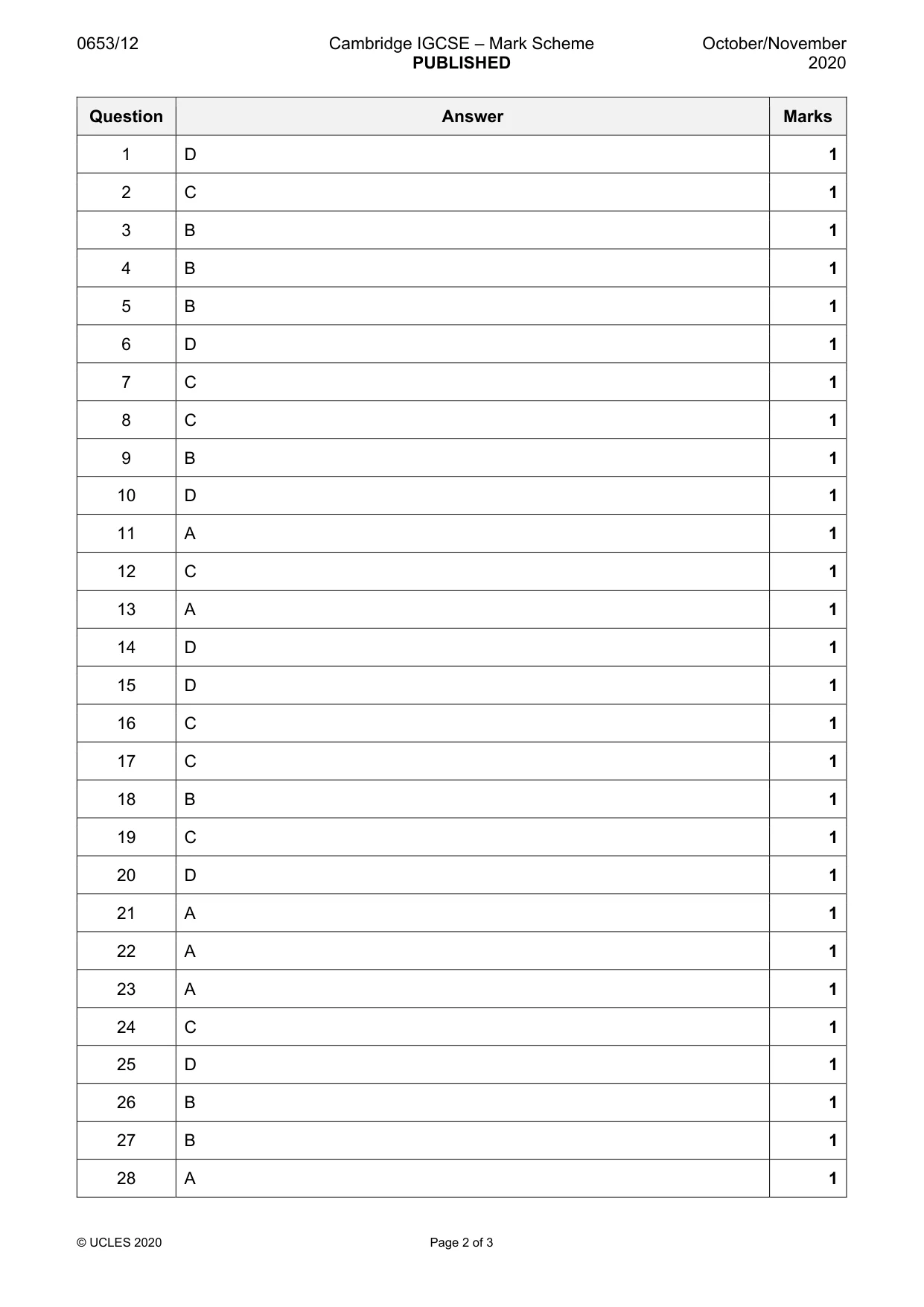
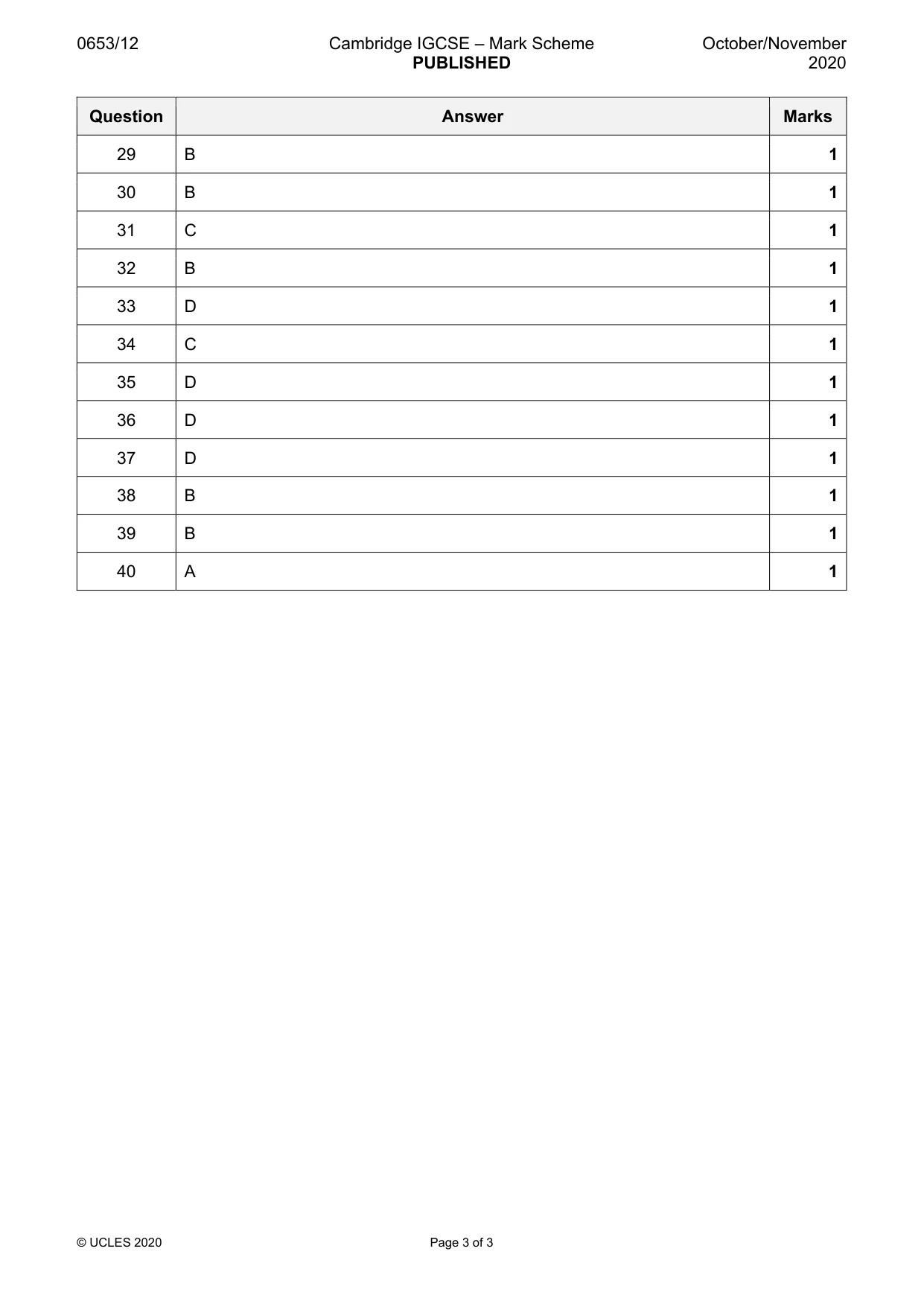
Mark scheme3 pages
Answers below. Sit the paper first if you are practising.
Questions as text
Q1 · A plant is placed next to a window
1 A plant is placed next to a window. After a few days, its leaves face the light. Which characteristic is this displaying? A excretion B nutrition C respiration D sensitivity
Mark scheme: D
Q2 · The diagram shows a cell from an animal’s liver
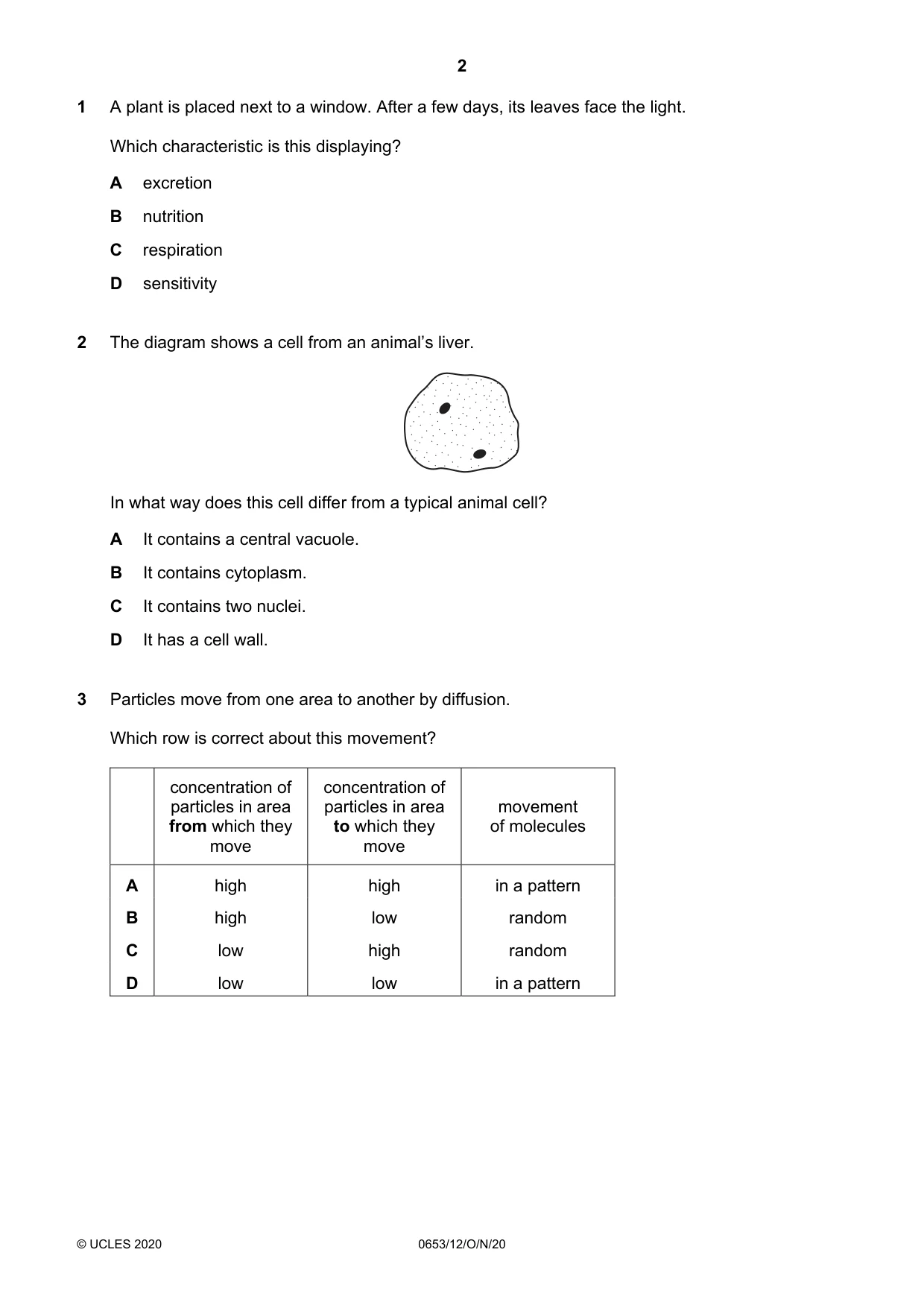
2 The diagram shows a cell from an animal’s liver. In what way does this cell differ from a typical animal cell? A It contains a central vacuole. B It contains cytoplasm. C It contains two nuclei. D It has a cell wall.
Mark scheme: C
Q3 · Particles move from one area to another by diffusion
3 Particles move from one area to another by diffusion. Which row is correct about this movement? concentration of concentration of particles in area particles in area movement from which they to which they of molecules move move A high high in a pattern B high low random C low high random D low low in a pattern
Mark scheme: B
Q4 · A student has samples of food and wants to test them for starch
4 A student has samples of food and wants to test them for starch. What should the student use to do this? A Benedict’s solution B iodine solution C limewater D water and ethanol
Mark scheme: B
Q5 · The diagram shows how the activity of an enzyme changes with temperature
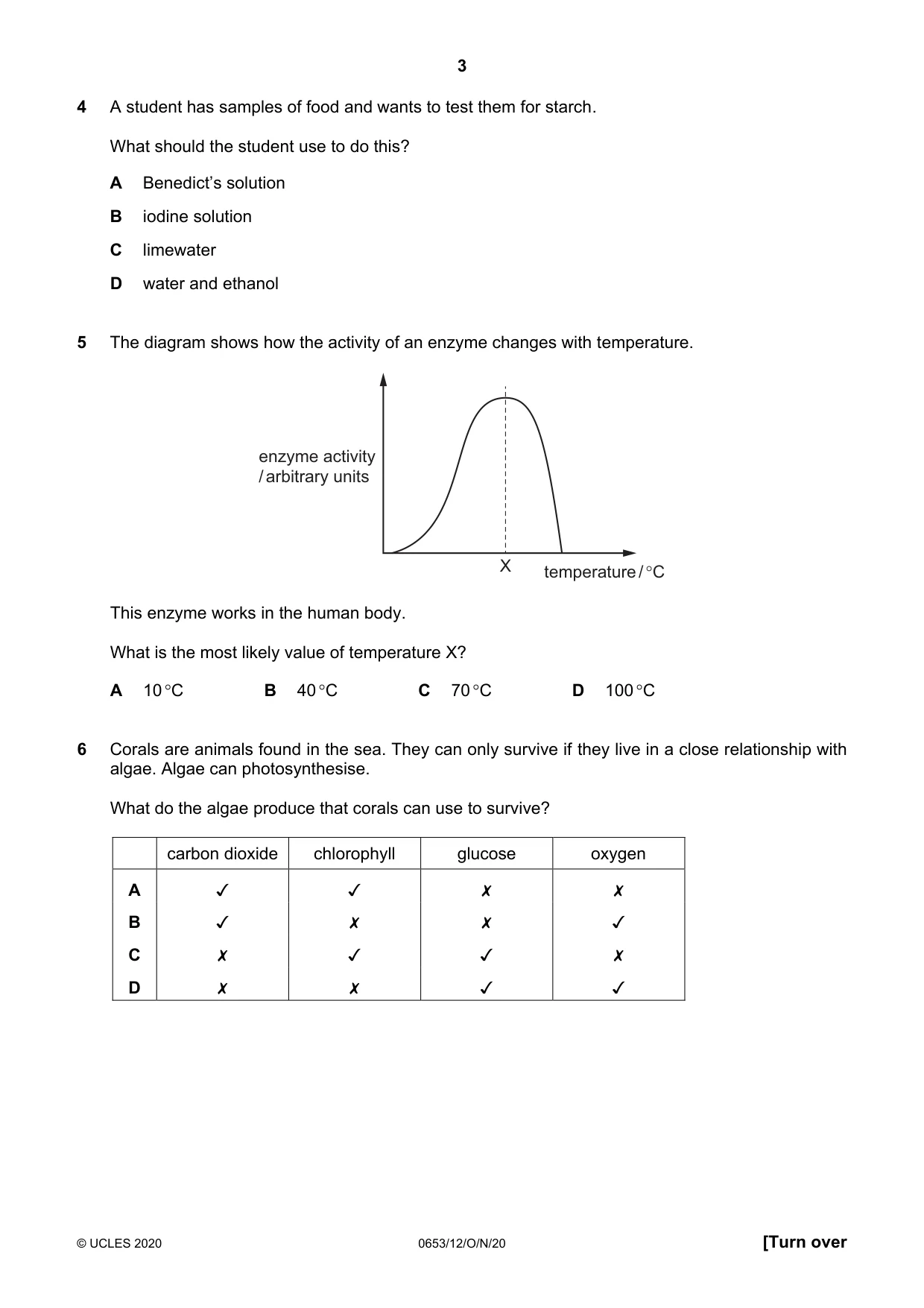
5 The diagram shows how the activity of an enzyme changes with temperature. enzyme activity / arbitrary units X temperature / °C This enzyme works in the human body. What is the most likely value of temperature X? A 10 C B 40 C C 70 C D 100 C
Mark scheme: B
Q6 · Corals are animals found in the sea
6 Corals are animals found in the sea. They can only survive if they live in a close relationship with algae. Algae can photosynthesise. What do the algae produce that corals can use to survive? carbon dioxide chlorophyll glucose oxygen v v x x 00 WwW > v x x x v v x x v Kx 4
Mark scheme: D
Q7 · Some undigested food passes out of the digestive system as faeces
7 Some undigested food passes out of the digestive system as faeces. What is this process? A absorption B digestion C egestion D ingestion
Mark scheme: C
Q8 · Which breakdown processes occur inside cells, and which occur outside cells?
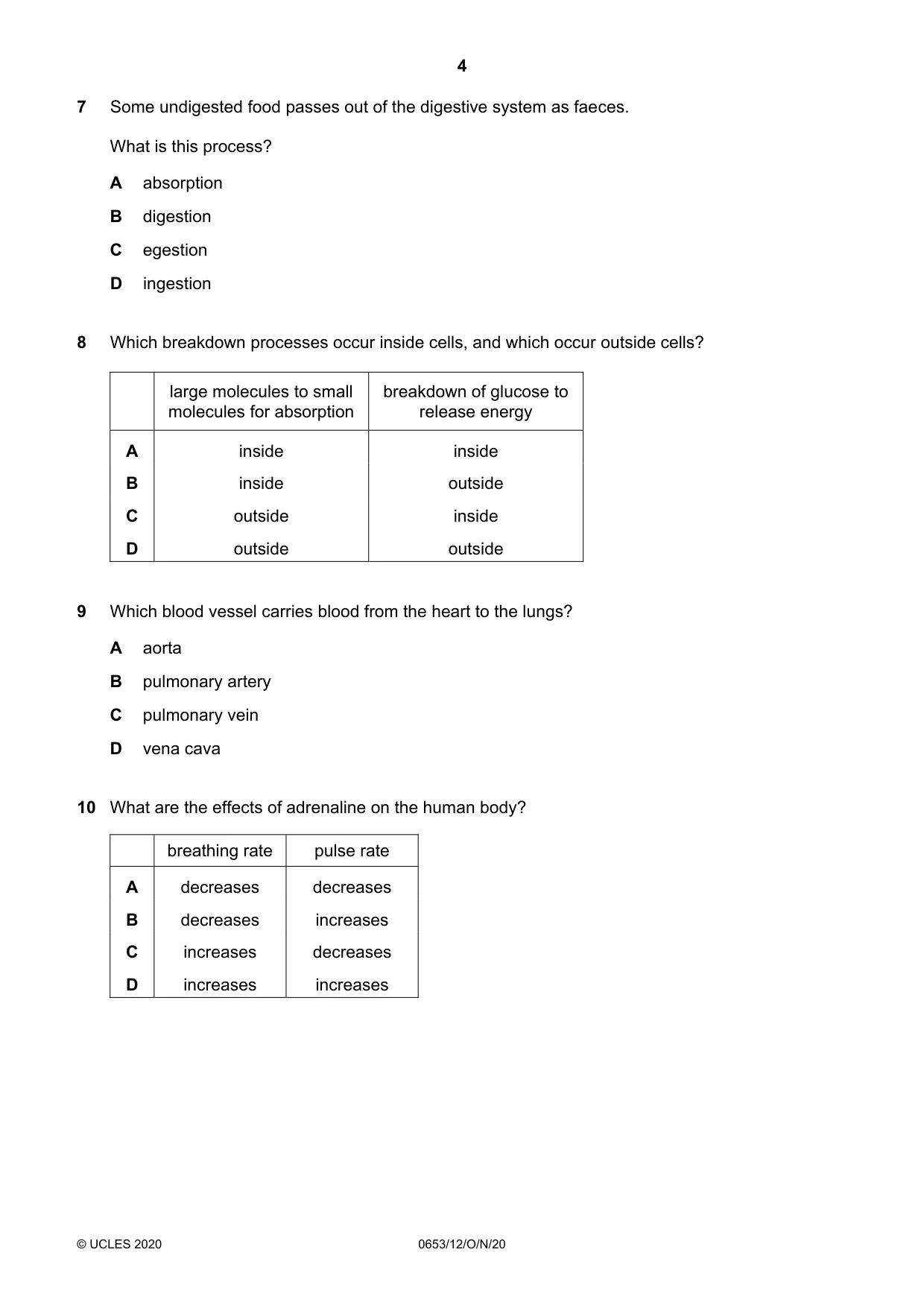
8 Which breakdown processes occur inside cells, and which occur outside cells? large molecules to small breakdown of glucose to molecules for absorption release energy A inside inside B inside outside C outside inside D outside outside
Mark scheme: C
Q9 · Which blood vessel carries blood from the heart to the lungs?
9 Which blood vessel carries blood from the heart to the lungs? A aorta B pulmonary artery C pulmonary vein D vena cava
Mark scheme: B
Q10 · What are the effects of adrenaline on the human body?
10 What are the effects of adrenaline on the human body? breathing rate pulse rate A decreases decreases B decreases increases C increases decreases D increases increases
Mark scheme: D
Q11 · Which row describes asexual reproduction?
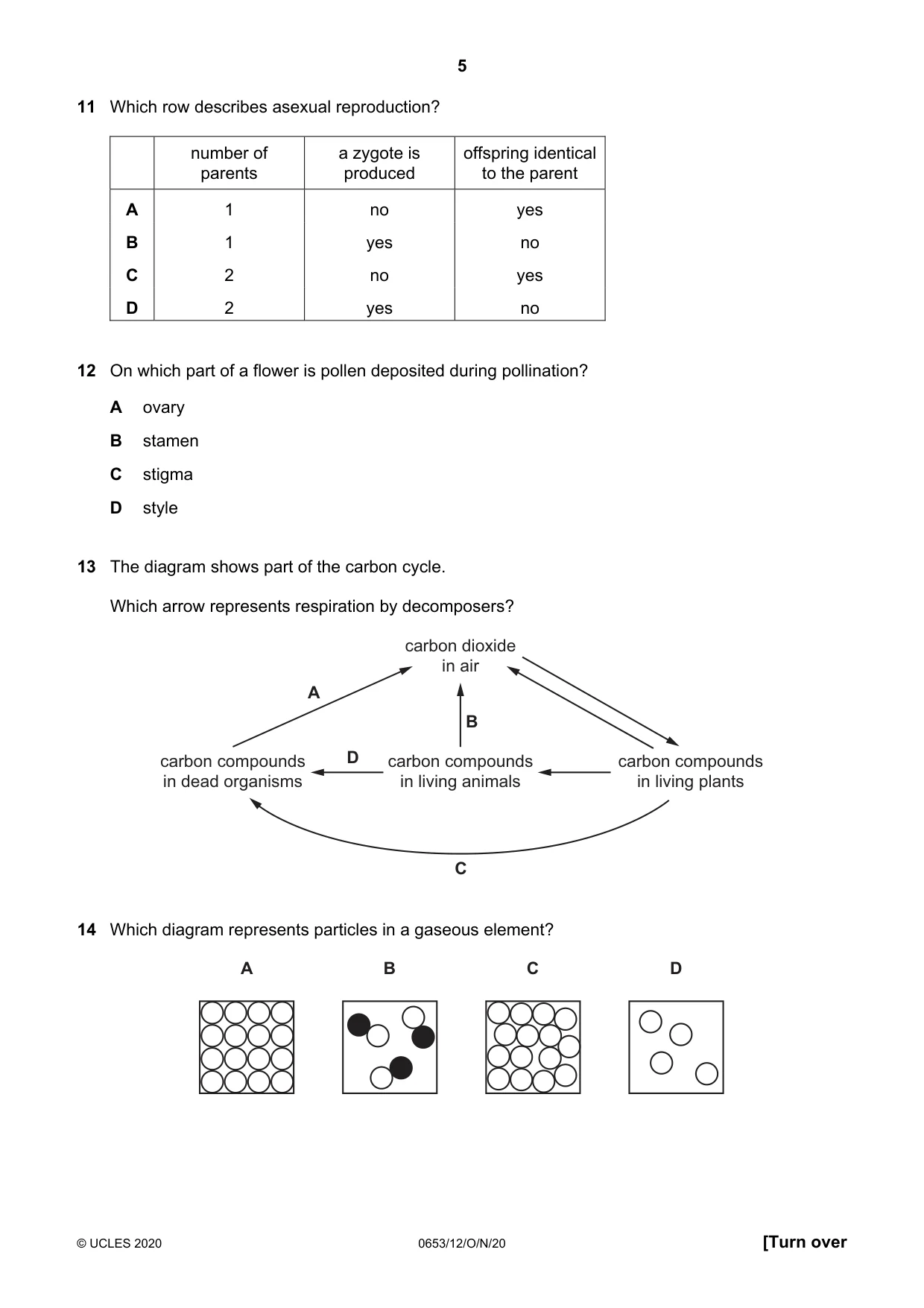
11 Which row describes asexual reproduction? number of a zygote is offspring identical parents produced to the parent A 1 no yes B 1 yes no C 2 no yes D 2 yes no
Mark scheme: A
Q12 · On which part of a flower is pollen deposited during pollination?
12 On which part of a flower is pollen deposited during pollination? A ovary B stamen C stigma D style
Mark scheme: C
Q13 · The diagram shows part of the carbon cycle
13 The diagram shows part of the carbon cycle. Which arrow represents respiration by decomposers? carbon dioxide in air A B carbon compounds D carbon compounds carbon compounds in dead organisms in living animals in living plants C
Mark scheme: A
Q14 · Which diagram represents particles in a gaseous element?
14 Which diagram represents particles in a gaseous element? A B C D
Mark scheme: D
Q15 · Chromatography separates ink into different colours
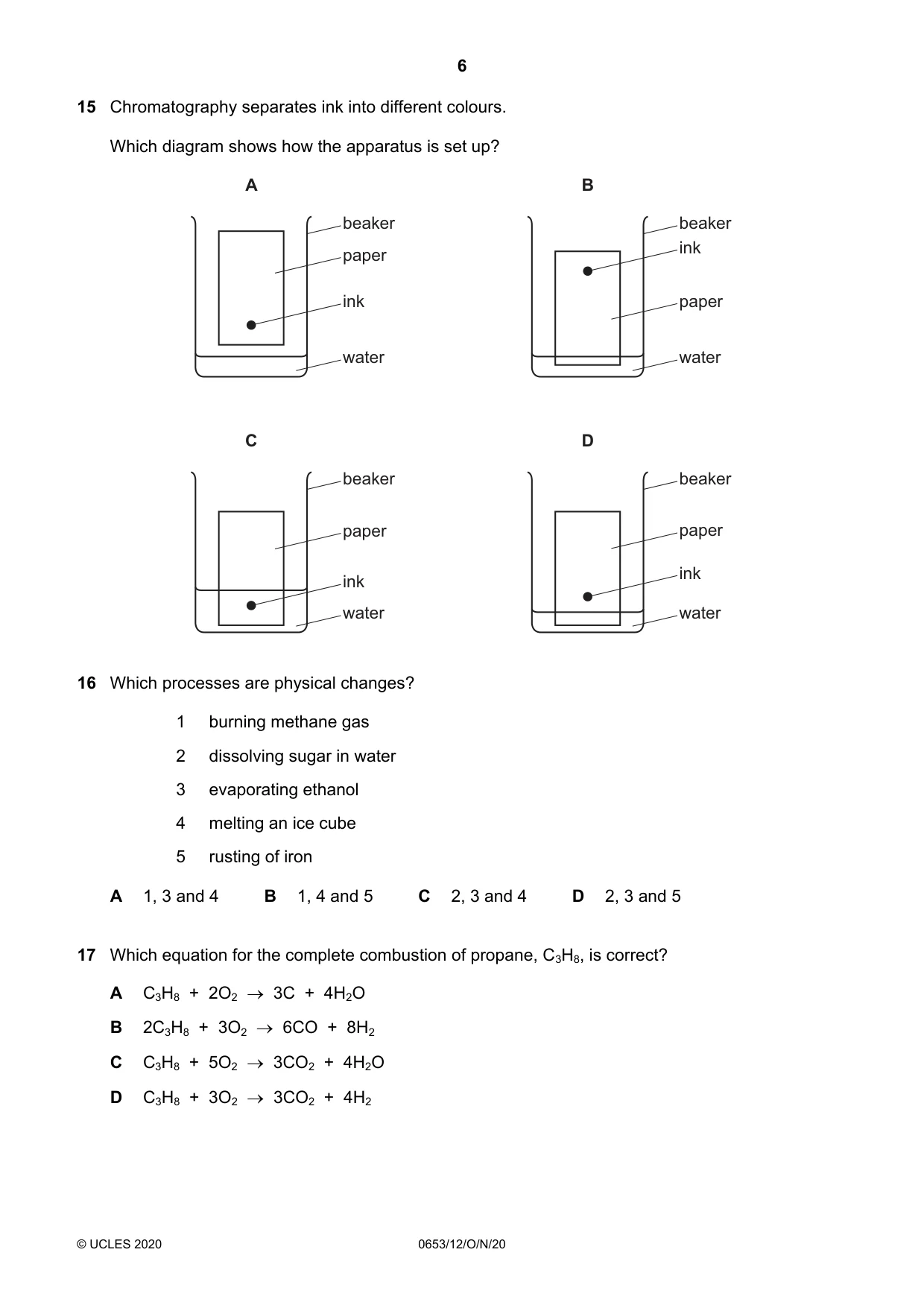
15 Chromatography separates ink into different colours. Which diagram shows how the apparatus is set up? A B beaker beaker paper ink ink paper water water C D beaker beaker paper paper ink ink water water
Mark scheme: D
Q16 · Which processes are physical changes?
16 Which processes are physical changes? 1 burning methane gas 2 dissolving sugar in water 3 evaporating ethanol 4 melting an ice cube 5 rusting of iron A 1, 3 and 4 B 1, 4 and 5 C 2, 3 and 4 D 2, 3 and 5
Mark scheme: C
Q17 · Which equation for the complete combustion of propane, C3H8, is correct?
17 Which equation for the complete combustion of propane, C3H8, is correct? A C3H8 + 2O2 3C + 4H2O B 2C3H8 + 3O2 6CO + 8H2 C C3H8 + 5O2 3CO2 + 4H2O D C3H8 + 3O2 3CO2 + 4H2
Mark scheme: C
Q18 · The diagram shows the electrolysis of molten lead(II) bromide
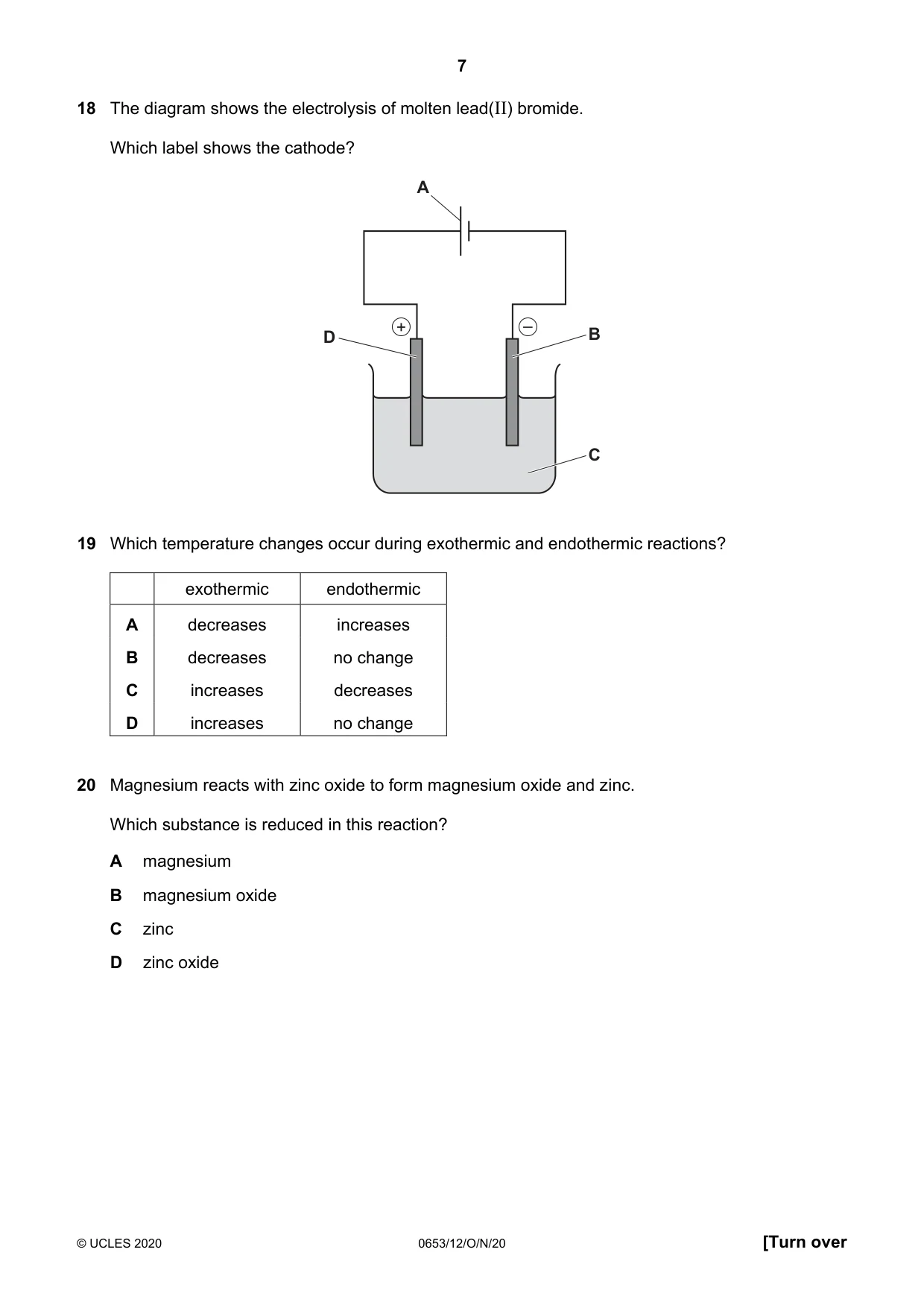
18 The diagram shows the electrolysis of molten lead(II) bromide. Which label shows the cathode? A D + – B C
Mark scheme: B
Q19 · Which temperature changes occur during exothermic and endothermic reactions?
19 Which temperature changes occur during exothermic and endothermic reactions? exothermic endothermic A decreases increases B decreases no change C increases decreases D increases no change
Mark scheme: C
Q20 · Magnesium reacts with zinc oxide to form magnesium oxide and zinc
20 Magnesium reacts with zinc oxide to form magnesium oxide and zinc. Which substance is reduced in this reaction? A magnesium B magnesium oxide C zinc D zinc oxide
Mark scheme: D
Q21 · Dilute hydrochloric acid is tested with universal indicator and with calcium carbonate
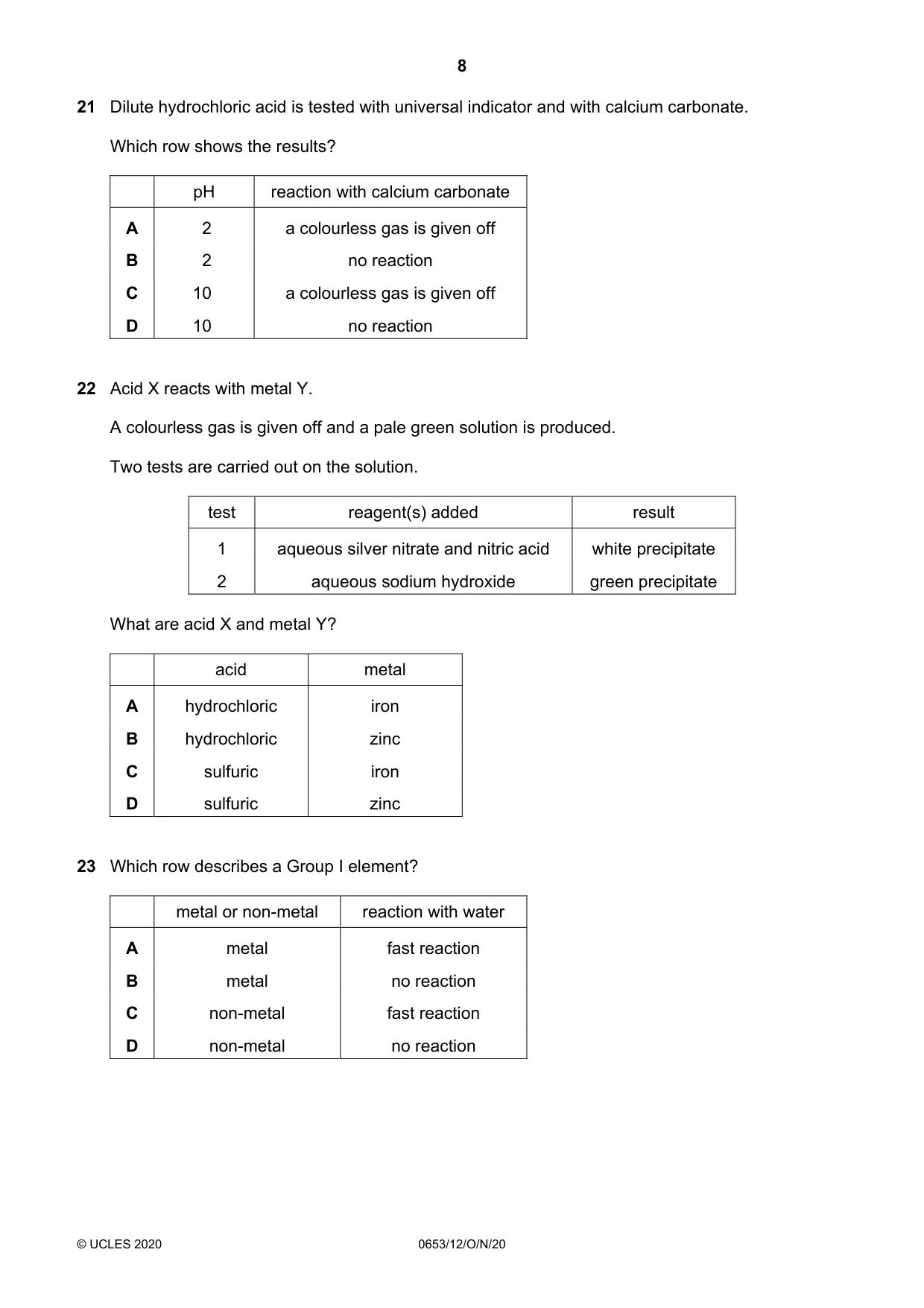
21 Dilute hydrochloric acid is tested with universal indicator and with calcium carbonate. Which row shows the results? pH reaction with calcium carbonate A 2 a colourless gas is given off B 2 no reaction C 10 a colourless gas is given off D 10 no reaction
Mark scheme: A
More questions on The characteristic properties of acids and bases
Q22 · Acid X reacts with metal Y
22 Acid X reacts with metal Y. A colourless gas is given off and a pale green solution is produced. Two tests are carried out on the solution. test reagent(s) added result 1 aqueous silver nitrate and nitric acid white precipitate 2 aqueous sodium hydroxide green precipitate What are acid X and metal Y? acid metal A hydrochloric iron B hydrochloric zinc C sulfuric iron D sulfuric zinc
Mark scheme: A
Q23 · Which row describes a Group I element?
23 Which row describes a Group I element? metal or non-metal reaction with water A metal fast reaction B metal no reaction C non-metal fast reaction D non-metal no reaction
Mark scheme: A
Q24 · Substance X is a coloured solid
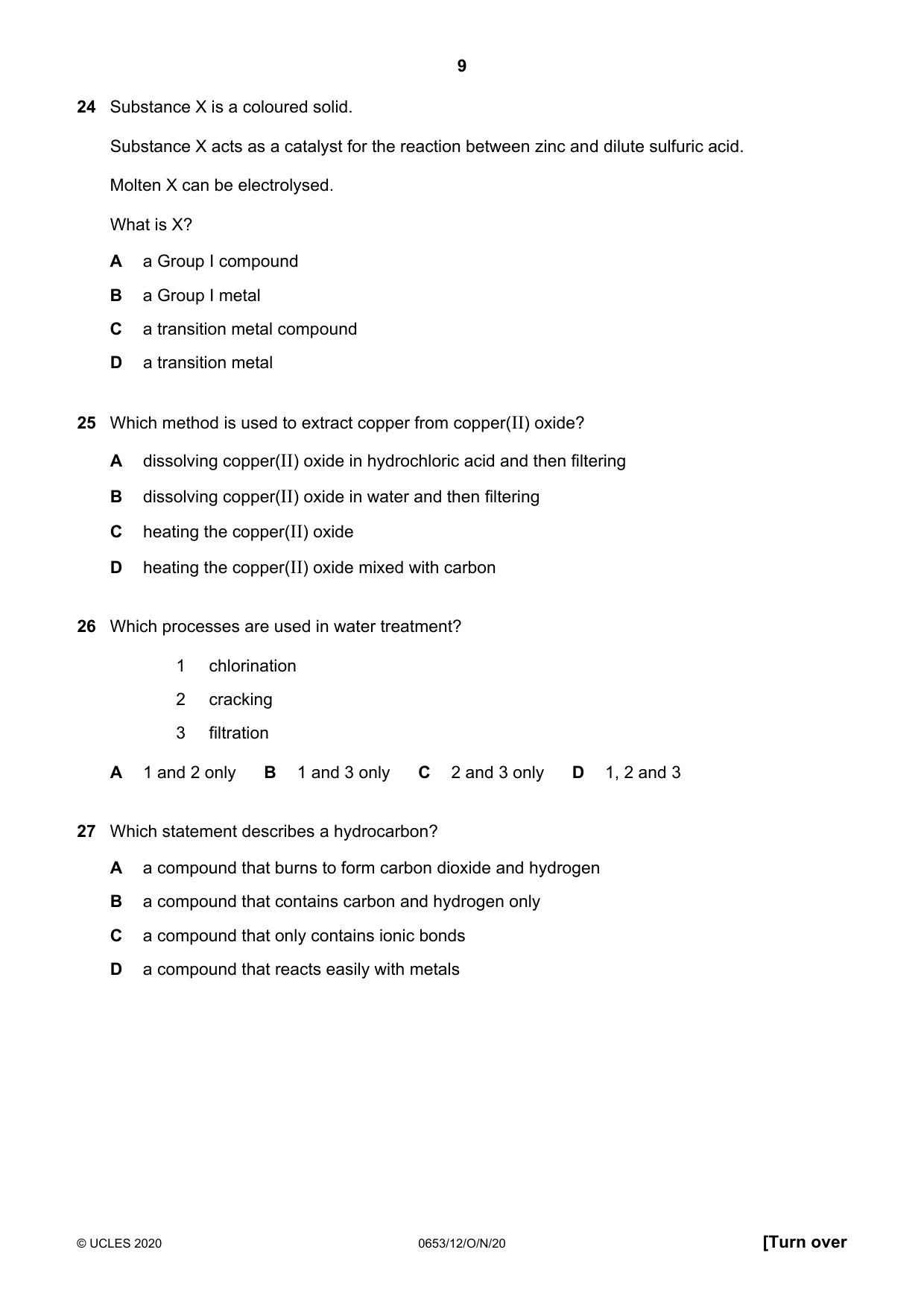
24 Substance X is a coloured solid. Substance X acts as a catalyst for the reaction between zinc and dilute sulfuric acid. Molten X can be electrolysed. What is X? A a Group I compound B a Group I metal C a transition metal compound D a transition metal
Mark scheme: C
Q25 · Which method is used to extract copper from copper(II) oxide?
25 Which method is used to extract copper from copper(II) oxide? A dissolving copper(II) oxide in hydrochloric acid and then filtering B dissolving copper(II) oxide in water and then filtering C heating the copper(II) oxide D heating the copper(II) oxide mixed with carbon
Mark scheme: D
Q26 · Which processes are used in water treatment?
26 Which processes are used in water treatment? 1 chlorination 2 cracking 3 filtration A 1 and 2 only B 1 and 3 only C 2 and 3 only D 1, 2 and 3
Mark scheme: B
Q27 · Which statement describes a hydrocarbon?
27 Which statement describes a hydrocarbon? A a compound that burns to form carbon dioxide and hydrogen B a compound that contains carbon and hydrogen only C a compound that only contains ionic bonds D a compound that reacts easily with metals
Mark scheme: B
Q28 · Which speed–time graph represents motion for which the acceleration is constant but not…
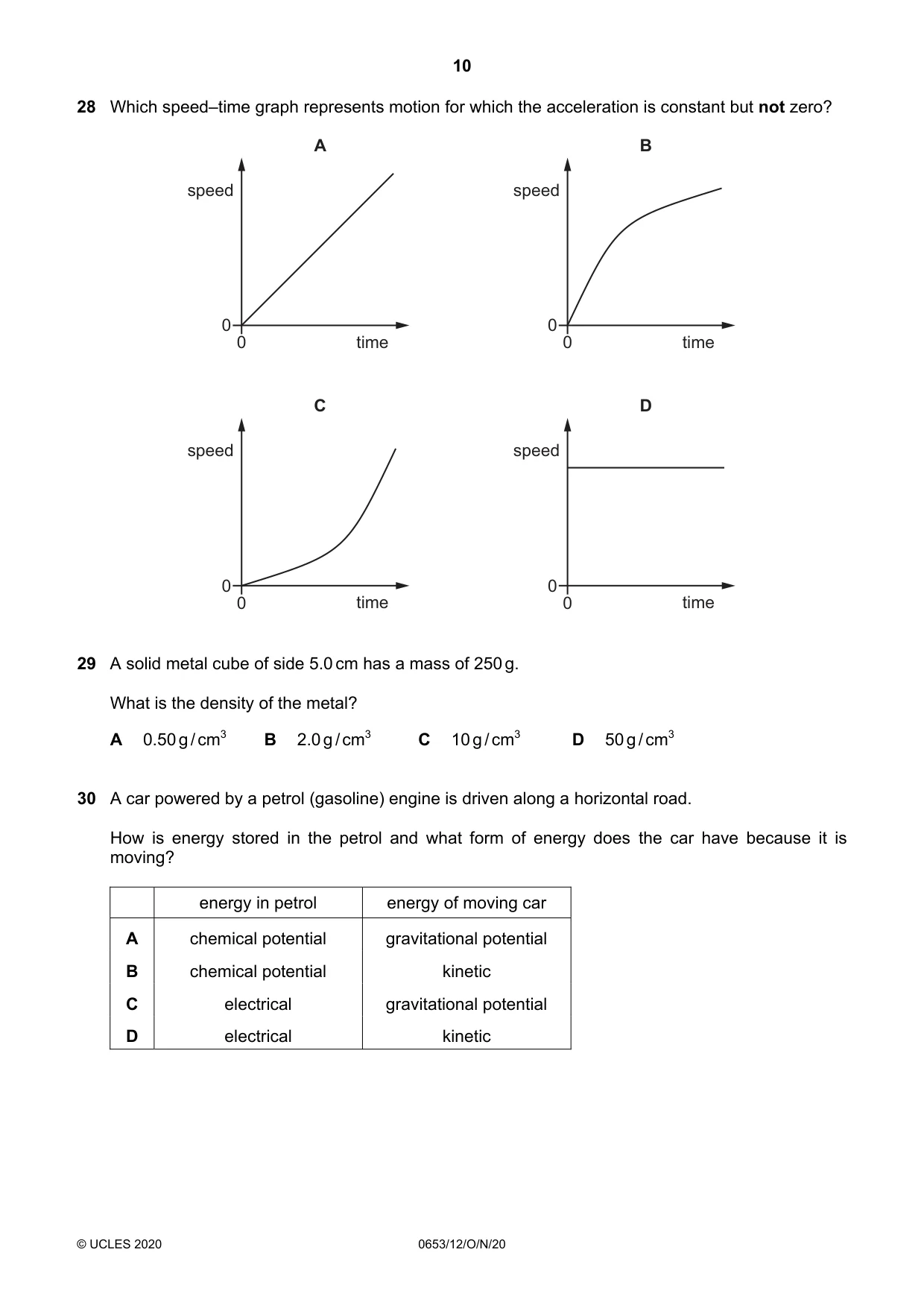
28 Which speed–time graph represents motion for which the acceleration is constant but not zero? A B speed speed 0 0 0 time 0 time C D speed speed 0 0 0 time 0 time
Mark scheme: A
Q29 · A solid metal cube of side 5.0 cm has a mass of 250 g
29 A solid metal cube of side 5.0 cm has a mass of 250 g. What is the density of the metal? A 0.50 g / cm3 B 2.0 g / cm3 C 10 g / cm3 D 50 g / cm3
Mark scheme: B
Q30 · A car powered by a petrol (gasoline) engine is driven along a horizontal road
30 A car powered by a petrol (gasoline) engine is driven along a horizontal road. How is energy stored in the petrol and what form of energy does the car have because it is moving? energy in petrol energy of moving car A chemical potential gravitational potential B chemical potential kinetic C electrical gravitational potential D electrical kinetic
Mark scheme: B
Q31 · The molecules of a liquid are close together
31 The molecules of a liquid are close together. What are other features of the molecules in a liquid? A They are arranged in a regular pattern but change positions with each other. B They are arranged in a regular pattern and vibrate about fixed positions. C They are arranged randomly and change positions with each other. D They are arranged randomly and vibrate about fixed positions.
Mark scheme: C
Q32 · In which states of matter can convection occur?
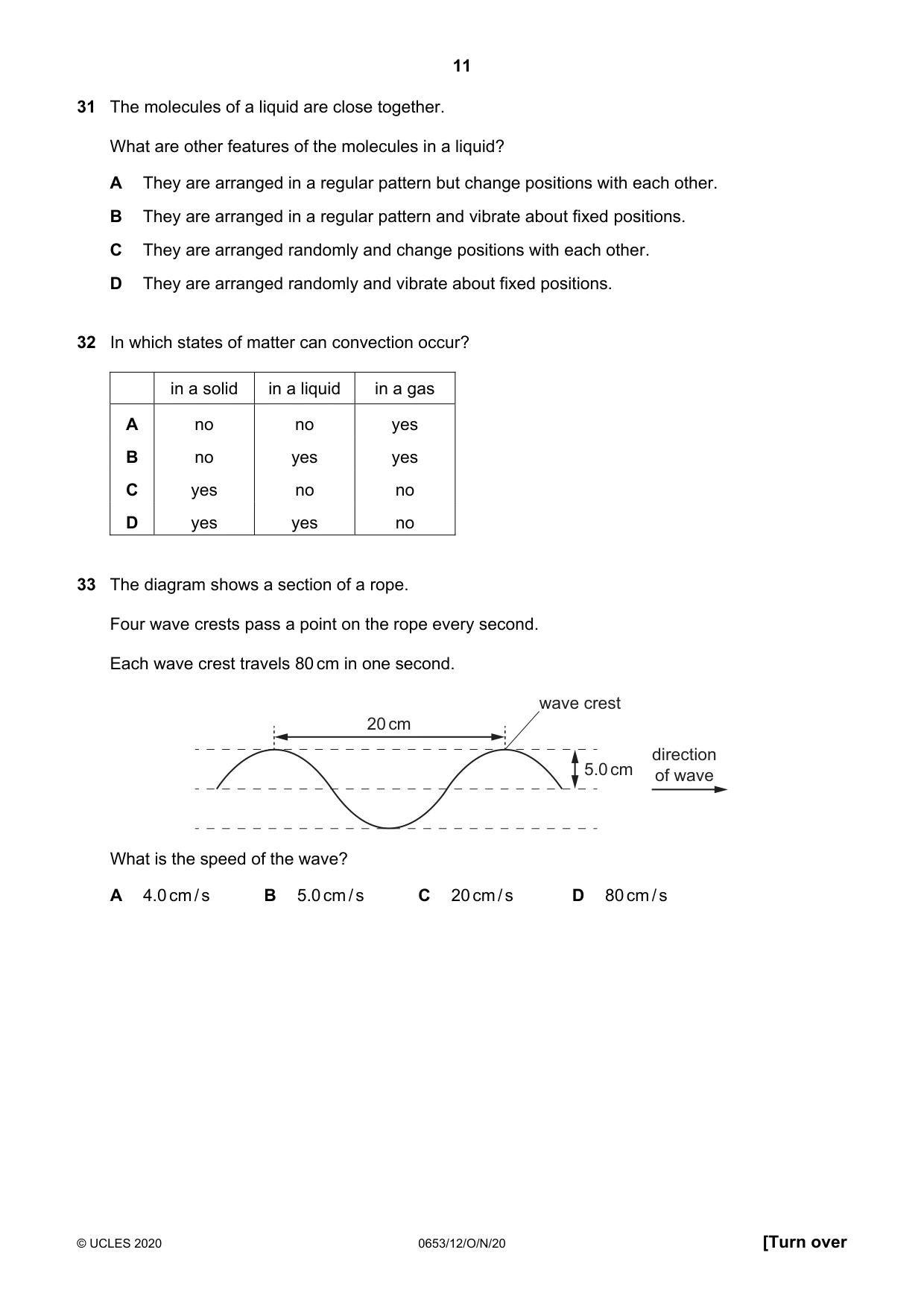
32 In which states of matter can convection occur? in a solid in a liquid in a gas A no no yes B no yes yes C yes no no D yes yes no
Mark scheme: B
Q33 · The diagram shows a section of a rope
33 The diagram shows a section of a rope. Four wave crests pass a point on the rope every second. Each wave crest travels 80 cm in one second. wave crest 20 cm direction 5.0 cm of wave What is the speed of the wave? A 4.0 cm / s B 5.0 cm / s C 20 cm / s D 80 cm / s
Mark scheme: D
Q34 · A source of light is placed in front of a plane mirror
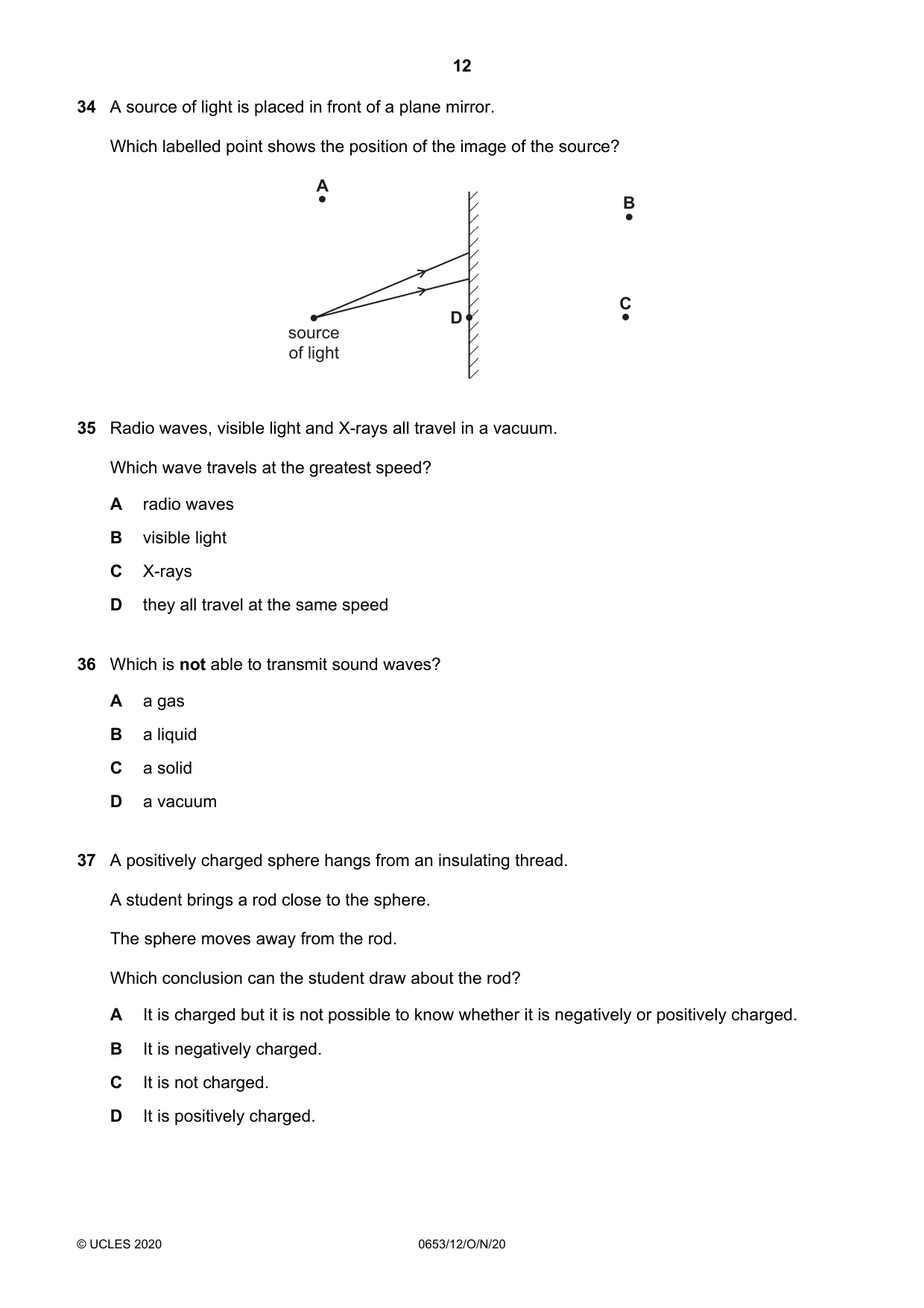
34 A source of light is placed in front of a plane mirror. Which labelled point shows the position of the image of the source? A B C D source of light
Mark scheme: C
Q35 · Radio waves, visible light and X-rays all travel in a vacuum
35 Radio waves, visible light and X-rays all travel in a vacuum. Which wave travels at the greatest speed? A radio waves B visible light C X-rays D they all travel at the same speed
Mark scheme: D
Q36 · Which is not able to transmit sound waves?
36 Which is not able to transmit sound waves? A a gas B a liquid C a solid D a vacuum
Mark scheme: D
Q37 · A positively charged sphere hangs from an insulating thread
37 A positively charged sphere hangs from an insulating thread. A student brings a rod close to the sphere. The sphere moves away from the rod. Which conclusion can the student draw about the rod? A It is charged but it is not possible to know whether it is negatively or positively charged. B It is negatively charged. C It is not charged. D It is positively charged.
Mark scheme: D
Q38 · A power supply causes a current in a circuit
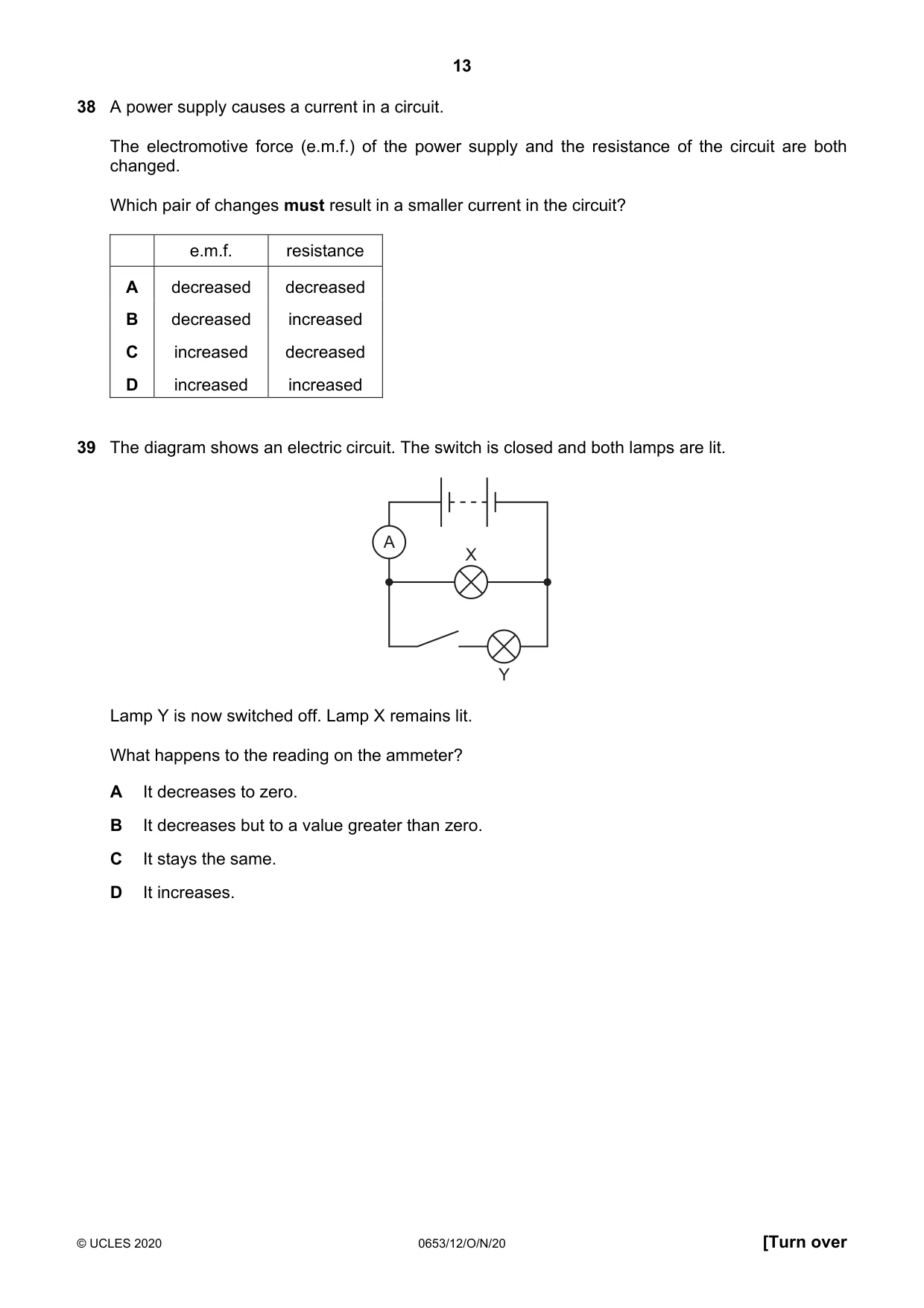
38 A power supply causes a current in a circuit. The electromotive force (e.m.f.) of the power supply and the resistance of the circuit are both changed. Which pair of changes must result in a smaller current in the circuit? e.m.f. resistance A decreased decreased B decreased increased C increased decreased D increased increased
Mark scheme: B
Q39 · The diagram shows an electric circuit
39 The diagram shows an electric circuit. The switch is closed and both lamps are lit. A X Y Lamp Y is now switched off. Lamp X remains lit. What happens to the reading on the ammeter? A It decreases to zero. B It decreases but to a value greater than zero. C It stays the same. D It increases.
Mark scheme: B
Q40 · The diagrams show four identical resistors connected in different combinations
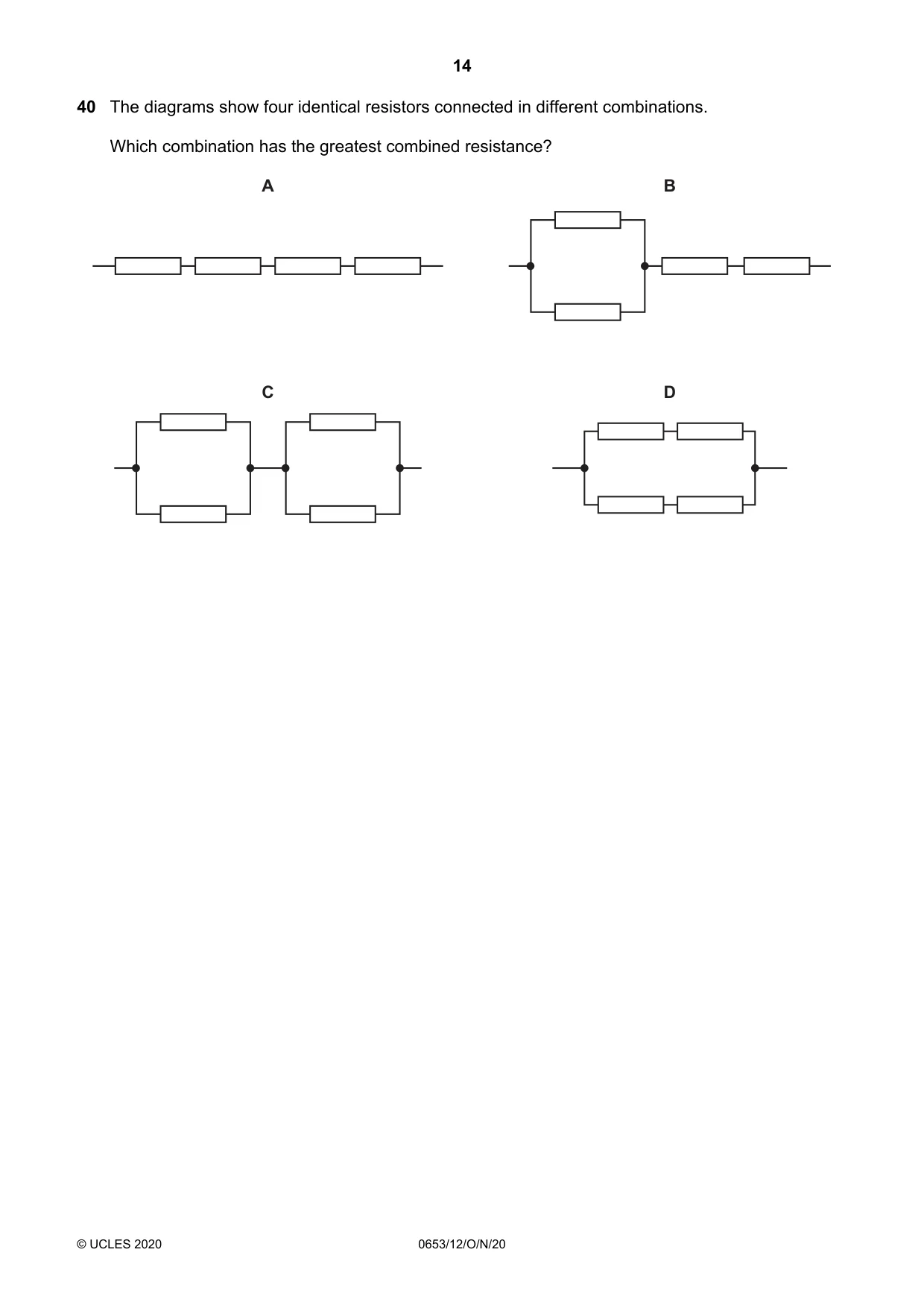
40 The diagrams show four identical resistors connected in different combinations. Which combination has the greatest combined resistance? A B C D
Mark scheme: A
What was in this paper
The subtopics covered by these 40 questions, and how many questions each got. Open one in a new tab to see every Cambridge question on it.
2Electrical quantities2Sexual reproduction in plants2Biological molecules1Carbon cycle1Cell structure1Characteristics of living organisms1Chromatography1Density1Diffusion1Digestion1Digestive system1Drugs1Electrolysis1Electromagnetic spectrum1Energy, work and power1Enzymes1Exothermic and endothermic reactions1Extraction of metals1Fuels1General properties of waves1Group I properties1Heart1Identification of ions and gases1Kinetic particle model of matter1Light1Motion1Photosynthesis1Physical and chemical changes1Redox1Solids, liquids and gases1Sound1Terminology1The characteristic properties of acids and bases1Transfer of thermal energy1Transition elements1Water1What you needed in this session
Cambridge’s own grade thresholds for 2020 Oct/Nov, Paper 1 · Variant 2. A higher threshold means an easier paper — the bar moves with how the cohort did.