Cambridge IGCSE Science - Combined 0653 — 2024 Oct/Nov Paper 1 · Variant 1
0653/11/O/N/24 · 40 questions · 40 marks · ≈45 min
The question paper and its mark scheme, free to read here and free to download. This is Cambridge’s own paper, exactly as it was sat.
Question paper16 pages


Mark scheme3 pages
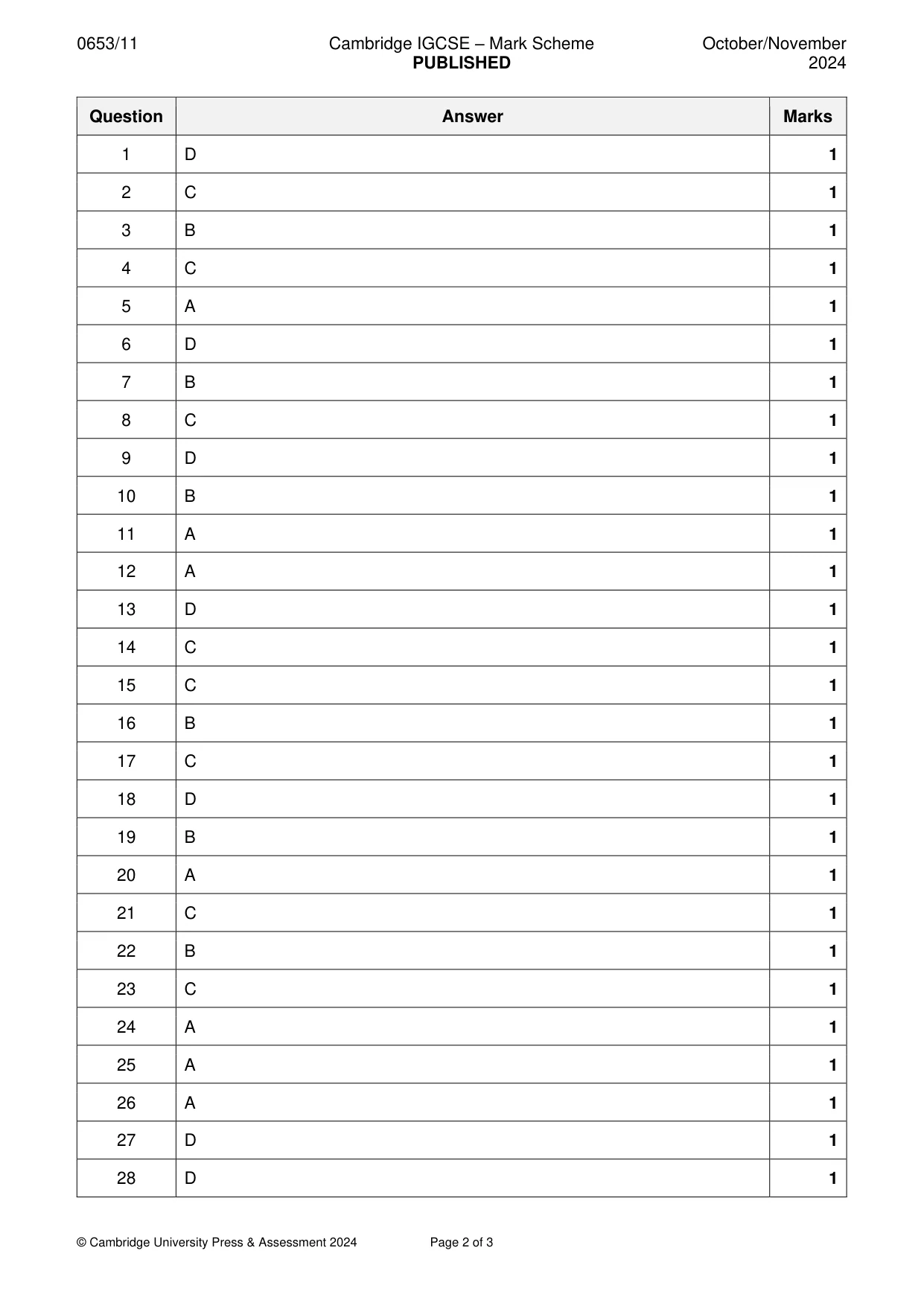
Answers below. Sit the paper first if you are practising.
Questions as text
Q1 · Chemical reactions in a muscle cell release energy by breaking down nutrient molecules
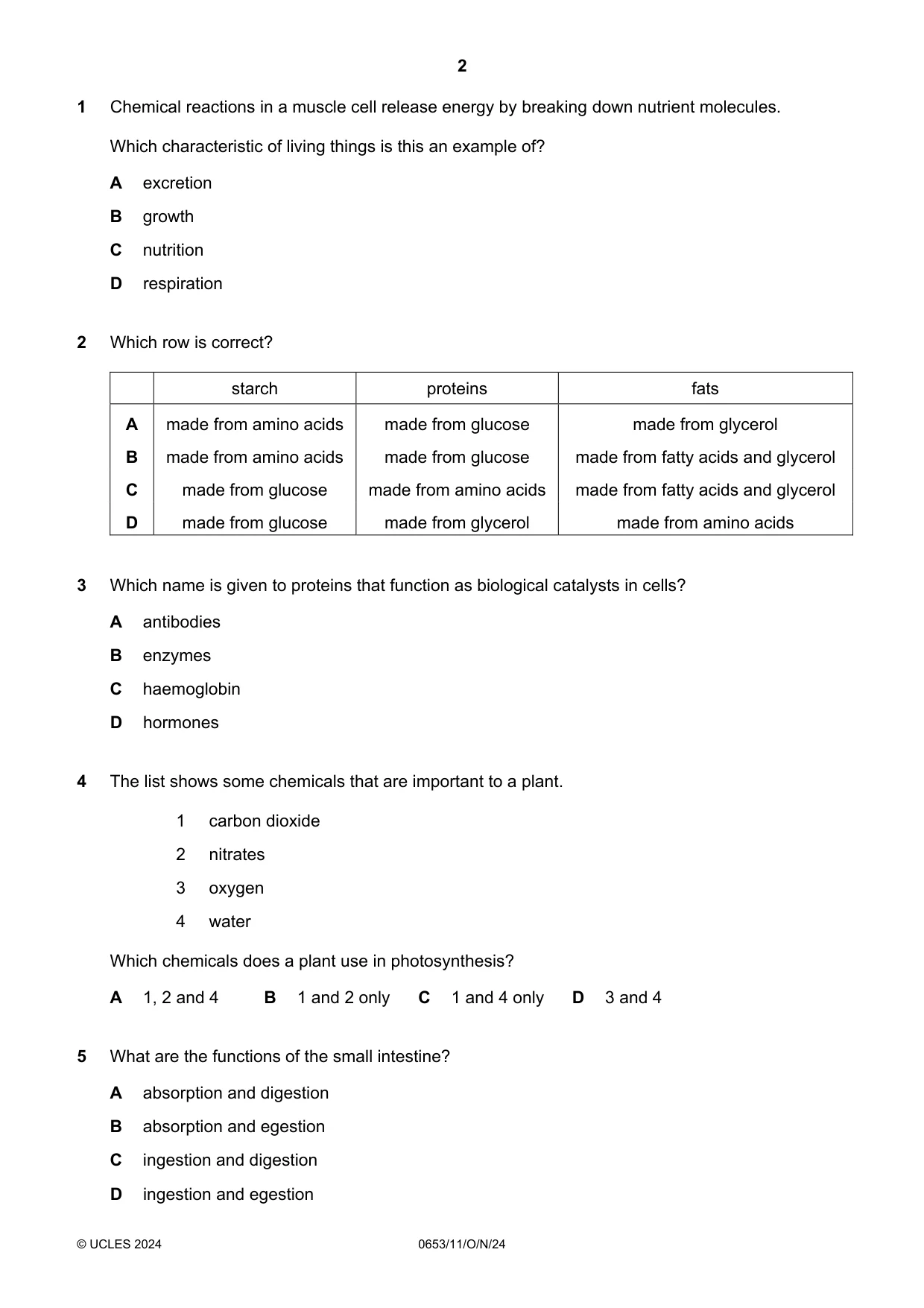
1 Chemical reactions in a muscle cell release energy by breaking down nutrient molecules. Which characteristic of living things is this an example of? A excretion B growth C nutrition D respiration
Mark scheme: D
Q2 · Which row is correct?
2 Which row is correct? starch proteins fats A made from amino acids made from glucose made from glycerol B made from amino acids made from glucose made from fatty acids and glycerol C made from glucose made from amino acids made from fatty acids and glycerol D made from glucose made from glycerol made from amino acids
Mark scheme: C
Q3 · Which name is given to proteins that function as biological catalysts in cells?
3 Which name is given to proteins that function as biological catalysts in cells? A antibodies B enzymes C haemoglobin D hormones
Mark scheme: B
Q4 · The list shows some chemicals that are important to a plant
4 The list shows some chemicals that are important to a plant. 1 carbon dioxide 2 nitrates 3 oxygen 4 water Which chemicals does a plant use in photosynthesis? A 1, 2 and 4 B 1 and 2 only C 1 and 4 only D 3 and 4
Mark scheme: C
Q5 · What are the functions of the small intestine?
5 What are the functions of the small intestine? A absorption and digestion B absorption and egestion C ingestion and digestion D ingestion and egestion
Mark scheme: A
Q6 · The table shows some of the processes involved in transpiration
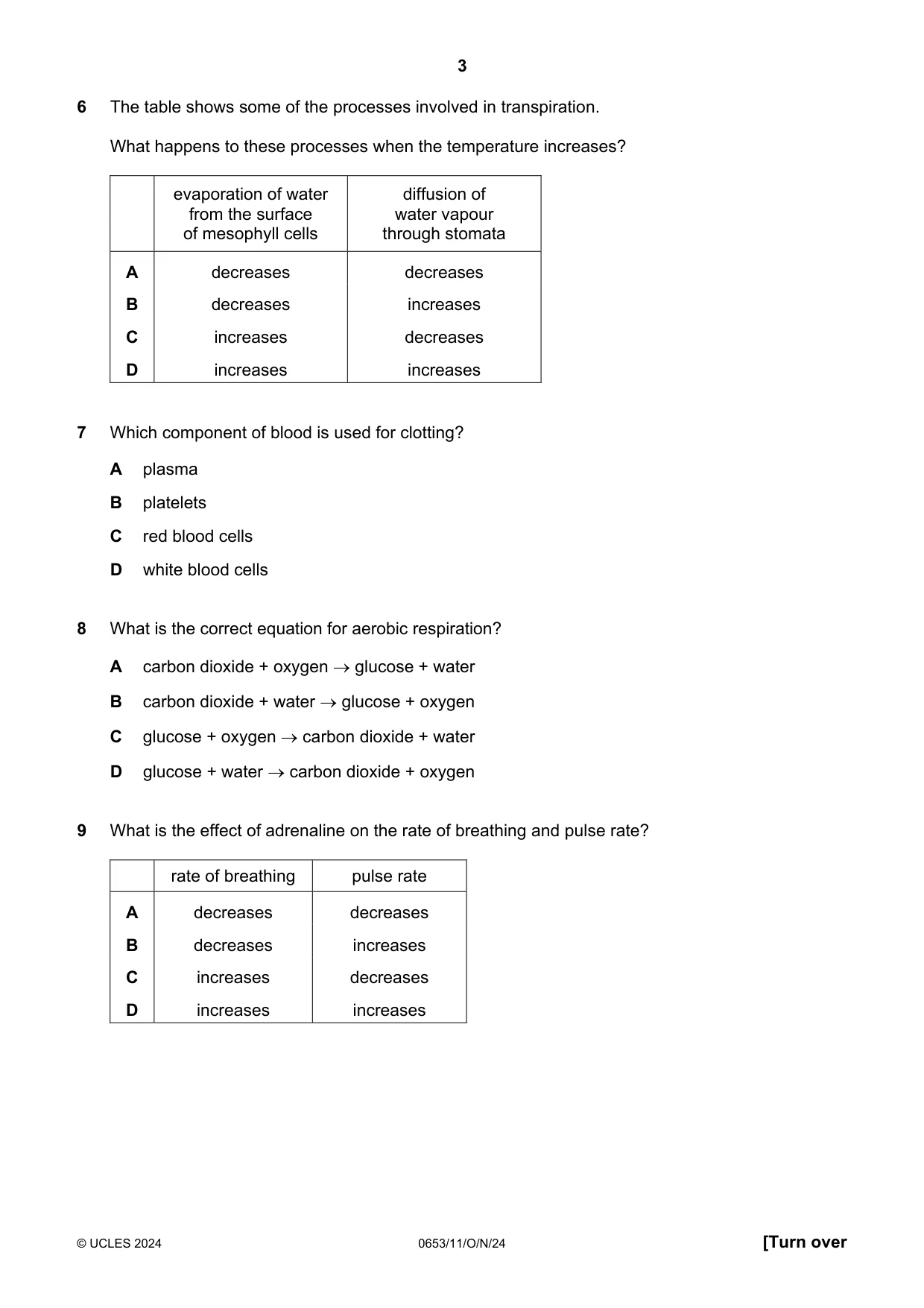
6 The table shows some of the processes involved in transpiration. What happens to these processes when the temperature increases? evaporation of water diffusion of from the surface water vapour of mesophyll cells through stomata A decreases decreases B decreases increases C increases decreases D increases increases
Mark scheme: D
Q7 · Which component of blood is used for clotting?
7 Which component of blood is used for clotting? A plasma B platelets C red blood cells D white blood cells
Mark scheme: B
Q8 · What is the correct equation for aerobic respiration?
8 What is the correct equation for aerobic respiration? A carbon dioxide + oxygen glucose + water B carbon dioxide + water glucose + oxygen C glucose + oxygen carbon dioxide + water D glucose + water carbon dioxide + oxygen
Mark scheme: C
Q9 · What is the effect of adrenaline on the rate of breathing and pulse rate?
9 What is the effect of adrenaline on the rate of breathing and pulse rate? rate of breathing pulse rate A decreases decreases B decreases increases C increases decreases D increases increases
Mark scheme: D
Q10 · Which row is correct for sexual reproduction?
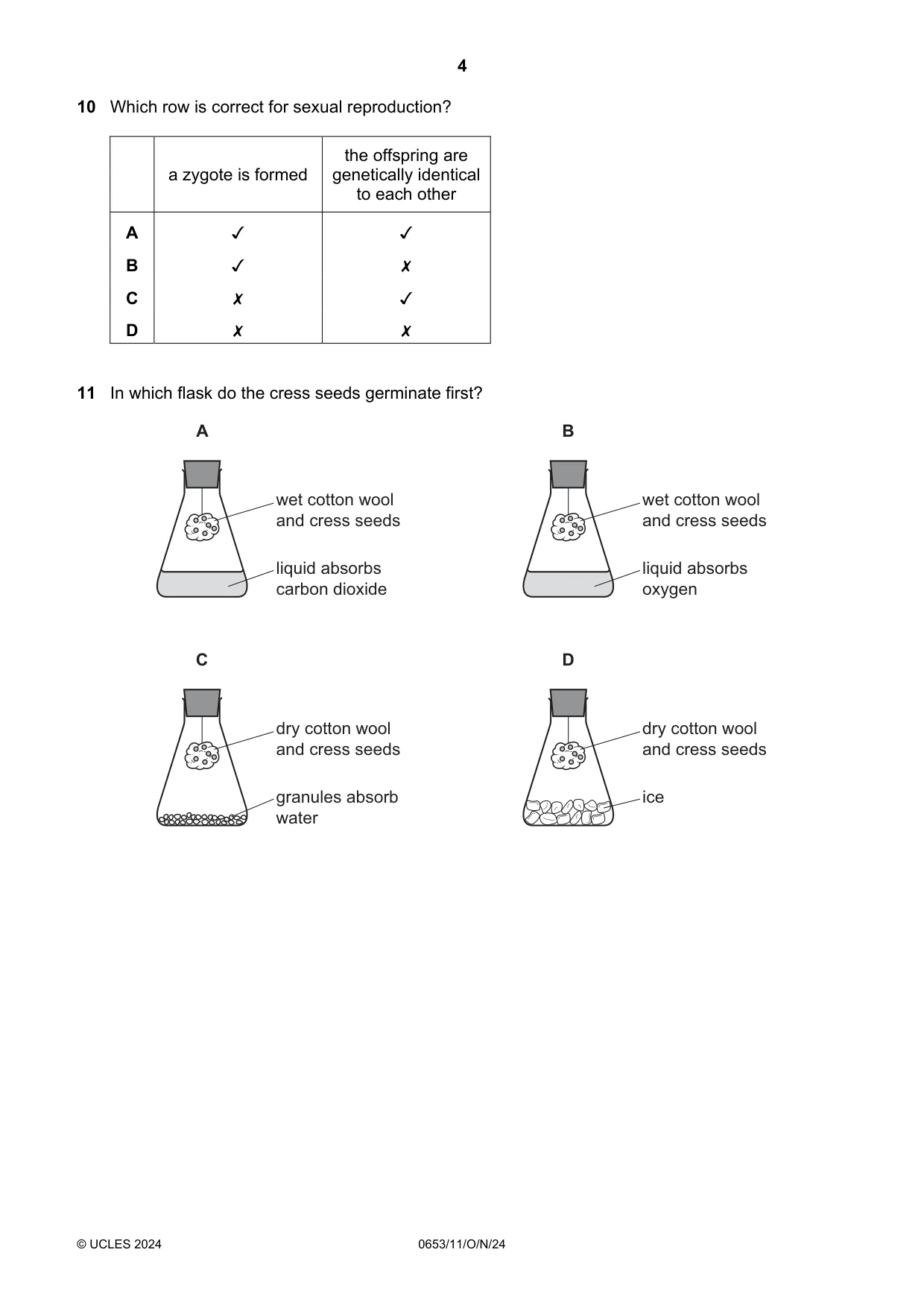
10 Which row is correct for sexual reproduction? a zygote is formed the offspring are genetically identical to each other 0 0O WwW D> ~~ & SOK v x v x
Mark scheme: B
Q11 · In which flask do the cress seeds germinate first?
11 In which flask do the cress seeds germinate first? A B wet cotton wool wet cotton wool and cress seeds and cress seeds liquid absorbs liquid absorbs carbon dioxide oxygen C D dry cotton wool dry cotton wool and cress seeds and cress seeds granules absorb ice water
Mark scheme: A
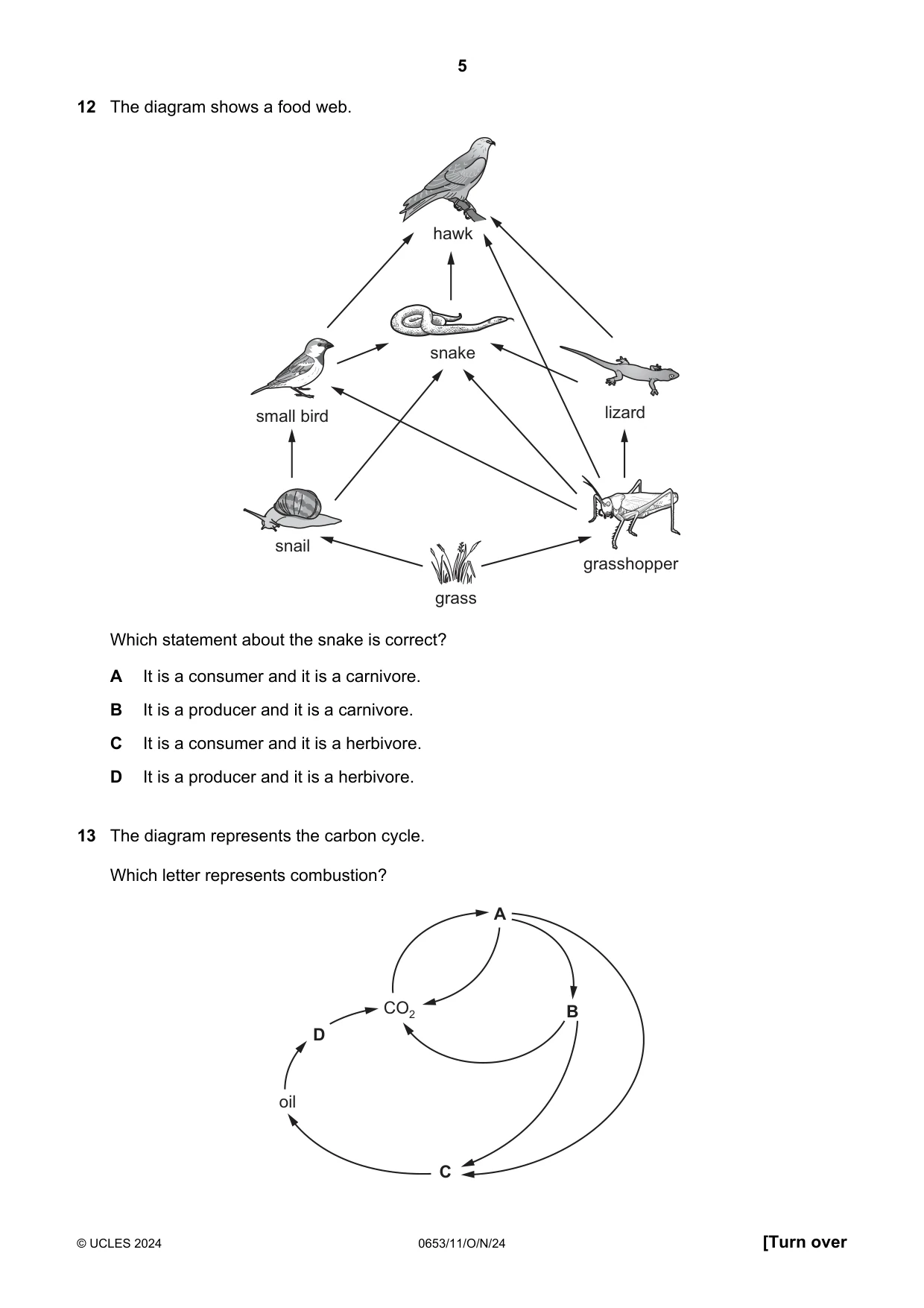
Q12 · The diagram shows a food web
12 The diagram shows a food web. hawk snake small bird lizard snail grasshopper grass Which statement about the snake is correct? A It is a consumer and it is a carnivore. B It is a producer and it is a carnivore. C It is a consumer and it is a herbivore. D It is a producer and it is a herbivore.
Mark scheme: A
Q13 · The diagram represents the carbon cycle
13 The diagram represents the carbon cycle. Which letter represents combustion? A CO2 B D oil C
Mark scheme: D
Q14 · Four processes are listed
14 Four processes are listed. 1 melting of ice 2 electrolysis of molten lead(II) bromide 3 combustion of carbon 4 rusting of iron Which processes are chemical changes? A 1, 2 and 3 B 1 and 3 only C 2, 3 and 4 D 2 and 4 only
Mark scheme: C
Q15 · Aluminium sulfate contains two aluminium atoms, three sulfur atoms and twelve oxygen atoms
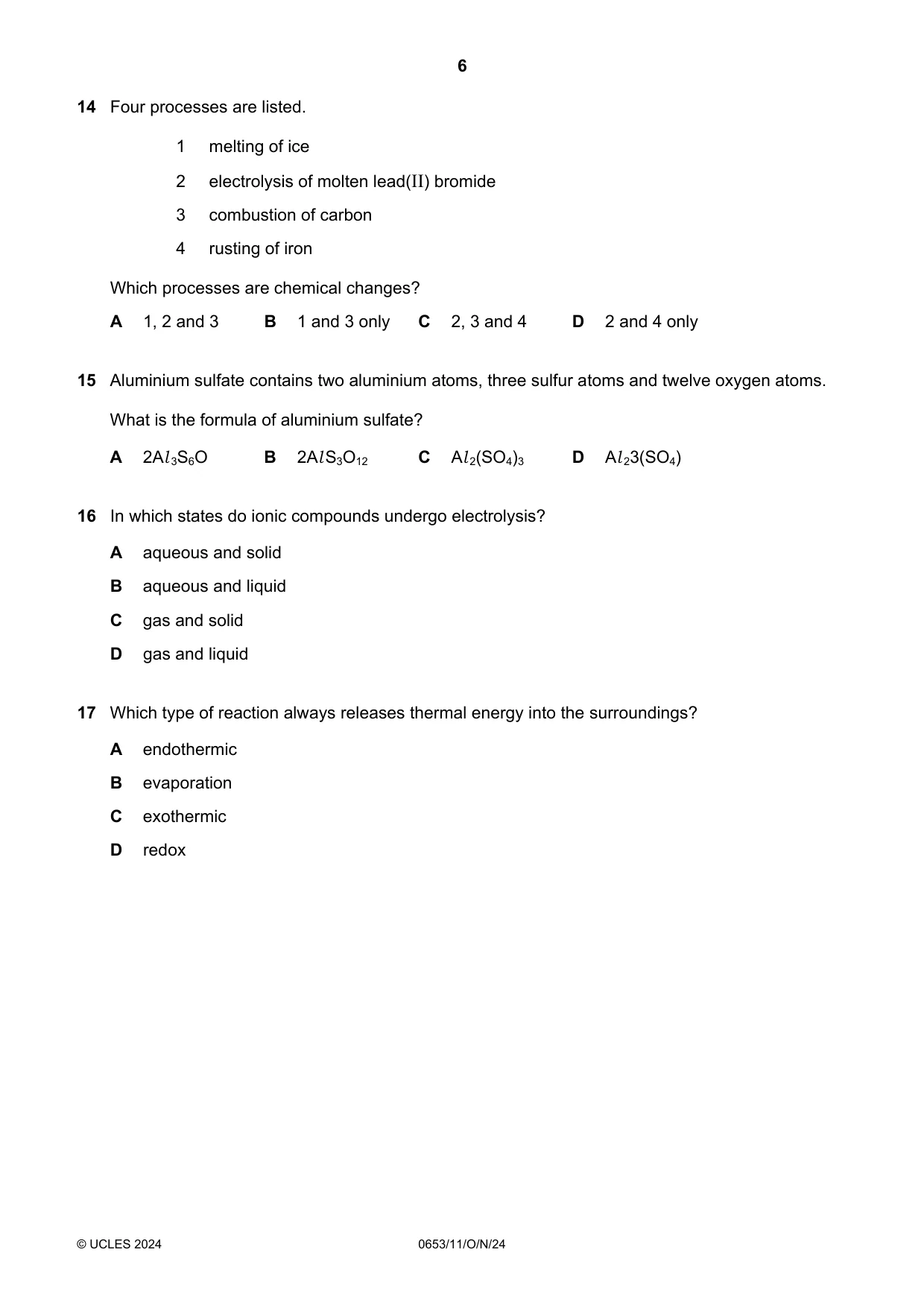
15 Aluminium sulfate contains two aluminium atoms, three sulfur atoms and twelve oxygen atoms. What is the formula of aluminium sulfate? A 2Al 3S6O B 2Al S3O12 C Al 2(SO4)3 D Al 23(SO4)
Mark scheme: C
Q16 · In which states do ionic compounds undergo electrolysis?
16 In which states do ionic compounds undergo electrolysis? A aqueous and solid B aqueous and liquid C gas and solid D gas and liquid
Mark scheme: B
Q17 · Which type of reaction always releases thermal energy into the surroundings?
17 Which type of reaction always releases thermal energy into the surroundings? A endothermic B evaporation C exothermic D redox
Mark scheme: C
Q18 · The apparatus used to measure the volume of gas produced in the reaction between…
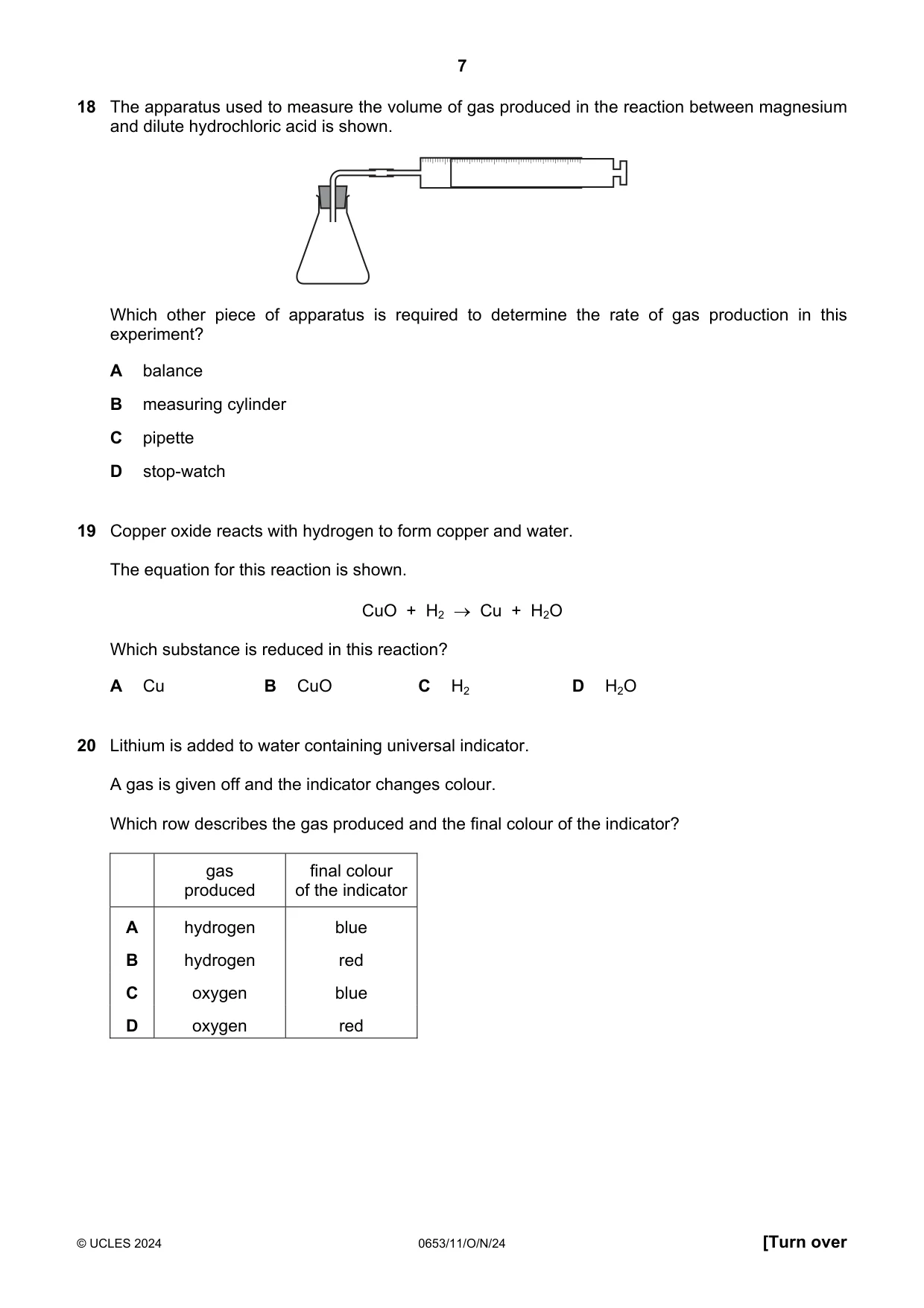
18 The apparatus used to measure the volume of gas produced in the reaction between magnesium and dilute hydrochloric acid is shown. Which other piece of apparatus is required to determine the rate of gas production in this experiment? A balance B measuring cylinder C pipette D stop-watch
Mark scheme: D
Q19 · Copper oxide reacts with hydrogen to form copper and water
19 Copper oxide reacts with hydrogen to form copper and water. The equation for this reaction is shown. CuO + H2 Cu + H2O Which substance is reduced in this reaction? A Cu B CuO C H2 D H2O
Mark scheme: B
Q20 · Lithium is added to water containing universal indicator
20 Lithium is added to water containing universal indicator. A gas is given off and the indicator changes colour. Which row describes the gas produced and the final colour of the indicator? gas final colour produced of the indicator A hydrogen blue B hydrogen red C oxygen blue D oxygen red
Mark scheme: A
Q21 · A solution of compound X produces a green precipitate when aqueous sodium hydroxide is…
21 A solution of compound X produces a green precipitate when aqueous sodium hydroxide is added. What is X? A copper(II) chloride B copper(II) sulfate C iron(II) sulfate D iron(III) chloride
Mark scheme: C
Q22 · Which statement about noble gases is correct?
22 Which statement about noble gases is correct? A Atoms of noble gases form diatomic molecules. B Atoms of noble gases have full outer shells of electrons. C They form unreactive compounds. D They are good conductors of electricity.
Mark scheme: B
Q23 · Brass is an alloy of copper and zinc
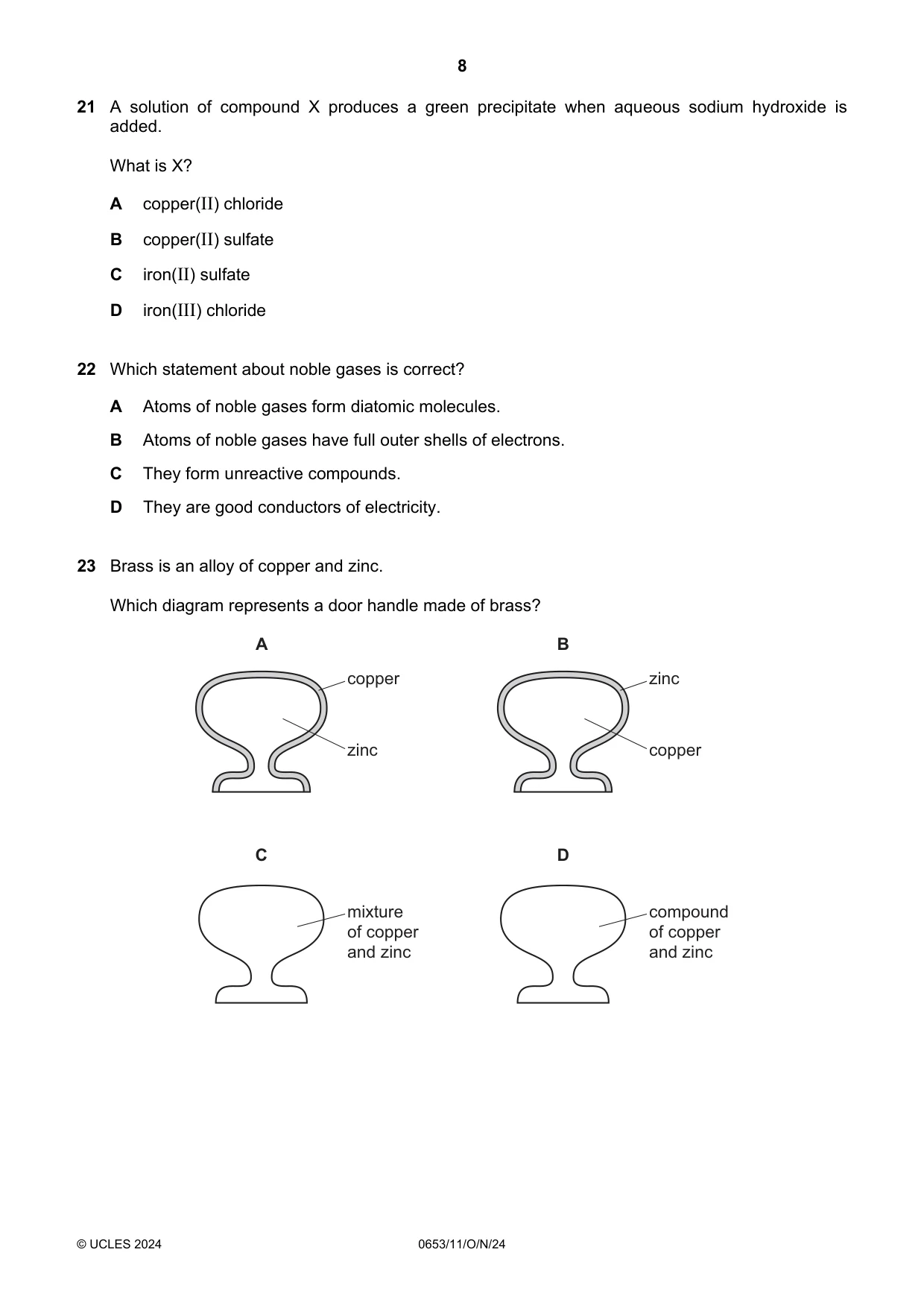
23 Brass is an alloy of copper and zinc. Which diagram represents a door handle made of brass? A B copper zinc zinc copper C D mixture compound of copper of copper and zinc and zinc
Mark scheme: C
Q24 · What is a chemical test for water?
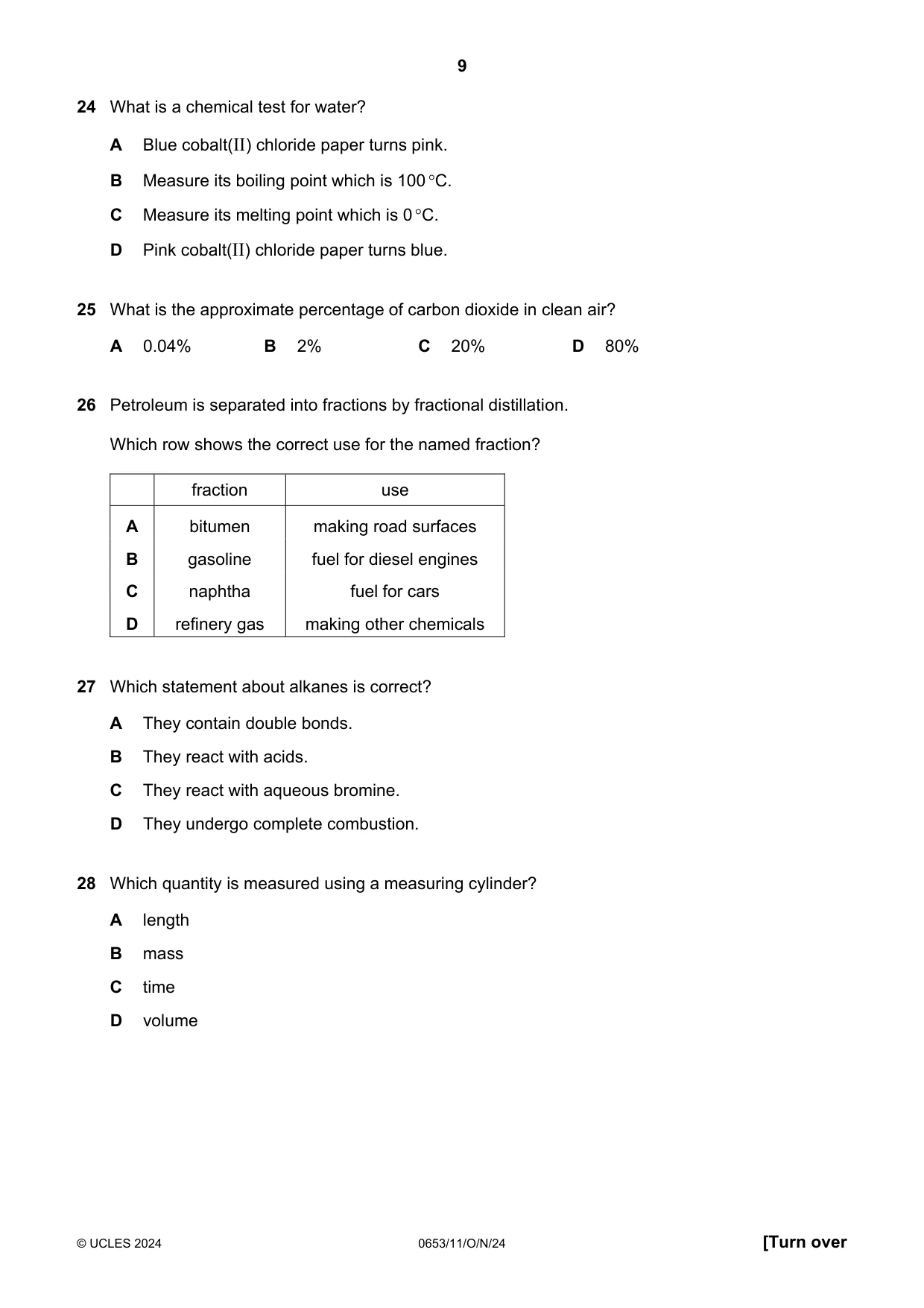
24 What is a chemical test for water? A Blue cobalt(II) chloride paper turns pink. B Measure its boiling point which is 100 C. C Measure its melting point which is 0 C. D Pink cobalt(II) chloride paper turns blue.
Mark scheme: A
Q25 · What is the approximate percentage of carbon dioxide in clean air?
25 What is the approximate percentage of carbon dioxide in clean air? A 0.04% B 2% C 20% D 80%
Mark scheme: A
Q26 · Petroleum is separated into fractions by fractional distillation
26 Petroleum is separated into fractions by fractional distillation. Which row shows the correct use for the named fraction? fraction use A bitumen making road surfaces B gasoline fuel for diesel engines C naphtha fuel for cars D refinery gas making other chemicals
Mark scheme: A
Q27 · Which statement about alkanes is correct?
27 Which statement about alkanes is correct? A They contain double bonds. B They react with acids. C They react with aqueous bromine. D They undergo complete combustion.
Mark scheme: D
Q28 · Which quantity is measured using a measuring cylinder?
28 Which quantity is measured using a measuring cylinder? A length B mass C time D volume
Mark scheme: D
More questions on Physical quantities and measurement techniques
Q29 · How is the density of a sample of a liquid calculated?
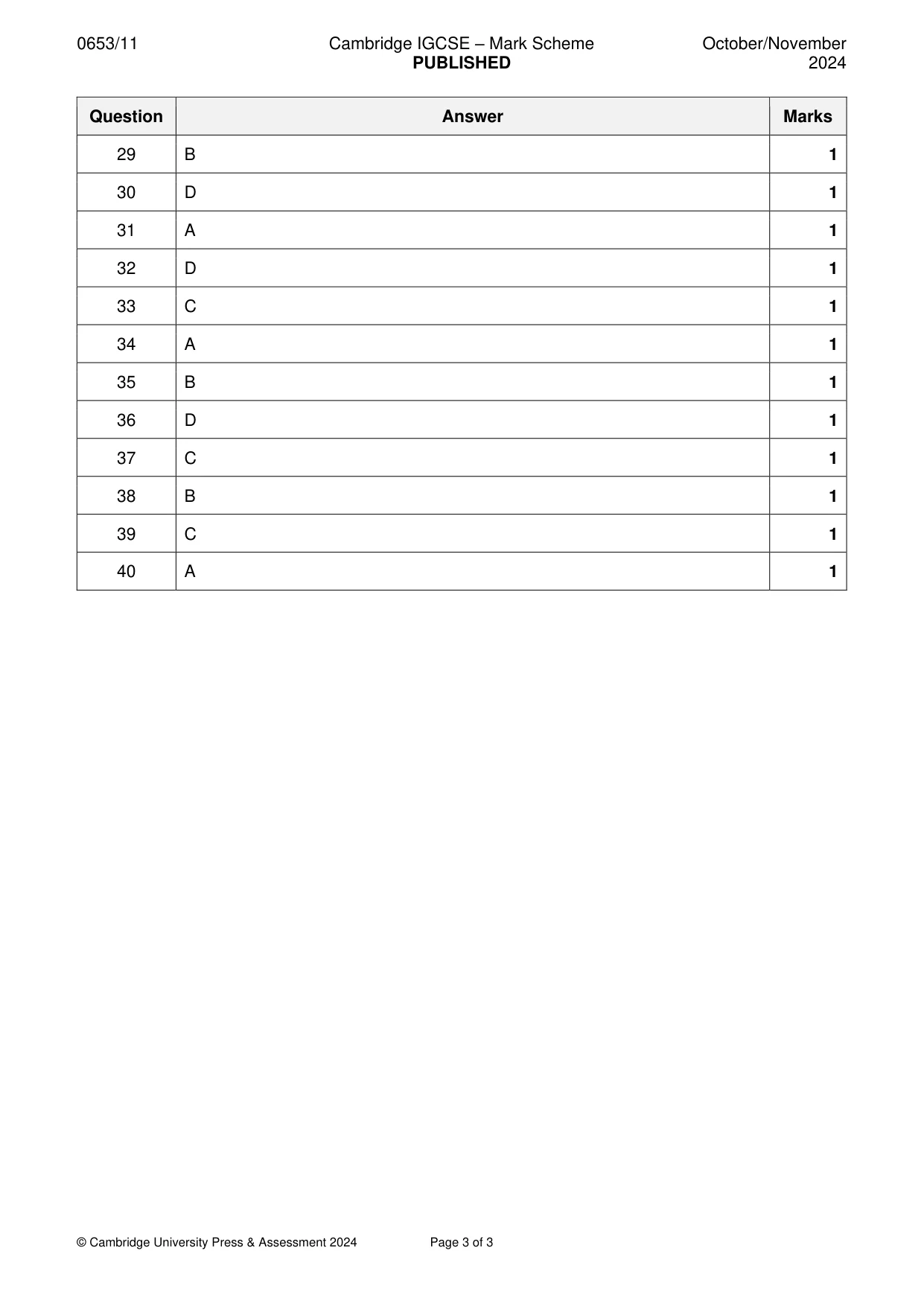
29 How is the density of a sample of a liquid calculated? A by adding the mass of the sample to its volume B by dividing the mass of the sample by its volume C by multiplying the mass of the sample by its volume D by subtracting the mass of the sample from its volume
Mark scheme: B
Q30 · An object is travelling in a straight line at constant speed
30 An object is travelling in a straight line at constant speed. Which statement describes the resultant force on the object? A It acts in the opposite direction to the motion of the object. B It acts in the same direction as the motion of the object. C It is constant, but not zero. D It is zero.
Mark scheme: D
Q31 · How is energy transferred from the Sun to the Earth through the vacuum of space?
31 How is energy transferred from the Sun to the Earth through the vacuum of space? A by electromagnetic waves B by movement of electrons C by movement of molecules D by sound waves
Mark scheme: A
Q32 · A crane lifts a load vertically
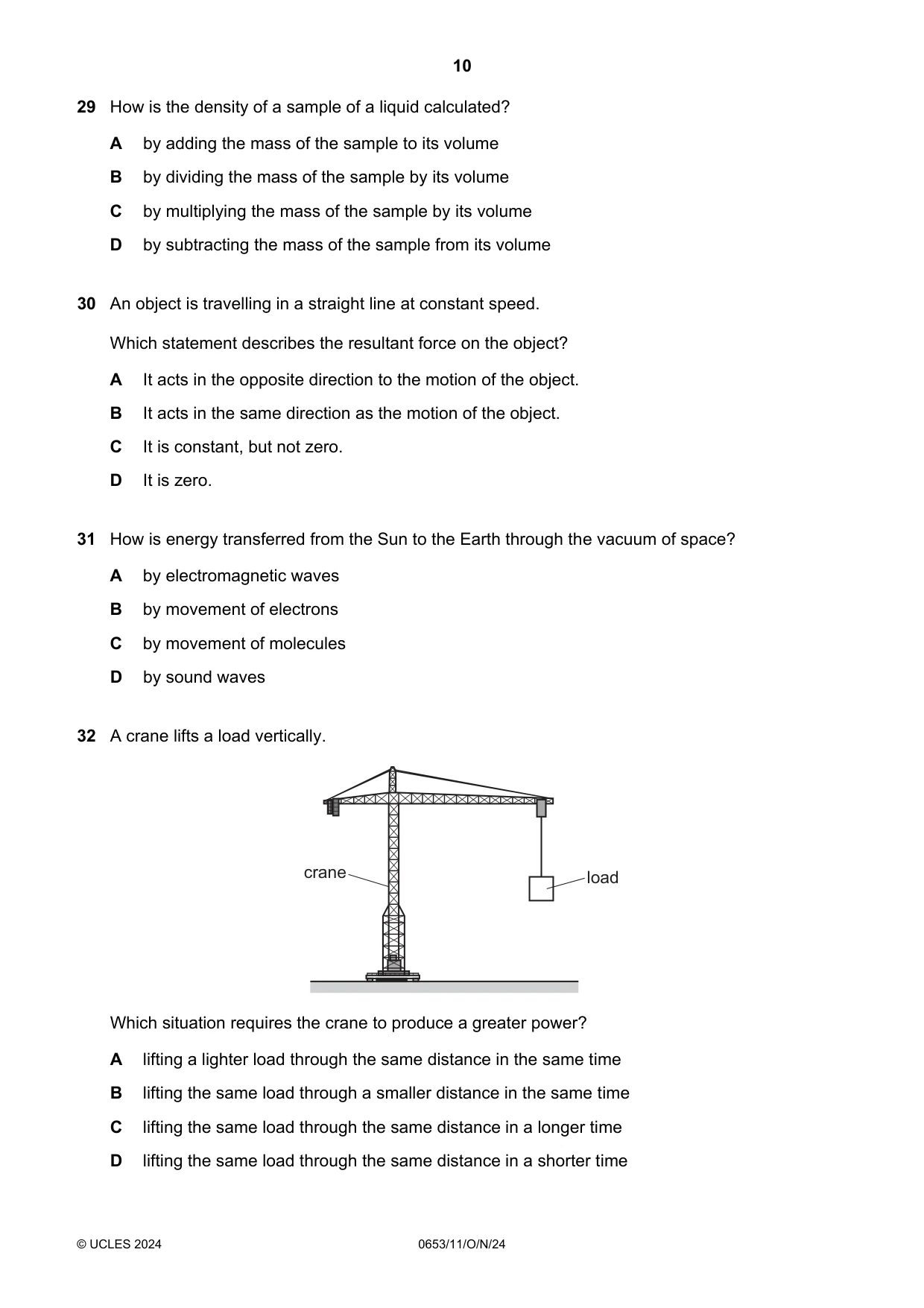
32 A crane lifts a load vertically. crane load Which situation requires the crane to produce a greater power? A lifting a lighter load through the same distance in the same time B lifting the same load through a smaller distance in the same time C lifting the same load through the same distance in a longer time D lifting the same load through the same distance in a shorter time
Mark scheme: D
Q33 · The more-energetic molecules of a liquid escape from its surface and the temperature of…
33 The more-energetic molecules of a liquid escape from its surface and the temperature of the remaining liquid decreases. Which process is occurring? A boiling B condensation C evaporation D melting
Mark scheme: C
Q34 · An iron rod fits tightly inside an aluminium cylinder
34 An iron rod fits tightly inside an aluminium cylinder. To remove the rod from the cylinder, hot air is blown onto the rod and cylinder. After a short time, the rod slides out of the cylinder. Why does this happen? A The aluminium expands more than the iron. B The aluminium is a better thermal insulator than the iron. C The iron expands more than the aluminium. D The iron is a better thermal conductor than the aluminium.
Mark scheme: A
Q35 · A gas is trapped in a container
35 A gas is trapped in a container. The gas is heated from below. What is the main method of thermal energy transfer in the gas? A conduction B convection C evaporation D radiation
Mark scheme: B
Q36 · The diagram shows a thin converging lens and a small object O
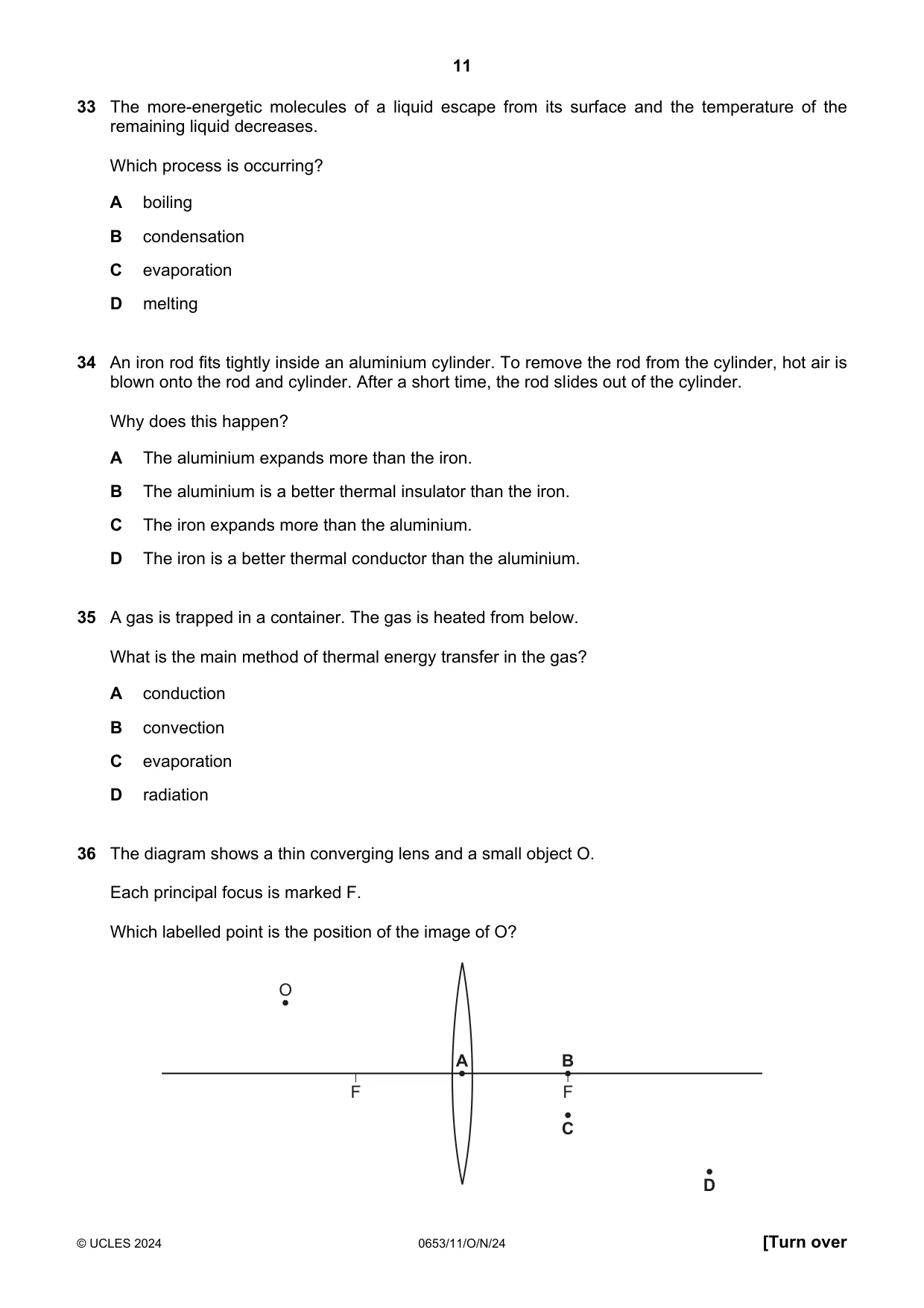
36 The diagram shows a thin converging lens and a small object O. Each principal focus is marked F. Which labelled point is the position of the image of O? O A B F F C D
Mark scheme: D
Q37 · Elephants can hear sounds with frequencies between 10 Hz and 12 kHz
37 Elephants can hear sounds with frequencies between 10 Hz and 12 kHz. Which frequency of sound can be heard by both elephants and humans with healthy ears? A 10 Hz B 15 Hz C 1500 Hz D 15 000 Hz
Mark scheme: C
Q38 · A positively charged sphere is suspended from an insulating thread
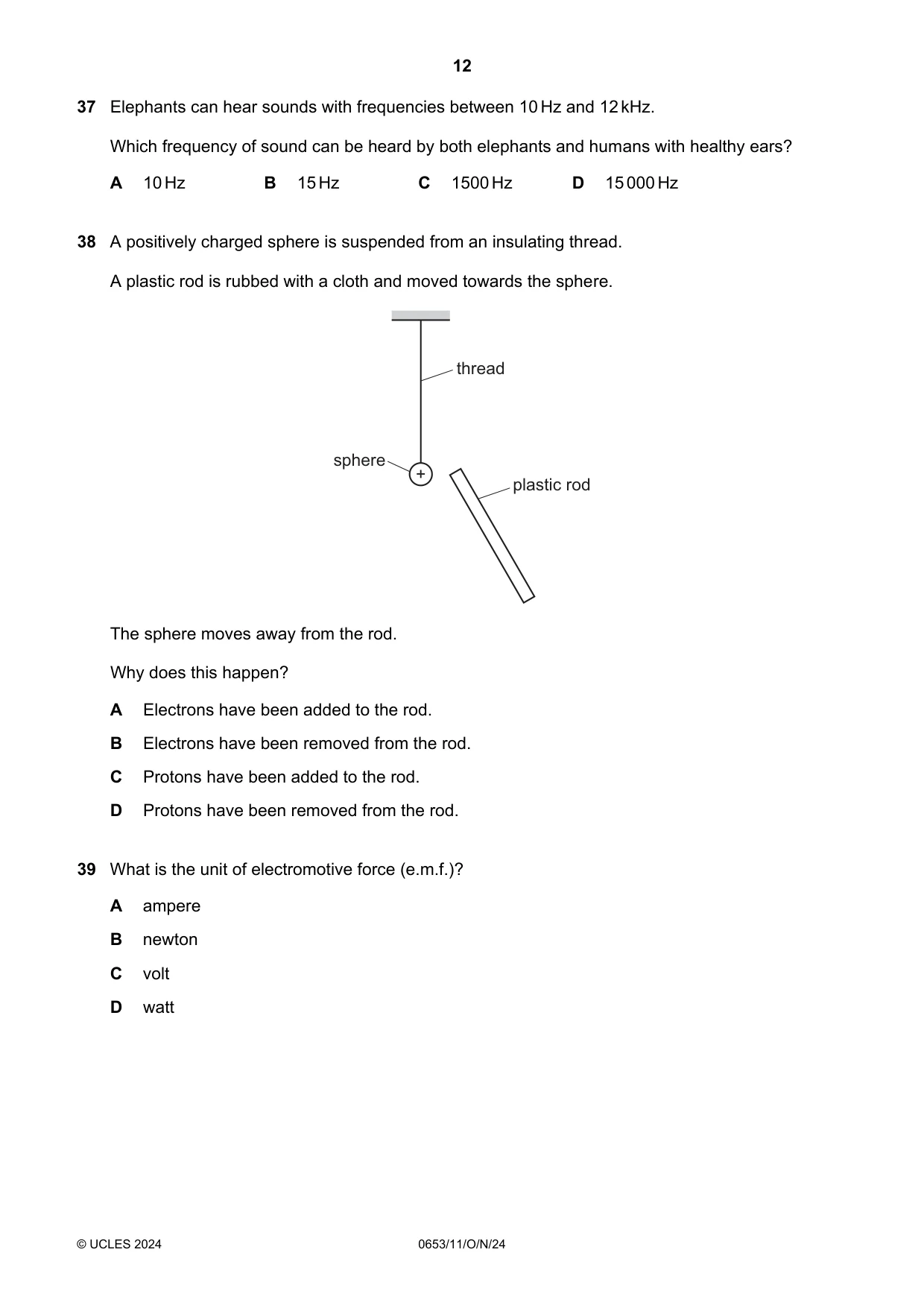
38 A positively charged sphere is suspended from an insulating thread. A plastic rod is rubbed with a cloth and moved towards the sphere. thread sphere + plastic rod The sphere moves away from the rod. Why does this happen? A Electrons have been added to the rod. B Electrons have been removed from the rod. C Protons have been added to the rod. D Protons have been removed from the rod.
Mark scheme: B
Q39 · What is the unit of electromotive force (e.m.f.)?
39 What is the unit of electromotive force (e.m.f.)? A ampere B newton C volt D watt
Mark scheme: C
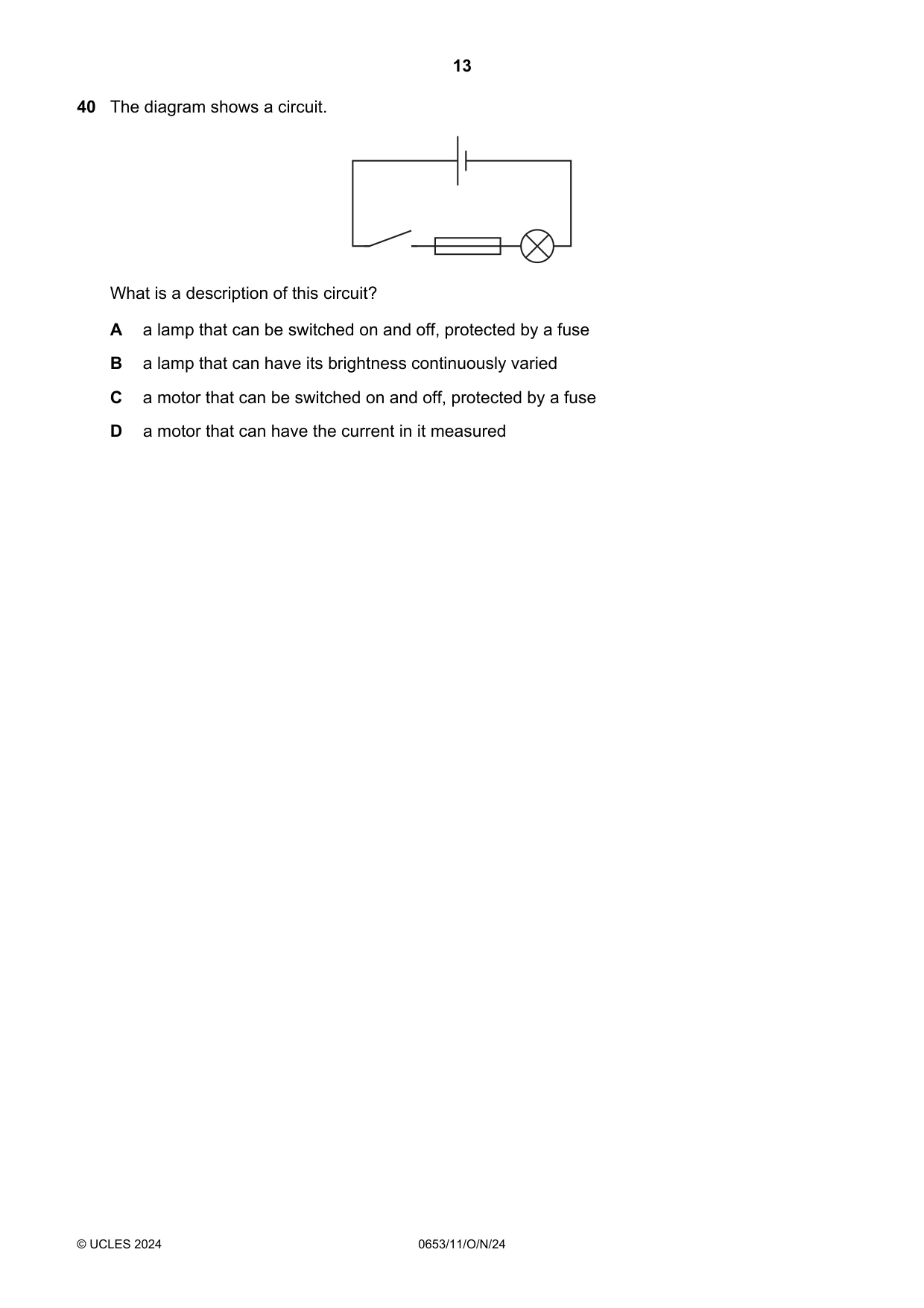
Q40 · The diagram shows a circuit
40 The diagram shows a circuit. What is a description of this circuit? A a lamp that can be switched on and off, protected by a fuse B a lamp that can have its brightness continuously varied C a motor that can be switched on and off, protected by a fuse D a motor that can have the current in it measured
Mark scheme: A
What was in this paper
The subtopics covered by these 40 questions, and how many questions each got. Open one in a new tab to see every Cambridge question on it.
2Identification of ions and gases2Respiration2Air quality and climate1Alkanes1Alloys and their properties1Biological molecules1Blood1Carbon cycle1Characteristics of living organisms1Density1Digestive system1Drugs1Electrical circuits1Electrolysis1Electromagnetic spectrum1Energy, work and power1Enzymes1Exothermic and endothermic reactions1Food chains and food webs1Forces1Formulas1Fuels1Group I properties1Kinetic particle model of matter1Light1Noble gases1Photosynthesis1Physical and chemical changes1Physical quantities and measurement techniques1Rate of reaction1Redox1Sexual reproduction in humans1Sound1Thermal properties and temperature1Transfer of thermal energy1Transpiration1What you needed in this session
Cambridge’s own grade thresholds for 2024 Oct/Nov, Paper 1 · Variant 1. A higher threshold means an easier paper — the bar moves with how the cohort did.