Cambridge IGCSE Science - Combined 0653 — 2024 May/June Paper 1 · Variant 1
0653/11/M/J/24 · 40 questions · 40 marks · ≈45 min
The question paper and its mark scheme, free to read here and free to download. This is Cambridge’s own paper, exactly as it was sat.
Question paper16 pages
Mark scheme3 pages
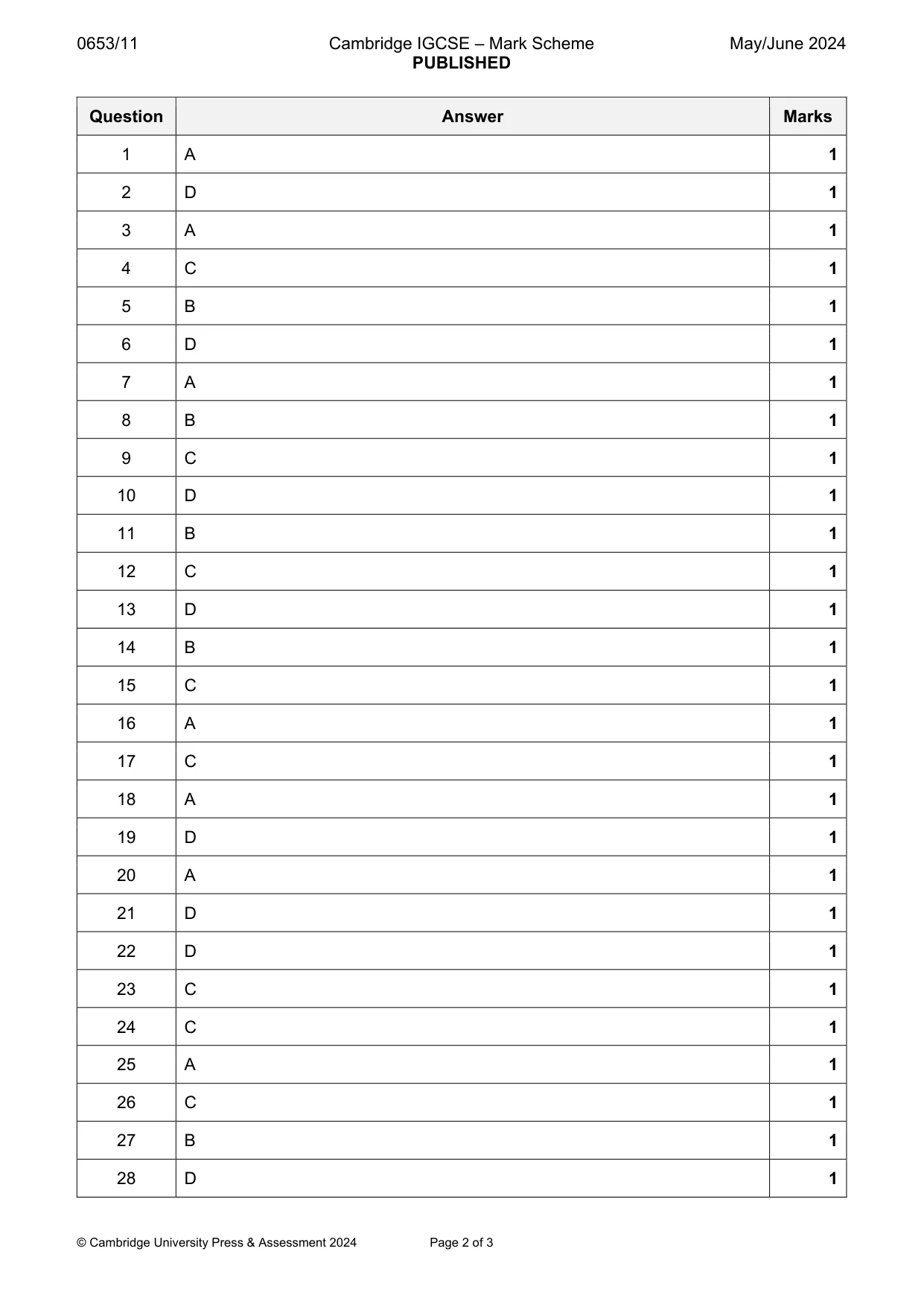
Answers below. Sit the paper first if you are practising.
Questions as text
Q1 · Which characteristic of living organisms is the removal of substances in excess of…
1 Which characteristic of living organisms is the removal of substances in excess of requirements? A excretion B nutrition C reproduction D respiration
Mark scheme: A
Q2 · A drop of red ink is injected into the centre of a test-tube containing gelatine
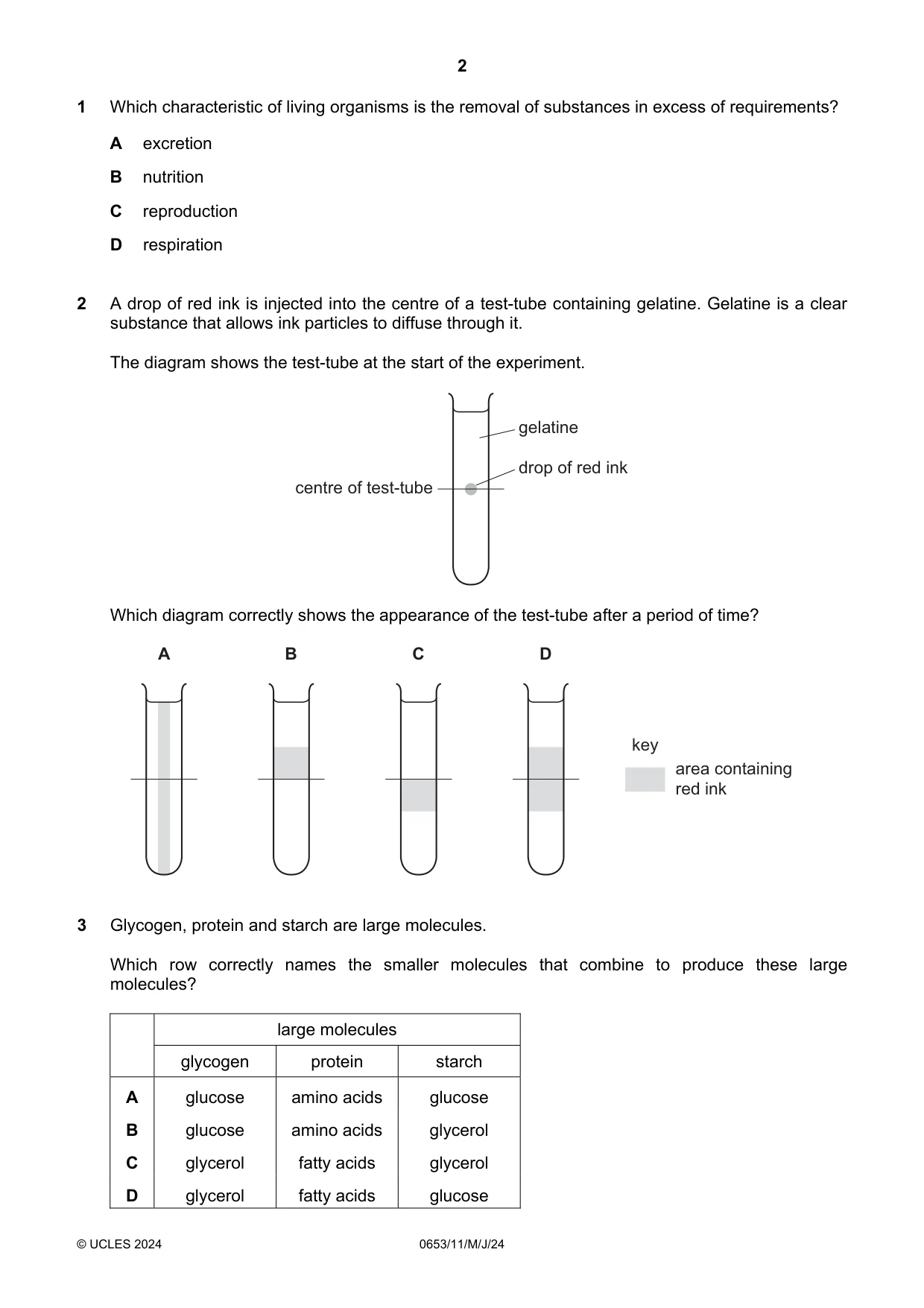
2 A drop of red ink is injected into the centre of a test-tube containing gelatine. Gelatine is a clear substance that allows ink particles to diffuse through it. The diagram shows the test-tube at the start of the experiment. gelatine drop of red ink centre of test-tube Which diagram correctly shows the appearance of the test-tube after a period of time? A B C D key area containing red ink
Mark scheme: D
Q3 · Glycogen, protein and starch are large molecules
3 Glycogen, protein and starch are large molecules. Which row correctly names the smaller molecules that combine to produce these large molecules? large molecules glycogen protein starch A glucose amino acids glucose B glucose amino acids glycerol C glycerol fatty acids glycerol D glycerol fatty acids glucose
Mark scheme: A
Q4 · Which statement about enzymes is correct?
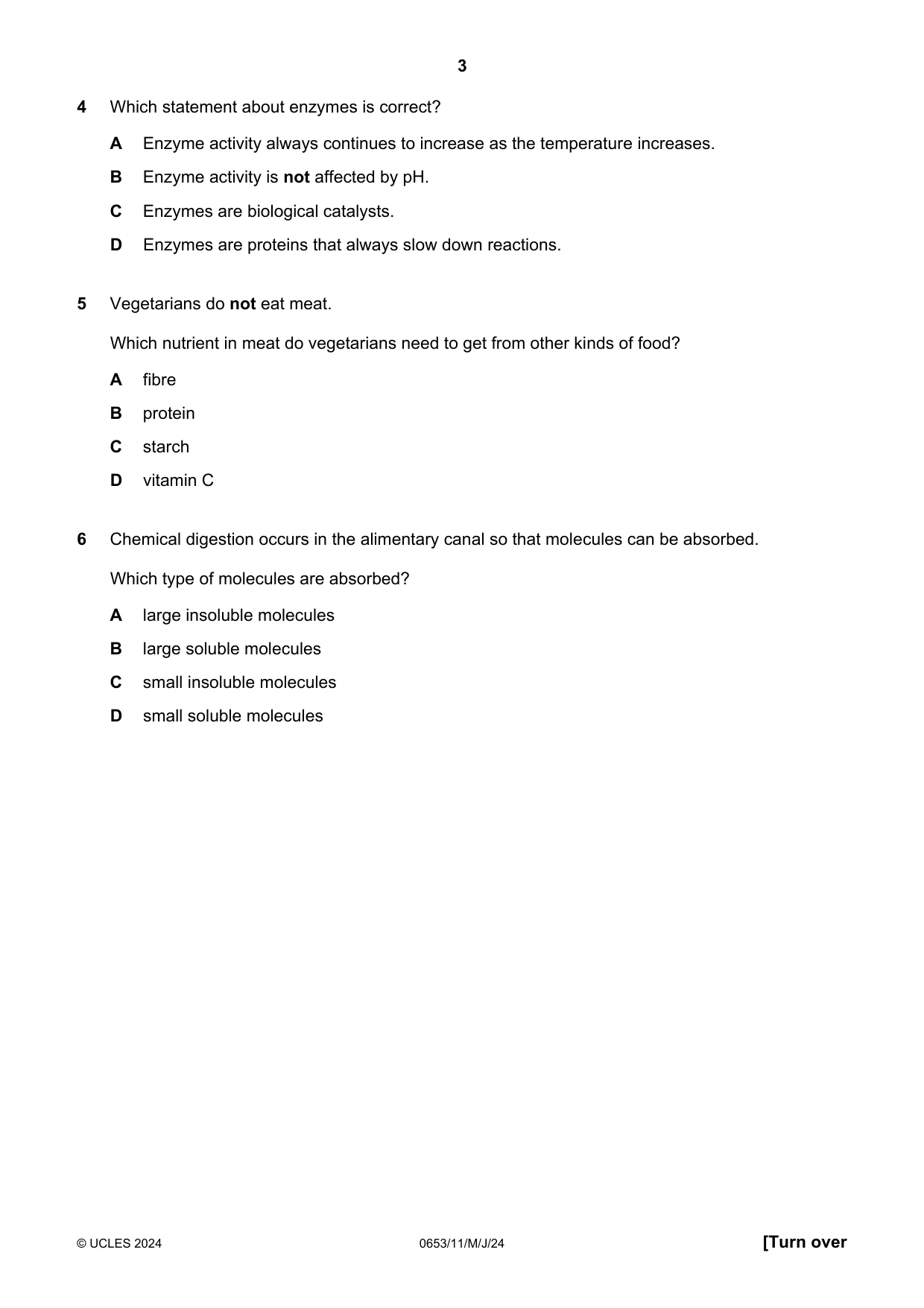
4 Which statement about enzymes is correct? A Enzyme activity always continues to increase as the temperature increases. B Enzyme activity is not affected by pH. C Enzymes are biological catalysts. D Enzymes are proteins that always slow down reactions.
Mark scheme: C
Q5 · Vegetarians do not eat meat
5 Vegetarians do not eat meat. Which nutrient in meat do vegetarians need to get from other kinds of food? A fibre B protein C starch D vitamin C
Mark scheme: B
Q6 · Chemical digestion occurs in the alimentary canal so that molecules can be absorbed
6 Chemical digestion occurs in the alimentary canal so that molecules can be absorbed. Which type of molecules are absorbed? A large insoluble molecules B large soluble molecules C small insoluble molecules D small soluble molecules
Mark scheme: D
Q7 · The diagram shows a section through a leaf
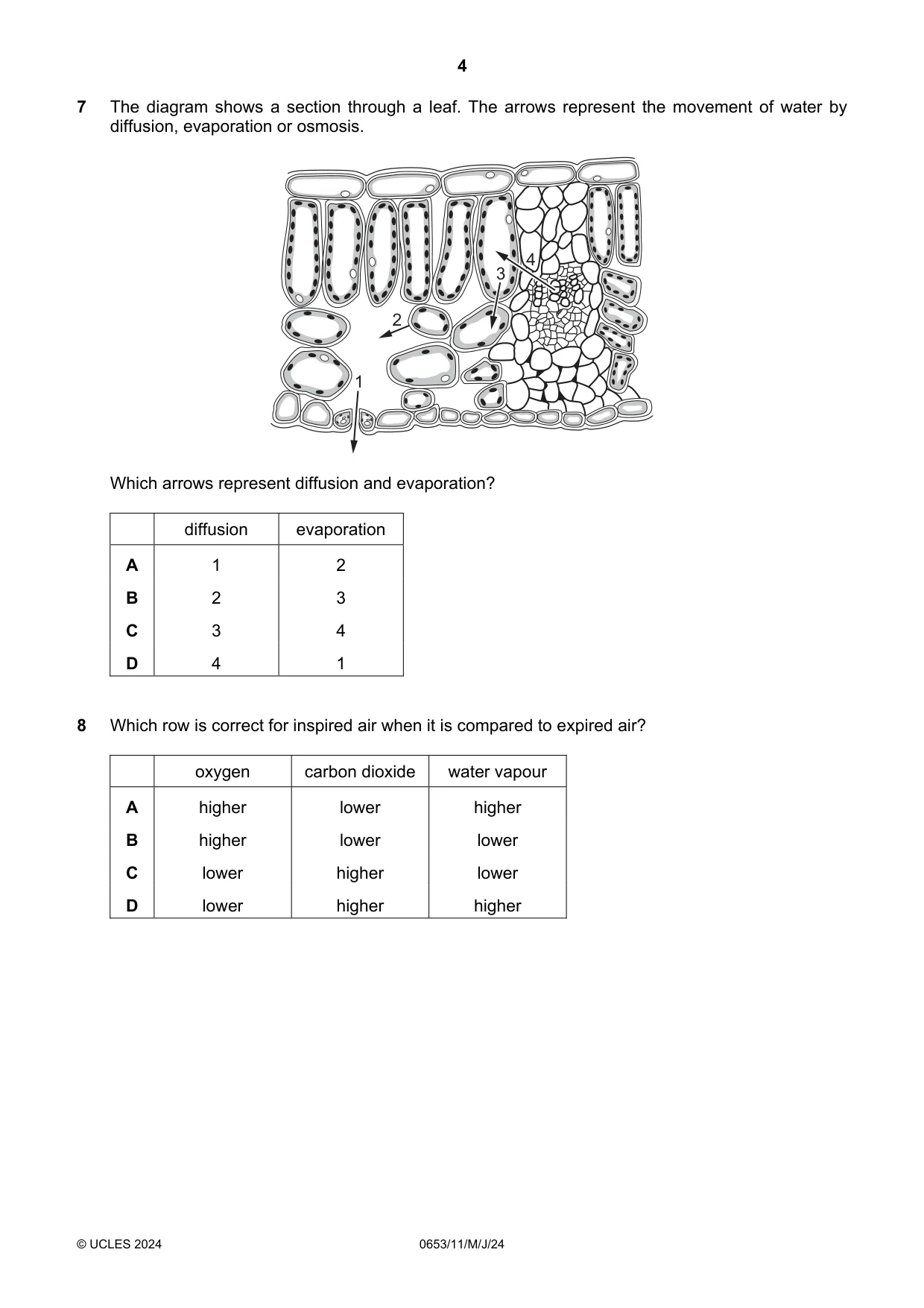
7 The diagram shows a section through a leaf. The arrows represent the movement of water by diffusion, evaporation or osmosis. 4 3 2 1 Which arrows represent diffusion and evaporation? diffusion evaporation A 1 2 B 2 3 C 3 4 D 4 1
Mark scheme: A
Q8 · Which row is correct for inspired air when it is compared to expired air?
8 Which row is correct for inspired air when it is compared to expired air? oxygen carbon dioxide water vapour A higher lower higher B higher lower lower C lower higher lower D lower higher higher
Mark scheme: B
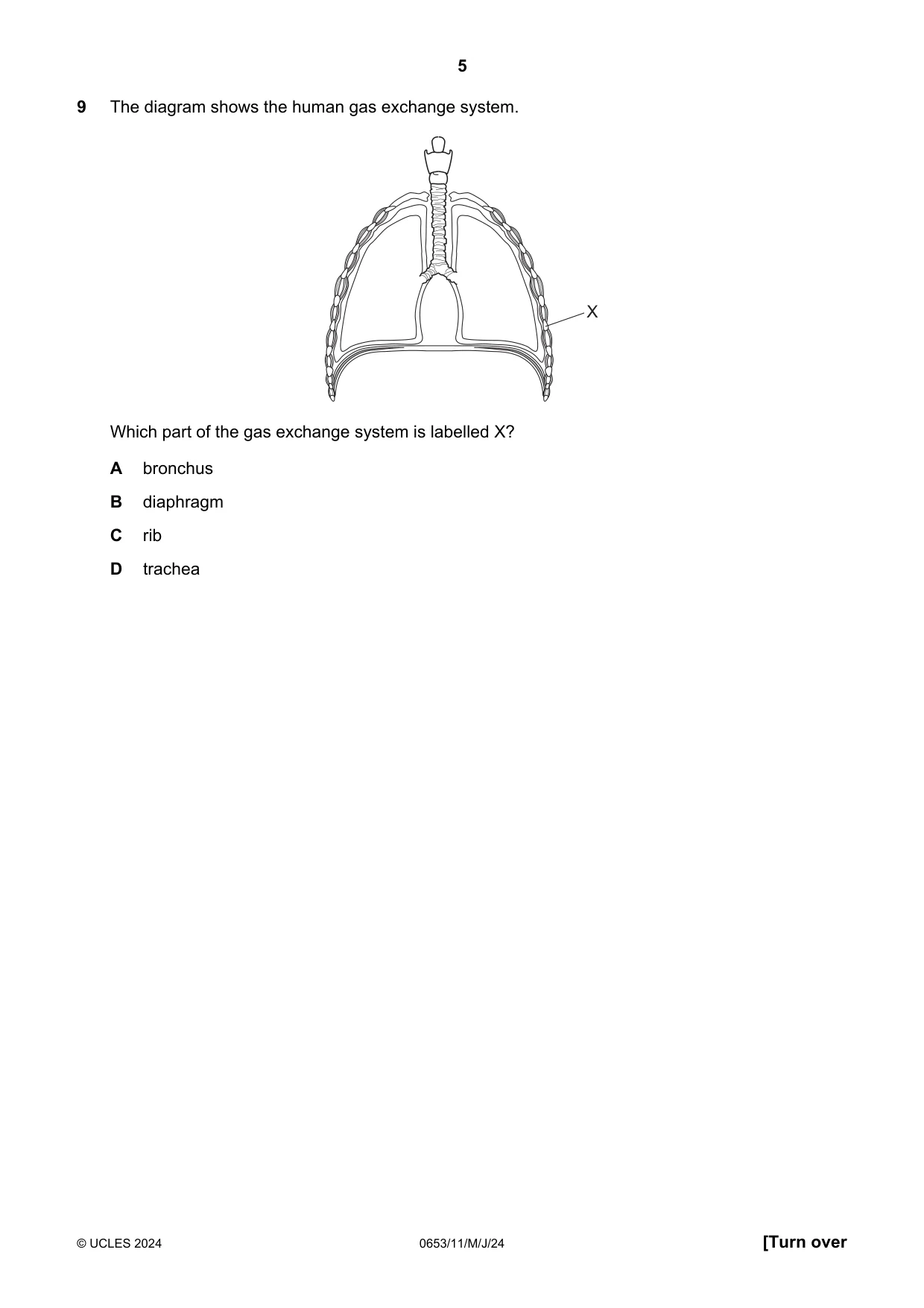
Q9 · The diagram shows the human gas exchange system
9 The diagram shows the human gas exchange system. X Which part of the gas exchange system is labelled X? A bronchus B diaphragm C rib D trachea
Mark scheme: C
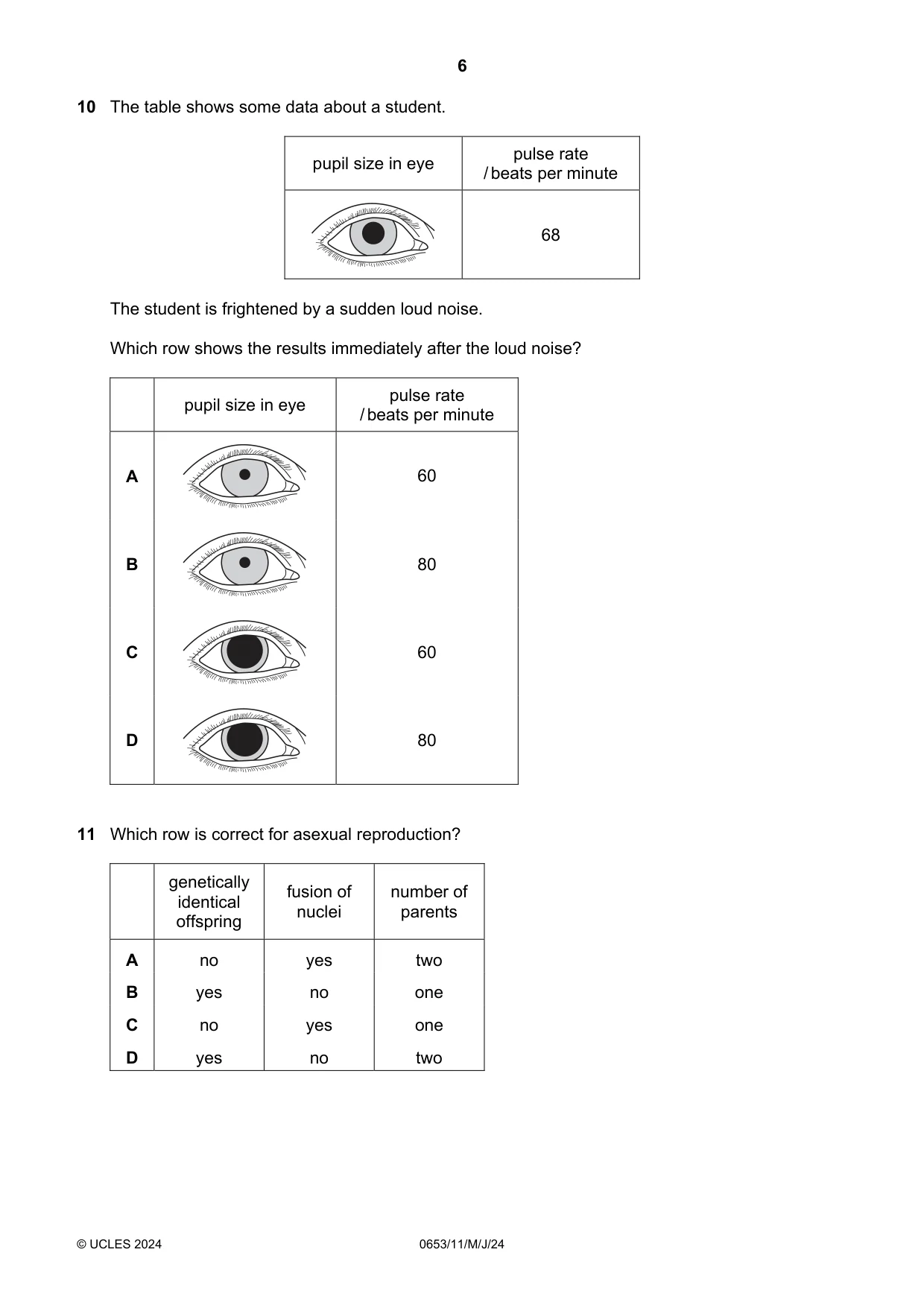
Q10 · The table shows some data about a student
10 The table shows some data about a student. pulse rate pupil size in eye / beats per minute 68 The student is frightened by a sudden loud noise. Which row shows the results immediately after the loud noise? pulse rate pupil size in eye / beats per minute A 60 B 80 C 60 D 80
Mark scheme: D
Q11 · Which row is correct for asexual reproduction?
11 Which row is correct for asexual reproduction? genetically fusion of number of identical nuclei parents offspring A no yes two B yes no one C no yes one D yes no two
Mark scheme: B
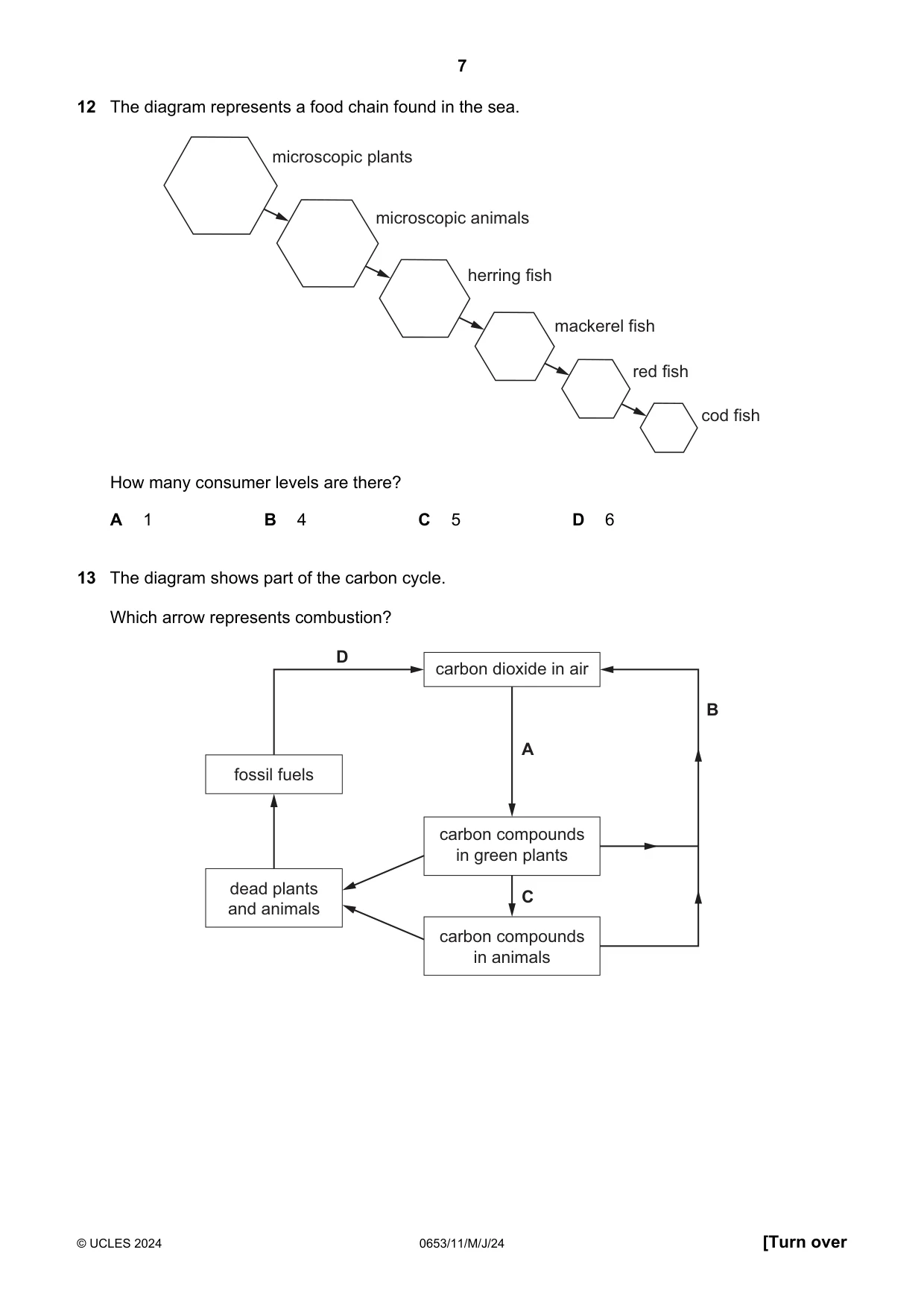
Q12 · The diagram represents a food chain found in the sea
12 The diagram represents a food chain found in the sea. microscopic plants microscopic animals herring fish mackerel fish red fish cod fish How many consumer levels are there? A 1 B 4 C 5 D 6
Mark scheme: C
Q13 · The diagram shows part of the carbon cycle
13 The diagram shows part of the carbon cycle. Which arrow represents combustion? D carbon dioxide in air B A fossil fuels carbon compounds in green plants dead plants C and animals carbon compounds in animals
Mark scheme: D
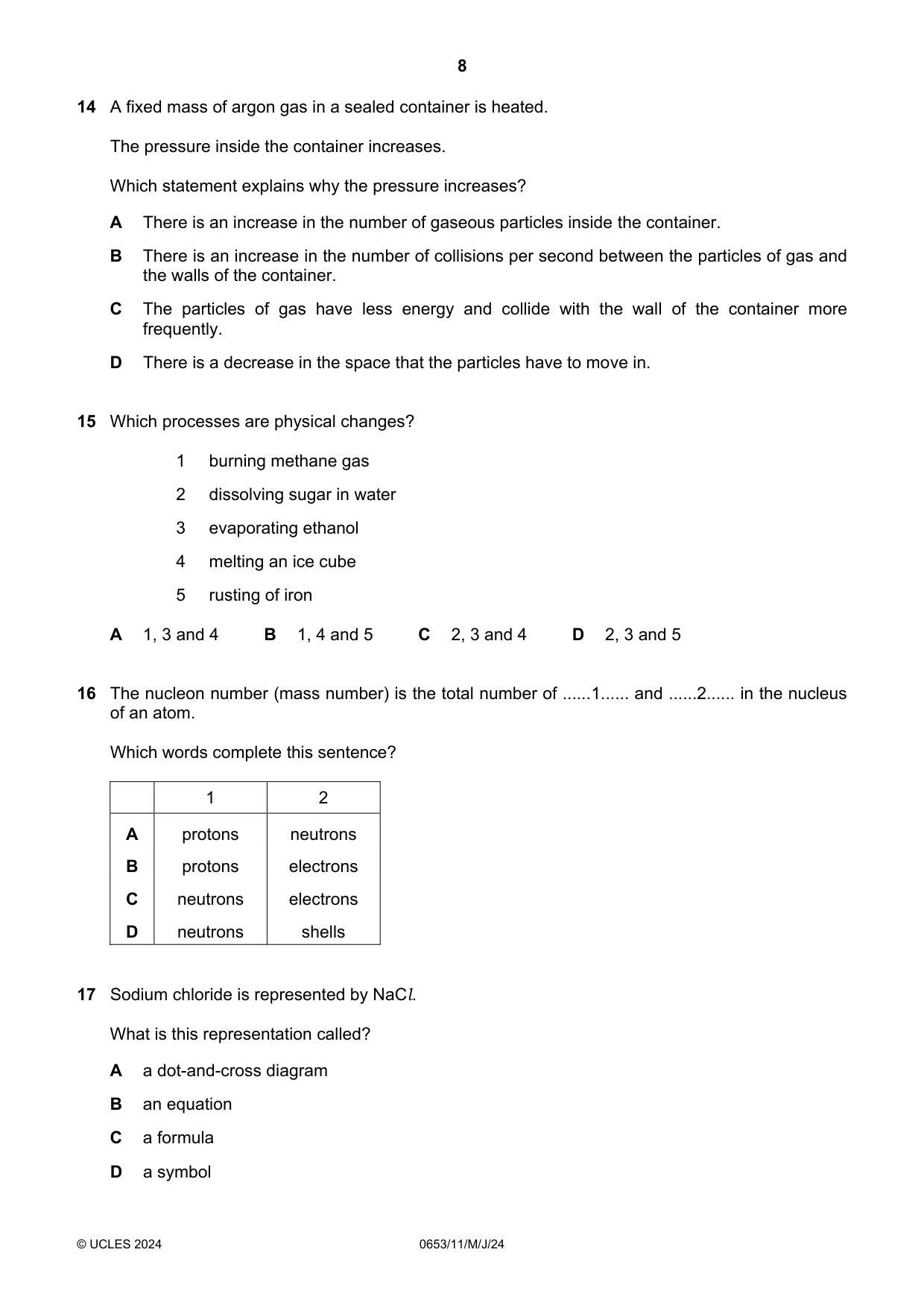
Q14 · A fixed mass of argon gas in a sealed container is heated
14 A fixed mass of argon gas in a sealed container is heated. The pressure inside the container increases. Which statement explains why the pressure increases? A There is an increase in the number of gaseous particles inside the container. B There is an increase in the number of collisions per second between the particles of gas and the walls of the container. C The particles of gas have less energy and collide with the wall of the container more frequently. D There is a decrease in the space that the particles have to move in.
Mark scheme: B
Q15 · Which processes are physical changes?
15 Which processes are physical changes? 1 burning methane gas 2 dissolving sugar in water 3 evaporating ethanol 4 melting an ice cube 5 rusting of iron A 1, 3 and 4 B 1, 4 and 5 C 2, 3 and 4 D 2, 3 and 5
Mark scheme: C
Q16 · The nucleon number (mass number) is the total number of ......1.....
16 The nucleon number (mass number) is the total number of ......1...... and ......2...... in the nucleus of an atom. Which words complete this sentence? 1 2 A protons neutrons B protons electrons C neutrons electrons D neutrons shells
Mark scheme: A
Q17 · Sodium chloride is represented by NaCl
17 Sodium chloride is represented by NaCl. What is this representation called? A a dot-and-cross diagram B an equation C a formula D a symbol
Mark scheme: C
Q18 · What is observed when molten lead(II) bromide is electrolysed using inert electrodes?
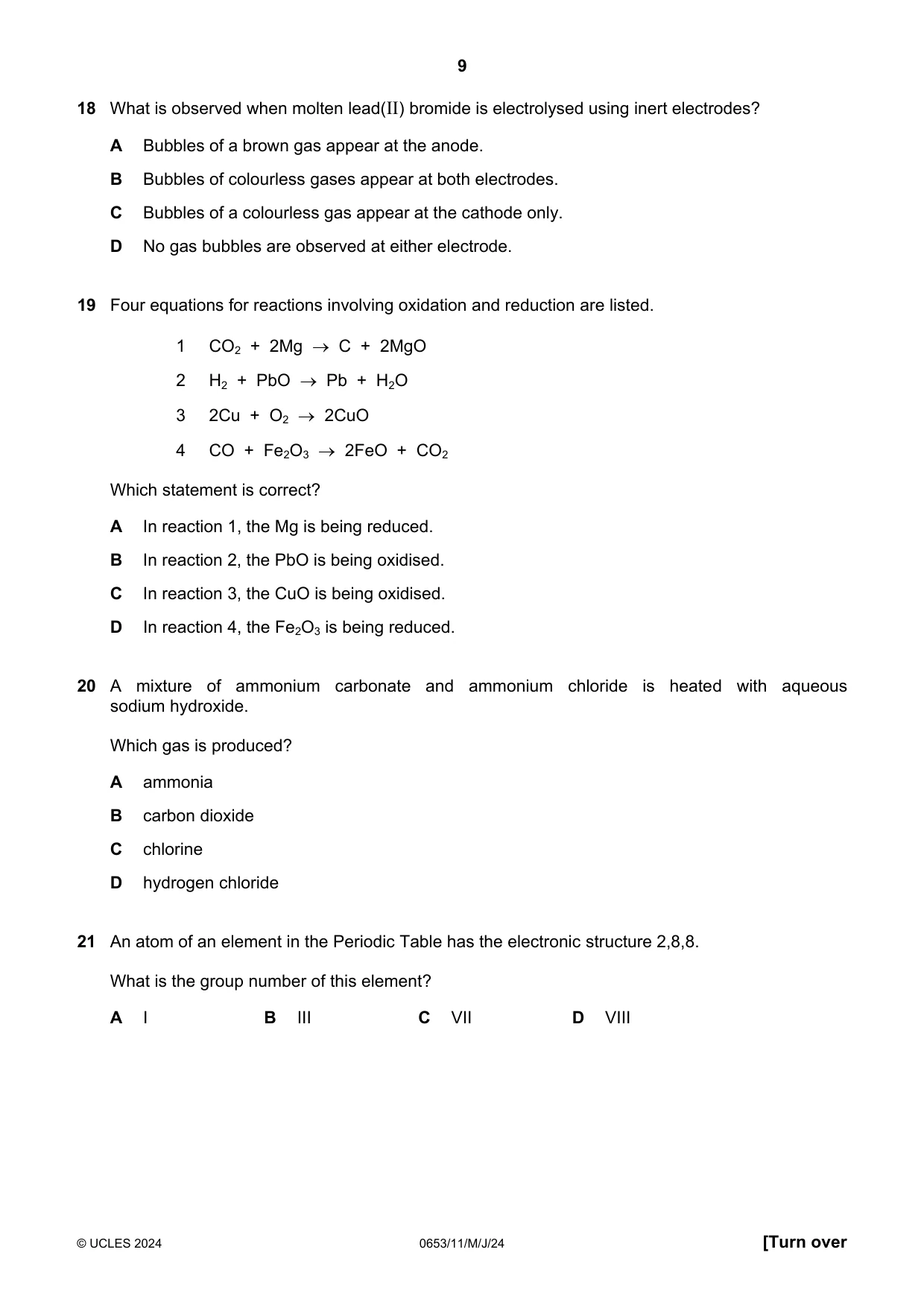
18 What is observed when molten lead(II) bromide is electrolysed using inert electrodes? A Bubbles of a brown gas appear at the anode. B Bubbles of colourless gases appear at both electrodes. C Bubbles of a colourless gas appear at the cathode only. D No gas bubbles are observed at either electrode.
Mark scheme: A
Q19 · Four equations for reactions involving oxidation and reduction are listed
19 Four equations for reactions involving oxidation and reduction are listed. 1 CO2 + 2Mg C + 2MgO 2 H2 + PbO Pb + H2O 3 2Cu + O2 2CuO 4 CO + Fe2O3 2FeO + CO2 Which statement is correct? A In reaction 1, the Mg is being reduced. B In reaction 2, the PbO is being oxidised. C In reaction 3, the CuO is being oxidised. D In reaction 4, the Fe2O3 is being reduced.
Mark scheme: D
Q20 · A mixture of ammonium carbonate and ammonium chloride is heated with aqueous sodium…
20 A mixture of ammonium carbonate and ammonium chloride is heated with aqueous sodium hydroxide. Which gas is produced? A ammonia B carbon dioxide C chlorine D hydrogen chloride
Mark scheme: A
Q21 · An atom of an element in the Periodic Table has the electronic structure 2,8,8
21 An atom of an element in the Periodic Table has the electronic structure 2,8,8. What is the group number of this element? A I B III C VII D VIII
Mark scheme: D
Q22 · Which property is the same for sodium and copper?
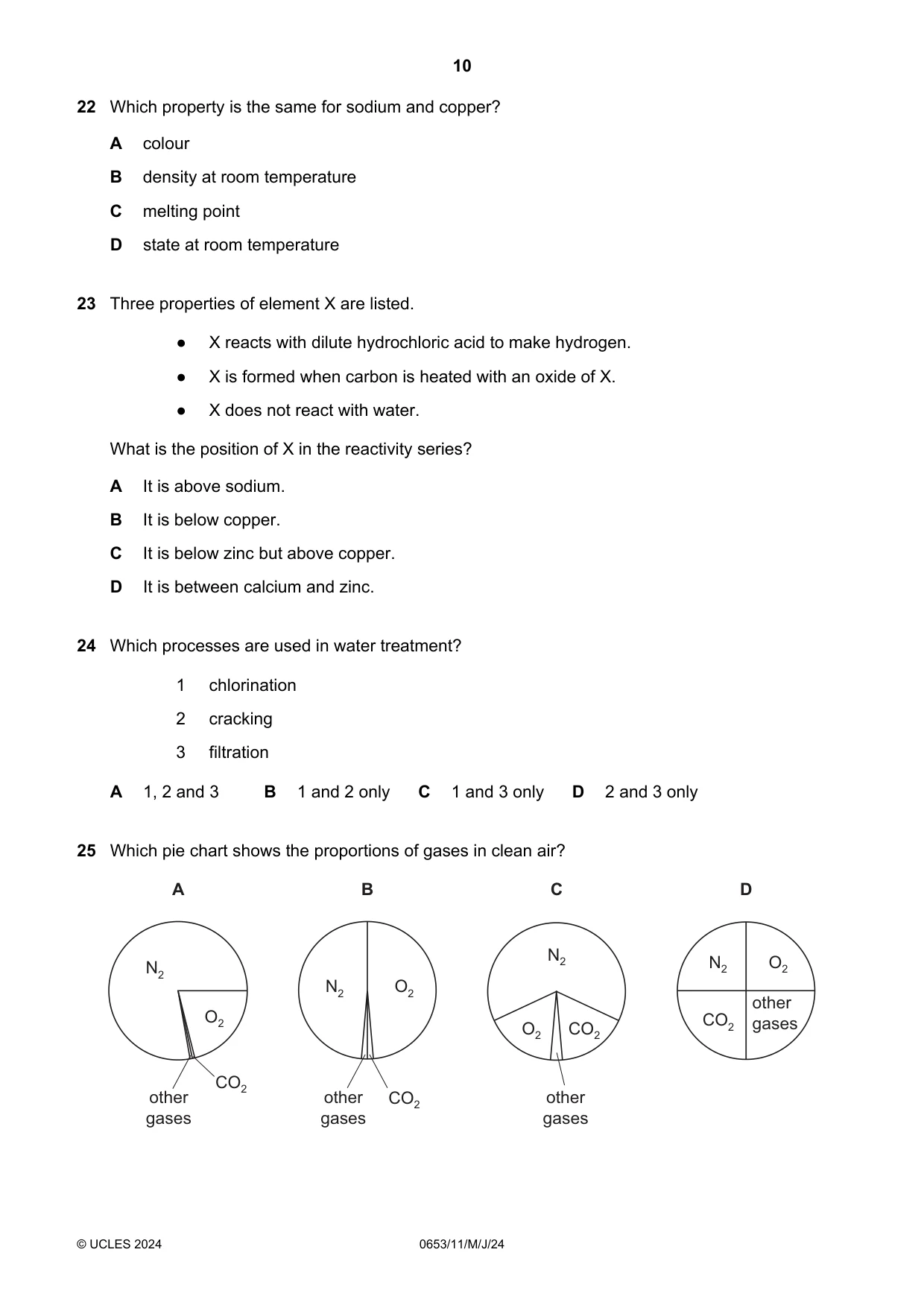
22 Which property is the same for sodium and copper? A colour B density at room temperature C melting point D state at room temperature
Mark scheme: D
Q23 · Three properties of element X are listed
23 Three properties of element X are listed. ● X reacts with dilute hydrochloric acid to make hydrogen. ● X is formed when carbon is heated with an oxide of X. ● X does not react with water. What is the position of X in the reactivity series? A It is above sodium. B It is below copper. C It is below zinc but above copper. D It is between calcium and zinc.
Mark scheme: C
Q24 · Which processes are used in water treatment?
24 Which processes are used in water treatment? 1 chlorination 2 cracking 3 filtration A 1, 2 and 3 B 1 and 2 only C 1 and 3 only D 2 and 3 only
Mark scheme: C
Q25 · Which pie chart shows the proportions of gases in clean air?
25 Which pie chart shows the proportions of gases in clean air? A B C D N2 N2 O2 N2 N2 O2 other O2 CO2 gases O2 CO2 CO2 other other CO2 other gases gases gases
Mark scheme: A
Q26 · Which fraction obtained from petroleum by fractional distillation is used for making…
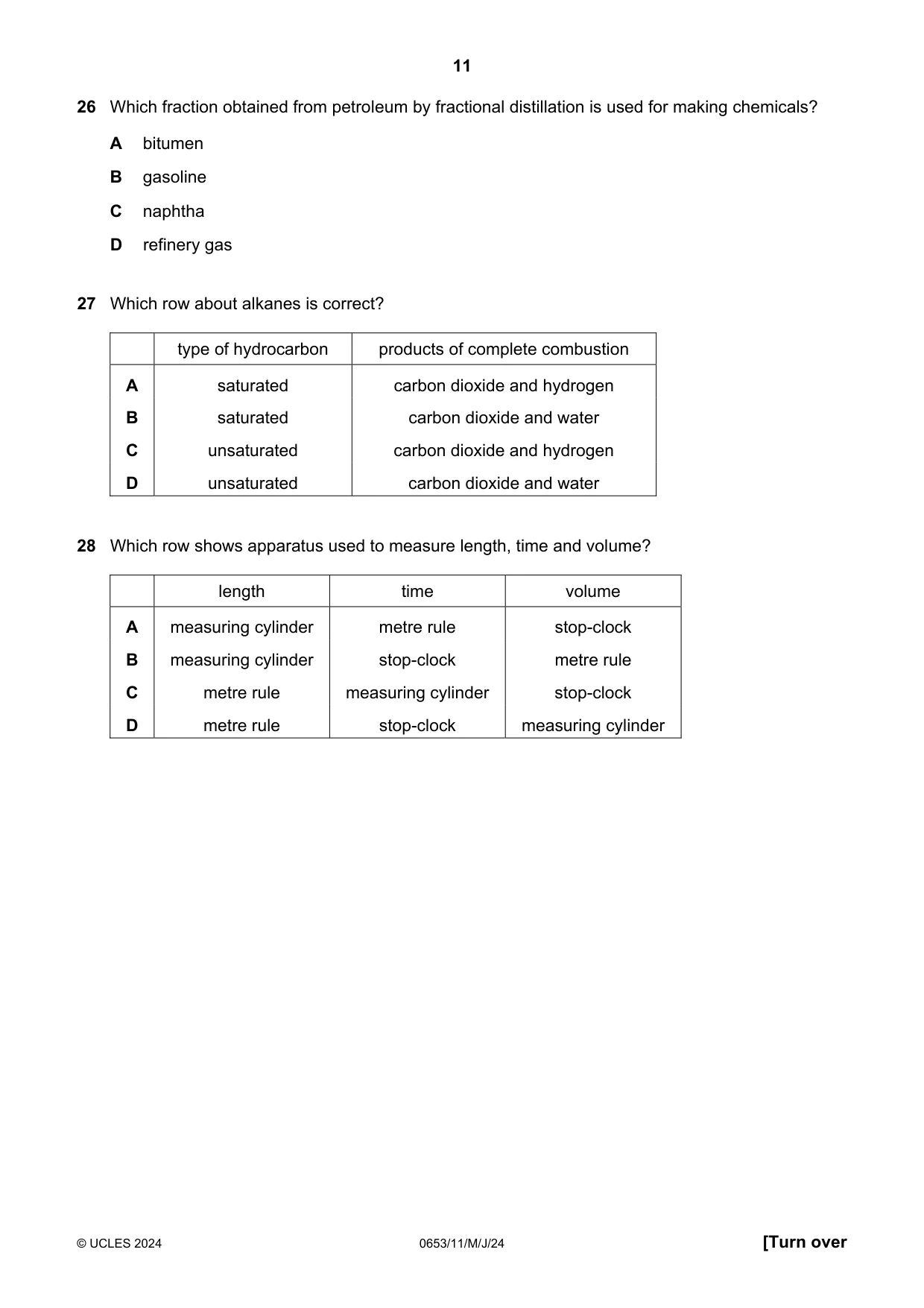
26 Which fraction obtained from petroleum by fractional distillation is used for making chemicals? A bitumen B gasoline C naphtha D refinery gas
Mark scheme: C
Q27 · Which row about alkanes is correct?
27 Which row about alkanes is correct? type of hydrocarbon products of complete combustion A saturated carbon dioxide and hydrogen B saturated carbon dioxide and water C unsaturated carbon dioxide and hydrogen D unsaturated carbon dioxide and water
Mark scheme: B
Q28 · Which row shows apparatus used to measure length, time and volume?
28 Which row shows apparatus used to measure length, time and volume? length time volume A measuring cylinder metre rule stop-clock B measuring cylinder stop-clock metre rule C metre rule measuring cylinder stop-clock D metre rule stop-clock measuring cylinder
Mark scheme: D
More questions on Physical quantities and measurement techniques
Q29 · Which speed–time graph represents the motion of an object that is moving with constant…
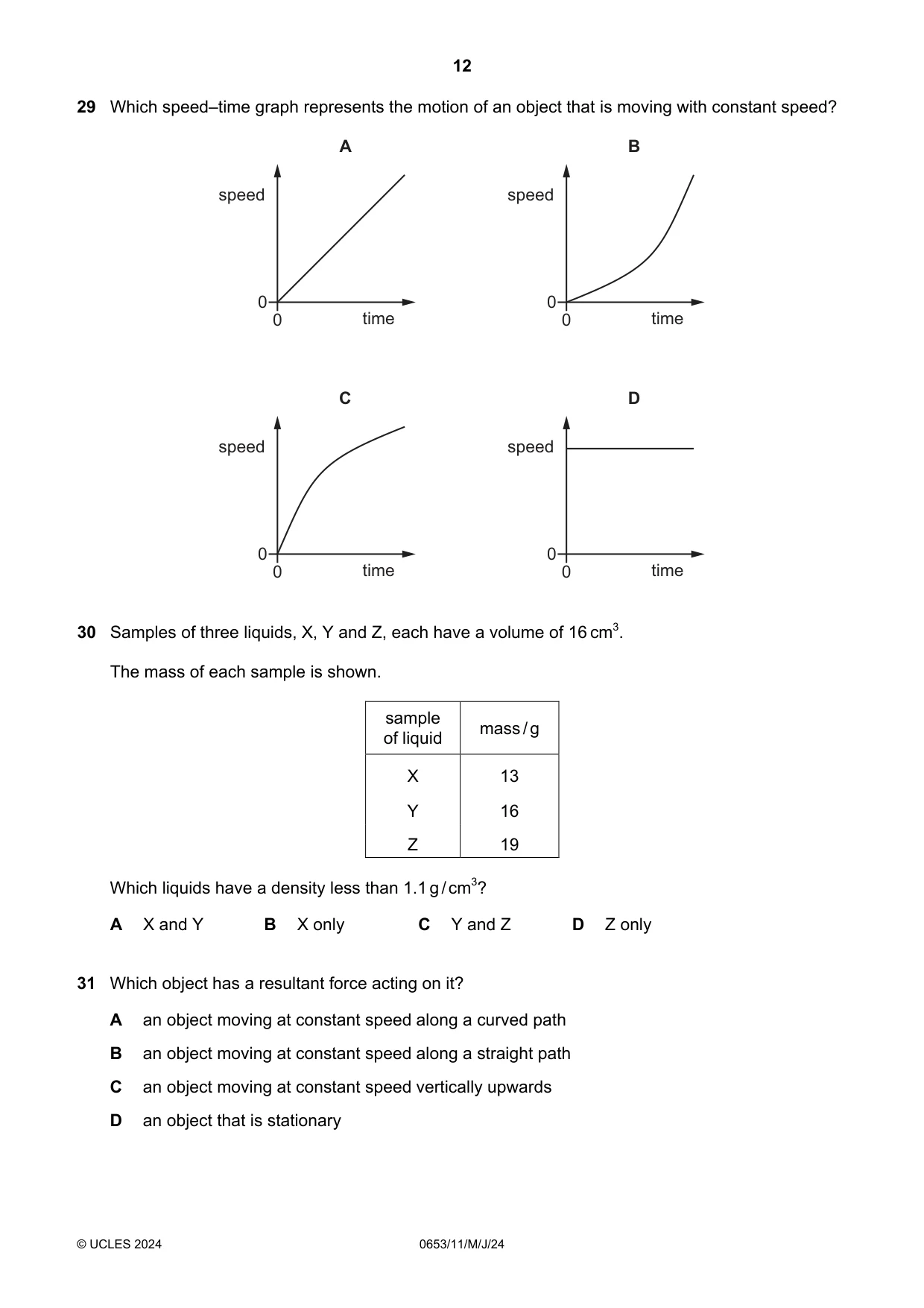
29 Which speed–time graph represents the motion of an object that is moving with constant speed? A B speed speed 0 0 0 time 0 time C D speed speed 0 0 0 time 0 time
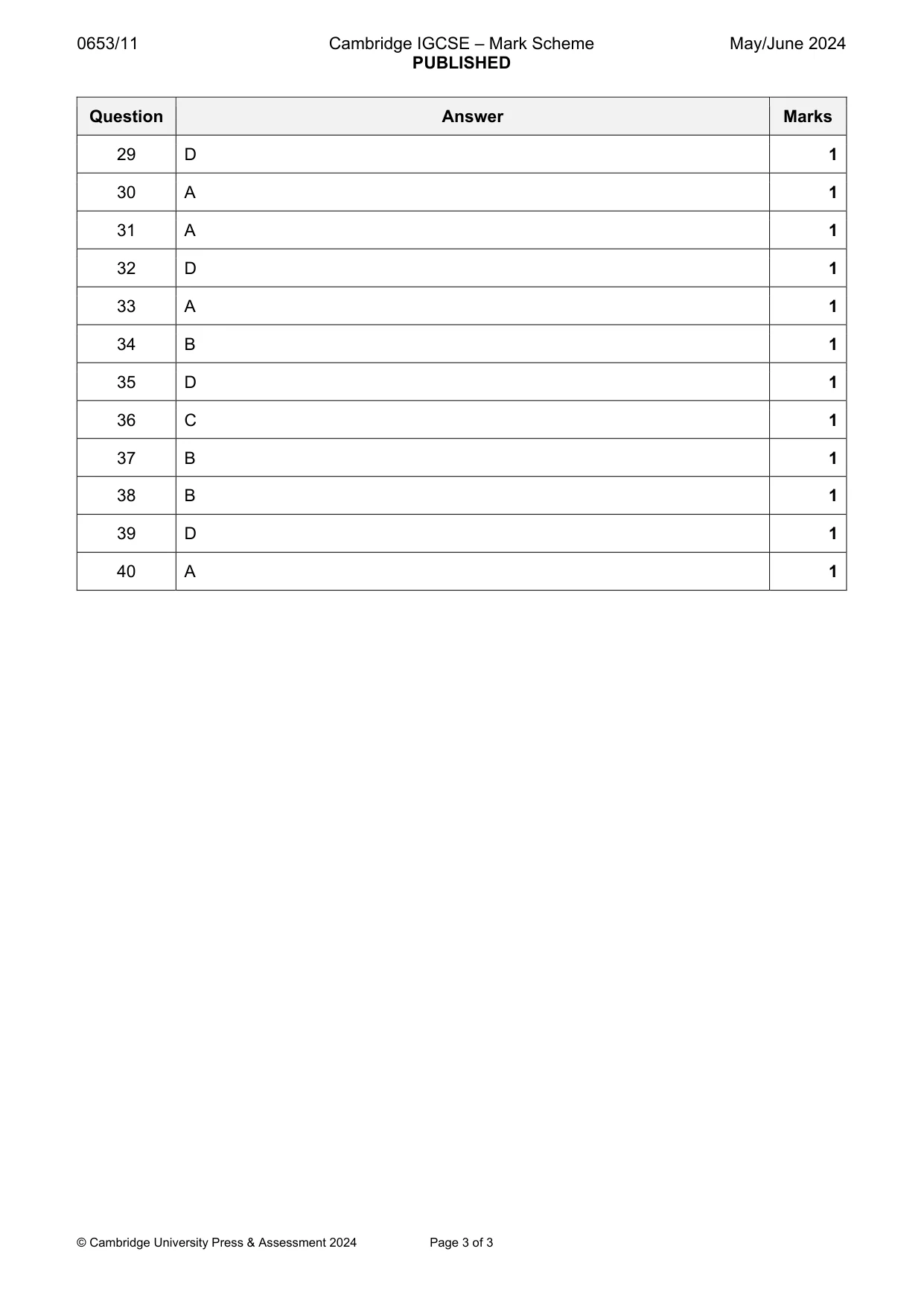
Mark scheme: D
Q30 · Samples of three liquids, X, Y and Z, each have a volume of 16 cm3
30 Samples of three liquids, X, Y and Z, each have a volume of 16 cm3. The mass of each sample is shown. sample mass / g of liquid X 13 Y 16 Z 19 Which liquids have a density less than 1.1 g / cm3? A X and Y B X only C Y and Z D Z only
Mark scheme: A
Q31 · Which object has a resultant force acting on it?
31 Which object has a resultant force acting on it? A an object moving at constant speed along a curved path B an object moving at constant speed along a straight path C an object moving at constant speed vertically upwards D an object that is stationary
Mark scheme: A
Q32 · In three experiments, equal forces of magnitude F move the same block of wood through…
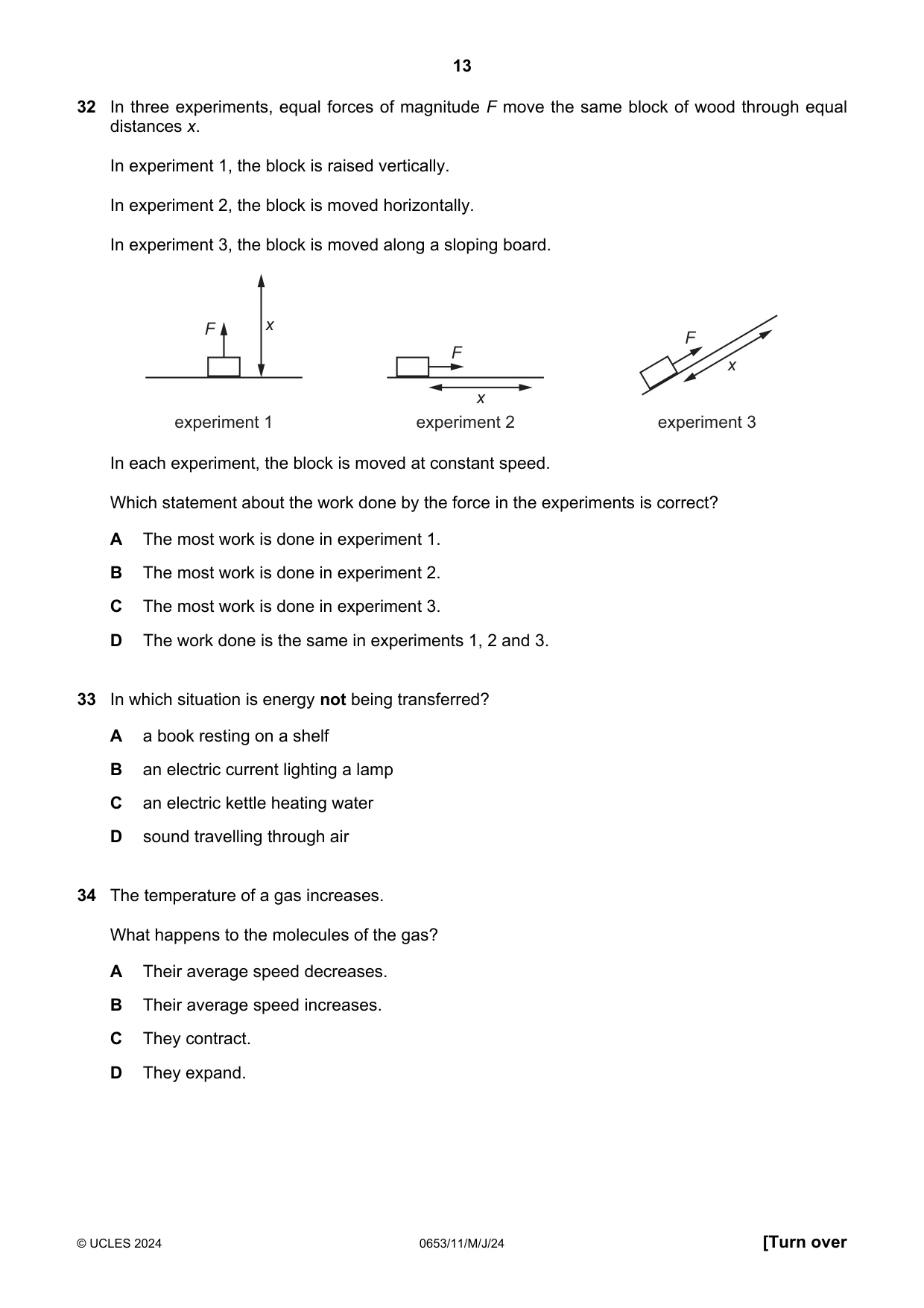
32 In three experiments, equal forces of magnitude F move the same block of wood through equal distances x. In experiment 1, the block is raised vertically. In experiment 2, the block is moved horizontally. In experiment 3, the block is moved along a sloping board. F x F F x x experiment 1 experiment 2 experiment 3 In each experiment, the block is moved at constant speed. Which statement about the work done by the force in the experiments is correct? A The most work is done in experiment 1. B The most work is done in experiment 2. C The most work is done in experiment 3. D The work done is the same in experiments 1, 2 and 3.
Mark scheme: D
Q33 · In which situation is energy not being transferred?
33 In which situation is energy not being transferred? A a book resting on a shelf B an electric current lighting a lamp C an electric kettle heating water D sound travelling through air
Mark scheme: A
Q34 · The temperature of a gas increases
34 The temperature of a gas increases. What happens to the molecules of the gas? A Their average speed decreases. B Their average speed increases. C They contract. D They expand.
Mark scheme: B
Q35 · Energy is transferred from the Sun to the Earth through the vacuum of space
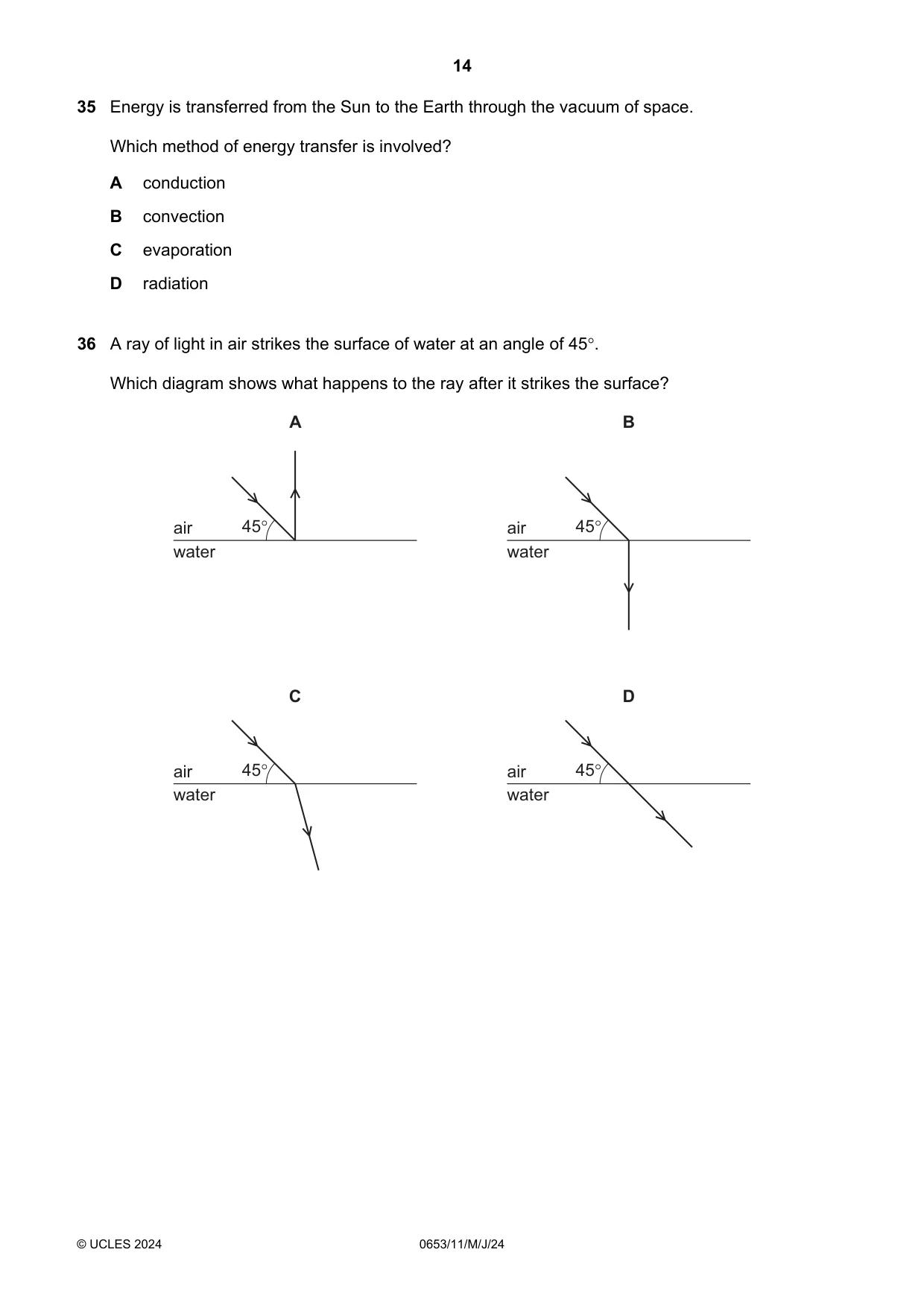
35 Energy is transferred from the Sun to the Earth through the vacuum of space. Which method of energy transfer is involved? A conduction B convection C evaporation D radiation
Mark scheme: D
Q36 · Aray of light in air strikes the surface of water at an angle of 45°
36 Aray of light in air strikes the surface of water at an angle of 45°. Which diagram shows what happens to the ray after it strikes the surface? A B air 45° air 45° water water Cc D air 45° air 45° water water
Mark scheme: C
Q37 · A student measures the speed of sound
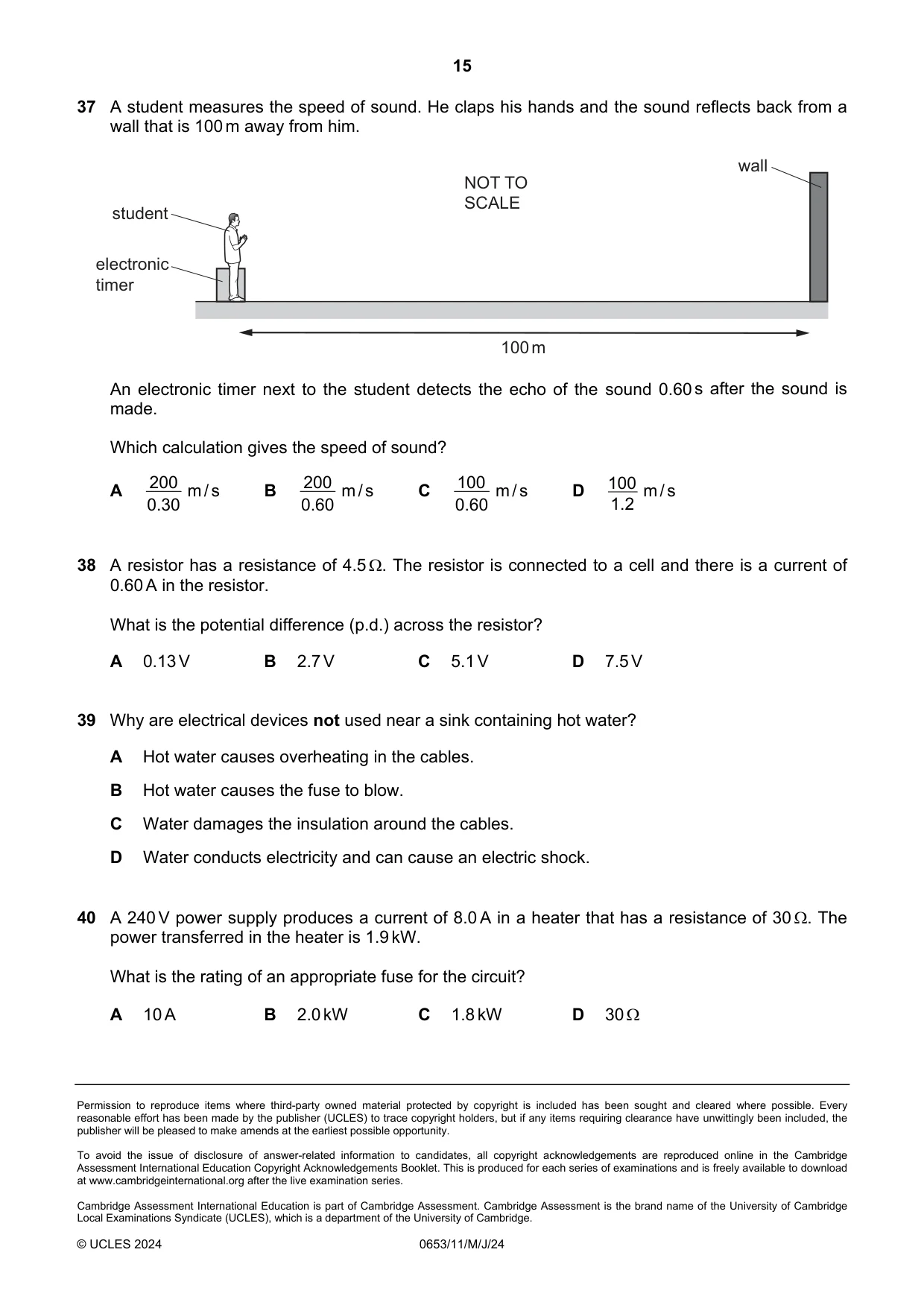
37 A student measures the speed of sound. He claps his hands and the sound reflects back from a wall that is 100 m away from him. wall NOT TO SCALE student electronic timer 100 m An electronic timer next to the student detects the echo of the sound 0.60 s after the sound is made. Which calculation gives the speed of sound? 200 200 100 100 A m / s B m / s C m / s D m / s 0.30 0.60 0.60 1 . 2
Mark scheme: B
Q38 · A resistor has a resistance of 4.5
38 A resistor has a resistance of 4.5 . The resistor is connected to a cell and there is a current of 0.60 A in the resistor. What is the potential difference (p.d.) across the resistor? A 0.13 V B 2.7 V C 5.1 V D 7.5 V
Mark scheme: B
Q39 · Why are electrical devices not used near a sink containing hot water?
39 Why are electrical devices not used near a sink containing hot water? A Hot water causes overheating in the cables. B Hot water causes the fuse to blow. C Water damages the insulation around the cables. D Water conducts electricity and can cause an electric shock.
Mark scheme: D
Q40 · A 240 V power supply produces a current of 8.0 A in a heater that has a resistance of 30
40 A 240 V power supply produces a current of 8.0 A in a heater that has a resistance of 30 . The power transferred in the heater is 1.9 kW. What is the rating of an appropriate fuse for the circuit? A 10 A B 2.0 kW C 1.8 kW D 30
Mark scheme: A
What was in this paper
The subtopics covered by these 40 questions, and how many questions each got. Open one in a new tab to see every Cambridge question on it.
2Energy, work and power2Gas exchange in humans2Kinetic particle model of matter2Air quality and climate1Alkanes1Atomic structure and the Periodic Table1Biological molecules1Carbon cycle1Characteristics of living organisms1Density1Diet1Diffusion1Digestion1Electrical quantities1Electrolysis1Enzymes1Food chains and food webs1Forces1Formulas1Fuels1Heart1Identification of ions and gases1Leaf structure1Light1Motion1Noble gases1Physical and chemical changes1Physical quantities and measurement techniques1Properties of metals1Reactivity series1Redox1Sexual reproduction in plants1Sound1Transfer of thermal energy1Water1What you needed in this session
Cambridge’s own grade thresholds for 2024 May/June, Paper 1 · Variant 1. A higher threshold means an easier paper — the bar moves with how the cohort did.