Cambridge IGCSE Science - Combined 0653 — 2021 Oct/Nov Paper 1 · Variant 1
0653/11/O/N/21 · 40 questions · 40 marks · ≈45 min
The question paper and its mark scheme, free to read here and free to download. This is Cambridge’s own paper, exactly as it was sat.
Question paper16 pages
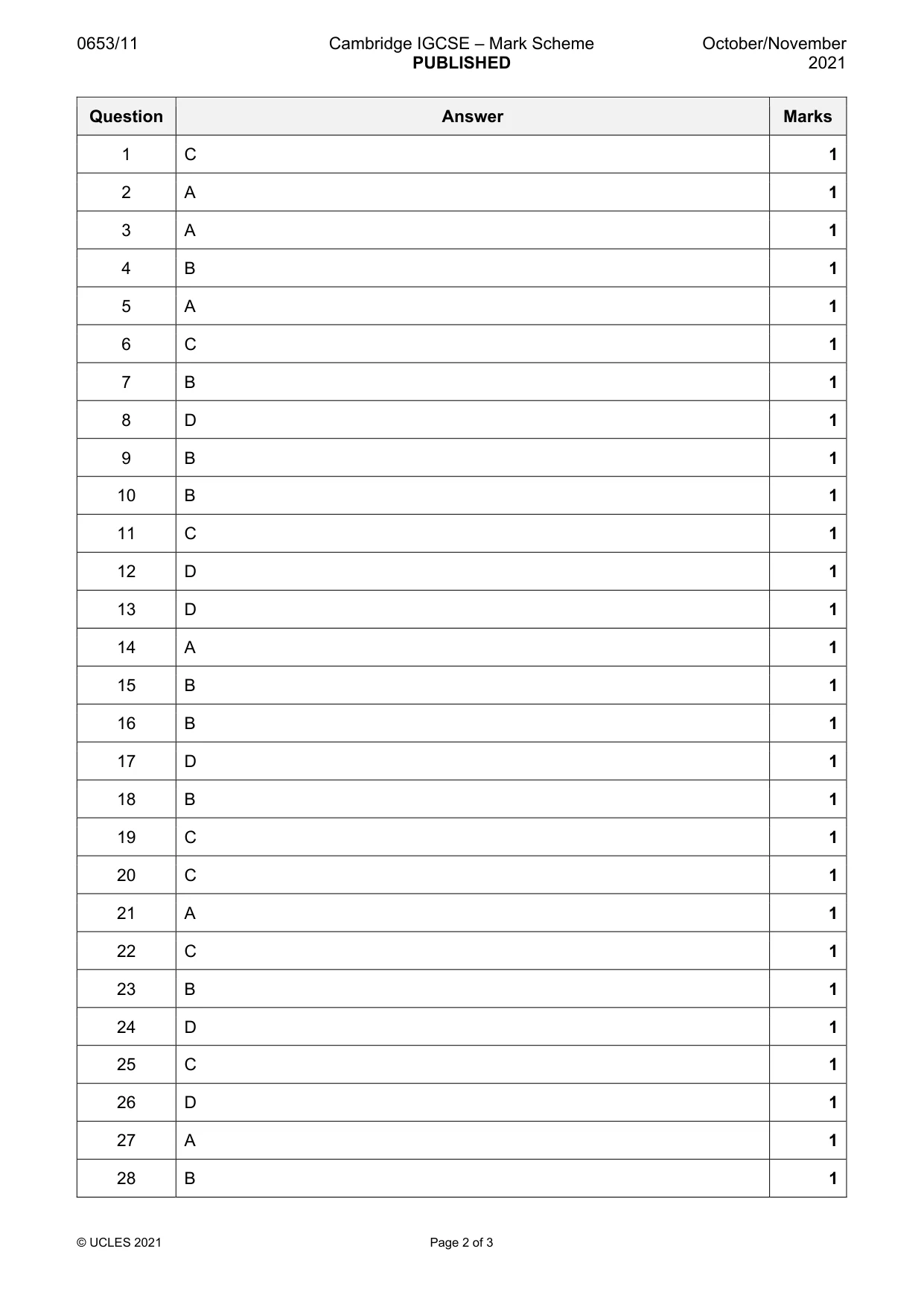
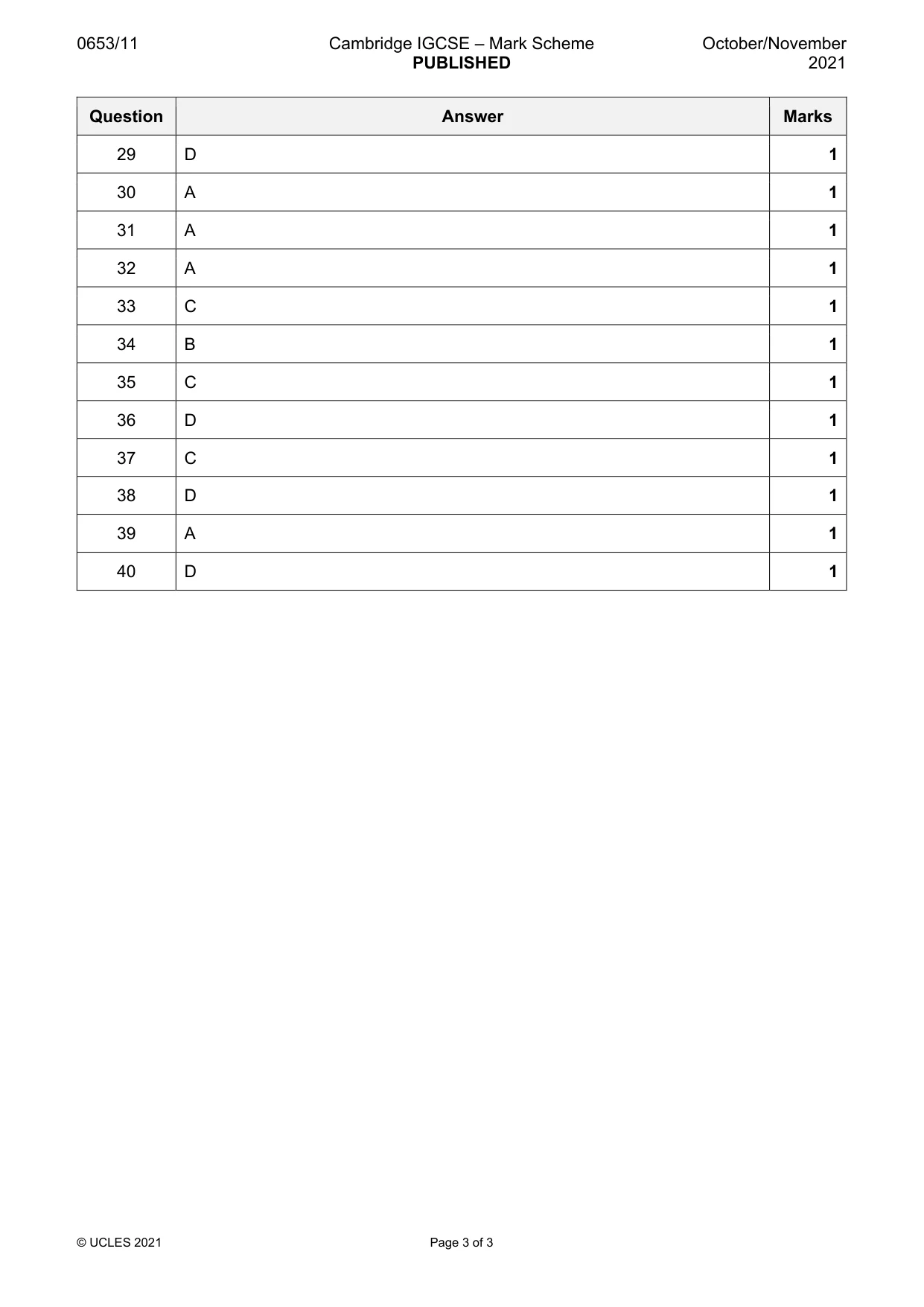
Mark scheme3 pages
Answers below. Sit the paper first if you are practising.
Questions as text
Q1 · Movement is a characteristic of all living organisms
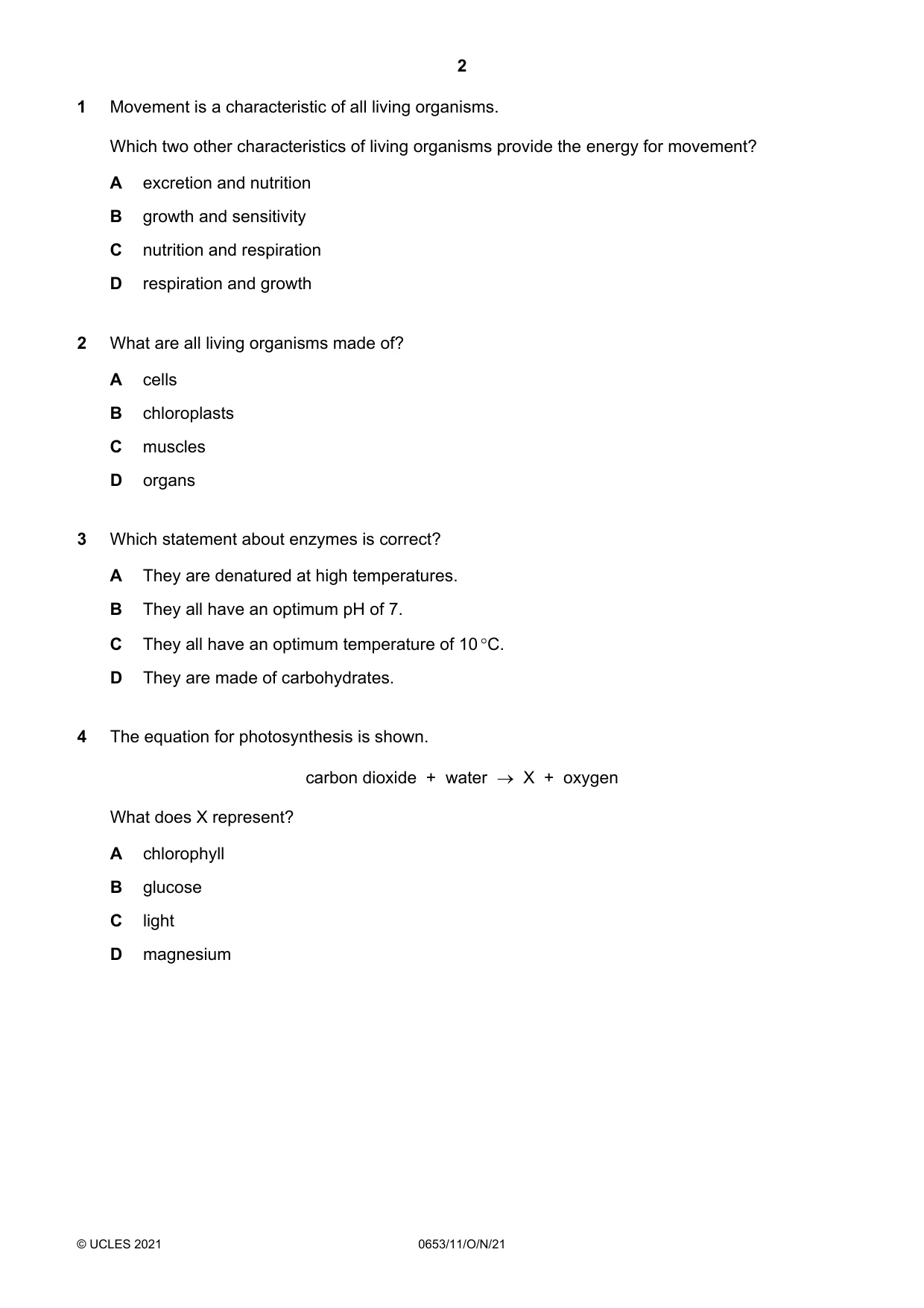
1 Movement is a characteristic of all living organisms. Which two other characteristics of living organisms provide the energy for movement? A excretion and nutrition B growth and sensitivity C nutrition and respiration D respiration and growth
Mark scheme: C
Q2 · What are all living organisms made of?
2 What are all living organisms made of? A cells B chloroplasts C muscles D organs
Mark scheme: A
Q3 · Which statement about enzymes is correct?
3 Which statement about enzymes is correct? A They are denatured at high temperatures. B They all have an optimum pH of 7. C They all have an optimum temperature of 10 C. D They are made of carbohydrates.
Mark scheme: A
Q4 · The equation for photosynthesis is shown
4 The equation for photosynthesis is shown. carbon dioxide + water X + oxygen What does X represent? A chlorophyll B glucose C light D magnesium
Mark scheme: B
Q5 · What happens during digestion?
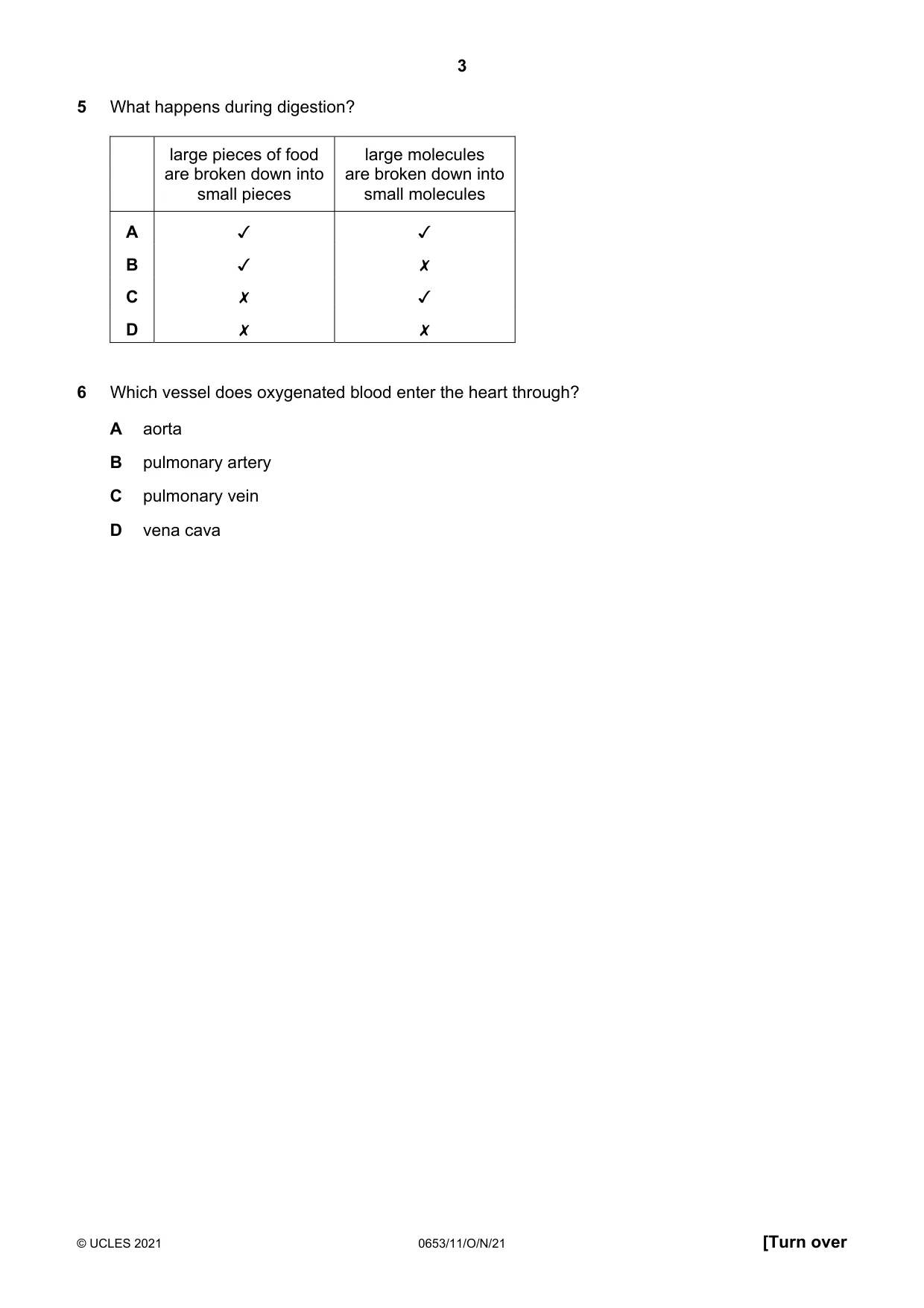
5 What happens during digestion? large pieces of food large molecules are broken down into | are broken down into small pieces small molecules v v 0 0O WwW > v x x v x x
Mark scheme: A
Q6 · Which vessel does oxygenated blood enter the heart through?
6 Which vessel does oxygenated blood enter the heart through? A aorta B pulmonary artery C pulmonary vein D vena cava
Mark scheme: C
Q7 · The diagram shows apparatus that is used to investigate the differences in composition…
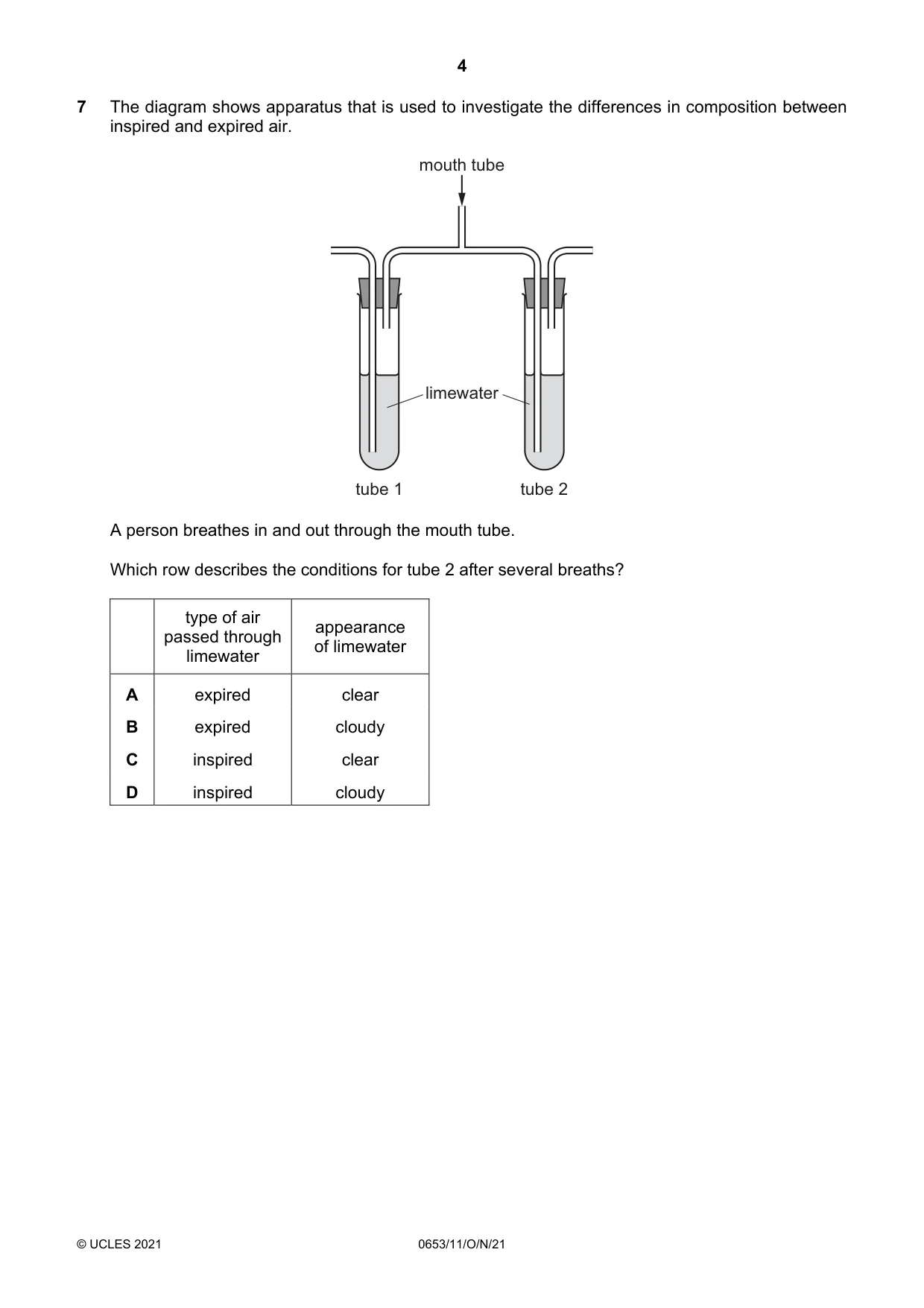
7 The diagram shows apparatus that is used to investigate the differences in composition between inspired and expired air. mouth tube limewater tube 1 tube 2 A person breathes in and out through the mouth tube. Which row describes the conditions for tube 2 after several breaths? type of air appearance passed through of limewater limewater A expired clear B expired cloudy C inspired clear D inspired cloudy
Mark scheme: B
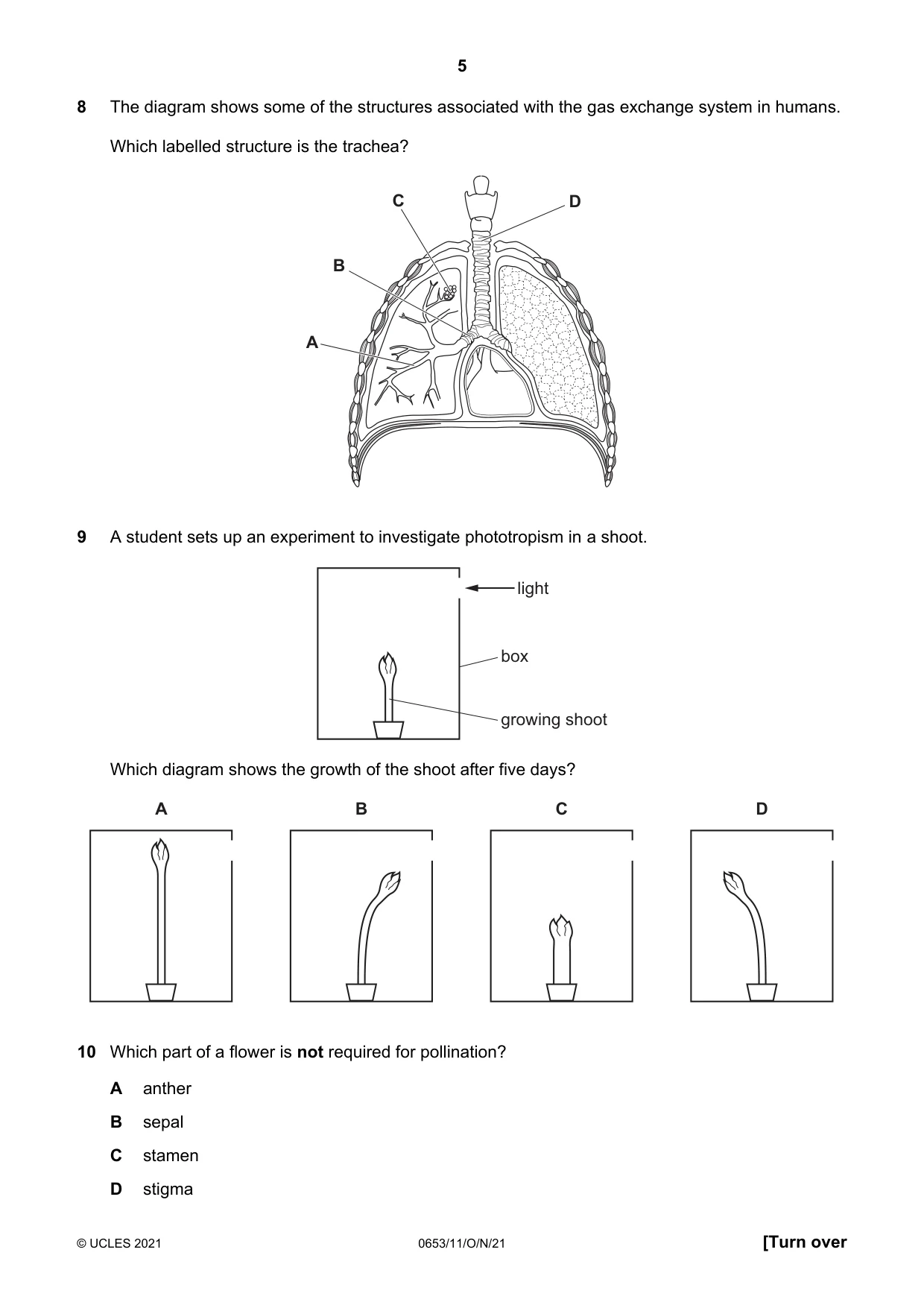
Q8 · The diagram shows some of the structures associated with the gas exchange system in humans
8 The diagram shows some of the structures associated with the gas exchange system in humans. Which labelled structure is the trachea? C D B A
Mark scheme: D
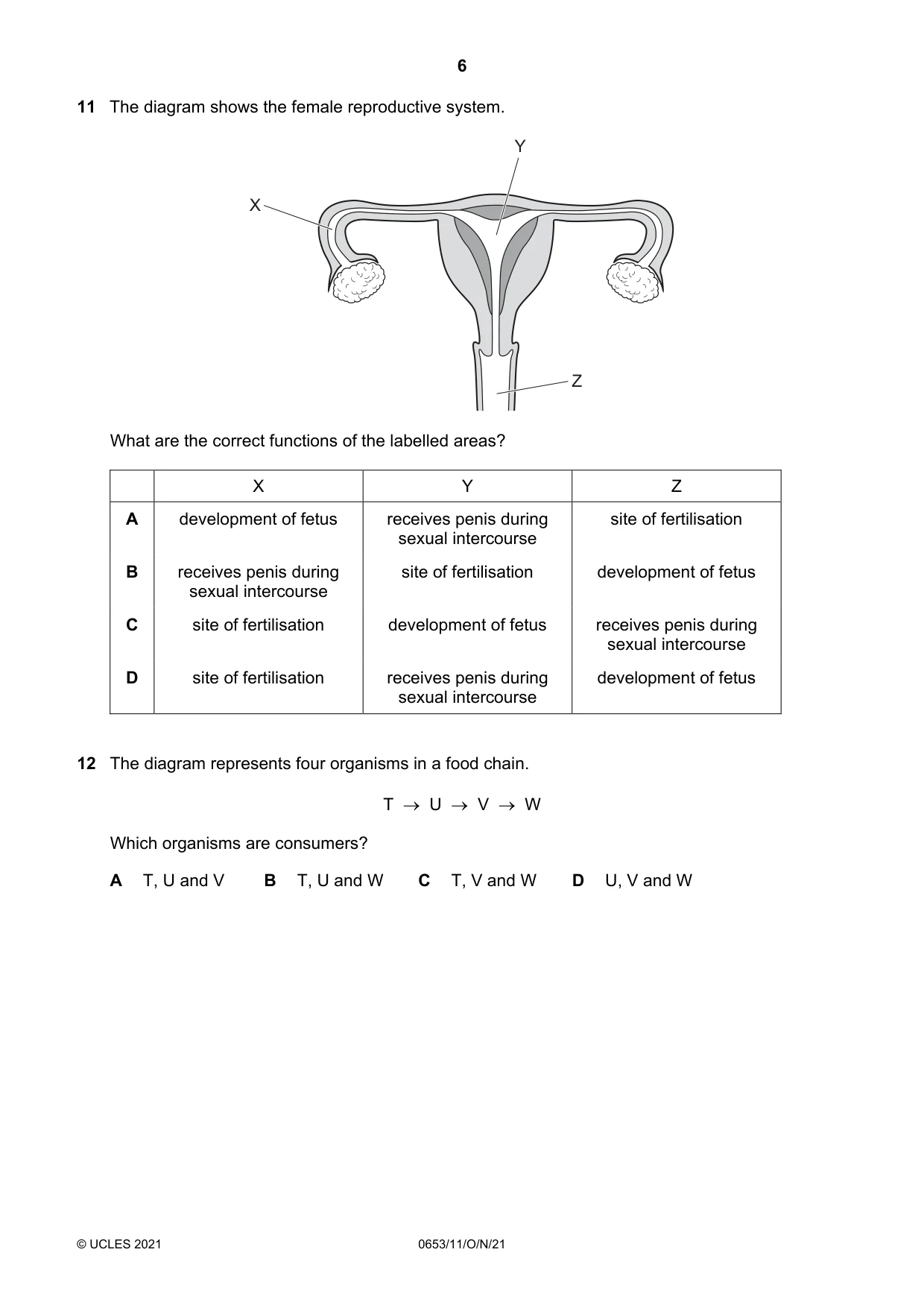
Q9 · A student sets up an experiment to investigate phototropism in a shoot
9 A student sets up an experiment to investigate phototropism in a shoot. light box growing shoot Which diagram shows the growth of the shoot after five days? A B C D
Mark scheme: B
Q10 · Which part of a flower is not required for pollination?
10 Which part of a flower is not required for pollination? A anther B sepal C stamen D stigma
Mark scheme: B
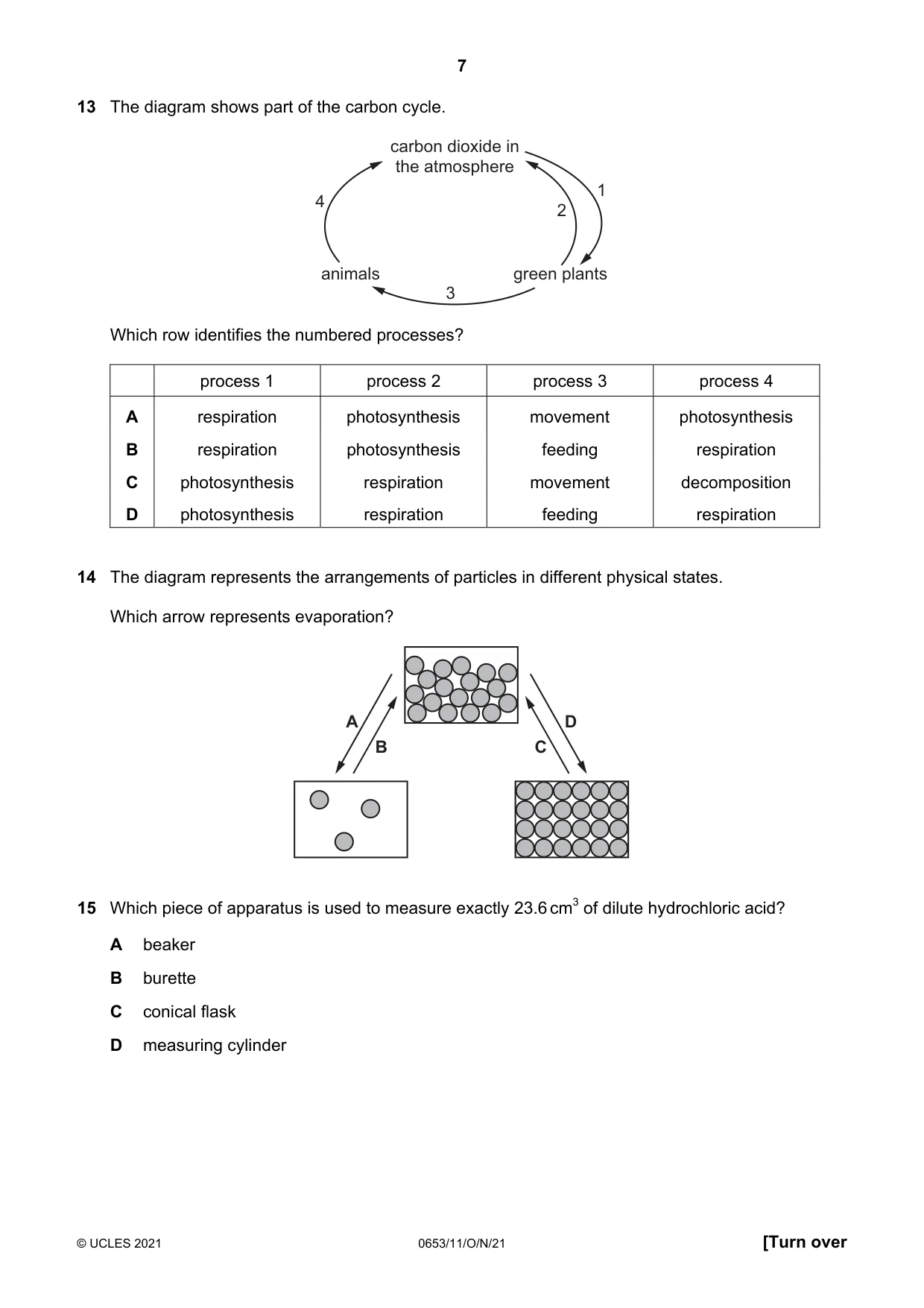
Q11 · The diagram shows the female reproductive system
11 The diagram shows the female reproductive system. Y X Z What are the correct functions of the labelled areas? X Y Z A development of fetus receives penis during site of fertilisation sexual intercourse B receives penis during site of fertilisation development of fetus sexual intercourse C site of fertilisation development of fetus receives penis during sexual intercourse D site of fertilisation receives penis during development of fetus sexual intercourse
Mark scheme: C
Q12 · The diagram represents four organisms in a food chain
12 The diagram represents four organisms in a food chain. T U V W Which organisms are consumers? A T, U and V B T, U and W C T, V and W D U, V and W
Mark scheme: D
Q13 · The diagram shows part of the carbon cycle
13 The diagram shows part of the carbon cycle. carbon dioxide in the atmosphere 1 4 2 animals green plants 3 Which row identifies the numbered processes? process 1 process 2 process 3 process 4 A respiration photosynthesis movement photosynthesis B respiration photosynthesis feeding respiration C photosynthesis respiration movement decomposition D photosynthesis respiration feeding respiration
Mark scheme: D
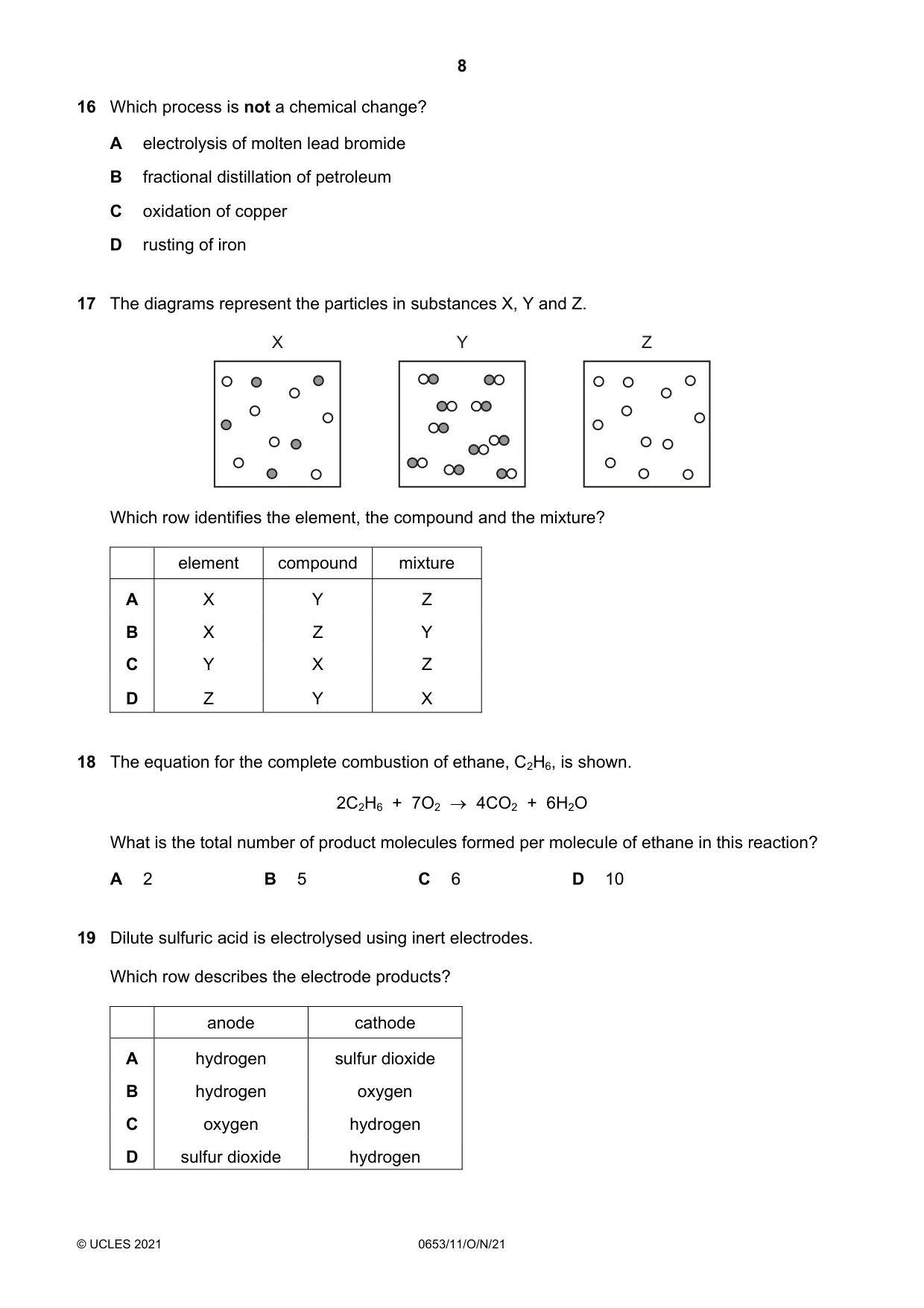
Q14 · The diagram represents the arrangements of particles in different physical states
14 The diagram represents the arrangements of particles in different physical states. Which arrow represents evaporation? A D B C
Mark scheme: A
Q15 · Which piece of apparatus is used to measure exactly 23.6 cm3 of dilute hydrochloric acid?
15 Which piece of apparatus is used to measure exactly 23.6 cm3 of dilute hydrochloric acid? A beaker B burette C conical flask D measuring cylinder
Mark scheme: B
Q16 · Which process is not a chemical change?
16 Which process is not a chemical change? A electrolysis of molten lead bromide B fractional distillation of petroleum C oxidation of copper D rusting of iron
Mark scheme: B
Q17 · The diagrams represent the particles in substances X, Y and Z
17 The diagrams represent the particles in substances X, Y and Z. X Y Z Which row identifies the element, the compound and the mixture? element compound mixture A X Y Z B X Z Y C Y X Z D Z Y X
Mark scheme: D
Q18 · The equation for the complete combustion of ethane, C2H6, is shown
18 The equation for the complete combustion of ethane, C2H6, is shown. 2C2H6 + 7O2 4CO2 + 6H2O What is the total number of product molecules formed per molecule of ethane in this reaction? A 2 B 5 C 6 D 10
Mark scheme: B
Q19 · Dilute sulfuric acid is electrolysed using inert electrodes
19 Dilute sulfuric acid is electrolysed using inert electrodes. Which row describes the electrode products? anode cathode A hydrogen sulfur dioxide B hydrogen oxygen C oxygen hydrogen D sulfur dioxide hydrogen
Mark scheme: C
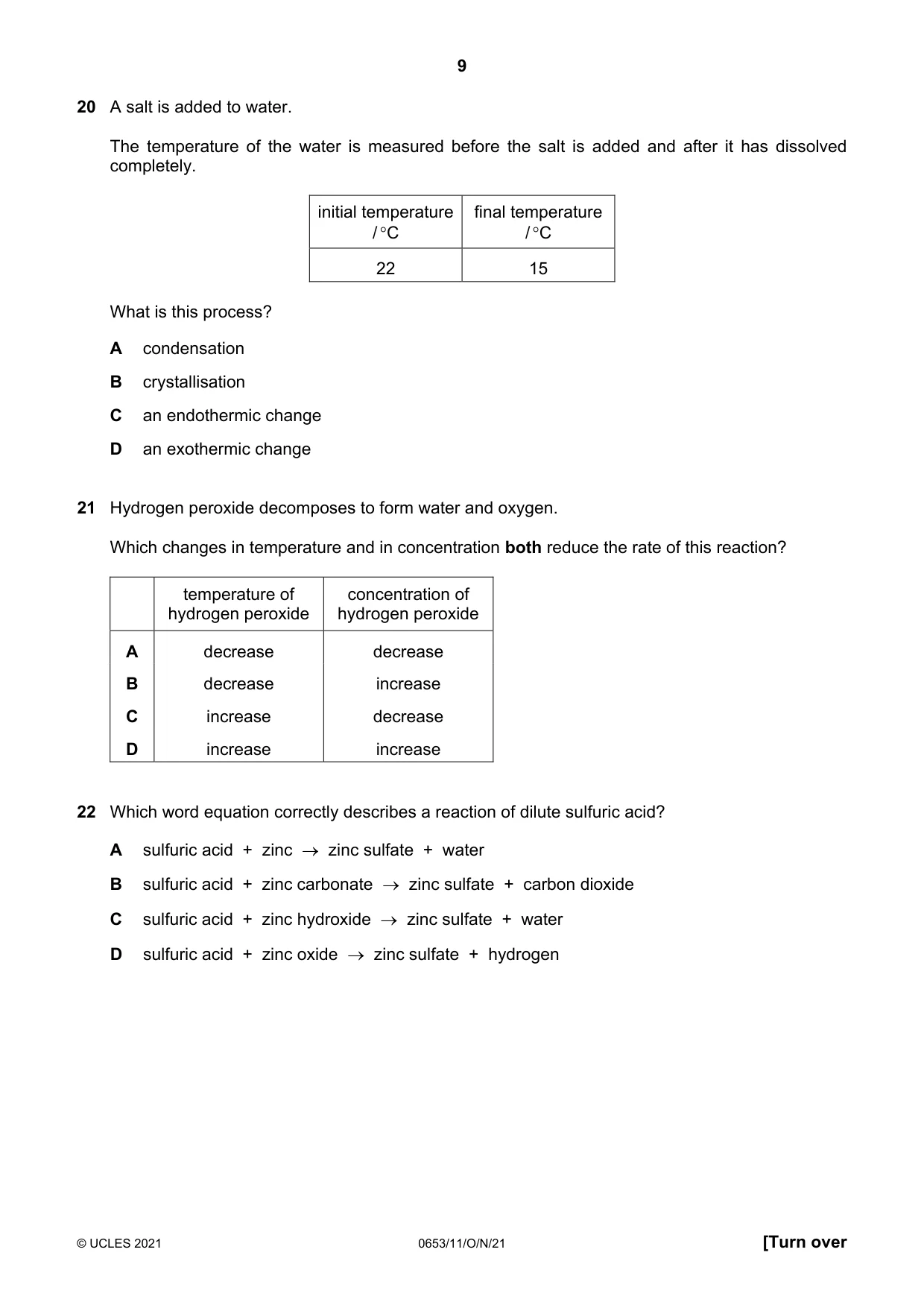
Q20 · A salt is added to water
20 A salt is added to water. The temperature of the water is measured before the salt is added and after it has dissolved completely. initial temperature final temperature / C / C 22 15 What is this process? A condensation B crystallisation C an endothermic change D an exothermic change
Mark scheme: C
Q21 · Hydrogen peroxide decomposes to form water and oxygen
21 Hydrogen peroxide decomposes to form water and oxygen. Which changes in temperature and in concentration both reduce the rate of this reaction? temperature of concentration of hydrogen peroxide hydrogen peroxide A decrease decrease B decrease increase C increase decrease D increase increase
Mark scheme: A
Q22 · Which word equation correctly describes a reaction of dilute sulfuric acid?
22 Which word equation correctly describes a reaction of dilute sulfuric acid? A sulfuric acid + zinc zinc sulfate + water B sulfuric acid + zinc carbonate zinc sulfate + carbon dioxide C sulfuric acid + zinc hydroxide zinc sulfate + water D sulfuric acid + zinc oxide zinc sulfate + hydrogen
Mark scheme: C
More questions on The characteristic properties of acids and bases
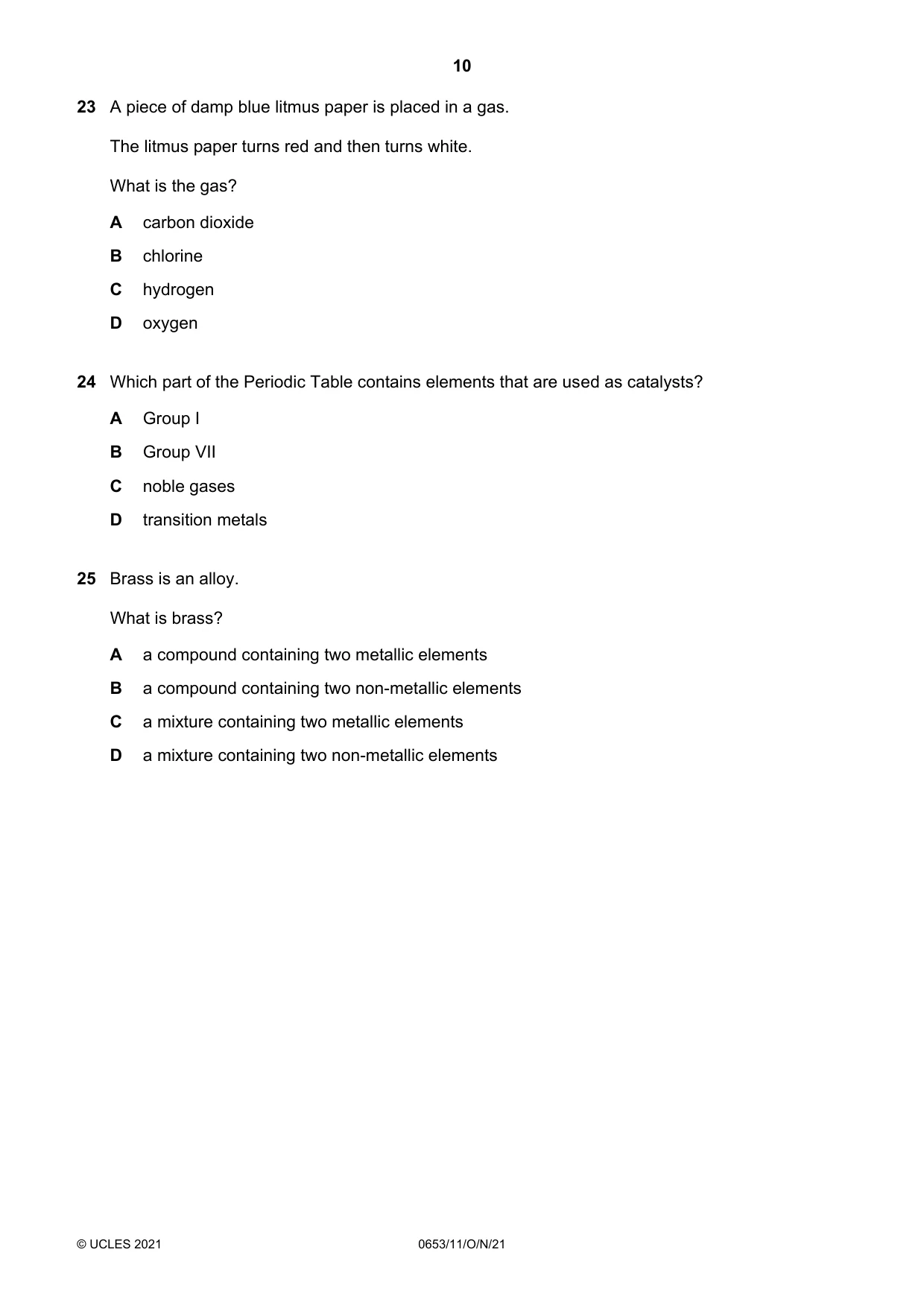
Q23 · A piece of damp blue litmus paper is placed in a gas
23 A piece of damp blue litmus paper is placed in a gas. The litmus paper turns red and then turns white. What is the gas? A carbon dioxide B chlorine C hydrogen D oxygen
Mark scheme: B
Q24 · Which part of the Periodic Table contains elements that are used as catalysts?
24 Which part of the Periodic Table contains elements that are used as catalysts? A Group I B Group VII C noble gases D transition metals
Mark scheme: D
Q25 · Brass is an alloy
25 Brass is an alloy. What is brass? A a compound containing two metallic elements B a compound containing two non-metallic elements C a mixture containing two metallic elements D a mixture containing two non-metallic elements
Mark scheme: C
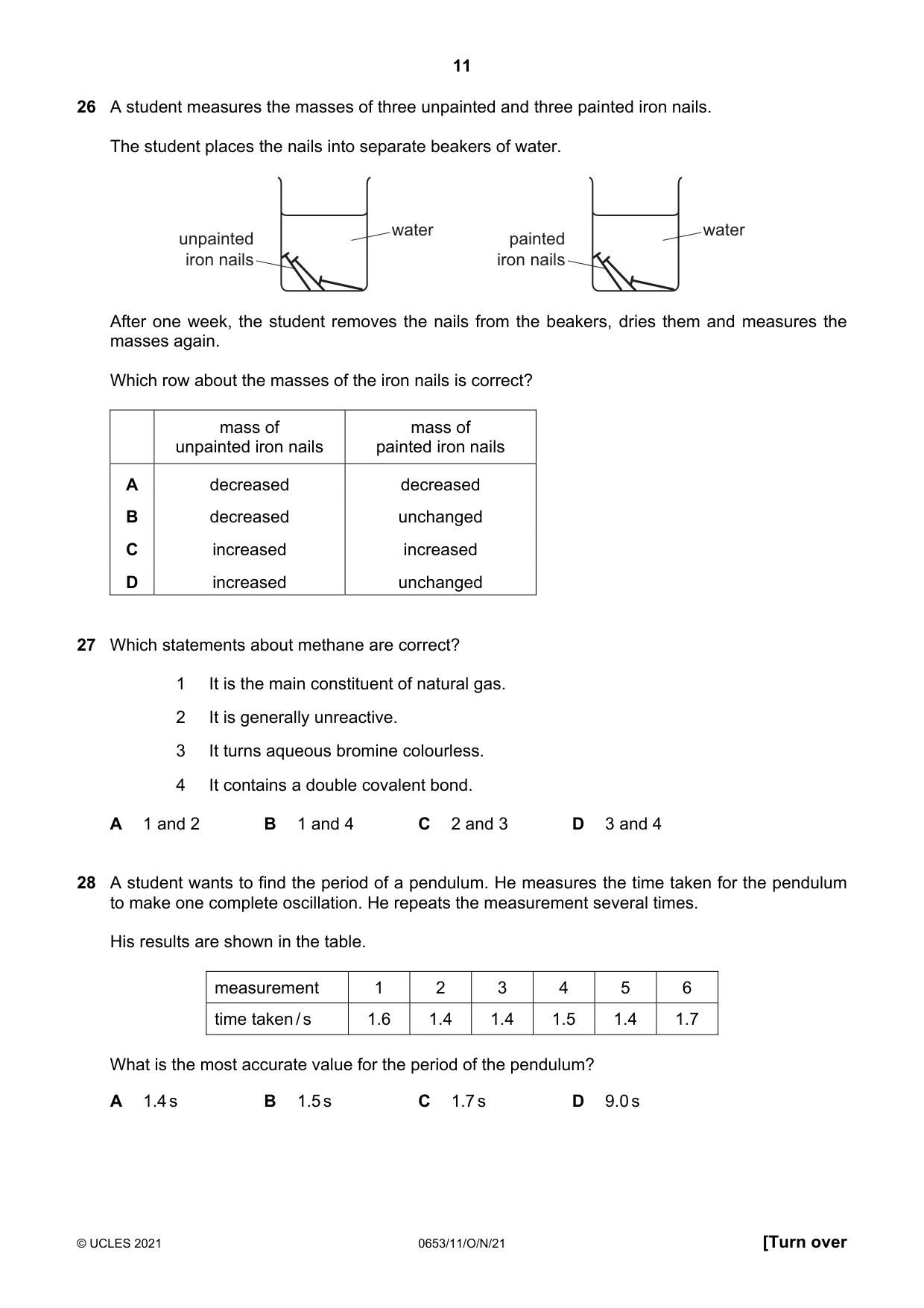
Q26 · A student measures the masses of three unpainted and three painted iron nails
26 A student measures the masses of three unpainted and three painted iron nails. The student places the nails into separate beakers of water. water water unpainted painted iron nails iron nails After one week, the student removes the nails from the beakers, dries them and measures the masses again. Which row about the masses of the iron nails is correct? mass of mass of unpainted iron nails painted iron nails A decreased decreased B decreased unchanged C increased increased D increased unchanged
Mark scheme: D
Q27 · Which statements about methane are correct?
27 Which statements about methane are correct? 1 It is the main constituent of natural gas. 2 It is generally unreactive. 3 It turns aqueous bromine colourless. 4 It contains a double covalent bond. A 1 and 2 B 1 and 4 C 2 and 3 D 3 and 4
Mark scheme: A
Q28 · A student wants to find the period of a pendulum
28 A student wants to find the period of a pendulum. He measures the time taken for the pendulum to make one complete oscillation. He repeats the measurement several times. His results are shown in the table. measurement 1 2 3 4 5 6 time taken / s 1.6 1.4 1.4 1.5 1.4 1.7 What is the most accurate value for the period of the pendulum? A 1.4 s B 1.5 s C 1.7 s D 9.0 s
Mark scheme: B
More questions on Physical quantities and measurement techniques
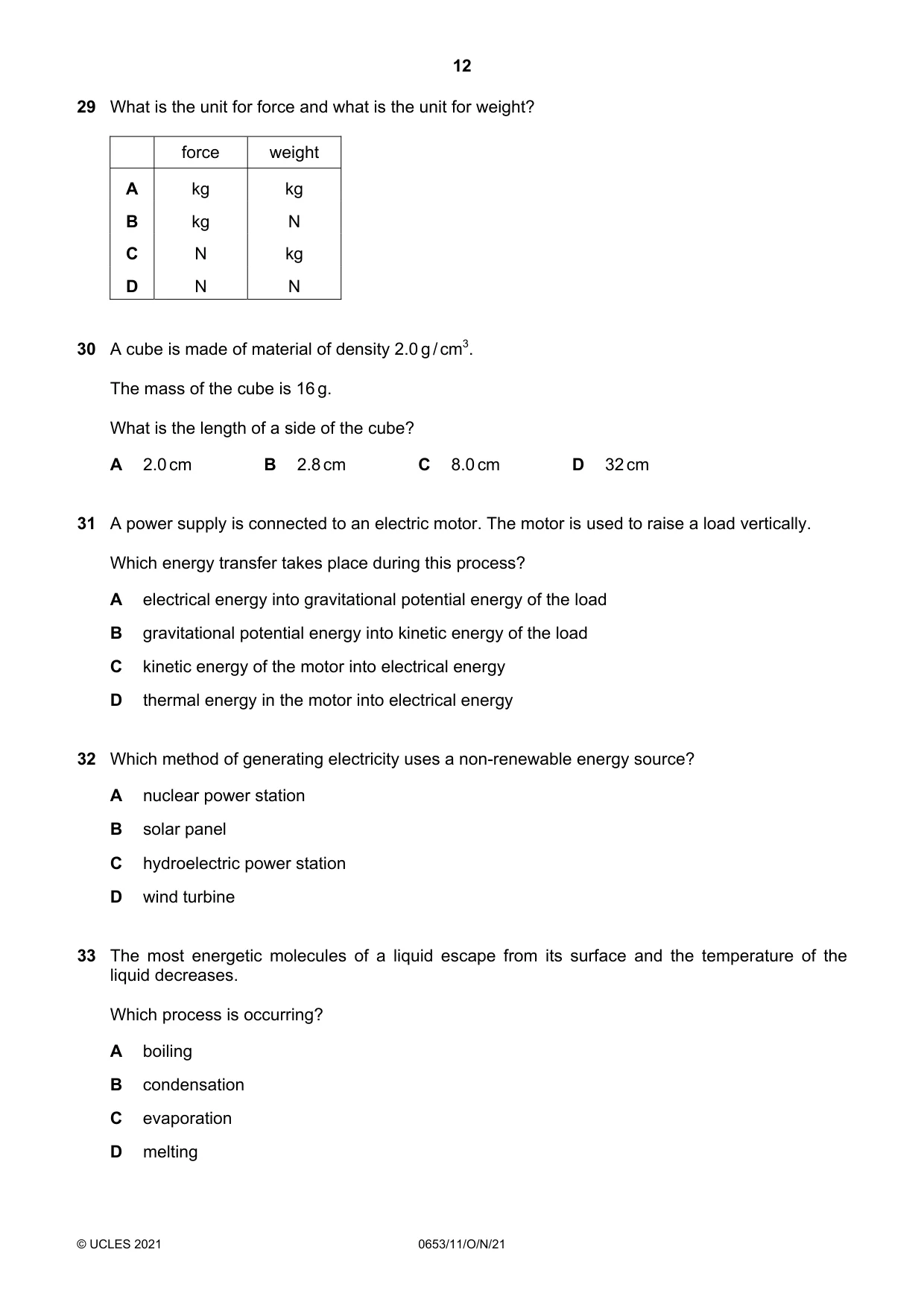
Q29 · What is the unit for force and what is the unit for weight?
29 What is the unit for force and what is the unit for weight? force weight A kg kg B kg N C N kg D N N
Mark scheme: D
Q30 · A cube is made of material of density 2.0 g / cm3
30 A cube is made of material of density 2.0 g / cm3. The mass of the cube is 16 g. What is the length of a side of the cube? A 2.0 cm B 2.8 cm C 8.0 cm D 32 cm
Mark scheme: A
Q31 · A power supply is connected to an electric motor
31 A power supply is connected to an electric motor. The motor is used to raise a load vertically. Which energy transfer takes place during this process? A electrical energy into gravitational potential energy of the load B gravitational potential energy into kinetic energy of the load C kinetic energy of the motor into electrical energy D thermal energy in the motor into electrical energy
Mark scheme: A
Q32 · Which method of generating electricity uses a non-renewable energy source?
32 Which method of generating electricity uses a non-renewable energy source? A nuclear power station B solar panel C hydroelectric power station D wind turbine
Mark scheme: A
Q33 · The most energetic molecules of a liquid escape from its surface and the temperature of…
33 The most energetic molecules of a liquid escape from its surface and the temperature of the liquid decreases. Which process is occurring? A boiling B condensation C evaporation D melting
Mark scheme: C
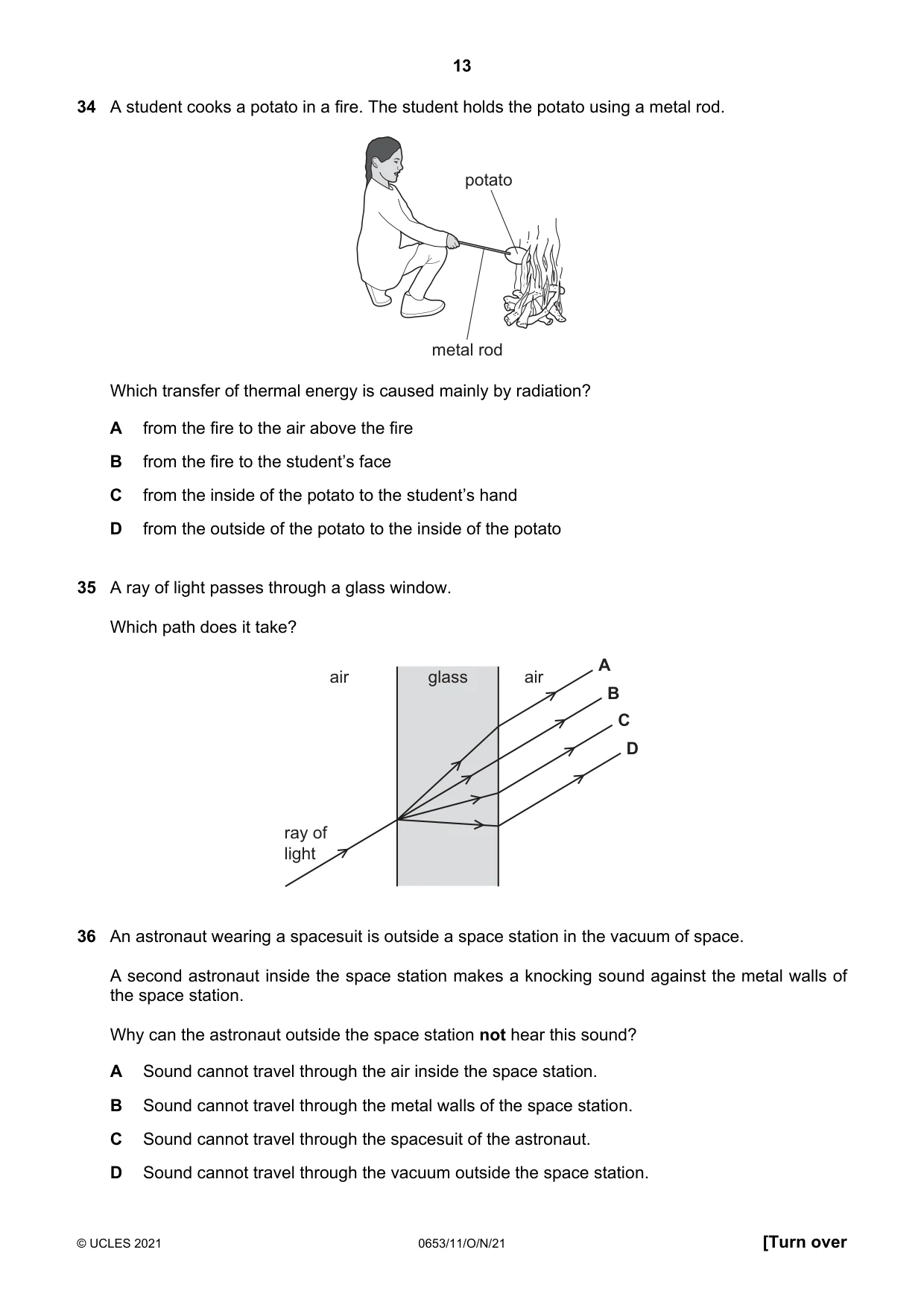
Q34 · A student cooks a potato in a fire
34 A student cooks a potato in a fire. The student holds the potato using a metal rod. potato metal rod Which transfer of thermal energy is caused mainly by radiation? A from the fire to the air above the fire B from the fire to the student’s face C from the inside of the potato to the student’s hand D from the outside of the potato to the inside of the potato
Mark scheme: B
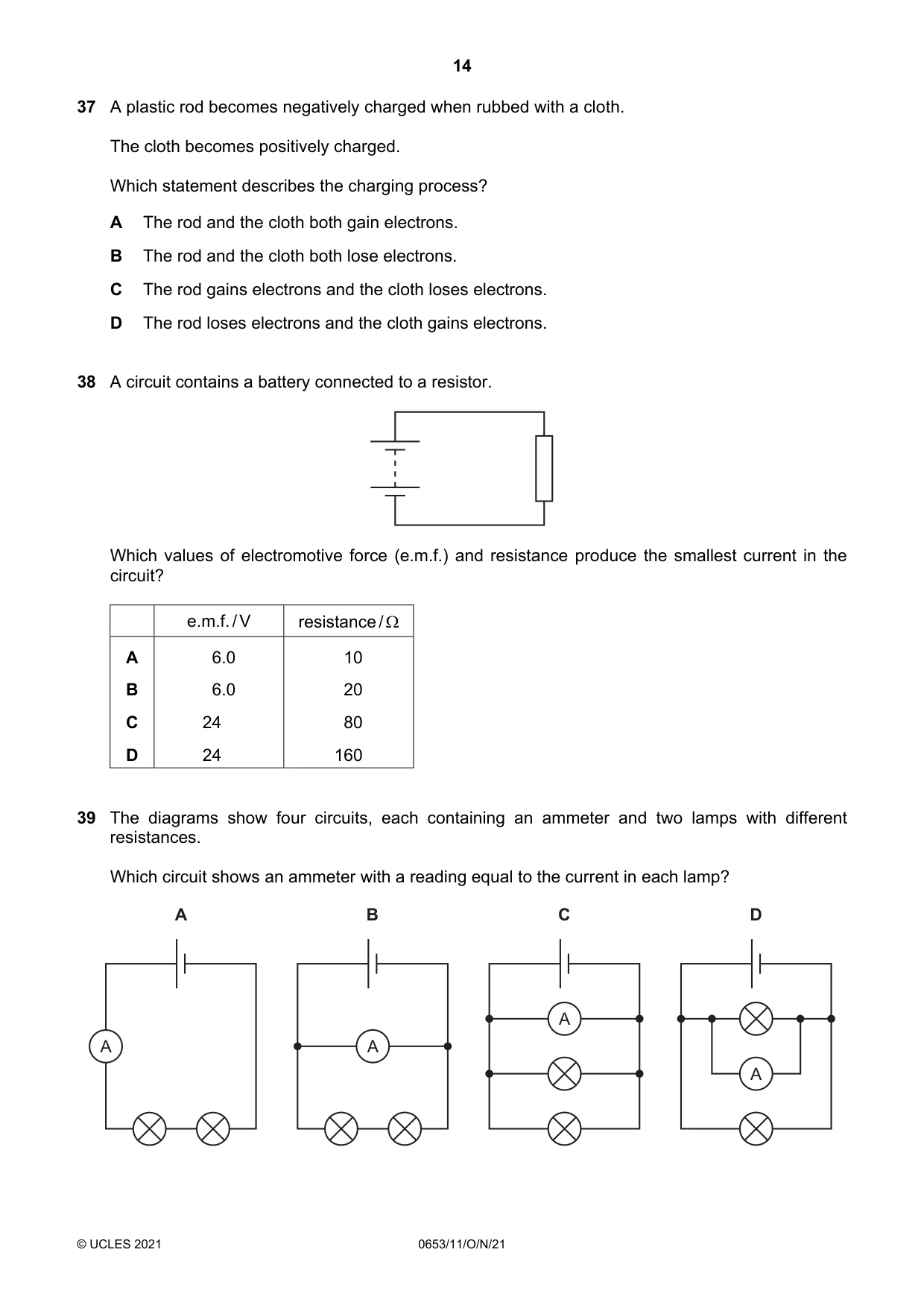
Q35 · A ray of light passes through a glass window
35 A ray of light passes through a glass window. Which path does it take? A air glass air B C D ray of light
Mark scheme: C
Q36 · An astronaut wearing a spacesuit is outside a space station in the vacuum of space
36 An astronaut wearing a spacesuit is outside a space station in the vacuum of space. A second astronaut inside the space station makes a knocking sound against the metal walls of the space station. Why can the astronaut outside the space station not hear this sound? A Sound cannot travel through the air inside the space station. B Sound cannot travel through the metal walls of the space station. C Sound cannot travel through the spacesuit of the astronaut. D Sound cannot travel through the vacuum outside the space station.
Mark scheme: D
Q37 · A plastic rod becomes negatively charged when rubbed with a cloth
37 A plastic rod becomes negatively charged when rubbed with a cloth. The cloth becomes positively charged. Which statement describes the charging process? A The rod and the cloth both gain electrons. B The rod and the cloth both lose electrons. C The rod gains electrons and the cloth loses electrons. D The rod loses electrons and the cloth gains electrons.
Mark scheme: C
Q38 · A circuit contains a battery connected to a resistor
38 A circuit contains a battery connected to a resistor. Which values of electromotive force (e.m.f.) and resistance produce the smallest current in the circuit? e.m.f. / V resistance / A 6.0 10 B 6.0 20 C 24 80 D 24 160
Mark scheme: D
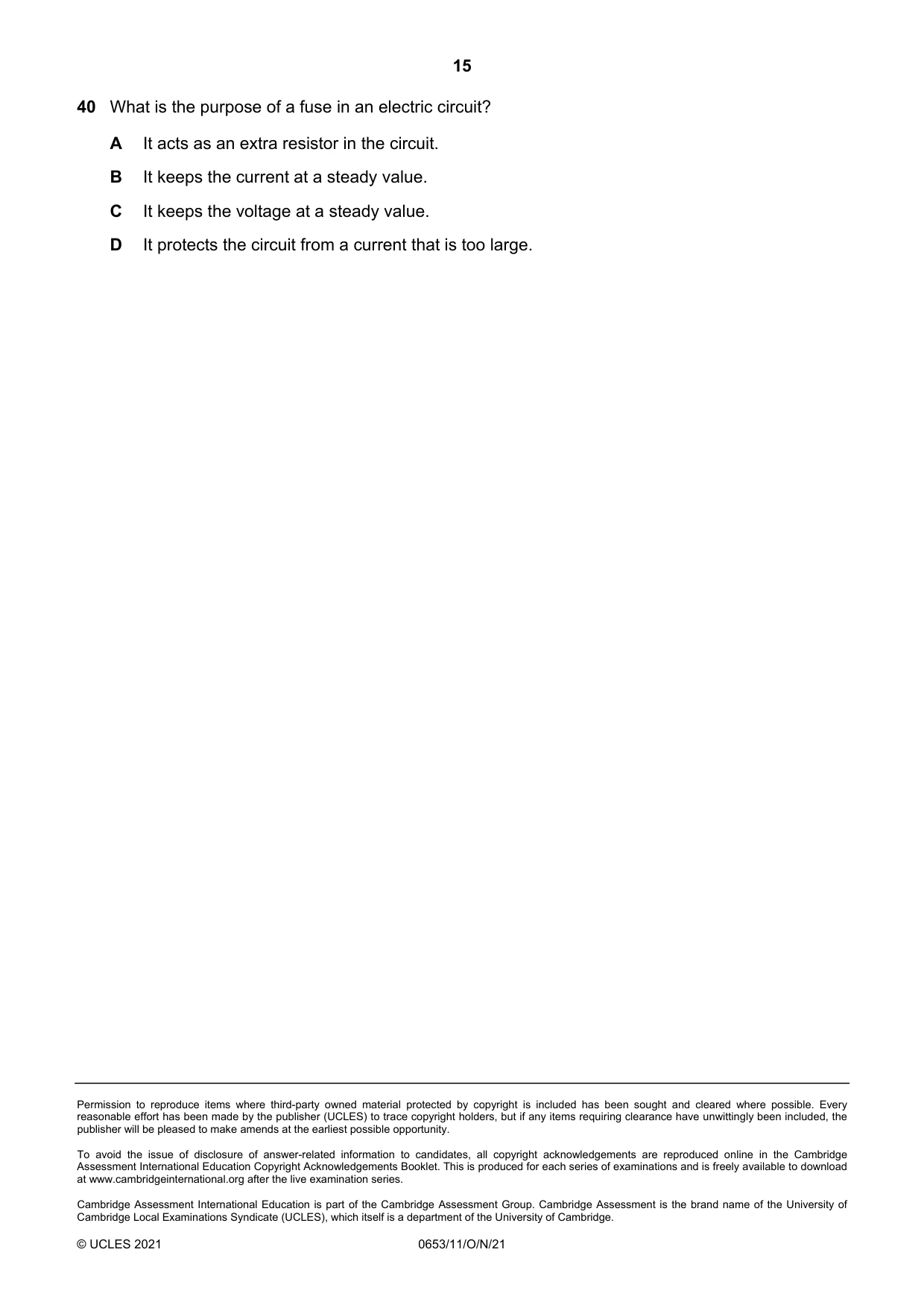
Q39 · The diagrams show four circuits, each containing an ammeter and two lamps with different…
39 The diagrams show four circuits, each containing an ammeter and two lamps with different resistances. Which circuit shows an ammeter with a reading equal to the current in each lamp? A B C D A A A A
Mark scheme: A
Q40 · What is the purpose of a fuse in an electric circuit?
40 What is the purpose of a fuse in an electric circuit? A It acts as an extra resistor in the circuit. B It keeps the current at a steady value. C It keeps the voltage at a steady value. D It protects the circuit from a current that is too large.
Mark scheme: D
What was in this paper
The subtopics covered by these 40 questions, and how many questions each got. Open one in a new tab to see every Cambridge question on it.
2Energy, work and power2Gas exchange in humans2Photosynthesis2Alkanes1Alloys and their properties1Carbon cycle1Cell structure1Corrosion of metals1Density1Digestion1Electrical circuits1Electrical safety1Electrolysis1Elements, compounds and mixtures1Enzymes1Exothermic and endothermic reactions1Experimental design1Food chains and food webs1Formulas1Heart1Identification of ions and gases1Kinetic particle model of matter1Light1Mass and weight1Physical and chemical changes1Physical quantities and measurement techniques1Rate of reaction1Respiration1Sexual reproduction in humans1Sexual reproduction in plants1Solids, liquids and gases1Sound1The characteristic properties of acids and bases1Transfer of thermal energy1Transition elements1What you needed in this session
Cambridge’s own grade thresholds for 2021 Oct/Nov, Paper 1 · Variant 1. A higher threshold means an easier paper — the bar moves with how the cohort did.