Cambridge IGCSE Science - Combined 0653 — 2018 May/June Paper 1 · Variant 1
0653/11/M/J/18 · 40 questions · 40 marks · ≈45 min
The question paper and its mark scheme, free to read here and free to download. This is Cambridge’s own paper, exactly as it was sat.
Question paper16 pages
Mark scheme4 pages
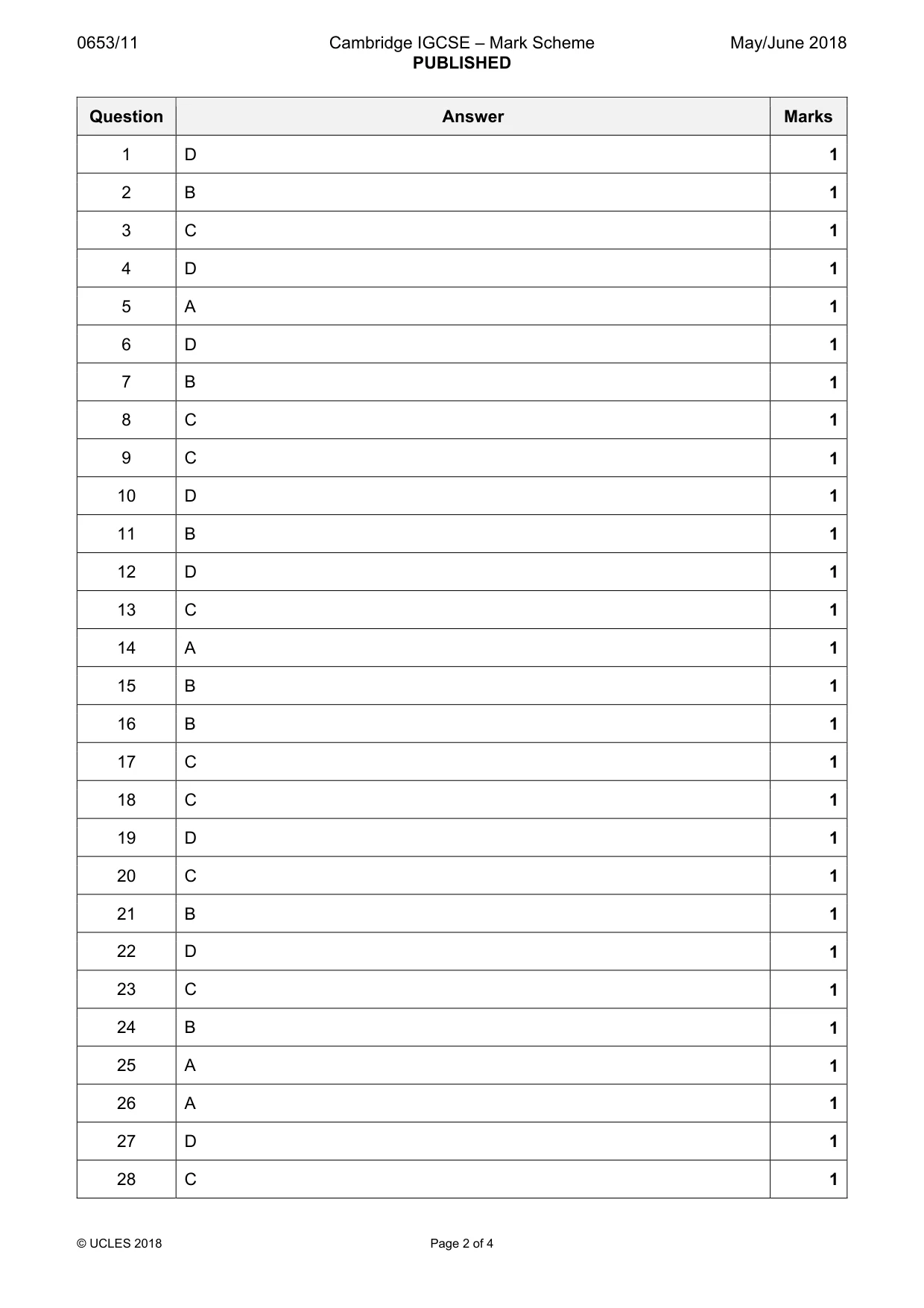
Answers below. Sit the paper first if you are practising.

Questions as text
Q1 · Most cars burn fossil fuels to release energy for their movement
1 Most cars burn fossil fuels to release energy for their movement. Which characteristic of living organisms is similar to this? A excretion B growth C nutrition D respiration
Mark scheme: D
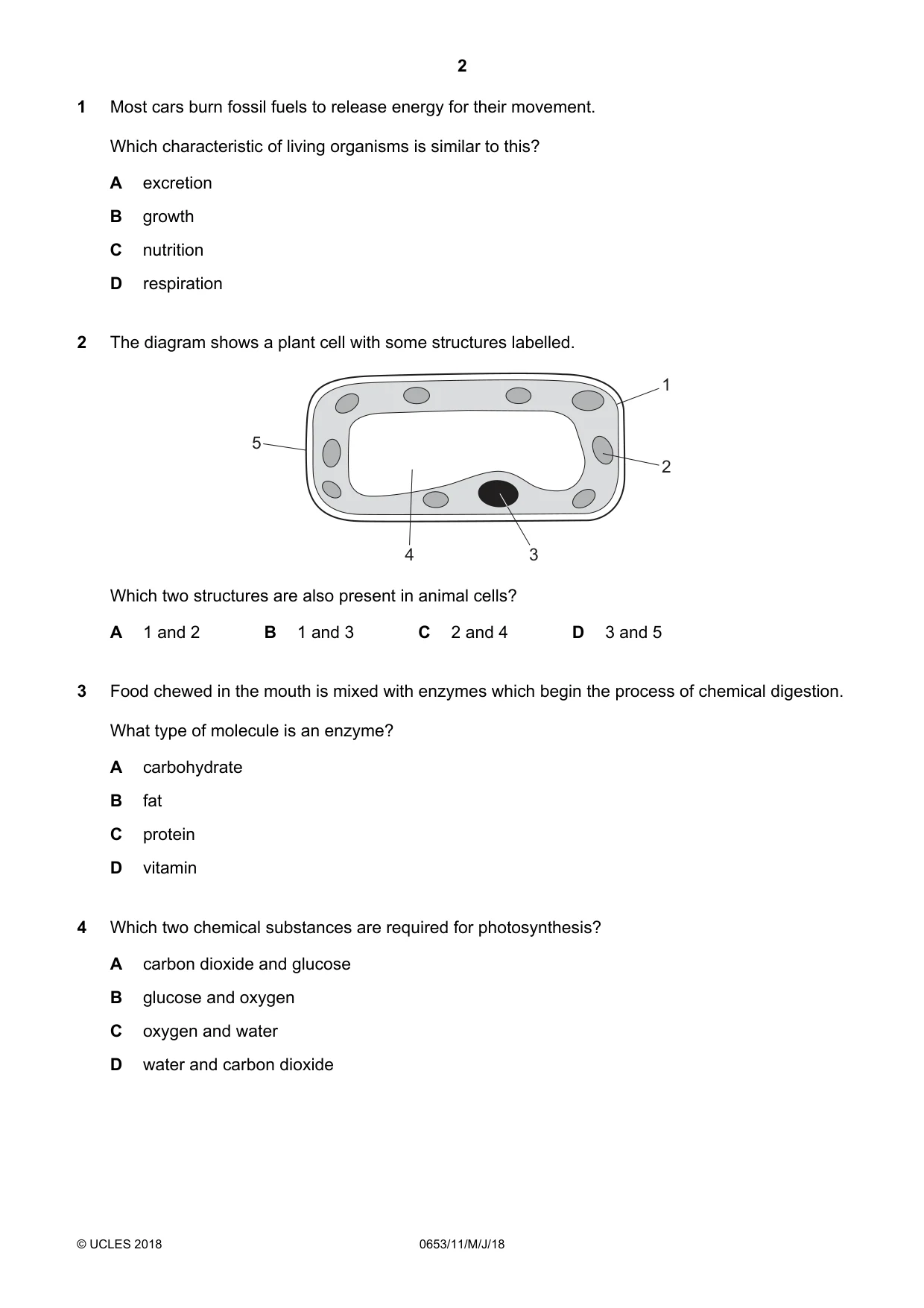
Q2 · The diagram shows a plant cell with some structures labelled
2 The diagram shows a plant cell with some structures labelled. 1 5 2 4 3 Which two structures are also present in animal cells? A 1 and 2 B 1 and 3 C 2 and 4 D 3 and 5
Mark scheme: B
Q3 · Food chewed in the mouth is mixed with enzymes which begin the process of chemical…
3 Food chewed in the mouth is mixed with enzymes which begin the process of chemical digestion. What type of molecule is an enzyme? A carbohydrate B fat C protein D vitamin
Mark scheme: C
Q4 · Which two chemical substances are required for photosynthesis?
4 Which two chemical substances are required for photosynthesis? A carbon dioxide and glucose B glucose and oxygen C oxygen and water D water and carbon dioxide
Mark scheme: D
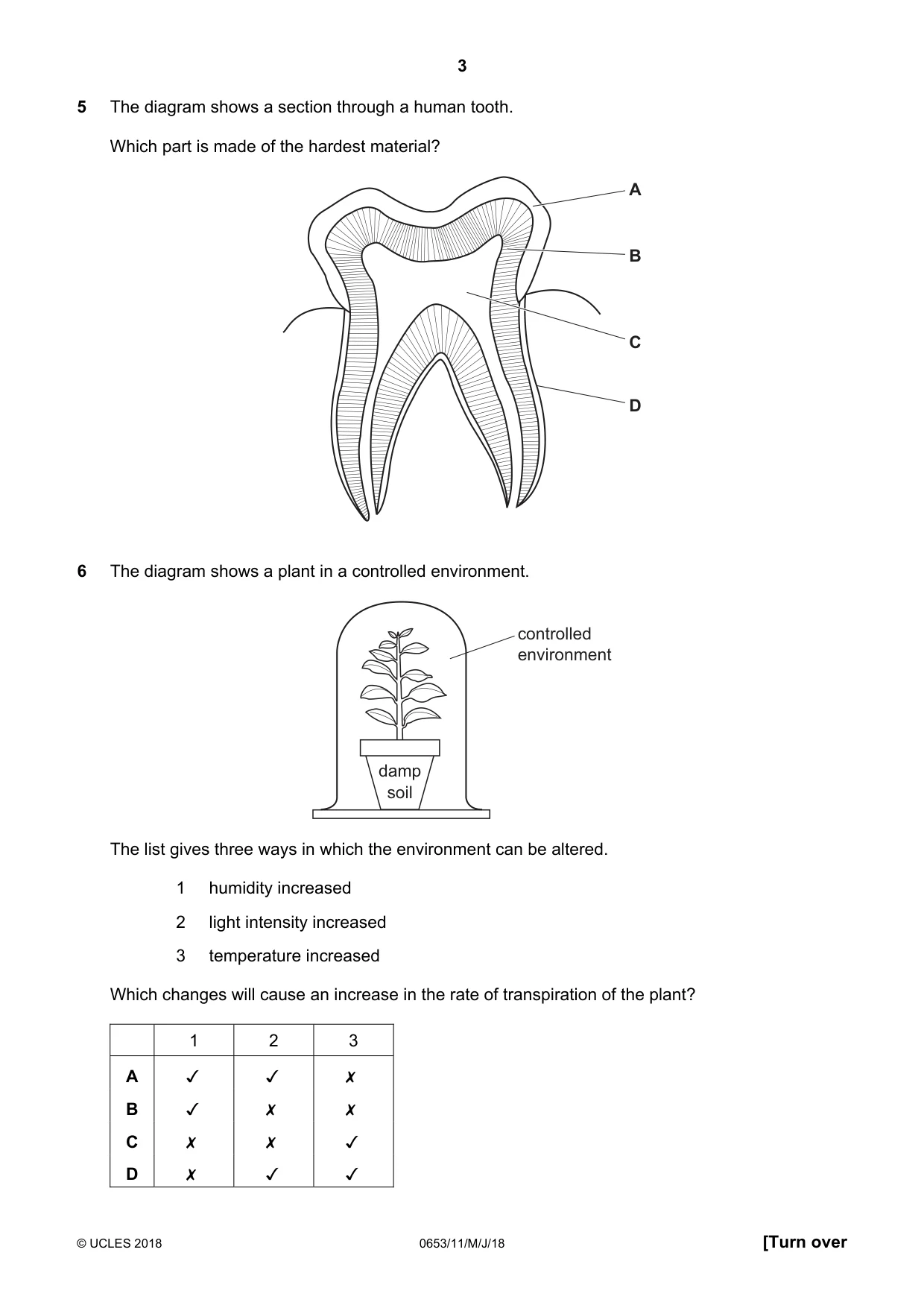
Q5 · The diagram shows a section through a human tooth
5 The diagram shows a section through a human tooth. Which part is made of the hardest material? A B C D
Mark scheme: A
Q6 · The diagram shows a plant in a controlled environment
6 The diagram shows a plant in a controlled environment. controlled environment The list gives three ways in which the environment can be altered. 1 humidity increased 2 __ light intensity increased 3 temperature increased Which changes will cause an increase in the rate of transpiration of the plant?
Mark scheme: D
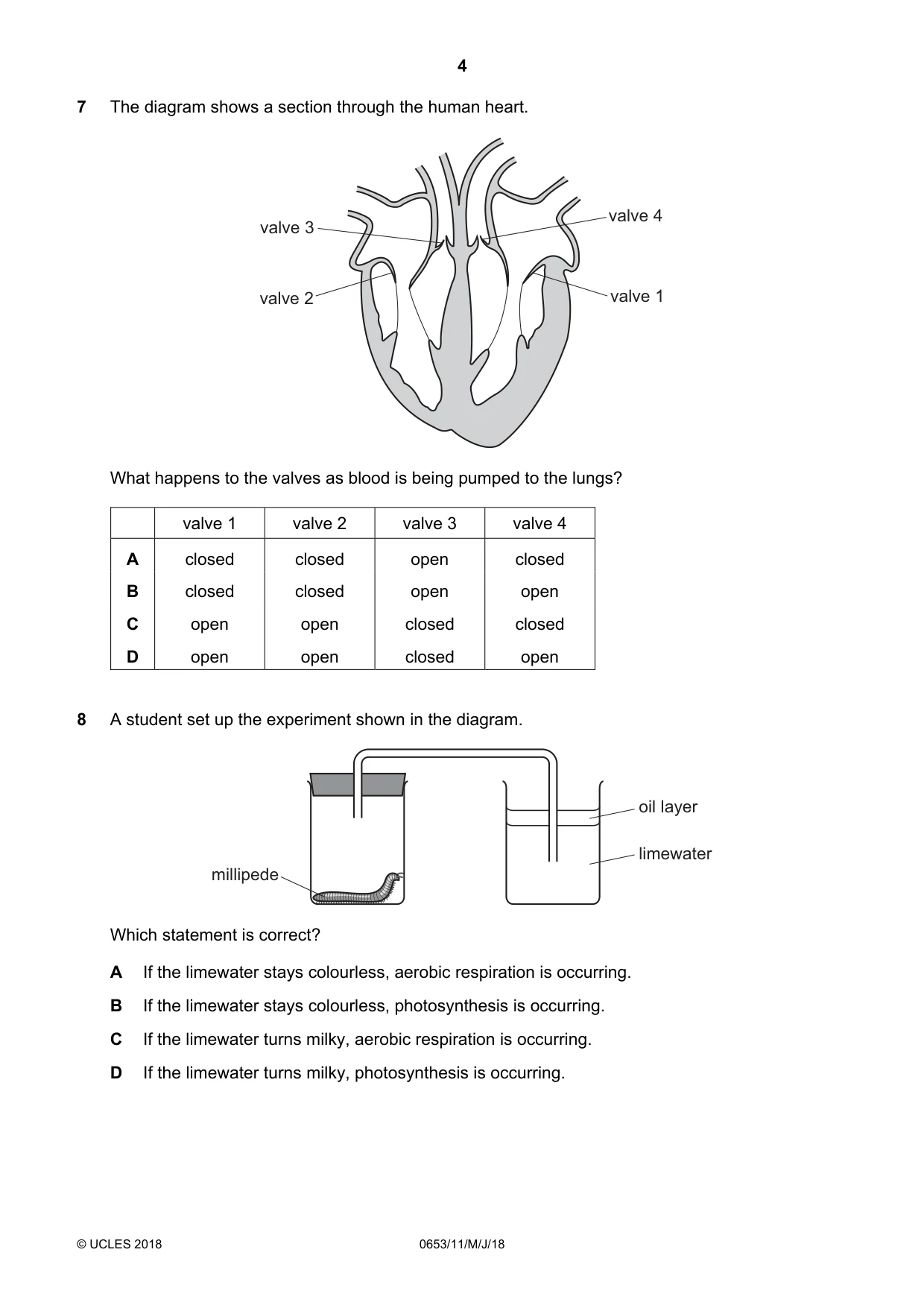
Q7 · The diagram shows a section through the human heart
7 The diagram shows a section through the human heart. valve 4 valve 3 valve 2 valve 1 What happens to the valves as blood is being pumped to the lungs? valve 1 valve 2 valve 3 valve 4 A closed closed open closed B closed closed open open C open open closed closed D open open closed open
Mark scheme: B
Q8 · A student set up the experiment shown in the diagram
8 A student set up the experiment shown in the diagram. oil layer limewater millipede Which statement is correct? A If the limewater stays colourless, aerobic respiration is occurring. B If the limewater stays colourless, photosynthesis is occurring. C If the limewater turns milky, aerobic respiration is occurring. D If the limewater turns milky, photosynthesis is occurring.
Mark scheme: C
Q9 · What are the growth responses of a plant to gravity?
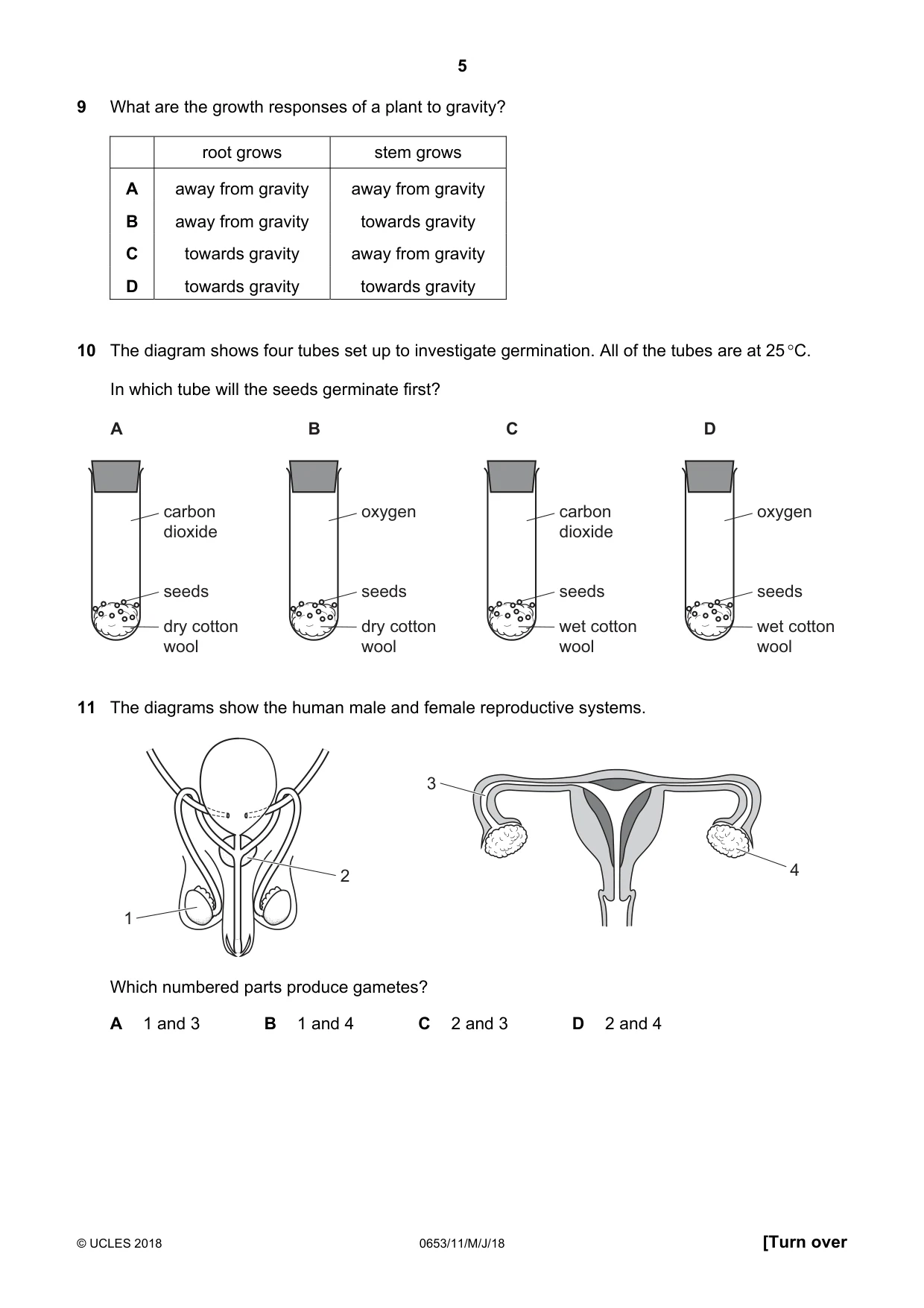
9 What are the growth responses of a plant to gravity? root grows stem grows A away from gravity away from gravity B away from gravity towards gravity C towards gravity away from gravity D towards gravity towards gravity
Mark scheme: C
Q10 · The diagram shows four tubes set up to investigate germination
10 The diagram shows four tubes set up to investigate germination. All of the tubes are at 25 °C. In which tube will the seeds germinate first? A B C D carbon oxygen carbon oxygen dioxide dioxide seeds seeds seeds seeds dry cotton dry cotton wet cotton wet cotton wool wool wool wool
Mark scheme: D
Q11 · The diagrams show the human male and female reproductive systems
11 The diagrams show the human male and female reproductive systems. 3 2 4 1 Which numbered parts produce gametes? A 1 and 3 B 1 and 4 C 2 and 3 D 2 and 4
Mark scheme: B
Q12 · The diagram shows a food chain
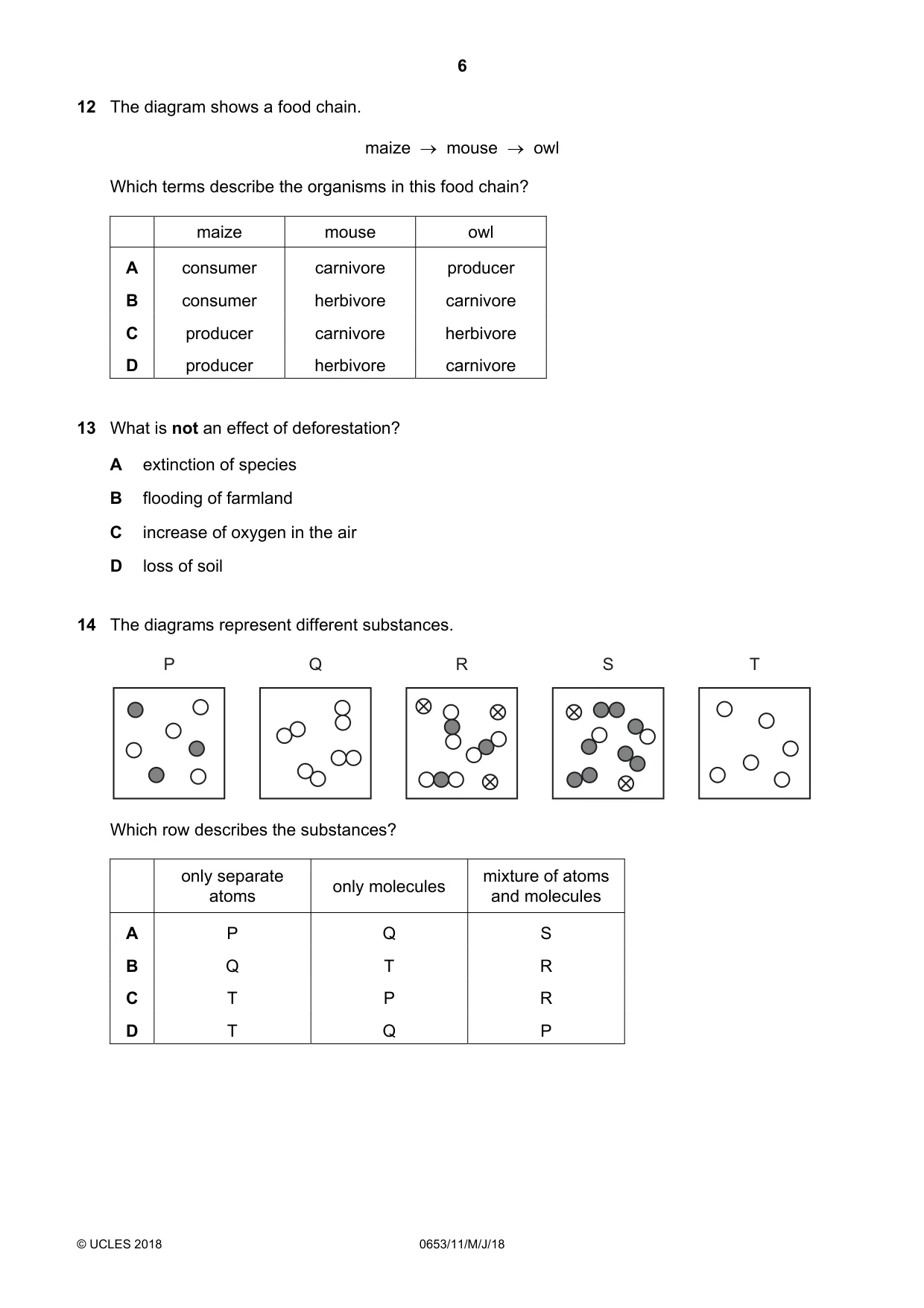
12 The diagram shows a food chain. maize → mouse → owl Which terms describe the organisms in this food chain? maize mouse owl A consumer carnivore producer B consumer herbivore carnivore C producer carnivore herbivore D producer herbivore carnivore
Mark scheme: D
Q13 · What is not an effect of deforestation?
13 What is not an effect of deforestation? A extinction of species B flooding of farmland C increase of oxygen in the air D loss of soil
Mark scheme: C
Q14 · The diagrams represent different substances
14 The diagrams represent different substances. P Q R S T Which row describes the substances? only separate mixture of atoms only molecules atoms and molecules A P Q S B Q T R C T P R D T Q P
Mark scheme: A
Q15 · Which row describes the method used to obtain salt from salt water and petrol from…
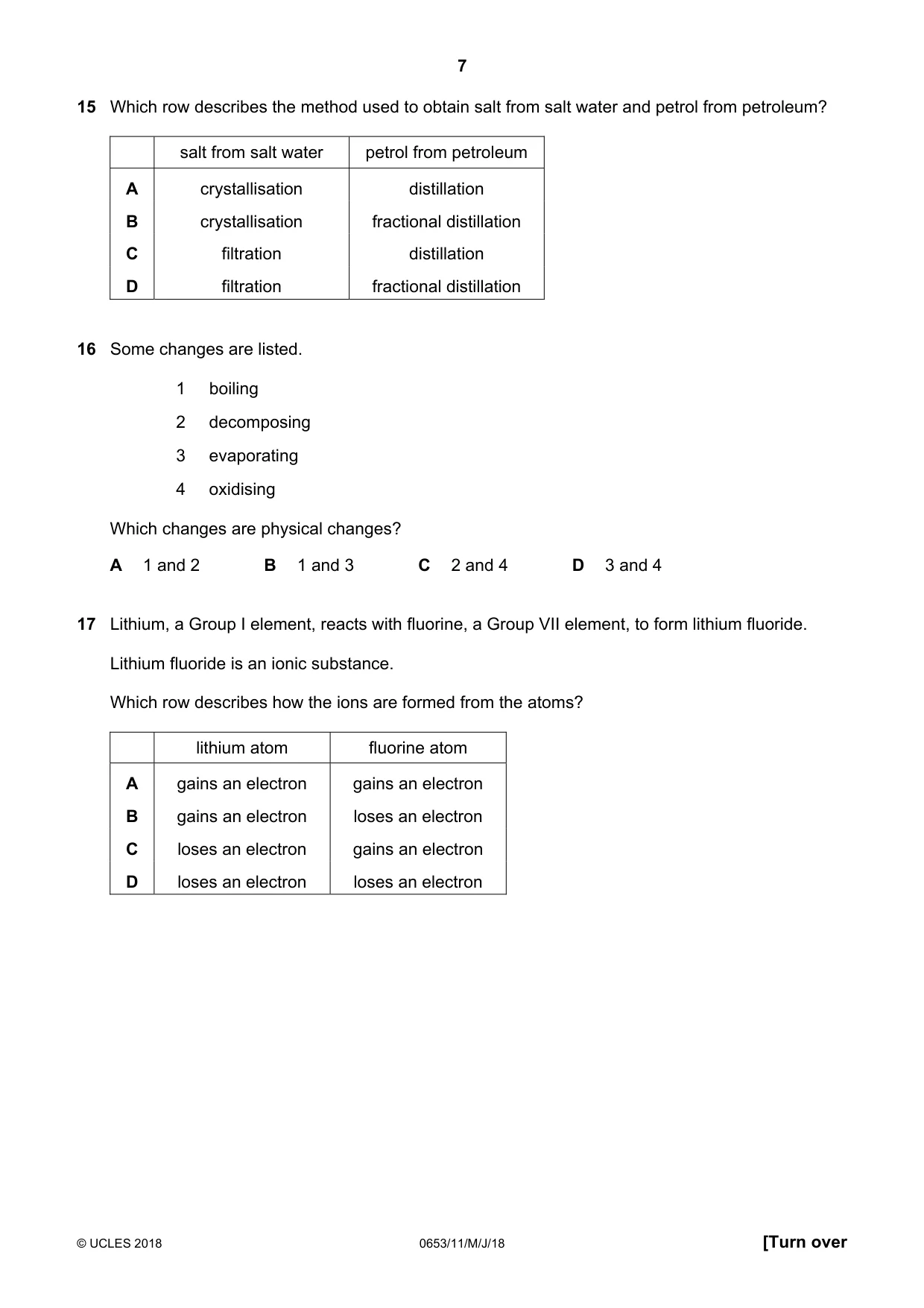
15 Which row describes the method used to obtain salt from salt water and petrol from petroleum? salt from salt water petrol from petroleum A crystallisation distillation B crystallisation fractional distillation C filtration distillation D filtration fractional distillation
Mark scheme: B
Q16 · Some changes are listed
16 Some changes are listed. 1 boiling 2 decomposing 3 evaporating 4 oxidising Which changes are physical changes? A 1 and 2 B 1 and 3 C 2 and 4 D 3 and 4
Mark scheme: B
Q17 · Lithium, a Group I element, reacts with fluorine, a Group VII element, to form lithium…
17 Lithium, a Group I element, reacts with fluorine, a Group VII element, to form lithium fluoride. Lithium fluoride is an ionic substance. Which row describes how the ions are formed from the atoms? lithium atom fluorine atom A gains an electron gains an electron B gains an electron loses an electron C loses an electron gains an electron D loses an electron loses an electron
Mark scheme: C
Q18 · The diagram represents molecules of phosphine
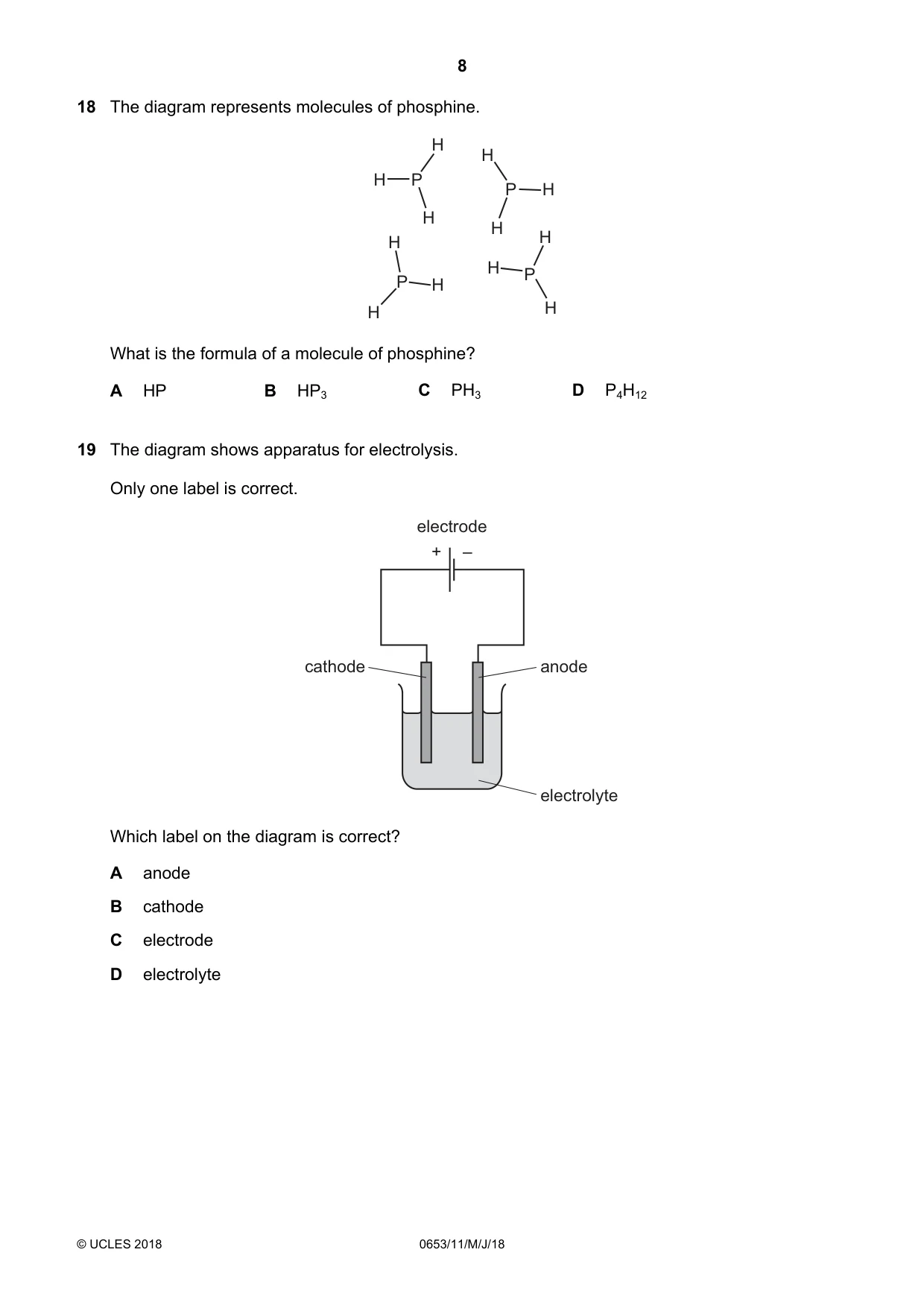
18 The diagram represents molecules of phosphine. H H H P P H H H H H H P P H H H What is the formula of a molecule of phosphine? A HP B HP3 C PH3 D P4H12
Mark scheme: C
Q19 · The diagram shows apparatus for electrolysis
19 The diagram shows apparatus for electrolysis. Only one label is correct. electrode + – cathode anode electrolyte Which label on the diagram is correct? A anode B cathode C electrode D electrolyte
Mark scheme: D
Q20 · Which change must take place in an endothermic reaction?
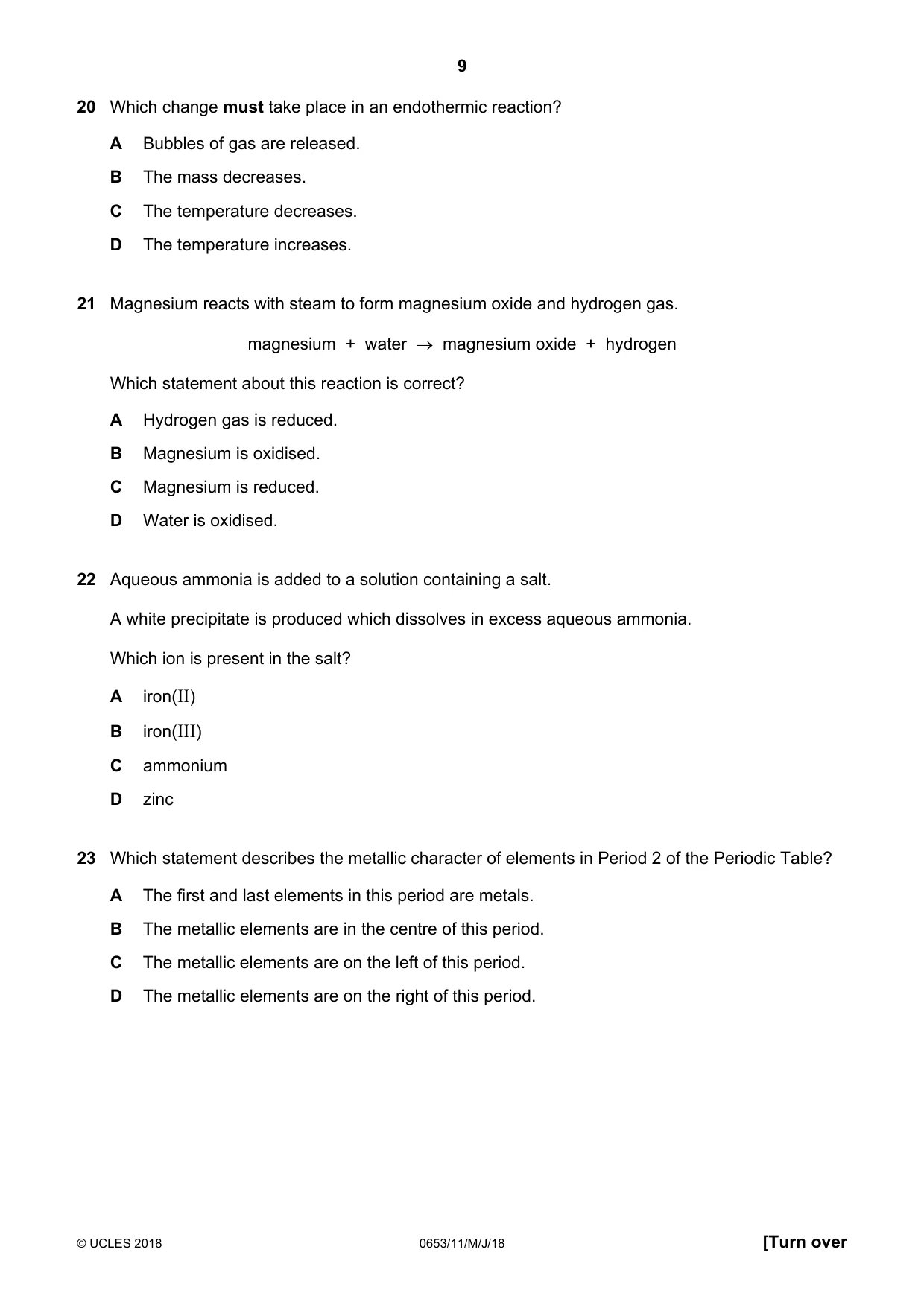
20 Which change must take place in an endothermic reaction? A Bubbles of gas are released. B The mass decreases. C The temperature decreases. D The temperature increases.
Mark scheme: C
Q21 · Magnesium reacts with steam to form magnesium oxide and hydrogen gas
21 Magnesium reacts with steam to form magnesium oxide and hydrogen gas. magnesium + water → magnesium oxide + hydrogen Which statement about this reaction is correct? A Hydrogen gas is reduced. B Magnesium is oxidised. C Magnesium is reduced. D Water is oxidised.
Mark scheme: B
Q22 · Aqueous ammonia is added to a solution containing a salt
22 Aqueous ammonia is added to a solution containing a salt. A white precipitate is produced which dissolves in excess aqueous ammonia. Which ion is present in the salt? A iron(II) B iron(III) C ammonium D zinc
Mark scheme: D
Q23 · Which statement describes the metallic character of elements in Period 2 of the Periodic…
23 Which statement describes the metallic character of elements in Period 2 of the Periodic Table? A The first and last elements in this period are metals. B The metallic elements are in the centre of this period. C The metallic elements are on the left of this period. D The metallic elements are on the right of this period.
Mark scheme: C
Q24 · Which statement about transition metals is not correct?
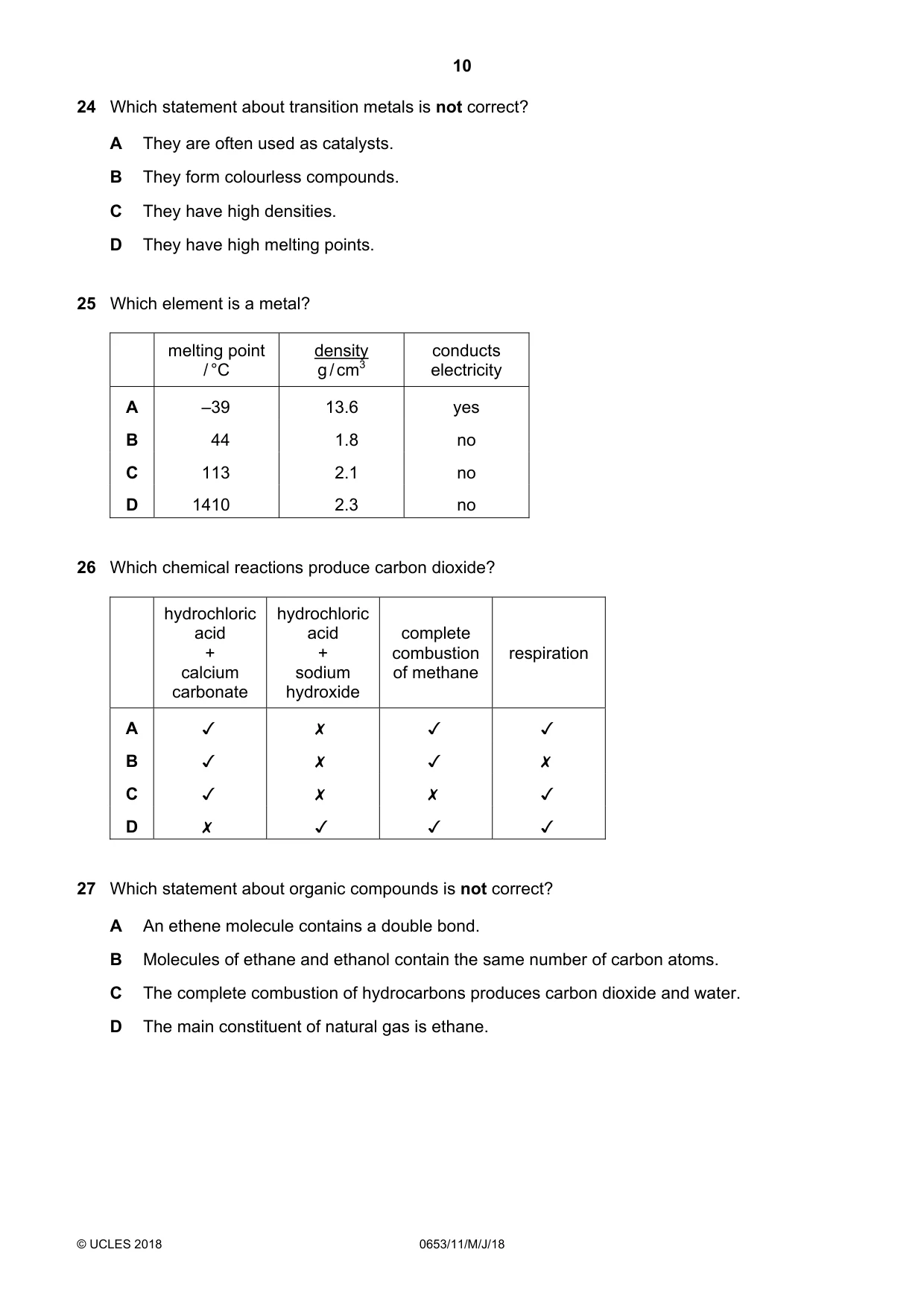
24 Which statement about transition metals is not correct? A They are often used as catalysts. B They form colourless compounds. C They have high densities. D They have high melting points.
Mark scheme: B
Q25 · Which element is a metal?
25 Which element is a metal? melting point density conducts / °C g / cm3 electricity A –39 13.6 yes B 44 1.8 no C 113 2.1 no D 1410 2.3 no
Mark scheme: A
Q26 · Which chemical reactions produce carbon dioxide?
26 Which chemical reactions produce carbon dioxide? hydrochloric hydrochloric acid acid complete + + combustion | respiration calcium sodium of methane carbonate hydroxide A Jv x Jv WA B Jv x Jv x Cc Jv x x Jv D x Jv Jv WA
Mark scheme: A
Q27 · Which statement about organic compounds is not correct?
27 Which statement about organic compounds is not correct? A An ethene molecule contains a double bond. B Molecules of ethane and ethanol contain the same number of carbon atoms. C The complete combustion of hydrocarbons produces carbon dioxide and water. D The main constituent of natural gas is ethane.
Mark scheme: D
Q28 · A vehicle takes 30 minutes to travel a distance of 60 km
28 A vehicle takes 30 minutes to travel a distance of 60 km. What is the average speed of the vehicle? A 2.0 km / hour B 30 km / hour C 120 km / hour D 1800 km / hour
Mark scheme: C
Q29 · What is the weight of an object?
29 What is the weight of an object? A the acceleration of the object due to gravity B the energy of the object due to its position C the force acting on the object due to gravity D the quantity of matter in the object
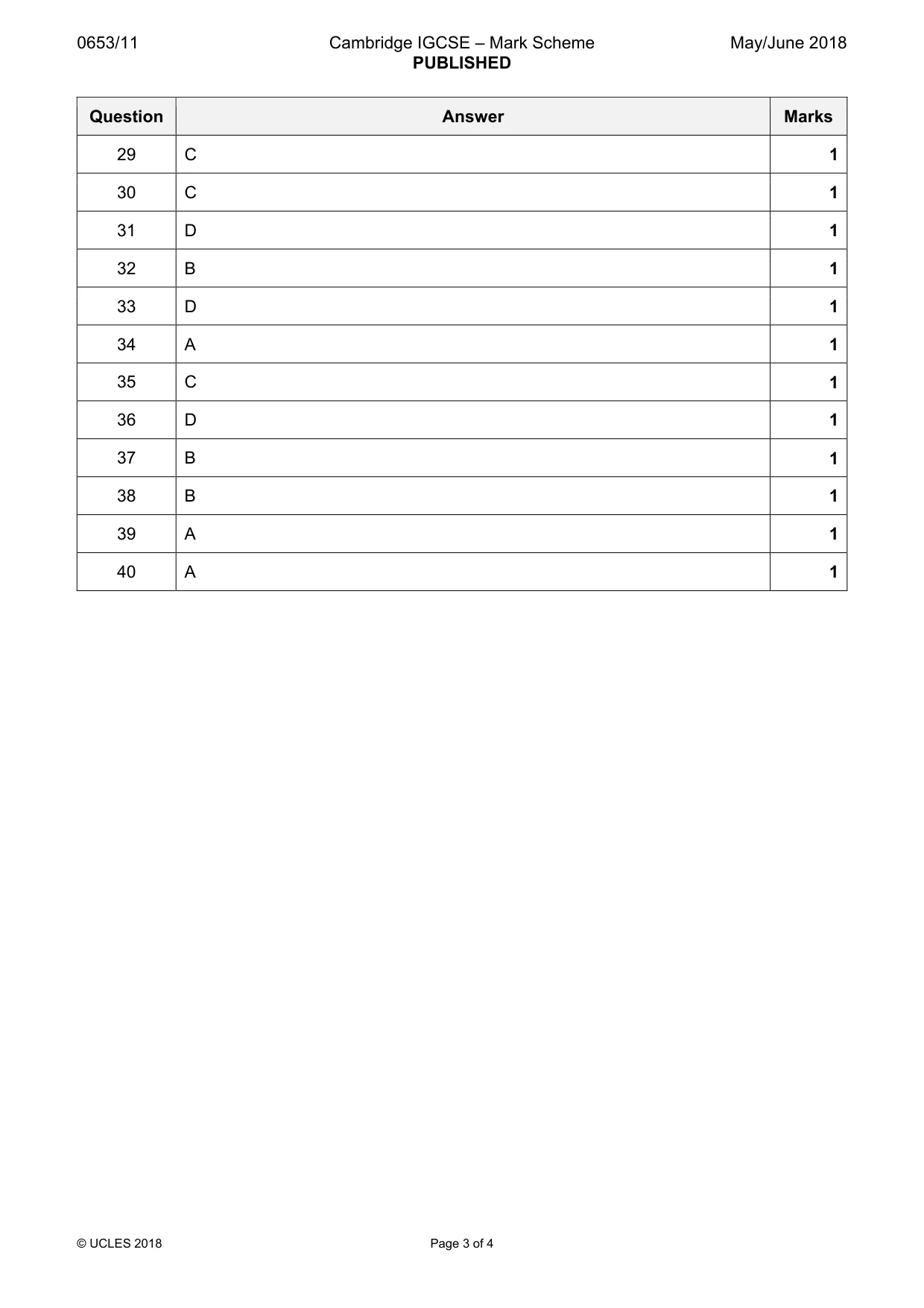
Mark scheme: C
Q30 · The diagram shows a solid rectangular block of mass 24 kg with the dimensions shown
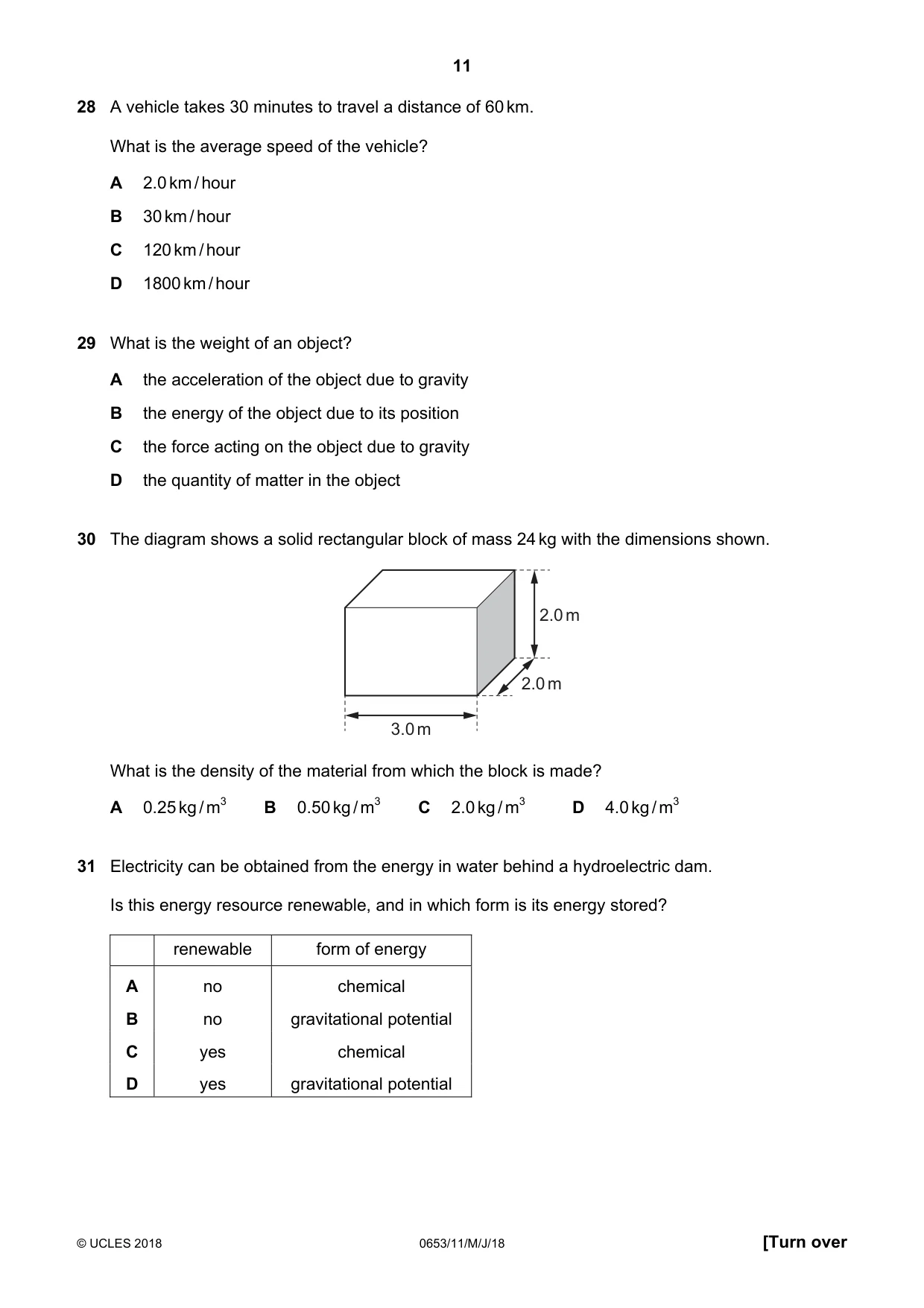
30 The diagram shows a solid rectangular block of mass 24 kg with the dimensions shown. 2.0 m 2.0 m 3.0 m What is the density of the material from which the block is made? A 0.25 kg / m3 B 0.50 kg / m3 C 2.0 kg / m3 D 4.0 kg / m3
Mark scheme: C
Q31 · Electricity can be obtained from the energy in water behind a hydroelectric dam
31 Electricity can be obtained from the energy in water behind a hydroelectric dam. Is this energy resource renewable, and in which form is its energy stored? renewable form of energy A no chemical B no gravitational potential C yes chemical D yes gravitational potential
Mark scheme: D
Q32 · Three beakers contain samples of the same substance
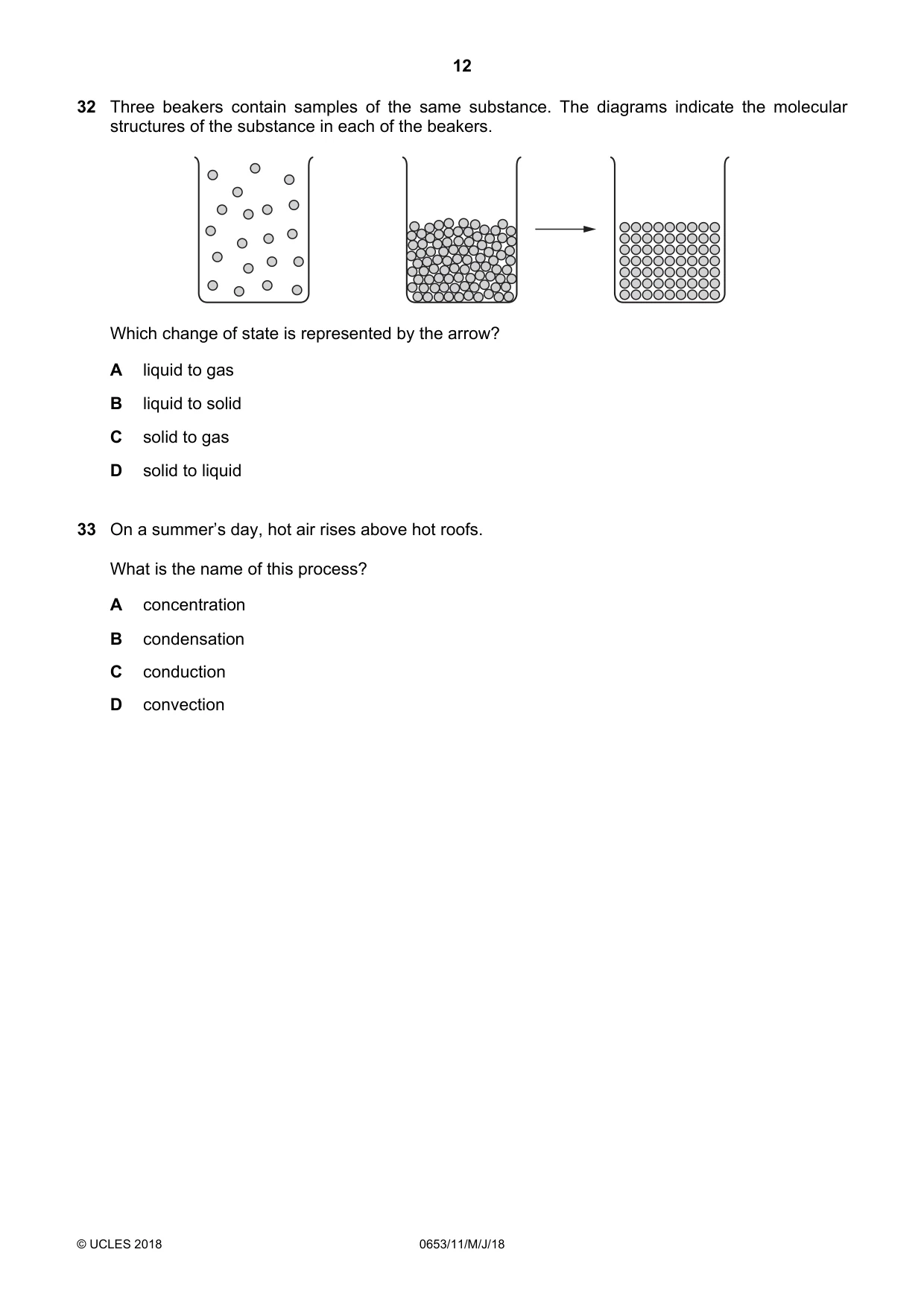
32 Three beakers contain samples of the same substance. The diagrams indicate the molecular structures of the substance in each of the beakers. Which change of state is represented by the arrow? A liquid to gas B liquid to solid C solid to gas D solid to liquid
Mark scheme: B
Q33 · On a summer’s day, hot air rises above hot roofs
33 On a summer’s day, hot air rises above hot roofs. What is the name of this process? A concentration B condensation C conduction D convection
Mark scheme: D
Q34 · The diagram represents a wave
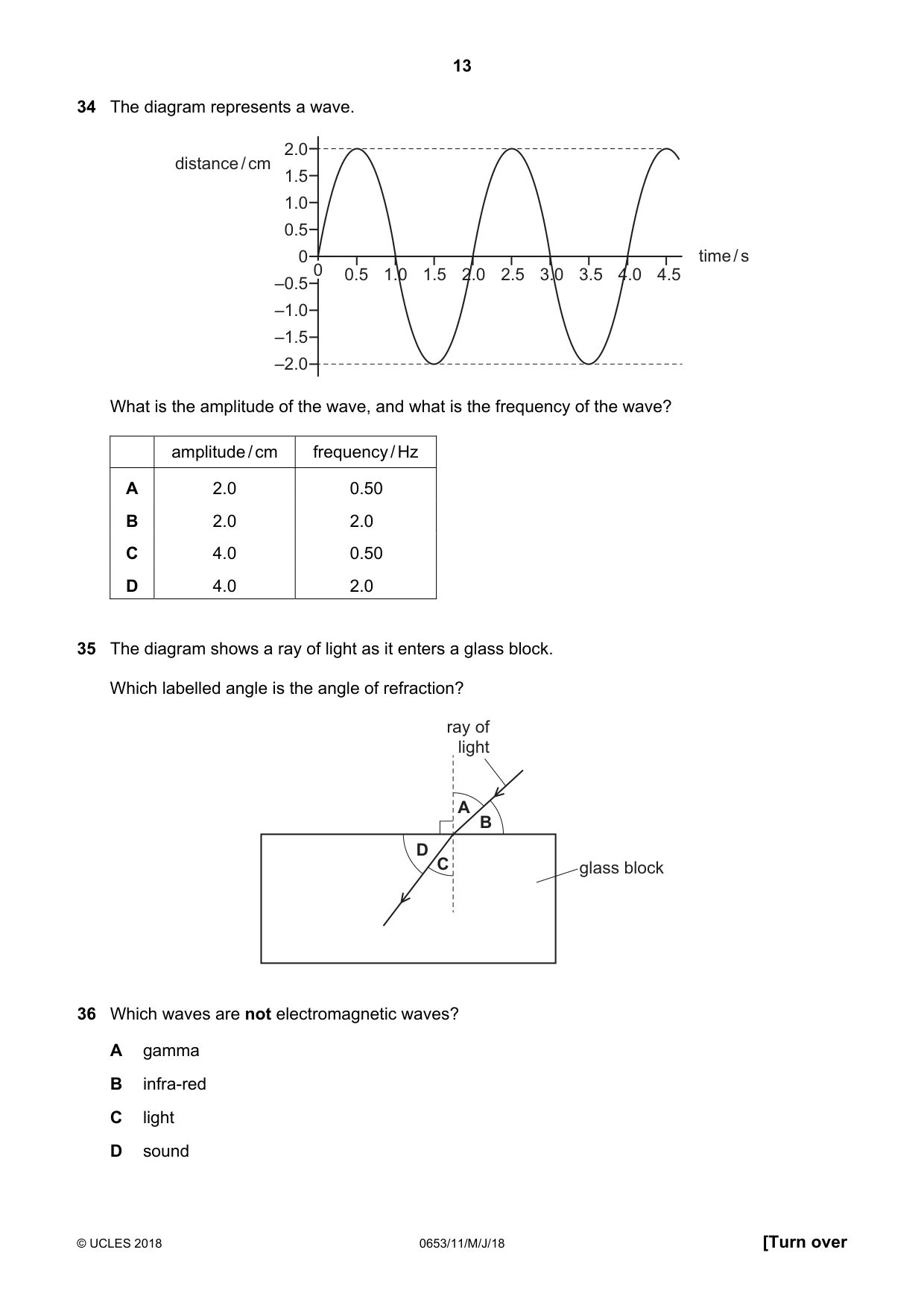
34 The diagram represents a wave. 2.0 distance / cm 1.5 1.0 0.5 0 time / s 0 0.5 1.0 1.5 2.0 2.5 3.0 3.5 4.0 4.5 –0.5 –1.0 –1.5 –2.0 What is the amplitude of the wave, and what is the frequency of the wave? amplitude / cm frequency / Hz A 2.0 0.50 B 2.0 2.0 C 4.0 0.50 D 4.0 2.0
Mark scheme: A
Q35 · The diagram shows a ray of light as it enters a glass block
35 The diagram shows a ray of light as it enters a glass block. Which labelled angle is the angle of refraction? ray of light A B D C glass block
Mark scheme: C
Q36 · Which waves are not electromagnetic waves?
36 Which waves are not electromagnetic waves? A gamma B infra-red C light D sound
Mark scheme: D
Q37 · A man sees a car door being slammed shut
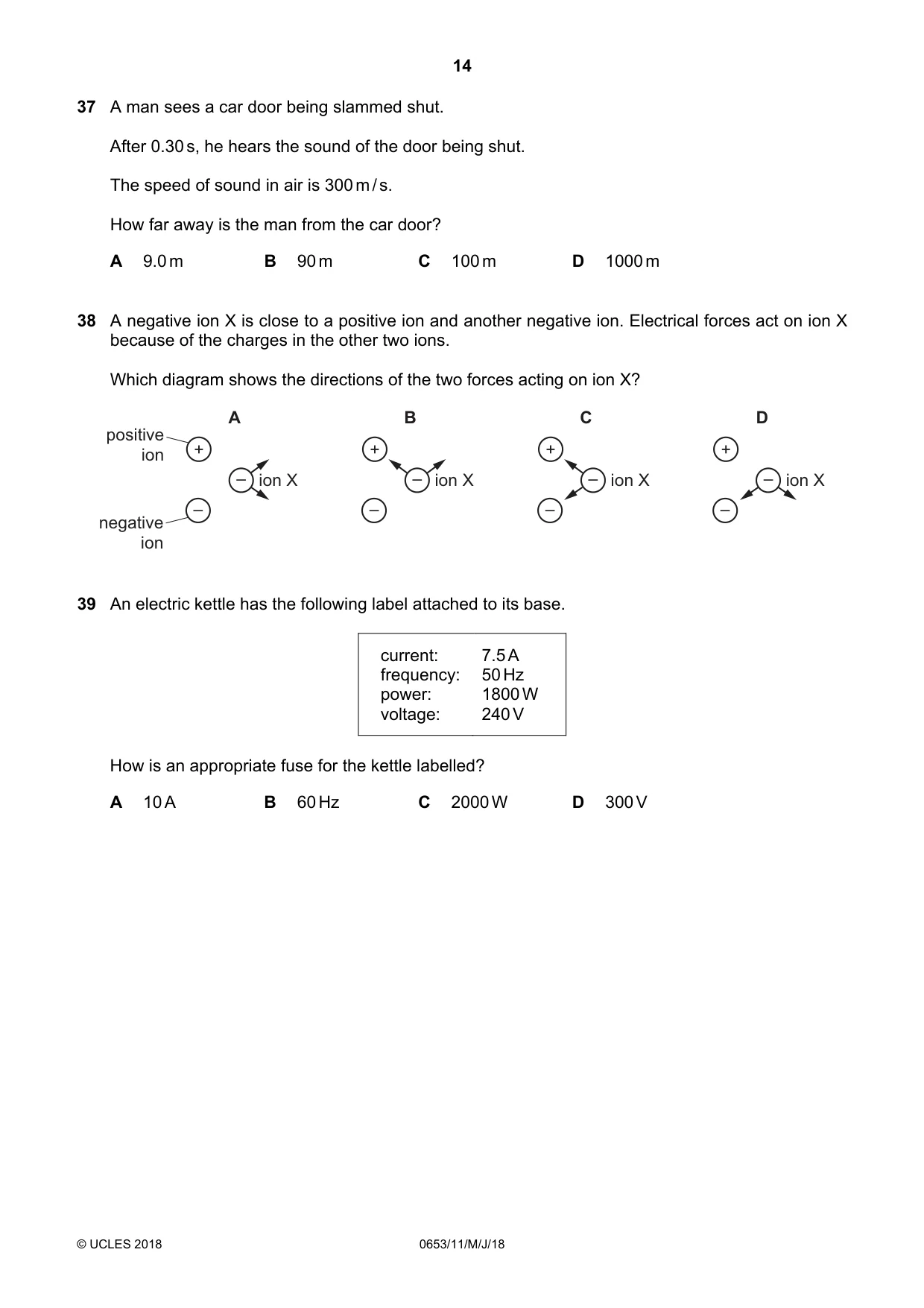
37 A man sees a car door being slammed shut. After 0.30 s, he hears the sound of the door being shut. The speed of sound in air is 300 m / s. How far away is the man from the car door? A 9.0 m B 90 m C 100 m D 1000 m
Mark scheme: B
Q38 · A negative ion X is close to a positive ion and another negative ion
38 A negative ion X is close to a positive ion and another negative ion. Electrical forces act on ion X because of the charges in the other two ions. Which diagram shows the directions of the two forces acting on ion X? A B C D positive ion + + + + – ion X – ion X – ion X – ion X – – – – negative ion
Mark scheme: B
Q39 · An electric kettle has the following label attached to its base
39 An electric kettle has the following label attached to its base. current: 7.5 A frequency: 50 Hz power: 1800 W voltage: 240 V How is an appropriate fuse for the kettle labelled? A 10 A B 60 Hz C 2000 W D 300 V
Mark scheme: A
Q40 · A student determines the resistance of resistor R
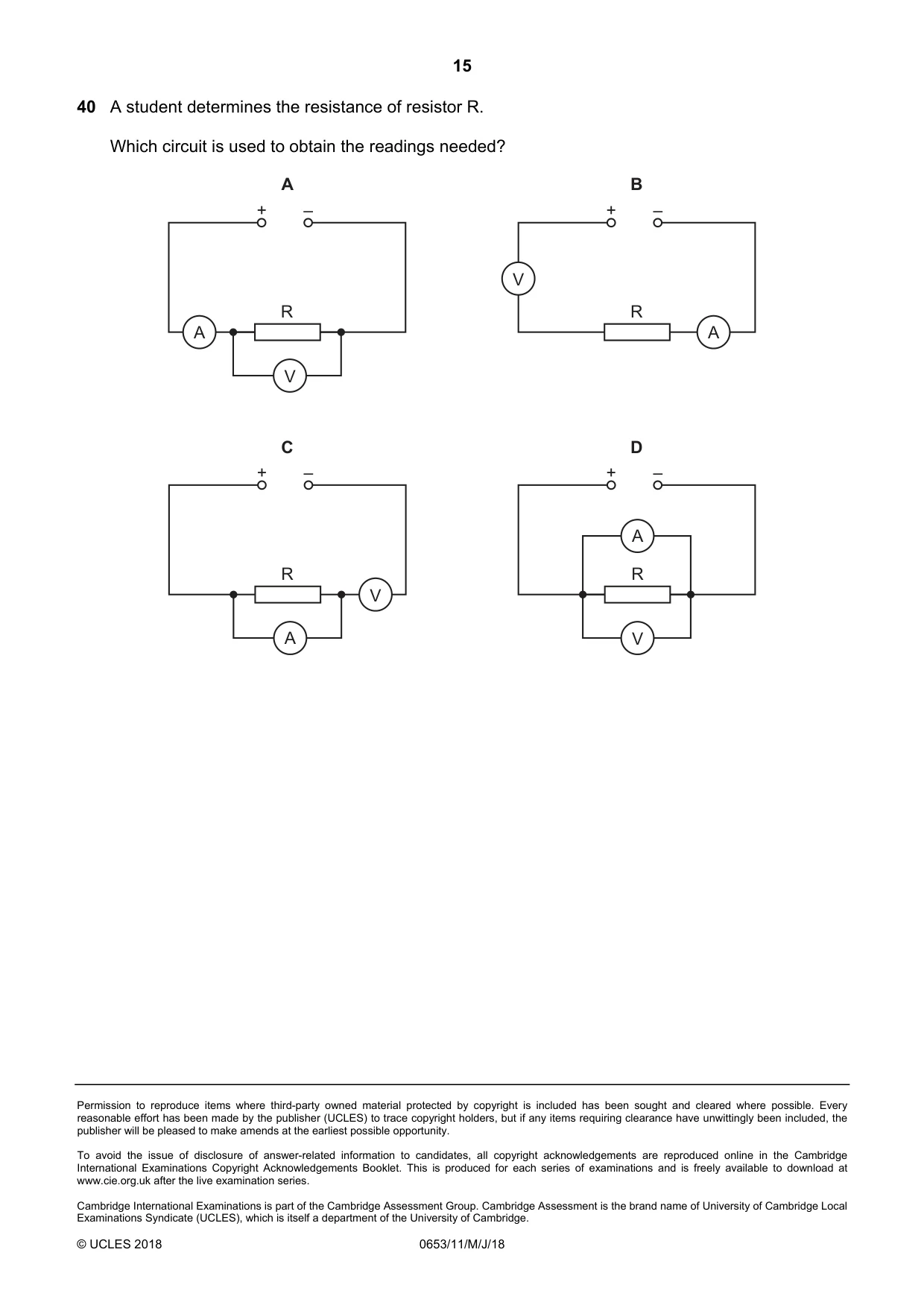
40 A student determines the resistance of resistor R. Which circuit is used to obtain the readings needed? A B + – + – V R R A A V C D + – + – A R R V A V
Mark scheme: A
What was in this paper
The subtopics covered by these 40 questions, and how many questions each got. Open one in a new tab to see every Cambridge question on it.
3Air quality and climate1Arrangement of elements1Biological molecules1Cell structure1Density1Digestion1Electrical circuits1Electrical safety1Electrolysis1Electromagnetic spectrum1Elements, compounds and mixtures1Energy, work and power1Exothermic and endothermic reactions1Food chains and food webs1Forces1Formulas1General properties of waves1Habitat destruction1Heart1Identification of ions and gases1Ions and ionic bonds1Kinetic particle model of matter1Light1Mass and weight1Motion1Photosynthesis1Physical and chemical changes1Properties of metals1Redox1Respiration1Separation and purification1Sexual reproduction in humans1Sound1Terminology1Transfer of thermal energy1Transition elements1Transpiration1What you needed in this session
Cambridge’s own grade thresholds for 2018 May/June, Paper 1 · Variant 1. A higher threshold means an easier paper — the bar moves with how the cohort did.