Cambridge IGCSE Science - Combined 0653 — 2006 Oct/Nov Paper 1 · Variant 1
0653/11/O/N/06 · 40 questions · 40 marks · ≈45 min
The question paper and its mark scheme, free to read here and free to download. This is Cambridge’s own paper, exactly as it was sat.
Question paper16 pages
Mark scheme2 pages
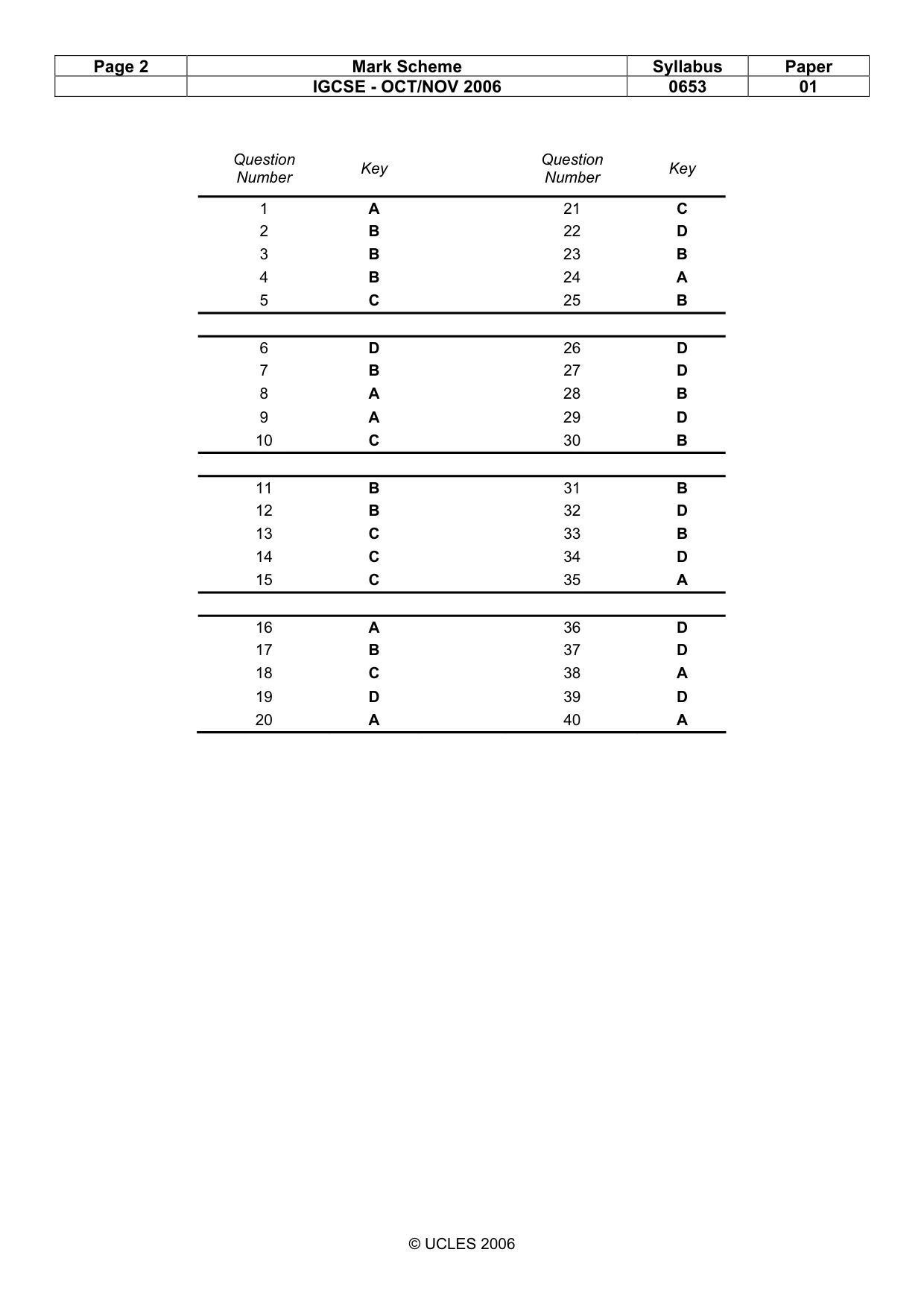
Answers below. Sit the paper first if you are practising.
Questions as text
Q1 · Living and dead plant cells are placed in a dilute solution of red dye
1 Living and dead plant cells are placed in a dilute solution of red dye. After a few minutes the cells are observed using a microscope. Only the dead cells are stained red. Which part of the living cells stops the uptake of the red dye? A cell membrane B cell wall C cytoplasm D nucleus
Mark scheme: A
Q2 · Which type of chemical is the enzyme catalase?
2 Which type of chemical is the enzyme catalase? A fat B protein C starch D sugar
Mark scheme: B
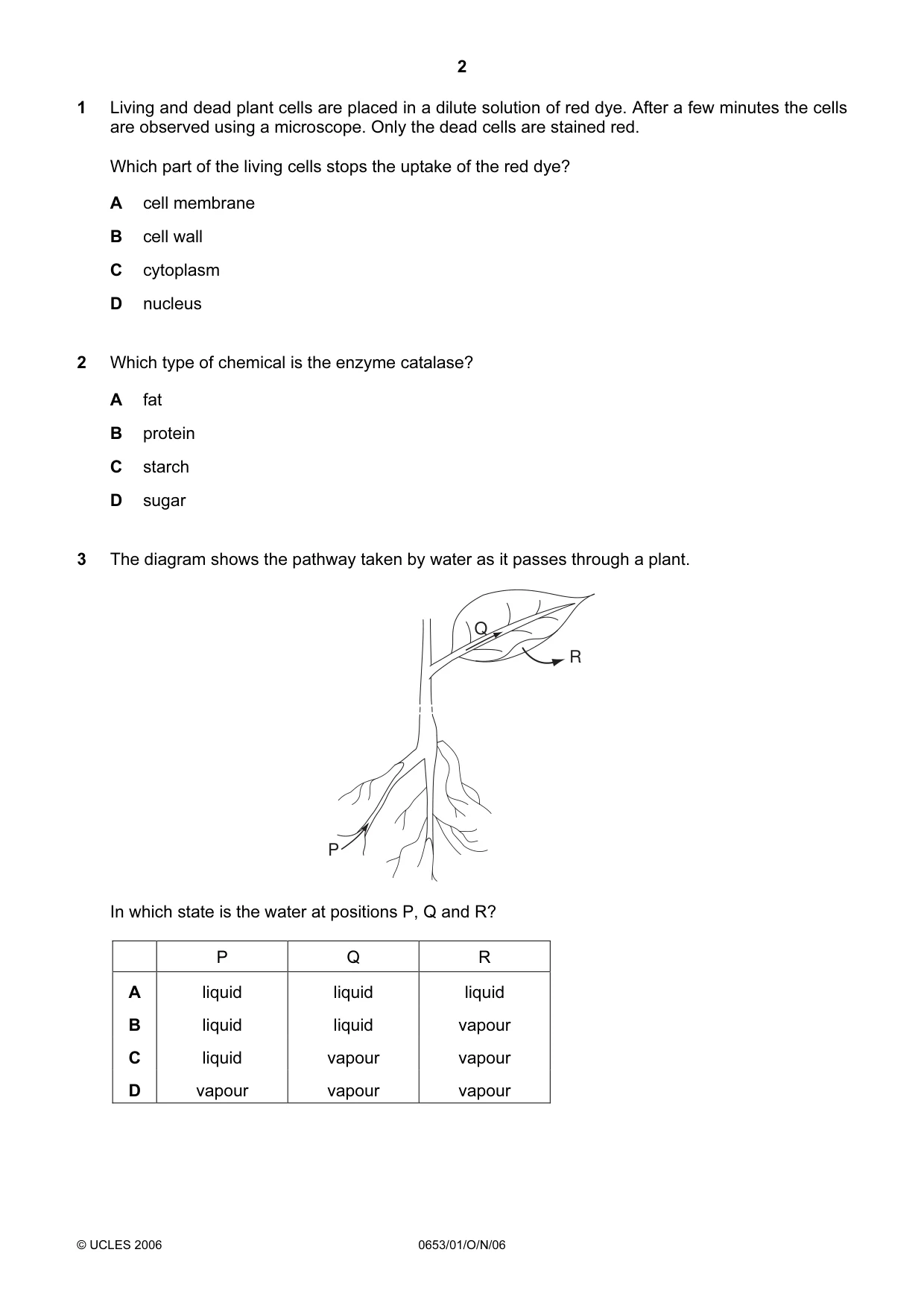
Q3 · The diagram shows the pathway taken by water as it passes through a plant
3 The diagram shows the pathway taken by water as it passes through a plant. Q R P In which state is the water at positions P, Q and R? P Q R A liquid liquid liquid B liquid liquid vapour C liquid vapour vapour D vapour vapour vapour
Mark scheme: B
Q4 · Four foods are each tested separately with Benedict’s, biuret and iodine solutions
4 Four foods are each tested separately with Benedict’s, biuret and iodine solutions. Which food contains starch and reducing sugar? food | Benedict’s test biuret test iodine test A v v x B v x v Cc x x v D x v x key v¥ = positive result X = negative result
Mark scheme: B
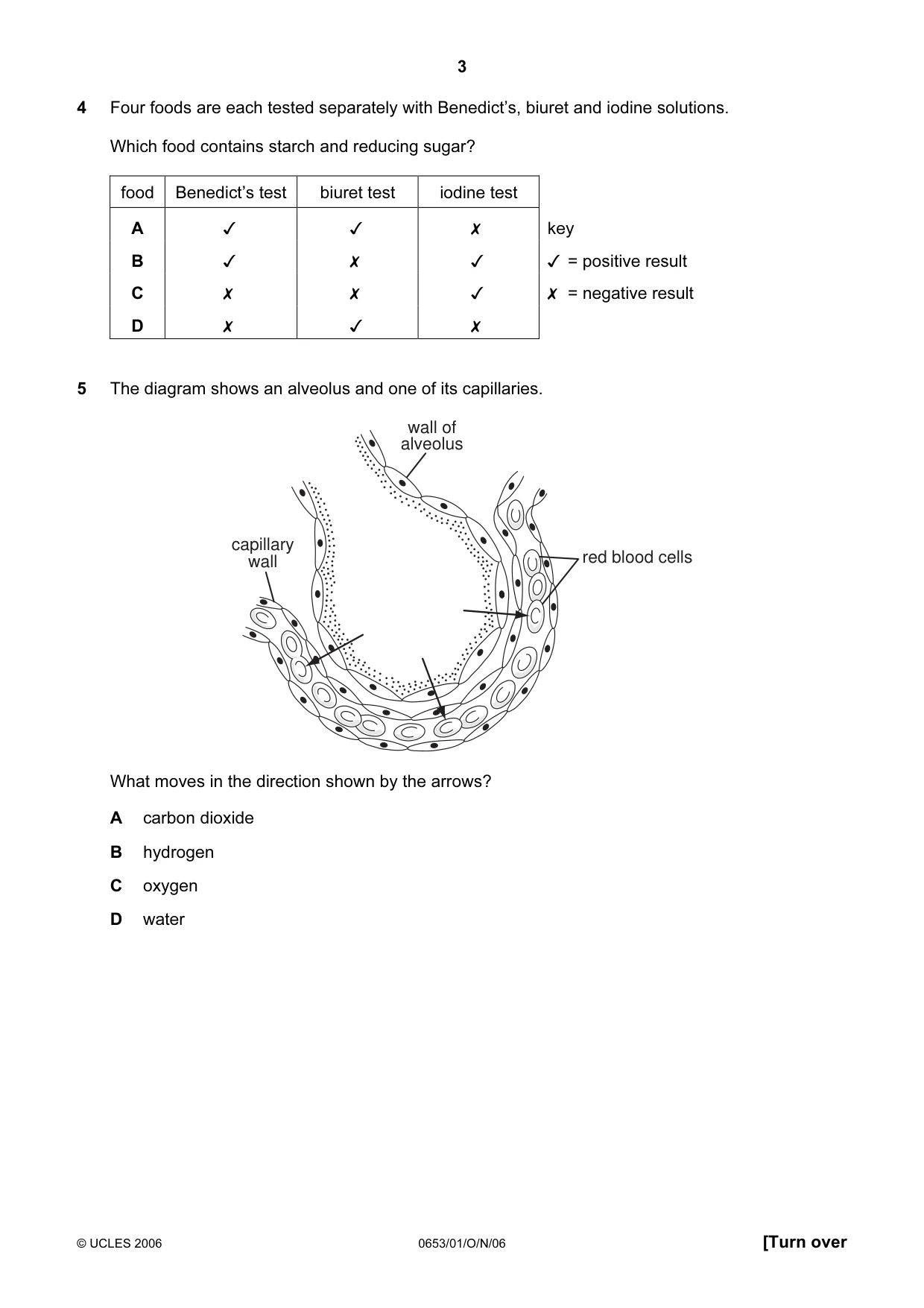
Q5 · The diagram shows an alveolus and one of its capillaries
5 The diagram shows an alveolus and one of its capillaries. wall of alveolus capillary wall red blood cells What moves in the direction shown by the arrows? A carbon dioxide B hydrogen C oxygen D water
Mark scheme: C
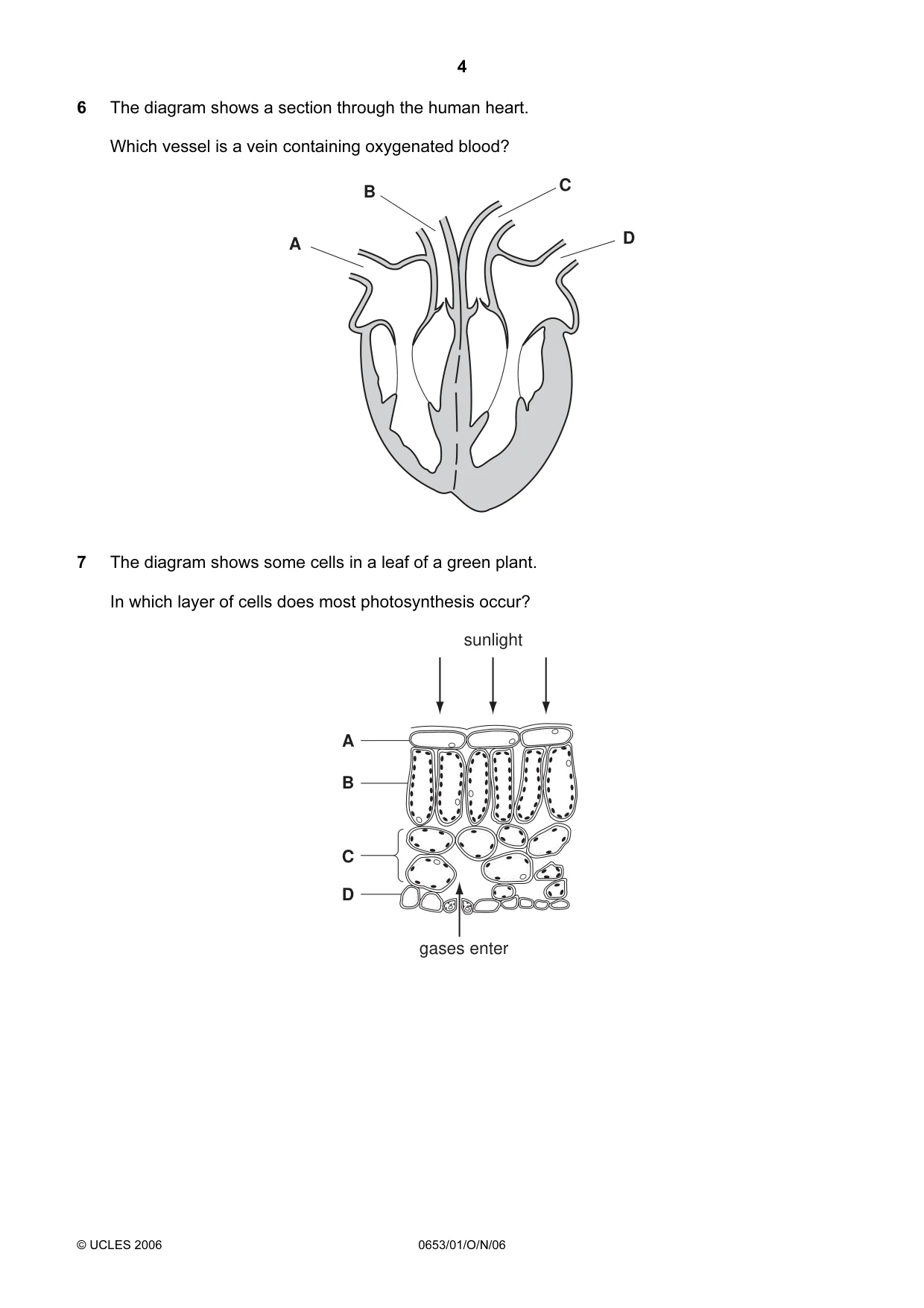
Q6 · The diagram shows a section through the human heart
6 The diagram shows a section through the human heart. Which vessel is a vein containing oxygenated blood? B C A D
Mark scheme: D
Q7 · The diagram shows some cells in a leaf of a green plant
7 The diagram shows some cells in a leaf of a green plant. In which layer of cells does most photosynthesis occur? sunlight A B C D gases enter
Mark scheme: B
Q8 · In a healthy person, which shows the correct relationship between blood sugar level…
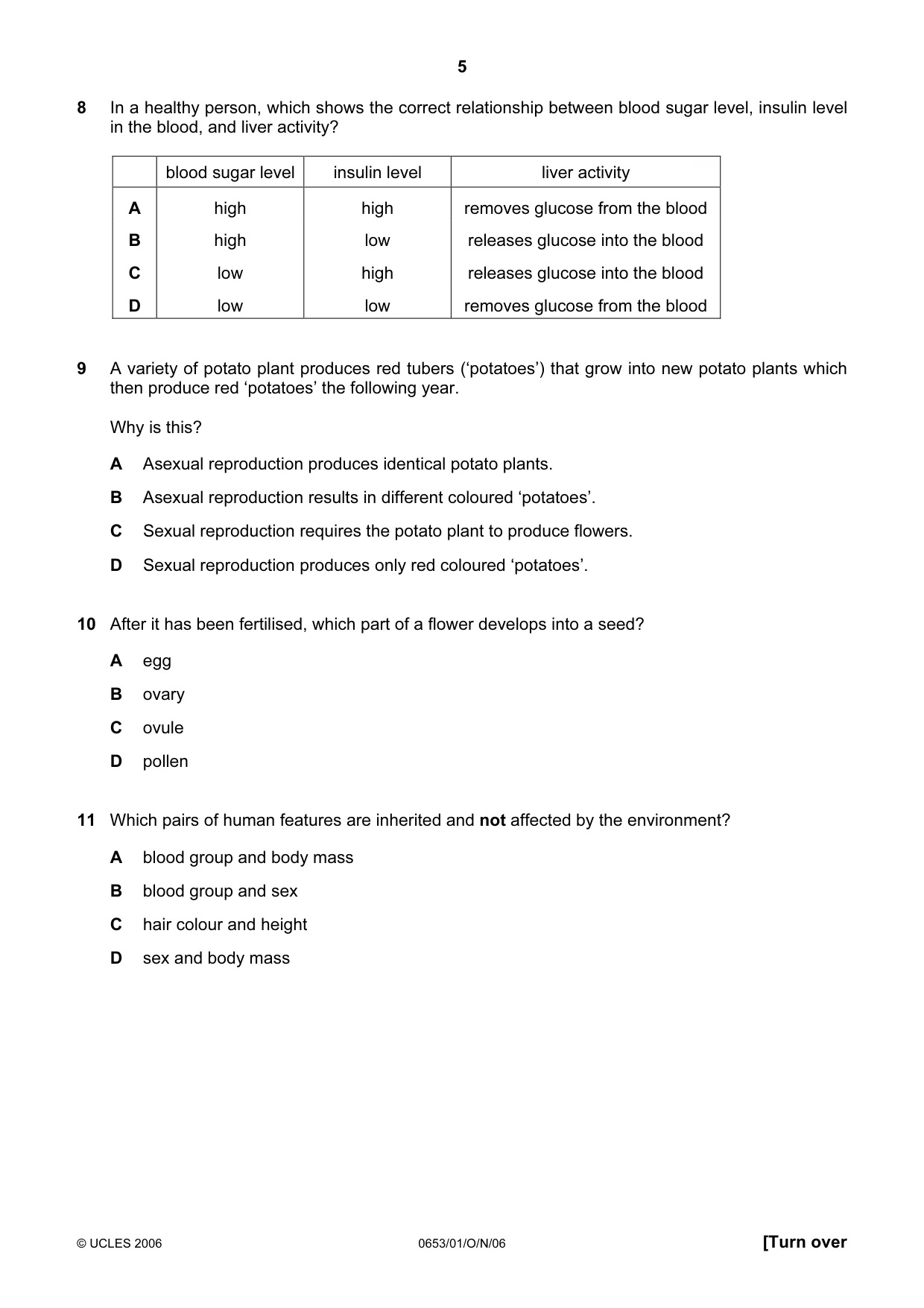
8 In a healthy person, which shows the correct relationship between blood sugar level, insulin level in the blood, and liver activity? blood sugar level insulin level liver activity A high high removes glucose from the blood B high low releases glucose into the blood C low high releases glucose into the blood D low low removes glucose from the blood
Mark scheme: A
Q9 · A variety of potato plant produces red tubers (‘potatoes’) that grow into new potato…
9 A variety of potato plant produces red tubers (‘potatoes’) that grow into new potato plants which then produce red ‘potatoes’ the following year. Why is this? A Asexual reproduction produces identical potato plants. B Asexual reproduction results in different coloured ‘potatoes’. C Sexual reproduction requires the potato plant to produce flowers. D Sexual reproduction produces only red coloured ‘potatoes’.
Mark scheme: A
Q10 · After it has been fertilised, which part of a flower develops into a seed?
10 After it has been fertilised, which part of a flower develops into a seed? A egg B ovary C ovule D pollen
Mark scheme: C
Q11 · Which pairs of human features are inherited and not affected by the environment?
11 Which pairs of human features are inherited and not affected by the environment? A blood group and body mass B blood group and sex C hair colour and height D sex and body mass
Mark scheme: B
Q12 · The diagram shows the carbon cycle
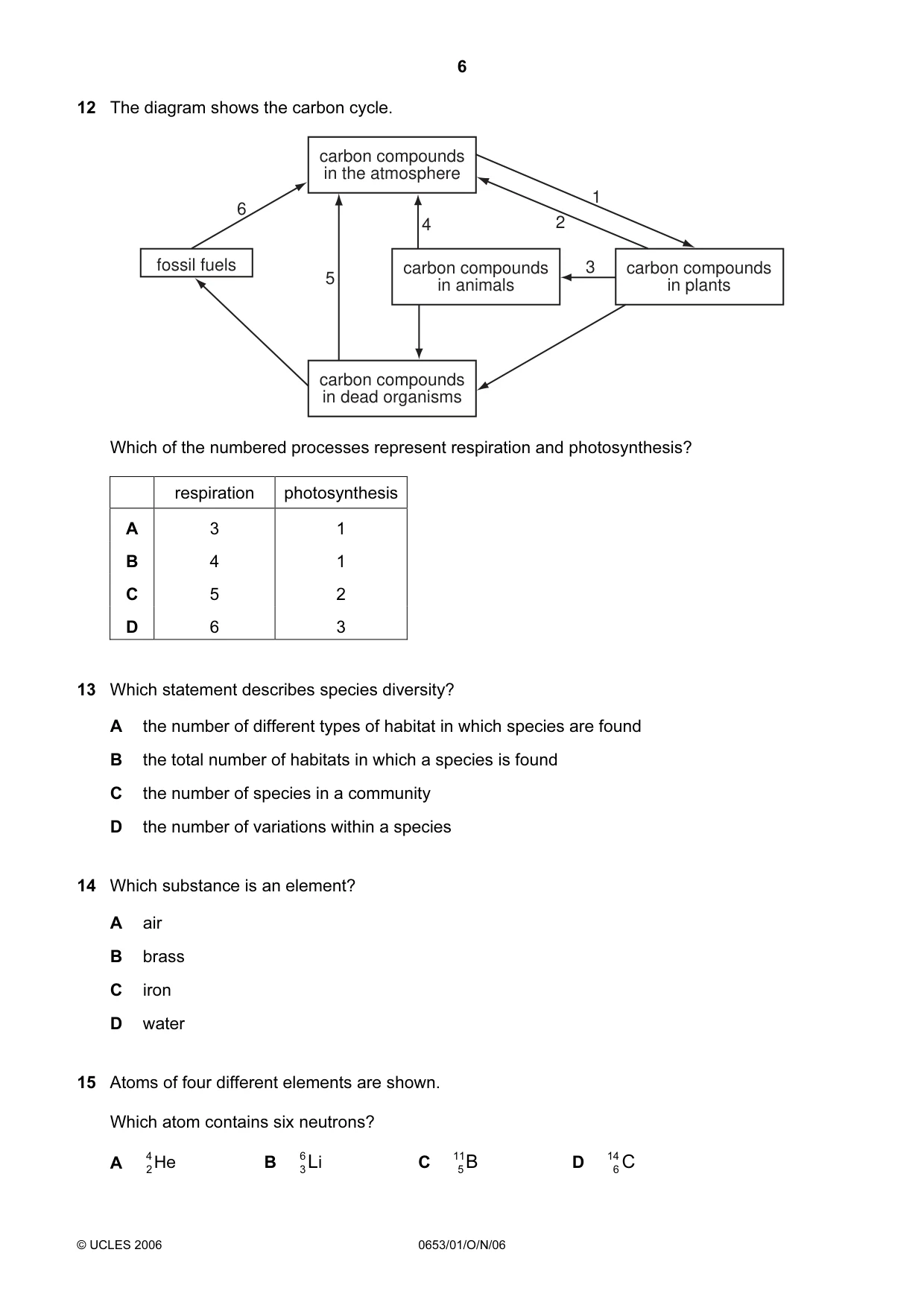
12 The diagram shows the carbon cycle. carbon compounds in the atmosphere 1 6 4 2 fossil fuels carbon compounds 3 carbon compounds 5 in animals in plants carbon compounds in dead organisms Which of the numbered processes represent respiration and photosynthesis? respiration photosynthesis A 3 1 B 4 1 C 5 2 D 6 3
Mark scheme: B
Q13 · Which statement describes species diversity?
13 Which statement describes species diversity? A the number of different types of habitat in which species are found B the total number of habitats in which a species is found C the number of species in a community D the number of variations within a species
Mark scheme: C
Q14 · Which substance is an element?
14 Which substance is an element? A air B brass C iron D water
Mark scheme: C
Q15 · Atoms of four different elements are shown
15 Atoms of four different elements are shown. Which atom contains six neutrons? A 4 He B 6 iL C 11 B D 14 C 2 3 5 6
Mark scheme: C
Q16 · Which substance is an ionic compound?
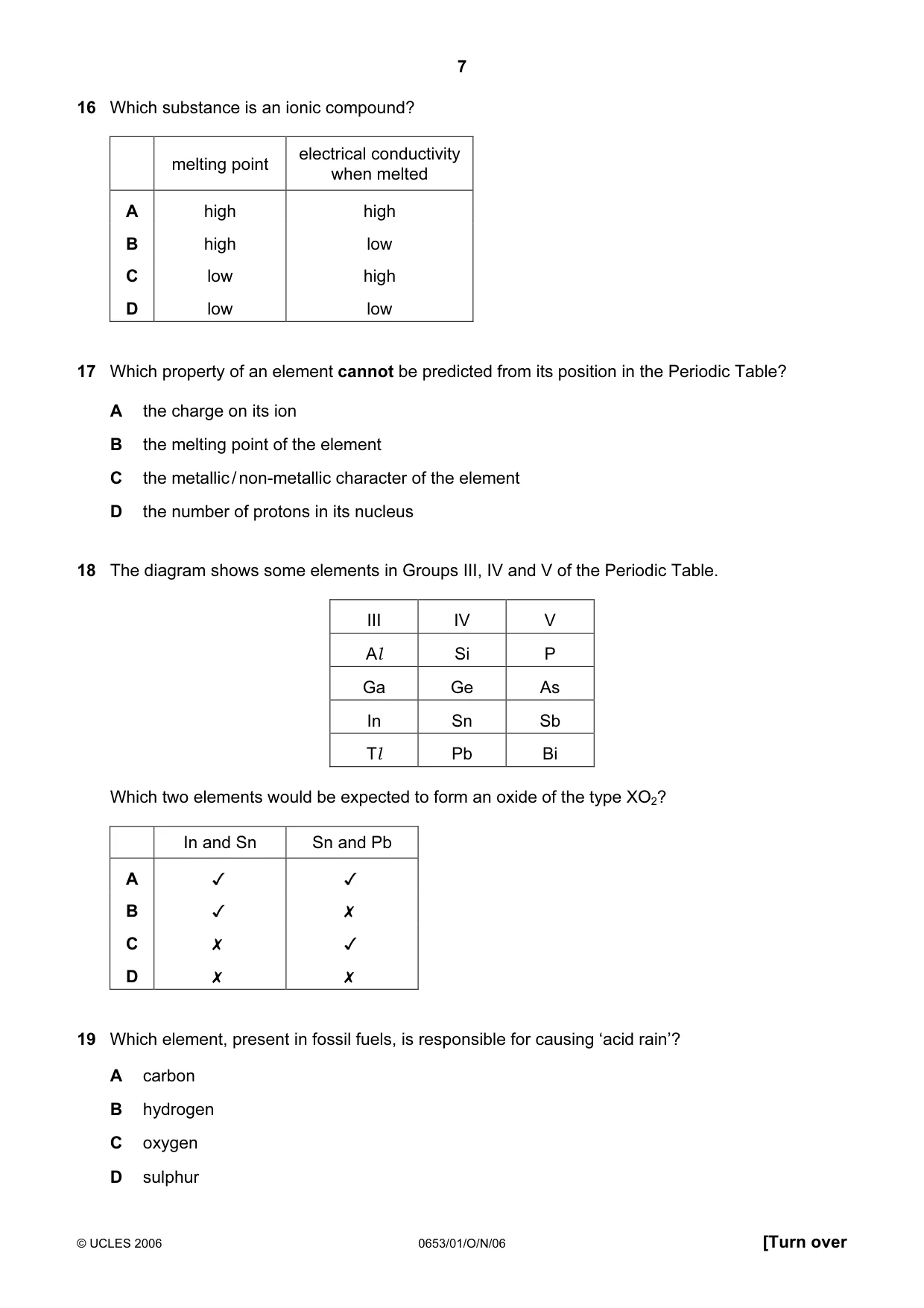
16 Which substance is an ionic compound? electrical conductivity melting point when melted A high high B high low C low high D low low
Mark scheme: A
Q17 · Which property of an element cannot be predicted from its position in the Periodic Table?
17 Which property of an element cannot be predicted from its position in the Periodic Table? A the charge on its ion B the melting point of the element C the metallic / non-metallic character of the element D the number of protons in its nucleus
Mark scheme: B
Q18 · The diagram shows some elements in Groups Ill, IV and V of the Periodic Table
18 The diagram shows some elements in Groups Ill, IV and V of the Periodic Table. III IV V Al Si Ga Ge As In Sn Sb Tl Pb Bi Which two elements would be expected to form an oxide of the type XO2? 0 0O WwW > In and Sn x «KX Sn and Pb x < x
Mark scheme: C
Q19 · Which element, present in fossil fuels, is responsible for causing ‘acid rain’?
19 Which element, present in fossil fuels, is responsible for causing ‘acid rain’? A carbon B hydrogen C oxygen D sulphur
Mark scheme: D
Q20 · The diagrams show some molecules of substances present in air
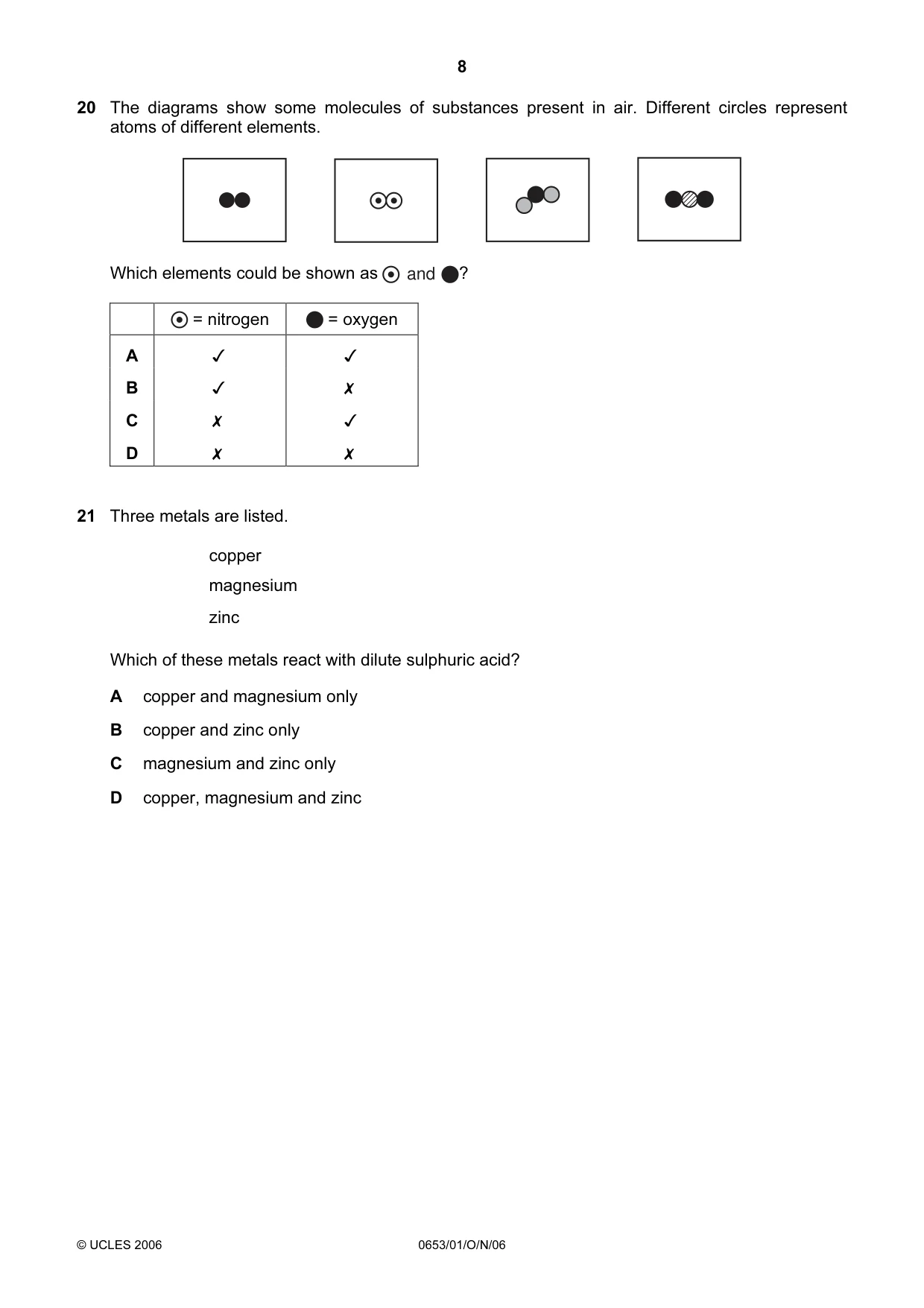
20 The diagrams show some molecules of substances present in air. Different circles represent atoms of different elements. rw} Le} lel ie Which elements could be shown as @) and @? © = nitrogen @ = oxygen A Jv v B Jv x Cc x v D x x
Mark scheme: A
Q21 · Three metals are listed
21 Three metals are listed. copper magnesium zinc Which of these metals react with dilute sulphuric acid? A copper and magnesium only B copper and zinc only C magnesium and zinc only D copper, magnesium and zinc
Mark scheme: C
Q22 · Hydrogen is passed over heated copper(II) oxide as shown
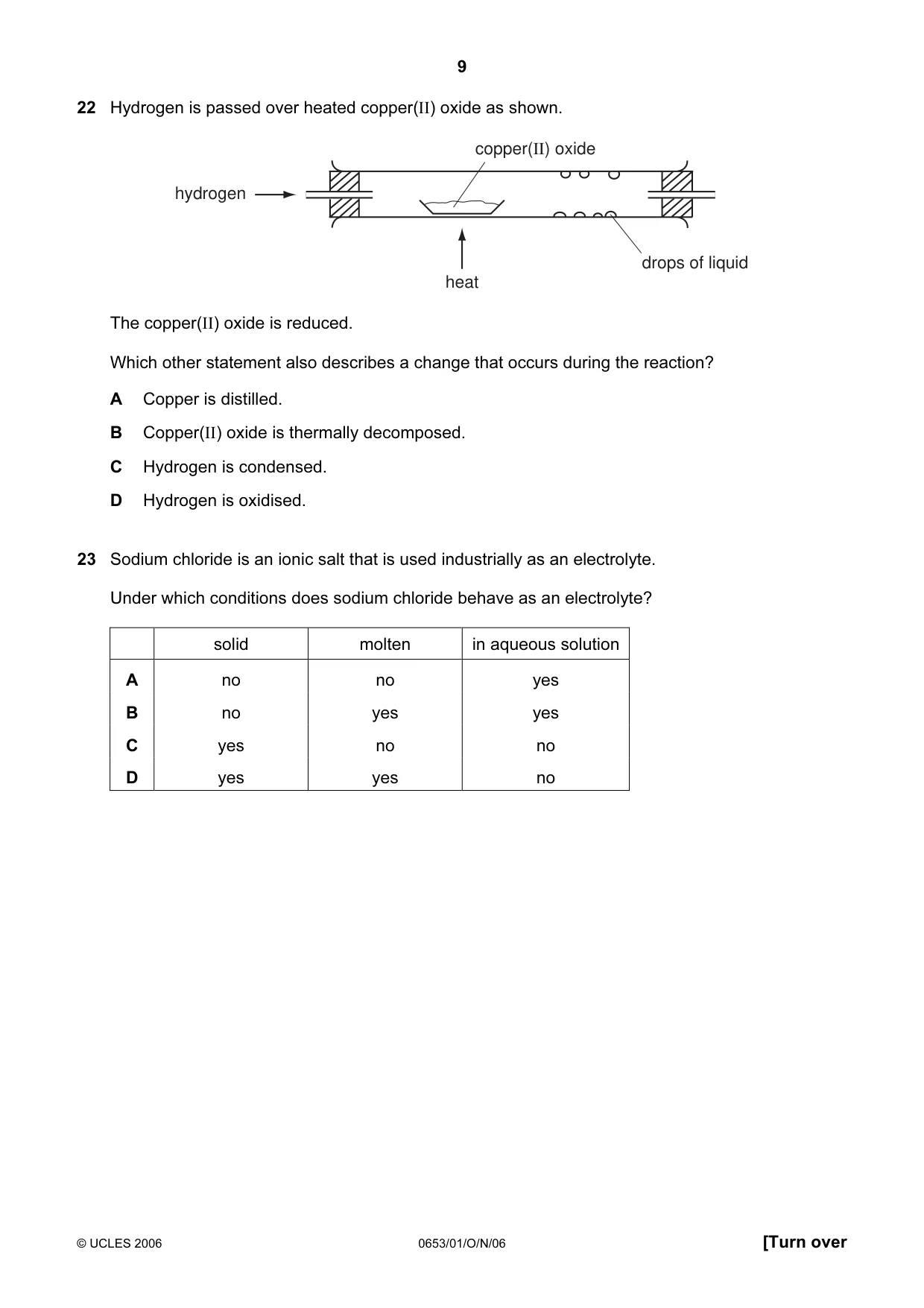
22 Hydrogen is passed over heated copper(II) oxide as shown. copper(II) oxide hydrogen drops of liquid heat The copper(II) oxide is reduced. Which other statement also describes a change that occurs during the reaction? A Copper is distilled. B Copper(II) oxide is thermally decomposed. C Hydrogen is condensed. D Hydrogen is oxidised.
Mark scheme: D
Q23 · Sodium chloride is an ionic salt that is used industrially as an electrolyte
23 Sodium chloride is an ionic salt that is used industrially as an electrolyte. Under which conditions does sodium chloride behave as an electrolyte? solid molten in aqueous solution A no no yes B no yes yes C yes no no D yes yes no
Mark scheme: B
Q24 · A substance, X, is dissolved in water and electrolysed as shown
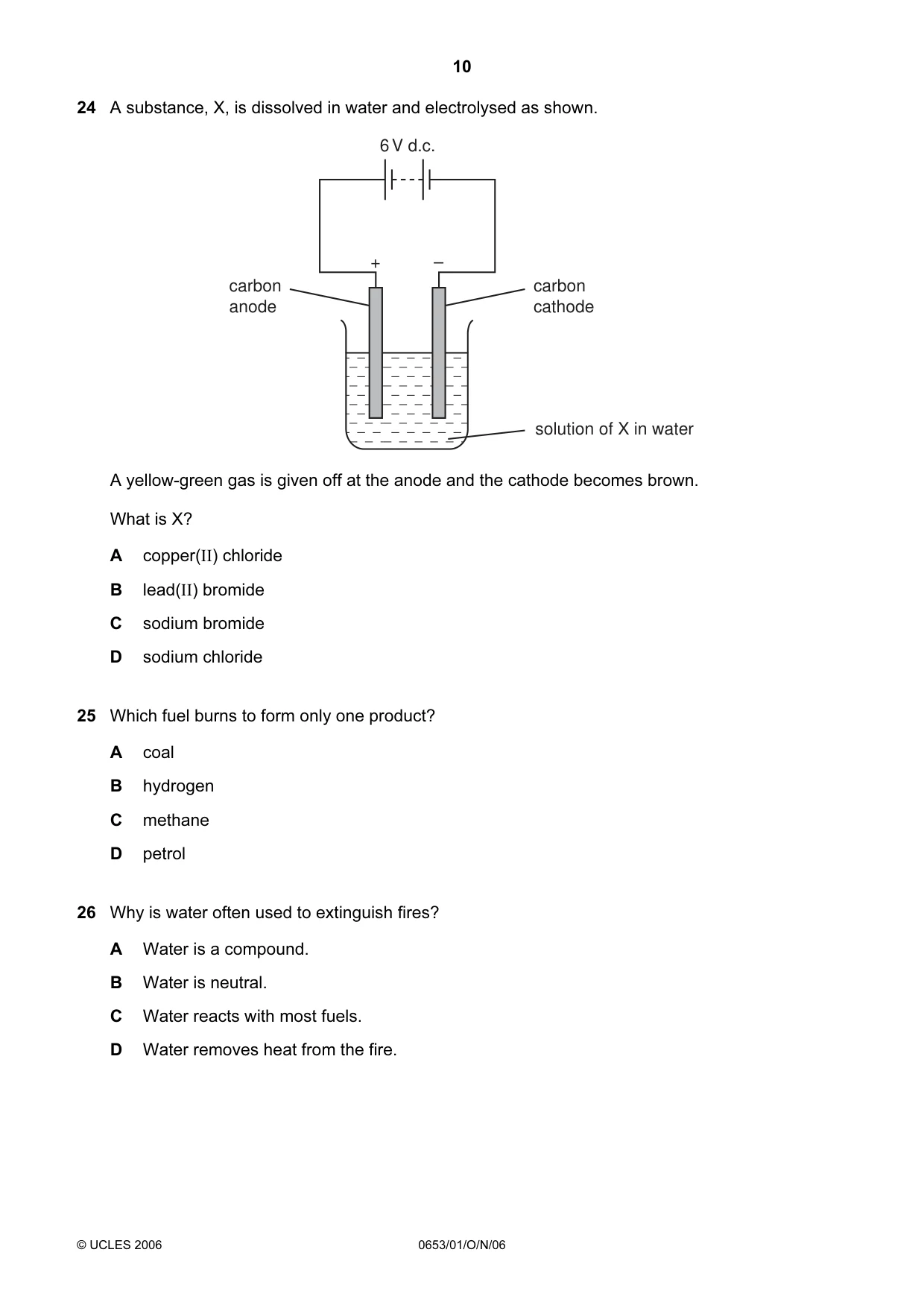
24 A substance, X, is dissolved in water and electrolysed as shown. 6 V d.c. + – carbon carbon anode cathode solution of X in water A yellow-green gas is given off at the anode and the cathode becomes brown. What is X? A copper(II) chloride B lead(II) bromide C sodium bromide D sodium chloride
Mark scheme: A
Q25 · Which fuel burns to form only one product?
25 Which fuel burns to form only one product? A coal B hydrogen C methane D petrol
Mark scheme: B
Q26 · Why is water often used to extinguish fires?
26 Why is water often used to extinguish fires? A Water is a compound. B Water is neutral. C Water reacts with most fuels. D Water removes heat from the fire.
Mark scheme: D
Q27 · Some man-made plastics are made from small molecules which join together by covalent bonds
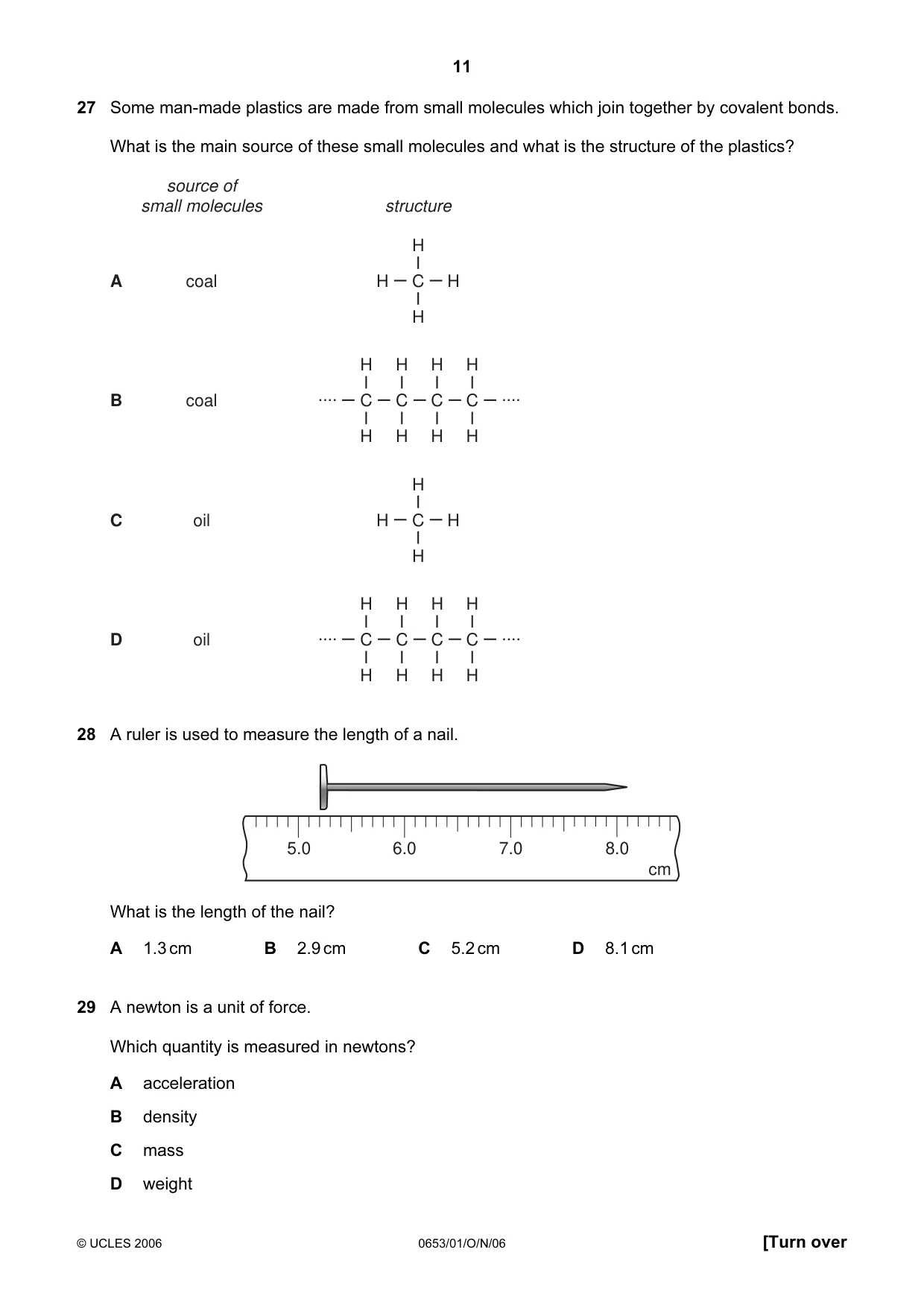
27 Some man-made plastics are made from small molecules which join together by covalent bonds. What is the main source of these small molecules and what is the structure of the plastics? source of small molecules structure H A coal H C H H H H H H B coal .... C C C C .... H H H H H C oil H C H H H H H H D oil .... C C C C .... H H H H
Mark scheme: D
Q28 · A ruler is used to measure the length of a nail
28 A ruler is used to measure the length of a nail. 5.0 6.0 7.0 8.0 cm What is the length of the nail? A 1.3 cm B 2.9 cm C 5.2 cm D 8.1 cm
Mark scheme: B
More questions on Physical quantities and measurement techniques
Q29 · A newton is a unit of force
29 A newton is a unit of force. Which quantity is measured in newtons? A acceleration B density C mass D weight
Mark scheme: D
Q30 · A student pours liquid into a measuring cylinder
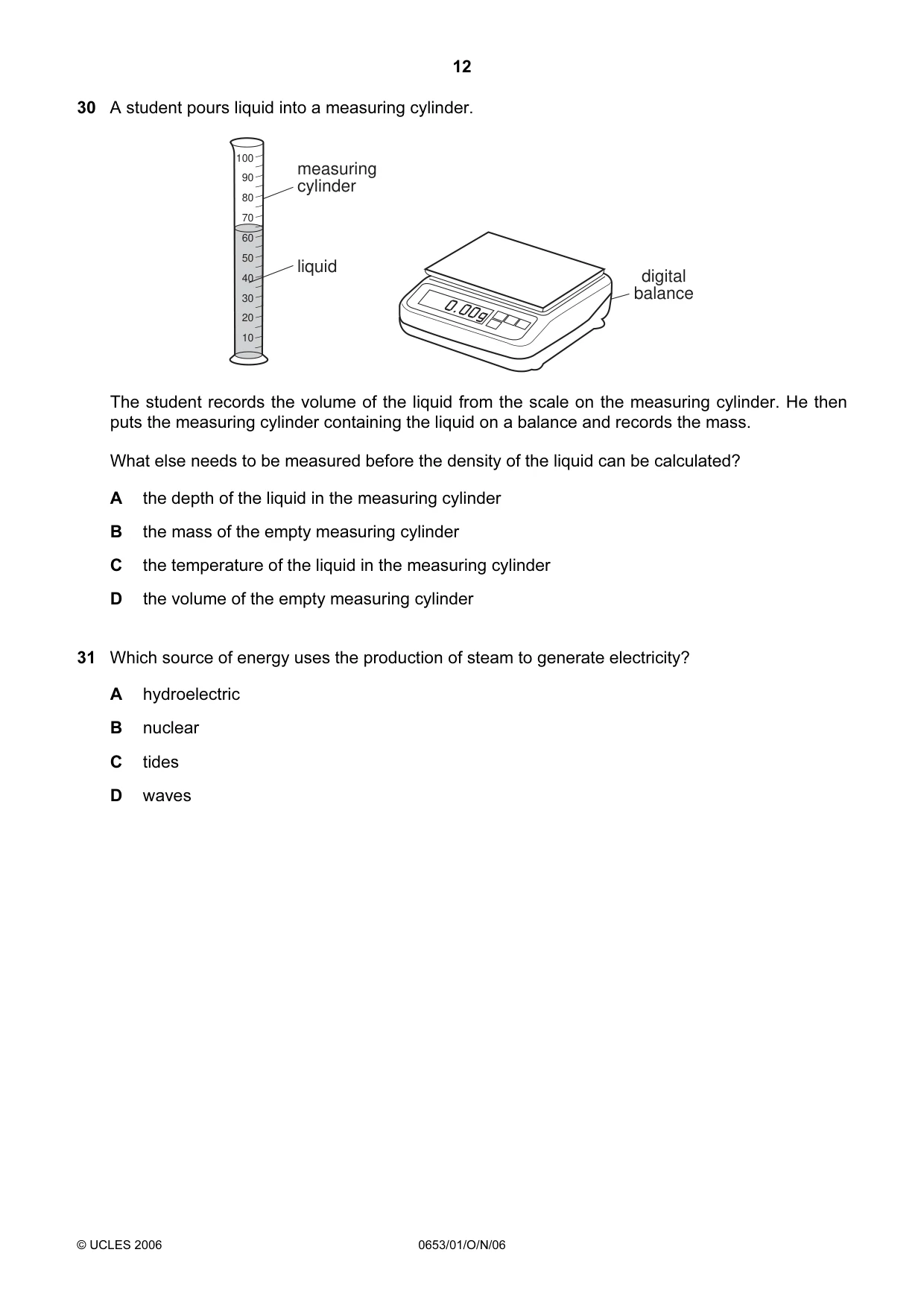
30 A student pours liquid into a measuring cylinder. 100 measuring 90 cylinder 80 70 60 50 liquid 40 digital balance 30 20 10 The student records the volume of the liquid from the scale on the measuring cylinder. He then puts the measuring cylinder containing the liquid on a balance and records the mass. What else needs to be measured before the density of the liquid can be calculated? A the depth of the liquid in the measuring cylinder B the mass of the empty measuring cylinder C the temperature of the liquid in the measuring cylinder D the volume of the empty measuring cylinder
Mark scheme: B
Q31 · Which source of energy uses the production of steam to generate electricity?
31 Which source of energy uses the production of steam to generate electricity? A hydroelectric B nuclear C tides D waves
Mark scheme: B
Q32 · A cyclist travels down a hill from rest at point X without pedalling
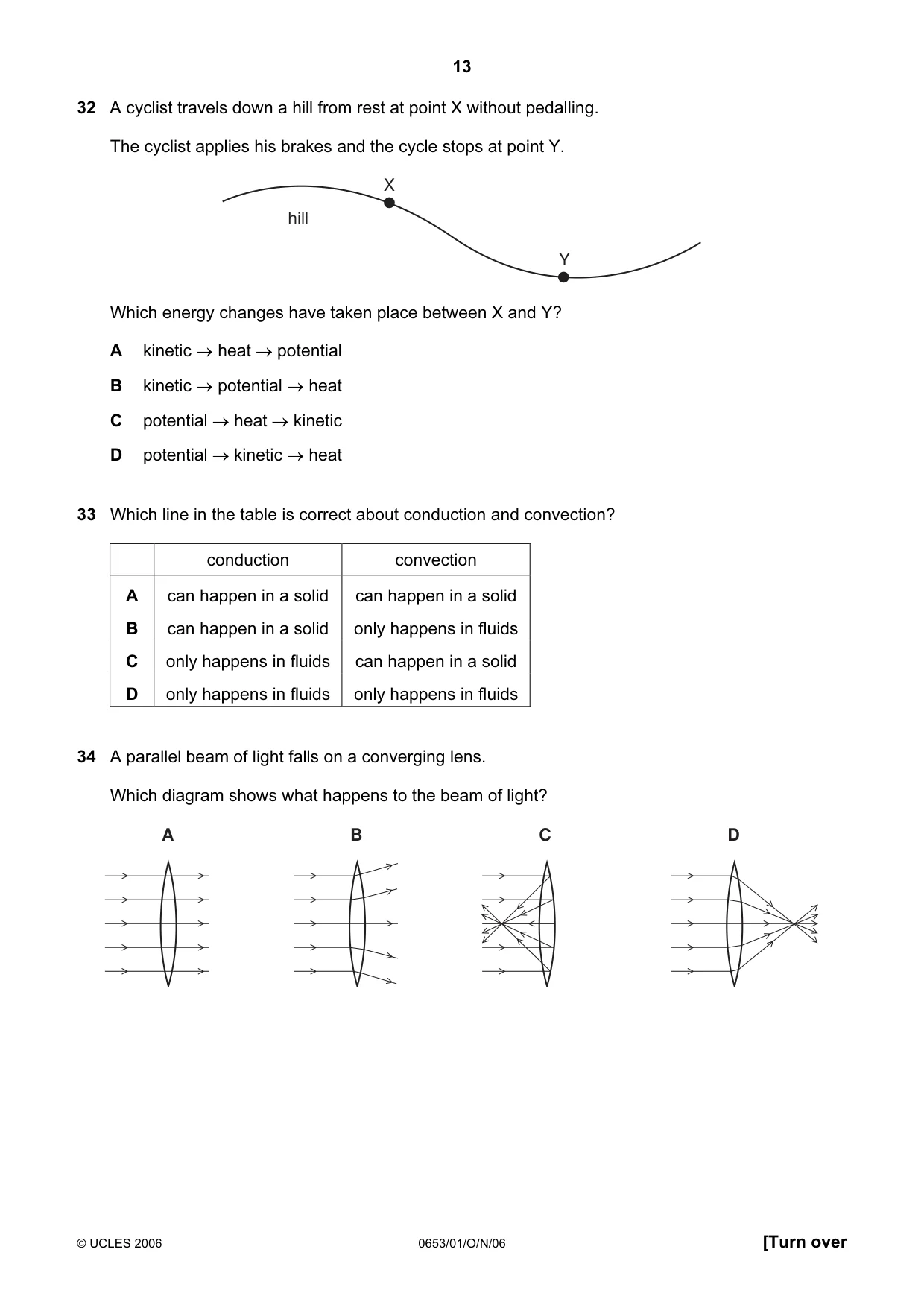
32 A cyclist travels down a hill from rest at point X without pedalling. The cyclist applies his brakes and the cycle stops at point Y. X hill Y Which energy changes have taken place between X and Y? A kinetic → heat → potential B kinetic → potential → heat C potential → heat → kinetic D potential → kinetic → heat
Mark scheme: D
Q33 · Which line in the table is correct about conduction and convection?
33 Which line in the table is correct about conduction and convection? conduction convection A can happen in a solid can happen in a solid B can happen in a solid only happens in fluids C only happens in fluids can happen in a solid D only happens in fluids only happens in fluids
Mark scheme: B
Q34 · A parallel beam of light falls on a converging lens
34 A parallel beam of light falls on a converging lens. Which diagram shows what happens to the beam of light? A B C D
Mark scheme: D
Q35 · The diagram shows a ray of light striking a plane mirror
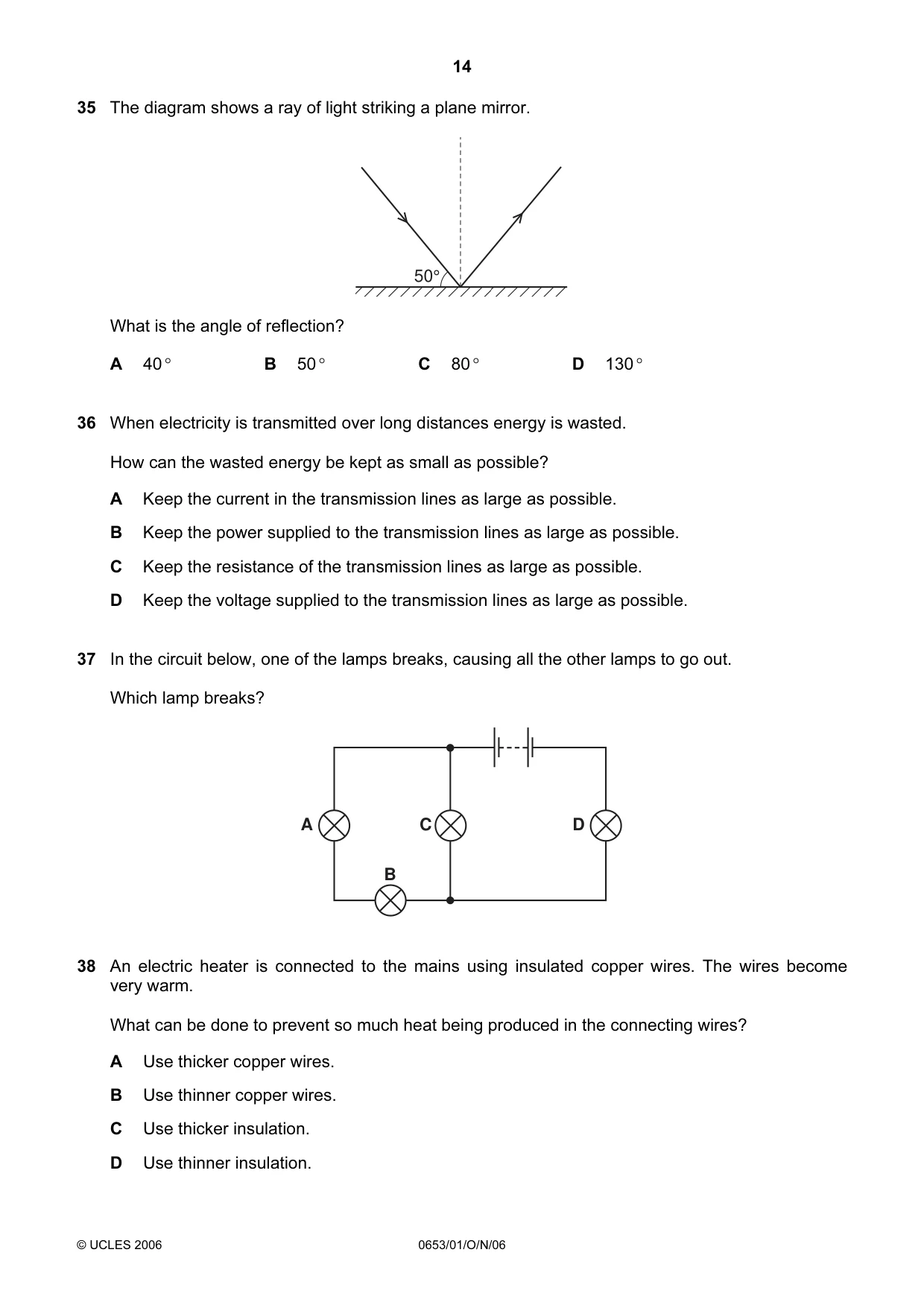
35 The diagram shows a ray of light striking a plane mirror. 50° What is the angle of reflection? A 40 ° B 50 ° C 80 ° D 130 °
Mark scheme: A
Q36 · When electricity is transmitted over long distances energy is wasted
36 When electricity is transmitted over long distances energy is wasted. How can the wasted energy be kept as small as possible? A Keep the current in the transmission lines as large as possible. B Keep the power supplied to the transmission lines as large as possible. C Keep the resistance of the transmission lines as large as possible. D Keep the voltage supplied to the transmission lines as large as possible.
Mark scheme: D
Q37 · In the circuit below, one of the lamps breaks, causing all the other lamps to go out
37 In the circuit below, one of the lamps breaks, causing all the other lamps to go out. Which lamp breaks? A C D B
Mark scheme: D
Q38 · An electric heater is connected to the mains using insulated copper wires
38 An electric heater is connected to the mains using insulated copper wires. The wires become very warm. What can be done to prevent so much heat being produced in the connecting wires? A Use thicker copper wires. B Use thinner copper wires. C Use thicker insulation. D Use thinner insulation.
Mark scheme: A
Q39 · The graph shows the voltage input to a step-down transformer
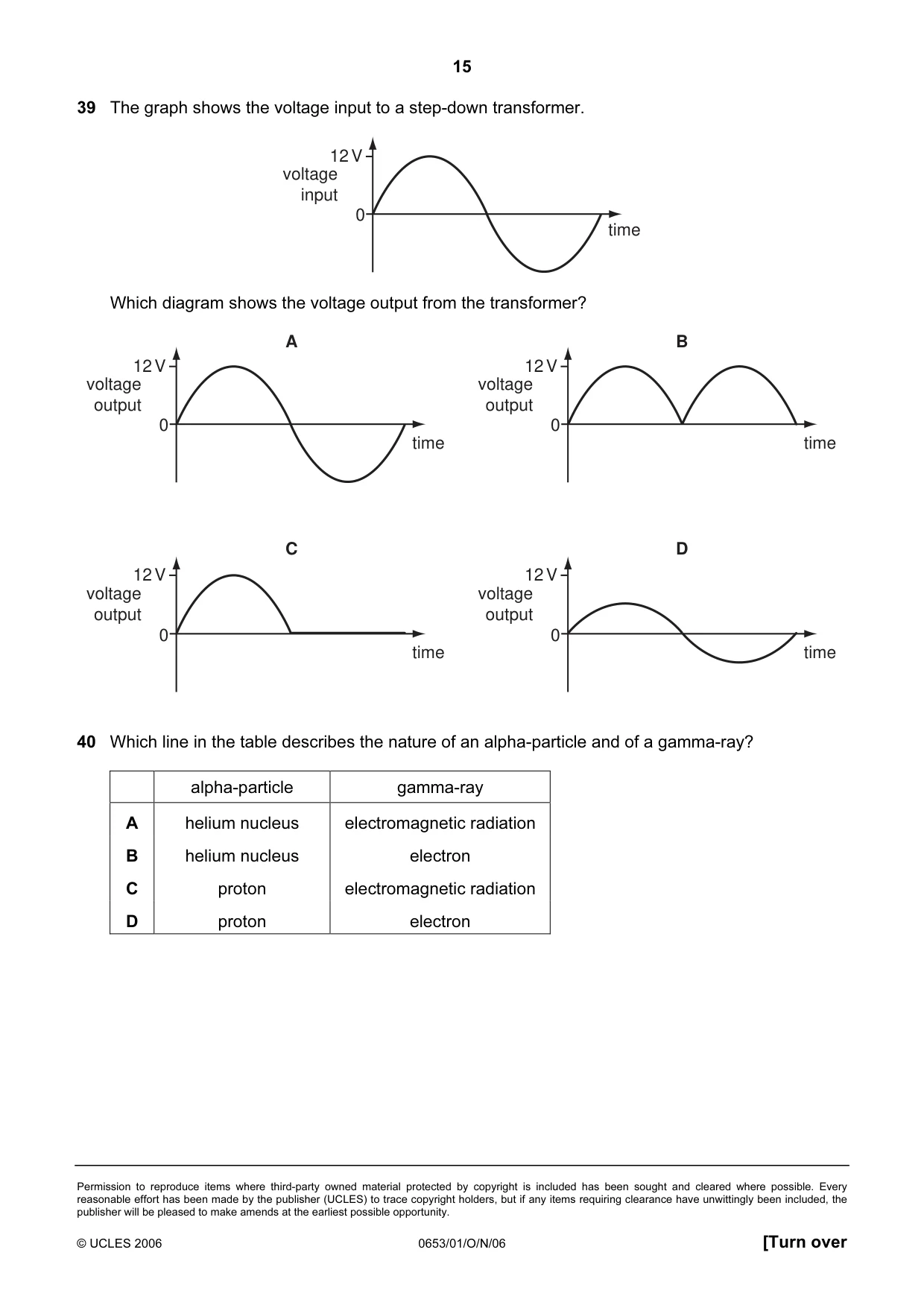
39 The graph shows the voltage input to a step-down transformer. 12 V voltage input 0 time Which diagram shows the voltage output from the transformer? A B 12 V 12 V voltage voltage output output 0 0 time time C D 12 V 12 V voltage voltage output output 0 0 time time
Mark scheme: D
Q40 · Which line in the table describes the nature of an alpha-particle and of a gamma-ray?
40 Which line in the table describes the nature of an alpha-particle and of a gamma-ray? alpha-particle gamma-ray A helium nucleus electromagnetic radiation B helium nucleus electron C proton electromagnetic radiation D proton electron
Mark scheme: A
What was in this paper
The subtopics covered by these 40 questions, and how many questions each got. Open one in a new tab to see every Cambridge question on it.
2Arrangement of elements2Electrical quantities2Electrolysis2Energy, work and power2Light2Sexual reproduction in plants2Atomic structure and the Periodic Table1Biological molecules1Blood1Carbon cycle1Cell structure1Cells, batteries, generators and motors1Conservation1Density1Electrical circuits1Electromagnetic spectrum1Elements, compounds and mixtures1Enzymes1Exothermic and endothermic reactions1Fuels1Gas exchange in humans1Heart1Ions and ionic bonds1Leaf structure1Mass and weight1Physical quantities and measurement techniques1Polymers1Reactivity series1Redox1Sexual reproduction in humans1Transfer of thermal energy1Transpiration1What you needed in this session
Cambridge’s own grade thresholds for 2006 Oct/Nov, Paper 1 · Variant 1. A higher threshold means an easier paper — the bar moves with how the cohort did.