Cambridge IGCSE Science - Combined 0653 — 2022 Oct/Nov Paper 1 · Variant 1
0653/11/O/N/22 · 40 questions · 40 marks · ≈45 min
The question paper and its mark scheme, free to read here and free to download. This is Cambridge’s own paper, exactly as it was sat.
Question paper16 pages
Mark scheme3 pages
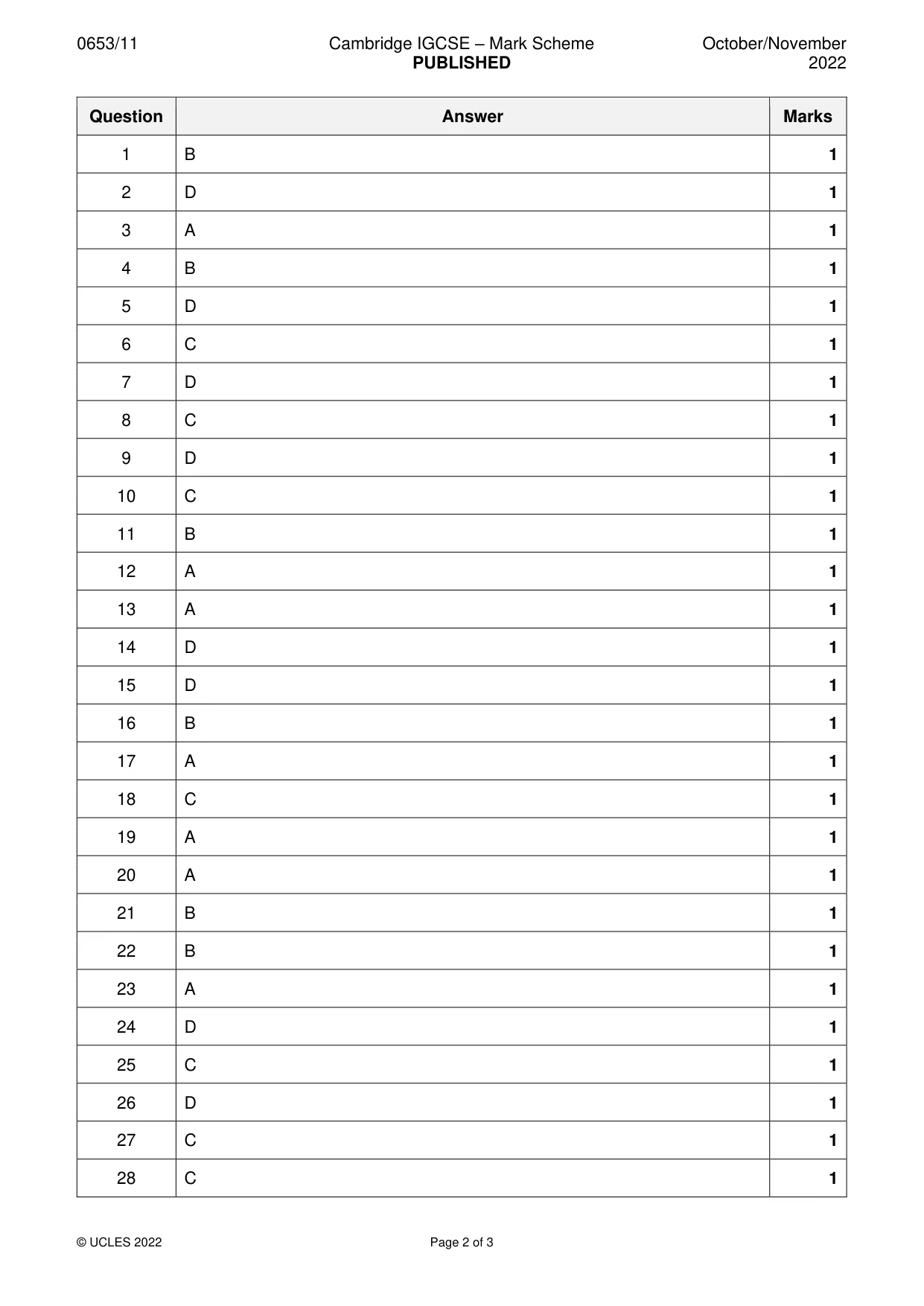
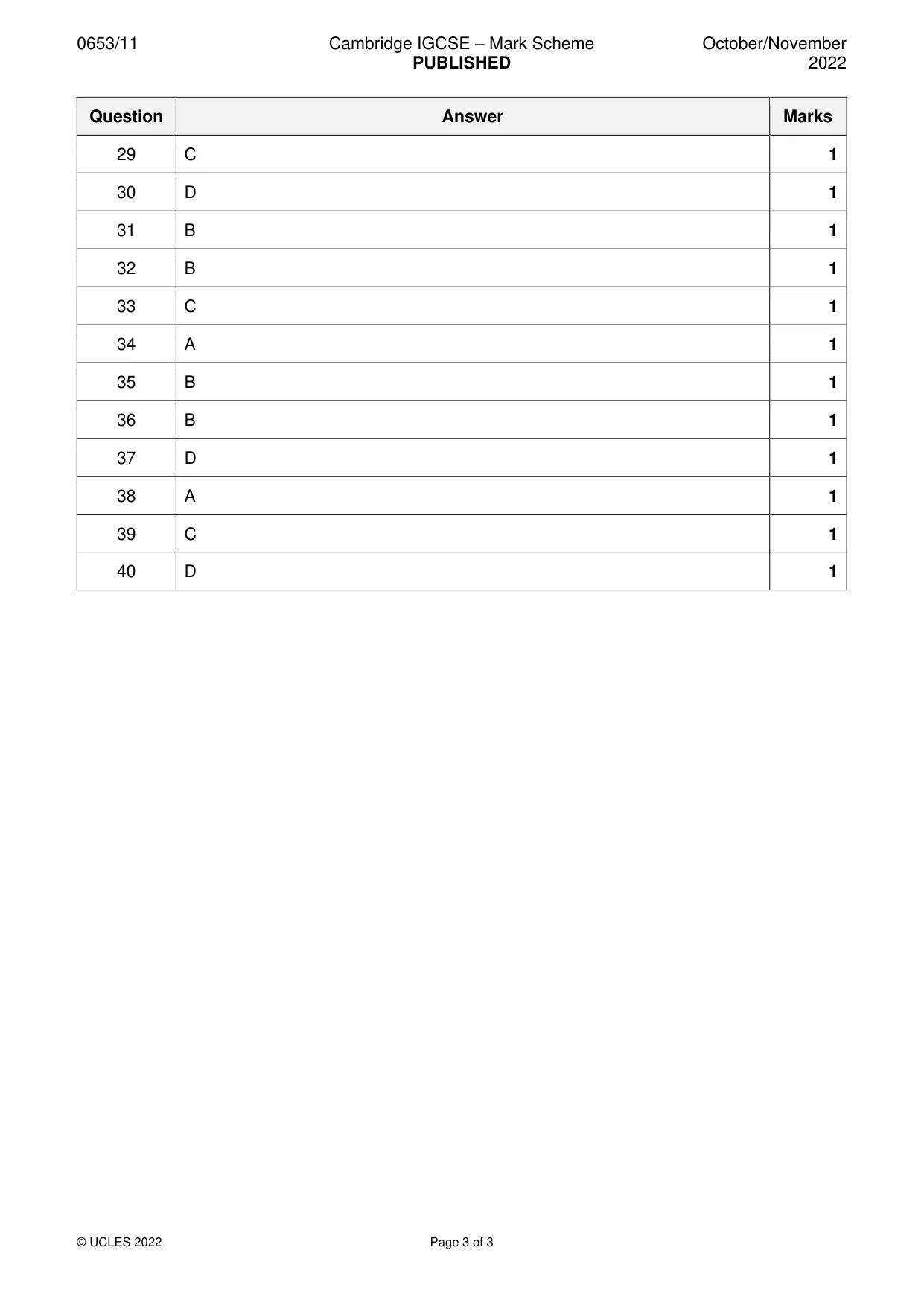
Answers below. Sit the paper first if you are practising.
Questions as text
Q1 · What are characteristics of all living organisms?
1 What are characteristics of all living organisms? A breathing, excretion, nutrition B excretion, growth, nutrition C reproduction, respiration, germination D secretion, growth, sensitivity
Mark scheme: B
Q2 · A plant cell is observed using a microscope
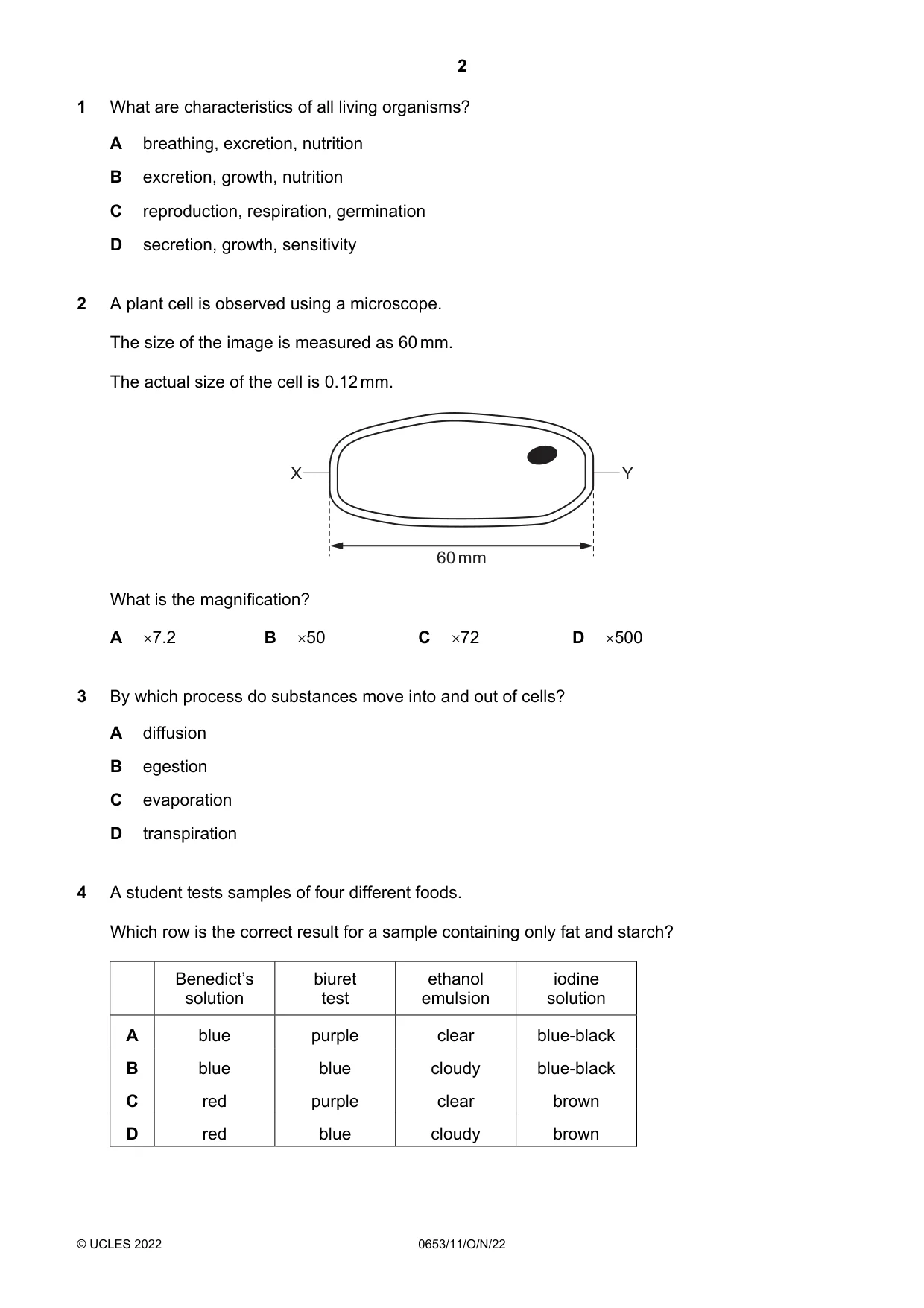
2 A plant cell is observed using a microscope. The size of the image is measured as 60 mm. The actual size of the cell is 0.12 mm. X Y 60 mm What is the magnification? A 7.2 B 50 C 72 D 500
Mark scheme: D
Q3 · By which process do substances move into and out of cells?
3 By which process do substances move into and out of cells? A diffusion B egestion C evaporation D transpiration
Mark scheme: A
Q4 · A student tests samples of four different foods
4 A student tests samples of four different foods. Which row is the correct result for a sample containing only fat and starch? Benedict’s biuret ethanol iodine solution test emulsion solution A blue purple clear blue-black B blue blue cloudy blue-black C red purple clear brown D red blue cloudy brown
Mark scheme: B
Q5 · The graph shows the effect of one variable on amylase activity
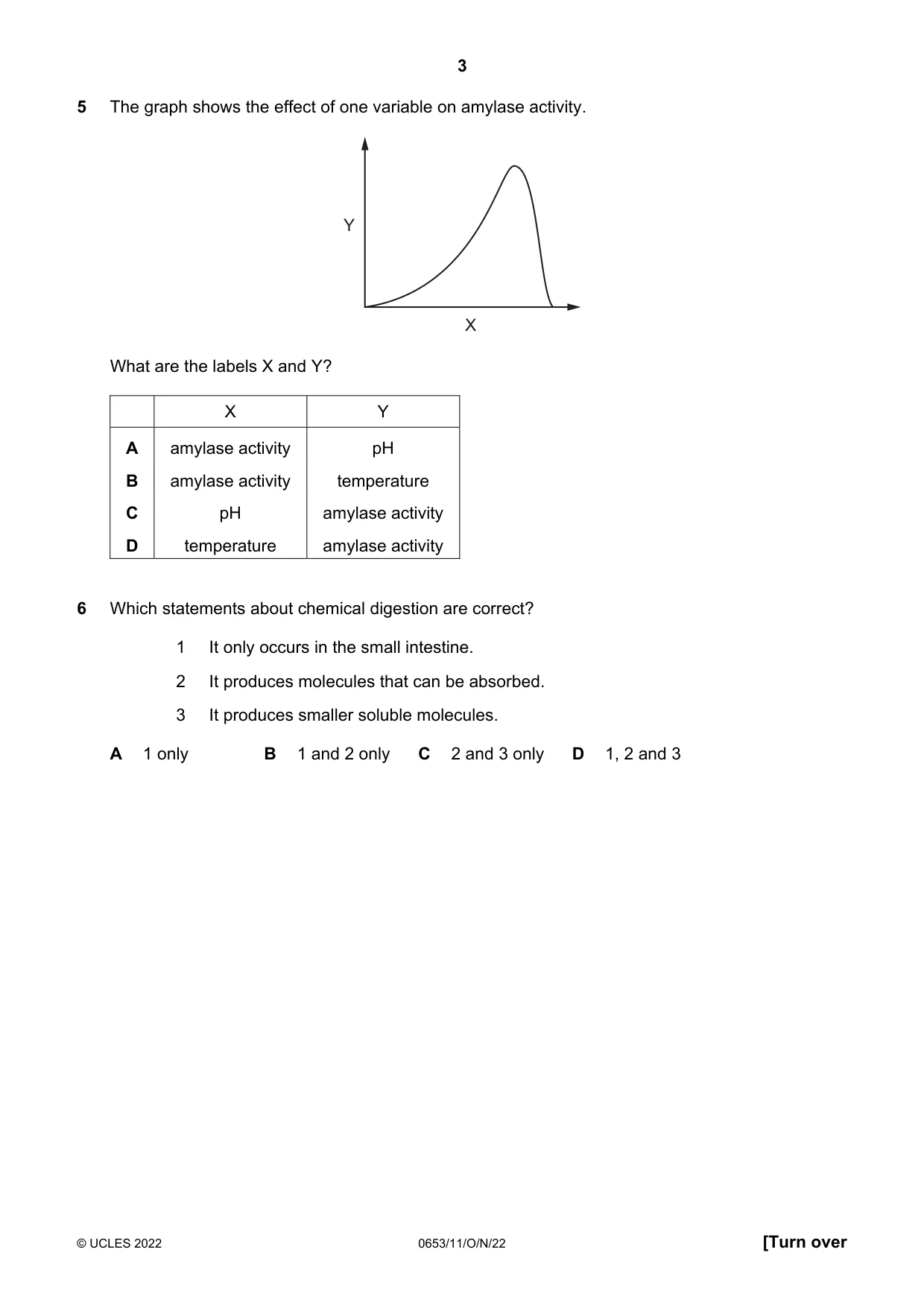
5 The graph shows the effect of one variable on amylase activity. Y X What are the labels X and Y? X Y A amylase activity pH B amylase activity temperature C pH amylase activity D temperature amylase activity
Mark scheme: D
Q6 · Which statements about chemical digestion are correct?
6 Which statements about chemical digestion are correct? 1 It only occurs in the small intestine. 2 It produces molecules that can be absorbed. 3 It produces smaller soluble molecules. A 1 only B 1 and 2 only C 2 and 3 only D 1, 2 and 3
Mark scheme: C
Q7 · When at rest, a student measures his rate of breathing and the volume of air inspired
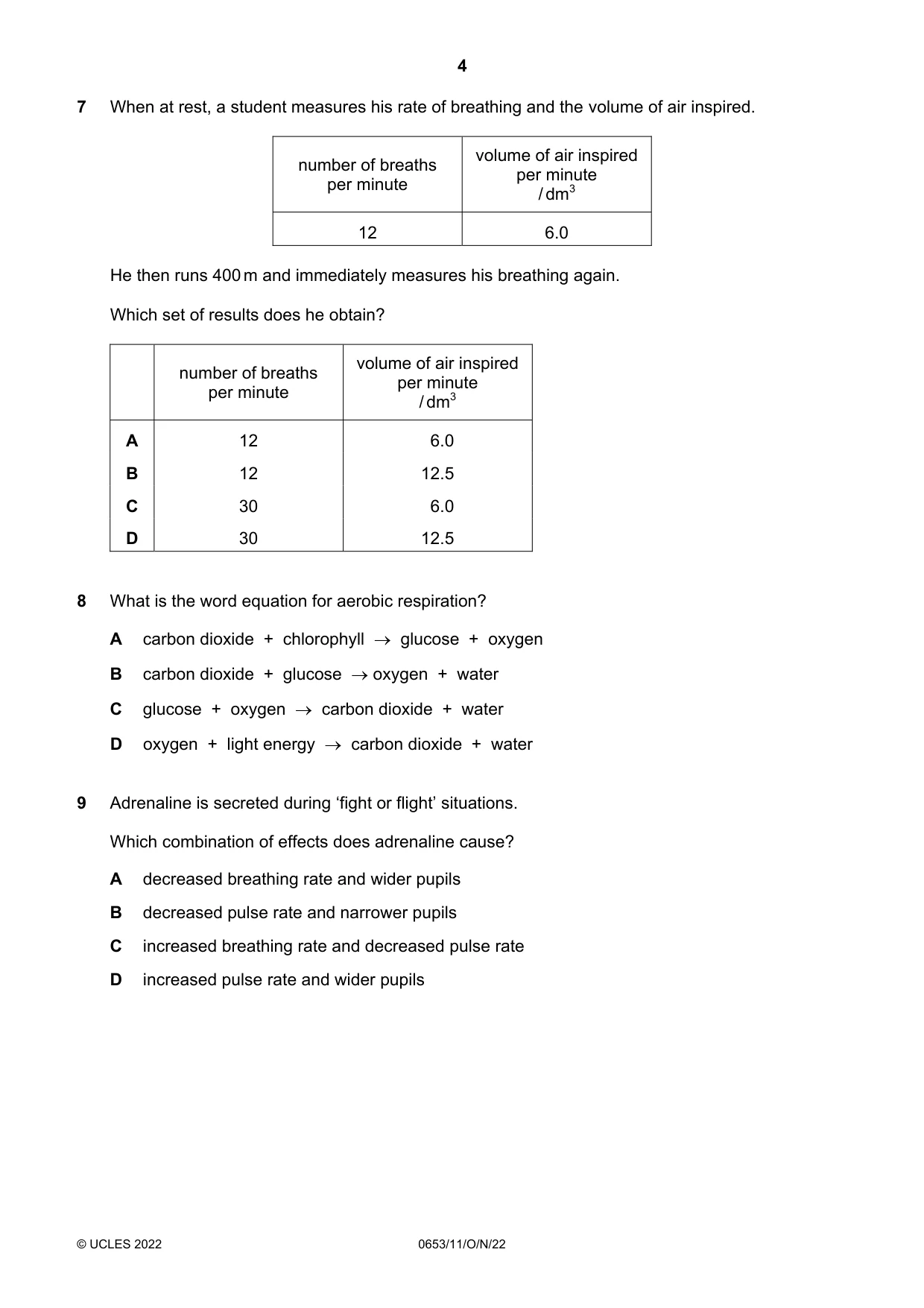
7 When at rest, a student measures his rate of breathing and the volume of air inspired. volume of air inspired number of breaths per minute per minute / dm3 12 6.0 He then runs 400 m and immediately measures his breathing again. Which set of results does he obtain? volume of air inspired number of breaths per minute per minute / dm3 A 12 6.0 B 12 12.5 C 30 6.0 D 30 12.5
Mark scheme: D
Q8 · What is the word equation for aerobic respiration?
8 What is the word equation for aerobic respiration? A carbon dioxide + chlorophyll glucose + oxygen B carbon dioxide + glucose oxygen + water C glucose + oxygen carbon dioxide + water D oxygen + light energy carbon dioxide + water
Mark scheme: C
Q9 · Adrenaline is secreted during ‘fight or flight’ situations
9 Adrenaline is secreted during ‘fight or flight’ situations. Which combination of effects does adrenaline cause? A decreased breathing rate and wider pupils B decreased pulse rate and narrower pupils C increased breathing rate and decreased pulse rate D increased pulse rate and wider pupils
Mark scheme: D
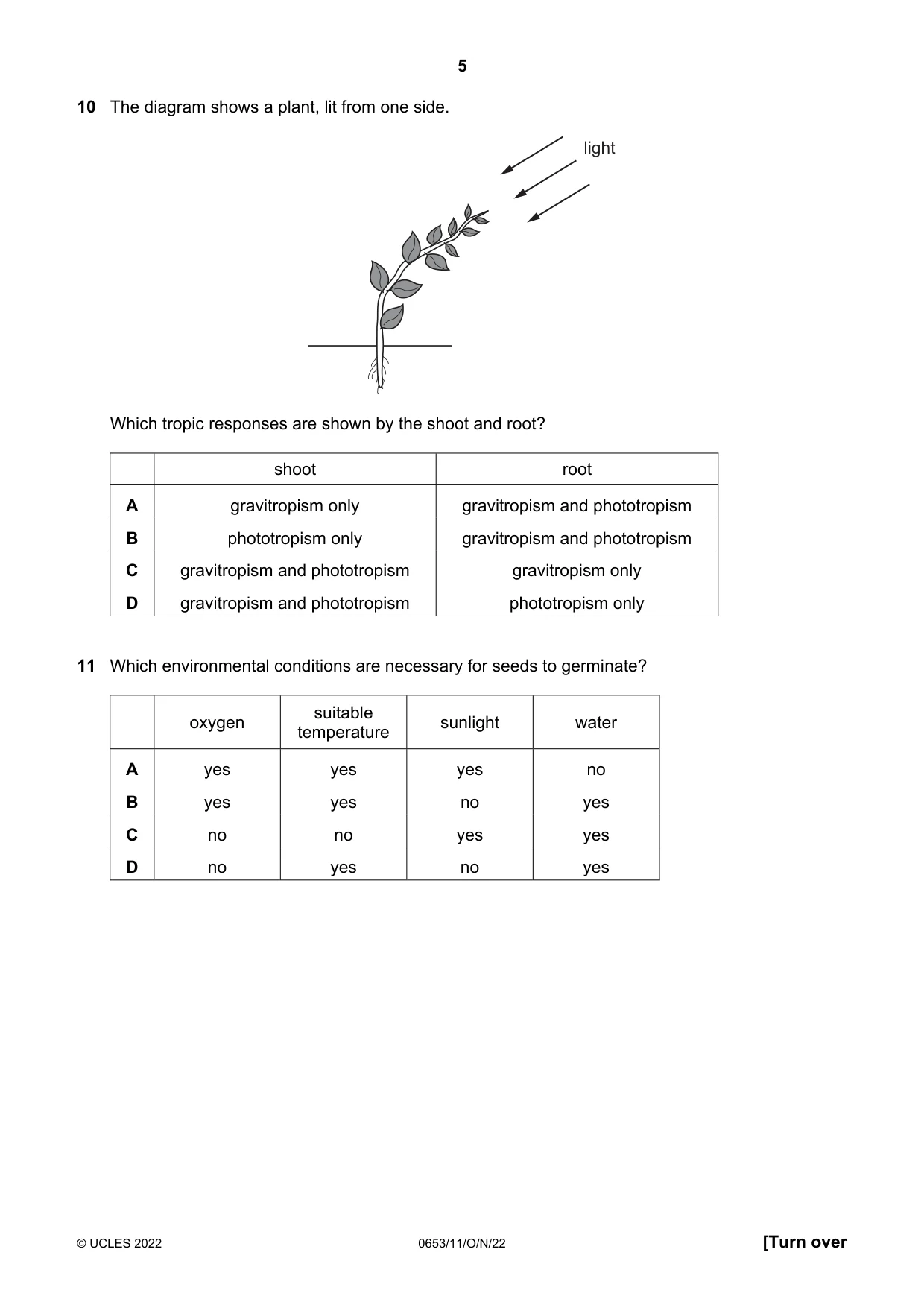
Q10 · The diagram shows a plant, lit from one side
10 The diagram shows a plant, lit from one side. light Which tropic responses are shown by the shoot and root? shoot root A gravitropism only gravitropism and phototropism B phototropism only gravitropism and phototropism C gravitropism and phototropism gravitropism only D gravitropism and phototropism phototropism only
Mark scheme: C
Q11 · Which environmental conditions are necessary for seeds to germinate?
11 Which environmental conditions are necessary for seeds to germinate? suitable oxygen sunlight water temperature A yes yes yes no B yes yes no yes C no no yes yes D no yes no yes
Mark scheme: B
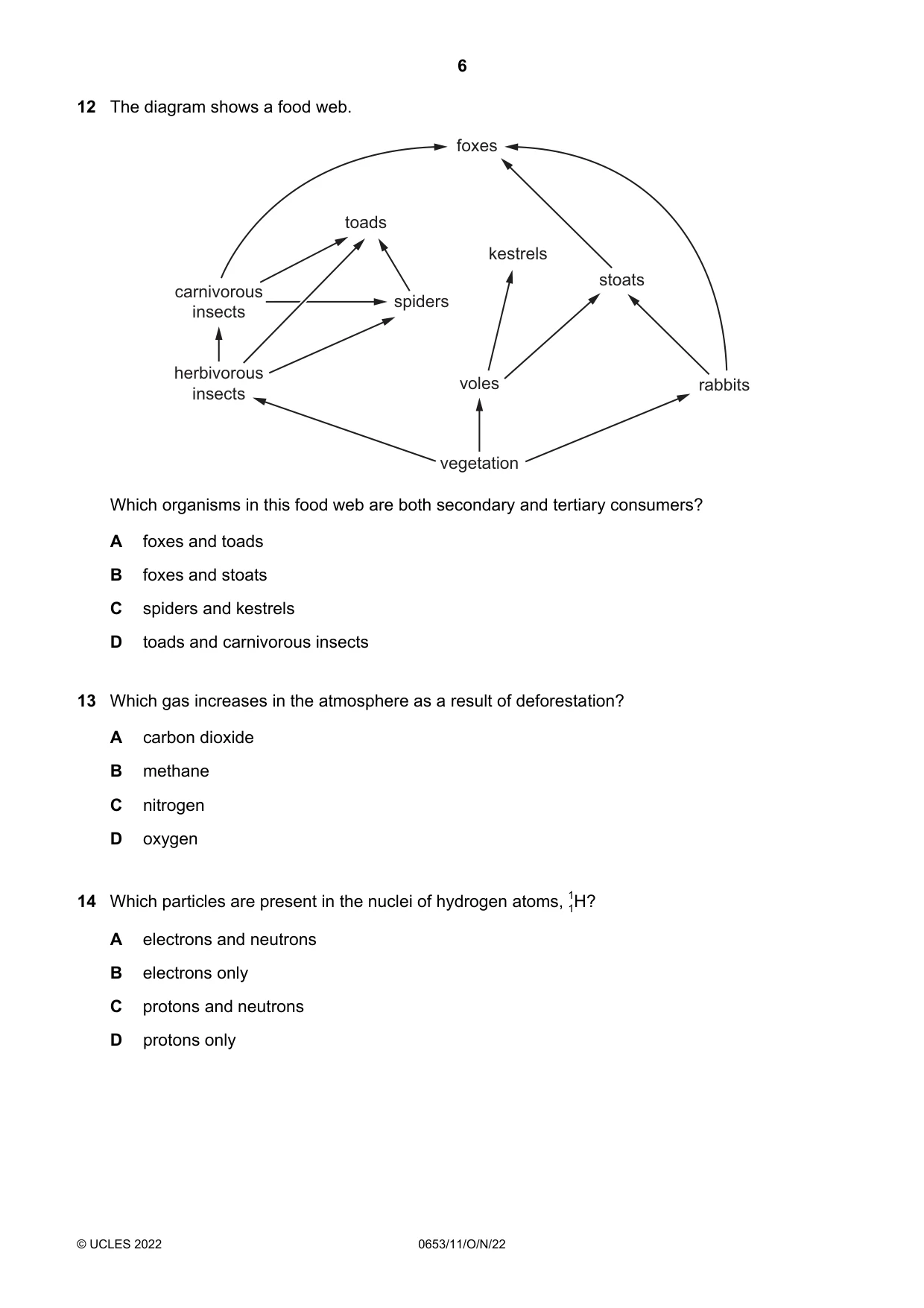
Q12 · The diagram shows a food web
12 The diagram shows a food web. foxes toads kestrels stoats carnivorous spiders insects herbivorous voles rabbits insects vegetation Which organisms in this food web are both secondary and tertiary consumers? A foxes and toads B foxes and stoats C spiders and kestrels D toads and carnivorous insects
Mark scheme: A
Q13 · Which gas increases in the atmosphere as a result of deforestation?
13 Which gas increases in the atmosphere as a result of deforestation? A carbon dioxide B methane C nitrogen D oxygen
Mark scheme: A
Q14 · Which particles are present in the nuclei of hydrogen atoms, H?
14 Which particles are present in the nuclei of hydrogen atoms, H? 1 1 A electrons and neutrons B electrons only C protons and neutrons D protons only
Mark scheme: D
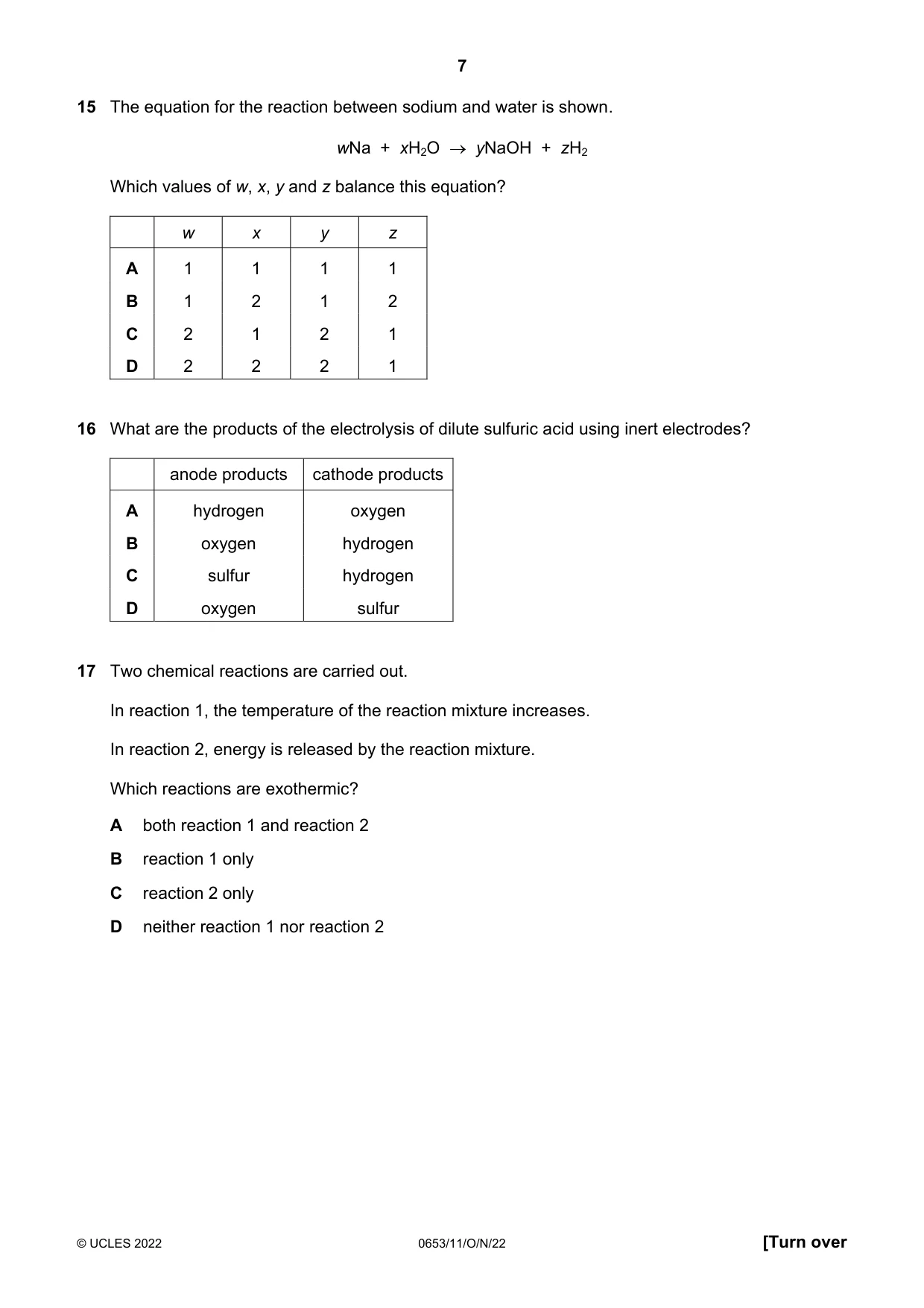
Q15 · The equation for the reaction between sodium and water is shown
15 The equation for the reaction between sodium and water is shown. wNa + xH2O yNaOH + zH2 Which values of w, x, y and z balance this equation? w x y z A 1 1 1 1 B 1 2 1 2 C 2 1 2 1 D 2 2 2 1
Mark scheme: D
Q16 · What are the products of the electrolysis of dilute sulfuric acid using inert electrodes?
16 What are the products of the electrolysis of dilute sulfuric acid using inert electrodes? anode products cathode products A hydrogen oxygen B oxygen hydrogen C sulfur hydrogen D oxygen sulfur
Mark scheme: B
Q17 · Two chemical reactions are carried out
17 Two chemical reactions are carried out. In reaction 1, the temperature of the reaction mixture increases. In reaction 2, energy is released by the reaction mixture. Which reactions are exothermic? A both reaction 1 and reaction 2 B reaction 1 only C reaction 2 only D neither reaction 1 nor reaction 2
Mark scheme: A
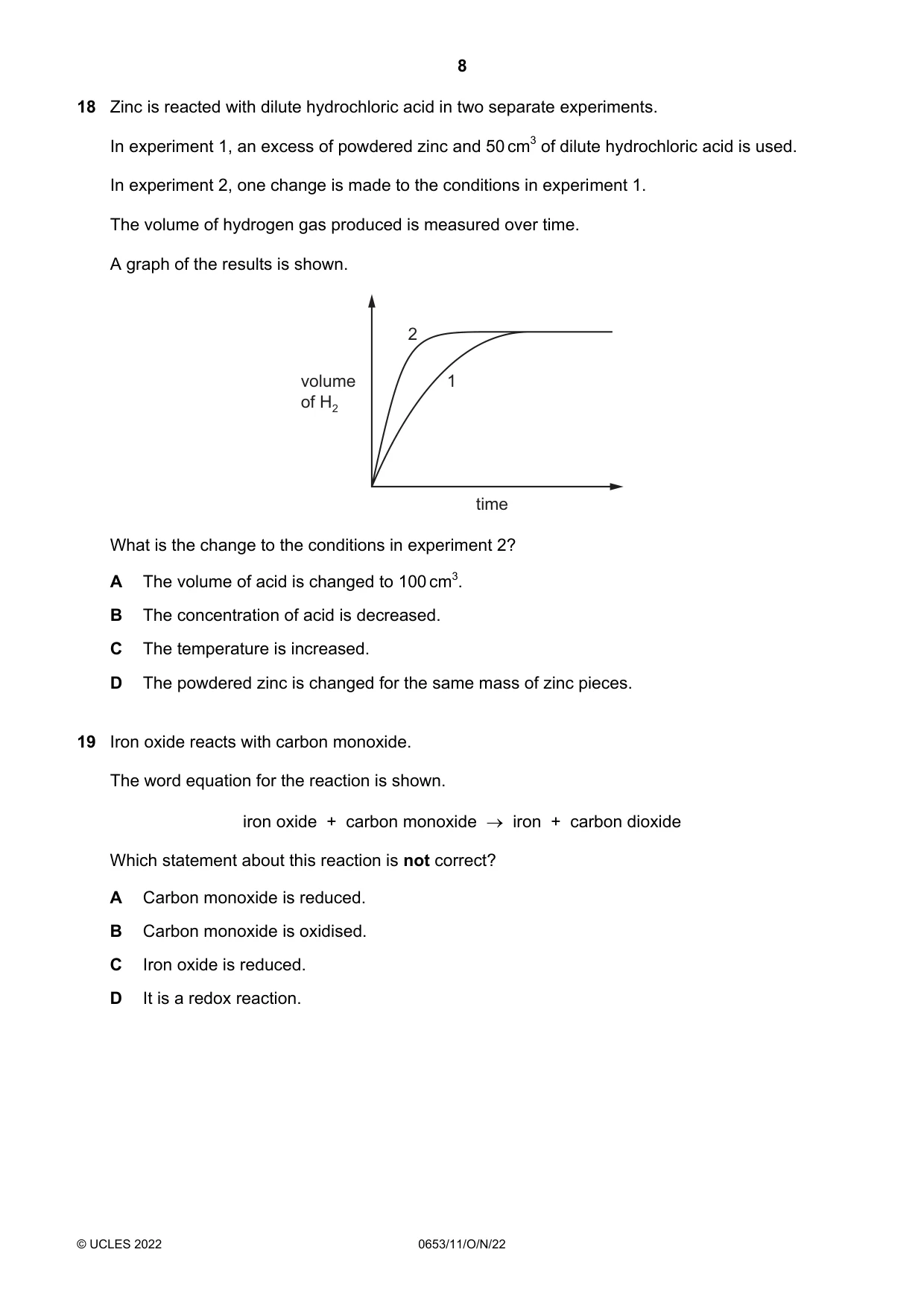
Q18 · Zinc is reacted with dilute hydrochloric acid in two separate experiments
18 Zinc is reacted with dilute hydrochloric acid in two separate experiments. In experiment 1, an excess of powdered zinc and 50 cm3 of dilute hydrochloric acid is used. In experiment 2, one change is made to the conditions in experiment 1. The volume of hydrogen gas produced is measured over time. A graph of the results is shown. 2 volume 1 of H2 time What is the change to the conditions in experiment 2? A The volume of acid is changed to 100 cm3. B The concentration of acid is decreased. C The temperature is increased. D The powdered zinc is changed for the same mass of zinc pieces.
Mark scheme: C
Q19 · Iron oxide reacts with carbon monoxide
19 Iron oxide reacts with carbon monoxide. The word equation for the reaction is shown. iron oxide + carbon monoxide iron + carbon dioxide Which statement about this reaction is not correct? A Carbon monoxide is reduced. B Carbon monoxide is oxidised. C Iron oxide is reduced. D It is a redox reaction.
Mark scheme: A
Q20 · The word equation represents the reaction between substance J and hydrochloric acid
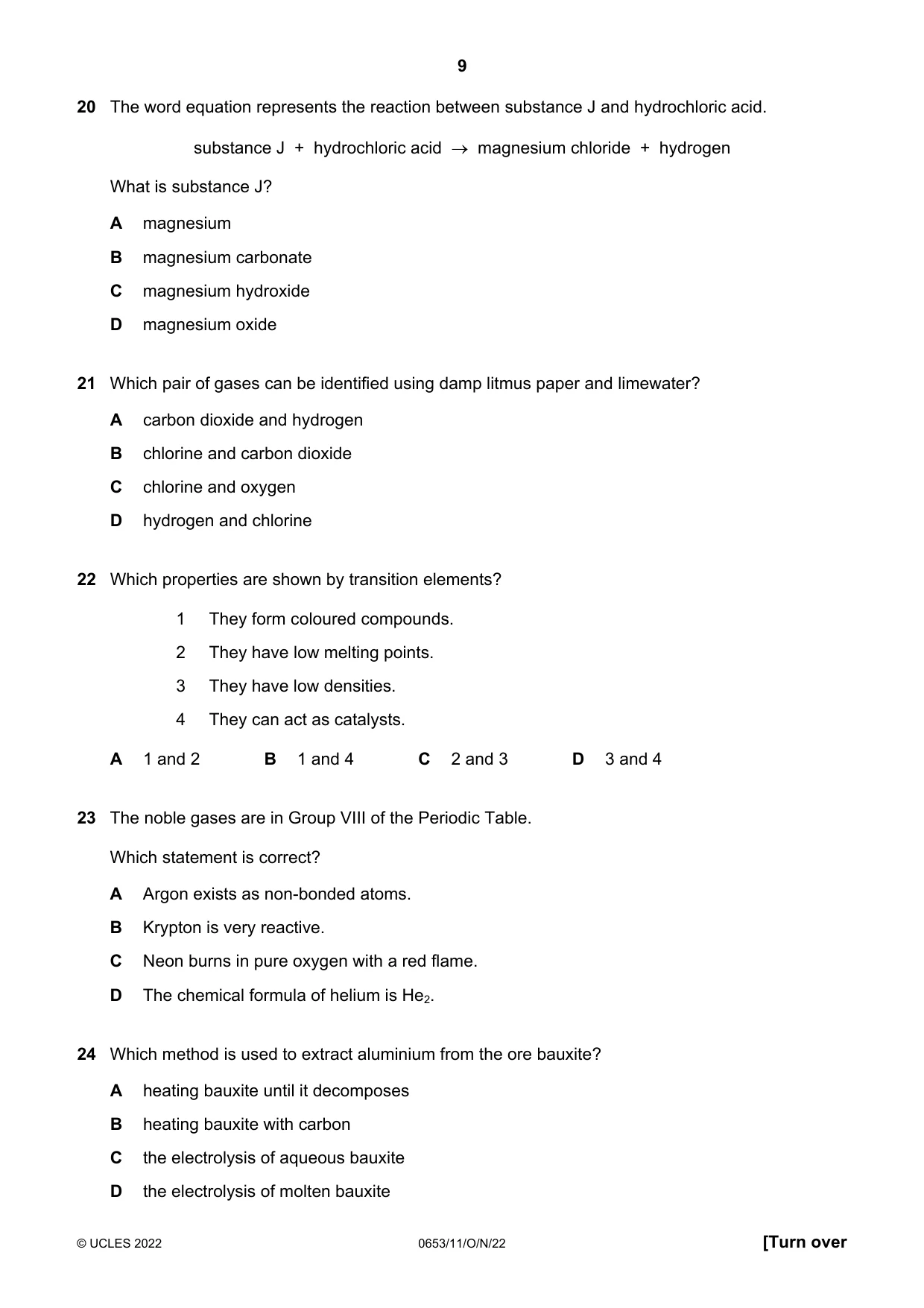
20 The word equation represents the reaction between substance J and hydrochloric acid. substance J + hydrochloric acid magnesium chloride + hydrogen What is substance J? A magnesium B magnesium carbonate C magnesium hydroxide D magnesium oxide
Mark scheme: A
More questions on The characteristic properties of acids and bases
Q21 · Which pair of gases can be identified using damp litmus paper and limewater?
21 Which pair of gases can be identified using damp litmus paper and limewater? A carbon dioxide and hydrogen B chlorine and carbon dioxide C chlorine and oxygen D hydrogen and chlorine
Mark scheme: B
Q22 · Which properties are shown by transition elements?
22 Which properties are shown by transition elements? 1 They form coloured compounds. 2 They have low melting points. 3 They have low densities. 4 They can act as catalysts. A 1 and 2 B 1 and 4 C 2 and 3 D 3 and 4
Mark scheme: B
Q23 · The noble gases are in Group VIII of the Periodic Table
23 The noble gases are in Group VIII of the Periodic Table. Which statement is correct? A Argon exists as non-bonded atoms. B Krypton is very reactive. C Neon burns in pure oxygen with a red flame. D The chemical formula of helium is He2.
Mark scheme: A
Q24 · Which method is used to extract aluminium from the ore bauxite?
24 Which method is used to extract aluminium from the ore bauxite? A heating bauxite until it decomposes B heating bauxite with carbon C the electrolysis of aqueous bauxite D the electrolysis of molten bauxite
Mark scheme: D
Q25 · Damp air is passed through a tube containing blue copper(II) sulfate and blue cobalt(II)…
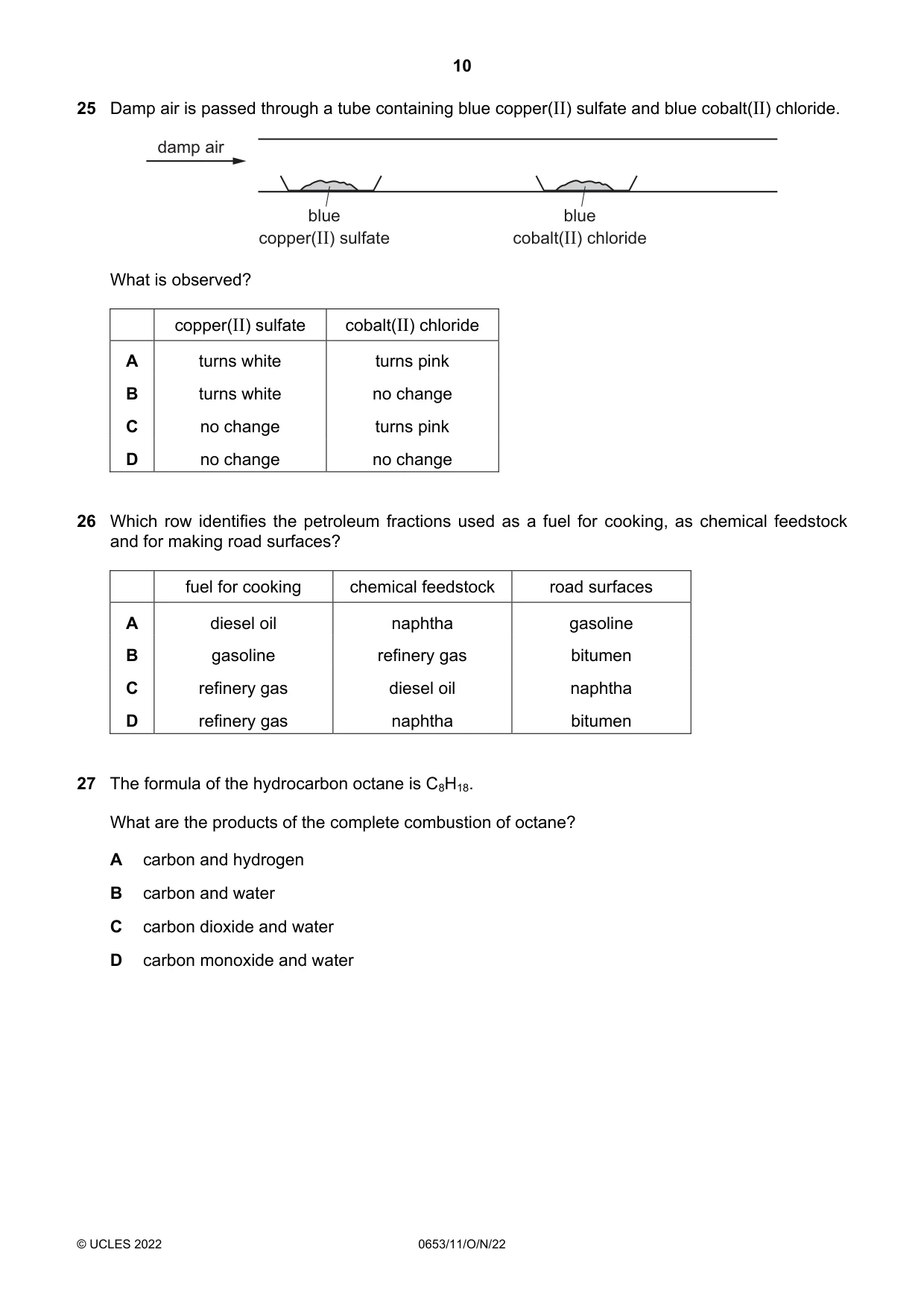
25 Damp air is passed through a tube containing blue copper(II) sulfate and blue cobalt(II) chloride. damp air blue blue copper(II) sulfate cobalt(II) chloride What is observed? copper(II) sulfate cobalt(II) chloride A turns white turns pink B turns white no change C no change turns pink D no change no change
Mark scheme: C
Q26 · Which row identifies the petroleum fractions used as a fuel for cooking, as chemical…
26 Which row identifies the petroleum fractions used as a fuel for cooking, as chemical feedstock and for making road surfaces? fuel for cooking chemical feedstock road surfaces A diesel oil naphtha gasoline B gasoline refinery gas bitumen C refinery gas diesel oil naphtha D refinery gas naphtha bitumen
Mark scheme: D
Q27 · The formula of the hydrocarbon octane is C8H18
27 The formula of the hydrocarbon octane is C8H18. What are the products of the complete combustion of octane? A carbon and hydrogen B carbon and water C carbon dioxide and water D carbon monoxide and water
Mark scheme: C
Q28 · A pendulum swings repeatedly from P to Q and back to P
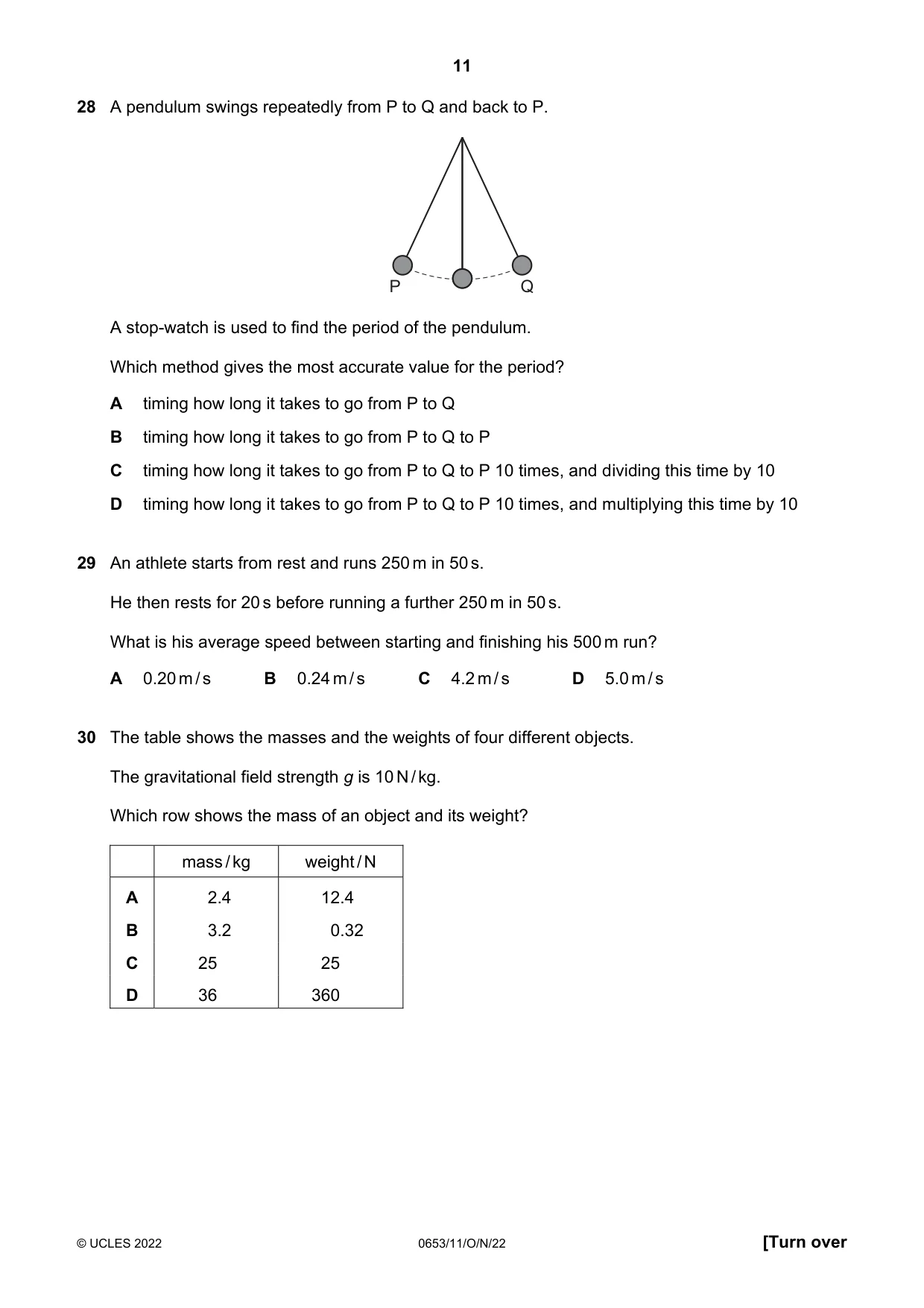
28 A pendulum swings repeatedly from P to Q and back to P. P Q A stop-watch is used to find the period of the pendulum. Which method gives the most accurate value for the period? A timing how long it takes to go from P to Q B timing how long it takes to go from P to Q to P C timing how long it takes to go from P to Q to P 10 times, and dividing this time by 10 D timing how long it takes to go from P to Q to P 10 times, and multiplying this time by 10
Mark scheme: C
More questions on Physical quantities and measurement techniques
Q29 · An athlete starts from rest and runs 250 m in 50 s
29 An athlete starts from rest and runs 250 m in 50 s. He then rests for 20 s before running a further 250 m in 50 s. What is his average speed between starting and finishing his 500 m run? A 0.20 m / s B 0.24 m / s C 4.2 m / s D 5.0 m / s
Mark scheme: C
Q30 · The table shows the masses and the weights of four different objects
30 The table shows the masses and the weights of four different objects. The gravitational field strength g is 10 N / kg. Which row shows the mass of an object and its weight? mass / kg weight / N A 2.4 12.4 B 3.2 0.32 C 25 25 D 36 360
Mark scheme: D
Q31 · A piece of scientific equipment is taken from the Earth to a distant planet
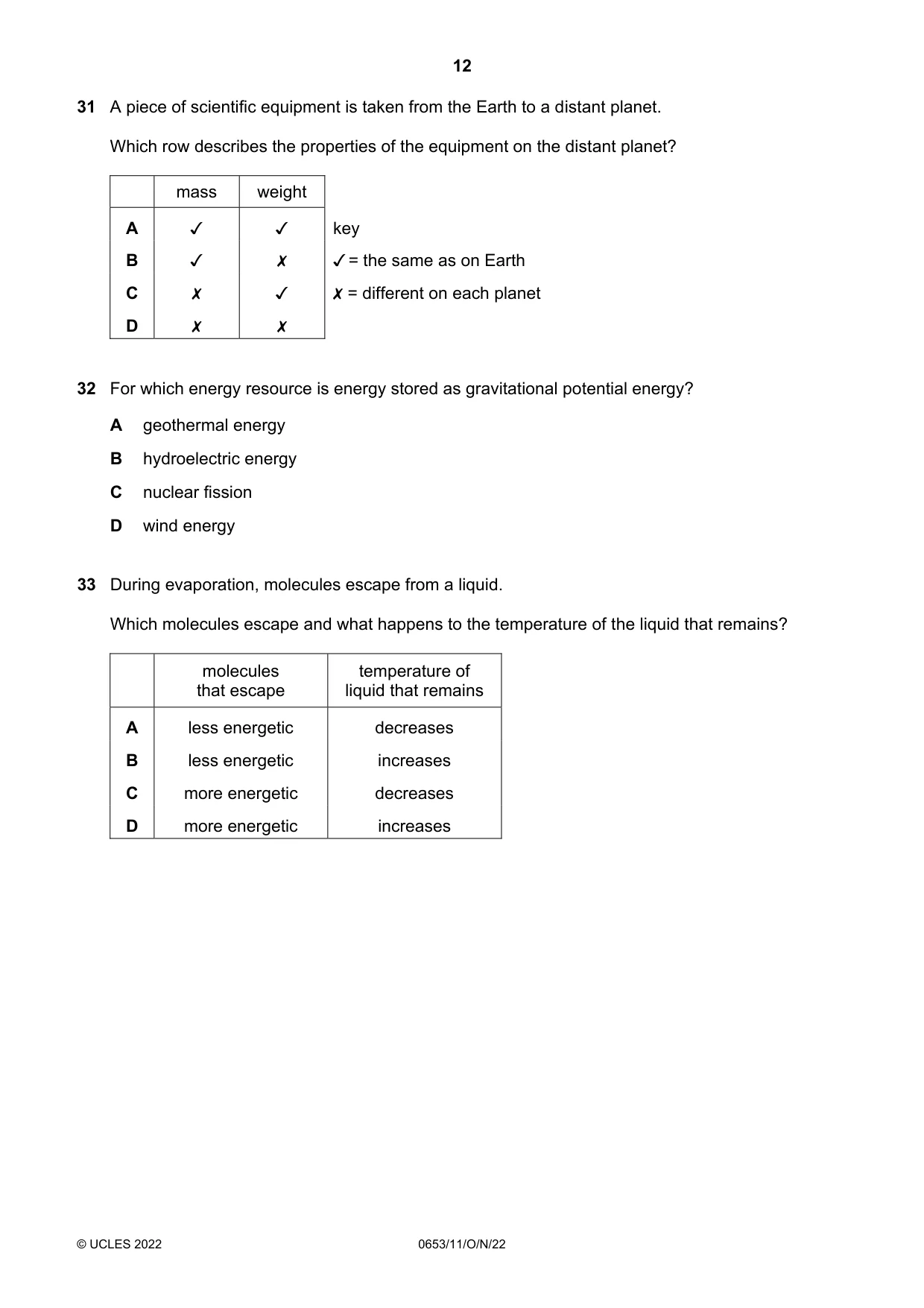
31 A piece of scientific equipment is taken from the Earth to a distant planet. Which row describes the properties of the equipment on the distant planet? key / =the same as on Earth X = different on each planet
Mark scheme: B
Q32 · For which energy resource is energy stored as gravitational potential energy?
32 For which energy resource is energy stored as gravitational potential energy? A geothermal energy B hydroelectric energy C nuclear fission D wind energy
Mark scheme: B
Q33 · During evaporation, molecules escape from a liquid
33 During evaporation, molecules escape from a liquid. Which molecules escape and what happens to the temperature of the liquid that remains? molecules temperature of that escape liquid that remains A less energetic decreases B less energetic increases C more energetic decreases D more energetic increases
Mark scheme: C
Q34 · An electric heater is placed inside a metal box which has one side open
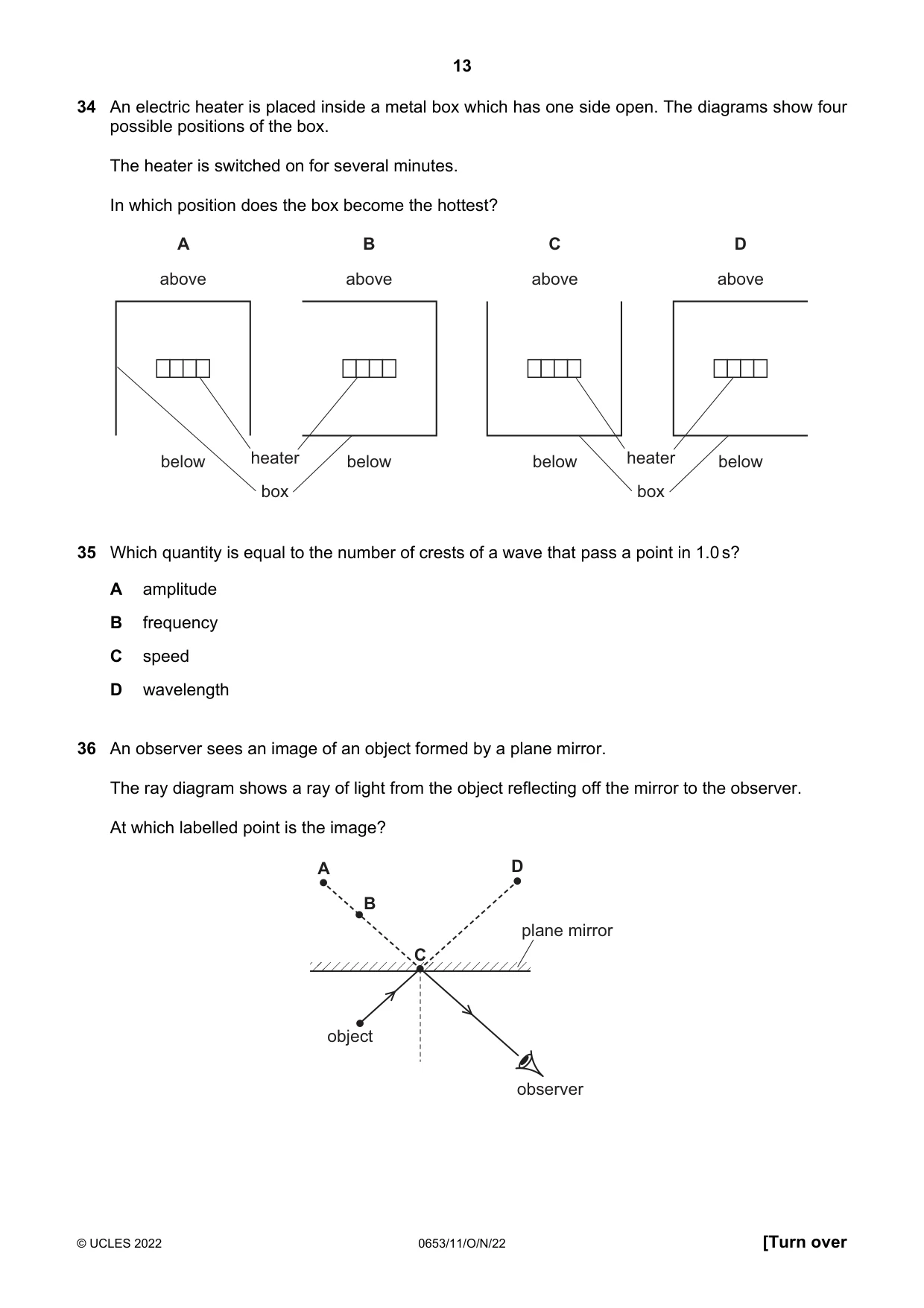
34 An electric heater is placed inside a metal box which has one side open. The diagrams show four possible positions of the box. The heater is switched on for several minutes. In which position does the box become the hottest? A B C D above above above above below heater below below heater below box box
Mark scheme: A
Q35 · Which quantity is equal to the number of crests of a wave that pass a point in 1.0 s?
35 Which quantity is equal to the number of crests of a wave that pass a point in 1.0 s? A amplitude B frequency C speed D wavelength
Mark scheme: B
Q36 · An observer sees an image of an object formed by a plane mirror
36 An observer sees an image of an object formed by a plane mirror. The ray diagram shows a ray of light from the object reflecting off the mirror to the observer. At which labelled point is the image? A D B plane mirror C object observer
Mark scheme: B
Q37 · A plastic rod and a woollen cloth are both uncharged
37 A plastic rod and a woollen cloth are both uncharged. The plastic rod is rubbed with the woollen cloth. The rod becomes negatively charged. What happens to the cloth? A The cloth gains electrons and becomes negatively charged. B The cloth gains electrons and becomes positively charged. C The cloth loses electrons and becomes negatively charged. D The cloth loses electrons and becomes positively charged.
Mark scheme: D
Q38 · In which circuit is there a current of 2.0 A?
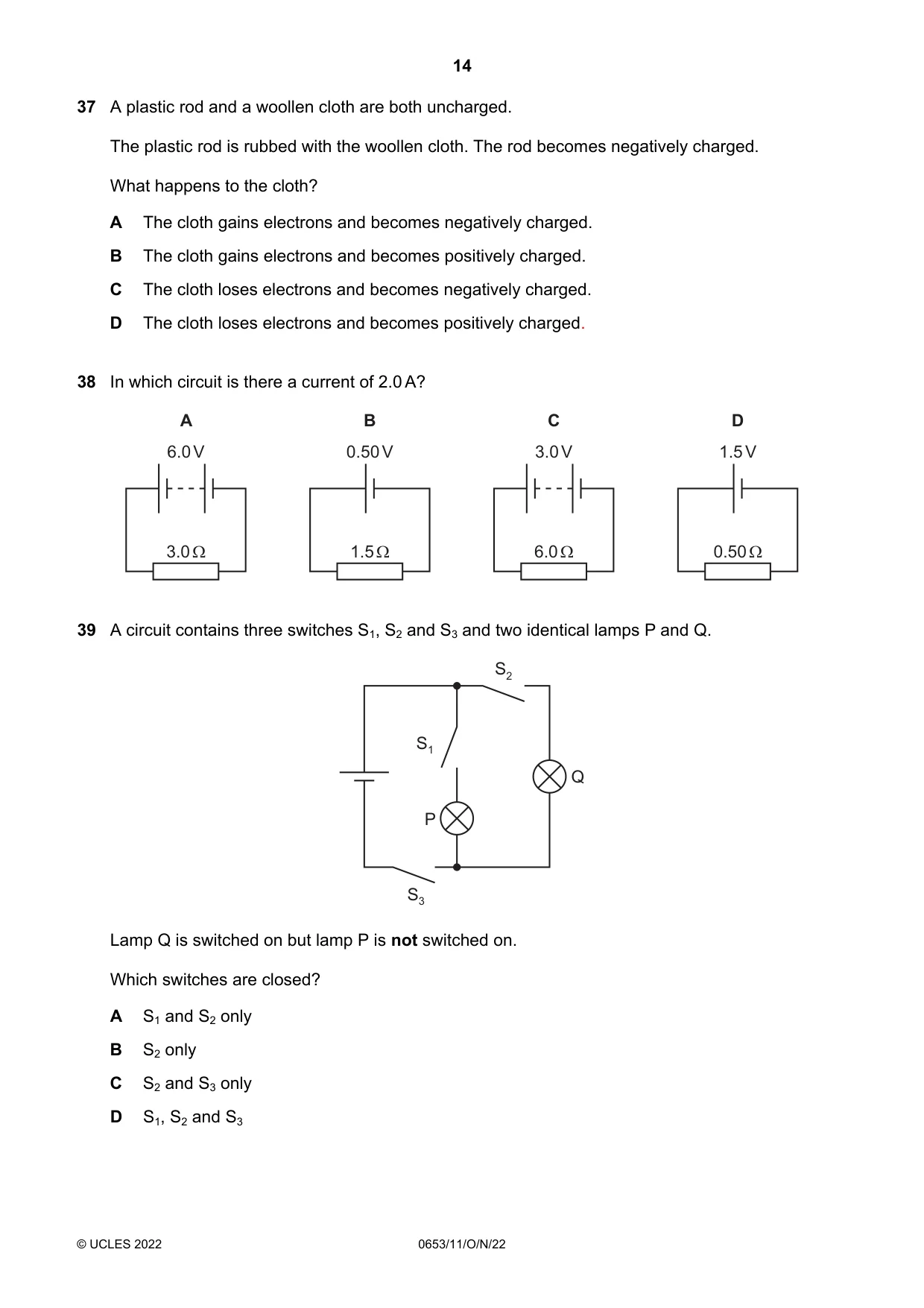
38 In which circuit is there a current of 2.0 A? A B Cc D 6.0V 0.50V 3.0V 1.5V 3.0Q 1.50 6.0Q 0.50Q
Mark scheme: A
Q39 · A circuit contains three switches S1, S2 and S3 and two identical lamps P and Q
39 A circuit contains three switches S1, S2 and S3 and two identical lamps P and Q. S2 S1 Q P S3 Lamp Q is switched on but lamp P is not switched on. Which switches are closed? A S1 and S2 only B S2 only C S2 and S3 only D S1, S2 and S3
Mark scheme: C
Q40 · Why is the electricity supply to a mains circuit fitted with a fuse?
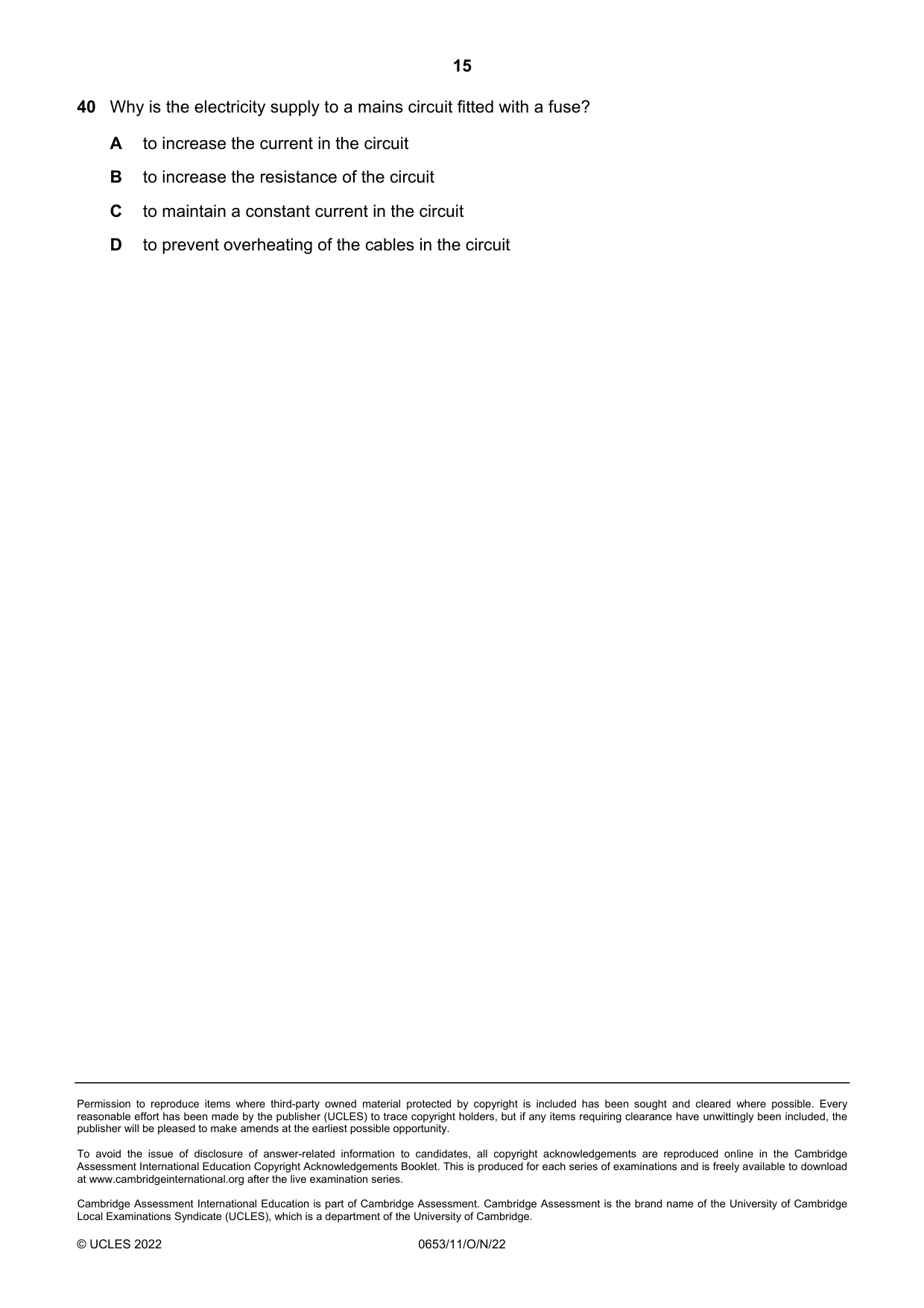
40 Why is the electricity supply to a mains circuit fitted with a fuse? A to increase the current in the circuit B to increase the resistance of the circuit C to maintain a constant current in the circuit D to prevent overheating of the cables in the circuit
Mark scheme: D
What was in this paper
The subtopics covered by these 40 questions, and how many questions each got. Open one in a new tab to see every Cambridge question on it.
2Electrical quantities2Mass and weight2Alkanes1Atomic structure and the Periodic Table1Biological molecules1Diffusion1Digestion1Electrical circuits1Electrical safety1Electrolysis1Energy, work and power1Enzymes1Exothermic and endothermic reactions1Extraction of metals1Food chains and food webs1Formulas1Fuels1Gas exchange in humans1General properties of waves1Habitat destruction1Heart1Identification of ions and gases1Kinetic particle model of matter1Light1Motion1Noble gases1Physical quantities and measurement techniques1Rate of reaction1Redox1Respiration1Sexual reproduction in plants1Size of specimens1The characteristic properties of acids and bases1Transfer of thermal energy1Transition elements1Water1What you needed in this session
Cambridge’s own grade thresholds for 2022 Oct/Nov, Paper 1 · Variant 1. A higher threshold means an easier paper — the bar moves with how the cohort did.