Cambridge IGCSE Science - Combined 0653 — 2008 May/June Paper 1 · Variant 1
0653/11/M/J/08 · 40 questions · 40 marks · ≈45 min
The question paper and its mark scheme, free to read here and free to download. This is Cambridge’s own paper, exactly as it was sat.
Question paper20 pages


Mark scheme2 pages
Answers below. Sit the paper first if you are practising.
Questions as text
Q1 · Which part of a plant cell is formed from cellulose?
1 Which part of a plant cell is formed from cellulose? A cell surface membrane B cell wall C chloroplasts D cytoplasm
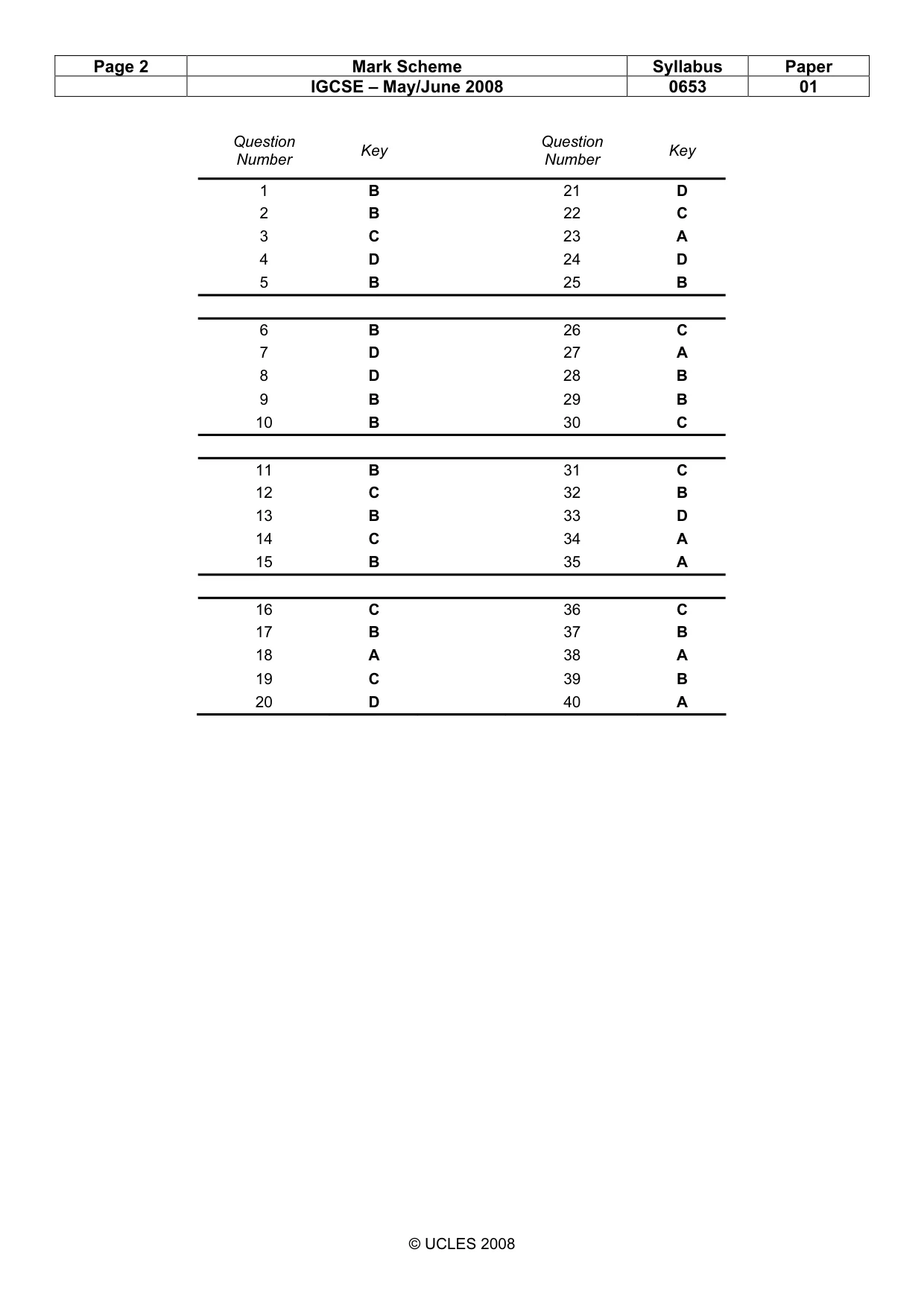
Mark scheme: B
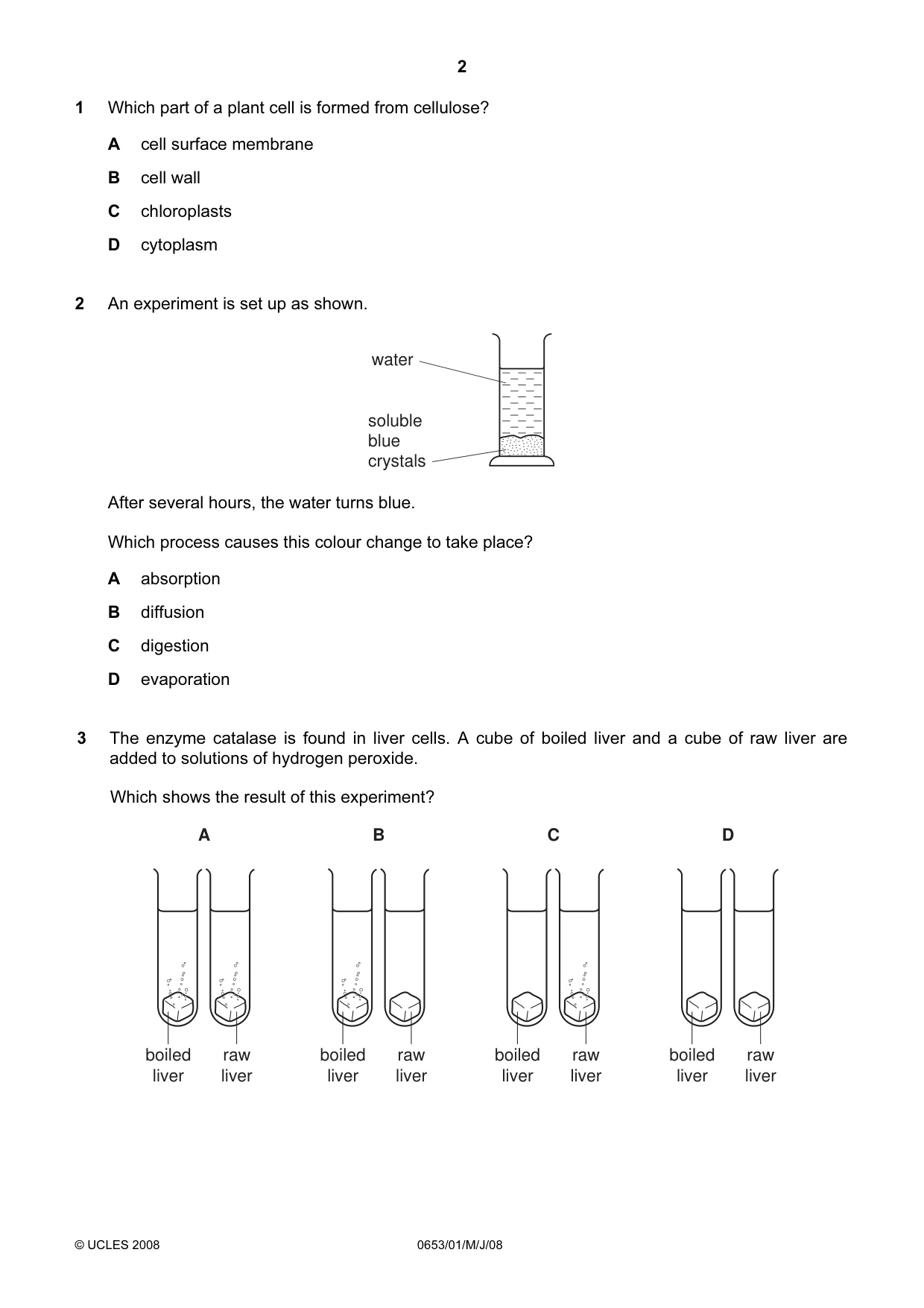
Q2 · An experiment is set up as shown
2 An experiment is set up as shown. water soluble blue crystals After several hours, the water turns blue. Which process causes this colour change to take place? A absorption B diffusion C digestion D evaporation
Mark scheme: B
Q3 · The enzyme catalase is found in liver cells
3 The enzyme catalase is found in liver cells. A cube of boiled liver and a cube of raw liver are added to solutions of hydrogen peroxide. Which shows the result of this experiment? A B C D boiled raw boiled raw boiled raw boiled raw liver liver liver liver liver liver liver liver
Mark scheme: C
Q4 · Which two chemical substances are required for photosynthesis?
4 Which two chemical substances are required for photosynthesis? A carbon dioxide and glucose B glucose and oxygen C oxygen and water D water and carbon dioxide
Mark scheme: D
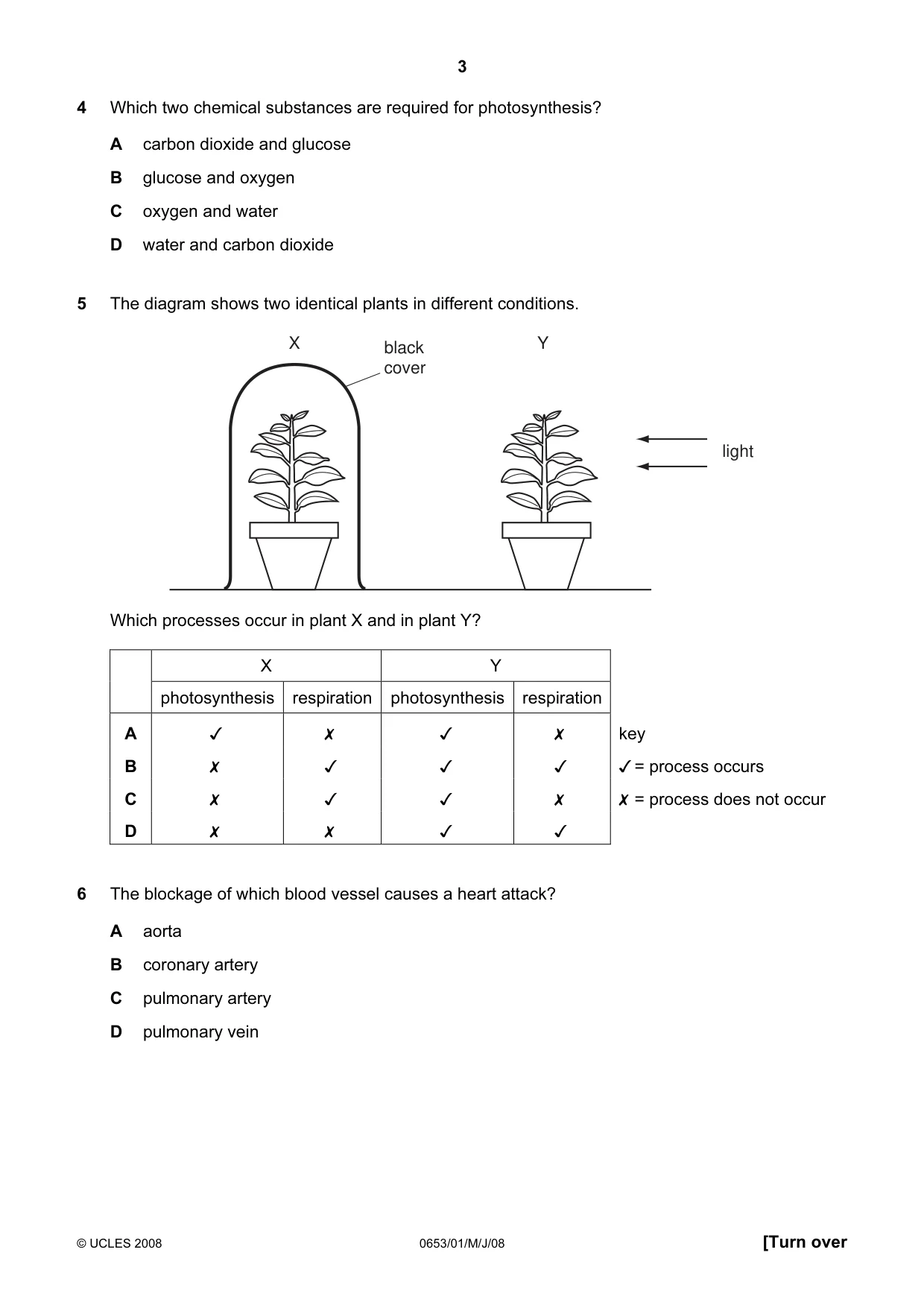
Q5 · The diagram shows two identical plants in different conditions
5 The diagram shows two identical plants in different conditions. X black cover Which processes occur in plant X and in plant Y? Y light X photosynthesis respiration photosynthesis respiration 0 0O WwW > v x x x ~ KOK v v v v x key / = process occurs X = process does not occur KS
Mark scheme: B
Q6 · The blockage of which blood vessel causes a heart attack?
6 The blockage of which blood vessel causes a heart attack? A aorta B coronary artery C pulmonary artery D pulmonary vein
Mark scheme: B
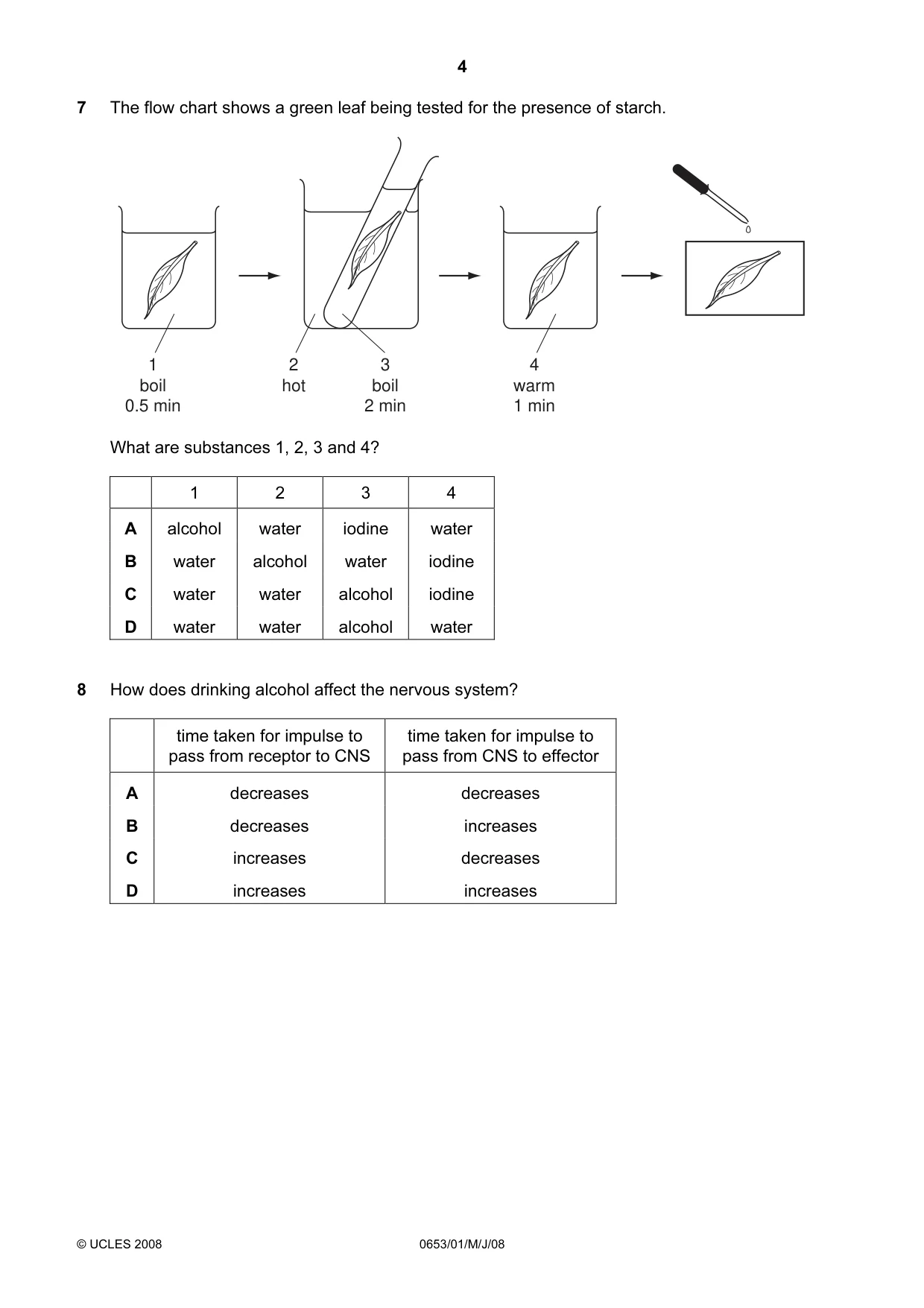
Q7 · The flow chart shows a green leaf being tested for the presence of starch
7 The flow chart shows a green leaf being tested for the presence of starch. 1 2 3 4 boil hot boil warm 0.5 min 2 min 1 min What are substances 1, 2, 3 and 4? 1 2 3 4 A alcohol water iodine water B water alcohol water iodine C water water alcohol iodine D water water alcohol water
Mark scheme: D
Q8 · How does drinking alcohol affect the nervous system?
8 How does drinking alcohol affect the nervous system? time taken for impulse to time taken for impulse to pass from receptor to CNS pass from CNS to effector A decreases decreases B decreases increases C increases decreases D increases increases
Mark scheme: D
Q9 · The diagram shows a section through the female reproductive system
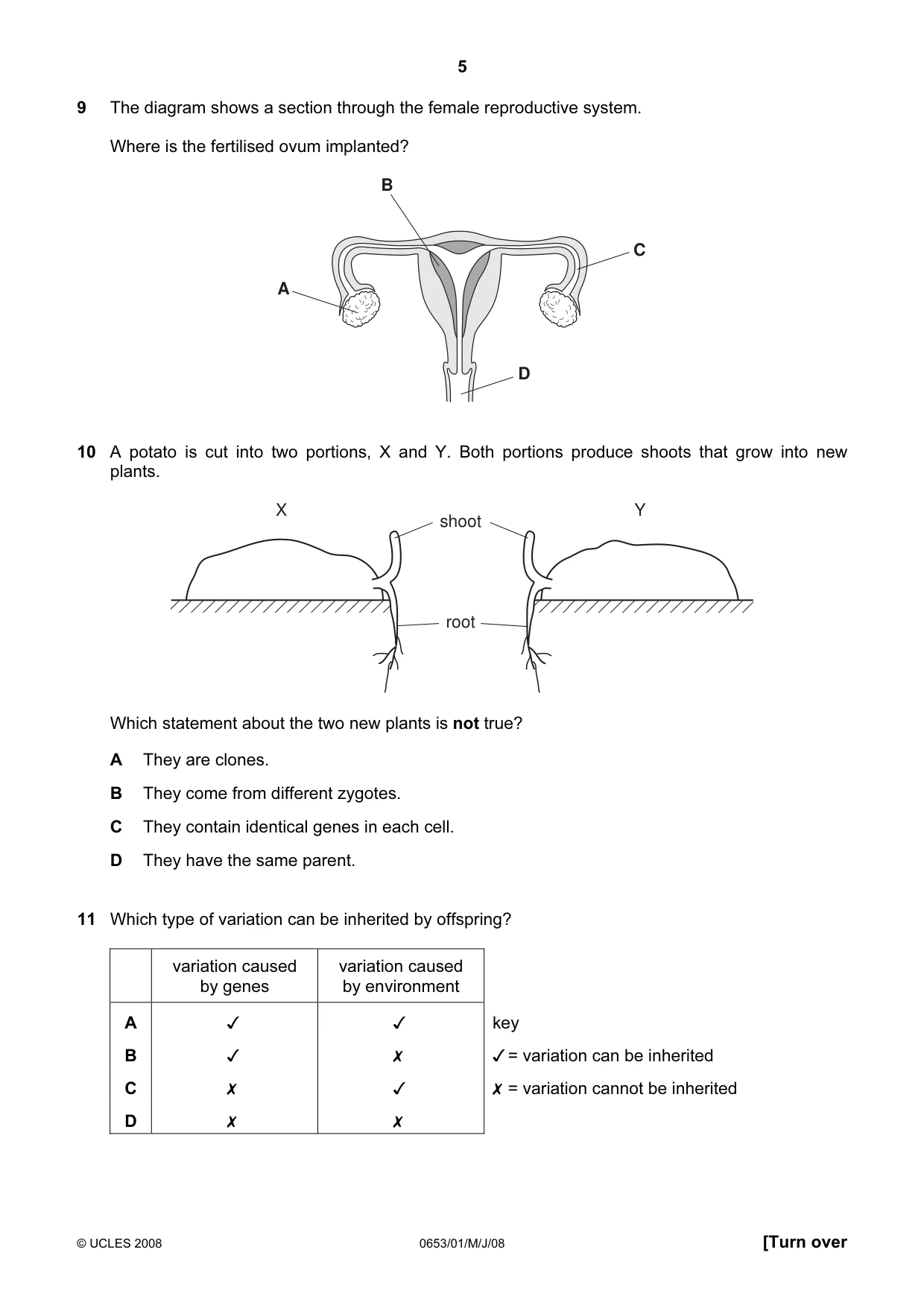
9 The diagram shows a section through the female reproductive system. Where is the fertilised ovum implanted? B C A D
Mark scheme: B
Q10 · A potato is cut into two portions, X and Y
10 A potato is cut into two portions, X and Y. Both portions produce shoots that grow into new plants. X Y shoot root Which statement about the two new plants is not true? A They are clones. B They come from different zygotes. C They contain identical genes in each cell. D They have the same parent.
Mark scheme: B
Q11 · Which type of variation can be inherited by offspring?
11. Which type of variation can be inherited by offspring? variation caused variation caused by genes by environment A v v B v x Cc x v D x x key J/ = variation can be inherited X = variation cannot be inherited
Mark scheme: B
Q12 · The diagram shows a food web for a lake
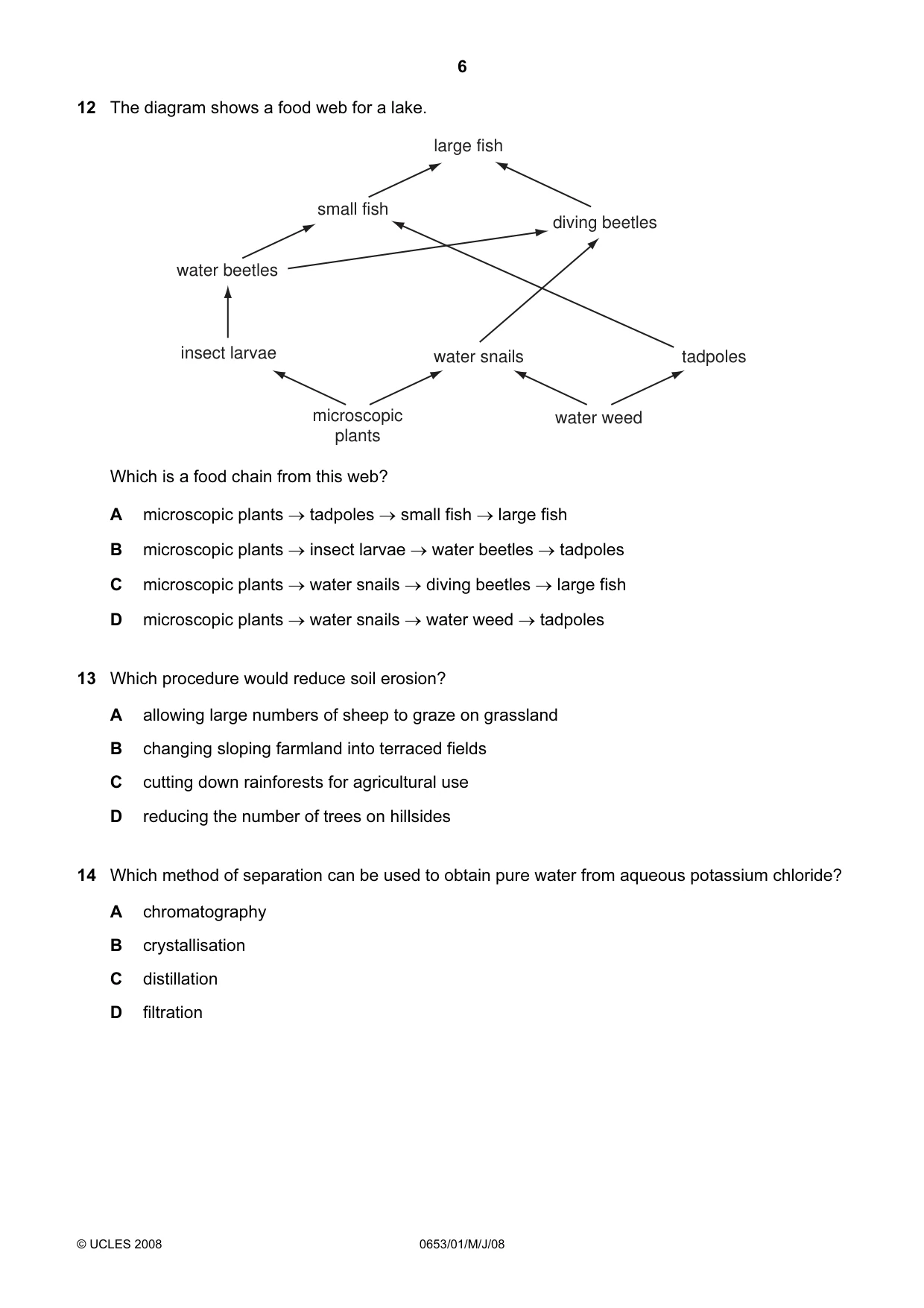
12 The diagram shows a food web for a lake. large fish small fish diving beetles water beetles insect larvae water snails tadpoles microscopic water weed plants Which is a food chain from this web? A microscopic plants → tadpoles → small fish → large fish B microscopic plants → insect larvae → water beetles → tadpoles C microscopic plants → water snails → diving beetles → large fish D microscopic plants → water snails → water weed → tadpoles
Mark scheme: C
Q13 · Which procedure would reduce soil erosion?
13 Which procedure would reduce soil erosion? A allowing large numbers of sheep to graze on grassland B changing sloping farmland into terraced fields C cutting down rainforests for agricultural use D reducing the number of trees on hillsides
Mark scheme: B
Q14 · Which method of separation can be used to obtain pure water from aqueous potassium…
14 Which method of separation can be used to obtain pure water from aqueous potassium chloride? A chromatography B crystallisation C distillation D filtration
Mark scheme: C
Q15 · Which diagrams correctly show the displayed formula of ammonia and of carbon dioxide?
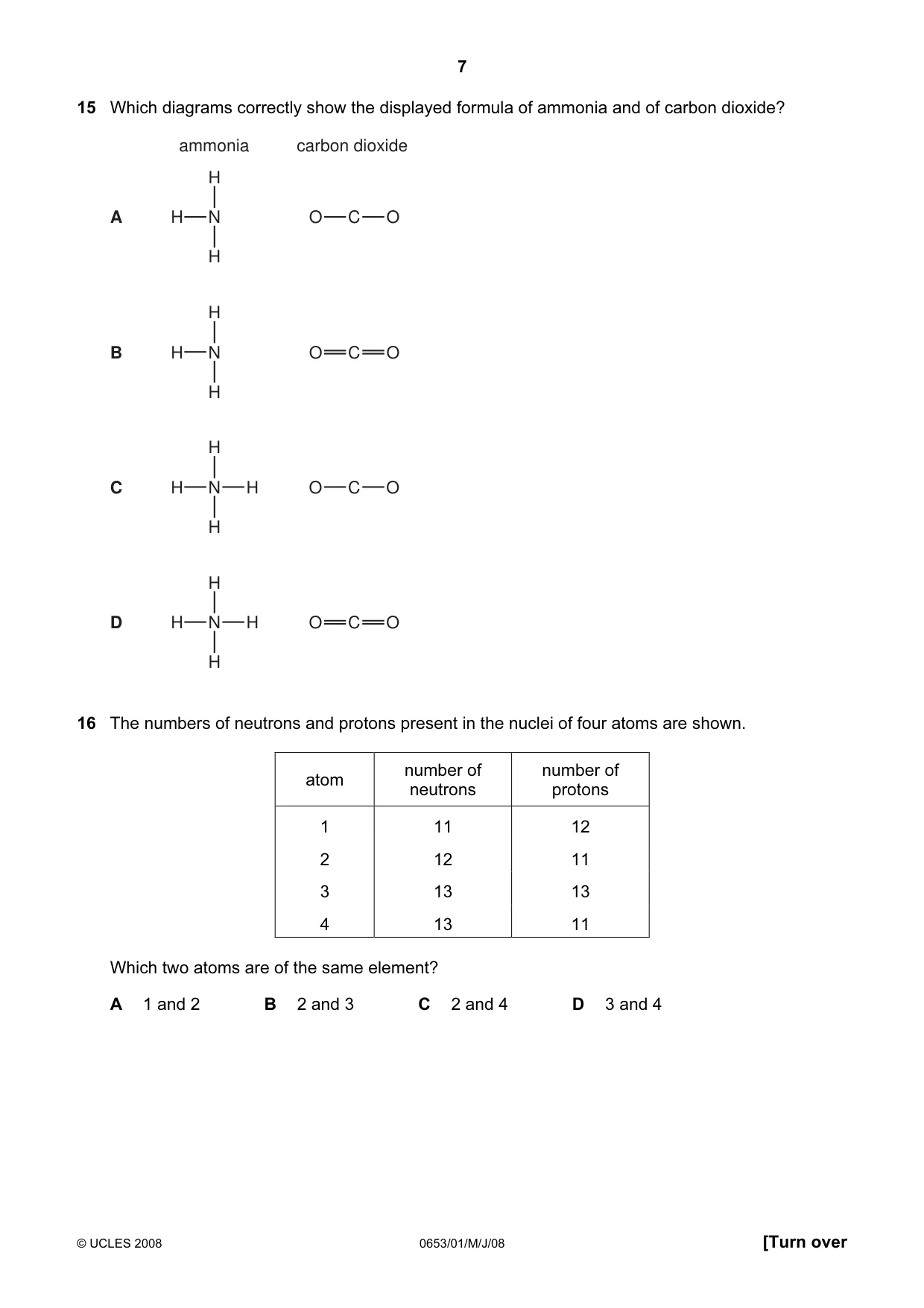
15 Which diagrams correctly show the displayed formula of ammonia and of carbon dioxide? ammonia carbon dioxide H A H N O C O H H B H N O C O H H C H N H O C O H H D H N H O C O H
Mark scheme: B
Q16 · The numbers of neutrons and protons present in the nuclei of four atoms are shown
16 The numbers of neutrons and protons present in the nuclei of four atoms are shown. number of number of atom neutrons protons 1 11 12 2 12 11 3 13 13 4 13 11 Which two atoms are of the same element? A 1 and 2 B 2 and 3 C 2 and 4 D 3 and 4
Mark scheme: C
Q17 · How many atoms are present in each of the molecules of the following components in air?
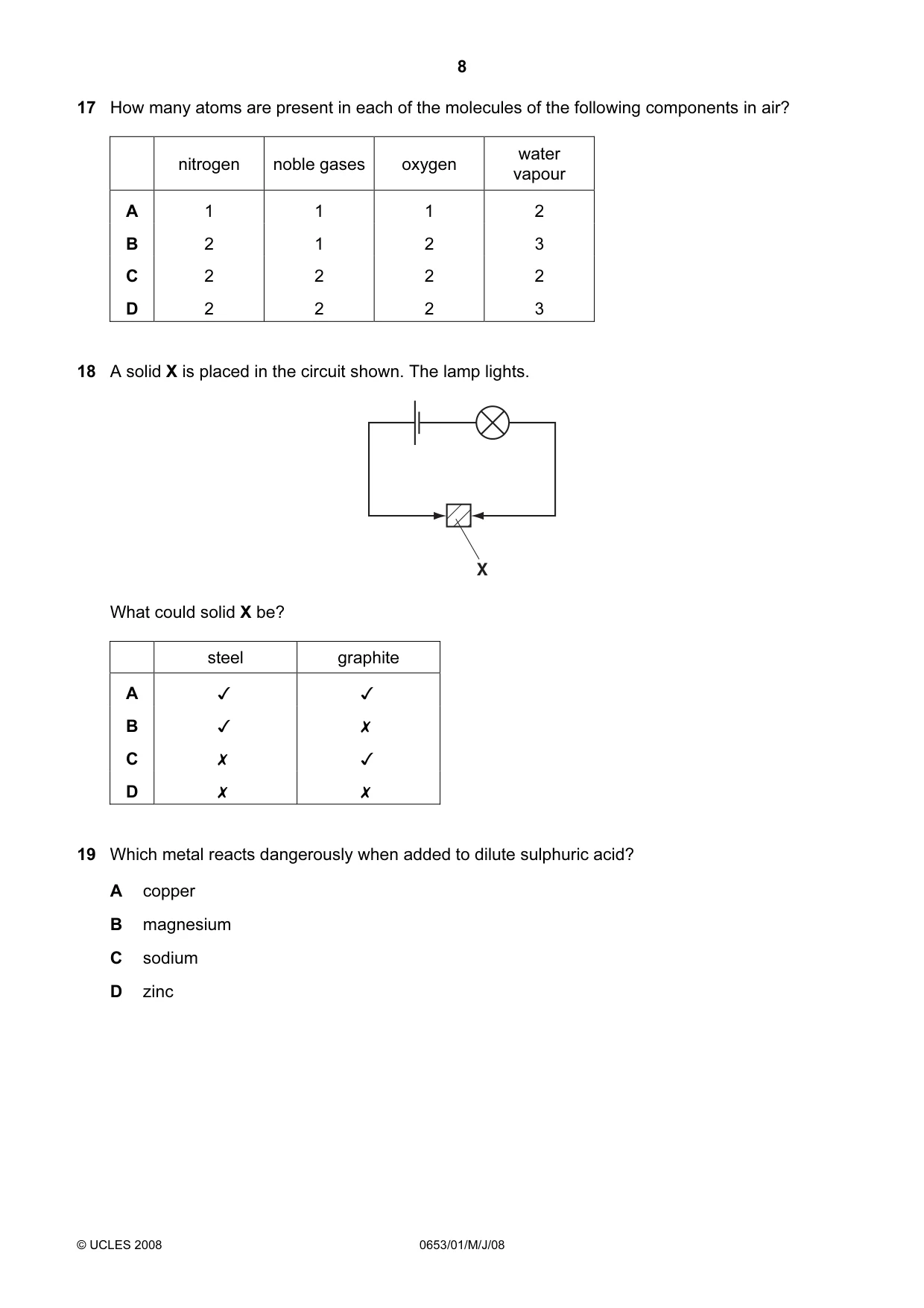
17 How many atoms are present in each of the molecules of the following components in air? water nitrogen noble gases oxygen vapour A 1 1 1 2 B 2 1 2 3 C 2 2 2 2 D 2 2 2 3
Mark scheme: B
Q18 · A solid X is placed in the circuit shown
18 A solid X is placed in the circuit shown. The lamp lights. What could solid X be? steel graphite A v v B v x Cc x v D x x
Mark scheme: A
Q19 · Which metal reacts dangerously when added to dilute sulphuric acid?
19 Which metal reacts dangerously when added to dilute sulphuric acid? A copper B magnesium C sodium D zinc
Mark scheme: C
Q20 · The diagram shows a razor used in shaving
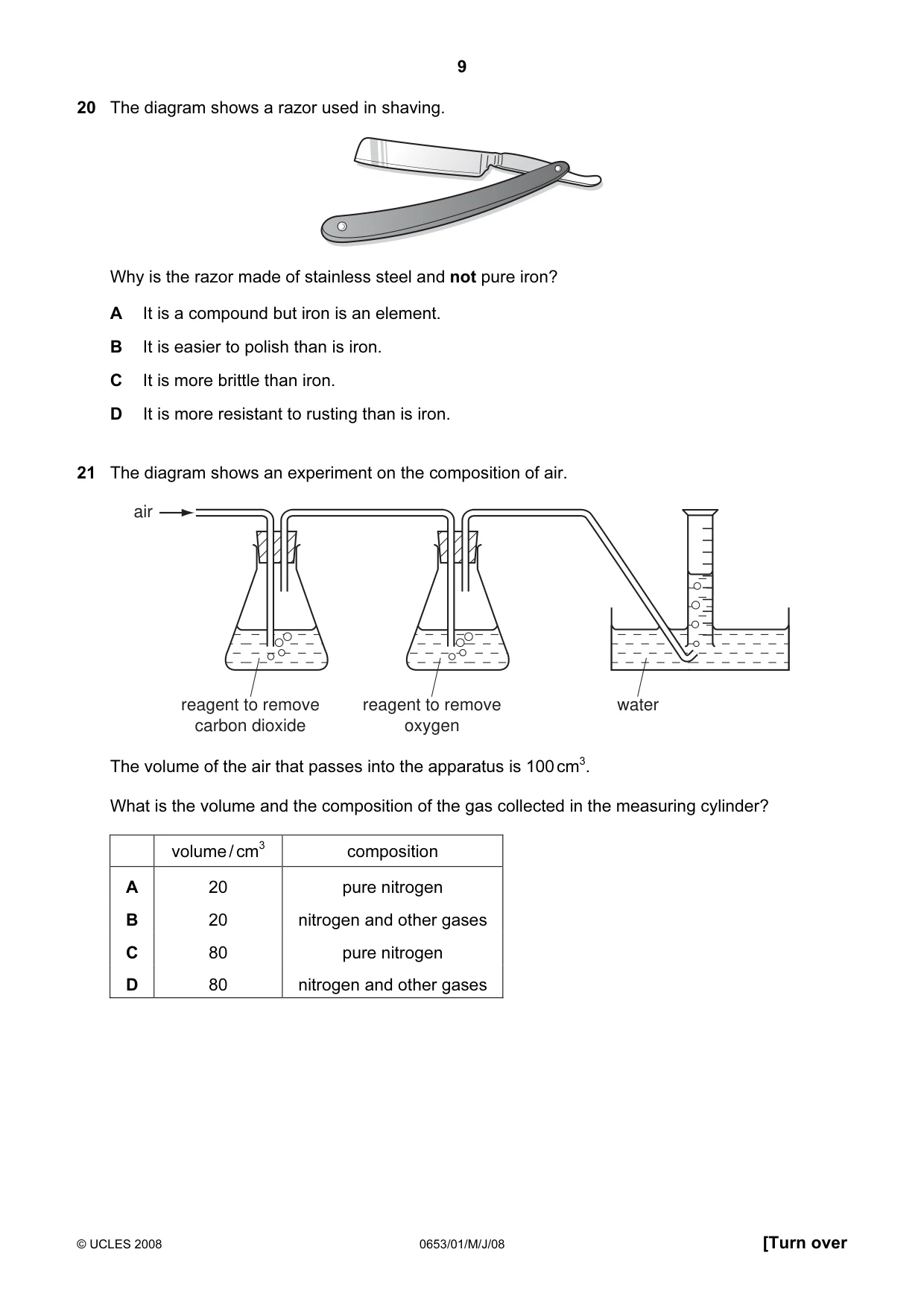
20 The diagram shows a razor used in shaving. Why is the razor made of stainless steel and not pure iron? A It is a compound but iron is an element. B It is easier to polish than is iron. C It is more brittle than iron. D It is more resistant to rusting than is iron.
Mark scheme: D
Q21 · The diagram shows an experiment on the composition of air
21 The diagram shows an experiment on the composition of air. air reagent to remove reagent to remove water carbon dioxide oxygen The volume of the air that passes into the apparatus is 100 cm3. What is the volume and the composition of the gas collected in the measuring cylinder? volume / cm3 composition A 20 pure nitrogen B 20 nitrogen and other gases C 80 pure nitrogen D 80 nitrogen and other gases
Mark scheme: D
Q22 · Which aqueous reagents give a white precipitate when added to aqueous zinc chloride?
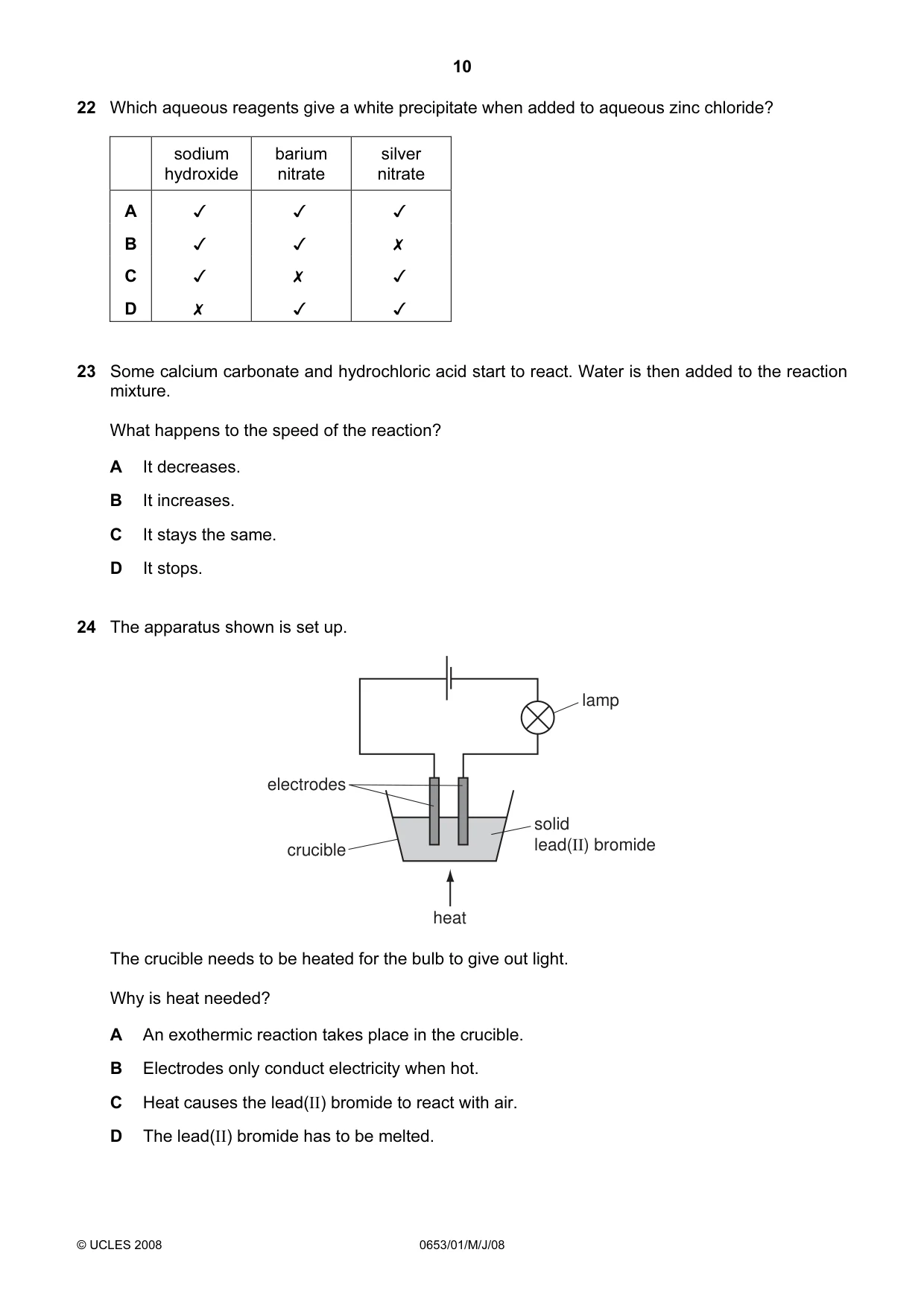
22 Which aqueous reagents give a white precipitate when added to aqueous zinc chloride? sodium barium silver hydroxide nitrate nitrate v v v 0 0O WwW > v v x v x v x v v
Mark scheme: C
Q23 · Some calcium carbonate and hydrochloric acid start to react
23 Some calcium carbonate and hydrochloric acid start to react. Water is then added to the reaction mixture. What happens to the speed of the reaction? A It decreases. B It increases. C It stays the same. D It stops.
Mark scheme: A
Q24 · The apparatus shown is set up
24 The apparatus shown is set up. lamp electrodes solid crucible lead(II) bromide heat The crucible needs to be heated for the bulb to give out light. Why is heat needed? A An exothermic reaction takes place in the crucible. B Electrodes only conduct electricity when hot. C Heat causes the lead(II) bromide to react with air. D The lead(II) bromide has to be melted.
Mark scheme: D
Q25 · Crude oil (petroleum) is a source of hydrocarbon fuels
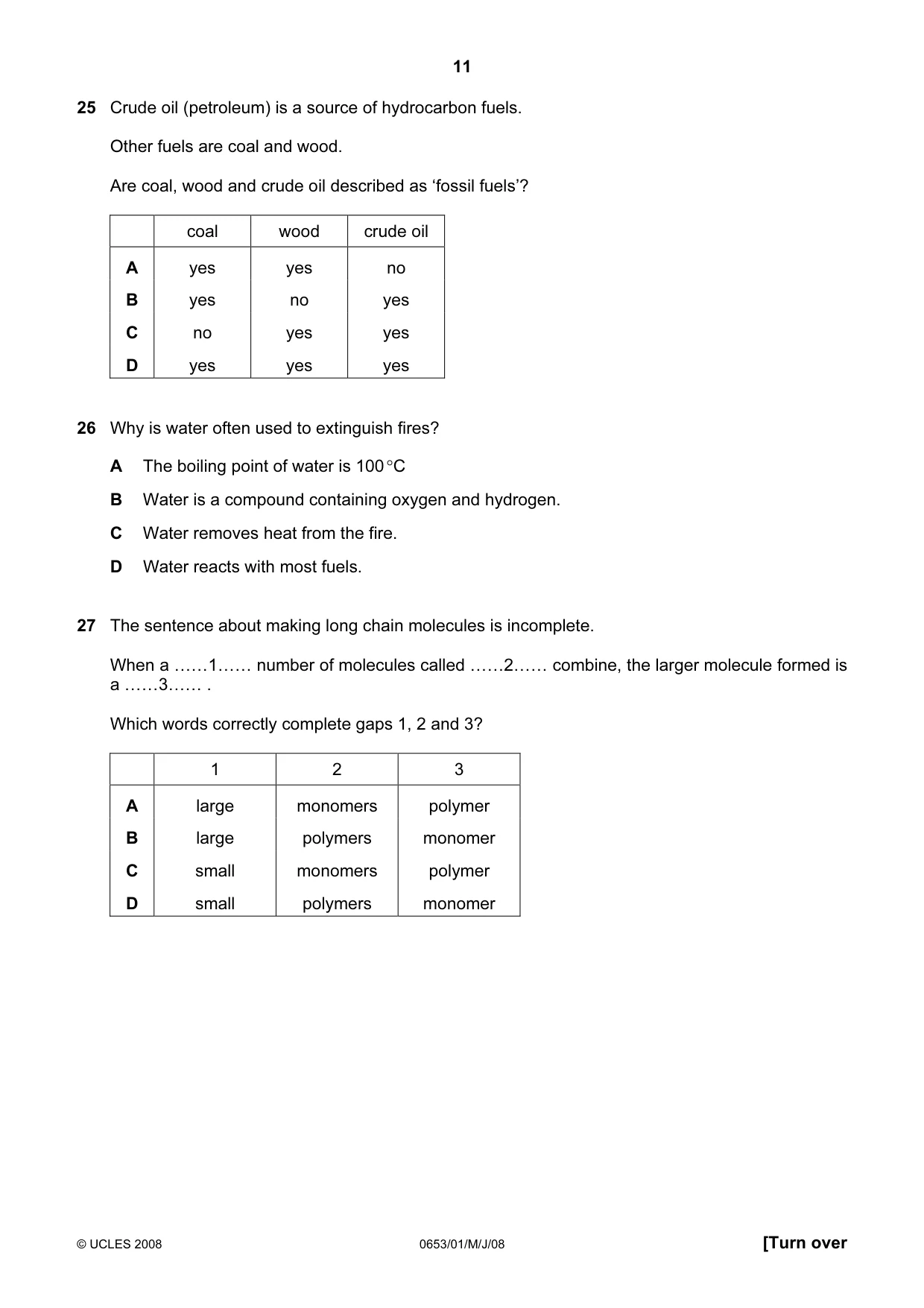
25 Crude oil (petroleum) is a source of hydrocarbon fuels. Other fuels are coal and wood. Are coal, wood and crude oil described as ‘fossil fuels’? coal wood crude oil A yes yes no B yes no yes C no yes yes D yes yes yes
Mark scheme: B
Q26 · Why is water often used to extinguish fires?
26 Why is water often used to extinguish fires? A The boiling point of water is 100 °C B Water is a compound containing oxygen and hydrogen. C Water removes heat from the fire. D Water reacts with most fuels.
Mark scheme: C
Q27 · The sentence about making long chain molecules is incomplete
27 The sentence about making long chain molecules is incomplete. When a ……1…… number of molecules called ……2…… combine, the larger molecule formed is a ……3…… . Which words correctly complete gaps 1, 2 and 3? 1 2 3 A large monomers polymer B large polymers monomer C small monomers polymer D small polymers monomer
Mark scheme: A
Q28 · Some liquid is heated in a flask
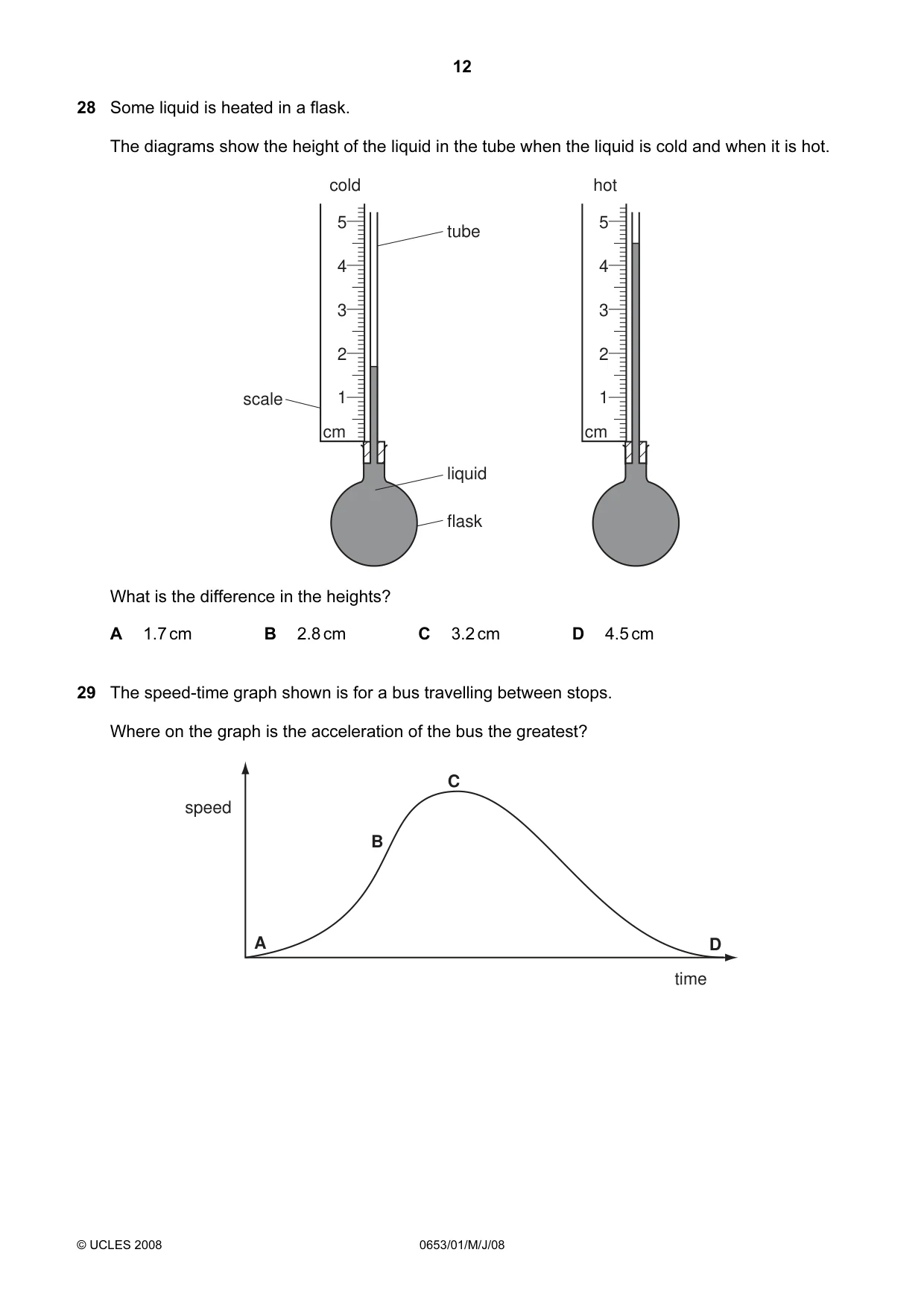
28 Some liquid is heated in a flask. The diagrams show the height of the liquid in the tube when the liquid is cold and when it is hot. cold hot 5 5 tube 4 4 3 3 2 2 scale 1 1 cm cm liquid flask What is the difference in the heights? A 1.7 cm B 2.8 cm C 3.2 cm D 4.5 cm
Mark scheme: B
More questions on Physical quantities and measurement techniques
Q29 · The speed-time graph shown is for a bus travelling between stops
29 The speed-time graph shown is for a bus travelling between stops. Where on the graph is the acceleration of the bus the greatest? C speed B A D time
Mark scheme: B
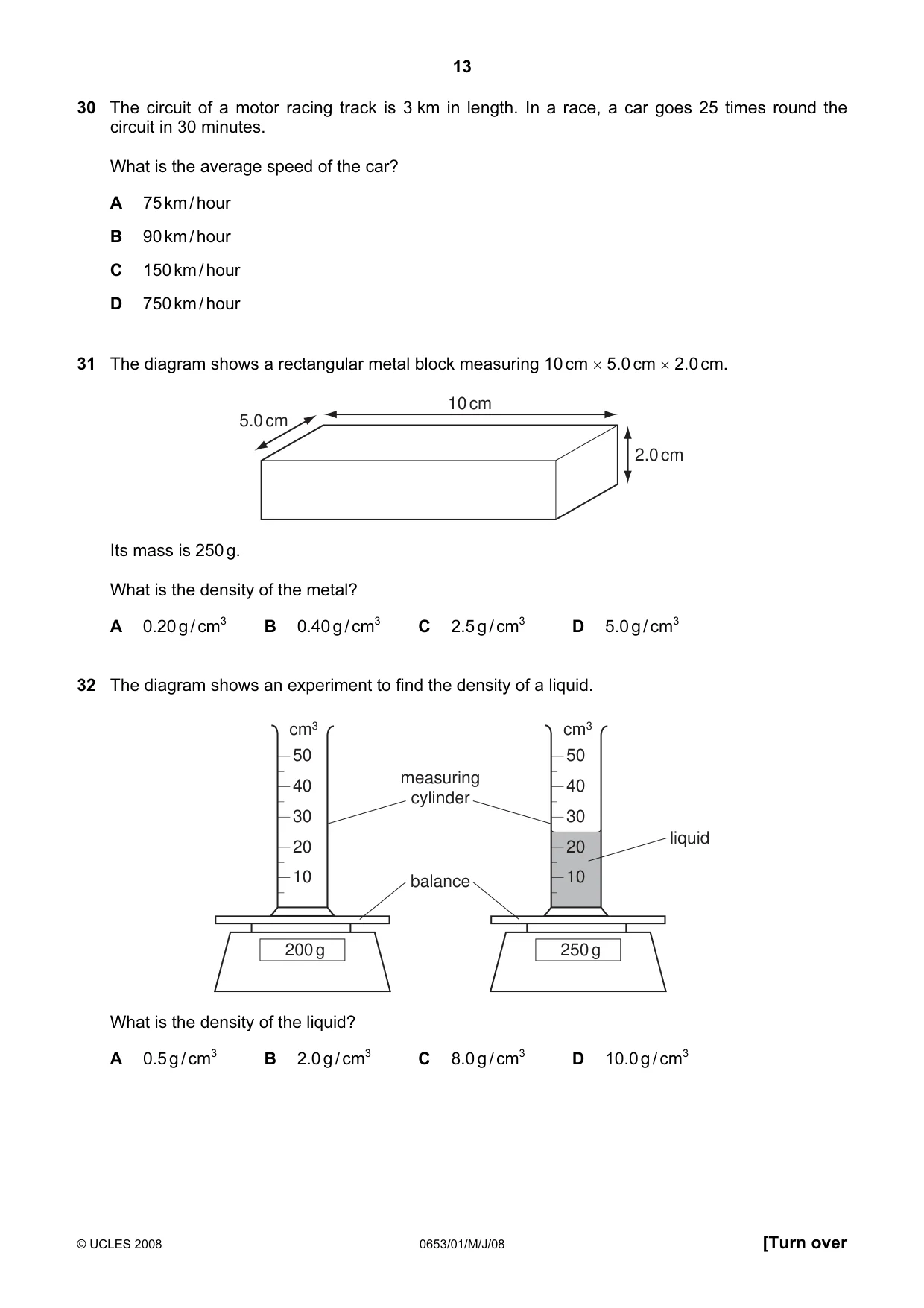
Q30 · The circuit of a motor racing track is 3 km in length
30 The circuit of a motor racing track is 3 km in length. In a race, a car goes 25 times round the circuit in 30 minutes. What is the average speed of the car? A 75 km / hour B 90 km / hour C 150 km / hour D 750 km / hour
Mark scheme: C
Q31 · The diagram shows a rectangular metal block measuring 10 cm × 5.0 cm × 2.0 cm
31 The diagram shows a rectangular metal block measuring 10 cm × 5.0 cm × 2.0 cm. 10 cm 5.0 cm 2.0 cm Its mass is 250 g. What is the density of the metal? A 0.20 g / cm3 B 0.40 g / cm3 C 2.5 g / cm3 D 5.0 g / cm3
Mark scheme: C
Q32 · The diagram shows an experiment to find the density of a liquid
32 The diagram shows an experiment to find the density of a liquid. cm3 cm3 50 50 measuring 40 40 cylinder 30 30 liquid 20 20 10 balance 10 200 g 250 g What is the density of the liquid? A 0.5 g / cm3 B 2.0 g / cm3 C 8.0 g / cm3 D 10.0 g / cm3
Mark scheme: B
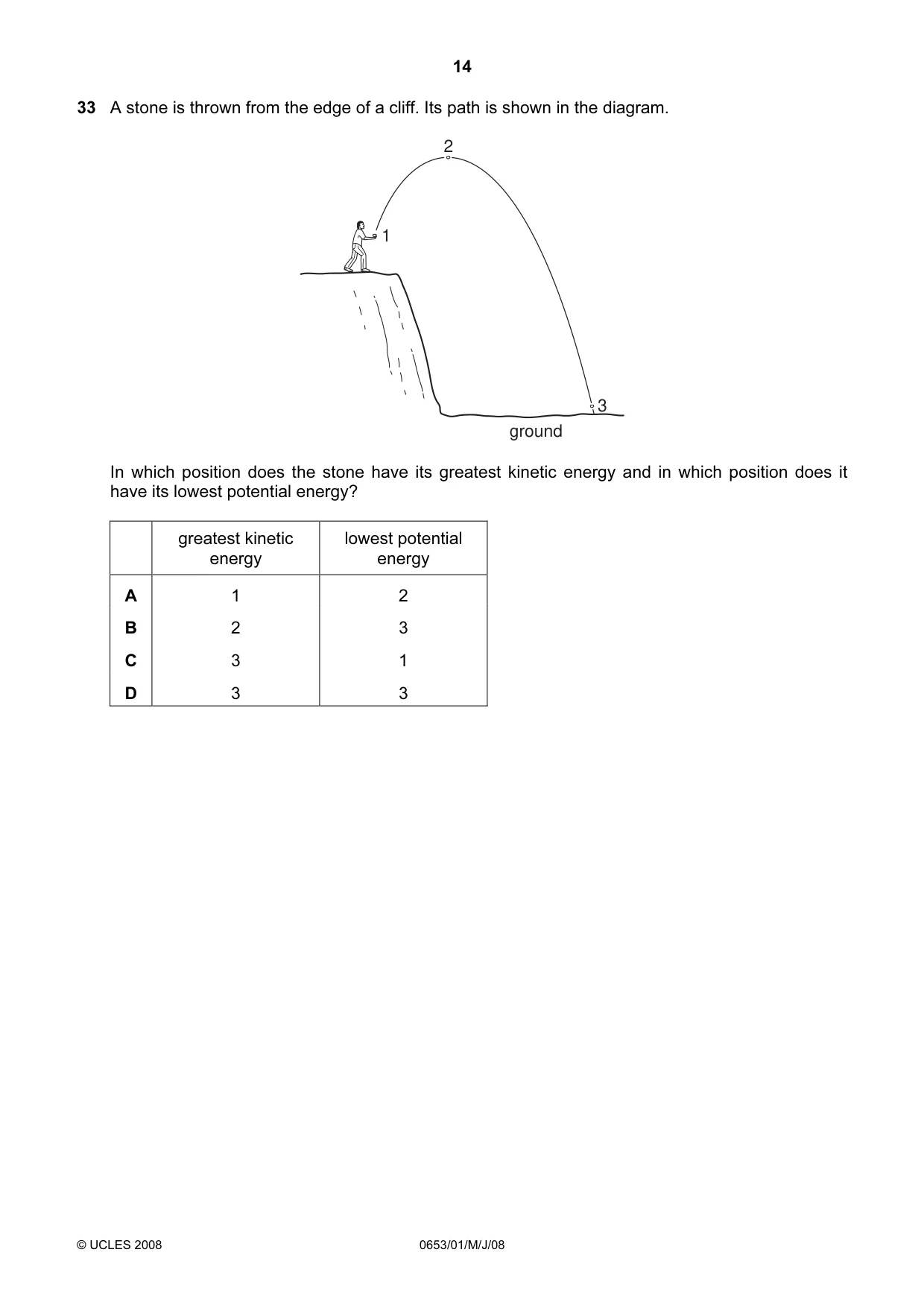
Q33 · A stone is thrown from the edge of a cliff
33 A stone is thrown from the edge of a cliff. Its path is shown in the diagram. 2 1 3 ground In which position does the stone have its greatest kinetic energy and in which position does it have its lowest potential energy? greatest kinetic lowest potential energy energy A 1 2 B 2 3 C 3 1 D 3 3
Mark scheme: D
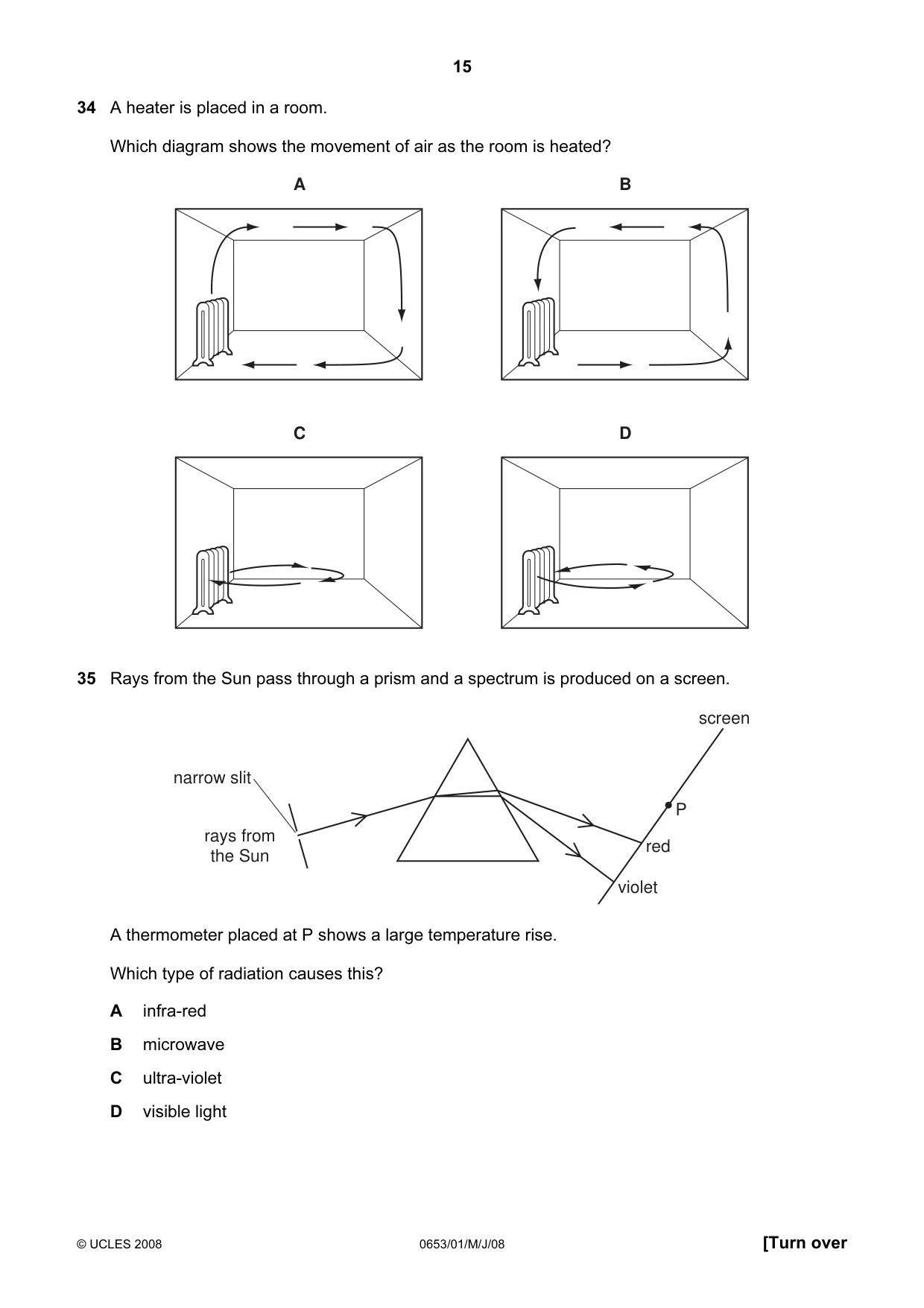
Q34 · A heater is placed in a room
34 A heater is placed in a room. Which diagram shows the movement of air as the room is heated? A B C D
Mark scheme: A
Q35 · Rays from the Sun pass through a prism and a spectrum is produced on a screen
35 Rays from the Sun pass through a prism and a spectrum is produced on a screen. screen narrow slit P rays from red the Sun violet A thermometer placed at P shows a large temperature rise. Which type of radiation causes this? A infra-red B microwave C ultra-violet D visible light
Mark scheme: A
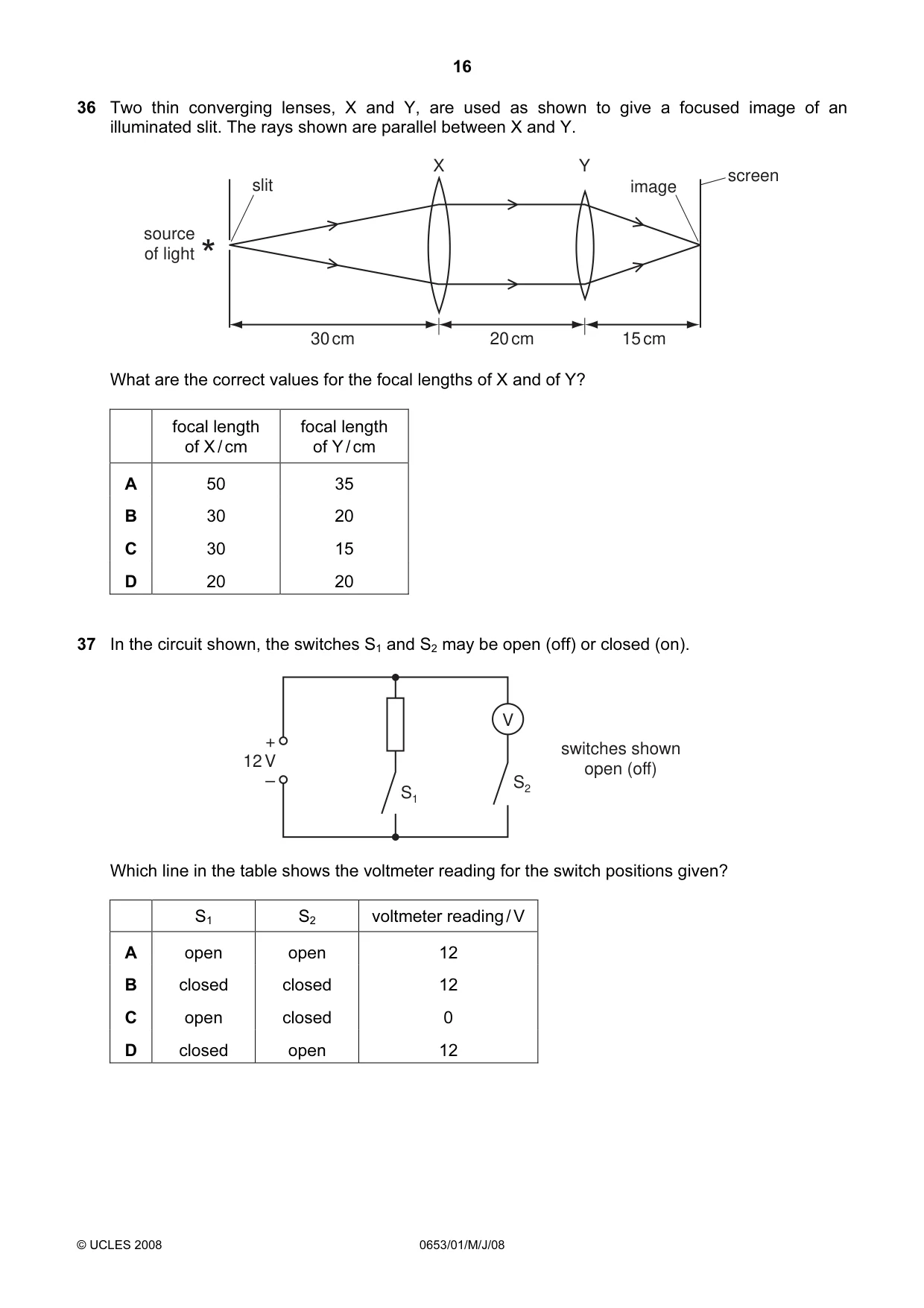
Q36 · Two thin converging lenses, X and Y, are used as shown to give a focused image of an…
36 Two thin converging lenses, X and Y, are used as shown to give a focused image of an illuminated slit. The rays shown are parallel between X and Y. X Y screen slit image source of light 30 cm 20 cm 15 cm What are the correct values for the focal lengths of X and of Y? focal length focal length of X / cm of Y / cm A 50 35 B 30 20 C 30 15 D 20 20
Mark scheme: C
Q37 · In the circuit shown, the switches S1 and S2 may be open (off) or closed (on)
37 In the circuit shown, the switches S1 and S2 may be open (off) or closed (on). V + switches shown 12 V open (off) – S2 S1 Which line in the table shows the voltmeter reading for the switch positions given? S1 S2 voltmeter reading / V A open open 12 B closed closed 12 C open closed 0 D closed open 12
Mark scheme: B
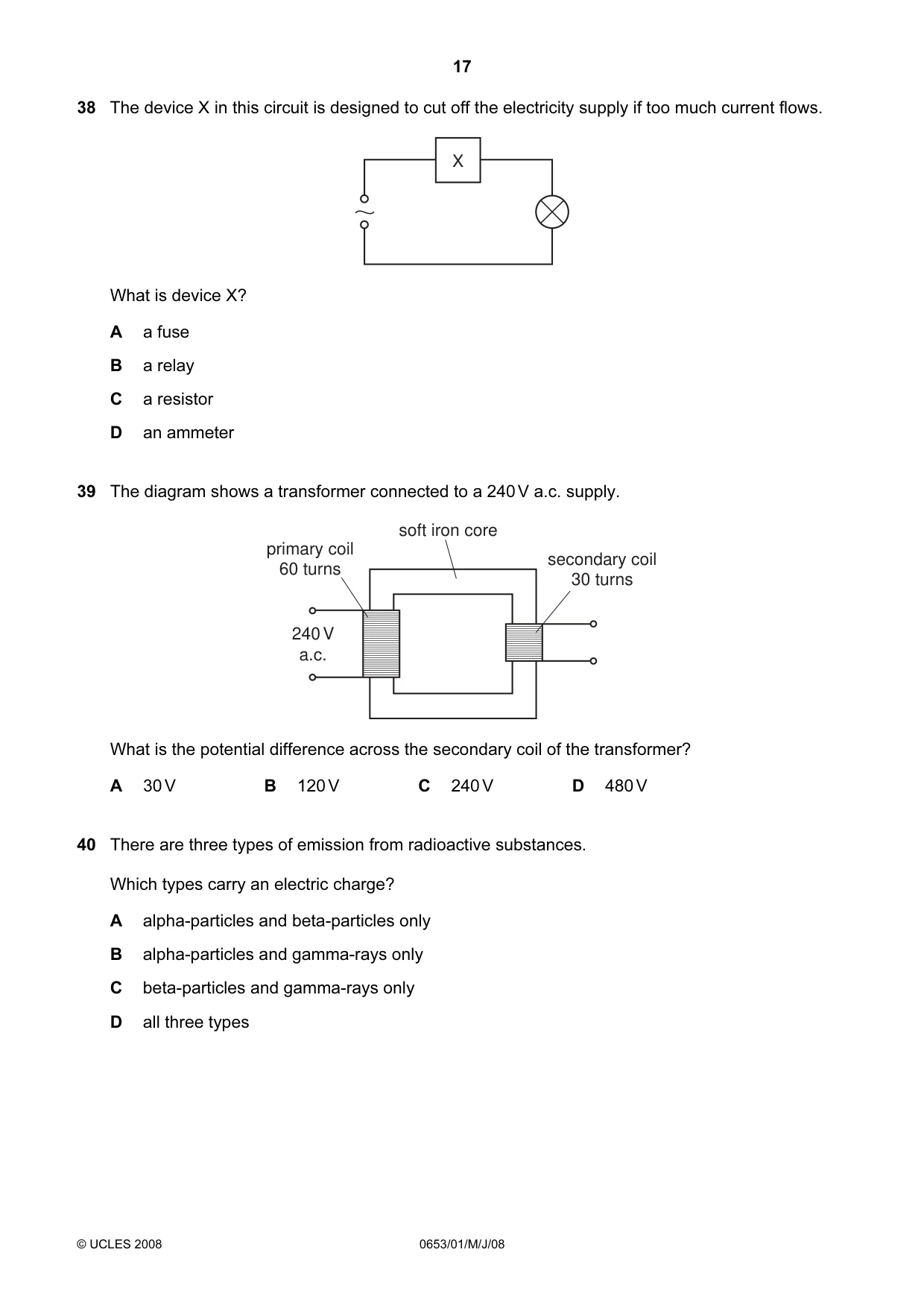
Q38 · The device X in this circuit is designed to cut off the electricity supply if too much…
38 The device X in this circuit is designed to cut off the electricity supply if too much current flows. X What is device X? A a fuse B a relay C a resistor D an ammeter
Mark scheme: A
Q39 · The diagram shows a transformer connected to a 240 V a.c
39 The diagram shows a transformer connected to a 240 V a.c. supply. soft iron core primary coil secondary coil 60 turns 30 turns 240 V a.c. What is the potential difference across the secondary coil of the transformer? A 30 V B 120 V C 240 V D 480 V
Mark scheme: B
Q40 · There are three types of emission from radioactive substances
40 There are three types of emission from radioactive substances. Which types carry an electric charge? A alpha-particles and beta-particles only B alpha-particles and gamma-rays only C beta-particles and gamma-rays only D all three types
Mark scheme: A
What was in this paper
The subtopics covered by these 40 questions, and how many questions each got. Open one in a new tab to see every Cambridge question on it.
3Air quality and climate2Atomic structure and the Periodic Table2Density2Fuels2Motion2Sexual reproduction in plants2Cell structure1Cells, batteries, generators and motors1Corrosion of metals1Diffusion1Drugs1Electrical circuits1Electrical safety1Electrolysis1Electromagnetic spectrum1Energy, work and power1Enzymes1Food chains and food webs1Habitat destruction1Heart1Identification of ions and gases1Light1Physical quantities and measurement techniques1Polymers1Properties of metals1Rate of reaction1Reactivity series1Separation and purification1Sexual reproduction in humans1Simple molecules and covalent bonds1Transfer of thermal energy1What you needed in this session
Cambridge’s own grade thresholds for 2008 May/June, Paper 1 · Variant 1. A higher threshold means an easier paper — the bar moves with how the cohort did.