Cambridge IGCSE Science - Combined 0653 — 2022 Feb/March Paper 1 · Variant 2
0653/12/F/M/22 · 40 questions · 40 marks · ≈45 min
The question paper and its mark scheme, free to read here and free to download. This is Cambridge’s own paper, exactly as it was sat.
Question paper16 pages
Mark scheme3 pages
Answers below. Sit the paper first if you are practising.
Questions as text
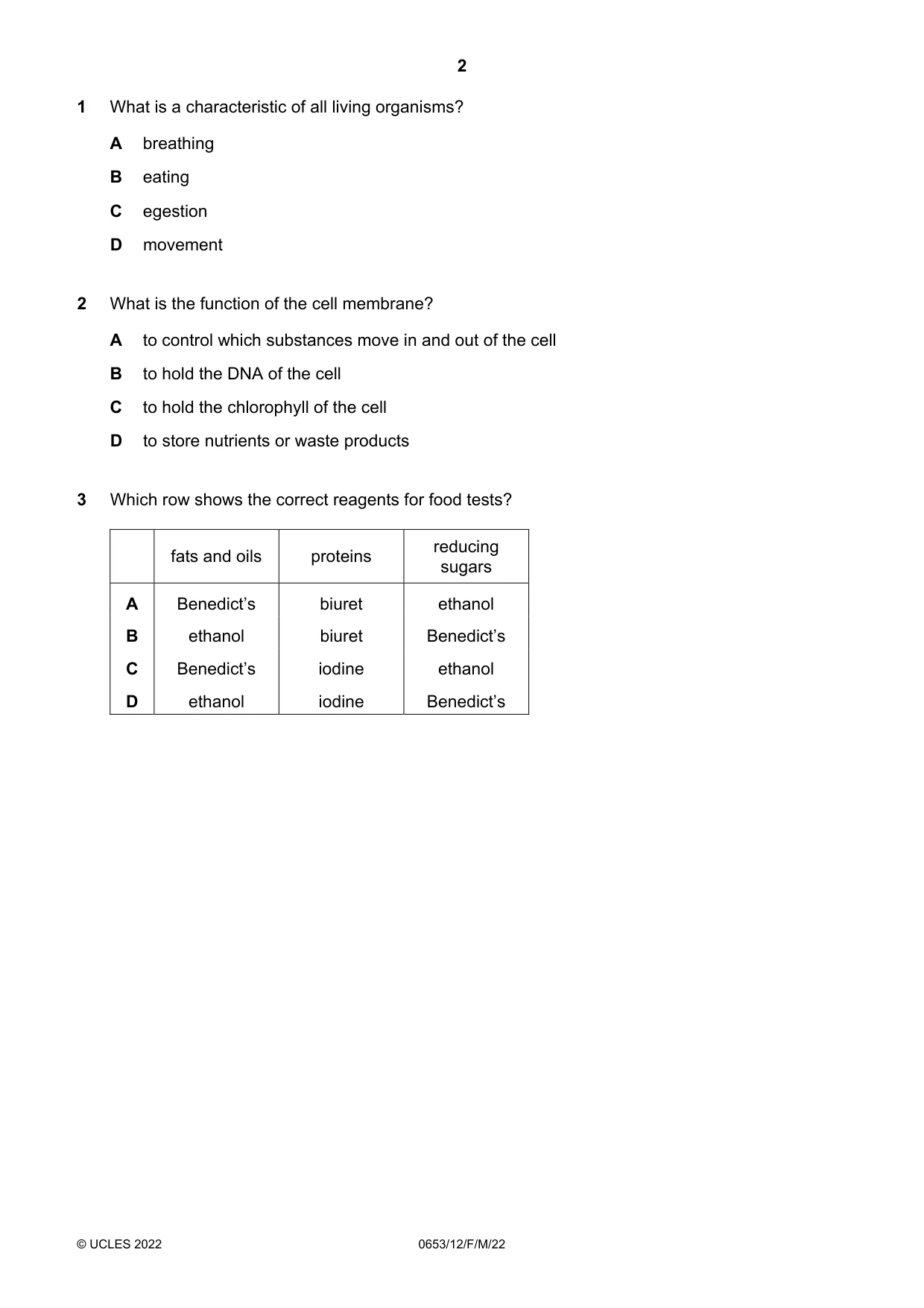
Q1 · What is a characteristic of all living organisms?
1 What is a characteristic of all living organisms? A breathing B eating C egestion D movement
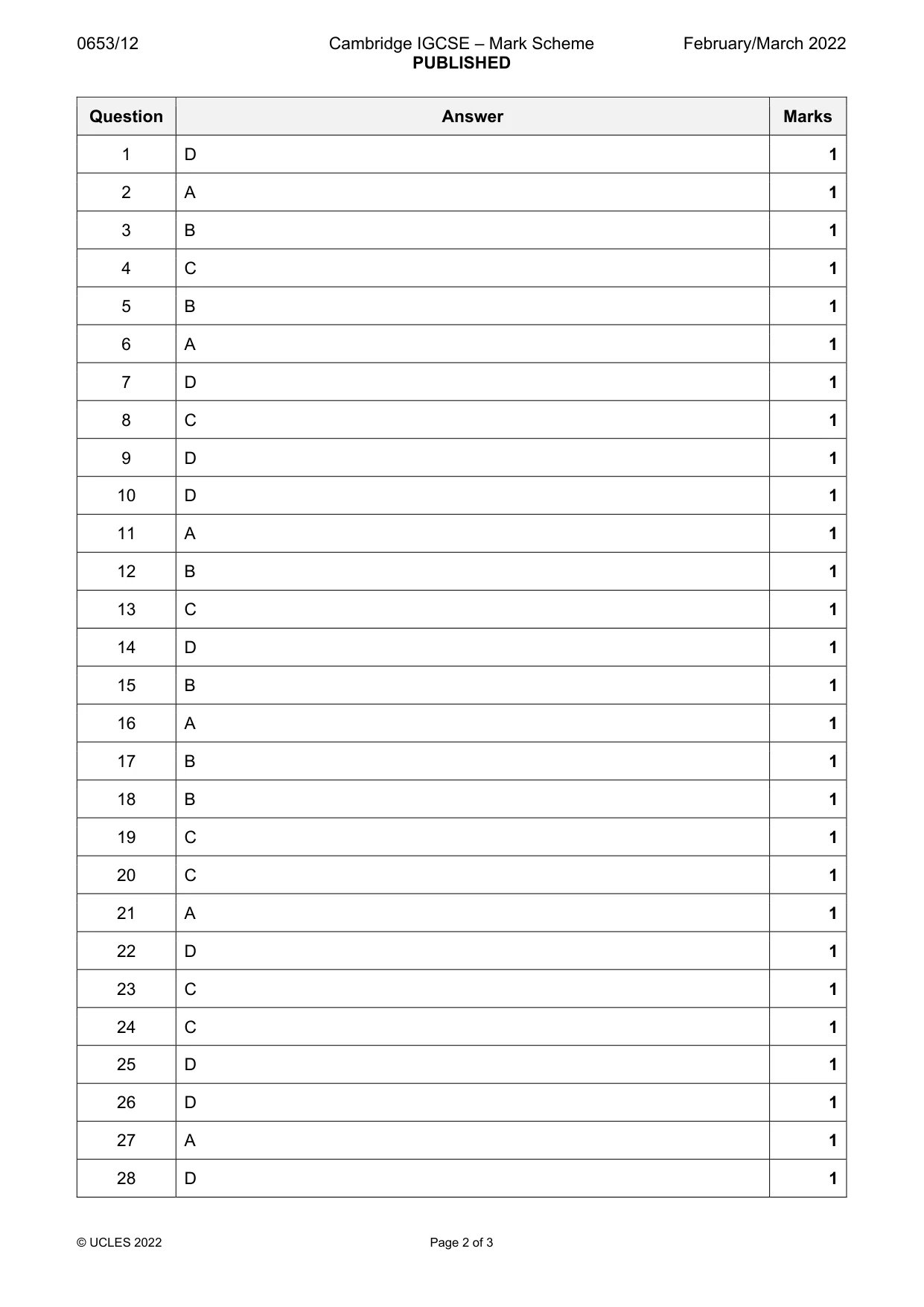
Mark scheme: D
Q2 · What is the function of the cell membrane?
2 What is the function of the cell membrane? A to control which substances move in and out of the cell B to hold the DNA of the cell C to hold the chlorophyll of the cell D to store nutrients or waste products
Mark scheme: A
Q3 · Which row shows the correct reagents for food tests?
3 Which row shows the correct reagents for food tests? reducing fats and oils proteins sugars A Benedict’s biuret ethanol B ethanol biuret Benedict’s C Benedict’s iodine ethanol D ethanol iodine Benedict’s
Mark scheme: B
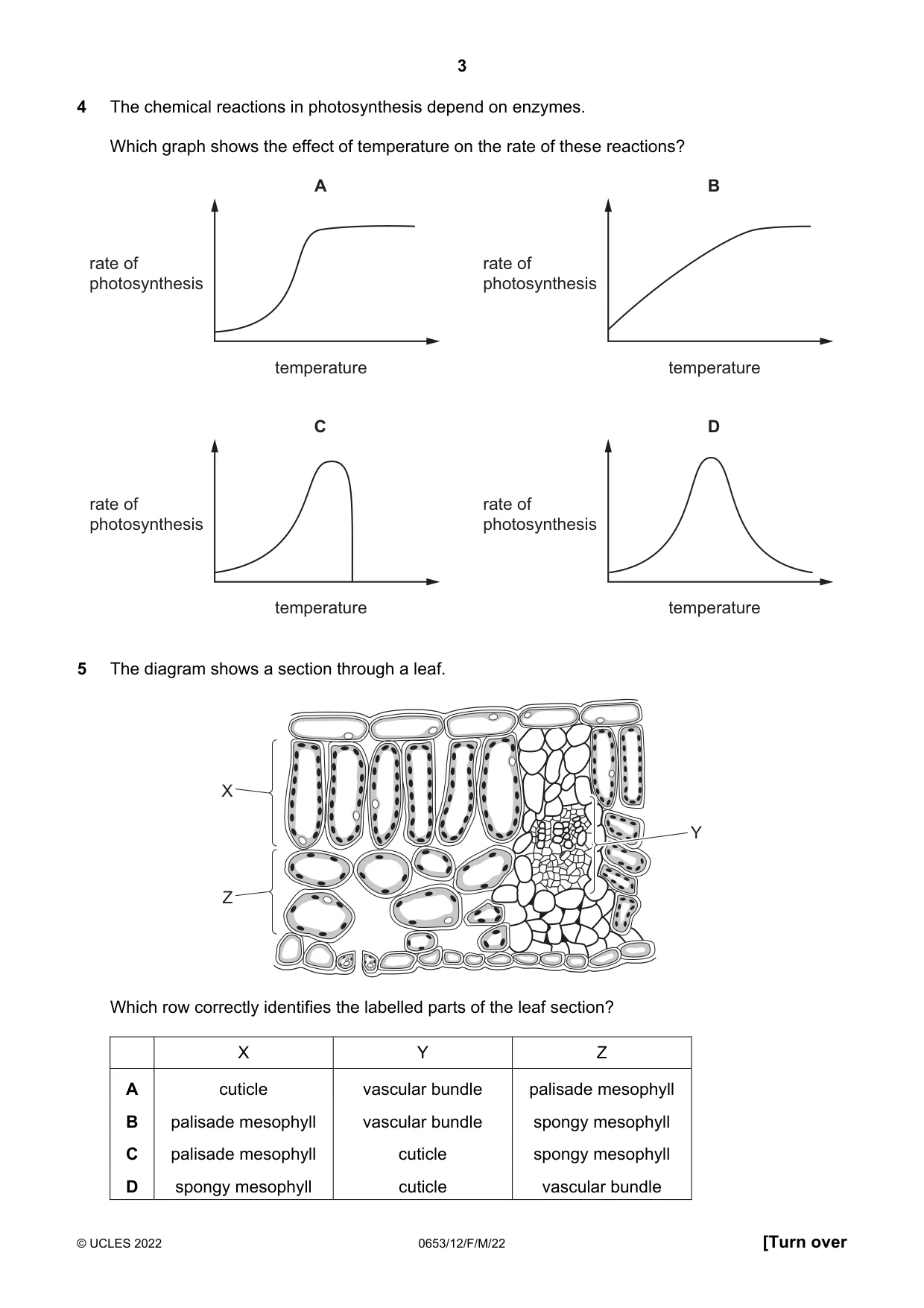
Q4 · The chemical reactions in photosynthesis depend on enzymes
4 The chemical reactions in photosynthesis depend on enzymes. Which graph shows the effect of temperature on the rate of these reactions? A B rate of rate of photosynthesis photosynthesis temperature temperature C D rate of rate of photosynthesis photosynthesis temperature temperature
Mark scheme: C
Q5 · The diagram shows a section through a leaf
5 The diagram shows a section through a leaf. X Y Z Which row correctly identifies the labelled parts of the leaf section? X Y Z A cuticle vascular bundle palisade mesophyll B palisade mesophyll vascular bundle spongy mesophyll C palisade mesophyll cuticle spongy mesophyll D spongy mesophyll cuticle vascular bundle
Mark scheme: B
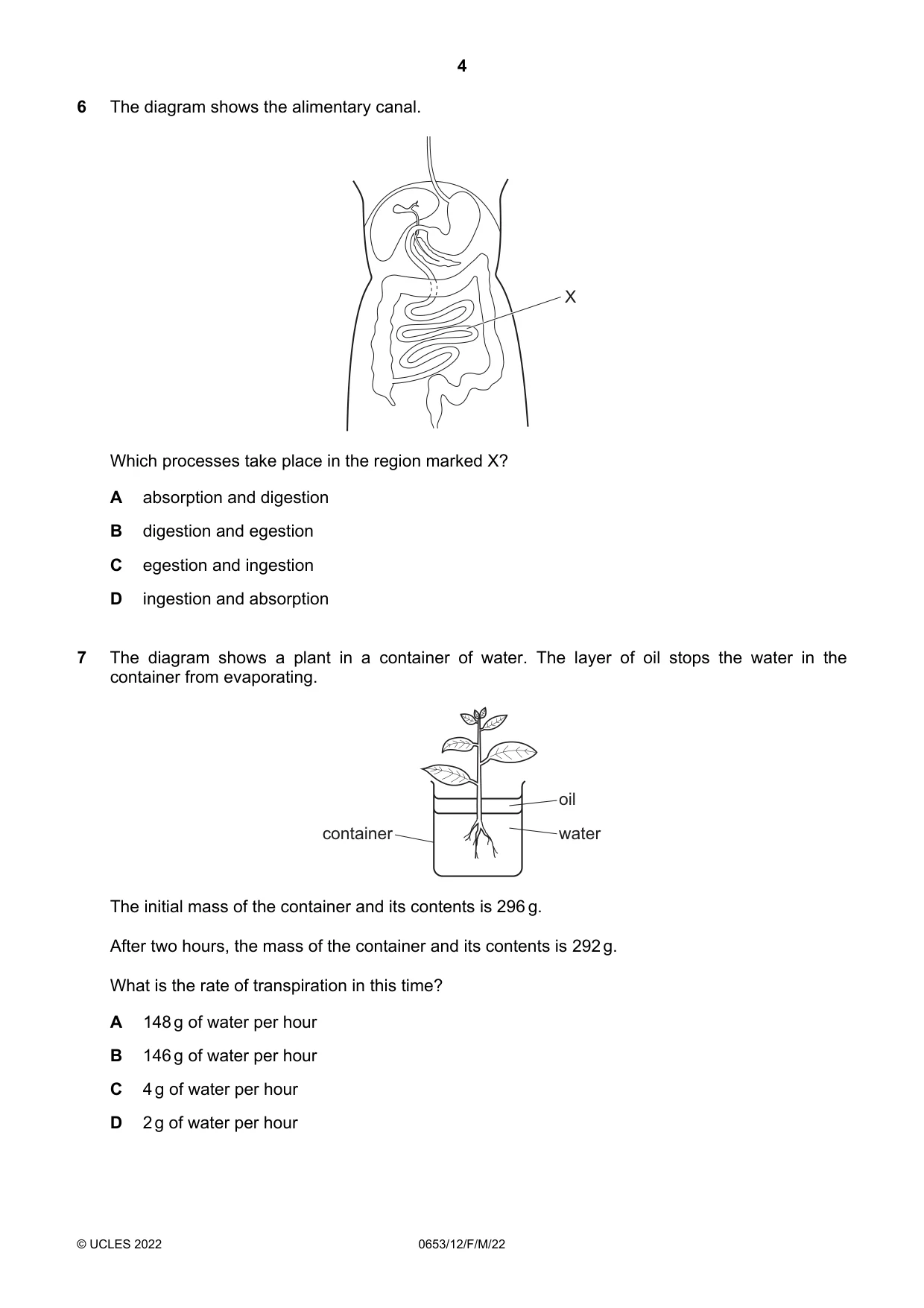
Q6 · The diagram shows the alimentary canal
6 The diagram shows the alimentary canal. X Which processes take place in the region marked X? A absorption and digestion B digestion and egestion C egestion and ingestion D ingestion and absorption
Mark scheme: A
Q7 · The diagram shows a plant in a container of water
7 The diagram shows a plant in a container of water. The layer of oil stops the water in the container from evaporating. oil container water The initial mass of the container and its contents is 296 g. After two hours, the mass of the container and its contents is 292 g. What is the rate of transpiration in this time? A 148 g of water per hour B 146 g of water per hour C 4 g of water per hour D 2 g of water per hour
Mark scheme: D
Q8 · In the equation for respiration shown, the components have been represented by numbers
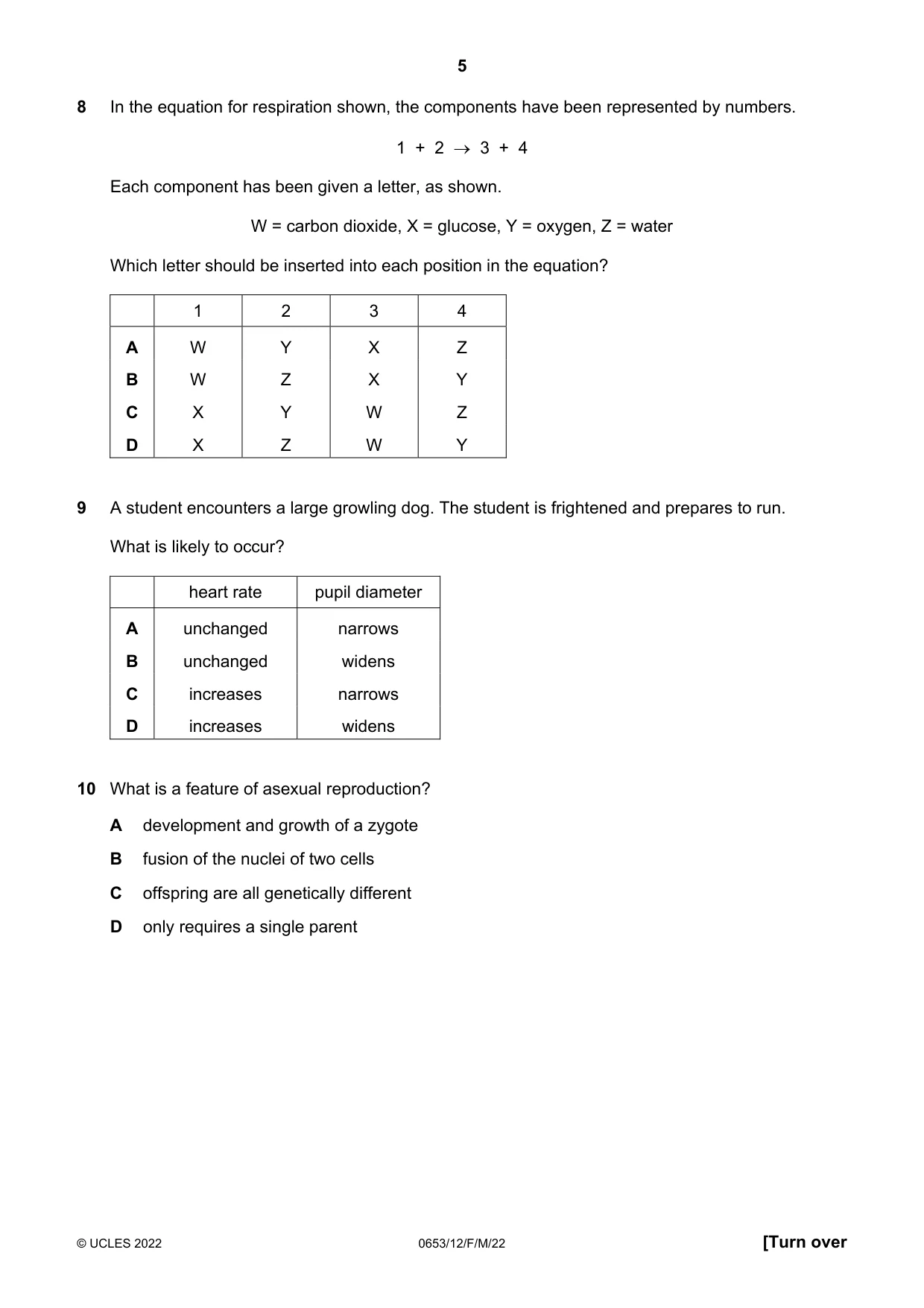
8 In the equation for respiration shown, the components have been represented by numbers. 1 + 2 3 + 4 Each component has been given a letter, as shown. W = carbon dioxide, X = glucose, Y = oxygen, Z = water Which letter should be inserted into each position in the equation? 1 2 3 4 A W Y X Z B W Z X Y C X Y W Z D X Z W Y
Mark scheme: C
Q9 · A student encounters a large growling dog
9 A student encounters a large growling dog. The student is frightened and prepares to run. What is likely to occur? heart rate pupil diameter A unchanged narrows B unchanged widens C increases narrows D increases widens
Mark scheme: D
Q10 · What is a feature of asexual reproduction?
10 What is a feature of asexual reproduction? A development and growth of a zygote B fusion of the nuclei of two cells C offspring are all genetically different D only requires a single parent
Mark scheme: D
Q11 · The diagram shows the female reproductive system of a human
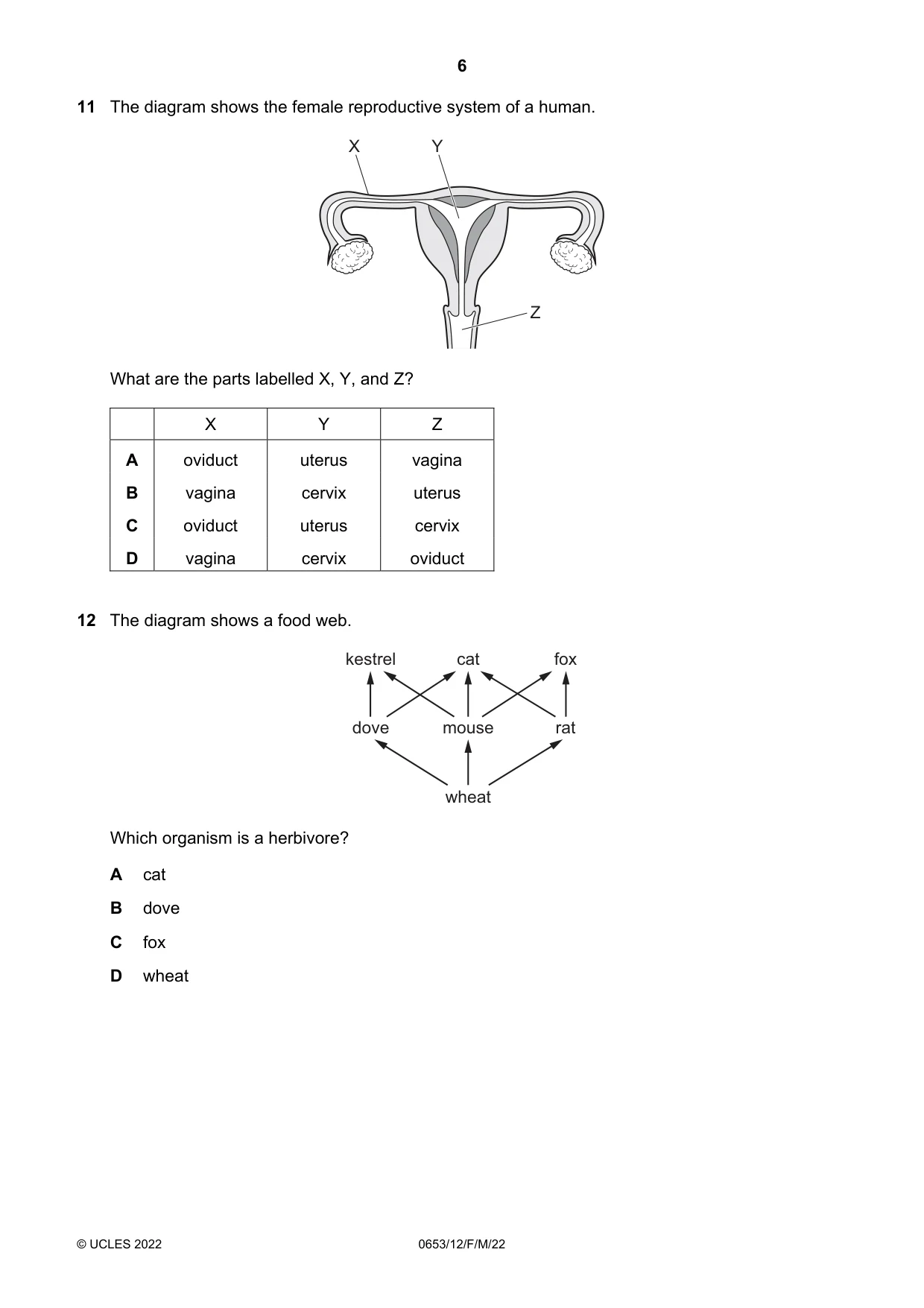
11 The diagram shows the female reproductive system of a human. X Y Z What are the parts labelled X, Y, and Z? X Y Z A oviduct uterus vagina B vagina cervix uterus C oviduct uterus cervix D vagina cervix oviduct
Mark scheme: A
Q12 · The diagram shows a food web
12 The diagram shows a food web. kestrel cat fox dove mouse rat wheat Which organism is a herbivore? A cat B dove C fox D wheat
Mark scheme: B
Q13 · Which labelled box represents plants in the carbon cycle?
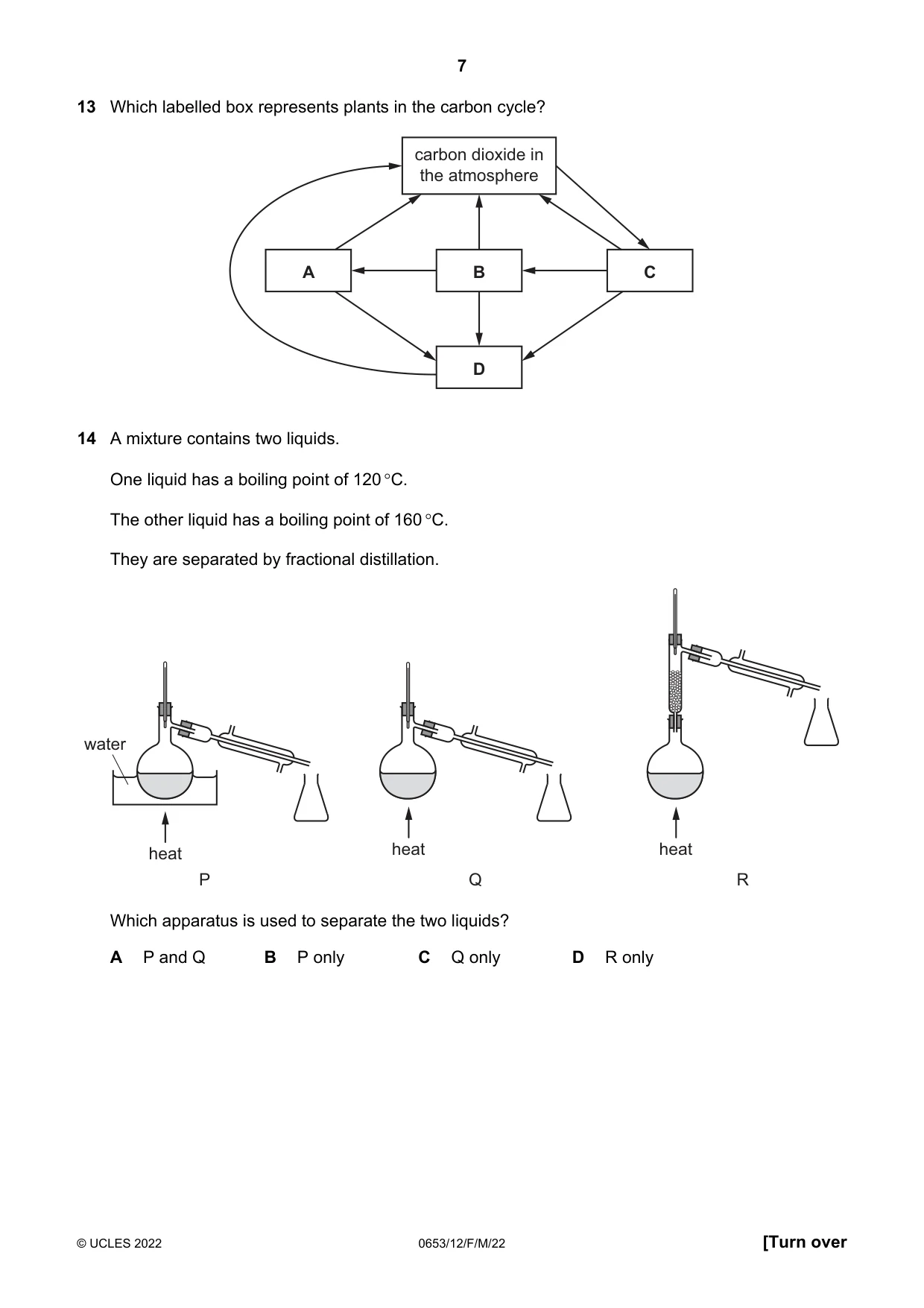
13 Which labelled box represents plants in the carbon cycle? carbon dioxide in the atmosphere A B C D
Mark scheme: C
Q14 · A mixture contains two liquids
14 A mixture contains two liquids. One liquid has a boiling point of 120 C. The other liquid has a boiling point of 160 C. They are separated by fractional distillation. water heat heat heat P Q R Which apparatus is used to separate the two liquids? A P and Q B P only C Q only D R only
Mark scheme: D
Q15 · Iodine is a non-metal
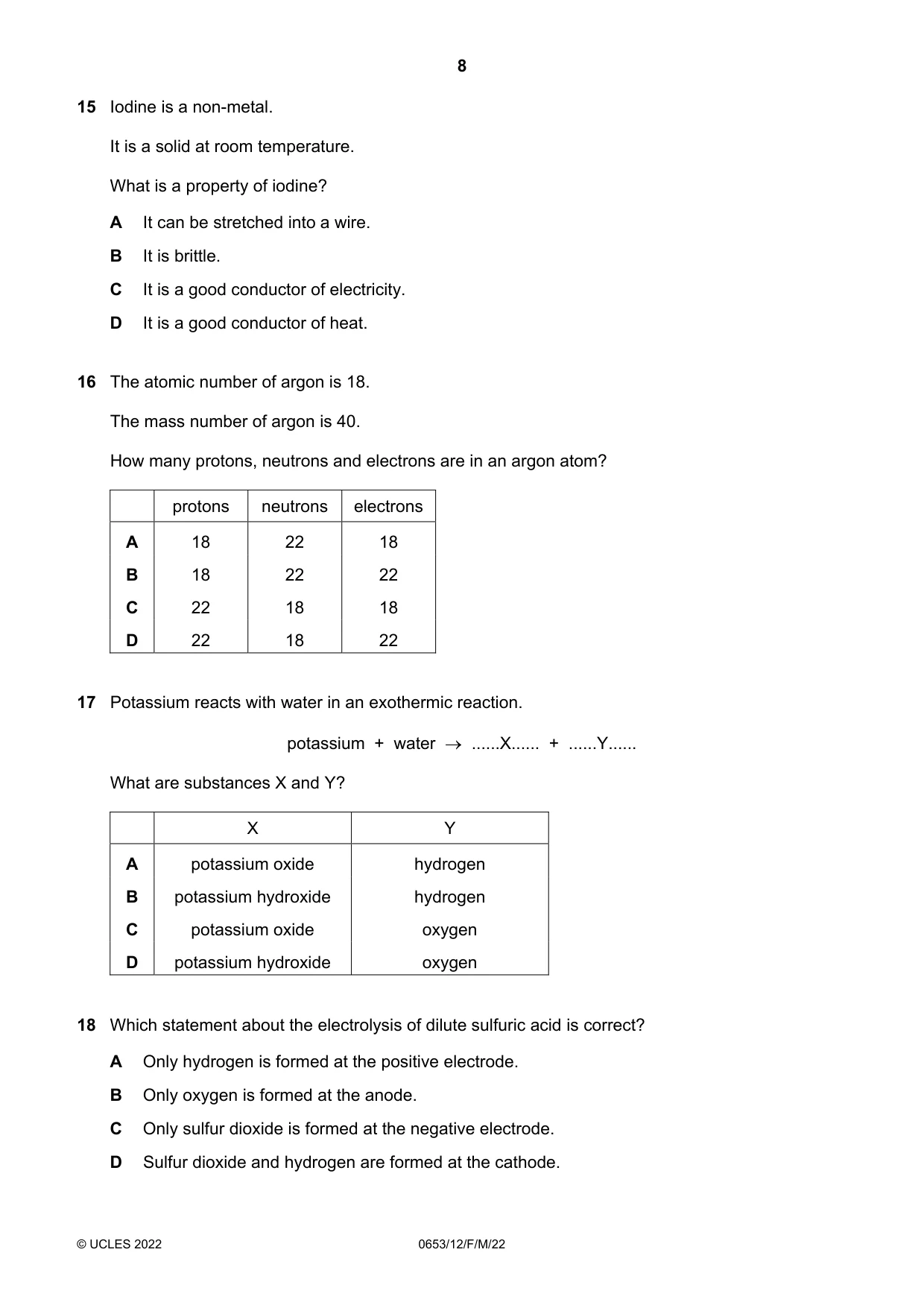
15 Iodine is a non-metal. It is a solid at room temperature. What is a property of iodine? A It can be stretched into a wire. B It is brittle. C It is a good conductor of electricity. D It is a good conductor of heat.
Mark scheme: B
Q16 · The atomic number of argon is 18
16 The atomic number of argon is 18. The mass number of argon is 40. How many protons, neutrons and electrons are in an argon atom? protons neutrons electrons A 18 22 18 B 18 22 22 C 22 18 18 D 22 18 22
Mark scheme: A
Q17 · Potassium reacts with water in an exothermic reaction
17 Potassium reacts with water in an exothermic reaction. potassium + water ......X...... + ......Y...... What are substances X and Y? X Y A potassium oxide hydrogen B potassium hydroxide hydrogen C potassium oxide oxygen D potassium hydroxide oxygen
Mark scheme: B
Q18 · Which statement about the electrolysis of dilute sulfuric acid is correct?
18 Which statement about the electrolysis of dilute sulfuric acid is correct? A Only hydrogen is formed at the positive electrode. B Only oxygen is formed at the anode. C Only sulfur dioxide is formed at the negative electrode. D Sulfur dioxide and hydrogen are formed at the cathode.
Mark scheme: B
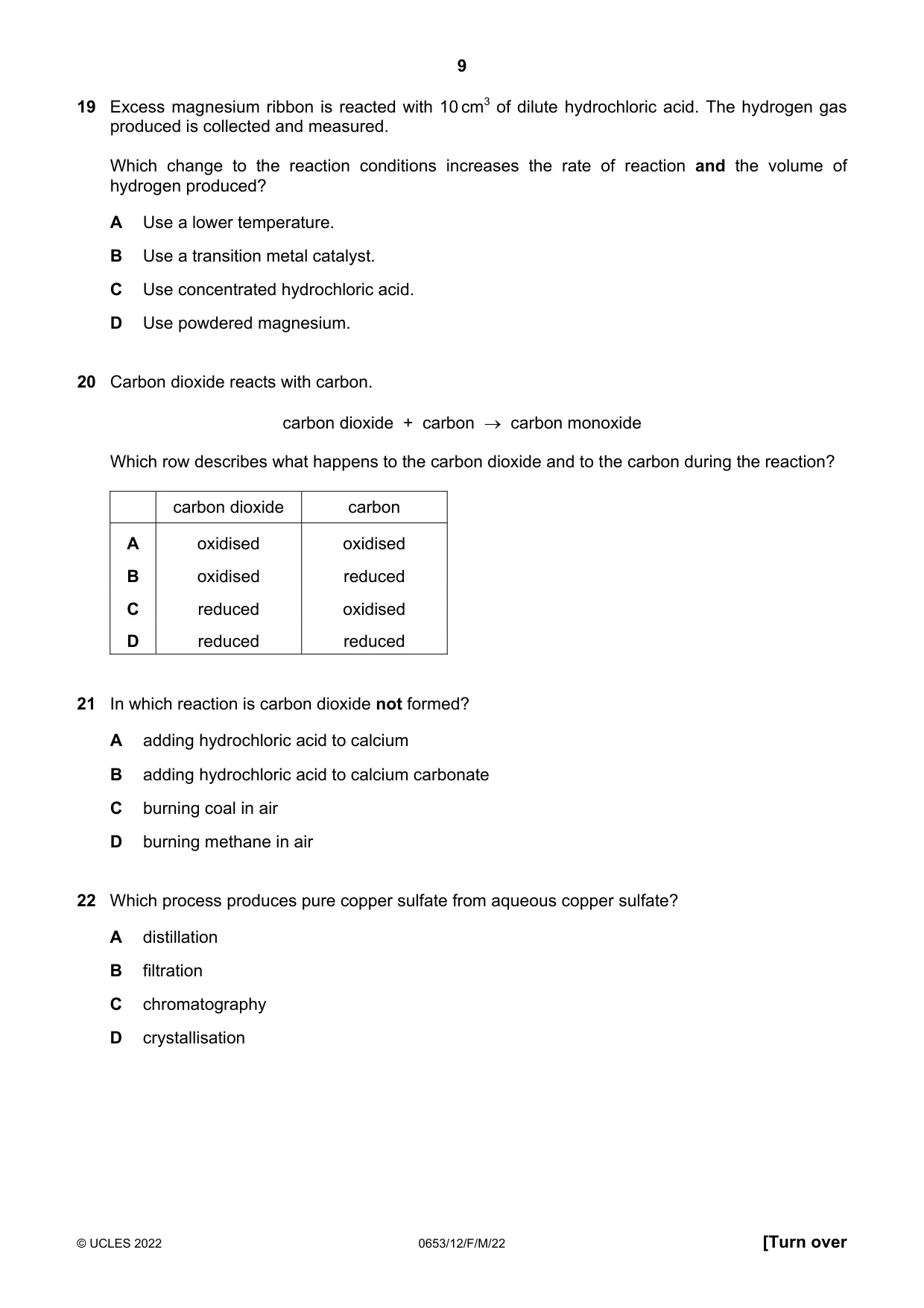
Q19 · Excess magnesium ribbon is reacted with 10 cm3 of dilute hydrochloric acid
19 Excess magnesium ribbon is reacted with 10 cm3 of dilute hydrochloric acid. The hydrogen gas produced is collected and measured. Which change to the reaction conditions increases the rate of reaction and the volume of hydrogen produced? A Use a lower temperature. B Use a transition metal catalyst. C Use concentrated hydrochloric acid. D Use powdered magnesium.
Mark scheme: C
Q20 · Carbon dioxide reacts with carbon
20 Carbon dioxide reacts with carbon. carbon dioxide + carbon carbon monoxide Which row describes what happens to the carbon dioxide and to the carbon during the reaction? carbon dioxide carbon A oxidised oxidised B oxidised reduced C reduced oxidised D reduced reduced
Mark scheme: C
Q21 · In which reaction is carbon dioxide not formed?
21 In which reaction is carbon dioxide not formed? A adding hydrochloric acid to calcium B adding hydrochloric acid to calcium carbonate C burning coal in air D burning methane in air
Mark scheme: A
More questions on The characteristic properties of acids and bases
Q22 · Which process produces pure copper sulfate from aqueous copper sulfate?
22 Which process produces pure copper sulfate from aqueous copper sulfate? A distillation B filtration C chromatography D crystallisation
Mark scheme: D
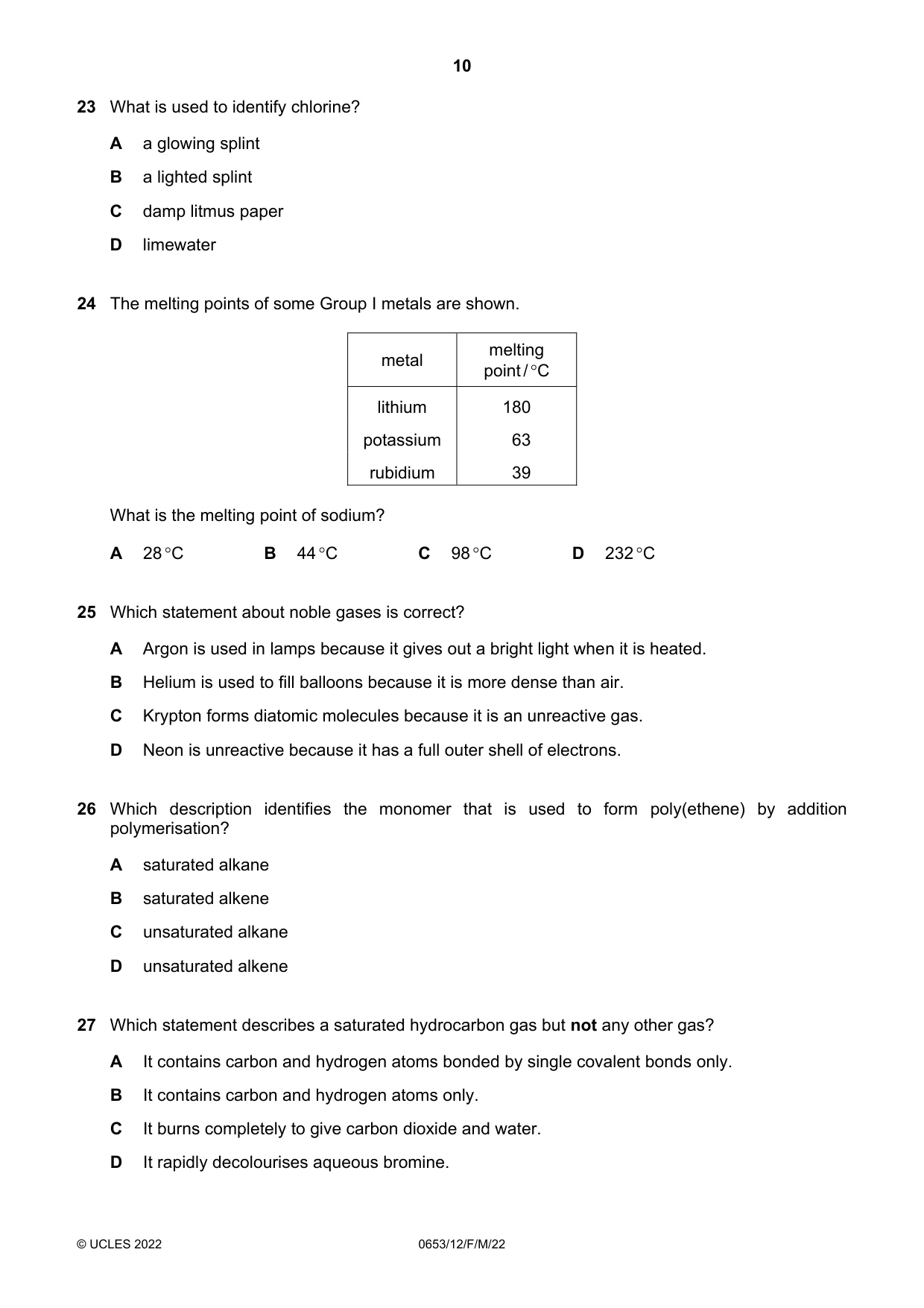
Q23 · What is used to identify chlorine?
23 What is used to identify chlorine? A a glowing splint B a lighted splint C damp litmus paper D limewater
Mark scheme: C
Q24 · The melting points of some Group I metals are shown
24 The melting points of some Group I metals are shown. melting metal point / C lithium 180 potassium 63 rubidium 39 What is the melting point of sodium? A 28 C B 44 C C 98 C D 232 C
Mark scheme: C
Q25 · Which statement about noble gases is correct?
25 Which statement about noble gases is correct? A Argon is used in lamps because it gives out a bright light when it is heated. B Helium is used to fill balloons because it is more dense than air. C Krypton forms diatomic molecules because it is an unreactive gas. D Neon is unreactive because it has a full outer shell of electrons.
Mark scheme: D
Q26 · Which description identifies the monomer that is used to form poly(ethene) by addition…
26 Which description identifies the monomer that is used to form poly(ethene) by addition polymerisation? A saturated alkane B saturated alkene C unsaturated alkane D unsaturated alkene
Mark scheme: D
Q27 · Which statement describes a saturated hydrocarbon gas but not any other gas?
27 Which statement describes a saturated hydrocarbon gas but not any other gas? A It contains carbon and hydrogen atoms bonded by single covalent bonds only. B It contains carbon and hydrogen atoms only. C It burns completely to give carbon dioxide and water. D It rapidly decolourises aqueous bromine.
Mark scheme: A
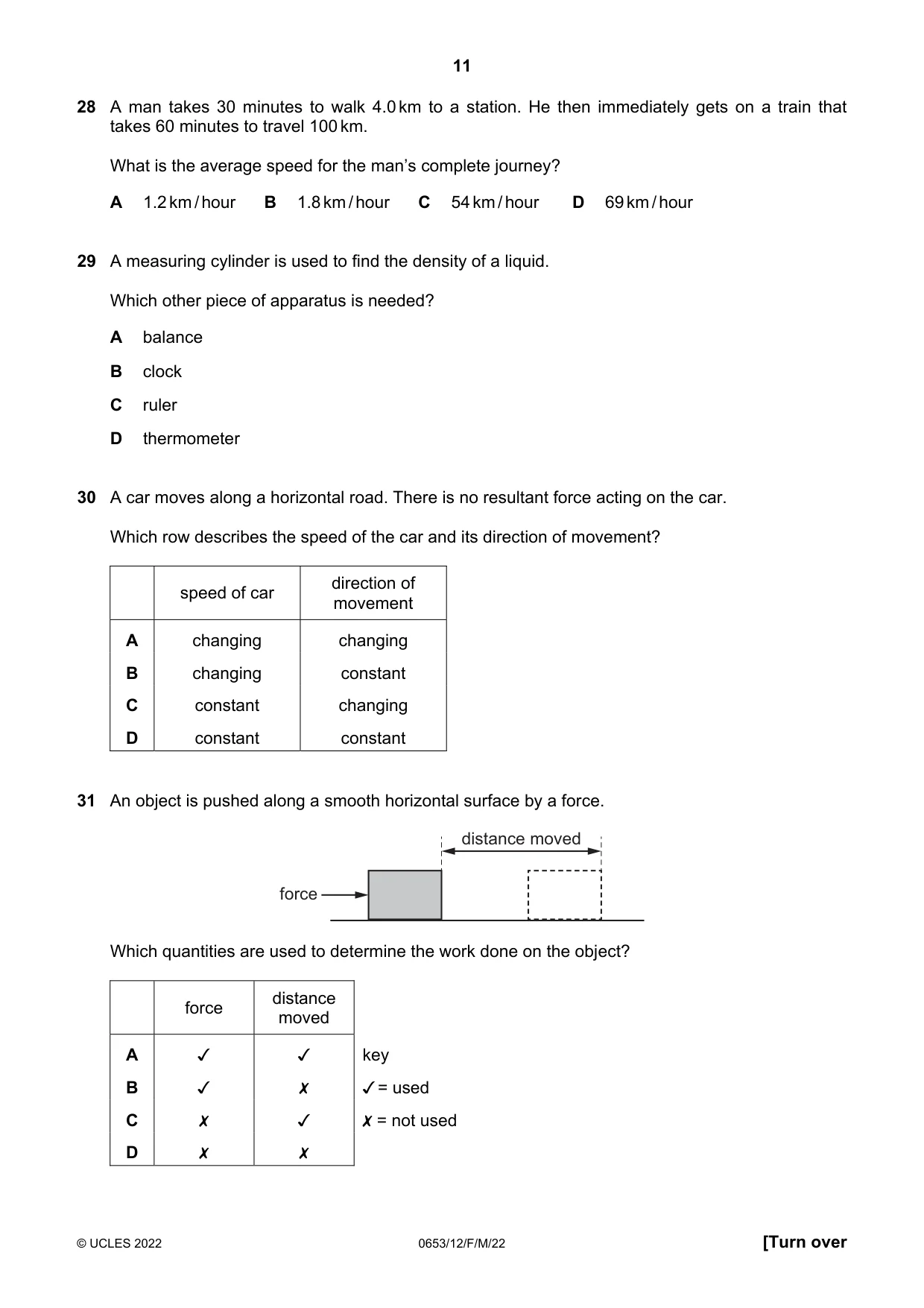
Q28 · A man takes 30 minutes to walk 4.0 km to a station
28 A man takes 30 minutes to walk 4.0 km to a station. He then immediately gets on a train that takes 60 minutes to travel 100 km. What is the average speed for the man’s complete journey? A 1.2 km / hour B 1.8 km / hour C 54 km / hour D 69 km / hour
Mark scheme: D
Q29 · A measuring cylinder is used to find the density of a liquid
29 A measuring cylinder is used to find the density of a liquid. Which other piece of apparatus is needed? A balance B clock C ruler D thermometer
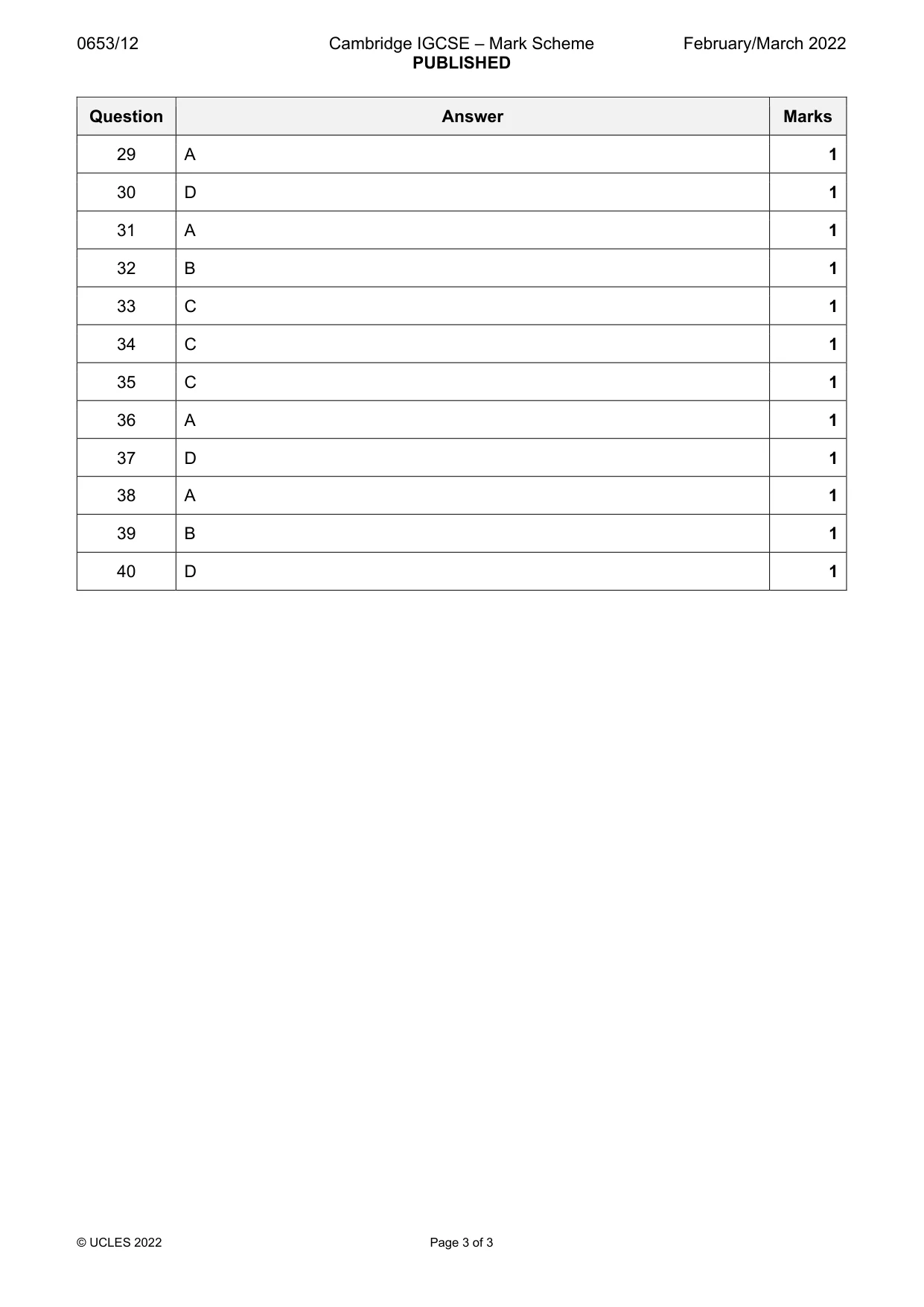
Mark scheme: A
Q30 · A car moves along a horizontal road
30 A car moves along a horizontal road. There is no resultant force acting on the car. Which row describes the speed of the car and its direction of movement? direction of speed of car movement A changing changing B changing constant C constant changing D constant constant
Mark scheme: D
Q31 · An object is pushed along a smooth horizontal surface by a force
31 An object is pushed along a smooth horizontal surface by a force. ‘ distance moved _ : <A force Which quantities are used to determine the work done on the object? distance moved key J¥ = used X = not used
Mark scheme: A
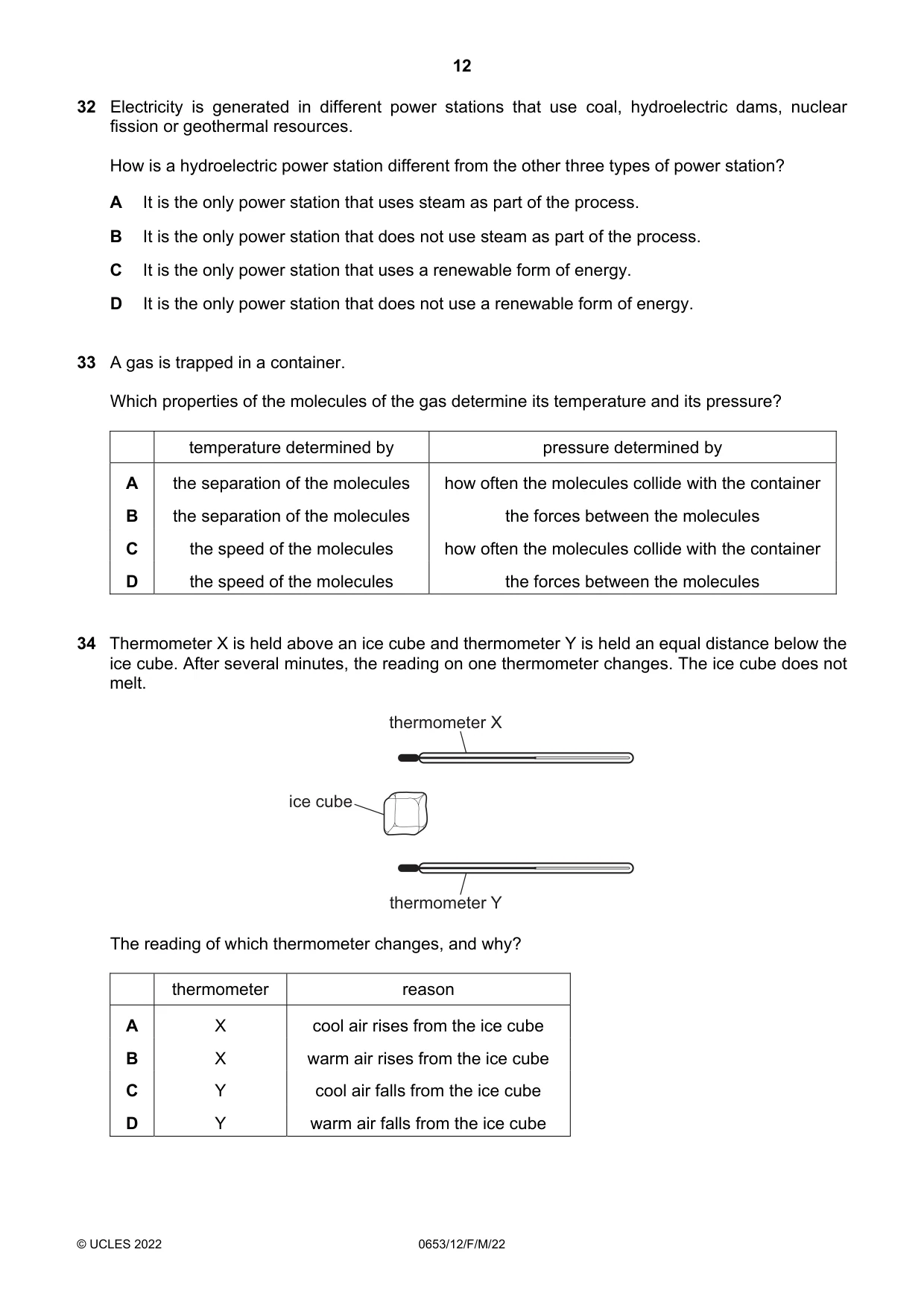
Q32 · Electricity is generated in different power stations that use coal, hydroelectric dams…
32 Electricity is generated in different power stations that use coal, hydroelectric dams, nuclear fission or geothermal resources. How is a hydroelectric power station different from the other three types of power station? A It is the only power station that uses steam as part of the process. B It is the only power station that does not use steam as part of the process. C It is the only power station that uses a renewable form of energy. D It is the only power station that does not use a renewable form of energy.
Mark scheme: B
Q33 · A gas is trapped in a container
33 A gas is trapped in a container. Which properties of the molecules of the gas determine its temperature and its pressure? temperature determined by pressure determined by A the separation of the molecules how often the molecules collide with the container B the separation of the molecules the forces between the molecules C the speed of the molecules how often the molecules collide with the container D the speed of the molecules the forces between the molecules
Mark scheme: C
Q34 · Thermometer X is held above an ice cube and thermometer Y is held an equal distance below…
34 Thermometer X is held above an ice cube and thermometer Y is held an equal distance below the ice cube. After several minutes, the reading on one thermometer changes. The ice cube does not melt. thermometer X ice cube thermometer Y The reading of which thermometer changes, and why? thermometer reason A X cool air rises from the ice cube B X warm air rises from the ice cube C Y cool air falls from the ice cube D Y warm air falls from the ice cube
Mark scheme: C
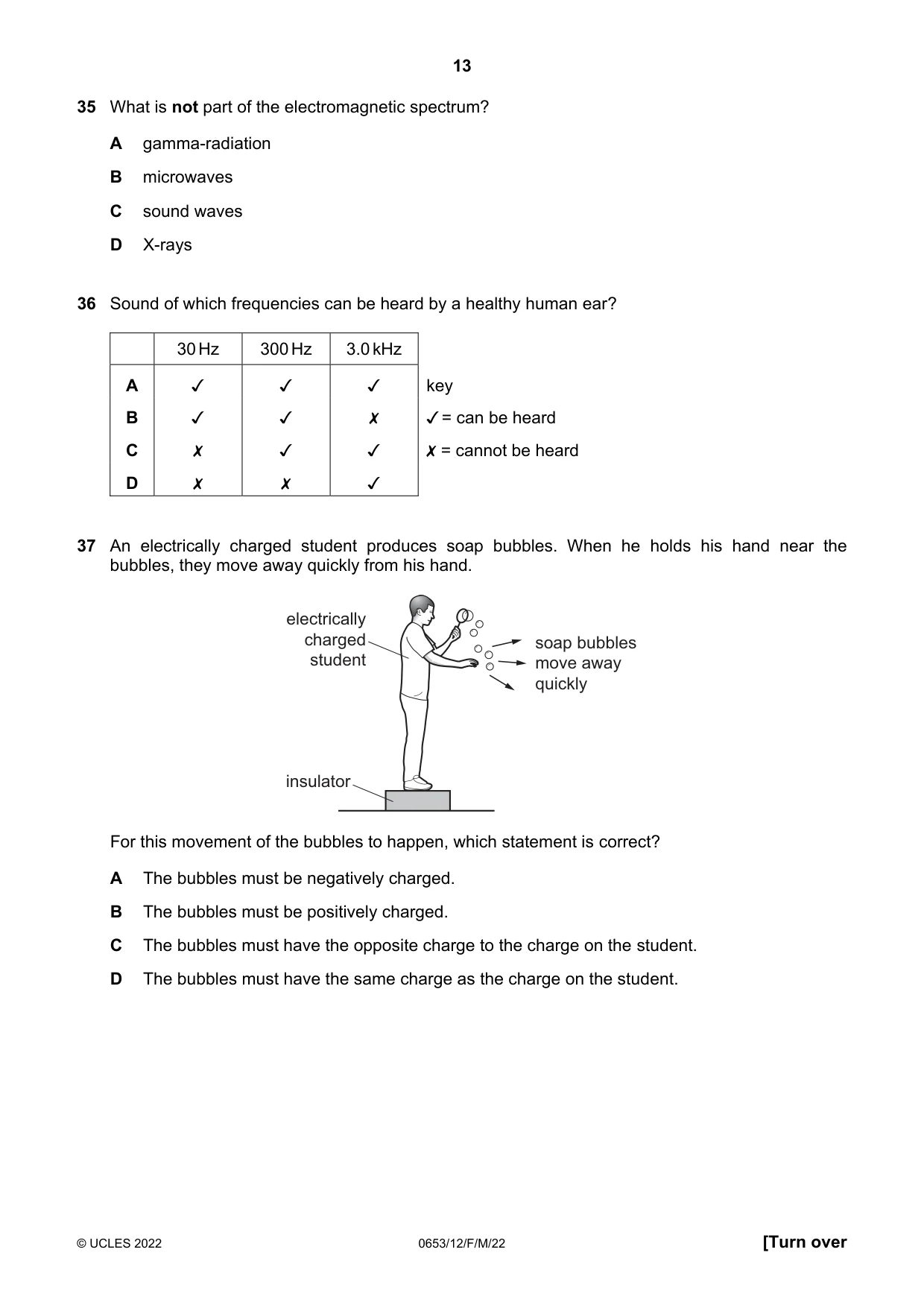
Q35 · What is not part of the electromagnetic spectrum?
35 What is not part of the electromagnetic spectrum? A gamma-radiation B microwaves C sound waves D X-rays
Mark scheme: C
Q36 · Sound of which frequencies can be heard by a healthy human ear?
36 Sound of which frequencies can be heard by a healthy human ear? key / = can be heard X = cannot be heard
Mark scheme: A
Q37 · An electrically charged student produces soap bubbles
37 An electrically charged student produces soap bubbles. When he holds his hand near the bubbles, they move away quickly from his hand. electrically charged soap bubbles student move away quickly insulator For this movement of the bubbles to happen, which statement is correct? A The bubbles must be negatively charged. B The bubbles must be positively charged. C The bubbles must have the opposite charge to the charge on the student. D The bubbles must have the same charge as the charge on the student.
Mark scheme: D
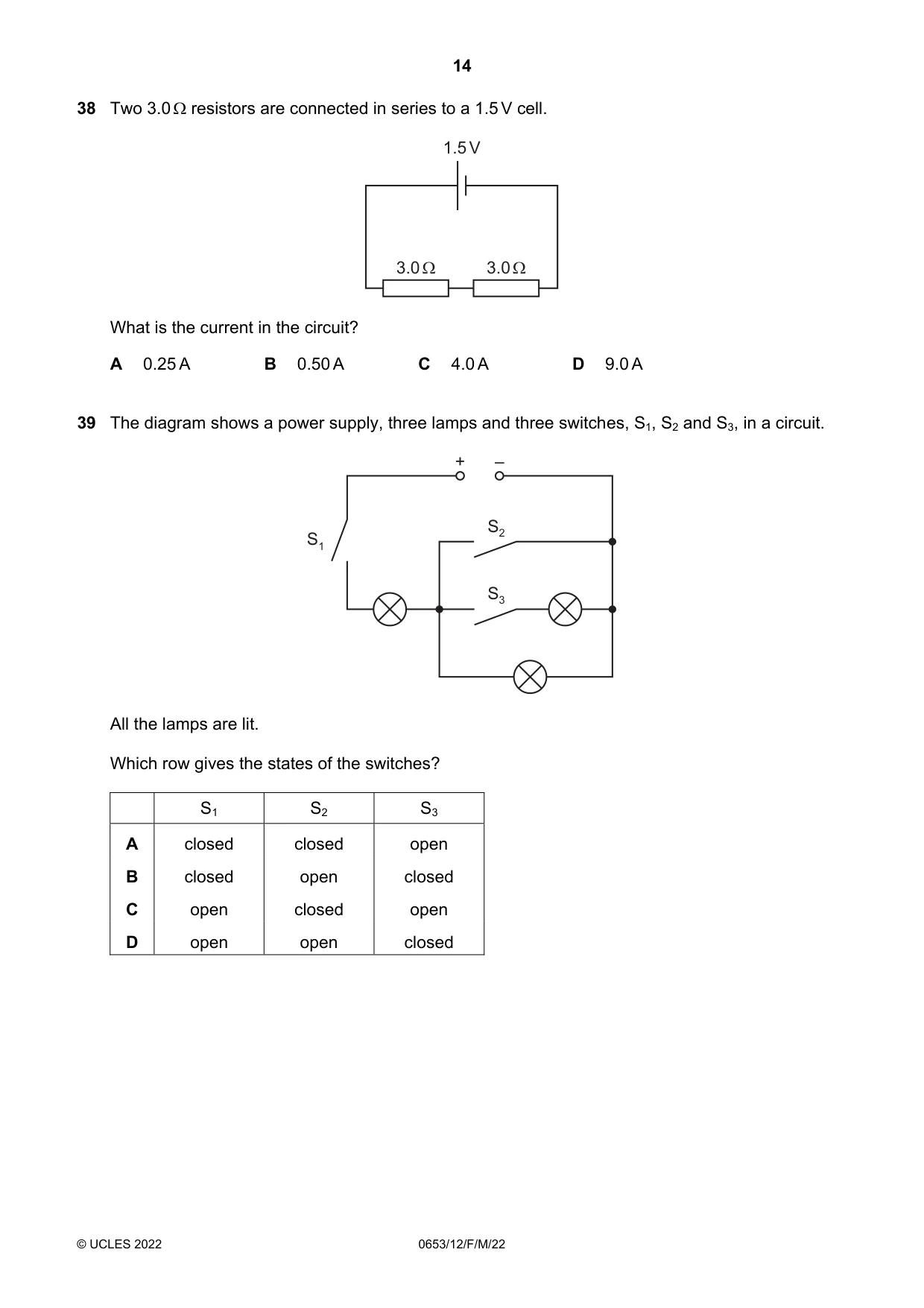
Q38 · Two 3.0Q resistors are connected in series to a 1.5V cell
38 Two 3.0Q resistors are connected in series to a 1.5V cell. 1.5V 3.0Q 3.00 What is the current in the circuit? A 0.25A B 0.50A C 4.0A D 9.0A
Mark scheme: A
Q39 · The diagram shows a power supply, three lamps and three switches, S1, S2 and S3, in a…
39 The diagram shows a power supply, three lamps and three switches, S1, S2 and S3, in a circuit. + – S2 S1 S3 All the lamps are lit. Which row gives the states of the switches? S1 S2 S3 A closed closed open B closed open closed C open closed open D open open closed
Mark scheme: B
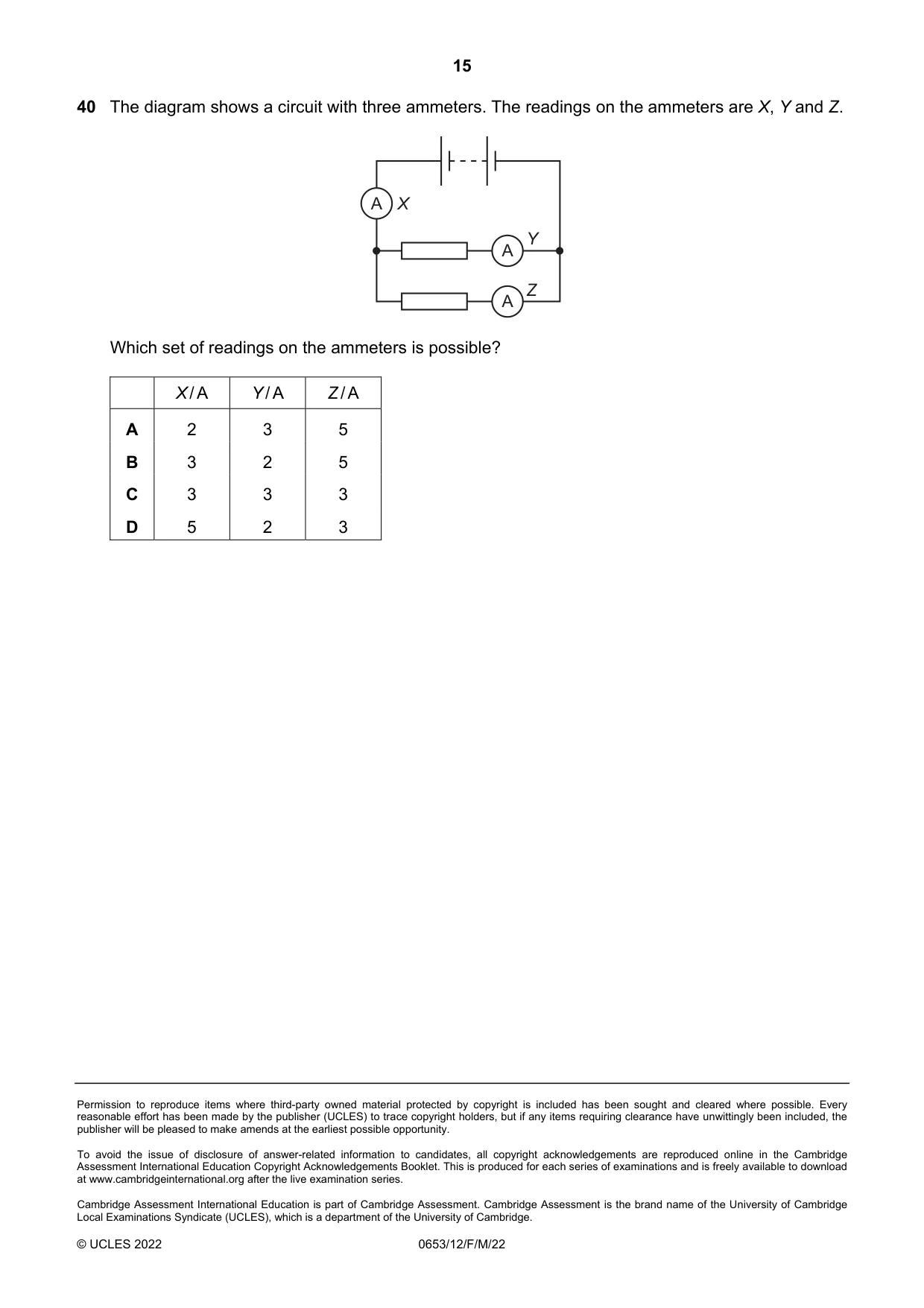
Q40 · The diagram shows a circuit with three ammeters
40 The diagram shows a circuit with three ammeters. The readings on the ammeters are X, Y and Z. A X Y A Z A Which set of readings on the ammeters is possible? X / A Y / A Z / A A 2 3 5 B 3 2 5 C 3 3 3 D 5 2 3
Mark scheme: D
What was in this paper
The subtopics covered by these 40 questions, and how many questions each got. Open one in a new tab to see every Cambridge question on it.
3Energy, work and power2Group I properties2Motion2Separation and purification2Alkanes1Atomic structure and the Periodic Table1Biological molecules1Carbon cycle1Cell structure1Characteristics of living organisms1Density1Digestive system1Electrical quantities1Electrolysis1Electromagnetic spectrum1Enzymes1Food chains and food webs1Heart1Identification of ions and gases1Kinetic particle model of matter1Leaf structure1Noble gases1Polymers1Properties of metals1Rate of reaction1Redox1Respiration1Sexual reproduction in humans1Sexual reproduction in plants1Sound1The characteristic properties of acids and bases1Transfer of thermal energy1Transpiration1What you needed in this session
Cambridge’s own grade thresholds for 2022 Feb/March, Paper 1 · Variant 2. A higher threshold means an easier paper — the bar moves with how the cohort did.