Cambridge IGCSE Science - Combined 0653 — 2025 Oct/Nov Paper 1 · Variant 3
0653/13/O/N/25 · 40 questions · 40 marks · 45 min
The question paper and its mark scheme, free to read here and free to download. This is Cambridge’s own paper, exactly as it was sat.
Question paper16 pages
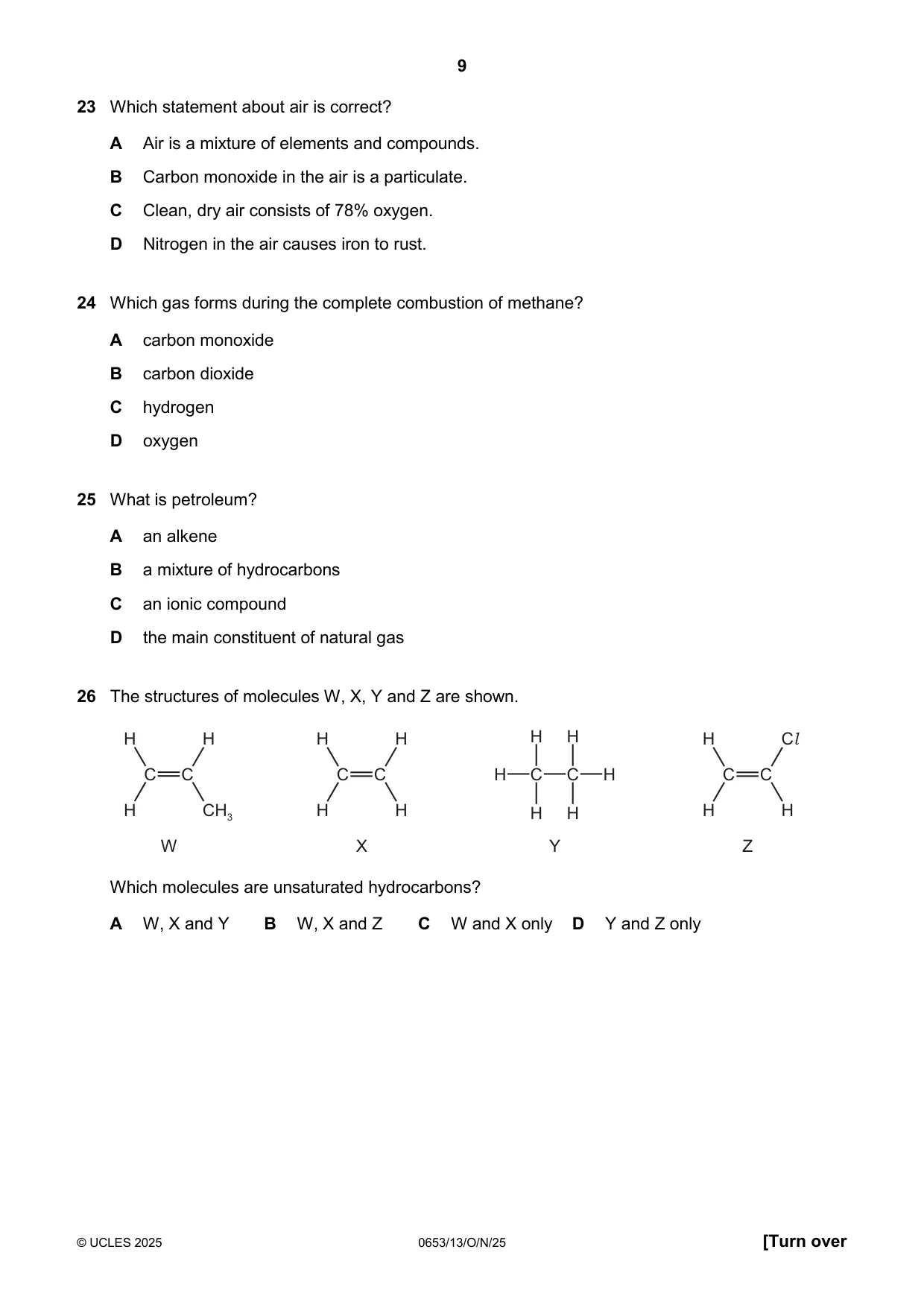
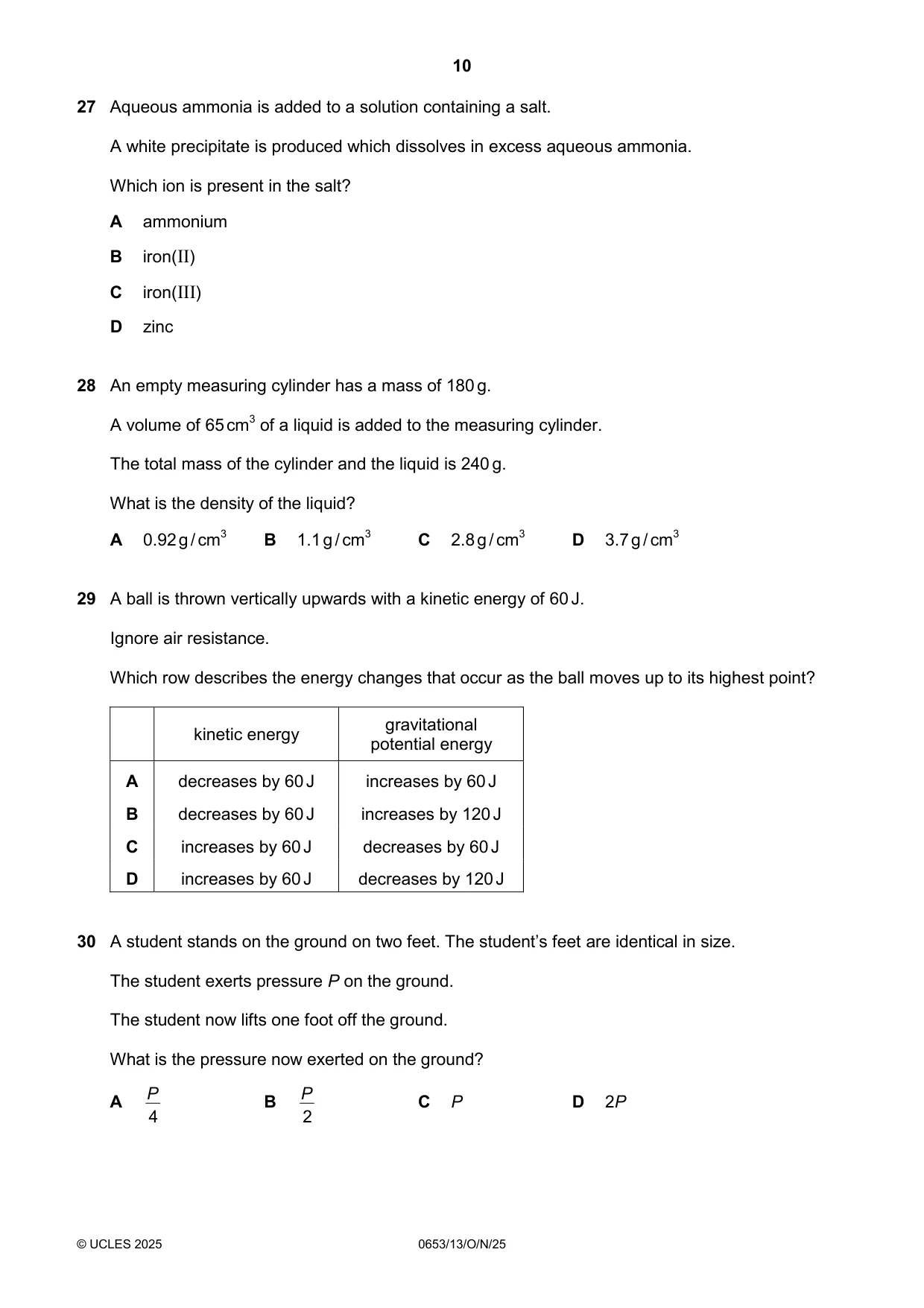
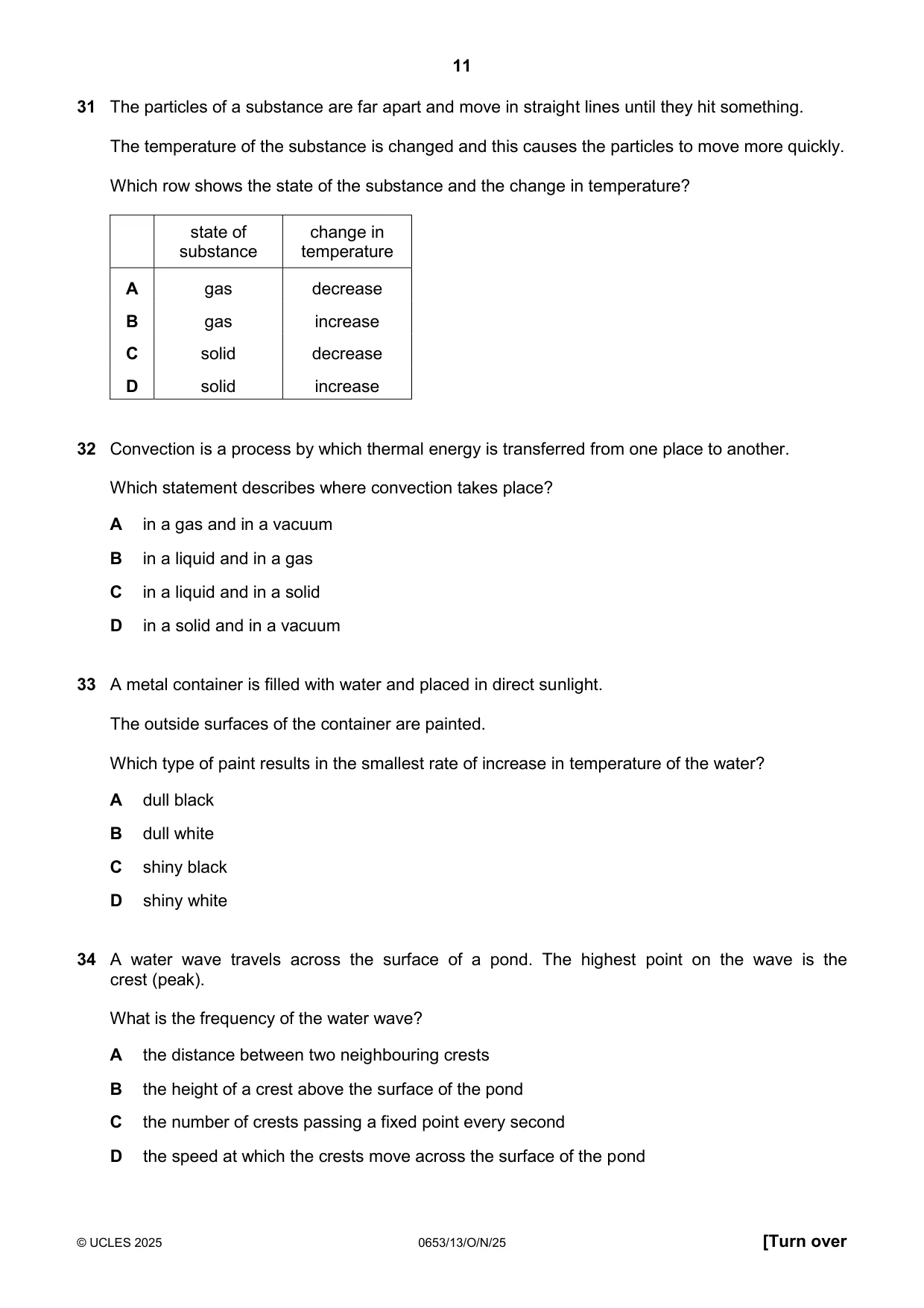
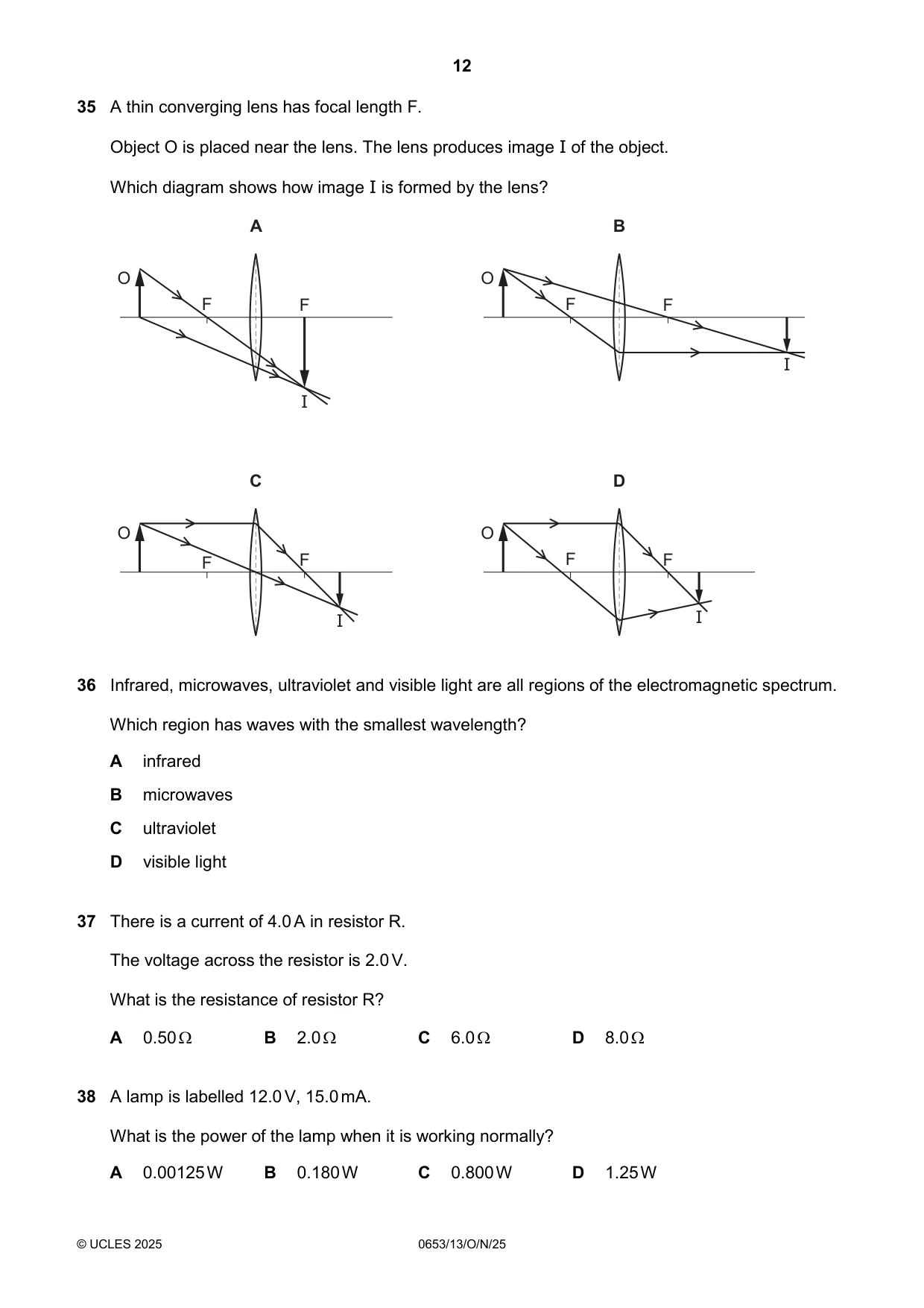

Mark scheme3 pages
Answers below. Sit the paper first if you are practising.
Questions as text
Q1 · A student is playing a game of football
1 A student is playing a game of football. Which characteristics of living organisms does the student show? 1 growth 2 movement 3 respiration 4 sensitivity A 1, 2 and 3 B 1, 3 and 4 C 1 only D 2, 3 and 4
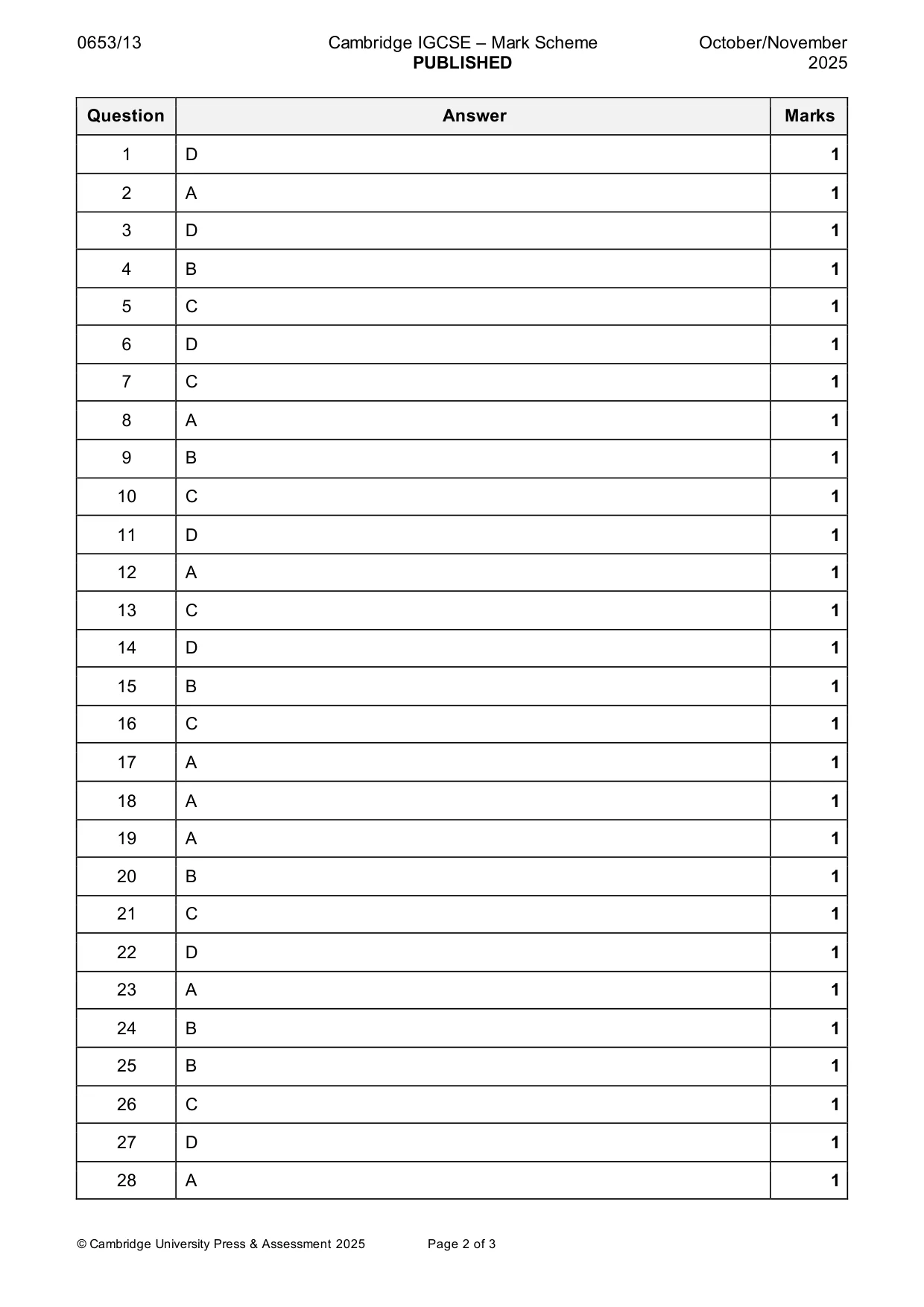
Mark scheme: D
Q2 · The diagram shows a plant cell
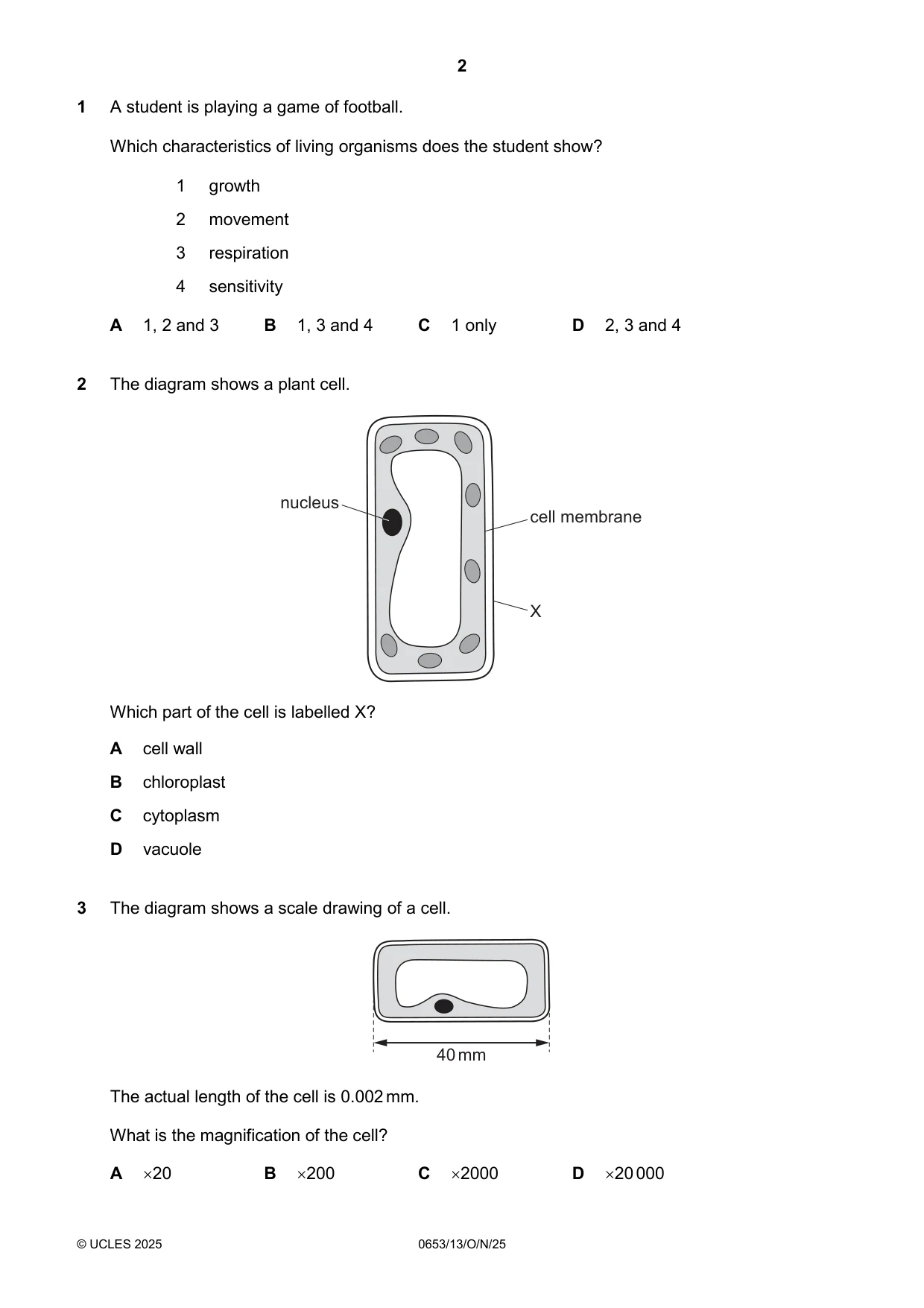
2 The diagram shows a plant cell. nucleus cell membrane X Which part of the cell is labelled X? A cell wall B chloroplast C cytoplasm D vacuole
Mark scheme: A
Q3 · The diagram shows a scale drawing of a cell
3 The diagram shows a scale drawing of a cell. 40 mm The actual length of the cell is 0.002 mm. What is the magnification of the cell? A 20 B 200 C 2000 D 20 000
Mark scheme: D
Q4 · Which biological molecule is made from amino acids?
4 Which biological molecule is made from amino acids? A fat B protein C starch D sugar
Mark scheme: B
Q5 · The table shows the time taken for an enzyme-controlled reaction to be completed at…
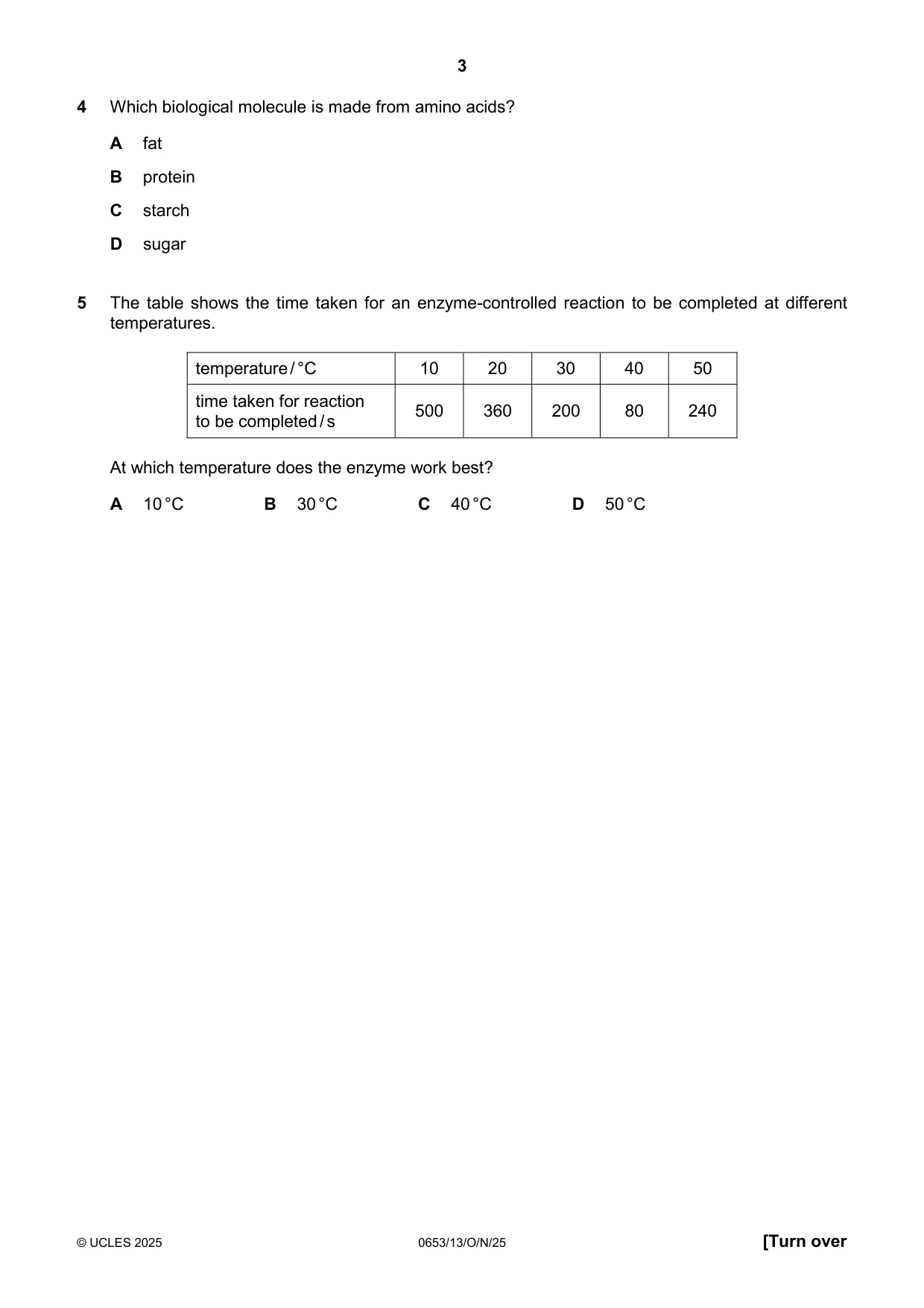
5 The table shows the time taken for an enzyme-controlled reaction to be completed at different temperatures. temperature / °C 10 20 30 40 50 time taken for reaction 500 360 200 80 240 to be completed / s At which temperature does the enzyme work best? A 10 °C B 30 °C C 40 °C D 50 °C
Mark scheme: C
Q6 · A student investigates the need for chlorophyll in photosynthesis
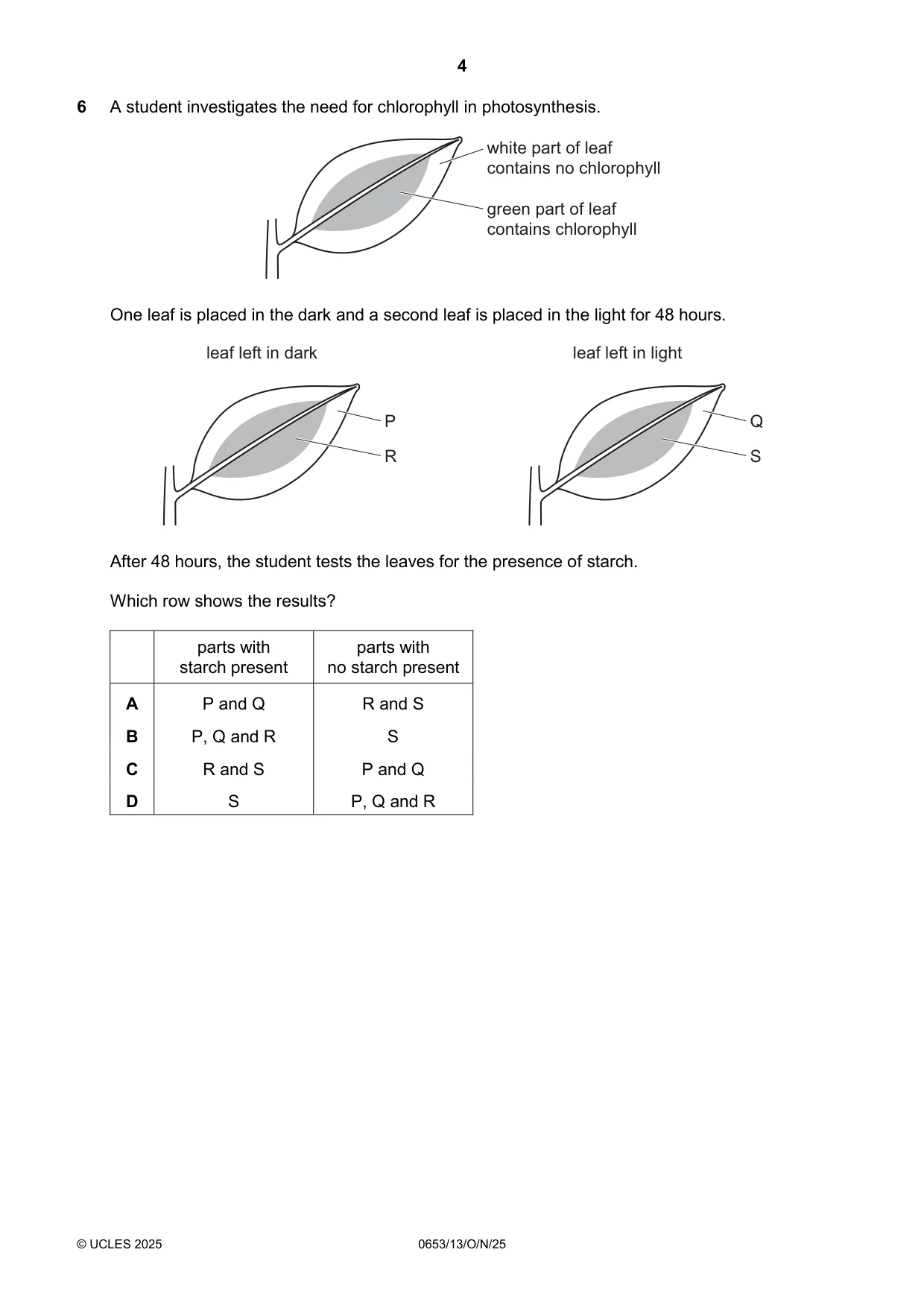
6 A student investigates the need for chlorophyll in photosynthesis. white part of leaf contains no chlorophyll green part of leaf contains chlorophyll One leaf is placed in the dark and a second leaf is placed in the light for 48 hours. leaf left in dark leaf left in light P Q R S After 48 hours, the student tests the leaves for the presence of starch. Which row shows the results? parts with parts with starch present no starch present A P and Q R and S B P, Q and R S C R and S P and Q D S P, Q and R
Mark scheme: D
Q7 · The diagram shows suggested daily proportions of different dietary food groups
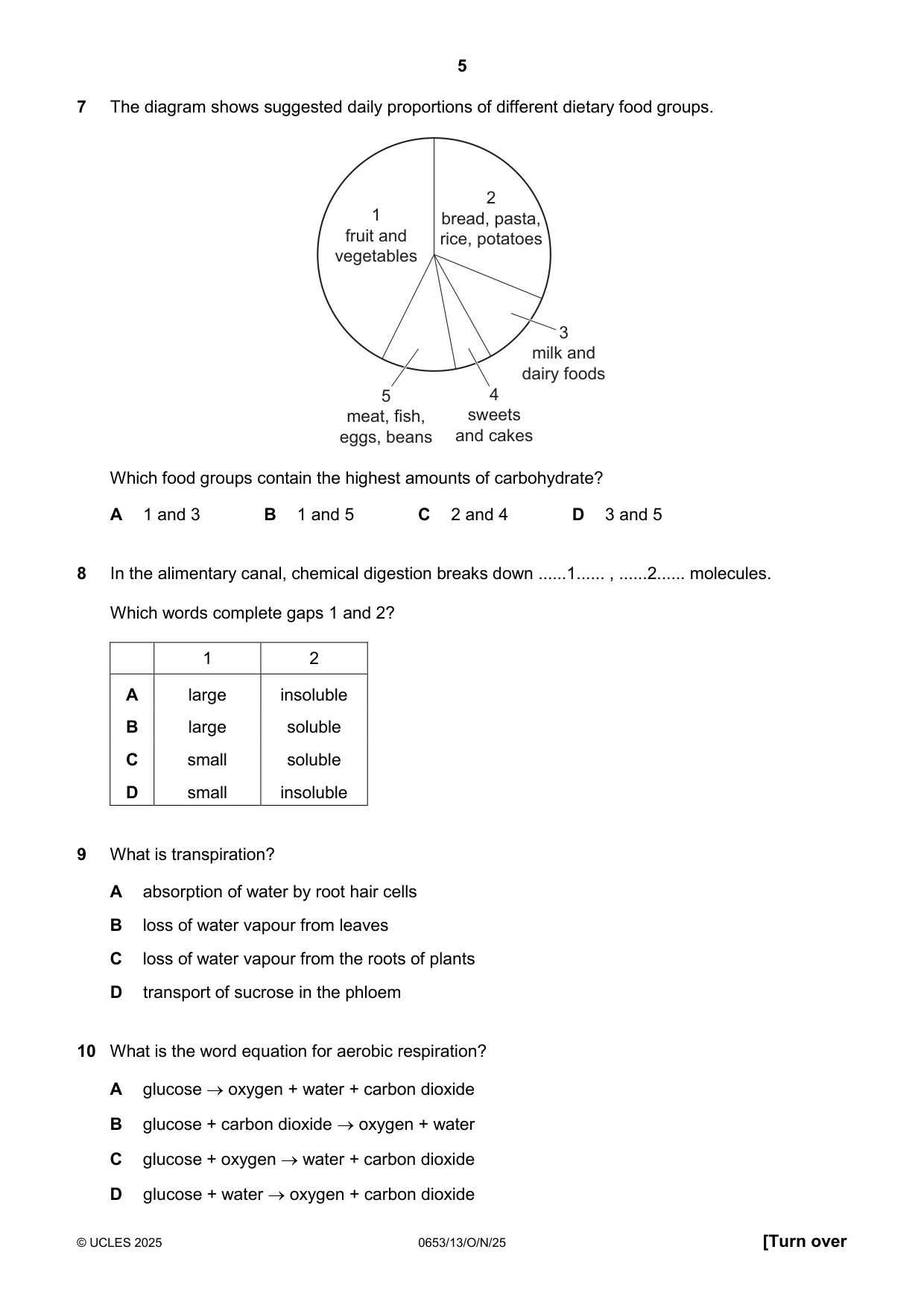
7 The diagram shows suggested daily proportions of different dietary food groups. 2 1 bread, pasta, fruit and rice, potatoes vegetables 3 milk and dairy foods 5 4 meat, fish, sweets eggs, beans and cakes Which food groups contain the highest amounts of carbohydrate? A 1 and 3 B 1 and 5 C 2 and 4 D 3 and 5
Mark scheme: C
Q8 · In the alimentary canal, chemical digestion breaks down ......1.....
8 In the alimentary canal, chemical digestion breaks down ......1...... , ......2...... molecules. Which words complete gaps 1 and 2? 1 2 A large insoluble B large soluble C small soluble D small insoluble
Mark scheme: A
Question 9
9 What is transpiration? A absorption of water by root hair cells B loss of water vapour from leaves C loss of water vapour from the roots of plants D transport of sucrose in the phloem
Mark scheme: B
Q10 · What is the word equation for aerobic respiration?
10 What is the word equation for aerobic respiration? A glucose oxygen + water + carbon dioxide B glucose + carbon dioxide oxygen + water C glucose + oxygen water + carbon dioxide D glucose + water oxygen + carbon dioxide
Mark scheme: C
Q11 · A student investigates the conditions needed for the germination of seeds
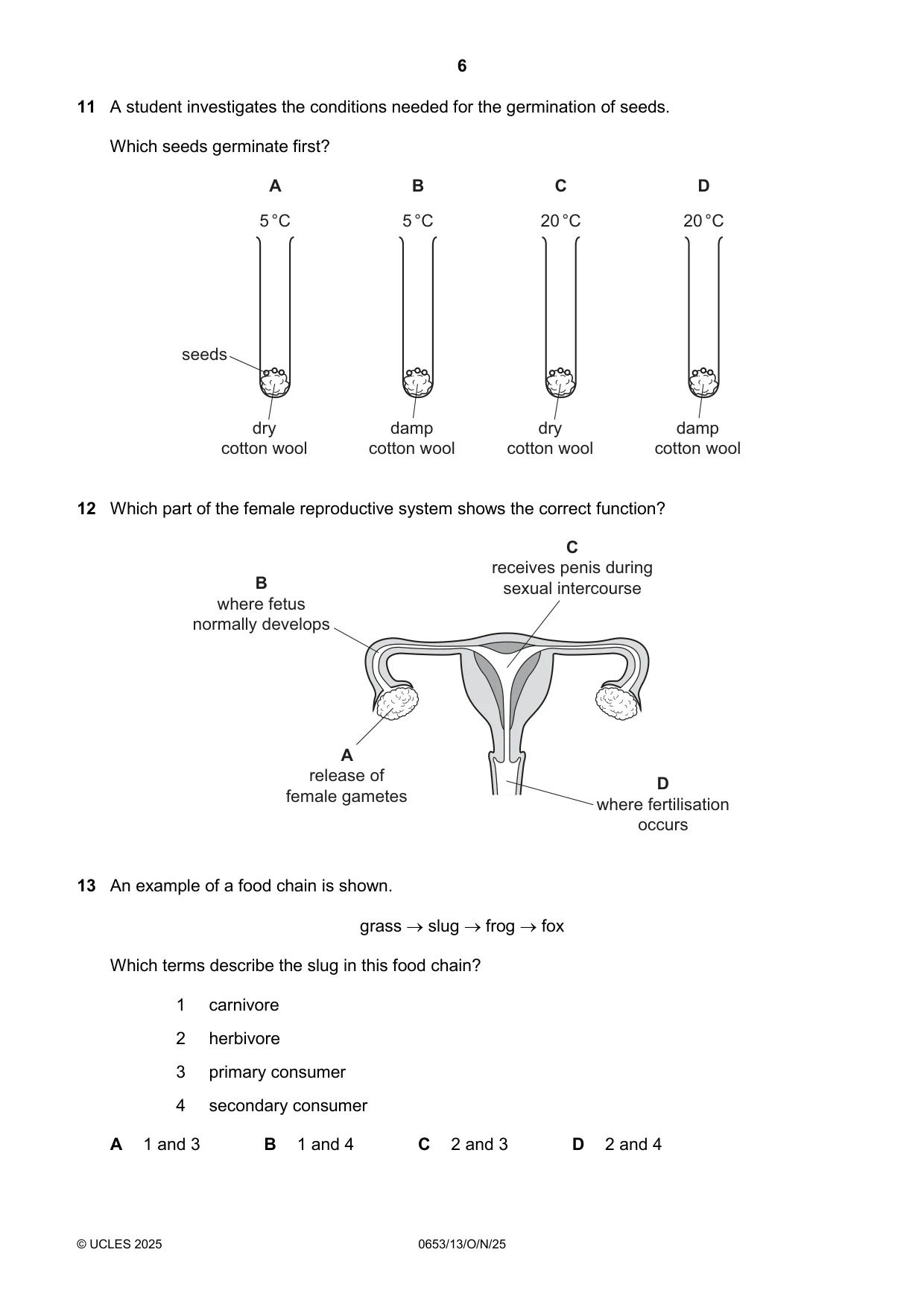
11 A student investigates the conditions needed for the germination of seeds. Which seeds germinate first? A B C D 5 °C 5 °C 20 °C 20 °C seeds dry damp dry damp cotton wool cotton wool cotton wool cotton wool
Mark scheme: D
Q12 · Which part of the female reproductive system shows the correct function?
12 Which part of the female reproductive system shows the correct function? C receives penis during B sexual intercourse where fetus normally develops A release of D female gametes where fertilisation occurs
Mark scheme: A
Q13 · An example of a food chain is shown
13 An example of a food chain is shown. grass slug frog fox Which terms describe the slug in this food chain? 1 carnivore 2 herbivore 3 primary consumer 4 secondary consumer A 1 and 3 B 1 and 4 C 2 and 3 D 2 and 4
Mark scheme: C
Q14 · Element Y has a proton number of 18 and a nucleon number of 40
14 Element Y has a proton number of 18 and a nucleon number of 40. Which statements about an atom of element Y are correct? 1 It has 40 neutrons in its nucleus. 2 It has 22 electrons. 3 It is unreactive. 4 It is in Group VIII of the Periodic Table. A 1 and 2 B 2 and 3 C 2 and 4 D 3 and 4
Mark scheme: D
Q15 · Which compound contains covalent bonds?
15 Which compound contains covalent bonds? A LiI B HCl C KCl D NaBr
Mark scheme: B
Q16 · The initial and the final temperatures of four different reactions are recorded
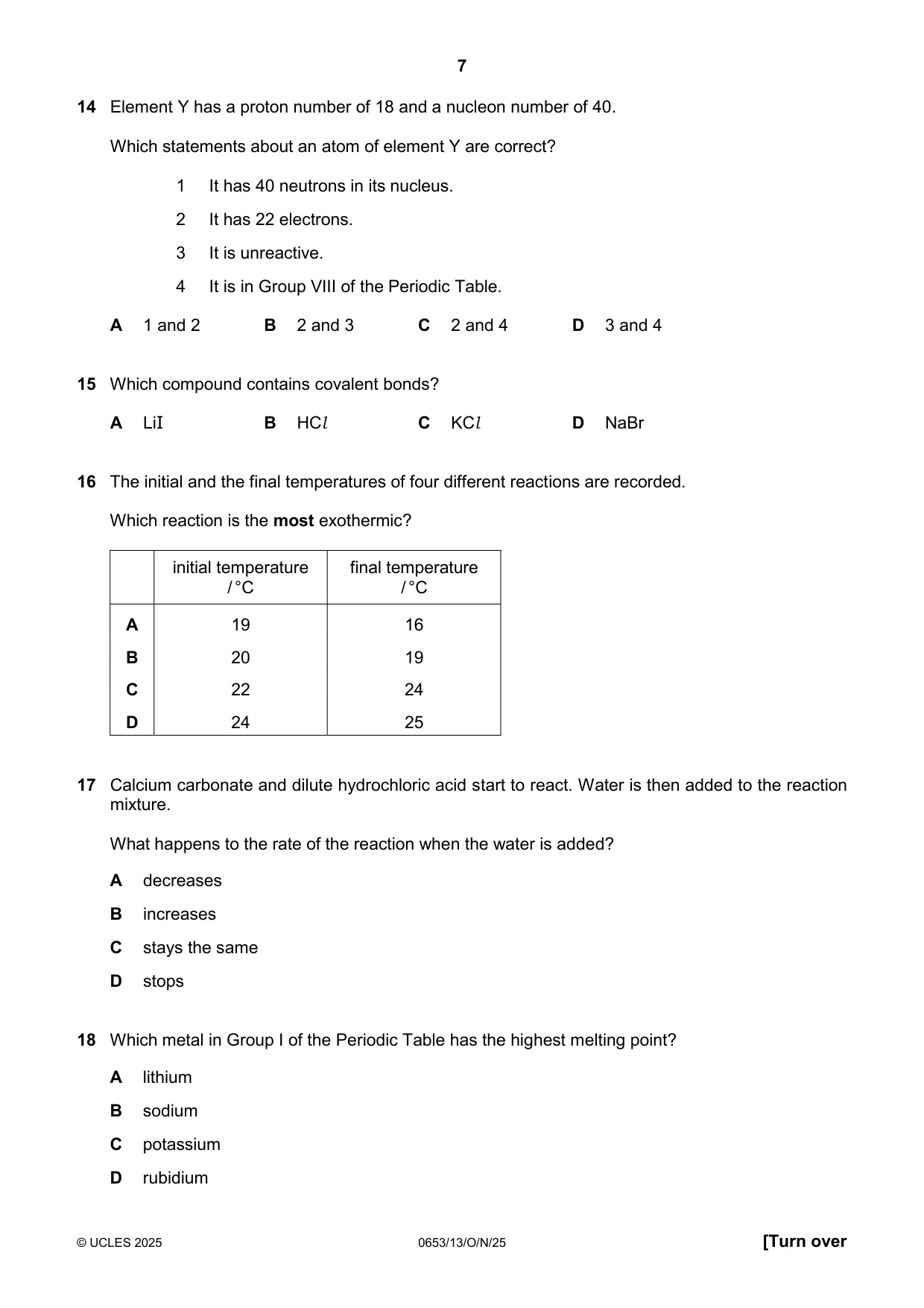
16 The initial and the final temperatures of four different reactions are recorded. Which reaction is the most exothermic? initial temperature final temperature / °C / °C A 19 16 B 20 19 C 22 24 D 24 25
Mark scheme: C
Q17 · Calcium carbonate and dilute hydrochloric acid start to react
17 Calcium carbonate and dilute hydrochloric acid start to react. Water is then added to the reaction mixture. What happens to the rate of the reaction when the water is added? A decreases B increases C stays the same D stops
Mark scheme: A
Q18 · Which metal in Group I of the Periodic Table has the highest melting point?
18 Which metal in Group I of the Periodic Table has the highest melting point? A lithium B sodium C potassium D rubidium
Mark scheme: A
Q19 · Element Q is in Group VII of the Periodic Table
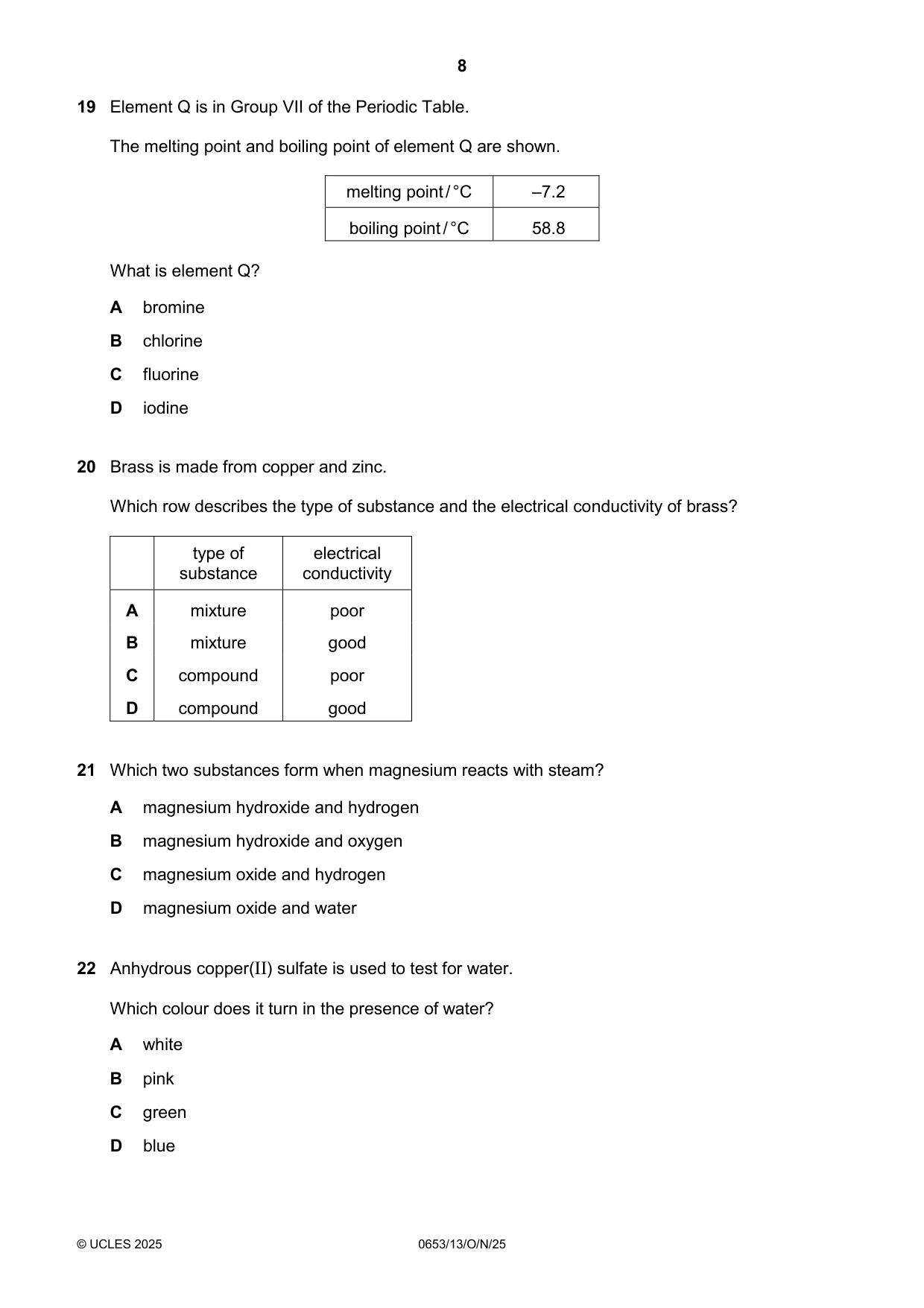
19 Element Q is in Group VII of the Periodic Table. The melting point and boiling point of element Q are shown. melting point / °C –7.2 boiling point / °C 58.8 What is element Q? A bromine B chlorine C fluorine D iodine
Mark scheme: A
Q20 · Brass is made from copper and zinc
20 Brass is made from copper and zinc. Which row describes the type of substance and the electrical conductivity of brass? type of electrical substance conductivity A mixture poor B mixture good C compound poor D compound good
Mark scheme: B
Q21 · Which two substances form when magnesium reacts with steam?
21 Which two substances form when magnesium reacts with steam? A magnesium hydroxide and hydrogen B magnesium hydroxide and oxygen C magnesium oxide and hydrogen D magnesium oxide and water
Mark scheme: C
Q22 · Anhydrous copper(II) sulfate is used to test for water
22 Anhydrous copper(II) sulfate is used to test for water. Which colour does it turn in the presence of water? A white B pink C green D blue
Mark scheme: D
Q23 · Which statement about air is correct?
23 Which statement about air is correct? A Air is a mixture of elements and compounds. B Carbon monoxide in the air is a particulate. C Clean, dry air consists of 78% oxygen. D Nitrogen in the air causes iron to rust.
Mark scheme: A
Q24 · Which gas forms during the complete combustion of methane?
24 Which gas forms during the complete combustion of methane? A carbon monoxide B carbon dioxide C hydrogen D oxygen
Mark scheme: B
Question 25
25 What is petroleum? A an alkene B a mixture of hydrocarbons C an ionic compound D the main constituent of natural gas
Mark scheme: B
Q26 · The structures of molecules W, X, Y and Z are shown
26 The structures of molecules W, X, Y and Z are shown. H H H H H H H Cl C C C C H C C H C C H CH3 H H H H H H W X Y Z Which molecules are unsaturated hydrocarbons? A W, X and Y B W, X and Z C W and X only D Y and Z only
Mark scheme: C
Q27 · Aqueous ammonia is added to a solution containing a salt
27 Aqueous ammonia is added to a solution containing a salt. A white precipitate is produced which dissolves in excess aqueous ammonia. Which ion is present in the salt? A ammonium B iron(II) C iron(III) D zinc
Mark scheme: D
Q28 · An empty measuring cylinder has a mass of 180 g
28 An empty measuring cylinder has a mass of 180 g. A volume of 65 cm3 of a liquid is added to the measuring cylinder. The total mass of the cylinder and the liquid is 240 g. What is the density of the liquid? A 0.92 g / cm3 B 1.1 g / cm3 C 2.8 g / cm3 D 3.7 g / cm3
Mark scheme: A
Q29 · A ball is thrown vertically upwards with a kinetic energy of 60 J
29 A ball is thrown vertically upwards with a kinetic energy of 60 J. Ignore air resistance. Which row describes the energy changes that occur as the ball moves up to its highest point? gravitational kinetic energy potential energy A decreases by 60 J increases by 60 J B decreases by 60 J increases by 120 J C increases by 60 J decreases by 60 J D increases by 60 J decreases by 120 J
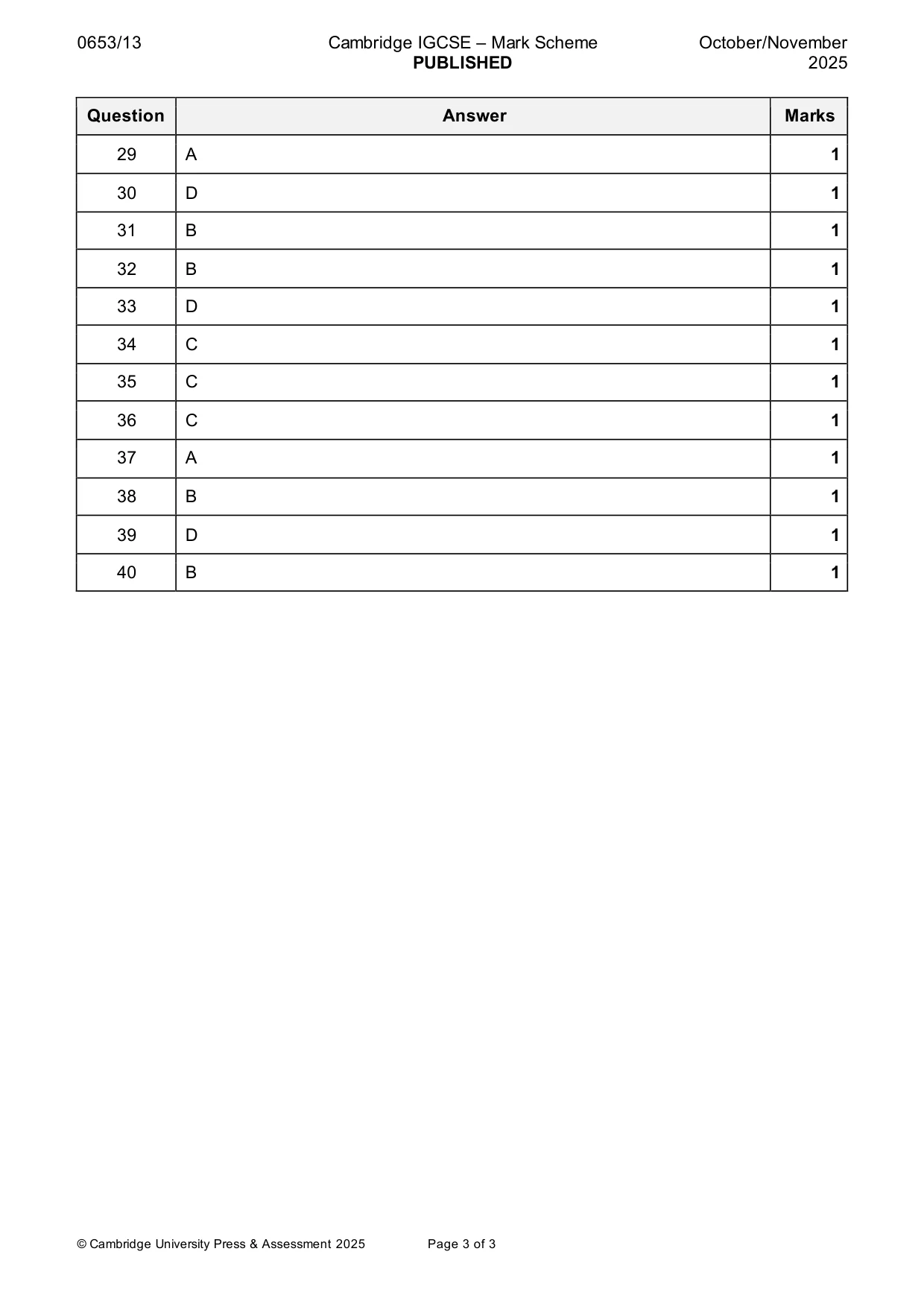
Mark scheme: A
Q30 · A student stands on the ground on two feet
30 A student stands on the ground on two feet. The student’s feet are identical in size. The student exerts pressure P on the ground. The student now lifts one foot off the ground. What is the pressure now exerted on the ground? P P A B C P D 2P 4 2
Mark scheme: D
Q31 · The particles of a substance are far apart and move in straight lines until they hit…
31 The particles of a substance are far apart and move in straight lines until they hit something. The temperature of the substance is changed and this causes the particles to move more quickly. Which row shows the state of the substance and the change in temperature? state of change in substance temperature A gas decrease B gas increase C solid decrease D solid increase
Mark scheme: B
Q32 · Convection is a process by which thermal energy is transferred from one place to another
32 Convection is a process by which thermal energy is transferred from one place to another. Which statement describes where convection takes place? A in a gas and in a vacuum B in a liquid and in a gas C in a liquid and in a solid D in a solid and in a vacuum
Mark scheme: B
Q33 · A metal container is filled with water and placed in direct sunlight
33 A metal container is filled with water and placed in direct sunlight. The outside surfaces of the container are painted. Which type of paint results in the smallest rate of increase in temperature of the water? A dull black B dull white C shiny black D shiny white
Mark scheme: D
Q34 · A water wave travels across the surface of a pond
34 A water wave travels across the surface of a pond. The highest point on the wave is the crest (peak). What is the frequency of the water wave? A the distance between two neighbouring crests B the height of a crest above the surface of the pond C the number of crests passing a fixed point every second D the speed at which the crests move across the surface of the pond
Mark scheme: C
Q35 · A thin converging lens has focal length F
35 A thin converging lens has focal length F. Object O is placed near the lens. The lens produces image I of the object. Which diagram shows how image I is formed by the lens? A B O O F F F F I I C D O O F F F F I I
Mark scheme: C
Q36 · Infrared, microwaves, ultraviolet and visible light are all regions of the…
36 Infrared, microwaves, ultraviolet and visible light are all regions of the electromagnetic spectrum. Which region has waves with the smallest wavelength? A infrared B microwaves C ultraviolet D visible light
Mark scheme: C
Q37 · There is a current of 4.0 A in resistor R
37 There is a current of 4.0 A in resistor R. The voltage across the resistor is 2.0 V. What is the resistance of resistor R? A 0.50 B 2.0 C 6.0 D 8.0
Mark scheme: A
Q38 · A lamp is labelled 12.0 V, 15.0 mA
38 A lamp is labelled 12.0 V, 15.0 mA. What is the power of the lamp when it is working normally? A 0.00125 W B 0.180 W C 0.800 W D 1.25 W
Mark scheme: B
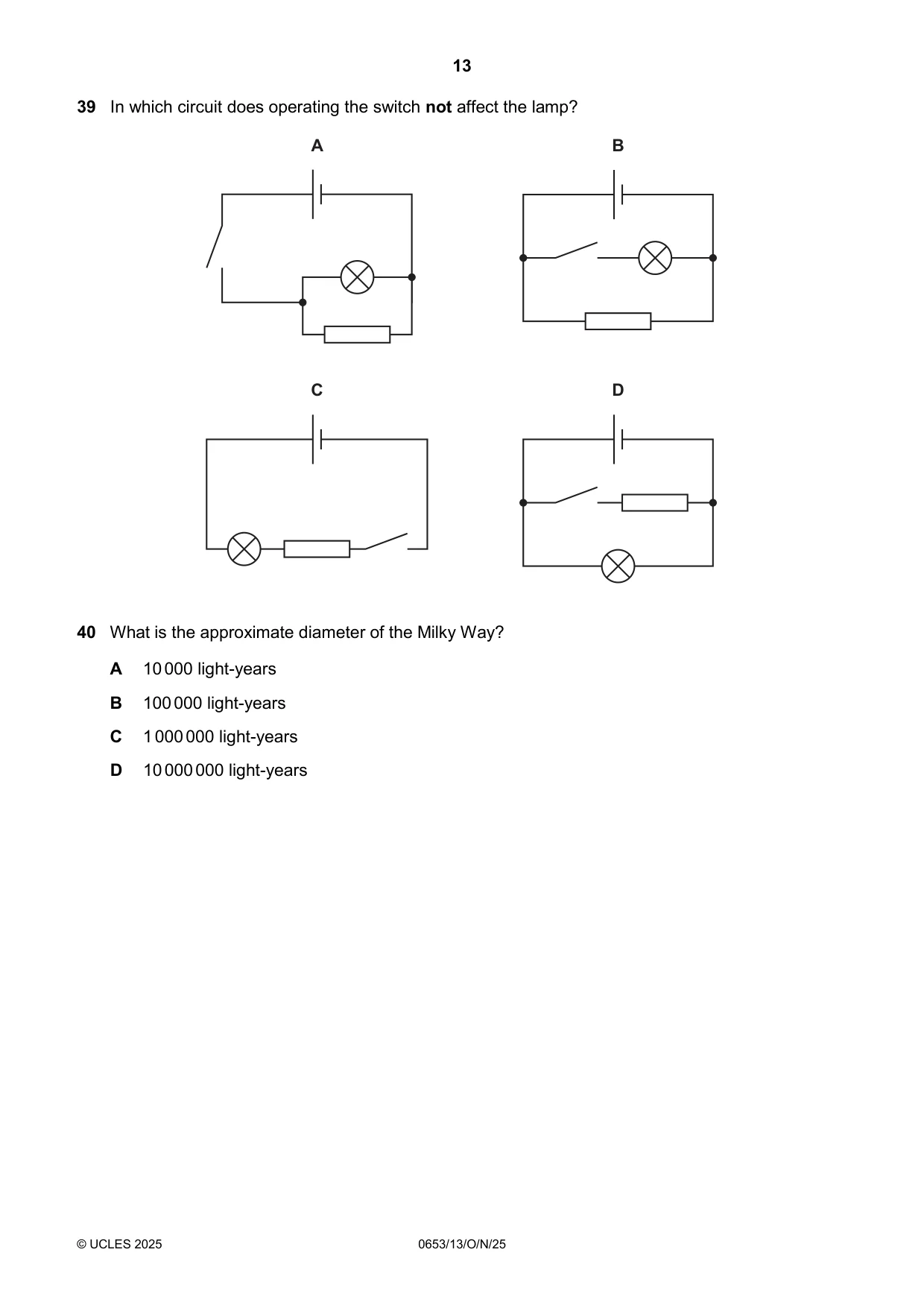
Q39 · In which circuit does operating the switch not affect the lamp?
39 In which circuit does operating the switch not affect the lamp? A B C D
Mark scheme: D
Q40 · What is the approximate diameter of the Milky Way?
40 What is the approximate diameter of the Milky Way? A 10 000 light-years B 100 000 light-years C 1 000 000 light-years D 10 000 000 light-years
Mark scheme: B
What was in this paper
The subtopics covered by these 40 questions, and how many questions each got. Open one in a new tab to see every Cambridge question on it.
2Transfer of thermal energy2Air quality and climate1Alkanes1Alkenes1Alloys and their properties1Atomic structure and the Periodic Table1Biological molecules1Cell structure1Characteristics of living organisms1Density1Diet1Digestion1Electrical circuits1Electromagnetic spectrum1Energy, work and power1Enzymes1Exothermic and endothermic reactions1Food chains and food webs1Fuels1General properties of waves1Group I properties1Group VII properties1Identification of ions and gases1Kinetic particle model of matter1Light1Photosynthesis1Pressure1Rate of reaction1Reactivity series1Respiration1Sexual reproduction in humans1Sexual reproduction in plants1Simple molecules and covalent bonds1Size of specimens1Stars and the Universe1Transpiration1Water1What you needed in this session
Cambridge’s own grade thresholds for 2025 Oct/Nov, Paper 1 · Variant 3. A higher threshold means an easier paper — the bar moves with how the cohort did.