Cambridge IGCSE Science - Combined 0653 — 2016 May/June Paper 1 · Variant 3
0653/13/M/J/16 · 40 questions · 40 marks · ≈45 min
The question paper and its mark scheme, free to read here and free to download. This is Cambridge’s own paper, exactly as it was sat.
Question paper16 pages
Mark scheme2 pages
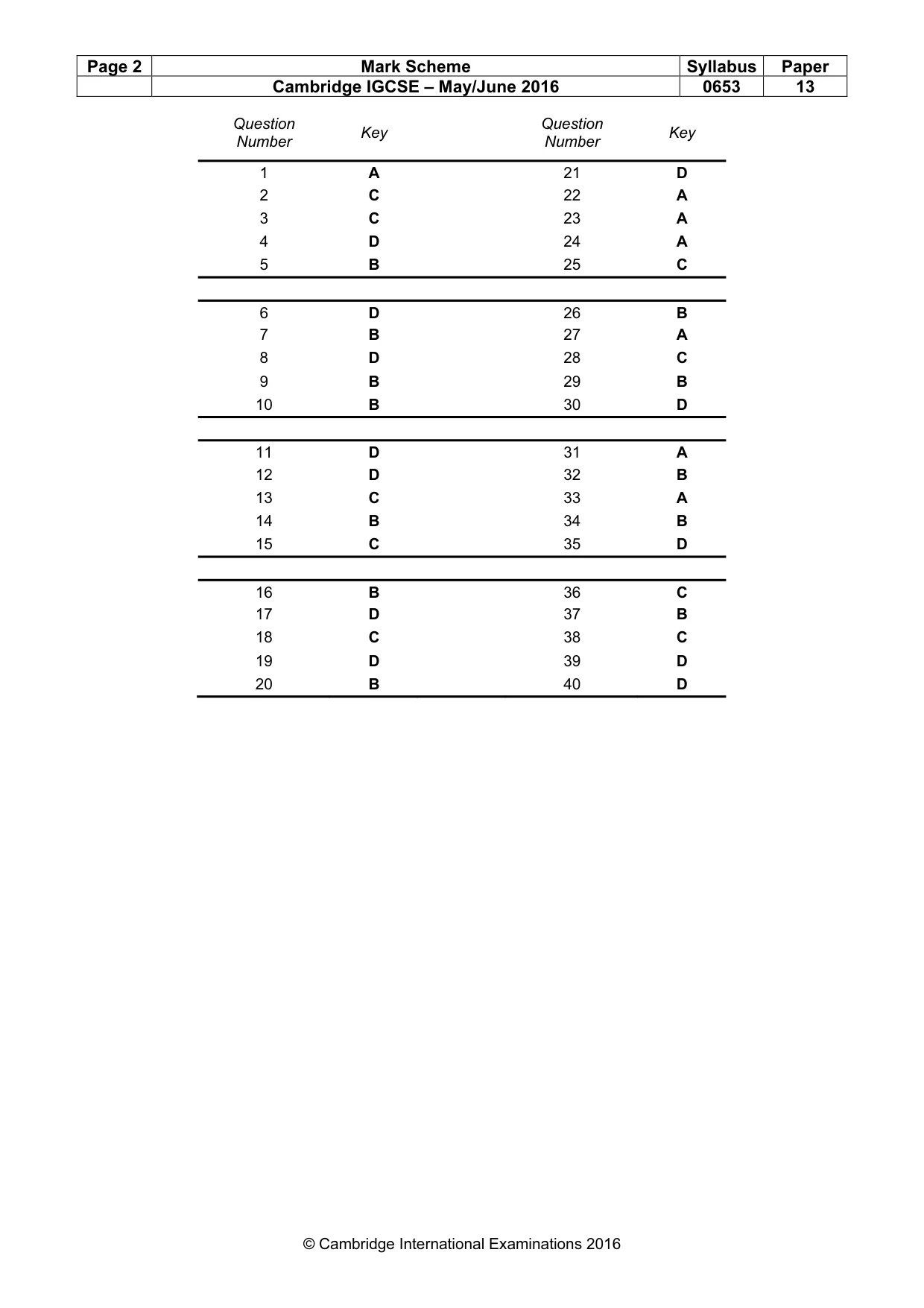
Answers below. Sit the paper first if you are practising.
Questions as text
Q1 · What are the characteristics of living organisms?
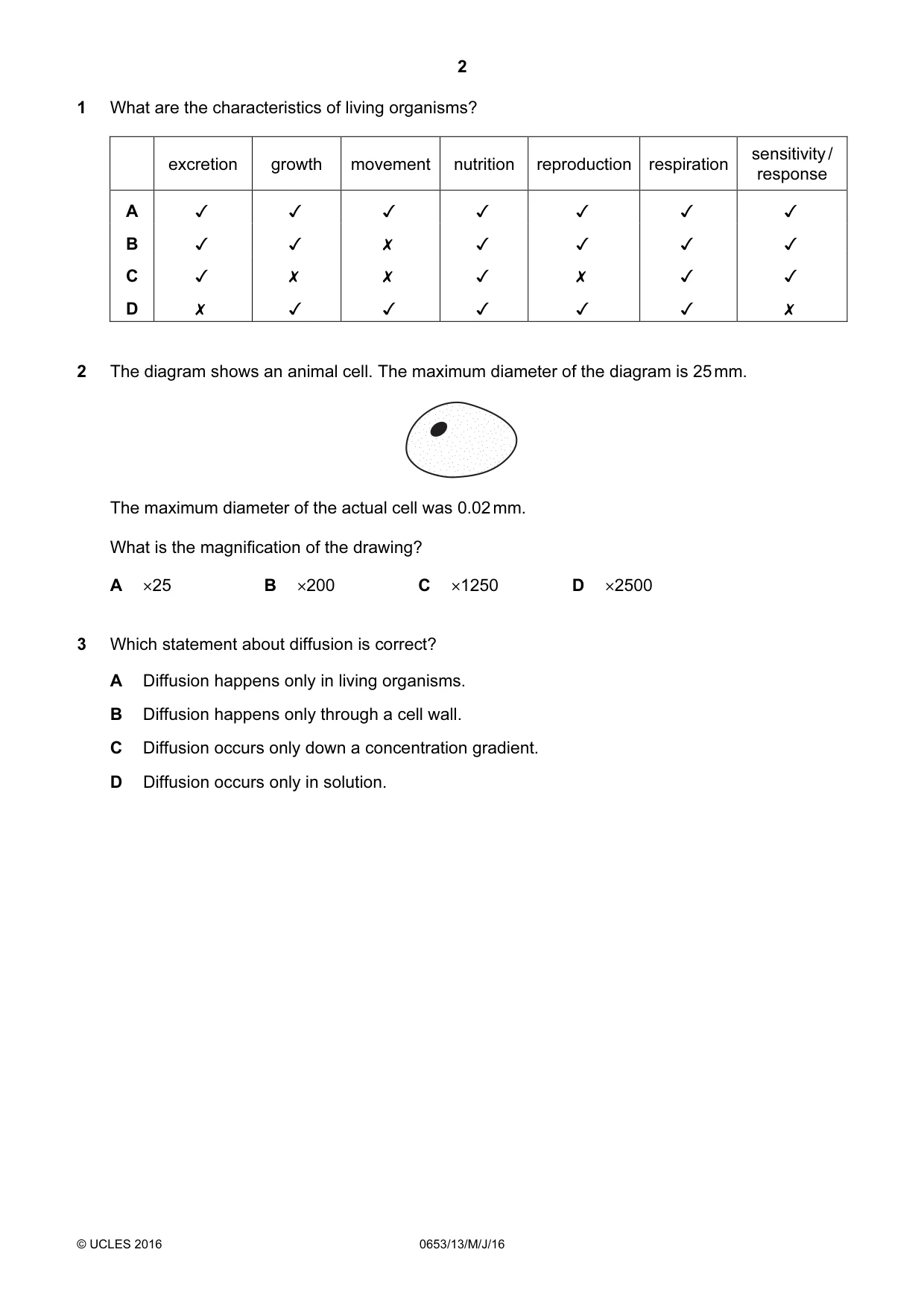
1 What are the characteristics of living organisms? excretion growth | movement | nutrition | reproduction | respiration veopones, A v v v v Vv JV V B v v x v V 4 V Cc v x x Jv x 4 W, D x v v v Vv JV x
Mark scheme: A
Q2 · The diagram shows an animal cell
2 The diagram shows an animal cell. The maximum diameter of the diagram is 25 mm. The maximum diameter of the actual cell was 0.02 mm. What is the magnification of the drawing? A ×25 B ×200 C ×1250 D ×2500
Mark scheme: C
Q3 · Which statement about diffusion is correct?
3 Which statement about diffusion is correct? A Diffusion happens only in living organisms. B Diffusion happens only through a cell wall. C Diffusion occurs only down a concentration gradient. D Diffusion occurs only in solution.
Mark scheme: C
Q4 · The diagram shows the effect of increasing temperature on an enzyme-controlled reaction…
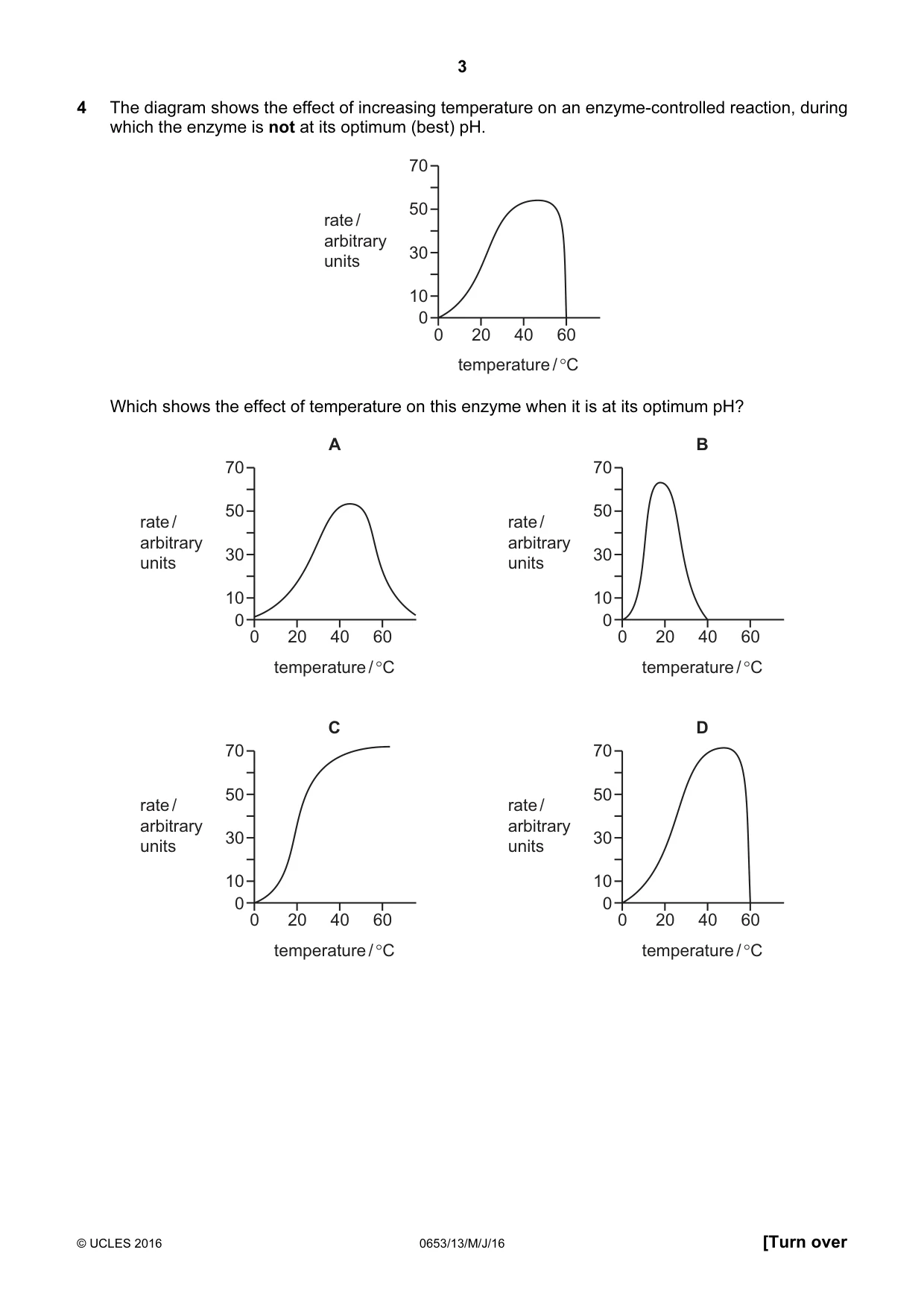
4 The diagram shows the effect of increasing temperature on an enzyme-controlled reaction, during which the enzyme is not at its optimum (best) pH. 70 50 rate / arbitrary 30 units 10 0 0 20 40 60 temperature / °C Which shows the effect of temperature on this enzyme when it is at its optimum pH? A B 70 70 50 50 rate / rate / arbitrary arbitrary 30 30 units units 10 10 0 0 0 20 40 60 0 20 40 60 temperature / °C temperature / °C C D 70 70 50 50 rate / rate / arbitrary arbitrary 30 30 units units 10 10 0 0 0 20 40 60 0 20 40 60 temperature / °C temperature / °C
Mark scheme: D
Q5 · The diagram shows a section through part of a leaf as seen under a light microscope
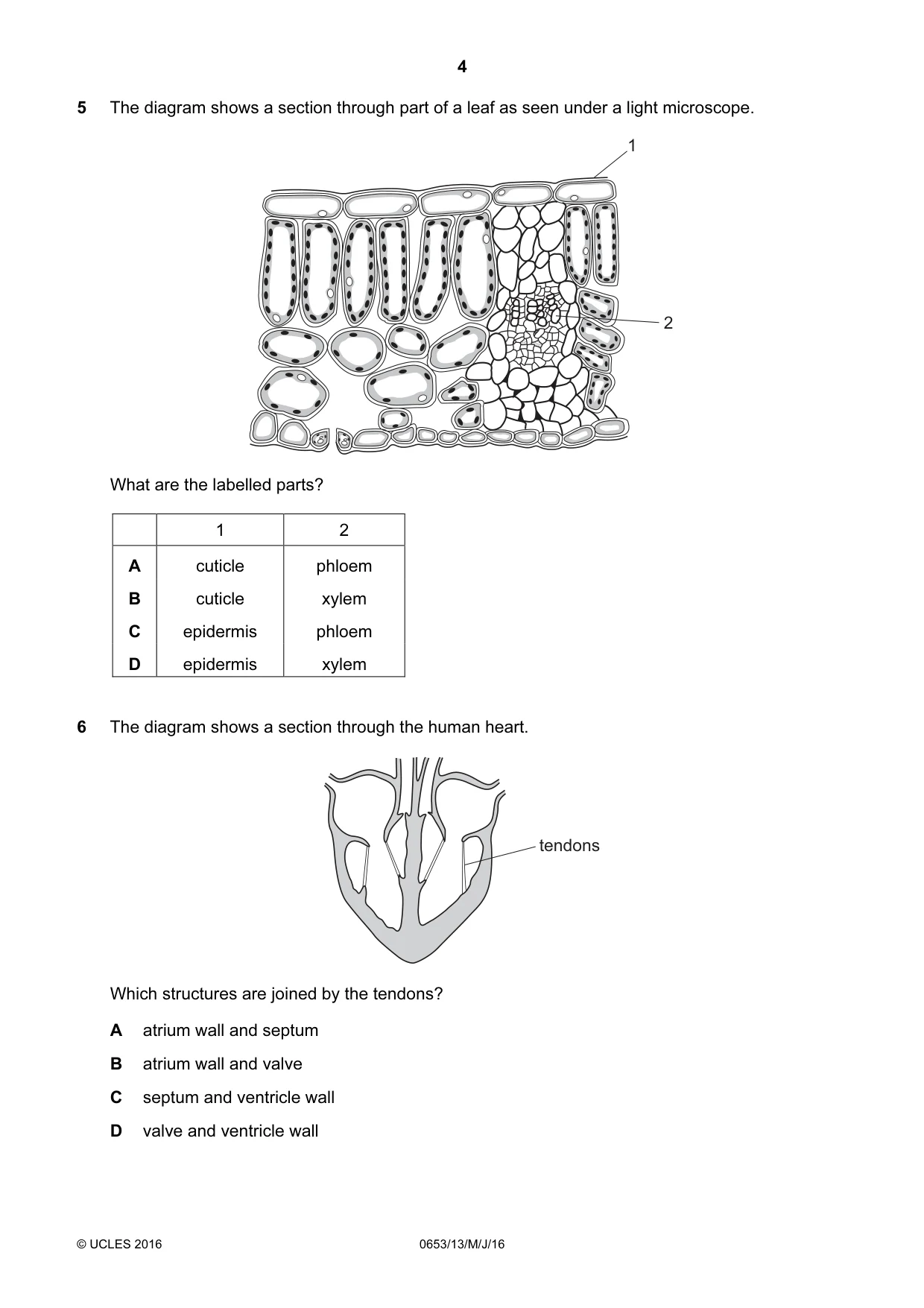
5 The diagram shows a section through part of a leaf as seen under a light microscope. 1 2 What are the labelled parts? 1 2 A cuticle phloem B cuticle xylem C epidermis phloem D epidermis xylem
Mark scheme: B
Q6 · The diagram shows a section through the human heart
6 The diagram shows a section through the human heart. tendons Which structures are joined by the tendons? A atrium wall and septum B atrium wall and valve C septum and ventricle wall D valve and ventricle wall
Mark scheme: D
Q7 · Where does most water enter a plant?
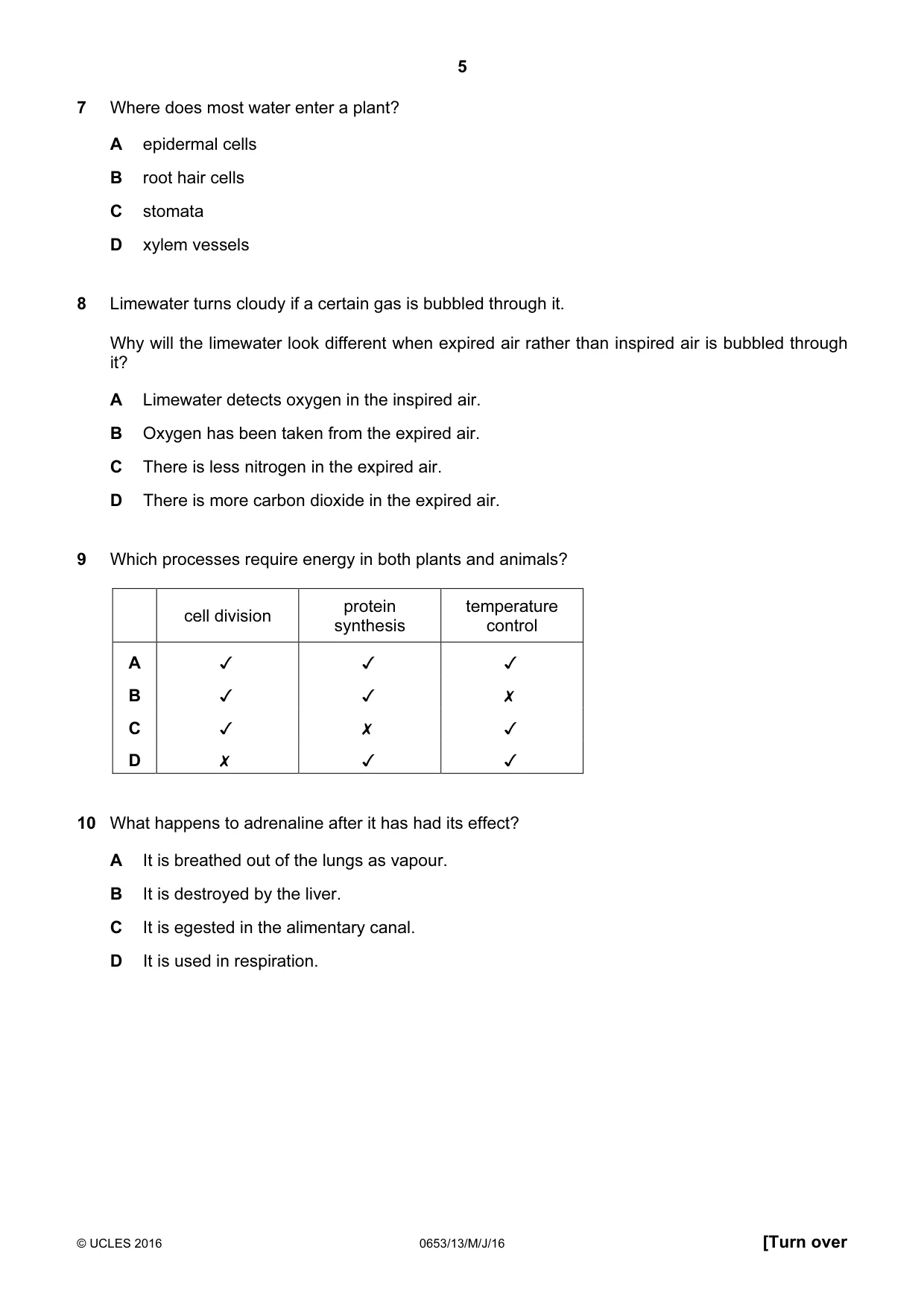
7 Where does most water enter a plant? A epidermal cells B root hair cells C stomata D xylem vessels
Mark scheme: B
Q8 · Limewater turns cloudy if a certain gas is bubbled through it
8 Limewater turns cloudy if a certain gas is bubbled through it. Why will the limewater look different when expired air rather than inspired air is bubbled through it? A Limewater detects oxygen in the inspired air. B Oxygen has been taken from the expired air. C There is less nitrogen in the expired air. D There is more carbon dioxide in the expired air.
Mark scheme: D
Q9 · Which processes require energy in both plants and animals?
9 Which processes require energy in both plants and animals? as protein temperature cell division . synthesis control A Jv Jv J B Jv Jv x Cc Jv x J D x Jv Jv
Mark scheme: B
Q10 · What happens to adrenaline after it has had its effect?
10 What happens to adrenaline after it has had its effect? A It is breathed out of the lungs as vapour. B It is destroyed by the liver. C It is egested in the alimentary canal. D It is used in respiration.
Mark scheme: B
Q11 · What are the features of sexual reproduction?
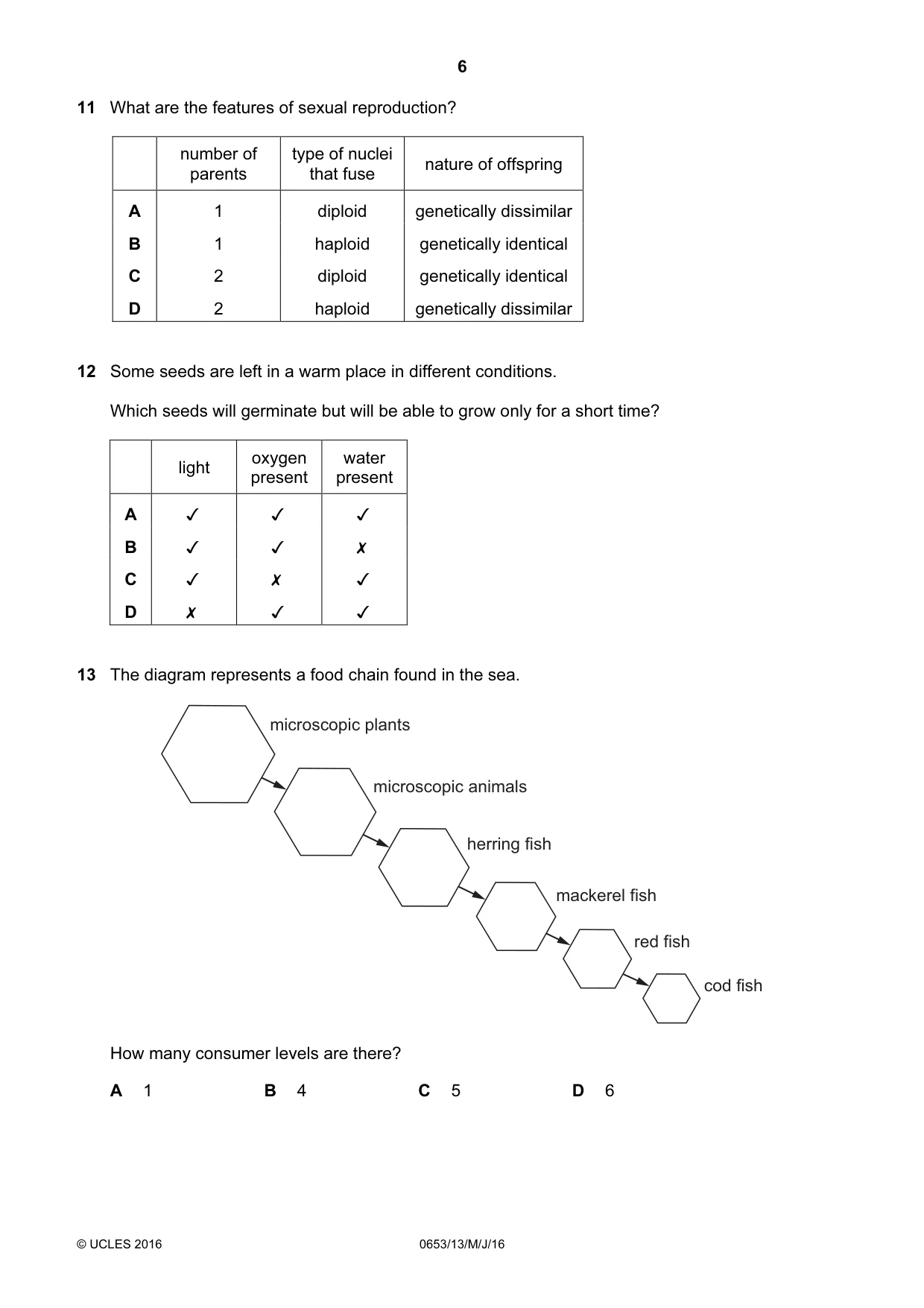
11 What are the features of sexual reproduction? number of type of nuclei nature of offspring parents that fuse A 1 diploid genetically dissimilar B 1 haploid genetically identical C 2 diploid genetically identical D 2 haploid genetically dissimilar
Mark scheme: D
Q12 · Some seeds are left in a warm place in different conditions
12 Some seeds are left in a warm place in different conditions. Which seeds will germinate but will be able to grow only for a short time? ight | Present | present Al v J J Bil v J x cl ov x J pD| x J J
Mark scheme: D
Q13 · The diagram represents a food chain found in the sea
13 The diagram represents a food chain found in the sea. microscopic plants microscopic animals herring fish mackerel fish red fish cod fish How many consumer levels are there? A 1 B 4 C 5 D 6
Mark scheme: C
Q14 · The apparatus used to remove sand from a mixture of salt and sand is shown
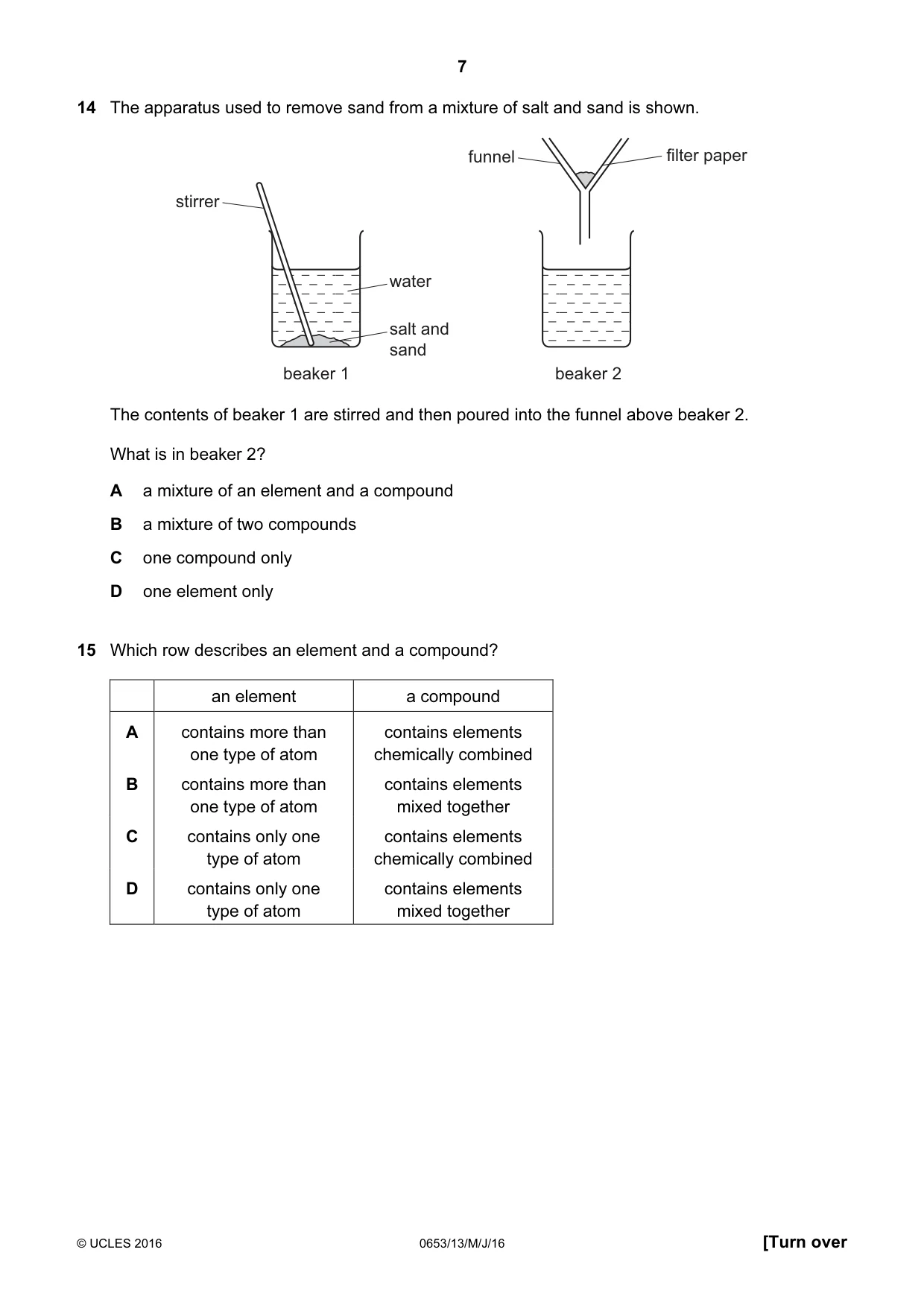
14 The apparatus used to remove sand from a mixture of salt and sand is shown. funnel filter paper stirrer water salt and sand beaker 1 beaker 2 The contents of beaker 1 are stirred and then poured into the funnel above beaker 2. What is in beaker 2? A a mixture of an element and a compound B a mixture of two compounds C one compound only D one element only
Mark scheme: B
Q15 · Which row describes an element and a compound?
15 Which row describes an element and a compound? an element a compound A contains more than contains elements one type of atom chemically combined B contains more than contains elements one type of atom mixed together C contains only one contains elements type of atom chemically combined D contains only one contains elements type of atom mixed together
Mark scheme: C
Q16 · The positions of elements P, Q, R, S and T in the Periodic Table are shown
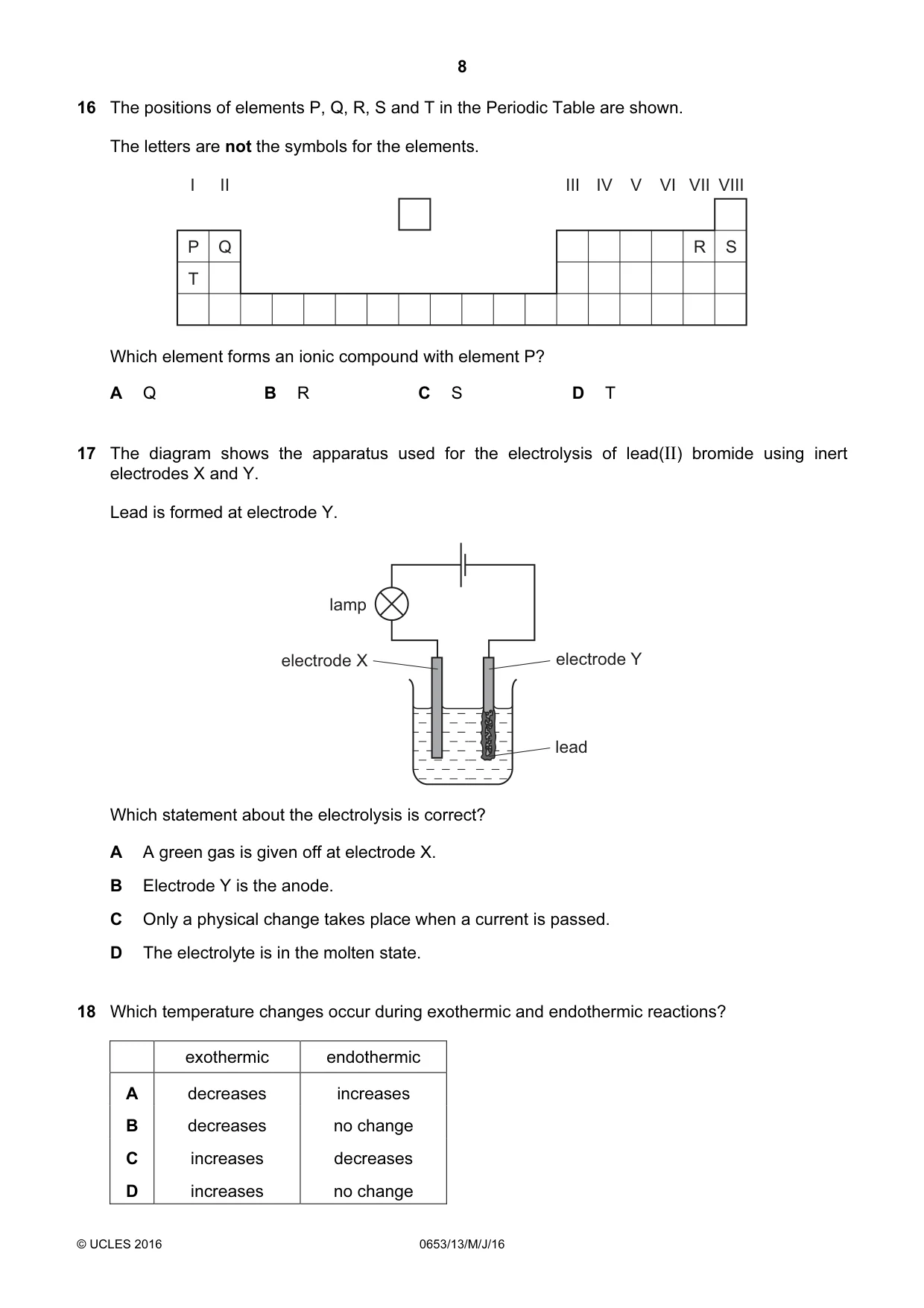
16 The positions of elements P, Q, R, S and T in the Periodic Table are shown. The letters are not the symbols for the elements. I II III IV V VI VII VIII P Q R S T Which element forms an ionic compound with element P? A Q B R C S D T
Mark scheme: B
Q17 · The diagram shows the apparatus used for the electrolysis of lead(II) bromide using inert…
17 The diagram shows the apparatus used for the electrolysis of lead(II) bromide using inert electrodes X and Y. Lead is formed at electrode Y. lamp electrode X electrode Y lead Which statement about the electrolysis is correct? A A green gas is given off at electrode X. B Electrode Y is the anode. C Only a physical change takes place when a current is passed. D The electrolyte is in the molten state.
Mark scheme: D
Q18 · Which temperature changes occur during exothermic and endothermic reactions?
18 Which temperature changes occur during exothermic and endothermic reactions? exothermic endothermic A decreases increases B decreases no change C increases decreases D increases no change
Mark scheme: C
Q19 · What is a catalyst?
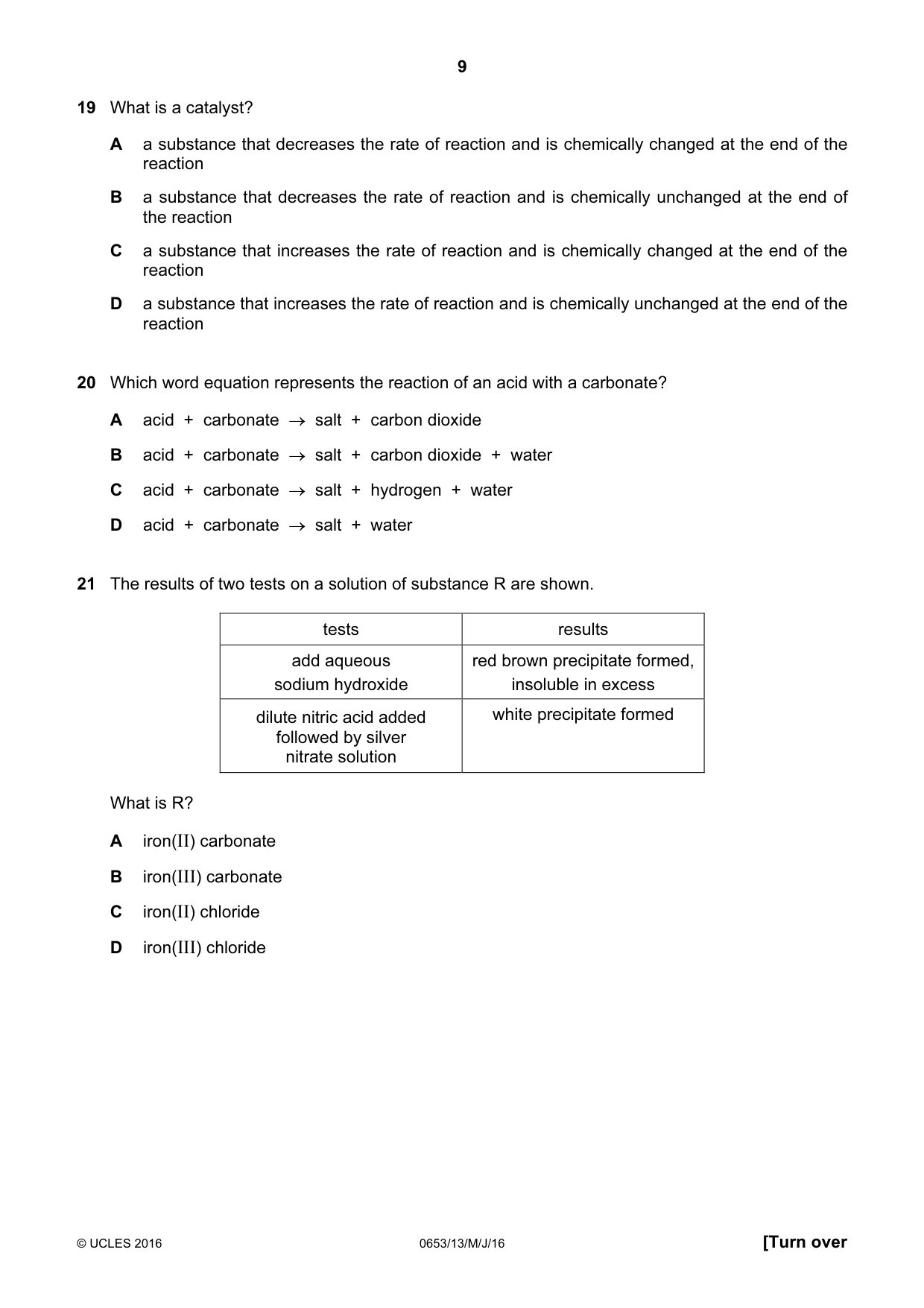
19 What is a catalyst? A a substance that decreases the rate of reaction and is chemically changed at the end of the reaction B a substance that decreases the rate of reaction and is chemically unchanged at the end of the reaction C a substance that increases the rate of reaction and is chemically changed at the end of the reaction D a substance that increases the rate of reaction and is chemically unchanged at the end of the reaction
Mark scheme: D
Q20 · Which word equation represents the reaction of an acid with a carbonate?
20 Which word equation represents the reaction of an acid with a carbonate? A acid + carbonate → salt + carbon dioxide B acid + carbonate → salt + carbon dioxide + water C acid + carbonate → salt + hydrogen + water D acid + carbonate → salt + water
Mark scheme: B
More questions on The characteristic properties of acids and bases
Q21 · The results of two tests on a solution of substance R are shown
21 The results of two tests on a solution of substance R are shown. tests results add aqueous red brown precipitate formed, sodium hydroxide insoluble in excess dilute nitric acid added white precipitate formed followed by silver nitrate solution What is R? A iron(II) carbonate B iron(III) carbonate C iron(II) chloride D iron(III) chloride
Mark scheme: D
Q22 · A soft metal reacts vigorously with cold water
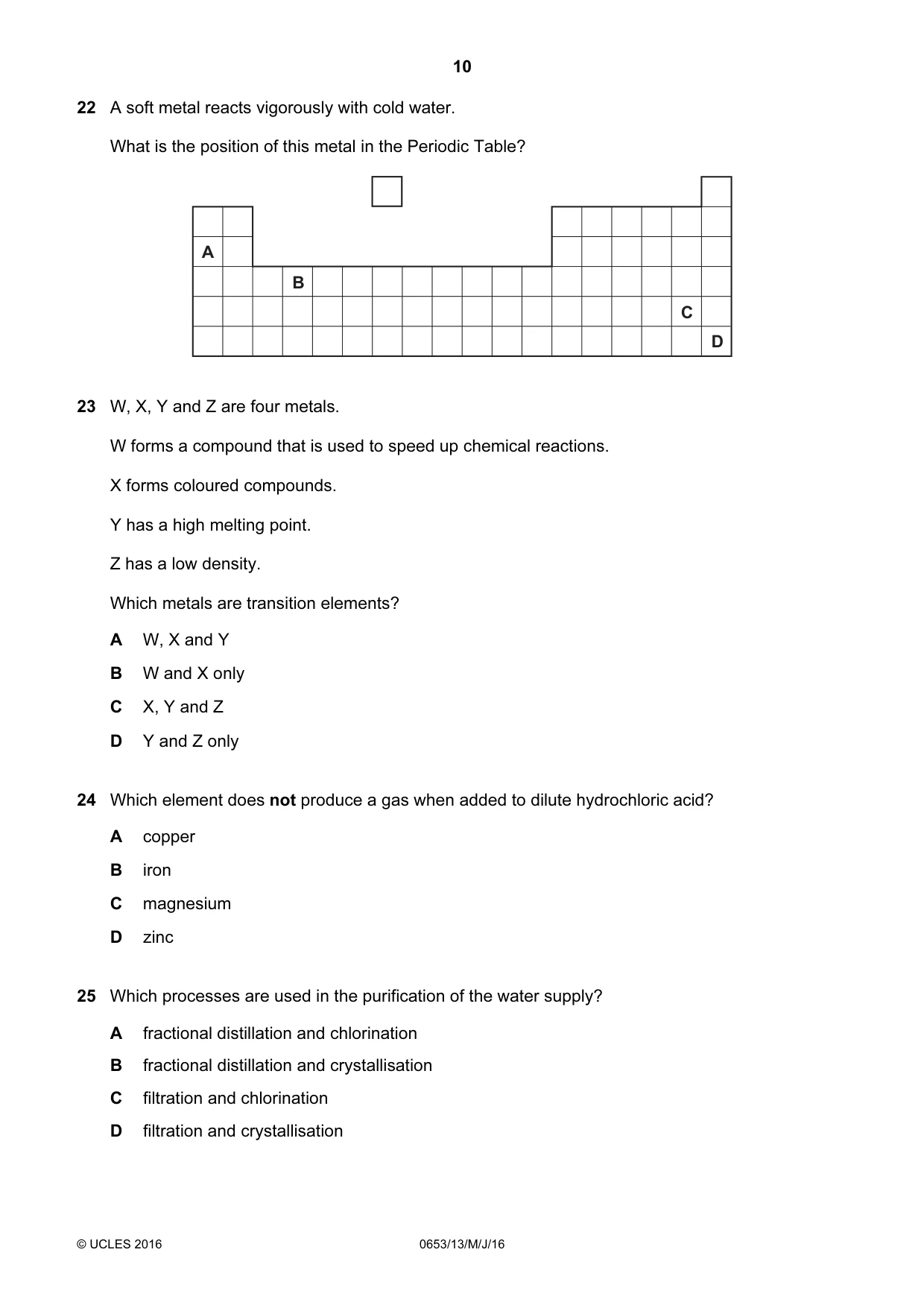
22 A soft metal reacts vigorously with cold water. What is the position of this metal in the Periodic Table? A B C D
Mark scheme: A
Q23 · W, X, Y and Z are four metals
23 W, X, Y and Z are four metals. W forms a compound that is used to speed up chemical reactions. X forms coloured compounds. Y has a high melting point. Z has a low density. Which metals are transition elements? A W, X and Y B W and X only C X, Y and Z D Y and Z only
Mark scheme: A
Q24 · Which element does not produce a gas when added to dilute hydrochloric acid?
24 Which element does not produce a gas when added to dilute hydrochloric acid? A copper B iron C magnesium D zinc
Mark scheme: A
Q25 · Which processes are used in the purification of the water supply?
25 Which processes are used in the purification of the water supply? A fractional distillation and chlorination B fractional distillation and crystallisation C filtration and chlorination D filtration and crystallisation
Mark scheme: C
Q26 · Which reaction involves combustion?
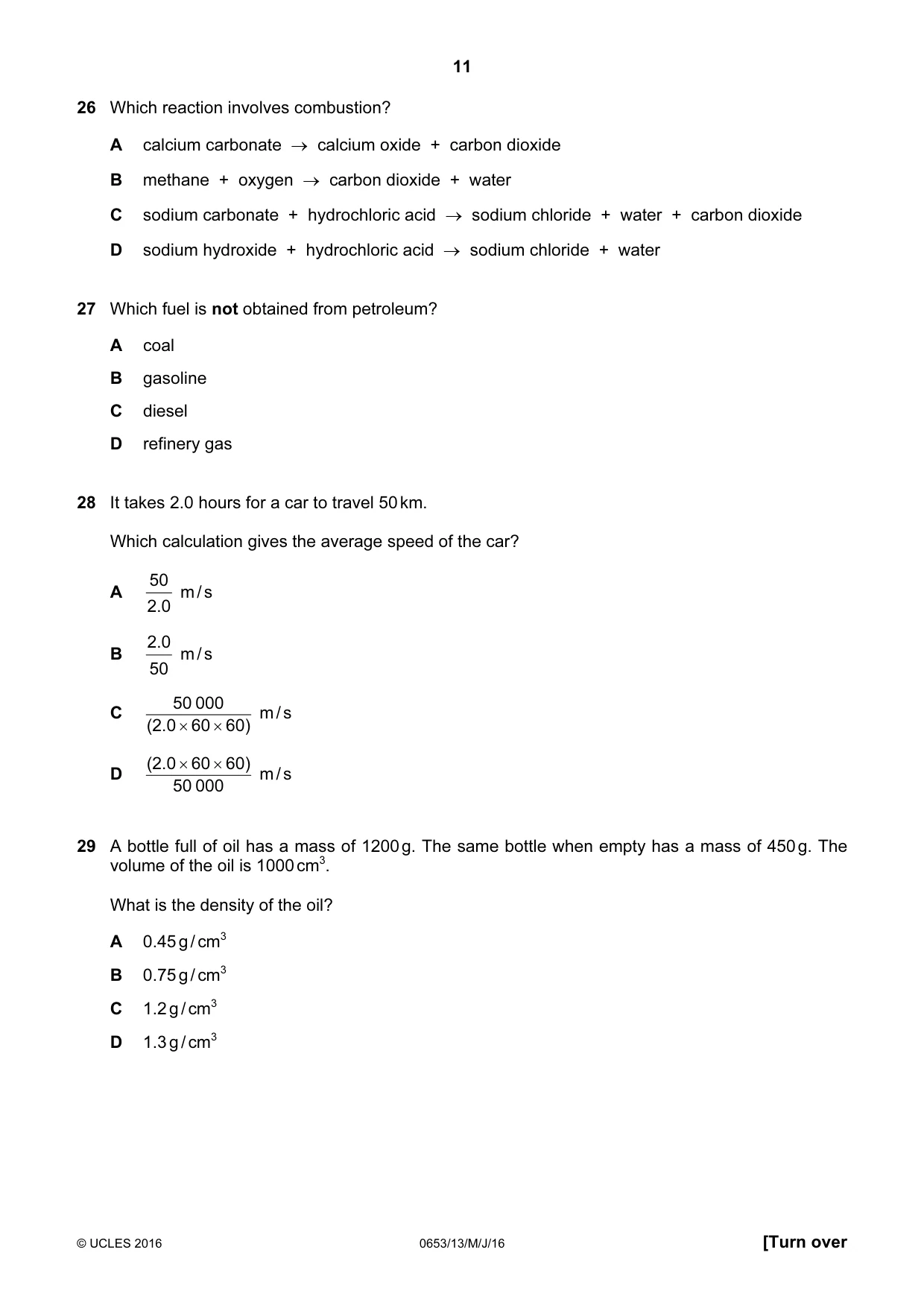
26 Which reaction involves combustion? A calcium carbonate → calcium oxide + carbon dioxide B methane + oxygen → carbon dioxide + water C sodium carbonate + hydrochloric acid → sodium chloride + water + carbon dioxide D sodium hydroxide + hydrochloric acid → sodium chloride + water
Mark scheme: B
Q27 · Which fuel is not obtained from petroleum?
27 Which fuel is not obtained from petroleum? A coal B gasoline C diesel D refinery gas
Mark scheme: A
Q28 · It takes 2.0 hours for a car to travel 50 km
28 It takes 2.0 hours for a car to travel 50 km. Which calculation gives the average speed of the car? 50 m / s A 2.0 2.0 m / s B 50 50 000 C m / s (2.0 × 60 × 60) (2.0 × 60 × 60) D m / s 50 000
Mark scheme: C
Q29 · A bottle full of oil has a mass of 1200 g
29 A bottle full of oil has a mass of 1200 g. The same bottle when empty has a mass of 450 g. The volume of the oil is 1000 cm3. What is the density of the oil? A 0.45 g / cm3 B 0.75 g / cm3 C 1.2 g / cm3 D 1.3 g / cm3
Mark scheme: B
Q30 · A motor is used to lift identical bags of flour between two floors in a windmill
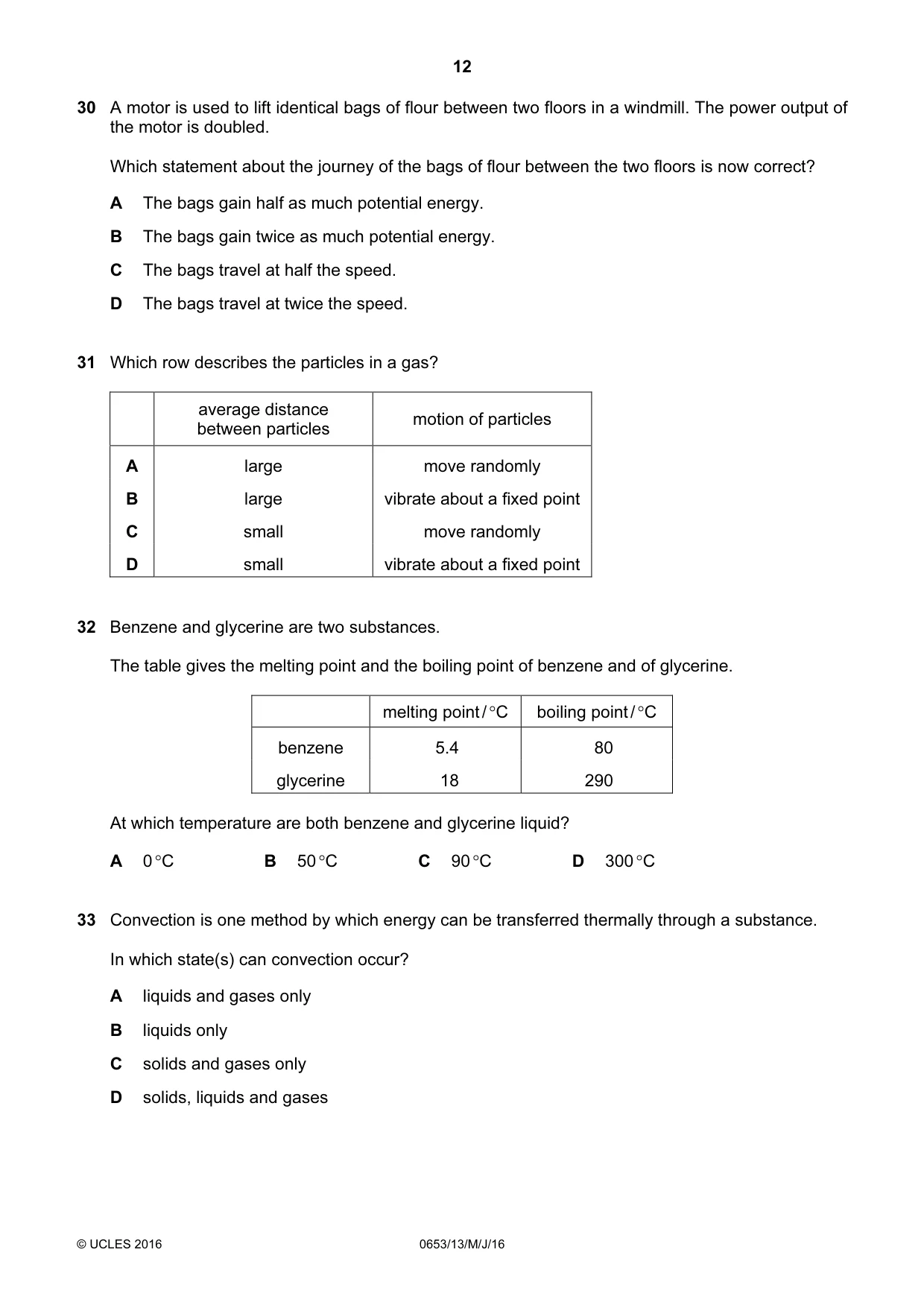
30 A motor is used to lift identical bags of flour between two floors in a windmill. The power output of the motor is doubled. Which statement about the journey of the bags of flour between the two floors is now correct? A The bags gain half as much potential energy. B The bags gain twice as much potential energy. C The bags travel at half the speed. D The bags travel at twice the speed.
Mark scheme: D
Q31 · Which row describes the particles in a gas?
31 Which row describes the particles in a gas? average distance motion of particles between particles A large move randomly B large vibrate about a fixed point C small move randomly D small vibrate about a fixed point
Mark scheme: A
Q32 · Benzene and glycerine are two substances
32 Benzene and glycerine are two substances. The table gives the melting point and the boiling point of benzene and of glycerine. melting point / °C boiling point / °C benzene 5.4 80 glycerine 18 290 At which temperature are both benzene and glycerine liquid? A 0 °C B 50 °C C 90 °C D 300 °C
Mark scheme: B
Q33 · Convection is one method by which energy can be transferred thermally through a substance
33 Convection is one method by which energy can be transferred thermally through a substance. In which state(s) can convection occur? A liquids and gases only B liquids only C solids and gases only D solids, liquids and gases
Mark scheme: A
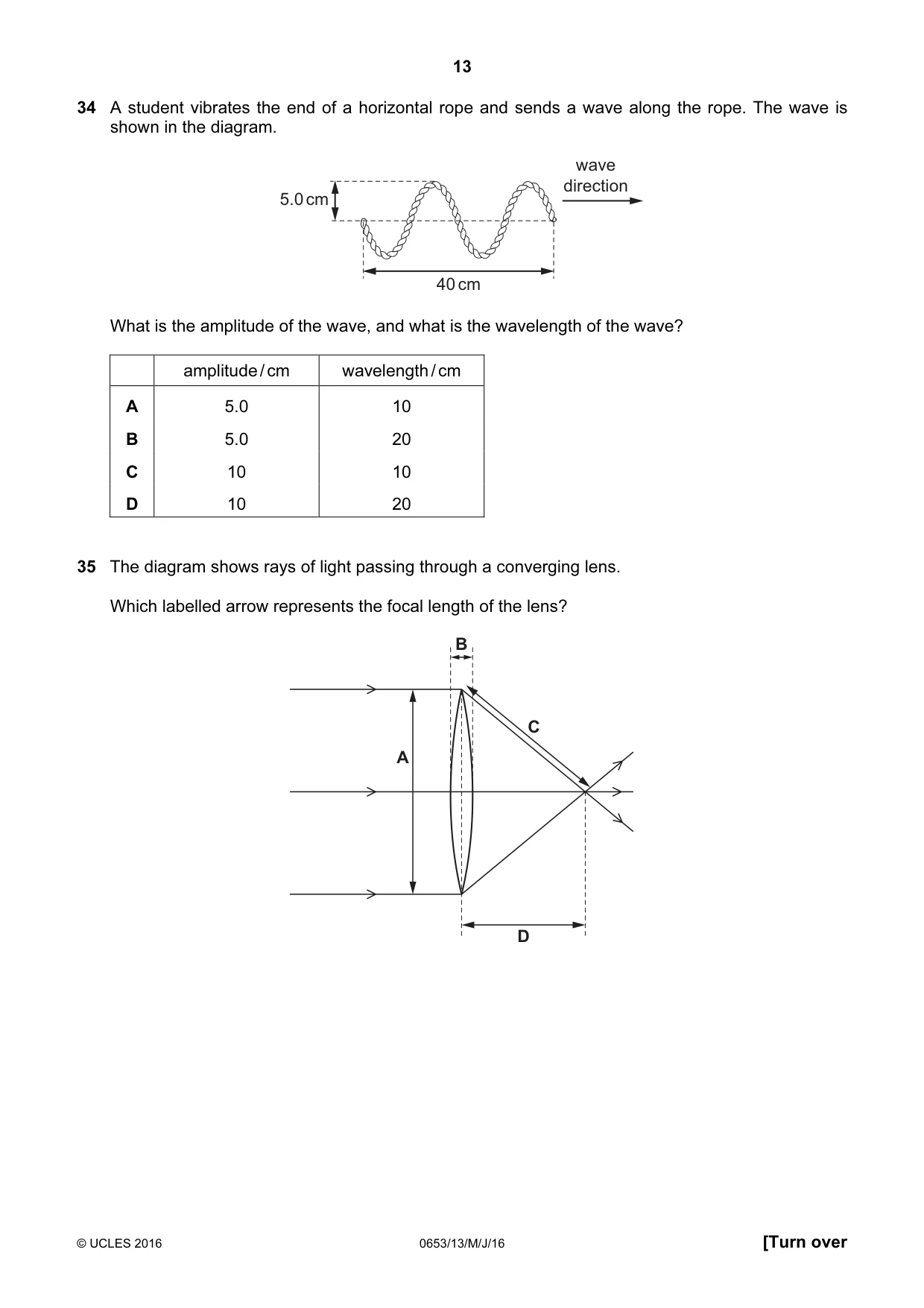
Q34 · A student vibrates the end of a horizontal rope and sends a wave along the rope
34 A student vibrates the end of a horizontal rope and sends a wave along the rope. The wave is shown in the diagram. wave direction 5.0 cm 40 cm What is the amplitude of the wave, and what is the wavelength of the wave? amplitude / cm wavelength / cm A 5.0 10 B 5.0 20 C 10 10 D 10 20
Mark scheme: B
Q35 · The diagram shows rays of light passing through a converging lens
35 The diagram shows rays of light passing through a converging lens. Which labelled arrow represents the focal length of the lens? B C A D
Mark scheme: D
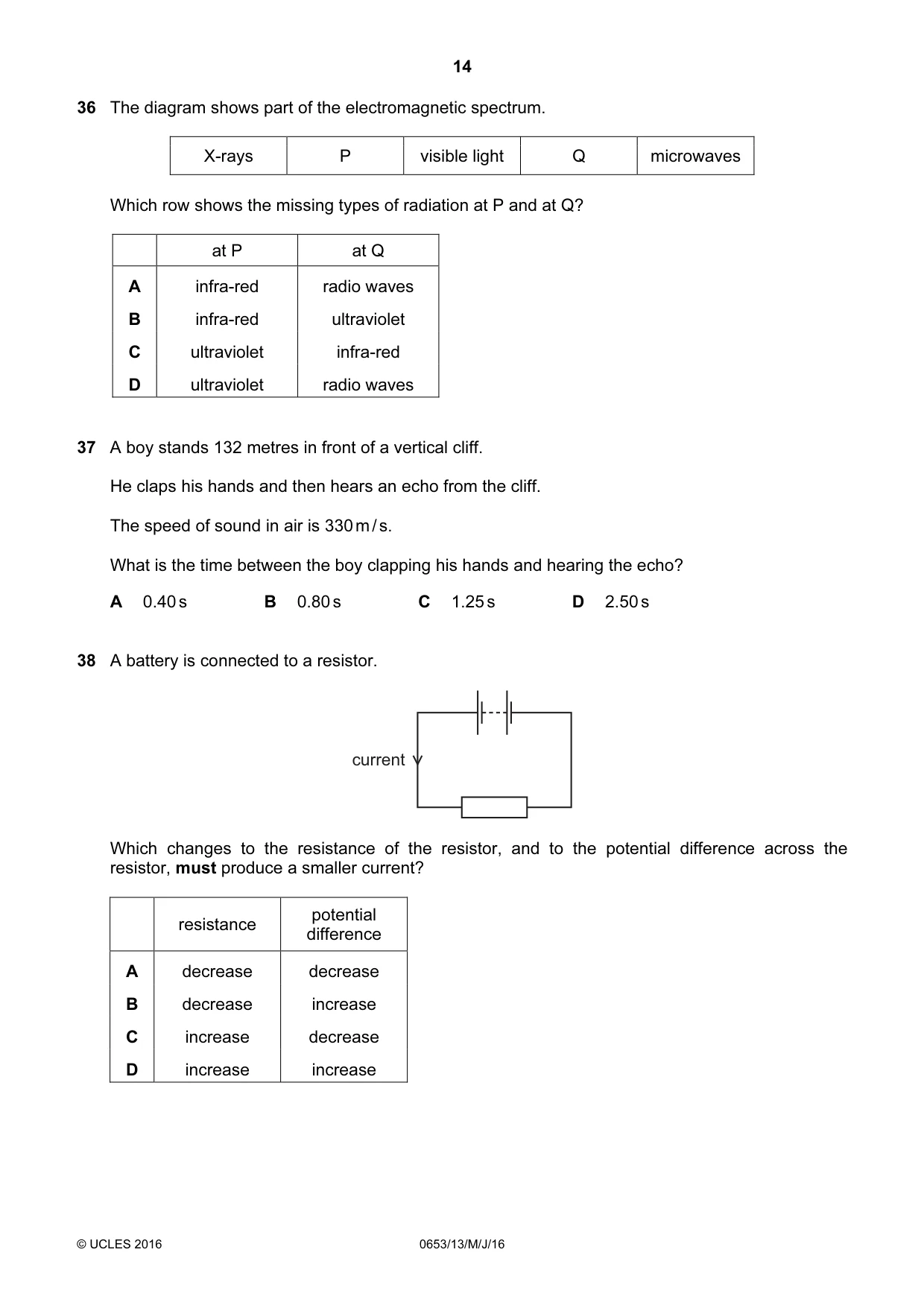
Q36 · The diagram shows part of the electromagnetic spectrum
36 The diagram shows part of the electromagnetic spectrum. X-rays P visible light Q microwaves Which row shows the missing types of radiation at P and at Q? at P at Q A infra-red radio waves B infra-red ultraviolet C ultraviolet infra-red D ultraviolet radio waves
Mark scheme: C
Q37 · A boy stands 132 metres in front of a vertical cliff
37 A boy stands 132 metres in front of a vertical cliff. He claps his hands and then hears an echo from the cliff. The speed of sound in air is 330 m / s. What is the time between the boy clapping his hands and hearing the echo? A 0.40 s B 0.80 s C 1.25 s D 2.50 s
Mark scheme: B
Q38 · A battery is connected to a resistor
38 A battery is connected to a resistor. current Which changes to the resistance of the resistor, and to the potential difference across the resistor, must produce a smaller current? potential resistance difference A decrease decrease B decrease increase C increase decrease D increase increase
Mark scheme: C
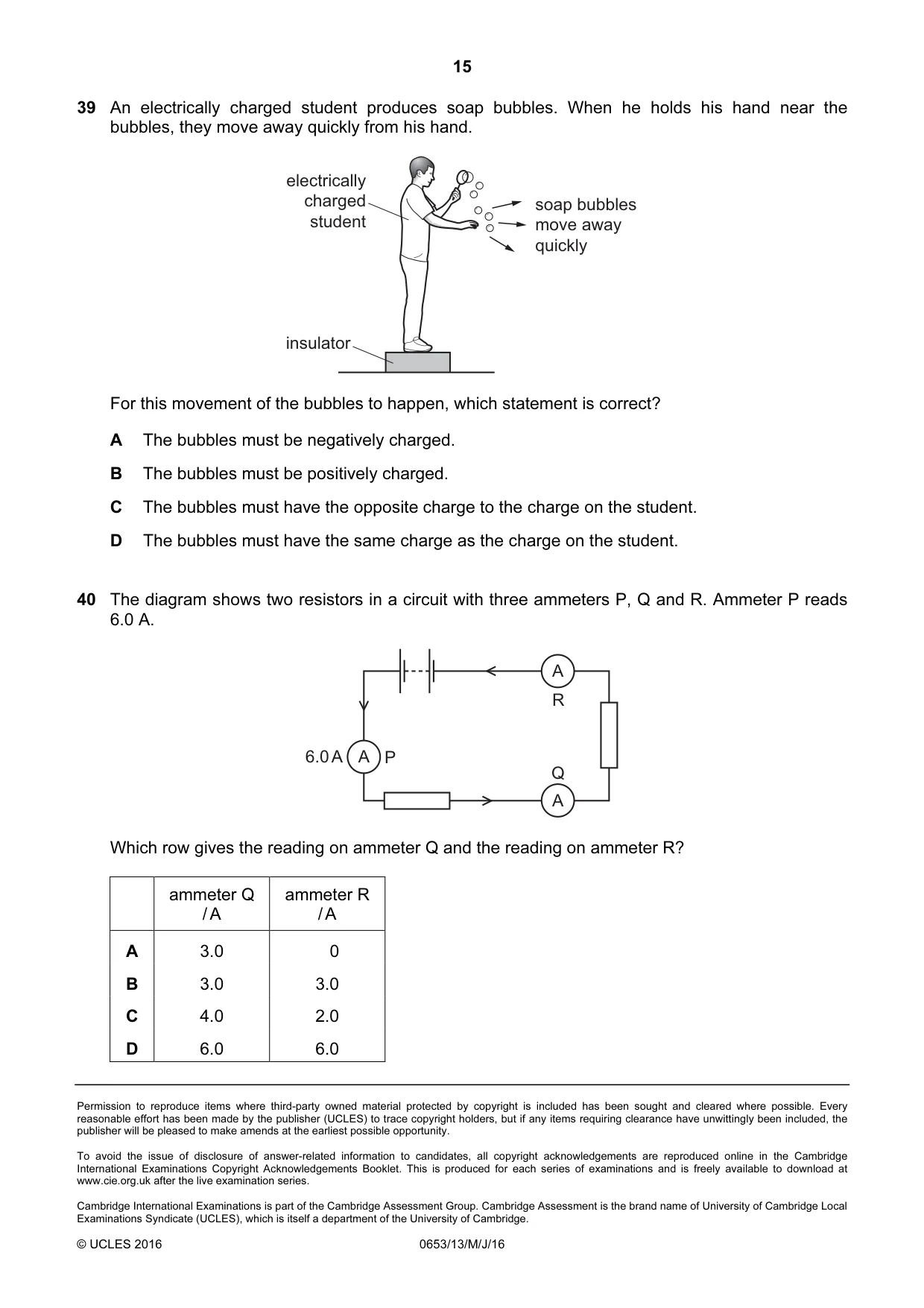
Q39 · An electrically charged student produces soap bubbles
39 An electrically charged student produces soap bubbles. When he holds his hand near the bubbles, they move away quickly from his hand. electrically charged soap bubbles student move away quickly insulator For this movement of the bubbles to happen, which statement is correct? A The bubbles must be negatively charged. B The bubbles must be positively charged. C The bubbles must have the opposite charge to the charge on the student. D The bubbles must have the same charge as the charge on the student.
Mark scheme: D
Q40 · The diagram shows two resistors in a circuit with three ammeters P, Q and R
40 The diagram shows two resistors in a circuit with three ammeters P, Q and R. Ammeter P reads 6.0 A. A R 6.0 A A P Q A Which row gives the reading on ammeter Q and the reading on ammeter R? ammeter Q ammeter R / A / A A 3.0 0 B 3.0 3.0 C 4.0 2.0 D 6.0 6.0
Mark scheme: D
What was in this paper
The subtopics covered by these 40 questions, and how many questions each got. Open one in a new tab to see every Cambridge question on it.
2Characteristics of living organisms1Density1Diffusion1Drugs1Electrical circuits1Electrolysis1Electromagnetic spectrum1Elements, compounds and mixtures1Energy, work and power1Enzymes1Exothermic and endothermic reactions1Food chains and food webs1Fuels1Gas exchange in humans1General properties of waves1Group I properties1Heart1Identification of ions and gases1Ions and ionic bonds1Kinetic particle model of matter1Leaf structure1Light1Motion1Physical and chemical changes1Rate of reaction1Reactivity series1Respiration1Separation and purification1Sexual reproduction in humans1Sexual reproduction in plants1Size of specimens1Sound1The characteristic properties of acids and bases1Thermal properties and temperature1Transfer of thermal energy1Transition elements1Water1Water uptake1What you needed in this session
Cambridge’s own grade thresholds for 2016 May/June, Paper 1 · Variant 3. A higher threshold means an easier paper — the bar moves with how the cohort did.