Cambridge IGCSE Science - Combined 0653 — 2017 May/June Paper 1 · Variant 1
0653/11/M/J/17 · 40 questions · 40 marks · ≈45 min
The question paper and its mark scheme, free to read here and free to download. This is Cambridge’s own paper, exactly as it was sat.
Question paper20 pages


Mark scheme3 pages
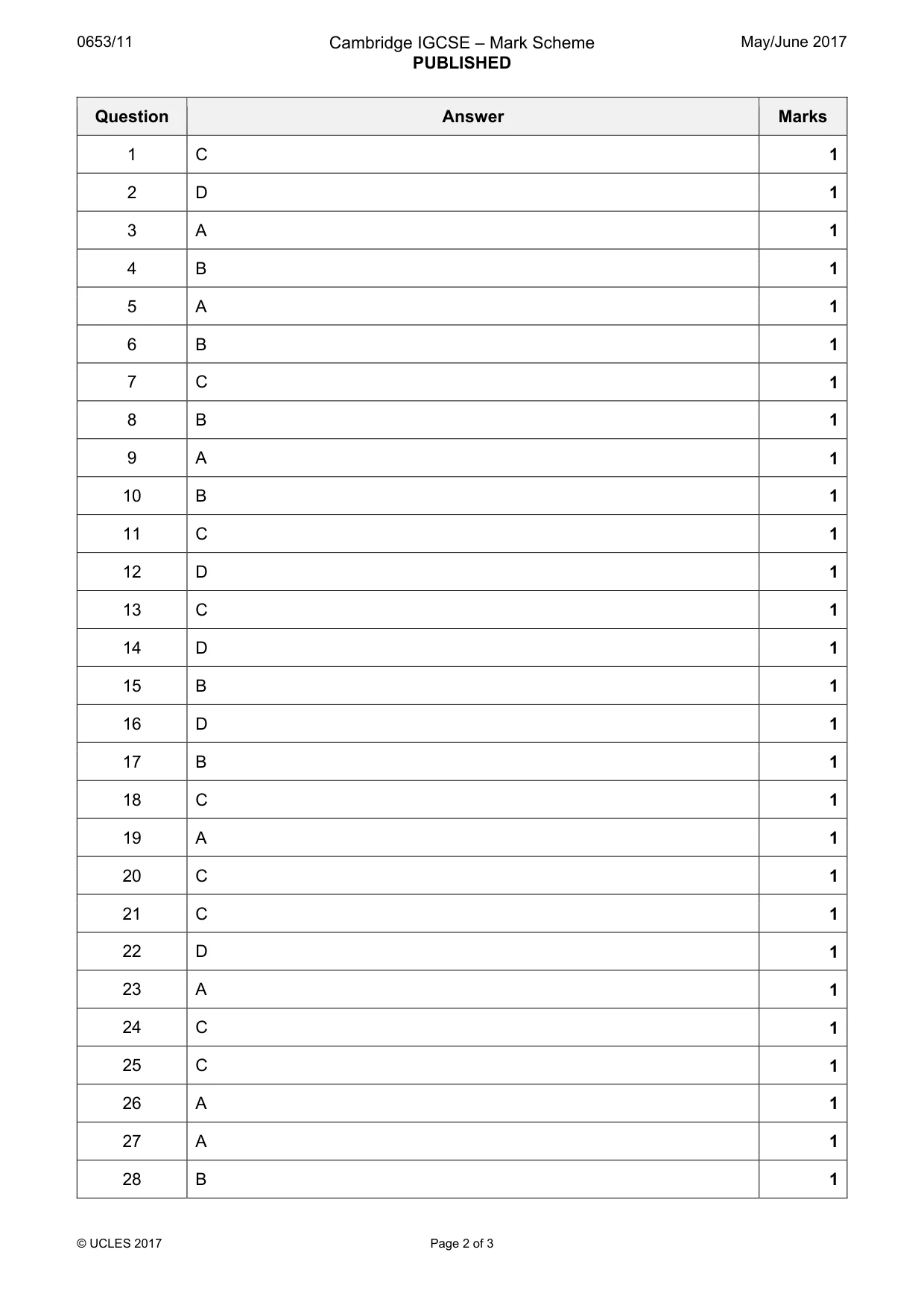
Answers below. Sit the paper first if you are practising.
Questions as text
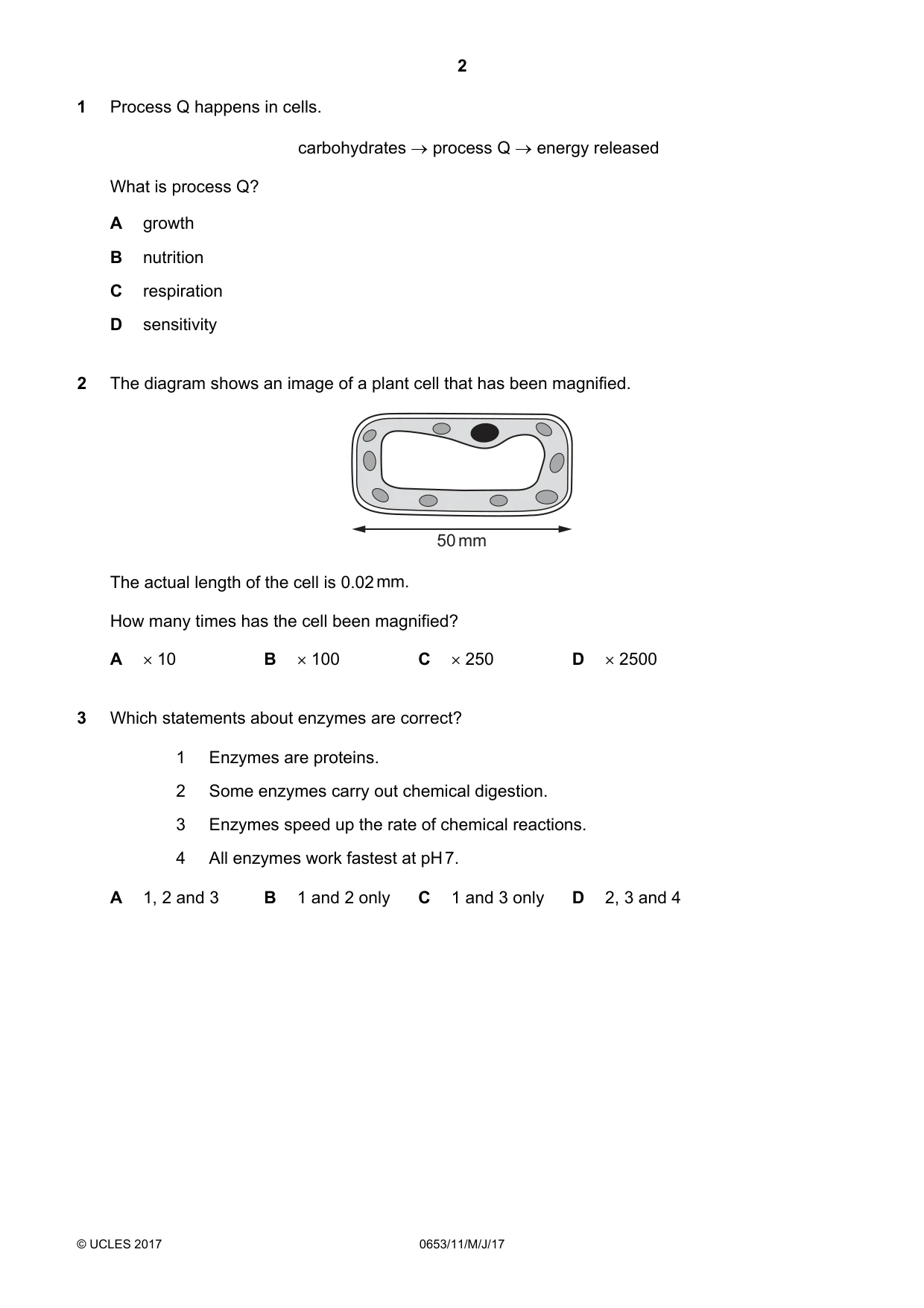
Q1 · Process Q happens in cells
1 Process Q happens in cells. carbohydrates → process Q → energy released What is process Q? A growth B nutrition C respiration D sensitivity
Mark scheme: C
Q2 · The diagram shows an image of a plant cell that has been magnified
2 The diagram shows an image of a plant cell that has been magnified. 50 mm The actual length of the cell is 0.02 mm. How many times has the cell been magnified? A × 10 B × 100 C × 250 D × 2500
Mark scheme: D
Q3 · Which statements about enzymes are correct?
3 Which statements about enzymes are correct? 1 Enzymes are proteins. 2 Some enzymes carry out chemical digestion. 3 Enzymes speed up the rate of chemical reactions. 4 All enzymes work fastest at pH 7. A 1, 2 and 3 B 1 and 2 only C 1 and 3 only D 2, 3 and 4
Mark scheme: A
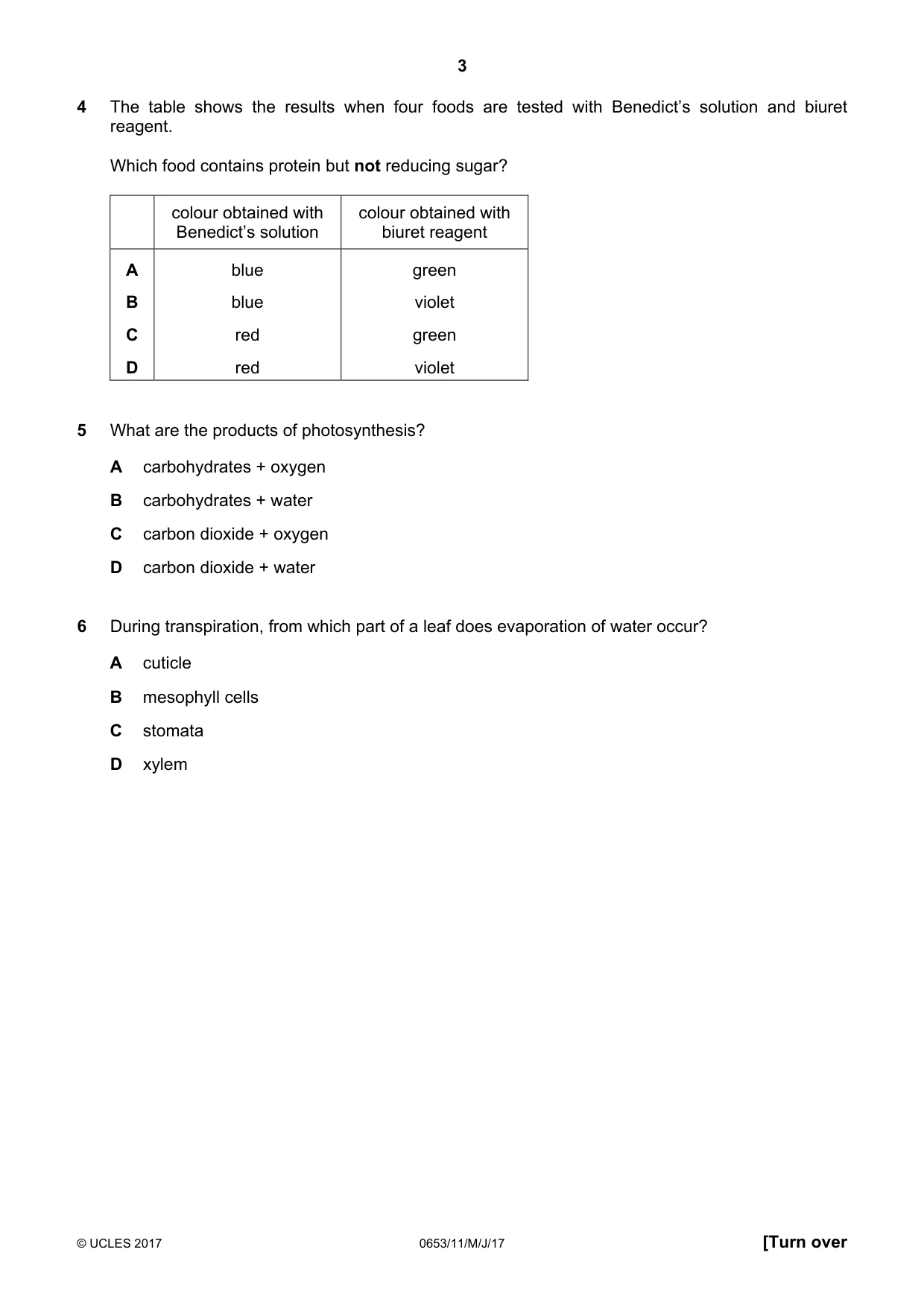
Q4 · The table shows the results when four foods are tested with Benedict’s solution and…
4 The table shows the results when four foods are tested with Benedict’s solution and biuret reagent. Which food contains protein but not reducing sugar? colour obtained with colour obtained with Benedict’s solution biuret reagent A blue green B blue violet C red green D red violet
Mark scheme: B
Q5 · What are the products of photosynthesis?
5 What are the products of photosynthesis? A carbohydrates + oxygen B carbohydrates + water C carbon dioxide + oxygen D carbon dioxide + water
Mark scheme: A
Q6 · During transpiration, from which part of a leaf does evaporation of water occur?
6 During transpiration, from which part of a leaf does evaporation of water occur? A cuticle B mesophyll cells C stomata D xylem
Mark scheme: B
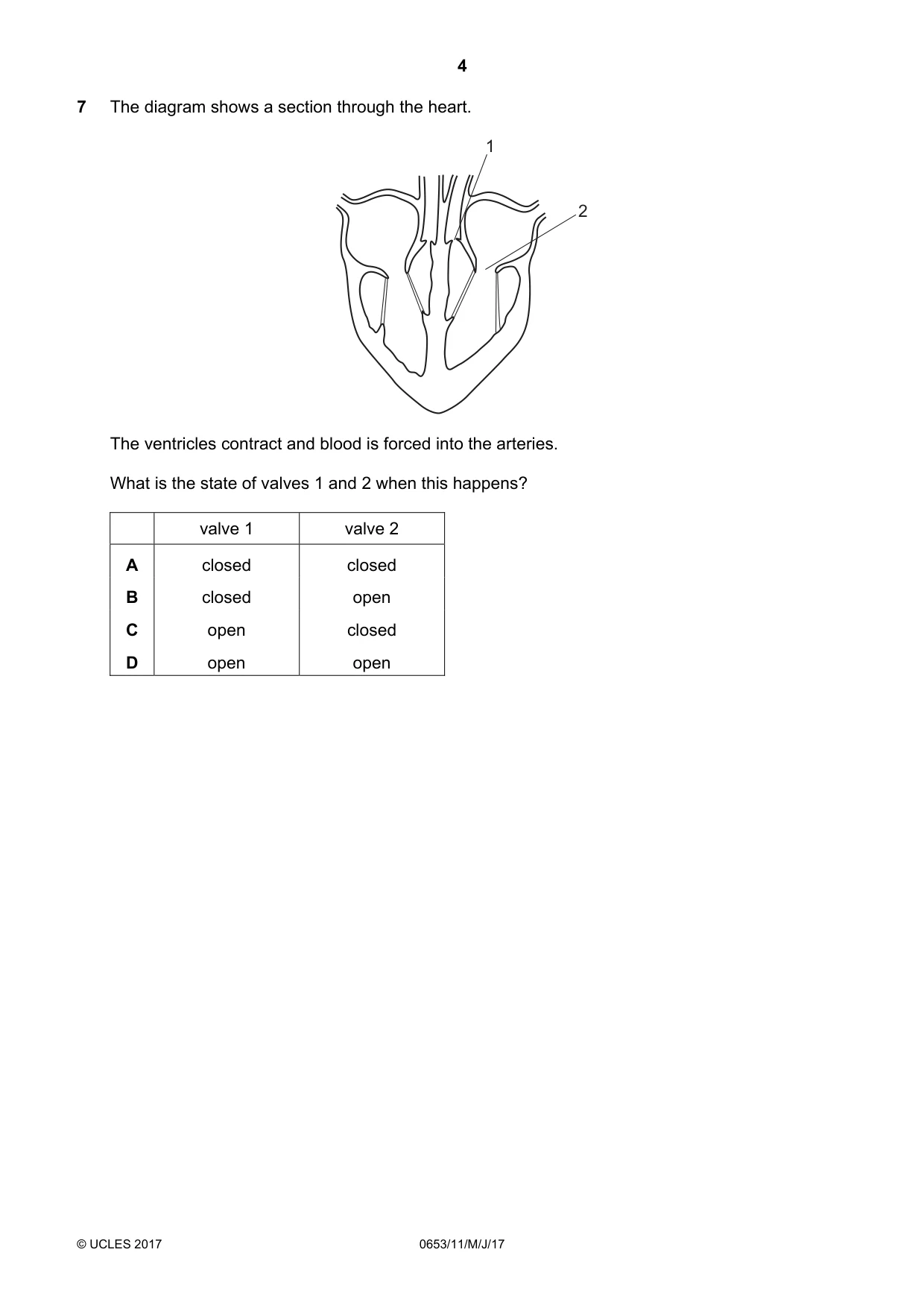
Q7 · The diagram shows a section through the heart
7 The diagram shows a section through the heart. 1 2 The ventricles contract and blood is forced into the arteries. What is the state of valves 1 and 2 when this happens? valve 1 valve 2 A closed closed B closed open C open closed D open open
Mark scheme: C
Q8 · The diagram shows apparatus at the start of a breathing experiment
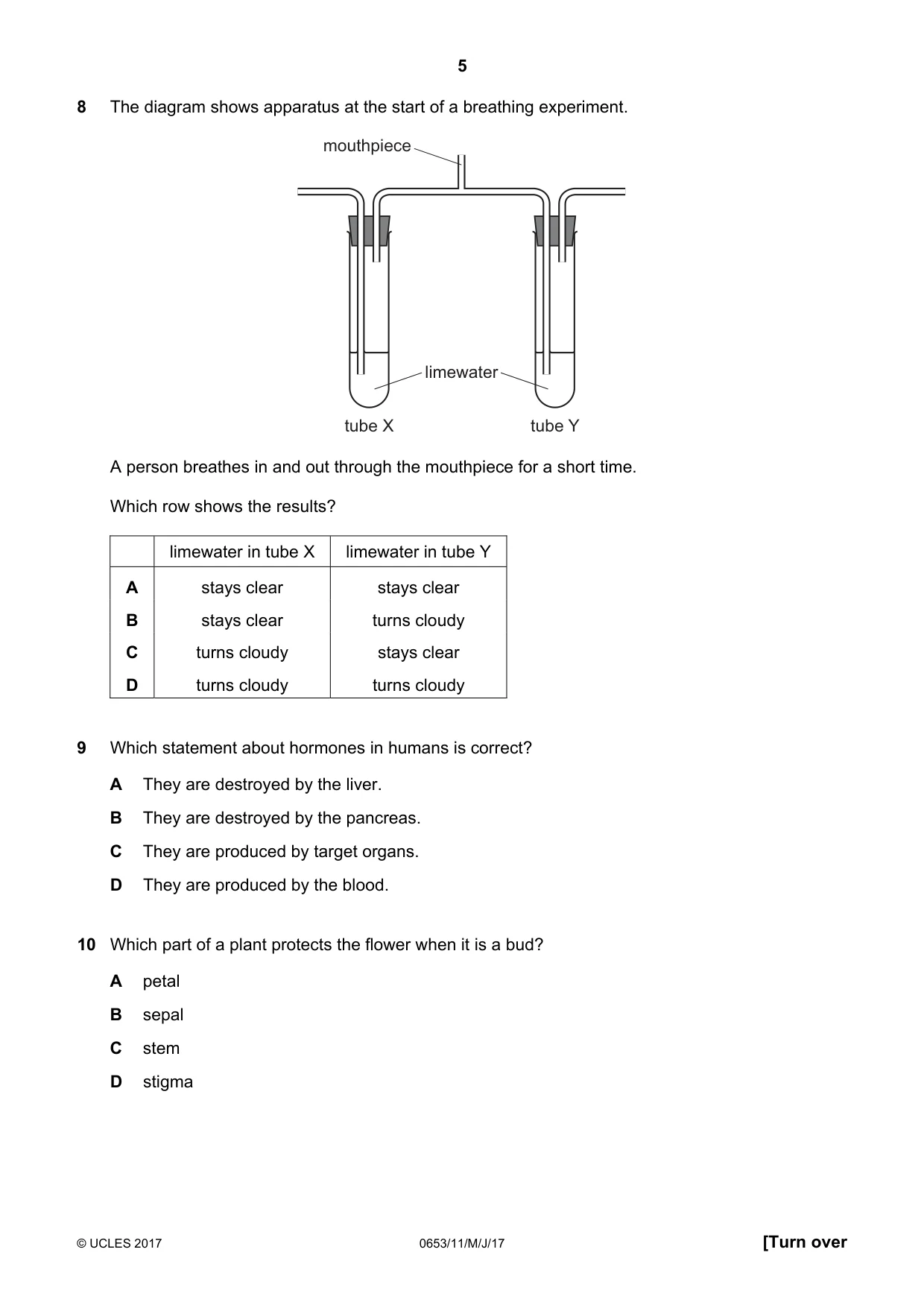
8 The diagram shows apparatus at the start of a breathing experiment. mouthpiece limewater tube X tube Y A person breathes in and out through the mouthpiece for a short time. Which row shows the results? limewater in tube X limewater in tube Y A stays clear stays clear B stays clear turns cloudy C turns cloudy stays clear D turns cloudy turns cloudy
Mark scheme: B
Q9 · Which statement about hormones in humans is correct?
9 Which statement about hormones in humans is correct? A They are destroyed by the liver. B They are destroyed by the pancreas. C They are produced by target organs. D They are produced by the blood.
Mark scheme: A
Q10 · Which part of a plant protects the flower when it is a bud?
10 Which part of a plant protects the flower when it is a bud? A petal B sepal C stem D stigma
Mark scheme: B
Q11 · The diagram shows the female reproductive system
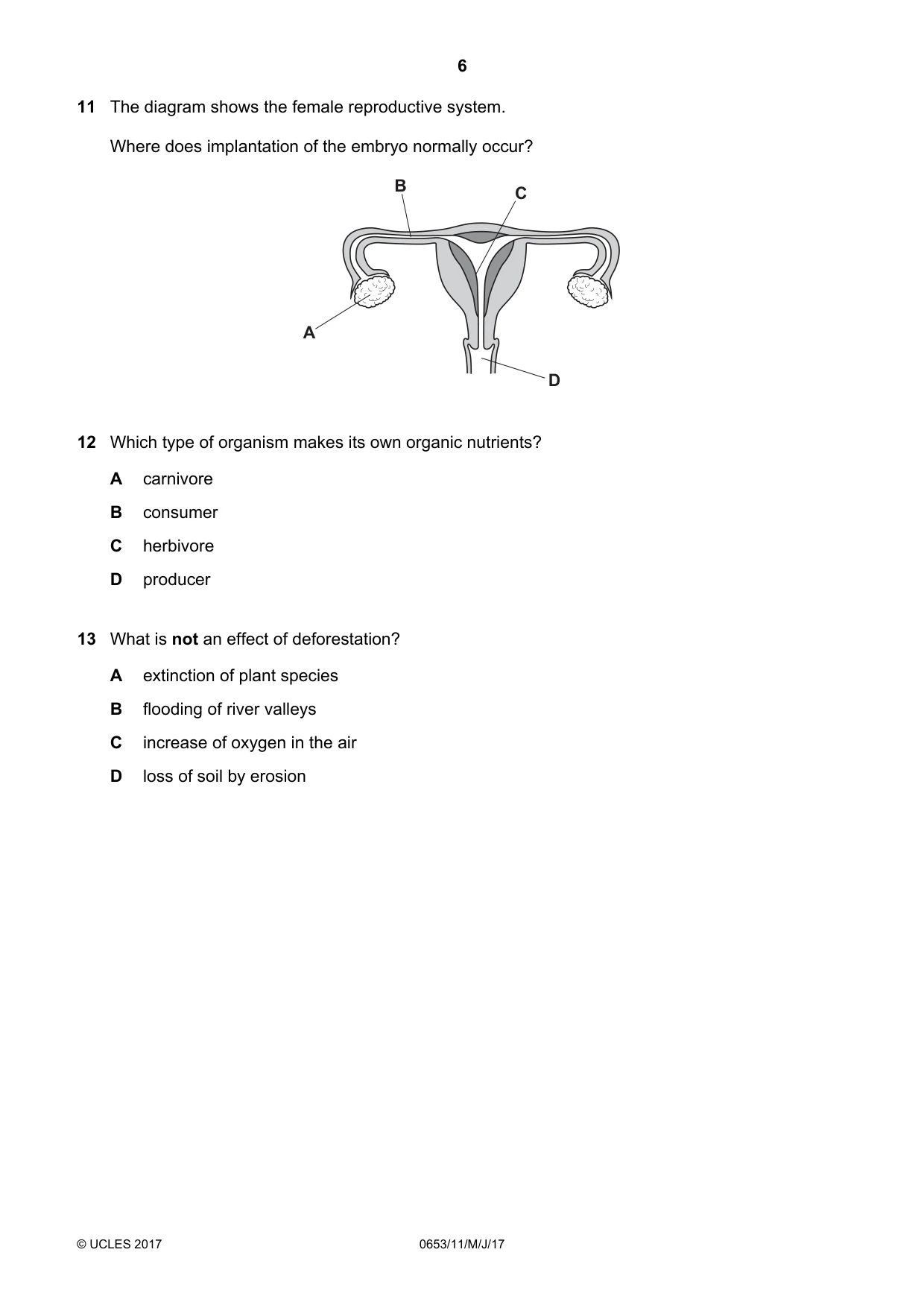
11 The diagram shows the female reproductive system. Where does implantation of the embryo normally occur? B C A D
Mark scheme: C
Q12 · Which type of organism makes its own organic nutrients?
12 Which type of organism makes its own organic nutrients? A carnivore B consumer C herbivore D producer
Mark scheme: D
Q13 · What is not an effect of deforestation?
13 What is not an effect of deforestation? A extinction of plant species B flooding of river valleys C increase of oxygen in the air D loss of soil by erosion
Mark scheme: C
Q14 · Which diagram shows how a mixture of dyes in a food colouring are separated?
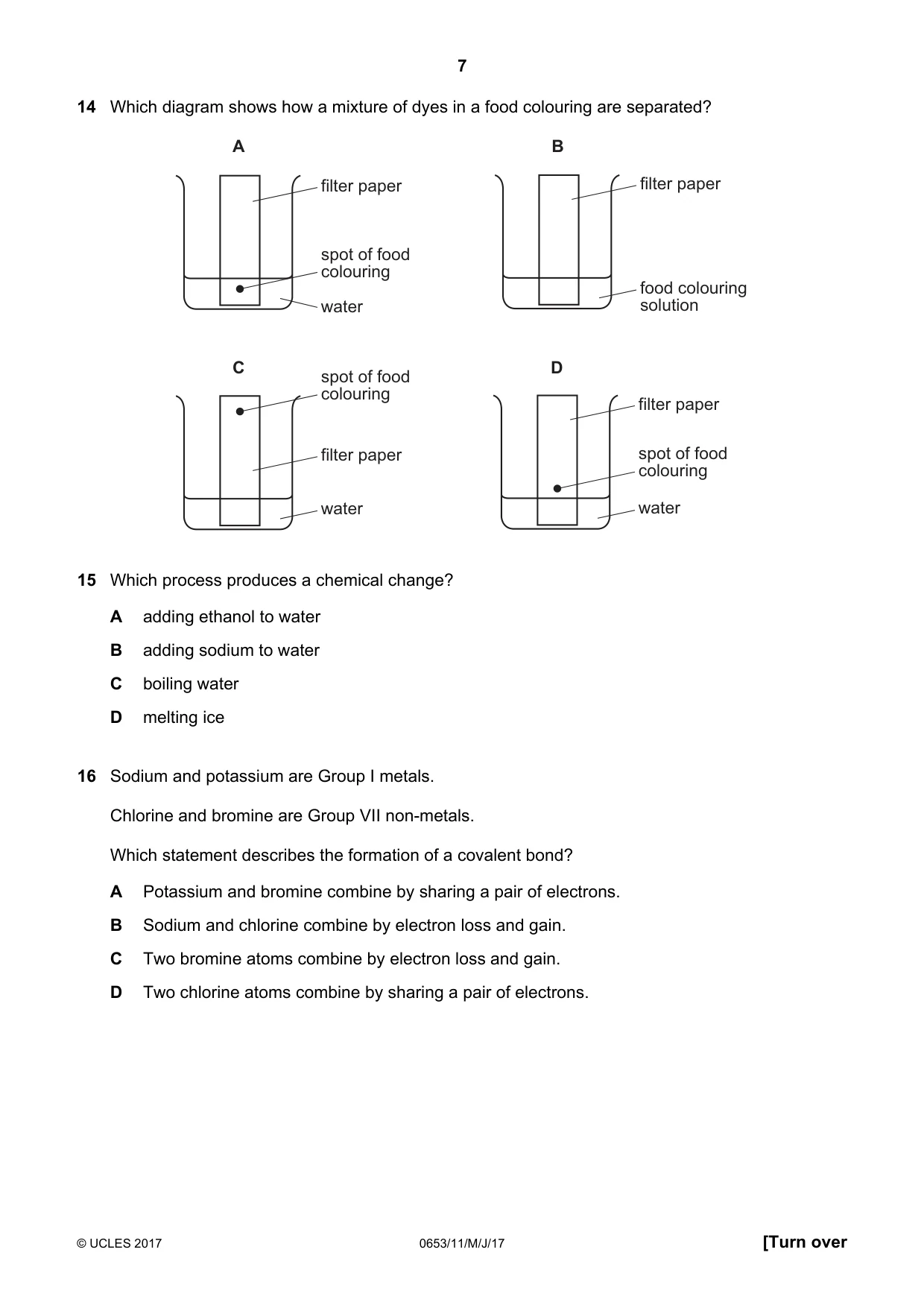
14 Which diagram shows how a mixture of dyes in a food colouring are separated? A B filter paper filter paper spot of food colouring food colouring water solution C D spot of food colouring filter paper filter paper spot of food colouring water water
Mark scheme: D
Q15 · Which process produces a chemical change?
15 Which process produces a chemical change? A adding ethanol to water B adding sodium to water C boiling water D melting ice
Mark scheme: B
Q16 · Sodium and potassium are Group I metals
16 Sodium and potassium are Group I metals. Chlorine and bromine are Group VII non-metals. Which statement describes the formation of a covalent bond? A Potassium and bromine combine by sharing a pair of electrons. B Sodium and chlorine combine by electron loss and gain. C Two bromine atoms combine by electron loss and gain. D Two chlorine atoms combine by sharing a pair of electrons.
Mark scheme: D
Q17 · The diagram shows the electrolysis of molten lead(II) bromide
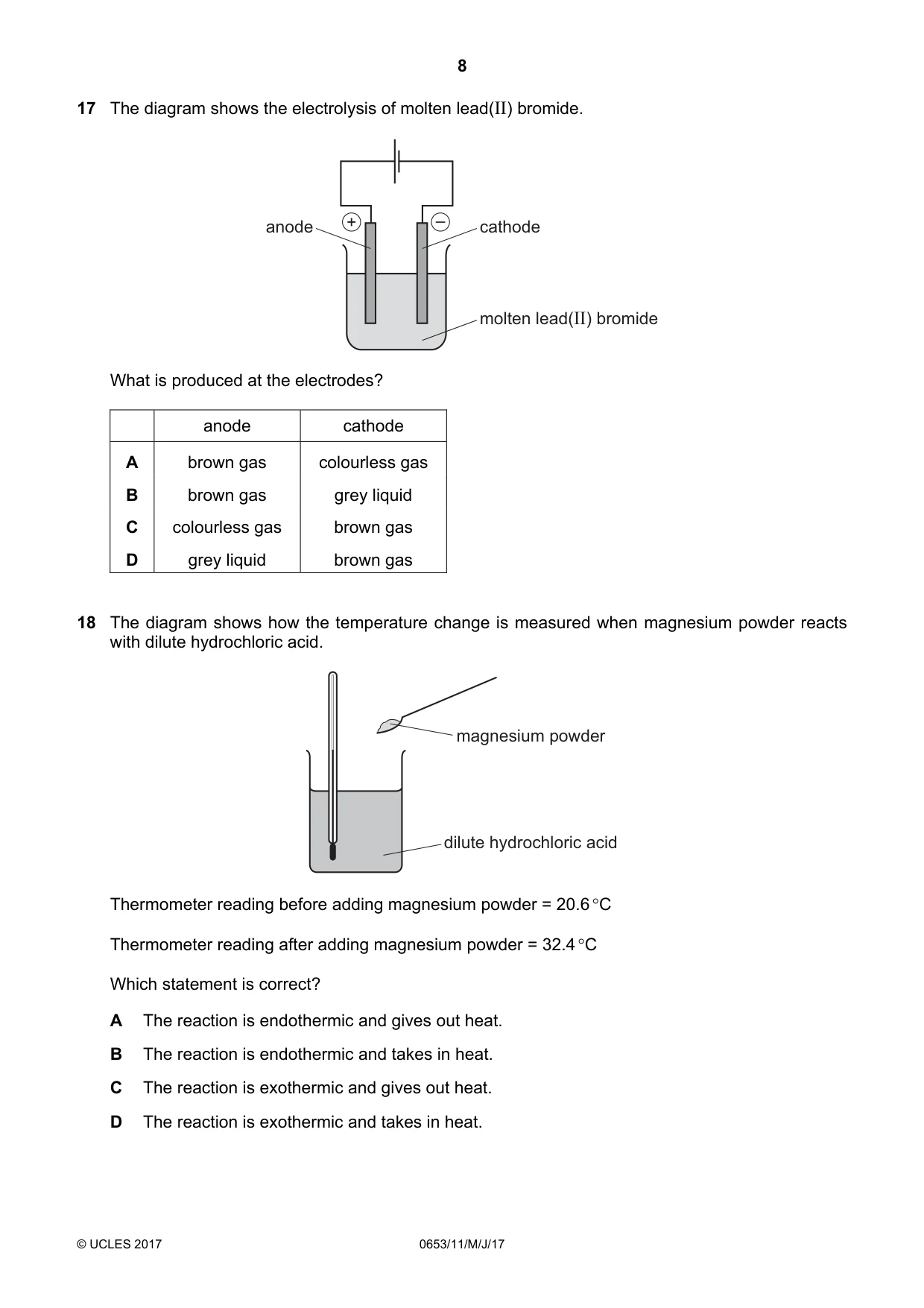
17 The diagram shows the electrolysis of molten lead(II) bromide. anode + – cathode molten lead(II) bromide What is produced at the electrodes? anode cathode A brown gas colourless gas B brown gas grey liquid C colourless gas brown gas D grey liquid brown gas
Mark scheme: B
Q18 · The diagram shows how the temperature change is measured when magnesium powder reacts…
18 The diagram shows how the temperature change is measured when magnesium powder reacts with dilute hydrochloric acid. magnesium powder dilute hydrochloric acid Thermometer reading before adding magnesium powder = 20.6 °C Thermometer reading after adding magnesium powder = 32.4 °C Which statement is correct? A The reaction is endothermic and gives out heat. B The reaction is endothermic and takes in heat. C The reaction is exothermic and gives out heat. D The reaction is exothermic and takes in heat.
Mark scheme: C
Q19 · Hydrogen peroxide decomposes to form water and oxygen
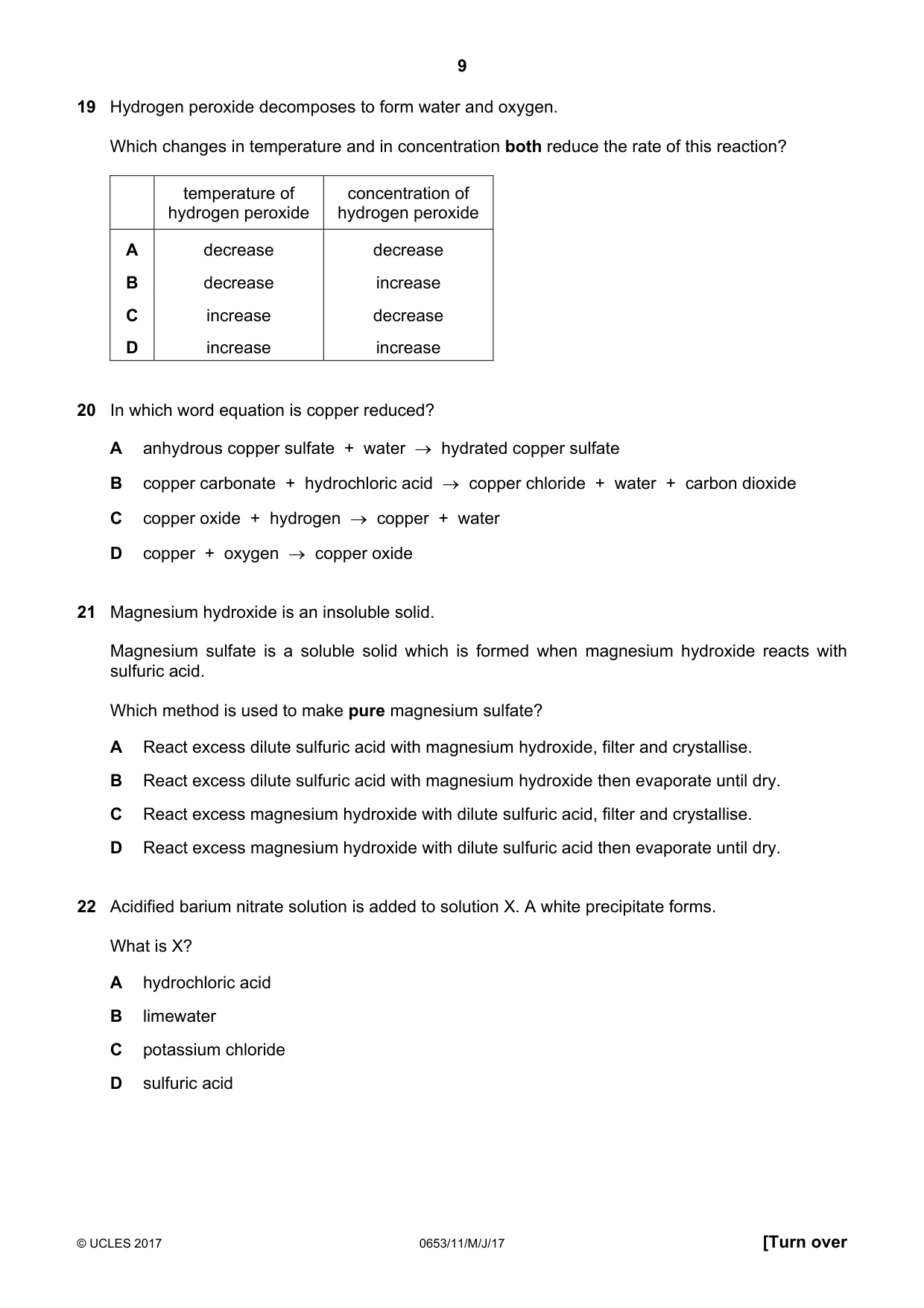
19 Hydrogen peroxide decomposes to form water and oxygen. Which changes in temperature and in concentration both reduce the rate of this reaction? temperature of concentration of hydrogen peroxide hydrogen peroxide A decrease decrease B decrease increase C increase decrease D increase increase
Mark scheme: A
Q20 · In which word equation is copper reduced?
20 In which word equation is copper reduced? A anhydrous copper sulfate + water → hydrated copper sulfate B copper carbonate + hydrochloric acid → copper chloride + water + carbon dioxide C copper oxide + hydrogen → copper + water D copper + oxygen → copper oxide
Mark scheme: C
Q21 · Magnesium hydroxide is an insoluble solid
21 Magnesium hydroxide is an insoluble solid. Magnesium sulfate is a soluble solid which is formed when magnesium hydroxide reacts with sulfuric acid. Which method is used to make pure magnesium sulfate? A React excess dilute sulfuric acid with magnesium hydroxide, filter and crystallise. B React excess dilute sulfuric acid with magnesium hydroxide then evaporate until dry. C React excess magnesium hydroxide with dilute sulfuric acid, filter and crystallise. D React excess magnesium hydroxide with dilute sulfuric acid then evaporate until dry.
Mark scheme: C
Q22 · Acidified barium nitrate solution is added to solution X
22 Acidified barium nitrate solution is added to solution X. A white precipitate forms. What is X? A hydrochloric acid B limewater C potassium chloride D sulfuric acid
Mark scheme: D
Q23 · The diagram shows part of the Periodic Table
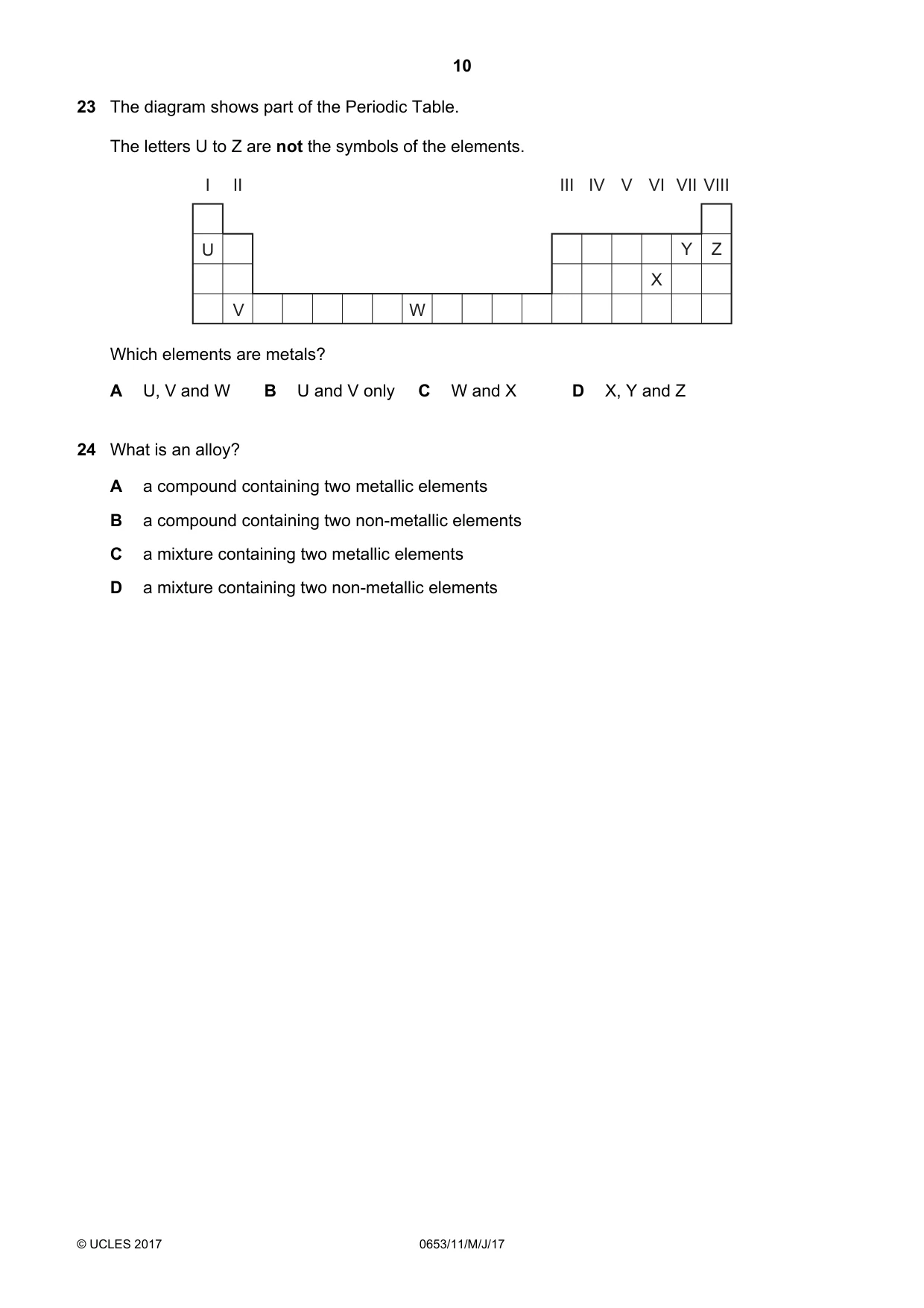
23 The diagram shows part of the Periodic Table. The letters U to Z are not the symbols of the elements. I II III IV V VI VII VIII U Y Z X V W Which elements are metals? A U, V and W B U and V only C W and X D X, Y and Z
Mark scheme: A
Q24 · What is an alloy?
24 What is an alloy? A a compound containing two metallic elements B a compound containing two non-metallic elements C a mixture containing two metallic elements D a mixture containing two non-metallic elements
Mark scheme: C
Q25 · Equal sized pieces of four different metals are added to separate samples of dilute…
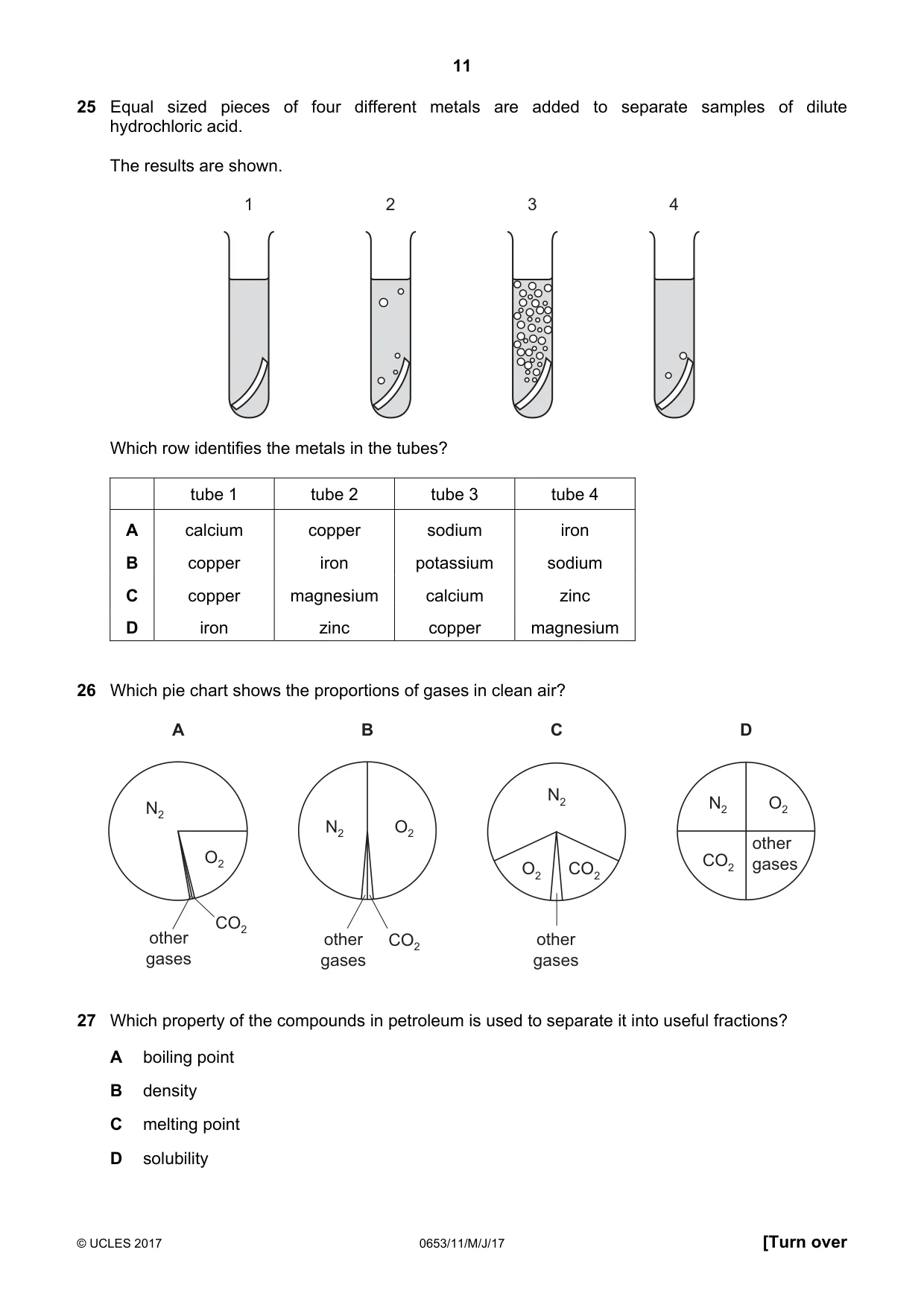
25 Equal sized pieces of four different metals are added to separate samples of dilute hydrochloric acid. The results are shown. 1 2 3 4 Which row identifies the metals in the tubes? tube 1 tube 2 tube 3 tube 4 A calcium copper sodium iron B copper iron potassium sodium C copper magnesium calcium zinc D iron zinc copper magnesium
Mark scheme: C
Q26 · Which pie chart shows the proportions of gases in clean air?
26 Which pie chart shows the proportions of gases in clean air? A B C D N2 N2 O2 N2 N2 O2 other O2 CO2 gases O2 CO2 CO2 other other CO2 other gases gases gases
Mark scheme: A
Q27 · Which property of the compounds in petroleum is used to separate it into useful fractions?
27 Which property of the compounds in petroleum is used to separate it into useful fractions? A boiling point B density C melting point D solubility
Mark scheme: A
Q28 · A car driver sets out from home to travel to Cambridge
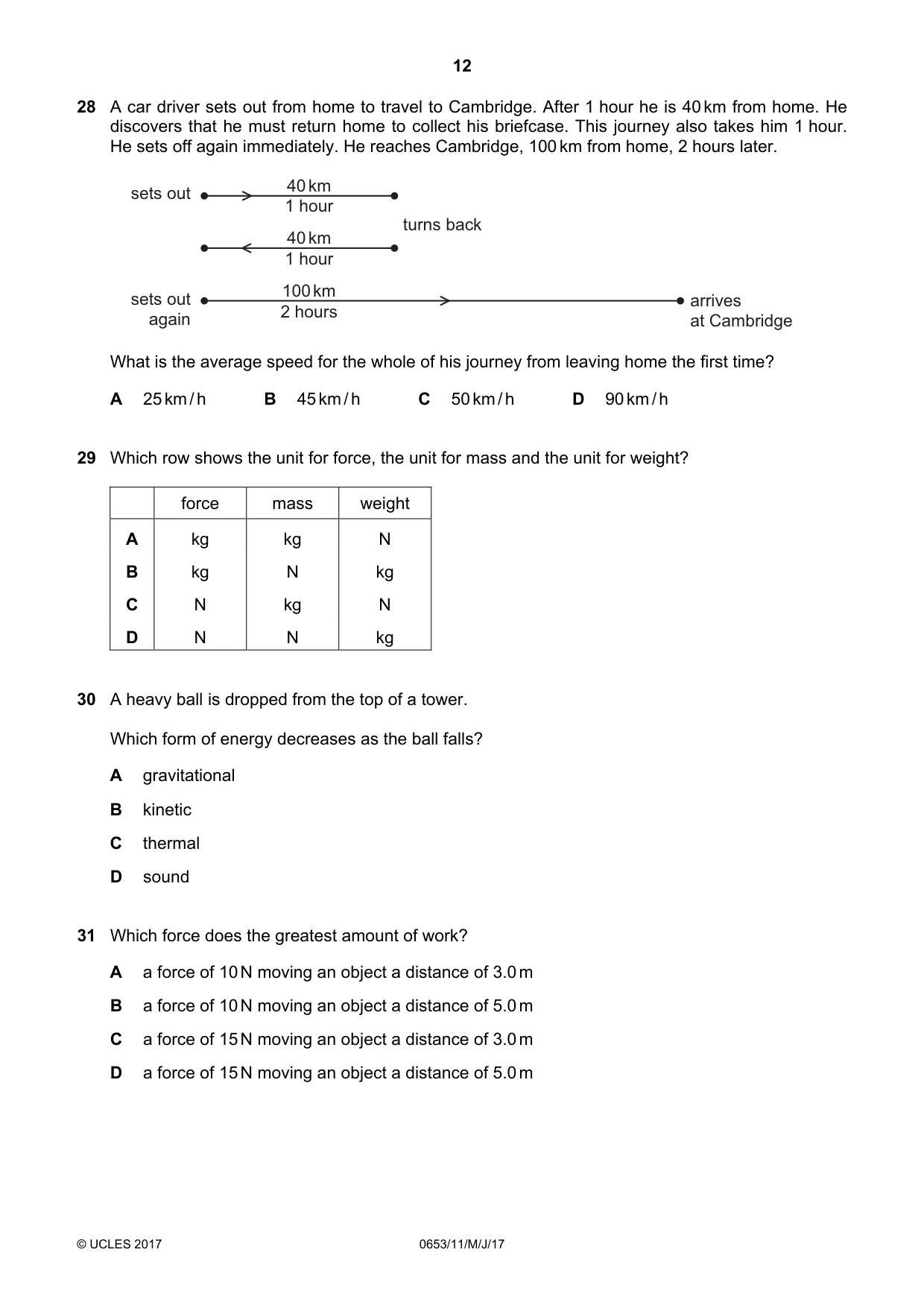
28 A car driver sets out from home to travel to Cambridge. After 1 hour he is 40 km from home. He discovers that he must return home to collect his briefcase. This journey also takes him 1 hour. He sets off again immediately. He reaches Cambridge, 100 km from home, 2 hours later. sets out 40 km 1 hour turns back 40 km 1 hour 100 km sets out arrives 2 hours again at Cambridge What is the average speed for the whole of his journey from leaving home the first time? A 25 km / h B 45 km / h C 50 km / h D 90 km / h
Mark scheme: B
Q29 · Which row shows the unit for force, the unit for mass and the unit for weight?
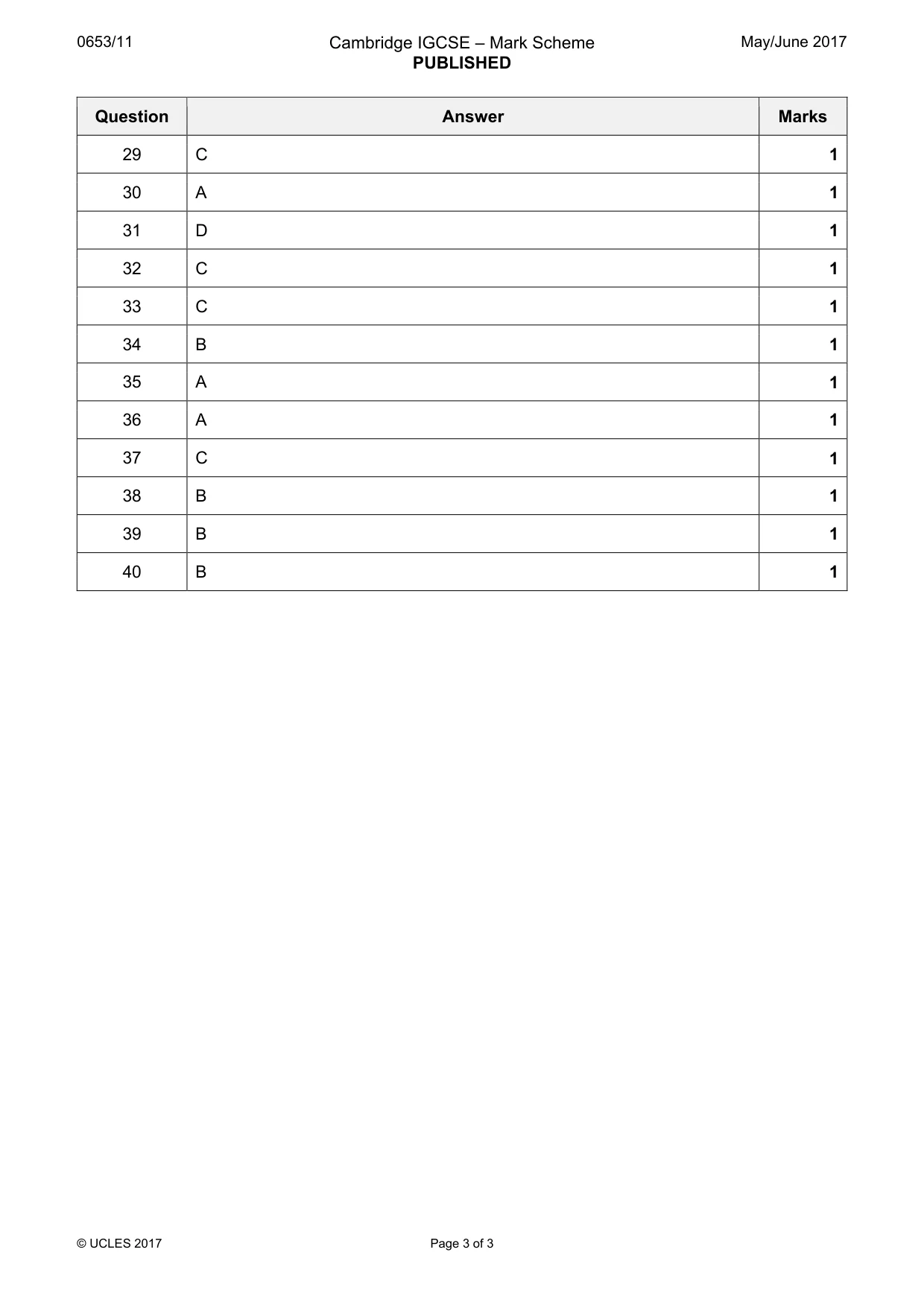
29 Which row shows the unit for force, the unit for mass and the unit for weight? force mass weight A kg kg N B kg N kg C N kg N D N N kg
Mark scheme: C
Q30 · A heavy ball is dropped from the top of a tower
30 A heavy ball is dropped from the top of a tower. Which form of energy decreases as the ball falls? A gravitational B kinetic C thermal D sound
Mark scheme: A
Q31 · Which force does the greatest amount of work?
31 Which force does the greatest amount of work? A a force of 10 N moving an object a distance of 3.0 m B a force of 10 N moving an object a distance of 5.0 m C a force of 15 N moving an object a distance of 3.0 m D a force of 15 N moving an object a distance of 5.0 m
Mark scheme: D
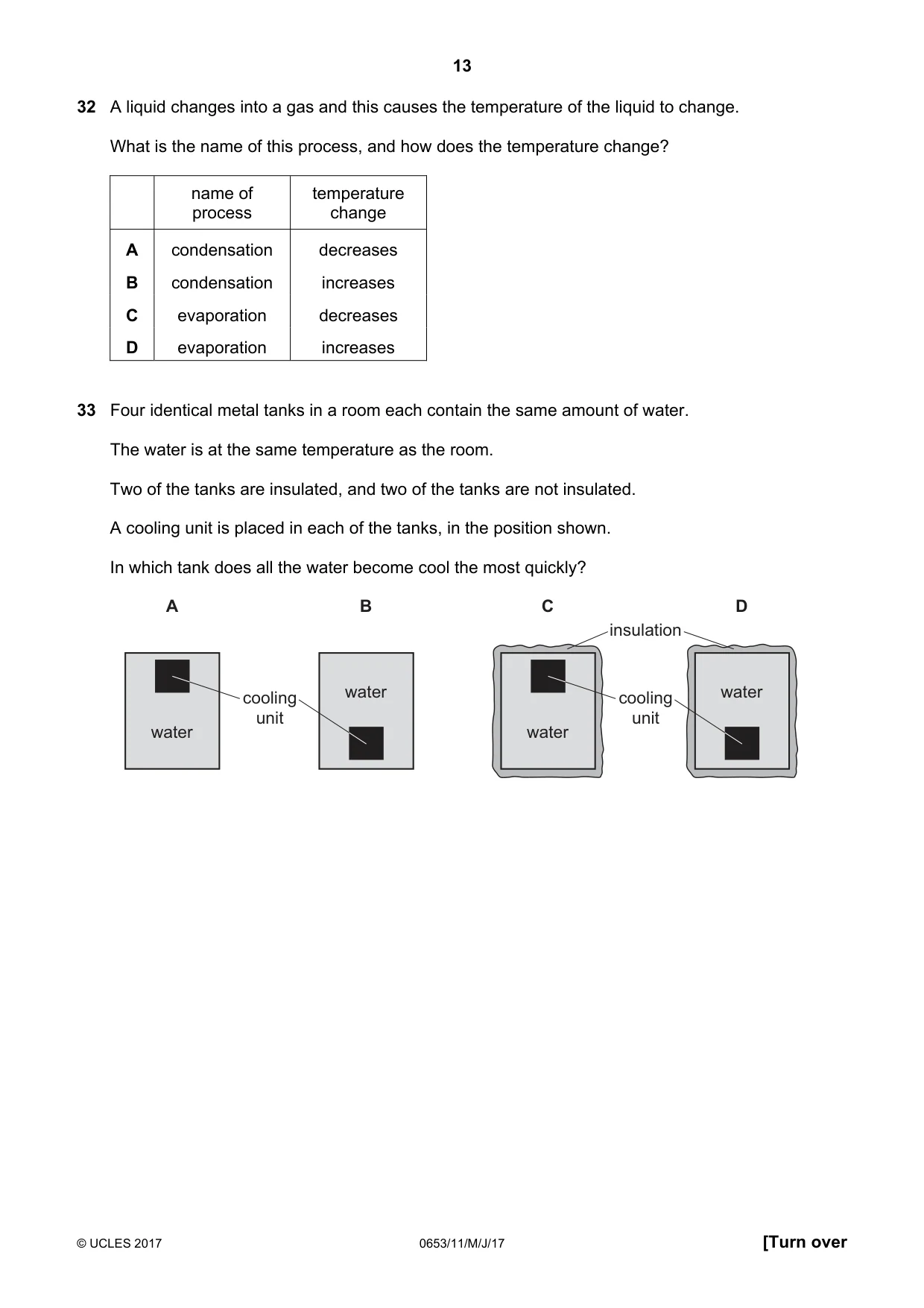
Q32 · A liquid changes into a gas and this causes the temperature of the liquid to change
32 A liquid changes into a gas and this causes the temperature of the liquid to change. What is the name of this process, and how does the temperature change? name of temperature process change A condensation decreases B condensation increases C evaporation decreases D evaporation increases
Mark scheme: C
Q33 · Four identical metal tanks in a room each contain the same amount of water
33 Four identical metal tanks in a room each contain the same amount of water. The water is at the same temperature as the room. Two of the tanks are insulated, and two of the tanks are not insulated. A cooling unit is placed in each of the tanks, in the position shown. In which tank does all the water become cool the most quickly? A B C D insulation cooling water cooling water unit unit water water
Mark scheme: C
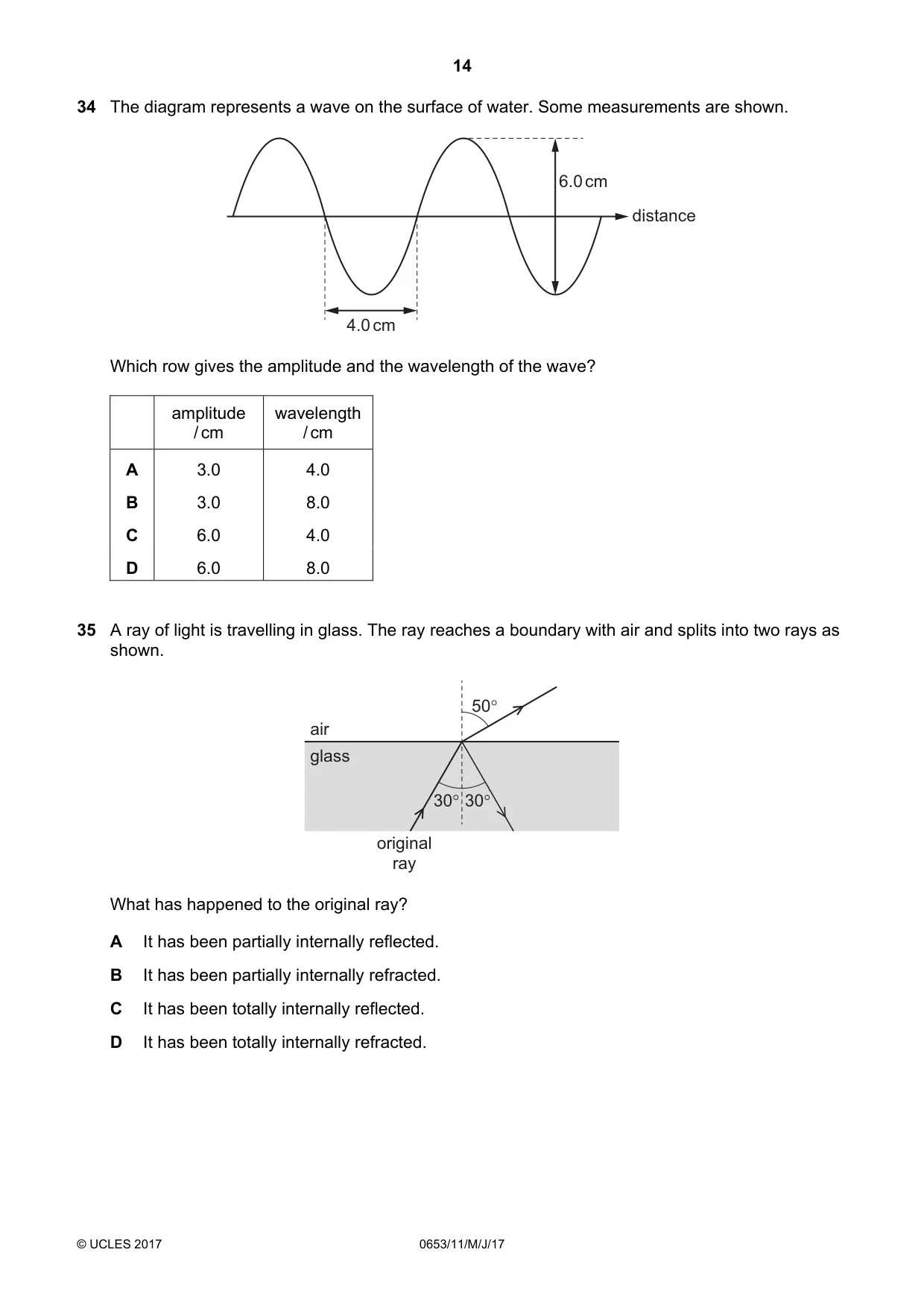
Q34 · The diagram represents a wave on the surface of water
34 The diagram represents a wave on the surface of water. Some measurements are shown. 6.0 cm distance 4.0 cm Which row gives the amplitude and the wavelength of the wave? amplitude wavelength / cm / cm A 3.0 4.0 B 3.0 8.0 C 6.0 4.0 D 6.0 8.0
Mark scheme: B
Q35 · A ray of light is travelling in glass
35 A ray of light is travelling in glass. The ray reaches a boundary with air and splits into two rays as shown. 50° air glass 30° 30° original ray What has happened to the original ray? A It has been partially internally reflected. B It has been partially internally refracted. C It has been totally internally reflected. D It has been totally internally refracted.
Mark scheme: A
Q36 · Which electromagnetic wave is used by a remote controller for a television?
36 Which electromagnetic wave is used by a remote controller for a television? A infra-red B microwaves C radio D ultraviolet
Mark scheme: A
Q37 · An electronic circuit in a fire alarm makes a loudspeaker vibrate alternately at two…
37 An electronic circuit in a fire alarm makes a loudspeaker vibrate alternately at two different frequencies. Which pair of frequencies is suitable to use in the alarm to alert people to the danger of fire? A 1.5 Hz and 15 Hz B 15 Hz and 150 000 Hz C 150 Hz and 15 000 Hz D 150 000 Hz and 15 000 000 Hz
Mark scheme: C
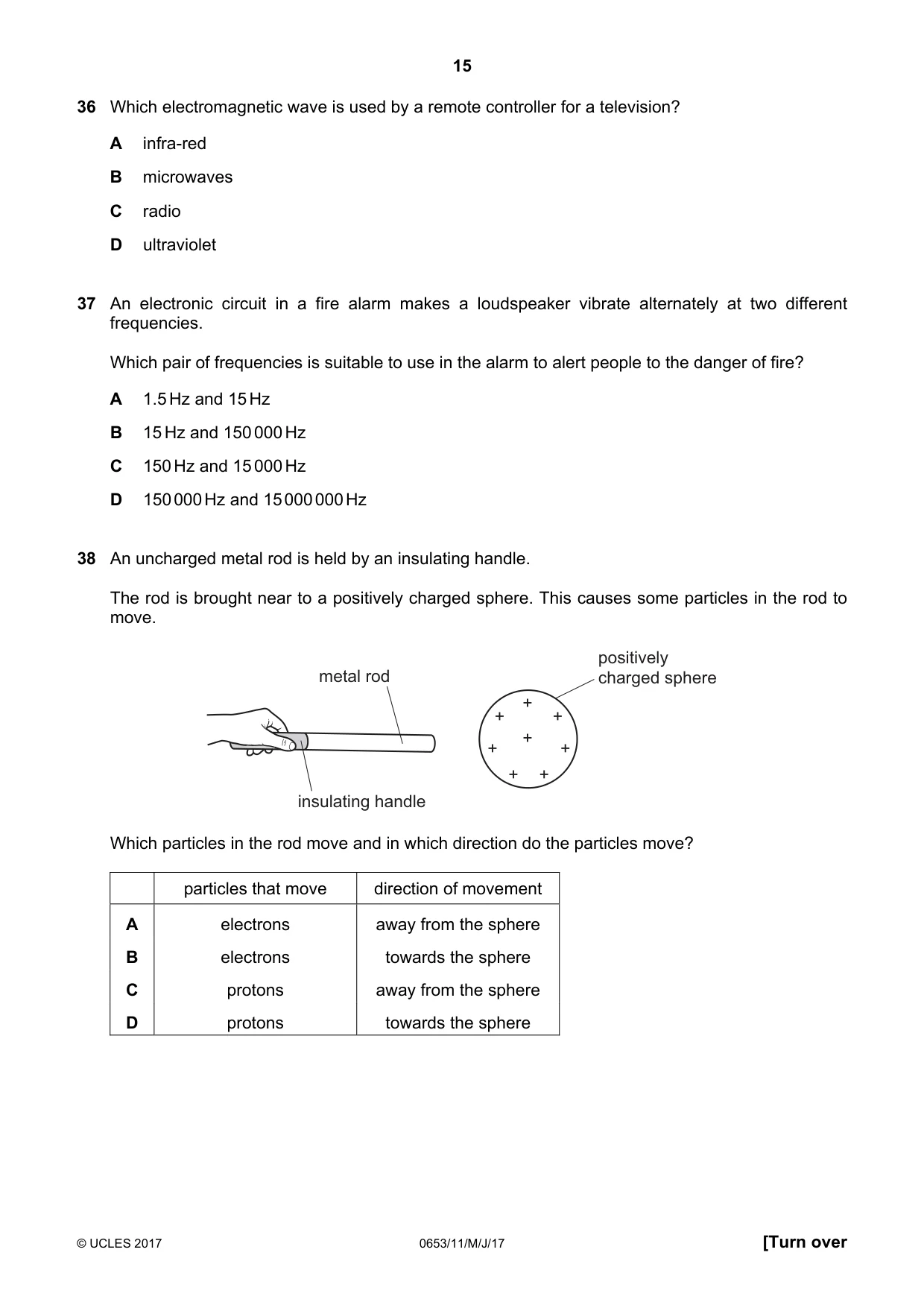
Q38 · An uncharged metal rod is held by an insulating handle
38 An uncharged metal rod is held by an insulating handle. The rod is brought near to a positively charged sphere. This causes some particles in the rod to move. positively metal rod charged sphere + + + + + + + + insulating handle Which particles in the rod move and in which direction do the particles move? particles that move direction of movement A electrons away from the sphere B electrons towards the sphere C protons away from the sphere D protons towards the sphere
Mark scheme: B
Q39 · A power supply causes a current in a circuit
39 A power supply causes a current in a circuit. The potential difference (p.d.) of the power supply and the resistance of the circuit are both changed. Which pair of changes must result in a smaller current in the circuit? p.d. resistance A decreased decreased B decreased increased C increased decreased D increased increased
Mark scheme: B
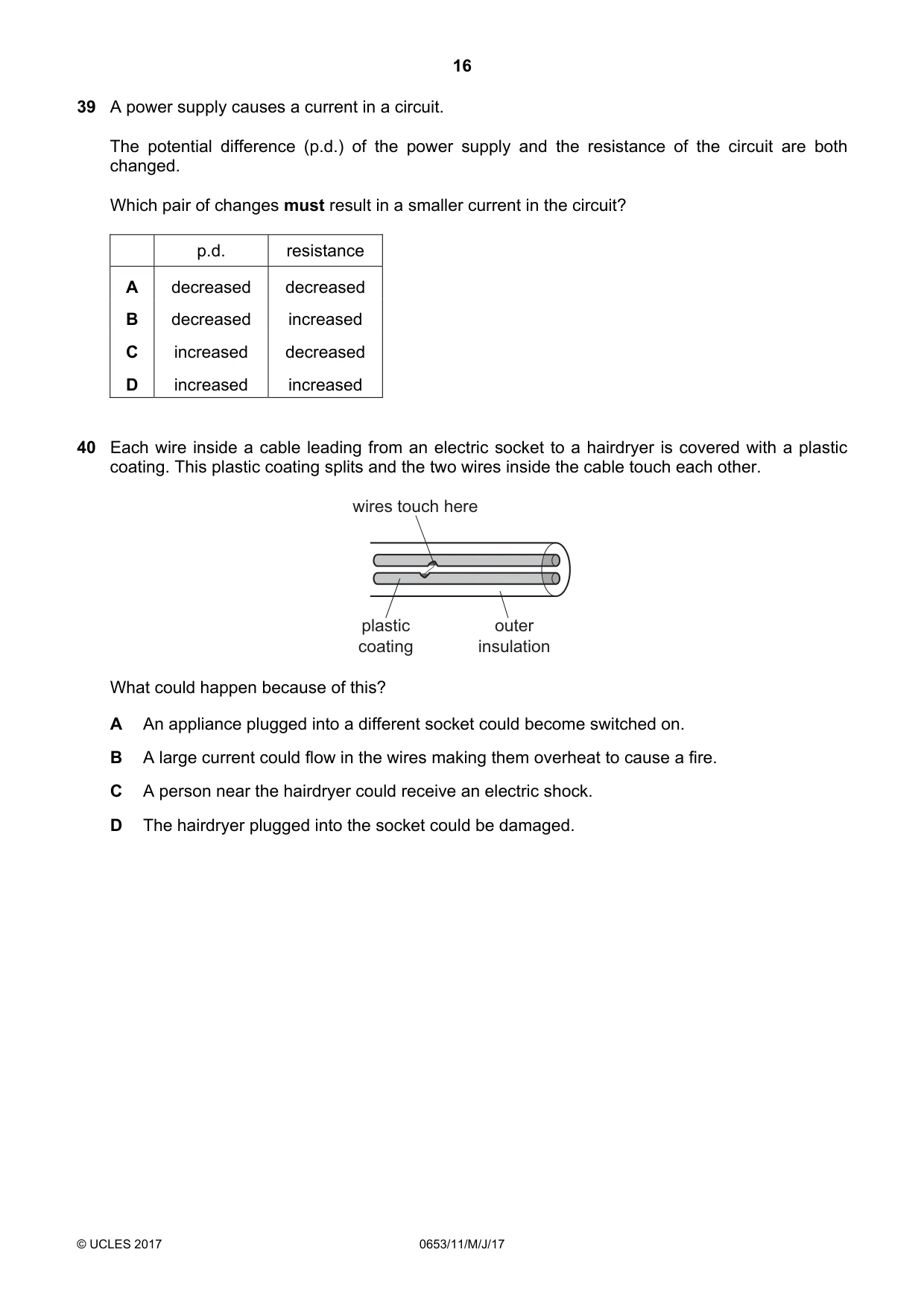
Q40 · Each wire inside a cable leading from an electric socket to a hairdryer is covered with a…
40 Each wire inside a cable leading from an electric socket to a hairdryer is covered with a plastic coating. This plastic coating splits and the two wires inside the cable touch each other. wires touch here plastic outer coating insulation What could happen because of this? A An appliance plugged into a different socket could become switched on. B A large current could flow in the wires making them overheat to cause a fire. C A person near the hairdryer could receive an electric shock. D The hairdryer plugged into the socket could be damaged.
Mark scheme: B
What was in this paper
The subtopics covered by these 40 questions, and how many questions each got. Open one in a new tab to see every Cambridge question on it.
2Air quality and climate1Alloys and their properties1Arrangement of elements1Biological molecules1Chromatography1Drugs1Electrical circuits1Electrical quantities1Electrical safety1Electrolysis1Electromagnetic spectrum1Enzymes1Exothermic and endothermic reactions1Food chains and food webs1Fuels1Gas exchange in humans1General properties of waves1Habitat destruction1Heart1Identification of ions and gases1Kinetic particle model of matter1Light1Mass and weight1Motion1Photosynthesis1Physical and chemical changes1Preparation of salts1Rate of reaction1Reactivity series1Redox1Respiration1Sexual reproduction in humans1Sexual reproduction in plants1Simple molecules and covalent bonds1Size of specimens1Sound1Transfer of thermal energy1Transpiration1What you needed in this session
Cambridge’s own grade thresholds for 2017 May/June, Paper 1 · Variant 1. A higher threshold means an easier paper — the bar moves with how the cohort did.