Cambridge IGCSE Science - Combined 0653 — 2022 May/June Paper 1 · Variant 1
0653/11/M/J/22 · 40 questions · 40 marks · ≈45 min
The question paper and its mark scheme, free to read here and free to download. This is Cambridge’s own paper, exactly as it was sat.
Question paper16 pages

Mark scheme3 pages
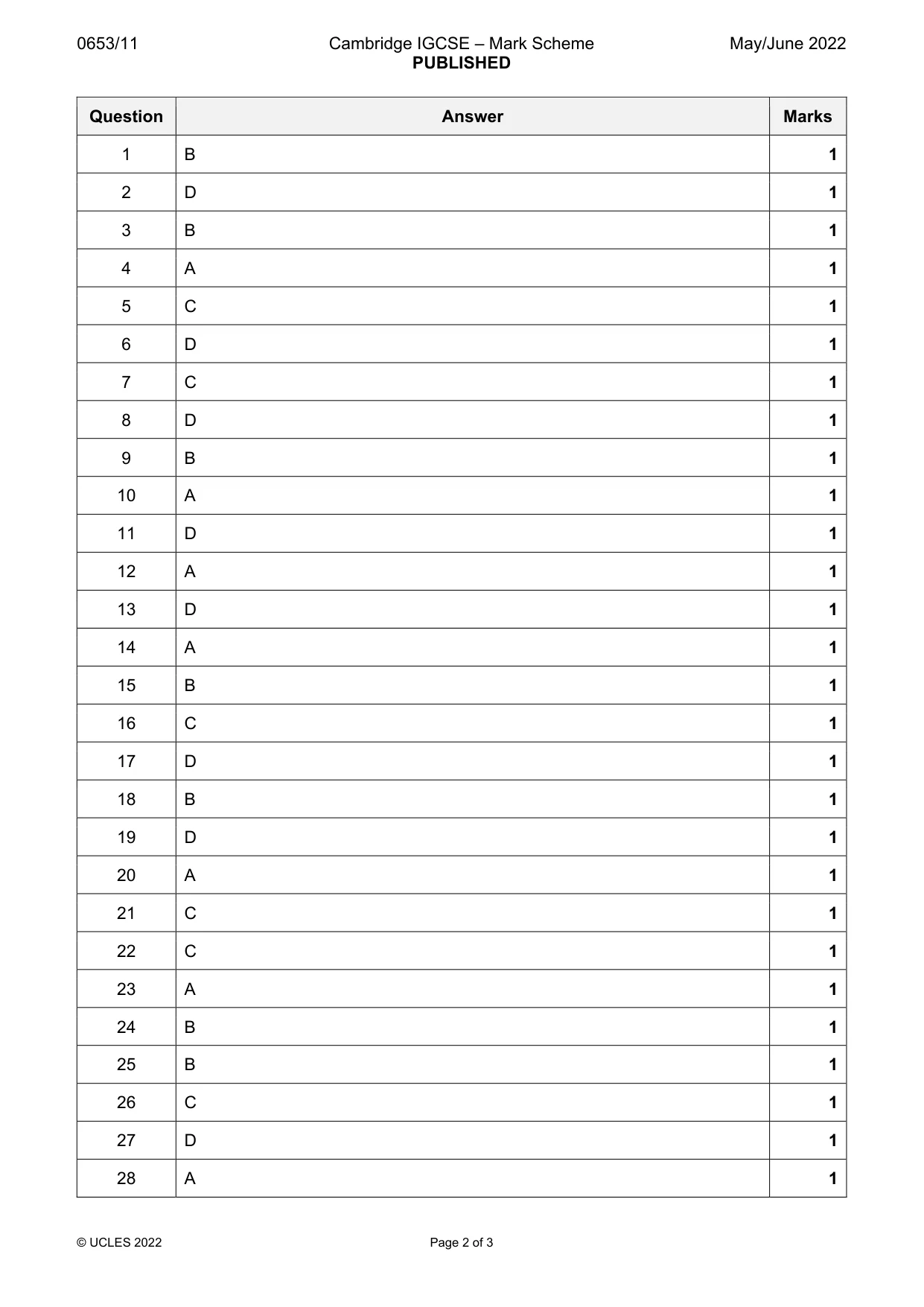
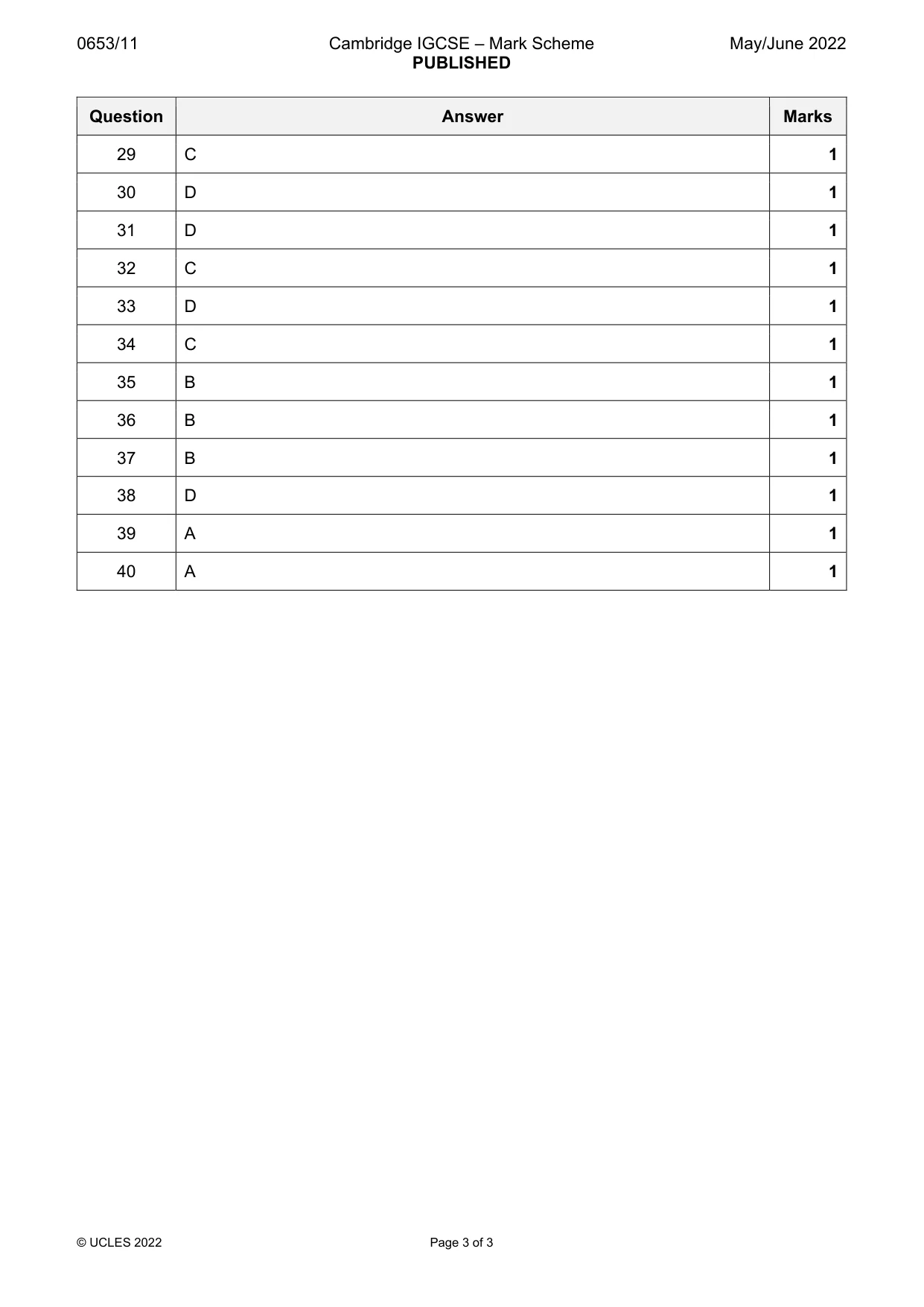
Answers below. Sit the paper first if you are practising.
Questions as text
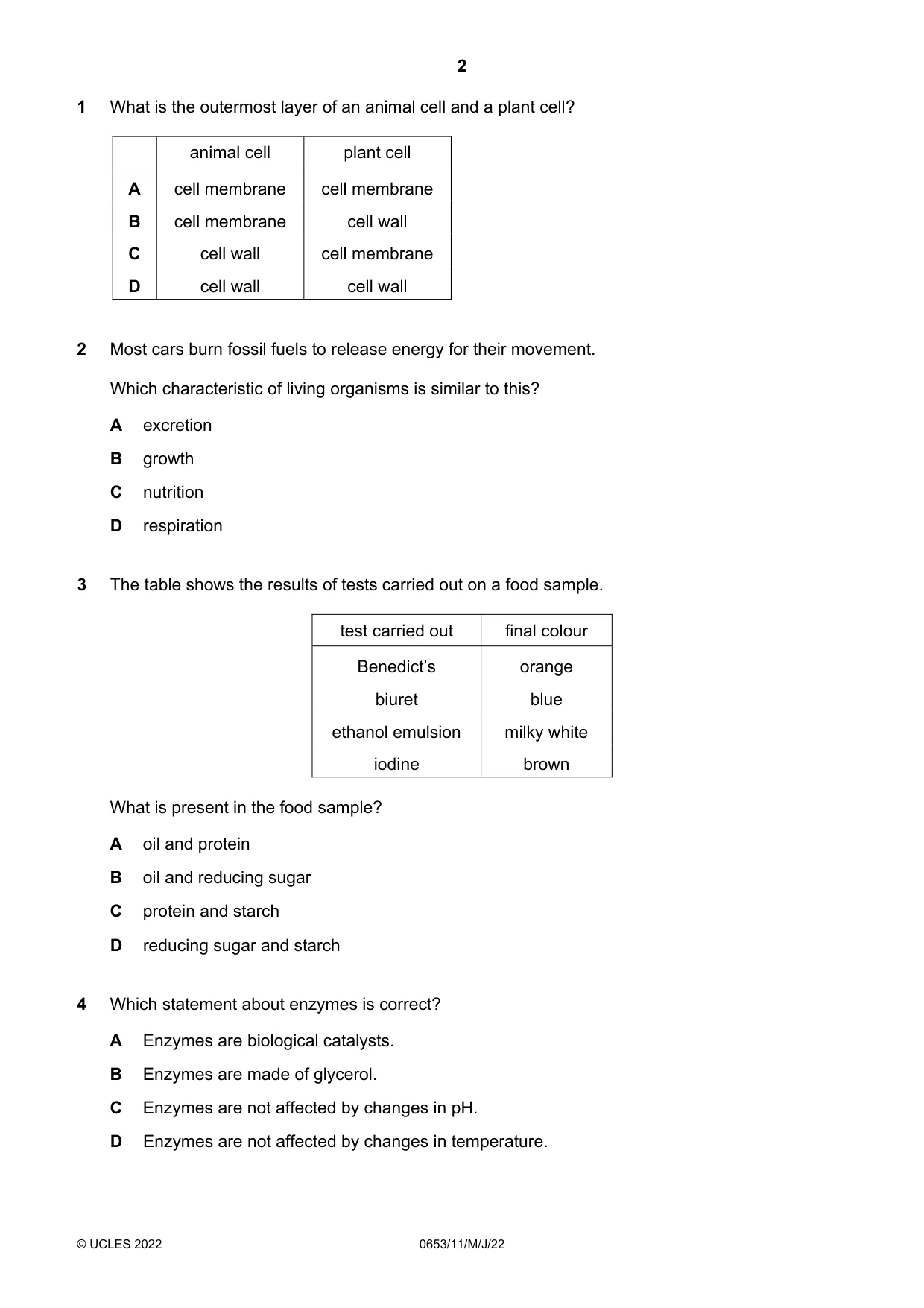
Q1 · What is the outermost layer of an animal cell and a plant cell?
1 What is the outermost layer of an animal cell and a plant cell? animal cell plant cell A cell membrane cell membrane B cell membrane cell wall C cell wall cell membrane D cell wall cell wall
Mark scheme: B
Q2 · Most cars burn fossil fuels to release energy for their movement
2 Most cars burn fossil fuels to release energy for their movement. Which characteristic of living organisms is similar to this? A excretion B growth C nutrition D respiration
Mark scheme: D
Q3 · The table shows the results of tests carried out on a food sample
3 The table shows the results of tests carried out on a food sample. test carried out final colour Benedict’s orange biuret blue ethanol emulsion milky white iodine brown What is present in the food sample? A oil and protein B oil and reducing sugar C protein and starch D reducing sugar and starch
Mark scheme: B
Q4 · Which statement about enzymes is correct?
4 Which statement about enzymes is correct? A Enzymes are biological catalysts. B Enzymes are made of glycerol. C Enzymes are not affected by changes in pH. D Enzymes are not affected by changes in temperature.
Mark scheme: A
Q5 · A plant that lives in water is exposed to sunlight
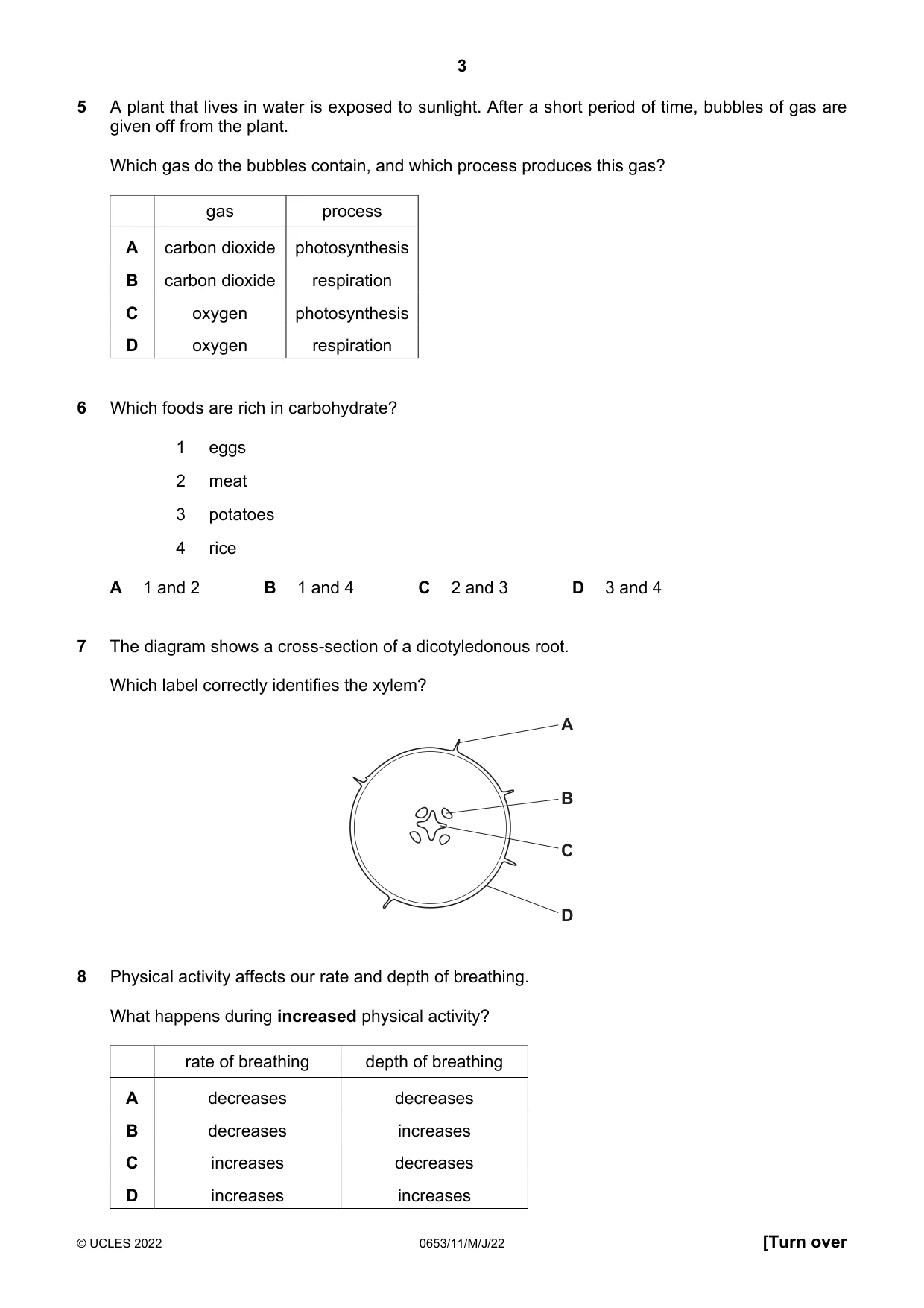
5 A plant that lives in water is exposed to sunlight. After a short period of time, bubbles of gas are given off from the plant. Which gas do the bubbles contain, and which process produces this gas? gas process A carbon dioxide photosynthesis B carbon dioxide respiration C oxygen photosynthesis D oxygen respiration
Mark scheme: C
Q6 · Which foods are rich in carbohydrate?
6 Which foods are rich in carbohydrate? 1 eggs 2 meat 3 potatoes 4 rice A 1 and 2 B 1 and 4 C 2 and 3 D 3 and 4
Mark scheme: D
Q7 · The diagram shows a cross-section of a dicotyledonous root
7 The diagram shows a cross-section of a dicotyledonous root. Which label correctly identifies the xylem? A B C D
Mark scheme: C
Q8 · Physical activity affects our rate and depth of breathing
8 Physical activity affects our rate and depth of breathing. What happens during increased physical activity? rate of breathing depth of breathing A decreases decreases B decreases increases C increases decreases D increases increases
Mark scheme: D
Q9 · Which responses occur as a result of adrenaline secretion?
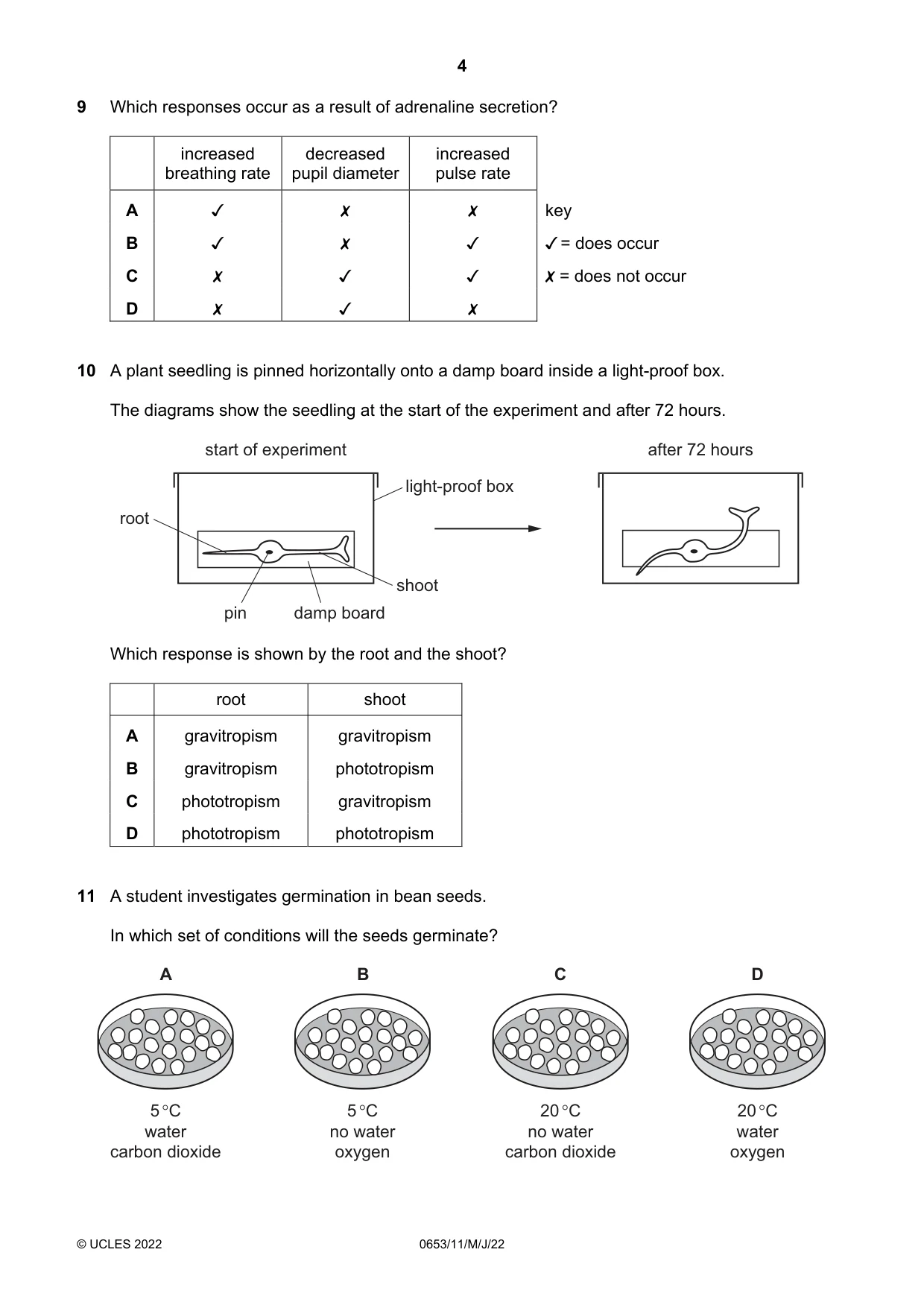
9 Which responses occur as a result of adrenaline secretion? increased decreased increased breathing rate | pupil diameter pulse rate A v x x B J x J Cc x Jv J D x Jv x key JY = does occur X = does not occur
Mark scheme: B
Q10 · A plant seedling is pinned horizontally onto a damp board inside a light-proof box
10 A plant seedling is pinned horizontally onto a damp board inside a light-proof box. The diagrams show the seedling at the start of the experiment and after 72 hours. start of experiment after 72 hours light-proof box root shoot pin damp board Which response is shown by the root and the shoot? root shoot A gravitropism gravitropism B gravitropism phototropism C phototropism gravitropism D phototropism phototropism
Mark scheme: A
Q11 · A student investigates germination in bean seeds
11 A student investigates germination in bean seeds. In which set of conditions will the seeds germinate? water no water no water water carbon dioxide oxygen carbon dioxide oxygen
Mark scheme: D
Q12 · Two food chains are shown
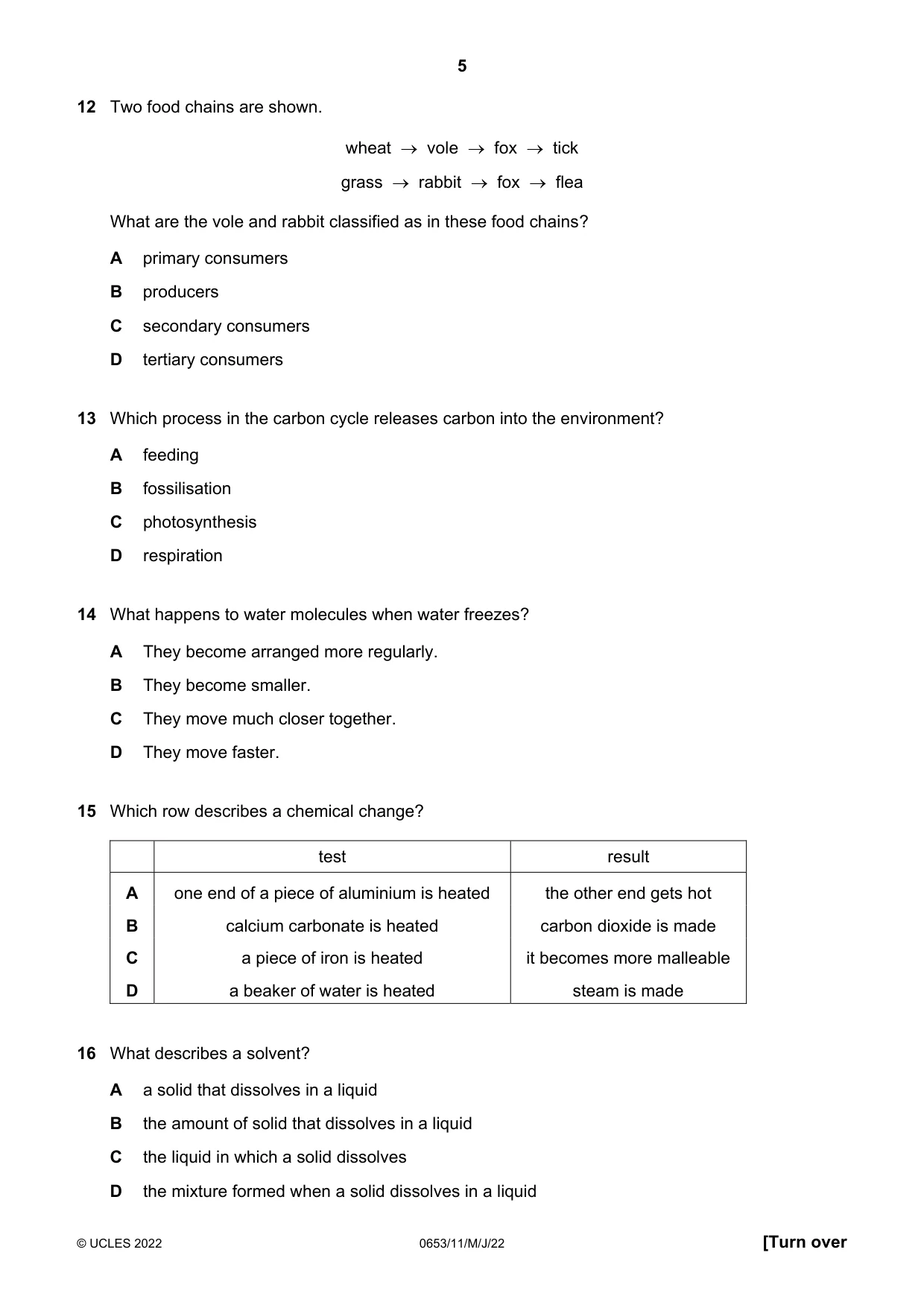
12 Two food chains are shown. wheat vole fox tick grass rabbit fox flea What are the vole and rabbit classified as in these food chains? A primary consumers B producers C secondary consumers D tertiary consumers
Mark scheme: A
Q13 · Which process in the carbon cycle releases carbon into the environment?
13 Which process in the carbon cycle releases carbon into the environment? A feeding B fossilisation C photosynthesis D respiration
Mark scheme: D
Q14 · What happens to water molecules when water freezes?
14 What happens to water molecules when water freezes? A They become arranged more regularly. B They become smaller. C They move much closer together. D They move faster.
Mark scheme: A
Q15 · Which row describes a chemical change?
15 Which row describes a chemical change? test result A one end of a piece of aluminium is heated the other end gets hot B calcium carbonate is heated carbon dioxide is made C a piece of iron is heated it becomes more malleable D a beaker of water is heated steam is made
Mark scheme: B
Q16 · What describes a solvent?
16 What describes a solvent? A a solid that dissolves in a liquid B the amount of solid that dissolves in a liquid C the liquid in which a solid dissolves D the mixture formed when a solid dissolves in a liquid
Mark scheme: C
Q17 · Which groups of the Periodic Table form compounds containing covalent bonds?
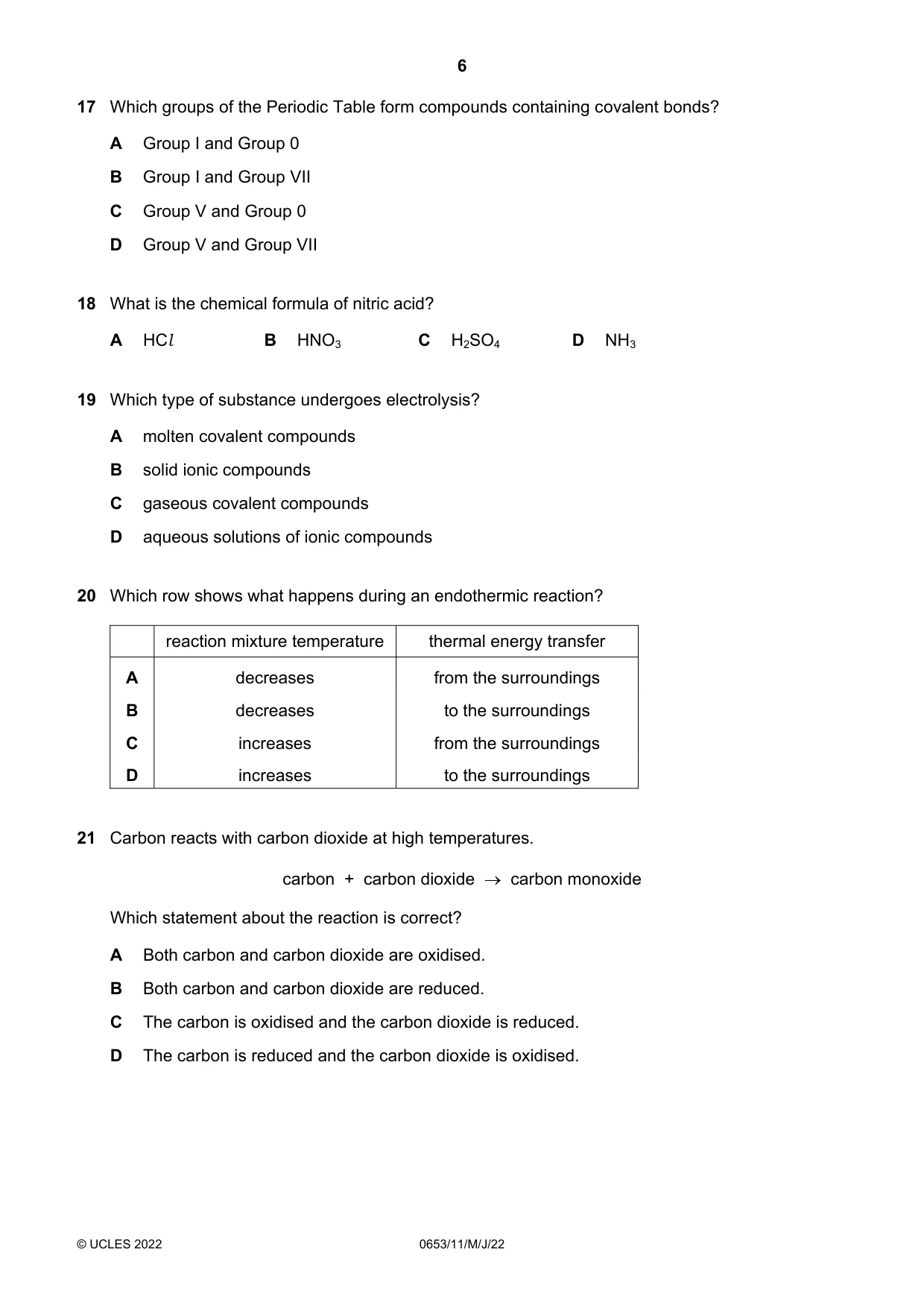
17 Which groups of the Periodic Table form compounds containing covalent bonds? A Group I and Group 0 B Group I and Group VII C Group V and Group 0 D Group V and Group VII
Mark scheme: D
Q18 · What is the chemical formula of nitric acid?
18 What is the chemical formula of nitric acid? A HCl B HNO3 C H2SO4 D NH3
Mark scheme: B
Q19 · Which type of substance undergoes electrolysis?
19 Which type of substance undergoes electrolysis? A molten covalent compounds B solid ionic compounds C gaseous covalent compounds D aqueous solutions of ionic compounds
Mark scheme: D
Q20 · Which row shows what happens during an endothermic reaction?
20 Which row shows what happens during an endothermic reaction? reaction mixture temperature thermal energy transfer A decreases from the surroundings B decreases to the surroundings C increases from the surroundings D increases to the surroundings
Mark scheme: A
Q21 · Carbon reacts with carbon dioxide at high temperatures
21 Carbon reacts with carbon dioxide at high temperatures. carbon + carbon dioxide carbon monoxide Which statement about the reaction is correct? A Both carbon and carbon dioxide are oxidised. B Both carbon and carbon dioxide are reduced. C The carbon is oxidised and the carbon dioxide is reduced. D The carbon is reduced and the carbon dioxide is oxidised.
Mark scheme: C
Q22 · Three powders are added to dilute sulfuric acid, as shown
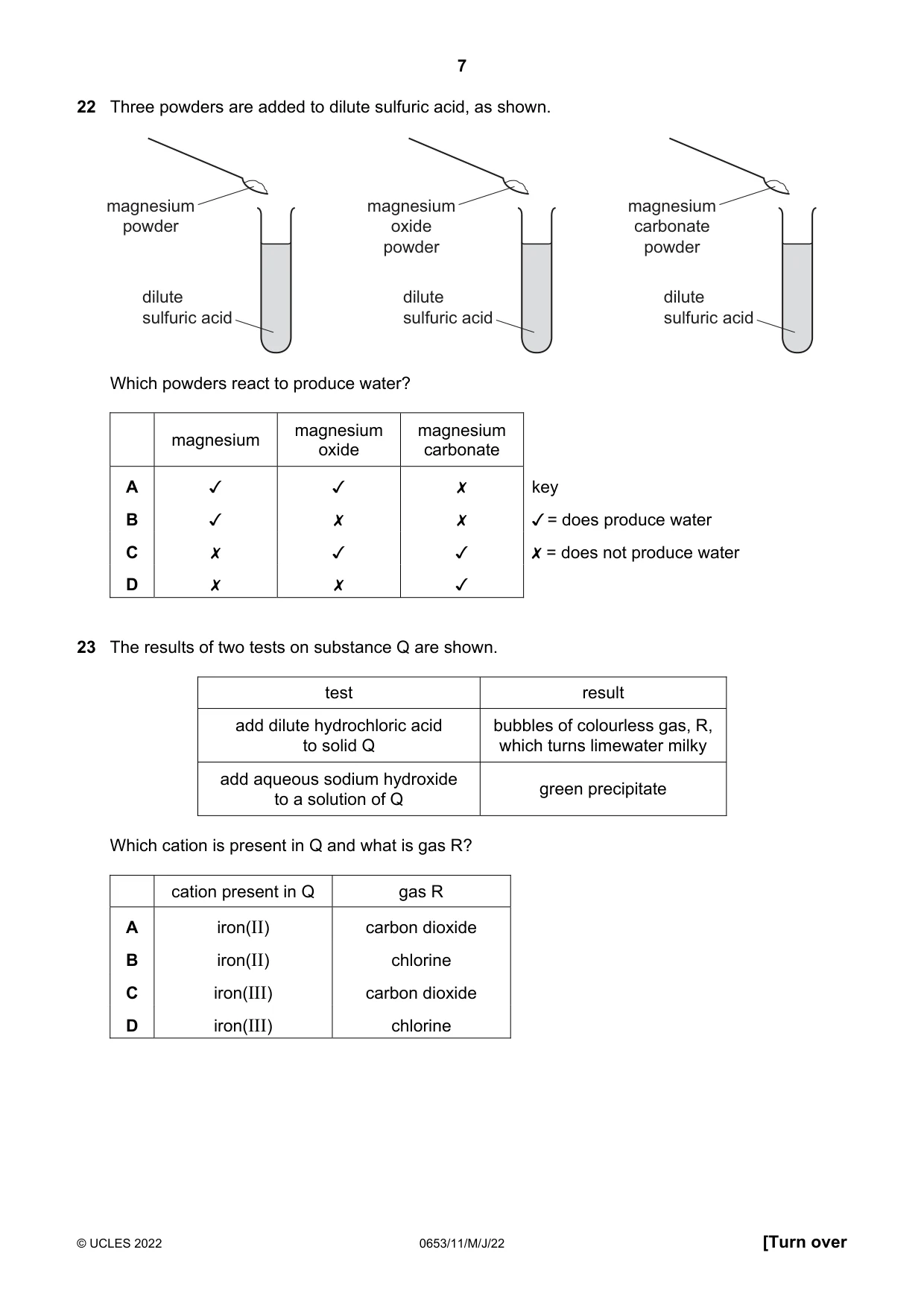
22 Three powders are added to dilute sulfuric acid, as shown. magnesium powder dilute sulfuric acid Which powders react to produce water? magnesium oxide powder dilute sulfuric acid magnesium magnesium oxide x \ x magnesium carbonate \ \ «Ox magnesium carbonate powder dilute sulfuric acid key ¥ = does produce water X = does not produce water
Mark scheme: C
More questions on The characteristic properties of acids and bases
Q23 · The results of two tests on substance Q are shown
23 The results of two tests on substance Q are shown. test result add dilute hydrochloric acid bubbles of colourless gas, R, to solid Q which turns limewater milky add aqueous sodium hydroxide green precipitate to a solution of Q Which cation is present in Q and what is gas R? cation present in Q gas R A iron(II) carbon dioxide B iron(II) chlorine C iron(III) carbon dioxide D iron(III) chlorine
Mark scheme: A
Q24 · Which row describes a transition element?
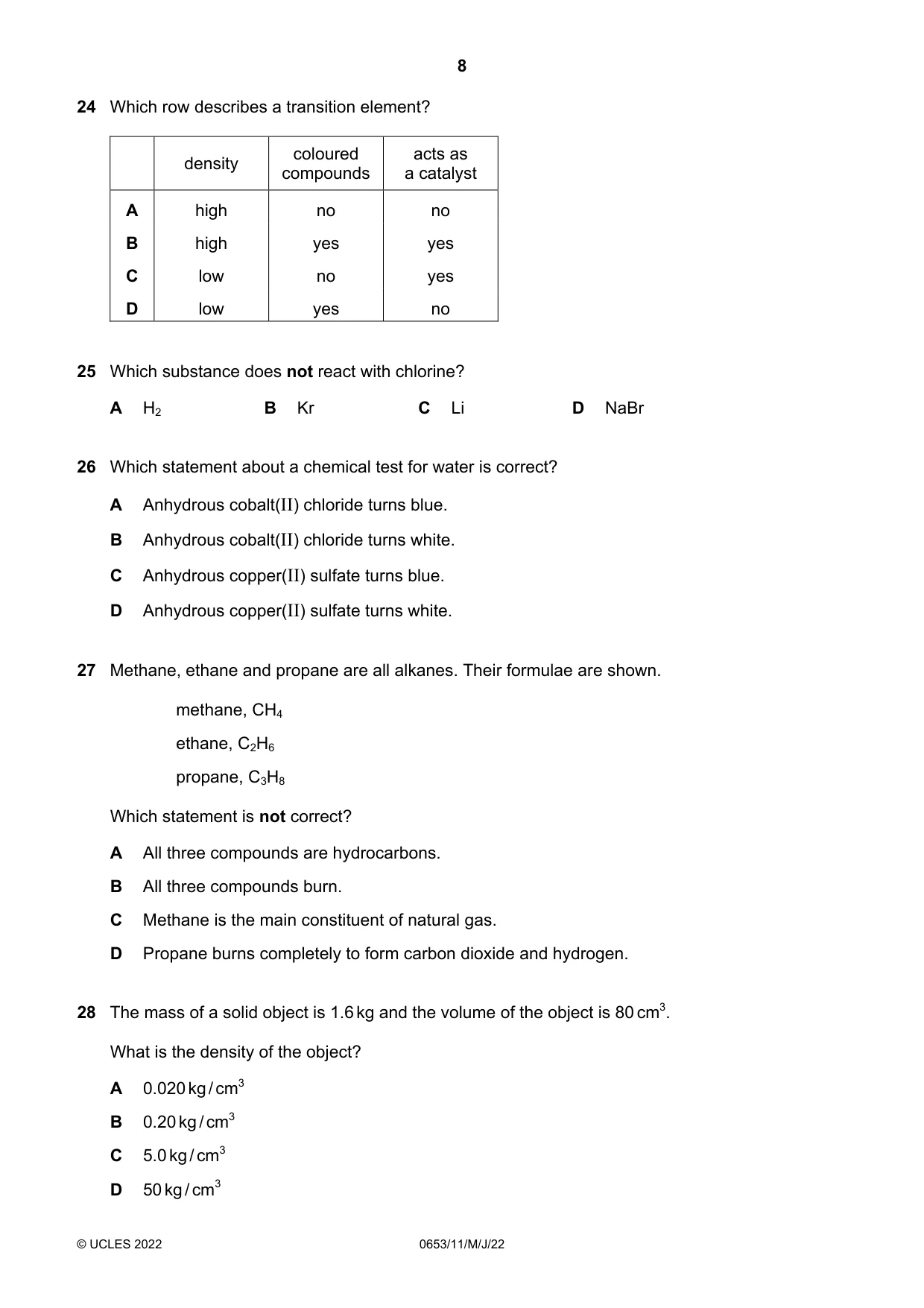
24 Which row describes a transition element? coloured acts as density compounds a catalyst A high no no B high yes yes C low no yes D low yes no
Mark scheme: B
Q25 · Which substance does not react with chlorine?
25 Which substance does not react with chlorine? A H2 B Kr C Li D NaBr
Mark scheme: B
Q26 · Which statement about a chemical test for water is correct?
26 Which statement about a chemical test for water is correct? A Anhydrous cobalt(II) chloride turns blue. B Anhydrous cobalt(II) chloride turns white. C Anhydrous copper(II) sulfate turns blue. D Anhydrous copper(II) sulfate turns white.
Mark scheme: C
Q27 · Methane, ethane and propane are all alkanes
27 Methane, ethane and propane are all alkanes. Their formulae are shown. methane, CH4 ethane, C2H6 propane, C3H8 Which statement is not correct? A All three compounds are hydrocarbons. B All three compounds burn. C Methane is the main constituent of natural gas. D Propane burns completely to form carbon dioxide and hydrogen.
Mark scheme: D
Q28 · The mass of a solid object is 1.6 kg and the volume of the object is 80 cm3
28 The mass of a solid object is 1.6 kg and the volume of the object is 80 cm3. What is the density of the object? A 0.020 kg / cm3 B 0.20 kg / cm3 C 5.0 kg / cm3 D 50 kg / cm3
Mark scheme: A
Q29 · Which statement about forces is always correct?
29 Which statement about forces is always correct? A A resultant force is needed to keep an object moving at constant speed in a straight line. B Air resistance acting on an object falling in still air causes its speed to increase. C Friction on an object sliding along rough ground acts in the opposite direction to its motion. D No forces act on any object that is at rest.
Mark scheme: C
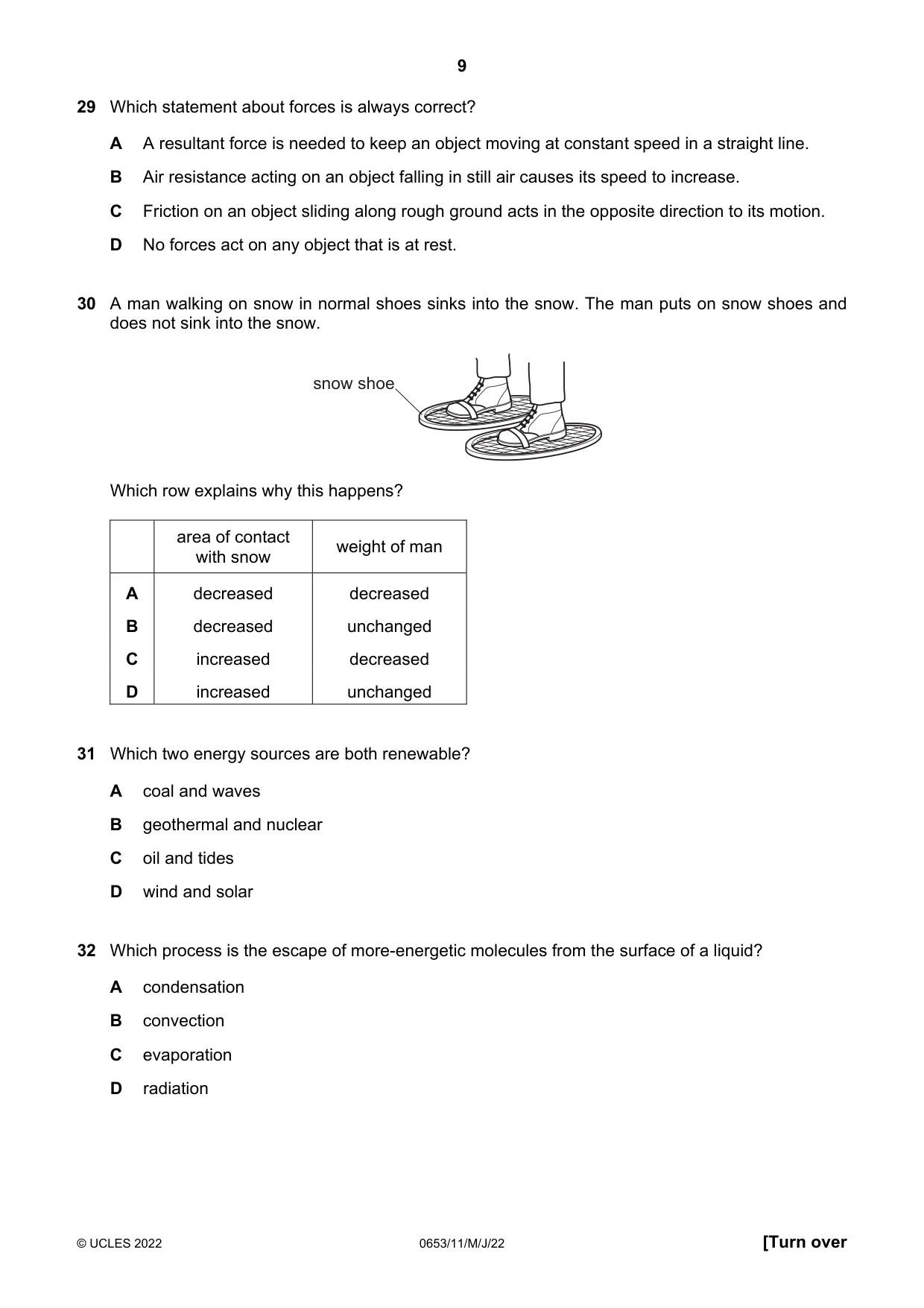
Q30 · A man walking on snow in normal shoes sinks into the snow
30 A man walking on snow in normal shoes sinks into the snow. The man puts on snow shoes and does not sink into the snow. snow shoe Which row explains why this happens? area of contact weight of man with snow A decreased decreased B decreased unchanged C increased decreased D increased unchanged
Mark scheme: D
Q31 · Which two energy sources are both renewable?
31 Which two energy sources are both renewable? A coal and waves B geothermal and nuclear C oil and tides D wind and solar
Mark scheme: D
Q32 · Which process is the escape of more-energetic molecules from the surface of a liquid?
32 Which process is the escape of more-energetic molecules from the surface of a liquid? A condensation B convection C evaporation D radiation
Mark scheme: C
Q33 · A mechanic cannot remove a large steel nut from a steel bolt because it is too tight
33 A mechanic cannot remove a large steel nut from a steel bolt because it is too tight. bolt nut What does the mechanic do to help remove the nut? A cool the nut and heat the bolt B heat the bolt only C heat the nut and the bolt through the same temperature rise D heat the nut only
Mark scheme: D
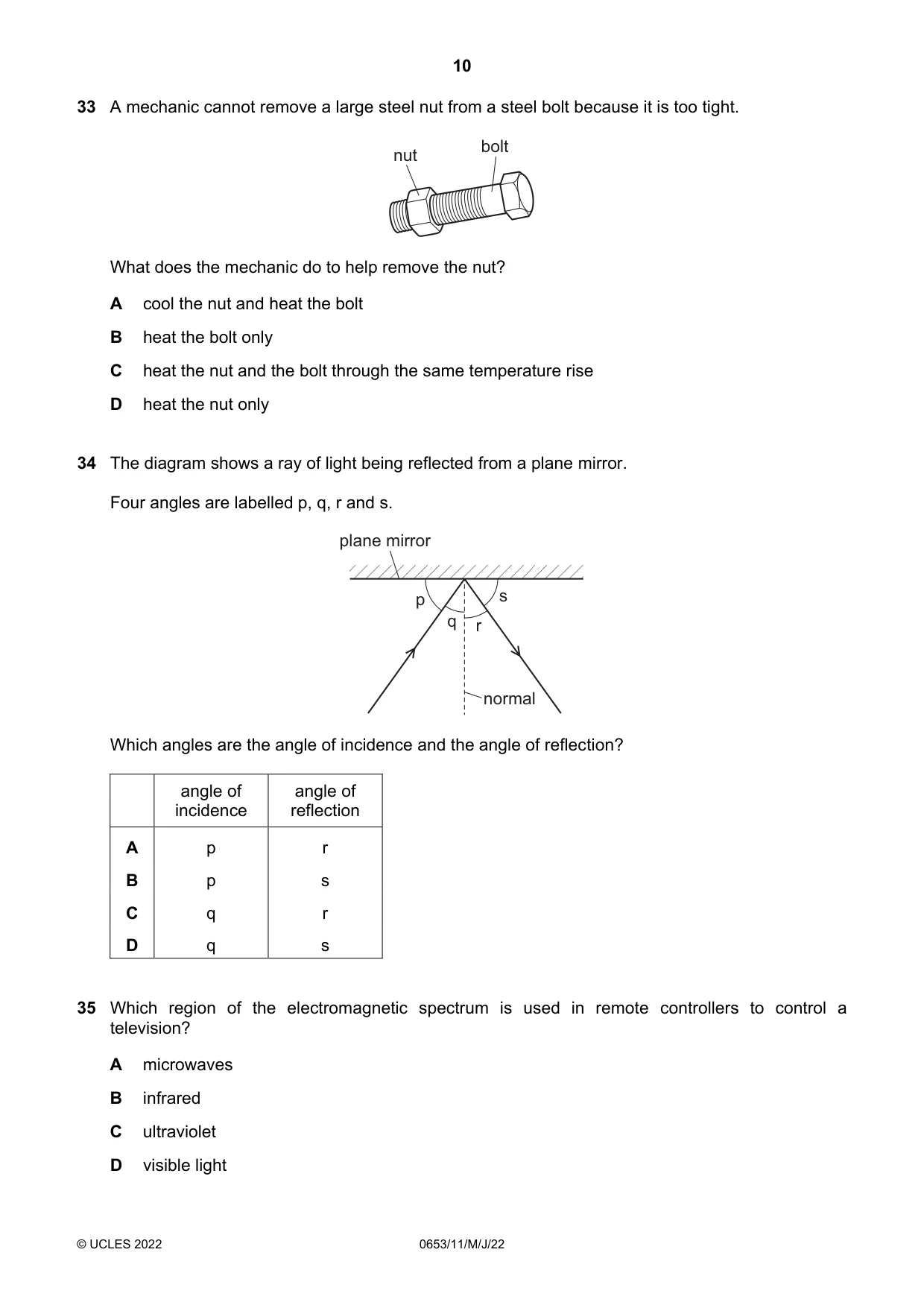
Q34 · The diagram shows a ray of light being reflected from a plane mirror
34 The diagram shows a ray of light being reflected from a plane mirror. Four angles are labelled p, q, r and s. plane mirror p s q r normal Which angles are the angle of incidence and the angle of reflection? angle of angle of incidence reflection A p r B p s C q r D q s
Mark scheme: C
Q35 · Which region of the electromagnetic spectrum is used in remote controllers to control a…
35 Which region of the electromagnetic spectrum is used in remote controllers to control a television? A microwaves B infrared C ultraviolet D visible light
Mark scheme: B
Q36 · Two balloons X and Y are suspended by insulating threads
36 Two balloons X and Y are suspended by insulating threads. They are each held near a negatively charged balloon. The balloons hang as shown. insulating insulating threads threads – – – – – – – – – – – – – X – – Y ––– – – – – – – What is the charge on balloon X and what is the charge on balloon Y? balloon X balloon Y A negative negative B negative positive C positive negative D positive positive
Mark scheme: B
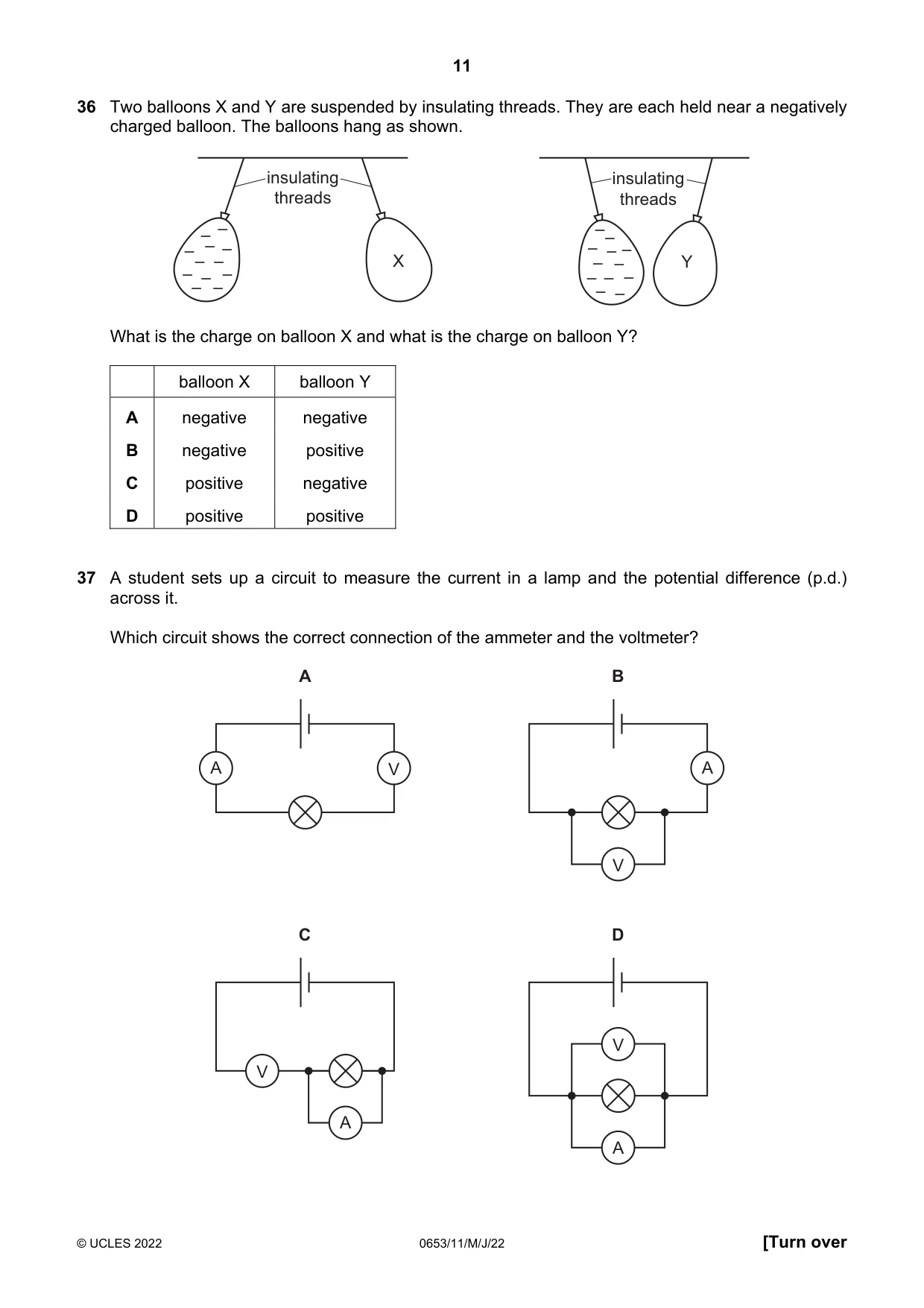
Q37 · A student sets up a circuit to measure the current in a lamp and the potential difference…
37 A student sets up a circuit to measure the current in a lamp and the potential difference (p.d.) across it. Which circuit shows the correct connection of the ammeter and the voltmeter? A B A V A V C D V V A A
Mark scheme: B
Q38 · The diagram shows a label on the side of a lamp
38 The diagram shows a label on the side of a lamp. 12 V 3.0 A 36 W What is the resistance of the lamp when it is operating normally? A 0.25 B 0.33 C 3.0 D 4.0
Mark scheme: D
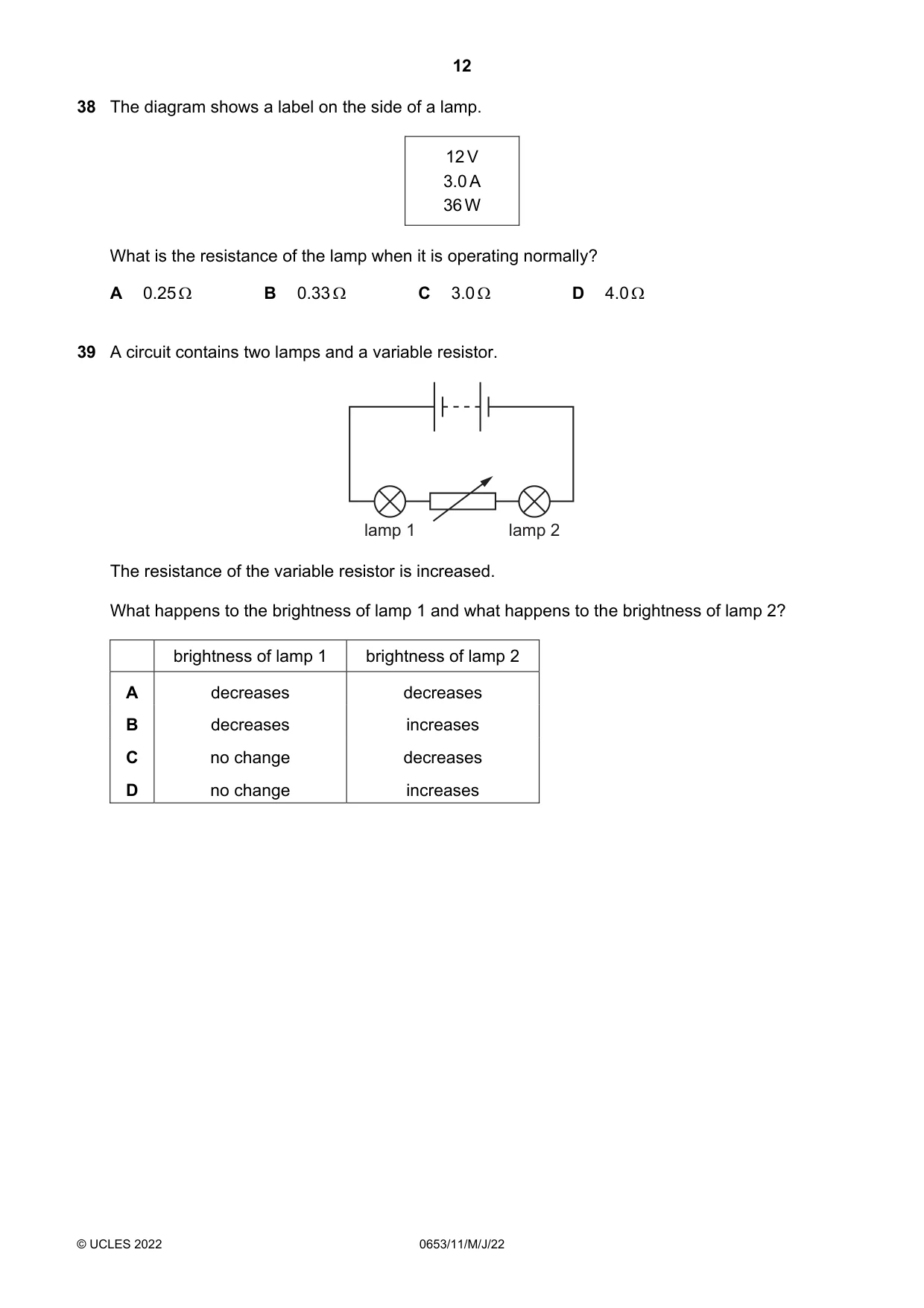
Q39 · A circuit contains two lamps and a variable resistor
39 A circuit contains two lamps and a variable resistor. lamp 1 lamp 2 The resistance of the variable resistor is increased. What happens to the brightness of lamp 1 and what happens to the brightness of lamp 2? brightness of lamp 1 brightness of lamp 2 A decreases decreases B decreases increases C no change decreases D no change increases
Mark scheme: A
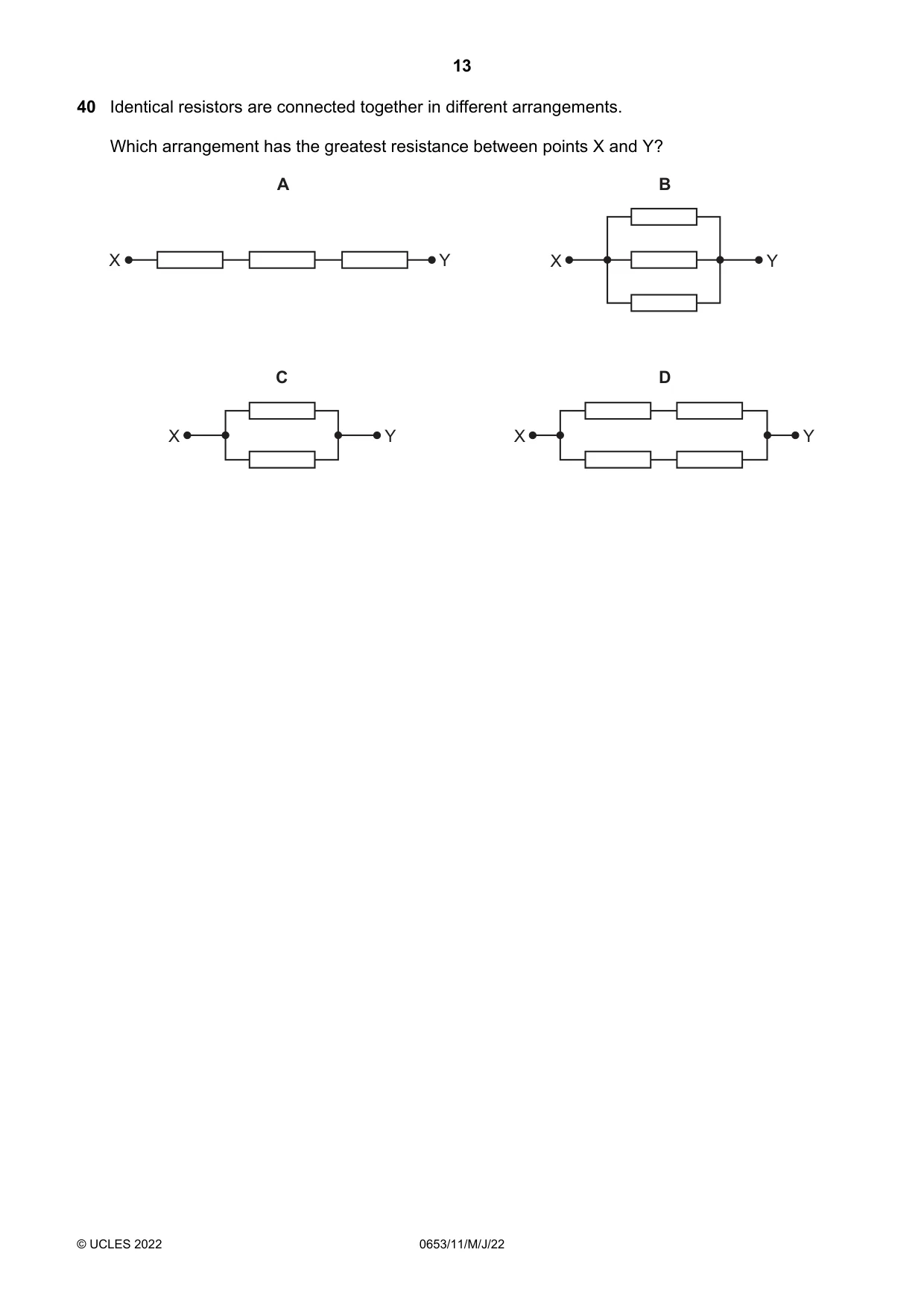
Q40 · Identical resistors are connected together in different arrangements
40 Identical resistors are connected together in different arrangements. Which arrangement has the greatest resistance between points X and Y? A B X Y X Y C D X Y X Y
Mark scheme: A
What was in this paper
The subtopics covered by these 40 questions, and how many questions each got. Open one in a new tab to see every Cambridge question on it.
3Electrical quantities2Kinetic particle model of matter2Sexual reproduction in plants2Alkanes1Biological molecules1Carbon cycle1Cell structure1Characteristics of living organisms1Density1Diet1Drugs1Electrolysis1Electromagnetic spectrum1Energy, work and power1Enzymes1Exothermic and endothermic reactions1Food chains and food webs1Forces1Formulas1Gas exchange in humans1Group VII properties1Identification of ions and gases1Light1Photosynthesis1Physical and chemical changes1Pressure1Redox1Separation and purification1Simple molecules and covalent bonds1The characteristic properties of acids and bases1Thermal properties and temperature1Transition elements1Water1Xylem and phloem1What you needed in this session
Cambridge’s own grade thresholds for 2022 May/June, Paper 1 · Variant 1. A higher threshold means an easier paper — the bar moves with how the cohort did.