Cambridge IGCSE Science - Combined 0653 — 2022 May/June Paper 1 · Variant 2
0653/12/M/J/22 · 40 questions · 40 marks · ≈45 min
The question paper and its mark scheme, free to read here and free to download. This is Cambridge’s own paper, exactly as it was sat.
Question paper16 pages

Mark scheme3 pages
Answers below. Sit the paper first if you are practising.
Questions as text
Q1 · What is the outermost layer of an animal cell and a plant cell?
1 What is the outermost layer of an animal cell and a plant cell? animal cell plant cell A cell membrane cell membrane B cell membrane cell wall C cell wall cell membrane D cell wall cell wall
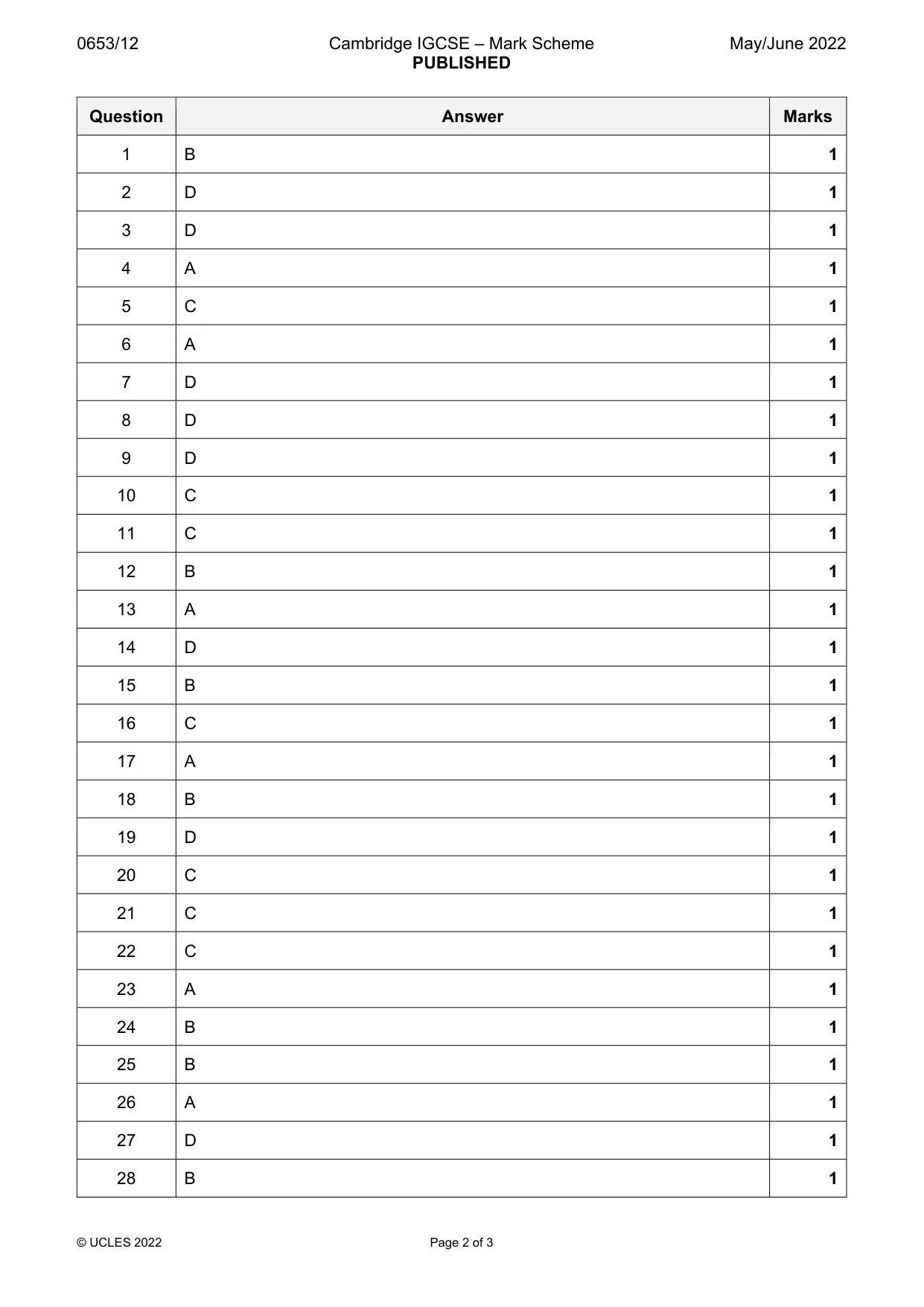
Mark scheme: B
Q2 · Most cars burn fossil fuels to release energy for their movement
2 Most cars burn fossil fuels to release energy for their movement. Which characteristic of living organisms is similar to this? A excretion B growth C nutrition D respiration
Mark scheme: D
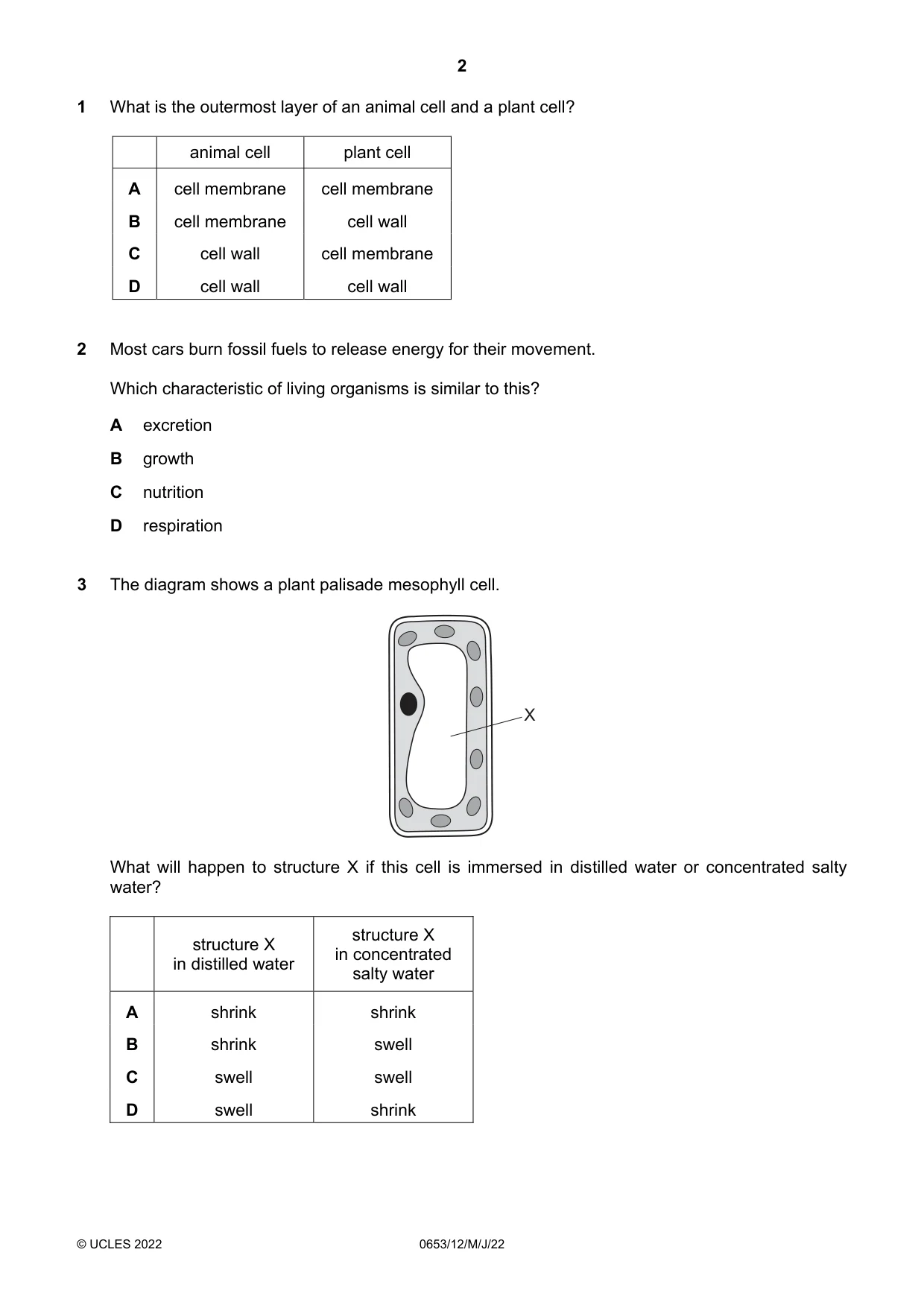
Q3 · The diagram shows a plant palisade mesophyll cell
3 The diagram shows a plant palisade mesophyll cell. X What will happen to structure X if this cell is immersed in distilled water or concentrated salty water? structure X structure X in concentrated in distilled water salty water A shrink shrink B shrink swell C swell swell D swell shrink
Mark scheme: D
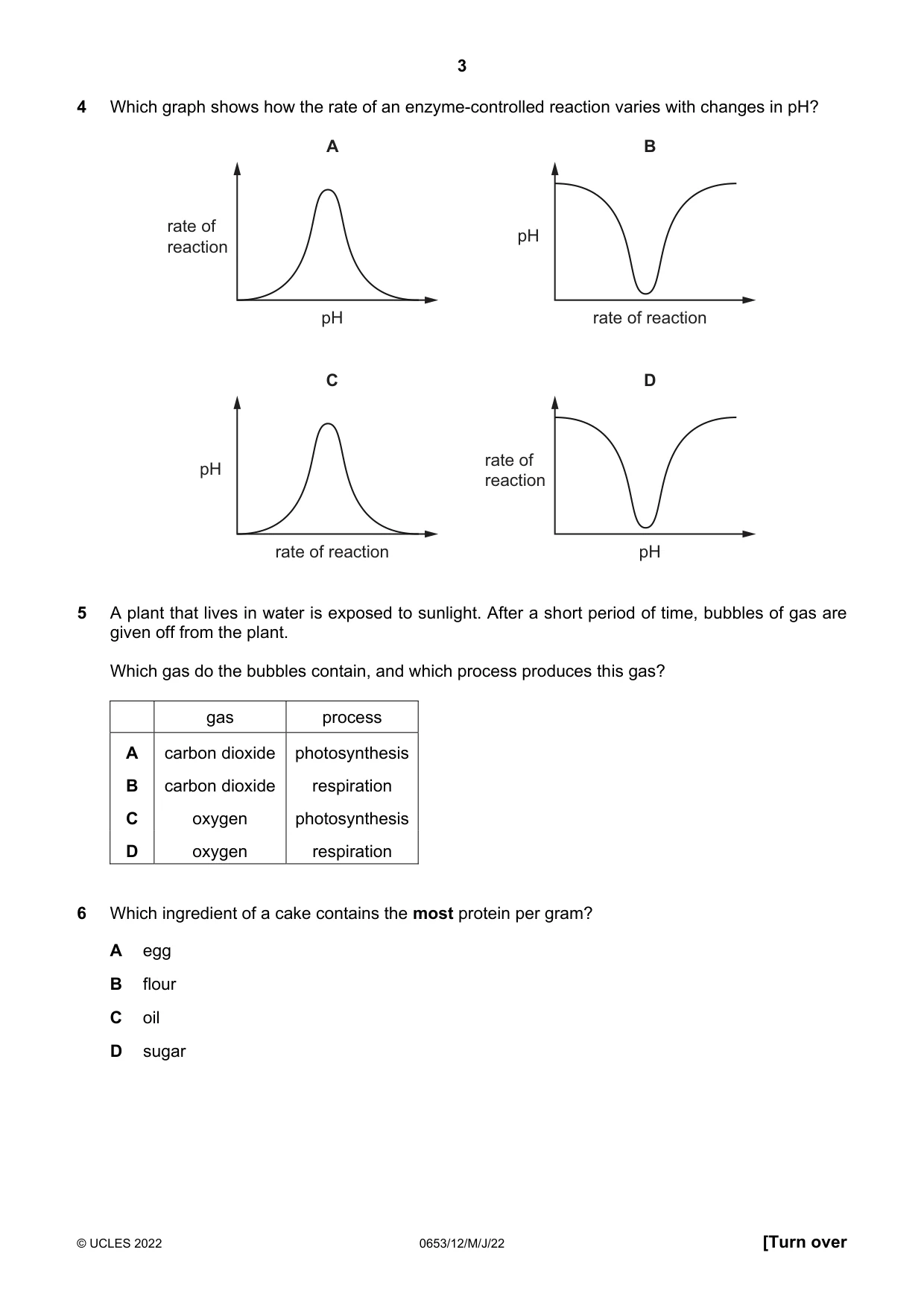
Q4 · Which graph shows how the rate of an enzyme-controlled reaction varies with changes in pH?
4 Which graph shows how the rate of an enzyme-controlled reaction varies with changes in pH? A B rate of pH reaction pH rate of reaction C D rate of pH reaction rate of reaction pH
Mark scheme: A
Q5 · A plant that lives in water is exposed to sunlight
5 A plant that lives in water is exposed to sunlight. After a short period of time, bubbles of gas are given off from the plant. Which gas do the bubbles contain, and which process produces this gas? gas process A carbon dioxide photosynthesis B carbon dioxide respiration C oxygen photosynthesis D oxygen respiration
Mark scheme: C
Q6 · Which ingredient of a cake contains the most protein per gram?
6 Which ingredient of a cake contains the most protein per gram? A egg B flour C oil D sugar
Mark scheme: A
Q7 · How is water transported in plants?
7 How is water transported in plants? A from the leaves to the roots through the phloem B from the leaves to the roots through the xylem C from the roots to the leaves through the phloem D from the roots to the leaves through the xylem
Mark scheme: D
Q8 · Physical activity affects our rate and depth of breathing
8 Physical activity affects our rate and depth of breathing. What happens during increased physical activity? rate of breathing depth of breathing A decreases decreases B decreases increases C increases decreases D increases increases
Mark scheme: D
Q9 · Some examples of responses in the body are listed
9 Some examples of responses in the body are listed. 1 decreased pupil diameter 2 increased breathing rate 3 increased pulse rate Which responses are caused by the secretion of adrenaline? A 1, 2 and 3 B 1 and 2 only C 1 and 3 only D 2 and 3 only
Mark scheme: D
Q10 · Some examples of how parts of a plant grow are listed
10 Some examples of how parts of a plant grow are listed. 1 grow away from gravity 2 grow away from the direction of light 3 grow towards gravity 4 grow towards the direction of light Which growth responses are due to gravitropism? A 1, 2 and 4 B 1 only C 1 and 3 D 3 only
Mark scheme: C
Q11 · Which statement about asexual reproduction is correct?
11 Which statement about asexual reproduction is correct? A It produces genetically different offspring from 1 parent. B It produces genetically different offspring from 2 parents. C It produces genetically identical offspring from 1 parent. D It produces genetically identical offspring from 2 parents.
Mark scheme: C
Q12 · Some organisms obtain their energy from dead or waste organic matter
12 Some organisms obtain their energy from dead or waste organic matter. Which term describes them? A carnivores B decomposers C herbivores D producers
Mark scheme: B
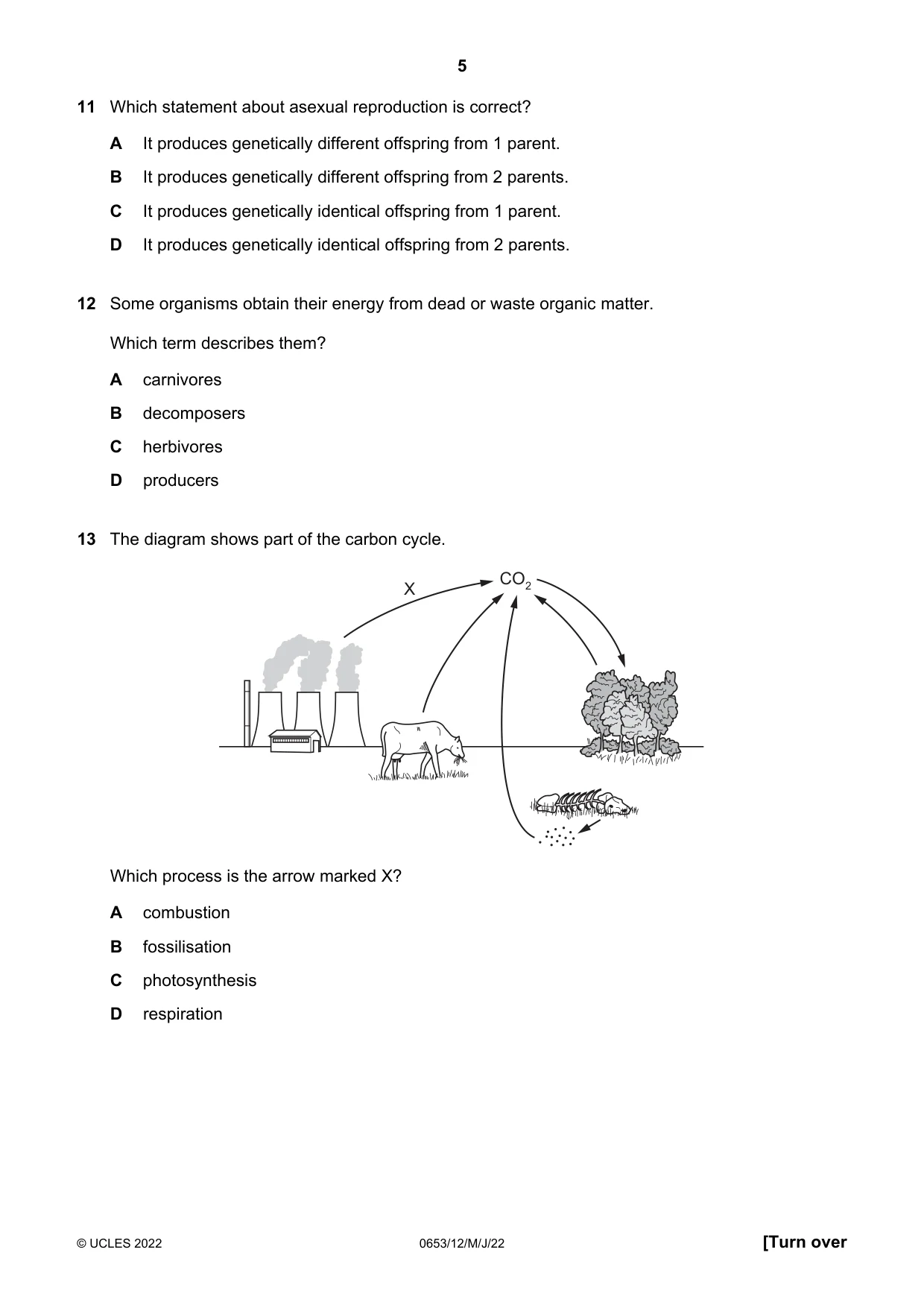
Q13 · The diagram shows part of the carbon cycle
13 The diagram shows part of the carbon cycle. CO2 X Which process is the arrow marked X? A combustion B fossilisation C photosynthesis D respiration
Mark scheme: A
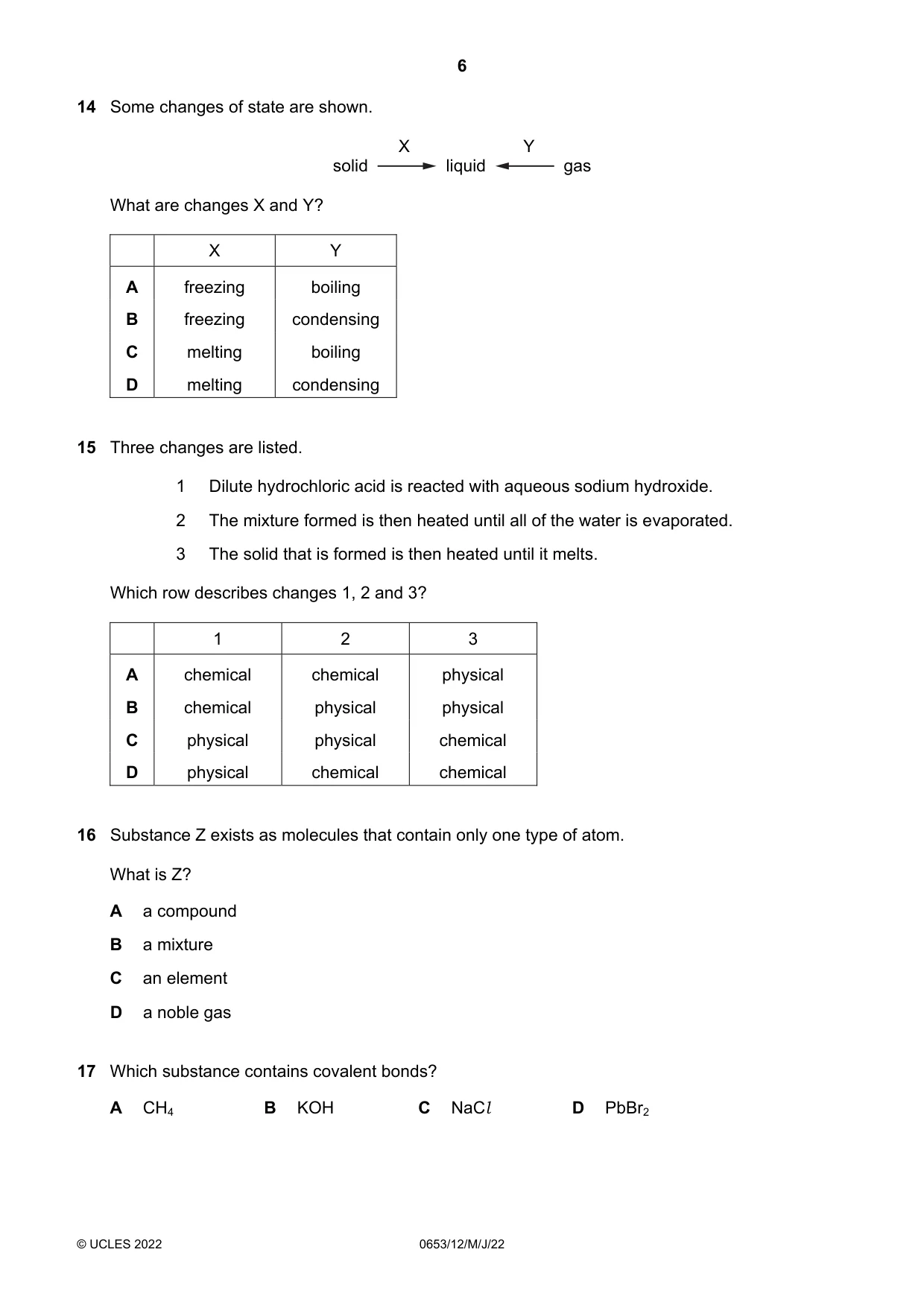
Q14 · Some changes of state are shown
14 Some changes of state are shown. X Y solid liquid gas What are changes X and Y? X Y A freezing boiling B freezing condensing C melting boiling D melting condensing
Mark scheme: D
Q15 · Three changes are listed
15 Three changes are listed. 1 Dilute hydrochloric acid is reacted with aqueous sodium hydroxide. 2 The mixture formed is then heated until all of the water is evaporated. 3 The solid that is formed is then heated until it melts. Which row describes changes 1, 2 and 3? 1 2 3 A chemical chemical physical B chemical physical physical C physical physical chemical D physical chemical chemical
Mark scheme: B
Q16 · Substance Z exists as molecules that contain only one type of atom
16 Substance Z exists as molecules that contain only one type of atom. What is Z? A a compound B a mixture C an element D a noble gas
Mark scheme: C
Q17 · Which substance contains covalent bonds?
17 Which substance contains covalent bonds? A CH4 B KOH C NaCl D PbBr2
Mark scheme: A
Q18 · Which row shows the correct formula for the named acid?
18 Which row shows the correct formula for the named acid? acid formula A nitric acid HCl B nitric acid HNO3 C sulfuric acid HCl D sulfuric acid HNO3
Mark scheme: B
Q19 · Dilute sulfuric acid breaks down when electricity is passed through it
19 Dilute sulfuric acid breaks down when electricity is passed through it. What is the name of this process? A cracking B crystallisation C distillation D electrolysis
Mark scheme: D
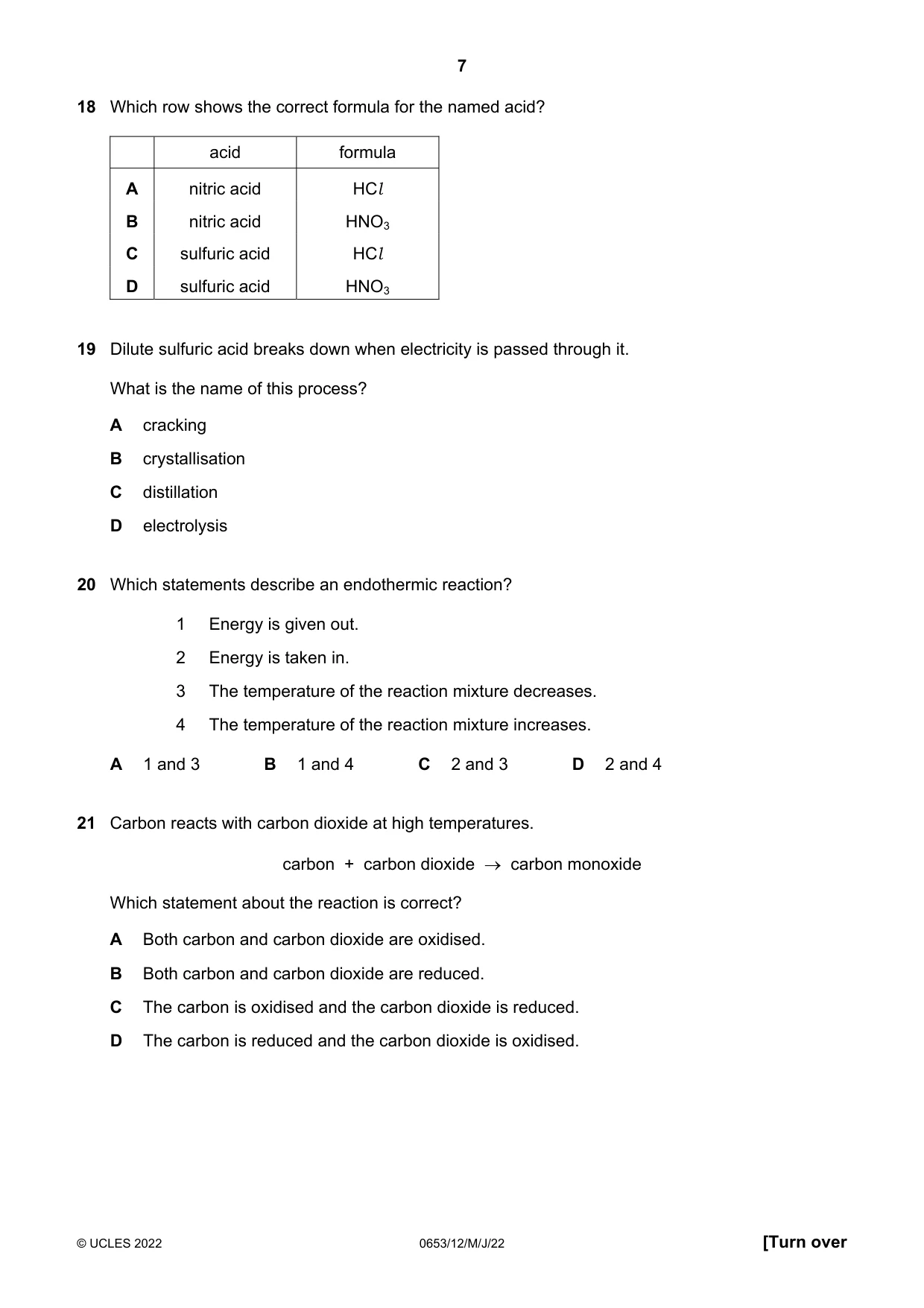
Q20 · Which statements describe an endothermic reaction?
20 Which statements describe an endothermic reaction? 1 Energy is given out. 2 Energy is taken in. 3 The temperature of the reaction mixture decreases. 4 The temperature of the reaction mixture increases. A 1 and 3 B 1 and 4 C 2 and 3 D 2 and 4
Mark scheme: C
Q21 · Carbon reacts with carbon dioxide at high temperatures
21 Carbon reacts with carbon dioxide at high temperatures. carbon + carbon dioxide carbon monoxide Which statement about the reaction is correct? A Both carbon and carbon dioxide are oxidised. B Both carbon and carbon dioxide are reduced. C The carbon is oxidised and the carbon dioxide is reduced. D The carbon is reduced and the carbon dioxide is oxidised.
Mark scheme: C
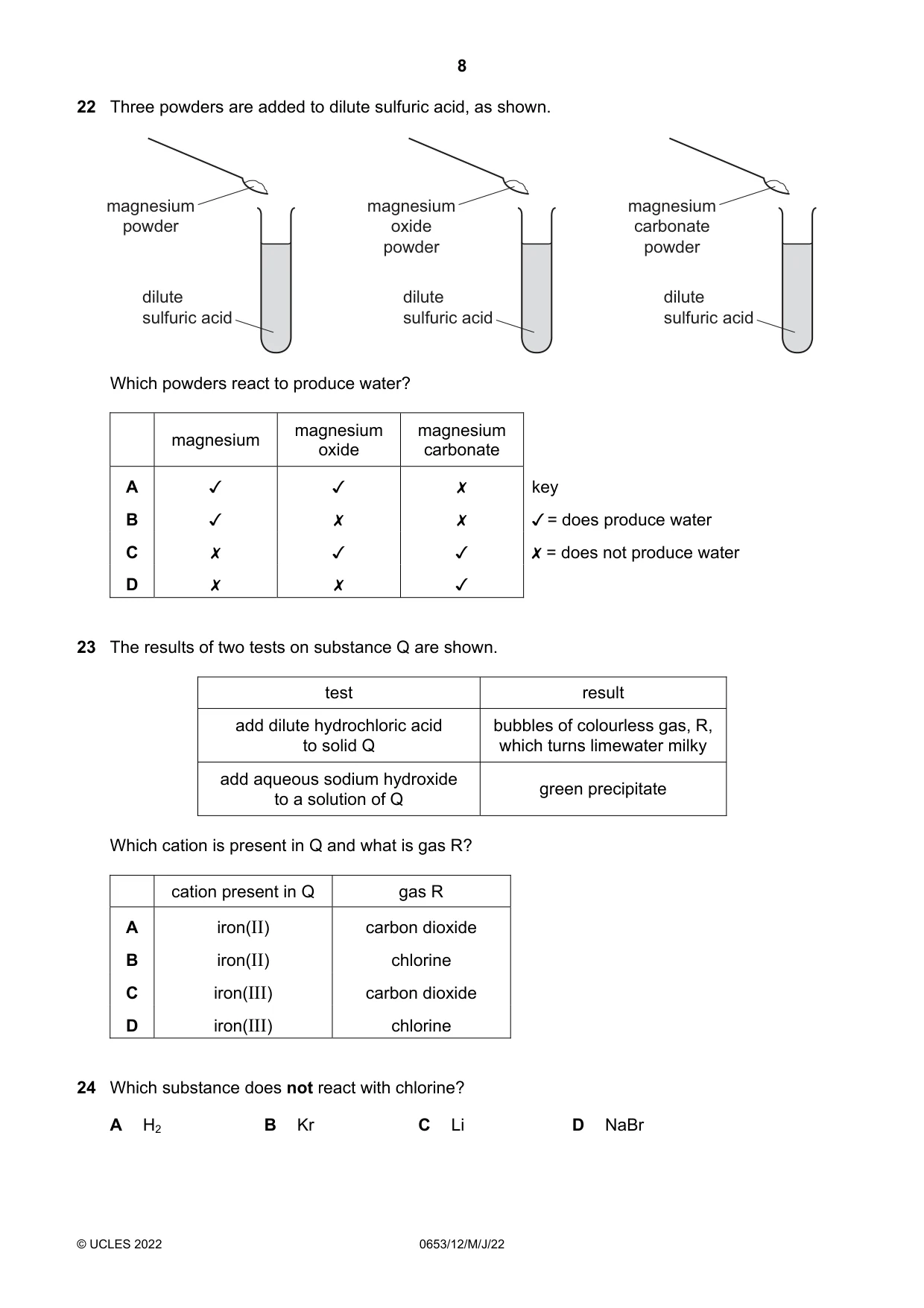
Q22 · Three powders are added to dilute sulfuric acid, as shown
22 Three powders are added to dilute sulfuric acid, as shown. magnesium powder dilute sulfuric acid Which powders react to produce water? magnesium oxide powder dilute sulfuric acid magnesium magnesium oxide x \ x magnesium carbonate \ \ «Ox magnesium carbonate powder dilute sulfuric acid key ¥ = does produce water X = does not produce water
Mark scheme: C
More questions on The characteristic properties of acids and bases
Q23 · The results of two tests on substance Q are shown
23 The results of two tests on substance Q are shown. test result add dilute hydrochloric acid bubbles of colourless gas, R, to solid Q which turns limewater milky add aqueous sodium hydroxide green precipitate to a solution of Q Which cation is present in Q and what is gas R? cation present in Q gas R A iron(II) carbon dioxide B iron(II) chlorine C iron(III) carbon dioxide D iron(III) chlorine
Mark scheme: A
Q24 · Which substance does not react with chlorine?
24 Which substance does not react with chlorine? A H2 B Kr C Li D NaBr
Mark scheme: B
Q25 · Copper is below both carbon and hydrogen in the reactivity series
25 Copper is below both carbon and hydrogen in the reactivity series. How is copper extracted? A Heat copper sulfate crystals. B Heat copper oxide with carbon. C Heat copper oxide with carbon dioxide. D Heat copper oxide with dilute hydrochloric acid.
Mark scheme: B
Q26 · Which colour change is seen when water is added to anhydrous cobalt(II) chloride?
26 Which colour change is seen when water is added to anhydrous cobalt(II) chloride? A blue to pink B blue to white C pink to blue D white to blue
Mark scheme: A
Q27 · Methane, ethane and propane are all alkanes
27 Methane, ethane and propane are all alkanes. Their formulae are shown. methane, CH4 ethane, C2H6 propane, C3H8 Which statement is not correct? A All three compounds are hydrocarbons. B All three compounds burn. C Methane is the main constituent of natural gas. D Propane burns completely to form carbon dioxide and hydrogen.
Mark scheme: D
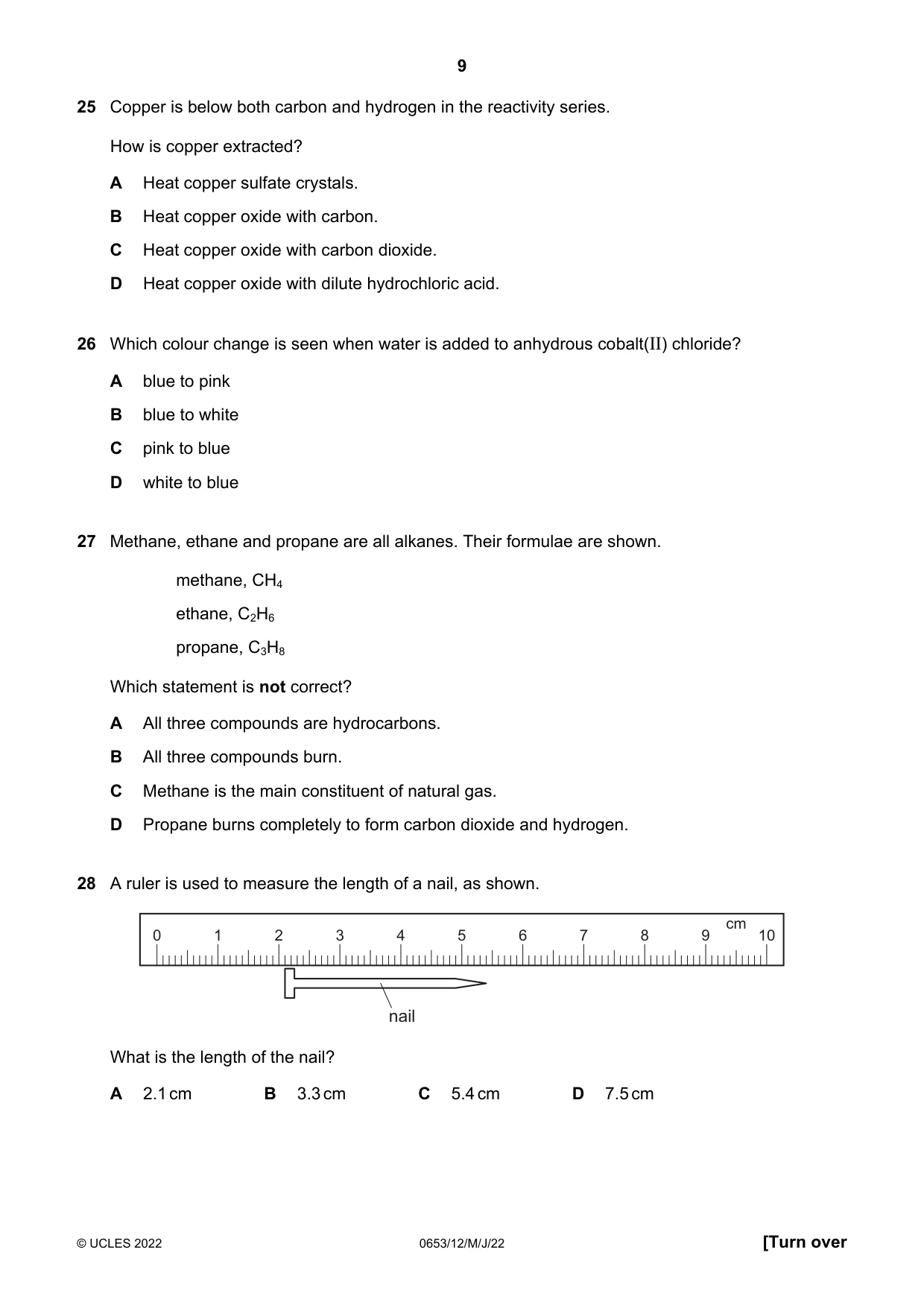
Q28 · A ruler is used to measure the length of a nail, as shown
28 A ruler is used to measure the length of a nail, as shown. cm 0 1 2 3 4 5 6 7 8 9 10 nail What is the length of the nail? A 2.1 cm B 3.3 cm C 5.4 cm D 7.5 cm
Mark scheme: B
More questions on Physical quantities and measurement techniques
Q29 · A metre rule has a mass of 120 g
29 A metre rule has a mass of 120 g. The gravitational field strength g is 10 N / kg. What is the weight of the metre rule? A 1.2 N B 1.2 kg C 1200 N D 1200 kg
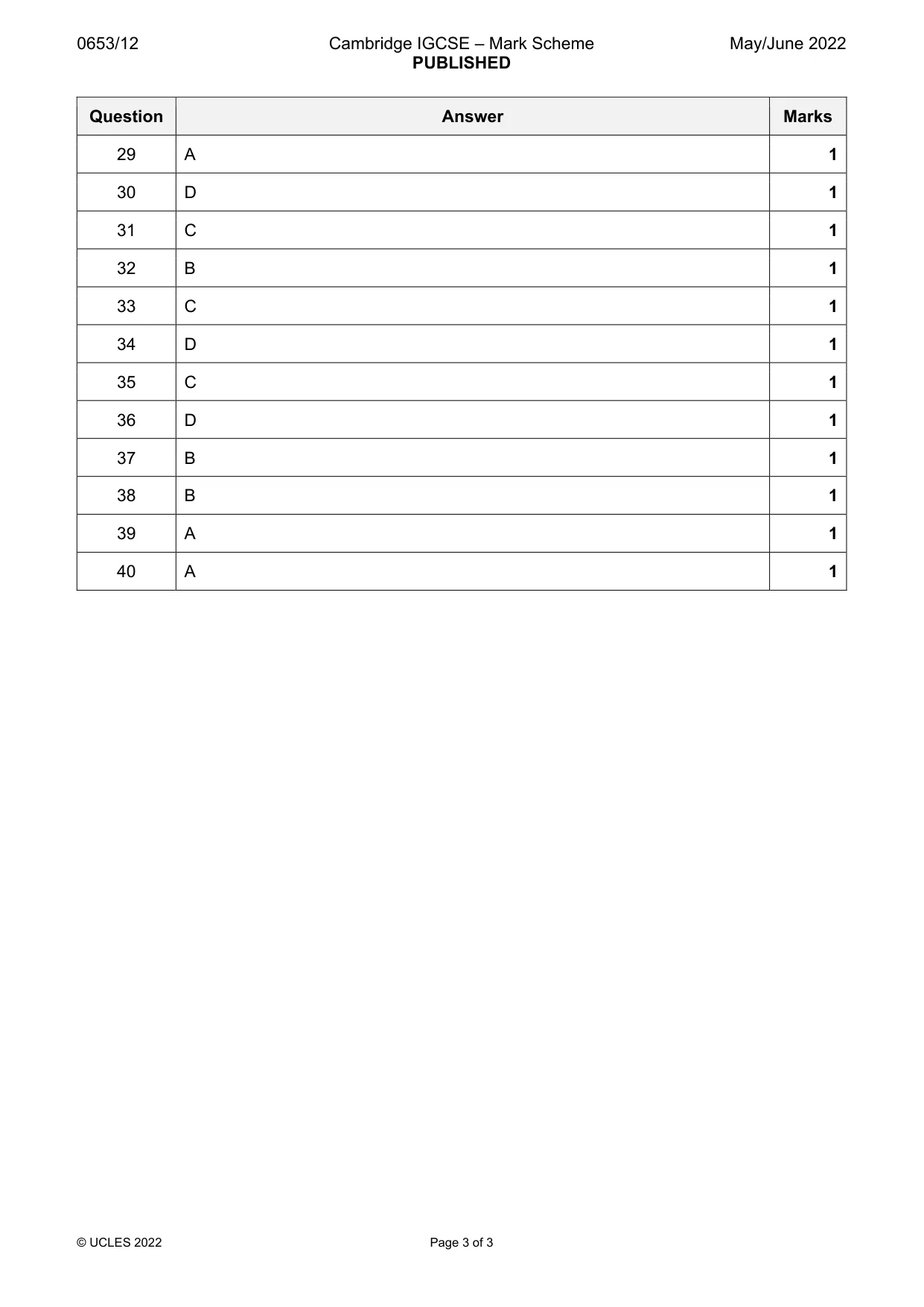
Mark scheme: A
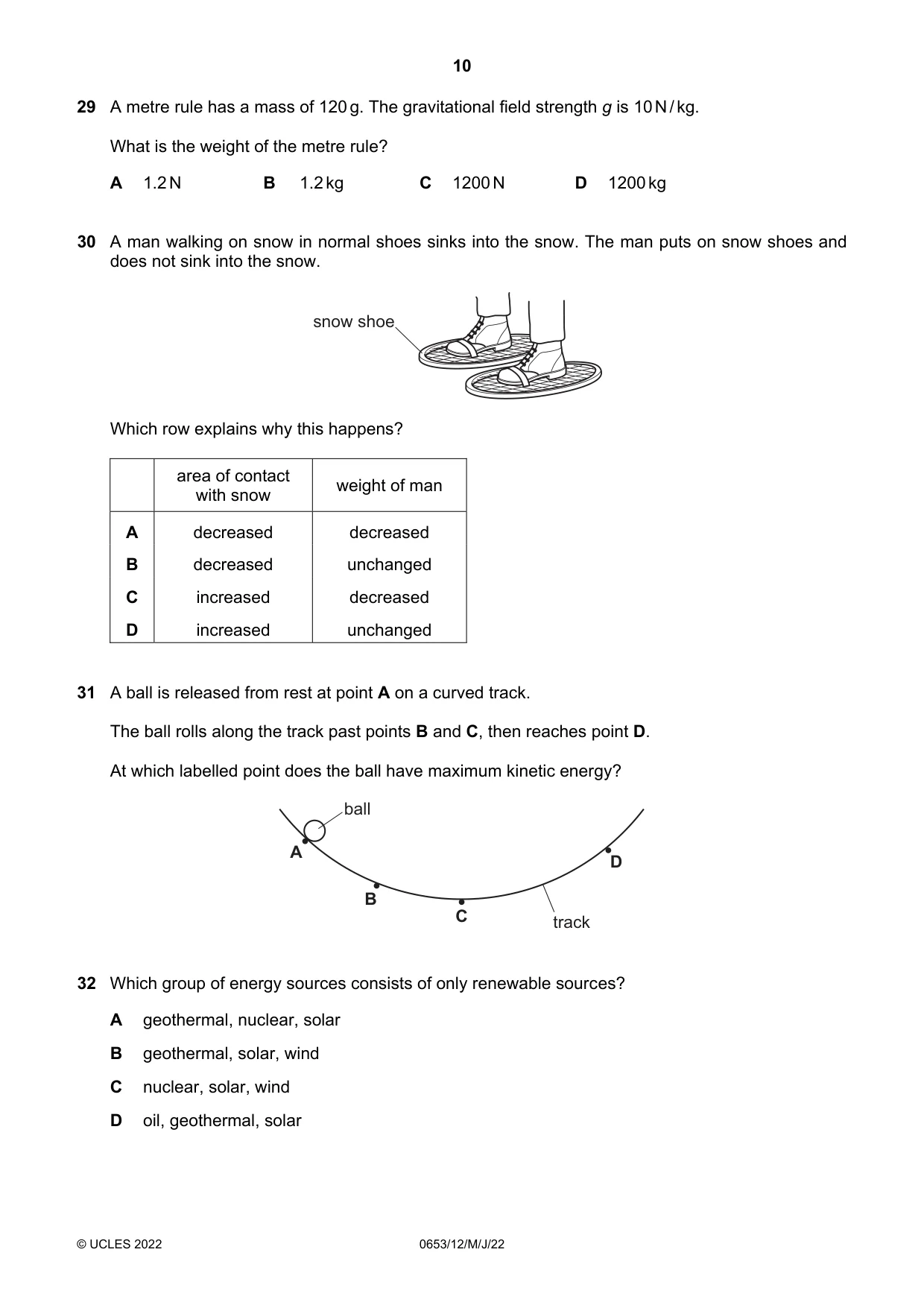
Q30 · A man walking on snow in normal shoes sinks into the snow
30 A man walking on snow in normal shoes sinks into the snow. The man puts on snow shoes and does not sink into the snow. snow shoe Which row explains why this happens? area of contact weight of man with snow A decreased decreased B decreased unchanged C increased decreased D increased unchanged
Mark scheme: D
Q31 · A ball is released from rest at point A on a curved track
31 A ball is released from rest at point A on a curved track. The ball rolls along the track past points B and C, then reaches point D. At which labelled point does the ball have maximum kinetic energy? ball A D B C track
Mark scheme: C
Q32 · Which group of energy sources consists of only renewable sources?
32 Which group of energy sources consists of only renewable sources? A geothermal, nuclear, solar B geothermal, solar, wind C nuclear, solar, wind D oil, geothermal, solar
Mark scheme: B
Q33 · Air is trapped in a sealed glass bottle that has a fixed volume
33 Air is trapped in a sealed glass bottle that has a fixed volume. The temperature of the air in the bottle decreases. Which statement describes what happens to the air in the bottle? A The average separation of the molecules decreases and the pressure decreases. B The average separation of the molecules decreases but the pressure remains the same. C The average separation of the molecules remains the same but the pressure decreases. D The average separation of the molecules remains the same and the pressure remains the same.
Mark scheme: C
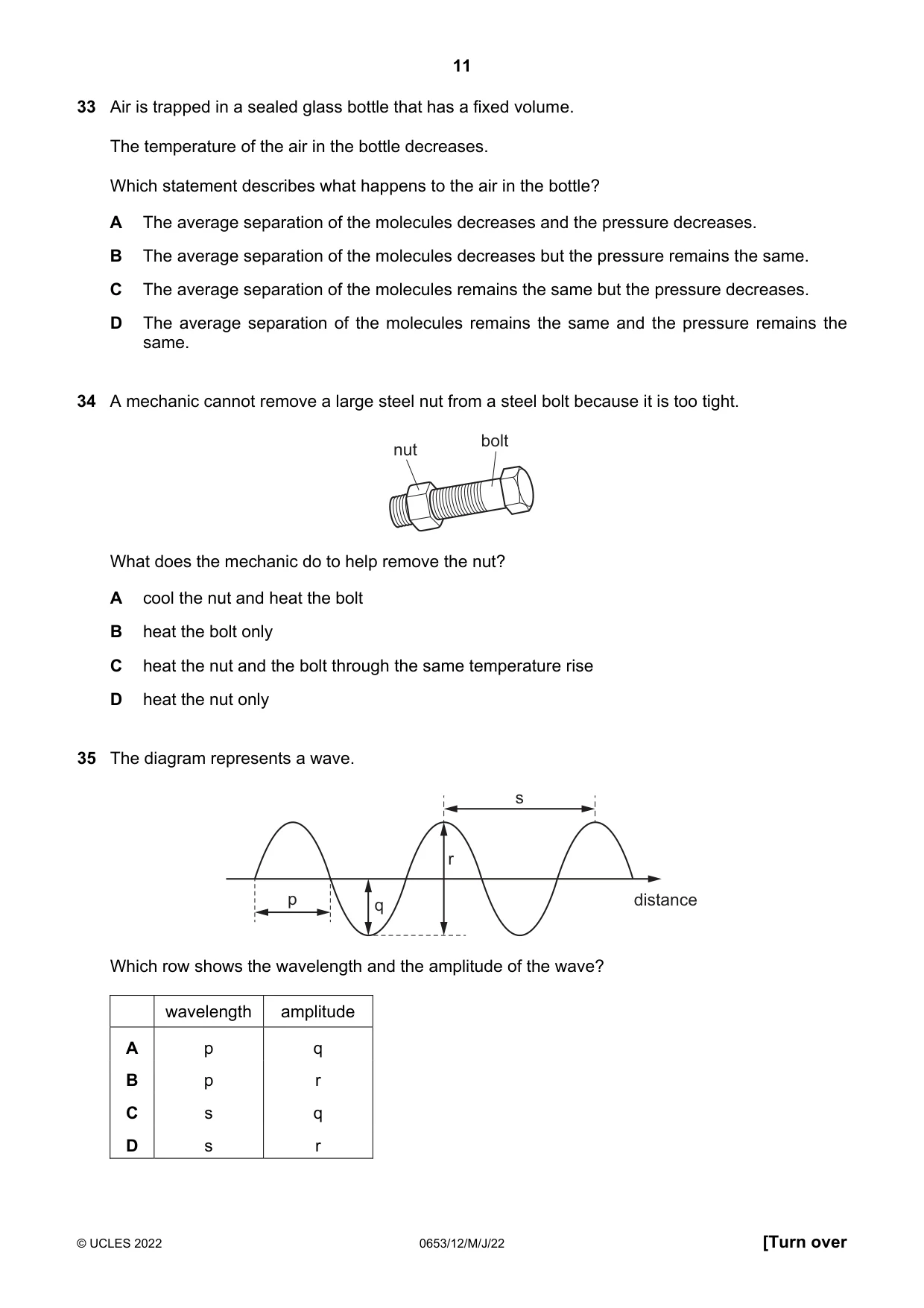
Q34 · A mechanic cannot remove a large steel nut from a steel bolt because it is too tight
34 A mechanic cannot remove a large steel nut from a steel bolt because it is too tight. bolt nut What does the mechanic do to help remove the nut? A cool the nut and heat the bolt B heat the bolt only C heat the nut and the bolt through the same temperature rise D heat the nut only
Mark scheme: D
Q35 · The diagram represents a wave
35 The diagram represents a wave. s r p q distance Which row shows the wavelength and the amplitude of the wave? wavelength amplitude A p q B p r C s q D s r
Mark scheme: C
Q36 · A student investigating the speed of sound stands at a distance of 50 m from a wall
36 A student investigating the speed of sound stands at a distance of 50 m from a wall. The student makes a short, sharp sound and then hears an echo from the wall 0.30 s later. Which calculation gives the speed of the sound in m / s? 50 50 100 100 A B C D 0.60 0.30 0.60 0.30
Mark scheme: D
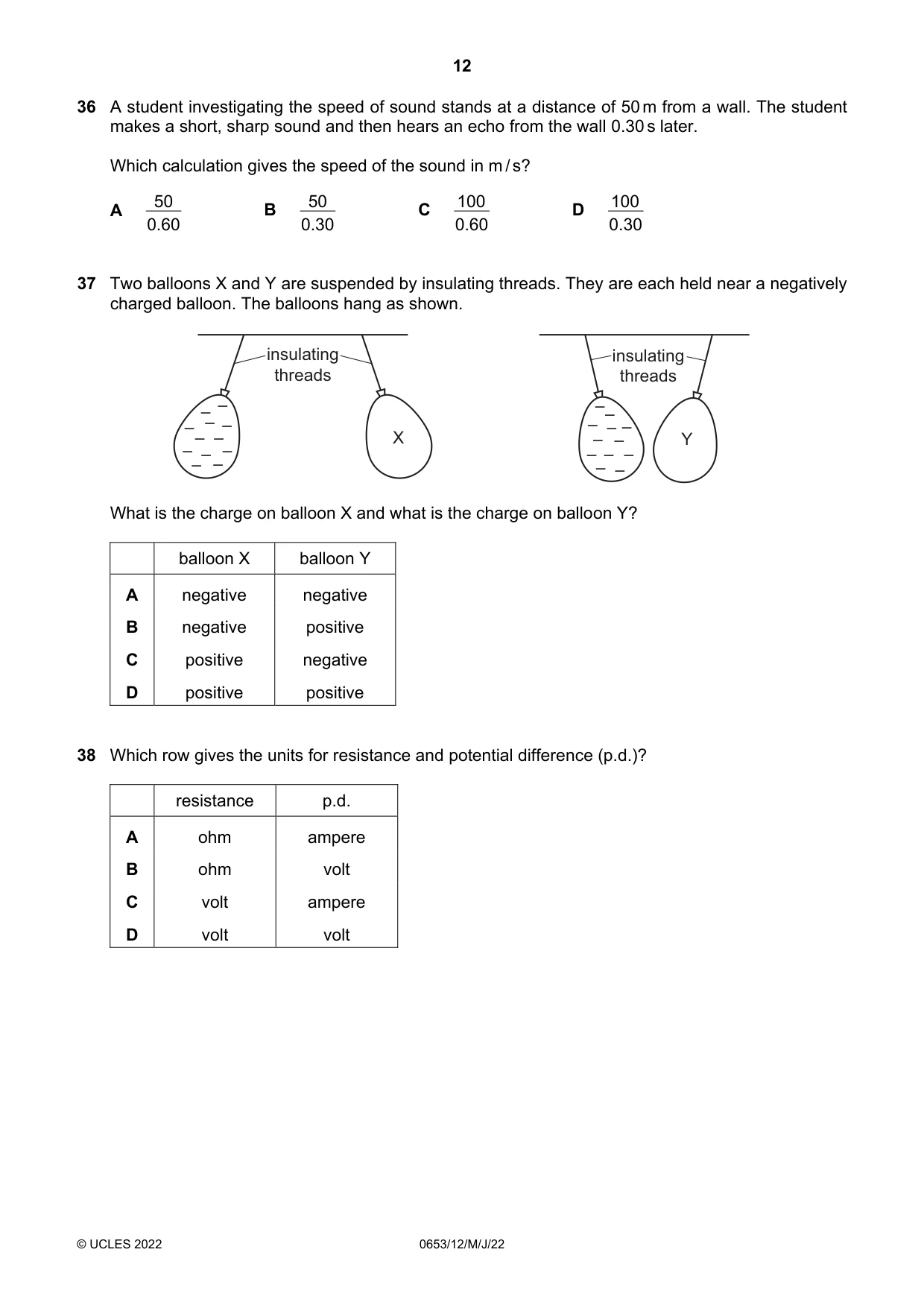
Q37 · Two balloons X and Y are suspended by insulating threads
37 Two balloons X and Y are suspended by insulating threads. They are each held near a negatively charged balloon. The balloons hang as shown. insulating insulating threads threads – – – – – – – – – – – – – X – – Y ––– – – – – – – What is the charge on balloon X and what is the charge on balloon Y? balloon X balloon Y A negative negative B negative positive C positive negative D positive positive
Mark scheme: B
Q38 · Which row gives the units for resistance and potential difference (p.d.)?
38 Which row gives the units for resistance and potential difference (p.d.)? resistance p.d. A ohm ampere B ohm volt C volt ampere D volt volt
Mark scheme: B
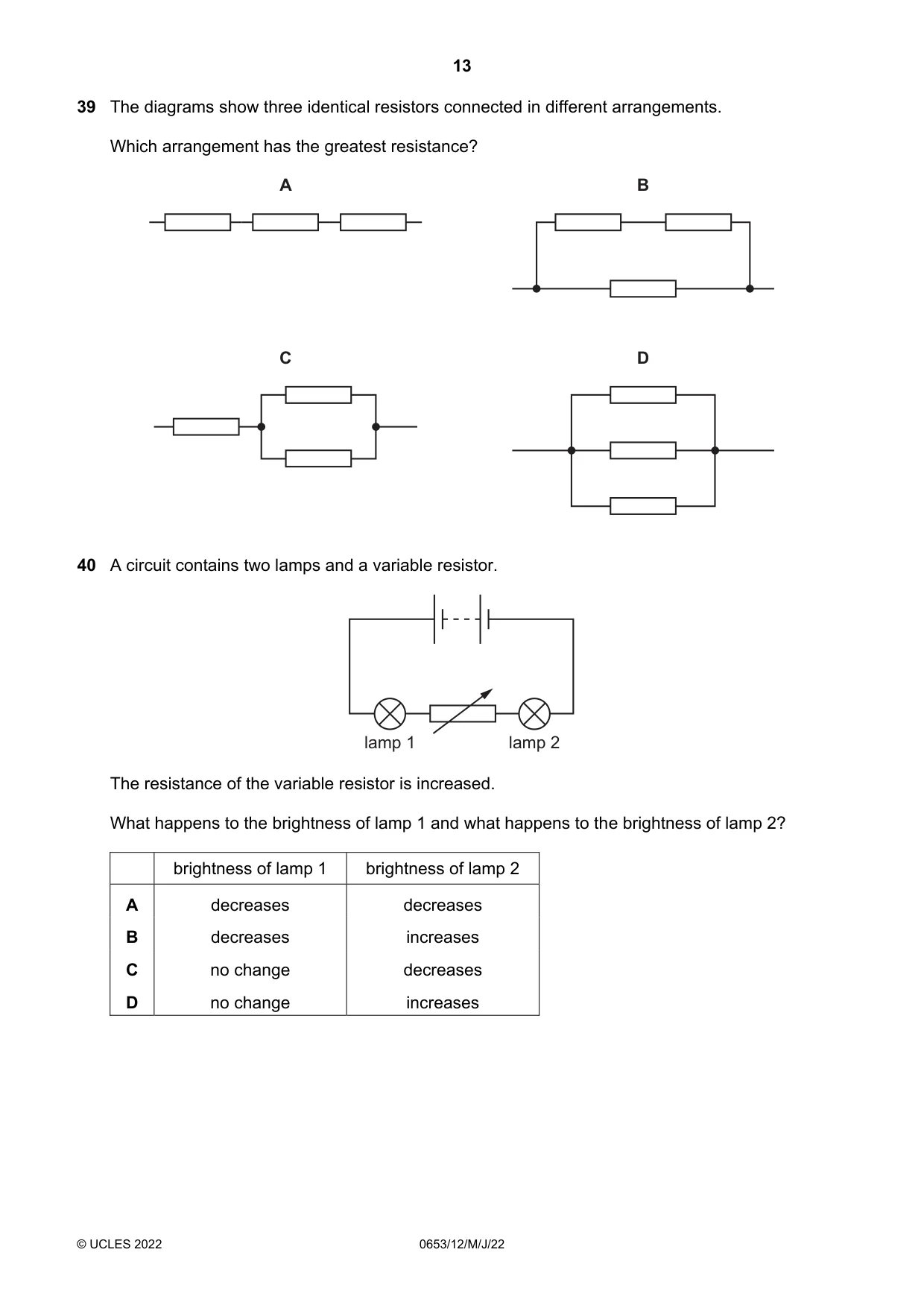
Q39 · The diagrams show three identical resistors connected in different arrangements
39 The diagrams show three identical resistors connected in different arrangements. Which arrangement has the greatest resistance? A B C D
Mark scheme: A
Q40 · A circuit contains two lamps and a variable resistor
40 A circuit contains two lamps and a variable resistor. lamp 1 lamp 2 The resistance of the variable resistor is increased. What happens to the brightness of lamp 1 and what happens to the brightness of lamp 2? brightness of lamp 1 brightness of lamp 2 A decreases decreases B decreases increases C no change decreases D no change increases
Mark scheme: A
What was in this paper
The subtopics covered by these 40 questions, and how many questions each got. Open one in a new tab to see every Cambridge question on it.
2Electrical quantities2Energy, work and power2Sexual reproduction in plants2Alkanes1Biological molecules1Carbon cycle1Cell structure1Characteristics of living organisms1Drugs1Electrolysis1Elements, compounds and mixtures1Enzymes1Exothermic and endothermic reactions1Extraction of metals1Food chains and food webs1Formulas1Gas exchange in humans1General properties of waves1Group VII properties1Identification of ions and gases1Kinetic particle model of matter1Mass and weight1Osmosis1Photosynthesis1Physical and chemical changes1Physical quantities and measurement techniques1Pressure1Redox1Simple molecules and covalent bonds1Solids, liquids and gases1Sound1The characteristic properties of acids and bases1Thermal properties and temperature1Water1Xylem and phloem1What you needed in this session
Cambridge’s own grade thresholds for 2022 May/June, Paper 1 · Variant 2. A higher threshold means an easier paper — the bar moves with how the cohort did.