Cambridge IGCSE Science - Combined 0653 — 2013 May/June Paper 1 · Variant 3
0653/13/M/J/13 · 40 questions · 40 marks · ≈45 min
The question paper and its mark scheme, free to read here and free to download. This is Cambridge’s own paper, exactly as it was sat.
Question paper20 pages



Mark scheme2 pages
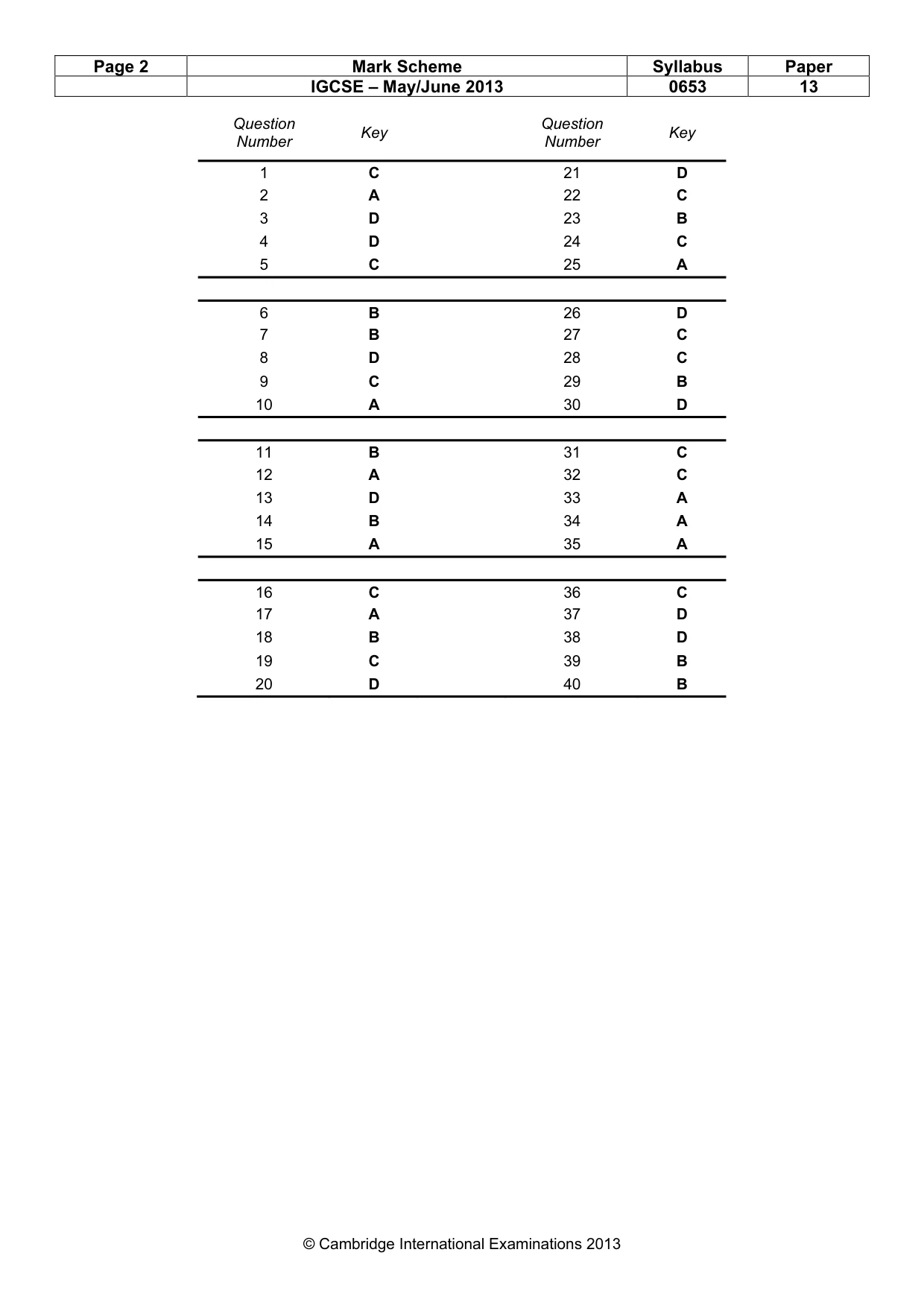
Answers below. Sit the paper first if you are practising.
Questions as text
Q1 · The diagram shows an animal cell
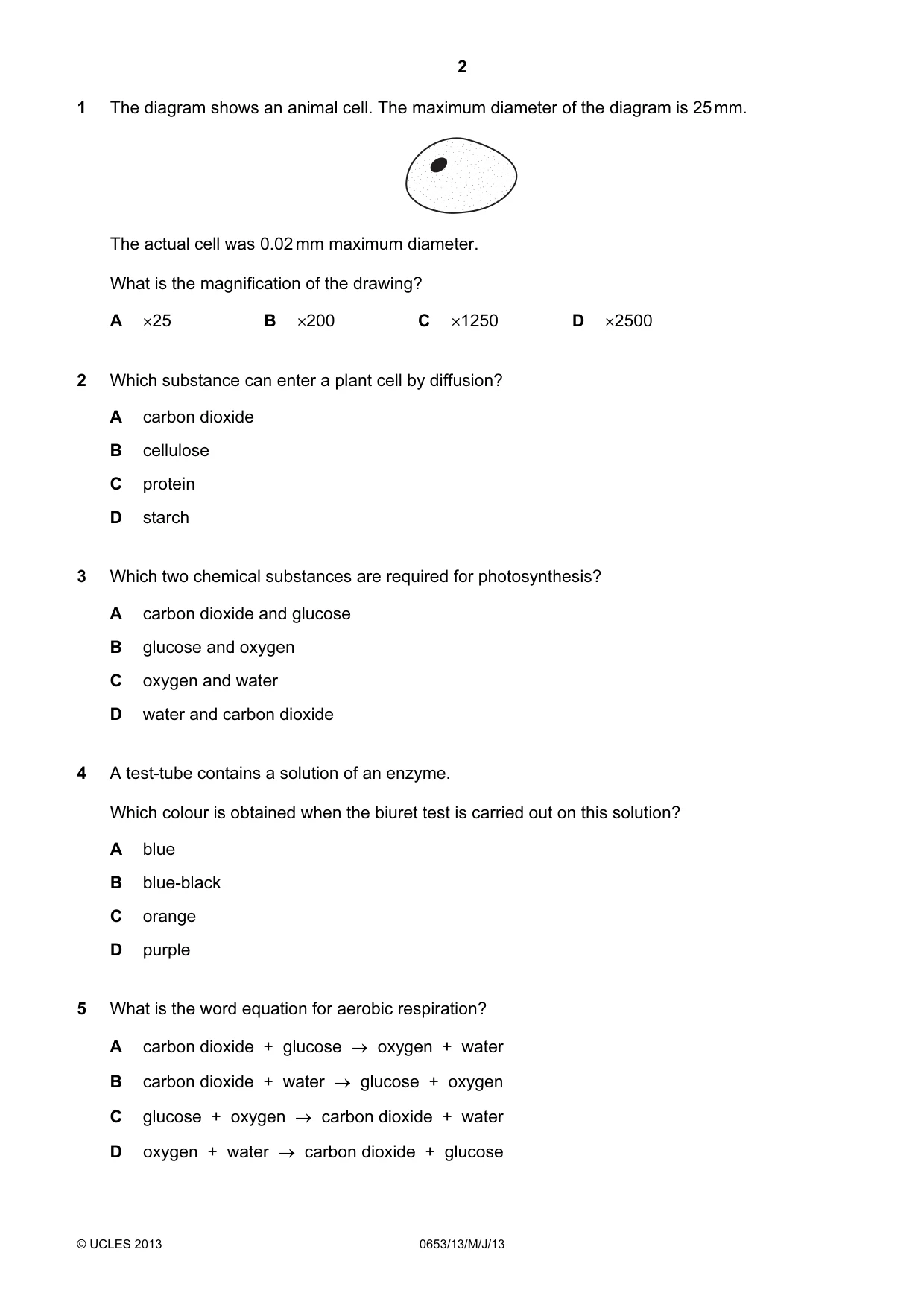
1 The diagram shows an animal cell. The maximum diameter of the diagram is 25 mm. The actual cell was 0.02 mm maximum diameter. What is the magnification of the drawing? A ×25 B ×200 C ×1250 D ×2500
Mark scheme: C
Q2 · Which substance can enter a plant cell by diffusion?
2 Which substance can enter a plant cell by diffusion? A carbon dioxide B cellulose C protein D starch
Mark scheme: A
Q3 · Which two chemical substances are required for photosynthesis?
3 Which two chemical substances are required for photosynthesis? A carbon dioxide and glucose B glucose and oxygen C oxygen and water D water and carbon dioxide
Mark scheme: D
Q4 · A test-tube contains a solution of an enzyme
4 A test-tube contains a solution of an enzyme. Which colour is obtained when the biuret test is carried out on this solution? A blue B blue-black C orange D purple
Mark scheme: D
Q5 · What is the word equation for aerobic respiration?
5 What is the word equation for aerobic respiration? A carbon dioxide + glucose → oxygen + water B carbon dioxide + water → glucose + oxygen C glucose + oxygen → carbon dioxide + water D oxygen + water → carbon dioxide + glucose
Mark scheme: C
Q6 · Mixtures were made from 5 cm3 of a starch solution and 2 cm3 of a solution of an enzyme…
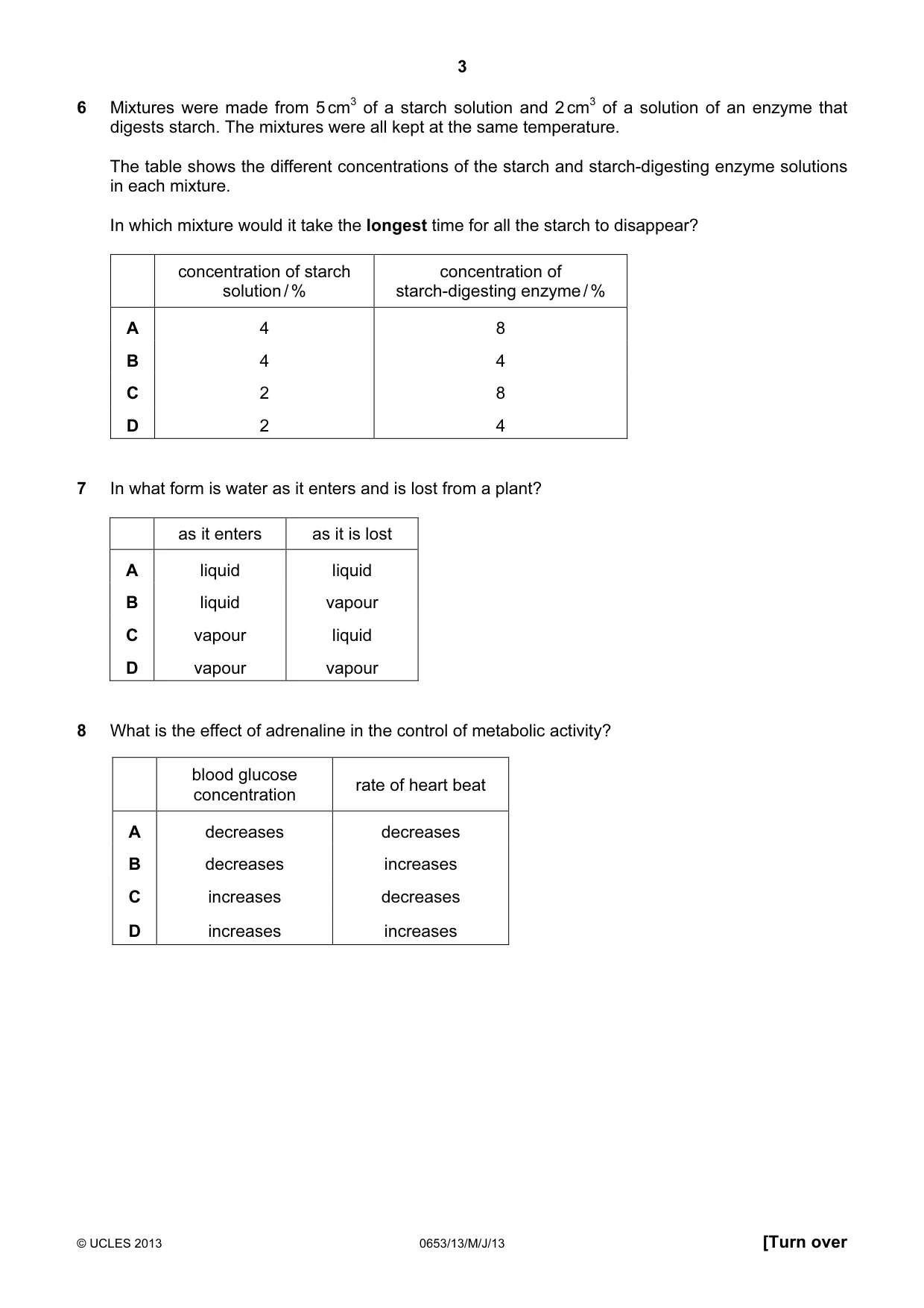
6 Mixtures were made from 5 cm3 of a starch solution and 2 cm3 of a solution of an enzyme that digests starch. The mixtures were all kept at the same temperature. The table shows the different concentrations of the starch and starch-digesting enzyme solutions in each mixture. In which mixture would it take the longest time for all the starch to disappear? concentration of starch concentration of solution / % starch-digesting enzyme / % A 4 8 B 4 4 C 2 8 D 2 4
Mark scheme: B
Q7 · In what form is water as it enters and is lost from a plant?
7 In what form is water as it enters and is lost from a plant? as it enters as it is lost A liquid liquid B liquid vapour C vapour liquid D vapour vapour
Mark scheme: B
Q8 · What is the effect of adrenaline in the control of metabolic activity?
8 What is the effect of adrenaline in the control of metabolic activity? blood glucose rate of heart beat concentration A decreases decreases B decreases increases C increases decreases D increases increases
Mark scheme: D
Q9 · The diagram shows a section through the heart
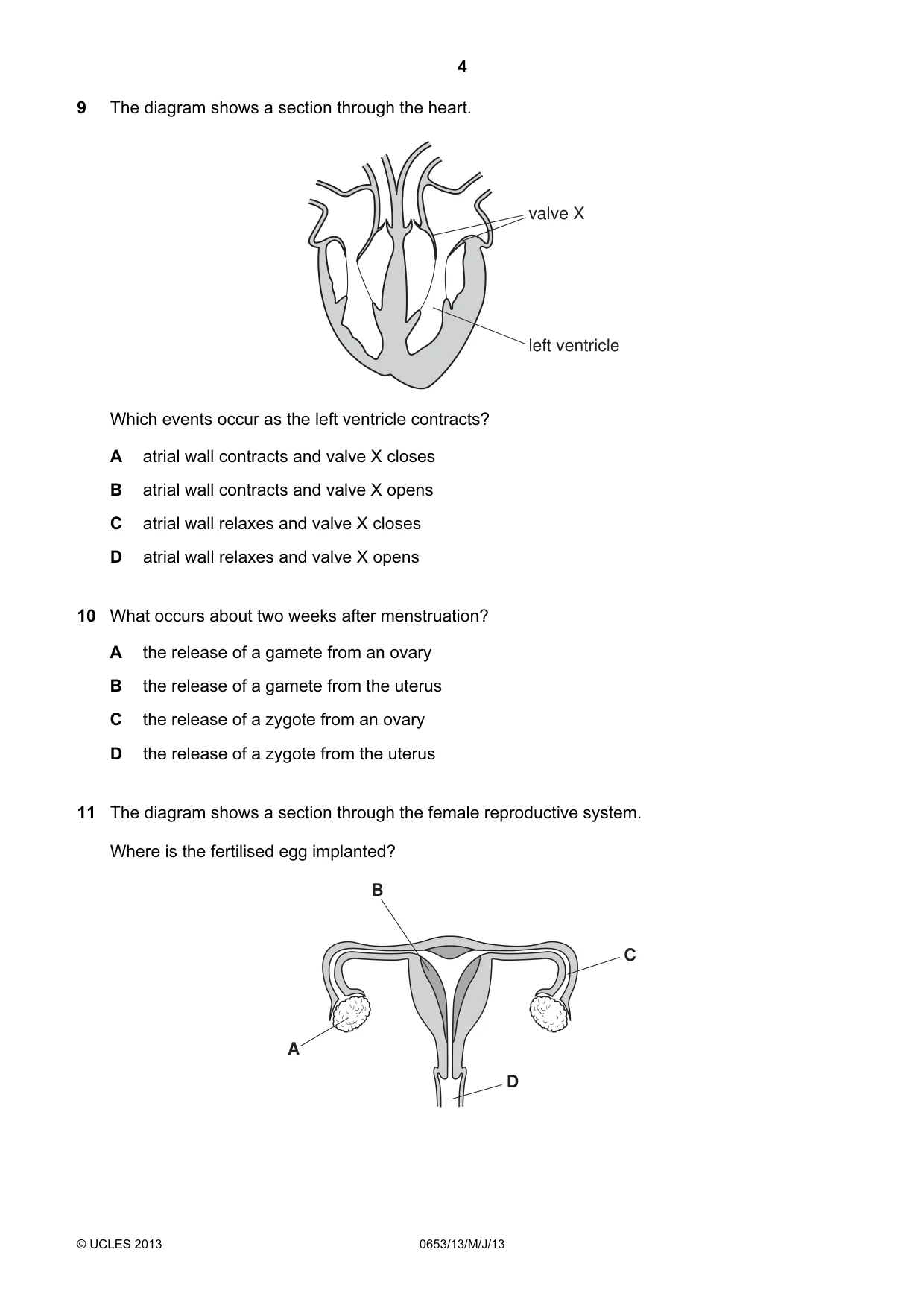
9 The diagram shows a section through the heart. valve X left ventricle Which events occur as the left ventricle contracts? A atrial wall contracts and valve X closes B atrial wall contracts and valve X opens C atrial wall relaxes and valve X closes D atrial wall relaxes and valve X opens
Mark scheme: C
Q10 · What occurs about two weeks after menstruation?
10 What occurs about two weeks after menstruation? A the release of a gamete from an ovary B the release of a gamete from the uterus C the release of a zygote from an ovary D the release of a zygote from the uterus
Mark scheme: A
Q11 · The diagram shows a section through the female reproductive system
11 The diagram shows a section through the female reproductive system. Where is the fertilised egg implanted? B C A D
Mark scheme: B
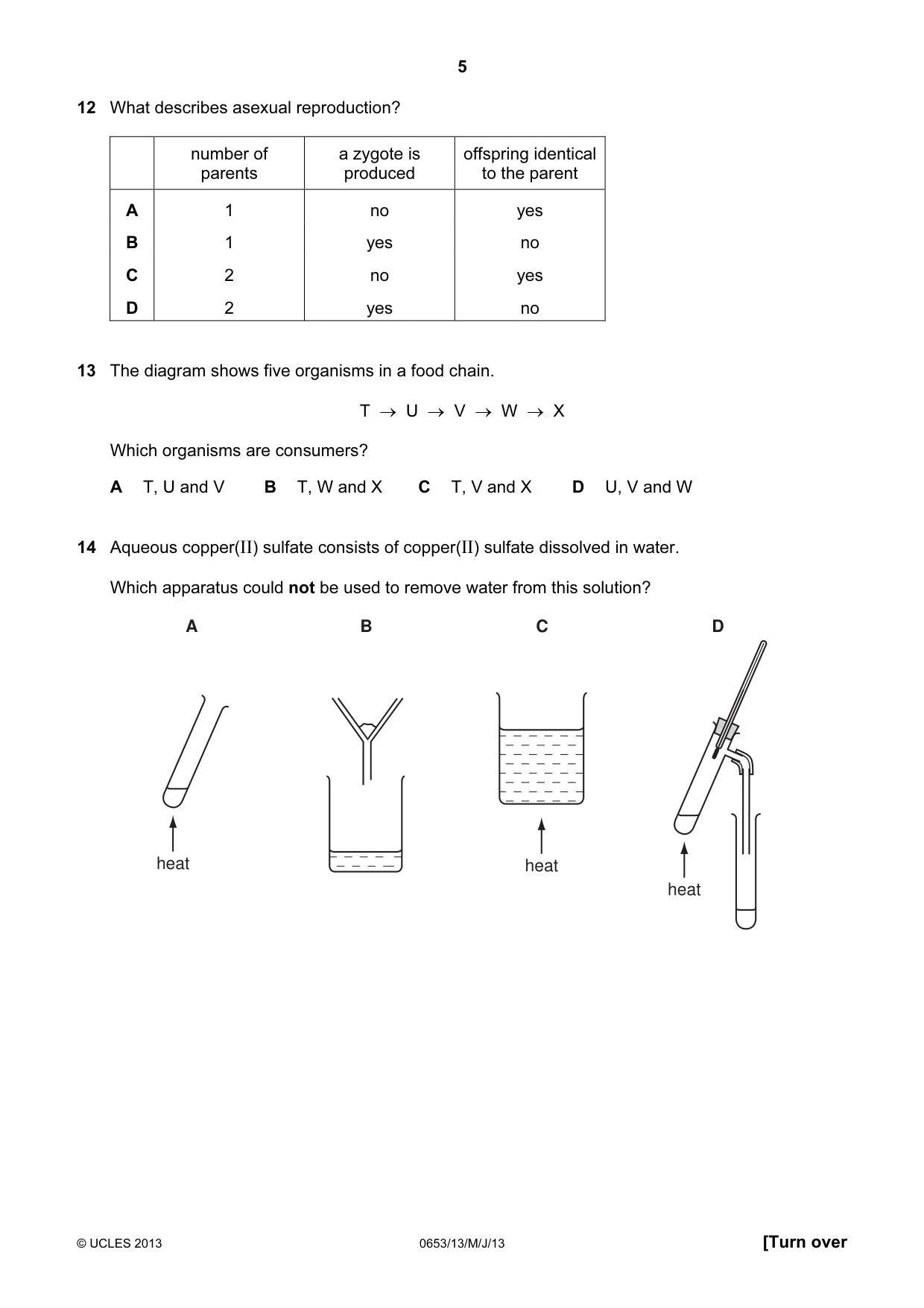
Q12 · What describes asexual reproduction?
12 What describes asexual reproduction? number of a zygote is offspring identical parents produced to the parent A 1 no yes B 1 yes no C 2 no yes D 2 yes no
Mark scheme: A
Q13 · The diagram shows five organisms in a food chain
13 The diagram shows five organisms in a food chain. T → U → V → W → X Which organisms are consumers? A T, U and V B T, W and X C T, V and X D U, V and W
Mark scheme: D
Q14 · Aqueous copper(II) sulfate consists of copper(II) sulfate dissolved in water
14 Aqueous copper(II) sulfate consists of copper(II) sulfate dissolved in water. Which apparatus could not be used to remove water from this solution? A B C D heat heat heat
Mark scheme: B
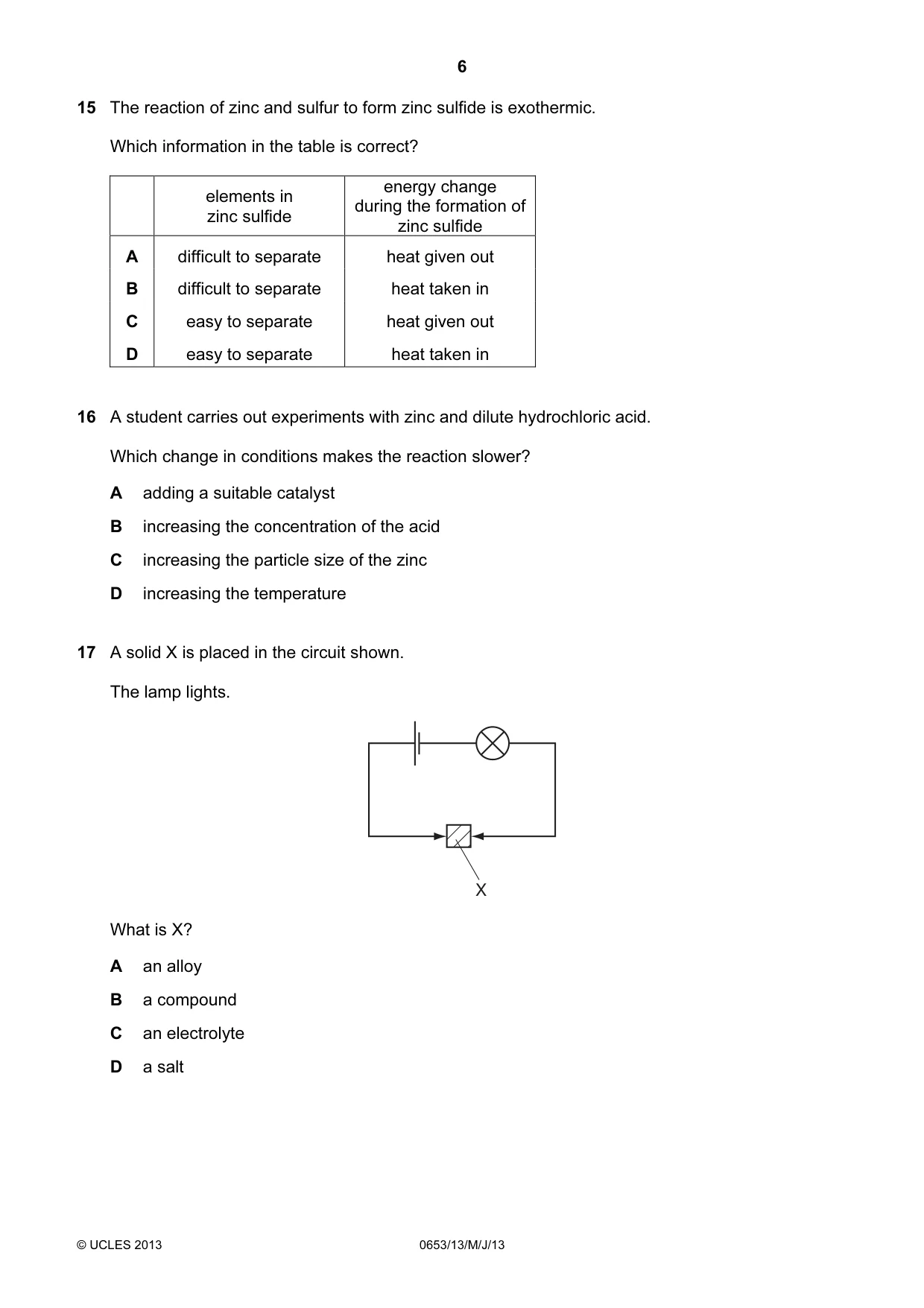
Q15 · The reaction of zinc and sulfur to form zinc sulfide is exothermic
15 The reaction of zinc and sulfur to form zinc sulfide is exothermic. Which information in the table is correct? energy change elements in during the formation of zinc sulfide zinc sulfide A difficult to separate heat given out B difficult to separate heat taken in C easy to separate heat given out D easy to separate heat taken in
Mark scheme: A
Q16 · A student carries out experiments with zinc and dilute hydrochloric acid
16 A student carries out experiments with zinc and dilute hydrochloric acid. Which change in conditions makes the reaction slower? A adding a suitable catalyst B increasing the concentration of the acid C increasing the particle size of the zinc D increasing the temperature
Mark scheme: C
Q17 · A solid X is placed in the circuit shown
17 A solid X is placed in the circuit shown. The lamp lights. X What is X? A an alloy B a compound C an electrolyte D a salt
Mark scheme: A
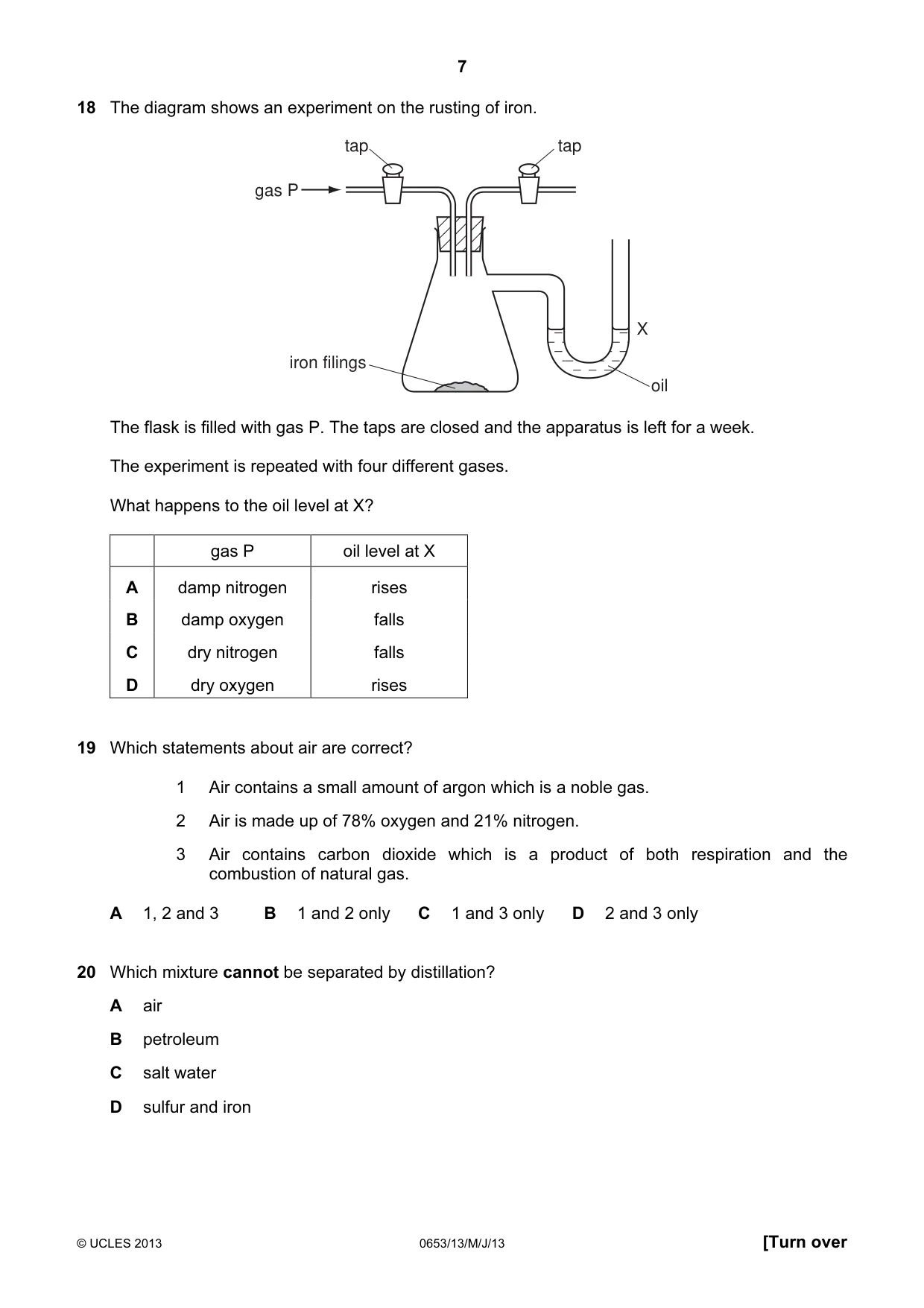
Q18 · The diagram shows an experiment on the rusting of iron
18 The diagram shows an experiment on the rusting of iron. tap tap gas P X iron filings oil The flask is filled with gas P. The taps are closed and the apparatus is left for a week. The experiment is repeated with four different gases. What happens to the oil level at X? gas P oil level at X A damp nitrogen rises B damp oxygen falls C dry nitrogen falls D dry oxygen rises
Mark scheme: B
Q19 · Which statements about air are correct?
19 Which statements about air are correct? 1 Air contains a small amount of argon which is a noble gas. 2 Air is made up of 78% oxygen and 21% nitrogen. 3 Air contains carbon dioxide which is a product of both respiration and the combustion of natural gas. A 1, 2 and 3 B 1 and 2 only C 1 and 3 only D 2 and 3 only
Mark scheme: C
Q20 · Which mixture cannot be separated by distillation?
20 Which mixture cannot be separated by distillation? A air B petroleum C salt water D sulfur and iron
Mark scheme: D
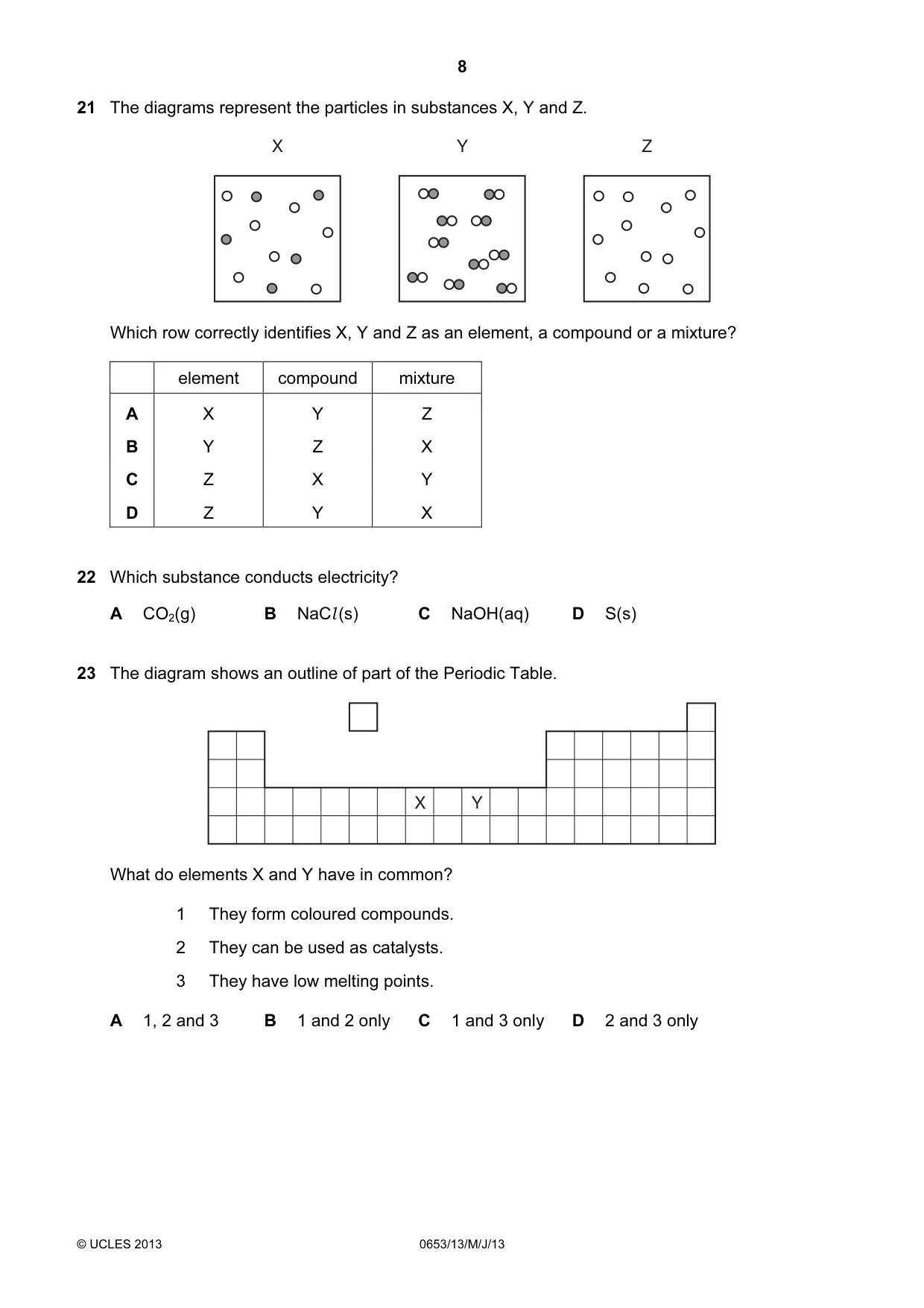
Q21 · The diagrams represent the particles in substances X, Y and Z
21 The diagrams represent the particles in substances X, Y and Z. X Y Z Which row correctly identifies X, Y and Z as an element, a compound or a mixture? element compound mixture A X Y Z B Y Z X C Z X Y D Z Y X
Mark scheme: D
Q22 · Which substance conducts electricity?
22 Which substance conducts electricity? A CO2(g) B NaCl (s) C NaOH(aq) D S(s)
Mark scheme: C
Q23 · The diagram shows an outline of part of the Periodic Table
23 The diagram shows an outline of part of the Periodic Table. X Y What do elements X and Y have in common? 1 They form coloured compounds. 2 They can be used as catalysts. 3 They have low melting points. A 1, 2 and 3 B 1 and 2 only C 1 and 3 only D 2 and 3 only
Mark scheme: B
Q24 · The equation shows the reaction of copper oxide with carbon
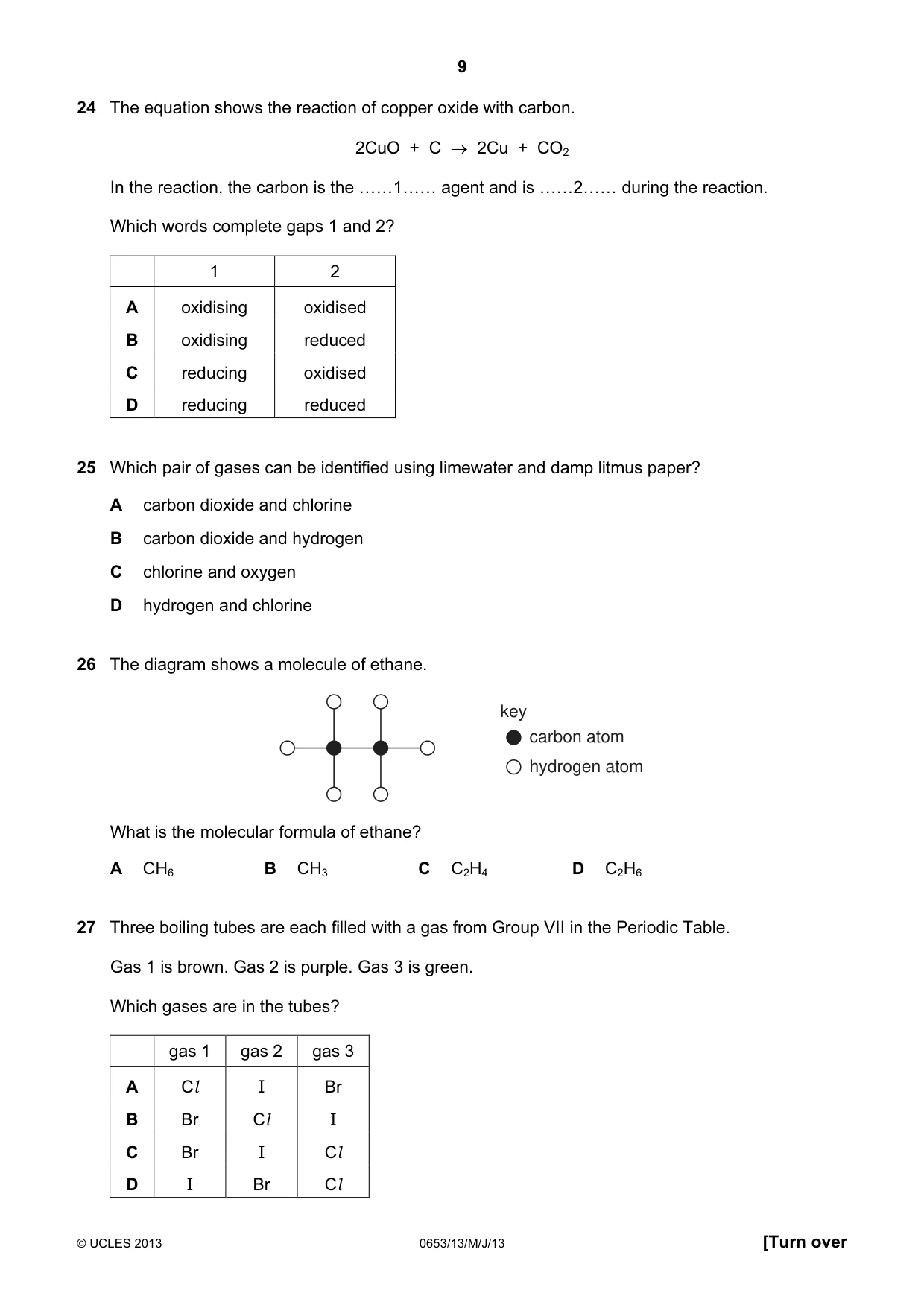
24 The equation shows the reaction of copper oxide with carbon. 2CuO + C → 2Cu + CO2 In the reaction, the carbon is the ……1…… agent and is ……2…… during the reaction. Which words complete gaps 1 and 2? 1 2 A oxidising oxidised B oxidising reduced C reducing oxidised D reducing reduced
Mark scheme: C
Q25 · Which pair of gases can be identified using limewater and damp litmus paper?
25 Which pair of gases can be identified using limewater and damp litmus paper? A carbon dioxide and chlorine B carbon dioxide and hydrogen C chlorine and oxygen D hydrogen and chlorine
Mark scheme: A
Q26 · The diagram shows a molecule of ethane
26 The diagram shows a molecule of ethane. key carbon atom hydrogen atom What is the molecular formula of ethane? A CH6 B CH3 C C2H4 D C2H6
Mark scheme: D
Q27 · Three boiling tubes are each filled with a gas from Group VII in the Periodic Table
27 Three boiling tubes are each filled with a gas from Group VII in the Periodic Table. Gas 1 is brown. Gas 2 is purple. Gas 3 is green. Which gases are in the tubes? gas 1 gas 2 gas 3 A Cl I Br B Br Cl I C Br I Cl D I Br Cl
Mark scheme: C
Q28 · Which pair of distance / time and speed / time graphs represents an object which is…
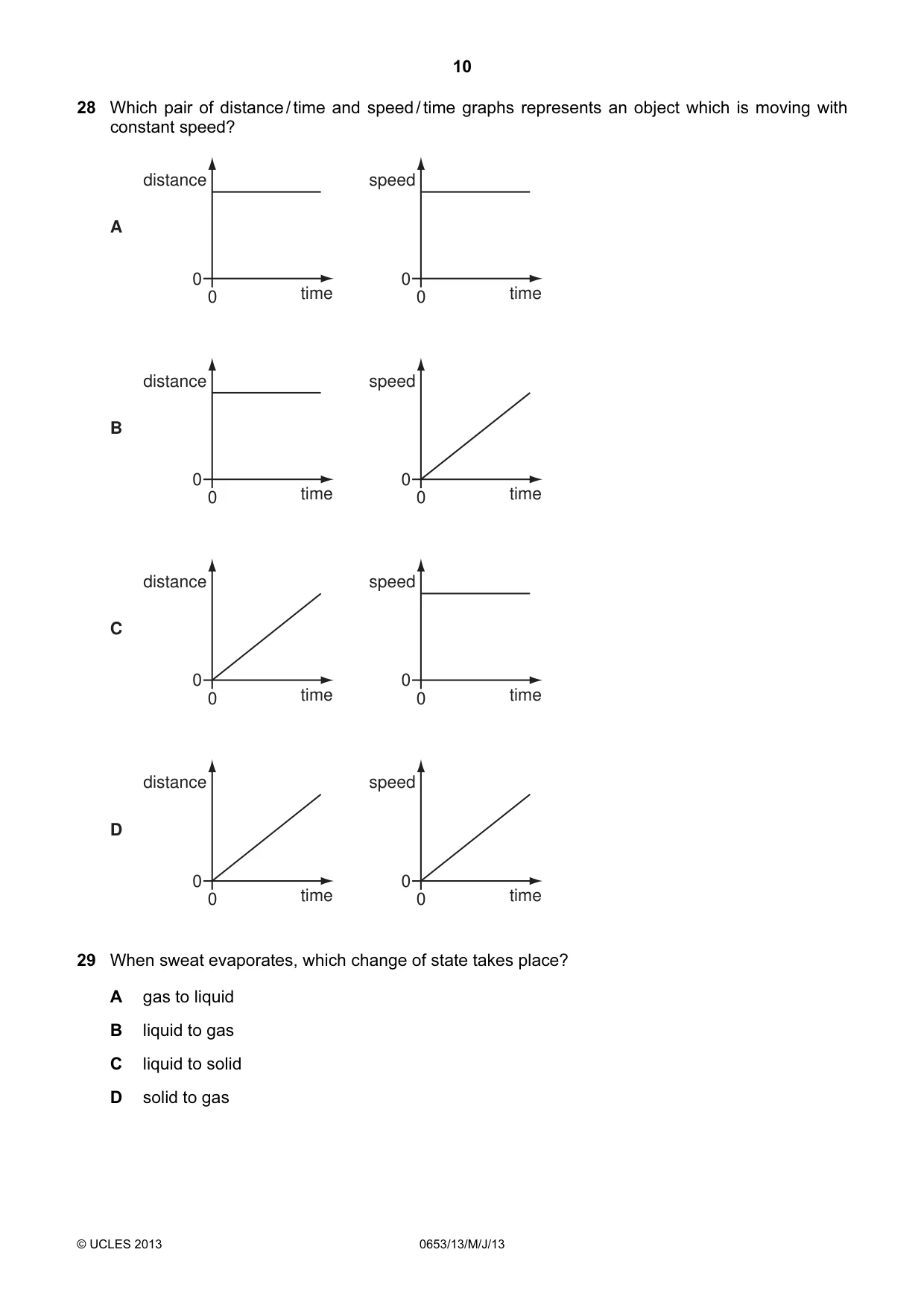
28 Which pair of distance / time and speed / time graphs represents an object which is moving with constant speed? distance speed A 0 0 0 time 0 time distance speed B 0 0 0 time 0 time distance speed C 0 0 0 time 0 time distance speed D 0 0 0 time 0 time
Mark scheme: C
Q29 · When sweat evaporates, which change of state takes place?
29 When sweat evaporates, which change of state takes place? A gas to liquid B liquid to gas C liquid to solid D solid to gas
Mark scheme: B
Q30 · A rectangular metal block has the dimensions shown
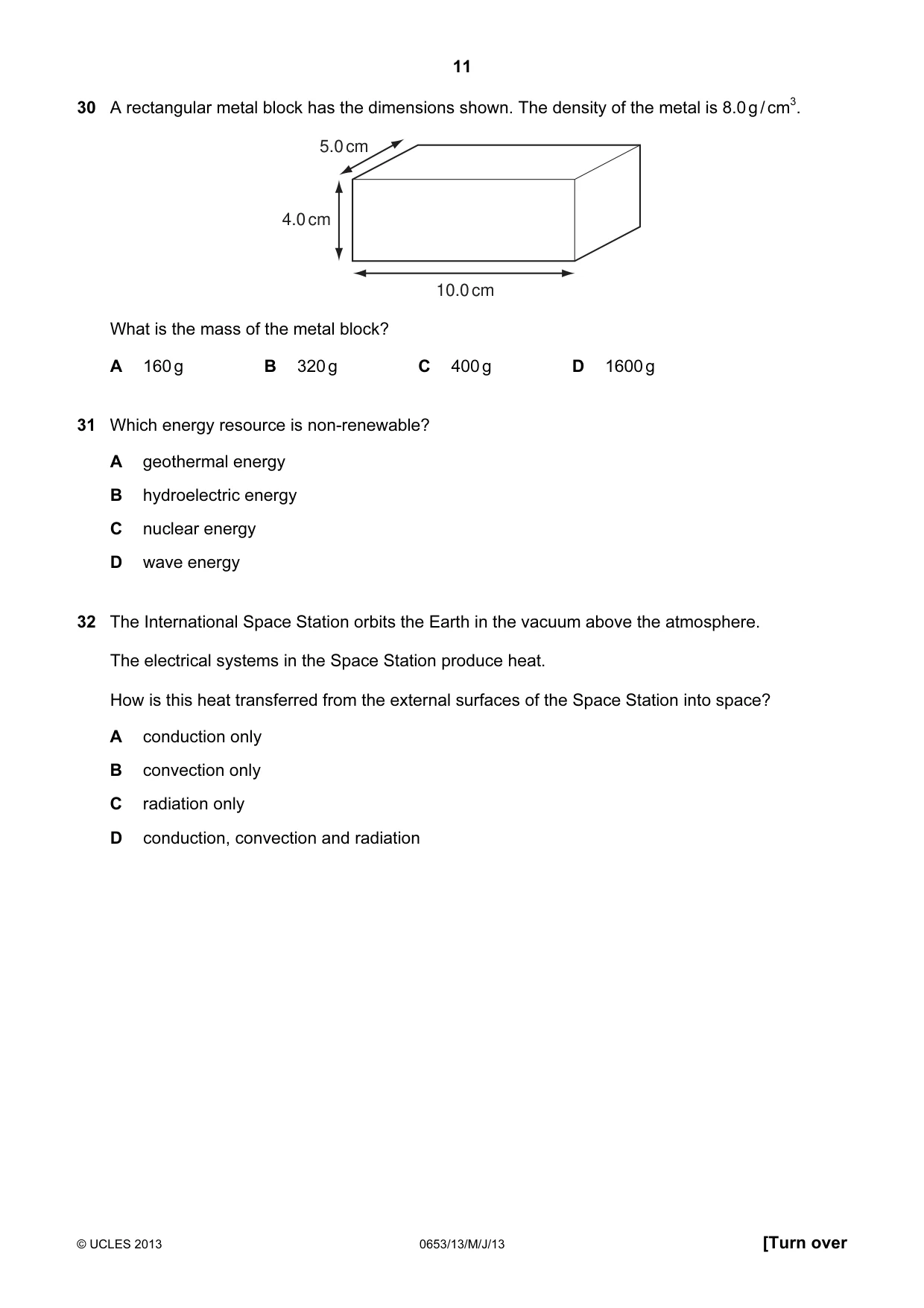
30 A rectangular metal block has the dimensions shown. The density of the metal is 8.0 g / cm3. 5.0 cm 4.0 cm 10.0 cm What is the mass of the metal block? A 160 g B 320 g C 400 g D 1600 g
Mark scheme: D
Q31 · Which energy resource is non-renewable?
31 Which energy resource is non-renewable? A geothermal energy B hydroelectric energy C nuclear energy D wave energy
Mark scheme: C
Q32 · The International Space Station orbits the Earth in the vacuum above the atmosphere
32 The International Space Station orbits the Earth in the vacuum above the atmosphere. The electrical systems in the Space Station produce heat. How is this heat transferred from the external surfaces of the Space Station into space? A conduction only B convection only C radiation only D conduction, convection and radiation
Mark scheme: C
Q33 · A block of ice is supplied with heat at a constant rate
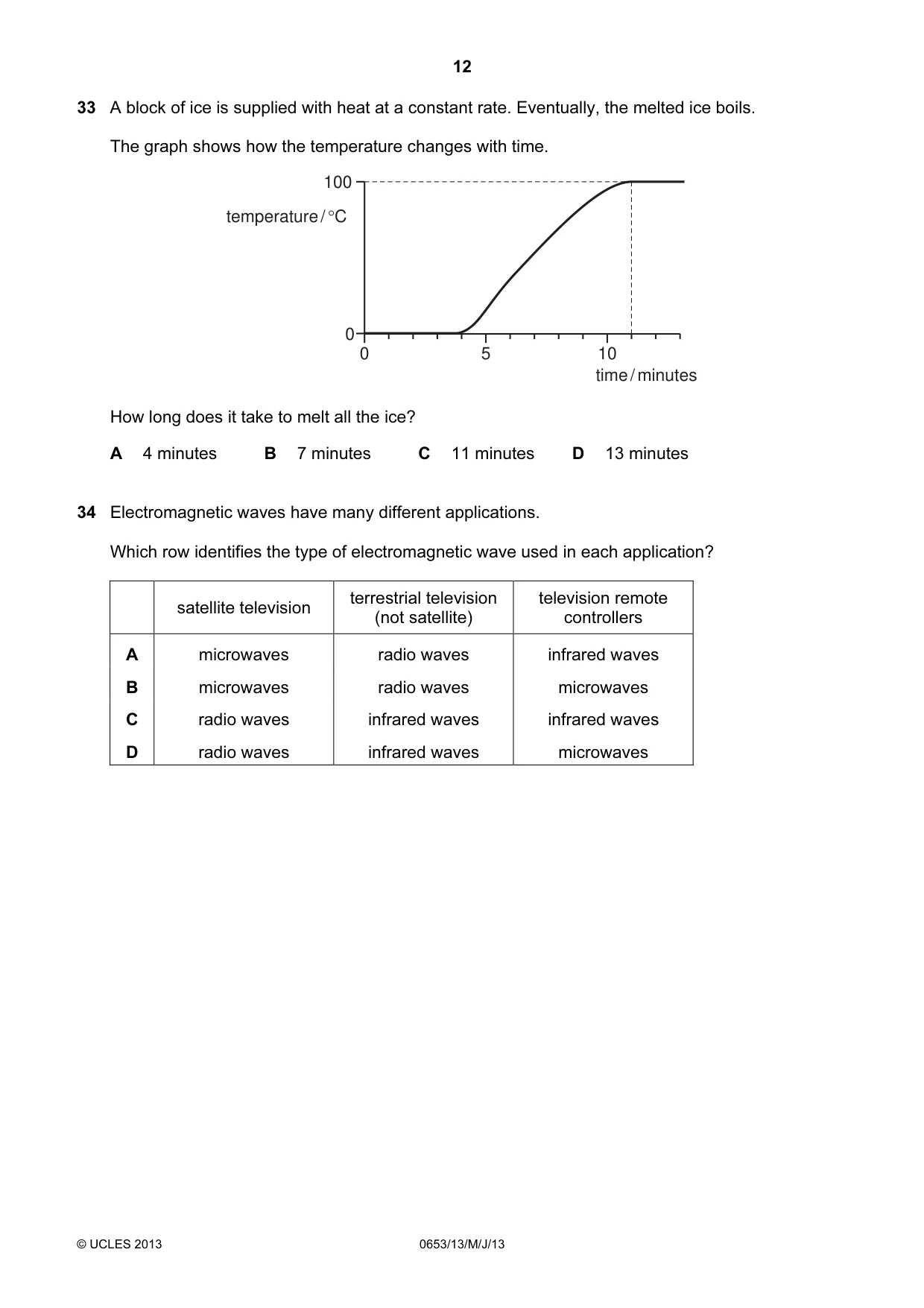
33 A block of ice is supplied with heat at a constant rate. Eventually, the melted ice boils. The graph shows how the temperature changes with time. 100 temperature / °C 0 0 5 10 time / minutes How long does it take to melt all the ice? A 4 minutes B 7 minutes C 11 minutes D 13 minutes
Mark scheme: A
Q34 · Electromagnetic waves have many different applications
34 Electromagnetic waves have many different applications. Which row identifies the type of electromagnetic wave used in each application? terrestrial television television remote satellite television (not satellite) controllers A microwaves radio waves infrared waves B microwaves radio waves microwaves C radio waves infrared waves infrared waves D radio waves infrared waves microwaves
Mark scheme: A
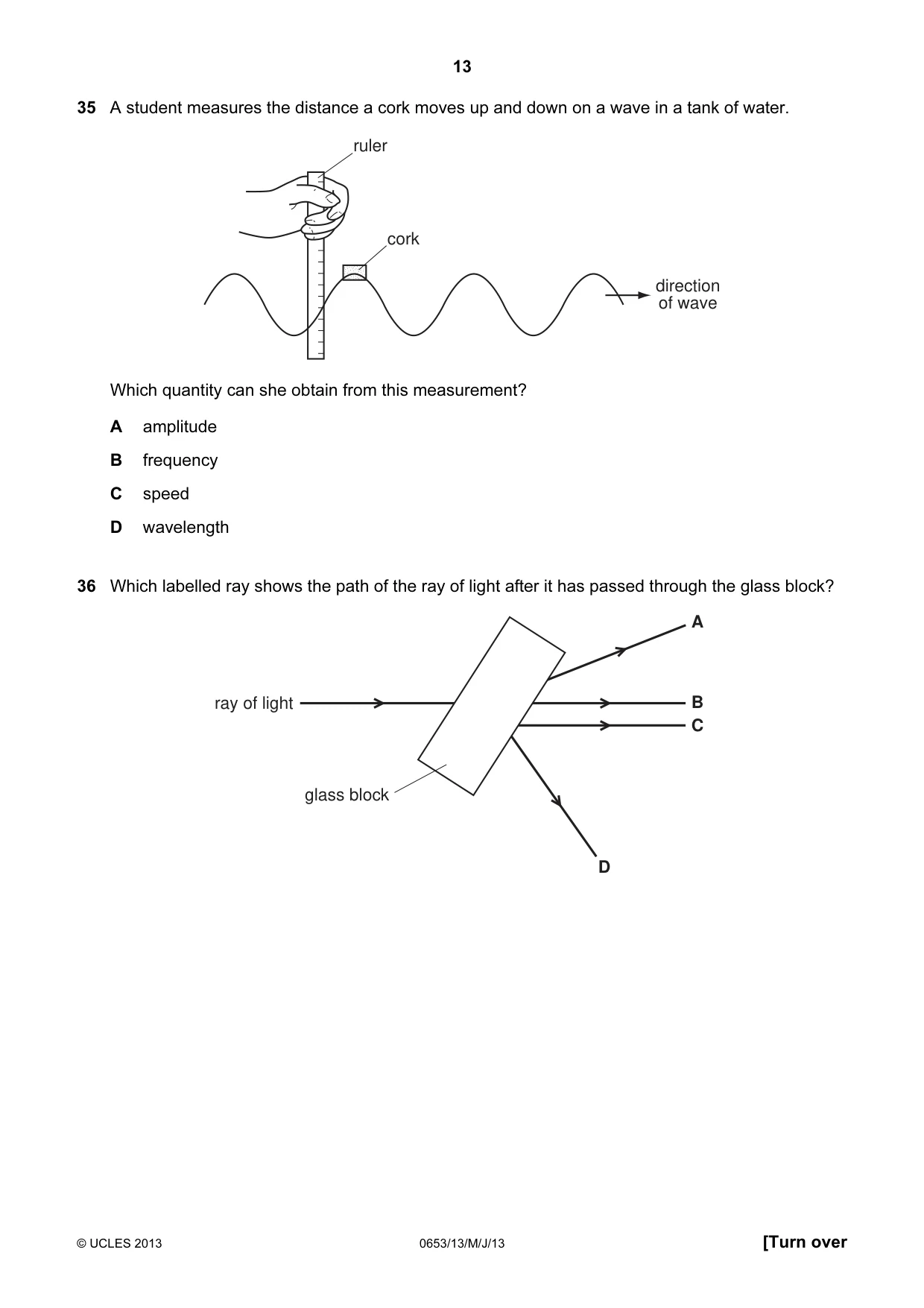
Q35 · A student measures the distance a cork moves up and down on a wave in a tank of water
35 A student measures the distance a cork moves up and down on a wave in a tank of water. ruler cork direction of wave Which quantity can she obtain from this measurement? A amplitude B frequency C speed D wavelength
Mark scheme: A
Q36 · Which labelled ray shows the path of the ray of light after it has passed through the…
36 Which labelled ray shows the path of the ray of light after it has passed through the glass block? A ray of light B C glass block D
Mark scheme: C
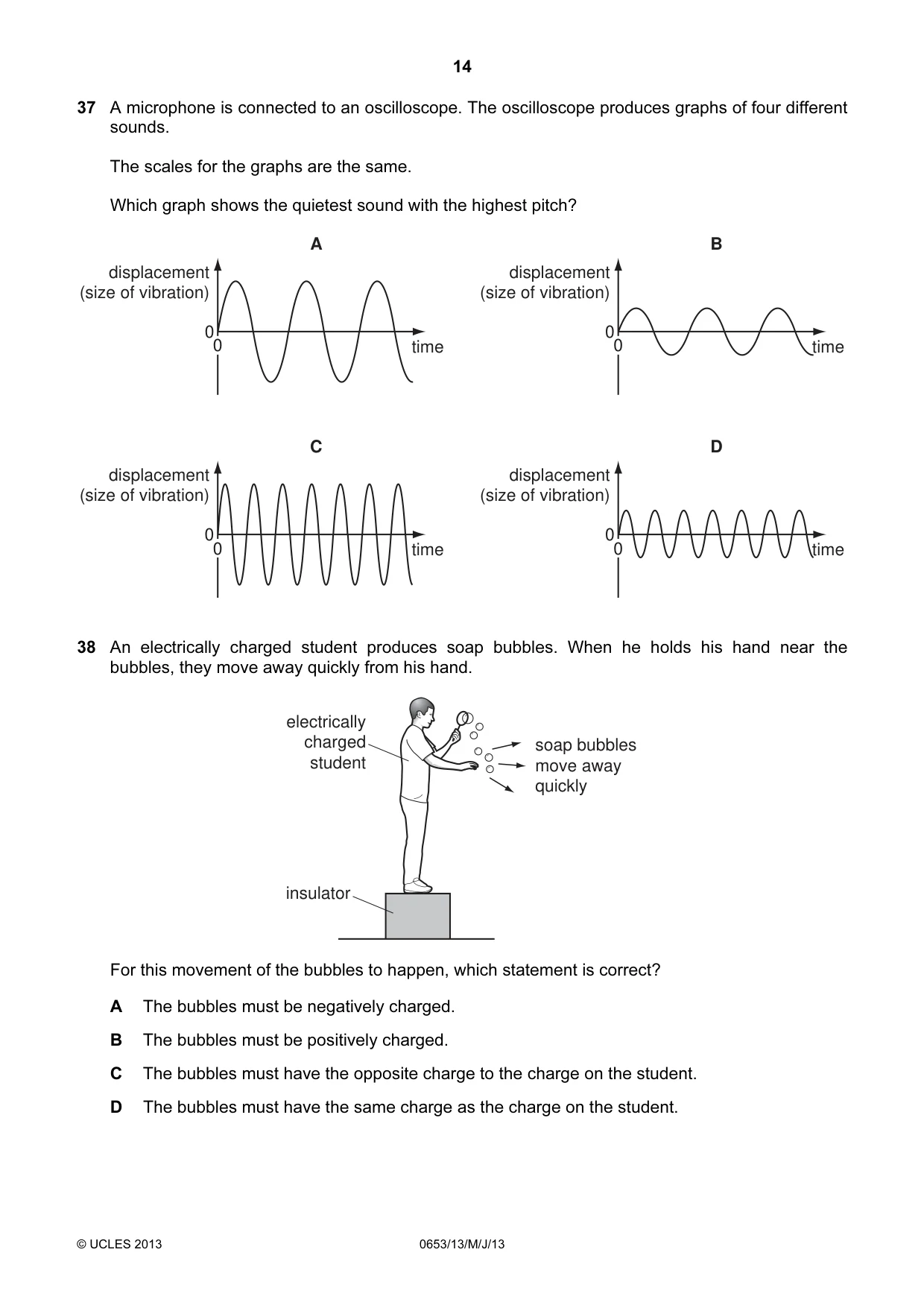
Q37 · A microphone is connected to an oscilloscope
37 A microphone is connected to an oscilloscope. The oscilloscope produces graphs of four different sounds. The scales for the graphs are the same. Which graph shows the quietest sound with the highest pitch? A B displacement displacement (size of vibration) (size of vibration) 00 00 time time C D displacement displacement (size of vibration) (size of vibration) 00 00 time time
Mark scheme: D
Q38 · An electrically charged student produces soap bubbles
38 An electrically charged student produces soap bubbles. When he holds his hand near the bubbles, they move away quickly from his hand. electrically charged soap bubbles student move away quickly insulator For this movement of the bubbles to happen, which statement is correct? A The bubbles must be negatively charged. B The bubbles must be positively charged. C The bubbles must have the opposite charge to the charge on the student. D The bubbles must have the same charge as the charge on the student.
Mark scheme: D
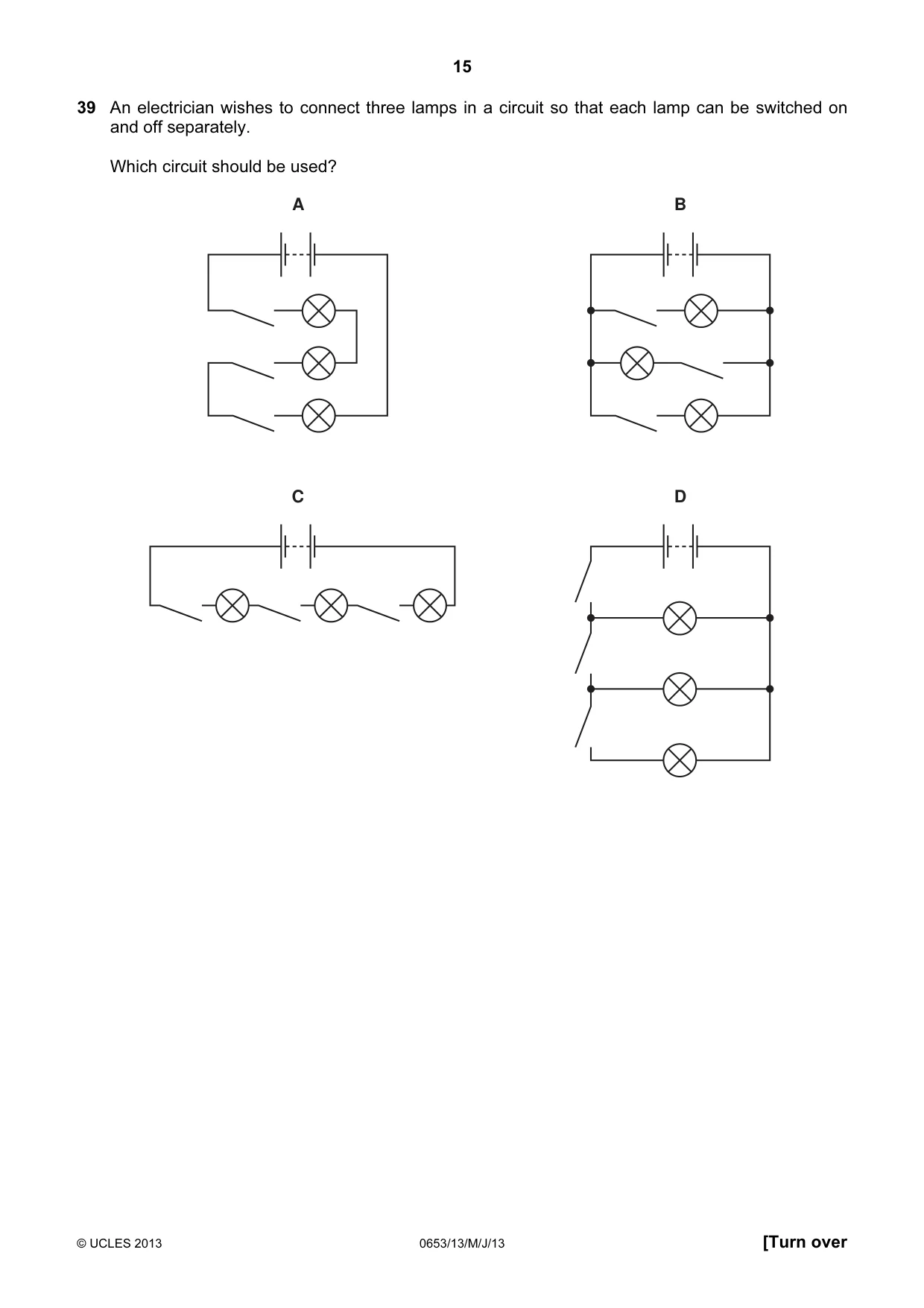
Q39 · An electrician wishes to connect three lamps in a circuit so that each lamp can be…
39 An electrician wishes to connect three lamps in a circuit so that each lamp can be switched on and off separately. Which circuit should be used? A B C D
Mark scheme: B
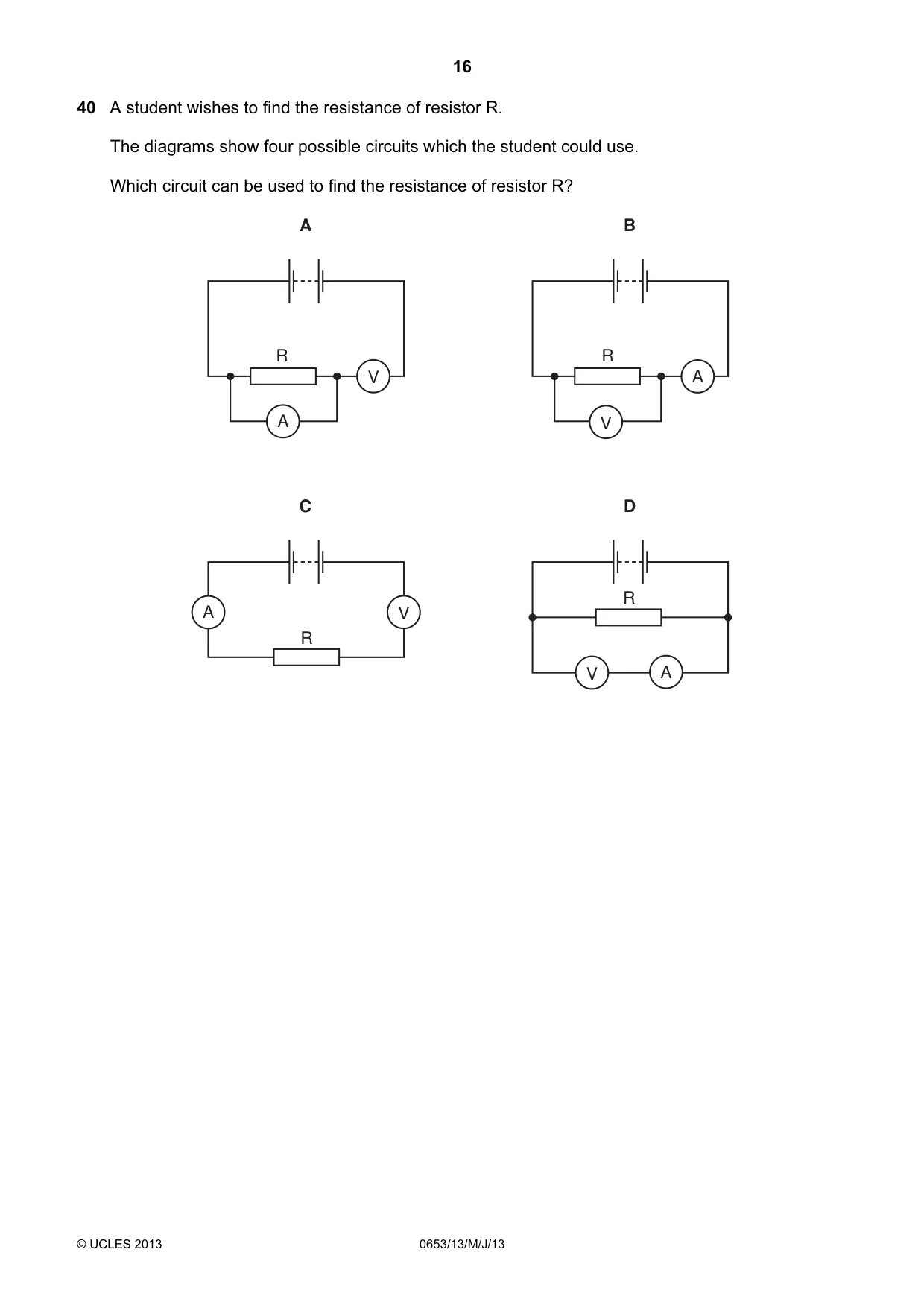
Q40 · A student wishes to find the resistance of resistor R
40 A student wishes to find the resistance of resistor R. The diagrams show four possible circuits which the student could use. Which circuit can be used to find the resistance of resistor R? A B R R V A A V C D R A V R V A
Mark scheme: B
What was in this paper
The subtopics covered by these 40 questions, and how many questions each got. Open one in a new tab to see every Cambridge question on it.
2Separation and purification2Sexual reproduction in humans2Air quality and climate1Biological molecules1Corrosion of metals1Density1Diffusion1Drugs1Electrical circuits1Electrolysis1Electromagnetic spectrum1Elements, compounds and mixtures1Energy, work and power1Enzymes1Exothermic and endothermic reactions1Food chains and food webs1General properties of waves1Group VII properties1Heart1Identification of ions and gases1Ions and ionic bonds1Kinetic particle model of matter1Light1Motion1Photosynthesis1Rate of reaction1Redox1Respiration1Sexual reproduction in plants1Size of specimens1Sound1Terminology1Thermal properties and temperature1Transfer of thermal energy1Transition elements1Transpiration1What you needed in this session
Cambridge’s own grade thresholds for 2013 May/June, Paper 1 · Variant 3. A higher threshold means an easier paper — the bar moves with how the cohort did.