Cambridge IGCSE Science - Combined 0653 — 2024 Oct/Nov Paper 1 · Variant 2
0653/12/O/N/24 · 40 questions · 40 marks · ≈45 min
The question paper and its mark scheme, free to read here and free to download. This is Cambridge’s own paper, exactly as it was sat.
Question paper16 pages
Mark scheme3 pages
Answers below. Sit the paper first if you are practising.
Questions as text
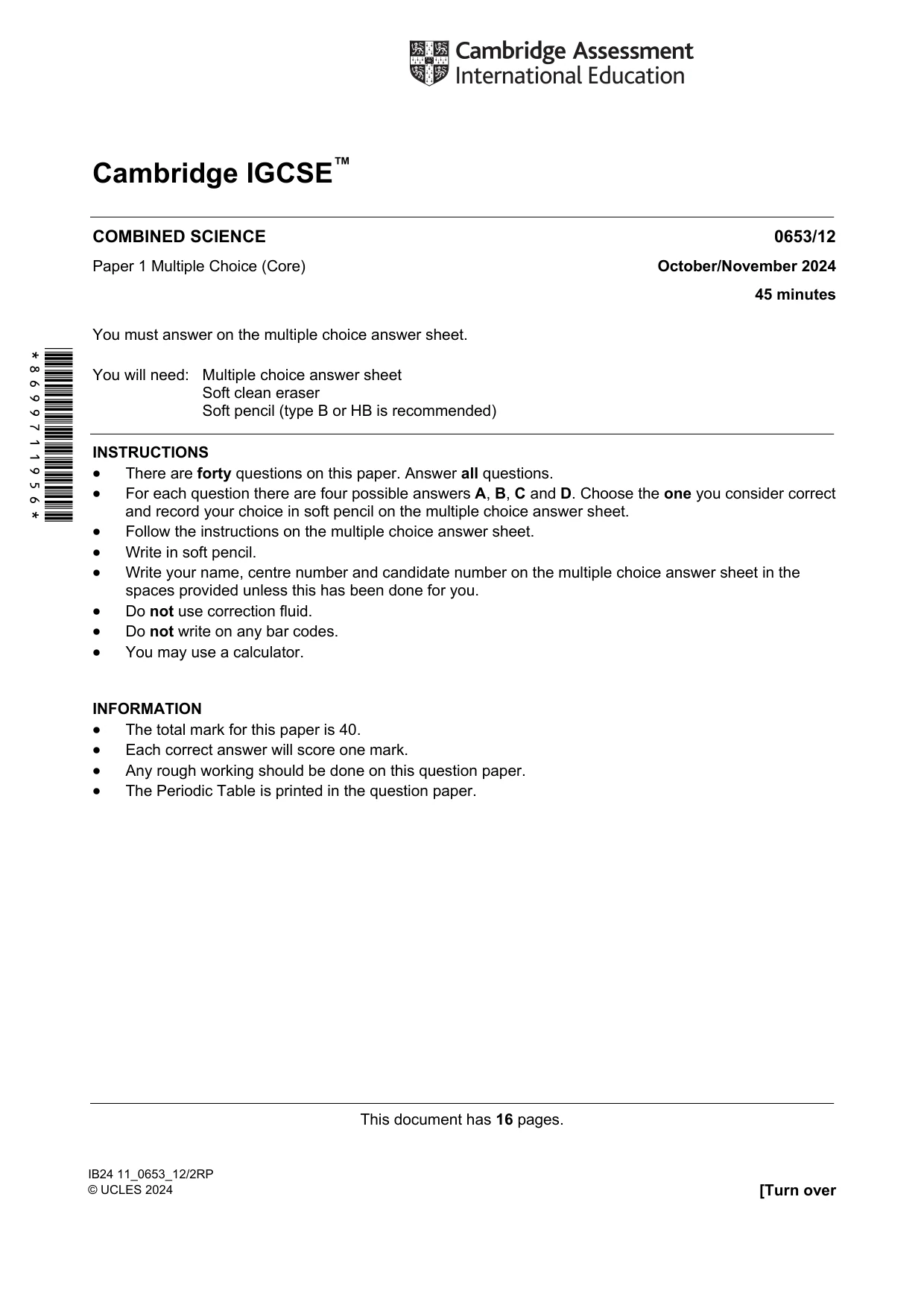
Q1 · Which label shows the cell membrane?
1 Which label shows the cell membrane? A B C D
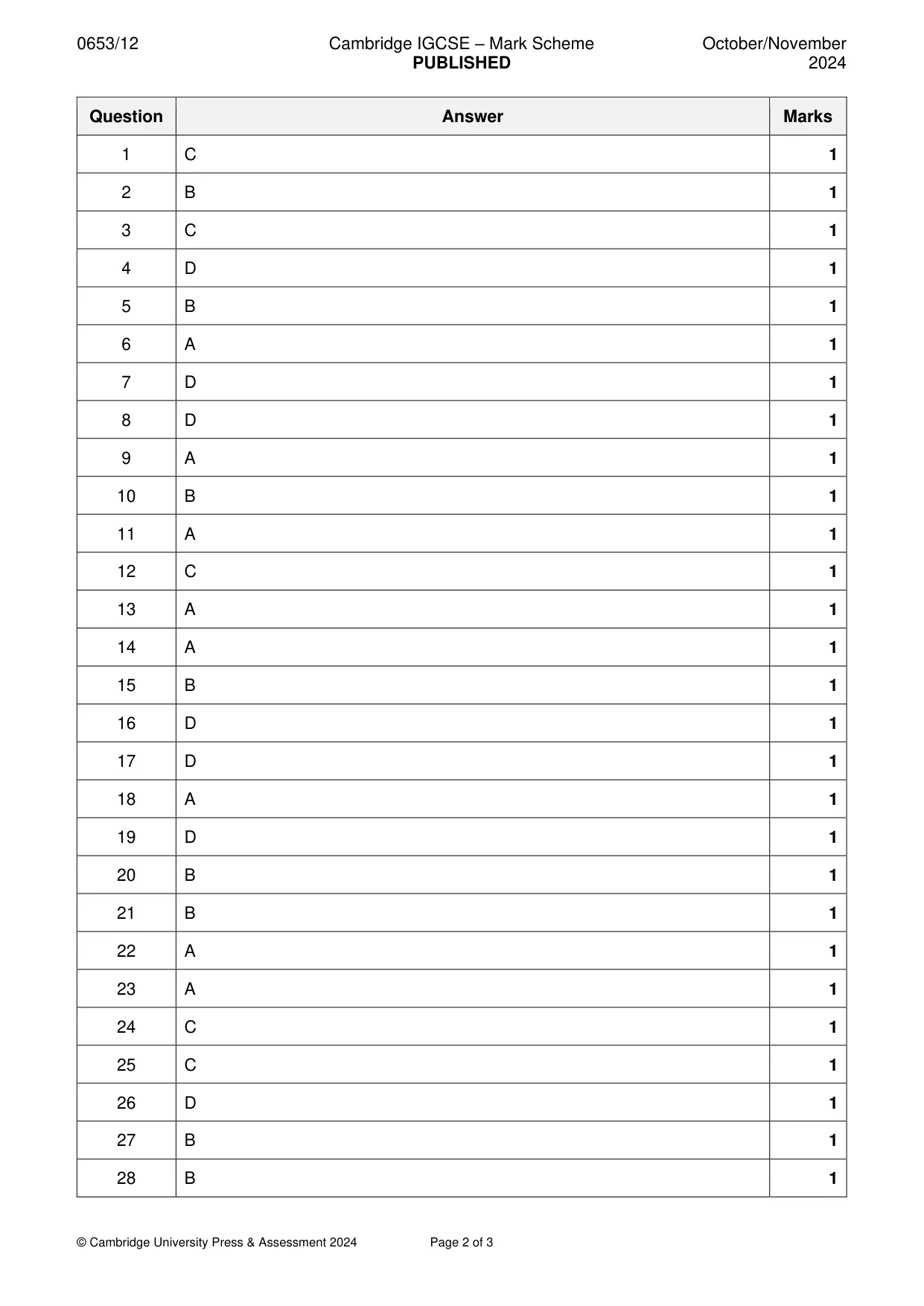
Mark scheme: C
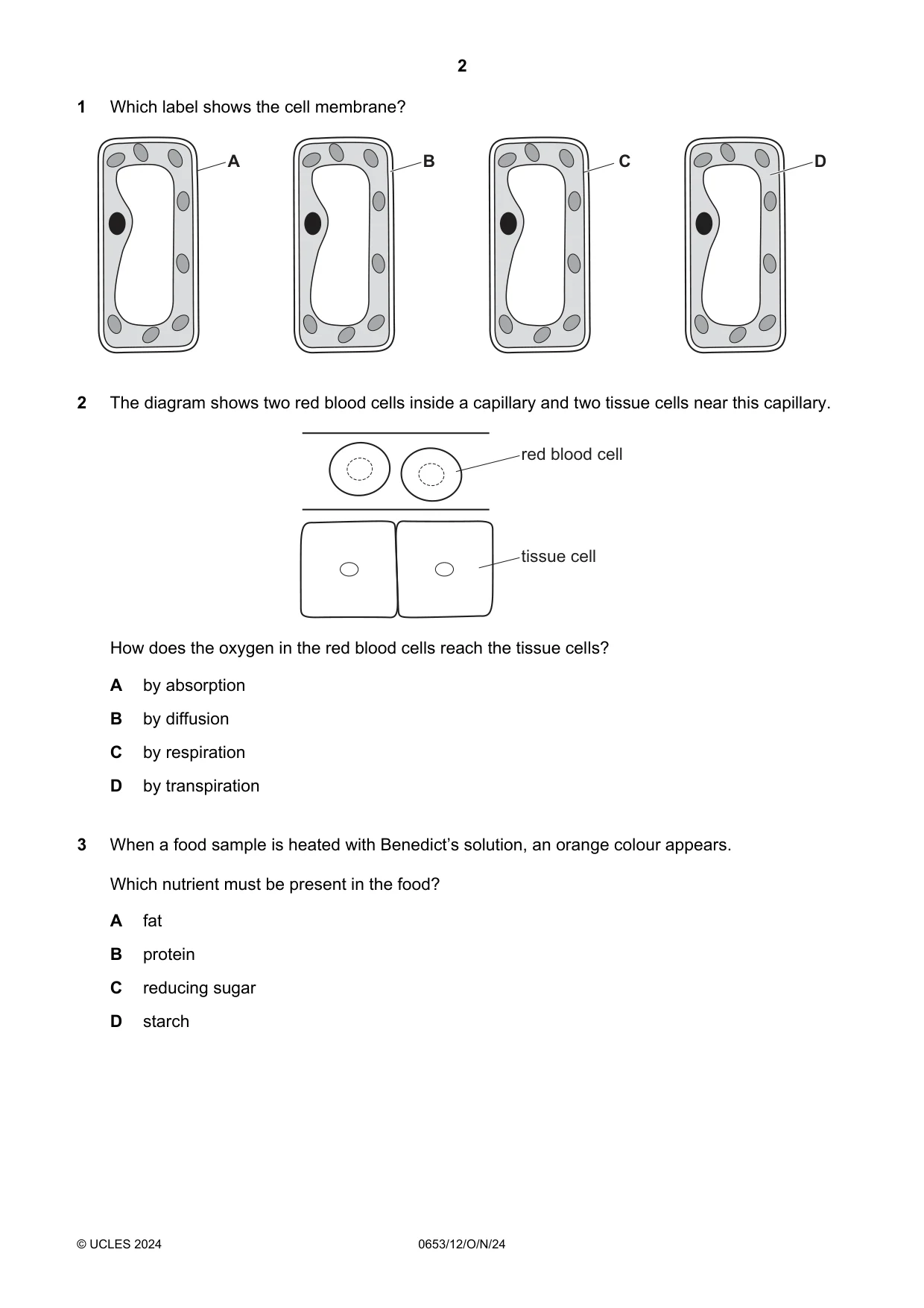
Q2 · The diagram shows two red blood cells inside a capillary and two tissue cells near this…
2 The diagram shows two red blood cells inside a capillary and two tissue cells near this capillary. red blood cell tissue cell How does the oxygen in the red blood cells reach the tissue cells? A by absorption B by diffusion C by respiration D by transpiration
Mark scheme: B
Q3 · When a food sample is heated with Benedict’s solution, an orange colour appears
3 When a food sample is heated with Benedict’s solution, an orange colour appears. Which nutrient must be present in the food? A fat B protein C reducing sugar D starch
Mark scheme: C
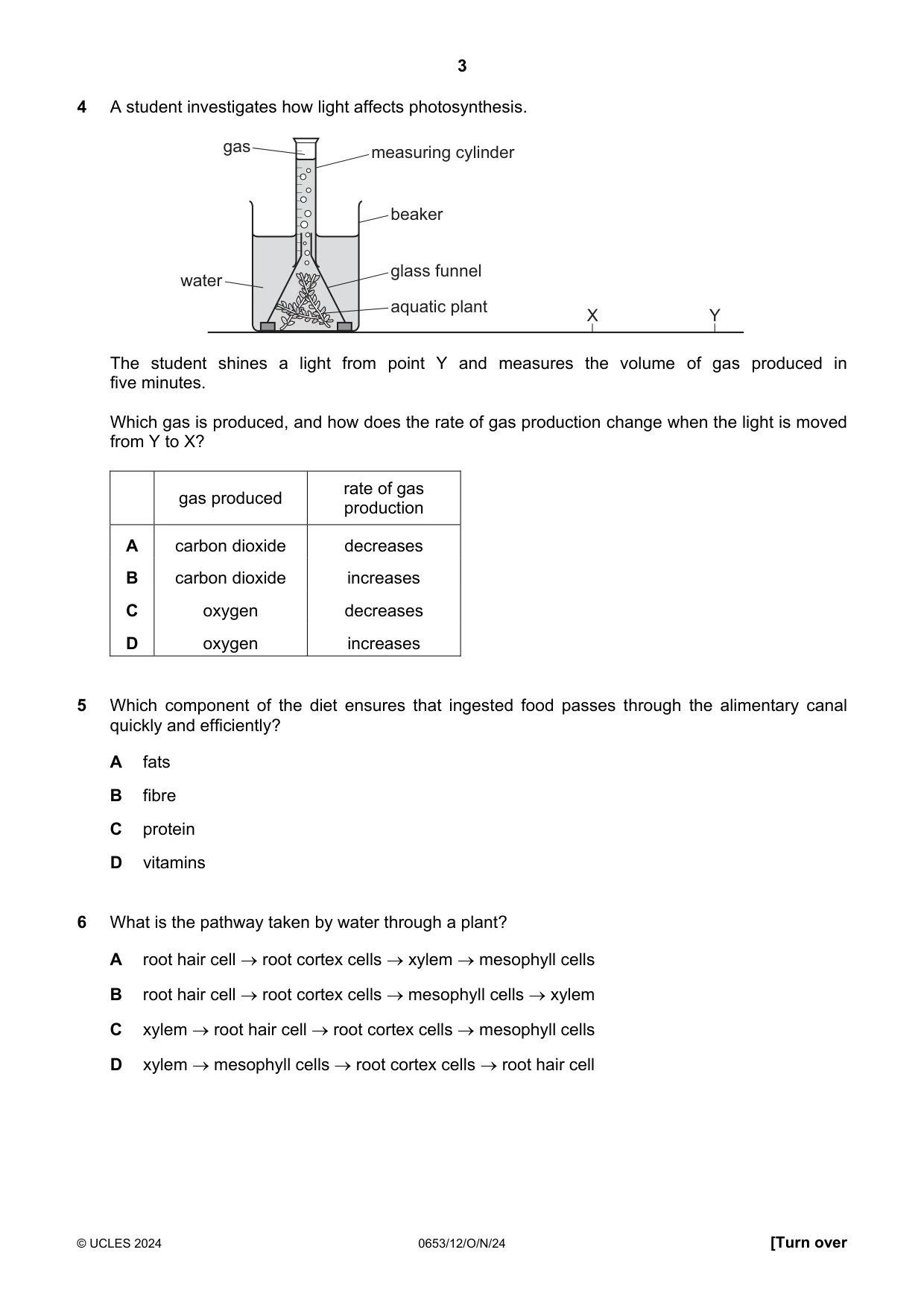
Q4 · A student investigates how light affects photosynthesis
4 A student investigates how light affects photosynthesis. gas measuring cylinder beaker glass funnel water aquatic plant X Y The student shines a light from point Y and measures the volume of gas produced in five minutes. Which gas is produced, and how does the rate of gas production change when the light is moved from Y to X? rate of gas gas produced production A carbon dioxide decreases B carbon dioxide increases C oxygen decreases D oxygen increases
Mark scheme: D
Q5 · Which component of the diet ensures that ingested food passes through the alimentary…
5 Which component of the diet ensures that ingested food passes through the alimentary canal quickly and efficiently? A fats B fibre C protein D vitamins
Mark scheme: B
Q6 · What is the pathway taken by water through a plant?
6 What is the pathway taken by water through a plant? A root hair cell root cortex cells xylem mesophyll cells B root hair cell root cortex cells mesophyll cells xylem C xylem root hair cell root cortex cells mesophyll cells D xylem mesophyll cells root cortex cells root hair cell
Mark scheme: A
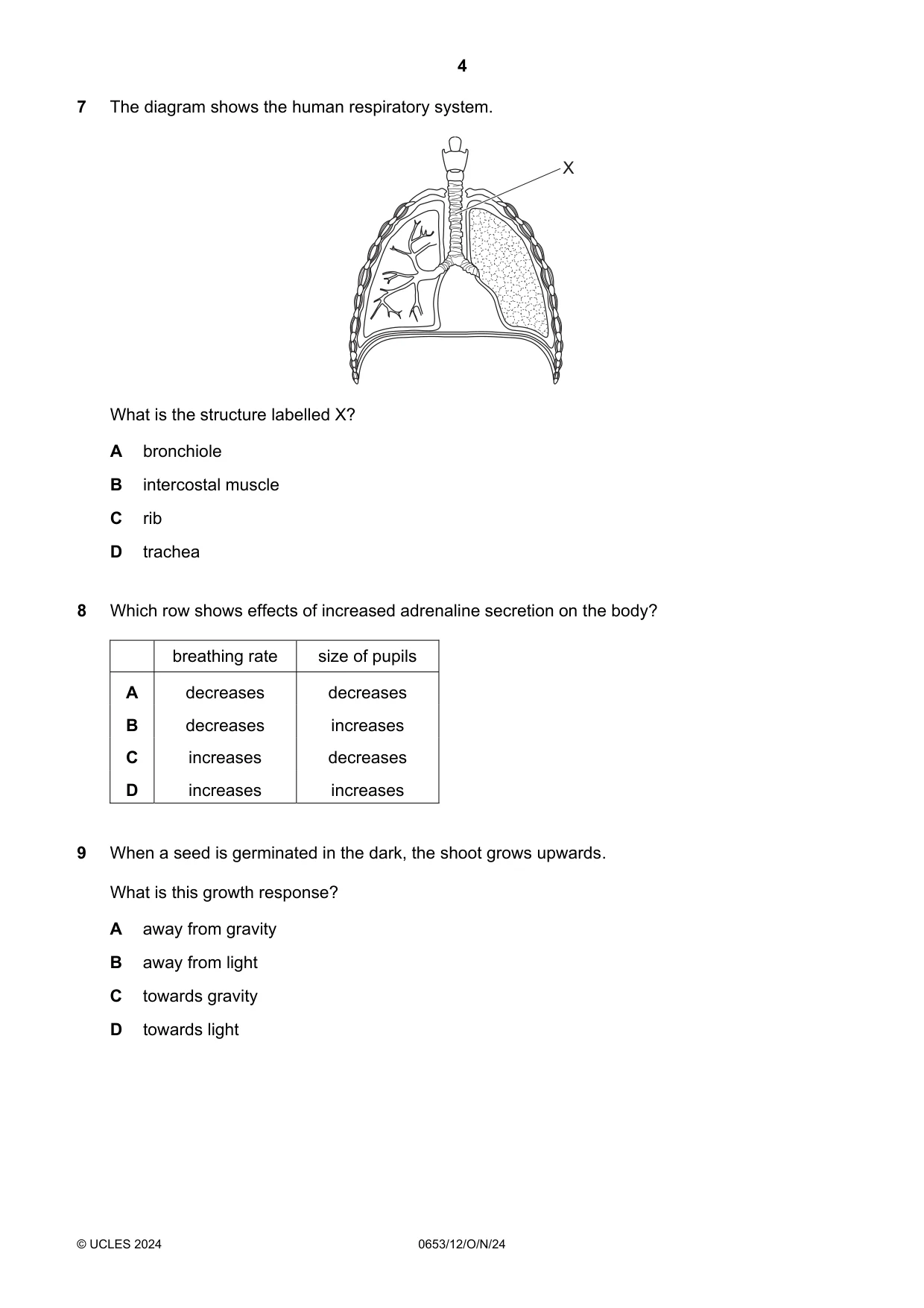
Q7 · The diagram shows the human respiratory system
7 The diagram shows the human respiratory system. X What is the structure labelled X? A bronchiole B intercostal muscle C rib D trachea
Mark scheme: D
Q8 · Which row shows effects of increased adrenaline secretion on the body?
8 Which row shows effects of increased adrenaline secretion on the body? breathing rate size of pupils A decreases decreases B decreases increases C increases decreases D increases increases
Mark scheme: D
Q9 · When a seed is germinated in the dark, the shoot grows upwards
9 When a seed is germinated in the dark, the shoot grows upwards. What is this growth response? A away from gravity B away from light C towards gravity D towards light
Mark scheme: A
Q10 · Which statement is correct?
10 Which statement is correct? A Asexual reproduction results in the formation of a zygote. B Asexual reproduction results in genetically identical offspring from one parent. C Sexual reproduction only occurs in animals. D Sexual reproduction results in genetically identical offspring from two parents.
Mark scheme: B
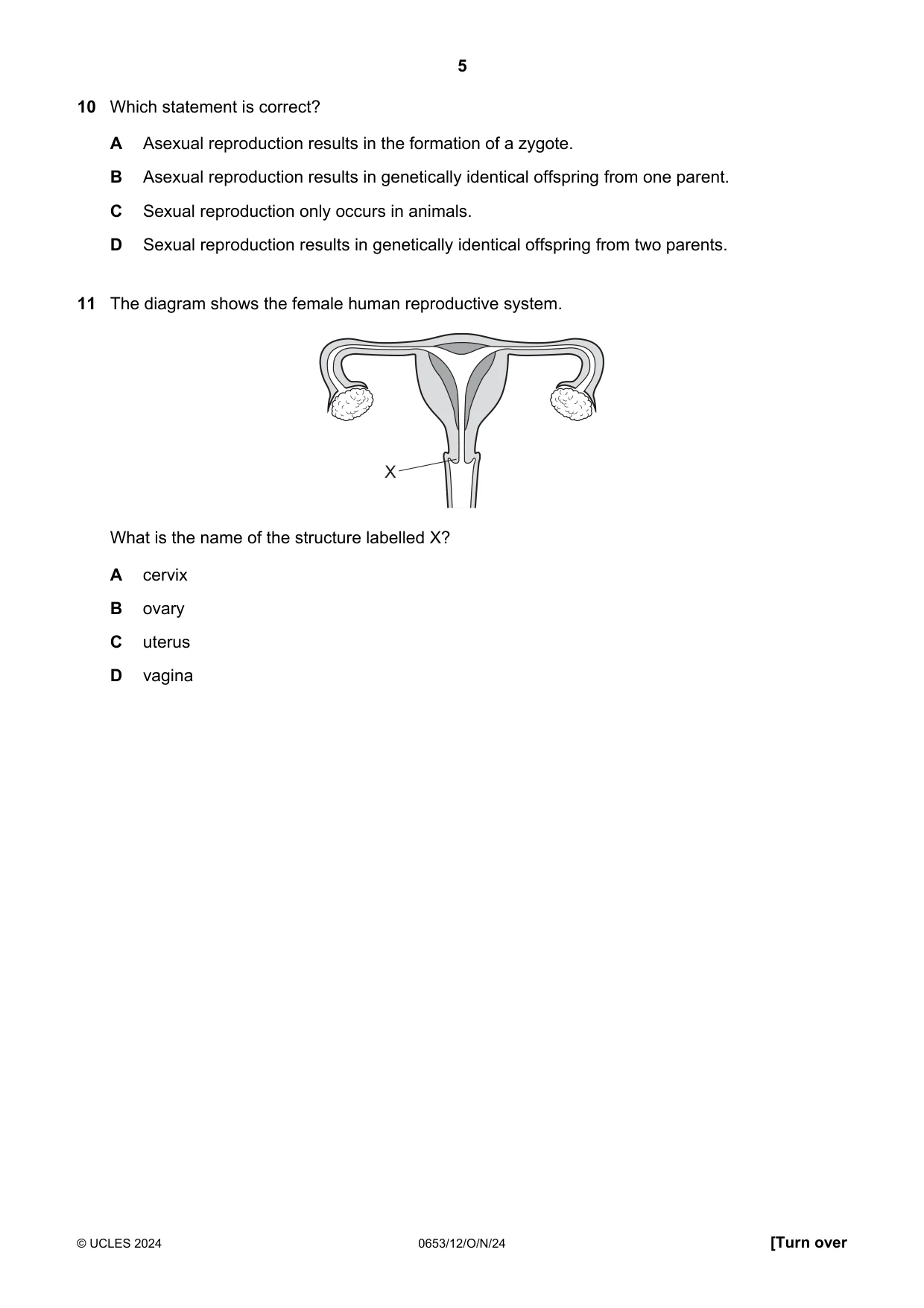
Q11 · The diagram shows the female human reproductive system
11 The diagram shows the female human reproductive system. X What is the name of the structure labelled X? A cervix B ovary C uterus D vagina
Mark scheme: A
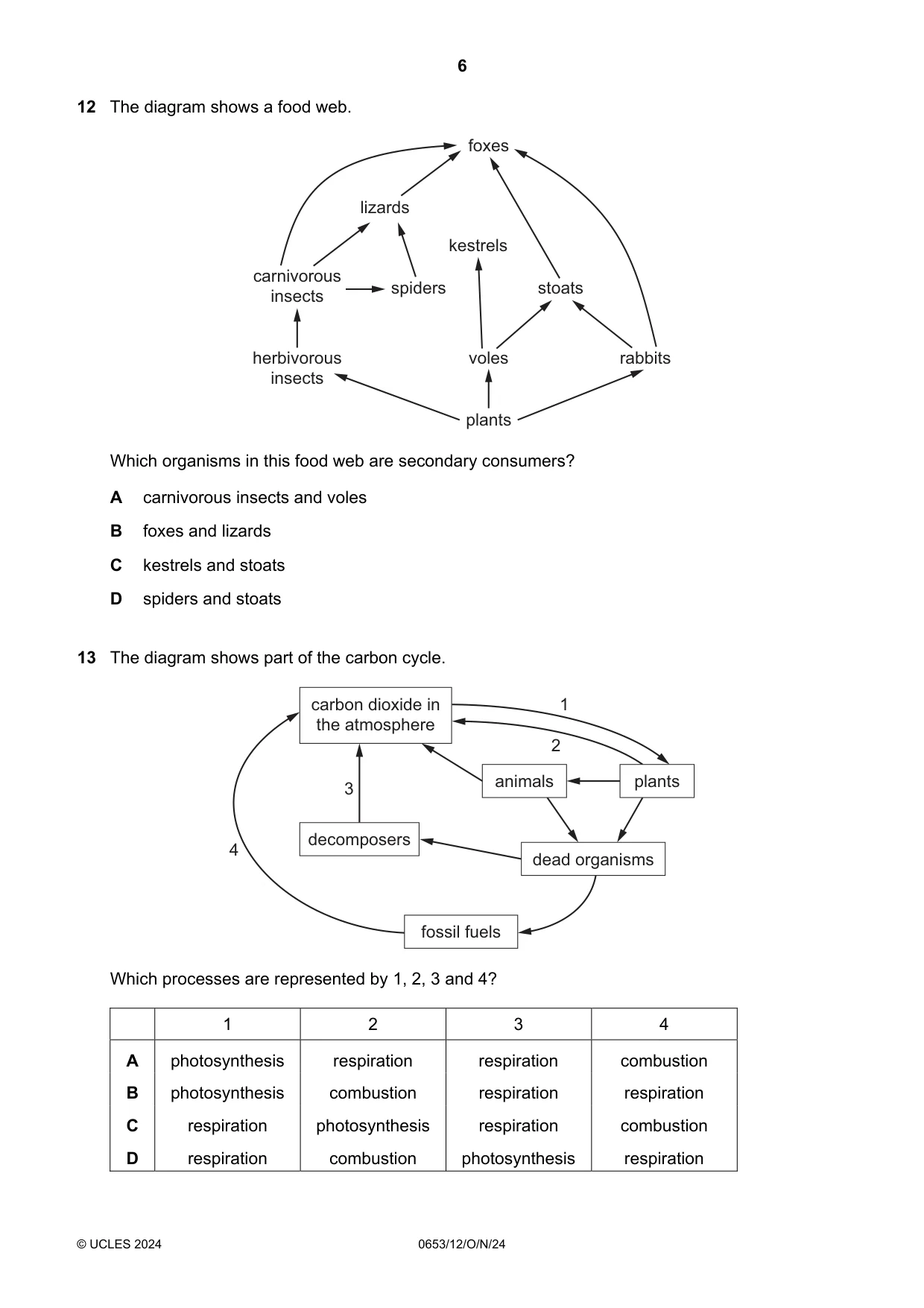
Q12 · The diagram shows a food web
12 The diagram shows a food web. foxes lizards kestrels carnivorous spiders stoats insects herbivorous voles rabbits insects plants Which organisms in this food web are secondary consumers? A carnivorous insects and voles B foxes and lizards C kestrels and stoats D spiders and stoats
Mark scheme: C
Q13 · The diagram shows part of the carbon cycle
13 The diagram shows part of the carbon cycle. carbon dioxide in 1 the atmosphere 2 3 animals plants decomposers 4 dead organisms fossil fuels Which processes are represented by 1, 2, 3 and 4? 1 2 3 4 A photosynthesis respiration respiration combustion B photosynthesis combustion respiration respiration C respiration photosynthesis respiration combustion D respiration combustion photosynthesis respiration
Mark scheme: A
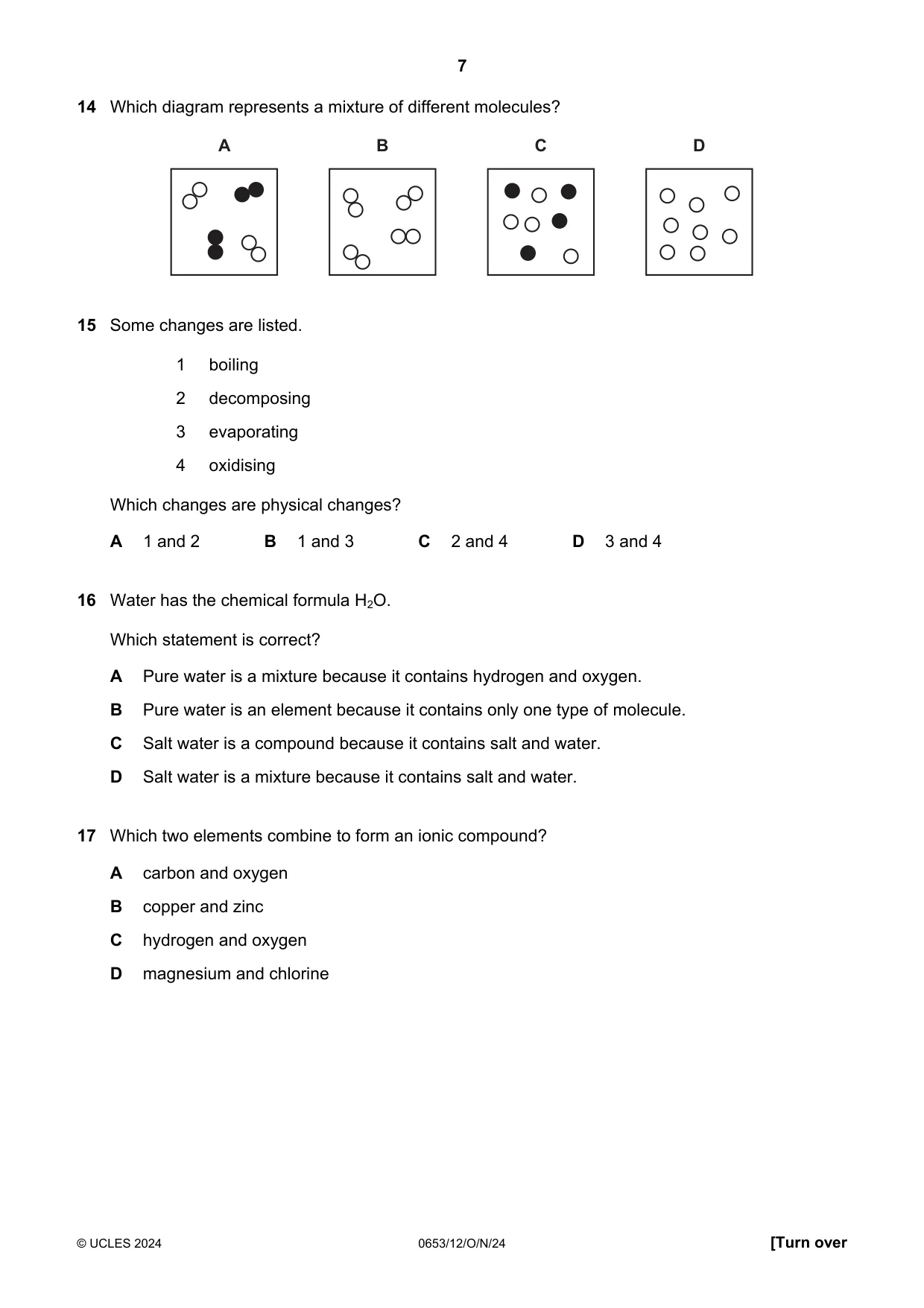
Q14 · Which diagram represents a mixture of different molecules?
14 Which diagram represents a mixture of different molecules? A B C D
Mark scheme: A
Q15 · Some changes are listed
15 Some changes are listed. 1 boiling 2 decomposing 3 evaporating 4 oxidising Which changes are physical changes? A 1 and 2 B 1 and 3 C 2 and 4 D 3 and 4
Mark scheme: B
Q16 · Water has the chemical formula H2O
16 Water has the chemical formula H2O. Which statement is correct? A Pure water is a mixture because it contains hydrogen and oxygen. B Pure water is an element because it contains only one type of molecule. C Salt water is a compound because it contains salt and water. D Salt water is a mixture because it contains salt and water.
Mark scheme: D
Q17 · Which two elements combine to form an ionic compound?
17 Which two elements combine to form an ionic compound? A carbon and oxygen B copper and zinc C hydrogen and oxygen D magnesium and chlorine
Mark scheme: D
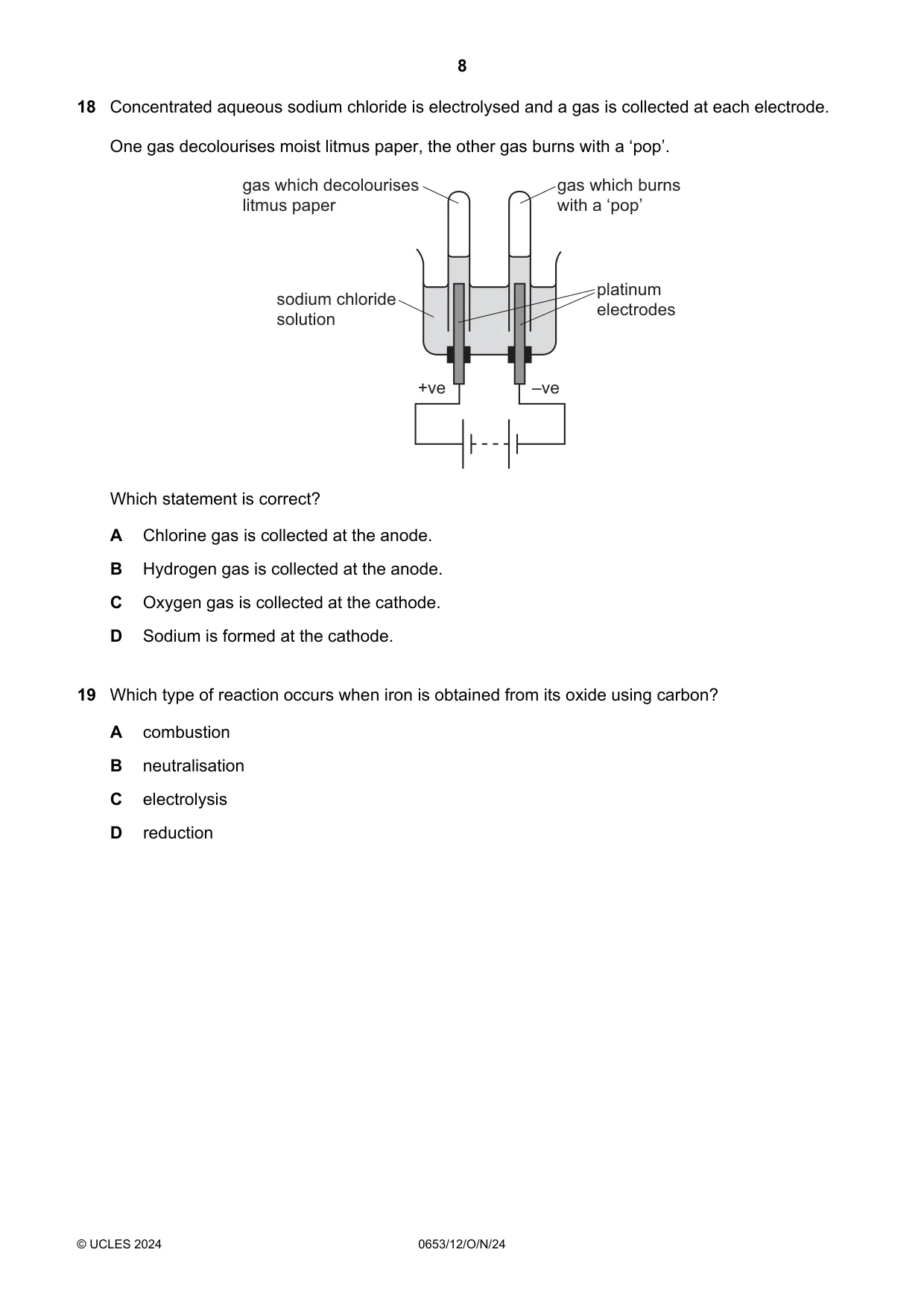
Q18 · Concentrated aqueous sodium chloride is electrolysed and a gas is collected at each…
18 Concentrated aqueous sodium chloride is electrolysed and a gas is collected at each electrode. One gas decolourises moist litmus paper, the other gas burns with a ‘pop’. gas which decolourises gas which burns litmus paper with a ‘pop’ platinum sodium chloride electrodes solution +ve –ve Which statement is correct? A Chlorine gas is collected at the anode. B Hydrogen gas is collected at the anode. C Oxygen gas is collected at the cathode. D Sodium is formed at the cathode.
Mark scheme: A
Q19 · Which type of reaction occurs when iron is obtained from its oxide using carbon?
19 Which type of reaction occurs when iron is obtained from its oxide using carbon? A combustion B neutralisation C electrolysis D reduction
Mark scheme: D
Q20 · The steps needed to make pure, dry magnesium sulfate crystals from magnesium oxide and…
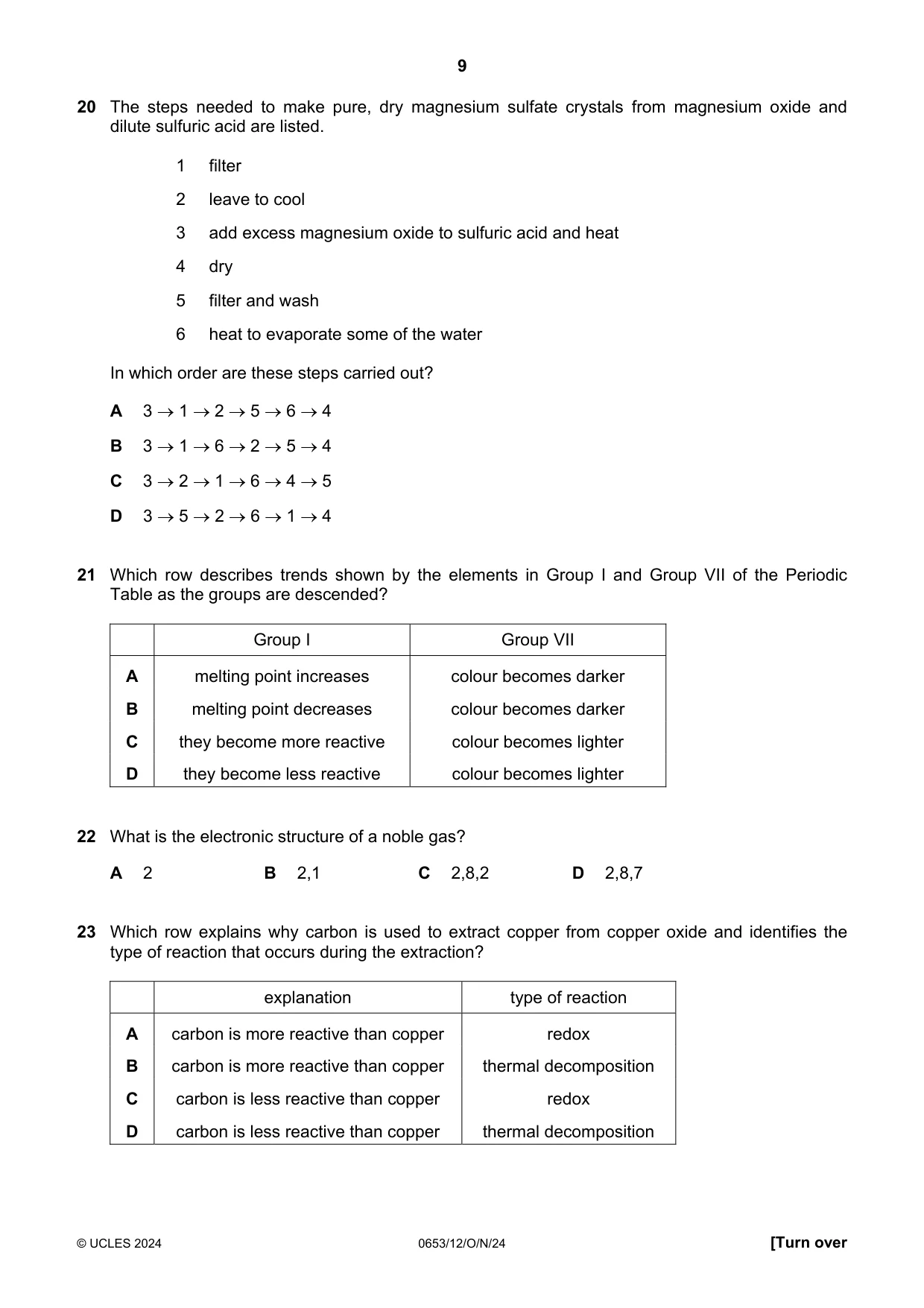
20 The steps needed to make pure, dry magnesium sulfate crystals from magnesium oxide and dilute sulfuric acid are listed. 1 filter 2 leave to cool 3 add excess magnesium oxide to sulfuric acid and heat 4 dry 5 filter and wash 6 heat to evaporate some of the water In which order are these steps carried out? A 3 1 2 5 6 4 B 3 1 6 2 5 4 C 3 2 1 6 4 5 D 3 5 2 6 1 4
Mark scheme: B
Q21 · Which row describes trends shown by the elements in Group I and Group VII of the Periodic…
21 Which row describes trends shown by the elements in Group I and Group VII of the Periodic Table as the groups are descended? Group I Group VII A melting point increases colour becomes darker B melting point decreases colour becomes darker C they become more reactive colour becomes lighter D they become less reactive colour becomes lighter
Mark scheme: B
Q22 · What is the electronic structure of a noble gas?
22 What is the electronic structure of a noble gas? A 2 B 2,1 C 2,8,2 D 2,8,7
Mark scheme: A
Q23 · Which row explains why carbon is used to extract copper from copper oxide and identifies…
23 Which row explains why carbon is used to extract copper from copper oxide and identifies the type of reaction that occurs during the extraction? explanation type of reaction A carbon is more reactive than copper redox B carbon is more reactive than copper thermal decomposition C carbon is less reactive than copper redox D carbon is less reactive than copper thermal decomposition
Mark scheme: A
Q24 · A 100 cm3 sample of clean air is passed into the apparatus as shown
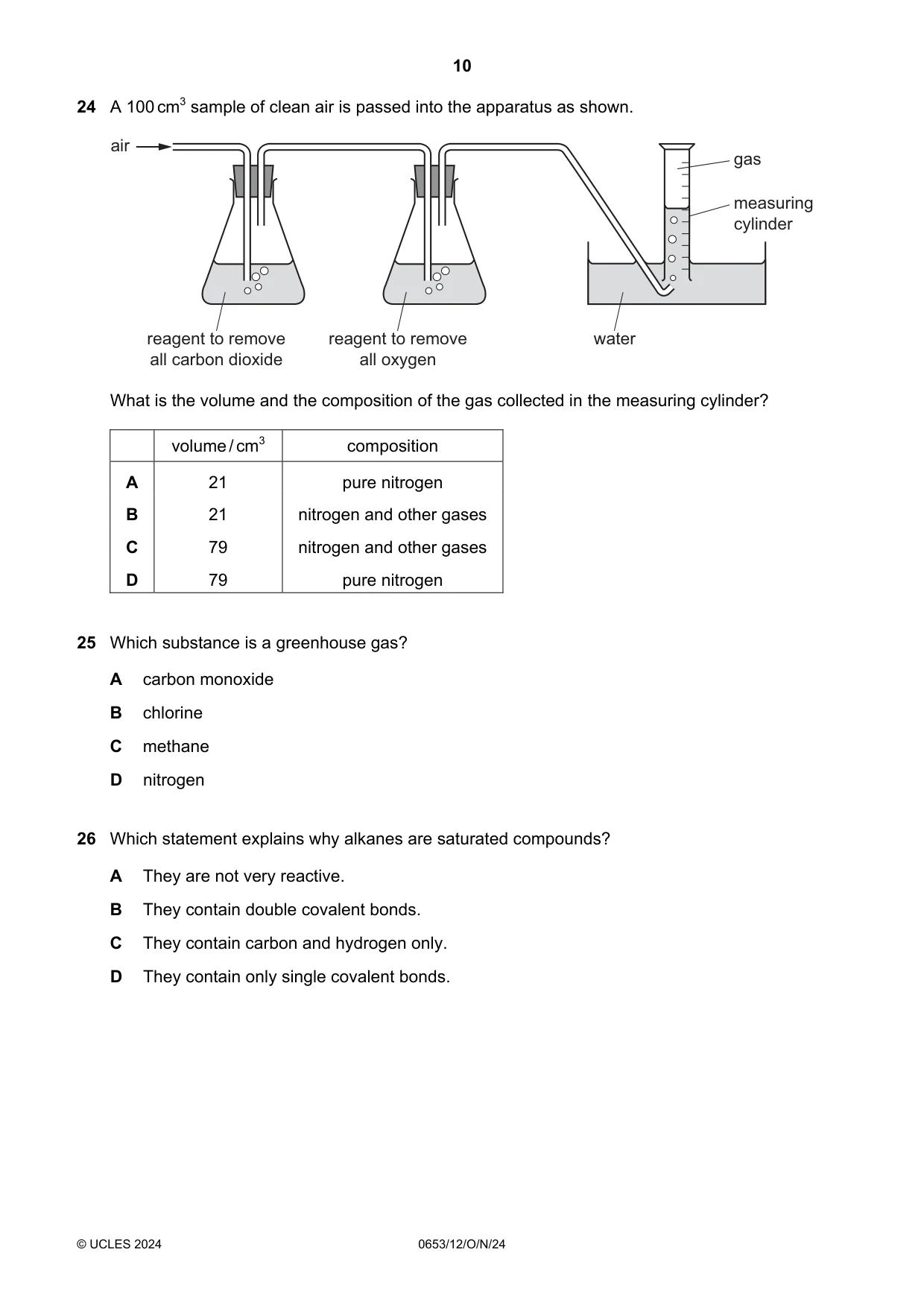
24 A 100 cm3 sample of clean air is passed into the apparatus as shown. air gas measuring cylinder reagent to remove reagent to remove water all carbon dioxide all oxygen What is the volume and the composition of the gas collected in the measuring cylinder? volume / cm3 composition A 21 pure nitrogen B 21 nitrogen and other gases C 79 nitrogen and other gases D 79 pure nitrogen
Mark scheme: C
Q25 · Which substance is a greenhouse gas?
25 Which substance is a greenhouse gas? A carbon monoxide B chlorine C methane D nitrogen
Mark scheme: C
Q26 · Which statement explains why alkanes are saturated compounds?
26 Which statement explains why alkanes are saturated compounds? A They are not very reactive. B They contain double covalent bonds. C They contain carbon and hydrogen only. D They contain only single covalent bonds.
Mark scheme: D
Q27 · Which statement about alkenes is correct?
27 Which statement about alkenes is correct? A They are manufactured in addition polymerisation reactions. B They react with aqueous bromine to give colourless products. C They are compounds containing carbon, hydrogen and oxygen. D They are cracked to produce other compounds.
Mark scheme: B
Q28 · Which expression is the definition of speed?
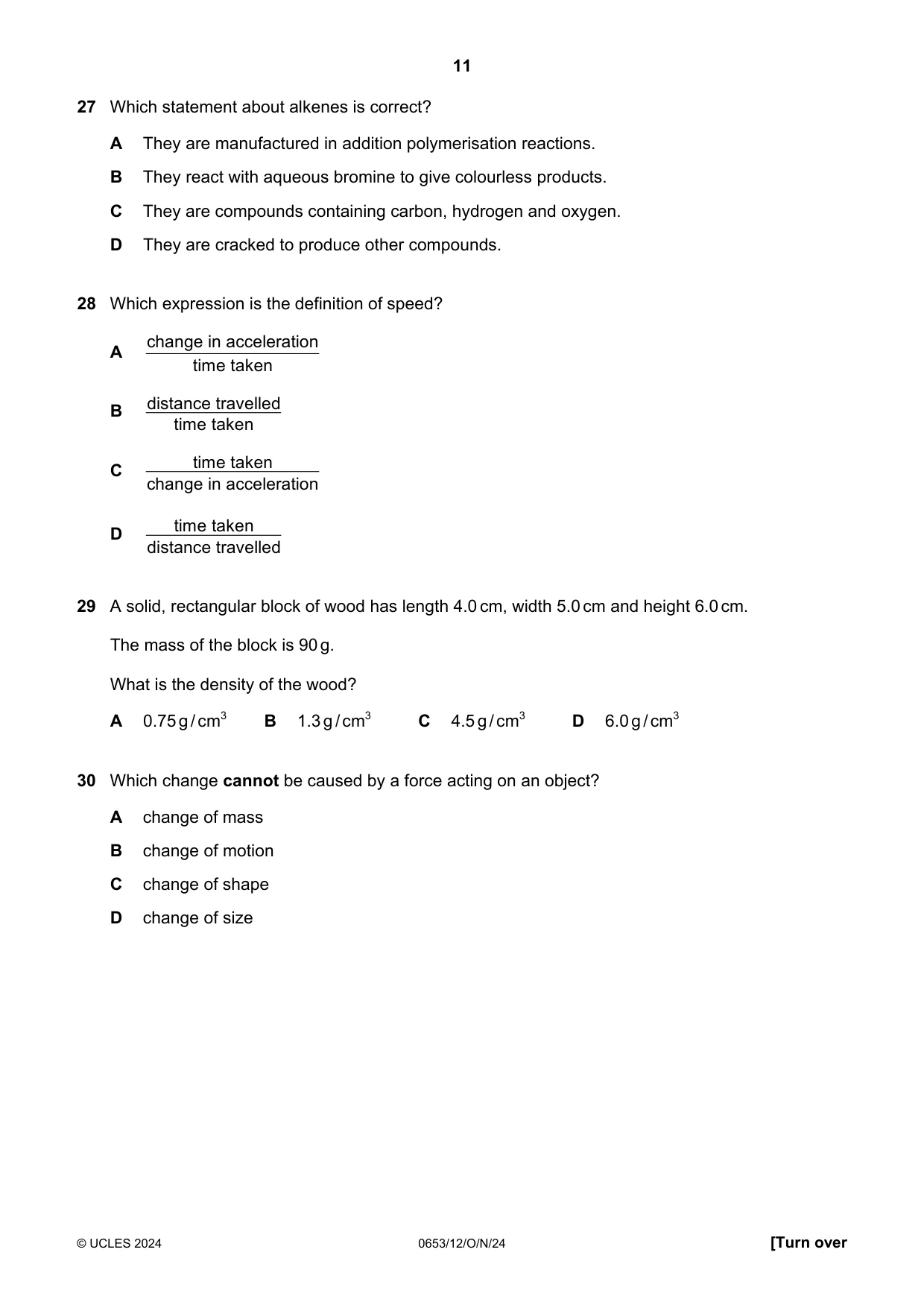
28 Which expression is the definition of speed? change in acceleration A time taken distance travelled B time taken time taken C change in acceleration time taken D distance travelled
Mark scheme: B
Q29 · A solid, rectangular block of wood has length 4.0 cm, width 5.0 cm and height 6.0 cm
29 A solid, rectangular block of wood has length 4.0 cm, width 5.0 cm and height 6.0 cm. The mass of the block is 90 g. What is the density of the wood? A 0.75 g / cm3 B 1.3 g / cm3 C 4.5 g / cm3 D 6.0 g / cm3
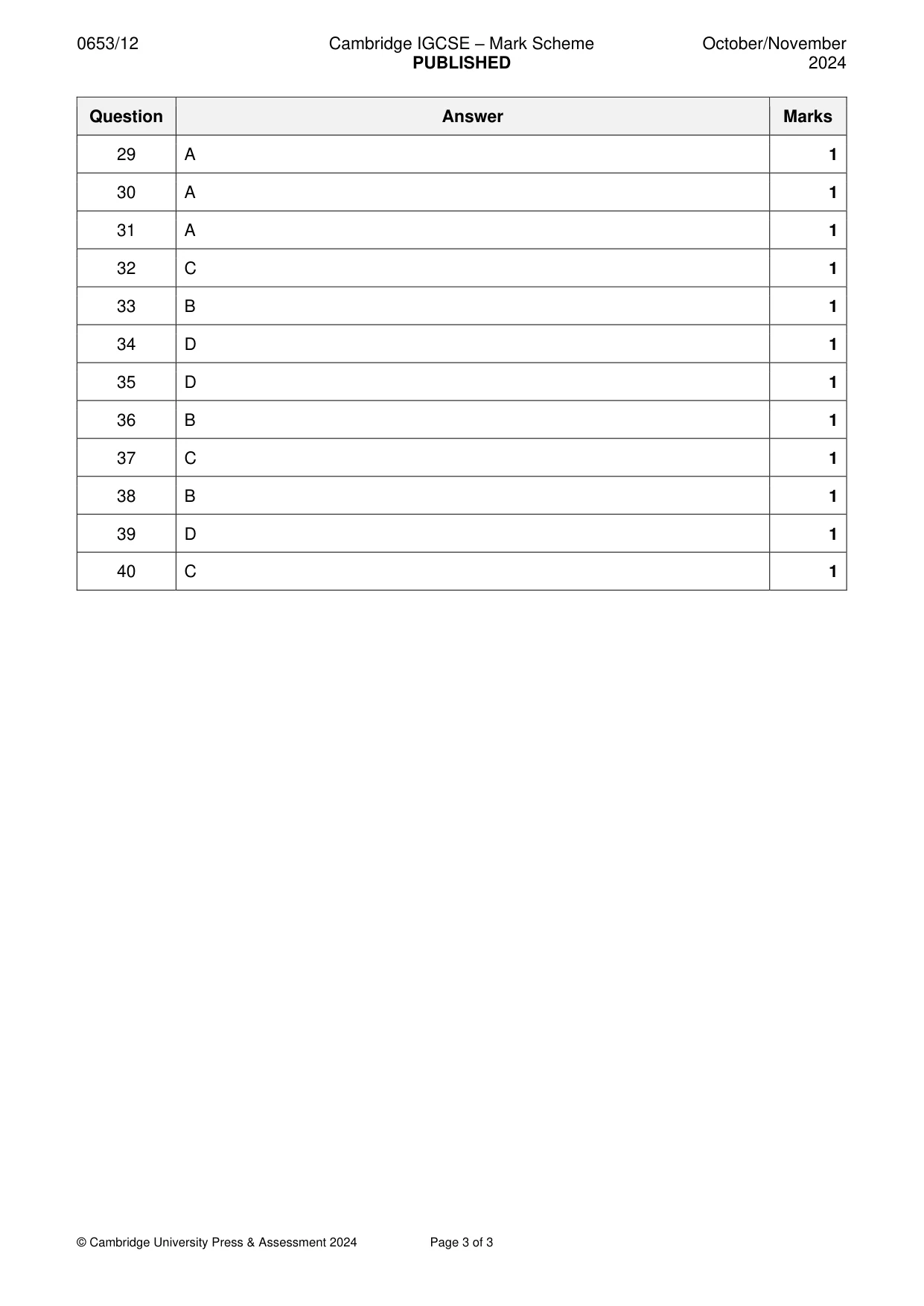
Mark scheme: A
Q30 · Which change cannot be caused by a force acting on an object?
30 Which change cannot be caused by a force acting on an object? A change of mass B change of motion C change of shape D change of size
Mark scheme: A
Q31 · Student R has a mass of 80 kg
31 Student R has a mass of 80 kg. Student S has a mass of 50 kg. On day 1, the students walk up the stairs to the top of a building in 15 minutes. On day 2, the students climb a vertical wall to the top of the same building in 2.0 hours. Which student uses the greatest power in reaching the top of the building, and when? A student R on day 1 B student S on day 1 C student R on day 2 D student S on day 2
Mark scheme: A
Q32 · In which situation is no energy transfer occurring?
32 In which situation is no energy transfer occurring? A a ball falling from rest through the air to the ground B a battery lighting a lamp C a metal block hanging at rest from a stretched spring D a saucepan being heated
Mark scheme: C
Q33 · Benzene and glycerine are two substances
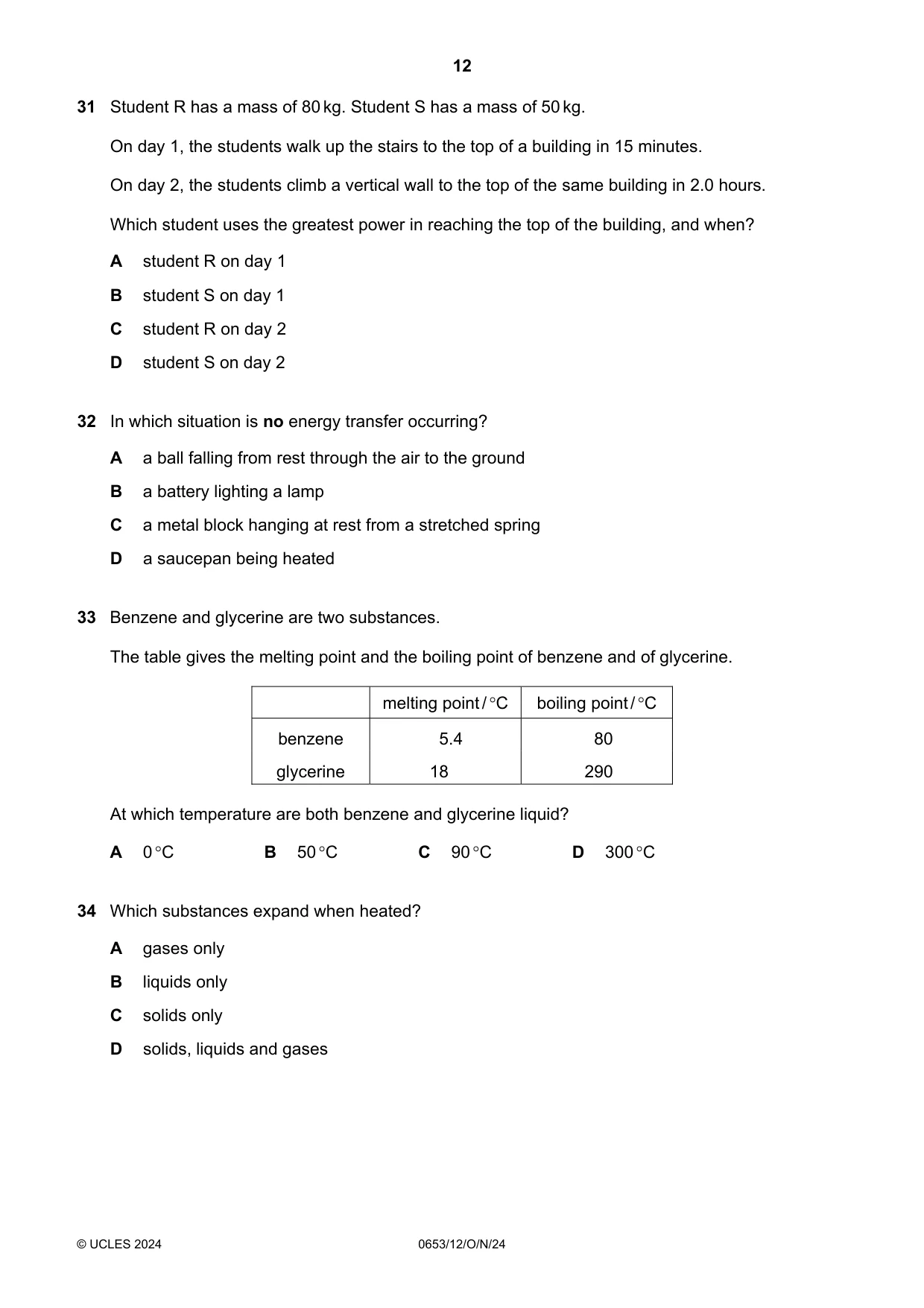
33 Benzene and glycerine are two substances. The table gives the melting point and the boiling point of benzene and of glycerine. melting point / C boiling point / C benzene 5.4 80 glycerine 18 290 At which temperature are both benzene and glycerine liquid? A 0 C B 50 C C 90 C D 300 C
Mark scheme: B
Q34 · Which substances expand when heated?
34 Which substances expand when heated? A gases only B liquids only C solids only D solids, liquids and gases
Mark scheme: D
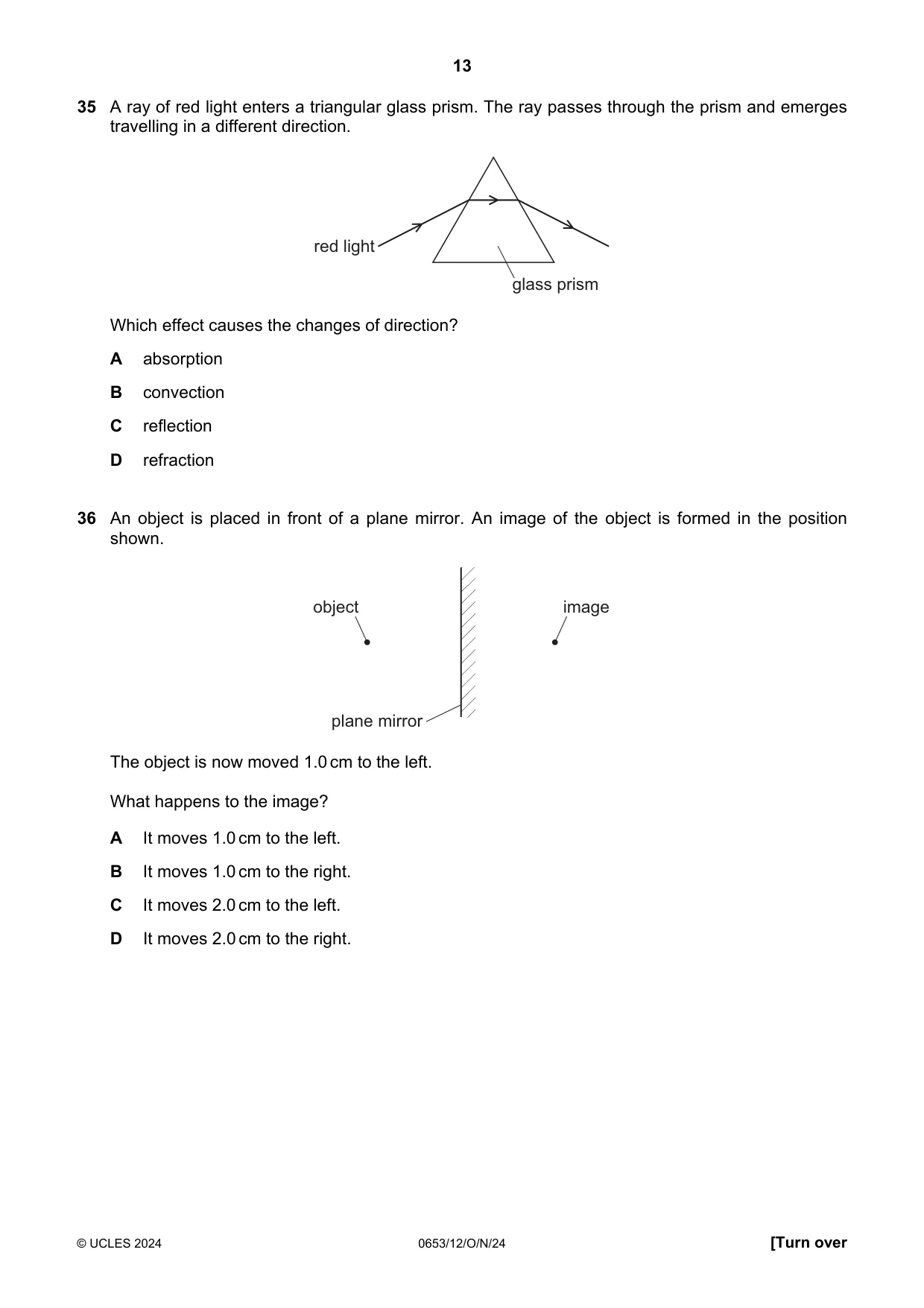
Q35 · A ray of red light enters a triangular glass prism
35 A ray of red light enters a triangular glass prism. The ray passes through the prism and emerges travelling in a different direction. red light glass prism Which effect causes the changes of direction? A absorption B convection C reflection D refraction
Mark scheme: D
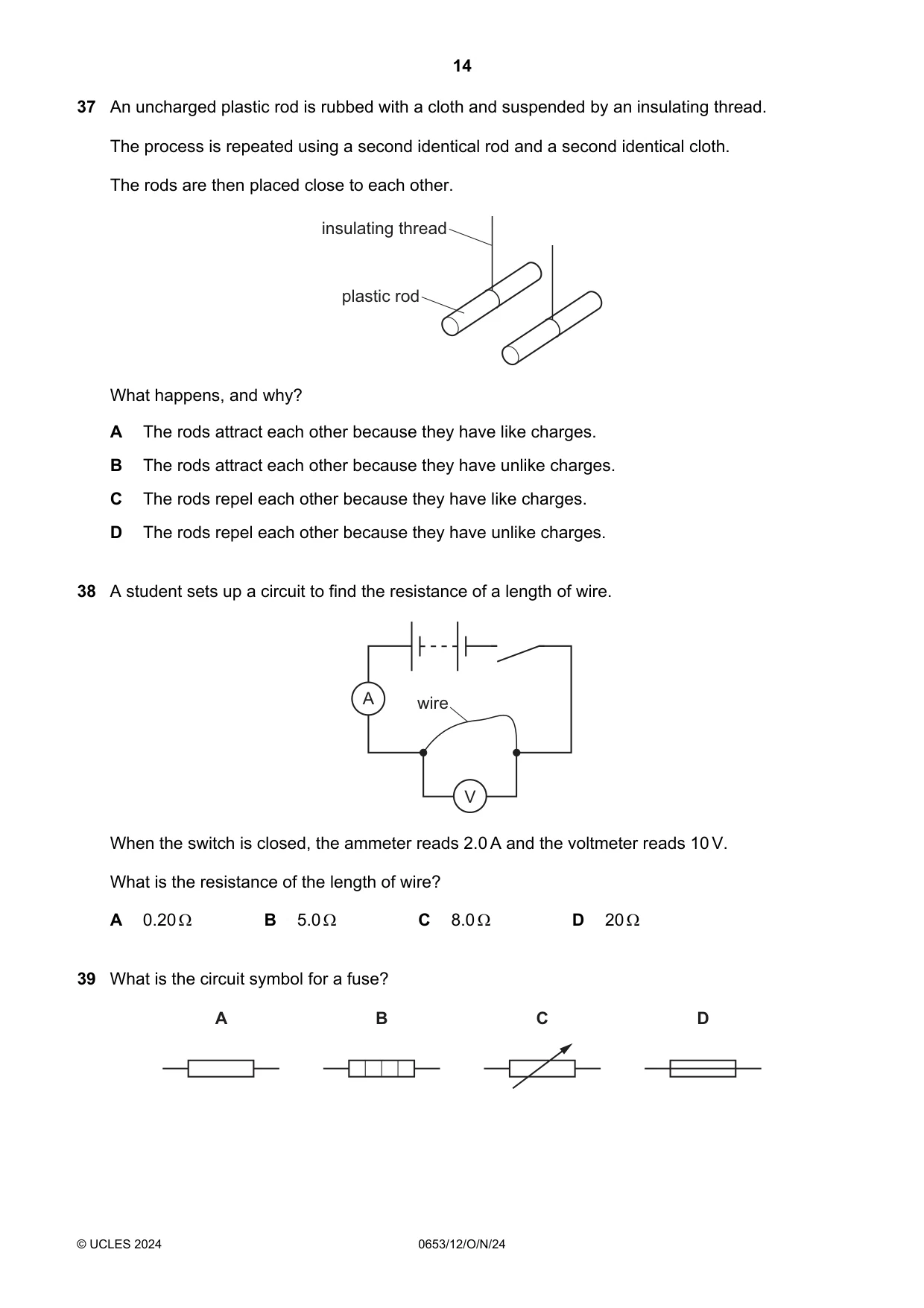
Q36 · An object is placed in front of a plane mirror
36 An object is placed in front of a plane mirror. An image of the object is formed in the position shown. object image plane mirror The object is now moved 1.0 cm to the left. What happens to the image? A It moves 1.0 cm to the left. B It moves 1.0 cm to the right. C It moves 2.0 cm to the left. D It moves 2.0 cm to the right.
Mark scheme: B
Q37 · An uncharged plastic rod is rubbed with a cloth and suspended by an insulating thread
37 An uncharged plastic rod is rubbed with a cloth and suspended by an insulating thread. The process is repeated using a second identical rod and a second identical cloth. The rods are then placed close to each other. insulating thread plastic rod What happens, and why? A The rods attract each other because they have like charges. B The rods attract each other because they have unlike charges. C The rods repel each other because they have like charges. D The rods repel each other because they have unlike charges.
Mark scheme: C
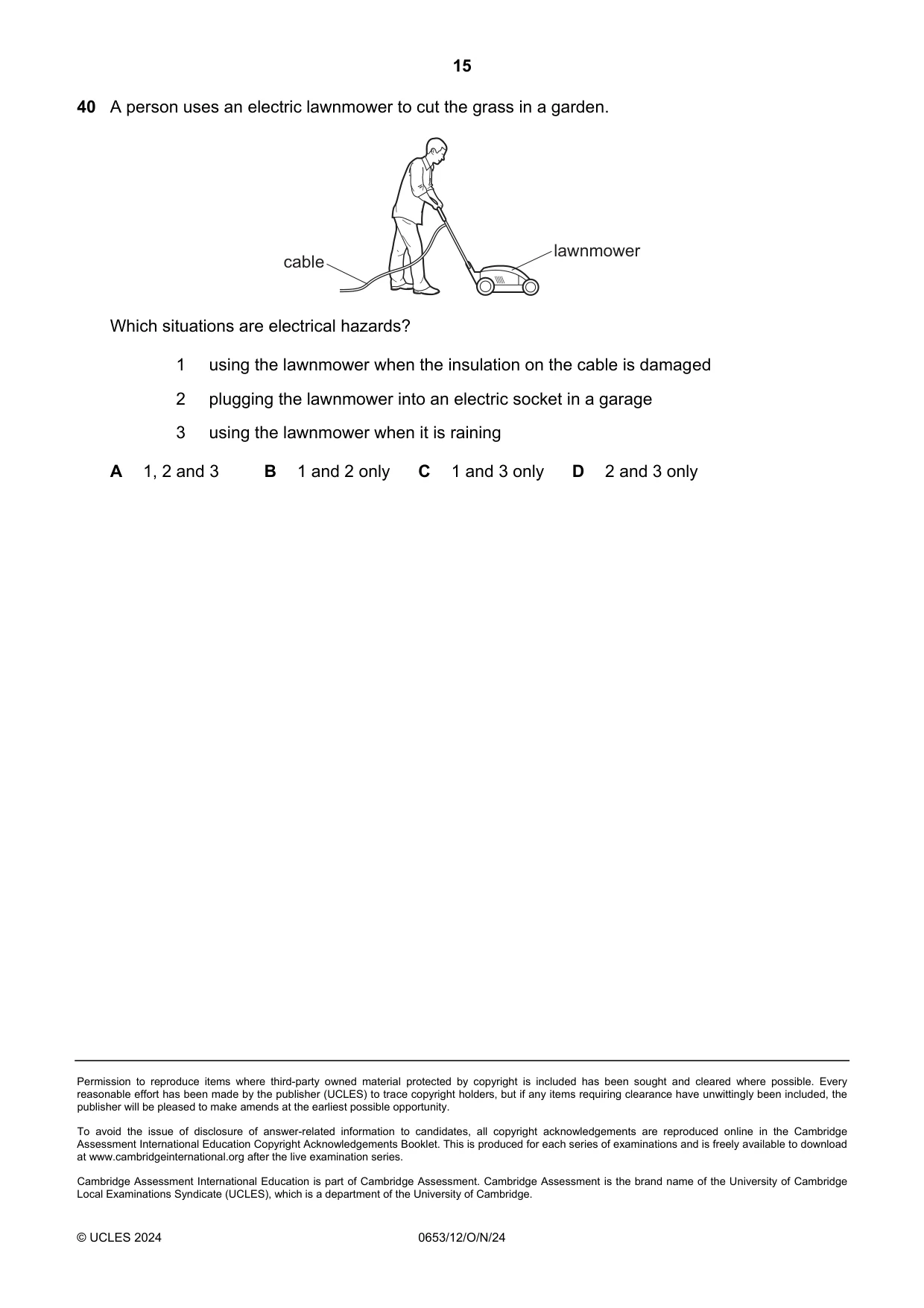
Q38 · A student sets up a circuit to find the resistance of a length of wire
38 A student sets up a circuit to find the resistance of a length of wire. A wire V When the switch is closed, the ammeter reads 2.0 A and the voltmeter reads 10 V. What is the resistance of the length of wire? A 0.20 B 5.0 C 8.0 D 20
Mark scheme: B
Q39 · What is the circuit symbol for a fuse?
39 What is the circuit symbol for a fuse? A B C D
Mark scheme: D
Q40 · A person uses an electric lawnmower to cut the grass in a garden
40 A person uses an electric lawnmower to cut the grass in a garden. lawnmower cable Which situations are electrical hazards? 1 using the lawnmower when the insulation on the cable is damaged 2 plugging the lawnmower into an electric socket in a garage 3 using the lawnmower when it is raining A 1, 2 and 3 B 1 and 2 only C 1 and 3 only D 2 and 3 only
Mark scheme: C
What was in this paper
The subtopics covered by these 40 questions, and how many questions each got. Open one in a new tab to see every Cambridge question on it.
2Electrical quantities2Electrical safety2Elements, compounds and mixtures2Energy, work and power2Light2Alkanes1Alkenes1Biological molecules1Carbon cycle1Cell structure1Characteristics of living organisms1Density1Diet1Diffusion1Drugs1Electrolysis1Extraction of metals1Food chains and food webs1Forces1Gas exchange in humans1Group VII properties1Ions and ionic bonds1Kinetic particle model of matter1Motion1Noble gases1Photosynthesis1Physical and chemical changes1Preparation of salts1Redox1Sexual reproduction in humans1Sexual reproduction in plants1Thermal properties and temperature1Xylem and phloem1What you needed in this session
Cambridge’s own grade thresholds for 2024 Oct/Nov, Paper 1 · Variant 2. A higher threshold means an easier paper — the bar moves with how the cohort did.