Cambridge IGCSE Science - Combined 0653 — 2019 Oct/Nov Paper 1 · Variant 1
0653/11/O/N/19 · 40 questions · 40 marks · ≈45 min
The question paper and its mark scheme, free to read here and free to download. This is Cambridge’s own paper, exactly as it was sat.
Question paper16 pages
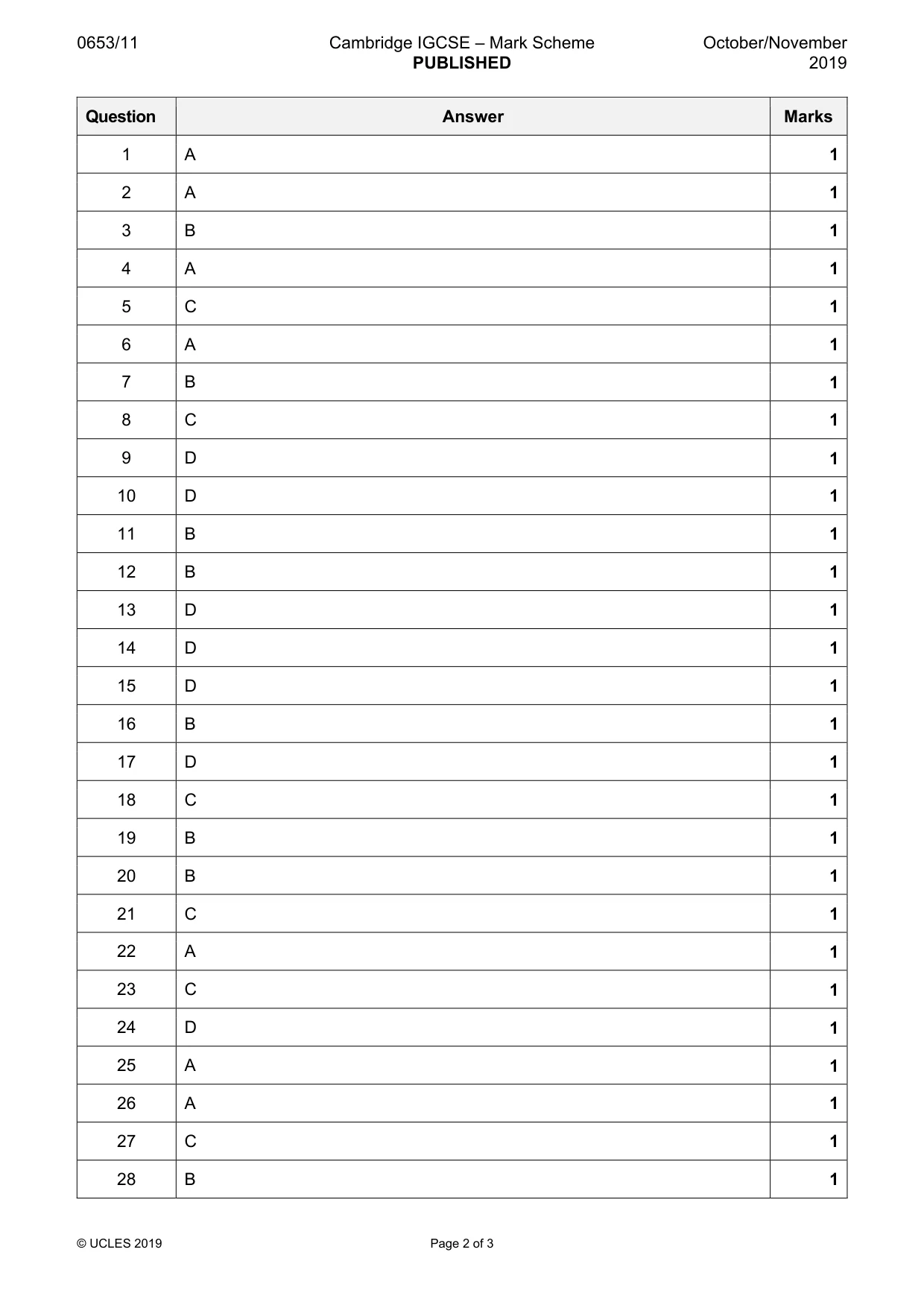
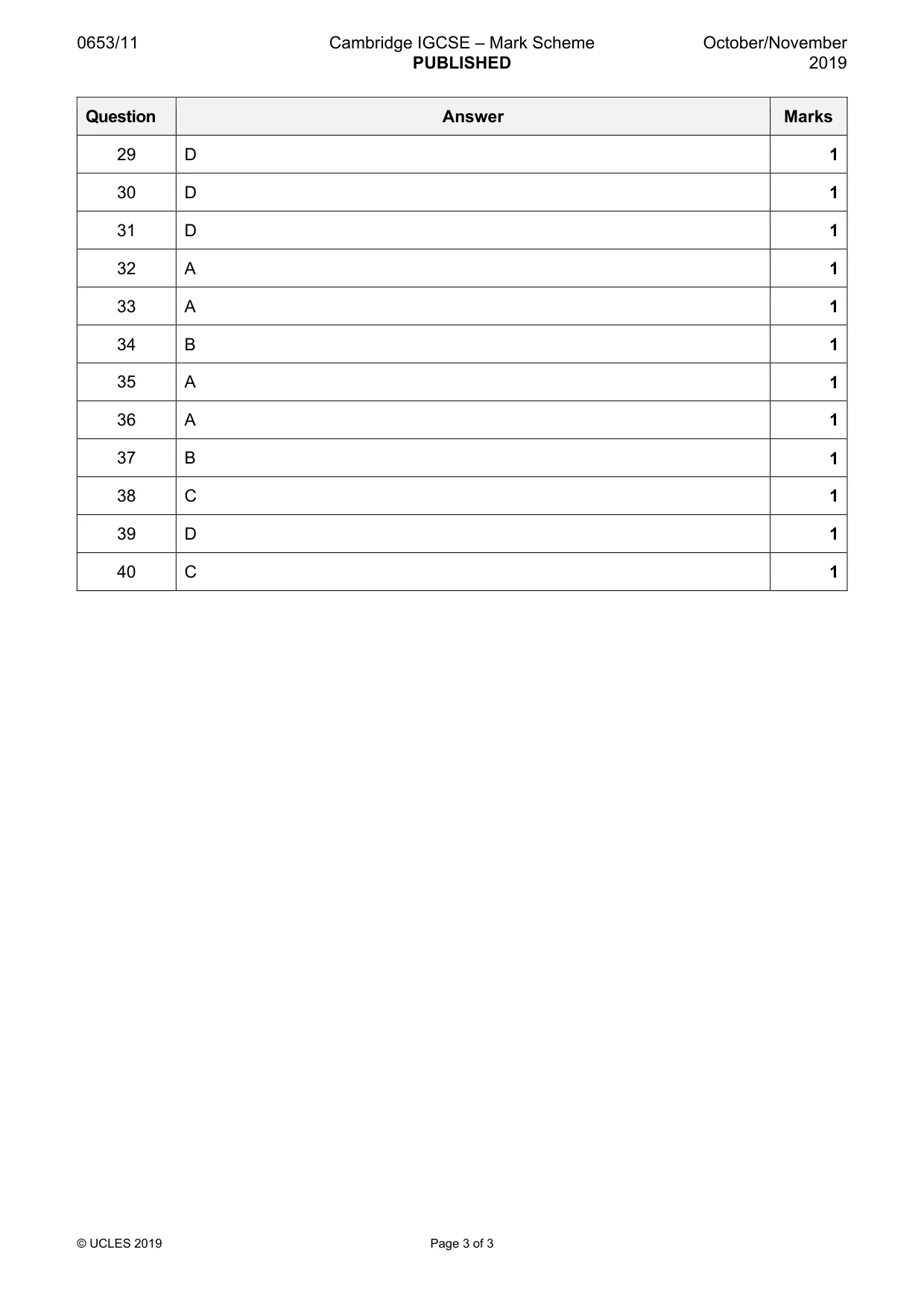
Mark scheme3 pages
Answers below. Sit the paper first if you are practising.
Questions as text
Q1 · A biologist keeps a potted plant in a laboratory
1 A biologist keeps a potted plant in a laboratory. Which feature of the potted plant shows that it is a living organism? A It grows larger over time. B It has green leaves. C The compost in the pot dries after he waters it. D The stems contain xylem.
Mark scheme: A
Q2 · Which is the correct description of diffusion?
2 Which is the correct description of diffusion? A net movement of particles from a region of higher concentration to a region of lower concentration down a concentration gradient B net movement of particles from a region of higher concentration to a region of lower concentration against a concentration gradient C net movement of particles from a region of lower concentration to a region of higher concentration down a concentration gradient D net movement of particles from a region of lower concentration to a region of higher concentration against a concentration gradient
Mark scheme: A
Q3 · The diagram shows a section through a leaf
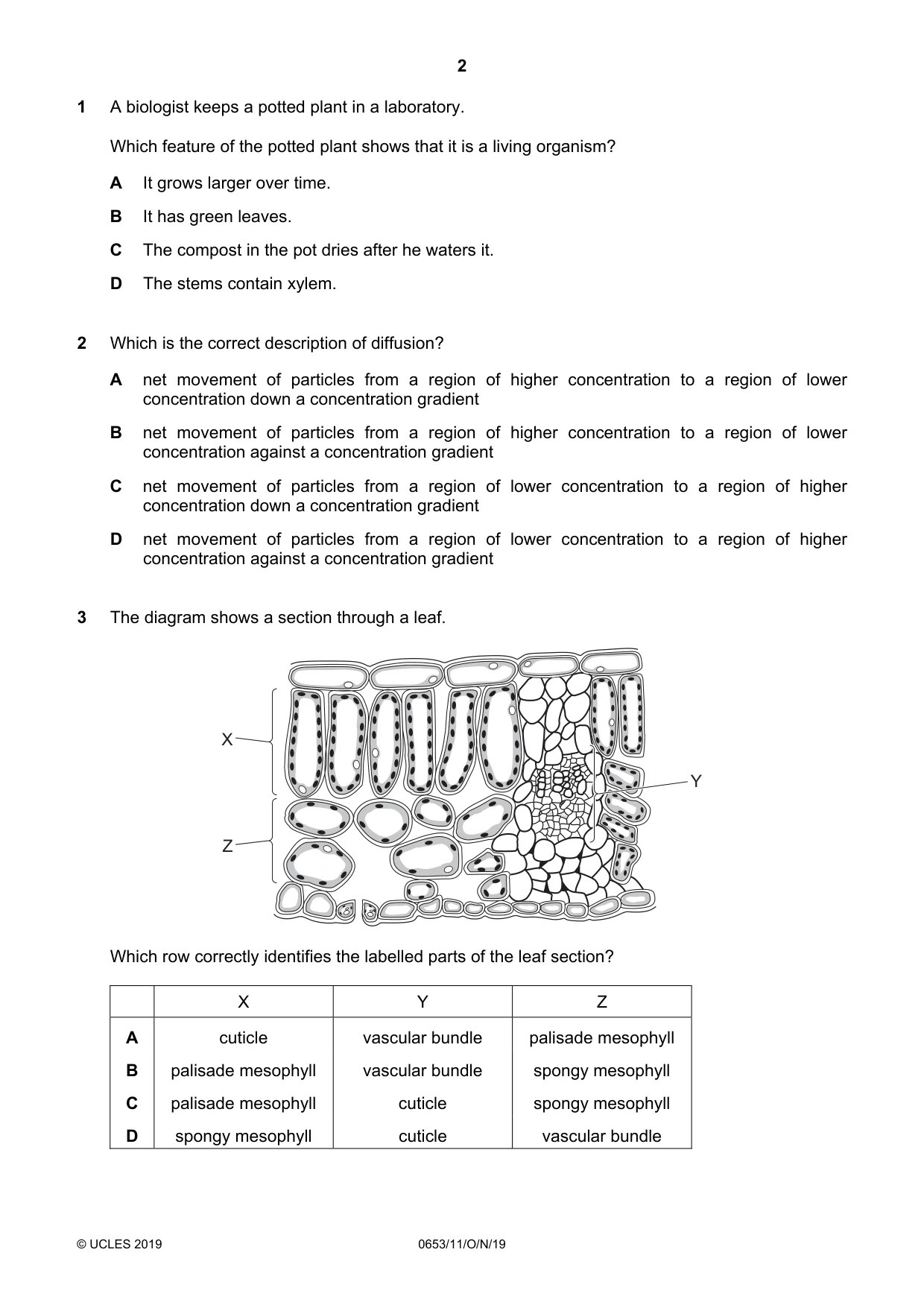
3 The diagram shows a section through a leaf. X Y Z Which row correctly identifies the labelled parts of the leaf section? X Y Z A cuticle vascular bundle palisade mesophyll B palisade mesophyll vascular bundle spongy mesophyll C palisade mesophyll cuticle spongy mesophyll D spongy mesophyll cuticle vascular bundle
Mark scheme: B
Q4 · What is not absorbed from the alimentary canal into the blood?
4 What is not absorbed from the alimentary canal into the blood? A fibre B glucose C mineral salts D vitamin C
Mark scheme: A
Q5 · Which row shows where digestion occurs?
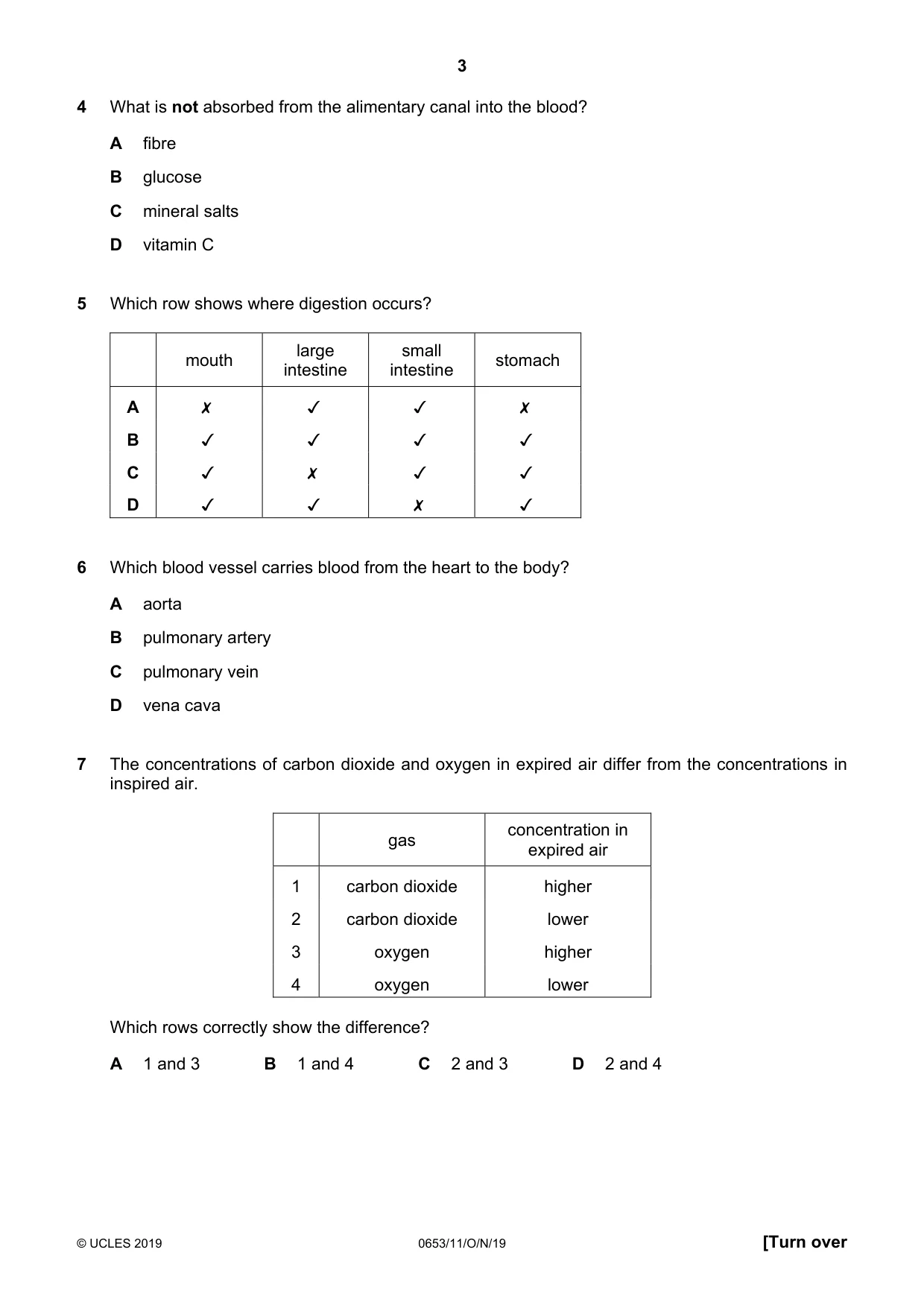
5 Which row shows where digestion occurs? mouth intestine intestine stomach A x v v x B v v v v Cc v x v v D v v x v
Mark scheme: C
Q6 · Which blood vessel carries blood from the heart to the body?
6 Which blood vessel carries blood from the heart to the body? A aorta B pulmonary artery C pulmonary vein D vena cava
Mark scheme: A
Q7 · The concentrations of carbon dioxide and oxygen in expired air differ from the…
7 The concentrations of carbon dioxide and oxygen in expired air differ from the concentrations in inspired air. concentration in gas expired air 1 carbon dioxide higher 2 carbon dioxide lower 3 oxygen higher 4 oxygen lower Which rows correctly show the difference? A 1 and 3 B 1 and 4 C 2 and 3 D 2 and 4
Mark scheme: B
Q8 · Glucose is involved in the reaction in the body shown below
8 Glucose is involved in the reaction in the body shown below. glucose + P → Q + R What are P, Q and R? P Q R A carbon dioxide oxygen water B carbon dioxide water oxygen C oxygen water carbon dioxide D water carbon dioxide oxygen
Mark scheme: C
Q9 · What is the effect of adrenaline on the rate of breathing and pulse rate?
9 What is the effect of adrenaline on the rate of breathing and pulse rate? rate of breathing pulse rate A decreases decreases B decreases increases C increases decreases D increases increases
Mark scheme: D
Q10 · The diagram shows the shoots of a tray of seedlings in a box
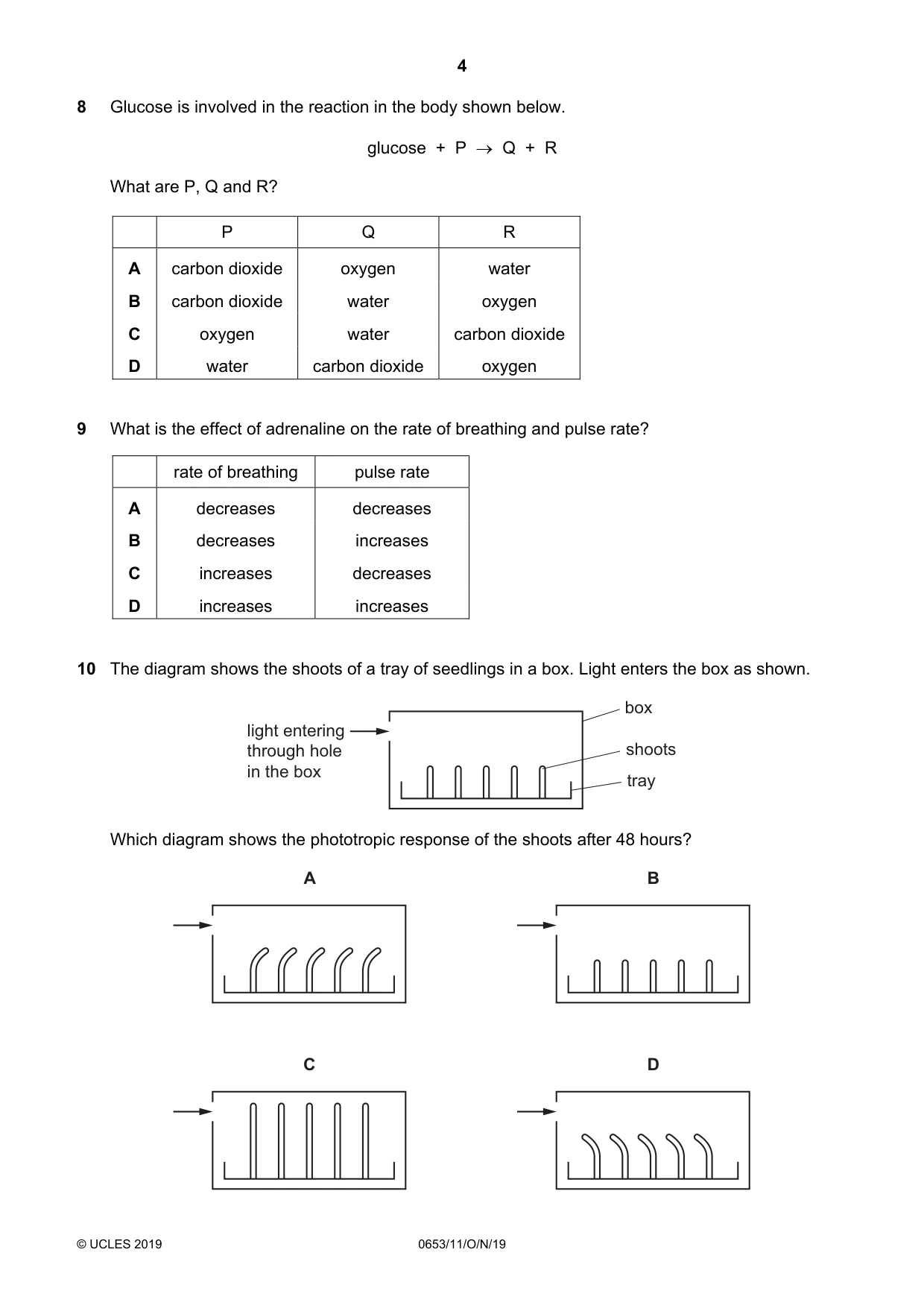
10 The diagram shows the shoots of a tray of seedlings in a box. Light enters the box as shown. box light entering through hole shoots in the box tray Which diagram shows the phototropic response of the shoots after 48 hours? A B C D
Mark scheme: D
Q11 · Which statement about sexual reproduction is always correct?
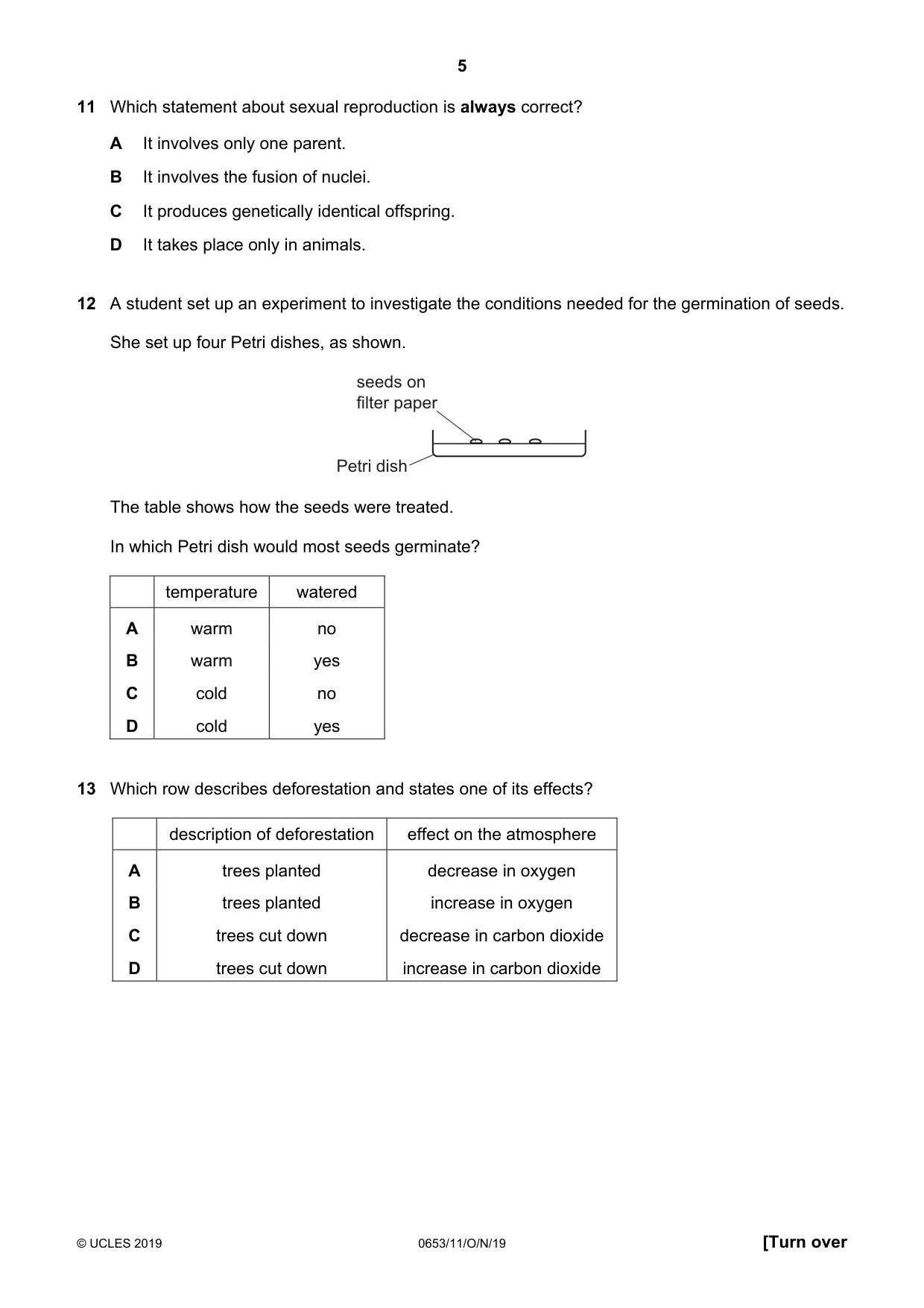
11 Which statement about sexual reproduction is always correct? A It involves only one parent. B It involves the fusion of nuclei. C It produces genetically identical offspring. D It takes place only in animals.
Mark scheme: B
Q12 · A student set up an experiment to investigate the conditions needed for the germination…
12 A student set up an experiment to investigate the conditions needed for the germination of seeds. She set up four Petri dishes, as shown. seeds on filter paper Petri dish The table shows how the seeds were treated. In which Petri dish would most seeds germinate? temperature watered A warm no B warm yes C cold no D cold yes
Mark scheme: B
Q13 · Which row describes deforestation and states one of its effects?
13 Which row describes deforestation and states one of its effects? description of deforestation effect on the atmosphere A trees planted decrease in oxygen B trees planted increase in oxygen C trees cut down decrease in carbon dioxide D trees cut down increase in carbon dioxide
Mark scheme: D
Q14 · Four processes are listed
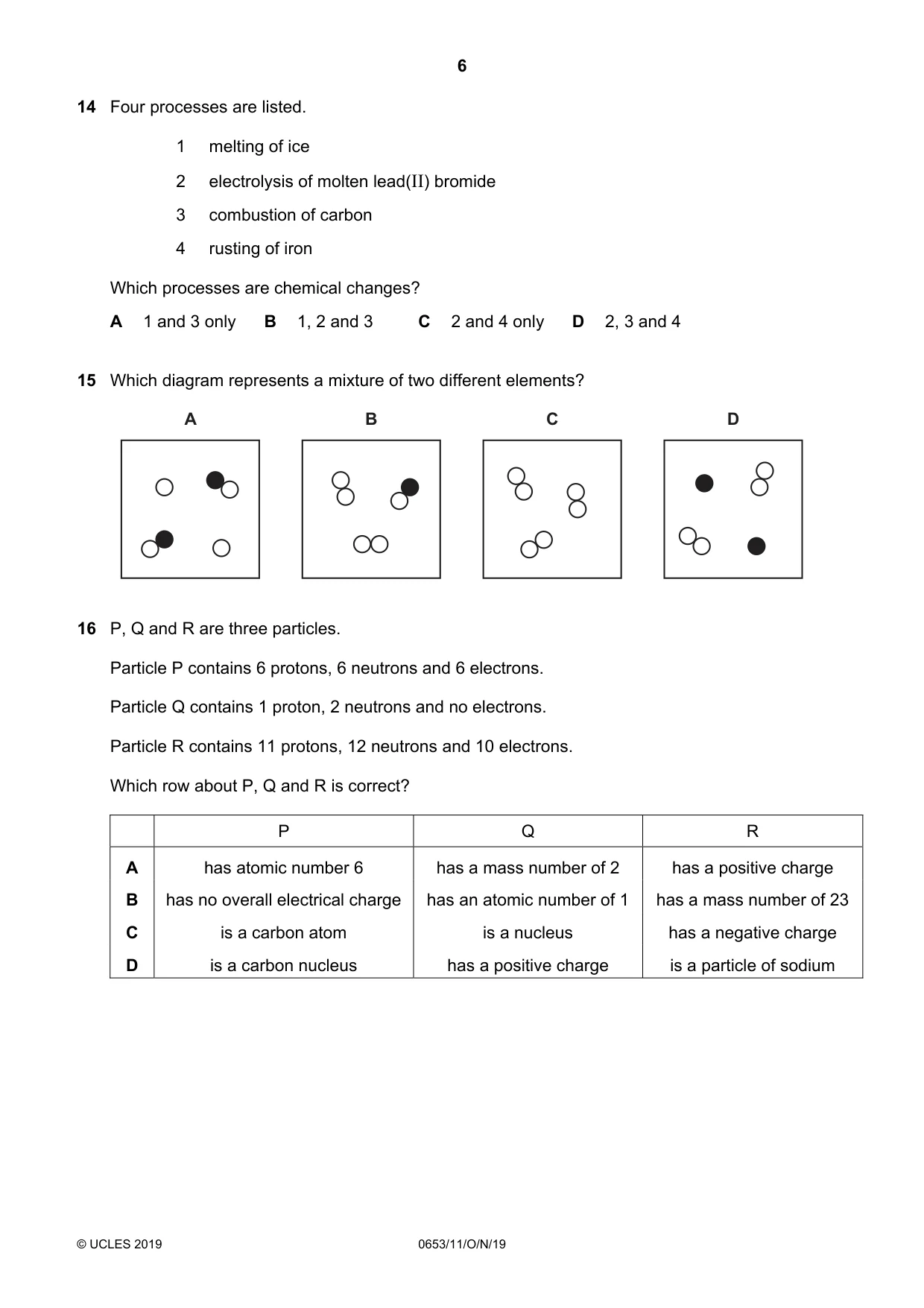
14 Four processes are listed. 1 melting of ice 2 electrolysis of molten lead(II) bromide 3 combustion of carbon 4 rusting of iron Which processes are chemical changes? A 1 and 3 only B 1, 2 and 3 C 2 and 4 only D 2, 3 and 4
Mark scheme: D
Q15 · Which diagram represents a mixture of two different elements?
15 Which diagram represents a mixture of two different elements? A B C D
Mark scheme: D
Q16 · P, Q and R are three particles
16 P, Q and R are three particles. Particle P contains 6 protons, 6 neutrons and 6 electrons. Particle Q contains 1 proton, 2 neutrons and no electrons. Particle R contains 11 protons, 12 neutrons and 10 electrons. Which row about P, Q and R is correct? P Q R A has atomic number 6 has a mass number of 2 has a positive charge B has no overall electrical charge has an atomic number of 1 has a mass number of 23 C is a carbon atom is a nucleus has a negative charge D is a carbon nucleus has a positive charge is a particle of sodium
Mark scheme: B
Q17 · The fertiliser ammonium sulfate has the formula (NH4)2SO4
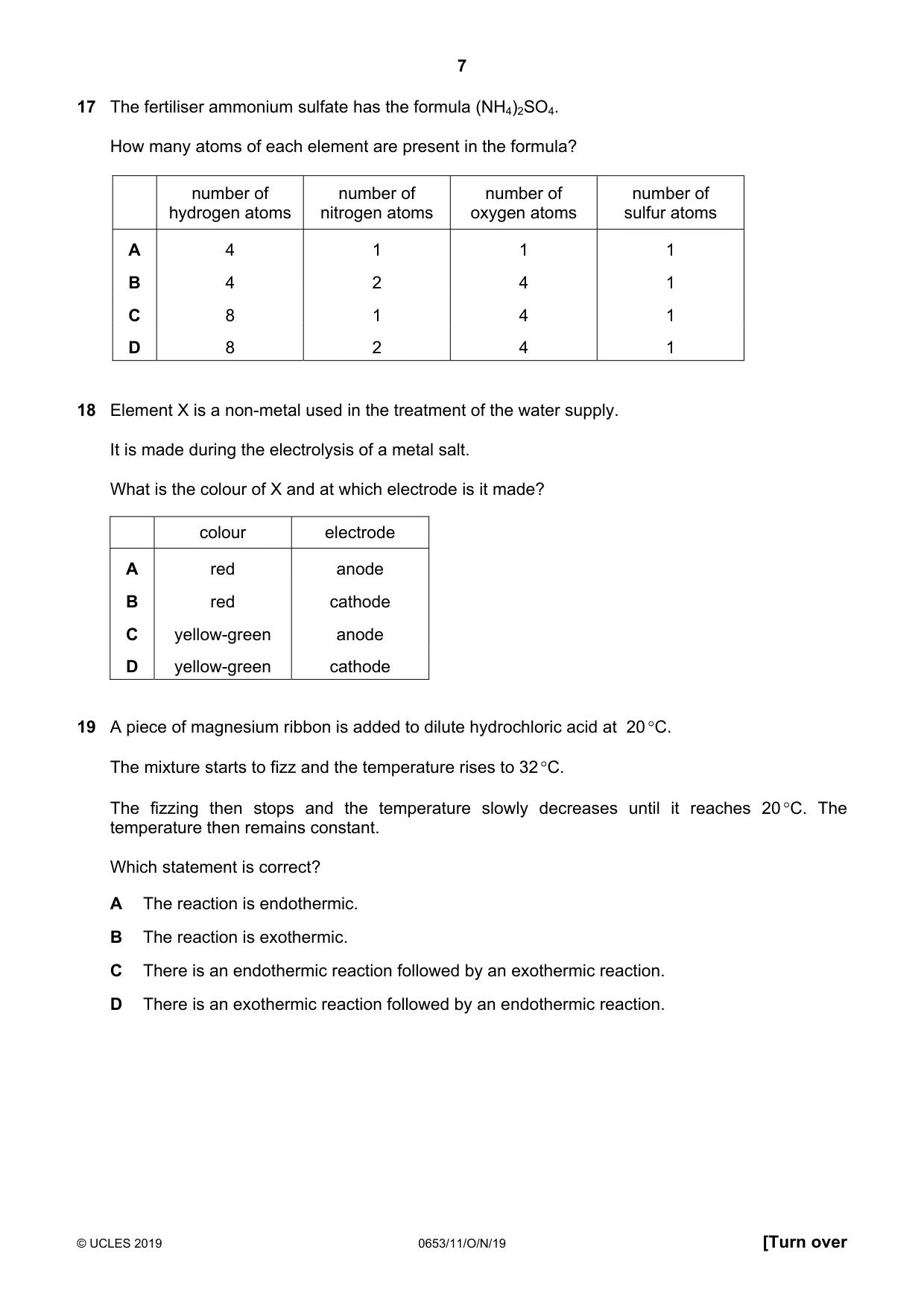
17 The fertiliser ammonium sulfate has the formula (NH4)2SO4. How many atoms of each element are present in the formula? number of number of number of number of hydrogen atoms nitrogen atoms oxygen atoms sulfur atoms A 4 1 1 1 B 4 2 4 1 C 8 1 4 1 D 8 2 4 1
Mark scheme: D
Q18 · Element X is a non-metal used in the treatment of the water supply
18 Element X is a non-metal used in the treatment of the water supply. It is made during the electrolysis of a metal salt. What is the colour of X and at which electrode is it made? colour electrode A red anode B red cathode C yellow-green anode D yellow-green cathode
Mark scheme: C
Q19 · A piece of magnesium ribbon is added to dilute hydrochloric acid at 20 °C
19 A piece of magnesium ribbon is added to dilute hydrochloric acid at 20 °C. The mixture starts to fizz and the temperature rises to 32 °C. The fizzing then stops and the temperature slowly decreases until it reaches 20 °C. The temperature then remains constant. Which statement is correct? A The reaction is endothermic. B The reaction is exothermic. C There is an endothermic reaction followed by an exothermic reaction. D There is an exothermic reaction followed by an endothermic reaction.
Mark scheme: B
Q20 · Limestone chips react with dilute hydrochloric acid
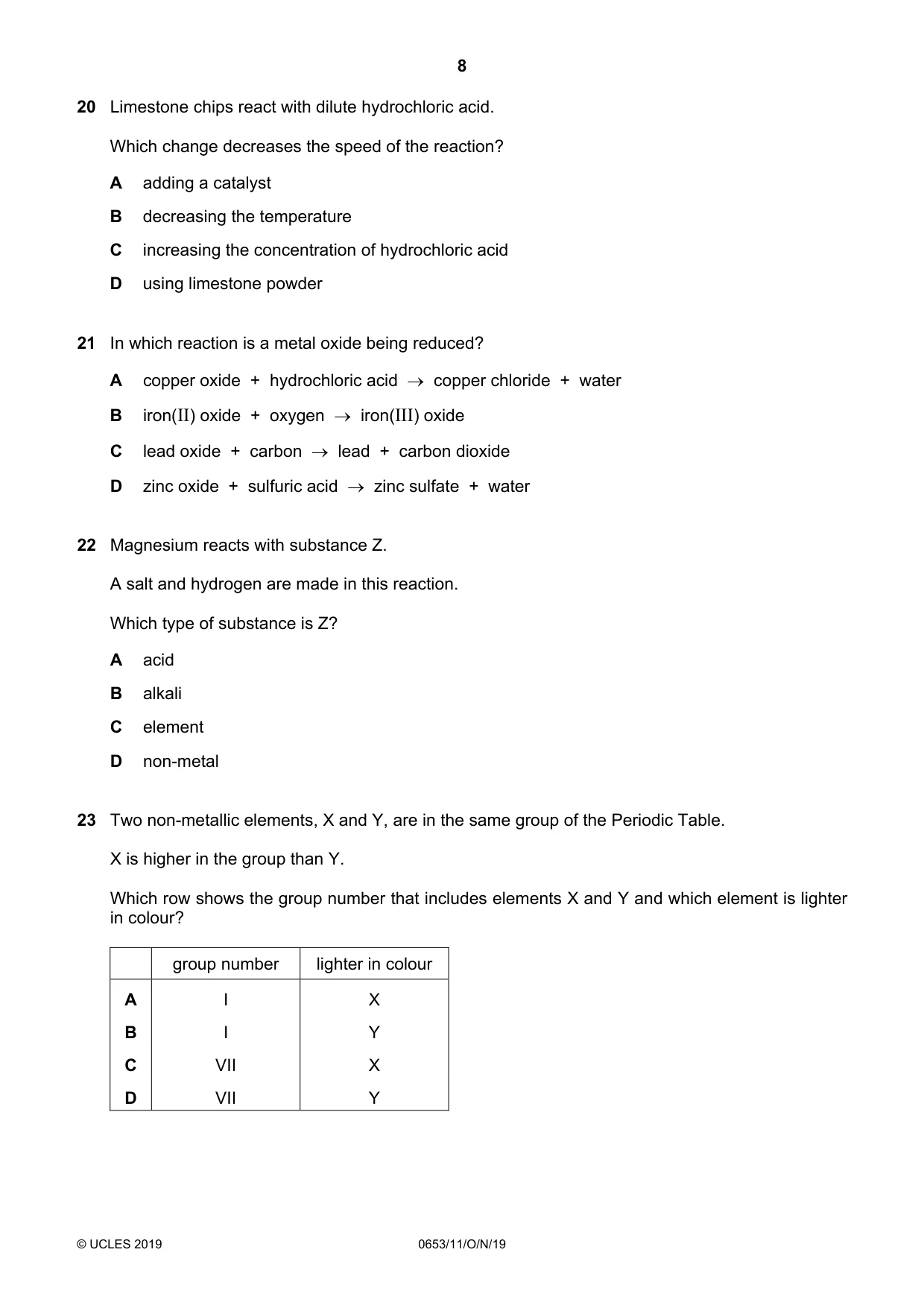
20 Limestone chips react with dilute hydrochloric acid. Which change decreases the speed of the reaction? A adding a catalyst B decreasing the temperature C increasing the concentration of hydrochloric acid D using limestone powder
Mark scheme: B
Q21 · In which reaction is a metal oxide being reduced?
21 In which reaction is a metal oxide being reduced? A copper oxide + hydrochloric acid → copper chloride + water B iron(II) oxide + oxygen → iron(III) oxide C lead oxide + carbon → lead + carbon dioxide D zinc oxide + sulfuric acid → zinc sulfate + water
Mark scheme: C
Q22 · Magnesium reacts with substance Z
22 Magnesium reacts with substance Z. A salt and hydrogen are made in this reaction. Which type of substance is Z? A acid B alkali C element D non-metal
Mark scheme: A
More questions on The characteristic properties of acids and bases
Q23 · Two non-metallic elements, X and Y, are in the same group of the Periodic Table
23 Two non-metallic elements, X and Y, are in the same group of the Periodic Table. X is higher in the group than Y. Which row shows the group number that includes elements X and Y and which element is lighter in colour? group number lighter in colour A I X B I Y C VII X D VII Y
Mark scheme: C
Q24 · Which statement about alloys is correct?
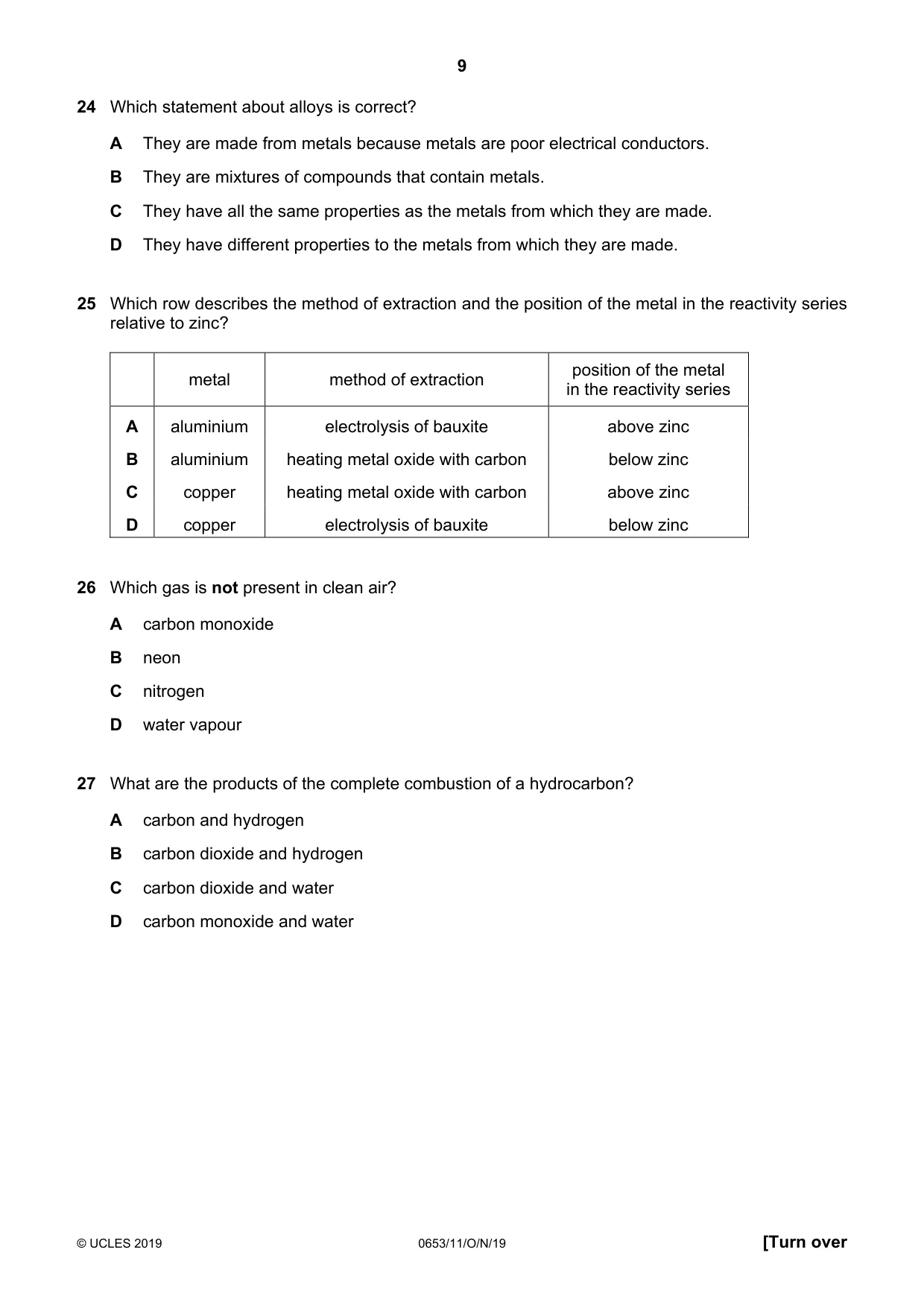
24 Which statement about alloys is correct? A They are made from metals because metals are poor electrical conductors. B They are mixtures of compounds that contain metals. C They have all the same properties as the metals from which they are made. D They have different properties to the metals from which they are made.
Mark scheme: D
Q25 · Which row describes the method of extraction and the position of the metal in the…
25 Which row describes the method of extraction and the position of the metal in the reactivity series relative to zinc? position of the metal metal method of extraction in the reactivity series A aluminium electrolysis of bauxite above zinc B aluminium heating metal oxide with carbon below zinc C copper heating metal oxide with carbon above zinc D copper electrolysis of bauxite below zinc
Mark scheme: A
Q26 · Which gas is not present in clean air?
26 Which gas is not present in clean air? A carbon monoxide B neon C nitrogen D water vapour
Mark scheme: A
Q27 · What are the products of the complete combustion of a hydrocarbon?
27 What are the products of the complete combustion of a hydrocarbon? A carbon and hydrogen B carbon dioxide and hydrogen C carbon dioxide and water D carbon monoxide and water
Mark scheme: C
Q28 · Which speed–time graph represents an object moving with constant speed?
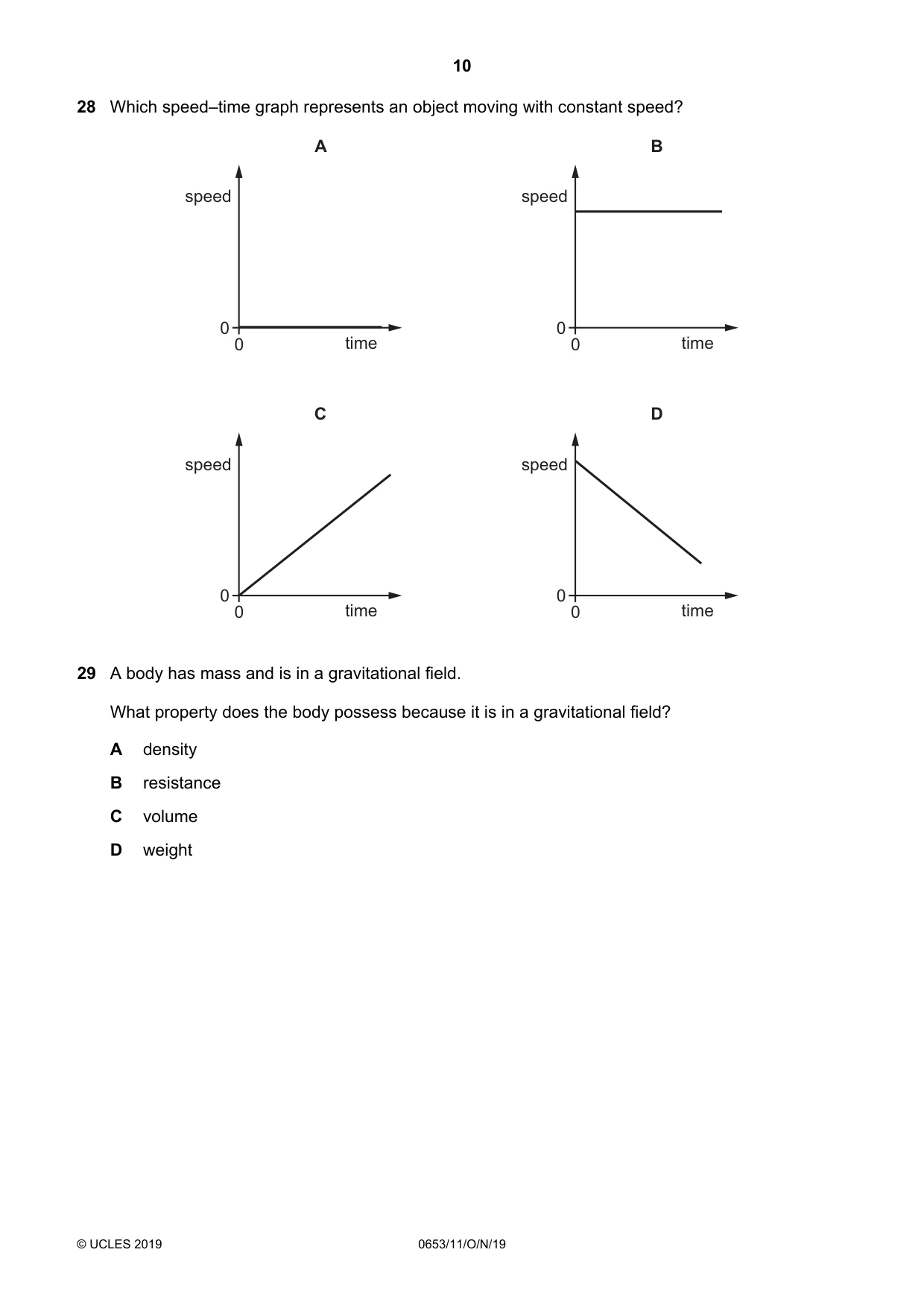
28 Which speed–time graph represents an object moving with constant speed? A B speed speed 0 0 0 time 0 time C D speed speed 0 0 0 time 0 time
Mark scheme: B
Q29 · A body has mass and is in a gravitational field
29 A body has mass and is in a gravitational field. What property does the body possess because it is in a gravitational field? A density B resistance C volume D weight
Mark scheme: D
Q30 · A solid cuboid block of metal has density ρ
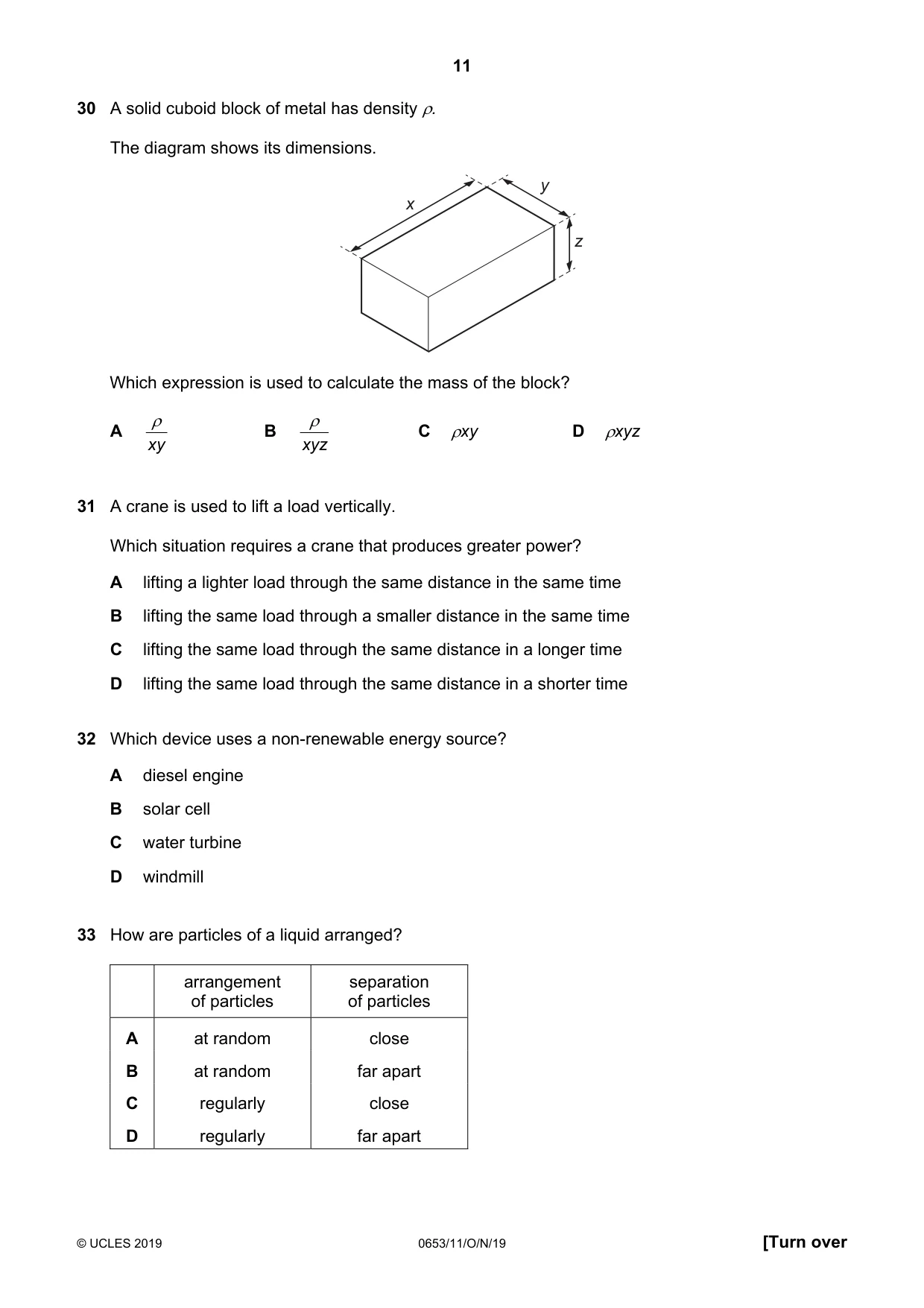
30 A solid cuboid block of metal has density ρ. The diagram shows its dimensions. y x z Which expression is used to calculate the mass of the block? ρ ρ A B C ρxy D ρxyz xy xyz
Mark scheme: D
Q31 · A crane is used to lift a load vertically
31 A crane is used to lift a load vertically. Which situation requires a crane that produces greater power? A lifting a lighter load through the same distance in the same time B lifting the same load through a smaller distance in the same time C lifting the same load through the same distance in a longer time D lifting the same load through the same distance in a shorter time
Mark scheme: D
Q32 · Which device uses a non-renewable energy source?
32 Which device uses a non-renewable energy source? A diesel engine B solar cell C water turbine D windmill
Mark scheme: A
Q33 · How are particles of a liquid arranged?
33 How are particles of a liquid arranged? arrangement separation of particles of particles A at random close B at random far apart C regularly close D regularly far apart
Mark scheme: A
Q34 · A metal pan containing water is heated on a hot stove
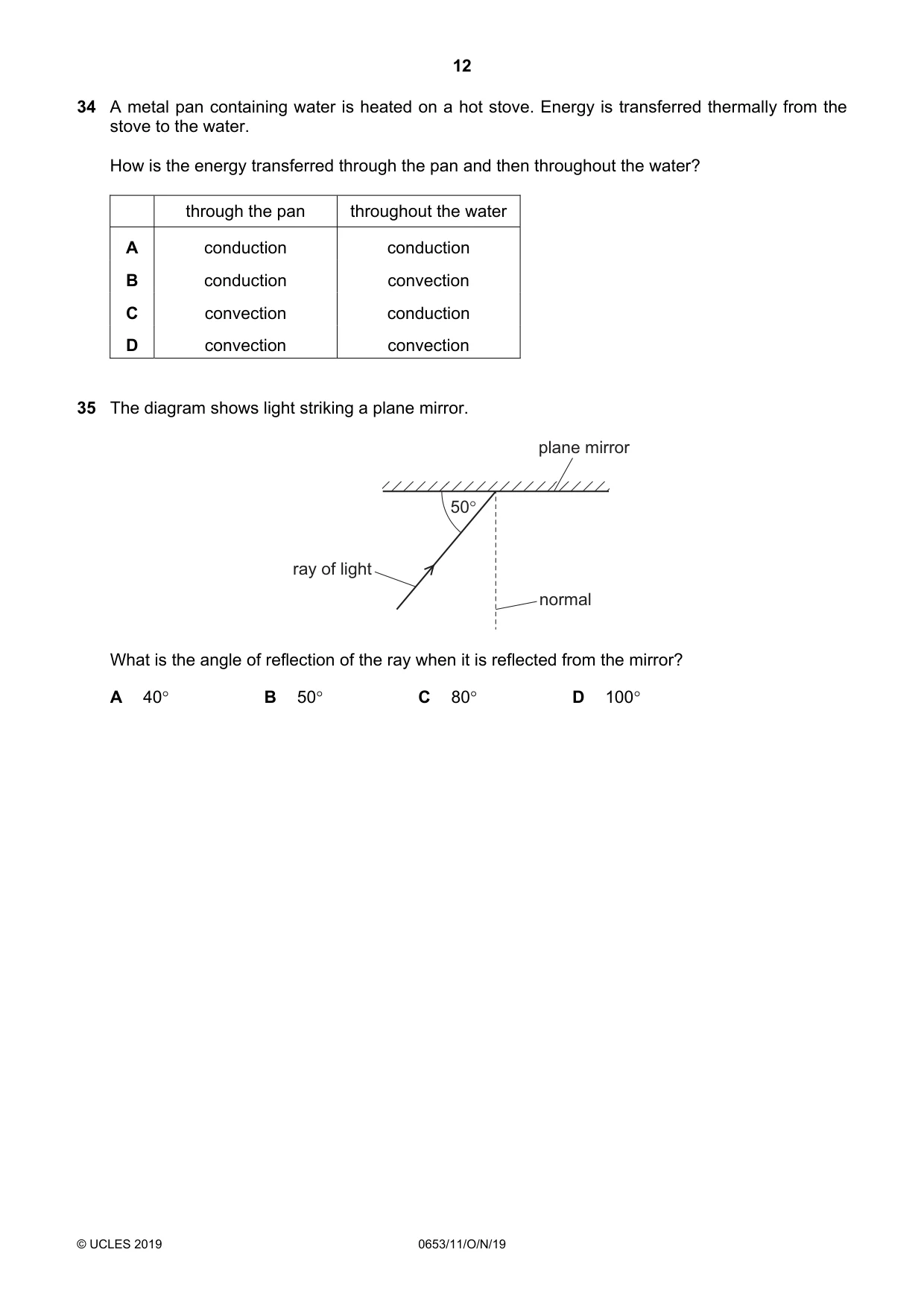
34 A metal pan containing water is heated on a hot stove. Energy is transferred thermally from the stove to the water. How is the energy transferred through the pan and then throughout the water? through the pan throughout the water A conduction conduction B conduction convection C convection conduction D convection convection
Mark scheme: B
Q35 · The diagram shows light striking a plane mirror
35 The diagram shows light striking a plane mirror. plane mirror 50° ray of light normal What is the angle of reflection of the ray when it is reflected from the mirror? A 40° B 50° C 80° D 100°
Mark scheme: A
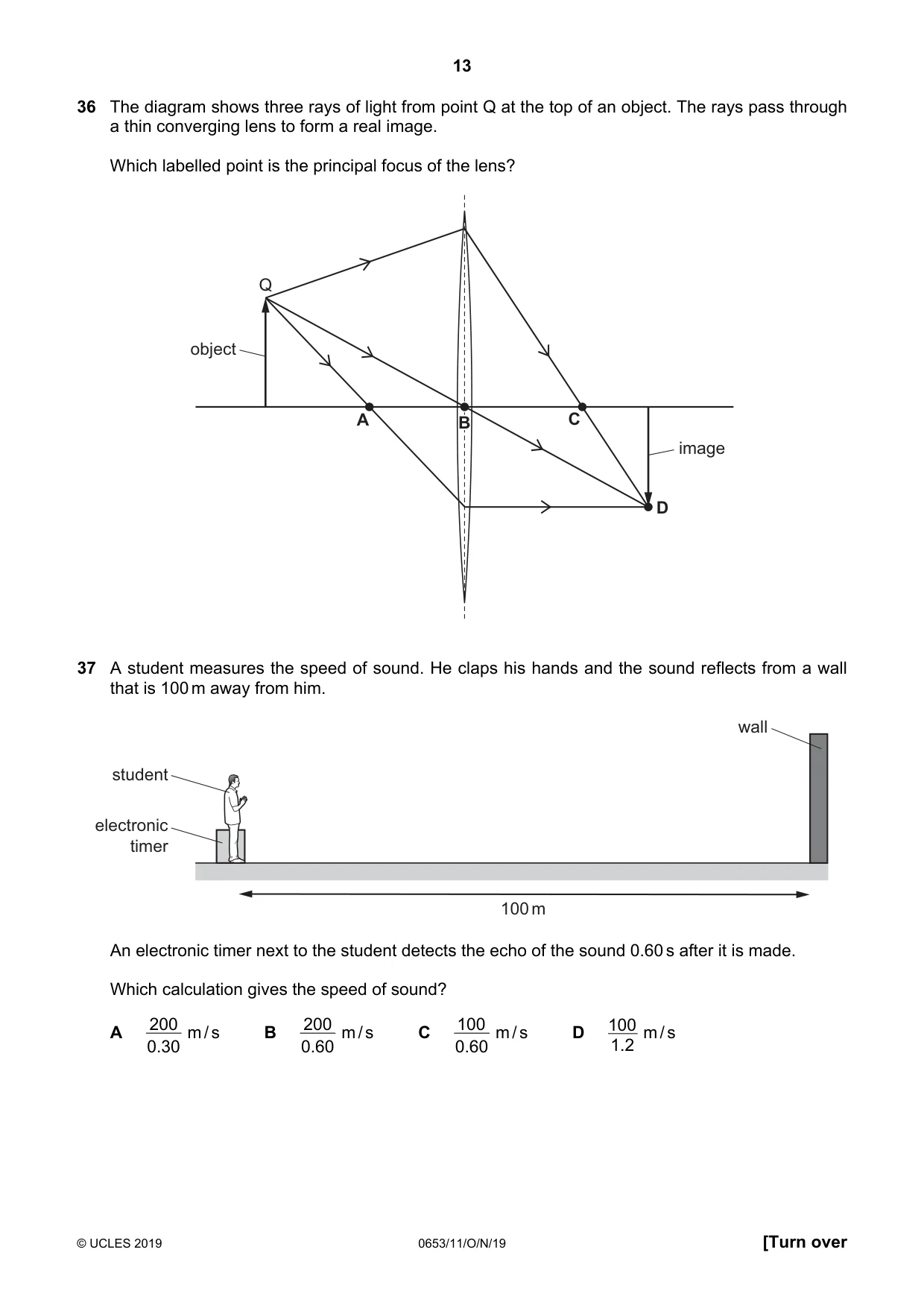
Q36 · The diagram shows three rays of light from point Q at the top of an object
36 The diagram shows three rays of light from point Q at the top of an object. The rays pass through a thin converging lens to form a real image. Which labelled point is the principal focus of the lens? Q object A B B C image D
Mark scheme: A
Q37 · A student measures the speed of sound
37 A student measures the speed of sound. He claps his hands and the sound reflects from a wall that is 100 m away from him. wall student electronic timer 100 m An electronic timer next to the student detects the echo of the sound 0.60 s after it is made. Which calculation gives the speed of sound? 200 200 100 100 A m / s B m / s C m / s D m / s 0.30 0.60 0.60 1 . 2
Mark scheme: B
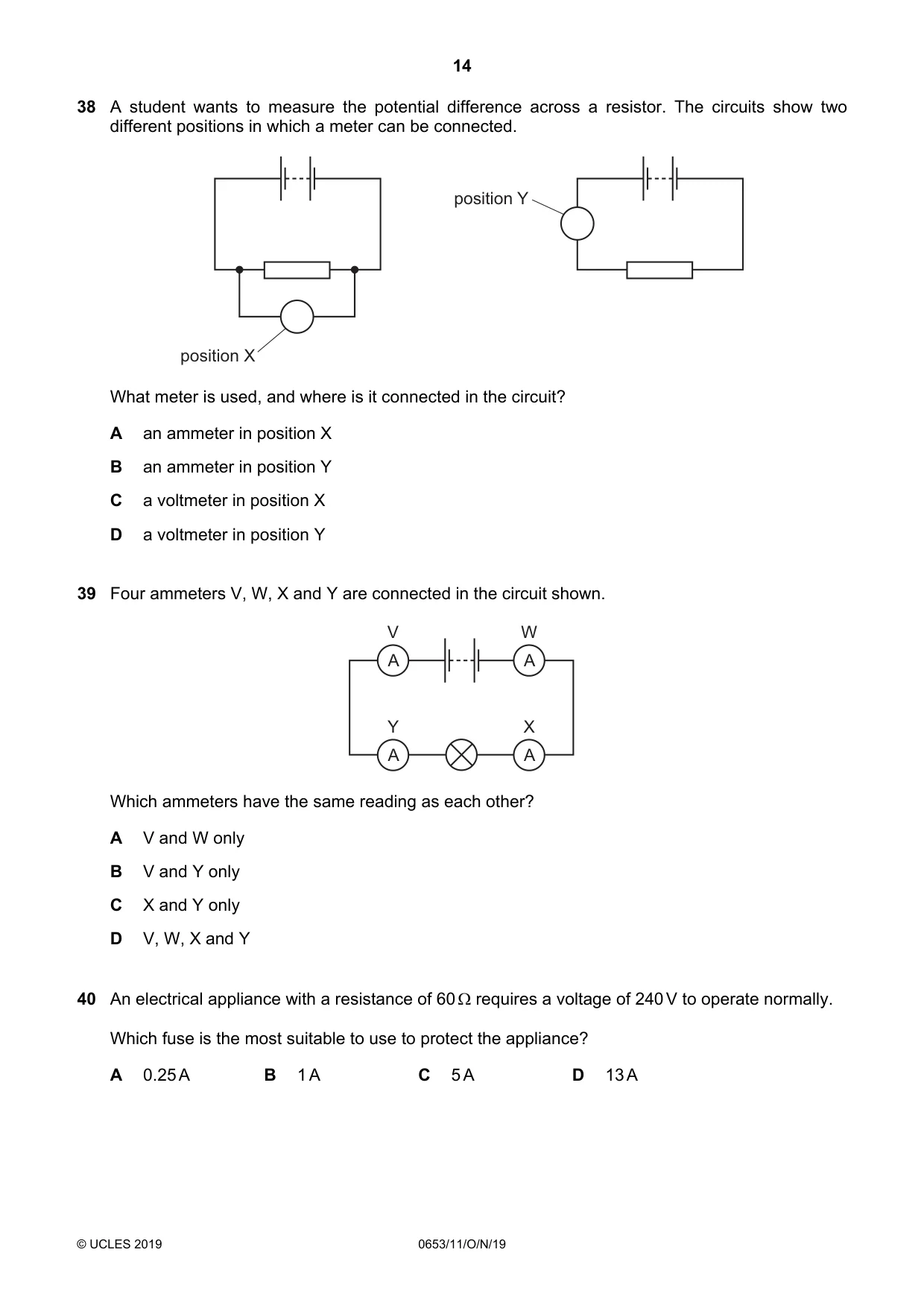
Q38 · A student wants to measure the potential difference across a resistor
38 A student wants to measure the potential difference across a resistor. The circuits show two different positions in which a meter can be connected. position Y position X What meter is used, and where is it connected in the circuit? A an ammeter in position X B an ammeter in position Y C a voltmeter in position X D a voltmeter in position Y
Mark scheme: C
Q39 · Four ammeters V, W, X and Y are connected in the circuit shown
39 Four ammeters V, W, X and Y are connected in the circuit shown. V W A A Y X A A Which ammeters have the same reading as each other? A V and W only B V and Y only C X and Y only D V, W, X and Y
Mark scheme: D
Q40 · An electrical appliance with a resistance of 60 Ω requires a voltage of 240 V to operate…
40 An electrical appliance with a resistance of 60 Ω requires a voltage of 240 V to operate normally. Which fuse is the most suitable to use to protect the appliance? A 0.25 A B 1 A C 5 A D 13 A
Mark scheme: C
What was in this paper
The subtopics covered by these 40 questions, and how many questions each got. Open one in a new tab to see every Cambridge question on it.
2Electrical circuits2Energy, work and power2Light2Sexual reproduction in plants2Air quality and climate1Alloys and their properties1Atomic structure and the Periodic Table1Circulatory systems1Density1Diet1Diffusion1Digestion1Drugs1Electrical safety1Electrolysis1Elements, compounds and mixtures1Exothermic and endothermic reactions1Extraction of metals1Formulas1Fuels1Gas exchange in humans1Group VII properties1Habitat destruction1Kinetic particle model of matter1Leaf structure1Mass and weight1Motion1Physical and chemical changes1Rate of reaction1Redox1Respiration1Sound1The characteristic properties of acids and bases1Transfer of thermal energy1What you needed in this session
Cambridge’s own grade thresholds for 2019 Oct/Nov, Paper 1 · Variant 1. A higher threshold means an easier paper — the bar moves with how the cohort did.