Cambridge IGCSE Science - Combined 0653 — 2015 May/June Paper 1 · Variant 3
0653/13/M/J/15 · 40 questions · 40 marks · ≈45 min
The question paper and its mark scheme, free to read here and free to download. This is Cambridge’s own paper, exactly as it was sat.
Question paper16 pages
Mark scheme2 pages
Answers below. Sit the paper first if you are practising.
Questions as text
Q1 · Which process produces an element that is excreted?
1 Which process produces an element that is excreted? A fertilisation B photosynthesis C respiration D transpiration
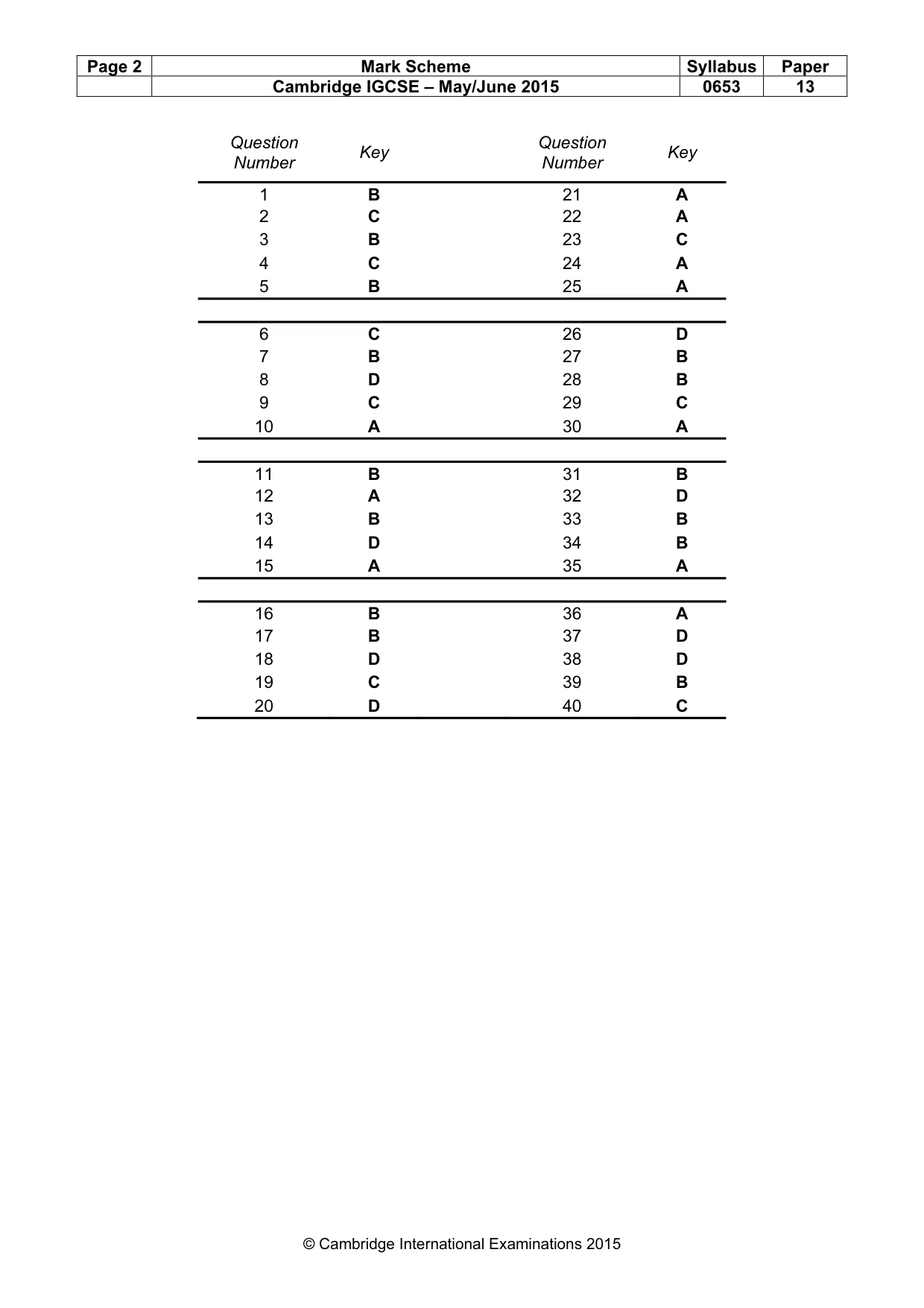
Mark scheme: B
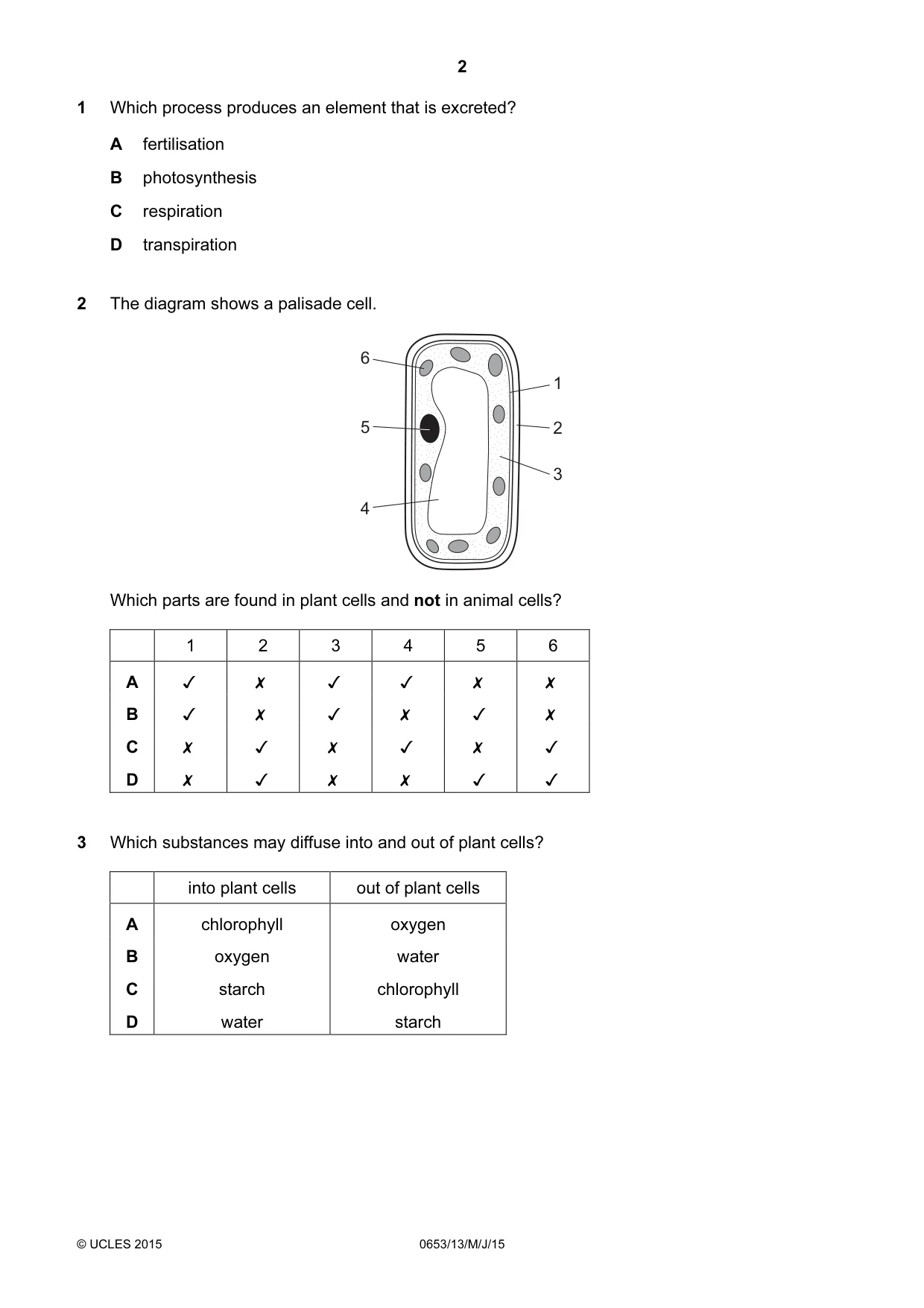
Q2 · The diagram shows a palisade cell
2 The diagram shows a palisade cell. Which parts are found in plant cells and not in animal cells? \ <x x lo 0 0O WwW >
Mark scheme: C
Q3 · Which substances may diffuse into and out of plant cells?
3 Which substances may diffuse into and out of plant cells? into plant cells out of plant cells A chlorophyll oxygen B oxygen water C starch chlorophyll D water starch
Mark scheme: B
Q4 · When an apple is cut, the cut surface quickly turns brown
4 When an apple is cut, the cut surface quickly turns brown. This is due to enzyme action. Which action destroys the enzyme? A brushing the cut surface with a strong sugar solution B cutting the apple into smaller pieces C dipping the cut apple in boiling water D dipping the cut apple in cold water
Mark scheme: C
Q5 · Which nutrients are needed in the diet to produce strong bones?
5 Which nutrients are needed in the diet to produce strong bones? calcium iron vitamin C | vitamin D v v x x 0 0O WwW D> v x x v x v x v x x v v
Mark scheme: B
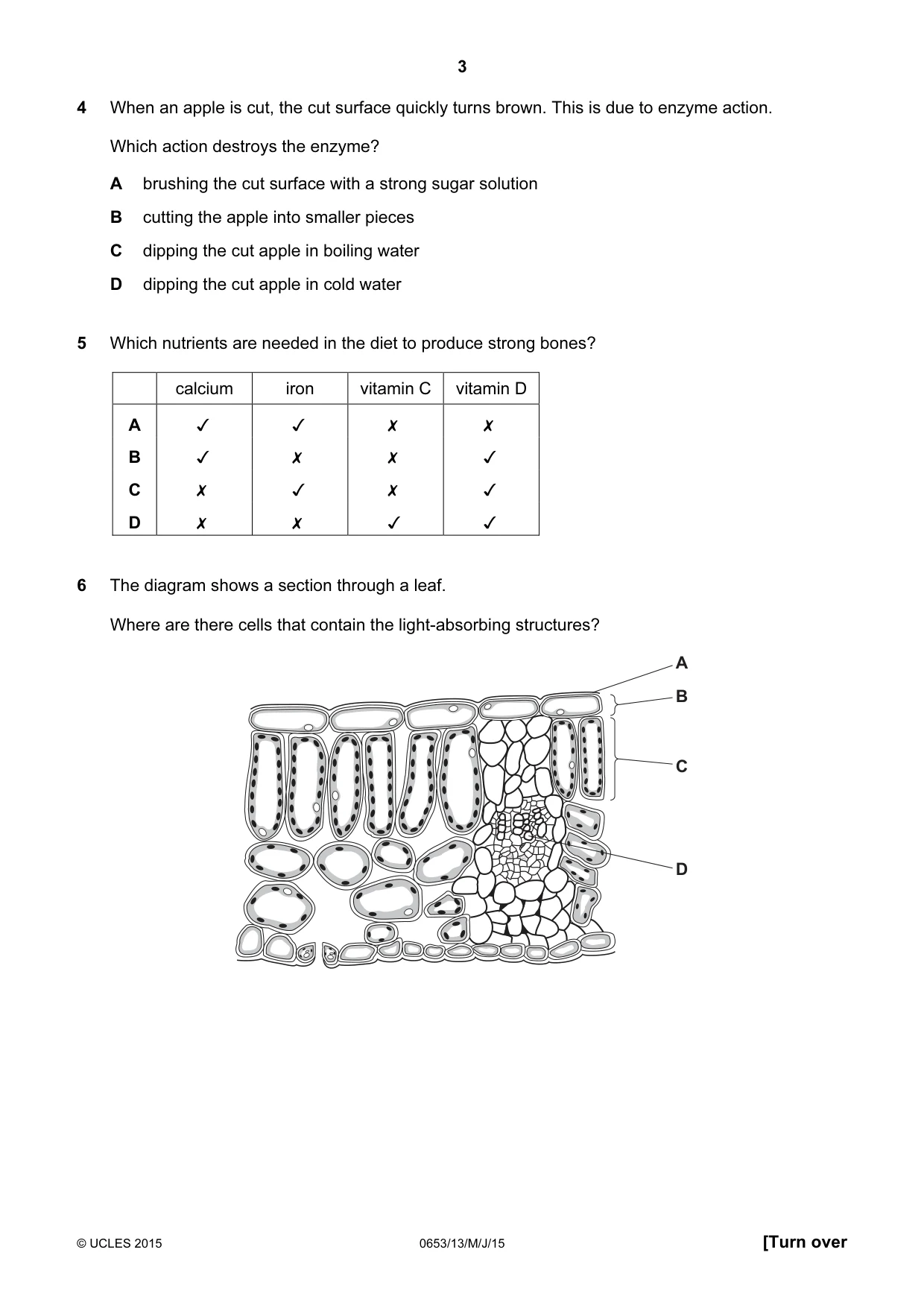
Q6 · The diagram shows a section through a leaf
6 The diagram shows a section through a leaf. Where are there cells that contain the light-absorbing structures? A B C D
Mark scheme: C
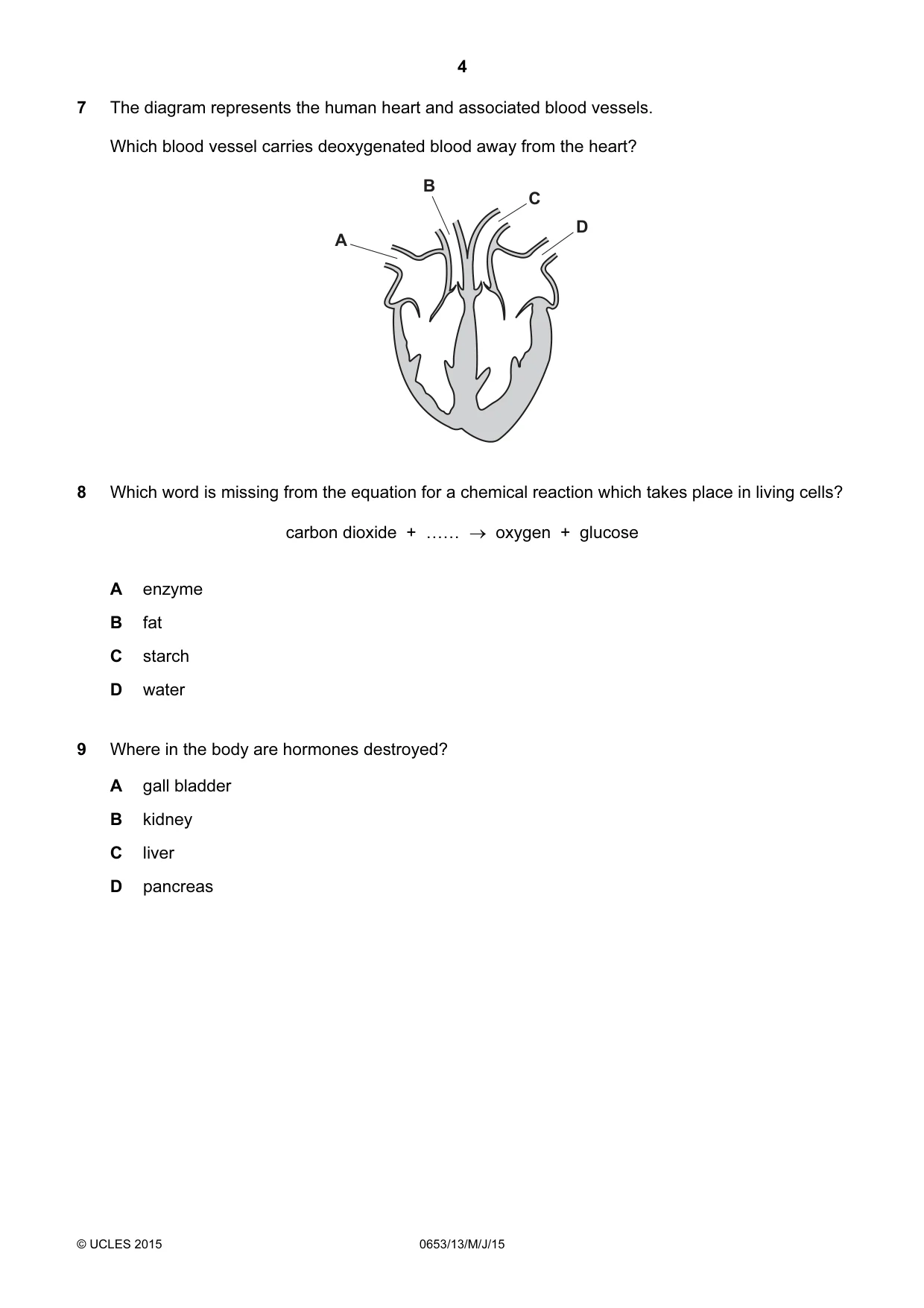
Q7 · The diagram represents the human heart and associated blood vessels
7 The diagram represents the human heart and associated blood vessels. Which blood vessel carries deoxygenated blood away from the heart? B C D A
Mark scheme: B
Q8 · Which word is missing from the equation for a chemical reaction which takes place in…
8 Which word is missing from the equation for a chemical reaction which takes place in living cells? carbon dioxide + …… → oxygen + glucose A enzyme B fat C starch D water
Mark scheme: D
Q9 · Where in the body are hormones destroyed?
9 Where in the body are hormones destroyed? A gall bladder B kidney C liver D pancreas
Mark scheme: C
Q10 · A healthy person does not eat for several hours but then has a meal rich in carbohydrate
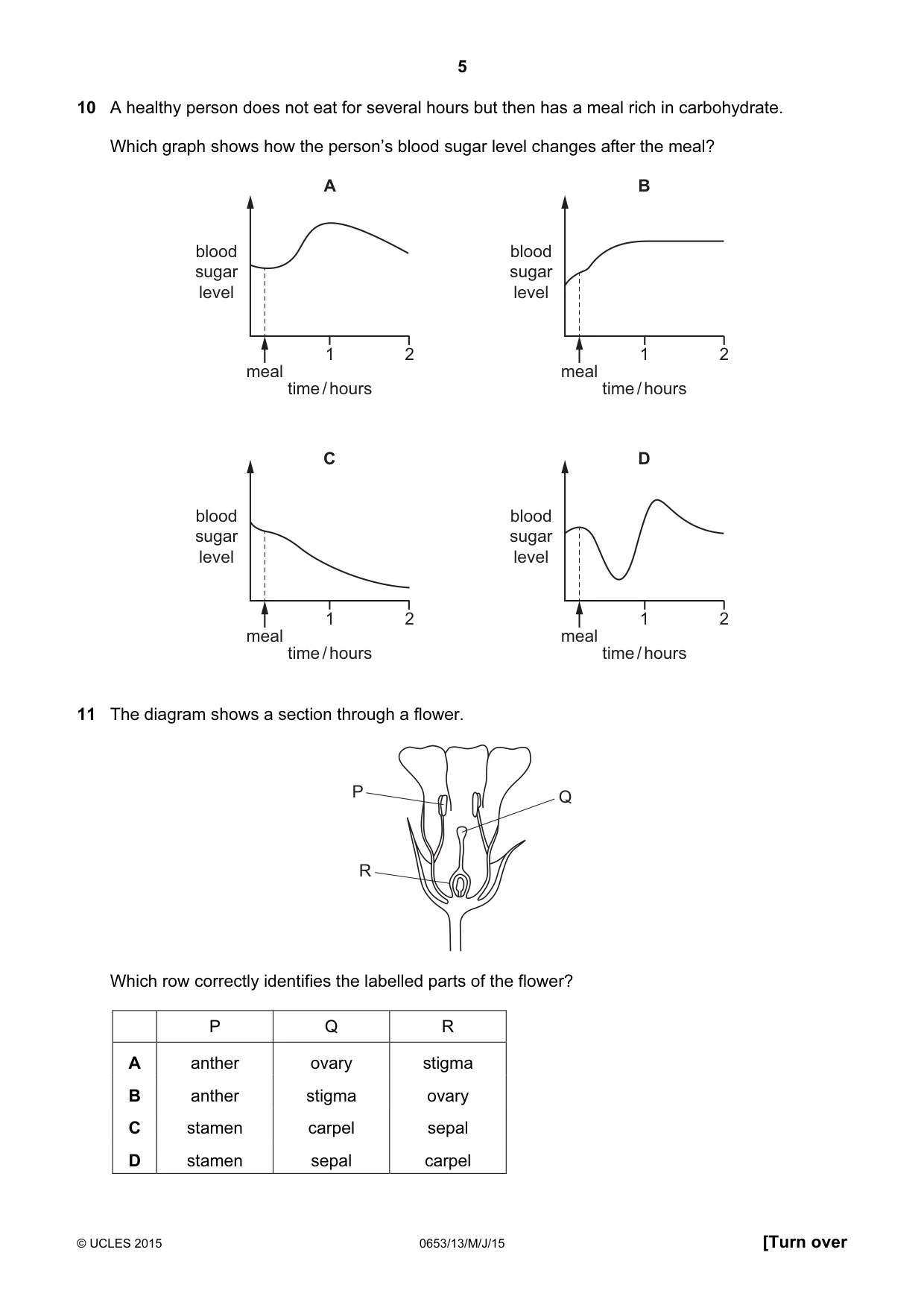
10 A healthy person does not eat for several hours but then has a meal rich in carbohydrate. Which graph shows how the person’s blood sugar level changes after the meal? A B blood blood sugar sugar level level 1 2 1 2 meal meal time / hours time / hours C D blood blood sugar sugar level level 1 2 1 2 meal meal time / hours time / hours
Mark scheme: A
Q11 · The diagram shows a section through a flower
11 The diagram shows a section through a flower. P Q R Which row correctly identifies the labelled parts of the flower? P Q R A anther ovary stigma B anther stigma ovary C stamen carpel sepal D stamen sepal carpel
Mark scheme: B
Q12 · The diagram shows a side view of the female reproductive system in a human
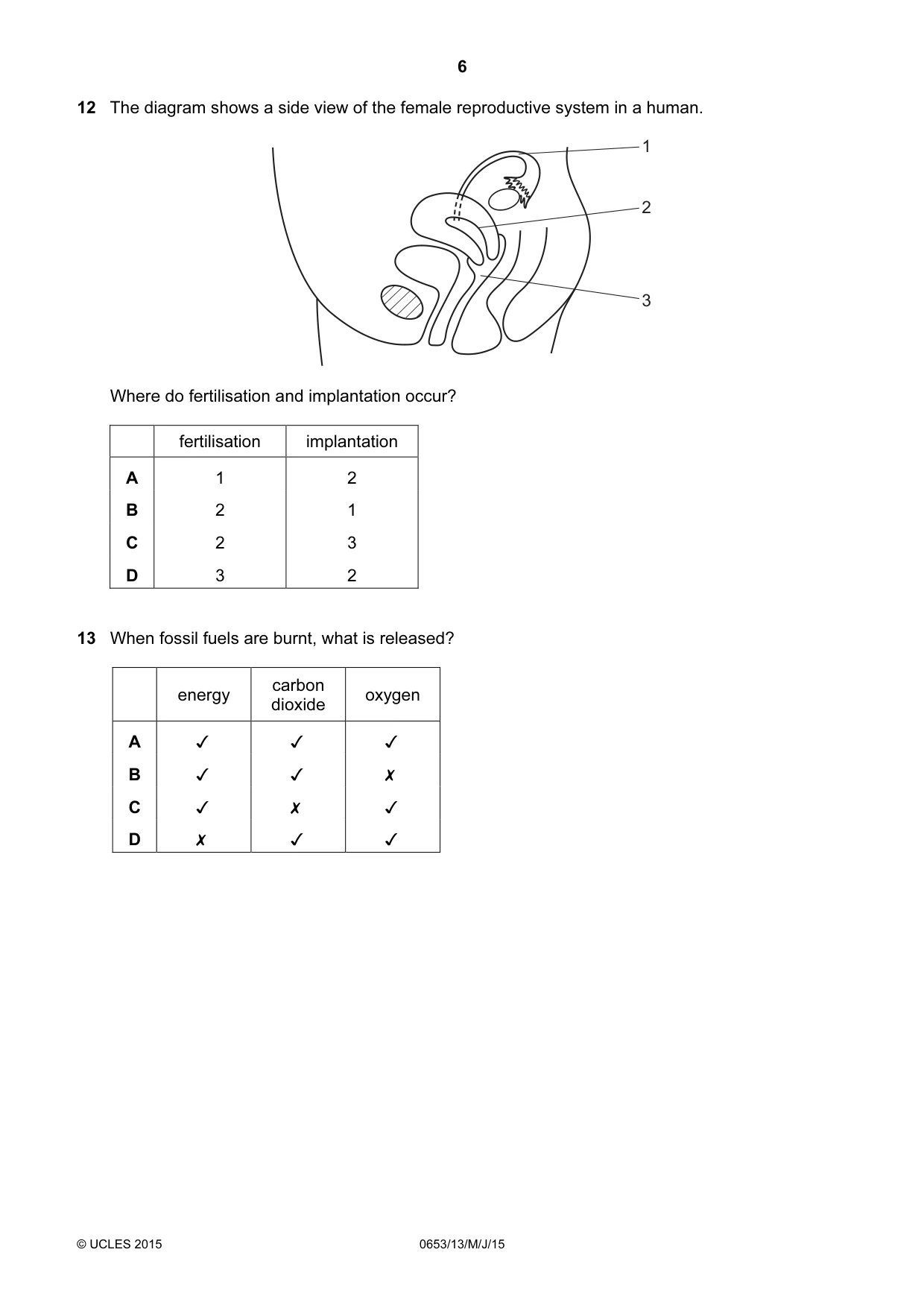
12 The diagram shows a side view of the female reproductive system in a human. 1 2 3 Where do fertilisation and implantation occur? fertilisation implantation A 1 2 B 2 1 C 2 3 D 3 2
Mark scheme: A
Q13 · When fossil fuels are burnt, what is released?
13 When fossil fuels are burnt, what is released? ener carbon oxygen gy dioxide yg A J J J B J Wi x c J x J D x Wi J
Mark scheme: B
Q14 · The structures of three molecules are shown
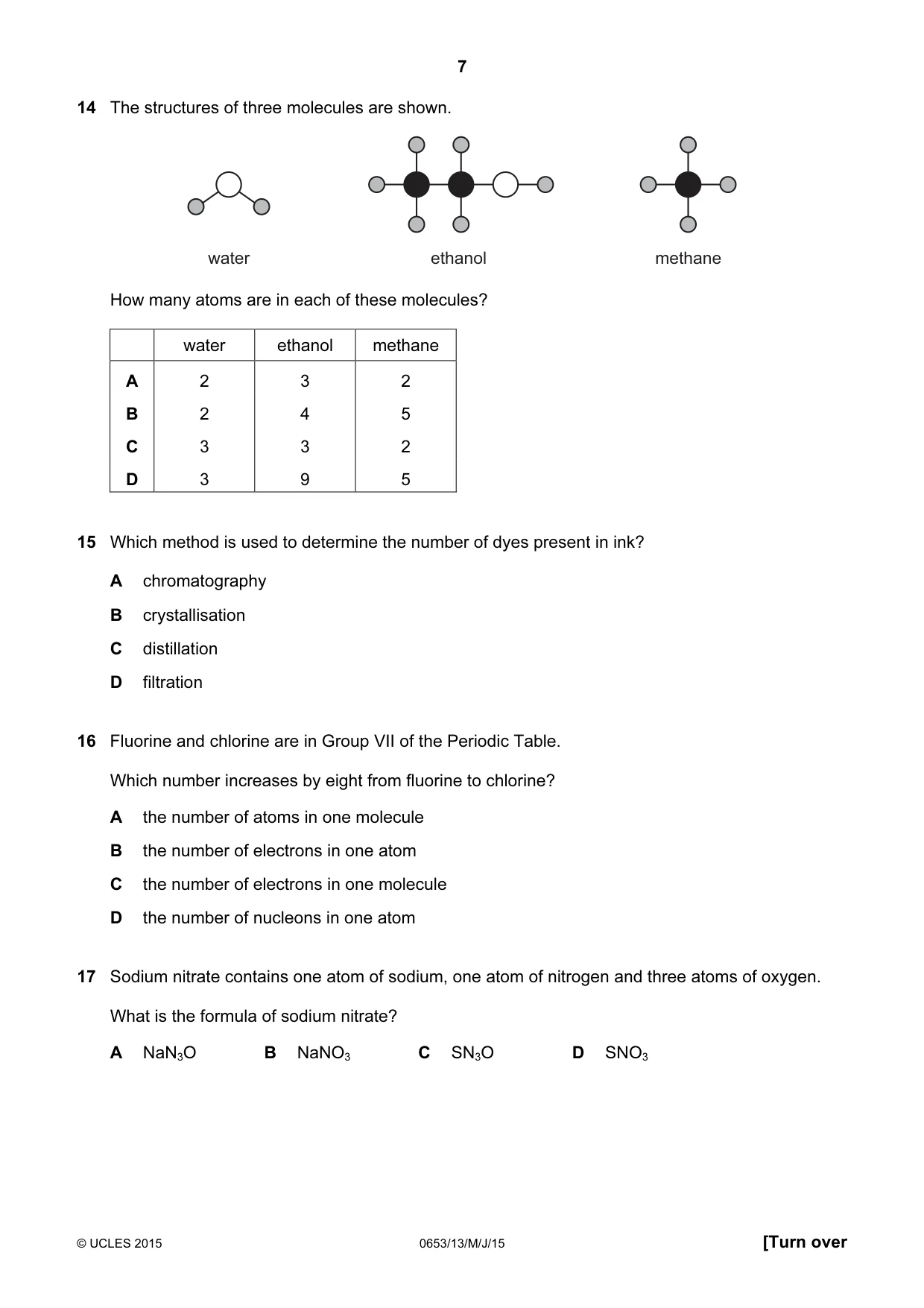
14 The structures of three molecules are shown. water ethanol methane How many atoms are in each of these molecules? water ethanol methane A 2 3 2 B 2 4 5 C 3 3 2 D 3 9 5
Mark scheme: D
Q15 · Which method is used to determine the number of dyes present in ink?
15 Which method is used to determine the number of dyes present in ink? A chromatography B crystallisation C distillation D filtration
Mark scheme: A
Q16 · Fluorine and chlorine are in Group VII of the Periodic Table
16 Fluorine and chlorine are in Group VII of the Periodic Table. Which number increases by eight from fluorine to chlorine? A the number of atoms in one molecule B the number of electrons in one atom C the number of electrons in one molecule D the number of nucleons in one atom
Mark scheme: B
Q17 · Sodium nitrate contains one atom of sodium, one atom of nitrogen and three atoms of oxygen
17 Sodium nitrate contains one atom of sodium, one atom of nitrogen and three atoms of oxygen. What is the formula of sodium nitrate? A NaN3O B NaNO3 C SN3O D SNO3
Mark scheme: B
Q18 · During the electrolysis of aqueous copper chloride, inert electrodes are placed in the…
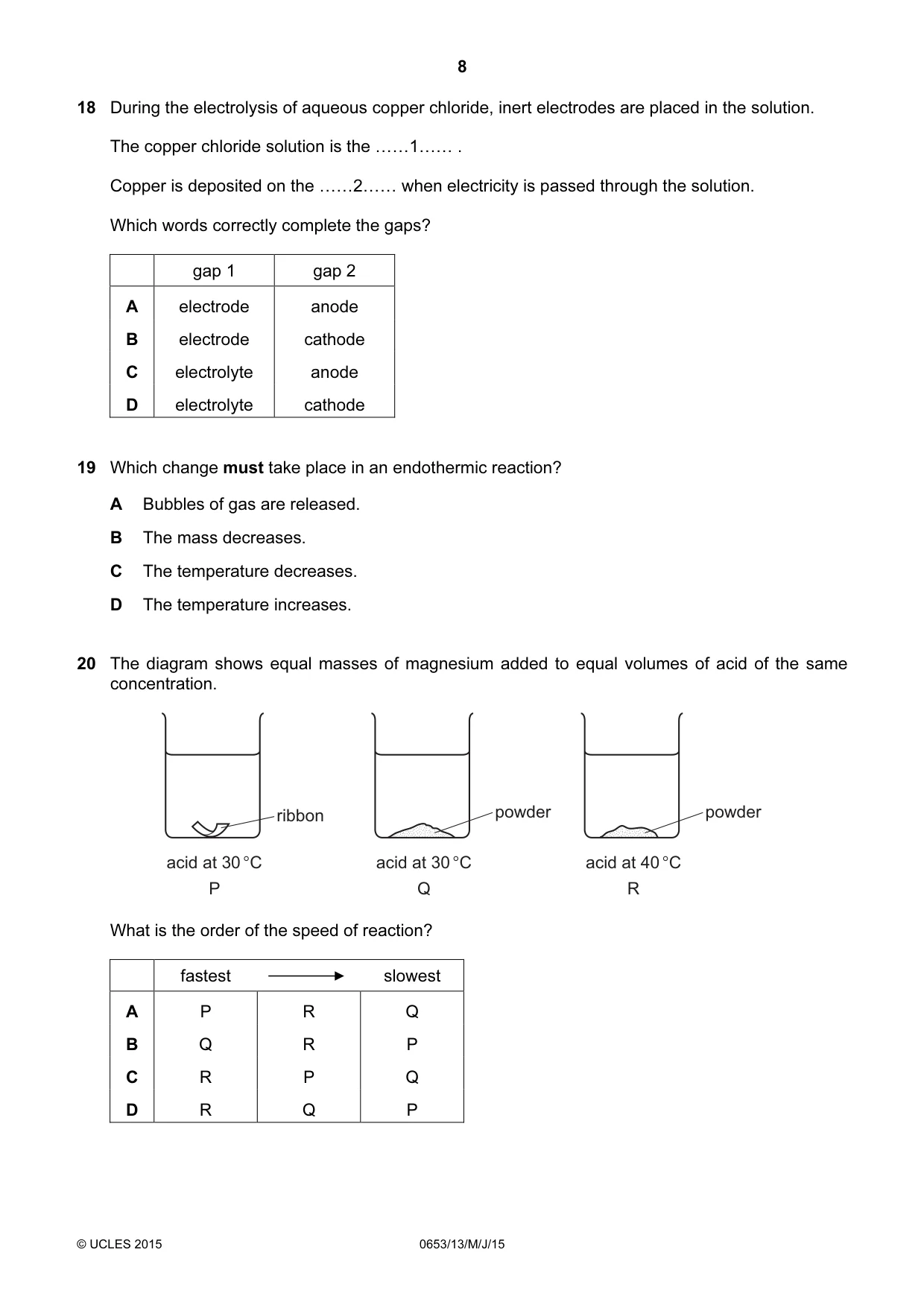
18 During the electrolysis of aqueous copper chloride, inert electrodes are placed in the solution. The copper chloride solution is the ……1…… . Copper is deposited on the ……2…… when electricity is passed through the solution. Which words correctly complete the gaps? gap 1 gap 2 A electrode anode B electrode cathode C electrolyte anode D electrolyte cathode
Mark scheme: D
Q19 · Which change must take place in an endothermic reaction?
19 Which change must take place in an endothermic reaction? A Bubbles of gas are released. B The mass decreases. C The temperature decreases. D The temperature increases.
Mark scheme: C
Q20 · The diagram shows equal masses of magnesium added to equal volumes of acid of the same…
20 The diagram shows equal masses of magnesium added to equal volumes of acid of the same concentration. ribbon powder powder acid at 30 °C acid at 30 °C acid at 40 °C P Q R What is the order of the speed of reaction? fastest slowest A P R Q B Q R P C R P Q D R Q P
Mark scheme: D
Q21 · The following reactions occur in the blast furnace
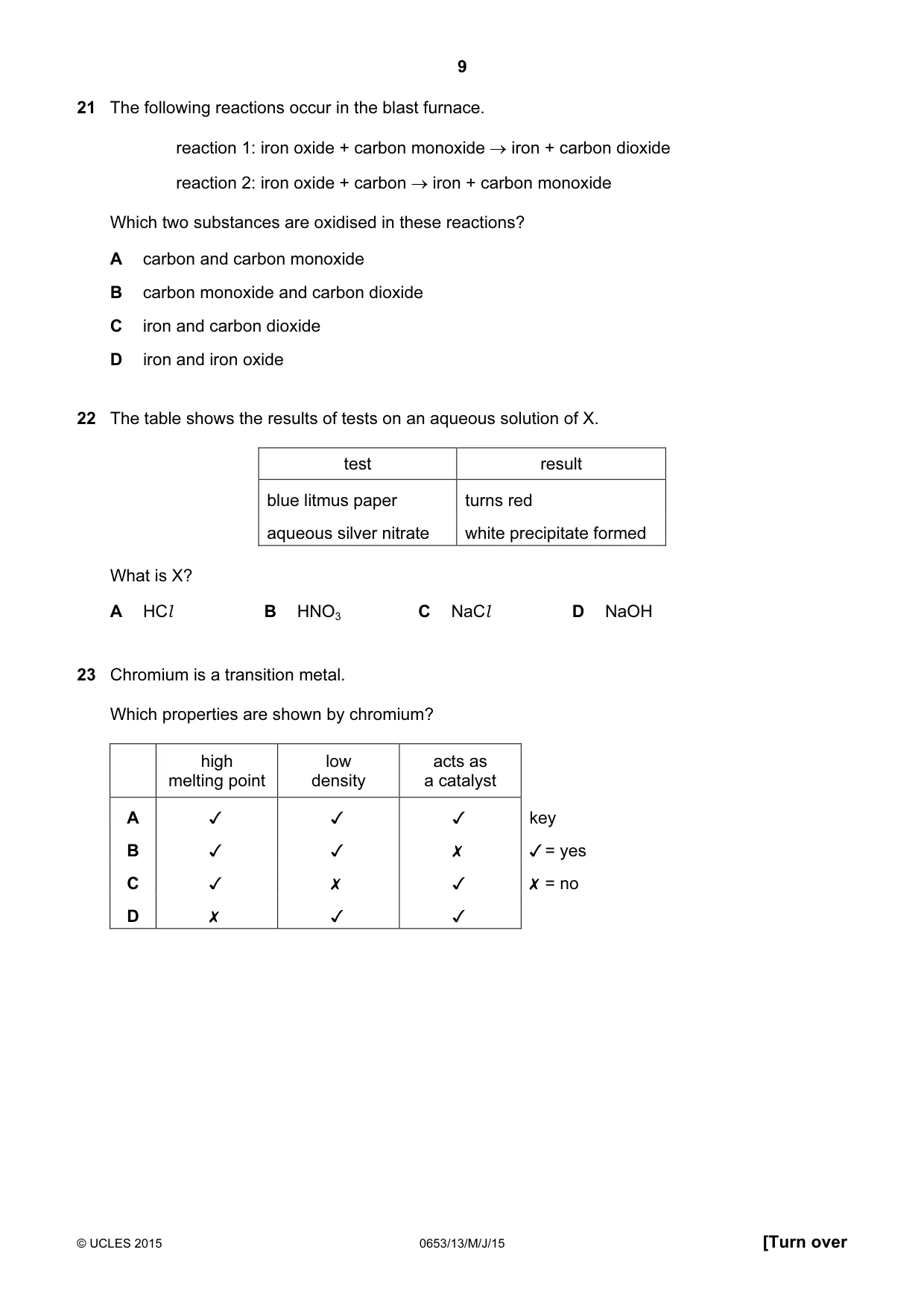
21 The following reactions occur in the blast furnace. reaction 1: iron oxide + carbon monoxide → iron + carbon dioxide reaction 2: iron oxide + carbon → iron + carbon monoxide Which two substances are oxidised in these reactions? A carbon and carbon monoxide B carbon monoxide and carbon dioxide C iron and carbon dioxide D iron and iron oxide
Mark scheme: A
Q22 · The table shows the results of tests on an aqueous solution of X
22 The table shows the results of tests on an aqueous solution of X. test result blue litmus paper turns red aqueous silver nitrate white precipitate formed What is X? A HCl B HNO3 C NaCl D NaOH
Mark scheme: A
Q23 · Chromium is a transition metal
23 Chromium is a transition metal. Which properties are shown by chromium? 0 Oo WwW > high melting point v v v x low density v v x v acts as a catalyst v x v v key v/=yes X =no
Mark scheme: C
Q24 · A new alloy is resistant to corrosion
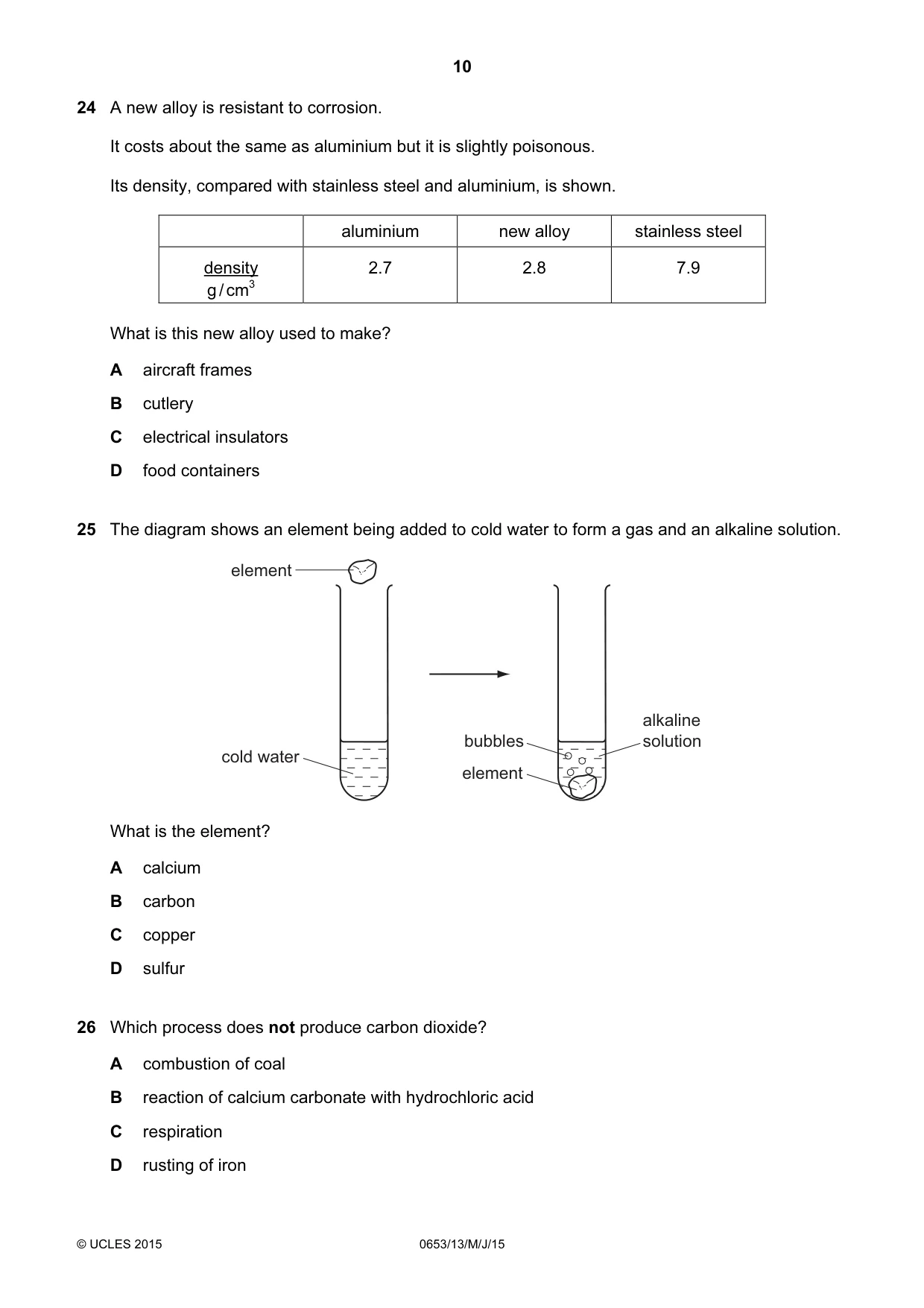
24 A new alloy is resistant to corrosion. It costs about the same as aluminium but it is slightly poisonous. Its density, compared with stainless steel and aluminium, is shown. aluminium new alloy stainless steel density 2.7 2.8 7.9 g / cm3 What is this new alloy used to make? A aircraft frames B cutlery C electrical insulators D food containers
Mark scheme: A
Q25 · The diagram shows an element being added to cold water to form a gas and an alkaline…
25 The diagram shows an element being added to cold water to form a gas and an alkaline solution. element alkaline bubbles solution cold water element What is the element? A calcium B carbon C copper D sulfur
Mark scheme: A
Q26 · Which process does not produce carbon dioxide?
26 Which process does not produce carbon dioxide? A combustion of coal B reaction of calcium carbonate with hydrochloric acid C respiration D rusting of iron
Mark scheme: D
Q27 · Which gas is the main constituent of natural gas?
27 Which gas is the main constituent of natural gas? A carbon dioxide B methane C nitrogen D oxygen
Mark scheme: B
Q28 · A student travels a distance of 6.0 km at a steady speed
28 A student travels a distance of 6.0 km at a steady speed. She completes her journey in a time of 5.0 minutes. What is her speed? A 1.2 m / s B 20 m / s C 30 m / s D 50 m / s
Mark scheme: B
Q29 · A shop-keeper places two identical blocks of cheese on a balance
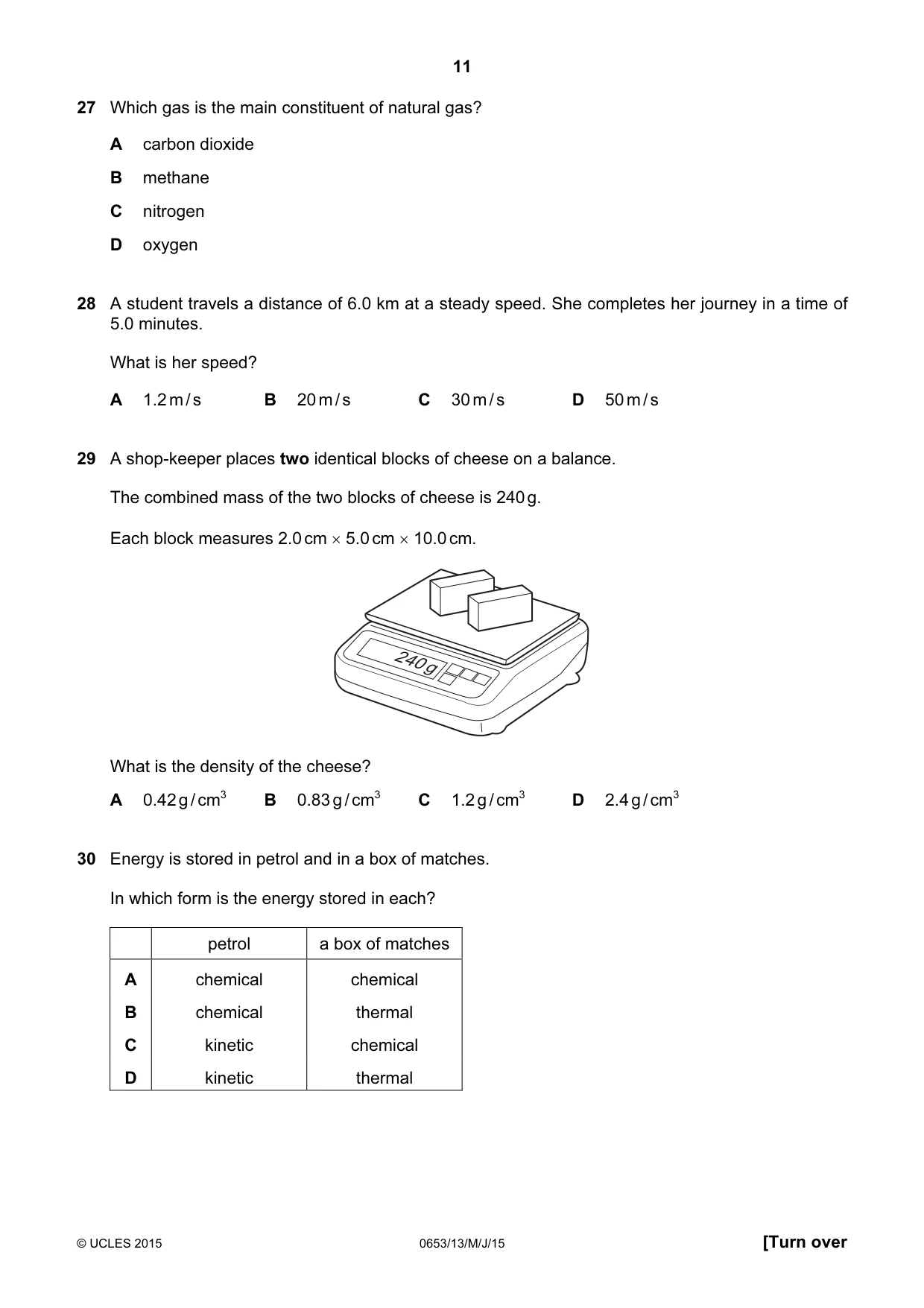
29 A shop-keeper places two identical blocks of cheese on a balance. The combined mass of the two blocks of cheese is 240 g. Each block measures 2.0 cm × 5.0 cm × 10.0 cm. 240 g What is the density of the cheese? A 0.42 g / cm3 B 0.83 g / cm3 C 1.2 g / cm3 D 2.4 g / cm3
Mark scheme: C
Q30 · Energy is stored in petrol and in a box of matches
30 Energy is stored in petrol and in a box of matches. In which form is the energy stored in each? petrol a box of matches A chemical chemical B chemical thermal C kinetic chemical D kinetic thermal
Mark scheme: A
Q31 · A container of milk is wrapped in a wet cloth
31 A container of milk is wrapped in a wet cloth. Air blows over the cloth. The temperature of the milk changes as the water in the cloth evaporates. Which statement is correct? A The temperature of the milk falls because the less energetic water molecules escape from the cloth. B The temperature of the milk falls because the more energetic water molecules escape from the cloth. C The temperature of the milk rises because the less energetic water molecules escape from the cloth. D The temperature of the milk rises because the more energetic water molecules escape from the cloth.
Mark scheme: B
Q32 · A pure solid is heated until it all becomes a liquid, and is then heated further
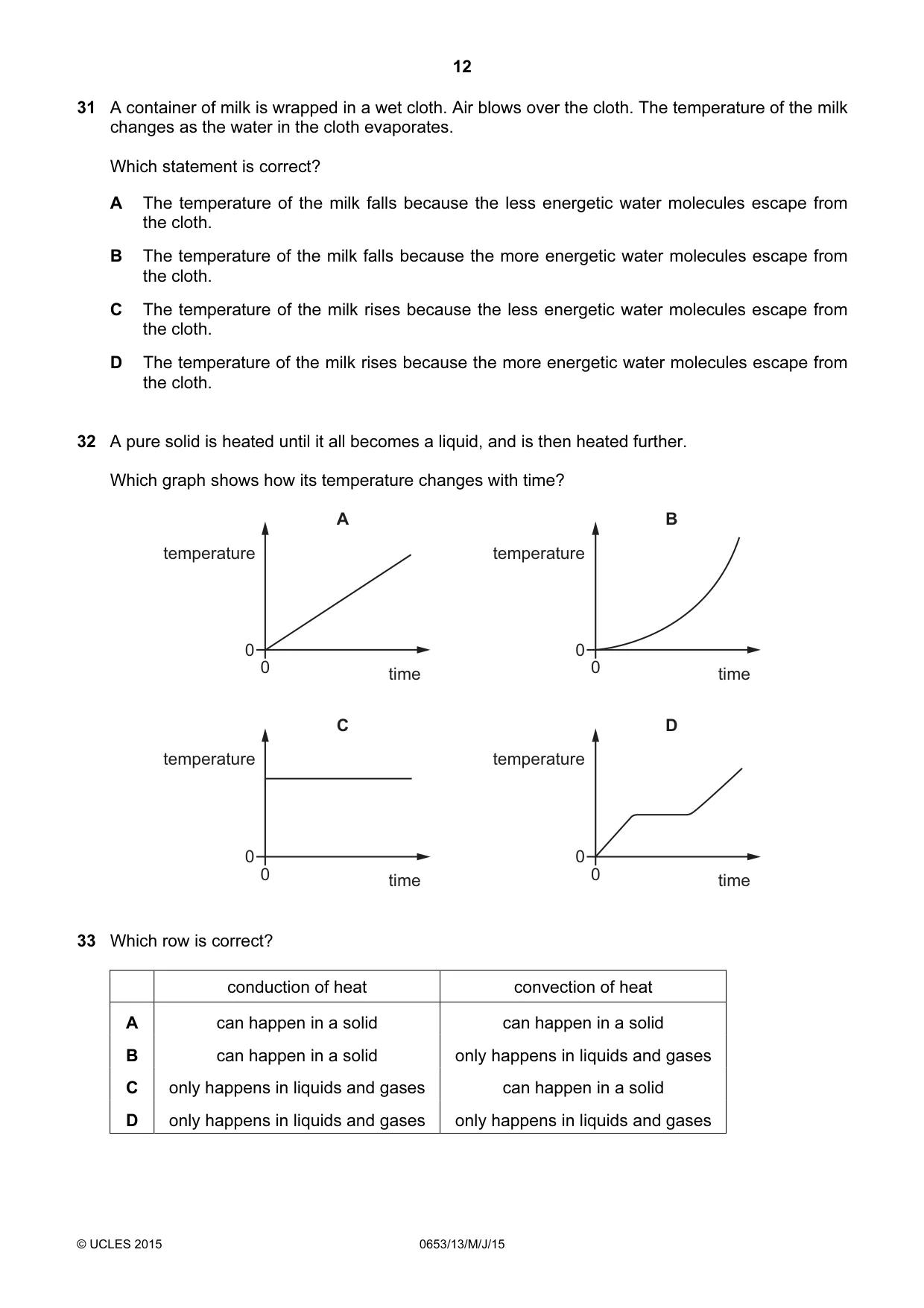
32 A pure solid is heated until it all becomes a liquid, and is then heated further. Which graph shows how its temperature changes with time? A B temperature temperature 0 0 0 time 0 time C D temperature temperature 0 0 0 time 0 time
Mark scheme: D
Q33 · Which row is correct?
33 Which row is correct? conduction of heat convection of heat A can happen in a solid can happen in a solid B can happen in a solid only happens in liquids and gases C only happens in liquids and gases can happen in a solid D only happens in liquids and gases only happens in liquids and gases
Mark scheme: B
Q34 · Waves cause a small boat to move regularly up and down
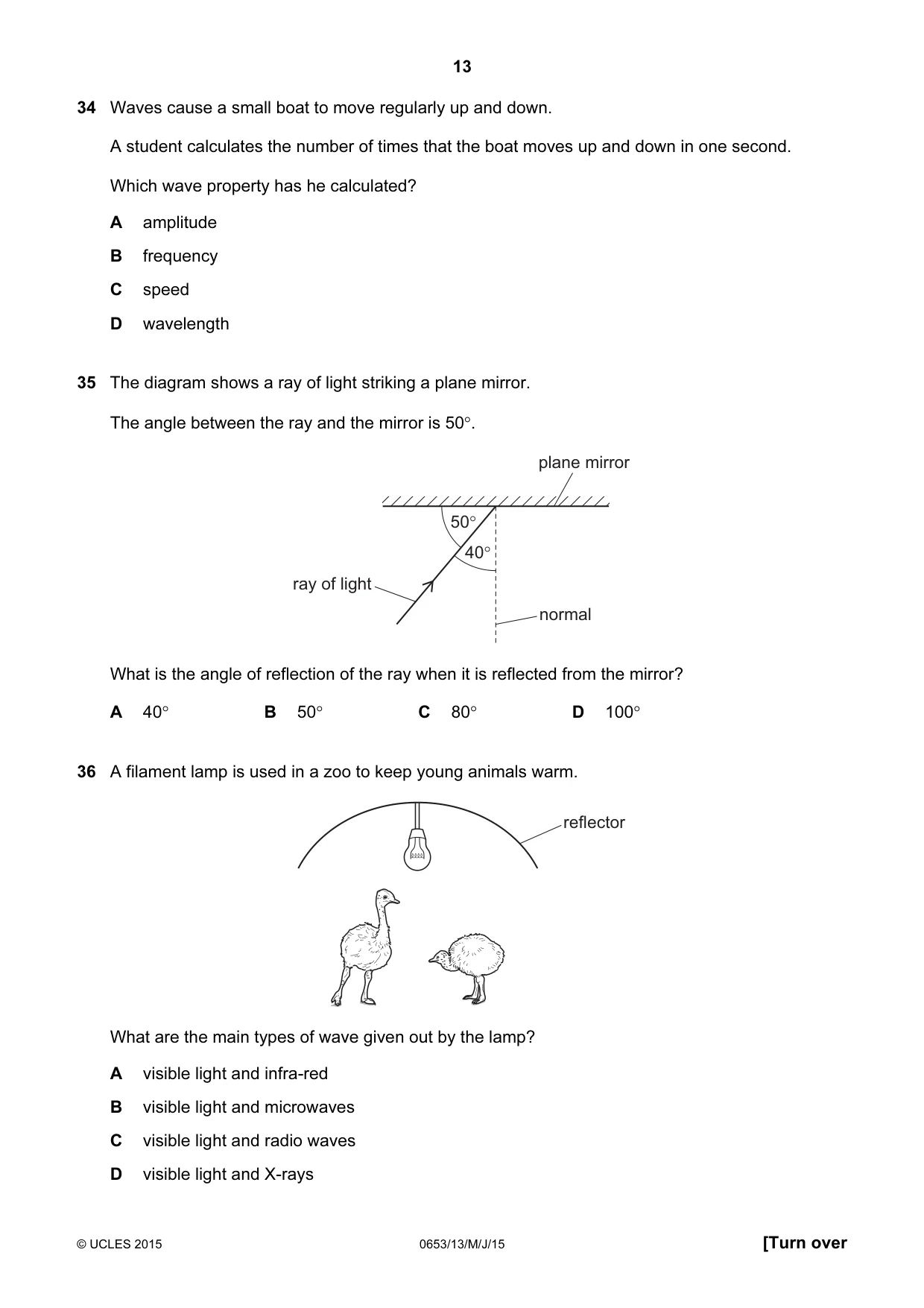
34 Waves cause a small boat to move regularly up and down. A student calculates the number of times that the boat moves up and down in one second. Which wave property has he calculated? A amplitude B frequency C speed D wavelength
Mark scheme: B
Q35 · The diagram shows a ray of light striking a plane mirror
35 The diagram shows a ray of light striking a plane mirror. The angle between the ray and the mirror is 50°. plane mirror 50° 40° ray of light normal What is the angle of reflection of the ray when it is reflected from the mirror? A 40° B 50° C 80° D 100°
Mark scheme: A
Q36 · A filament lamp is used in a zoo to keep young animals warm
36 A filament lamp is used in a zoo to keep young animals warm. reflector What are the main types of wave given out by the lamp? A visible light and infra-red B visible light and microwaves C visible light and radio waves D visible light and X-rays
Mark scheme: A
Q37 · A whistle produces a sound that dogs can hear
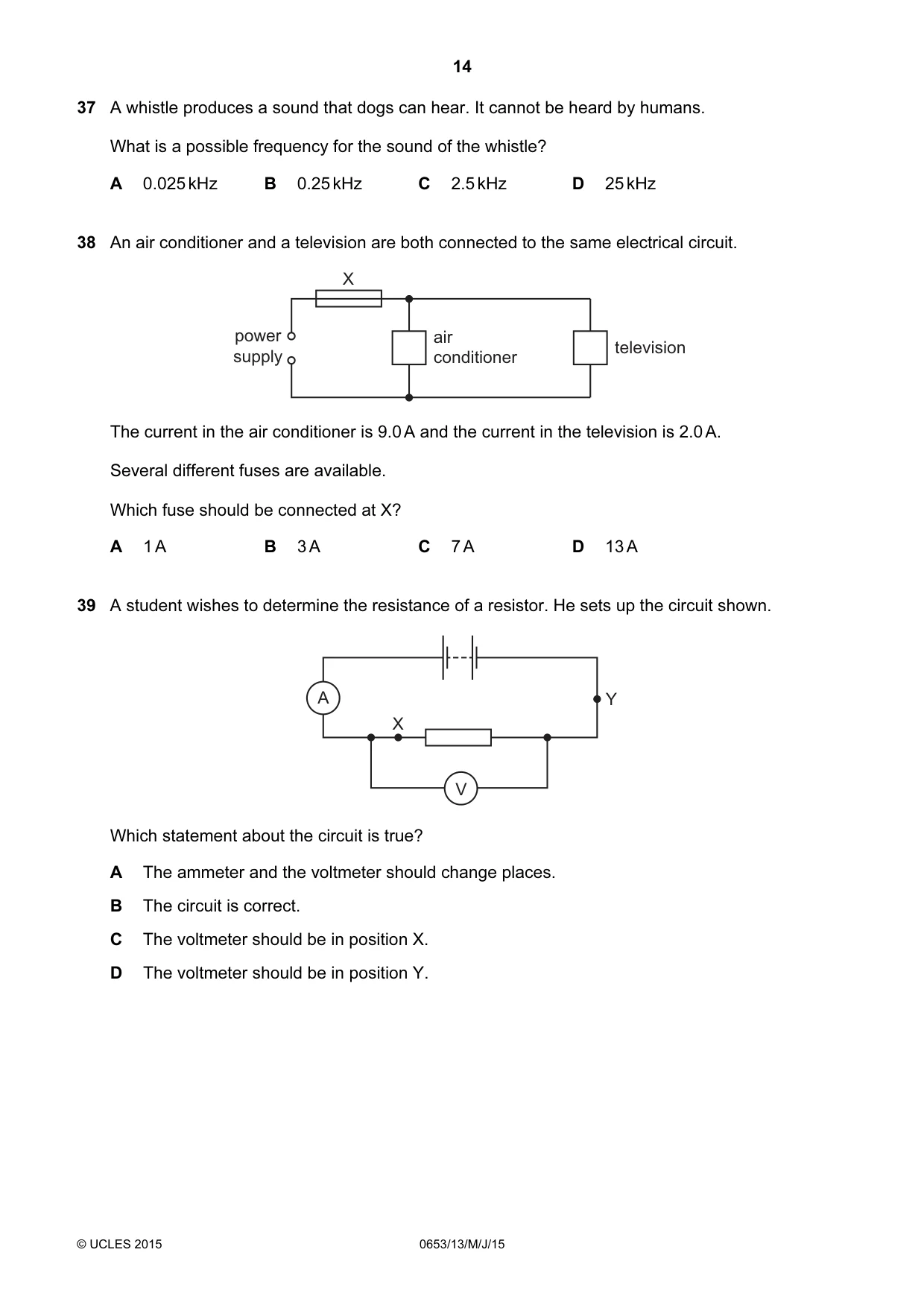
37 A whistle produces a sound that dogs can hear. It cannot be heard by humans. What is a possible frequency for the sound of the whistle? A 0.025 kHz B 0.25 kHz C 2.5 kHz D 25 kHz
Mark scheme: D
Q38 · An air conditioner and a television are both connected to the same electrical circuit
38 An air conditioner and a television are both connected to the same electrical circuit. X power air television supply conditioner The current in the air conditioner is 9.0 A and the current in the television is 2.0 A. Several different fuses are available. Which fuse should be connected at X? A 1 A B 3 A C 7 A D 13 A
Mark scheme: D
Q39 · A student wishes to determine the resistance of a resistor
39 A student wishes to determine the resistance of a resistor. He sets up the circuit shown. A Y X V Which statement about the circuit is true? A The ammeter and the voltmeter should change places. B The circuit is correct. C The voltmeter should be in position X. D The voltmeter should be in position Y.
Mark scheme: B
Q40 · The diagrams show different arrangements of identical resistors
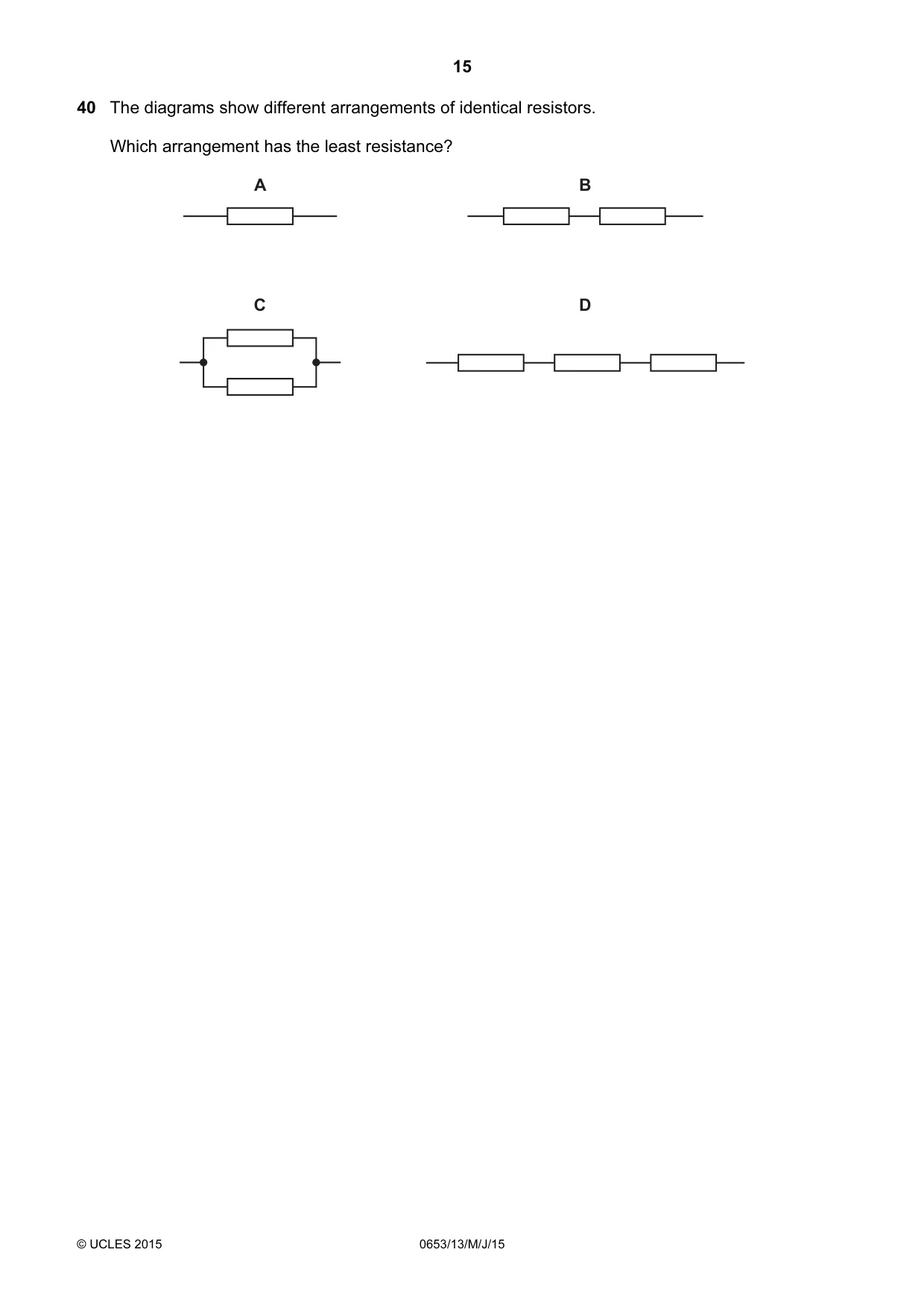
40 The diagrams show different arrangements of identical resistors. Which arrangement has the least resistance? A B C D
Mark scheme: C
What was in this paper
The subtopics covered by these 40 questions, and how many questions each got. Open one in a new tab to see every Cambridge question on it.
2Electrical circuits2Fuels2Photosynthesis2Alloys and their properties1Cell structure1Chromatography1Corrosion of metals1Density1Diffusion1Digestive system1Electrical safety1Electrolysis1Electromagnetic spectrum1Energy, work and power1Enzymes1Exothermic and endothermic reactions1Formulas1General properties of waves1Group VII properties1Heart1Identification of ions and gases1Kinetic particle model of matter1Leaf structure1Light1Motion1Rate of reaction1Reactivity series1Redox1Sexual reproduction in humans1Sexual reproduction in plants1Simple molecules and covalent bonds1Sound1Thermal properties and temperature1Transfer of thermal energy1Transition elements1What you needed in this session
Cambridge’s own grade thresholds for 2015 May/June, Paper 1 · Variant 3. A higher threshold means an easier paper — the bar moves with how the cohort did.