Cambridge IGCSE Science - Combined 0653 — 2010 May/June Paper 1 · Variant 2
0653/12/M/J/10 · 40 questions · 40 marks · ≈45 min
The question paper and its mark scheme, free to read here and free to download. This is Cambridge’s own paper, exactly as it was sat.
Question paper16 pages
Mark scheme2 pages
Answers below. Sit the paper first if you are practising.
Questions as text
Q1 · Which part of a plant cell controls what enters and leaves the cell?
1 Which part of a plant cell controls what enters and leaves the cell? A cell sap B cell surface membrane C cellulose cell wall D cytoplasm
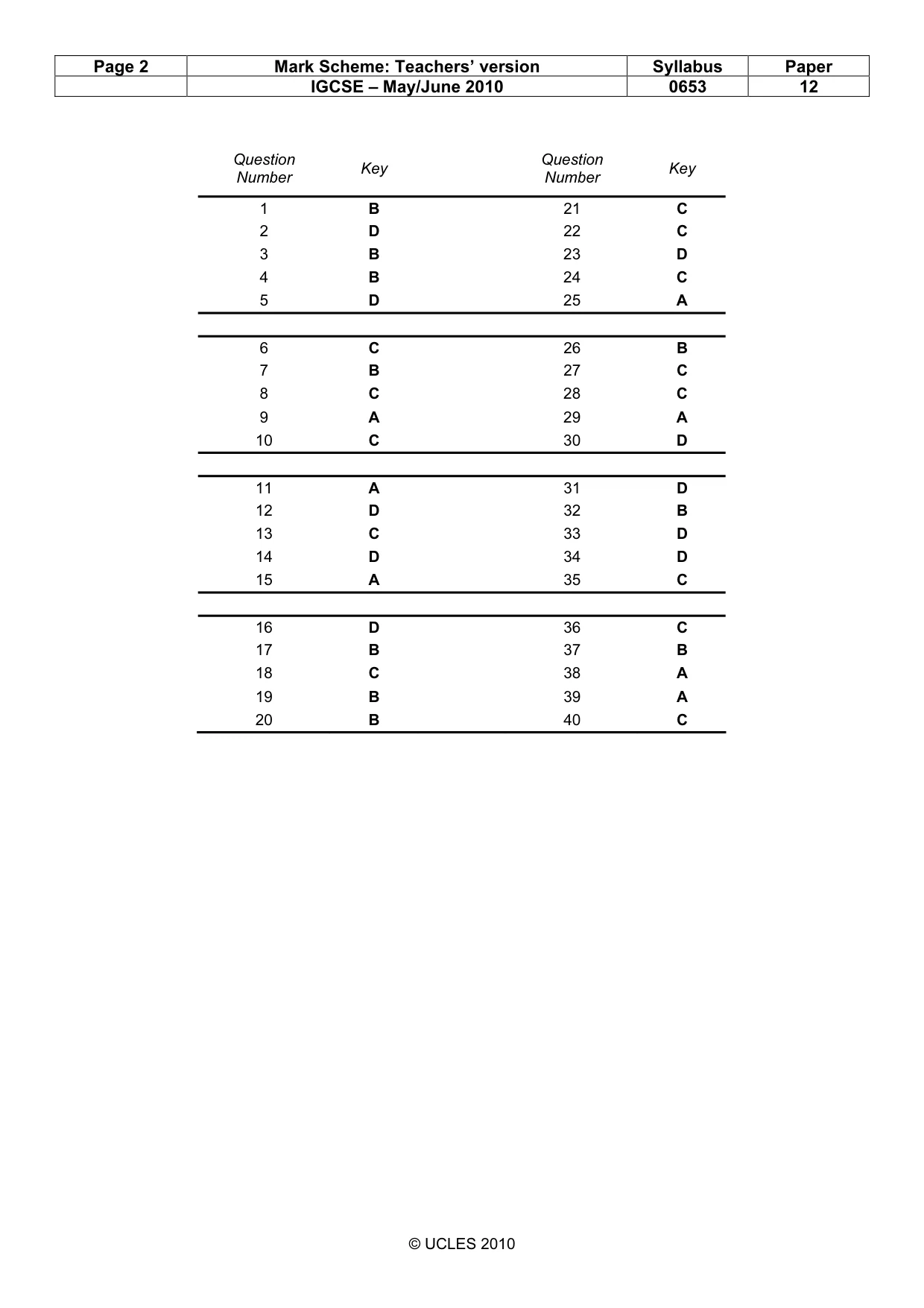
Mark scheme: B
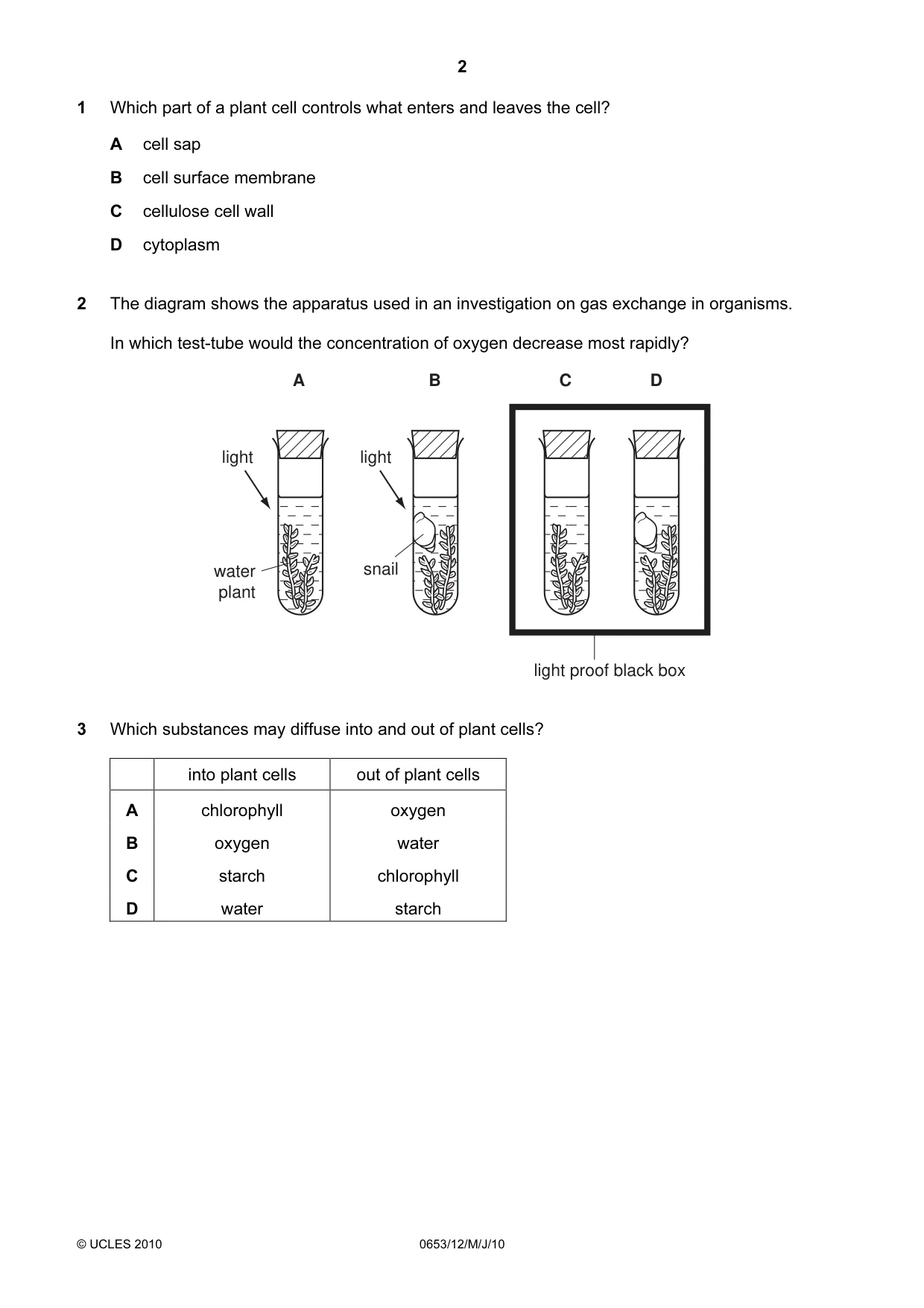
Q2 · The diagram shows the apparatus used in an investigation on gas exchange in organisms
2 The diagram shows the apparatus used in an investigation on gas exchange in organisms. In which test-tube would the concentration of oxygen decrease most rapidly? A B C D light light water snail plant light proof black box
Mark scheme: D
Q3 · Which substances may diffuse into and out of plant cells?
3 Which substances may diffuse into and out of plant cells? into plant cells out of plant cells A chlorophyll oxygen B oxygen water C starch chlorophyll D water starch
Mark scheme: B
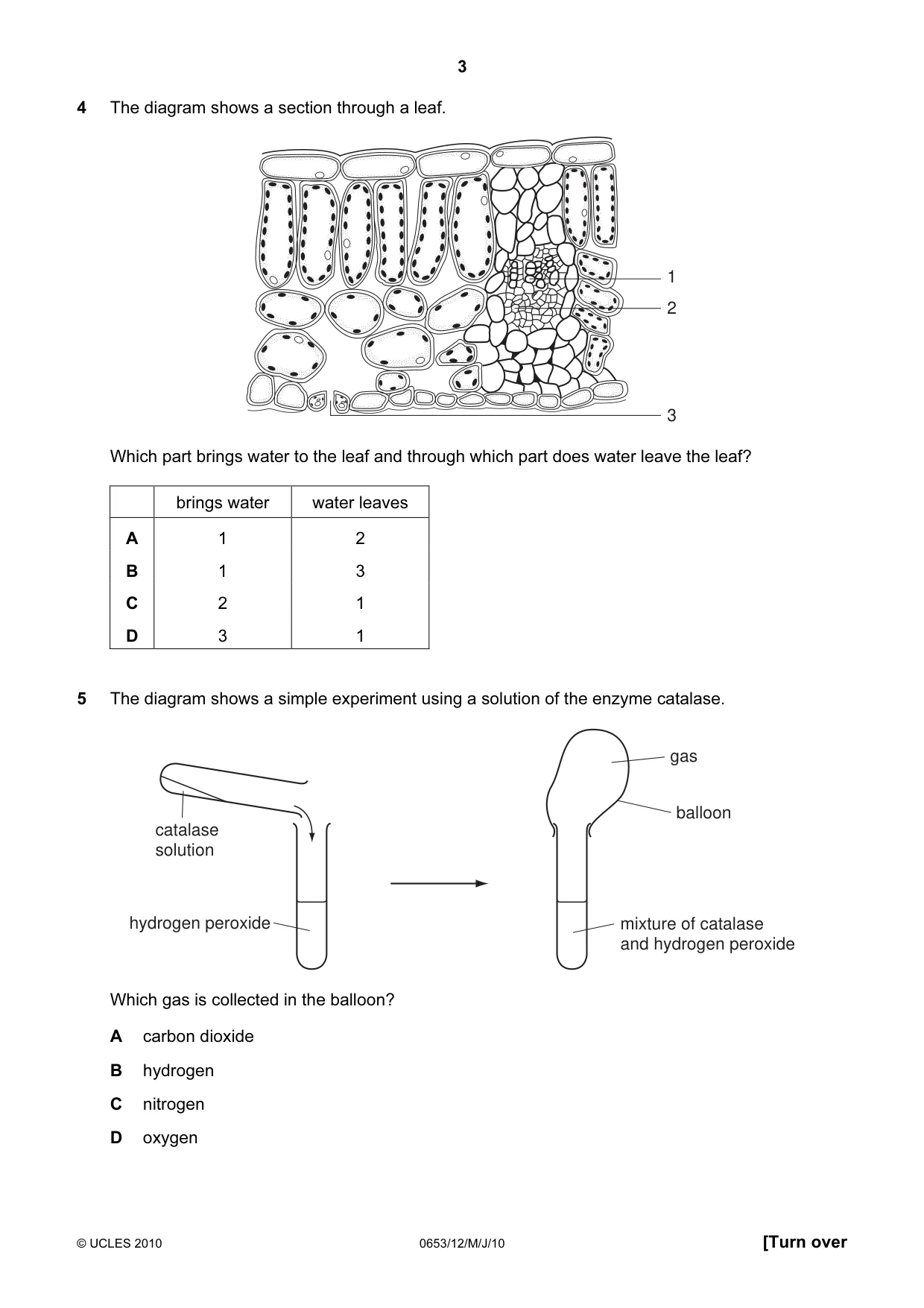
Q4 · The diagram shows a section through a leaf
4 The diagram shows a section through a leaf. 1 2 3 Which part brings water to the leaf and through which part does water leave the leaf? brings water water leaves A 1 2 B 1 3 C 2 1 D 3 1
Mark scheme: B
Q5 · The diagram shows a simple experiment using a solution of the enzyme catalase
5 The diagram shows a simple experiment using a solution of the enzyme catalase. gas balloon catalase solution hydrogen peroxide mixture of catalase and hydrogen peroxide Which gas is collected in the balloon? A carbon dioxide B hydrogen C nitrogen D oxygen
Mark scheme: D
Q6 · The diagram shows some cells from the lining of the human trachea
6 The diagram shows some cells from the lining of the human trachea. What is the function of these cells? A absorption of oxygen into the blood B excretion of carbon dioxide from the blood C removal of mucus from the trachea D secretion of mucus into the trachea
Mark scheme: C
Q7 · Which nutrients in the diet will help to prevent leg bones becoming deformed?
7 Which nutrients in the diet will help to prevent leg bones becoming deformed? A calcium and vitamin C B calcium and vitamin D C iron and vitamin C D iron and vitamin D
Mark scheme: B
Q8 · What effect does drinking alcohol have on the following: • the rate at which signals pass…
8 What effect does drinking alcohol have on the following: • the rate at which signals pass along nerves, • the length of reaction time? rate at which signals length of pass along nerves reaction time A faster longer B faster shorter C slower longer D slower shorter
Mark scheme: C
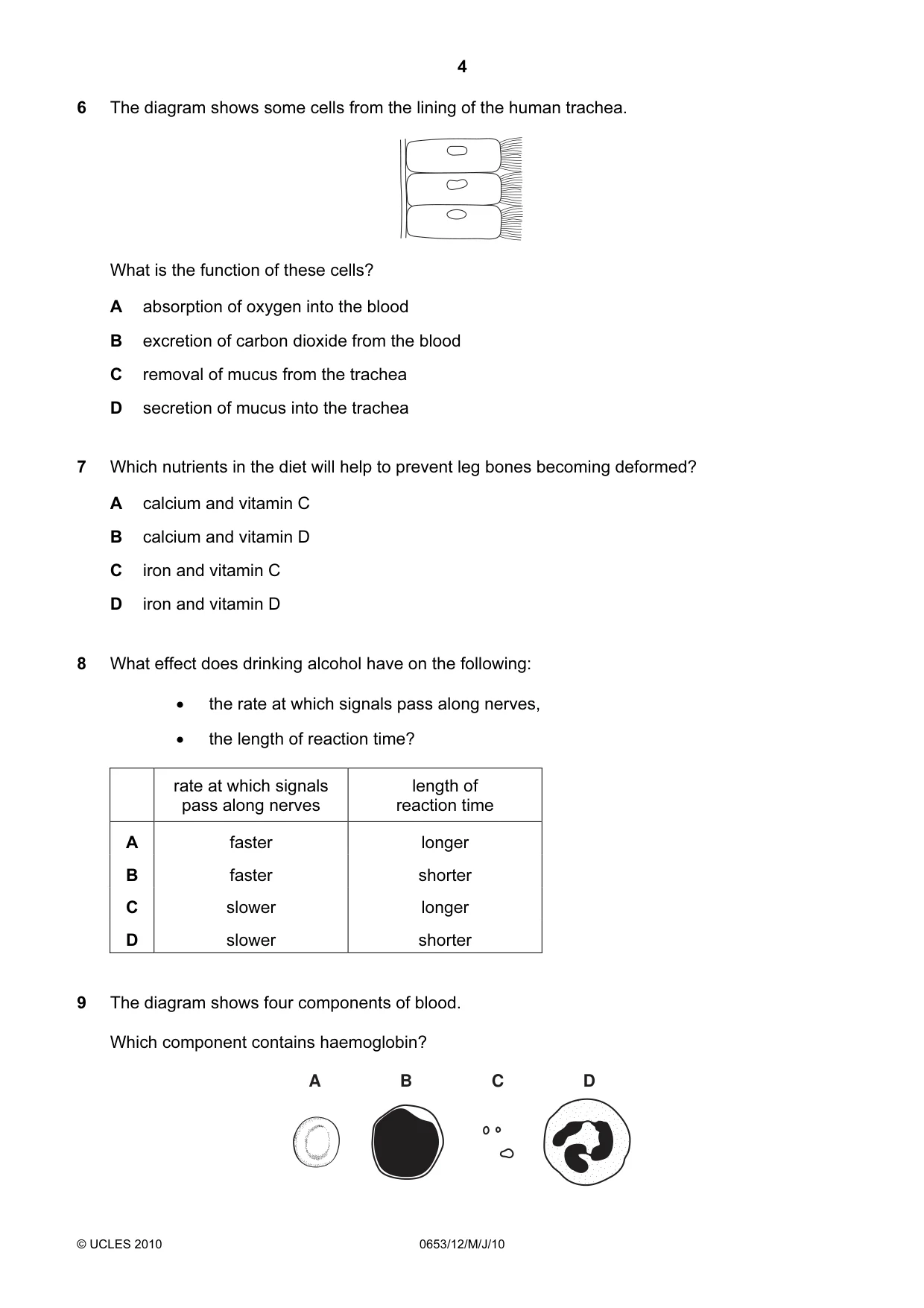
Q9 · The diagram shows four components of blood
9 The diagram shows four components of blood. Which component contains haemoglobin? A B C D
Mark scheme: A
Q10 · Rain forests have high species diversity
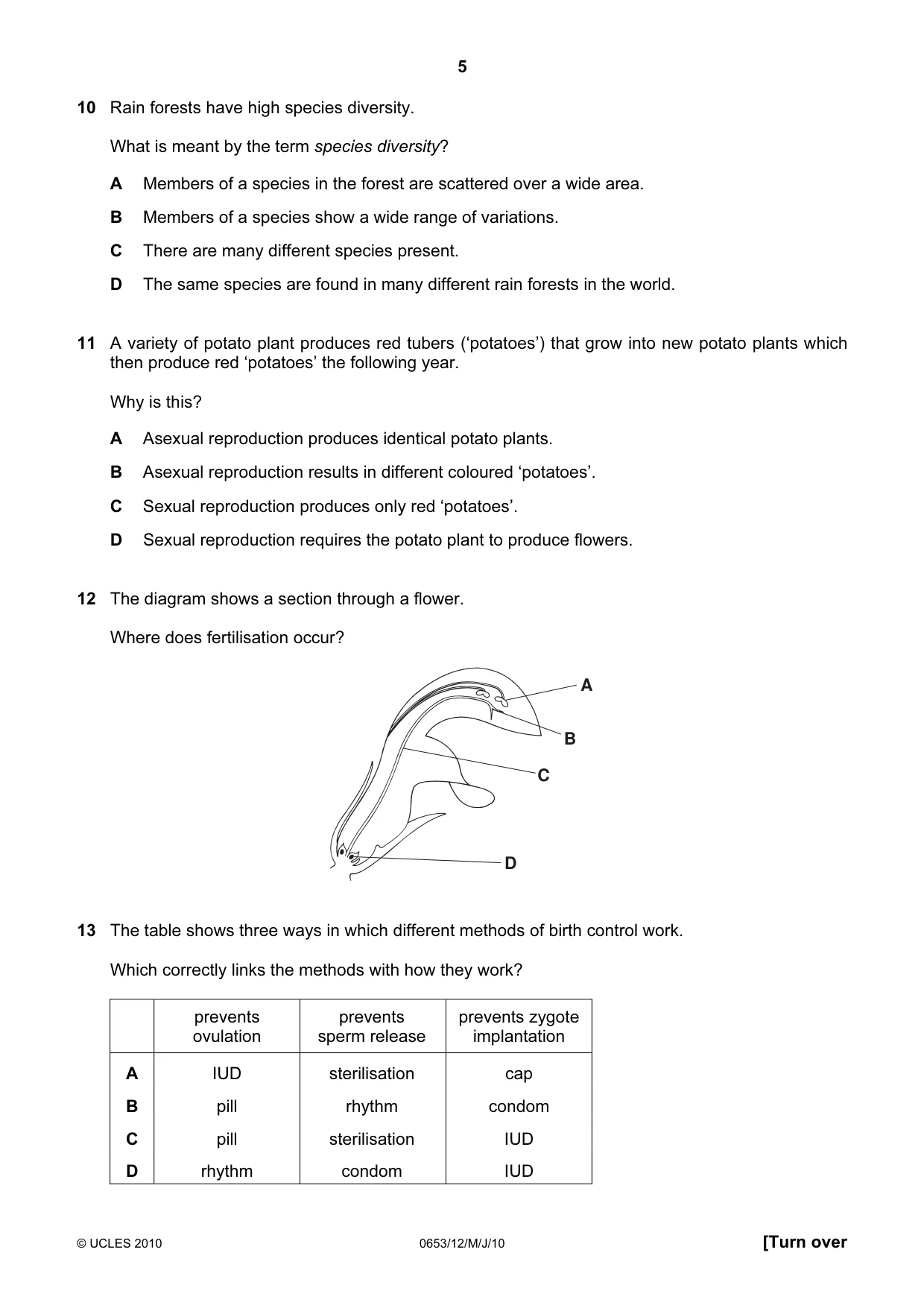
10 Rain forests have high species diversity. What is meant by the term species diversity? A Members of a species in the forest are scattered over a wide area. B Members of a species show a wide range of variations. C There are many different species present. D The same species are found in many different rain forests in the world.
Mark scheme: C
Q11 · A variety of potato plant produces red tubers (‘potatoes’) that grow into new potato…
11 A variety of potato plant produces red tubers (‘potatoes’) that grow into new potato plants which then produce red ‘potatoes’ the following year. Why is this? A Asexual reproduction produces identical potato plants. B Asexual reproduction results in different coloured ‘potatoes’. C Sexual reproduction produces only red ‘potatoes’. D Sexual reproduction requires the potato plant to produce flowers.
Mark scheme: A
Q12 · The diagram shows a section through a flower
12 The diagram shows a section through a flower. Where does fertilisation occur? A B C D
Mark scheme: D
Q13 · The table shows three ways in which different methods of birth control work
13 The table shows three ways in which different methods of birth control work. Which correctly links the methods with how they work? prevents prevents prevents zygote ovulation sperm release implantation A IUD sterilisation cap B pill rhythm condom C pill sterilisation IUD D rhythm condom IUD
Mark scheme: C
Q14 · The diagram shows apparatus used to separate a mixture
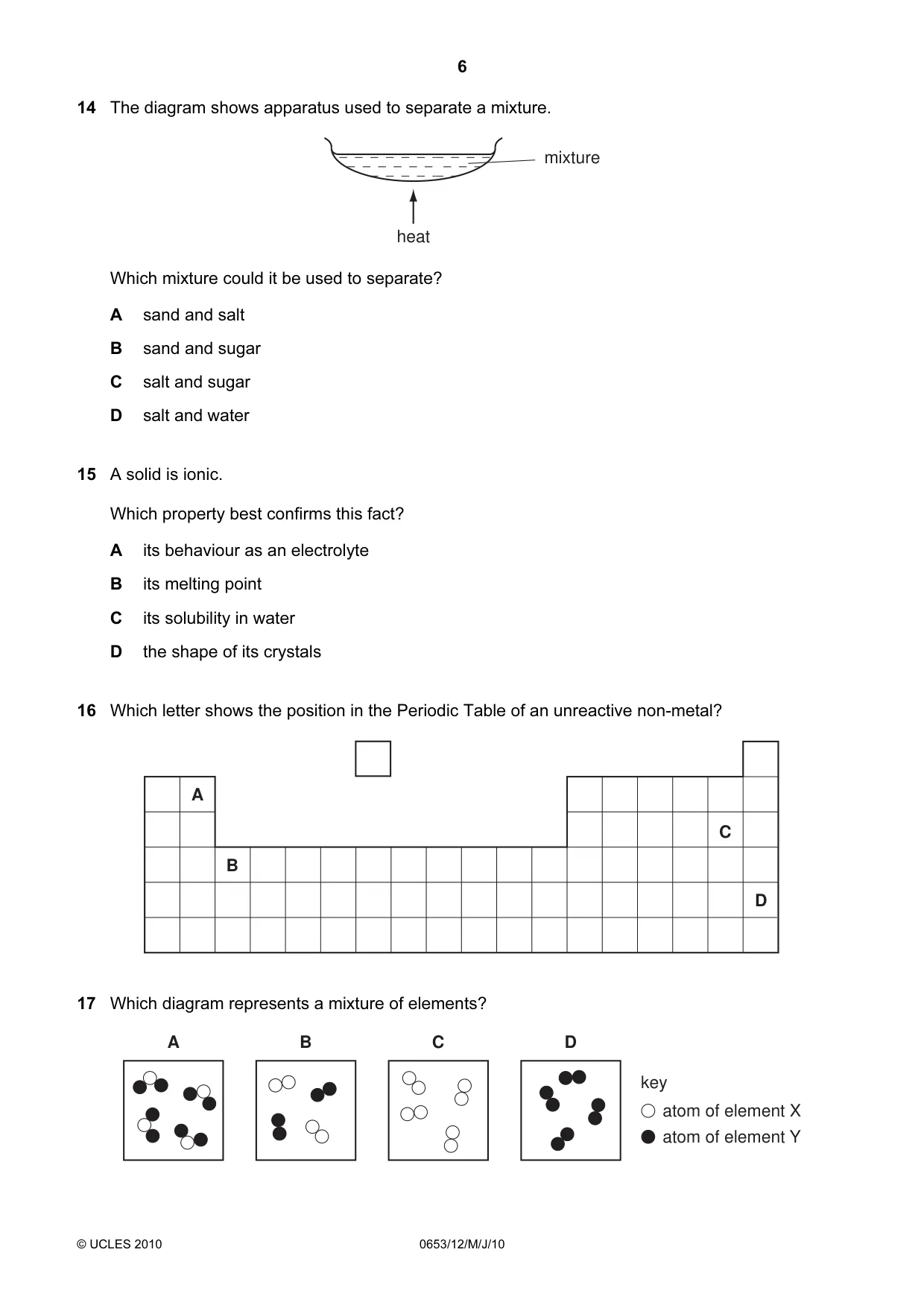
14 The diagram shows apparatus used to separate a mixture. mixture heat Which mixture could it be used to separate? A sand and salt B sand and sugar C salt and sugar D salt and water
Mark scheme: D
Q15 · A solid is ionic
15 A solid is ionic. Which property best confirms this fact? A its behaviour as an electrolyte B its melting point C its solubility in water D the shape of its crystals
Mark scheme: A
Q16 · Which letter shows the position in the Periodic Table of an unreactive non-metal?
16 Which letter shows the position in the Periodic Table of an unreactive non-metal? A C B D
Mark scheme: D
Q17 · Which diagram represents a mixture of elements?
17 Which diagram represents a mixture of elements? A B C D key atom of element X atom of element Y
Mark scheme: B
Q18 · Which processes are used to purify the drinking water from reservoirs?
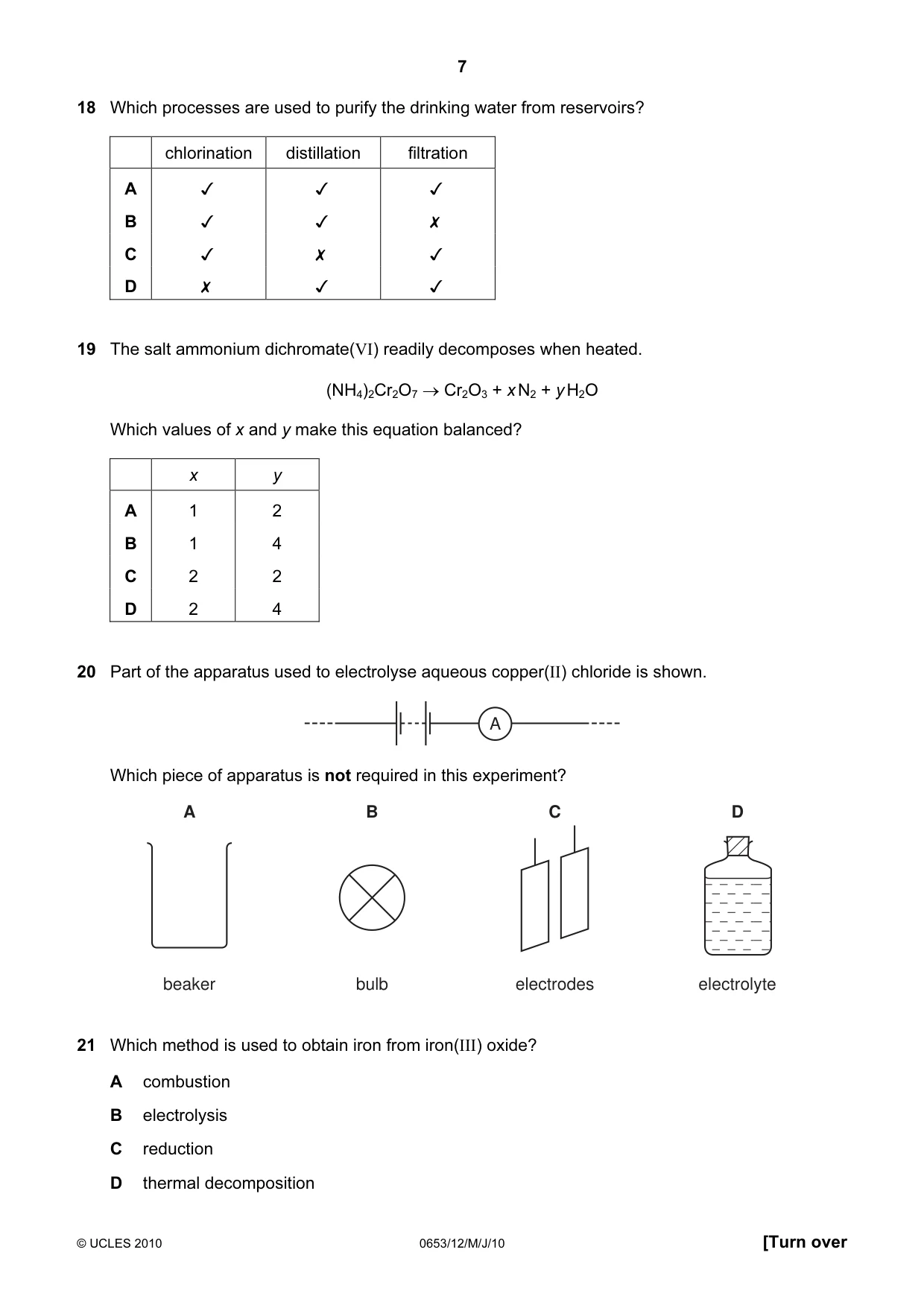
18 Which processes are used to purify the drinking water from reservoirs? chlorination distillation filtration 0 aO WwW D> ~ KOK KS << x
Mark scheme: C
Q19 · The salt ammonium dichromate(VI) readily decomposes when heated
19 The salt ammonium dichromate(VI) readily decomposes when heated. (NH4)2Cr2O7 → Cr2O3 + x N2 + y H2O Which values of x and y make this equation balanced? x y A 1 2 B 1 4 C 2 2 D 2 4
Mark scheme: B
Q20 · Part of the apparatus used to electrolyse aqueous copper(II) chloride is shown
20 Part of the apparatus used to electrolyse aqueous copper(II) chloride is shown. A Which piece of apparatus is not required in this experiment? A B C D beaker bulb electrodes electrolyte
Mark scheme: B
Q21 · Which method is used to obtain iron from iron(III) oxide?
21 Which method is used to obtain iron from iron(III) oxide? A combustion B electrolysis C reduction D thermal decomposition
Mark scheme: C
Q22 · A student carries out experiments with zinc and dilute hydrochloric acid
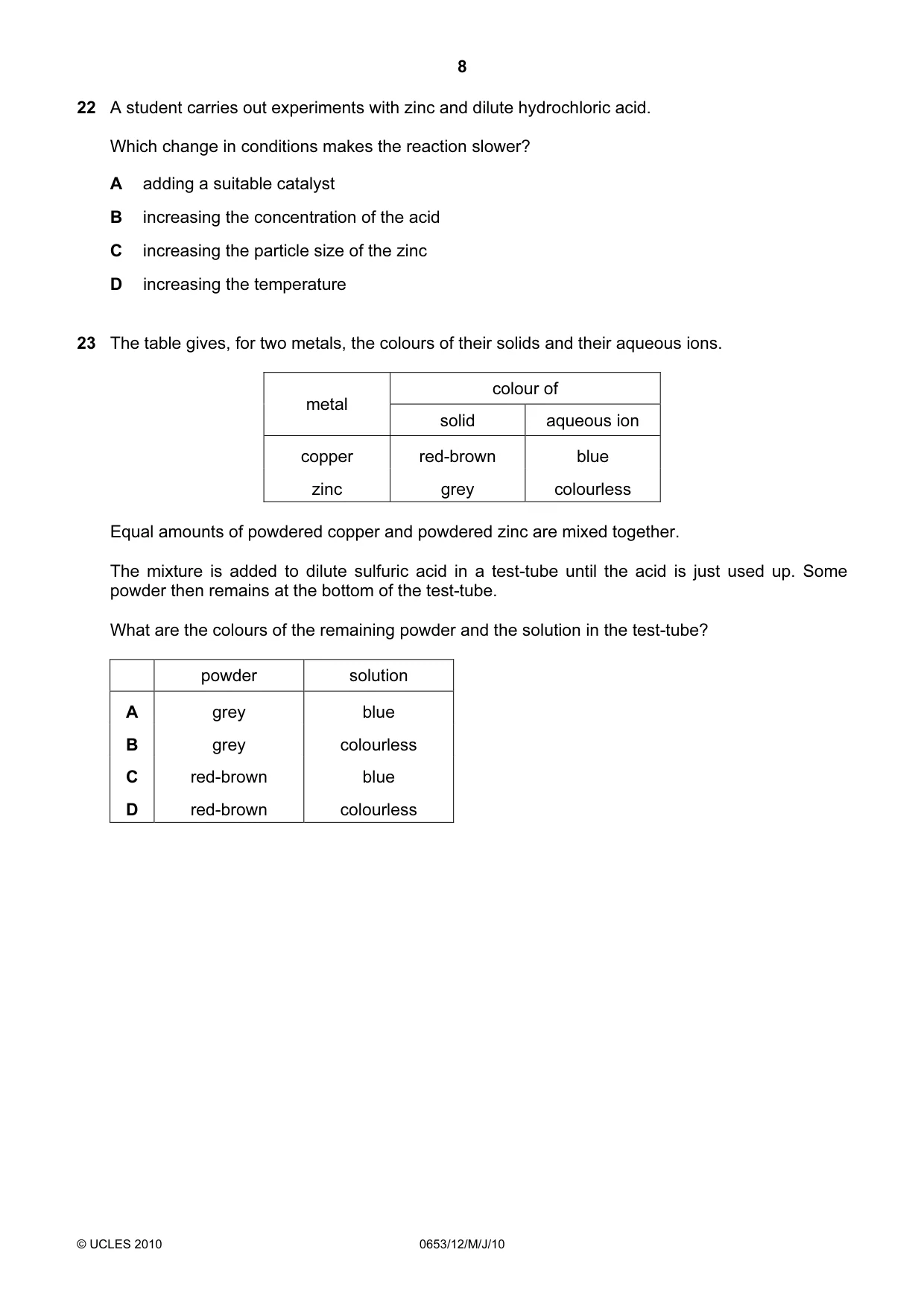
22 A student carries out experiments with zinc and dilute hydrochloric acid. Which change in conditions makes the reaction slower? A adding a suitable catalyst B increasing the concentration of the acid C increasing the particle size of the zinc D increasing the temperature
Mark scheme: C
Q23 · The table gives, for two metals, the colours of their solids and their aqueous ions
23 The table gives, for two metals, the colours of their solids and their aqueous ions. colour of metal solid aqueous ion copper red-brown blue zinc grey colourless Equal amounts of powdered copper and powdered zinc are mixed together. The mixture is added to dilute sulfuric acid in a test-tube until the acid is just used up. Some powder then remains at the bottom of the test-tube. What are the colours of the remaining powder and the solution in the test-tube? powder solution A grey blue B grey colourless C red-brown blue D red-brown colourless
Mark scheme: D
Q24 · A hydrocarbon is burned in excess oxygen
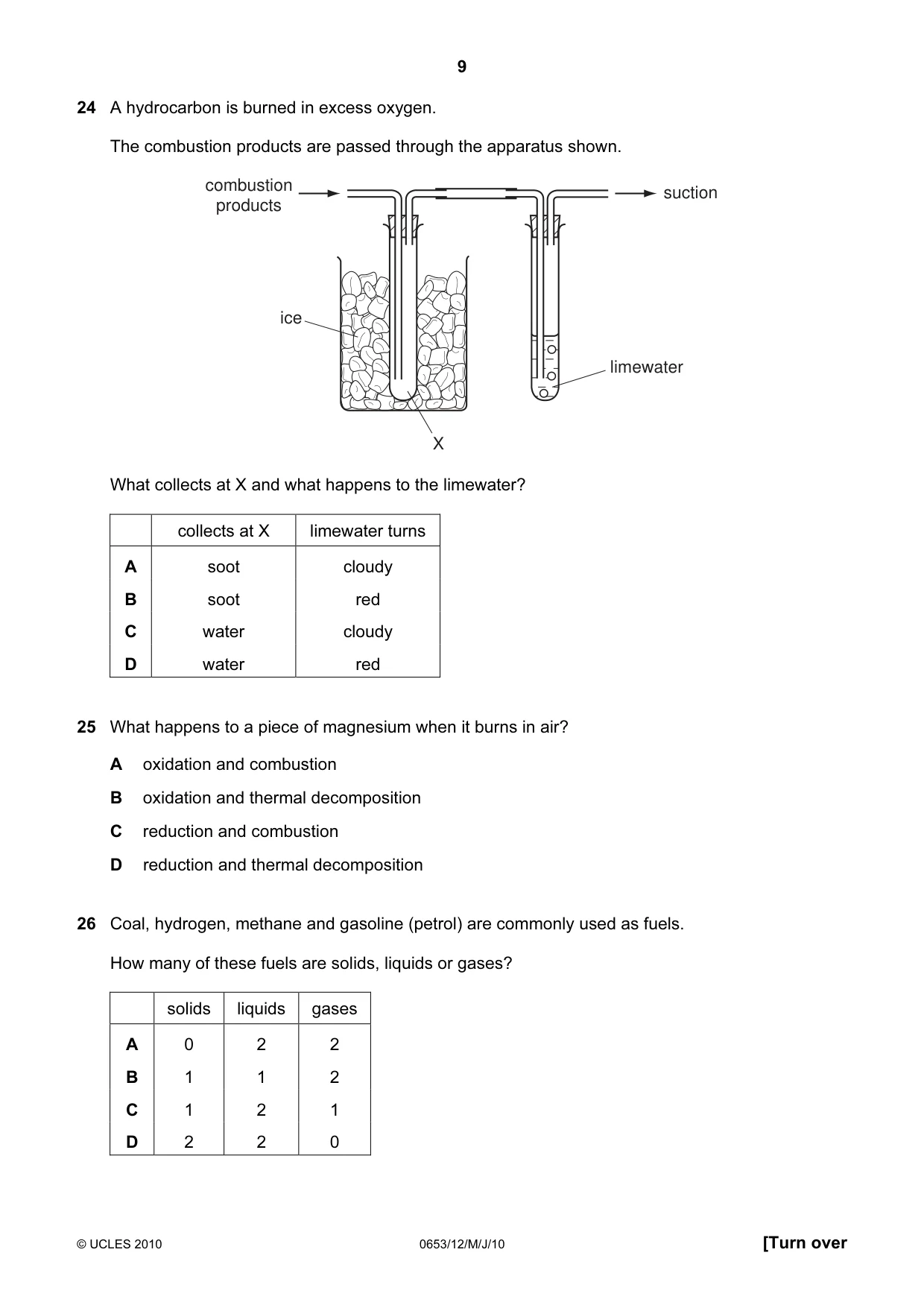
24 A hydrocarbon is burned in excess oxygen. The combustion products are passed through the apparatus shown. combustion suction products ice limewater X What collects at X and what happens to the limewater? collects at X limewater turns A soot cloudy B soot red C water cloudy D water red
Mark scheme: C
Q25 · What happens to a piece of magnesium when it burns in air?
25 What happens to a piece of magnesium when it burns in air? A oxidation and combustion B oxidation and thermal decomposition C reduction and combustion D reduction and thermal decomposition
Mark scheme: A
Q26 · Coal, hydrogen, methane and gasoline (petrol) are commonly used as fuels
26 Coal, hydrogen, methane and gasoline (petrol) are commonly used as fuels. How many of these fuels are solids, liquids or gases? solids liquids gases A 0 2 2 B 1 1 2 C 1 2 1 D 2 2 0
Mark scheme: B
Q27 · This description of a plastic is incomplete
27 This description of a plastic is incomplete. To make a plastic, ……1…… of a ……2…… combine to form a long chain ……3…… . Which words correctly complete the gaps? 1 2 3 A atoms monomer polymer B atoms polymer monomer C molecules monomer polymer D molecules polymer monomer
Mark scheme: C
Q28 · Water spilled on the ground on a hot day evaporates
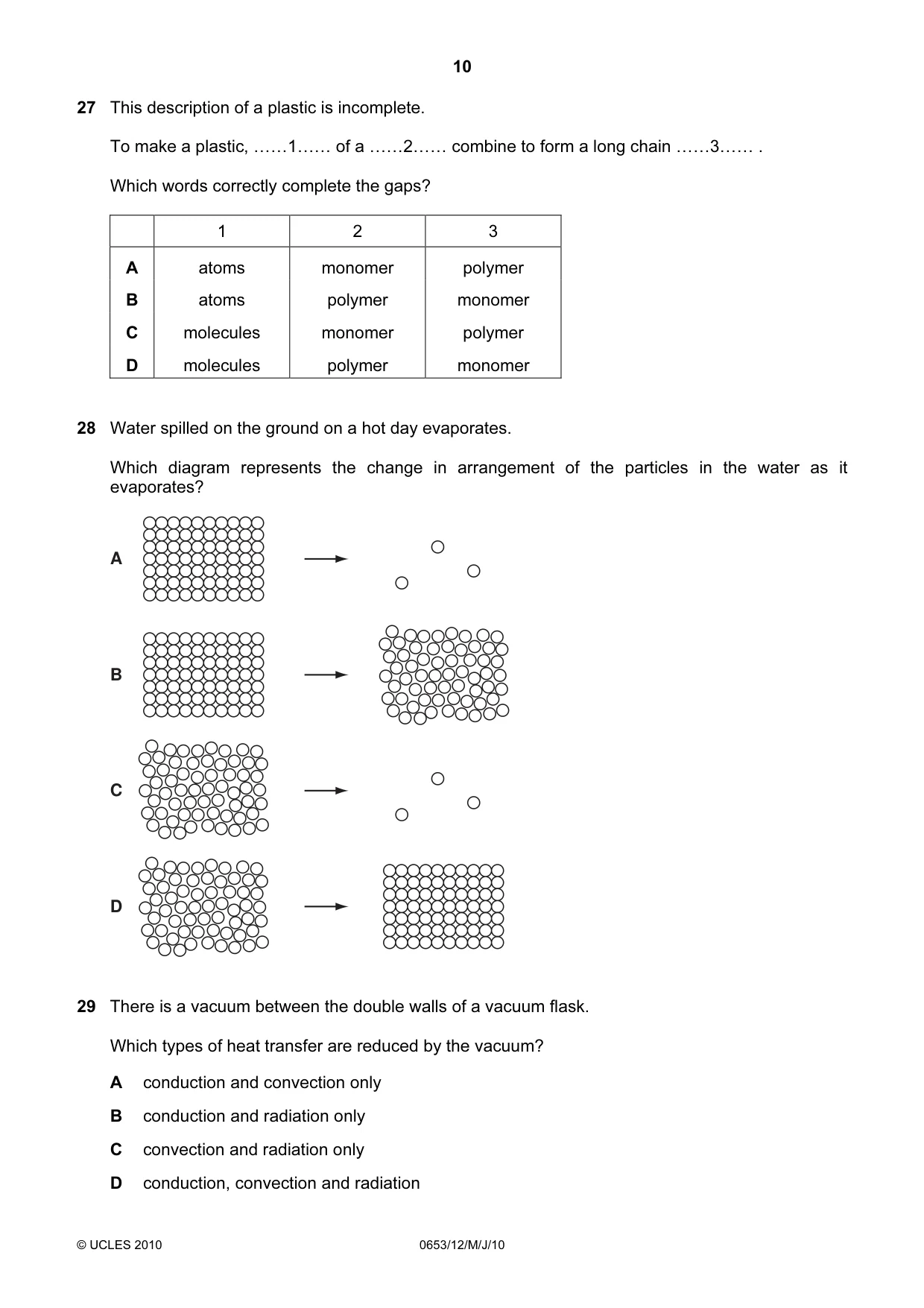
28 Water spilled on the ground on a hot day evaporates. Which diagram represents the change in arrangement of the particles in the water as it evaporates? A B C D
Mark scheme: C
Q29 · There is a vacuum between the double walls of a vacuum flask
29 There is a vacuum between the double walls of a vacuum flask. Which types of heat transfer are reduced by the vacuum? A conduction and convection only B conduction and radiation only C convection and radiation only D conduction, convection and radiation
Mark scheme: A
Q30 · In which situation would the object described be given an increase in its total energy?
30 In which situation would the object described be given an increase in its total energy? A a battery-powered torch being switched on B a firework exploding C a parachutist falling to the ground D a skier being pulled up a slope
Mark scheme: D
Q31 · A tidal power station is made by building a barrage
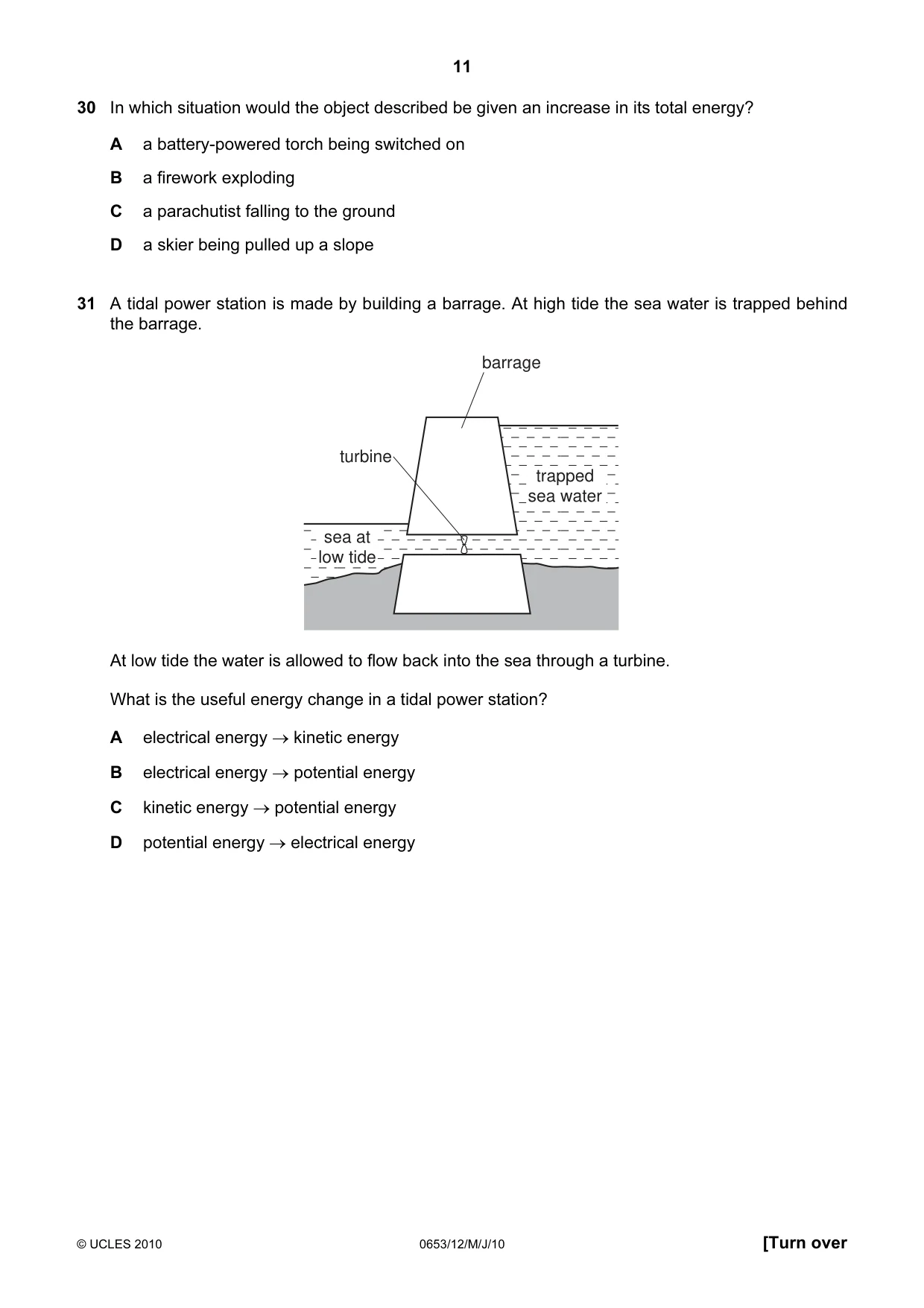
31 A tidal power station is made by building a barrage. At high tide the sea water is trapped behind the barrage. barrage turbine trapped sea water sea at low tide At low tide the water is allowed to flow back into the sea through a turbine. What is the useful energy change in a tidal power station? A electrical energy → kinetic energy B electrical energy → potential energy C kinetic energy → potential energy D potential energy → electrical energy
Mark scheme: D
Q32 · In each of the circuits shown, identical resistors, cells and lamps are used
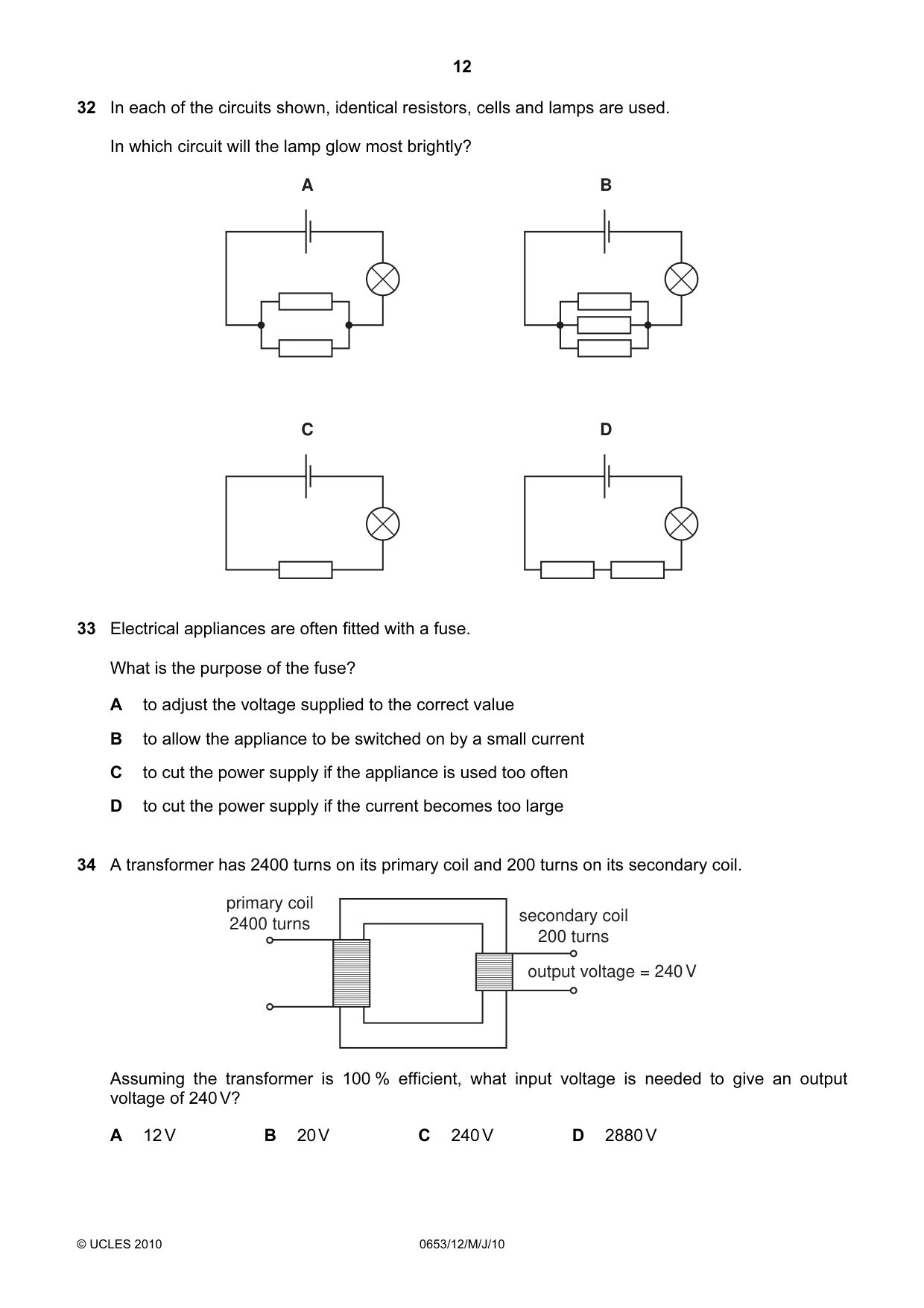
32 In each of the circuits shown, identical resistors, cells and lamps are used. In which circuit will the lamp glow most brightly? A B C D
Mark scheme: B
Q33 · Electrical appliances are often fitted with a fuse
33 Electrical appliances are often fitted with a fuse. What is the purpose of the fuse? A to adjust the voltage supplied to the correct value B to allow the appliance to be switched on by a small current C to cut the power supply if the appliance is used too often D to cut the power supply if the current becomes too large
Mark scheme: D
Q34 · A transformer has 2400 turns on its primary coil and 200 turns on its secondary coil
34 A transformer has 2400 turns on its primary coil and 200 turns on its secondary coil. primary coil 2400 turns secondary coil 200 turns output voltage = 240 V Assuming the transformer is 100 % efficient, what input voltage is needed to give an output voltage of 240 V? A 12 V B 20 V C 240 V D 2880 V
Mark scheme: D
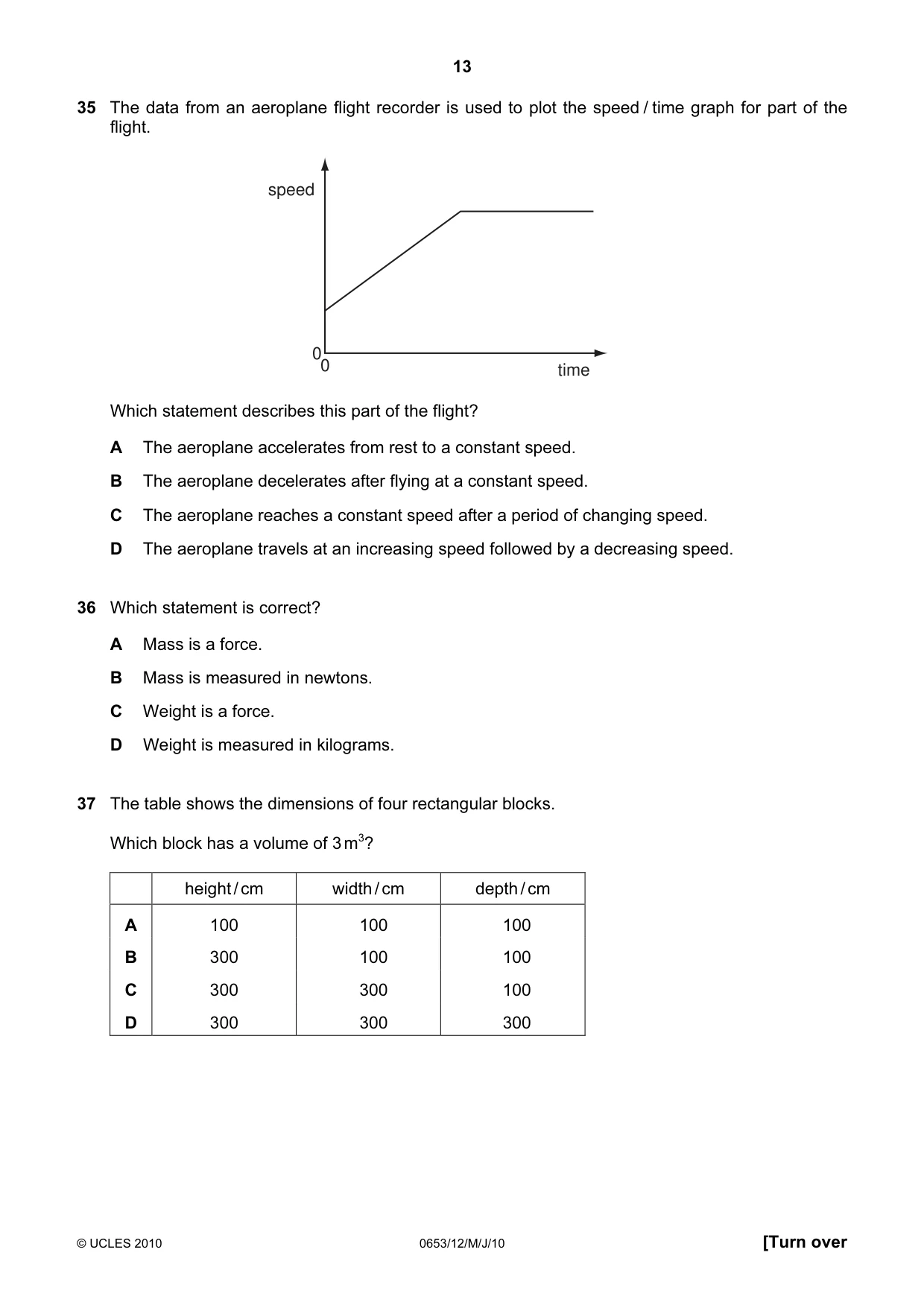
Q35 · The data from an aeroplane flight recorder is used to plot the speed / time graph for…
35 The data from an aeroplane flight recorder is used to plot the speed / time graph for part of the flight. speed 00 time Which statement describes this part of the flight? A The aeroplane accelerates from rest to a constant speed. B The aeroplane decelerates after flying at a constant speed. C The aeroplane reaches a constant speed after a period of changing speed. D The aeroplane travels at an increasing speed followed by a decreasing speed.
Mark scheme: C
Q36 · Which statement is correct?
36 Which statement is correct? A Mass is a force. B Mass is measured in newtons. C Weight is a force. D Weight is measured in kilograms.
Mark scheme: C
Q37 · The table shows the dimensions of four rectangular blocks
37 The table shows the dimensions of four rectangular blocks. Which block has a volume of 3 m3? height / cm width / cm depth / cm A 100 100 100 B 300 100 100 C 300 300 100 D 300 300 300
Mark scheme: B
More questions on Physical quantities and measurement techniques
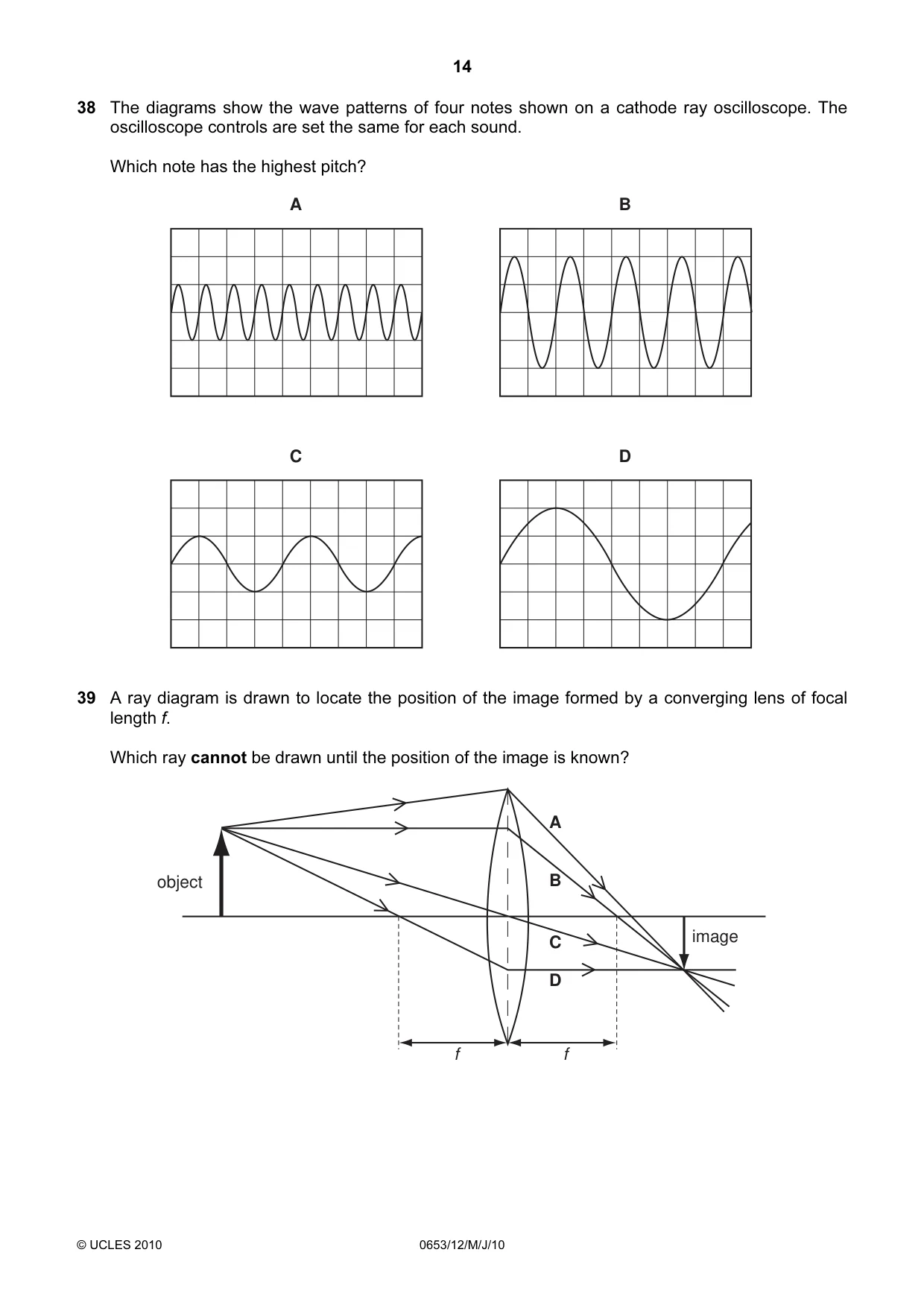
Q38 · The diagrams show the wave patterns of four notes shown on a cathode ray oscilloscope
38 The diagrams show the wave patterns of four notes shown on a cathode ray oscilloscope. The oscilloscope controls are set the same for each sound. Which note has the highest pitch? A B C D
Mark scheme: A
Q39 · A ray diagram is drawn to locate the position of the image formed by a converging lens of…
39 A ray diagram is drawn to locate the position of the image formed by a converging lens of focal length f. Which ray cannot be drawn until the position of the image is known? A object B C image D f f
Mark scheme: A
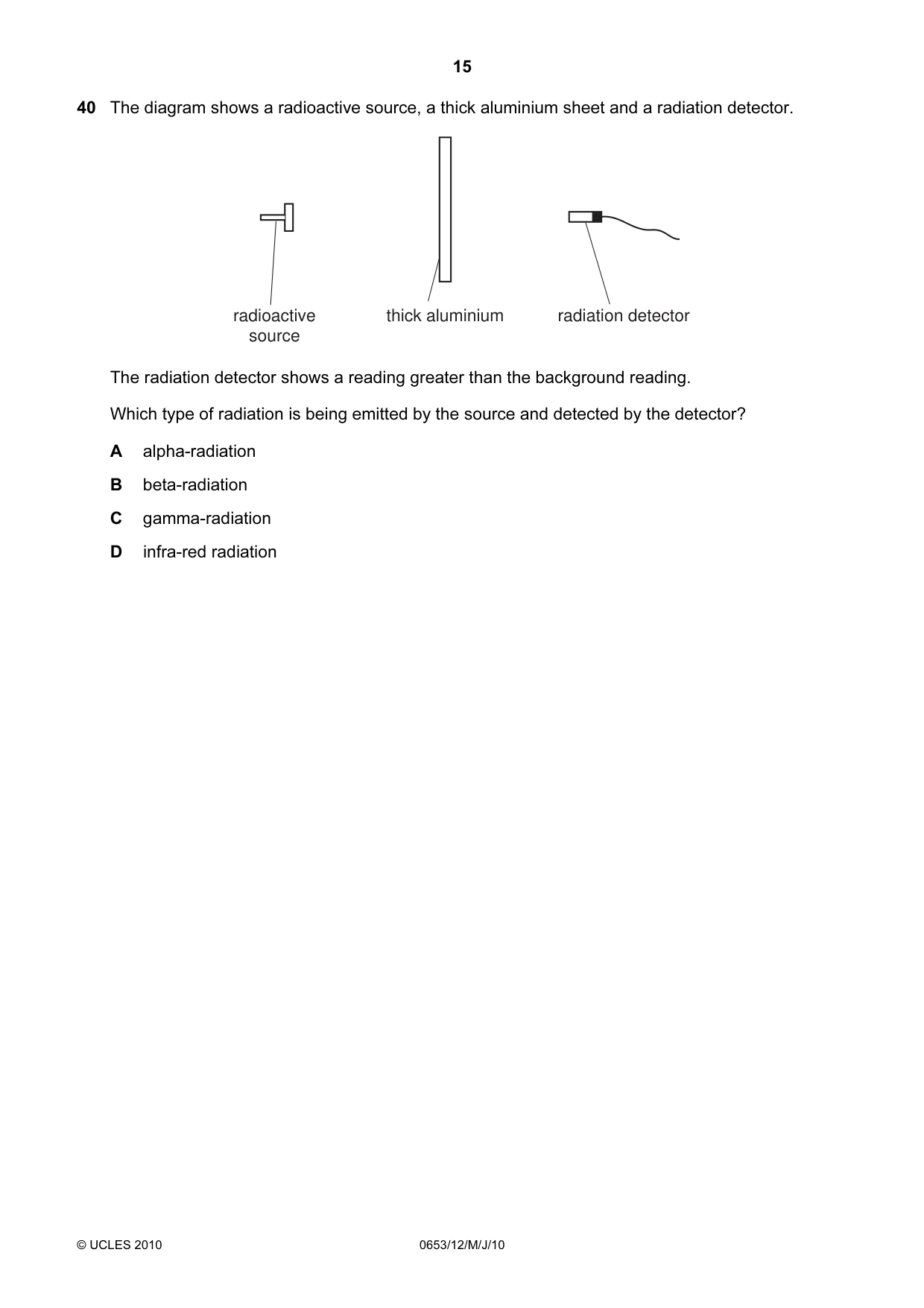
Q40 · The diagram shows a radioactive source, a thick aluminium sheet and a radiation detector
40 The diagram shows a radioactive source, a thick aluminium sheet and a radiation detector. radioactive thick aluminium radiation detector source The radiation detector shows a reading greater than the background reading. Which type of radiation is being emitted by the source and detected by the detector? A alpha-radiation B beta-radiation C gamma-radiation D infra-red radiation
Mark scheme: C
What was in this paper
The subtopics covered by these 40 questions, and how many questions each got. Open one in a new tab to see every Cambridge question on it.
2Fuels2Sexual reproduction in plants2Blood1Cell structure1Cells, batteries, generators and motors1Conservation1Diet1Diffusion1Drugs1Electrical circuits1Electrical safety1Electrolysis1Electromagnetic spectrum1Elements, compounds and mixtures1Enzymes1Extraction of metals1Formulas1Gas exchange in humans1Ions and ionic bonds1Kinetic particle model of matter1Leaf structure1Light1Mass and weight1Motion1Noble gases1Physical quantities and measurement techniques1Polymers1Rate of reaction1Reactivity series1Redox1Respiration1Separation and purification1Sexual reproduction in humans1Sound1Transfer of thermal energy1Water1What you needed in this session
Cambridge’s own grade thresholds for 2010 May/June, Paper 1 · Variant 2. A higher threshold means an easier paper — the bar moves with how the cohort did.