Cambridge IGCSE Science - Combined 0653 — 2023 May/June Paper 1 · Variant 1
0653/11/M/J/23 · 40 questions · 40 marks · ≈45 min
The question paper and its mark scheme, free to read here and free to download. This is Cambridge’s own paper, exactly as it was sat.
Question paper16 pages
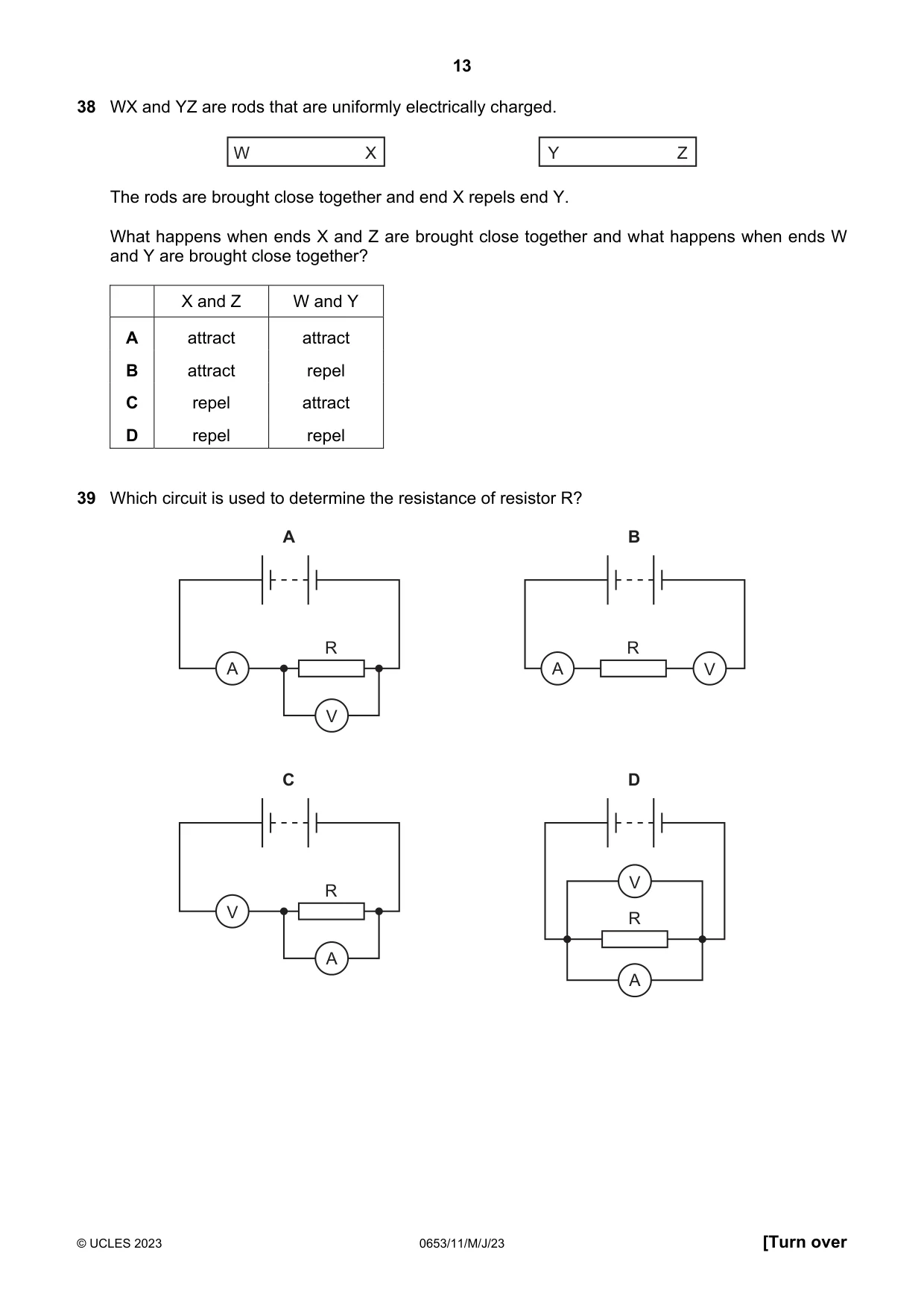
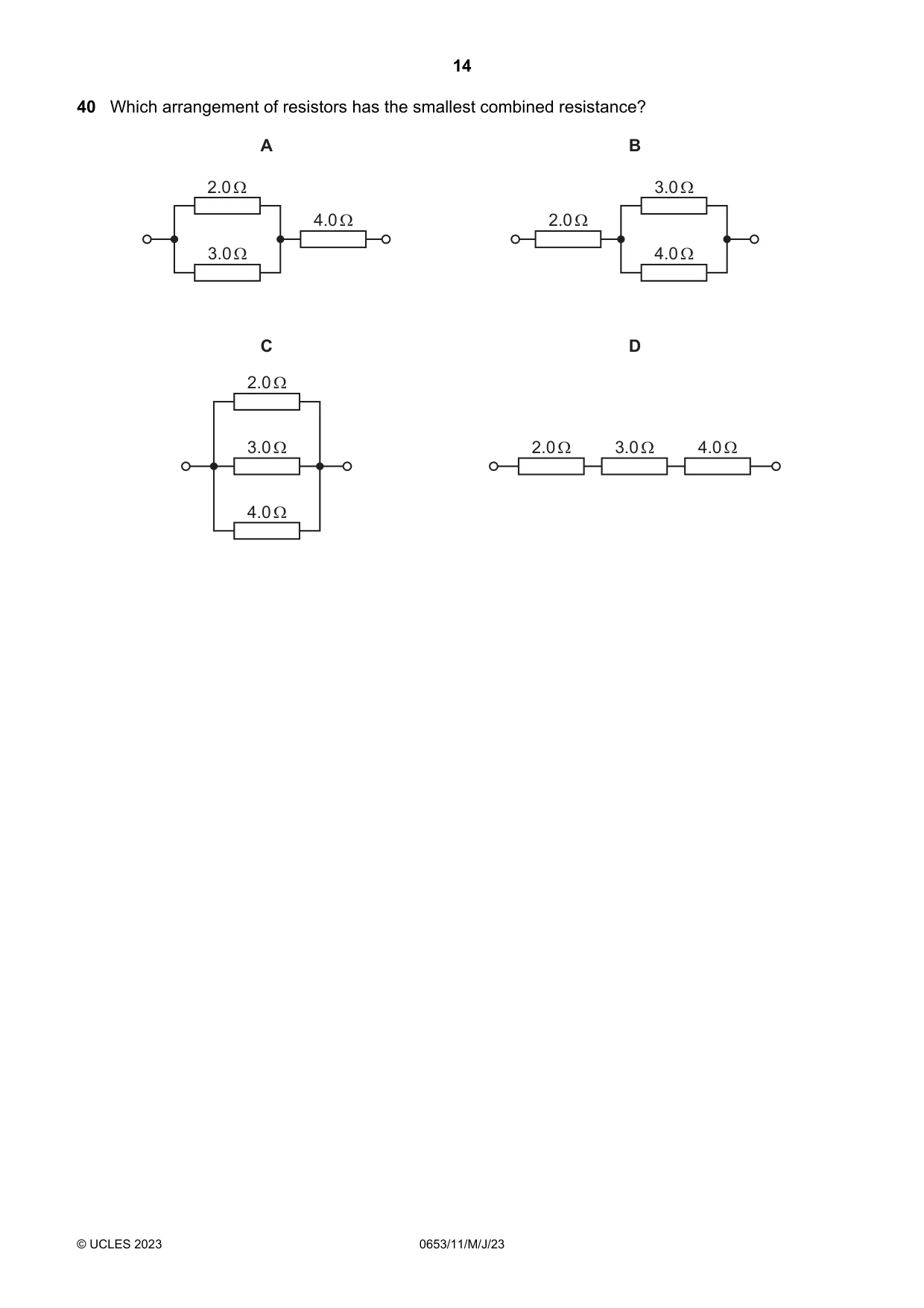

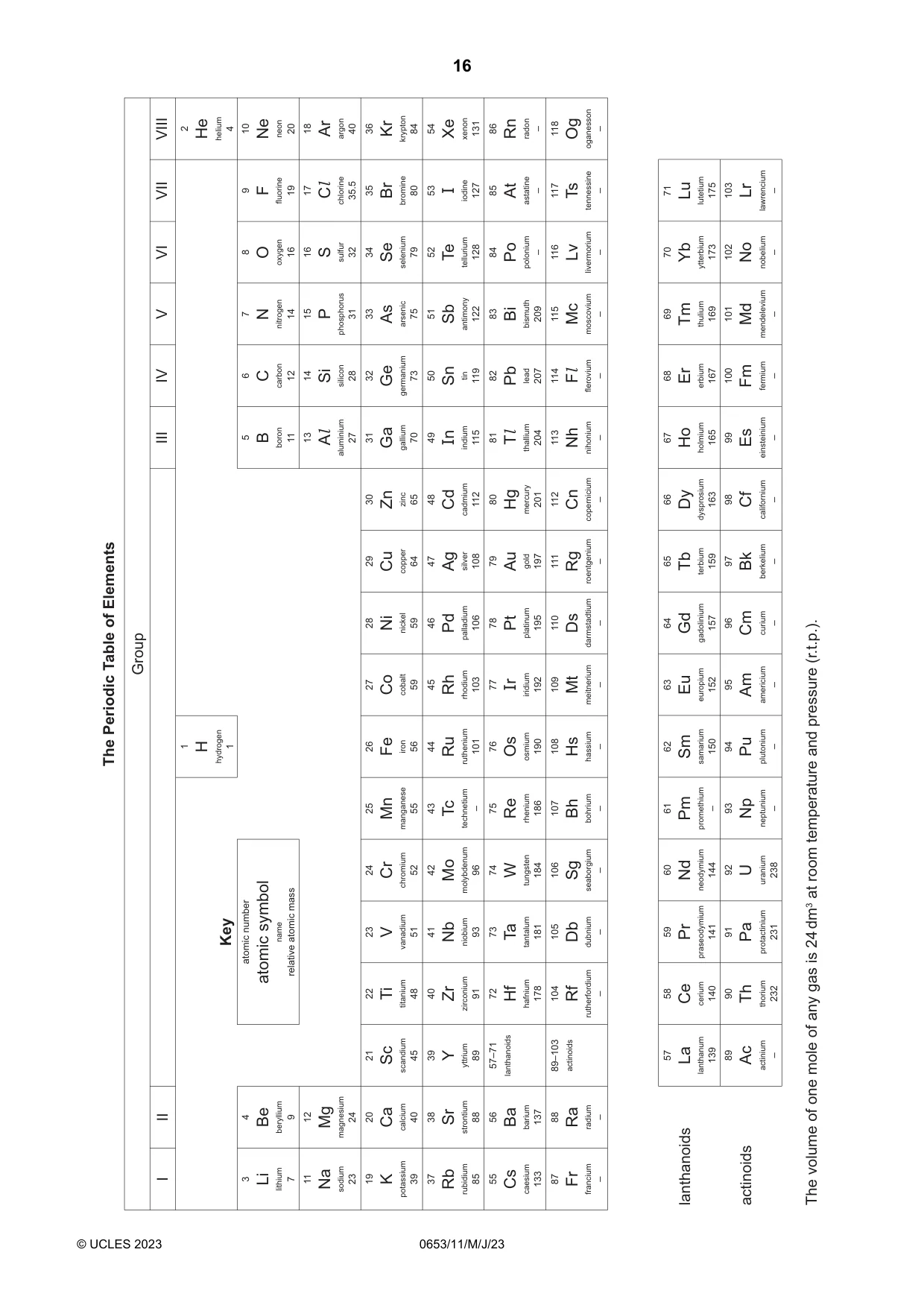
Mark scheme3 pages
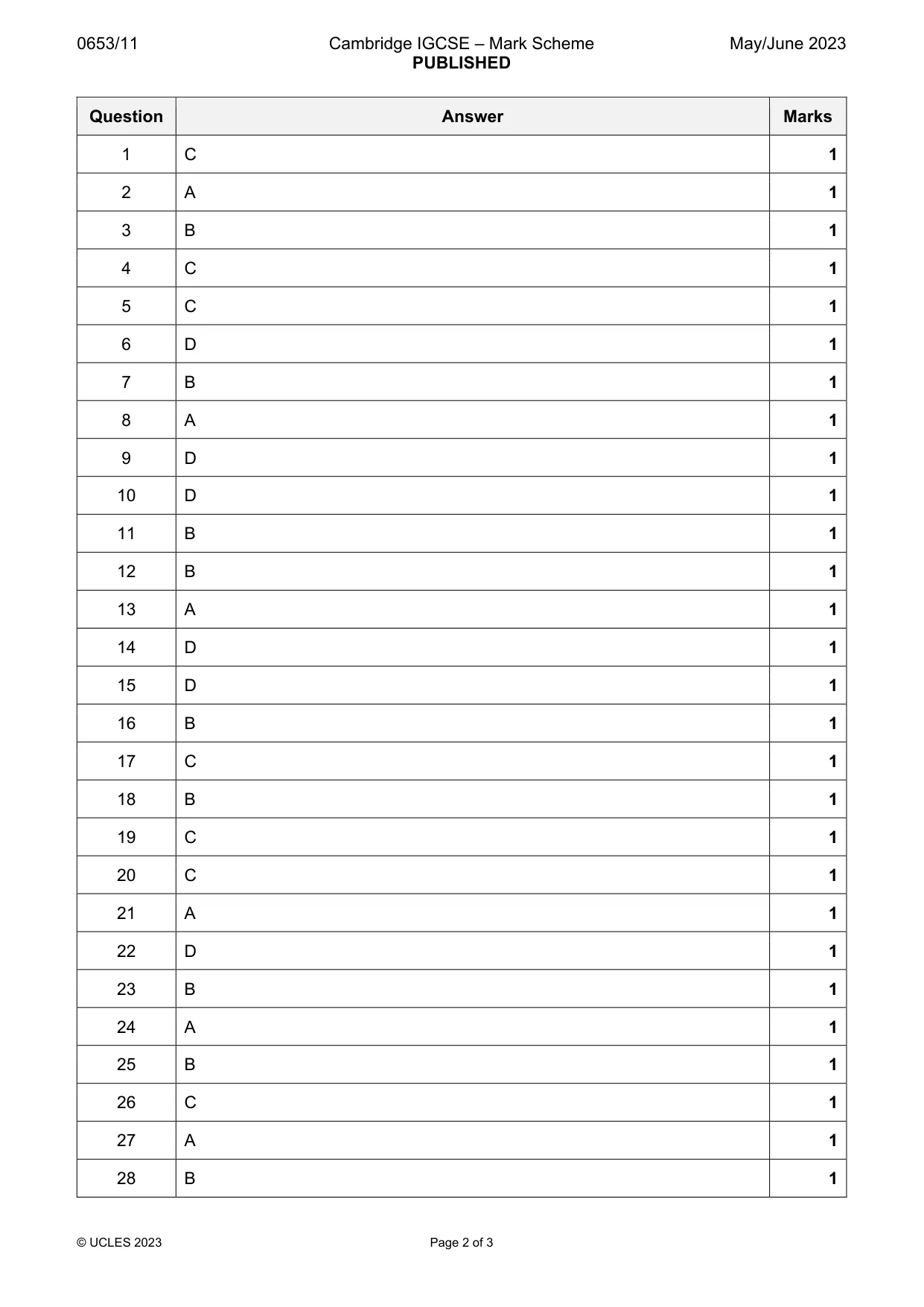
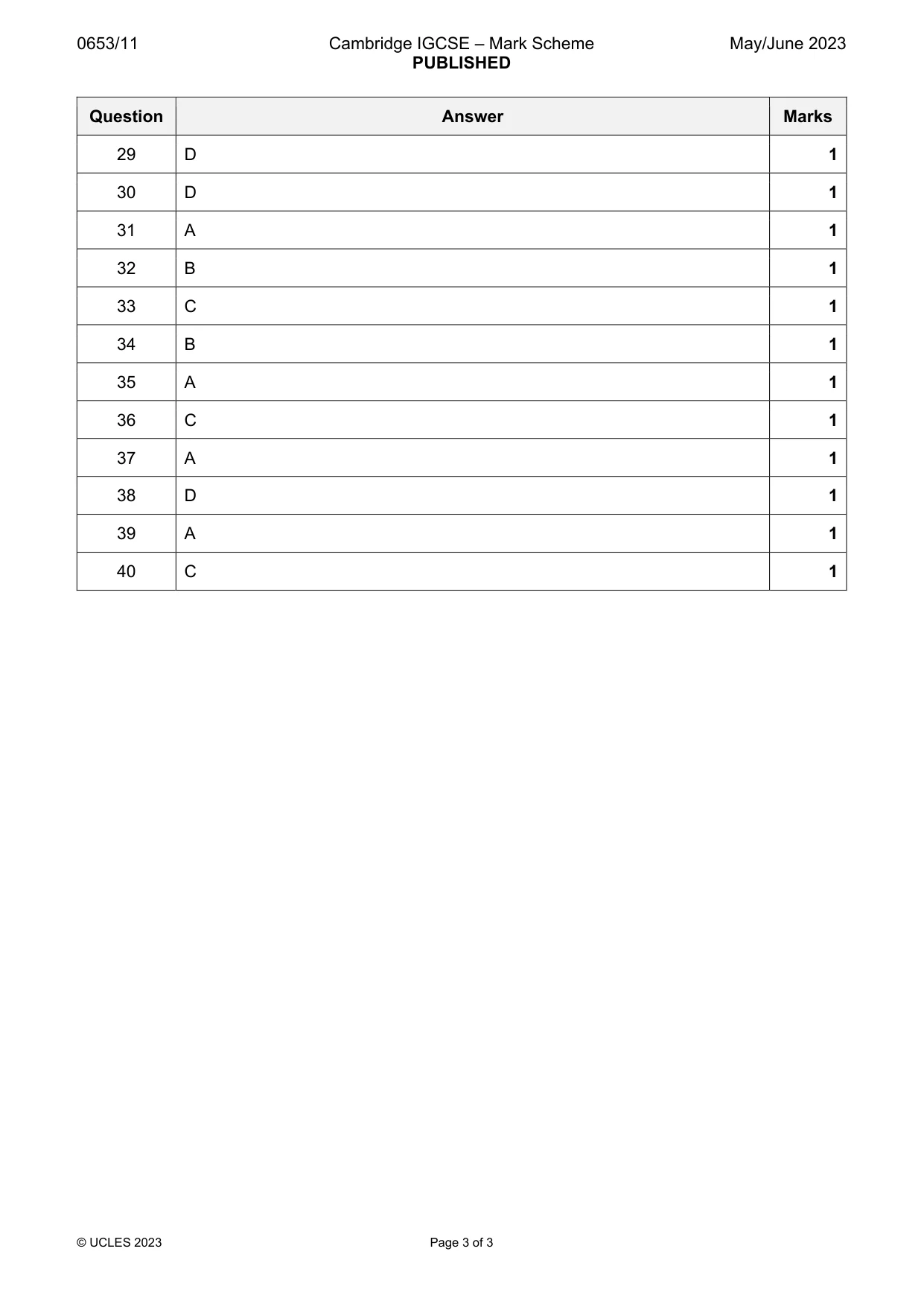
Answers below. Sit the paper first if you are practising.
Questions as text
Q1 · Which characteristic of living organisms involves chemical reactions in cells that break…
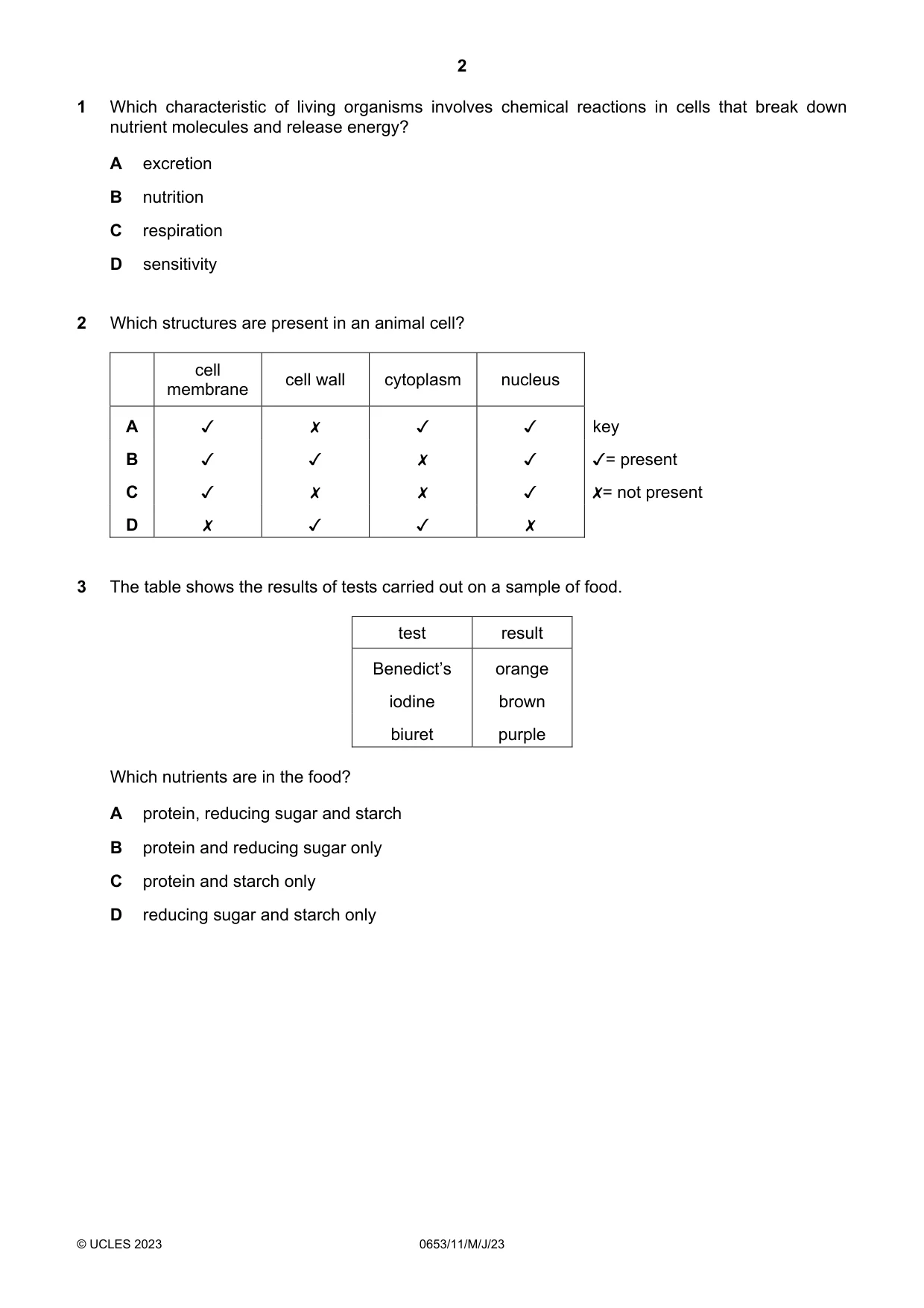
1 Which characteristic of living organisms involves chemical reactions in cells that break down nutrient molecules and release energy? A excretion B nutrition C respiration D sensitivity
Mark scheme: C
Q2 · Which structures are present in an animal cell?
2 Which structures are present in an animal cell? cell membrane cell wall cytoplasm nucleus A JV x V y B JV JV x y Cc WA x x y D x JV W, x key /= present X= not present
Mark scheme: A
Q3 · The table shows the results of tests carried out on a sample of food
3 The table shows the results of tests carried out on a sample of food. test result Benedict’s orange iodine brown biuret purple Which nutrients are in the food? A protein, reducing sugar and starch B protein and reducing sugar only C protein and starch only D reducing sugar and starch only
Mark scheme: B
Q4 · The diagram shows a section through part of a leaf
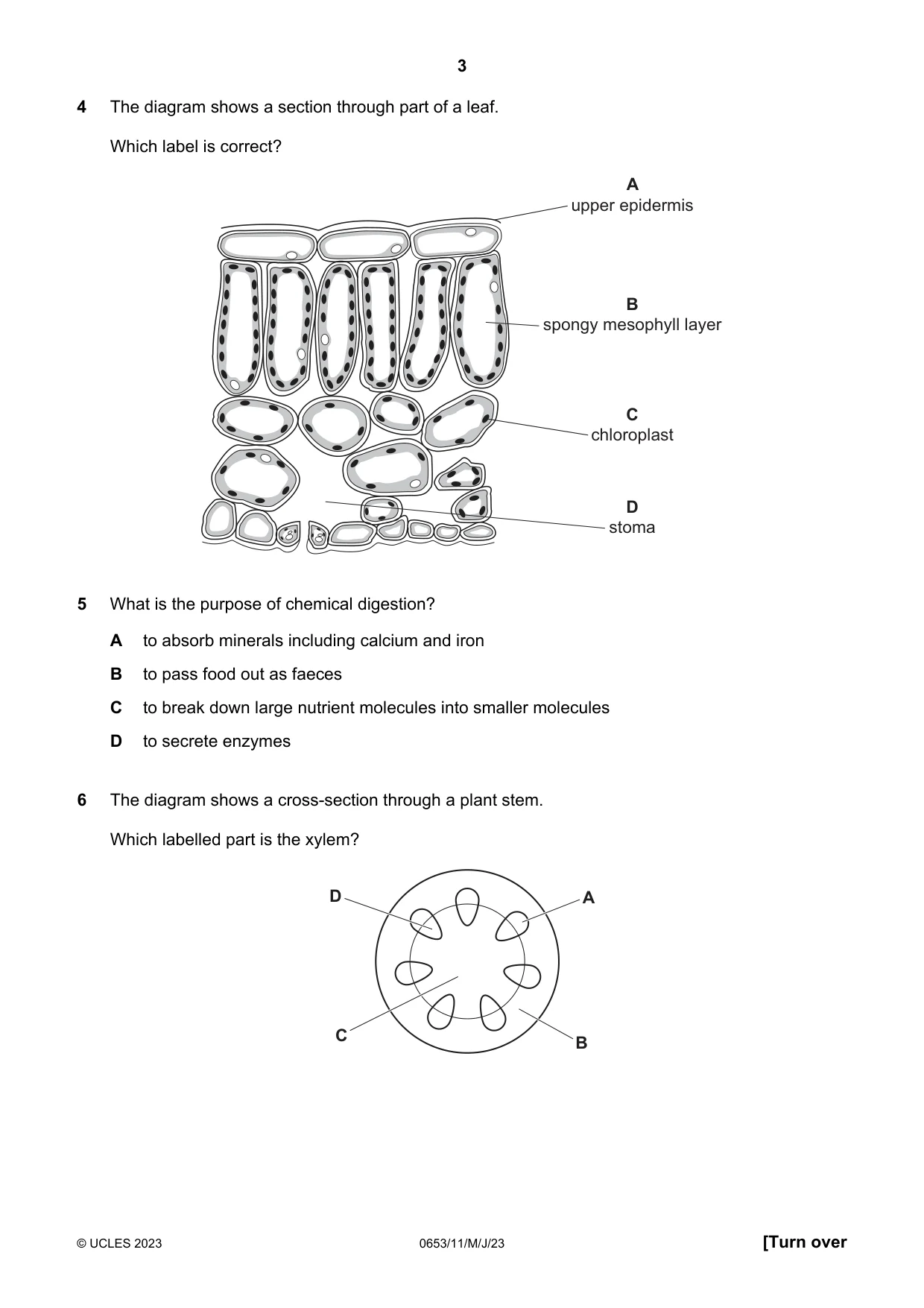
4 The diagram shows a section through part of a leaf. Which label is correct? A upper epidermis B spongy mesophyll layer C chloroplast D stoma
Mark scheme: C
Q5 · What is the purpose of chemical digestion?
5 What is the purpose of chemical digestion? A to absorb minerals including calcium and iron B to pass food out as faeces C to break down large nutrient molecules into smaller molecules D to secrete enzymes
Mark scheme: C
Q6 · The diagram shows a cross-section through a plant stem
6 The diagram shows a cross-section through a plant stem. Which labelled part is the xylem? D A C B
Mark scheme: D
Q7 · The diagram shows a section through the heart
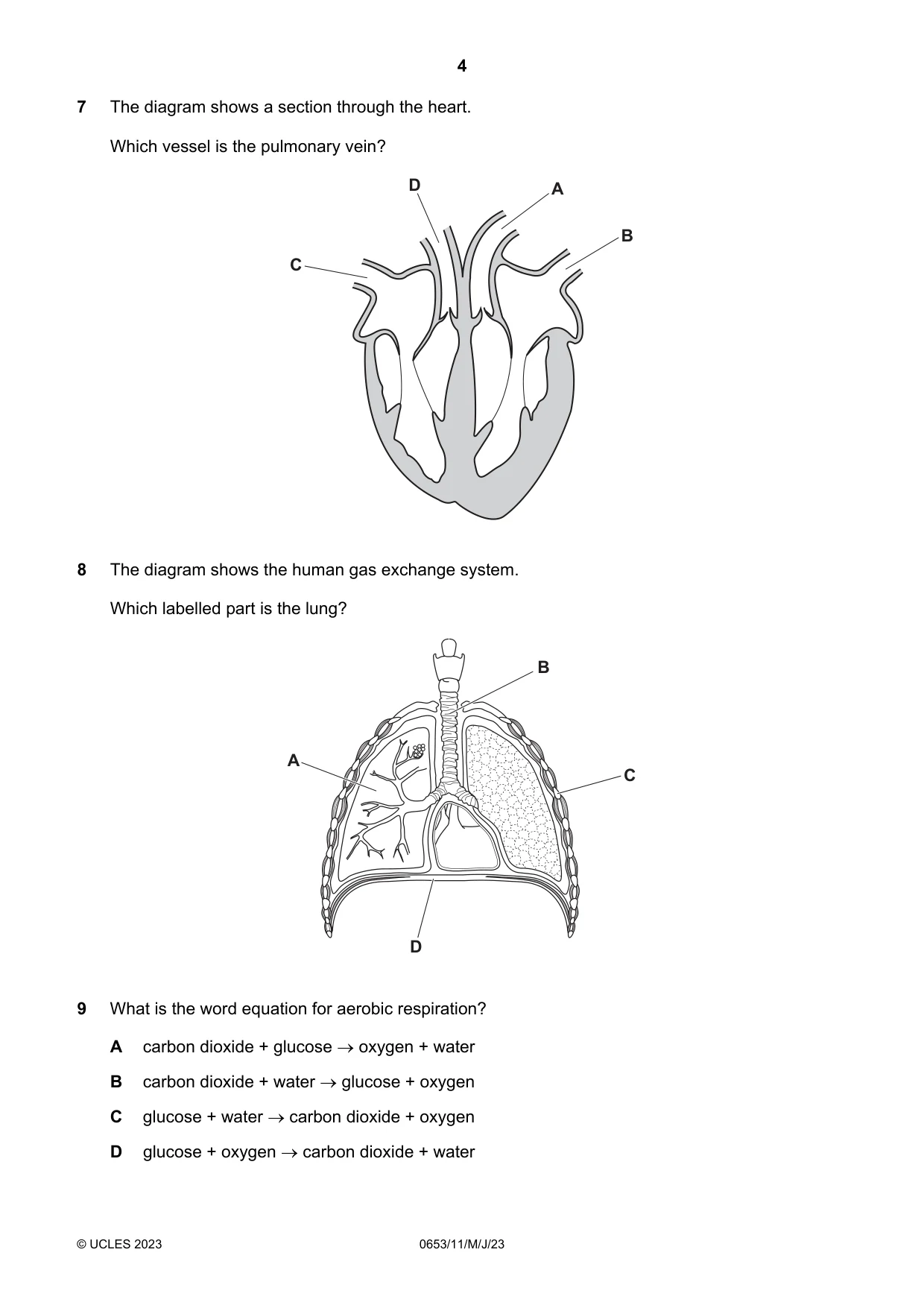
7 The diagram shows a section through the heart. Which vessel is the pulmonary vein? D A B C
Mark scheme: B
Q8 · The diagram shows the human gas exchange system
8 The diagram shows the human gas exchange system. Which labelled part is the lung? B A C D
Mark scheme: A
Q9 · What is the word equation for aerobic respiration?
9 What is the word equation for aerobic respiration? A carbon dioxide + glucose oxygen + water B carbon dioxide + water glucose + oxygen C glucose + water carbon dioxide + oxygen D glucose + oxygen carbon dioxide + water
Mark scheme: D
Q10 · What are features of sexual reproduction?
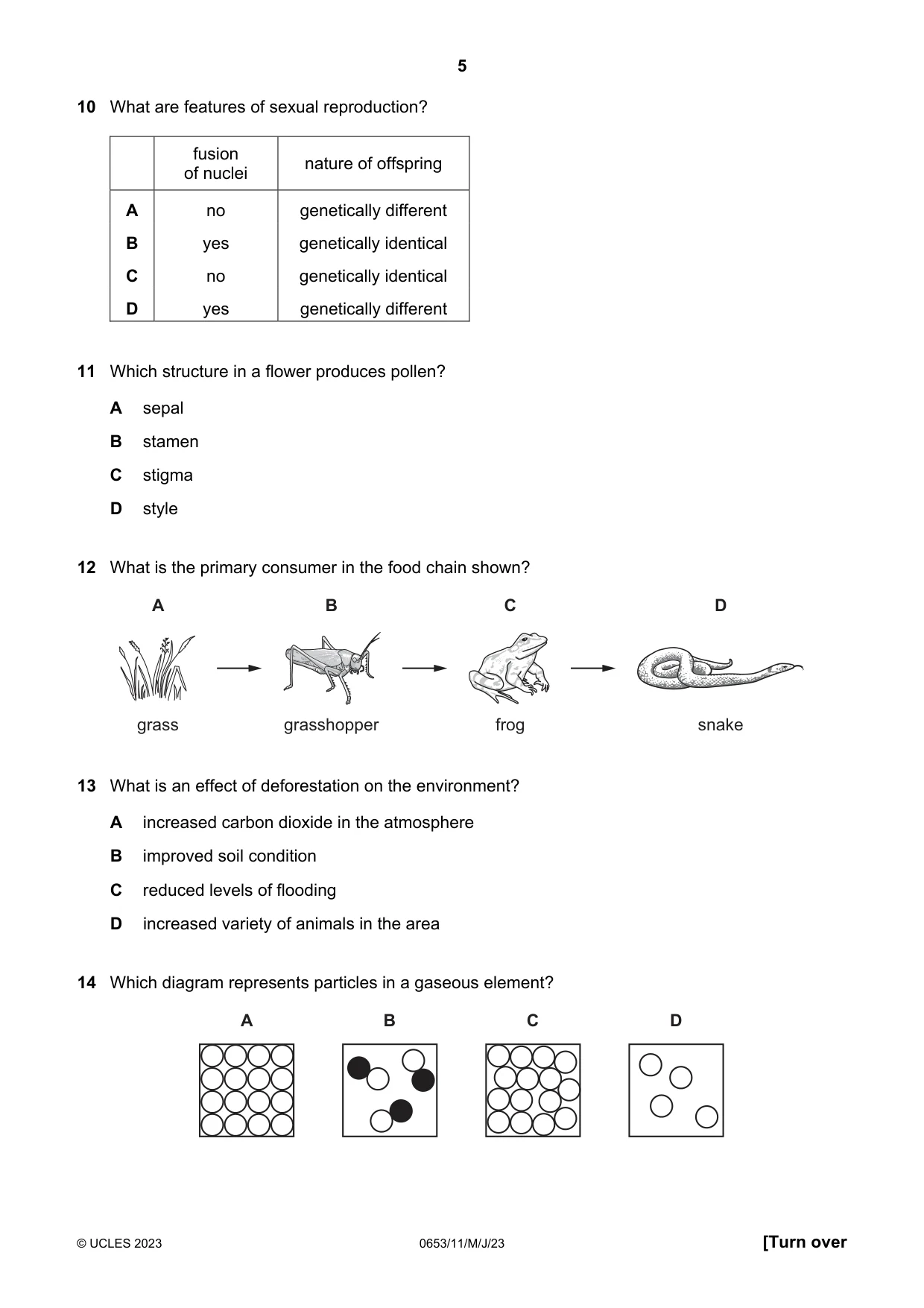
10 What are features of sexual reproduction? fusion nature of offspring of nuclei A no genetically different B yes genetically identical C no genetically identical D yes genetically different
Mark scheme: D
Q11 · Which structure in a flower produces pollen?
11 Which structure in a flower produces pollen? A sepal B stamen C stigma D style
Mark scheme: B
Q12 · What is the primary consumer in the food chain shown?
12 What is the primary consumer in the food chain shown? A B C D grass grasshopper frog snake
Mark scheme: B
Q13 · What is an effect of deforestation on the environment?
13 What is an effect of deforestation on the environment? A increased carbon dioxide in the atmosphere B improved soil condition C reduced levels of flooding D increased variety of animals in the area
Mark scheme: A
Q14 · Which diagram represents particles in a gaseous element?
14 Which diagram represents particles in a gaseous element? A B C D
Mark scheme: D
Q15 · What is the relative mass of a proton and the relative charge on a proton?
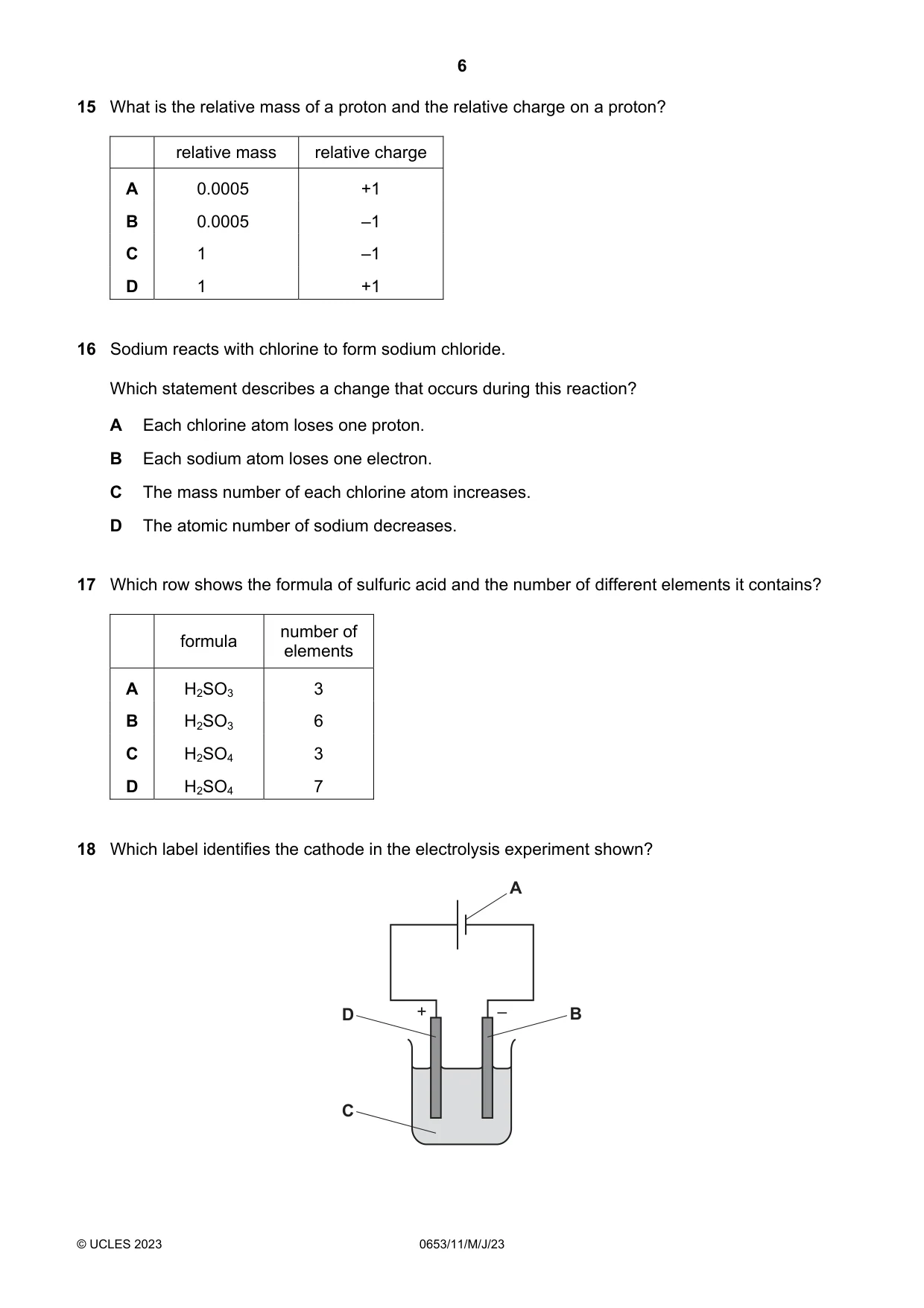
15 What is the relative mass of a proton and the relative charge on a proton? relative mass relative charge A 0.0005 +1 B 0.0005 –1 C 1 –1 D 1 +1
Mark scheme: D
Q16 · Sodium reacts with chlorine to form sodium chloride
16 Sodium reacts with chlorine to form sodium chloride. Which statement describes a change that occurs during this reaction? A Each chlorine atom loses one proton. B Each sodium atom loses one electron. C The mass number of each chlorine atom increases. D The atomic number of sodium decreases.
Mark scheme: B
Q17 · Which row shows the formula of sulfuric acid and the number of different elements it…
17 Which row shows the formula of sulfuric acid and the number of different elements it contains? number of formula elements A H2SO3 3 B H2SO3 6 C H2SO4 3 D H2SO4 7
Mark scheme: C
Q18 · Which label identifies the cathode in the electrolysis experiment shown?
18 Which label identifies the cathode in the electrolysis experiment shown? A D + – B C
Mark scheme: B
Q19 · Which reactions are exothermic?
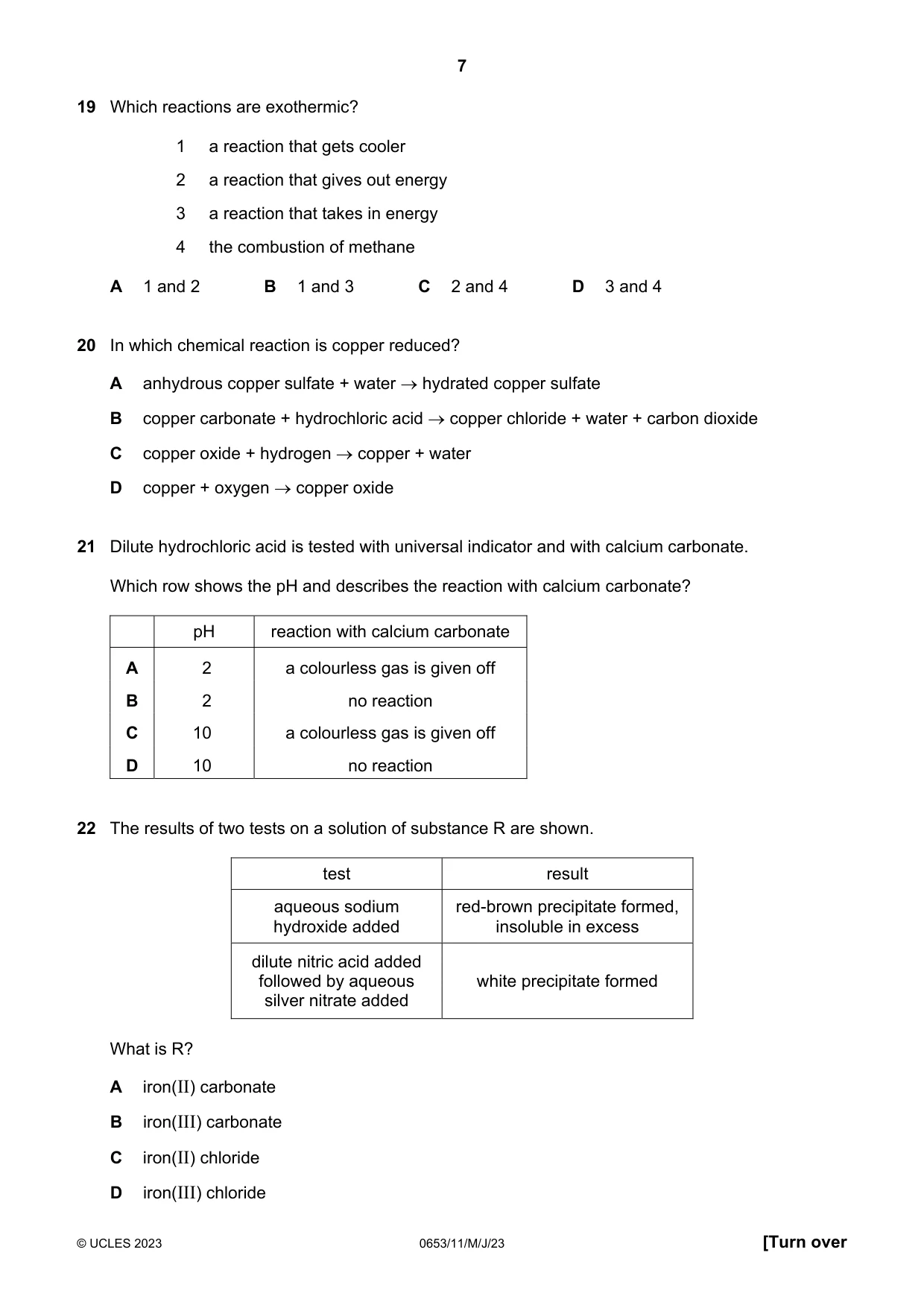
19 Which reactions are exothermic? 1 a reaction that gets cooler 2 a reaction that gives out energy 3 a reaction that takes in energy 4 the combustion of methane A 1 and 2 B 1 and 3 C 2 and 4 D 3 and 4
Mark scheme: C
Q20 · In which chemical reaction is copper reduced?
20 In which chemical reaction is copper reduced? A anhydrous copper sulfate + water hydrated copper sulfate B copper carbonate + hydrochloric acid copper chloride + water + carbon dioxide C copper oxide + hydrogen copper + water D copper + oxygen copper oxide
Mark scheme: C
Q21 · Dilute hydrochloric acid is tested with universal indicator and with calcium carbonate
21 Dilute hydrochloric acid is tested with universal indicator and with calcium carbonate. Which row shows the pH and describes the reaction with calcium carbonate? pH reaction with calcium carbonate A 2 a colourless gas is given off B 2 no reaction C 10 a colourless gas is given off D 10 no reaction
Mark scheme: A
More questions on The characteristic properties of acids and bases
Q22 · The results of two tests on a solution of substance R are shown
22 The results of two tests on a solution of substance R are shown. test result aqueous sodium red-brown precipitate formed, hydroxide added insoluble in excess dilute nitric acid added followed by aqueous white precipitate formed silver nitrate added What is R? A iron(II) carbonate B iron(III) carbonate C iron(II) chloride D iron(III) chloride
Mark scheme: D
Q23 · Which statement about Period 2 of the Periodic Table is correct?
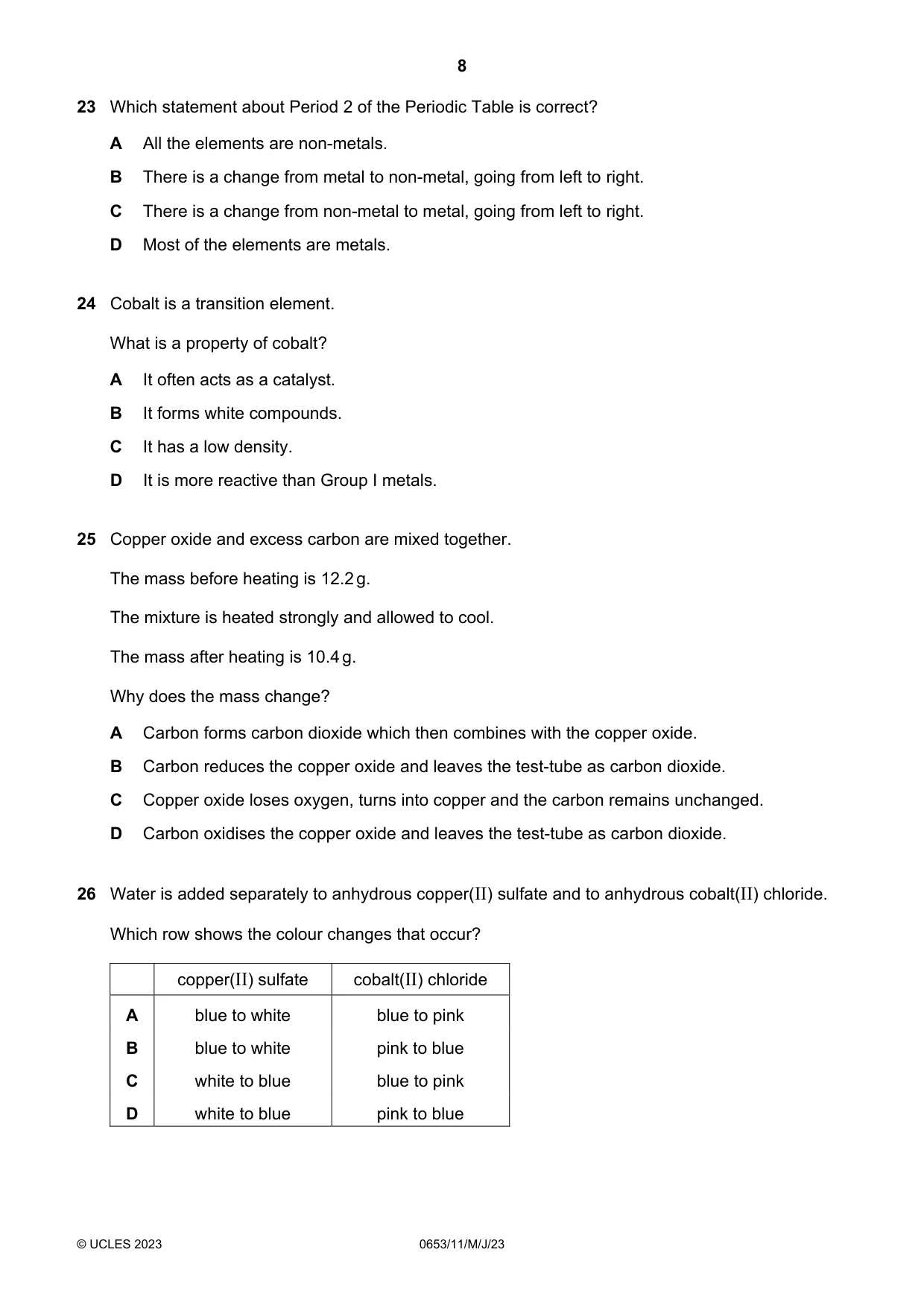
23 Which statement about Period 2 of the Periodic Table is correct? A All the elements are non-metals. B There is a change from metal to non-metal, going from left to right. C There is a change from non-metal to metal, going from left to right. D Most of the elements are metals.
Mark scheme: B
Q24 · Cobalt is a transition element
24 Cobalt is a transition element. What is a property of cobalt? A It often acts as a catalyst. B It forms white compounds. C It has a low density. D It is more reactive than Group I metals.
Mark scheme: A
Q25 · Copper oxide and excess carbon are mixed together
25 Copper oxide and excess carbon are mixed together. The mass before heating is 12.2 g. The mixture is heated strongly and allowed to cool. The mass after heating is 10.4 g. Why does the mass change? A Carbon forms carbon dioxide which then combines with the copper oxide. B Carbon reduces the copper oxide and leaves the test-tube as carbon dioxide. C Copper oxide loses oxygen, turns into copper and the carbon remains unchanged. D Carbon oxidises the copper oxide and leaves the test-tube as carbon dioxide.
Mark scheme: B
Q26 · Water is added separately to anhydrous copper(II) sulfate and to anhydrous cobalt(II)…
26 Water is added separately to anhydrous copper(II) sulfate and to anhydrous cobalt(II) chloride. Which row shows the colour changes that occur? copper(II) sulfate cobalt(II) chloride A blue to white blue to pink B blue to white pink to blue C white to blue blue to pink D white to blue pink to blue
Mark scheme: C
Q27 · What is produced when propane, a hydrocarbon, undergoes complete combustion?
27 What is produced when propane, a hydrocarbon, undergoes complete combustion? A carbon dioxide and water B carbon dioxide only C carbon monoxide and water D carbon monoxide only
Mark scheme: A
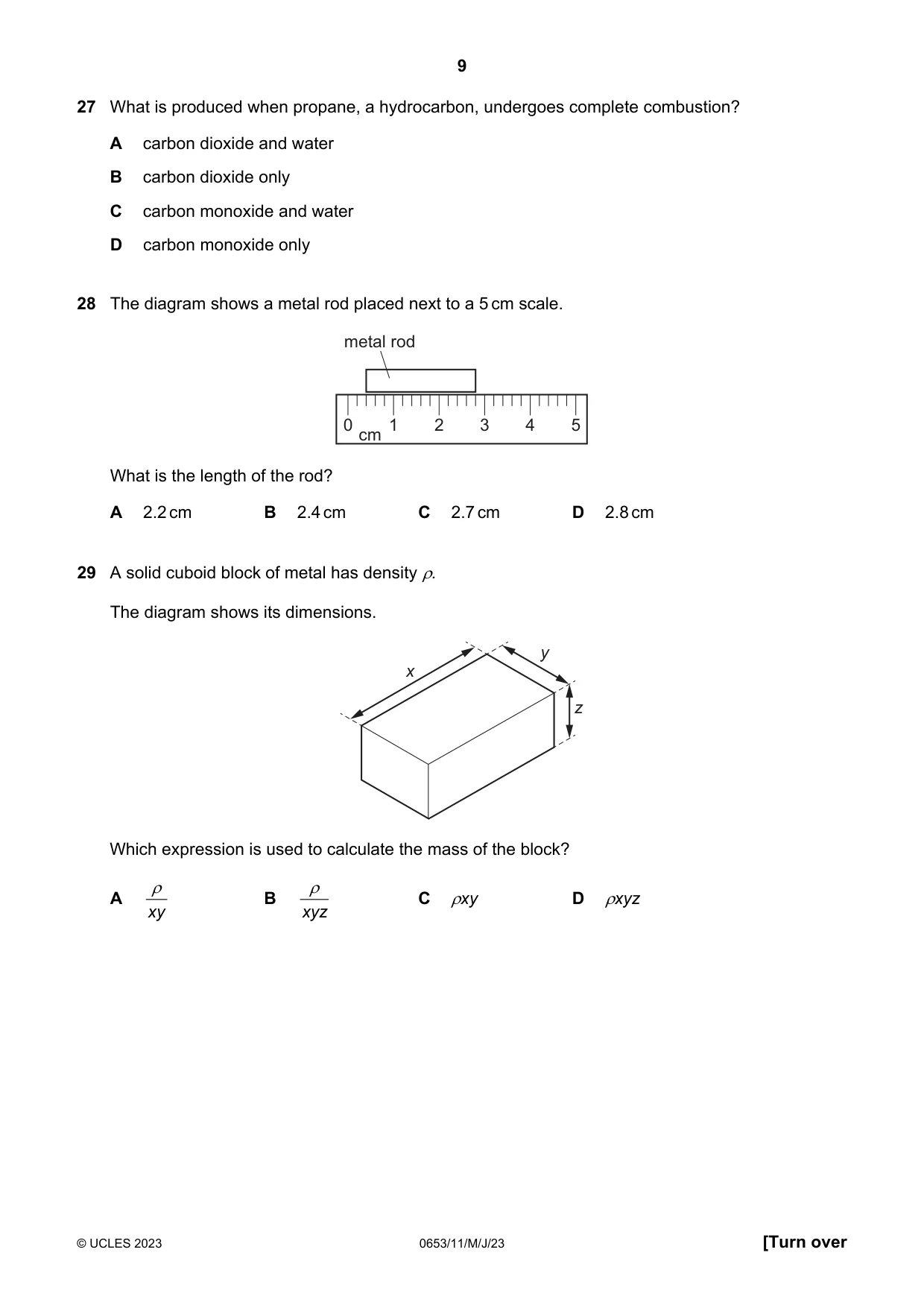
Q28 · The diagram shows a metal rod placed next to a 5 cm scale
28 The diagram shows a metal rod placed next to a 5 cm scale. metal rod 0 1 2 3 4 5 cm What is the length of the rod? A 2.2 cm B 2.4 cm C 2.7 cm D 2.8 cm
Mark scheme: B
More questions on Physical quantities and measurement techniques
Q29 · A solid cuboid block of metal has density
29 A solid cuboid block of metal has density . The diagram shows its dimensions. y x z Which expression is used to calculate the mass of the block? A B C xy D xyz xy xyz
Mark scheme: D
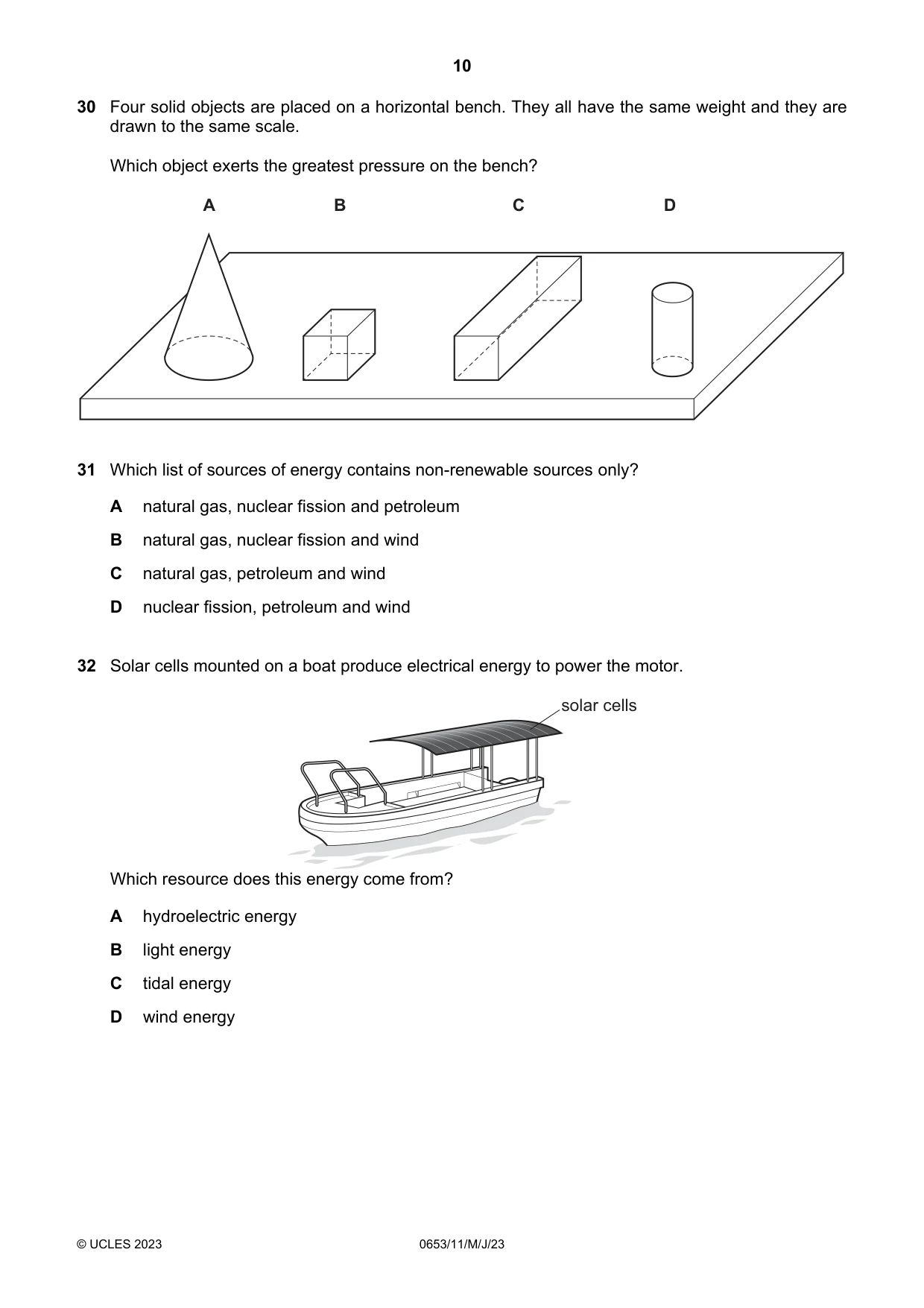
Q30 · Four solid objects are placed on a horizontal bench
30 Four solid objects are placed on a horizontal bench. They all have the same weight and they are drawn to the same scale. Which object exerts the greatest pressure on the bench? A B C D
Mark scheme: D
Q31 · Which list of sources of energy contains non-renewable sources only?
31 Which list of sources of energy contains non-renewable sources only? A natural gas, nuclear fission and petroleum B natural gas, nuclear fission and wind C natural gas, petroleum and wind D nuclear fission, petroleum and wind
Mark scheme: A
Q32 · Solar cells mounted on a boat produce electrical energy to power the motor
32 Solar cells mounted on a boat produce electrical energy to power the motor. solar cells Which resource does this energy come from? A hydroelectric energy B light energy C tidal energy D wind energy
Mark scheme: B
Q33 · The molecules in a liquid are close together
33 The molecules in a liquid are close together. What are other features of the molecules in a liquid? A They are arranged in a regular pattern but change positions with each other. B They are arranged in a regular pattern and vibrate about fixed positions. C They are arranged randomly and change positions with each other. D They are arranged randomly and vibrate about fixed positions.
Mark scheme: C
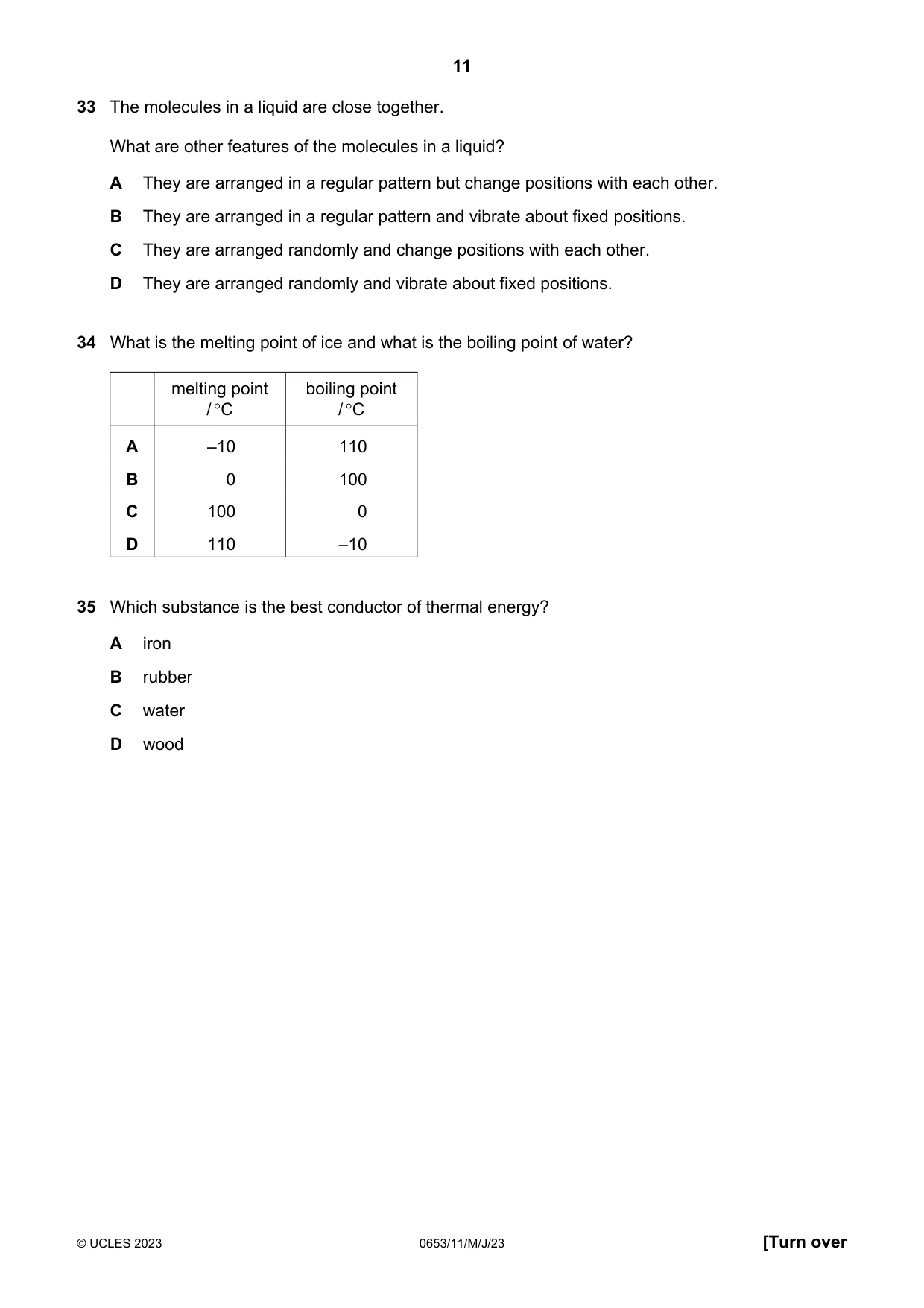
Q34 · What is the melting point of ice and what is the boiling point of water?
34 What is the melting point of ice and what is the boiling point of water? melting point boiling point / C / C A –10 110 B 0 100 C 100 0 D 110 –10
Mark scheme: B
Q35 · Which substance is the best conductor of thermal energy?
35 Which substance is the best conductor of thermal energy? A iron B rubber C water D wood
Mark scheme: A
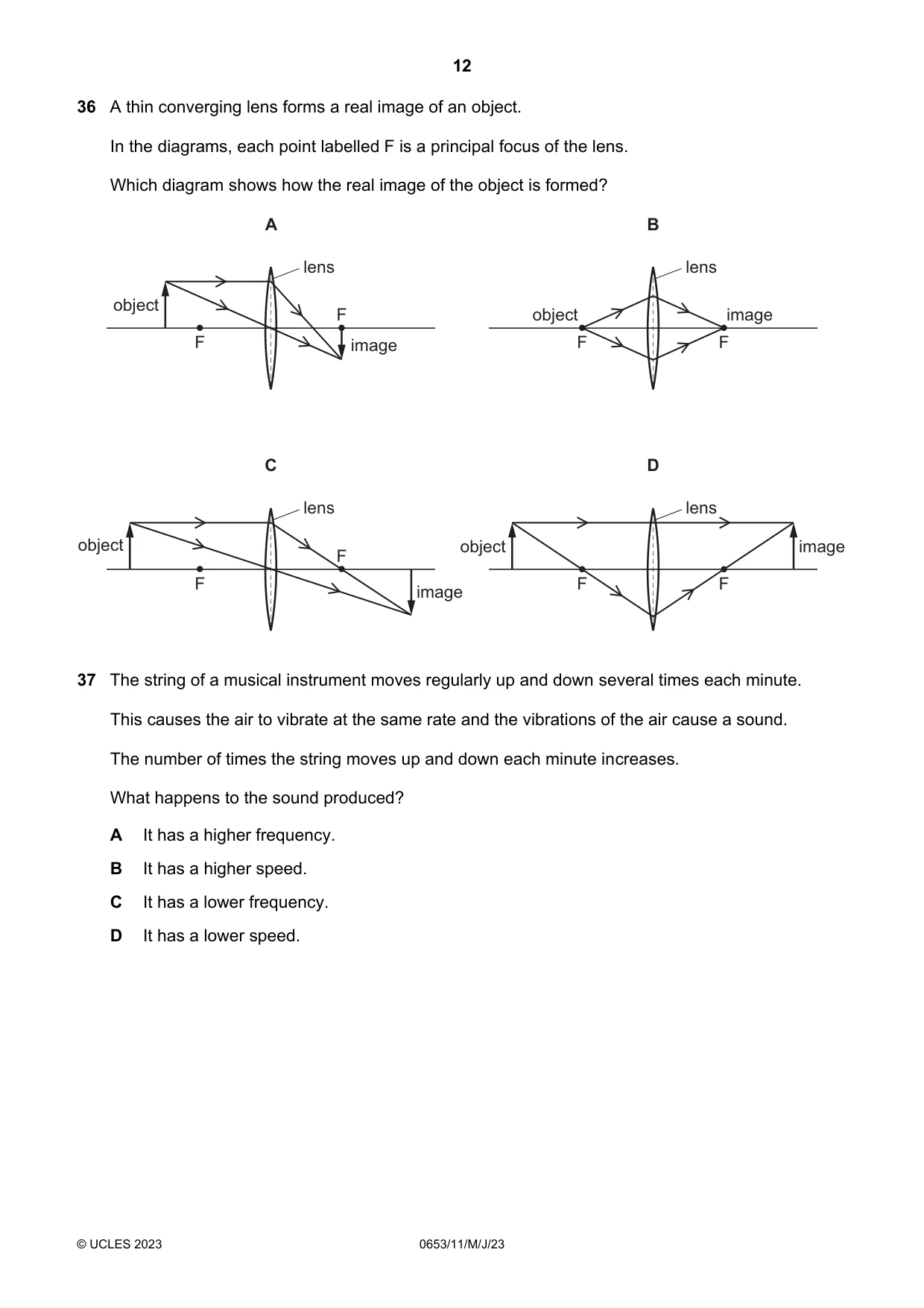
Q36 · A thin converging lens forms a real image of an object
36 A thin converging lens forms a real image of an object. In the diagrams, each point labelled F is a principal focus of the lens. Which diagram shows how the real image of the object is formed? A B lens lens object F object image F image F F C D lens lens object object image F F F F image
Mark scheme: C
Q37 · The string of a musical instrument moves regularly up and down several times each minute
37 The string of a musical instrument moves regularly up and down several times each minute. This causes the air to vibrate at the same rate and the vibrations of the air cause a sound. The number of times the string moves up and down each minute increases. What happens to the sound produced? A It has a higher frequency. B It has a higher speed. C It has a lower frequency. D It has a lower speed.
Mark scheme: A
Q38 · WX and YZ are rods that are uniformly electrically charged
38 WX and YZ are rods that are uniformly electrically charged. W X Y Z The rods are brought close together and end X repels end Y. What happens when ends X and Z are brought close together and what happens when ends W and Y are brought close together? X and Z W and Y A attract attract B attract repel C repel attract D repel repel
Mark scheme: D
Q39 · Which circuit is used to determine the resistance of resistor R?
39 Which circuit is used to determine the resistance of resistor R? A B R R A A V V C D V R V R A A
Mark scheme: A
Q40 · Which arrangement of resistors has the smallest combined resistance?
40 Which arrangement of resistors has the smallest combined resistance? A B 2.0Q Cc D 2.00 | 2.00 3.00 400 a oe oe of}
Mark scheme: C
What was in this paper
The subtopics covered by these 40 questions, and how many questions each got. Open one in a new tab to see every Cambridge question on it.
2Energy, work and power2Redox2Respiration2Arrangement of elements1Atomic structure and the Periodic Table1Biological molecules1Cell structure1Density1Digestion1Electrical quantities1Electrolysis1Exothermic and endothermic reactions1Food chains and food webs1Formulas1Fuels1Gas exchange in humans1Habitat destruction1Heart1Identification of ions and gases1Ions and ionic bonds1Kinetic particle model of matter1Leaf structure1Light1Physical quantities and measurement techniques1Pressure1Sexual reproduction in humans1Sexual reproduction in plants1Solids, liquids and gases1Sound1The characteristic properties of acids and bases1Thermal properties and temperature1Transfer of thermal energy1Transition elements1Water1Xylem and phloem1What you needed in this session
Cambridge’s own grade thresholds for 2023 May/June, Paper 1 · Variant 1. A higher threshold means an easier paper — the bar moves with how the cohort did.