Cambridge IGCSE Science - Combined 0653 — 2023 May/June Paper 1 · Variant 2
0653/12/M/J/23 · 40 questions · 40 marks · ≈45 min
The question paper and its mark scheme, free to read here and free to download. This is Cambridge’s own paper, exactly as it was sat.
Question paper16 pages
Mark scheme3 pages
Answers below. Sit the paper first if you are practising.
Questions as text
Q1 · Which process removes toxic materials from an organism?
1 Which process removes toxic materials from an organism? A digestion B egestion C excretion D respiration
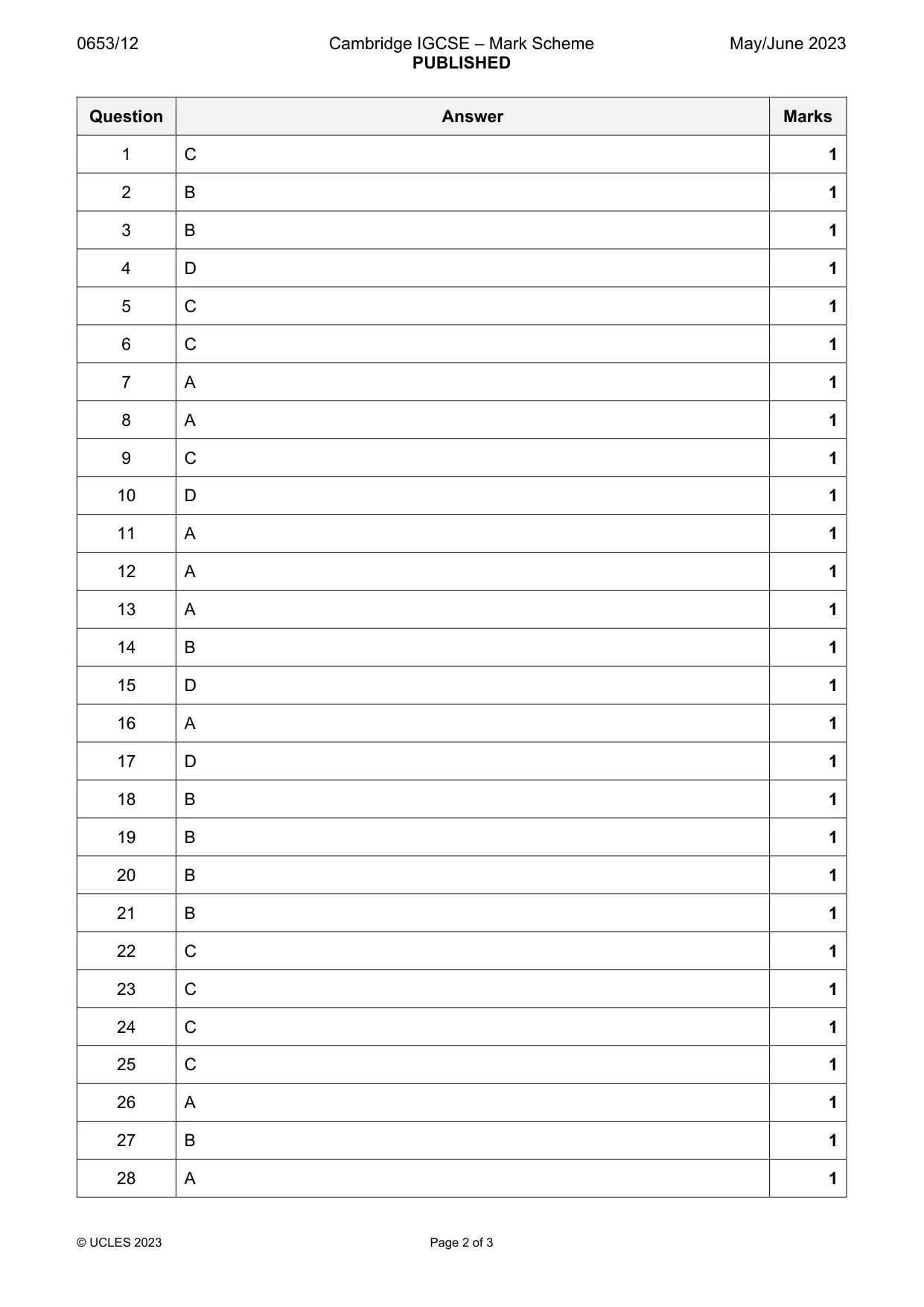
Mark scheme: C
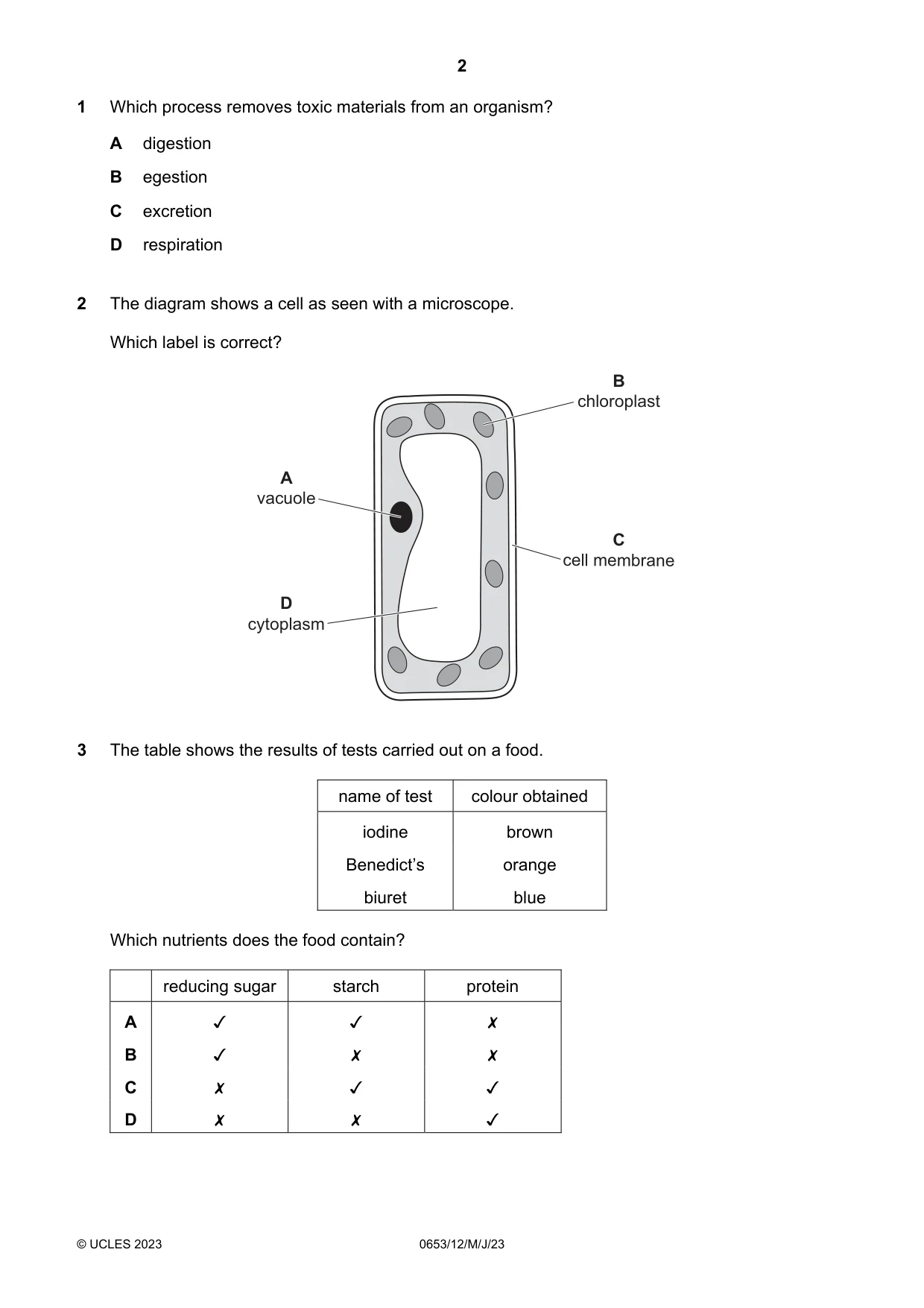
Q2 · The diagram shows a cell as seen with a microscope
2 The diagram shows a cell as seen with a microscope. Which label is correct? B chloroplast A vacuole C cell membrane D cytoplasm
Mark scheme: B
Q3 · The table shows the results of tests carried out on a food
3 The table shows the results of tests carried out on a food. name of test colour obtained iodine Benedict’s biuret Which nutrients does the food contain? reducing sugar starch 00D D> x « & x \ x brown orange blue protein \ \ x
Mark scheme: B
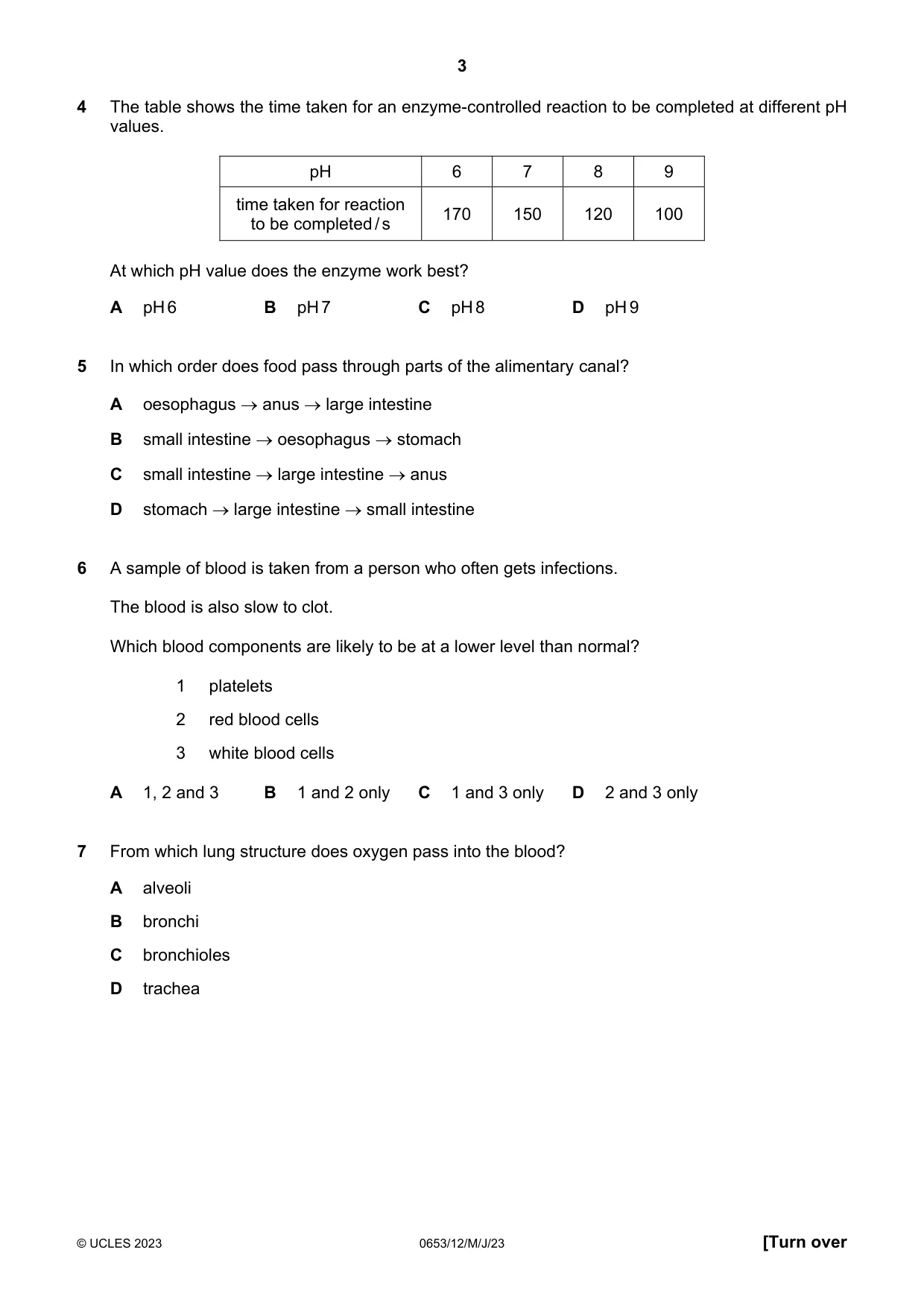
Q4 · The table shows the time taken for an enzyme-controlled reaction to be completed at…
4 The table shows the time taken for an enzyme-controlled reaction to be completed at different pH values. pH 6 7 8 9 time taken for reaction 170 150 120 100 to be completed / s At which pH value does the enzyme work best? A pH 6 B pH 7 C pH 8 D pH 9
Mark scheme: D
Q5 · In which order does food pass through parts of the alimentary canal?
5 In which order does food pass through parts of the alimentary canal? A oesophagus anus large intestine B small intestine oesophagus stomach C small intestine large intestine anus D stomach large intestine small intestine
Mark scheme: C
Q6 · A sample of blood is taken from a person who often gets infections
6 A sample of blood is taken from a person who often gets infections. The blood is also slow to clot. Which blood components are likely to be at a lower level than normal? 1 platelets 2 red blood cells 3 white blood cells A 1, 2 and 3 B 1 and 2 only C 1 and 3 only D 2 and 3 only
Mark scheme: C
Q7 · From which lung structure does oxygen pass into the blood?
7 From which lung structure does oxygen pass into the blood? A alveoli B bronchi C bronchioles D trachea
Mark scheme: A
Q8 · Which word is missing from the word equation for respiration?
8 Which word is missing from the word equation for respiration? .................... + oxygen carbon dioxide + water A glucose B glycogen C protein D starch
Mark scheme: A
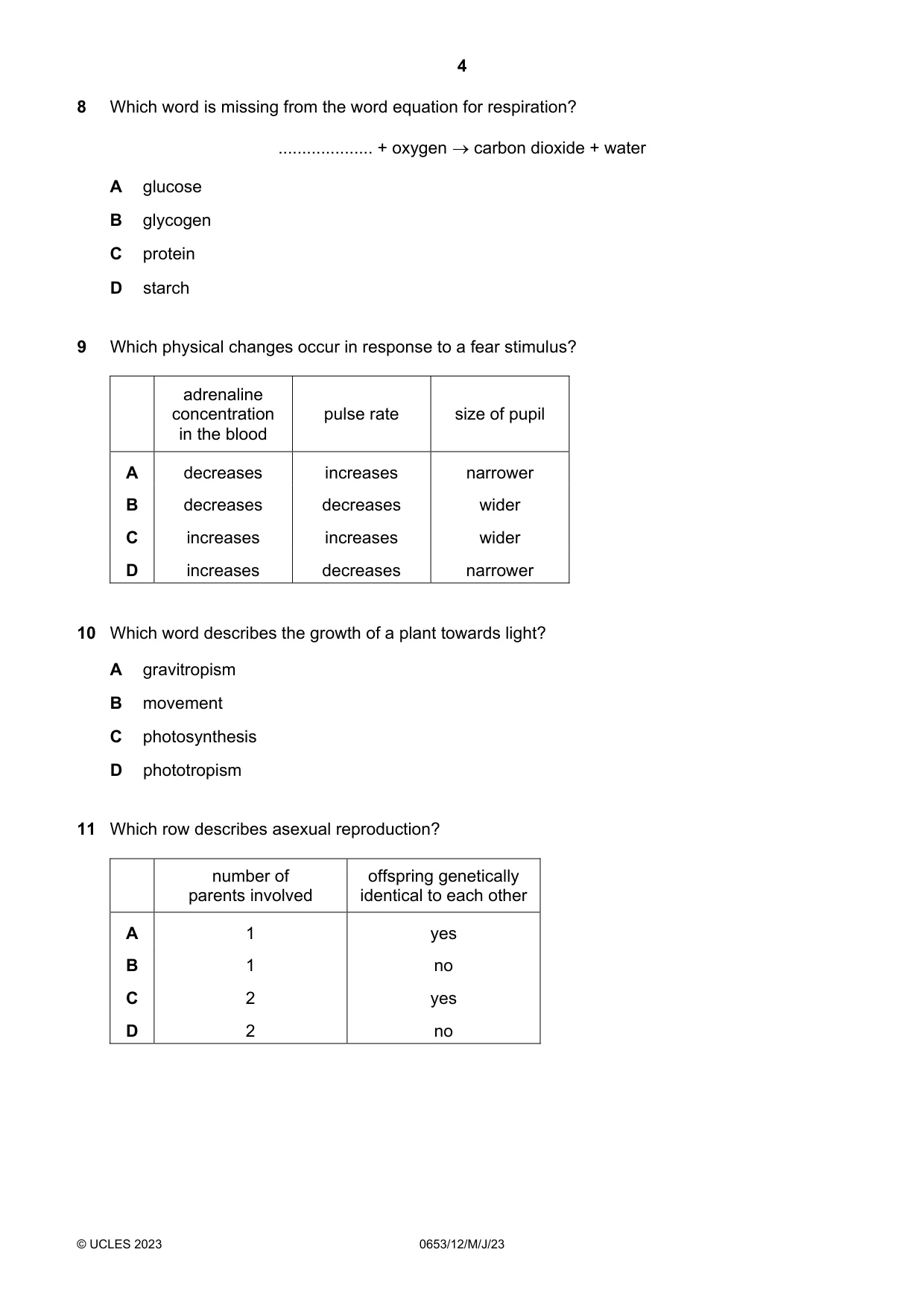
Q9 · Which physical changes occur in response to a fear stimulus?
9 Which physical changes occur in response to a fear stimulus? adrenaline concentration pulse rate size of pupil in the blood A decreases increases narrower B decreases decreases wider C increases increases wider D increases decreases narrower
Mark scheme: C
Q10 · Which word describes the growth of a plant towards light?
10 Which word describes the growth of a plant towards light? A gravitropism B movement C photosynthesis D phototropism
Mark scheme: D
Q11 · Which row describes asexual reproduction?
11 Which row describes asexual reproduction? number of offspring genetically parents involved identical to each other A 1 yes B 1 no C 2 yes D 2 no
Mark scheme: A
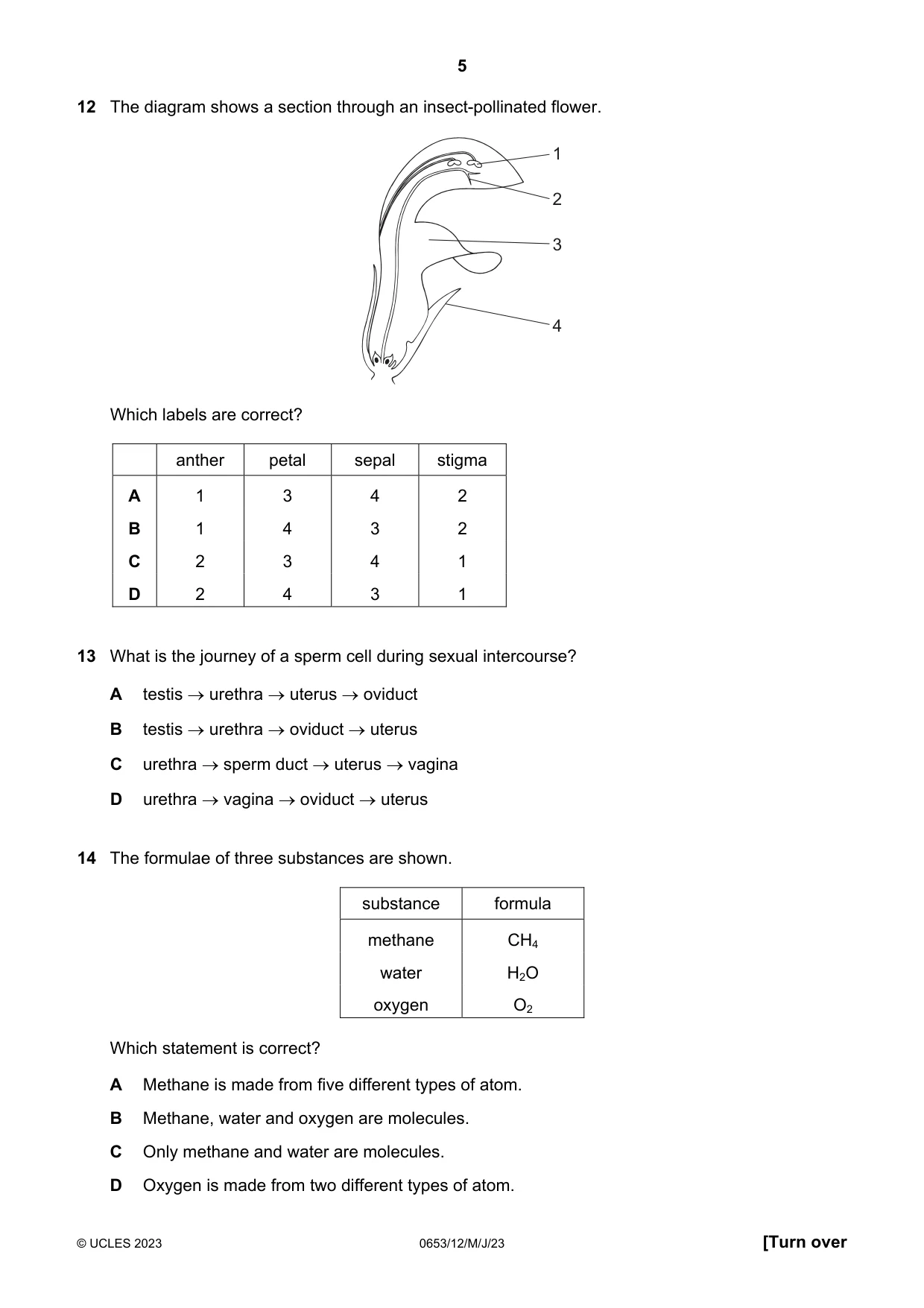
Q12 · The diagram shows a section through an insect-pollinated flower
12 The diagram shows a section through an insect-pollinated flower. 1 2 3 4 Which labels are correct? anther petal sepal stigma A 1 3 4 2 B 1 4 3 2 C 2 3 4 1 D 2 4 3 1
Mark scheme: A
Q13 · What is the journey of a sperm cell during sexual intercourse?
13 What is the journey of a sperm cell during sexual intercourse? A testis urethra uterus oviduct B testis urethra oviduct uterus C urethra sperm duct uterus vagina D urethra vagina oviduct uterus
Mark scheme: A
Q14 · The formulae of three substances are shown
14 The formulae of three substances are shown. substance formula methane CH4 water H2O oxygen O2 Which statement is correct? A Methane is made from five different types of atom. B Methane, water and oxygen are molecules. C Only methane and water are molecules. D Oxygen is made from two different types of atom.
Mark scheme: B
Q15 · What is the definition of nucleon number?
15 What is the definition of nucleon number? A the number of protons in an atom B the number of electrons in an atom C the total number of electrons and neutrons in an atom D the total number of neutrons and protons in an atom
Mark scheme: D
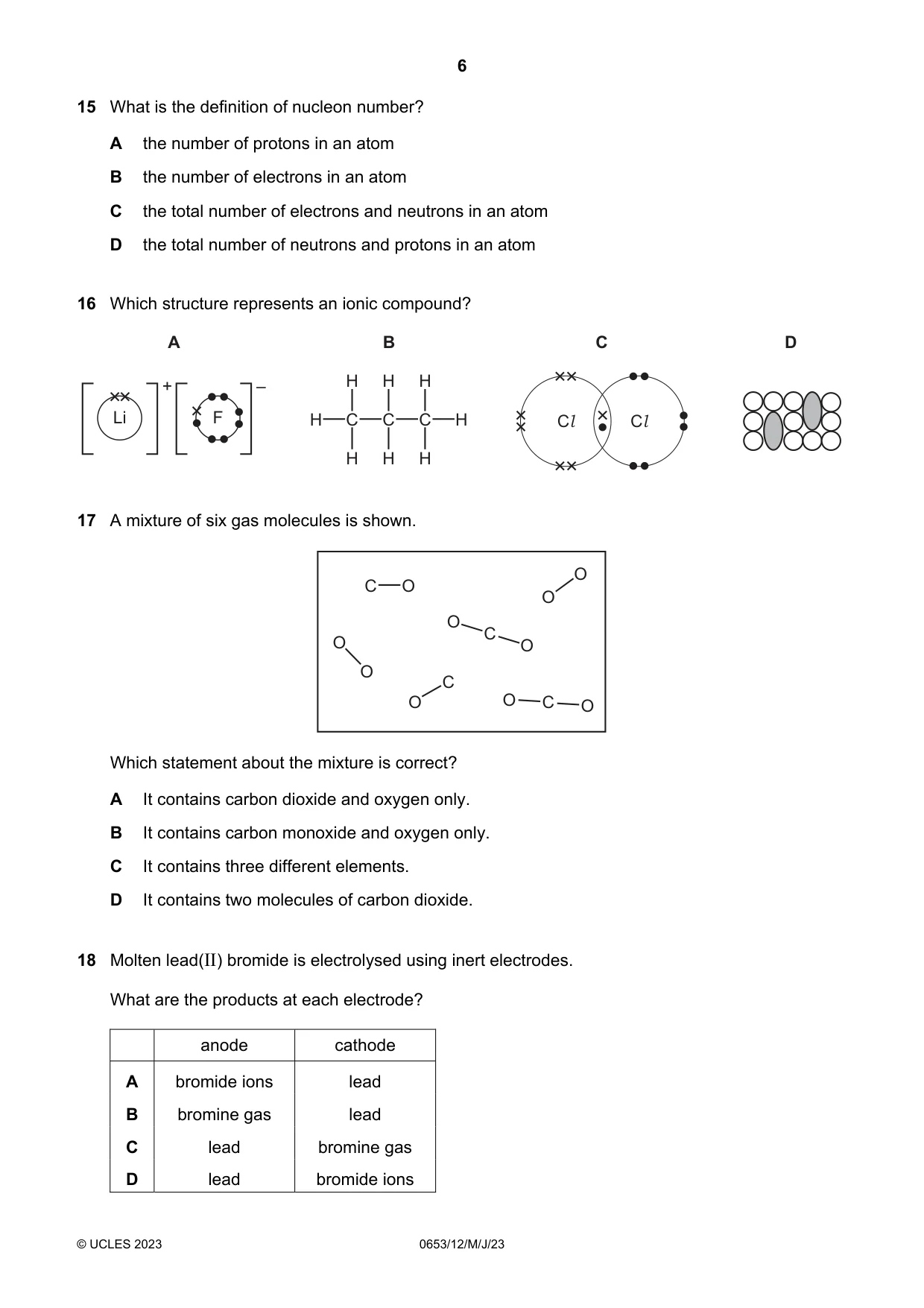
Q16 · Which structure represents an ionic compound?
16 Which structure represents an ionic compound? A B C D + – H H H Li F H C C C H Cl Cl H H H
Mark scheme: A
Q17 · A mixture of six gas molecules is shown
17 A mixture of six gas molecules is shown. O C O O O C O O O C O O C O Which statement about the mixture is correct? A It contains carbon dioxide and oxygen only. B It contains carbon monoxide and oxygen only. C It contains three different elements. D It contains two molecules of carbon dioxide.
Mark scheme: D
Q18 · Molten lead(II) bromide is electrolysed using inert electrodes
18 Molten lead(II) bromide is electrolysed using inert electrodes. What are the products at each electrode? anode cathode A bromide ions lead B bromine gas lead C lead bromine gas D lead bromide ions
Mark scheme: B
Q19 · The initial and final temperatures of four different reactions are measured
19 The initial and final temperatures of four different reactions are measured. The results are shown. Which reaction is the most exothermic? initial final temperature temperature / C / C A 21 18 B 21 27 C 23 28 D 24 17
Mark scheme: B
Q20 · In which reactions is the underlined substance oxidised?
20 In which reactions is the underlined substance oxidised? 1 iron when it rusts 2 methane when it burns in air 3 copper oxide when it reacts with carbon A 1, 2 and 3 B 1 and 2 only C 1 and 3 only D 2 and 3 only
Mark scheme: B
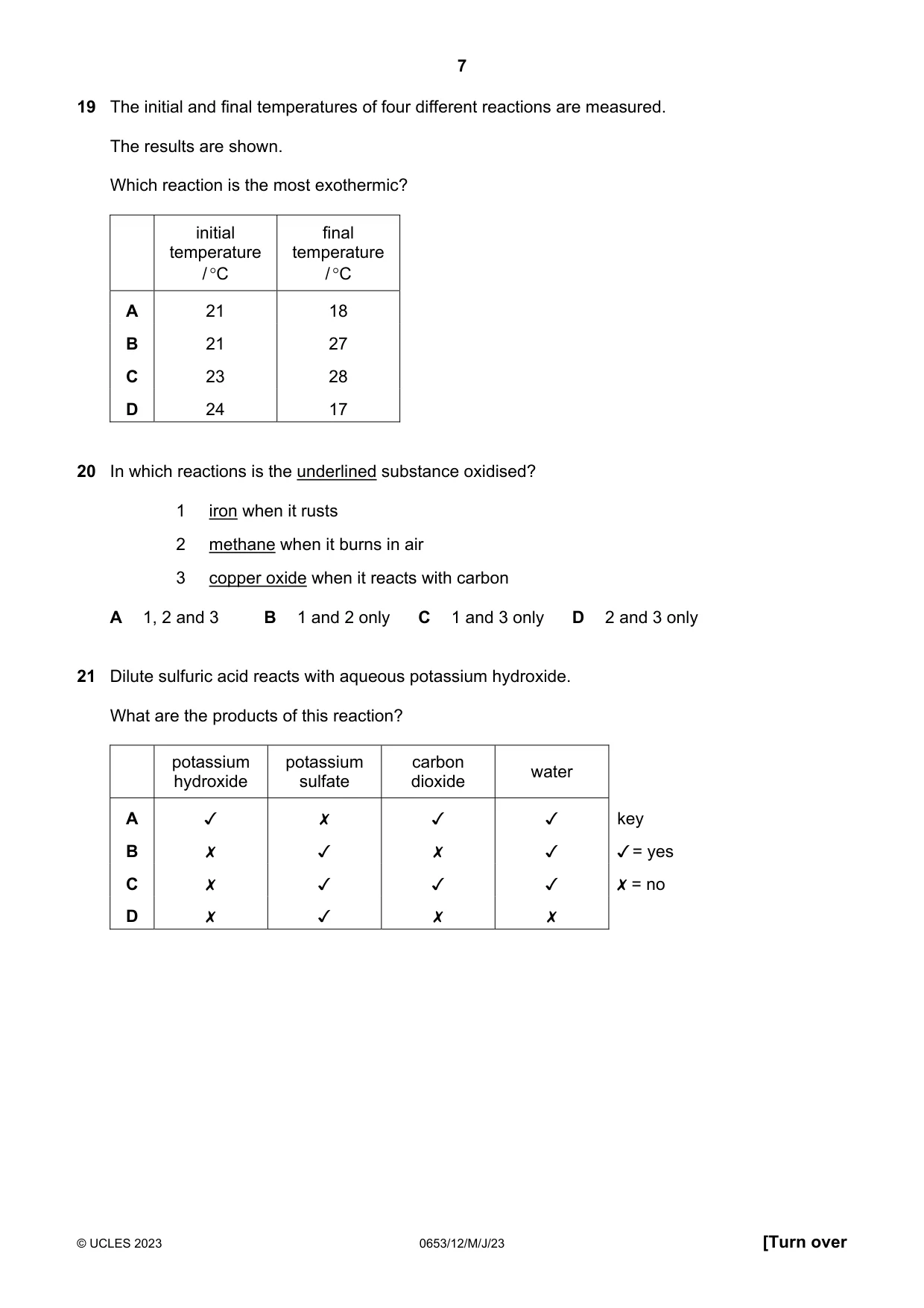
Q21 · Dilute sulfuric acid reacts with aqueous potassium hydroxide
21 Dilute sulfuric acid reacts with aqueous potassium hydroxide. What are the products of this reaction? potassium potassium carbon water hydroxide sulfate dioxide A J x Jv Jv B x Jv x JV Cc x J Jv Jv D x Jv x x key /=yes X =no
Mark scheme: B
More questions on The characteristic properties of acids and bases
Q22 · The results of two tests on solid P are shown
22 The results of two tests on solid P are shown. test result 1 add aqueous gas given off that turns sodium hydroxide to solid moist red litmus paper blue 2 dissolve solid in water, white precipitate formed add dilute aqueous silver nitrate What is P? A aluminium carbonate B aluminium sulfate C ammonium chloride D ammonium nitrate
Mark scheme: C
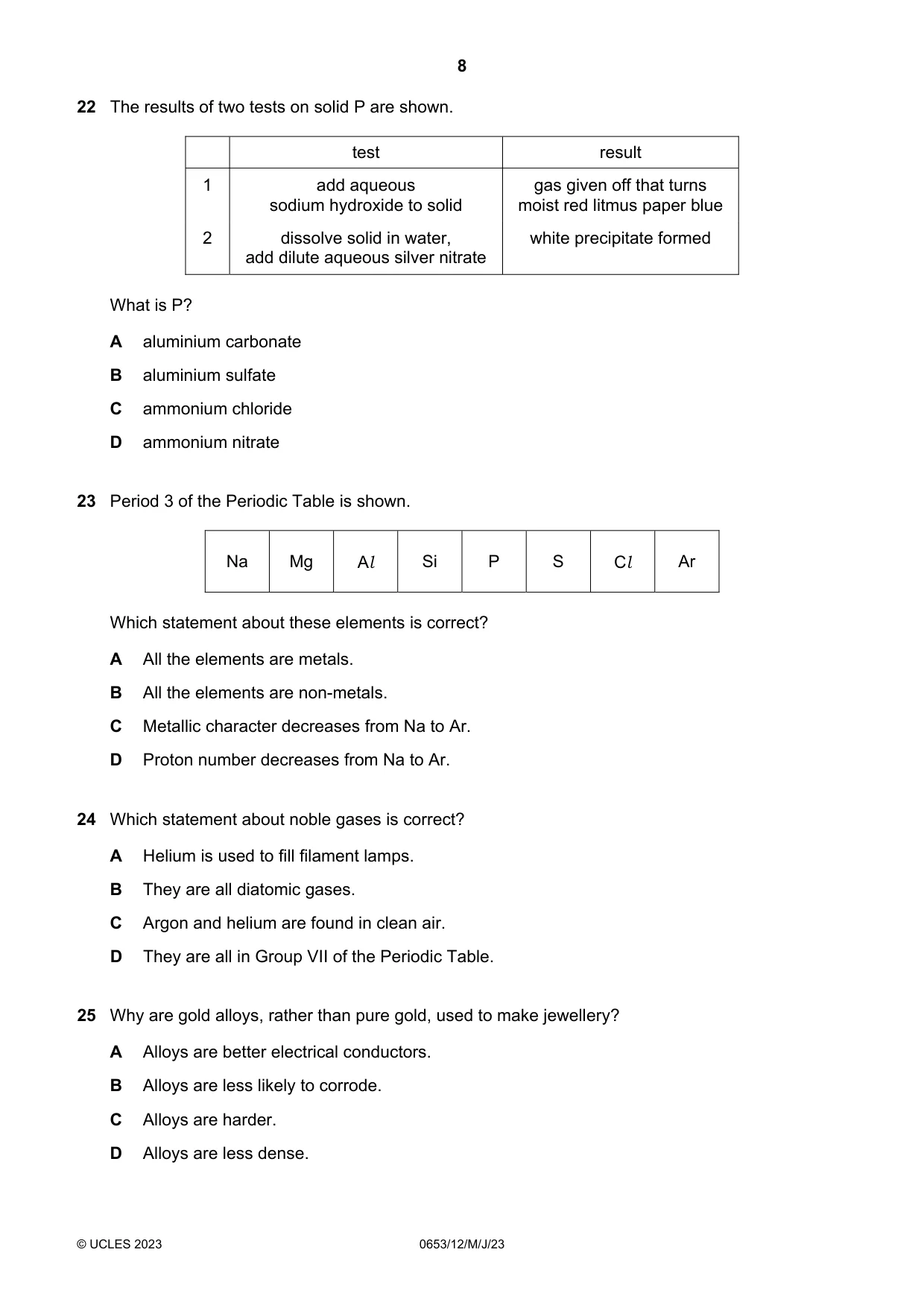
Q23 · Period 3 of the Periodic Table is shown
23 Period 3 of the Periodic Table is shown. Na Mg Al Si P S Cl Ar Which statement about these elements is correct? A All the elements are metals. B All the elements are non-metals. C Metallic character decreases from Na to Ar. D Proton number decreases from Na to Ar.
Mark scheme: C
Q24 · Which statement about noble gases is correct?
24 Which statement about noble gases is correct? A Helium is used to fill filament lamps. B They are all diatomic gases. C Argon and helium are found in clean air. D They are all in Group VII of the Periodic Table.
Mark scheme: C
Q25 · Why are gold alloys, rather than pure gold, used to make jewellery?
25 Why are gold alloys, rather than pure gold, used to make jewellery? A Alloys are better electrical conductors. B Alloys are less likely to corrode. C Alloys are harder. D Alloys are less dense.
Mark scheme: C
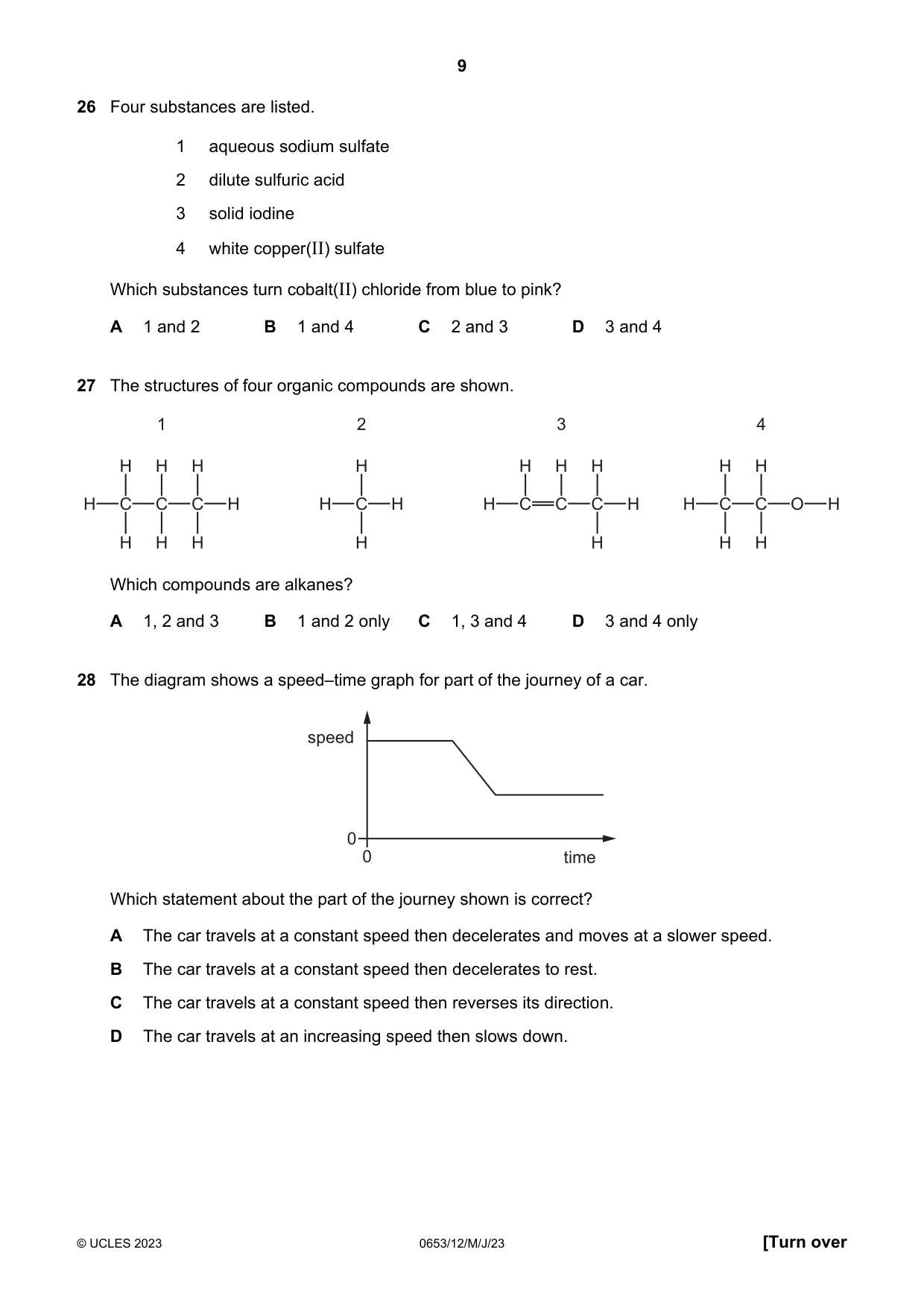
Q26 · Four substances are listed
26 Four substances are listed. 1 aqueous sodium sulfate 2 dilute sulfuric acid 3 solid iodine 4 white copper(II) sulfate Which substances turn cobalt(II) chloride from blue to pink? A 1 and 2 B 1 and 4 C 2 and 3 D 3 and 4
Mark scheme: A
Q27 · The structures of four organic compounds are shown
27 The structures of four organic compounds are shown. 1 2 3 4 H H H H H H H H H H C C C H H C H H C C C H H C C O H H H H H H H H Which compounds are alkanes? A 1, 2 and 3 B 1 and 2 only C 1, 3 and 4 D 3 and 4 only
Mark scheme: B
Q28 · The diagram shows a speed–time graph for part of the journey of a car
28 The diagram shows a speed–time graph for part of the journey of a car. speed 0 0 time Which statement about the part of the journey shown is correct? A The car travels at a constant speed then decelerates and moves at a slower speed. B The car travels at a constant speed then decelerates to rest. C The car travels at a constant speed then reverses its direction. D The car travels at an increasing speed then slows down.
Mark scheme: A
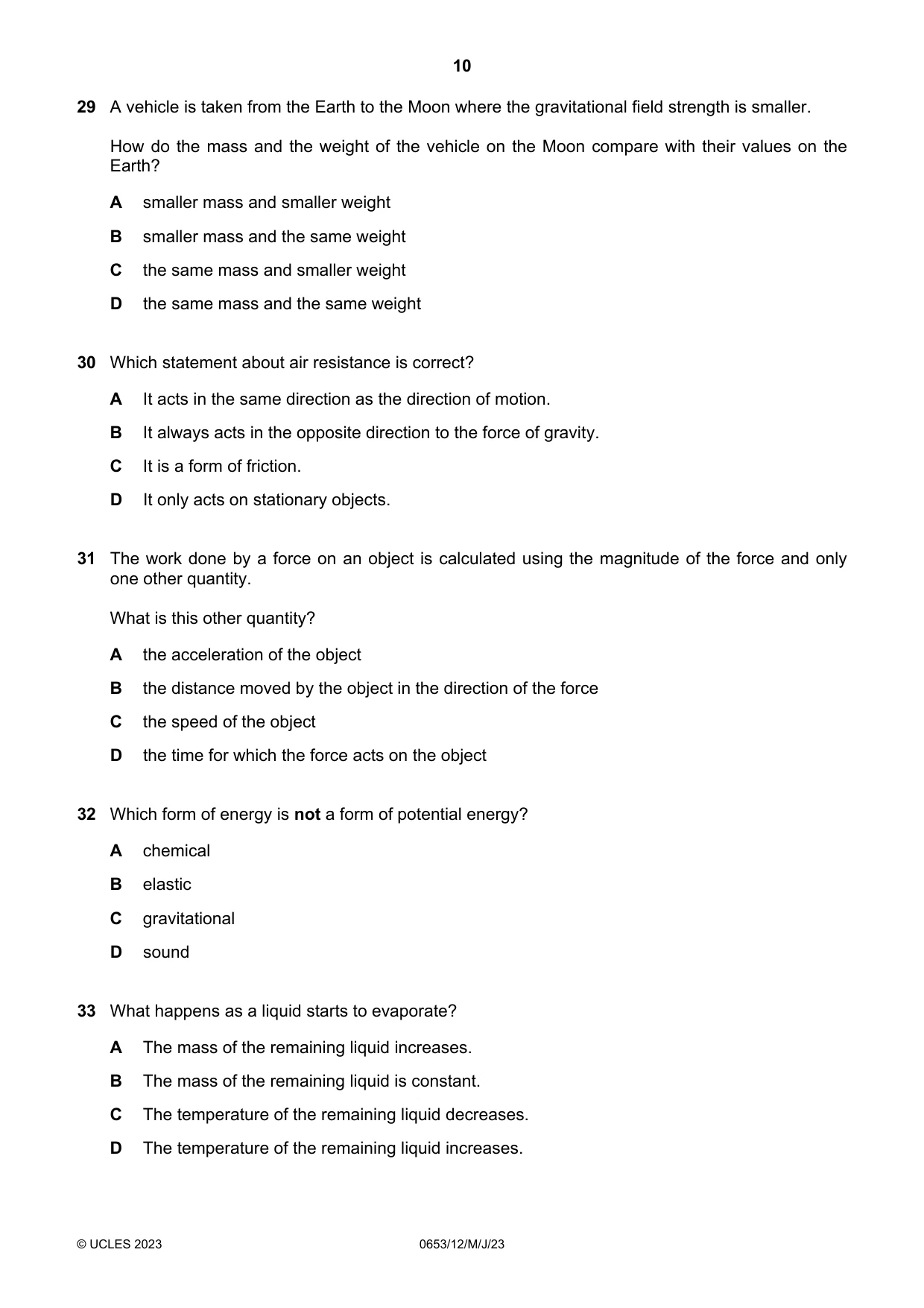
Q29 · A vehicle is taken from the Earth to the Moon where the gravitational field strength is…
29 A vehicle is taken from the Earth to the Moon where the gravitational field strength is smaller. How do the mass and the weight of the vehicle on the Moon compare with their values on the Earth? A smaller mass and smaller weight B smaller mass and the same weight C the same mass and smaller weight D the same mass and the same weight
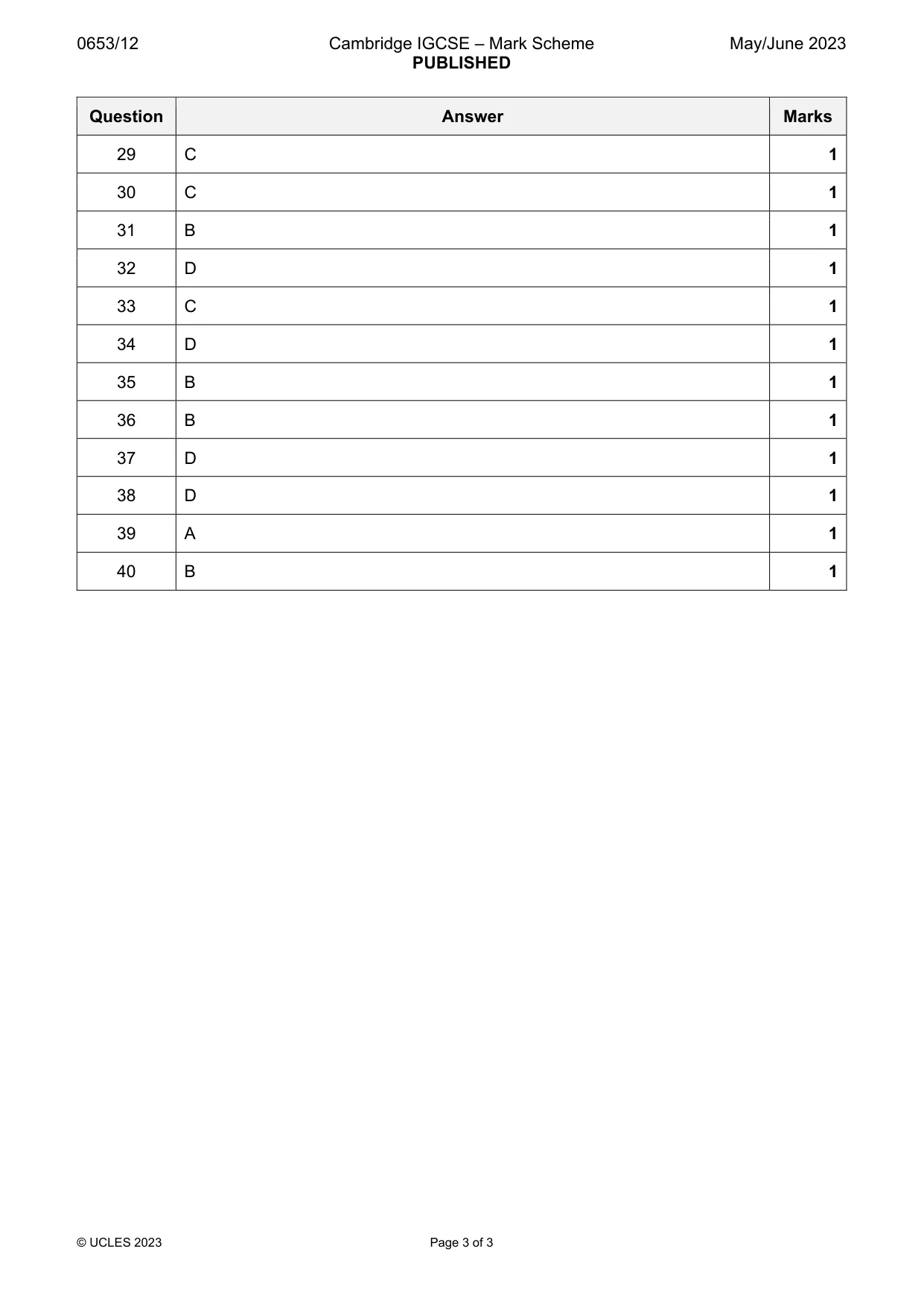
Mark scheme: C
Q30 · Which statement about air resistance is correct?
30 Which statement about air resistance is correct? A It acts in the same direction as the direction of motion. B It always acts in the opposite direction to the force of gravity. C It is a form of friction. D It only acts on stationary objects.
Mark scheme: C
Q31 · The work done by a force on an object is calculated using the magnitude of the force and…
31 The work done by a force on an object is calculated using the magnitude of the force and only one other quantity. What is this other quantity? A the acceleration of the object B the distance moved by the object in the direction of the force C the speed of the object D the time for which the force acts on the object
Mark scheme: B
Q32 · Which form of energy is not a form of potential energy?
32 Which form of energy is not a form of potential energy? A chemical B elastic C gravitational D sound
Mark scheme: D
Q33 · What happens as a liquid starts to evaporate?
33 What happens as a liquid starts to evaporate? A The mass of the remaining liquid increases. B The mass of the remaining liquid is constant. C The temperature of the remaining liquid decreases. D The temperature of the remaining liquid increases.
Mark scheme: C
Q34 · The metal lid on a glass jar is difficult to unscrew
34 The metal lid on a glass jar is difficult to unscrew. The lid is unscrewed more easily after it is held under hot water. What is the reason for this? A The jar contracts more than the lid. B The jar expands more than the lid. C The lid contracts more than the jar. D The lid expands more than the jar.
Mark scheme: D
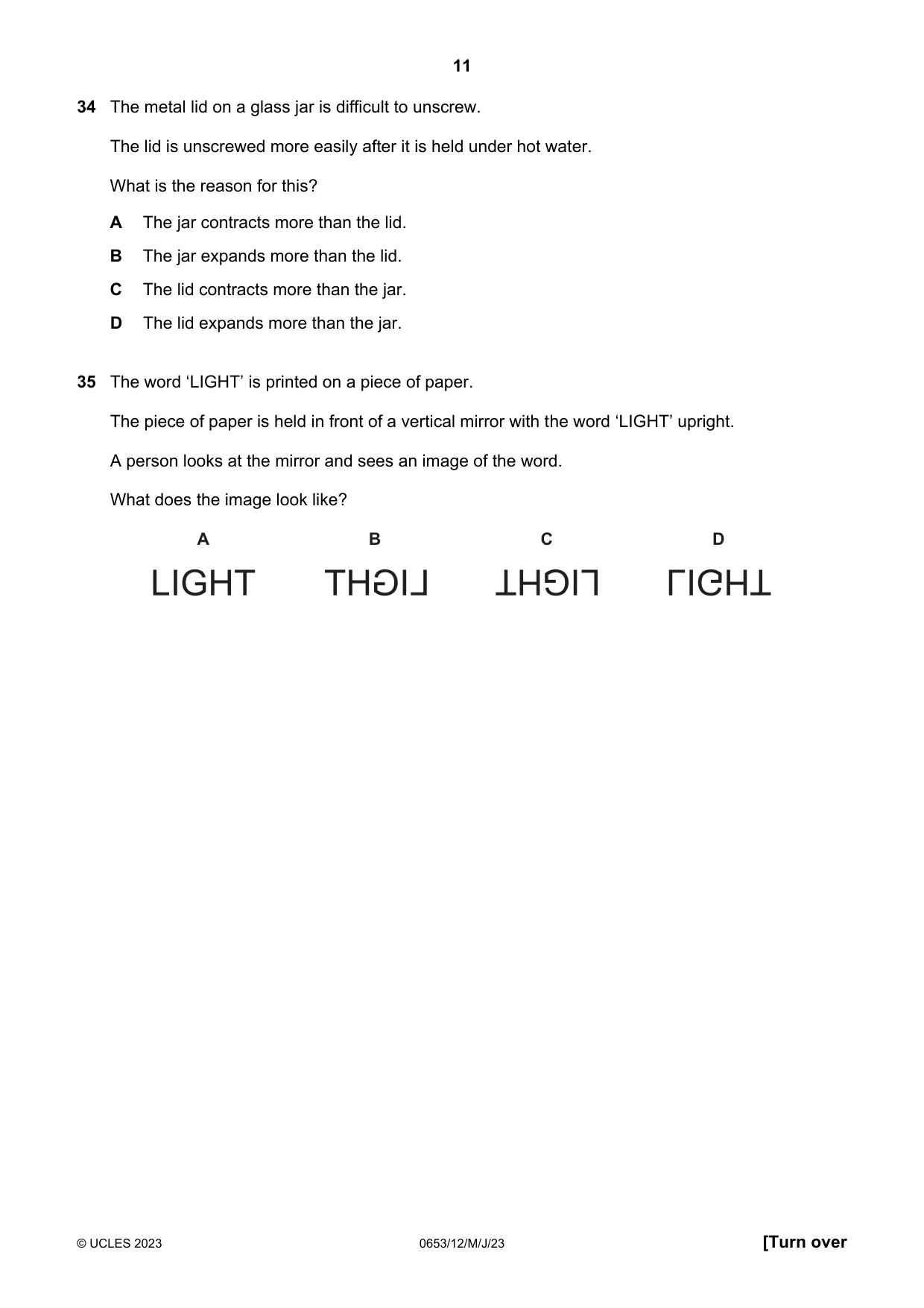
Q35 · The word ‘LIGHT’ is printed on a piece of paper
35 The word ‘LIGHT’ is printed on a piece of paper. The piece of paper is held in front of a vertical mirror with the word ‘LIGHT’ upright. A person looks at the mirror and sees an image of the word. What does the image look like? A B C D
Mark scheme: B
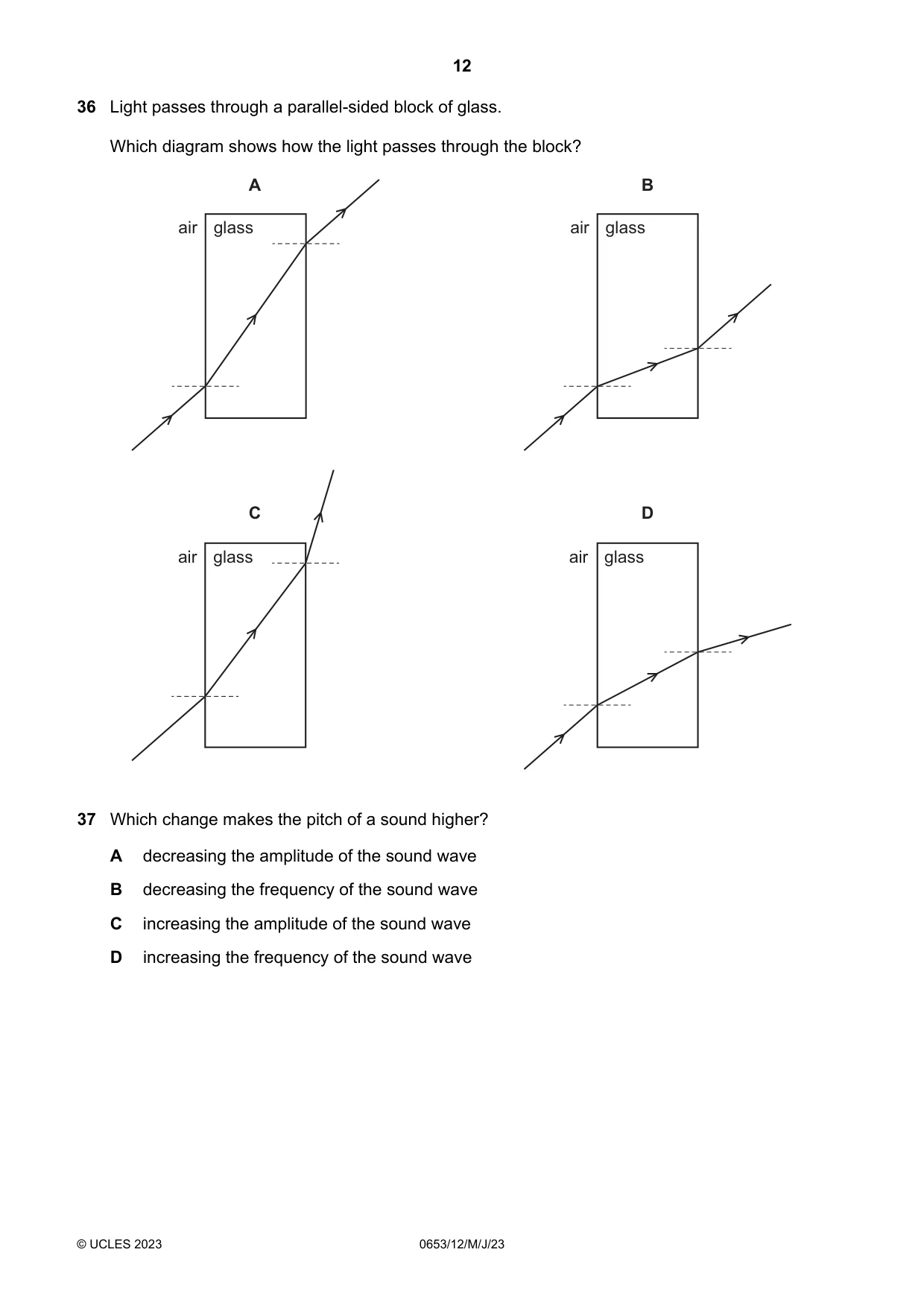
Q36 · Light passes through a parallel-sided block of glass
36 Light passes through a parallel-sided block of glass. Which diagram shows how the light passes through the block? A B air glass air glass C D air glass air glass
Mark scheme: B
Q37 · Which change makes the pitch of a sound higher?
37 Which change makes the pitch of a sound higher? A decreasing the amplitude of the sound wave B decreasing the frequency of the sound wave C increasing the amplitude of the sound wave D increasing the frequency of the sound wave
Mark scheme: D
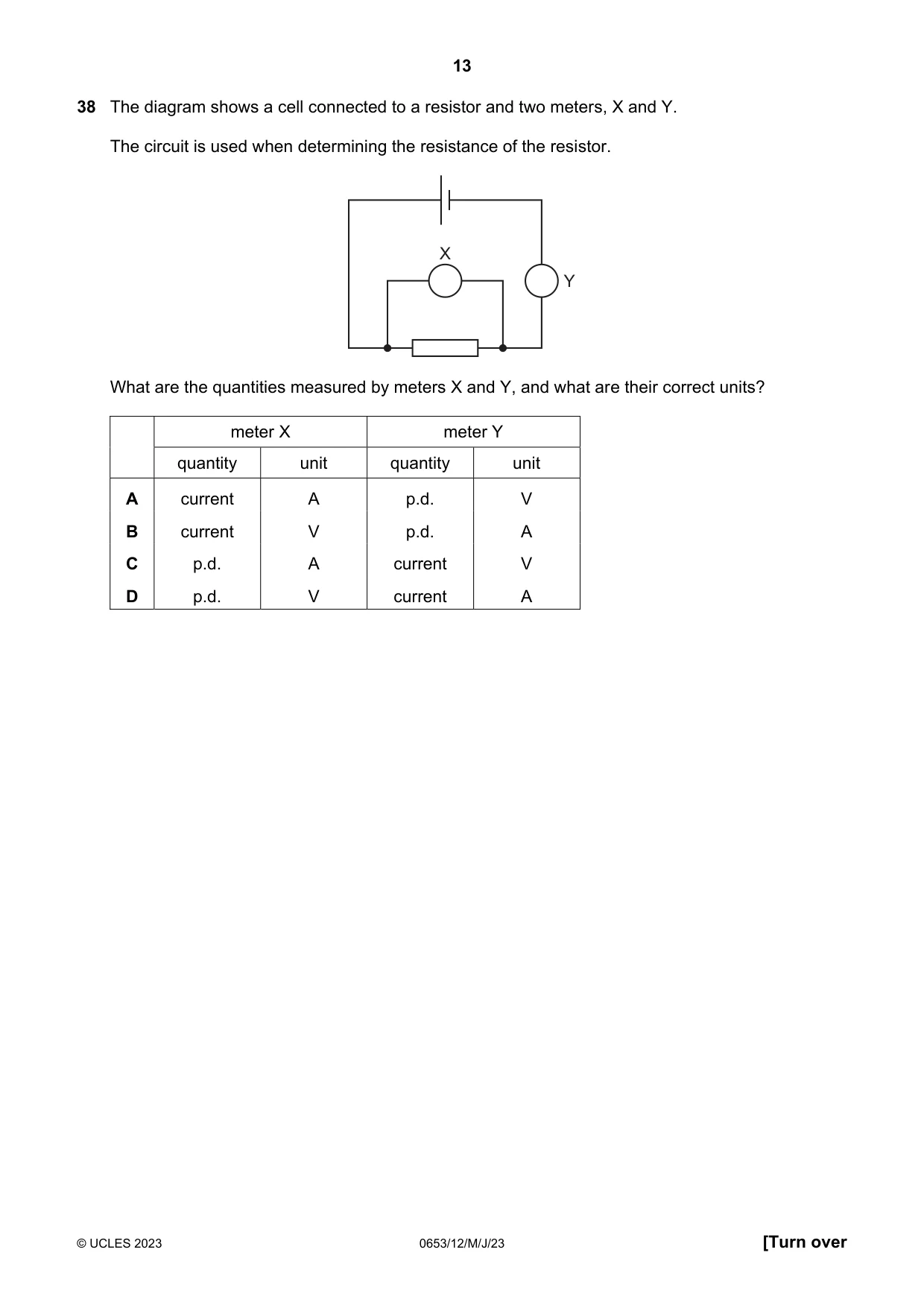
Q38 · The diagram shows a cell connected to a resistor and two meters, X and Y
38 The diagram shows a cell connected to a resistor and two meters, X and Y. The circuit is used when determining the resistance of the resistor. X Y What are the quantities measured by meters X and Y, and what are their correct units? meter X meter Y quantity unit quantity unit A current A p.d. V B current V p.d. A C p.d. A current V D p.d. V current A
Mark scheme: D
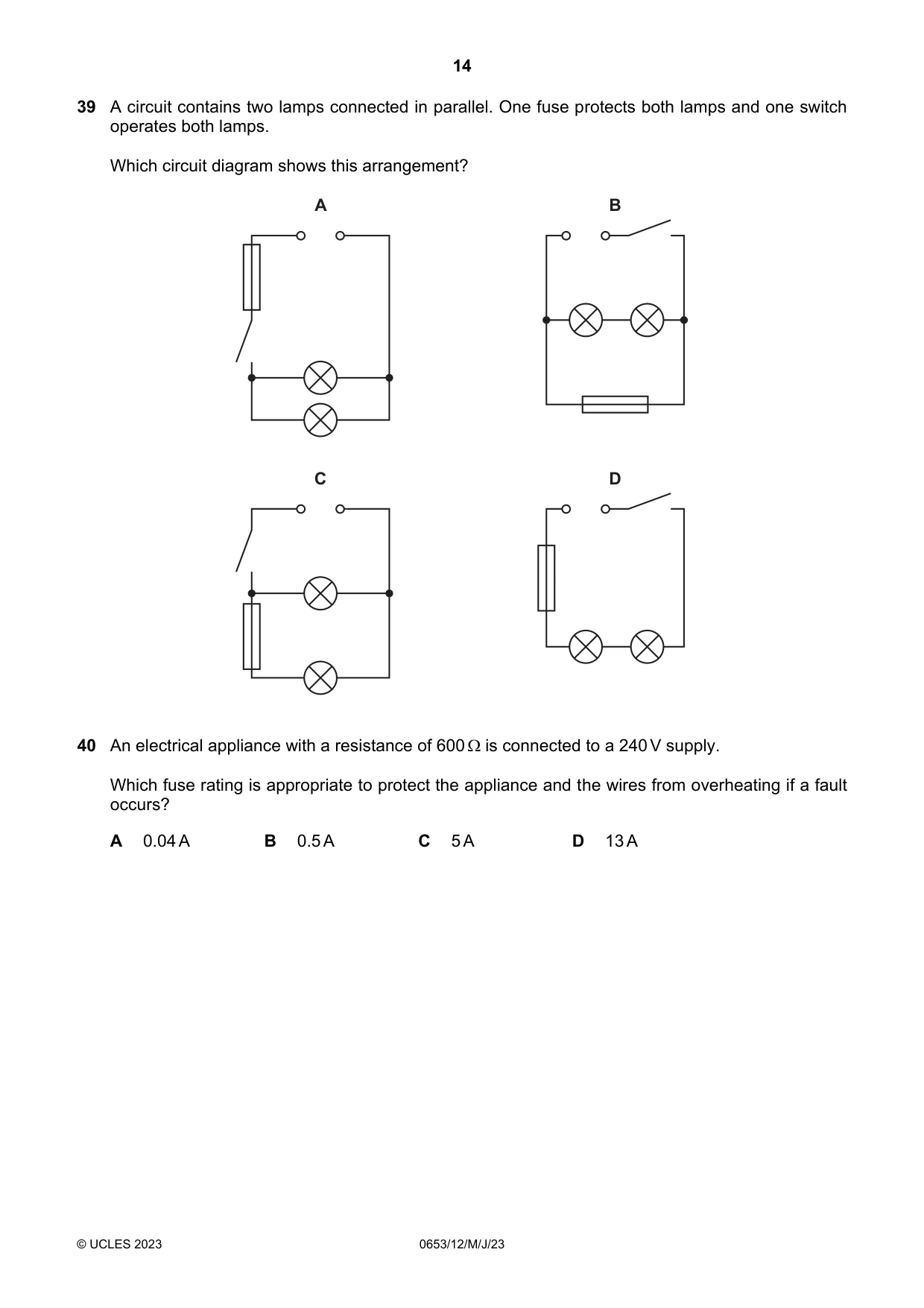
Q39 · A circuit contains two lamps connected in parallel
39 A circuit contains two lamps connected in parallel. One fuse protects both lamps and one switch operates both lamps. Which circuit diagram shows this arrangement? A B C D
Mark scheme: A
Q40 · An electrical appliance with a resistance of 600 is connected to a 240 V supply
40 An electrical appliance with a resistance of 600 is connected to a 240 V supply. Which fuse rating is appropriate to protect the appliance and the wires from overheating if a fault occurs? A 0.04 A B 0.5 A C 5 A D 13 A
Mark scheme: B
What was in this paper
The subtopics covered by these 40 questions, and how many questions each got. Open one in a new tab to see every Cambridge question on it.
2Energy, work and power2Identification of ions and gases2Light2Sexual reproduction in plants2Alkanes1Alloys and their properties1Arrangement of elements1Atomic structure and the Periodic Table1Biological molecules1Blood1Cell structure1Digestive system1Drugs1Electrical circuits1Electrical quantities1Electrical safety1Electrolysis1Elements, compounds and mixtures1Enzymes1Exothermic and endothermic reactions1Forces1Gas exchange in humans1Ions and ionic bonds1Kinetic particle model of matter1Mass and weight1Motion1Noble gases1Redox1Respiration1Sexual reproduction in humans1Simple molecules and covalent bonds1Sound1The characteristic properties of acids and bases1Thermal properties and temperature1What you needed in this session
Cambridge’s own grade thresholds for 2023 May/June, Paper 1 · Variant 2. A higher threshold means an easier paper — the bar moves with how the cohort did.