Cambridge IGCSE Science - Combined 0653 — 2022 Oct/Nov Paper 1 · Variant 2
0653/12/O/N/22 · 40 questions · 40 marks · ≈45 min
The question paper and its mark scheme, free to read here and free to download. This is Cambridge’s own paper, exactly as it was sat.
Question paper16 pages

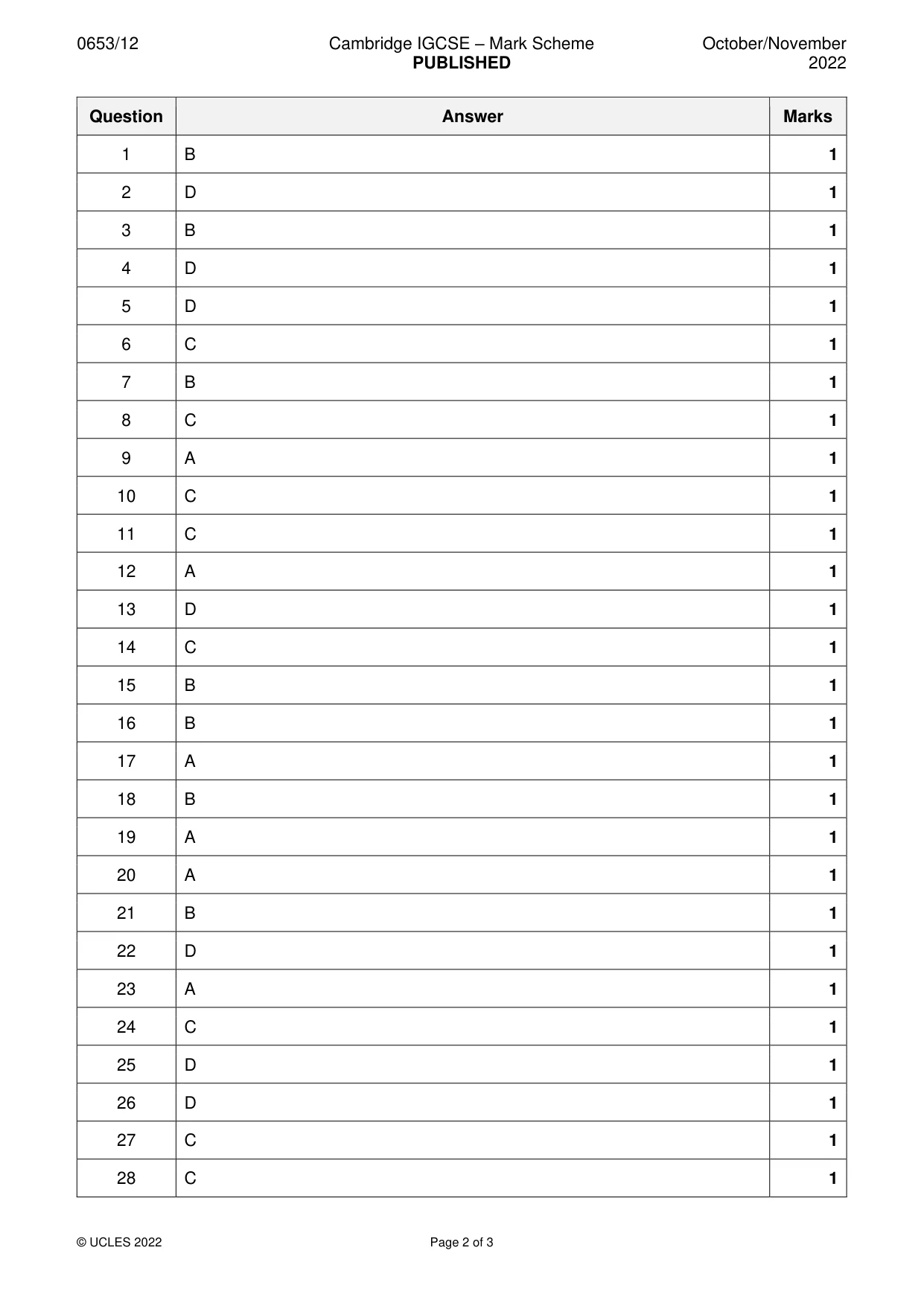
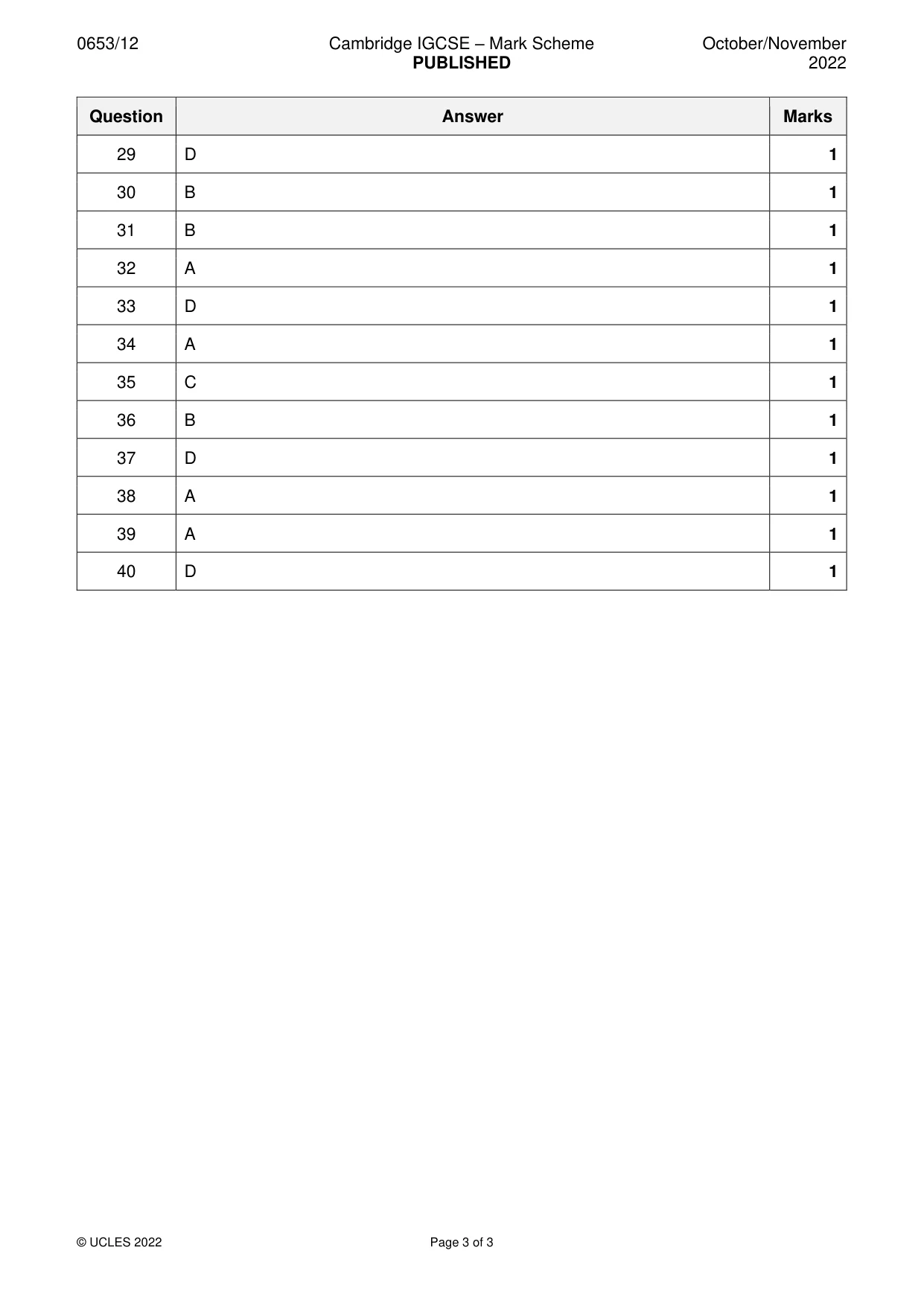
Mark scheme3 pages
Answers below. Sit the paper first if you are practising.
Questions as text
Q1 · What are characteristics of all living organisms?
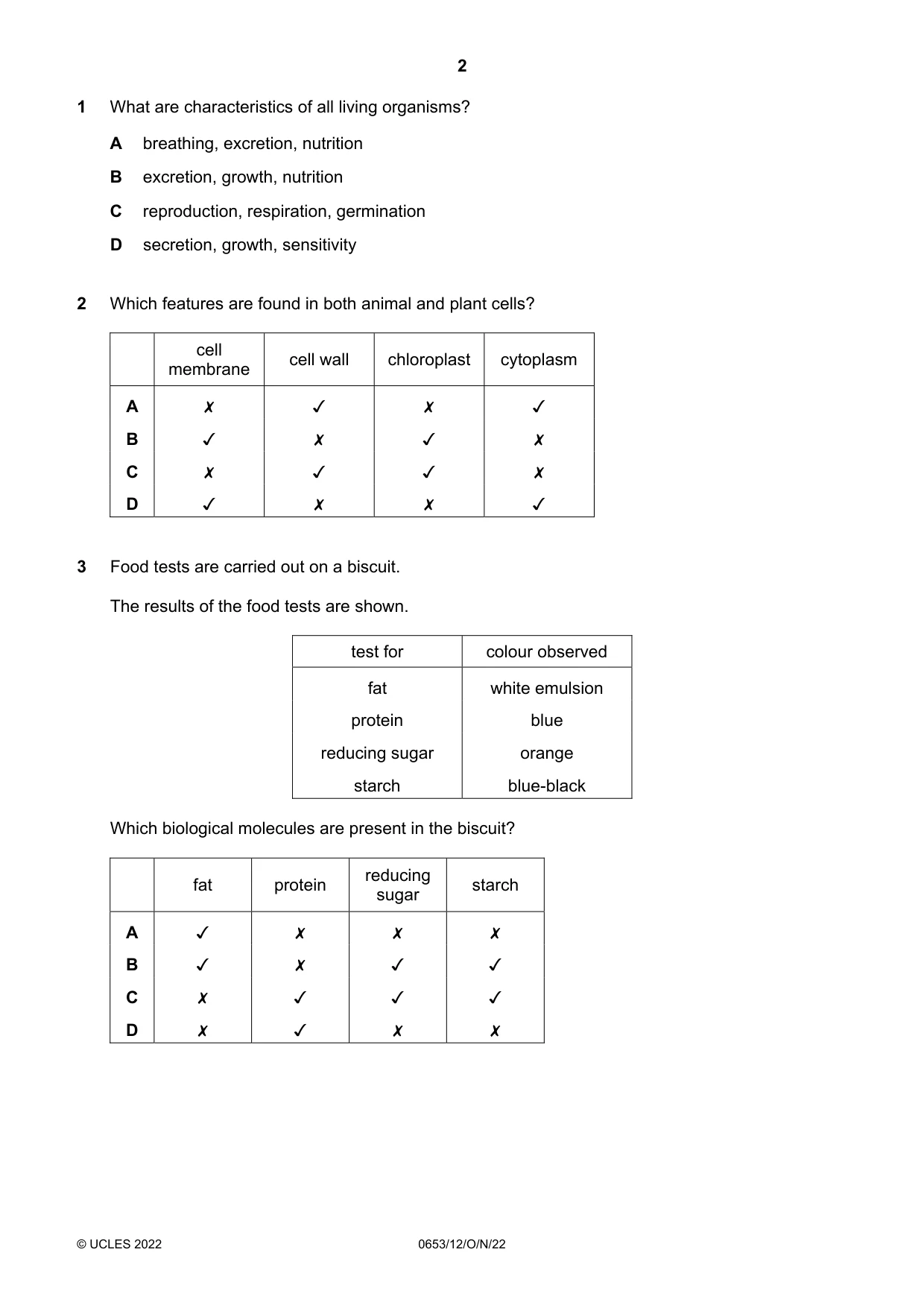
1 What are characteristics of all living organisms? A breathing, excretion, nutrition B excretion, growth, nutrition C reproduction, respiration, germination D secretion, growth, sensitivity
Mark scheme: B
Q2 · Which features are found in both animal and plant cells?
2 Which features are found in both animal and plant cells? net brane cell wall chloroplast | cytoplasm A x V x y B JV x V x Cc x V V x D JV x x y
Mark scheme: D
Q3 · Food tests are carried out on a biscuit
3. Food tests are carried out on a biscuit. The results of the food tests are shown. test for colour observed fat protein reducing sugar starch white emulsion blue-black Which biological molecules are present in the biscuit? fat protein sugar starch A v x x x B v x v v Cc x v v v D x v x x
Mark scheme: B
Q4 · The graph shows the effect of one variable on amylase activity
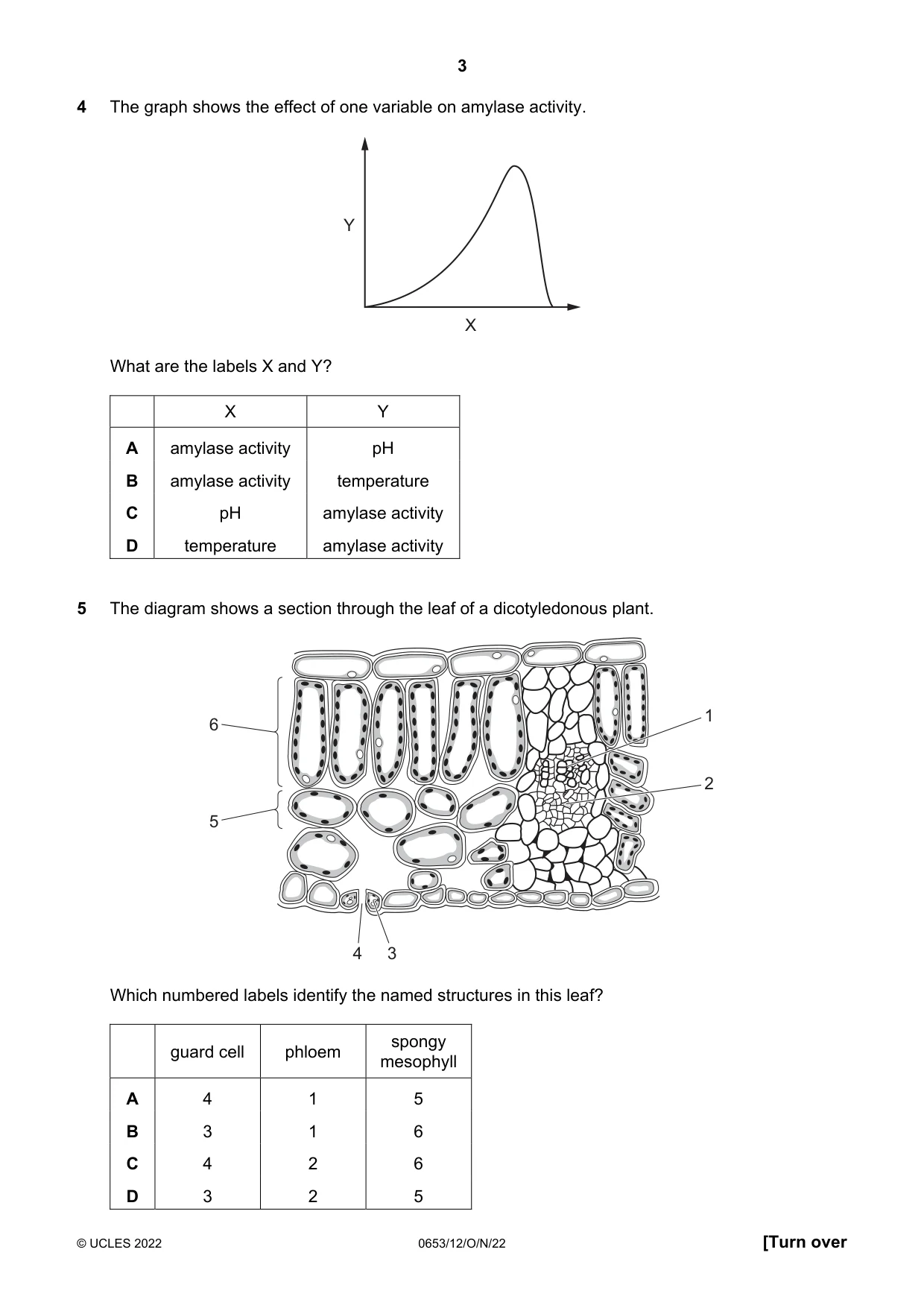
4 The graph shows the effect of one variable on amylase activity. Y X What are the labels X and Y? X Y A amylase activity pH B amylase activity temperature C pH amylase activity D temperature amylase activity
Mark scheme: D
Q5 · The diagram shows a section through the leaf of a dicotyledonous plant
5 The diagram shows a section through the leaf of a dicotyledonous plant. 1 6 2 5 4 3 Which numbered labels identify the named structures in this leaf? spongy guard cell phloem mesophyll A 4 1 5 B 3 1 6 C 4 2 6 D 3 2 5
Mark scheme: D
Q6 · Which statements about dietary fibre are correct?
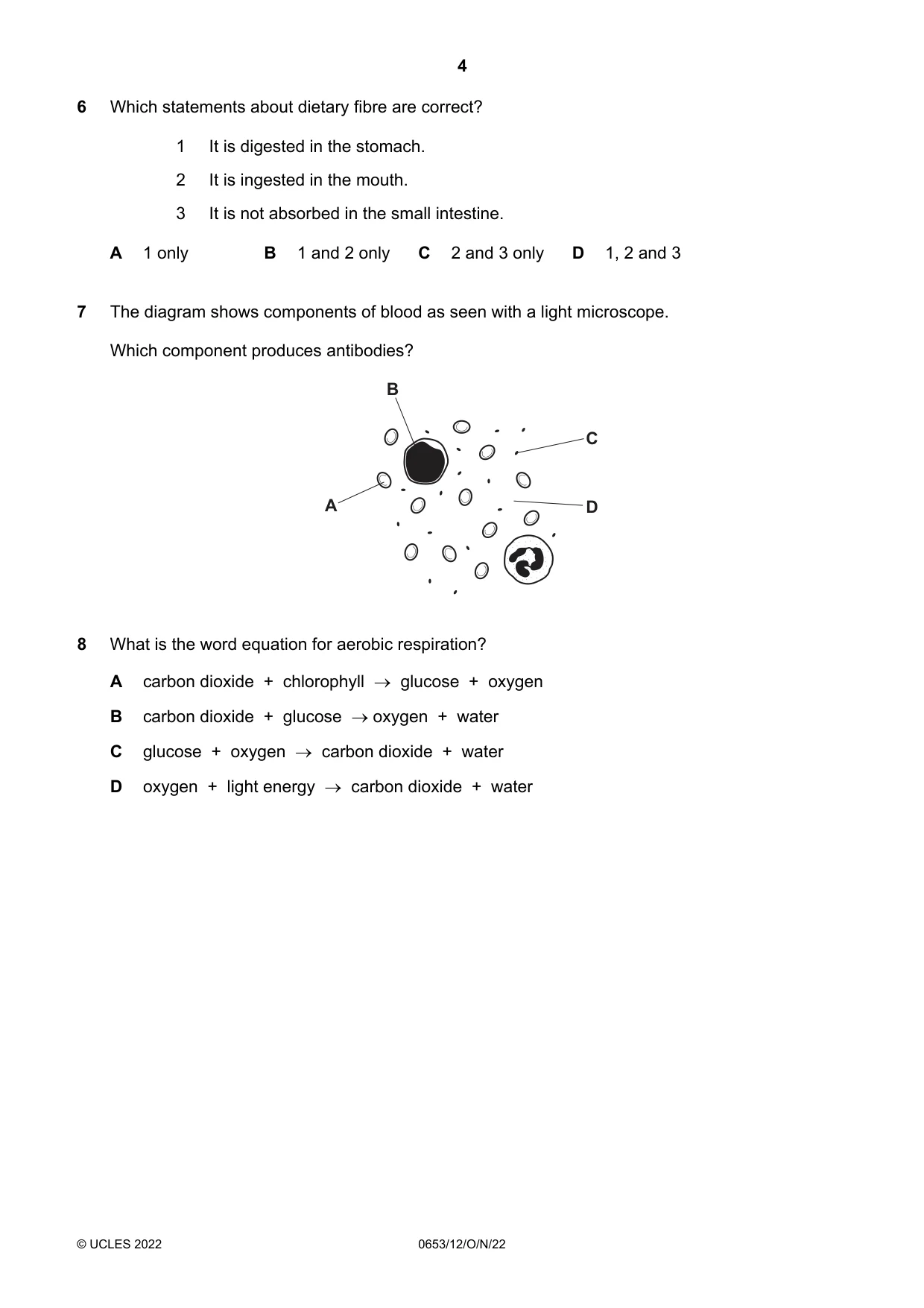
6 Which statements about dietary fibre are correct? 1 It is digested in the stomach. 2 It is ingested in the mouth. 3 It is not absorbed in the small intestine. A 1 only B 1 and 2 only C 2 and 3 only D 1, 2 and 3
Mark scheme: C
Q7 · The diagram shows components of blood as seen with a light microscope
7 The diagram shows components of blood as seen with a light microscope. Which component produces antibodies? B C A D
Mark scheme: B
Q8 · What is the word equation for aerobic respiration?
8 What is the word equation for aerobic respiration? A carbon dioxide + chlorophyll glucose + oxygen B carbon dioxide + glucose oxygen + water C glucose + oxygen carbon dioxide + water D oxygen + light energy carbon dioxide + water
Mark scheme: C
Q9 · A student tests her exhaled breath by blowing through a straw into some limewater
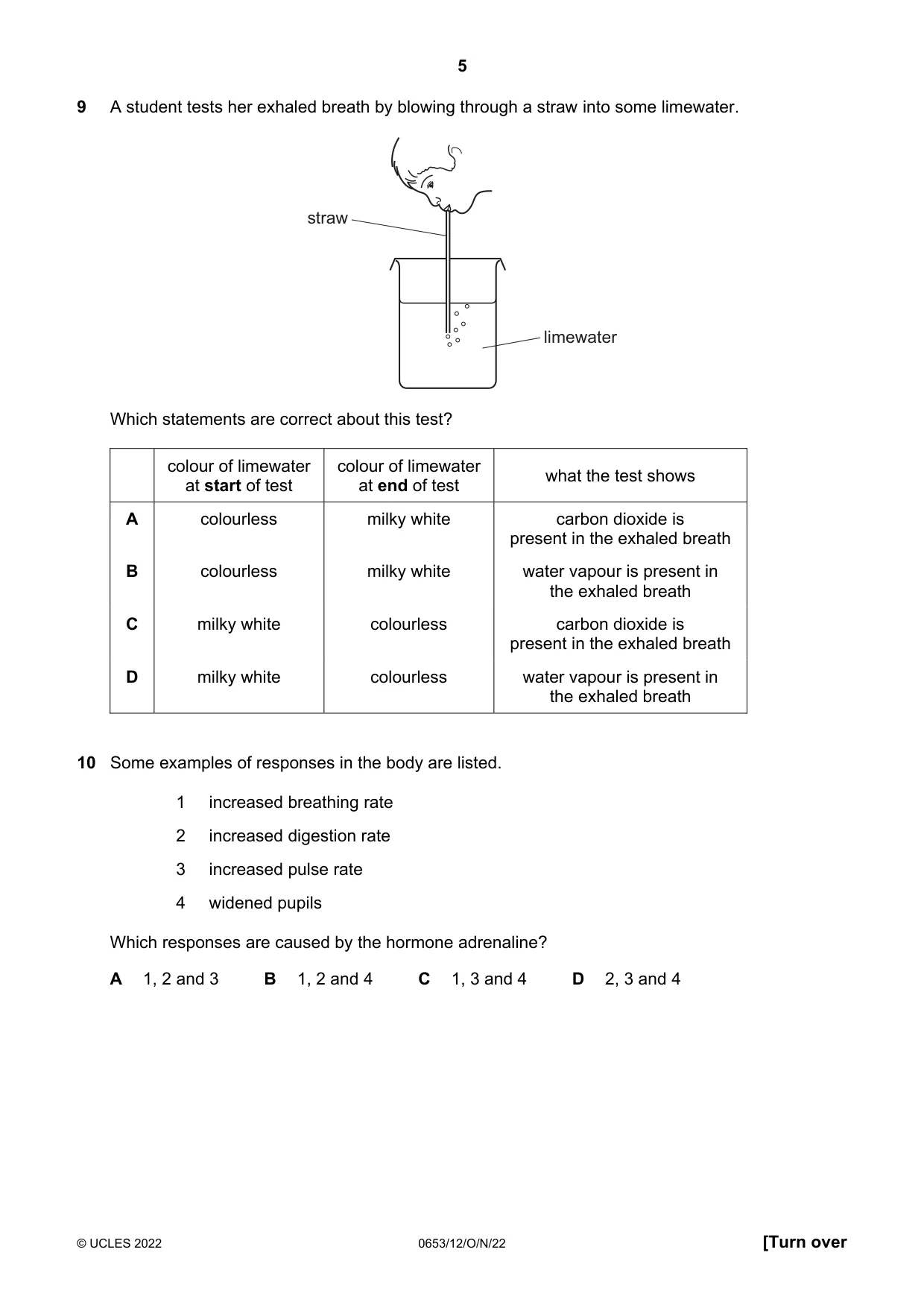
9 A student tests her exhaled breath by blowing through a straw into some limewater. straw limewater Which statements are correct about this test? colour of limewater colour of limewater what the test shows at start of test at end of test A colourless milky white carbon dioxide is present in the exhaled breath B colourless milky white water vapour is present in the exhaled breath C milky white colourless carbon dioxide is present in the exhaled breath D milky white colourless water vapour is present in the exhaled breath
Mark scheme: A
Q10 · Some examples of responses in the body are listed
10 Some examples of responses in the body are listed. 1 increased breathing rate 2 increased digestion rate 3 increased pulse rate 4 widened pupils Which responses are caused by the hormone adrenaline? A 1, 2 and 3 B 1, 2 and 4 C 1, 3 and 4 D 2, 3 and 4
Mark scheme: C
Q11 · What are two features of sexual reproduction?
11 What are two features of sexual reproduction? feature 1 feature 2 A fusion of two identical nuclei requires two different parents B fusion of two zygotes offspring are genetically identical C offspring are genetically different fusion of two different nuclei D only requires a single parent development from a single zygote
Mark scheme: C
Q12 · Where are male gametes made in a flower?
12 Where are male gametes made in a flower? A anther B filament C stigma D style
Mark scheme: A
Q13 · The diagram shows part of the carbon cycle
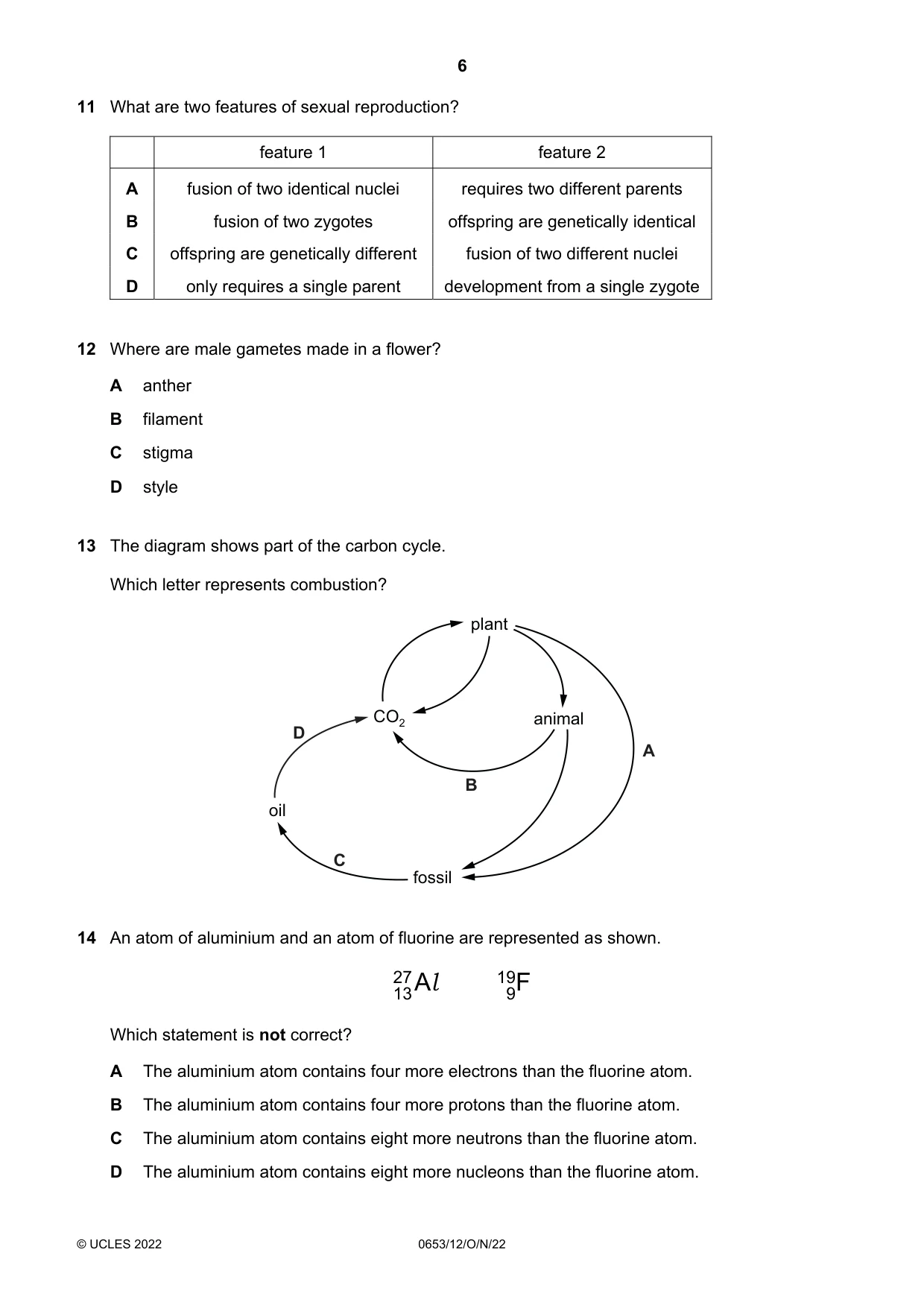
13 The diagram shows part of the carbon cycle. Which letter represents combustion? plant CO2 animal D A B oil C fossil
Mark scheme: D
Q14 · An atom of aluminium and an atom of fluorine are represented as shown
14 An atom of aluminium and an atom of fluorine are represented as shown. 13Al 19 27 9F Which statement is not correct? A The aluminium atom contains four more electrons than the fluorine atom. B The aluminium atom contains four more protons than the fluorine atom. C The aluminium atom contains eight more neutrons than the fluorine atom. D The aluminium atom contains eight more nucleons than the fluorine atom.
Mark scheme: C
Q15 · In boron chloride, 25% of the atoms are boron
15 In boron chloride, 25% of the atoms are boron. What is the formula of boron chloride? A BCl B BCl 3 C B2Cl 3 D B3Cl
Mark scheme: B
Q16 · The apparatus used for the electrolysis of concentrated aqueous sodium chloride is shown
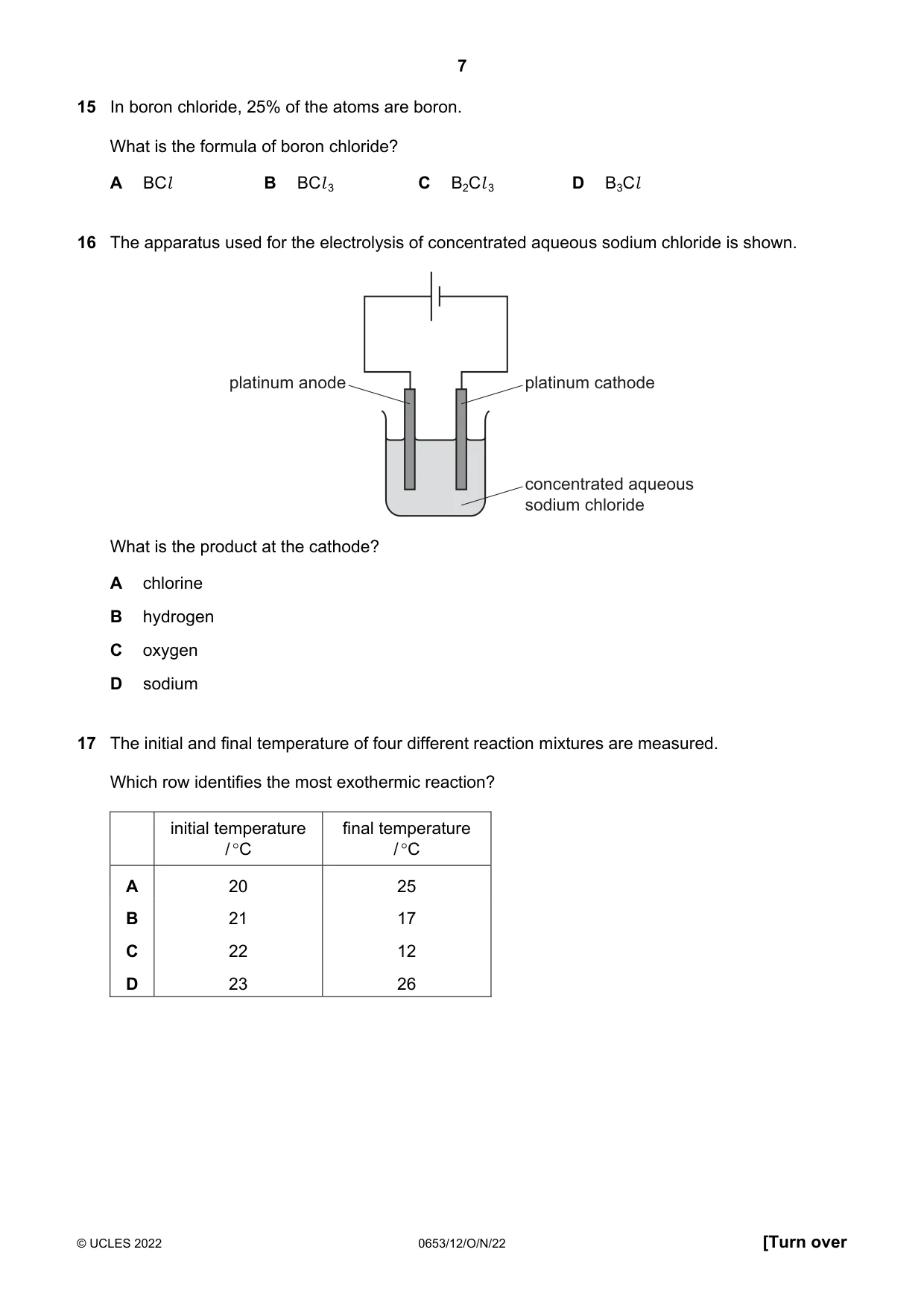
16 The apparatus used for the electrolysis of concentrated aqueous sodium chloride is shown. platinum anode platinum cathode concentrated aqueous sodium chloride What is the product at the cathode? A chlorine B hydrogen C oxygen D sodium
Mark scheme: B
Q17 · The initial and final temperature of four different reaction mixtures are measured
17 The initial and final temperature of four different reaction mixtures are measured. Which row identifies the most exothermic reaction? initial temperature final temperature / C / C A 20 25 B 21 17 C 22 12 D 23 26
Mark scheme: A
Q18 · 10 g of solid calcium carbonate is added to 100 cm3 of hydrochloric acid
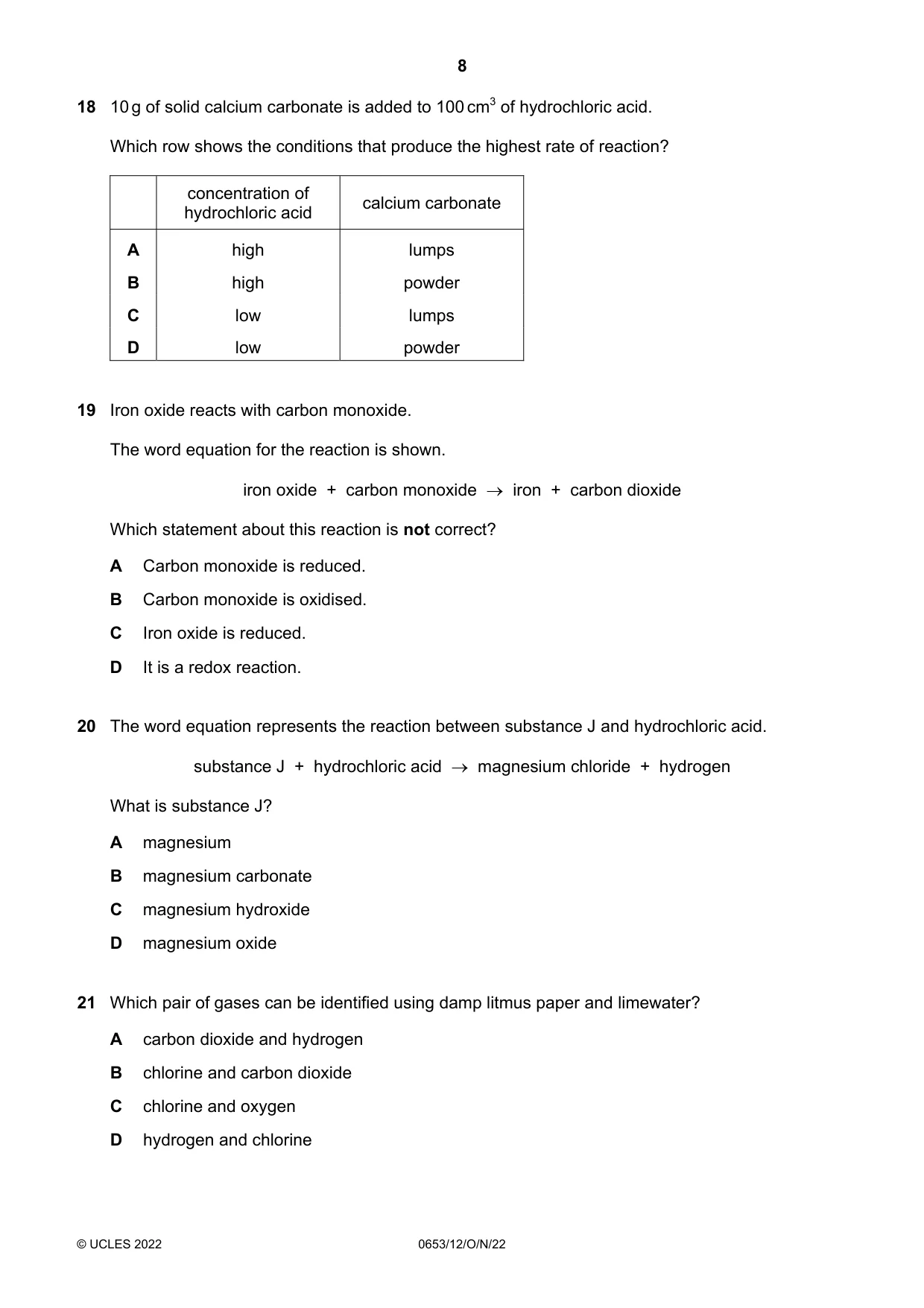
18 10 g of solid calcium carbonate is added to 100 cm3 of hydrochloric acid. Which row shows the conditions that produce the highest rate of reaction? concentration of calcium carbonate hydrochloric acid A high lumps B high powder C low lumps D low powder
Mark scheme: B
Q19 · Iron oxide reacts with carbon monoxide
19 Iron oxide reacts with carbon monoxide. The word equation for the reaction is shown. iron oxide + carbon monoxide iron + carbon dioxide Which statement about this reaction is not correct? A Carbon monoxide is reduced. B Carbon monoxide is oxidised. C Iron oxide is reduced. D It is a redox reaction.
Mark scheme: A
Q20 · The word equation represents the reaction between substance J and hydrochloric acid
20 The word equation represents the reaction between substance J and hydrochloric acid. substance J + hydrochloric acid magnesium chloride + hydrogen What is substance J? A magnesium B magnesium carbonate C magnesium hydroxide D magnesium oxide
Mark scheme: A
More questions on The characteristic properties of acids and bases
Q21 · Which pair of gases can be identified using damp litmus paper and limewater?
21 Which pair of gases can be identified using damp litmus paper and limewater? A carbon dioxide and hydrogen B chlorine and carbon dioxide C chlorine and oxygen D hydrogen and chlorine
Mark scheme: B
Q22 · Element X has a high density and conducts electricity when solid and when molten
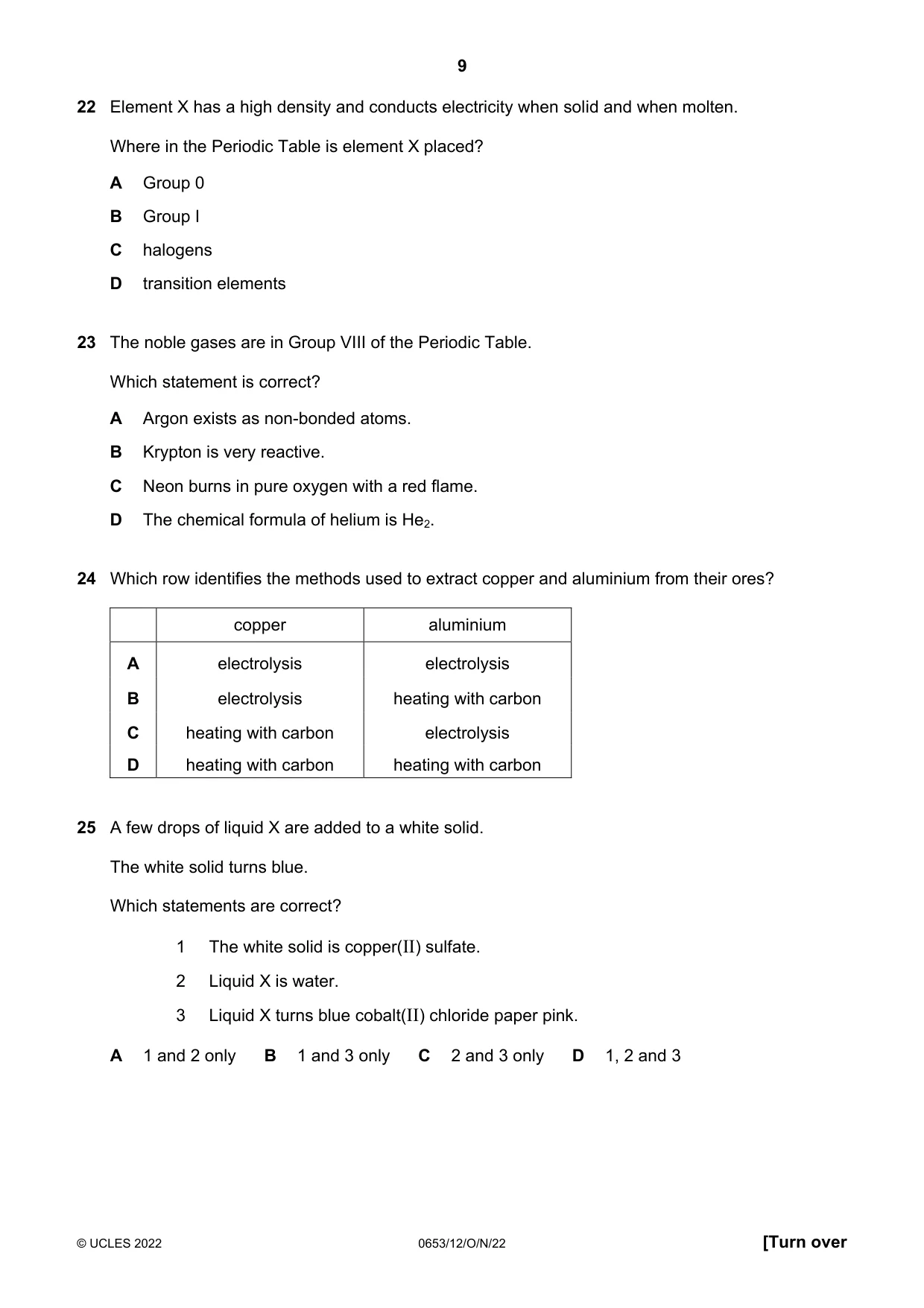
22 Element X has a high density and conducts electricity when solid and when molten. Where in the Periodic Table is element X placed? A Group 0 B Group I C halogens D transition elements
Mark scheme: D
Q23 · The noble gases are in Group VIII of the Periodic Table
23 The noble gases are in Group VIII of the Periodic Table. Which statement is correct? A Argon exists as non-bonded atoms. B Krypton is very reactive. C Neon burns in pure oxygen with a red flame. D The chemical formula of helium is He2.
Mark scheme: A
Q24 · Which row identifies the methods used to extract copper and aluminium from their ores?
24 Which row identifies the methods used to extract copper and aluminium from their ores? copper aluminium A electrolysis electrolysis B electrolysis heating with carbon C heating with carbon electrolysis D heating with carbon heating with carbon
Mark scheme: C
Q25 · A few drops of liquid X are added to a white solid
25 A few drops of liquid X are added to a white solid. The white solid turns blue. Which statements are correct? 1 The white solid is copper(II) sulfate. 2 Liquid X is water. 3 Liquid X turns blue cobalt(II) chloride paper pink. A 1 and 2 only B 1 and 3 only C 2 and 3 only D 1, 2 and 3
Mark scheme: D
Q26 · Which statements about the fractions obtained by fractional distillation of petroleum are…
26 Which statements about the fractions obtained by fractional distillation of petroleum are correct? 1 Gas oil is used as a fuel in petrol engines. 2 Naphtha is used for road surfaces. 3 Refinery gas is used as bottled gas for heating. 4 The fractions are mixtures of hydrocarbons. A 1 and 2 B 1 and 3 C 2 and 4 D 3 and 4
Mark scheme: D
Q27 · The formula of the hydrocarbon octane is C8H18
27 The formula of the hydrocarbon octane is C8H18. What are the products of the complete combustion of octane? A carbon and hydrogen B carbon and water C carbon dioxide and water D carbon monoxide and water
Mark scheme: C
Q28 · The diagram shows a speed–time graph for a car
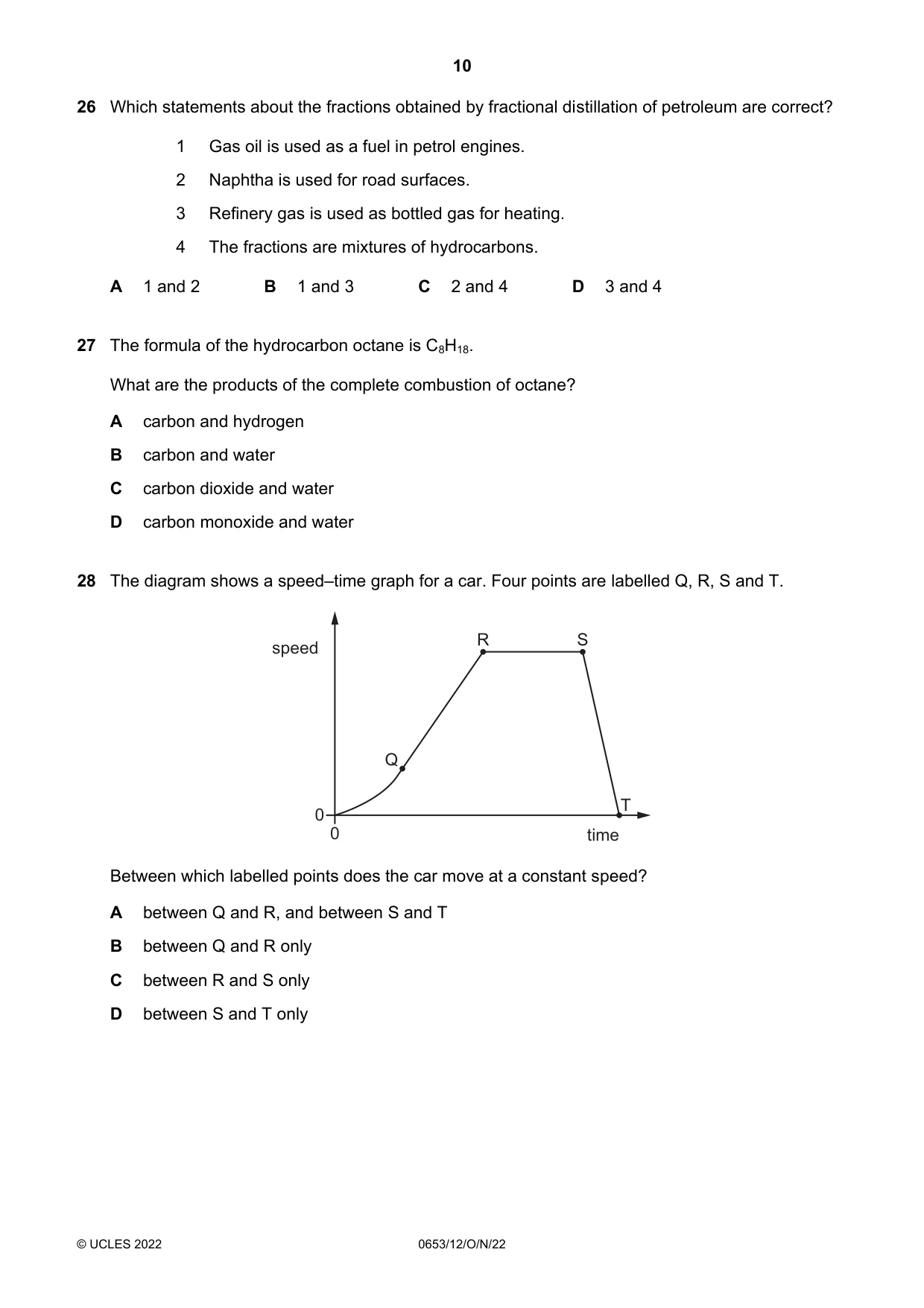
28 The diagram shows a speed–time graph for a car. Four points are labelled Q, R, S and T. R S speed Q T 0 0 time Between which labelled points does the car move at a constant speed? A between Q and R, and between S and T B between Q and R only C between R and S only D between S and T only
Mark scheme: C
Q29 · A car travels at a constant speed along a straight road
29 A car travels at a constant speed along a straight road. Which statement about the car is correct? A The resultant force on the car is equal to the weight of the car. B The resultant force on the car acts in the direction of the motion of the car. C The resultant force on the car opposes the motion of the car. D The resultant force on the car is equal to zero.
Mark scheme: D
Q30 · A man lies on the ground, then stands up
30 A man lies on the ground, then stands up. How do the force and the pressure that the man exerts on the ground in each of the two positions compare? force on the ground pressure on the ground A equal in both positions equal in both positions B equal in both positions greater when standing up C greater when standing up equal in both positions D greater when standing up greater when standing up
Mark scheme: B
Q31 · A piece of scientific equipment is taken from the Earth to a distant planet
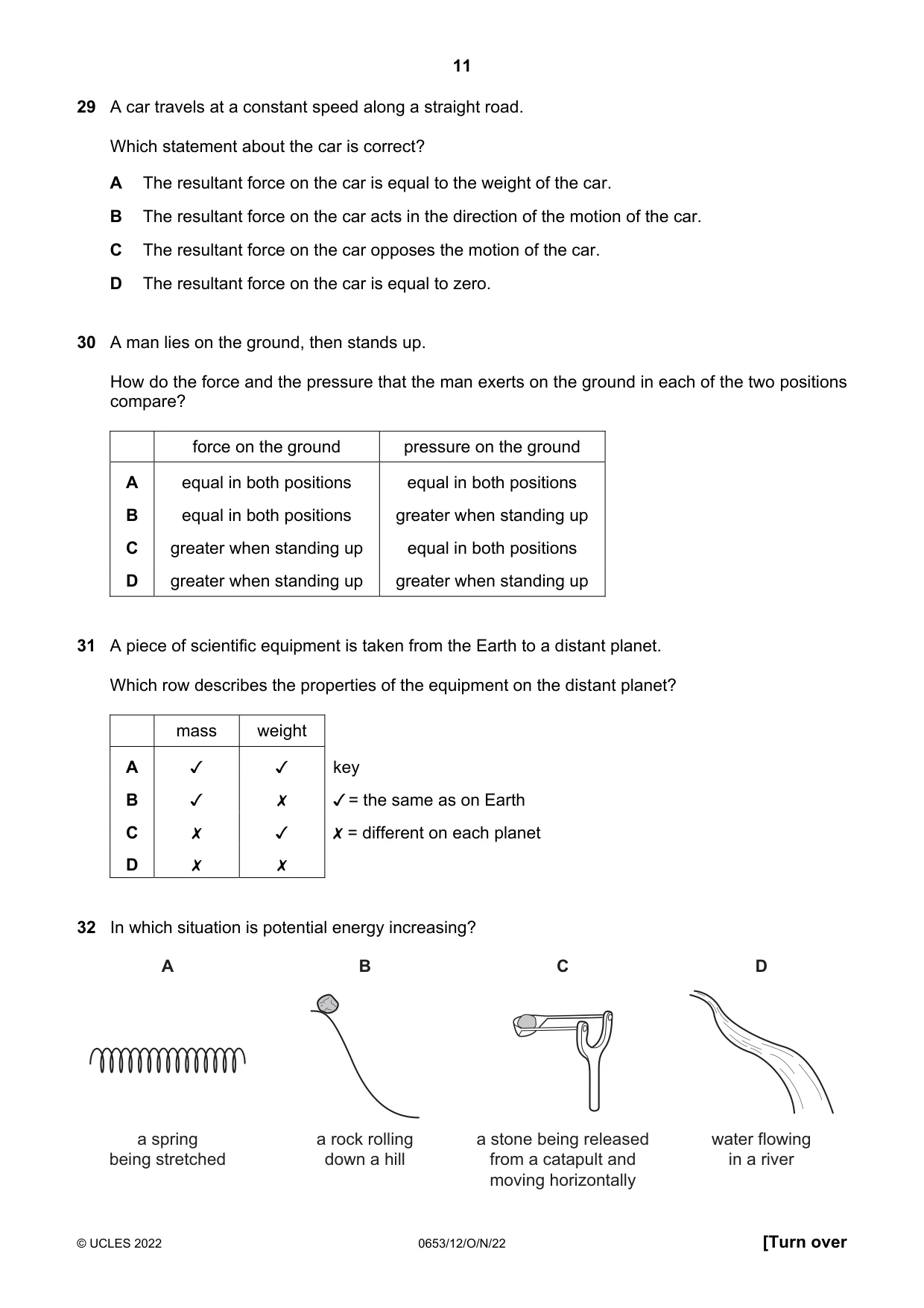
31 A piece of scientific equipment is taken from the Earth to a distant planet. Which row describes the properties of the equipment on the distant planet? mass weight Jv v key / =the same as on Earth X = different on each planet 00QW D> ~ «eX x \ x
Mark scheme: B
Q32 · In which situation is potential energy increasing?
32 In which situation is potential energy increasing? A B C D a spring a rock rolling a stone being released water flowing being stretched down a hill from a catapult and in a river moving horizontally
Mark scheme: A
Q33 · Which statement about water is correct?
33 Which statement about water is correct? A It boils at 0 C and melts at 100 C. B It boils at 0 C and melts at –100 C. C It boils at 100 C and melts at –100 C. D It boils at 100 C and melts at 0 C.
Mark scheme: D
Q34 · An electric heater is placed inside a metal box which has one side open
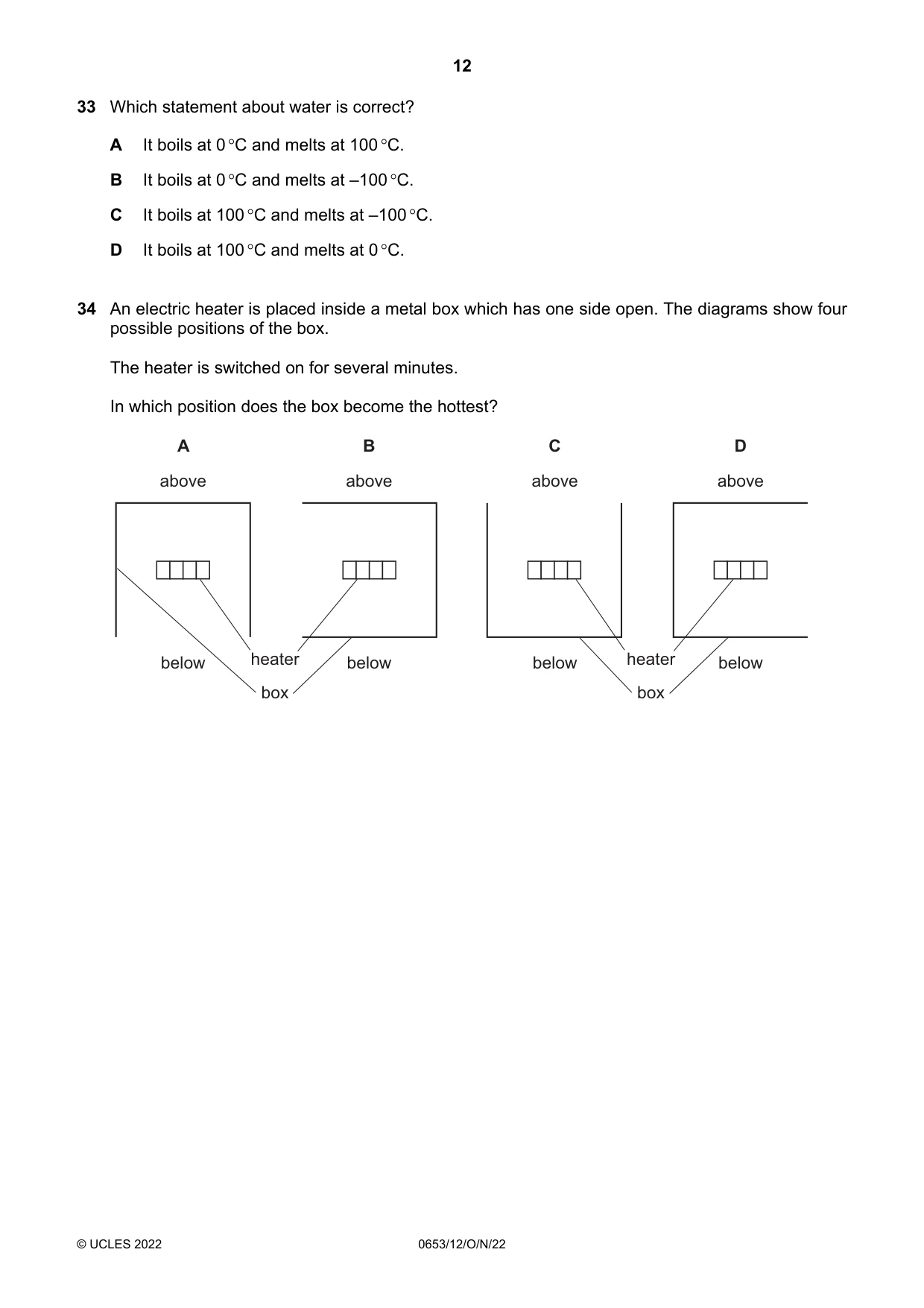
34 An electric heater is placed inside a metal box which has one side open. The diagrams show four possible positions of the box. The heater is switched on for several minutes. In which position does the box become the hottest? A B C D above above above above below heater below below heater below box box
Mark scheme: A
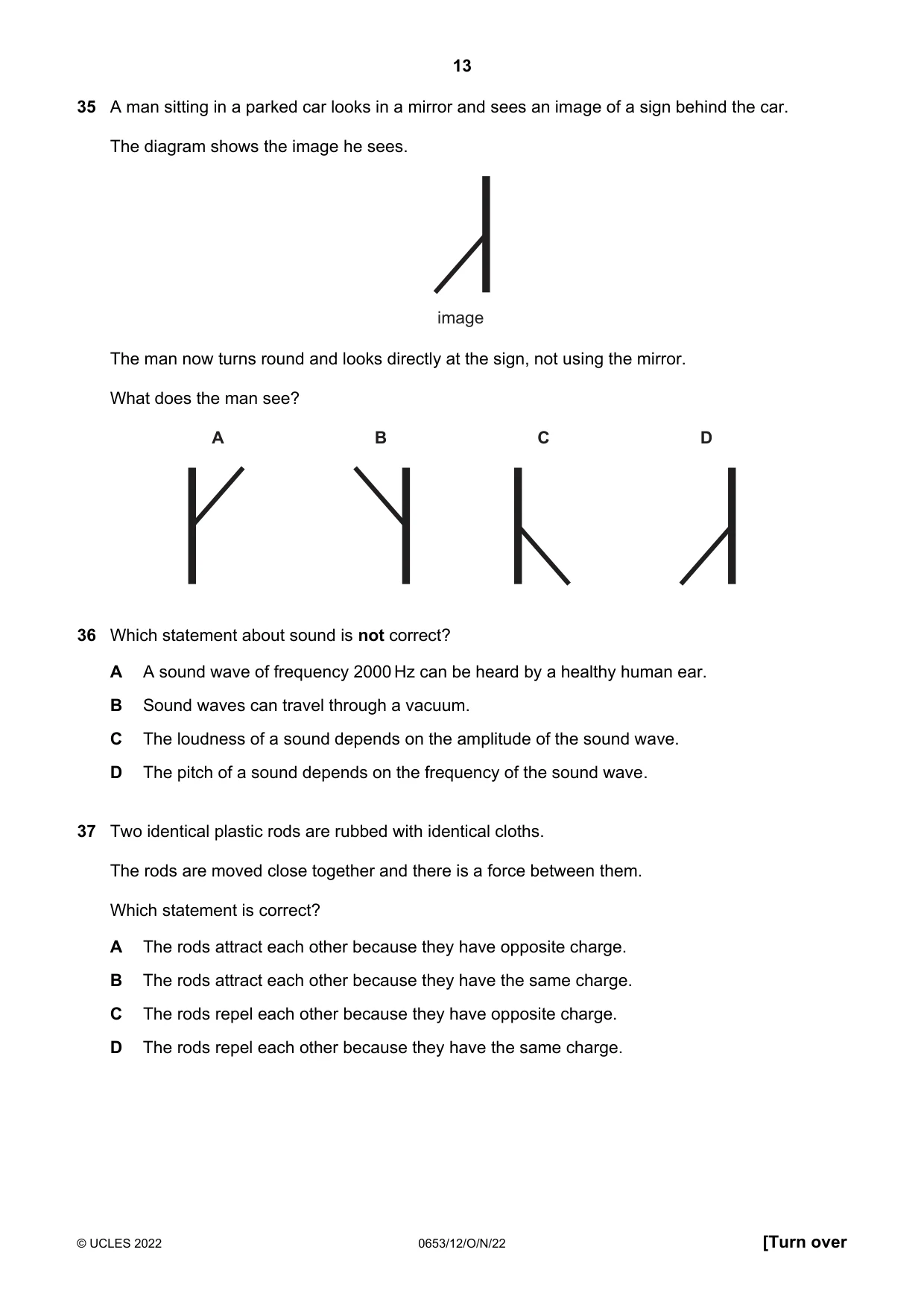
Q35 · A man sitting in a parked car looks in a mirror and sees an image of a sign behind the car
35 A man sitting in a parked car looks in a mirror and sees an image of a sign behind the car. The diagram shows the image he sees. image The man now turns round and looks directly at the sign, not using the mirror. What does the man see? A B C D
Mark scheme: C
Q36 · Which statement about sound is not correct?
36 Which statement about sound is not correct? A A sound wave of frequency 2000 Hz can be heard by a healthy human ear. B Sound waves can travel through a vacuum. C The loudness of a sound depends on the amplitude of the sound wave. D The pitch of a sound depends on the frequency of the sound wave.
Mark scheme: B
Q37 · Two identical plastic rods are rubbed with identical cloths
37 Two identical plastic rods are rubbed with identical cloths. The rods are moved close together and there is a force between them. Which statement is correct? A The rods attract each other because they have opposite charge. B The rods attract each other because they have the same charge. C The rods repel each other because they have opposite charge. D The rods repel each other because they have the same charge.
Mark scheme: D
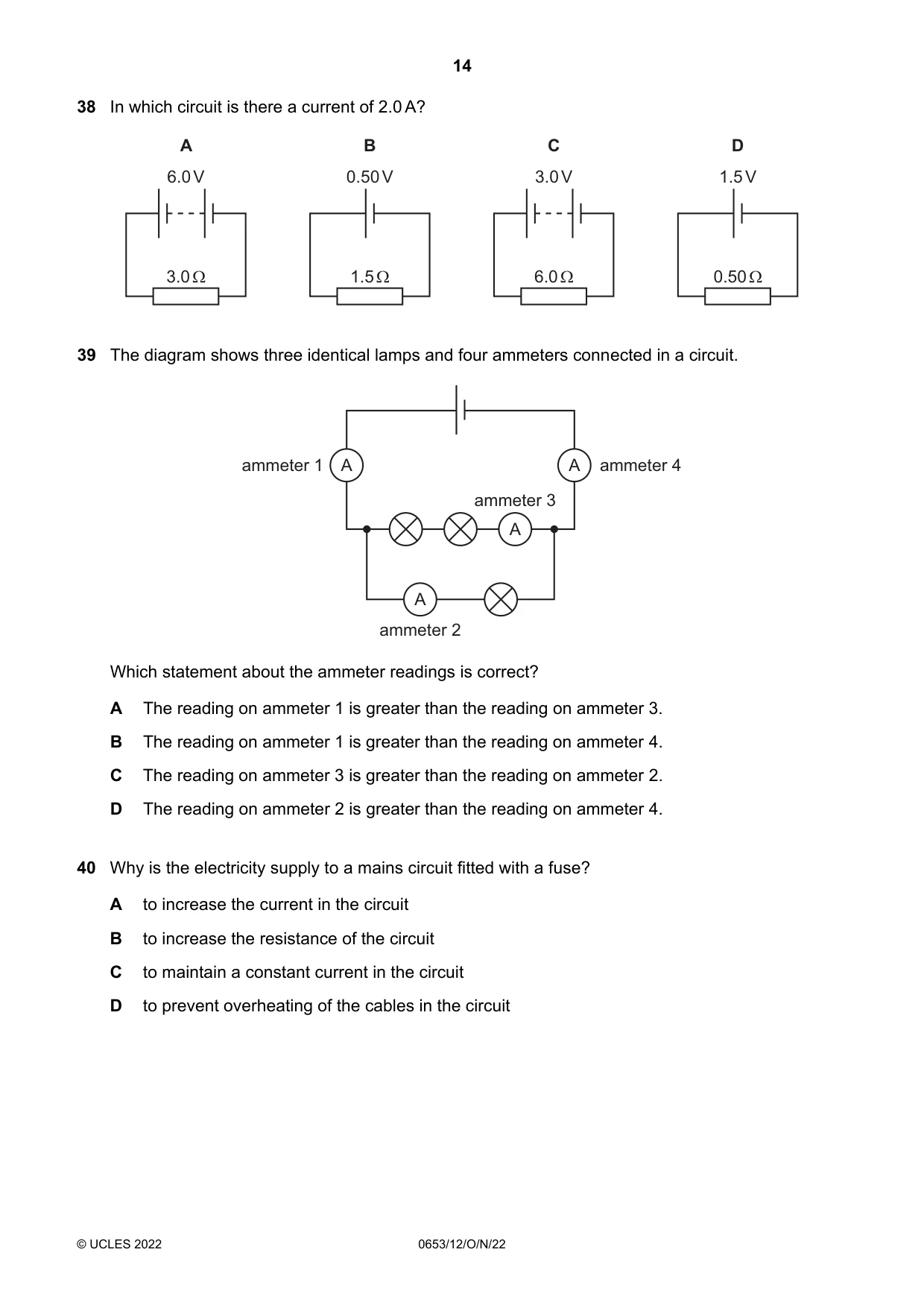
Q38 · In which circuit is there a current of 2.0 A?
38 In which circuit is there a current of 2.0 A? A B Cc D 6.0V 0.50V 3.0V 1.5V 3.0Q 1.50 6.0Q 0.50Q
Mark scheme: A
Q39 · The diagram shows three identical lamps and four ammeters connected in a circuit
39 The diagram shows three identical lamps and four ammeters connected in a circuit. ammeter 1 A A ammeter 4 ammeter 3 A A ammeter 2 Which statement about the ammeter readings is correct? A The reading on ammeter 1 is greater than the reading on ammeter 3. B The reading on ammeter 1 is greater than the reading on ammeter 4. C The reading on ammeter 3 is greater than the reading on ammeter 2. D The reading on ammeter 2 is greater than the reading on ammeter 4.
Mark scheme: A
Q40 · Why is the electricity supply to a mains circuit fitted with a fuse?
40 Why is the electricity supply to a mains circuit fitted with a fuse? A to increase the current in the circuit B to increase the resistance of the circuit C to maintain a constant current in the circuit D to prevent overheating of the cables in the circuit
Mark scheme: D
What was in this paper
The subtopics covered by these 40 questions, and how many questions each got. Open one in a new tab to see every Cambridge question on it.
2Sexual reproduction in plants2Alkanes1Atomic structure and the Periodic Table1Biological molecules1Blood1Carbon cycle1Cell structure1Characteristics of living organisms1Diet1Drugs1Electrical quantities1Electrical safety1Electrolysis1Energy, work and power1Enzymes1Exothermic and endothermic reactions1Extraction of metals1Forces1Formulas1Fuels1Gas exchange in humans1Identification of ions and gases1Leaf structure1Light1Mass and weight1Motion1Noble gases1Pressure1Rate of reaction1Redox1Respiration1Sound1The characteristic properties of acids and bases1Thermal properties and temperature1Transfer of thermal energy1Transition elements1Water1What you needed in this session
Cambridge’s own grade thresholds for 2022 Oct/Nov, Paper 1 · Variant 2. A higher threshold means an easier paper — the bar moves with how the cohort did.