Questions as text
Q1 · A simple circuit set up to investigate the electrical properties of a lamp 0653/42 Feb/March 2017
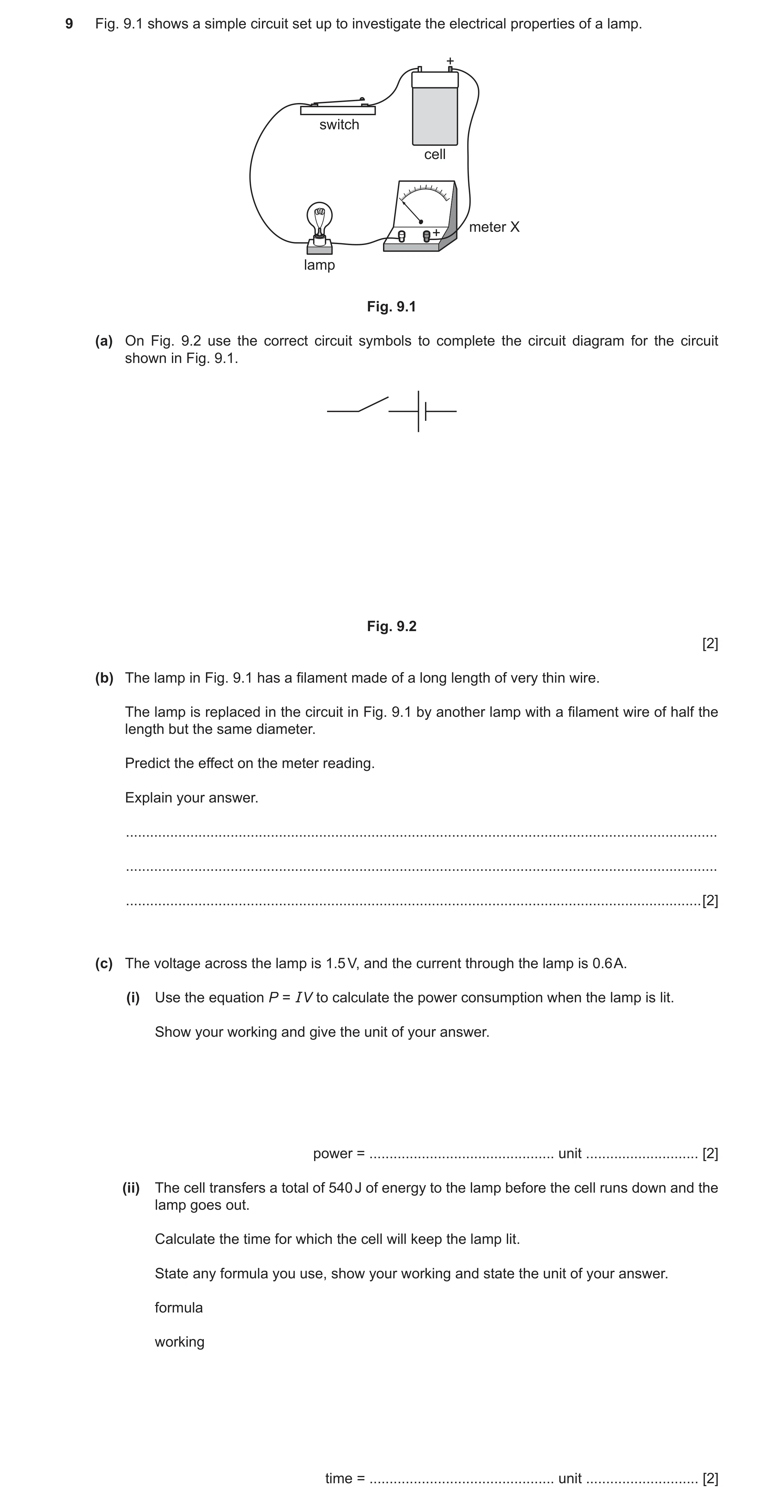
9 Fig. 9.1 shows a simple circuit set up to investigate the electrical properties of a lamp. + switch cell meter X + lamp Fig. 9.1 (a) On Fig. 9.2 use the correct circuit symbols to complete the circuit diagram for the circuit shown in Fig. 9.1. Fig. 9.2 [2] (b) The lamp in Fig. 9.1 has a filament made of a long length of very thin wire. The lamp is replaced in the circuit in Fig. 9.1 by another lamp with a filament wire of half the length but the same diameter. Predict the effect on the meter reading. Explain your answer. … … … [2] (c) The voltage across the lamp is 1.5 V, and the current through the lamp is 0.6 A. (i) Use the equation P = IV to calculate the power consumption when the lamp is lit. Show your working and give the unit of your answer. power = … unit … [2] (ii) The cell transfers a total of 540 J of energy to the lamp before the cell runs down and the lamp goes out. Calculate the time for which the cell will keep the lamp lit. State any formula you use, show your working and state the unit of your answer. formula working time = … unit … [2]
8 marks
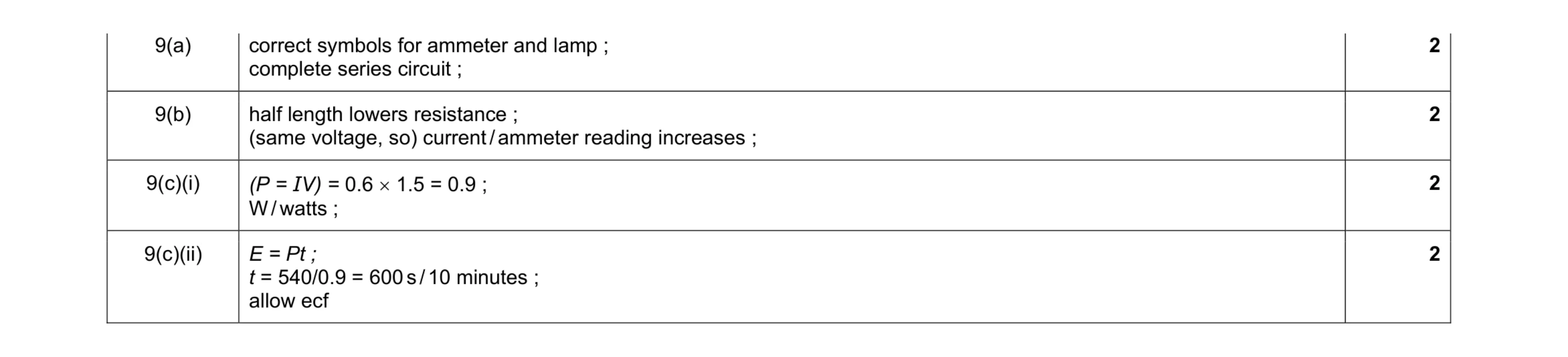
Mark scheme: 9(a) correct symbols for ammeter and lamp ; complete series circuit ; 2 9(b) half length lowers resistance ; (same voltage, so) current / ammeter reading increases ; 2 9(c)(i) (P = IV) = 0.6 × 1.5 = 0.9 ; W / watts ; 2 9(c)(ii) E = Pt ; t = 540/0.9 = 600 s / 10 minutes ; allow ecf 2
This question in 0653/42 Feb/March 2017
Q2 · A wind surfer on a surf board, driven by the wind, sailing at a constant speed across the… 0653/41 May/June 2017
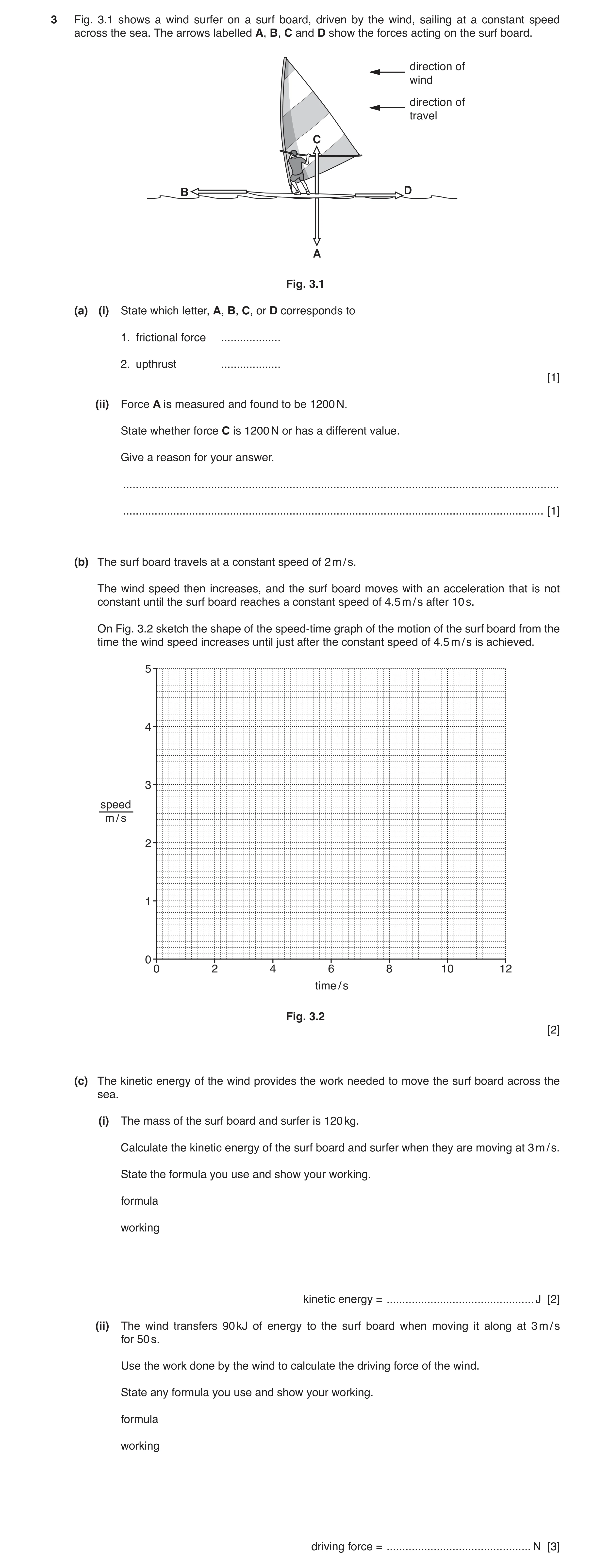
3 Fig. 3.1 shows a wind surfer on a surf board, driven by the wind, sailing at a constant speed across the sea. The arrows labelled A, B, C and D show the forces acting on the surf board. direction of wind direction of travel C B D A Fig. 3.1 (a) (i) State which letter, A, B, C, or D corresponds to 1. frictional force … 2. upthrust … [1] (ii) Force A is measured and found to be 1200 N. State whether force C is 1200 N or has a different value. Give a reason for your answer. … … [1] (b) The surf board travels at a constant speed of 2 m / s. The wind speed then increases, and the surf board moves with an acceleration that is not constant until the surf board reaches a constant speed of 4.5 m / s after 10 s. On Fig. 3.2 sketch the shape of the speed-time graph of the motion of the surf board from the time the wind speed increases until just after the constant speed of 4.5 m / s is achieved. 5 4 3 speed m / s 2 1 0 0 2 4 6 8 10 12 time / s Fig. 3.2 [2] (c) The kinetic energy of the wind provides the work needed to move the surf board across the sea. (i) The mass of the surf board and surfer is 120 kg. Calculate the kinetic energy of the surf board and surfer when they are moving at 3 m / s. State the formula you use and show your working. formula working kinetic energy = … J [2] (ii) The wind transfers 90 kJ of energy to the surf board when moving it along at 3 m / s for 50 s. Use the work done by the wind to calculate the driving force of the wind. State any formula you use and show your working. formula working driving force = … N [3]
9 marks
Mark scheme: 3(a)(i) D C 1 3(a)(ii) (Force C is 1200 N) no mark no vertical motion / forces (A and C) are balanced ; 1 3(b) line starts along the speed = 2 m / s horizontal, levelling off at speed = 4.5 m / s and 10 mins ; any curved line between these points, then level after (10,4.5) ; 2 3(c)(i) KE = ½ m v2 / ½ × 120 × 3 × 3 ; = 540 (J) ; 2 3(c)(ii) (90 kJ =) 90 000 J (= work done = energy transferred) ; distance moved = 3 (m / s) × 50 (s) = 150 m ; force = work done ÷ distance / 90 000 ÷ 150 / = 600 (N) ; 3
This question in 0653/41 May/June 2017
Q3 · A cyclist riding her bicycle at a constant speed along a road 0653/43 May/June 2017
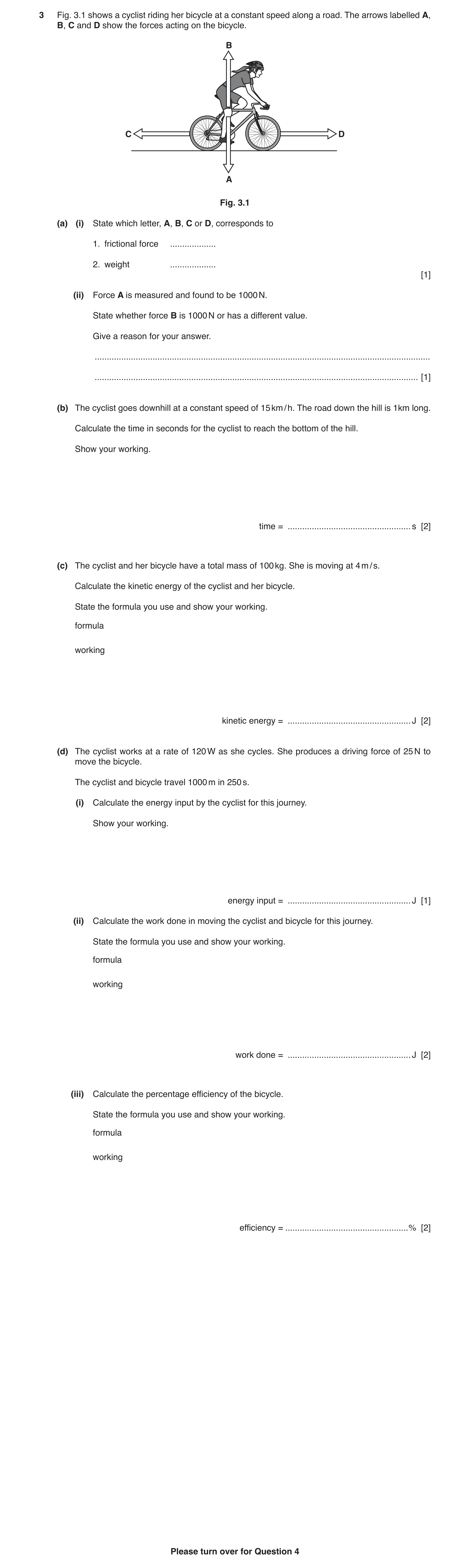
3 Fig. 3.1 shows a cyclist riding her bicycle at a constant speed along a road. The arrows labelled A, B, C and D show the forces acting on the bicycle. B C D A Fig. 3.1 (a) (i) State which letter, A, B, C or D, corresponds to 1. frictional force … 2. weight … [1] (ii) Force A is measured and found to be 1000 N. State whether force B is 1000 N or has a different value. Give a reason for your answer. … … [1] (b) The cyclist goes downhill at a constant speed of 15 km / h. The road down the hill is 1 km long. Calculate the time in seconds for the cyclist to reach the bottom of the hill. Show your working. time = … s [2] (c) The cyclist and her bicycle have a total mass of 100 kg. She is moving at 4 m / s. Calculate the kinetic energy of the cyclist and her bicycle. State the formula you use and show your working. formula working kinetic energy = … J [2] (d) The cyclist works at a rate of 120 W as she cycles. She produces a driving force of 25 N to move the bicycle. The cyclist and bicycle travel 1000 m in 250 s. (i) Calculate the energy input by the cyclist for this journey. Show your working. energy input = … J [1] (ii) Calculate the work done in moving the cyclist and bicycle for this journey. State the formula you use and show your working. formula working work done = … J [2] (iii) Calculate the percentage efficiency of the bicycle. State the formula you use and show your working. formula working efficiency = … % [2] Please turn over for Question 4
11 marks
Mark scheme: 3(a)(i) C A 1 3(a)(ii) (Force B is 1000 N) no vertical motion / forces (A and B) are balanced ; 1 3(b) 1 km at 15 km / h Æ 1 / 15 h / 0.067 h ; 1 / 15 h = 3 600 × 1 / 15 = 240 (s) ; 2 3(c) KE = ½ mv2 = ½ × 100 × 4 × 4 = 800 (J) ; 2 3(d)(i) energy input = 120 × 250 = 30 000 (J) ; 1 3(d)(ii) work done = force × distance (moved) / F × d ; = 25 × 1 000 = 25 000 (J) ; 2 3(d)(iii) efficiency (%) = (work got out ÷ work put in) × 100 / (equivalent wording ) ; = (25 000 / 30 000) × 100 = 83.3 (%) ; 2
This question in 0653/43 May/June 2017
Q4 · The horizontal and vertical forces which act on a car on a level road 0653/41 Oct/Nov 2017
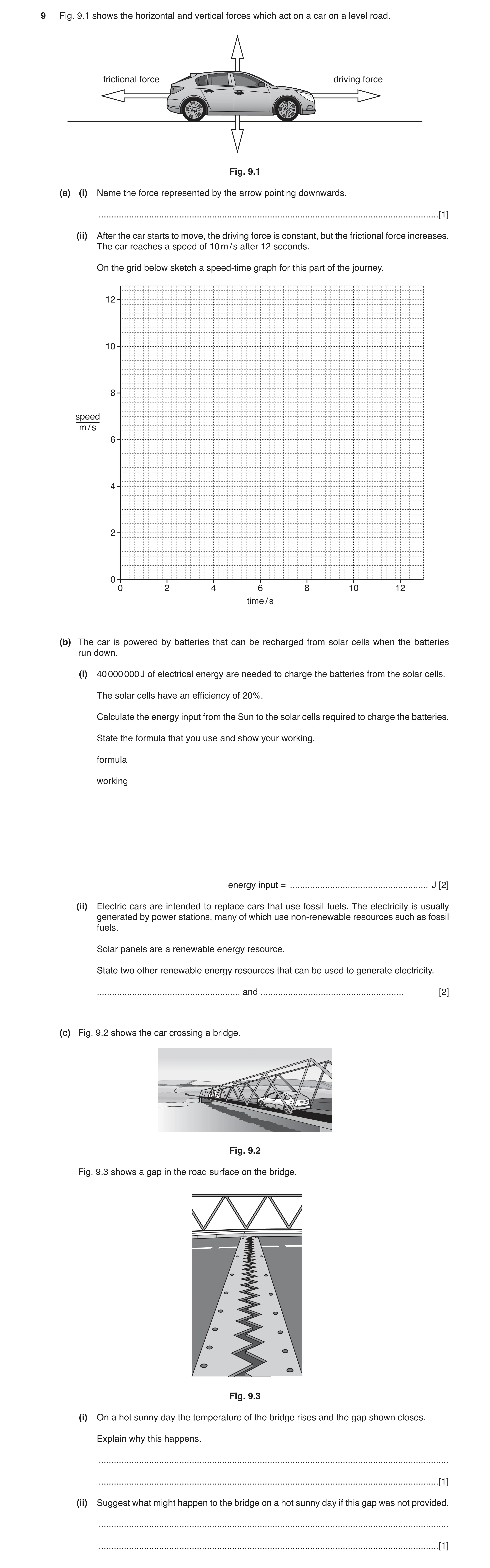
9 Fig. 9.1 shows the horizontal and vertical forces which act on a car on a level road. frictional force driving force Fig. 9.1 (a) (i) Name the force represented by the arrow pointing downwards. … [1] (ii) After the car starts to move, the driving force is constant, but the frictional force increases. The car reaches a speed of 10 m / s after 12 seconds. On the grid below sketch a speed-time graph for this part of the journey. 12 10 8 speed m / s 6 4 2 0 0 2 4 6 8 10 12 time / s (b) The car is powered by batteries that can be recharged from solar cells when the batteries run down. (i) 40 000 000 J of electrical energy are needed to charge the batteries from the solar cells. The solar cells have an efficiency of 20%. Calculate the energy input from the Sun to the solar cells required to charge the batteries. State the formula that you use and show your working. formula working energy input = … J [2] (ii) Electric cars are intended to replace cars that use fossil fuels. The electricity is usually generated by power stations, many of which use non-renewable resources such as fossil fuels. Solar panels are a renewable energy resource. State two other renewable energy resources that can be used to generate electricity. … and … [2] (c) Fig. 9.2 shows the car crossing a bridge. Fig. 9.2 Fig. 9.3 shows a gap in the road surface on the bridge. Fig. 9.3 (i) On a hot sunny day the temperature of the bridge rises and the gap shown closes. Explain why this happens. … … [1] (ii) Suggest what might happen to the bridge on a hot sunny day if this gap was not provided. … … [1]
9 marks
Mark scheme: 9 9 9 9 9(a)(i) weigh 9(a)(ii) curve from ( 9(b)(i) efficie energ 9(b)(ii) any tw 9(c)(i) {therm 9(c)(ii) buckl 9(c)(iii) evapo faster 9(c)(iv) line d ht / gravitational f ed line, convex u (0,0) and arrivin ency = {energy o gy in = 100 × ene wo from hydroel mal} expansion ( e / twist / bend / d orates ; r ; rawn between th force ; upwards ; g at 10 m / s at 1 out / energy in} × ergy out / efficien ectric / tidal / wav (of bridge structu deform etc. ; he two bottom b 12 s ; × 100 ; ncy = 200 000 00 ves / geotherma ure) ; owtte boxes ; 00 (J) al / wind ;; 1 2 2 2 1 1 2 1
This question in 0653/41 Oct/Nov 2017
Q5 · A helicopter hovering above the ground 0653/42 Oct/Nov 2017
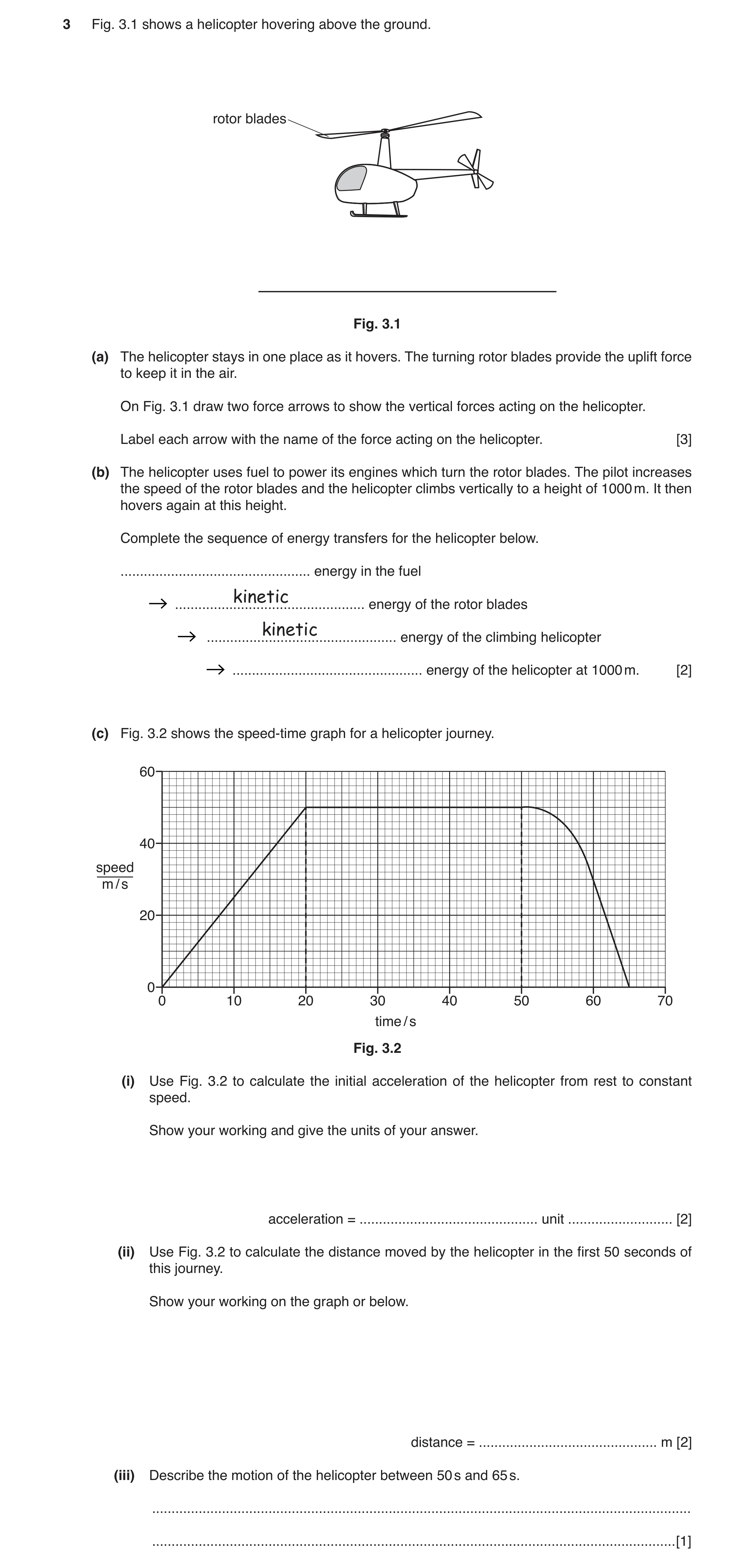
3 Fig. 3.1 shows a helicopter hovering above the ground. rotor blades Fig. 3.1 (a) The helicopter stays in one place as it hovers. The turning rotor blades provide the uplift force to keep it in the air. On Fig. 3.1 draw two force arrows to show the vertical forces acting on the helicopter. Label each arrow with the name of the force acting on the helicopter. [3] (b) The helicopter uses fuel to power its engines which turn the rotor blades. The pilot increases the speed of the rotor blades and the helicopter climbs vertically to a height of 1000 m. It then hovers again at this height. Complete the sequence of energy transfers for the helicopter below. … energy in the fuel kinetic … energy of the rotor blades kinetic … energy of the climbing helicopter … energy of the helicopter at 1000 m. [2] (c) Fig. 3.2 shows the speed-time graph for a helicopter journey. 60 40 speed m / s 20 0 0 10 20 30 40 50 60 70 time / s Fig. 3.2 (i) Use Fig. 3.2 to calculate the initial acceleration of the helicopter from rest to constant speed. Show your working and give the units of your answer. acceleration = … unit … [2] (ii) Use Fig. 3.2 to calculate the distance moved by the helicopter in the first 50 seconds of this journey. Show your working on the graph or below. distance = … m [2] (iii) Describe the motion of the helicopter between 50 s and 65 s. … … [1]
10 marks
Mark scheme: 3(a) force arrow vertically upward labelled ‘uplift’ ; force arrow vertically downward labelled weight / gravitational force / gravity ; the two vertical force arrows in contact with helicopter / or the vertical arrows of approximately equal length by inspection ; 3 3(b) chemical ; gravitational / potential ; 2 3(c)(i) acceleration = (change of speed / time = 50 / 20 ) = 2.5 ; m / s2 ; 2 3(c)(ii) ½ × 50 × 20 / 500 (m) / 50 × (50 – 20) / 1500 (m) seen ; = 2000 (m) ; (also by using the formula for the area of the trapezium, ½ (30 + 50) × 50 ) 2 3(c)(iii) non-constant deceleration / acceleration owtte ; 1
This question in 0653/42 Oct/Nov 2017
Q6 · The circuit for an immersion heater using electrical energy to heat water 0653/42 Feb/March 2018
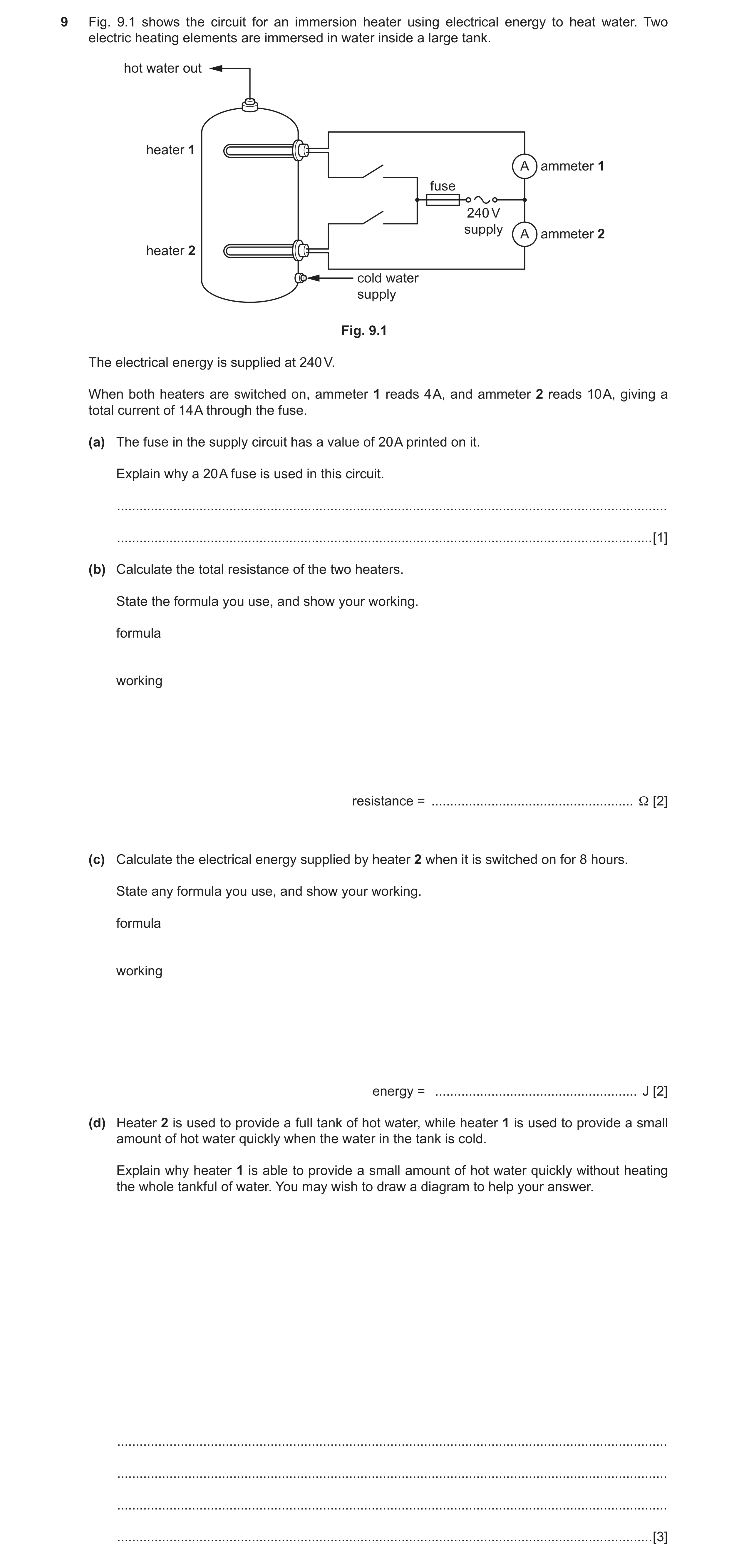
9 Fig. 9.1 shows the circuit for an immersion heater using electrical energy to heat water. Two electric heating elements are immersed in water inside a large tank. hot water out heater 1 A ammeter 1 fuse 240 V supply A ammeter 2 heater 2 cold water supply Fig. 9.1 The electrical energy is supplied at 240 V. When both heaters are switched on, ammeter 1 reads 4 A, and ammeter 2 reads 10 A, giving a total current of 14 A through the fuse. (a) The fuse in the supply circuit has a value of 20 A printed on it. Explain why a 20 A fuse is used in this circuit. … … [1] (b) Calculate the total resistance of the two heaters. State the formula you use, and show your working. formula working resistance = … Ω [2] (c) Calculate the electrical energy supplied by heater 2 when it is switched on for 8 hours. State any formula you use, and show your working. formula working energy = … J [2] (d) Heater 2 is used to provide a full tank of hot water, while heater 1 is used to provide a small amount of hot water quickly when the water in the tank is cold. Explain why heater 1 is able to provide a small amount of hot water quickly without heating the whole tankful of water. You may wish to draw a diagram to help your answer. … … … … [3]
8 marks
Mark scheme: 9(a) total current of 14 A needs higher value fuse / reference to the safety margin / owtte ; 1 9(b) (R = ) V / I ; (R = ) 240 / 14 = 17.1 (Ω) ; OR 1 / R = 1 / R1 + 1 / R2 ; R1 = 240 /4 = 60 Ω and R2 = 240 / 10 = 24 Ω and so 1/R = 1/60 + 1/24 = 7/120, so R = 17.1 Ω ; 2 Question Answer Marks 9(c) E = IVt ; = 10 × 240 × 8 × 60 ×60 = 69 120 000 (J) ; 2 9(d) reference to convection ; the idea that water at higher temperature rises / has a lower density ; the idea that the convection current from heater 1 does not affect the water in the lower part of the tank / water below heater 1 has greater density and so does not mix with heated water / owtte ; 3
This question in 0653/42 Feb/March 2018
Q7 · A small quadcopter (drone with four rotors) being operated by radio control 0653/43 May/June 2018
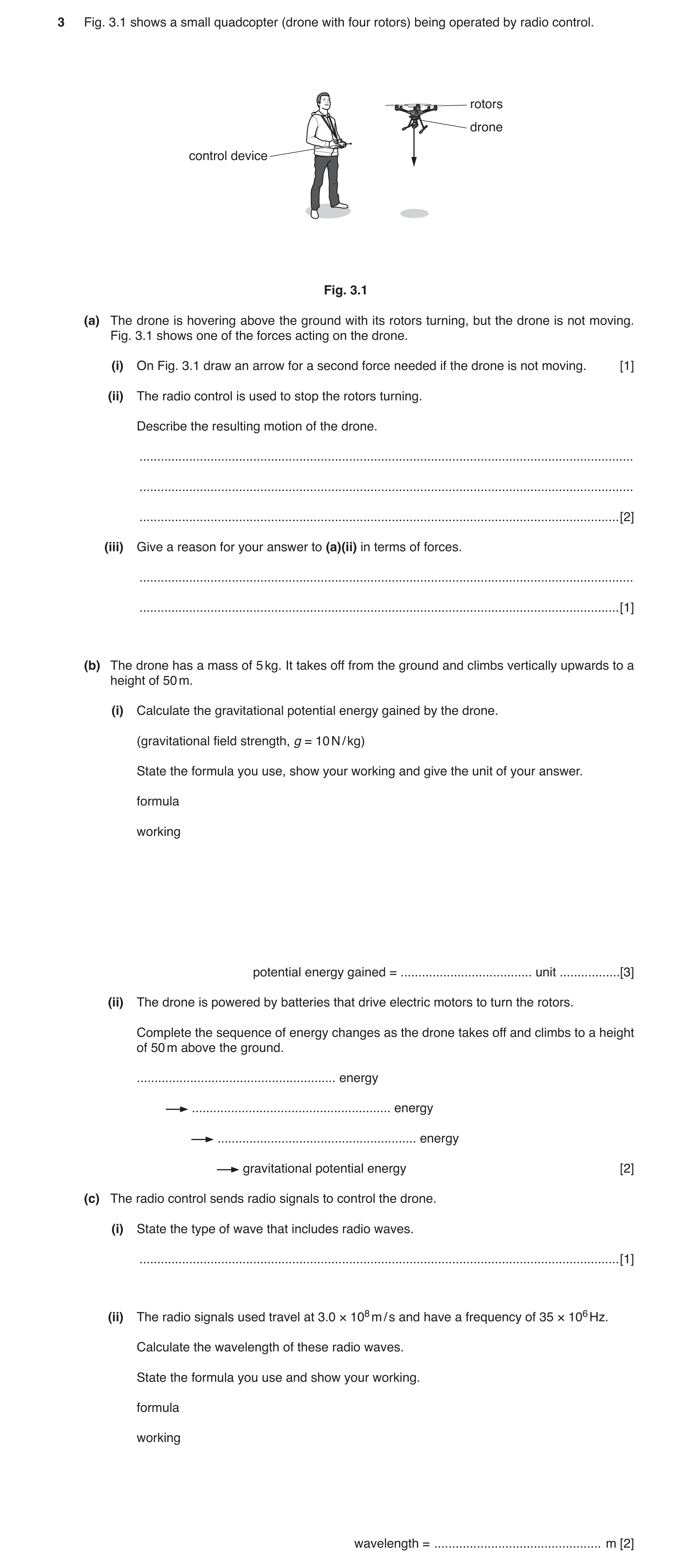
3 Fig. 3.1 shows a small quadcopter (drone with four rotors) being operated by radio control. rotors drone control device Fig. 3.1 (a) The drone is hovering above the ground with its rotors turning, but the drone is not moving. Fig. 3.1 shows one of the forces acting on the drone. (i) On Fig. 3.1 draw an arrow for a second force needed if the drone is not moving. [1] (ii) The radio control is used to stop the rotors turning. Describe the resulting motion of the drone. … … … [2] (iii) Give a reason for your answer to (a)(ii) in terms of forces. … … [1] (b) The drone has a mass of 5 kg. It takes off from the ground and climbs vertically upwards to a height of 50 m. (i) Calculate the gravitational potential energy gained by the drone. (gravitational field strength, g = 10 N / kg) State the formula you use, show your working and give the unit of your answer. formula working potential energy gained = … unit … [3] (ii) The drone is powered by batteries that drive electric motors to turn the rotors. Complete the sequence of energy changes as the drone takes off and climbs to a height of 50 m above the ground. … energy … energy … energy gravitational potential energy [2] (c) The radio control sends radio signals to control the drone. (i) State the type of wave that includes radio waves. … [1] (ii) The radio signals used travel at 3.0 × 10⁸ m / s and have a frequency of 35 × 106 Hz. Calculate the wavelength of these radio waves. State the formula you use and show your working. formula working wavelength = … m [2]
12 marks
Mark scheme: 3(a)(i) upward vertical force arrow acting on the drone at any point ; 1 Question Answer Marks 3(a)(ii) falls to ground ; accelerates ; 2 3(a)(iii) (moves / accelerates due to) unbalanced forces / weight / gravitational force ; 1 3(b)(i) PE gained = mgh = 5 × 10 × 50 ; = 2500 ; joules / J ; 3 3(b)(ii) chemical > electrical > kinetic > (grav PE) ;; all 3 correct for 2 marks; any 2 correct for 1 2 3(c)(i) electromagnetic waves ; 1 3(c)(ii) v = f λ OR rearranged / λ = 3.0 × 10⁸/ 35 × 106; = 8.6 m ; 2
This question in 0653/43 May/June 2018
Q8 · A farm tractor pulling a trailer 0653/42 Oct/Nov 2018
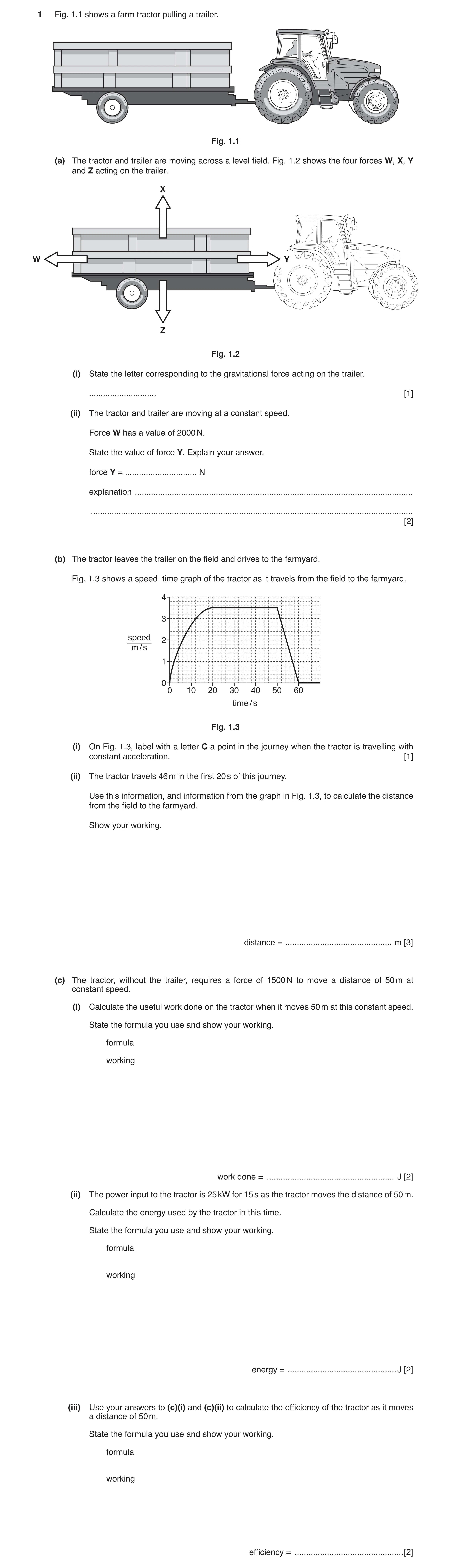
1 Fig. 1.1 shows a farm tractor pulling a trailer. Fig. 1.1 (a) The tractor and trailer are moving across a level field. Fig. 1.2 shows the four forces W, X, Y and Z acting on the trailer. X W Y Z Fig. 1.2 (i) State the letter corresponding to the gravitational force acting on the trailer. … [1] (ii) The tractor and trailer are moving at a constant speed. Force W has a value of 2000 N. State the value of force Y. Explain your answer. force Y = … N explanation … … [2] (b) The tractor leaves the trailer on the field and drives to the farmyard. Fig. 1.3 shows a speed–time graph of the tractor as it travels from the field to the farmyard. 4 3 speed 2 m / s 1 0 0 10 20 30 40 50 60 time / s Fig. 1.3 (i) On Fig. 1.3, label with a letter C a point in the journey when the tractor is travelling with constant acceleration. [1] (ii) The tractor travels 46 m in the first 20 s of this journey. Use this information, and information from the graph in Fig. 1.3, to calculate the distance from the field to the farmyard. Show your working. distance = … m [3] (c) The tractor, without the trailer, requires a force of 1500 N to move a distance of 50 m at constant speed. (i) Calculate the useful work done on the tractor when it moves 50 m at this constant speed. State the formula you use and show your working. formula working work done = … J [2] (ii) The power input to the tractor is 25 kW for 15 s as the tractor moves the distance of 50 m. Calculate the energy used by the tractor in this time. State the formula you use and show your working. formula working energy = … J [2] (iii) Use your answers to (c)(i) and (c)(ii) to calculate the efficiency of the tractor as it moves a distance of 50 m. State the formula you use and show your working. formula working efficiency = … [2]
13 marks
Mark scheme: 1(a)(i) Z 1 1(a)(ii) 2000 (N) ; constant speed / no acceleration, (so forces must balance) ; 2 1(b)(i) C on any point on graph line between 50 and 60 s ; 1 1(b)(ii) distance travelled 20–50 s = speed × time = 30 × 3.5 = 105 m ; distance travelled 50–60 s = ½ × 10 × 3.5 = 17.5 m ; total distance = 46 + 105 + 17.5 = 168.5 m ; 3 1(c)(i) work done = force × distance / F × d ; = 1500 × 50 = 75 000 (J) ; 2 1(c)(ii) E = Pt / E = 25 000 × 15 ; = 375 000 (J) ; 2 1(c)(iii) efficiency = work out / work in (× 100 to give %) / 75 000 ÷ 375 000 = 0.20 / 20% ; 2
This question in 0653/42 Oct/Nov 2018
Q9 · A man pushing a shopping trolley 0653/43 Oct/Nov 2018
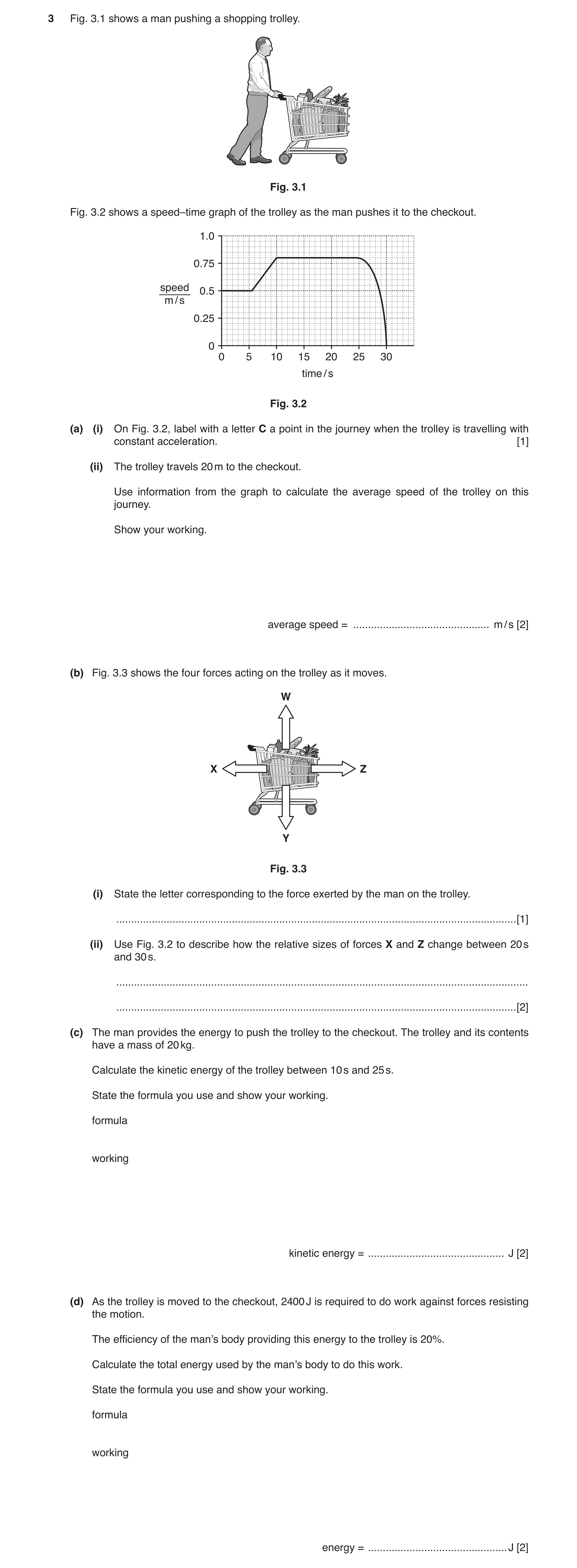
3 Fig. 3.1 shows a man pushing a shopping trolley. Fig. 3.1 Fig. 3.2 shows a speed–time graph of the trolley as the man pushes it to the checkout. 1.0 0.75 speed 0.5 m / s 0.25 0 0 5 10 15 20 25 30 time / s Fig. 3.2 (a) (i) On Fig. 3.2, label with a letter C a point in the journey when the trolley is travelling with constant acceleration. [1] (ii) The trolley travels 20 m to the checkout. Use information from the graph to calculate the average speed of the trolley on this journey. Show your working. average speed = … m / s [2] (b) Fig. 3.3 shows the four forces acting on the trolley as it moves. W X Z Y Fig. 3.3 (i) State the letter corresponding to the force exerted by the man on the trolley. … [1] (ii) Use Fig. 3.2 to describe how the relative sizes of forces X and Z change between 20 s and 30 s. … … [2] (c) The man provides the energy to push the trolley to the checkout. The trolley and its contents have a mass of 20 kg. Calculate the kinetic energy of the trolley between 10 s and 25 s. State the formula you use and show your working. formula working kinetic energy = … J [2] (d) As the trolley is moved to the checkout, 2400 J is required to do work against forces resisting the motion. The efficiency of the man’s body providing this energy to the trolley is 20%. Calculate the total energy used by the man’s body to do this work. State the formula you use and show your working. formula working energy = … J [2]
10 marks
Mark scheme: 3(a)(i) C at any point on graph line between 5.7 and 10 s ; 1 3(a)(ii) average speed = total distance / total time = 20 / 30 ; = 0.67 (m / s) ; 2 3(b)(i) Z ; 1 3(b)(ii) X and Z equal / same (20–25) s ; X > Z for (25–30) s ; 2 3(c) KE = ½ mv2 / ½ × 20 × 0.82 ; = 6.4 J ; 2 3(d) efficiency = [energy out / energy in] (× 100%) or energy in = energy out / 0.2 or 2400 / 0.2 / energy in = 2400 × 100 / 20 ; = 12 000 (J) ; 2
This question in 0653/43 Oct/Nov 2018
Q10 · A girl throwing a beach ball up in the air 0653/42 Feb/March 2019
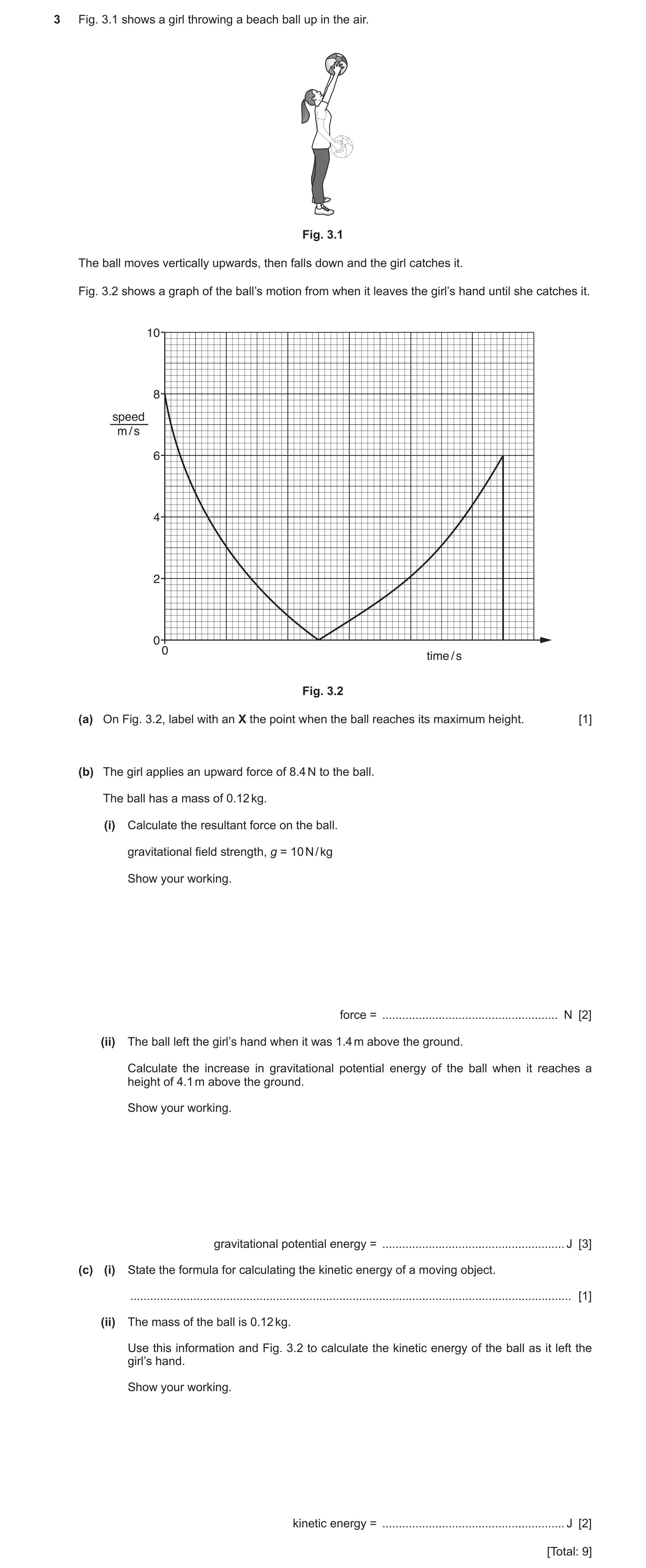
3 Fig. 3.1 shows a girl throwing a beach ball up in the air. Fig. 3.1 The ball moves vertically upwards, then falls down and the girl catches it. Fig. 3.2 shows a graph of the ball’s motion from when it leaves the girl’s hand until she catches it. 10 8 speed m / s 6 4 2 0 0 time / s Fig. 3.2 (a) On Fig. 3.2, label with an X the point when the ball reaches its maximum height. [1] (b) The girl applies an upward force of 8.4 N to the ball. The ball has a mass of 0.12 kg. (i) Calculate the resultant force on the ball. gravitational field strength, g = 10 N / kg Show your working. force = … N [2] (ii) The ball left the girl’s hand when it was 1.4 m above the ground. Calculate the increase in gravitational potential energy of the ball when it reaches a height of 4.1 m above the ground. Show your working. gravitational potential energy = … J [3] (c) (i) State the formula for calculating the kinetic energy of a moving object. … [1] (ii) The mass of the ball is 0.12 kg. Use this information and Fig. 3.2 to calculate the kinetic energy of the ball as it left the girl’s hand. Show your working. kinetic energy = … J [2] [Total: 9]
9 marks
Mark scheme: 3(a) X at point where curve touches x axis the first time ; 1 3(b)(i) weight of ball = force downwards = 0.12 × 10 = 1.2 N ; resultant force = 8.4 – 1.2 = 7.2 N ; 2 3(b)(ii) gain in height by ball = 4.1 – 1.4 = 2.7 m ; gain in PE = mgh = 0.12 × 10 × 2.7 ; = 3.24 (J) ; 3 3(c)(i) ½ mv2 ; 1 3(c)(ii) (½ mv2) = ½ × 0.12 × 82; = 3.84 (J) ; 2
This question in 0653/42 Feb/March 2019
Q11 · A forklift truck moving a large heavy box towards a shelf 0653/42 May/June 2019
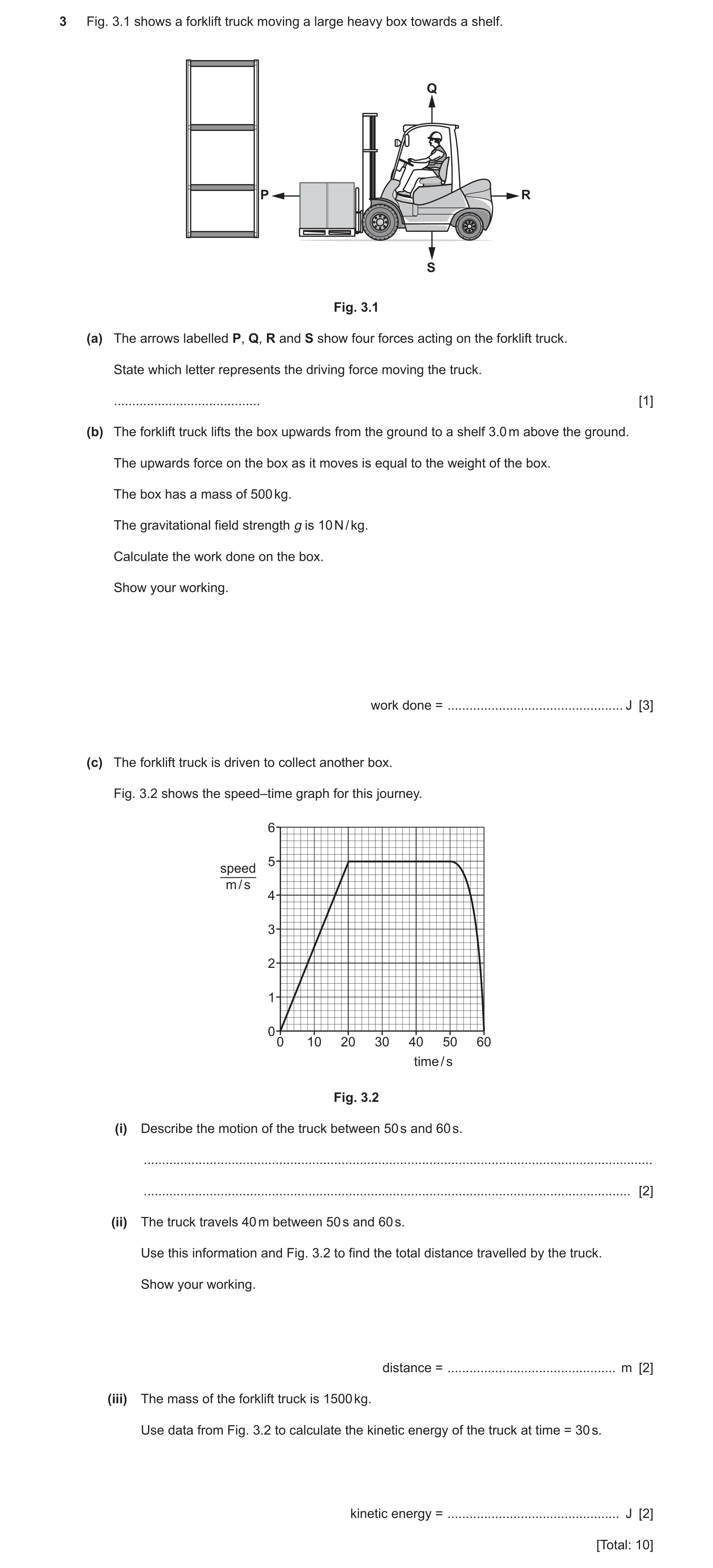
3 Fig. 3.1 shows a forklift truck moving a large heavy box towards a shelf. Q P R S Fig. 3.1 (a) The arrows labelled P, Q, R and S show four forces acting on the forklift truck. State which letter represents the driving force moving the truck. … [1] (b) The forklift truck lifts the box upwards from the ground to a shelf 3.0 m above the ground. The upwards force on the box as it moves is equal to the weight of the box. The box has a mass of 500 kg. The gravitational field strength g is 10 N / kg. Calculate the work done on the box. Show your working. work done = … J [3] (c) The forklift truck is driven to collect another box. Fig. 3.2 shows the speed–time graph for this journey. 6 5 speed m / s 4 3 2 1 0 0 10 20 30 40 50 60 time / s Fig. 3.2 (i) Describe the motion of the truck between 50 s and 60 s. … … [2] (ii) The truck travels 40 m between 50 s and 60 s. Use this information and Fig. 3.2 to find the total distance travelled by the truck. Show your working. distance = … m [2] (iii) The mass of the forklift truck is 1500 kg. Use data from Fig. 3.2 to calculate the kinetic energy of the truck at time = 30 s. kinetic energy = … J [2] [Total: 10]
10 marks
Mark scheme: 3(a) P ; 1 3(b) weight of box = 500 × 10 = 5000 (N) ; work done = force × distance moved / F × d ; = 5000 × 3 = 15 000 (J) ; 3 3(c)(i) decelerating / slowing down to a stop ; deceleration changing / not constant ; 2 3(c)(ii) distance = area under graph or 0.5 × 20 × 5 + (50 – 20) × 5 (+ 40) or (0.5 × (50 + (50 – 20)) × 5)(+ 40) ; = 240 (m) ; 2 3(c)(iii) KE = 2 1 2 mv or KE = 0.5 × 1500 × 52 ; = 18 750 J 2
This question in 0653/42 May/June 2019
Question 12 0653/42 May/June 2019
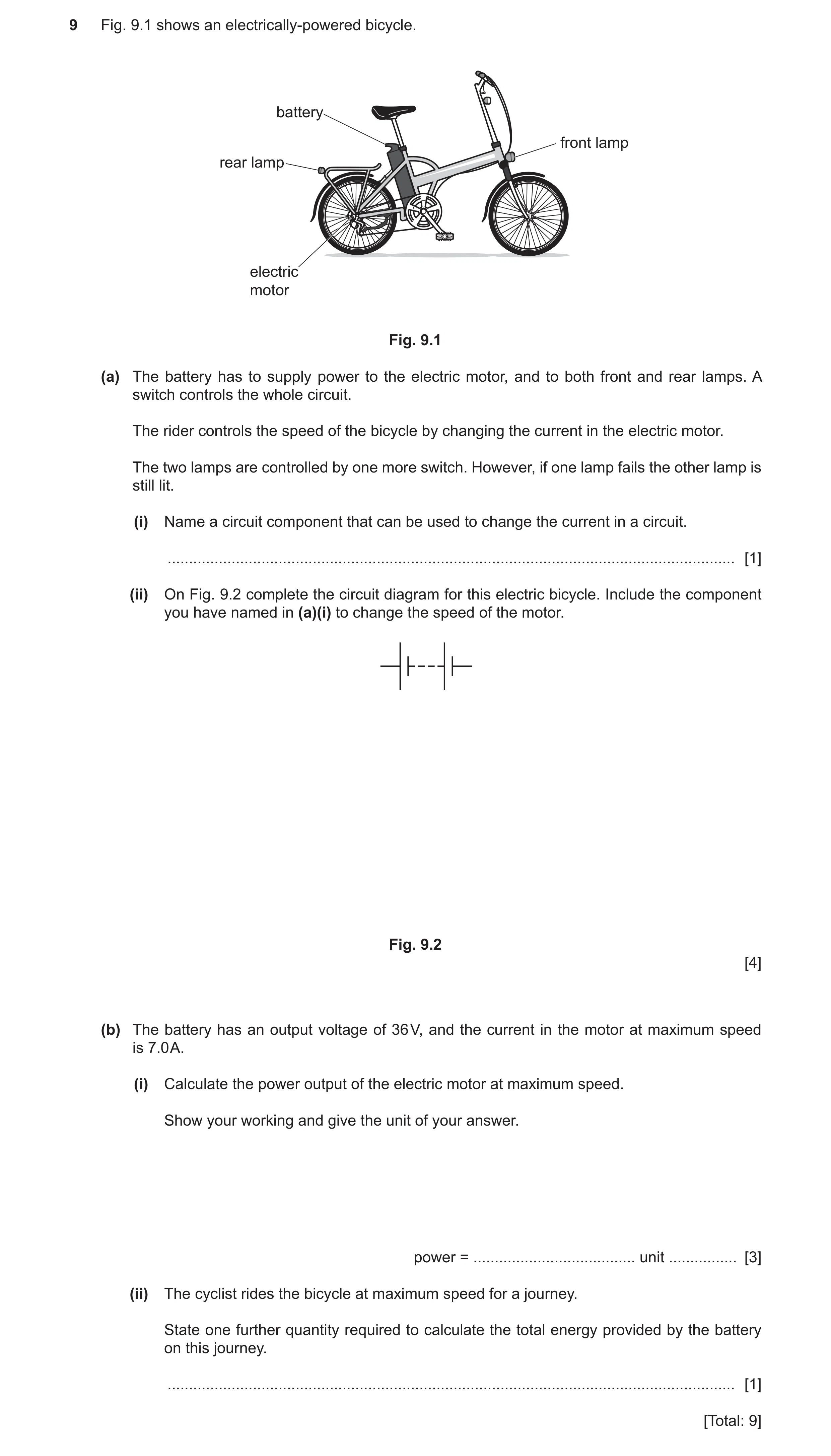
9 Fig. 9.1 shows an electrically-powered bicycle. battery front lamp rear lamp electric motor Fig. 9.1 (a) The battery has to supply power to the electric motor, and to both front and rear lamps. A switch controls the whole circuit. The rider controls the speed of the bicycle by changing the current in the electric motor. The two lamps are controlled by one more switch. However, if one lamp fails the other lamp is still lit. (i) Name a circuit component that can be used to change the current in a circuit. … [1] (ii) On Fig. 9.2 complete the circuit diagram for this electric bicycle. Include the component you have named in (a)(i) to change the speed of the motor. Fig. 9.2 [4] (b) The battery has an output voltage of 36 V, and the current in the motor at maximum speed is 7.0 A. (i) Calculate the power output of the electric motor at maximum speed. Show your working and give the unit of your answer. power = … unit … [3] (ii) The cyclist rides the bicycle at maximum speed for a journey. State one further quantity required to calculate the total energy provided by the battery on this journey. … [1] [Total: 9]
9 marks
Mark scheme: 9(a)(i) variable resistor ; 1 9(a)(ii) at least three symbols correct ; variable resistor and motor in series in same branch ; lamps in parallel with motor and each other ; only two switches and both correctly located ; 4 9(b)(i) P = V × I / 36 × 7.0 ; = 252 / 250 ; watt(s) / W ; 3 9(b)(ii) time / t ; 1
This question in 0653/42 May/June 2019
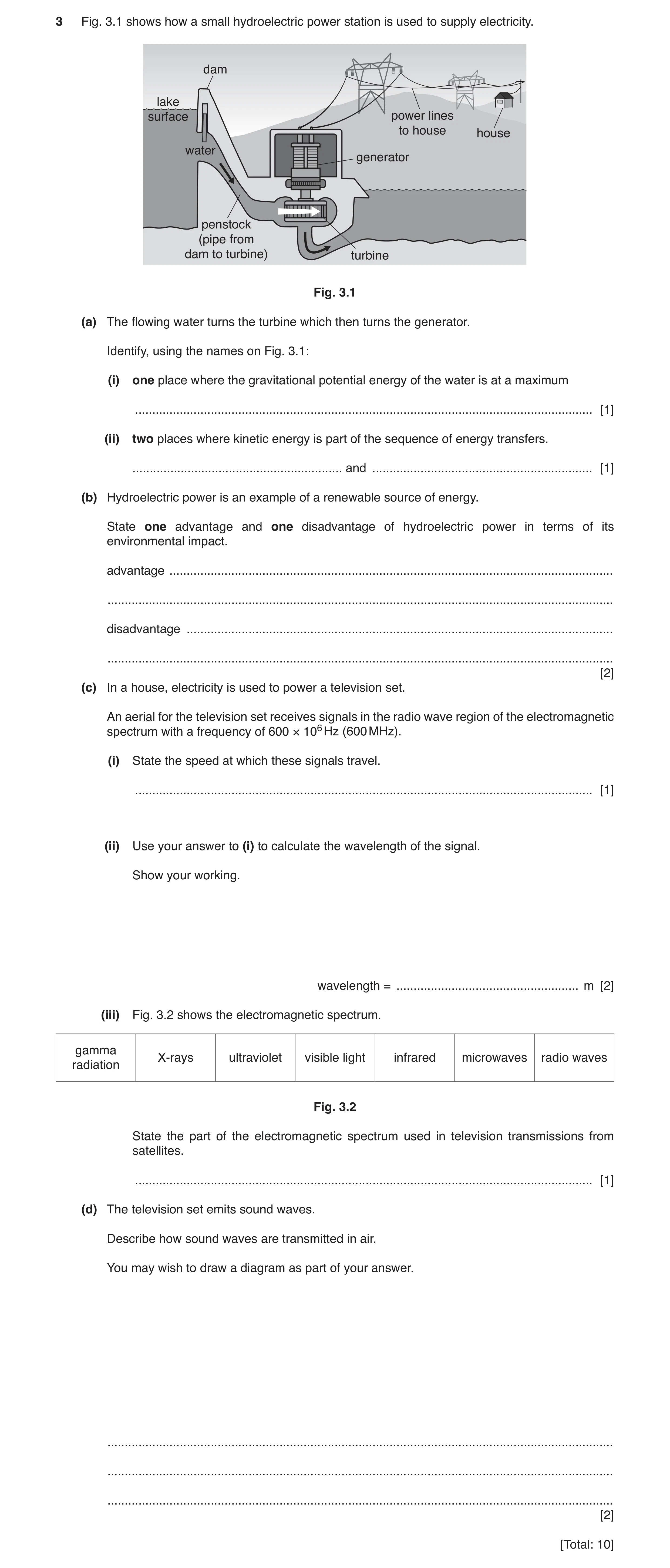
Q13 · How a small hydroelectric power station is used to supply electricity 0653/41 Oct/Nov 2019
3 Fig. 3.1 shows how a small hydroelectric power station is used to supply electricity. dam lake surface power lines to house house water generator penstock (pipe from dam to turbine) turbine Fig. 3.1 (a) The flowing water turns the turbine which then turns the generator. Identify, using the names on Fig. 3.1: (i) one place where the gravitational potential energy of the water is at a maximum … [1] (ii) two places where kinetic energy is part of the sequence of energy transfers. … and … [1] (b) Hydroelectric power is an example of a renewable source of energy. State one advantage and one disadvantage of hydroelectric power in terms of its environmental impact. advantage … … disadvantage … … [2] (c) In a house, electricity is used to power a television set. An aerial for the television set receives signals in the radio wave region of the electromagnetic spectrum with a frequency of 600 × 106 Hz (600 MHz). (i) State the speed at which these signals travel. … [1] (ii) Use your answer to (i) to calculate the wavelength of the signal. Show your working. wavelength = … m [2] (iii) Fig. 3.2 shows the electromagnetic spectrum. gamma X-rays ultraviolet visible light infrared microwaves radio wavesradiation Fig. 3.2 State the part of the electromagnetic spectrum used in television transmissions from satellites. … [1] (d) The television set emits sound waves. Describe how sound waves are transmitted in air. You may wish to draw a diagram as part of your answer. … … … [2] [Total: 10]
10 marks
Mark scheme: 3(a)(i) lake surface ; 1 3(a)(ii) any 2 from: penstock (pipe from dam to turbine) ; turbine ; generator ; 1 3(b) advantage: no emissions / can be used for flood control ; disadvantage: creating reservoirs can flood useful land / destroy local ecosystems ; 2 3(c)(i) 3 × 10⁸ m/s ; 1 3(c)(ii) use of v = fλ ; (λ = v ÷ f = 3 × 10⁸ ÷ 600 × 106 ) = 0.5 m ; 2 3(c)(iii) microwaves ; 1 3(d) vibrations / oscillations of particles / air molecules or compressions and rarefactions ; longitudinal / vibration (direction) is parallel to direction of wave propagation / energy propagation ; 2
This question in 0653/41 Oct/Nov 2019
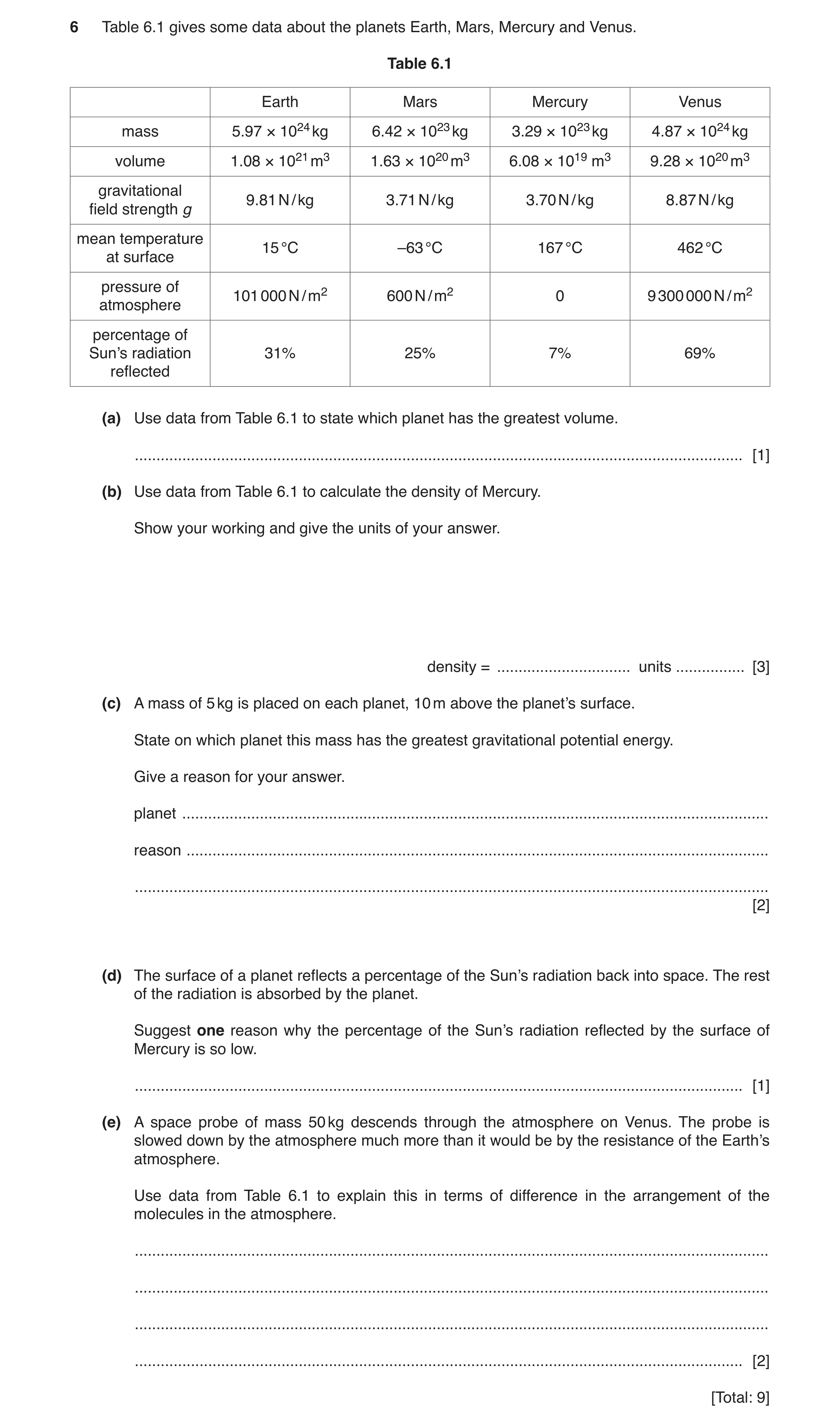
Q14 · Some data about the planets Earth, Mars, Mercury and Venus 0653/41 Oct/Nov 2019
6 Table 6.1 gives some data about the planets Earth, Mars, Mercury and Venus. Table 6.1 Earth Mars Mercury Venus mass 5.97 × 1024 kg 6.42 × 10²³ kg 3.29 × 10²³ kg 4.87 × 1024 kg volume 1.08 × 10²¹ m3 1.63 × 10²⁰ m3 6.08 × 10¹⁹ m3 9.28 × 10²⁰ m3 gravitational 9.81 N / kg 3.71 N / kg 3.70 N / kg 8.87 N / kg field strength g mean temperature 15 °C –63 °C 167 °C 462 °C at surface pressure of 101 000 N / m2 600 N / m2 0 9 300 000 N / m2 atmosphere percentage of Sun’s radiation 31% 25% 7% 69% reflected (a) Use data from Table 6.1 to state which planet has the greatest volume. … [1] (b) Use data from Table 6.1 to calculate the density of Mercury. Show your working and give the units of your answer. density = … units … [3] (c) A mass of 5 kg is placed on each planet, 10 m above the planet’s surface. State on which planet this mass has the greatest gravitational potential energy. Give a reason for your answer. planet … reason … … [2] (d) The surface of a planet reflects a percentage of the Sun’s radiation back into space. The rest of the radiation is absorbed by the planet. Suggest one reason why the percentage of the Sun’s radiation reflected by the surface of Mercury is so low. … [1] (e) A space probe of mass 50 kg descends through the atmosphere on Venus. The probe is slowed down by the atmosphere much more than it would be by the resistance of the Earth’s atmosphere. Use data from Table 6.1 to explain this in terms of difference in the arrangement of the molecules in the atmosphere. … … … … [2] [Total: 9]
9 marks
Mark scheme: 6(a) Earth ; 1 6(b) use of d = m/V ; (3.29 × 10²³ / 0.608 × 10²⁰) = 5.41 × 10³ (3sf) ; kg/m3 ; 3 6(c) Earth ; greatest mass / highest gravitational field strength ; 2 6(d) darker colour / duller surface ; 1 6(e) (on Venus) pressure of atmosphere much higher so molecules more concentrated ; so (atmospheric) resistance is greater / more work done by probe pushing molecules aside / owtte ; ORA 2
This question in 0653/41 Oct/Nov 2019
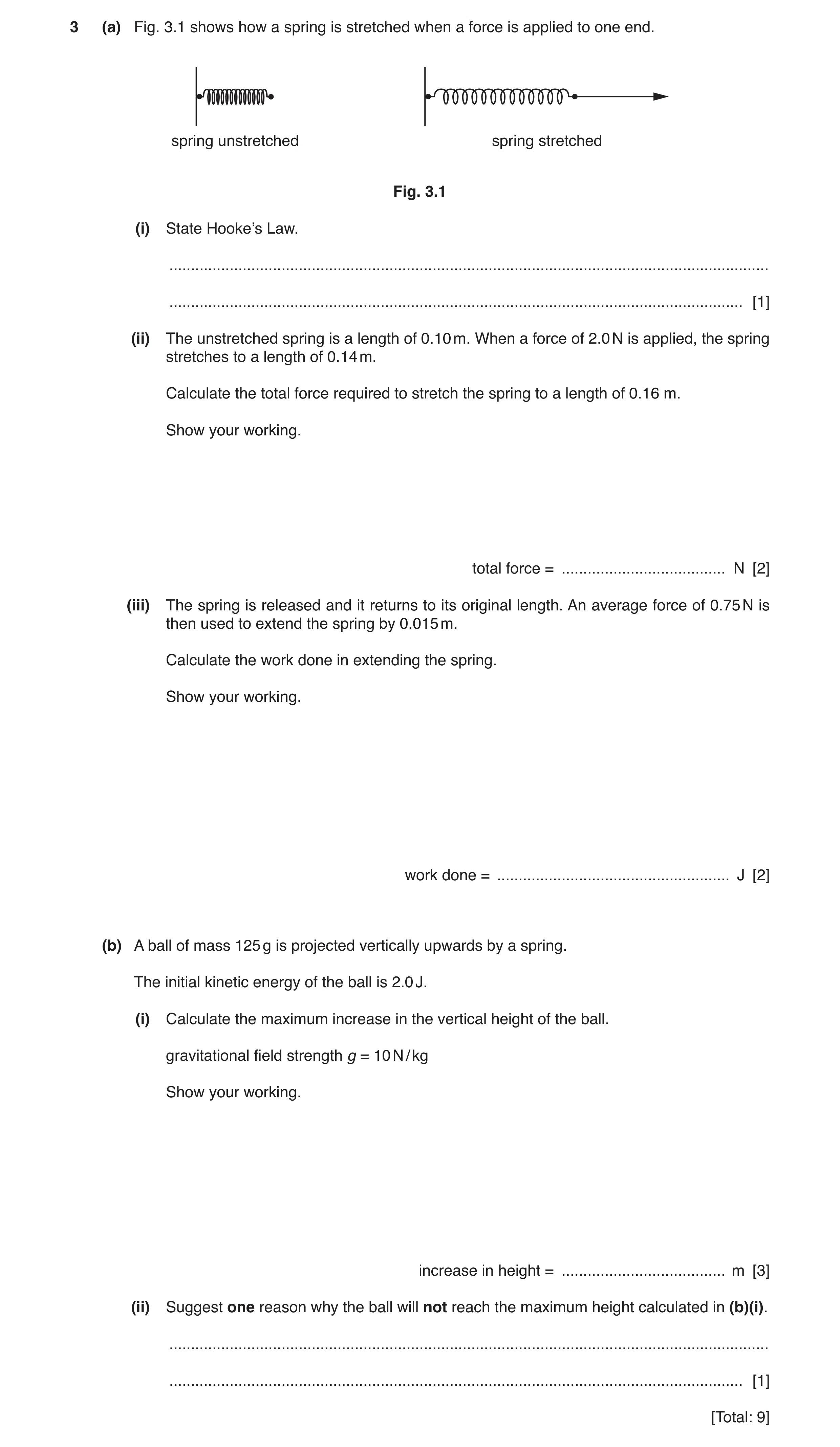
Q15 · How a spring is stretched when a force is applied to one end 0653/42 Oct/Nov 2019
3 (a) Fig. 3.1 shows how a spring is stretched when a force is applied to one end. spring unstretched spring stretched Fig. 3.1 (i) State Hooke’s Law. … … [1] (ii) The unstretched spring is a length of 0.10 m. When a force of 2.0 N is applied, the spring stretches to a length of 0.14 m. Calculate the total force required to stretch the spring to a length of 0.16 m. Show your working. total force = … N [2] (iii) The spring is released and it returns to its original length. An average force of 0.75 N is then used to extend the spring by 0.015 m. Calculate the work done in extending the spring. Show your working. work done = … J [2] (b) A ball of mass 125 g is projected vertically upwards by a spring. The initial kinetic energy of the ball is 2.0 J. (i) Calculate the maximum increase in the vertical height of the ball. gravitational field strength g = 10 N / kg Show your working. increase in height = … m [3] (ii) Suggest one reason why the ball will not reach the maximum height calculated in (b)(i). … … [1] [Total: 9]
9 marks
Mark scheme: 3(a)(i) The extension (of an elastic object) is (directly) proportional to the force (applied to it) ; 1 3(a)(ii) correct calculation of extension x = 0.04 or spring constant k = 50 ; (F= k x = 50 × 0.06) = 3.0 (N) ; 2 3(a)(iii) use of work done = force × distance ; (W = F x = 0.75 × 0.015) = 0.011 (J) ; 2 3(b)(i) use of conservation of energy (mgh = KE = 2) ; 0.125 × 10 × h = 2 ; = 1.6 (m) ; 3 3(b)(ii) friction / air resistance ; 1
This question in 0653/42 Oct/Nov 2019
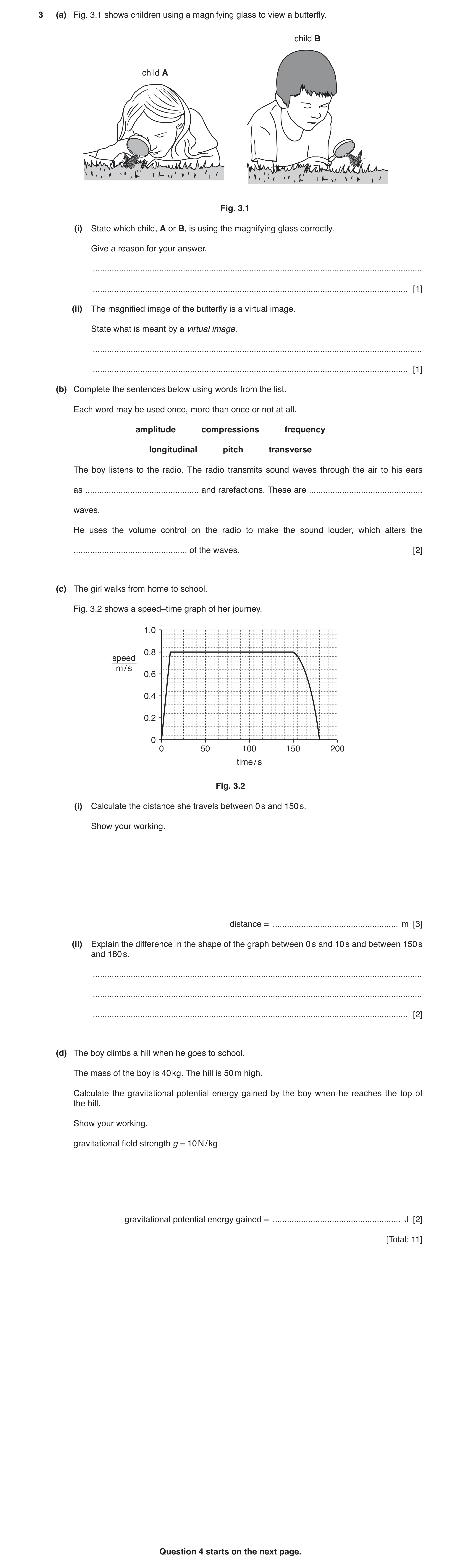
Q16 · Children using a magnifying glass to view a butterfly 0653/43 Oct/Nov 2019
3 (a) Fig. 3.1 shows children using a magnifying glass to view a butterfly. child B child A Fig. 3.1 (i) State which child, A or B, is using the magnifying glass correctly. Give a reason for your answer. … … [1] (ii) The magnified image of the butterfly is a virtual image. State what is meant by a virtual image. … … [1] (b) Complete the sentences below using words from the list. Each word may be used once, more than once or not at all. amplitude compressions frequency longitudinal pitch transverse The boy listens to the radio. The radio transmits sound waves through the air to his ears as … and rarefactions. These are … waves. He uses the volume control on the radio to make the sound louder, which alters the … of the waves. [2] (c) The girl walks from home to school. Fig. 3.2 shows a speed–time graph of her journey. 1.0 0.8 speed m / s 0.6 0.4 0.2 0 0 50 100 150 200 time / s Fig. 3.2 (i) Calculate the distance she travels between 0 s and 150 s. Show your working. distance = … m [3] (ii) Explain the difference in the shape of the graph between 0 s and 10 s and between 150 s and 180 s. … … … [2] (d) The boy climbs a hill when he goes to school. The mass of the boy is 40 kg. The hill is 50 m high. Calculate the gravitational potential energy gained by the boy when he reaches the top of the hill. Show your working. gravitational field strength g = 10 N / kg gravitational potential energy gained = … J [2] [Total: 11] Question 4 starts on the next page.
11 marks
Mark scheme: 3(a)(i) (child A because) child A holding close(r) to eye / child B eye is too far from the lens ; 1 3(a)(ii) image that cannot be projected onto a screen ; 1 3(b) compressions longitudinal amplitude any 2 correct = 1 mark all 3 correct = 2 marks 2 3(c)(i) use of area under graph or d = s × t ; correct use of data from graph ; = 116 ; 3 3(c)(ii) constant acceleration (0–10 s) ; non-constant deceleration (150–180 s) ; 2 3(d) use of gravitational PE gained = mgh ; (= 40 × 10 × 50) = 20 000 (J) ; 2
This question in 0653/43 Oct/Nov 2019
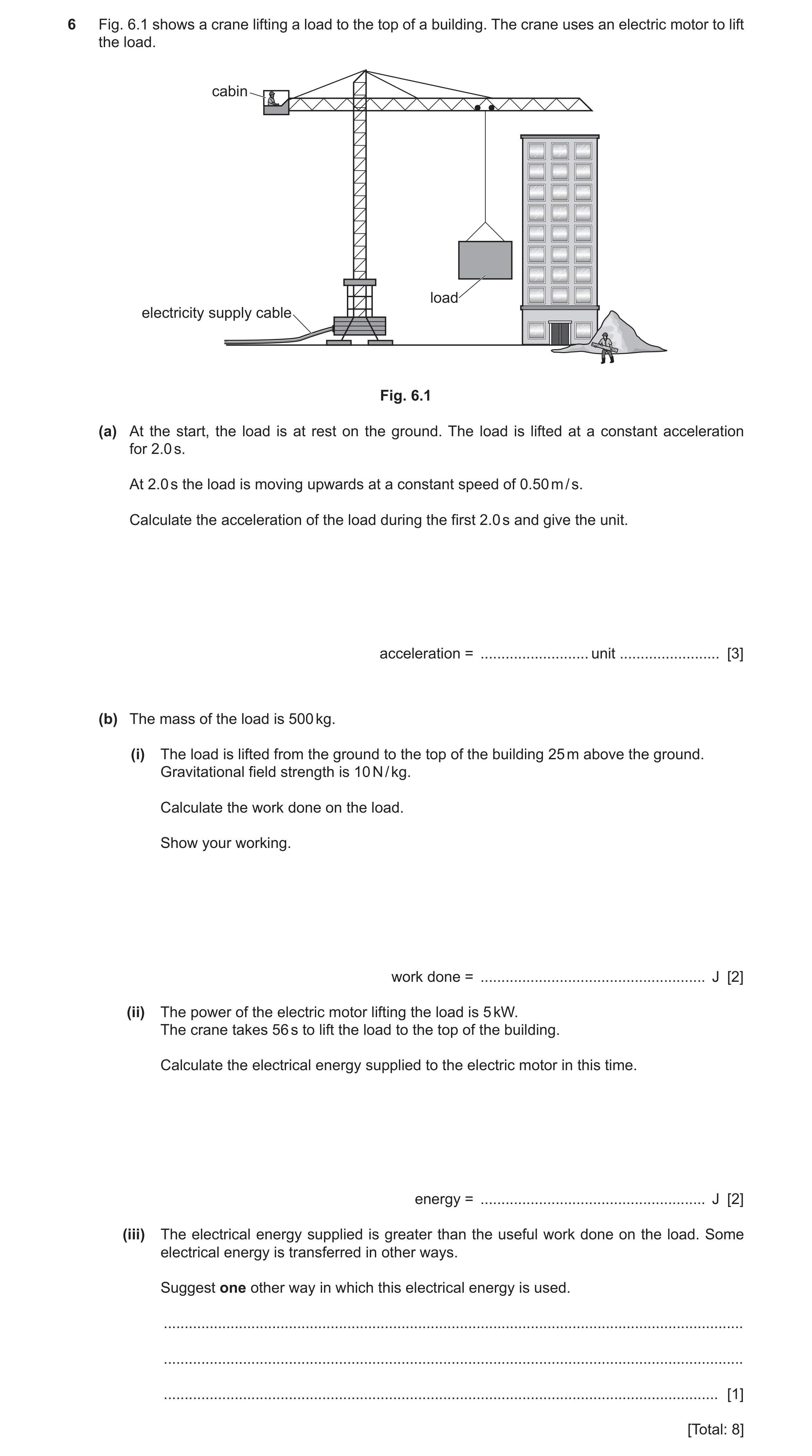
Q17 · A crane lifting a load to the top of a building 0653/42 Feb/March 2020
6 Fig. 6.1 shows a crane lifting a load to the top of a building. The crane uses an electric motor to lift the load. cabin load electricity supply cable Fig. 6.1 (a) At the start, the load is at rest on the ground. The load is lifted at a constant acceleration for 2.0 s. At 2.0 s the load is moving upwards at a constant speed of 0.50 m / s. Calculate the acceleration of the load during the first 2.0 s and give the unit. acceleration = … unit … [3] (b) The mass of the load is 500 kg. (i) The load is lifted from the ground to the top of the building 25 m above the ground. Gravitational field strength is 10 N / kg. Calculate the work done on the load. Show your working. work done = … J [2] (ii) The power of the electric motor lifting the load is 5 kW. The crane takes 56 s to lift the load to the top of the building. Calculate the electrical energy supplied to the electric motor in this time. energy = … J [2] (iii) The electrical energy supplied is greater than the useful work done on the load. Some electrical energy is transferred in other ways. Suggest one other way in which this electrical energy is used. … … … [1] [Total: 8]
8 marks
Mark scheme: 6(a) acceleration = change of speed ÷ time / 0.5 ÷ 2 ; = 0.25 ; m / s2 ; 3 Question Answer Marks 6(b)(i) work done = force × distance / 500 × 10 × 25 ; = 125 000 (J) ; 2 6(b)(ii) electrical energy = power × time / 5000 × 56 ; = 280 000 (J) ; 2 6(b)(iii) any one from: transferred / lost as, thermal / sound energy ; used to do work against friction (in machinery) ; used to do work against air resistance ; other correct way in which electrical energy is used, e.g. moving the crane ; max 1
This question in 0653/42 Feb/March 2020
Q18 · A microwave oven connected to a mains electricity supply 0653/41 May/June 2020
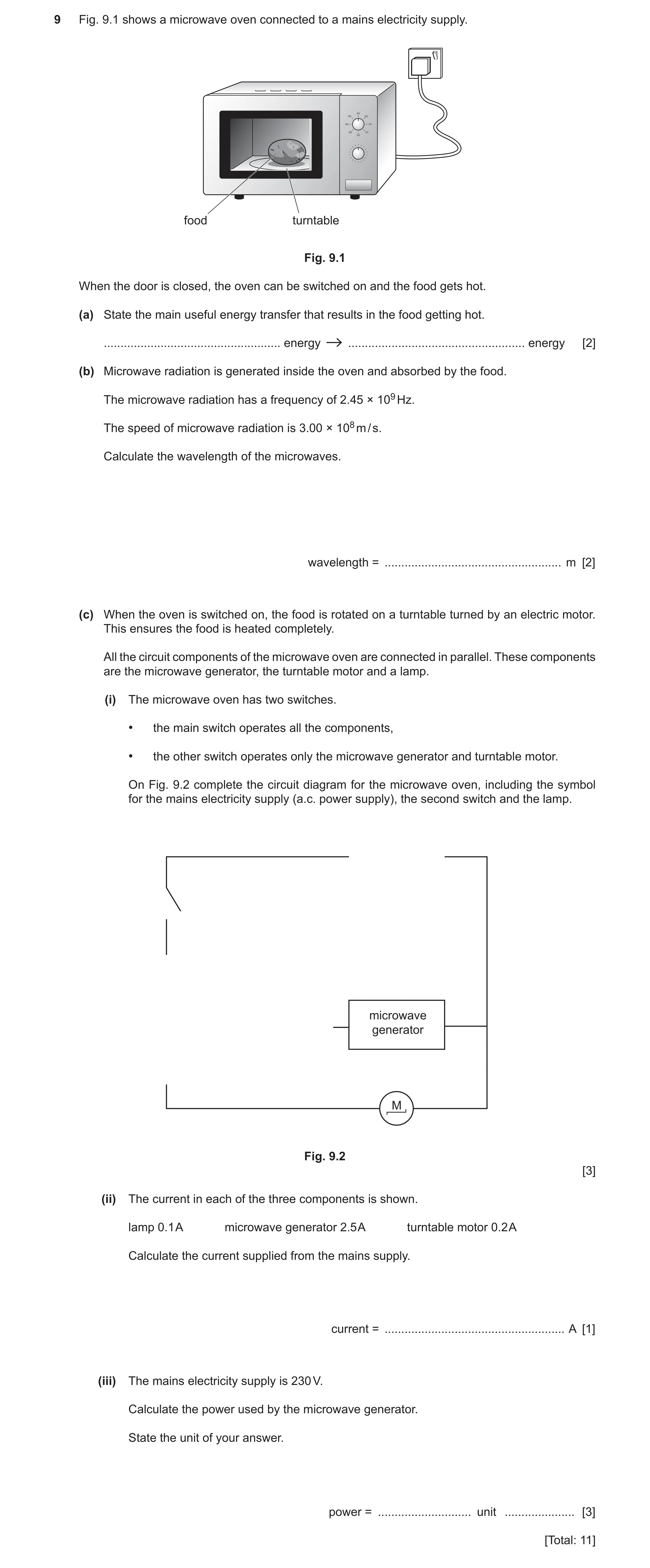
9 Fig. 9.1 shows a microwave oven connected to a mains electricity supply. food turntable Fig. 9.1 When the door is closed, the oven can be switched on and the food gets hot. (a) State the main useful energy transfer that results in the food getting hot. … energy … energy [2] (b) Microwave radiation is generated inside the oven and absorbed by the food. The microwave radiation has a frequency of 2.45 × 10⁹ Hz. The speed of microwave radiation is 3.00 × 10⁸ m / s. Calculate the wavelength of the microwaves. wavelength = … m [2] (c) When the oven is switched on, the food is rotated on a turntable turned by an electric motor. This ensures the food is heated completely. All the circuit components of the microwave oven are connected in parallel. These components are the microwave generator, the turntable motor and a lamp. (i) The microwave oven has two switches. • the main switch operates all the components, • the other switch operates only the microwave generator and turntable motor. On Fig. 9.2 complete the circuit diagram for the microwave oven, including the symbol for the mains electricity supply (a.c. power supply), the second switch and the lamp. microwave generator M Fig. 9.2 [3] (ii) The current in each of the three components is shown. lamp 0.1 A microwave generator 2.5 A turntable motor 0.2 A Calculate the current supplied from the mains supply. current = … A [1] (iii) The mains electricity supply is 230 V. Calculate the power used by the microwave generator. State the unit of your answer. power = … unit … [3] [Total: 11]
11 marks
Mark scheme: 9(a) electrical (energy) ; (→) thermal (energy) ; 2 9(b) v = fλ so λ = v/f = 3 × 10⁸ / 2.45 × 10⁹ ; wavelength = 0.12 / 0.122 (m) ; 2 9(c)(i) 3 9(c)(ii) (current = 0.1 + 2.5 + 0.2 =) 2.8 (A) ; 1 9(c)(iii) Power = V × I = 230 × 2.5 ; = 575 ; watts / W ; 3 a.c. mains symbol ; microwave generator in parallel with lamp and motor ; second switch in a position where it operates motor and microwave generator only ;
This question in 0653/41 May/June 2020
Q19 · A woman travelling on an escalator (a moving staircase) 0653/41 Oct/Nov 2020
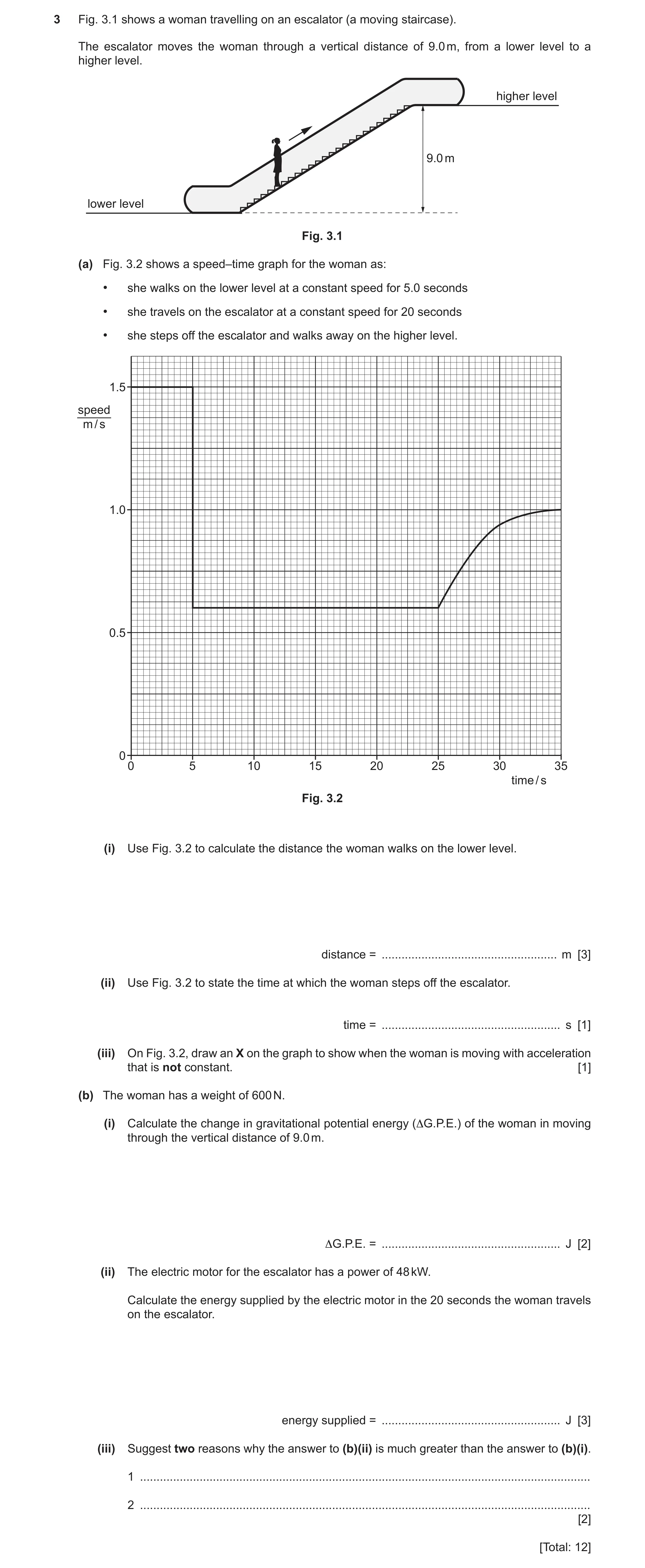
3 Fig. 3.1 shows a woman travelling on an escalator (a moving staircase). The escalator moves the woman through a vertical distance of 9.0 m, from a lower level to a higher level. higher level 9.0 m lower level Fig. 3.1 (a) Fig. 3.2 shows a speed–time graph for the woman as: • she walks on the lower level at a constant speed for 5.0 seconds • she travels on the escalator at a constant speed for 20 seconds • she steps off the escalator and walks away on the higher level. 1.5 speed m / s 1.0 0.5 0 0 5 10 15 20 25 30 35 time / s Fig. 3.2 (i) Use Fig. 3.2 to calculate the distance the woman walks on the lower level. distance = … m [3] (ii) Use Fig. 3.2 to state the time at which the woman steps off the escalator. time = … s [1] (iii) On Fig. 3.2, draw an X on the graph to show when the woman is moving with acceleration that is not constant. [1] (b) The woman has a weight of 600 N. (i) Calculate the change in gravitational potential energy (ΔG.P.E.) of the woman in moving through the vertical distance of 9.0 m. ΔG.P.E. = … J [2] (ii) The electric motor for the escalator has a power of 48 kW. Calculate the energy supplied by the electric motor in the 20 seconds the woman travels on the escalator. energy supplied = … J [3] (iii) Suggest two reasons why the answer to (b)(ii) is much greater than the answer to (b)(i). 1 … 2 … [2] [Total: 12]
12 marks
Mark scheme: 3(a)(i) use of area under graph OR distance = speed × time ; correct area identified / 1.5 × 5.0 ; 7.5 (m) ; 3 3(a)(ii) 25 (s) ; 1 3(a)(iii) X anywhere on curved section between 25 s and 35 s ; 1 3(b)(i) ΔG.P.E = mgΔh / ΔG.P.E = WΔh / 600 × 9.0 ; 5 400 (J) ; 2 3(b)(ii) conversion of 48 kW to 48 000 W; energy = power × time / 48 000 × 20 ; 960 000 (J) ; 3 3(b)(iii) any two from: work is done moving the woman forward horizontally / KE of woman ; work is done moving the escalator / KE of escalator ; work is done against friction / thermal energy produced / heat produced ; 2
This question in 0653/41 Oct/Nov 2020
Q20 · The forces acting on a truck full of sand as it is pulled along level ground at constant… 0653/42 Oct/Nov 2020
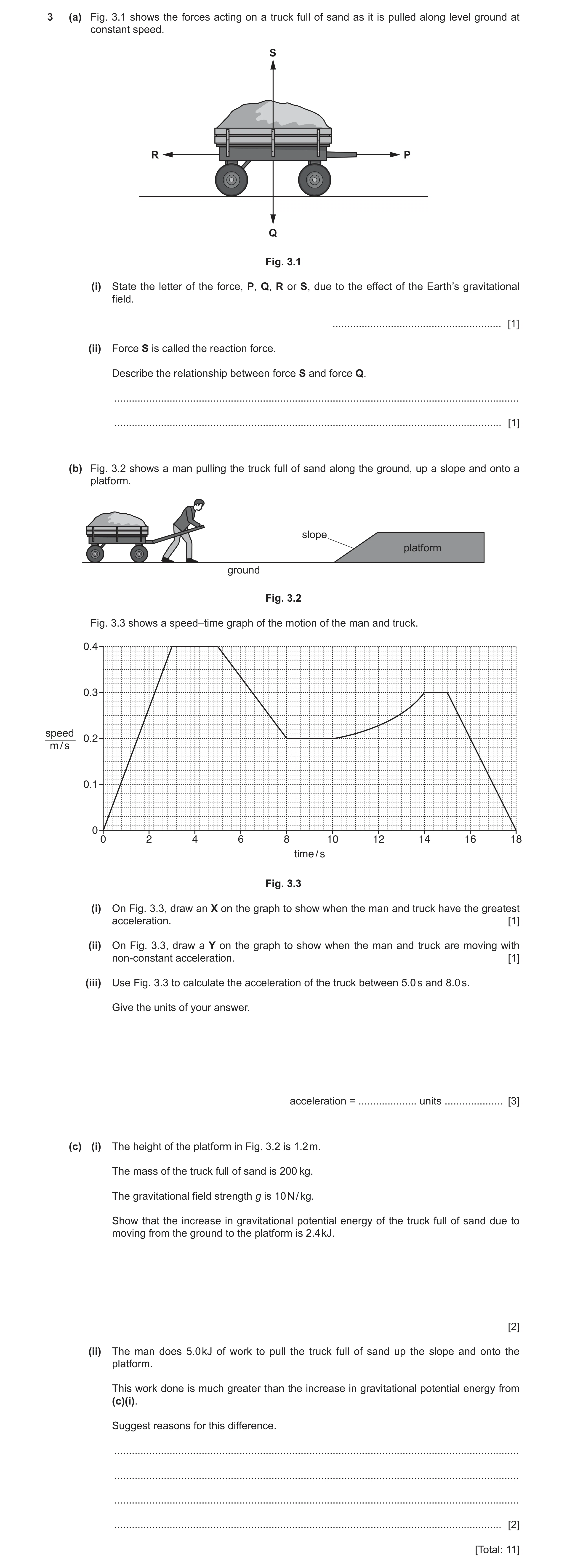
3 (a) Fig. 3.1 shows the forces acting on a truck full of sand as it is pulled along level ground at constant speed. S R P Q Fig. 3.1 (i) State the letter of the force, P, Q, R or S, due to the effect of the Earth’s gravitational field. … [1] (ii) Force S is called the reaction force. Describe the relationship between force S and force Q. … … [1] (b) Fig. 3.2 shows a man pulling the truck full of sand along the ground, up a slope and onto a platform. slope platform ground Fig. 3.2 Fig. 3.3 shows a speed–time graph of the motion of the man and truck. 0.4 0.3 speed 0.2 m / s 0.1 0 0 2 4 6 8 10 12 14 16 18 time / s Fig. 3.3 (i) On Fig. 3.3, draw an X on the graph to show when the man and truck have the greatest acceleration. [1] (ii) On Fig. 3.3, draw a Y on the graph to show when the man and truck are moving with non-constant acceleration. [1] (iii) Use Fig. 3.3 to calculate the acceleration of the truck between 5.0 s and 8.0 s. Give the units of your answer. acceleration = … units … [3] (c) (i) The height of the platform in Fig. 3.2 is 1.2 m. The mass of the truck full of sand is 200 kg. The gravitational field strength g is 10 N / kg. Show that the increase in gravitational potential energy of the truck full of sand due to moving from the ground to the platform is 2.4 kJ. [2] (ii) The man does 5.0 kJ of work to pull the truck full of sand up the slope and onto the platform. This work done is much greater than the increase in gravitational potential energy from (c)(i). Suggest reasons for this difference. … … … … [2] [Total: 11]
11 marks
Mark scheme: 3(a)(i) Q ; 1 3(a)(ii) equal (magnitude) AND opposite (direction) ; 1 3(b)(i) X drawn to show region between (0,0) and (3,0.4) ; 1 3(b)(ii) Y drawn to show region between (10,0.2) and (14,0.3) ; 1 3(b)(iii) acceleration = change of speed ÷ time / –0.2 ÷ 3 ; –0.07 ; m / s2 ; 3 3(c)(i) ΔG.P.E. = mgΔh in any form / 200 × 10 × 1.2 ; 2400 J (= 2.4 kJ) ; 2 3(c)(ii) any two from: thermal energy lost to surroundings / work done against friction ; man also has to gain PE going up onto the platform ; kinetic energy transferred / work also done in moving the man (and load) forward ; 2
This question in 0653/42 Oct/Nov 2020
Q21 · A climber using a safety rope to climb a rock face 0653/43 Oct/Nov 2020
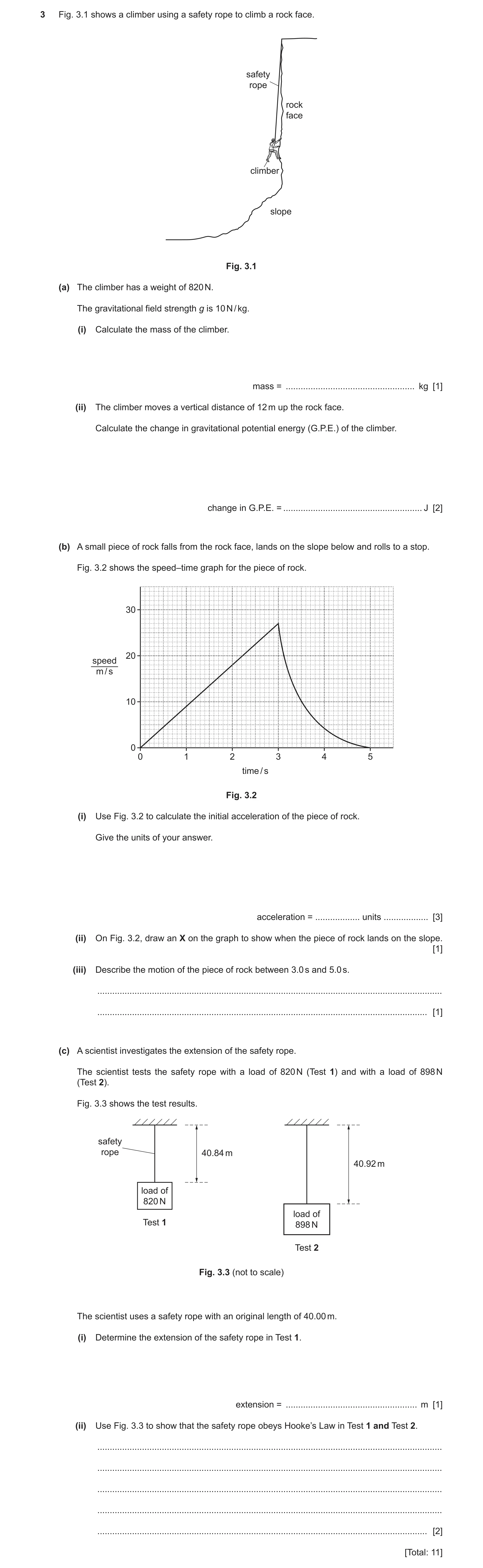
3 Fig. 3.1 shows a climber using a safety rope to climb a rock face. safety rope rock face climber slope Fig. 3.1 (a) The climber has a weight of 820 N. The gravitational field strength g is 10 N / kg. (i) Calculate the mass of the climber. mass = … kg [1] (ii) The climber moves a vertical distance of 12 m up the rock face. Calculate the change in gravitational potential energy (G.P.E.) of the climber. change in G.P.E. = … J [2] (b) A small piece of rock falls from the rock face, lands on the slope below and rolls to a stop. Fig. 3.2 shows the speed–time graph for the piece of rock. 30 20 speed m / s 10 0 0 1 2 3 4 5 time / s Fig. 3.2 (i) Use Fig. 3.2 to calculate the initial acceleration of the piece of rock. Give the units of your answer. acceleration = … units … [3] (ii) On Fig. 3.2, draw an X on the graph to show when the piece of rock lands on the slope. [1] (iii) Describe the motion of the piece of rock between 3.0 s and 5.0 s. … … [1] (c) A scientist investigates the extension of the safety rope. The scientist tests the safety rope with a load of 820 N (Test 1) and with a load of 898 N (Test 2). Fig. 3.3 shows the test results. safety rope 40.84 m 40.92 m load of 820 N load of Test 1 898 N Test 2 Fig. 3.3 (not to scale) The scientist uses a safety rope with an original length of 40.00 m. (i) Determine the extension of the safety rope in Test 1. extension = … m [1] (ii) Use Fig. 3.3 to show that the safety rope obeys Hooke’s Law in Test 1 and Test 2. … … … … … [2] [Total: 11]
11 marks
Mark scheme: 3(a)(i) (m = W ÷ g = 820 ÷ 10 =) 82 (kg) ; 1 3(a)(ii) ΔG.P.E. = mgΔh / ΔG.P.E. = wΔh / 82 × 10 × 12 ; 9840 (J) ; 2 3(b)(i) use of acceleration = change in speed ÷ time / 27 ÷ 3.0 ; 9.0 ; m / s2 ; 3 3(b)(ii) X marked at time = 3 s ; 1 3(b)(iii) non-constant, deceleration / acceleration (until it comes to rest) ; 1 3(c)(i) (extension = 40.84 – 40.00 =) 0.84 (m) ; 1 3(c)(ii) calculation of k OR 1 / k for one test ; calculation of k OR 1 / k for second test AND shown to be the same ; 2
This question in 0653/43 Oct/Nov 2020
Q22 · A motor boat moving forward across the sea 0653/41 May/June 2021
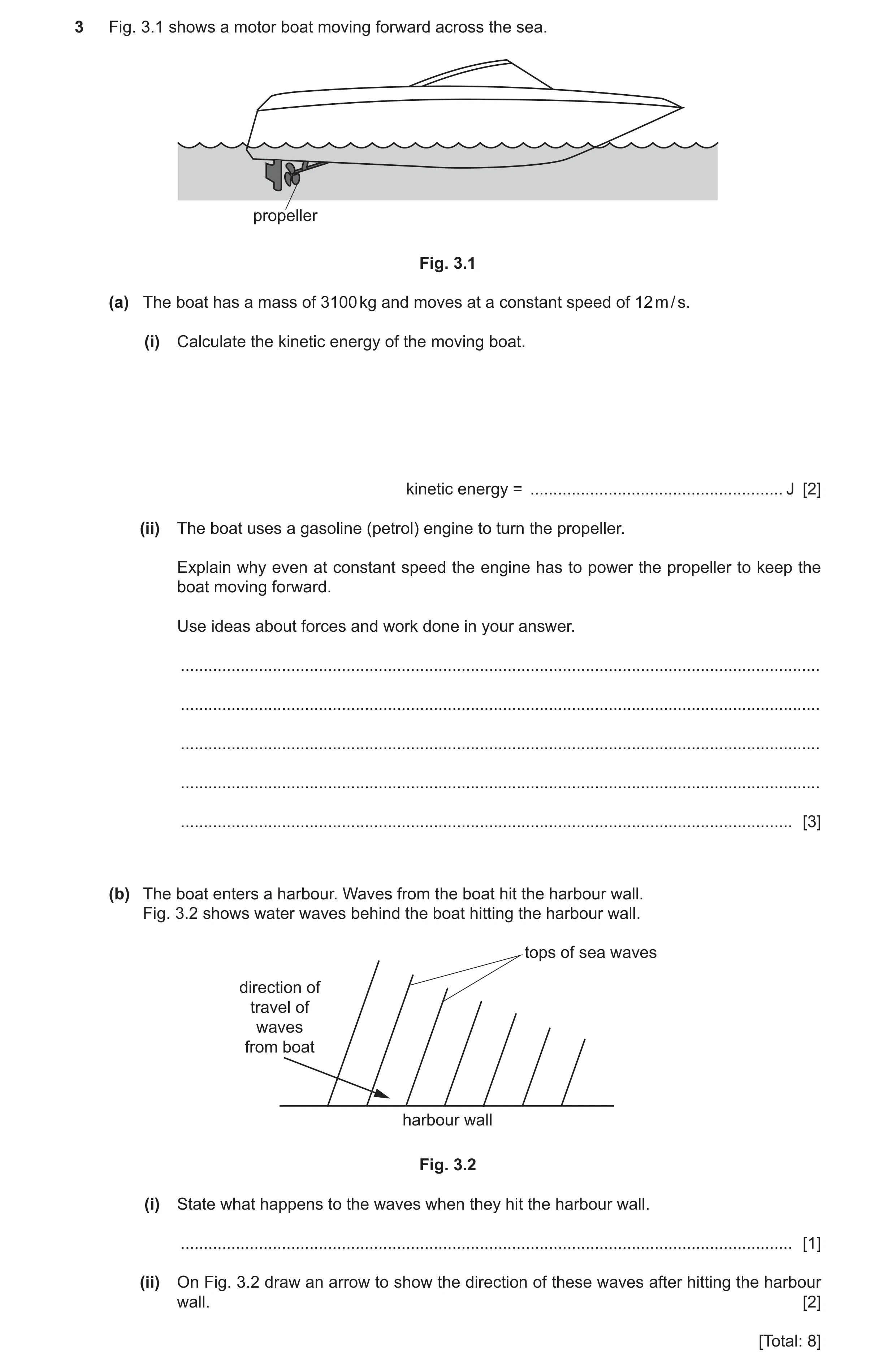
3 Fig. 3.1 shows a motor boat moving forward across the sea. propeller Fig. 3.1 (a) The boat has a mass of 3100 kg and moves at a constant speed of 12 m / s. (i) Calculate the kinetic energy of the moving boat. kinetic energy = … J [2] (ii) The boat uses a gasoline (petrol) engine to turn the propeller. Explain why even at constant speed the engine has to power the propeller to keep the boat moving forward. Use ideas about forces and work done in your answer. … … … … … [3] (b) The boat enters a harbour. Waves from the boat hit the harbour wall. Fig. 3.2 shows water waves behind the boat hitting the harbour wall. tops of sea waves direction of travel of waves from boat harbour wall Fig. 3.2 (i) State what happens to the waves when they hit the harbour wall. … [1] (ii) On Fig. 3.2 draw an arrow to show the direction of these waves after hitting the harbour wall. [2] [Total: 8]
8 marks
Mark scheme: 3(a)(i) KE = ½ mv2 / ½ × 3100 × 12 × 12 ; (=) 223 200 / 223 000 (J) ; 2 3(a)(ii) any three from: friction / resistance (force) ; balanced force needed (for constant speed) ; energy required for work done against friction ; the idea that energy (chemical, kinetic) is, transferred / lost as thermal energy (heat) ; energy input from gasoline turned into mechanical work by engine ; 3 3(b)(i) reflection ; 1 3(b)(ii) arrow shown reflected from wall (example above) ; at approximately the correct angle as seen by eye ; 2
This question in 0653/41 May/June 2021
Q23 · A battery-powered electric bus 0653/42 May/June 2021
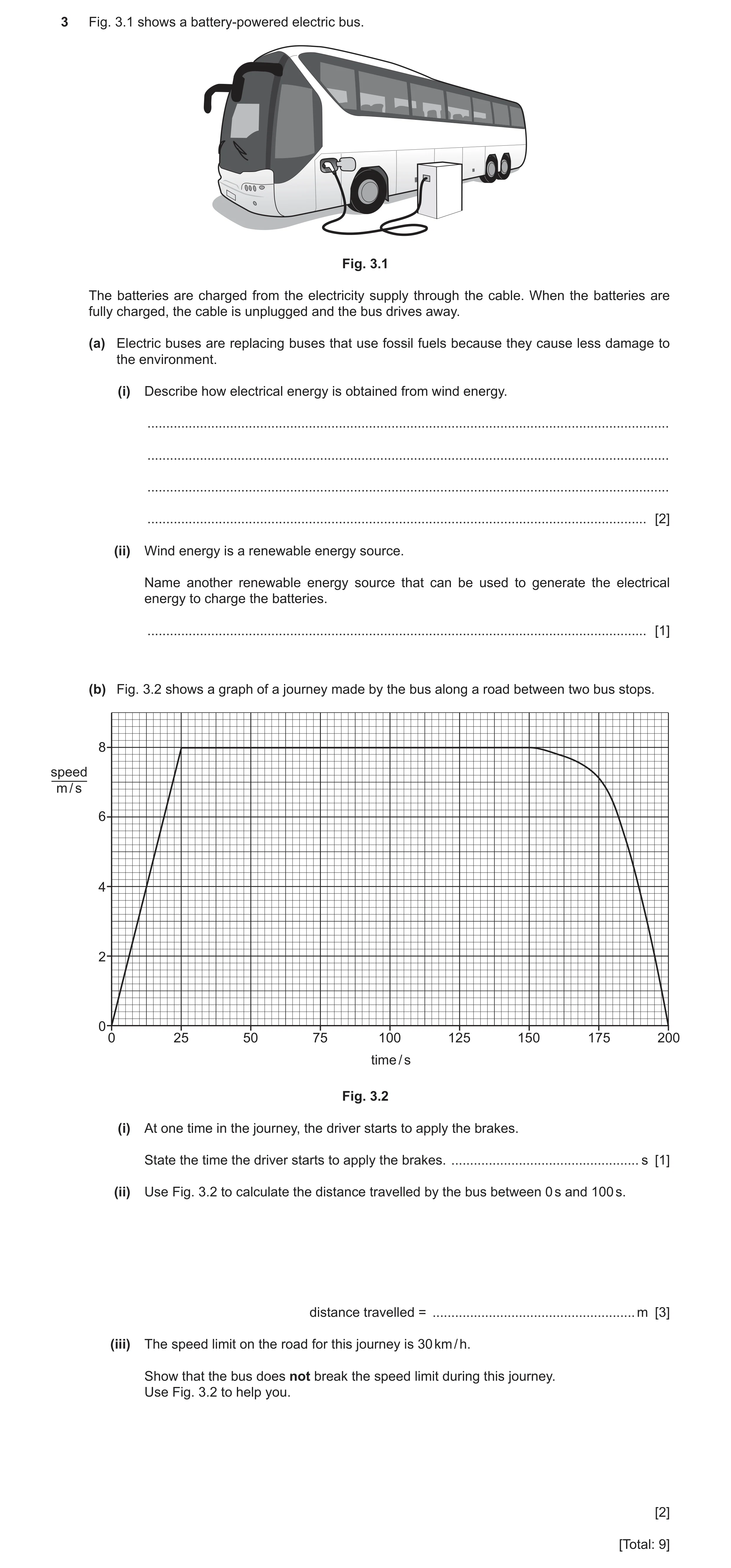
3 Fig. 3.1 shows a battery-powered electric bus. Fig. 3.1 The batteries are charged from the electricity supply through the cable. When the batteries are fully charged, the cable is unplugged and the bus drives away. (a) Electric buses are replacing buses that use fossil fuels because they cause less damage to the environment. (i) Describe how electrical energy is obtained from wind energy. … … … … [2] (ii) Wind energy is a renewable energy source. Name another renewable energy source that can be used to generate the electrical energy to charge the batteries. … [1] (b) Fig. 3.2 shows a graph of a journey made by the bus along a road between two bus stops. 8 speed m / s 6 4 2 0 0 25 50 75 100 125 150 175 200 time / s Fig. 3.2 (i) At one time in the journey, the driver starts to apply the brakes. State the time the driver starts to apply the brakes. … s [1] (ii) Use Fig. 3.2 to calculate the distance travelled by the bus between 0 s and 100 s. distance travelled = … m [3] (iii) The speed limit on the road for this journey is 30 km / h. Show that the bus does not break the speed limit during this journey. Use Fig. 3.2 to help you. [2] [Total: 9]
9 marks
Mark scheme: 3(a)(i) reference to kinetic energy (in wind) ; (KE) turns / moves, a turbine / generator ; 2 3(a)(ii) solar / tidal / hydroelectric / geothermal / water ; 1 3(b)(i) 150 (s) ; 1 3(b)(ii) use of area under graph / distance = speed × time ; (½ × 25 × 8) or 100 / (75 × 8) or 600 ; ((½ × 25 × 8) + (75 × 8) or (100 + 600)) = 700 (m) ; 3 3(b)(iii) max. speed is 8 m / s ; = 0.008 × 3600 = 28.8 km / h (which does not break the speed limit of 30 km / h) ; 2
This question in 0653/42 May/June 2021
Q24 · A dog accelerates from rest to a maximum constant speed 0653/41 Oct/Nov 2021
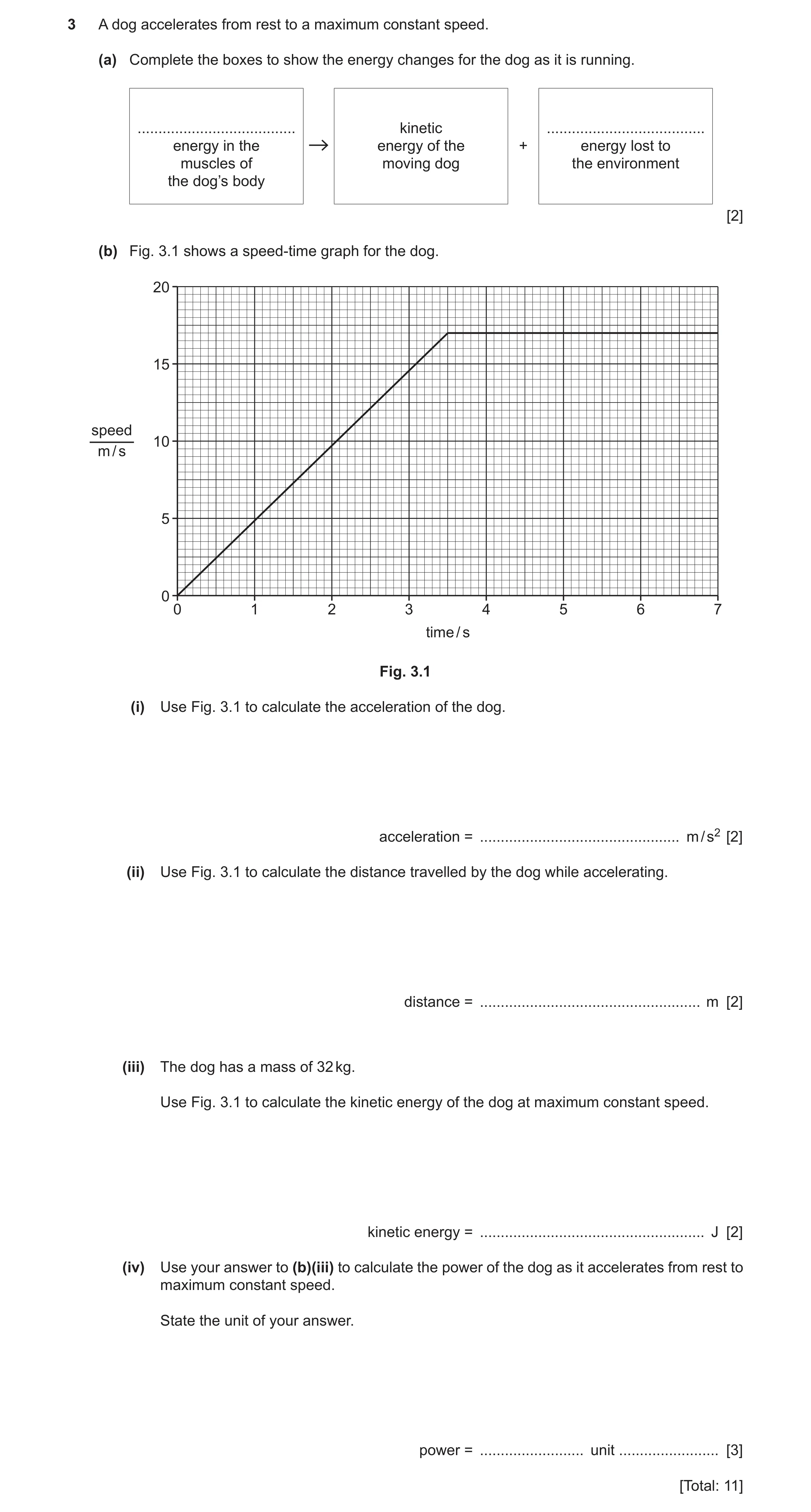
3 A dog accelerates from rest to a maximum constant speed. (a) Complete the boxes to show the energy changes for the dog as it is running. … kinetic … energy in the energy of the + energy lost to muscles of moving dog the environment the dog’s body [2] (b) Fig. 3.1 shows a speed-time graph for the dog. 20 15 speed 10 m / s 5 0 0 1 2 3 4 5 6 7 time / s Fig. 3.1 (i) Use Fig. 3.1 to calculate the acceleration of the dog. acceleration = … m / s2 [2] (ii) Use Fig. 3.1 to calculate the distance travelled by the dog while accelerating. distance = … m [2] (iii) The dog has a mass of 32 kg. Use Fig. 3.1 to calculate the kinetic energy of the dog at maximum constant speed. kinetic energy = … J [2] (iv) Use your answer to (b)(iii) to calculate the power of the dog as it accelerates from rest to maximum constant speed. State the unit of your answer. power = … unit … [3] [Total: 11]
11 marks
Mark scheme: 3(a) chemical (potential) ; thermal / heat ; 2 3(b)(i) acceleration = change in speed ÷ time in any form / 17 ÷ 3.5 ; 4.9 (m / s2) ; 2 3(b)(ii) use of area under graph / ½ × 3.5 × 17 ; 30 (m) ; 2 3(b)(iii) KE = ½ m v2 in any form / ½ × 32 × 17 × 17 ; 4600 (J) ; 2 3(b)(iv) P = E ÷ t in any form / 4600 ÷ 3.5 ; 1300 ; watt(s) / W ; 3
This question in 0653/41 Oct/Nov 2021
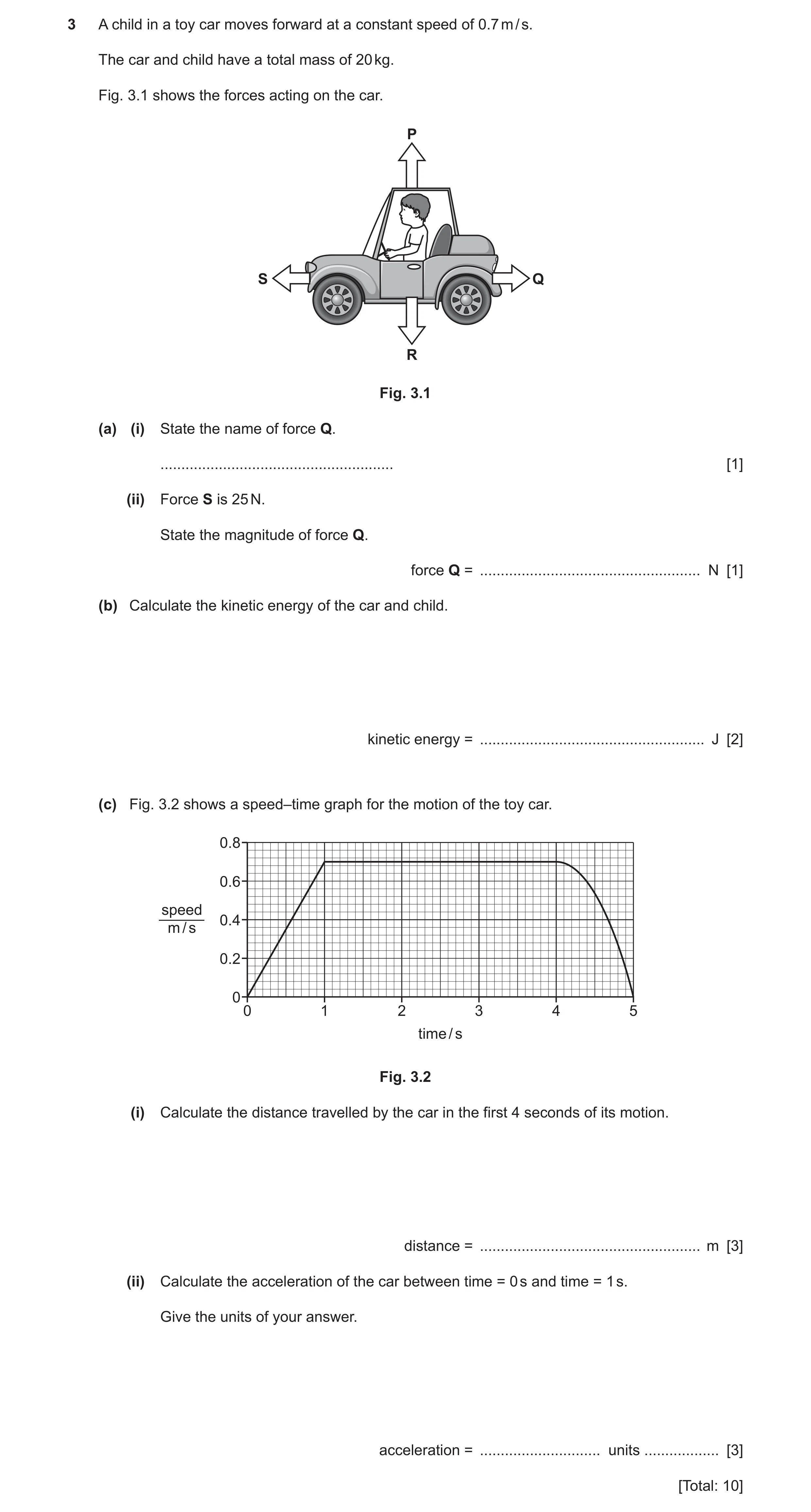
Q25 · A child in a toy car moves forward at a constant speed of 0.7 m / s 0653/42 Feb/March 2022
3 A child in a toy car moves forward at a constant speed of 0.7 m / s. The car and child have a total mass of 20 kg. Fig. 3.1 shows the forces acting on the car. P S Q R Fig. 3.1 (a) (i) State the name of force Q. … [1] (ii) Force S is 25 N. State the magnitude of force Q. force Q = … N [1] (b) Calculate the kinetic energy of the car and child. kinetic energy = … J [2] (c) Fig. 3.2 shows a speed–time graph for the motion of the toy car. 0.8 0.6 speed 0.4 m / s 0.2 0 0 1 2 3 4 5 time / s Fig. 3.2 (i) Calculate the distance travelled by the car in the first 4 seconds of its motion. distance = … m [3] (ii) Calculate the acceleration of the car between time = 0 s and time = 1 s. Give the units of your answer. acceleration = … units … [3] [Total: 10]
10 marks
Mark scheme: 3(a)(i) friction ; 1 3(a)(ii) 25 (N) ; 1 Question Answer Marks 3(b) KE = ½mv2 (in any form) / ½ × 20 × 0.7 × 0.7 ; 4.9 (J) ; 2 3(c)(i) use of area under curve ; calculation of one area e.g., distance = (½ × 1 × 0.7 = 0.35) / (3 × 0.7 = 2.1) ; (= 0.35 + 2.1 =) 2.45 (m) ; 3 3(c)(ii) acceleration = change in speed ÷ time (in any form) / 0.7 ÷ 1 ; 0.7 ; m / s2 ; 3
This question in 0653/42 Feb/March 2022
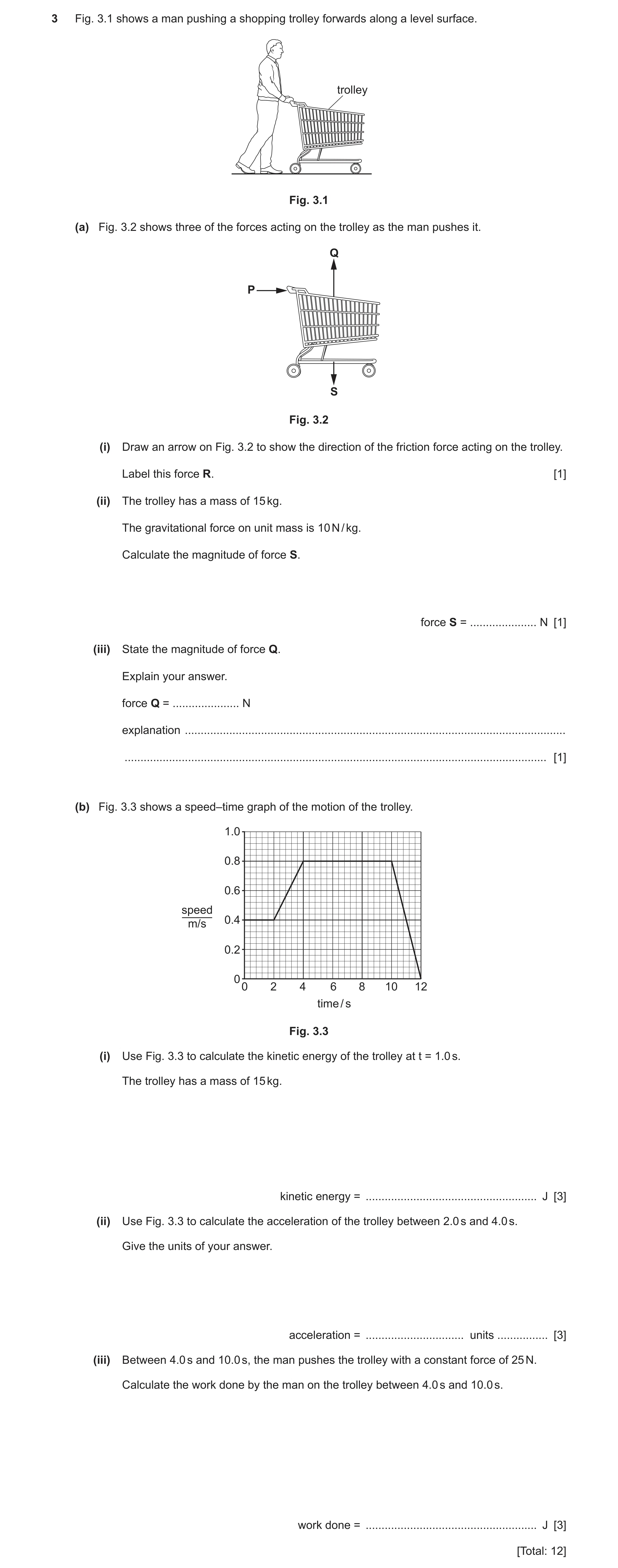
Q26 · A man pushing a shopping trolley forwards along a level surface 0653/41 May/June 2022
3 Fig. 3.1 shows a man pushing a shopping trolley forwards along a level surface. trolley Fig. 3.1 (a) Fig. 3.2 shows three of the forces acting on the trolley as the man pushes it. Q P S Fig. 3.2 (i) Draw an arrow on Fig. 3.2 to show the direction of the friction force acting on the trolley. Label this force R. [1] (ii) The trolley has a mass of 15 kg. The gravitational force on unit mass is 10 N / kg. Calculate the magnitude of force S. force S = … N [1] (iii) State the magnitude of force Q. Explain your answer. force Q = … N explanation … … [1] (b) Fig. 3.3 shows a speed–time graph of the motion of the trolley. 1.0 0.8 0.6 speed 0.4 m/s 0.2 00 2 4 6 8 10 12 time / s Fig. 3.3 (i) Use Fig. 3.3 to calculate the kinetic energy of the trolley at t = 1.0 s. The trolley has a mass of 15 kg. kinetic energy = … J [3] (ii) Use Fig. 3.3 to calculate the acceleration of the trolley between 2.0 s and 4.0 s. Give the units of your answer. acceleration = … units … [3] (iii) Between 4.0 s and 10.0 s, the man pushes the trolley with a constant force of 25 N. Calculate the work done by the man on the trolley between 4.0 s and 10.0 s. work done = … J [3] [Total: 12]
12 marks
Mark scheme: 3(a)(i) arrow pointing to left with label R ; 1 3(a)(ii) (S =) 150 (N) ; 1 3(a)(iii) (Q =) 150 (N) AND no vertical movement, (so forces must be equal and opposite) ; 1 3(b)(i) reading 0.4 for speed from graph ; KE = ½ mv2 (in any form) / = ½ x 15 0.4 0.4 ; 1.2 (J) ; 3 3(b)(ii) acceleration = change in speed ÷ time / = (0.8 – 0.4) ÷ 2 ; 0.2 ; m / s2 ; 3 3(b)(iii) work done = F d (in any form) ; distance travelled = area under graph between 4 s and 10 s / (0.8 6) ; (= (0.8 6) 25 =) 120 (J); 3 R
This question in 0653/41 May/June 2022
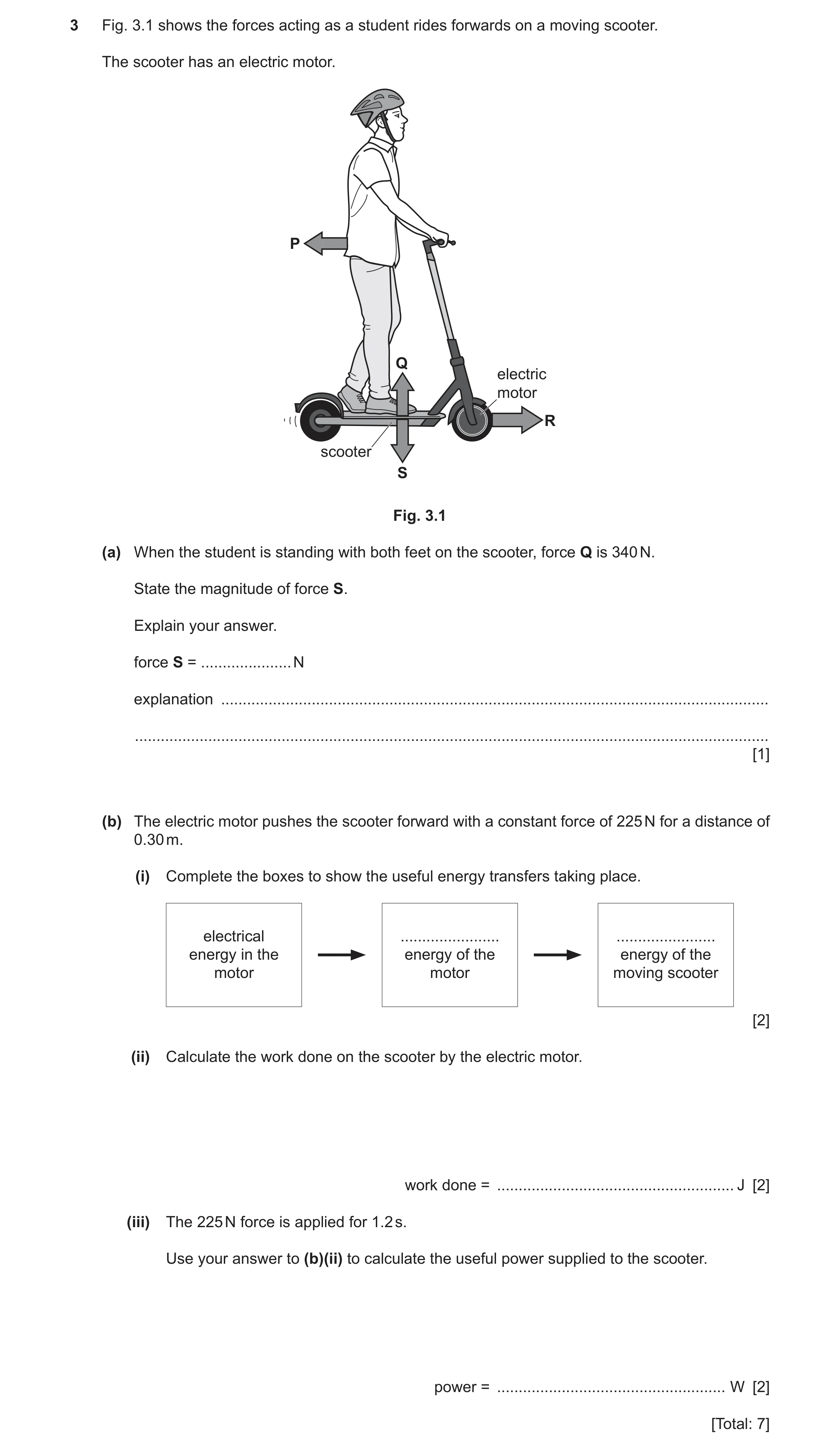
Q27 · The forces acting as a student rides forwards on a moving scooter 0653/42 May/June 2022
3 Fig. 3.1 shows the forces acting as a student rides forwards on a moving scooter. The scooter has an electric motor. P Q electric motor R scooter S Fig. 3.1 (a) When the student is standing with both feet on the scooter, force Q is 340 N. State the magnitude of force S. Explain your answer. force S = … N explanation … … [1] (b) The electric motor pushes the scooter forward with a constant force of 225 N for a distance of 0.30 m. (i) Complete the boxes to show the useful energy transfers taking place. electrical … … energy in the energy of the energy of the motor motor moving scooter [2] (ii) Calculate the work done on the scooter by the electric motor. work done = … J [2] (iii) The 225 N force is applied for 1.2 s. Use your answer to (b)(ii) to calculate the useful power supplied to the scooter. power = … W [2] [Total: 7]
7 marks
Mark scheme: 3(a) (S =) 340 (N) AND no vertical movement, (so forces must be equal and opposite) ; 1 3(b)(i) kinetic ; kinetic ; 2 3(b)(ii) W = F d (in any form) / = 225 0.30 ; 67.5 (J) ; 2 3(b)(iii) power = work done ÷ time OR change in energy ÷ time OR = 67.5 ÷ 1.2 ; 56 (W) ; 2
This question in 0653/42 May/June 2022
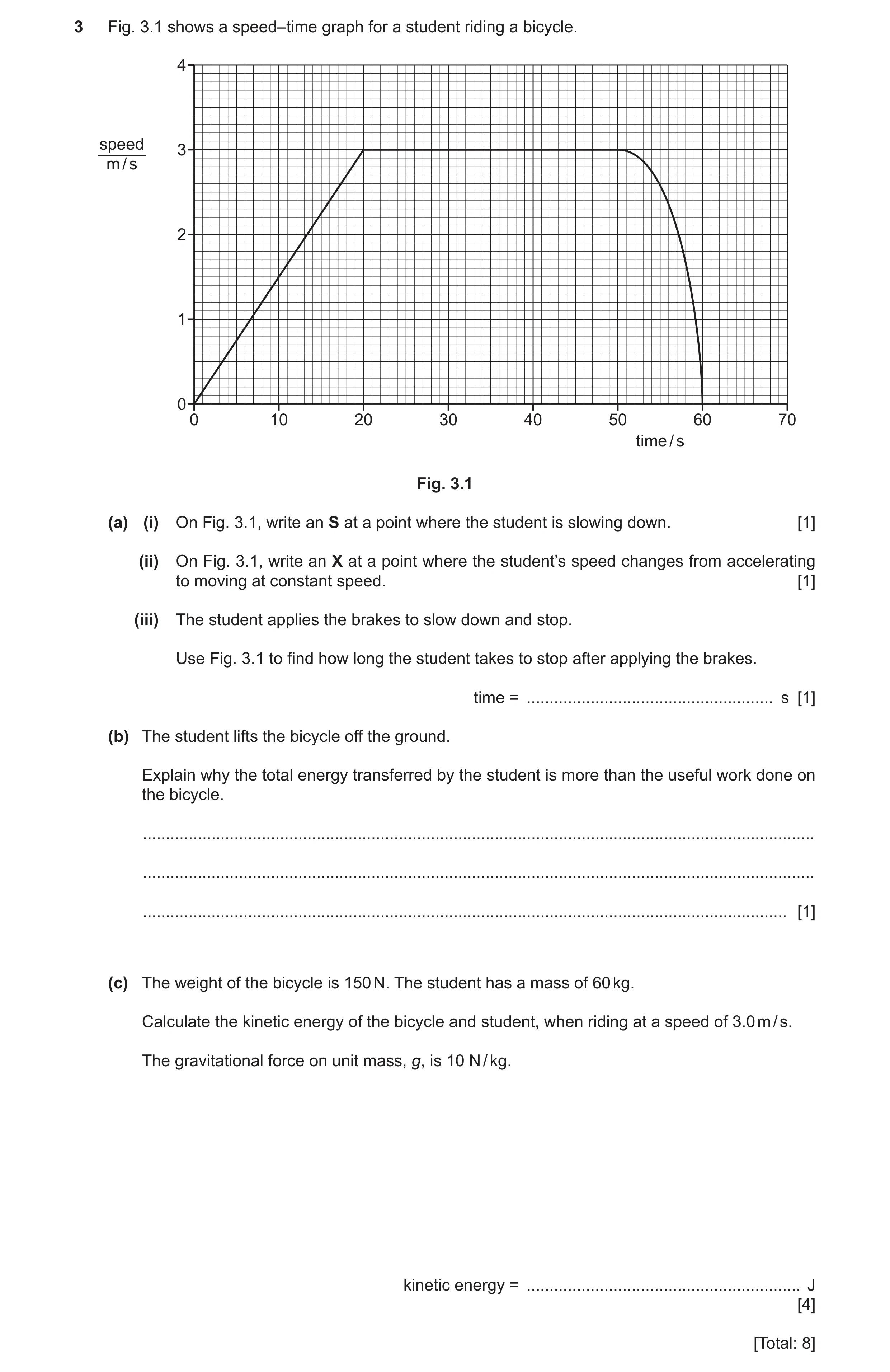
Q28 · A speed–time graph for a student riding a bicycle 0653/42 Feb/March 2023
3 Fig. 3.1 shows a speed–time graph for a student riding a bicycle. 4 speed 3 m / s 2 1 0 0 10 20 30 40 50 60 70 time / s Fig. 3.1 (a) (i) On Fig. 3.1, write an S at a point where the student is slowing down. [1] (ii) On Fig. 3.1, write an X at a point where the student’s speed changes from accelerating to moving at constant speed. [1] (iii) The student applies the brakes to slow down and stop. Use Fig. 3.1 to find how long the student takes to stop after applying the brakes. time = … s [1] (b) The student lifts the bicycle off the ground. Explain why the total energy transferred by the student is more than the useful work done on the bicycle. … … … [1] (c) The weight of the bicycle is 150 N. The student has a mass of 60 kg. Calculate the kinetic energy of the bicycle and student, when riding at a speed of 3.0 m / s. The gravitational force on unit mass, g, is 10 N / kg. kinetic energy = … J [4] [Total: 8]
8 marks
Mark scheme: 3(a)(i) S on any point on curved section of graph ; 1 3(a)(ii) X reasonable accurately marked at t = 20 s and s = 3 m / s ; 1 3(a)(iii) 10 (s) ; 1 3(b) energy lost / wasted as, thermal energy / heat ; 1 3(c) mass of bicycle = weight g / m = 150 10 = 15 (kg) ; 4 total mass of rider + bicycle = 60 + 15 = 75 (kg) ; (KE =) ½ mv2 ; ½ x 75 9 = 338 (337.5) (J) ;
This question in 0653/42 Feb/March 2023
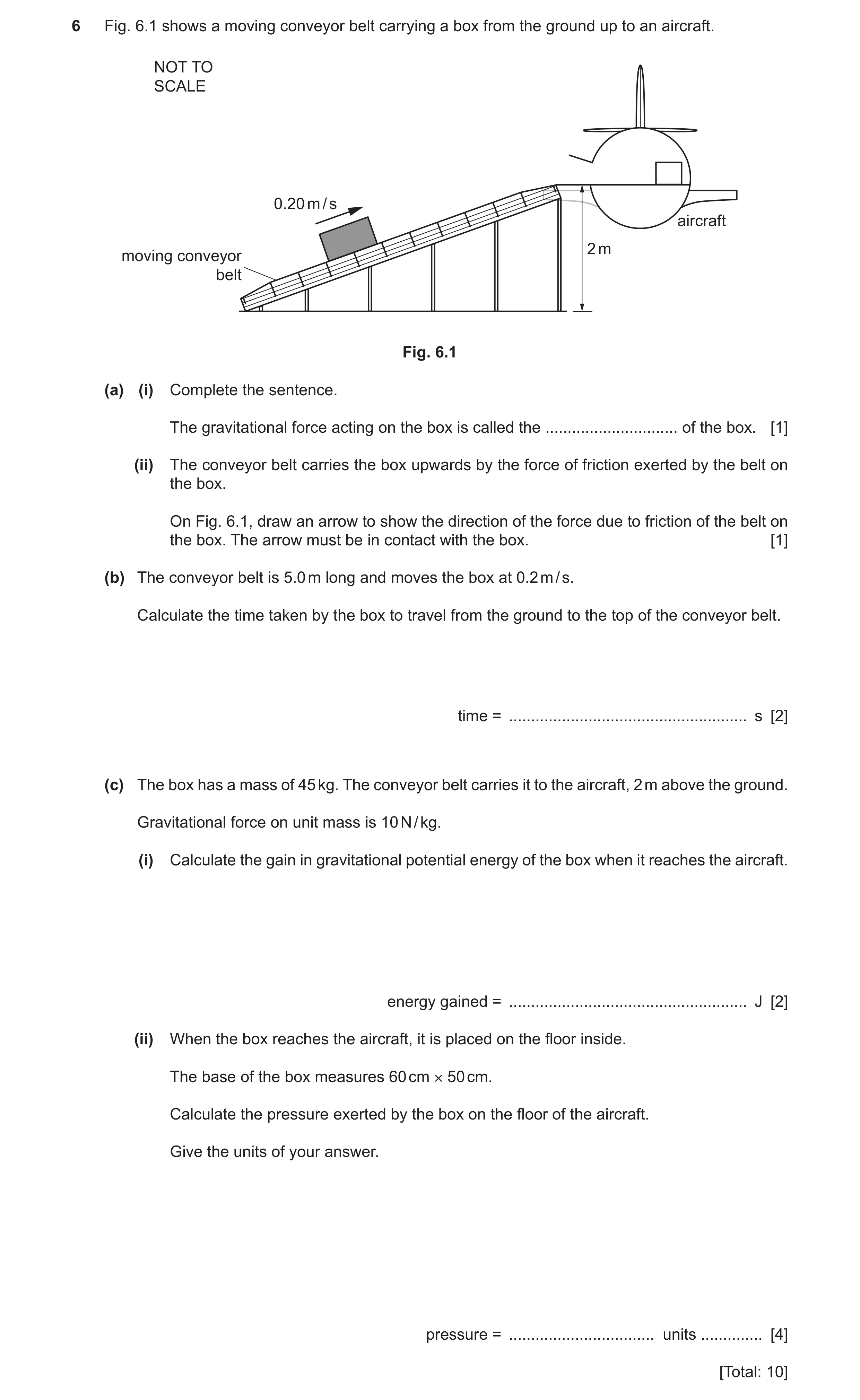
Q29 · A moving conveyor belt carrying a box from the ground up to an aircraft 0653/41 May/June 2023
6 Fig. 6.1 shows a moving conveyor belt carrying a box from the ground up to an aircraft. NOT TO SCALE 0.20 m / s aircraft 2 m moving conveyor belt Fig. 6.1 (a) (i) Complete the sentence. The gravitational force acting on the box is called the … of the box. [1] (ii) The conveyor belt carries the box upwards by the force of friction exerted by the belt on the box. On Fig. 6.1, draw an arrow to show the direction of the force due to friction of the belt on the box. The arrow must be in contact with the box. [1] (b) The conveyor belt is 5.0 m long and moves the box at 0.2 m / s. Calculate the time taken by the box to travel from the ground to the top of the conveyor belt. time = … s [2] (c) The box has a mass of 45 kg. The conveyor belt carries it to the aircraft, 2 m above the ground. Gravitational force on unit mass is 10 N / kg. (i) Calculate the gain in gravitational potential energy of the box when it reaches the aircraft. energy gained = … J [2] (ii) When the box reaches the aircraft, it is placed on the floor inside. The base of the box measures 60 cm × 50 cm. Calculate the pressure exerted by the box on the floor of the aircraft. Give the units of your answer. pressure = … units … [4] [Total: 10]
10 marks
Mark scheme: 6(a)(i) weight ; 1 6(a)(ii) force arrow parallel to belt in contact with box pointing up the belt ; 1 6(b) time = distance speed (stated or evidence of use) / (time = ) 5 0.2 ; 25 (s) ; 2 6(c)(i) (gain in GPE = ) mgh (stated or evidence of use) / 45 10 2 ; 900 (J) ; 2 6(c)(ii) pressure = force area (in any form) ; = 450 ÷ 3 000 OR 450 ÷ 0.3 ; (pressure = ) 0.15 (N / cm2) OR 1 500 (N / m2 or Pa) ; N / cm2 OR N / m2 OR Pa (to match numerical answer) ; 4
This question in 0653/41 May/June 2023
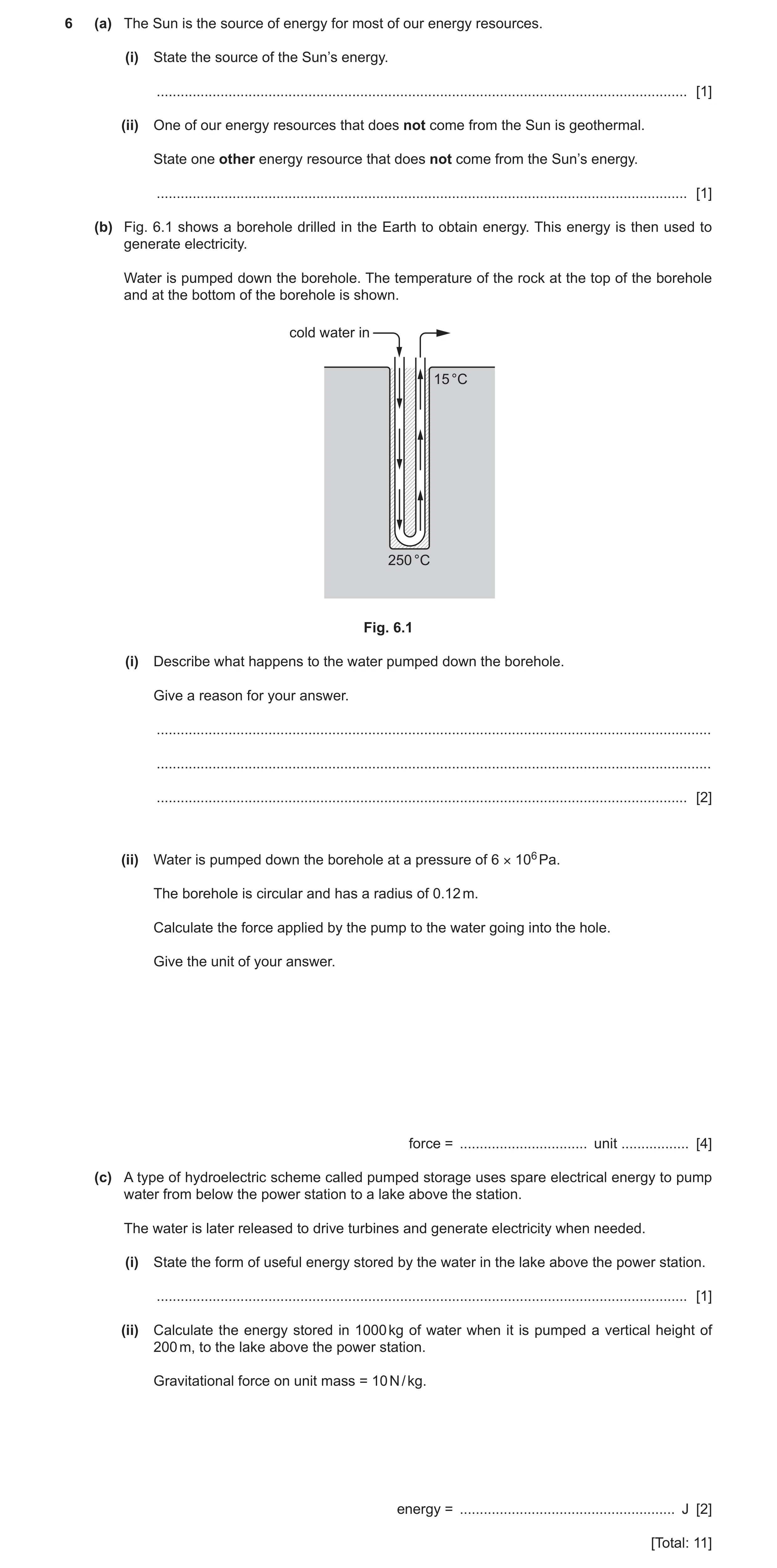
Q30 · The Sun is the source of energy for most of our energy resources 0653/42 May/June 2023
6 (a) The Sun is the source of energy for most of our energy resources. (i) State the source of the Sun’s energy. … [1] (ii) One of our energy resources that does not come from the Sun is geothermal. State one other energy resource that does not come from the Sun’s energy. … [1] (b) Fig. 6.1 shows a borehole drilled in the Earth to obtain energy. This energy is then used to generate electricity. Water is pumped down the borehole. The temperature of the rock at the top of the borehole and at the bottom of the borehole is shown. cold water in 15 °C 250 °C Fig. 6.1 (i) Describe what happens to the water pumped down the borehole. Give a reason for your answer. … … … [2] (ii) Water is pumped down the borehole at a pressure of 6 × 10⁶ Pa. The borehole is circular and has a radius of 0.12 m. Calculate the force applied by the pump to the water going into the hole. Give the unit of your answer. force = … unit … [4] (c) A type of hydroelectric scheme called pumped storage uses spare electrical energy to pump water from below the power station to a lake above the station. The water is later released to drive turbines and generate electricity when needed. (i) State the form of useful energy stored by the water in the lake above the power station. … [1] (ii) Calculate the energy stored in 1000 kg of water when it is pumped a vertical height of 200 m, to the lake above the power station. Gravitational force on unit mass = 10 N / kg. energy = … J [2] [Total: 11]
11 marks
Mark scheme: 6(a)(i) nuclear fusion ; 1 6(a)(ii) nuclear (fission) / tidal ; 1 6(b)(i) boils / turns to steam ; (temperature of rock is) above 100 °C / boiling point of water is 100 °C / higher than the b.pt of water ; 2 6(b)(ii) pressure = force area / F = p A (stated or evidence of use) ; area of borehole A = r2 / 3.14 0.12 0.12 / 0.045 (m2) ; F = 6 106 3.14 0.12 0.12 / 6 106 0.045 ; 0.27 106 N / 270 000 N / 270 kN ; 4 Question Answer Marks 6(c)(i) gravitational potential ; 1 6(c)(ii) (PE stored =) mgh (stated or evidence of use) / 1000 10 200 ; 2 000 000 (J) ; 2
This question in 0653/42 May/June 2023
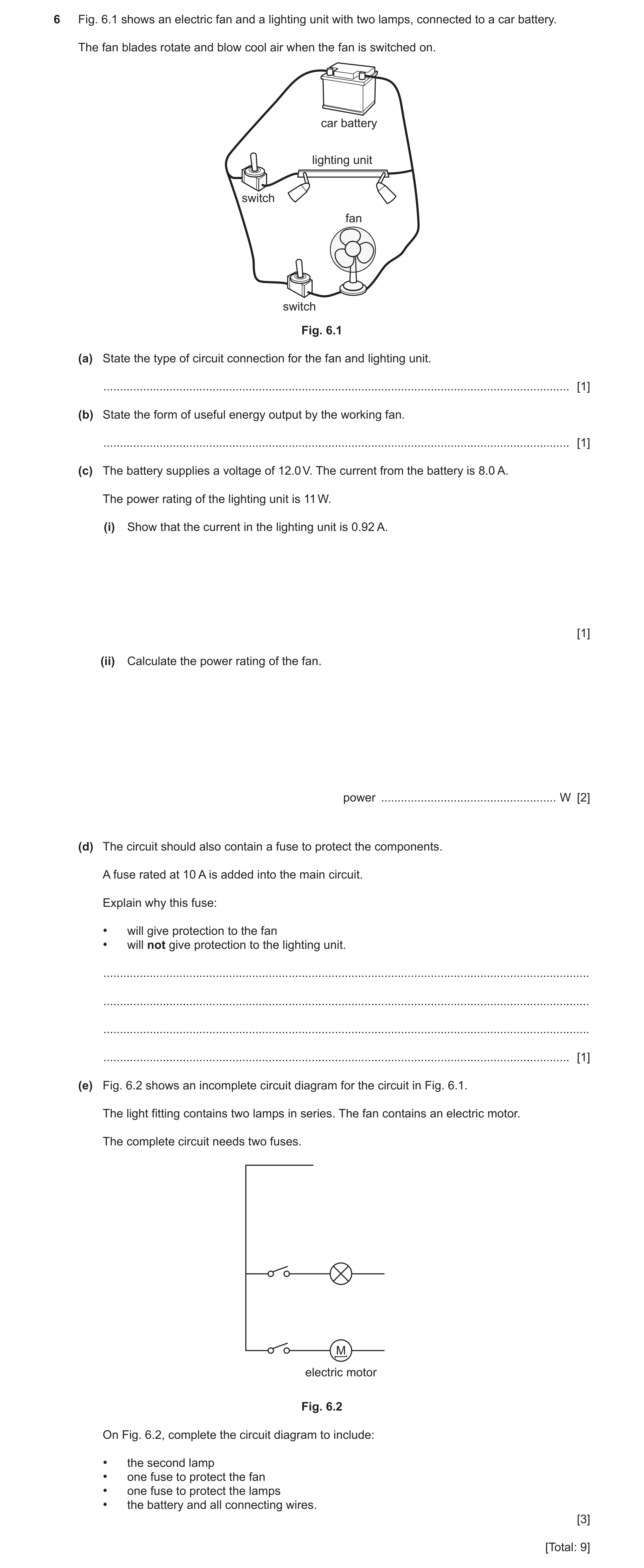
Q31 · An electric fan and a lighting unit with two lamps, connected to a car battery 0653/43 May/June 2023
6 Fig. 6.1 shows an electric fan and a lighting unit with two lamps, connected to a car battery. The fan blades rotate and blow cool air when the fan is switched on. car battery lighting unit switch fan switch Fig. 6.1 (a) State the type of circuit connection for the fan and lighting unit. … [1] (b) State the form of useful energy output by the working fan. … [1] (c) The battery supplies a voltage of 12.0 V. The current from the battery is 8.0 A. The power rating of the lighting unit is 11 W. (i) Show that the current in the lighting unit is 0.92 A. [1] (ii) Calculate the power rating of the fan. power … W [2] (d) The circuit should also contain a fuse to protect the components. A fuse rated at 10 A is added into the main circuit. Explain why this fuse: • will give protection to the fan • will not give protection to the lighting unit. … … … … [1] (e) Fig. 6.2 shows an incomplete circuit diagram for the circuit in Fig. 6.1. The light fitting contains two lamps in series. The fan contains an electric motor. The complete circuit needs two fuses. M electric motor Fig. 6.2 On Fig. 6.2, complete the circuit diagram to include: • the second lamp • one fuse to protect the fan • one fuse to protect the lamps • the battery and all connecting wires. [3] [Total: 9]
9 marks
Mark scheme: 6(a) parallel ; 1 6(b) kinetic energy (of rotating blades / blown air) ; 1 6(c)(i) power (rating of lamp) = V I / (I =) 11 12 ; 1 6(c)(ii) (power rating of whole circuit = V I =) 12 8.0 / 96 ; (power rating of fan = (12 8) – 11 =) 85 (W) ; OR (current in fan circuit =) 8.0 – 0.92 / 7.1 ; (power rating of fan = 12 7.1 =) 85(.2) (W) ; 2 Question Answer Marks 6(d) rating of fuse (10 A) much higher than lamp current but closer to the fan current OR fuse allows (up to) 10 A to flow with no damage to fan but causes damage to lamp ; 1 6(e) second lamp in series ; two fuse symbols correct, and one in each branch ; battery symbol and connecting wiring complete with no short circuits ; 3
This question in 0653/43 May/June 2023
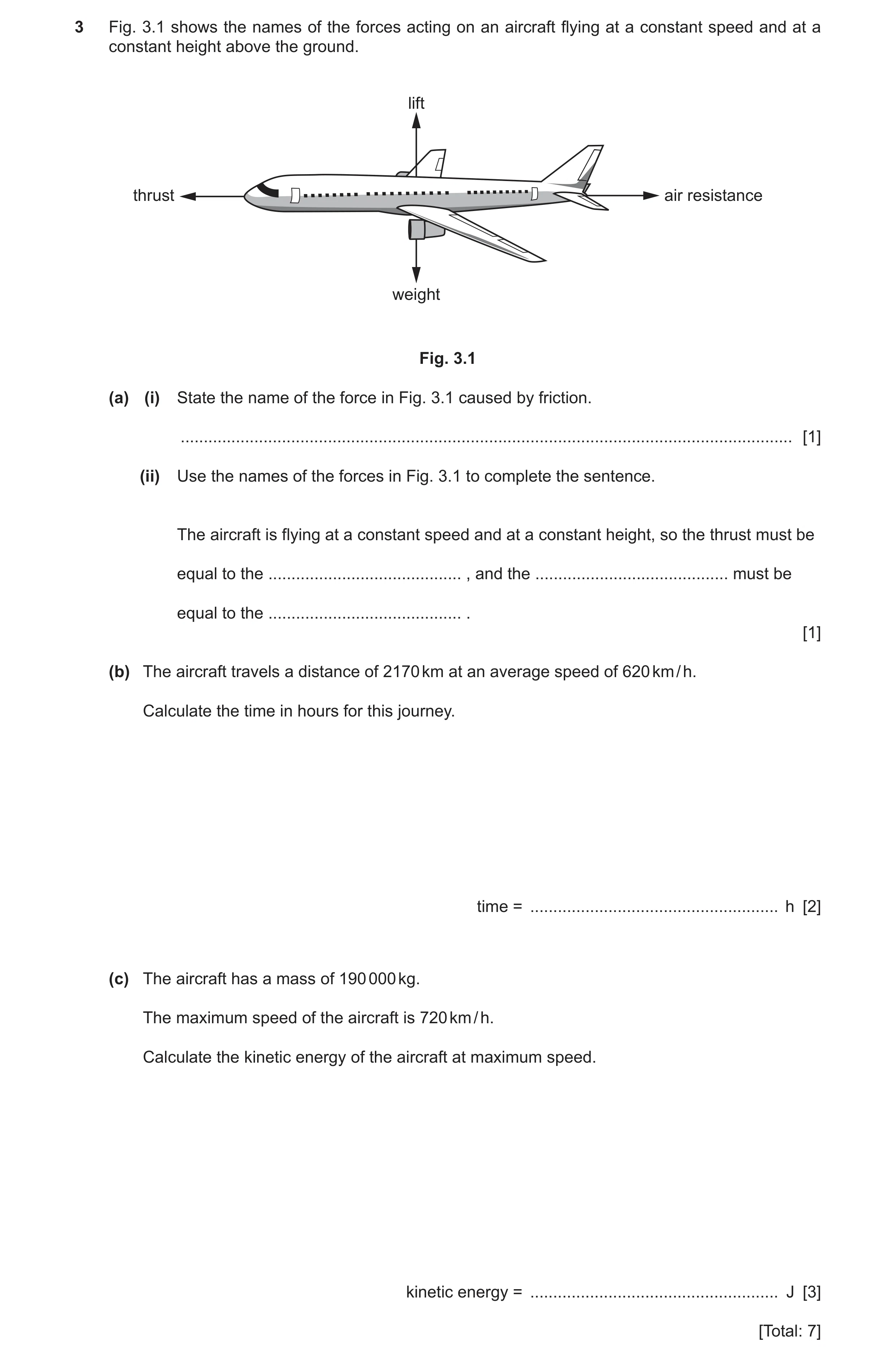
Q32 · The names of the forces acting on an aircraft flying at a constant speed and at a… 0653/41 Oct/Nov 2023
3 Fig. 3.1 shows the names of the forces acting on an aircraft flying at a constant speed and at a constant height above the ground. lift thrust air resistance weight Fig. 3.1 (a) (i) State the name of the force in Fig. 3.1 caused by friction. … [1] (ii) Use the names of the forces in Fig. 3.1 to complete the sentence. The aircraft is flying at a constant speed and at a constant height, so the thrust must be equal to the … , and the … must be equal to the … . [1] (b) The aircraft travels a distance of 2170 km at an average speed of 620 km / h. Calculate the time in hours for this journey. time = … h [2] (c) The aircraft has a mass of 190 000 kg. The maximum speed of the aircraft is 720 km / h. Calculate the kinetic energy of the aircraft at maximum speed. kinetic energy = … J [3] [Total: 7]
7 marks
Mark scheme: 3(a)(i) air resistance ; 1 3(a)(ii) air resistance, lift, weight (all required) ; 1 3(b) evidence of, speed = distance time / 2170 620 ; 2 3.5 (h) ; 3(c) unit conversion, 720 000 3600 / 200 (m / s) ; 3 evidence of, KE = ½ m v 2 / ½ 190 000 200 200 ; 3.8 109 / 3 800 000 000 (J) ;
This question in 0653/41 Oct/Nov 2023
Question 33 0653/42 Oct/Nov 2023
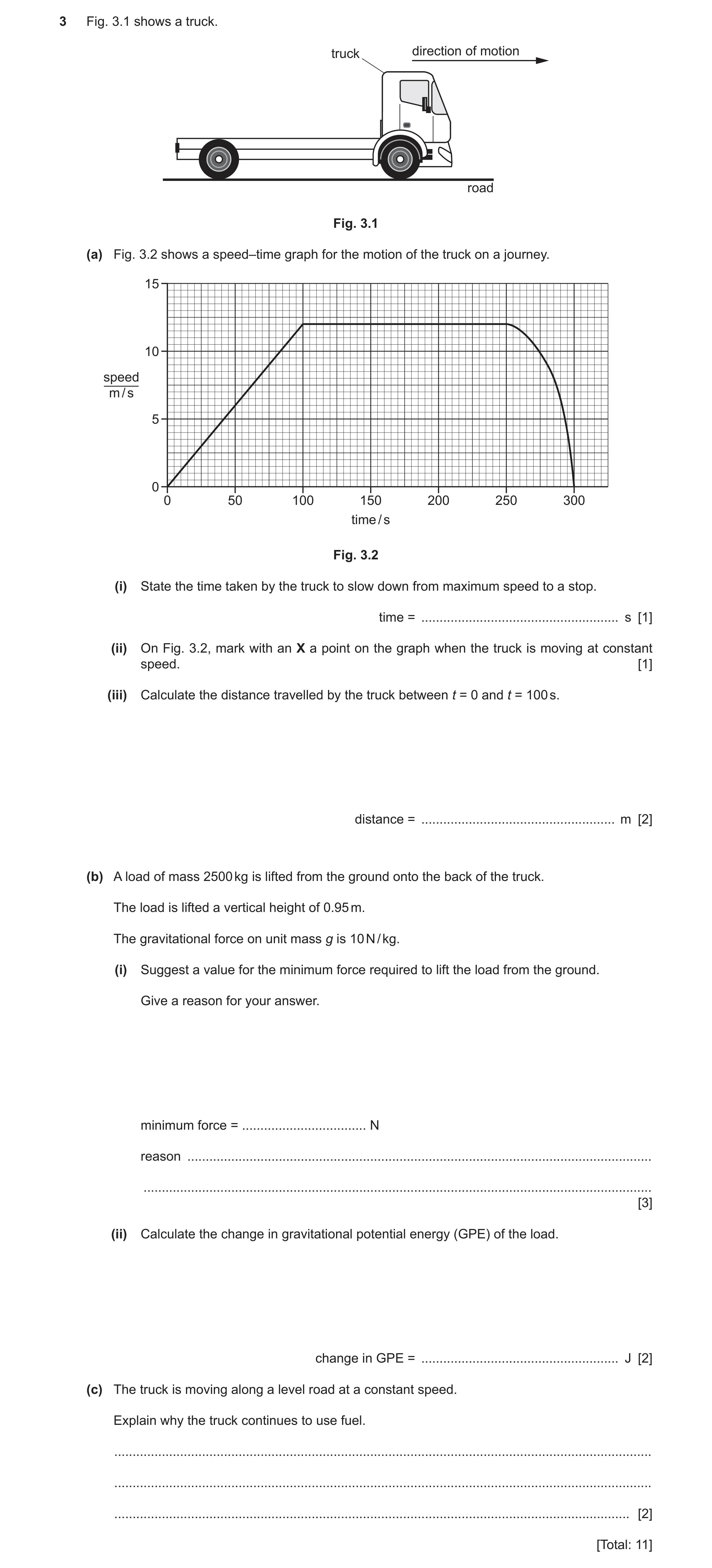
3 Fig. 3.1 shows a truck. truck direction of motion road Fig. 3.1 (a) Fig. 3.2 shows a speed–time graph for the motion of the truck on a journey. 15 10 speed m / s 5 0 0 50 100 150 200 250 300 time / s Fig. 3.2 (i) State the time taken by the truck to slow down from maximum speed to a stop. time = … s [1] (ii) On Fig. 3.2, mark with an X a point on the graph when the truck is moving at constant speed. [1] (iii) Calculate the distance travelled by the truck between t = 0 and t = 100 s. distance = … m [2] (b) A load of mass 2500 kg is lifted from the ground onto the back of the truck. The load is lifted a vertical height of 0.95 m. The gravitational force on unit mass g is 10 N / kg. (i) Suggest a value for the minimum force required to lift the load from the ground. Give a reason for your answer. minimum force = … N reason … … [3] (ii) Calculate the change in gravitational potential energy (GPE) of the load. change in GPE = … J [2] (c) The truck is moving along a level road at a constant speed. Explain why the truck continues to use fuel. … … … [2] [Total: 11]
11 marks
Mark scheme: 3(a)(i) 50 (s) ; 1 3(a)(ii) X anywhere on the horizontal line of the graph ; 1 3(a)(iii) evidence of, use of area under graph / ½ 100 12 ; 2 600 (m) ; 3(b)(i) evidence of, W = mg / 2500 10 OR 25 000 ; 3 any value greater than 25 000 (N) ; a resultant force is needed ; 3(b)(ii) evidence of, change in GPE = mgh / 2500 10 0.95 ; 2 24 000 (J) ; 3(c) (the truck needs the) energy in fuel / energy transfer from fuel ; 2 work done against friction OR energy is transferred to thermal energy (of surroundings) ;
This question in 0653/42 Oct/Nov 2023
Q34 · An old-fashioned room heater made of iron 0653/42 May/June 2024
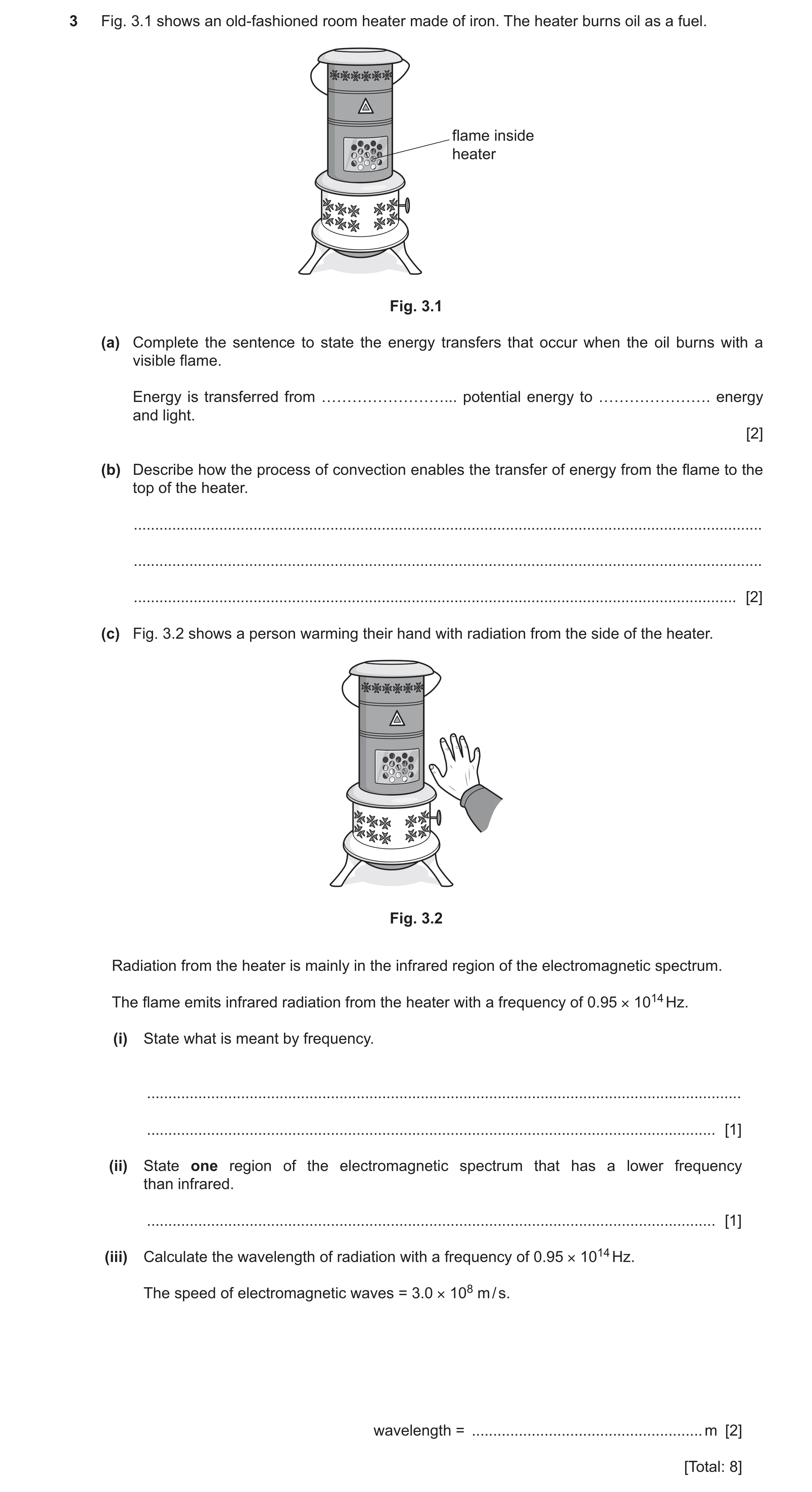
3 Fig. 3.1 shows an old-fashioned room heater made of iron. The heater burns oil as a fuel. flame inside heater Fig. 3.1 (a) Complete the sentence to state the energy transfers that occur when the oil burns with a visible flame. Energy is transferred from ……………………... potential energy to …………………. energy and light. [2] (b) Describe how the process of convection enables the transfer of energy from the flame to the top of the heater. … … … [2] (c) Fig. 3.2 shows a person warming their hand with radiation from the side of the heater. Fig. 3.2 Radiation from the heater is mainly in the infrared region of the electromagnetic spectrum. The flame emits infrared radiation from the heater with a frequency of 0.95 × 10¹⁴ Hz. (i) State what is meant by frequency. … … [1] (ii) State one region of the electromagnetic spectrum that has a lower frequency than infrared. … [1] (iii) Calculate the wavelength of radiation with a frequency of 0.95 × 10¹⁴ Hz. The speed of electromagnetic waves = 3.0 × 10⁸ m / s. wavelength = … m [2] [Total: 8]
8 marks
Mark scheme: 3(a) chemical ; thermal ; 3(b) air (above flame) is heated ; less dense air rises ; 2 3(c)(i) number of wavelengths, per unit time / per second ; 1 3(c)(ii) microwaves / radio waves ; 1 3(c)(iii) ( = ) v ÷ f or 3.0 108 0.95 1014 ; 3.2 (3.16) 10–6 (m) ; 2
This question in 0653/42 May/June 2024
Q35 · A rover vehicle on the planet Mars 0653/42 May/June 2024
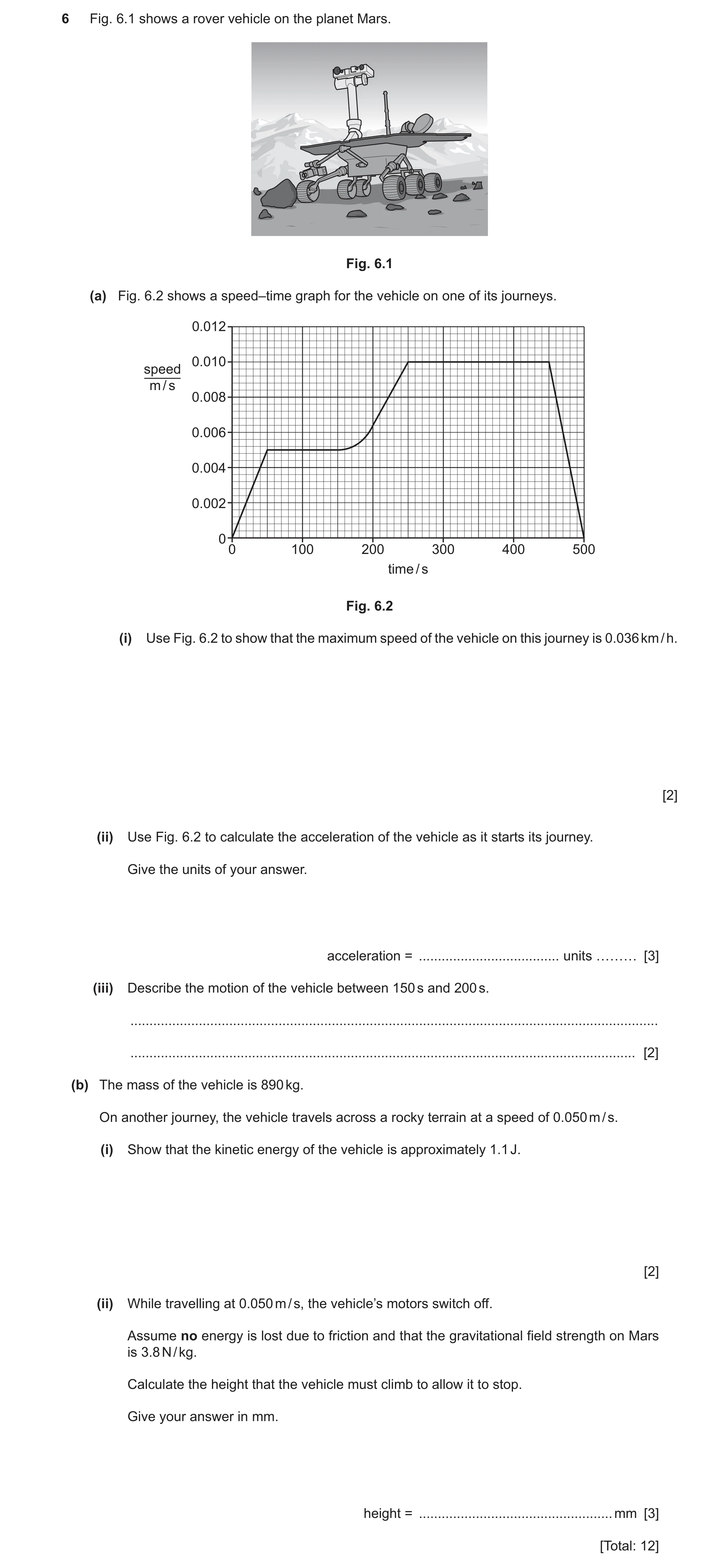
6 Fig. 6.1 shows a rover vehicle on the planet Mars. Fig. 6.1 (a) Fig. 6.2 shows a speed–time graph for the vehicle on one of its journeys. 0.012 0.010 speed m / s 0.008 0.006 0.004 0.002 0 0 100 200 300 400 500 time / s Fig. 6.2 (i) Use Fig. 6.2 to show that the maximum speed of the vehicle on this journey is 0.036 km / h. [2] (ii) Use Fig. 6.2 to calculate the acceleration of the vehicle as it starts its journey. Give the units of your answer. acceleration = … units ……… [3] (iii) Describe the motion of the vehicle between 150 s and 200 s. … … [2] (b) The mass of the vehicle is 890 kg. On another journey, the vehicle travels across a rocky terrain at a speed of 0.050 m / s. (i) Show that the kinetic energy of the vehicle is approximately 1.1 J. [2] (ii) While travelling at 0.050 m / s, the vehicle’s motors switch off. Assume no energy is lost due to friction and that the gravitational field strength on Mars is 3.8 N / kg. Calculate the height that the vehicle must climb to allow it to stop. Give your answer in mm. height = … mm [3] [Total: 12]
12 marks
Mark scheme: 6(a)(i) max. speed = 0.010 m / s OR 3600 OR 1000 ; both conversions seen 3600 (s) and 1000 (m) and correct substitution ; 2 6(a)(ii) (a =) v t or 0.005 50 ; 0.0001(0) / 1 10–4 ; m / s2 ; 3 6(a)(iii) acceleration ; acceleration is not constant ; 2 6(b)(i) KE = ½ mv2 (in any form) or ½ 890 0.05 0.05 ; = 1.1125 ; (≈ 1.1) 2 6(b)(ii) GPE (gained) = 1.1 J ; (GPE =) mgh or 890 3.8 h or h = 1.1 (890 3.8) ; 0.33 mm ; 3
This question in 0653/42 May/June 2024
Q36 · A block of wood has a weight of 24.1 N 0653/41 Oct/Nov 2024
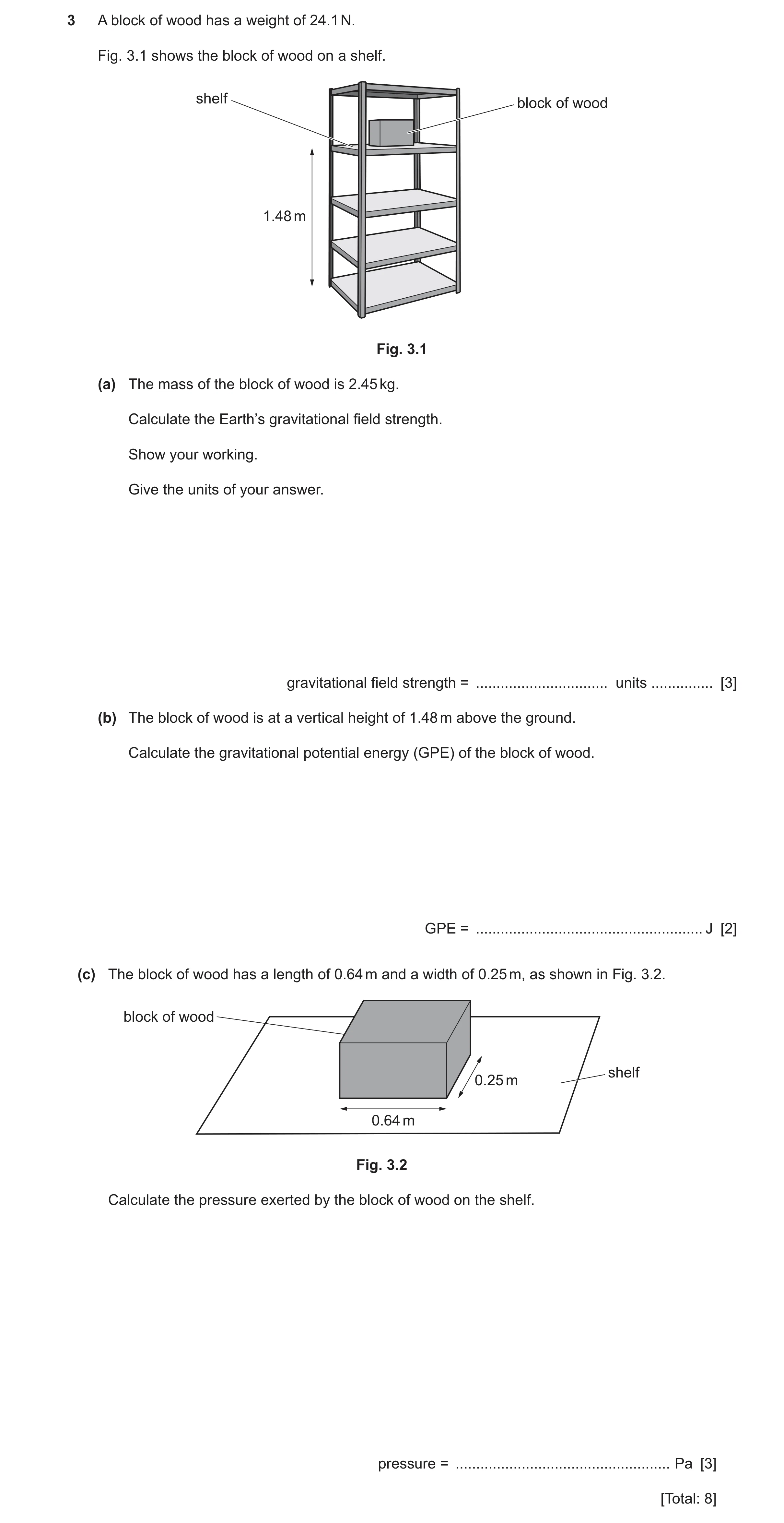
3 A block of wood has a weight of 24.1 N. Fig. 3.1 shows the block of wood on a shelf. shelf block of wood 1.48 m Fig. 3.1 (a) The mass of the block of wood is 2.45 kg. Calculate the Earth’s gravitational field strength. Show your working. Give the units of your answer. gravitational field strength = … units … [3] (b) The block of wood is at a vertical height of 1.48 m above the ground. Calculate the gravitational potential energy (GPE) of the block of wood. GPE = … J [2] (c) The block of wood has a length of 0.64 m and a width of 0.25 m, as shown in Fig. 3.2. block of wood shelf 0.25 m 0.64 m Fig. 3.2 Calculate the pressure exerted by the block of wood on the shelf. pressure = … Pa [3] [Total: 8]
8 marks
Mark scheme: 3(a) evidence of, W = mg ; 3 24.1 ÷ 2.45 = 9.84 ; N / kg ; 3(b) evidence of, GPE = mgh / W d / 24.1 1.48 ; 2 35.7 / 36 (J) ; 3(c) (calculation of area A =) 0.64 0.25 / 0.16 (m2) ; 3 evidence of, p = F ÷ A / 24.1 ÷ 0.16 ; 150 / 151 (Pa) ;
This question in 0653/41 Oct/Nov 2024
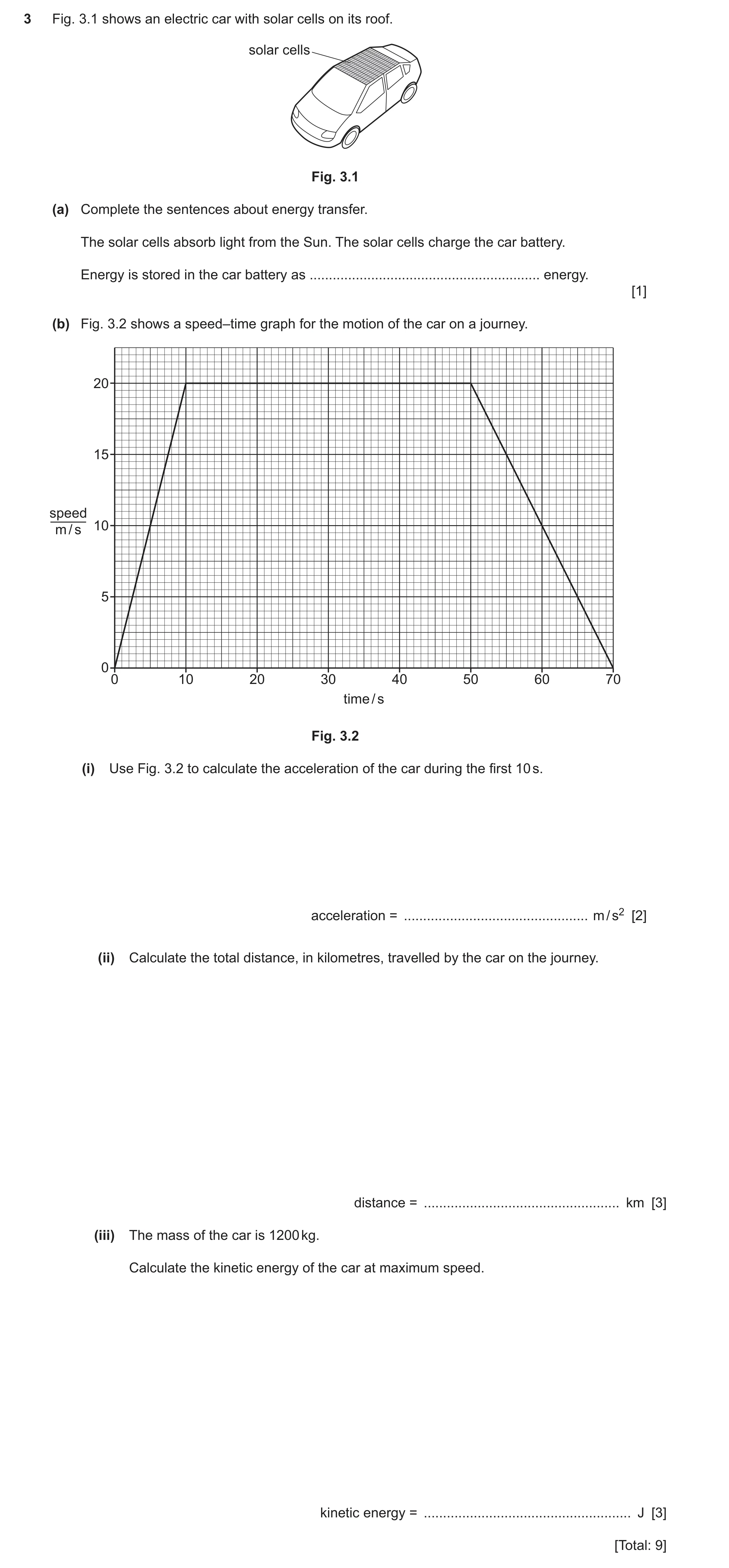
Q37 · An electric car with solar cells on its roof 0653/42 Oct/Nov 2024
3 Fig. 3.1 shows an electric car with solar cells on its roof. solar cells Fig. 3.1 (a) Complete the sentences about energy transfer. The solar cells absorb light from the Sun. The solar cells charge the car battery. Energy is stored in the car battery as … energy. [1] (b) Fig. 3.2 shows a speed–time graph for the motion of the car on a journey. 20 15 speed 10 m / s 5 0 0 10 20 30 40 50 60 70 time / s Fig. 3.2 (i) Use Fig. 3.2 to calculate the acceleration of the car during the first 10 s. acceleration = … m / s2 [2] (ii) Calculate the total distance, in kilometres, travelled by the car on the journey. distance = … km [3] (iii) The mass of the car is 1200 kg. Calculate the kinetic energy of the car at maximum speed. kinetic energy = … J [3] [Total: 9]
9 marks
Mark scheme: 3(a) chemical (potential) ; 1 3(b)(i) acceleration = gradient of graph / 20 ÷ 10 / change in speed ÷ time ; 2 2 (m / s2) ; 3(b)(ii) (any relevant area) 100 / 800 / 200 ; 3 (all three relevant areas) 100 + 800 + 200 / 1100 ; (unit conversion) 1.1 km ; 3(b)(iii) recognition that maximum speed is 20 m / s ; 3 evidence of, KE = ½ m v2 / ½ 1200 202 ; 240 000 (J) ;
This question in 0653/42 Oct/Nov 2024
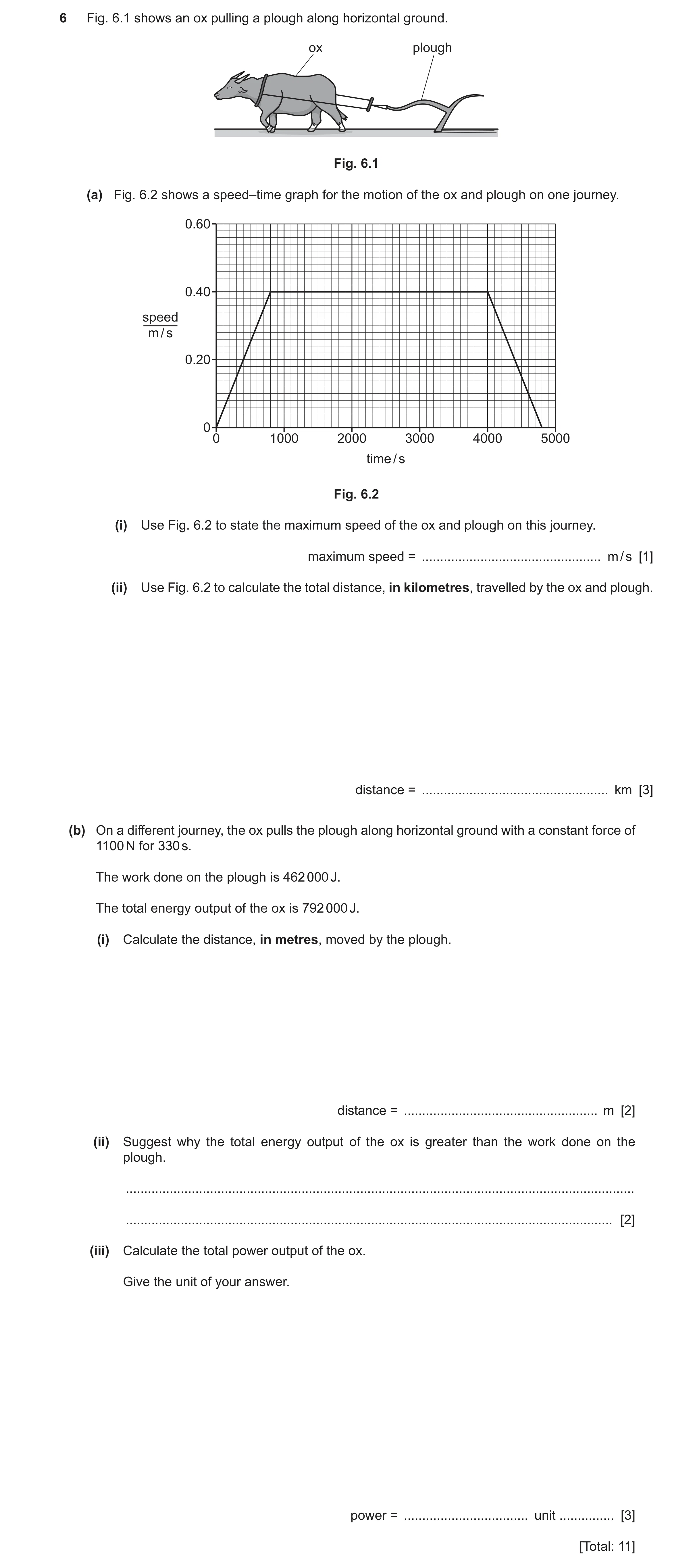
Q38 · An ox pulling a plough along horizontal ground 0653/43 Oct/Nov 2024
6 Fig. 6.1 shows an ox pulling a plough along horizontal ground. ox plough Fig. 6.1 (a) Fig. 6.2 shows a speed–time graph for the motion of the ox and plough on one journey. 0.60 0.40 speed m / s 0.20 0 0 1000 2000 3000 4000 5000 time / s Fig. 6.2 (i) Use Fig. 6.2 to state the maximum speed of the ox and plough on this journey. maximum speed = … m / s [1] (ii) Use Fig. 6.2 to calculate the total distance, in kilometres, travelled by the ox and plough. distance = … km [3] (b) On a different journey, the ox pulls the plough along horizontal ground with a constant force of 1100 N for 330 s. The work done on the plough is 462 000 J. The total energy output of the ox is 792 000 J. (i) Calculate the distance, in metres, moved by the plough. distance = … m [2] (ii) Suggest why the total energy output of the ox is greater than the work done on the plough. … … [2] (iii) Calculate the total power output of the ox. Give the unit of your answer. power = … unit … [3] [Total: 11]
11 marks
Mark scheme: 6(a)(i) 0.40 (m / s) ; 1 6(a)(ii) (calculation of any relevant area) 160 / 1280; 3 (all three relevant areas) 160 + 1280 + 160 / 1600 (m) ; 1.6 (km) ; 6(b)(i) evidence of, W = Fd / 462 000 ÷ 1100 ; 2 420 (m) ; 6(b)(ii) idea that some energy is also transferred to the surroundings ; 2 as, thermal / sound / AVP ; 6(b)(iii) evidence of, P = W ÷ t / 792 000 ÷ 330 ; 3 2400 ; W / watt(s) ;
This question in 0653/43 Oct/Nov 2024
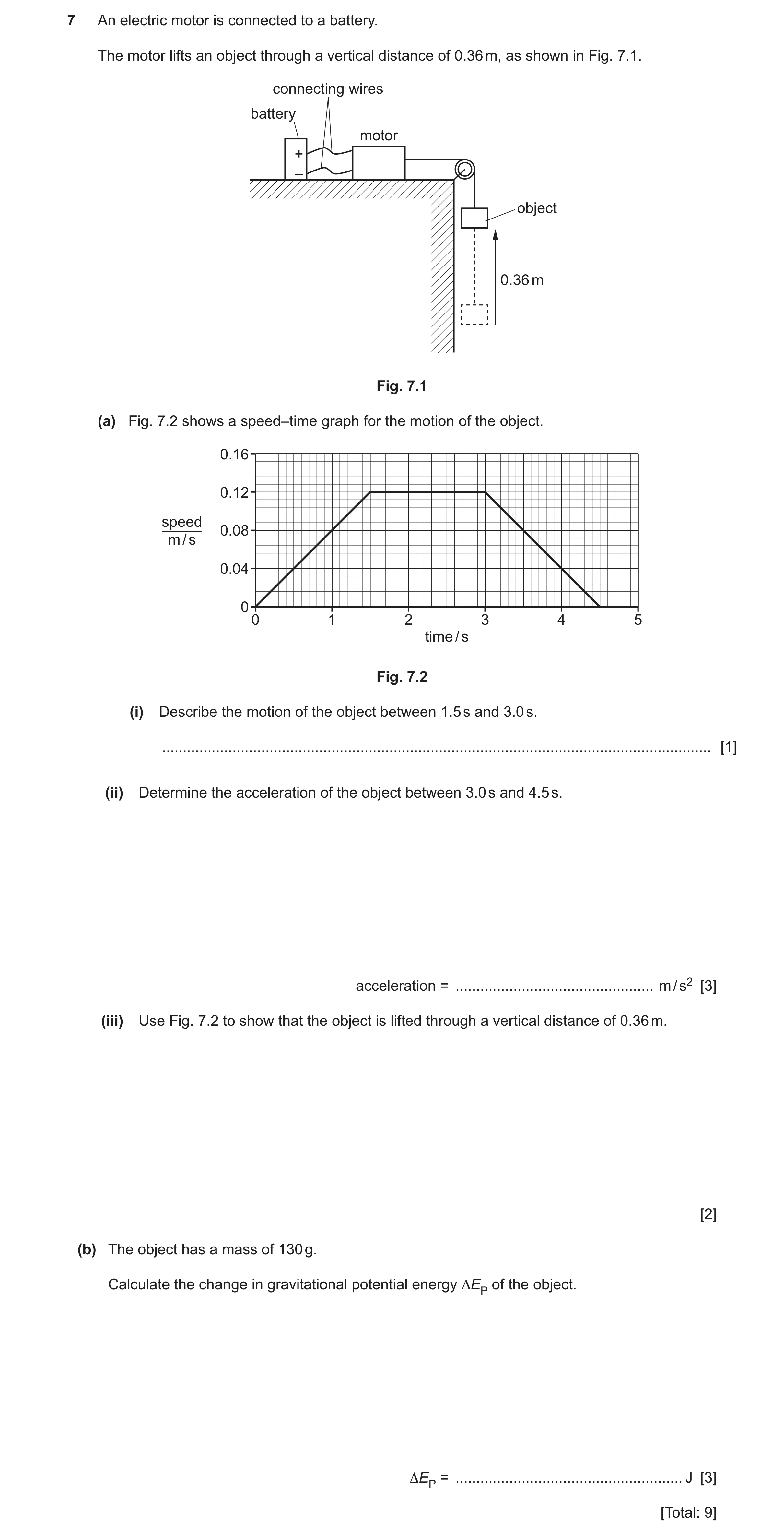
Q39 · An electric motor is connected to a battery 0653/42 Feb/March 2025
7 An electric motor is connected to a battery. The motor lifts an object through a vertical distance of 0.36 m, as shown in Fig. 7.1. connecting wires battery motor + – object 0.36 m Fig. 7.1 (a) Fig. 7.2 shows a speed–time graph for the motion of the object. 0.16 0.12 speed 0.08 m / s 0.04 0 0 1 2 3 4 5 time / s Fig. 7.2 (i) Describe the motion of the object between 1.5 s and 3.0 s. … [1] (ii) Determine the acceleration of the object between 3.0 s and 4.5 s. acceleration = … m / s2 [3] (iii) Use Fig. 7.2 to show that the object is lifted through a vertical distance of 0.36 m. [2] (b) The object has a mass of 130 g. Calculate the change in gravitational potential energy ΔEP of the object. ΔEP = … J [3] [Total: 9]
9 marks
Mark scheme: 7(a)(i) (moving with) constant speed ; 1 7(a)(ii) a = v ÷ t / 0.12 ÷ 1.5 ; 3 0.080 (m / s2) ; negative sign ; 7(a)(iii) use of area under the graph ; 2 correct calculation shown, (½ 0.12 1.5) + (0.12 1.5) + (½ 0.12 1.5) (= 0.36) / or equivalent ; 7(b) unit conversion of g to kg / 0.13 seen ; 3 ΔEP = mgh / 0.13 9.8 0.36 ; = 0.46 (J) ;
This question in 0653/42 Feb/March 2025
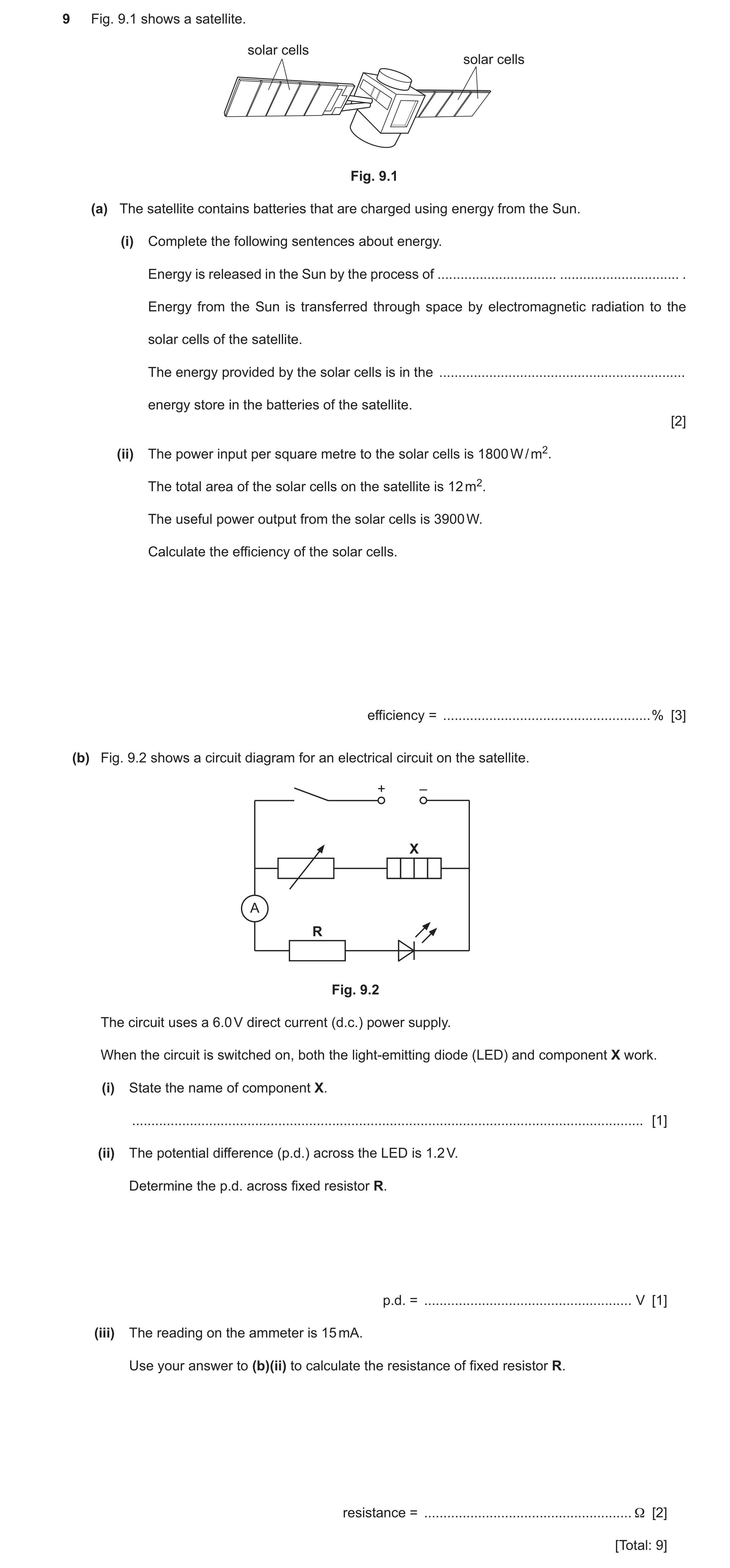
Question 40 0653/42 Feb/March 2025
9 Fig. 9.1 shows a satellite. solar cells solar cells Fig. 9.1 (a) The satellite contains batteries that are charged using energy from the Sun. (i) Complete the following sentences about energy. Energy is released in the Sun by the process of … … . Energy from the Sun is transferred through space by electromagnetic radiation to the solar cells of the satellite. The energy provided by the solar cells is in the … energy store in the batteries of the satellite. [2] (ii) The power input per square metre to the solar cells is 1800 W / m2. The total area of the solar cells on the satellite is 12 m2. The useful power output from the solar cells is 3900 W. Calculate the efficiency of the solar cells. efficiency = … % [3] (b) Fig. 9.2 shows a circuit diagram for an electrical circuit on the satellite. + – X A R Fig. 9.2 The circuit uses a 6.0 V direct current (d.c.) power supply. When the circuit is switched on, both the light-emitting diode (LED) and component X work. (i) State the name of component X. … [1] (ii) The potential difference (p.d.) across the LED is 1.2 V. Determine the p.d. across fixed resistor R. p.d. = … V [1] (iii) The reading on the ammeter is 15 mA. Use your answer to (b)(ii) to calculate the resistance of fixed resistor R. resistance = … Ω [2] [Total: 9]
9 marks
Mark scheme: 9(a)(i) nuclear fusion ; 2 chemical ; 9(a)(ii) total power received by solar cells = 1800 12 / 21 600 W ; 3 efficiency = useful power output ÷ total power input 100 / 3900 ÷ 21 600 100 ; 18 (%) ; 9(b)(i) heater ; 1 9(b)(ii) 4.8 (V) ; 1 9(b)(iii) evidence for use of R = V ÷ I / 4.8 ÷ 0.015 ; 2 320 () ;
This question in 0653/42 Feb/March 2025
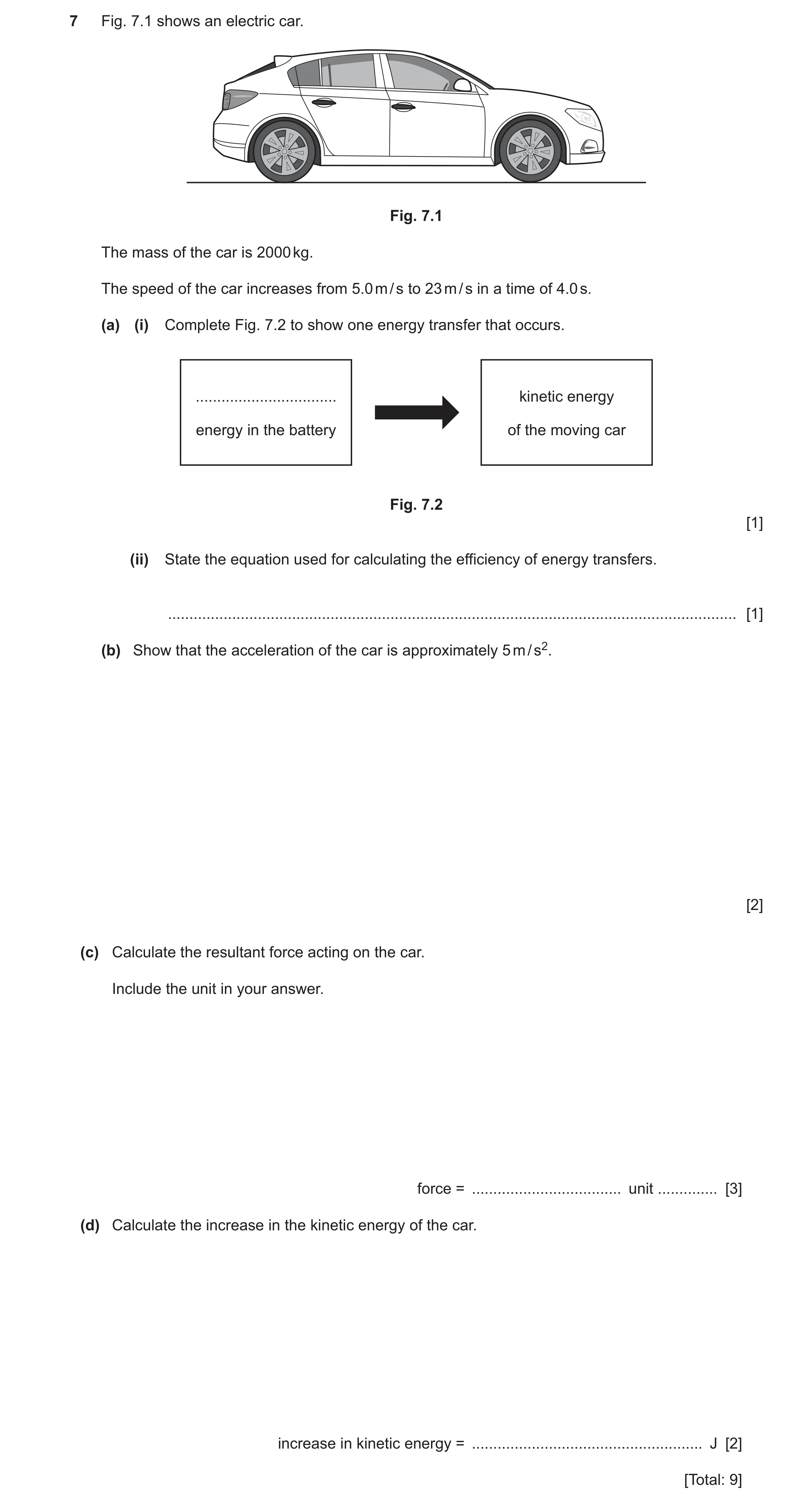
Question 41 0653/41 May/June 2025
7 Fig. 7.1 shows an electric car. Fig. 7.1 The mass of the car is 2000 kg. The speed of the car increases from 5.0 m / s to 23 m / s in a time of 4.0 s. (a) (i) Complete Fig. 7.2 to show one energy transfer that occurs. … kinetic energy energy in the battery of the moving car Fig. 7.2 [1] (ii) State the equation used for calculating the efficiency of energy transfers. … [1] (b) Show that the acceleration of the car is approximately 5 m / s2. [2] (c) Calculate the resultant force acting on the car. Include the unit in your answer. force = … unit … [3] (d) Calculate the increase in the kinetic energy of the car. increase in kinetic energy = … J [2] [Total: 9]
9 marks
Mark scheme: 7(a)(i) chemical ; 1 7(a)(ii) useful (energy) output 1 efficiency =) ( 100%) total (energy) input ; 7(b) a = v ÷ t / 18 ÷ 4.0 ; 2 4.5 (= ~5 m / s2)_; 7(c) F = ma / 2000 4.5 ; 3 9000 ; N ; 7(d) EK = ½ mv2 / ½ 2000 (232 – 5.02) / 529 000 or 25 000 (evidence of use of formula) ; 2 504 000 (J) ;
This question in 0653/41 May/June 2025
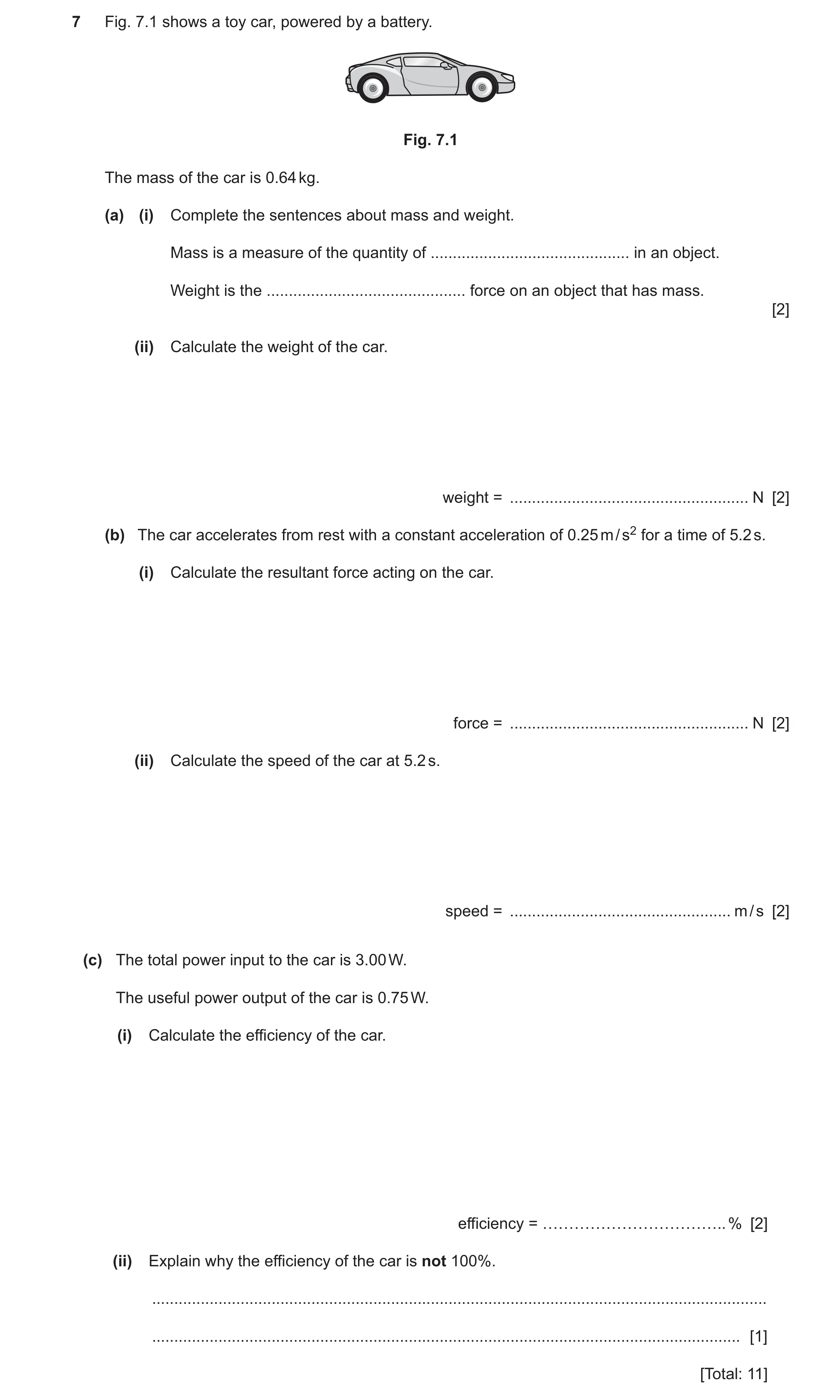
Q42 · A toy car, powered by a battery 0653/43 May/June 2025
7 Fig. 7.1 shows a toy car, powered by a battery. Fig. 7.1 The mass of the car is 0.64 kg. (a) (i) Complete the sentences about mass and weight. Mass is a measure of the quantity of … in an object. Weight is the … force on an object that has mass. [2] (ii) Calculate the weight of the car. weight = … N [2] (b) The car accelerates from rest with a constant acceleration of 0.25 m / s2 for a time of 5.2 s. (i) Calculate the resultant force acting on the car. force = … N [2] (ii) Calculate the speed of the car at 5.2 s. speed = … m / s [2] (c) The total power input to the car is 3.00 W. The useful power output of the car is 0.75 W. (i) Calculate the efficiency of the car. efficiency = …………………………….. % [2] (ii) Explain why the efficiency of the car is not 100%. … … [1] [Total: 11]
11 marks
Mark scheme: 7(a)(i) matter; 2 gravitational ; 7(a)(ii) W = mg / 0.64 × 9.8 ; 2 6.3 (N) ; 7(b)(i) F = ma / 0.64 × 0.25 ; 2 0.16 (N) ; 7(b)(ii) (v =) a × t or 0.25 × 5.2 ; 2 1.3 (m / s) ; 7(c)(i) 2 power output 0.75 efficiency = 100 OR ×100 ; power input 3.00 25 (%) ; 7(c)(ii) energy transfer, to surroundings / internal energy of car / thermal energy of tyres, etc. 1 or (by) work done against, friction / air resistance ;
This question in 0653/43 May/June 2025
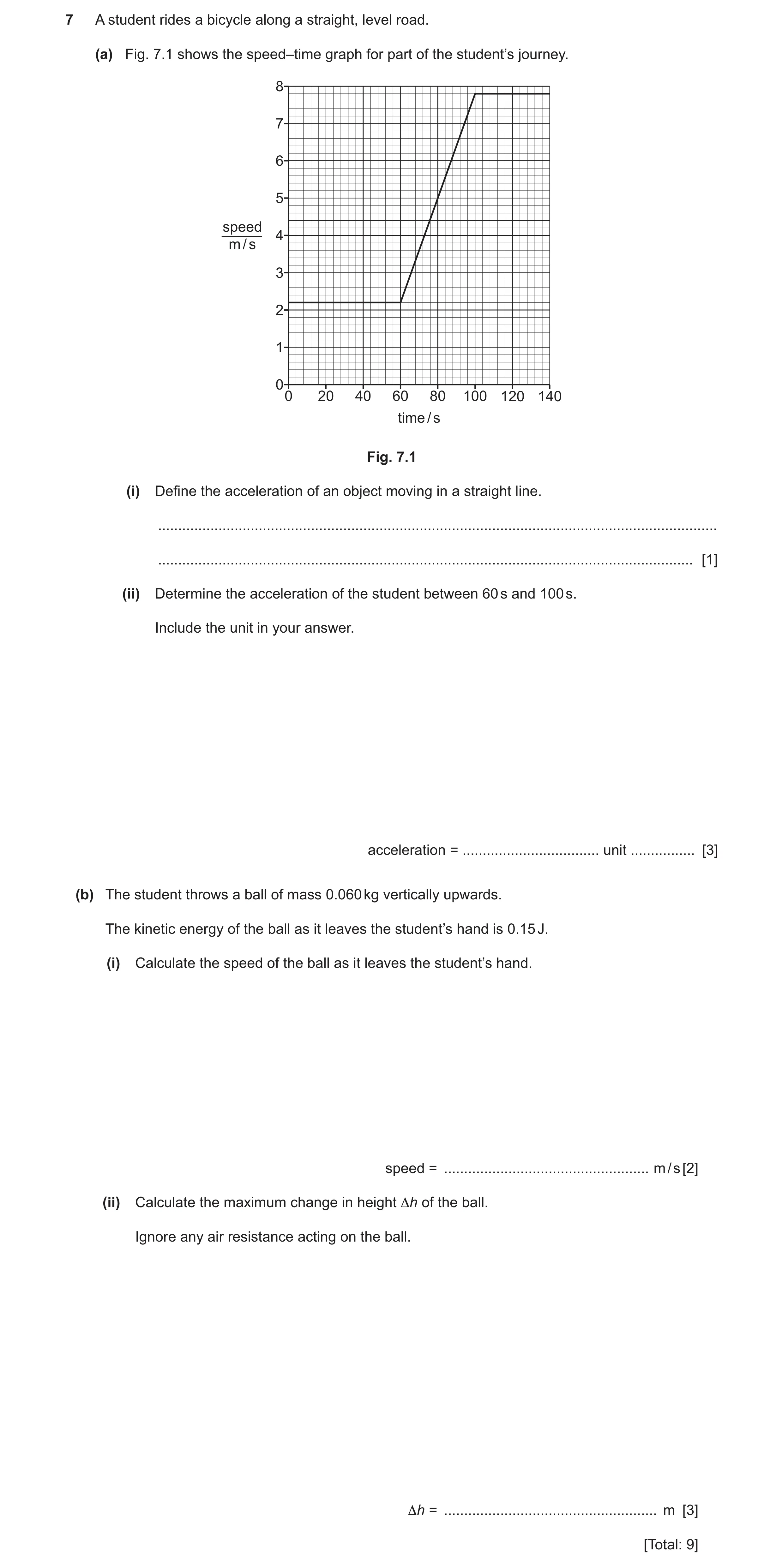
Q43 · A student rides a bicycle along a straight, level road 0653/41 Oct/Nov 2025
7 A student rides a bicycle along a straight, level road. (a) Fig. 7.1 shows the speed–time graph for part of the student’s journey. 8 7 6 5 speed 4 m / s 3 2 1 0 0 20 40 60 80 100 120 140 time / s Fig. 7.1 (i) Define the acceleration of an object moving in a straight line. … … [1] (ii) Determine the acceleration of the student between 60 s and 100 s. Include the unit in your answer. acceleration = … unit … [3] (b) The student throws a ball of mass 0.060 kg vertically upwards. The kinetic energy of the ball as it leaves the student’s hand is 0.15 J. (i) Calculate the speed of the ball as it leaves the student’s hand. speed = … m / s [2] (ii) Calculate the maximum change in height Δh of the ball. Ignore any air resistance acting on the ball. Δh = … m [3] [Total: 9]
9 marks
Mark scheme: 7(a)(i) change in speed per unit time; 1 7(a)(ii) v 3 (acceleration =) ;t 7.8 − 2.2 OR (a =) ; 40 5.6 OR (a =) ; 40 0.14 ; m / s2 ; 7(b)(i) (KE =) ½ m v2 2 OR 0.15 = ½ 0.060 x v2 2 0.15 OR v = ; 0.060 2.2 (m / s) ; 7(b)(ii) M1 KE = GPE 3 OR GPE = 0.15 (J) ; M2 (GPE =) mgh But if M1 and M2 combined is seen give two marks 0.15 = 0.060 9.8 h OR 0.15 h = ;; 0.060 9.8 0.26 (m) ;
This question in 0653/41 Oct/Nov 2025
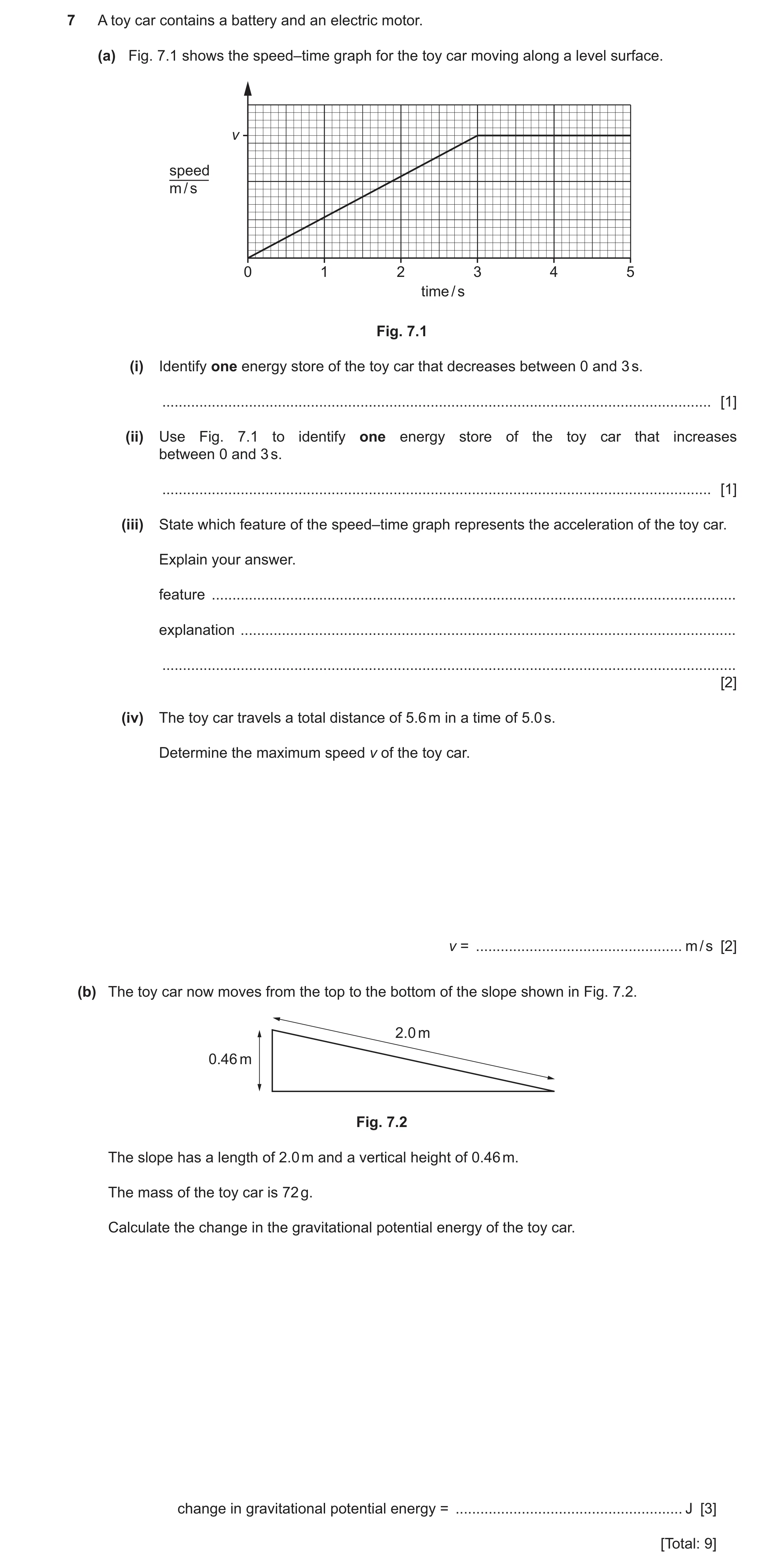
Q44 · A toy car contains a battery and an electric motor 0653/42 Oct/Nov 2025
7 A toy car contains a battery and an electric motor. (a) Fig. 7.1 shows the speed–time graph for the toy car moving along a level surface. v speed m / s 0 1 2 3 4 5 time / s Fig. 7.1 (i) Identify one energy store of the toy car that decreases between 0 and 3 s. … [1] (ii) Use Fig. 7.1 to identify one energy store of the toy car that increases between 0 and 3 s. … [1] (iii) State which feature of the speed–time graph represents the acceleration of the toy car. Explain your answer. feature … explanation … … [2] (iv) The toy car travels a total distance of 5.6 m in a time of 5.0 s. Determine the maximum speed v of the toy car. v = … m / s [2] (b) The toy car now moves from the top to the bottom of the slope shown in Fig. 7.2. 2.0 m 0.46 m Fig. 7.2 The slope has a length of 2.0 m and a vertical height of 0.46 m. The mass of the toy car is 72 g. Calculate the change in the gravitational potential energy of the toy car. change in gravitational potential energy = … J [3] [Total: 9]
9 marks
Mark scheme: 7(a)(i) chemical ; 1 7(a)(ii) kinetic ; 1 7(a)(iii) (feature) gradient ; 2 (explanation) (gradient is) change in speed per unit time ; 7(a)(iv) evidence of understanding that distance travelled = area under graph e.g. or ½ 3 v (seen) or 5.6 = (½ 3 v) + (2 v) 2 or 5.6 ÷ 3.5 ; 1.6 (m / s) ; 7(b) (unit conversion) 0.072 seen (kg) ; 3 GPE = mgh or 0.072 9.8 0.46 ; 0.32 (J) ;
This question in 0653/42 Oct/Nov 2025
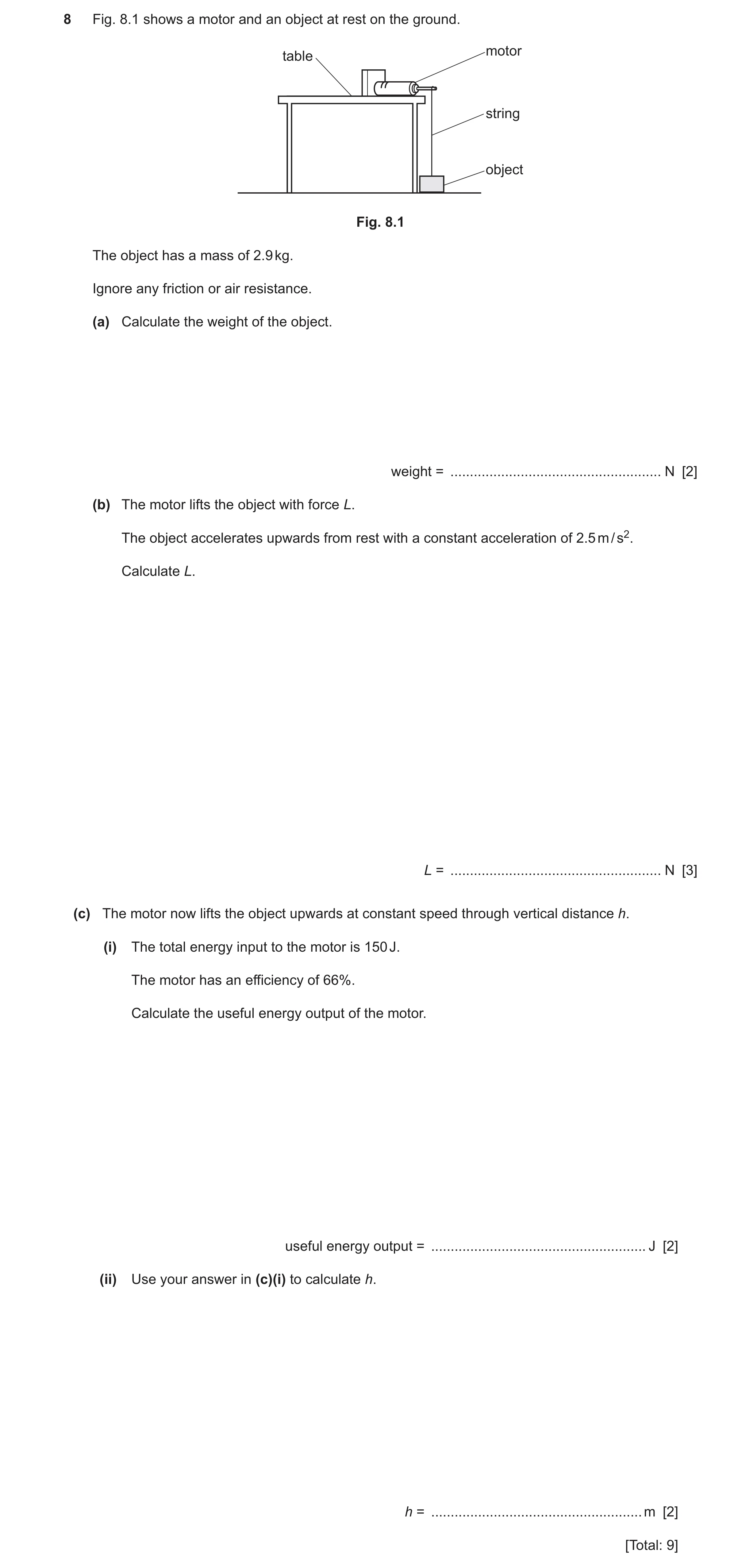
Q45 · A motor and an object at rest on the ground 0653/43 Oct/Nov 2025
8 Fig. 8.1 shows a motor and an object at rest on the ground. motor table string object Fig. 8.1 The object has a mass of 2.9 kg. Ignore any friction or air resistance. (a) Calculate the weight of the object. weight = … N [2] (b) The motor lifts the object with force L. The object accelerates upwards from rest with a constant acceleration of 2.5 m / s2. Calculate L. L = … N [3] (c) The motor now lifts the object upwards at constant speed through vertical distance h. (i) The total energy input to the motor is 150 J. The motor has an efficiency of 66%. Calculate the useful energy output of the motor. useful energy output = … J [2] (ii) Use your answer in (c)(i) to calculate h. h = … m [2] [Total: 9]
9 marks
Mark scheme: 8(a) W = mg / 2.9 9.8 ; 2 28 (N) ; 8(b) F = ma / 2.9 2.5 / 7.25 ; 3 L = F + W / (L = ) 28.42 + 7.25 / (L = ) 35.67 ; 36 (N) ; 8(c)(i) useful energy output = efficiency total energy input / 0.66 150 ; 2 99 (J) ; 8(c)(ii) ΔEp = mgΔh 2 or 99 = 2.9 9.8 h or 99 = 28.42 h 99 or h = ; 2.9 9.8 3.5 (m) ;
This question in 0653/43 Oct/Nov 2025
 8
8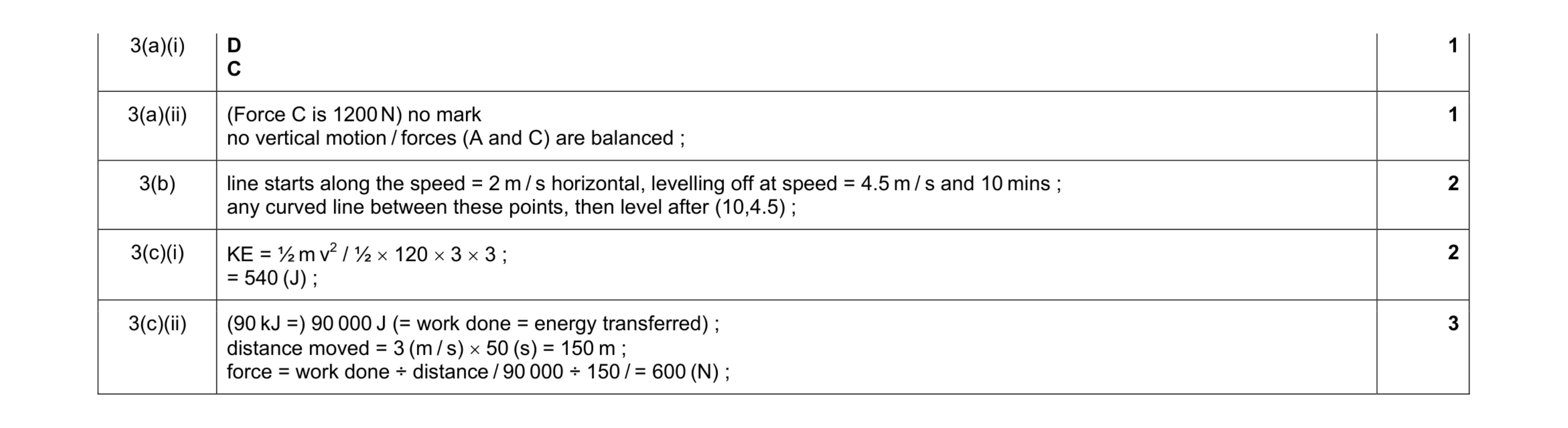 9
9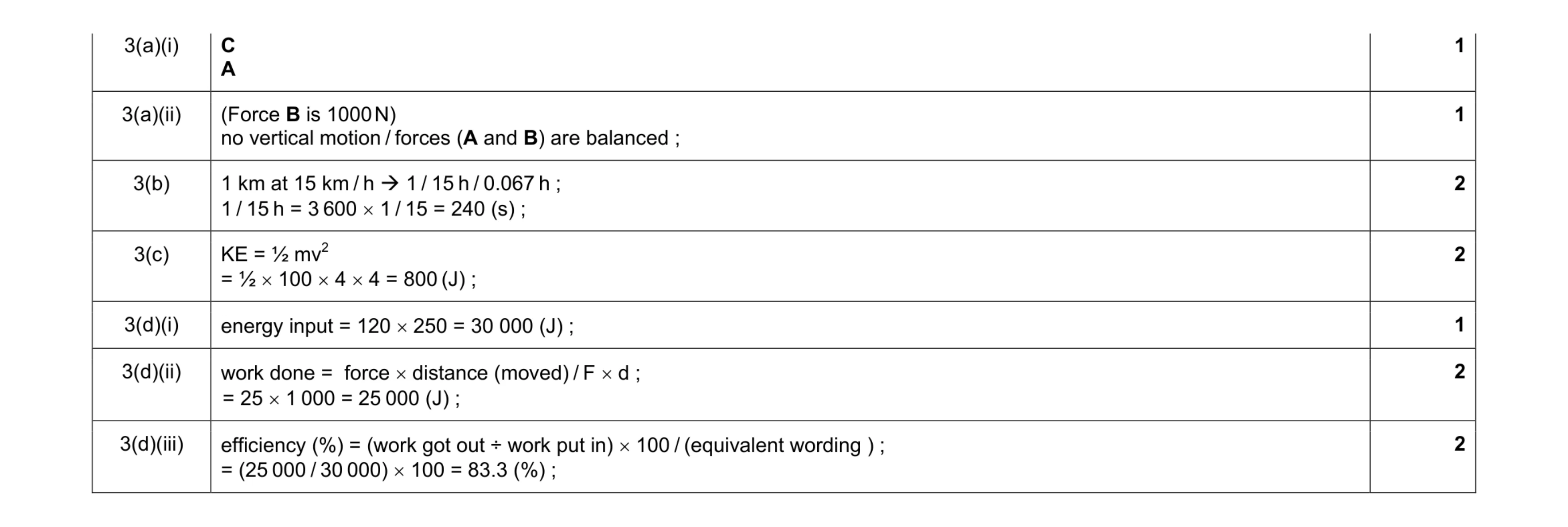 11
11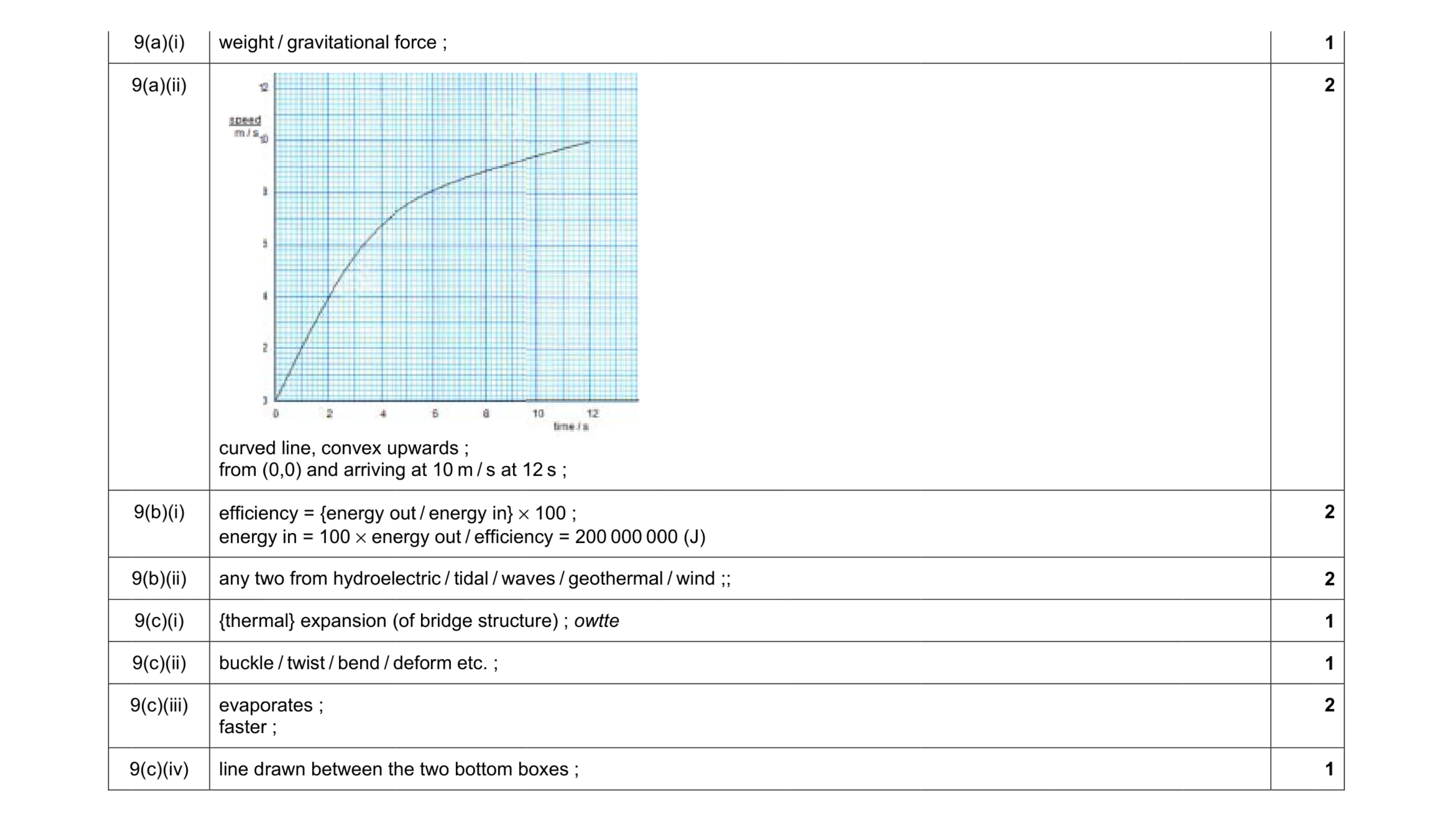 9
9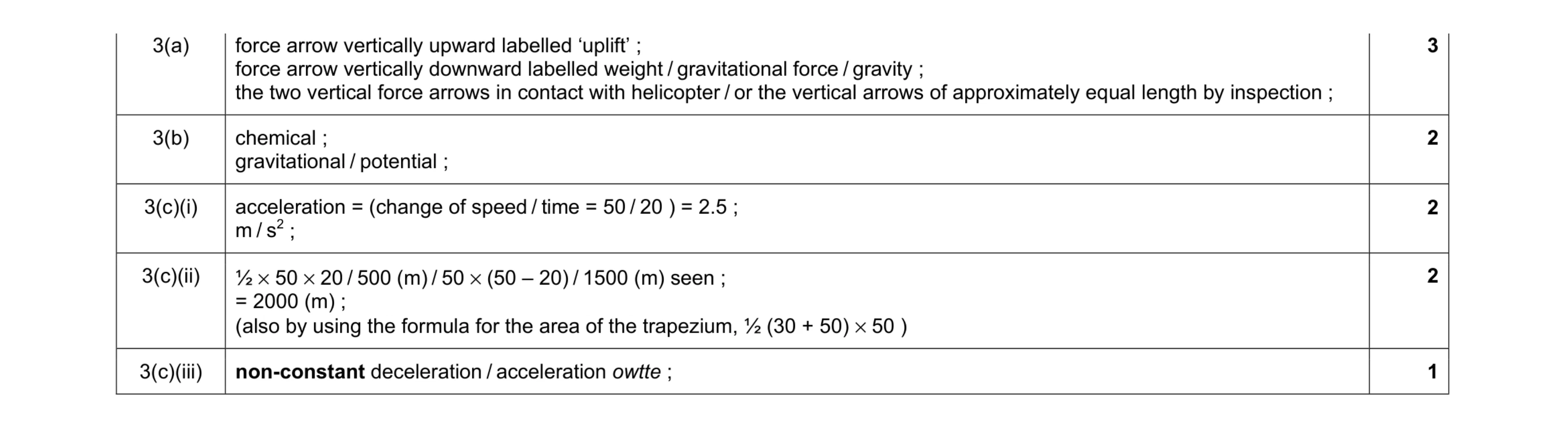 10
10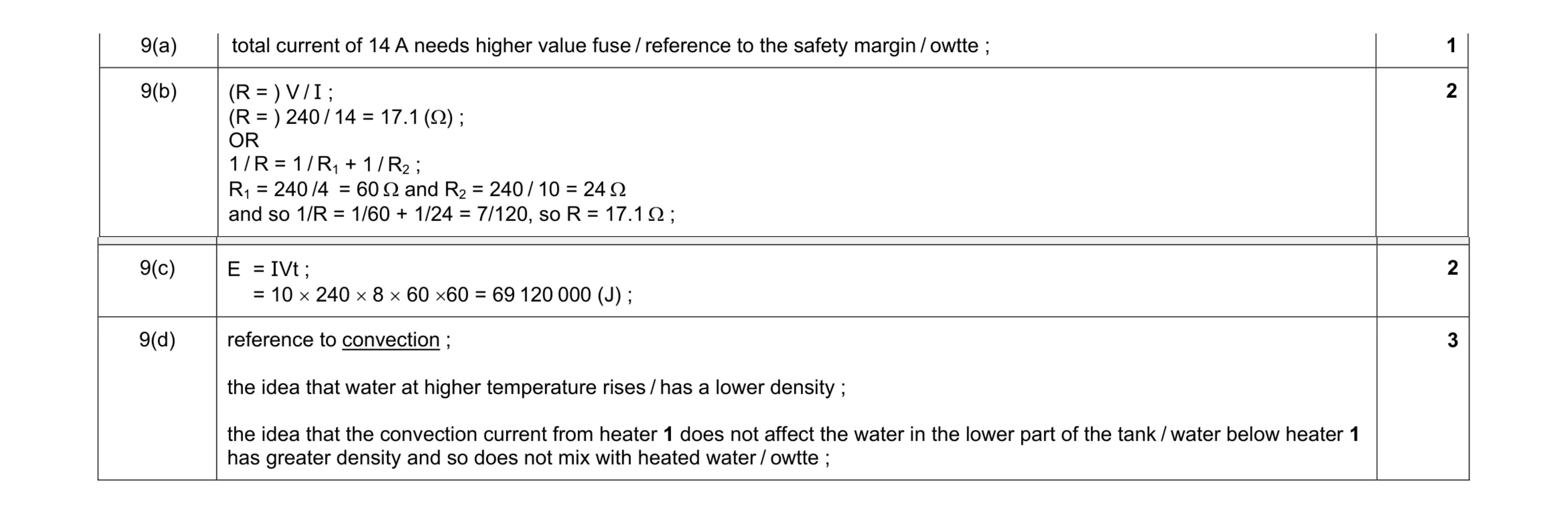 8
8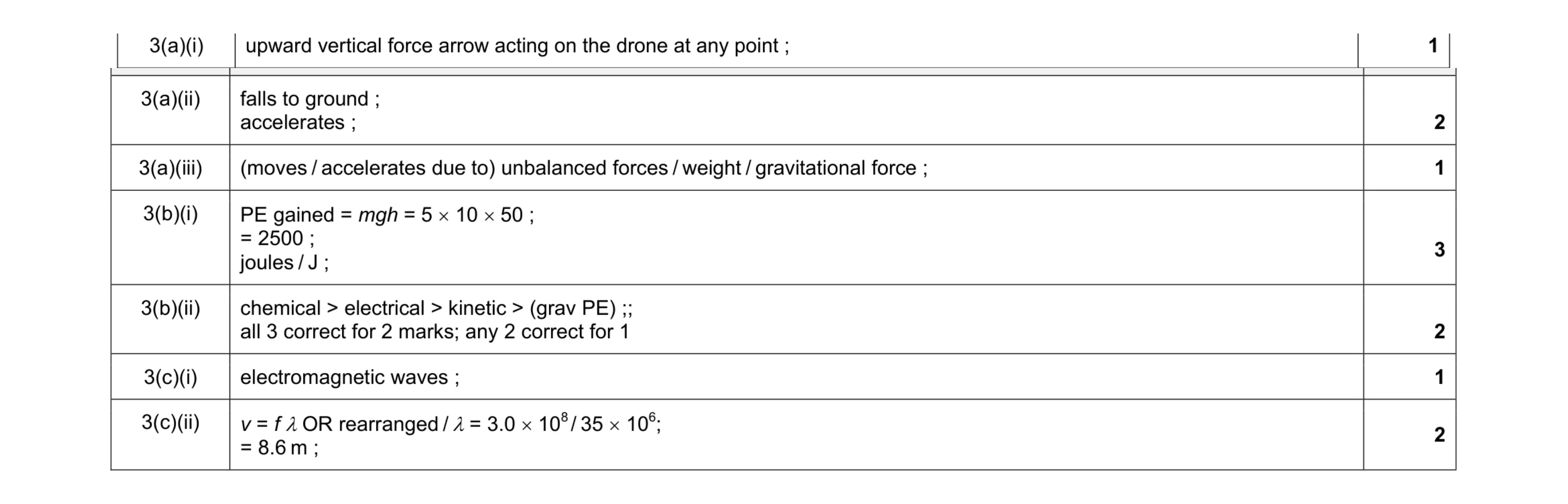 12
12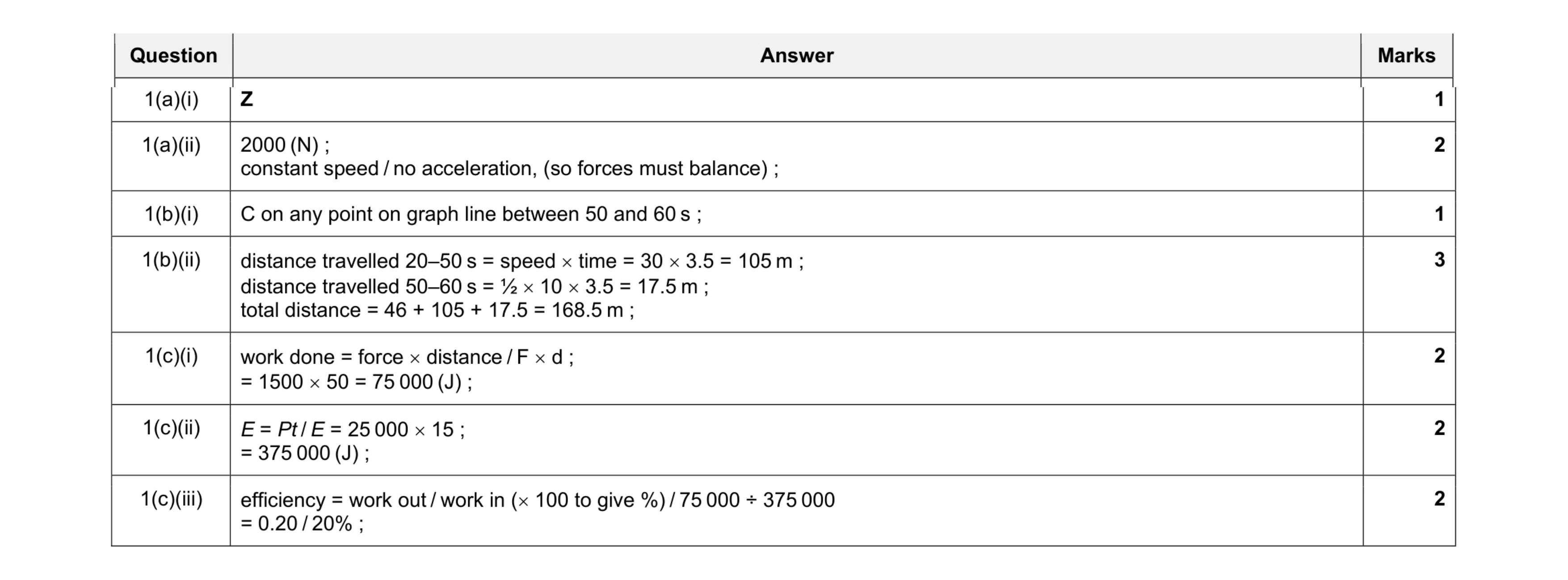 13
13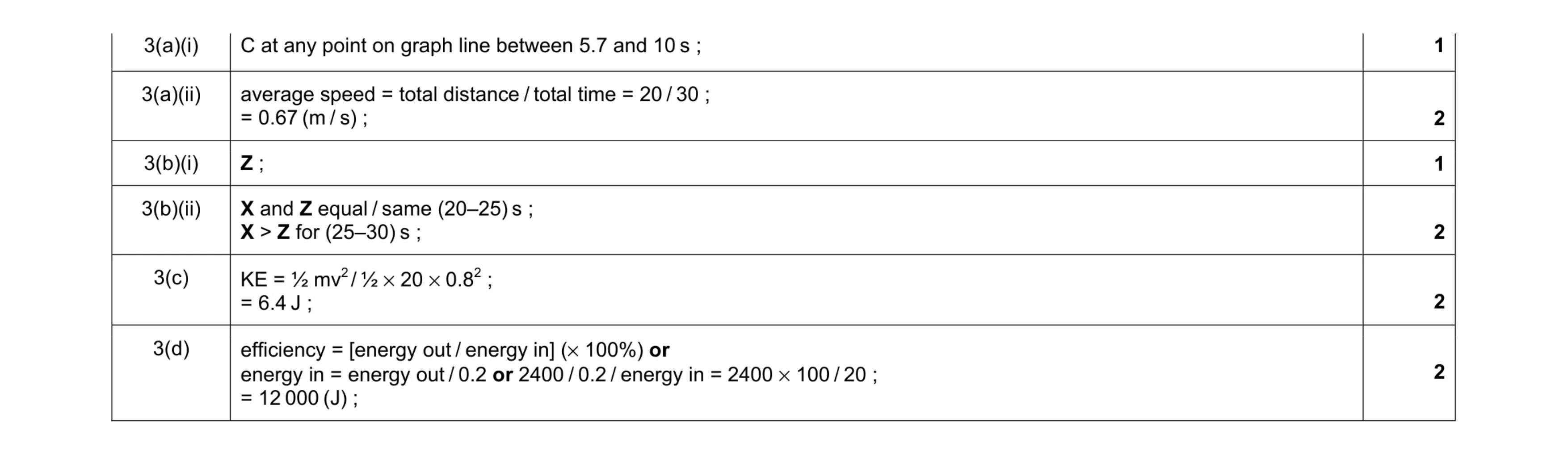 10
10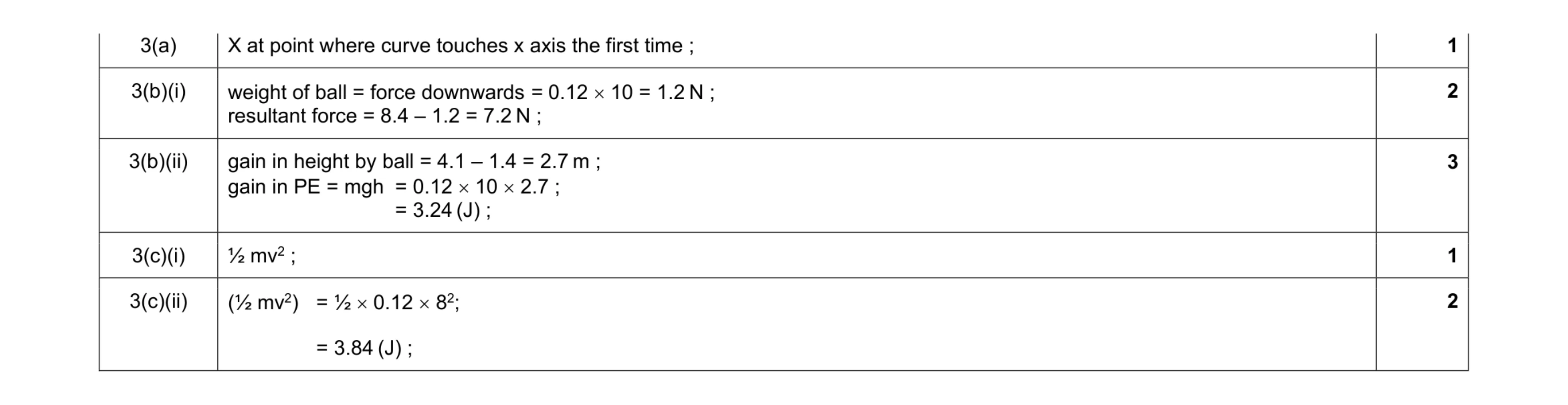 9
9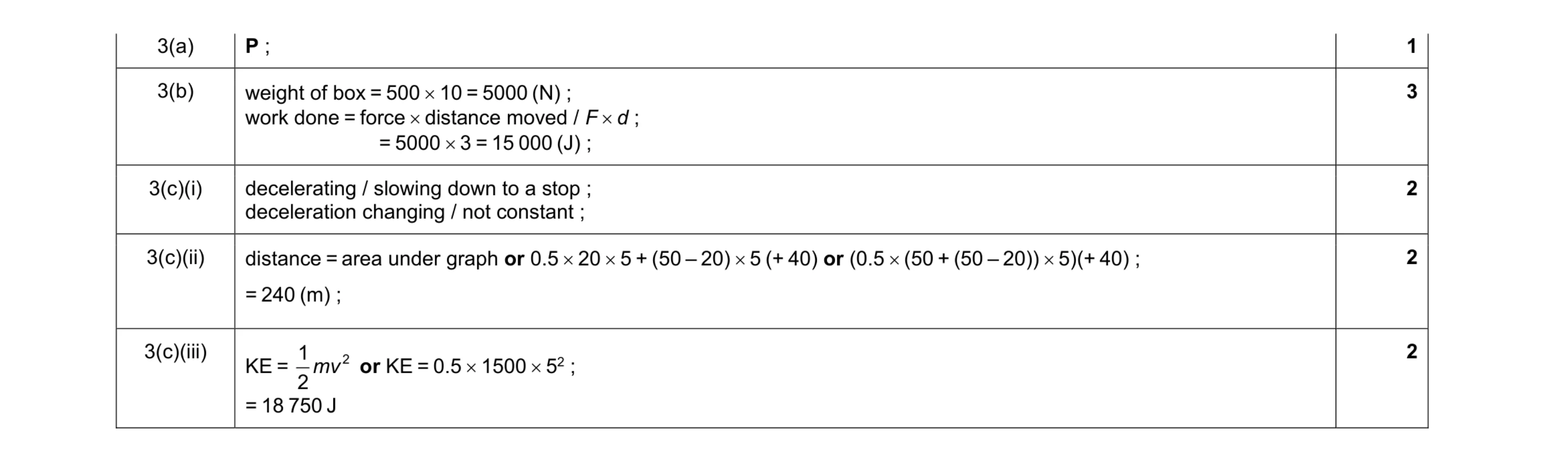 10
10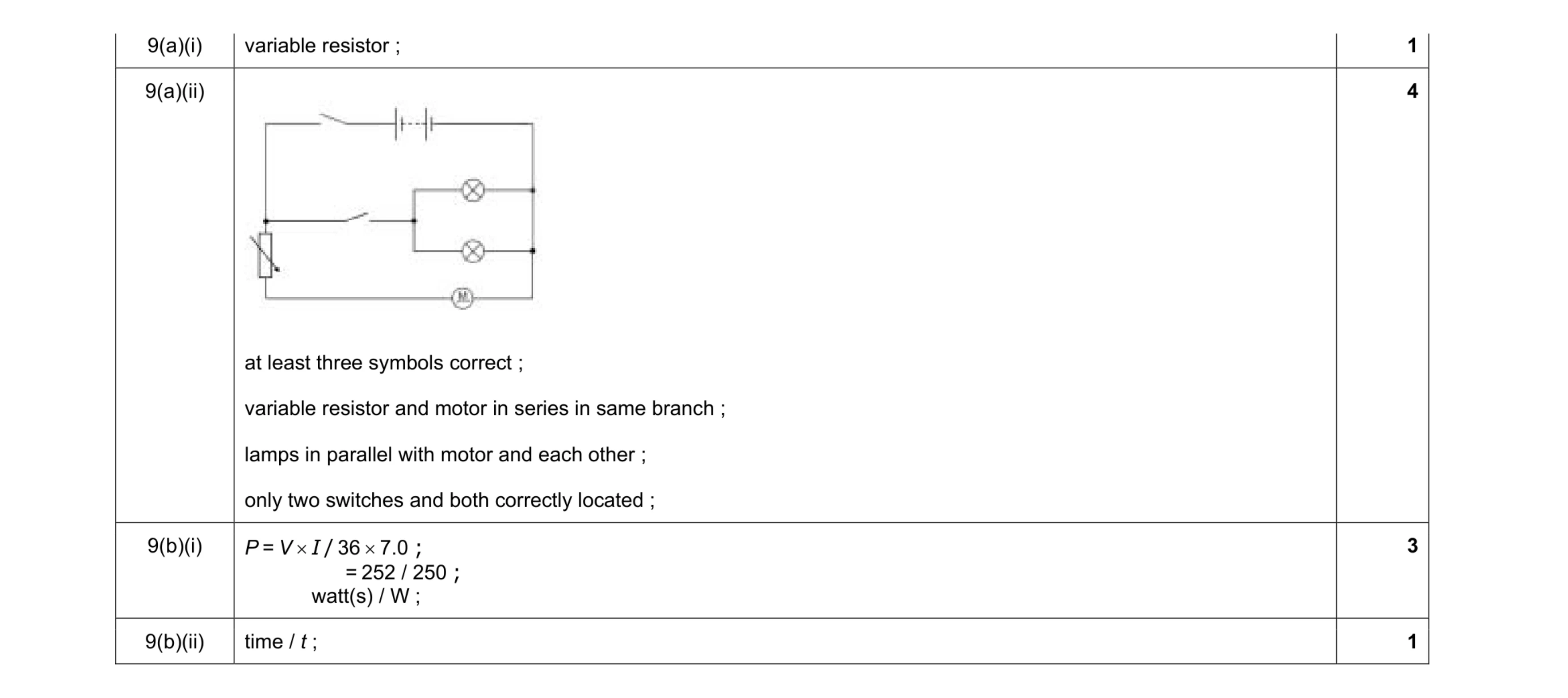 9
9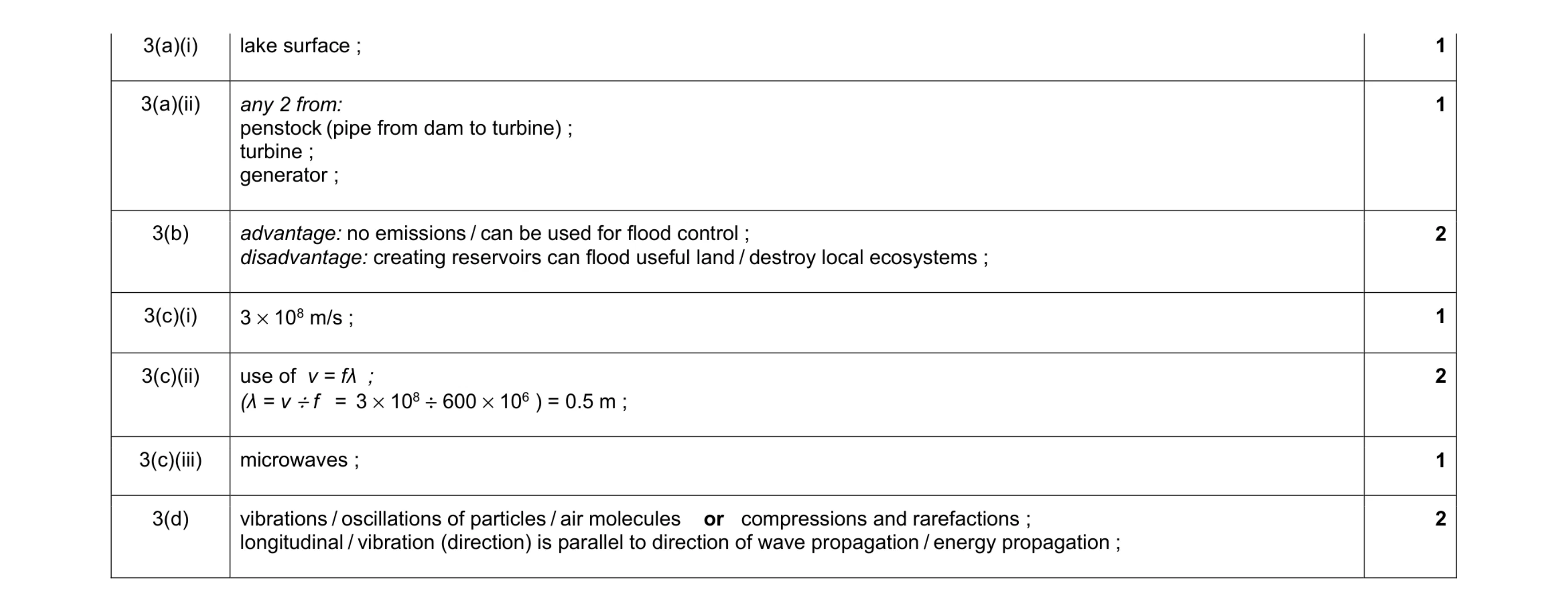 10
10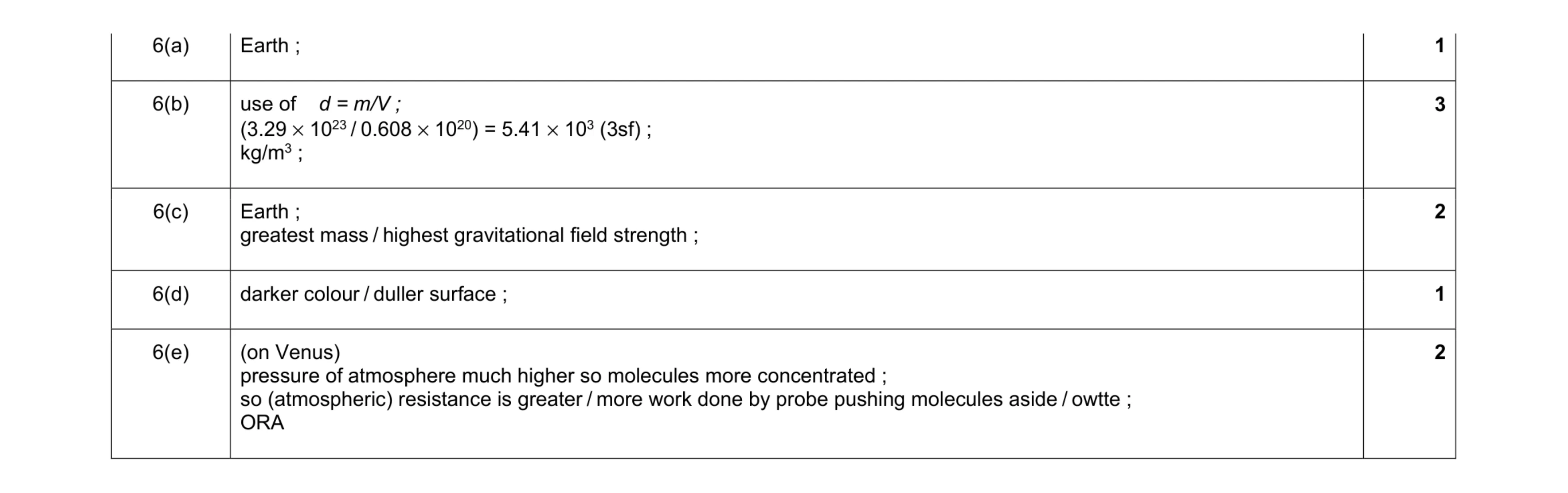 9
9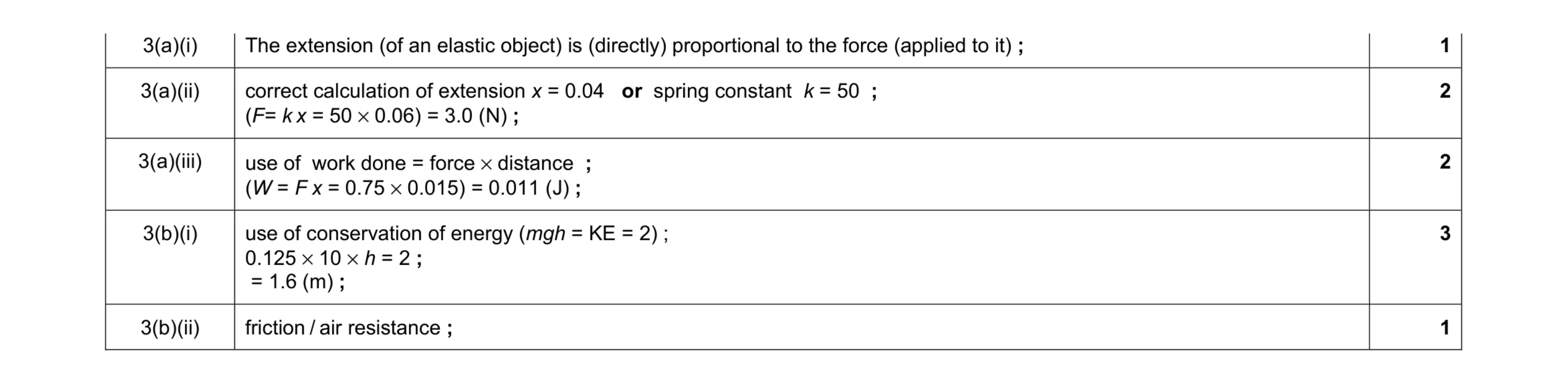 9
9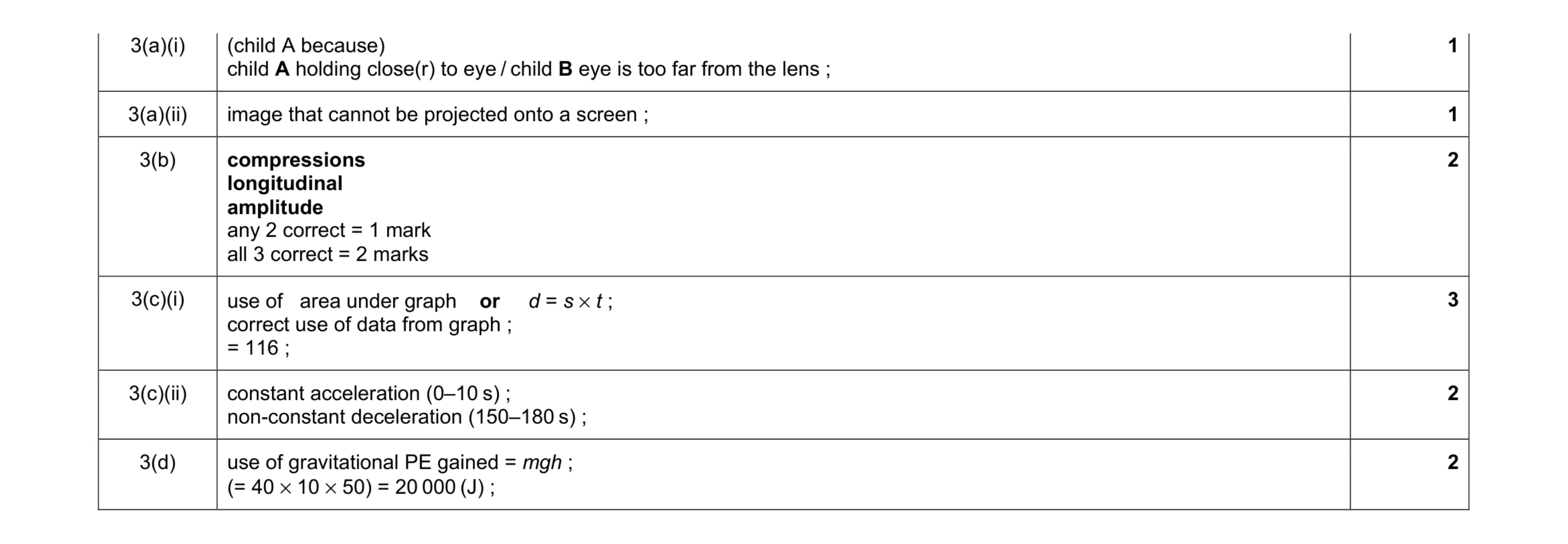 11
11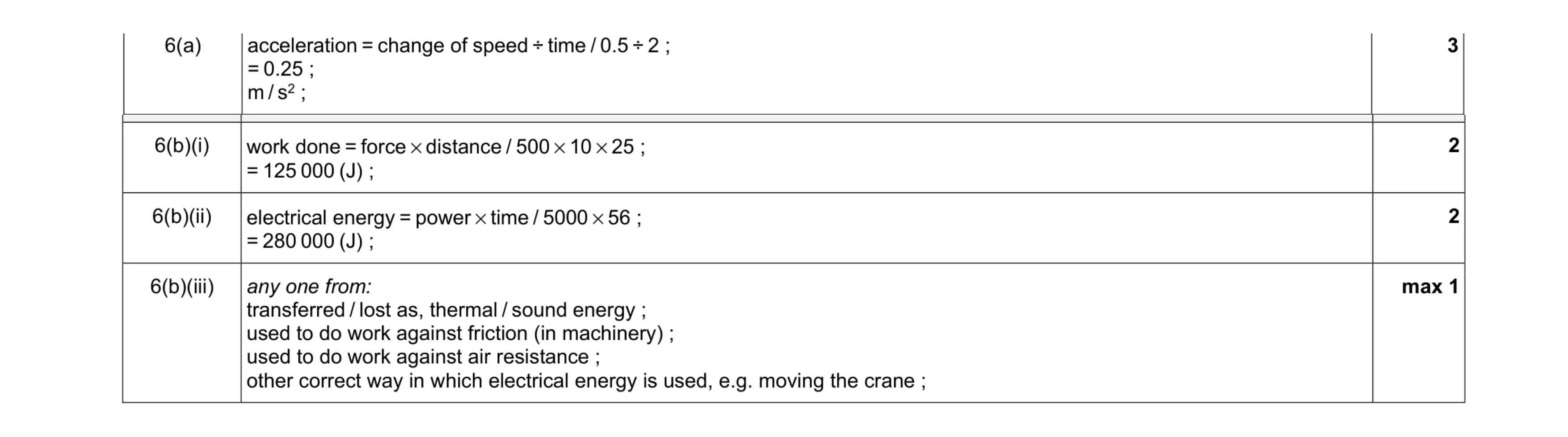 8
8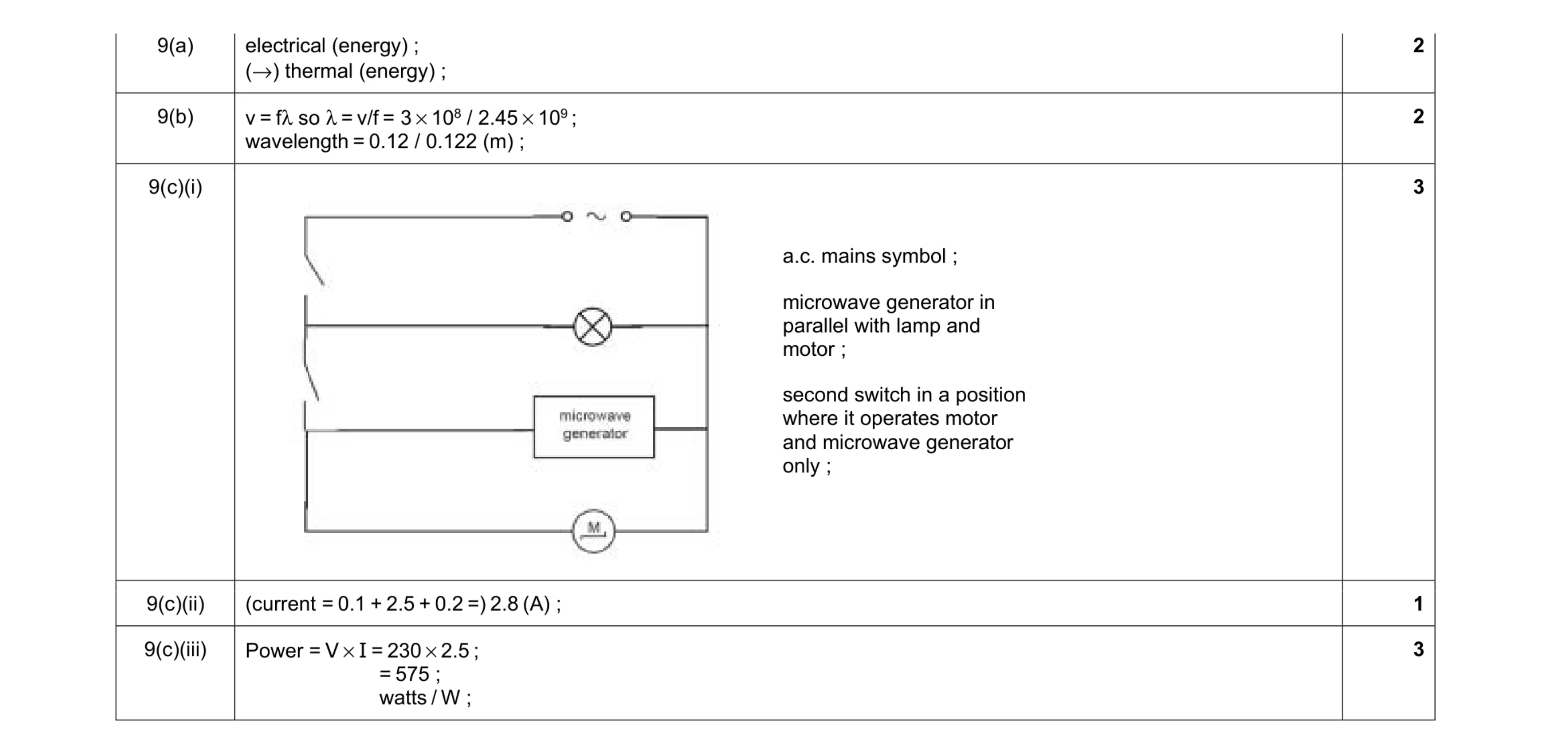 11
11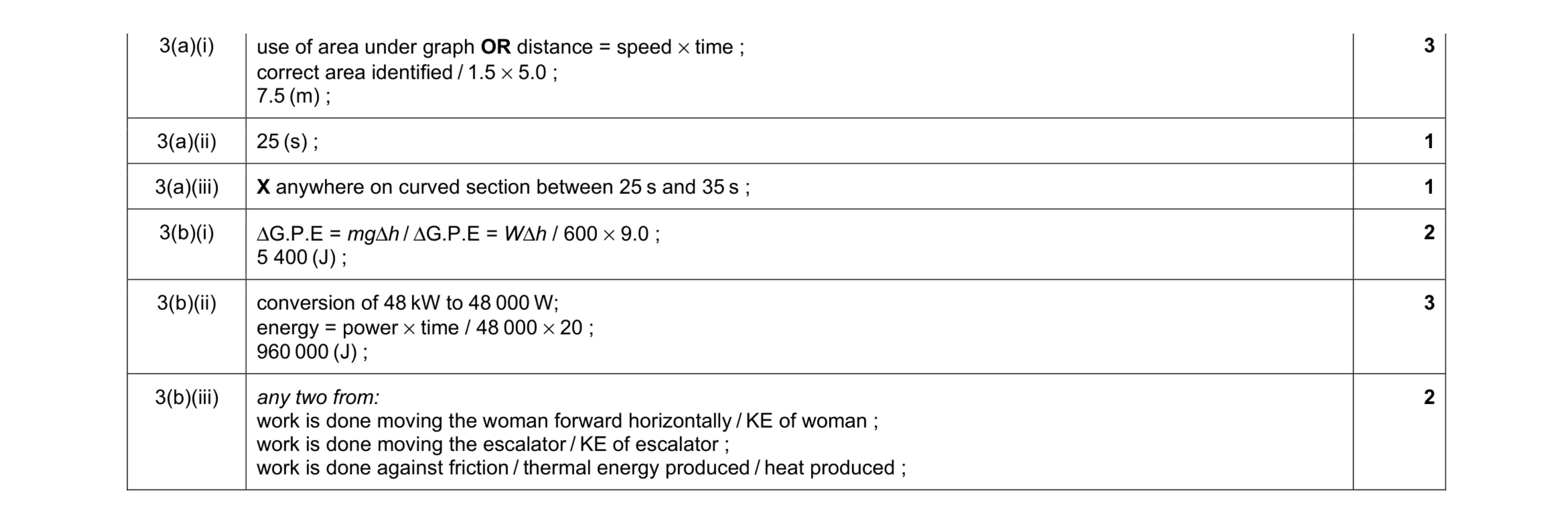 12
12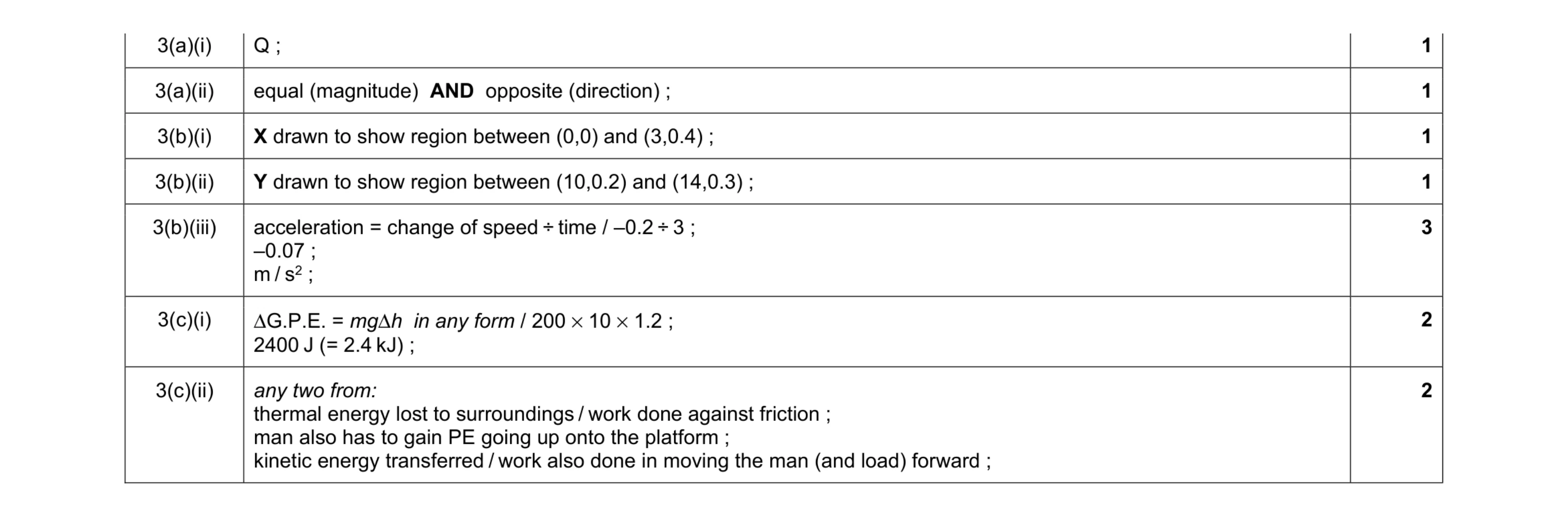 11
11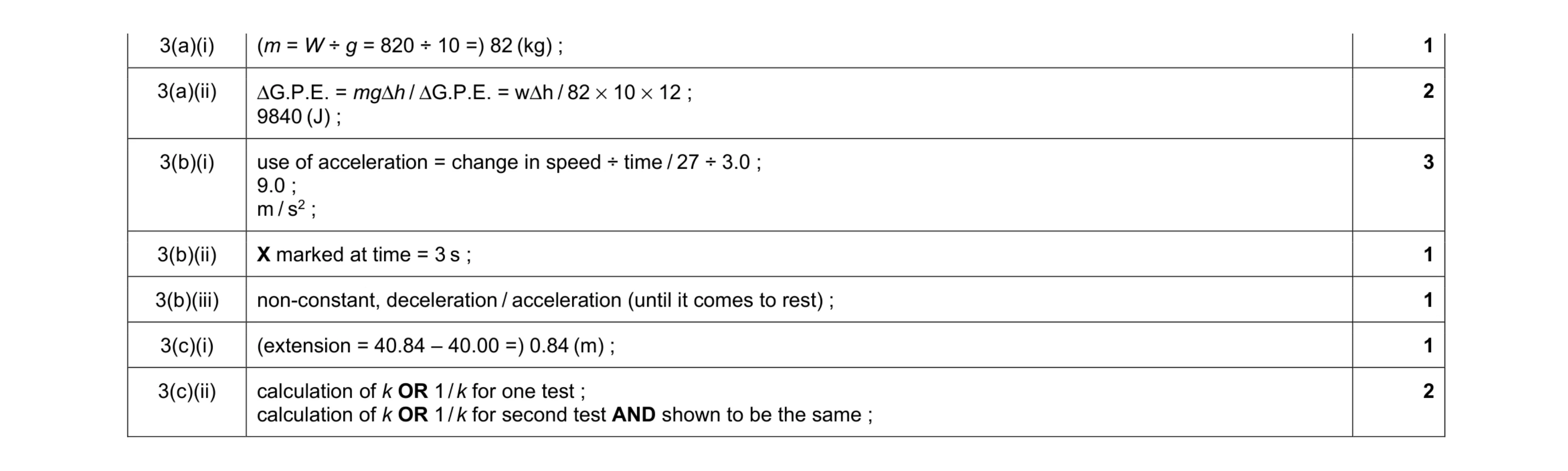 11
11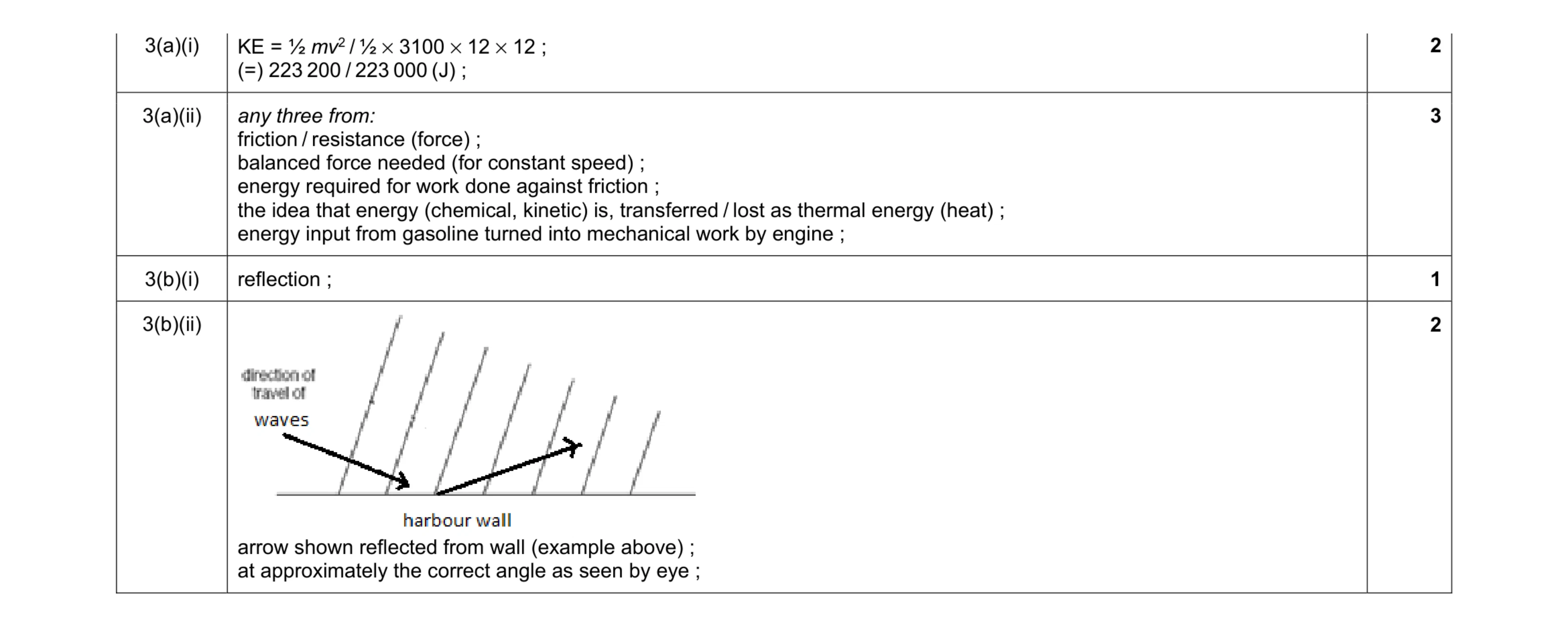 8
8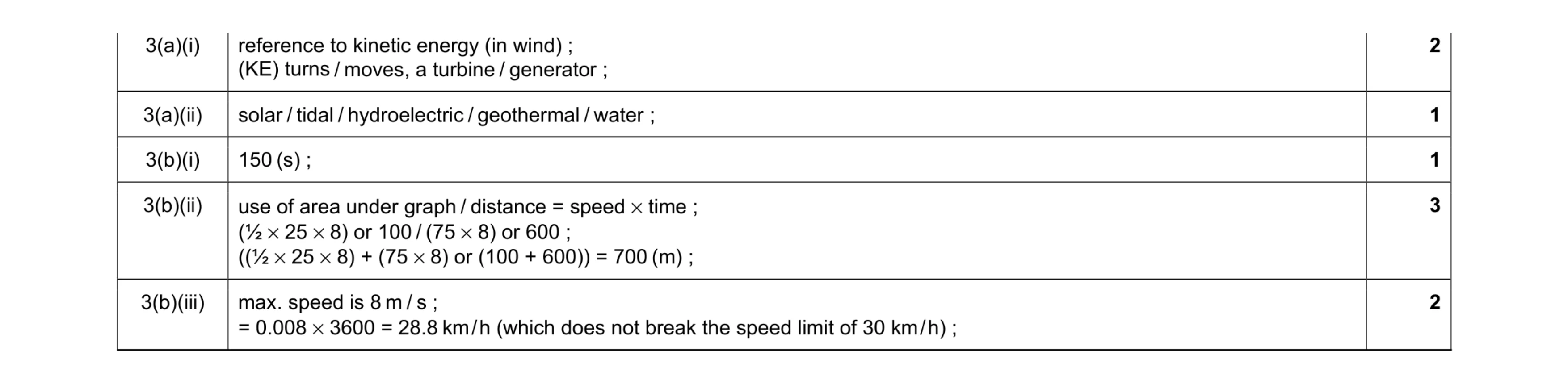 9
9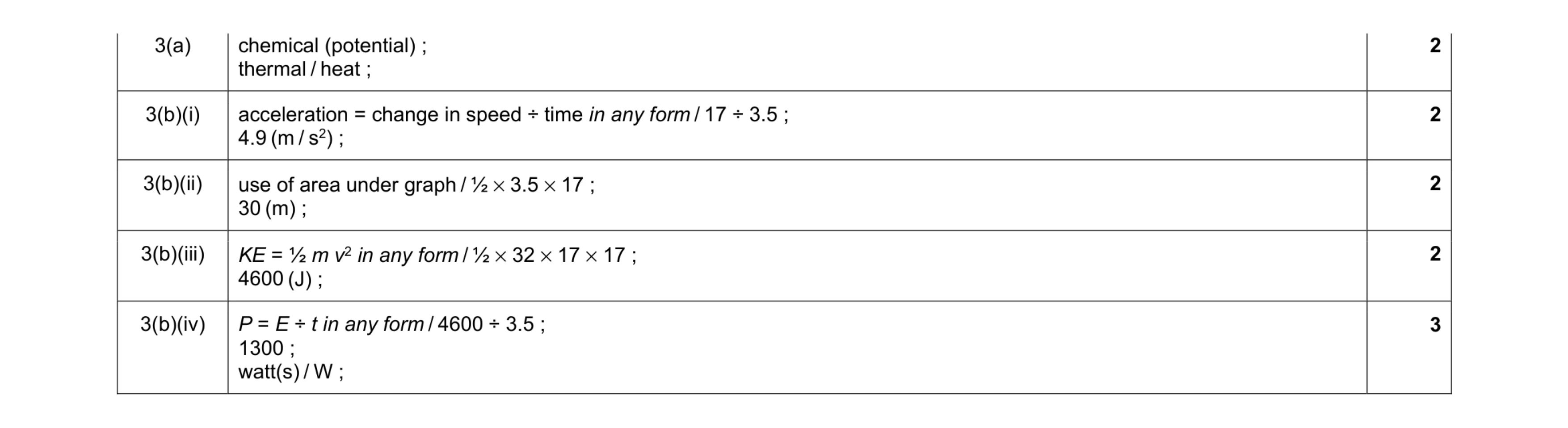 11
11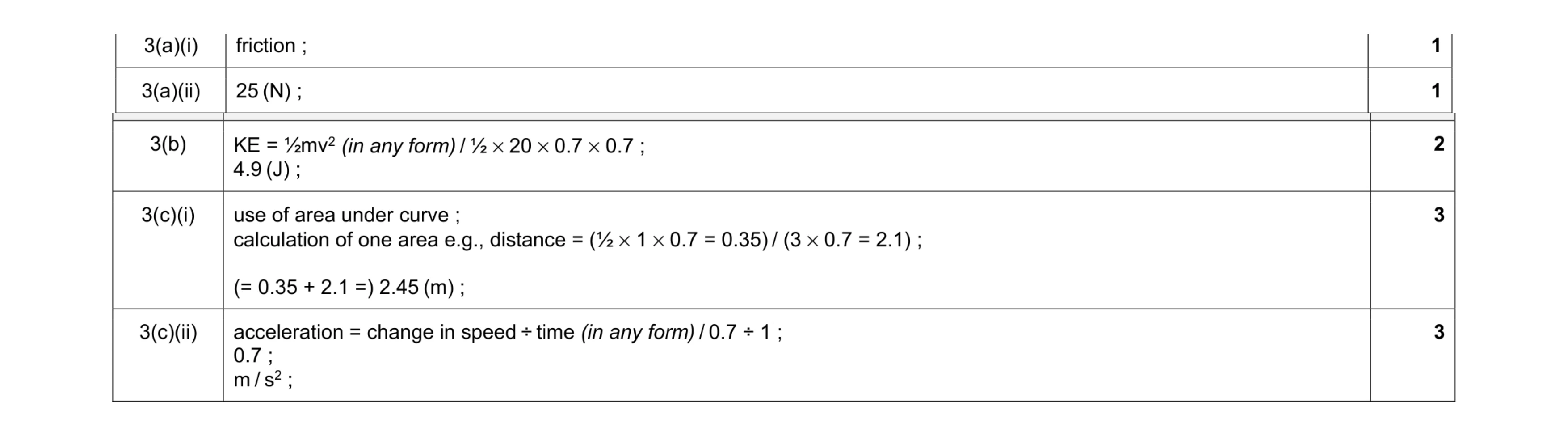 10
10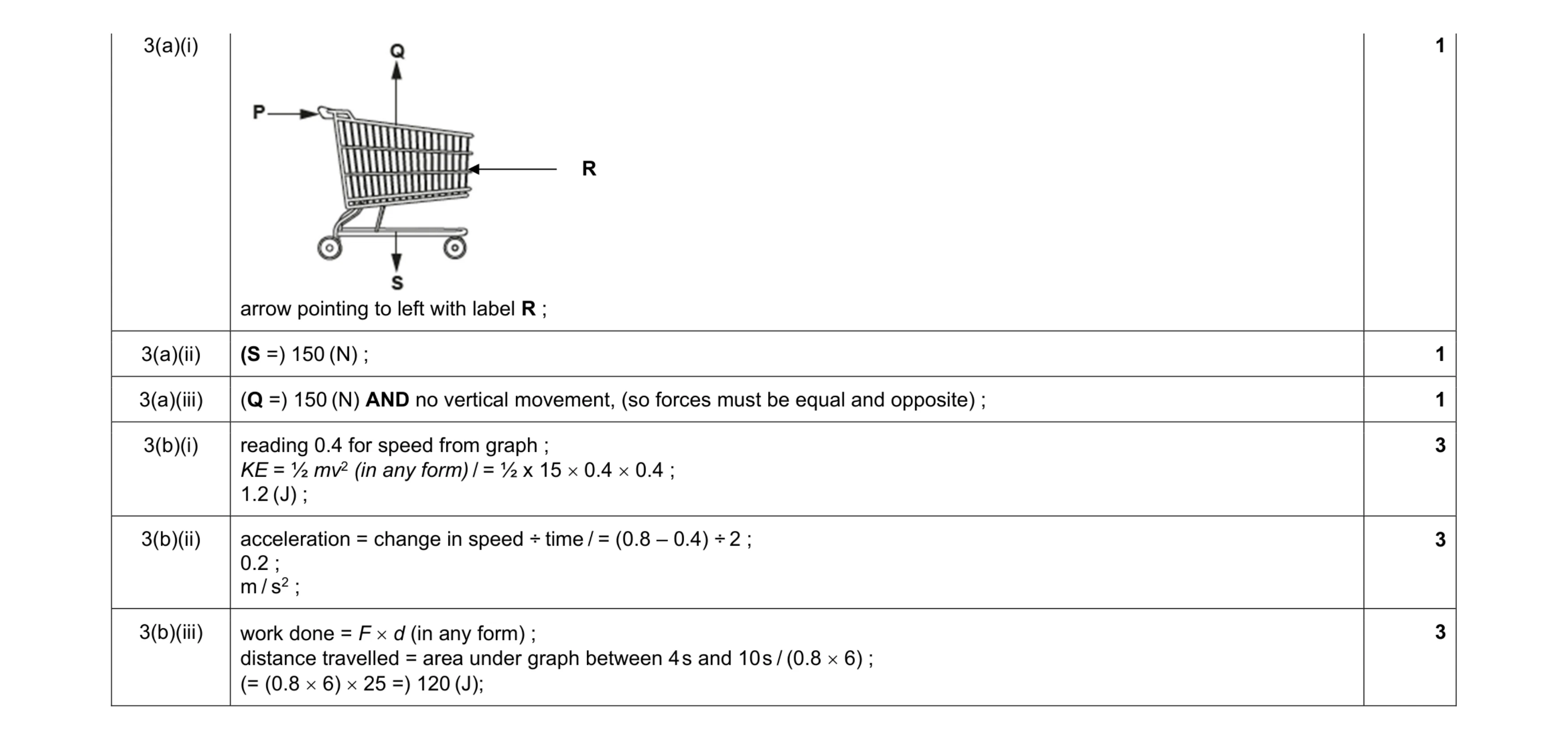 12
12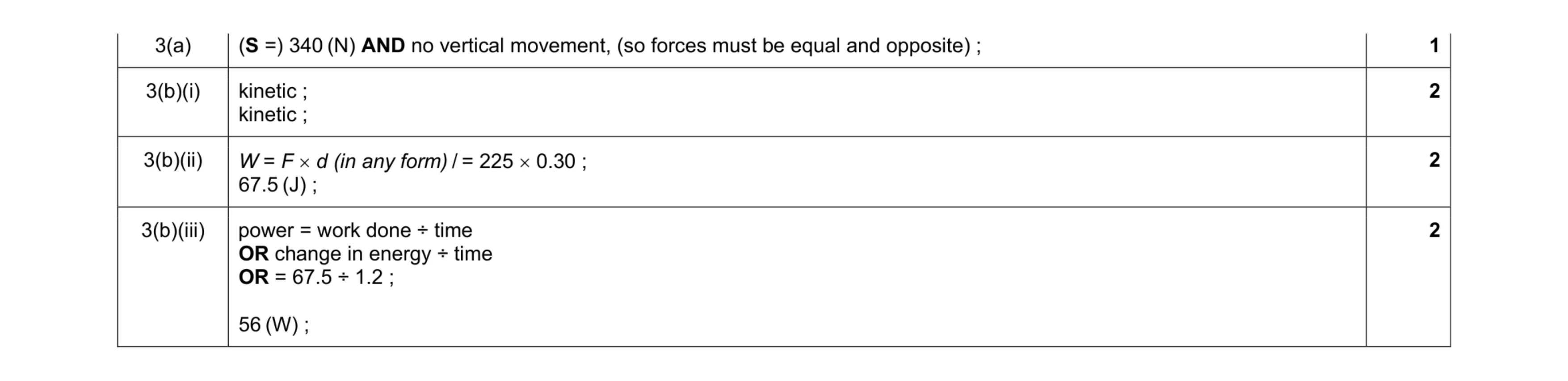 7
7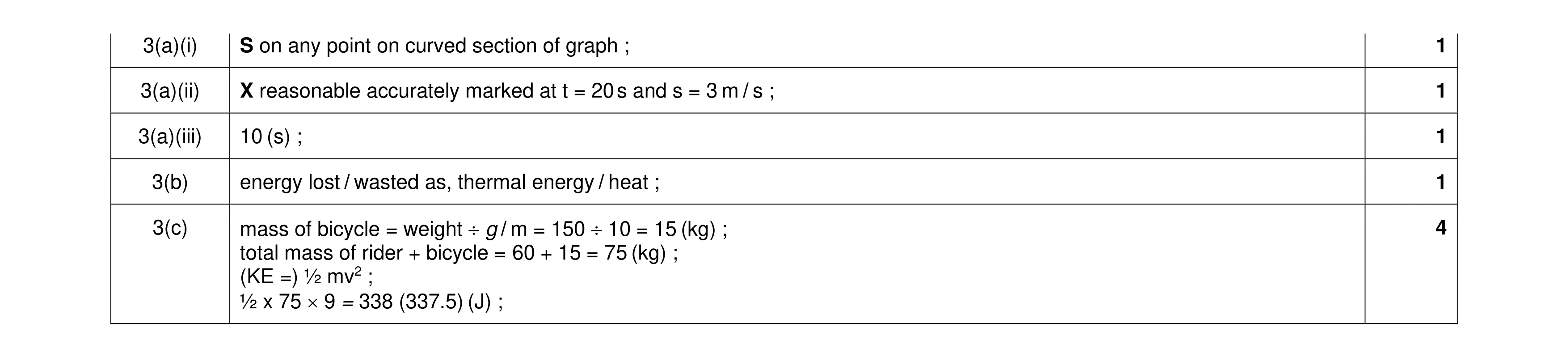 8
8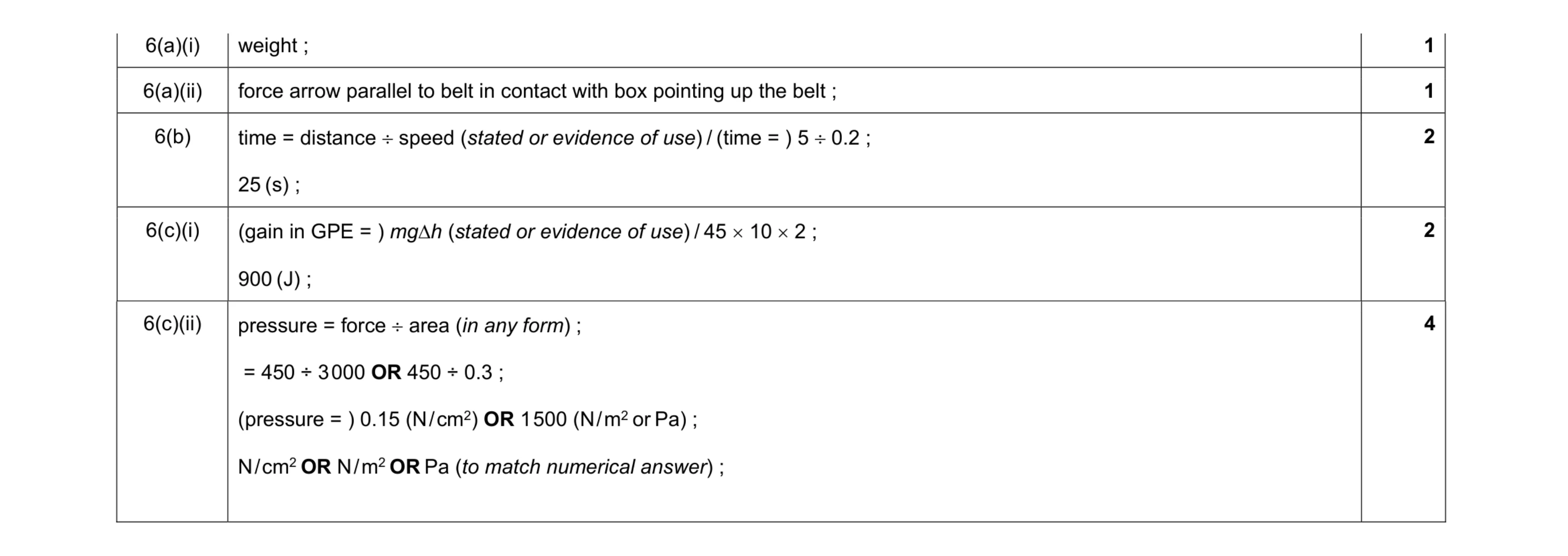 10
10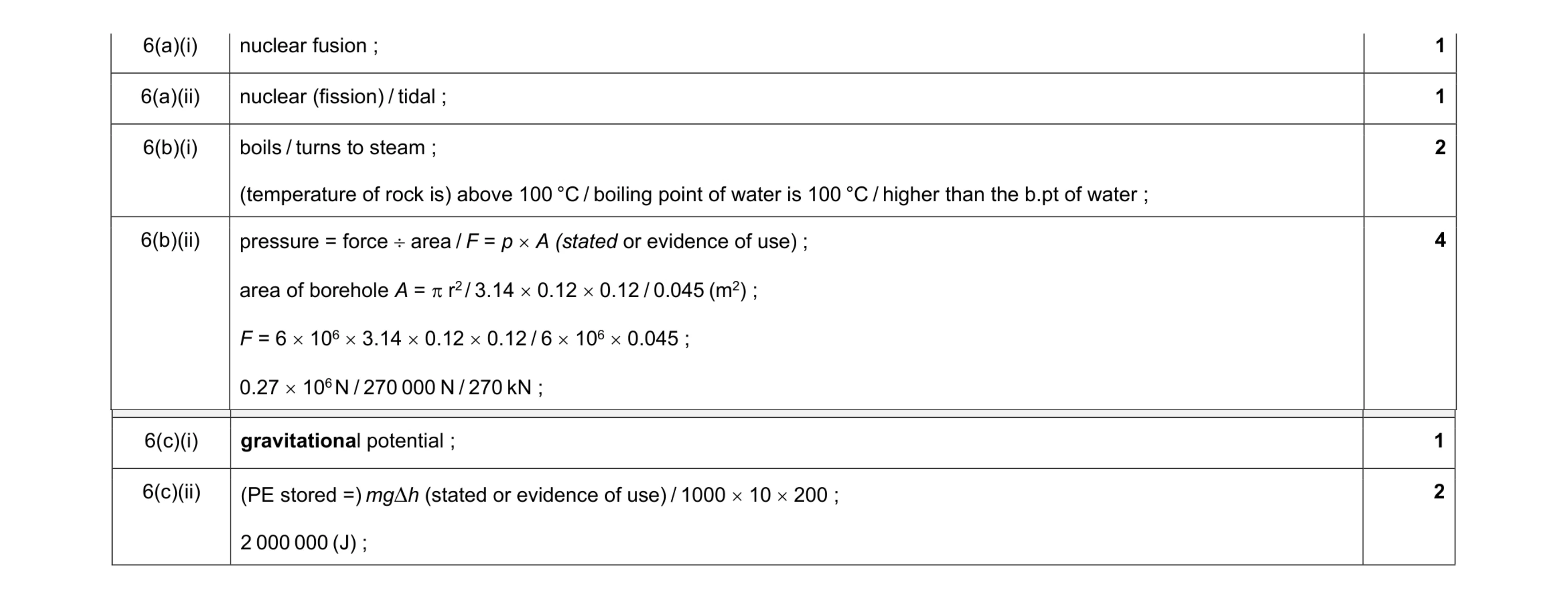 11
11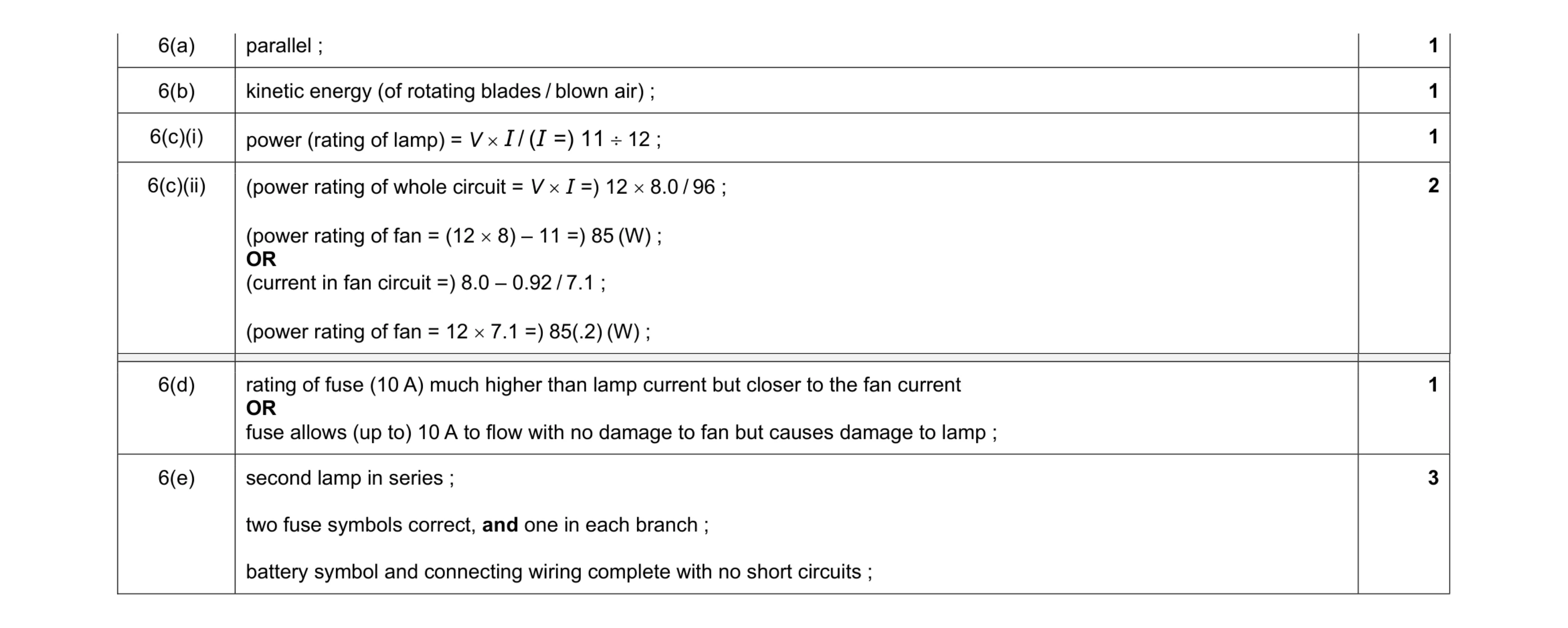 9
9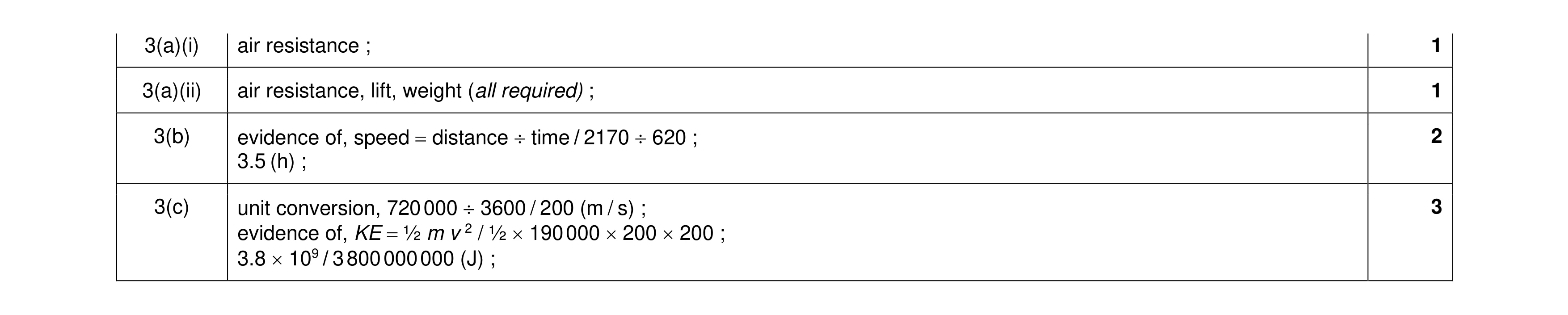 7
7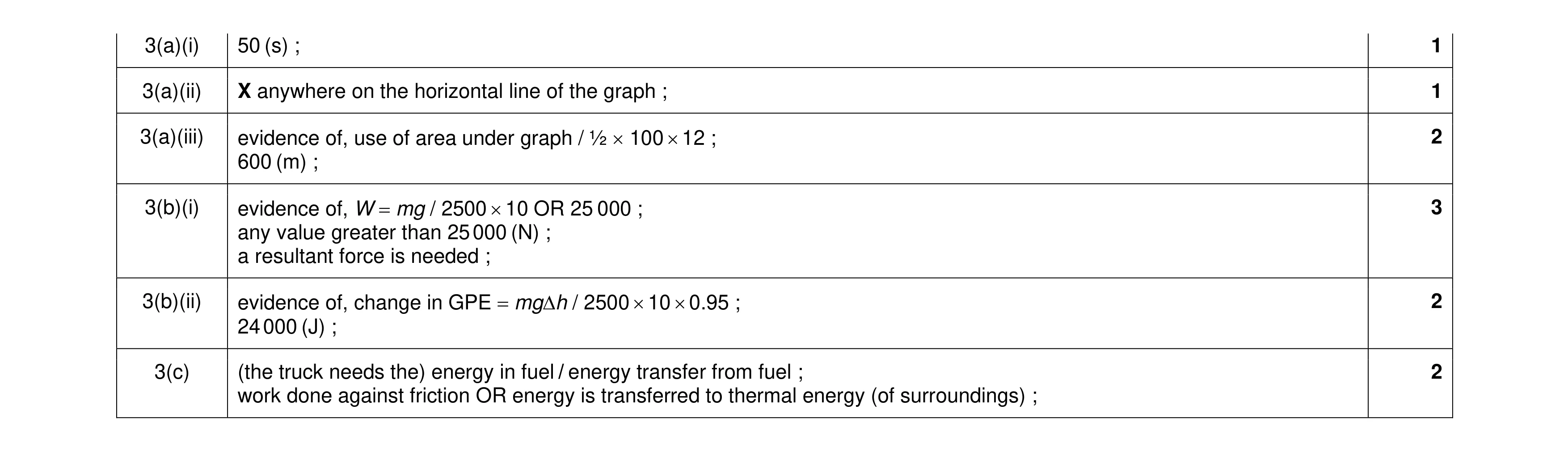 11
11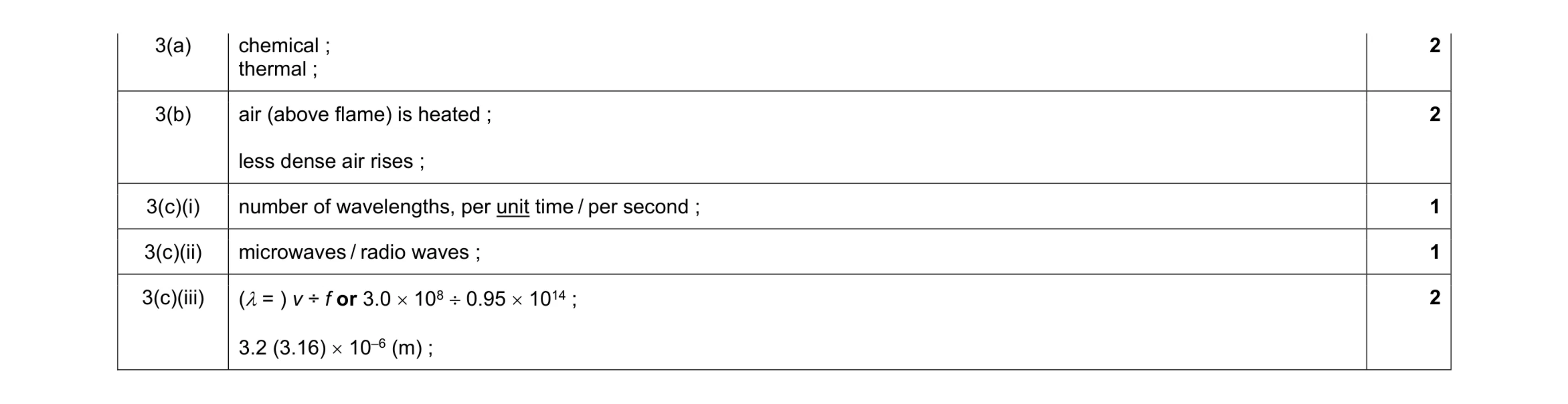 8
8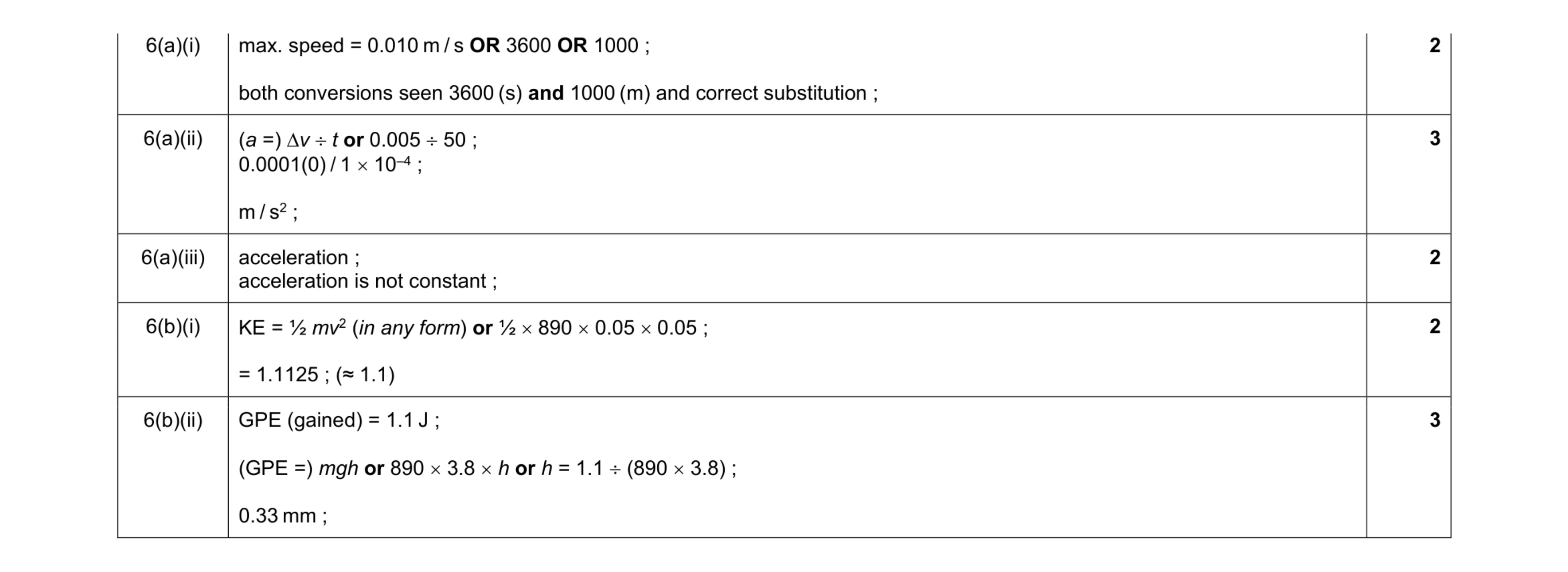 12
12 8
8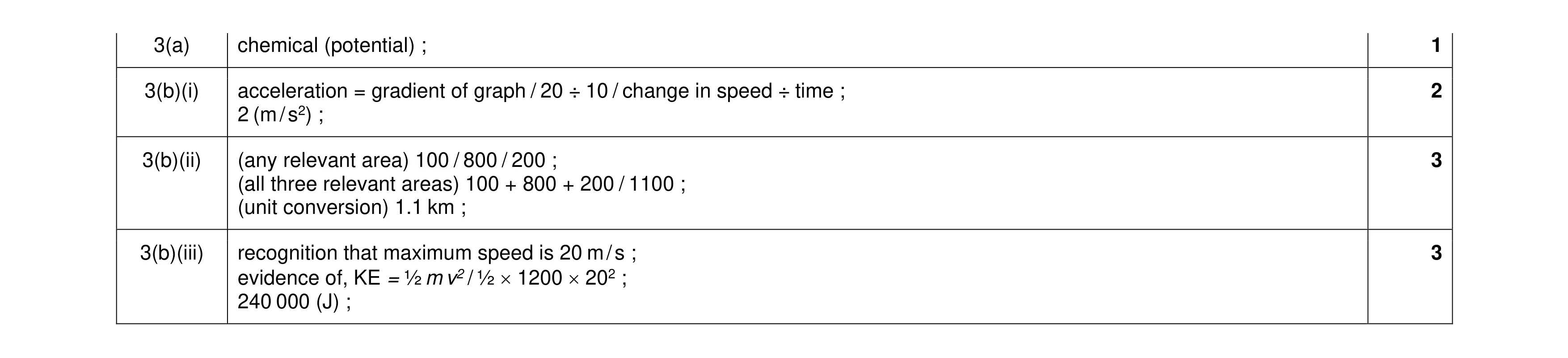 9
9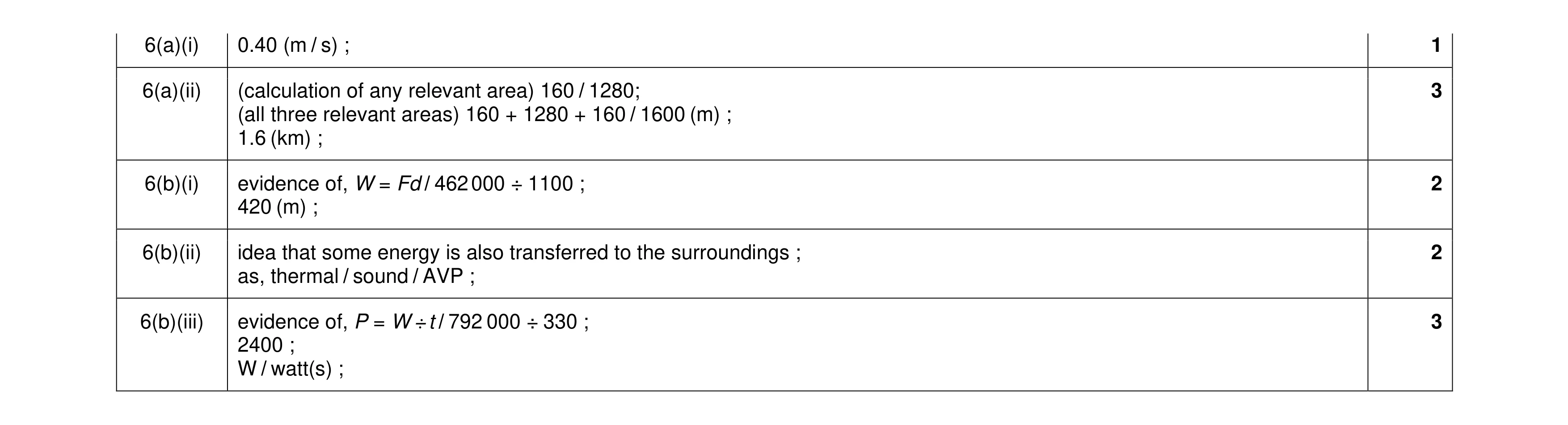 11
11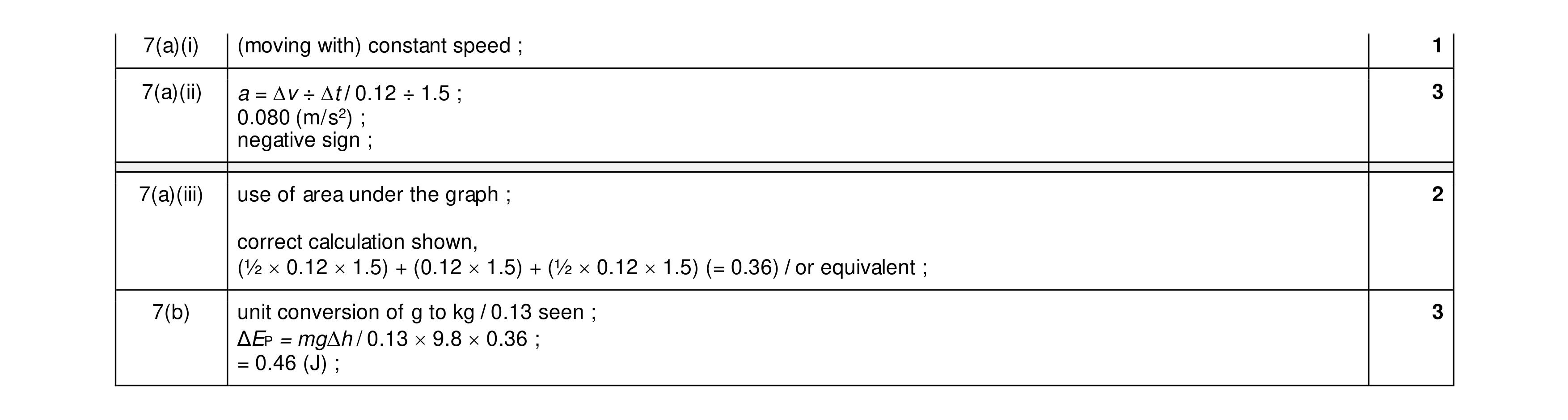 9
9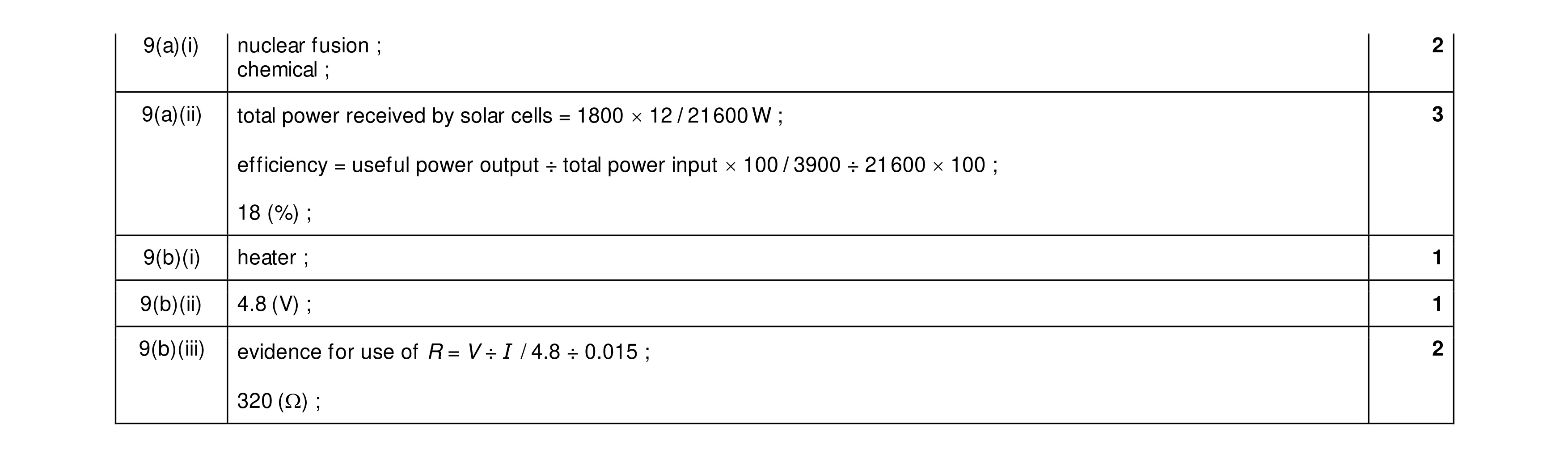 9
9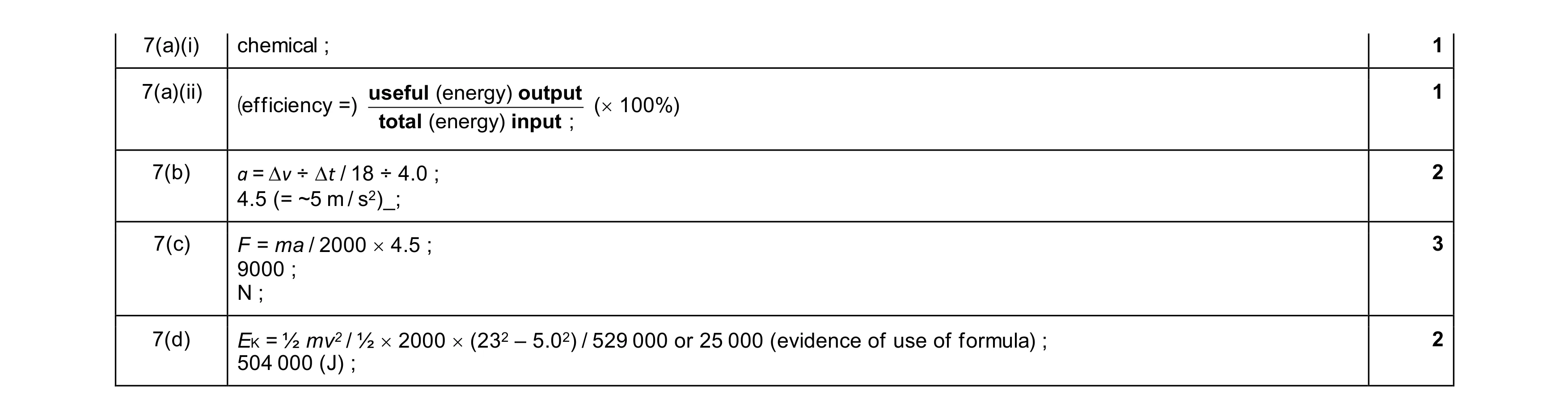 9
9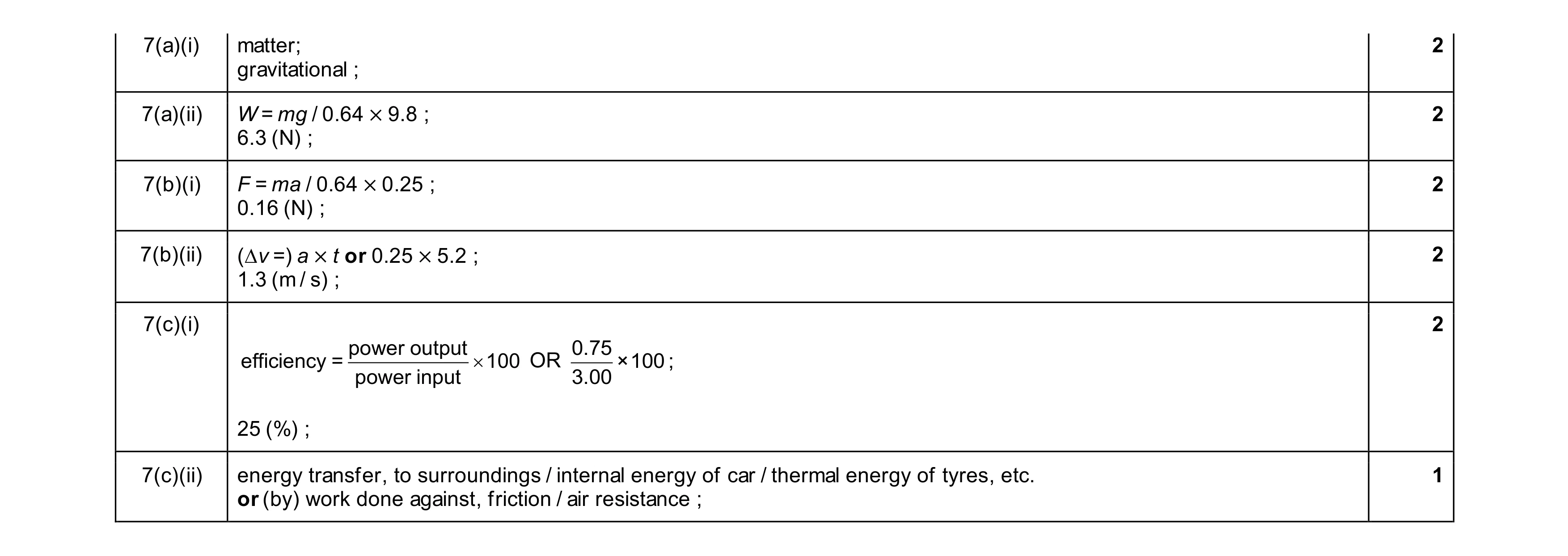 11
11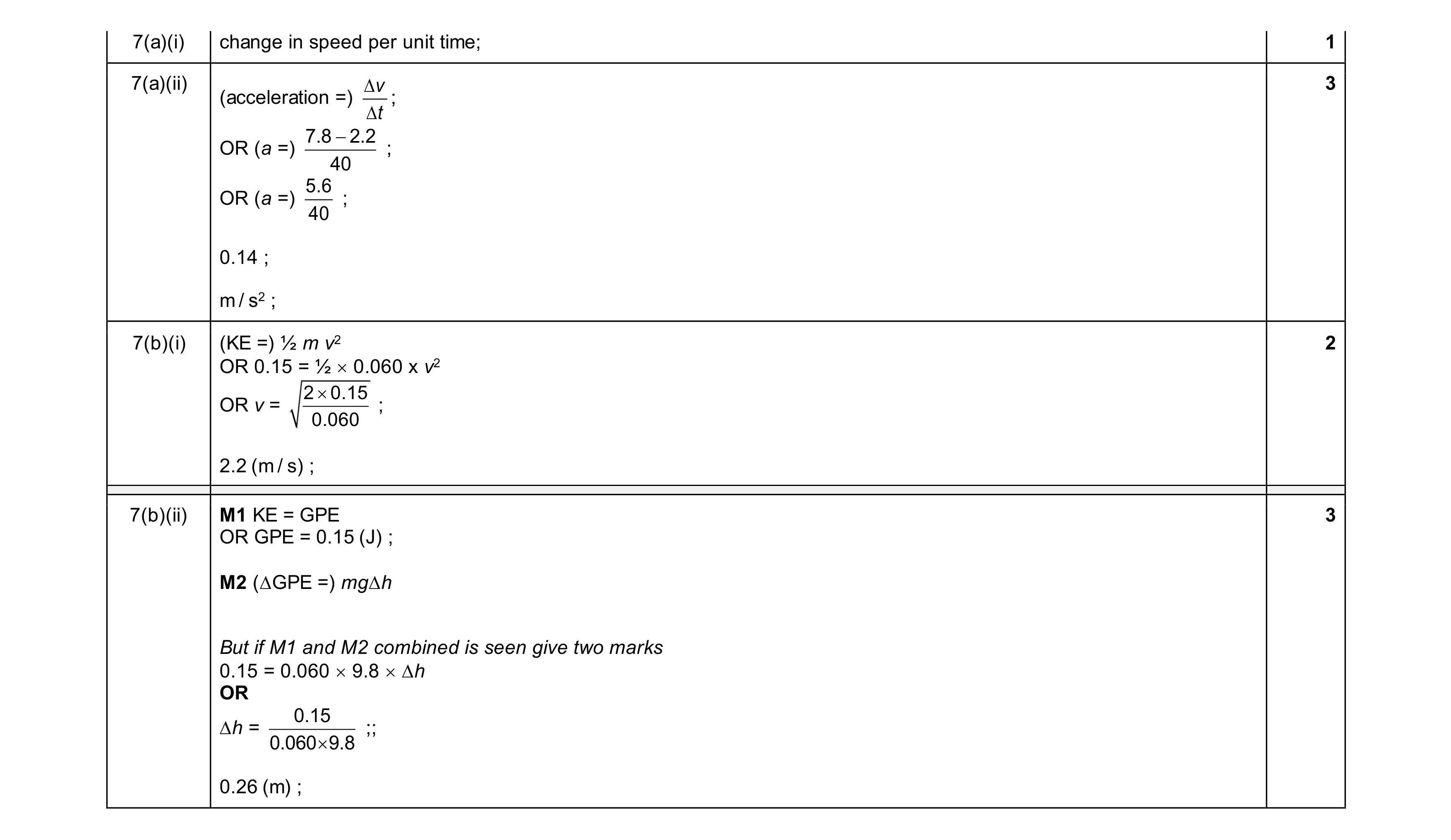 9
9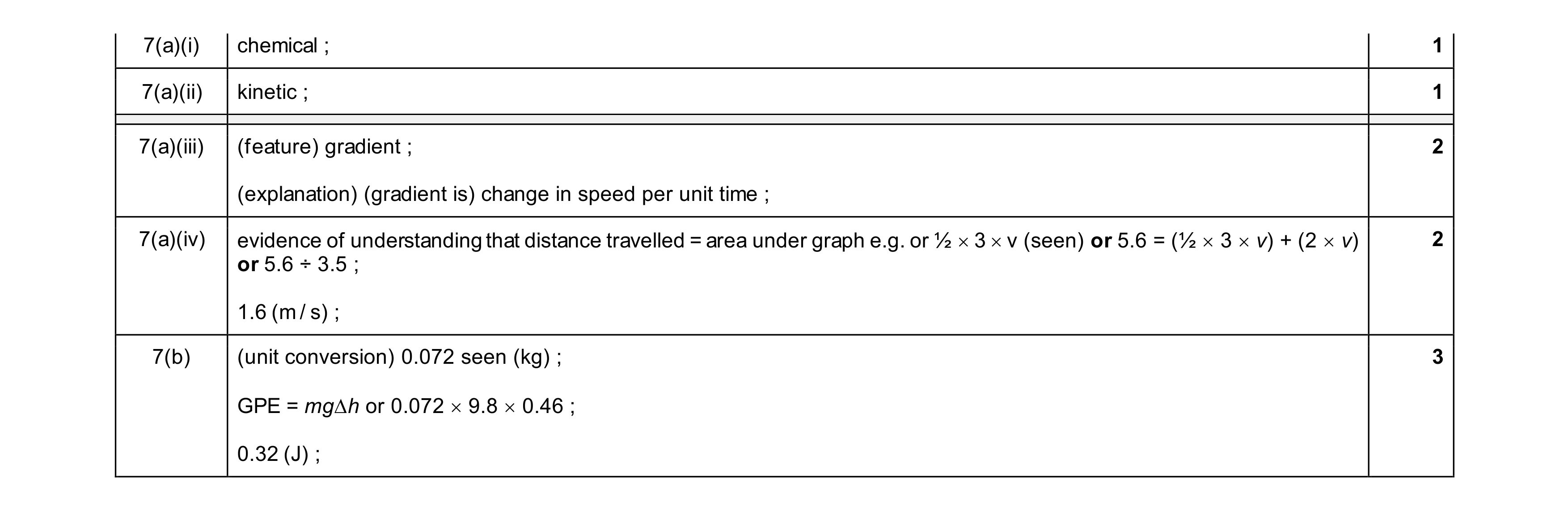 9
9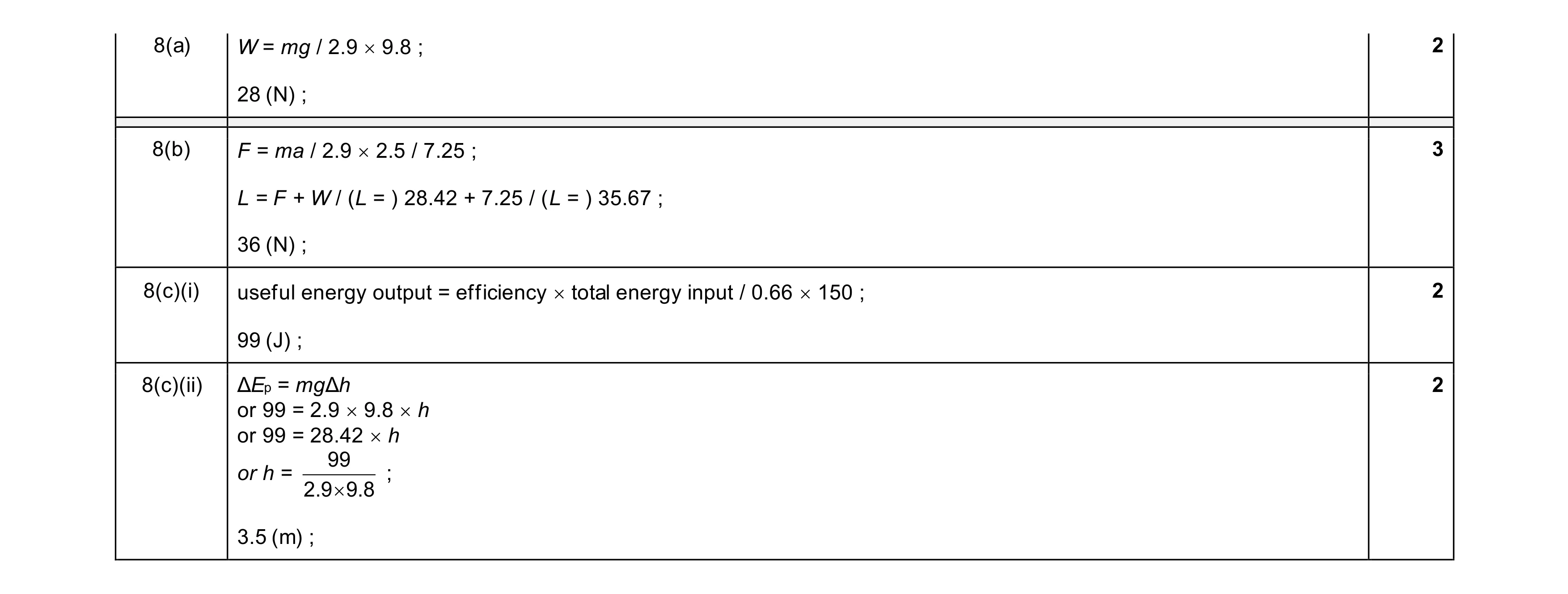 9
9