Cambridge IGCSE Science - Combined 0653 — 2024 Feb/March Paper 1 · Variant 2
0653/12/F/M/24 · 40 questions · 40 marks · ≈45 min
The question paper and its mark scheme, free to read here and free to download. This is Cambridge’s own paper, exactly as it was sat.
Question paper16 pages

Mark scheme3 pages
Answers below. Sit the paper first if you are practising.
Questions as text
Q1 · Acar burns gasoline (petrol), providing energy to drive its wheels and releasing exhaust…
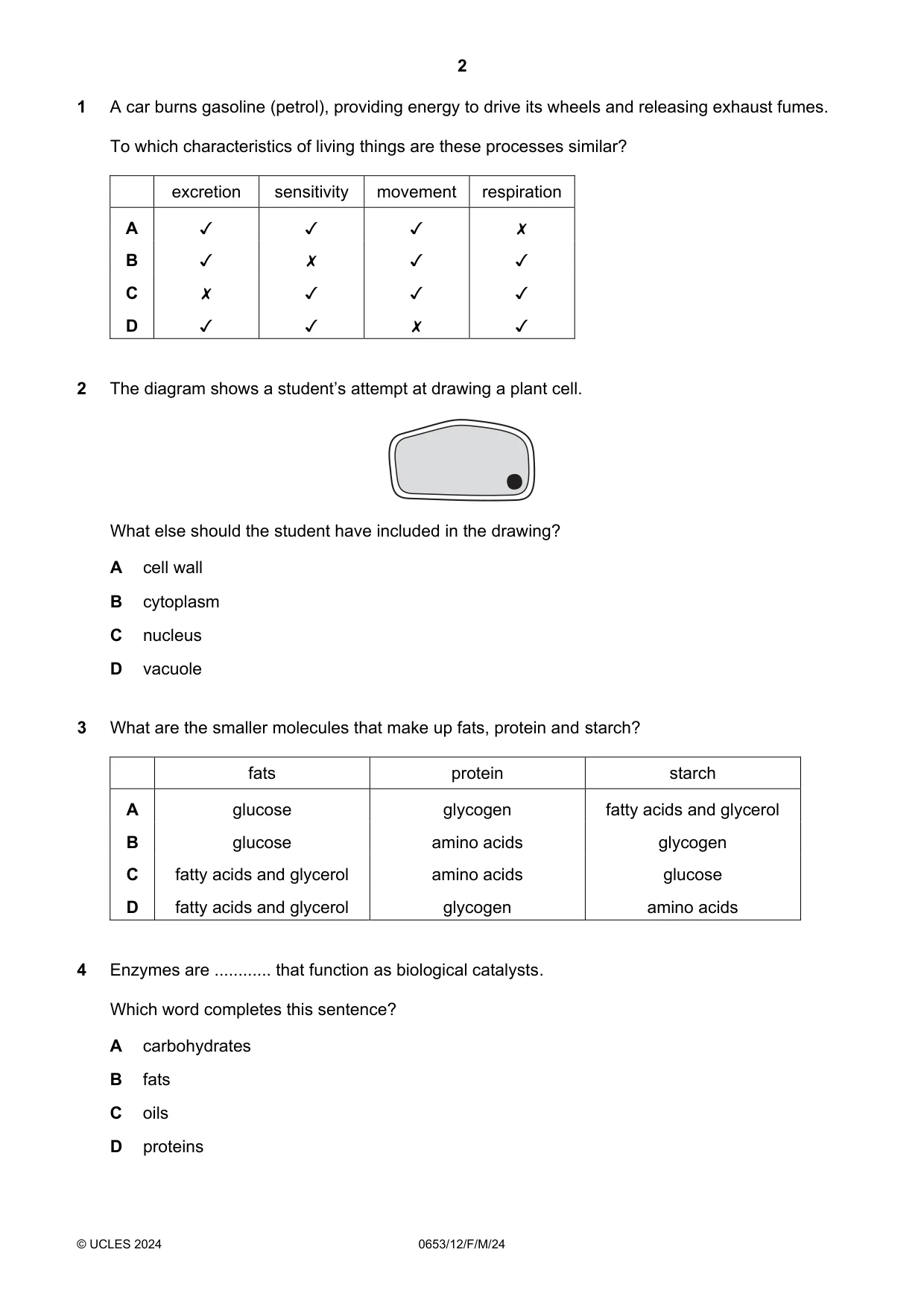
1. Acar burns gasoline (petrol), providing energy to drive its wheels and releasing exhaust fumes. To which characteristics of living things are these processes similar? excretion sensitivity | movement | respiration
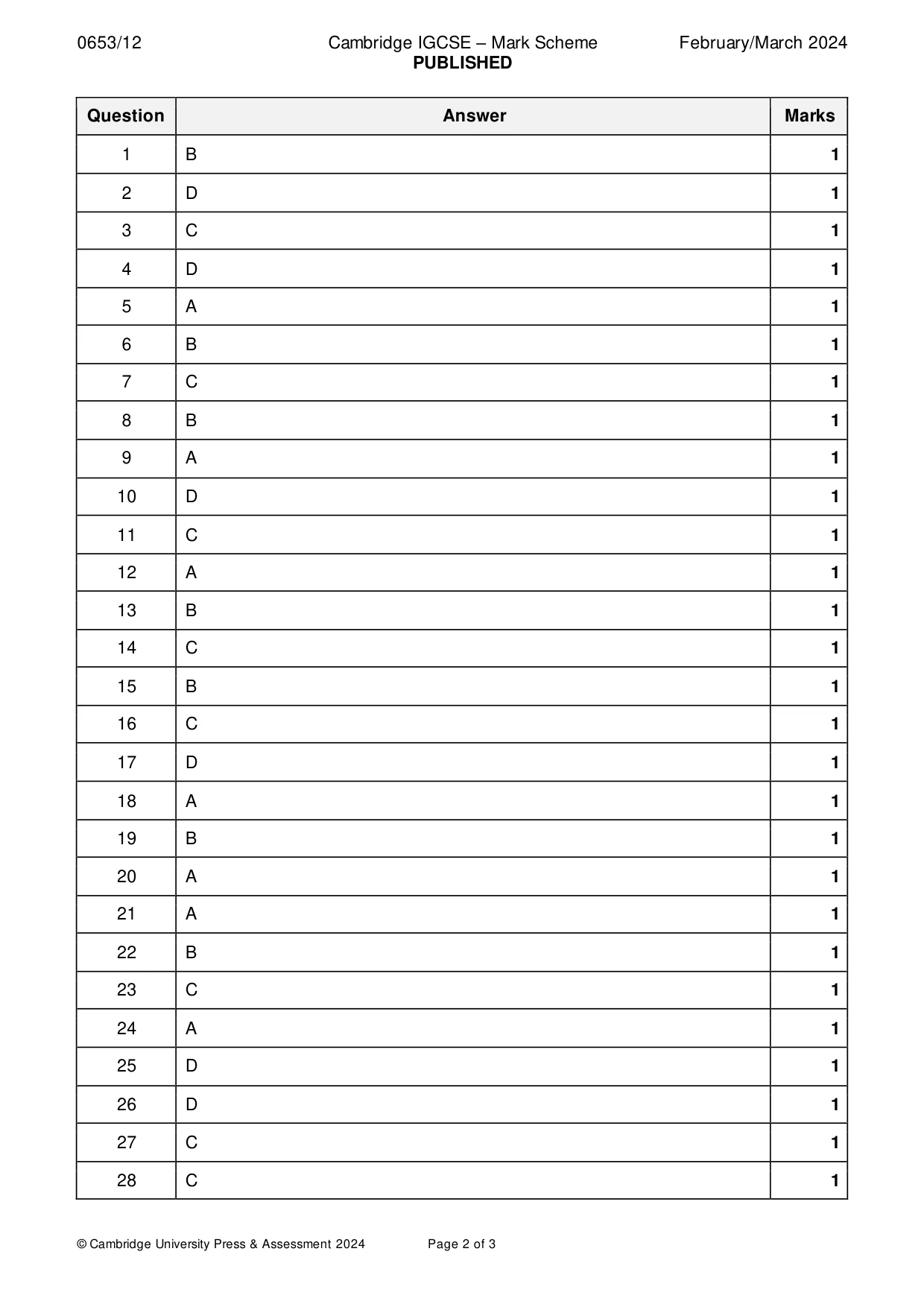
Mark scheme: B
Q2 · The diagram shows a student’s attempt at drawing a plant cell
2 The diagram shows a student’s attempt at drawing a plant cell. What else should the student have included in the drawing? A cell wall B cytoplasm C nucleus D vacuole
Mark scheme: D
Q3 · What are the smaller molecules that make up fats, protein and starch?
3 What are the smaller molecules that make up fats, protein and starch? fats protein starch A glucose glycogen fatty acids and glycerol B glucose amino acids glycogen C fatty acids and glycerol amino acids glucose D fatty acids and glycerol glycogen amino acids
Mark scheme: C
Question 4
4 Enzymes are ............ that function as biological catalysts. Which word completes this sentence? A carbohydrates B fats C oils D proteins
Mark scheme: D
Q5 · Which effects of magnesium deficiency on a plant are correct?
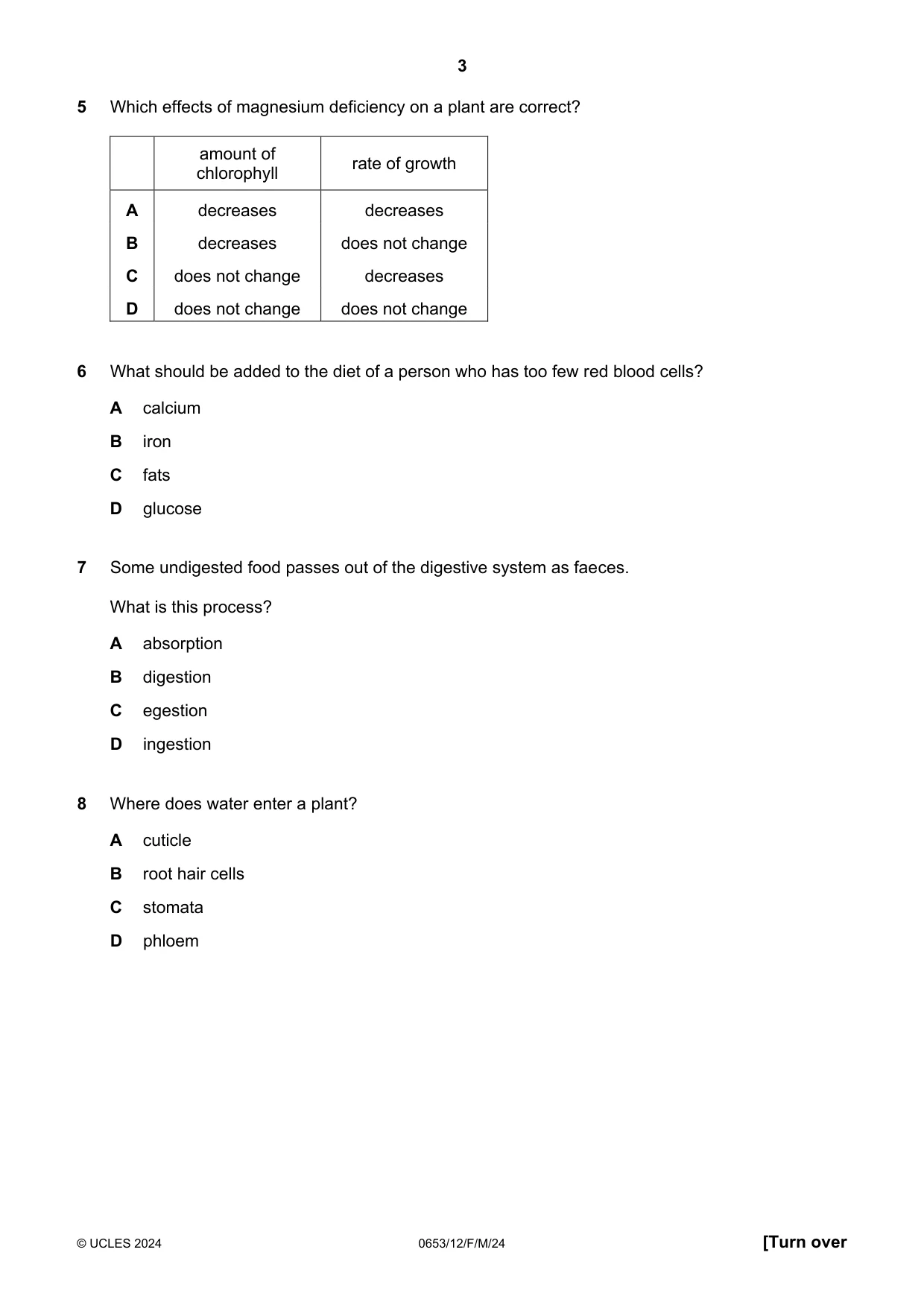
5 Which effects of magnesium deficiency on a plant are correct? amount of rate of growth chlorophyll A decreases decreases B decreases does not change C does not change decreases D does not change does not change
Mark scheme: A
Q6 · What should be added to the diet of a person who has too few red blood cells?
6 What should be added to the diet of a person who has too few red blood cells? A calcium B iron C fats D glucose
Mark scheme: B
Q7 · Some undigested food passes out of the digestive system as faeces
7 Some undigested food passes out of the digestive system as faeces. What is this process? A absorption B digestion C egestion D ingestion
Mark scheme: C
Q8 · Where does water enter a plant?
8 Where does water enter a plant? A cuticle B root hair cells C stomata D phloem
Mark scheme: B
Q9 · The diagram shows the human gas exchange system
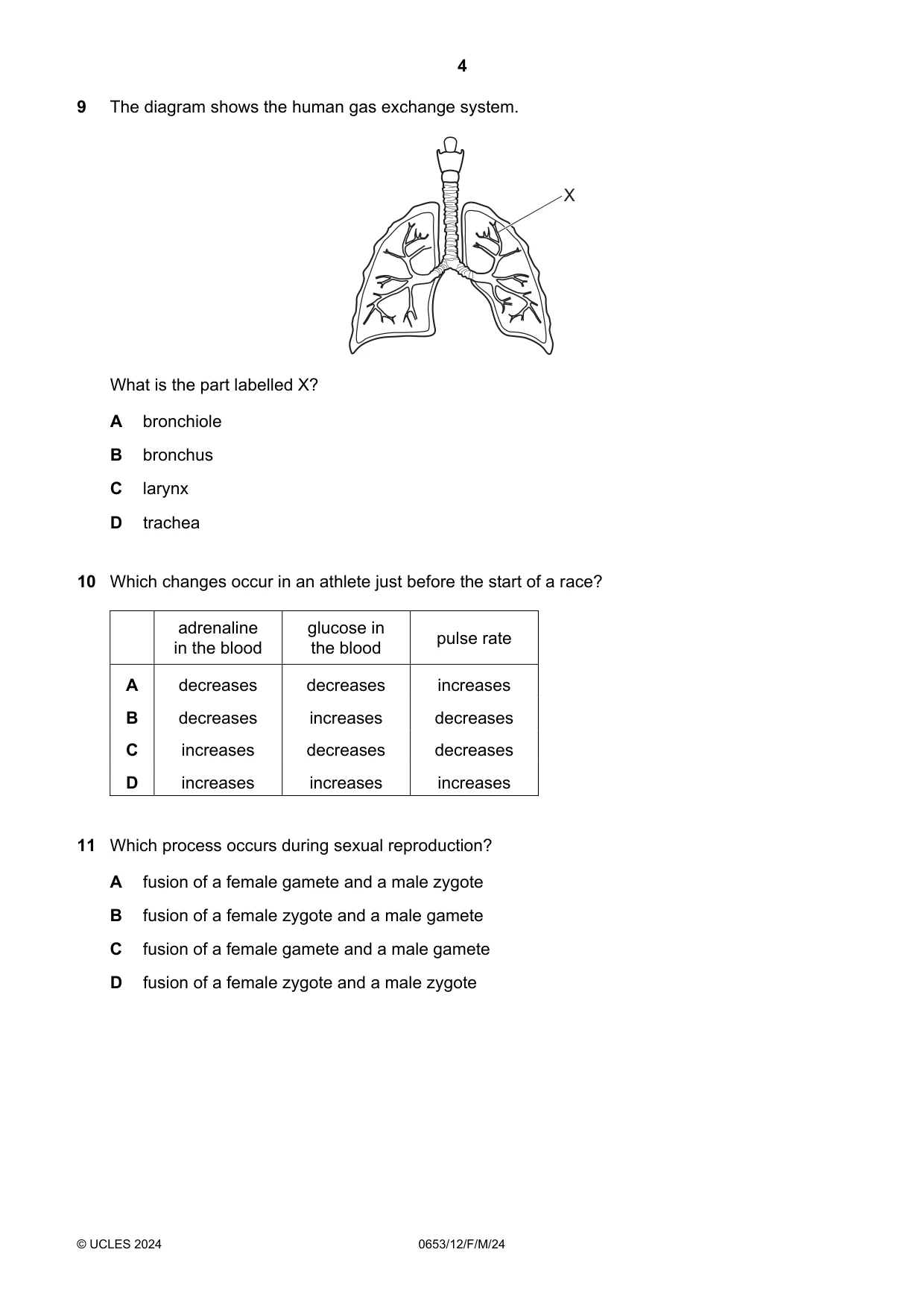
9 The diagram shows the human gas exchange system. X What is the part labelled X? A bronchiole B bronchus C larynx D trachea
Mark scheme: A
Q10 · Which changes occur in an athlete just before the start of a race?
10 Which changes occur in an athlete just before the start of a race? adrenaline glucose in pulse rate in the blood the blood A decreases decreases increases B decreases increases decreases C increases decreases decreases D increases increases increases
Mark scheme: D
Q11 · Which process occurs during sexual reproduction?
11 Which process occurs during sexual reproduction? A fusion of a female gamete and a male zygote B fusion of a female zygote and a male gamete C fusion of a female gamete and a male gamete D fusion of a female zygote and a male zygote
Mark scheme: C
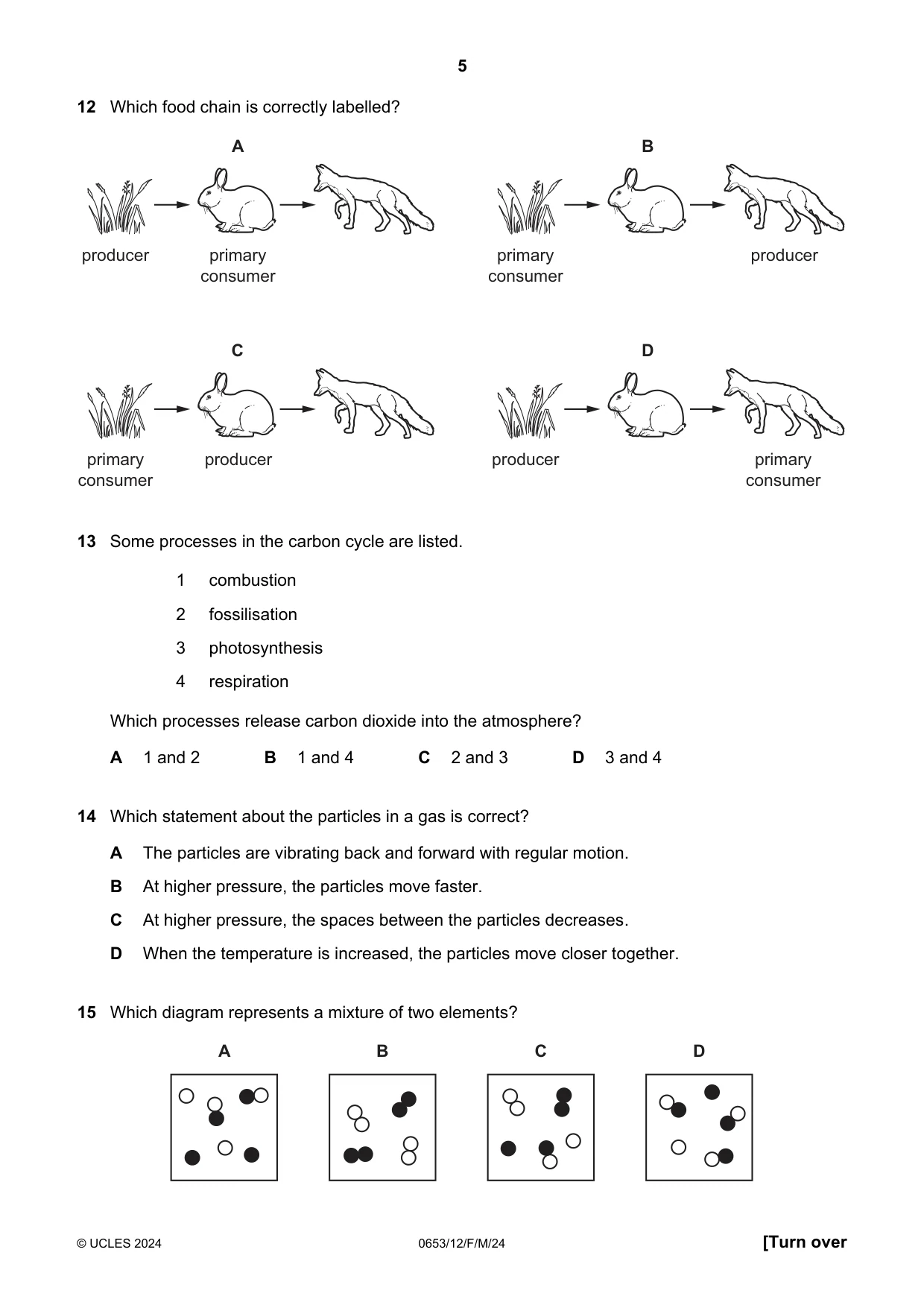
Q12 · Which food chain is correctly labelled?
12 Which food chain is correctly labelled? A B producer primary primary producer consumer consumer C D primary producer producer primary consumer consumer
Mark scheme: A
Q13 · Some processes in the carbon cycle are listed
13 Some processes in the carbon cycle are listed. 1 combustion 2 fossilisation 3 photosynthesis 4 respiration Which processes release carbon dioxide into the atmosphere? A 1 and 2 B 1 and 4 C 2 and 3 D 3 and 4
Mark scheme: B
Q14 · Which statement about the particles in a gas is correct?
14 Which statement about the particles in a gas is correct? A The particles are vibrating back and forward with regular motion. B At higher pressure, the particles move faster. C At higher pressure, the spaces between the particles decreases. D When the temperature is increased, the particles move closer together.
Mark scheme: C
Q15 · Which diagram represents a mixture of two elements?
15 Which diagram represents a mixture of two elements? A B C D
Mark scheme: B
Q16 · Which word describes molten lead bromide during its electrolysis?
16 Which word describes molten lead bromide during its electrolysis? A anode B cathode C electrolyte D solution
Mark scheme: C
Q17 · Sodium chloride dissolves in water in an endothermic process
17 Sodium chloride dissolves in water in an endothermic process. When calcium chloride dissolves in water, the temperature of the solution increases. Which statement is correct? A The process of dissolving calcium chloride is neither exothermic nor endothermic. B The temperature of the solution increases when sodium chloride dissolves. C The temperature of the solution remains constant when sodium chloride dissolves. D When calcium chloride dissolves in water, the process is exothermic.
Mark scheme: D
Q18 · Powdered calcium carbonate reacts with hydrochloric acid
18 Powdered calcium carbonate reacts with hydrochloric acid. Which change in the reaction conditions increases the rate of this reaction? A increasing the temperature of the acid B increasing the volume of the acid C decreasing the concentration of the acid D using lumps of calcium carbonate
Mark scheme: A
Q19 · The equation for the reaction of sodium with oxygen is shown
19 The equation for the reaction of sodium with oxygen is shown. 4Na + O2 2Na2O Which process is involved in this reaction? A decomposition B oxidation C neutralisation D precipitation
Mark scheme: B
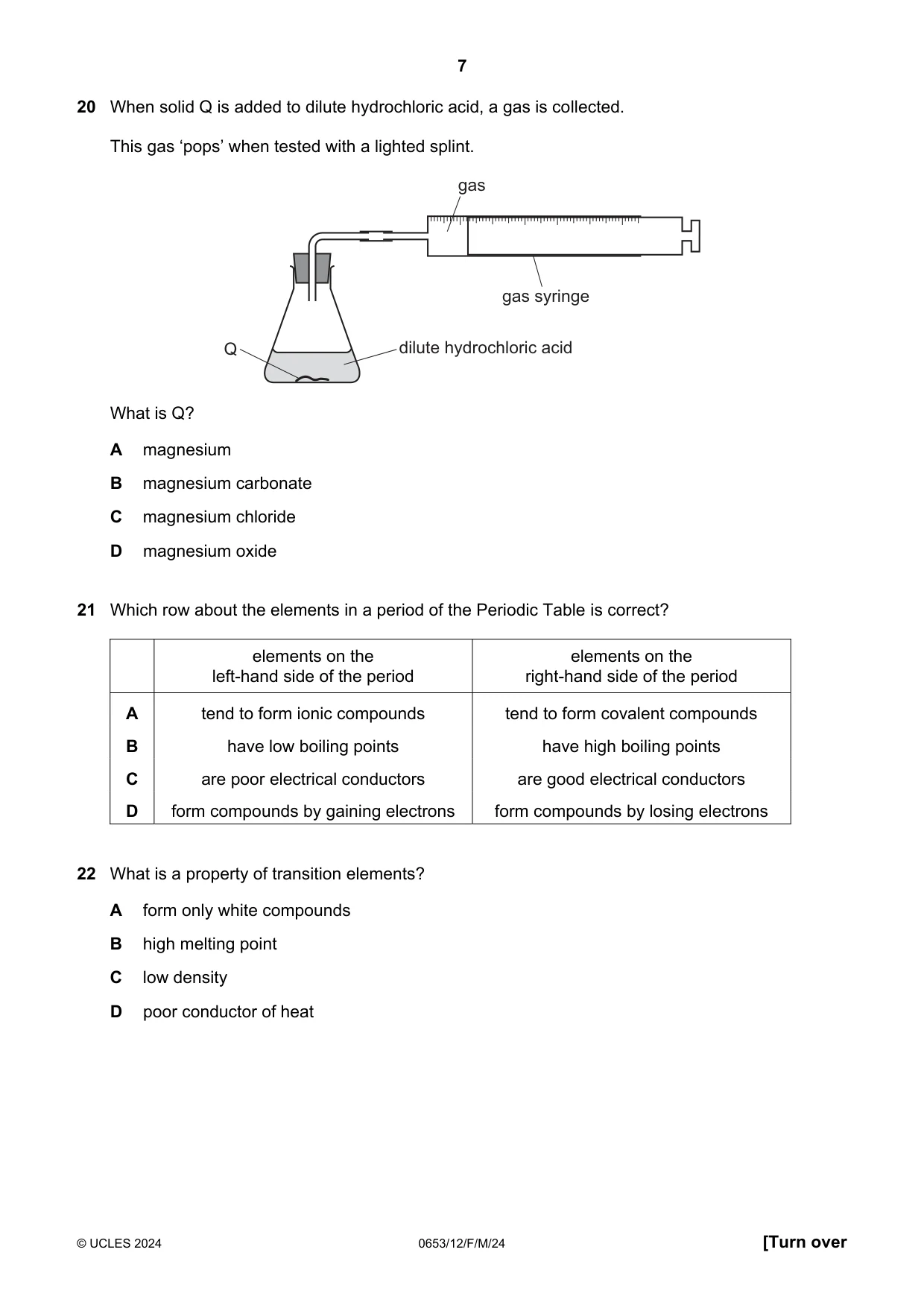
Q20 · When solid Q is added to dilute hydrochloric acid, a gas is collected
20 When solid Q is added to dilute hydrochloric acid, a gas is collected. This gas ‘pops’ when tested with a lighted splint. gas gas syringe Q dilute hydrochloric acid What is Q? A magnesium B magnesium carbonate C magnesium chloride D magnesium oxide
Mark scheme: A
Q21 · Which row about the elements in a period of the Periodic Table is correct?
21 Which row about the elements in a period of the Periodic Table is correct? elements on the elements on the left-hand side of the period right-hand side of the period A tend to form ionic compounds tend to form covalent compounds B have low boiling points have high boiling points C are poor electrical conductors are good electrical conductors D form compounds by gaining electrons form compounds by losing electrons
Mark scheme: A
Q22 · What is a property of transition elements?
22 What is a property of transition elements? A form only white compounds B high melting point C low density D poor conductor of heat
Mark scheme: B
Q23 · Which substances conduct electricity when molten?
23 Which substances conduct electricity when molten? 1 sodium chloride 2 naphtha 3 brass A 1, 2 and 3 B 1 and 2 only C 1 and 3 only D 2 and 3 only
Mark scheme: C
Q24 · Which process is used in the treatment of the water supply?
24 Which process is used in the treatment of the water supply? A filtration B evaporation C crystallisation D chromatography
Mark scheme: A
Q25 · Which pollutant gases result in damage to buildings?
25 Which pollutant gases result in damage to buildings? A carbon dioxide and carbon monoxide B carbon dioxide and sulfur dioxide C carbon monoxide and nitrogen dioxide D oxides of nitrogen and sulfur dioxide
Mark scheme: D
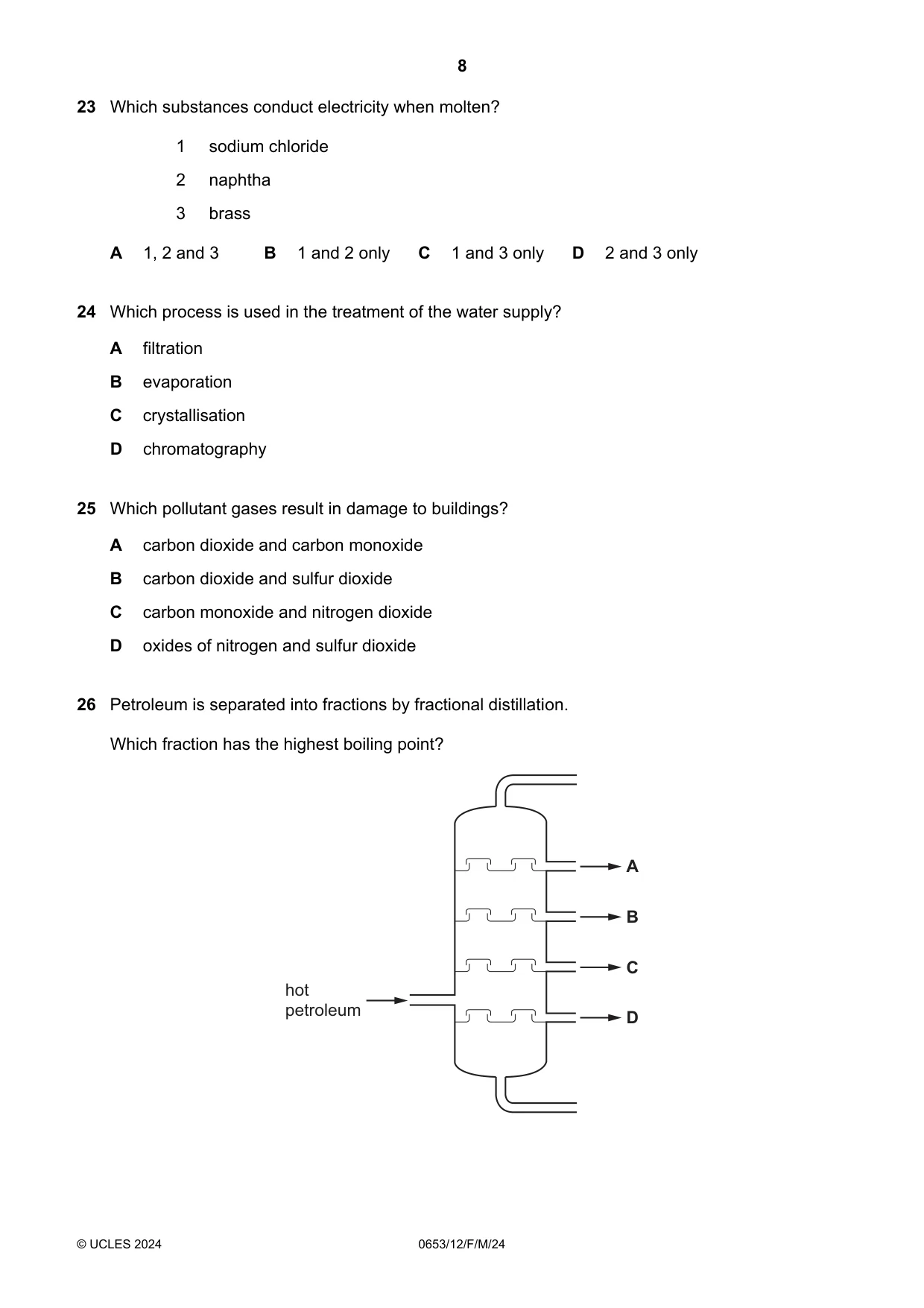
Q26 · Petroleum is separated into fractions by fractional distillation
26 Petroleum is separated into fractions by fractional distillation. Which fraction has the highest boiling point? A B C hot petroleum D
Mark scheme: D
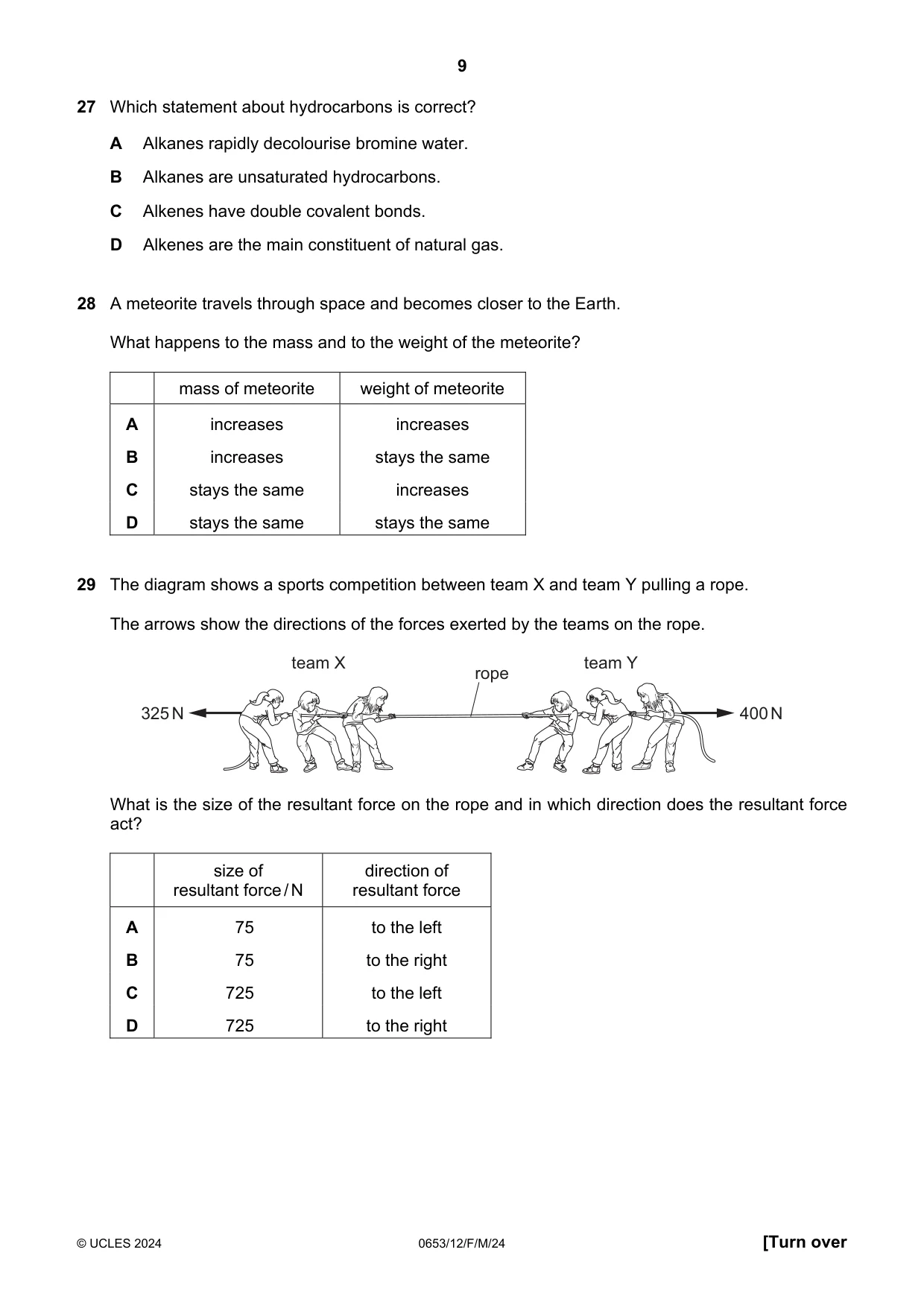
Q27 · Which statement about hydrocarbons is correct?
27 Which statement about hydrocarbons is correct? A Alkanes rapidly decolourise bromine water. B Alkanes are unsaturated hydrocarbons. C Alkenes have double covalent bonds. D Alkenes are the main constituent of natural gas.
Mark scheme: C
Q28 · A meteorite travels through space and becomes closer to the Earth
28 A meteorite travels through space and becomes closer to the Earth. What happens to the mass and to the weight of the meteorite? mass of meteorite weight of meteorite A increases increases B increases stays the same C stays the same increases D stays the same stays the same
Mark scheme: C
Q29 · The diagram shows a sports competition between team X and team Y pulling a rope
29 The diagram shows a sports competition between team X and team Y pulling a rope. The arrows show the directions of the forces exerted by the teams on the rope. team X team Y rope 325 N 400 N What is the size of the resultant force on the rope and in which direction does the resultant force act? size of direction of resultant force / N resultant force A 75 to the left B 75 to the right C 725 to the left D 725 to the right
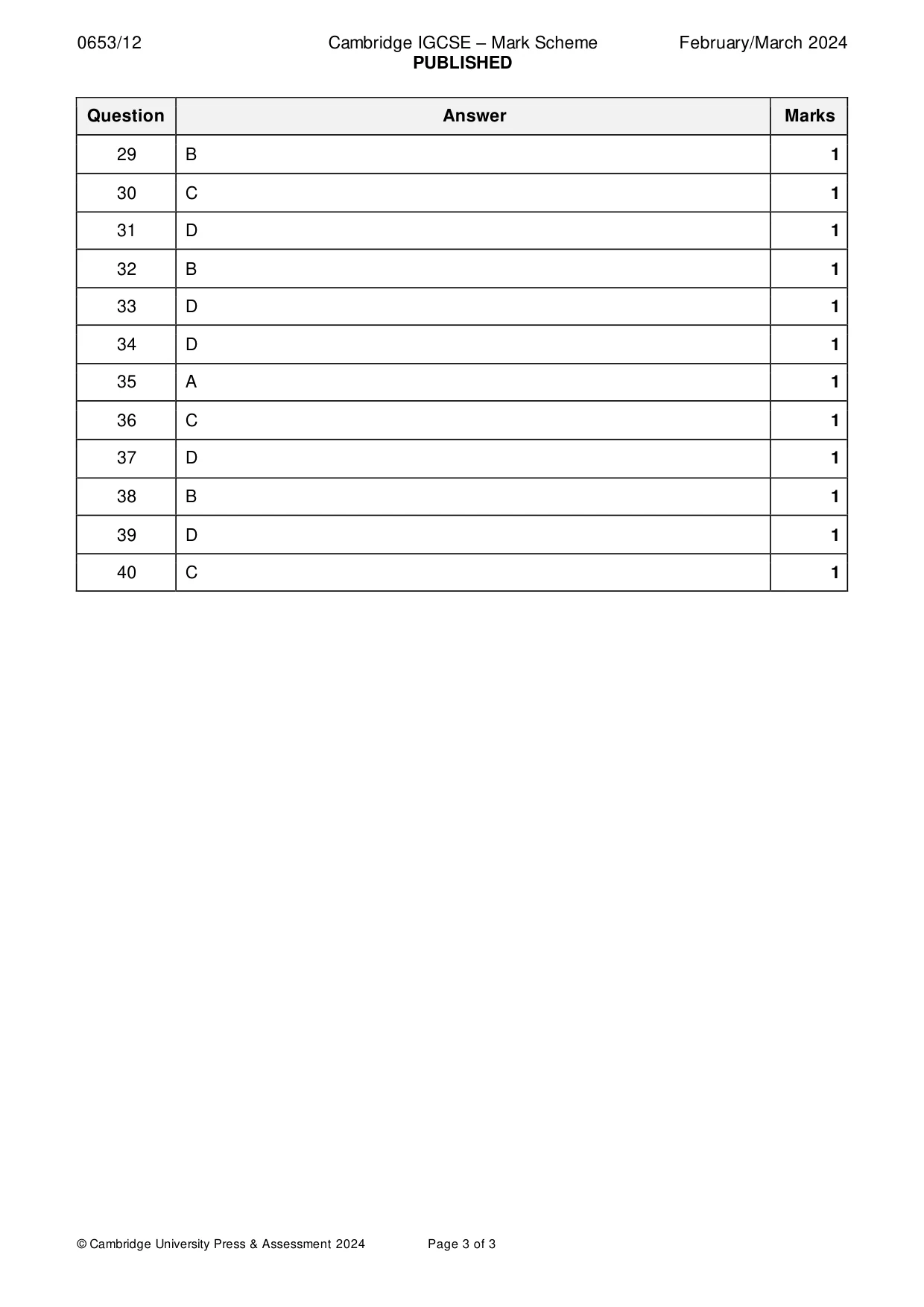
Mark scheme: B
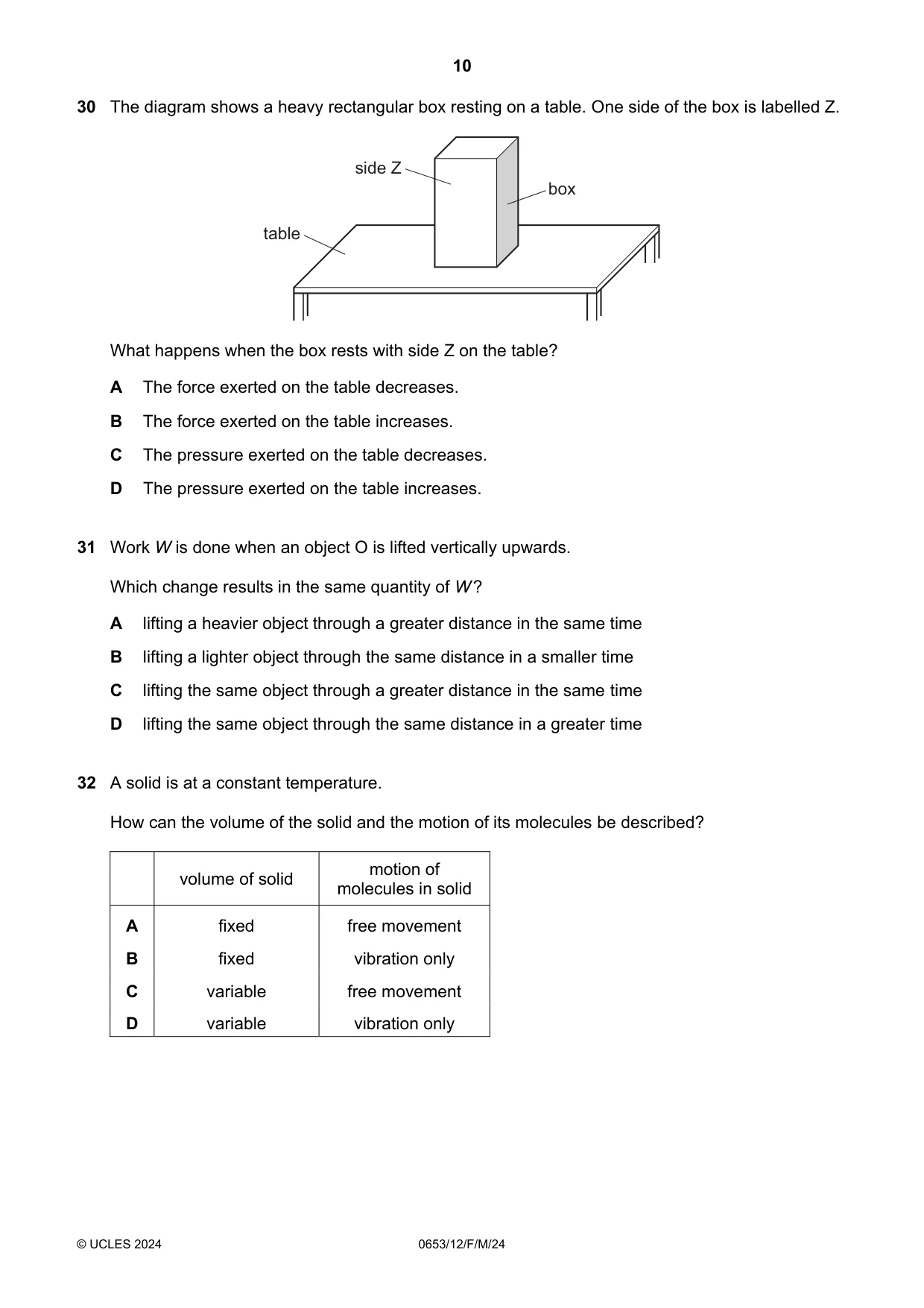
Q30 · The diagram shows a heavy rectangular box resting on a table
30 The diagram shows a heavy rectangular box resting on a table. One side of the box is labelled Z. side Z box table What happens when the box rests with side Z on the table? A The force exerted on the table decreases. B The force exerted on the table increases. C The pressure exerted on the table decreases. D The pressure exerted on the table increases.
Mark scheme: C
Q31 · Work W is done when an object O is lifted vertically upwards
31 Work W is done when an object O is lifted vertically upwards. Which change results in the same quantity of W ? A lifting a heavier object through a greater distance in the same time B lifting a lighter object through the same distance in a smaller time C lifting the same object through a greater distance in the same time D lifting the same object through the same distance in a greater time
Mark scheme: D
Q32 · A solid is at a constant temperature
32 A solid is at a constant temperature. How can the volume of the solid and the motion of its molecules be described? motion of volume of solid molecules in solid A fixed free movement B fixed vibration only C variable free movement D variable vibration only
Mark scheme: B
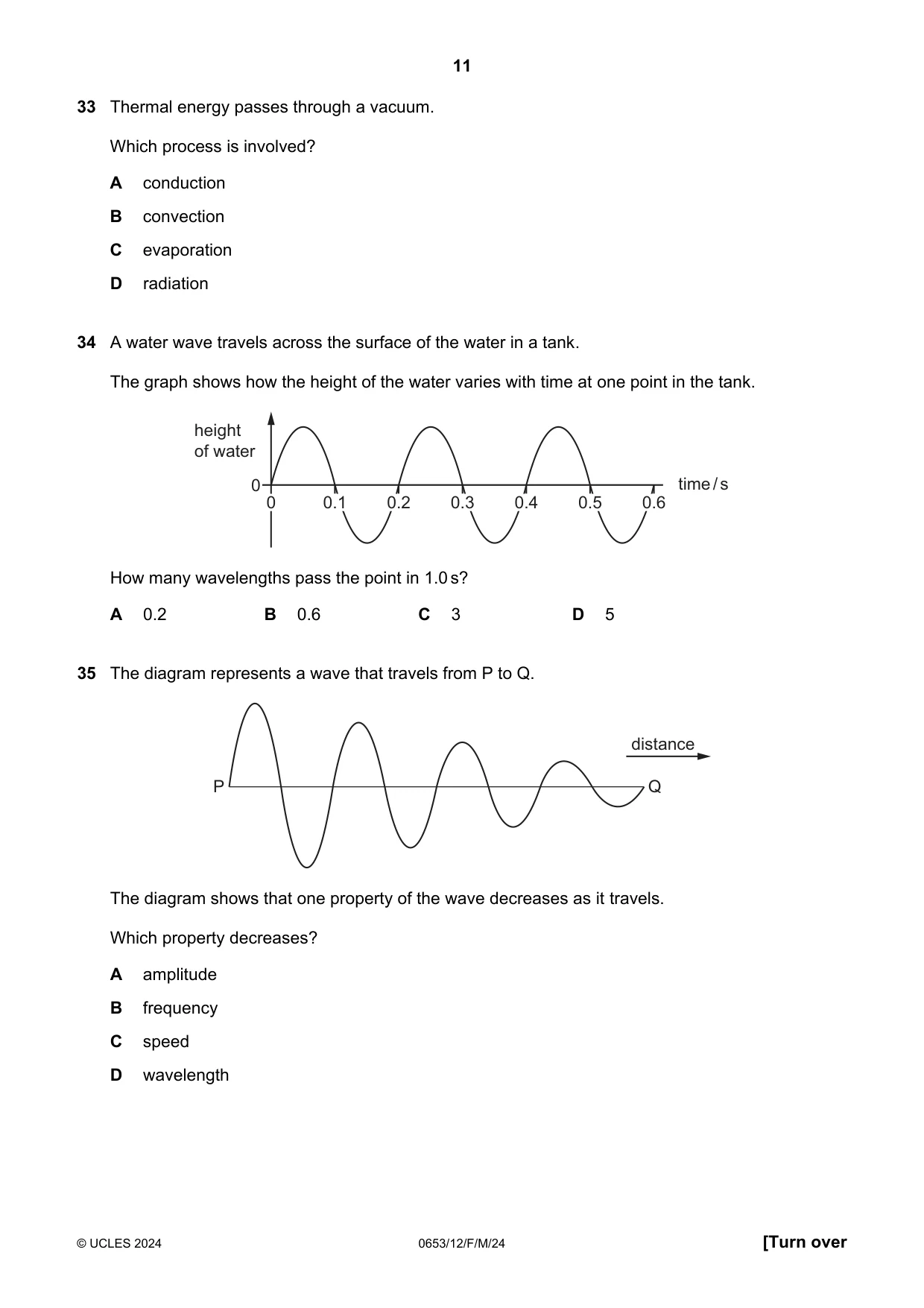
Q33 · Thermal energy passes through a vacuum
33 Thermal energy passes through a vacuum. Which process is involved? A conduction B convection C evaporation D radiation
Mark scheme: D
Q34 · A water wave travels across the surface of the water in a tank
34 A water wave travels across the surface of the water in a tank. The graph shows how the height of the water varies with time at one point in the tank. height of water 0 time / s 0 0.1 0.2 0.3 0.4 0.5 0.6 How many wavelengths pass the point in 1.0 s? A 0.2 B 0.6 C 3 D 5
Mark scheme: D
Q35 · The diagram represents a wave that travels from P to Q
35 The diagram represents a wave that travels from P to Q. distance P Q The diagram shows that one property of the wave decreases as it travels. Which property decreases? A amplitude B frequency C speed D wavelength
Mark scheme: A
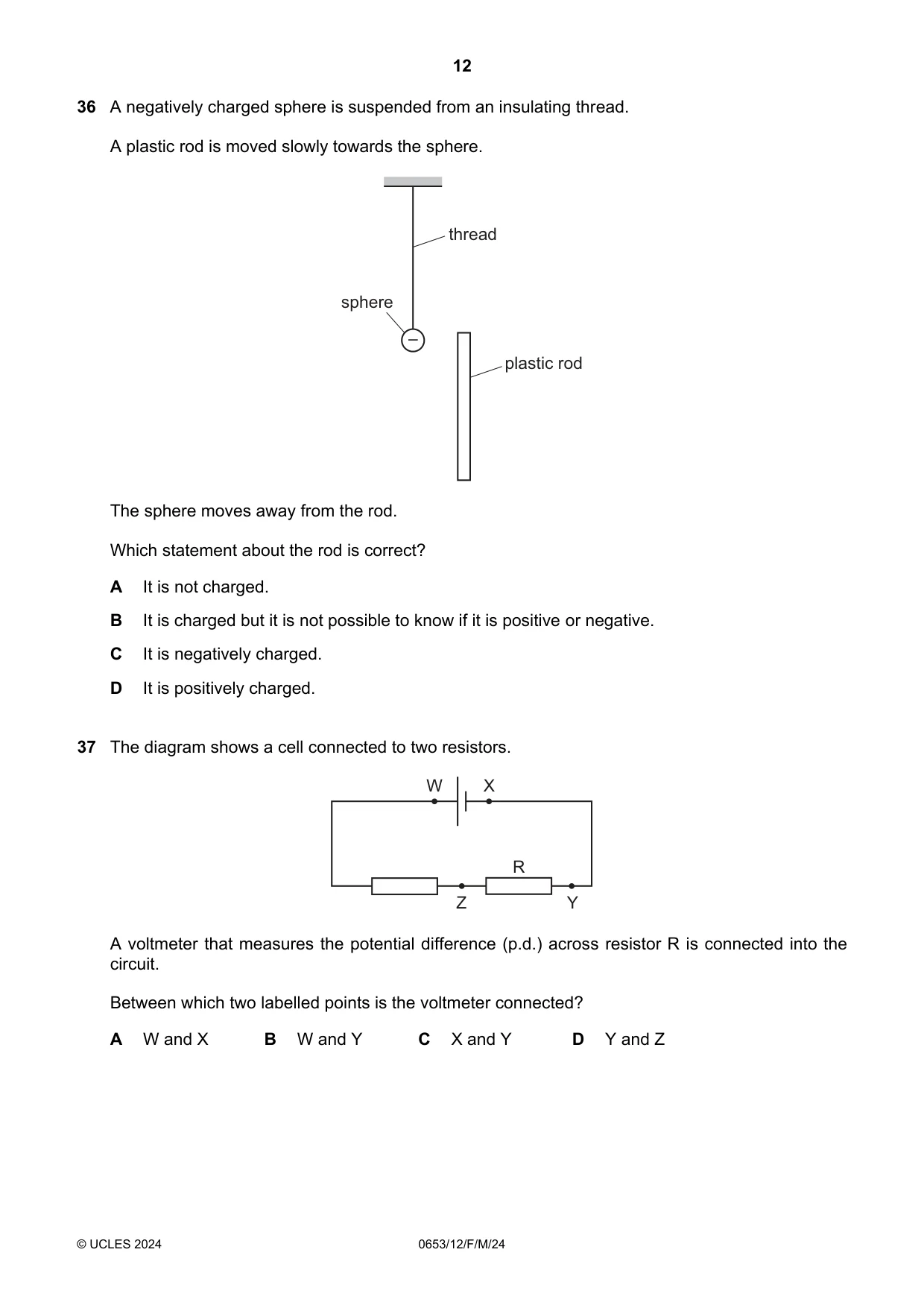
Q36 · A negatively charged sphere is suspended from an insulating thread
36 A negatively charged sphere is suspended from an insulating thread. A plastic rod is moved slowly towards the sphere. thread sphere – plastic rod The sphere moves away from the rod. Which statement about the rod is correct? A It is not charged. B It is charged but it is not possible to know if it is positive or negative. C It is negatively charged. D It is positively charged.
Mark scheme: C
Q37 · The diagram shows a cell connected to two resistors
37 The diagram shows a cell connected to two resistors. W X R Z Y A voltmeter that measures the potential difference (p.d.) across resistor R is connected into the circuit. Between which two labelled points is the voltmeter connected? A W and X B W and Y C X and Y D Y and Z
Mark scheme: D
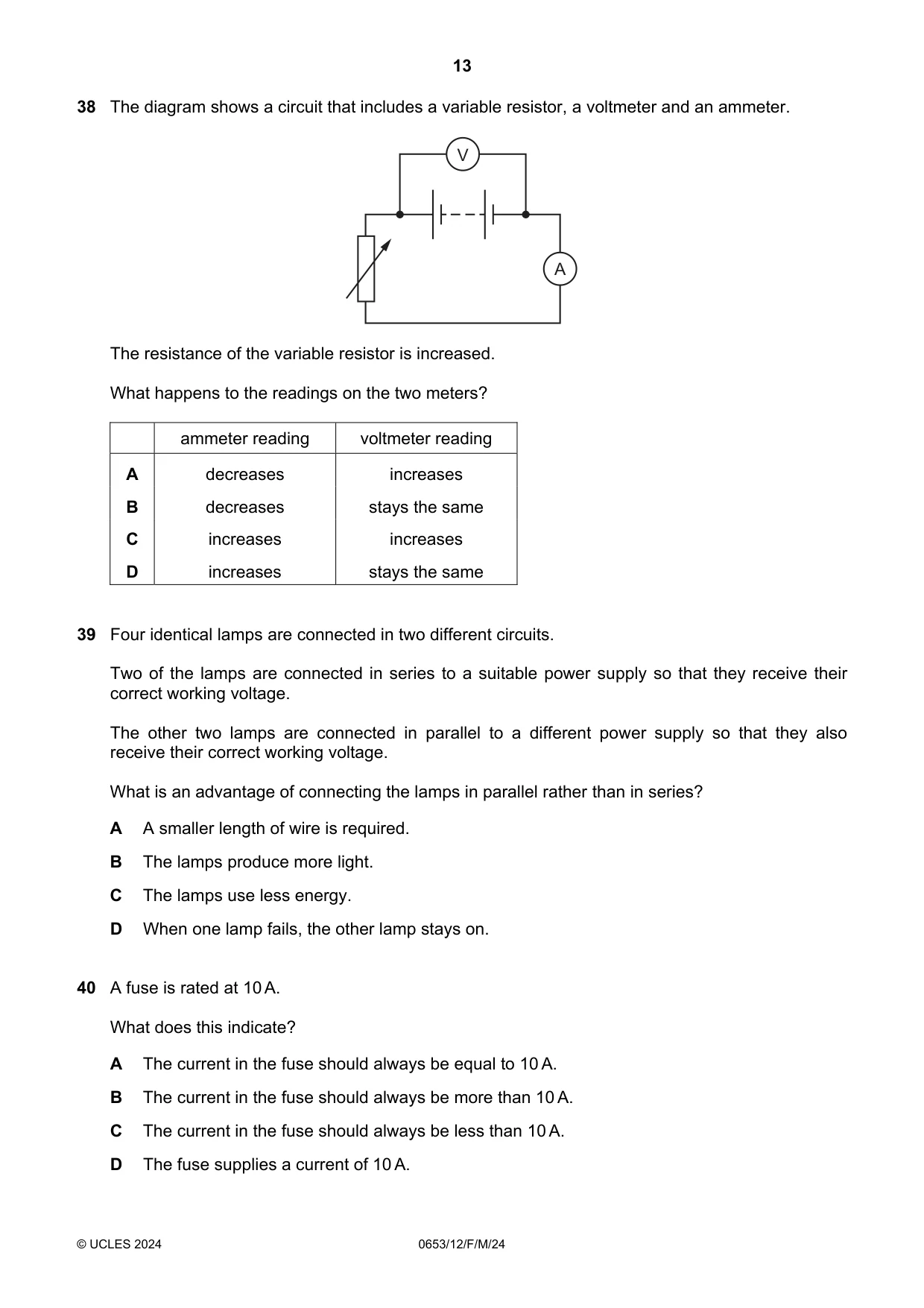
Q38 · The diagram shows a circuit that includes a variable resistor, a voltmeter and an ammeter
38 The diagram shows a circuit that includes a variable resistor, a voltmeter and an ammeter. V A The resistance of the variable resistor is increased. What happens to the readings on the two meters? ammeter reading voltmeter reading A decreases increases B decreases stays the same C increases increases D increases stays the same
Mark scheme: B
Q39 · Four identical lamps are connected in two different circuits
39 Four identical lamps are connected in two different circuits. Two of the lamps are connected in series to a suitable power supply so that they receive their correct working voltage. The other two lamps are connected in parallel to a different power supply so that they also receive their correct working voltage. What is an advantage of connecting the lamps in parallel rather than in series? A A smaller length of wire is required. B The lamps produce more light. C The lamps use less energy. D When one lamp fails, the other lamp stays on.
Mark scheme: D
Q40 · A fuse is rated at 10 A
40 A fuse is rated at 10 A. What does this indicate? A The current in the fuse should always be equal to 10 A. B The current in the fuse should always be more than 10 A. C The current in the fuse should always be less than 10 A. D The fuse supplies a current of 10 A.
Mark scheme: C
What was in this paper
The subtopics covered by these 40 questions, and how many questions each got. Open one in a new tab to see every Cambridge question on it.
3General properties of waves2Kinetic particle model of matter2Air quality and climate1Alkenes1Arrangement of elements1Biological molecules1Carbon cycle1Cell structure1Characteristics of living organisms1Diet1Digestion1Electrical quantities1Electrical safety1Electrolysis1Elements, compounds and mixtures1Energy, work and power1Enzymes1Exothermic and endothermic reactions1Food chains and food webs1Forces1Fuels1Gas exchange in humans1Identification of ions and gases1Mass and weight1Photosynthesis1Pressure1Properties of metals1Rate of reaction1Redox1Respiration1Separation and purification1Sexual reproduction in humans1Transfer of thermal energy1Transition elements1Water uptake1What you needed in this session
Cambridge’s own grade thresholds for 2024 Feb/March, Paper 1 · Variant 2. A higher threshold means an easier paper — the bar moves with how the cohort did.