Questions as text
Q1 · A wind surfer on a surf board, driven by the wind, sailing at a constant speed across the… 0653/31 May/June 2017
3 Fig. 3.1 shows a wind surfer on a surf board, driven by the wind, sailing at a constant speed across the sea. The arrows labelled A, B, C and D show the forces acting on the surf board. direction of wind direction of travel C B D A Fig. 3.1 (a) (i) Complete Table 3.1 using the letters A, B, C and D. Table 3.1 name of force letter on Fig. 3.1 driving force frictional force upthrust of water weight [2] (ii) Force A is measured and found to be 1200 N. State whether force C is 1200 N or has a different value. Give a reason for your answer. … … [1] (iii) State which force needs to be increased to make the surf board sail at a faster speed. … [1] (b) The speed of the surf board is 12 km / h. Calculate the speed of the surf board in m / s. Show your working. speed = … m / s [1] (c) The wind provides the energy for the work needed to move the surf board across the sea. (i) State the two quantities that must be measured to calculate the work done in moving the surf board during its journey across the sea. … and … [2] (ii) State the type of energy the surf board has when it is being moved by the wind. … [1] (iii) The wind stops blowing and the surf board slows down and stops. Describe what has happened to the energy in (c)(ii). … … [1]
9 marks
Mark scheme: 3(a)(i) name of force letter on Fig. 1.1 driving force B frictional force D upthrust of water C weight A two letters correct ; two more letters correct ; 2 3(a)(ii) (Force C is 1200 N) no mark no vertical motion / forces (A and C) must balance ; 1 3(a)(iii) B / driving force ; 1 3(b) 12 km / h (= 12 000 m / h = 200 m / min) = 3.3 m / s ; 1 3(c)(i) (magnitude of) force ; distance (moved) ; 2 3(c)(ii) kinetic (energy) / KE ; 1 3(c)(iii) transferred to other forms of energy ; 1
This question in 0653/31 May/June 2017
Q2 · An aircraft flying at a constant height and constant speed above the Earth’s surface 0653/32 May/June 2017
3 Fig. 3.1 shows an aircraft flying at a constant height and constant speed above the Earth’s surface. The arrows labelled A, B, C and D show the forces acting on the aircraft. B C A D Fig. 3.1 (a) (i) Complete Table 3.1 using the letters A, B, C and D. Table 3.1 name of force letter on Fig. 3.1 driving force frictional force lifting force weight [2] (ii) Force D is measured and found to be 500 000 N. State whether force B is 500 000 N or has a different value. Give a reason for your answer. … … … [1] (iii) State which force should be increased by the pilot 1. to make the aircraft fly at a faster speed, … 2. to make the aircraft go up to a higher height. … [2] (b) The speed of the aircraft is 600 km / h. (i) Calculate the speed of the aircraft in m / s. Show your working. speed = … m / s [1] (ii) The aircraft travels at this speed for a distance of 2700 km. The pilot tells his passengers that the flight time will be 4 hours 30 minutes. Show by calculation that the pilot is correct. [1] (c) The aircraft slows down and descends to a lower height. Describe the energy changes that have taken place for the aircraft. … … … [2] (d) Another aircraft takes off and climbs to cruising height. It then travels at a constant speed until it descends and lands. On Fig. 3.2 sketch the shape of the speed-time graph for the whole journey of this aircraft from take-off to landing. speed 0 0 time Fig. 3.2 [2] Please turn over for Question 4
11 marks
Mark scheme: 3(a)(i) one mark for each two correct ;; name of force letter on Fig. 1.1 driving force A frictional force C lifting force B weight D 2 3(a)(ii) (Force B is 500 000 N) no mark constant height; forces (B and D) are balanced ; 1 3(a)(iii) 1. A / driving force ; 2. B / lifting force ; 2 3(b)(i) 600 km / h = 600 000 / 3600 m / s = 167 m / s ; 1 3(b)(ii) time (= distance / speed) = 2700 / 600 = 4.5 h 1 3(c) loss of kinetic energy ; loss of (gravitational) potential energy ; 2 3(d) any variation on this shape that goes from the origin to a maximum and returns to speed = 0 ; horizontal section at constant maximum speed ; 2
This question in 0653/32 May/June 2017
Q3 · An aircraft flying at a constant height and constant speed above the Earth’s surface 0653/33 May/June 2017
3 Fig. 3.1 shows an aircraft flying at a constant height and constant speed above the Earth’s surface. The arrows labelled A, B, C and D show the forces acting on the aircraft. B C A D Fig. 3.1 (a) (i) Complete Table 3.1 using the letters A, B, C and D. Table 3.1 name of force letter on Fig. 3.1 driving force frictional force lifting force weight [2] (ii) Force D is measured and found to be 500 000 N. State whether force B is 500 000 N or has a different value. Give a reason for your answer. … … … [1] (iii) State which force should be increased by the pilot 1. to make the aircraft fly at a faster speed, … 2. to make the aircraft go up to a higher height. … [2] (b) The speed of the aircraft is 600 km / h. (i) Calculate the speed of the aircraft in m / s. Show your working. speed = … m / s [1] (ii) The aircraft travels at this speed for a distance of 2700 km. The pilot tells his passengers that the flight time will be 4 hours 30 minutes. Show by calculation that the pilot is correct. [1] (c) The aircraft slows down and descends to a lower height. Describe the energy changes that have taken place for the aircraft. … … … [2] (d) Another aircraft takes off and climbs to cruising height. It then travels at a constant speed until it descends and lands. On Fig. 3.2 sketch the shape of the speed-time graph for the whole journey of this aircraft from take-off to landing. speed 0 0 time Fig. 3.2 [2] Please turn over for Question 4
11 marks
Mark scheme: 3(a)(i) one mark for each two correct ;; name of force letter on Fig. 1.1 driving force A frictional force C lifting force B weight D 2 3(a)(ii) (Force B is 500 000 N) no mark constant height; forces (B and D) are balanced ; 1 3(a)(iii) 1. A / driving force ; 2. B / lifting force ; 2 3(b)(i) 600 km / h = 600 000 / 3600 m / s = 167 m / s ; 1 3(b)(ii) time (= distance / speed) = 2700 / 600 = 4.5 h 1 3(c) loss of kinetic energy ; loss of (gravitational) potential energy ; 2 3(d) any variation on this shape that goes from the origin to a maximum and returns to speed = 0 ; horizontal section at constant maximum speed ; 2
This question in 0653/33 May/June 2017
Q4 · A helicopter hovering above the ground 0653/32 Oct/Nov 2017
3 Fig. 3.1 shows a helicopter hovering above the ground. rotor blades Fig. 3.1 (a) The helicopter stays in one place as it hovers. The turning rotor blades provide the uplift force to keep it in the air. On Fig. 3.1 draw two force arrows to show the vertical forces acting on the helicopter. Label each arrow with the name of the force acting on the helicopter. [3] (b) The helicopter uses fuel to power its engines which turn the rotor blades. The pilot increases the speed of the rotor blades and the helicopter climbs vertically to a height of 1000 m. It then hovers again at this height. Complete the sequence of energy transfers for the helicopter below. … energy in the fuel … energy of the rotor blades kinetic … energy of the climbing helicopter … energy of the helicopter at 1000 m. [3] (c) The helicopter starts to move forward. It increases speed for 20 s until it reaches a constant speed of 50 m / s. It continues at this speed for 100 s. It then slows down for 10 s to hover in one place again. (i) On the grid in Fig. 3.2, plot a speed-time graph of the helicopter journey, which lasts 130 s. 50 40 30 speed m / s 20 10 0 0 20 40 60 80 100 120 140 time / s Fig. 3.2 [2] (ii) Calculate the distance moved by the helicopter while flying at constant speed. Show your working. working distance = … m [2]
10 marks
Mark scheme: 3(a) force arrow vertically upward labelled ‘uplift’ ; force arrow vertically downward labelled ‘weight’ or ‘gravitational force’ ; (the two vertical) arrows in contact with helicopter / of equal length ; 3 3(b) chemical ; kinetic ; gravitational / potential ; 3 3(c)(i) one section of plot correct ; all 3 sections of the plot correct ; 2 3(c)(ii) distance = speed × time (= 50 × 100) ; = 5000 (m) ; 2
This question in 0653/32 Oct/Nov 2017
Q5 · Four forces, P, Q, R and S, acting on a submarine 0653/33 Oct/Nov 2017
3 Fig. 3.1 shows four forces, P, Q, R and S, acting on a submarine. The submarine is travelling underwater and moving to the right at constant speed. P S Q R Fig. 3.1 (a) In Table 3.1 complete the names of the forces P, Q, R and S. Table 3.1 P uplift Q R S driving force [2] (b) The submarine is travelling at a constant depth. State how the magnitude of force P compares to force R. … [1] (c) The submarine captain cannot use a radio transmitter underwater. The captain orders the crew to take the submarine to the surface so he can use a radio transmitter. (i) State which force must be increased to bring the submarine to the surface. … [1] (ii) Fig. 3.2 shows an incomplete electromagnetic spectrum. On Fig. 3.2 add radio waves in their correct place. visible micro- gamma light waves Fig. 3.2 [1] (iii) Electromagnetic waves do not pass easily through sea water. Suggest a different kind of wave that can travel in water and might be used to send a signal. … [1] (d) When submerged, the submarine has to use an energy source that does not depend upon the Sun or on burning a fuel. Suggest a suitable energy source that can be carried in a submarine in order to power the submarine underwater. … [1] (e) Use steps 1 to 3 below to calculate the average speed of the submarine in metres per second (m / s) if it travels 30 kilometres in 1 hour. Step 1: convert 30 kilometres to metres. … m Step 2: convert 1 hour to seconds. … s Step 3: calculate the speed in metres per second. speed = … m / s [2]
9 marks
Mark scheme: 3(a) (Q =) friction / (water) resistance ; (R =) gravitational force / weight ; 2 3(b) (forces P and R) equal / balanced ; 1 3(c)(i) P / uplift ; 1 3(c)(ii) gamma visible light micro- waves radio waves ; 1 3(c)(iii) sound ; 1 3(d) nuclear / batteries ; 1 3(e) either 30 km = 30 000 m or 1 hour = 3600 s ; (30 000 / 3600) = 8.3 m / s ; 2
This question in 0653/33 Oct/Nov 2017
Q6 · A diagram which shows the International Space Station which is kept in orbit around the… 0653/32 Feb/March 2018
3 Fig. 3.1 is a diagram which shows the International Space Station which is kept in orbit around the Earth by a force which prevents it escaping into space. Fig. 3.1 (a) Name this force. … [1] (b) On one of its orbits, the space station travels at a speed of 28 000 km / h and takes 90 minutes to complete one orbit of the Earth. Calculate the distance travelled by the space station during this orbit. Show your working. distance = … km [2] (c) The mass of the Earth is 5972 × 1021 kg. The volume of the Earth is 1.08 × 10²¹ m3. Calculate the density of the Earth. State the formula you use, show your working and give the units of your answer. formula working density = … units … [3] (d) Fig. 3.2 shows the large solar panels that provide energy for the space station. solar panels Fig. 3.2 (i) The solar cells are in large panels that face the Sun to gather energy. This energy is stored by charging batteries on board the space station. Complete the sequence of energy conversions that take place. Radiation from the Sun to … energy in the solar cells to … energy in the batteries. [2] (ii) Each solar cell contains solid crystals of silicon. On Fig. 3.3 below draw a diagram to show the arrangement of atoms in a crystal of silicon. One atom has been drawn for you; you should draw at least 10 more atoms of the same size. Fig. 3.3 [2]
10 marks
Mark scheme: 3(a) gravitational force / weight ; 1 3(b) speed = distance / time or AV ; distance (= speed × time) = 28 000 × 90 / 60 = 42 000 (km) ; 2 3(c) density = mass / volume ; = 5972 × 1021 / 1.08 × 1021 = 5530 ; (units) kg / m3 ; 3 3(d)(i) electrical (energy in solar cells) ; chemical (energy in the batteries) ; 2 3(d)(ii) regular arrangement of at least 10 atoms of similar size ; all touching ; 2
This question in 0653/32 Feb/March 2018
Q7 · A crane carrying a load 0653/32 May/June 2018
3 Fig. 3.1 shows a crane carrying a load. The crane is floating in the sea on a calm day. load crane sea Fig. 3.1 (a) (i) The load is stationary. On Fig. 3.1 draw two force arrows to show the vertical forces acting on the load. [2] (ii) One of the forces acting on the load is called tension. Name the other force acting on the load. … [1] (b) The crane lifts a load upwards from the sea bed to the surface of the sea at a constant speed of 0.60 m / s. The depth of the sea is 200 m. Calculate the time taken to lift the load from the sea bed to the surface. Show your working. time = … s [2] (c) The load being lifted by the crane is a large container full of sea water. The volume inside the container is 5000 dm3. The density of sea water is 1.025 kg / dm3. Calculate the mass of sea water being lifted. State the formula you use and show your working. formula working mass = … kg [2] (d) Two cranes, A and B, are working to lift loads. Crane A has a power output of 35 kW, crane B has a power output of 40 kW. (i) Name the unit with the symbol W. … [1] (ii) Both cranes can lift the same load through the same distance from the sea bed to the surface. Explain why the higher power output from crane B means it can lift the load to the surface faster than crane A. … … … … [2]
10 marks
Mark scheme: 3(a)(i) two opposing vertical force arrows ; both arrows from the load ; 2 3(a)(ii) weight / gravitational force ; 1 3(b) speed = distance / time or time = 200 / 0.60 ; = 333 s ; 2 3(c) density = mass / volume or mass = volume × density = 5000 × 1.025 ; = 5125 (kg) ; 2 3(d)(i) watt ; 1 3(d)(ii) idea that the same amount of energy is transferred / work done ; the same amount of energy is transferred / work done in less time ; 2
This question in 0653/32 May/June 2018
Q8 · A crane carrying a load 0653/33 May/June 2018
3 Fig. 3.1 shows a crane carrying a load. The crane is floating in the sea on a calm day. load crane sea Fig. 3.1 (a) (i) The load is stationary. On Fig. 3.1 draw two force arrows to show the vertical forces acting on the load. [2] (ii) One of the forces acting on the load is called tension. Name the other force acting on the load. … [1] (b) The crane lifts a load upwards from the sea bed to the surface of the sea at a constant speed of 0.60 m / s. The depth of the sea is 200 m. Calculate the time taken to lift the load from the sea bed to the surface. Show your working. time = … s [2] (c) The load being lifted by the crane is a large container full of sea water. The volume inside the container is 5000 dm3. The density of sea water is 1.025 kg / dm3. Calculate the mass of sea water being lifted. State the formula you use and show your working. formula working mass = … kg [2] (d) Two cranes, A and B, are working to lift loads. Crane A has a power output of 35 kW, crane B has a power output of 40 kW. (i) Name the unit with the symbol W. … [1] (ii) Both cranes can lift the same load through the same distance from the sea bed to the surface. Explain why the higher power output from crane B means it can lift the load to the surface faster than crane A. … … … … [2]
10 marks
Mark scheme: 3(a)(i) two opposing vertical force arrows ; both arrows from the load ; 2 3(a)(ii) weight / gravitational force ; 1 3(b) speed = distance / time or time = 200 / 0.60 ; = 333 s ; 2 3(c) density = mass / volume or mass = volume × density = 5000 × 1.025 ; = 5125 (kg) ; 2 3(d)(i) watt ; 1 3(d)(ii) idea that the same amount of energy is transferred / work done ; the same amount of energy is transferred / work done in less time ; 2
This question in 0653/33 May/June 2018
Q9 · A train made up of a steam engine and a passenger coach 0653/31 Oct/Nov 2018
3 Fig. 3.1 shows a train made up of a steam engine and a passenger coach. steam engine passenger coach Fig. 3.1 (a) The train is travelling at a constant speed along a level track. Fig. 3.2 shows the four forces W, X, Y and Z acting on the train. X W Y Z Fig. 3.2 (i) Name force Z. … [1] (ii) The force arrows on Fig. 3.2 do not show the sizes of the forces. State whether or not the driver has made force W equal in size to force Y. Explain your answer. … … [1] (b) Fig. 3.3 shows a speed–time graph of the train as it travels between two stations. 30 20 speed m / s 10 0 0 100 200 300 400 500 600 700 time / s Fig. 3.3 (i) On Fig. 3.3, use the letter P to label one point in the journey when the train is travelling with changing speed. [1] (ii) The distance between the two stations is 12.8 km. State the distance between the stations in metres. distance = … m [1] (iii) Use your answer to (b)(ii) and information from the graph to calculate the average speed of the train on this journey in m / s. Show your working. average speed = … m / s [2] (c) The steam engine is powered by burning coal to boil water. This makes steam that moves the engine. Complete the energy transfer that moves the train. … energy in the coal … energy of the train. [2] (d) State the original source of the energy stored in coal. … [1]
9 marks
Mark scheme: 3(a)(i) weight / gravitational (force) ; 1 3(a)(ii) yes (no mark) constant speed / no acceleration, (so forces must balance) ; 1 3(b)(i) P on any point on graph line between 0 and 200 s, or between 520 and 650 s ; 1 3(b)(ii) 12 800 (m) ; 1 3(b)(iii) (average speed = ) (total) distance / (total) time ; (12800 / 650) = 19.7 or 20 (m / s) ; 2 3(c) chemical ; kinetic ; 2 3(d) the Sun ; 1
This question in 0653/31 Oct/Nov 2018
Q10 · A farm tractor pulling a trailer 0653/32 Oct/Nov 2018
3 Fig. 3.1 shows a farm tractor pulling a trailer. Fig. 3.1 (a) The tractor and trailer are moving across a level field. Fig. 3.2 shows the four forces W, X, Y and Z acting on the trailer. X Y W Z Fig. 3.2 (i) State the letter corresponding to the gravitational force acting on the trailer. … [1] (ii) The tractor and trailer are moving at a constant speed. Force W has a value of 2000 N. State the value of force Y. Explain your answer. value of force Y = … N explanation … … [2] (b) The tractor leaves the trailer in the field and drives to the farmyard. Fig. 3.3 shows a speed–time graph of the tractor as it travels from the field to the farmyard. 4 3 speed 2 m / s 1 0 0 10 20 30 40 50 60 time / s Fig. 3.3 (i) On Fig 3.3, label with a letter C a point in the journey when the tractor is travelling with changing speed. [1] (ii) The tractor travels 200 m from the field to the farmyard. Use information from the graph to calculate the average speed of the tractor on this journey in m / s. Show your working. average speed = … m / s [2] (c) (i) The tractor is powered by a diesel engine, which burns diesel oil. Complete the energy transfer that occurs to move the tractor. … energy in the diesel oil … energy of the tractor. [2] (ii) State the original source of the energy stored in diesel oil. … [1] (iii) To keep the tractor moving at constant speed for 30 s, an energy input of 300 000 J from diesel fuel is needed. Only 60 000 J is required to do the work against forces resisting the motion. Describe what happens to most of the wasted energy. … … [1]
10 marks
Mark scheme: 3(a)(i) Z 1 3(a)(ii) 2000 N ; constant speed / no acceleration, (so forces must balance) ; 2 3(b)(i) C on any point on graph line between 0 and 20 s, or between 50 and 60 s ; 1 3(b)(ii) (average) speed = (total) distance / (total) time ; = 200 / 60 = 3.3(3) (m / s) ; 2 3(c)(i) chemical ; kinetic ; 2 3(c)(ii) the Sun ; 1 3(c)(iii) converted / transformed into thermal energy ; 1
This question in 0653/32 Oct/Nov 2018
Q11 · A man pushing a shopping trolley 0653/33 Oct/Nov 2018
3 Fig. 3.1 shows a man pushing a shopping trolley. Fig. 3.1 (a) The man and the trolley are moving. Fig. 3.2 shows the four forces W, X, Y and Z acting on the trolley. W X Z Y Fig. 3.2 State the letter corresponding to the gravitational force acting on the trolley. … [1] (b) Fig. 3.3 shows a speed–time graph of the trolley as the man pushes it to the checkout. 1.0 0.75 speed 0.5 m / s 0.25 0 0 5 10 15 20 25 30 time / s Fig. 3.3 (i) On Fig. 3.3, label with a letter C a point in the journey when the trolley is travelling with changing speed. [1] (ii) The trolley travels 20 m to the checkout. Use information from the graph to calculate the average speed of the trolley on this journey. Show your working. average speed = … m / s [2] (c) The man provides the energy to push the trolley to the checkout. The original source of the energy in the man is the Sun. (i) Use words from the list to complete the sentences that describe how energy is transferred from the Sun to move the trolley. Each word may be used once, more than once, or not at all. chemical electrical gravitational kinetic nuclear Light energy from the Sun is converted to … energy in food. When the man eats the food, he gains … energy. When he pushes the trolley, some of this energy is transferred to the … energy of the trolley. [3] (ii) To keep the trolley moving at constant speed for 15 s, an energy input of 20 000 J to the man is needed. Only 2400 J is required to do the work against forces resisting the motion. Describe what happens to most of the wasted energy. … … [1]
8 marks
Mark scheme: 3(a) Y ; 1 3(b)(i) C at any point on graph line between 5 and 10 s, or between 25 and 30 s ; 1 3(b)(ii) (average) speed = (total) distance / (total) time or 20 / 30 ; = 0.67 (m / s) ; 2 3(c)(i) chemical ; chemical ; kinetic ; 3 3(c)(ii) converted / transformed into thermal energy; 1
This question in 0653/33 Oct/Nov 2018
Q12 · A whale swimming underwater 0653/31 May/June 2019
3 Fig. 3.1 shows a whale swimming underwater. P R Q Fig. 3.1 (a) (i) The force arrows labelled P and Q show the vertical forces acting on the whale. Name force Q. … [1] (ii) The whale is swimming at constant depth, using a force R to push itself forward. On Fig. 3.1 draw a force arrow to show the frictional force opposing the motion of the whale, and label it S. [1] (iii) When force R is 500 N, the whale moves at a constant speed of 5.0 km / h. State the value of force S. force S = … N [1] (iv) Force R decreases to 400 N. Force P increases. Describe how these two changes affect the motion of the whale. … … … [2] (b) The whale does work against the friction of the water as it swims at a constant speed and a constant depth on a journey. (i) State the two quantities needed to calculate the work done by the whale on its journey. … and … [2] (ii) Complete the sequence of energy changes that occur on the whale’s journey. … energy in the whale to … energy of the whale thermal to … energy transferred to the water. [2] (c) The whale makes a sound to call to another whale 9000 m away. The second whale hears the call 6.0 seconds later. Calculate the speed of sound in water. Show your working. speed = … m / s [2] [Total: 11]
11 marks
Mark scheme: 3(a)(i) weight / gravitational force / (force of) gravity 1 3(a)(ii) horizontal arrow pointing to right, with one end touching whale 1 3(a)(iii) 500 (N) 1 3(a)(iv) slows down ; moves upwards ; 2 3(b)(i) force (exerted by the whale) ; distance (travelled) ; 2 3(b)(ii) chemical potential ; (to) kinetic ; 2 3(c) speed = distance/time or 9000 / 6.0 ; = 1500 (m / s) ; 2
This question in 0653/31 May/June 2019
Q13 · A forklift truck moving a large heavy box towards a shelf 0653/32 May/June 2019
9 Fig. 9.1 shows a forklift truck moving a large heavy box towards a shelf. Q shelf box P R S Fig. 9.1 (a) The arrows labelled P, Q, R and S show four forces acting on the forklift truck. (i) State which letter represents the frictional forces acting on the moving truck. … [1] (ii) The truck stops and the motor is switched off. State the letters of all the forces that now have a value of 0 N. … [1] (b) The box has a mass of 500 kg. The forklift truck lifts the box upwards from rest on the ground using a force to push the box up. Fig. 9.2 shows the directions of the forces acting on the box. U W Fig. 9.2 (i) The gravitational field strength g is 10 N / kg. Calculate the weight W of the box. W = … N [1] (ii) State how the upward force U on the box compares with the weight W of the box as the box begins to move upwards. … [1] (iii) The truck lifts the box towards two shelves, one at 1 m above the ground, the other at 3 m above the ground. Compare the work required to lift the box from the ground to the higher shelf with the work required to lift the box from the ground to the lower shelf. Explain your answer. … … … [2] (c) The truck is driven a distance of 225 m to collect another box. Fig. 9.3 shows the speed–time graph for this journey. 6 5 speed m / s 4 3 2 1 0 0 10 20 30 40 50 60 time / s Fig. 9.3 (i) Calculate the average speed of the truck on this journey. Show your working. average speed = … m / s [2] (ii) Describe the motion of the truck between 0 s and 20 s. … [1] (iii) The truck is driven by an electric motor powered by a battery. Complete the energy transfers involved. from … energy in the battery to … energy driving the motor to kinetic energy of the truck. [2] [Total: 11]
11 marks
Mark scheme: 9(a)(i) R ; 1 9(a)(ii) R, P ; 1 9(b)(i) 5000 (N) ; 1 9(b)(ii) greater ; 1 9(b)(iii) more work ; (same force / box lifted through) greater distance (from the ground) / box lifted through 3 m rather than 1 m ; 2 9(c)(i) average speed = total distance / total time or speed = d t = 225 60 ; = 3.75 m/s ; 2 9(c)(ii) accelerating / speeding up ; 1 9(c)(iii) chemical / potential) ; (to) electrical ; 2
This question in 0653/32 May/June 2019
Q14 · How a small hydroelectric power station is used to supply electricity 0653/31 Oct/Nov 2019
3 Fig. 3.1 shows how a small hydroelectric power station is used to supply electricity. dam power lines to house house water generator lake river pipe turbine Fig. 3.1 (a) The flowing water turns the turbine (a type of waterwheel), which then turns the generator. Use words from the list to complete the sequence of energy changes that take place. Each word may be used once, more than once or not at all. chemical elastic electrical gravitational kinetic light sound thermal … potential energy of water in the lake … energy of flowing water in the pipe … energy of the turning turbine and generator … energy in the power lines. [3] (b) In a house, the electricity is used to power a television set. The aerial for the television set receives one type of electromagnetic wave. The television set emits a different type of electromagnetic wave. Fig. 3.2 shows the electromagnetic spectrum. gamma X-rays ultraviolet visible light infrared microwaves radio waves radiation Fig. 3.2 (i) Name the type of electromagnetic wave received by the aerial. … [1] (ii) Name the type of electromagnetic wave emitted by the television set. … [1] (c) A man in the house is listening to music on the television. Fig. 3.3 shows the sound waves coming from three different instruments, A, B and C, playing musical notes at the same time. A time B time C time Fig. 3.3 (i) State which instrument was playing the note with the highest pitch. Explain your answer. instrument … explanation … … [1] (ii) State which instrument was playing the loudest note. Explain your answer. instrument … explanation … … (iii) The man says he could hear two of the notes, but not the one with the lowest frequency. Suggest a value for the frequency that the man could not hear. State the unit of frequency in your answer. frequency = … unit … [2] (iv) Give a reason for your answer to (iii). … … [1] [Total: 10]
10 marks
Mark scheme: 3(a) gravitational kinetic kinetic electrical 1 or 2 correct = 1 mark 3 correct = 2 marks All correct = 3 marks 3 3(b)(i) radio waves / microwaves ; 1 3(b)(ii) visible light ; 1 3(c)(i) C and because more waves in same time / higher frequency ; 1 3(c)(ii) A and because waves have largest amplitude ; 1 3(c)(iii) any value below 20 (Hz) ; Hz / hertz ; 2 3(c)(iv) below the (normal) lower limit / frequency of human hearing ; 1
This question in 0653/31 Oct/Nov 2019
Q15 · A game played on a sloping board 0653/32 Oct/Nov 2019
3 Fig. 3.1 shows a game played on a sloping board. traps spring ball knob Fig. 3.1 A ball is launched by a spring up the slope and around the top of the board. The ball then rolls down the slope to fall into one of the traps. (a) Fig. 3.2 shows the compressed spring when the knob is pulled back. compressed spring knob ball Fig. 3.2 Fig. 3.3 shows the spring before it is compressed. knob ball Fig. 3.3 (i) On Fig. 3.3 draw a force arrow to show the direction of the force used to compress the spring. [1] (ii) State two effects that a force can have on an object. 1. … 2. … [2] (iii) As the spring is pulled back, work is done. State the two quantities that are needed to calculate the work done. 1. … 2. … [2] (b) When the ball is launched up the slope, energy is transferred from the compressed spring to the ball. The energy of the ball changes as it moves up the slope to other types of energy. Complete the sequence of energy changes. One has been done for you. from … elastic potential energy in the spring to … energy of the ball as it begins to move up the slope to … potential energy as the ball slows down going up the slope and … thermal energy lost to the environment [2] (c) The ball is made from steel. The mass of the ball is 6.0 g. The volume of the ball is 0.75 cm3. Calculate the density of the steel ball. Show your working. density = … g / cm3 [2] [Total: 9]
9 marks
Mark scheme: 3(a)(i) horizontal arrow to the right ; 1 3(a)(ii) any two from: changes (object’s) shape ; changes (object’s) size ; changes (object’s) motion ; 2 3(a)(iii) force (applied) ; distance (moved) ; 2 3(b) kinetic ; gravitational ; 2 3(c) density = mass / volume or density = 6.0 (g) / 0.75 (cm3) ; = 8.0 or 8 (g/cm3) ; 2
This question in 0653/32 Oct/Nov 2019
Q16 · A game played on a sloping board 0653/33 Oct/Nov 2019
3 Fig. 3.1 shows a game played on a sloping board. traps spring ball knob Fig. 3.1 A ball is launched by a spring up the slope and around the top of the board. The ball then rolls down the slope to fall into one of the traps. (a) Fig. 3.2 shows the compressed spring when the knob is pulled back. compressed spring knob ball Fig. 3.2 Fig. 3.3 shows the spring before it is compressed. knob ball Fig. 3.3 (i) On Fig. 3.3 draw a force arrow to show the direction of the force used to compress the spring. [1] (ii) State two effects that a force can have on an object. 1. … 2. … [2] (iii) As the spring is pulled back, work is done. State the two quantities that are needed to calculate the work done. 1. … 2. … [2] (b) When the ball is launched up the slope, energy is transferred from the compressed spring to the ball. The energy of the ball changes as it moves up the slope to other types of energy. Complete the sequence of energy changes. One has been done for you. from … elastic potential energy in the spring to … energy of the ball as it begins to move up the slope to … potential energy as the ball slows down going up the slope and … thermal energy lost to the environment [2] (c) The ball is made from steel. The mass of the ball is 6.0 g. The volume of the ball is 0.75 cm3. Calculate the density of the steel ball. Show your working. density = … g / cm3 [2] [Total: 9]
9 marks
Mark scheme: 3(a)(i) horizontal arrow to the right ; 1 3(a)(ii) any two from: changes (object’s) shape ; changes (object’s) size ; changes (object’s) motion ; 2 3(a)(iii) force (applied) ; distance (moved) ; 2 3(b) kinetic ; gravitational ; 2 3(c) density = mass / volume or density = 6.0 (g) / 0.75 (cm3) ; = 8.0 or 8 (g/cm3) ; 2
This question in 0653/33 Oct/Nov 2019
Q17 · A crane lifting a load up the side of a building 0653/32 Feb/March 2020
6 Fig. 6.1 shows a crane lifting a load up the side of a building. The crane uses an electric motor to lift the load. cabin load electricity supply cable Fig. 6.1 (a) (i) Complete the sequence of useful energy transfers that occur as the crane lifts the load from the ground to the top of the building. electrical energy … … potential energy [2] (ii) The electrical energy supplied is 250 000 J. When the load stops at the top of the building, the gain in potential energy by the load is 150 000 J. State what has happened to most of the rest of the energy supplied. … [1] (b) The crane lifts the load from rest on the ground with an upward force of 6000 N. The load weighs 5000 N. (i) Fig. 6.2 shows the load attached to a rope for lifting the load. On Fig. 6.2 draw force arrows to show the weight and the lifting force acting on the load. Label the force arrows with their values. load Fig. 6.2 [2] (ii) Calculate the resultant force on the load. resultant force = … N [1] (iii) The resultant force causes the load to move upwards. Describe the upward motion of the load. … [1] (c) The crane is operated by a woman in the cabin at the top of the crane. Before starting to lift the load, she shouts a warning to a worker on the ground. The distance from the woman to the worker is 30 m. Speed of sound in air = 330 m/s. Calculate the time taken for the shouted warning to reach the worker. time = … s [2] [Total: 9]
9 marks
Mark scheme: 6(a)(i) (electrical energy) kinetic (energy) ; gravitational (potential energy) ; 2 6(a)(ii) (lost as / transformed into) thermal energy ; 1 Question Answer Marks 6(b)(i) 6000 N 5000 N both arrows in correct directions ; both arrows correctly labelled ; 2 6(b)(ii) (6000 – 5000 =) 1000 (N) ; 1 6(b)(iii) accelerating / changing speed ; 1 6(c) distance 30 time = speed 330 = ; = 0.09(1) s ; 2
This question in 0653/32 Feb/March 2020
Q18 · A rocket about to transport a large mirror into orbit around the Earth 0653/31 May/June 2020
3 Fig. 3.1 shows a rocket about to transport a large mirror into orbit around the Earth. Fig. 3.1 (a) The total mass of the rocket is 750 000 kg. (i) The Earth’s gravitational field strength is 10 N / kg. Calculate the weight of the rocket. weight = … N [1] (ii) When the rocket is launched, the force exerted on the rocket is 12 000 000 N vertically upwards. Calculate the resultant force on the rocket. State the direction of the resultant force. resultant force = … N direction is … [2] (iii) Describe the motion of the rocket as it leaves the Earth. … [1] (b) The rocket is powered by a fuel. The fuel is a store of chemical potential energy. As the rocket moves upwards, large flames can be seen coming out of the back of the rocket. The ground crew wear ear protection for their hearing as the rocket rises off the ground. Use this information to identify three forms of energy resulting from the launch of the rocket. 1. … energy 2. … energy 3. … energy [3] (c) In space, the rocket places a large mirror in orbit so that it reflects sunlight down to a solar panel on Earth. Fig. 3.2 shows how the mirror is placed to reflect sunlight to a solar panel on Earth at night. mirror Sun Earth solar panel Fig. 3.2 (not to scale) On Fig. 3.2, draw a ray to show how the mirror can reflect sunlight to the solar panel. [2] [Total: 9]
9 marks
Mark scheme: 3(a)(i) (weight = 750000 × 10 =) 7500000 (N) ; 1 3(a)(ii) (resultant force = 12 000 000 – 7 500 000 =) 4 500 000 (N) ; (vertically) upwards ; 2 3(a)(iii) accelerating / increasing speed ; 1 3(b) any three from: gravitational potential ; kinetic ; light ; sound ; thermal / heat ; max 3 3(c) ray from Sun to mirror reflected to solar panel ; angle of incidence equal to angle of reflection by visual inspection ; 2
This question in 0653/31 May/June 2020
Q19 · The distance–time graph for a man 0653/31 Oct/Nov 2020
3 (a) Fig. 3.1 shows the distance–time graph for a man. 20 15 distance / m 10 5 0 0 5 10 15 20 25 time / s Fig. 3.1 (i) Suggest what the man is doing between 5 s and 15 s. … [1] (ii) On Fig. 3.1, draw an X on the graph to show when the man is moving fastest. [1] (iii) Use Fig. 3.1 to calculate the average speed of the man for the 25 s. speed = … m / s [2] (b) The weight of the man is 800 N. The gravitational field strength g is 10 N / kg. Calculate the mass of the man. mass = … kg [1] (c) (i) The man enters a lift (elevator). The lift moves the man vertically upwards. The lift uses an electric motor. Complete the useful energy transfers for the lift and man. electrical … … energy energy potential energy + supplied to the of the of the electric motor lift and man lift and man [2] (ii) The amount of electrical energy supplied to the electric motor is actually greater than the useful work done in moving the lift and man up to the higher level. Suggest why. … … … [2] [Total: 9]
9 marks
Mark scheme: 3(a)(i) standing still / not moving / stationary / at rest ; 1 3(a)(ii) X marked on the graph between 0 s and 5 s (steepest gradient) ; 1 3(a)(iii) total distance = 20 m / (average) speed = (total) distance÷time in any form / 20÷25 ; 0.8 (m / s) ; 2 3(b) (mass = weight ÷ g = 800 ÷ 10 =) 80 (kg) ; 1 3(c)(i) kinetic ; gravitational (potential) ; 2 3(c)(ii) any two from: (work done against) friction ; (so some) energy, wasted / lost to surroundings / transferred to surroundings ; as, thermal energy / heat ; 2
This question in 0653/31 Oct/Nov 2020
Q20 · The forces acting on a wheelbarrow full of sand as a man pushes it along a straight path… 0653/32 Oct/Nov 2020
3 (a) Fig. 3.1 shows the forces acting on a wheelbarrow full of sand as a man pushes it along a straight path at a constant speed. P sand wheelbarrow S Q R Fig. 3.1 (i) State the letter, P, Q, R or S, of the force due to the man pushing the wheelbarrow. … [1] (ii) State the letter, P, Q, R or S, of the force due to friction. … [1] (iii) State whether the two forces in (i) and (ii) are equal in size. Give a reason for your answer. … … … [1] (b) Fig. 3.2 shows the distance–time graph for the man pushing the wheelbarrow along the straight path. 4 3 distance / m 2 1 0 0 1 2 3 4 5 6 7 time / s Fig. 3.2 (i) On Fig. 3.2, draw an X on the graph to show a point when the man and wheelbarrow change speed. [1] (ii) On Fig. 3.2, draw a Y on the graph to show a point when the man and wheelbarrow are moving at maximum speed. [1] (c) The man pushes the wheelbarrow full of sand up a slope. (i) Complete the sequence of useful energy changes. chemical potential … … energy in the energy of the + potential energy of the man man and wheelbarrow man and wheelbarrow [2] (ii) Not all the energy changes taking place are useful. Some energy is lost as thermal energy. Identify two ways that energy is lost as thermal energy. 1 … 2 … [2] (d) The man pushes the wheelbarrow up the same slope again but this time with the wheelbarrow empty. Explain why the man does less work on this second journey up the slope. … … [1] [Total: 10]
10 marks
Mark scheme: 3(a)(i) Q ; 1 Question Answer Marks 3(a)(ii) S ; 1 3(a)(iii) Yes AND (because) (movement at) constant speed (so no resultant force) ; 1 3(b)(i) X at (1.5, 2) or (5, 3) ; 1 3(b)(ii) Y anywhere between (0, 0) and (1.5, 2) ; 1 3(c)(i) kinetic ; gravitational ; 2 3(c)(ii) any two from: friction ; air resistance ; man gets hot ; 2 3(d) (empty wheelbarrow has) less, mass / weight, so less force (from man) needed ; 1 Question Answer Marks
This question in 0653/32 Oct/Nov 2020
Q21 · A climber moving up a rock face 0653/33 Oct/Nov 2020
3 Fig. 3.1 shows a climber moving up a rock face. C rock 6.0 m face B climber 6.0 m A Fig. 3.1 (a) The mass of the climber is 64 kg. The gravitational field strength g is 10 N / kg. (i) Calculate the weight of the climber. weight = … N [1] (ii) State the source of the gravitational field. … [1] (b) The climber moves up the rock face from A to B at a constant speed. (i) State the type of energy the climber has that is due to the climber’s motion. … [1] (ii) State the type of energy the climber has that increases due to the climber’s change in position above the ground. … [1] (c) The climber takes 120 seconds to move up the rock face from A to B. The climber takes 60 seconds to move up the rock face from B to C. (i) Calculate the average speed of the climber for the 12 m climb from A to C. average speed = … m / s [3] (ii) Explain why the useful work done against gravity by the climber moving from B to C is the same as the useful work done against gravity by the climber moving from A to B. … … [1] (iii) Explain why the useful power developed by the climber moving from B to C is greater than the useful power developed by the climber moving from A to B. … … [1] [Total: 9]
9 marks
Mark scheme: 3(a)(i) 640 (N) ; 1 3(a)(ii) (the) Earth ; 1 3(b)(i) kinetic ; 1 3(b)(ii) gravitational (potential energy) ; 1 3(c)(i) total time = 120 + 60 = 180 s ; speed = distance ÷ time / 12 ÷ 180 ; 0.067 (m / s) ; 3 3(c)(ii) the distance moved (and the force / climber’s weight) is the same ; 1 3(c)(iii) (the climber does the same work in a) shorter time taken ; 1
This question in 0653/33 Oct/Nov 2020
Q22 · A car moving forward along a road 0653/32 Feb/March 2021
3 Fig. 3.1 shows a car moving forward along a road. The road goes over a hill. not to scale Fig. 3.1 Fig. 3.2 shows a speed–time graph for the car shown in Fig. 3.1. 15 10 speed m / s 5 0 0 1 2 3 4 5 6 7 8 9 time / s Fig. 3.2 (a) State the speed of the car before it reaches the hill. … m / s [1] (b) (i) State what is meant by the term acceleration. … [1] (ii) On Fig. 3.2 write an X at a point on the graph when the car is accelerating. [1] (c) The journey shown in Fig. 3.2 is a total distance of 83 m. Calculate the average speed of the car. speed = … m / s [2] (d) Fig. 3.3 shows the car moving forward along a level road at a constant speed. Fig. 3.3 (i) On Fig. 3.3 draw a force arrow to show the driving force acting on the car. [1] (ii) Suggest why there has to be a driving force to keep the car moving at constant speed. … … [1] (e) The car engine uses gasoline (petrol) to do work to move the car along the road. Complete the sentence below that describes the useful energy change as the car moves. The gasoline provides … energy that is changed into the … energy of the moving car. [2] [Total: 9]
9 marks
Mark scheme: 3(a) 10 (m / s) ; 1 3(b)(i) increase of speed (per unit time) ; 1 3(b)(ii) X at any point on line between t=3 s and t=6 s ; 1 3(c) average speed = distance ÷ time / 83 ÷ 9.0 ; = 9.2 (m / s) ; 2 3(d)(i) force arrow horizontal, pointing to right ; 1 3(d)(ii) air resistance / friction / opposing forces ; 1 3(e) chemical potential ; kinetic ; in this order 2
This question in 0653/32 Feb/March 2021
Q23 · A motor boat moving forward across the sea 0653/31 May/June 2021
9 Fig. 9.1 shows a motor boat moving forward across the sea. propeller Fig. 9.1 (a) The boat is travelling at a constant speed across the surface of the sea. Fig. 9.2 shows four forces, P, Q, R and S, acting on the boat. P S Q R Fig. 9.2 (i) State the letter of the force driving the boat forward. … [1] (ii) Some of these forces are equal to each other. Place a tick in the box next to each pair of forces that must be equal in magnitude to each other. P and Q P and R P and S Q and R Q and S R and S [2] (b) The motor boat is driven by a gasoline (petrol) engine that turns the propeller. (i) Complete the sequence of useful energy changes that take place from the gasoline to the motion of the boat. … energy in the gasoline thermal energy in the engine … energy of the propeller … energy of the moving boat. [3] (ii) The boat takes 5.0 minutes to travel 960 metres. Calculate the speed of the boat in metres per second. speed = … m/s [3] (c) The boat makes water waves behind it. Fig. 9.3 shows a graph of the height of the water waves against distance. height / m distance / m Fig. 9.3 The waves have a wavelength of 5 m and an amplitude of 0.8 m. On Fig. 9.3 label the axes with the correct scales for these waves. [2] [Total: 11]
11 marks
Mark scheme: 9(a)(i) Q ; 1 9(a)(ii) P and R (ticked) ; Q and S (ticked) ; 2 9(b)(i) (potential) chemical ; kinetic ; kinetic ; 3 Question Answer Marks 9(b)(ii) 5.0 min = 300 s ; speed = distance / time = 960 / 300 ; (speed =) 3.2 (m / s) ; 3 9(c) x-axis scale correct ; y-axis scale correct ; 2
This question in 0653/31 May/June 2021
Q24 · A battery-powered electric bus 0653/32 May/June 2021
6 Fig. 6.1 shows a battery-powered electric bus. Fig. 6.1 The batteries are charged from the electricity supply through the cables. When the batteries are fully charged, the cable is unplugged and the bus is driven away. (a) (i) Complete the useful energy change when the batteries are being charged. electrical energy … energy [1] (ii) State the useful form of energy the bus has as it moves along the road. … [1] (b) The bus accelerates. Describe how the driving force on the bus compares with the frictional forces acting on the bus as it accelerates. … … [1] (c) The bus travels 15 km in 20 minutes. Calculate the average speed of the bus in metres per second. speed = … m/s [3] (d) Fig. 6.2 shows the electric circuit in the bus that: • powers the electric motor • lights the headlamps. B A M Fig. 6.2 M is the symbol for an electric motor (i) Name the component at point A. … [1] (ii) State the type of circuit connection for the two lamps. … [1] (iii) Suggest why the component at point A is not connected at point B in the circuit. Include ideas about the motor and the lamps in your answer. … … … … [2] [Total: 10]
10 marks
Mark scheme: 6(a)(i) chemical ; 1 6(a)(ii) kinetic ; 1 6(b) (driving force is) larger / more (than the frictional force) ; 1 6(c) average speed = distance / time taken ; unit conversions = 15 000 m and 1200 s ; (15 000 / 1200 =) 12.5 (m / s) ; 3 6(d)(i) variable resistor ; 1 6(d)(ii) series ; 1 Question Answer Marks 6(d)(iii) (the variable resistor) at point A (only) controls the motors ; (if the variable resistor was) at point B (would) control / affect (brightness of) the headlamps ; 2
This question in 0653/32 May/June 2021
Q25 · A meteorite is a rock from space that travels through the Earth’s atmosphere and hits the… 0653/32 Oct/Nov 2021
6 A meteorite is a rock from space that travels through the Earth’s atmosphere and hits the surface of the Earth. (a) A meteorite is moving in space towards the Earth. State the type of energy that the meteorite has due to its motion. … [1] (b) The meteorite slows down as it travels through the Earth’s atmosphere. State the name of the force that slows the meteorite down. … [1] (c) The volume of the meteorite is 1.2 m3. The density of the meteorite is 3700 kg / m3. Calculate the mass of the meteorite. mass = … kg [2] (d) Fig. 6.1 shows a speed–time graph for the meteorite as it travels through the Earth’s atmosphere and then hits the surface of the Earth. 20 15 speed 10 km / s 5 0 0 1 2 3 4 5 6 time / s Fig. 6.1 (i) Use Fig. 6.1 to identify the time at which the meteorite hits the surface of the Earth. Give a reason for your answer. time … s reason … [1] (ii) Compare the deceleration of the meteorite between 0 s and 5.5 s with the deceleration of the meteorite between 5.5 s and 5.8 s. Explain your answer. … … [2] (e) Lenses are often used in telescopes to help astronomers observe objects in space. Fig. 6.2 shows an incomplete ray diagram for two rays of light from an object entering a thin converging lens. F is the principal focus of the lens. ray 1 ray 2 F principal axis object lens Fig. 6.2 Complete Fig. 6.2 to show: • the path of ray 2 leaving the lens • the image. [2] [Total: 9]
9 marks
Mark scheme: 6(a) kinetic (energy) ; 1 6(b) air resistance ; 1 6(c) density = mass ÷ volume in any form / 3700 × 1.2 ; 4400 (kg) ; 2 6(d)(i) 5.5–5.8 s AND sudden decrease in speed / large deceleration ; 1 6(d)(ii) smaller deceleration for (0–5.5) s ; less steep gradient on graph ; 2 6(e) (ray 2) undeviated straight line ; (image) inverted AND from principal axis to intersection of ray 1 and ray 2 ; 2
This question in 0653/32 Oct/Nov 2021
Q26 · A meteorite is a rock from space that travels through the Earth’s atmosphere and hits the… 0653/33 Oct/Nov 2021
6 A meteorite is a rock from space that travels through the Earth’s atmosphere and hits the surface of the Earth. (a) A meteorite is moving in space towards the Earth. State the type of energy that the meteorite has due to its motion. … [1] (b) The meteorite slows down as it travels through the Earth’s atmosphere. State the name of the force that slows the meteorite down. … [1] (c) The volume of the meteorite is 1.2 m3. The density of the meteorite is 3700 kg / m3. Calculate the mass of the meteorite. mass = … kg [2] (d) Fig. 6.1 shows a speed–time graph for the meteorite as it travels through the Earth’s atmosphere and then hits the surface of the Earth. 20 15 speed 10 km / s 5 0 0 1 2 3 4 5 6 time / s Fig. 6.1 (i) Use Fig. 6.1 to identify the time at which the meteorite hits the surface of the Earth. Give a reason for your answer. time … s reason … [1] (ii) Compare the deceleration of the meteorite between 0 s and 5.5 s with the deceleration of the meteorite between 5.5 s and 5.8 s. Explain your answer. … … [2] (e) Lenses are often used in telescopes to help astronomers observe objects in space. Fig. 6.2 shows an incomplete ray diagram for two rays of light from an object entering a thin converging lens. F is the principal focus of the lens. ray 1 ray 2 F principal axis object lens Fig. 6.2 Complete Fig. 6.2 to show: • the path of ray 2 leaving the lens • the image. [2] [Total: 9]
9 marks
Mark scheme: 6(a) kinetic (energy) ; 1 6(b) air resistance ; 1 6(c) density = mass ÷ volume in any form / 3700 × 1.2 ; 4400 (kg) ; 2 6(d)(i) 5.5–5.8 s AND sudden decrease in speed / large deceleration ; 1 6(d)(ii) smaller deceleration for (0–5.5) s ; less steep gradient on graph ; 2 6(e) (ray 2) undeviated straight line ; (image) inverted AND from principal axis to intersection of ray 1 and ray 2 ; 2
This question in 0653/33 Oct/Nov 2021
Q27 · A child in a moving toy car 0653/32 Feb/March 2022
3 Fig. 3.1 shows a child in a moving toy car. The car is moving forwards. The toy car has an electric motor. The electric motor is powered by a battery. Fig. 3.1 (a) Complete the boxes to show the useful energy changes that occur when the battery is used to make the car move. One box has been completed for you. electrical … … … energy in the energy in the energy of the battery motor circuit moving car [2] (b) The car moves forwards for 8 seconds at a constant speed of 0.7 m / s. Calculate the distance travelled by the car. distance = … m [2] (c) Fig. 3.2 shows the forces acting on the car moving at constant speed. P S Q R Fig. 3.2 (i) State which force, P, Q, R or S, is the weight. … [1] (ii) The weight of the car and child is 400 N. The gravitational force on unit mass is 10 N / kg. Calculate the mass of the car and child. mass = … kg [2] (iii) Force S is increased. All the other forces remain unchanged. Describe the effect this has on the motion of the toy car. … … [1] (iv) The child applies the car’s brakes. State which force, P, Q, R or S, is changed by applying the brakes. Describe the change in this force. force … change … [2] [Total: 10]
10 marks
Mark scheme: 3(a) chemical (potential) ; kinetic ; 2 3(b) speed = distance ÷ time (in any form) / (distance =) 0.7 × 8 ; 5.6 (m) ; 2 3(c)(i) R ; 1 3(c)(ii) weight = mass x g (in any form) / (mass =) 400 ÷ 10 ; 40 (kg) ; 2 3(c)(iii) car accelerates / increases in speed ; 1 3(c)(iv) Q ; increases ; 2
This question in 0653/32 Feb/March 2022
Q28 · A man pushing a shopping trolley forwards 0653/31 May/June 2022
3 Fig. 3.1 shows a man pushing a shopping trolley forwards. Fig. 3.1 (a) Fig. 3.2 shows four forces, P, Q, R and S, acting on the shopping trolley as the man pushes it. Q P R S Fig. 3.2 State the name of force S. … [1] (b) The man pushes the trolley with force P = 15 N. The trolley moves at a constant speed. (i) State the magnitude of force R. force R = … N [1] (ii) The man increases force P to 20 N. Forces Q, R and S do not change. Calculate the resultant force on the trolley. resultant force = … N [1] (iii) Describe how the change in force P affects the motion of the trolley. … … [1] (c) As the man pushes the trolley, he transfers 150 J of energy to the trolley. (i) State the work done on the trolley by the man. Give the unit of your answer. work done = … unit … [1] (ii) Complete the boxes to show the useful energy transfer as the man pushes the trolley. … … energy stored energy of the in the man moving trolley [2] (iii) The man lets go of the moving trolley. The trolley slows down and stops. Explain why the trolley slows down. … … … [2] [Total: 9]
9 marks
Mark scheme: 3(a) weight ; 1 3(b)(i) 15 (N) ; 1 3(b)(ii) (resultant force = 20 – 15 =) 5 (N) ; 1 3(b)(iii) (trolley) increases speed / accelerates ; 1 3(c)(i) 150 AND J ; 1 3(c)(ii) (from) chemical (potential) ; (to) kinetic ; 2 3(c)(iii) force P now zero ; friction (causes trolley to slow down) ; 2
This question in 0653/31 May/June 2022
Q29 · Some water is heated in a beaker using an electric heater 0653/32 May/June 2022
9 (a) Some water is heated in a beaker using an electric heater. Fig. 9.1 shows the circuit for the electric heater. battery switch variable resistor beaker of water electric heater Fig. 9.1 (i) Use words from the list to complete the boxes to show the sequence of useful energy transfers taking place in Fig. 9.1. Each word may be used once or not at all. One has been completed for you. chemical potential elastic potential electrical gravitational potential kinetic sound thermal electrical … … … energy in the energy in the energy in the battery electric heater water [2] (ii) On Fig. 9.2, complete the circuit diagram for the circuit shown in Fig. 9.1. heater Fig. 9.2 [3] (b) Fig. 9.3 shows a liquid-in-glass thermometer without a scale. liquid Fig. 9.3 (i) The thermometer is placed in a beaker of water. The beaker of water is heated. State what happens to the level of liquid inside the thermometer while the water is being heated. Give a reason for your answer. level … reason … [2] (ii) The thermometer in Fig. 9.3 measures temperatures between –10 °C and +110 °C. Table 9.1 gives some information about four liquids, A, B, C and D. Table 9.1 liquid melting point / °C boiling point / °C A –86 +80 B –117 +79 C –39 +367 D +17 +118 Identify the liquid used in this thermometer. liquid … [1] (iii) Explain why the liquid you identified in (ii) is suitable for use in this thermometer. … … … [2] [Total: 10]
10 marks
Mark scheme: 9(a)(i) chemical (potential) ; thermal ; 2 9(a)(ii) battery AND switch symbols ; variable resistor symbol ; complete circuit ; 3 9(b)(i) level, goes higher / goes up / increases ; (temperature increases) so liquid expands ; 2 9(b)(ii) (liquid) C ; 1 Question Answer Marks 9(b)(iii) (only liquid with both) melting point (freezing point) below –10 °C ; (and) boiling point above 110 °C ; 2
This question in 0653/32 May/June 2022
Q30 · A solid block at rest on a table 0653/33 May/June 2022
3 Fig. 3.1 shows a solid block at rest on a table. shelf block table Fig. 3.1 (a) (i) On Fig. 3.1, draw a force arrow to show the gravitational force acting on the block. Label this force A. [1] (ii) On Fig. 3.1, draw a force arrow to show the force exerted by the table on the block. Label this force B. [1] (iii) The gravitational force on the block is 30 N. State the magnitude of the force exerted by the table on the solid block. Give a reason for your answer. force = … N reason … … [1] (iv) Calculate the mass of the block. The gravitational force on unit mass is 10 N / kg. mass = … kg [2] (v) The block has a volume of 0.0040 m3. Use your answer from (a)(iv) to calculate the density of the block. density = … kg / m3 [2] (b) A student lifts the block up onto a high shelf. Complete the boxes to show the sequence of useful energy transfers that occur. … … … energy stored energy of energy stored in the block in the student the moving on the high shelf block [3] [Total: 10]
10 marks
Mark scheme: 3(a)(i) arrow downwards from block ; 1 3(a)(ii) arrow upwards from table ; 1 3(a)(iii) 30 (N) because block at rest so forces are balanced ; 1 3(a)(iv) W = mg (in any form) OR 30 10 ; 3.0 (kg) ; 2 3(a)(v) d = m V OR= 3.0 0.0040 (in any form) ; 750 (kg / m3) ; 2 Question Answer Marks 3(b) chemical (potential) ; kinetic ; gravitational (potential) ; 3
This question in 0653/33 May/June 2022
Q31 · Forces P, Q, R and S acting on an airplane moving forward along a runway 0653/31 Oct/Nov 2022
3 Fig. 3.1 shows forces P, Q, R and S acting on an airplane moving forward along a runway. S R P runway Q Fig. 3.1 (a) Force P is the driving force of the airplane engines. State the name of force R. … [1] (b) The airplane has a weight of 1 200 000 N. Calculate the mass of the airplane. The gravitational force on unit mass is 10 N / kg. mass = … kg [2] (c) The airplane moves along the runway for 50 s at a constant speed of 100 km / h. (i) Show that the speed of the airplane in metres per second is 28 m / s. [2] (ii) Calculate the distance the airplane moves along the runway in 50 s. distance = … m [2] (d) (i) The airplane moves along the runway. • From t = 0 s to t = 50 s, the airplane moves at a constant speed of 28 m / s. • From t = 50 s to t = 100 s, the airplane accelerates with constant acceleration. • At t = 100 s, the airplane reaches a speed of 84 m / s. On Fig. 3.2, plot a speed-time graph of the motion of the airplane from t = 0 s to t = 100 s. 100 80 60 speed m / s 40 20 0 0 20 40 60 80 100 time / s Fig. 3.2 [3] (ii) At t = 100 s, the airplane takes off. The airplane climbs to a height of 5000 m above the ground. State the form of energy gained by the airplane due to its increase in height. … [1] [Total: 11]
11 marks
Mark scheme: 3(a) friction ; 1 3(b) evidence of, W = mg / 1 200 000 ÷ 10 ; 2 120 000 (kg) ; 3(c)(i) one unit conversion correct (1 km = 1000 m / 1 hour = 3600 s) ; 2 speed conversion shown (= 27.8 or 28) (m / s) ; 3(c)(ii) evidence of, speed = distance ÷ time / 28 50 ; 2 1400 (m) ; 3(d)(i) horizontal line from t = 0 s to t = 50 s ; 3 straight diagonal line from t = 50 s to t = 100 s ; horizontal line at 28 m / s AND diagonal line finishes at 84 m / s ; 3(d)(ii) gravitational (potential) ; 1
This question in 0653/31 Oct/Nov 2022
Q32 · In 1997, the Thrust Supersonic Car set a world land speed record 0653/32 Oct/Nov 2022
3 In 1997, the Thrust Supersonic Car set a world land speed record. (a) Fig. 3.1 shows forces R, S, V and T acting on the moving car. direction of motion R V T S Fig. 3.1 (i) State the name of force S. … [1] (ii) The car moves at a constant speed in a straight line along a horizontal track. Force T = 223 000 N. State the magnitude of force V. force V = … N [1] (b) (i) The world land speed record set was 1228 km / h. Show that the record speed of the car in metres per second is 341 m / s. [2] (ii) The car moves a distance of 1609 m at the record speed of 341 m / s. Calculate the time taken to travel this distance. time = … s [2] (c) There is chemical potential energy stored in the fuel of the car. Combustion of the fuel allows the car to accelerate. Some of this chemical potential energy is transferred to kinetic energy of the moving car. Suggest two other forms of energy to which the chemical potential energy is transferred. 1 … 2 … [2] (d) Fig. 3.2 is a speed–time graph for the motion of the car. 400 300 speed m / s 200 100 0 0 20 40 60 80 100 time / s Fig. 3.2 Draw one straight line from each time period to the matching motion of the car. time period motion of the car 0–20 s constant speed 20–40 s deceleration 40–100 s increasing speed [2] [Total: 10]
10 marks
Mark scheme: 3(a)(i) weight ; 1 3(a)(ii) 223 000 (N) ; 1 3(b)(i) one unit conversion correct (1 km = 1000 m / 1 hour = 3600 s) ; 2 speed conversion shown (= 341) (m / s) ; 3(b)(ii) evidence of, speed = distance ÷ time / 1609 ÷ 341 ; 2 4.72 (s) ; 3(c) any two from: 2 thermal / heat energy (of, surroundings / car / exhaust gases ; sound energy (of, car / engines) ; kinetic energy of exhaust gases ; light / radiation, energy (from engines) ; 3(d) time period description 2 0–20 s constant speed 20–40 s deceleration 40–100 s increasing speed 1 correct ; 3 correct ;
This question in 0653/32 Oct/Nov 2022
Q33 · In 1997, the Thrust Supersonic Car set a world land speed record 0653/33 Oct/Nov 2022
3 In 1997, the Thrust Supersonic Car set a world land speed record. (a) Fig. 3.1 shows forces R, S, V and T acting on the moving car. direction of motion R V T S Fig. 3.1 (i) State the name of force S. … [1] (ii) The car moves at a constant speed in a straight line along a horizontal track. Force T = 223 000 N. State the magnitude of force V. force V = … N [1] (b) (i) The world land speed record set was 1228 km / h. Show that the record speed of the car in metres per second is 341 m / s. [2] (ii) The car moves a distance of 1609 m at the record speed of 341 m / s. Calculate the time taken to travel this distance. time = … s [2] (c) There is chemical potential energy stored in the fuel of the car. Combustion of the fuel allows the car to accelerate. Some of this chemical potential energy is transferred to kinetic energy of the moving car. Suggest two other forms of energy to which the chemical potential energy is transferred. 1 … 2 … [2] (d) Fig. 3.2 is a speed–time graph for the motion of the car. 400 300 speed m / s 200 100 0 0 20 40 60 80 100 time / s Fig. 3.2 Draw one straight line from each time period to the matching motion of the car. time period motion of the car 0–20 s constant speed 20–40 s deceleration 40–100 s increasing speed [2] [Total: 10]
10 marks
Mark scheme: 3(a)(i) weight ; 1 3(a)(ii) 223 000 (N) ; 1 3(b)(i) one unit conversion correct (1 km = 1000 m / 1 hour = 3600 s) ; 2 speed conversion shown (= 341) (m / s) ; 3(b)(ii) evidence of, speed = distance ÷ time / 1609 ÷ 341 ; 2 4.72 (s) ; 3(c) any two from: 2 thermal / heat energy (of, surroundings / car / exhaust gases ; sound energy (of, car / engines) ; kinetic energy of exhaust gases ; light / radiation, energy (from engines) ; 3(d) time period description 2 0–20 s constant speed 20–40 s deceleration 40–100 s increasing speed 1 correct ; 3 correct ;
This question in 0653/33 Oct/Nov 2022
Q34 · A distance–time graph for a student riding a bicycle 0653/32 Feb/March 2023
3 Fig. 3.1 shows a distance–time graph for a student riding a bicycle. 1000 800 600 distance / m 400 200 0 0 50 100 150 200 250 300 time / s Fig. 3.1 (a) (i) On Fig. 3.1, mark with an X where the student is travelling fastest. [1] (ii) On Fig. 3.1, mark with a Y where the student is gradually slowing down. [1] (b) (i) During the journey, the student rests for some time before moving on again. Use Fig. 3.1 to determine for how long the student rests. time = … s [1] (ii) The student’s journey takes 300 s. Use Fig. 3.1 to calculate the average speed for the journey. speed = … m / s [2] (c) (i) Fig. 3.2 shows the student holding the bicycle off the ground with an upwards force of 97 N. Fig. 3.2 The gravitational force on unit mass is 10 N / kg. Calculate the mass of the bicycle. mass = … kg [2] (ii) The student does useful work to lift the bicycle off the ground. Use words and phrases from the list below to state the useful energy transfers that take place. Each word or phrase may be used once, more than once, or not at all. chemical potential elastic potential electrical potential gravitational potential kinetic sound thermal Energy is transferred: from … energy in the student to … energy of the moving bicycle and then to … energy in the stationary lifted bicycle. [3] (iii) Explain why the total energy transferred by the student is more than the useful work done on the bicycle. … … … [1]
11 marks
Mark scheme: 3(a)(i) X on any point on steepest section of graph ; 1 3(a)(ii) Y on any point on the curved section of the graph at the top ; 1 3(b)(i) 50 (s) ; 1 3(b)(ii) (average) speed = (total) distance ÷ (total) time in any form ; 2 840 300 = 2.8 (m / s) ; 3(c)(i) W = mg in any form ; 2 97 10 = 9.7 ; 3(c)(ii) chemical potential ; 3 kinetic ; gravitational potential ; 3(c)(iii) energy lost / wasted, as thermal / heat energy ; 1
This question in 0653/32 Feb/March 2023
Q35 · A moving conveyor belt carrying a box from the ground up to an aircraft 0653/31 May/June 2023
6 Figure 6.1 shows a moving conveyor belt carrying a box from the ground up to an aircraft. The box weighs 500 N. NOT TO SCALE 0.20 m / s aircraft moving 2 m conveyor belt Fig. 6.1 (a) (i) On Fig. 6.1, draw a force arrow to show the weight of the box. The arrow must be in contact with the box. [1] (ii) Complete the sentence. The weight of the box is due to the … force acting on the box. [1] (b) The conveyor belt carries the box at 0.20 m / s from the ground to the top in 25 s. Calculate the length of the conveyor belt from the ground to the top. length = … m [2] (c) An electric motor drives the conveyor belt. Complete the sentences to describe the useful energy transfers. The energy input to move the conveyor belt is … energy. This is transferred to … energy of the moving conveyor belt and the box. When the box stops at the top, it has gained … energy. [3] (d) The conveyor belt stops for a short time when the box is only half-way to the top. The box stays at rest on the conveyor belt. Explain in terms of the forces acting on the box, why the box stays at rest. … … [1] (e) When the box reaches the top, the box is stationary in the aircraft. As a result of the work done, the box gains a total of 2.5 kJ of energy. The total energy input to the electric motor doing this work is 90 kJ. Explain the difference between these figures. … … [1] [Total: 9]
9 marks
Mark scheme: 6(a)(i) arrow in contact with box pointing vertically downwards ; 1 6(a)(ii) gravitational ; 1 6(b) speed = distance time (in any form) OR distance = 25 0.2 ; 5 (m) ; 2 6(c) electrical ; kinetic ; gravitational potential ; 3 6(d) all forces balanced / no resultant force ; 1 6(e) energy lost / wasted, as thermal energy / energy needed to move, belt / motor ; 1
This question in 0653/31 May/June 2023
Q36 · Moving water has kinetic energy 0653/32 May/June 2023
6 (a) Moving water has kinetic energy. State two energy resources which supply useful energy from moving water. 1 … 2 … [2] (b) Fig. 6.1 shows a borehole drilled into the Earth to obtain energy. This energy is then used to generate electricity. The temperature of the rock at the top of the borehole and at the bottom of the borehole is shown. cold water in steam out ground 15 °C 250 °C Fig. 6.1 (i) Calculate the temperature difference between the top and the bottom of the borehole. temperature difference = … °C [1] (ii) This is an energy resource that uses energy stored in hot rocks below the ground. State the name of this type of energy resource. … [1] (iii) Use Fig. 6.1 to describe how the energy is extracted from the borehole and used to generate electrical energy. … … … … … [3] (c) Energy is stored in batteries. (i) State the form of energy stored in a battery. … [1] (ii) Two electric motors do work using energy from batteries. One of the electric motors does work by lifting a load to a high shelf. The second electric motor has a lower power output but does the same task. Complete the sentences. As the load moves upwards, it has kinetic energy and gains … energy. The second motor takes … to complete the same task. [2] [Total: 10]
10 marks
Mark scheme: 6(a) any two from: hydroelectric (behind dam) ; waves ; tides ; 2 6(b)(i) 235 (°C) ; 1 6(b)(ii) geothermal ; 1 6(b)(iii) any three from: water turns to steam ; at high pressure ; drives / moves, turbine ; (which) turns generator ; kinetic energy is converted to electrical energy ; 3 6(c)(i) chemical (potential) ; 1 6(c)(ii) gravitational potential ; longer / more time ; 2
This question in 0653/32 May/June 2023
Q37 · A car battery connected to an electric heater used in a caravan 0653/33 May/June 2023
6 Fig. 6.1 shows a car battery connected to an electric heater used in a caravan. The heater has two identical heating elements connected as shown. car battery switch heating elements Fig. 6.1 (a) State the type of circuit connection for the heating elements. … [1] (b) The two heating elements get hot. A hand held 20 cm in front of the heater feels warm. A hand held 20 cm above the heater feels hot from heated air rising. State two methods of thermal energy transfer from the heater that keep the people in the caravan warm. … and … [2] (c) State the form of energy stored in the car battery. … [1] (d) State the name of the circuit component with the symbol: … [1] (e) The switch shown in Fig. 6.1 turns both heating elements on and off. Another switch is used to turn only one of the heating elements on and off. There is also a fuse to protect the complete circuit. Fig. 6.2 shows an incomplete circuit diagram for the heater circuit. heating elements Fig. 6.2 On Fig. 6.2, complete the circuit diagram by including the fuse, the second switch and all connecting wires. [3] (f) The battery provides a potential difference of 12 V across one heating element. The current in the heating element is 8.0 A. (i) Show that the resistance of the heating element is 1.5 Ω. [1] (ii) Explain why the current in the main circuit is larger than 8.0 A when both heaters are switched on. … … [1] [Total: 10]
10 marks
Mark scheme: 6(a) parallel ; 1 6(b) radiation ; convection ; in any order 2 6(c) chemical (potential) ; 1 6(d) variable resistor ; 1 6(e) symbol for fuse ; second switch placed between heating elements ; fuse in main circuit and all connections completed ; 3 6(f)(i) (R =) V I / R = 12 8.0 (= 1.5) ; 1 6(f)(ii) current from source is (always) larger than current in either branch ; 1
This question in 0653/33 May/June 2023
Q38 · The forces acting on an aircraft in flight 0653/31 Oct/Nov 2023
3 Fig. 3.1 shows the forces acting on an aircraft in flight. lift thrust air resistance weight Fig. 3.1 (a) The aircraft has a mass of 190 000 kg. (i) Calculate the weight of the aircraft. The gravitational force on unit mass g is 10 N / kg. weight = … N [2] (ii) Complete the sentences about air resistance. Air resistance is a force that acts on an object moving through air. Air resistance is a form of … . [1] (iii) The body of the aircraft is made of an aluminium alloy with a density of 2800 kg / m3. The mass of the aluminium alloy is 120 000 kg. Calculate the volume of the aluminium alloy. volume = … m3 [2] (b) Complete the sentences about energy transfers. The aircraft uses fuel for combustion. When the aircraft climbs higher at a constant speed, energy is transferred from … energy to … energy. [2] (c) The aircraft travels a distance of 1950 km in a time of 4 h 15 min. Calculate the average speed for this journey in km / h. speed = … km / h [3] [Total: 10]
10 marks
Mark scheme: 3(a)(i) evidence of, W = mg / 190 000 10 ; 2 1 900 000 (N) ; 3(a)(ii) friction ; 1 3(a)(iii) m 2 evidence of, = / 120 000 ÷ 2800 ; V 43 (m3) ; 3(b) chemical (potential) ; 2 gravitational potential ; 3(c) evidence of, speed = distance ÷ time / 1950 ÷ 4.25 ; 3 unit conversion of 15 mins to 0.25 hour ; 459 (km / h) ;
This question in 0653/31 Oct/Nov 2023
Q39 · A wind turbine used to generate electricity for the electrical system of a house 0653/32 Oct/Nov 2023
6 Fig. 6.1 shows a wind turbine used to generate electricity for the electrical system of a house. blade wires house wind turbine Fig. 6.1 (a) Complete the sentences to describe the energy transfers for the wind turbine. The … energy of the wind rotates the blades of the turbine. The generator in the wind turbine uses the … energy of the rotating blades to generate … energy. [3] (b) The electromotive force (e.m.f.) produced by the wind turbine is 230 V. There is a current of 9.2 A in each wire connected to the house. (i) State the name of a suitable metal for the wires. … [1] (ii) Complete the sentence: The current in the metal wires is due to a flow of … . [1] (iii) Calculate the resistance of the electrical system of the house. Give the unit of your answer. resistance = … unit … [3] (c) Fig. 6.2 shows electricity wires hanging between poles on a cold day. cold day pole Fig. 6.2 Fig. 6.3 shows the same electricity wires on a hot day. hot day pole Fig. 6.3 Explain why the wires hang differently on the hot day. … … [1] [Total: 9]
9 marks
Mark scheme: 6(a) kinetic ; 3 kinetic ; electrical ; 6(b)(i) copper ; 1 6(b)(ii) electrons ; 1 6(b)(iii) evidence of, R = V ÷ I / 230 ÷ 9.2 ; 3 25 ; / ohm(s) ; 6(c) idea of (thermal) expansion (with increase in temperature on hot day) ; 1
This question in 0653/32 Oct/Nov 2023
Q40 · A wind turbine used to generate electricity for the electrical system of a house 0653/33 Oct/Nov 2023
6 Fig. 6.1 shows a wind turbine used to generate electricity for the electrical system of a house. blade wires house wind turbine Fig. 6.1 (a) Complete the sentences to describe the energy transfers for the wind turbine. The … energy of the wind rotates the blades of the turbine. The generator in the wind turbine uses the … energy of the rotating blades to generate … energy. [3] (b) The electromotive force (e.m.f.) produced by the wind turbine is 230 V. There is a current of 9.2 A in each wire connected to the house. (i) State the name of a suitable metal for the wires. … [1] (ii) Complete the sentence: The current in the metal wires is due to a flow of … . [1] (iii) Calculate the resistance of the electrical system of the house. Give the unit of your answer. resistance = … unit … [3] (c) Fig. 6.2 shows electricity wires hanging between poles on a cold day. cold day pole Fig. 6.2 Fig. 6.3 shows the same electricity wires on a hot day. hot day pole Fig. 6.3 Explain why the wires hang differently on the hot day. … … [1] [Total: 9]
9 marks
Mark scheme: 6(a) kinetic ; 3 kinetic ; electrical ; 6(b)(i) copper ; 1 6(b)(ii) electrons ; 1 6(b)(iii) evidence of, R = V ÷ I / 230 ÷ 9.2 ; 3 25 ; / ohm(s) ; 6(c) idea of (thermal) expansion (with increase in temperature on hot day) ; 1
This question in 0653/33 Oct/Nov 2023
Q41 · A nuclear power station 0653/32 Feb/March 2024
3 (a) Fig. 3.1 shows a nuclear power station. nuclear power station Fig. 3.1 State the process in the nuclear power station that releases energy from nuclear fuel. … [1] (b) Fig. 3.2 shows four fuses connected to wires in a house. X fuse Fig. 3.2 (i) Draw the circuit symbol for a fuse. [1] (ii) State the purpose of a fuse in an electrical circuit. … … [1] (iii) Identify the electrical hazard labelled X in Fig. 3.2. … … [1] (c) An electric kettle is used to boil water in a house. The supply voltage to the house is 240 V. The current in the kettle when switched on is 13 A. (i) Calculate the resistance of the kettle. Give the unit for your answer. resistance = … unit … [3] (ii) Fig. 3.3 shows a circuit diagram for the kettle and a lamp in the same room. 240 V kettle Fig. 3.3 When connected in parallel, the lamp and the kettle can be switched on and off independently. If one component breaks, the other component will still work. When they are working correctly, the current in the lamp is 1 A and the current in the kettle is 13 A. Explain why the kettle and the lamp must be connected in parallel and not in series for both to work correctly. … … … … [2]
9 marks
Mark scheme: 3(a) (nuclear) fission ; 1 3(b)(i) 1 ; 3(b)(ii) protects the circuit ; 1 3(b)(iii) damaged insulation OR 1 bare wires ; 3(c)(i) R = V I in any form ; 3 240 13 = 18 OR 18.5 ; / ohms ; 3(c)(ii) lamp and kettle need / take, (very) different currents ; 2 in series would have the same current / cannot have different currents ;
This question in 0653/32 Feb/March 2024
Q42 · A mechanical crane using force P to lift a box from the ground to the top of a building 0653/31 May/June 2024
6 Fig. 6.1 shows a mechanical crane using force P to lift a box from the ground to the top of a building. crane building P box Fig. 6.1 (a) (i) The box weighs 15 000 N. Calculate the mass of the box. The gravitational force on unit mass is 10 N / kg. mass = … kg [2] (ii) The box has a volume of 2.0 m3. Use your answer to (a)(i) to calculate the density of the box. density = … kg / m3 [2] (b) When the box is on the ground, the crane applies force P of 16 000 N to the box. Describe what happens to the box when this force is applied. Use ideas about motion in your answer. … … … [2] (c) The building is 56 m tall. The crane lifts the box at an average speed of 0.28 m / s. (i) Calculate the time taken to lift the box from the ground to the top of the building. time = … s [2] (ii) The box gains 825 000 J of gravitational potential energy (GPE) when it is lifted to the top of the building. The crane lifts a second box of the same weight to the top of the building at an average speed of 0.50 m / s. State whether the second box gains more, less or the same gravitational potential energy (GPE) as the first box. Explain your answer. … … … [2] [Total: 10]
10 marks
Mark scheme: 6(a)(i) 1500 (kg) ; 2 Question Answer Marks 6(a)(ii) d = m V in any form / 1500 2.0 ; 750 (kg / m3) ; 2 6(b) moves upward ; accelerates / speed increases ; 2 6(c)(i) speed = distance time in any form OR 56 0.28 ; 200 (s) ; 2 6(c)(ii) same (gravitational PE) gain ; gain (in PE) only depends on height gained / does not depend on speed / different speed does not affect PE ; 2
This question in 0653/31 May/June 2024
Q43 · An old‑fashioned room heater made of iron 0653/32 May/June 2024
3 Fig. 3.1 shows an old‑fashioned room heater made of iron. The heater burns oil as a fuel. A pan of water is being heated on top. pan of water heater flame inside heater Fig. 3.1 (a) (i) The oil is a source of stored energy. State the form in which the energy is stored. … [1] (ii) State the form of energy produced when the oil burns. … [1] (b) Energy from the flame is transferred to the top surface of the heater. State the method of energy transfer. … [1] (c) The top surface of the heater is at 75 °C. (i) State the name of the process that forms water vapour inside the pan. … [1] (ii) State if the water in the pan will boil. Explain your answer. … … [1] (d) Fig. 3.2 shows a person warming their hand near the side of the heater. The person sees light from the flame of the burning oil through the holes in the side of the heater. Fig. 3.2 (i) State the method of energy transfer that is warming the hand. … [1] (ii) The person has noticed the two main forms of electromagnetic wave emitted by the flame. Add these to Fig. 3.3 in the correct places in the electromagnetic spectrum. increasing frequency gamma rays X-rays microwaves radio waves Fig. 3.3 [2] (e) The person holds their hand in front of a mirror. Fig. 3.4 shows the image seen in the mirror. mirror Fig. 3.4 State which hand, left or right, the person is holding in front of the mirror. Give a reason for your answer in terms of the characteristics of plane mirrors. hand … reason … [1] [Total: 9]
9 marks
Mark scheme: 3(a)(i) chemical (potential) ; 1 3(a)(ii) thermal ; 1 3(b) convection ; 1 3(c)(i) evaporation ; 1 3(c)(ii) no (no mark) has not / does not, reach 100 °C / does not reach boiling point of water ; 1 3(d)(i) radiation ; 1 3(d)(ii) visible(light) infra-red visible (light) and infrared identified (only) ; in correct positions with first box left empty ; 2 3(e) right hand (no mark) lateral inversion ; 1
This question in 0653/32 May/June 2024
Q44 · A rover vehicle on the planet Mars 0653/32 May/June 2024
6 Fig. 6.1 shows a rover vehicle on the planet Mars. Fig. 6.1 (a) The vehicle travels at an average speed of 0.0089 m / s. Show that the average speed of the vehicle is 0.032 km / h. [1] (b) Fig. 6.2 shows a speed–time graph for the vehicle on one of its journeys on Mars. 0.020 speed m / s 0.015 0.010 0.005 0 0 20 40 60 80 100 time / s Fig. 6.2 (i) Use Fig. 6.2 to find the maximum speed of the vehicle on this journey. speed = … m / s [1] (ii) During its journey, the vehicle climbs over a large rock. This causes a change in the motion of the vehicle before it continues. Describe the motion using data from the graph in Fig. 6.2. … … … … … [3] (c) The vehicle carries a video camera to record pictures and a microphone to record sound. The camera records the fall of a rock from a cliff at a distance of 120 m. Energy is transferred by sound waves to the microphone. The microphone records the sound 0.5 s after the rock hits the ground. (i) Complete the sequence of energy transfers that occur as the rock falls. Energy stored as … potential energy of the rock on the cliff is transferred to … energy of the falling rock. As the rock hits the ground, energy is transferred by sound waves. [2] (ii) Calculate the speed of sound on Mars. speed = … m / s [2] [Total: 9]
9 marks
Mark scheme: 6(a) (= 0.032 km / h) 1 6(b)(i) 0.018 (m / s) ; 1 6(b)(ii) any 3 from: at 50 s hits rock ; slows down / decelerates ; minimum speed at 60 s / minimum speed is 0.010 m / s ; then speeds up / accelerates ; 3 6(c)(i) gravitational ; kinetic ; in this order 2 6(c)(ii) speed of sound = distance time = 120 0.5 ; 240 (m / s) ; 2
This question in 0653/32 May/June 2024
Q45 · Three forces, Q, R and S, acting on a bus moving along a level road at constant speed 0653/33 May/June 2024
3 Fig. 3.1 shows three forces, Q, R and S, acting on a bus moving along a level road at constant speed. direction of travel R S Q road Fig. 3.1 (a) The gravitational force acting on the bus is not shown on Fig. 3.1. (i) On Fig. 3.1, draw an arrow to represent the gravitational force acting on the bus and label it P. [1] (ii) State the name of the gravitational force P. … [1] (b) The driving force Q of the bus is 2500 N as it moves. (i) Explain why force S must also be 2500 N as the bus moves along a level road at constant speed. … … [1] (ii) Force Q is increased to 3000 N. Force S does not change. Find the resultant of the forces Q and S acting on the bus. resultant = … N [1] (iii) Describe the effect on the motion of the bus of the resultant force in (b)(ii). … [1] (c) Fig. 3.2 shows a speed–time graph of the motion of a bus between two bus stops. 15 10 speed m / s 5 0 0 50 100 150 200 250 300 350 time / s Fig. 3.2 (i) Determine the speed of the bus when it is travelling at constant speed. speed = … m / s [1] (ii) Determine the time when the bus begins to decelerate and the time when it ends decelerating. begins at time = … s ends at time = … s [1] (d) The bus uses batteries to supply energy to the electric motors that drive the wheels of the bus. Complete the sentence by identifying the energy transfers that happen when the bus is moving. One has been done for you. Energy is transferred from … potential energy in the batteries electrical to … energy in the motors and then to … energy of the motors and the moving bus. [2] [Total: 9]
9 marks
Mark scheme: 3(a)(i) arrow vertically down, touching bus ; 1 3(a)(ii) weight ; 1 3(b)(i) no resultant force / (driving) force Q must equal (friction) force S / forces are equal and opposite ; 1 Question Answer Marks 3(b)(ii) (resultant force = 3000 – 2500 =) 500 (N) ; 1 3(b)(iii) acceleration ; 1 3(c)(i) 12 (m / s) ; 1 3(c)(ii) (begins at time) 250 (s) (ends at time) 300 (s) ; 1 3(d) chemical ; kinetic ; in this order 2
This question in 0653/33 May/June 2024
Q46 · A block of wood 0653/31 Oct/Nov 2024
3 Fig. 3.1 shows a block of wood. 30.0 cm 8.0 cm 15.0 cm Fig. 3.1 The mass of the block of wood is 2.7 kg. (a) (i) Calculate the weight of the block of wood. The gravitational force on unit mass is 10 N / kg. weight = … N [2] (ii) Show that the volume of the block is 0.0036 m3. [2] (iii) Calculate the density of the wood. density = … kg / m3 [2] (b) Fig. 3.2 shows the block of wood on the bottom shelf (shelf 1) of some bookshelves. shelf 4 shelf 3 shelf 2 shelf 1 block of wood Fig. 3.2 (i) A student lifts the block from shelf 1 to shelf 2. At the beginning of this event, the block is at rest on shelf 1. At the end of this event, the block is at rest on shelf 2. Circle the type of potential energy that increases as a result of this event. chemical elastic electrical gravitational [1] (ii) The student now lifts the block of wood from shelf 2 to shelf 4. Complete the sentences about work done. Use one word in each gap. Work done is related to both the magnitude of a force and the … moved in the … of the force. Therefore, the work done lifting the block from shelf 2 to shelf 4 is … than the work done lifting the block from shelf 1 to shelf 2. [3] [Total: 10]
10 marks
Mark scheme: 3(a)(i) evidence of W = mg / 2.7 10 ; 2 27 (N) ; 3(a)(ii) evidence of volume = width length depth / 8.0 30.0 15.0 ; 2 ÷ 1 000 000 / 106 ; (= 0.0036 m3) 3(a)(iii) evidence of = m ÷ V / 2.7 ÷ 0.0036 ; 2 750 (kg / m3) ; 3(b)(i) gravitational ; 1 3(b)(ii) distance ; 3 direction ; greater / more / AW ;
This question in 0653/31 Oct/Nov 2024
Q47 · A horse pulling a cart along a flat, horizontal road 0653/32 Oct/Nov 2024
6 Fig. 6.1 shows a horse pulling a cart along a flat, horizontal road. horse cart Fig. 6.1 The horse and cart move forward at a constant speed of 3.2 km / h. (a) Complete the sentences about the horse using one word in each gap. The horse is moving at constant speed, so the … energy of the horse must be constant. The horse is moving along a flat, horizontal road, so the … potential energy of the horse must be constant. The … of the horse is related to the work done by the horse and the time taken to do the work. [3] (b) Calculate the time taken, in hours, for the horse and cart to move a distance of 4.0 km. time = … h [2] (c) The horse pulls the cart forward with constant force F. Fig. 6.2 shows force F acting on the cart. F Fig. 6.2 Force F keeps the cart moving at constant speed. Suggest why force F does not increase the speed of the cart. … … … [2] (d) The hearing range of the horse is different from the hearing range of a healthy human. The range of audible frequencies for the horse is 55 Hz to 33.5 kHz. (i) State what is meant by a frequency of 55 Hz. … … [1] (ii) Use data to describe how the hearing range of the horse is different from the hearing range of a healthy human. … … … … [2] [Total: 10]
10 marks
Mark scheme: 6(a) kinetic ; 3 gravitational ; power ; 6(b) evidence of speed = distance time / 4.0 3.2 ; 2 1.25 (h) ; 6(c) (there must be an) opposing force, e.g. friction ; 2 idea that, forces must be balanced / opposing force must be equal in magnitude to F ; 6(d)(i) 55, vibrations / oscillations, per second ; 1 6(d)(ii) any two from: 2 the horse can hear frequencies higher than 20 kHz ; the horse cannot hear frequencies as low as 20 Hz ; the horse has wider frequency range of 33 445 Hz (vs 19 980 Hz) ; the hearing range of the horse is 55 Hz to 33.5 kHz whereas the hearing range of a human is 20 Hz to 20k Hz ;
This question in 0653/32 Oct/Nov 2024
Q48 · A horse pulling a cart along a flat, horizontal road 0653/33 Oct/Nov 2024
6 Fig. 6.1 shows a horse pulling a cart along a flat, horizontal road. horse cart Fig. 6.1 The horse and cart move forward at a constant speed of 3.2 km / h. (a) Complete the sentences about the horse using one word in each gap. The horse is moving at constant speed, so the … energy of the horse must be constant. The horse is moving along a flat, horizontal road, so the … potential energy of the horse must be constant. The … of the horse is related to the work done by the horse and the time taken to do the work. [3] (b) Calculate the time taken, in hours, for the horse and cart to move a distance of 4.0 km. time = … h [2] (c) The horse pulls the cart forward with constant force F. Fig. 6.2 shows force F acting on the cart. F Fig. 6.2 Force F keeps the cart moving at constant speed. Suggest why force F does not increase the speed of the cart. … … … [2] (d) The hearing range of the horse is different from the hearing range of a healthy human. The range of audible frequencies for the horse is 55 Hz to 33.5 kHz. (i) State what is meant by a frequency of 55 Hz. … … [1] (ii) Use data to describe how the hearing range of the horse is different from the hearing range of a healthy human. … … … … [2] [Total: 10]
10 marks
Mark scheme: 6(a) kinetic ; 3 gravitational ; power ; 6(b) evidence of speed = distance time / 4.0 3.2 ; 2 1.25 (h) ; 6(c) (there must be an) opposing force, e.g. friction ; 2 idea that, forces must be balanced / opposing force must be equal in magnitude to F ; 6(d)(i) 55, vibrations / oscillations, per second ; 1 6(d)(ii) any two from: 2 the horse can hear frequencies higher than 20 kHz ; the horse cannot hear frequencies as low as 20 Hz ; the horse has wider frequency range of 33 445 Hz (vs 19 980 Hz) ; the hearing range of the horse is 55 Hz to 33.5 kHz whereas the hearing range of a human is 20 Hz to 20k Hz ;
This question in 0653/33 Oct/Nov 2024
Q49 · An electric motor is connected to a battery 0653/32 Feb/March 2025
7 An electric motor is connected to a battery. The motor lifts a mass through a vertical distance, as shown in Fig. 7.1. battery motor + – mass Fig. 7.1 (a) Fig. 7.2 shows a speed–time graph for the motion of the mass. 0.08 0.06 speed 0.04 m / s 0.02 0 0 1 2 3 4 5 time / s Fig. 7.2 Draw one straight line from each time to the correct description of the motion of the mass at that time. time motion of the mass 0.5 s accelerating 2.5 s at rest 4.5 s moving at constant speed [2] (b) The mass is lifted through a vertical distance of 18 cm in a time of 4.0 s. Calculate the average speed, in metres per second, of the mass. average speed = … m / s [3] (c) The mass is lifted through a vertical distance. Complete the sentence about the main energy transfer that occurs. The energy in the … store of the battery transfers to the … … store of the mass. [2] (d) The power output of the motor is 80 W. Calculate the energy output from the motor in 4.0 s. energy = … J [2] [Total: 9]
9 marks
Mark scheme: 7(a) 2 ; ; one correct line = 1 mark three correct lines = 2 marks 7(b) conversion of cm to m ; 3 average speed = total distance ÷ total time / 0.18 ÷ 4.0 ; 0.045 (m / s) ; 7(c) chemical ; 2 gravitational potential ; 7(d) P = E ÷ t / 80 4.0 ; 2 320 (J) ;
This question in 0653/32 Feb/March 2025
Q50 · A spacecraft travels through space from Earth to Mars 0653/32 Feb/March 2025
9 A spacecraft travels through space from Earth to Mars. (a) Earth and Mars are planets in the Solar System. (i) State how many planets there are in the Solar System. … [1] (ii) State the name of the galaxy that contains the Solar System. … [1] (b) The spacecraft contains electrical equipment powered by batteries. Suggest a suitable energy resource for recharging the batteries of the spacecraft in space. … [1] (c) Fig. 9.1 shows a circuit diagram for an electrical circuit on the spacecraft. A M Fig. 9.1 (i) Name the component represented by the symbol shown. M … [1] (ii) On Fig. 9.1, draw a voltmeter connected to measure the voltage across the lamp. [2] (iii) The voltage across the lamp is 6.5 V. The reading on the ammeter is 1.3 A. Calculate the resistance of the lamp. resistance = … Ω [2] (iv) The resistance of the variable resistor in Fig. 9.1 is increased. The voltage across the variable resistor increases. Explain why the voltage across the lamp decreases. … … [1] [Total: 9]
9 marks
Mark scheme: 9(a)(i) 8 / eight ; 1 9(a)(ii) Milky Way ; 1 9(b) solar ; 1 9(c)(i) (electric) motor ; 1 9(c)(ii) voltmeter symbol correct ; 2 connected correctly in parallel across the lamp ; 9(c)(iii) R = V÷I / 6.5 ÷ 1.3 ; 2 5.0 () ; 9(c)(iv) voltage of the source is shared between the components in a series circuit / AW ; 1
This question in 0653/32 Feb/March 2025
Question 51 0653/31 May/June 2025
7 Fig. 7.1 shows an electric motorcycle. direction of motion Fig. 7.1 (a) (i) On Fig. 7.1, draw an arrow to show the direction of the air resistance acting on the motorcycle. Label the arrow with the letter R. [1] (ii) Complete the sentences about the motorcycle. The motorcycle is moving at constant speed along a level road. The total resistance force is 250 N. The driving force must also be 250 N because the … force is zero. [1] (iii) Name the unit represented by N. … [1] (b) The motorcycle is powered by a battery. (i) The motorcycle travels a distance of 24 km at an average speed of 16 m / s. Show that the time taken to travel this distance is 1500 s. [2] (ii) The battery supplies a constant current of 45 A at a voltage of 72 V. Calculate the power supplied by the battery. power = … W [2] (iii) Use your answer to (b)(ii) to calculate the total energy supplied by the battery in 1500 s. energy = … J [2] [Total: 9]
9 marks
Mark scheme: 7(a)(i) horizontal arrow pointing to the left labelled R ; 1 7(a)(ii) resultant ; 1 7(a)(iii) newton ; 1 7(b)(i) unit conversion of distance or velocity 24 km = 24 000 m / 16 m / s = 0.016 km / s ; 2 show in working t = s ÷ v / time = distance ÷ speed / 24 (1000) ÷ 16 OR 24 ÷ 0.016 ; (= 1500 s) 7(b)(ii) P = I V / 45 72 ; 2 3200 (W) ; 7(b)(iii) E = I V t / E = Pt / 3200 1500 ; 2 4 800 000 (J) ;
This question in 0653/31 May/June 2025
Q52 · A tram powered by electricity supplied through overhead cables 0653/32 May/June 2025
7 Fig. 7.1 shows a tram powered by electricity supplied through overhead cables. overhead cable motion of tram Q P track Fig. 7.1 (a) Forces P and Q act on the tram as it moves along a level track. Force P has a magnitude of 2400 N. Force Q has a magnitude of 1900 N. (i) Name force Q. … [1] (ii) Calculate the resultant force acting on the tram. resultant force = … N [1] (iii) Describe the motion of the tram. … [1] (b) The mass of the tram is 35 000 kg. Calculate the weight of the tram. weight = … N [2] (c) Later in its journey, the tram moves up a hill at constant speed. Complete the sentence about energy transfers. Energy is transferred to the … … energy store of the tram and the thermal energy stores of the tram and the surroundings. [1] (d) On one journey, the tram travels for 0.24 h. The electrical power input to the tram is 55 kW. Energy is supplied at a cost of $0.25 per kW h. Calculate the total energy cost for this journey. total energy cost = $ … [3] [Total: 9]
9 marks
Mark scheme: 7(a)(i) friction / air resistance / drag ; 1 7(a)(ii) (2400 – 1900 =) 500 (N) ; 1 7(a)(iii) accelerating ; 1 7(b) W = m g / 35 000 9.8 ; 2 343 000 / 340 000 (N) ; 7(c) gravitational potential ; 1 7(d) energy = P t / 55 0.24 / = 13.2 ; 3 cost = 13.2 0.25 ; (= $) 3.3 ;
This question in 0653/32 May/June 2025
Q53 · A toy car, powered by a battery 0653/33 May/June 2025
7 Fig. 7.1 shows a toy car, powered by a battery. F D Fig. 7.1 (a) Fig. 7.1 shows the driving force D and the total friction force F acting on the car. (i) On Fig. 7.1, draw a force arrow labelled W to show the weight of the car. [1] (ii) The car moves at a constant speed along a level surface. Force D is 16 N. State the value of force F. F = … N [1] (b) The car travels a total distance of 18 m at a constant speed of 1.2 m / s. (i) Calculate the time taken for the car to travel 18 m. time = … s [2] (ii) The driving force acting on the car is 16 N. Calculate the work done in moving the car a distance of 18 m. Include the unit in your answer. work done = …………………….. unit ………….. [3] (c) The car now travels up a slope at constant speed. Complete the boxes to show the changes in energy stores. … energy store of the car battery decreases gravitational potential energy store of the car increases + energy store of the surroundings increases [2] [Total: 9]
9 marks
Mark scheme: 7(a)(i) arrow pointing vertically downwards, touching car, labelled W ; 1 7(a)(ii) 16 (N) ; 1 7(b)(i) speed = total distance ÷ total time in any form / 18 ÷ 1.2 ; 2 15 (s) ; 7(b)(ii) W = F × d / work done = force × distance / 16 × 18 ; 3 288 / 290 ; J ; 7(c) chemical ; 2 thermal ;
This question in 0653/33 May/June 2025
Q54 · A student rides a bicycle along a straight, level road 0653/31 Oct/Nov 2025
7 (a) A student rides a bicycle along a straight, level road. Fig. 7.1 shows the distance–time graph for part of the student’s journey. 600 500 400 distance / m 300 200 100 0 0 40 80 120 160 200 240 time / s Fig. 7.1 (i) State the total distance travelled by the student in 240 s. distance = … m [1] (ii) Draw one line from each time interval to the correct description of motion. time interval description of motion 0–80 s at rest 80–120 s 120–160 s moving with constant speed 160–240 s [2] (iii) Determine the maximum speed of the student. speed = … m / s [2] (b) (i) The student in (a) now accelerates along the straight, level road. Circle one word to describe how each energy store for the student is affected. chemical increases / decreases / stays the same kinetic increases / decreases / stays the same gravitational potential increases / decreases / stays the same [1] (ii) The student in (a) now travels up a slope at constant speed. Circle one word to describe how each energy store for the student is affected. chemical increases / decreases / stays the same kinetic increases / decreases / stays the same gravitational potential increases / decreases / stays the same [1] (c) Fossil fuels are burned to obtain useful energy. Describe how electrical power is generated from fossil fuels in a power station. … … … … [2] [Total: 9]
9 marks
Mark scheme: 7(a)(i) 480 (m) ; 1 7(a)(ii) 2 two or three lines correct ; four lines correct ; 7(a)(iii) s = d ÷ t / 260 ÷ 40 ; 2 6.5 (m / s) ; 7(b)(i) chemical decreases 1 kinetic increases gravitational (potential) stays the same all correct ; 7(b)(ii) chemical decreases kinetic stays the same gravitational (potential) increases all correct ; 7(c) any two from: 2 water heated / steam produced (in boiler) ; (steam turns) turbine ; (turbine turns) generator ;
This question in 0653/31 Oct/Nov 2025
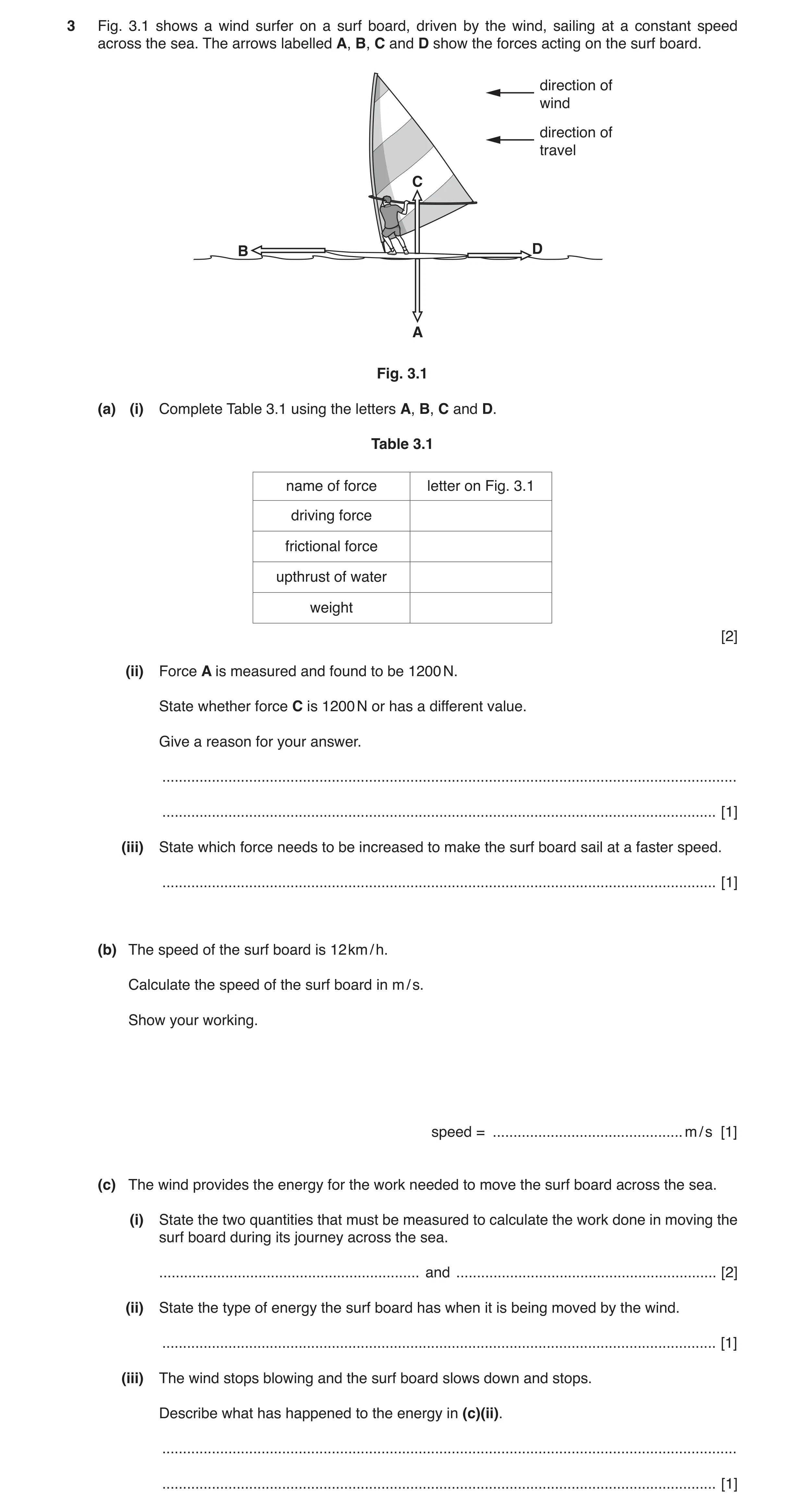
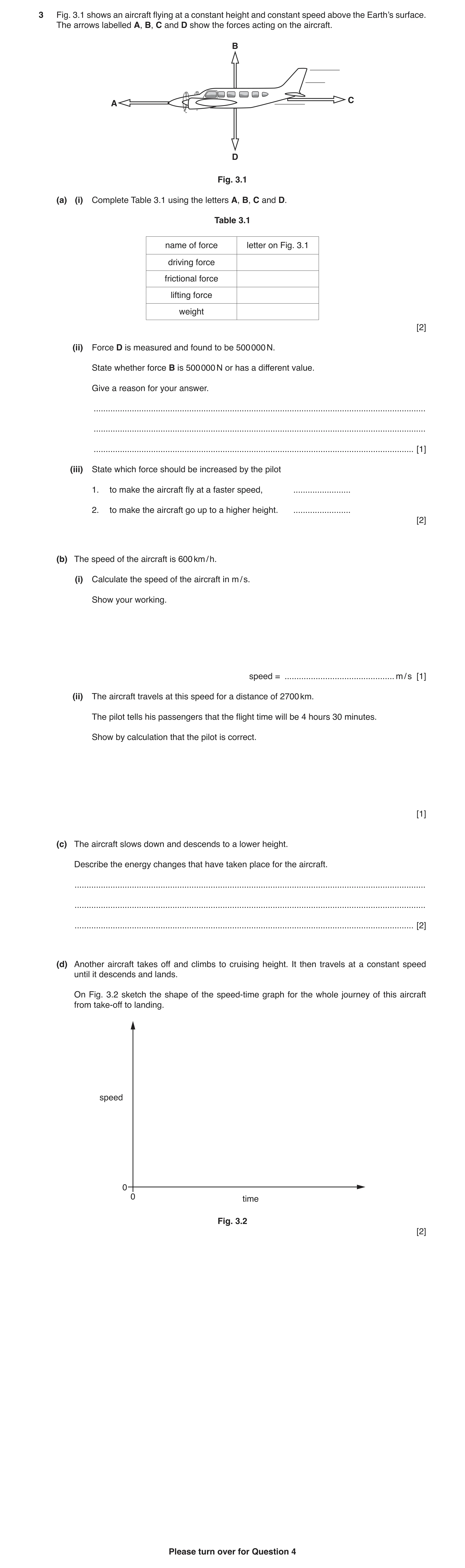
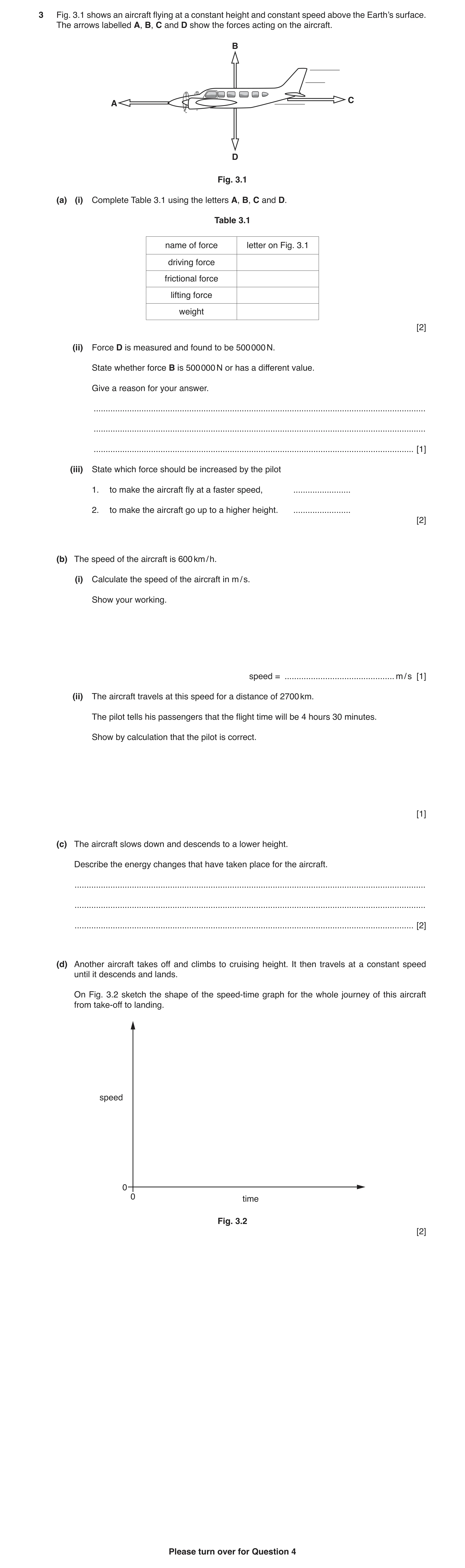
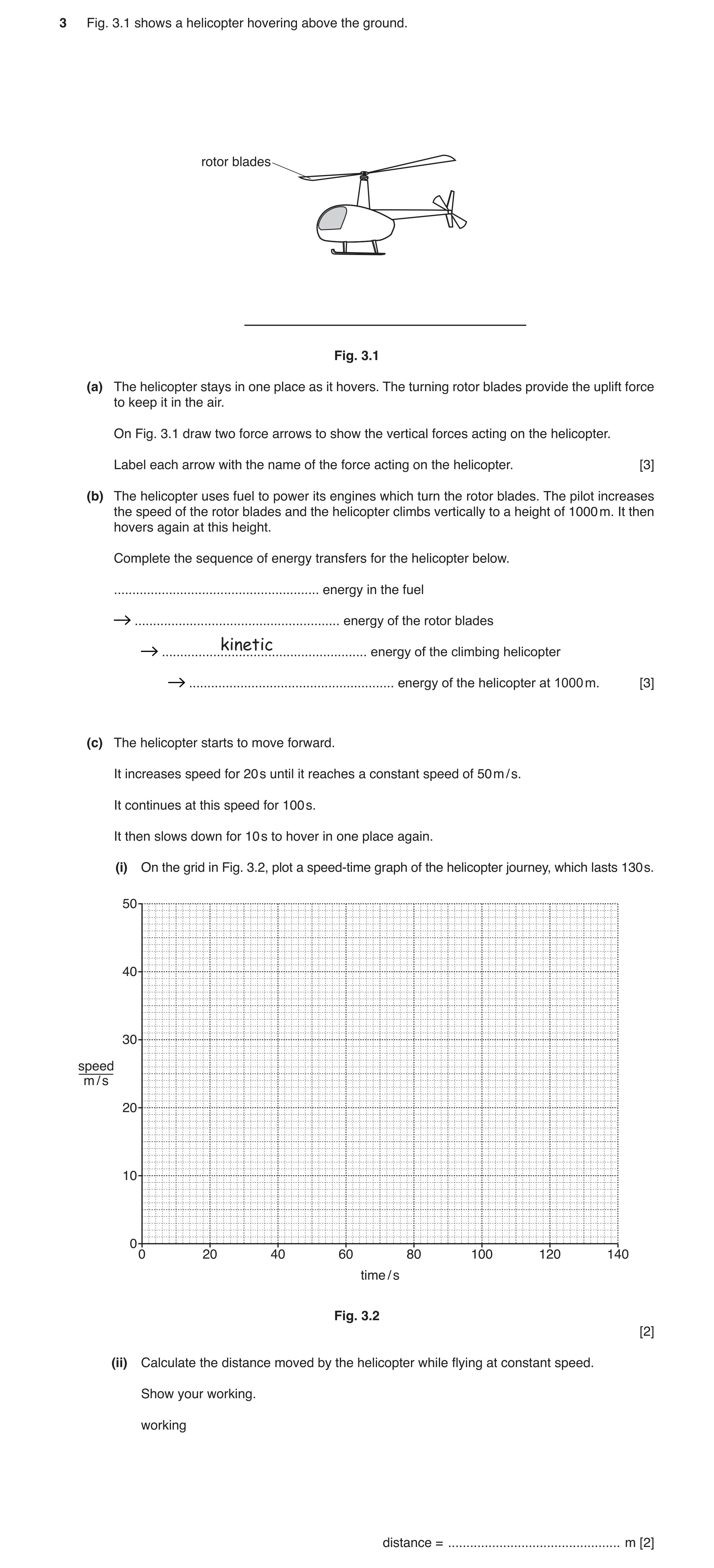
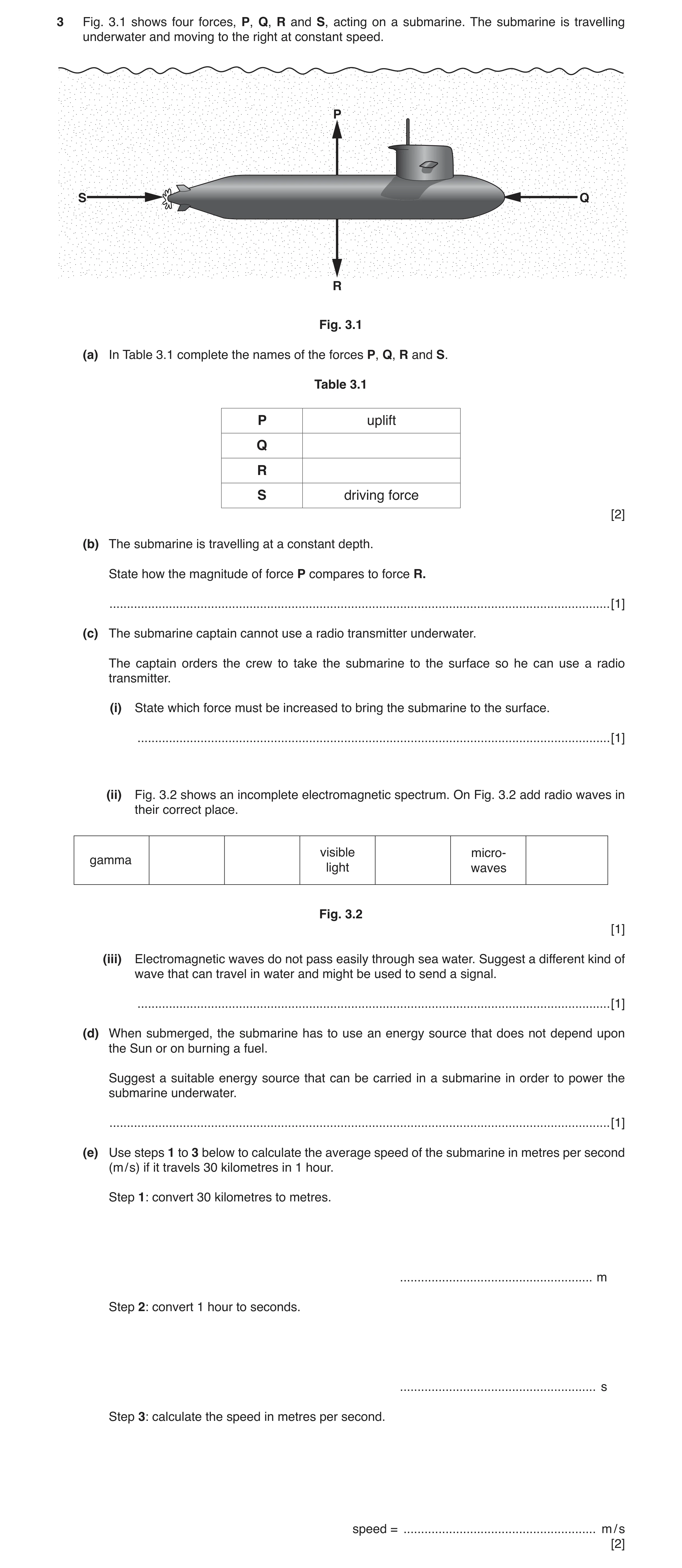
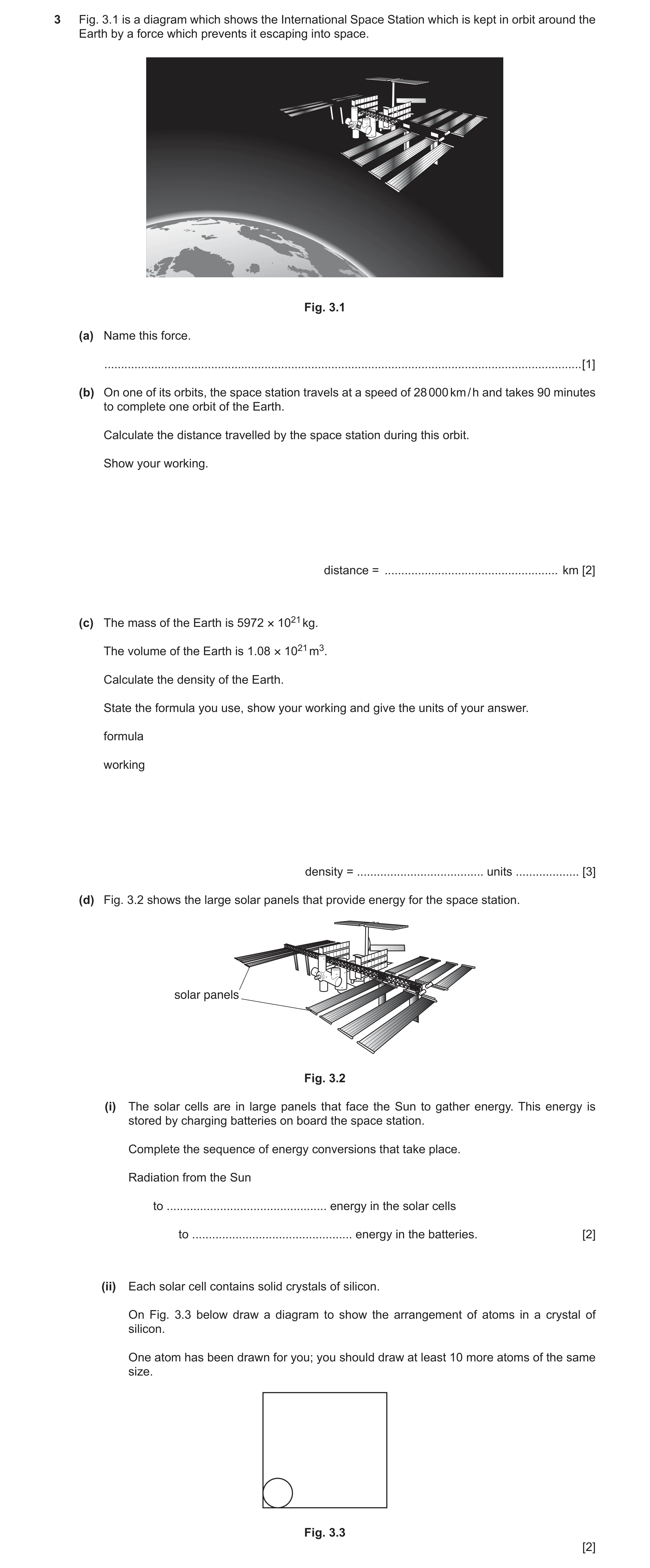
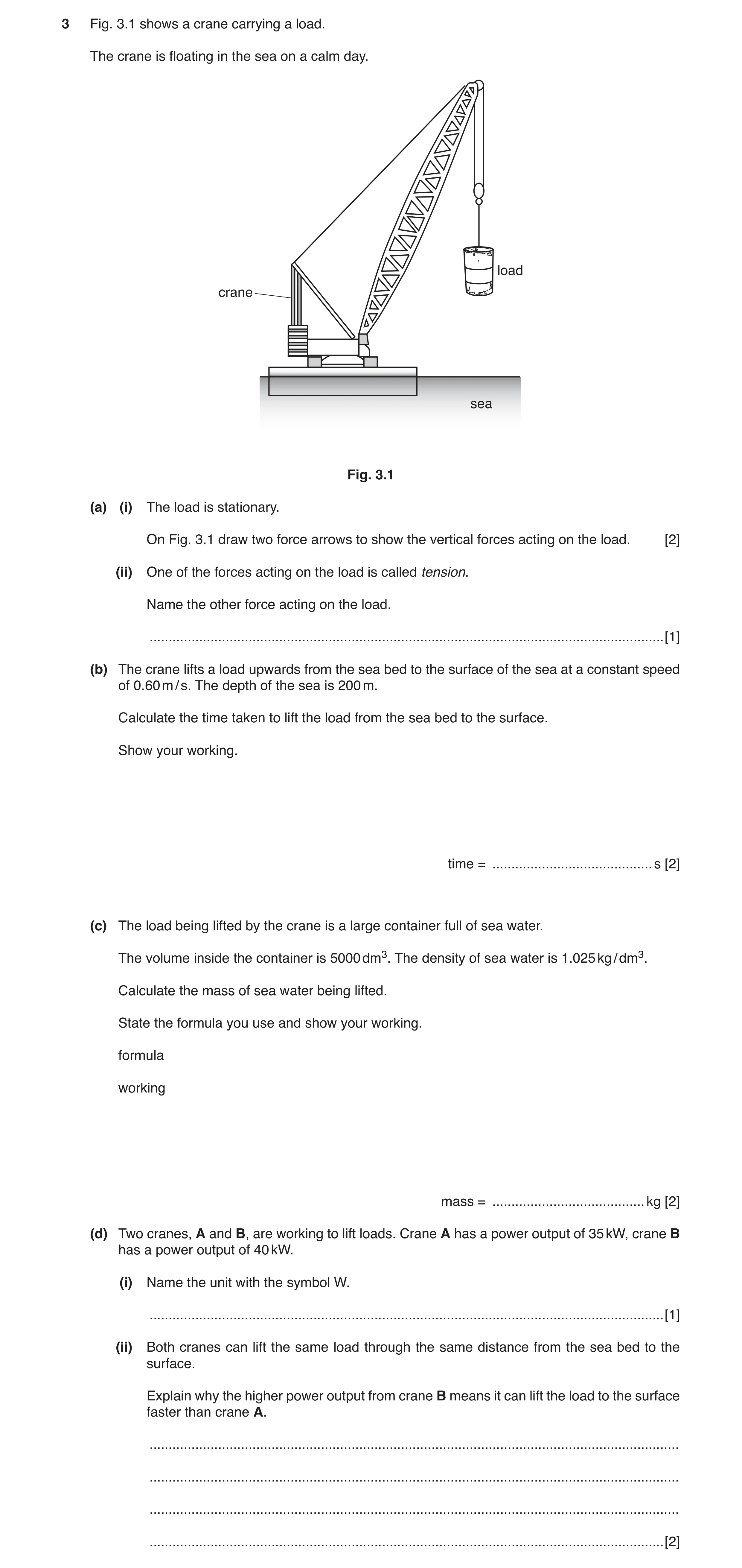
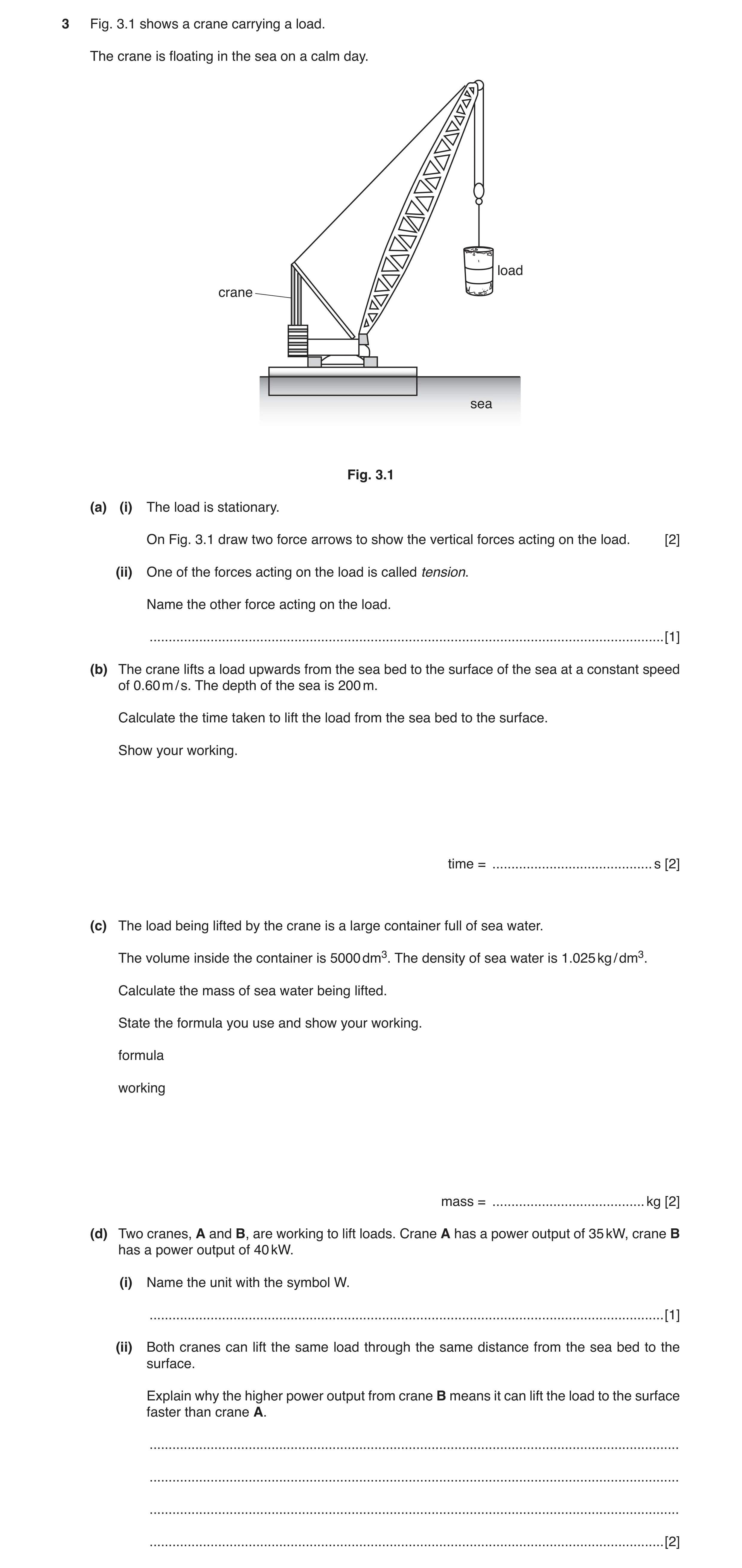
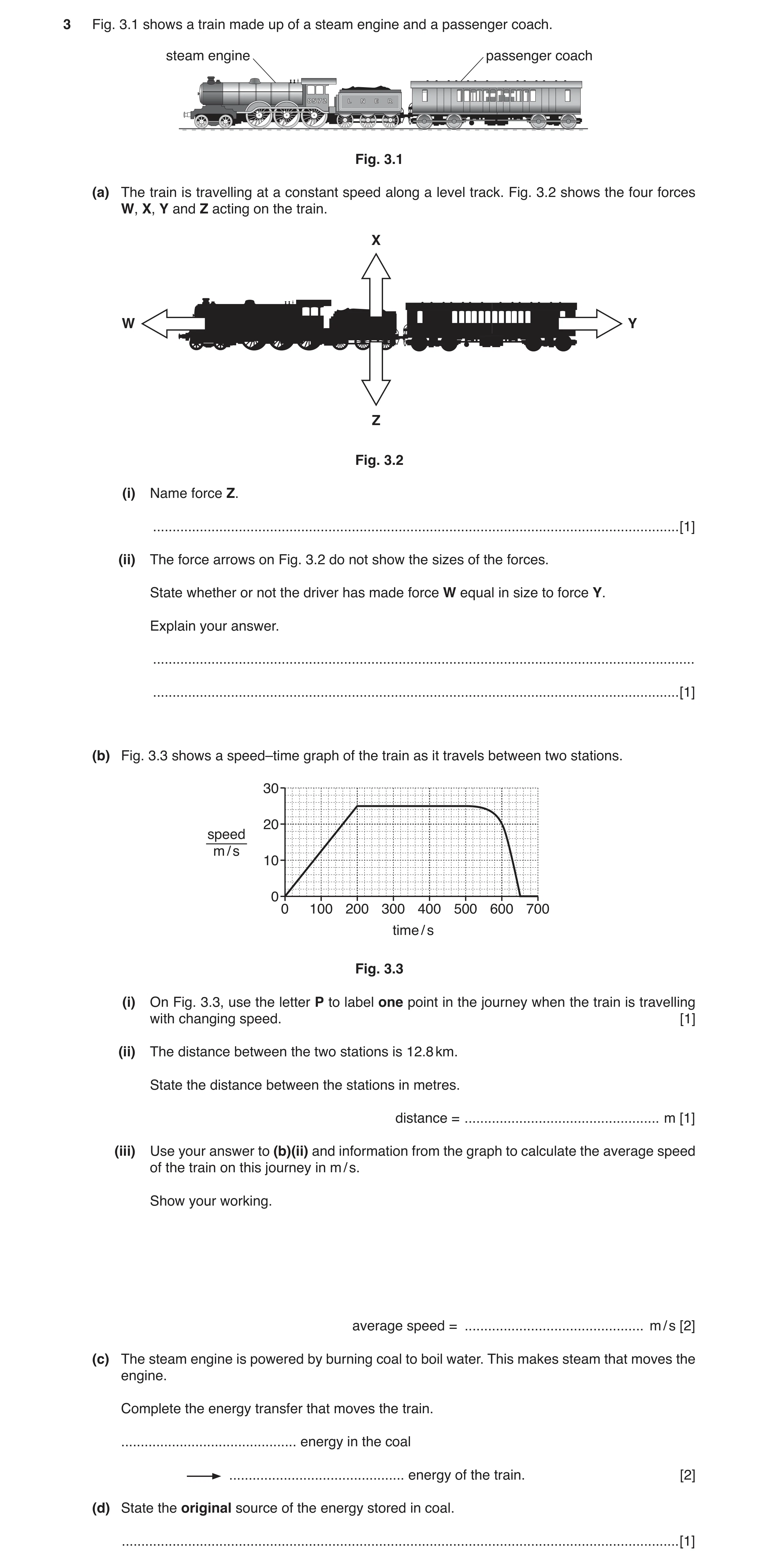
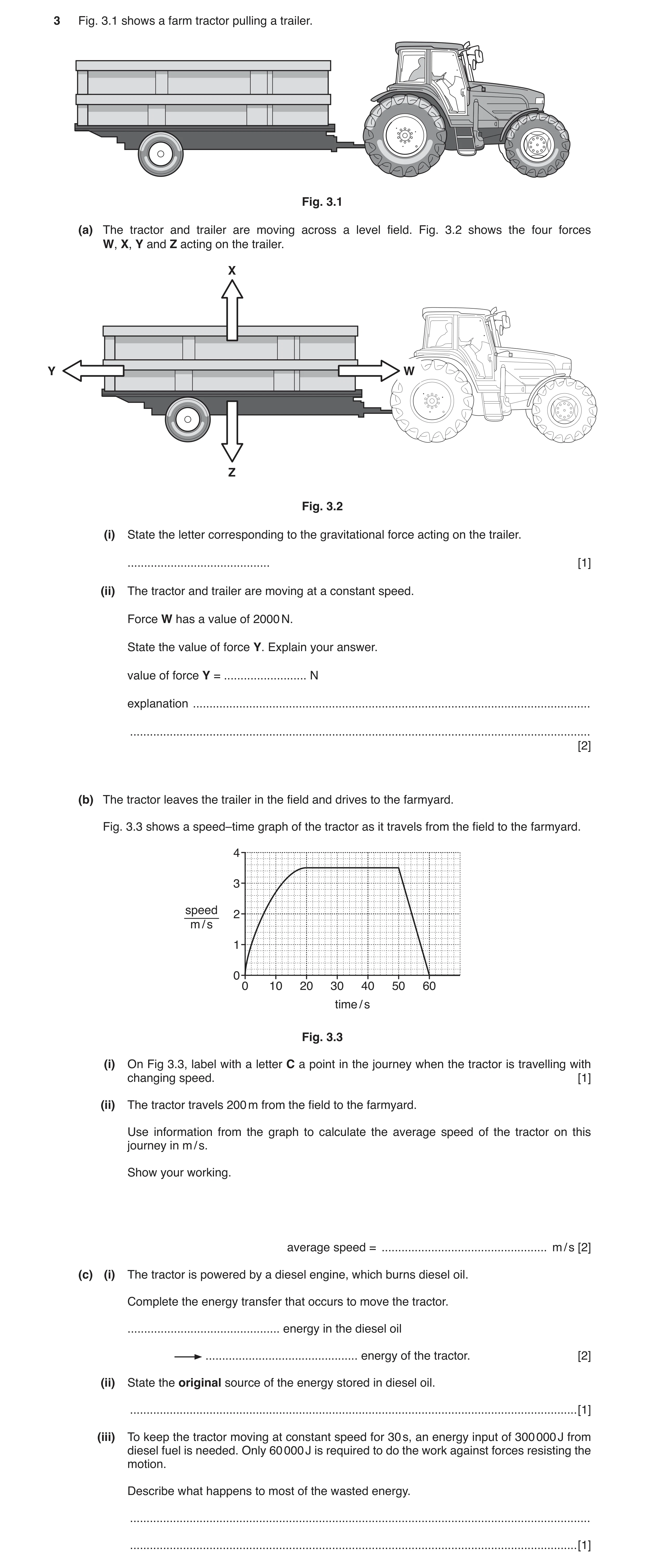
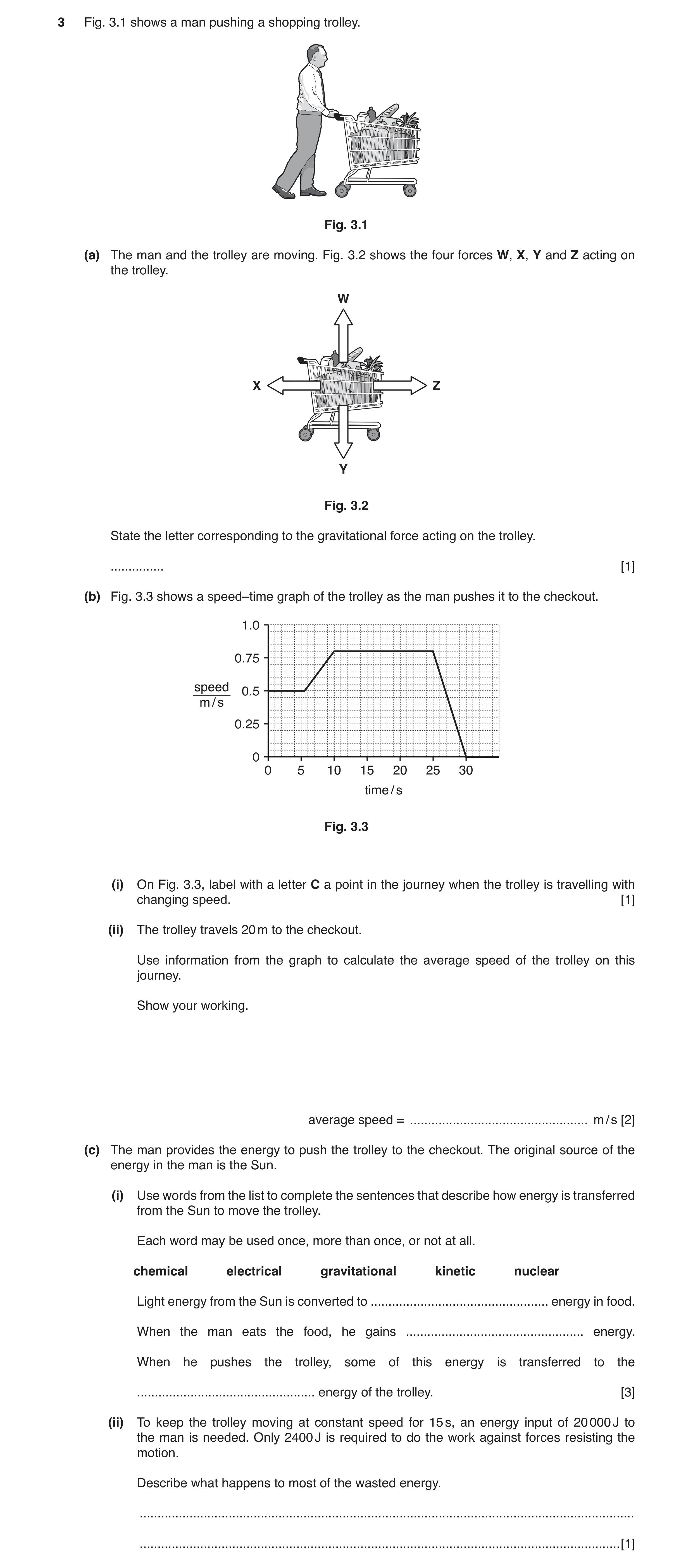
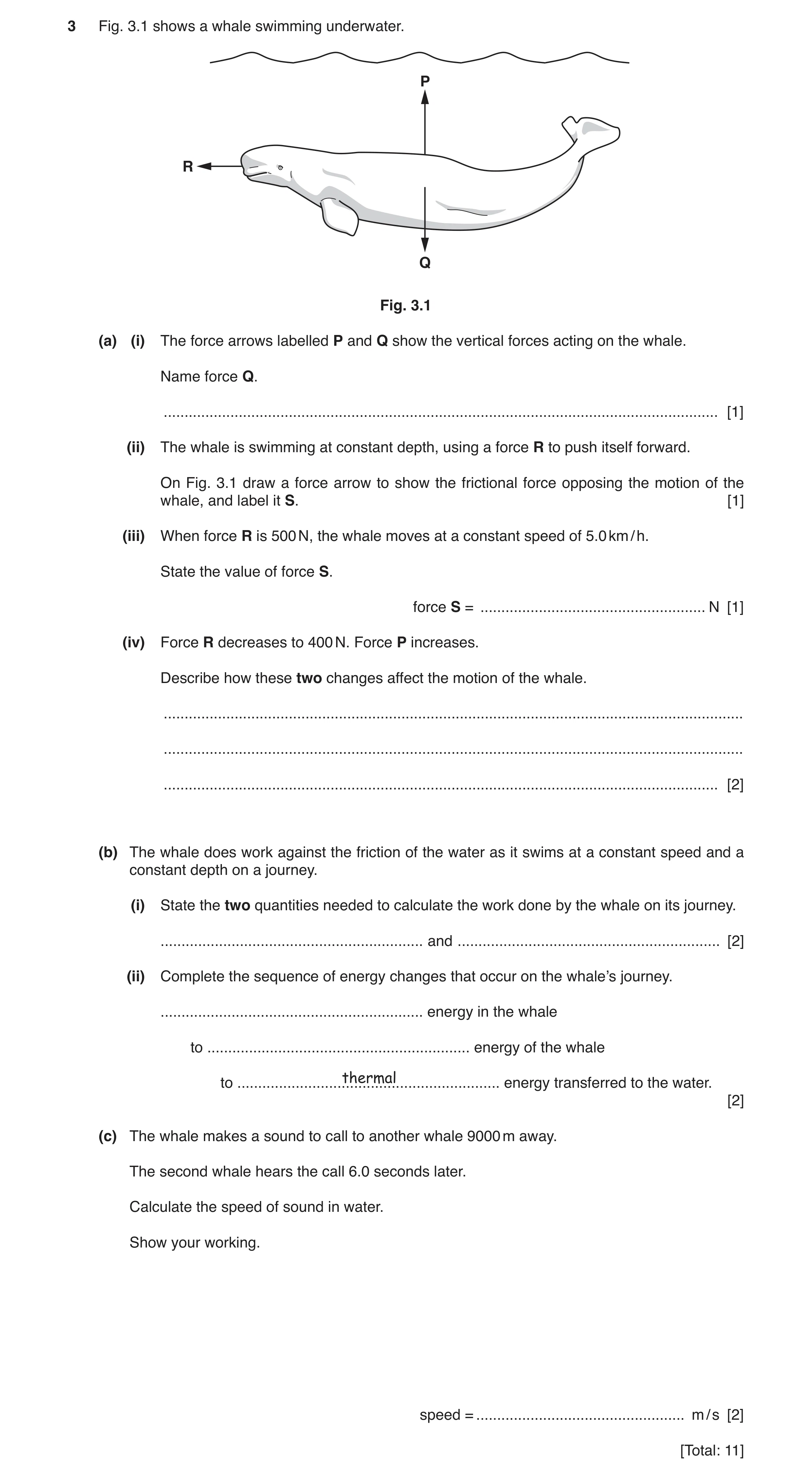
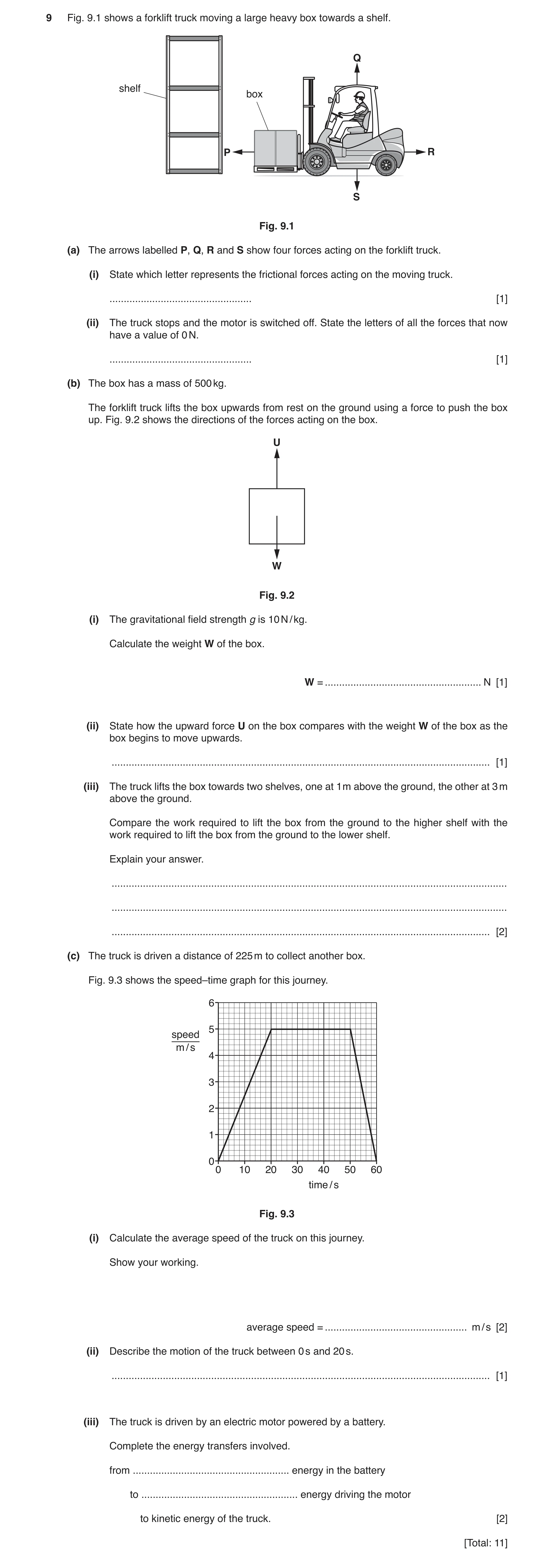
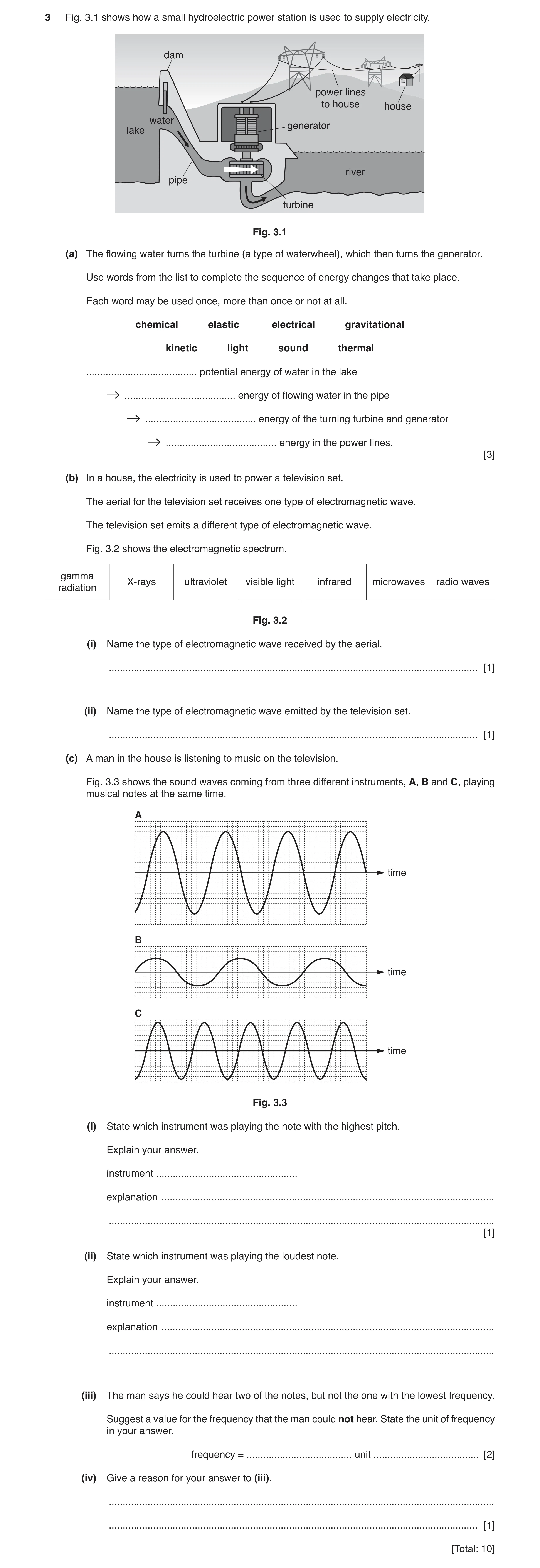
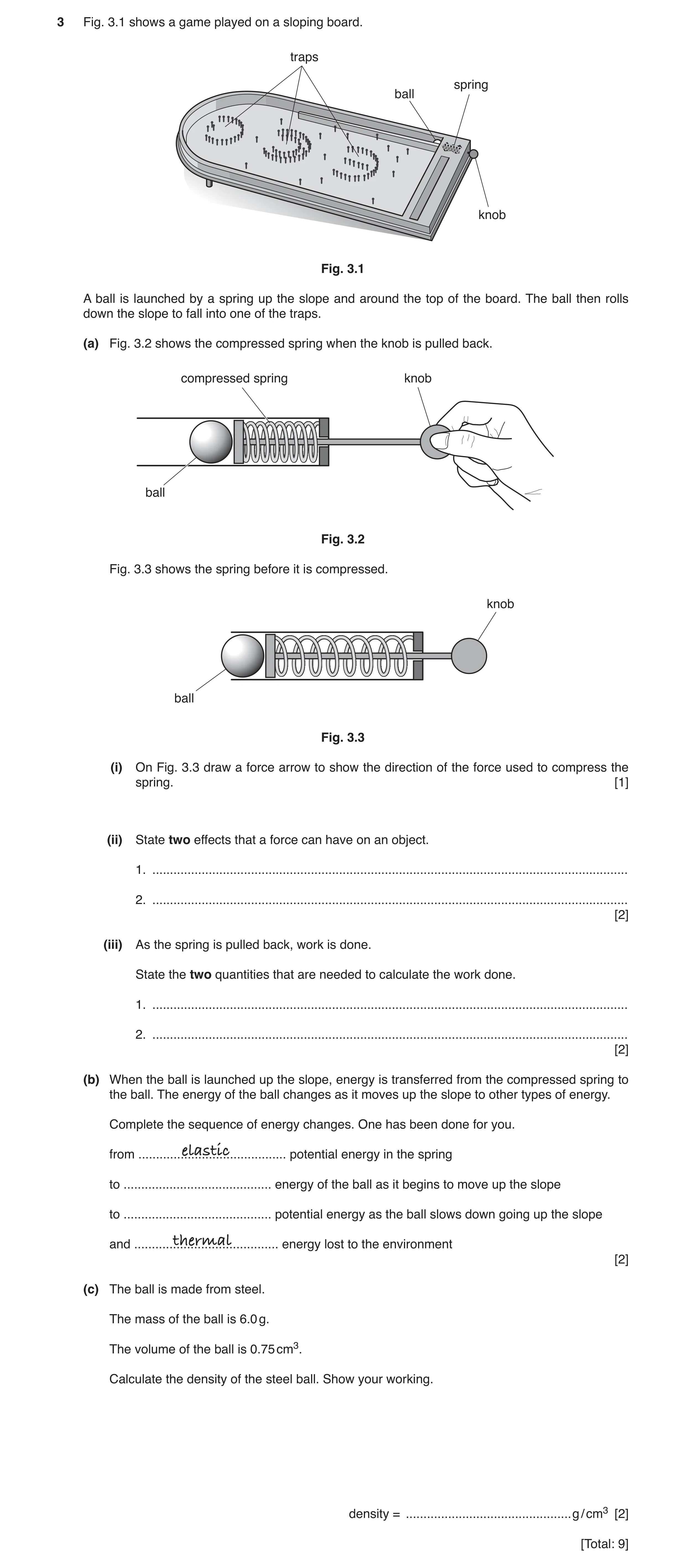
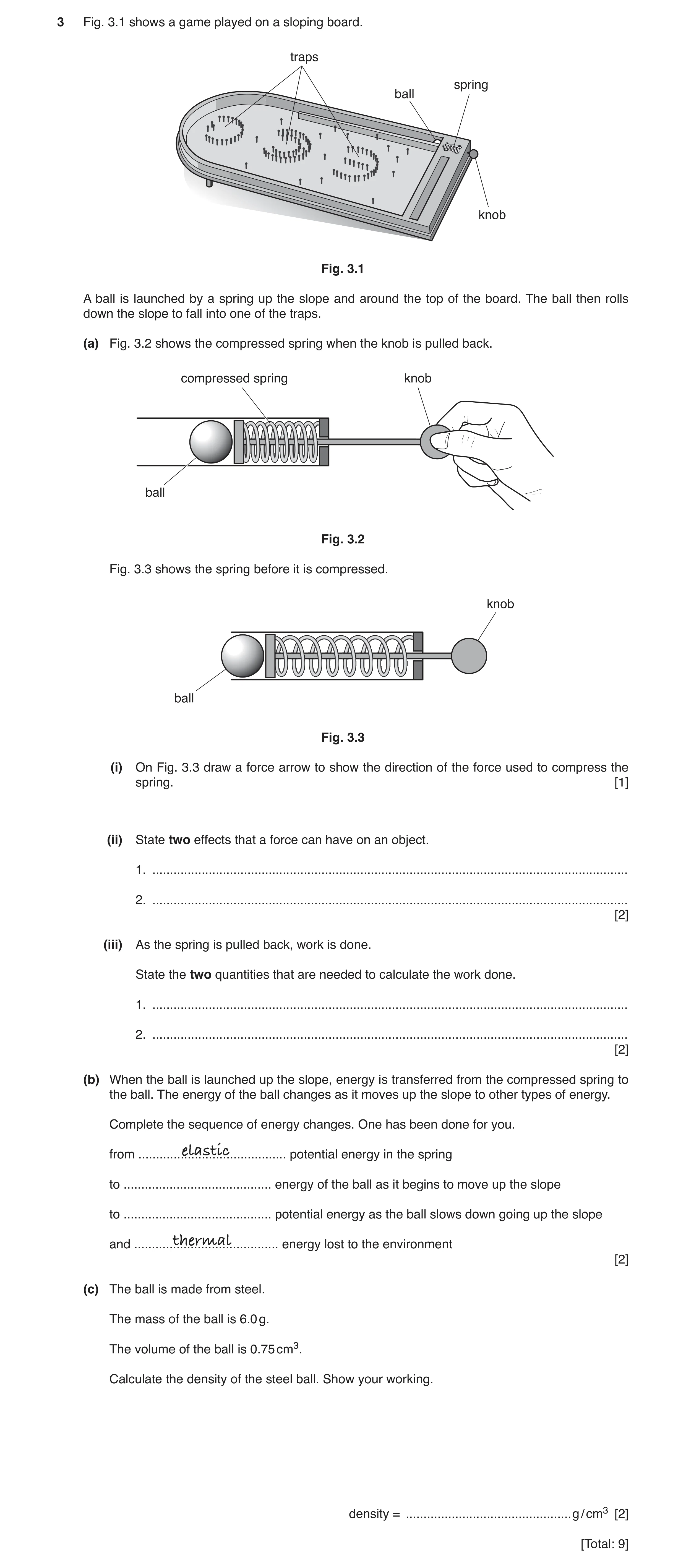
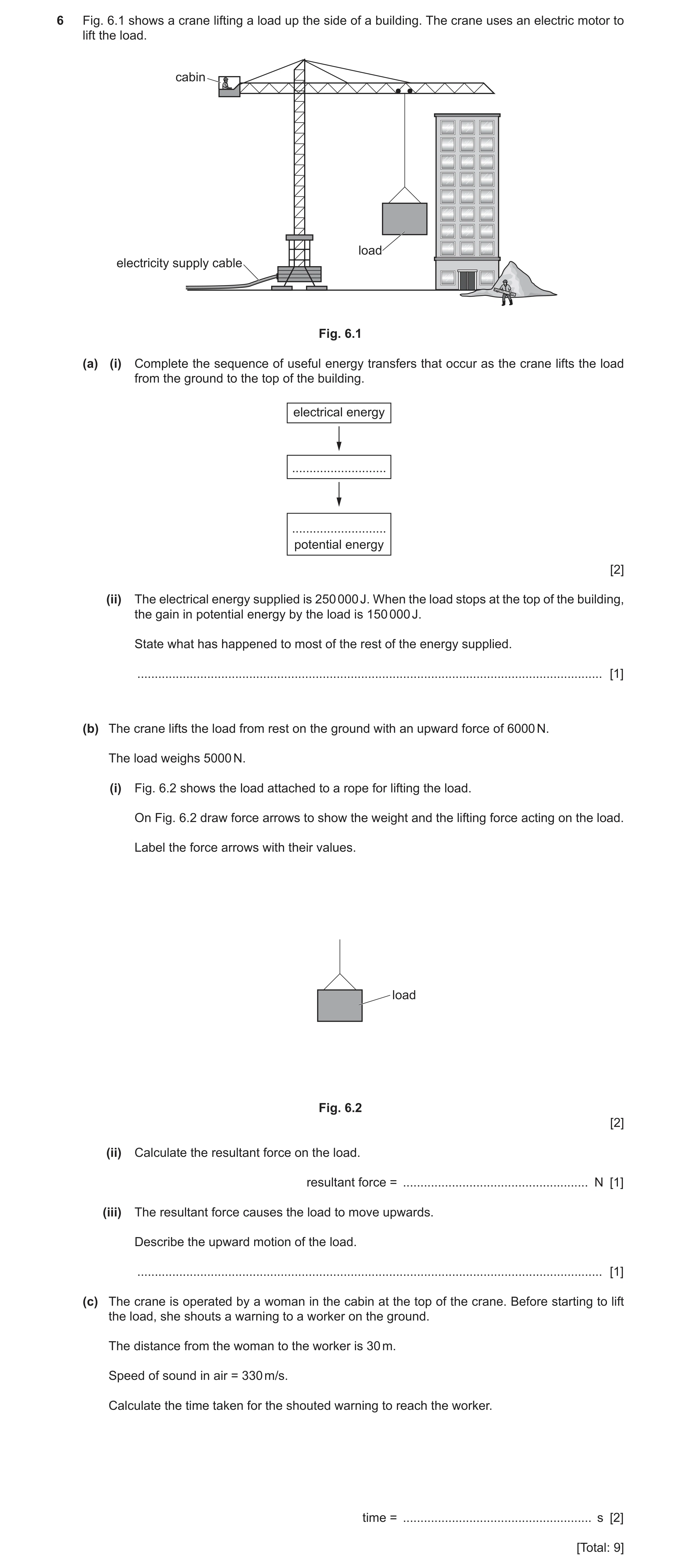
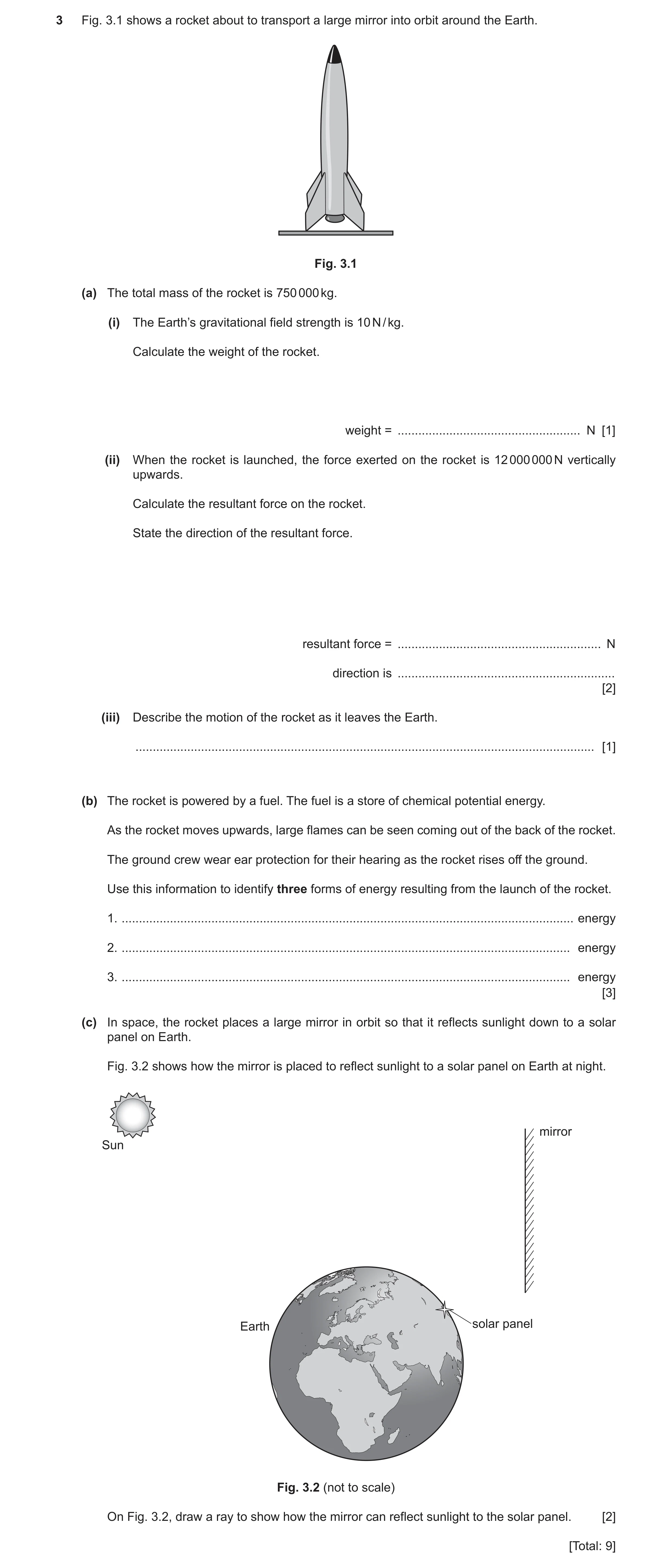
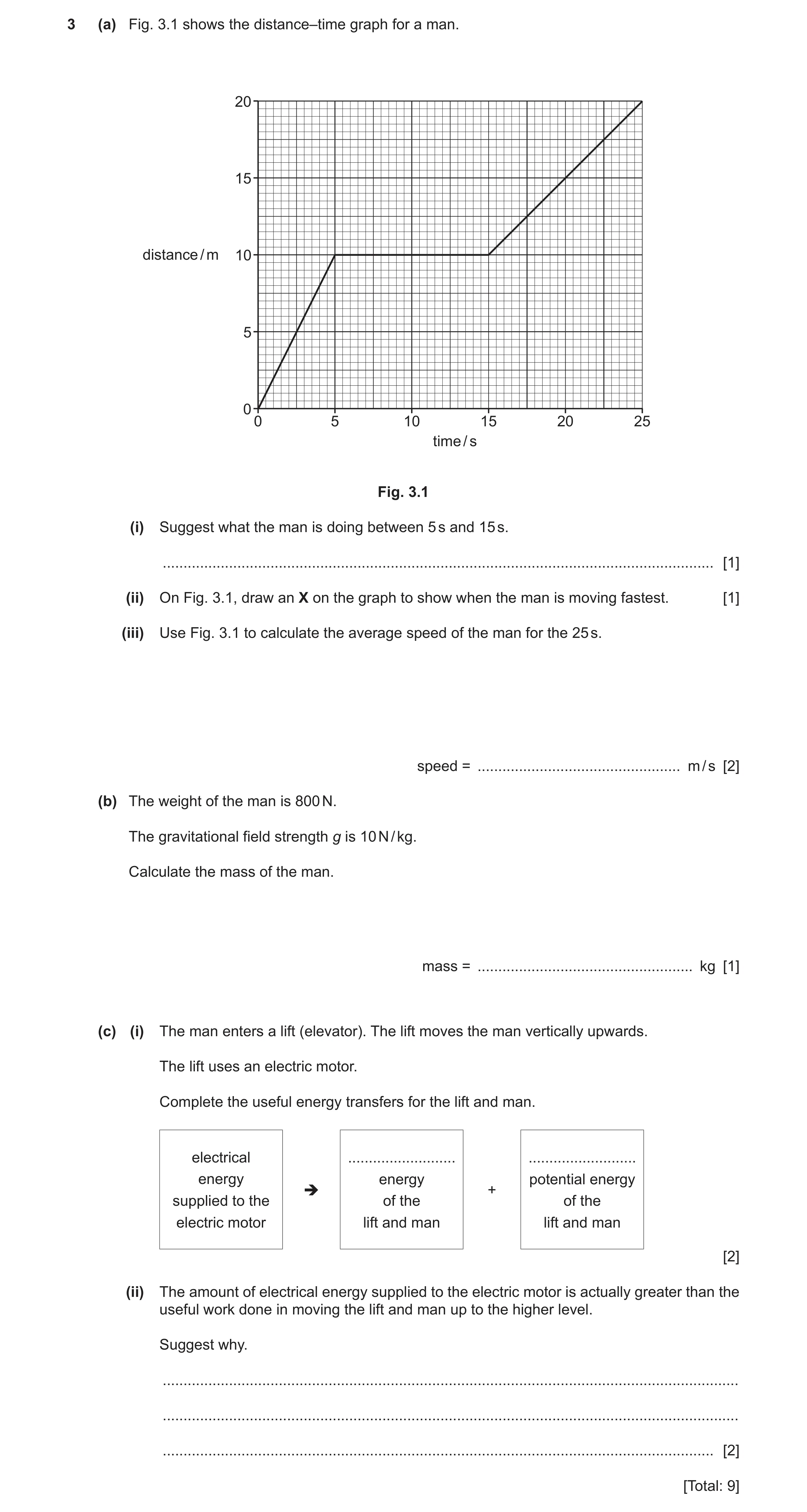
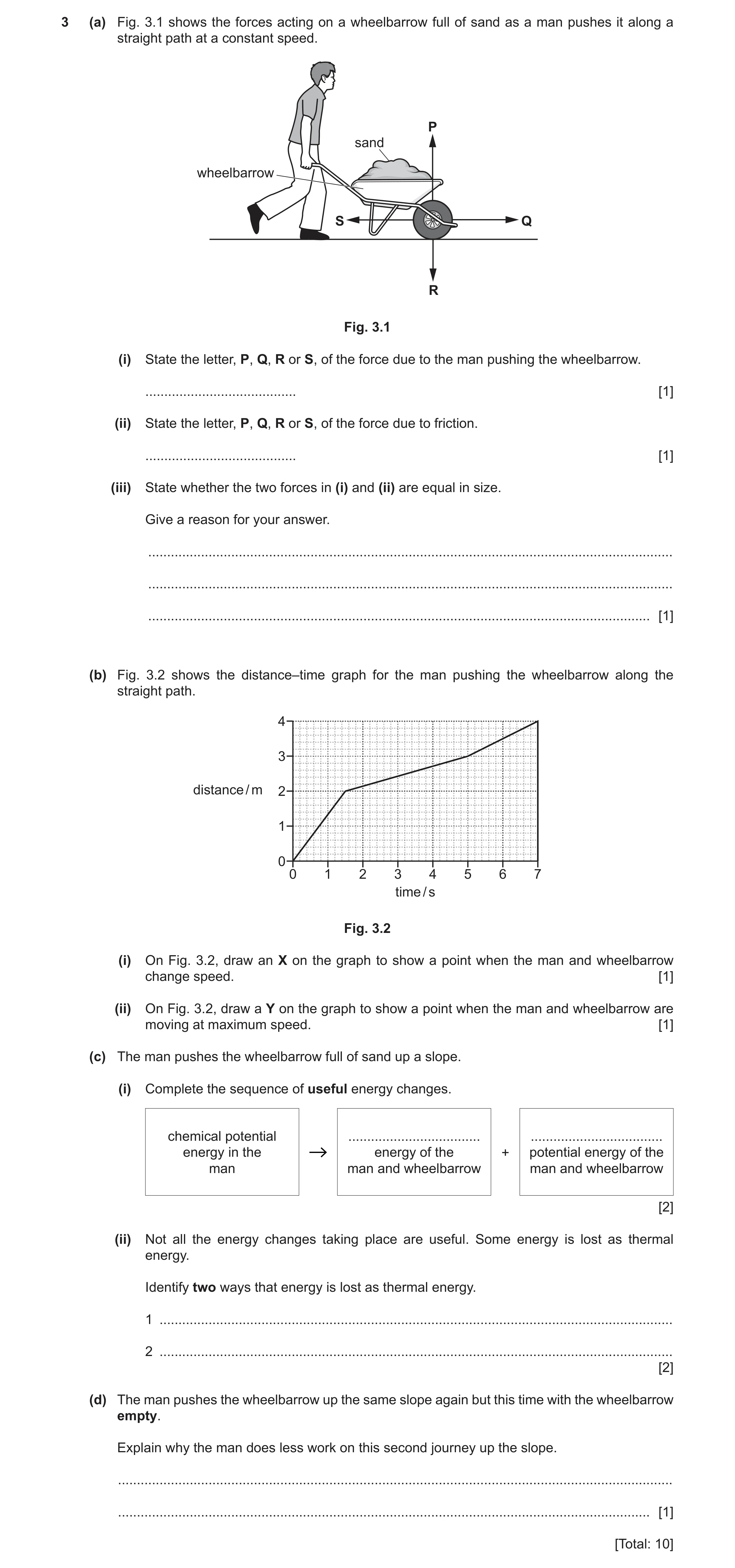
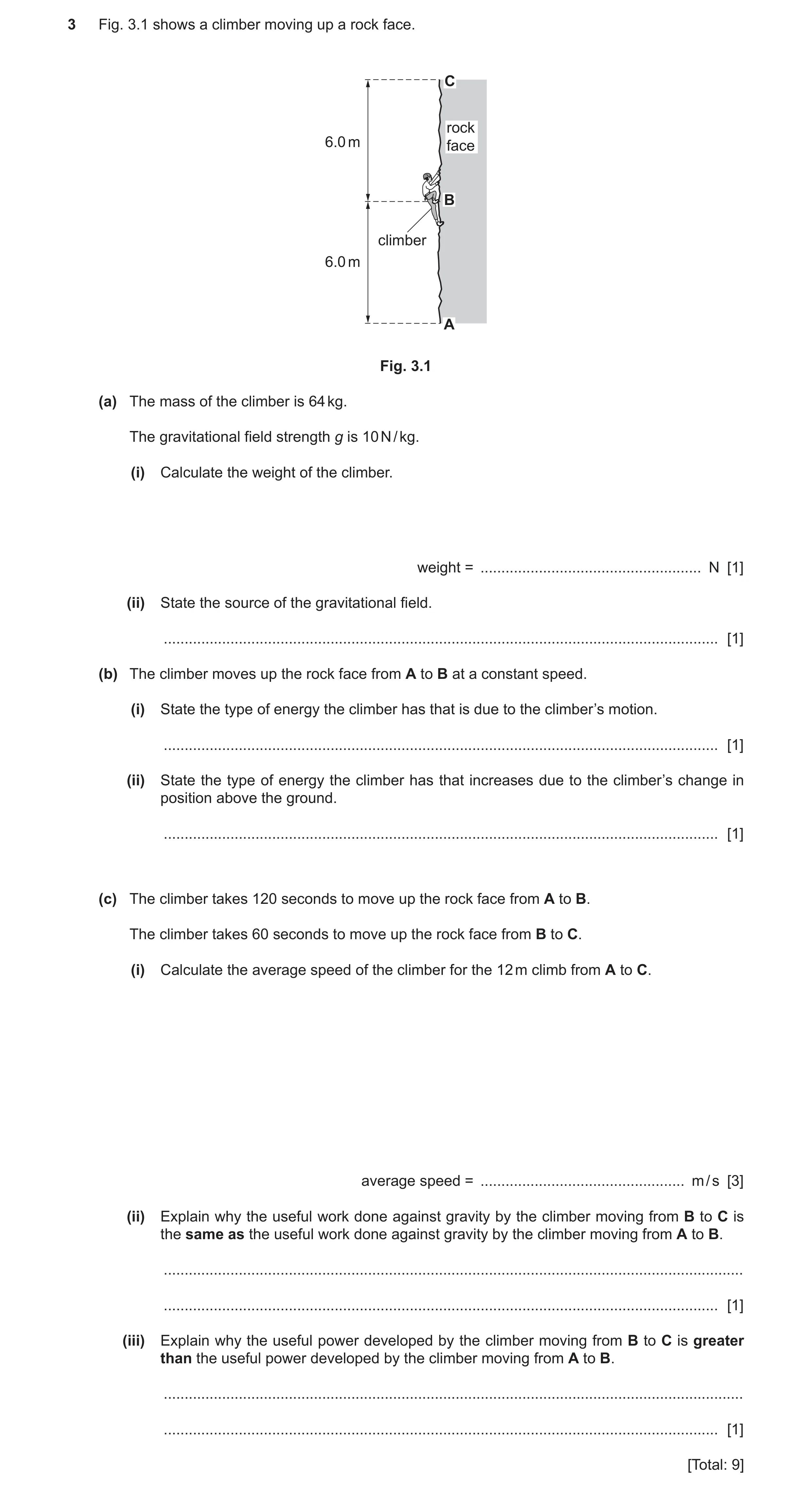
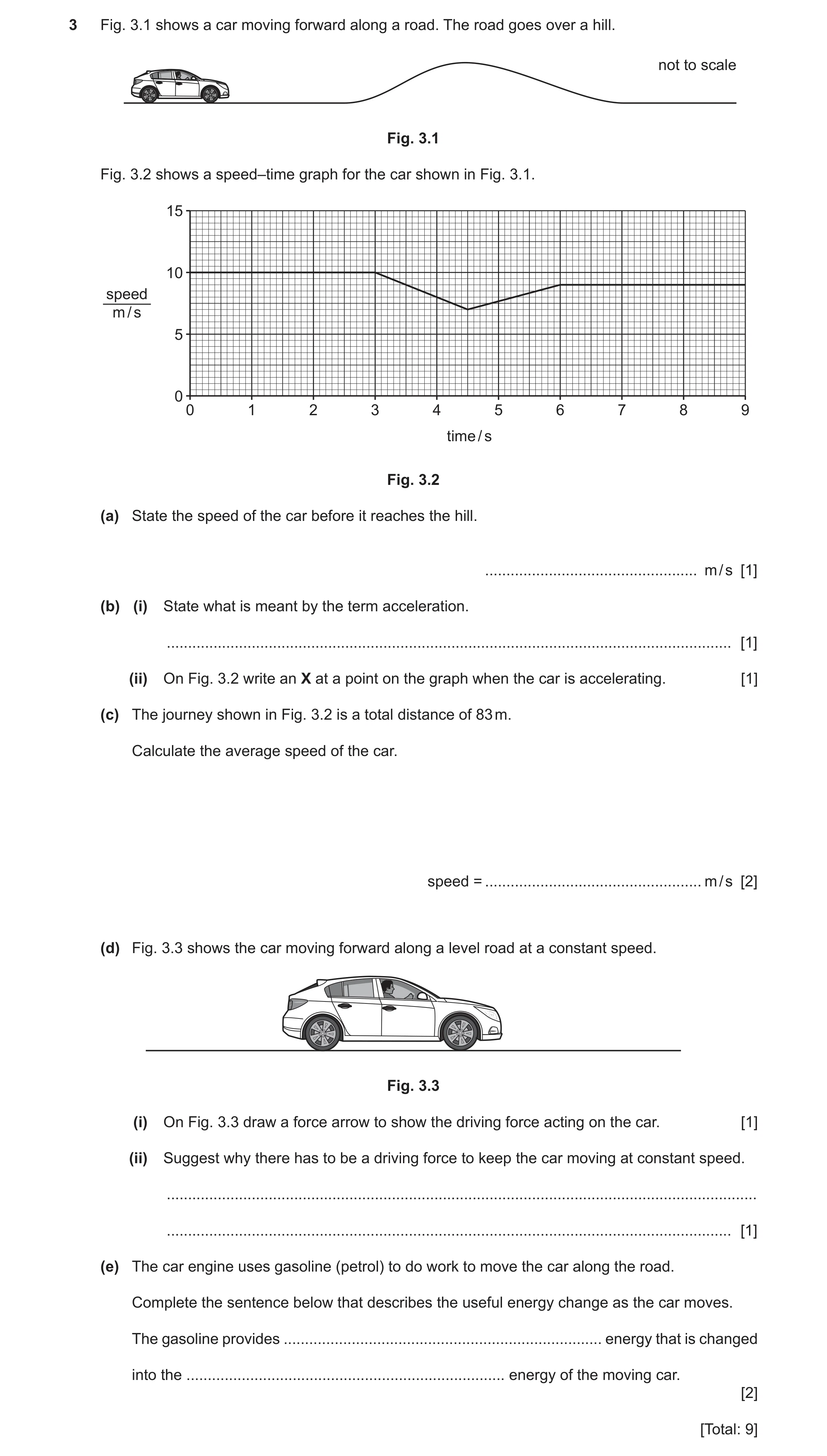
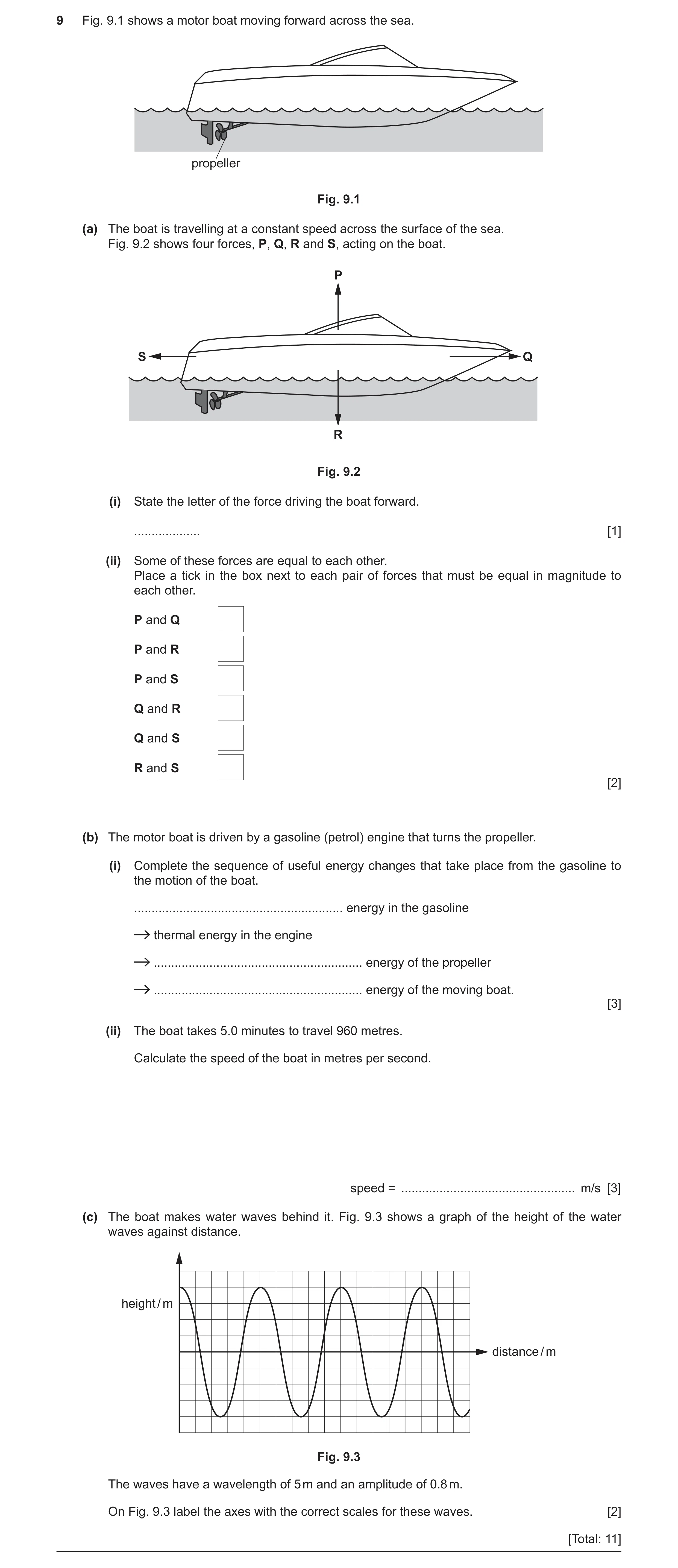
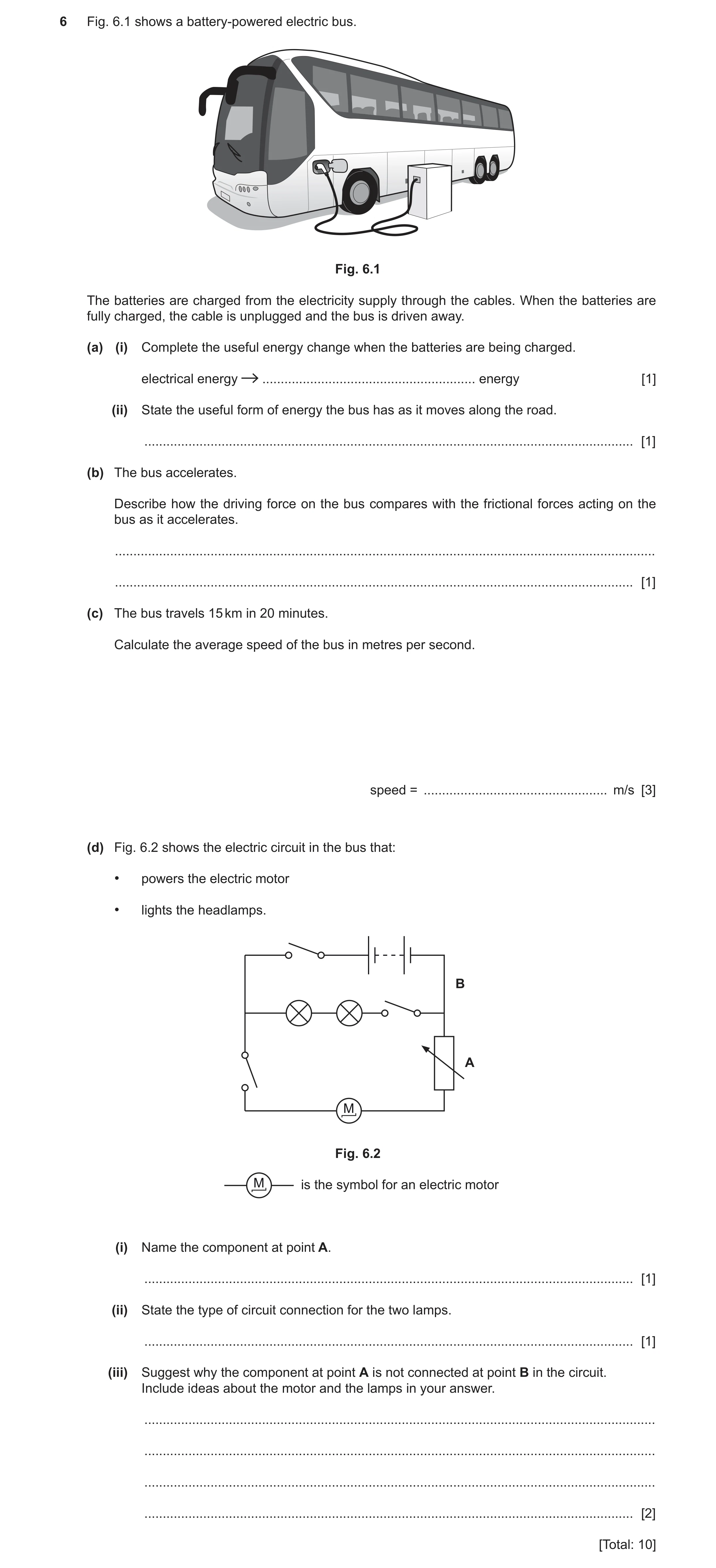
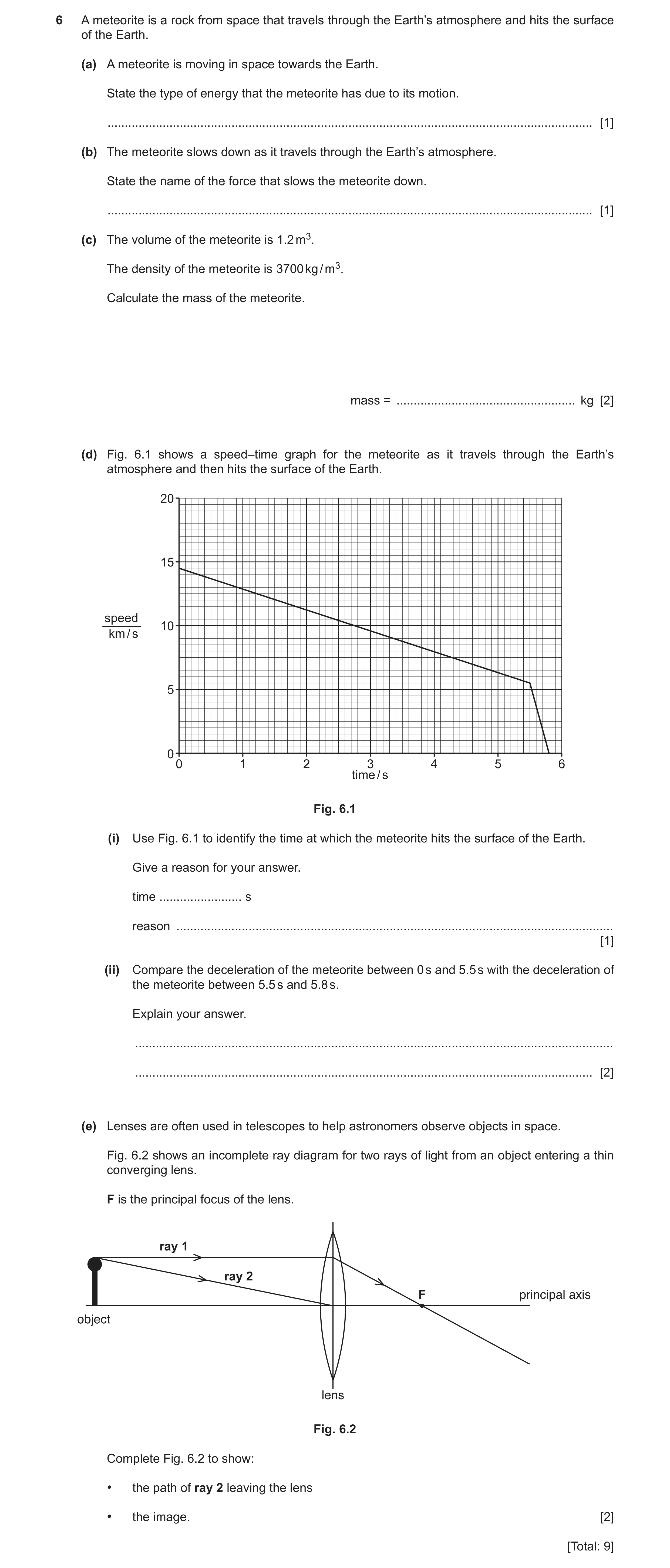
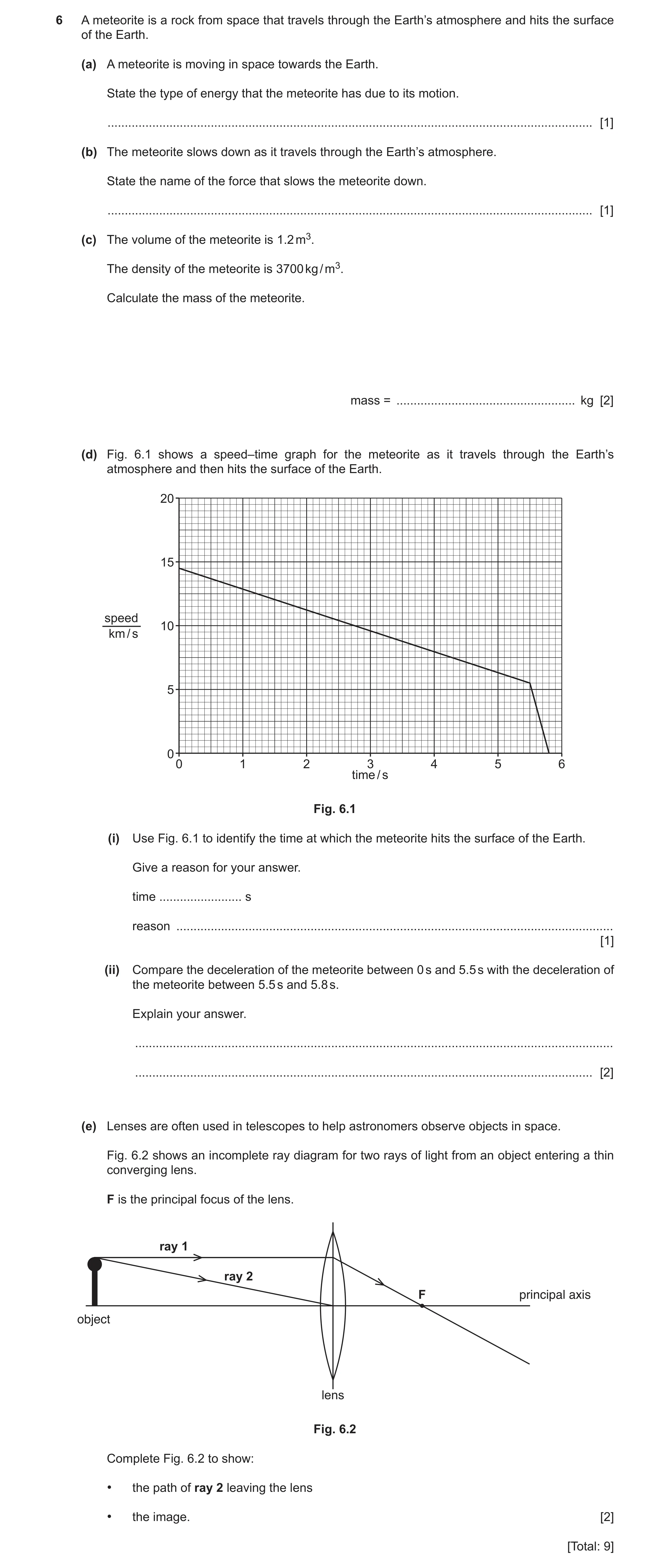
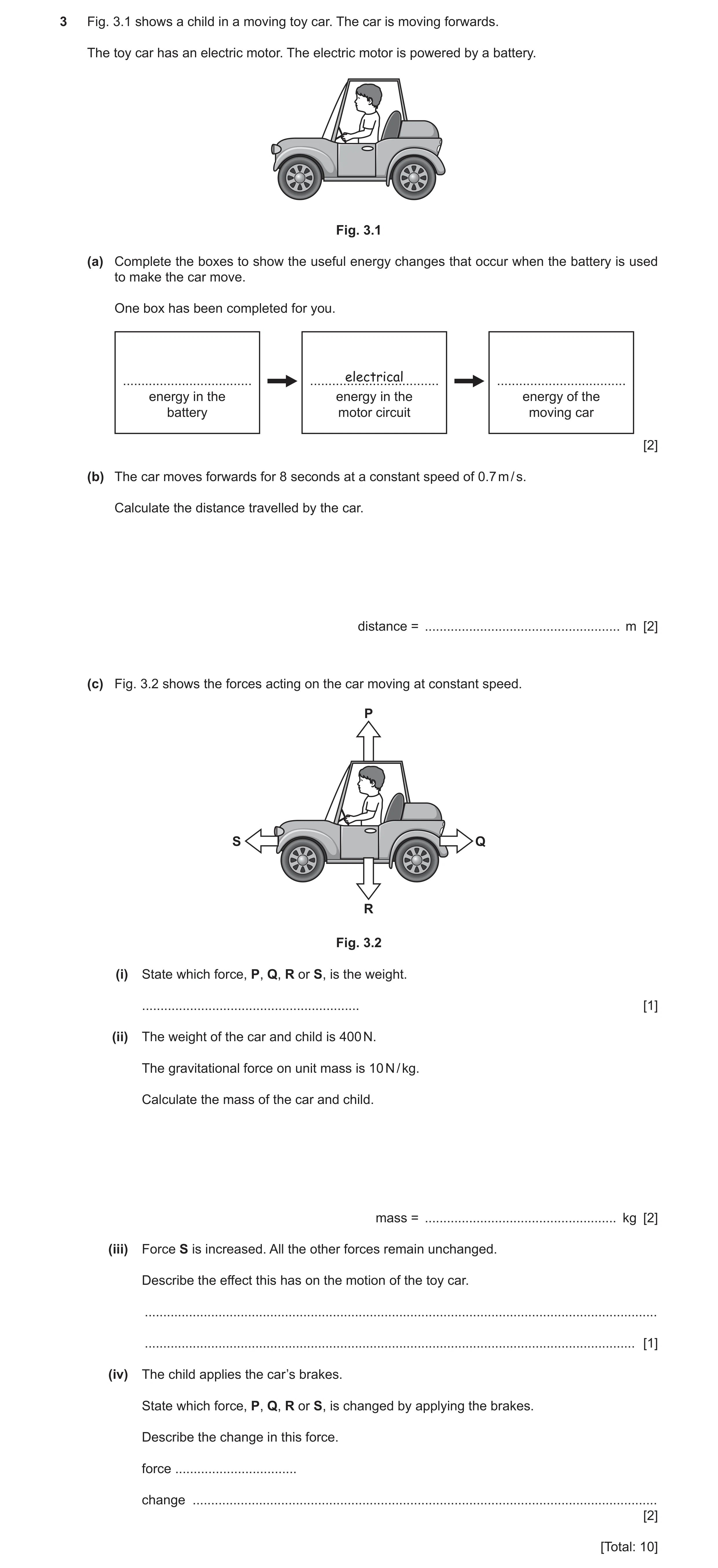
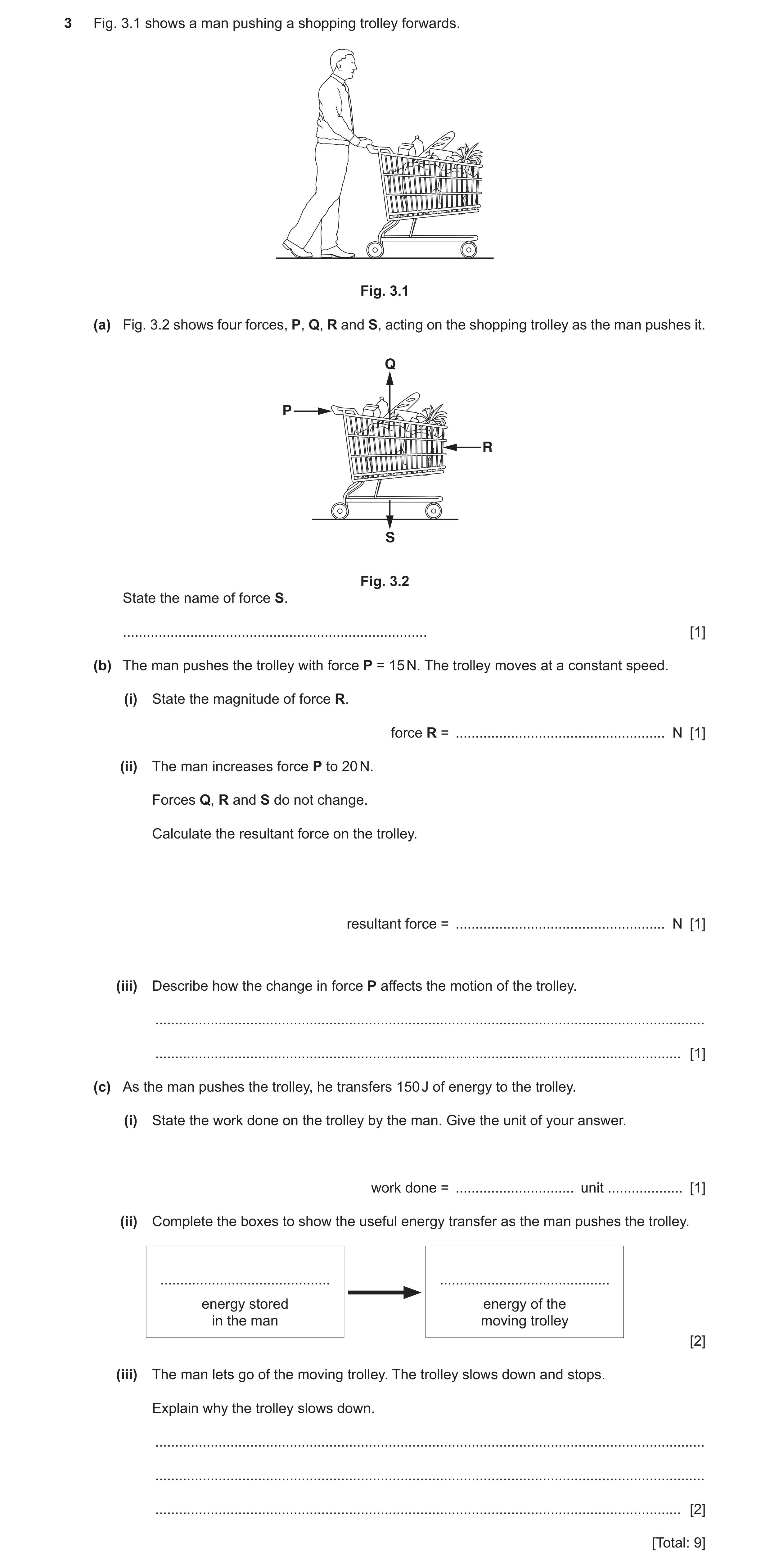
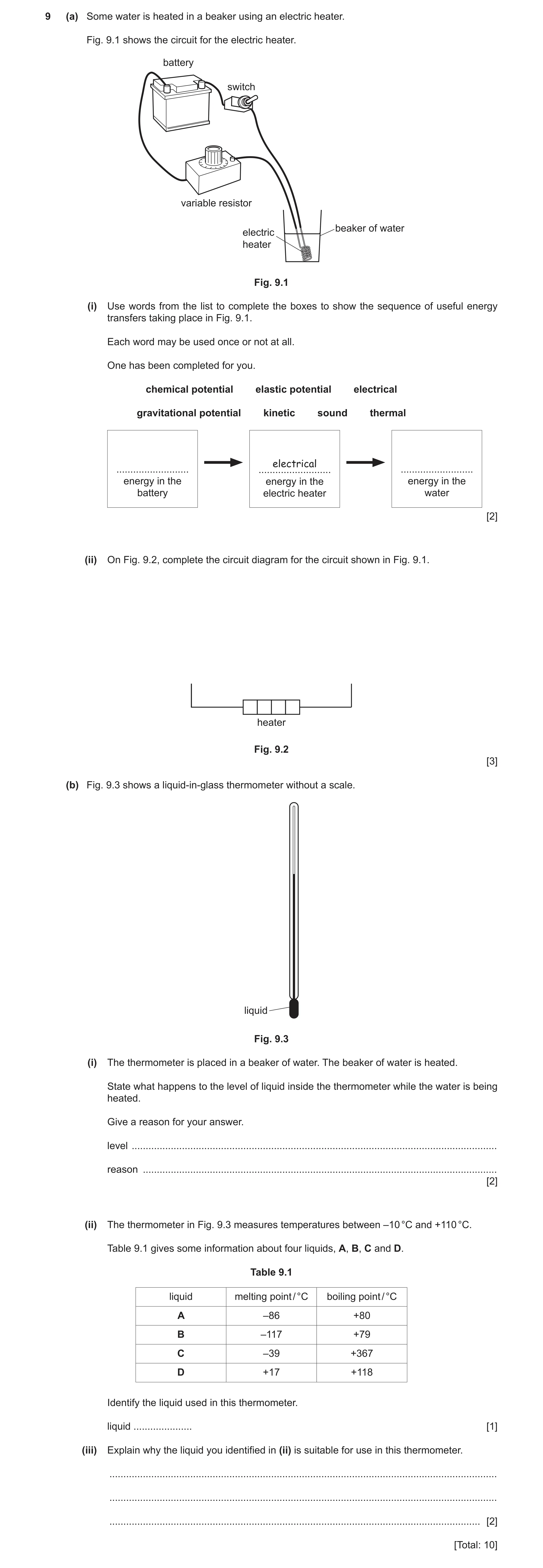
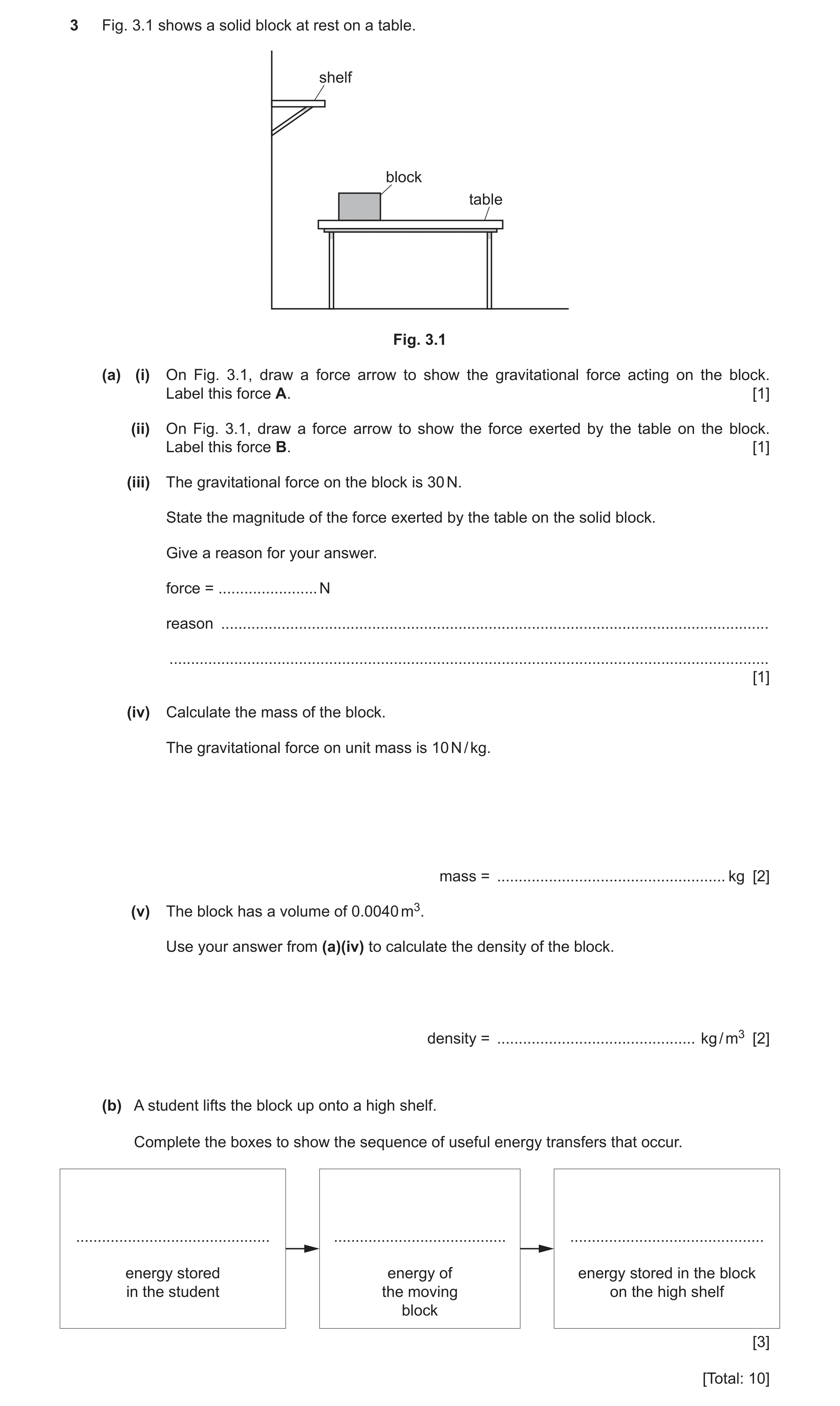
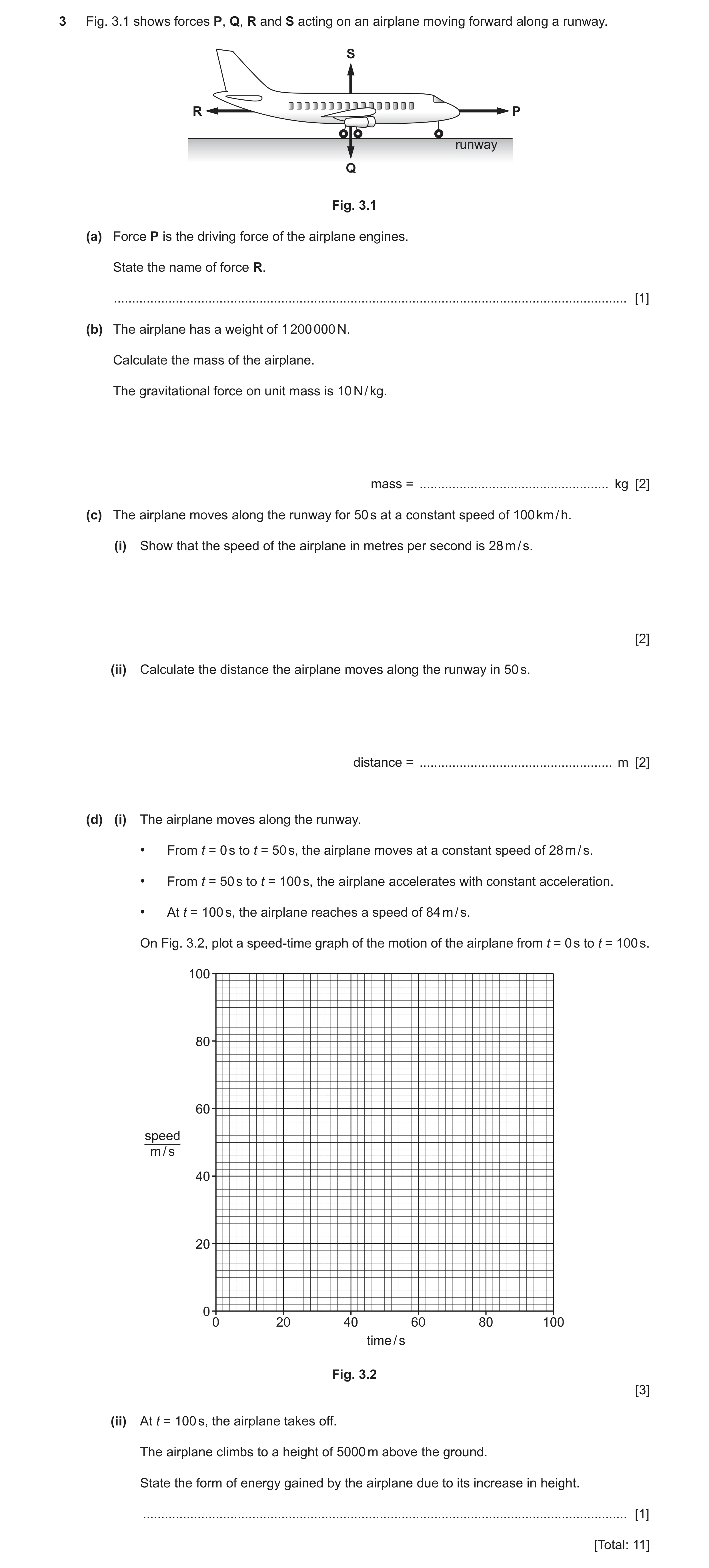
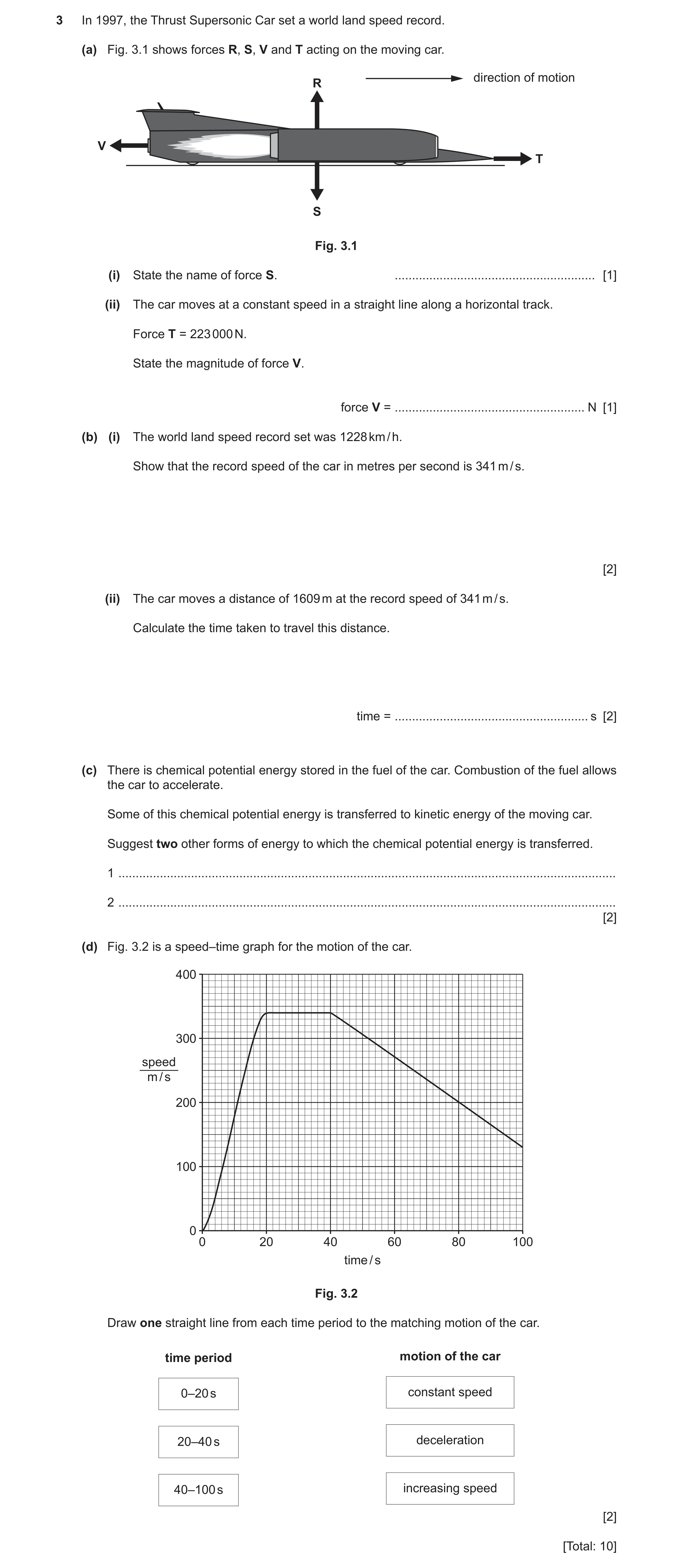
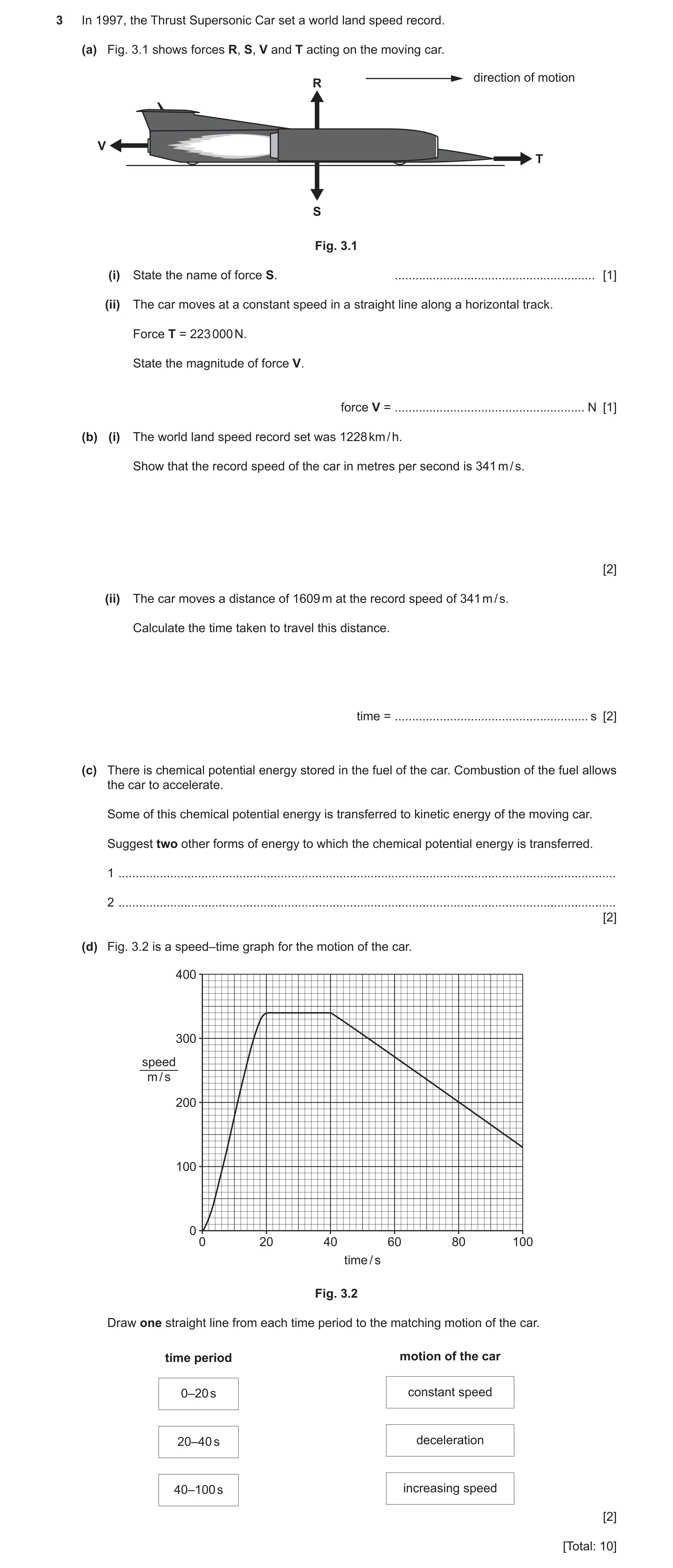
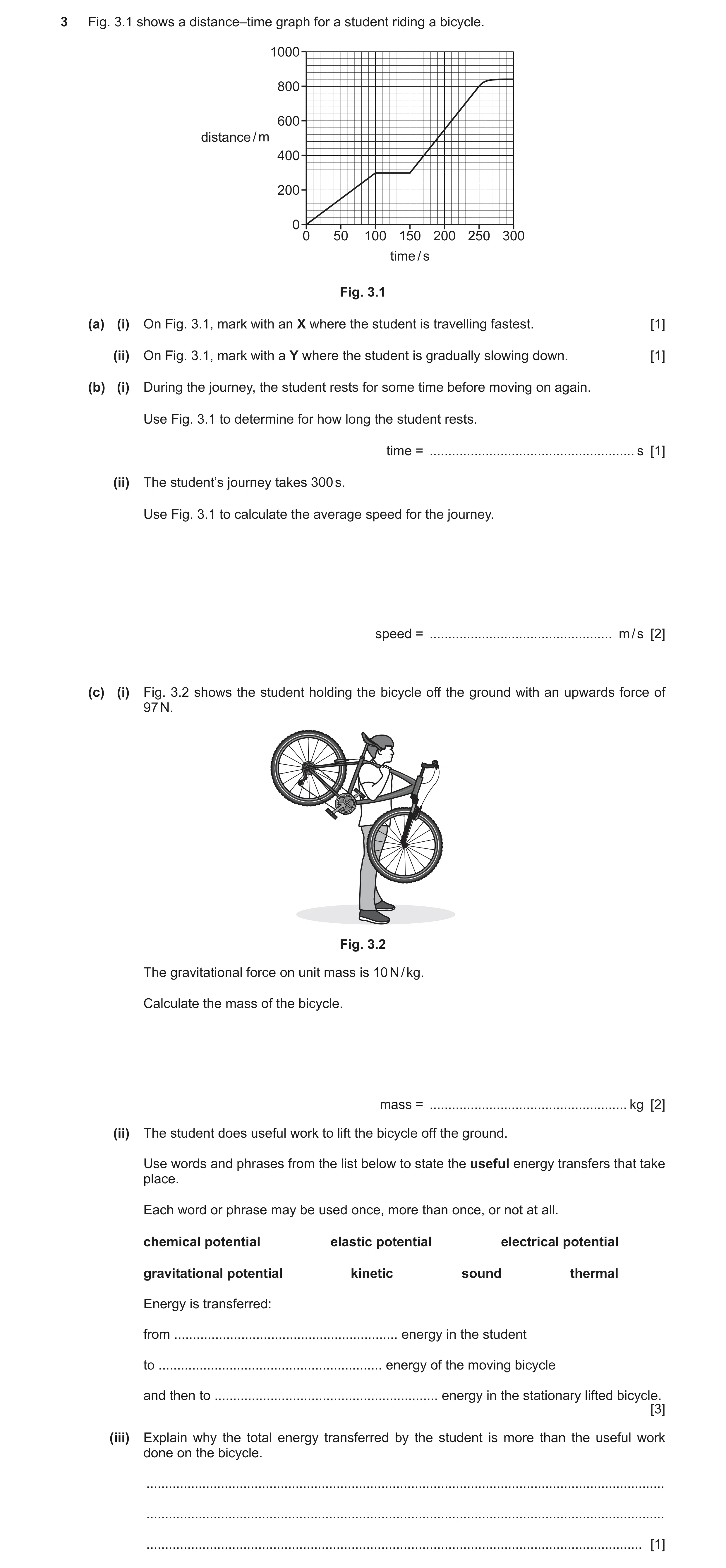
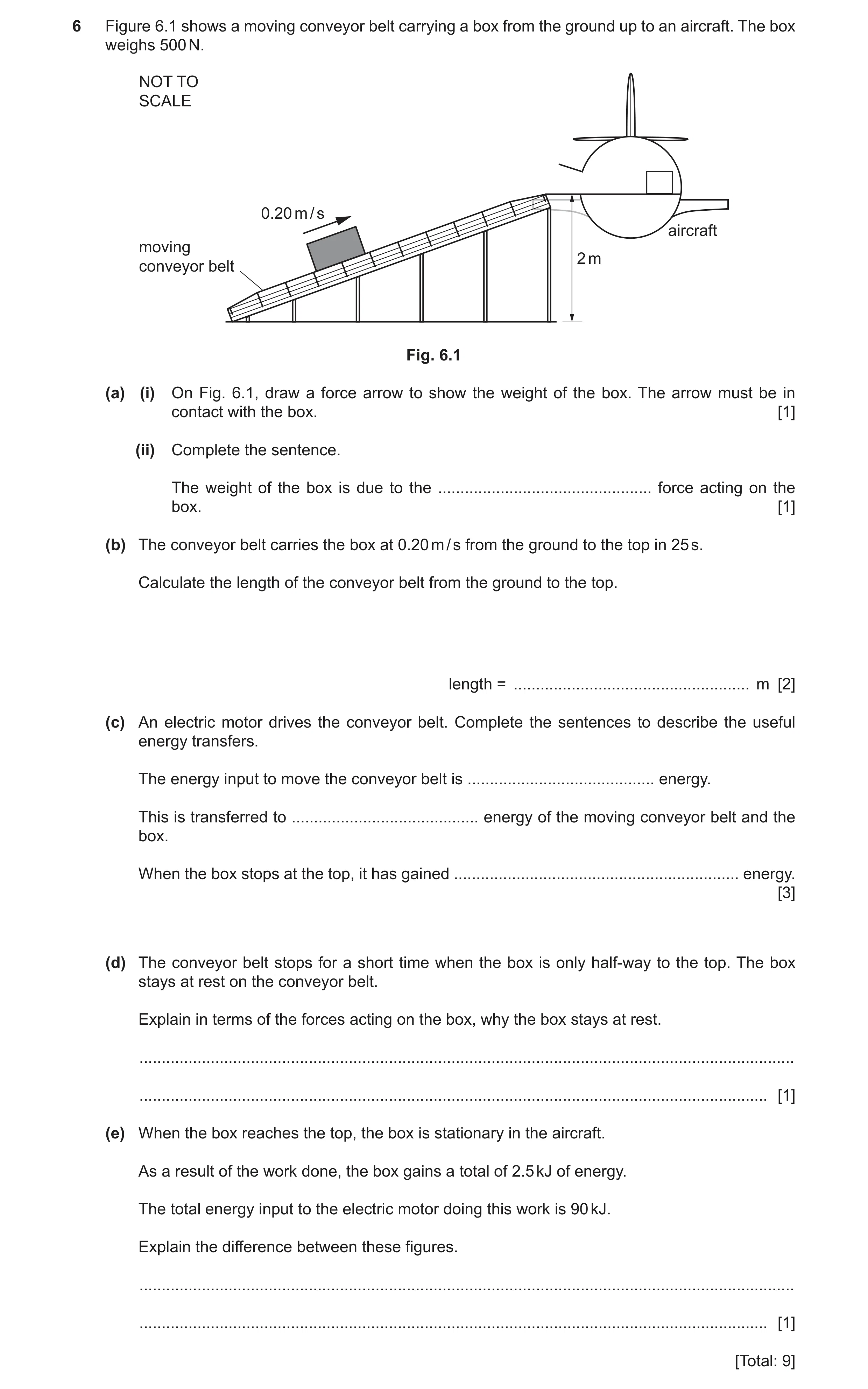
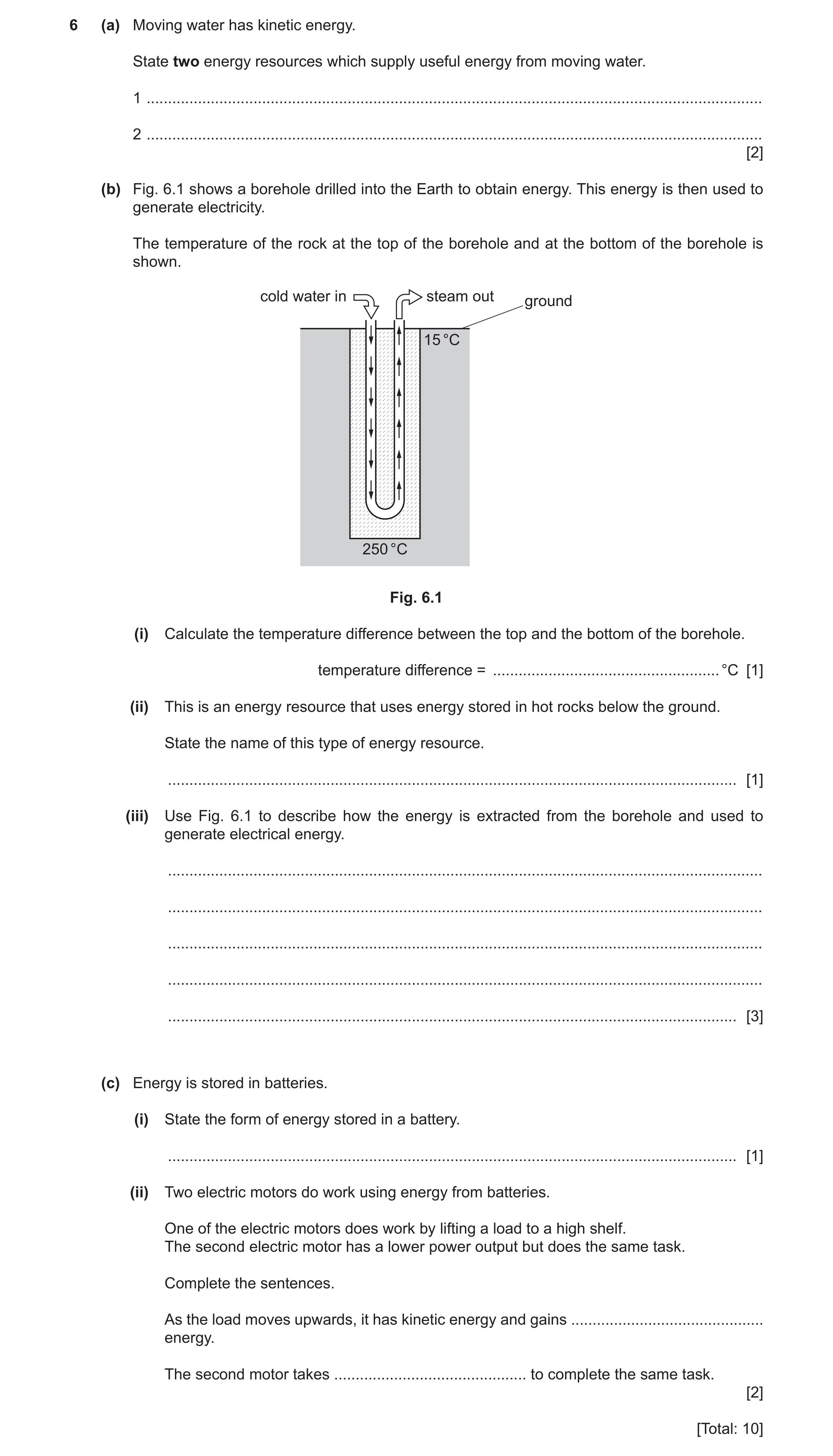
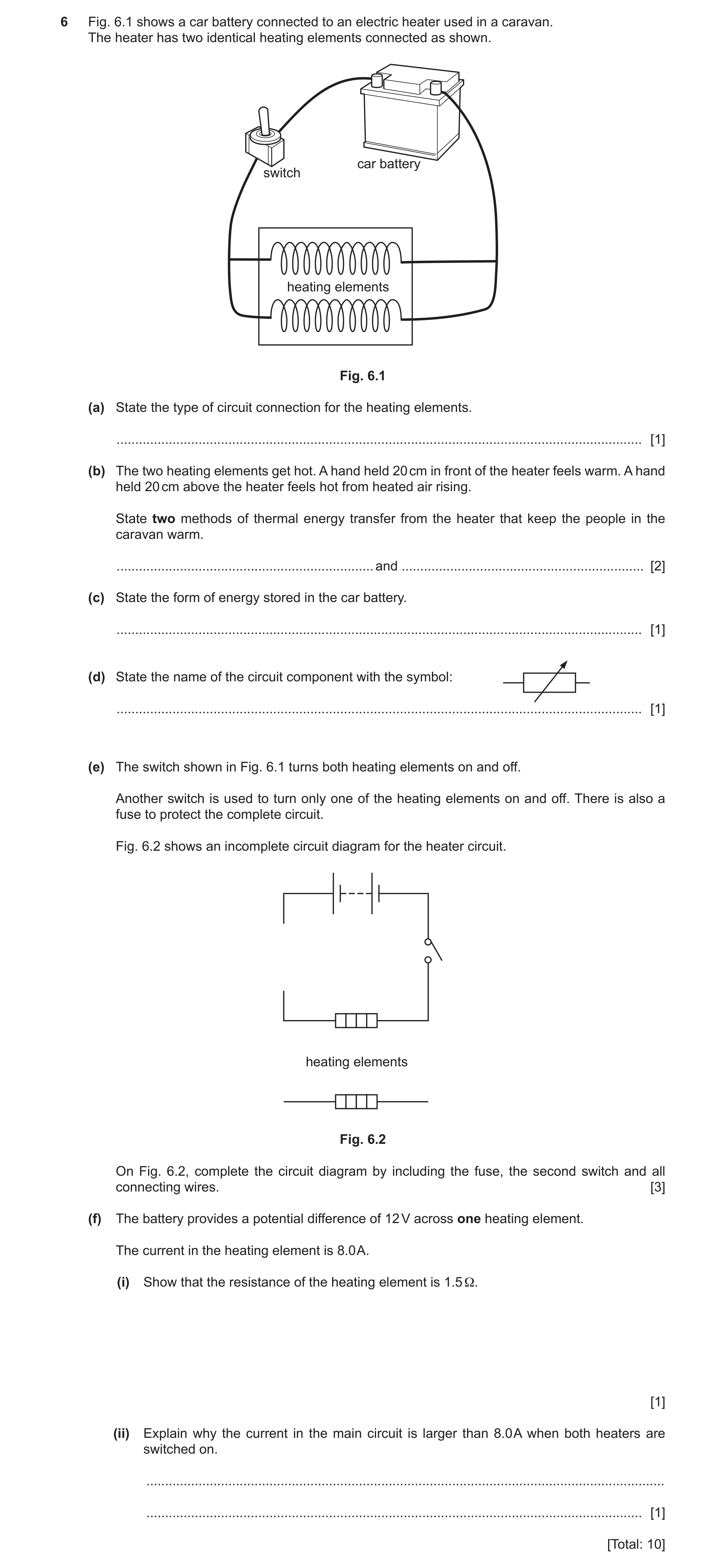
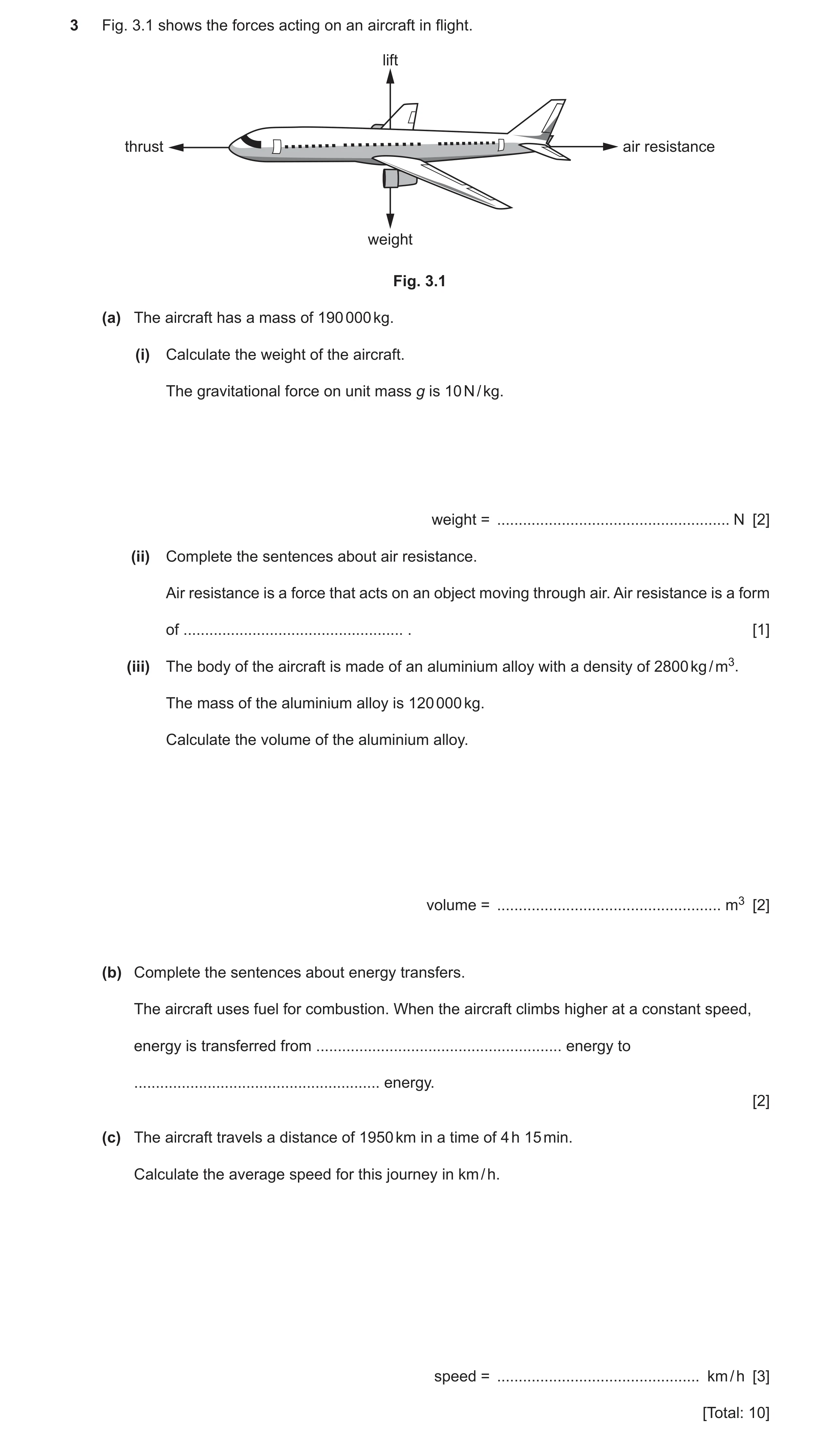
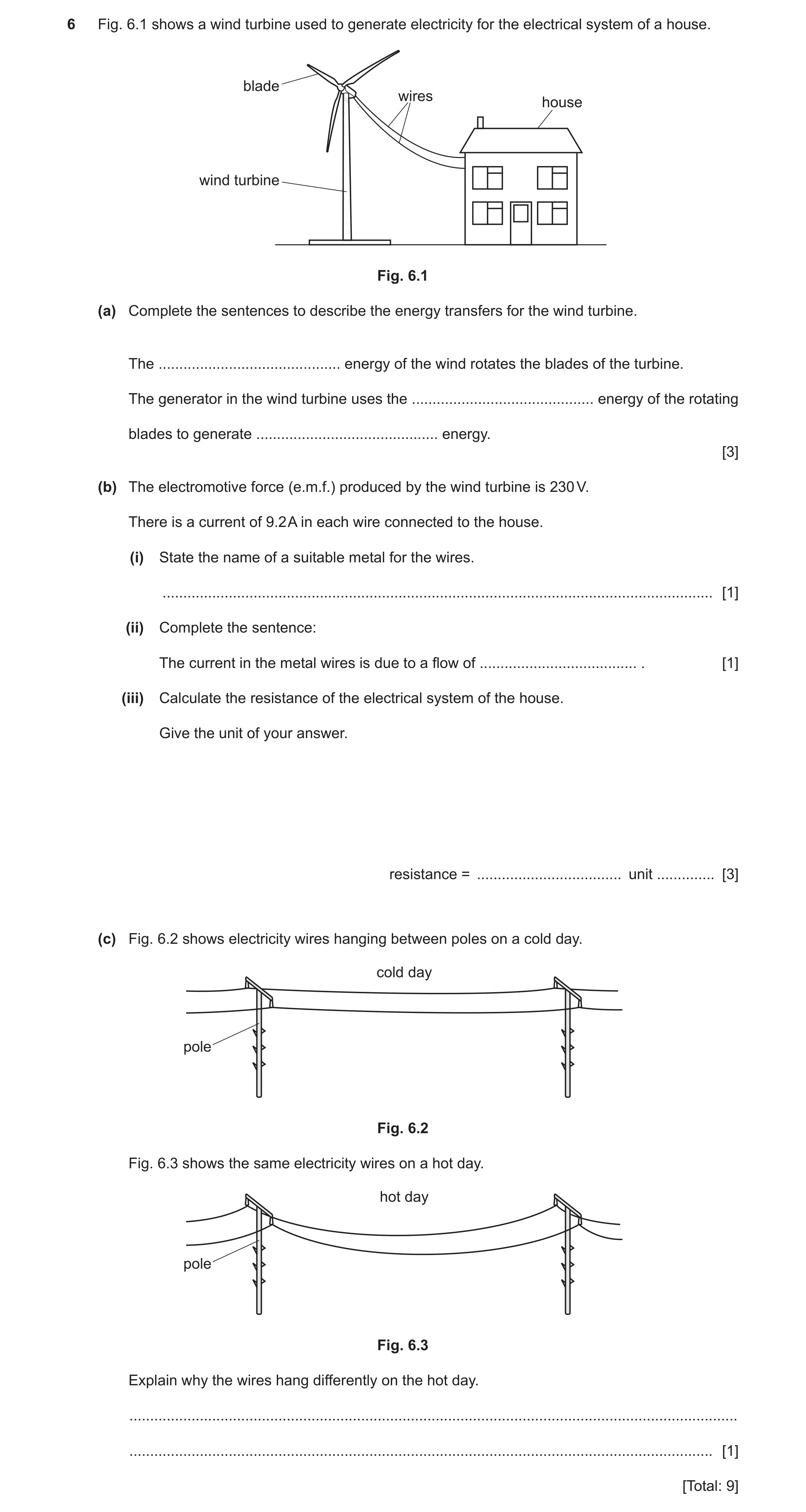
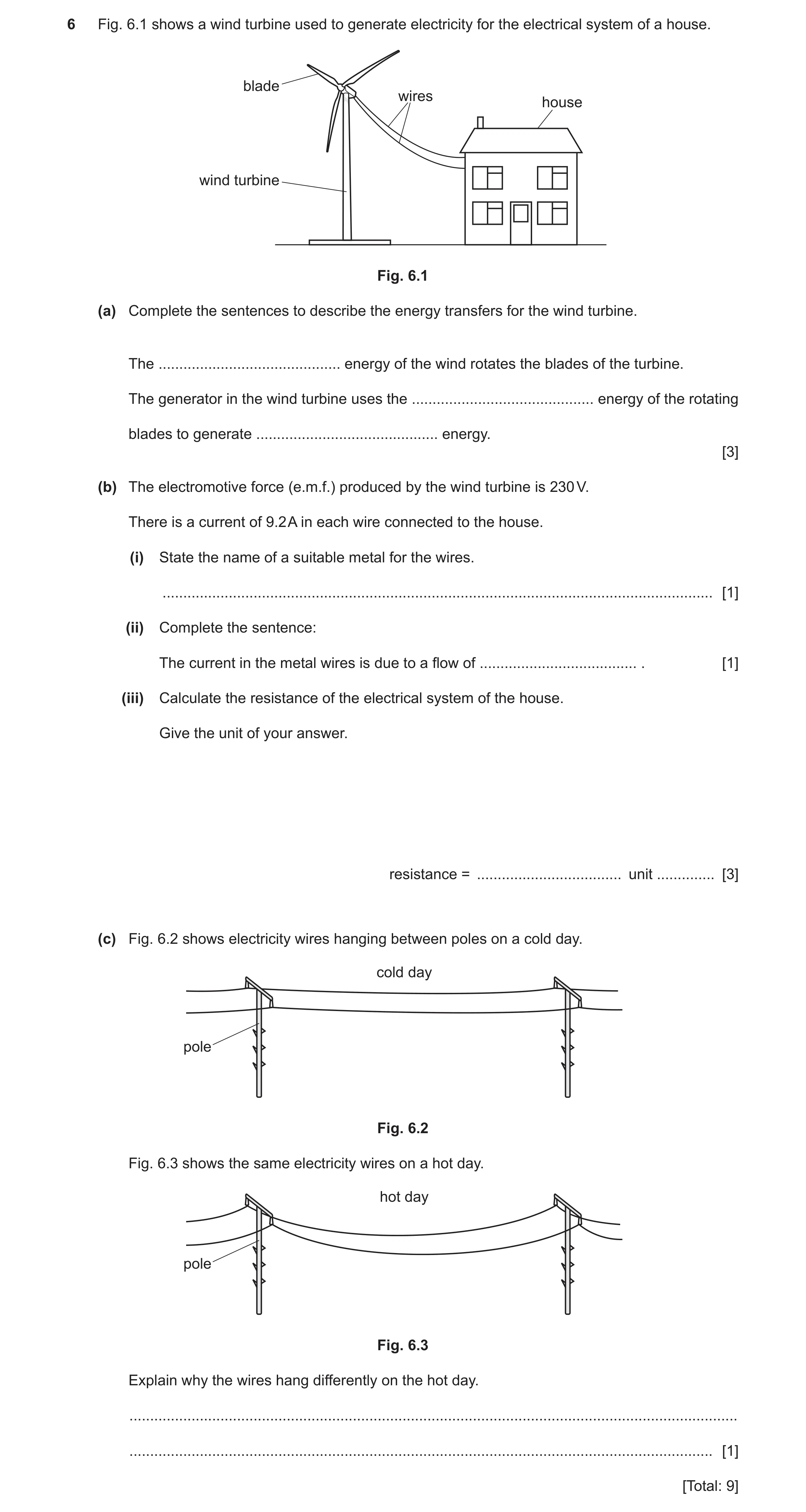
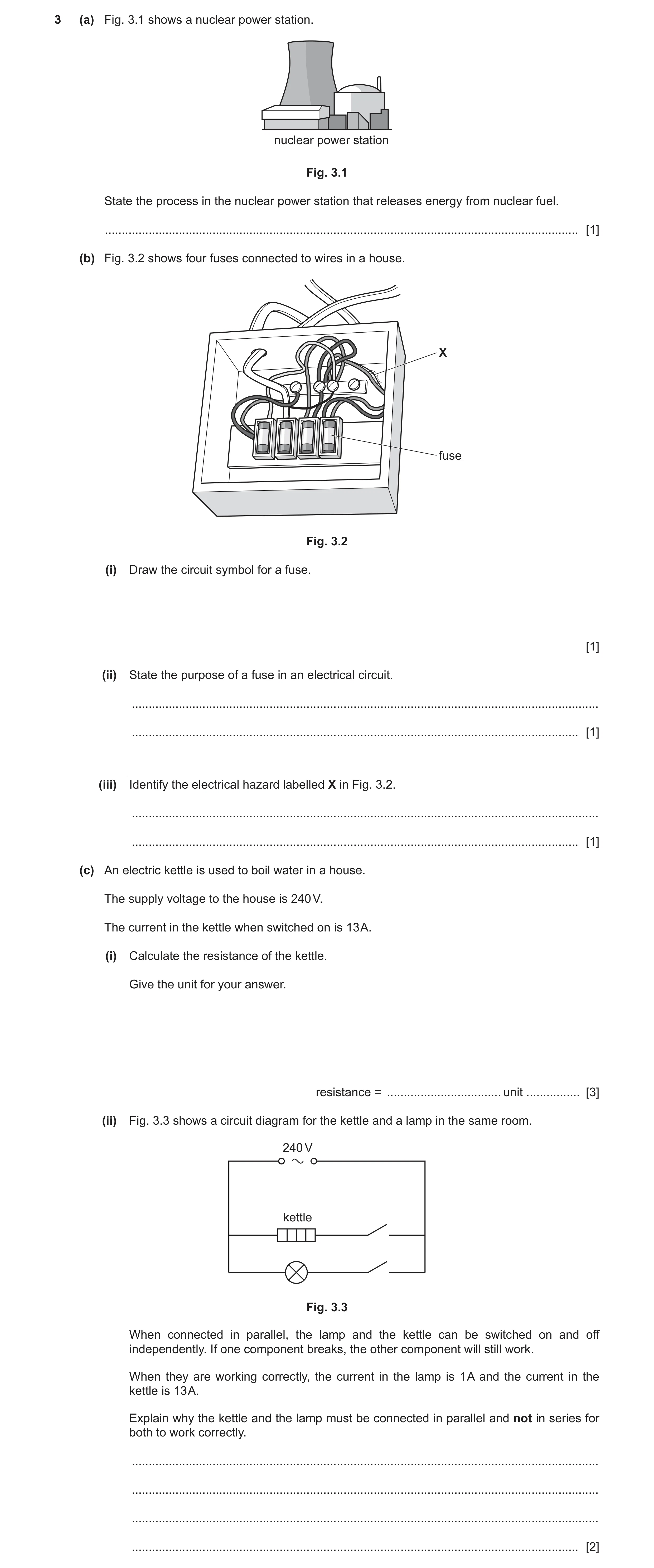
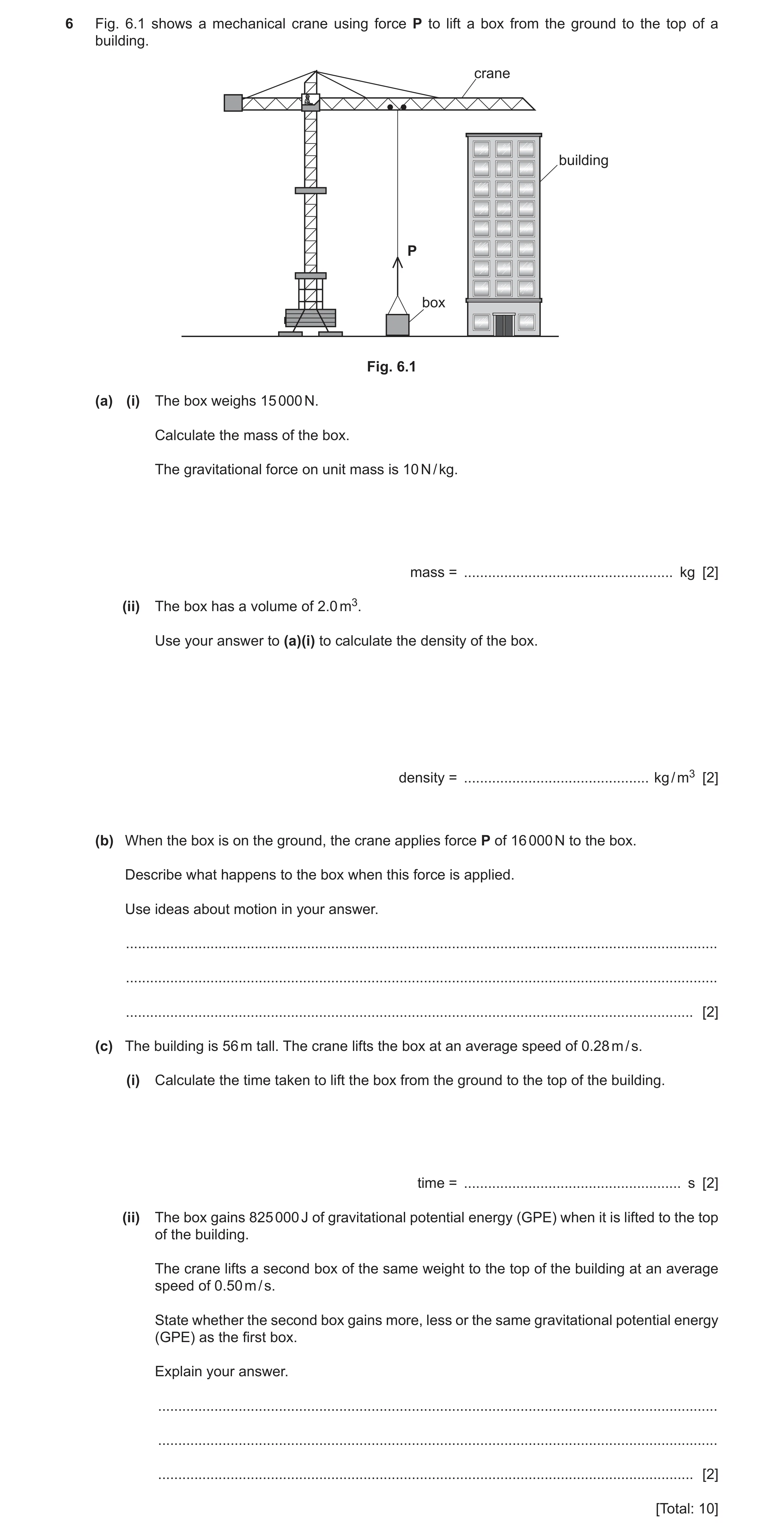
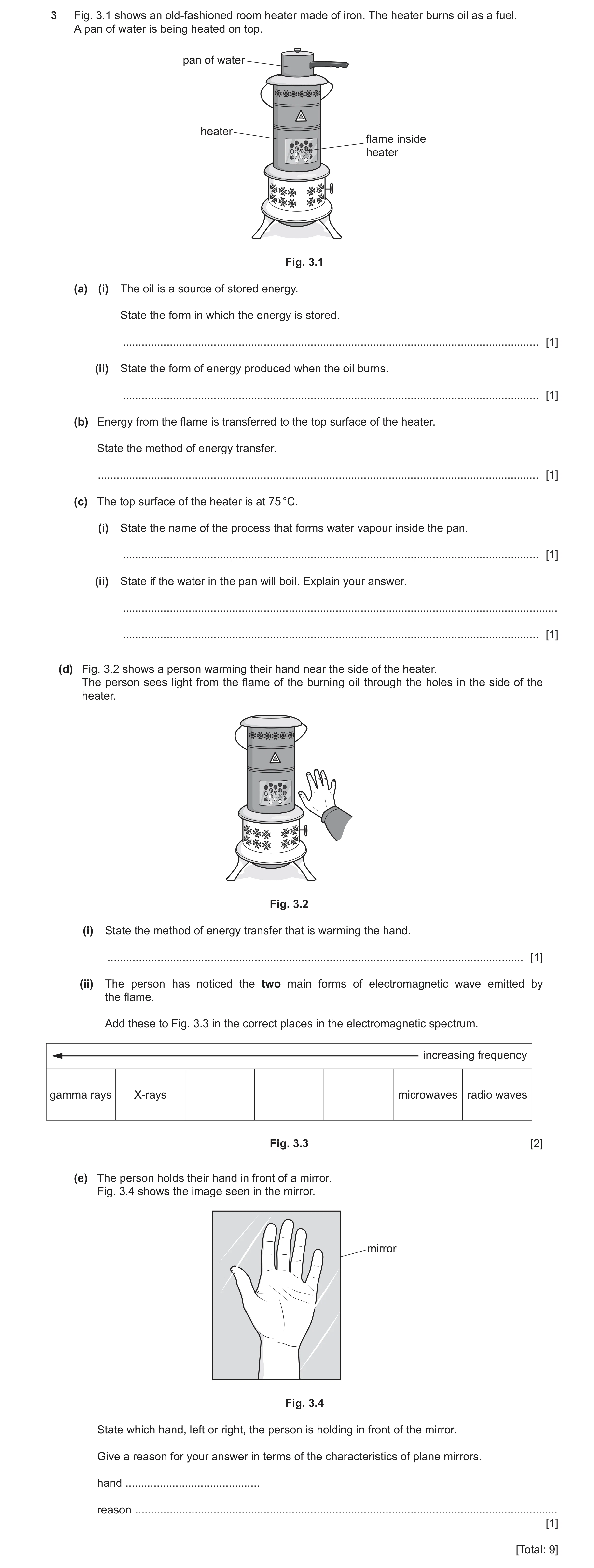
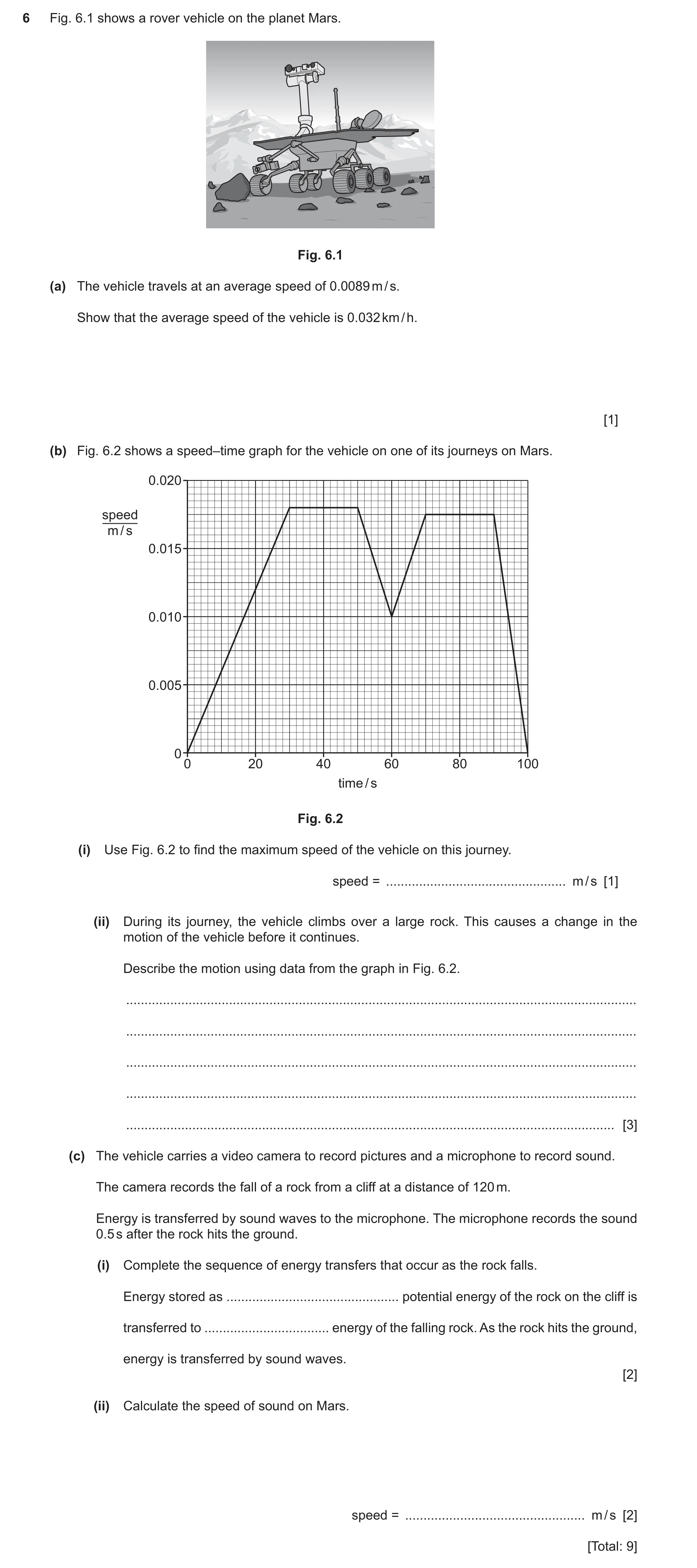
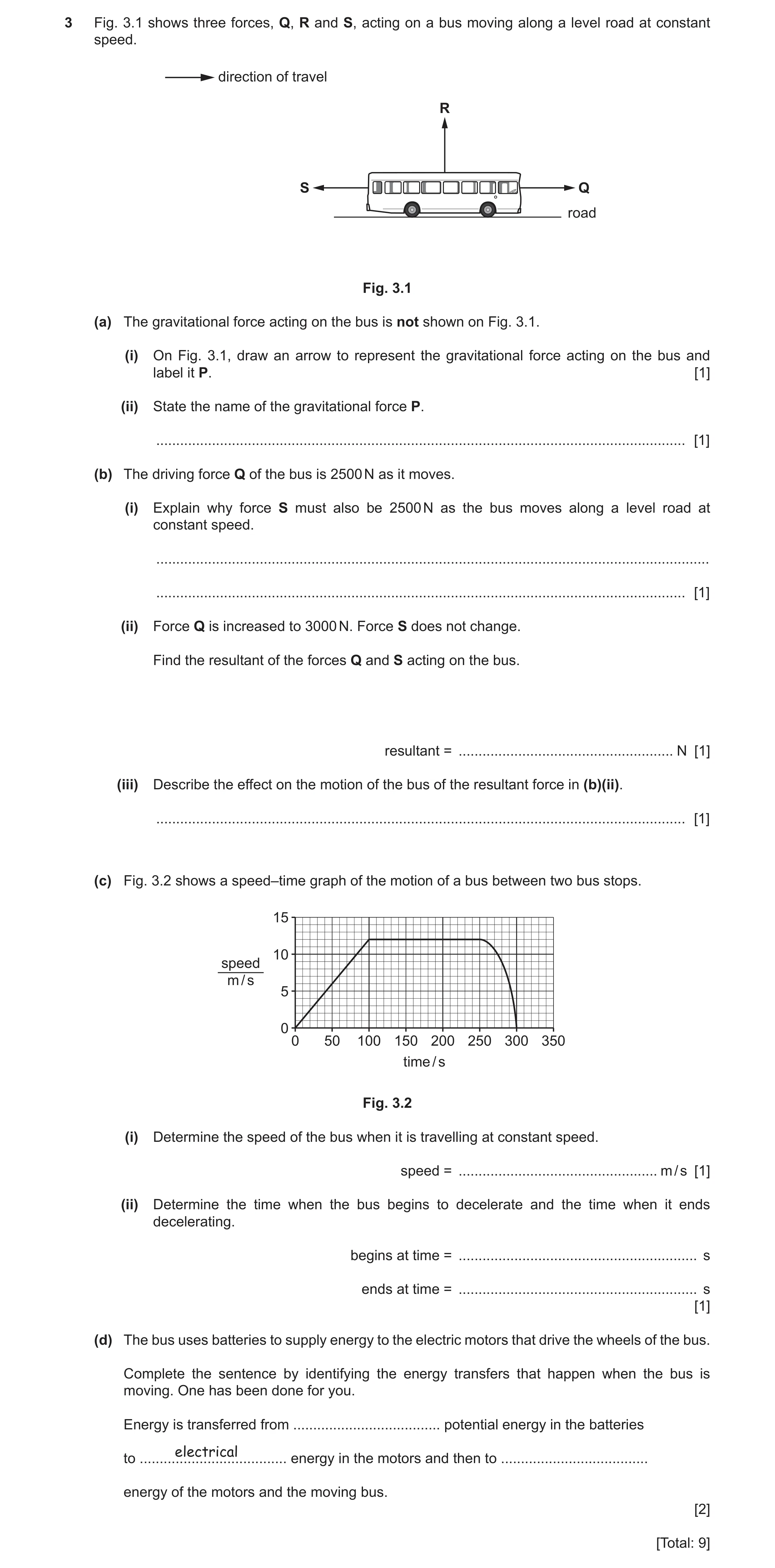
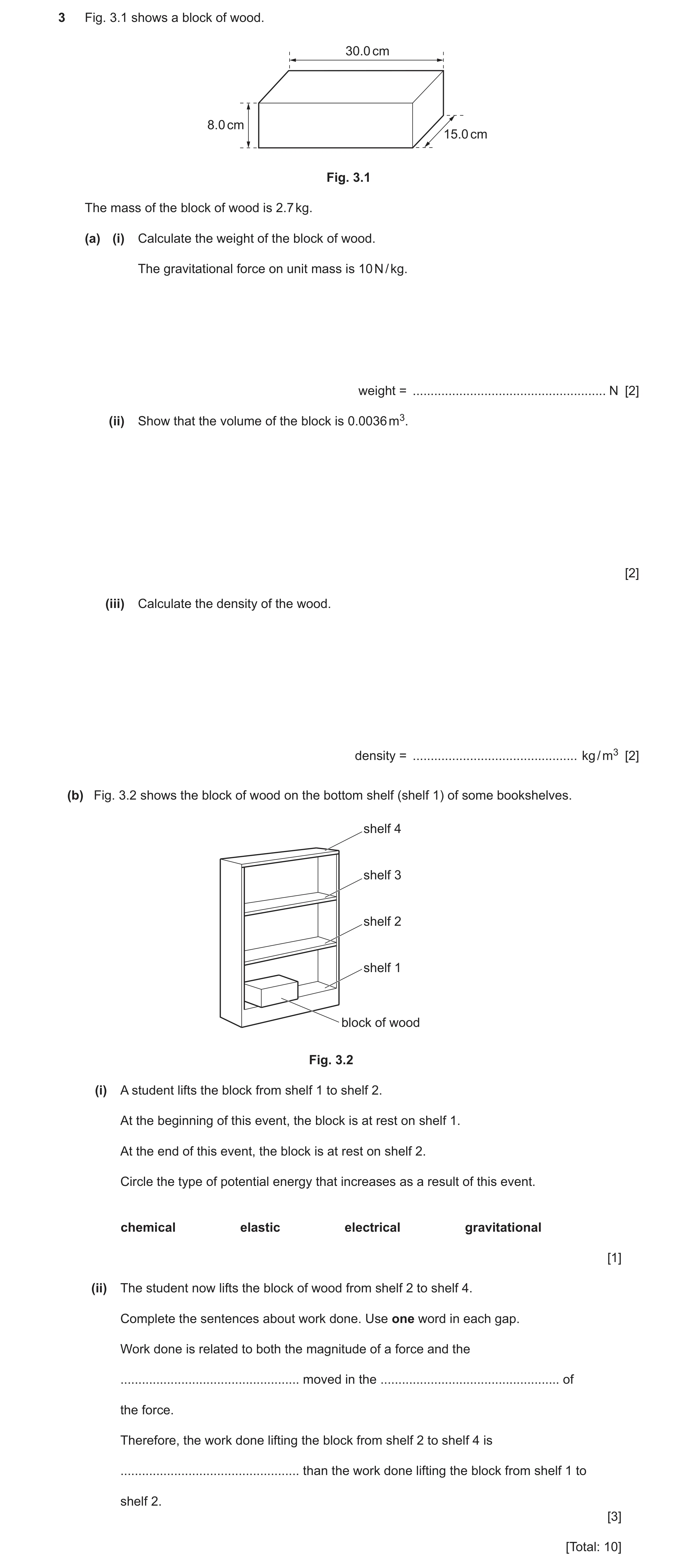
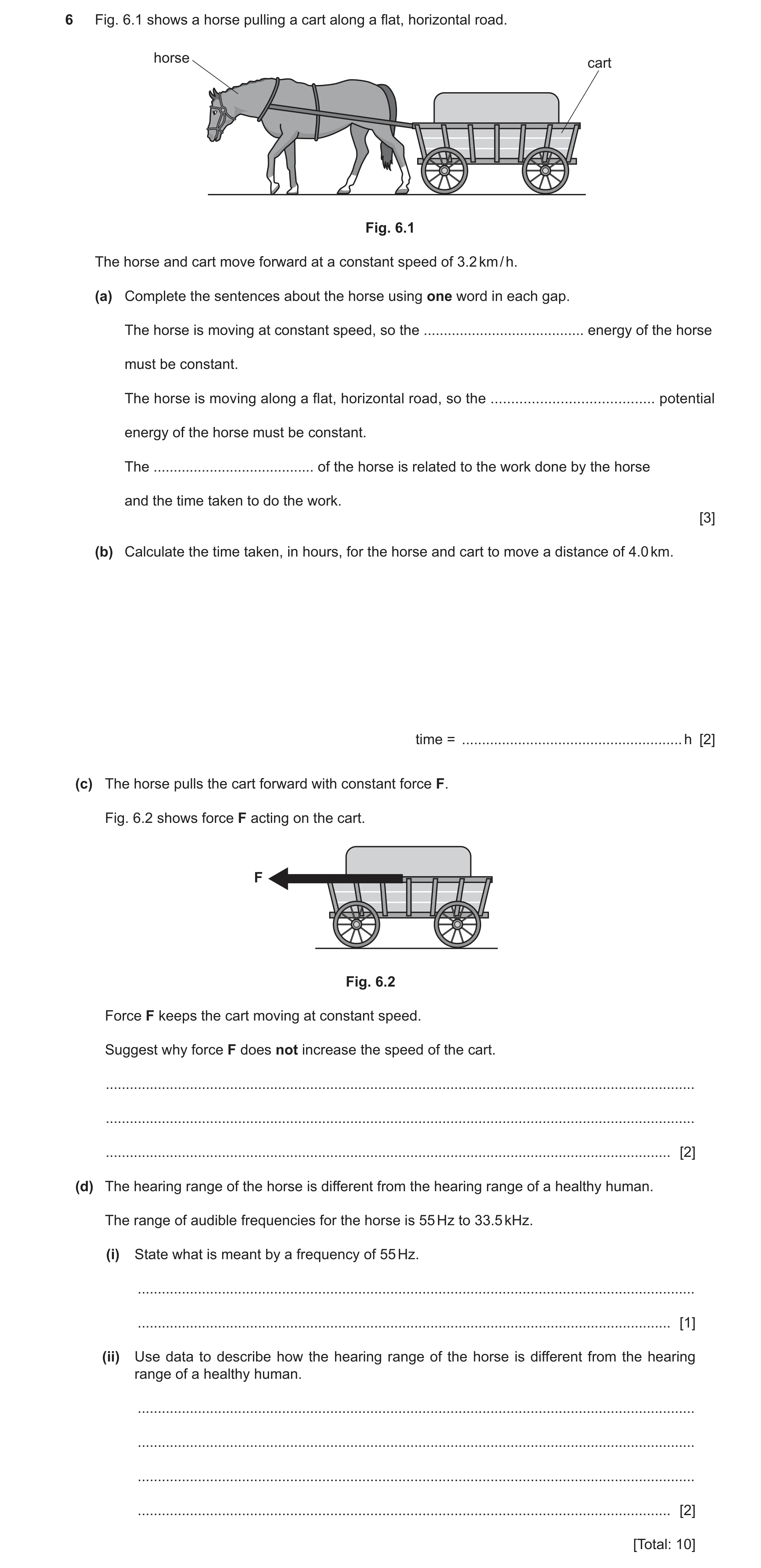
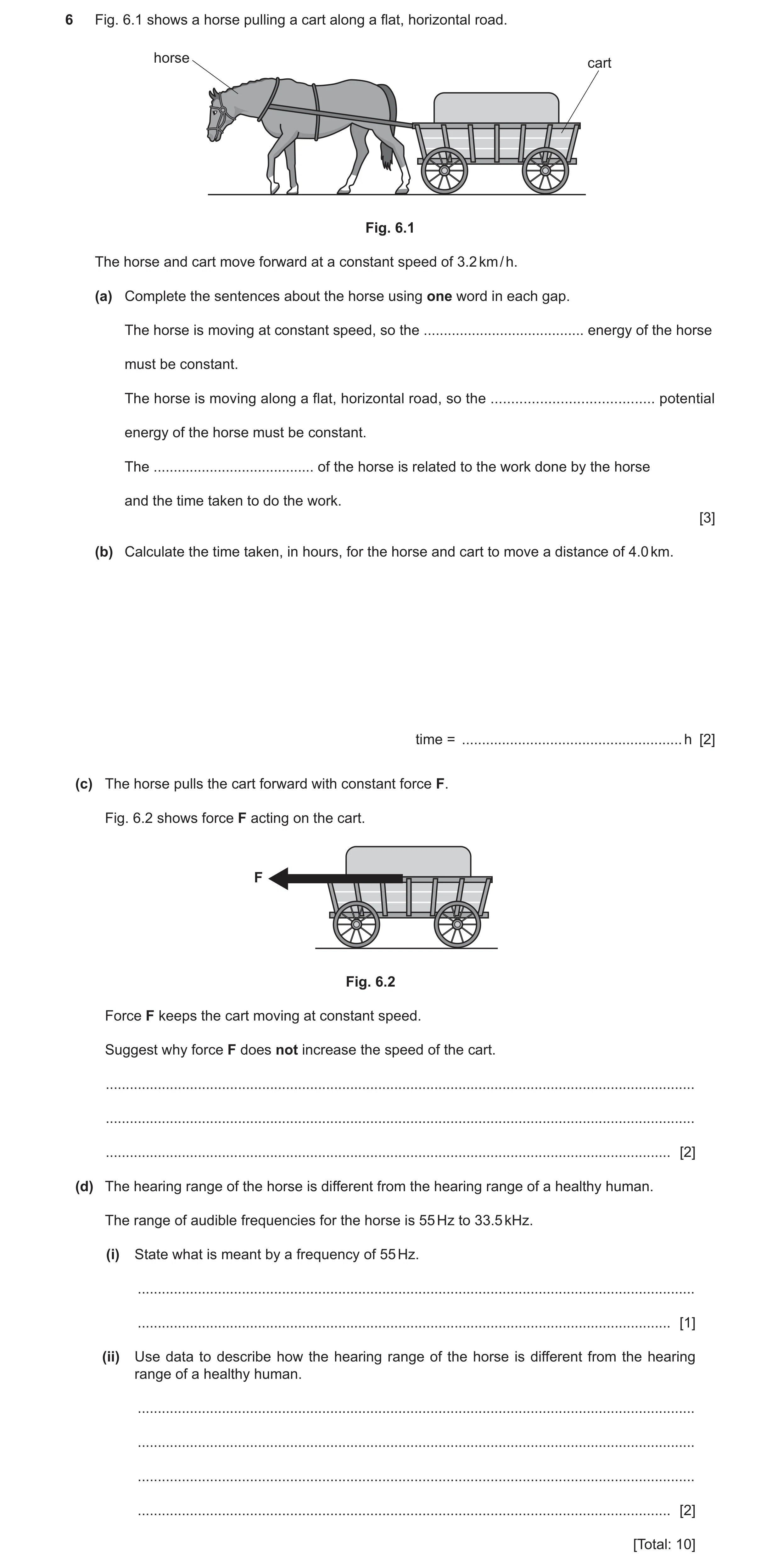
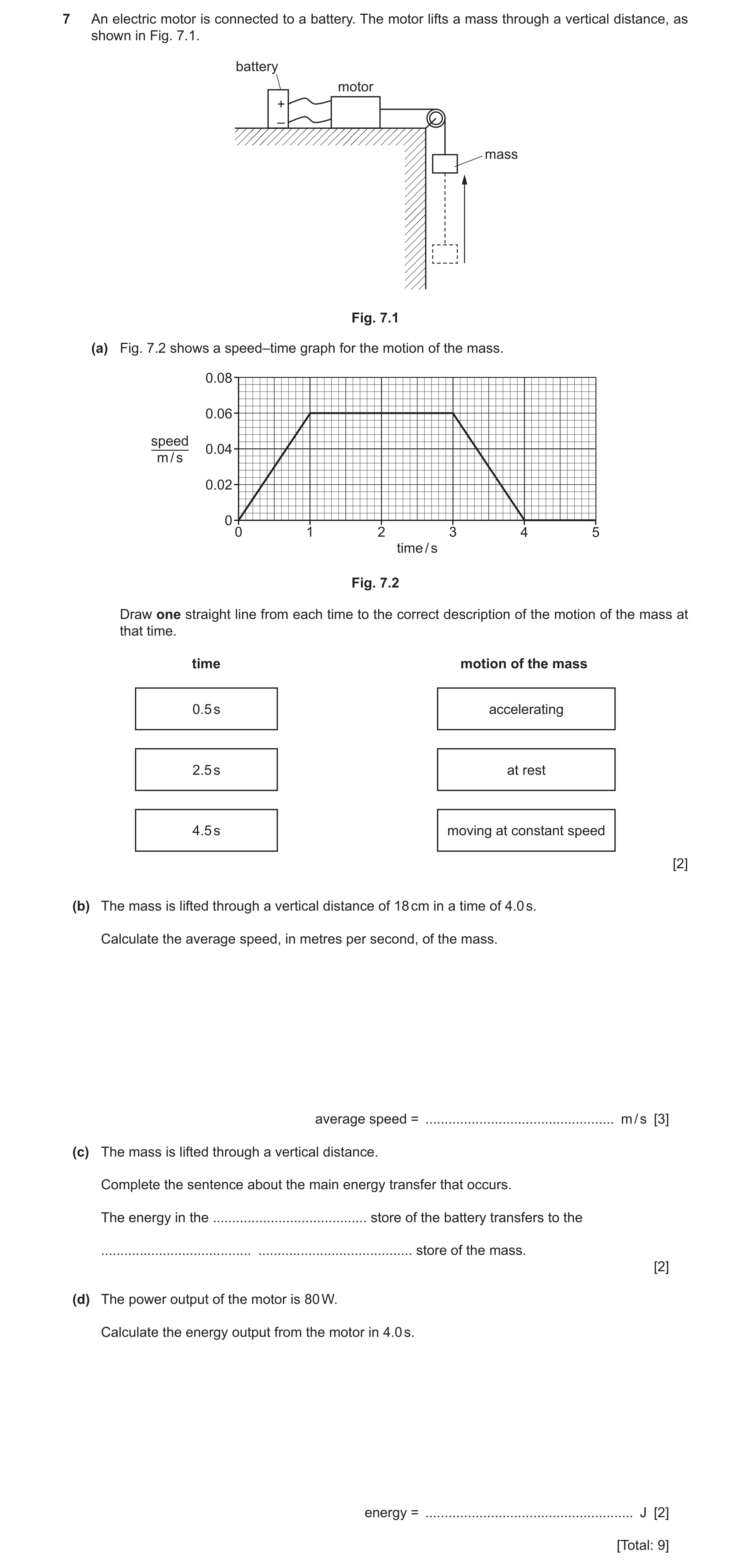
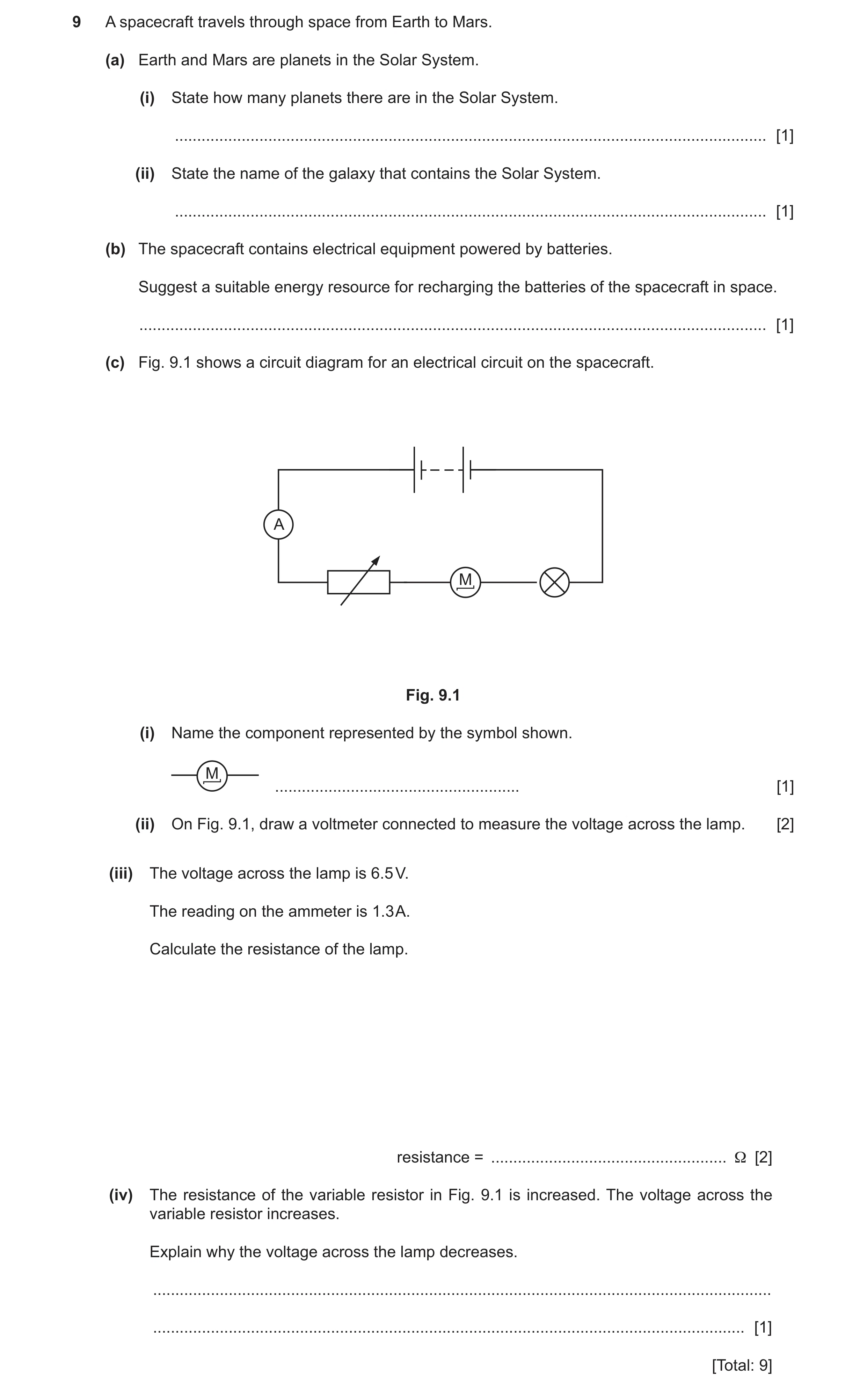
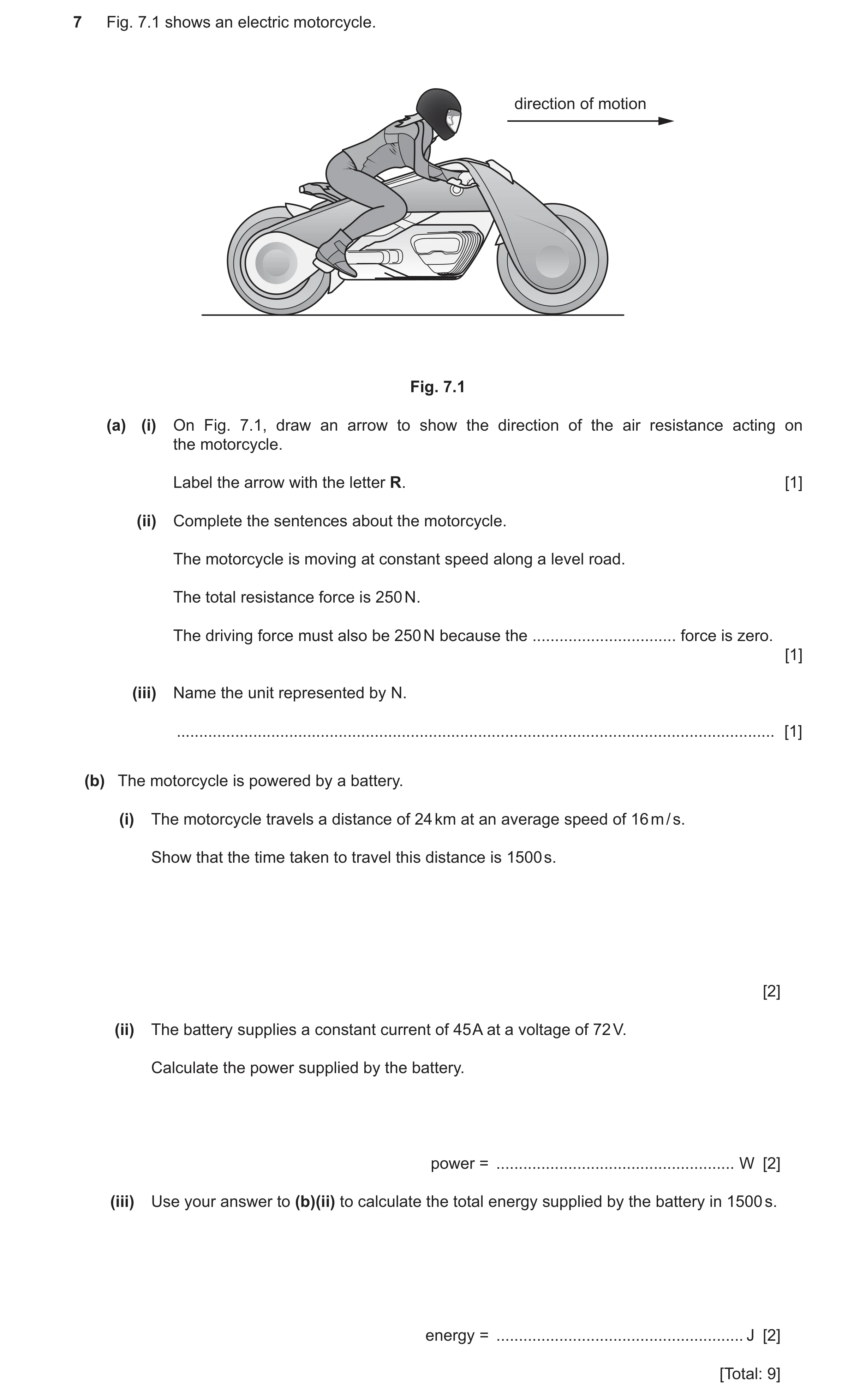
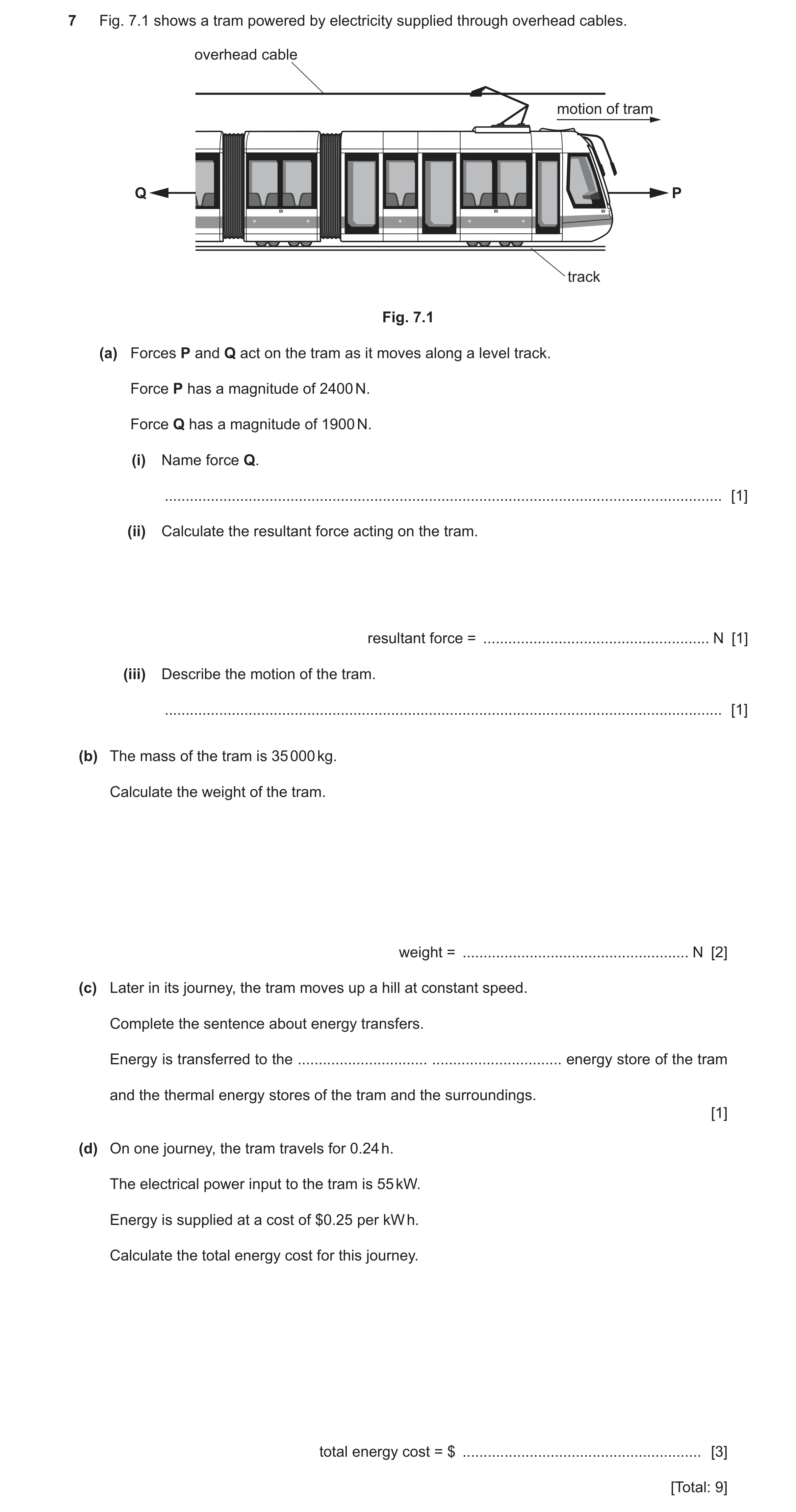
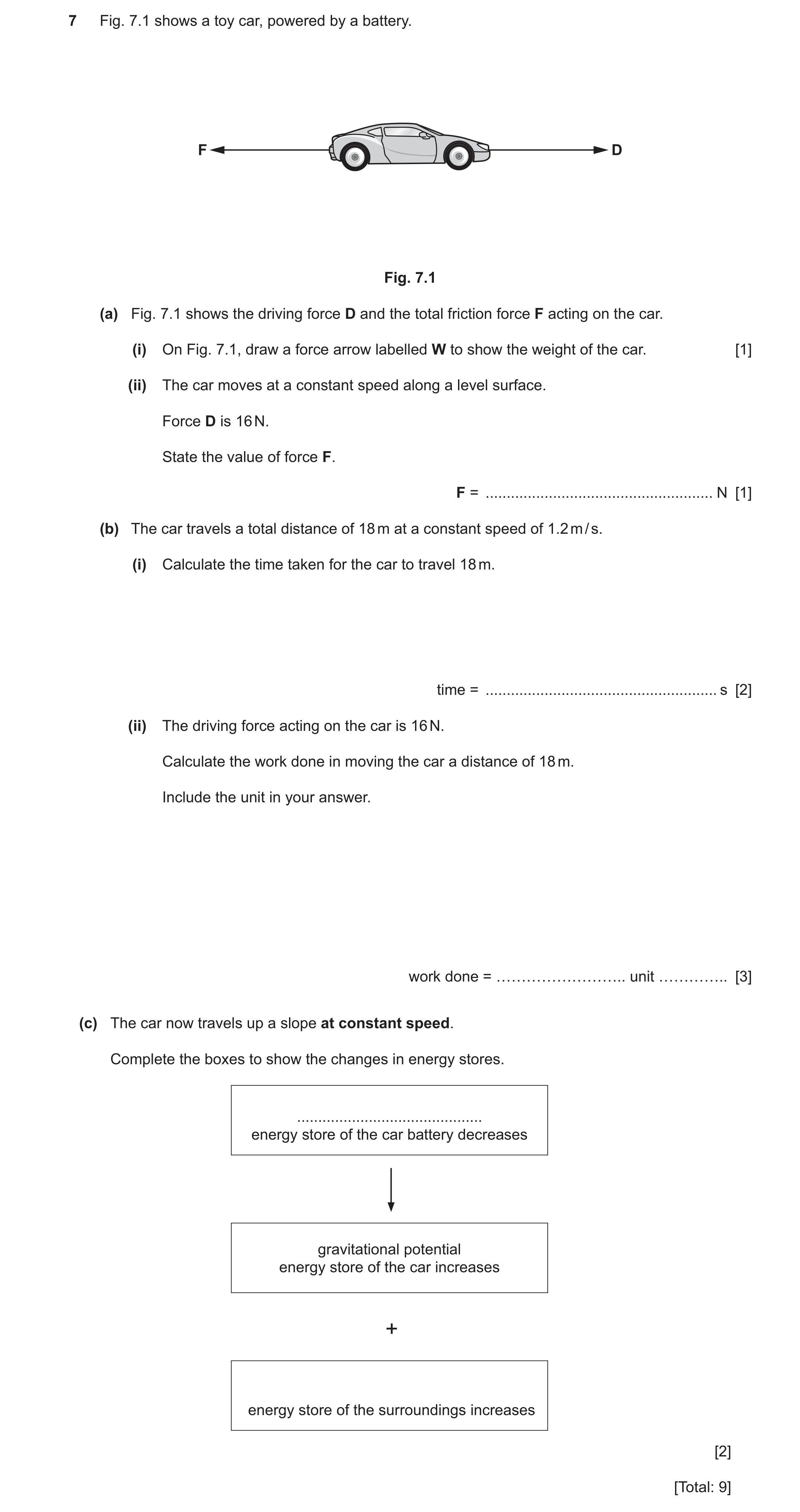
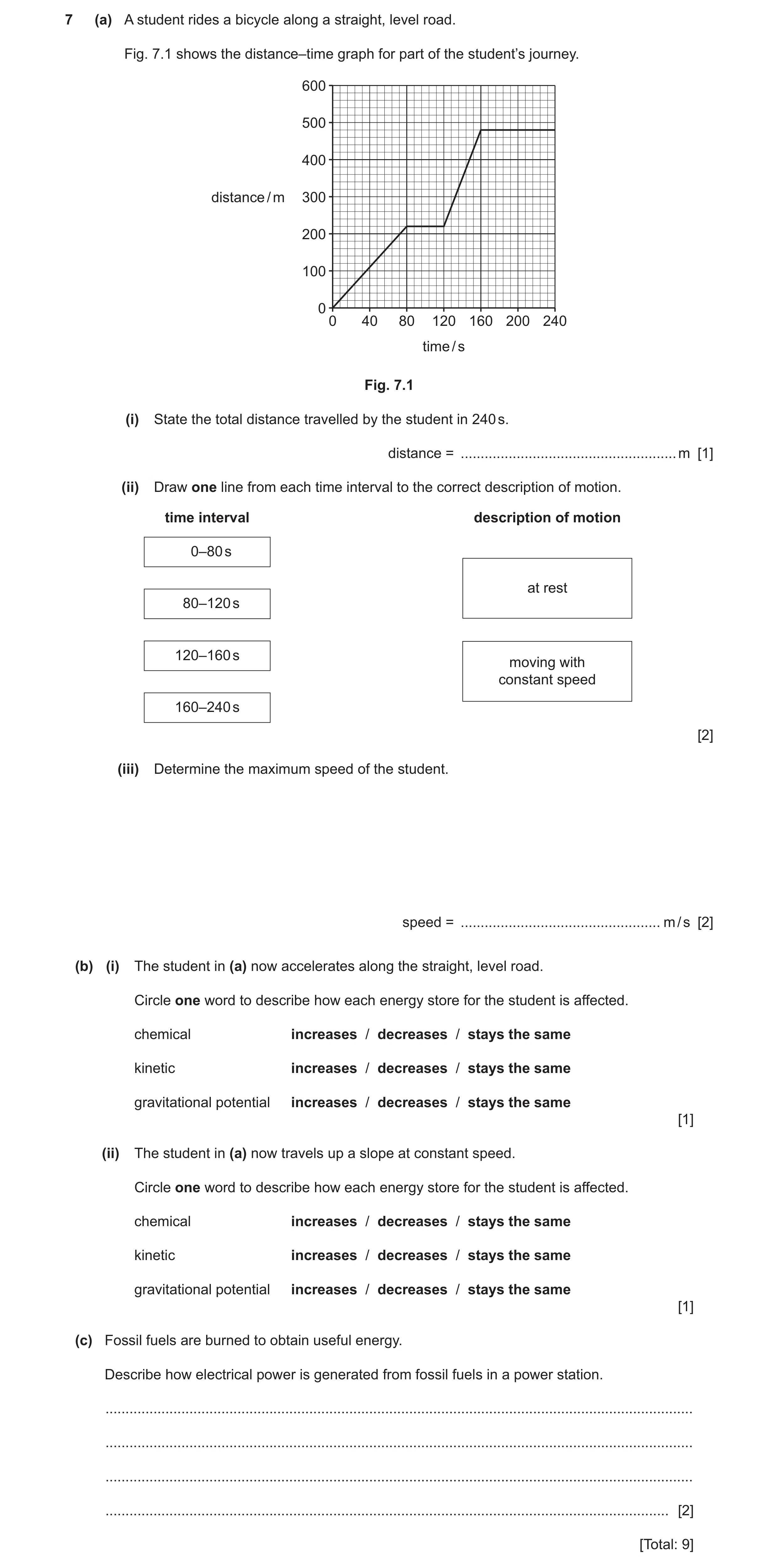
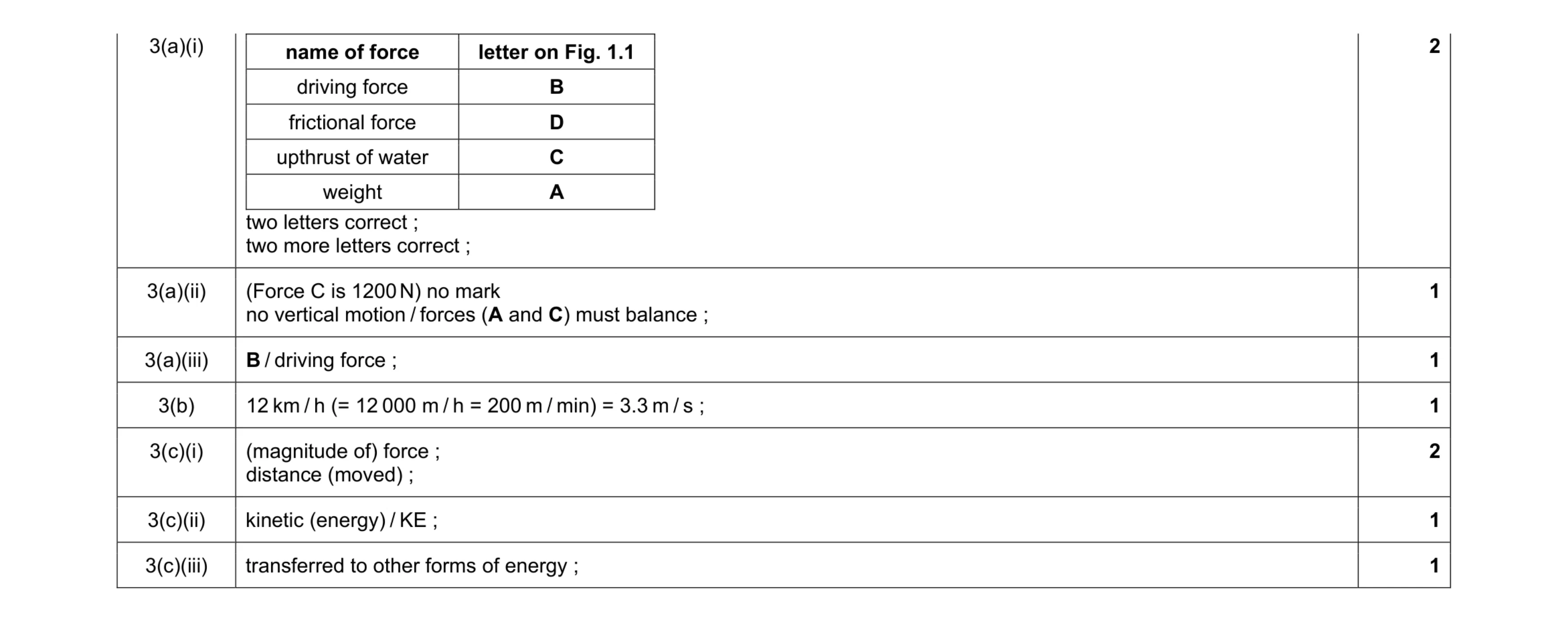 9
9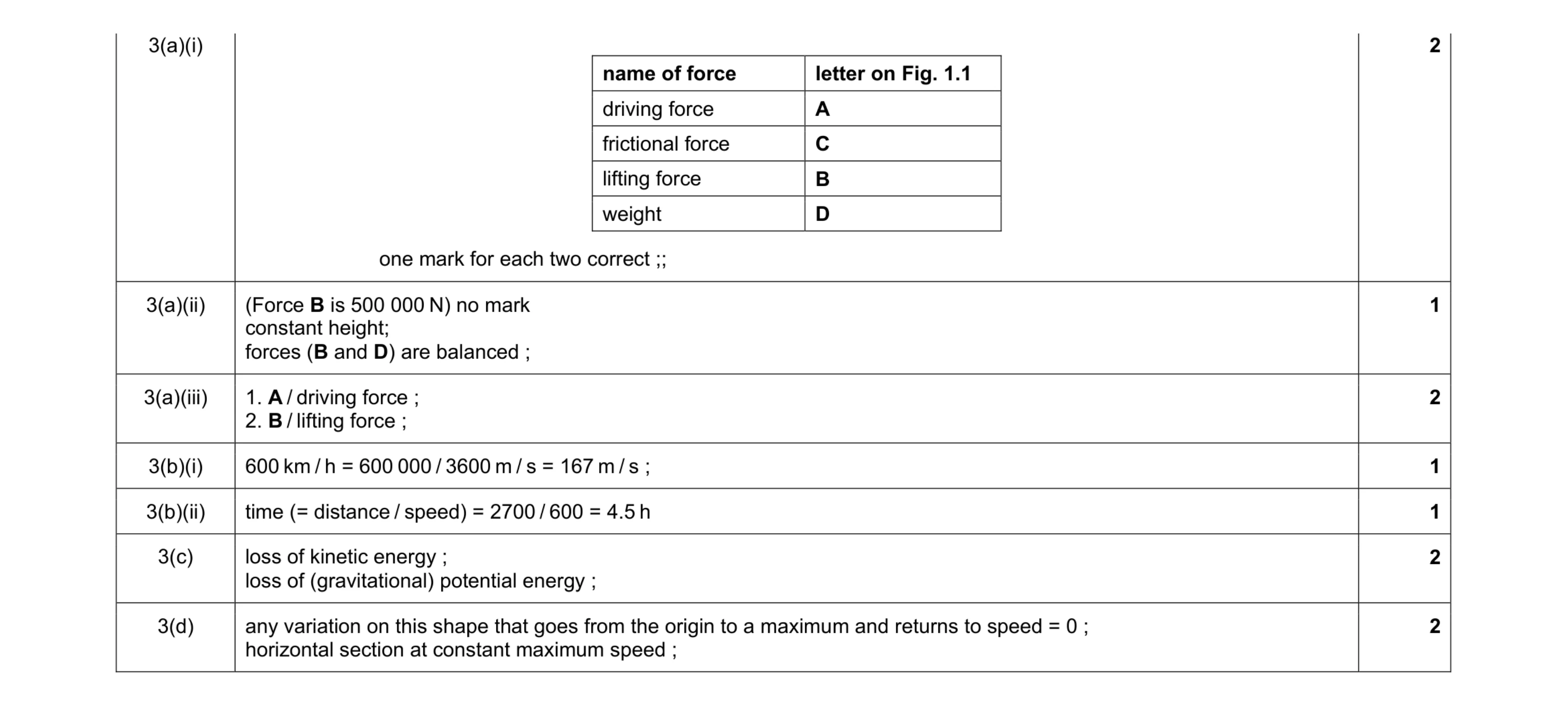 11
11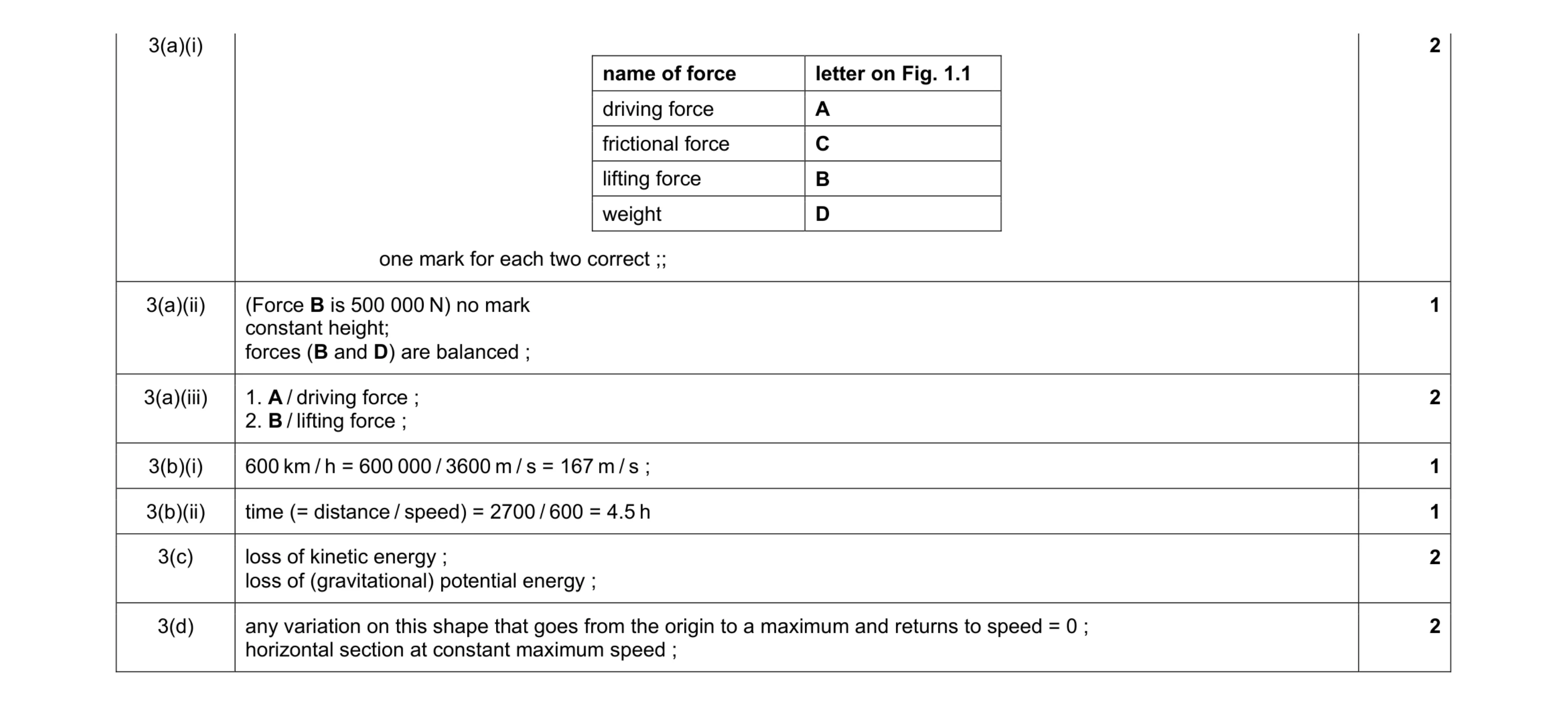 11
11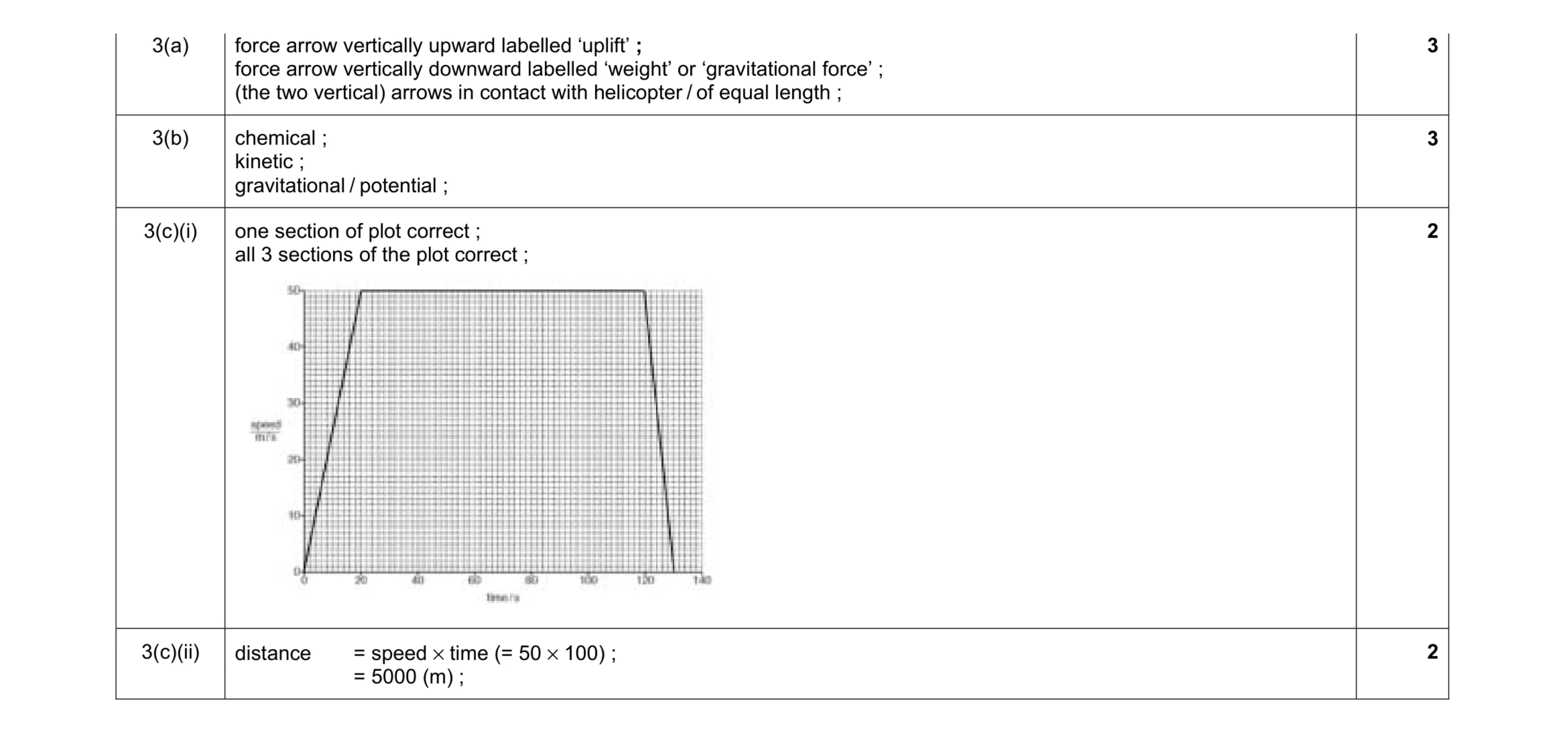 10
10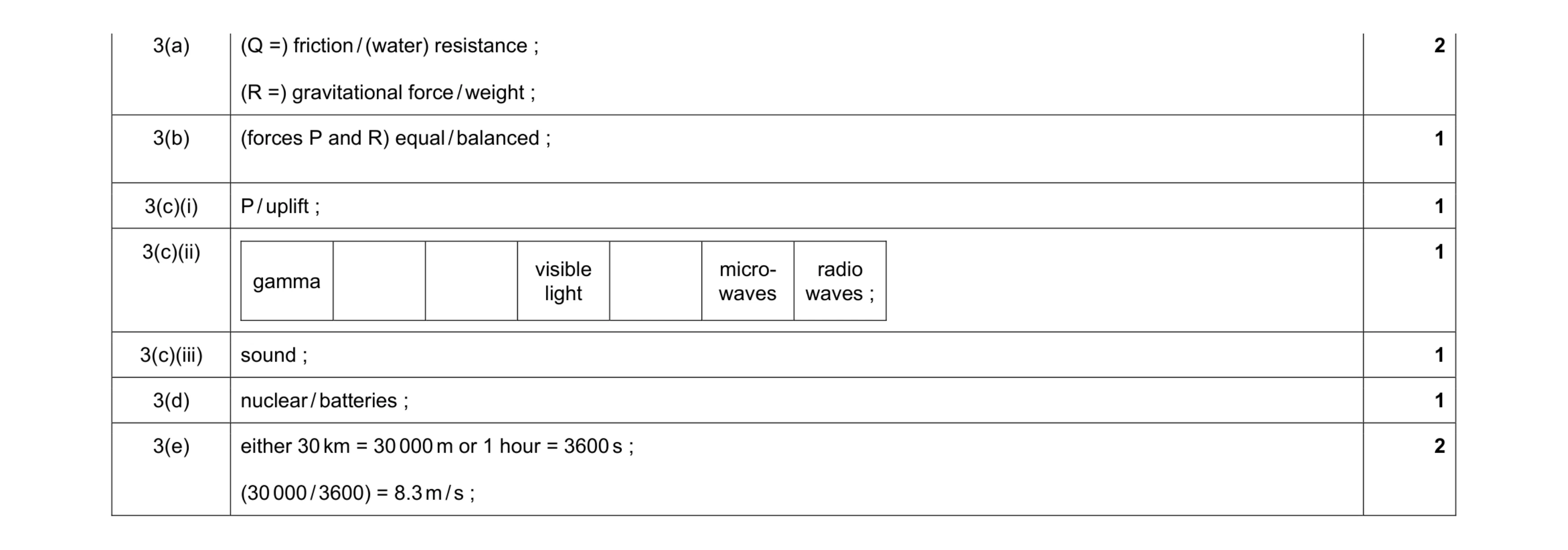 9
9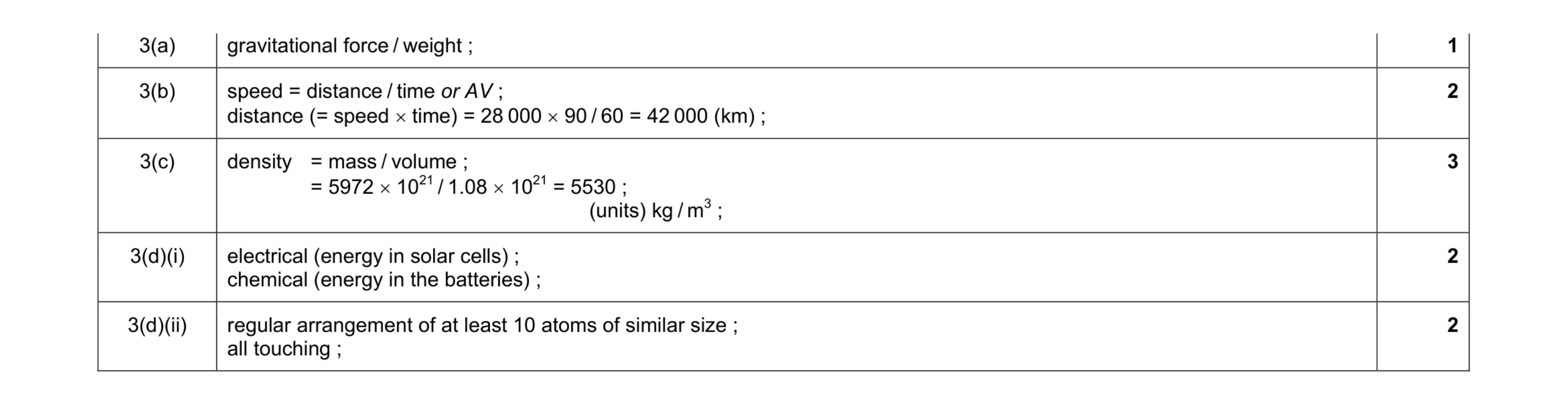 10
10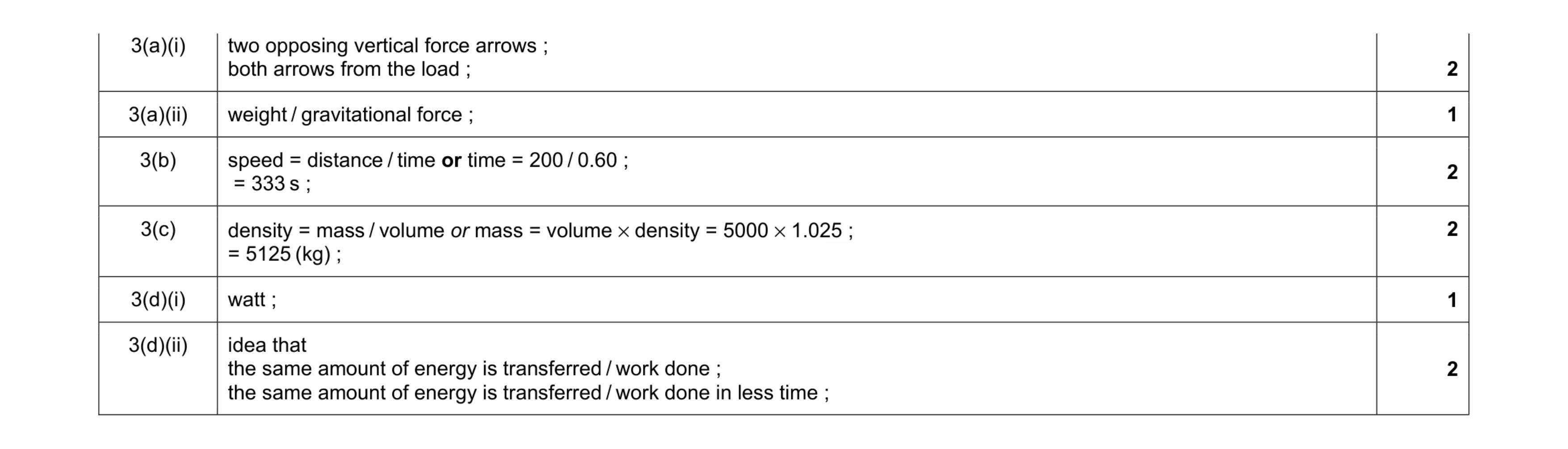 10
10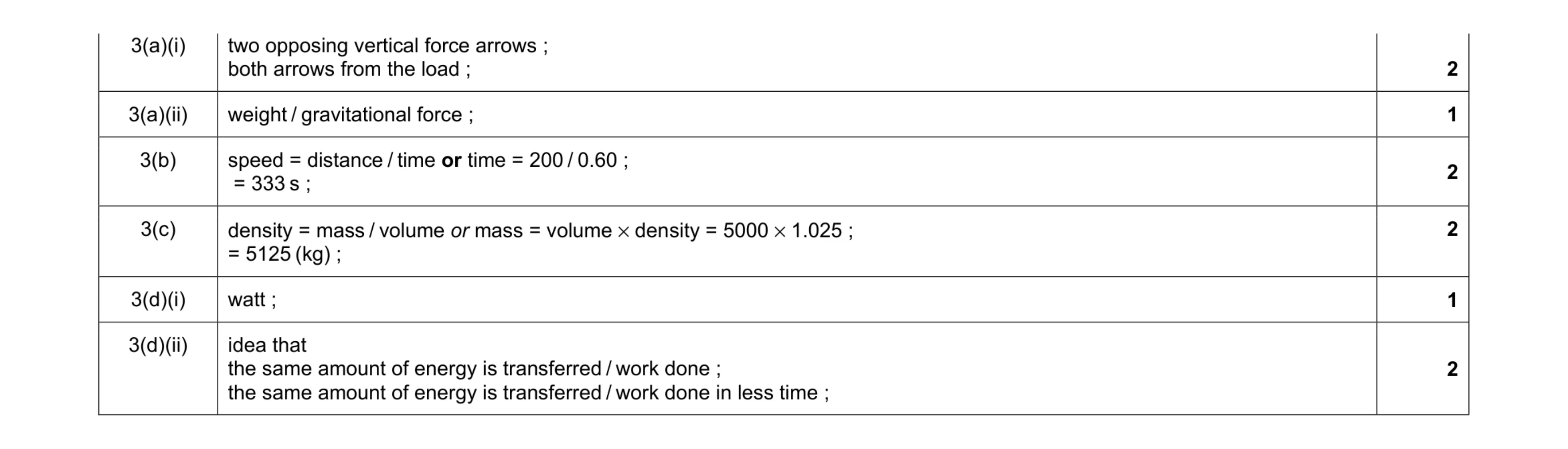 10
10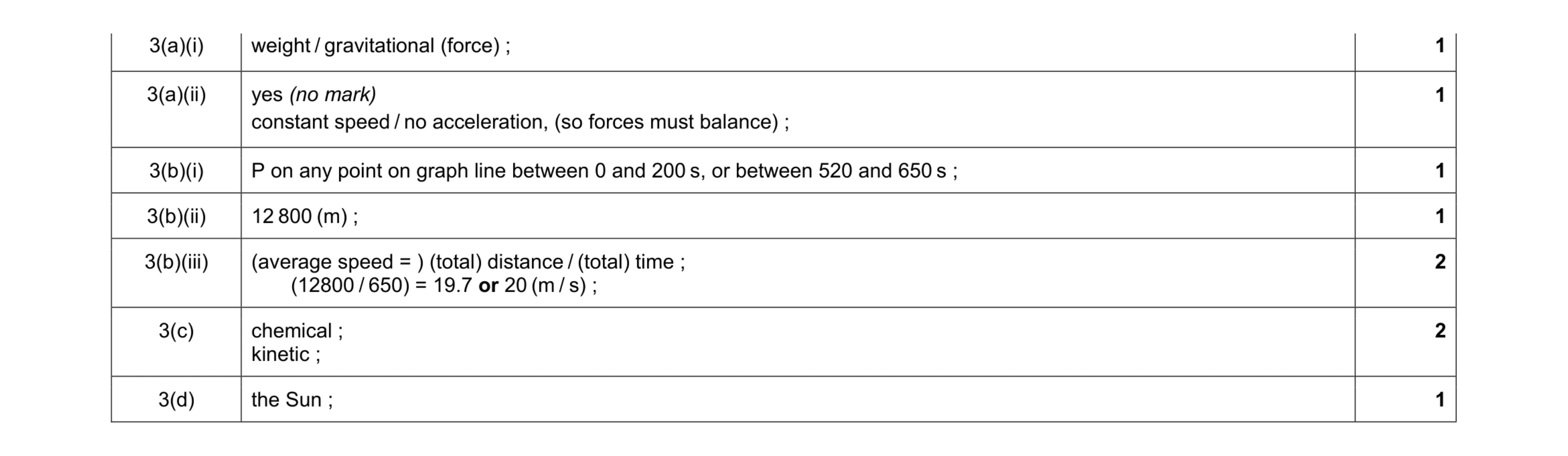 9
9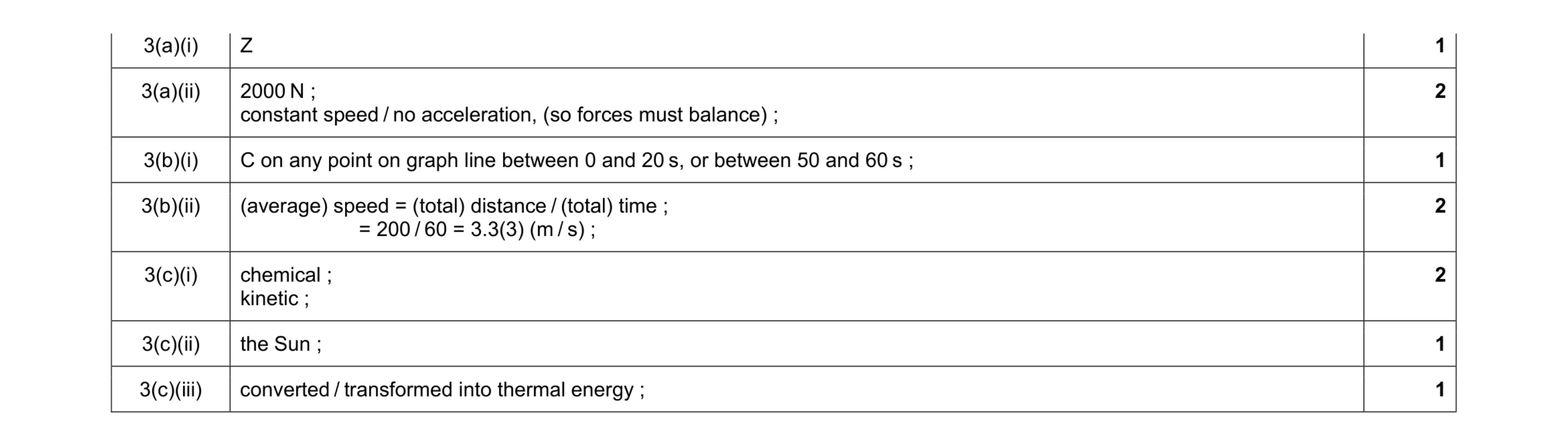 10
10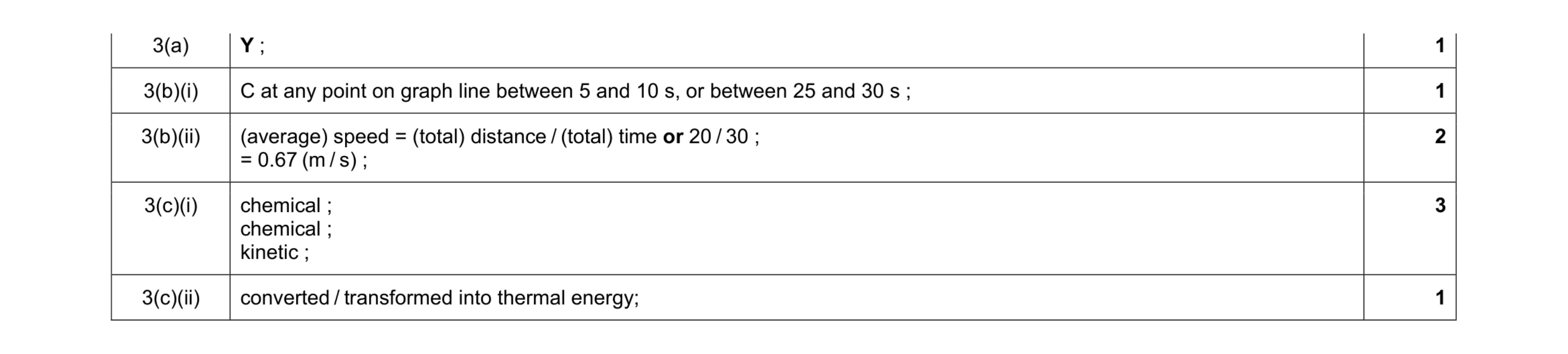 8
8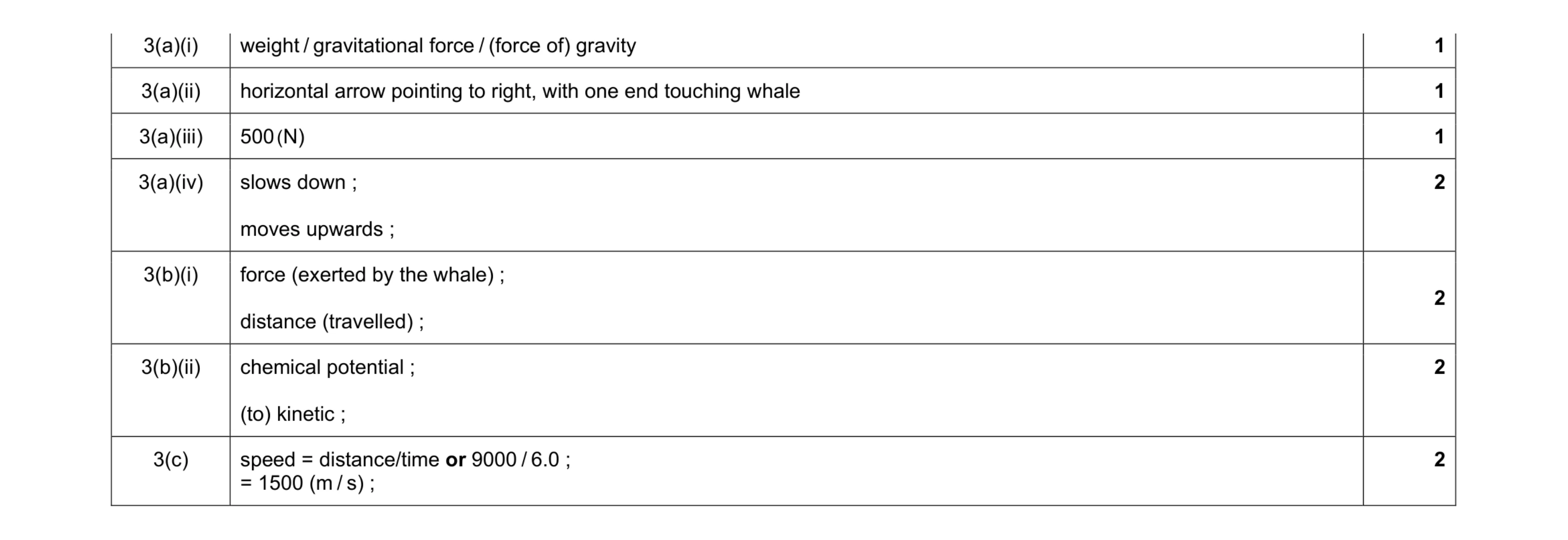 11
11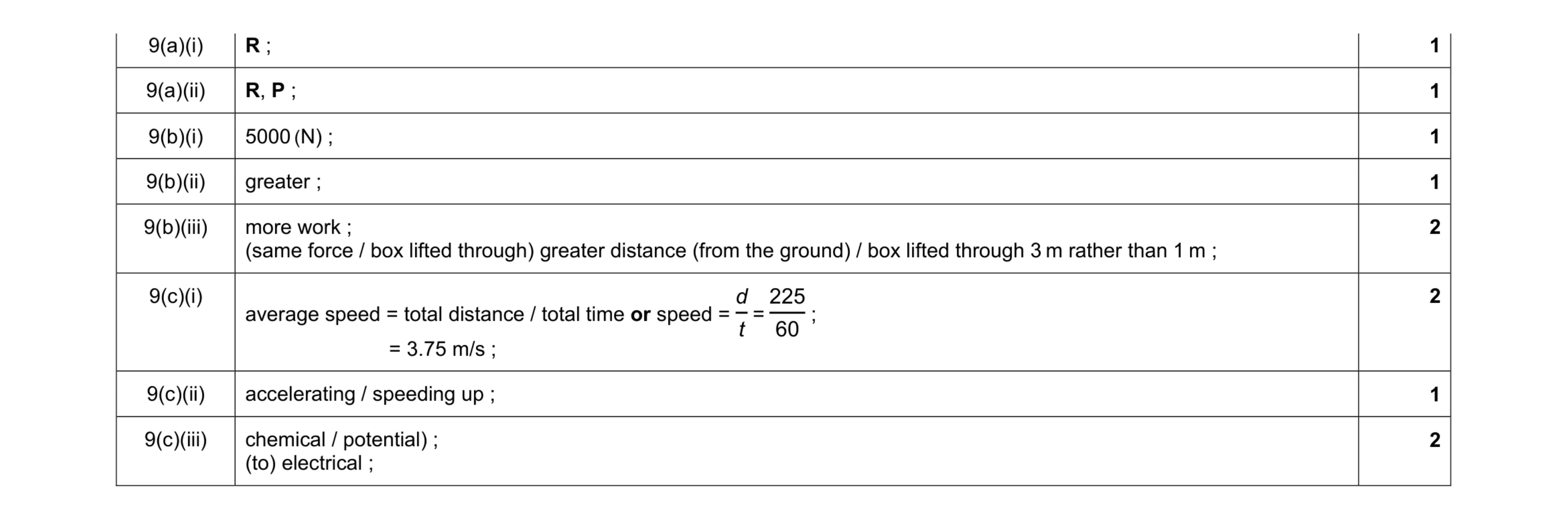 11
11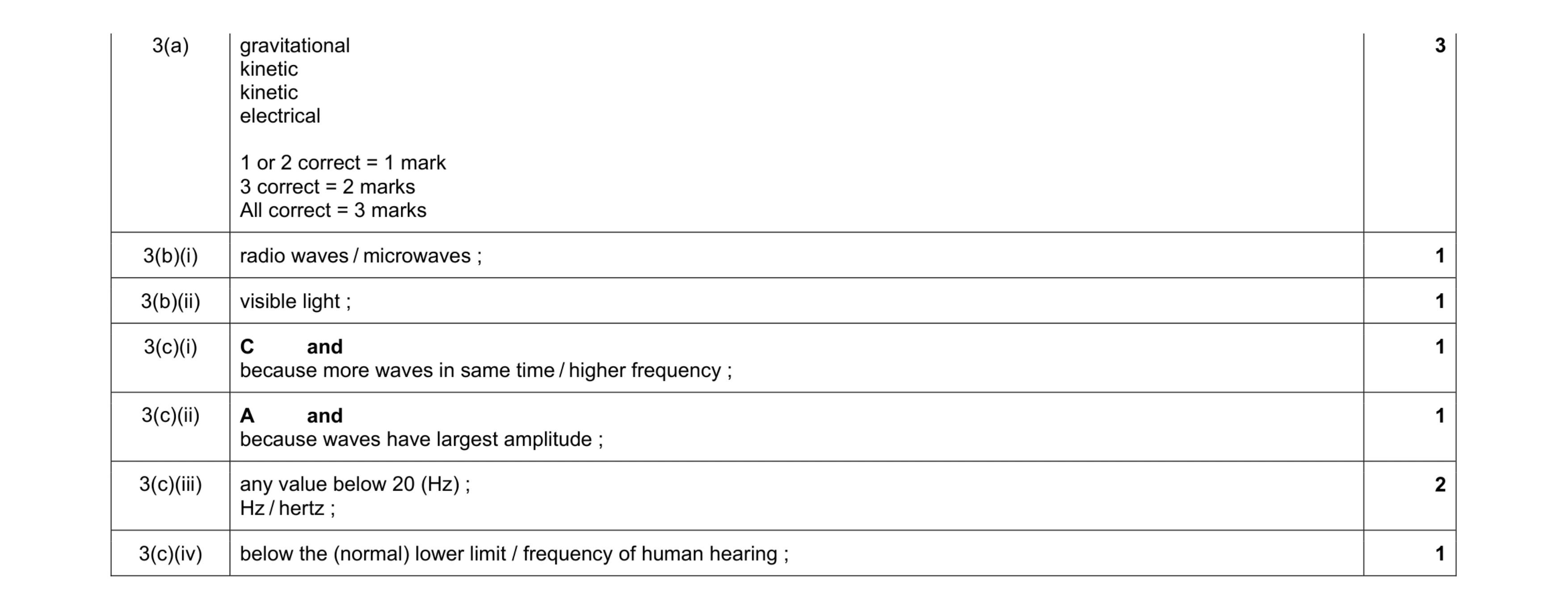 10
10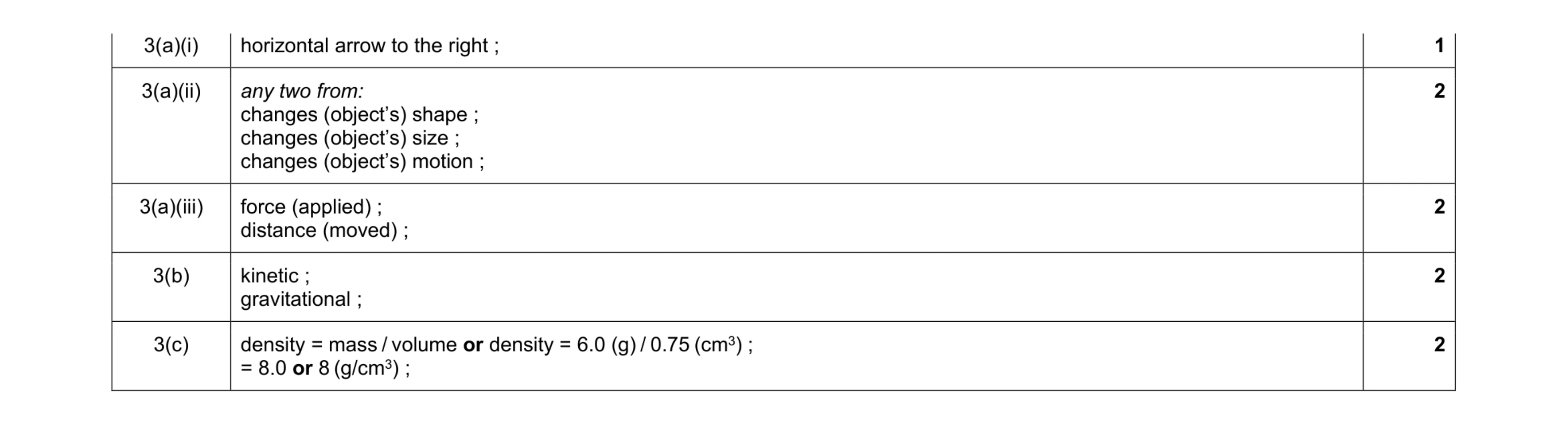 9
9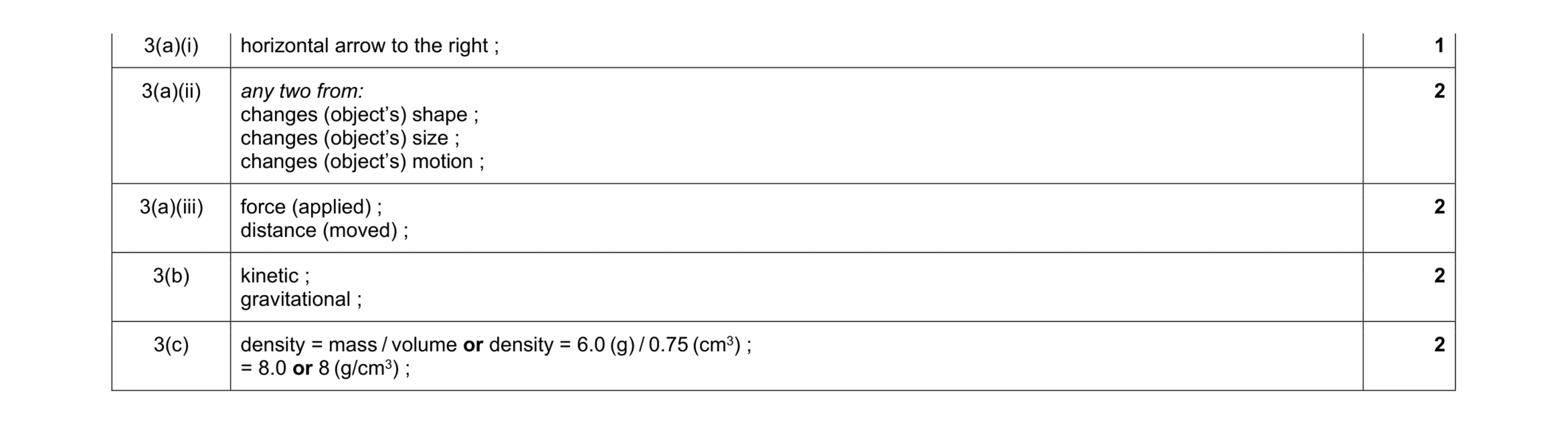 9
9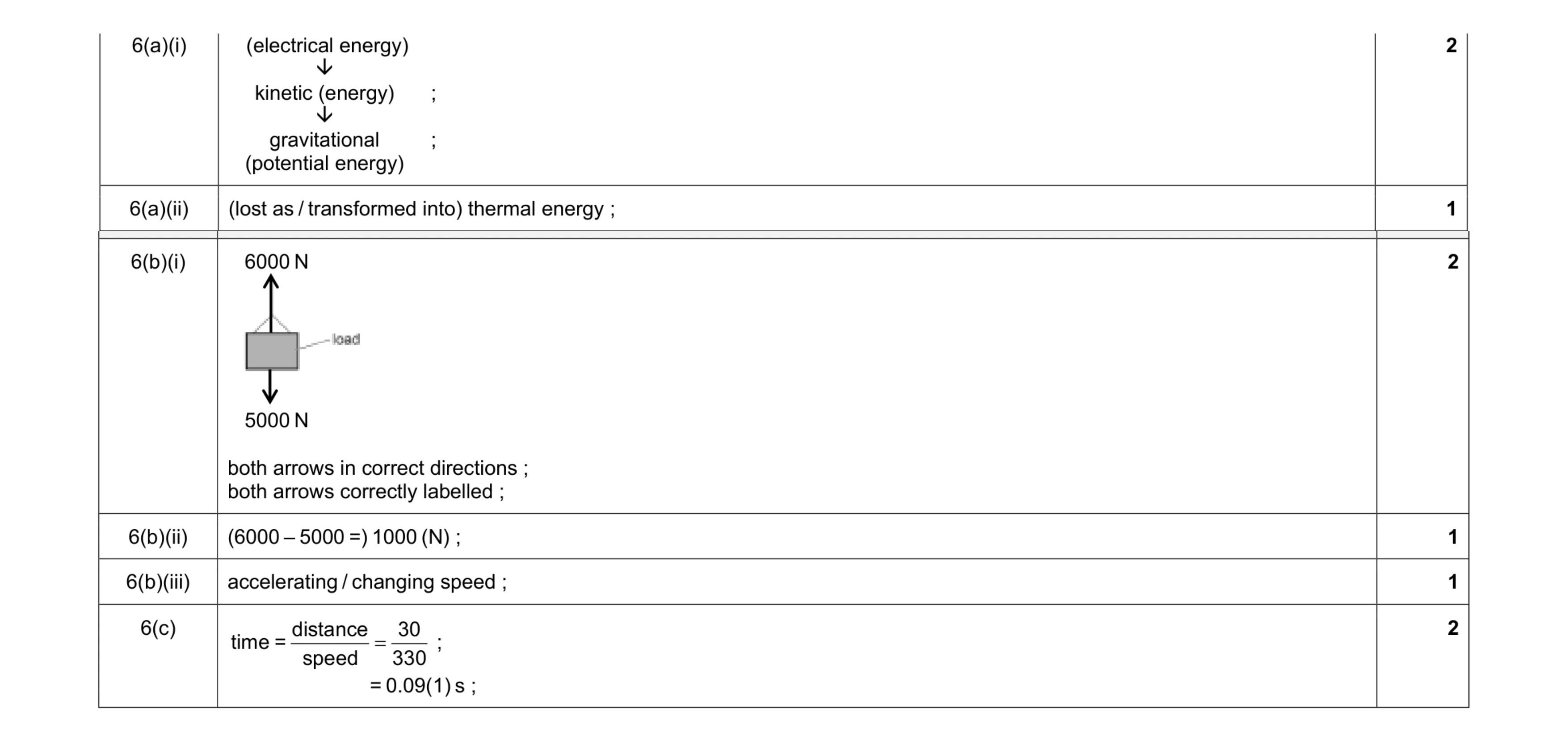 9
9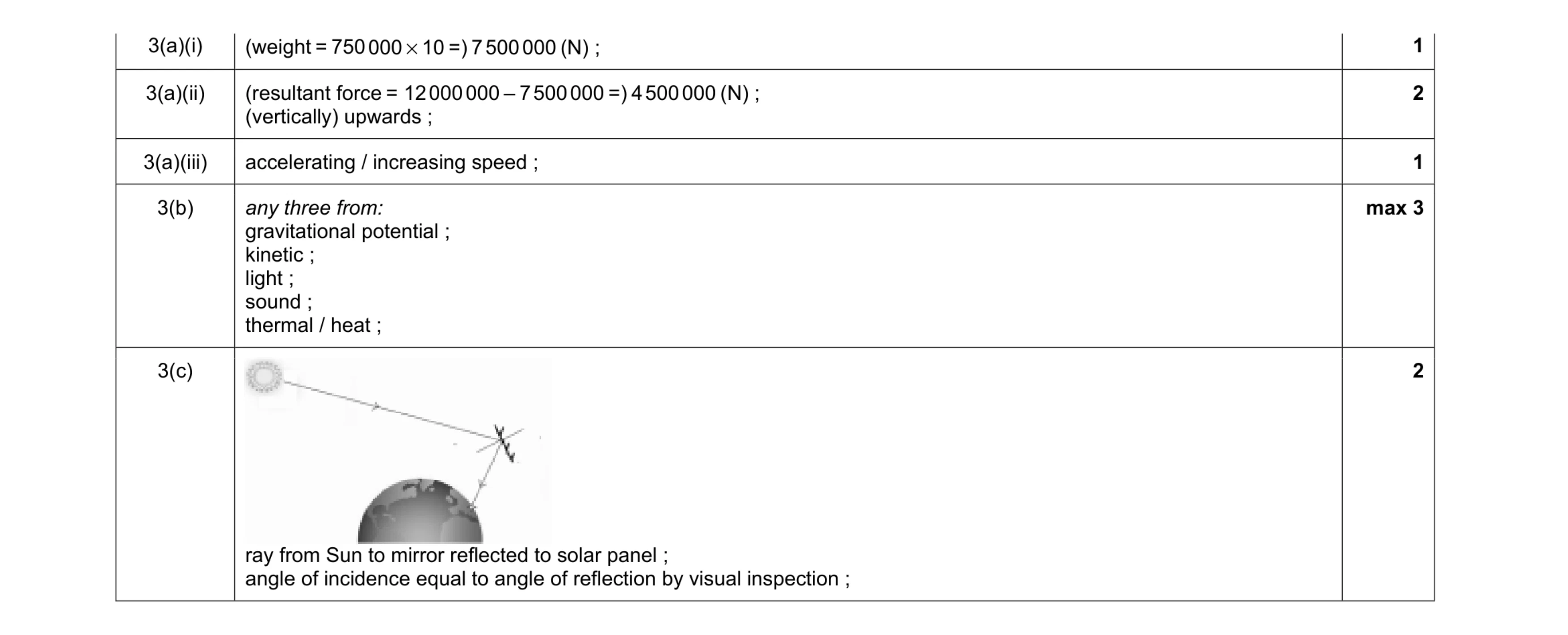 9
9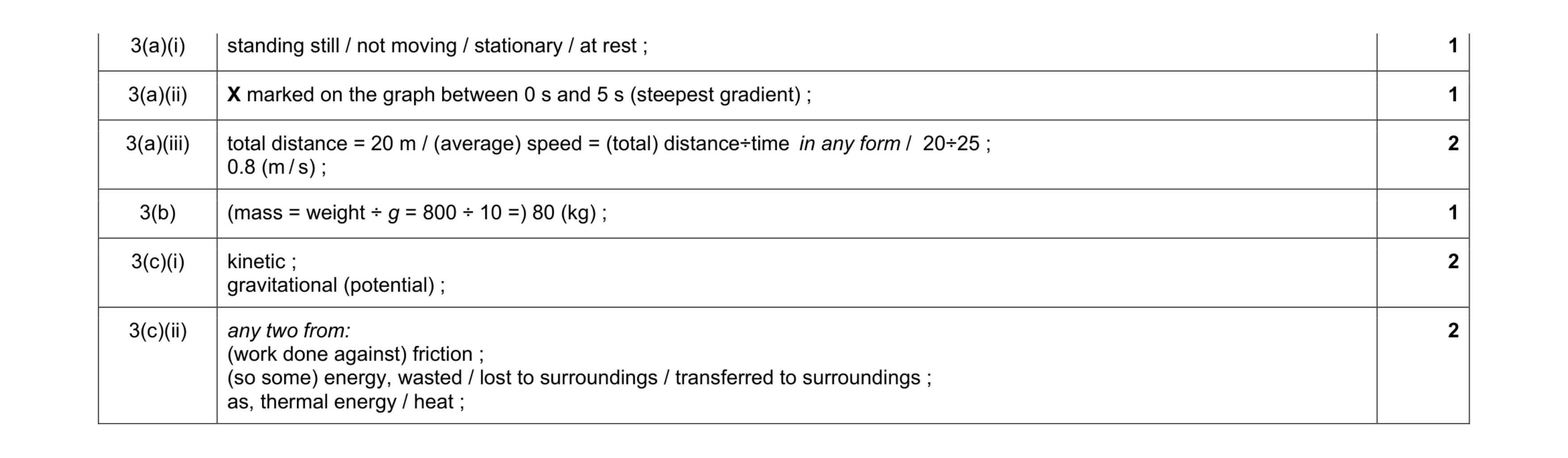 9
9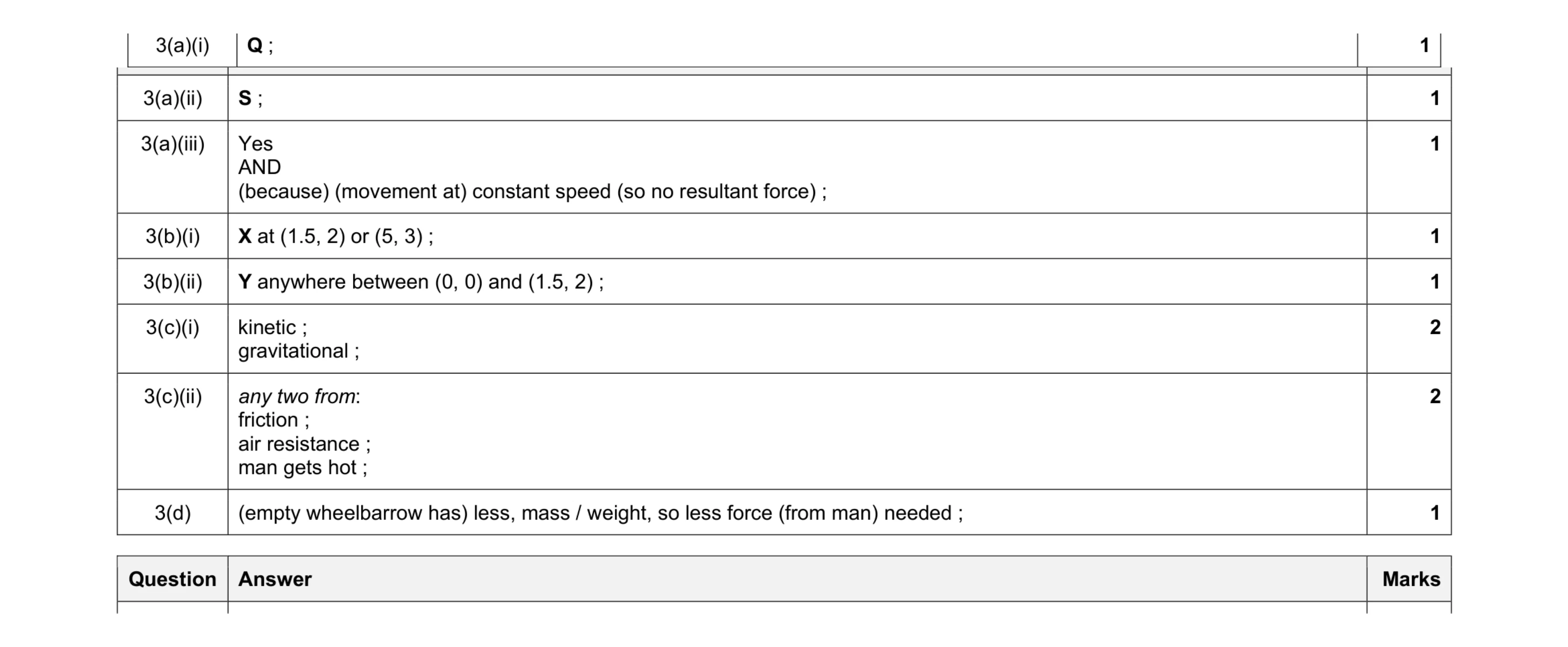 10
10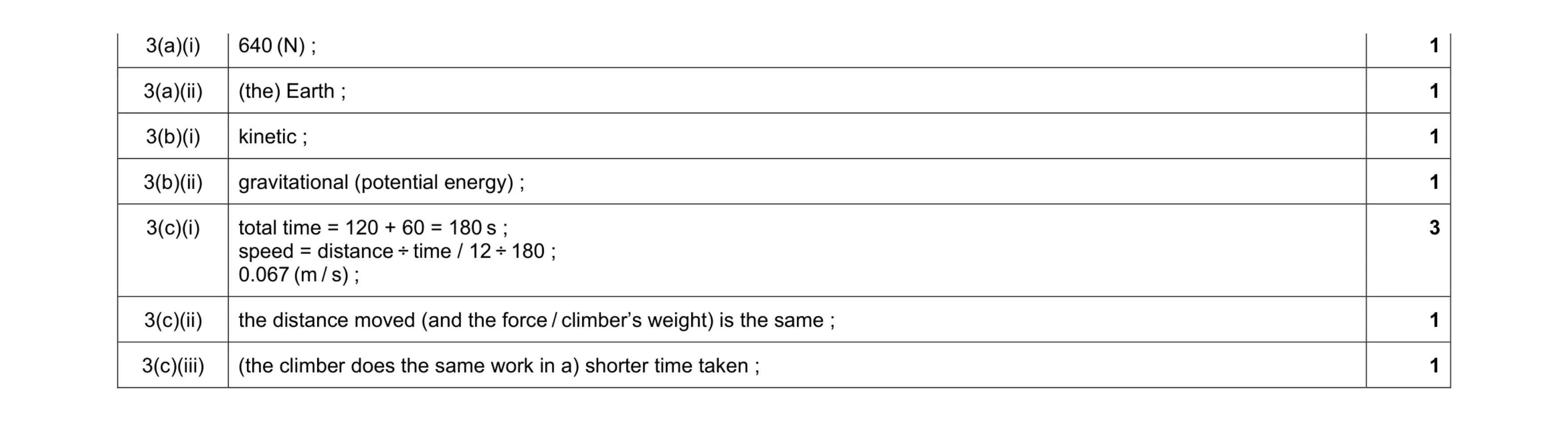 9
9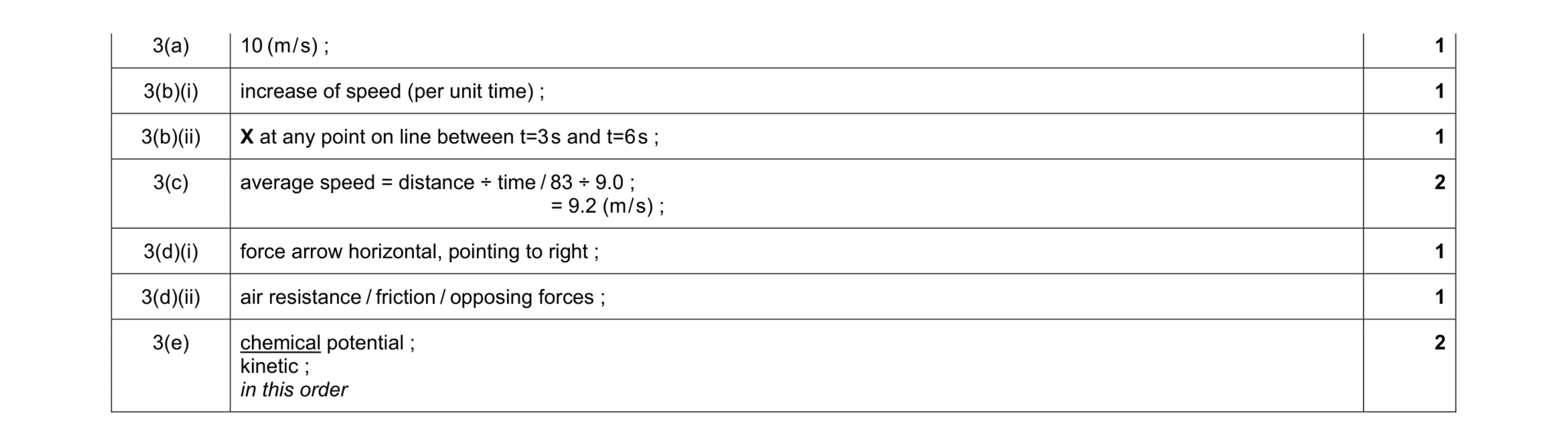 9
9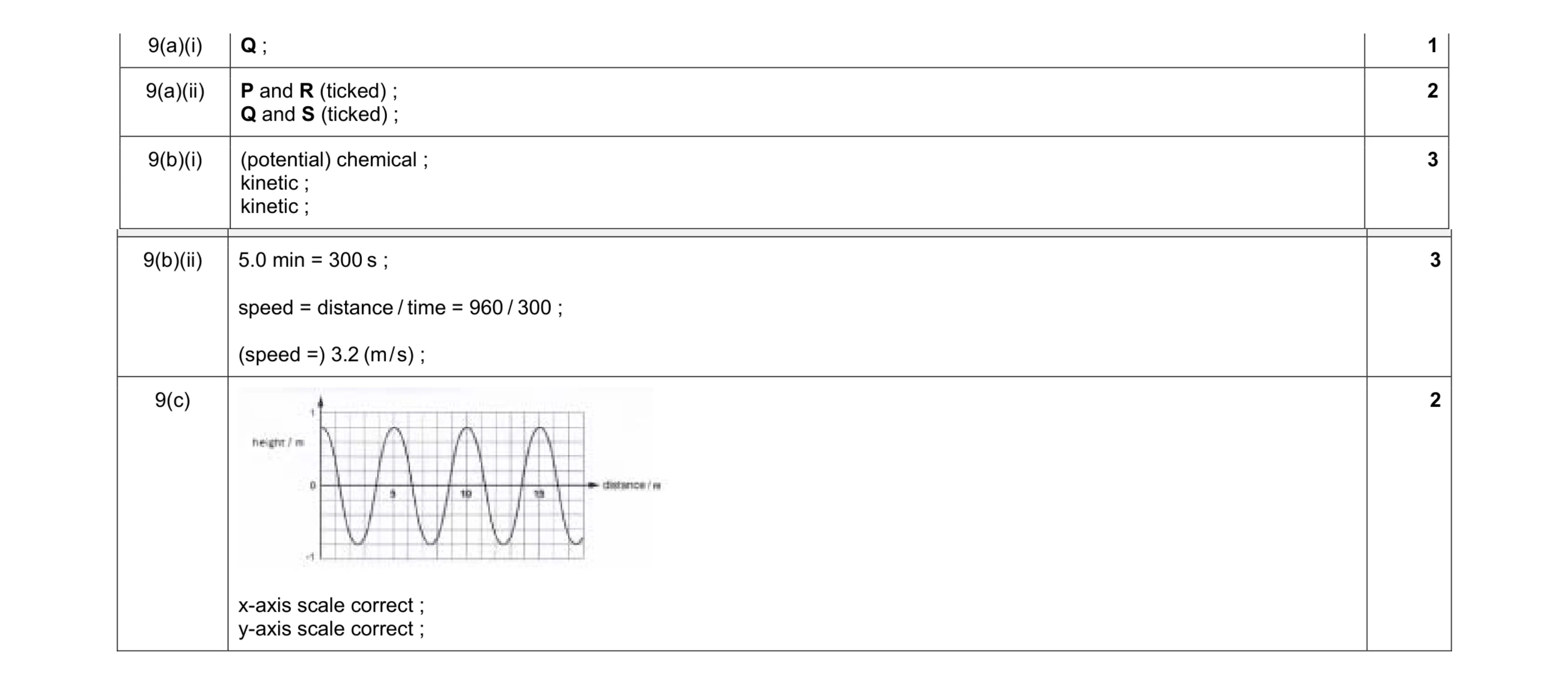 11
11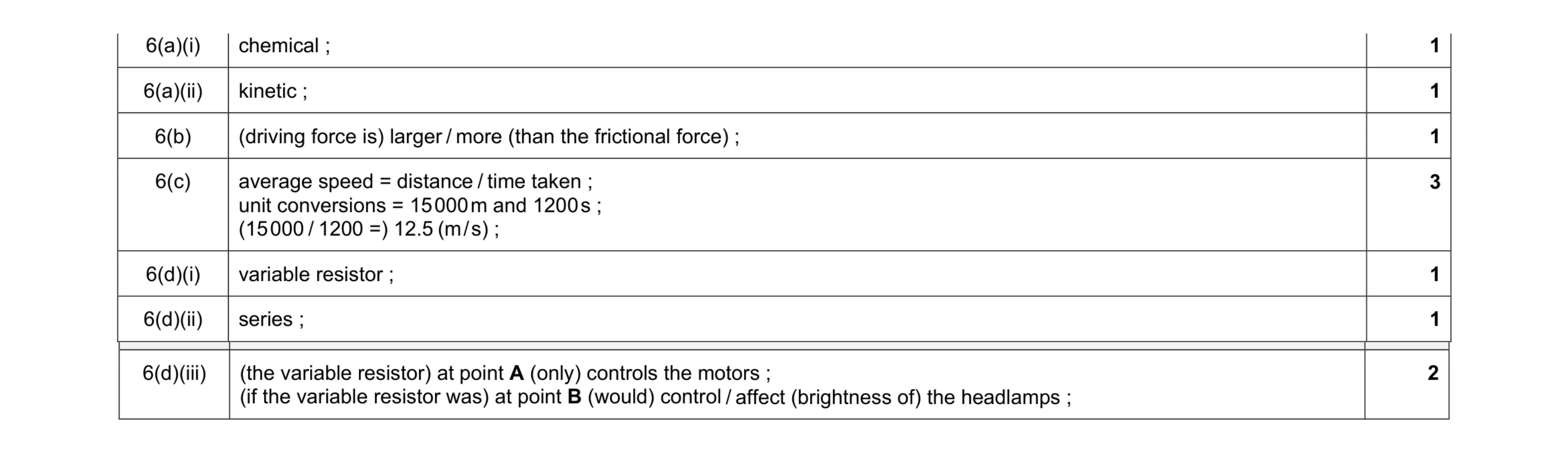 10
10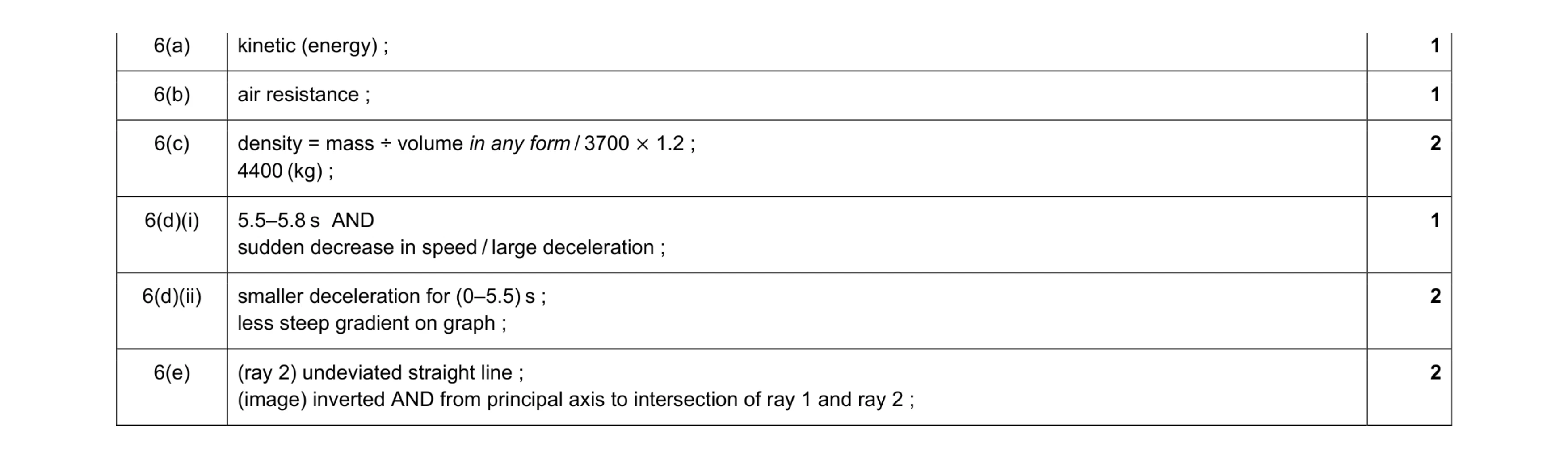 9
9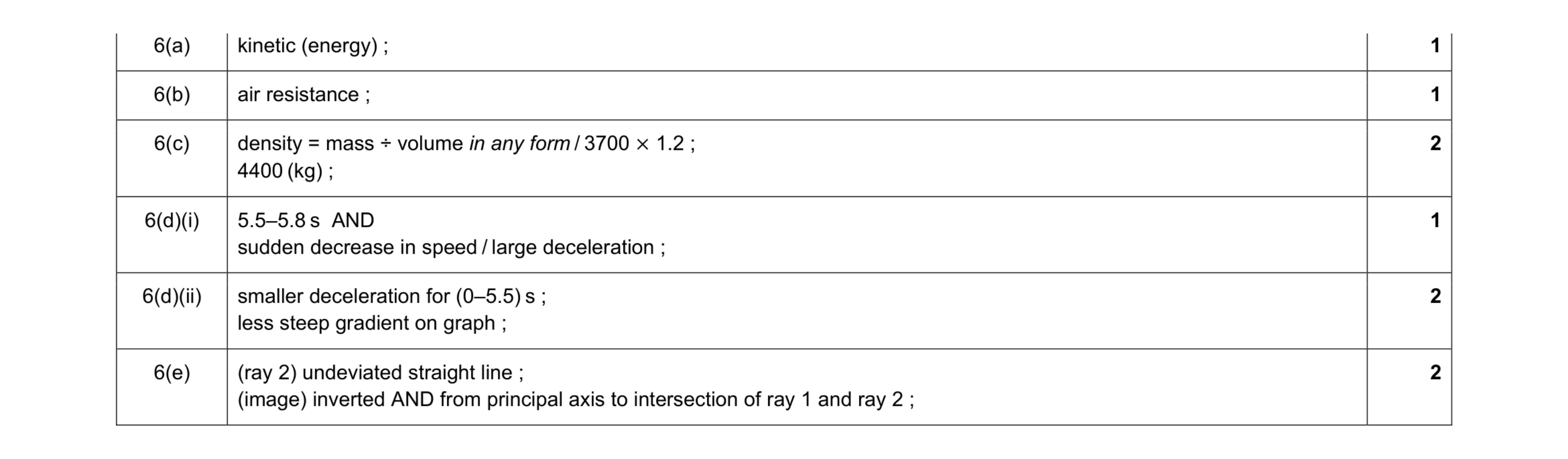 9
9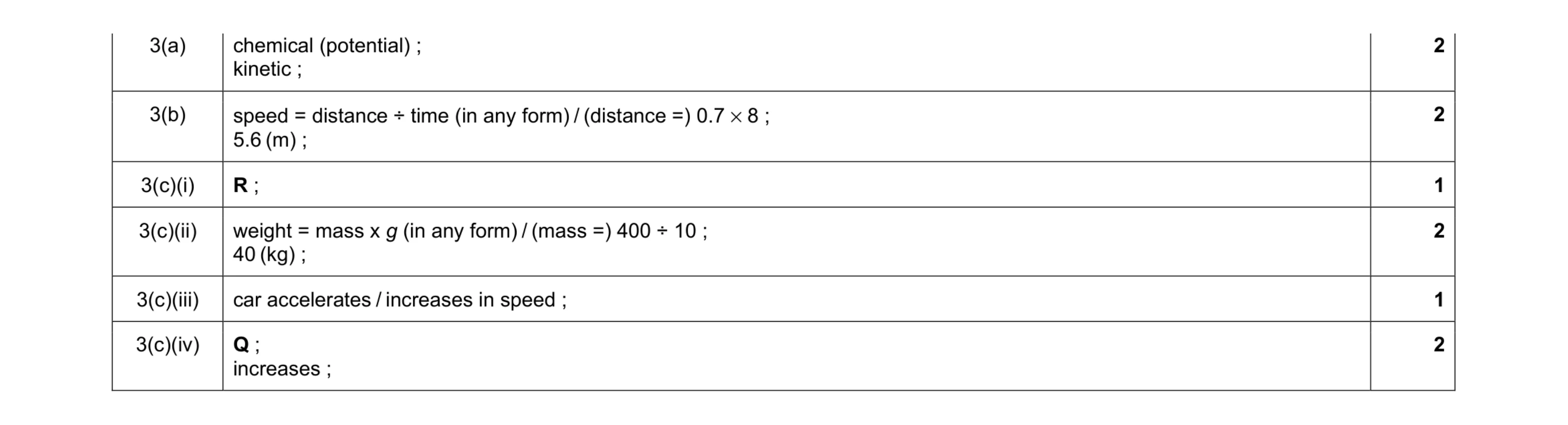 10
10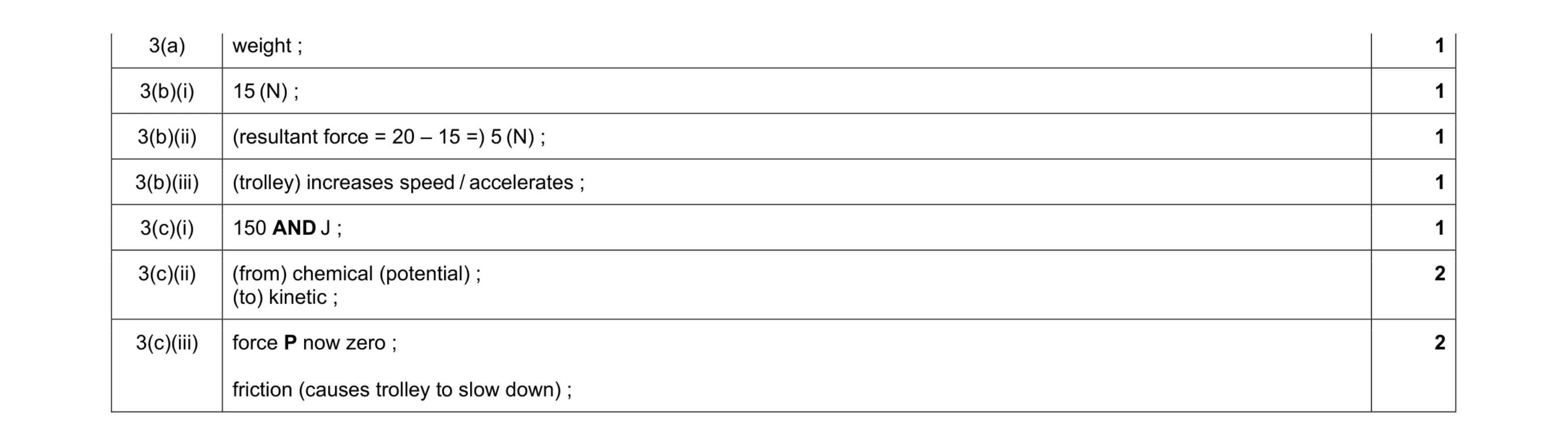 9
9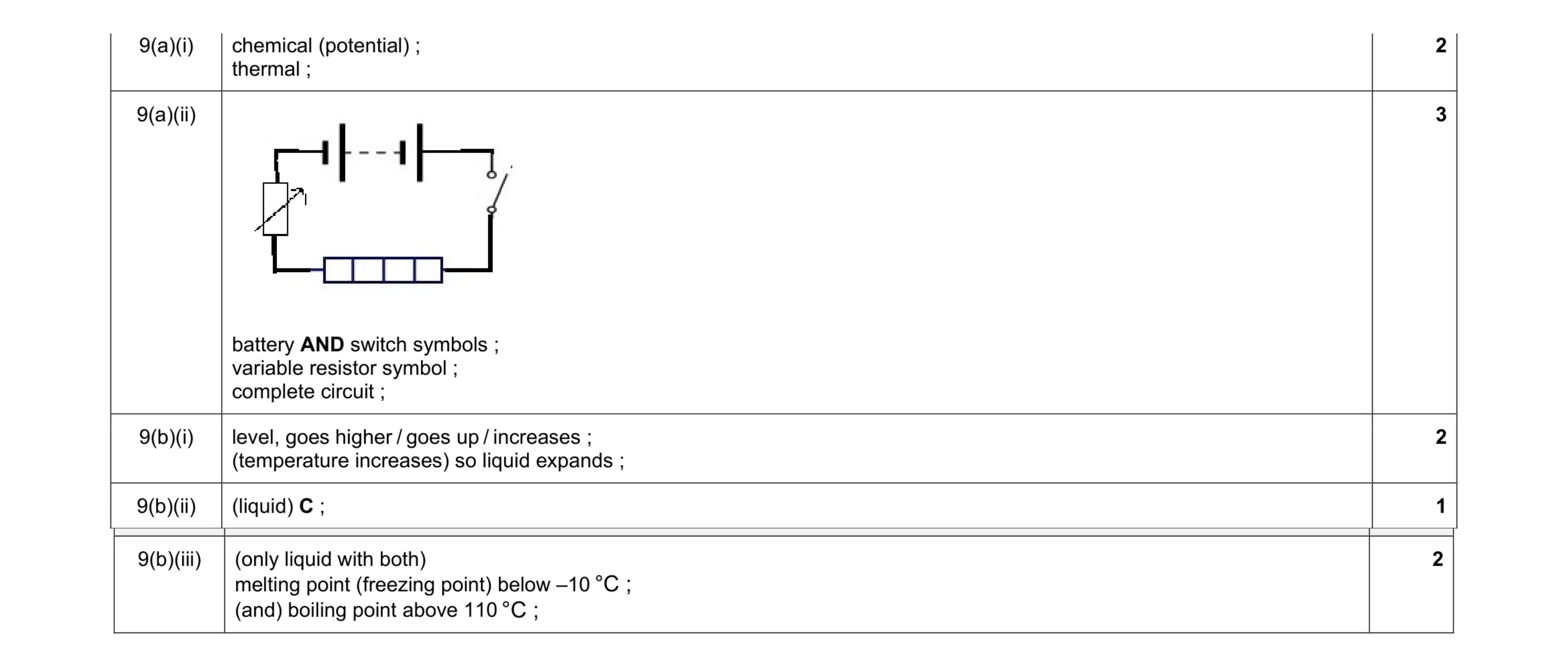 10
10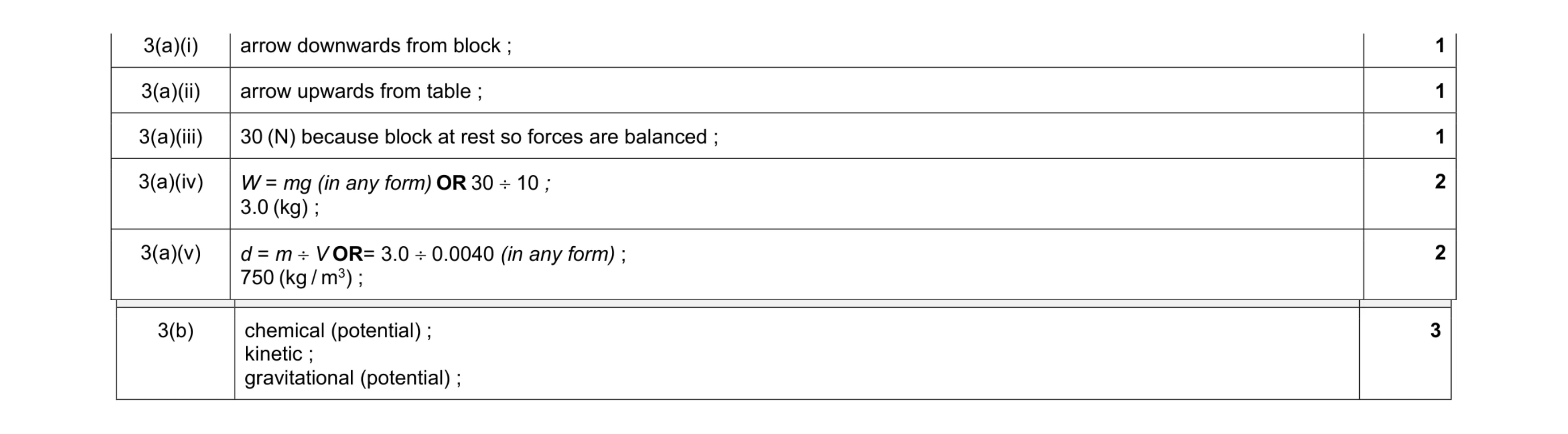 10
10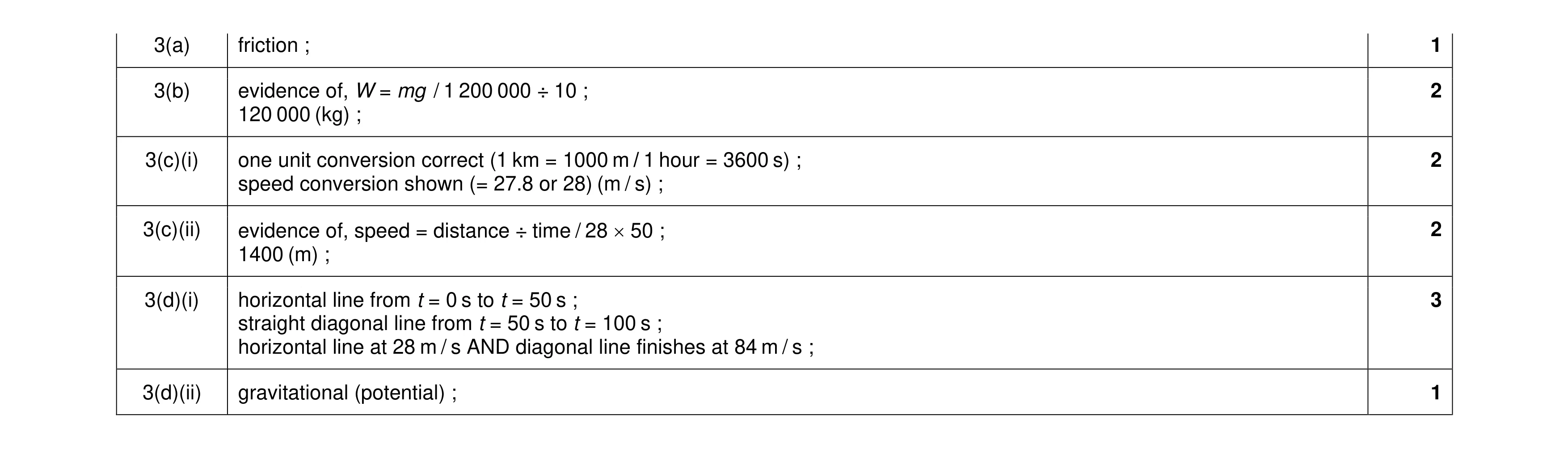 11
11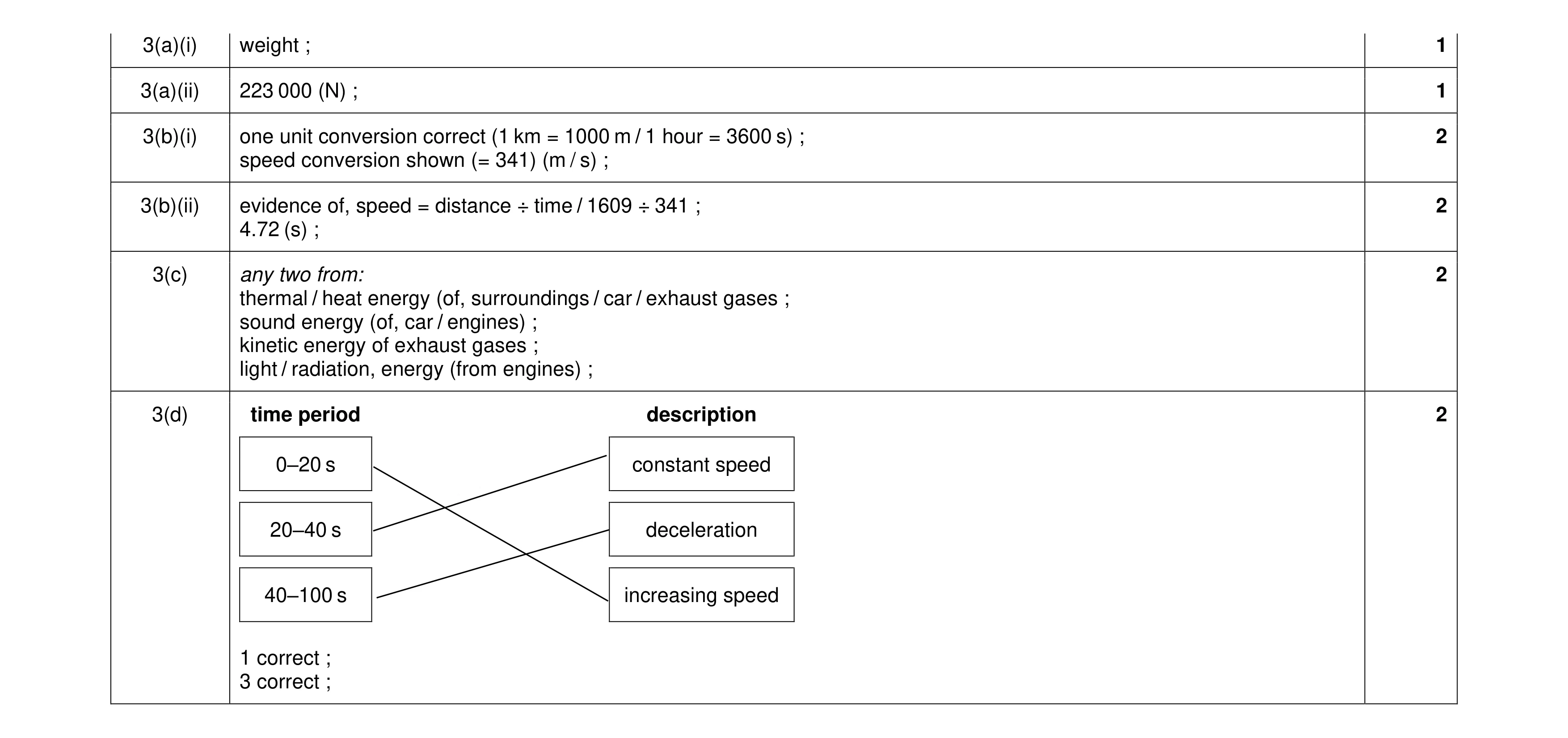 10
10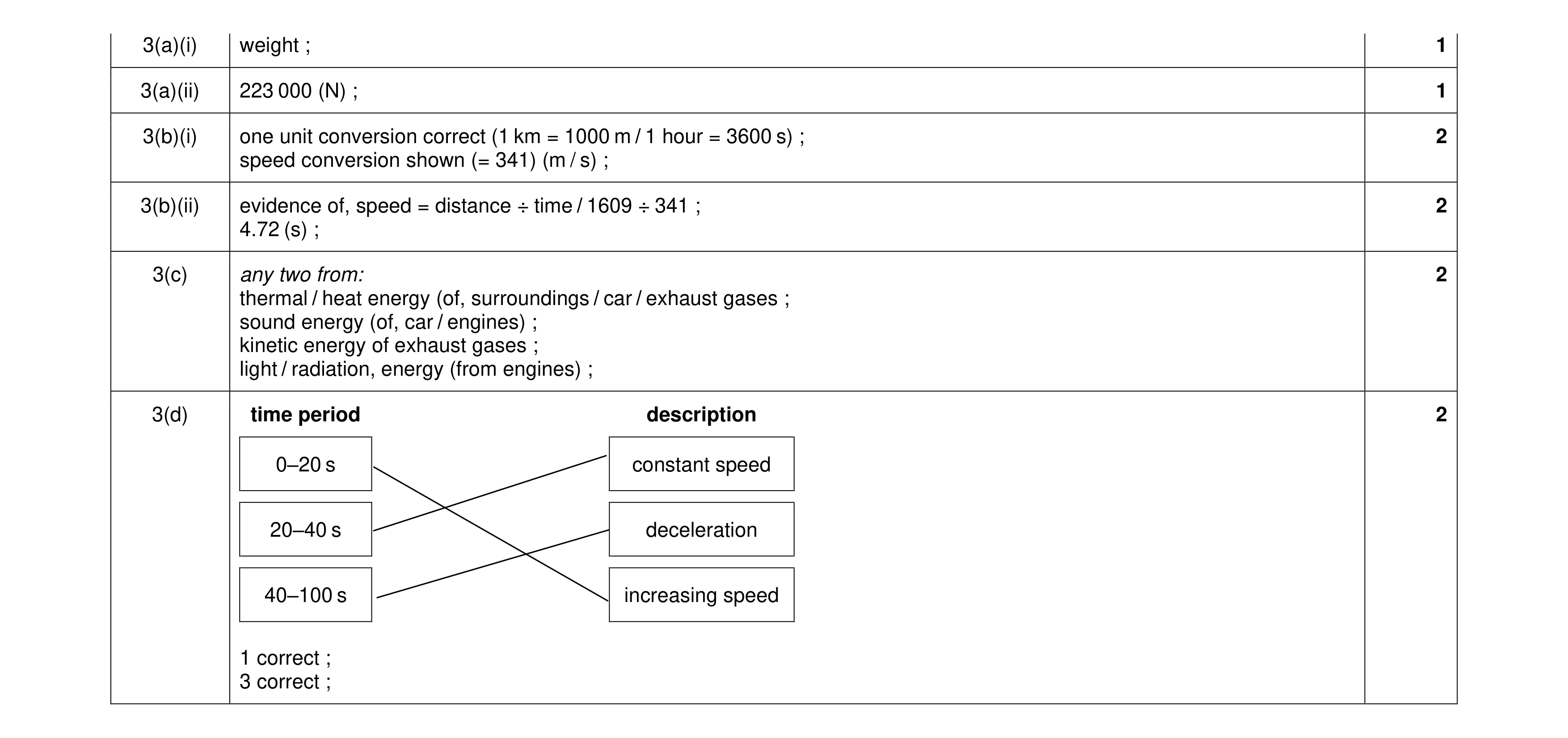 10
10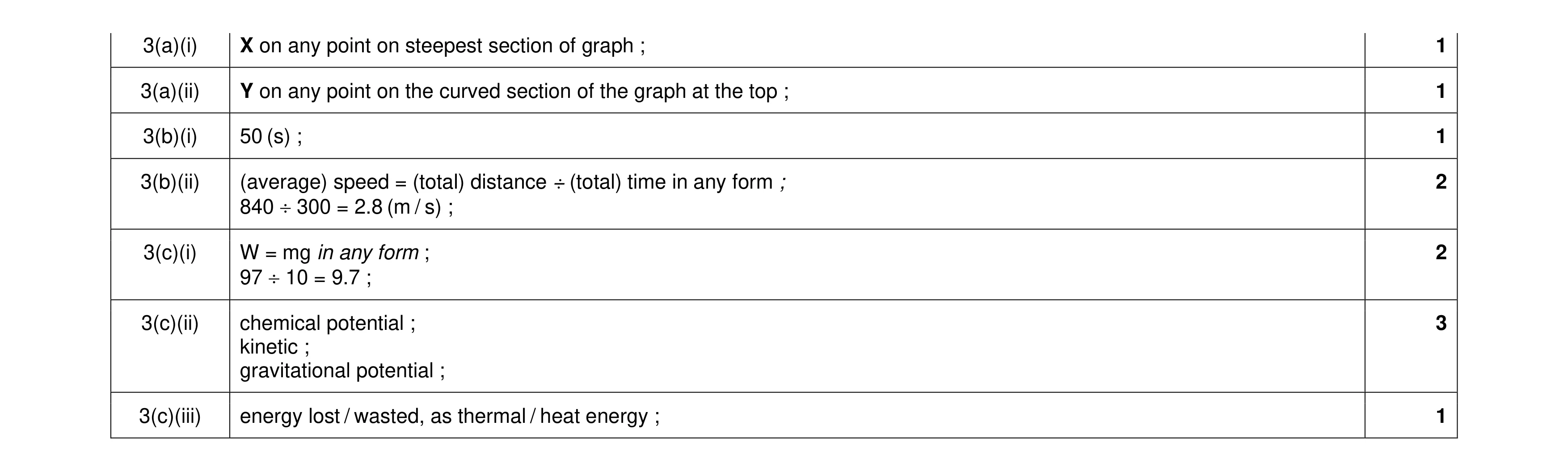 11
11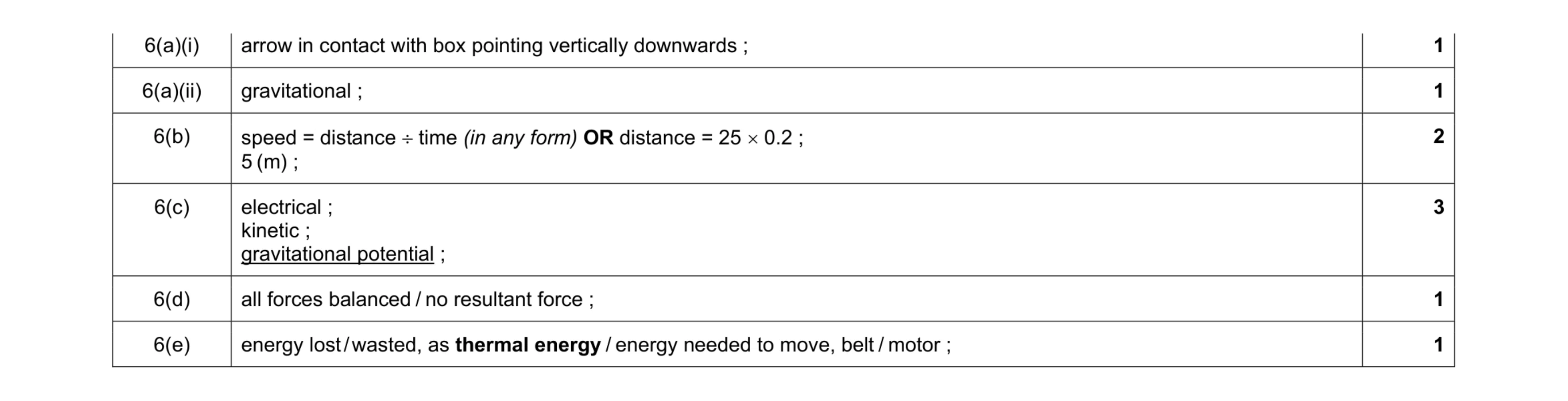 9
9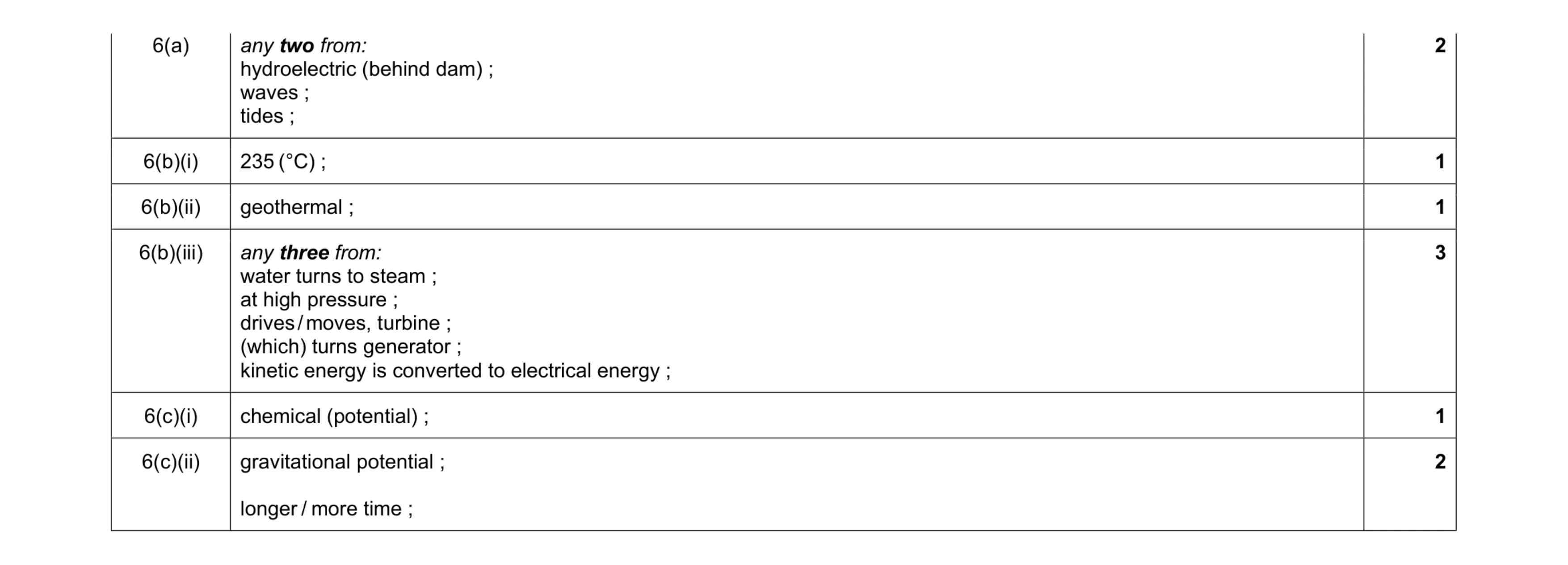 10
10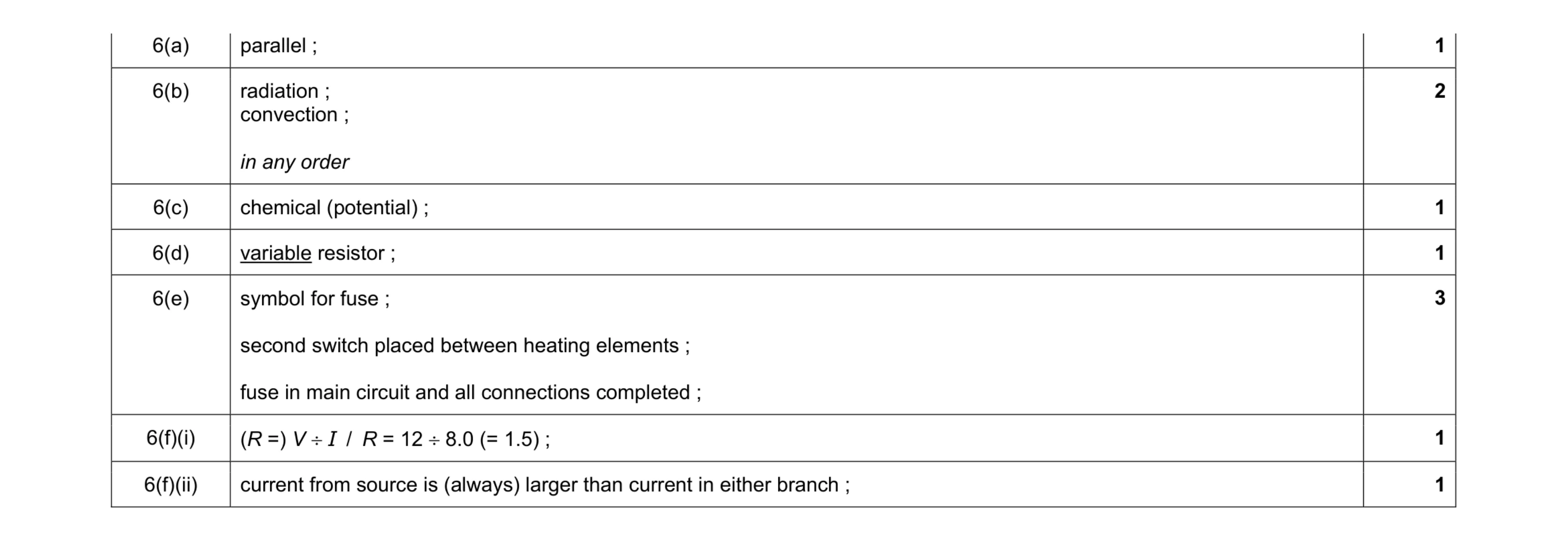 10
10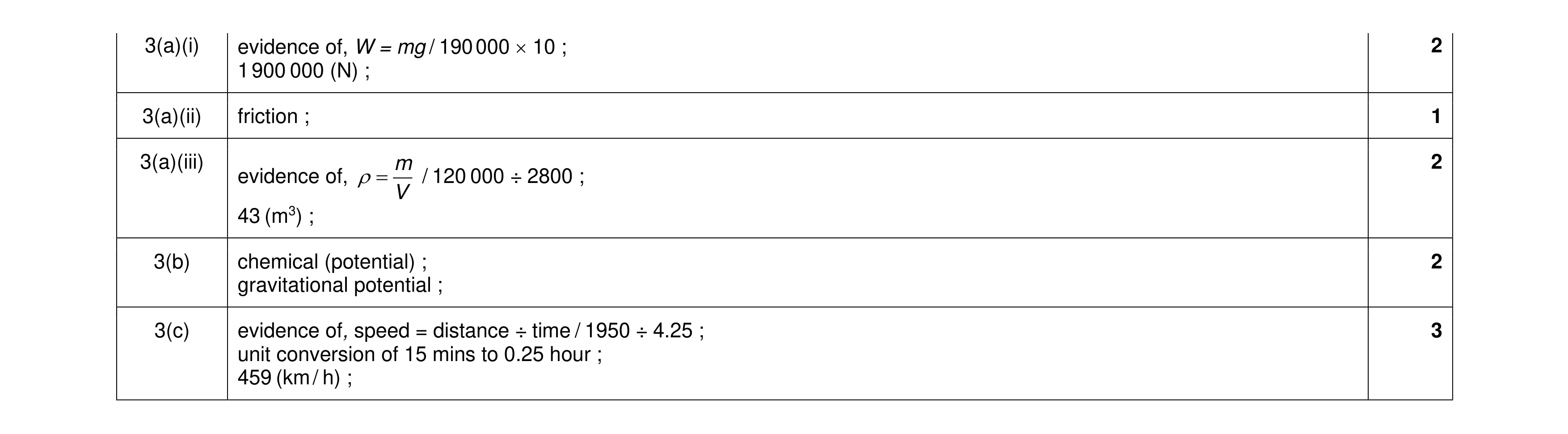 10
10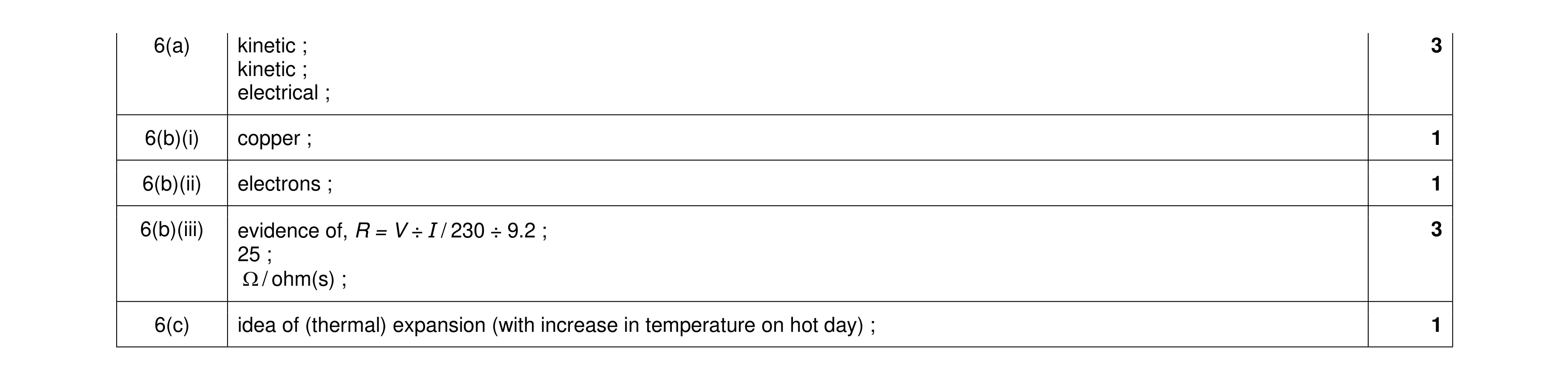 9
9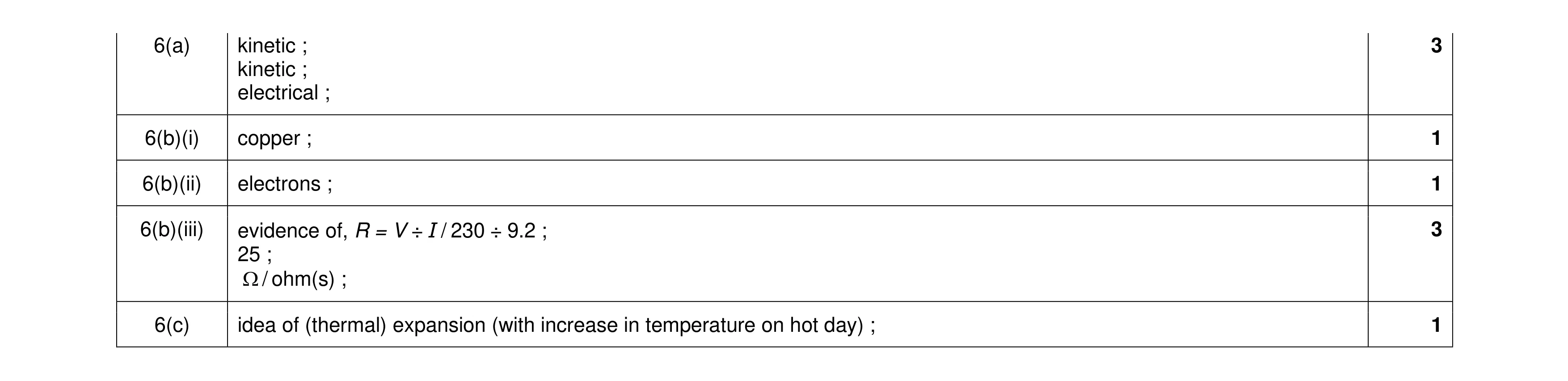 9
9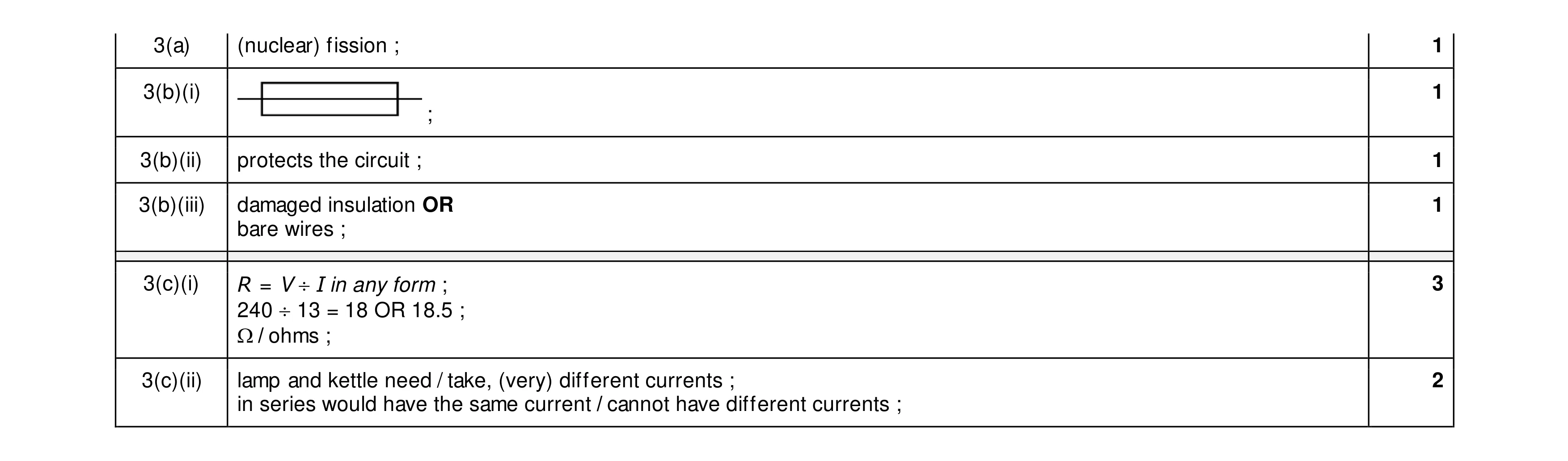 9
9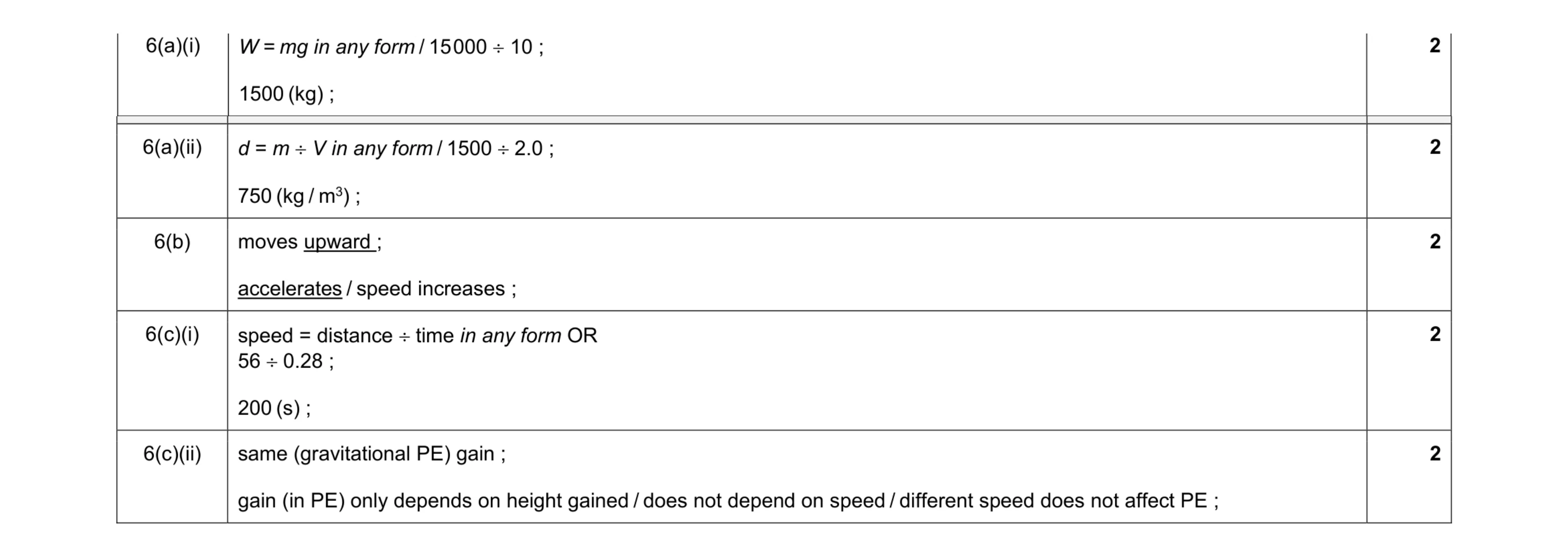 10
10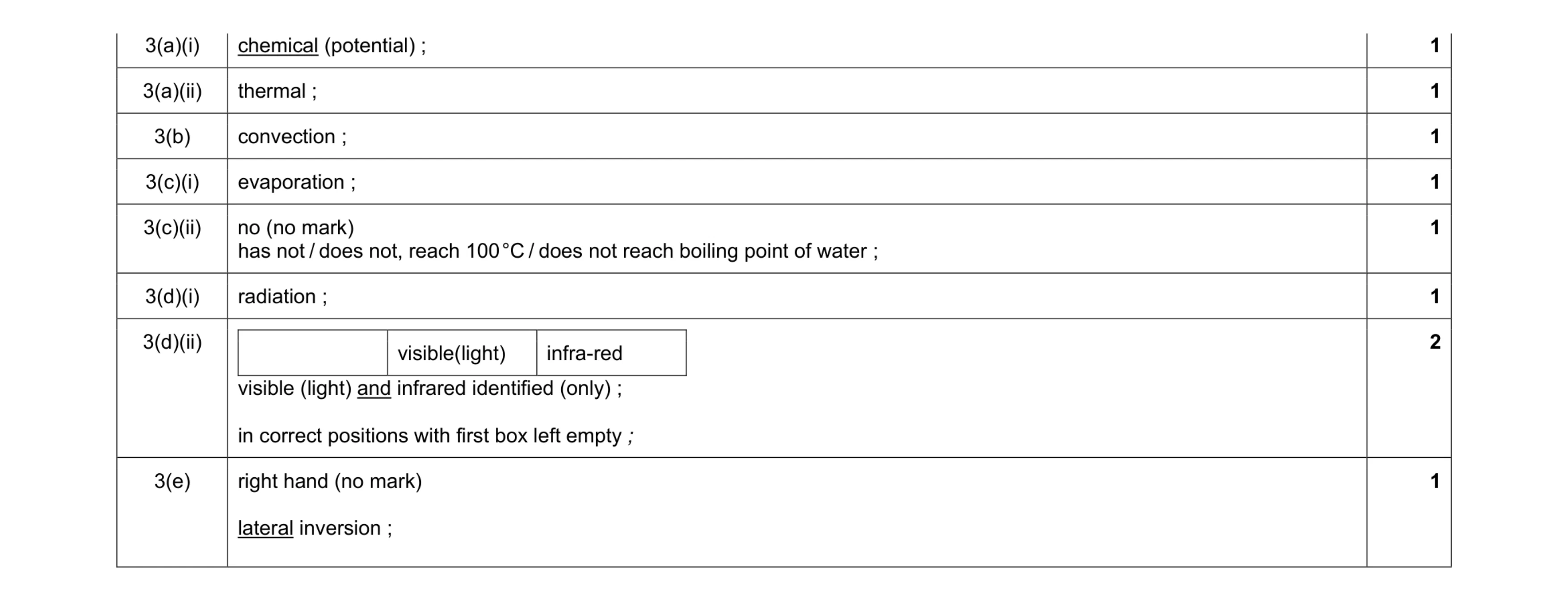 9
9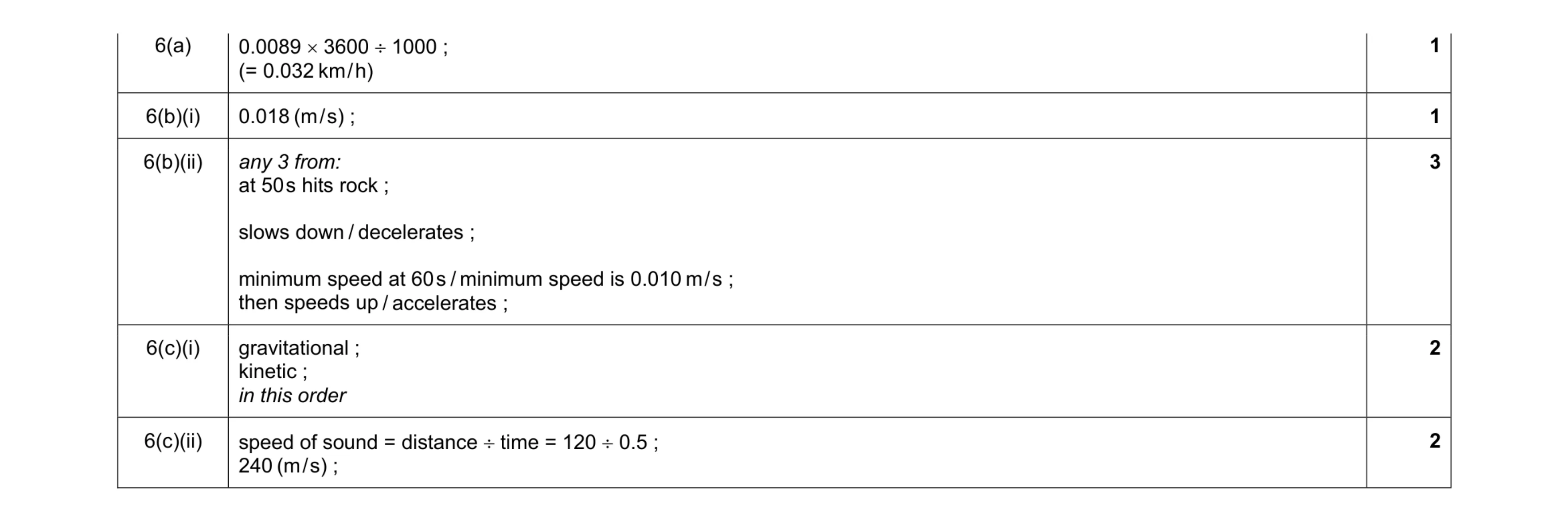 9
9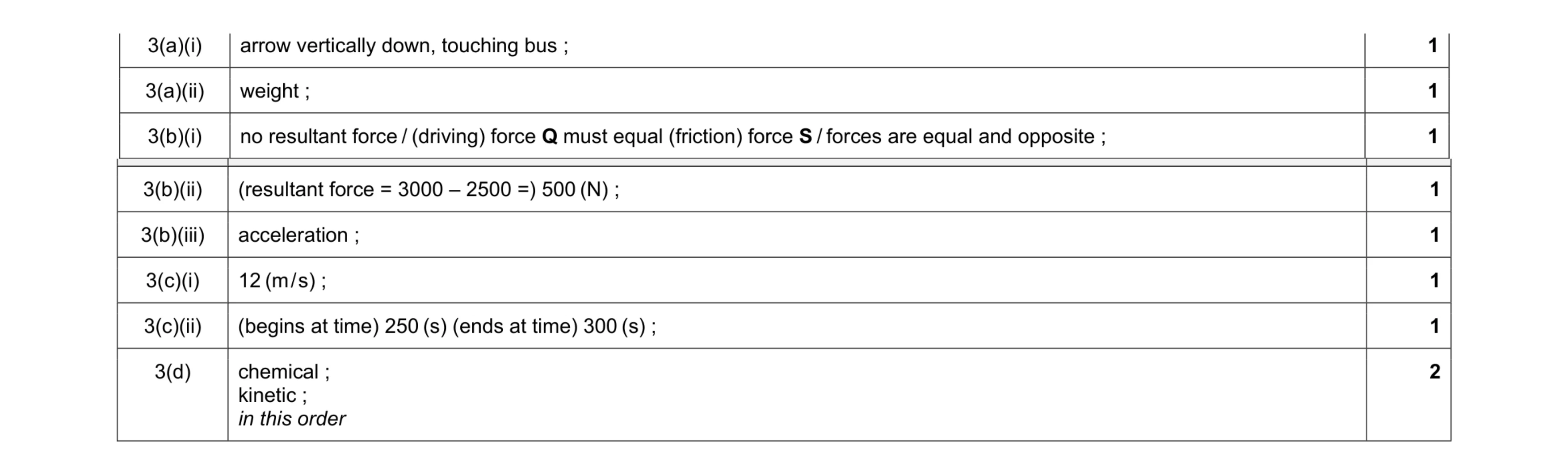 9
9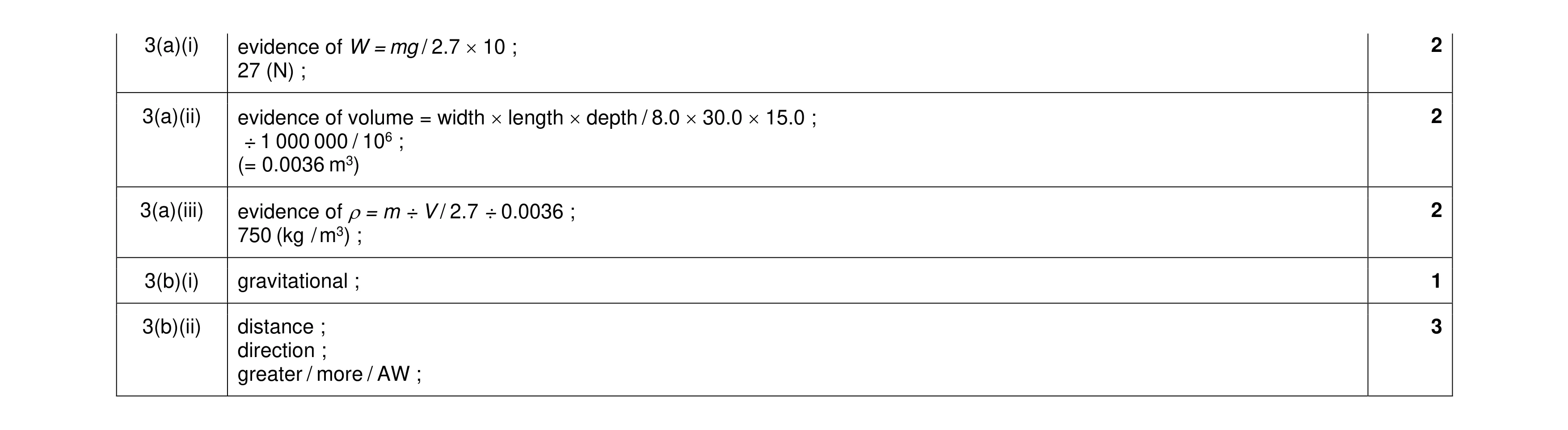 10
10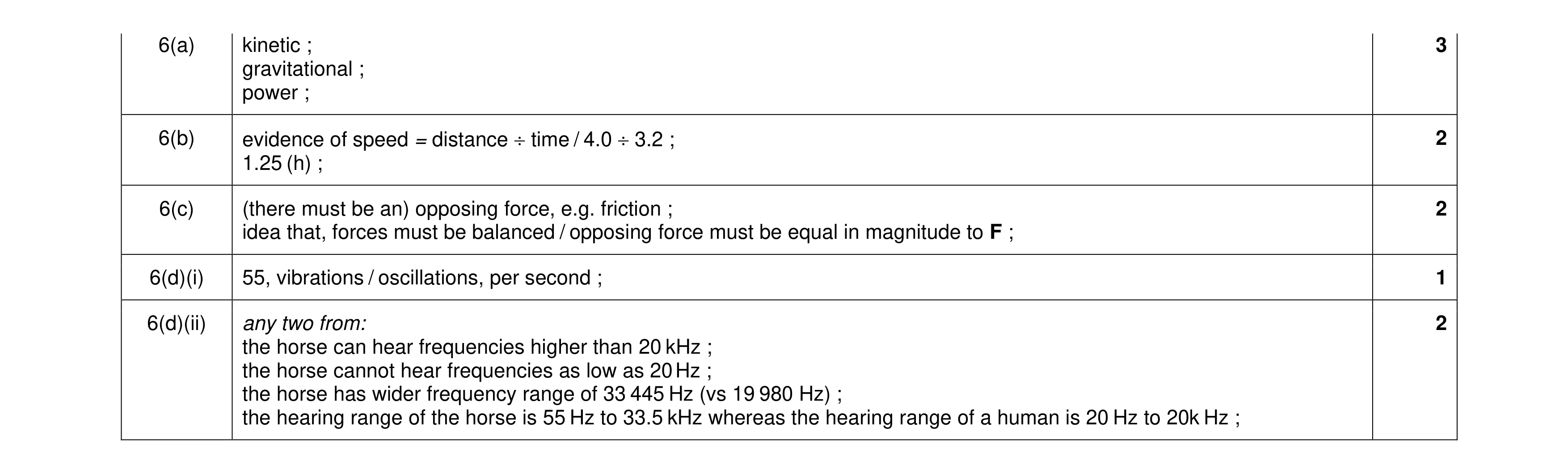 10
10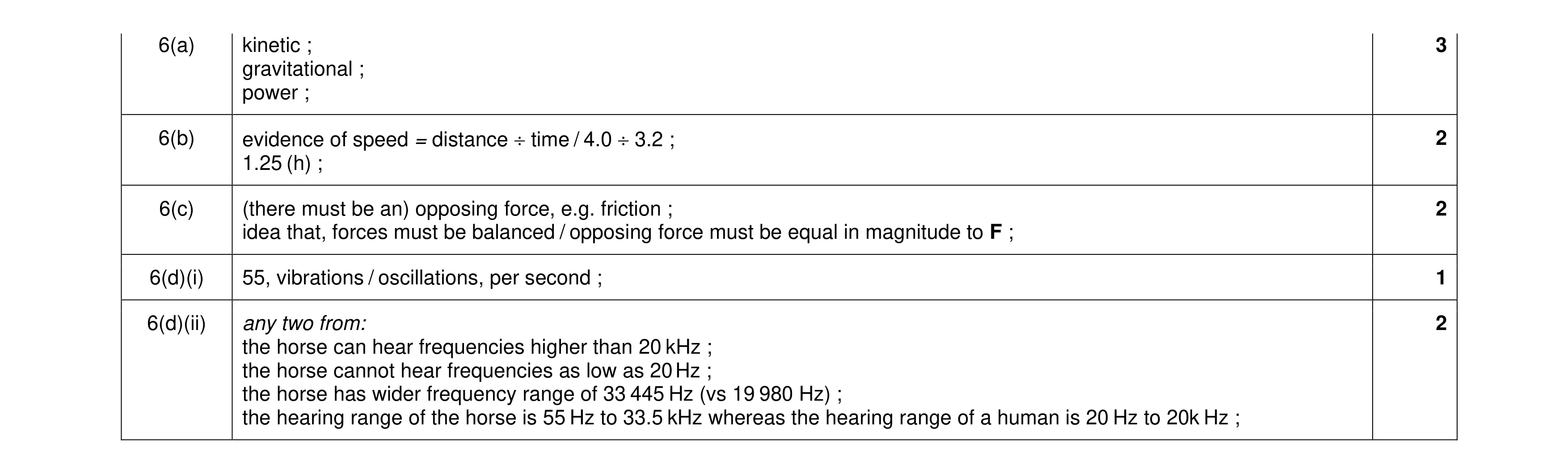 10
10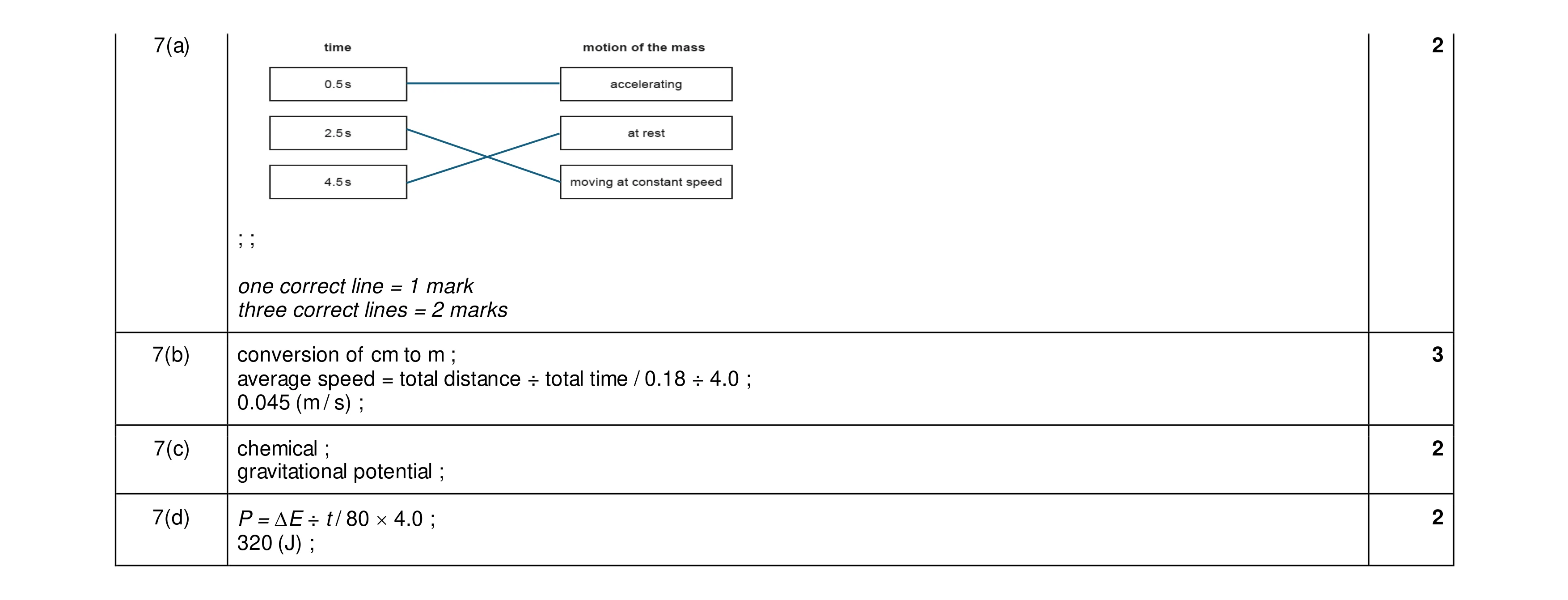 9
9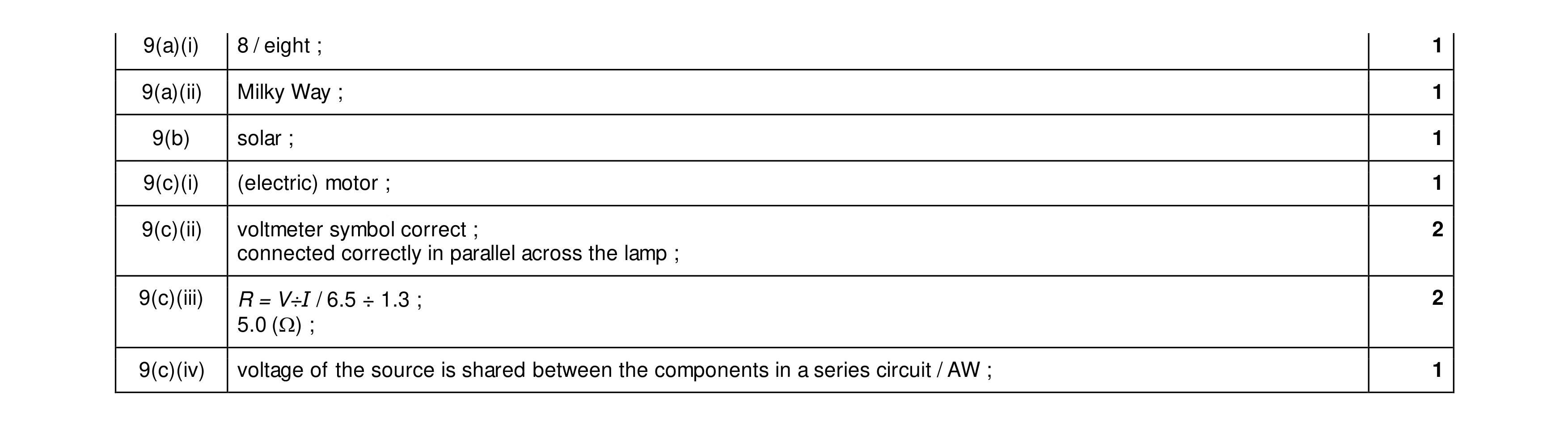 9
9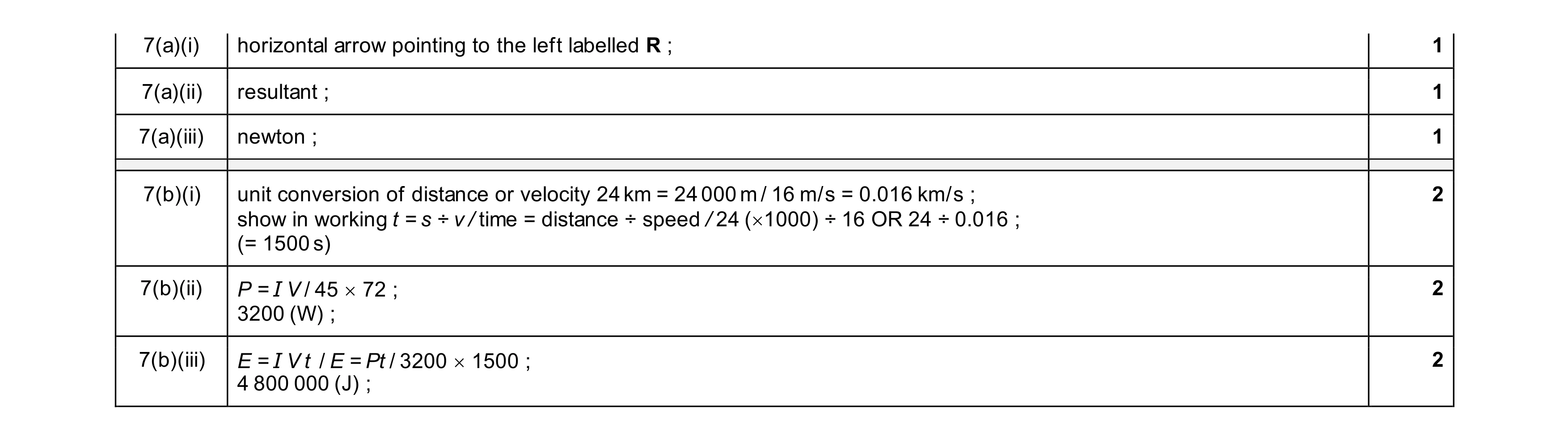 9
9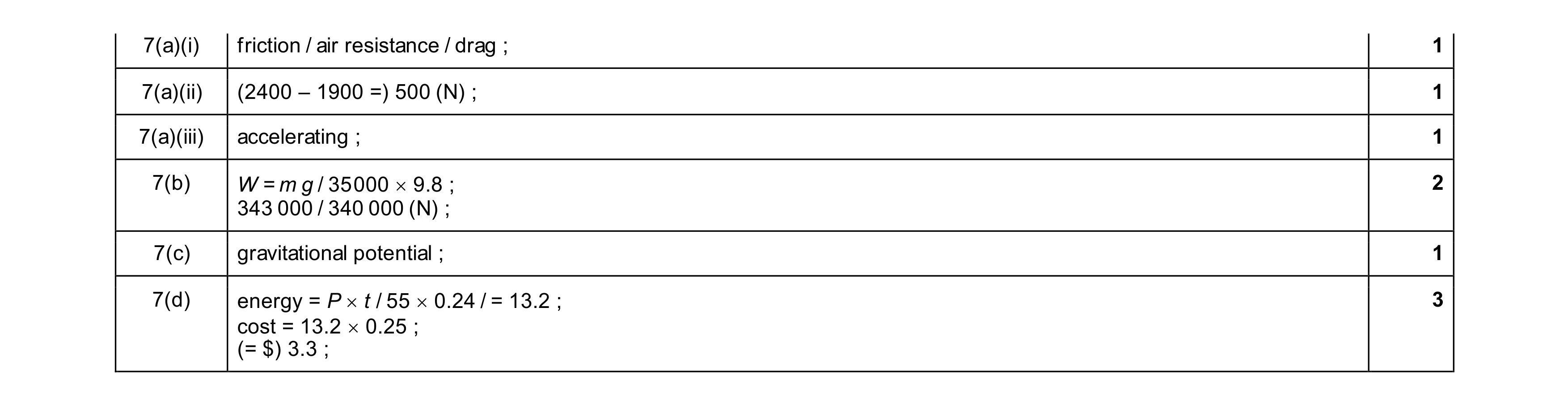 9
9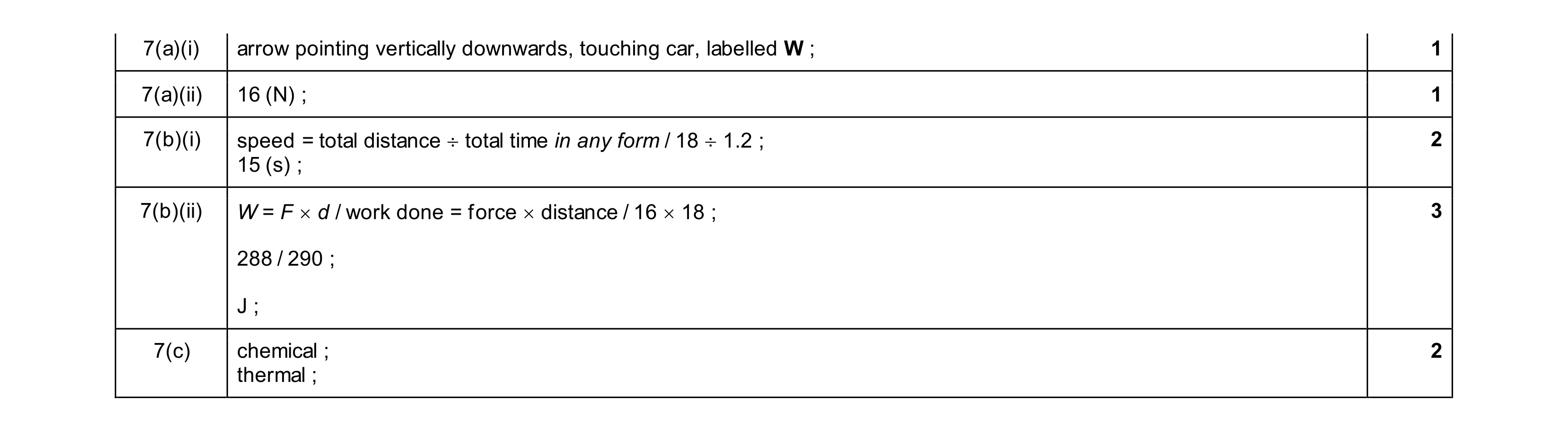 9
9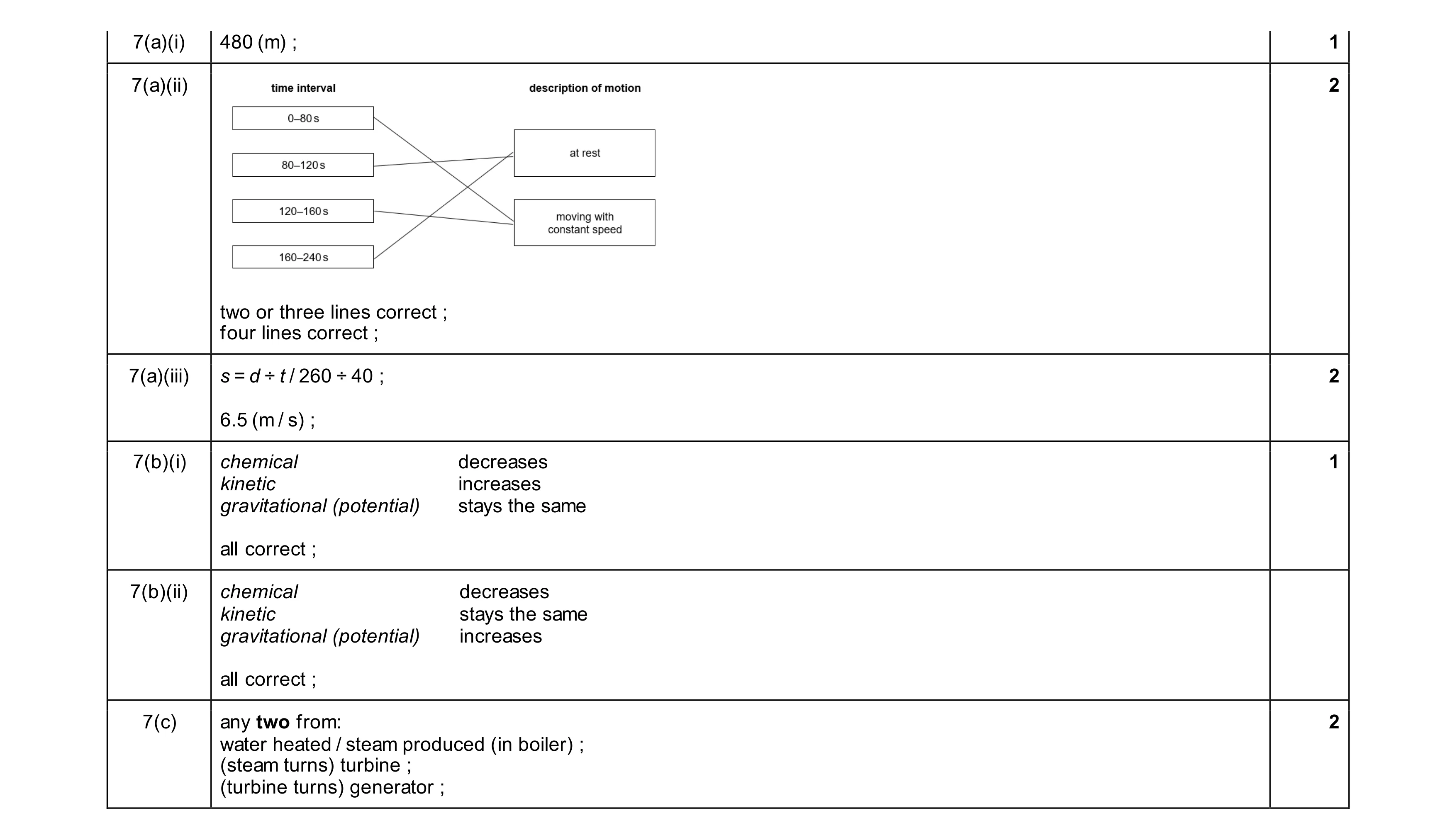 9
9