Cambridge IGCSE Science - Combined 0653 — 2018 Feb/March Paper 1 · Variant 2
0653/12/F/M/18 · 40 questions · 40 marks · ≈45 min
The question paper and its mark scheme, free to read here and free to download. This is Cambridge’s own paper, exactly as it was sat.
Question paper16 pages

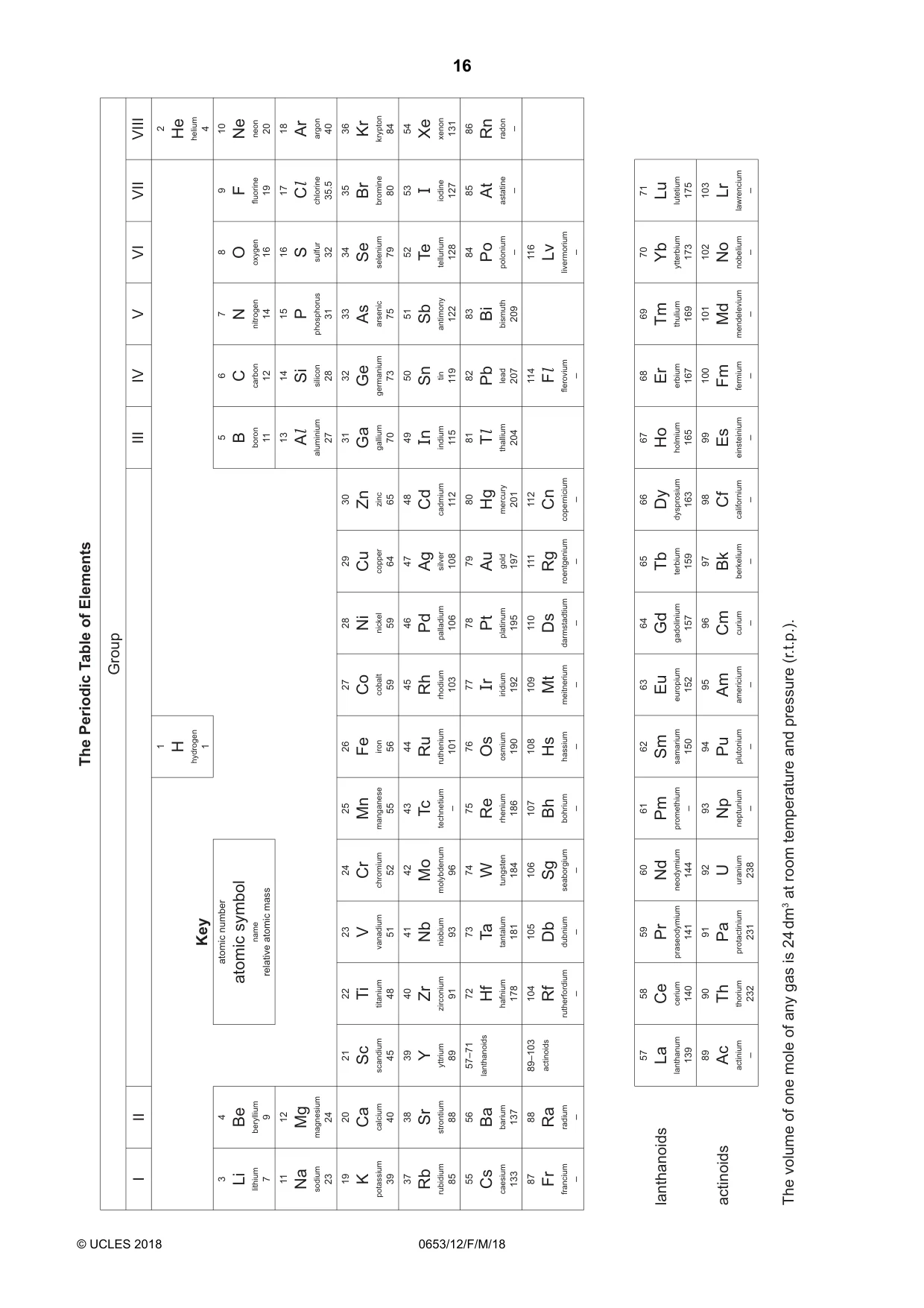
Mark scheme3 pages
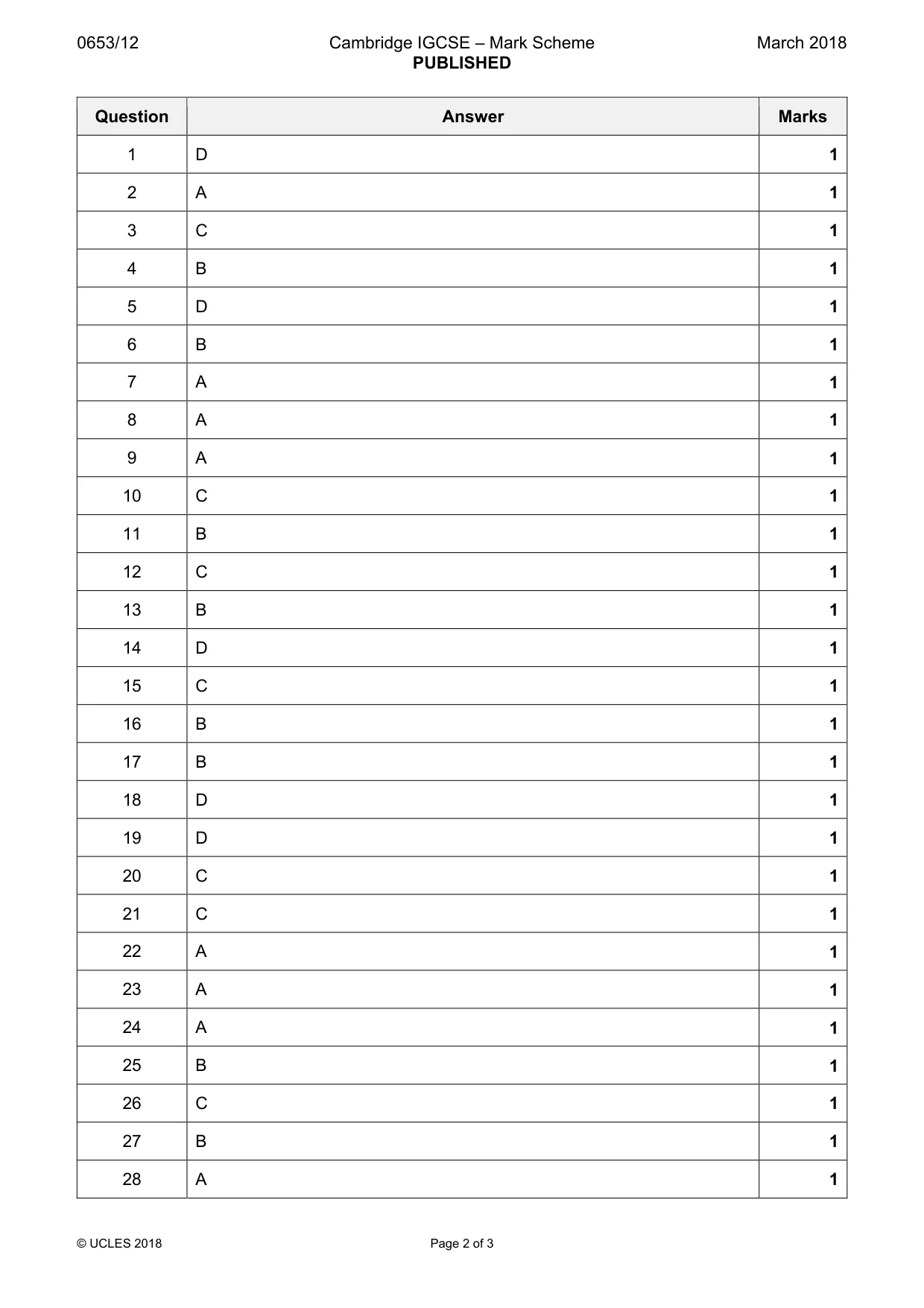
Answers below. Sit the paper first if you are practising.
Questions as text
Q1 · Which is a characteristic of all living organisms?
1 Which is a characteristic of all living organisms? A breathing B eating C egestion D movement
Mark scheme: D
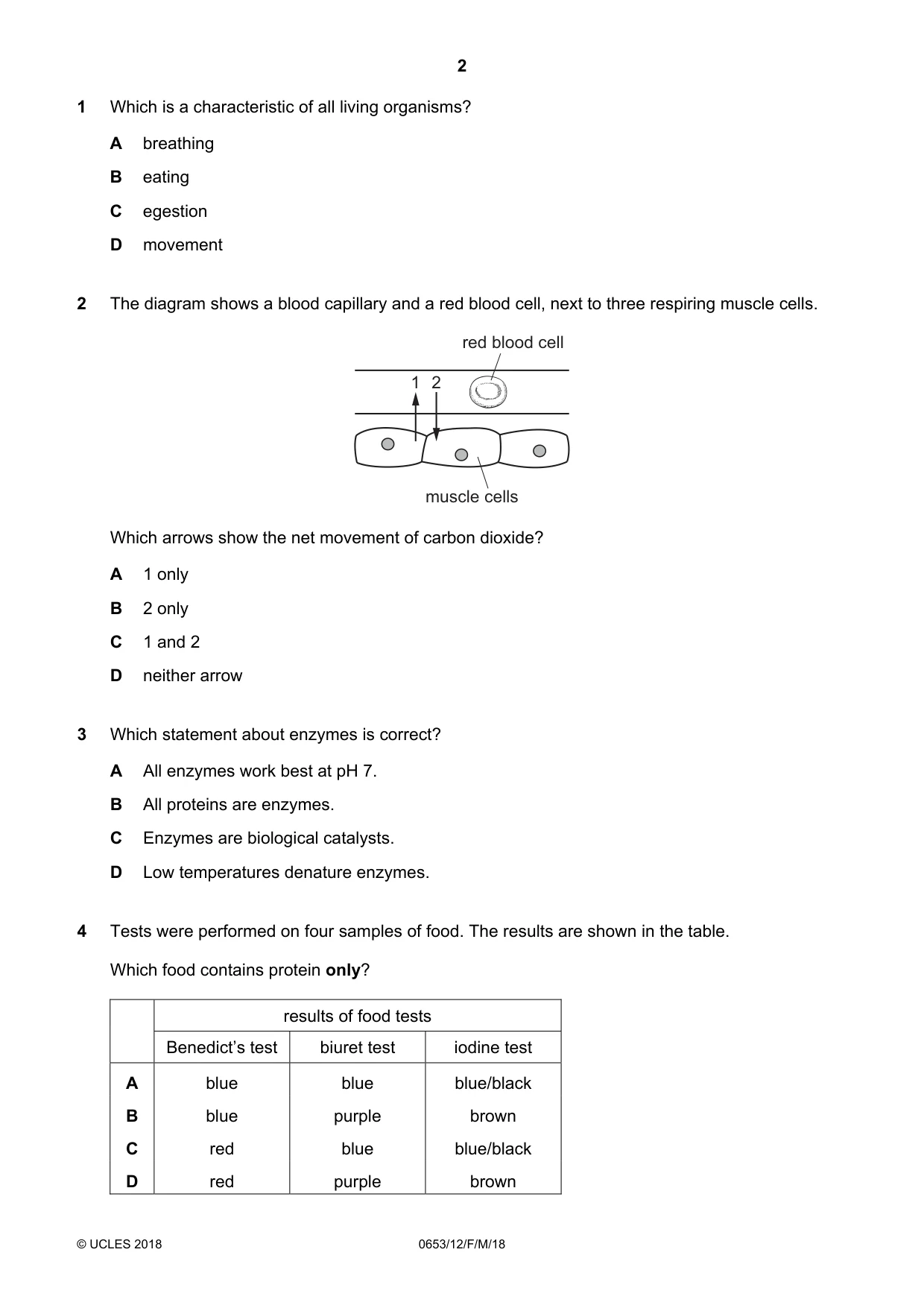
Q2 · The diagram shows a blood capillary and a red blood cell, next to three respiring muscle…
2 The diagram shows a blood capillary and a red blood cell, next to three respiring muscle cells. red blood cell 1 2 muscle cells Which arrows show the net movement of carbon dioxide? A 1 only B 2 only C 1 and 2 D neither arrow
Mark scheme: A
Q3 · Which statement about enzymes is correct?
3 Which statement about enzymes is correct? A All enzymes work best at pH 7. B All proteins are enzymes. C Enzymes are biological catalysts. D Low temperatures denature enzymes.
Mark scheme: C
Q4 · Tests were performed on four samples of food
4 Tests were performed on four samples of food. The results are shown in the table. Which food contains protein only? results of food tests Benedict’s test biuret test iodine test A blue blue blue/black B blue purple brown C red blue blue/black D red purple brown
Mark scheme: B
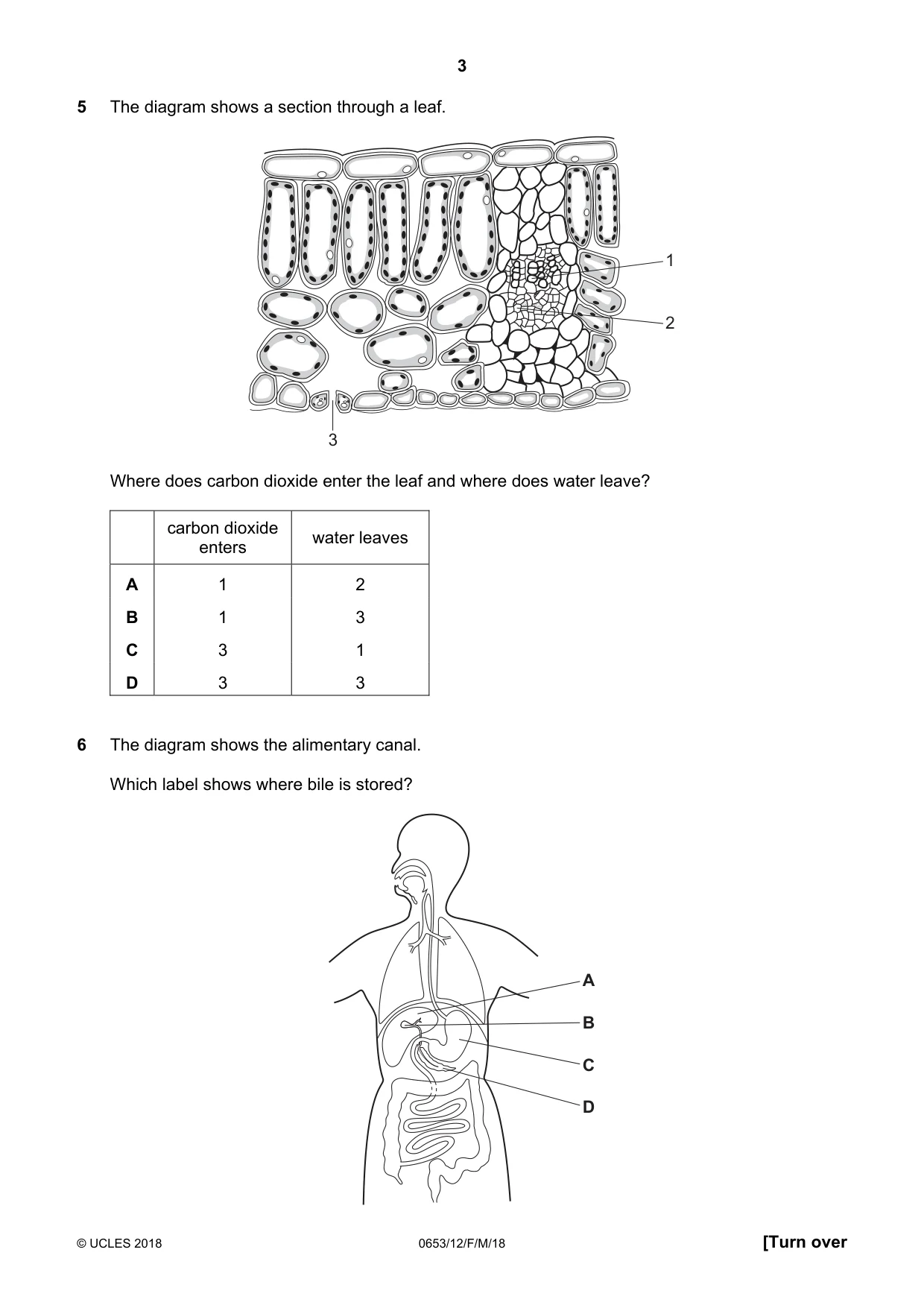
Q5 · The diagram shows a section through a leaf
5 The diagram shows a section through a leaf. 1 2 3 Where does carbon dioxide enter the leaf and where does water leave? carbon dioxide water leaves enters A 1 2 B 1 3 C 3 1 D 3 3
Mark scheme: D
Q6 · The diagram shows the alimentary canal
6 The diagram shows the alimentary canal. Which label shows where bile is stored? A B C D
Mark scheme: B
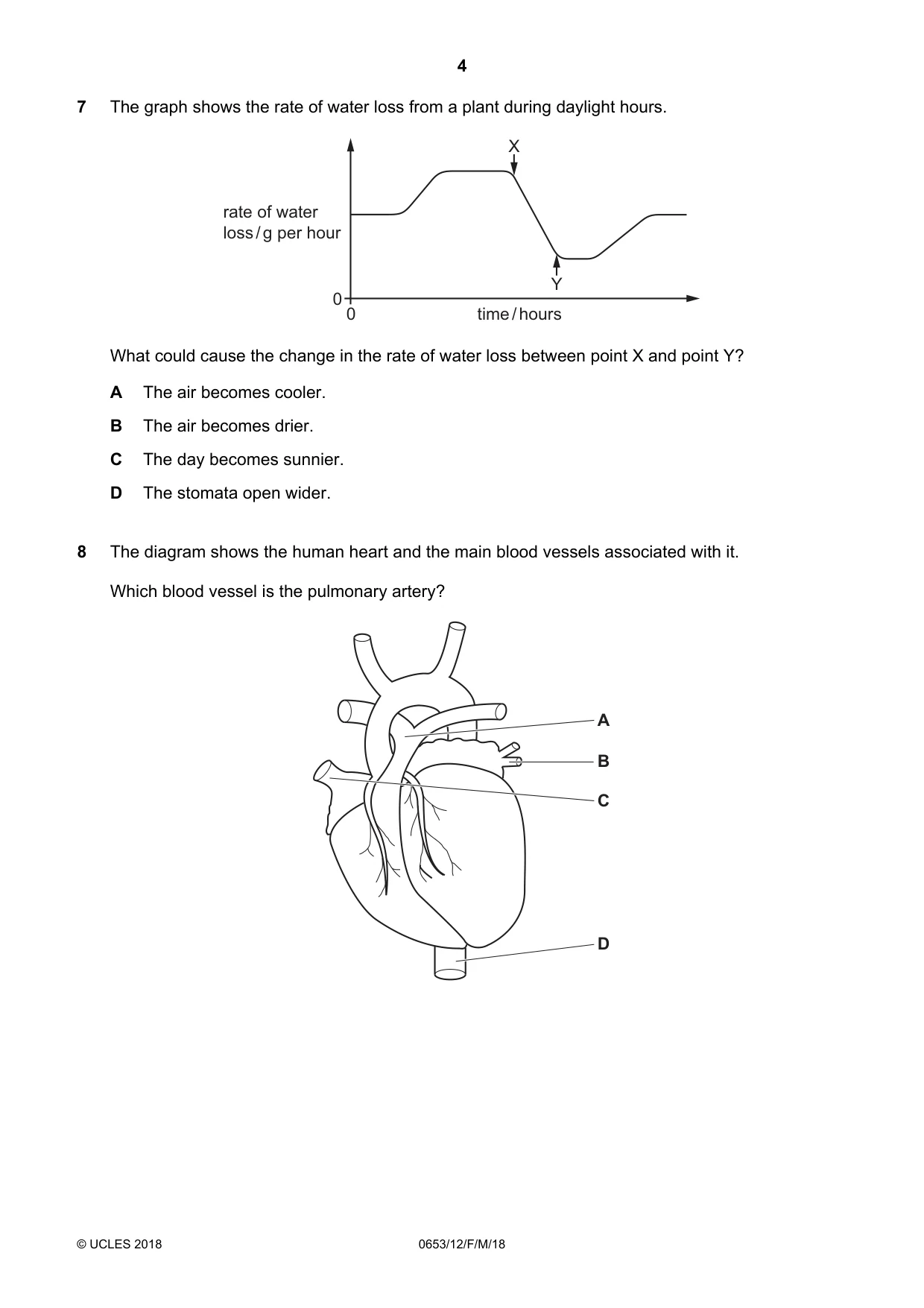
Q7 · The graph shows the rate of water loss from a plant during daylight hours
7 The graph shows the rate of water loss from a plant during daylight hours. X rate of water loss / g per hour Y 0 0 time / hours What could cause the change in the rate of water loss between point X and point Y? A The air becomes cooler. B The air becomes drier. C The day becomes sunnier. D The stomata open wider.
Mark scheme: A
Q8 · The diagram shows the human heart and the main blood vessels associated with it
8 The diagram shows the human heart and the main blood vessels associated with it. Which blood vessel is the pulmonary artery? A B C D
Mark scheme: A
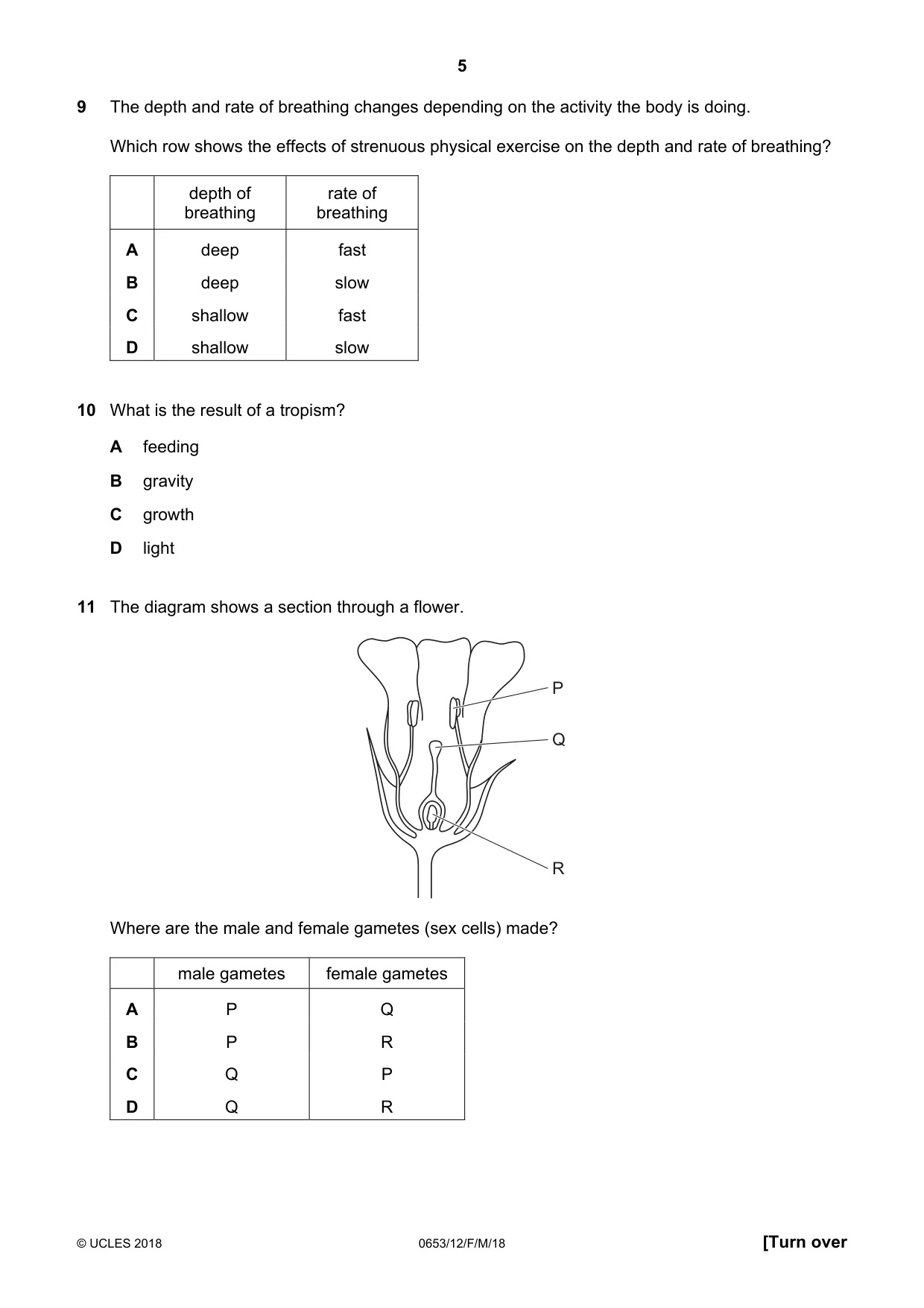
Q9 · The depth and rate of breathing changes depending on the activity the body is doing
9 The depth and rate of breathing changes depending on the activity the body is doing. Which row shows the effects of strenuous physical exercise on the depth and rate of breathing? depth of rate of breathing breathing A deep fast B deep slow C shallow fast D shallow slow
Mark scheme: A
Q10 · What is the result of a tropism?
10 What is the result of a tropism? A feeding B gravity C growth D light
Mark scheme: C
Q11 · The diagram shows a section through a flower
11 The diagram shows a section through a flower. P Q R Where are the male and female gametes (sex cells) made? male gametes female gametes A P Q B P R C Q P D Q R
Mark scheme: B
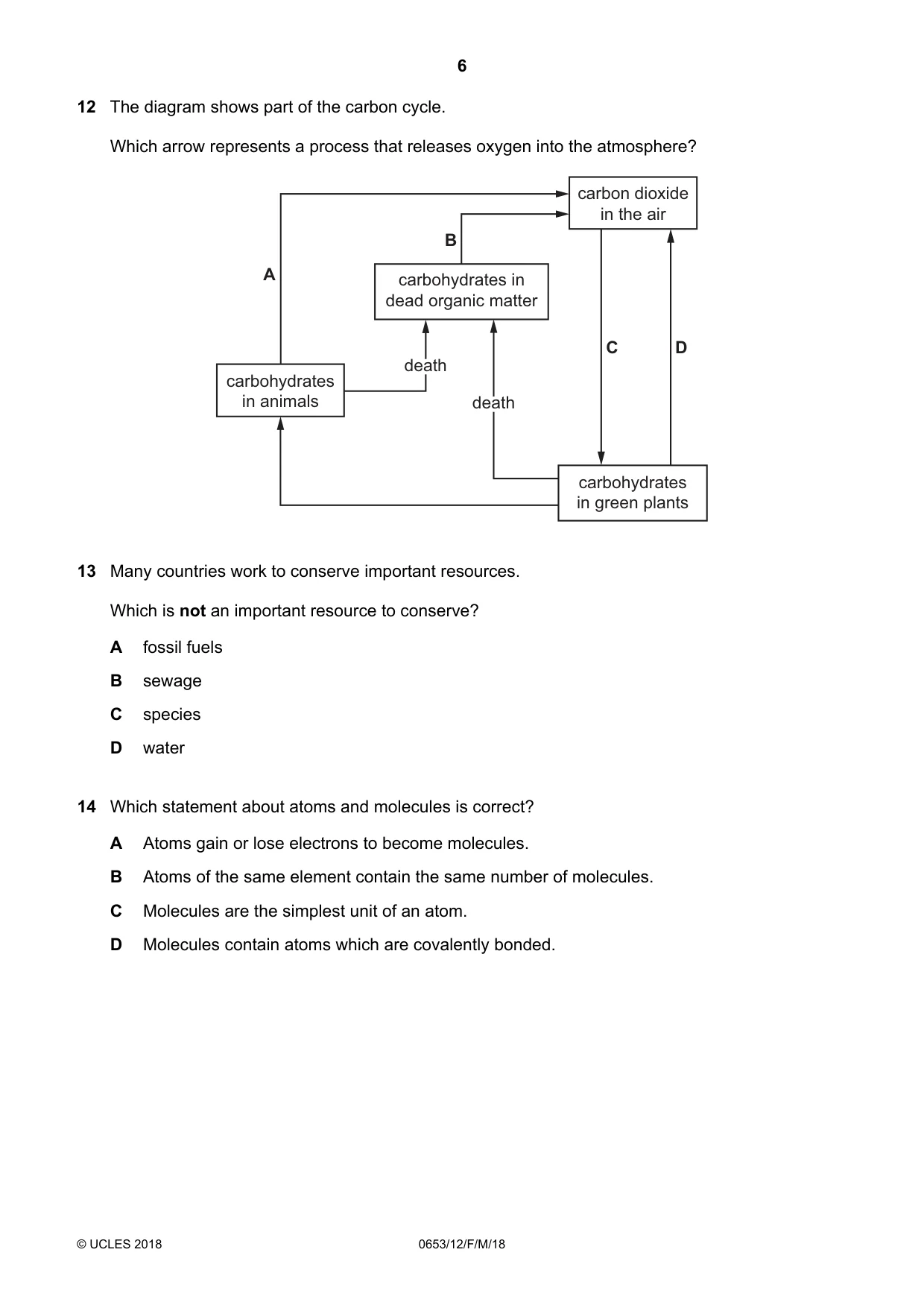
Q12 · The diagram shows part of the carbon cycle
12 The diagram shows part of the carbon cycle. Which arrow represents a process that releases oxygen into the atmosphere? carbon dioxide in the air B A carbohydrates in dead organic matter C D death carbohydrates in animals death carbohydrates in green plants
Mark scheme: C
Q13 · Many countries work to conserve important resources
13 Many countries work to conserve important resources. Which is not an important resource to conserve? A fossil fuels B sewage C species D water
Mark scheme: B
Q14 · Which statement about atoms and molecules is correct?
14 Which statement about atoms and molecules is correct? A Atoms gain or lose electrons to become molecules. B Atoms of the same element contain the same number of molecules. C Molecules are the simplest unit of an atom. D Molecules contain atoms which are covalently bonded.
Mark scheme: D
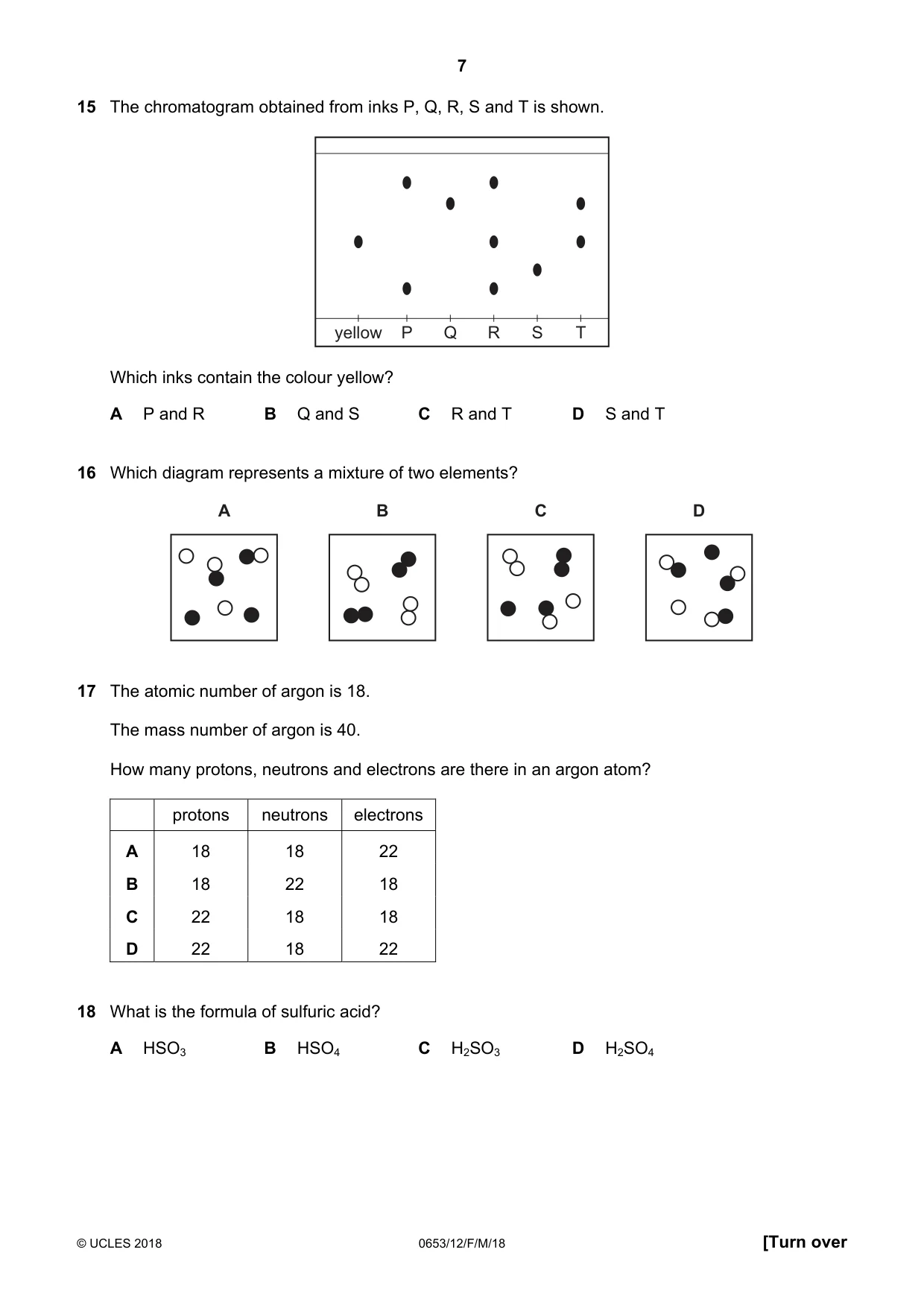
Q15 · The chromatogram obtained from inks P, Q, R, S and T is shown
15 The chromatogram obtained from inks P, Q, R, S and T is shown. yellow P Q R S T Which inks contain the colour yellow? A P and R B Q and S C R and T D S and T
Mark scheme: C
Q16 · Which diagram represents a mixture of two elements?
16 Which diagram represents a mixture of two elements? A B C D
Mark scheme: B
Q17 · The atomic number of argon is 18
17 The atomic number of argon is 18. The mass number of argon is 40. How many protons, neutrons and electrons are there in an argon atom? protons neutrons electrons A 18 18 22 B 18 22 18 C 22 18 18 D 22 18 22
Mark scheme: B
Q18 · What is the formula of sulfuric acid?
18 What is the formula of sulfuric acid? A HSO3 B HSO4 C H2SO3 D H2SO4
Mark scheme: D
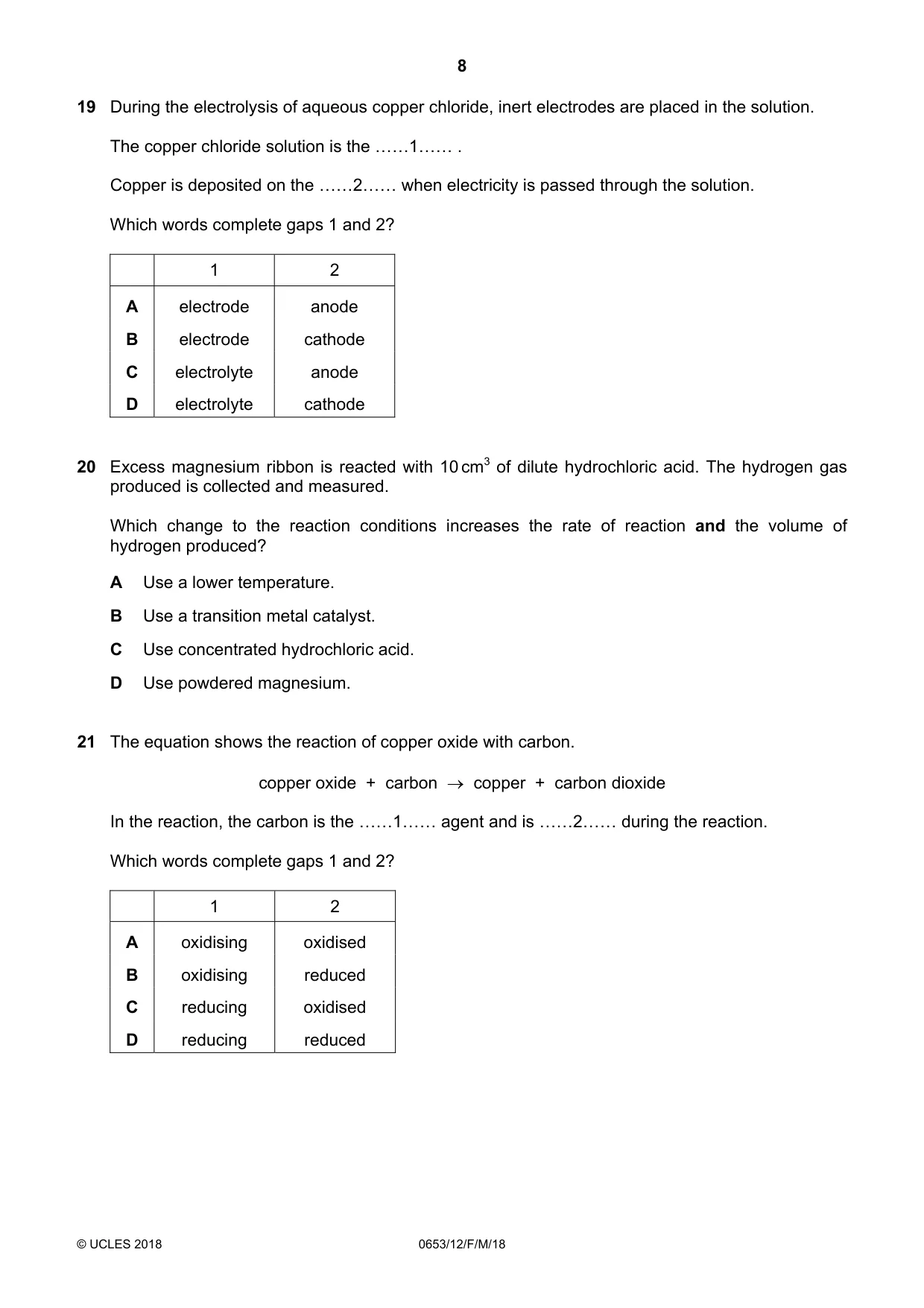
Q19 · During the electrolysis of aqueous copper chloride, inert electrodes are placed in the…
19 During the electrolysis of aqueous copper chloride, inert electrodes are placed in the solution. The copper chloride solution is the ««1«« . Copper is deposited on the ««2«« when electricity is passed through the solution. Which words complete gaps 1 and 2? 1 2 A electrode anode B electrode cathode C electrolyte anode D electrolyte cathode
Mark scheme: D
Q20 · Excess magnesium ribbon is reacted with 10 cm3 of dilute hydrochloric acid
20 Excess magnesium ribbon is reacted with 10 cm3 of dilute hydrochloric acid. The hydrogen gas produced is collected and measured. Which change to the reaction conditions increases the rate of reaction and the volume of hydrogen produced? A Use a lower temperature. B Use a transition metal catalyst. C Use concentrated hydrochloric acid. D Use powdered magnesium.
Mark scheme: C
Q21 · The equation shows the reaction of copper oxide with carbon
21 The equation shows the reaction of copper oxide with carbon. copper oxide + carbon → copper + carbon dioxide In the reaction, the carbon is the ««1«« agent and is ««2«« during the reaction. Which words complete gaps 1 and 2? 1 2 A oxidising oxidised B oxidising reduced C reducing oxidised D reducing reduced
Mark scheme: C
Q22 · What reacts with dilute hydrochloric acid to make magnesium chloride?
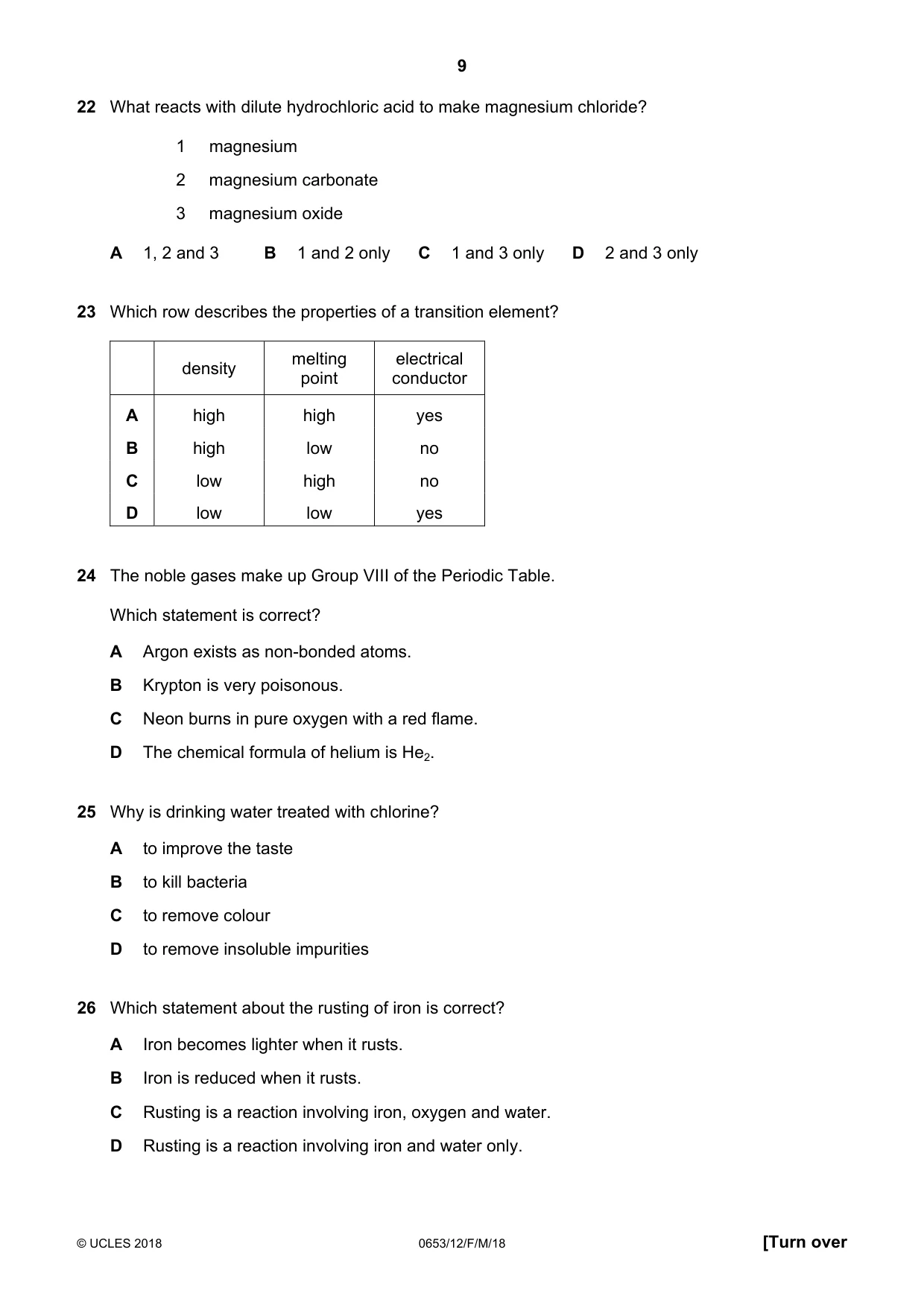
22 What reacts with dilute hydrochloric acid to make magnesium chloride? 1 magnesium 2 magnesium carbonate 3 magnesium oxide A 1, 2 and 3 B 1 and 2 only C 1 and 3 only D 2 and 3 only
Mark scheme: A
Q23 · Which row describes the properties of a transition element?
23 Which row describes the properties of a transition element? melting electrical density point conductor A high high yes B high low no C low high no D low low yes
Mark scheme: A
Q24 · The noble gases make up Group VIII of the Periodic Table
24 The noble gases make up Group VIII of the Periodic Table. Which statement is correct? A Argon exists as non-bonded atoms. B Krypton is very poisonous. C Neon burns in pure oxygen with a red flame. D The chemical formula of helium is He2.
Mark scheme: A
Q25 · Why is drinking water treated with chlorine?
25 Why is drinking water treated with chlorine? A to improve the taste B to kill bacteria C to remove colour D to remove insoluble impurities
Mark scheme: B
Q26 · Which statement about the rusting of iron is correct?
26 Which statement about the rusting of iron is correct? A Iron becomes lighter when it rusts. B Iron is reduced when it rusts. C Rusting is a reaction involving iron, oxygen and water. D Rusting is a reaction involving iron and water only.
Mark scheme: C
Q27 · What gas is the main constituent of natural gas?
27 What gas is the main constituent of natural gas? A carbon dioxide B methane C nitrogen D oxygen
Mark scheme: B
Q28 · The diagrams show distance-time and speed-time graphs
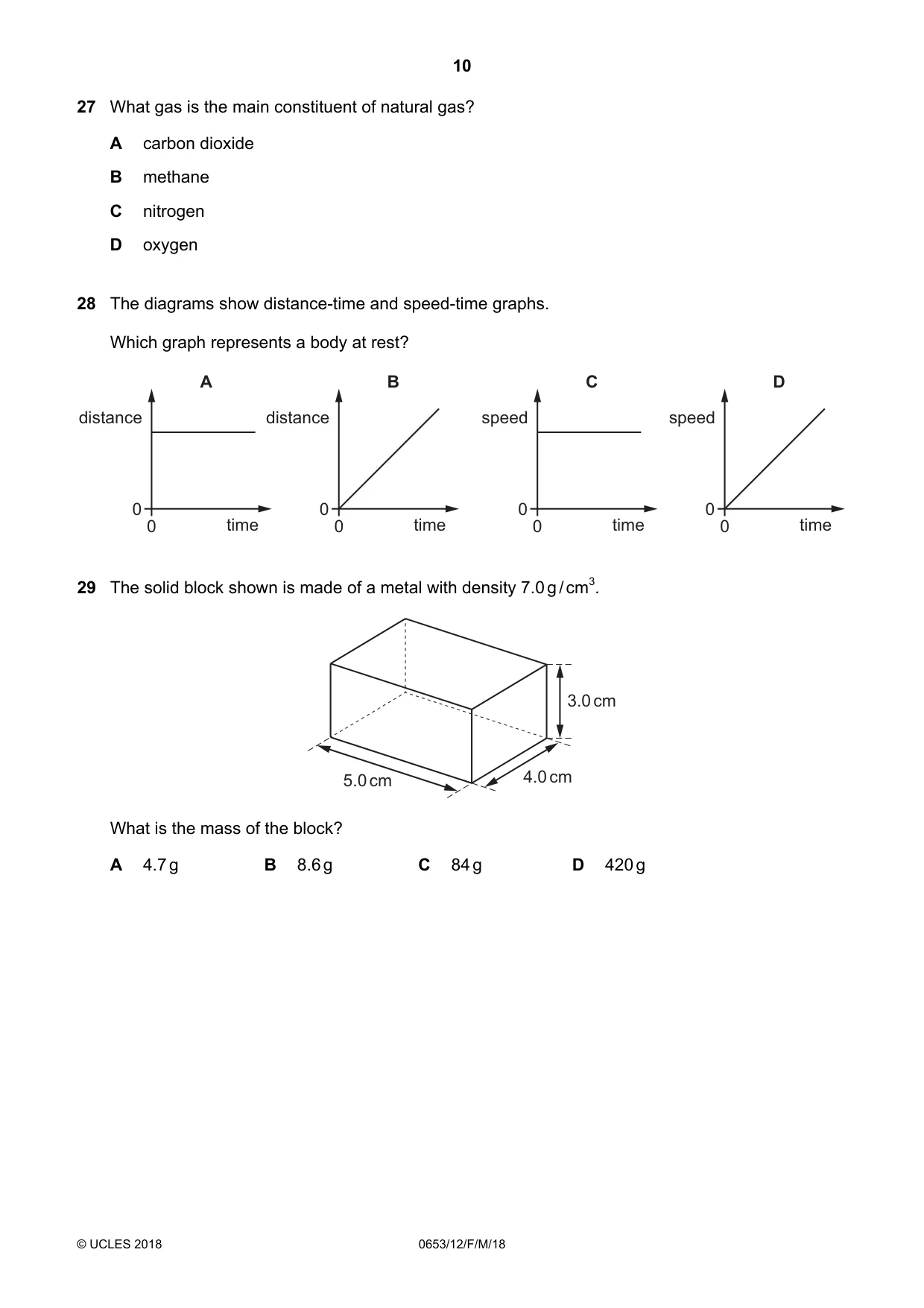
28 The diagrams show distance-time and speed-time graphs. Which graph represents a body at rest? A B C D distance distance speed speed 0 0 0 0 0 time 0 time 0 time 0 time
Mark scheme: A
Q29 · The solid block shown is made of a metal with density 7.0 g / cm3
29 The solid block shown is made of a metal with density 7.0 g / cm3. 3.0 cm 5.0 cm 4.0 cm What is the mass of the block? A 4.7 g B 8.6 g C 84 g D 420 g
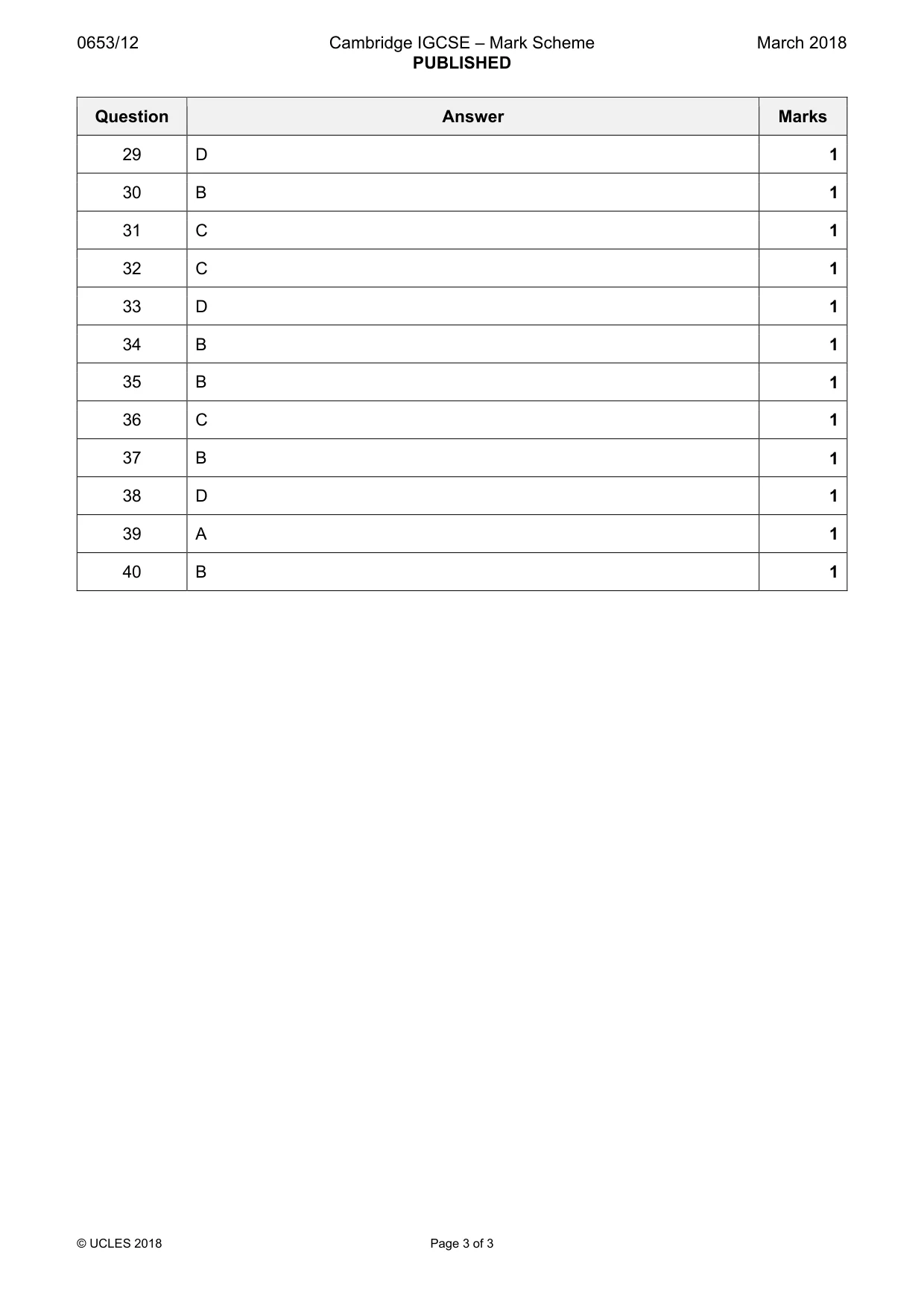
Mark scheme: D
Q30 · A student plots an extension-load graph for a spring
30 A student plots an extension-load graph for a spring. He measures the length of the spring with no load attached. Next he hangs a load from the spring and measures the new length of the spring. He repeats this for different loads. How does the student calculate the extension for each value of load? A new length + original length B new length – original length C new length × original length D new length ÷ original length
Mark scheme: B
Q31 · Which energy resource is non-renewable?
31 Which energy resource is non-renewable? A geothermal energy B hydroelectric energy C nuclear energy D wave energy
Mark scheme: C
Q32 · In an experiment, four students each lift a different empty metal box from the floor on…
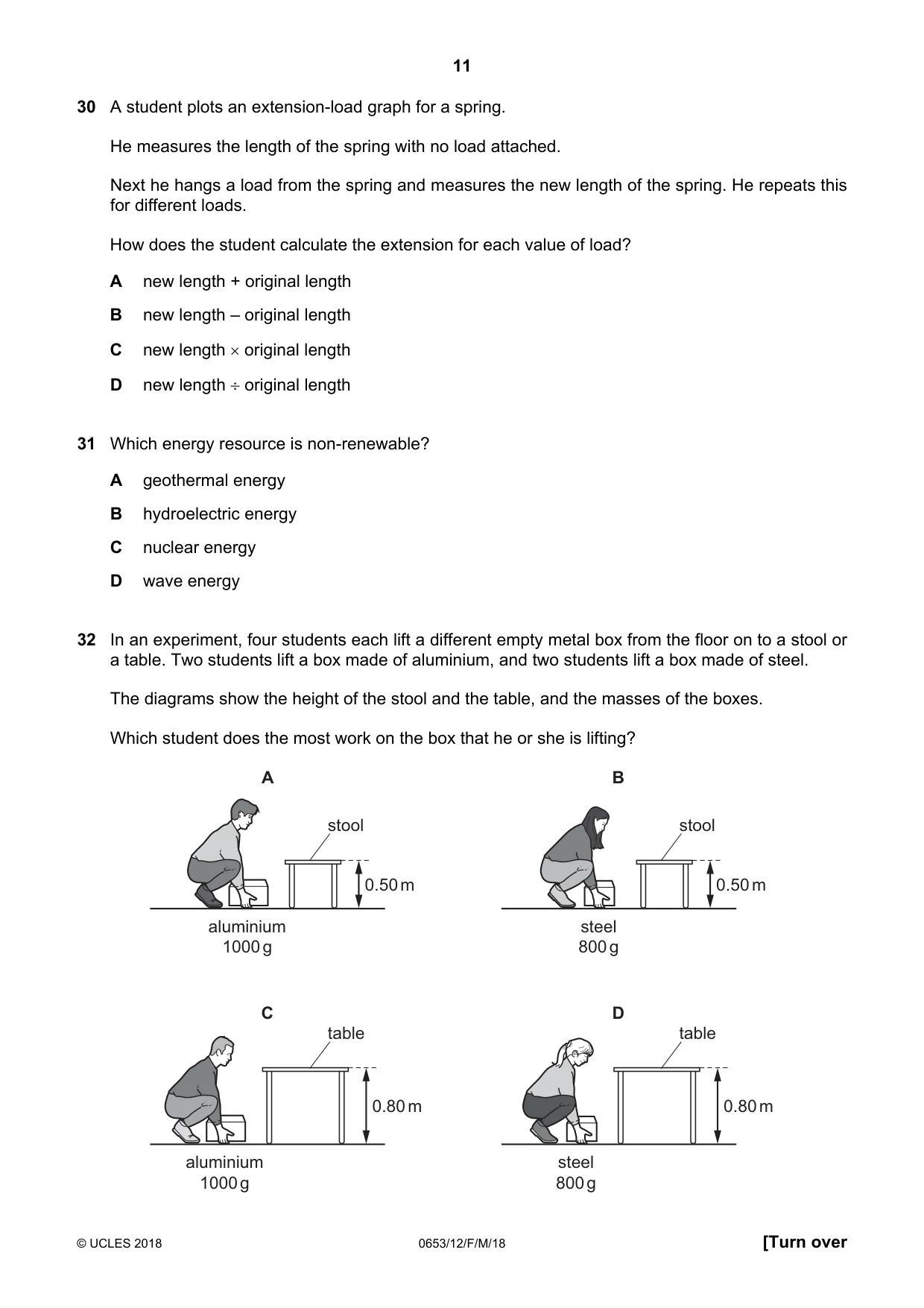
32 In an experiment, four students each lift a different empty metal box from the floor on to a stool or a table. Two students lift a box made of aluminium, and two students lift a box made of steel. The diagrams show the height of the stool and the table, and the masses of the boxes. Which student does the most work on the box that he or she is lifting? A B stool stool 0.50 m 0.50 m aluminium steel 1000 g 800 g C D table table 0.80 m 0.80 m aluminium steel 1000 g 800 g
Mark scheme: C
Q33 · What is a property of both solids and liquids?
33 What is a property of both solids and liquids? A They always fill a container. B They can flow. C They have a fixed shape. D They have a fixed volume.
Mark scheme: D
Q34 · A student makes two statements about infra-red radiation
34 A student makes two statements about infra-red radiation. 1 It is electromagnetic radiation. 2 It transfers thermal energy through a vacuum. Which of these statements are correct? A 1 only B 1 and 2 C 2 only D neither 1 nor 2
Mark scheme: B
Q35 · The diagram represents a wave
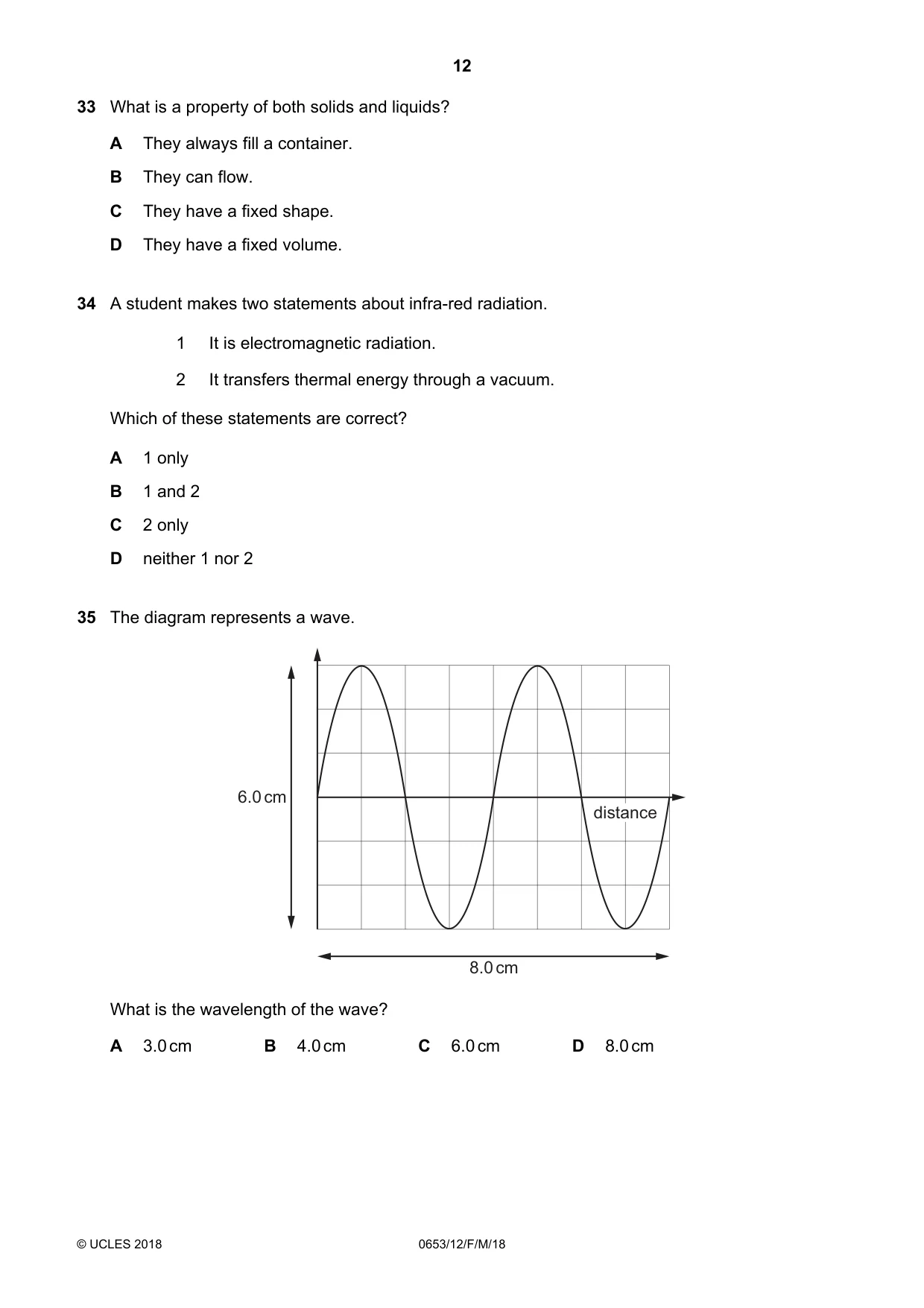
35 The diagram represents a wave. 6.0 cm distance 8.0 cm What is the wavelength of the wave? A 3.0 cm B 4.0 cm C 6.0 cm D 8.0 cm
Mark scheme: B
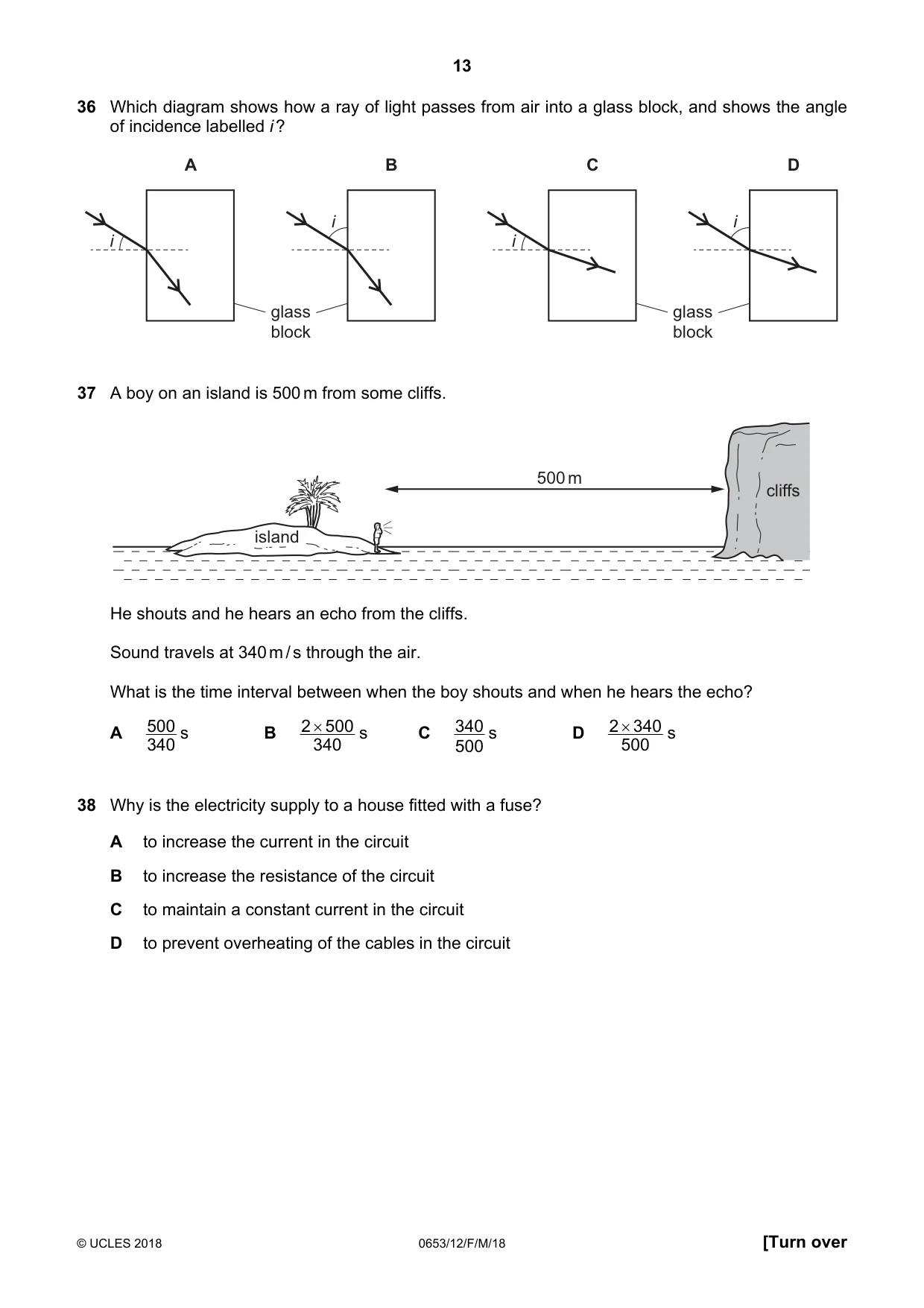
Q36 · Which diagram shows how a ray of light passes from air into a glass block, and shows the…
36 Which diagram shows how a ray of light passes from air into a glass block, and shows the angle of incidence labelled i ? A B C D i i i i glass glass block block
Mark scheme: C
Q37 · A boy on an island is 500 m from some cliffs
37 A boy on an island is 500 m from some cliffs. 500 m cliffs island He shouts and he hears an echo from the cliffs. Sound travels at 340 m / s through the air. What is the time interval between when the boy shouts and when he hears the echo? 500 s 2× 500 340 s 2× 340 A B s C D s 340 340 5 00 500
Mark scheme: B
Q38 · Why is the electricity supply to a house fitted with a fuse?
38 Why is the electricity supply to a house fitted with a fuse? A to increase the current in the circuit B to increase the resistance of the circuit C to maintain a constant current in the circuit D to prevent overheating of the cables in the circuit
Mark scheme: D
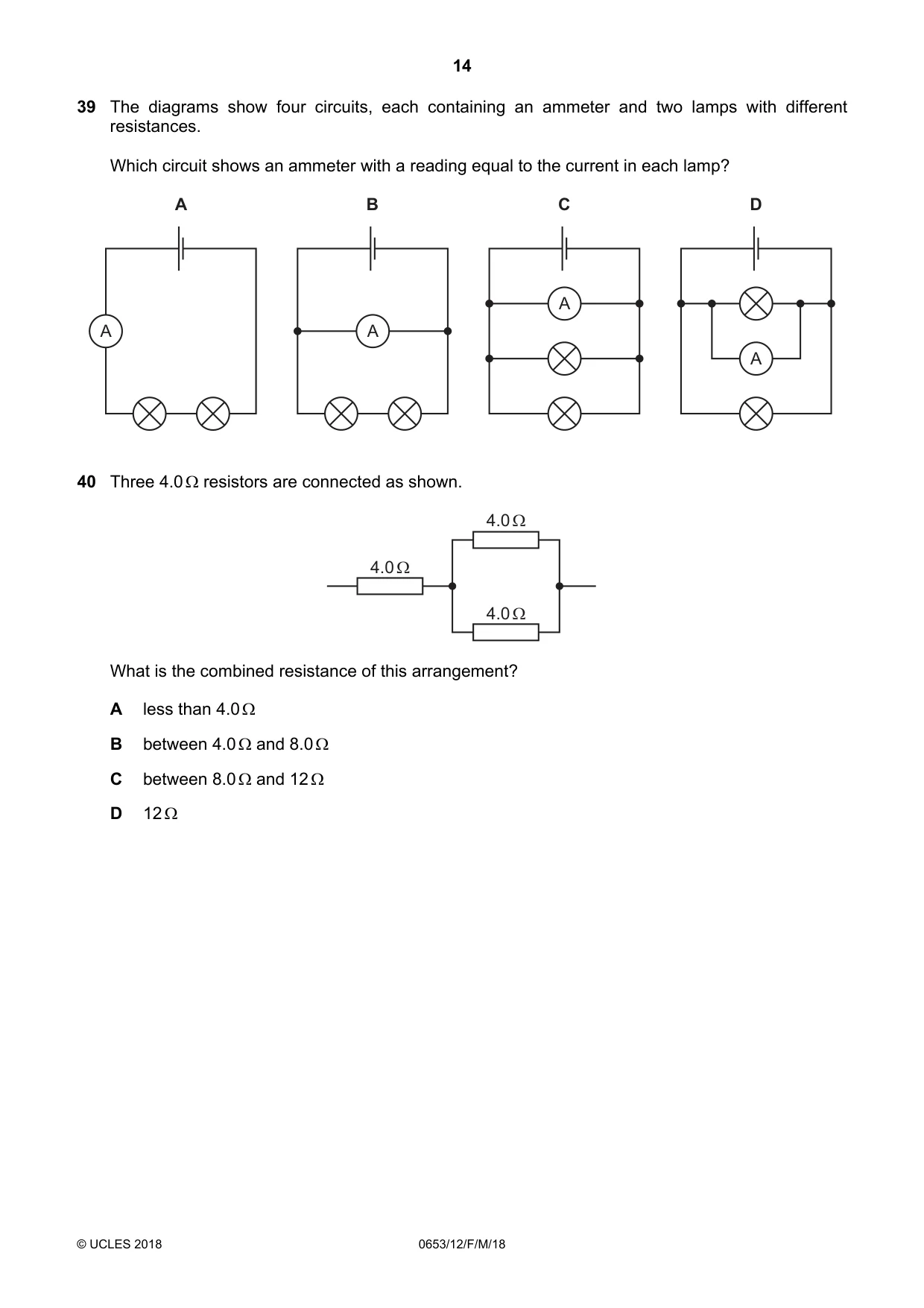
Q39 · The diagrams show four circuits, each containing an ammeter and two lamps with different…
39 The diagrams show four circuits, each containing an ammeter and two lamps with different resistances. Which circuit shows an ammeter with a reading equal to the current in each lamp? A B C D A A A A
Mark scheme: A
Q40 · Three 4.0 Ω resistors are connected as shown
40 Three 4.0 Ω resistors are connected as shown. 4.0 Ω 4.0 Ω 4.0 Ω What is the combined resistance of this arrangement? A less than 4.0 Ω B between 4.0 Ω and 8.0 Ω C between 8.0 Ω and 12 Ω D 12 Ω
Mark scheme: B
What was in this paper
The subtopics covered by these 40 questions, and how many questions each got. Open one in a new tab to see every Cambridge question on it.
2Energy, work and power2Sexual reproduction in plants2Atomic structure and the Periodic Table1Biological molecules1Carbon cycle1Characteristics of living organisms1Chromatography1Conservation1Corrosion of metals1Density1Digestive system1Electrical safety1Electrolysis1Elements, compounds and mixtures1Enzymes1Forces1Formulas1Fuels1Gas exchange in humans1General properties of waves1Heart1Kinetic particle model of matter1Leaf structure1Light1Motion1Noble gases1Preparation of salts1Rate of reaction1Redox1Respiration1Simple molecules and covalent bonds1Sound1Transfer of thermal energy1Transition elements1Transpiration1Water1What you needed in this session
Cambridge’s own grade thresholds for 2018 Feb/March, Paper 1 · Variant 2. A higher threshold means an easier paper — the bar moves with how the cohort did.