Cambridge IGCSE Science - Combined 0653 — 2006 May/June Paper 1 · Variant 1
0653/11/M/J/06 · 40 questions · 40 marks · ≈45 min
The question paper and its mark scheme, free to read here and free to download. This is Cambridge’s own paper, exactly as it was sat.
Question paper16 pages
Mark scheme2 pages
Answers below. Sit the paper first if you are practising.
Questions as text
Q1 · Which statement about diffusion is correct?
1 Which statement about diffusion is correct? A Changing temperature has no effect on the diffusion of molecules. B Diffusion involves the random movement of molecules. C Small molecules enter but do not leave cells by diffusion. D Small molecules diffuse through cell membranes but not through cell walls.
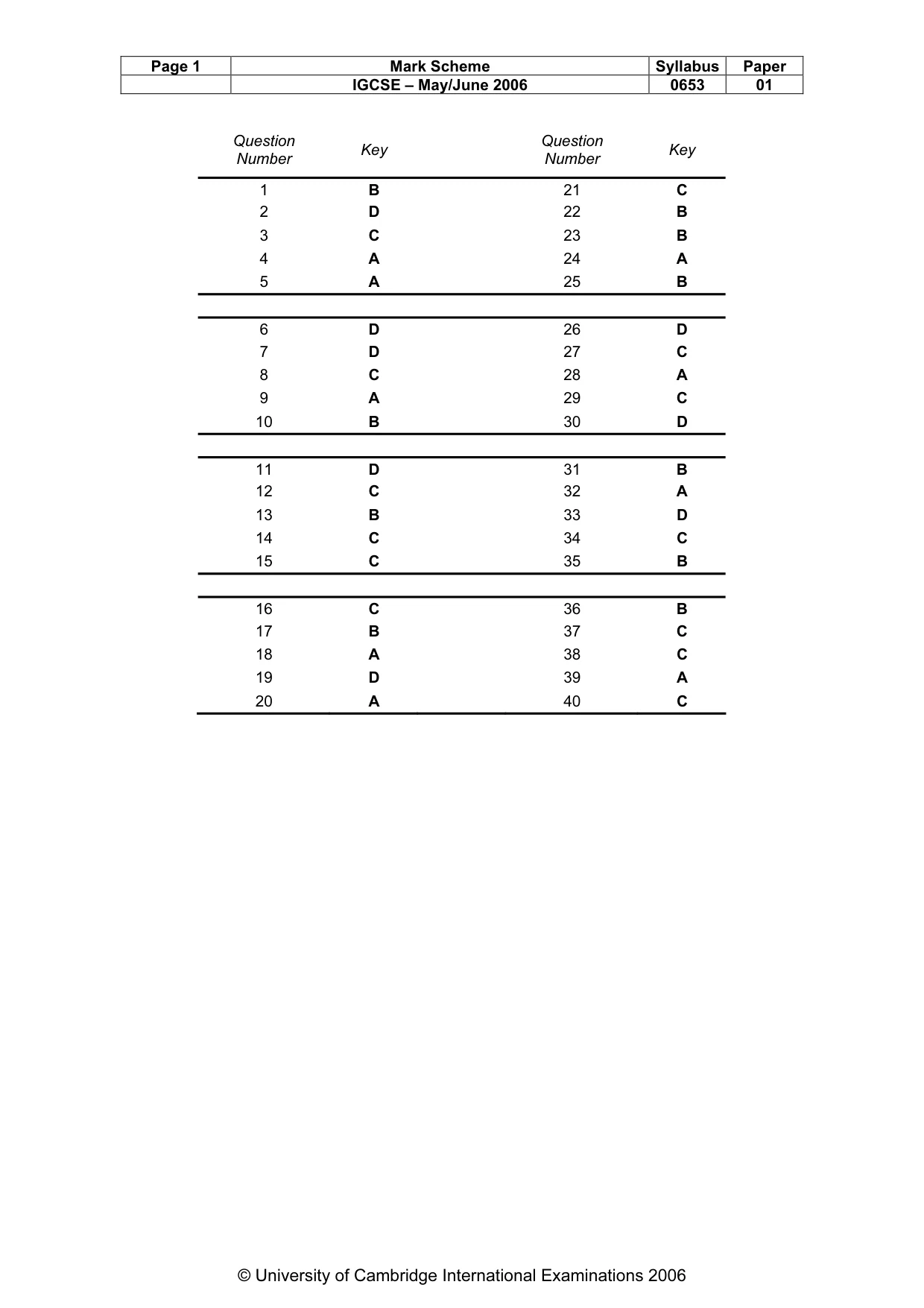
Mark scheme: B
Q2 · A test-tube contains a solution of the enzyme catalase
2 A test-tube contains a solution of the enzyme catalase. Which colour is obtained when this solution is tested with biuret solution? A blue B blue-black C orange D violet-mauve
Mark scheme: D
Q3 · In what form is carbohydrate stored in a leaf?
3 In what form is carbohydrate stored in a leaf? A fat B protein C starch D Vitamin C
Mark scheme: C
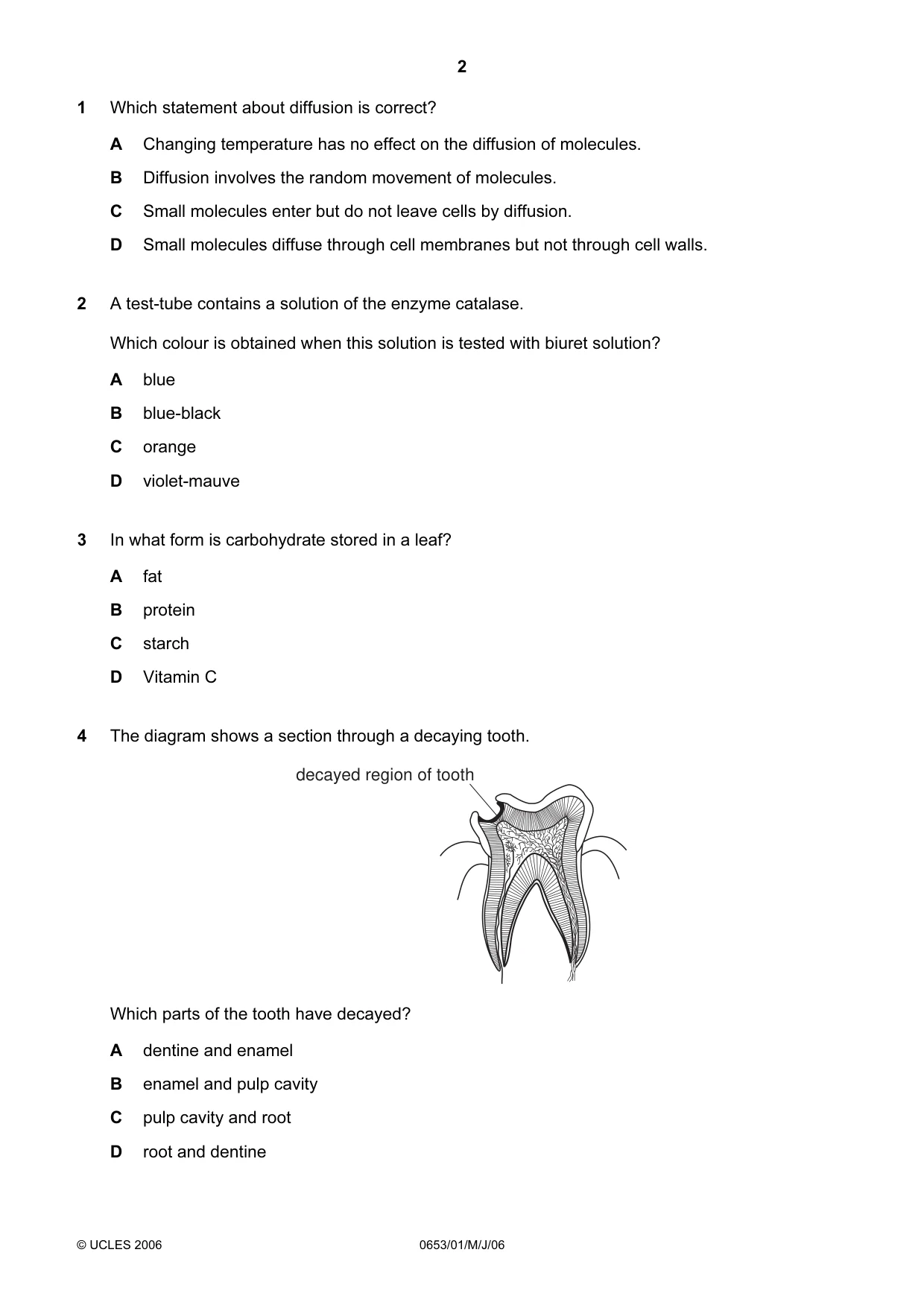
Q4 · The diagram shows a section through a decaying tooth
4 The diagram shows a section through a decaying tooth. decayed region of tooth Which parts of the tooth have decayed? A dentine and enamel B enamel and pulp cavity C pulp cavity and root D root and dentine
Mark scheme: A
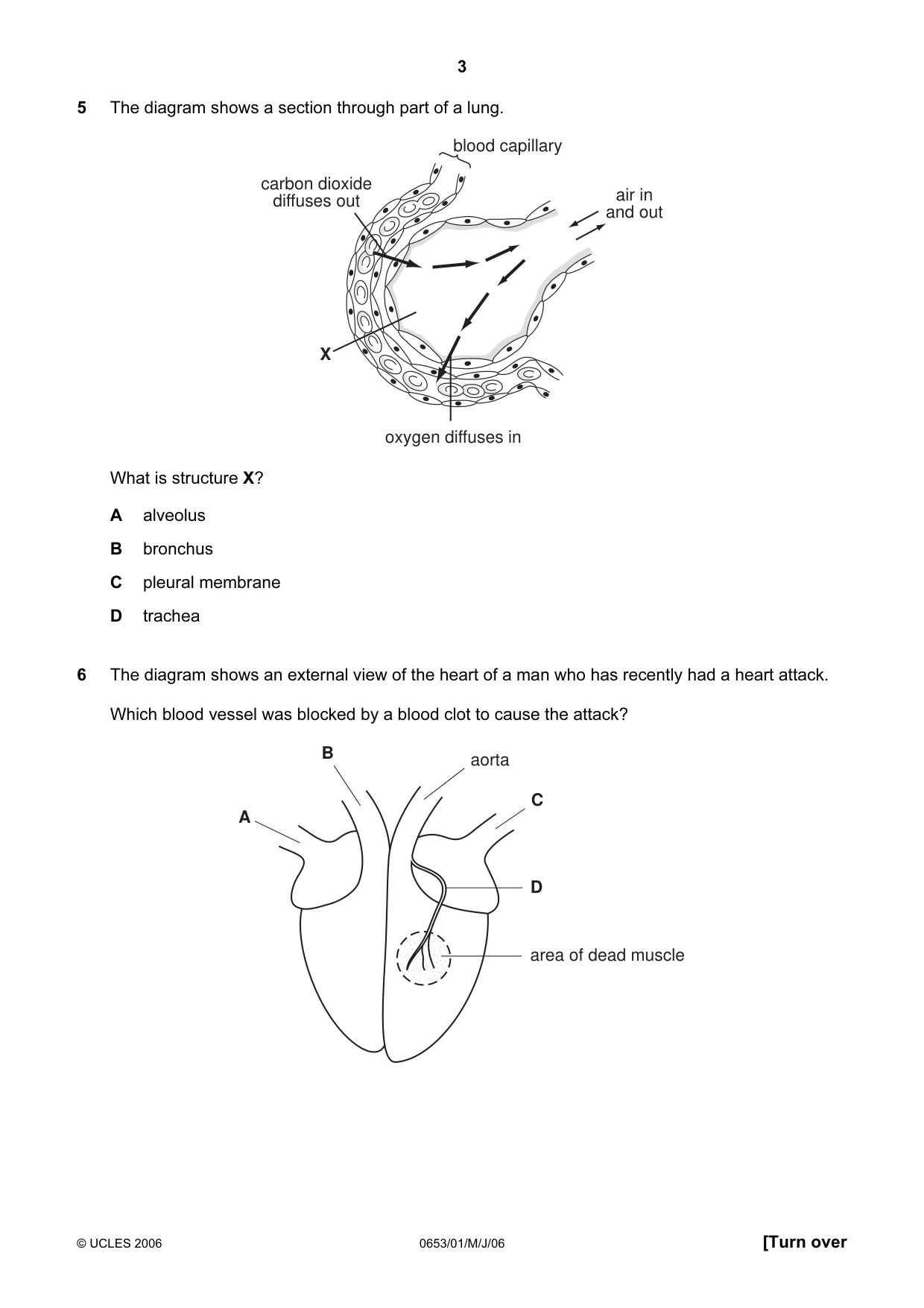
Q5 · The diagram shows a section through part of a lung
5 The diagram shows a section through part of a lung. blood capillary carbon dioxide diffuses out air in and out X oxygen diffuses in What is structure X? A alveolus B bronchus C pleural membrane D trachea
Mark scheme: A
Q6 · The diagram shows an external view of the heart of a man who has recently had a heart…
6 The diagram shows an external view of the heart of a man who has recently had a heart attack. Which blood vessel was blocked by a blood clot to cause the attack? B aorta C A D area of dead muscle
Mark scheme: D
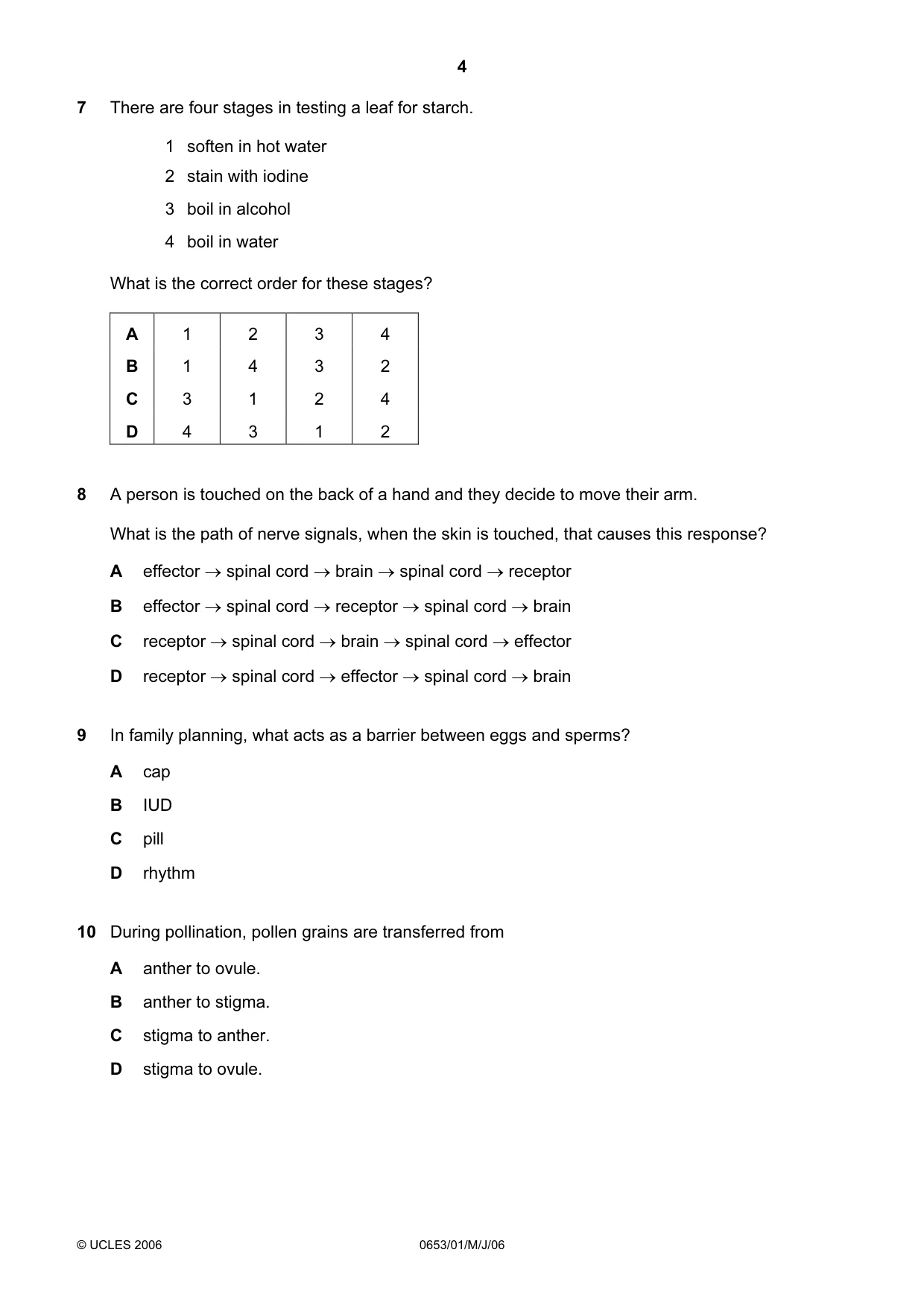
Q7 · There are four stages in testing a leaf for starch
7 There are four stages in testing a leaf for starch. 1 soften in hot water 2 stain with iodine 3 boil in alcohol 4 boil in water What is the correct order for these stages? A 1 2 3 4 B 1 4 3 2 C 3 1 2 4 D 4 3 1 2
Mark scheme: D
Q8 · A person is touched on the back of a hand and they decide to move their arm
8 A person is touched on the back of a hand and they decide to move their arm. What is the path of nerve signals, when the skin is touched, that causes this response? A effector → spinal cord → brain → spinal cord → receptor B effector → spinal cord → receptor → spinal cord → brain C receptor → spinal cord → brain → spinal cord → effector D receptor → spinal cord → effector → spinal cord → brain
Mark scheme: C
Q9 · In family planning, what acts as a barrier between eggs and sperms?
9 In family planning, what acts as a barrier between eggs and sperms? A cap B IUD C pill D rhythm
Mark scheme: A
Q10 · During pollination, pollen grains are transferred from A anther to ovule
10 During pollination, pollen grains are transferred from A anther to ovule. B anther to stigma. C stigma to anther. D stigma to ovule.
Mark scheme: B
Q11 · In the nineteenth century, August Weissmann removed the tails of two mice before breeding…
11 In the nineteenth century, August Weissmann removed the tails of two mice before breeding from them. He then removed the tails of their offspring before breeding from them again. He repeated this for many generations. All the offspring had tails when they were born. Why were new mice without tails never born? A Asexual reproduction does not produce new varieties. B Genes are not passed on from parents to offspring. C The results of asexual reproduction are not predictable. D Variation due to the environment is not inherited.
Mark scheme: D
Q12 · In the carbon cycle, several different processes may release carbon dioxide from dead…
12 In the carbon cycle, several different processes may release carbon dioxide from dead organisms. Which process does not do so? A combustion B decomposition C photosynthesis D respiration
Mark scheme: C
Q13 · Deforestation in tropical rain forests can lead to A decreased carbon dioxide in the air
13 Deforestation in tropical rain forests can lead to A decreased carbon dioxide in the air. B decreased species diversity. C increased number of habitats. D increased oxygen in the air.
Mark scheme: B
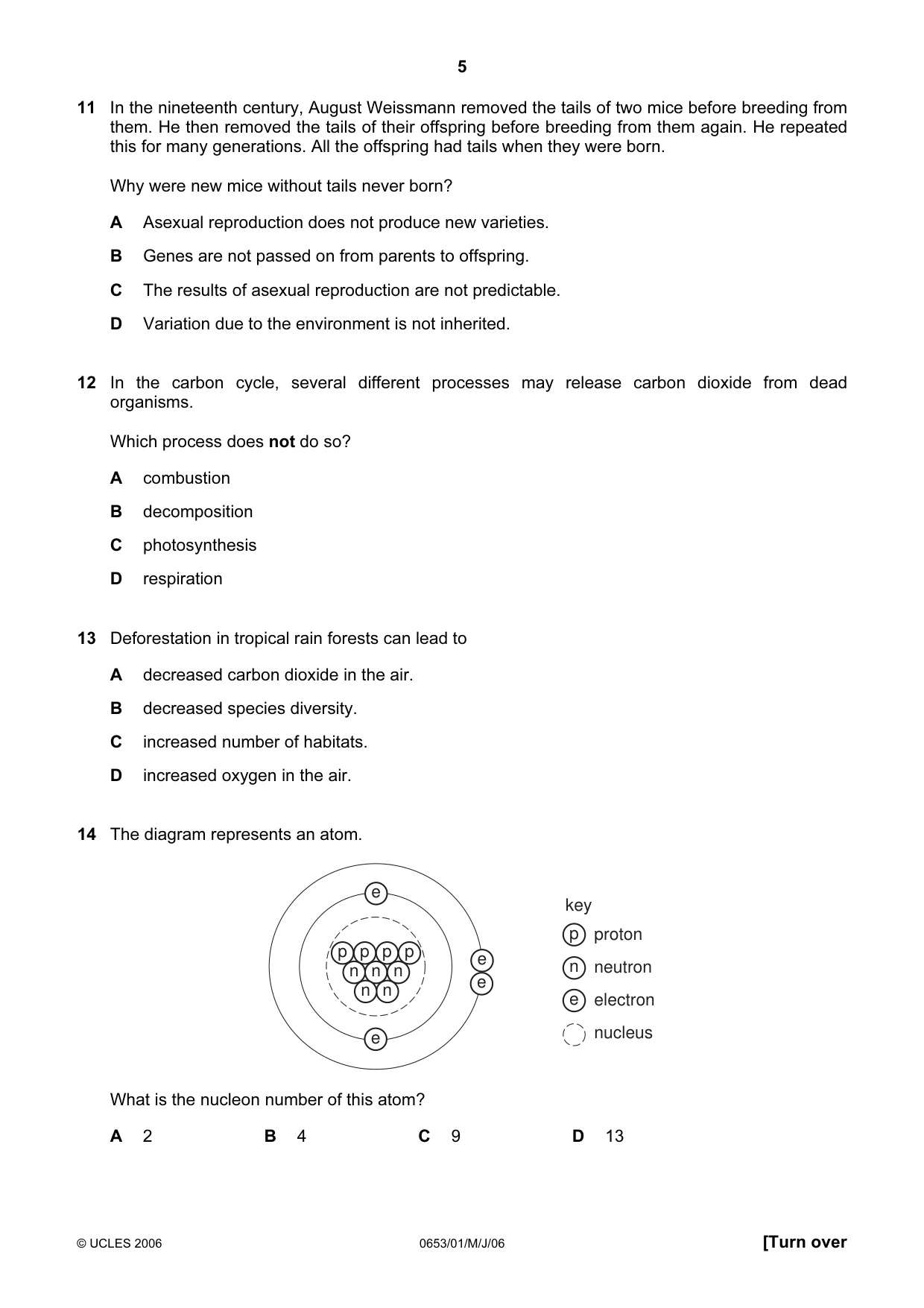
Q14 · The diagram represents an atom
14 The diagram represents an atom. e key p proton p p p p e n n n n neutron e n n e electron e nucleus What is the nucleon number of this atom? A 2 B 4 C 9 D 13
Mark scheme: C
Q15 · Metals and non-metals can each form ions
15 Metals and non-metals can each form ions. Which charges do these ions have? metal ion non-metal ion A negative negative B negative positive C positive negative D positive positive
Mark scheme: C
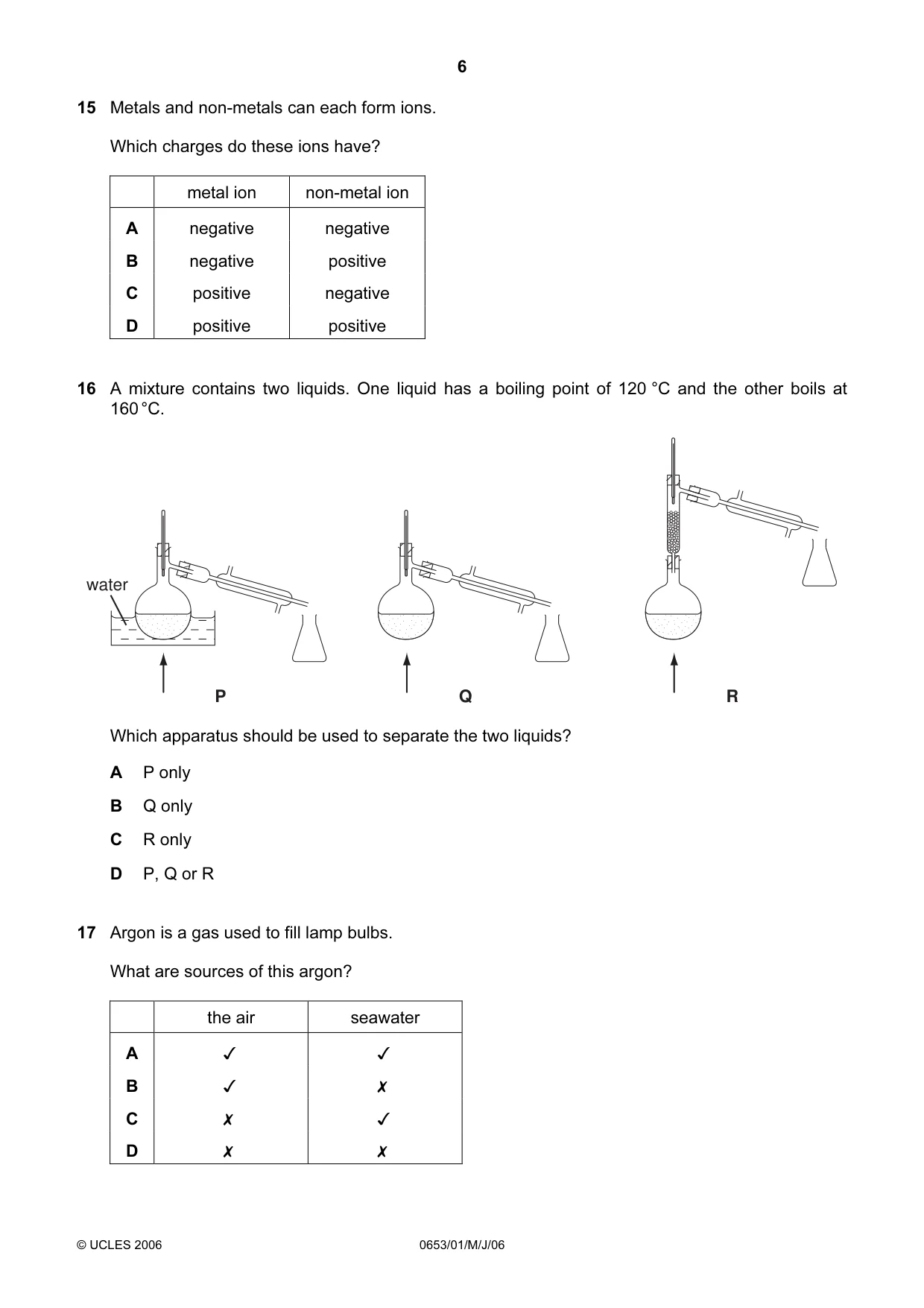
Q16 · A mixture contains two liquids
16 A mixture contains two liquids. One liquid has a boiling point of 120 °C and the other boils at 160 °C. water P Q R Which apparatus should be used to separate the two liquids? A P only B Q only C R only D P, Q or R
Mark scheme: C
Q17 · Argon is a gas used to fill lamp bulbs
17 Argon is a gas used to fill lamp bulbs. What are sources of this argon? the air seawater A v v B v x Cc x v D x x
Mark scheme: B
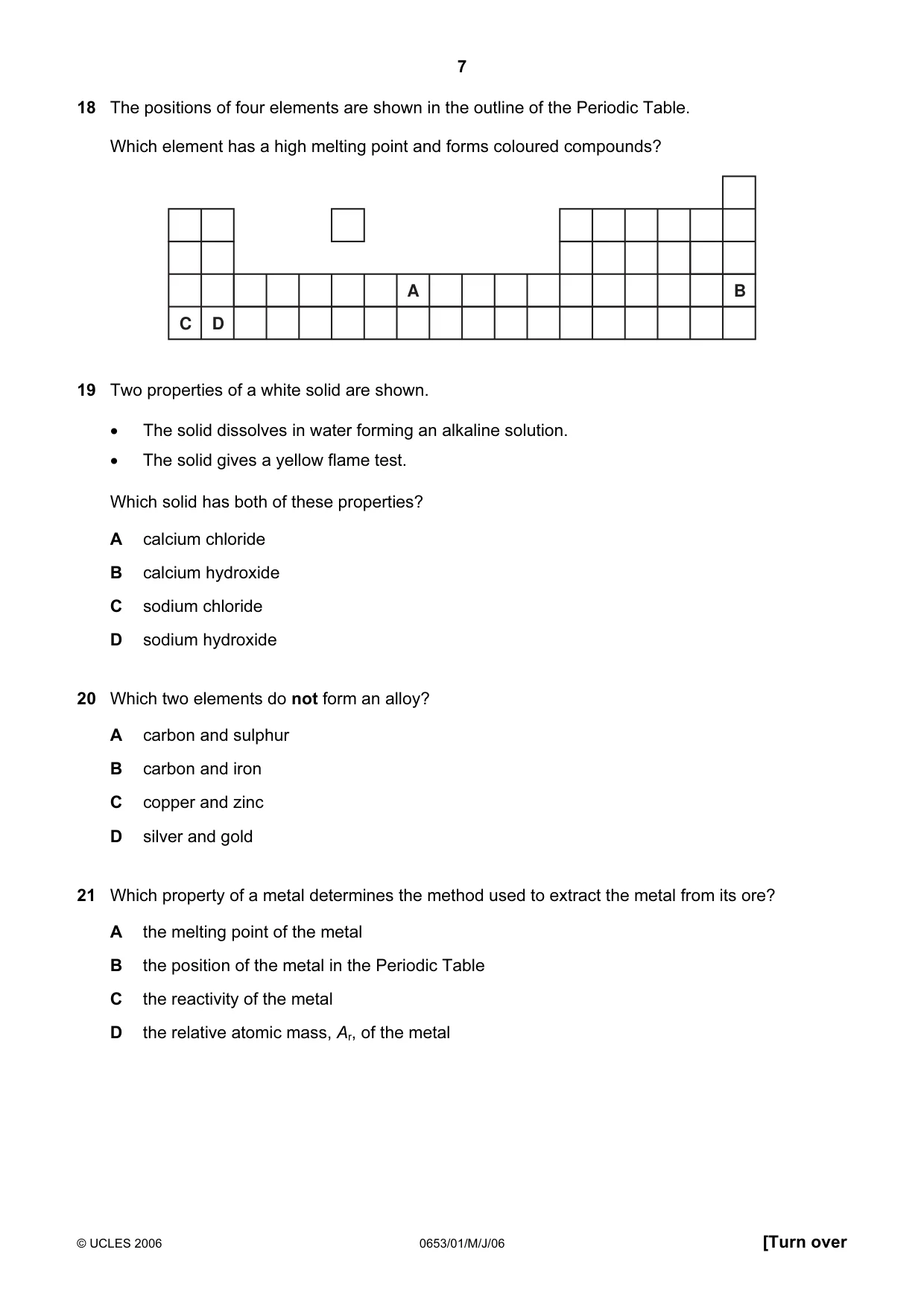
Q18 · The positions of four elements are shown in the outline of the Periodic Table
18 The positions of four elements are shown in the outline of the Periodic Table. Which element has a high melting point and forms coloured compounds? A B C D
Mark scheme: A
Q19 · Two properties of a white solid are shown
19 Two properties of a white solid are shown. • The solid dissolves in water forming an alkaline solution. • The solid gives a yellow flame test. Which solid has both of these properties? A calcium chloride B calcium hydroxide C sodium chloride D sodium hydroxide
Mark scheme: D
Q20 · Which two elements do not form an alloy?
20 Which two elements do not form an alloy? A carbon and sulphur B carbon and iron C copper and zinc D silver and gold
Mark scheme: A
Q21 · Which property of a metal determines the method used to extract the metal from its ore?
21 Which property of a metal determines the method used to extract the metal from its ore? A the melting point of the metal B the position of the metal in the Periodic Table C the reactivity of the metal D the relative atomic mass, Ar, of the metal
Mark scheme: C
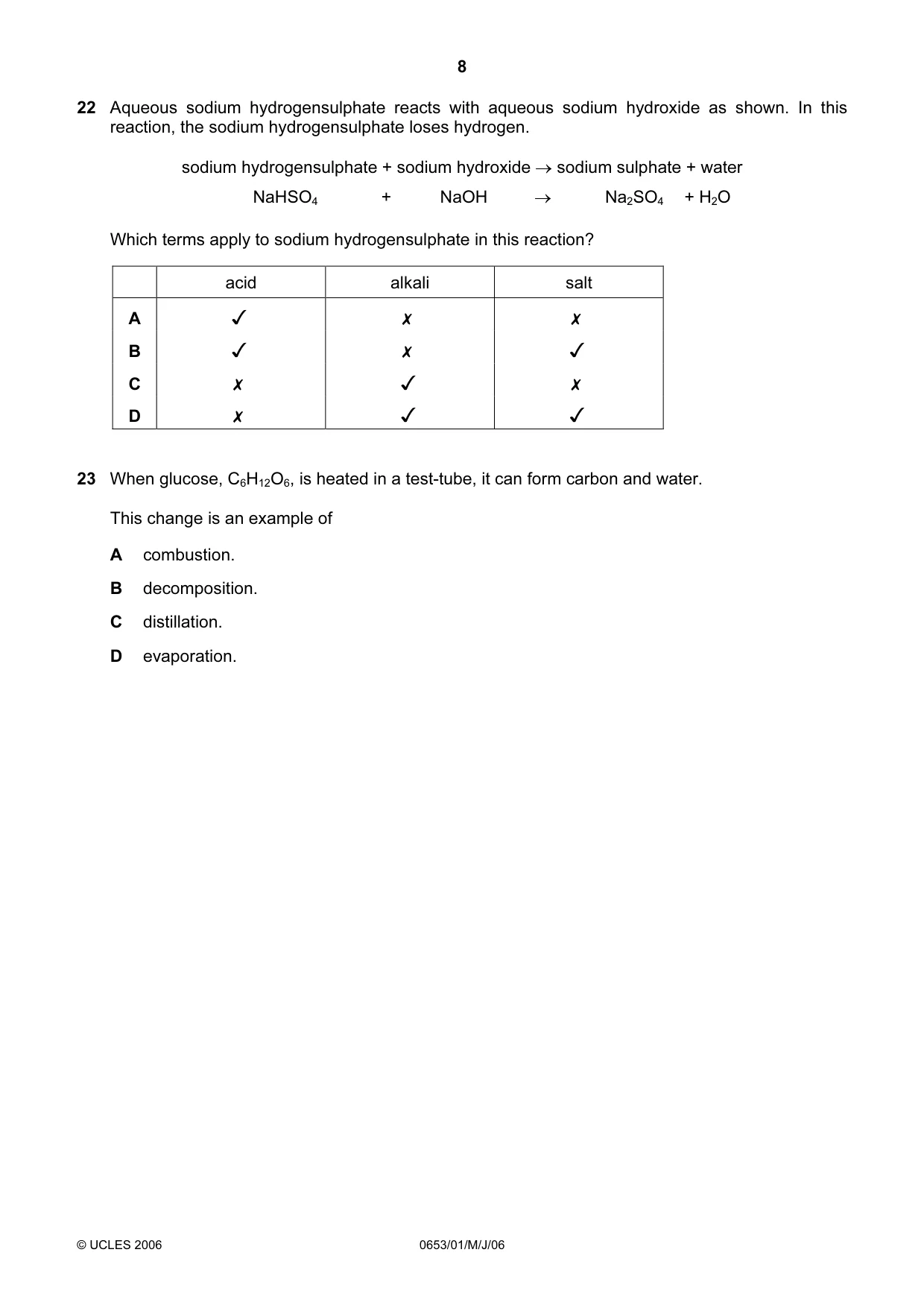
Q22 · Aqueous sodium hydrogensulphate reacts with aqueous sodium hydroxide as shown
22 Aqueous sodium hydrogensulphate reacts with aqueous sodium hydroxide as shown. In this reaction, the sodium hydrogensulphate loses hydrogen. sodium hydrogensulphate + sodium hydroxide — sodium sulphate + water NaHSQ, + NaOH > NazSO, +H20 Which terms apply to sodium hydrogensulphate in this reaction? acid alkali salt A v x x B v x v Cc x v x D x v v
Mark scheme: B
More questions on The characteristic properties of acids and bases
Q23 · When glucose, C6H12O6, is heated in a test-tube, it can form carbon and water
23 When glucose, C6H12O6, is heated in a test-tube, it can form carbon and water. This change is an example of A combustion. B decomposition. C distillation. D evaporation.
Mark scheme: B
Q24 · Molten lead(II) bromide conducts electricity and the bulb lights up in the experiment…
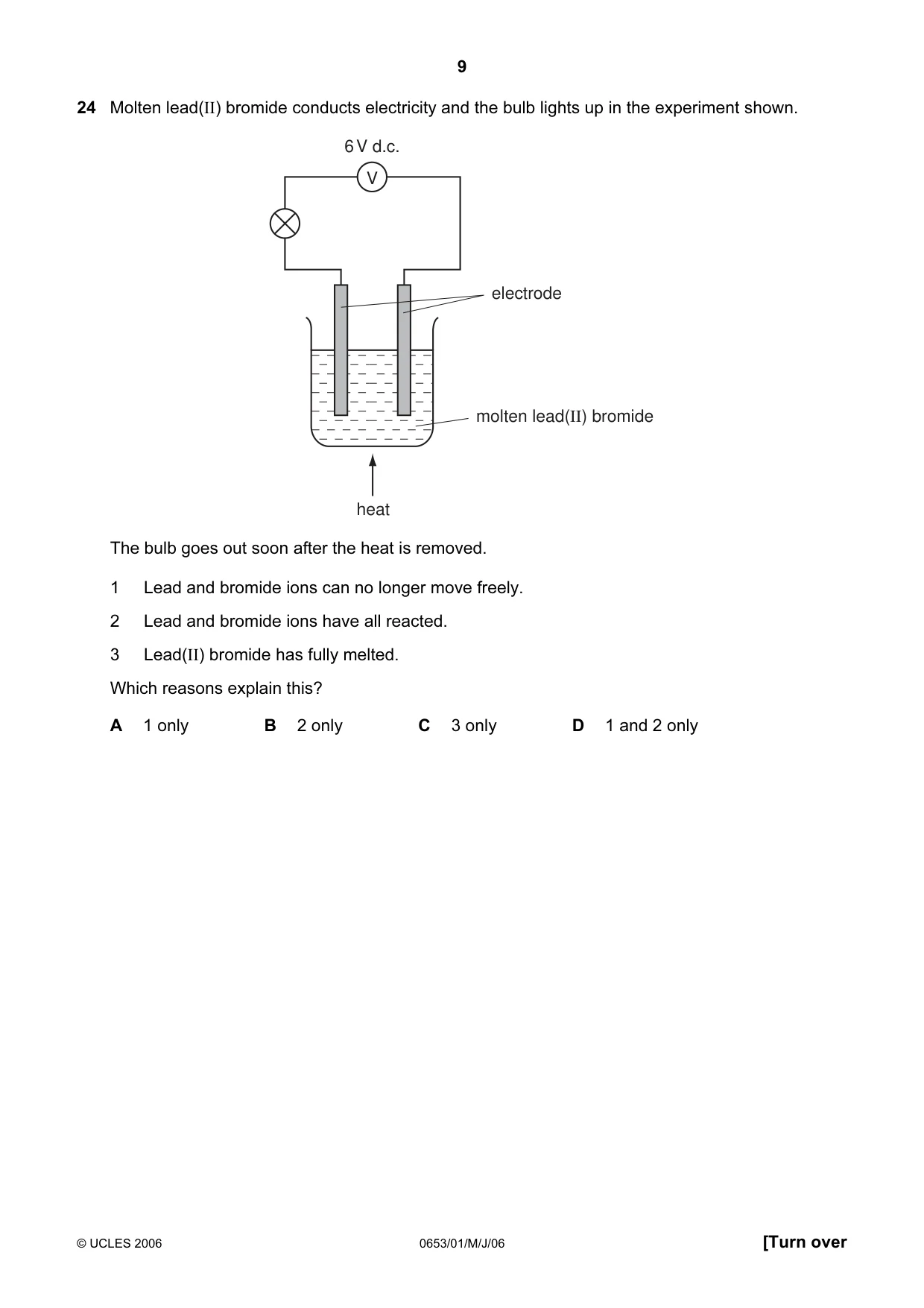
24 Molten lead(II) bromide conducts electricity and the bulb lights up in the experiment shown. 6 V d.c. V electrode molten lead(II) bromide heat The bulb goes out soon after the heat is removed. 1 Lead and bromide ions can no longer move freely. 2 Lead and bromide ions have all reacted. 3 Lead(II) bromide has fully melted. Which reasons explain this? A 1 only B 2 only C 3 only D 1 and 2 only
Mark scheme: A
Q25 · The diagrams show two experiments X and Y
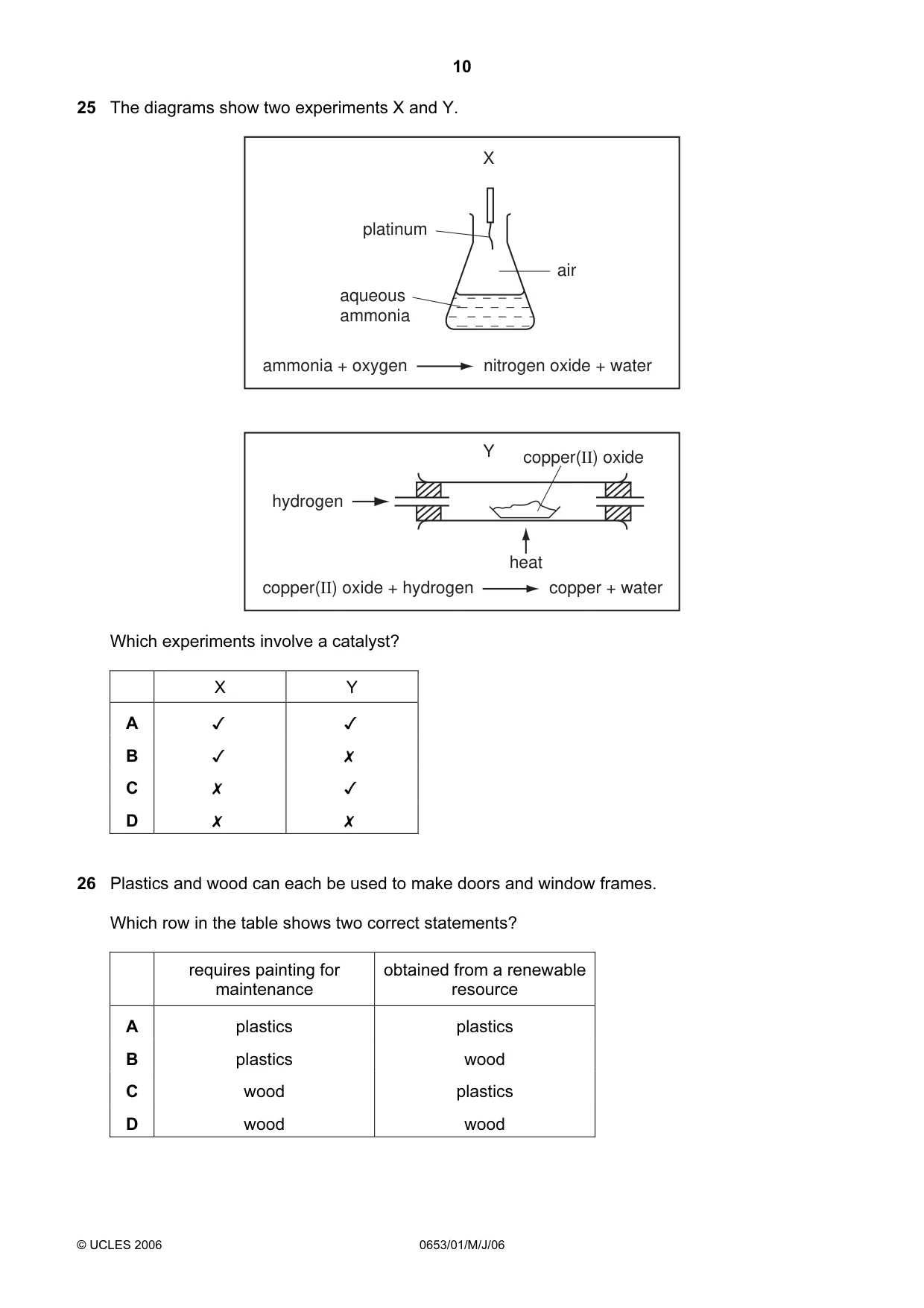
25 The diagrams show two experiments X and Y. platinum aqueous ammonia (—-} ammonia + oxygen ———» nitrogen oxide + water Y copper(II) oxide hydrogen —> heat copper(II) oxide + hydrogen ———> copper + water Which experiments involve a catalyst? 0 ONO DW > x x <<] x x <x [XK
Mark scheme: B
Q26 · Plastics and wood can each be used to make doors and window frames
26 Plastics and wood can each be used to make doors and window frames. Which row in the table shows two correct statements? requires painting for obtained from a renewable maintenance resource A plastics plastics B plastics wood C wood plastics D wood wood
Mark scheme: D
Q27 · Some man-made polymers, for example, poly(ethene), are made from monomers that join…
27 Some man-made polymers, for example, poly(ethene), are made from monomers that join together by forming carbon-to-carbon bonds. From what source are the monomers obtained and what type of carbon-to-carbon bonds form? source of carbon-to-carbon bonds monomers A coal covalent B coal ionic C oil covalent D oil ionic
Mark scheme: C
Q28 · A measuring cylinder contains some water
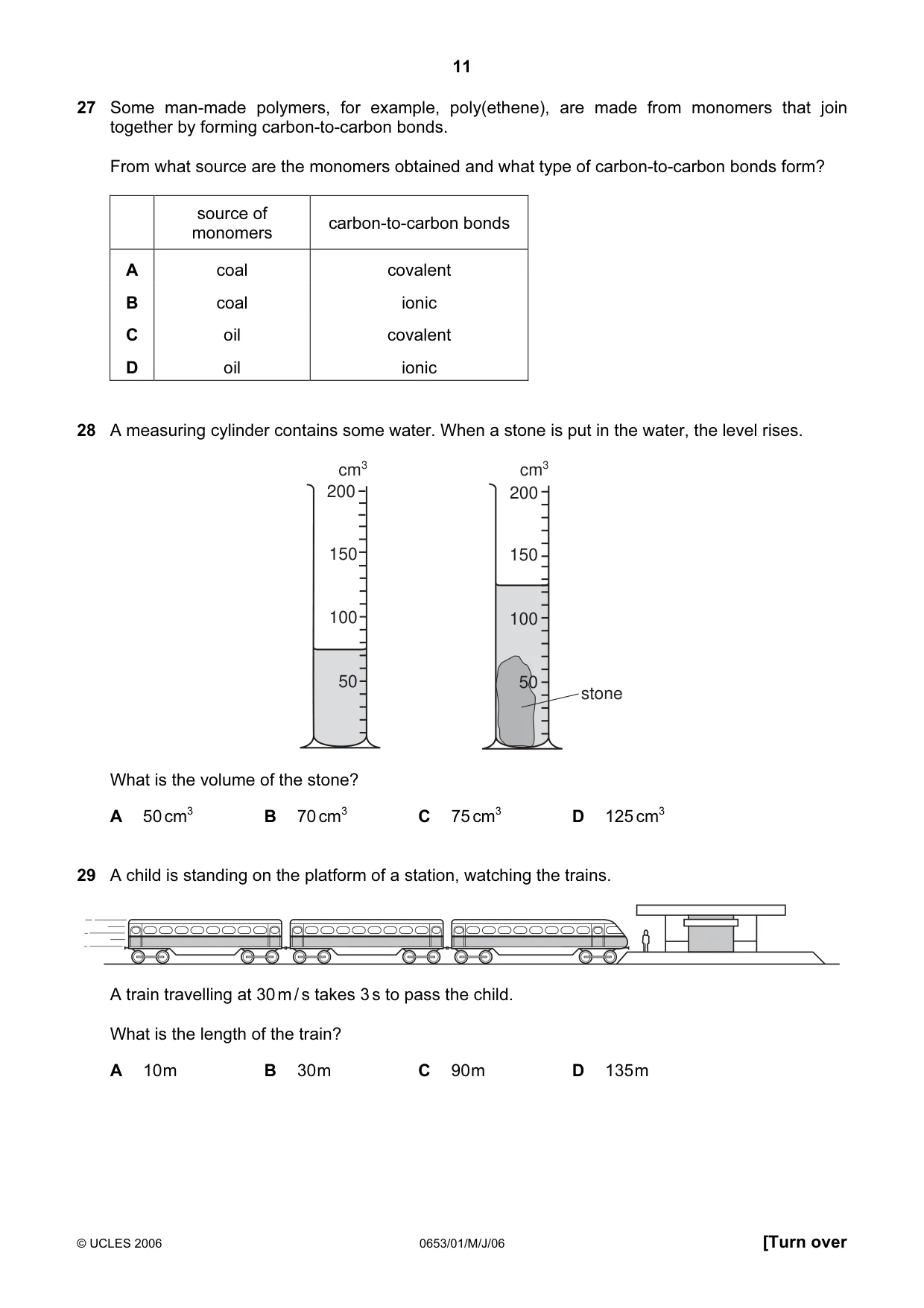
28 A measuring cylinder contains some water. When a stone is put in the water, the level rises. cm3 cm3 200 200 150 150 100 100 50 50 stone What is the volume of the stone? A 50 cm3 B 70 cm3 C 75 cm3 D 125 cm3
Mark scheme: A
More questions on Physical quantities and measurement techniques
Q29 · A child is standing on the platform of a station, watching the trains
29 A child is standing on the platform of a station, watching the trains. A train travelling at 30 m / s takes 3 s to pass the child. What is the length of the train? A 10 m B 30 m C 90 m D 135 m
Mark scheme: C
Q30 · A person measures the length, width, height and mass of a rectangular metal block
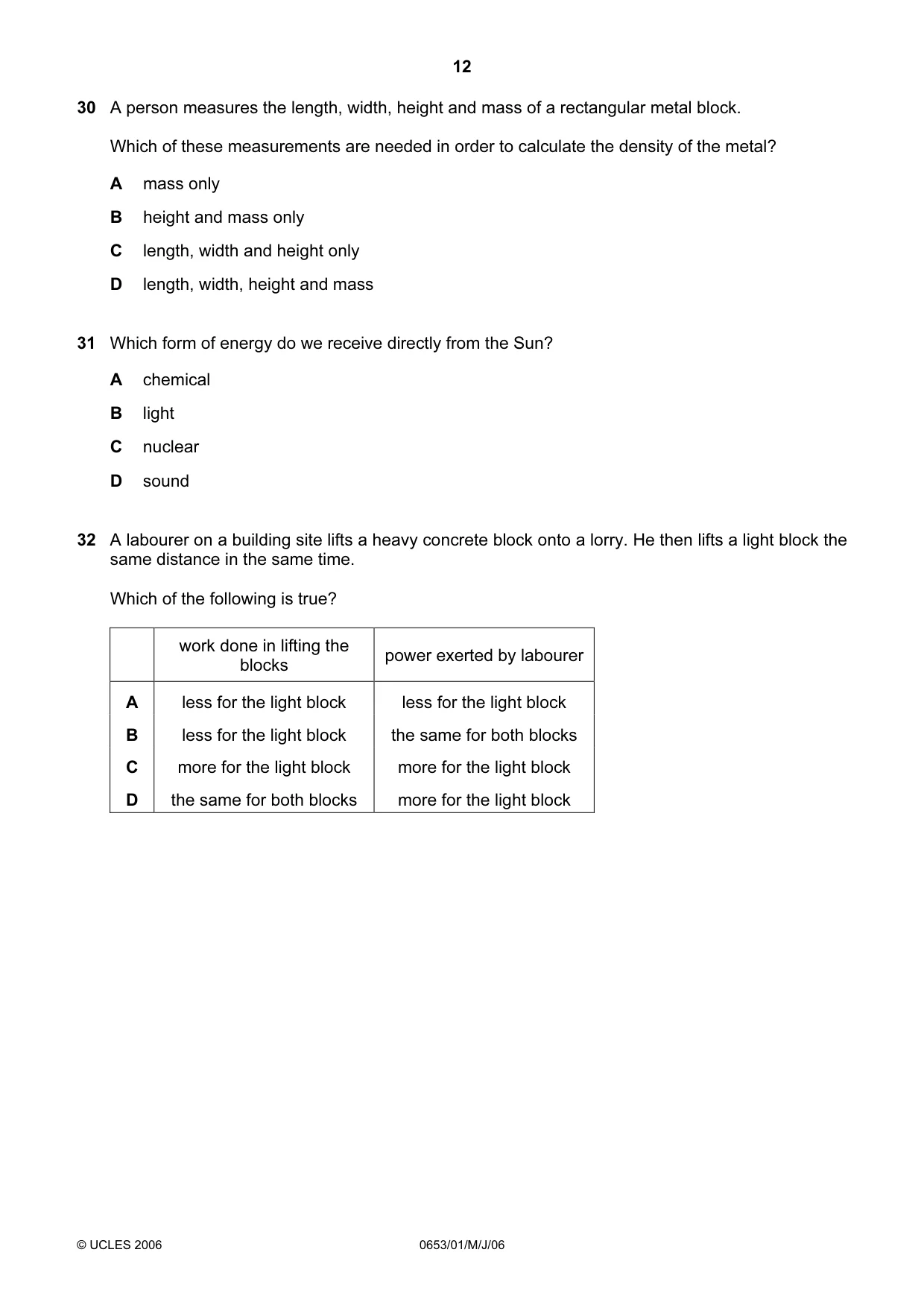
30 A person measures the length, width, height and mass of a rectangular metal block. Which of these measurements are needed in order to calculate the density of the metal? A mass only B height and mass only C length, width and height only D length, width, height and mass
Mark scheme: D
Q31 · Which form of energy do we receive directly from the Sun?
31 Which form of energy do we receive directly from the Sun? A chemical B light C nuclear D sound
Mark scheme: B
Q32 · A labourer on a building site lifts a heavy concrete block onto a lorry
32 A labourer on a building site lifts a heavy concrete block onto a lorry. He then lifts a light block the same distance in the same time. Which of the following is true? work done in lifting the power exerted by labourer blocks A less for the light block less for the light block B less for the light block the same for both blocks C more for the light block more for the light block D the same for both blocks more for the light block
Mark scheme: A
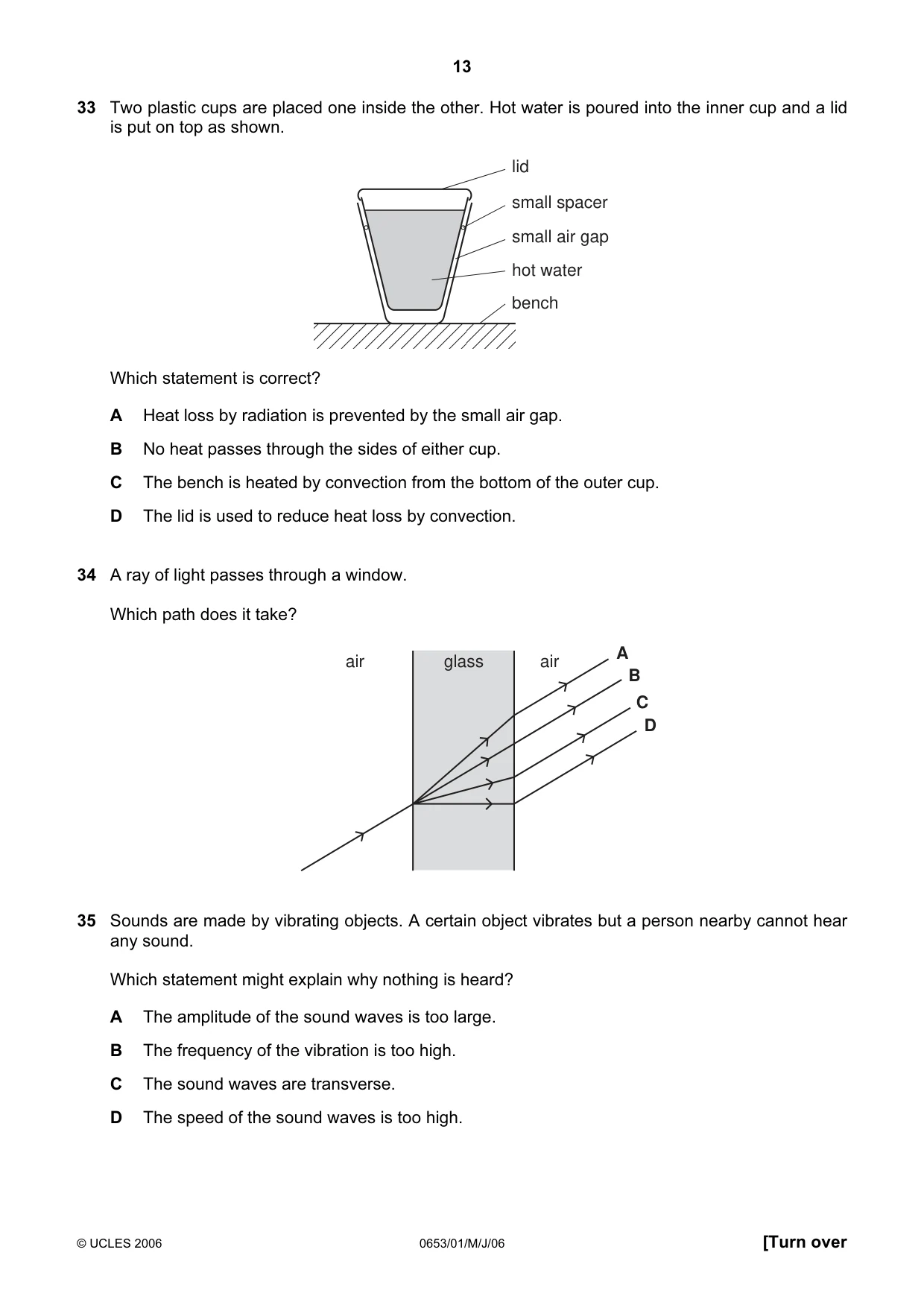
Q33 · Two plastic cups are placed one inside the other
33 Two plastic cups are placed one inside the other. Hot water is poured into the inner cup and a lid is put on top as shown. lid small spacer small air gap hot water bench Which statement is correct? A Heat loss by radiation is prevented by the small air gap. B No heat passes through the sides of either cup. C The bench is heated by convection from the bottom of the outer cup. D The lid is used to reduce heat loss by convection.
Mark scheme: D
Q34 · A ray of light passes through a window
34 A ray of light passes through a window. Which path does it take? A air glass air B C D
Mark scheme: C
Q35 · Sounds are made by vibrating objects
35 Sounds are made by vibrating objects. A certain object vibrates but a person nearby cannot hear any sound. Which statement might explain why nothing is heard? A The amplitude of the sound waves is too large. B The frequency of the vibration is too high. C The sound waves are transverse. D The speed of the sound waves is too high.
Mark scheme: B
Q36 · What are the symbols used for the units of current and resistance?
36 What are the symbols used for the units of current and resistance? unit of current unit of resistance A A W B A Ω C V W D V Ω
Mark scheme: B
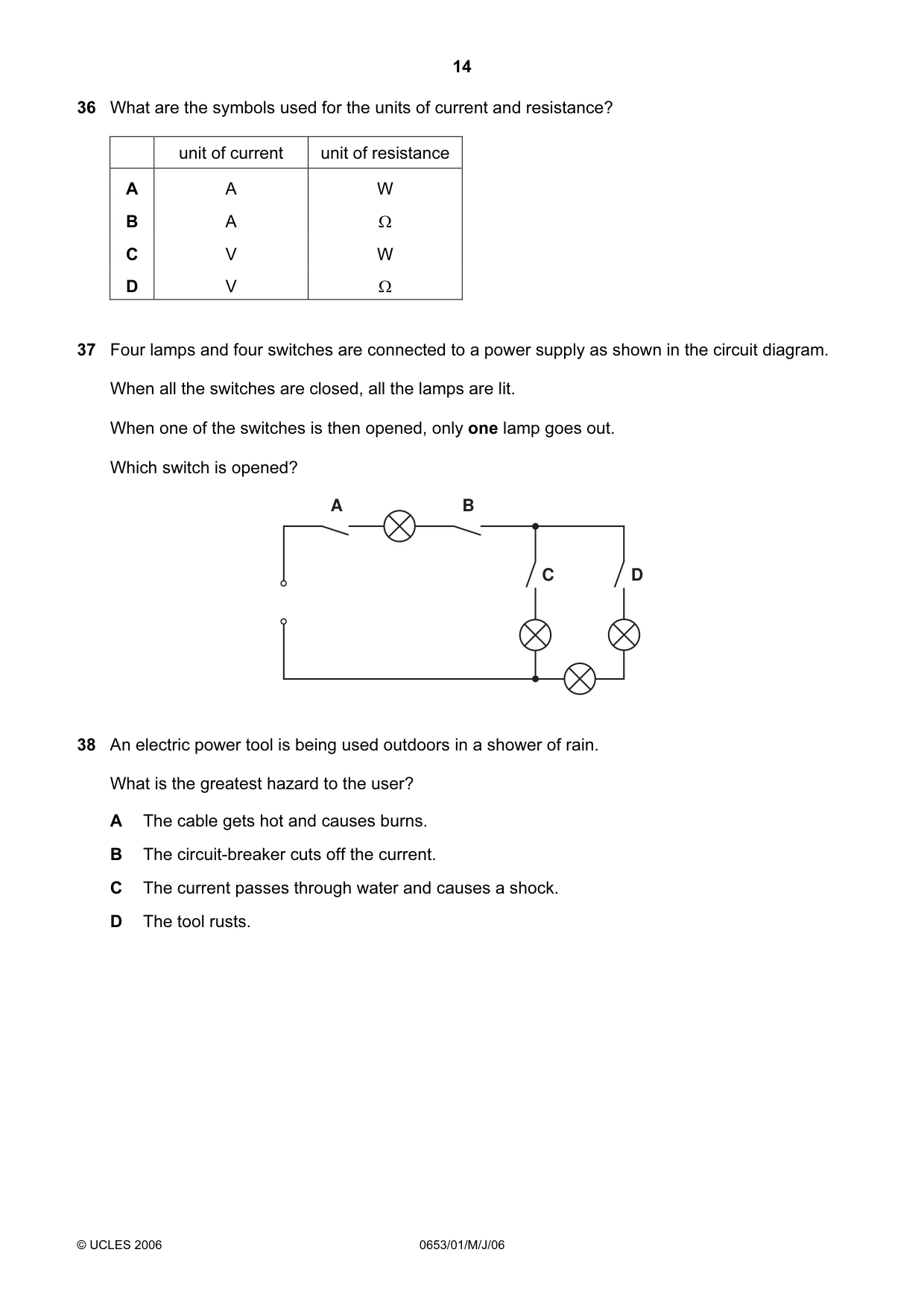
Q37 · Four lamps and four switches are connected to a power supply as shown in the circuit…
37 Four lamps and four switches are connected to a power supply as shown in the circuit diagram. When all the switches are closed, all the lamps are lit. When one of the switches is then opened, only one lamp goes out. Which switch is opened? A B C D
Mark scheme: C
Q38 · An electric power tool is being used outdoors in a shower of rain
38 An electric power tool is being used outdoors in a shower of rain. What is the greatest hazard to the user? A The cable gets hot and causes burns. B The circuit-breaker cuts off the current. C The current passes through water and causes a shock. D The tool rusts.
Mark scheme: C
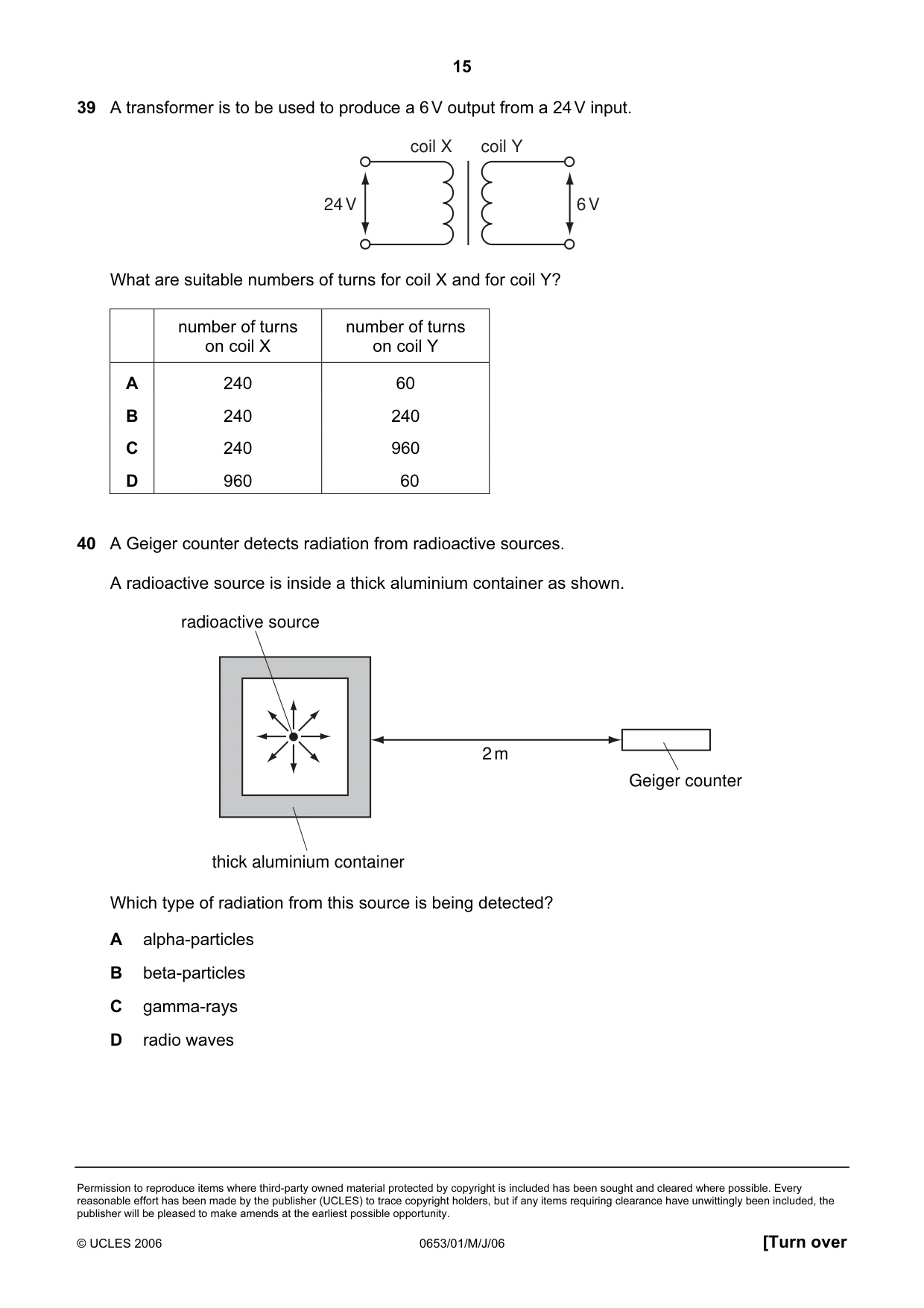
Q39 · A transformer is to be used to produce a 6 V output from a 24 V input
39 A transformer is to be used to produce a 6 V output from a 24 V input. coil X coil Y 24 V 6 V What are suitable numbers of turns for coil X and for coil Y? number of turns number of turns on coil X on coil Y A 240 60 B 240 240 C 240 960 D 960 60
Mark scheme: A
Q40 · A Geiger counter detects radiation from radioactive sources
40 A Geiger counter detects radiation from radioactive sources. A radioactive source is inside a thick aluminium container as shown. radioactive source 2 m Geiger counter thick aluminium container Which type of radiation from this source is being detected? A alpha-particles B beta-particles C gamma-rays D radio waves
Mark scheme: C
What was in this paper
The subtopics covered by these 40 questions, and how many questions each got. Open one in a new tab to see every Cambridge question on it.
2Photosynthesis2Polymers2Sexual reproduction in humans2Alloys and their properties1Atomic structure and the Periodic Table1Biological molecules1Carbon cycle1Cells, batteries, generators and motors1Characteristics of living organisms1Density1Diffusion1Digestive system1Electrical circuits1Electrical quantities1Electrical safety1Electrolysis1Electromagnetic spectrum1Extraction of metals1Gas exchange in humans1Habitat destruction1Heart1Identification of ions and gases1Ions and ionic bonds1Light1Motion1Noble gases1Physical and chemical changes1Physical quantities and measurement techniques1Rate of reaction1Separation and purification1Sexual reproduction in plants1Sound1The characteristic properties of acids and bases1Transfer of thermal energy1Transition elements1What you needed in this session
Cambridge’s own grade thresholds for 2006 May/June, Paper 1 · Variant 1. A higher threshold means an easier paper — the bar moves with how the cohort did.