Cambridge IGCSE Science - Combined 0653 — 2021 May/June Paper 1 · Variant 1
0653/11/M/J/21 · 40 questions · 40 marks · ≈45 min
The question paper and its mark scheme, free to read here and free to download. This is Cambridge’s own paper, exactly as it was sat.
Question paper16 pages
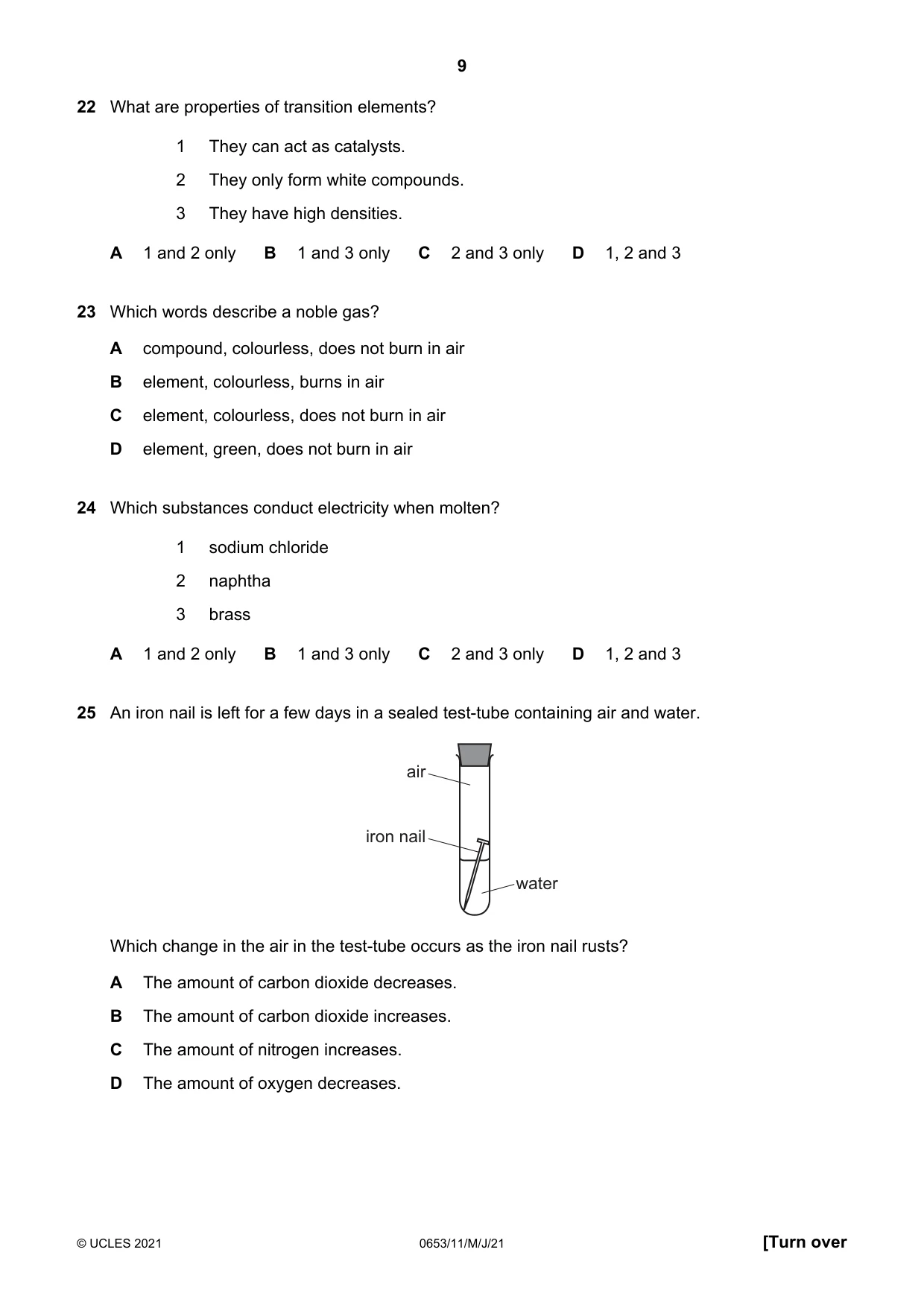
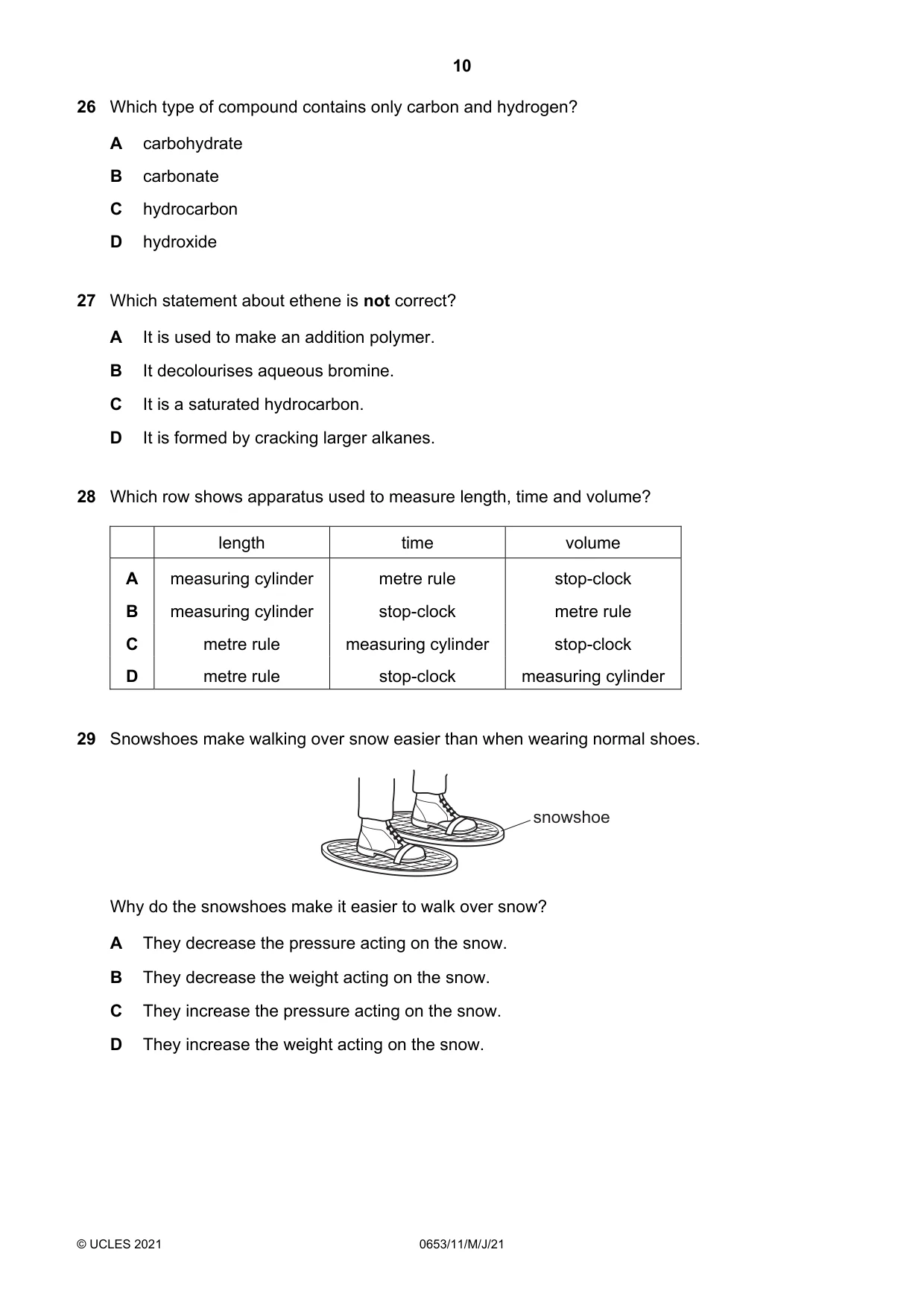
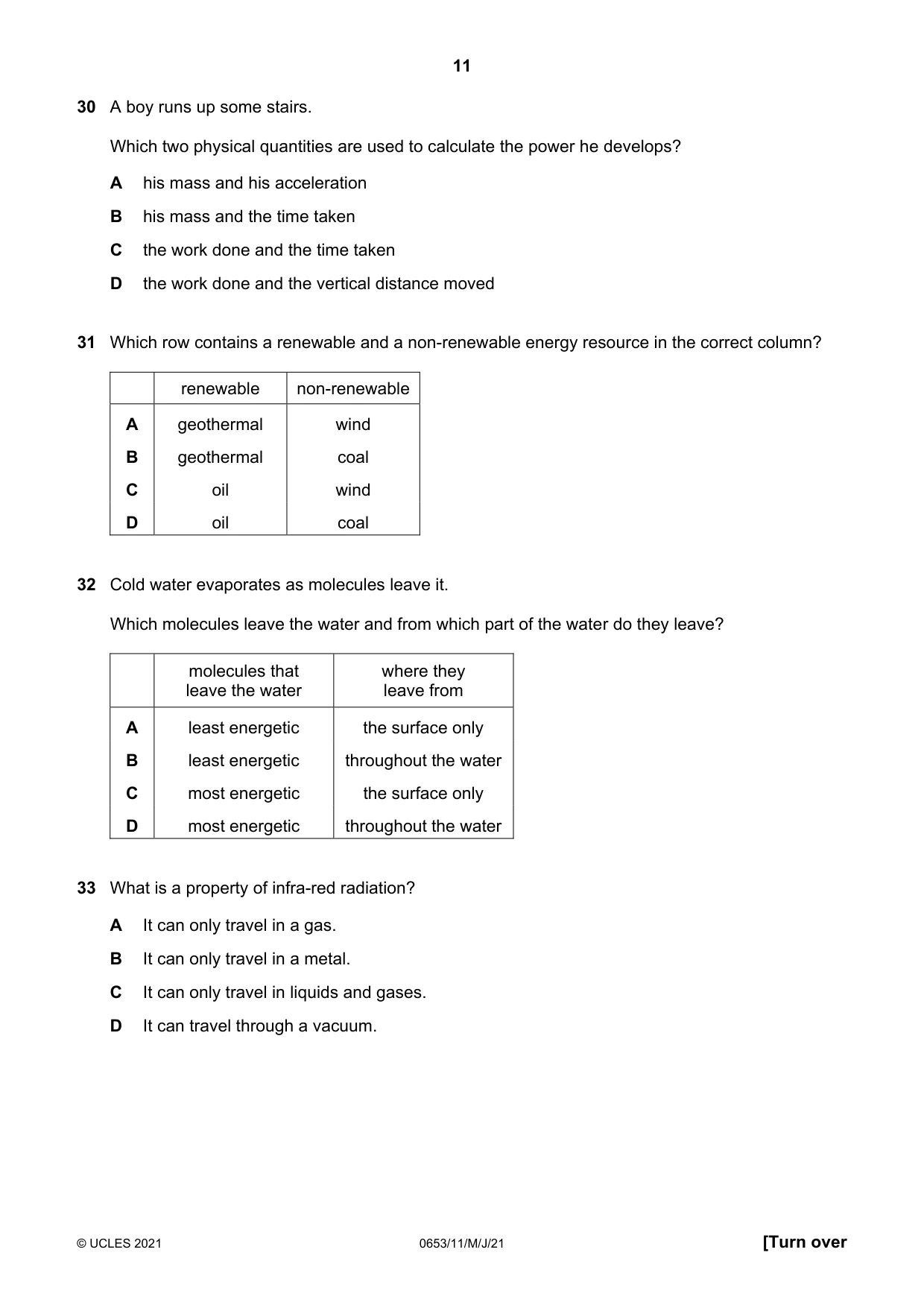
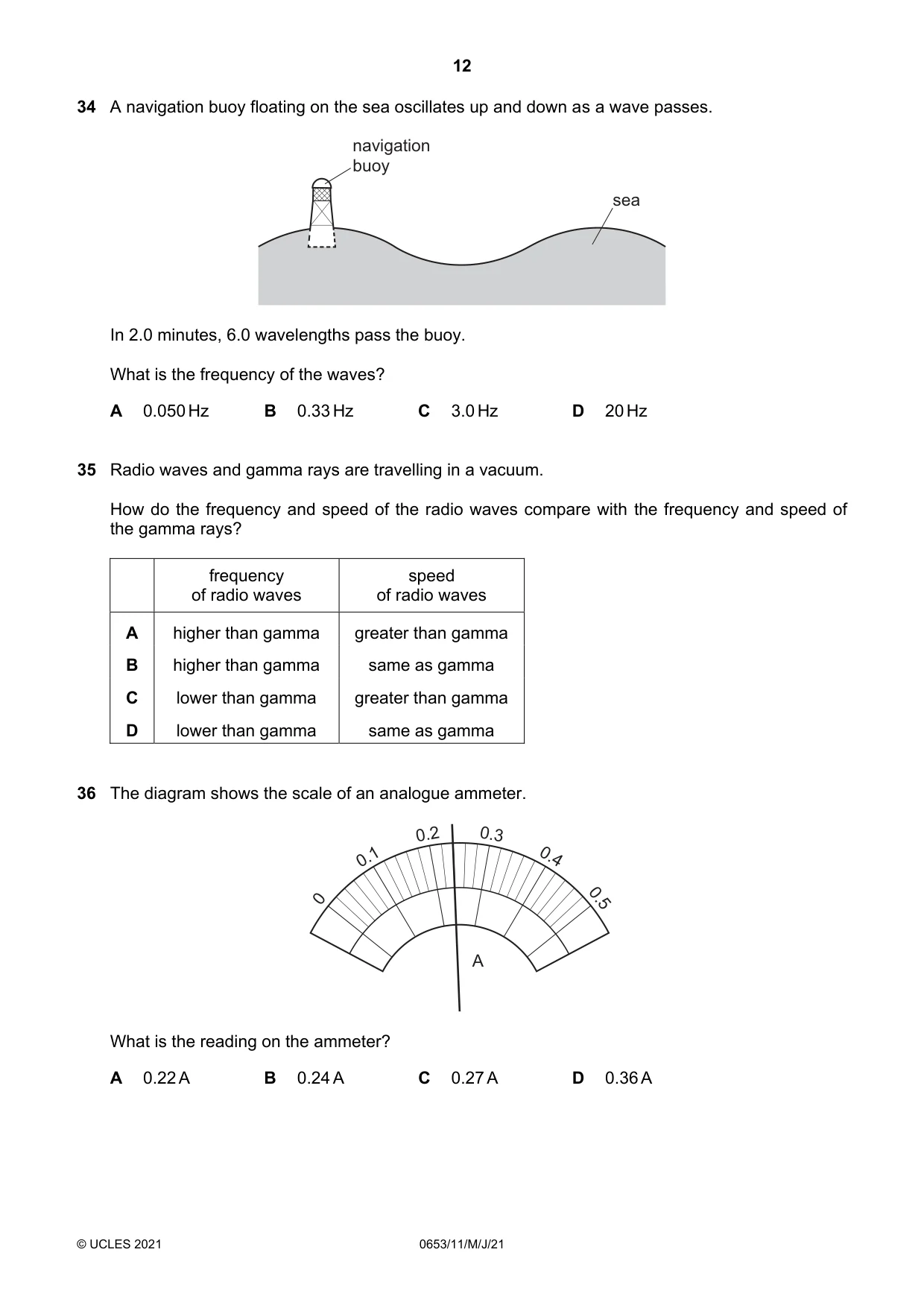
Mark scheme3 pages
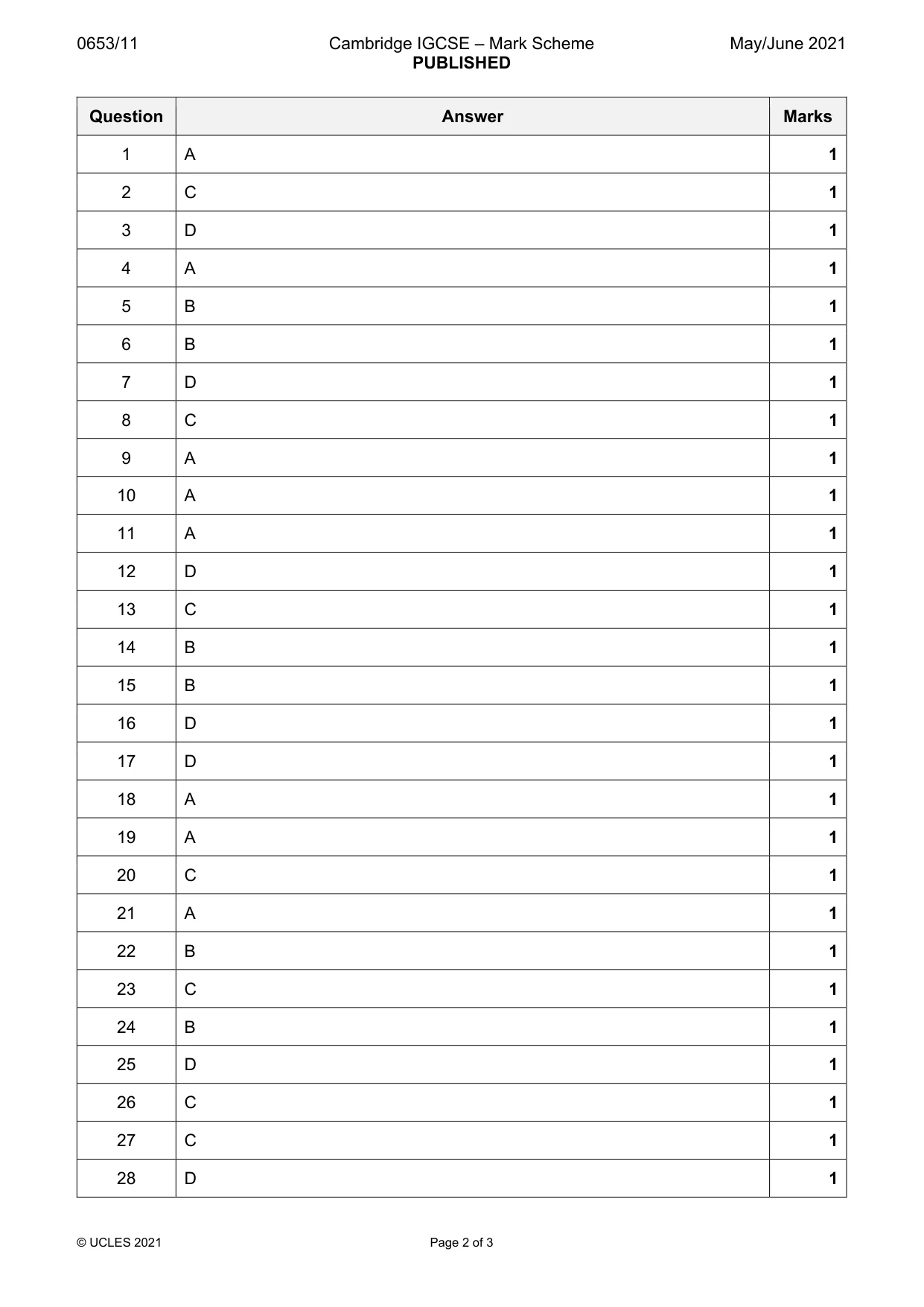
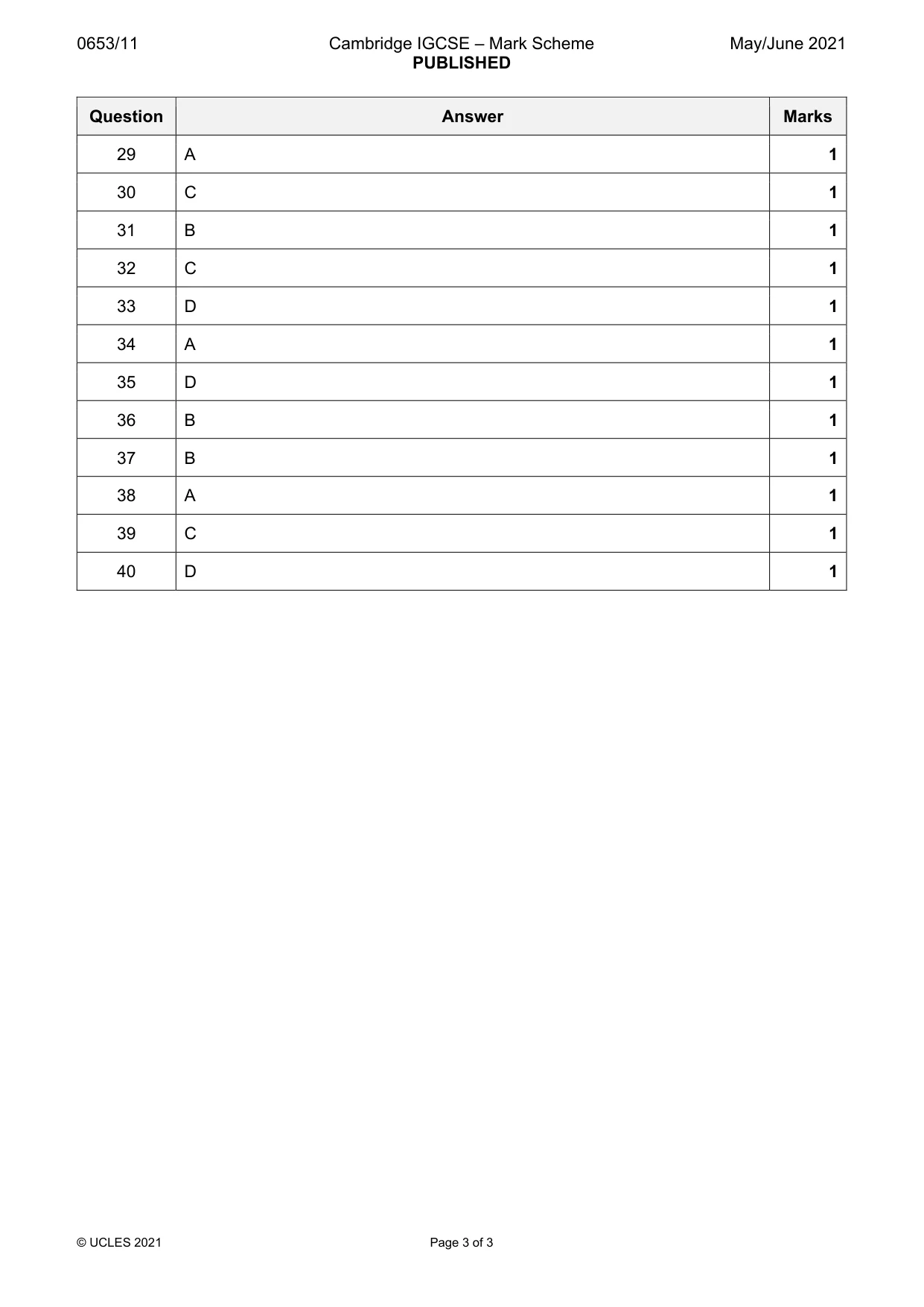
Answers below. Sit the paper first if you are practising.
Questions as text
Q1 · A drawing of a cell is 80 mm in length and the magnification is 200
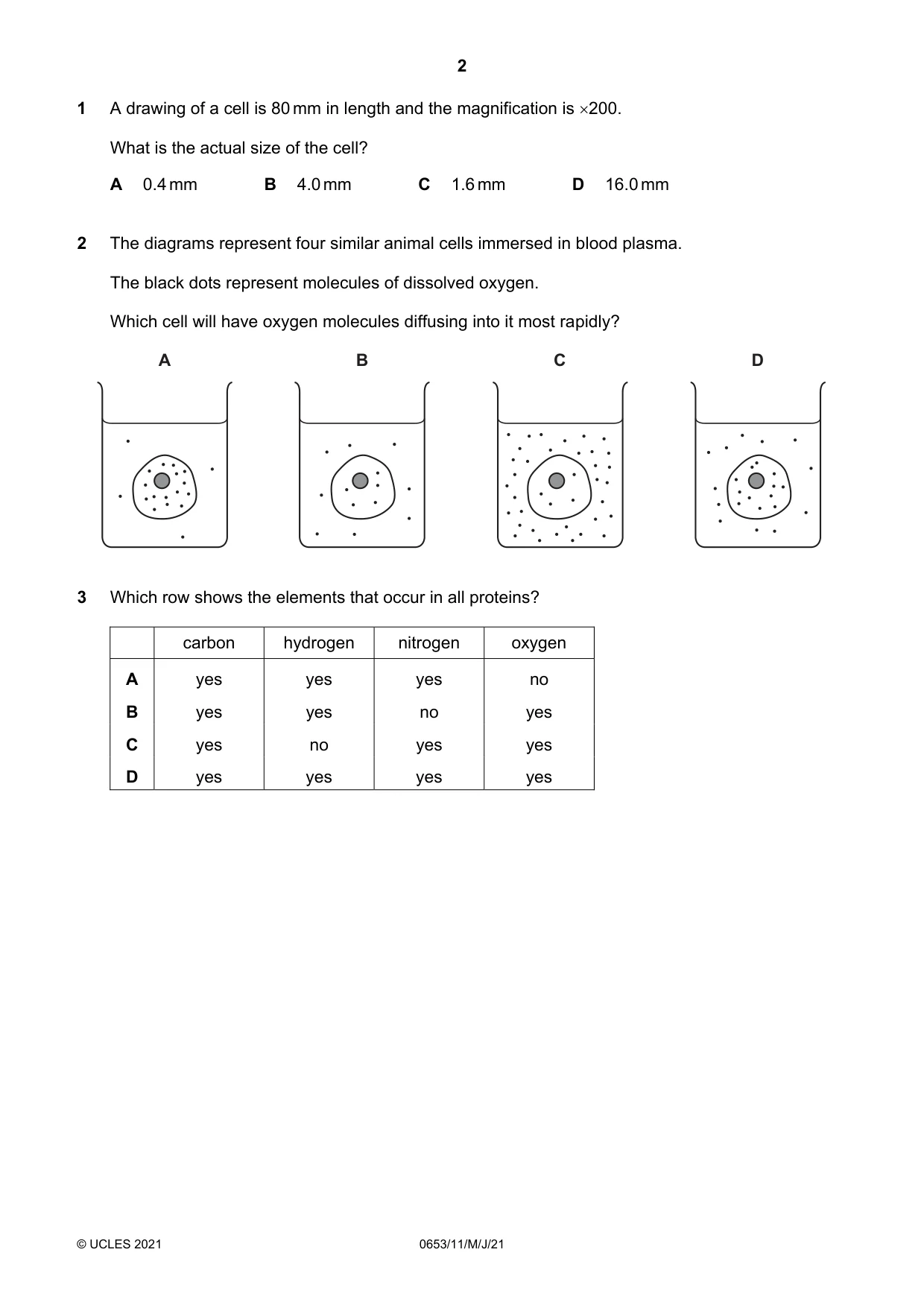
1 A drawing of a cell is 80 mm in length and the magnification is 200. What is the actual size of the cell? A 0.4 mm B 4.0 mm C 1.6 mm D 16.0 mm
Mark scheme: A
Q2 · The diagrams represent four similar animal cells immersed in blood plasma
2 The diagrams represent four similar animal cells immersed in blood plasma. The black dots represent molecules of dissolved oxygen. Which cell will have oxygen molecules diffusing into it most rapidly? A B C D
Mark scheme: C
Q3 · Which row shows the elements that occur in all proteins?
3 Which row shows the elements that occur in all proteins? carbon hydrogen nitrogen oxygen A yes yes yes no B yes yes no yes C yes no yes yes D yes yes yes yes
Mark scheme: D
Q4 · The flow diagram shows the stages in testing a green leaf for starch
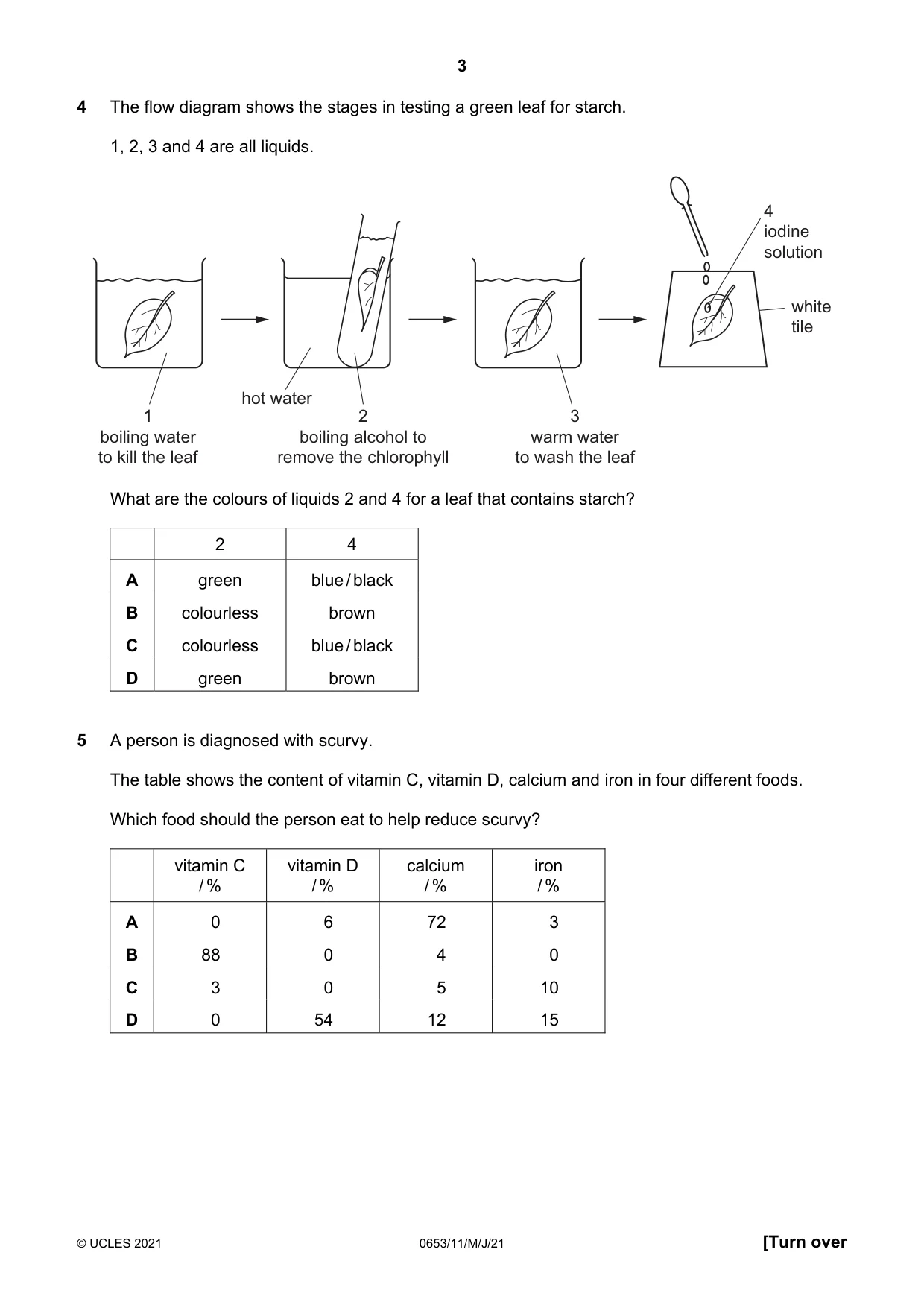
4 The flow diagram shows the stages in testing a green leaf for starch. 1, 2, 3 and 4 are all liquids. 4 iodine solution white tile hot water 1 2 3 boiling water boiling alcohol to warm water to kill the leaf remove the chlorophyll to wash the leaf What are the colours of liquids 2 and 4 for a leaf that contains starch? 2 4 A green blue / black B colourless brown C colourless blue / black D green brown
Mark scheme: A
Q5 · A person is diagnosed with scurvy
5 A person is diagnosed with scurvy. The table shows the content of vitamin C, vitamin D, calcium and iron in four different foods. Which food should the person eat to help reduce scurvy? vitamin C vitamin D calcium iron / % / % / % / % A 0 6 72 3 B 88 0 4 0 C 3 0 5 10 D 0 54 12 15
Mark scheme: B
Q6 · This statement is about chemical digestion
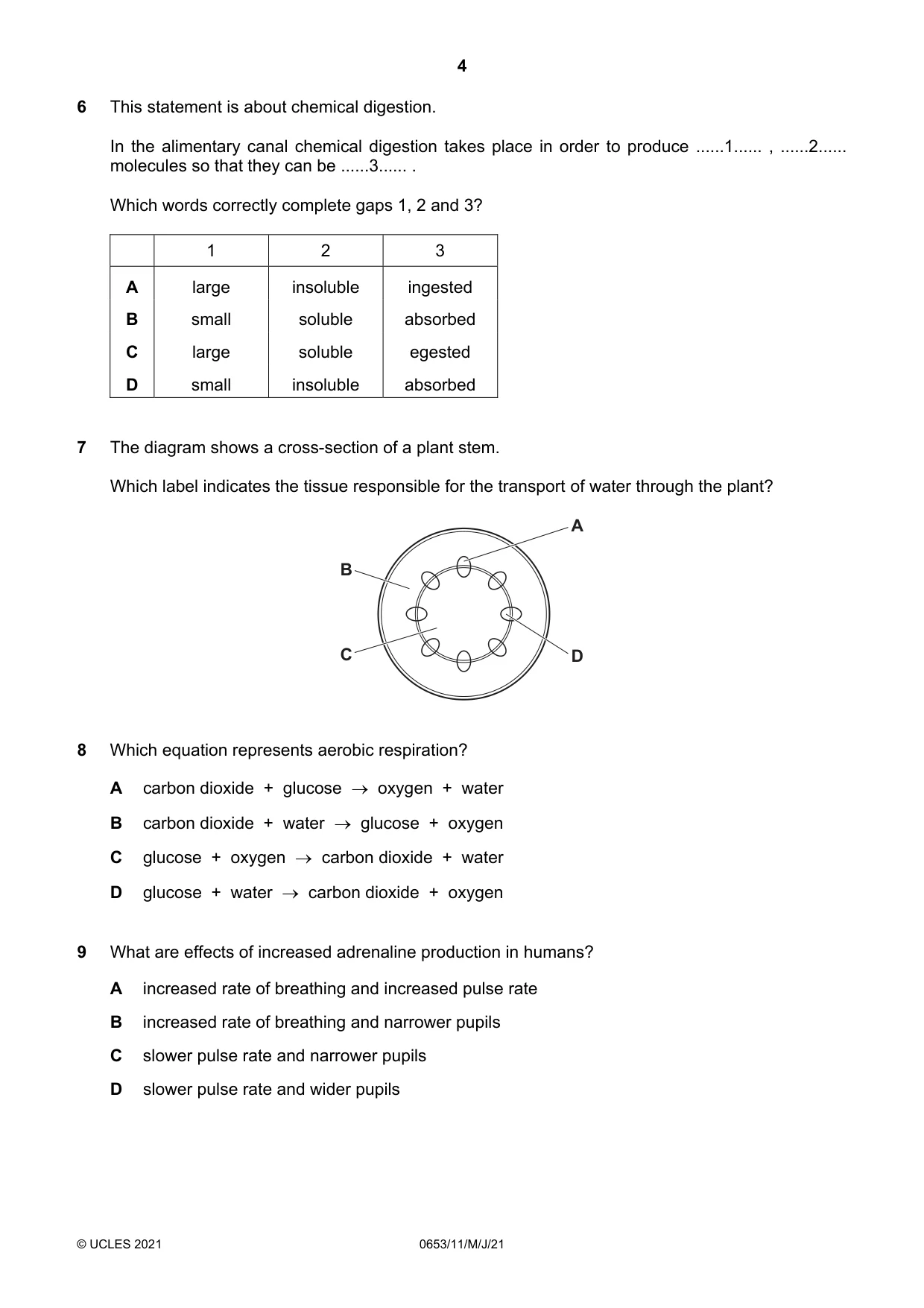
6 This statement is about chemical digestion. In the alimentary canal chemical digestion takes place in order to produce ......1...... , ......2...... molecules so that they can be ......3...... . Which words correctly complete gaps 1, 2 and 3? 1 2 3 A large insoluble ingested B small soluble absorbed C large soluble egested D small insoluble absorbed
Mark scheme: B
Q7 · The diagram shows a cross-section of a plant stem
7 The diagram shows a cross-section of a plant stem. Which label indicates the tissue responsible for the transport of water through the plant? A B C D
Mark scheme: D
Q8 · Which equation represents aerobic respiration?
8 Which equation represents aerobic respiration? A carbon dioxide + glucose oxygen + water B carbon dioxide + water glucose + oxygen C glucose + oxygen carbon dioxide + water D glucose + water carbon dioxide + oxygen
Mark scheme: C
Q9 · What are effects of increased adrenaline production in humans?
9 What are effects of increased adrenaline production in humans? A increased rate of breathing and increased pulse rate B increased rate of breathing and narrower pupils C slower pulse rate and narrower pupils D slower pulse rate and wider pupils
Mark scheme: A
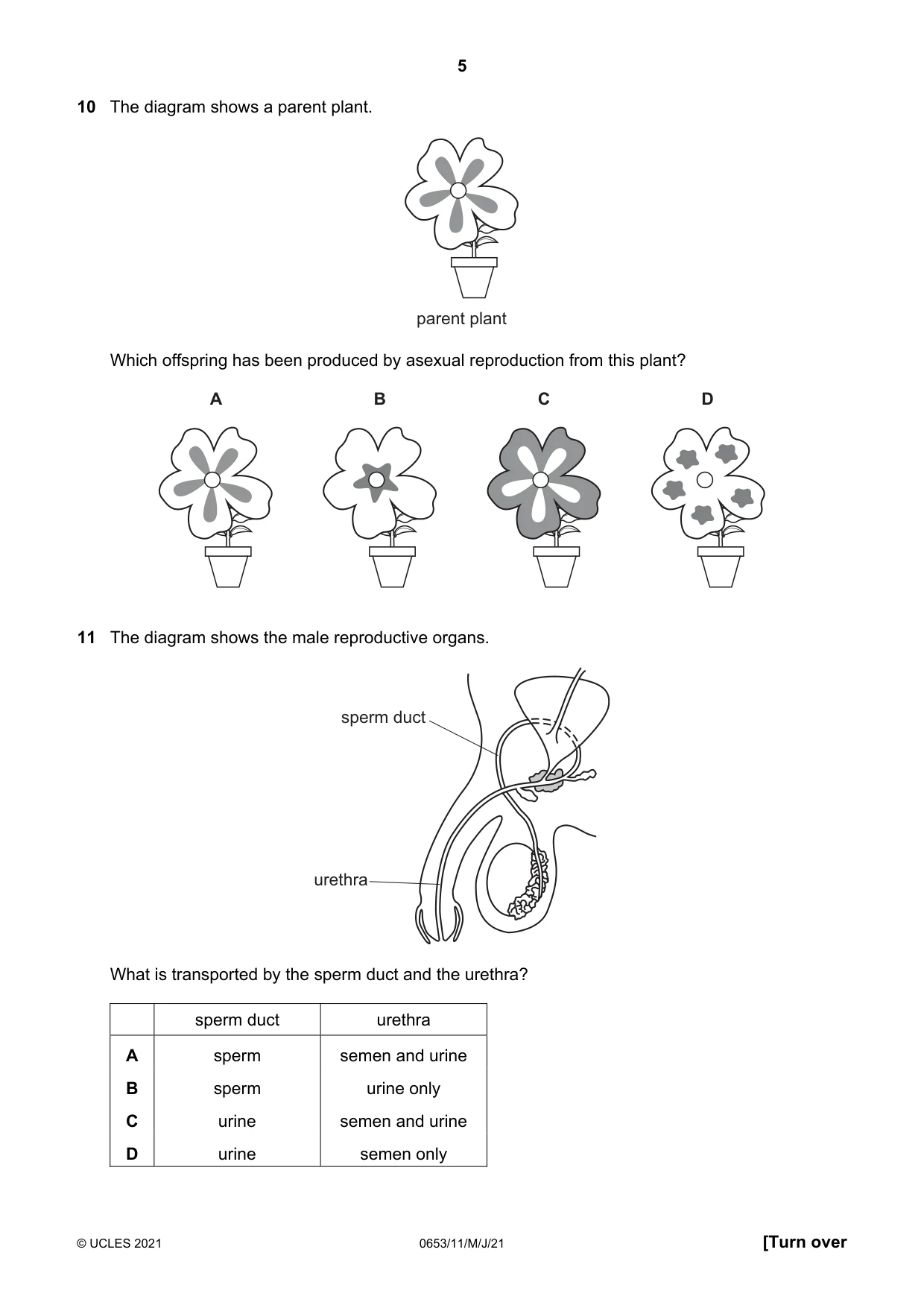
Q10 · The diagram shows a parent plant
10 The diagram shows a parent plant. parent plant Which offspring has been produced by asexual reproduction from this plant? A B C D
Mark scheme: A
Q11 · The diagram shows the male reproductive organs
11 The diagram shows the male reproductive organs. sperm duct urethra What is transported by the sperm duct and the urethra? sperm duct urethra A sperm semen and urine B sperm urine only C urine semen and urine D urine semen only
Mark scheme: A
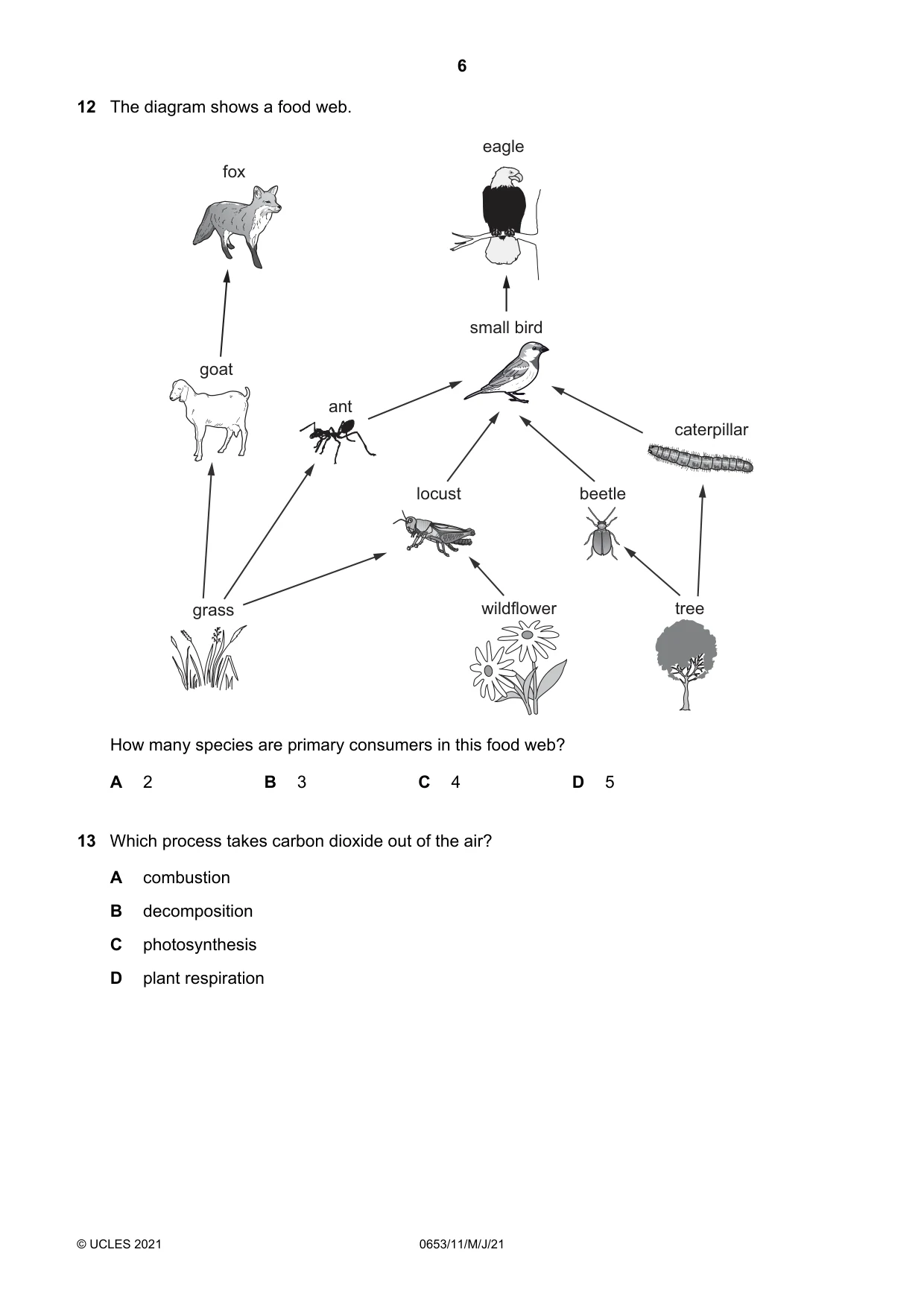
Q12 · The diagram shows a food web
12 The diagram shows a food web. eagle fox small bird goat ant caterpillar locust beetle grass wildflower tree How many species are primary consumers in this food web? A 2 B 3 C 4 D 5
Mark scheme: D
Q13 · Which process takes carbon dioxide out of the air?
13 Which process takes carbon dioxide out of the air? A combustion B decomposition C photosynthesis D plant respiration
Mark scheme: C
Q14 · A fixed mass of argon gas in a sealed container is heated
14 A fixed mass of argon gas in a sealed container is heated. The pressure inside the container increases. Which statement explains why the pressure increases? A There is an increase in the number of gaseous particles inside the container. B There is an increase in the number of collisions per second between the particles of gas and the walls of the container. C The particles of gas have less energy and collide with the wall of the container more frequently. D There is a decrease in the space that the particles have to move in.
Mark scheme: B
Q15 · What is an example of a physical change?
15 What is an example of a physical change? A carbon dioxide turning limewater milky B the crystallisation of copper(II) sulfate from solution C the electrolysis of molten lead(II) bromide D the thermal decomposition of calcium carbonate
Mark scheme: B
Q16 · Which row about elements and compounds is correct?
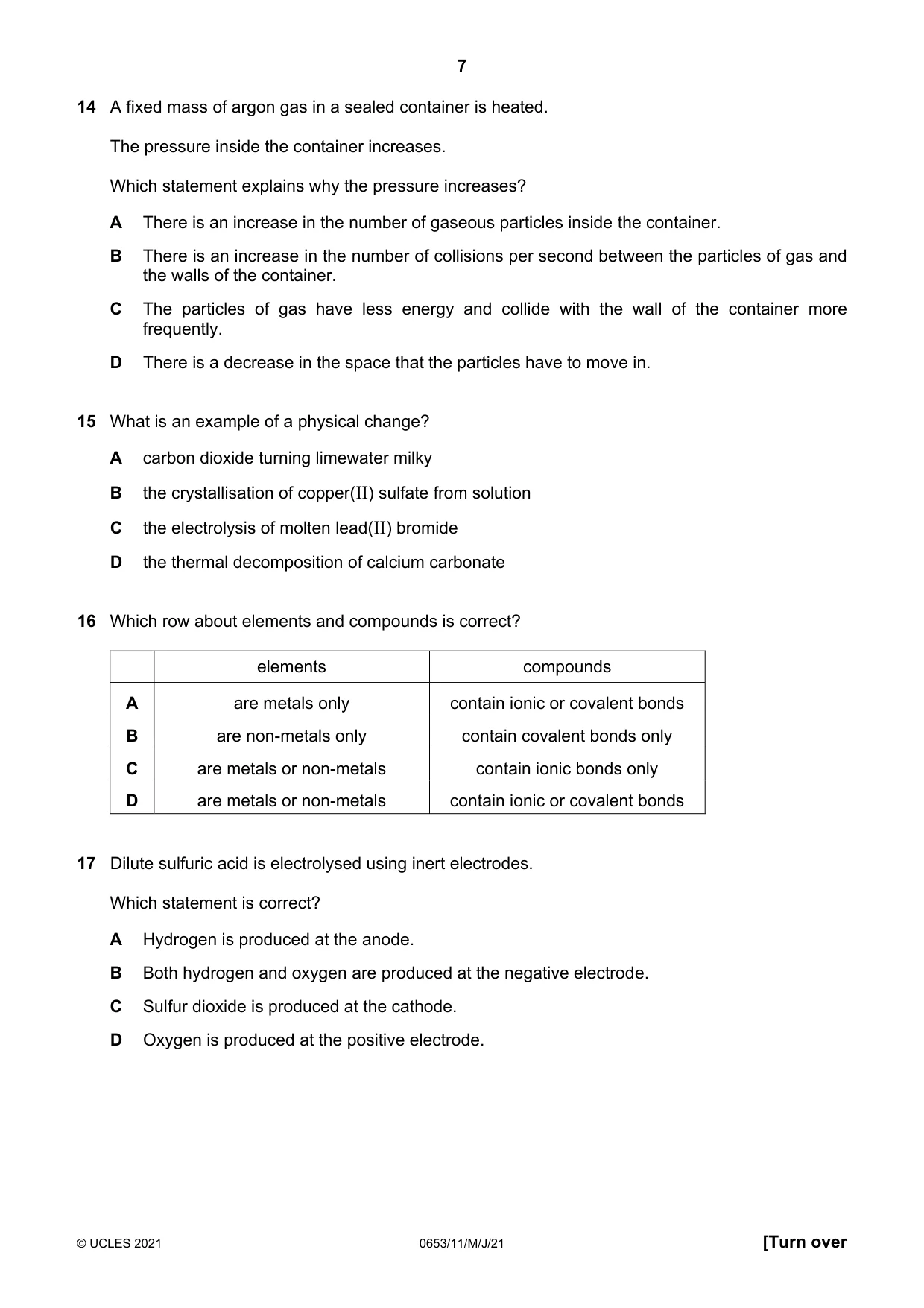
16 Which row about elements and compounds is correct? elements compounds A are metals only contain ionic or covalent bonds B are non-metals only contain covalent bonds only C are metals or non-metals contain ionic bonds only D are metals or non-metals contain ionic or covalent bonds
Mark scheme: D
Q17 · Dilute sulfuric acid is electrolysed using inert electrodes
17 Dilute sulfuric acid is electrolysed using inert electrodes. Which statement is correct? A Hydrogen is produced at the anode. B Both hydrogen and oxygen are produced at the negative electrode. C Sulfur dioxide is produced at the cathode. D Oxygen is produced at the positive electrode.
Mark scheme: D
Q18 · Some calcium carbonate and dilute hydrochloric acid start to react
18 Some calcium carbonate and dilute hydrochloric acid start to react. Water is then added to the reaction mixture. What happens to the rate of the reaction? A It decreases. B It increases. C It stays the same. D It stops.
Mark scheme: A
Q19 · Barium hydroxide is an alkali
19 Barium hydroxide is an alkali. Which statement about barium hydroxide is correct? A It has a pH greater than 7 in aqueous solution. B It reacts with aqueous sodium hydroxide. C It reacts with metal carbonates. D It turns Universal Indicator red.
Mark scheme: A
More questions on The characteristic properties of acids and bases
Q20 · Which two substances form a white precipitate when they are mixed?
20 Which two substances form a white precipitate when they are mixed? A barium chloride and hydrochloric acid B barium chloride and nitric acid C silver nitrate and hydrochloric acid D silver nitrate and nitric acid
Mark scheme: C
Q21 · There are eight elements in Period 3 of the Periodic Table
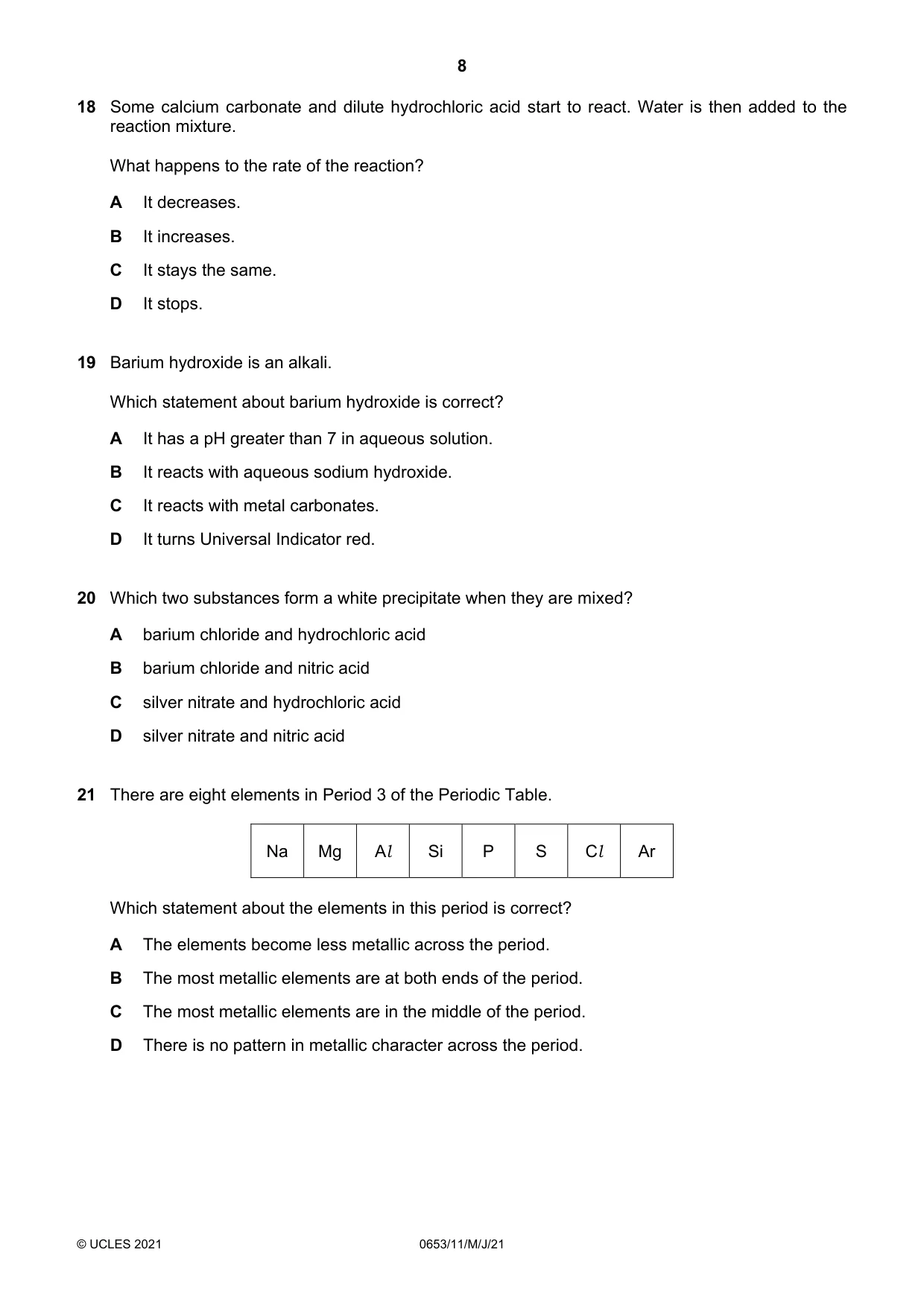
21 There are eight elements in Period 3 of the Periodic Table. Na Mg Al Si P S Cl Ar Which statement about the elements in this period is correct? A The elements become less metallic across the period. B The most metallic elements are at both ends of the period. C The most metallic elements are in the middle of the period. D There is no pattern in metallic character across the period.
Mark scheme: A
Q22 · What are properties of transition elements?
22 What are properties of transition elements? 1 They can act as catalysts. 2 They only form white compounds. 3 They have high densities. A 1 and 2 only B 1 and 3 only C 2 and 3 only D 1, 2 and 3
Mark scheme: B
Q23 · Which words describe a noble gas?
23 Which words describe a noble gas? A compound, colourless, does not burn in air B element, colourless, burns in air C element, colourless, does not burn in air D element, green, does not burn in air
Mark scheme: C
Q24 · Which substances conduct electricity when molten?
24 Which substances conduct electricity when molten? 1 sodium chloride 2 naphtha 3 brass A 1 and 2 only B 1 and 3 only C 2 and 3 only D 1, 2 and 3
Mark scheme: B
Q25 · An iron nail is left for a few days in a sealed test-tube containing air and water
25 An iron nail is left for a few days in a sealed test-tube containing air and water. air iron nail water Which change in the air in the test-tube occurs as the iron nail rusts? A The amount of carbon dioxide decreases. B The amount of carbon dioxide increases. C The amount of nitrogen increases. D The amount of oxygen decreases.
Mark scheme: D
Q26 · Which type of compound contains only carbon and hydrogen?
26 Which type of compound contains only carbon and hydrogen? A carbohydrate B carbonate C hydrocarbon D hydroxide
Mark scheme: C
Q27 · Which statement about ethene is not correct?
27 Which statement about ethene is not correct? A It is used to make an addition polymer. B It decolourises aqueous bromine. C It is a saturated hydrocarbon. D It is formed by cracking larger alkanes.
Mark scheme: C
Q28 · Which row shows apparatus used to measure length, time and volume?
28 Which row shows apparatus used to measure length, time and volume? length time volume A measuring cylinder metre rule stop-clock B measuring cylinder stop-clock metre rule C metre rule measuring cylinder stop-clock D metre rule stop-clock measuring cylinder
Mark scheme: D
More questions on Physical quantities and measurement techniques
Q29 · Snowshoes make walking over snow easier than when wearing normal shoes
29 Snowshoes make walking over snow easier than when wearing normal shoes. snowshoe Why do the snowshoes make it easier to walk over snow? A They decrease the pressure acting on the snow. B They decrease the weight acting on the snow. C They increase the pressure acting on the snow. D They increase the weight acting on the snow.
Mark scheme: A
Q30 · A boy runs up some stairs
30 A boy runs up some stairs. Which two physical quantities are used to calculate the power he develops? A his mass and his acceleration B his mass and the time taken C the work done and the time taken D the work done and the vertical distance moved
Mark scheme: C
Q31 · Which row contains a renewable and a non-renewable energy resource in the correct column?
31 Which row contains a renewable and a non-renewable energy resource in the correct column? renewable non-renewable A geothermal wind B geothermal coal C oil wind D oil coal
Mark scheme: B
Q32 · Cold water evaporates as molecules leave it
32 Cold water evaporates as molecules leave it. Which molecules leave the water and from which part of the water do they leave? molecules that where they leave the water leave from A least energetic the surface only B least energetic throughout the water C most energetic the surface only D most energetic throughout the water
Mark scheme: C
Q33 · What is a property of infra-red radiation?
33 What is a property of infra-red radiation? A It can only travel in a gas. B It can only travel in a metal. C It can only travel in liquids and gases. D It can travel through a vacuum.
Mark scheme: D
Q34 · A navigation buoy floating on the sea oscillates up and down as a wave passes
34 A navigation buoy floating on the sea oscillates up and down as a wave passes. navigation buoy sea In 2.0 minutes, 6.0 wavelengths pass the buoy. What is the frequency of the waves? A 0.050 Hz B 0.33 Hz C 3.0 Hz D 20 Hz
Mark scheme: A
Q35 · Radio waves and gamma rays are travelling in a vacuum
35 Radio waves and gamma rays are travelling in a vacuum. How do the frequency and speed of the radio waves compare with the frequency and speed of the gamma rays? frequency speed of radio waves of radio waves A higher than gamma greater than gamma B higher than gamma same as gamma C lower than gamma greater than gamma D lower than gamma same as gamma
Mark scheme: D
Q36 · The diagram shows the scale of an analogue ammeter
36 The diagram shows the scale of an analogue ammeter. 0.2 0.3 0.1 0.4 0 0.5 A What is the reading on the ammeter? A 0.22 A B 0.24 A C 0.27 A D 0.36 A
Mark scheme: B
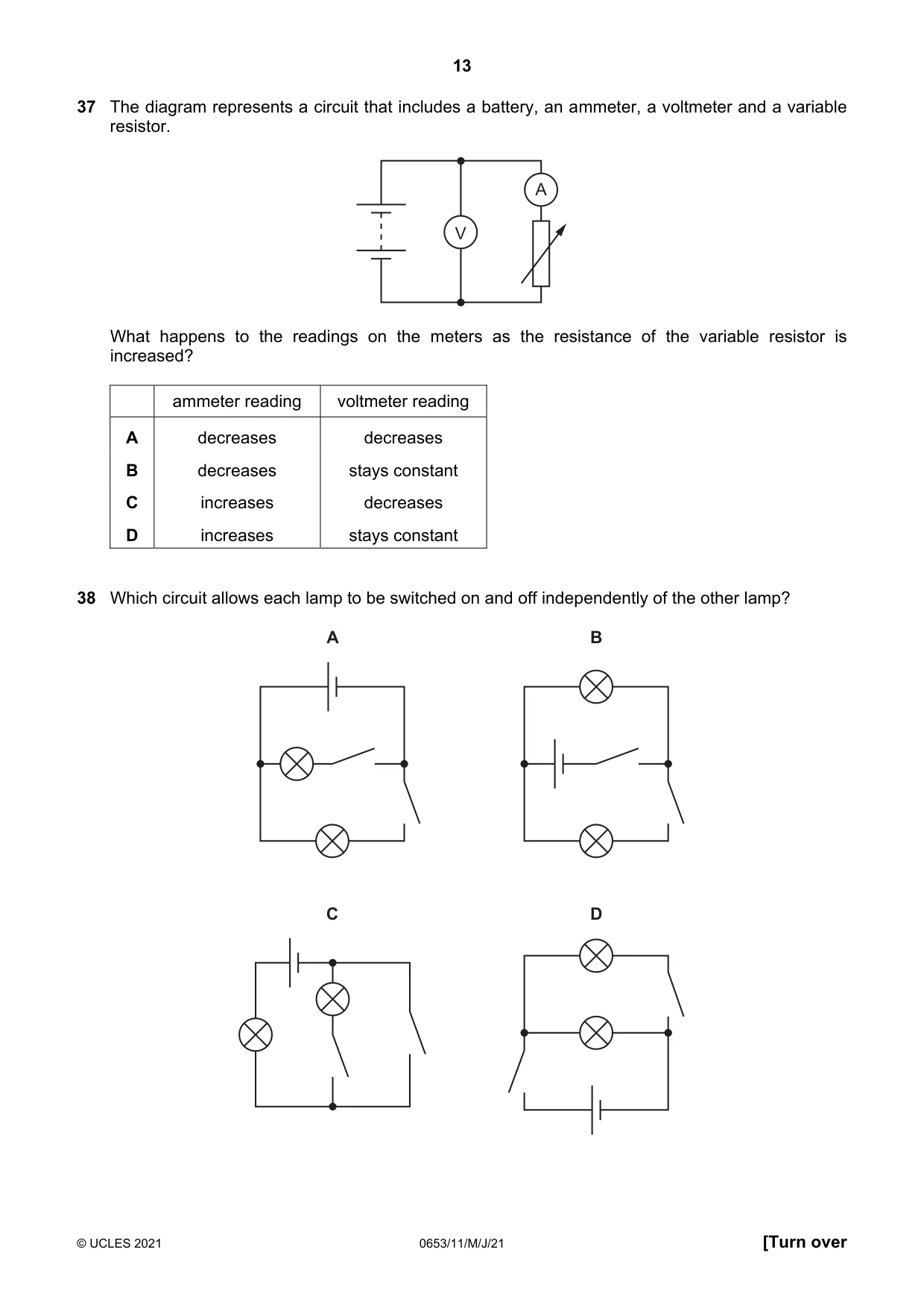
Q37 · The diagram represents a circuit that includes a battery, an ammeter, a voltmeter and a…
37 The diagram represents a circuit that includes a battery, an ammeter, a voltmeter and a variable resistor. A V What happens to the readings on the meters as the resistance of the variable resistor is increased? ammeter reading voltmeter reading A decreases decreases B decreases stays constant C increases decreases D increases stays constant
Mark scheme: B
Q38 · Which circuit allows each lamp to be switched on and off independently of the other lamp?
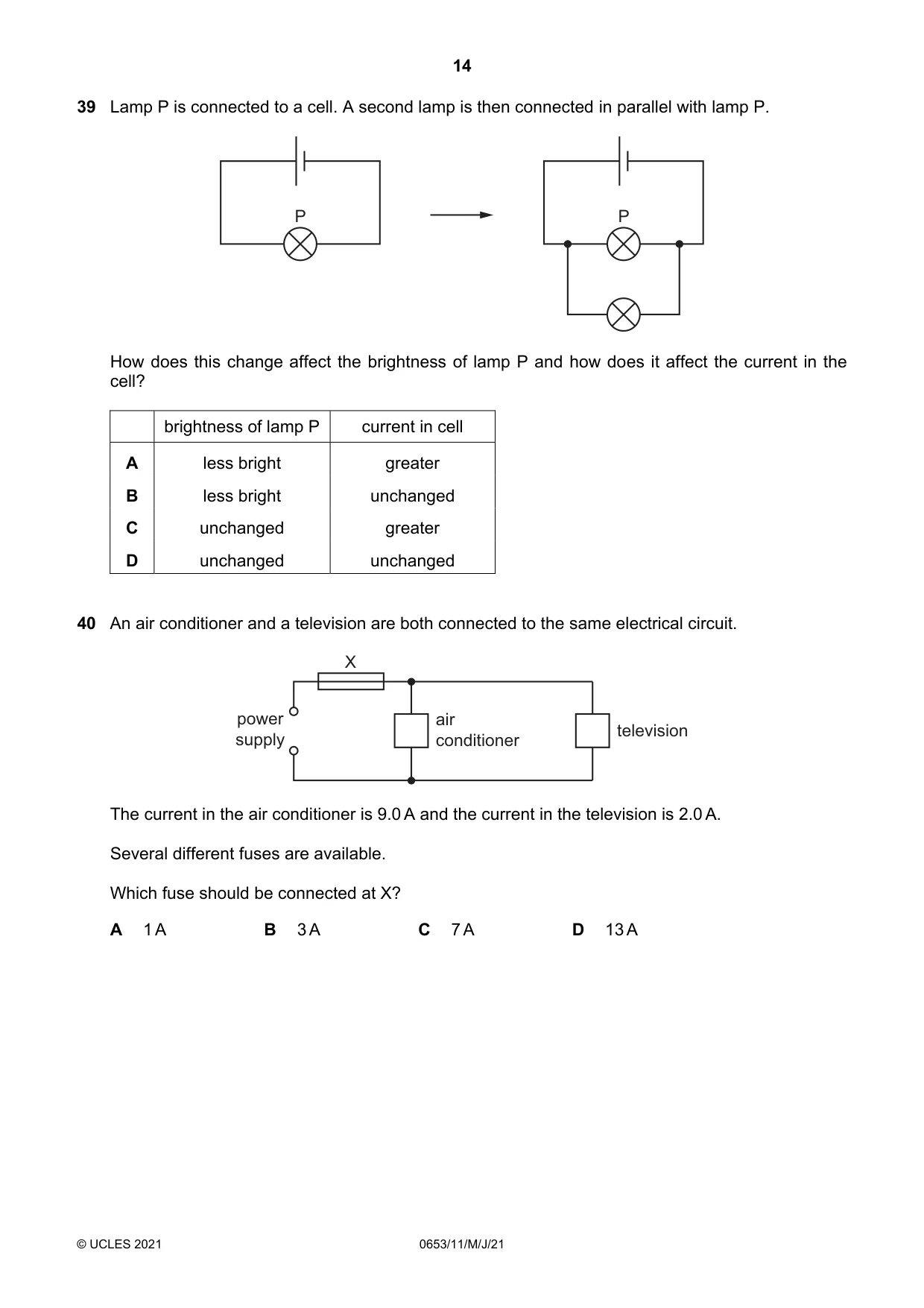
38 Which circuit allows each lamp to be switched on and off independently of the other lamp? A B C D
Mark scheme: A
Q39 · Lamp P is connected to a cell
39 Lamp P is connected to a cell. A second lamp is then connected in parallel with lamp P. P P How does this change affect the brightness of lamp P and how does it affect the current in the cell? brightness of lamp P current in cell A less bright greater B less bright unchanged C unchanged greater D unchanged unchanged
Mark scheme: C
Q40 · An air conditioner and a television are both connected to the same electrical circuit
40 An air conditioner and a television are both connected to the same electrical circuit. X power air television supply conditioner The current in the air conditioner is 9.0 A and the current in the television is 2.0 A. Several different fuses are available. Which fuse should be connected at X? A 1 A B 3 A C 7 A D 13 A
Mark scheme: D
What was in this paper
The subtopics covered by these 40 questions, and how many questions each got. Open one in a new tab to see every Cambridge question on it.
3Electromagnetic spectrum2Energy, work and power2Kinetic particle model of matter2Alkenes1Arrangement of elements1Biological molecules1Carbon cycle1Corrosion of metals1Diet1Diffusion1Digestion1Drugs1Electrical quantities1Electrical safety1Electrolysis1Elements, compounds and mixtures1Experimental design1Food chains and food webs1General properties of waves1Identification of ions and gases1Noble gases1Physical and chemical changes1Physical quantities and measurement techniques1Pressure1Properties of metals1Rate of reaction1Respiration1Sexual reproduction in humans1Sexual reproduction in plants1Size of specimens1Terminology1The characteristic properties of acids and bases1Transition elements1Xylem and phloem1What you needed in this session
Cambridge’s own grade thresholds for 2021 May/June, Paper 1 · Variant 1. A higher threshold means an easier paper — the bar moves with how the cohort did.