Cambridge IGCSE Science - Combined 0653 — 2019 Feb/March Paper 1 · Variant 2
0653/12/F/M/19 · 40 questions · 40 marks · ≈45 min
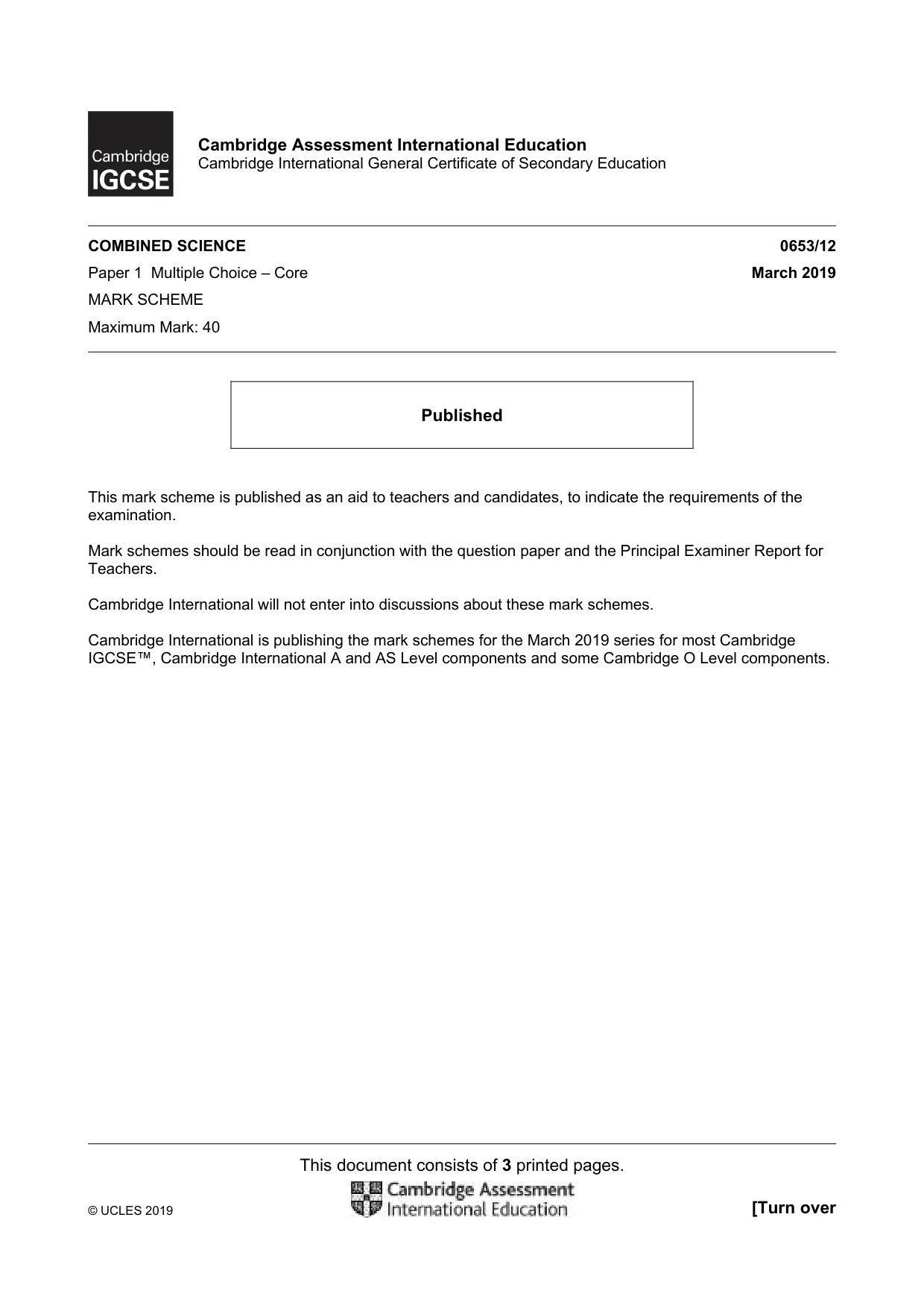
The question paper and its mark scheme, free to read here and free to download. This is Cambridge’s own paper, exactly as it was sat.
Question paper16 pages
Mark scheme3 pages
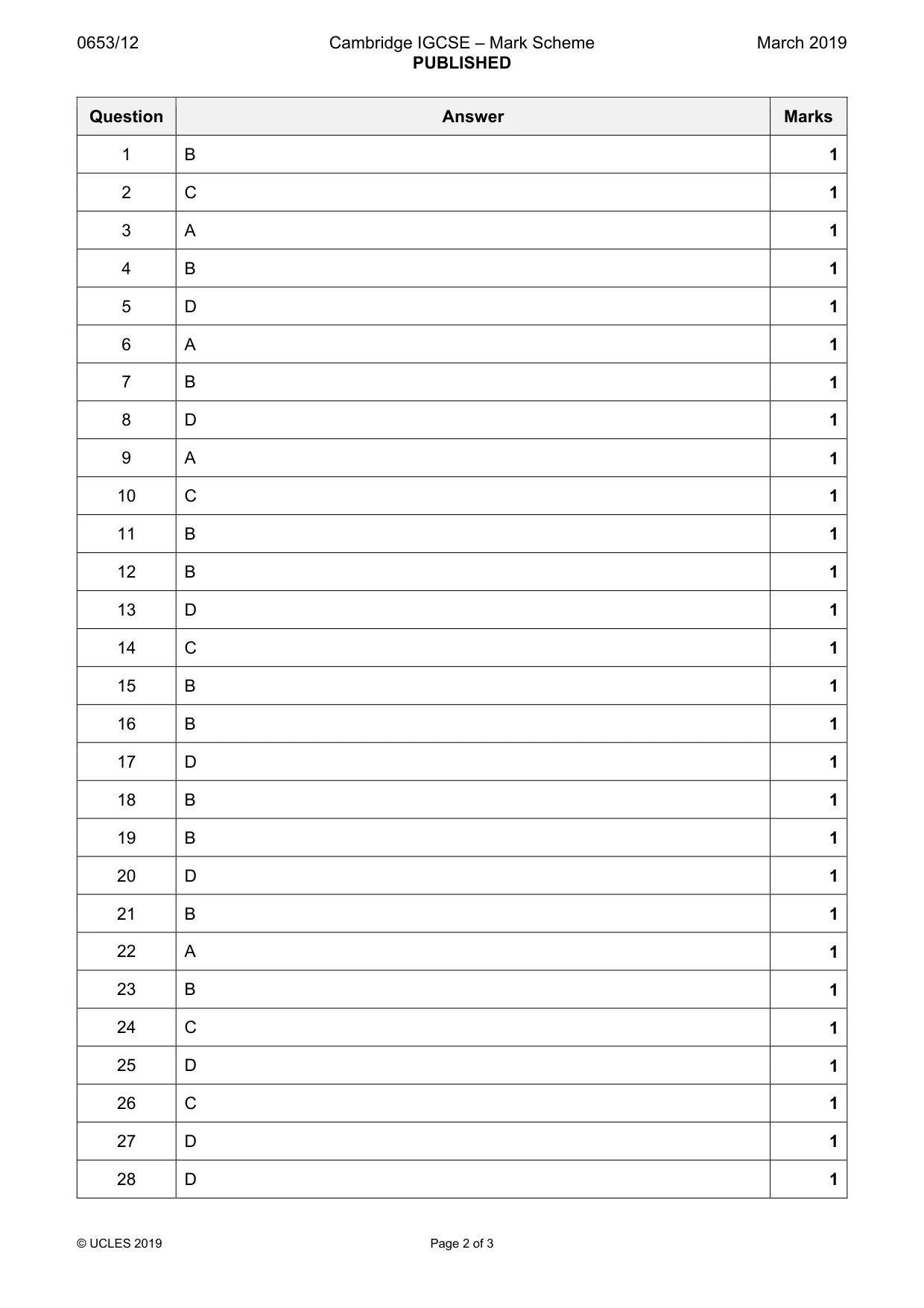
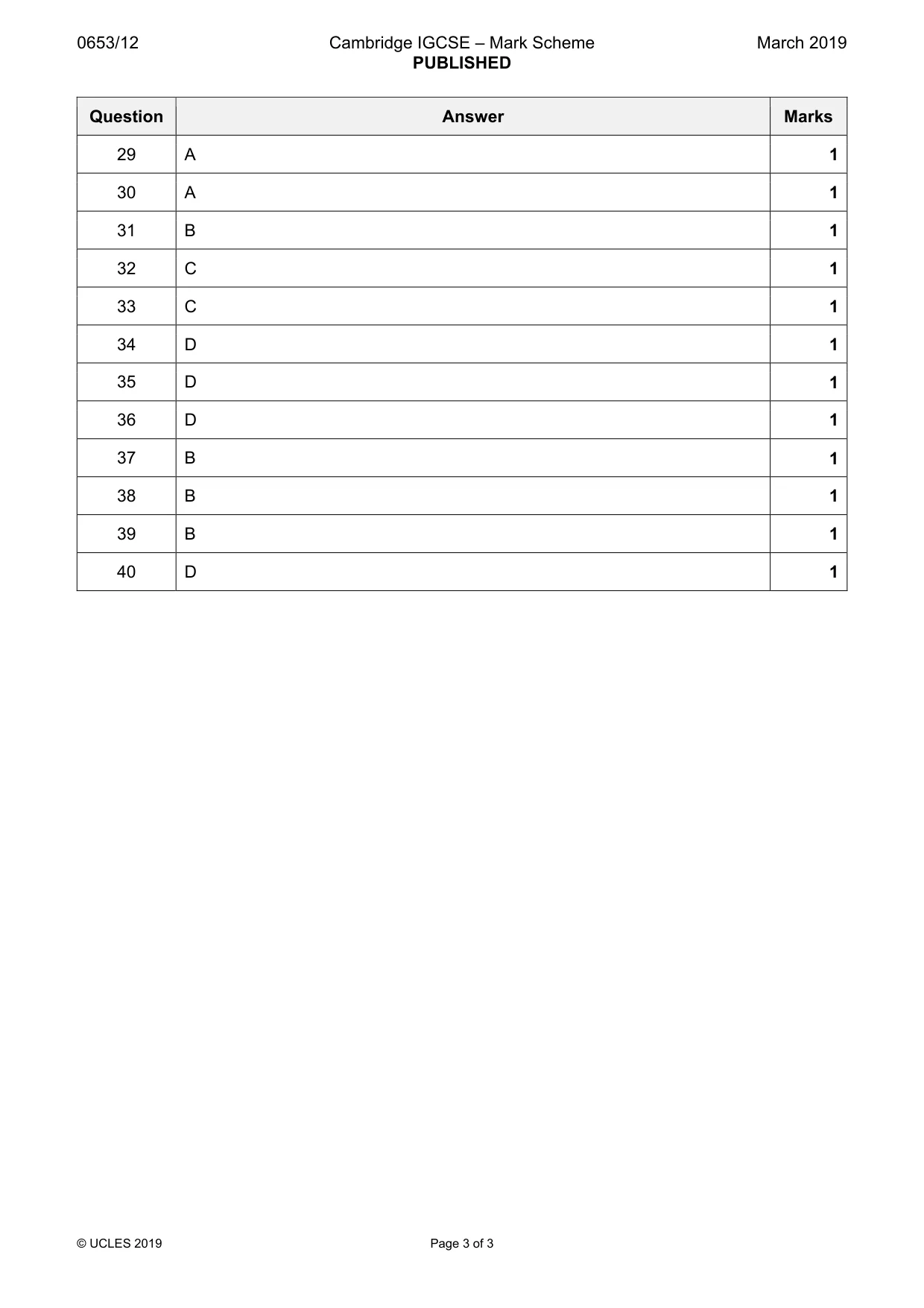
Answers below. Sit the paper first if you are practising.
Questions as text
Q1 · A car enters a garage, is filled with fuel and is driven away
1 A car enters a garage, is filled with fuel and is driven away. Which characteristic of living organisms is not matched by a similar process in the car? A excretion B growth C movement D respiration
Mark scheme: B
Q2 · In an experiment, an enzyme from the human alimentary canal is found to work slowly at 20…
2 In an experiment, an enzyme from the human alimentary canal is found to work slowly at 20 °C. What is the optimum temperature for enzymes working in the human alimentary canal? A 17 °C B 27 °C C 37 °C D 77 °C
Mark scheme: C
Q3 · The diagram shows some cells in a leaf of a green plant
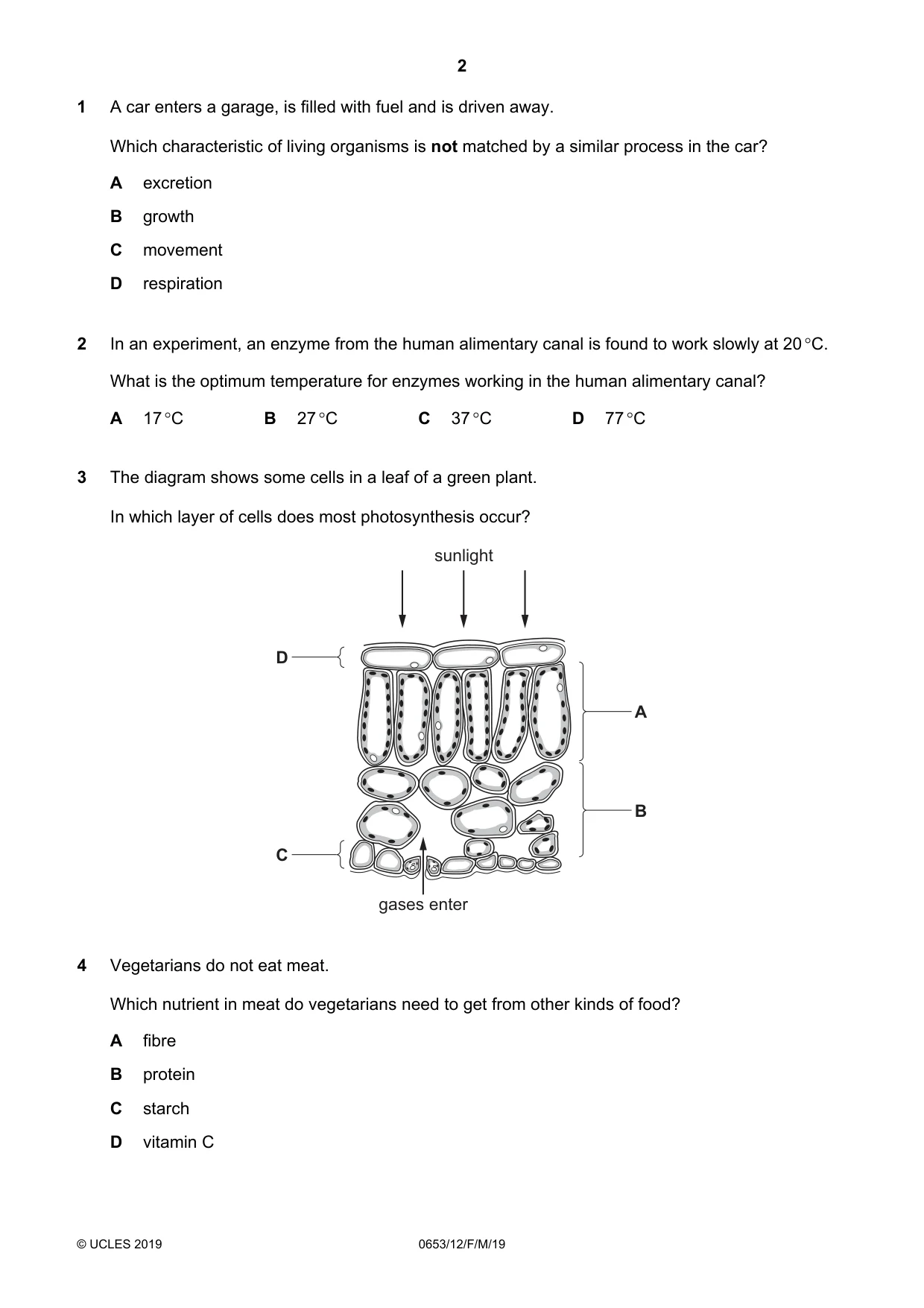
3 The diagram shows some cells in a leaf of a green plant. In which layer of cells does most photosynthesis occur? sunlight D A B C gases enter
Mark scheme: A
Q4 · Vegetarians do not eat meat
4 Vegetarians do not eat meat. Which nutrient in meat do vegetarians need to get from other kinds of food? A fibre B protein C starch D vitamin C
Mark scheme: B
Q5 · Which process is defined as taking substances into the body through the mouth?
5 Which process is defined as taking substances into the body through the mouth? A absorption B digestion C egestion D ingestion
Mark scheme: D
Q6 · Digestion can be defined as the breakdown of A large insoluble molecules to small soluble…
6 Digestion can be defined as the breakdown of A large insoluble molecules to small soluble molecules. B small insoluble molecules to large soluble molecules. C large soluble molecules to small insoluble molecules. D small soluble molecules to large insoluble molecules.
Mark scheme: A
Q7 · The diagram shows a transverse section through a plant root
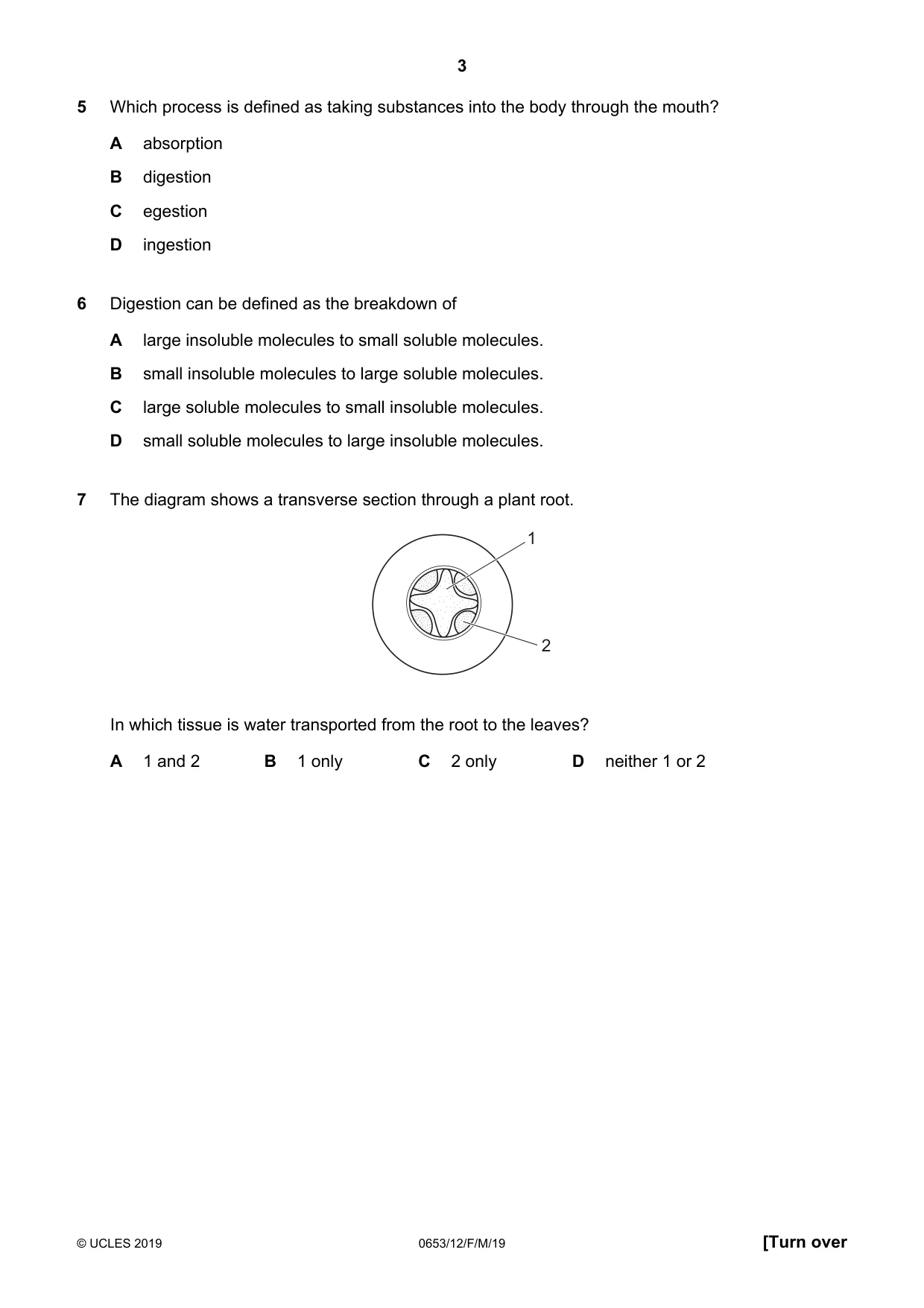
7 The diagram shows a transverse section through a plant root. 1 2 In which tissue is water transported from the root to the leaves? A 1 and 2 B 1 only C 2 only D neither 1 or 2
Mark scheme: B
Q8 · The diagram shows a section through the human heart
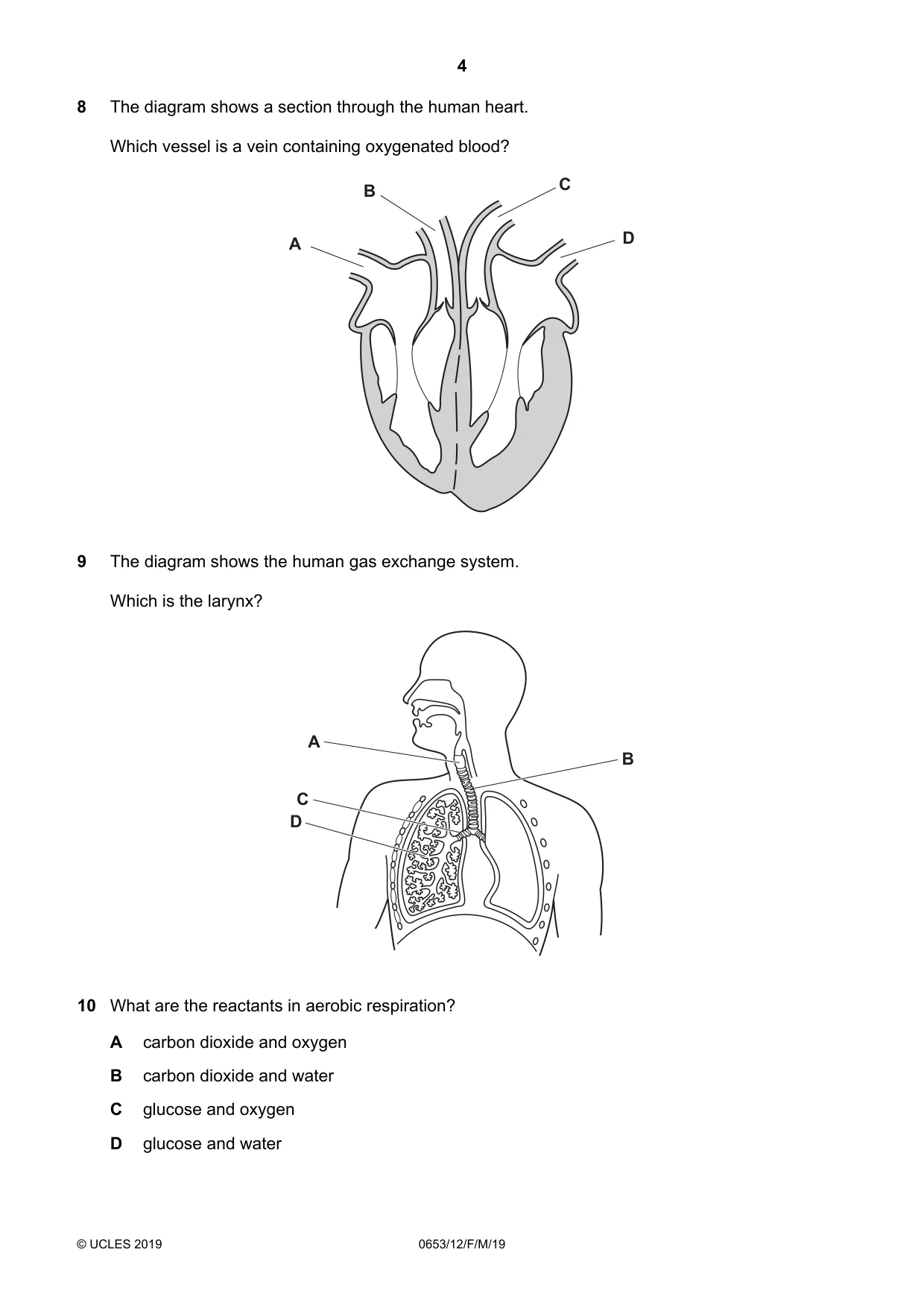
8 The diagram shows a section through the human heart. Which vessel is a vein containing oxygenated blood? B C A D
Mark scheme: D
Q9 · The diagram shows the human gas exchange system
9 The diagram shows the human gas exchange system. Which is the larynx? A B C D
Mark scheme: A
Q10 · What are the reactants in aerobic respiration?
10 What are the reactants in aerobic respiration? A carbon dioxide and oxygen B carbon dioxide and water C glucose and oxygen D glucose and water
Mark scheme: C
Q11 · Which row is correct for sexual reproduction?
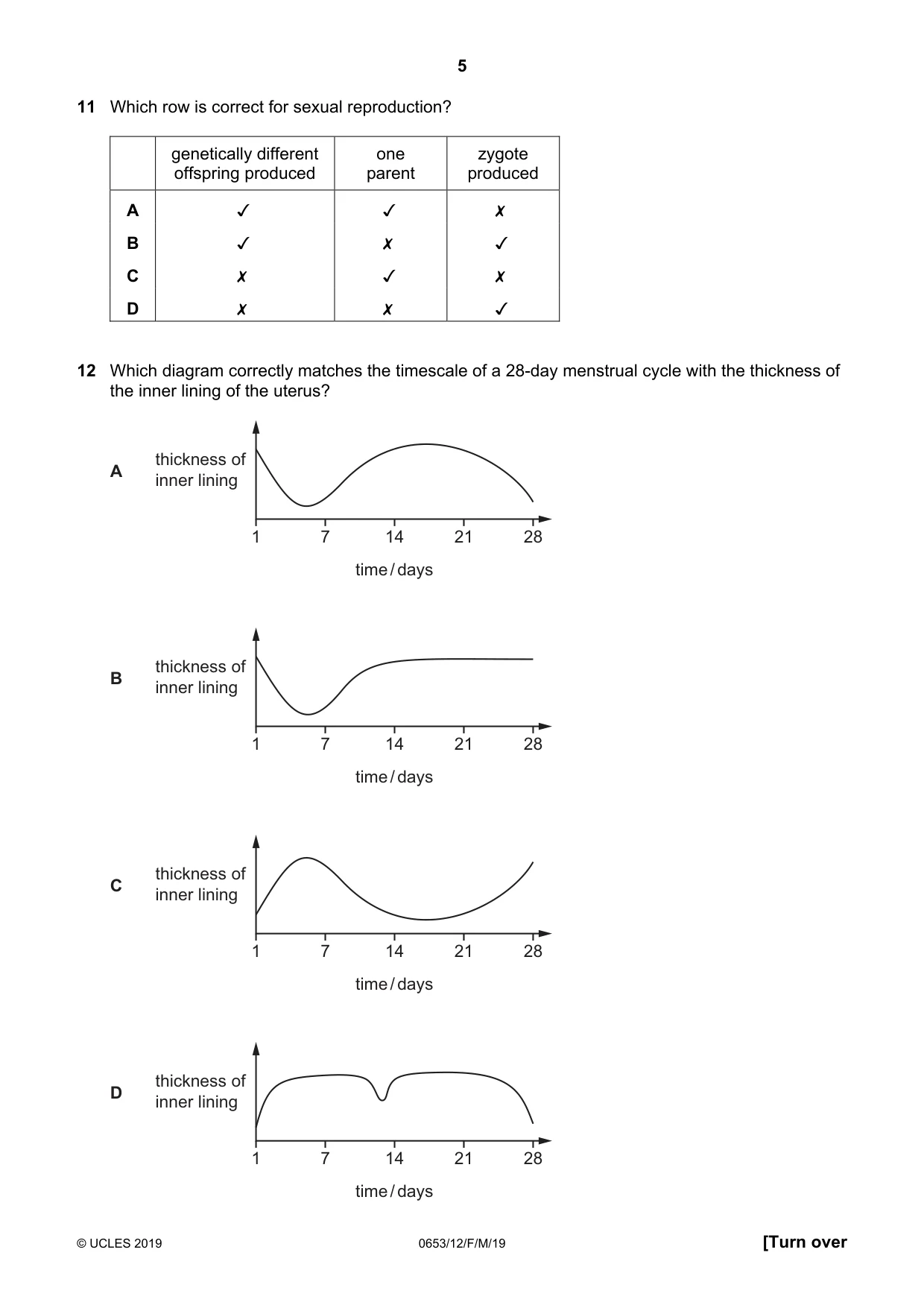
11. Which row is correct for sexual reproduction? genetically different one zygote offspring produced parent produced A v Jv x B J x J Cc x v x D x x J
Mark scheme: B
Q12 · Which diagram correctly matches the timescale of a 28-day menstrual cycle with the…
12 Which diagram correctly matches the timescale of a 28-day menstrual cycle with the thickness of the inner lining of the uterus? A thickness of inner lining 1 7 14 21 28 time / days B thickness of inner lining 1 7 14 21 28 time / days C thickness of inner lining 1 7 14 21 28 time / days D thickness of inner lining 1 7 14 21 28 time / days
Mark scheme: B
Q13 · A farmer chops down a tree to provide firewood
13 A farmer chops down a tree to provide firewood. He gets warm when chopping down the tree. The farmer then burns the wood to keep warm. What is the original source of the energy that warms the farmer in both cases? A photosynthesis by the tree growing the wood B respiration C the match used to light the fire D the Sun
Mark scheme: D
Q14 · Which statement describes oxygen molecules at room temperature and pressure?
14 Which statement describes oxygen molecules at room temperature and pressure? A They are closely packed and move around slowly. B They are closely packed and vibrate about a fixed point. C They are loosely packed and move around rapidly. D They are loosely packed and vibrate about a fixed point.
Mark scheme: C
Q15 · Which piece of equipment can be used to measure exactly 21.6 cm3 of dilute sulfuric acid?
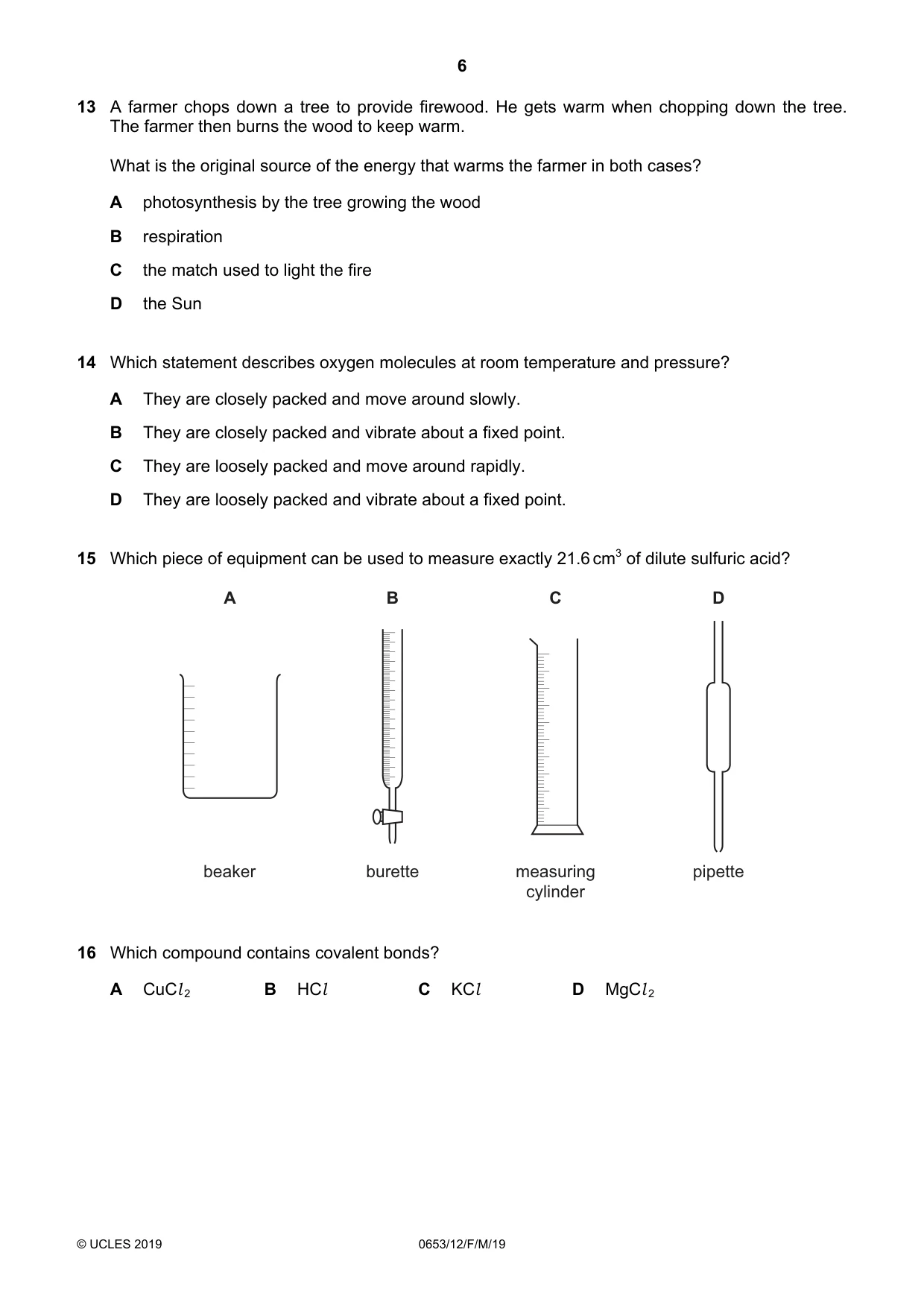
15 Which piece of equipment can be used to measure exactly 21.6 cm3 of dilute sulfuric acid? A B C D beaker burette measuring pipette cylinder
Mark scheme: B
Q16 · Which compound contains covalent bonds?
16 Which compound contains covalent bonds? A CuCl 2 B HCl C KCl D MgCl 2
Mark scheme: B
Q17 · The diagram shows apparatus used to pass an electric current through dilute sulfuric acid
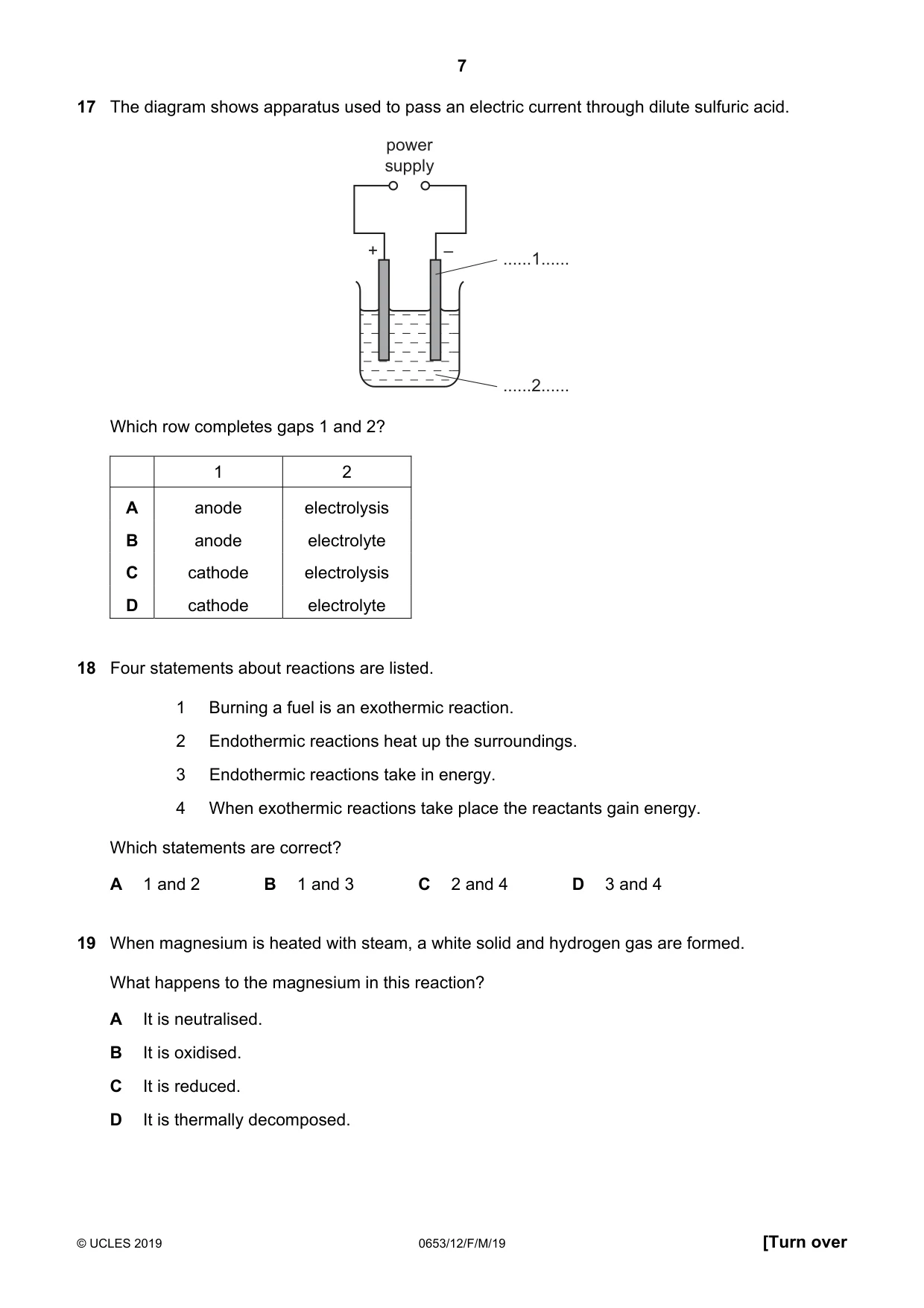
17 The diagram shows apparatus used to pass an electric current through dilute sulfuric acid. power supply + – ......1...... ......2...... Which row completes gaps 1 and 2? 1 2 A anode electrolysis B anode electrolyte C cathode electrolysis D cathode electrolyte
Mark scheme: D
Q18 · Four statements about reactions are listed
18 Four statements about reactions are listed. 1 Burning a fuel is an exothermic reaction. 2 Endothermic reactions heat up the surroundings. 3 Endothermic reactions take in energy. 4 When exothermic reactions take place the reactants gain energy. Which statements are correct? A 1 and 2 B 1 and 3 C 2 and 4 D 3 and 4
Mark scheme: B
Q19 · When magnesium is heated with steam, a white solid and hydrogen gas are formed
19 When magnesium is heated with steam, a white solid and hydrogen gas are formed. What happens to the magnesium in this reaction? A It is neutralised. B It is oxidised. C It is reduced. D It is thermally decomposed.
Mark scheme: B
Q20 · Copper nitrate is prepared by reacting excess copper oxide with dilute nitric acid
20 Copper nitrate is prepared by reacting excess copper oxide with dilute nitric acid. How is a solid sample of copper nitrate obtained from the reaction mixture? A Add an excess of dilute nitric acid. B Distil the solution. C Filter the solution and dry the residue in the filter paper. D Filter the solution and crystallise the filtrate.
Mark scheme: D
Q21 · A solution is tested for the presence of cations
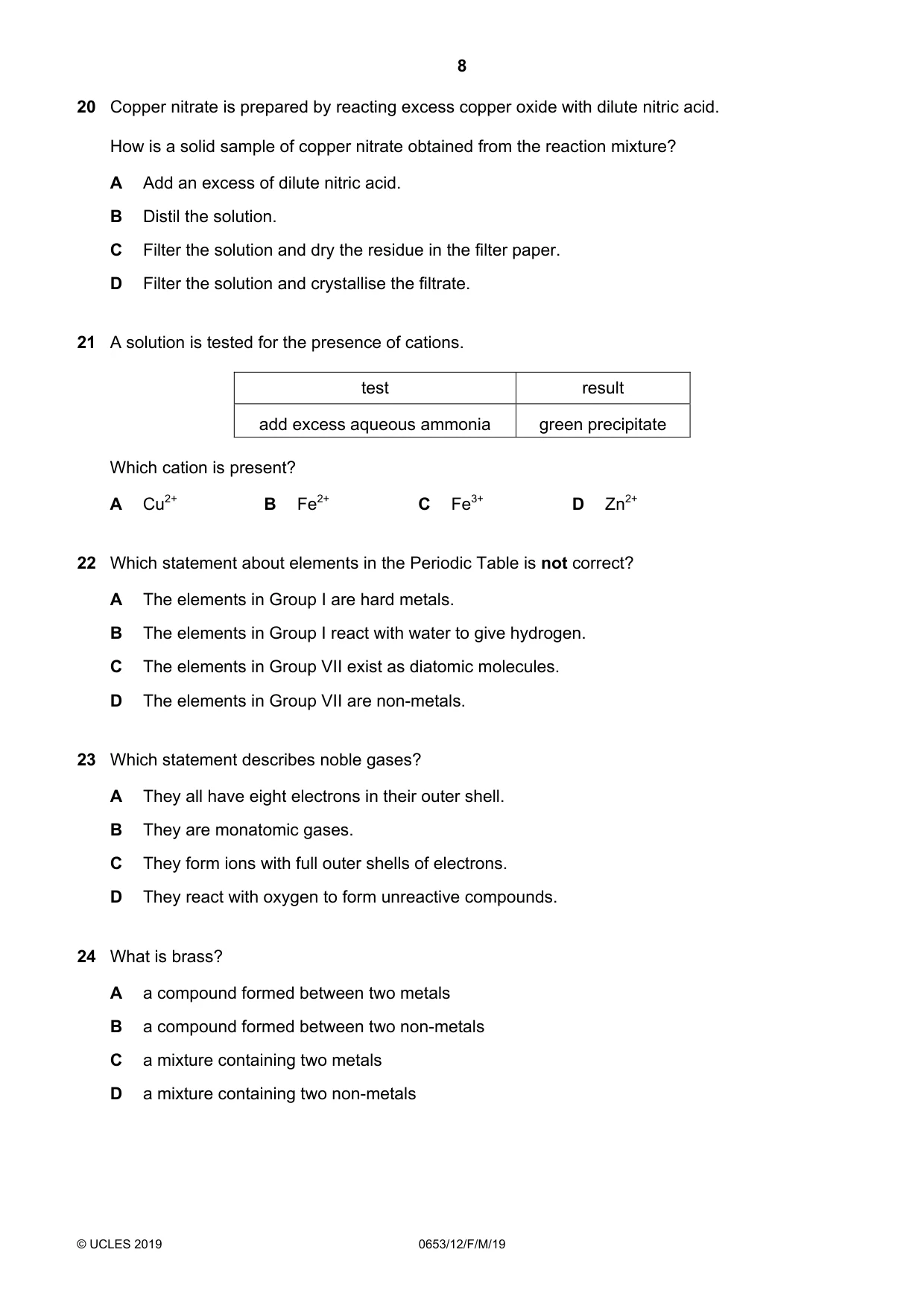
21 A solution is tested for the presence of cations. test result add excess aqueous ammonia green precipitate Which cation is present? A Cu2+ B Fe2+ C Fe3+ D Zn2+
Mark scheme: B
Q22 · Which statement about elements in the Periodic Table is not correct?
22 Which statement about elements in the Periodic Table is not correct? A The elements in Group I are hard metals. B The elements in Group I react with water to give hydrogen. C The elements in Group VII exist as diatomic molecules. D The elements in Group VII are non-metals.
Mark scheme: A
Q23 · Which statement describes noble gases?
23 Which statement describes noble gases? A They all have eight electrons in their outer shell. B They are monatomic gases. C They form ions with full outer shells of electrons. D They react with oxygen to form unreactive compounds.
Mark scheme: B
Question 24
24 What is brass? A a compound formed between two metals B a compound formed between two non-metals C a mixture containing two metals D a mixture containing two non-metals
Mark scheme: C
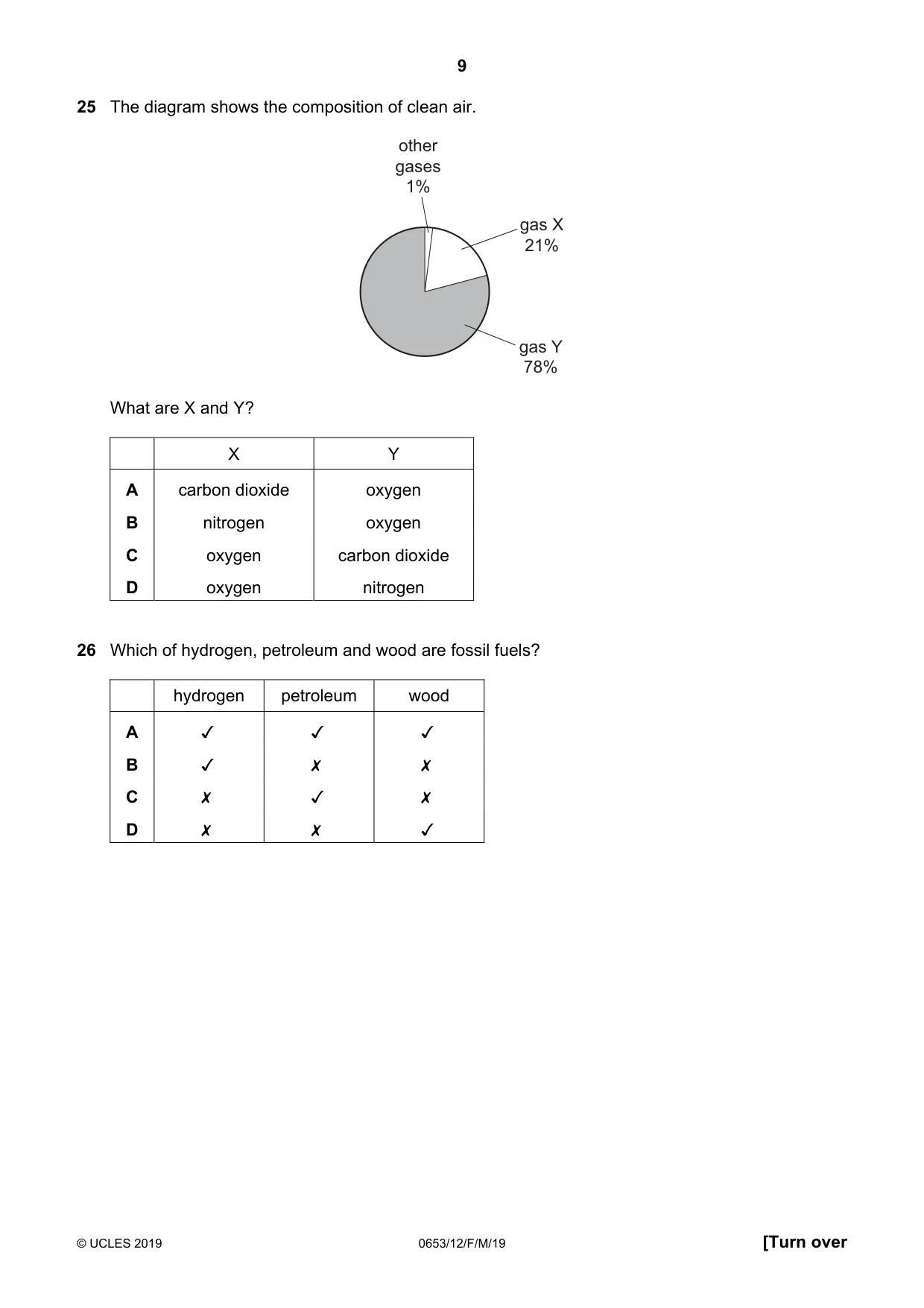
Q25 · The diagram shows the composition of clean air
25 The diagram shows the composition of clean air. other gases 1% gas X 21% gas Y 78% What are X and Y? X Y A carbon dioxide oxygen B nitrogen oxygen C oxygen carbon dioxide D oxygen nitrogen
Mark scheme: D
Q26 · Which of hydrogen, petroleum and wood are fossil fuels?
26 Which of hydrogen, petroleum and wood are fossil fuels? hydrogen petroleum wood A J J J B v x x Cc x Jv x D x x J
Mark scheme: C
Q27 · P, Q, R and S are four hydrocarbons
27 P, Q, R and S are four hydrocarbons. P is unsaturated. Q contains only single covalent bonds. R undergoes addition polymerisation. S decolourises bromine water. Which row identifies these hydrocarbons? P Q R S A alkane alkene alkane alkane B alkene alkane alkane alkene C alkene alkane alkene alkane D alkene alkane alkene alkene
Mark scheme: D
Q28 · An object with mass 5.0 kg is dropped
28 An object with mass 5.0 kg is dropped. The acceleration of free fall is 10 m / s2. What is the weight of the object? A 0.50 N B 2.0 N C 5.0 N D 50 N
Mark scheme: D
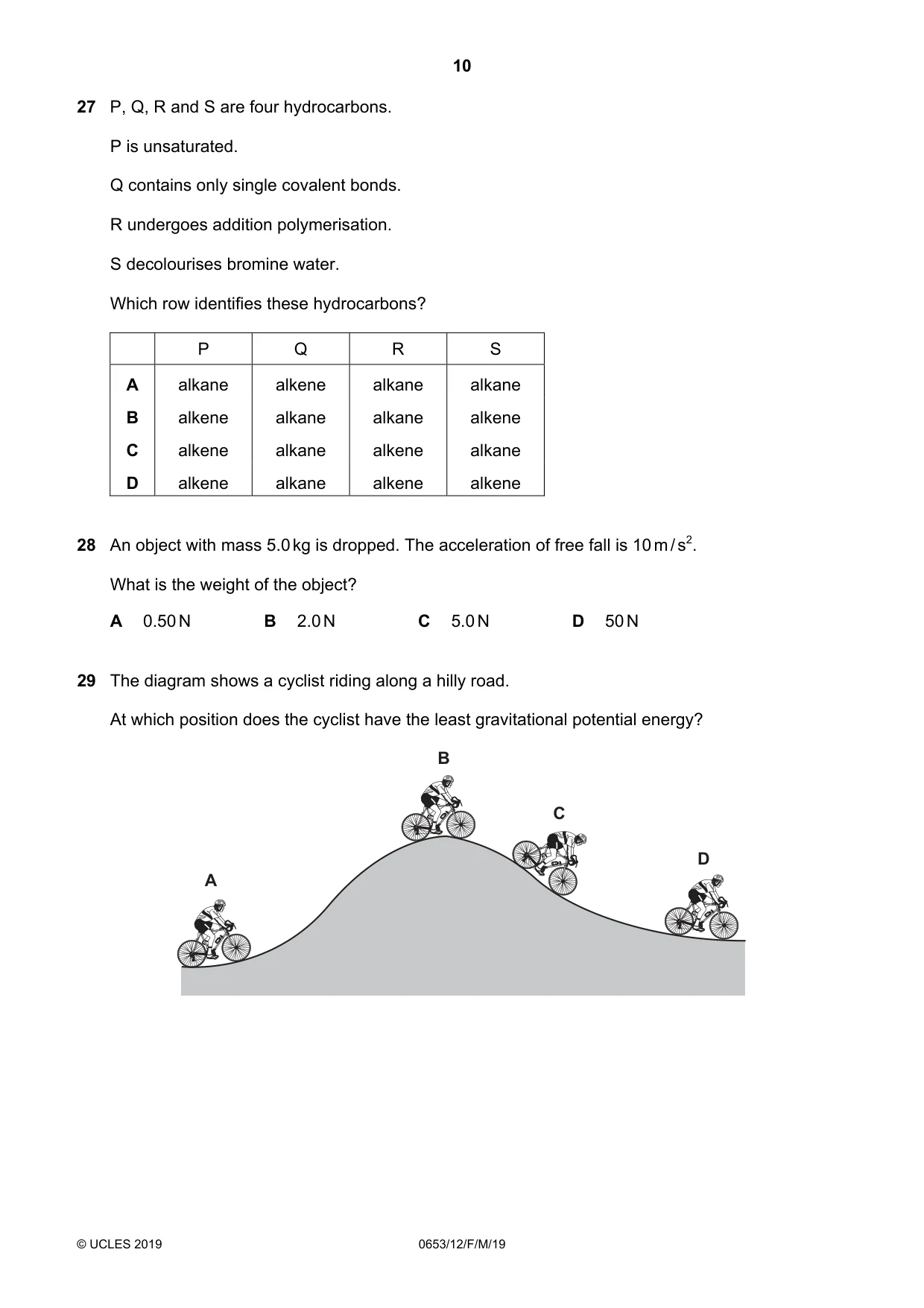
Q29 · The diagram shows a cyclist riding along a hilly road
29 The diagram shows a cyclist riding along a hilly road. At which position does the cyclist have the least gravitational potential energy? B C D A
Mark scheme: A
Q30 · Which row correctly compares the separation of molecules in different states of matter?
30 Which row correctly compares the separation of molecules in different states of matter? molecules in a solid are molecules in a liquid are A closer together than in a gas closer together than in a gas B closer together than in a gas further apart than in a gas C further apart than in a gas closer together than in a gas D further apart than in a gas further apart than in a gas
Mark scheme: A
Q31 · Which row gives thermal properties of air and aluminium?
31 Which row gives thermal properties of air and aluminium? air aluminium A a bad thermal conductor a bad thermal conductor B a bad thermal conductor a good thermal conductor C a good thermal conductor a bad thermal conductor D a good thermal conductor a good thermal conductor
Mark scheme: B
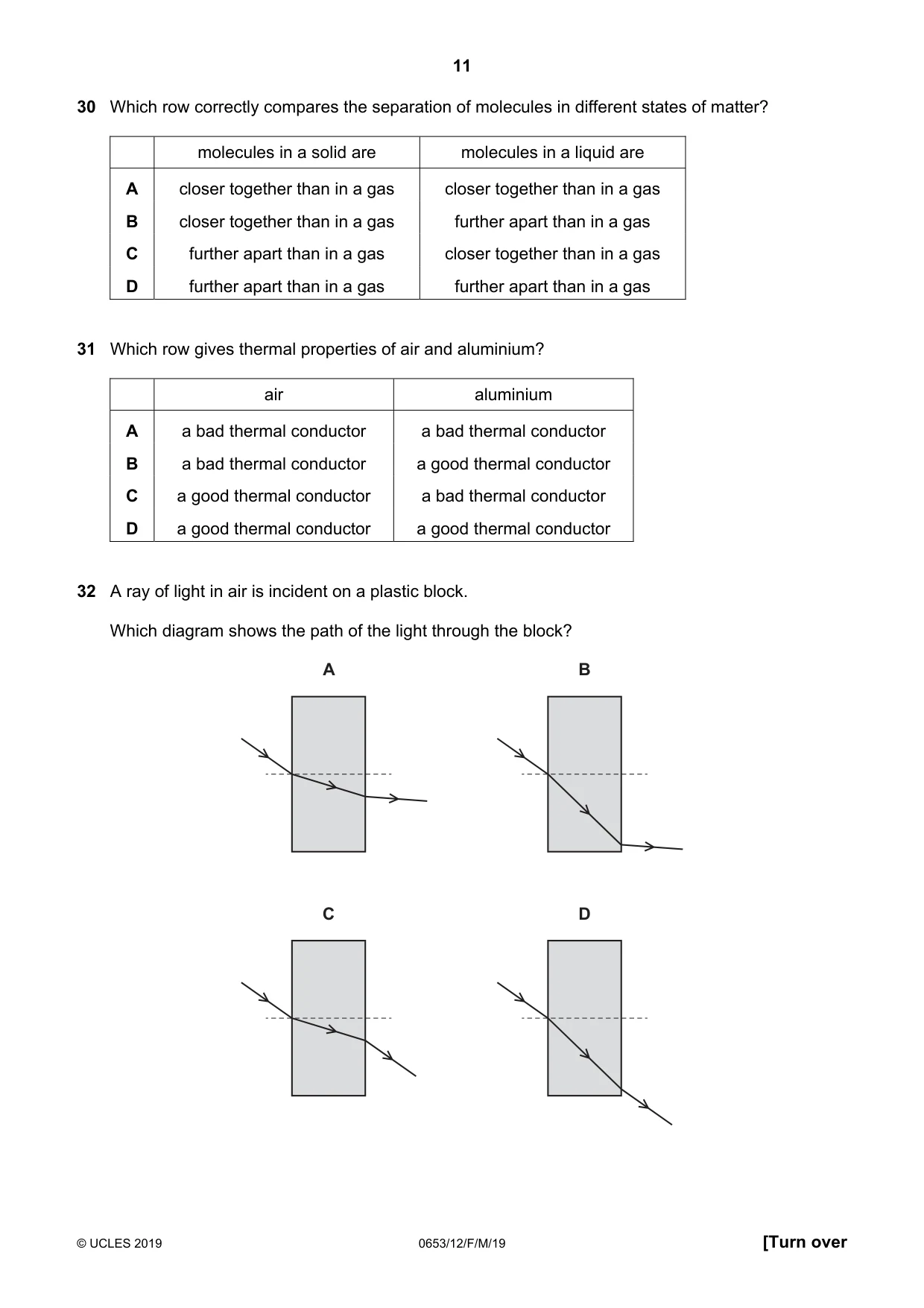
Q32 · A ray of light in air is incident on a plastic block
32 A ray of light in air is incident on a plastic block. Which diagram shows the path of the light through the block? A B C D
Mark scheme: C
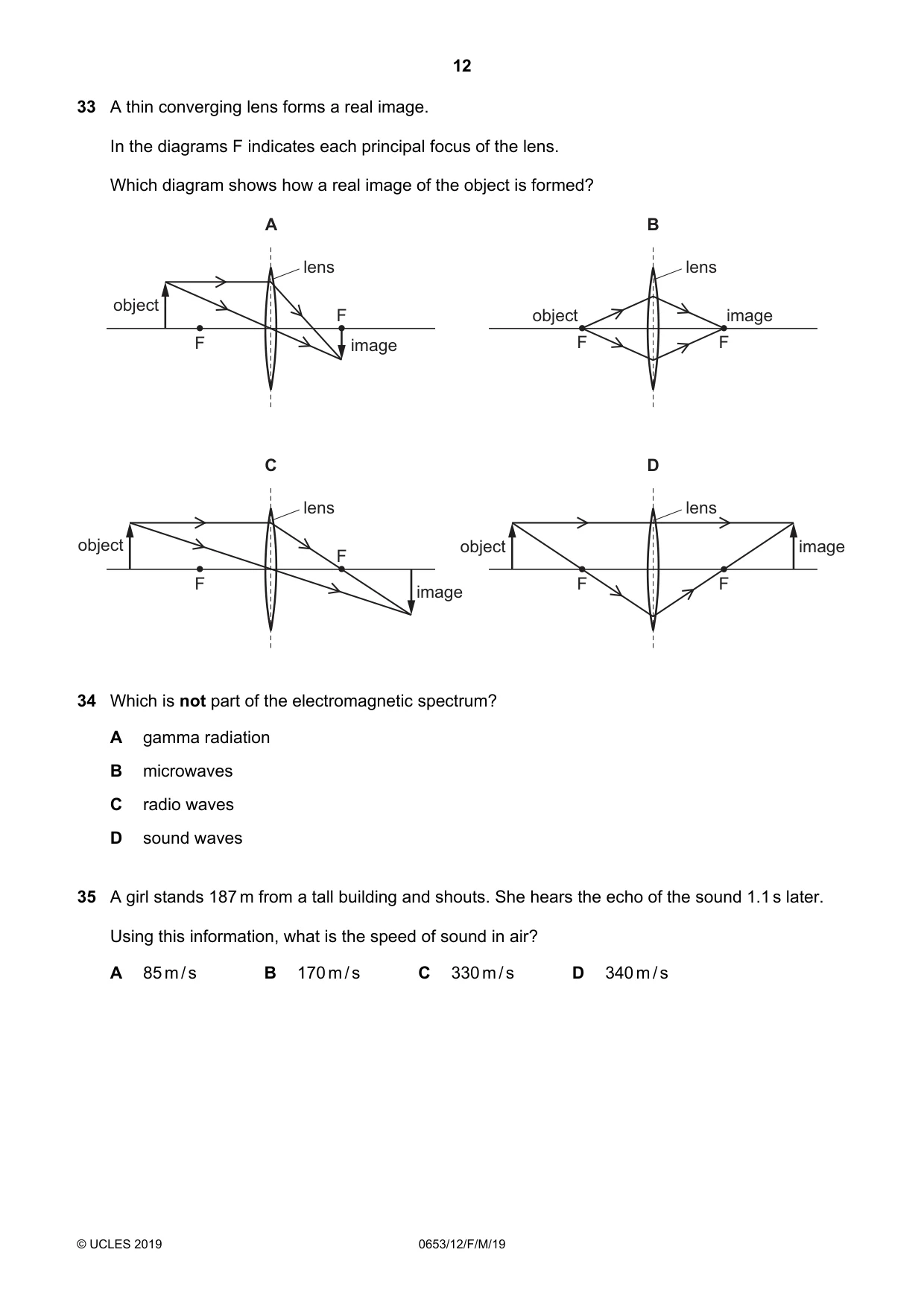
Q33 · A thin converging lens forms a real image
33 A thin converging lens forms a real image. In the diagrams F indicates each principal focus of the lens. Which diagram shows how a real image of the object is formed? A B lens lens object F object image F image F F C D lens lens object object image F F F F image
Mark scheme: C
Q34 · Which is not part of the electromagnetic spectrum?
34 Which is not part of the electromagnetic spectrum? A gamma radiation B microwaves C radio waves D sound waves
Mark scheme: D
Q35 · A girl stands 187 m from a tall building and shouts
35 A girl stands 187 m from a tall building and shouts. She hears the echo of the sound 1.1 s later. Using this information, what is the speed of sound in air? A 85 m / s B 170 m / s C 330 m / s D 340 m / s
Mark scheme: D
Q36 · An electrically charged student produces soap bubbles
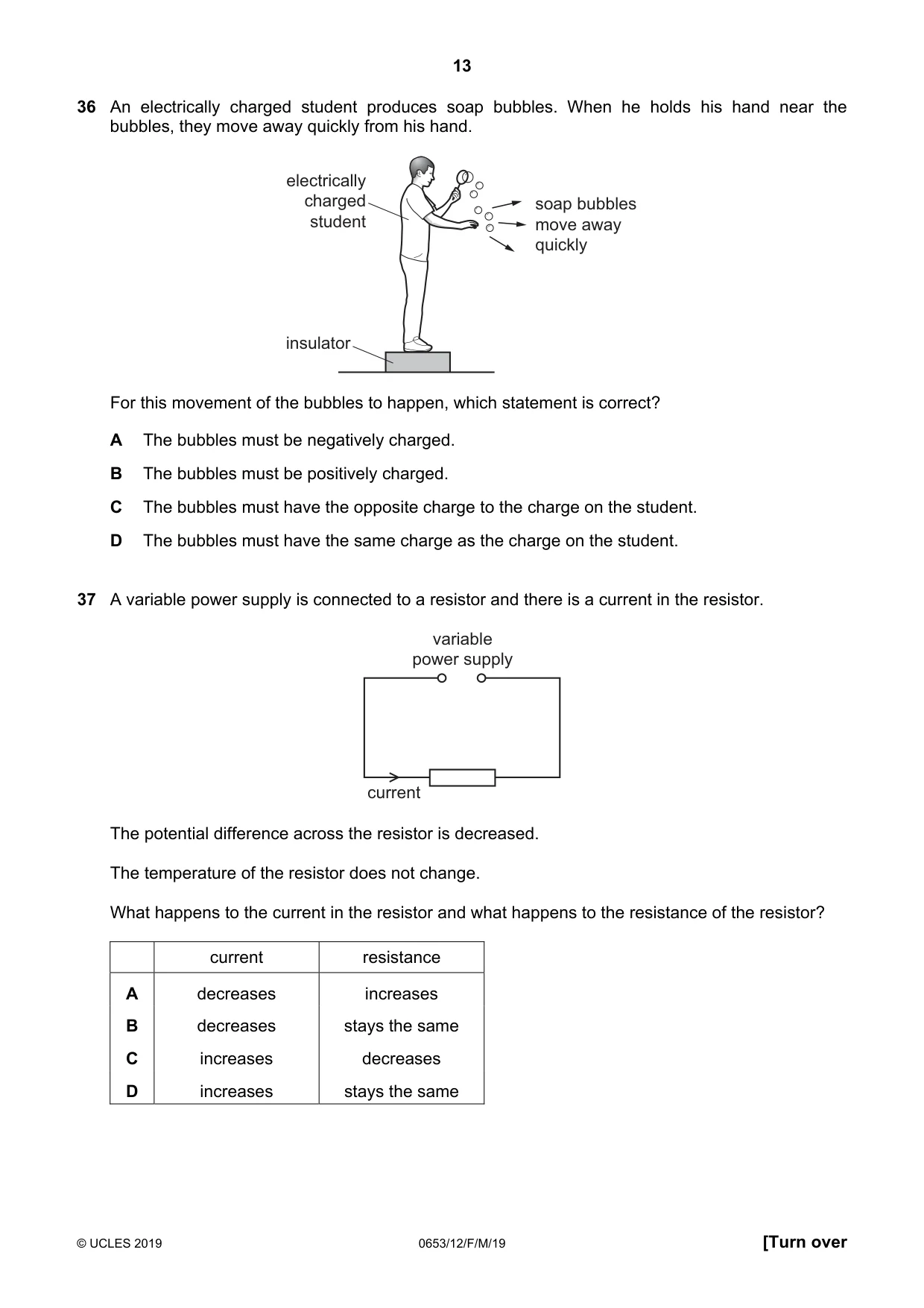
36 An electrically charged student produces soap bubbles. When he holds his hand near the bubbles, they move away quickly from his hand. electrically charged soap bubbles student move away quickly insulator For this movement of the bubbles to happen, which statement is correct? A The bubbles must be negatively charged. B The bubbles must be positively charged. C The bubbles must have the opposite charge to the charge on the student. D The bubbles must have the same charge as the charge on the student.
Mark scheme: D
Q37 · A variable power supply is connected to a resistor and there is a current in the resistor
37 A variable power supply is connected to a resistor and there is a current in the resistor. variable power supply current The potential difference across the resistor is decreased. The temperature of the resistor does not change. What happens to the current in the resistor and what happens to the resistance of the resistor? current resistance A decreases increases B decreases stays the same C increases decreases D increases stays the same
Mark scheme: B
Q38 · The diagram shows a circuit used to light a lamp in a torch
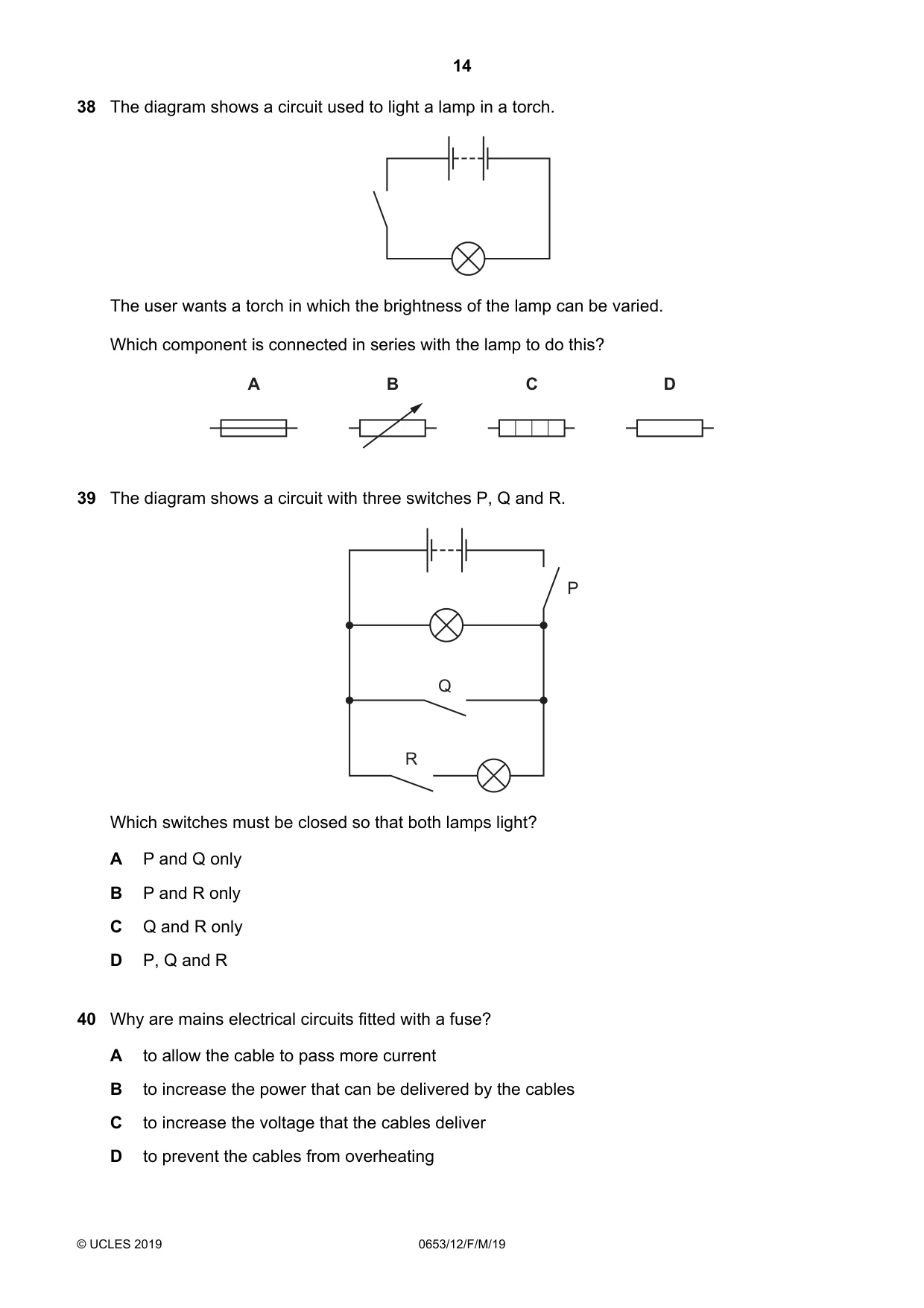
38 The diagram shows a circuit used to light a lamp in a torch. The user wants a torch in which the brightness of the lamp can be varied. Which component is connected in series with the lamp to do this? A B C D
Mark scheme: B
Q39 · The diagram shows a circuit with three switches P, Q and R
39 The diagram shows a circuit with three switches P, Q and R. P Q R Which switches must be closed so that both lamps light? A P and Q only B P and R only C Q and R only D P, Q and R
Mark scheme: B
Q40 · Why are mains electrical circuits fitted with a fuse?
40 Why are mains electrical circuits fitted with a fuse? A to allow the cable to pass more current B to increase the power that can be delivered by the cables C to increase the voltage that the cables deliver D to prevent the cables from overheating
Mark scheme: D
What was in this paper
The subtopics covered by these 40 questions, and how many questions each got. Open one in a new tab to see every Cambridge question on it.
2Electrical quantities2Light2Air quality and climate1Alkenes1Alloys and their properties1Characteristics of living organisms1Diet1Digestion1Digestive system1Electrical safety1Electrolysis1Electromagnetic spectrum1Energy flow1Energy, work and power1Enzymes1Exothermic and endothermic reactions1Experimental design1Fuels1Gas exchange in humans1Group I properties1Heart1Identification of ions and gases1Kinetic particle model of matter1Leaf structure1Mass and weight1Noble gases1Preparation of salts1Redox1Respiration1Sexual reproduction in humans1Sexual reproduction in plants1Simple molecules and covalent bonds1Solids, liquids and gases1Sound1Transfer of thermal energy1Xylem and phloem1What you needed in this session
Cambridge’s own grade thresholds for 2019 Feb/March, Paper 1 · Variant 2. A higher threshold means an easier paper — the bar moves with how the cohort did.