Cambridge IGCSE Science - Combined 0653 — 2023 Oct/Nov Paper 1 · Variant 2
0653/12/O/N/23 · 40 questions · 40 marks · ≈45 min
The question paper and its mark scheme, free to read here and free to download. This is Cambridge’s own paper, exactly as it was sat.
Question paper12 pages
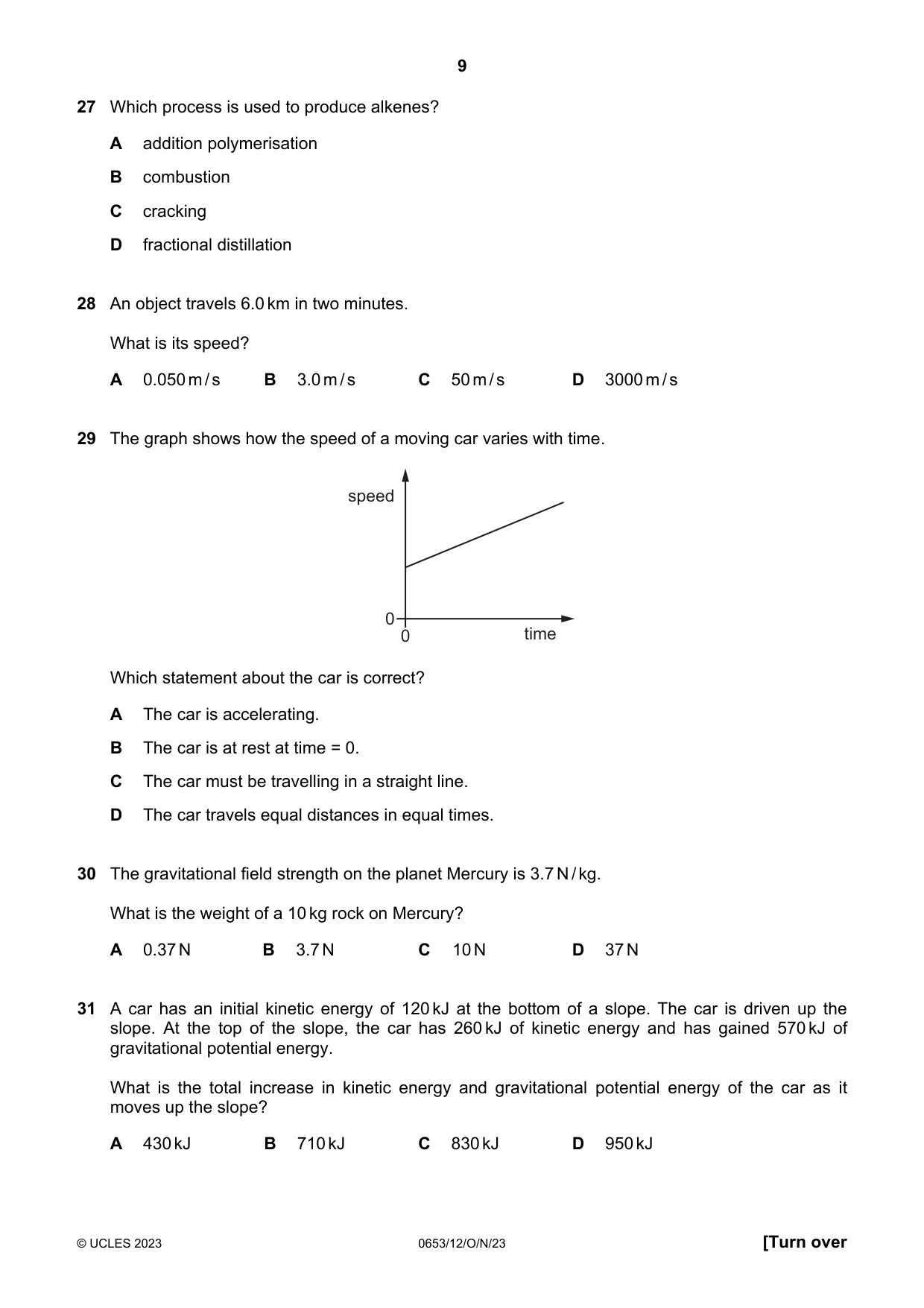
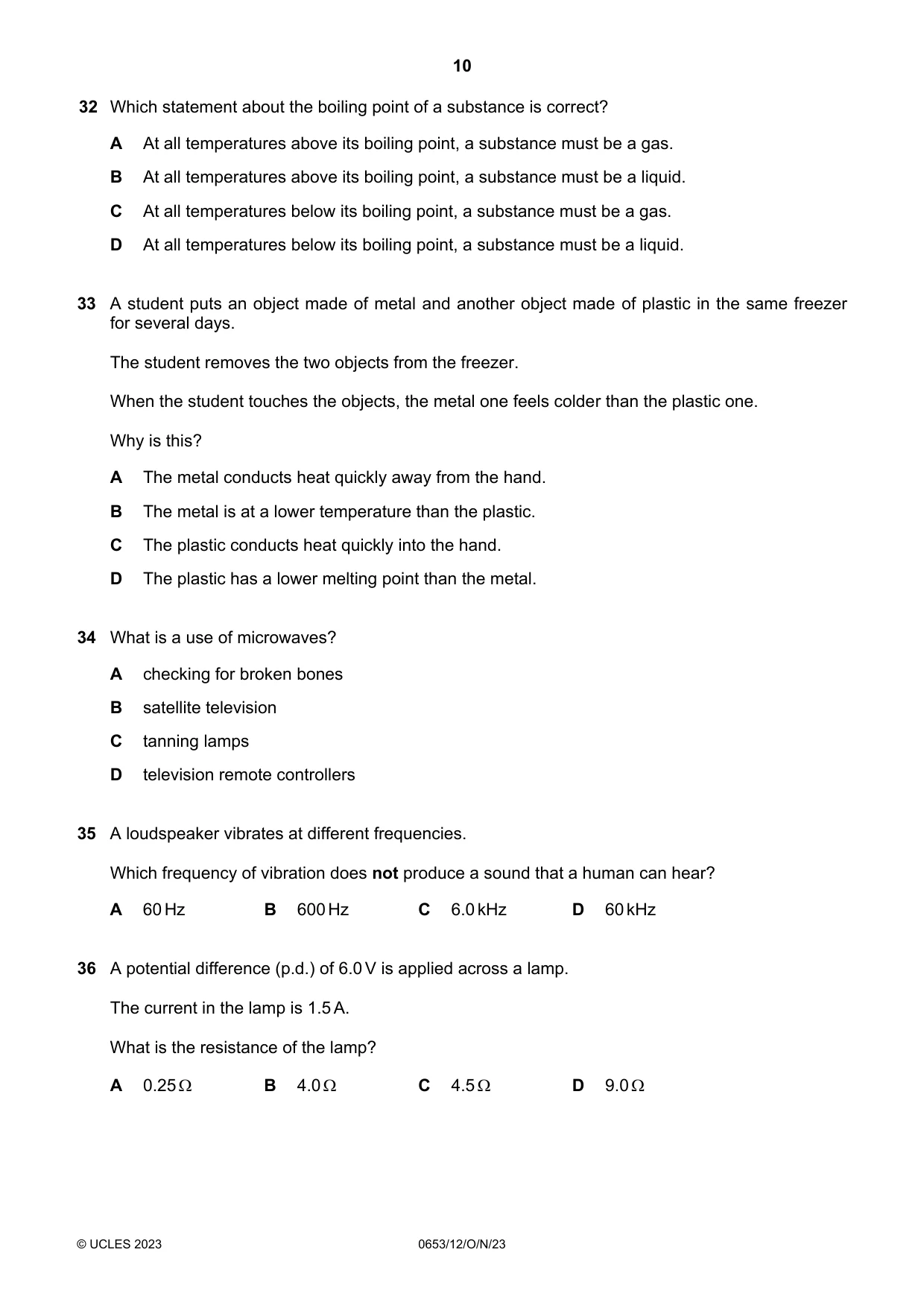
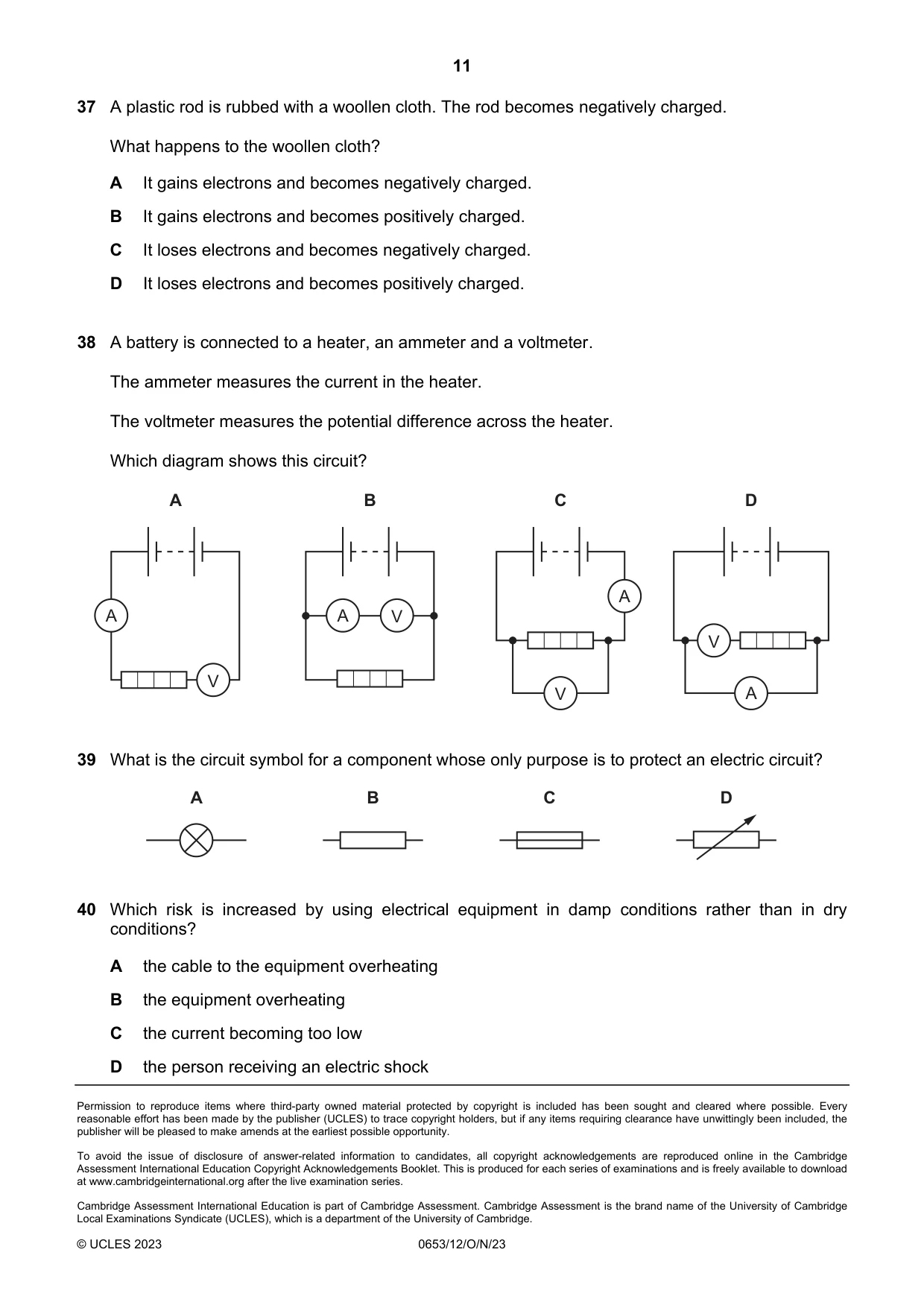
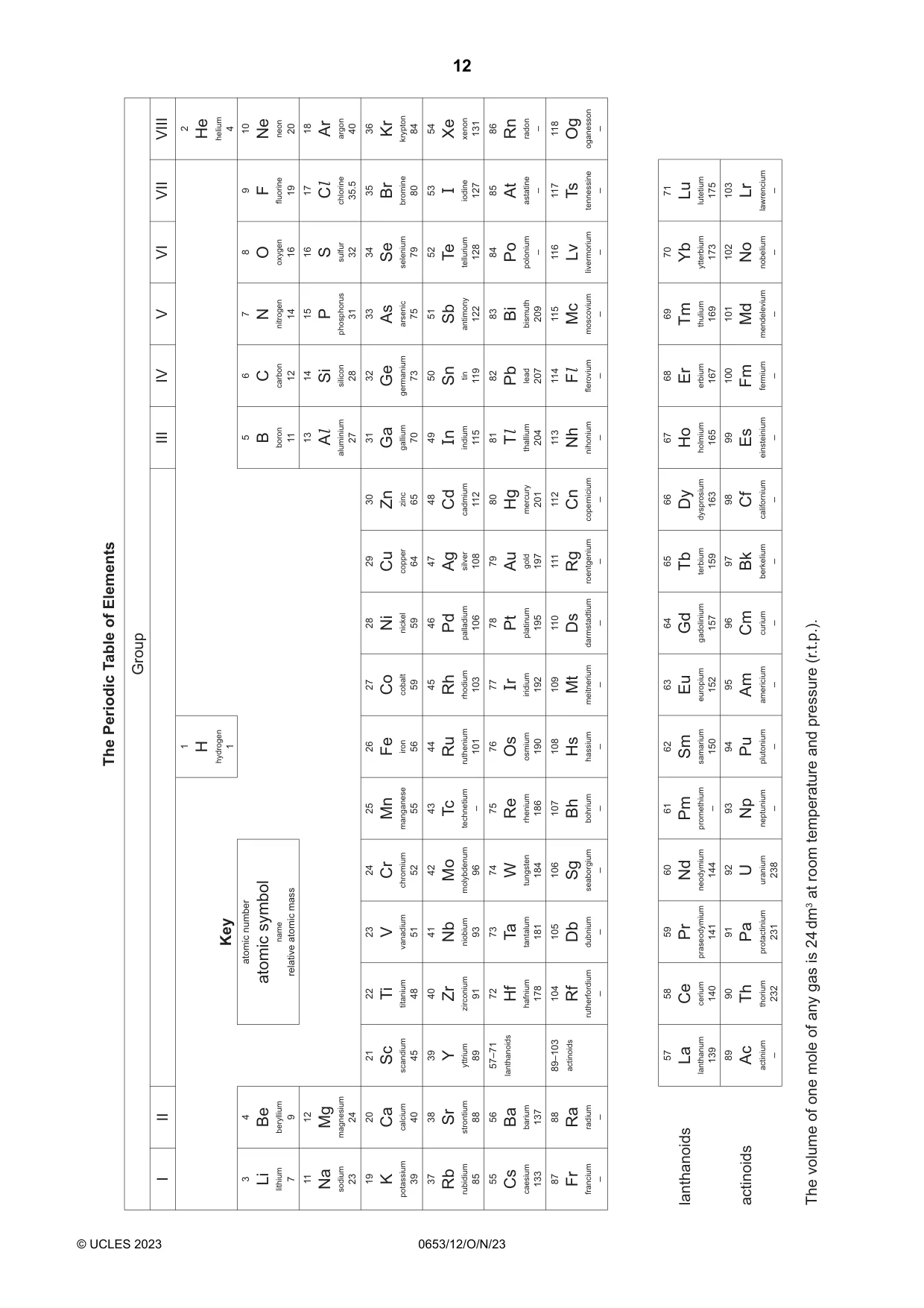
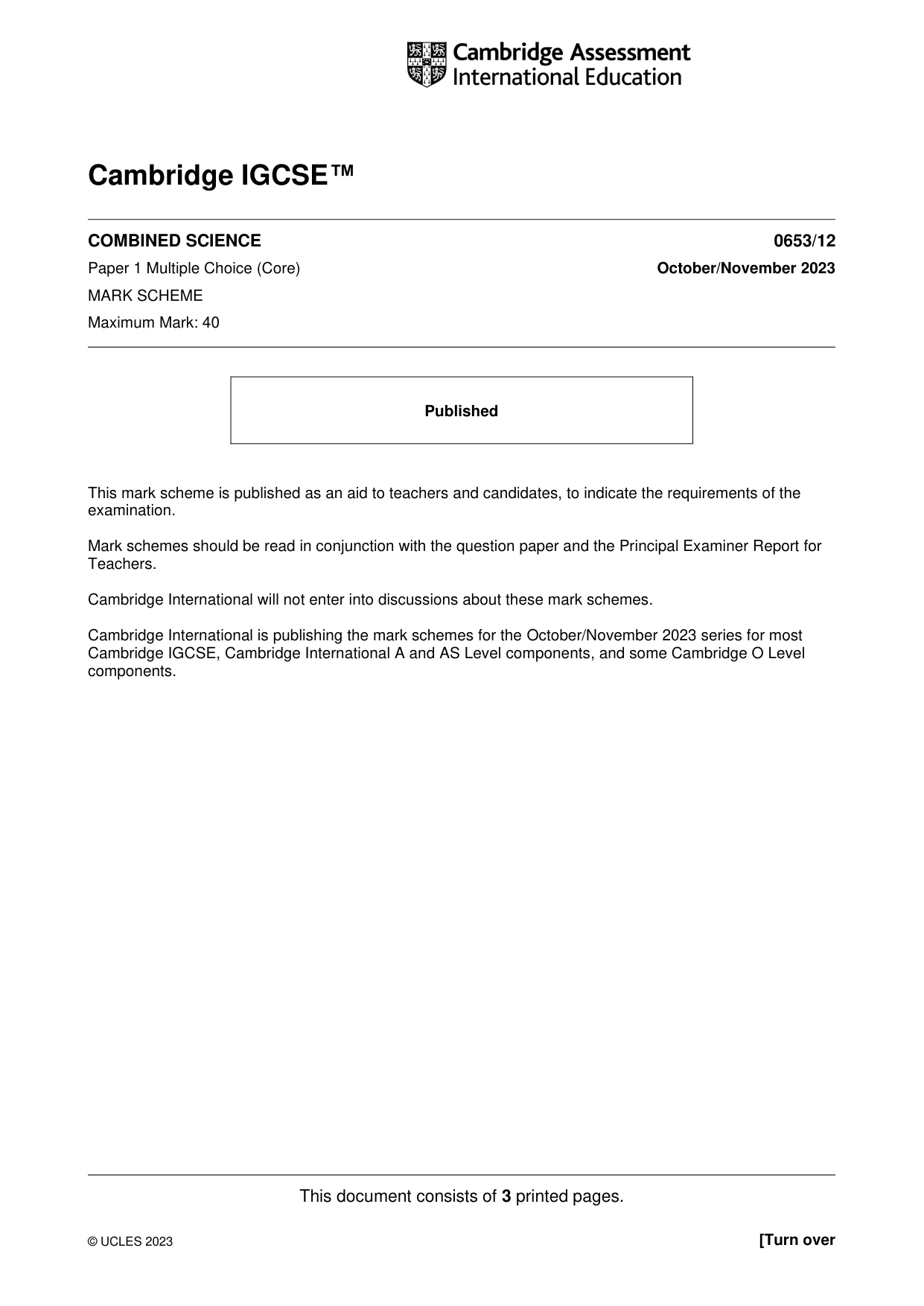
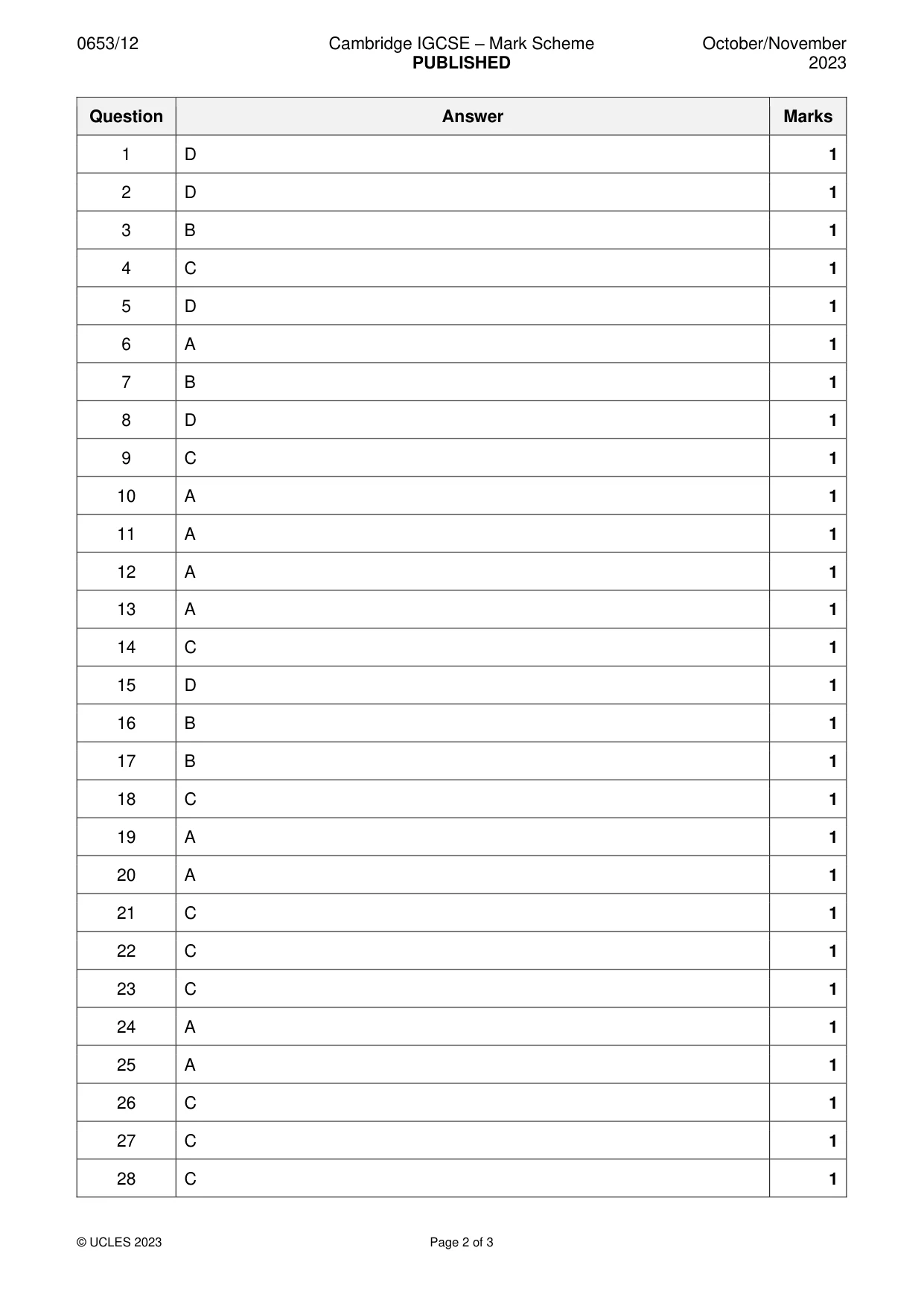
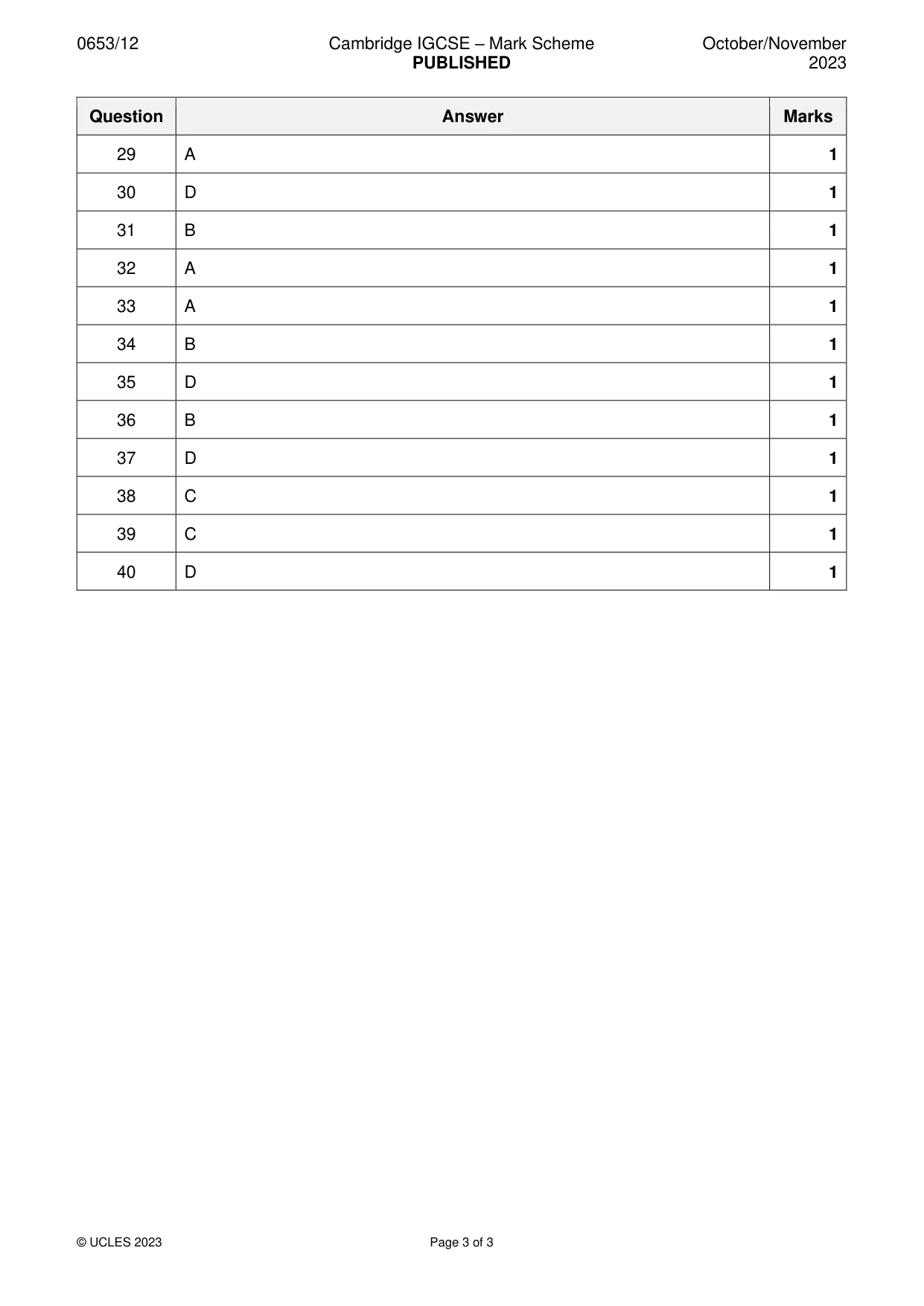
Mark scheme3 pages
Answers below. Sit the paper first if you are practising.
Questions as text
Question 1
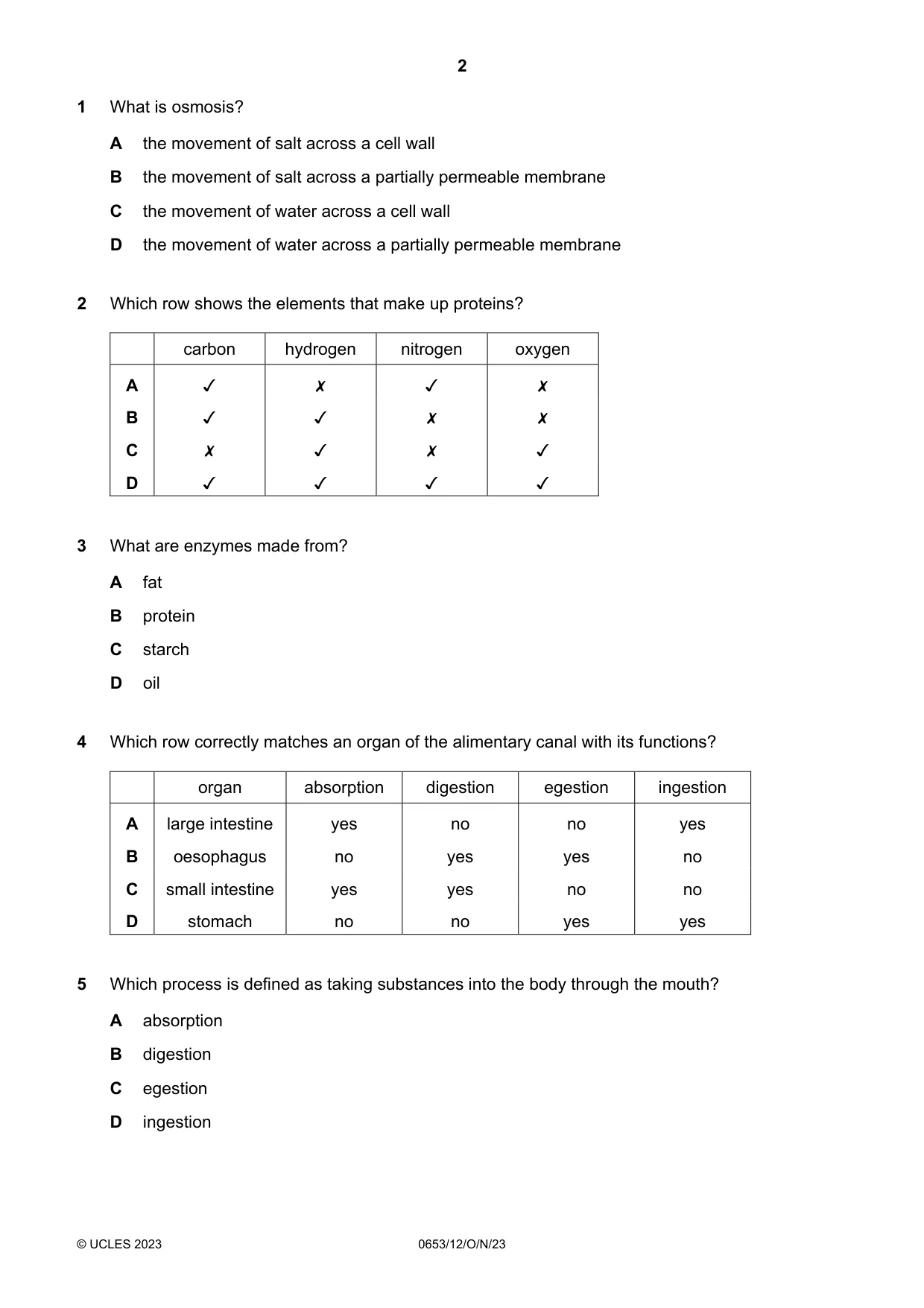
1 What is osmosis? A the movement of salt across a cell wall B the movement of salt across a partially permeable membrane C the movement of water across a cell wall D the movement of water across a partially permeable membrane
Mark scheme: D
Q2 · Which row shows the elements that make up proteins?
2 Which row shows the elements that make up proteins? carbon hydrogen nitrogen oxygen v v x v S44 v x x v
Mark scheme: D
Q3 · What are enzymes made from?
3 What are enzymes made from? A fat B protein C starch D oil
Mark scheme: B
Q4 · Which row correctly matches an organ of the alimentary canal with its functions?
4 Which row correctly matches an organ of the alimentary canal with its functions? organ absorption digestion egestion ingestion A large intestine yes no no yes B oesophagus no yes yes no C small intestine yes yes no no D stomach no no yes yes
Mark scheme: C
Q5 · Which process is defined as taking substances into the body through the mouth?
5 Which process is defined as taking substances into the body through the mouth? A absorption B digestion C egestion D ingestion
Mark scheme: D
Q6 · The apparatus shown can be used to measure the rate of transpiration
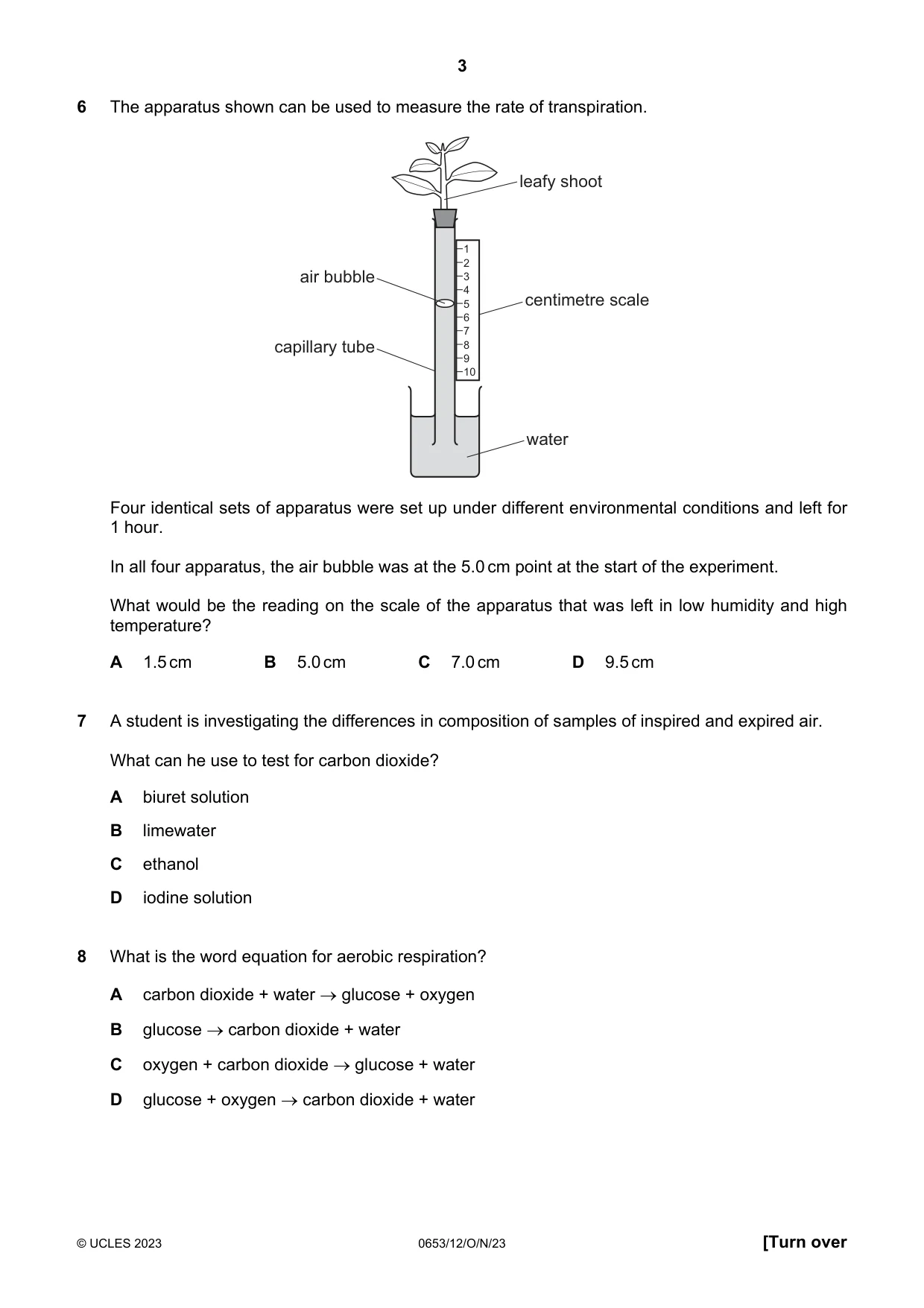
6 The apparatus shown can be used to measure the rate of transpiration. leafy shoot 1 2 air bubble 3 4 centimetre scale 5 6 7 capillary tube 8 9 10 water Four identical sets of apparatus were set up under different environmental conditions and left for 1 hour. In all four apparatus, the air bubble was at the 5.0 cm point at the start of the experiment. What would be the reading on the scale of the apparatus that was left in low humidity and high temperature? A 1.5 cm B 5.0 cm C 7.0 cm D 9.5 cm
Mark scheme: A
Q7 · A student is investigating the differences in composition of samples of inspired and…
7 A student is investigating the differences in composition of samples of inspired and expired air. What can he use to test for carbon dioxide? A biuret solution B limewater C ethanol D iodine solution
Mark scheme: B
Q8 · What is the word equation for aerobic respiration?
8 What is the word equation for aerobic respiration? A carbon dioxide + water glucose + oxygen B glucose carbon dioxide + water C oxygen + carbon dioxide glucose + water D glucose + oxygen carbon dioxide + water
Mark scheme: D
Q9 · Which statement about the growth response of plant roots is correct?
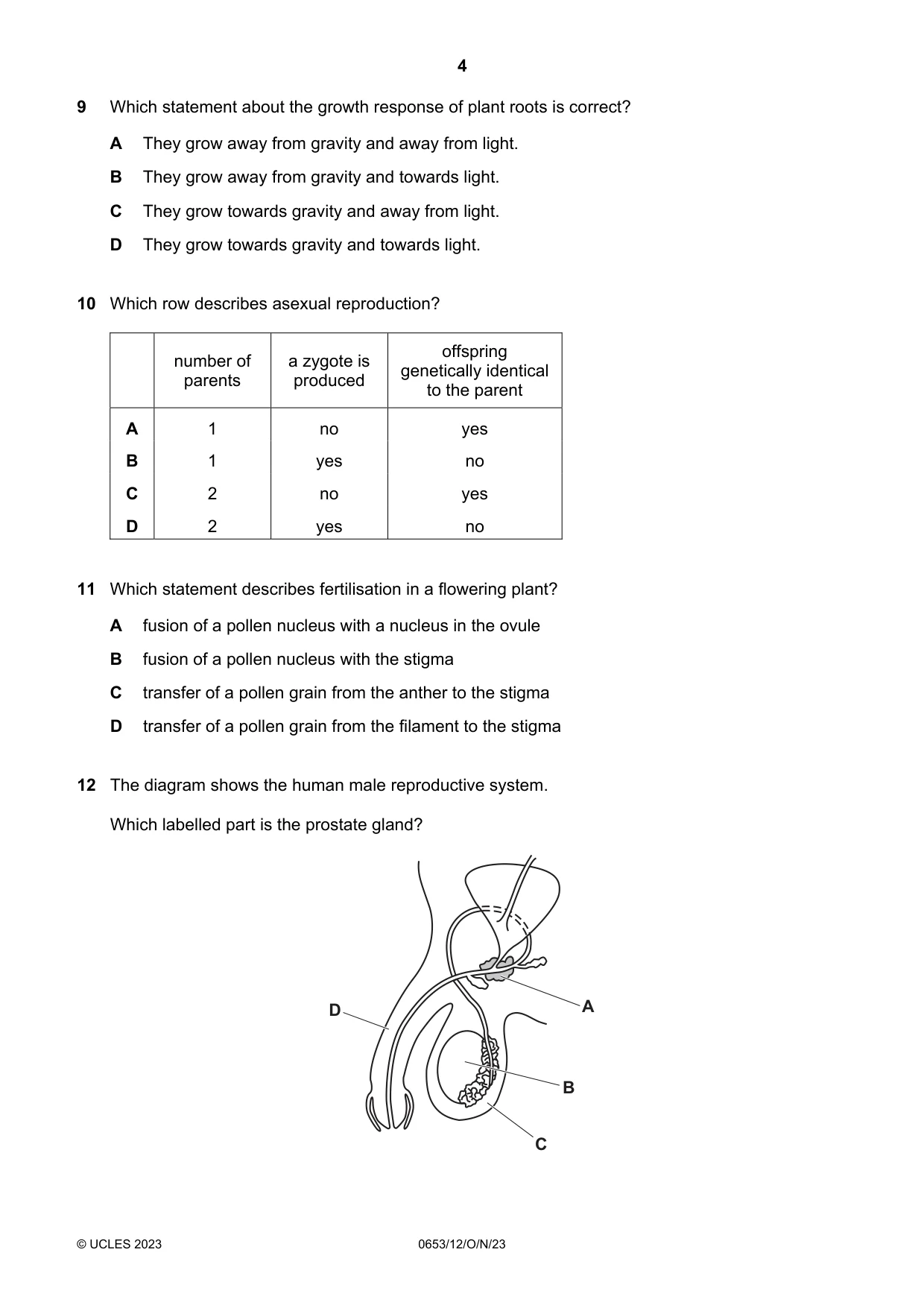
9 Which statement about the growth response of plant roots is correct? A They grow away from gravity and away from light. B They grow away from gravity and towards light. C They grow towards gravity and away from light. D They grow towards gravity and towards light.
Mark scheme: C
Q10 · Which row describes asexual reproduction?
10 Which row describes asexual reproduction? offspring number of a zygote is genetically identical parents produced to the parent A 1 no yes B 1 yes no C 2 no yes D 2 yes no
Mark scheme: A
Q11 · Which statement describes fertilisation in a flowering plant?
11 Which statement describes fertilisation in a flowering plant? A fusion of a pollen nucleus with a nucleus in the ovule B fusion of a pollen nucleus with the stigma C transfer of a pollen grain from the anther to the stigma D transfer of a pollen grain from the filament to the stigma
Mark scheme: A
Q12 · The diagram shows the human male reproductive system
12 The diagram shows the human male reproductive system. Which labelled part is the prostate gland? D A B C
Mark scheme: A
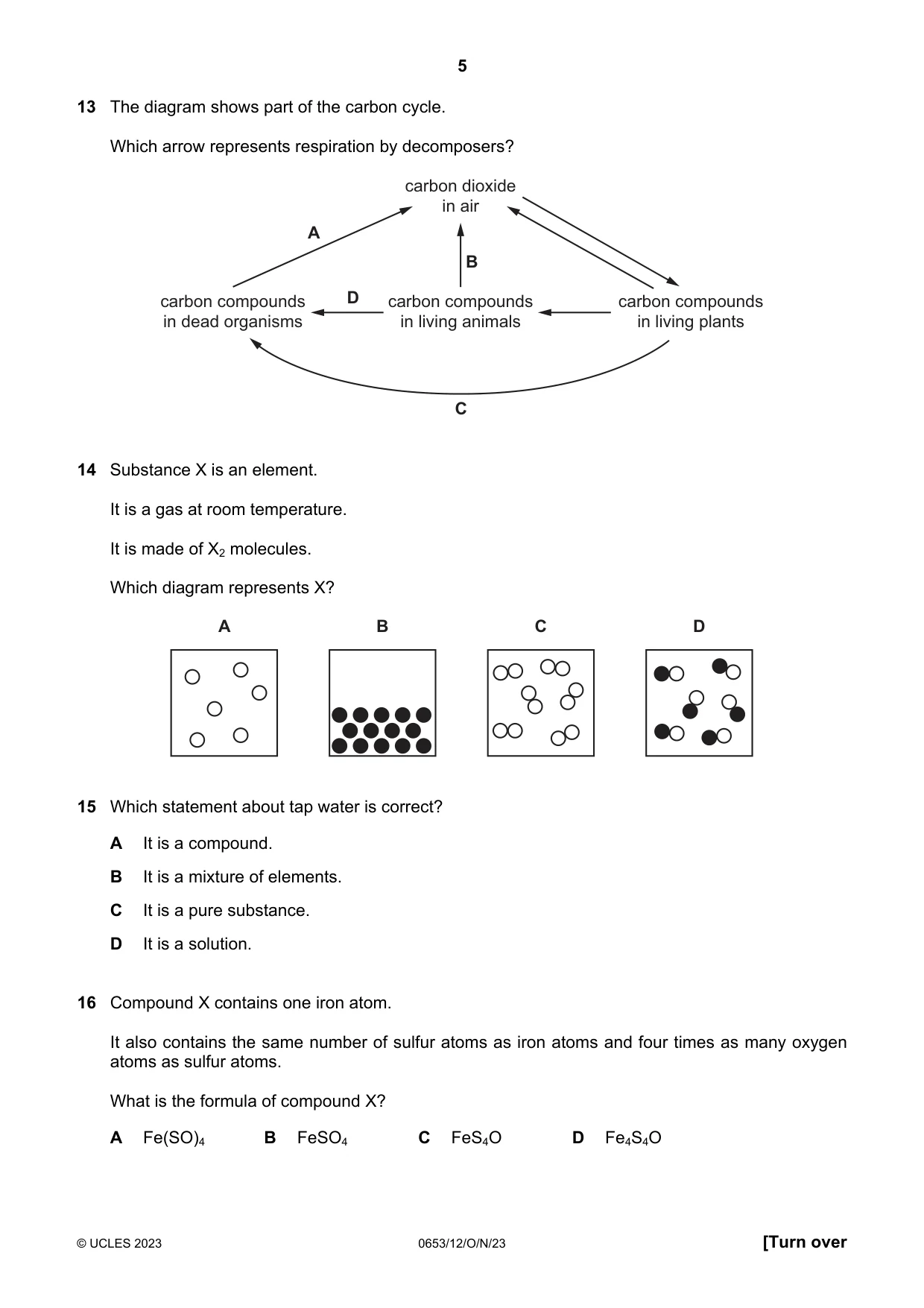
Q13 · The diagram shows part of the carbon cycle
13 The diagram shows part of the carbon cycle. Which arrow represents respiration by decomposers? carbon dioxide in air A B carbon compounds D carbon compounds carbon compounds in dead organisms in living animals in living plants C
Mark scheme: A
Q14 · Substance X is an element
14 Substance X is an element. It is a gas at room temperature. It is made of X2 molecules. Which diagram represents X? A B C D
Mark scheme: C
Q15 · Which statement about tap water is correct?
15 Which statement about tap water is correct? A It is a compound. B It is a mixture of elements. C It is a pure substance. D It is a solution.
Mark scheme: D
Q16 · Compound X contains one iron atom
16 Compound X contains one iron atom. It also contains the same number of sulfur atoms as iron atoms and four times as many oxygen atoms as sulfur atoms. What is the formula of compound X? A Fe(SO)4 B FeSO4 C FeS4O D Fe4S4O
Mark scheme: B
Q17 · When solid sodium carbonate and dilute hydrochloric acid are mixed, a reaction occurs
17 When solid sodium carbonate and dilute hydrochloric acid are mixed, a reaction occurs. During this reaction, carbon dioxide is released and the temperature of the mixture increases. Which chemical terms describe this reaction? 1 exothermic 2 neutralisation 3 thermal decomposition A 1, 2 and 3 B 1 and 2 only C 1 and 3 only D 2 and 3 only
Mark scheme: B
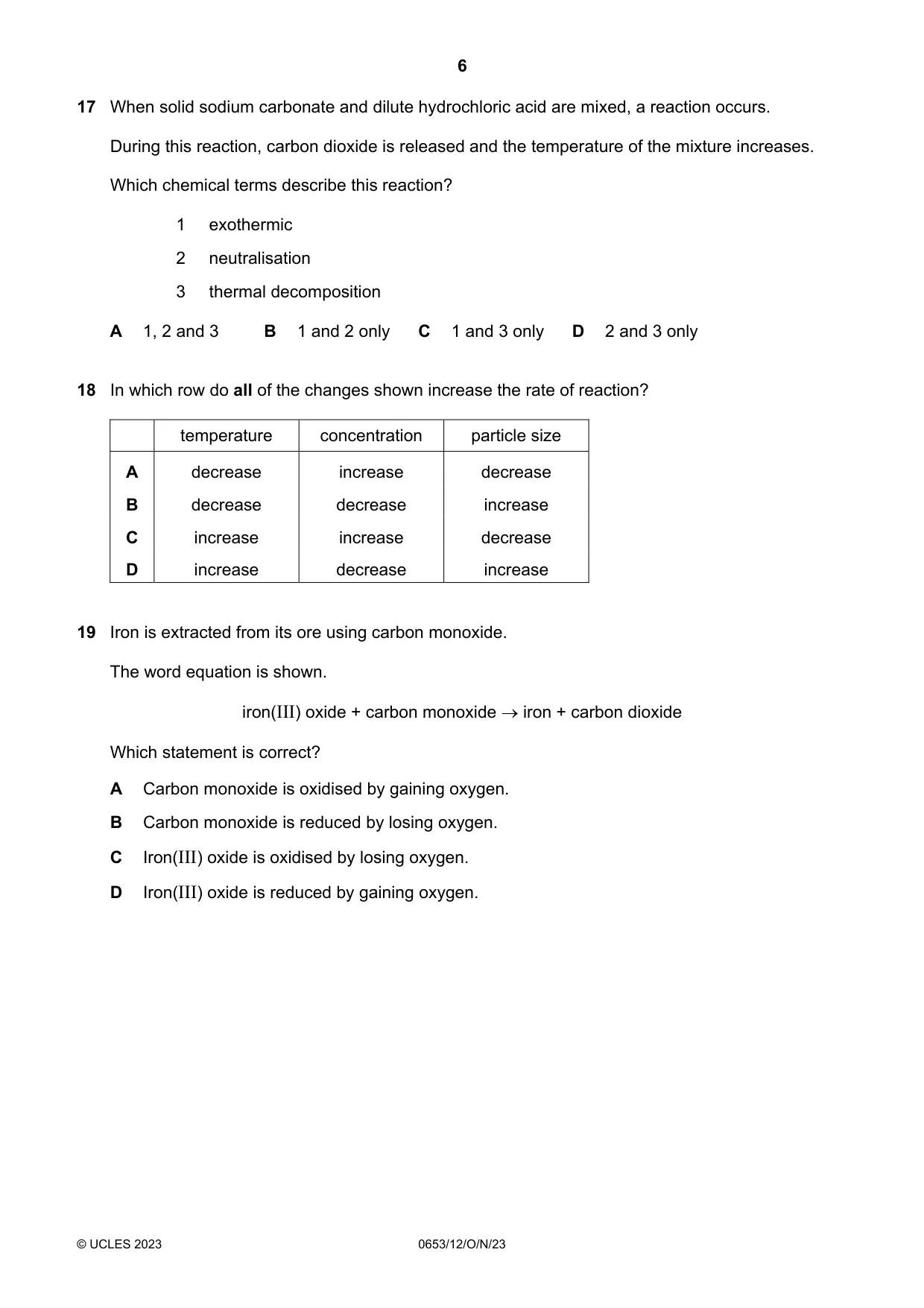
Q18 · In which row do all of the changes shown increase the rate of reaction?
18 In which row do all of the changes shown increase the rate of reaction? temperature concentration particle size A decrease increase decrease B decrease decrease increase C increase increase decrease D increase decrease increase
Mark scheme: C
Q19 · Iron is extracted from its ore using carbon monoxide
19 Iron is extracted from its ore using carbon monoxide. The word equation is shown. iron(III) oxide + carbon monoxide iron + carbon dioxide Which statement is correct? A Carbon monoxide is oxidised by gaining oxygen. B Carbon monoxide is reduced by losing oxygen. C Iron(III) oxide is oxidised by losing oxygen. D Iron(III) oxide is reduced by gaining oxygen.
Mark scheme: A
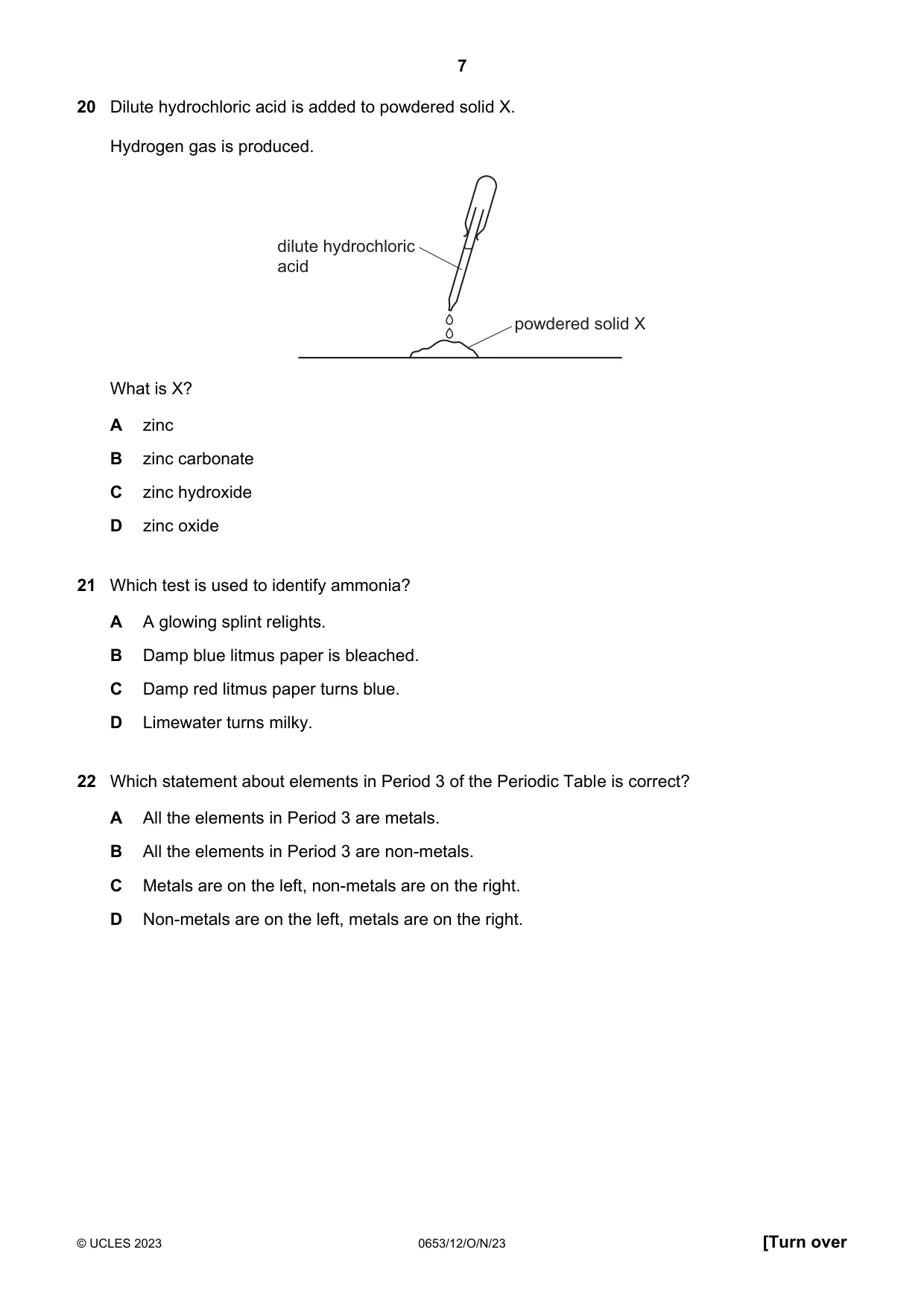
Q20 · Dilute hydrochloric acid is added to powdered solid X
20 Dilute hydrochloric acid is added to powdered solid X. Hydrogen gas is produced. dilute hydrochloric acid powdered solid X What is X? A zinc B zinc carbonate C zinc hydroxide D zinc oxide
Mark scheme: A
More questions on The characteristic properties of acids and bases
Q21 · Which test is used to identify ammonia?
21 Which test is used to identify ammonia? A A glowing splint relights. B Damp blue litmus paper is bleached. C Damp red litmus paper turns blue. D Limewater turns milky.
Mark scheme: C
Q22 · Which statement about elements in Period 3 of the Periodic Table is correct?
22 Which statement about elements in Period 3 of the Periodic Table is correct? A All the elements in Period 3 are metals. B All the elements in Period 3 are non-metals. C Metals are on the left, non-metals are on the right. D Non-metals are on the left, metals are on the right.
Mark scheme: C
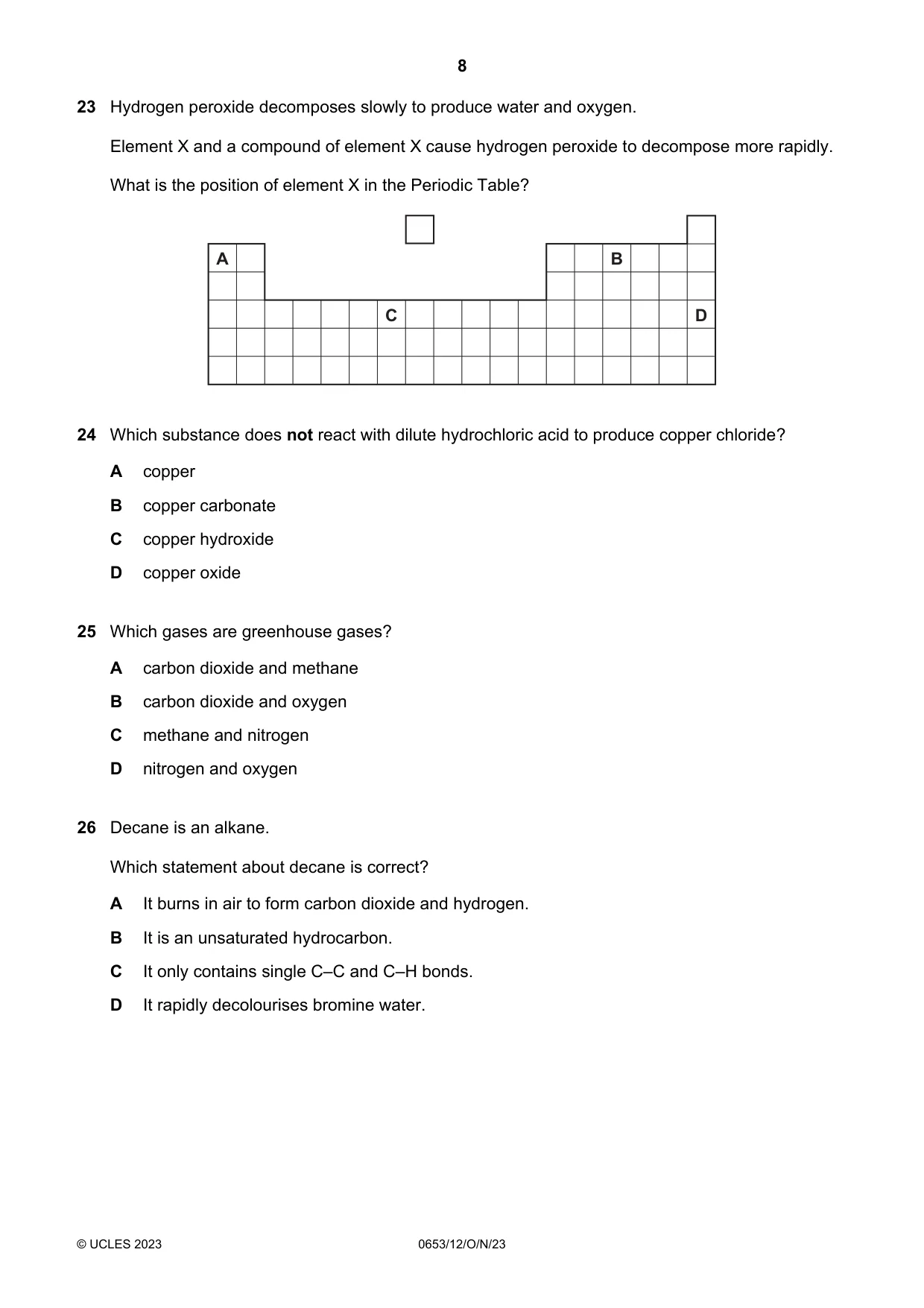
Q23 · Hydrogen peroxide decomposes slowly to produce water and oxygen
23 Hydrogen peroxide decomposes slowly to produce water and oxygen. Element X and a compound of element X cause hydrogen peroxide to decompose more rapidly. What is the position of element X in the Periodic Table? A B C D
Mark scheme: C
Q24 · Which substance does not react with dilute hydrochloric acid to produce copper chloride?
24 Which substance does not react with dilute hydrochloric acid to produce copper chloride? A copper B copper carbonate C copper hydroxide D copper oxide
Mark scheme: A
More questions on The characteristic properties of acids and bases
Q25 · Which gases are greenhouse gases?
25 Which gases are greenhouse gases? A carbon dioxide and methane B carbon dioxide and oxygen C methane and nitrogen D nitrogen and oxygen
Mark scheme: A
Q26 · Decane is an alkane
26 Decane is an alkane. Which statement about decane is correct? A It burns in air to form carbon dioxide and hydrogen. B It is an unsaturated hydrocarbon. C It only contains single C–C and C–H bonds. D It rapidly decolourises bromine water.
Mark scheme: C
Q27 · Which process is used to produce alkenes?
27 Which process is used to produce alkenes? A addition polymerisation B combustion C cracking D fractional distillation
Mark scheme: C
Q28 · An object travels 6.0 km in two minutes
28 An object travels 6.0 km in two minutes. What is its speed? A 0.050 m / s B 3.0 m / s C 50 m / s D 3000 m / s
Mark scheme: C
Q29 · The graph shows how the speed of a moving car varies with time
29 The graph shows how the speed of a moving car varies with time. speed 0 0 time Which statement about the car is correct? A The car is accelerating. B The car is at rest at time = 0. C The car must be travelling in a straight line. D The car travels equal distances in equal times.
Mark scheme: A
Q30 · The gravitational field strength on the planet Mercury is 3.7 N / kg
30 The gravitational field strength on the planet Mercury is 3.7 N / kg. What is the weight of a 10 kg rock on Mercury? A 0.37 N B 3.7 N C 10 N D 37 N
Mark scheme: D
Q31 · A car has an initial kinetic energy of 120 kJ at the bottom of a slope
31 A car has an initial kinetic energy of 120 kJ at the bottom of a slope. The car is driven up the slope. At the top of the slope, the car has 260 kJ of kinetic energy and has gained 570 kJ of gravitational potential energy. What is the total increase in kinetic energy and gravitational potential energy of the car as it moves up the slope? A 430 kJ B 710 kJ C 830 kJ D 950 kJ
Mark scheme: B
Q32 · Which statement about the boiling point of a substance is correct?
32 Which statement about the boiling point of a substance is correct? A At all temperatures above its boiling point, a substance must be a gas. B At all temperatures above its boiling point, a substance must be a liquid. C At all temperatures below its boiling point, a substance must be a gas. D At all temperatures below its boiling point, a substance must be a liquid.
Mark scheme: A
Q33 · A student puts an object made of metal and another object made of plastic in the same…
33 A student puts an object made of metal and another object made of plastic in the same freezer for several days. The student removes the two objects from the freezer. When the student touches the objects, the metal one feels colder than the plastic one. Why is this? A The metal conducts heat quickly away from the hand. B The metal is at a lower temperature than the plastic. C The plastic conducts heat quickly into the hand. D The plastic has a lower melting point than the metal.
Mark scheme: A
Q34 · What is a use of microwaves?
34 What is a use of microwaves? A checking for broken bones B satellite television C tanning lamps D television remote controllers
Mark scheme: B
Q35 · A loudspeaker vibrates at different frequencies
35 A loudspeaker vibrates at different frequencies. Which frequency of vibration does not produce a sound that a human can hear? A 60 Hz B 600 Hz C 6.0 kHz D 60 kHz
Mark scheme: D
Q36 · A potential difference (p.d.) of 6.0 V is applied across a lamp
36 A potential difference (p.d.) of 6.0 V is applied across a lamp. The current in the lamp is 1.5 A. What is the resistance of the lamp? A 0.25 B 4.0 C 4.5 D 9.0
Mark scheme: B
Q37 · A plastic rod is rubbed with a woollen cloth
37 A plastic rod is rubbed with a woollen cloth. The rod becomes negatively charged. What happens to the woollen cloth? A It gains electrons and becomes negatively charged. B It gains electrons and becomes positively charged. C It loses electrons and becomes negatively charged. D It loses electrons and becomes positively charged.
Mark scheme: D
Q38 · A battery is connected to a heater, an ammeter and a voltmeter
38 A battery is connected to a heater, an ammeter and a voltmeter. The ammeter measures the current in the heater. The voltmeter measures the potential difference across the heater. Which diagram shows this circuit? A B C D A A A V V V V A
Mark scheme: C
Q39 · What is the circuit symbol for a component whose only purpose is to protect an electric…
39 What is the circuit symbol for a component whose only purpose is to protect an electric circuit? A B C D
Mark scheme: C
Q40 · Which risk is increased by using electrical equipment in damp conditions rather than in…
40 Which risk is increased by using electrical equipment in damp conditions rather than in dry conditions? A the cable to the equipment overheating B the equipment overheating C the current becoming too low D the person receiving an electric shock
Mark scheme: D
What was in this paper
The subtopics covered by these 40 questions, and how many questions each got. Open one in a new tab to see every Cambridge question on it.
3Digestive system2Electrical quantities2Electrical safety2Elements, compounds and mixtures2Motion2The characteristic properties of acids and bases2Air quality and climate1Alkanes1Alkenes1Arrangement of elements1Biological molecules1Carbon cycle1Electrical circuits1Electromagnetic spectrum1Energy, work and power1Enzymes1Exothermic and endothermic reactions1Formulas1Gas exchange in humans1Identification of ions and gases1Kinetic particle model of matter1Mass and weight1Osmosis1Rate of reaction1Redox1Respiration1Sexual reproduction in humans1Sound1Transfer of thermal energy1Transition elements1Transpiration1What you needed in this session
Cambridge’s own grade thresholds for 2023 Oct/Nov, Paper 1 · Variant 2. A higher threshold means an easier paper — the bar moves with how the cohort did.