Cambridge IGCSE Science - Combined 0653 — 2016 May/June Paper 1 · Variant 1
0653/11/M/J/16 · 40 questions · 40 marks · ≈45 min
The question paper and its mark scheme, free to read here and free to download. This is Cambridge’s own paper, exactly as it was sat.
Question paper16 pages
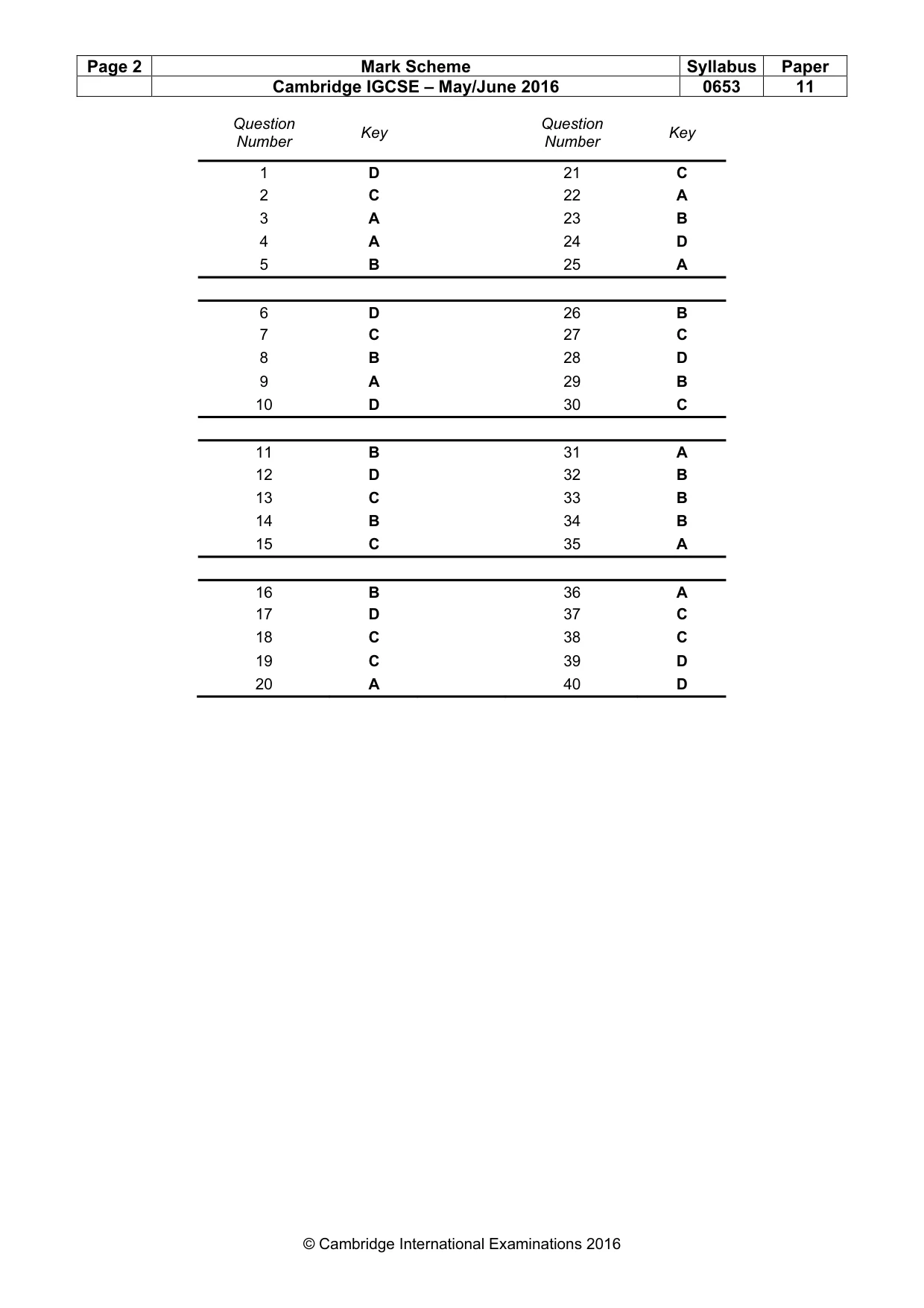
Mark scheme2 pages
Answers below. Sit the paper first if you are practising.
Questions as text
Q1 · What are characteristics of all living organisms?
1 What are characteristics of all living organisms? A breathing, photosynthesis and transpiration B circulation, excretion and nutrition C digestion, growth and movement D respiration, reproduction and sensitivity
Mark scheme: D
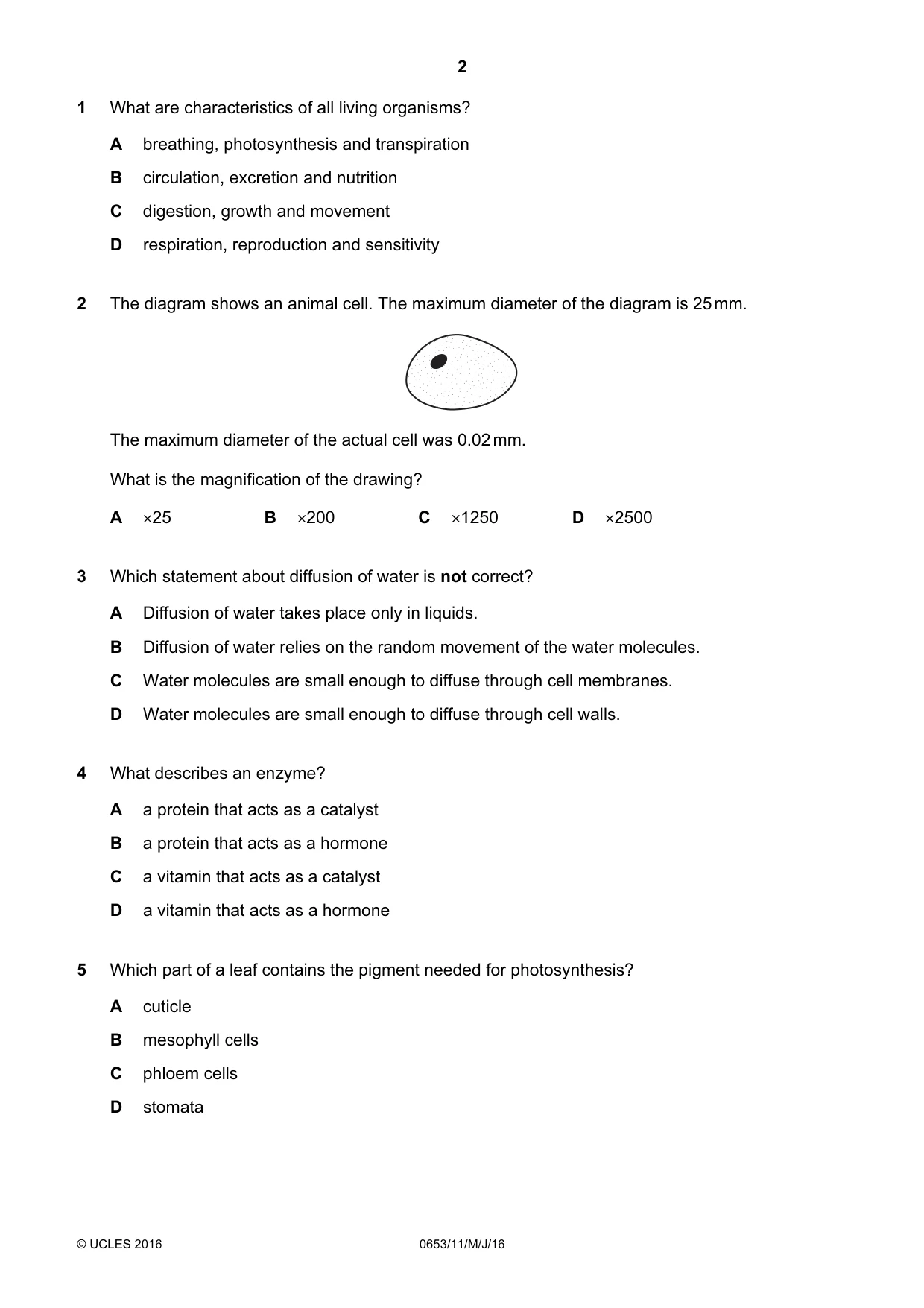
Q2 · The diagram shows an animal cell
2 The diagram shows an animal cell. The maximum diameter of the diagram is 25 mm. The maximum diameter of the actual cell was 0.02 mm. What is the magnification of the drawing? A ×25 B ×200 C ×1250 D ×2500
Mark scheme: C
Q3 · Which statement about diffusion of water is not correct?
3 Which statement about diffusion of water is not correct? A Diffusion of water takes place only in liquids. B Diffusion of water relies on the random movement of the water molecules. C Water molecules are small enough to diffuse through cell membranes. D Water molecules are small enough to diffuse through cell walls.
Mark scheme: A
Q4 · What describes an enzyme?
4 What describes an enzyme? A a protein that acts as a catalyst B a protein that acts as a hormone C a vitamin that acts as a catalyst D a vitamin that acts as a hormone
Mark scheme: A
Q5 · Which part of a leaf contains the pigment needed for photosynthesis?
5 Which part of a leaf contains the pigment needed for photosynthesis? A cuticle B mesophyll cells C phloem cells D stomata
Mark scheme: B
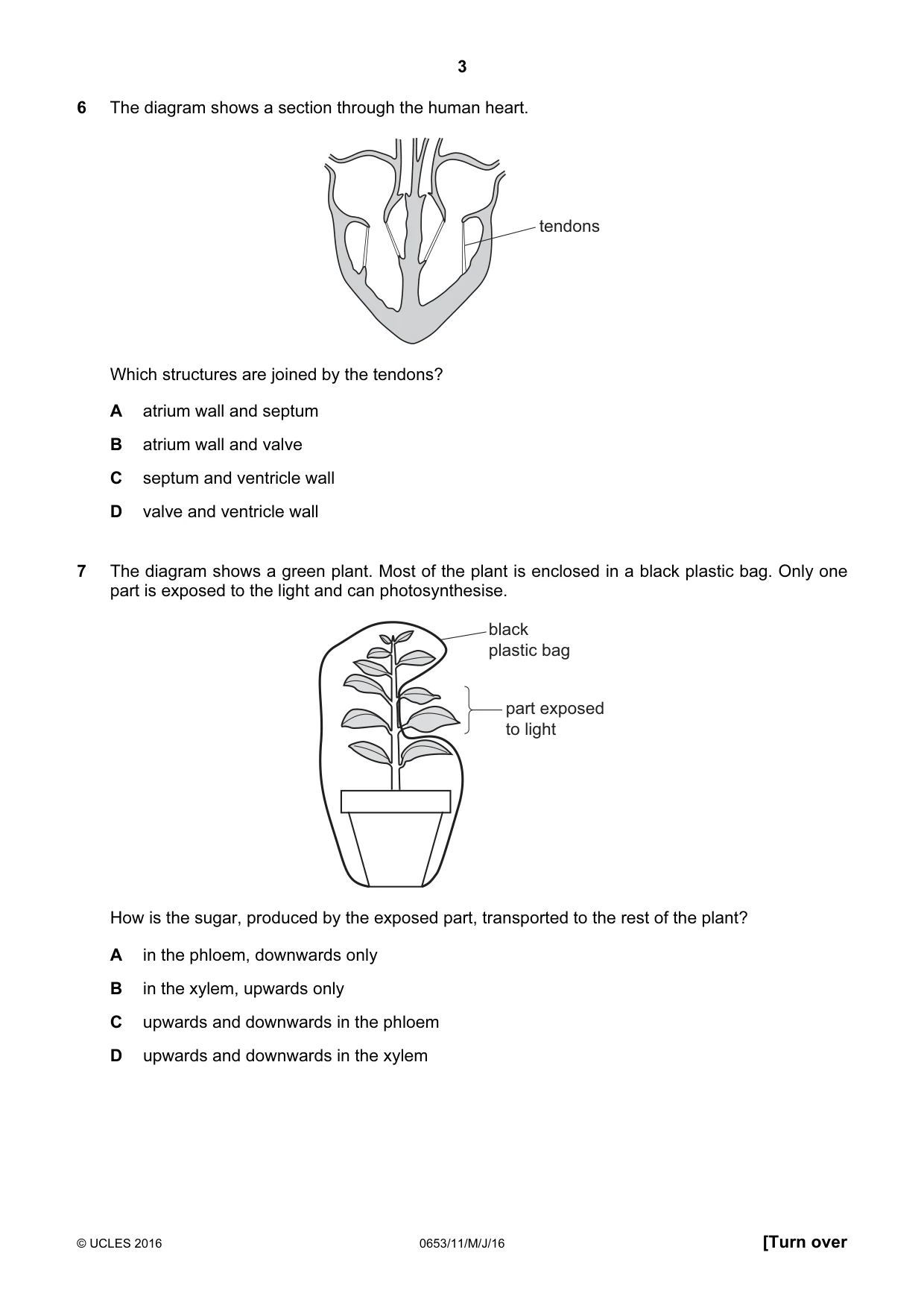
Q6 · The diagram shows a section through the human heart
6 The diagram shows a section through the human heart. tendons Which structures are joined by the tendons? A atrium wall and septum B atrium wall and valve C septum and ventricle wall D valve and ventricle wall
Mark scheme: D
Q7 · The diagram shows a green plant
7 The diagram shows a green plant. Most of the plant is enclosed in a black plastic bag. Only one part is exposed to the light and can photosynthesise. black plastic bag part exposed to light How is the sugar, produced by the exposed part, transported to the rest of the plant? A in the phloem, downwards only B in the xylem, upwards only C upwards and downwards in the phloem D upwards and downwards in the xylem
Mark scheme: C
Q8 · What is the purpose of respiration?
8 What is the purpose of respiration? A to enrich the atmosphere with oxygen B to release energy for the organism C to supply water for the organism D to take oxygen into the lungs
Mark scheme: B
Q9 · Where does most of the oxygen enter the blood?
9 Where does most of the oxygen enter the blood? A an alveolus B a bronchiole C a bronchus D the trachea
Mark scheme: A
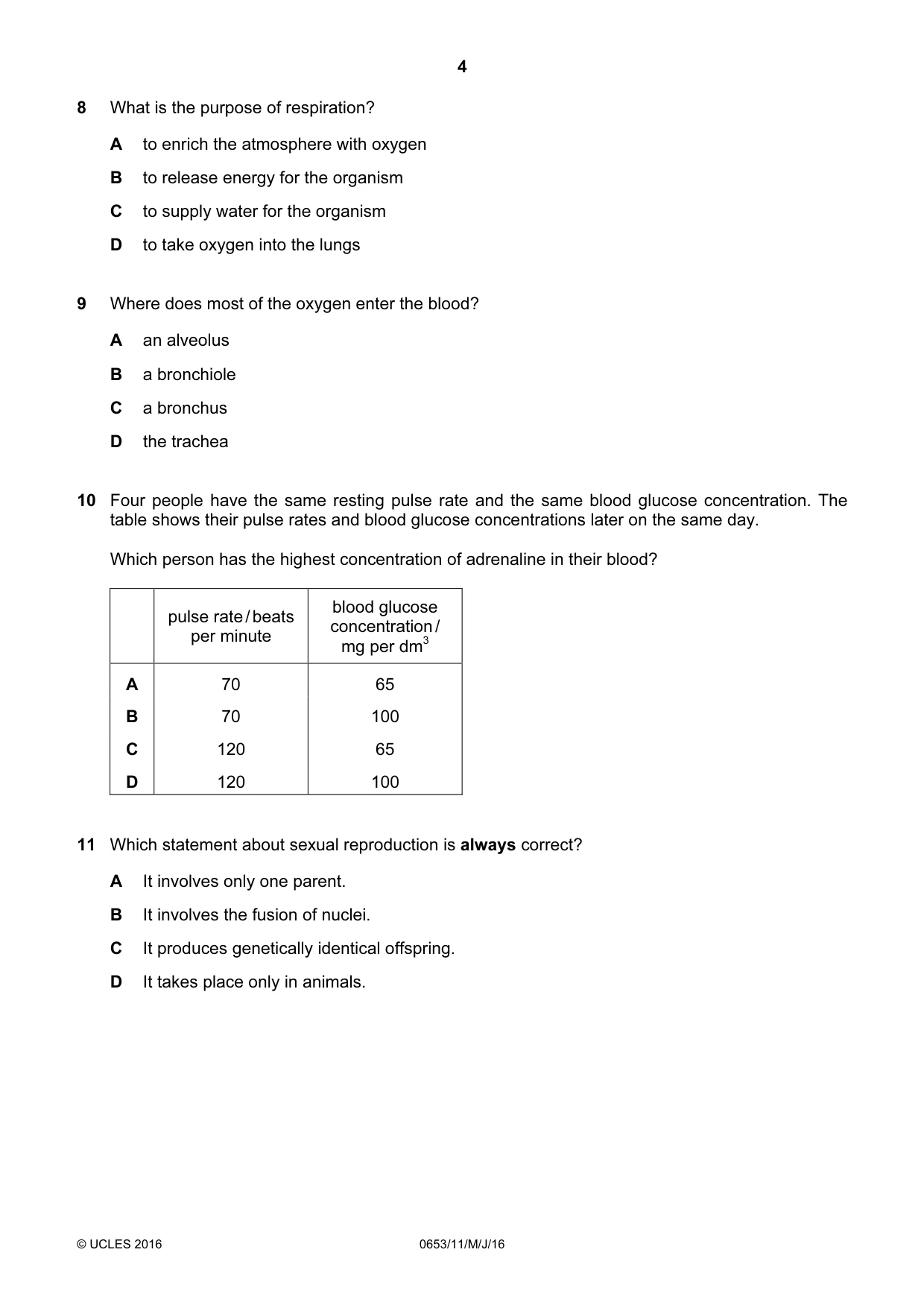
Q10 · Four people have the same resting pulse rate and the same blood glucose concentration
10 Four people have the same resting pulse rate and the same blood glucose concentration. The table shows their pulse rates and blood glucose concentrations later on the same day. Which person has the highest concentration of adrenaline in their blood? blood glucose pulse rate / beats concentration / per minute mg per dm3 A 70 65 B 70 100 C 120 65 D 120 100
Mark scheme: D
Q11 · Which statement about sexual reproduction is always correct?
11 Which statement about sexual reproduction is always correct? A It involves only one parent. B It involves the fusion of nuclei. C It produces genetically identical offspring. D It takes place only in animals.
Mark scheme: B
Q12 · A woman with a regular 28 day menstrual cycle has a blocked right oviduct
12 A woman with a regular 28 day menstrual cycle has a blocked right oviduct. An egg is released from the right ovary. When is the next time that sexual intercourse is most likely to result in fertilisation? A immediately B one week later C 5 days after the beginning of the next menstruation D 14 days after the beginning of the next menstruation
Mark scheme: D
Q13 · The diagram represents a food chain found in the sea
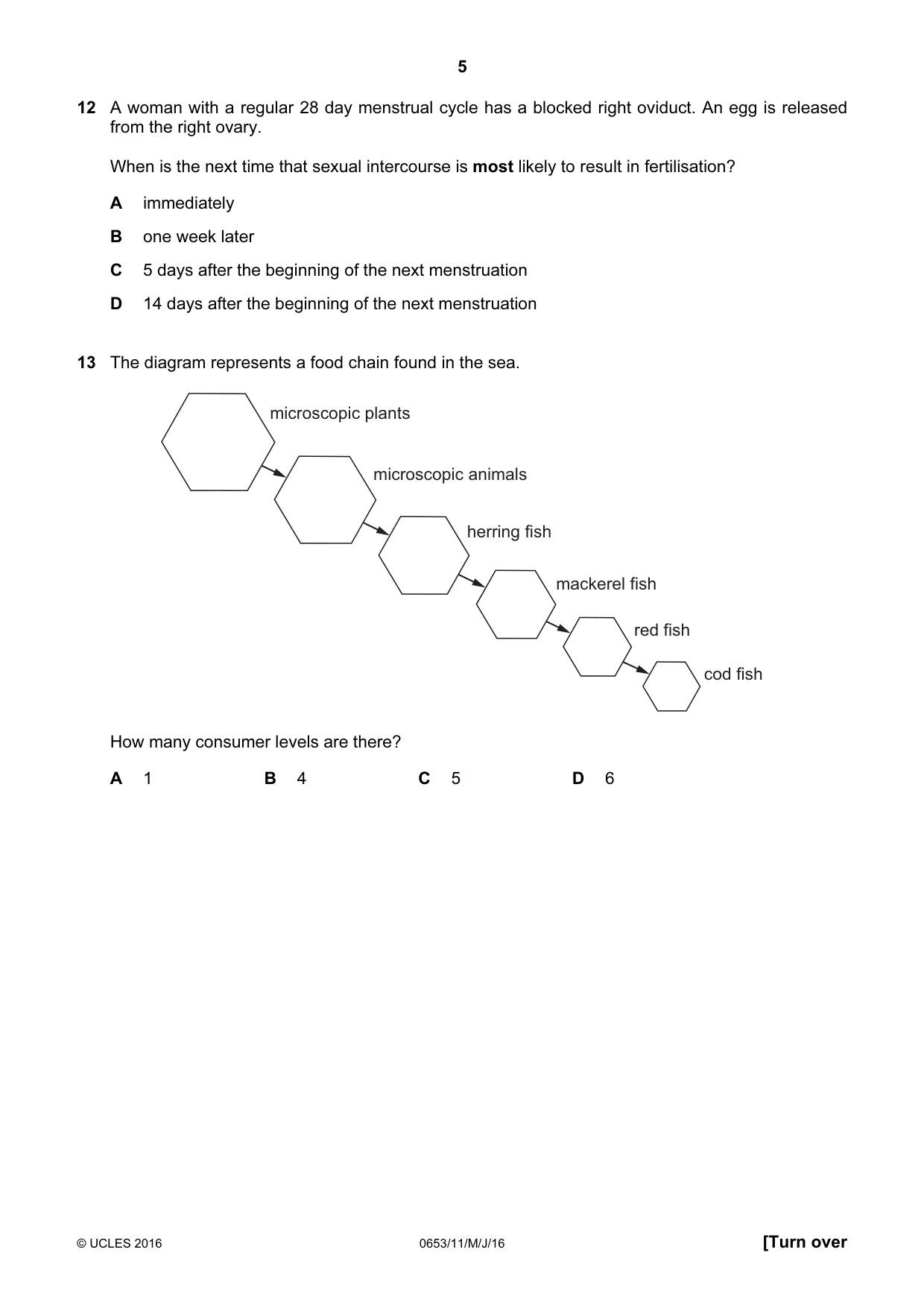
13 The diagram represents a food chain found in the sea. microscopic plants microscopic animals herring fish mackerel fish red fish cod fish How many consumer levels are there? A 1 B 4 C 5 D 6
Mark scheme: C
Q14 · The apparatus used to remove sand from a mixture of salt and sand is shown
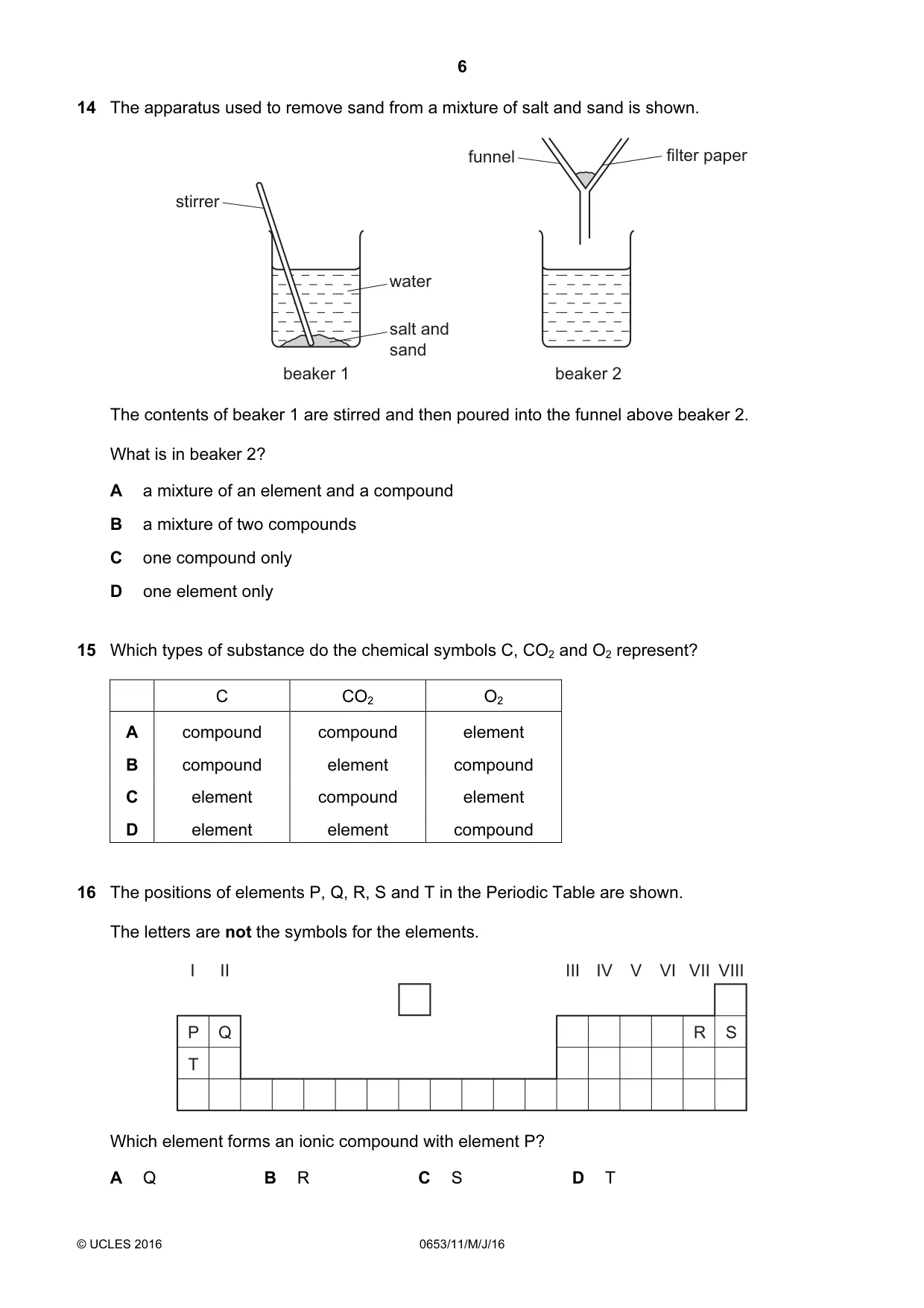
14 The apparatus used to remove sand from a mixture of salt and sand is shown. funnel filter paper stirrer water salt and sand beaker 1 beaker 2 The contents of beaker 1 are stirred and then poured into the funnel above beaker 2. What is in beaker 2? A a mixture of an element and a compound B a mixture of two compounds C one compound only D one element only
Mark scheme: B
Q15 · Which types of substance do the chemical symbols C, CO2 and O2 represent?
15 Which types of substance do the chemical symbols C, CO2 and O2 represent? C CO2 O2 A compound compound element B compound element compound C element compound element D element element compound
Mark scheme: C
Q16 · The positions of elements P, Q, R, S and T in the Periodic Table are shown
16 The positions of elements P, Q, R, S and T in the Periodic Table are shown. The letters are not the symbols for the elements. I II III IV V VI VII VIII P Q R S T Which element forms an ionic compound with element P? A Q B R C S D T
Mark scheme: B
Q17 · The diagram shows the apparatus used for the electrolysis of lead(II) bromide using inert…
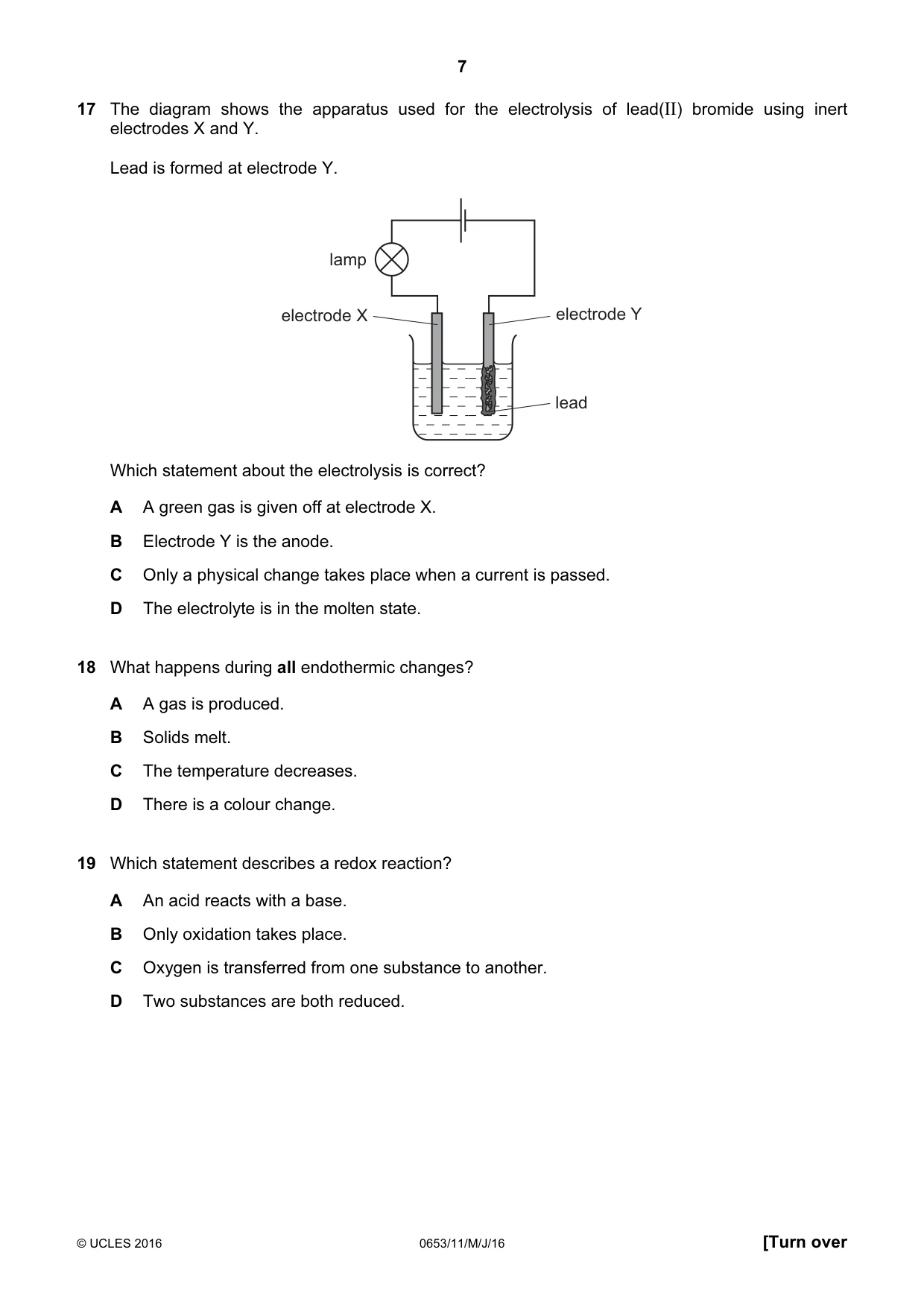
17 The diagram shows the apparatus used for the electrolysis of lead(II) bromide using inert electrodes X and Y. Lead is formed at electrode Y. lamp electrode X electrode Y lead Which statement about the electrolysis is correct? A A green gas is given off at electrode X. B Electrode Y is the anode. C Only a physical change takes place when a current is passed. D The electrolyte is in the molten state.
Mark scheme: D
Q18 · What happens during all endothermic changes?
18 What happens during all endothermic changes? A A gas is produced. B Solids melt. C The temperature decreases. D There is a colour change.
Mark scheme: C
Q19 · Which statement describes a redox reaction?
19 Which statement describes a redox reaction? A An acid reacts with a base. B Only oxidation takes place. C Oxygen is transferred from one substance to another. D Two substances are both reduced.
Mark scheme: C
Q20 · Dilute hydrochloric acid is added to solid X
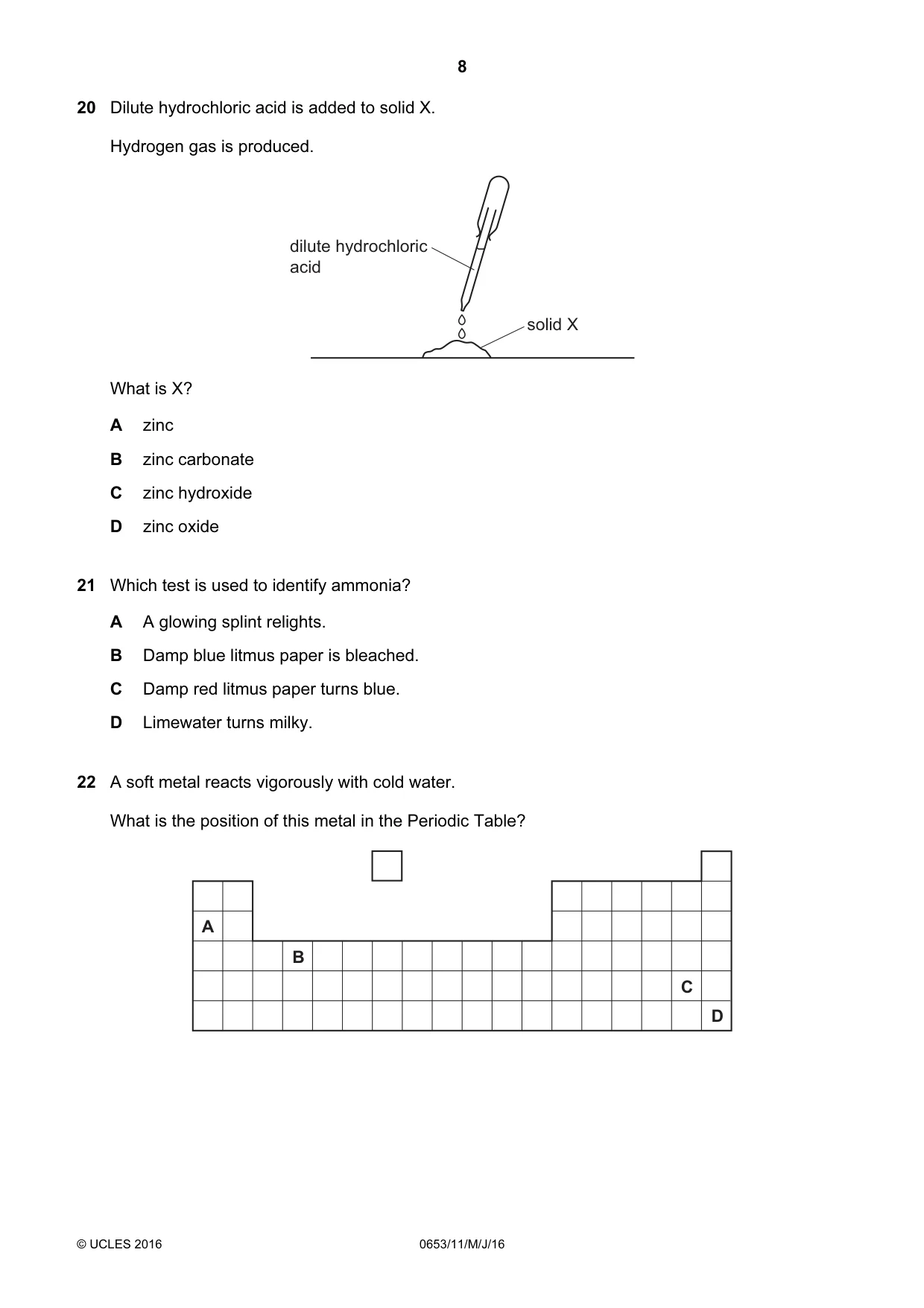
20 Dilute hydrochloric acid is added to solid X. Hydrogen gas is produced. dilute hydrochloric acid solid X What is X? A zinc B zinc carbonate C zinc hydroxide D zinc oxide
Mark scheme: A
More questions on The characteristic properties of acids and bases
Q21 · Which test is used to identify ammonia?
21 Which test is used to identify ammonia? A A glowing splint relights. B Damp blue litmus paper is bleached. C Damp red litmus paper turns blue. D Limewater turns milky.
Mark scheme: C
Q22 · A soft metal reacts vigorously with cold water
22 A soft metal reacts vigorously with cold water. What is the position of this metal in the Periodic Table? A B C D
Mark scheme: A
Q23 · Which statement describes a transition element?
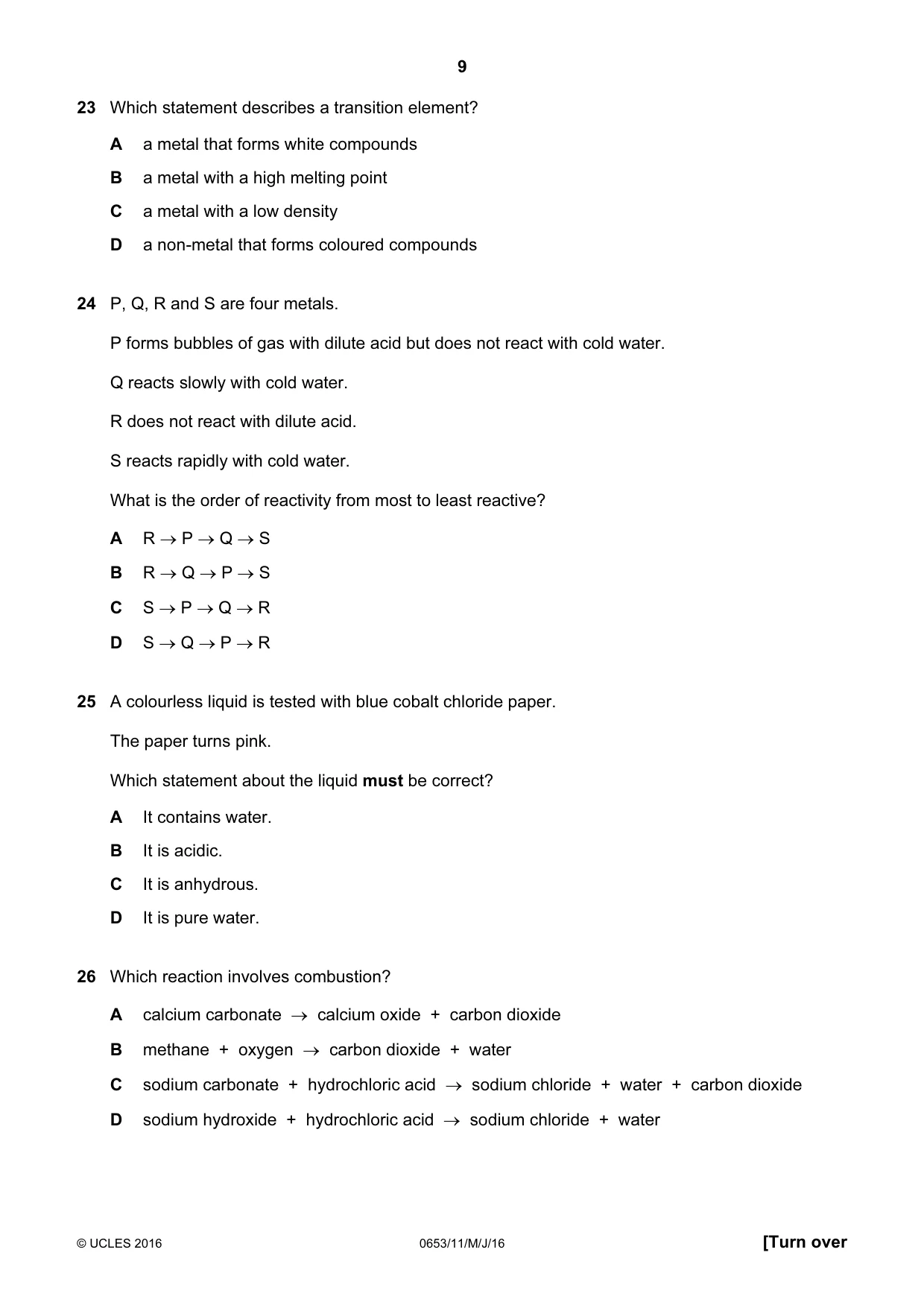
23 Which statement describes a transition element? A a metal that forms white compounds B a metal with a high melting point C a metal with a low density D a non-metal that forms coloured compounds
Mark scheme: B
Q24 · P, Q, R and S are four metals
24 P, Q, R and S are four metals. P forms bubbles of gas with dilute acid but does not react with cold water. Q reacts slowly with cold water. R does not react with dilute acid. S reacts rapidly with cold water. What is the order of reactivity from most to least reactive? A R → P → Q → S B R → Q → P → S C S → P → Q → R D S → Q → P → R
Mark scheme: D
Q25 · A colourless liquid is tested with blue cobalt chloride paper
25 A colourless liquid is tested with blue cobalt chloride paper. The paper turns pink. Which statement about the liquid must be correct? A It contains water. B It is acidic. C It is anhydrous. D It is pure water.
Mark scheme: A
Q26 · Which reaction involves combustion?
26 Which reaction involves combustion? A calcium carbonate → calcium oxide + carbon dioxide B methane + oxygen → carbon dioxide + water C sodium carbonate + hydrochloric acid → sodium chloride + water + carbon dioxide D sodium hydroxide + hydrochloric acid → sodium chloride + water
Mark scheme: B
Q27 · What is the name of the type of compound containing only carbon and hydrogen?
27 What is the name of the type of compound containing only carbon and hydrogen? A carbohydrate B carbonate C hydrocarbon D hydroxide
Mark scheme: C
Q28 · A train takes passengers from a railway station to an airport
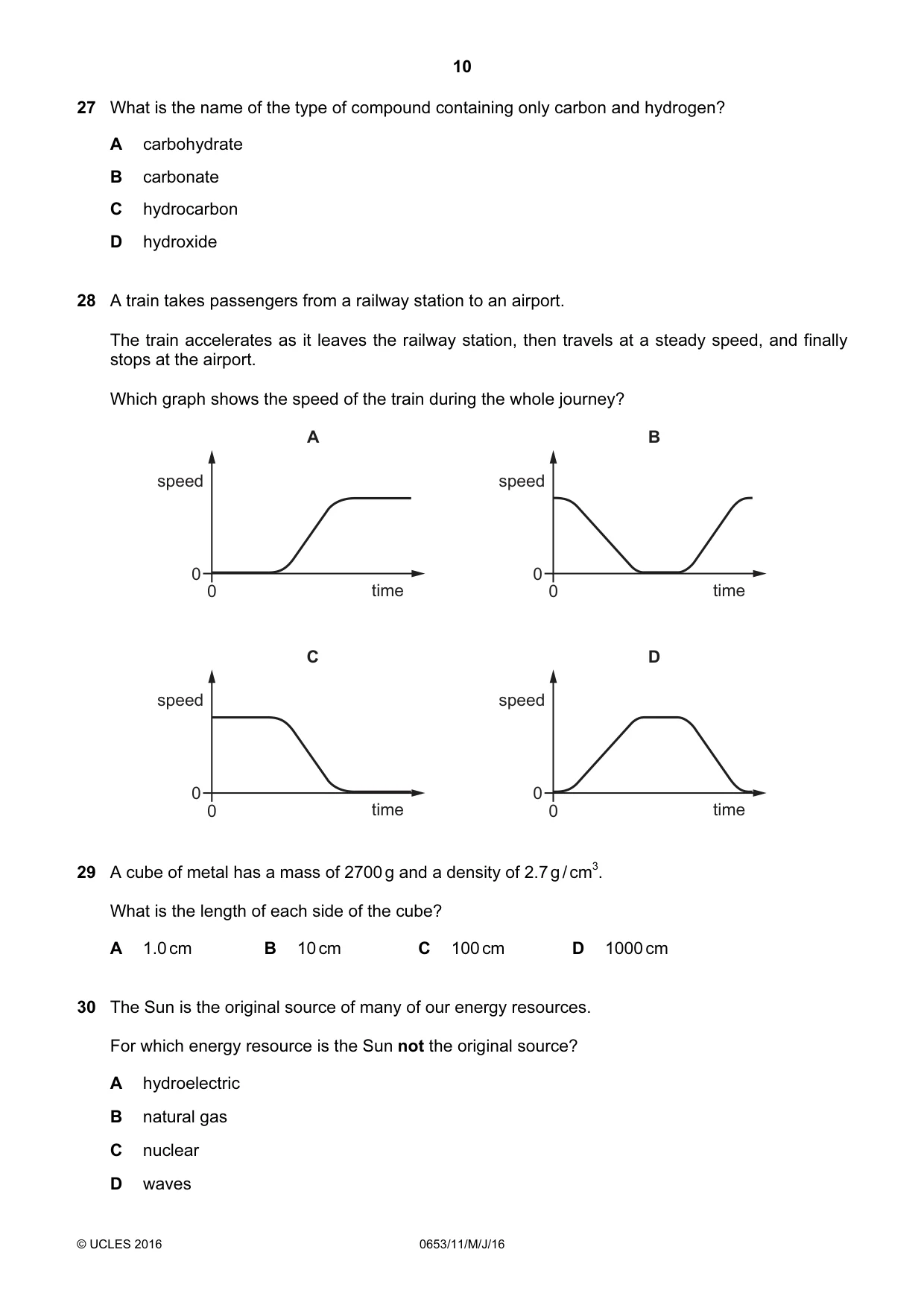
28 A train takes passengers from a railway station to an airport. The train accelerates as it leaves the railway station, then travels at a steady speed, and finally stops at the airport. Which graph shows the speed of the train during the whole journey? A B speed speed 0 0 0 time 0 time C D speed speed 0 0 0 time 0 time
Mark scheme: D
Q29 · A cube of metal has a mass of 2700 g and a density of 2.7 g / cm3
29 A cube of metal has a mass of 2700 g and a density of 2.7 g / cm3. What is the length of each side of the cube? A 1.0 cm B 10 cm C 100 cm D 1000 cm
Mark scheme: B
Q30 · The Sun is the original source of many of our energy resources
30 The Sun is the original source of many of our energy resources. For which energy resource is the Sun not the original source? A hydroelectric B natural gas C nuclear D waves
Mark scheme: C
Q31 · When a liquid evaporates, molecules escape from its surface and the temperature of the…
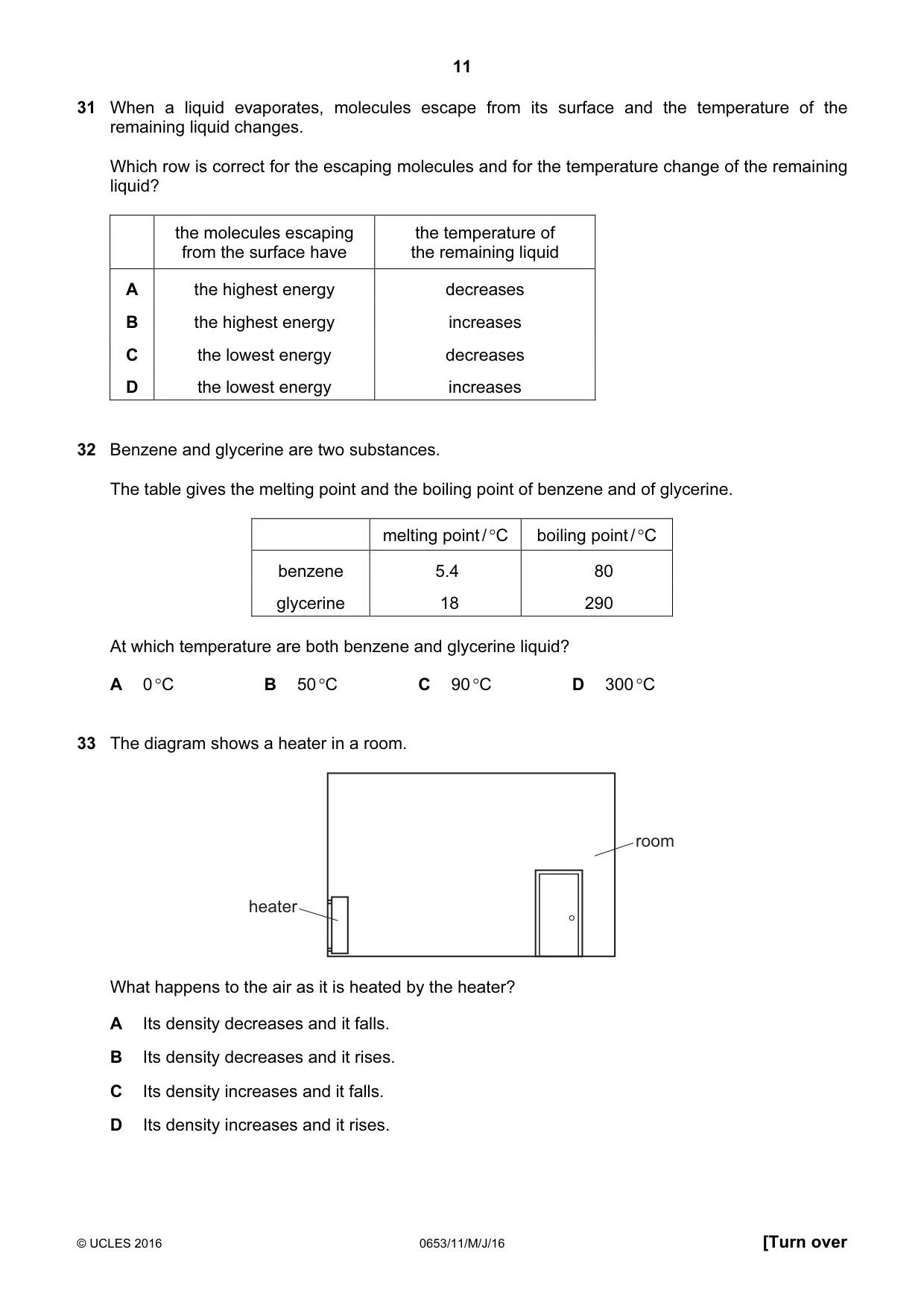
31 When a liquid evaporates, molecules escape from its surface and the temperature of the remaining liquid changes. Which row is correct for the escaping molecules and for the temperature change of the remaining liquid? the molecules escaping the temperature of from the surface have the remaining liquid A the highest energy decreases B the highest energy increases C the lowest energy decreases D the lowest energy increases
Mark scheme: A
Q32 · Benzene and glycerine are two substances
32 Benzene and glycerine are two substances. The table gives the melting point and the boiling point of benzene and of glycerine. melting point / °C boiling point / °C benzene 5.4 80 glycerine 18 290 At which temperature are both benzene and glycerine liquid? A 0 °C B 50 °C C 90 °C D 300 °C
Mark scheme: B
Q33 · The diagram shows a heater in a room
33 The diagram shows a heater in a room. room heater What happens to the air as it is heated by the heater? A Its density decreases and it falls. B Its density decreases and it rises. C Its density increases and it falls. D Its density increases and it rises.
Mark scheme: B
Q34 · A student vibrates the end of a horizontal rope and sends a wave along the rope
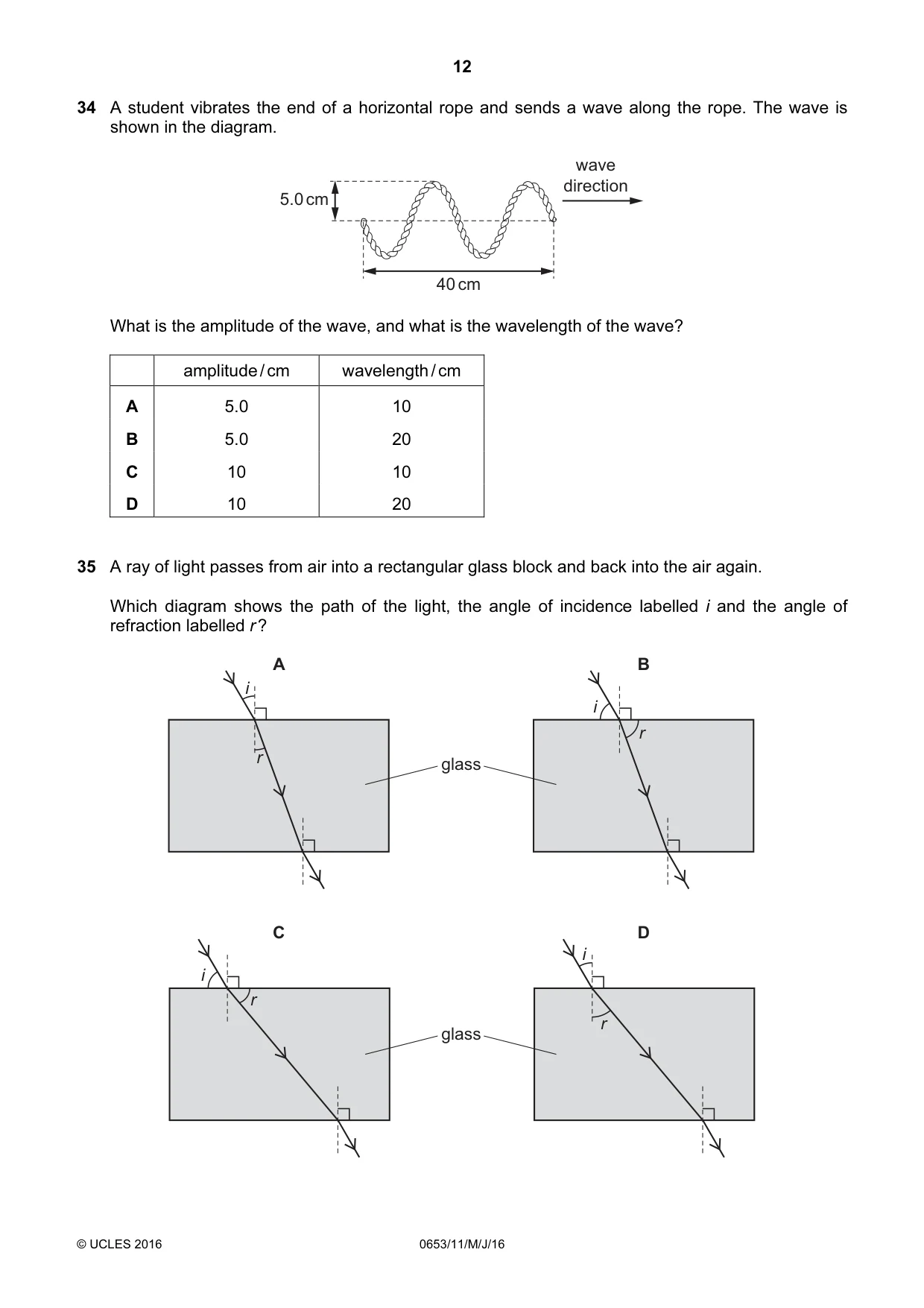
34 A student vibrates the end of a horizontal rope and sends a wave along the rope. The wave is shown in the diagram. wave direction 5.0 cm 40 cm What is the amplitude of the wave, and what is the wavelength of the wave? amplitude / cm wavelength / cm A 5.0 10 B 5.0 20 C 10 10 D 10 20
Mark scheme: B
Q35 · A ray of light passes from air into a rectangular glass block and back into the air again
35 A ray of light passes from air into a rectangular glass block and back into the air again. Which diagram shows the path of the light, the angle of incidence labelled i and the angle of refraction labelled r ? A B i i r r glass C D i i r r glass
Mark scheme: A
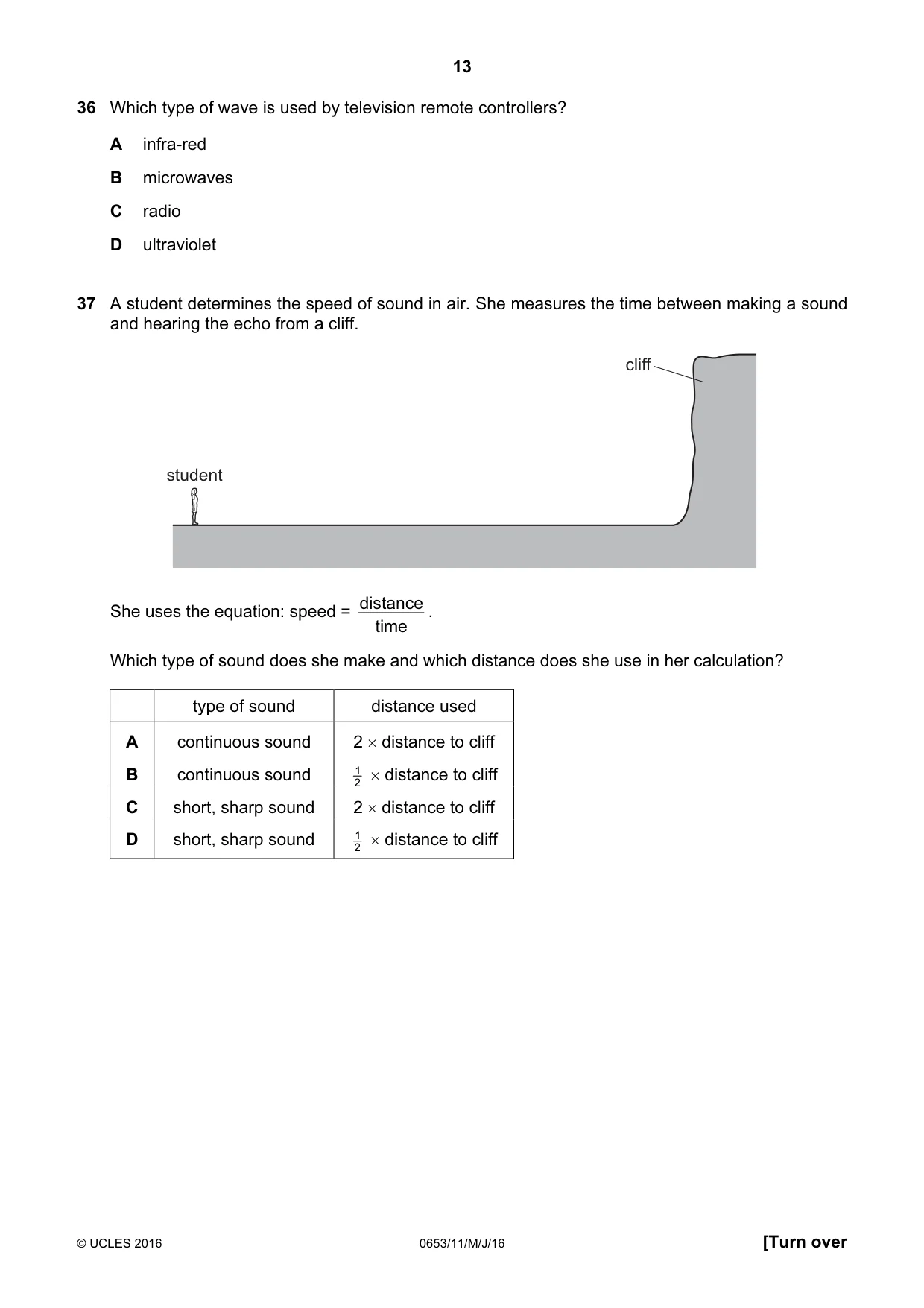
Q36 · Which type of wave is used by television remote controllers?
36 Which type of wave is used by television remote controllers? A infra-red B microwaves C radio D ultraviolet
Mark scheme: A
Q37 · A student determines the speed of sound in air
37 A student determines the speed of sound in air. She measures the time between making a sound and hearing the echo from a cliff. cliff student distance . She uses the equation: speed = time Which type of sound does she make and which distance does she use in her calculation? type of sound distance used A continuous sound 2 × distance to cliff B continuous sound 1 × distance to cliff 2 C short, sharp sound 2 × distance to cliff D short, sharp sound 1 × distance to cliff 2
Mark scheme: C
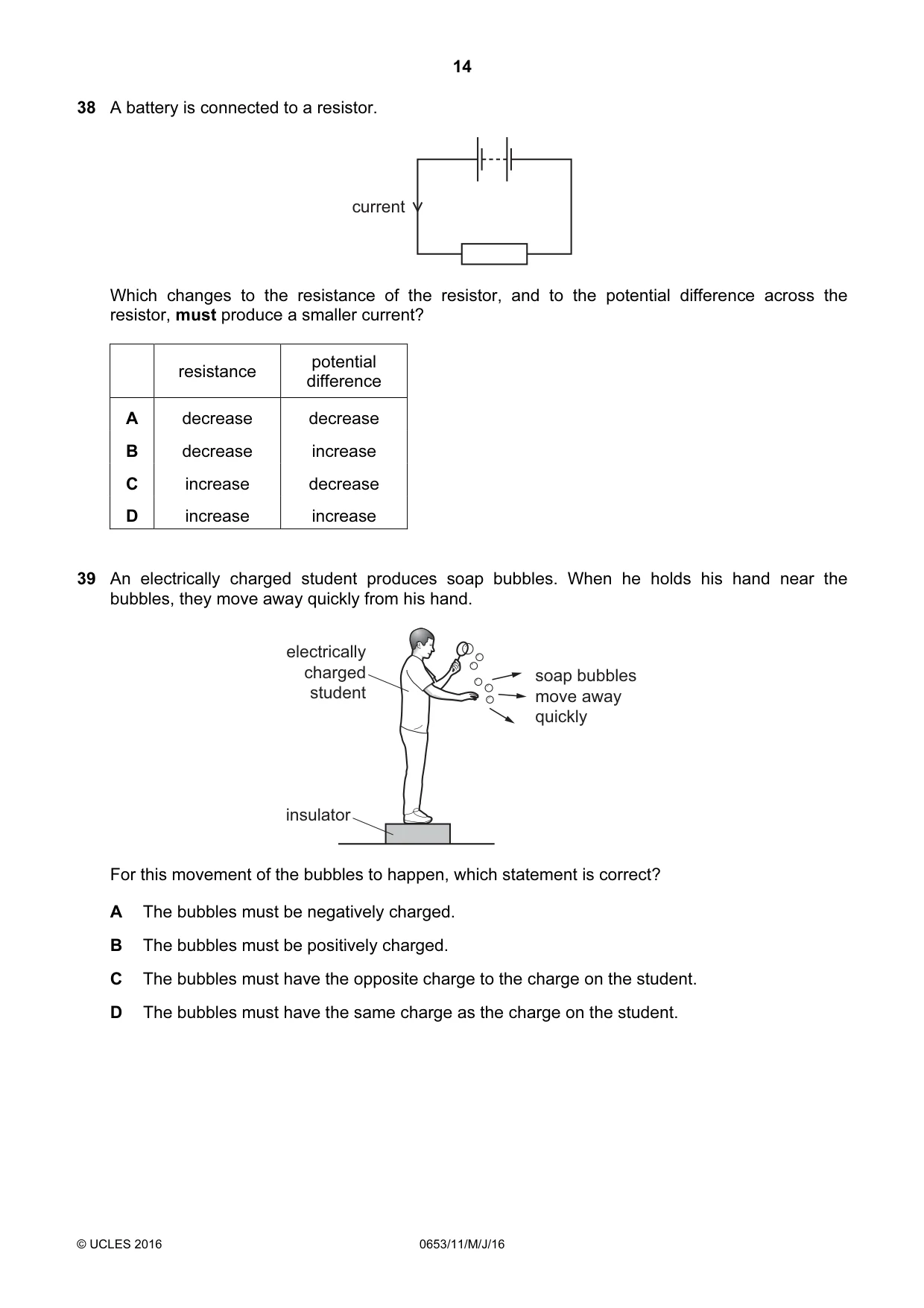
Q38 · A battery is connected to a resistor
38 A battery is connected to a resistor. current Which changes to the resistance of the resistor, and to the potential difference across the resistor, must produce a smaller current? potential resistance difference A decrease decrease B decrease increase C increase decrease D increase increase
Mark scheme: C
Q39 · An electrically charged student produces soap bubbles
39 An electrically charged student produces soap bubbles. When he holds his hand near the bubbles, they move away quickly from his hand. electrically charged soap bubbles student move away quickly insulator For this movement of the bubbles to happen, which statement is correct? A The bubbles must be negatively charged. B The bubbles must be positively charged. C The bubbles must have the opposite charge to the charge on the student. D The bubbles must have the same charge as the charge on the student.
Mark scheme: D
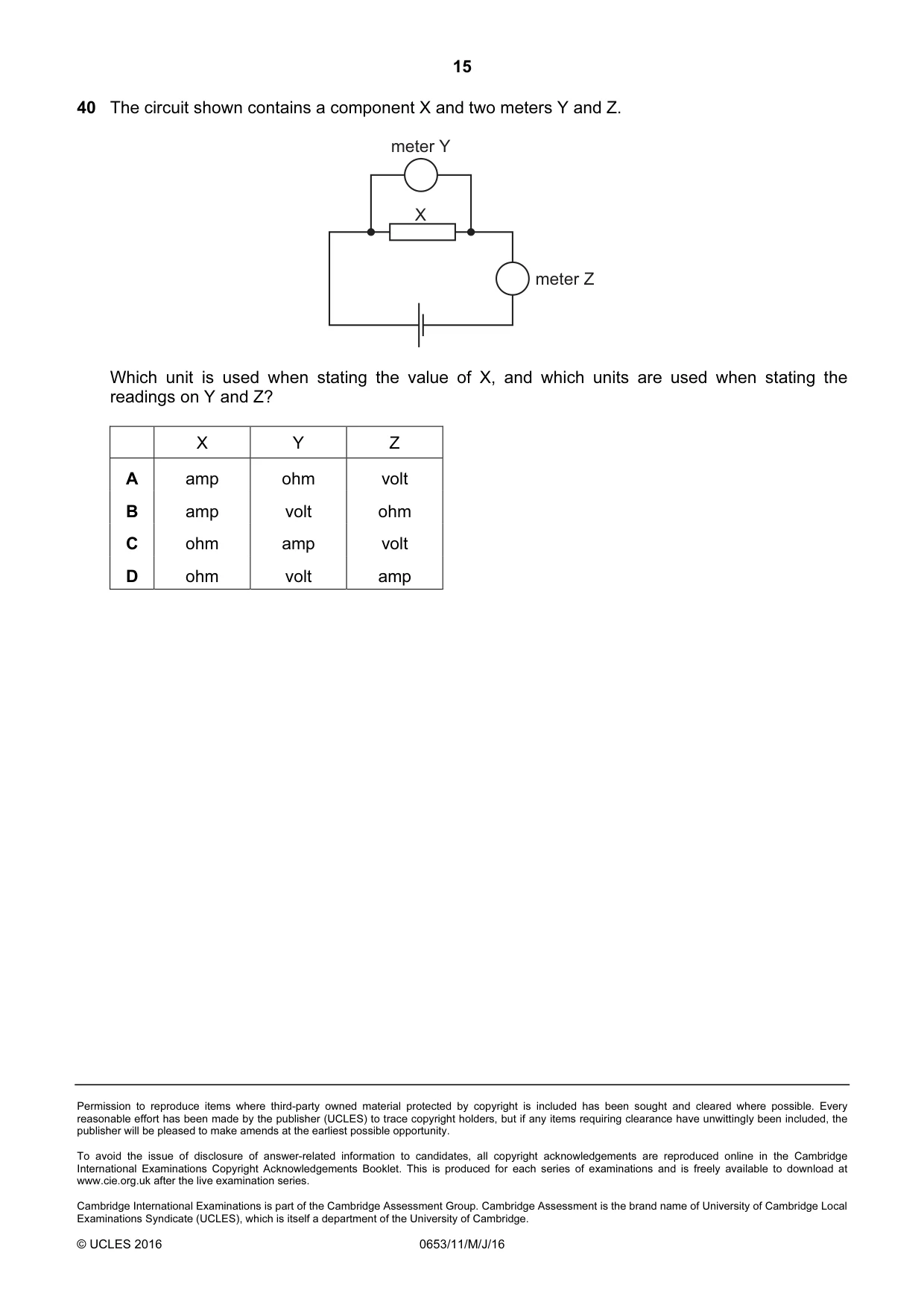
Q40 · The circuit shown contains a component X and two meters Y and Z
40 The circuit shown contains a component X and two meters Y and Z. meter Y X meter Z Which unit is used when stating the value of X, and which units are used when stating the readings on Y and Z? X Y Z A amp ohm volt B amp volt ohm C ohm amp volt D ohm volt amp
Mark scheme: D
What was in this paper
The subtopics covered by these 40 questions, and how many questions each got. Open one in a new tab to see every Cambridge question on it.
2Identification of ions and gases2Characteristics of living organisms1Density1Diffusion1Drugs1Electrical quantities1Electrolysis1Electromagnetic spectrum1Elements, compounds and mixtures1Energy, work and power1Enzymes1Exothermic and endothermic reactions1Food chains and food webs1Fuels1Gas exchange in humans1General properties of waves1Group I properties1Heart1Ions and ionic bonds1Kinetic particle model of matter1Leaf structure1Light1Motion1Reactivity series1Redox1Respiration1Separation and purification1Sexual reproduction in humans1Sexual reproduction in plants1Size of specimens1Sound1Terminology1The characteristic properties of acids and bases1Thermal properties and temperature1Transfer of thermal energy1Transition elements1Xylem and phloem1What you needed in this session
Cambridge’s own grade thresholds for 2016 May/June, Paper 1 · Variant 1. A higher threshold means an easier paper — the bar moves with how the cohort did.