Cambridge IGCSE Science - Combined 0653 — 2015 Oct/Nov Paper 1 · Variant 1
0653/11/O/N/15 · 40 questions · 40 marks · ≈45 min
The question paper and its mark scheme, free to read here and free to download. This is Cambridge’s own paper, exactly as it was sat.
Question paper16 pages
Mark scheme2 pages
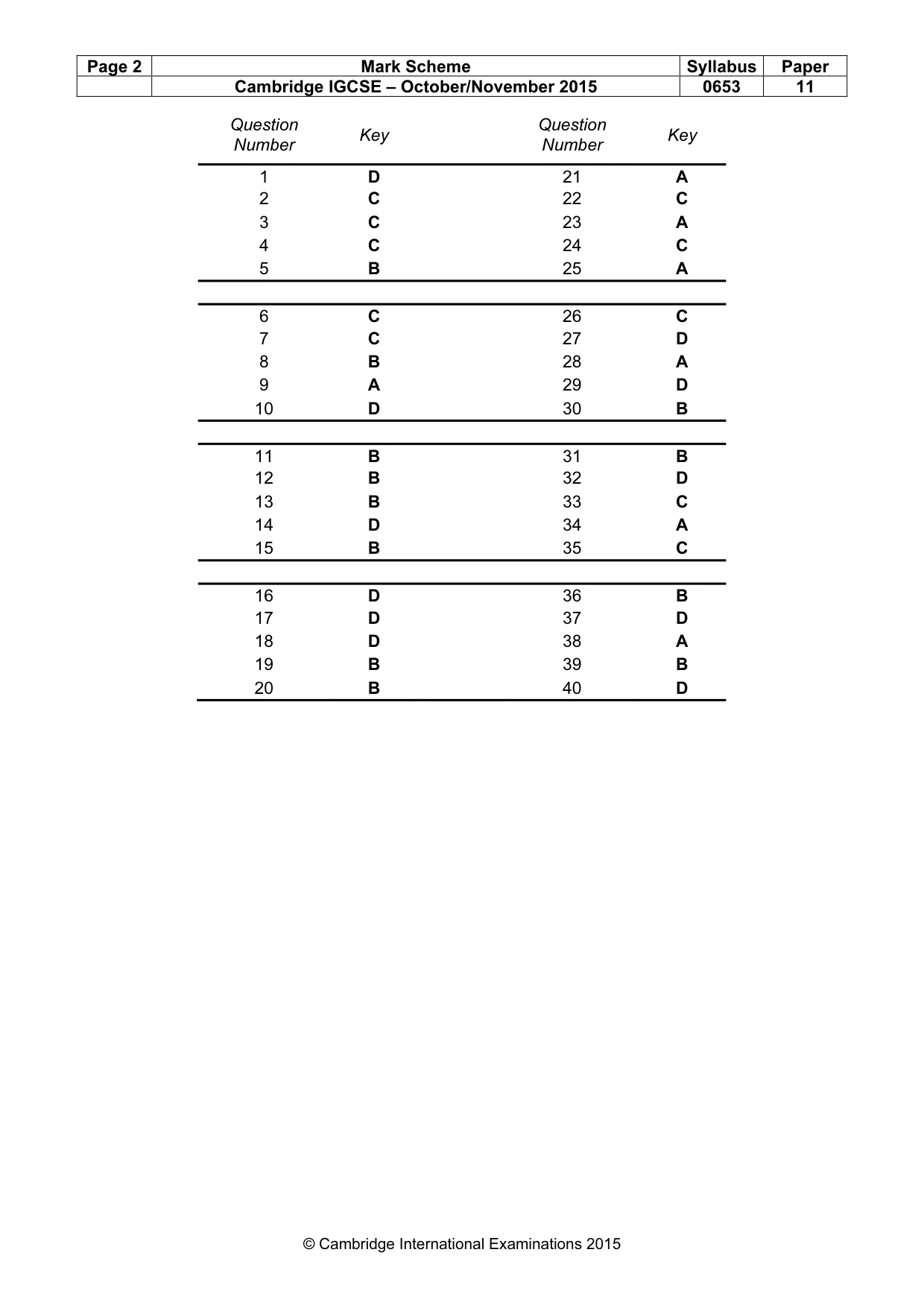
Answers below. Sit the paper first if you are practising.
Questions as text
Q1 · The graph shows the effect of temperature on the rate of an enzyme-controlled reaction
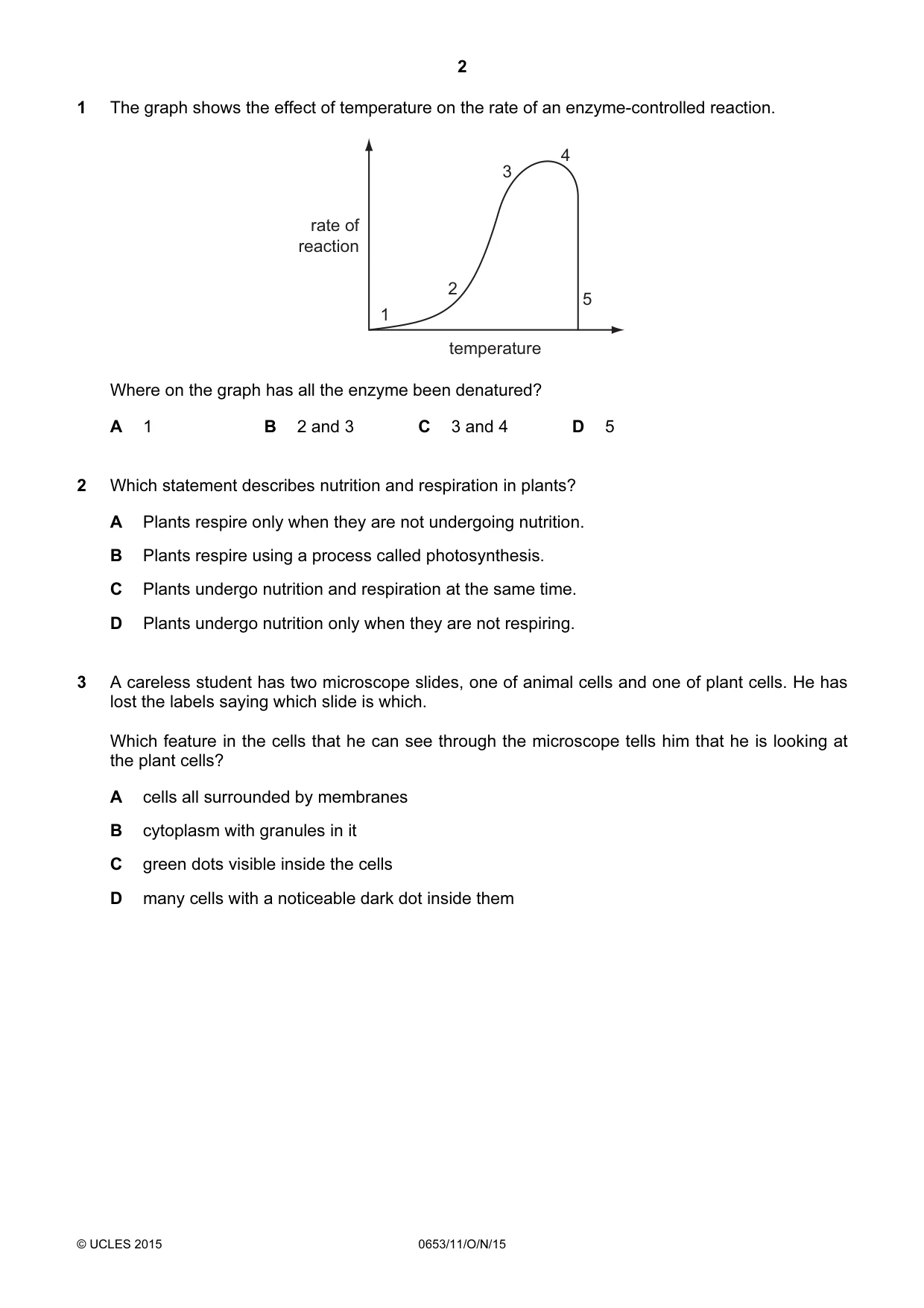
1 The graph shows the effect of temperature on the rate of an enzyme-controlled reaction. 4 3 rate of reaction 2 5 1 temperature Where on the graph has all the enzyme been denatured? A 1 B 2 and 3 C 3 and 4 D 5
Mark scheme: D
Q2 · Which statement describes nutrition and respiration in plants?
2 Which statement describes nutrition and respiration in plants? A Plants respire only when they are not undergoing nutrition. B Plants respire using a process called photosynthesis. C Plants undergo nutrition and respiration at the same time. D Plants undergo nutrition only when they are not respiring.
Mark scheme: C
Q3 · A careless student has two microscope slides, one of animal cells and one of plant cells
3 A careless student has two microscope slides, one of animal cells and one of plant cells. He has lost the labels saying which slide is which. Which feature in the cells that he can see through the microscope tells him that he is looking at the plant cells? A cells all surrounded by membranes B cytoplasm with granules in it C green dots visible inside the cells D many cells with a noticeable dark dot inside them
Mark scheme: C
Q4 · Asample of food is tested with Benedict’s solution, biuret solution and iodine solution
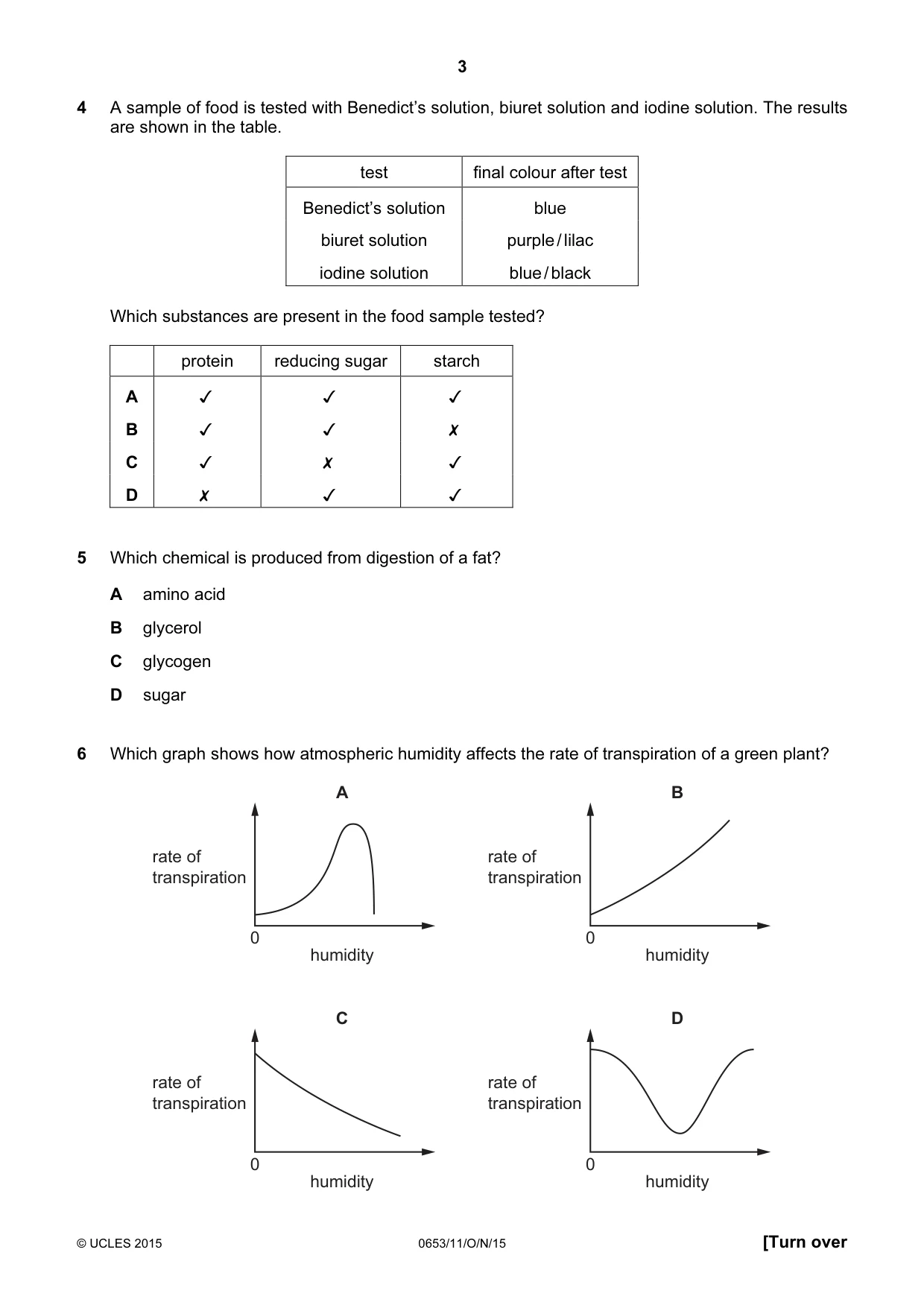
4 Asample of food is tested with Benedict’s solution, biuret solution and iodine solution. The results are shown in the table. test final colour after test Benedict's solution blue biuret solution purple /lilac iodine solution blue/ black Which substances are present in the food sample tested? protein reducing sugar starch v v v 0 Oo WwW > v v x v x v x v v
Mark scheme: C
Q5 · Which chemical is produced from digestion of a fat?
5 Which chemical is produced from digestion of a fat? A amino acid B glycerol C glycogen D sugar
Mark scheme: B
Q6 · Which graph shows how atmospheric humidity affects the rate of transpiration of a green…
6 Which graph shows how atmospheric humidity affects the rate of transpiration of a green plant? A B rate of rate of transpiration transpiration 0 0 humidity humidity C D rate of rate of transpiration transpiration 0 0 humidity humidity
Mark scheme: C
Q7 · The drawing shows some blood, as it appears under the microscope
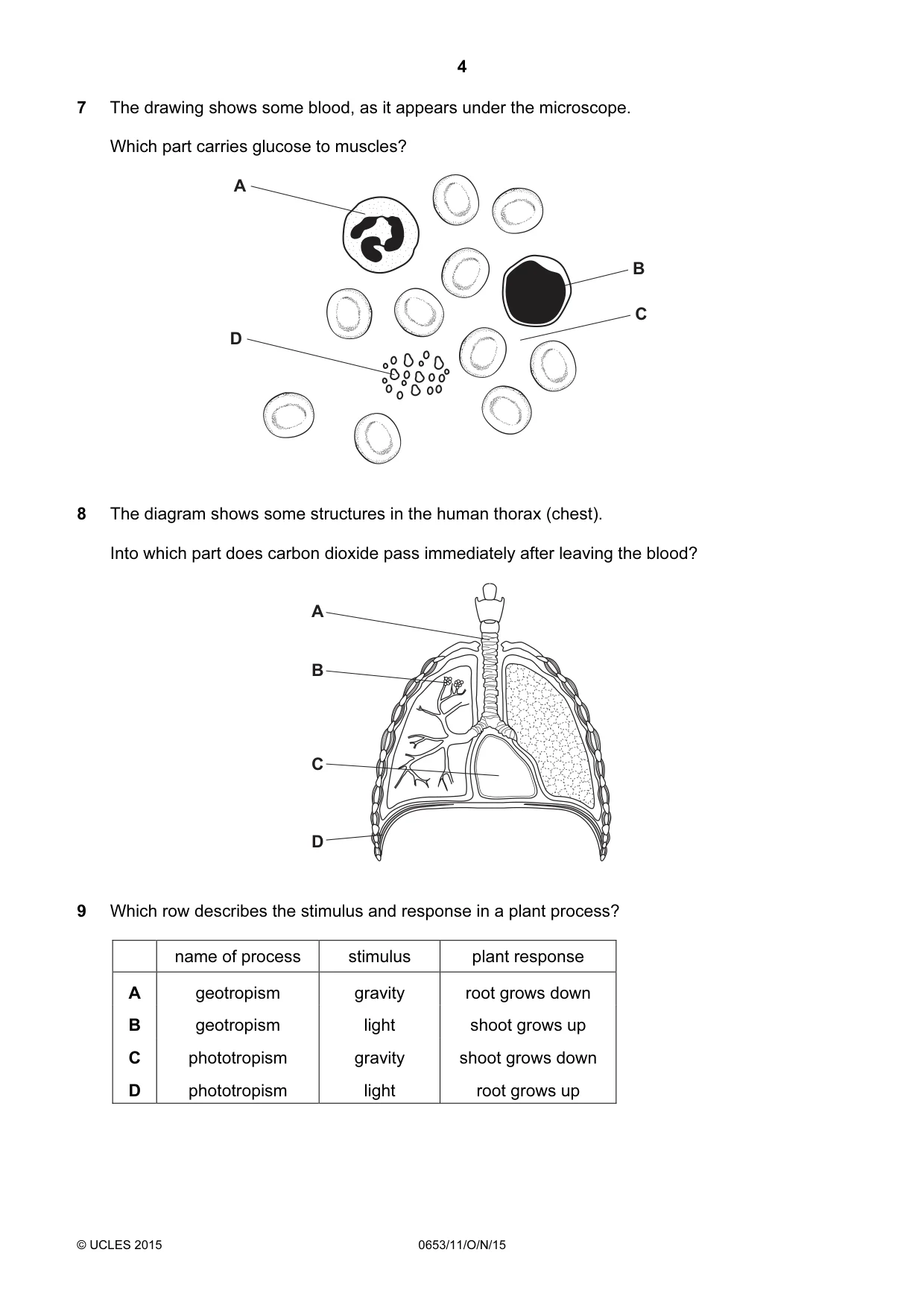
7 The drawing shows some blood, as it appears under the microscope. Which part carries glucose to muscles? A B C D
Mark scheme: C
Q8 · The diagram shows some structures in the human thorax (chest)
8 The diagram shows some structures in the human thorax (chest). Into which part does carbon dioxide pass immediately after leaving the blood? A B C D
Mark scheme: B
Q9 · Which row describes the stimulus and response in a plant process?
9 Which row describes the stimulus and response in a plant process? name of process stimulus plant response A geotropism gravity root grows down B geotropism light shoot grows up C phototropism gravity shoot grows down D phototropism light root grows up
Mark scheme: A
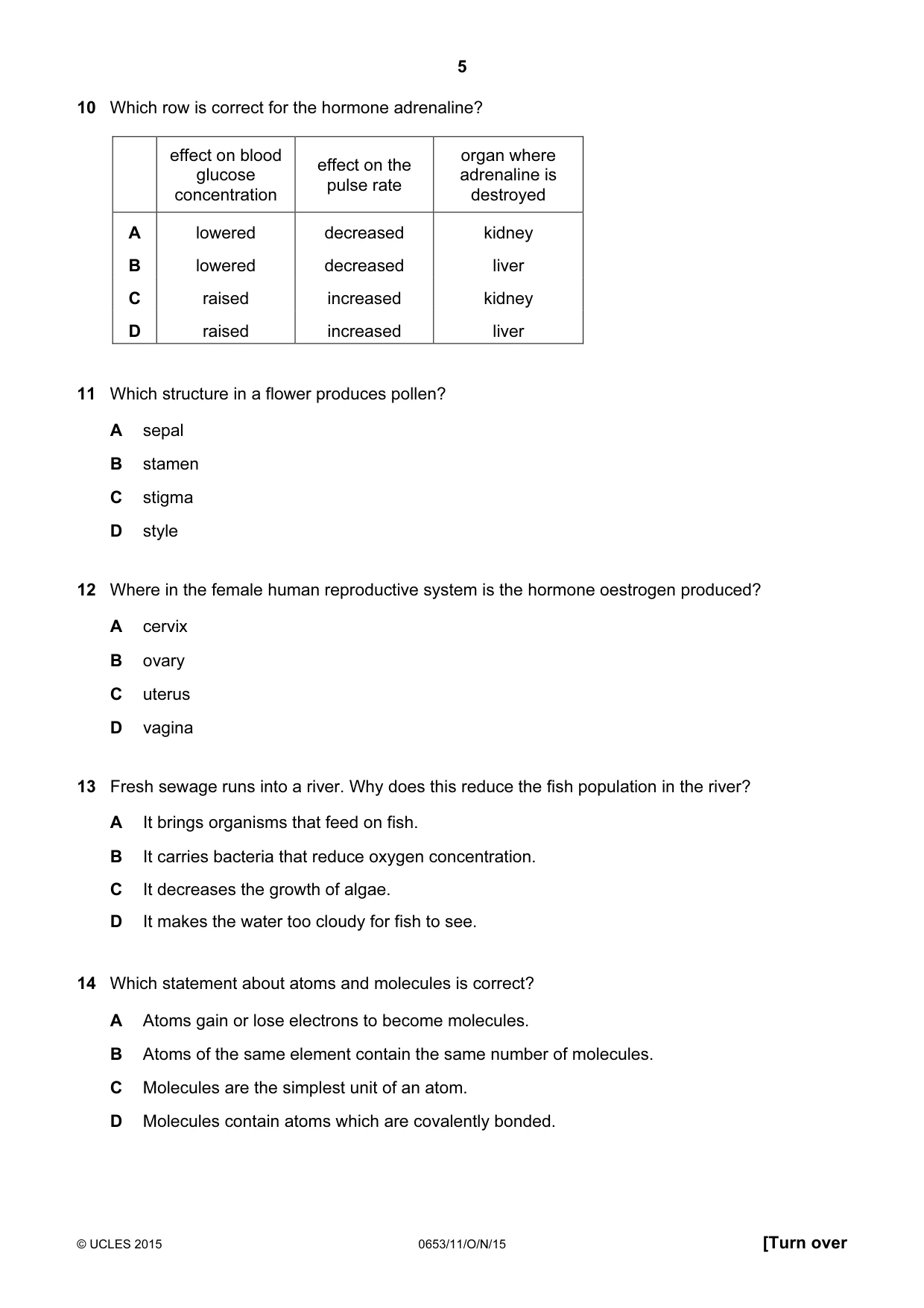
Q10 · Which row is correct for the hormone adrenaline?
10 Which row is correct for the hormone adrenaline? effect on blood organ where effect on the glucose adrenaline is pulse rate concentration destroyed A lowered decreased kidney B lowered decreased liver C raised increased kidney D raised increased liver
Mark scheme: D
Q11 · Which structure in a flower produces pollen?
11 Which structure in a flower produces pollen? A sepal B stamen C stigma D style
Mark scheme: B
Q12 · Where in the female human reproductive system is the hormone oestrogen produced?
12 Where in the female human reproductive system is the hormone oestrogen produced? A cervix B ovary C uterus D vagina
Mark scheme: B
Q13 · Fresh sewage runs into a river
13 Fresh sewage runs into a river. Why does this reduce the fish population in the river? A It brings organisms that feed on fish. B It carries bacteria that reduce oxygen concentration. C It decreases the growth of algae. D It makes the water too cloudy for fish to see.
Mark scheme: B
Q14 · Which statement about atoms and molecules is correct?
14 Which statement about atoms and molecules is correct? A Atoms gain or lose electrons to become molecules. B Atoms of the same element contain the same number of molecules. C Molecules are the simplest unit of an atom. D Molecules contain atoms which are covalently bonded.
Mark scheme: D
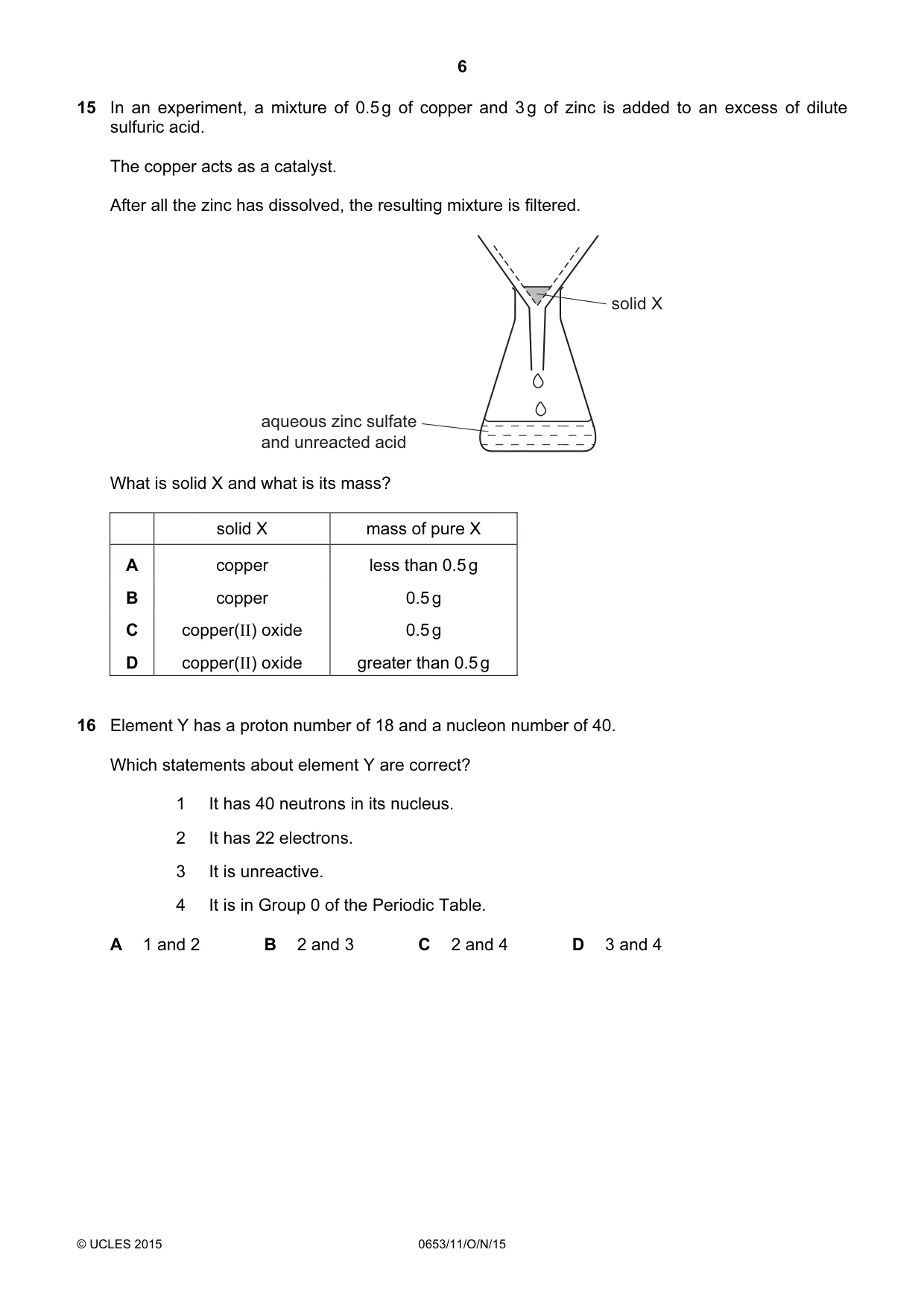
Q15 · In an experiment, a mixture of 0.5 g of copper and 3 g of zinc is added to an excess of…
15 In an experiment, a mixture of 0.5 g of copper and 3 g of zinc is added to an excess of dilute sulfuric acid. The copper acts as a catalyst. After all the zinc has dissolved, the resulting mixture is filtered. solid X aqueous zinc sulfate and unreacted acid What is solid X and what is its mass? solid X mass of pure X A copper less than 0.5 g B copper 0.5 g C copper(II) oxide 0.5 g D copper(II) oxide greater than 0.5 g
Mark scheme: B
Q16 · Element Y has a proton number of 18 and a nucleon number of 40
16 Element Y has a proton number of 18 and a nucleon number of 40. Which statements about element Y are correct? 1 It has 40 neutrons in its nucleus. 2 It has 22 electrons. 3 It is unreactive. 4 It is in Group 0 of the Periodic Table. A 1 and 2 B 2 and 3 C 2 and 4 D 3 and 4
Mark scheme: D
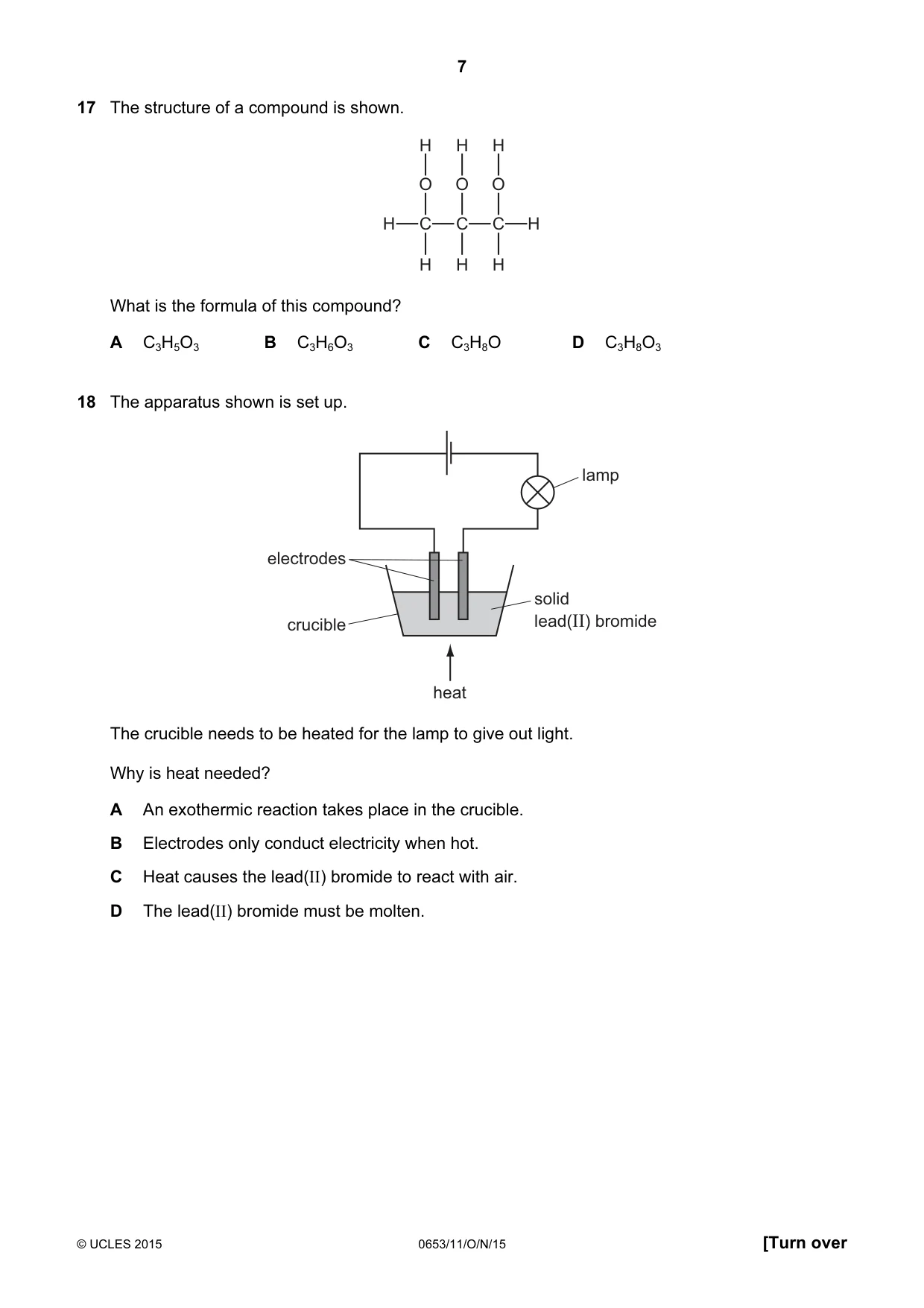
Q17 · The structure of a compound is shown
17 The structure of a compound is shown. H H H O O O H C C C H H H H What is the formula of this compound? A C3H5O3 B C3H6O3 C C3H8O D C3H8O3
Mark scheme: D
Q18 · The apparatus shown is set up
18 The apparatus shown is set up. lamp electrodes solid crucible lead(II) bromide heat The crucible needs to be heated for the lamp to give out light. Why is heat needed? A An exothermic reaction takes place in the crucible. B Electrodes only conduct electricity when hot. C Heat causes the lead(II) bromide to react with air. D The lead(II) bromide must be molten.
Mark scheme: D
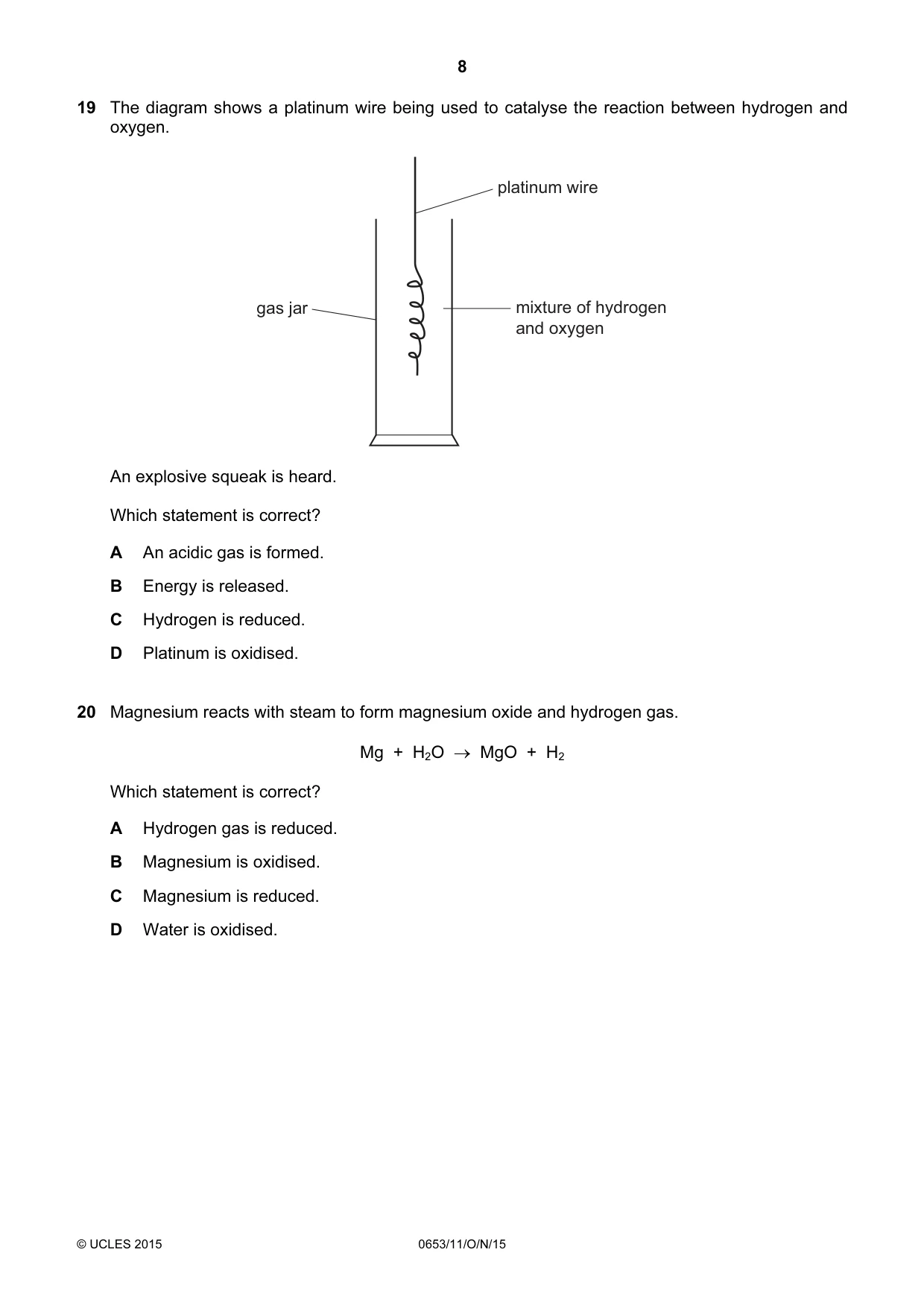
Q19 · The diagram shows a platinum wire being used to catalyse the reaction between hydrogen…
19 The diagram shows a platinum wire being used to catalyse the reaction between hydrogen and oxygen. platinum wire gas jar mixture of hydrogen and oxygen An explosive squeak is heard. Which statement is correct? A An acidic gas is formed. B Energy is released. C Hydrogen is reduced. D Platinum is oxidised.
Mark scheme: B
Q20 · Magnesium reacts with steam to form magnesium oxide and hydrogen gas
20 Magnesium reacts with steam to form magnesium oxide and hydrogen gas. Mg + H2O → MgO + H2 Which statement is correct? A Hydrogen gas is reduced. B Magnesium is oxidised. C Magnesium is reduced. D Water is oxidised.
Mark scheme: B
Q21 · Compound X reacts with dilute nitric acid to give a colourless gas which turns limewater…
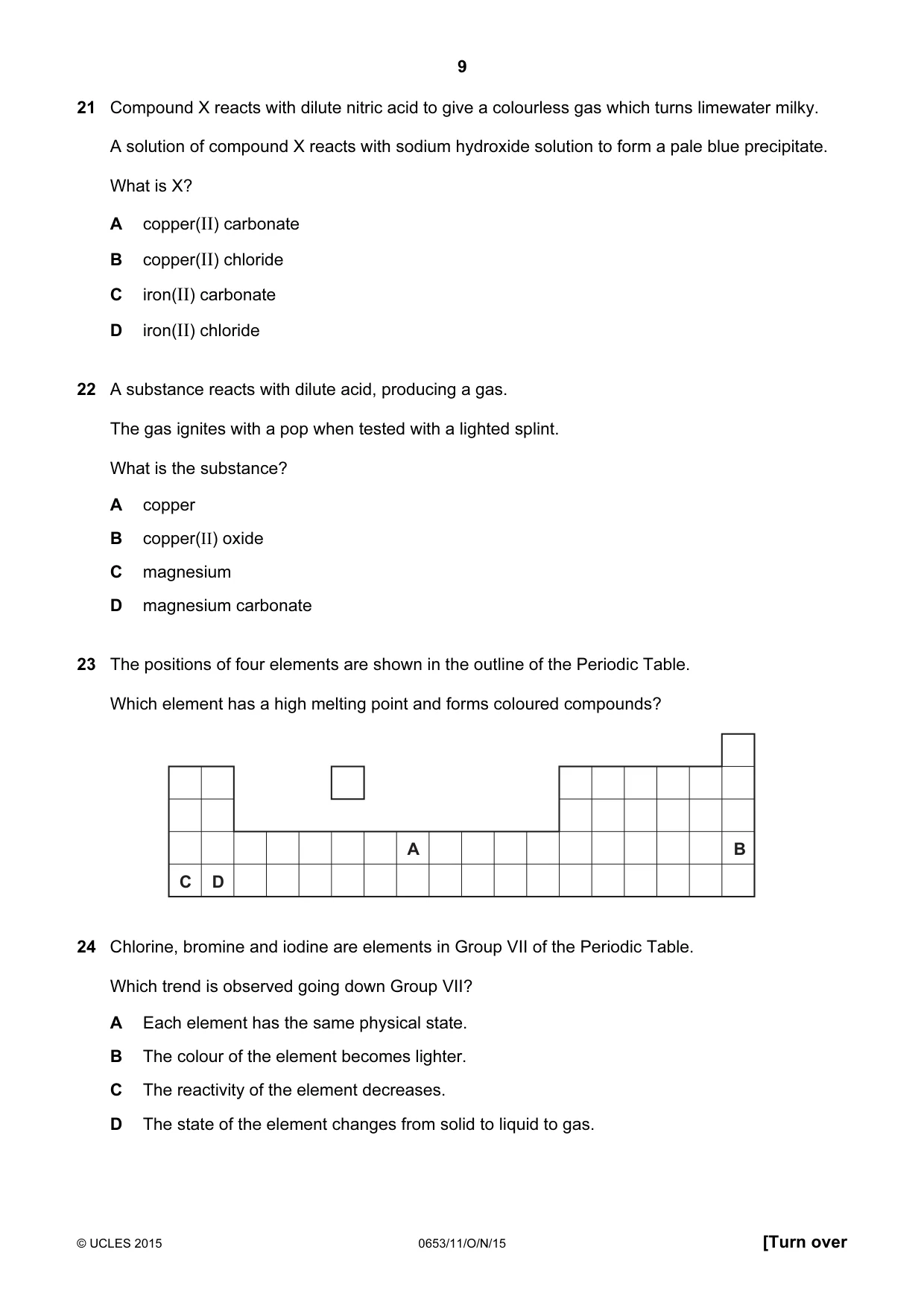
21 Compound X reacts with dilute nitric acid to give a colourless gas which turns limewater milky. A solution of compound X reacts with sodium hydroxide solution to form a pale blue precipitate. What is X? A copper(II) carbonate B copper(II) chloride C iron(II) carbonate D iron(II) chloride
Mark scheme: A
Q22 · A substance reacts with dilute acid, producing a gas
22 A substance reacts with dilute acid, producing a gas. The gas ignites with a pop when tested with a lighted splint. What is the substance? A copper B copper(II) oxide C magnesium D magnesium carbonate
Mark scheme: C
More questions on The characteristic properties of acids and bases
Q23 · The positions of four elements are shown in the outline of the Periodic Table
23 The positions of four elements are shown in the outline of the Periodic Table. Which element has a high melting point and forms coloured compounds? A B C D
Mark scheme: A
Q24 · Chlorine, bromine and iodine are elements in Group VII of the Periodic Table
24 Chlorine, bromine and iodine are elements in Group VII of the Periodic Table. Which trend is observed going down Group VII? A Each element has the same physical state. B The colour of the element becomes lighter. C The reactivity of the element decreases. D The state of the element changes from solid to liquid to gas.
Mark scheme: C
Q25 · Which element is less reactive than hydrogen?
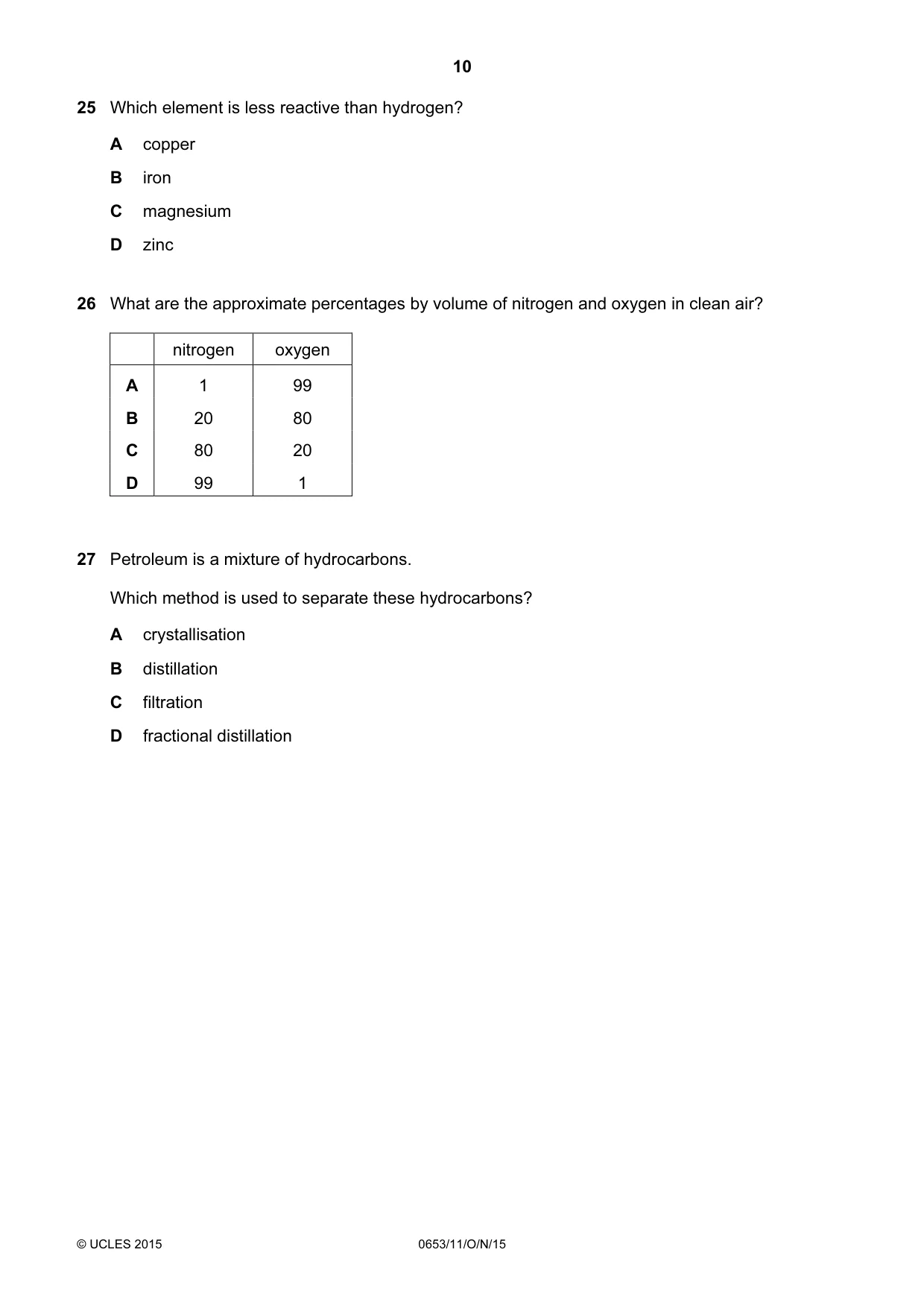
25 Which element is less reactive than hydrogen? A copper B iron C magnesium D zinc
Mark scheme: A
Q26 · What are the approximate percentages by volume of nitrogen and oxygen in clean air?
26 What are the approximate percentages by volume of nitrogen and oxygen in clean air? nitrogen oxygen A 1 99 B 20 80 C 80 20 D 99 1
Mark scheme: C
Q27 · Petroleum is a mixture of hydrocarbons
27 Petroleum is a mixture of hydrocarbons. Which method is used to separate these hydrocarbons? A crystallisation B distillation C filtration D fractional distillation
Mark scheme: D
Q28 · A car is moving downhill along a road at a constant speed
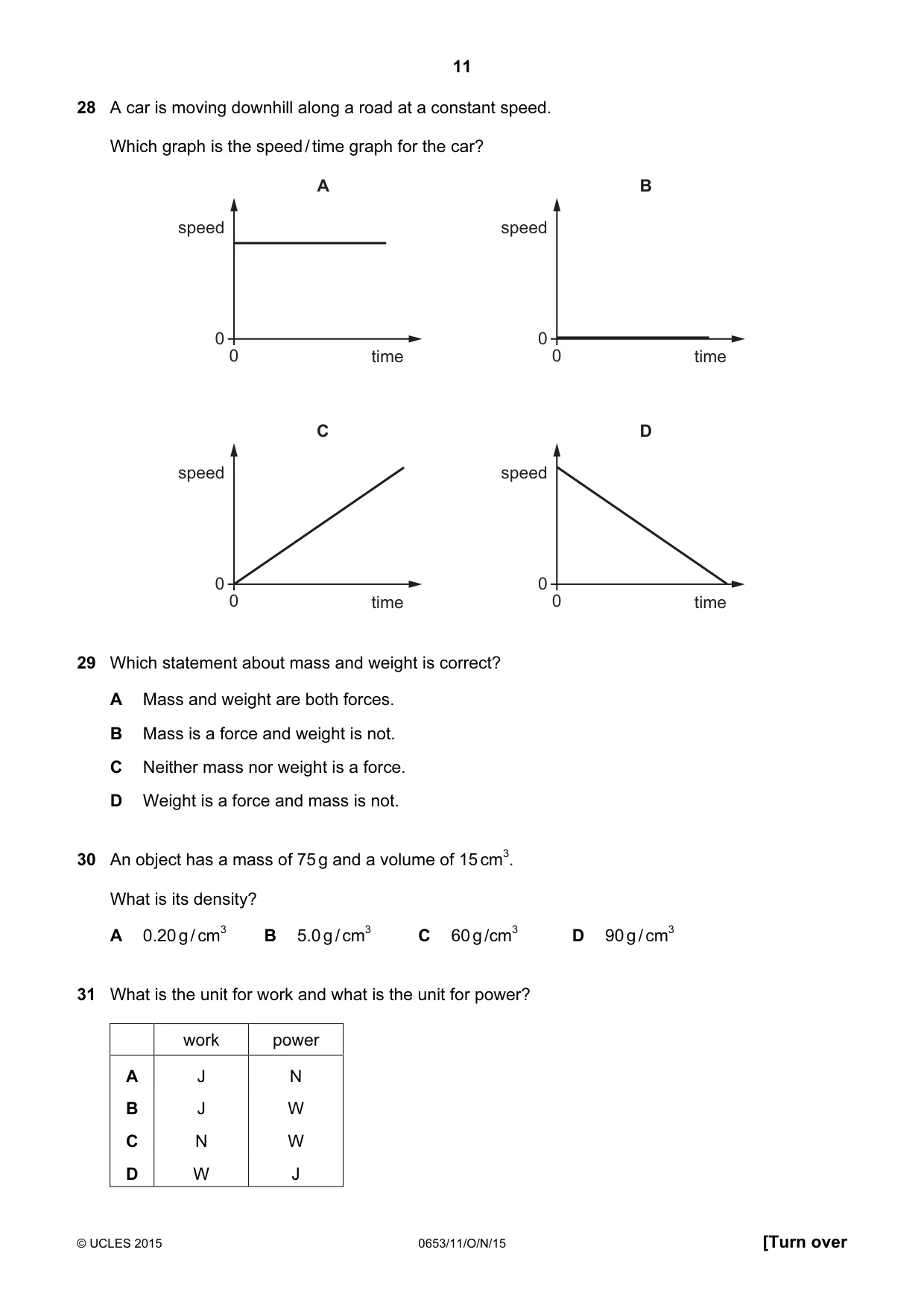
28 A car is moving downhill along a road at a constant speed. Which graph is the speed / time graph for the car? A B speed speed 0 0 0 time 0 time C D speed speed 0 0 0 time 0 time
Mark scheme: A
Q29 · Which statement about mass and weight is correct?
29 Which statement about mass and weight is correct? A Mass and weight are both forces. B Mass is a force and weight is not. C Neither mass nor weight is a force. D Weight is a force and mass is not.
Mark scheme: D
Q30 · An object has a mass of 75 g and a volume of 15 cm3
30 An object has a mass of 75 g and a volume of 15 cm3. What is its density? A 0.20 g / cm3 B 5.0 g / cm3 C 60 g /cm3 D 90 g / cm3
Mark scheme: B
Q31 · What is the unit for work and what is the unit for power?
31 What is the unit for work and what is the unit for power? work power A J N B J W C N W D W J
Mark scheme: B
Q32 · Which energy change takes place when a block of wood slows down as it slides across a…
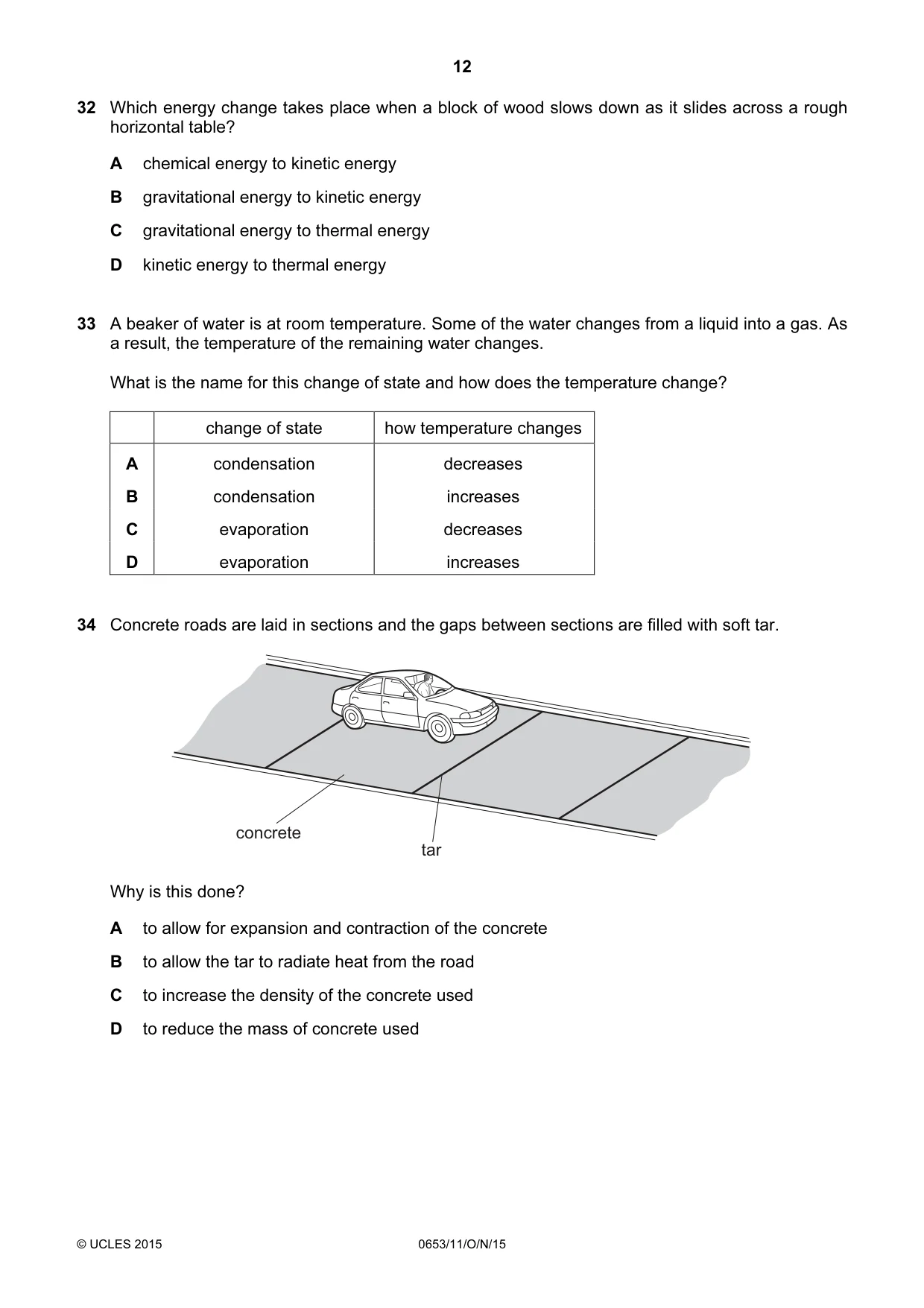
32 Which energy change takes place when a block of wood slows down as it slides across a rough horizontal table? A chemical energy to kinetic energy B gravitational energy to kinetic energy C gravitational energy to thermal energy D kinetic energy to thermal energy
Mark scheme: D
Q33 · A beaker of water is at room temperature
33 A beaker of water is at room temperature. Some of the water changes from a liquid into a gas. As a result, the temperature of the remaining water changes. What is the name for this change of state and how does the temperature change? change of state how temperature changes A condensation decreases B condensation increases C evaporation decreases D evaporation increases
Mark scheme: C
Q34 · Concrete roads are laid in sections and the gaps between sections are filled with soft tar
34 Concrete roads are laid in sections and the gaps between sections are filled with soft tar. concrete tar Why is this done? A to allow for expansion and contraction of the concrete B to allow the tar to radiate heat from the road C to increase the density of the concrete used D to reduce the mass of concrete used
Mark scheme: A
Q35 · Thermometer X is held above an ice cube and thermometer Y is held an equal distance below…
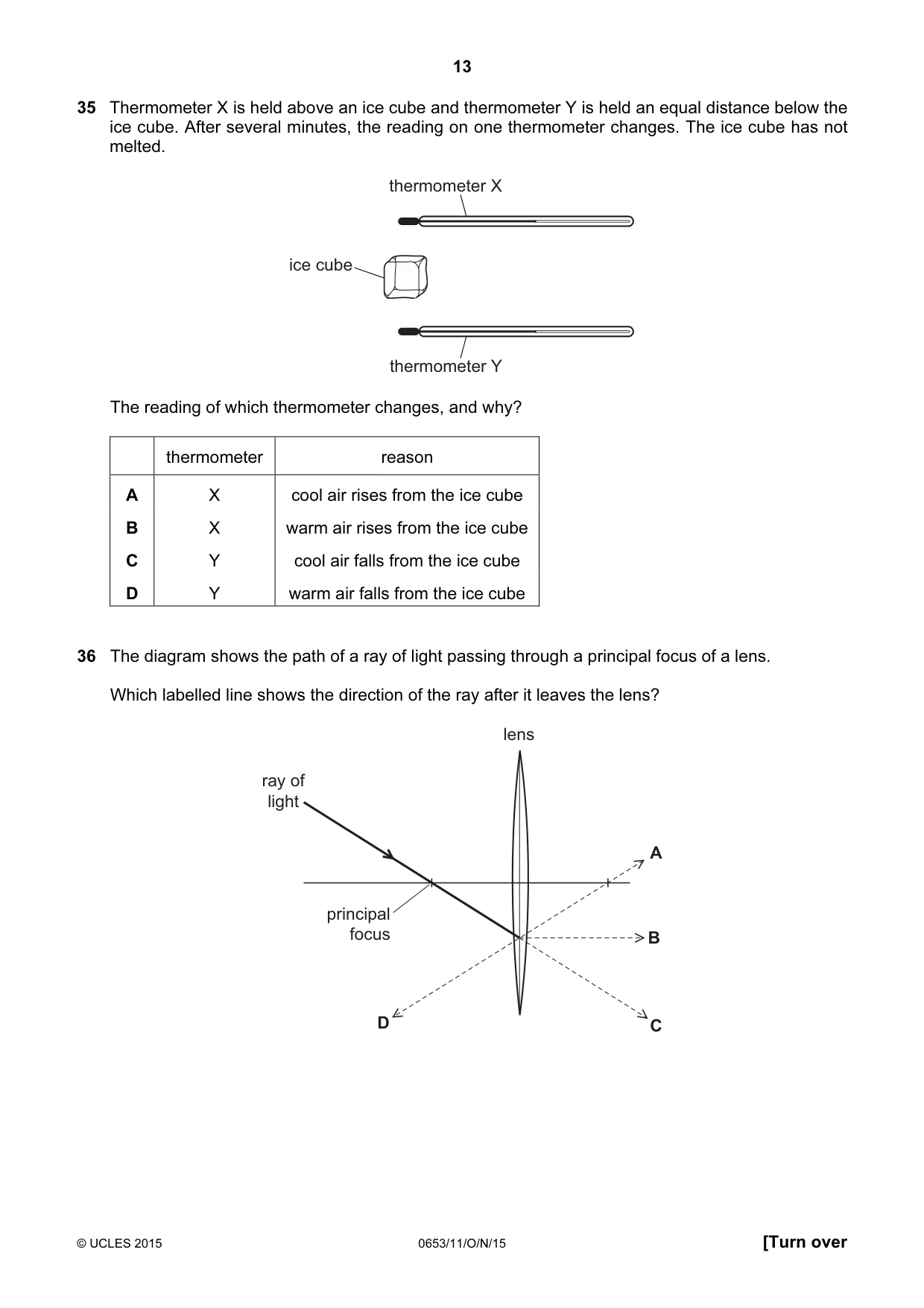
35 Thermometer X is held above an ice cube and thermometer Y is held an equal distance below the ice cube. After several minutes, the reading on one thermometer changes. The ice cube has not melted. thermometer X ice cube thermometer Y The reading of which thermometer changes, and why? thermometer reason A X cool air rises from the ice cube B X warm air rises from the ice cube C Y cool air falls from the ice cube D Y warm air falls from the ice cube
Mark scheme: C
Q36 · The diagram shows the path of a ray of light passing through a principal focus of a lens
36 The diagram shows the path of a ray of light passing through a principal focus of a lens. Which labelled line shows the direction of the ray after it leaves the lens? lens ray of light A principal focus B D C
Mark scheme: B
Q37 · A student measures the speed of sound
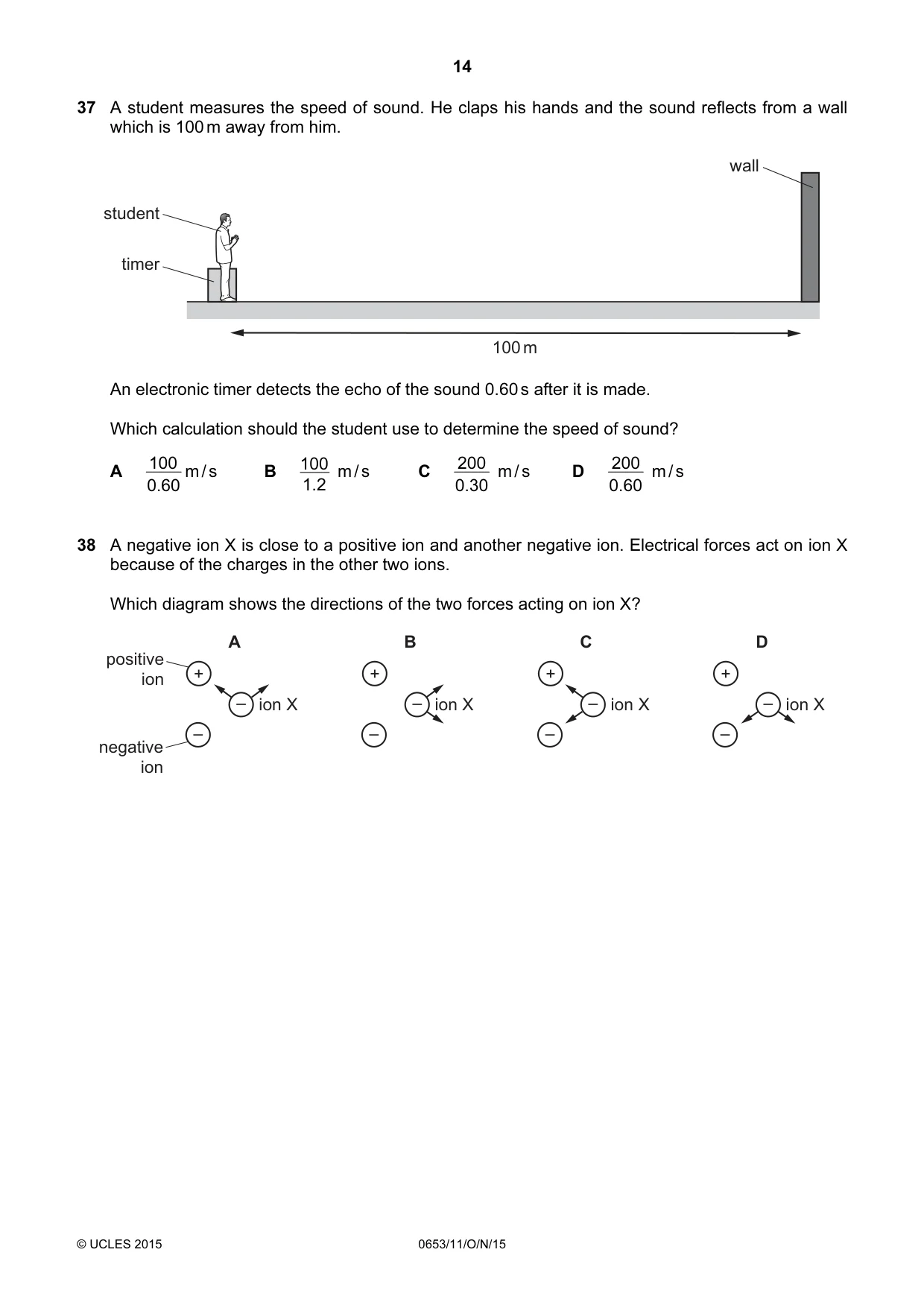
37 A student measures the speed of sound. He claps his hands and the sound reflects from a wall which is 100 m away from him. wall student timer 100 m An electronic timer detects the echo of the sound 0.60 s after it is made. Which calculation should the student use to determine the speed of sound? 100 m / s 100 m / s 200 m / s 200 m / s A B C D 0.60 1 . 2 0.30 0.60
Mark scheme: D
Q38 · A negative ion X is close to a positive ion and another negative ion
38 A negative ion X is close to a positive ion and another negative ion. Electrical forces act on ion X because of the charges in the other two ions. Which diagram shows the directions of the two forces acting on ion X? A B C D positive ion + + + + – ion X – ion X – ion X – ion X – – – – negative ion
Mark scheme: A
Q39 · The circuit diagram includes two resistors connected in parallel
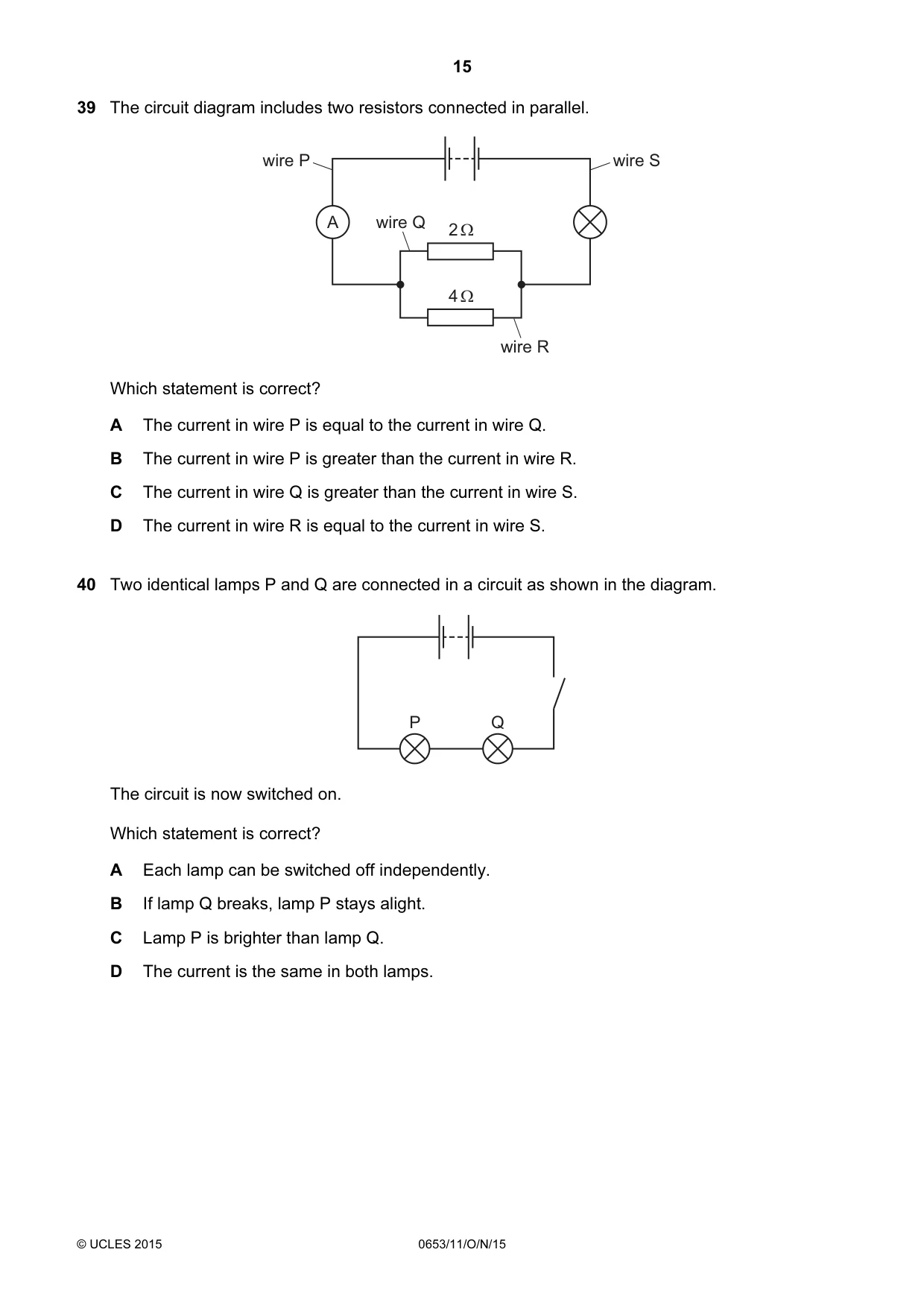
39 The circuit diagram includes two resistors connected in parallel. wire P wire S A wire Q 2 Ω 4 Ω wire R Which statement is correct? A The current in wire P is equal to the current in wire Q. B The current in wire P is greater than the current in wire R. C The current in wire Q is greater than the current in wire S. D The current in wire R is equal to the current in wire S.
Mark scheme: B
Q40 · Two identical lamps P and Q are connected in a circuit as shown in the diagram
40 Two identical lamps P and Q are connected in a circuit as shown in the diagram. P Q The circuit is now switched on. Which statement is correct? A Each lamp can be switched off independently. B If lamp Q breaks, lamp P stays alight. C Lamp P is brighter than lamp Q. D The current is the same in both lamps.
Mark scheme: D
What was in this paper
The subtopics covered by these 40 questions, and how many questions each got. Open one in a new tab to see every Cambridge question on it.
3Electrical circuits2Energy, work and power2Reactivity series2Air quality and climate1Atomic structure and the Periodic Table1Biological molecules1Blood1Cell structure1Density1Digestion1Electrical quantities1Electrolysis1Enzymes1Exothermic and endothermic reactions1Formulas1Fuels1Gas exchange in humans1Group VII properties1Habitat destruction1Identification of ions and gases1Kinetic particle model of matter1Light1Mass and weight1Motion1Redox1Sexual reproduction in humans1Sexual reproduction in plants1Simple molecules and covalent bonds1Sound1The characteristic properties of acids and bases1Thermal properties and temperature1Transfer of thermal energy1Transition elements1Transpiration1What you needed in this session
Cambridge’s own grade thresholds for 2015 Oct/Nov, Paper 1 · Variant 1. A higher threshold means an easier paper — the bar moves with how the cohort did.