Cambridge IGCSE Science - Combined 0653 — 2025 May/June Paper 1 · Variant 3
0653/13/M/J/25 · 40 questions · 40 marks · 45 min
The question paper and its mark scheme, free to read here and free to download. This is Cambridge’s own paper, exactly as it was sat.
Question paper16 pages
Mark scheme3 pages
Answers below. Sit the paper first if you are practising.
Questions as text
Q1 · Which row shows substances that are removed by the process of excretion?
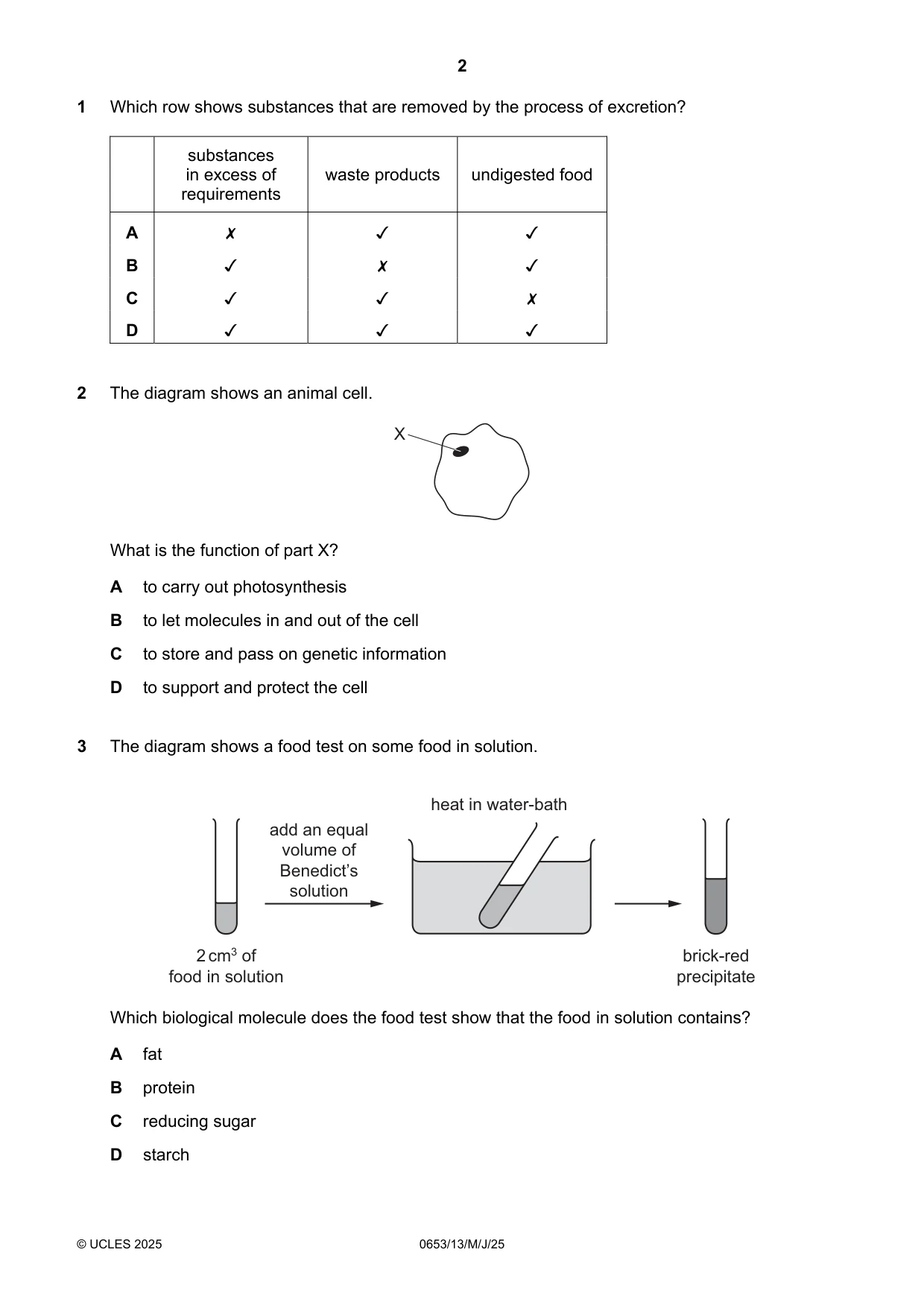
1. Which row shows substances that are removed by the process of excretion? substances in excess of waste products undigested food requirements 00 DW D> \ N\ NX \ N\ «KOS \ & NON
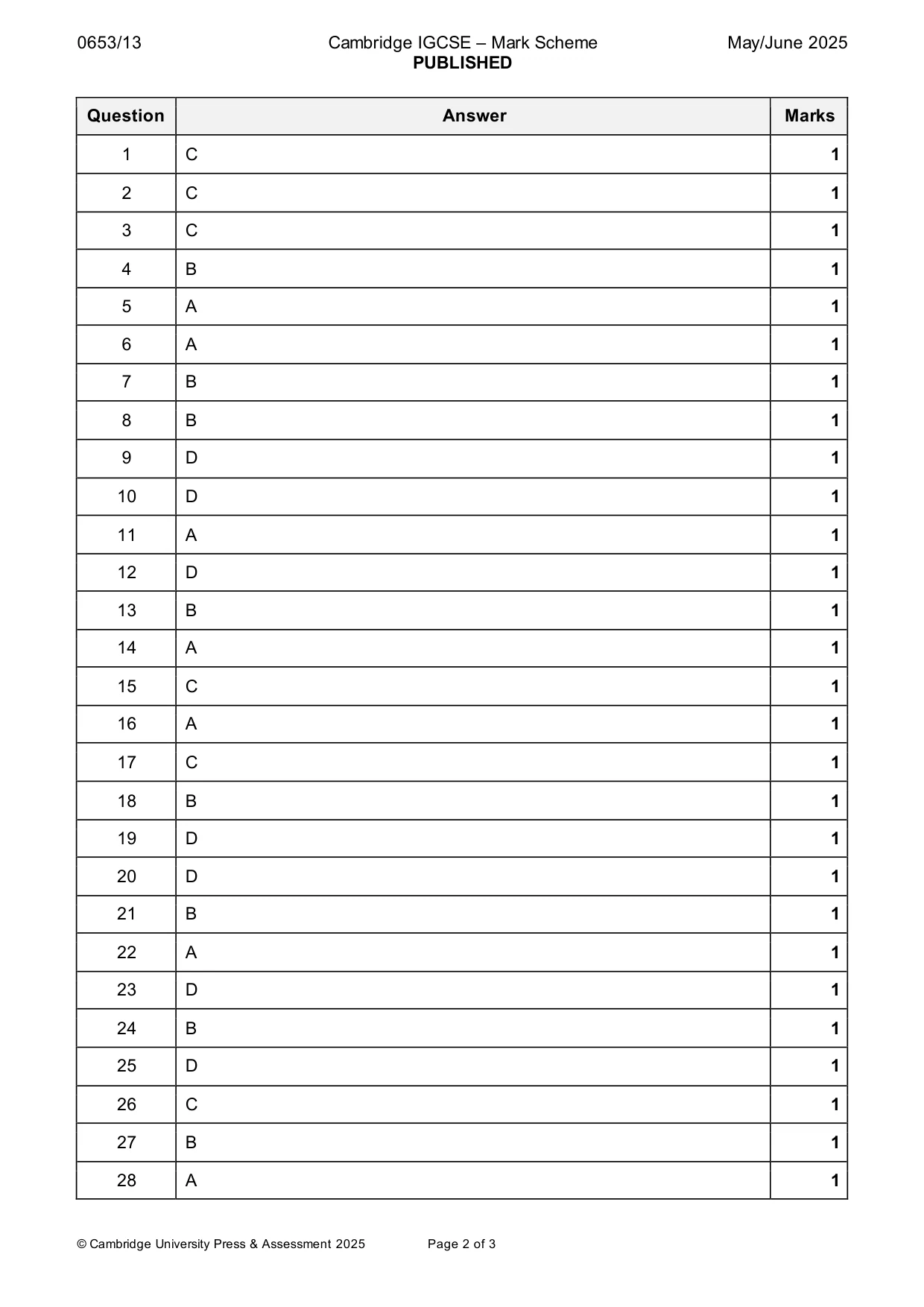
Mark scheme: C
Q2 · The diagram shows an animal cell
2 The diagram shows an animal cell. X What is the function of part X? A to carry out photosynthesis B to let molecules in and out of the cell C to store and pass on genetic information D to support and protect the cell
Mark scheme: C
Q3 · The diagram shows a food test on some food in solution
3 The diagram shows a food test on some food in solution. heat in water-bath add an equal volume of Benedict’s solution 2 cm3 of brick-red food in solution precipitate Which biological molecule does the food test show that the food in solution contains? A fat B protein C reducing sugar D starch
Mark scheme: C
Q4 · What function as biological catalysts?
4 What function as biological catalysts? A antibodies B enzymes C hormones D platelets
Mark scheme: B
Q5 · Which substance is required for photosynthesis to occur?
5 Which substance is required for photosynthesis to occur? A chlorophyll B glucose C haemoglobin D oxygen
Mark scheme: A
Q6 · The diagram shows a section through a leaf
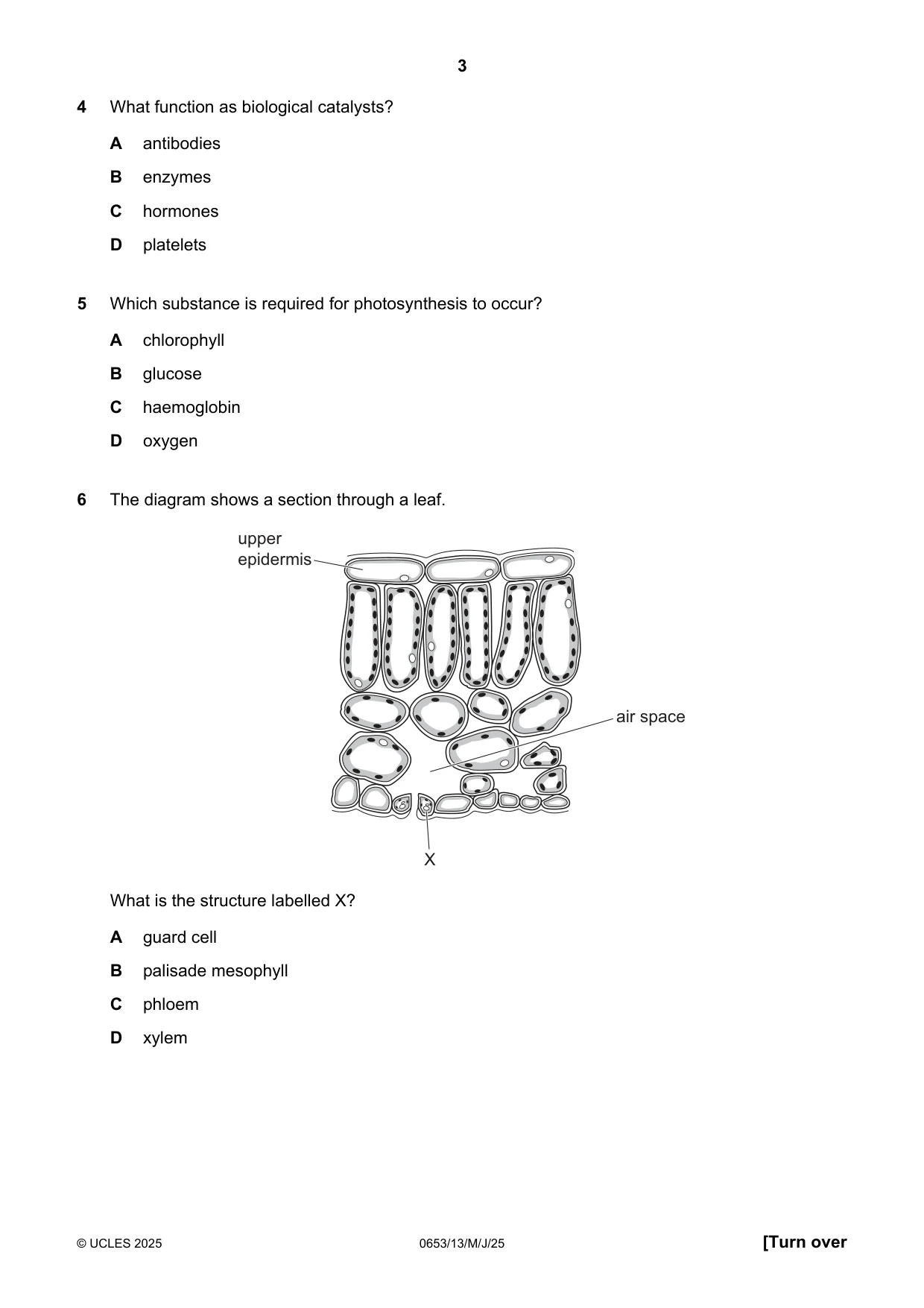
6 The diagram shows a section through a leaf. upper epidermis air space X What is the structure labelled X? A guard cell B palisade mesophyll C phloem D xylem
Mark scheme: A
Q7 · What is meant by a balanced diet in humans?
7 What is meant by a balanced diet in humans? A a diet that contains a lot of fibre to aid food passing through the alimentary canal B a diet that has only enough of each food group for the body to maintain good health C every meal contains all the main food groups D each food group is present in excessive amounts
Mark scheme: B
Q8 · The diagram shows part of the human alimentary canal and associated organs
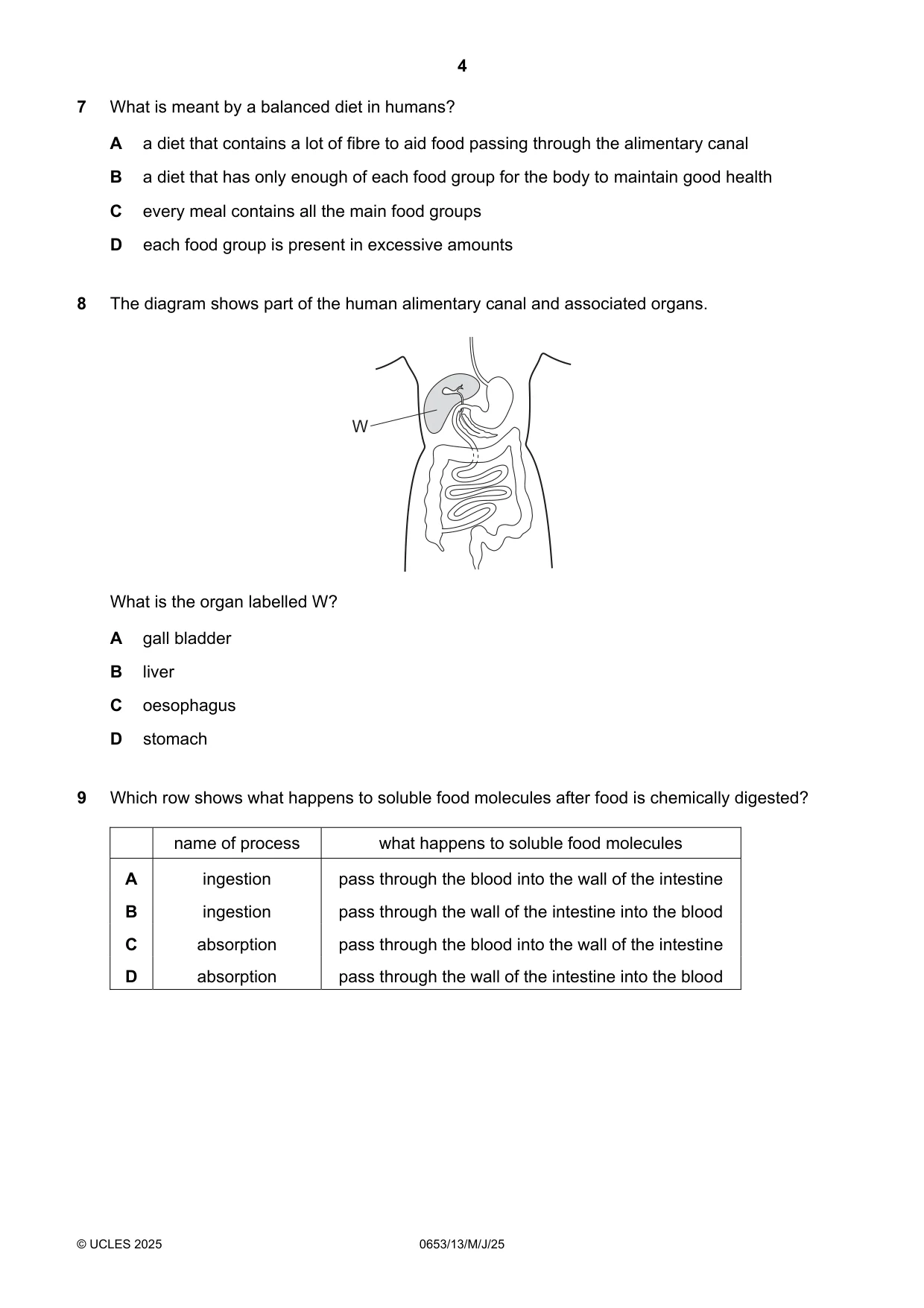
8 The diagram shows part of the human alimentary canal and associated organs. W What is the organ labelled W? A gall bladder B liver C oesophagus D stomach
Mark scheme: B
Q9 · Which row shows what happens to soluble food molecules after food is chemically digested?
9 Which row shows what happens to soluble food molecules after food is chemically digested? name of process what happens to soluble food molecules A ingestion pass through the blood into the wall of the intestine B ingestion pass through the wall of the intestine into the blood C absorption pass through the blood into the wall of the intestine D absorption pass through the wall of the intestine into the blood
Mark scheme: D
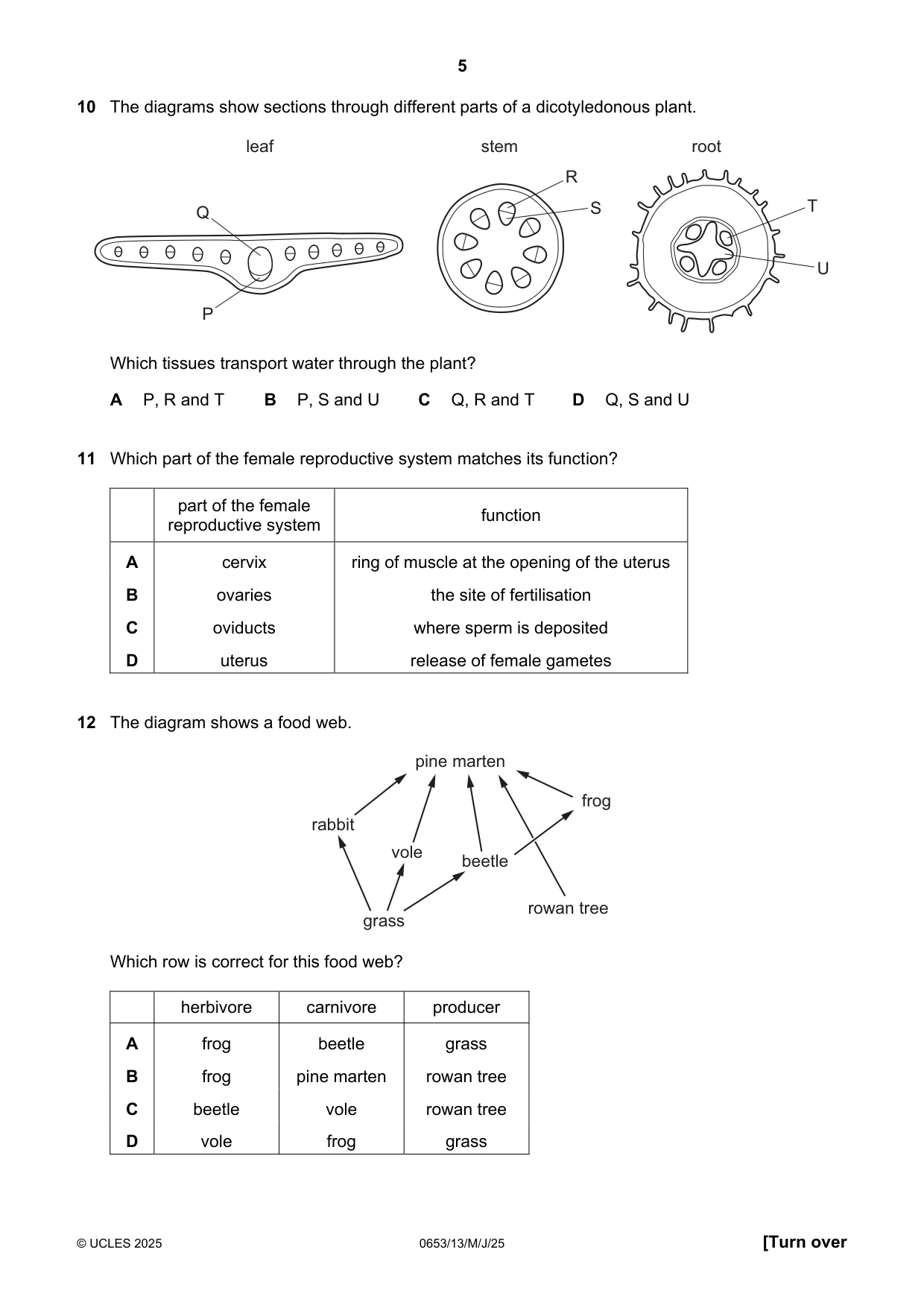
Q10 · The diagrams show sections through different parts of a dicotyledonous plant
10 The diagrams show sections through different parts of a dicotyledonous plant. leaf stem root R Q S T U P Which tissues transport water through the plant? A P, R and T B P, S and U C Q, R and T D Q, S and U
Mark scheme: D
Q11 · Which part of the female reproductive system matches its function?
11 Which part of the female reproductive system matches its function? part of the female function reproductive system A cervix ring of muscle at the opening of the uterus B ovaries the site of fertilisation C oviducts where sperm is deposited D uterus release of female gametes
Mark scheme: A
Q12 · The diagram shows a food web
12 The diagram shows a food web. pine marten frog rabbit vole beetle rowan tree grass Which row is correct for this food web? herbivore carnivore producer A frog beetle grass B frog pine marten rowan tree C beetle vole rowan tree D vole frog grass
Mark scheme: D
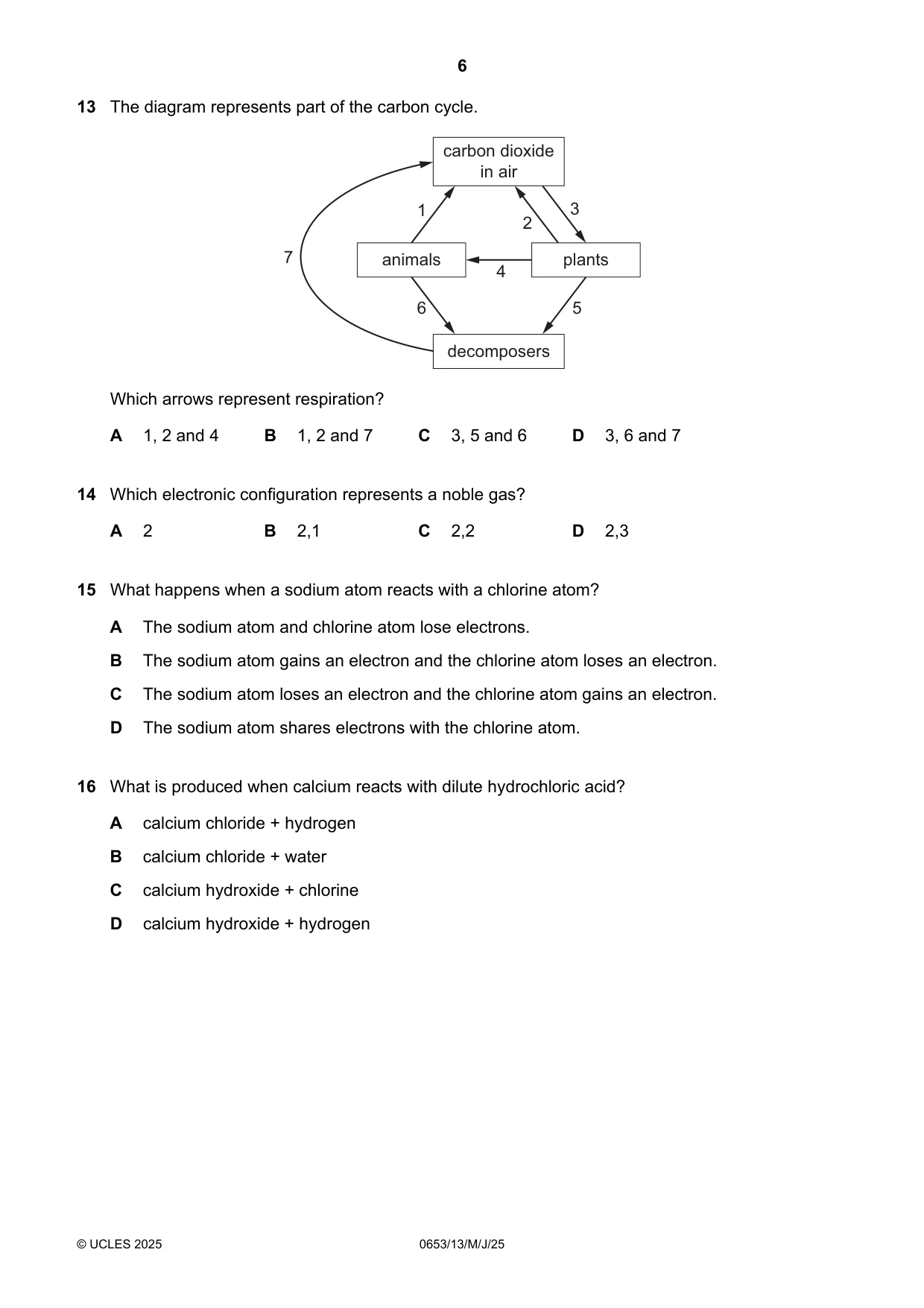
Q13 · The diagram represents part of the carbon cycle
13 The diagram represents part of the carbon cycle. carbon dioxide in air 1 3 2 7 animals plants 4 6 5 decomposers Which arrows represent respiration? A 1, 2 and 4 B 1, 2 and 7 C 3, 5 and 6 D 3, 6 and 7
Mark scheme: B
Q14 · Which electronic configuration represents a noble gas?
14 Which electronic configuration represents a noble gas? A 2 B 2,1 C 2,2 D 2,3
Mark scheme: A
Q15 · What happens when a sodium atom reacts with a chlorine atom?
15 What happens when a sodium atom reacts with a chlorine atom? A The sodium atom and chlorine atom lose electrons. B The sodium atom gains an electron and the chlorine atom loses an electron. C The sodium atom loses an electron and the chlorine atom gains an electron. D The sodium atom shares electrons with the chlorine atom.
Mark scheme: C
Q16 · What is produced when calcium reacts with dilute hydrochloric acid?
16 What is produced when calcium reacts with dilute hydrochloric acid? A calcium chloride + hydrogen B calcium chloride + water C calcium hydroxide + chlorine D calcium hydroxide + hydrogen
Mark scheme: A
More questions on The characteristic properties of acids and bases
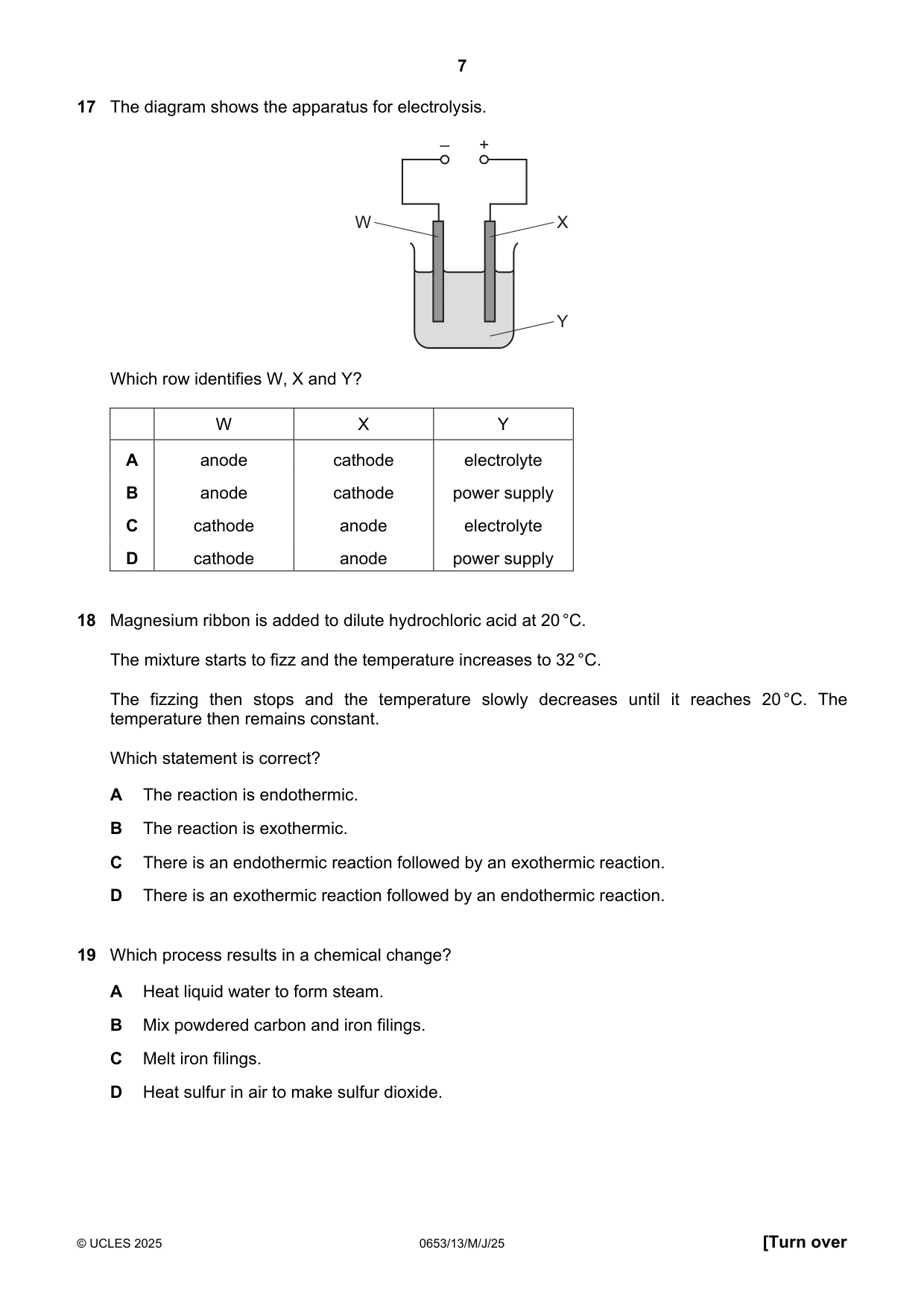
Q17 · The diagram shows the apparatus for electrolysis
17 The diagram shows the apparatus for electrolysis. – + W X Y Which row identifies W, X and Y? W X Y A anode cathode electrolyte B anode cathode power supply C cathode anode electrolyte D cathode anode power supply
Mark scheme: C
Q18 · Magnesium ribbon is added to dilute hydrochloric acid at 20 °C
18 Magnesium ribbon is added to dilute hydrochloric acid at 20 °C. The mixture starts to fizz and the temperature increases to 32 °C. The fizzing then stops and the temperature slowly decreases until it reaches 20 °C. The temperature then remains constant. Which statement is correct? A The reaction is endothermic. B The reaction is exothermic. C There is an endothermic reaction followed by an exothermic reaction. D There is an exothermic reaction followed by an endothermic reaction.
Mark scheme: B
Q19 · Which process results in a chemical change?
19 Which process results in a chemical change? A Heat liquid water to form steam. B Mix powdered carbon and iron filings. C Melt iron filings. D Heat sulfur in air to make sulfur dioxide.
Mark scheme: D
Q20 · Which substance contains a covalent bond between two different elements?
20 Which substance contains a covalent bond between two different elements? A chlorine B potassium chloride C hydrogen D hydrogen chloride
Mark scheme: D
Q21 · Universal indicator is placed into a colourless liquid
21 Universal indicator is placed into a colourless liquid. The colour change of the universal indicator shows that the pH of the liquid is 6. Which statement about the colourless liquid is correct? A It is an acid that turns the universal indicator red. B It is an acid that turns the universal indicator yellow. C It is an alkali that turns the universal indicator blue. D It is a neutral liquid that turns the universal indicator green.
Mark scheme: B
More questions on The characteristic properties of acids and bases
Q22 · Sodium nitrate, NaNO3, is a soluble salt
22 Sodium nitrate, NaNO3, is a soluble salt. Which method is used to make pure solid sodium nitrate? A Add aqueous sodium hydroxide to a conical flask, titrate with dilute nitric acid, then crystallise. B Dissolve solid sodium chloride in dilute nitric acid, leave for 10 minutes and then crystallise. C Heat sodium with nitrogen and oxygen. Let the mixture cool, then collect the solid that is made. D Mix copper nitrate and sodium chloride solutions, then filter the mixture and collect the sodium nitrate from the filter paper.
Mark scheme: A
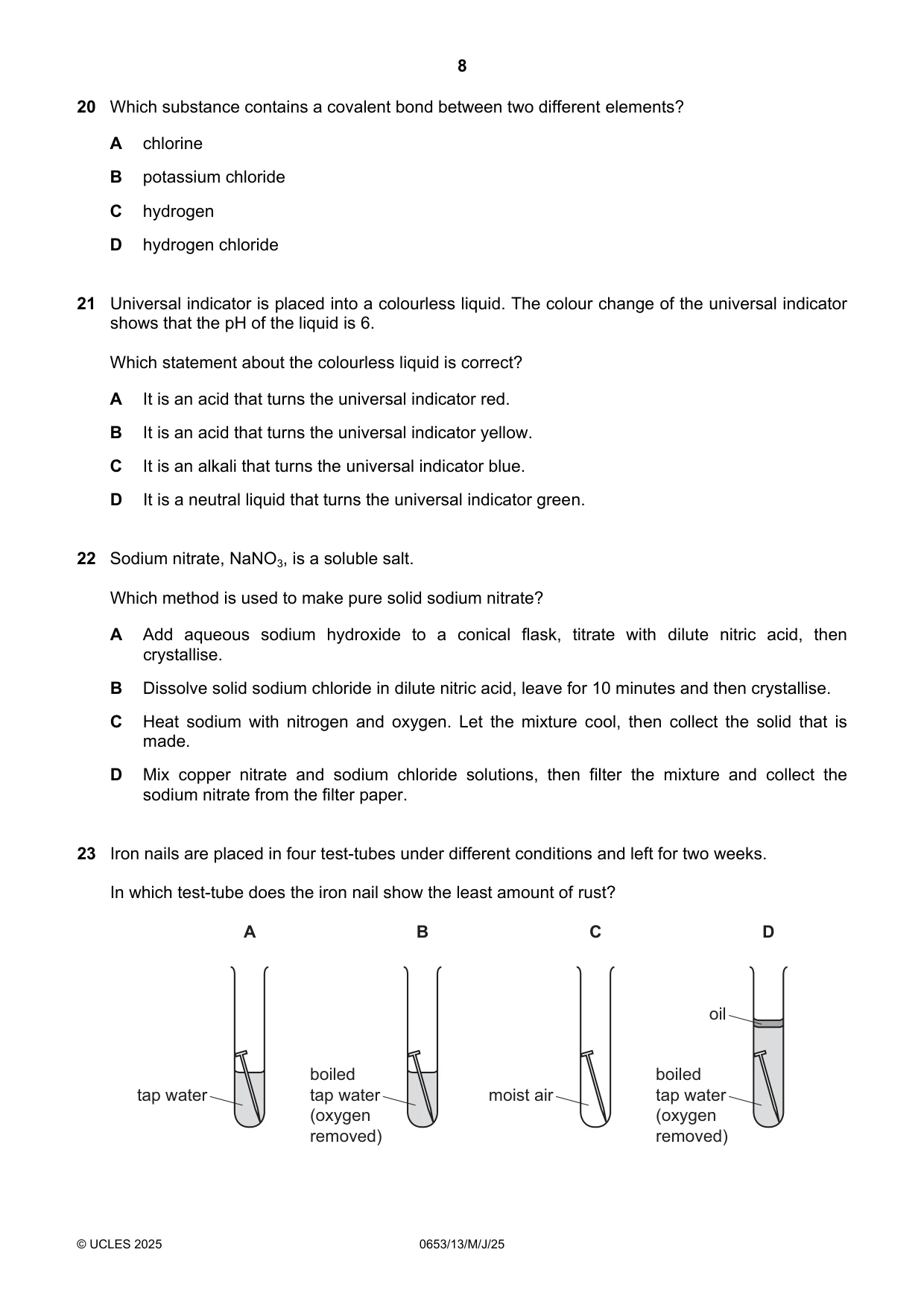
Q23 · Iron nails are placed in four test-tubes under different conditions and left for two weeks
23 Iron nails are placed in four test-tubes under different conditions and left for two weeks. In which test-tube does the iron nail show the least amount of rust? A B C D oil boiled boiled tap water tap water moist air tap water (oxygen (oxygen removed) removed)
Mark scheme: D
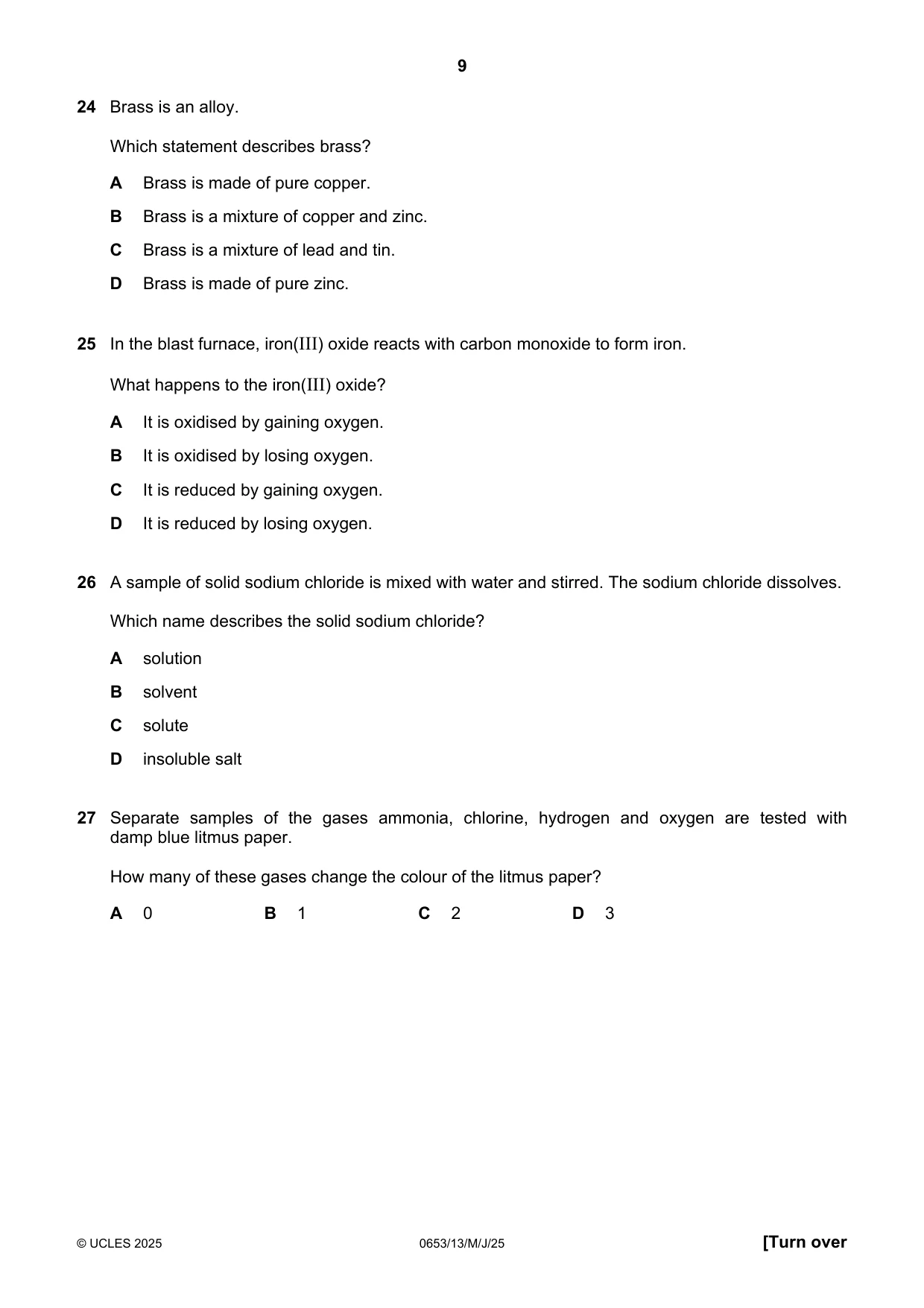
Q24 · Brass is an alloy
24 Brass is an alloy. Which statement describes brass? A Brass is made of pure copper. B Brass is a mixture of copper and zinc. C Brass is a mixture of lead and tin. D Brass is made of pure zinc.
Mark scheme: B
Q25 · In the blast furnace, iron(III) oxide reacts with carbon monoxide to form iron
25 In the blast furnace, iron(III) oxide reacts with carbon monoxide to form iron. What happens to the iron(III) oxide? A It is oxidised by gaining oxygen. B It is oxidised by losing oxygen. C It is reduced by gaining oxygen. D It is reduced by losing oxygen.
Mark scheme: D
Q26 · A sample of solid sodium chloride is mixed with water and stirred
26 A sample of solid sodium chloride is mixed with water and stirred. The sodium chloride dissolves. Which name describes the solid sodium chloride? A solution B solvent C solute D insoluble salt
Mark scheme: C
Q27 · Separate samples of the gases ammonia, chlorine, hydrogen and oxygen are tested with damp…
27 Separate samples of the gases ammonia, chlorine, hydrogen and oxygen are tested with damp blue litmus paper. How many of these gases change the colour of the litmus paper? A 0 B 1 C 2 D 3
Mark scheme: B
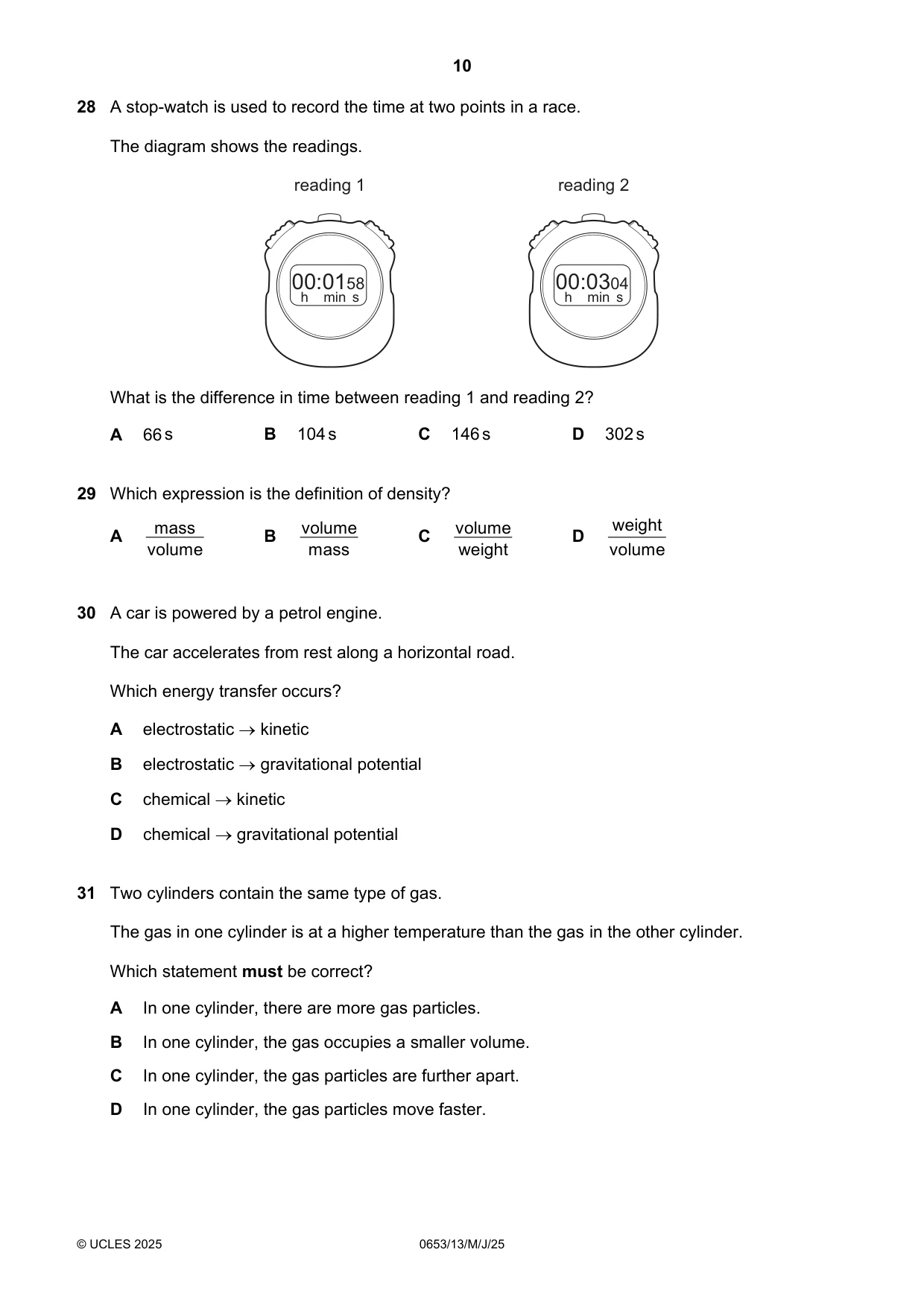
Q28 · A stop-watch is used to record the time at two points in a race
28 A stop-watch is used to record the time at two points in a race. The diagram shows the readings. reading 1 reading 2 00:0158 00:0304 h min s h min s What is the difference in time between reading 1 and reading 2? A 66 s B 104 s C 146 s D 302 s
Mark scheme: A
More questions on Physical quantities and measurement techniques
Q29 · Which expression is the definition of density?
29 Which expression is the definition of density? mass volume volume weight A volume B mass C weight D volume
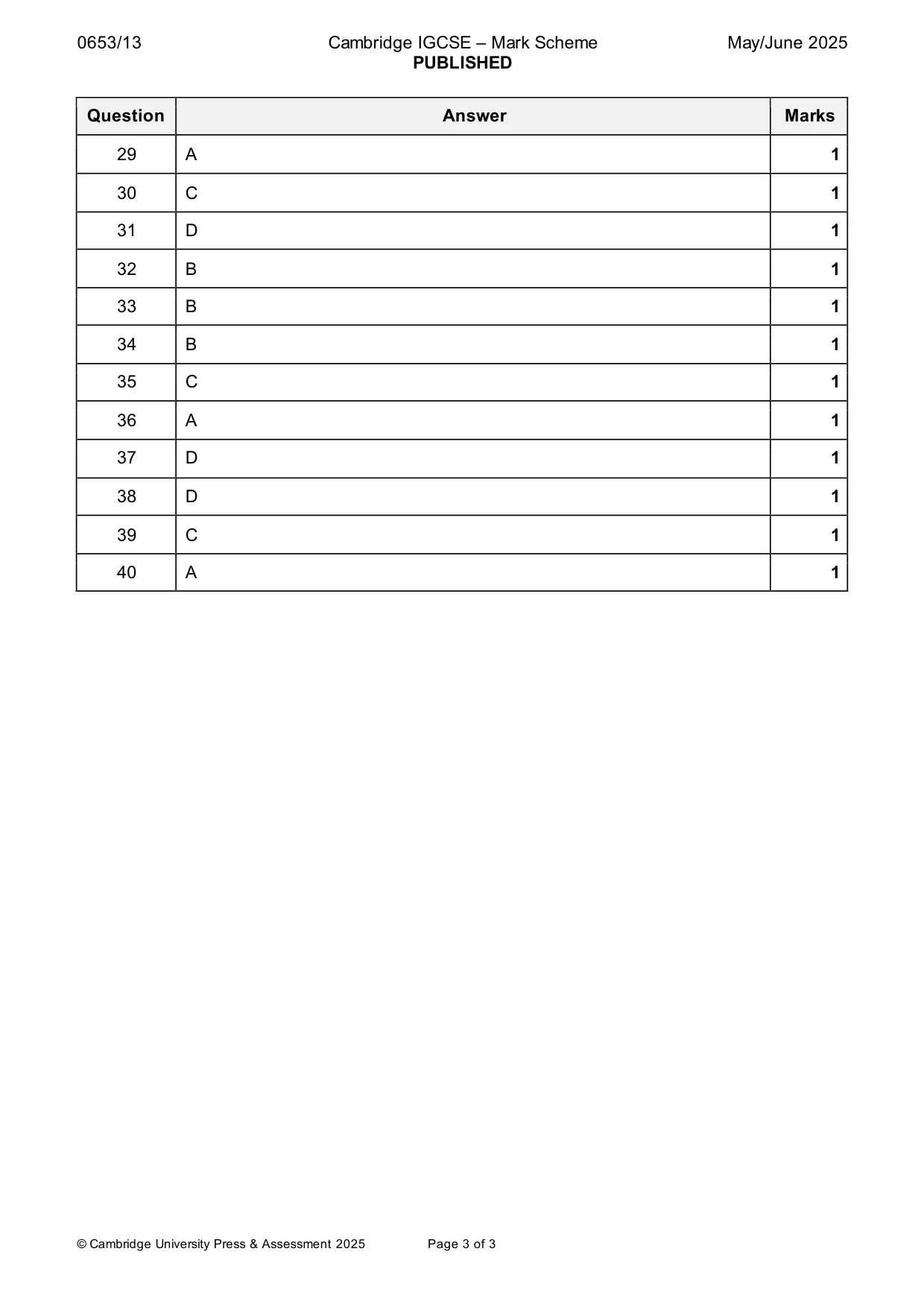
Mark scheme: A
Q30 · A car is powered by a petrol engine
30 A car is powered by a petrol engine. The car accelerates from rest along a horizontal road. Which energy transfer occurs? A electrostatic kinetic B electrostatic gravitational potential C chemical kinetic D chemical gravitational potential
Mark scheme: C
Q31 · Two cylinders contain the same type of gas
31 Two cylinders contain the same type of gas. The gas in one cylinder is at a higher temperature than the gas in the other cylinder. Which statement must be correct? A In one cylinder, there are more gas particles. B In one cylinder, the gas occupies a smaller volume. C In one cylinder, the gas particles are further apart. D In one cylinder, the gas particles move faster.
Mark scheme: D
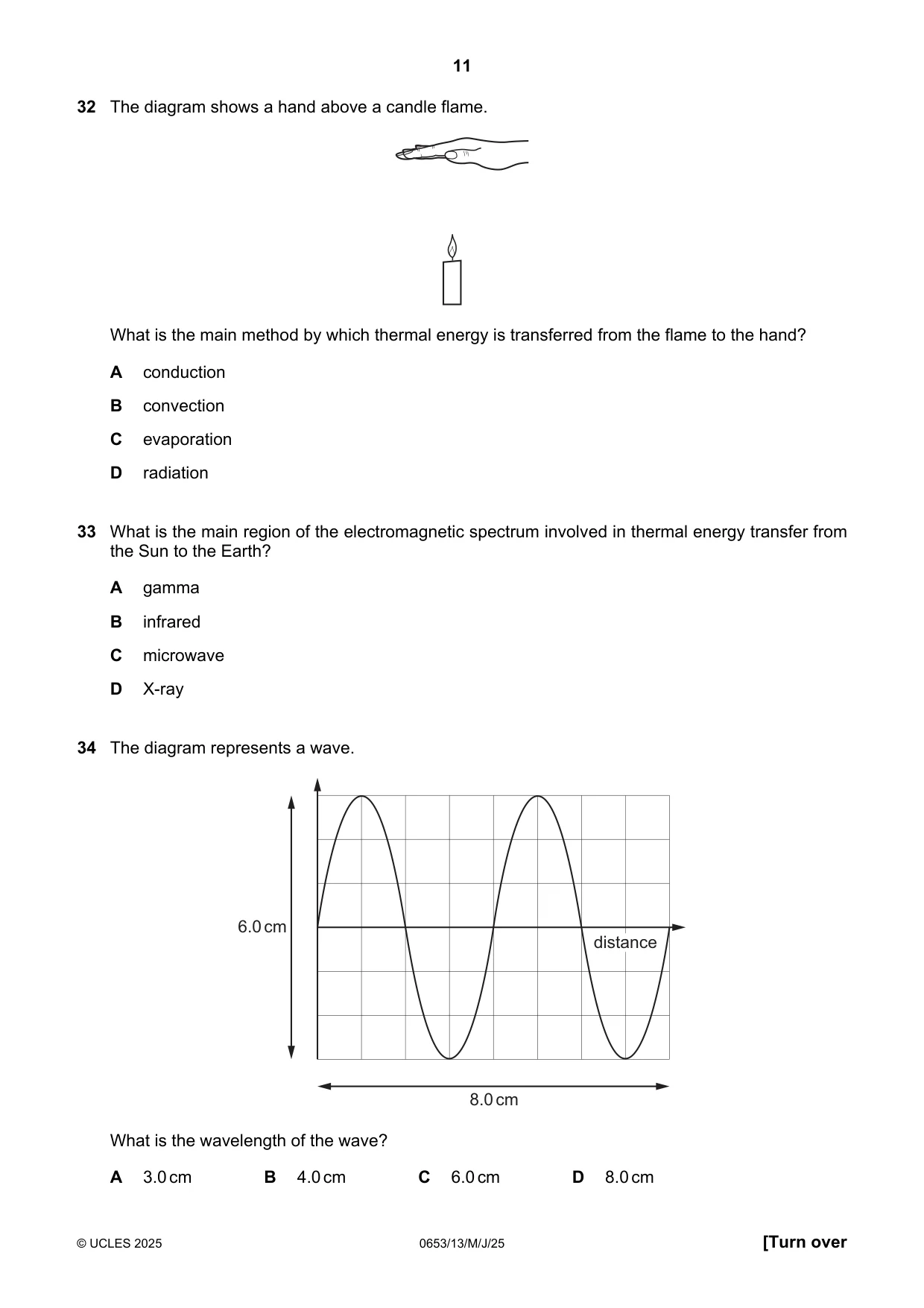
Q32 · The diagram shows a hand above a candle flame
32 The diagram shows a hand above a candle flame. What is the main method by which thermal energy is transferred from the flame to the hand? A conduction B convection C evaporation D radiation
Mark scheme: B
Q33 · What is the main region of the electromagnetic spectrum involved in thermal energy…
33 What is the main region of the electromagnetic spectrum involved in thermal energy transfer from the Sun to the Earth? A gamma B infrared C microwave D X-ray
Mark scheme: B
Q34 · The diagram represents a wave
34 The diagram represents a wave. 6.0 cm distance 8.0 cm What is the wavelength of the wave? A 3.0 cm B 4.0 cm C 6.0 cm D 8.0 cm
Mark scheme: B
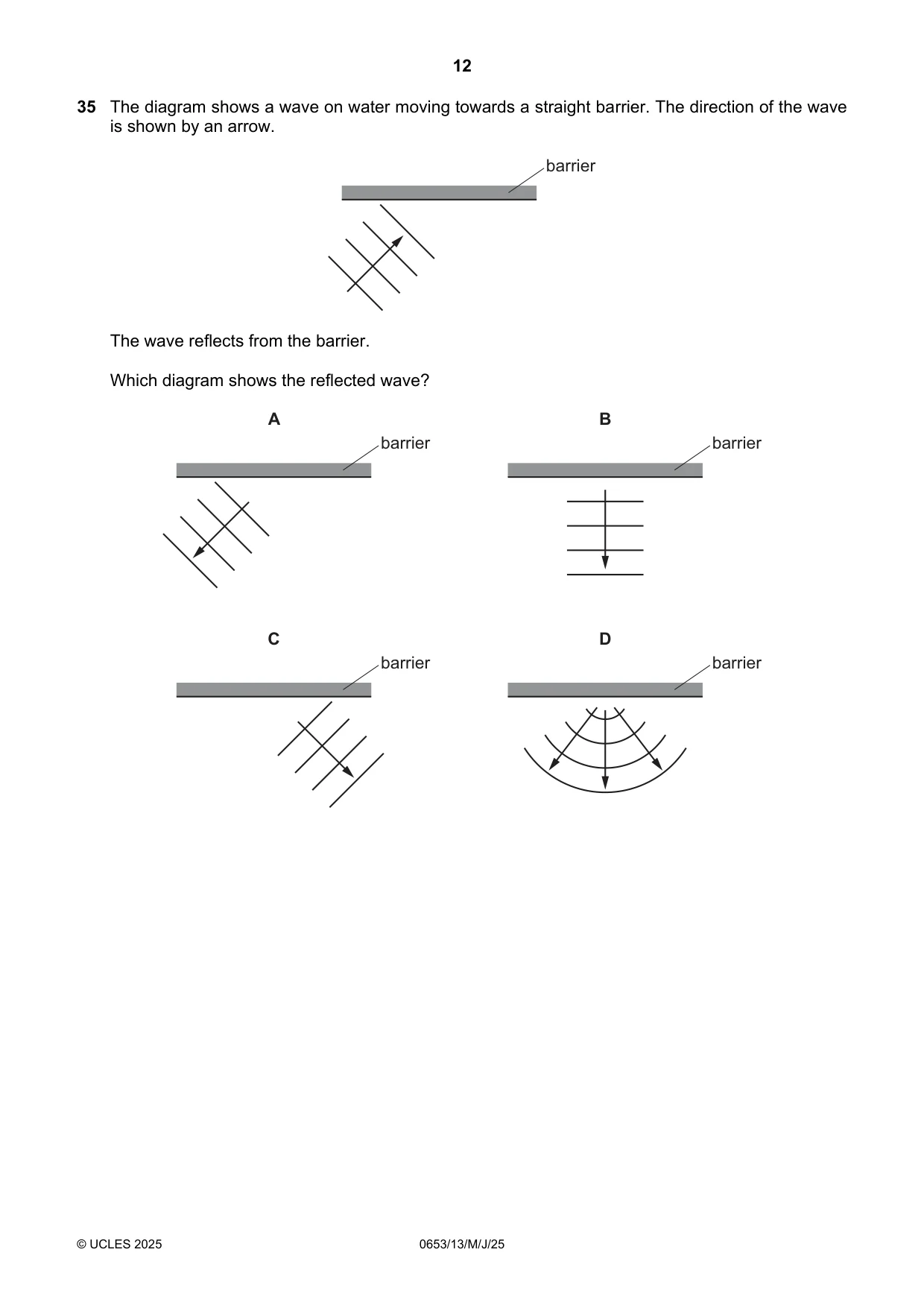
Q35 · The diagram shows a wave on water moving towards a straight barrier
35 The diagram shows a wave on water moving towards a straight barrier. The direction of the wave is shown by an arrow. barrier The wave reflects from the barrier. Which diagram shows the reflected wave? A B barrier barrier C D barrier barrier
Mark scheme: C
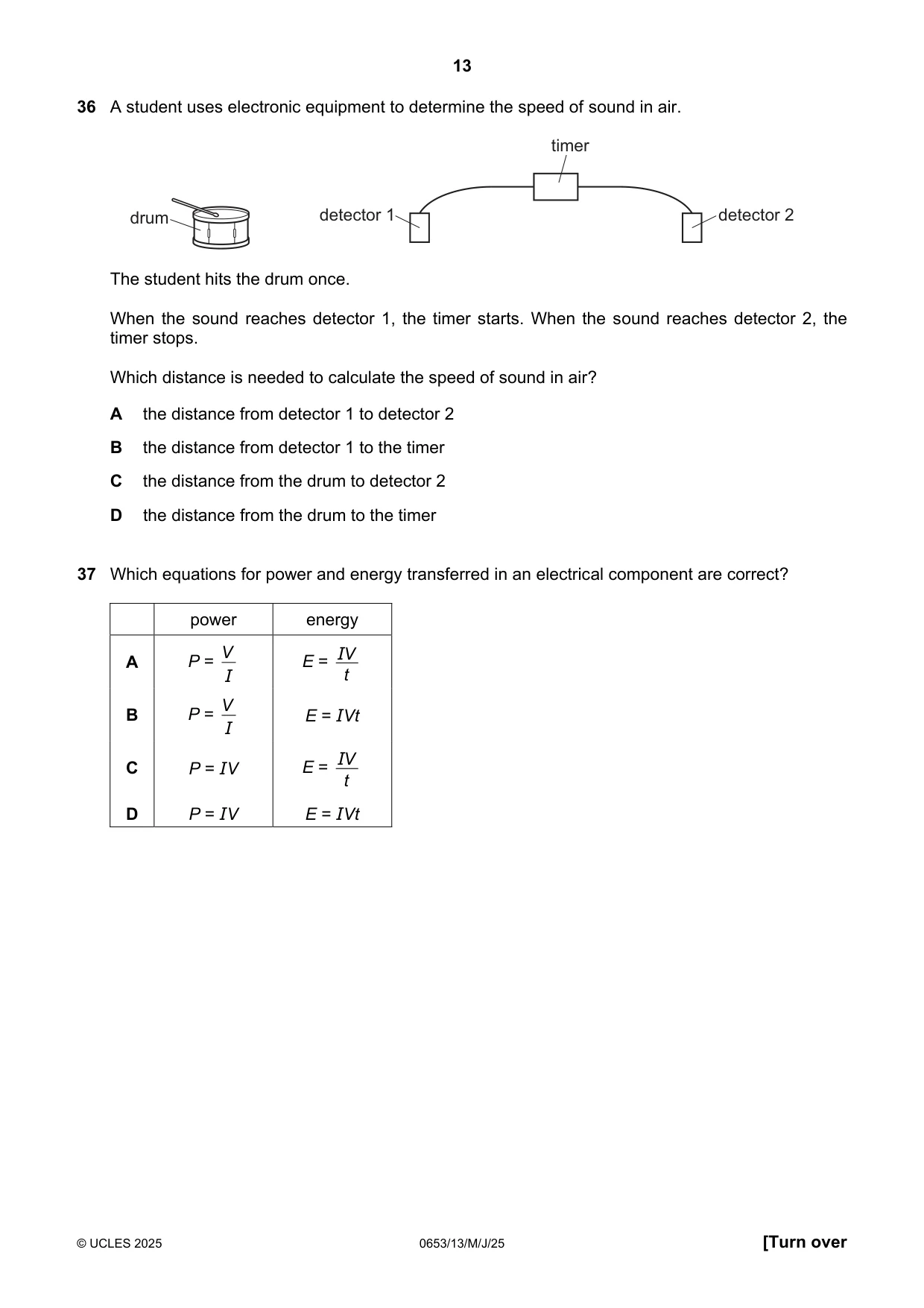
Q36 · A student uses electronic equipment to determine the speed of sound in air
36 A student uses electronic equipment to determine the speed of sound in air. timer drum detector 1 detector 2 The student hits the drum once. When the sound reaches detector 1, the timer starts. When the sound reaches detector 2, the timer stops. Which distance is needed to calculate the speed of sound in air? A the distance from detector 1 to detector 2 B the distance from detector 1 to the timer C the distance from the drum to detector 2 D the distance from the drum to the timer
Mark scheme: A
Q37 · Which equations for power and energy transferred in an electrical component are correct?
37 Which equations for power and energy transferred in an electrical component are correct? power energy V E = V I A P = I t V B P = E = IVt I E = V I C P = IV t D P = IV E = IVt
Mark scheme: D
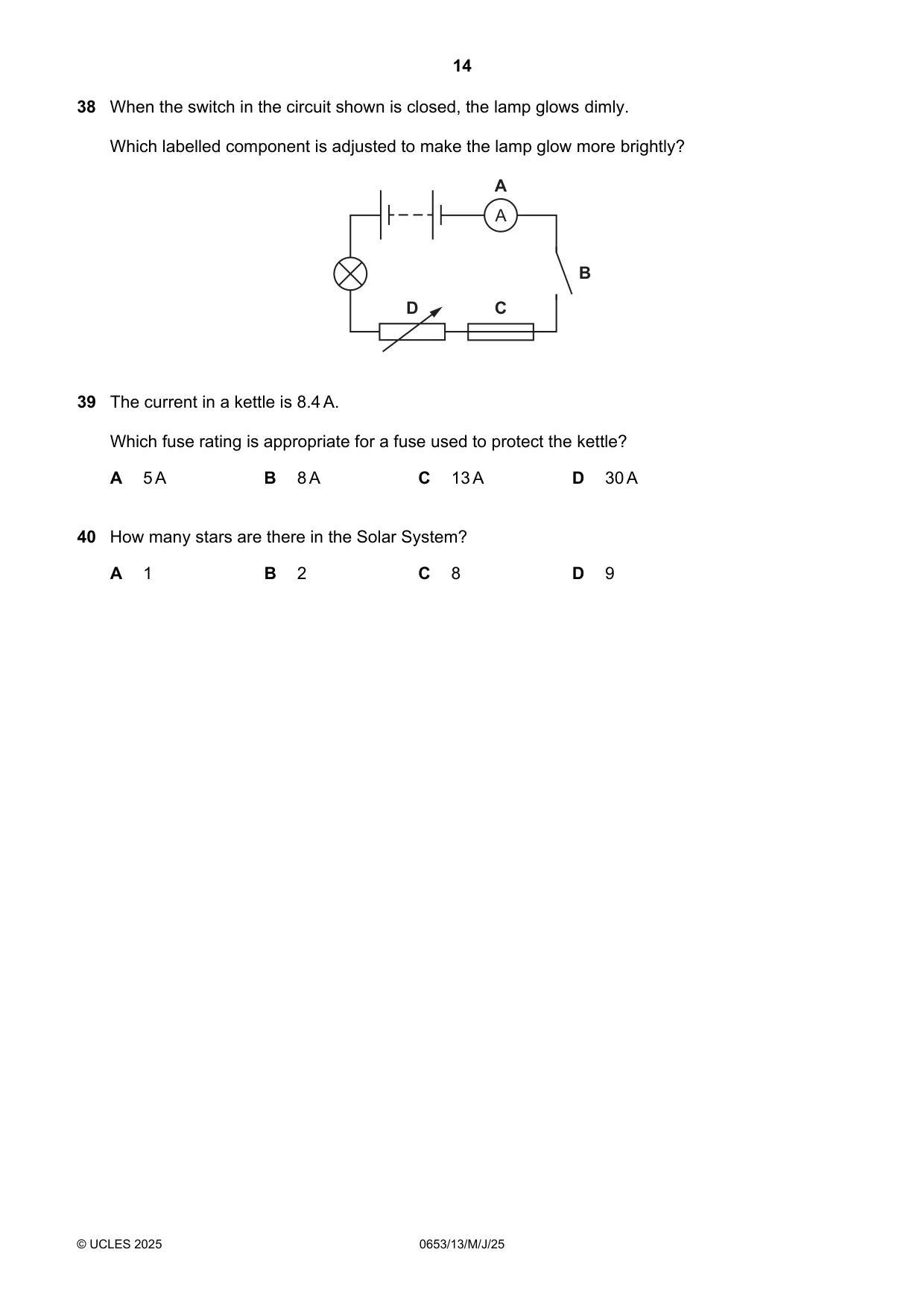
Q38 · When the switch in the circuit shown is closed, the lamp glows dimly
38 When the switch in the circuit shown is closed, the lamp glows dimly. Which labelled component is adjusted to make the lamp glow more brightly? A A B D C
Mark scheme: D
Q39 · The current in a kettle is 8.4 A
39 The current in a kettle is 8.4 A. Which fuse rating is appropriate for a fuse used to protect the kettle? A 5 A B 8 A C 13 A D 30 A
Mark scheme: C
Q40 · How many stars are there in the Solar System?
40 How many stars are there in the Solar System? A 1 B 2 C 8 D 9
Mark scheme: A
What was in this paper
The subtopics covered by these 40 questions, and how many questions each got. Open one in a new tab to see every Cambridge question on it.
2Alloys and their properties1Biological molecules1Carbon cycle1Cell structure1Characteristics of living organisms1Corrosion of metals1Density1Diet1Digestion1Digestive system1Electrical circuits1Electrical quantities1Electrical safety1Electrolysis1Electromagnetic spectrum1Elements, compounds and mixtures1Energy, work and power1Enzymes1Exothermic and endothermic reactions1Extraction of metals1Food chains and food webs1General properties of waves1Identification of ions and gases1Ions and ionic bonds1Kinetic particle model of matter1Leaf structure1Light1Noble gases1Photosynthesis1Physical and chemical changes1Physical quantities and measurement techniques1Preparation of salts1Sexual reproduction in humans1Simple molecules and covalent bonds1Sound1The Solar System1Transfer of thermal energy1Xylem and phloem1What you needed in this session
Cambridge’s own grade thresholds for 2025 May/June, Paper 1 · Variant 3. A higher threshold means an easier paper — the bar moves with how the cohort did.