Cambridge IGCSE Science - Combined 0653 — 2014 Oct/Nov Paper 1 · Variant 1
0653/11/O/N/14 · 40 questions · 40 marks · ≈45 min
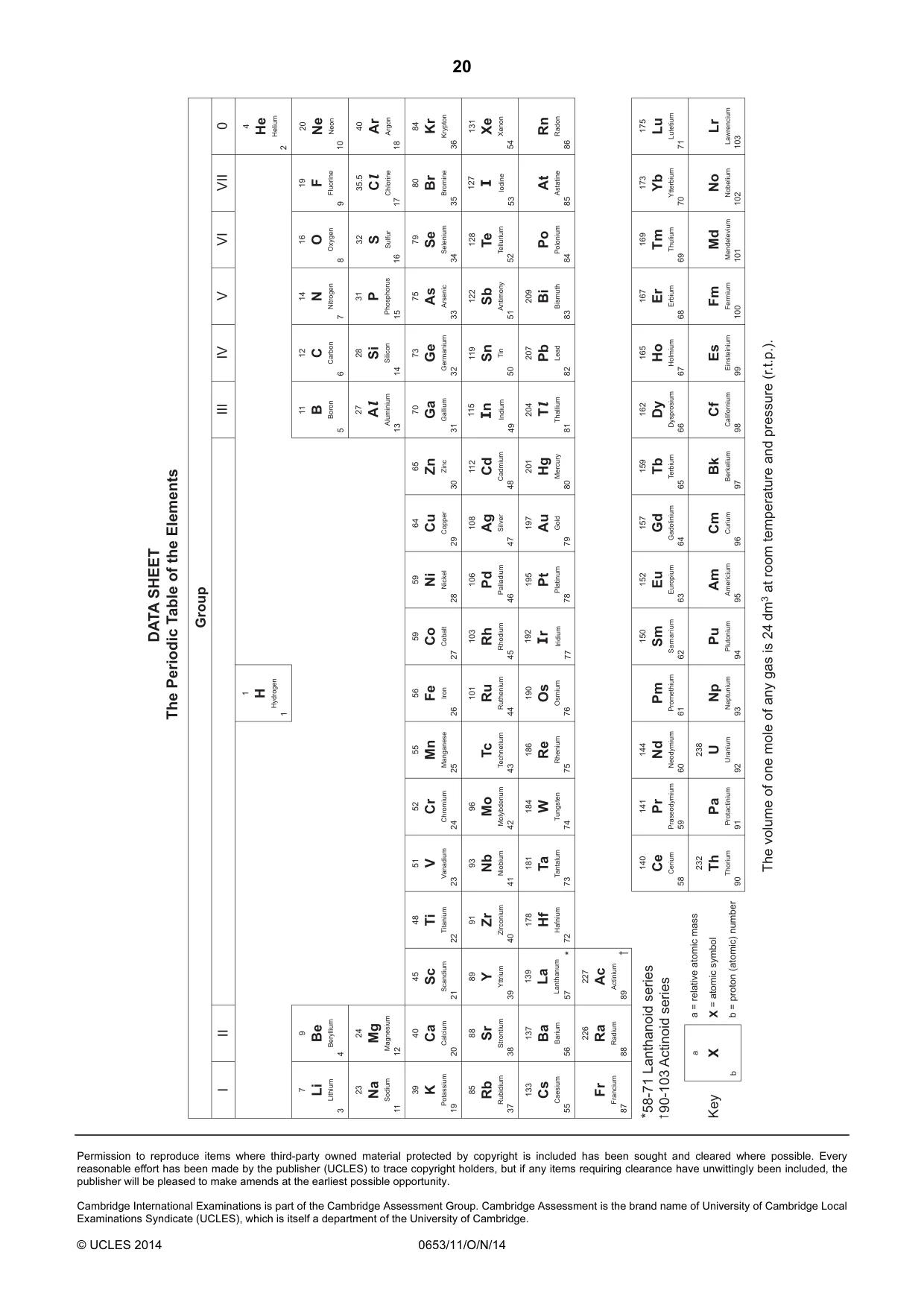
The question paper and its mark scheme, free to read here and free to download. This is Cambridge’s own paper, exactly as it was sat.
Question paper20 pages



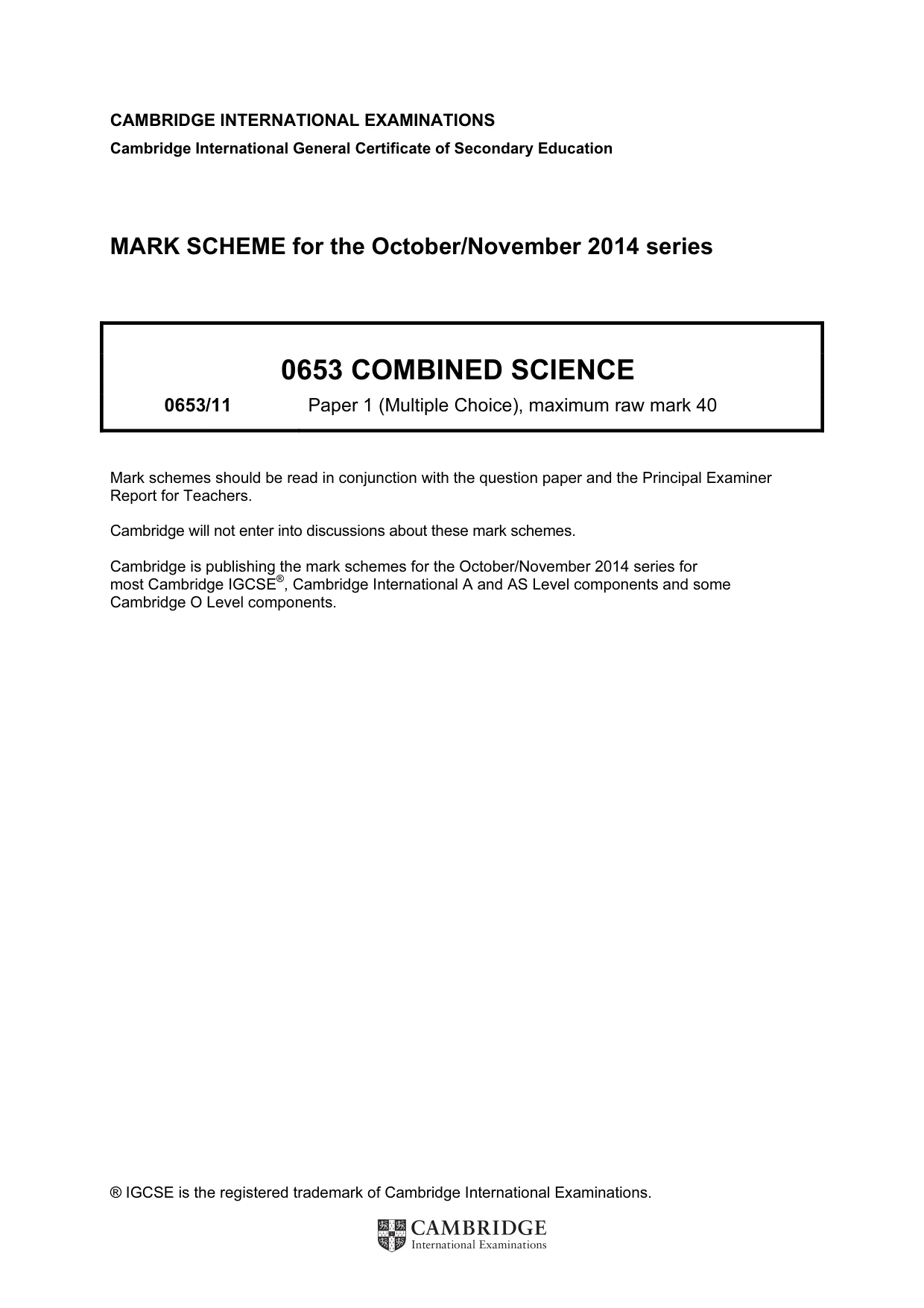
Mark scheme2 pages
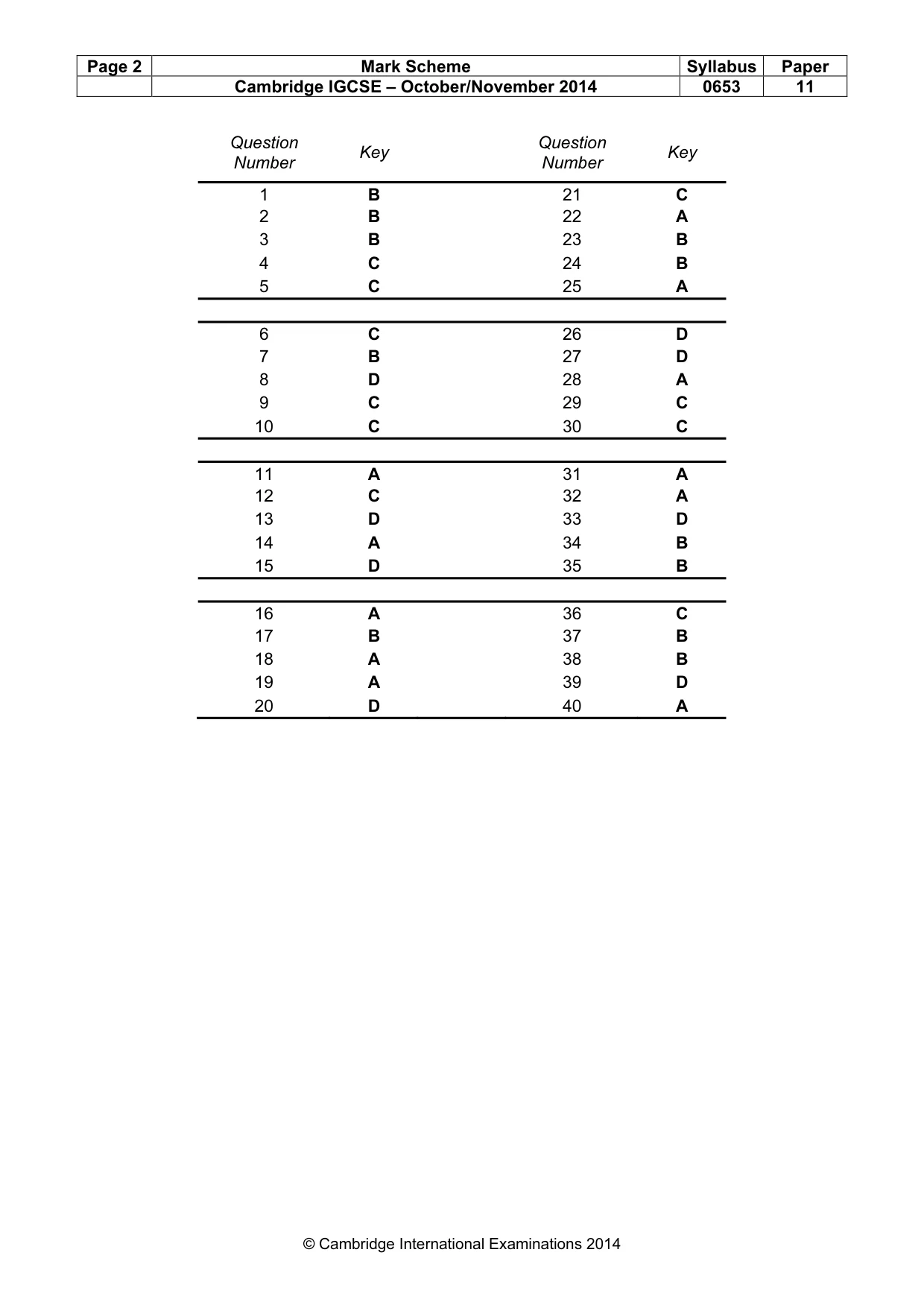
Answers below. Sit the paper first if you are practising.
Questions as text
Q1 · Which characteristics help to define a living organism?
1 Which characteristics help to define a living organism? A diffusion, movement, respiration B excretion, nutrition, sensitivity C excretion, reproduction, transpiration D growth, inspiration, nutrition
Mark scheme: B
Q2 · The diagram shows a plant cell
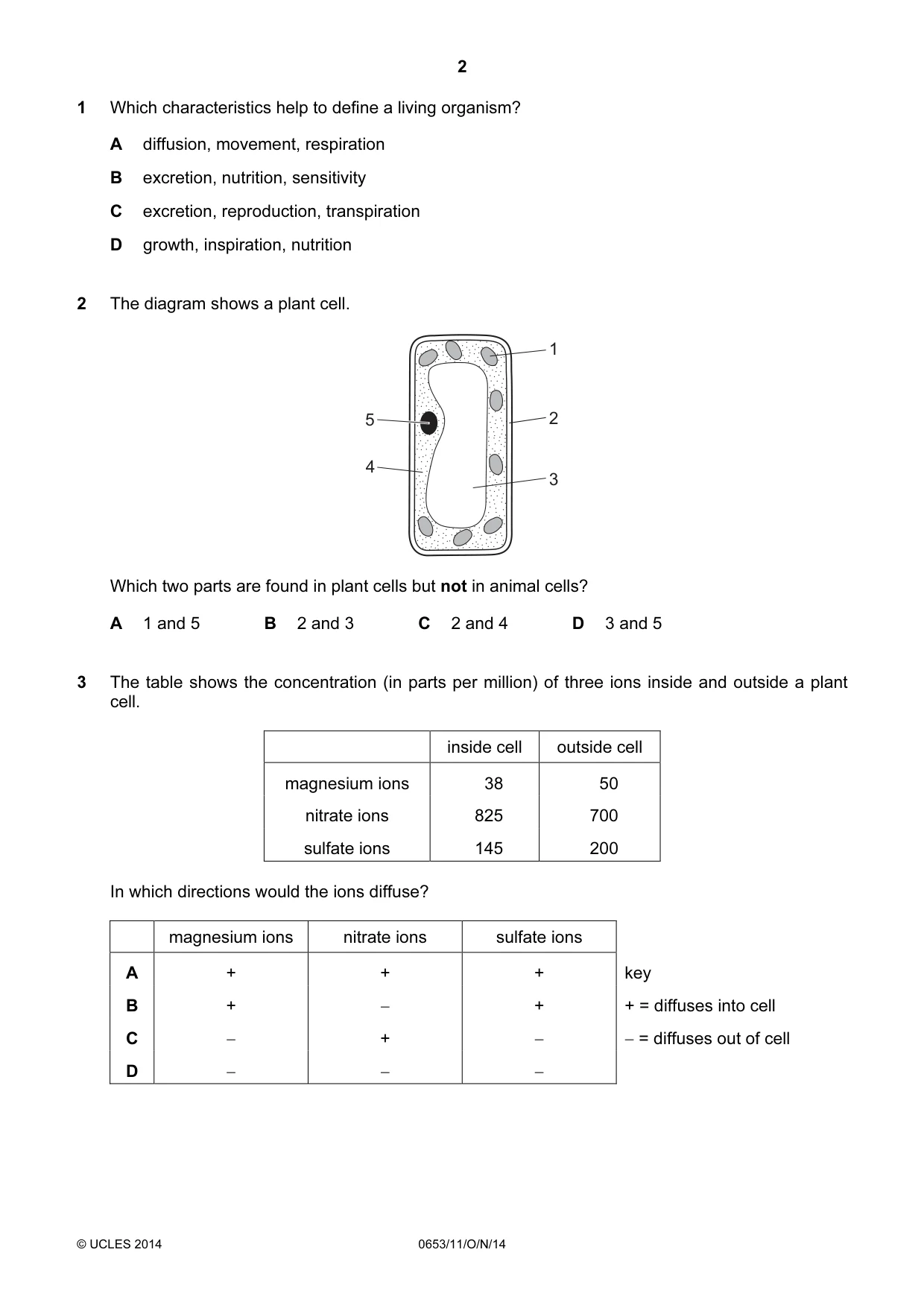
2 The diagram shows a plant cell. 1 5 2 4 3 Which two parts are found in plant cells but not in animal cells? A 1 and 5 B 2 and 3 C 2 and 4 D 3 and 5
Mark scheme: B
Q3 · The table shows the concentration (in parts per million) of three ions inside and outside…
3 The table shows the concentration (in parts per million) of three ions inside and outside a plant cell. inside cell outside cell magnesium ions 38 50 nitrate ions 825 700 sulfate ions 145 200 In which directions would the ions diffuse? magnesium ions nitrate ions sulfate ions A + + + key B + − + + = diffuses into cell C − + − − = diffuses out of cell D − − −
Mark scheme: B
Q4 · An experiment is carried out to investigate the effect of pH on the activity of an enzyme
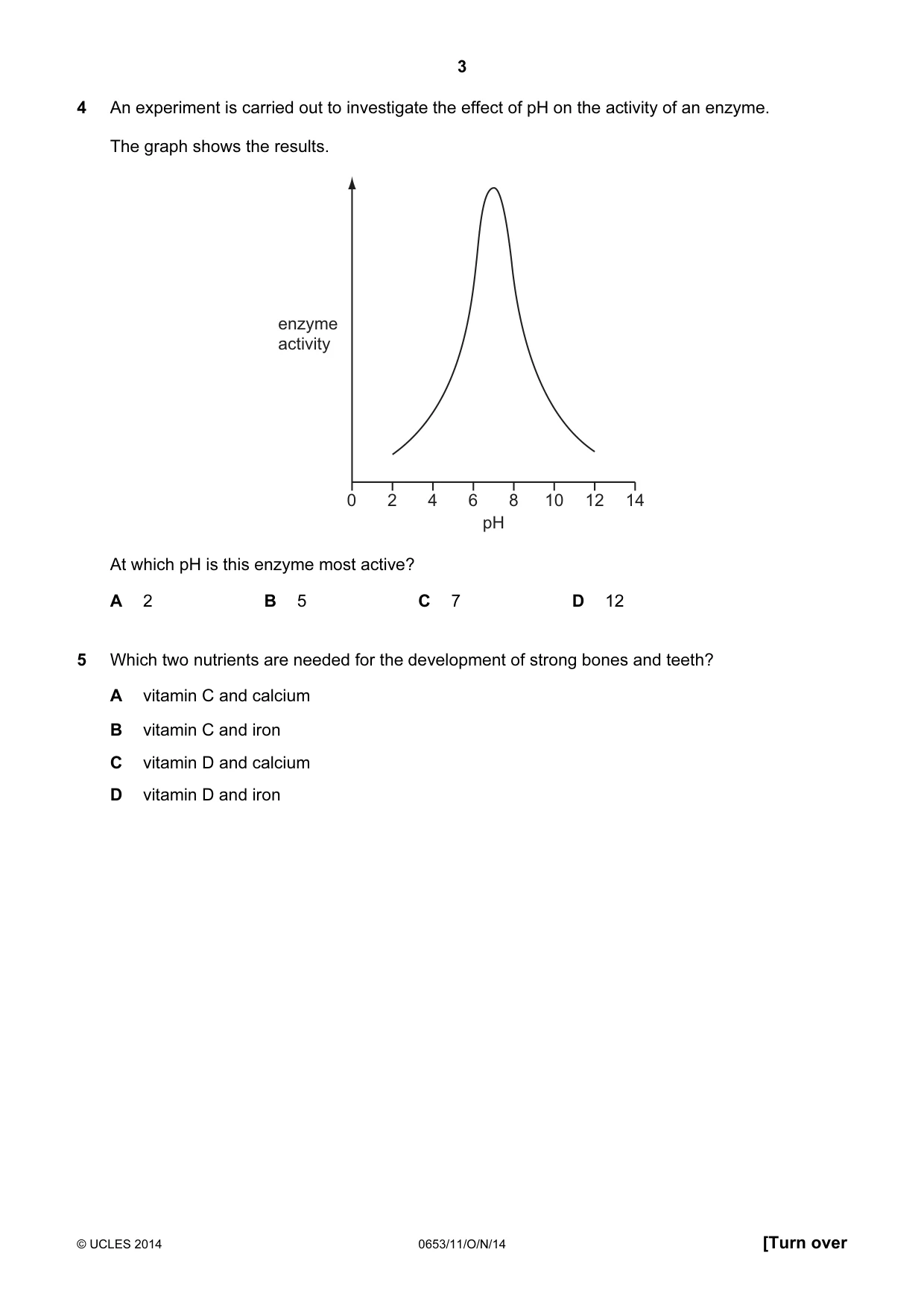
4 An experiment is carried out to investigate the effect of pH on the activity of an enzyme. The graph shows the results. enzyme activity 0 2 4 6 8 10 12 14 pH At which pH is this enzyme most active? A 2 B 5 C 7 D 12
Mark scheme: C
Q5 · Which two nutrients are needed for the development of strong bones and teeth?
5 Which two nutrients are needed for the development of strong bones and teeth? A vitamin C and calcium B vitamin C and iron C vitamin D and calcium D vitamin D and iron
Mark scheme: C
Q6 · The diagram shows a section through a leaf
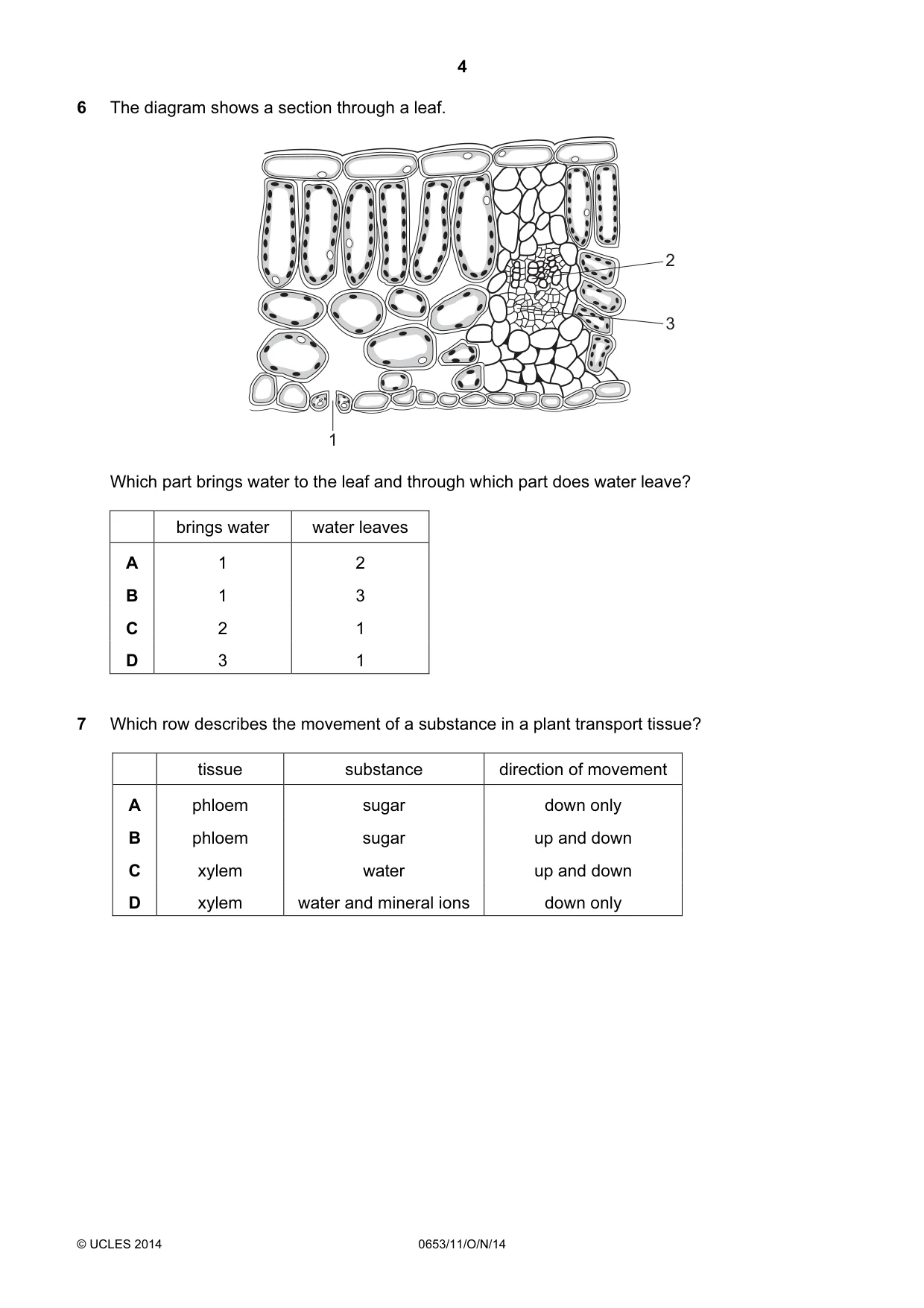
6 The diagram shows a section through a leaf. 2 3 1 Which part brings water to the leaf and through which part does water leave? brings water water leaves A 1 2 B 1 3 C 2 1 D 3 1
Mark scheme: C
Q7 · Which row describes the movement of a substance in a plant transport tissue?
7 Which row describes the movement of a substance in a plant transport tissue? tissue substance direction of movement A phloem sugar down only B phloem sugar up and down C xylem water up and down D xylem water and mineral ions down only
Mark scheme: B
Q8 · Four students assembled apparatus intended to show that air breathed out contains more…
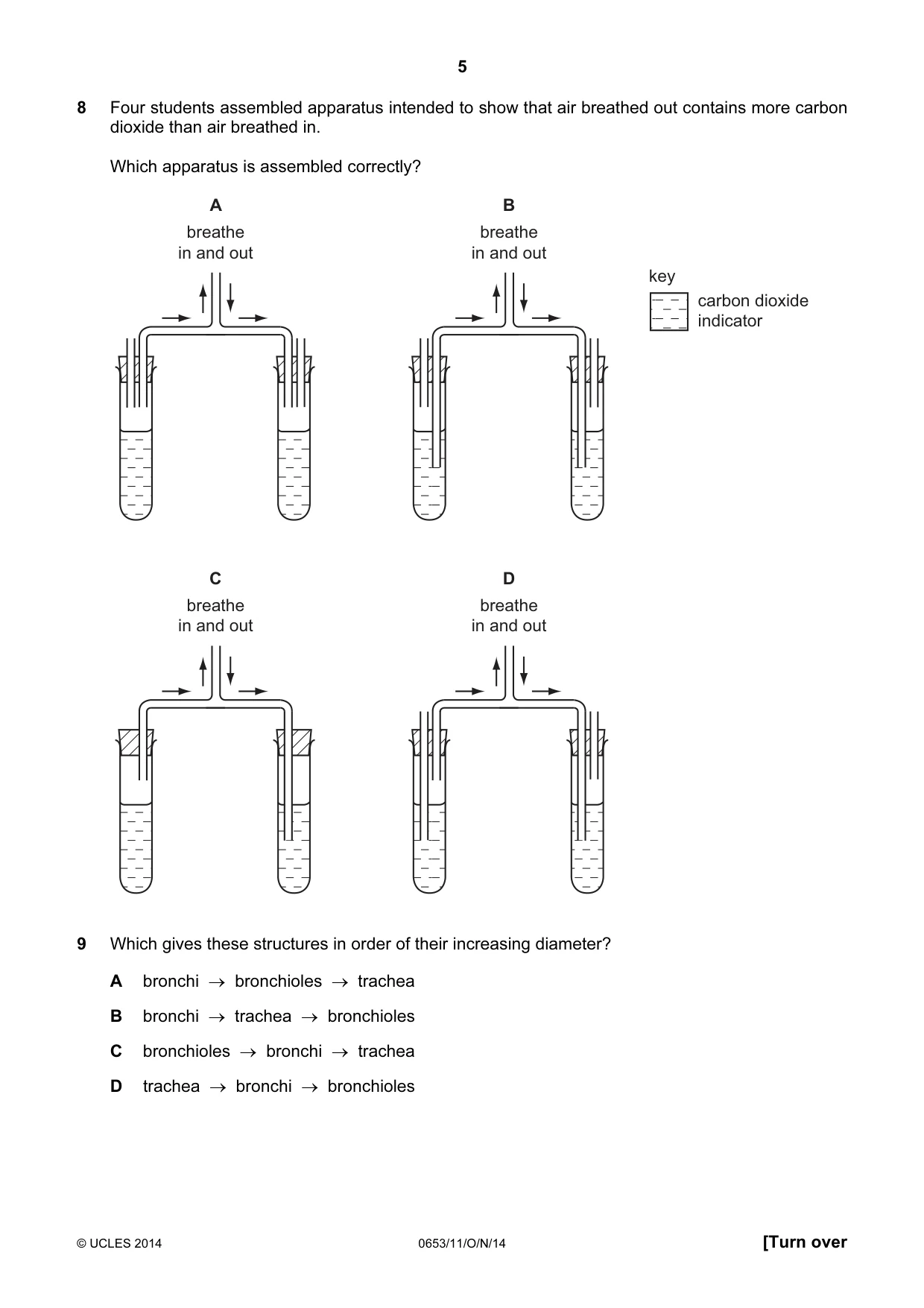
8 Four students assembled apparatus intended to show that air breathed out contains more carbon dioxide than air breathed in. Which apparatus is assembled correctly? A B breathe breathe in and out in and out key carbon dioxide indicator C D breathe breathe in and out in and out
Mark scheme: D
Q9 · Which gives these structures in order of their increasing diameter?
9 Which gives these structures in order of their increasing diameter? A bronchi → bronchioles → trachea B bronchi → trachea → bronchioles C bronchioles → bronchi → trachea D trachea → bronchi → bronchioles
Mark scheme: C
Q10 · When a food is heated with Benedict’s solution, an orange colour appears
10 When a food is heated with Benedict’s solution, an orange colour appears. Which nutrient must be present in the food? A fat B protein C reducing sugar D starch
Mark scheme: C
Q11 · A student is frightened by a dog and runs away
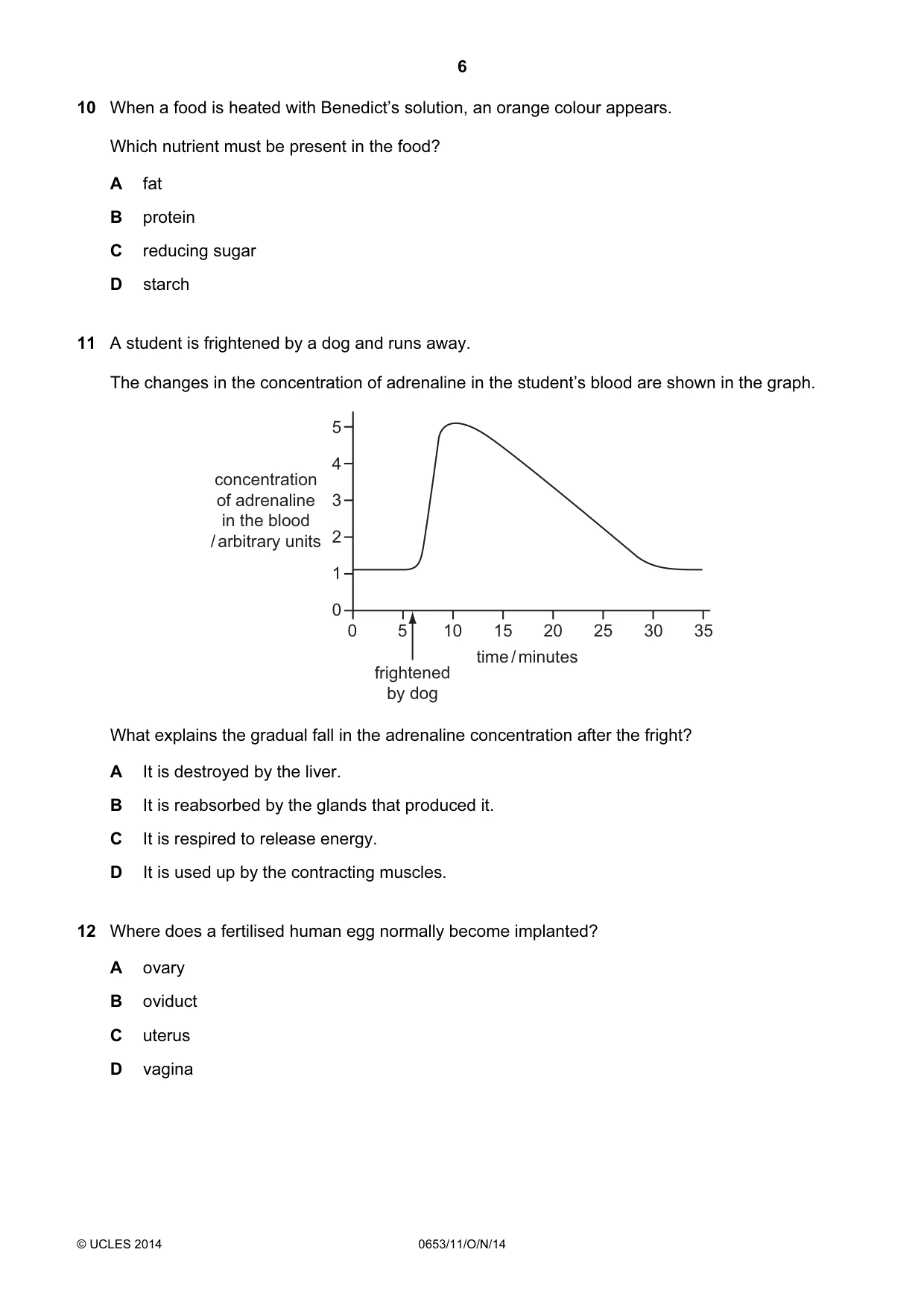
11 A student is frightened by a dog and runs away. The changes in the concentration of adrenaline in the student’s blood are shown in the graph. 5 4 concentration of adrenaline 3 in the blood / arbitrary units 2 1 0 0 5 10 15 20 25 30 35 time / minutes frightened by dog What explains the gradual fall in the adrenaline concentration after the fright? A It is destroyed by the liver. B It is reabsorbed by the glands that produced it. C It is respired to release energy. D It is used up by the contracting muscles.
Mark scheme: A
Q12 · Where does a fertilised human egg normally become implanted?
12 Where does a fertilised human egg normally become implanted? A ovary B oviduct C uterus D vagina
Mark scheme: C
Q13 · The diagram shows a food chain
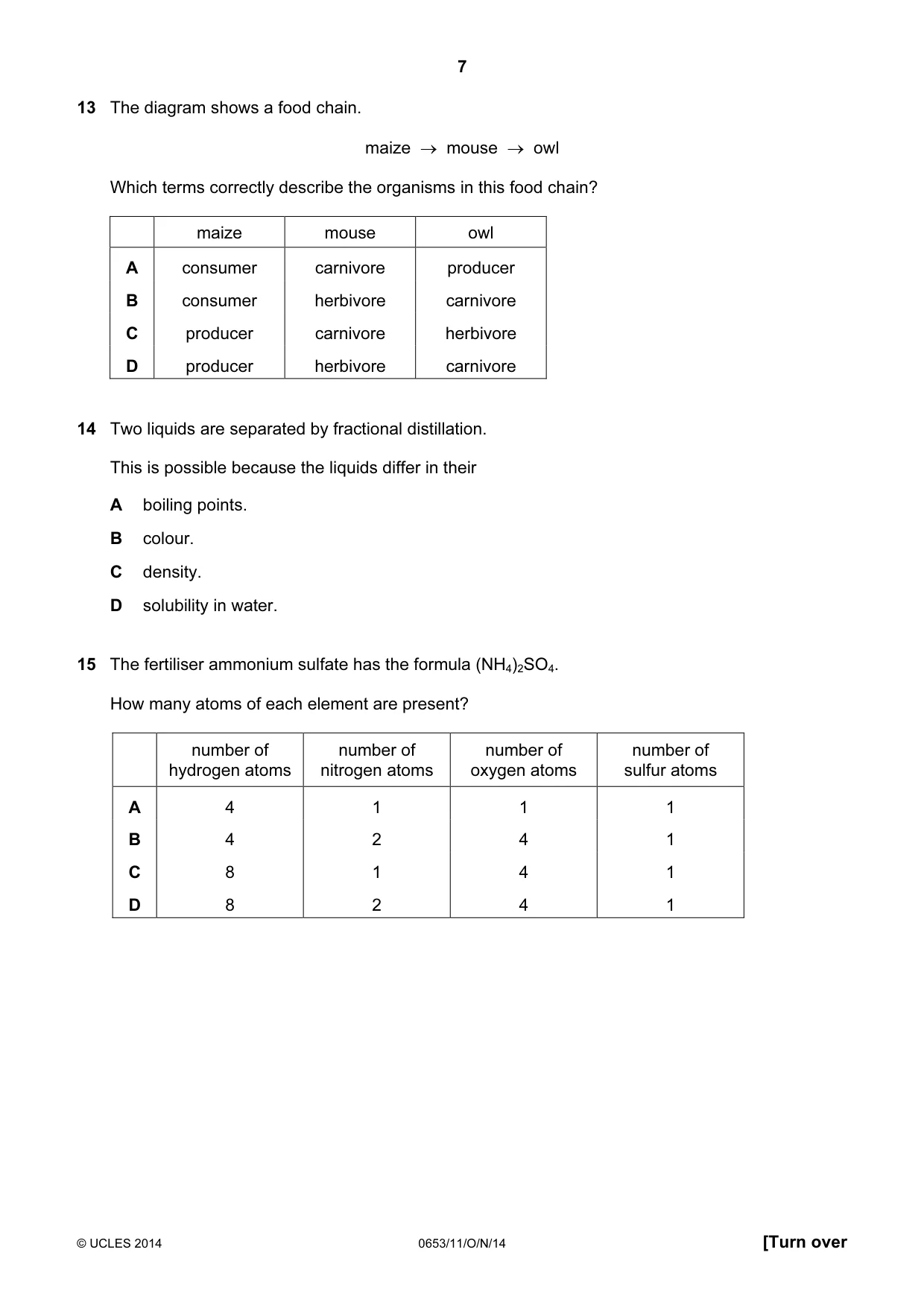
13 The diagram shows a food chain. maize → mouse → owl Which terms correctly describe the organisms in this food chain? maize mouse owl A consumer carnivore producer B consumer herbivore carnivore C producer carnivore herbivore D producer herbivore carnivore
Mark scheme: D
Q14 · Two liquids are separated by fractional distillation
14 Two liquids are separated by fractional distillation. This is possible because the liquids differ in their A boiling points. B colour. C density. D solubility in water.
Mark scheme: A
Q15 · The fertiliser ammonium sulfate has the formula (NH4)2SO4
15 The fertiliser ammonium sulfate has the formula (NH4)2SO4. How many atoms of each element are present? number of number of number of number of hydrogen atoms nitrogen atoms oxygen atoms sulfur atoms A 4 1 1 1 B 4 2 4 1 C 8 1 4 1 D 8 2 4 1
Mark scheme: D
Q16 · The contents of the two beakers shown are mixed
16 The contents of the two beakers shown are mixed. dilute HNO3 MgCO3 Which salt is formed? A magnesium nitrate B magnesium sulfate C manganese nitrate D manganese sulfate
Mark scheme: A
Q17 · A sweet potato is cut into pieces and cooked
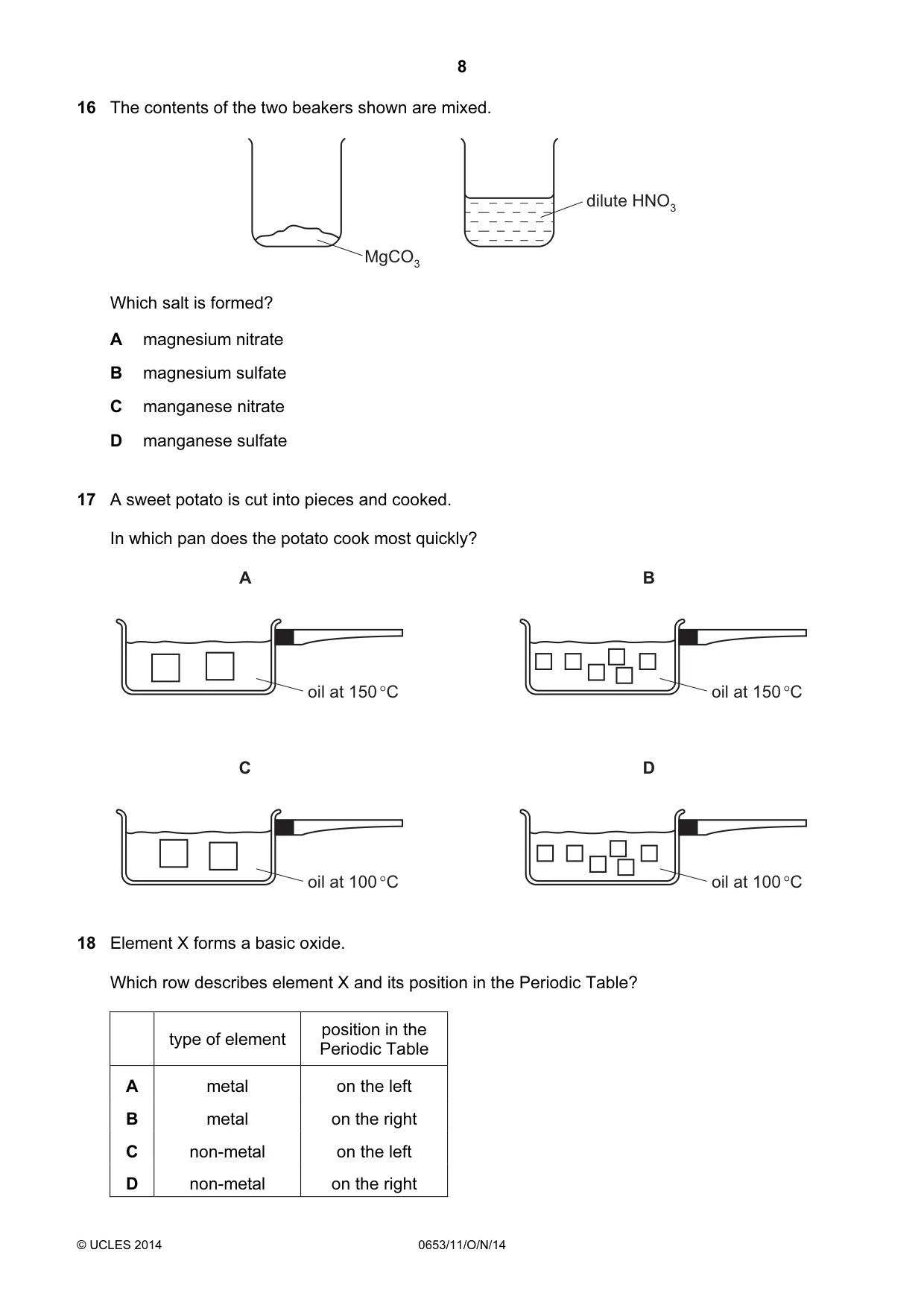
17 A sweet potato is cut into pieces and cooked. In which pan does the potato cook most quickly? A B oil at 150 °C oil at 150 °C C D oil at 100 °C oil at 100 °C
Mark scheme: B
Q18 · Element X forms a basic oxide
18 Element X forms a basic oxide. Which row describes element X and its position in the Periodic Table? position in the type of element Periodic Table A metal on the left B metal on the right C non-metal on the left D non-metal on the right
Mark scheme: A
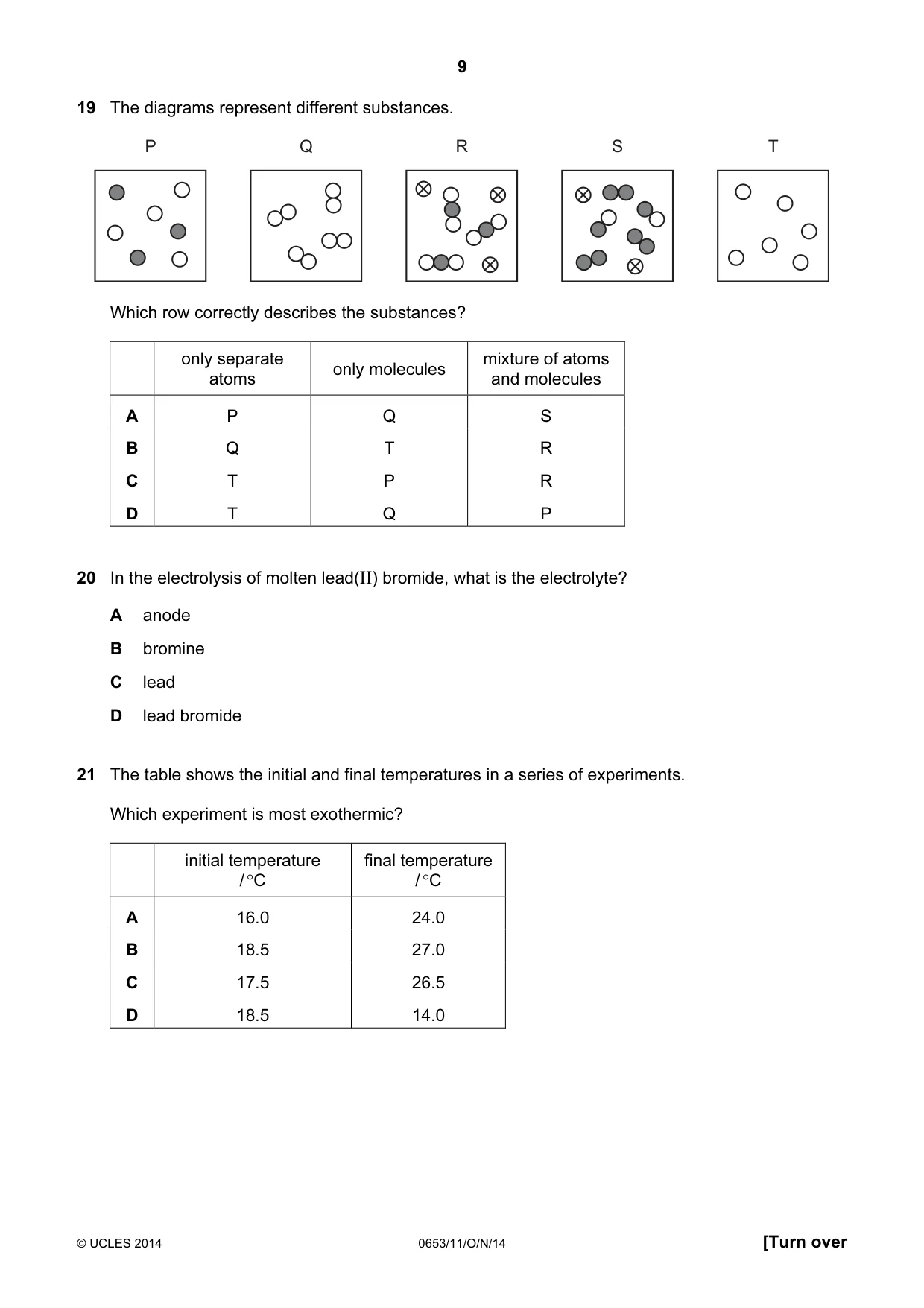
Q19 · The diagrams represent different substances
19 The diagrams represent different substances. P Q R S T Which row correctly describes the substances? only separate mixture of atoms only molecules atoms and molecules A P Q S B Q T R C T P R D T Q P
Mark scheme: A
Q20 · In the electrolysis of molten lead(II) bromide, what is the electrolyte?
20 In the electrolysis of molten lead(II) bromide, what is the electrolyte? A anode B bromine C lead D lead bromide
Mark scheme: D
Q21 · The table shows the initial and final temperatures in a series of experiments
21 The table shows the initial and final temperatures in a series of experiments. Which experiment is most exothermic? initial temperature final temperature / °C / °C A 16.0 24.0 B 18.5 27.0 C 17.5 26.5 D 18.5 14.0
Mark scheme: C
Q22 · Iron(III) oxide, Fe2O3, reacts with carbon monoxide, CO, to produce iron and carbon…
22 Iron(III) oxide, Fe2O3, reacts with carbon monoxide, CO, to produce iron and carbon dioxide. The equation for the reaction is Fe2O3 + 3CO → 2Fe + 3CO2 Which statement is not correct? A Carbon is neither oxidised nor reduced. B Carbon is oxidised. C Iron is reduced. D This is a redox reaction.
Mark scheme: A
Q23 · Which statement about transition metals is not correct?
23 Which statement about transition metals is not correct? A They are often used as catalysts. B They form colourless compounds. C They have high densities. D They have high melting points.
Mark scheme: B
Q24 · Which statement about Group I elements is correct?
24 Which statement about Group I elements is correct? A Their melting points increase down the group. B They are relatively soft metals. C They do not react with cold water. D They include sodium, potassium and calcium.
Mark scheme: B
Q25 · Gasoline is a hydrocarbon fuel obtained from crude oil
25 Gasoline is a hydrocarbon fuel obtained from crude oil. Which statement is correct? A Gasoline burns to form carbon dioxide and water. B Gasoline contains the elements carbon, hydrogen and oxygen. C Gasoline is used as a fuel for diesel engines. D The combustion of gasoline is an endothermic reaction.
Mark scheme: A
Q26 · Copper can be made from copper oxide by reacting it with carbon at a high temperature
26 Copper can be made from copper oxide by reacting it with carbon at a high temperature. Why is carbon used? A It does not react with copper. B It is a conductor of electricity. C It is a high melting point solid. D It is more reactive than copper.
Mark scheme: D
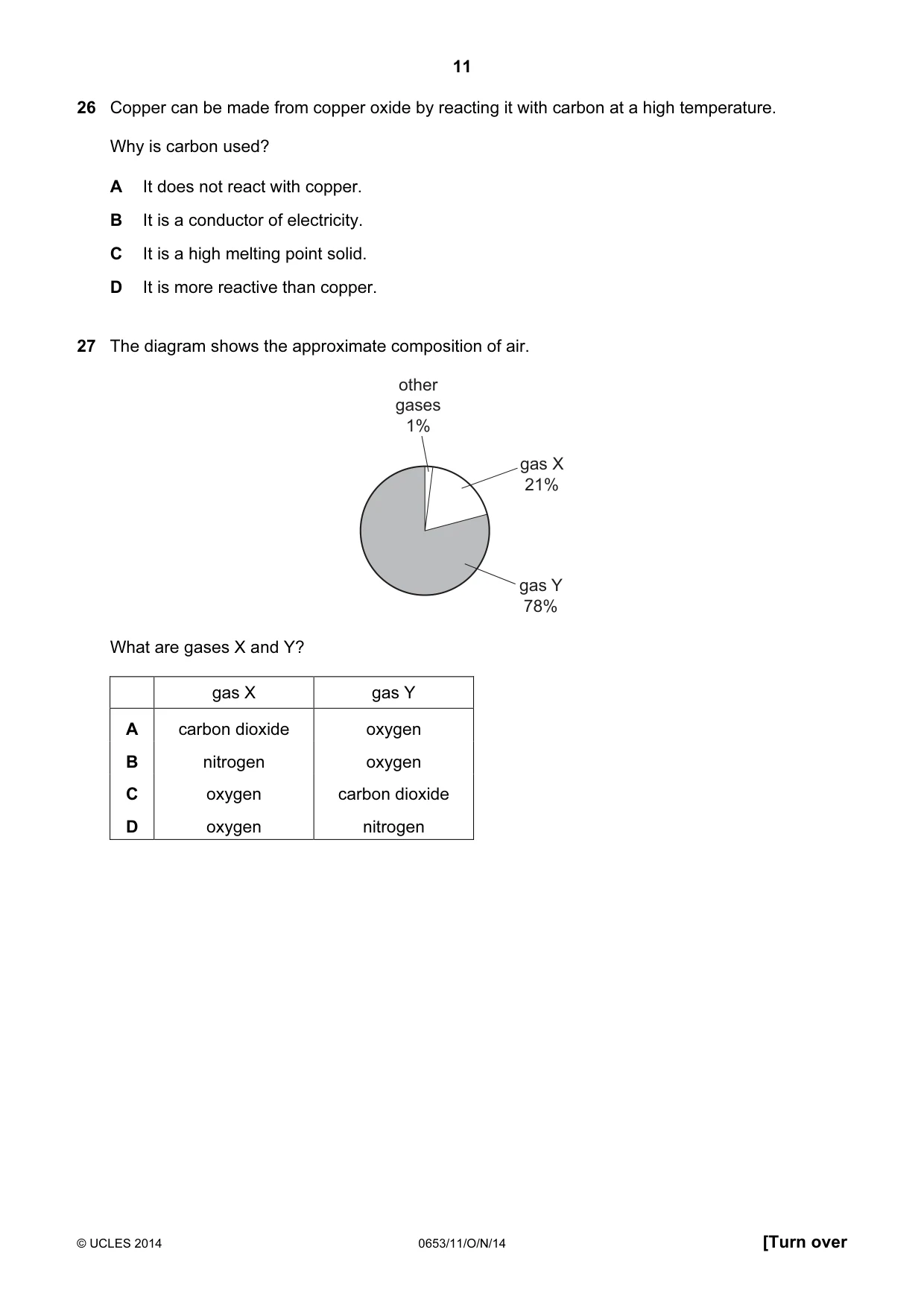
Q27 · The diagram shows the approximate composition of air
27 The diagram shows the approximate composition of air. other gases 1% gas X 21% gas Y 78% What are gases X and Y? gas X gas Y A carbon dioxide oxygen B nitrogen oxygen C oxygen carbon dioxide D oxygen nitrogen
Mark scheme: D
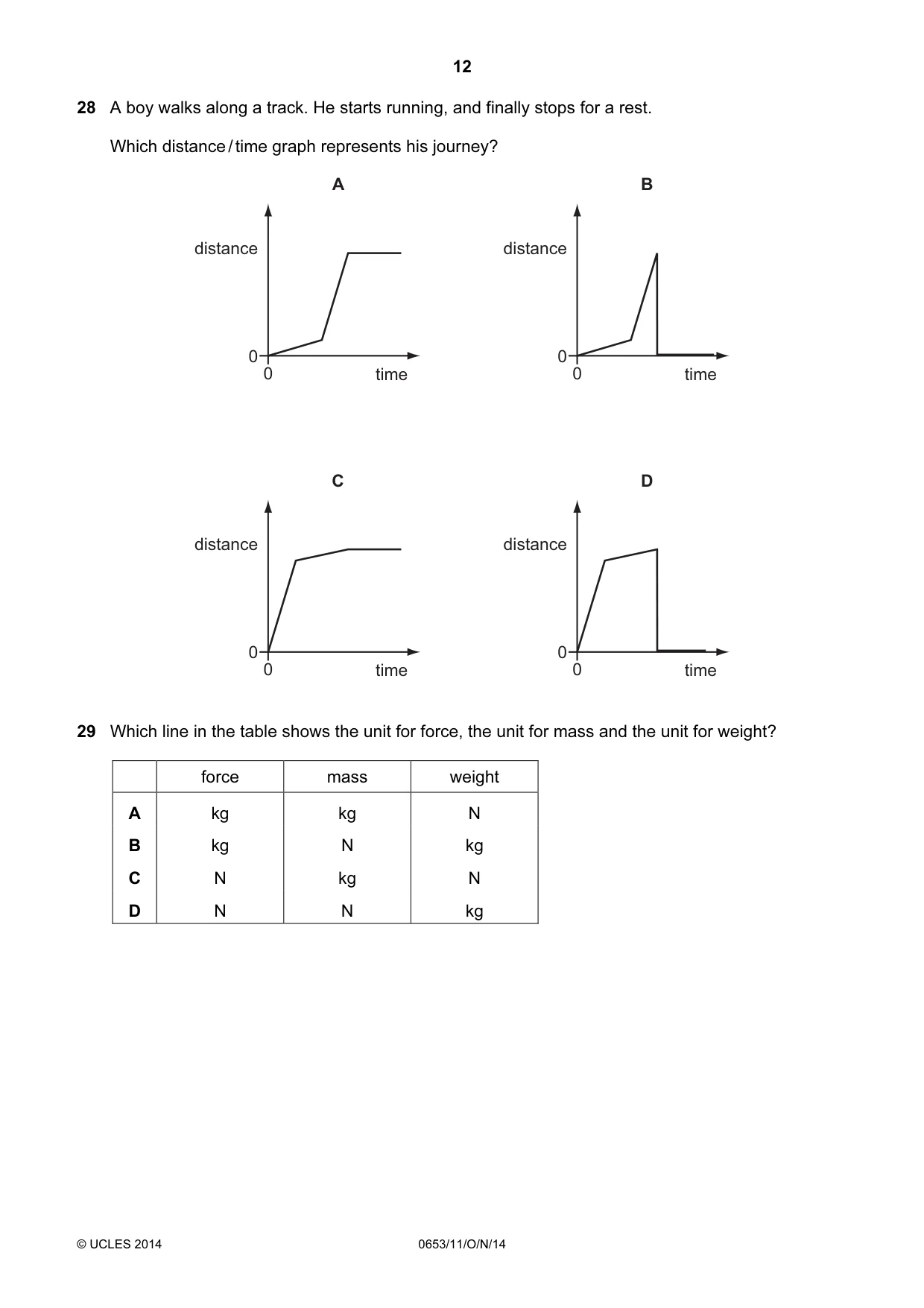
Q28 · A boy walks along a track
28 A boy walks along a track. He starts running, and finally stops for a rest. Which distance / time graph represents his journey? A B distance distance 0 0 0 time 0 time C D distance distance 0 0 0 time 0 time
Mark scheme: A
Q29 · Which line in the table shows the unit for force, the unit for mass and the unit for…
29 Which line in the table shows the unit for force, the unit for mass and the unit for weight? force mass weight A kg kg N B kg N kg C N kg N D N N kg
Mark scheme: C
Q30 · A force F lifting a weight through a height h
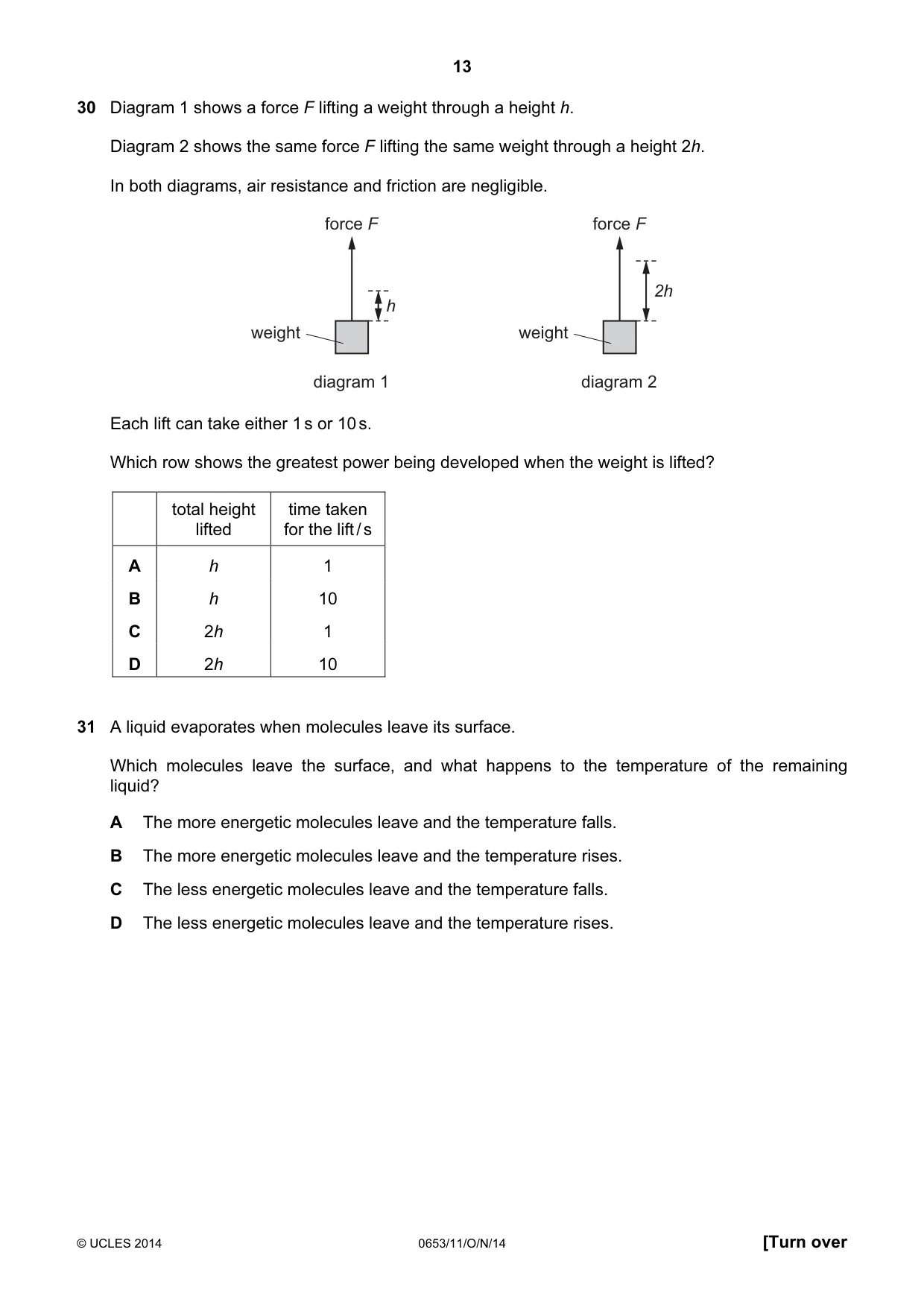
30 Diagram 1 shows a force F lifting a weight through a height h. Diagram 2 shows the same force F lifting the same weight through a height 2h. In both diagrams, air resistance and friction are negligible. force F force F 2h h weight weight diagram 1 diagram 2 Each lift can take either 1 s or 10 s. Which row shows the greatest power being developed when the weight is lifted? total height time taken lifted for the lift / s A h 1 B h 10 C 2h 1 D 2h 10
Mark scheme: C
Q31 · A liquid evaporates when molecules leave its surface
31 A liquid evaporates when molecules leave its surface. Which molecules leave the surface, and what happens to the temperature of the remaining liquid? A The more energetic molecules leave and the temperature falls. B The more energetic molecules leave and the temperature rises. C The less energetic molecules leave and the temperature falls. D The less energetic molecules leave and the temperature rises.
Mark scheme: A
Q32 · A telephone engineer connects a wire between two poles on a very hot day in a desert
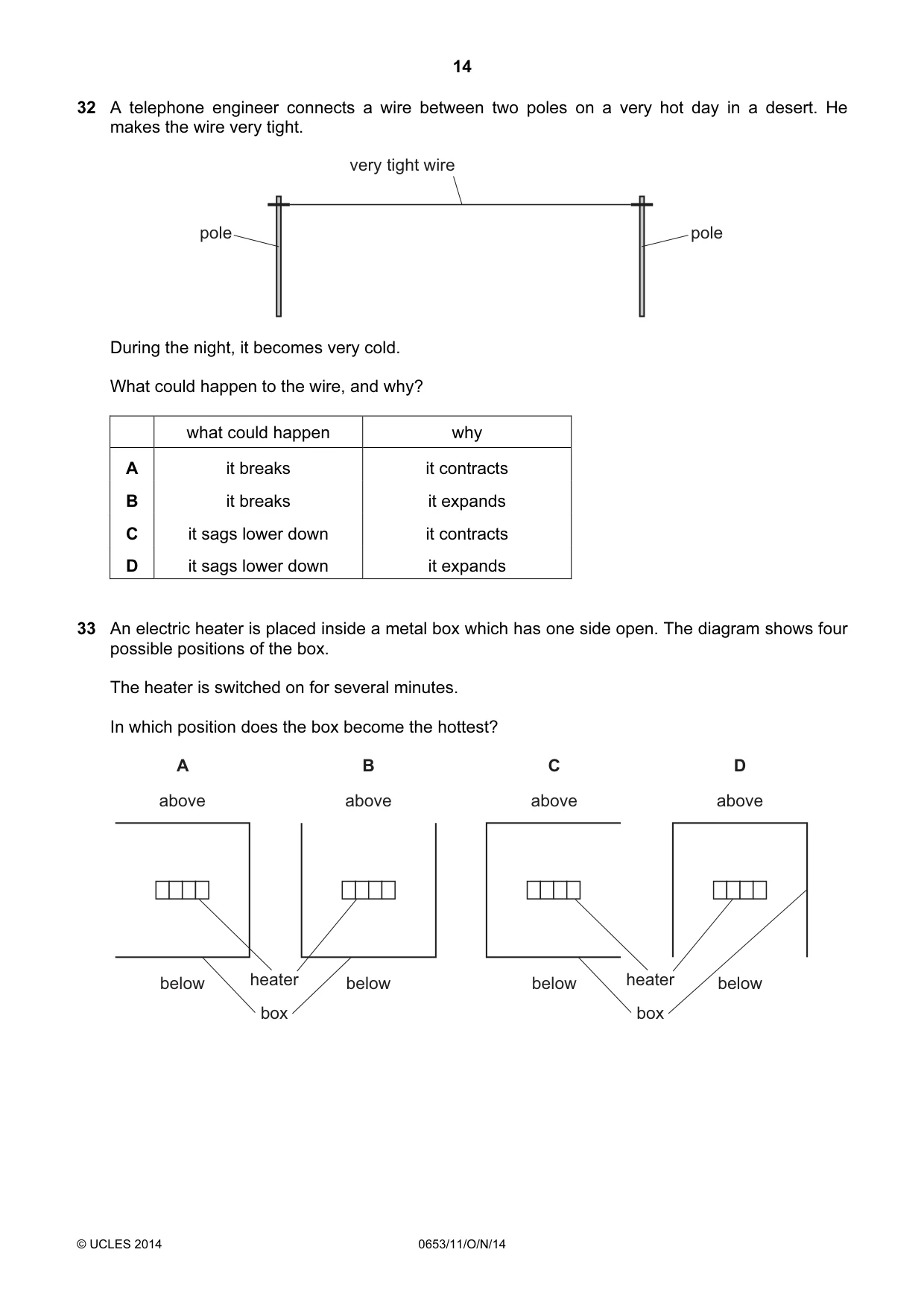
32 A telephone engineer connects a wire between two poles on a very hot day in a desert. He makes the wire very tight. very tight wire pole pole During the night, it becomes very cold. What could happen to the wire, and why? what could happen why A it breaks it contracts B it breaks it expands C it sags lower down it contracts D it sags lower down it expands
Mark scheme: A
Q33 · An electric heater is placed inside a metal box which has one side open
33 An electric heater is placed inside a metal box which has one side open. The diagram shows four possible positions of the box. The heater is switched on for several minutes. In which position does the box become the hottest? A B C D above above above above below heater below below heater below box box
Mark scheme: D
Q34 · The diagram shows a section through waves on water
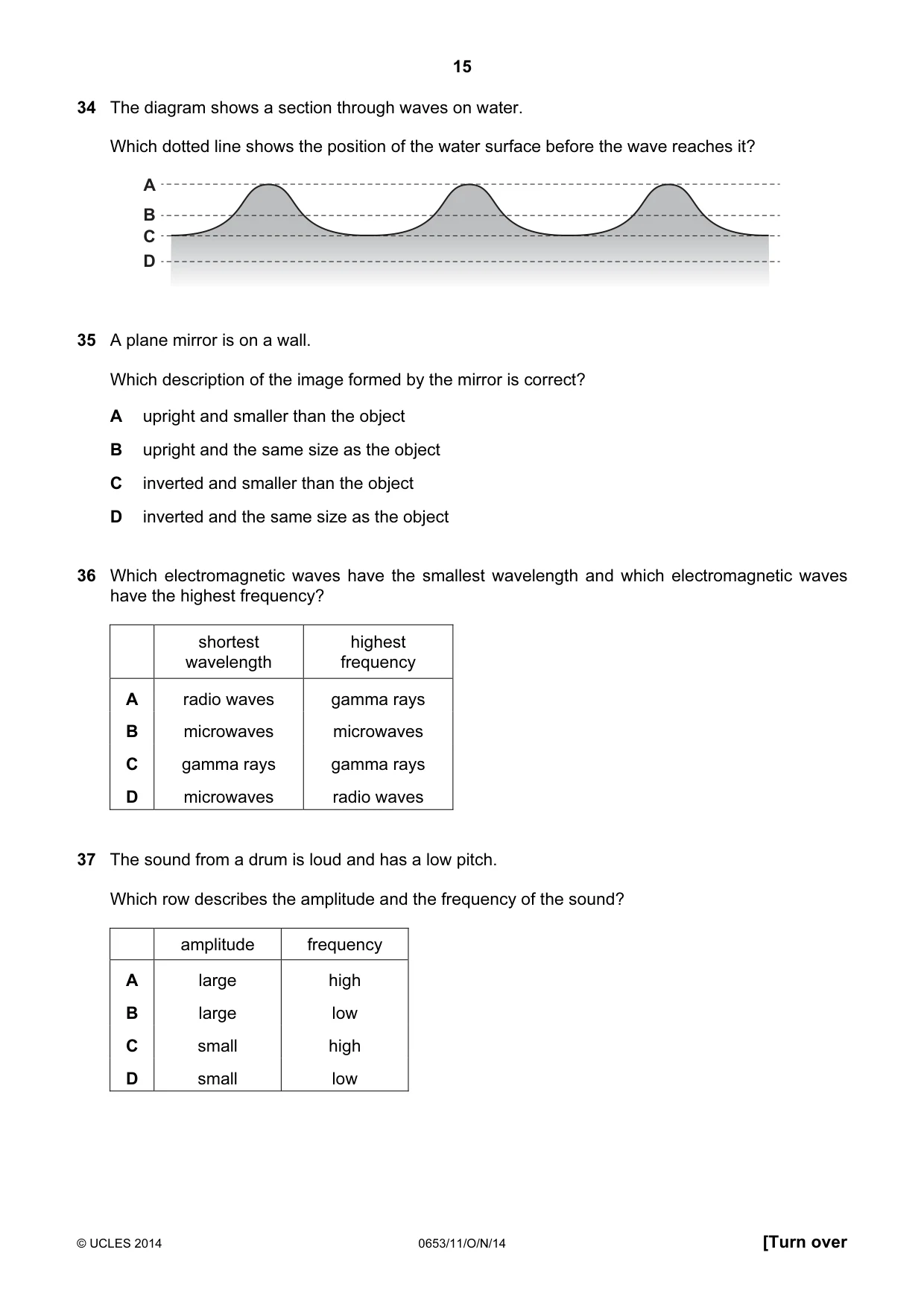
34 The diagram shows a section through waves on water. Which dotted line shows the position of the water surface before the wave reaches it? A B C D
Mark scheme: B
Q35 · A plane mirror is on a wall
35 A plane mirror is on a wall. Which description of the image formed by the mirror is correct? A upright and smaller than the object B upright and the same size as the object C inverted and smaller than the object D inverted and the same size as the object
Mark scheme: B
Q36 · Which electromagnetic waves have the smallest wavelength and which electromagnetic waves…
36 Which electromagnetic waves have the smallest wavelength and which electromagnetic waves have the highest frequency? shortest highest wavelength frequency A radio waves gamma rays B microwaves microwaves C gamma rays gamma rays D microwaves radio waves
Mark scheme: C
Q37 · The sound from a drum is loud and has a low pitch
37 The sound from a drum is loud and has a low pitch. Which row describes the amplitude and the frequency of the sound? amplitude frequency A large high B large low C small high D small low
Mark scheme: B
Q38 · When a plastic rod is rubbed with a cloth, the rod becomes positively charged
38 When a plastic rod is rubbed with a cloth, the rod becomes positively charged. How is this explained? A Electrons have been added to the rod. B Electrons have been removed from the rod. C Neutrons have been added to the rod. D Neutrons have been removed from the rod.
Mark scheme: B
Q39 · Why is a fuse used in an electric circuit in a house?
39 Why is a fuse used in an electric circuit in a house? A to increase the resistance of the circuit B to keep the power used at a constant value C to prevent a short circuit from occurring D to stop the cables overheating
Mark scheme: D
Q40 · Two resistors of resistance 6.0 ohms and 3.0 ohms are combined first in series and then…
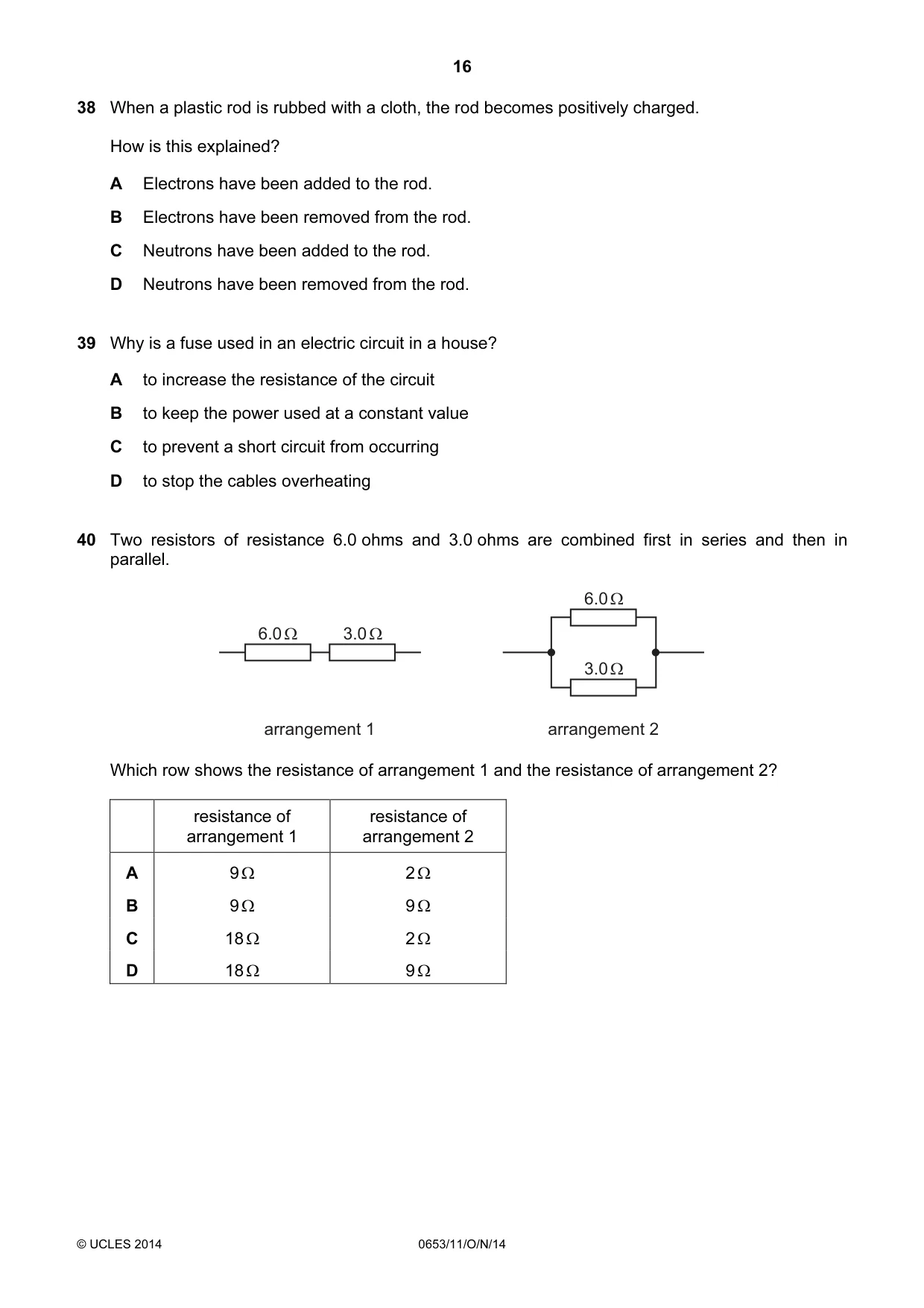
40 Two resistors of resistance 6.0 ohms and 3.0 ohms are combined first in series and then in parallel. 6.0 Ω 6.0 Ω 3.0 Ω 3.0 Ω arrangement 1 arrangement 2 Which row shows the resistance of arrangement 1 and the resistance of arrangement 2? resistance of resistance of arrangement 1 arrangement 2 A 9 Ω 2 Ω B 9 Ω 9 Ω C 18 Ω 2 Ω D 18 Ω 9 Ω
Mark scheme: A
What was in this paper
The subtopics covered by these 40 questions, and how many questions each got. Open one in a new tab to see every Cambridge question on it.
2Kinetic particle model of matter2Xylem and phloem2Active transport1Air quality and climate1Biological molecules1Cell structure1Characteristics of living organisms1Diet1Drugs1Electrical circuits1Electrical quantities1Electrical safety1Electrolysis1Electromagnetic spectrum1Elements, compounds and mixtures1Energy, work and power1Enzymes1Exothermic and endothermic reactions1Food chains and food webs1Formulas1Fuels1General properties of waves1Group I properties1Light1Mass and weight1Motion1Oxides1Preparation of salts1Rate of reaction1Reactivity series1Redox1Separation and purification1Sexual reproduction in humans1Sound1Transfer of thermal energy1Transition elements1What you needed in this session
Cambridge’s own grade thresholds for 2014 Oct/Nov, Paper 1 · Variant 1. A higher threshold means an easier paper — the bar moves with how the cohort did.