Cambridge IGCSE Science - Combined 0653 — 2016 Oct/Nov Paper 1 · Variant 3
0653/13/O/N/16 · 40 questions · 40 marks · ≈45 min
The question paper and its mark scheme, free to read here and free to download. This is Cambridge’s own paper, exactly as it was sat.
Question paper20 pages
Mark scheme2 pages
Answers below. Sit the paper first if you are practising.
Questions as text
Q1 · In an experiment, two pins are pressed onto a student’s hand
1 In an experiment, two pins are pressed onto a student’s hand. The student reports whether they feel one or two pins. Which characteristic of living things is being investigated? A excretion B growth C respiration D sensitivity
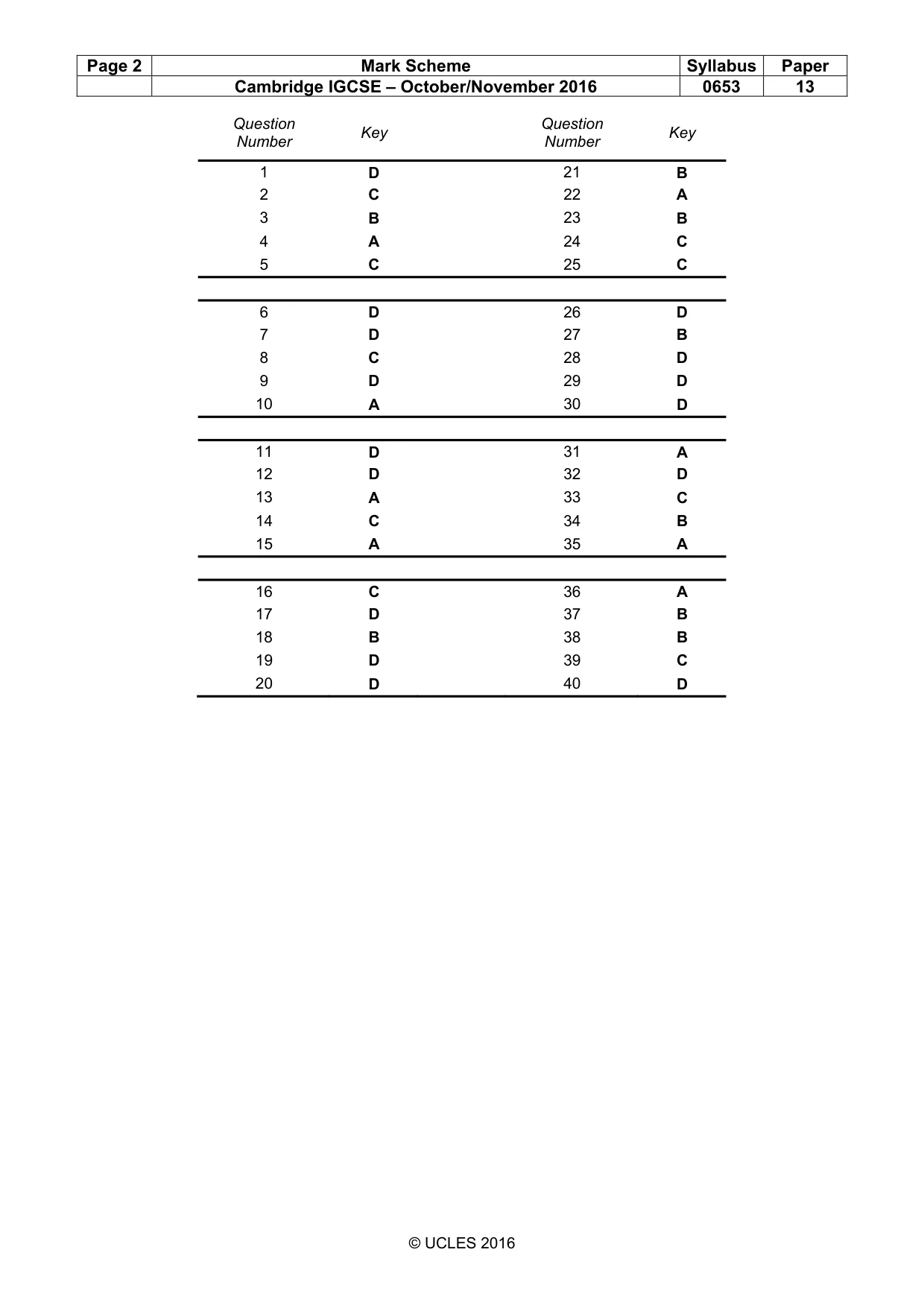
Mark scheme: D
Q2 · How does carbon dioxide move out of the cells that form the walls of the alveoli into the…
2 How does carbon dioxide move out of the cells that form the walls of the alveoli into the surrounding air? A absorption B breathing C diffusion D respiration
Mark scheme: C
Q3 · The diagram shows a palisade cell from a leaf
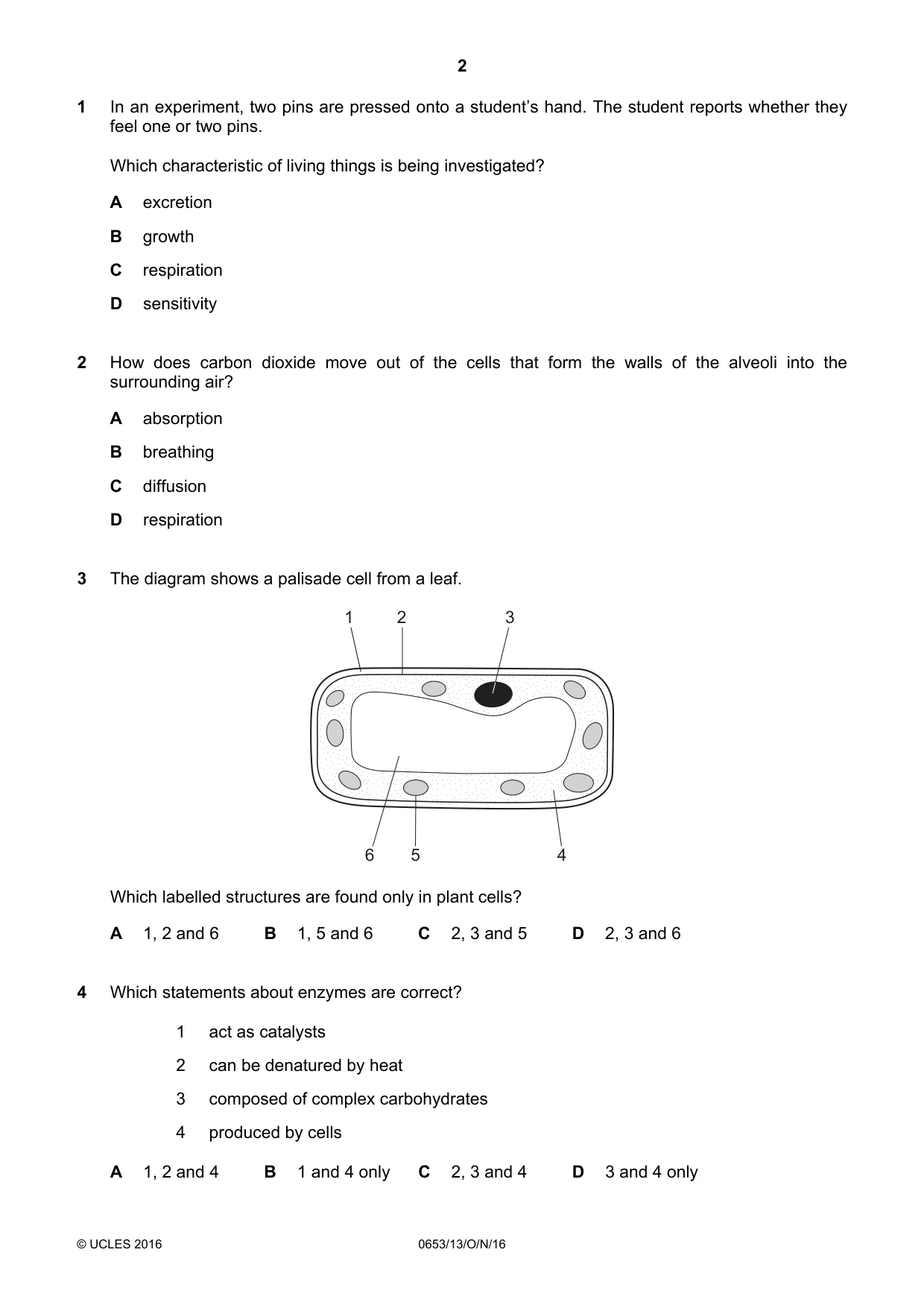
3 The diagram shows a palisade cell from a leaf. 1 2 3 6 5 4 Which labelled structures are found only in plant cells? A 1, 2 and 6 B 1, 5 and 6 C 2, 3 and 5 D 2, 3 and 6
Mark scheme: B
Q4 · Which statements about enzymes are correct?
4 Which statements about enzymes are correct? 1 act as catalysts 2 can be denatured by heat 3 composed of complex carbohydrates 4 produced by cells A 1, 2 and 4 B 1 and 4 only C 2, 3 and 4 D 3 and 4 only
Mark scheme: A
Q5 · When food reaches the stomach the digestion of starch stops
5 When food reaches the stomach the digestion of starch stops. Why is this? A All the starch has been digested. B The enzyme in saliva has been used up. C The pH in the stomach is very low. D The stomach does not produce a starch-digesting enzyme.
Mark scheme: C
Q6 · The photograph shows a sample of blood seen under a microscope
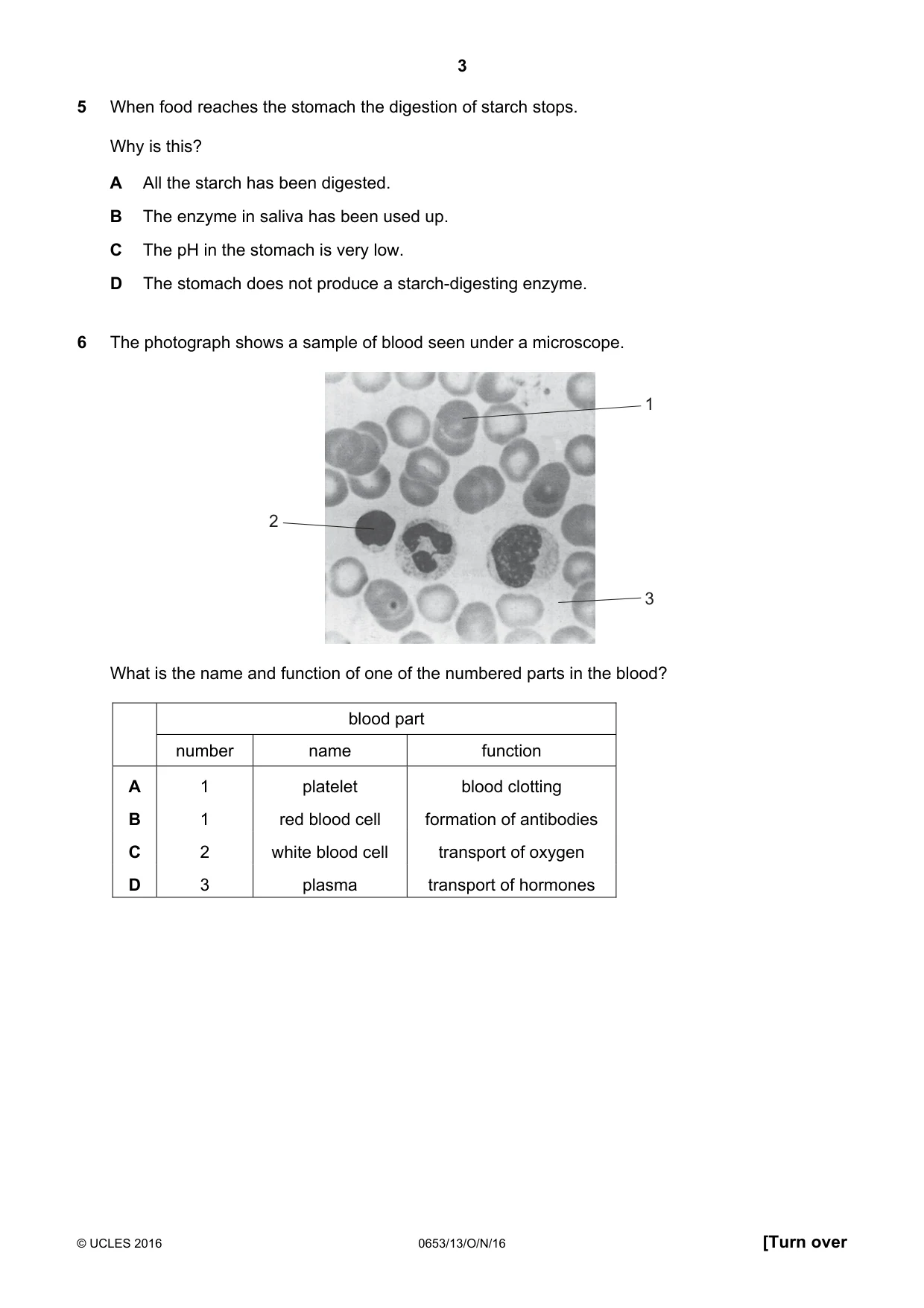
6 The photograph shows a sample of blood seen under a microscope. 1 2 3 What is the name and function of one of the numbered parts in the blood? blood part number name function A 1 platelet blood clotting B 1 red blood cell formation of antibodies C 2 white blood cell transport of oxygen D 3 plasma transport of hormones
Mark scheme: D
Q7 · The diagram shows a plant in a container of water
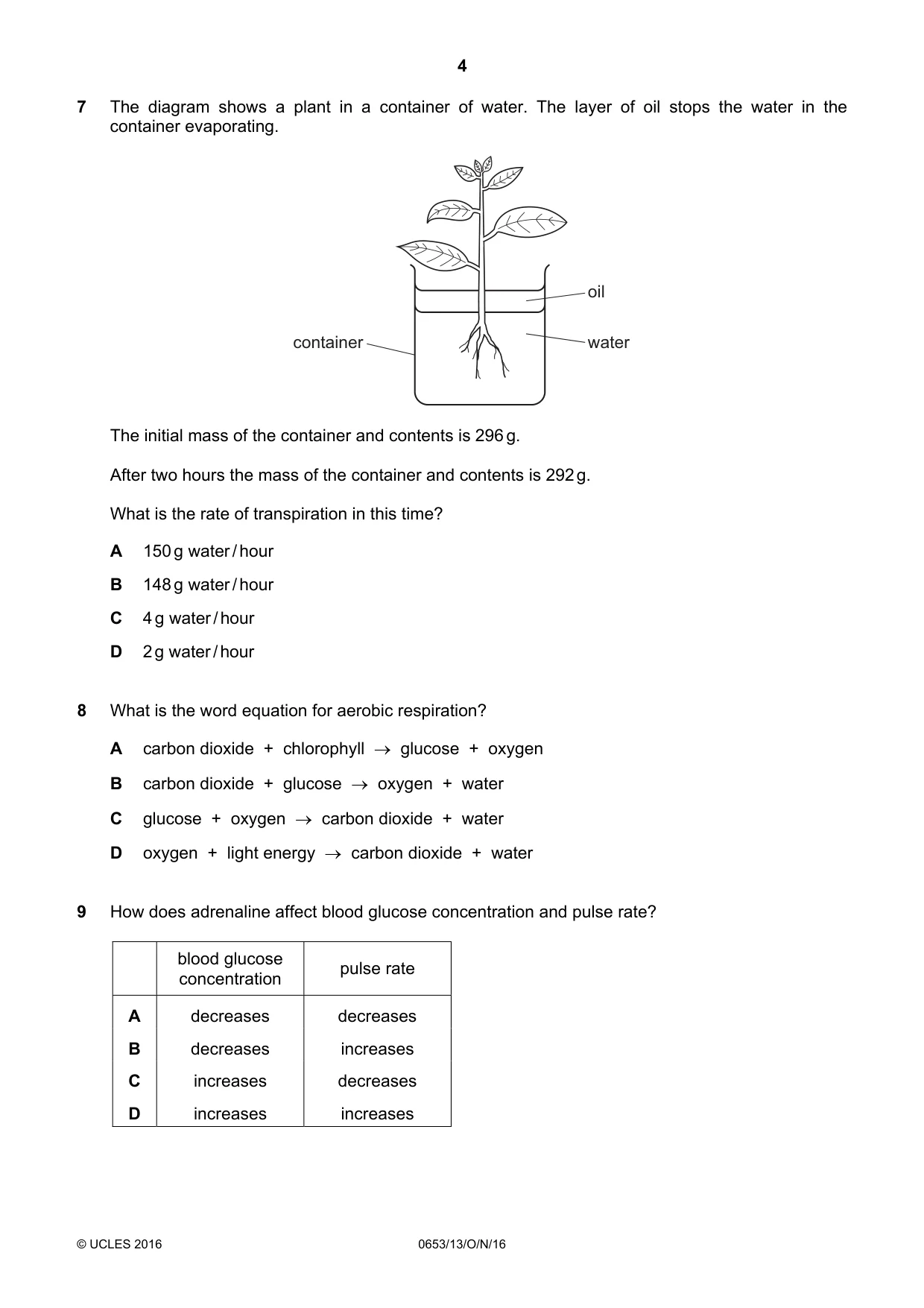
7 The diagram shows a plant in a container of water. The layer of oil stops the water in the container evaporating. oil container water The initial mass of the container and contents is 296 g. After two hours the mass of the container and contents is 292 g. What is the rate of transpiration in this time? A 150 g water / hour B 148 g water / hour C 4 g water / hour D 2 g water / hour
Mark scheme: D
Q8 · What is the word equation for aerobic respiration?
8 What is the word equation for aerobic respiration? A carbon dioxide + chlorophyll → glucose + oxygen B carbon dioxide + glucose → oxygen + water C glucose + oxygen → carbon dioxide + water D oxygen + light energy → carbon dioxide + water
Mark scheme: C
Q9 · How does adrenaline affect blood glucose concentration and pulse rate?
9 How does adrenaline affect blood glucose concentration and pulse rate? blood glucose pulse rate concentration A decreases decreases B decreases increases C increases decreases D increases increases
Mark scheme: D
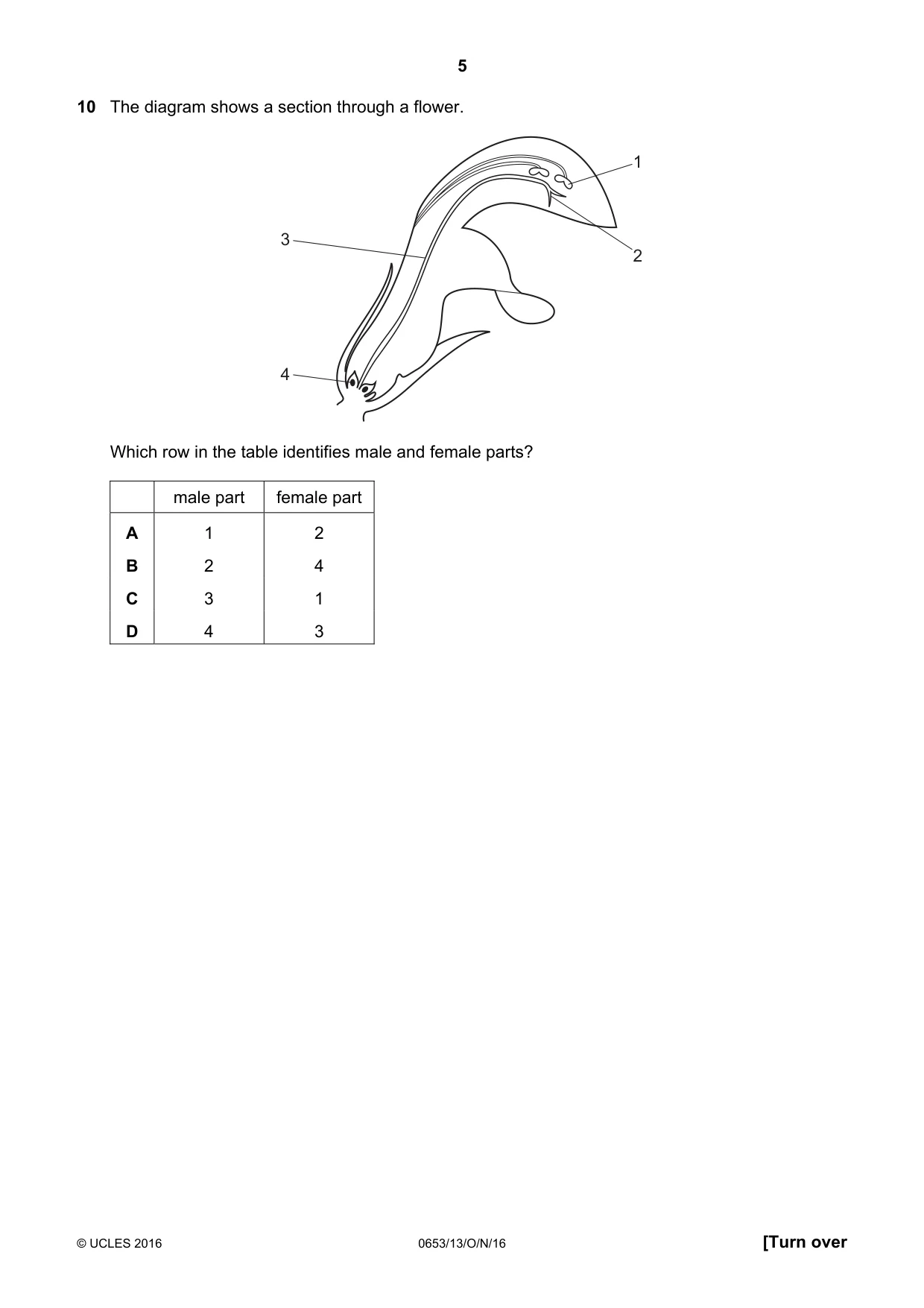
Q10 · The diagram shows a section through a flower
10 The diagram shows a section through a flower. 1 3 2 4 Which row in the table identifies male and female parts? male part female part A 1 2 B 2 4 C 3 1 D 4 3
Mark scheme: A
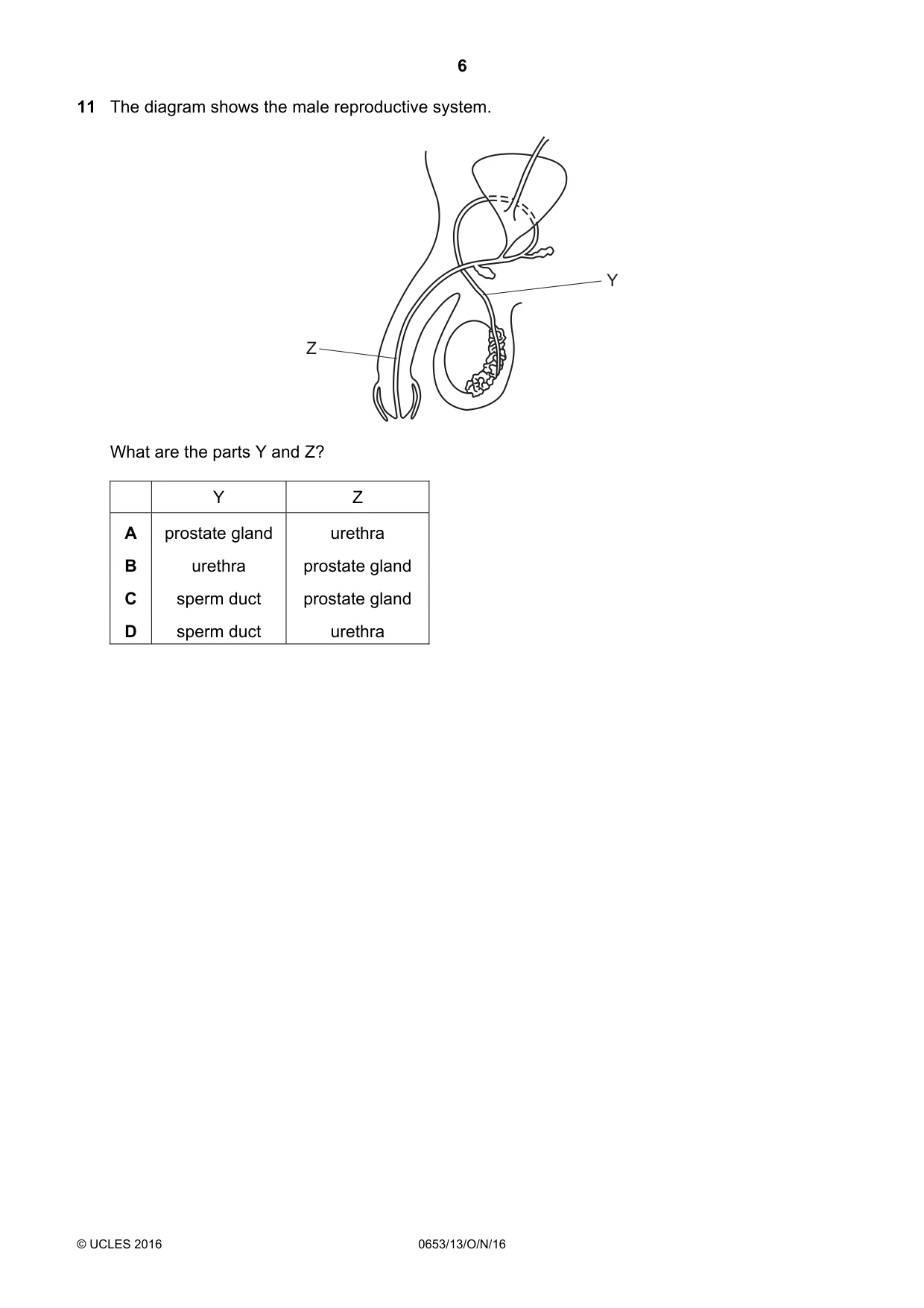
Q11 · The diagram shows the male reproductive system
11 The diagram shows the male reproductive system. Y Z What are the parts Y and Z? Y Z A prostate gland urethra B urethra prostate gland C sperm duct prostate gland D sperm duct urethra
Mark scheme: D
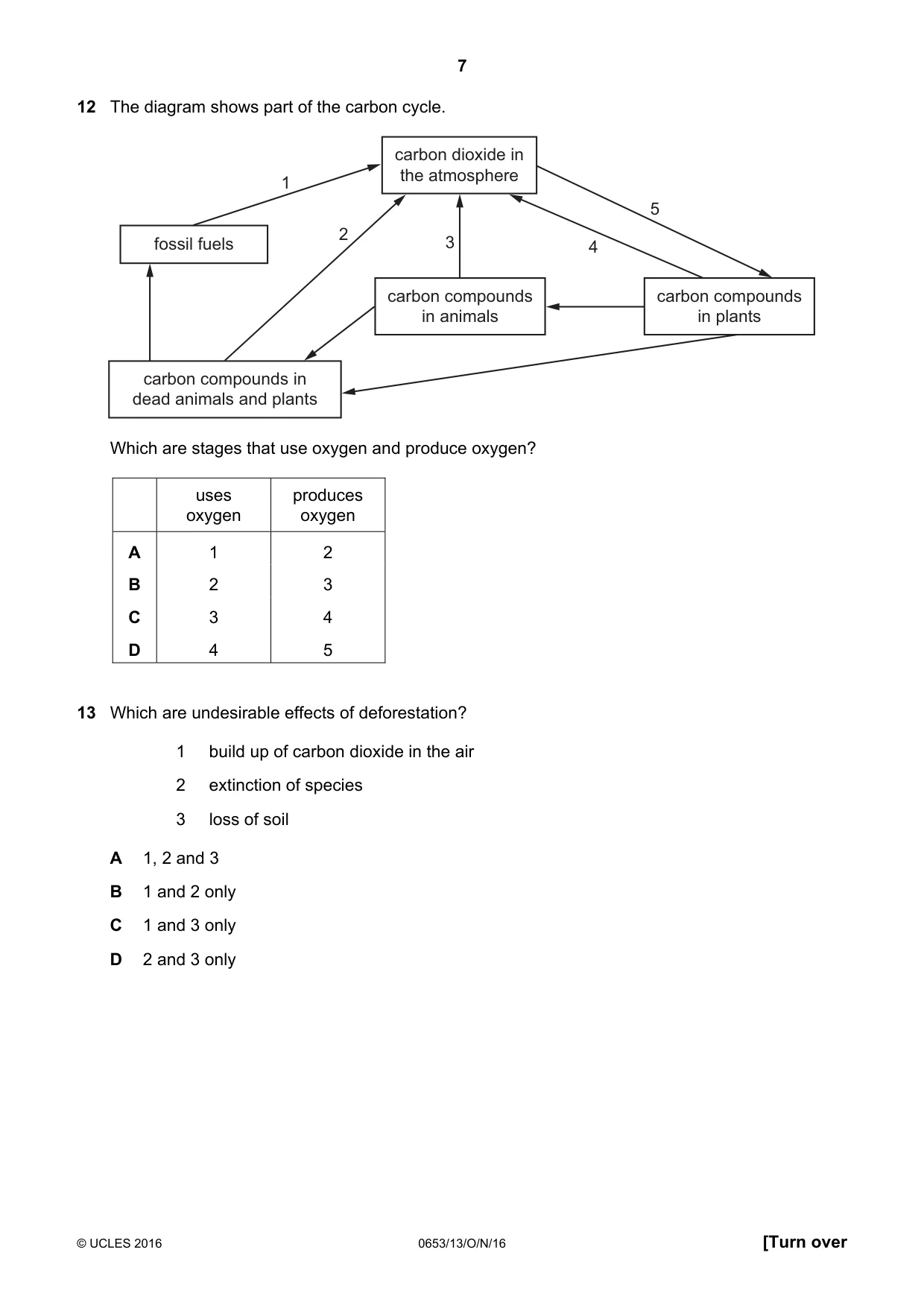
Q12 · The diagram shows part of the carbon cycle
12 The diagram shows part of the carbon cycle. carbon dioxide in 1 the atmosphere 5 2 fossil fuels 3 4 carbon compounds carbon compounds in animals in plants carbon compounds in dead animals and plants Which are stages that use oxygen and produce oxygen? uses produces oxygen oxygen A 1 2 B 2 3 C 3 4 D 4 5
Mark scheme: D
Q13 · Which are undesirable effects of deforestation?
13 Which are undesirable effects of deforestation? 1 build up of carbon dioxide in the air 2 extinction of species 3 loss of soil A 1, 2 and 3 B 1 and 2 only C 1 and 3 only D 2 and 3 only
Mark scheme: A
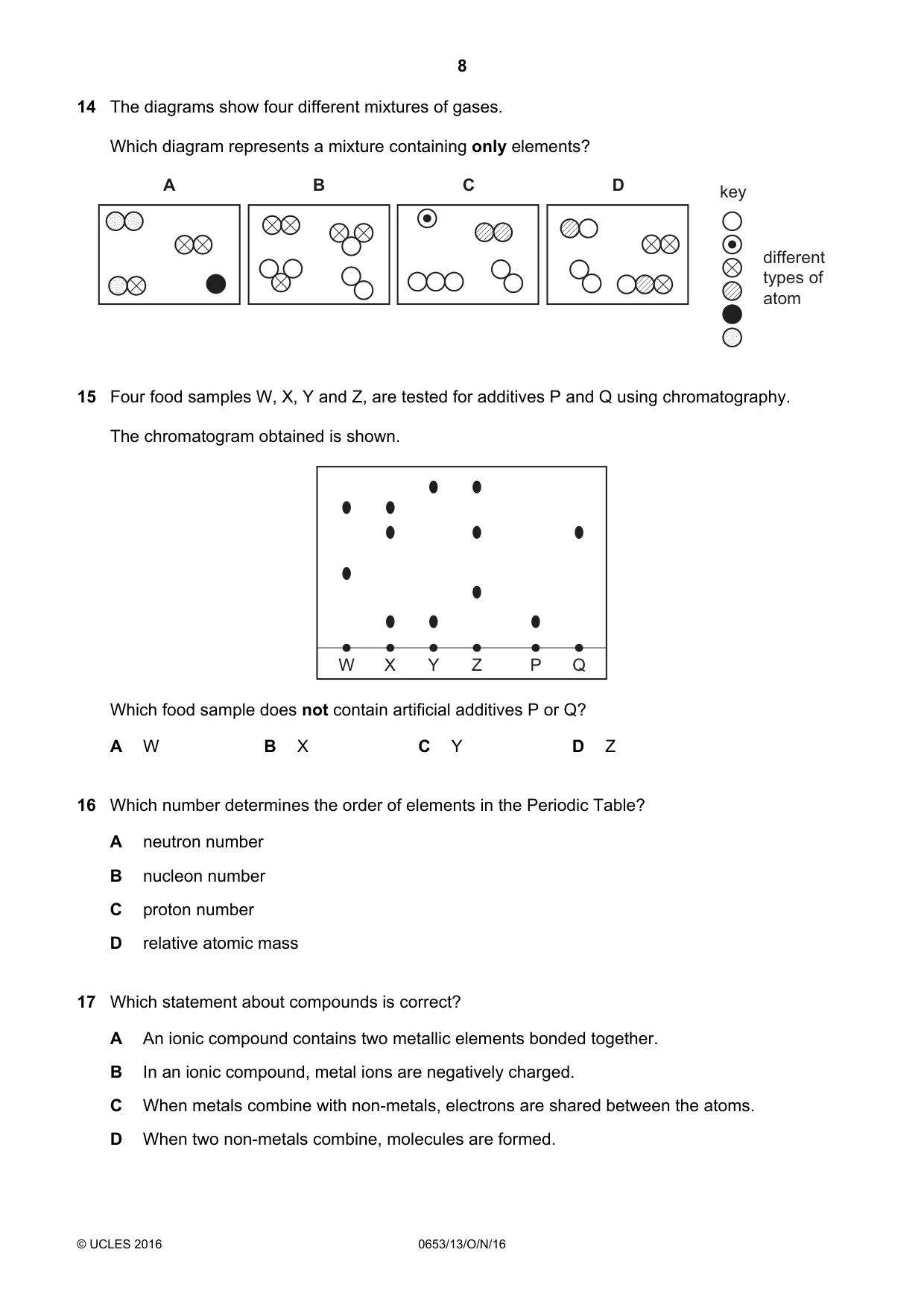
Q14 · The diagrams show four different mixtures of gases
14 The diagrams show four different mixtures of gases. Which diagram represents a mixture containing only elements? A B C D key different types of atom
Mark scheme: C
Q15 · Four food samples W, X, Y and Z, are tested for additives P and Q using chromatography
15 Four food samples W, X, Y and Z, are tested for additives P and Q using chromatography. The chromatogram obtained is shown. W X Y Z P Q Which food sample does not contain artificial additives P or Q? A W B X C Y D Z
Mark scheme: A
Q16 · Which number determines the order of elements in the Periodic Table?
16 Which number determines the order of elements in the Periodic Table? A neutron number B nucleon number C proton number D relative atomic mass
Mark scheme: C
Q17 · Which statement about compounds is correct?
17 Which statement about compounds is correct? A An ionic compound contains two metallic elements bonded together. B In an ionic compound, metal ions are negatively charged. C When metals combine with non-metals, electrons are shared between the atoms. D When two non-metals combine, molecules are formed.
Mark scheme: D
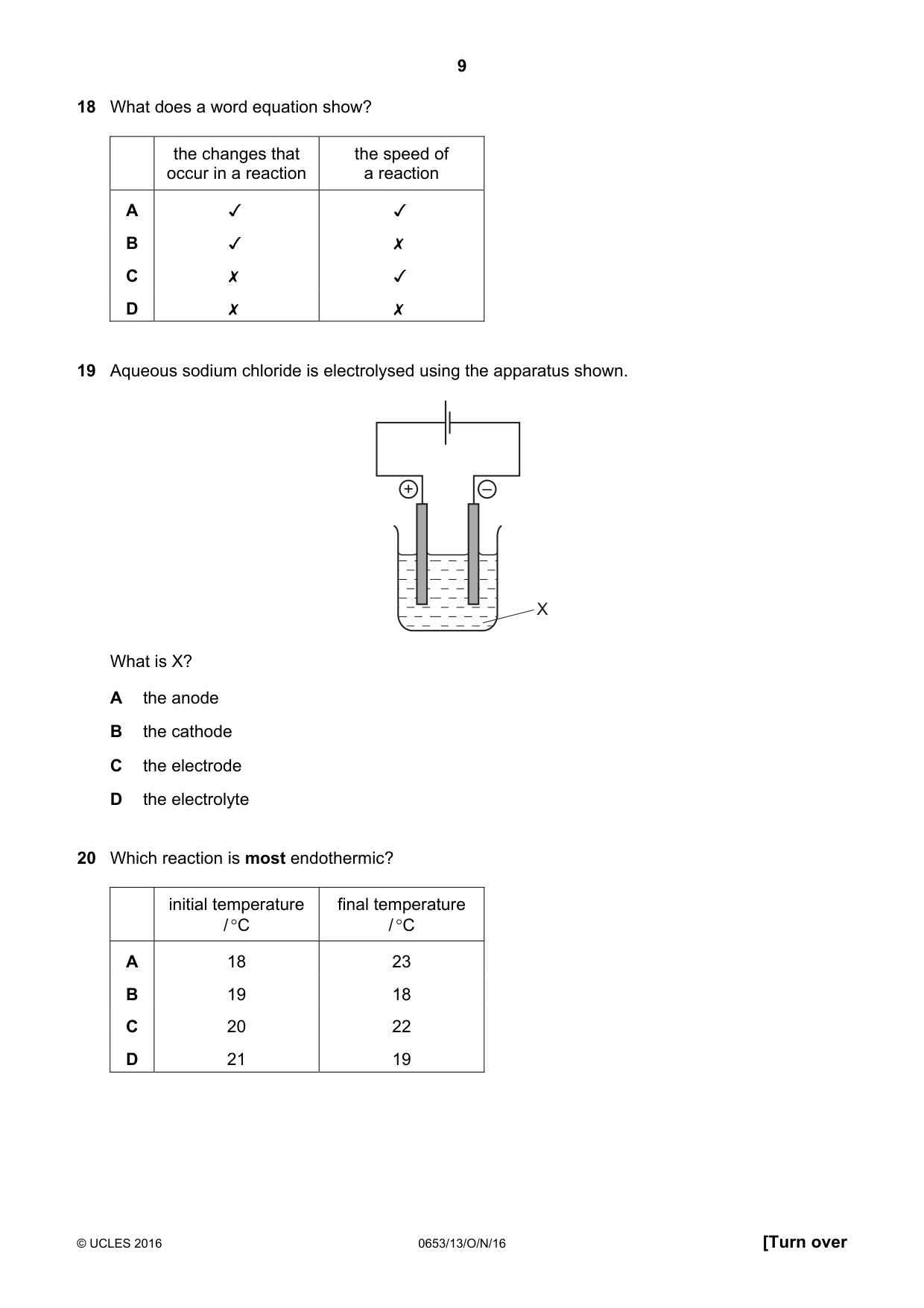
Q18 · What does a word equation show?
18 What does a word equation show? the changes that the speed of occur in a reaction a reaction A Jv Jv B Jv x Cc x v D x x
Mark scheme: B
Q19 · Aqueous sodium chloride is electrolysed using the apparatus shown
19 Aqueous sodium chloride is electrolysed using the apparatus shown. + – X What is X? A the anode B the cathode C the electrode D the electrolyte
Mark scheme: D
Q20 · Which reaction is most endothermic?
20 Which reaction is most endothermic? initial temperature final temperature / °C / °C A 18 23 B 19 18 C 20 22 D 21 19
Mark scheme: D
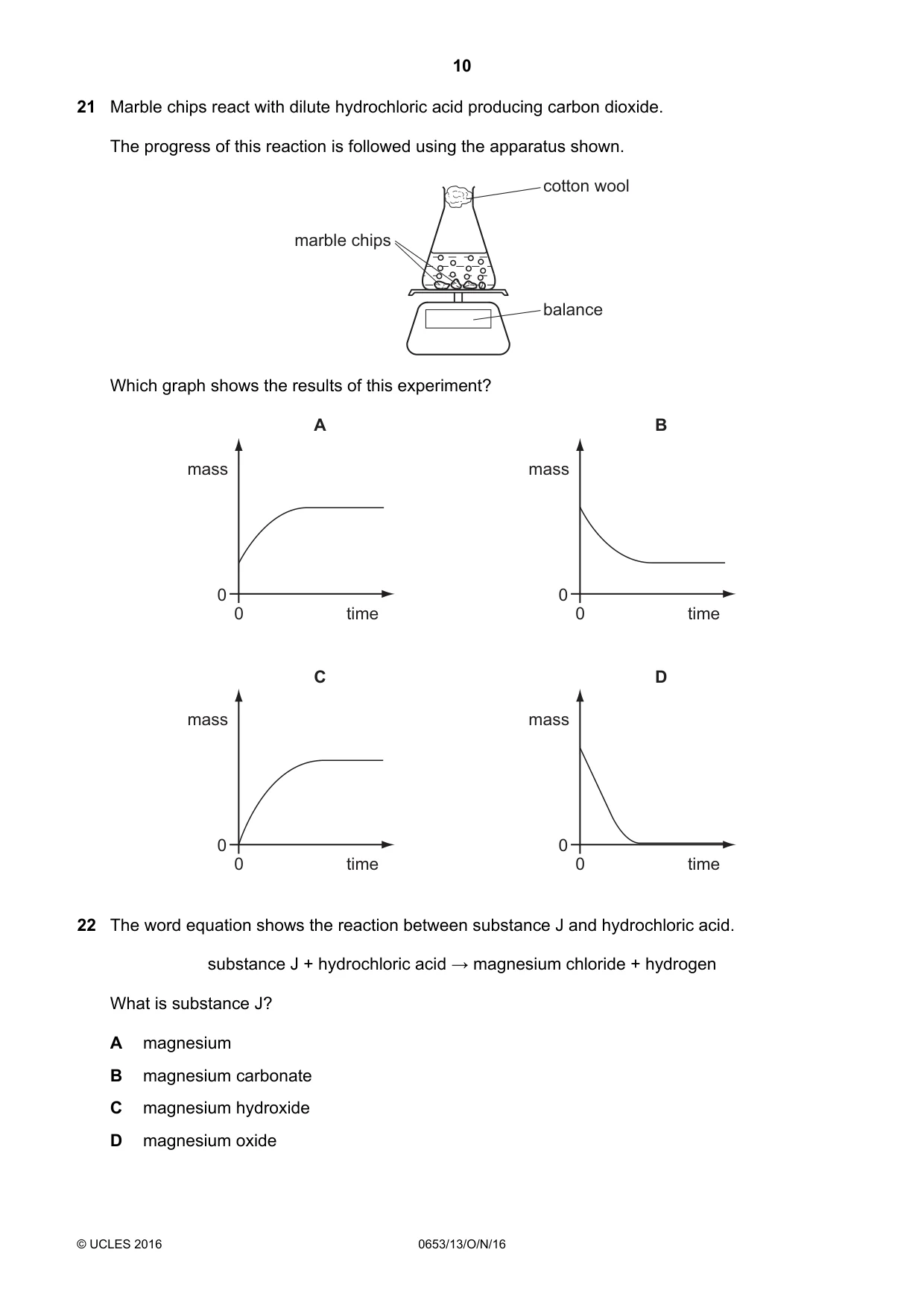
Q21 · Marble chips react with dilute hydrochloric acid producing carbon dioxide
21 Marble chips react with dilute hydrochloric acid producing carbon dioxide. The progress of this reaction is followed using the apparatus shown. cotton wool marble chips balance Which graph shows the results of this experiment? A B mass mass 0 0 0 time 0 time C D mass mass 0 0 0 time 0 time
Mark scheme: B
Q22 · The word equation shows the reaction between substance J and hydrochloric acid
22 The word equation shows the reaction between substance J and hydrochloric acid. substance J + hydrochloric acid → magnesium chloride + hydrogen What is substance J? A magnesium B magnesium carbonate C magnesium hydroxide D magnesium oxide
Mark scheme: A
More questions on The characteristic properties of acids and bases
Q23 · A piece of damp blue litmus paper is placed in a gas
23 A piece of damp blue litmus paper is placed in a gas. The litmus paper turns red and then turns white. What is the gas? A carbon dioxide B chlorine C hydrogen D oxygen
Mark scheme: B
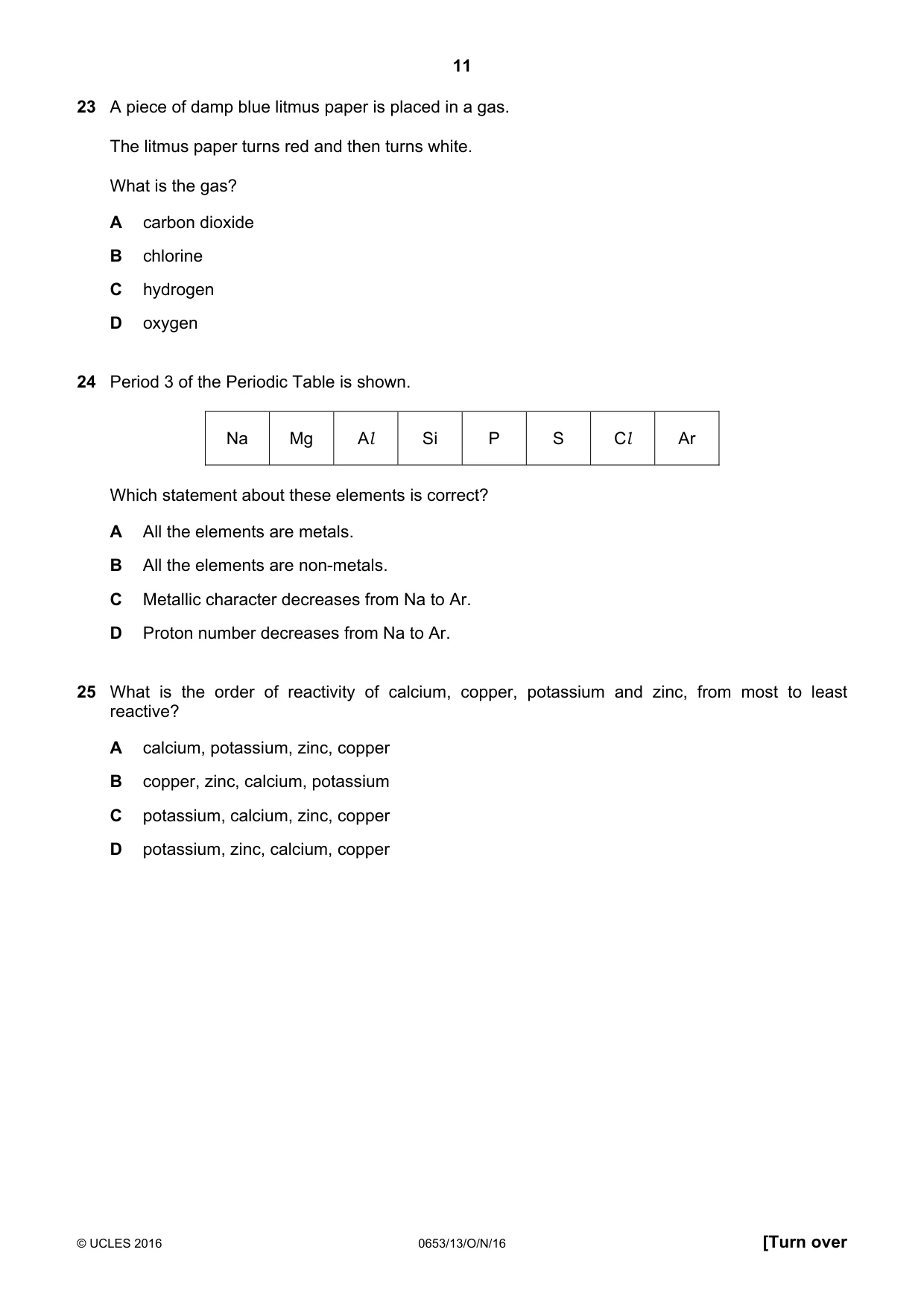
Q24 · Period 3 of the Periodic Table is shown
24 Period 3 of the Periodic Table is shown. Na Mg Al Si P S Cl Ar Which statement about these elements is correct? A All the elements are metals. B All the elements are non-metals. C Metallic character decreases from Na to Ar. D Proton number decreases from Na to Ar.
Mark scheme: C
Q25 · What is the order of reactivity of calcium, copper, potassium and zinc, from most to…
25 What is the order of reactivity of calcium, copper, potassium and zinc, from most to least reactive? A calcium, potassium, zinc, copper B copper, zinc, calcium, potassium C potassium, calcium, zinc, copper D potassium, zinc, calcium, copper
Mark scheme: C
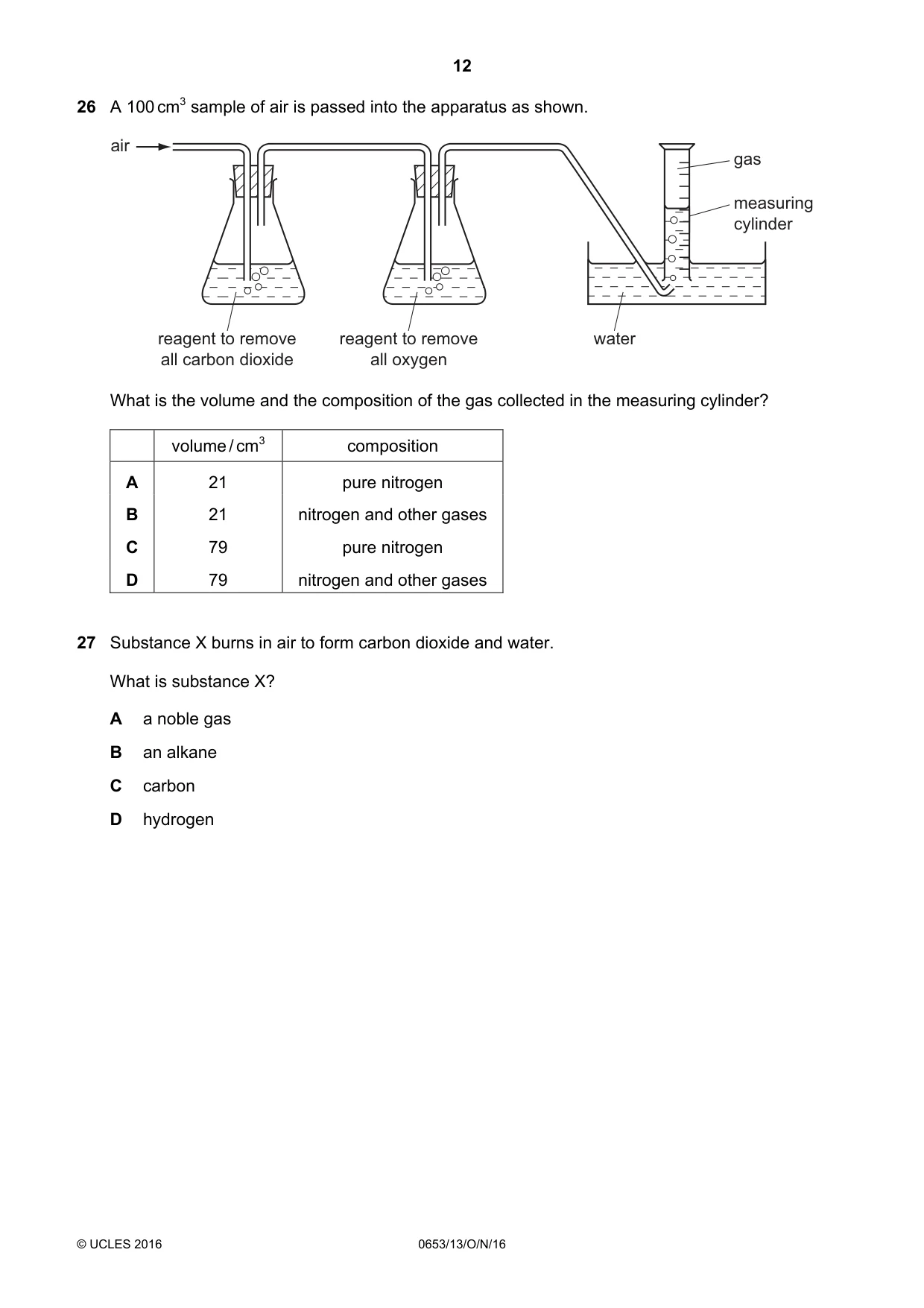
Q26 · A 100 cm3 sample of air is passed into the apparatus as shown
26 A 100 cm3 sample of air is passed into the apparatus as shown. air gas measuring cylinder reagent to remove reagent to remove water all carbon dioxide all oxygen What is the volume and the composition of the gas collected in the measuring cylinder? volume / cm3 composition A 21 pure nitrogen B 21 nitrogen and other gases C 79 pure nitrogen D 79 nitrogen and other gases
Mark scheme: D
Q27 · Substance X burns in air to form carbon dioxide and water
27 Substance X burns in air to form carbon dioxide and water. What is substance X? A a noble gas B an alkane C carbon D hydrogen
Mark scheme: B
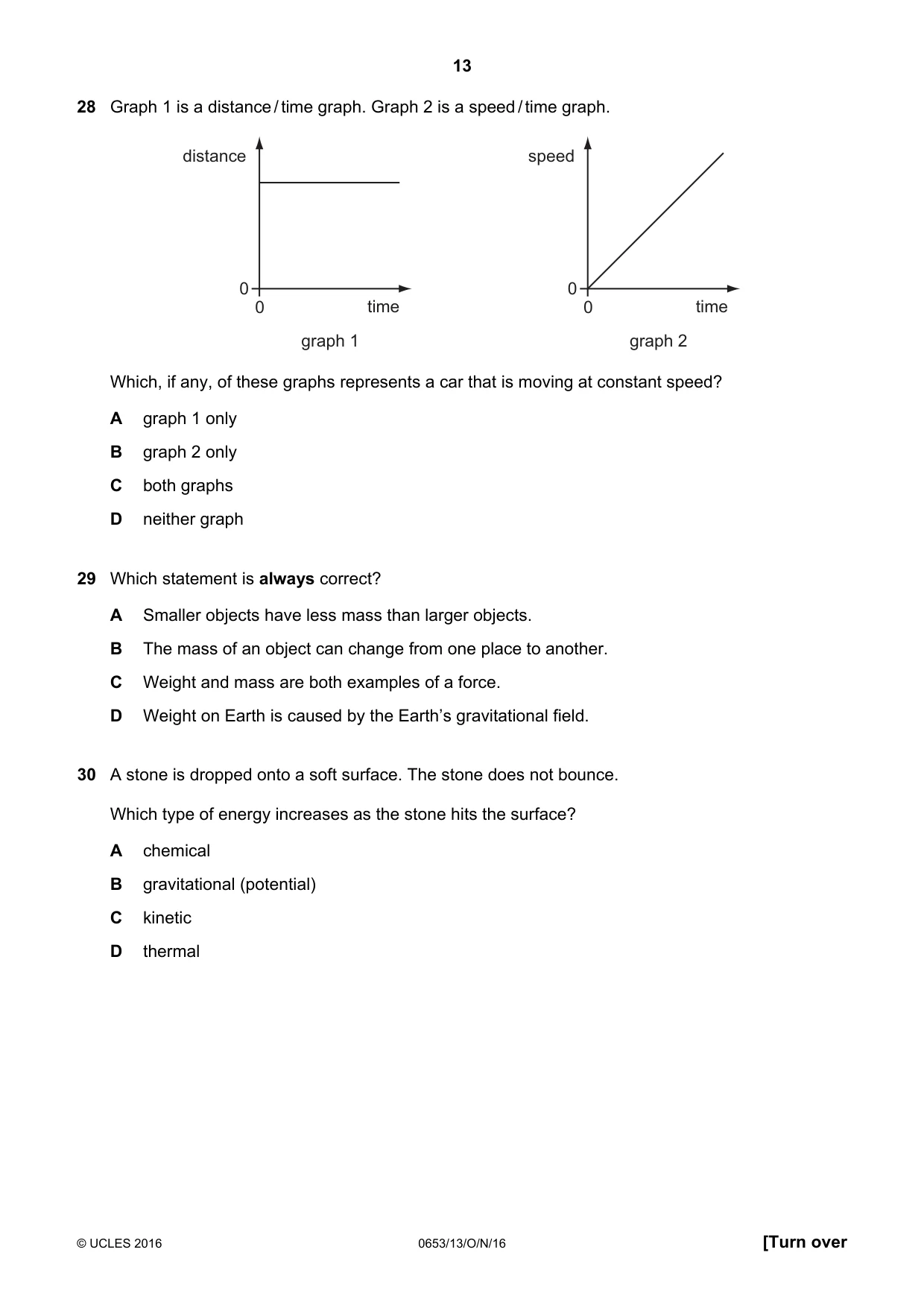
Q28 · A distance / time graph
28 Graph 1 is a distance / time graph. Graph 2 is a speed / time graph. distance speed 0 0 0 time 0 time graph 1 graph 2 Which, if any, of these graphs represents a car that is moving at constant speed? A graph 1 only B graph 2 only C both graphs D neither graph
Mark scheme: D
Q29 · Which statement is always correct?
29 Which statement is always correct? A Smaller objects have less mass than larger objects. B The mass of an object can change from one place to another. C Weight and mass are both examples of a force. D Weight on Earth is caused by the Earth’s gravitational field.
Mark scheme: D
Q30 · A stone is dropped onto a soft surface
30 A stone is dropped onto a soft surface. The stone does not bounce. Which type of energy increases as the stone hits the surface? A chemical B gravitational (potential) C kinetic D thermal
Mark scheme: D
Q31 · A bowl contains some warm water
31 A bowl contains some warm water. The water evaporates from the bowl. Which row describes where the evaporation occurs and the effect of the evaporation on the temperature of the water left in the bowl? where evaporation effect on temperature occurs of water in bowl A only on the surface decreases B only on the surface no change C throughout the water decreases D throughout the water no change
Mark scheme: A
Q32 · An engineer wants to fix a steel washer on to a steel rod
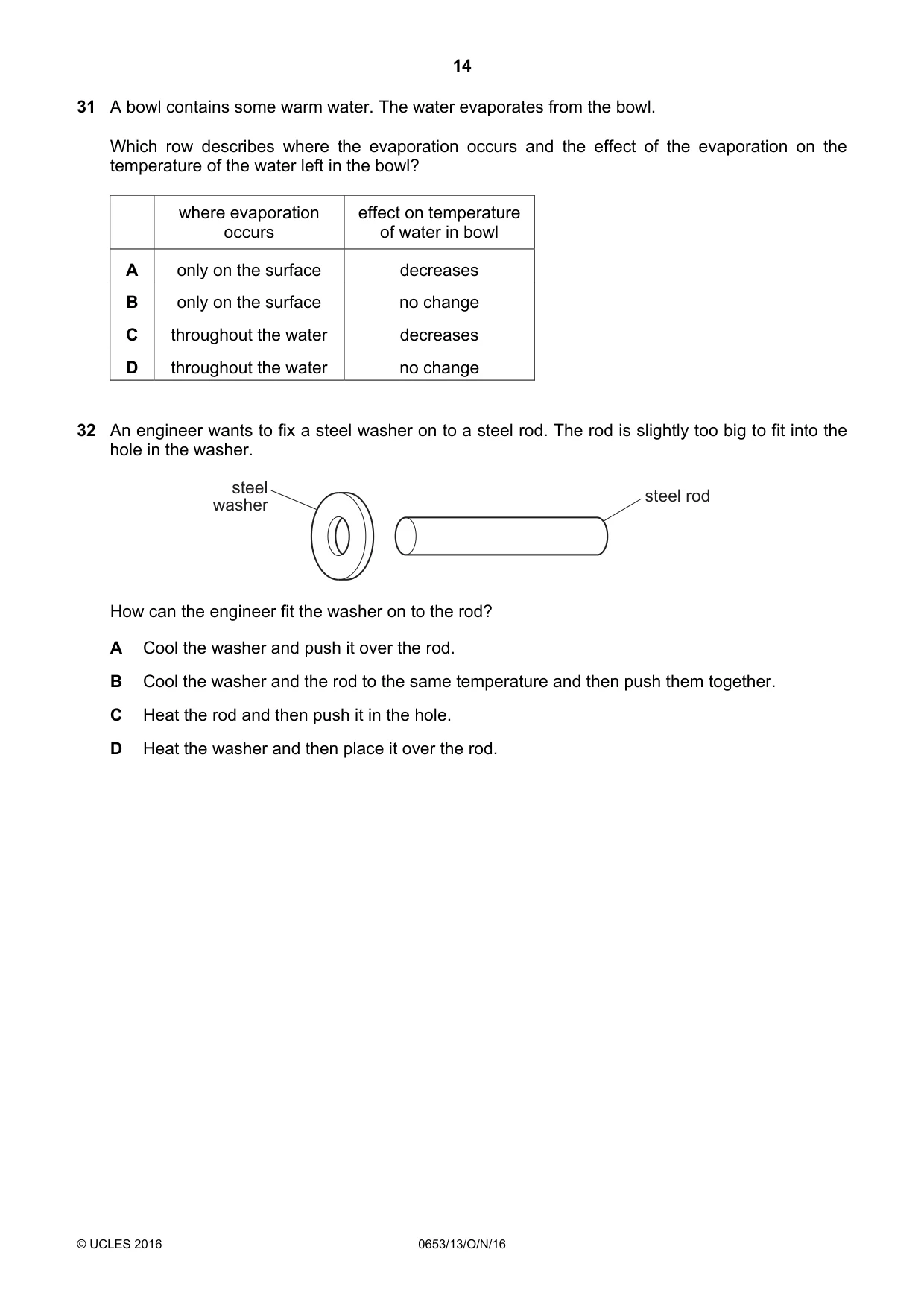
32 An engineer wants to fix a steel washer on to a steel rod. The rod is slightly too big to fit into the hole in the washer. steel steel rod washer How can the engineer fit the washer on to the rod? A Cool the washer and push it over the rod. B Cool the washer and the rod to the same temperature and then push them together. C Heat the rod and then push it in the hole. D Heat the washer and then place it over the rod.
Mark scheme: D
Q33 · A man is in a cold room one metre away from a heater
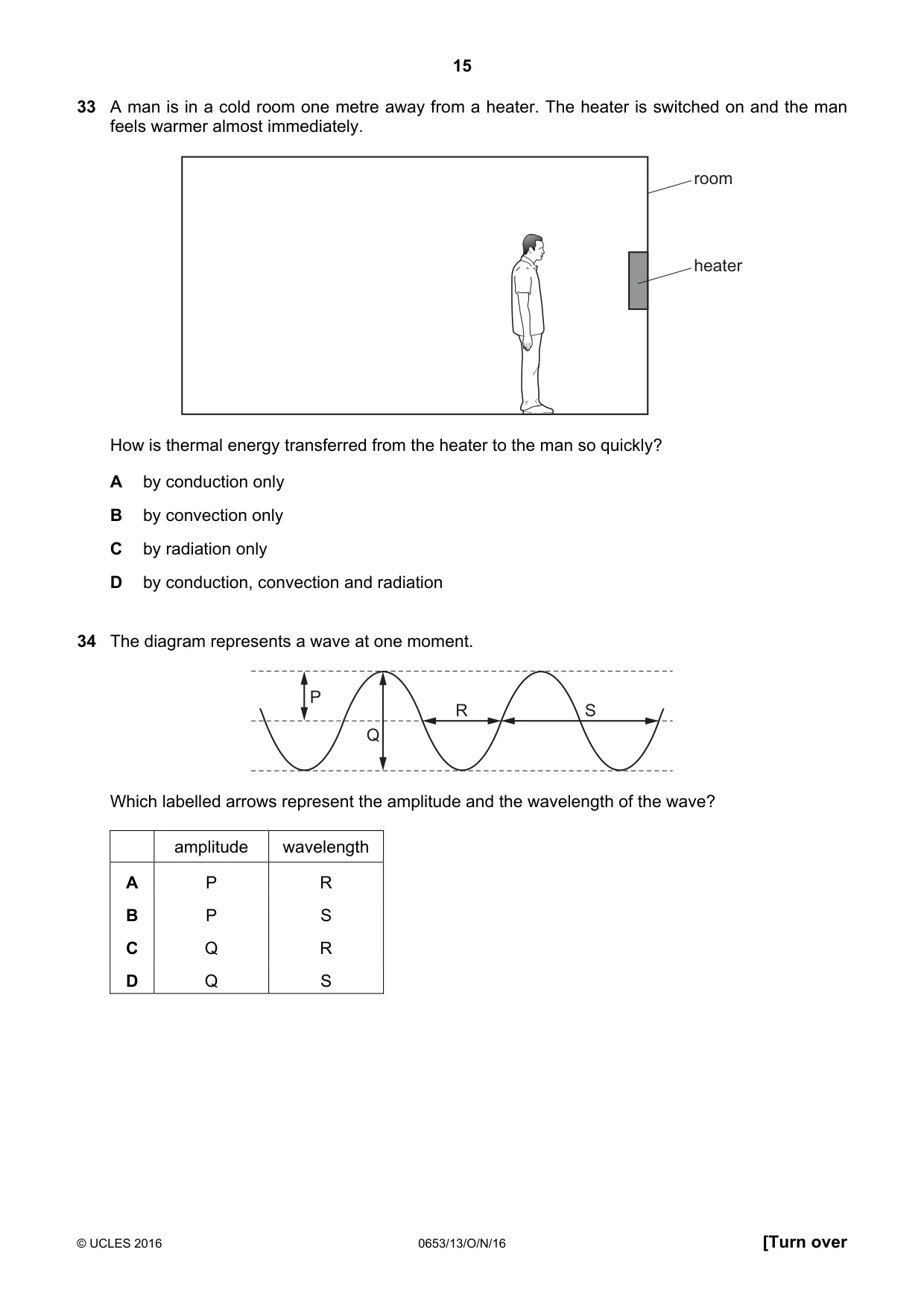
33 A man is in a cold room one metre away from a heater. The heater is switched on and the man feels warmer almost immediately. room heater How is thermal energy transferred from the heater to the man so quickly? A by conduction only B by convection only C by radiation only D by conduction, convection and radiation
Mark scheme: C
Q34 · The diagram represents a wave at one moment
34 The diagram represents a wave at one moment. P R S Q Which labelled arrows represent the amplitude and the wavelength of the wave? amplitude wavelength A P R B P S C Q R D Q S
Mark scheme: B
Q35 · Two rectangular glass blocks are placed a short distance apart in air
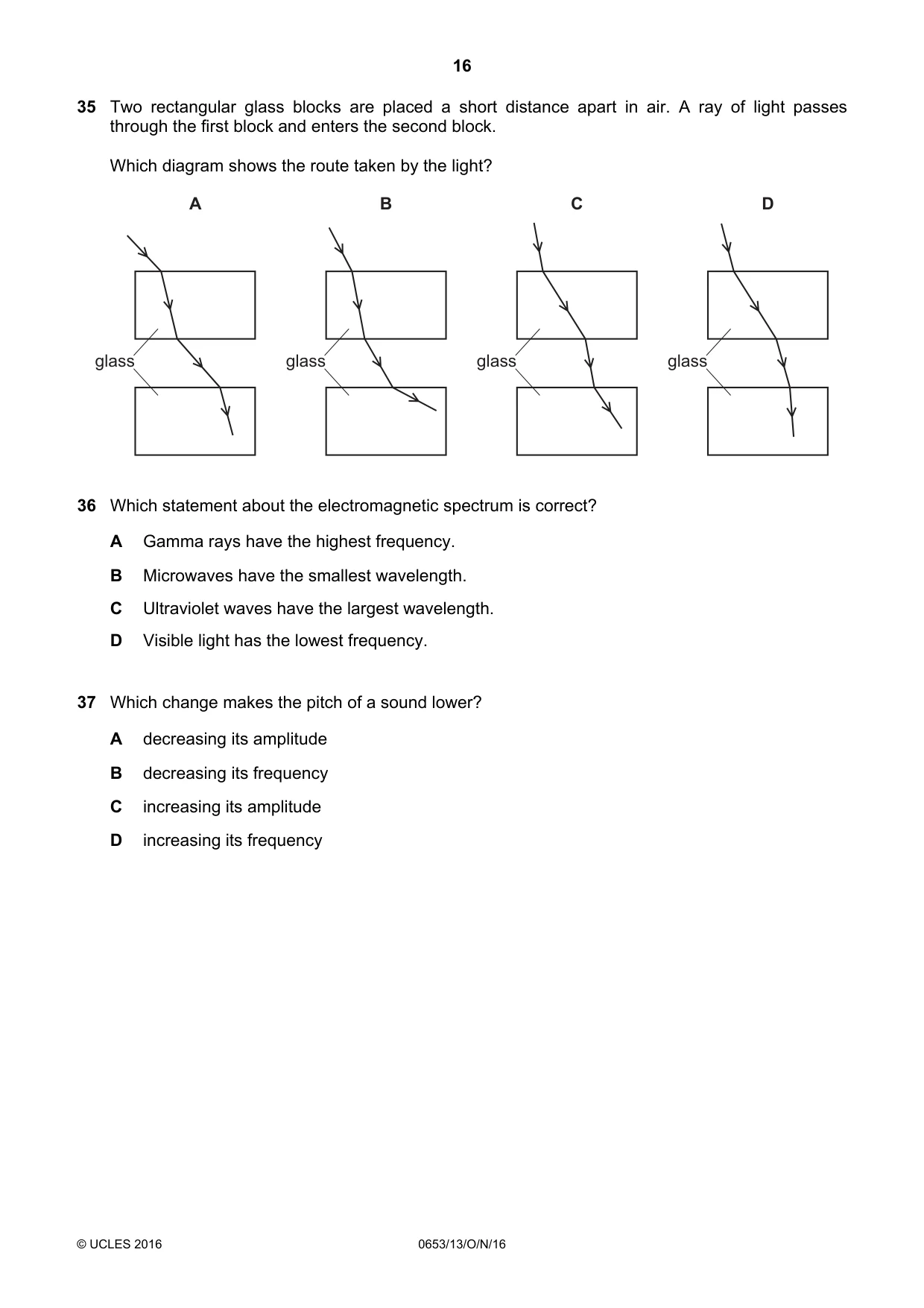
35 Two rectangular glass blocks are placed a short distance apart in air. A ray of light passes through the first block and enters the second block. Which diagram shows the route taken by the light? A B C D glass glass glass glass
Mark scheme: A
Q36 · Which statement about the electromagnetic spectrum is correct?
36 Which statement about the electromagnetic spectrum is correct? A Gamma rays have the highest frequency. B Microwaves have the smallest wavelength. C Ultraviolet waves have the largest wavelength. D Visible light has the lowest frequency.
Mark scheme: A
Q37 · Which change makes the pitch of a sound lower?
37 Which change makes the pitch of a sound lower? A decreasing its amplitude B decreasing its frequency C increasing its amplitude D increasing its frequency
Mark scheme: B
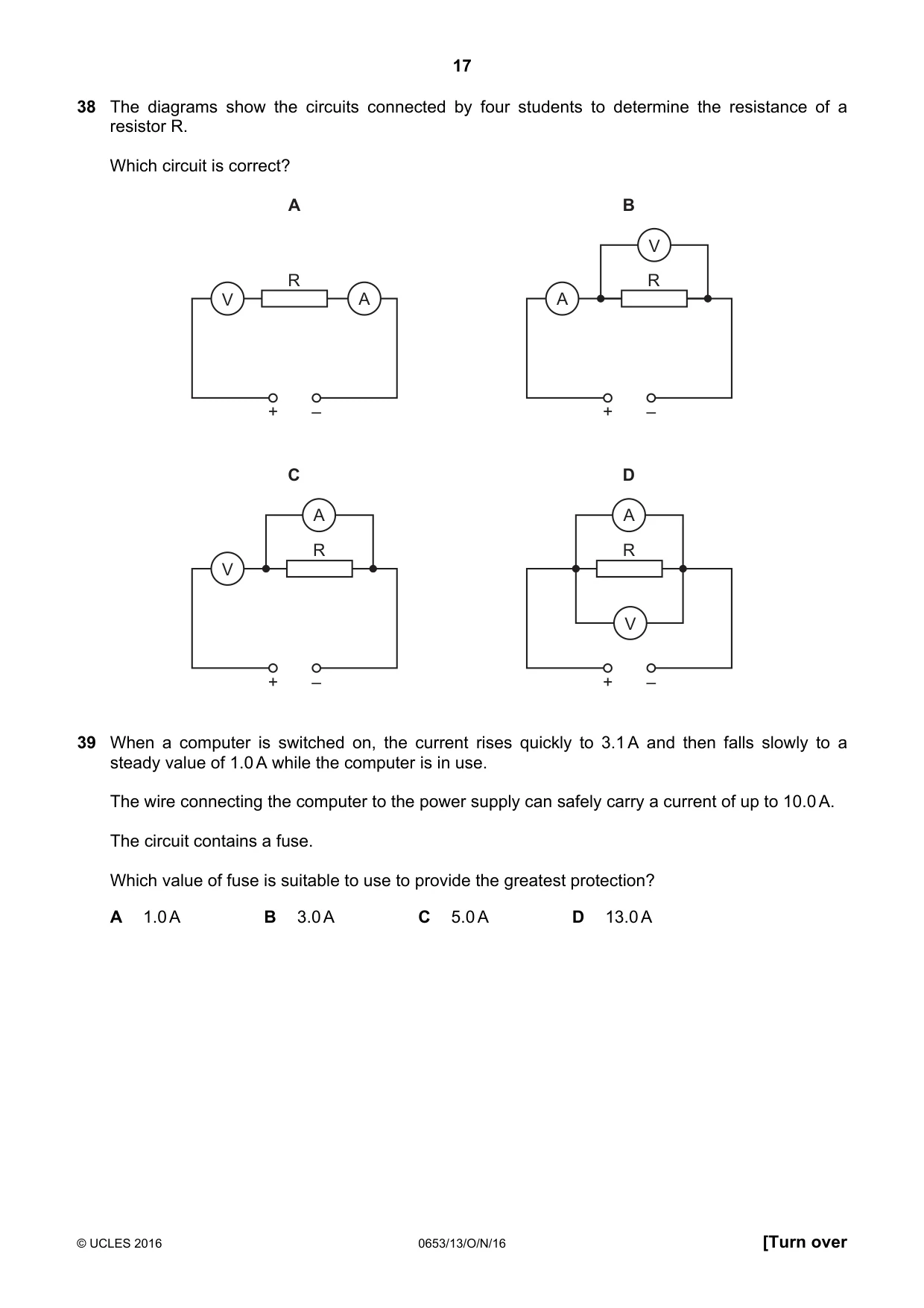
Q38 · The diagrams show the circuits connected by four students to determine the resistance of…
38 The diagrams show the circuits connected by four students to determine the resistance of a resistor R. Which circuit is correct? A B V R R V A A + – + – C D A A R R V V + – + –
Mark scheme: B
Q39 · When a computer is switched on, the current rises quickly to 3.1 A and then falls slowly…
39 When a computer is switched on, the current rises quickly to 3.1 A and then falls slowly to a steady value of 1.0 A while the computer is in use. The wire connecting the computer to the power supply can safely carry a current of up to 10.0 A. The circuit contains a fuse. Which value of fuse is suitable to use to provide the greatest protection? A 1.0 A B 3.0 A C 5.0 A D 13.0 A
Mark scheme: C
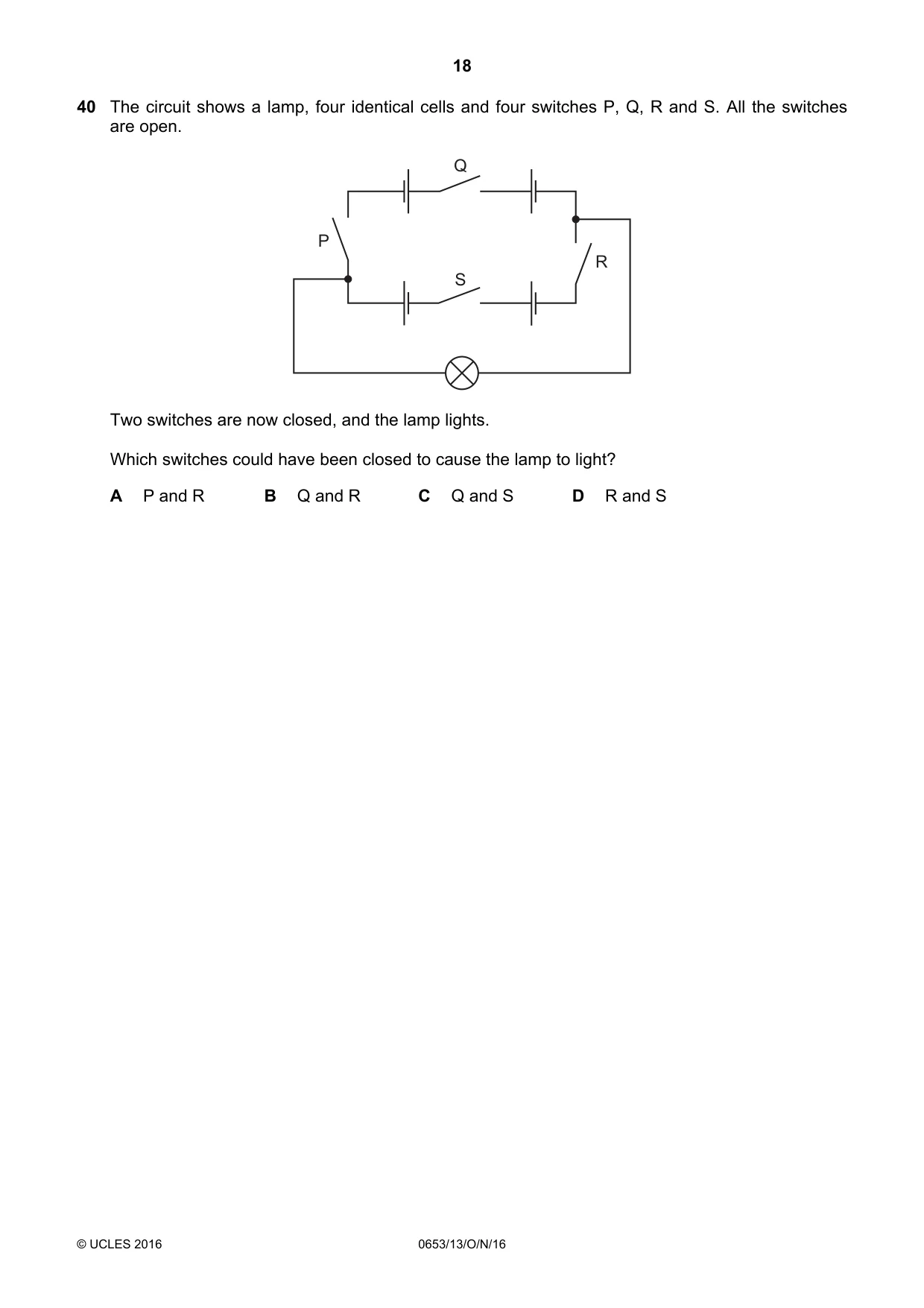
Q40 · The circuit shows a lamp, four identical cells and four switches P, Q, R and S
40 The circuit shows a lamp, four identical cells and four switches P, Q, R and S. All the switches are open. Q P R S Two switches are now closed, and the lamp lights. Which switches could have been closed to cause the lamp to light? A P and R B Q and R C Q and S D R and S
Mark scheme: D
What was in this paper
The subtopics covered by these 40 questions, and how many questions each got. Open one in a new tab to see every Cambridge question on it.
2Air quality and climate1Alkanes1Arrangement of elements1Atomic structure and the Periodic Table1Blood1Carbon cycle1Cell structure1Characteristics of living organisms1Chromatography1Diffusion1Digestion1Drugs1Electrical safety1Electrolysis1Electromagnetic spectrum1Elements, compounds and mixtures1Energy, work and power1Enzymes1Exothermic and endothermic reactions1General properties of waves1Habitat destruction1Identification of ions and gases1Kinetic particle model of matter1Light1Mass and weight1Motion1Physical and chemical changes1Rate of reaction1Reactivity series1Respiration1Sexual reproduction in humans1Sexual reproduction in plants1Simple molecules and covalent bonds1Sound1The characteristic properties of acids and bases1Thermal properties and temperature1Transfer of thermal energy1Transpiration1What you needed in this session
Cambridge’s own grade thresholds for 2016 Oct/Nov, Paper 1 · Variant 3. A higher threshold means an easier paper — the bar moves with how the cohort did.