Cambridge IGCSE Science - Combined 0653 — 2011 Oct/Nov Paper 1 · Variant 3
0653/13/O/N/11 · 40 questions · 40 marks · ≈45 min
The question paper and its mark scheme, free to read here and free to download. This is Cambridge’s own paper, exactly as it was sat.
Question paper16 pages


Mark scheme2 pages
Answers below. Sit the paper first if you are practising.
Questions as text
Q1 · Which part of a plant cell is made of cellulose?
1 Which part of a plant cell is made of cellulose? A cell membrane B cell wall C chloroplast D nucleus
Mark scheme: B
Q2 · Which leaf tissue has specialised cells that surround stomata?
2 Which leaf tissue has specialised cells that surround stomata? A epidermis B palisade mesophyll C phloem D xylem
Mark scheme: A
Q3 · Which parts of a cell control its activities and control what enters and leaves it?
3 Which parts of a cell control its activities and control what enters and leaves it? controls cell’s controls what enters activities and leaves the cell A chloroplast cell surface membrane B chloroplast cell wall C nucleus cell surface membrane D nucleus cell wall
Mark scheme: C
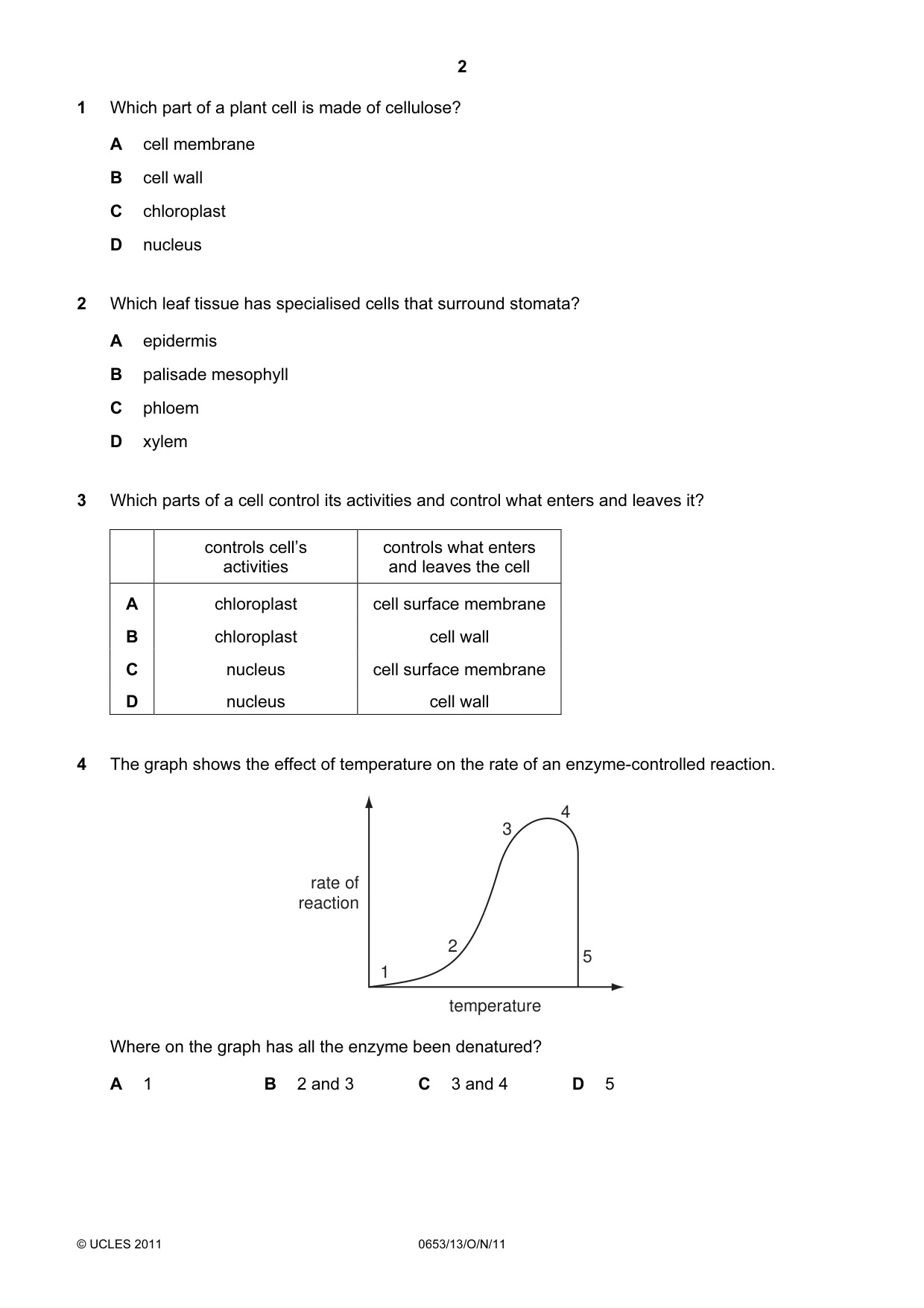
Q4 · The graph shows the effect of temperature on the rate of an enzyme-controlled reaction
4 The graph shows the effect of temperature on the rate of an enzyme-controlled reaction. 4 3 rate of reaction 2 5 1 temperature Where on the graph has all the enzyme been denatured? A 1 B 2 and 3 C 3 and 4 D 5
Mark scheme: D
Q5 · Oxygenated blood returns to the heart from the lungs in vessel X and leaves the heart to…
5 Oxygenated blood returns to the heart from the lungs in vessel X and leaves the heart to circulate around the body in vessel Y. What are X and Y? X Y A aorta pulmonary vein B pulmonary artery vena cava C pulmonary vein aorta D vena cava pulmonary artery
Mark scheme: C
Q6 · When a leaf is photosynthesising, in which direction do gases diffuse through the stomata?
6 When a leaf is photosynthesising, in which direction do gases diffuse through the stomata? carbon dioxide oxygen A in in B in out C out in D out out
Mark scheme: B
Q7 · What happens during digestion?
7 What happens during digestion? large pieces of food are broken into small pieces large molecules are broken into small molecules 0 0O WwW D> v v x x v x v x
Mark scheme: A
Q8 · A species of animal reproduces both sexually and asexually
8 A species of animal reproduces both sexually and asexually. Which offspring will be clones? offspring from sexual offspring from reproduction asexual reproduction A v v B v x Cc x v D x x
Mark scheme: C
Q9 · The table shows the level of alcohol in a person’s blood after drinking two litres of beer
9 The table shows the level of alcohol in a person’s blood after drinking two litres of beer. time after drinking alcohol in the blood beer (hours) (grams / dm3) 1 7 2 5 3 3 4 0 How long will it be (in hours) before the person’s reaction time returns to normal? A 0 to 1 B 1 to 2 C 2 to 3 D 3 to 4
Mark scheme: D
Q10 · Which method of family planning is also likely to reduce the risk of the spread of…
10 Which method of family planning is also likely to reduce the risk of the spread of syphilis? A condom B intra-uterine device (IUD) C pill D sterilisation
Mark scheme: A
Q11 · Which process reduces soil erosion on hilly ground?
11 Which process reduces soil erosion on hilly ground? A cutting down the trees B increasing the number of grazing animals C ploughing up and down the hilly ground D terracing the hilly ground
Mark scheme: D
Q12 · Albino humans cannot make any pigment in their skin
12 Albino humans cannot make any pigment in their skin. A pale-skinned student, who is not an albino, sits in the sun on a number of days. The student’s skin becomes suntanned (darker). What causes this suntanning to happen? A the environment and the student’s albino alleles B the environment and the student’s non-albino alleles C the environment only D the student’s genes only
Mark scheme: B
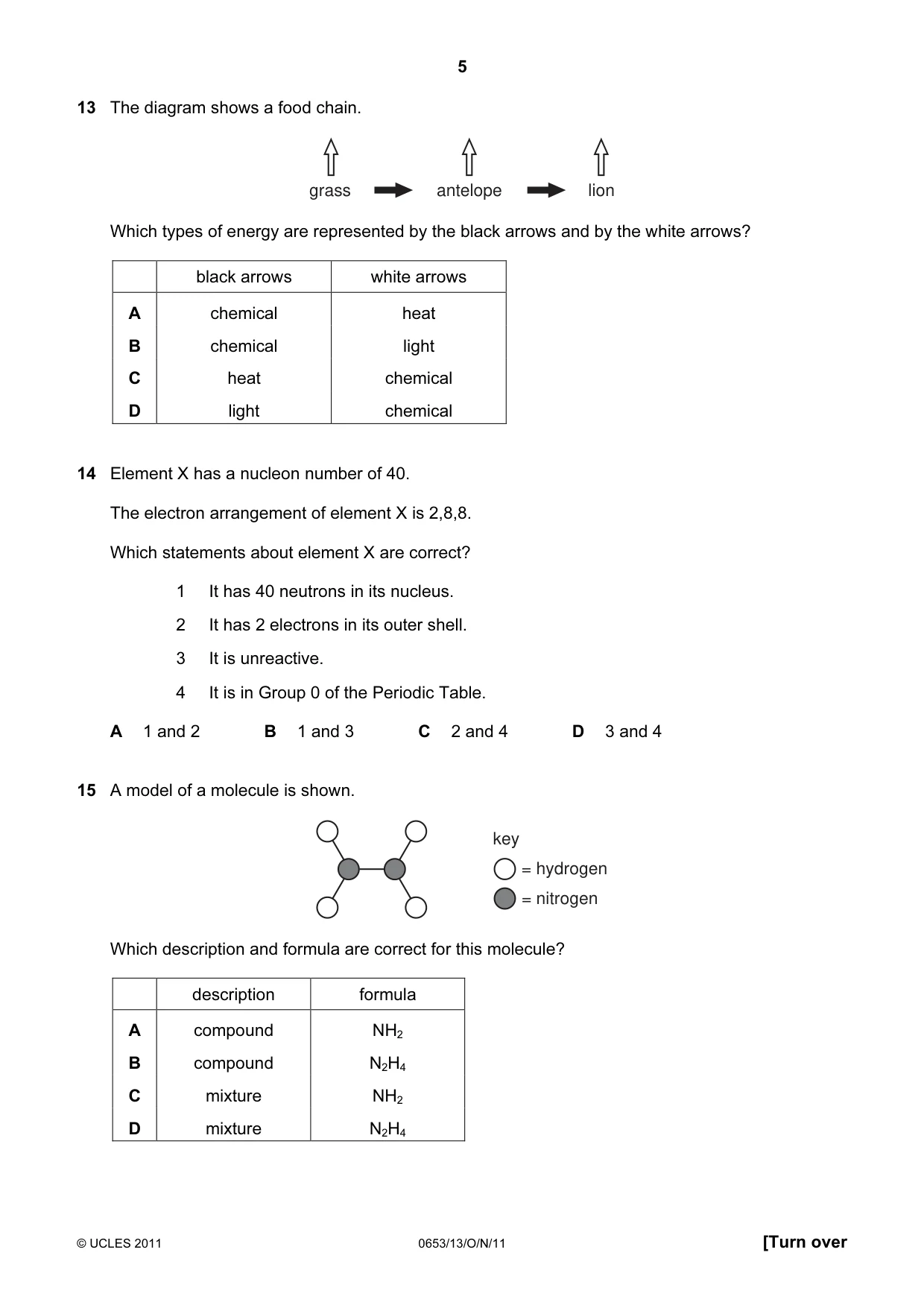
Q13 · The diagram shows a food chain
13 The diagram shows a food chain. grass antelope lion Which types of energy are represented by the black arrows and by the white arrows? black arrows white arrows A chemical heat B chemical light C heat chemical D light chemical
Mark scheme: A
Q14 · Element X has a nucleon number of 40
14 Element X has a nucleon number of 40. The electron arrangement of element X is 2,8,8. Which statements about element X are correct? 1 It has 40 neutrons in its nucleus. 2 It has 2 electrons in its outer shell. 3 It is unreactive. 4 It is in Group 0 of the Periodic Table. A 1 and 2 B 1 and 3 C 2 and 4 D 3 and 4
Mark scheme: D
Q15 · A model of a molecule is shown
15 A model of a molecule is shown. key = hydrogen = nitrogen Which description and formula are correct for this molecule? description formula A compound NH2 B compound N2H4 C mixture NH2 D mixture N2H4
Mark scheme: B
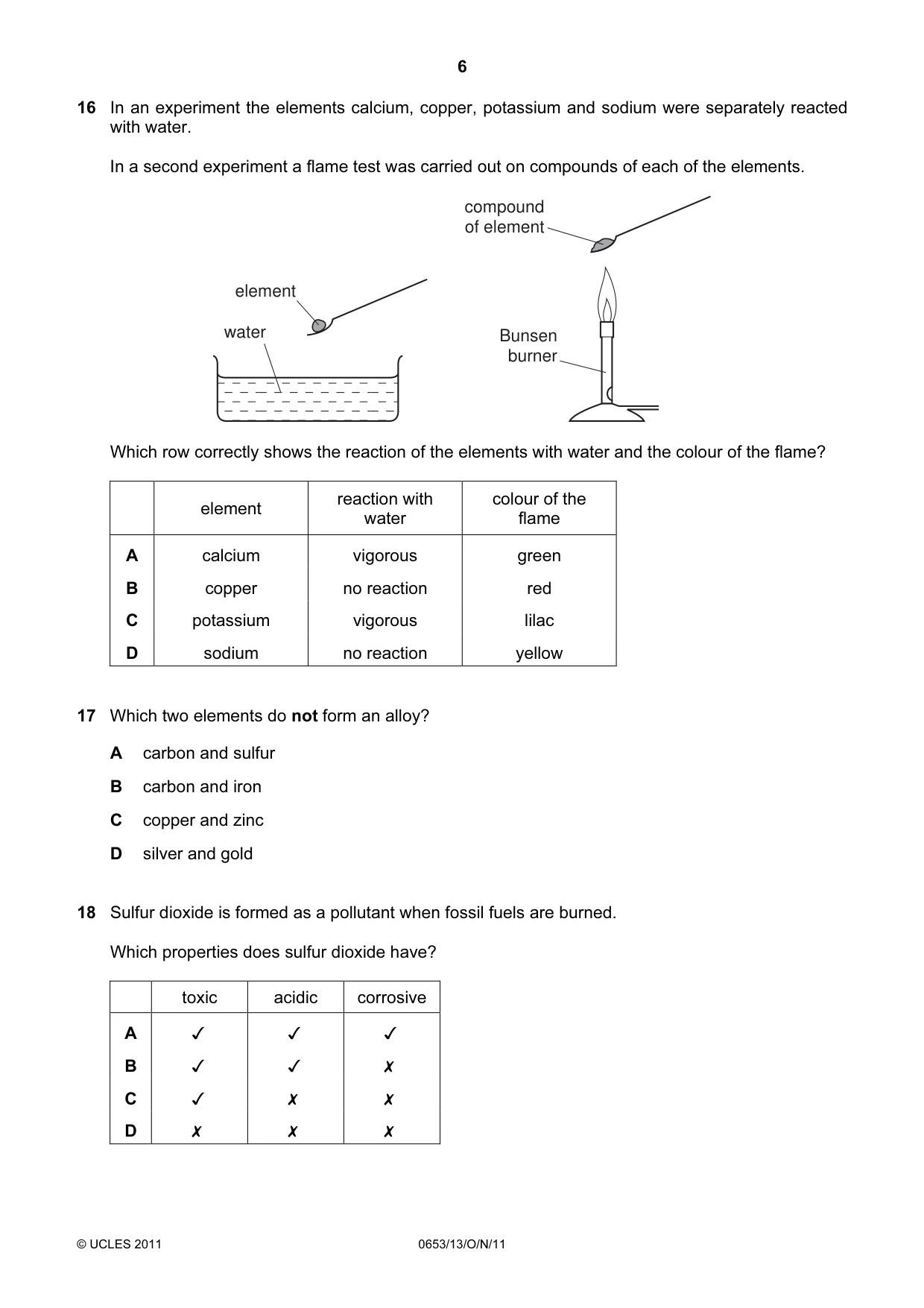
Q16 · In an experiment the elements calcium, copper, potassium and sodium were separately…
16 In an experiment the elements calcium, copper, potassium and sodium were separately reacted with water. In a second experiment a flame test was carried out on compounds of each of the elements. compound of element element water Bunsen burner Which row correctly shows the reaction of the elements with water and the colour of the flame? reaction with colour of the element water flame A calcium vigorous green B copper no reaction red C potassium vigorous lilac D sodium no reaction yellow
Mark scheme: C
Q17 · Which two elements do not form an alloy?
17 Which two elements do not form an alloy? A carbon and sulfur B carbon and iron C copper and zinc D silver and gold
Mark scheme: A
Q18 · Sulfur dioxide is formed as a pollutant when fossil fuels are burned
18 Sulfur dioxide is formed as a pollutant when fossil fuels are burned. Which properties does sulfur dioxide have? toxic acidic corrosive v v v 0 0O WwW > v v x v x x x x x
Mark scheme: A
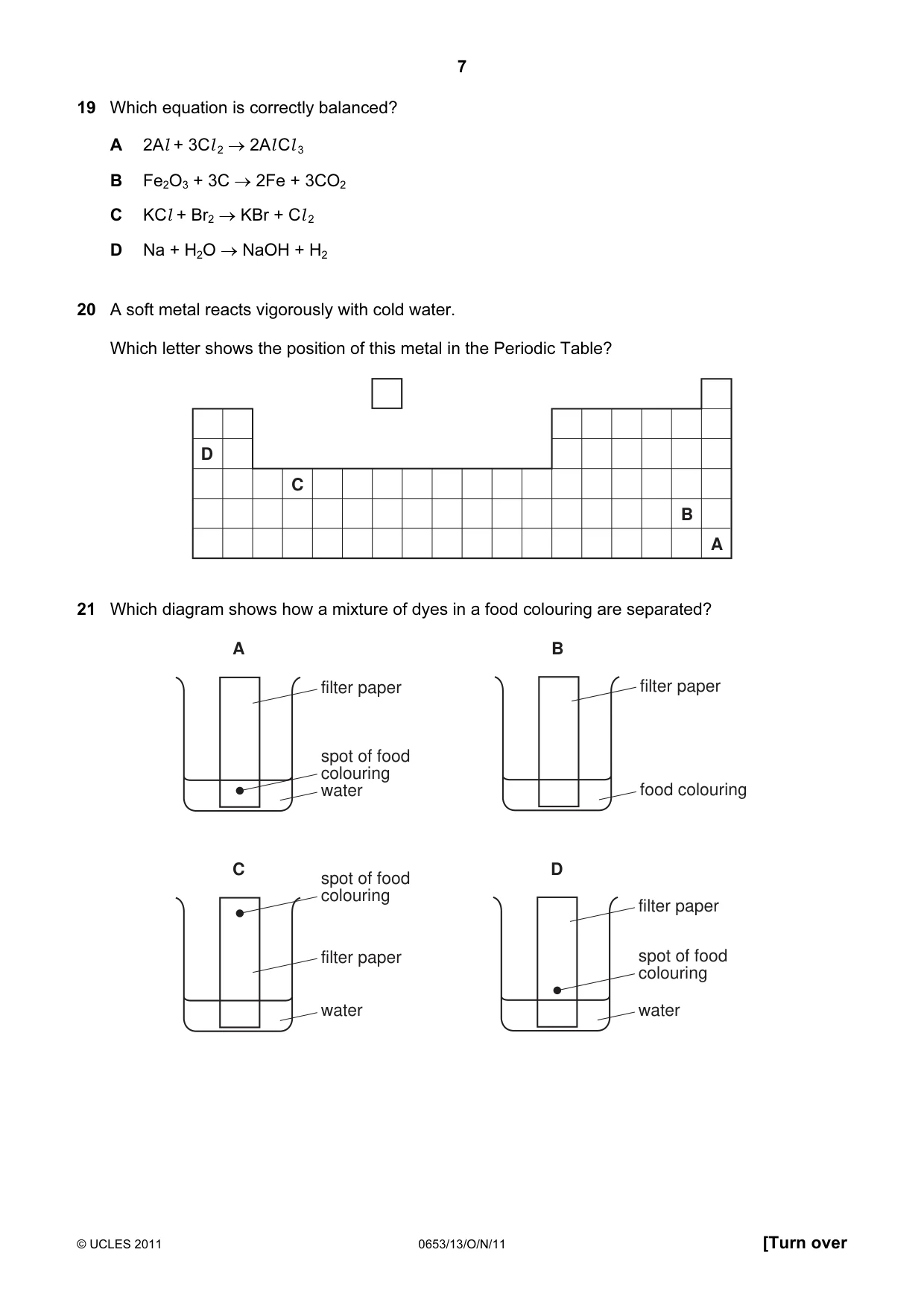
Q19 · Which equation is correctly balanced?
19 Which equation is correctly balanced? A 2Al + 3Cl 2 → 2Al Cl 3 B Fe2O3 + 3C → 2Fe + 3CO2 C KCl + Br2 → KBr + Cl 2 D Na + H2O → NaOH + H2
Mark scheme: A
Q20 · A soft metal reacts vigorously with cold water
20 A soft metal reacts vigorously with cold water. Which letter shows the position of this metal in the Periodic Table? D C B A
Mark scheme: D
Q21 · Which diagram shows how a mixture of dyes in a food colouring are separated?
21 Which diagram shows how a mixture of dyes in a food colouring are separated? A B filter paper filter paper spot of food colouring water food colouring C D spot of food colouring filter paper filter paper spot of food colouring water water
Mark scheme: D
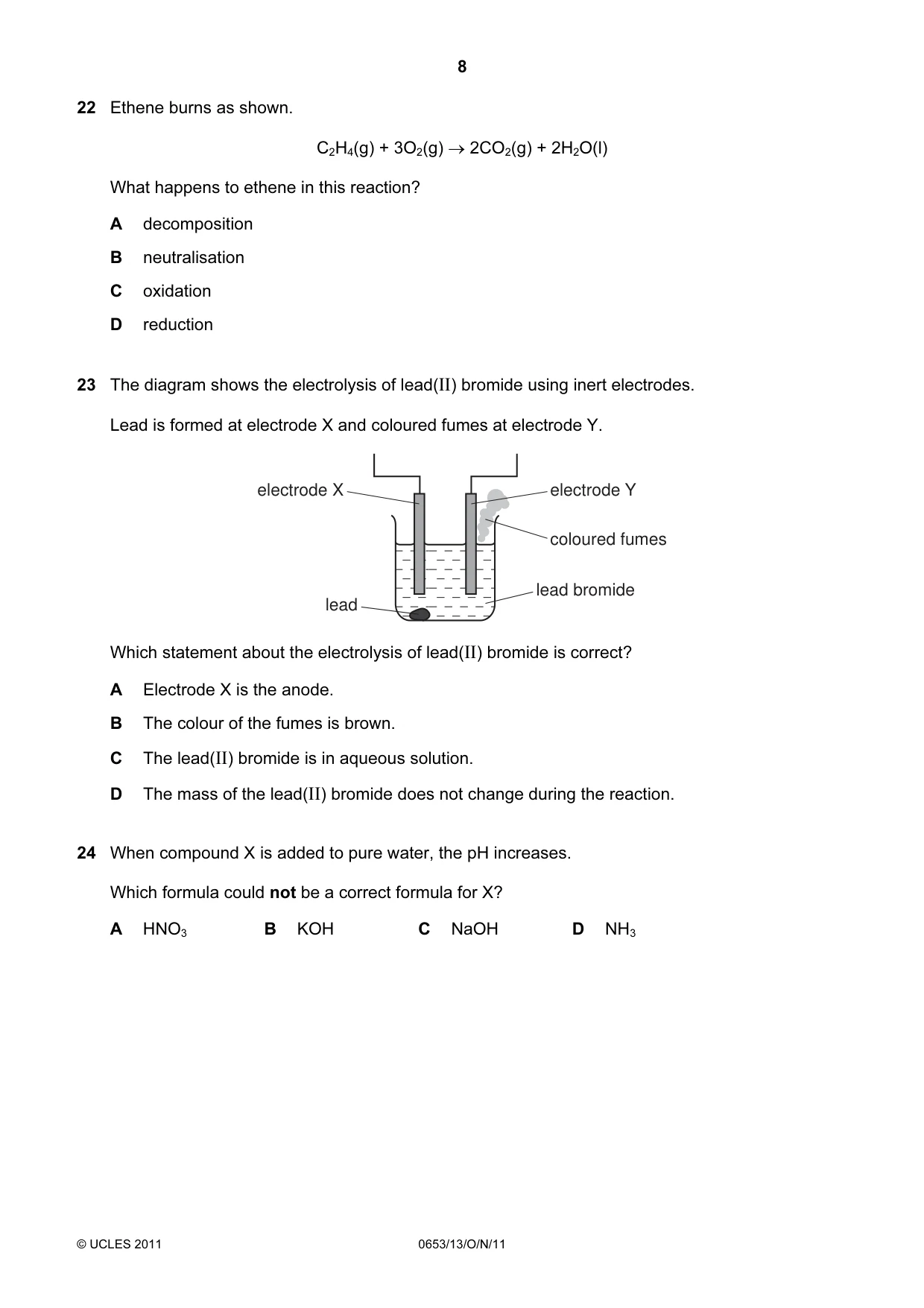
Q22 · Ethene burns as shown
22 Ethene burns as shown. C2H4(g) + 3O2(g) → 2CO2(g) + 2H2O(l) What happens to ethene in this reaction? A decomposition B neutralisation C oxidation D reduction
Mark scheme: C
Q23 · The diagram shows the electrolysis of lead(II) bromide using inert electrodes
23 The diagram shows the electrolysis of lead(II) bromide using inert electrodes. Lead is formed at electrode X and coloured fumes at electrode Y. electrode X electrode Y coloured fumes lead bromide lead Which statement about the electrolysis of lead(II) bromide is correct? A Electrode X is the anode. B The colour of the fumes is brown. C The lead(II) bromide is in aqueous solution. D The mass of the lead(II) bromide does not change during the reaction.
Mark scheme: B
Q24 · When compound X is added to pure water, the pH increases
24 When compound X is added to pure water, the pH increases. Which formula could not be a correct formula for X? A HNO3 B KOH C NaOH D NH3
Mark scheme: A
More questions on The characteristic properties of acids and bases
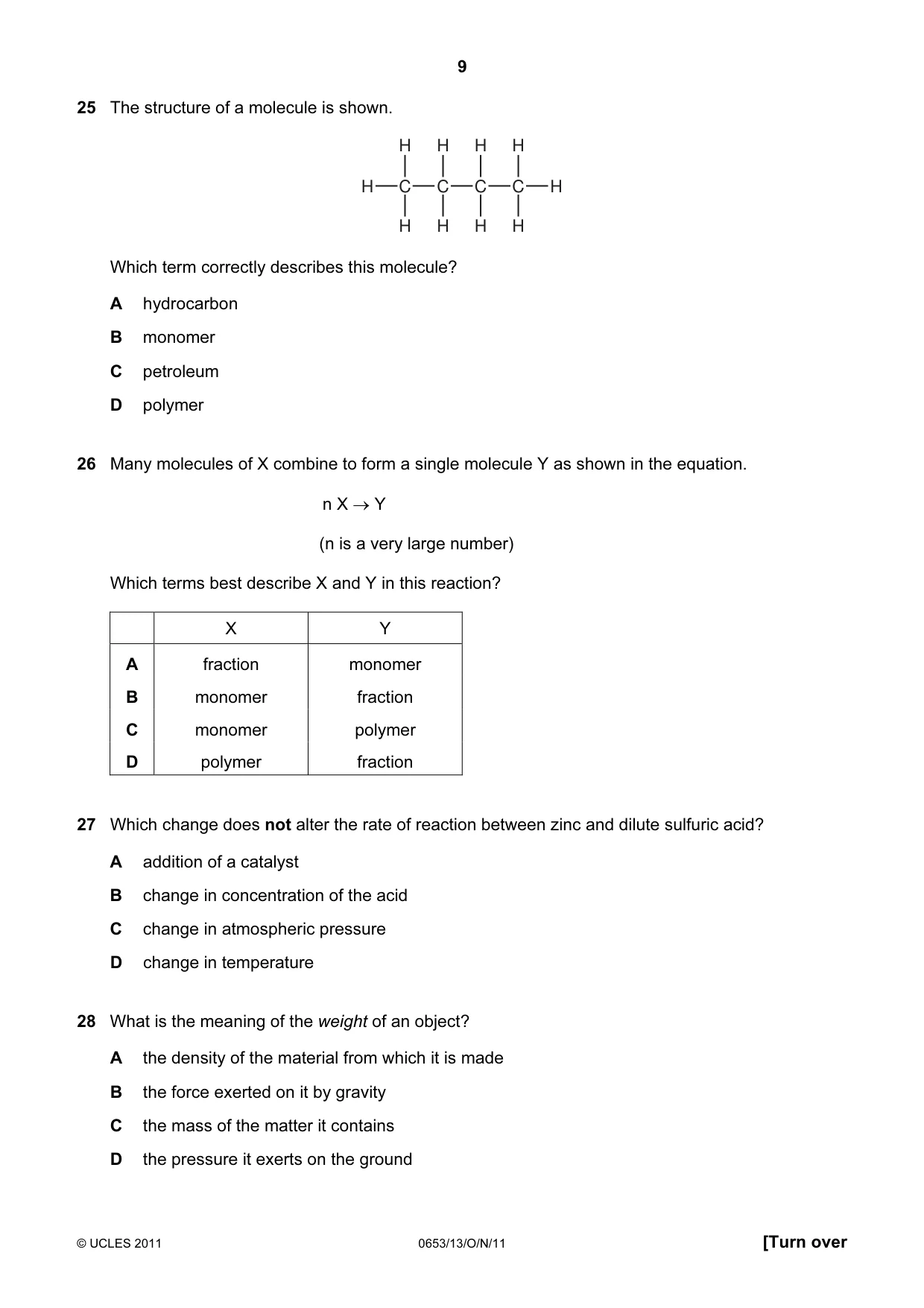
Q25 · The structure of a molecule is shown
25 The structure of a molecule is shown. H H H H H C C C C H H H H H Which term correctly describes this molecule? A hydrocarbon B monomer C petroleum D polymer
Mark scheme: A
Q26 · Many molecules of X combine to form a single molecule Y as shown in the equation
26 Many molecules of X combine to form a single molecule Y as shown in the equation. n X → Y (n is a very large number) Which terms best describe X and Y in this reaction? X Y A fraction monomer B monomer fraction C monomer polymer D polymer fraction
Mark scheme: C
Q27 · Which change does not alter the rate of reaction between zinc and dilute sulfuric acid?
27 Which change does not alter the rate of reaction between zinc and dilute sulfuric acid? A addition of a catalyst B change in concentration of the acid C change in atmospheric pressure D change in temperature
Mark scheme: C
Q28 · What is the meaning of the weight of an object?
28 What is the meaning of the weight of an object? A the density of the material from which it is made B the force exerted on it by gravity C the mass of the matter it contains D the pressure it exerts on the ground
Mark scheme: B
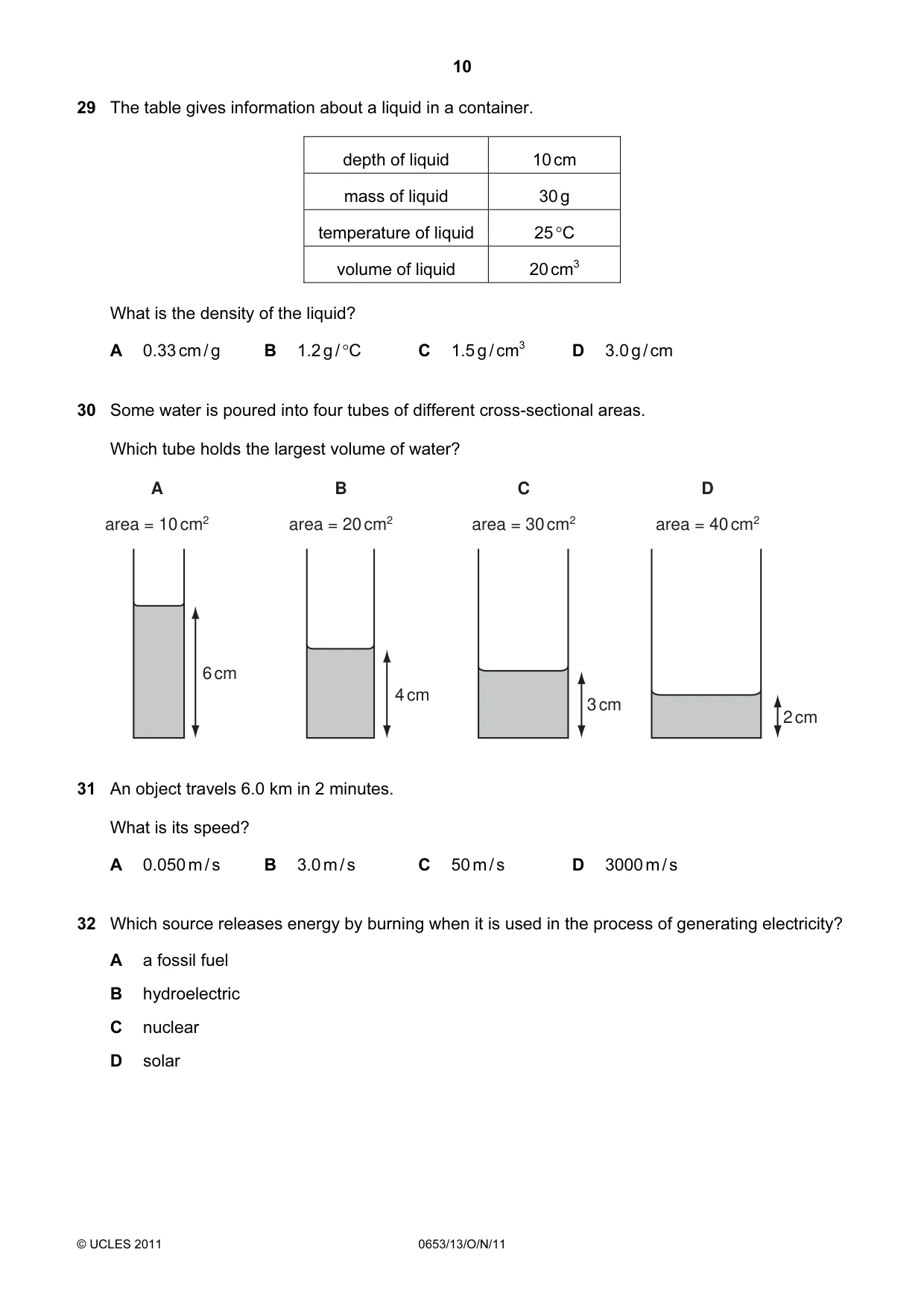
Q29 · The table gives information about a liquid in a container
29 The table gives information about a liquid in a container. depth of liquid 10 cm mass of liquid 30 g temperature of liquid 25 °C volume of liquid 20 cm3 What is the density of the liquid? A 0.33 cm / g B 1.2 g / °C C 1.5 g / cm3 D 3.0 g / cm
Mark scheme: C
Q30 · Some water is poured into four tubes of different cross-sectional areas
30 Some water is poured into four tubes of different cross-sectional areas. Which tube holds the largest volume of water? A B C D area = 10 cm2 area = 20 cm2 area = 30 cm2 area = 40 cm2 6 cm 4 cm 3 cm 2 cm
Mark scheme: C
Q31 · An object travels 6.0 km in 2 minutes
31 An object travels 6.0 km in 2 minutes. What is its speed? A 0.050 m / s B 3.0 m / s C 50 m / s D 3000 m / s
Mark scheme: C
Q32 · Which source releases energy by burning when it is used in the process of generating…
32 Which source releases energy by burning when it is used in the process of generating electricity? A a fossil fuel B hydroelectric C nuclear D solar
Mark scheme: A
Q33 · When flying, some birds use warm air currents to gain height
33 When flying, some birds use warm air currents to gain height. What is the cause of these currents? A conduction B convection C evaporation D radiation
Mark scheme: B
Q34 · Why is a fuse used in an electric circuit in a house?
34 Why is a fuse used in an electric circuit in a house? A to increase the resistance of the circuit B to keep the power used to a minimum value C to prevent a short circuit from occurring D to stop the cables overheating
Mark scheme: D
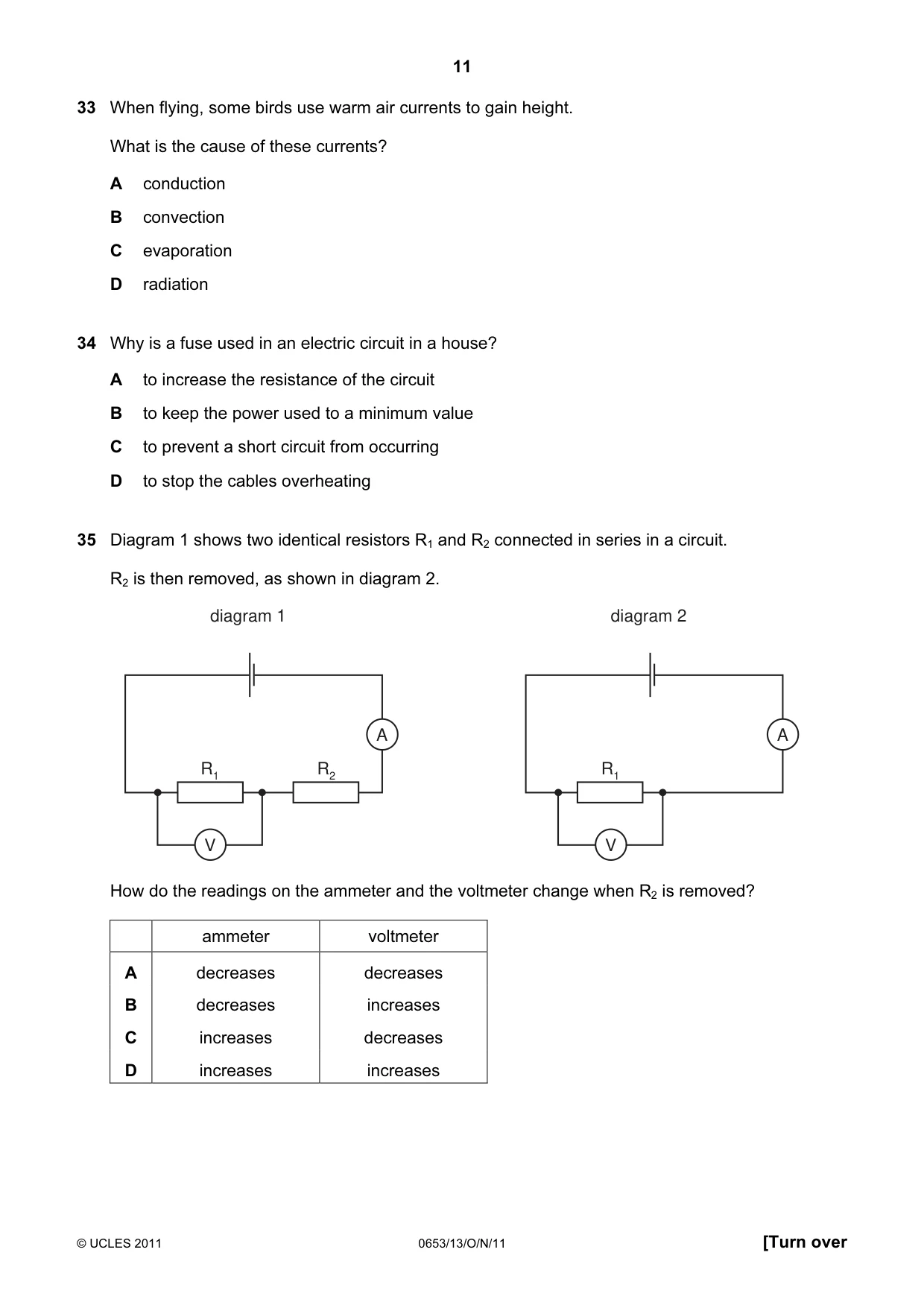
Q35 · Two identical resistors R1 and R2 connected in series in a circuit
35 Diagram 1 shows two identical resistors R1 and R2 connected in series in a circuit. R2 is then removed, as shown in diagram 2. diagram 1 diagram 2 A A R1 R2 R1 V V How do the readings on the ammeter and the voltmeter change when R2 is removed? ammeter voltmeter A decreases decreases B decreases increases C increases decreases D increases increases
Mark scheme: D
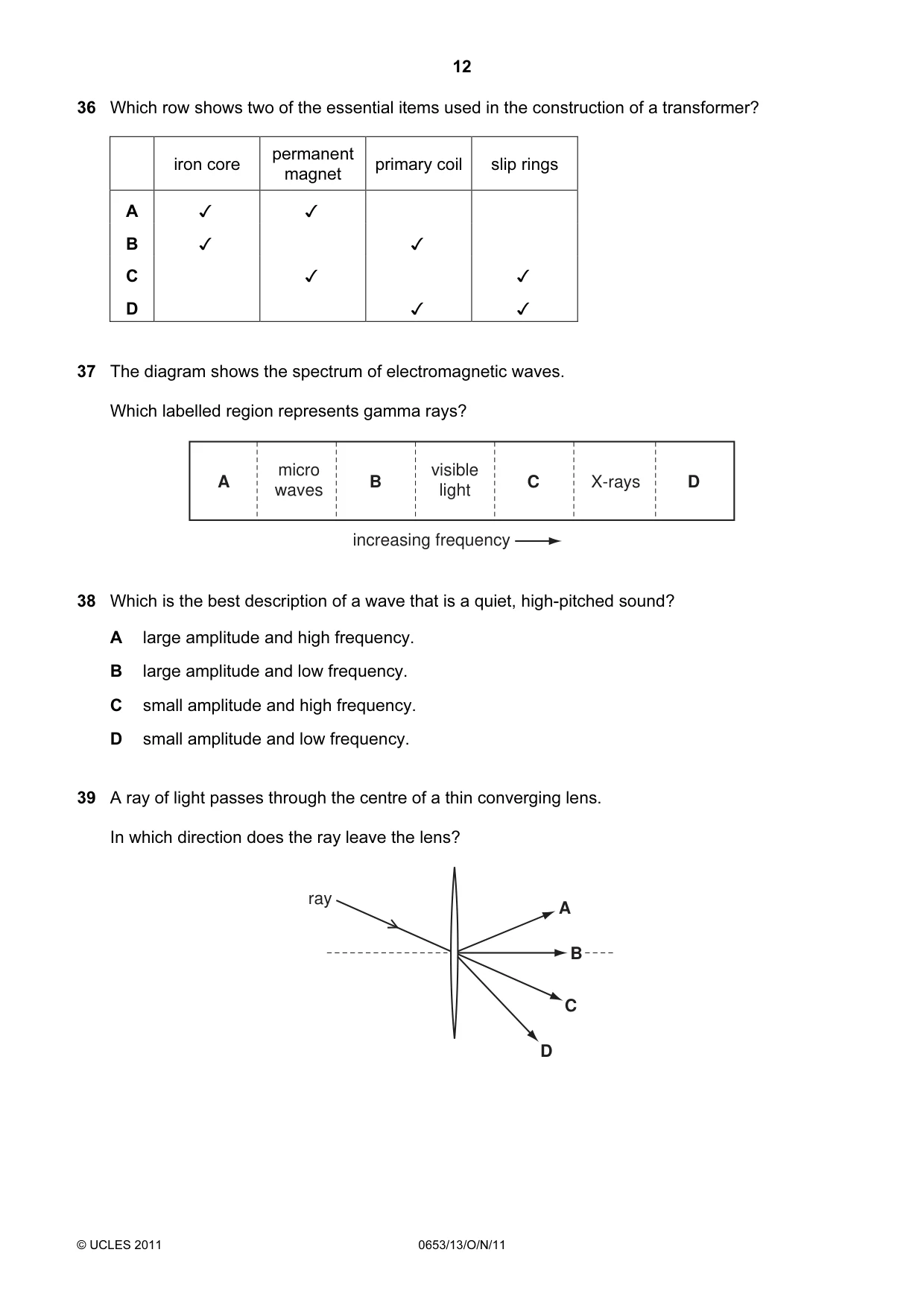
Q36 · Which row shows two of the essential items used in the construction of a transformer?
36 Which row shows two of the essential items used in the construction of a transformer? iron core permanent primary coil | slip rings magnet A v v B v v Cc v v D v v
Mark scheme: B
Q37 · The diagram shows the spectrum of electromagnetic waves
37 The diagram shows the spectrum of electromagnetic waves. Which labelled region represents gamma rays? micro visible A B C X-rays D waves light increasing frequency
Mark scheme: D
Q38 · Which is the best description of a wave that is a quiet, high-pitched sound?
38 Which is the best description of a wave that is a quiet, high-pitched sound? A large amplitude and high frequency. B large amplitude and low frequency. C small amplitude and high frequency. D small amplitude and low frequency.
Mark scheme: C
Q39 · A ray of light passes through the centre of a thin converging lens
39 A ray of light passes through the centre of a thin converging lens. In which direction does the ray leave the lens? ray A B C D
Mark scheme: C
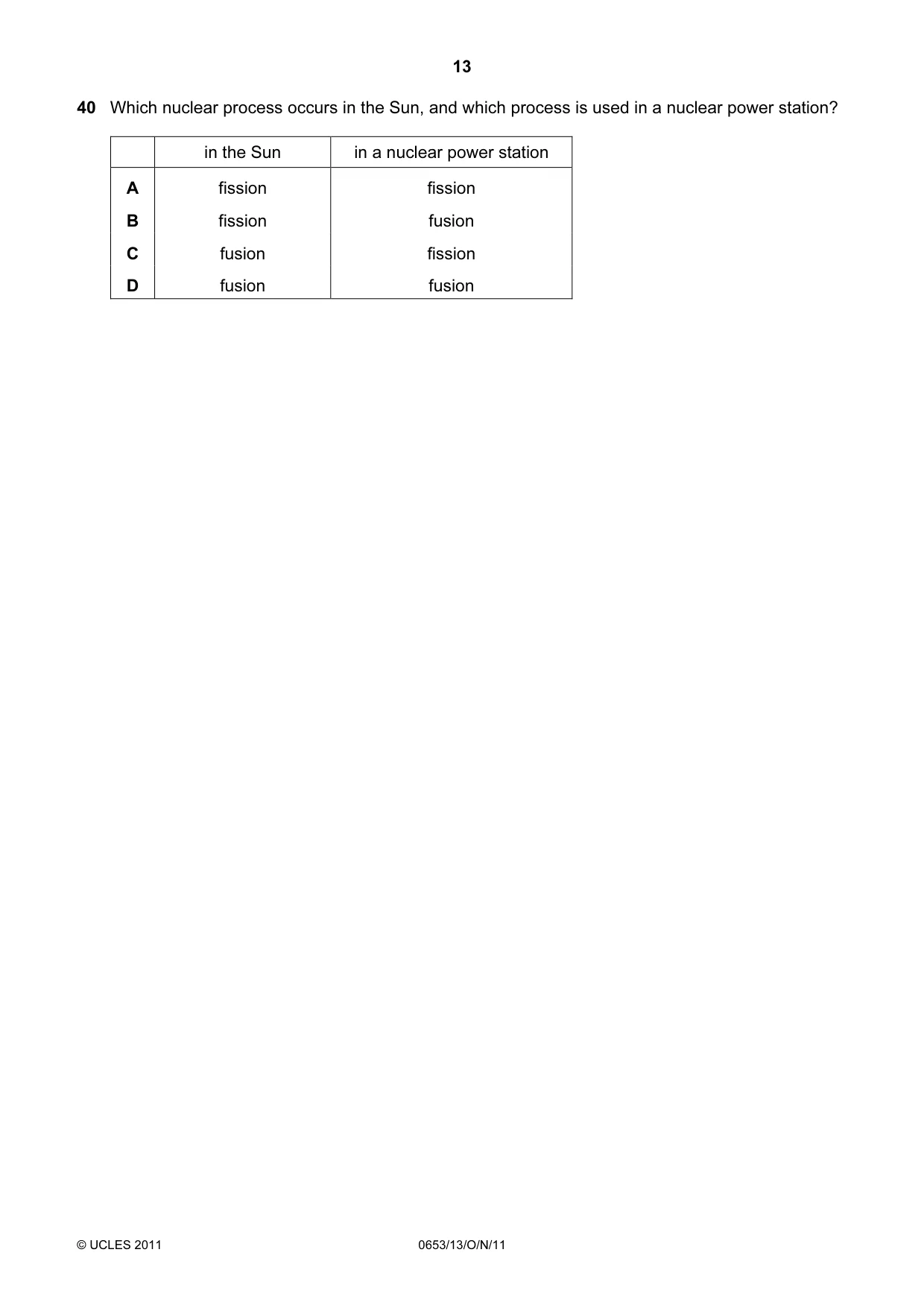
Q40 · Which nuclear process occurs in the Sun, and which process is used in a nuclear power…
40 Which nuclear process occurs in the Sun, and which process is used in a nuclear power station? in the Sun in a nuclear power station A fission fission B fission fusion C fusion fission D fusion fusion
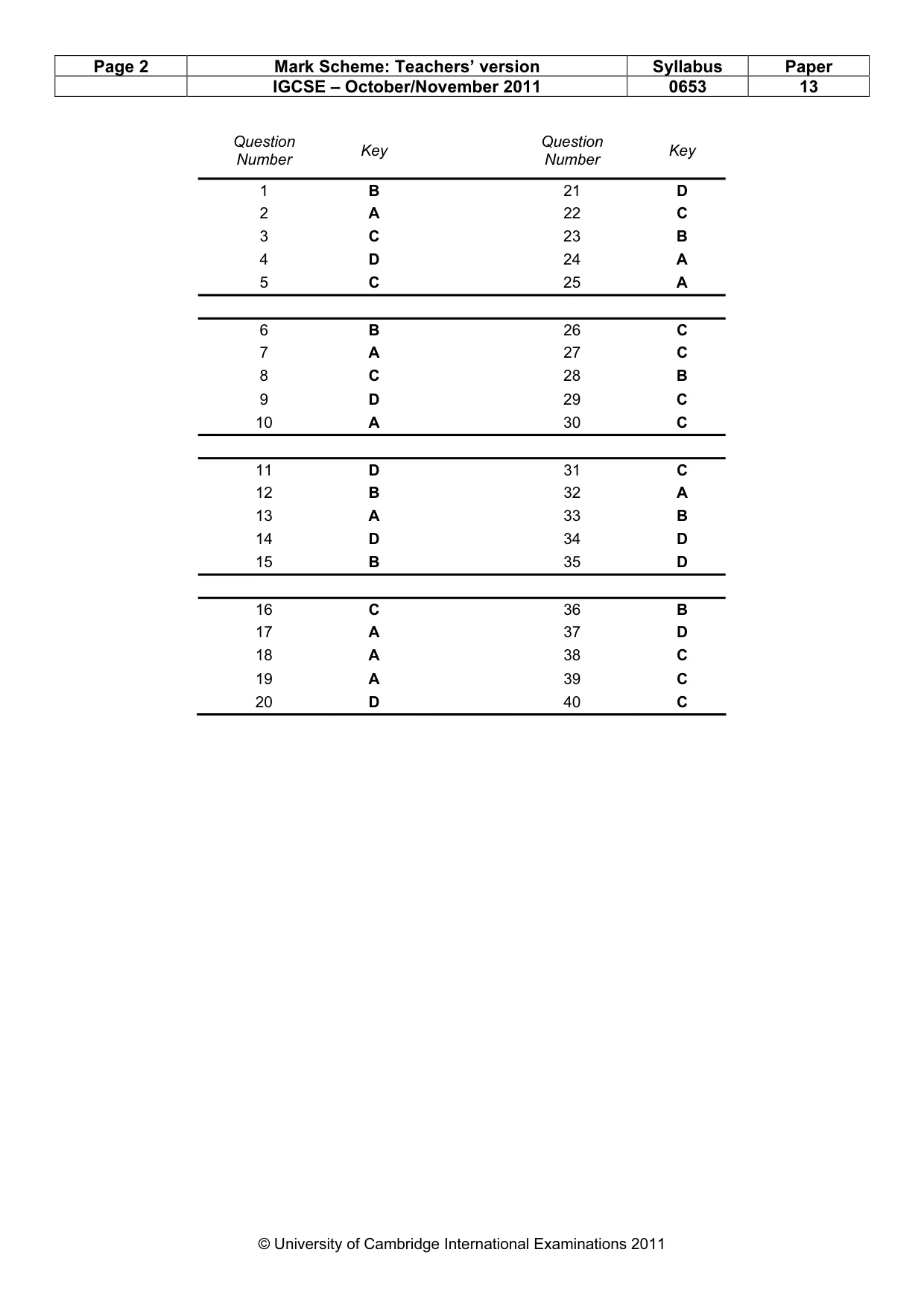
Mark scheme: C
What was in this paper
The subtopics covered by these 40 questions, and how many questions each got. Open one in a new tab to see every Cambridge question on it.
2Density2Group I properties2Alkanes1Alloys and their properties1Atomic structure and the Periodic Table1Cells, batteries, generators and motors1Characteristics of living organisms1Chromatography1Circulatory systems1Conservation1Digestion1Drugs1Electrical circuits1Electrical safety1Electrolysis1Electromagnetic spectrum1Elements, compounds and mixtures1Energy flow1Energy, work and power1Enzymes1Formulas1Gas exchange in humans1General properties of waves1Leaf structure1Light1Mass and weight1Motion1Oxides1Polymers1Rate of reaction1Redox1Sexual reproduction in humans1Sexual reproduction in plants1Stars and the Universe1The characteristic properties of acids and bases1Transfer of thermal energy1What you needed in this session
Cambridge’s own grade thresholds for 2011 Oct/Nov, Paper 1 · Variant 3. A higher threshold means an easier paper — the bar moves with how the cohort did.