Cambridge IGCSE Science - Combined 0653 — 2019 May/June Paper 1 · Variant 2
0653/12/M/J/19 · 40 questions · 40 marks · ≈45 min
The question paper and its mark scheme, free to read here and free to download. This is Cambridge’s own paper, exactly as it was sat.
Question paper16 pages
Mark scheme3 pages
Answers below. Sit the paper first if you are practising.
Questions as text
Q1 · What are the outermost layers of an animal cell and a plant cell?
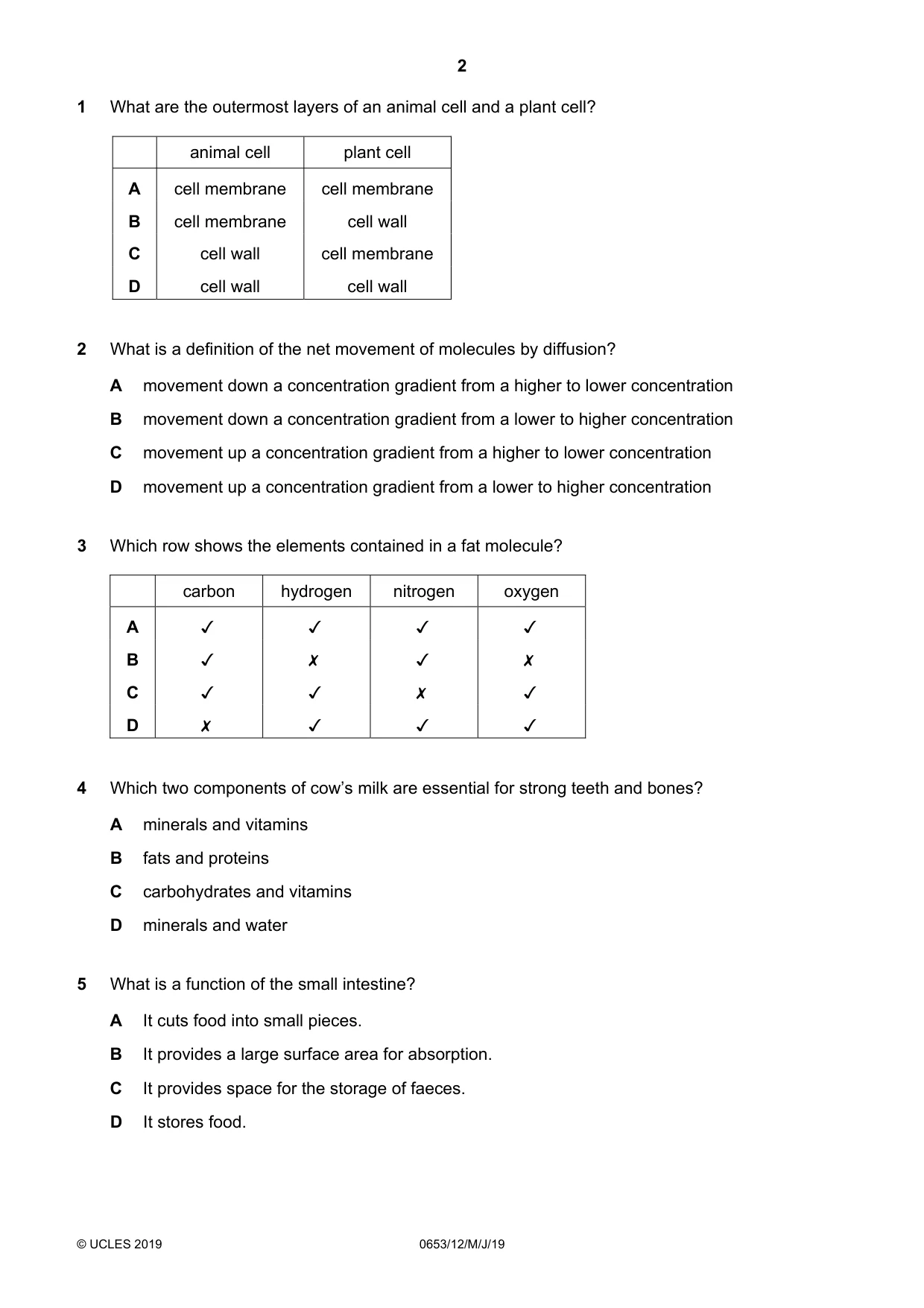
1 What are the outermost layers of an animal cell and a plant cell? animal cell plant cell A cell membrane cell membrane B cell membrane cell wall C cell wall cell membrane D cell wall cell wall
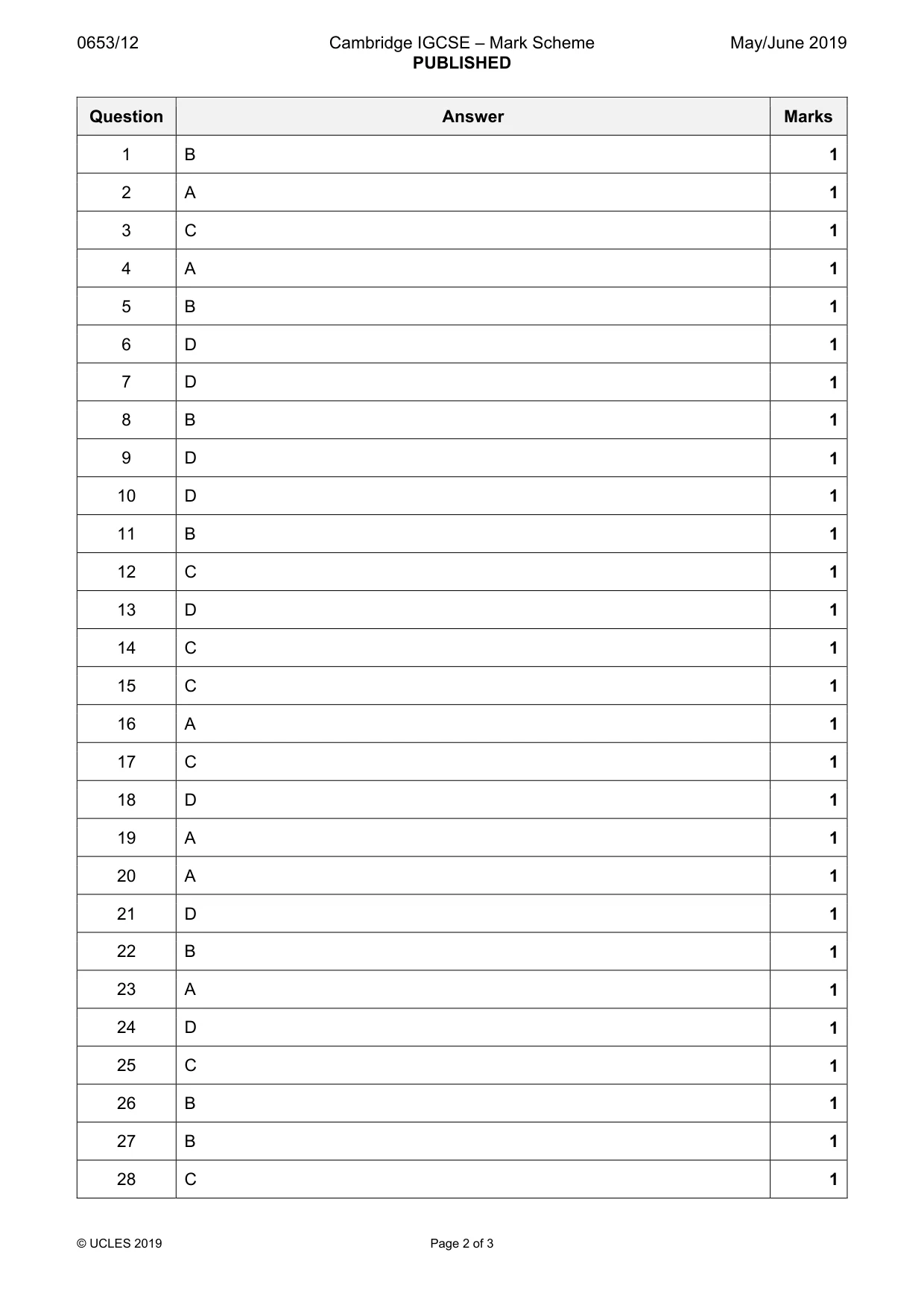
Mark scheme: B
Q2 · What is a definition of the net movement of molecules by diffusion?
2 What is a definition of the net movement of molecules by diffusion? A movement down a concentration gradient from a higher to lower concentration B movement down a concentration gradient from a lower to higher concentration C movement up a concentration gradient from a higher to lower concentration D movement up a concentration gradient from a lower to higher concentration
Mark scheme: A
Q3 · Which row shows the elements contained in a fat molecule?
3. Which row shows the elements contained in a fat molecule? carbon hydrogen nitrogen oxygen v v v v 0 Oo WwW > v x v x v v Xx v x v v v
Mark scheme: C
Q4 · Which two components of cow’s milk are essential for strong teeth and bones?
4 Which two components of cow’s milk are essential for strong teeth and bones? A minerals and vitamins B fats and proteins C carbohydrates and vitamins D minerals and water
Mark scheme: A
Q5 · What is a function of the small intestine?
5 What is a function of the small intestine? A It cuts food into small pieces. B It provides a large surface area for absorption. C It provides space for the storage of faeces. D It stores food.
Mark scheme: B
Q6 · What is the route for carbon dioxide passing out of the body?
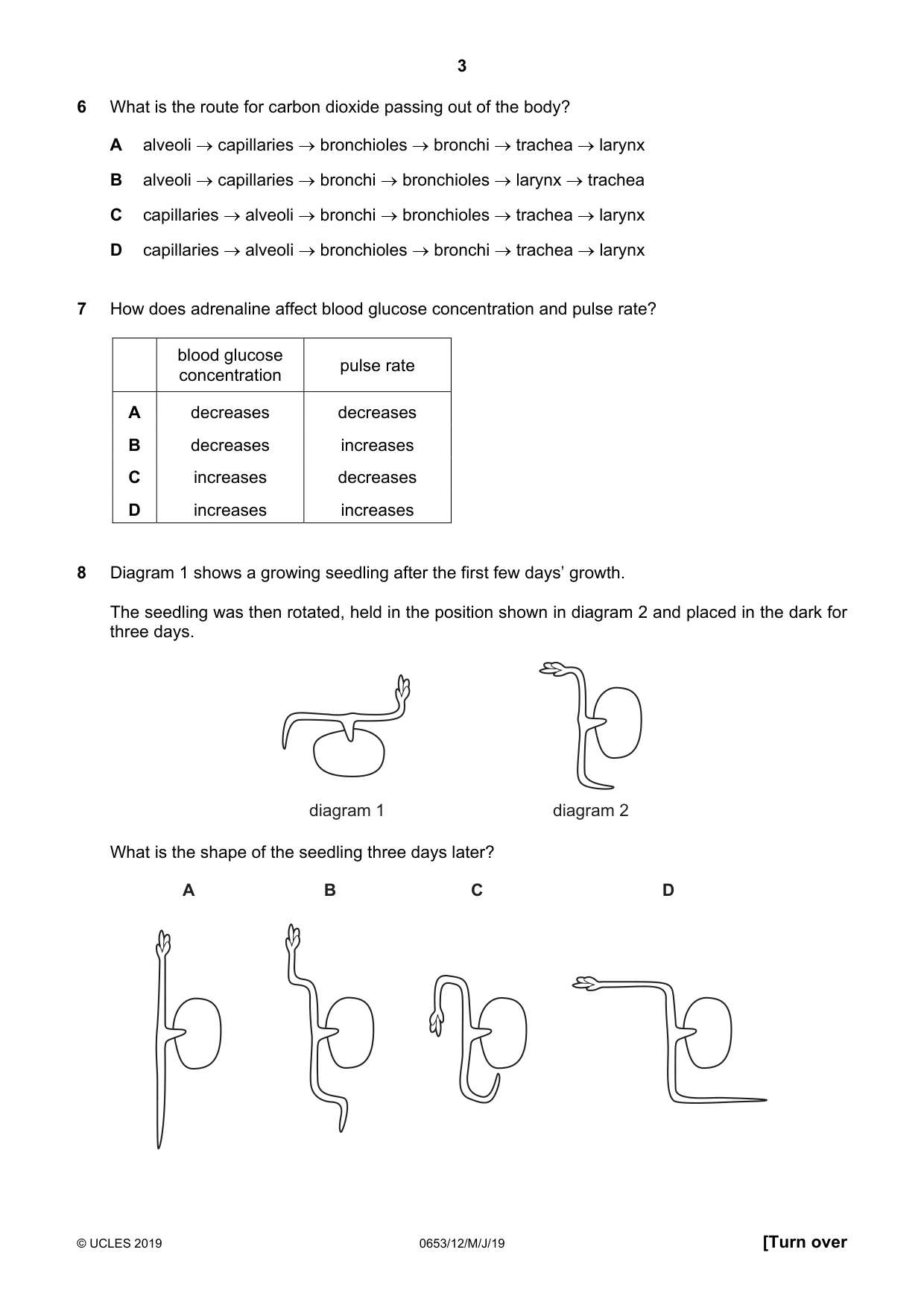
6 What is the route for carbon dioxide passing out of the body? A alveoli → capillaries → bronchioles → bronchi → trachea → larynx B alveoli → capillaries → bronchi → bronchioles → larynx → trachea C capillaries → alveoli → bronchi → bronchioles → trachea → larynx D capillaries → alveoli → bronchioles → bronchi → trachea → larynx
Mark scheme: D
Q7 · How does adrenaline affect blood glucose concentration and pulse rate?
7 How does adrenaline affect blood glucose concentration and pulse rate? blood glucose pulse rate concentration A decreases decreases B decreases increases C increases decreases D increases increases
Mark scheme: D
Q8 · A growing seedling after the first few days’ growth
8 Diagram 1 shows a growing seedling after the first few days’ growth. The seedling was then rotated, held in the position shown in diagram 2 and placed in the dark for three days. diagram 1 diagram 2 What is the shape of the seedling three days later? A B C D
Mark scheme: B
Q9 · What are the features of sexual reproduction?
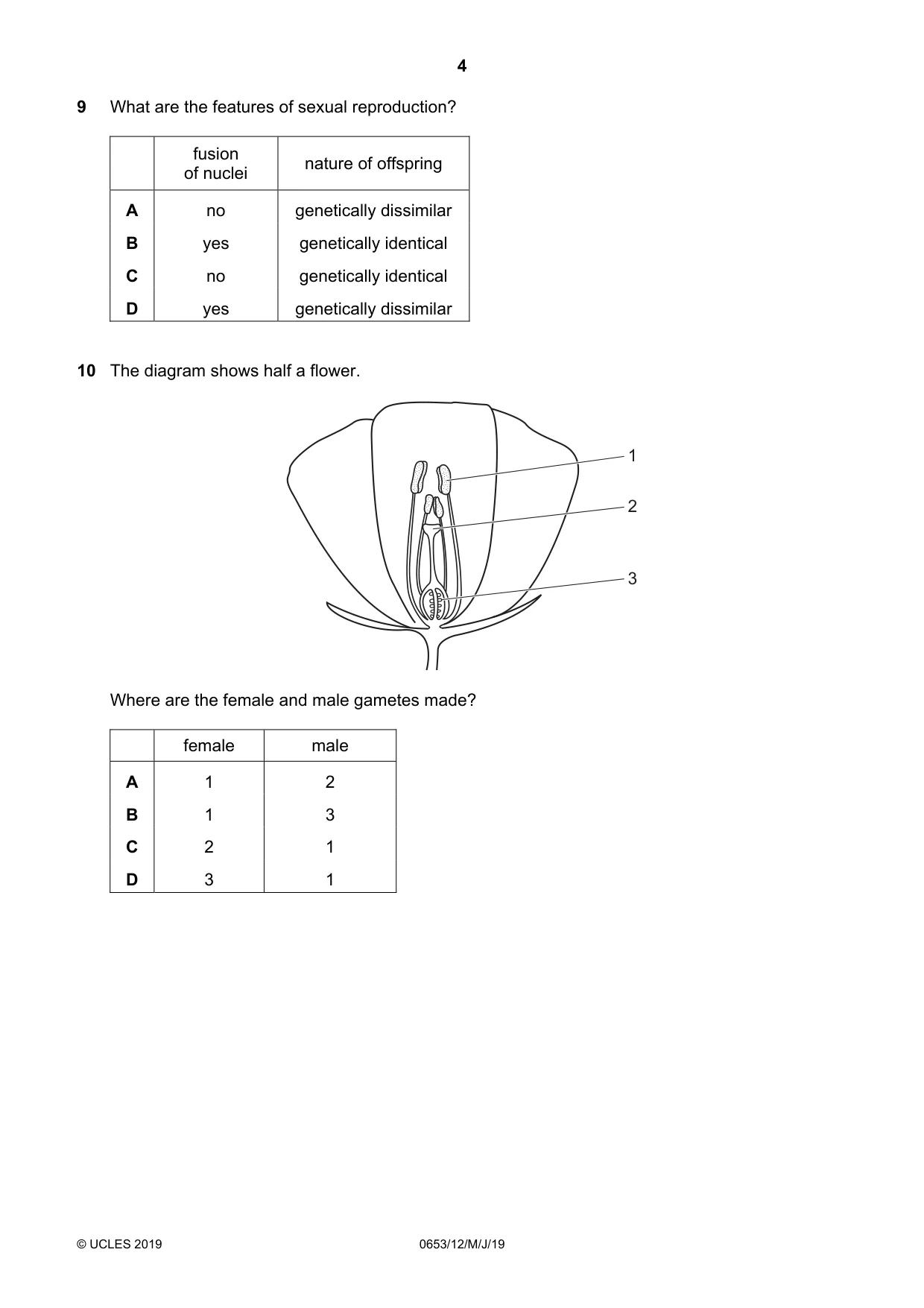
9 What are the features of sexual reproduction? fusion nature of offspring of nuclei A no genetically dissimilar B yes genetically identical C no genetically identical D yes genetically dissimilar
Mark scheme: D
Q10 · The diagram shows half a flower
10 The diagram shows half a flower. 1 2 3 Where are the female and male gametes made? female male A 1 2 B 1 3 C 2 1 D 3 1
Mark scheme: D
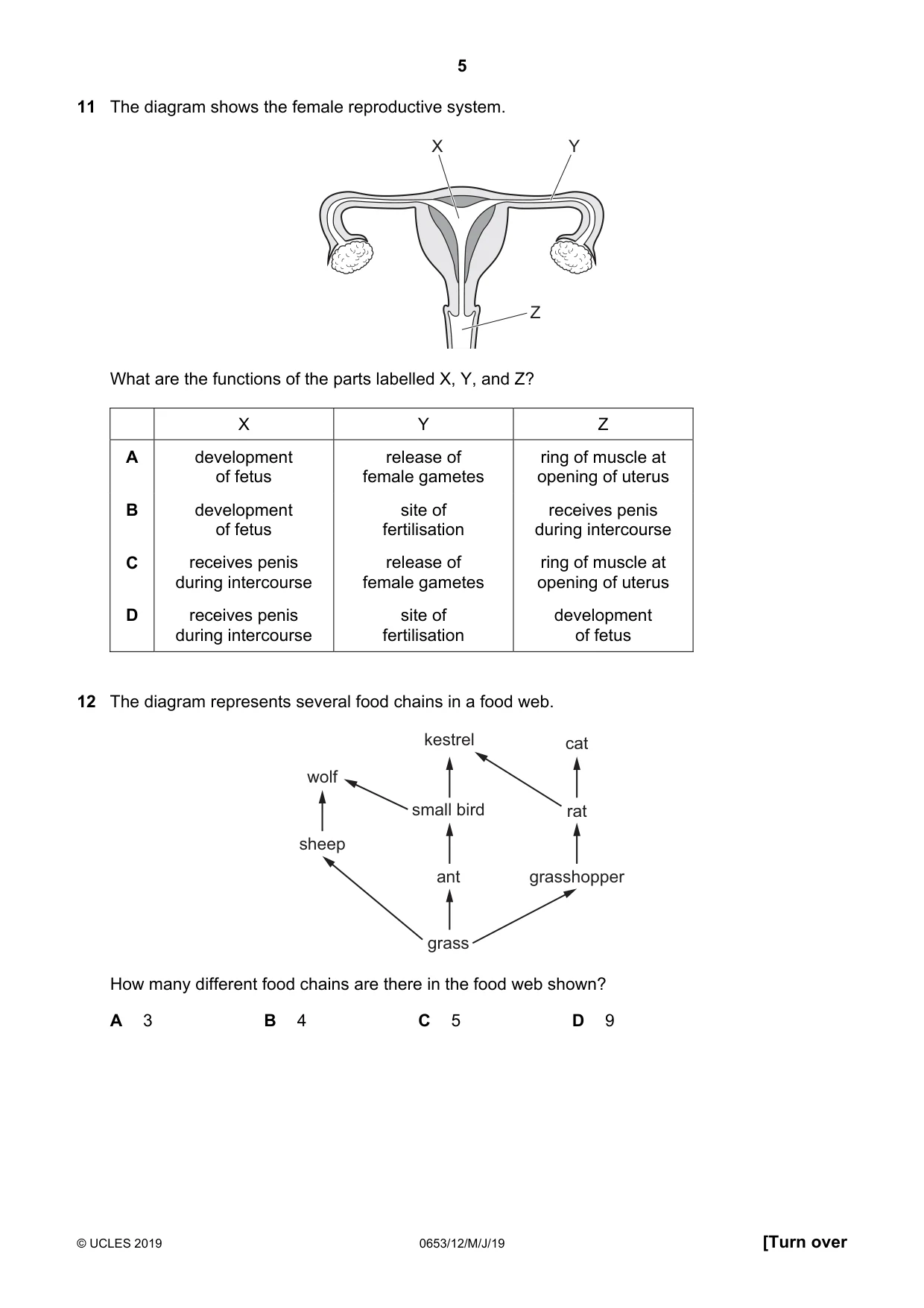
Q11 · The diagram shows the female reproductive system
11 The diagram shows the female reproductive system. X Y Z What are the functions of the parts labelled X, Y, and Z? X Y Z A development release of ring of muscle at of fetus female gametes opening of uterus B development site of receives penis of fetus fertilisation during intercourse C receives penis release of ring of muscle at during intercourse female gametes opening of uterus D receives penis site of development during intercourse fertilisation of fetus
Mark scheme: B
Q12 · The diagram represents several food chains in a food web
12 The diagram represents several food chains in a food web. kestrel cat wolf small bird rat sheep ant grasshopper grass How many different food chains are there in the food web shown? A 3 B 4 C 5 D 9
Mark scheme: C
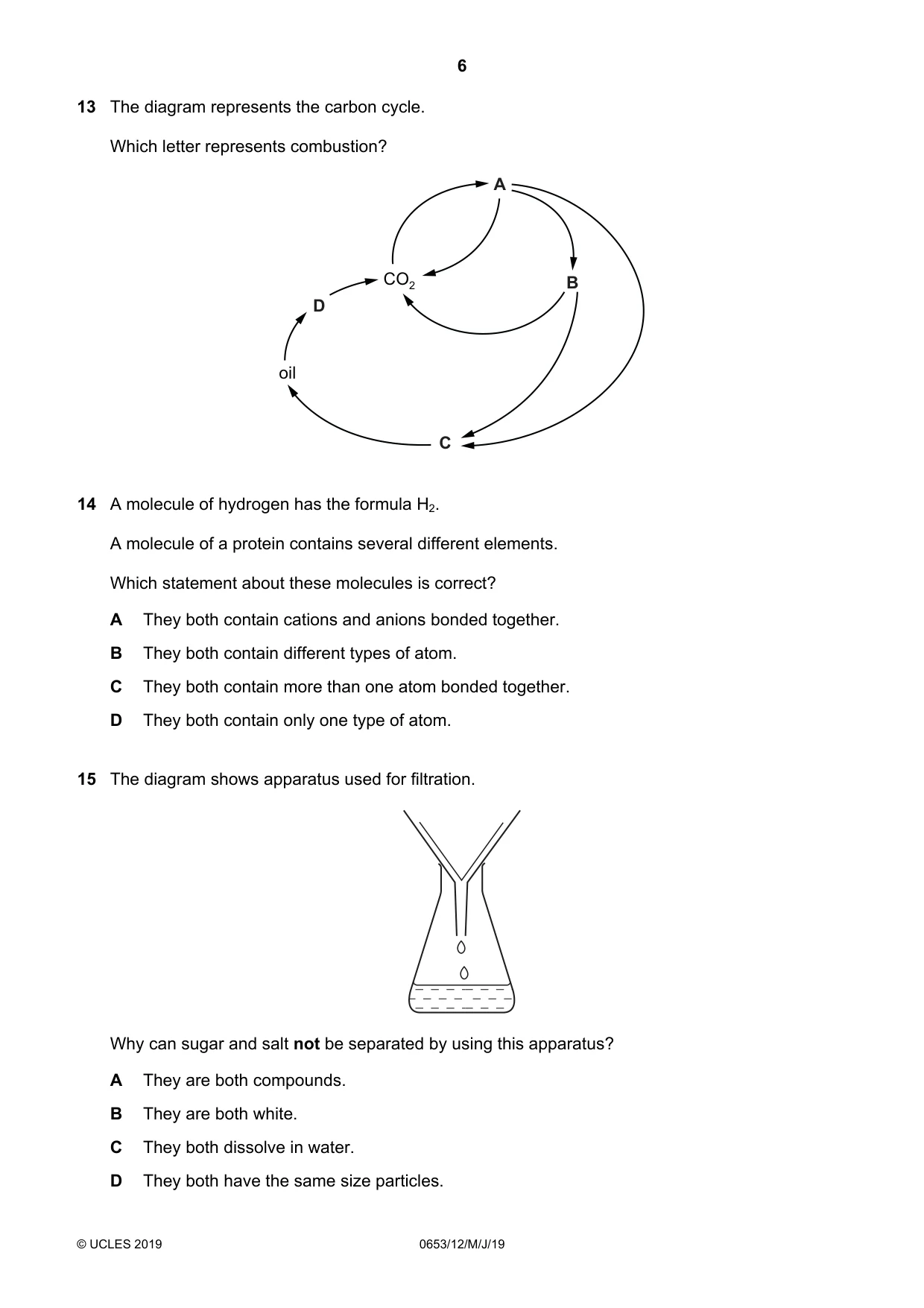
Q13 · The diagram represents the carbon cycle
13 The diagram represents the carbon cycle. Which letter represents combustion? A CO2 B D oil C
Mark scheme: D
Q14 · A molecule of hydrogen has the formula H2
14 A molecule of hydrogen has the formula H2. A molecule of a protein contains several different elements. Which statement about these molecules is correct? A They both contain cations and anions bonded together. B They both contain different types of atom. C They both contain more than one atom bonded together. D They both contain only one type of atom.
Mark scheme: C
Q15 · The diagram shows apparatus used for filtration
15 The diagram shows apparatus used for filtration. Why can sugar and salt not be separated by using this apparatus? A They are both compounds. B They are both white. C They both dissolve in water. D They both have the same size particles.
Mark scheme: C
Q16 · Which row about each substance is correct?
16 Which row about each substance is correct? type of description other substance bonding of bonds information A ammonia covalent three shared all atoms have pairs of electrons full outer electron shells B lithium fluoride covalent one shared both atoms have pair of electrons noble gas electronic structure C potassium iodide ionic electron transfer from volatile potassium to iodine compound D water ionic electron transfer from non-volatile hydrogen to oxygen compound
Mark scheme: A
Q17 · The equation for the combustion of ethene is shown
17 The equation for the combustion of ethene is shown. C2H4 + 3O2 → 2CO2 + 2H2O Which statement about this reaction is not correct? A More oxygen molecules than ethene molecules are used. B The number of carbon dioxide molecules formed is equal to the number of water molecules formed. C The number of carbon dioxide molecules formed is the same as the number of ethene molecules used. D The total number of molecules formed is the same as the total number of molecules used.
Mark scheme: C
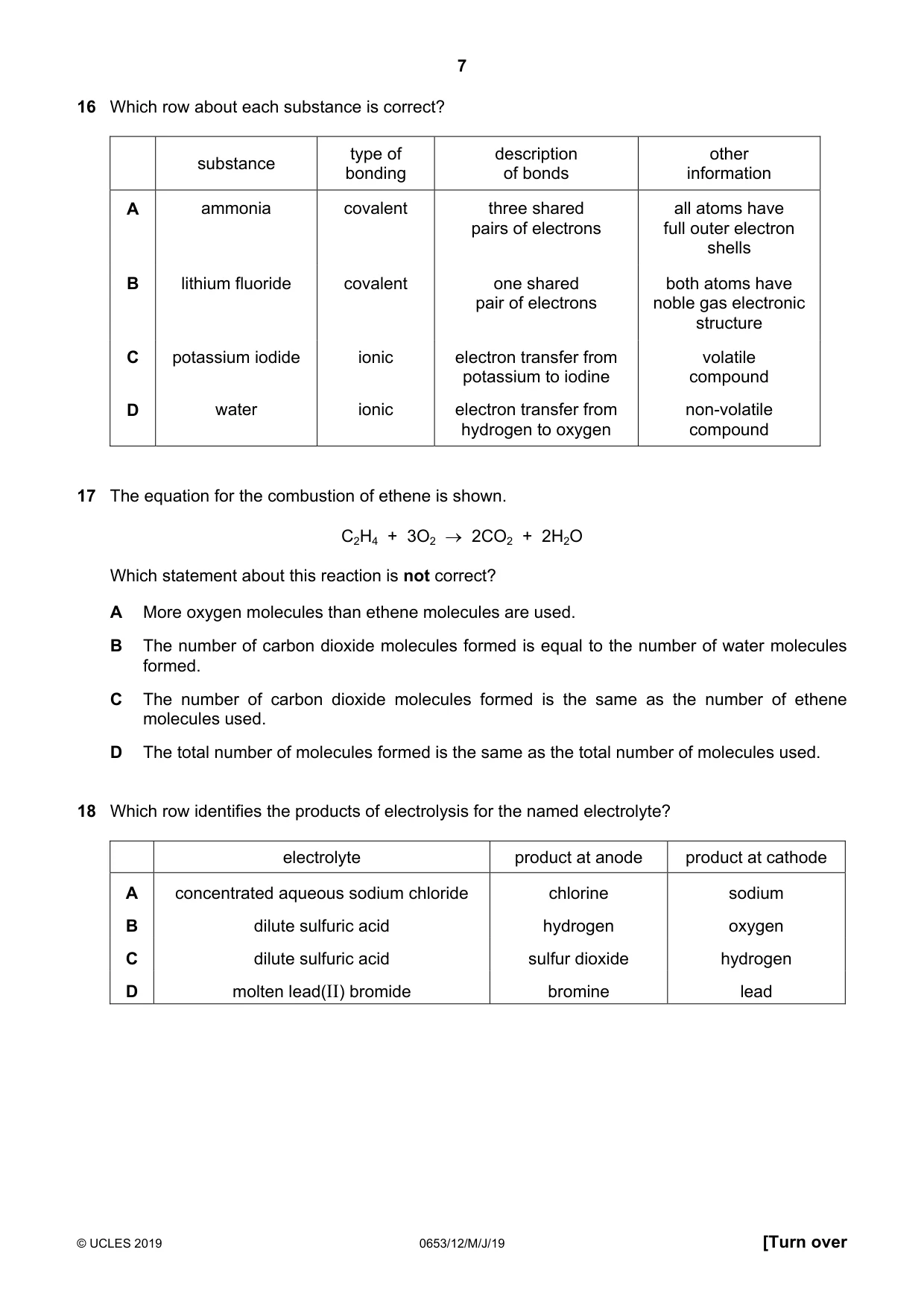
Q18 · Which row identifies the products of electrolysis for the named electrolyte?
18 Which row identifies the products of electrolysis for the named electrolyte? electrolyte product at anode product at cathode A concentrated aqueous sodium chloride chlorine sodium B dilute sulfuric acid hydrogen oxygen C dilute sulfuric acid sulfur dioxide hydrogen D molten lead(II) bromide bromine lead
Mark scheme: D
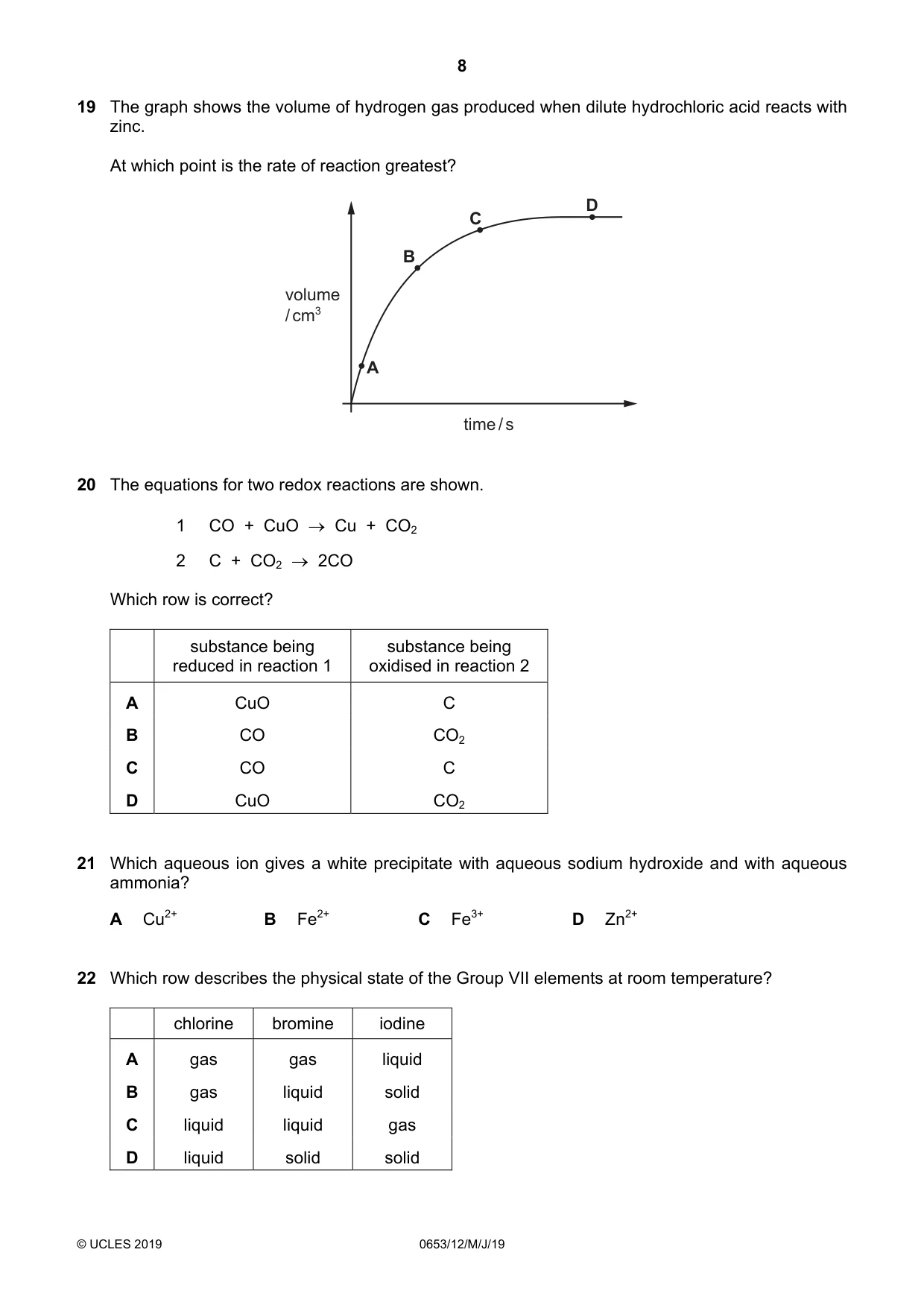
Q19 · The graph shows the volume of hydrogen gas produced when dilute hydrochloric acid reacts…
19 The graph shows the volume of hydrogen gas produced when dilute hydrochloric acid reacts with zinc. At which point is the rate of reaction greatest? D C B volume / cm3 A time / s
Mark scheme: A
Q20 · The equations for two redox reactions are shown
20 The equations for two redox reactions are shown. 1 CO + CuO → Cu + CO2 2 C + CO2 → 2CO Which row is correct? substance being substance being reduced in reaction 1 oxidised in reaction 2 A CuO C B CO CO2 C CO C D CuO CO2
Mark scheme: A
Q21 · Which aqueous ion gives a white precipitate with aqueous sodium hydroxide and with…
21 Which aqueous ion gives a white precipitate with aqueous sodium hydroxide and with aqueous ammonia? A Cu2+ B Fe2+ C Fe3+ D Zn2+
Mark scheme: D
Q22 · Which row describes the physical state of the Group VII elements at room temperature?
22 Which row describes the physical state of the Group VII elements at room temperature? chlorine bromine iodine A gas gas liquid B gas liquid solid C liquid liquid gas D liquid solid solid
Mark scheme: B
Q23 · Which two elements do not form an alloy?
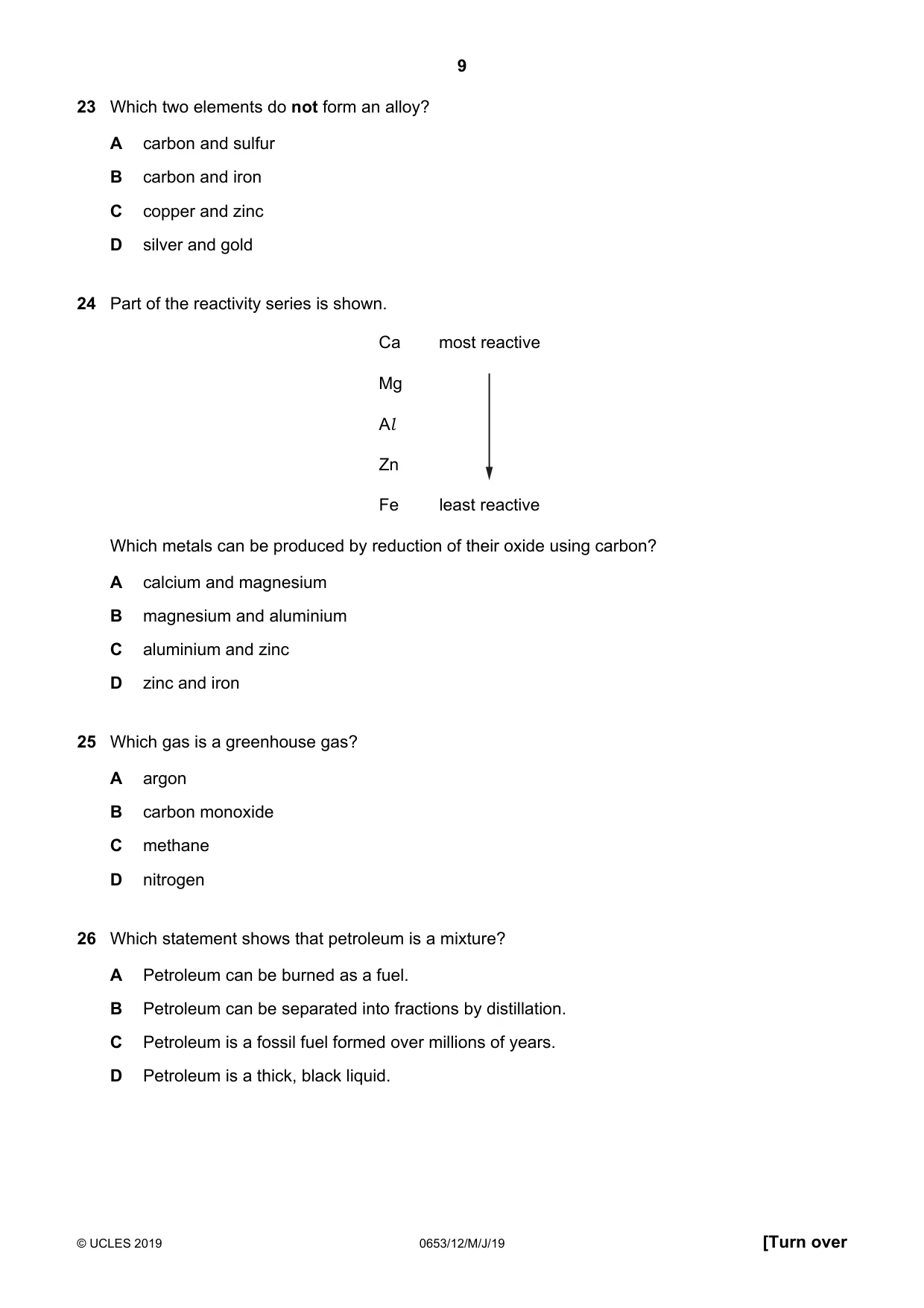
23 Which two elements do not form an alloy? A carbon and sulfur B carbon and iron C copper and zinc D silver and gold
Mark scheme: A
Q24 · Part of the reactivity series is shown
24 Part of the reactivity series is shown. Ca most reactive Mg Al Zn Fe least reactive Which metals can be produced by reduction of their oxide using carbon? A calcium and magnesium B magnesium and aluminium C aluminium and zinc D zinc and iron
Mark scheme: D
Q25 · Which gas is a greenhouse gas?
25 Which gas is a greenhouse gas? A argon B carbon monoxide C methane D nitrogen
Mark scheme: C
Q26 · Which statement shows that petroleum is a mixture?
26 Which statement shows that petroleum is a mixture? A Petroleum can be burned as a fuel. B Petroleum can be separated into fractions by distillation. C Petroleum is a fossil fuel formed over millions of years. D Petroleum is a thick, black liquid.
Mark scheme: B
Q27 · Which statement about alkanes is correct?
27 Which statement about alkanes is correct? A Alkanes are compounds containing carbon, hydrogen and oxygen. B Alkanes are saturated hydrocarbons. C Ethane is used to make poly(ethene). D Methane is the only alkane that does not contain a double bond.
Mark scheme: B
Q28 · A vehicle is taken from the Earth to the Moon where the gravitational field strength is…
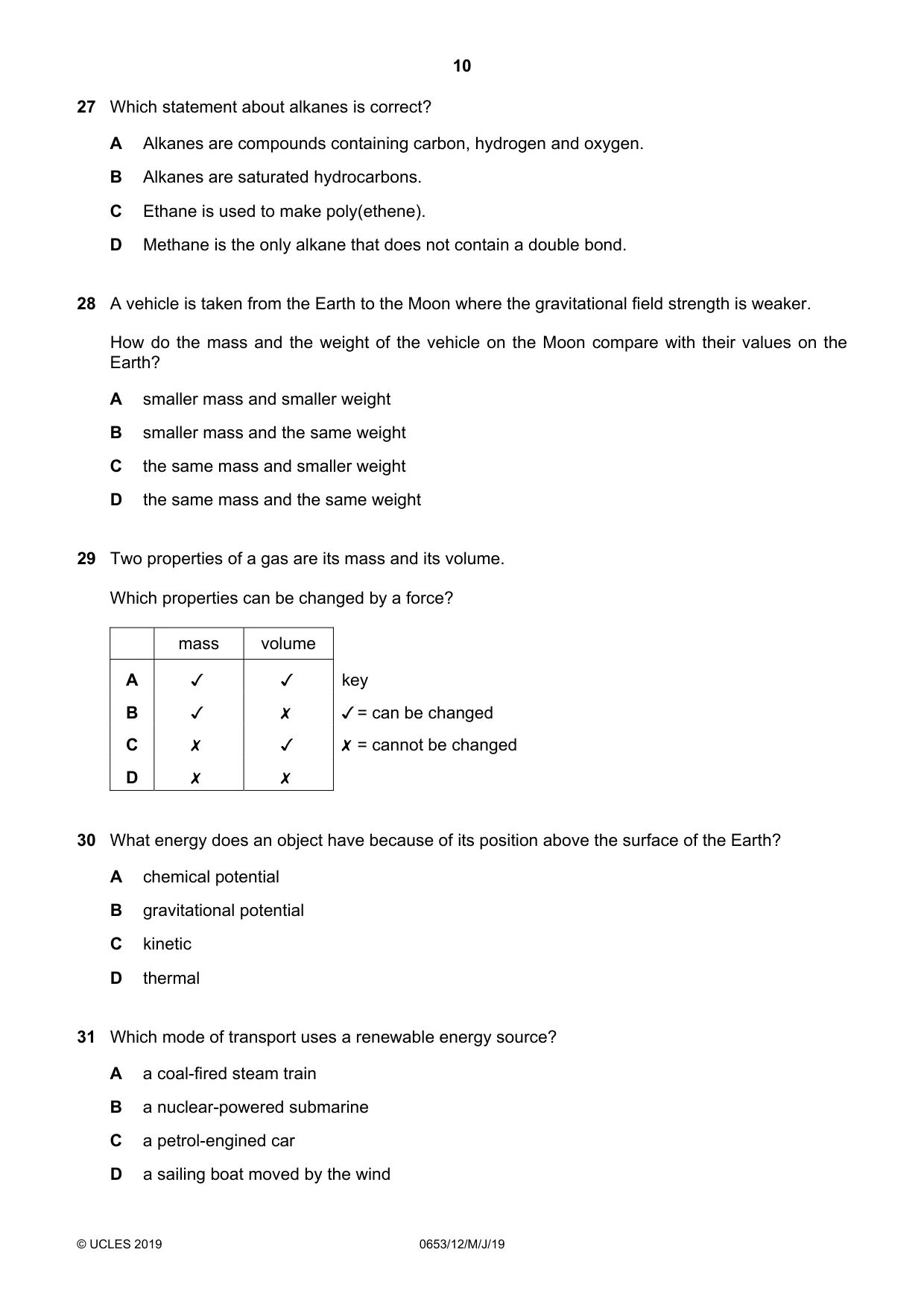
28 A vehicle is taken from the Earth to the Moon where the gravitational field strength is weaker. How do the mass and the weight of the vehicle on the Moon compare with their values on the Earth? A smaller mass and smaller weight B smaller mass and the same weight C the same mass and smaller weight D the same mass and the same weight
Mark scheme: C
Q29 · Two properties of a gas are its mass and its volume
29 Two properties of a gas are its mass and its volume. Which properties can be changed by a force? mass volume A J J B Jv x Cc x v D x x key ¥ =can be changed X = cannot be changed
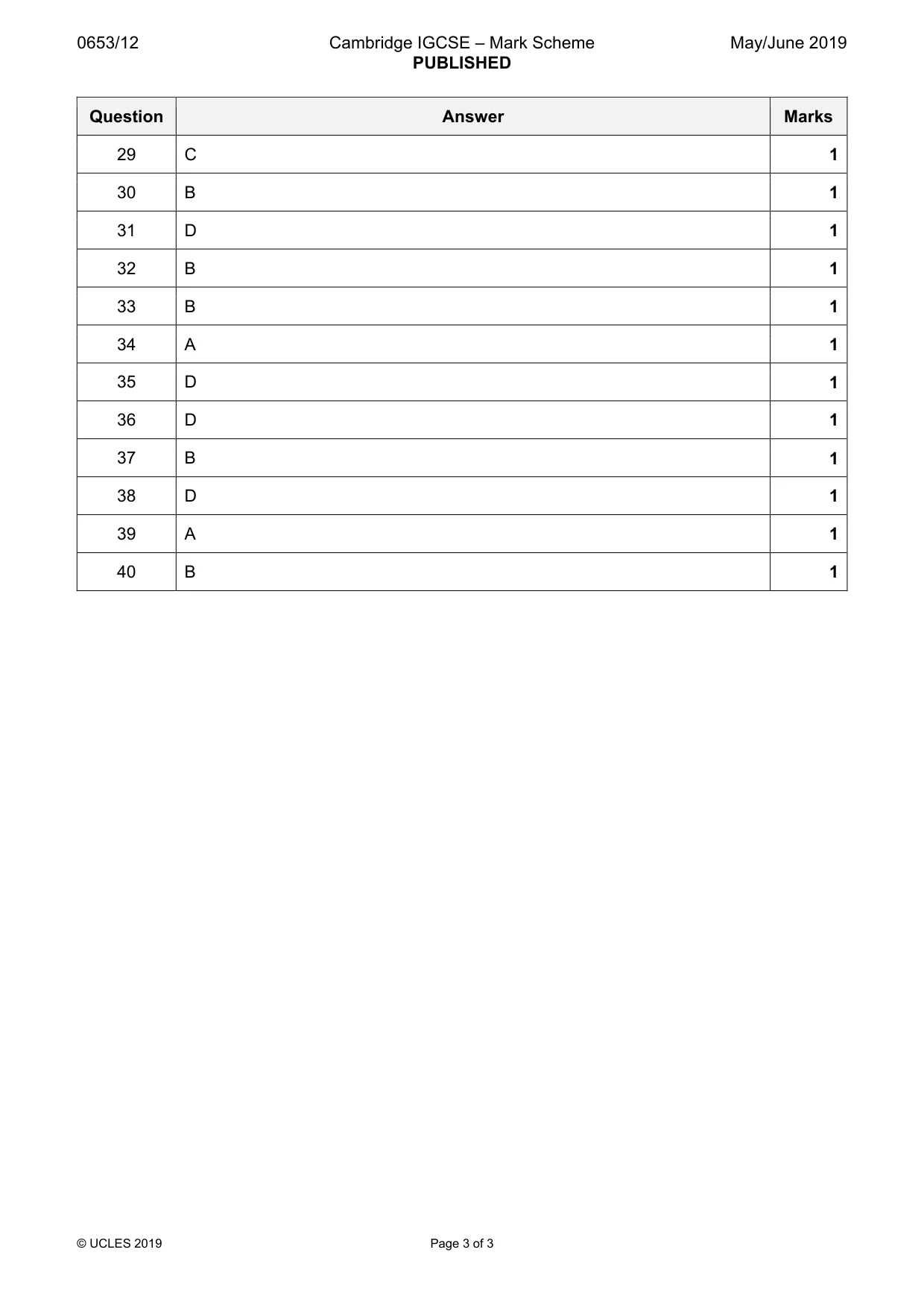
Mark scheme: C
More questions on Physical quantities and measurement techniques
Q30 · What energy does an object have because of its position above the surface of the Earth?
30 What energy does an object have because of its position above the surface of the Earth? A chemical potential B gravitational potential C kinetic D thermal
Mark scheme: B
Q31 · Which mode of transport uses a renewable energy source?
31 Which mode of transport uses a renewable energy source? A a coal-fired steam train B a nuclear-powered submarine C a petrol-engined car D a sailing boat moved by the wind
Mark scheme: D
Q32 · Which diagram shows the molecular structure of a liquid?
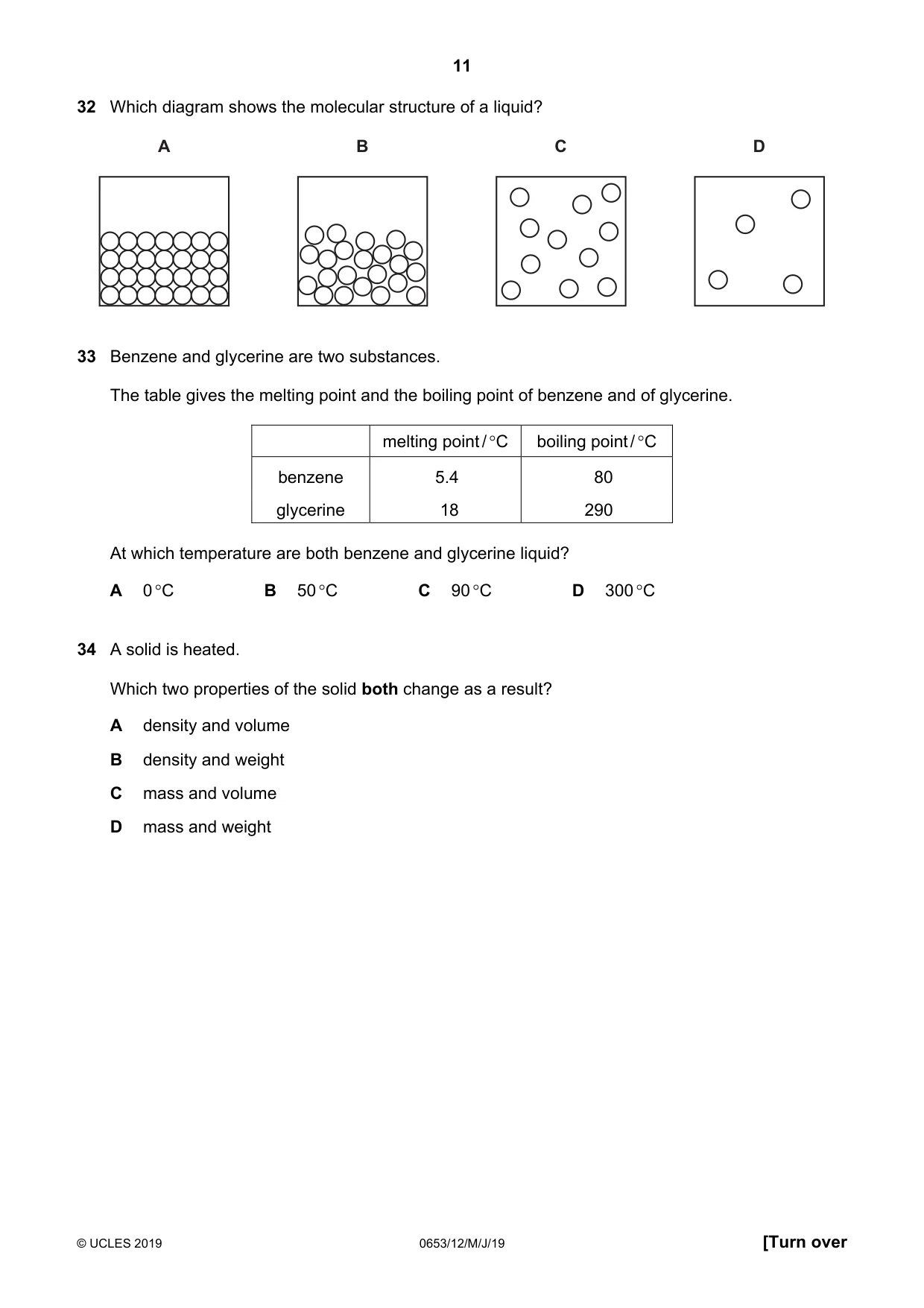
32 Which diagram shows the molecular structure of a liquid? A B C D
Mark scheme: B
Q33 · Benzene and glycerine are two substances
33 Benzene and glycerine are two substances. The table gives the melting point and the boiling point of benzene and of glycerine. melting point / °C boiling point / °C benzene 5.4 80 glycerine 18 290 At which temperature are both benzene and glycerine liquid? A 0 °C B 50 °C C 90 °C D 300 °C
Mark scheme: B
Q34 · A solid is heated
34 A solid is heated. Which two properties of the solid both change as a result? A density and volume B density and weight C mass and volume D mass and weight
Mark scheme: A
Q35 · The diagram shows a vacuum flask containing a hot liquid in a cold room
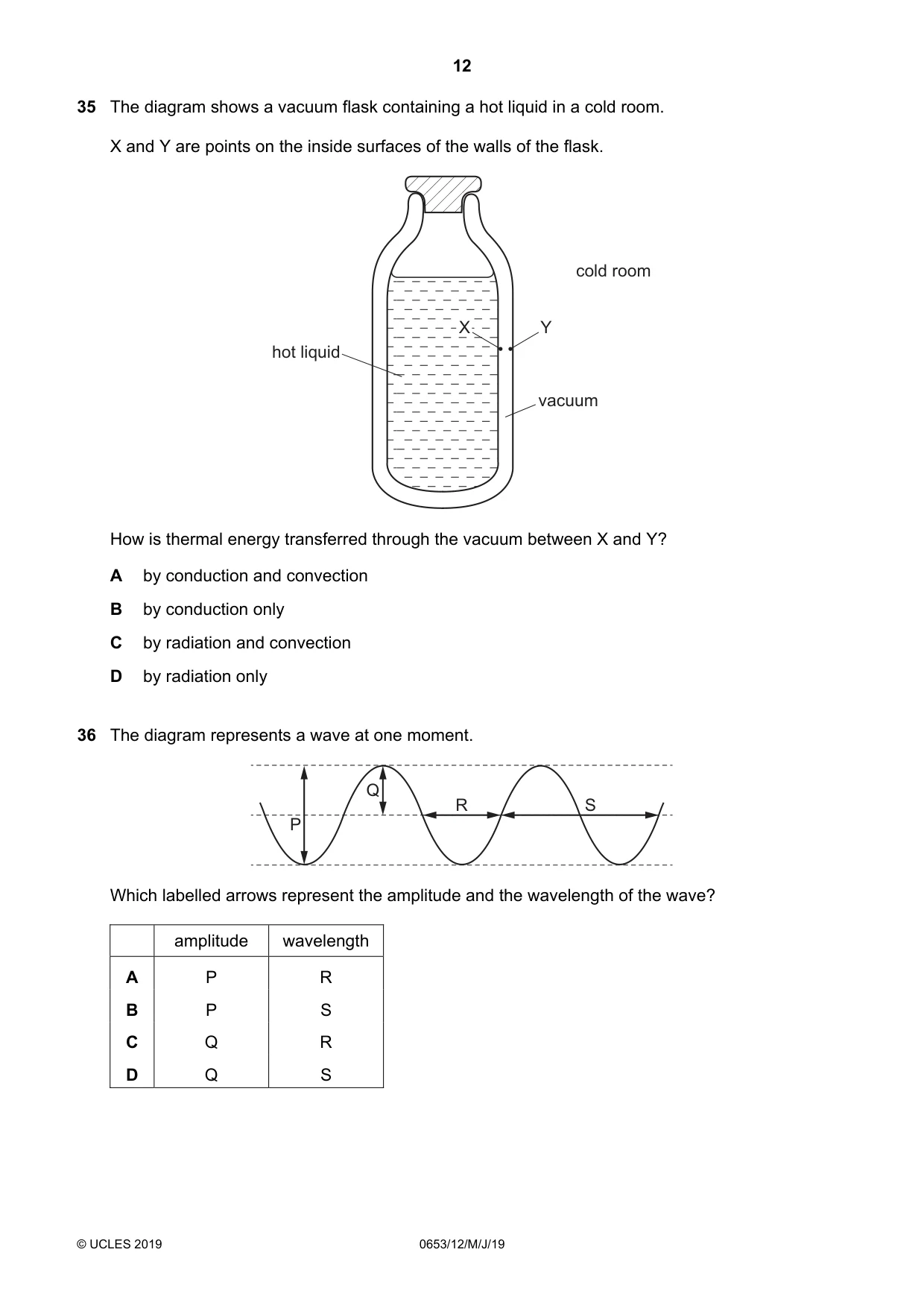
35 The diagram shows a vacuum flask containing a hot liquid in a cold room. X and Y are points on the inside surfaces of the walls of the flask. cold room X Y hot liquid vacuum How is thermal energy transferred through the vacuum between X and Y? A by conduction and convection B by conduction only C by radiation and convection D by radiation only
Mark scheme: D
Q36 · The diagram represents a wave at one moment
36 The diagram represents a wave at one moment. Q R S P Which labelled arrows represent the amplitude and the wavelength of the wave? amplitude wavelength A P R B P S C Q R D Q S
Mark scheme: D
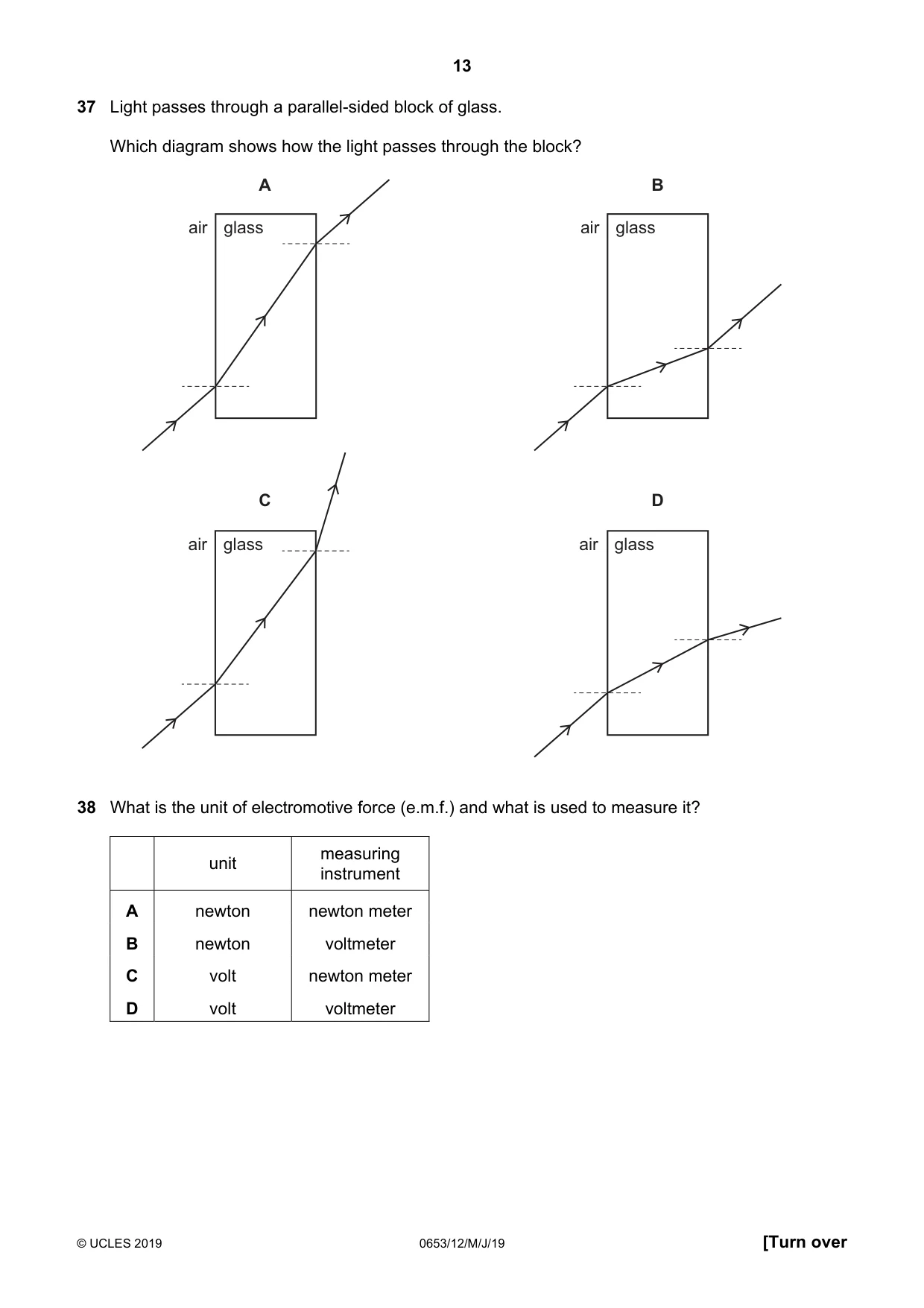
Q37 · Light passes through a parallel-sided block of glass
37 Light passes through a parallel-sided block of glass. Which diagram shows how the light passes through the block? A B air glass air glass C D air glass air glass
Mark scheme: B
Q38 · What is the unit of electromotive force (e.m.f.) and what is used to measure it?
38 What is the unit of electromotive force (e.m.f.) and what is used to measure it? measuring unit instrument A newton newton meter B newton voltmeter C volt newton meter D volt voltmeter
Mark scheme: D
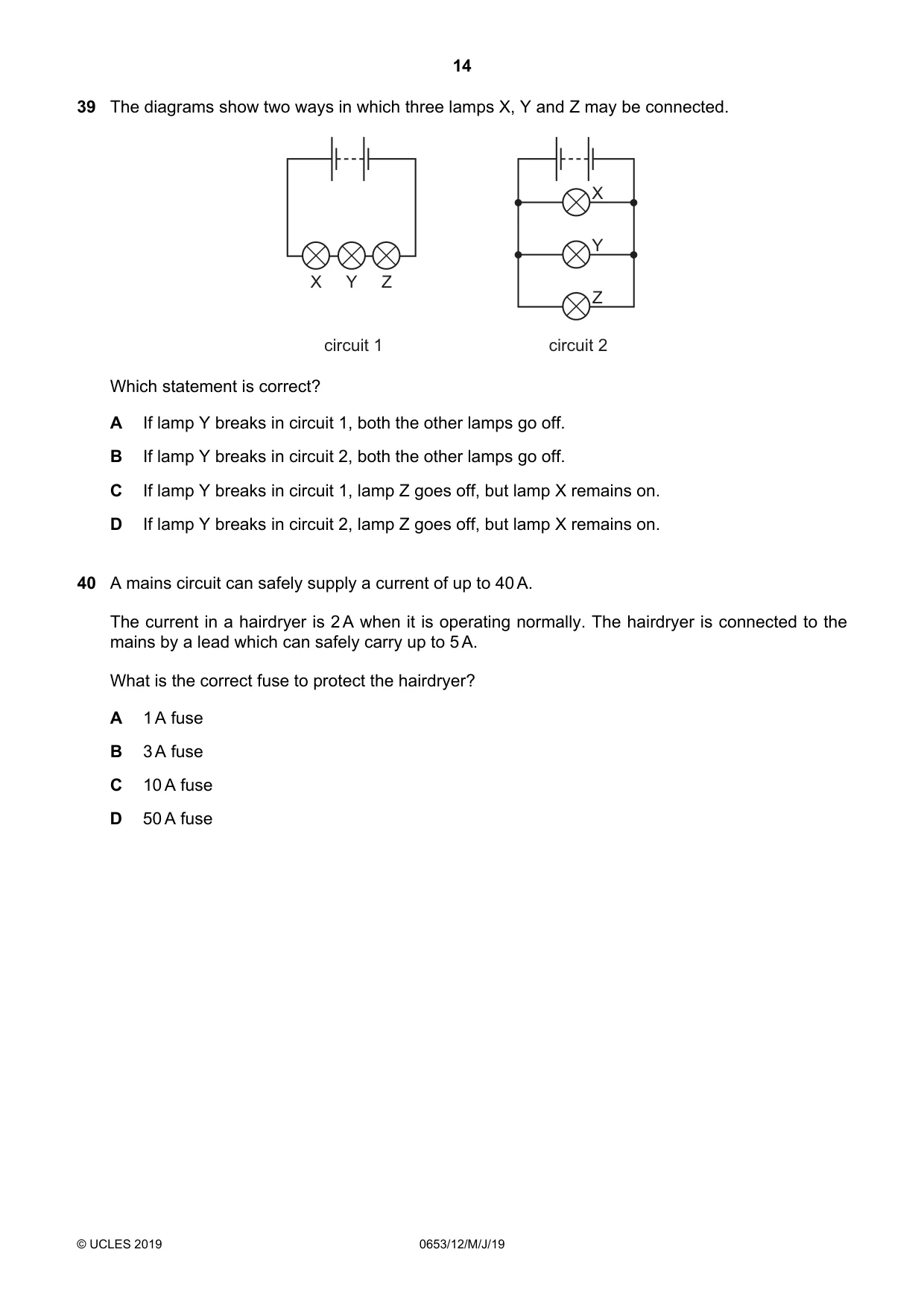
Q39 · The diagrams show two ways in which three lamps X, Y and Z may be connected
39 The diagrams show two ways in which three lamps X, Y and Z may be connected. X Y X Y Z Z circuit 1 circuit 2 Which statement is correct? A If lamp Y breaks in circuit 1, both the other lamps go off. B If lamp Y breaks in circuit 2, both the other lamps go off. C If lamp Y breaks in circuit 1, lamp Z goes off, but lamp X remains on. D If lamp Y breaks in circuit 2, lamp Z goes off, but lamp X remains on.
Mark scheme: A
Q40 · A mains circuit can safely supply a current of up to 40 A
40 A mains circuit can safely supply a current of up to 40 A. The current in a hairdryer is 2 A when it is operating normally. The hairdryer is connected to the mains by a lead which can safely carry up to 5 A. What is the correct fuse to protect the hairdryer? A 1 A fuse B 3 A fuse C 10 A fuse D 50 A fuse
Mark scheme: B
What was in this paper
The subtopics covered by these 40 questions, and how many questions each got. Open one in a new tab to see every Cambridge question on it.
2Kinetic particle model of matter2Sexual reproduction in plants2Simple molecules and covalent bonds2Air quality and climate1Alkanes1Alloys and their properties1Biological molecules1Carbon cycle1Cell structure1Density1Diet1Diffusion1Digestive system1Drugs1Electrical circuits1Electrical quantities1Electrical safety1Electrolysis1Elements, compounds and mixtures1Food chains and food webs1Formulas1Gas exchange in humans1General properties of waves1Group VII properties1Identification of ions and gases1Light1Mass and weight1Photosynthesis1Physical quantities and measurement techniques1Rate of reaction1Reactivity series1Redox1Separation and purification1Sexual reproduction in humans1Transfer of thermal energy1What you needed in this session
Cambridge’s own grade thresholds for 2019 May/June, Paper 1 · Variant 2. A higher threshold means an easier paper — the bar moves with how the cohort did.