Cambridge IGCSE Science - Combined 0653 — 2023 Oct/Nov Paper 1 · Variant 1
0653/11/O/N/23 · 40 questions · 40 marks · ≈45 min
The question paper and its mark scheme, free to read here and free to download. This is Cambridge’s own paper, exactly as it was sat.
Question paper16 pages
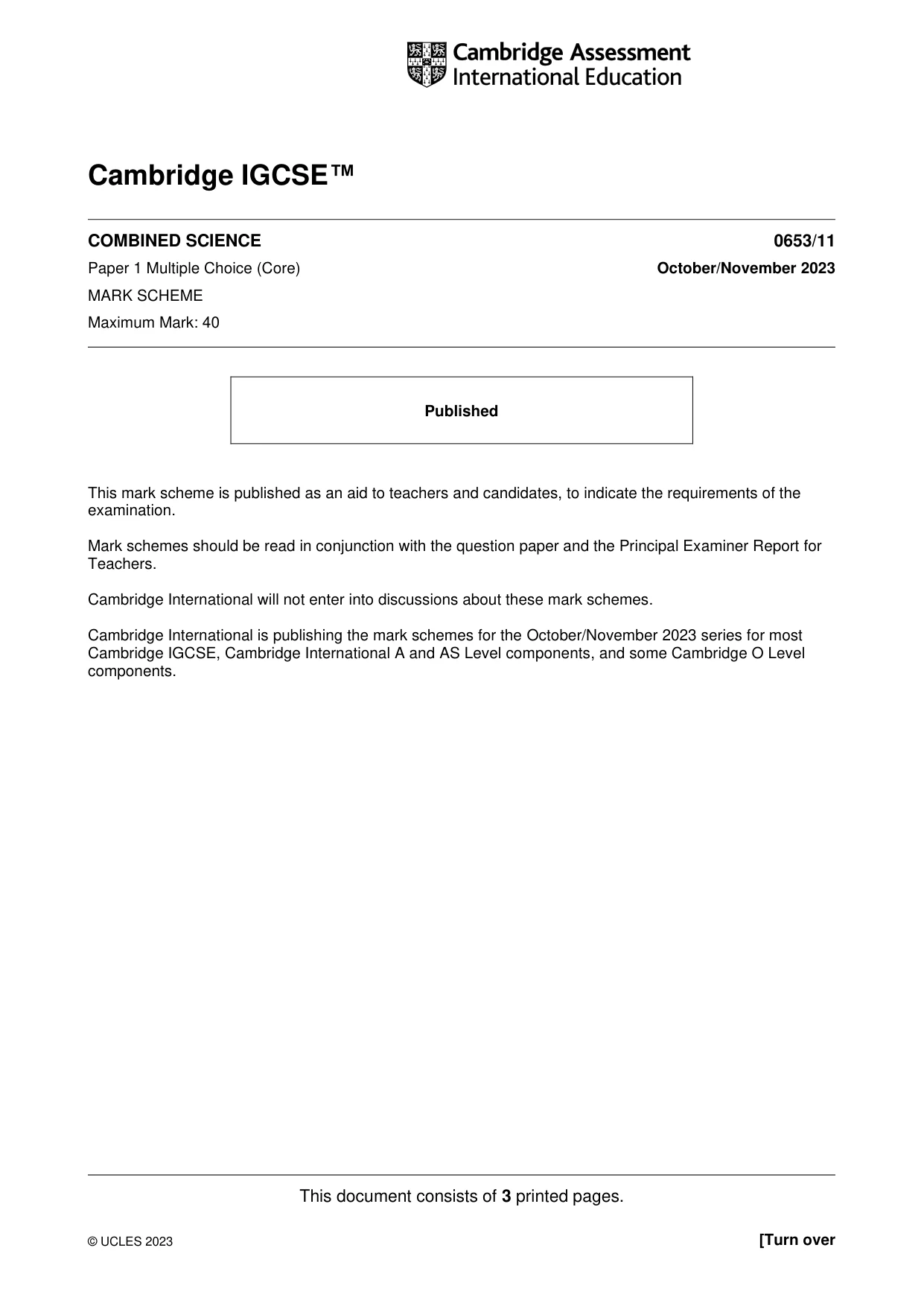
Mark scheme3 pages
Answers below. Sit the paper first if you are practising.
Questions as text
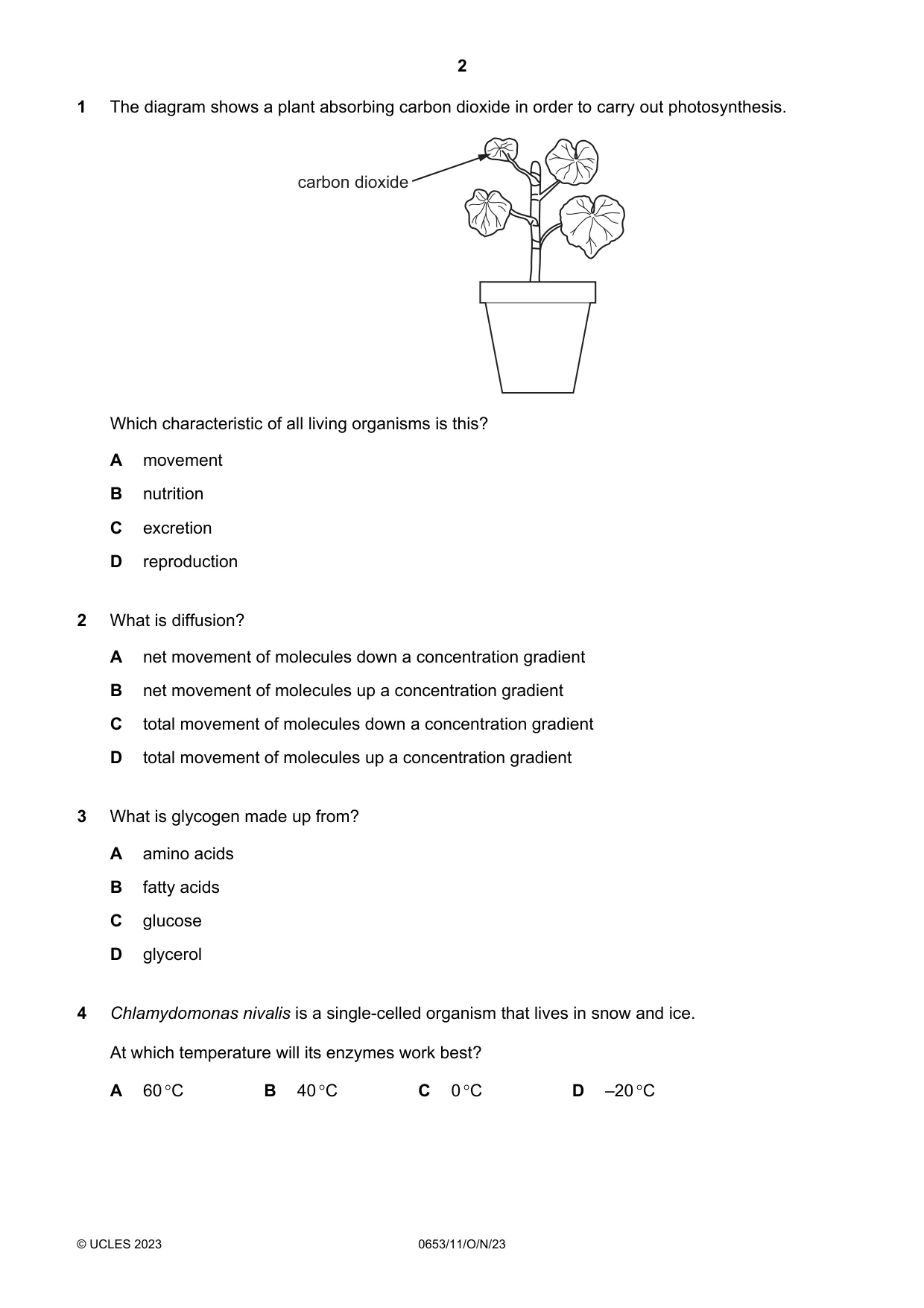
Q1 · The diagram shows a plant absorbing carbon dioxide in order to carry out photosynthesis
1 The diagram shows a plant absorbing carbon dioxide in order to carry out photosynthesis. carbon dioxide Which characteristic of all living organisms is this? A movement B nutrition C excretion D reproduction
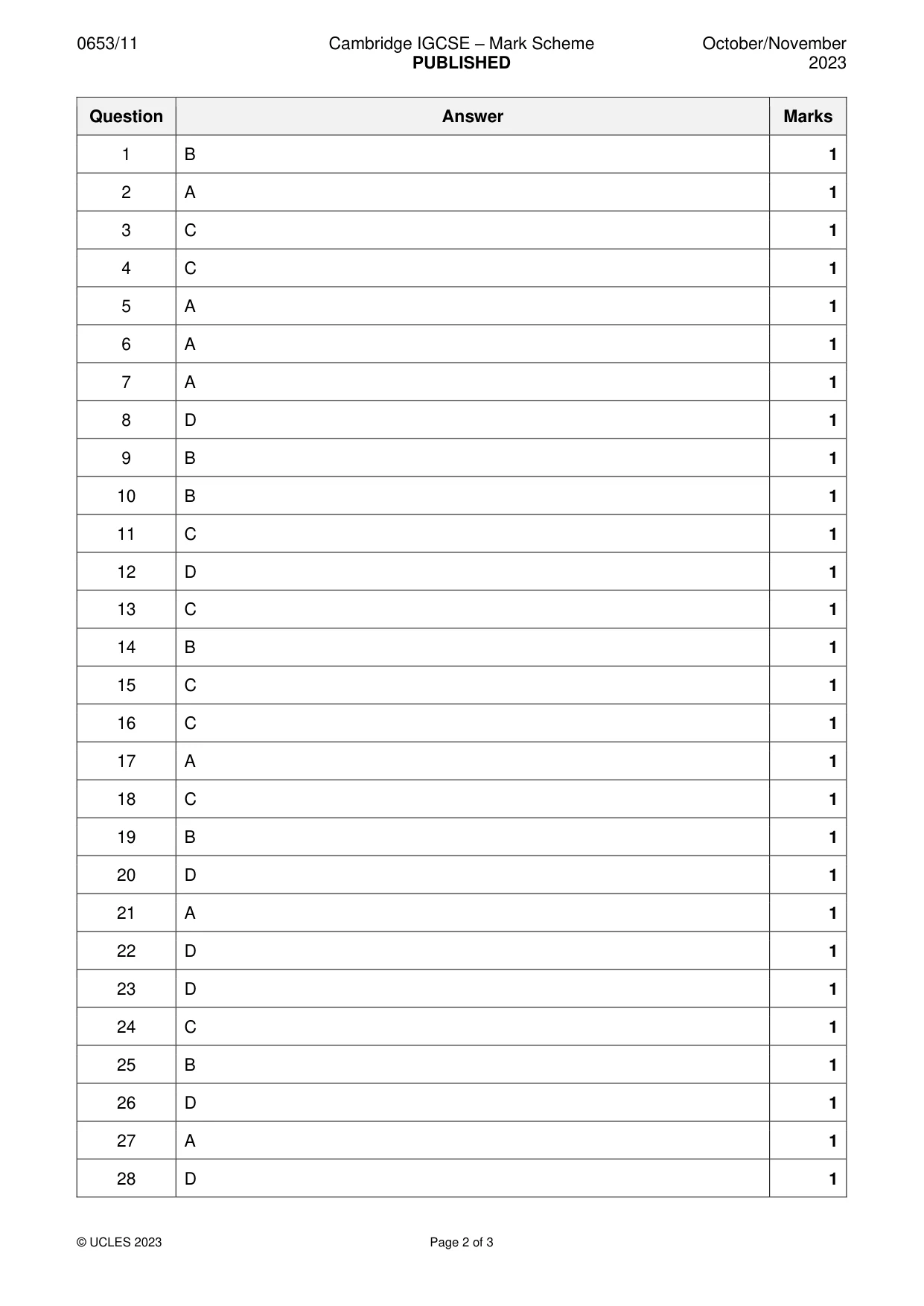
Mark scheme: B
Question 2
2 What is diffusion? A net movement of molecules down a concentration gradient B net movement of molecules up a concentration gradient C total movement of molecules down a concentration gradient D total movement of molecules up a concentration gradient
Mark scheme: A
Q3 · What is glycogen made up from?
3 What is glycogen made up from? A amino acids B fatty acids C glucose D glycerol
Mark scheme: C
Q4 · Chlamydomonas nivalis is a single-celled organism that lives in snow and ice
4 Chlamydomonas nivalis is a single-celled organism that lives in snow and ice. At which temperature will its enzymes work best? A 60 C B 40 C C 0 C D –20 C
Mark scheme: C
Q5 · What is the correct definition of a balanced diet?
5 What is the correct definition of a balanced diet? A a diet in which all the components needed to maintain health are present in appropriate proportions B a diet which contains only carbohydrates, fats and proteins C a diet which contains mostly protein and dietary fibre D a diet which contains only vitamins and minerals
Mark scheme: A
Q6 · Digestion can be defined as the breakdown of A large insoluble molecules to small soluble…
6 Digestion can be defined as the breakdown of A large insoluble molecules to small soluble molecules. B small insoluble molecules to large soluble molecules. C large soluble molecules to small insoluble molecules. D small soluble molecules to large insoluble molecules.
Mark scheme: A
Q7 · By which process does water vapour move out of plant leaves through stomata?
7 By which process does water vapour move out of plant leaves through stomata? A diffusion B evaporation C osmosis D respiration
Mark scheme: A
Q8 · Which chemical is used to test for carbon dioxide in expired air?
8 Which chemical is used to test for carbon dioxide in expired air? A Benedict’s solution B distilled water C iodine solution D limewater
Mark scheme: D
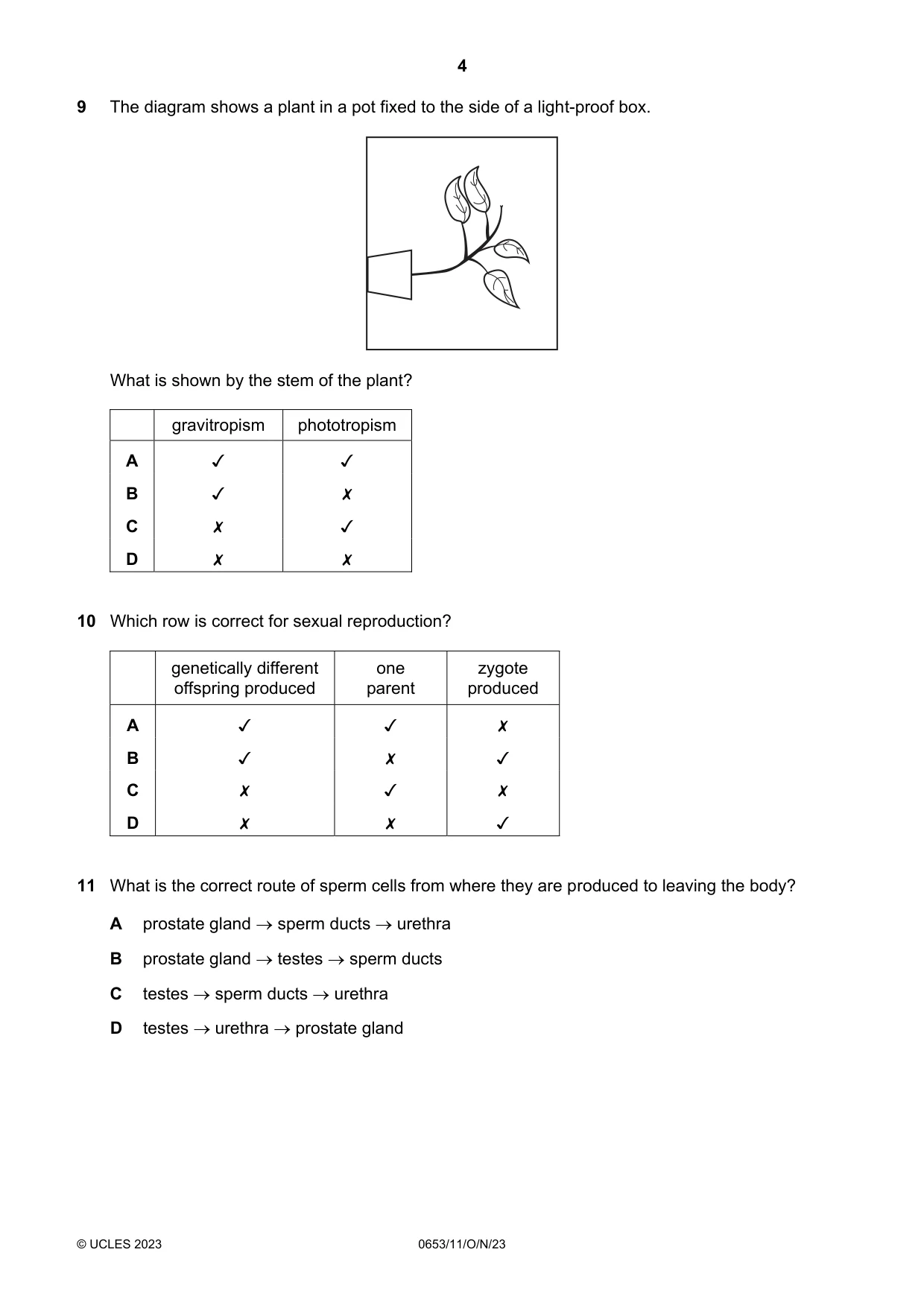
Q9 · The diagram shows a plant in a pot fixed to the side of a light-proof box
9 The diagram shows a plant in a pot fixed to the side of a light-proof box. © wn ac What is shown by the stem of the plant? gravitropism phototropism v v 0 0O WwW > v x x v x x
Mark scheme: B
Q10 · Which row is correct for sexual reproduction?
10 Which row is correct for sexual reproduction? genetically different one zygote offspring produced parent produced A v Jv x B Jv x Jv Cc x v x D x x Jv
Mark scheme: B
Q11 · What is the correct route of sperm cells from where they are produced to leaving the body?
11 What is the correct route of sperm cells from where they are produced to leaving the body? A prostate gland sperm ducts urethra B prostate gland testes sperm ducts C testes sperm ducts urethra D testes urethra prostate gland
Mark scheme: C
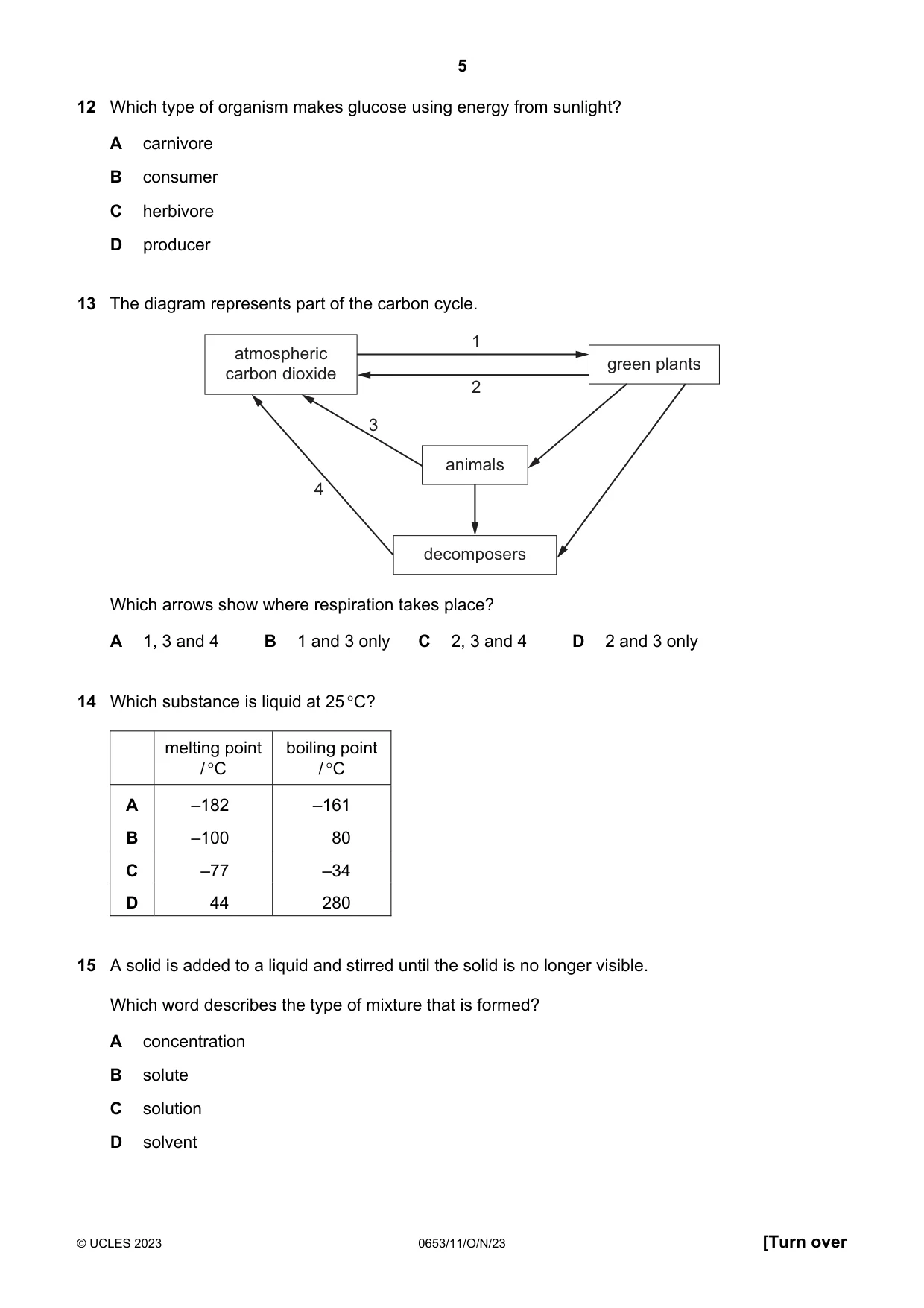
Q12 · Which type of organism makes glucose using energy from sunlight?
12 Which type of organism makes glucose using energy from sunlight? A carnivore B consumer C herbivore D producer
Mark scheme: D
Q13 · The diagram represents part of the carbon cycle
13 The diagram represents part of the carbon cycle. 1 atmospheric green plants carbon dioxide 2 3 animals 4 decomposers Which arrows show where respiration takes place? A 1, 3 and 4 B 1 and 3 only C 2, 3 and 4 D 2 and 3 only
Mark scheme: C
Q14 · Which substance is liquid at 25 C?
14 Which substance is liquid at 25 C? melting point boiling point / C / C A –182 –161 B –100 80 C –77 –34 D 44 280
Mark scheme: B
Q15 · A solid is added to a liquid and stirred until the solid is no longer visible
15 A solid is added to a liquid and stirred until the solid is no longer visible. Which word describes the type of mixture that is formed? A concentration B solute C solution D solvent
Mark scheme: C
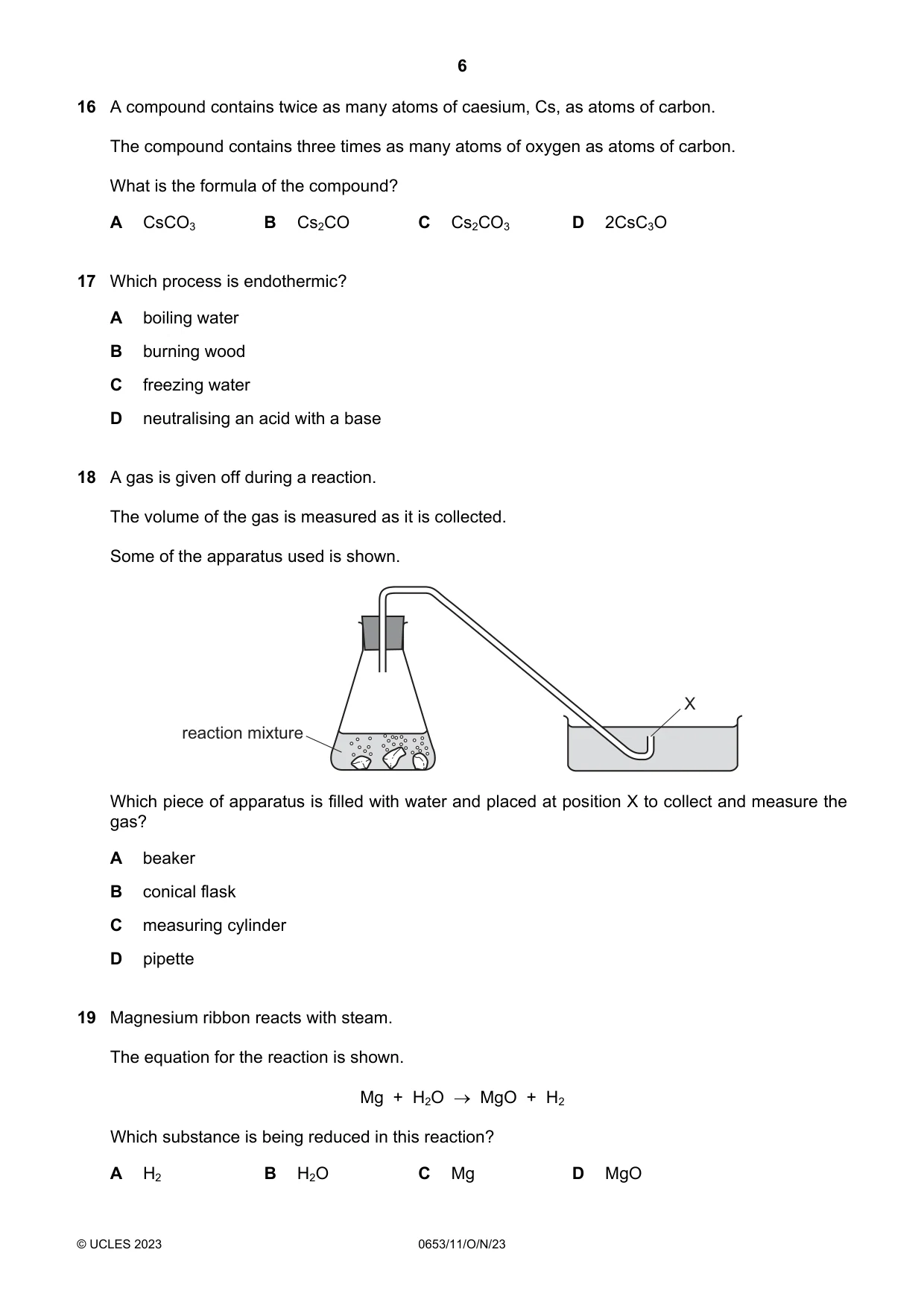
Q16 · A compound contains twice as many atoms of caesium, Cs, as atoms of carbon
16 A compound contains twice as many atoms of caesium, Cs, as atoms of carbon. The compound contains three times as many atoms of oxygen as atoms of carbon. What is the formula of the compound? A CsCO3 B Cs2CO C Cs2CO3 D 2CsC3O
Mark scheme: C
Q17 · Which process is endothermic?
17 Which process is endothermic? A boiling water B burning wood C freezing water D neutralising an acid with a base
Mark scheme: A
Q18 · A gas is given off during a reaction
18 A gas is given off during a reaction. The volume of the gas is measured as it is collected. Some of the apparatus used is shown. X reaction mixture Which piece of apparatus is filled with water and placed at position X to collect and measure the gas? A beaker B conical flask C measuring cylinder D pipette
Mark scheme: C
Q19 · Magnesium ribbon reacts with steam
19 Magnesium ribbon reacts with steam. The equation for the reaction is shown. Mg + H2O MgO + H2 Which substance is being reduced in this reaction? A H2 B H2O C Mg D MgO
Mark scheme: B
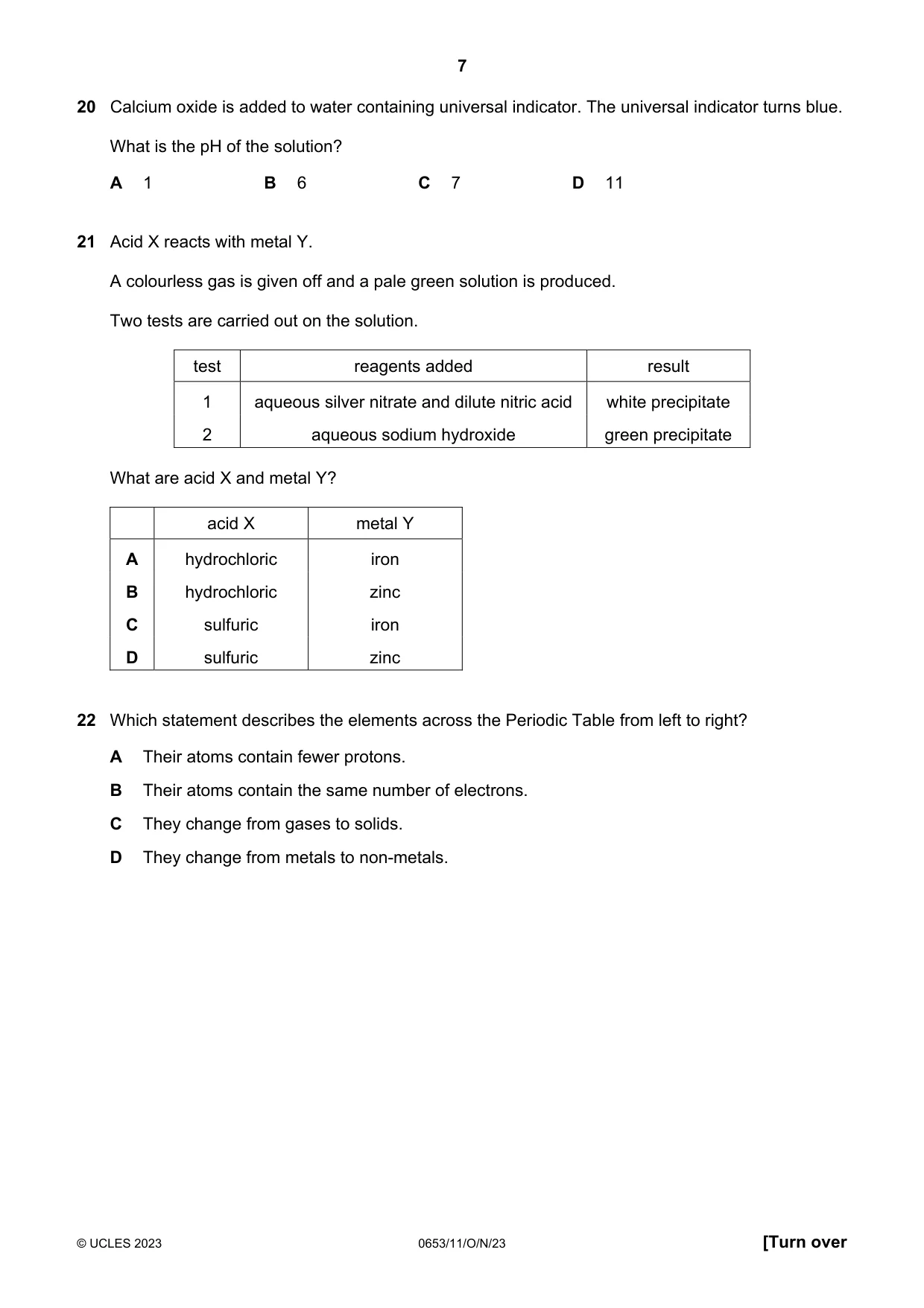
Q20 · Calcium oxide is added to water containing universal indicator
20 Calcium oxide is added to water containing universal indicator. The universal indicator turns blue. What is the pH of the solution? A 1 B 6 C 7 D 11
Mark scheme: D
More questions on The characteristic properties of acids and bases
Q21 · Acid X reacts with metal Y
21 Acid X reacts with metal Y. A colourless gas is given off and a pale green solution is produced. Two tests are carried out on the solution. test reagents added result 1 aqueous silver nitrate and dilute nitric acid white precipitate 2 aqueous sodium hydroxide green precipitate What are acid X and metal Y? acid X metal Y A hydrochloric iron B hydrochloric zinc C sulfuric iron D sulfuric zinc
Mark scheme: A
Q22 · Which statement describes the elements across the Periodic Table from left to right?
22 Which statement describes the elements across the Periodic Table from left to right? A Their atoms contain fewer protons. B Their atoms contain the same number of electrons. C They change from gases to solids. D They change from metals to non-metals.
Mark scheme: D
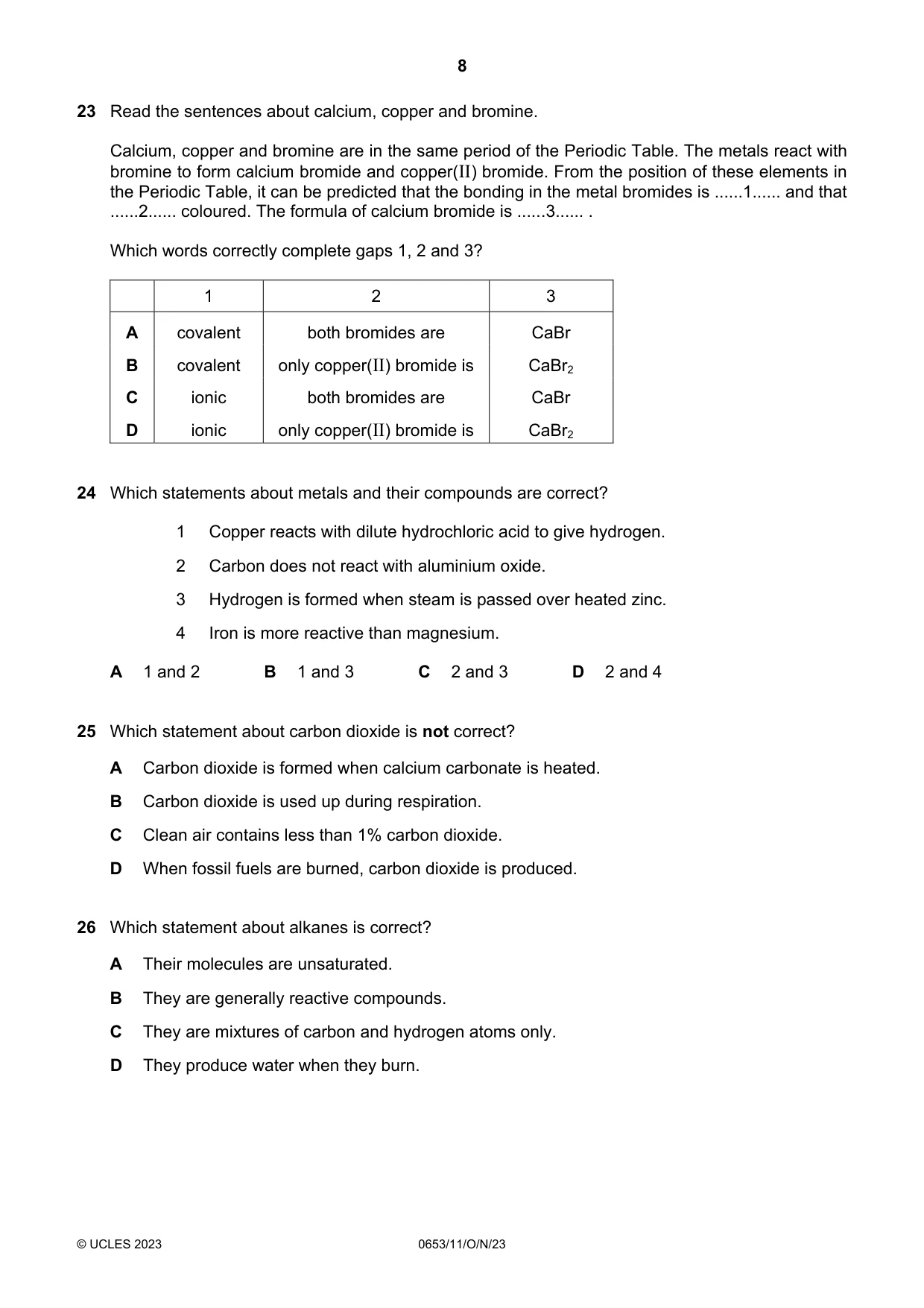
Q23 · Read the sentences about calcium, copper and bromine
23 Read the sentences about calcium, copper and bromine. Calcium, copper and bromine are in the same period of the Periodic Table. The metals react with bromine to form calcium bromide and copper(II) bromide. From the position of these elements in the Periodic Table, it can be predicted that the bonding in the metal bromides is ......1...... and that ......2...... coloured. The formula of calcium bromide is ......3...... . Which words correctly complete gaps 1, 2 and 3? 1 2 3 A covalent both bromides are CaBr B covalent only copper(II) bromide is CaBr2 C ionic both bromides are CaBr D ionic only copper(II) bromide is CaBr2
Mark scheme: D
Q24 · Which statements about metals and their compounds are correct?
24 Which statements about metals and their compounds are correct? 1 Copper reacts with dilute hydrochloric acid to give hydrogen. 2 Carbon does not react with aluminium oxide. 3 Hydrogen is formed when steam is passed over heated zinc. 4 Iron is more reactive than magnesium. A 1 and 2 B 1 and 3 C 2 and 3 D 2 and 4
Mark scheme: C
Q25 · Which statement about carbon dioxide is not correct?
25 Which statement about carbon dioxide is not correct? A Carbon dioxide is formed when calcium carbonate is heated. B Carbon dioxide is used up during respiration. C Clean air contains less than 1% carbon dioxide. D When fossil fuels are burned, carbon dioxide is produced.
Mark scheme: B
Q26 · Which statement about alkanes is correct?
26 Which statement about alkanes is correct? A Their molecules are unsaturated. B They are generally reactive compounds. C They are mixtures of carbon and hydrogen atoms only. D They produce water when they burn.
Mark scheme: D
Q27 · Which process is used to make poly(ethene)?
27 Which process is used to make poly(ethene)? A addition polymerisation B cracking C fractional distillation D reacting ethane molecules together
Mark scheme: A
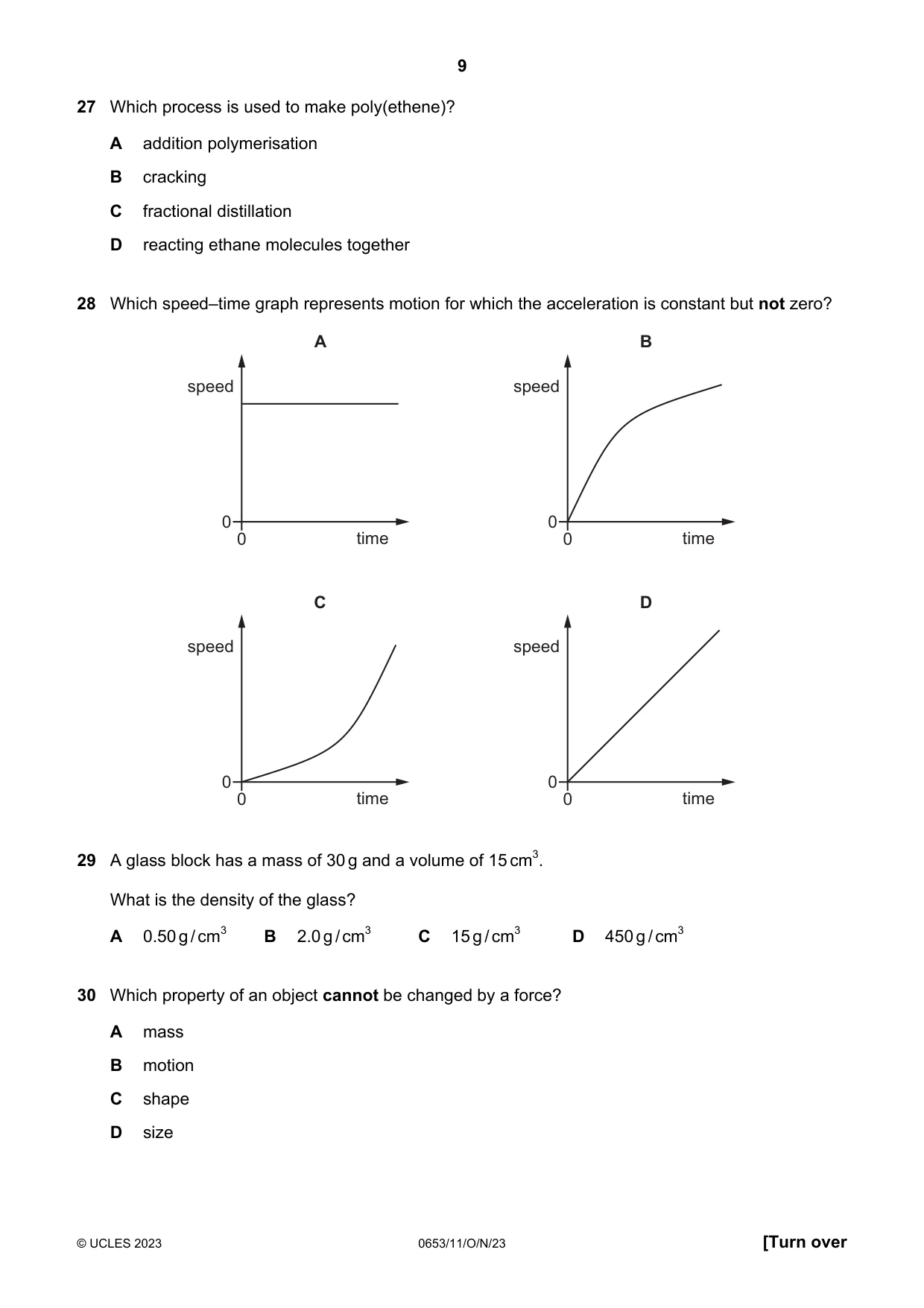
Q28 · Which speed–time graph represents motion for which the acceleration is constant but not…
28 Which speed–time graph represents motion for which the acceleration is constant but not zero? A B speed speed 0 0 0 time 0 time C D speed speed 0 0 0 time 0 time
Mark scheme: D
Q29 · A glass block has a mass of 30 g and a volume of 15 cm3
29 A glass block has a mass of 30 g and a volume of 15 cm3. What is the density of the glass? A 0.50 g / cm3 B 2.0 g / cm3 C 15 g / cm3 D 450 g / cm3
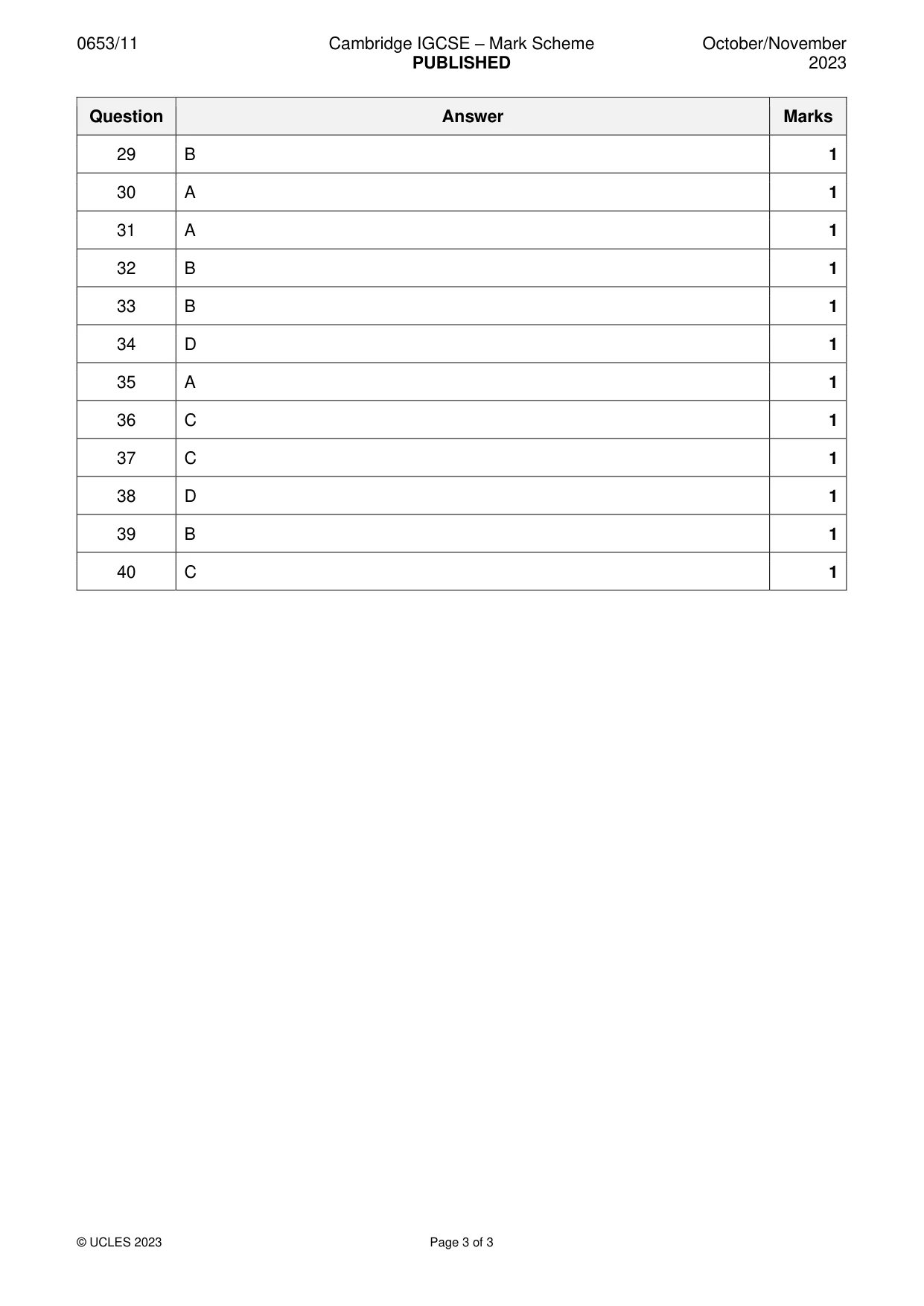
Mark scheme: B
Q30 · Which property of an object cannot be changed by a force?
30 Which property of an object cannot be changed by a force? A mass B motion C shape D size
Mark scheme: A
Q31 · A car on a journey travels along a horizontal road at a constant speed of 50 km / h
31 A car on a journey travels along a horizontal road at a constant speed of 50 km / h. Which description of the forces acting on the car during this journey is correct? driving force friction forces A constant equal to driving force B constant less than driving force C increasing decreasing D increasing zero
Mark scheme: A
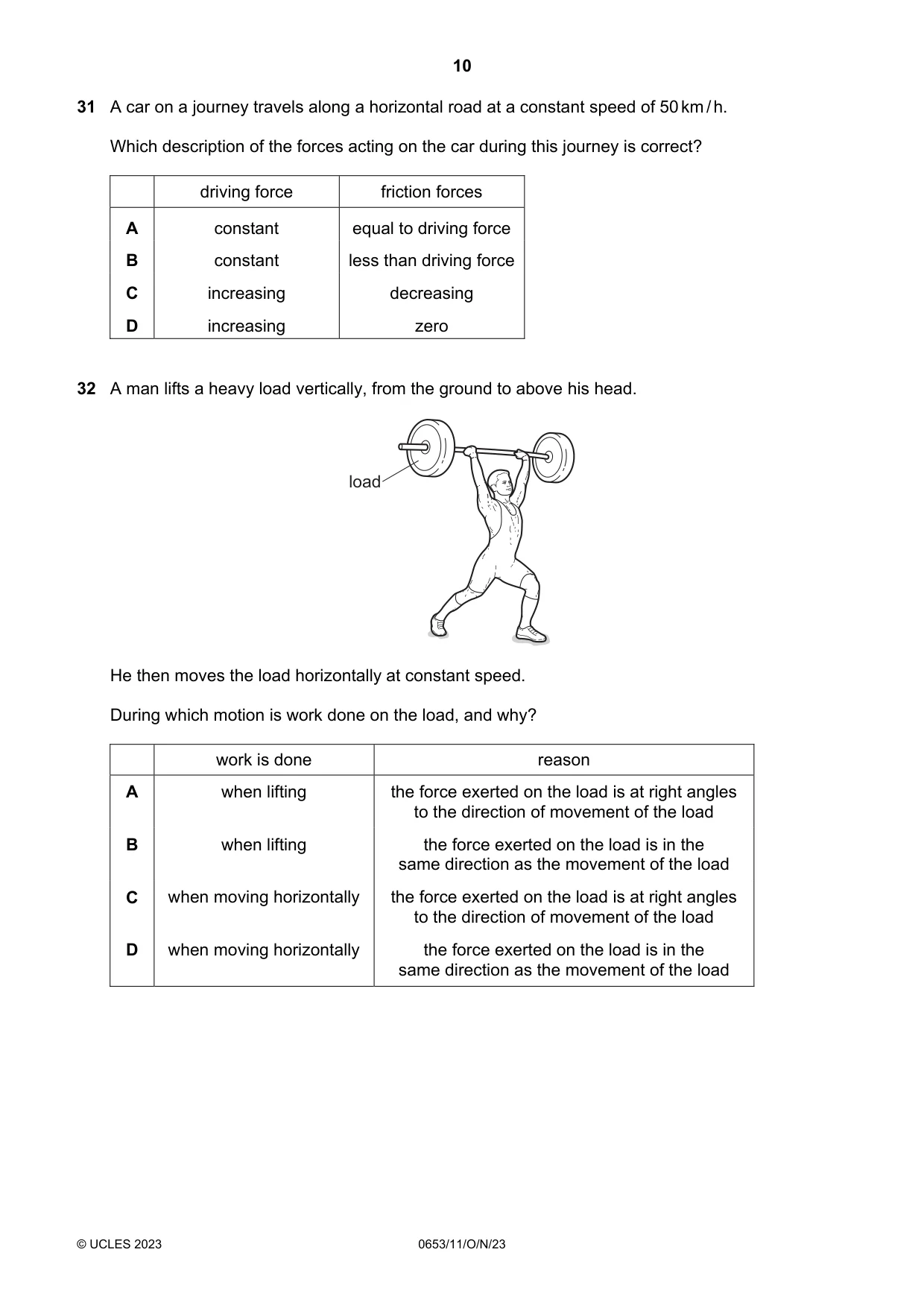
Q32 · A man lifts a heavy load vertically, from the ground to above his head
32 A man lifts a heavy load vertically, from the ground to above his head. load He then moves the load horizontally at constant speed. During which motion is work done on the load, and why? work is done reason A when lifting the force exerted on the load is at right angles to the direction of movement of the load B when lifting the force exerted on the load is in the same direction as the movement of the load C when moving horizontally the force exerted on the load is at right angles to the direction of movement of the load D when moving horizontally the force exerted on the load is in the same direction as the movement of the load
Mark scheme: B
Q33 · A girl watches a man hammering a post into the ground
33 A girl watches a man hammering a post into the ground. When she sees the hammer hit the post, she starts a stop-watch. When she hears the sound of the hammer hitting the post, she stops the stop-watch. The reading on the stop-watch is 0.60 s. The speed of sound in air is 330 m / s. What is the distance between the girl and the post? A 99 m B 198 m C 396 m D 550 m
Mark scheme: B
Q34 · The molecules in a substance are close together but free to change positions with each…
34 The molecules in a substance are close together but free to change positions with each other. Which substance at 20 C matches this description? A air B copper C iron D water
Mark scheme: D
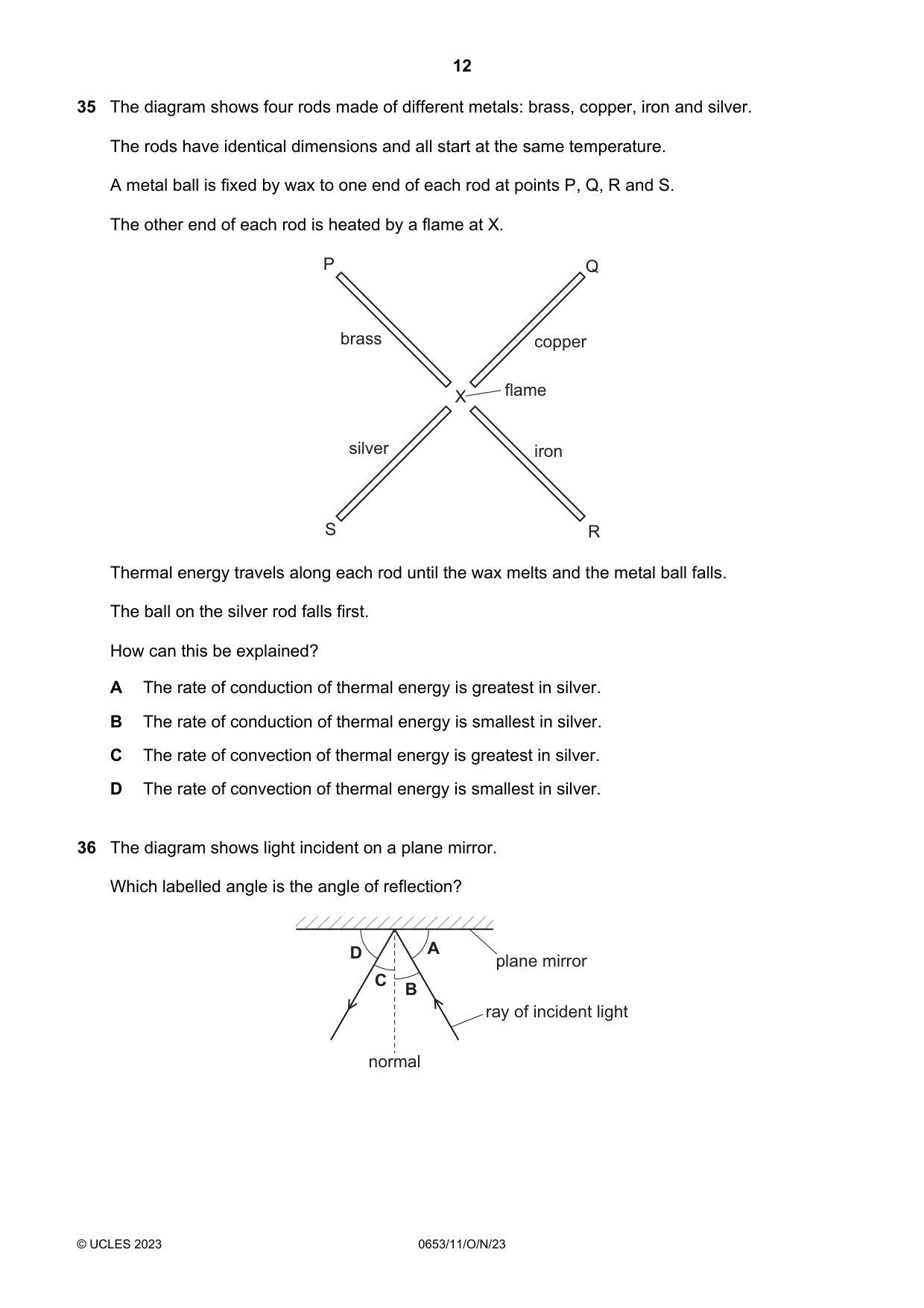
Q35 · The diagram shows four rods made of different metals: brass, copper, iron and silver
35 The diagram shows four rods made of different metals: brass, copper, iron and silver. The rods have identical dimensions and all start at the same temperature. A metal ball is fixed by wax to one end of each rod at points P, Q, R and S. The other end of each rod is heated by a flame at X. P Q brass copper X flame silver iron S R Thermal energy travels along each rod until the wax melts and the metal ball falls. The ball on the silver rod falls first. How can this be explained? A The rate of conduction of thermal energy is greatest in silver. B The rate of conduction of thermal energy is smallest in silver. C The rate of convection of thermal energy is greatest in silver. D The rate of convection of thermal energy is smallest in silver.
Mark scheme: A
Q36 · The diagram shows light incident on a plane mirror
36 The diagram shows light incident on a plane mirror. Which labelled angle is the angle of reflection? D A plane mirror C B ray of incident light normal
Mark scheme: C
Q37 · The amplitude of a sound wave decreases and its frequency increases
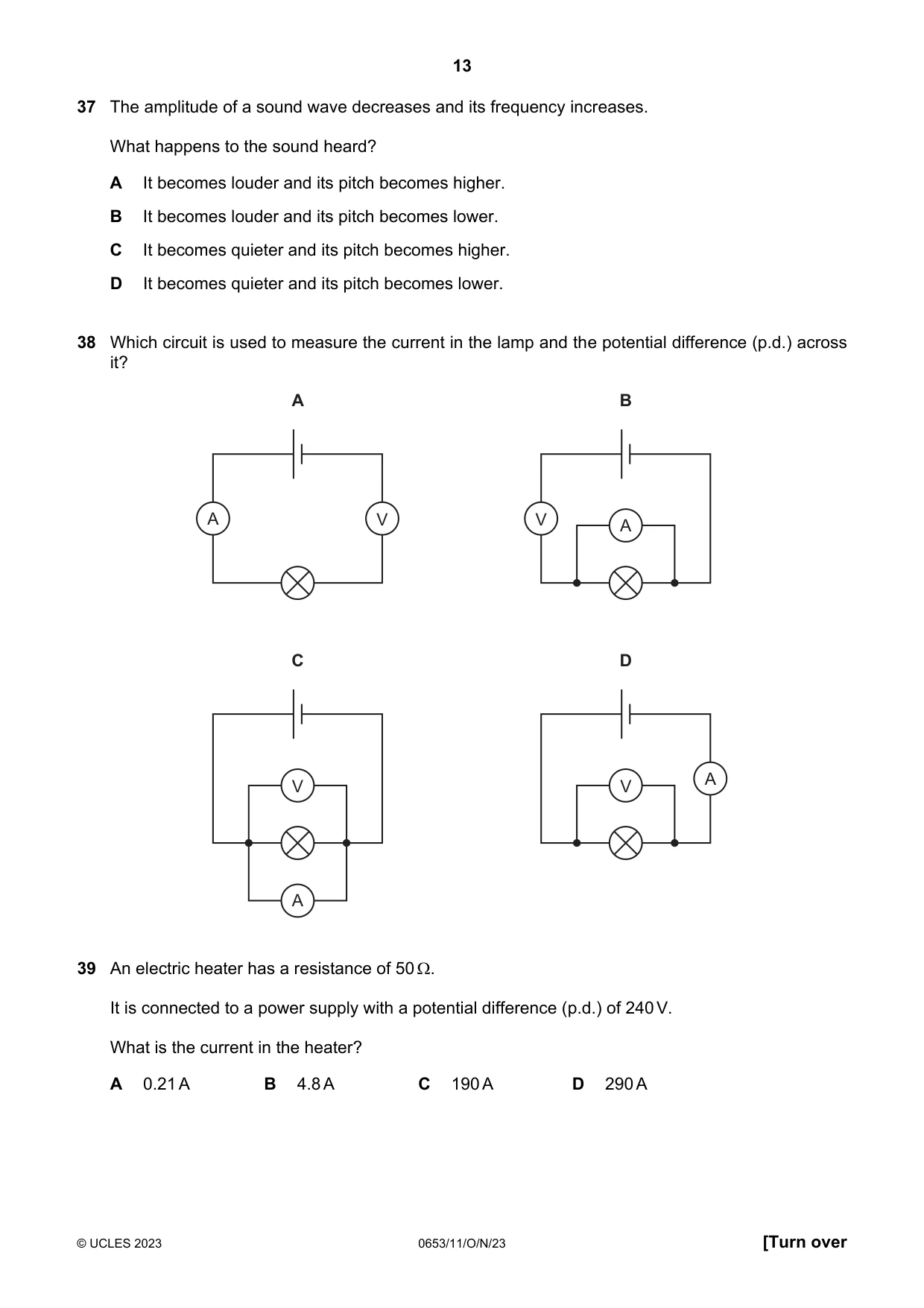
37 The amplitude of a sound wave decreases and its frequency increases. What happens to the sound heard? A It becomes louder and its pitch becomes higher. B It becomes louder and its pitch becomes lower. C It becomes quieter and its pitch becomes higher. D It becomes quieter and its pitch becomes lower.
Mark scheme: C
Q38 · Which circuit is used to measure the current in the lamp and the potential difference…
38 Which circuit is used to measure the current in the lamp and the potential difference (p.d.) across it? A B A V V A C D A V V A
Mark scheme: D
Q39 · An electric heater has a resistance of 50
39 An electric heater has a resistance of 50 . It is connected to a power supply with a potential difference (p.d.) of 240 V. What is the current in the heater? A 0.21 A B 4.8 A C 190 A D 290 A
Mark scheme: B
Q40 · Which symbol is used to represent a fixed resistor in an electrical circuit?
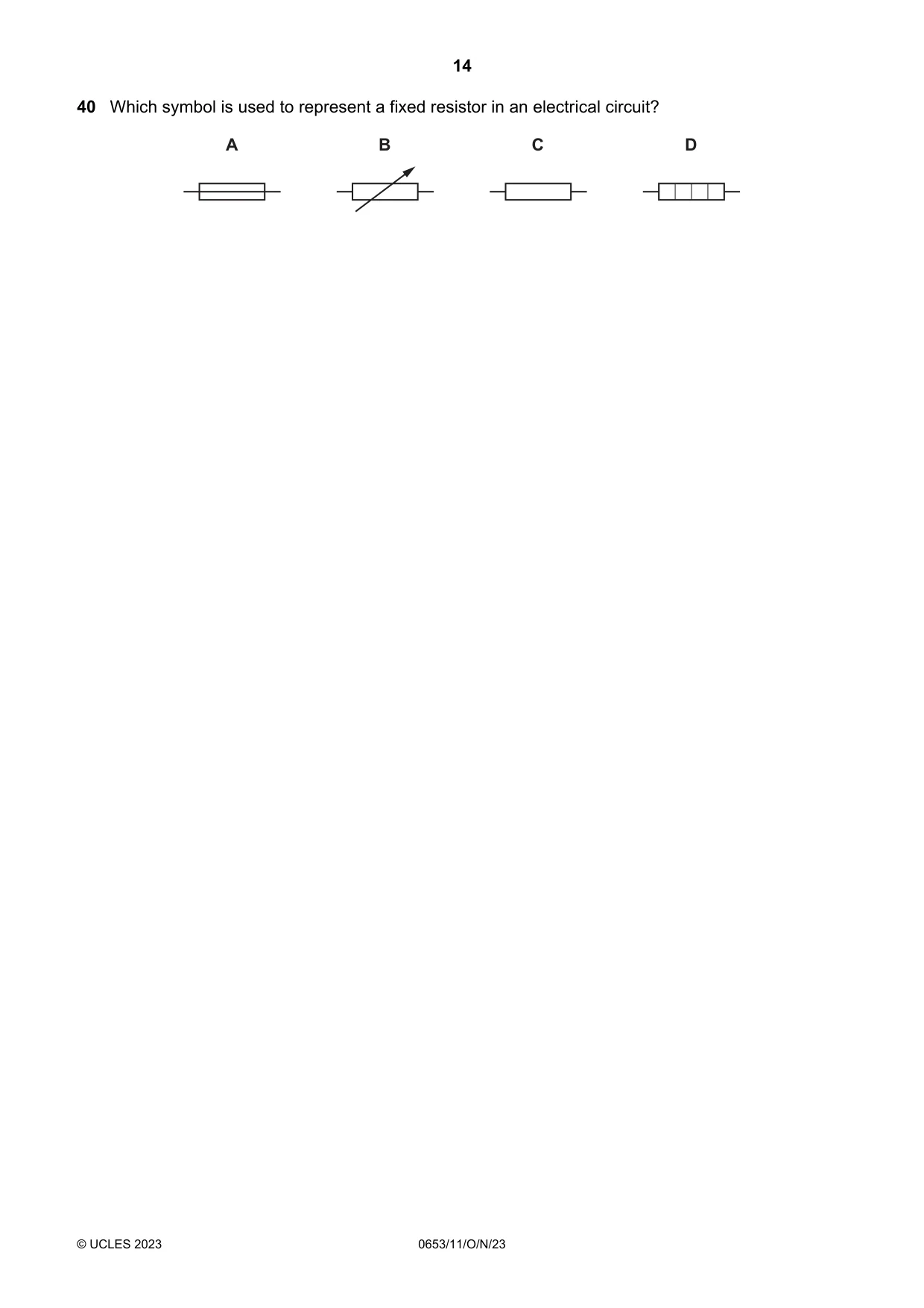
40 Which symbol is used to represent a fixed resistor in an electrical circuit? A B C D
Mark scheme: C
What was in this paper
The subtopics covered by these 40 questions, and how many questions each got. Open one in a new tab to see every Cambridge question on it.
2Forces2Identification of ions and gases2Sound2Air quality and climate1Alkanes1Arrangement of elements1Biological molecules1Carbon cycle1Characteristics of living organisms1Density1Diet1Diffusion1Digestion1Electrical quantities1Elements, compounds and mixtures1Energy, work and power1Enzymes1Exothermic and endothermic reactions1Experimental design1Food chains and food webs1Formulas1Kinetic particle model of matter1Light1Motion1Photosynthesis1Polymers1Reactivity series1Redox1Sexual reproduction in humans1Sexual reproduction in plants1Simple molecules and covalent bonds1Solids, liquids and gases1The characteristic properties of acids and bases1Transfer of thermal energy1Transpiration1What you needed in this session
Cambridge’s own grade thresholds for 2023 Oct/Nov, Paper 1 · Variant 1. A higher threshold means an easier paper — the bar moves with how the cohort did.