Cambridge IGCSE Science - Combined 0653 — 2020 Feb/March Paper 1 · Variant 2
0653/12/F/M/20 · 40 questions · 40 marks · ≈45 min
The question paper and its mark scheme, free to read here and free to download. This is Cambridge’s own paper, exactly as it was sat.
Question paper16 pages
Mark scheme3 pages
Answers below. Sit the paper first if you are practising.
Questions as text
Q1 · Four biological processes are listed
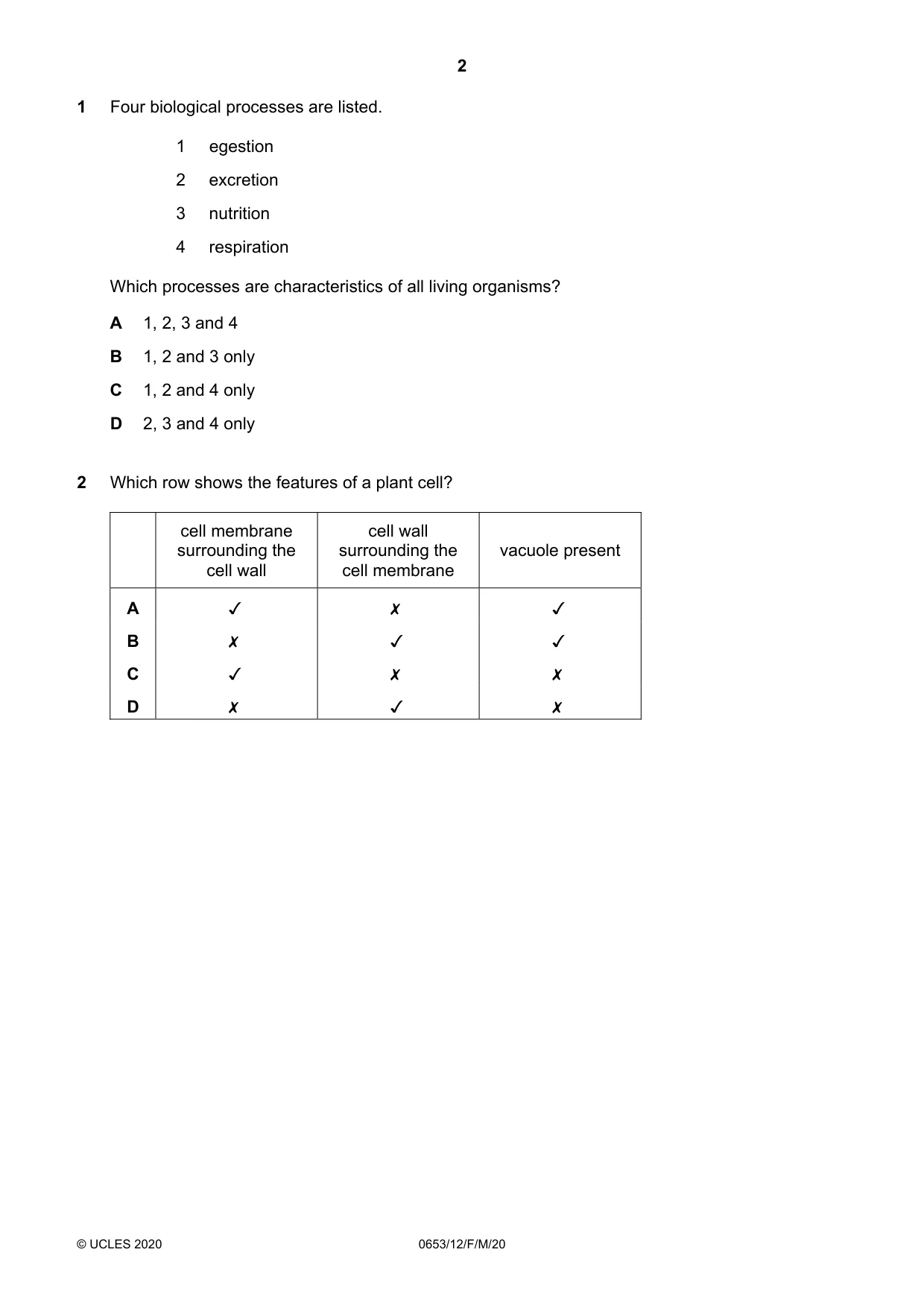
1 Four biological processes are listed. 1 egestion 2 excretion 3 nutrition 4 respiration Which processes are characteristics of all living organisms? A 1, 2, 3 and 4 B 1, 2 and 3 only C 1, 2 and 4 only D 2, 3 and 4 only
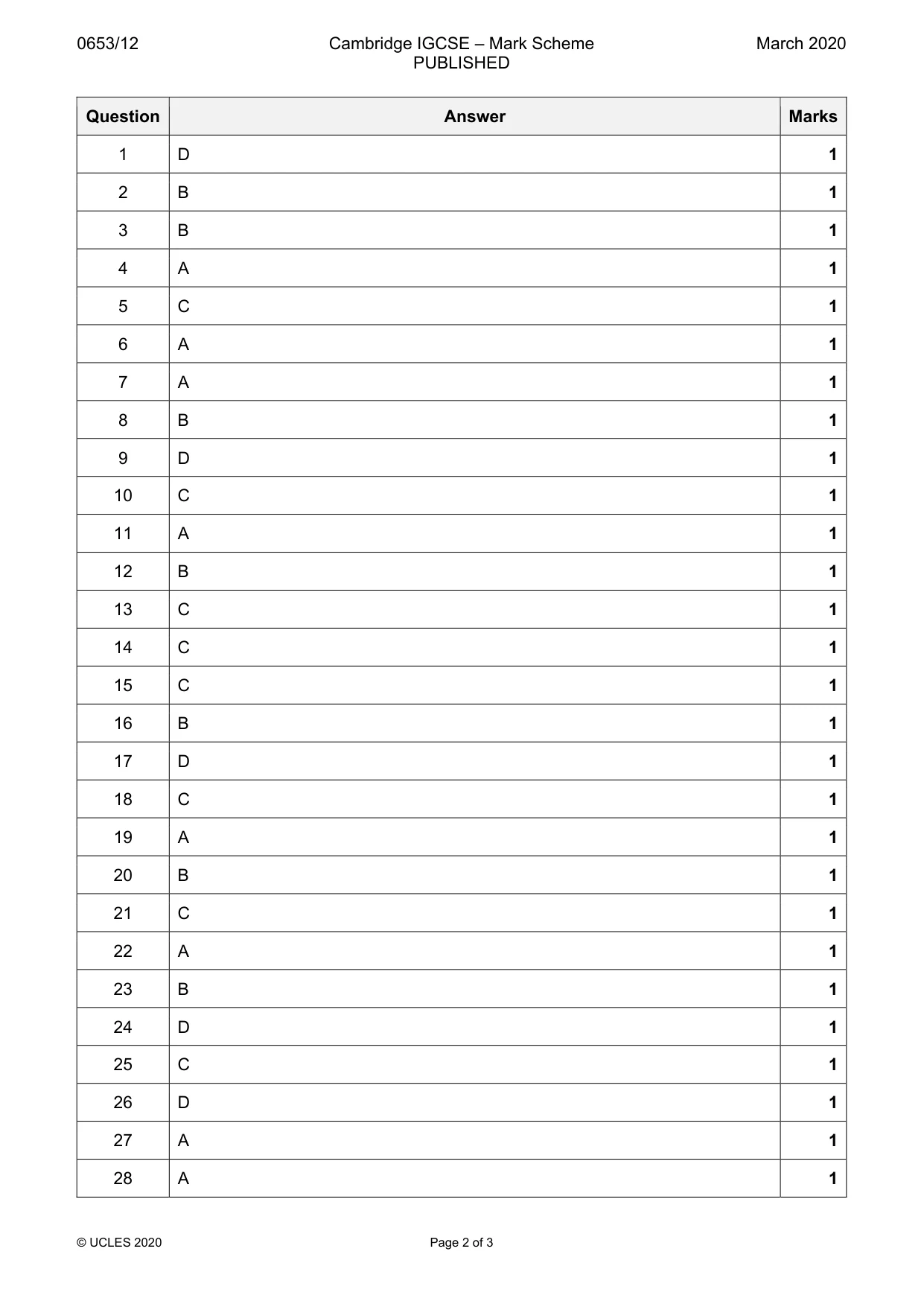
Mark scheme: D
Q2 · Which row shows the features of a plant cell?
2 Which row shows the features of a plant cell? cell membrane surrounding the cell wall surrounding the vacuole present cell wall cell membrane A v x v B x v v Cc Jv x x D x v x
Mark scheme: B
Q3 · A solution of glucose which has had some protein molecules added
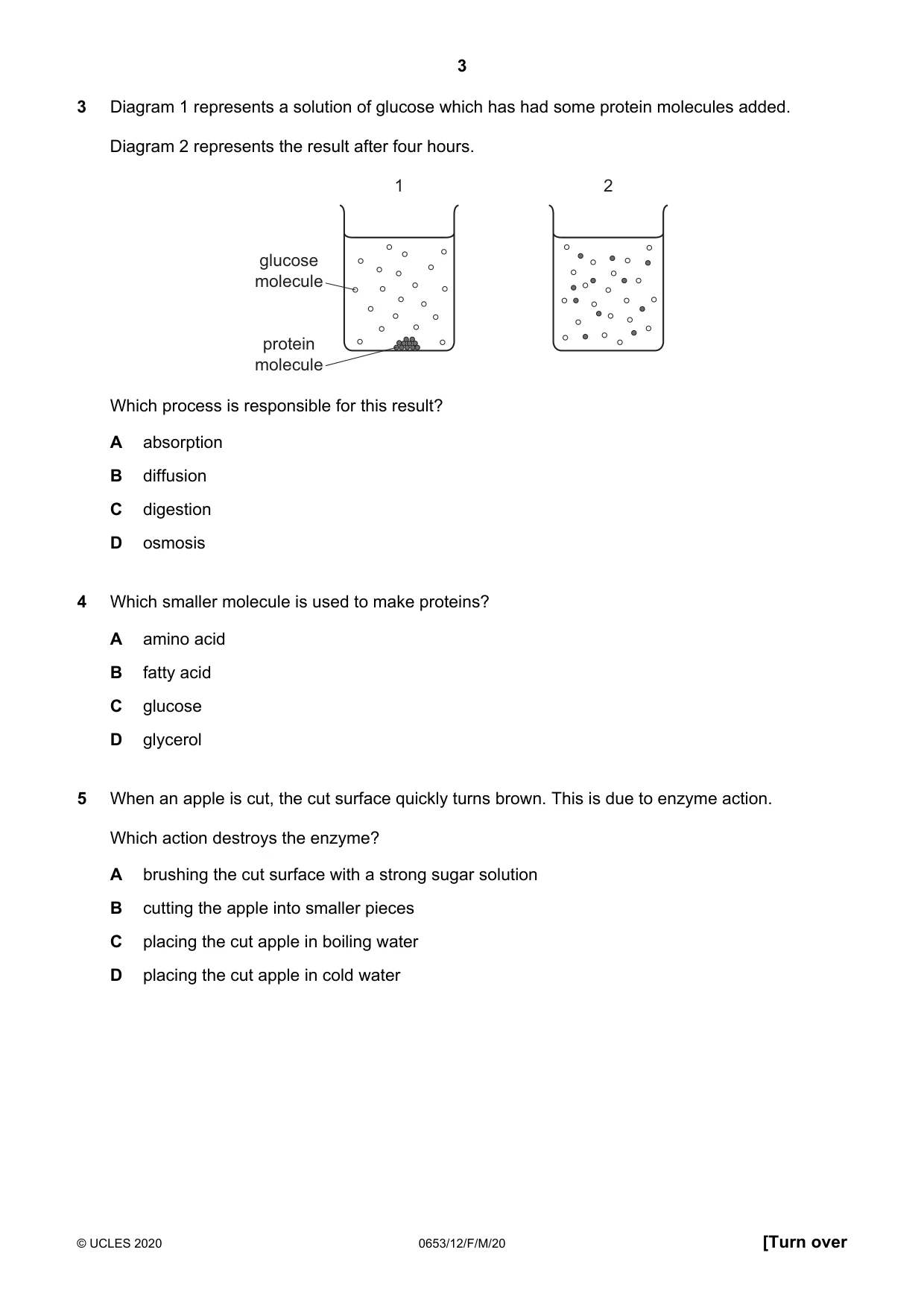
3 Diagram 1 represents a solution of glucose which has had some protein molecules added. Diagram 2 represents the result after four hours. 1 2 glucose molecule protein molecule Which process is responsible for this result? A absorption B diffusion C digestion D osmosis
Mark scheme: B
Q4 · Which smaller molecule is used to make proteins?
4 Which smaller molecule is used to make proteins? A amino acid B fatty acid C glucose D glycerol
Mark scheme: A
Q5 · When an apple is cut, the cut surface quickly turns brown
5 When an apple is cut, the cut surface quickly turns brown. This is due to enzyme action. Which action destroys the enzyme? A brushing the cut surface with a strong sugar solution B cutting the apple into smaller pieces C placing the cut apple in boiling water D placing the cut apple in cold water
Mark scheme: C
Q6 · The diagram shows the arrangement of part of the small intestine and a capillary
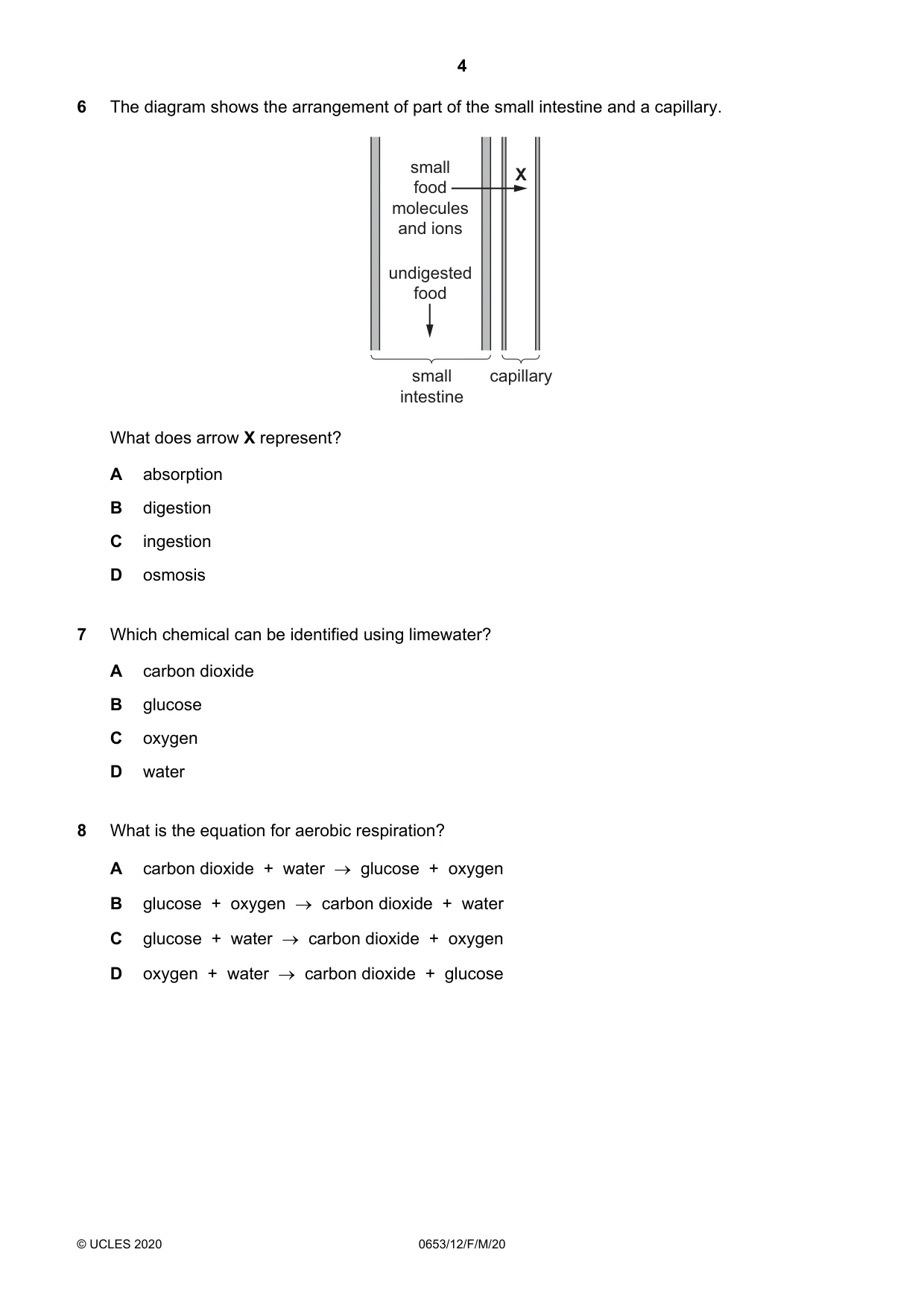
6 The diagram shows the arrangement of part of the small intestine and a capillary. small X food molecules and ions undigested food small capillary intestine What does arrow X represent? A absorption B digestion C ingestion D osmosis
Mark scheme: A
Q7 · Which chemical can be identified using limewater?
7 Which chemical can be identified using limewater? A carbon dioxide B glucose C oxygen D water
Mark scheme: A
Q8 · What is the equation for aerobic respiration?
8 What is the equation for aerobic respiration? A carbon dioxide + water → glucose + oxygen B glucose + oxygen → carbon dioxide + water C glucose + water → carbon dioxide + oxygen D oxygen + water → carbon dioxide + glucose
Mark scheme: B
Q9 · When an athlete prepares for the start of a sprint race, excitement causes the…
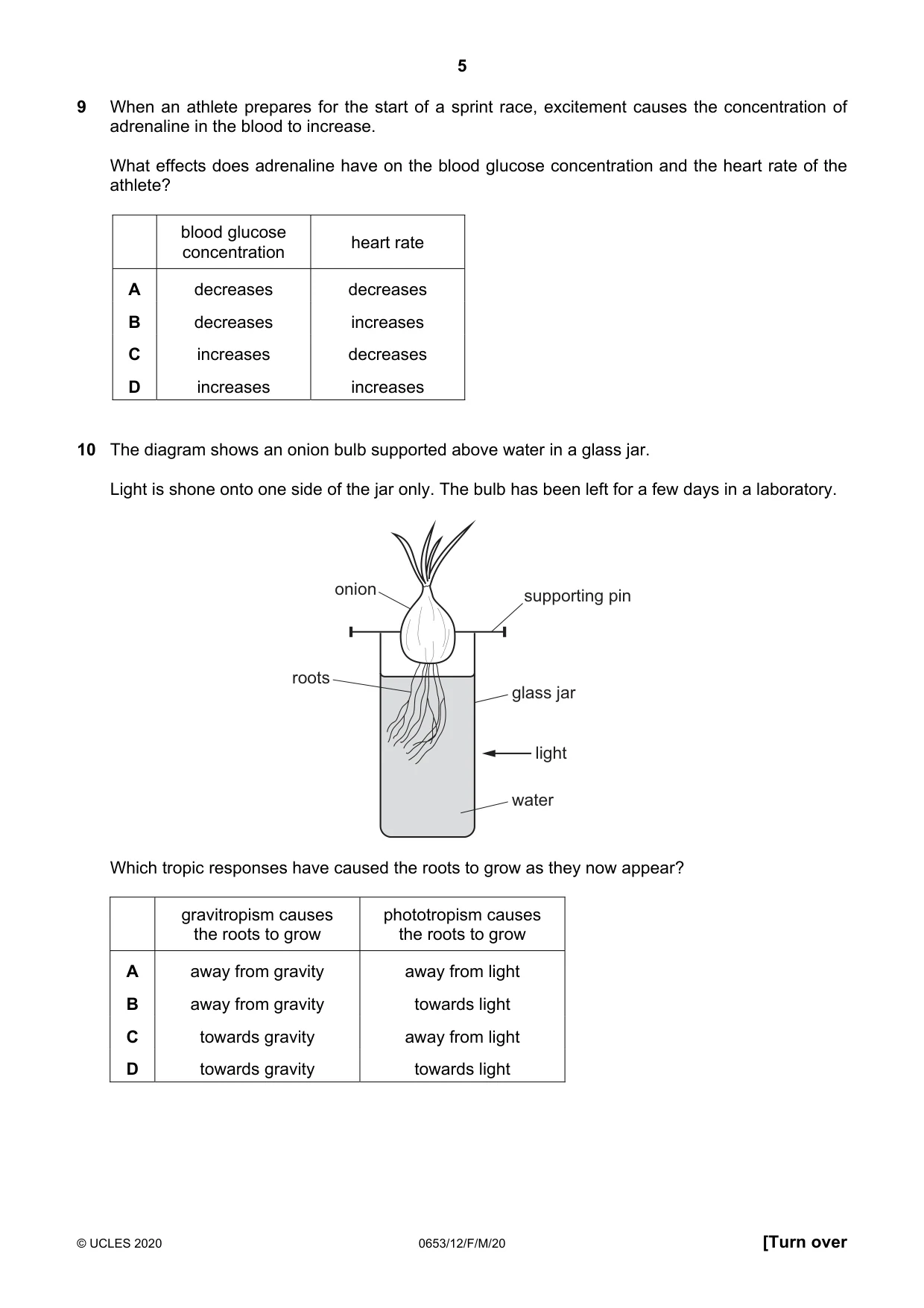
9 When an athlete prepares for the start of a sprint race, excitement causes the concentration of adrenaline in the blood to increase. What effects does adrenaline have on the blood glucose concentration and the heart rate of the athlete? blood glucose heart rate concentration A decreases decreases B decreases increases C increases decreases D increases increases
Mark scheme: D
Q10 · The diagram shows an onion bulb supported above water in a glass jar
10 The diagram shows an onion bulb supported above water in a glass jar. Light is shone onto one side of the jar only. The bulb has been left for a few days in a laboratory. onion supporting pin roots glass jar light water Which tropic responses have caused the roots to grow as they now appear? gravitropism causes phototropism causes the roots to grow the roots to grow A away from gravity away from light B away from gravity towards light C towards gravity away from light D towards gravity towards light
Mark scheme: C
Q11 · The diagram shows a section through a flower
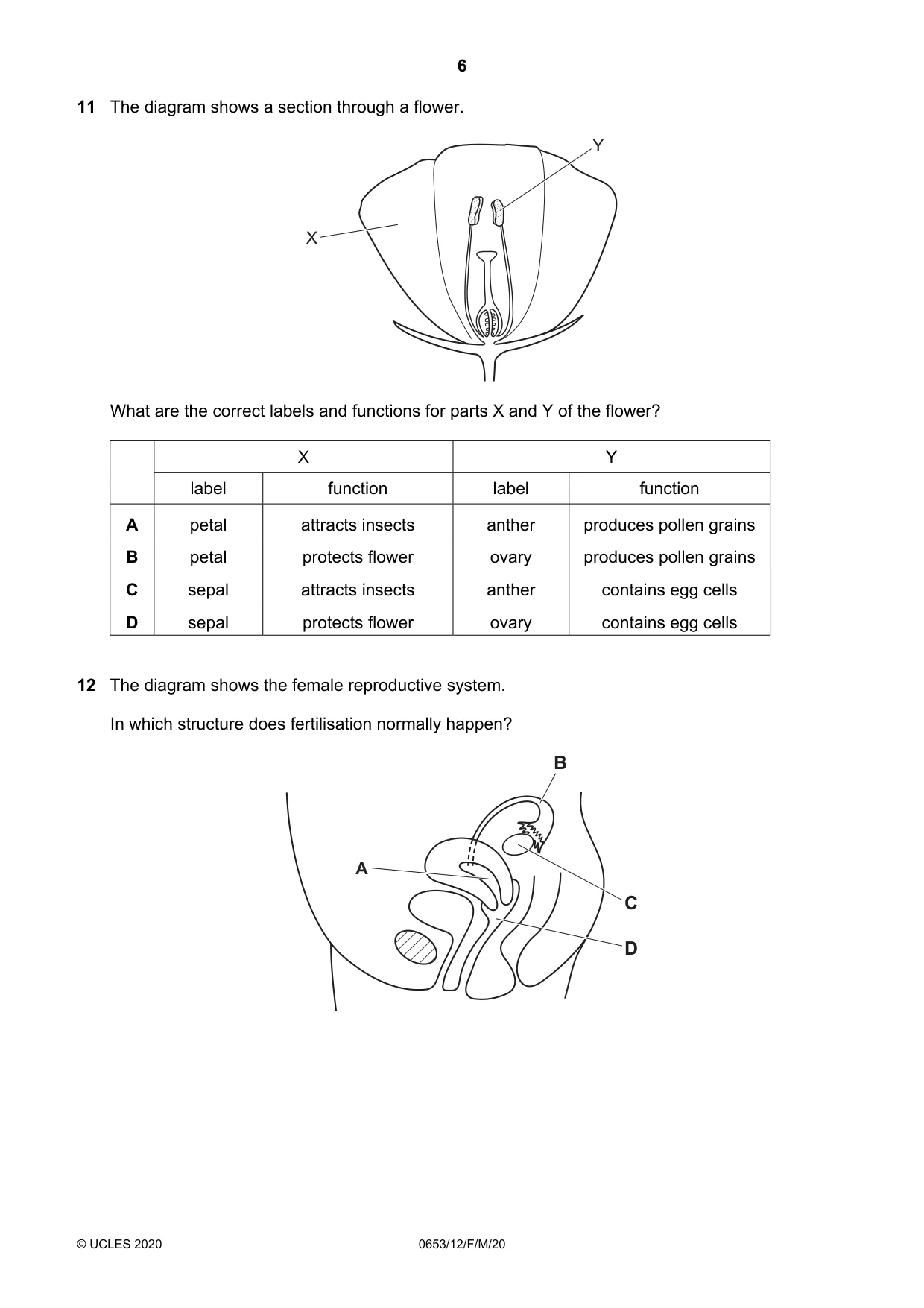
11 The diagram shows a section through a flower. Y X What are the correct labels and functions for parts X and Y of the flower? X Y label function label function A petal attracts insects anther produces pollen grains B petal protects flower ovary produces pollen grains C sepal attracts insects anther contains egg cells D sepal protects flower ovary contains egg cells
Mark scheme: A
Q12 · The diagram shows the female reproductive system
12 The diagram shows the female reproductive system. In which structure does fertilisation normally happen? B A C D
Mark scheme: B
Q13 · The diagram shows part of the carbon cycle
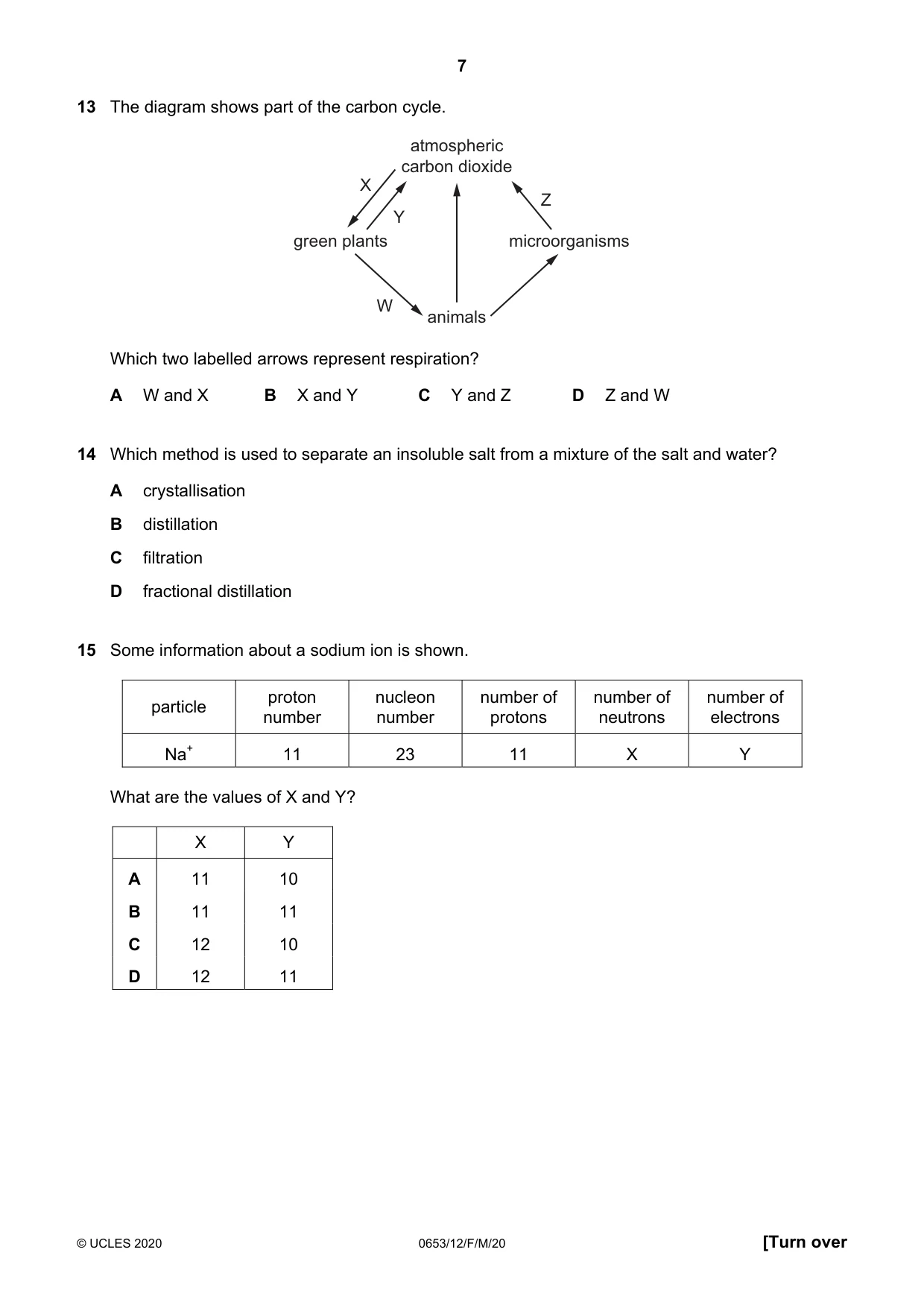
13 The diagram shows part of the carbon cycle. atmospheric carbon dioxide X Z Y green plants microorganisms W animals Which two labelled arrows represent respiration? A W and X B X and Y C Y and Z D Z and W
Mark scheme: C
Q14 · Which method is used to separate an insoluble salt from a mixture of the salt and water?
14 Which method is used to separate an insoluble salt from a mixture of the salt and water? A crystallisation B distillation C filtration D fractional distillation
Mark scheme: C
Q15 · Some information about a sodium ion is shown
15 Some information about a sodium ion is shown. proton nucleon number of number of number of particle number number protons neutrons electrons Na+ 11 23 11 X Y What are the values of X and Y? X Y A 11 10 B 11 11 C 12 10 D 12 11
Mark scheme: C
Q16 · Potassium carbonate reacts with dilute hydrochloric acid
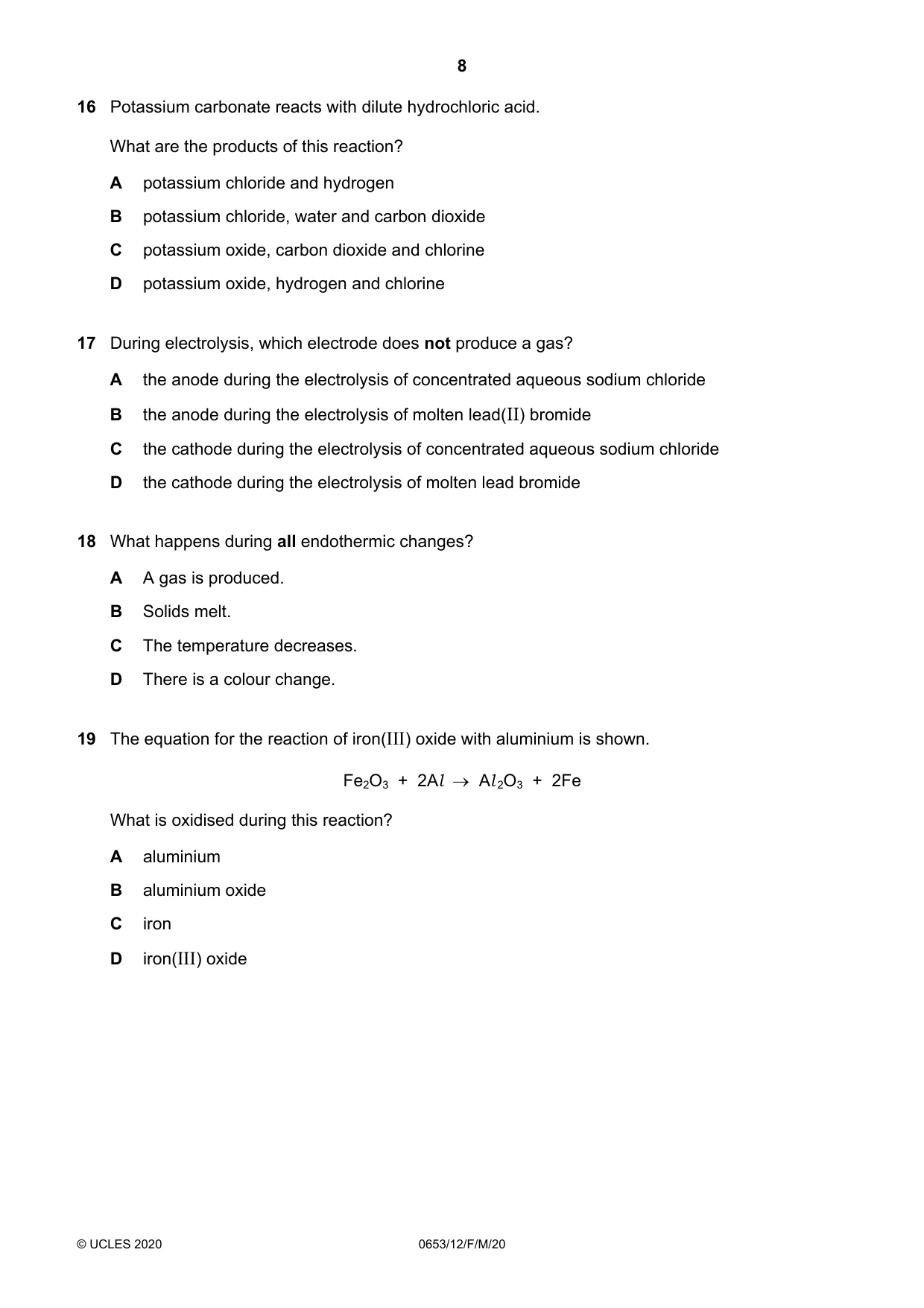
16 Potassium carbonate reacts with dilute hydrochloric acid. What are the products of this reaction? A potassium chloride and hydrogen B potassium chloride, water and carbon dioxide C potassium oxide, carbon dioxide and chlorine D potassium oxide, hydrogen and chlorine
Mark scheme: B
More questions on The characteristic properties of acids and bases
Q17 · During electrolysis, which electrode does not produce a gas?
17 During electrolysis, which electrode does not produce a gas? A the anode during the electrolysis of concentrated aqueous sodium chloride B the anode during the electrolysis of molten lead(II) bromide C the cathode during the electrolysis of concentrated aqueous sodium chloride D the cathode during the electrolysis of molten lead bromide
Mark scheme: D
Q18 · What happens during all endothermic changes?
18 What happens during all endothermic changes? A A gas is produced. B Solids melt. C The temperature decreases. D There is a colour change.
Mark scheme: C
Q19 · The equation for the reaction of iron(III) oxide with aluminium is shown
19 The equation for the reaction of iron(III) oxide with aluminium is shown. Fe2O3 + 2Al → Al 2O3 + 2Fe What is oxidised during this reaction? A aluminium B aluminium oxide C iron D iron(III) oxide
Mark scheme: A
Q20 · Universal indicator is placed into a colourless liquid
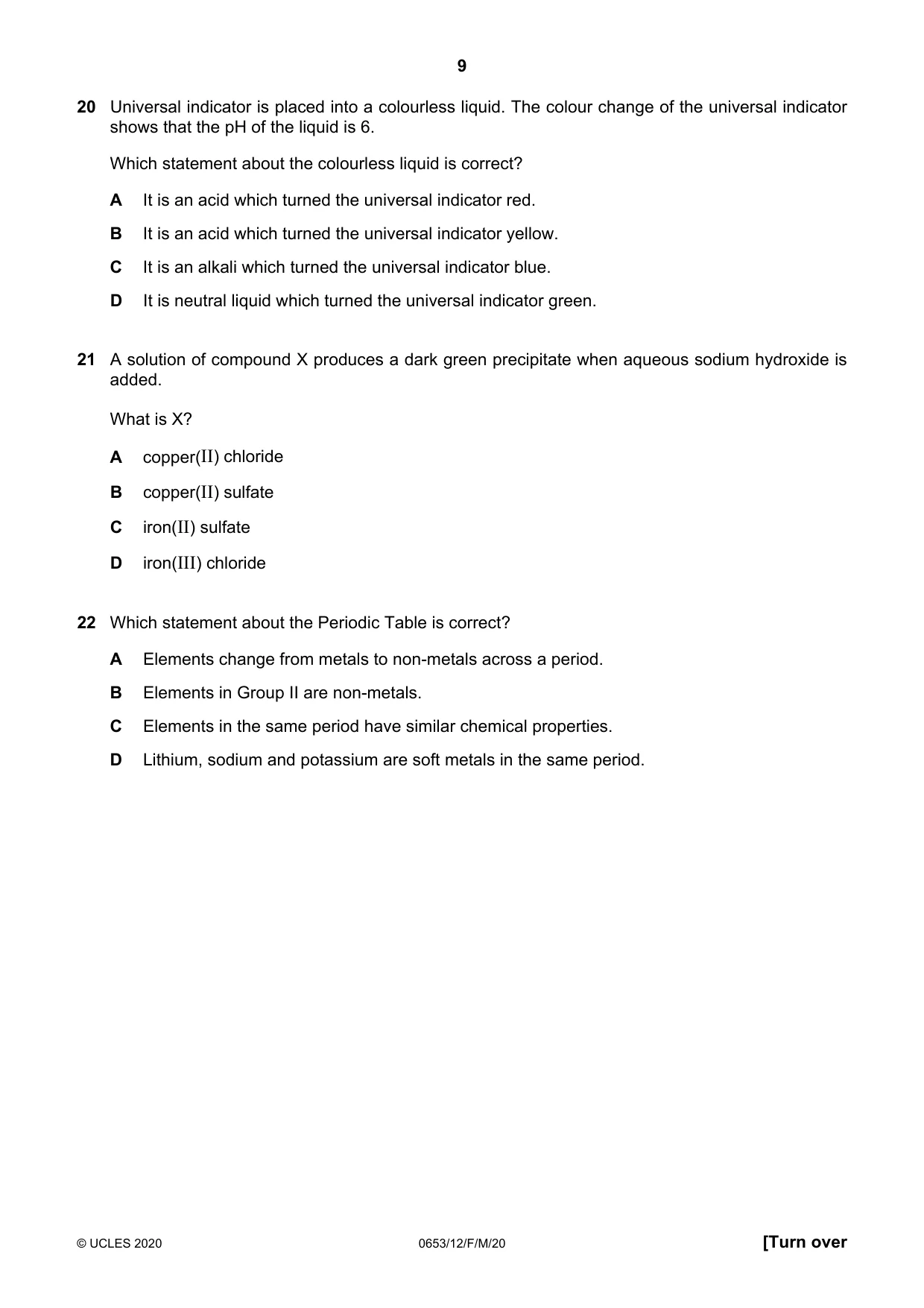
20 Universal indicator is placed into a colourless liquid. The colour change of the universal indicator shows that the pH of the liquid is 6. Which statement about the colourless liquid is correct? A It is an acid which turned the universal indicator red. B It is an acid which turned the universal indicator yellow. C It is an alkali which turned the universal indicator blue. D It is neutral liquid which turned the universal indicator green.
Mark scheme: B
More questions on The characteristic properties of acids and bases
Q21 · A solution of compound X produces a dark green precipitate when aqueous sodium hydroxide…
21 A solution of compound X produces a dark green precipitate when aqueous sodium hydroxide is added. What is X? A copper(II) chloride B copper(II) sulfate C iron(II) sulfate D iron(III) chloride
Mark scheme: C
Q22 · Which statement about the Periodic Table is correct?
22 Which statement about the Periodic Table is correct? A Elements change from metals to non-metals across a period. B Elements in Group II are non-metals. C Elements in the same period have similar chemical properties. D Lithium, sodium and potassium are soft metals in the same period.
Mark scheme: A
Q23 · Rubidium is a very reactive Group I metal
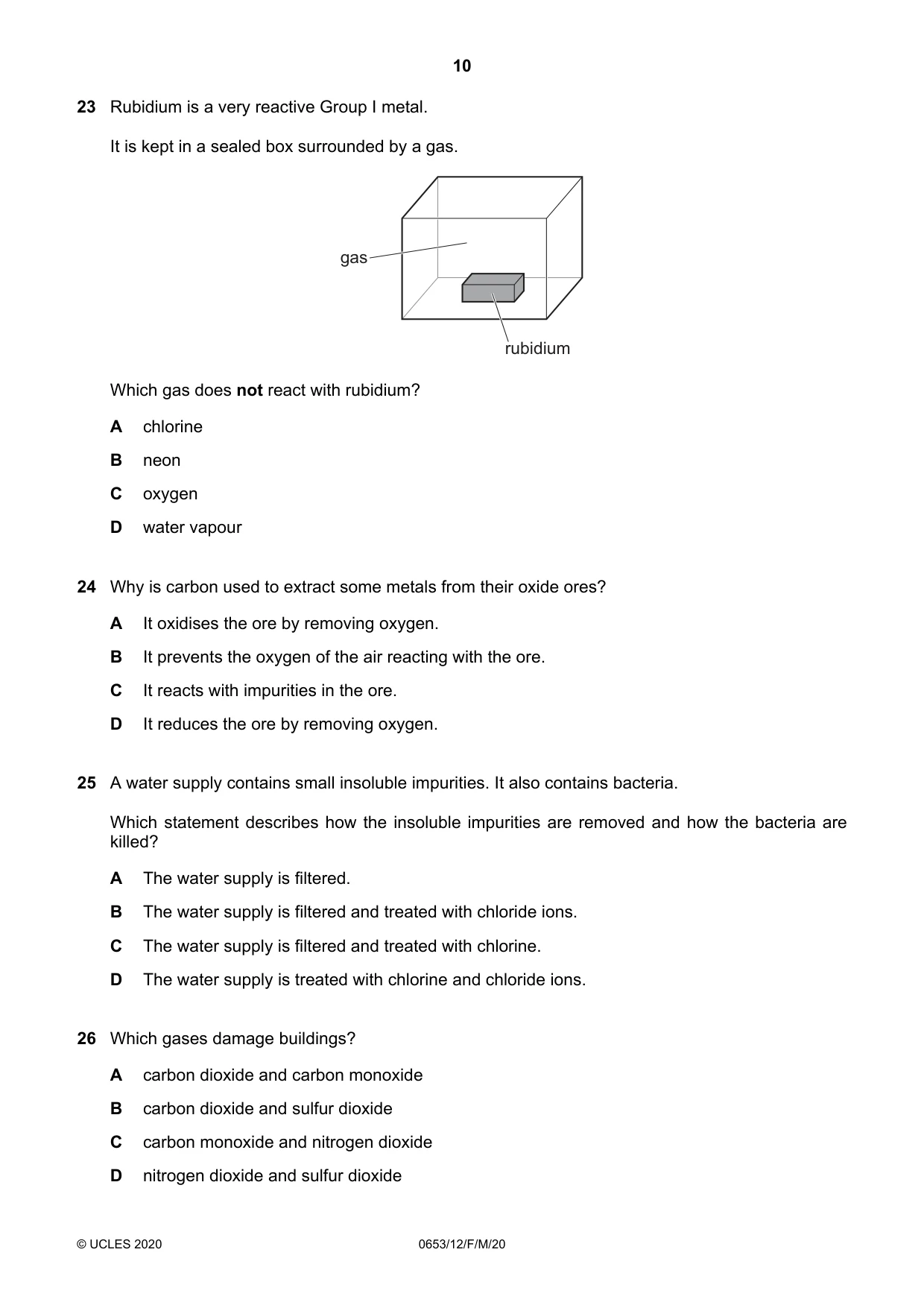
23 Rubidium is a very reactive Group I metal. It is kept in a sealed box surrounded by a gas. gas rubidium Which gas does not react with rubidium? A chlorine B neon C oxygen D water vapour
Mark scheme: B
Q24 · Why is carbon used to extract some metals from their oxide ores?
24 Why is carbon used to extract some metals from their oxide ores? A It oxidises the ore by removing oxygen. B It prevents the oxygen of the air reacting with the ore. C It reacts with impurities in the ore. D It reduces the ore by removing oxygen.
Mark scheme: D
Q25 · A water supply contains small insoluble impurities
25 A water supply contains small insoluble impurities. It also contains bacteria. Which statement describes how the insoluble impurities are removed and how the bacteria are killed? A The water supply is filtered. B The water supply is filtered and treated with chloride ions. C The water supply is filtered and treated with chlorine. D The water supply is treated with chlorine and chloride ions.
Mark scheme: C
Q26 · Which gases damage buildings?
26 Which gases damage buildings? A carbon dioxide and carbon monoxide B carbon dioxide and sulfur dioxide C carbon monoxide and nitrogen dioxide D nitrogen dioxide and sulfur dioxide
Mark scheme: D
Q27 · What is formed during the complete combustion of a hydrocarbon?
27 What is formed during the complete combustion of a hydrocarbon? A carbon dioxide and water B carbon dioxide and hydrogen C carbon monoxide and carbon dioxide D carbon monoxide and water
Mark scheme: A
Q28 · A student measures the length of a line using a rule
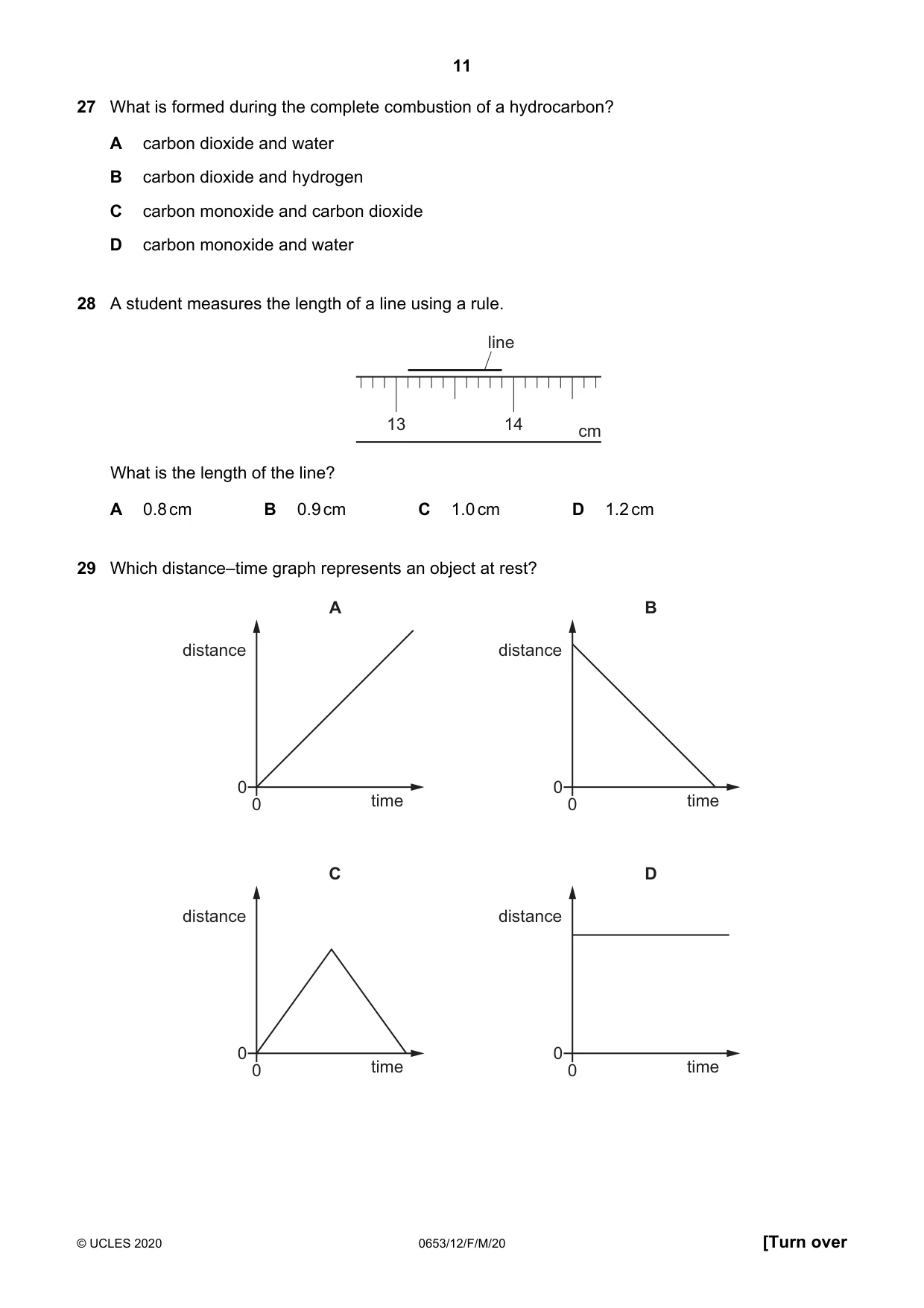
28 A student measures the length of a line using a rule. line 13 14 cm What is the length of the line? A 0.8 cm B 0.9 cm C 1.0 cm D 1.2 cm
Mark scheme: A
More questions on Physical quantities and measurement techniques
Q29 · Which distance–time graph represents an object at rest?
29 Which distance–time graph represents an object at rest? A B distance distance 0 0 0 time 0 time C D distance distance 0 0 0 time 0 time
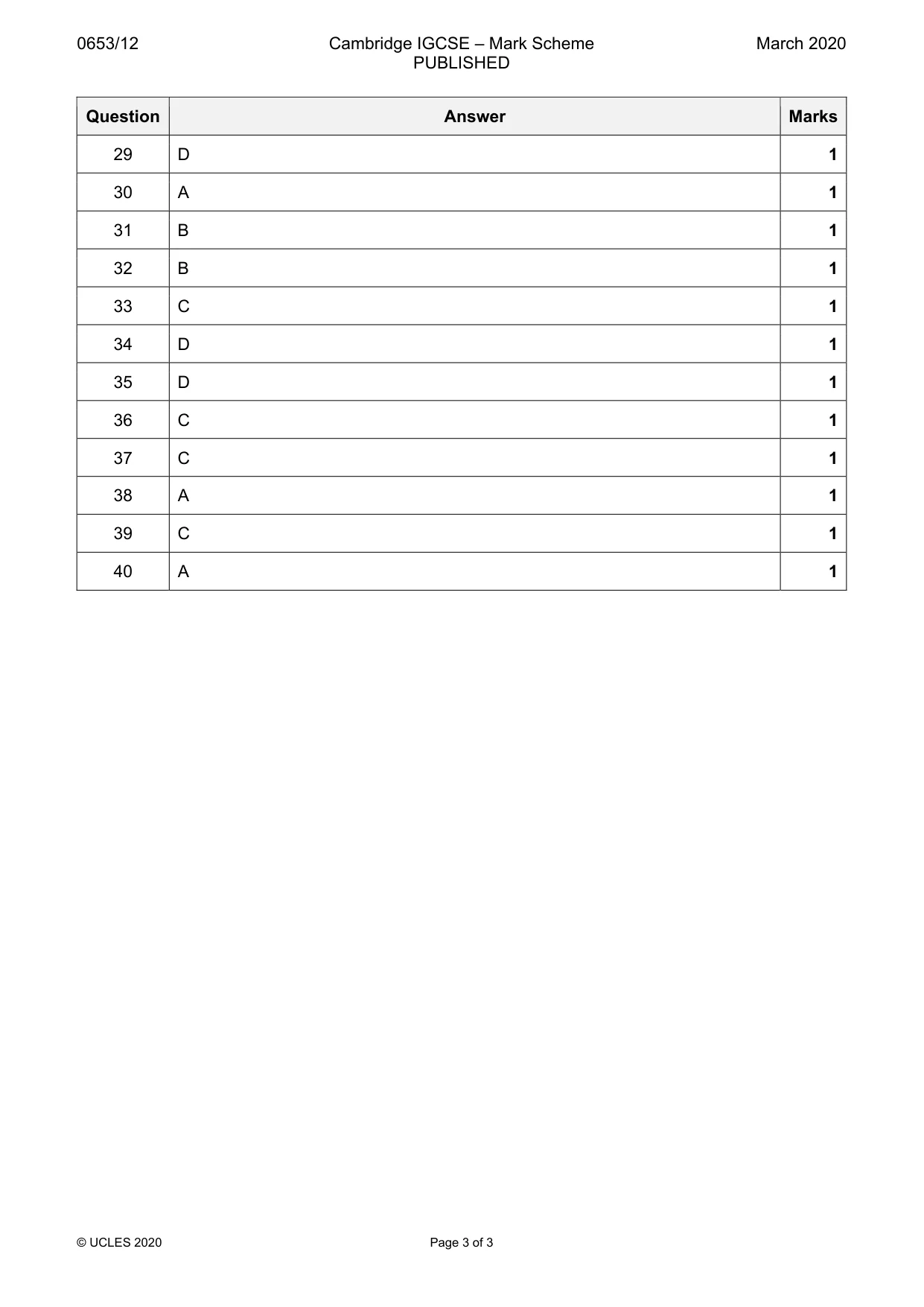
Mark scheme: D
Q30 · The weight W and mass m of an object are related by the equation shown
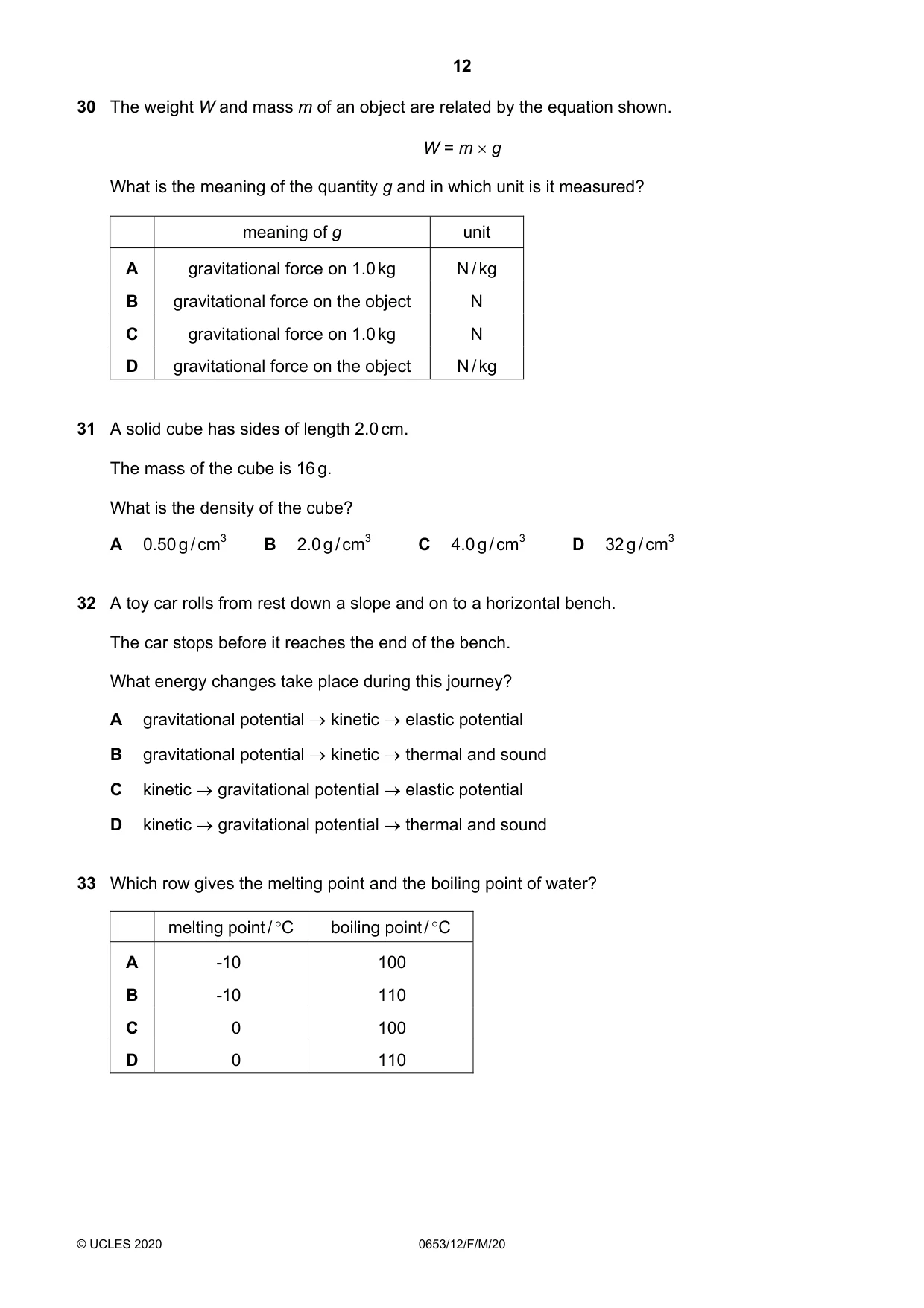
30 The weight W and mass m of an object are related by the equation shown. W = m × g What is the meaning of the quantity g and in which unit is it measured? meaning of g unit A gravitational force on 1.0 kg N / kg B gravitational force on the object N C gravitational force on 1.0 kg N D gravitational force on the object N / kg
Mark scheme: A
Q31 · A solid cube has sides of length 2.0 cm
31 A solid cube has sides of length 2.0 cm. The mass of the cube is 16 g. What is the density of the cube? A 0.50 g / cm3 B 2.0 g / cm3 C 4.0 g / cm3 D 32 g / cm3
Mark scheme: B
Q32 · A toy car rolls from rest down a slope and on to a horizontal bench
32 A toy car rolls from rest down a slope and on to a horizontal bench. The car stops before it reaches the end of the bench. What energy changes take place during this journey? A gravitational potential → kinetic → elastic potential B gravitational potential → kinetic → thermal and sound C kinetic → gravitational potential → elastic potential D kinetic → gravitational potential → thermal and sound
Mark scheme: B
Q33 · Which row gives the melting point and the boiling point of water?
33 Which row gives the melting point and the boiling point of water? melting point / °C boiling point / °C A -10 100 B -10 110 C 0 100 D 0 110
Mark scheme: C
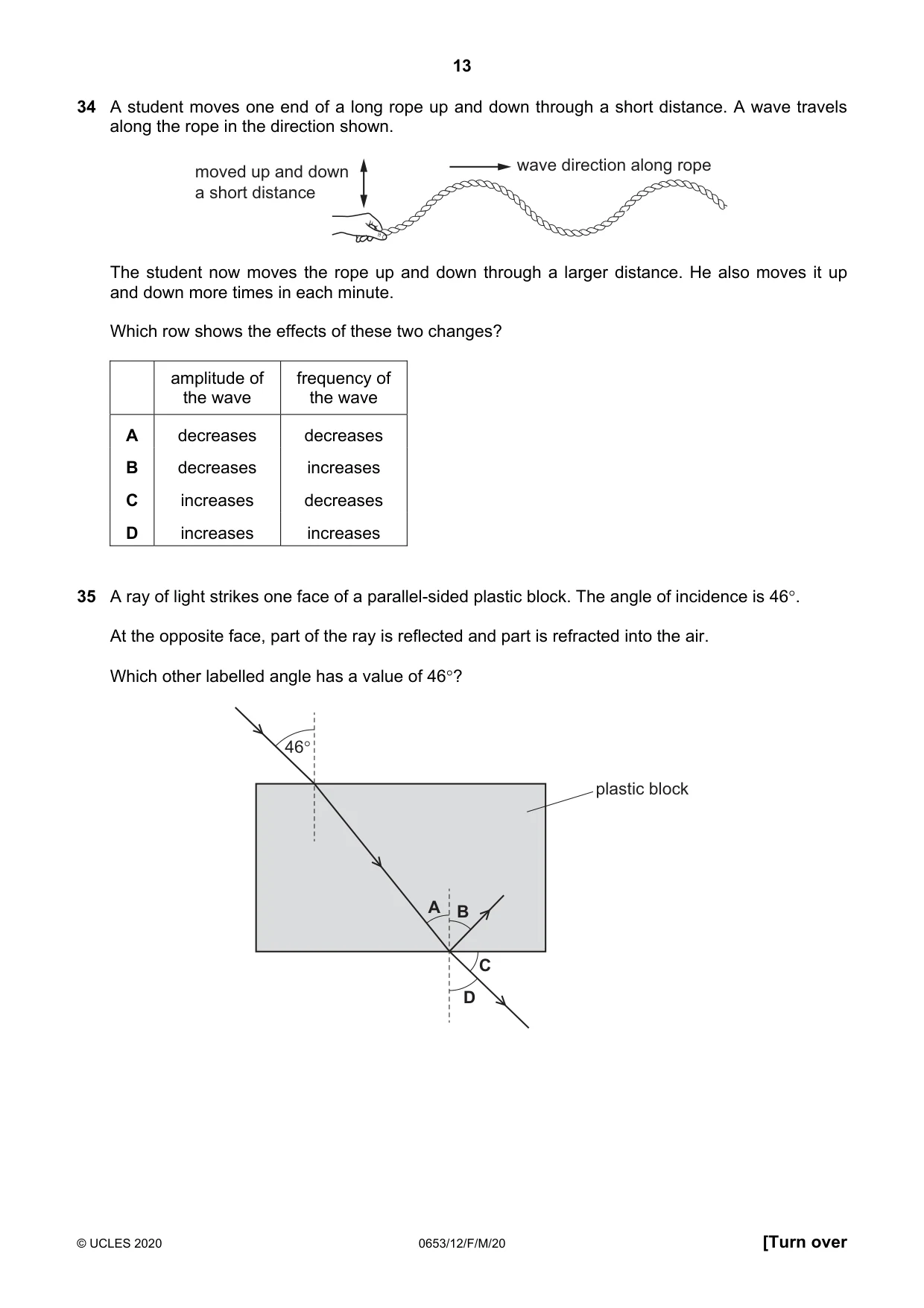
Q34 · A student moves one end of a long rope up and down through a short distance
34 A student moves one end of a long rope up and down through a short distance. A wave travels along the rope in the direction shown. moved up and down wave direction along rope a short distance The student now moves the rope up and down through a larger distance. He also moves it up and down more times in each minute. Which row shows the effects of these two changes? amplitude of frequency of the wave the wave A decreases decreases B decreases increases C increases decreases D increases increases
Mark scheme: D
Q35 · A ray of light strikes one face of a parallel-sided plastic block
35 A ray of light strikes one face of a parallel-sided plastic block. The angle of incidence is 46°. At the opposite face, part of the ray is reflected and part is refracted into the air. Which other labelled angle has a value of 46°? 46° plastic block A B C D
Mark scheme: D
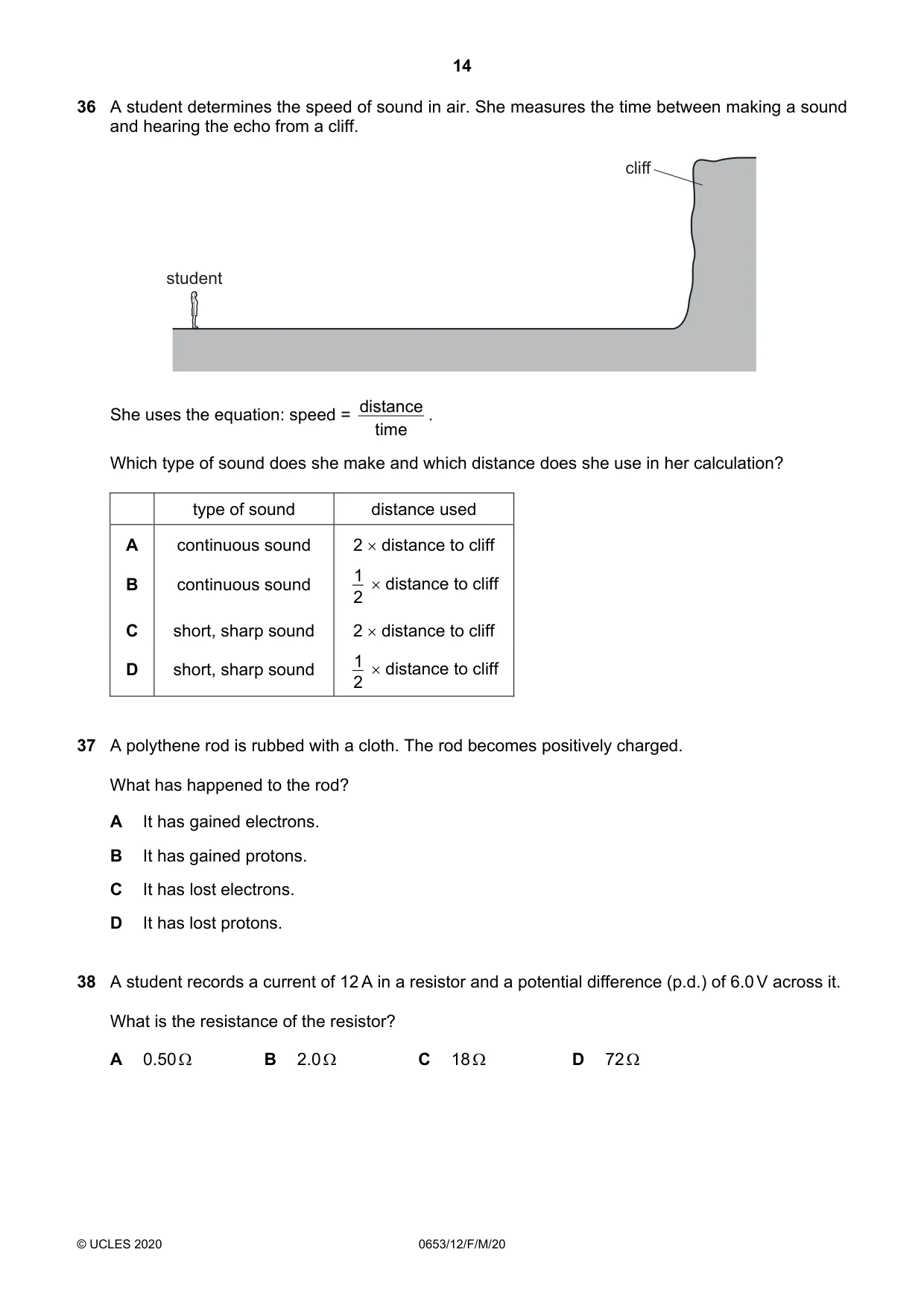
Q36 · A student determines the speed of sound in air
36 A student determines the speed of sound in air. She measures the time between making a sound and hearing the echo from a cliff. cliff student distance . She uses the equation: speed = time Which type of sound does she make and which distance does she use in her calculation? type of sound distance used A continuous sound 2 × distance to cliff 2 × distance to cliff 1 B continuous sound C short, sharp sound 2 × distance to cliff 2 × distance to cliff 1 D short, sharp sound
Mark scheme: C
Q37 · A polythene rod is rubbed with a cloth
37 A polythene rod is rubbed with a cloth. The rod becomes positively charged. What has happened to the rod? A It has gained electrons. B It has gained protons. C It has lost electrons. D It has lost protons.
Mark scheme: C
Q38 · A student records a current of 12 A in a resistor and a potential difference (p.d.) of…
38 A student records a current of 12 A in a resistor and a potential difference (p.d.) of 6.0 V across it. What is the resistance of the resistor? A 0.50 Ω B 2.0 Ω C 18 Ω D 72 Ω
Mark scheme: A
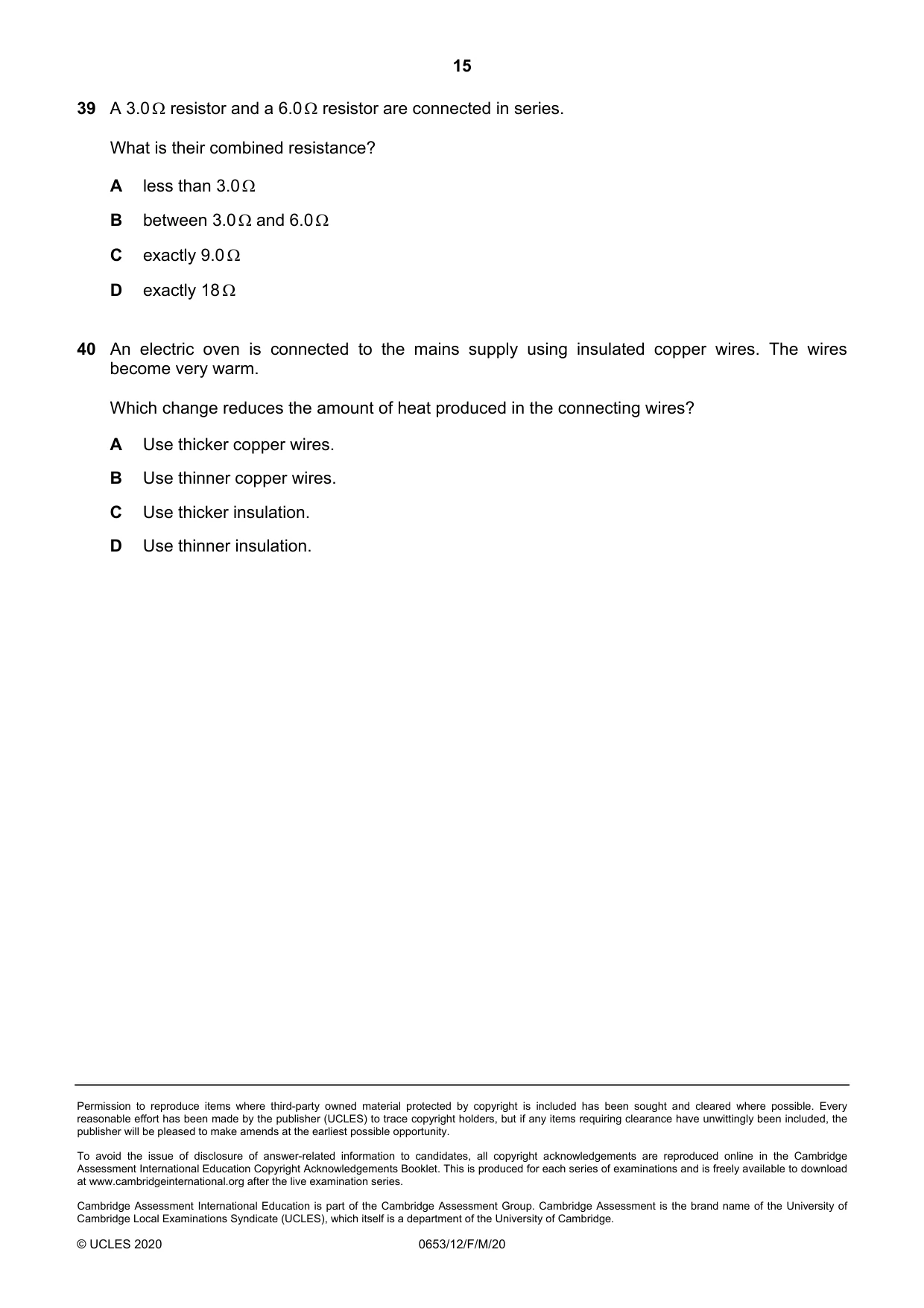
Q39 · A 3.0 Ω resistor and a 6.0 Ω resistor are connected in series
39 A 3.0 Ω resistor and a 6.0 Ω resistor are connected in series. What is their combined resistance? A less than 3.0 Ω B between 3.0 Ω and 6.0 Ω C exactly 9.0 Ω D exactly 18 Ω
Mark scheme: C
Q40 · An electric oven is connected to the mains supply using insulated copper wires
40 An electric oven is connected to the mains supply using insulated copper wires. The wires become very warm. Which change reduces the amount of heat produced in the connecting wires? A Use thicker copper wires. B Use thinner copper wires. C Use thicker insulation. D Use thinner insulation.
Mark scheme: A
What was in this paper
The subtopics covered by these 40 questions, and how many questions each got. Open one in a new tab to see every Cambridge question on it.
2Identification of ions and gases2Sexual reproduction in plants2The characteristic properties of acids and bases2Air quality and climate1Arrangement of elements1Atomic structure and the Periodic Table1Biological molecules1Carbon cycle1Cell structure1Characteristics of living organisms1Density1Diffusion1Digestion1Drugs1Electrical circuits1Electrical safety1Electrolysis1Energy, work and power1Enzymes1Exothermic and endothermic reactions1Extraction of metals1Fuels1General properties of waves1Group I properties1Light1Mass and weight1Motion1Physical quantities and measurement techniques1Redox1Respiration1Separation and purification1Sexual reproduction in humans1Sound1Thermal properties and temperature1Water1What you needed in this session
Cambridge’s own grade thresholds for 2020 Feb/March, Paper 1 · Variant 2. A higher threshold means an easier paper — the bar moves with how the cohort did.