Cambridge IGCSE Science - Combined 0653 — 2012 May/June Paper 1 · Variant 1
0653/11/M/J/12 · 40 questions · 40 marks · ≈45 min
The question paper and its mark scheme, free to read here and free to download. This is Cambridge’s own paper, exactly as it was sat.
Question paper20 pages



Mark scheme2 pages
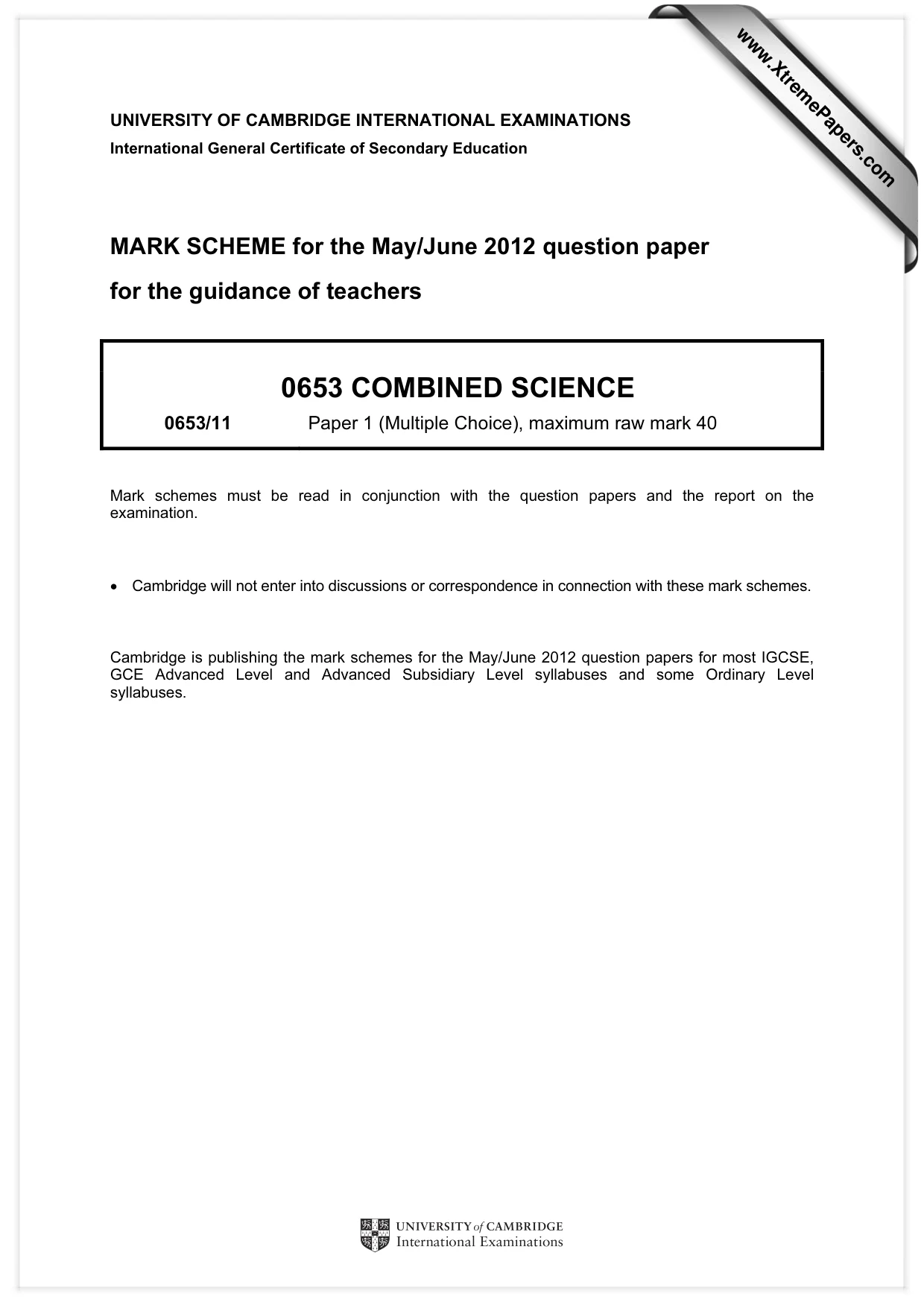
Answers below. Sit the paper first if you are practising.
Questions as text
Q1 · The diagram shows a cell from the mesophyll of a leaf
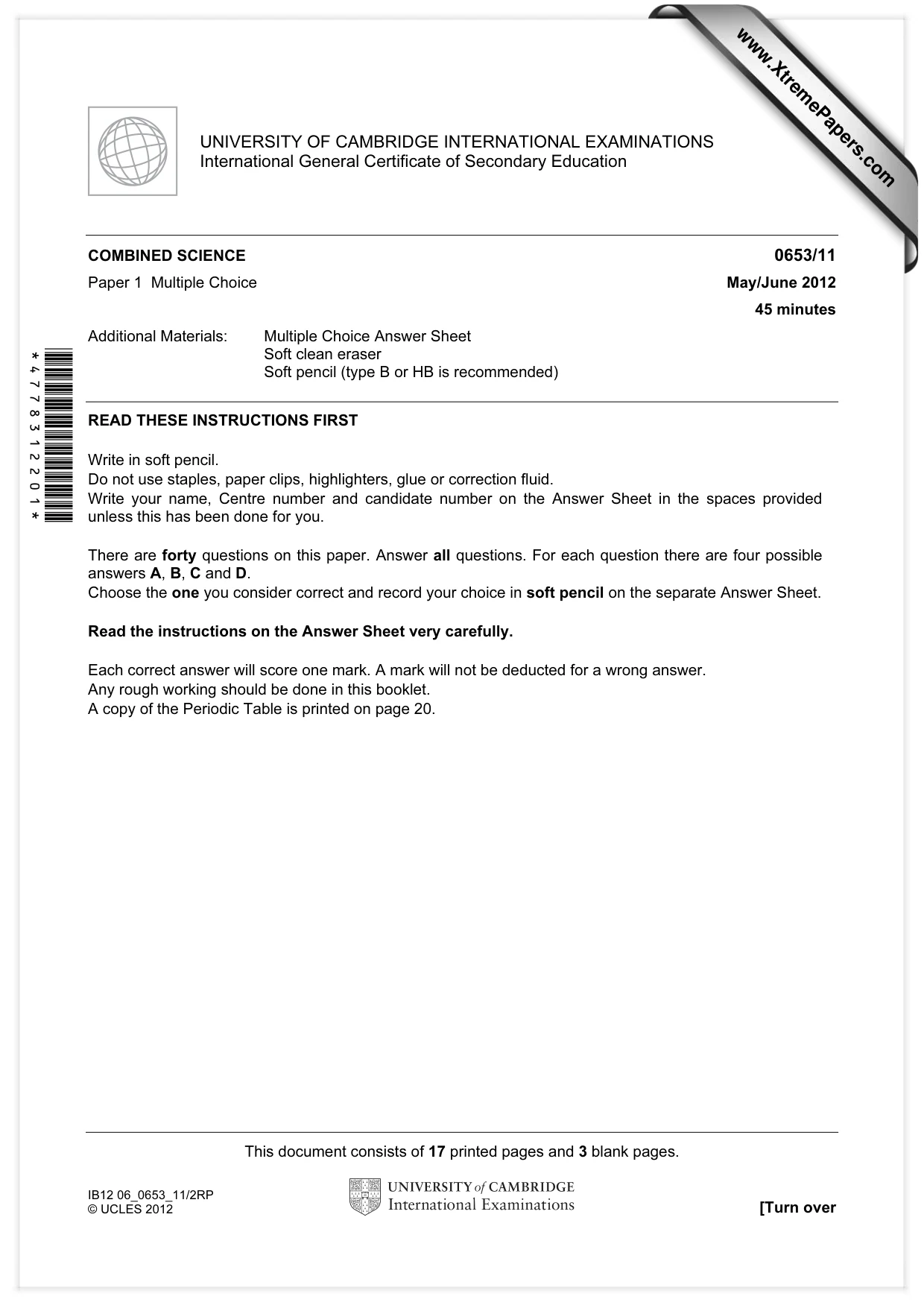
1 The diagram shows a cell from the mesophyll of a leaf. Which part contains DNA? A B C D
Q2 · The diagram shows two cells in contact with one another, and the concentrations of…
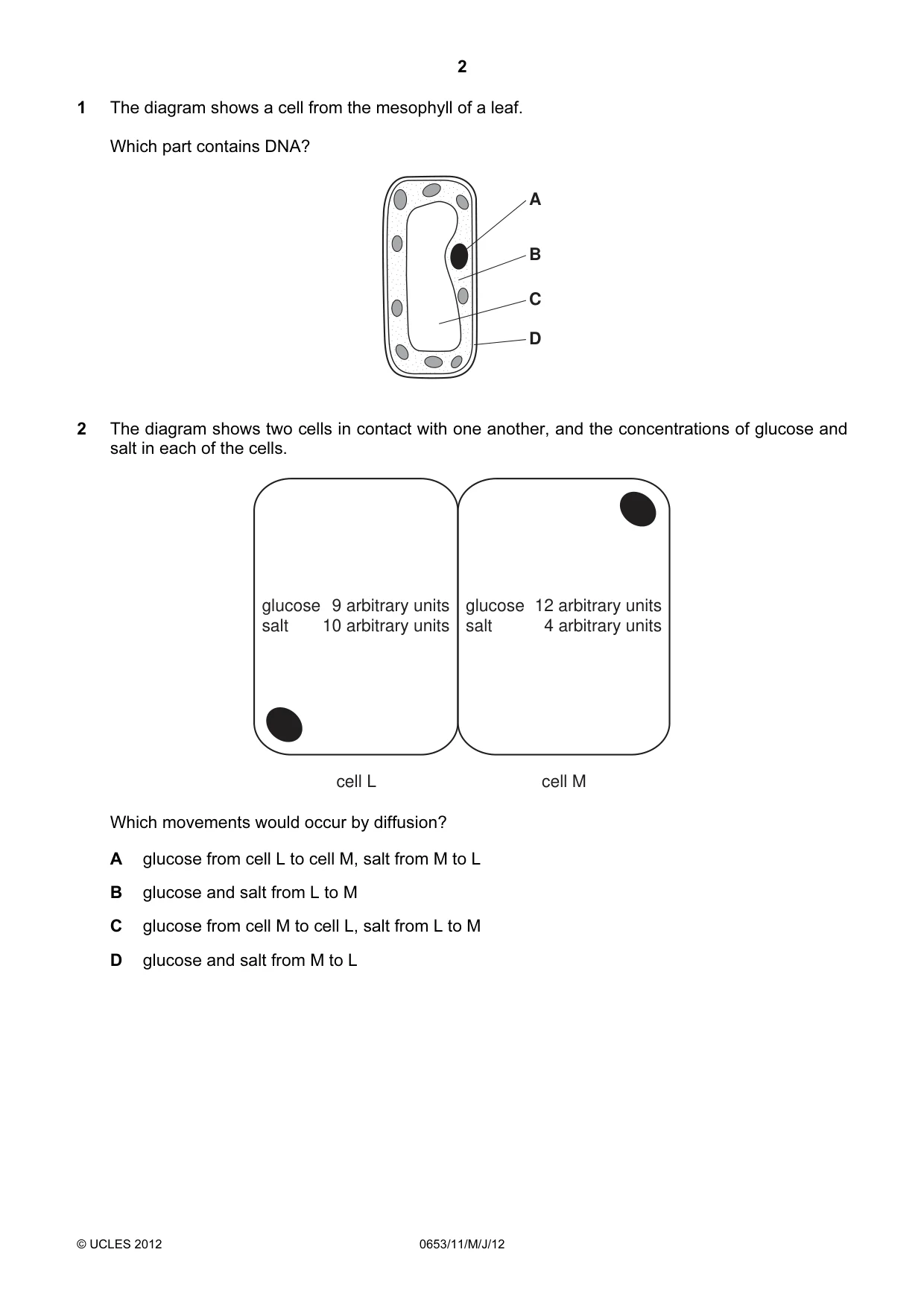
2 The diagram shows two cells in contact with one another, and the concentrations of glucose and salt in each of the cells. glucose 9 arbitrary units glucose 12 arbitrary units salt 10 arbitrary units salt 4 arbitrary units cell L cell M Which movements would occur by diffusion? A glucose from cell L to cell M, salt from M to L B glucose and salt from L to M C glucose from cell M to cell L, salt from L to M D glucose and salt from M to L
Q3 · The statements are about enzymes
3 The statements are about enzymes. 1 act as catalysts 2 can be denatured by heat 3 composed of complex carbohydrates 4 not affected by pH 5 produced by cells Which statements are correct? A 1, 2 and 5 B 1, 4 and 5 C 2, 3 and 4 D 3 and 5 only
Q4 · The diagram shows some cells in a leaf of a green plant
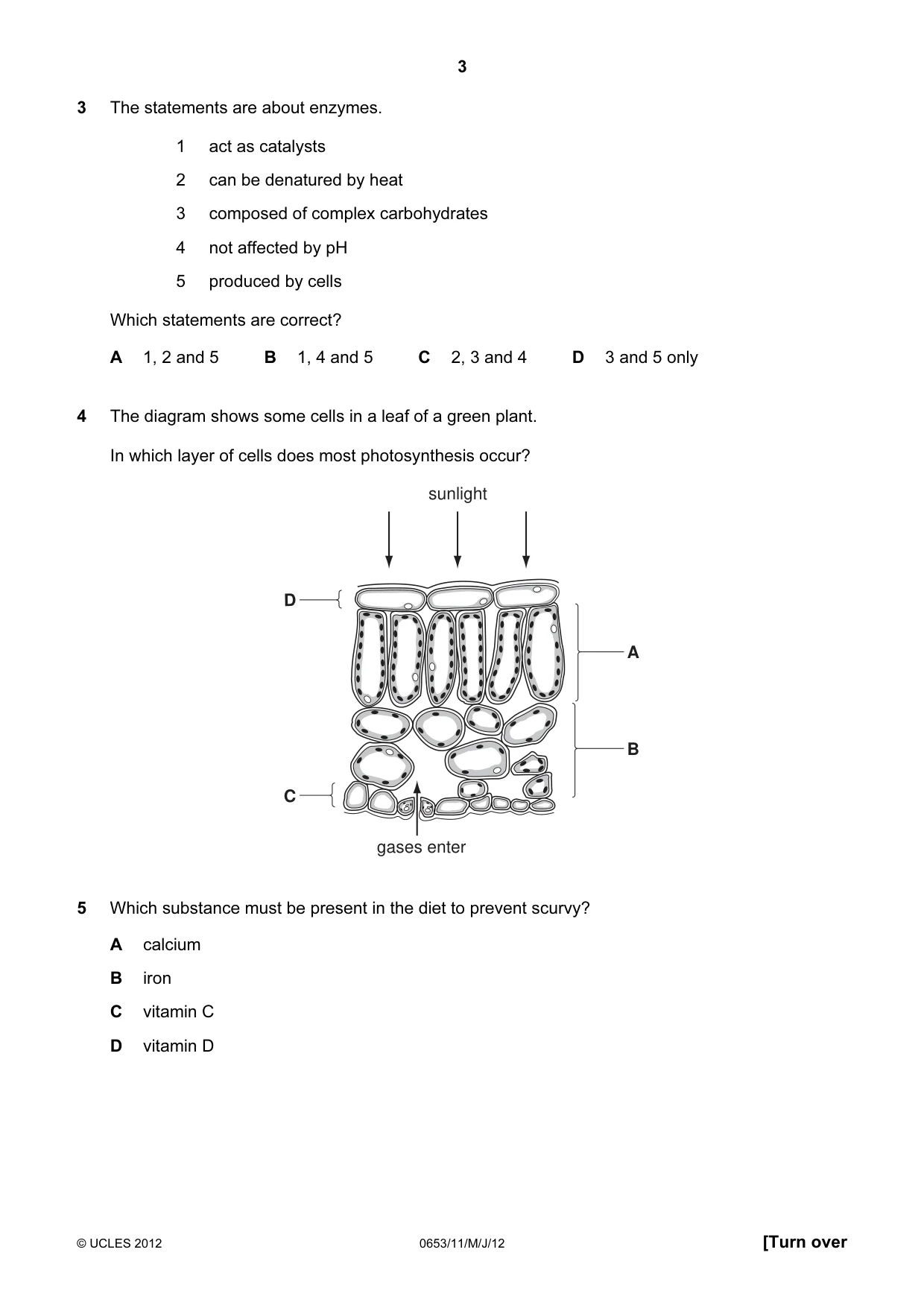
4 The diagram shows some cells in a leaf of a green plant. In which layer of cells does most photosynthesis occur? sunlight D A B C gases enter
Q5 · Which substance must be present in the diet to prevent scurvy?
5 Which substance must be present in the diet to prevent scurvy? A calcium B iron C vitamin C D vitamin D
Q6 · Which process in the human body does not depend on energy from respiration?
6 Which process in the human body does not depend on energy from respiration? A cell division B diffusion C muscle contraction D passage of a nerve impulse
Q7 · Through which vessel does oxygenated blood enter the heart?
7 Through which vessel does oxygenated blood enter the heart? A aorta B pulmonary artery C pulmonary vein D vena cava
Q8 · The diagram shows a cross-section of a stem and a cross-section of a root
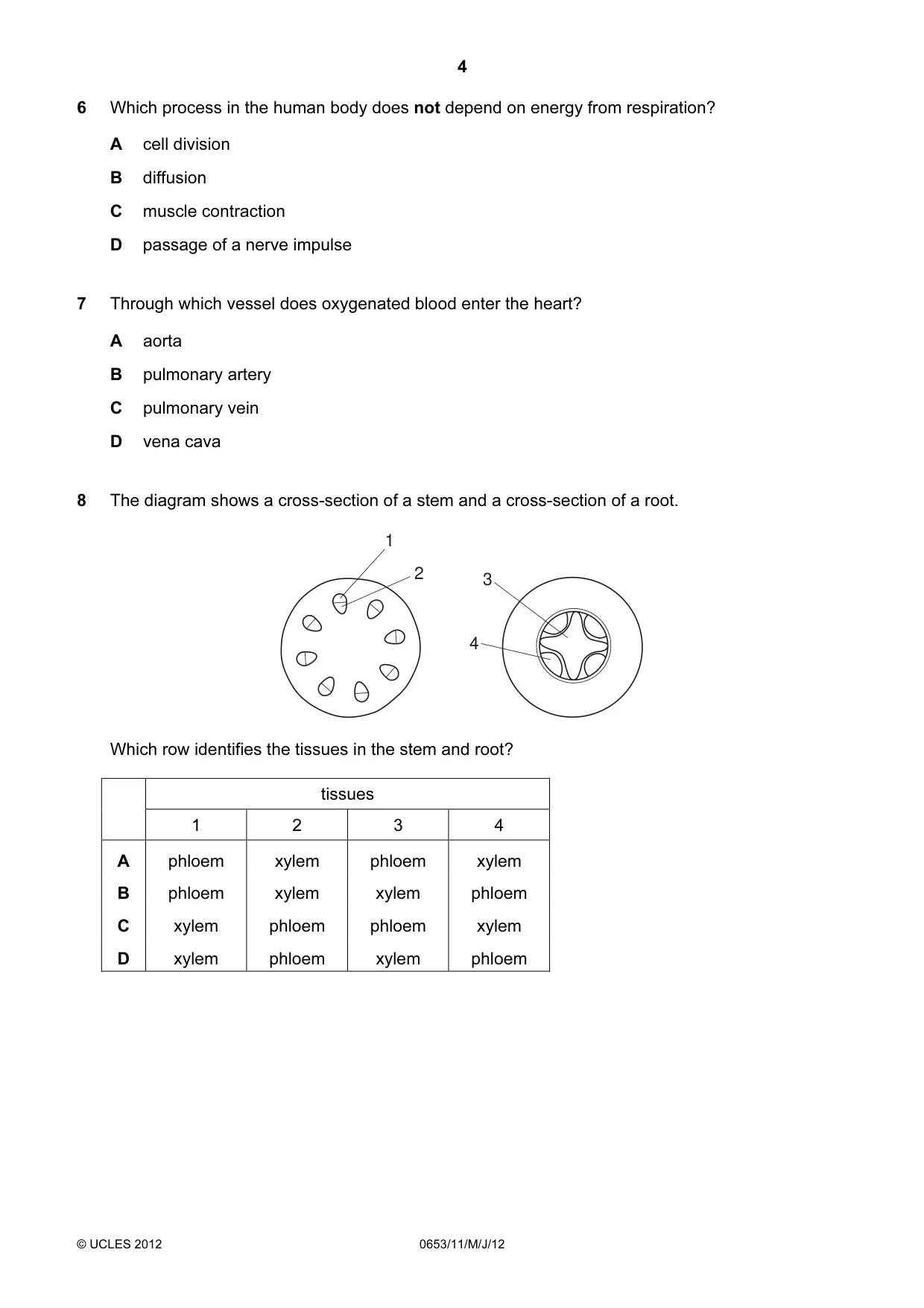
8 The diagram shows a cross-section of a stem and a cross-section of a root. 1 2 3 4 Which row identifies the tissues in the stem and root? tissues 1 2 3 4 A phloem xylem phloem xylem B phloem xylem xylem phloem C xylem phloem phloem xylem D xylem phloem xylem phloem
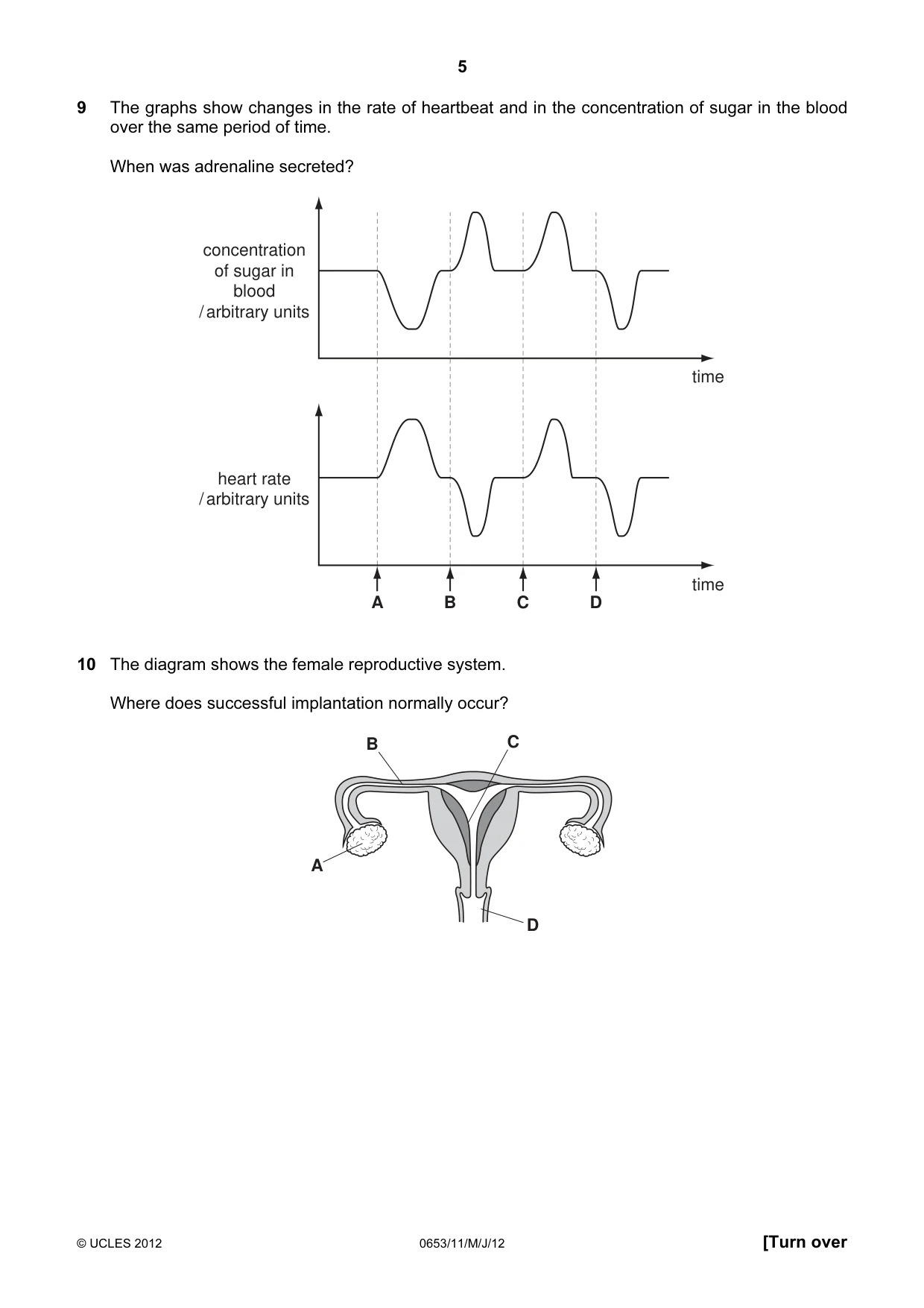
Q9 · The graphs show changes in the rate of heartbeat and in the concentration of sugar in the…
9 The graphs show changes in the rate of heartbeat and in the concentration of sugar in the blood over the same period of time. When was adrenaline secreted? concentration of sugar in blood / arbitrary units time heart rate / arbitrary units time A B C D
Q10 · The diagram shows the female reproductive system
10 The diagram shows the female reproductive system. Where does successful implantation normally occur? B C A D
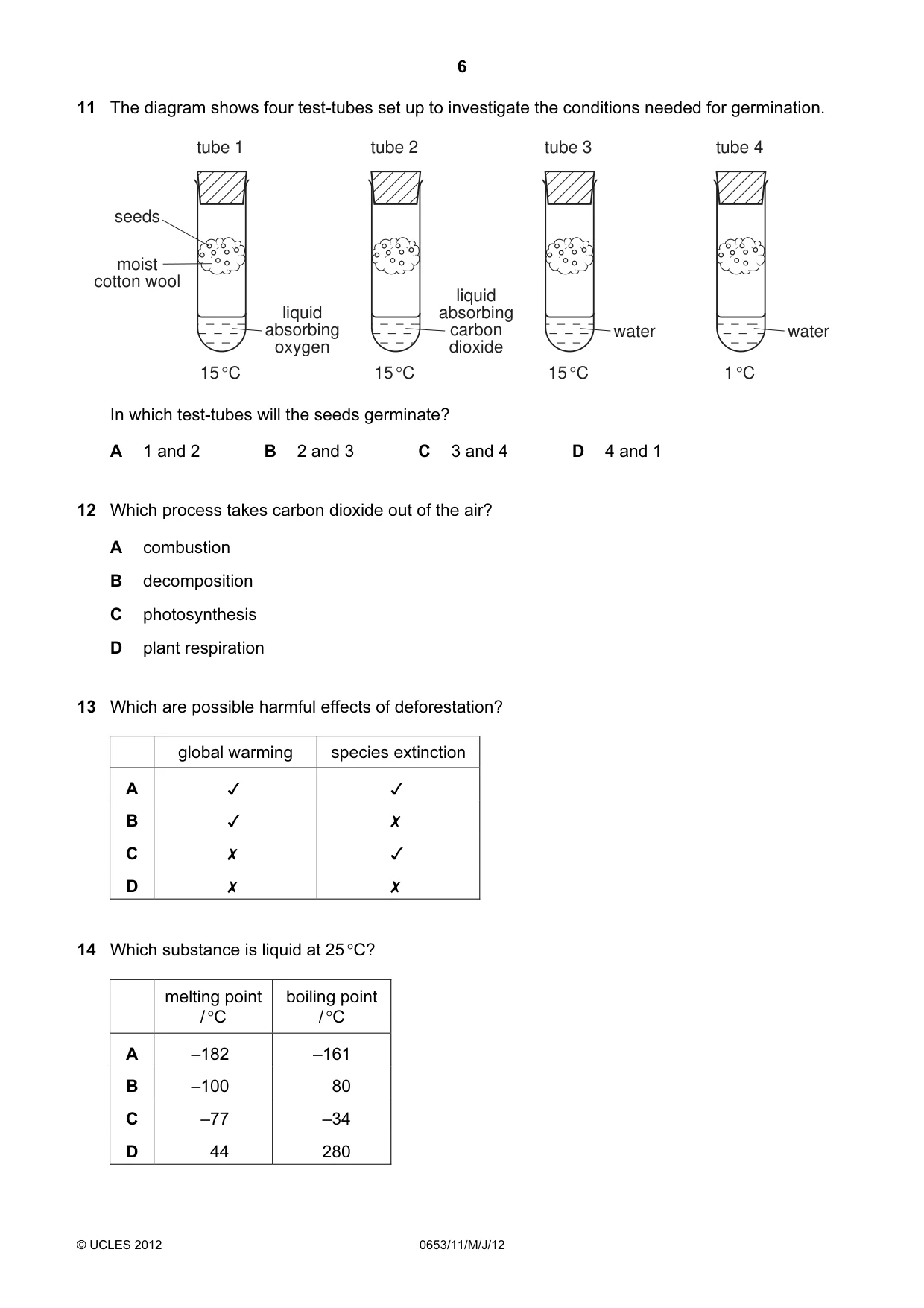
Q11 · The diagram shows four test-tubes set up to investigate the conditions needed for…
11 The diagram shows four test-tubes set up to investigate the conditions needed for germination. tube 1 tube 2 tube 3 tube 4 seeds moist cotton wool liquid liquid absorbing absorbing carbon water water oxygen dioxide 15 °C 15 °C 15 °C 1 °C In which test-tubes will the seeds germinate? A 1 and 2 B 2 and 3 C 3 and 4 D 4 and 1
Q12 · Which process takes carbon dioxide out of the air?
12 Which process takes carbon dioxide out of the air? A combustion B decomposition C photosynthesis D plant respiration
Q13 · Which are possible harmful effects of deforestation?
13 Which are possible harmful effects of deforestation? global warming species extinction A v v B v x Cc x v D x x
Q14 · Which substance is liquid at 25 °C?
14 Which substance is liquid at 25 °C? melting point boiling point / °C / °C A –182 –161 B –100 80 C –77 –34 D 44 280
Q15 · Two oxides have the formulae CaO and NO
15 Two oxides have the formulae CaO and NO. Which statement about the bonding in these oxides is correct? A Both CaO and NO are covalent. B Both CaO and NO are ionic. C CaO is covalent and NO is ionic. D CaO is ionic and NO is covalent.
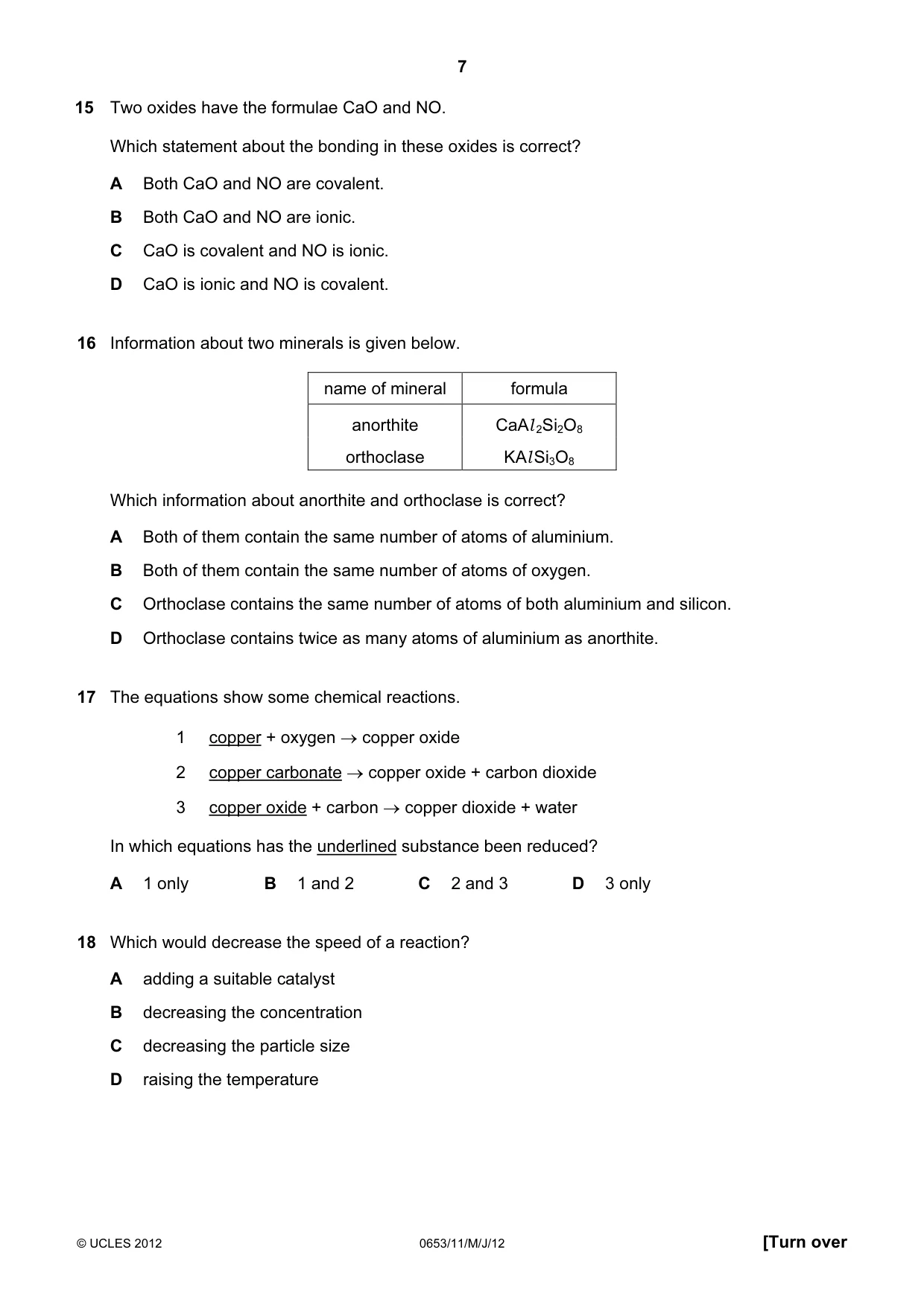
Q16 · Information about two minerals is given below
16 Information about two minerals is given below. name of mineral formula anorthite CaAl 2Si2O8 orthoclase KAl Si3O8 Which information about anorthite and orthoclase is correct? A Both of them contain the same number of atoms of aluminium. B Both of them contain the same number of atoms of oxygen. C Orthoclase contains the same number of atoms of both aluminium and silicon. D Orthoclase contains twice as many atoms of aluminium as anorthite.
Q17 · The equations show some chemical reactions
17 The equations show some chemical reactions. 1 copper + oxygen → copper oxide 2 copper carbonate → copper oxide + carbon dioxide 3 copper oxide + carbon → copper dioxide + water In which equations has the underlined substance been reduced? A 1 only B 1 and 2 C 2 and 3 D 3 only
Q18 · Which would decrease the speed of a reaction?
18 Which would decrease the speed of a reaction? A adding a suitable catalyst B decreasing the concentration C decreasing the particle size D raising the temperature
Q19 · Four pairs of oxides are listed
19 Four pairs of oxides are listed. W calcium oxide and sodium oxide X calcium oxide and sulfur dioxide Y nitrogen dioxide and sodium oxide Z sulfur dioxide and nitrogen dioxide Which pairs of oxides would neutralise each other? A pair W and pair X B pair W and pair Z C pair X and pair Y D pair Y and pair Z
More questions on The characteristic properties of acids and bases
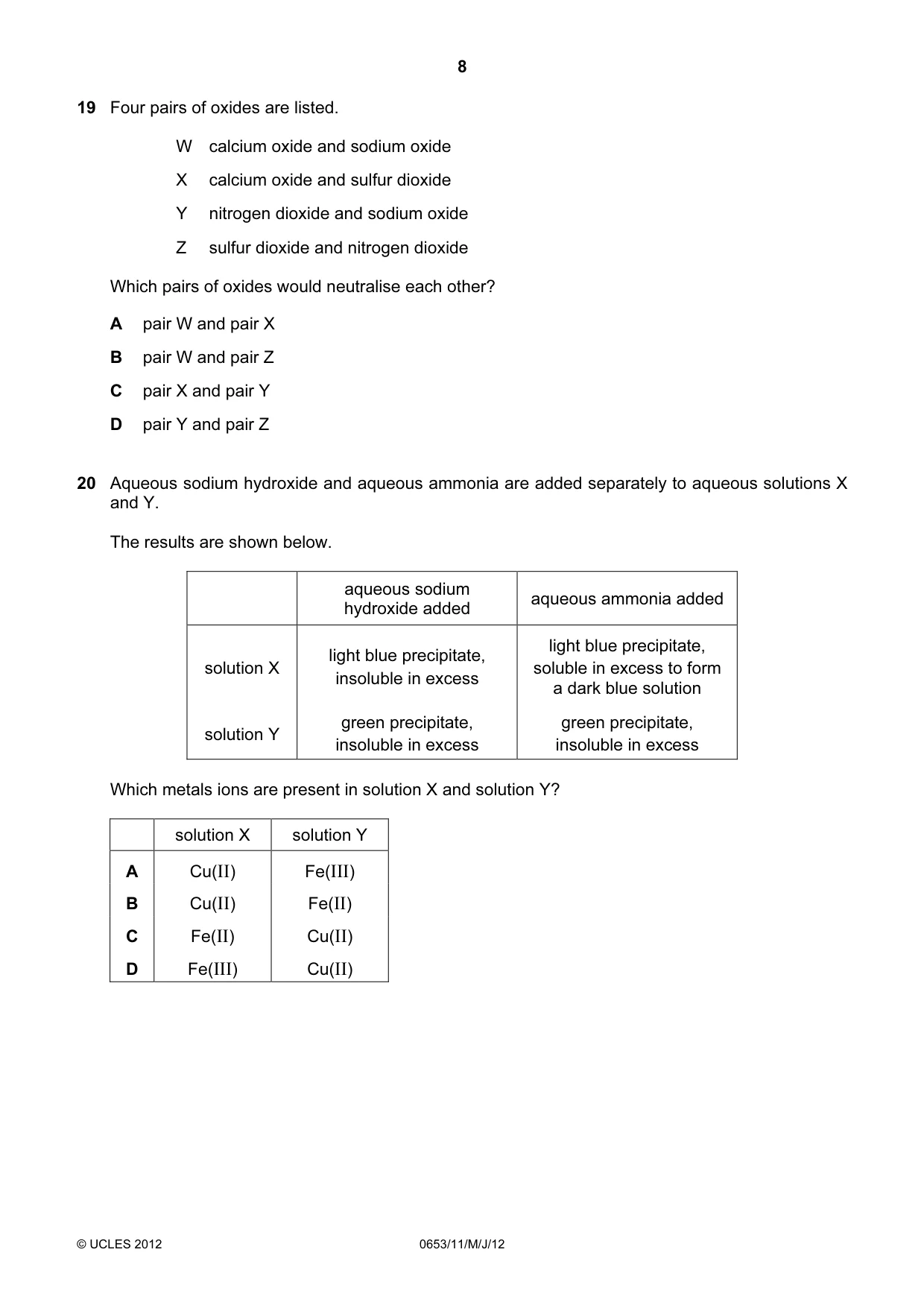
Q20 · Aqueous sodium hydroxide and aqueous ammonia are added separately to aqueous solutions X…
20 Aqueous sodium hydroxide and aqueous ammonia are added separately to aqueous solutions X and Y. The results are shown below. aqueous sodium aqueous ammonia added hydroxide added light blue precipitate, light blue precipitate, solution X soluble in excess to form insoluble in excess a dark blue solution green precipitate, green precipitate, solution Y insoluble in excess insoluble in excess Which metals ions are present in solution X and solution Y? solution X solution Y A Cu(II) Fe(III) B Cu(II) Fe(II) C Fe(II) Cu(II) D Fe(III) Cu(II)
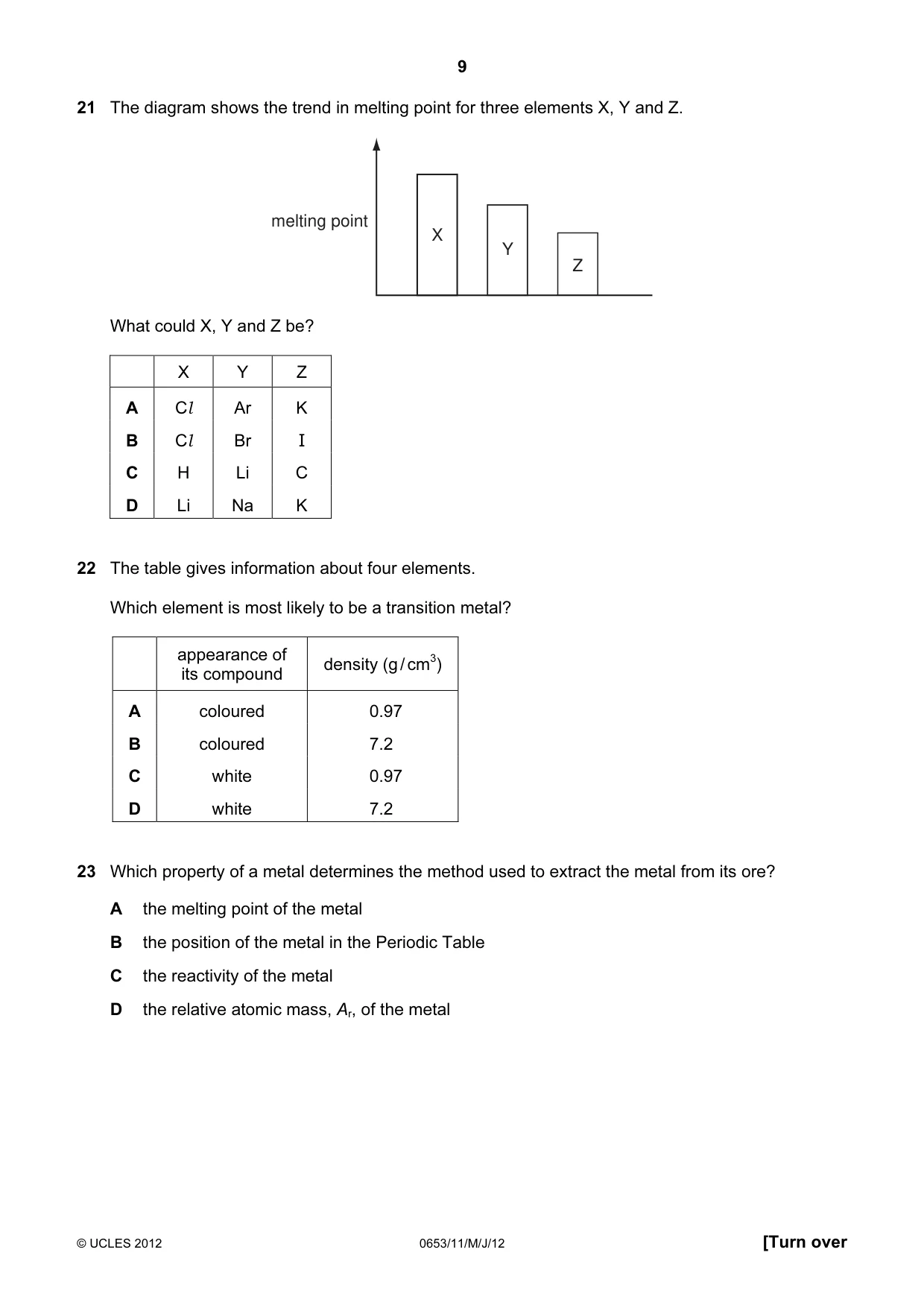
Q21 · The diagram shows the trend in melting point for three elements X, Y and Z
21 The diagram shows the trend in melting point for three elements X, Y and Z. melting point X Y Z What could X, Y and Z be? X Y Z A Cl Ar K B Cl Br I C H Li C D Li Na K
Q22 · The table gives information about four elements
22 The table gives information about four elements. Which element is most likely to be a transition metal? appearance of density (g / cm3) its compound A coloured 0.97 B coloured 7.2 C white 0.97 D white 7.2
Q23 · Which property of a metal determines the method used to extract the metal from its ore?
23 Which property of a metal determines the method used to extract the metal from its ore? A the melting point of the metal B the position of the metal in the Periodic Table C the reactivity of the metal D the relative atomic mass, Ar, of the metal
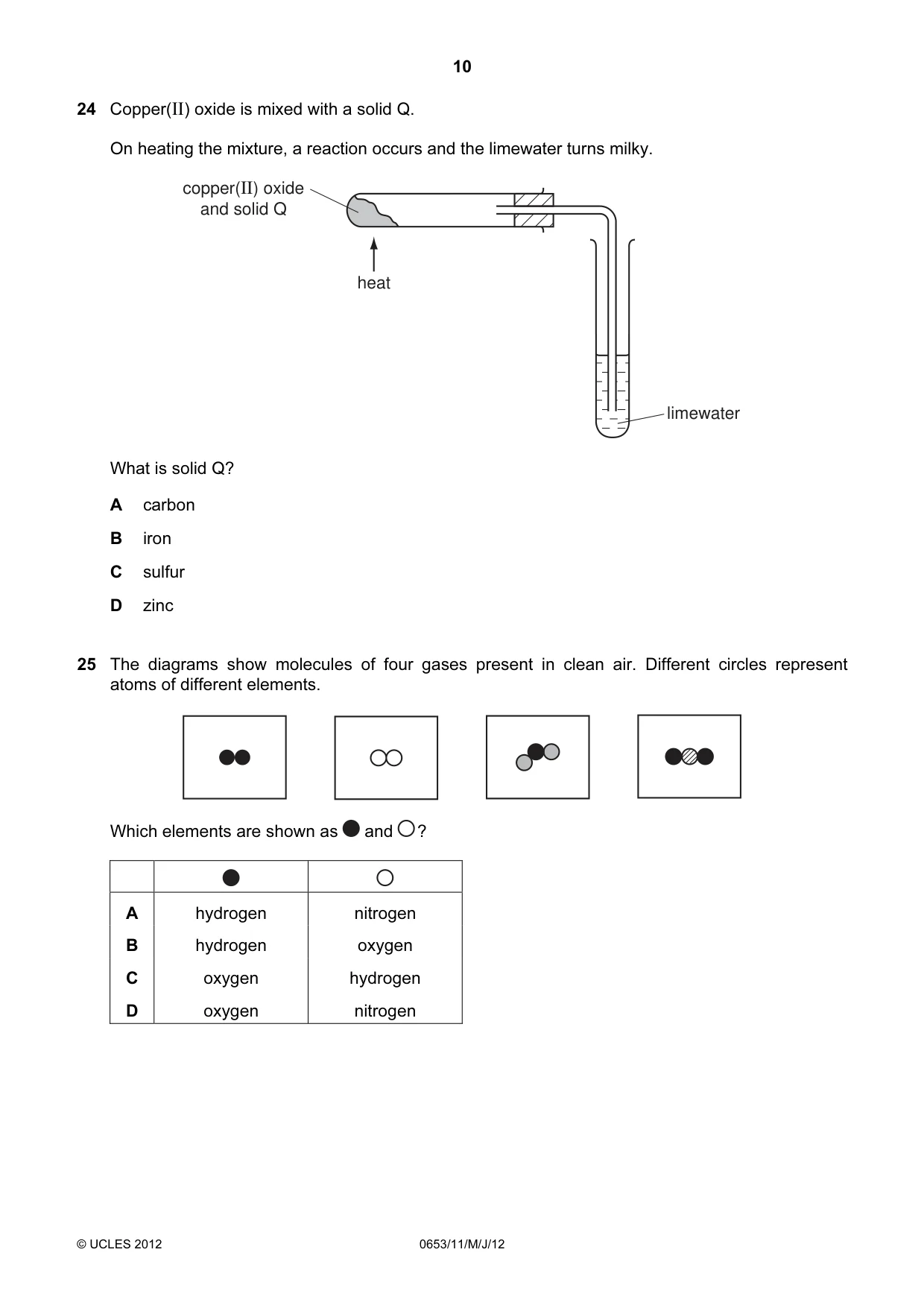
Q24 · Copper(II) oxide is mixed with a solid Q
24 Copper(II) oxide is mixed with a solid Q. On heating the mixture, a reaction occurs and the limewater turns milky. copper(II) oxide and solid Q heat limewater What is solid Q? A carbon B iron C sulfur D zinc
Q25 · The diagrams show molecules of four gases present in clean air
25 The diagrams show molecules of four gases present in clean air. Different circles represent atoms of different elements. Which elements are shown as and ? A hydrogen nitrogen B hydrogen oxygen C oxygen hydrogen D oxygen nitrogen
Q26 · Which property of the compounds in petroleum is used to separate it into useful fractions?
26 Which property of the compounds in petroleum is used to separate it into useful fractions? A boiling point B density C melting point D solubility
Q27 · Which equation shows the complete combustion of a hydrocarbon?
27 Which equation shows the complete combustion of a hydrocarbon? A C2H4 + 2O2 → 2CO + 2H2O B C2H4 + 3O2 → 2CO2 + 2H2O C C2H6O + 2O2 → 2CO + 3H2O D C2H6O + 3O2 → 2CO2 + 3H2O
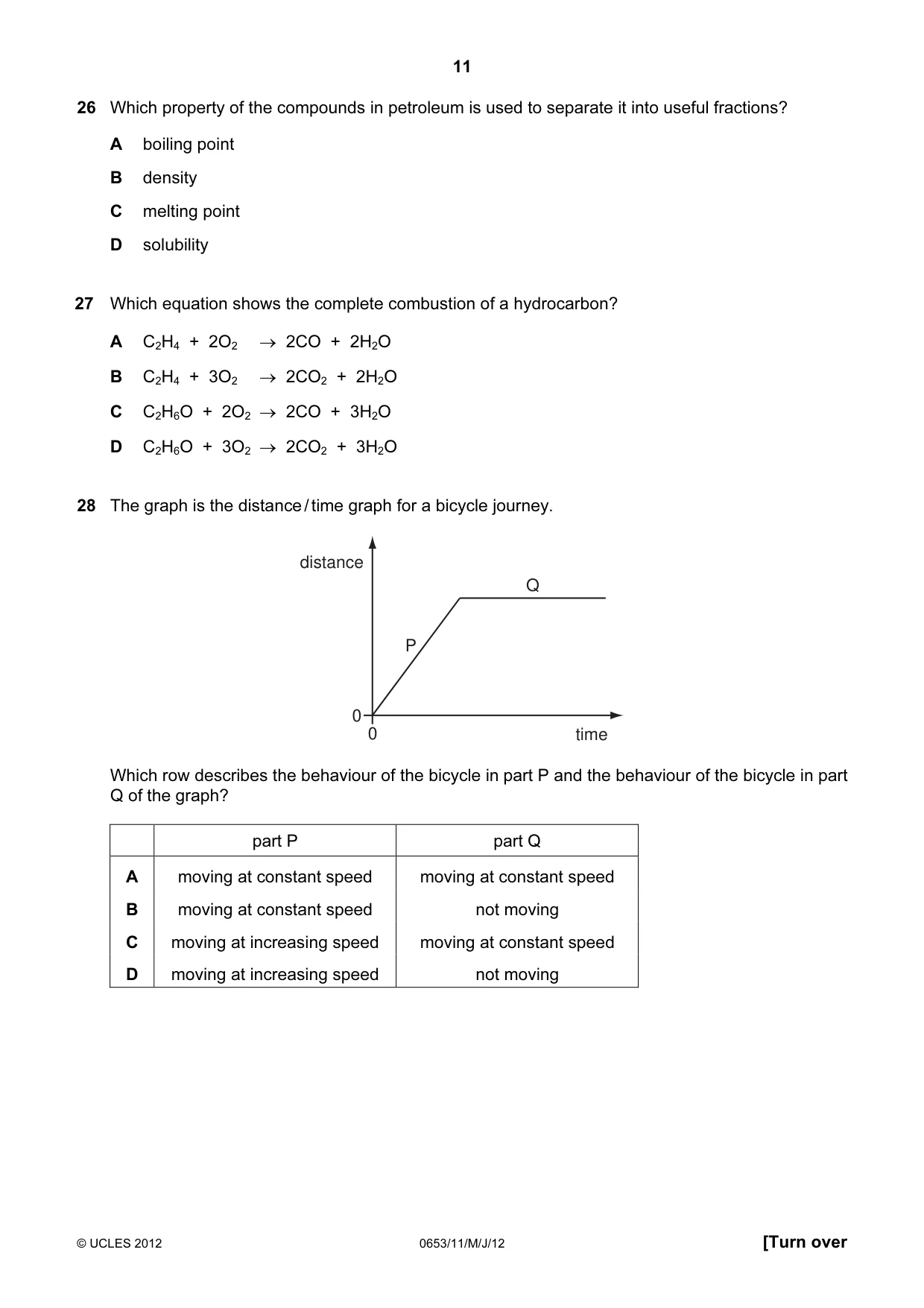
Q28 · The graph is the distance / time graph for a bicycle journey
28 The graph is the distance / time graph for a bicycle journey. distance Q P 0 0 time Which row describes the behaviour of the bicycle in part P and the behaviour of the bicycle in part Q of the graph? part P part Q A moving at constant speed moving at constant speed B moving at constant speed not moving C moving at increasing speed moving at constant speed D moving at increasing speed not moving
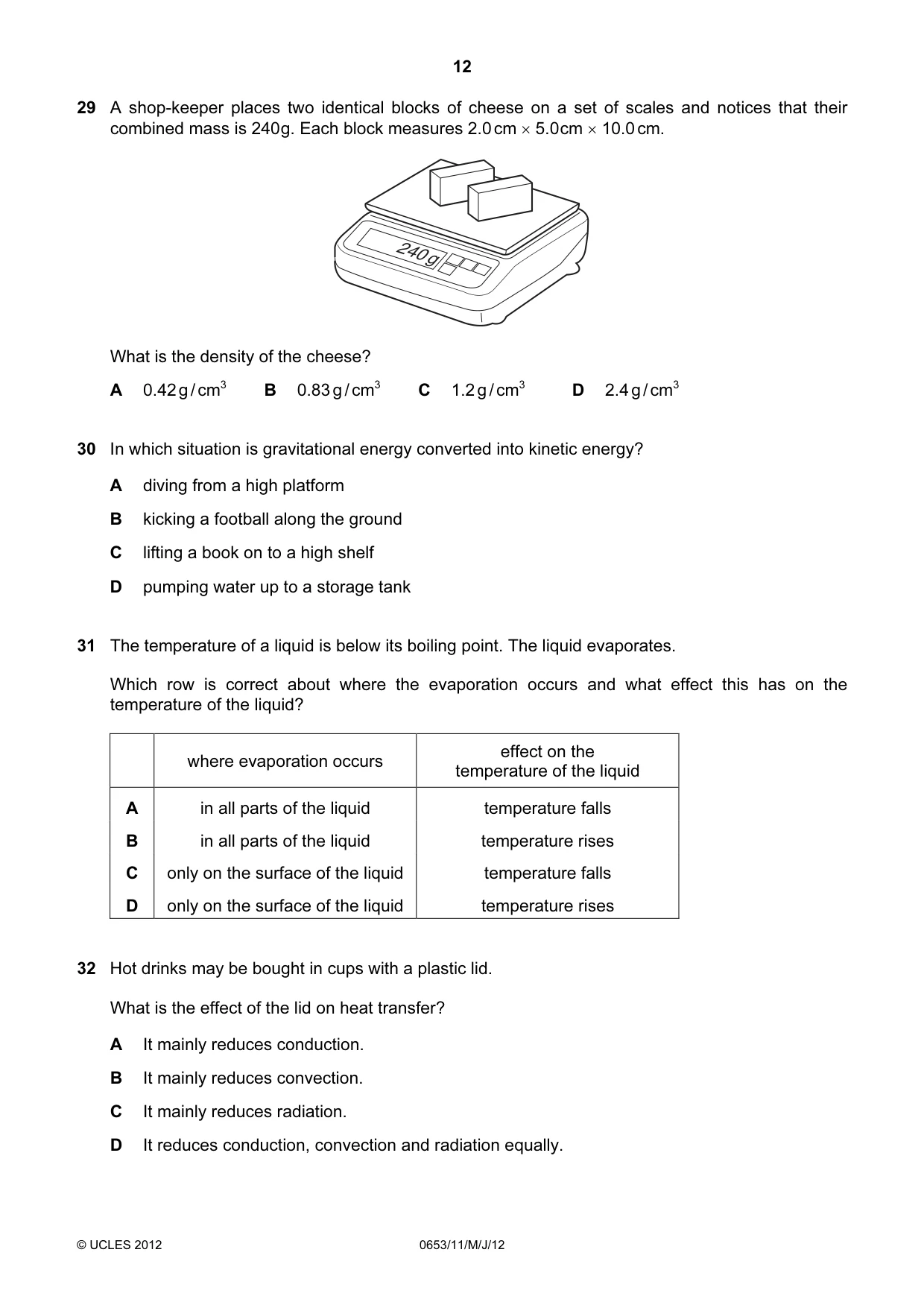
Q29 · A shop-keeper places two identical blocks of cheese on a set of scales and notices that…
29 A shop-keeper places two identical blocks of cheese on a set of scales and notices that their combined mass is 240 g. Each block measures 2.0 cm × 5.0 cm × 10.0 cm. 240 g What is the density of the cheese? A 0.42 g / cm3 B 0.83 g / cm3 C 1.2 g / cm3 D 2.4 g / cm3
Q30 · In which situation is gravitational energy converted into kinetic energy?
30 In which situation is gravitational energy converted into kinetic energy? A diving from a high platform B kicking a football along the ground C lifting a book on to a high shelf D pumping water up to a storage tank
Q31 · The temperature of a liquid is below its boiling point
31 The temperature of a liquid is below its boiling point. The liquid evaporates. Which row is correct about where the evaporation occurs and what effect this has on the temperature of the liquid? effect on the where evaporation occurs temperature of the liquid A in all parts of the liquid temperature falls B in all parts of the liquid temperature rises C only on the surface of the liquid temperature falls D only on the surface of the liquid temperature rises
Q32 · Hot drinks may be bought in cups with a plastic lid
32 Hot drinks may be bought in cups with a plastic lid. What is the effect of the lid on heat transfer? A It mainly reduces conduction. B It mainly reduces convection. C It mainly reduces radiation. D It reduces conduction, convection and radiation equally.
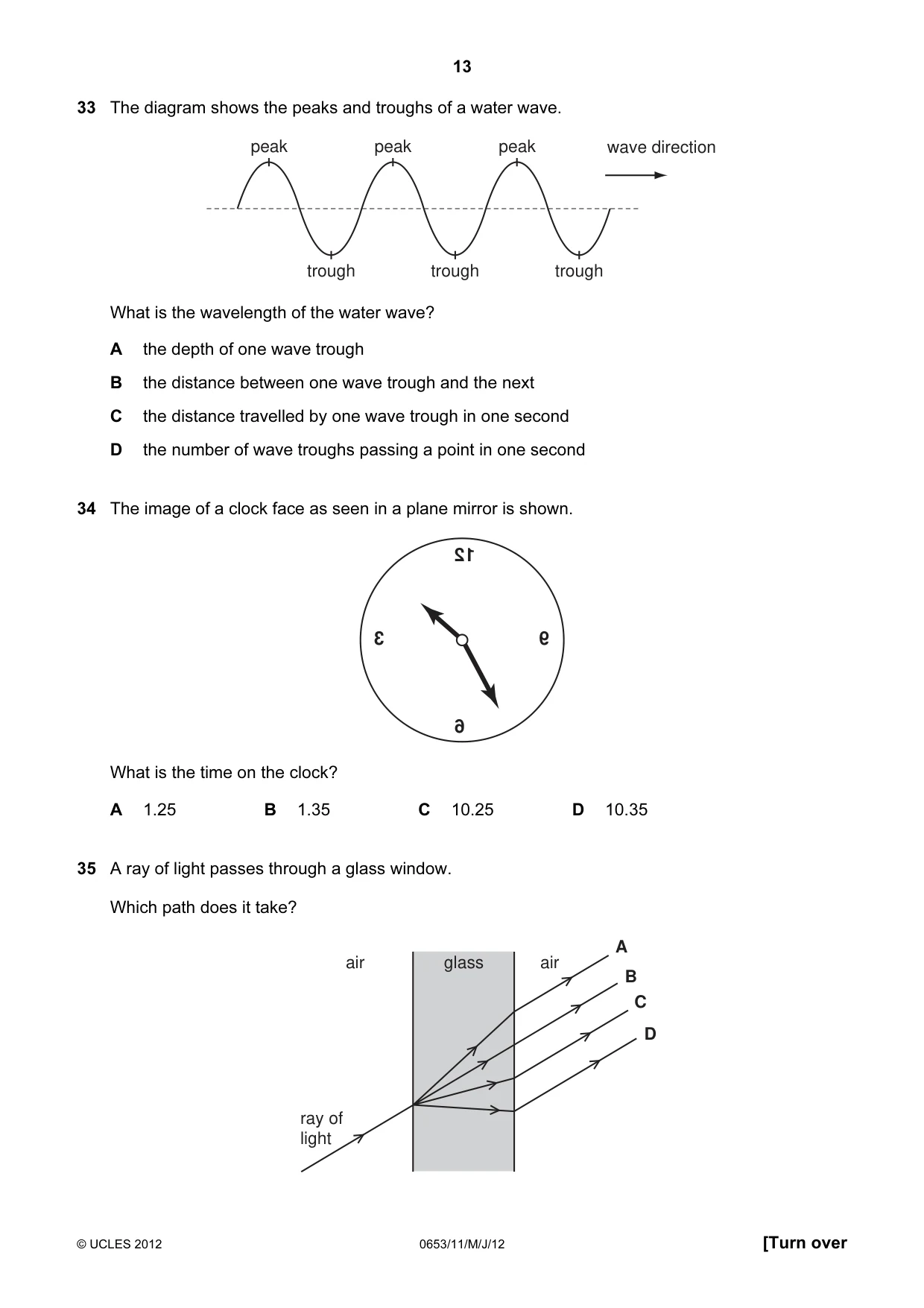
Q33 · The diagram shows the peaks and troughs of a water wave
33 The diagram shows the peaks and troughs of a water wave. peak peak peak wave direction trough trough trough What is the wavelength of the water wave? A the depth of one wave trough B the distance between one wave trough and the next C the distance travelled by one wave trough in one second D the number of wave troughs passing a point in one second
Q34 · The image of a clock face as seen in a plane mirror is shown
34 The image of a clock face as seen in a plane mirror is shown. 12 3 9 6 What is the time on the clock? A 1.25 B 1.35 C 10.25 D 10.35
Q35 · A ray of light passes through a glass window
35 A ray of light passes through a glass window. Which path does it take? A air glass air B C D ray of light
Q36 · Which statement about the electromagnetic spectrum is correct?
36 Which statement about the electromagnetic spectrum is correct? A Gamma rays have the highest frequency. B Microwaves have the smallest wavelength. C Ultraviolet waves have the largest wavelength. D Visible light waves have the lowest frequency.
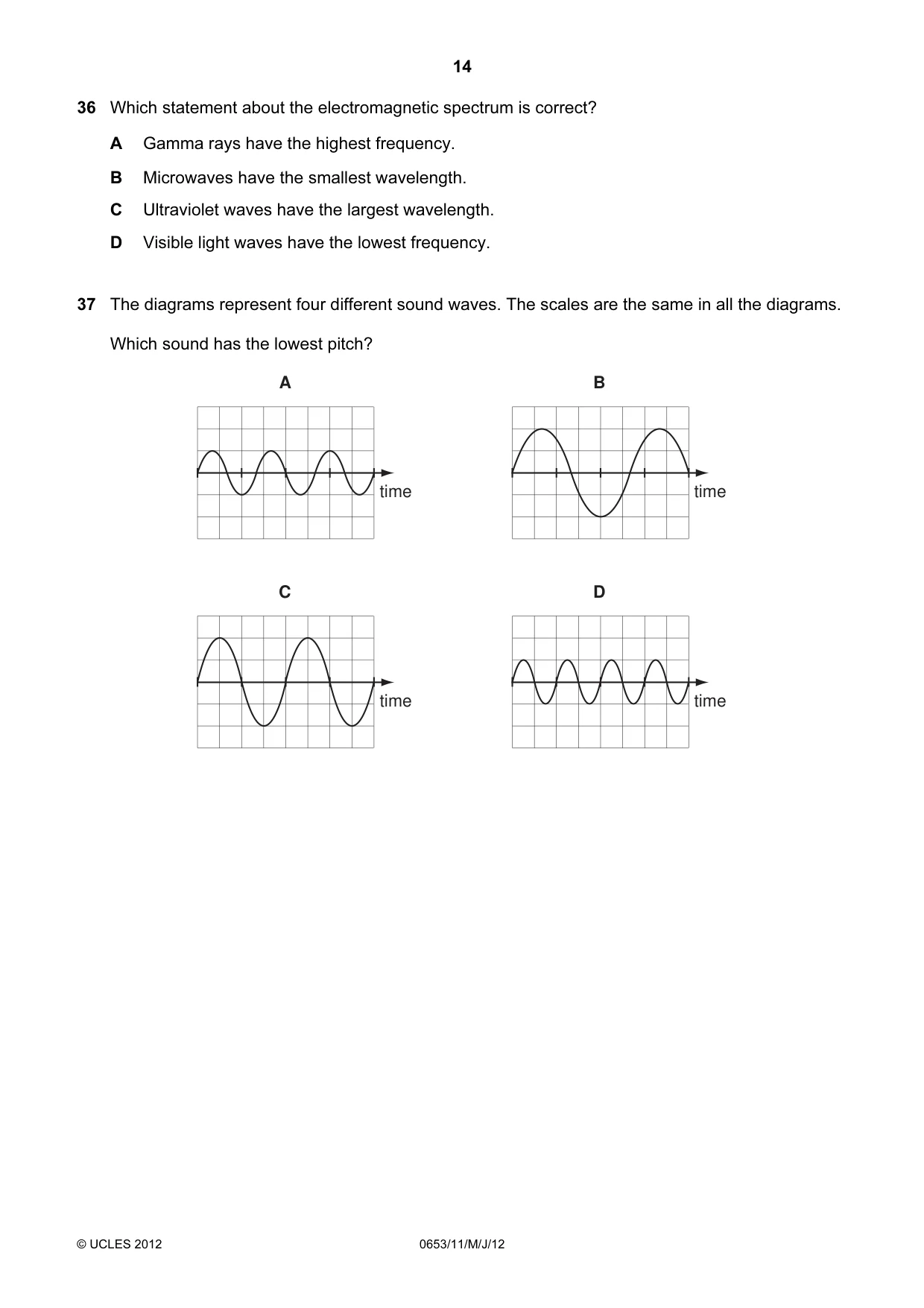
Q37 · The diagrams represent four different sound waves
37 The diagrams represent four different sound waves. The scales are the same in all the diagrams. Which sound has the lowest pitch? A B time time C D time time
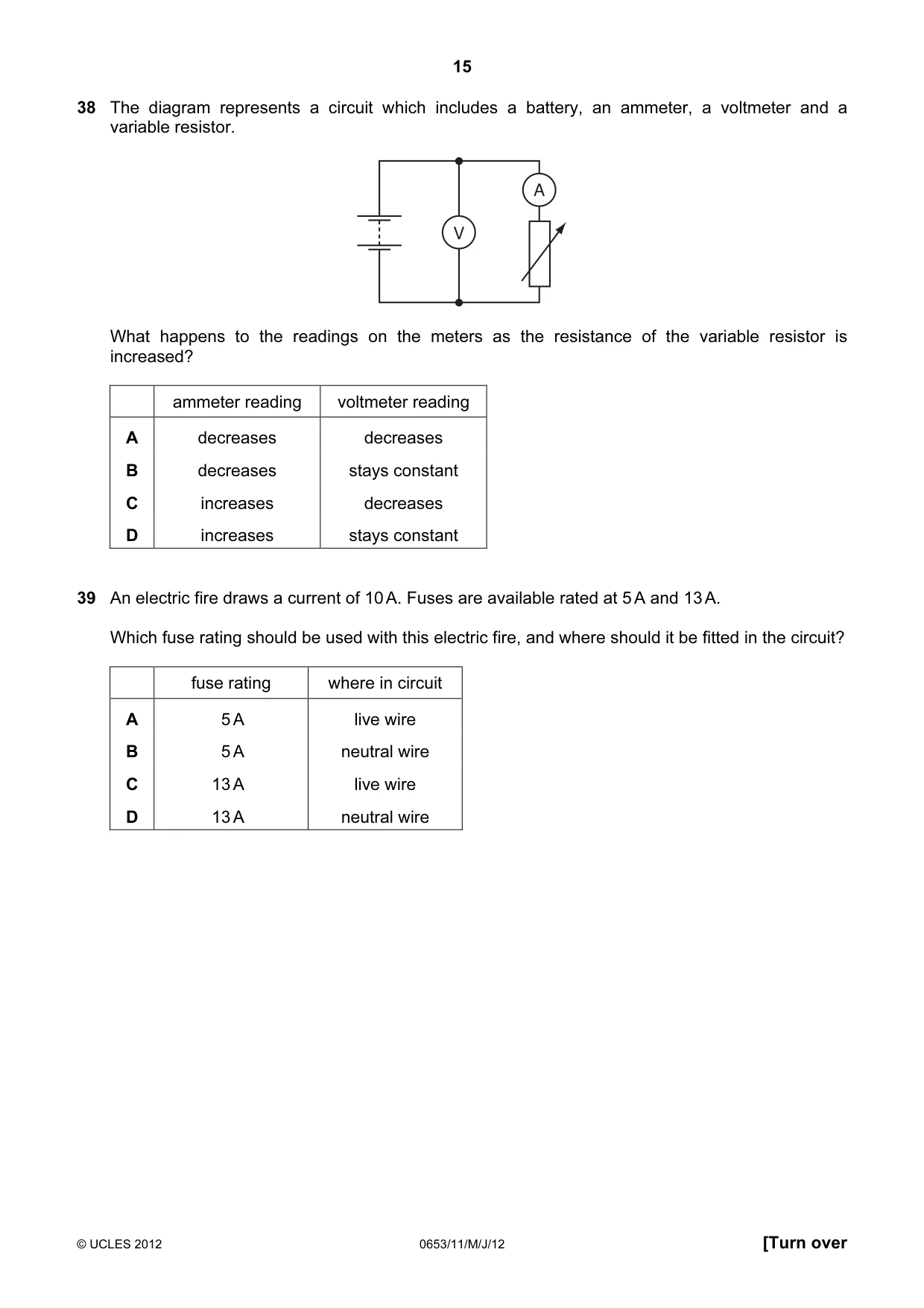
Q38 · The diagram represents a circuit which includes a battery, an ammeter, a voltmeter and a…
38 The diagram represents a circuit which includes a battery, an ammeter, a voltmeter and a variable resistor. A V What happens to the readings on the meters as the resistance of the variable resistor is increased? ammeter reading voltmeter reading A decreases decreases B decreases stays constant C increases decreases D increases stays constant
Q39 · An electric fire draws a current of 10 A
39 An electric fire draws a current of 10 A. Fuses are available rated at 5 A and 13 A. Which fuse rating should be used with this electric fire, and where should it be fitted in the circuit? fuse rating where in circuit A 5 A live wire B 5 A neutral wire C 13 A live wire D 13 A neutral wire
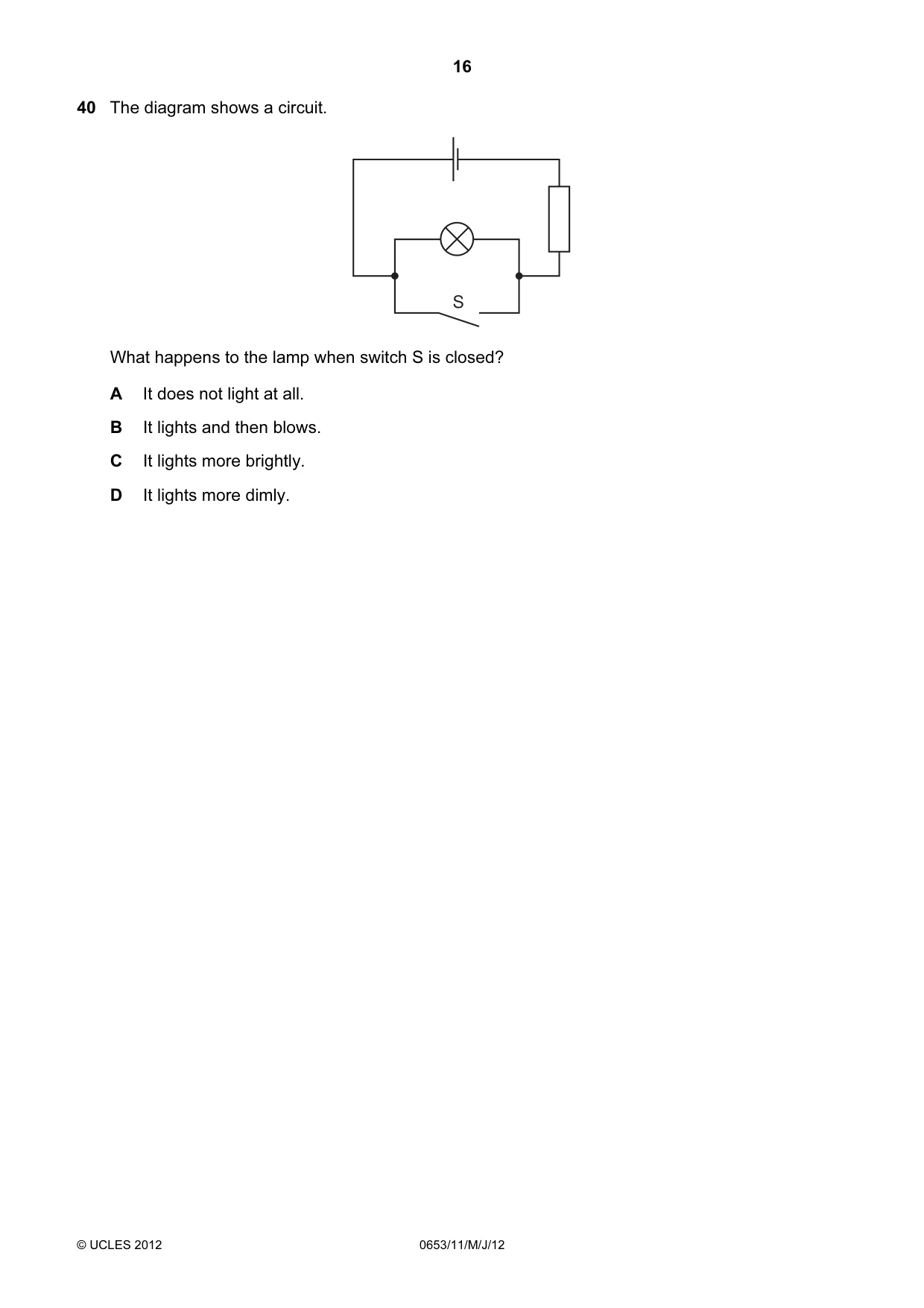
Q40 · The diagram shows a circuit
40 The diagram shows a circuit. S What happens to the lamp when switch S is closed? A It does not light at all. B It lights and then blows. C It lights more brightly. D It lights more dimly.
What was in this paper
The subtopics covered by these 40 questions, and how many questions each got. Open one in a new tab to see every Cambridge question on it.
2Identification of ions and gases2Light2Arrangement of elements1Carbon cycle1Cell structure1Characteristics of living organisms1Circulatory systems1Density1Diet1Diffusion1Drugs1Electrical safety1Electromagnetic spectrum1Elements, compounds and mixtures1Energy, work and power1Enzymes1Extraction of metals1Formulas1Fuels1General properties of waves1Habitat destruction1Ions and ionic bonds1Kinetic particle model of matter1Motion1Photosynthesis1Rate of reaction1Redox1Respiration1Separation and purification1Sexual reproduction in humans1Solids, liquids and gases1Sound1The characteristic properties of acids and bases1Transfer of thermal energy1Transition elements1Xylem and phloem1What you needed in this session
Cambridge’s own grade thresholds for 2012 May/June, Paper 1 · Variant 1. A higher threshold means an easier paper — the bar moves with how the cohort did.