Cambridge IGCSE Science - Combined 0653 — 2017 May/June Paper 1 · Variant 3
0653/13/M/J/17 · 40 questions · 40 marks · ≈45 min
The question paper and its mark scheme, free to read here and free to download. This is Cambridge’s own paper, exactly as it was sat.
Question paper20 pages


Mark scheme3 pages
Answers below. Sit the paper first if you are practising.
Questions as text
Q1 · A person moves their hand away from a hot object
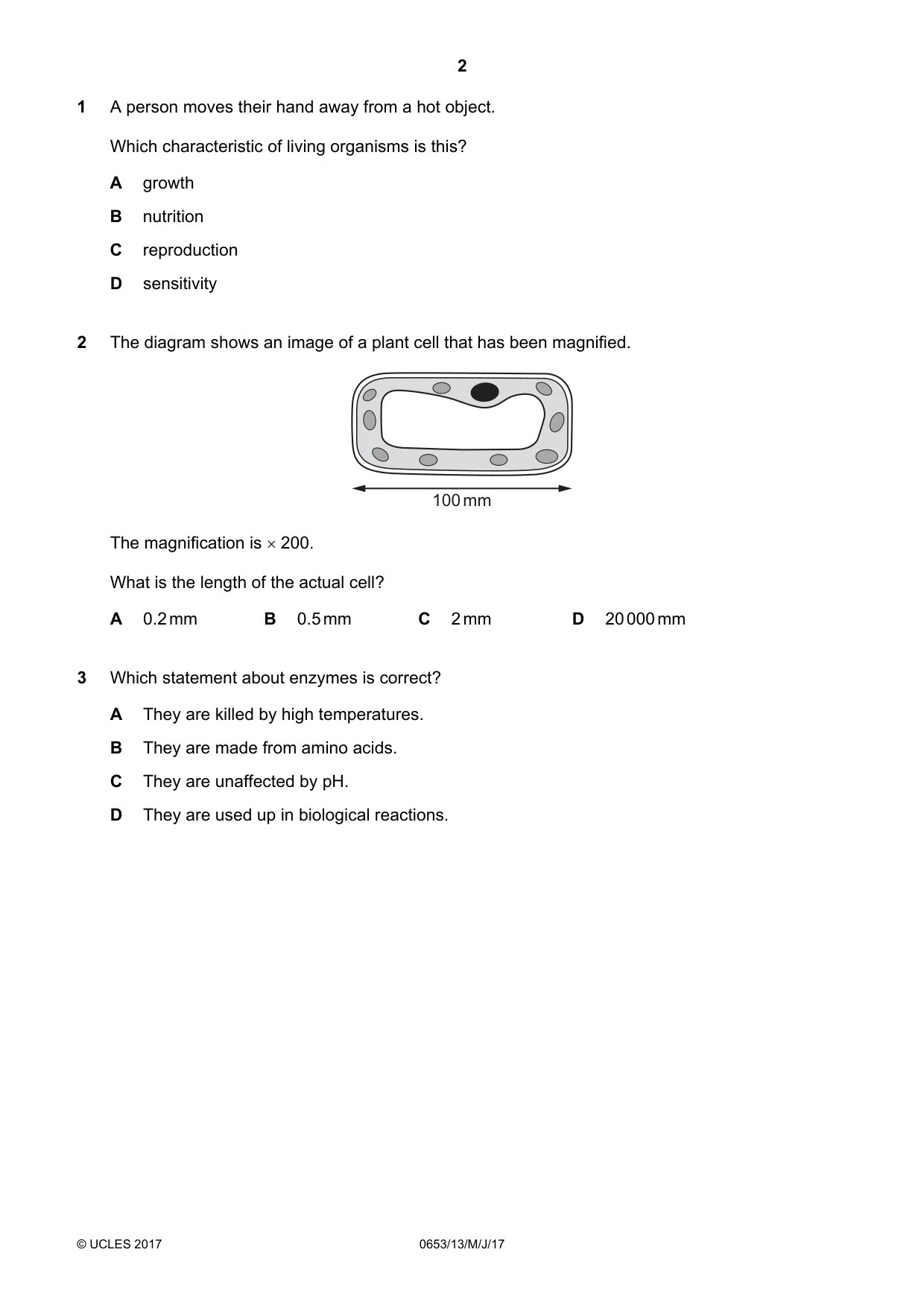
1 A person moves their hand away from a hot object. Which characteristic of living organisms is this? A growth B nutrition C reproduction D sensitivity
Mark scheme: D
Q2 · The diagram shows an image of a plant cell that has been magnified
2 The diagram shows an image of a plant cell that has been magnified. 100 mm The magnification is × 200. What is the length of the actual cell? A 0.2 mm B 0.5 mm C 2 mm D 20 000 mm
Mark scheme: B
Q3 · Which statement about enzymes is correct?
3 Which statement about enzymes is correct? A They are killed by high temperatures. B They are made from amino acids. C They are unaffected by pH. D They are used up in biological reactions.
Mark scheme: B
Q4 · An unknown liquid is divided into three test-tubes and tested as shown in the table
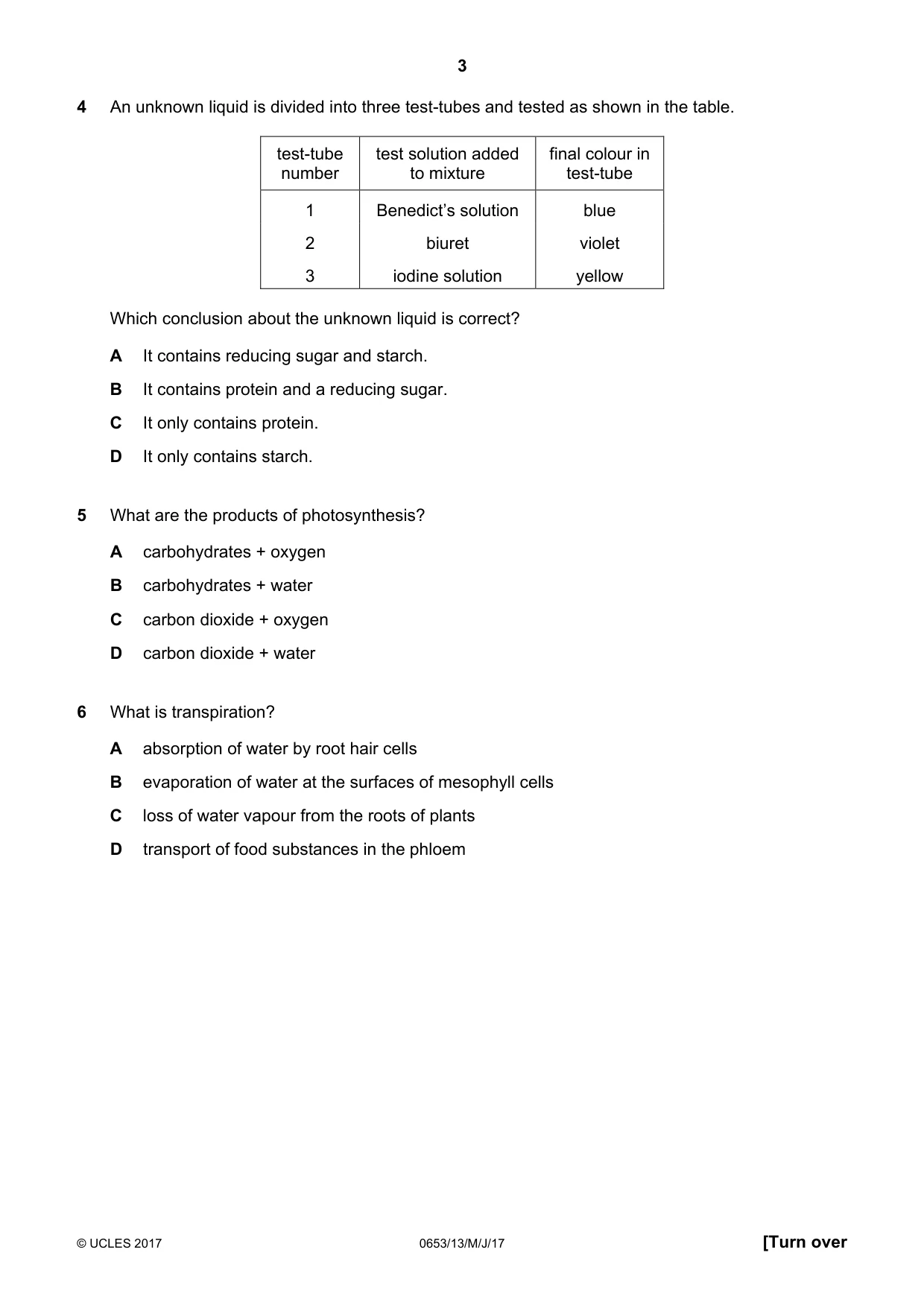
4 An unknown liquid is divided into three test-tubes and tested as shown in the table. test-tube test solution added final colour in number to mixture test-tube 1 Benedict’s solution blue 2 biuret violet 3 iodine solution yellow Which conclusion about the unknown liquid is correct? A It contains reducing sugar and starch. B It contains protein and a reducing sugar. C It only contains protein. D It only contains starch.
Mark scheme: C
Q5 · What are the products of photosynthesis?
5 What are the products of photosynthesis? A carbohydrates + oxygen B carbohydrates + water C carbon dioxide + oxygen D carbon dioxide + water
Mark scheme: A
Question 6
6 What is transpiration? A absorption of water by root hair cells B evaporation of water at the surfaces of mesophyll cells C loss of water vapour from the roots of plants D transport of food substances in the phloem
Mark scheme: B
Q7 · The diagram shows a section through the heart
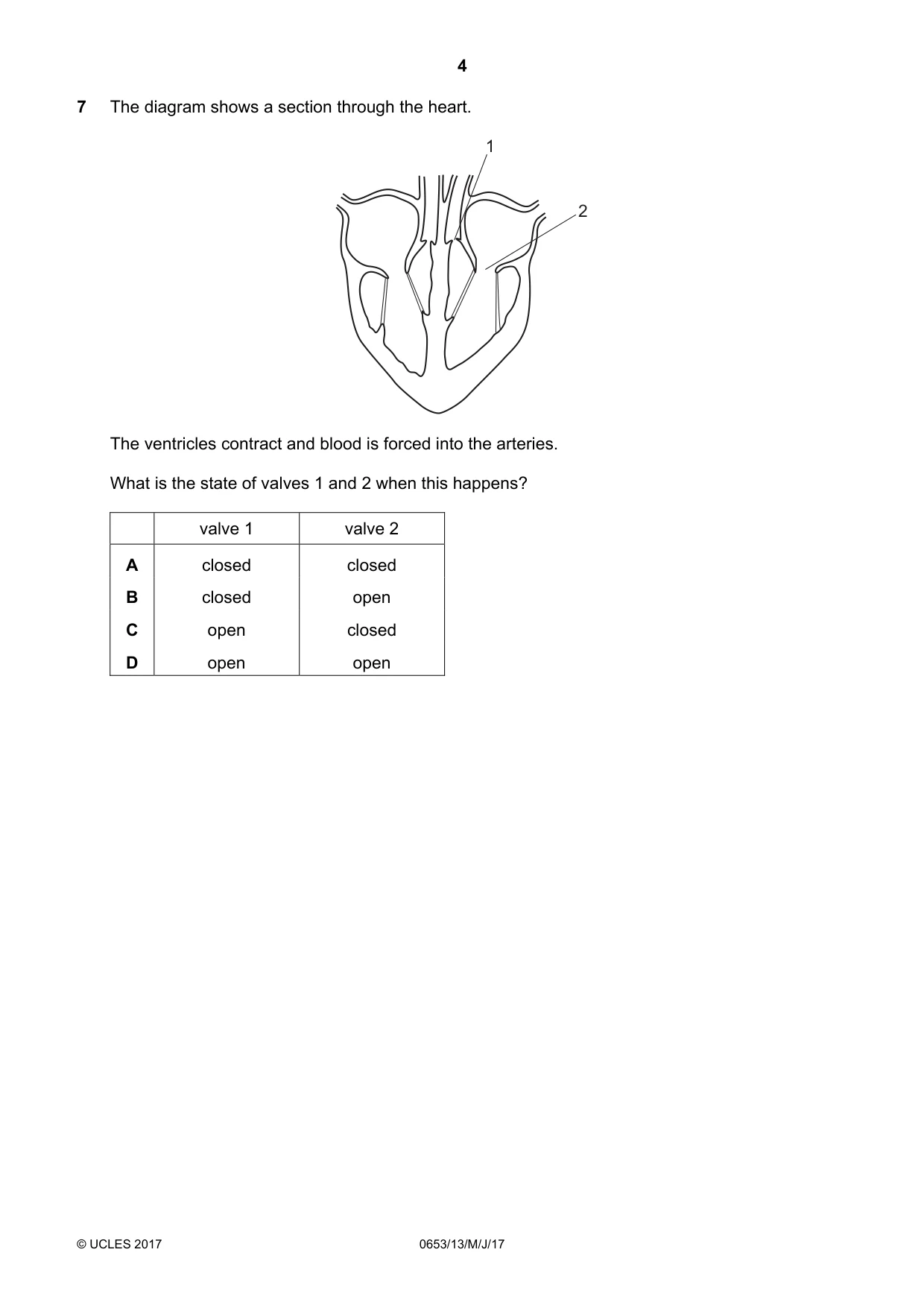
7 The diagram shows a section through the heart. 1 2 The ventricles contract and blood is forced into the arteries. What is the state of valves 1 and 2 when this happens? valve 1 valve 2 A closed closed B closed open C open closed D open open
Mark scheme: C
Q8 · The diagram shows apparatus at the start of a breathing experiment
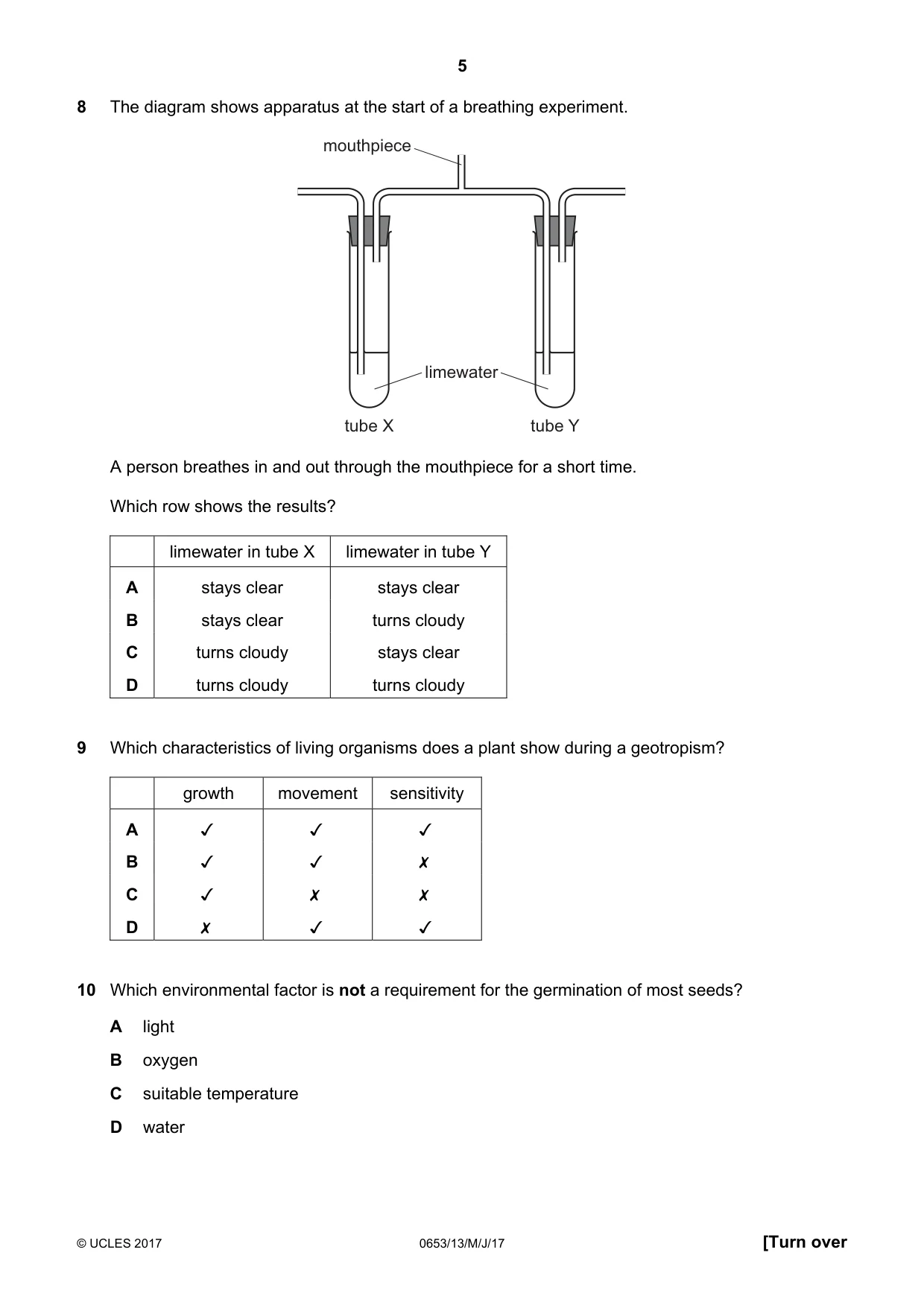
8 The diagram shows apparatus at the start of a breathing experiment. mouthpiece limewater tube X tube Y A person breathes in and out through the mouthpiece for a short time. Which row shows the results? limewater in tube X limewater in tube Y A stays clear stays clear B stays clear turns cloudy C turns cloudy stays clear D turns cloudy turns cloudy
Mark scheme: B
Q9 · Which characteristics of living organisms does a plant show during a geotropism?
9 Which characteristics of living organisms does a plant show during a geotropism? movement sensitivity
Mark scheme: A
Q10 · Which environmental factor is not a requirement for the germination of most seeds?
10 Which environmental factor is not a requirement for the germination of most seeds? A light B oxygen C suitable temperature D water
Mark scheme: A
Q11 · The diagram shows the female reproductive system
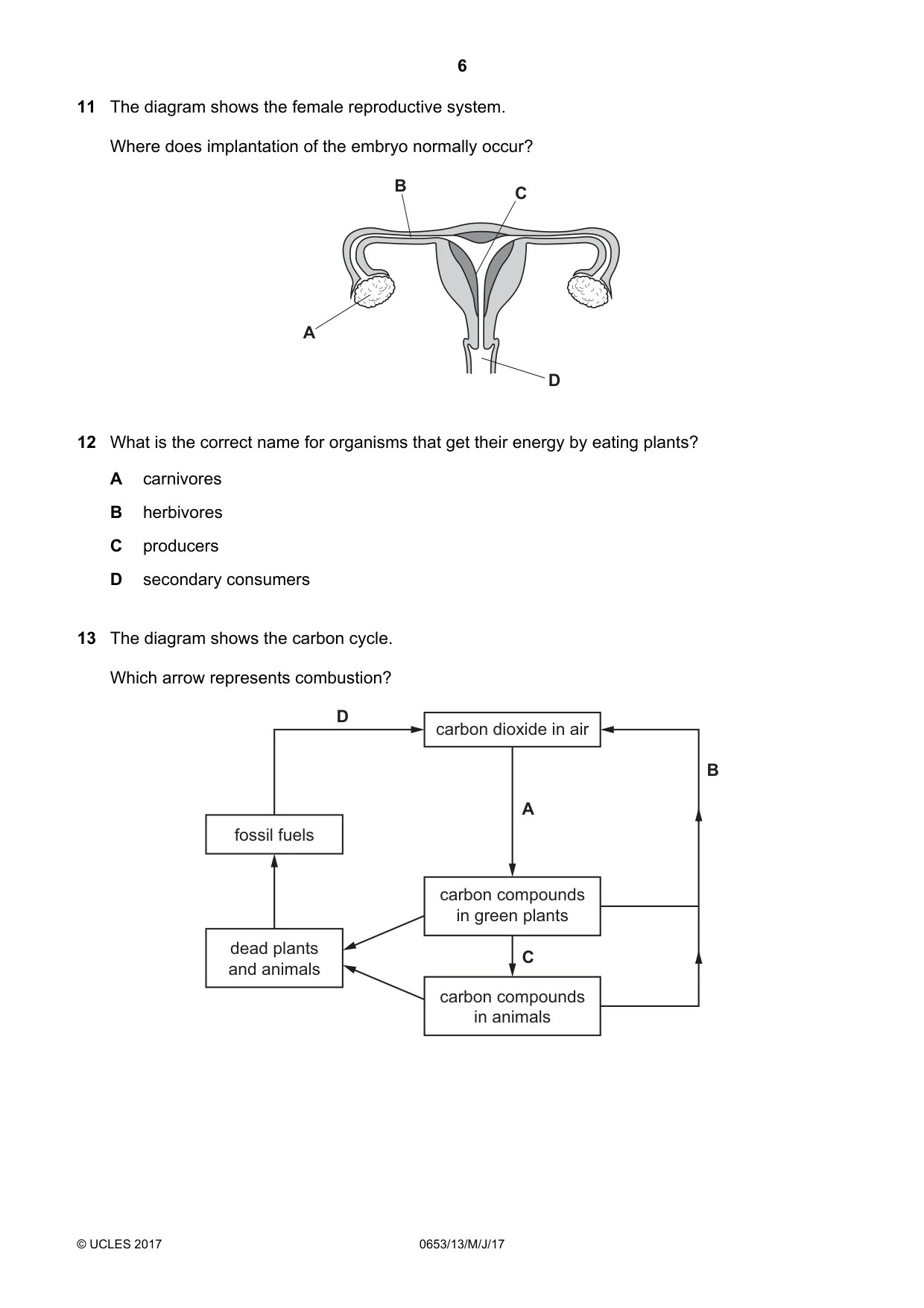
11 The diagram shows the female reproductive system. Where does implantation of the embryo normally occur? B C A D
Mark scheme: C
Q12 · What is the correct name for organisms that get their energy by eating plants?
12 What is the correct name for organisms that get their energy by eating plants? A carnivores B herbivores C producers D secondary consumers
Mark scheme: B
Q13 · The diagram shows the carbon cycle
13 The diagram shows the carbon cycle. Which arrow represents combustion? D carbon dioxide in air B A fossil fuels carbon compounds in green plants dead plants C and animals carbon compounds in animals
Mark scheme: D
Q14 · Which diagram shows how a mixture of dyes in a food colouring are separated?
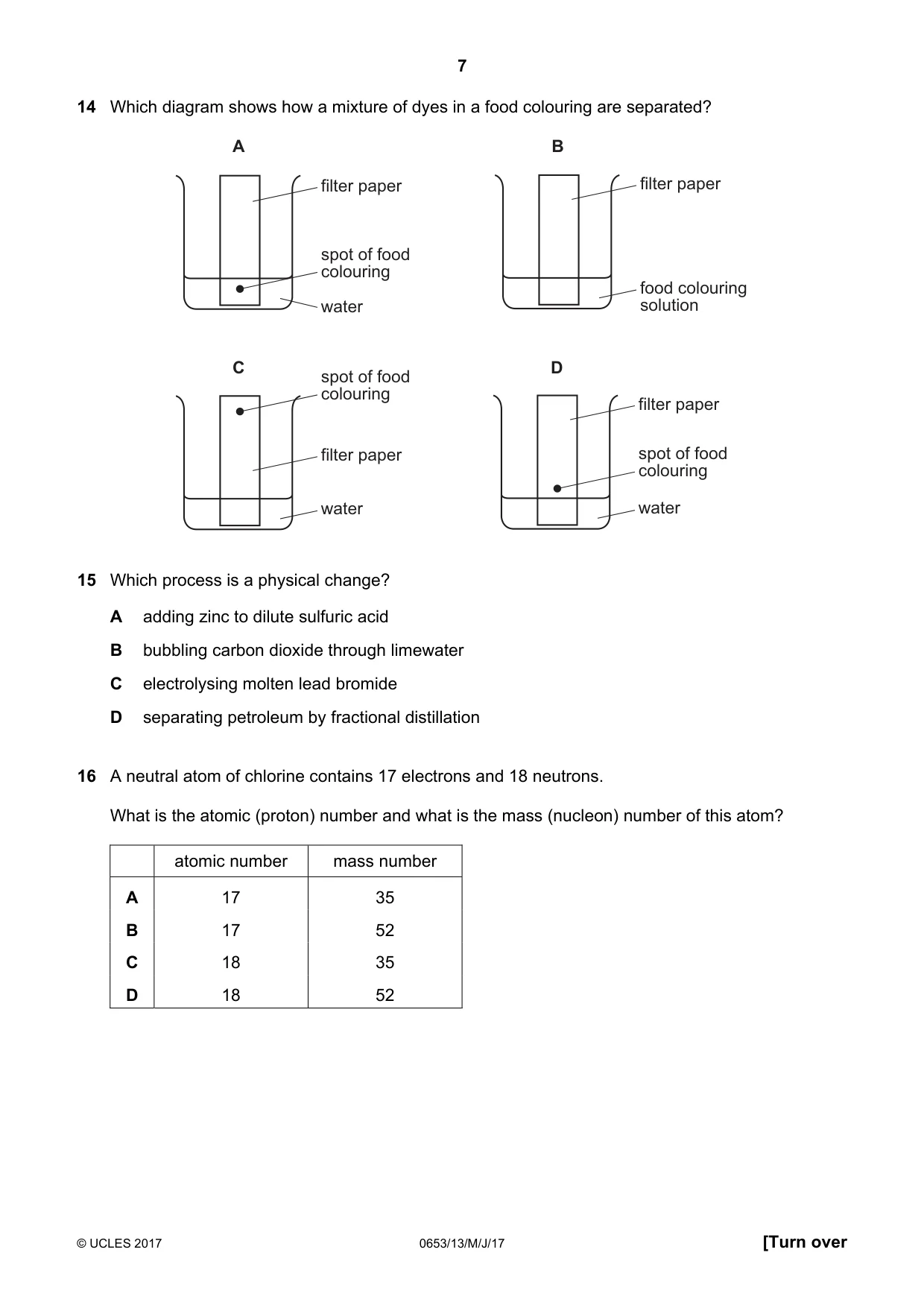
14 Which diagram shows how a mixture of dyes in a food colouring are separated? A B filter paper filter paper spot of food colouring food colouring water solution C D spot of food colouring filter paper filter paper spot of food colouring water water
Mark scheme: D
Q15 · Which process is a physical change?
15 Which process is a physical change? A adding zinc to dilute sulfuric acid B bubbling carbon dioxide through limewater C electrolysing molten lead bromide D separating petroleum by fractional distillation
Mark scheme: D
Q16 · A neutral atom of chlorine contains 17 electrons and 18 neutrons
16 A neutral atom of chlorine contains 17 electrons and 18 neutrons. What is the atomic (proton) number and what is the mass (nucleon) number of this atom? atomic number mass number A 17 35 B 17 52 C 18 35 D 18 52
Mark scheme: A
Q17 · A molten compound X is electrolysed as shown
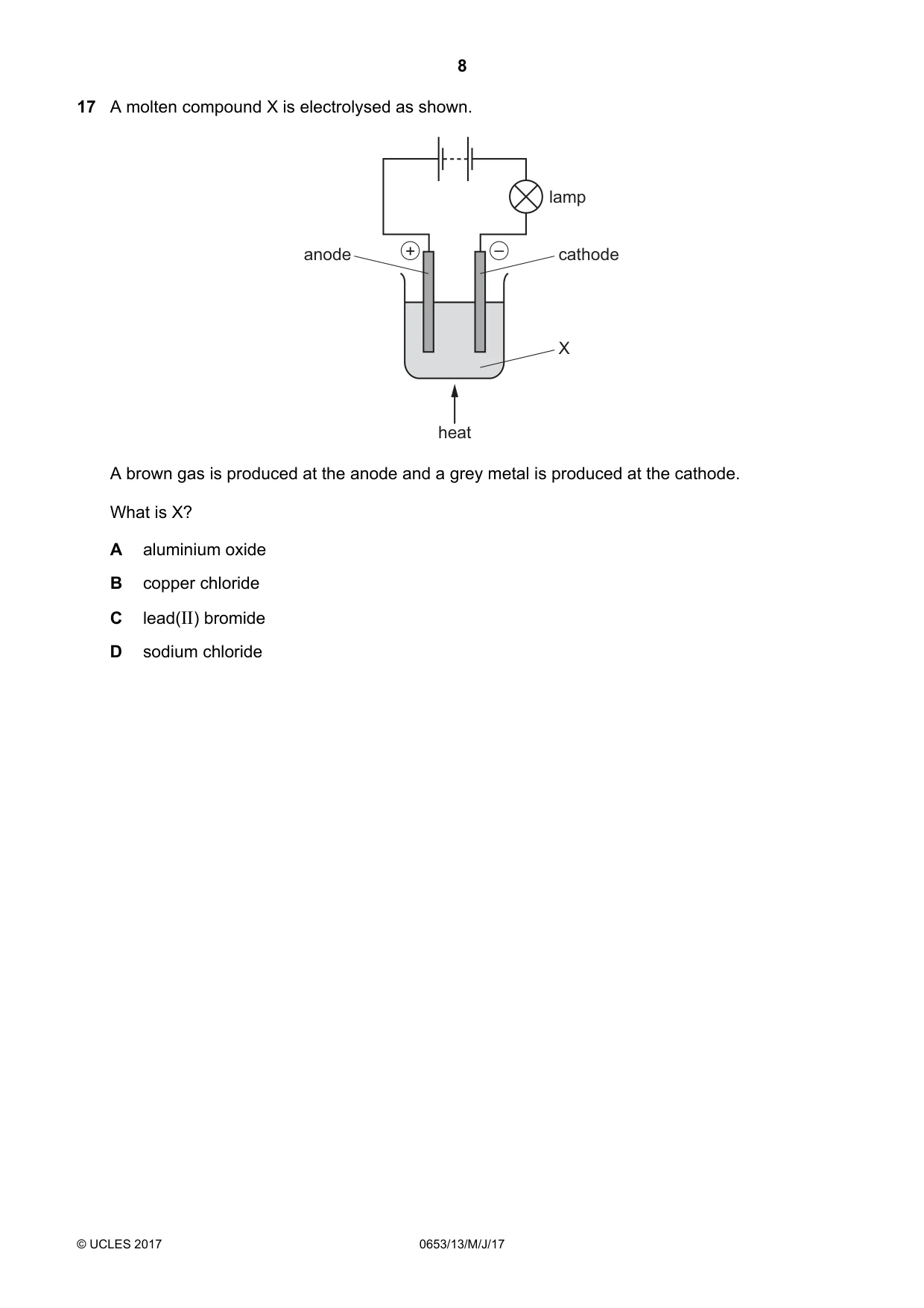
17 A molten compound X is electrolysed as shown. lamp anode + – cathode X heat A brown gas is produced at the anode and a grey metal is produced at the cathode. What is X? A aluminium oxide B copper chloride C lead(II) bromide D sodium chloride
Mark scheme: C
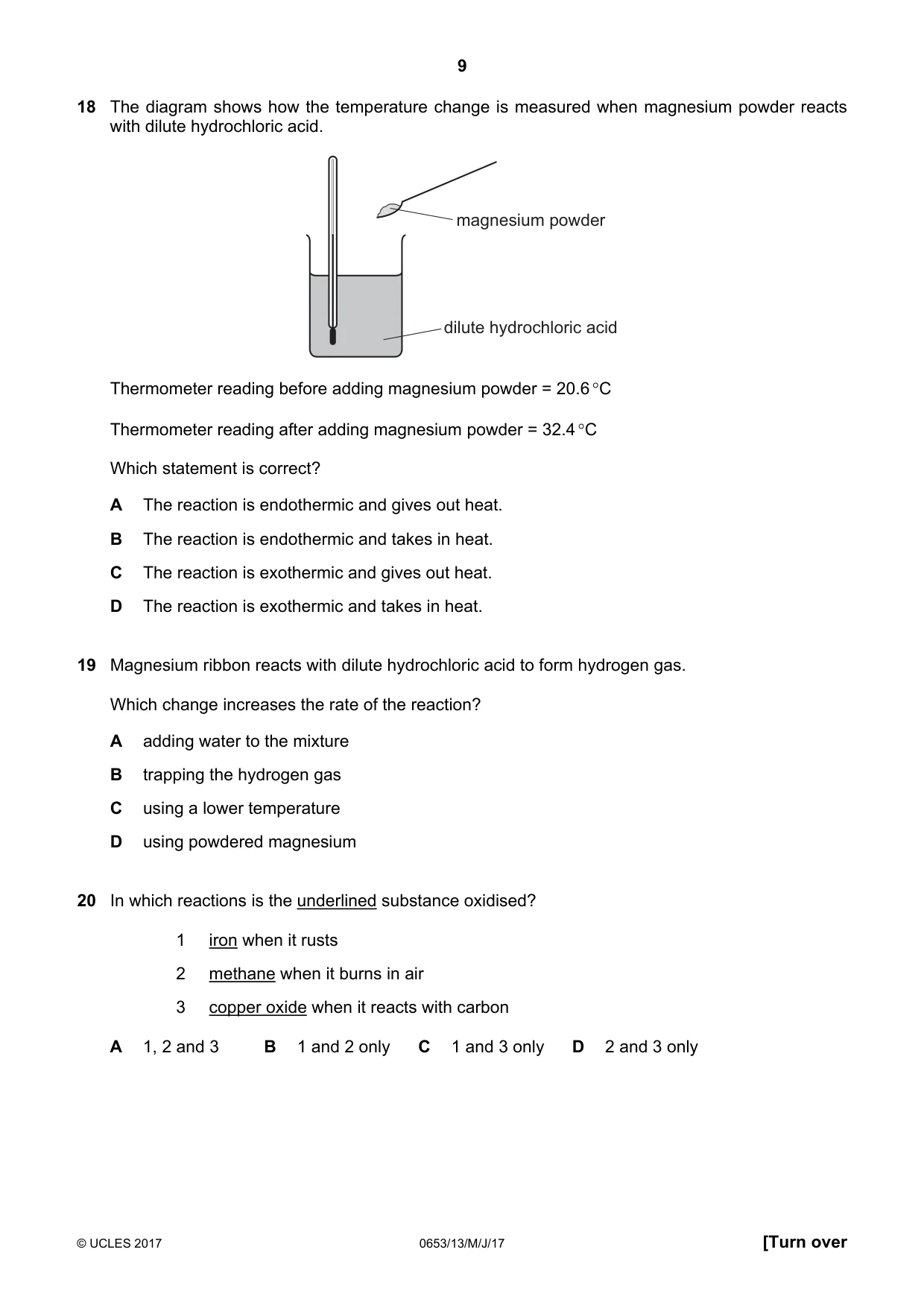
Q18 · The diagram shows how the temperature change is measured when magnesium powder reacts…
18 The diagram shows how the temperature change is measured when magnesium powder reacts with dilute hydrochloric acid. magnesium powder dilute hydrochloric acid Thermometer reading before adding magnesium powder = 20.6 °C Thermometer reading after adding magnesium powder = 32.4 °C Which statement is correct? A The reaction is endothermic and gives out heat. B The reaction is endothermic and takes in heat. C The reaction is exothermic and gives out heat. D The reaction is exothermic and takes in heat.
Mark scheme: C
Q19 · Magnesium ribbon reacts with dilute hydrochloric acid to form hydrogen gas
19 Magnesium ribbon reacts with dilute hydrochloric acid to form hydrogen gas. Which change increases the rate of the reaction? A adding water to the mixture B trapping the hydrogen gas C using a lower temperature D using powdered magnesium
Mark scheme: D
Q20 · In which reactions is the underlined substance oxidised?
20 In which reactions is the underlined substance oxidised? 1 iron when it rusts 2 methane when it burns in air 3 copper oxide when it reacts with carbon A 1, 2 and 3 B 1 and 2 only C 1 and 3 only D 2 and 3 only
Mark scheme: B
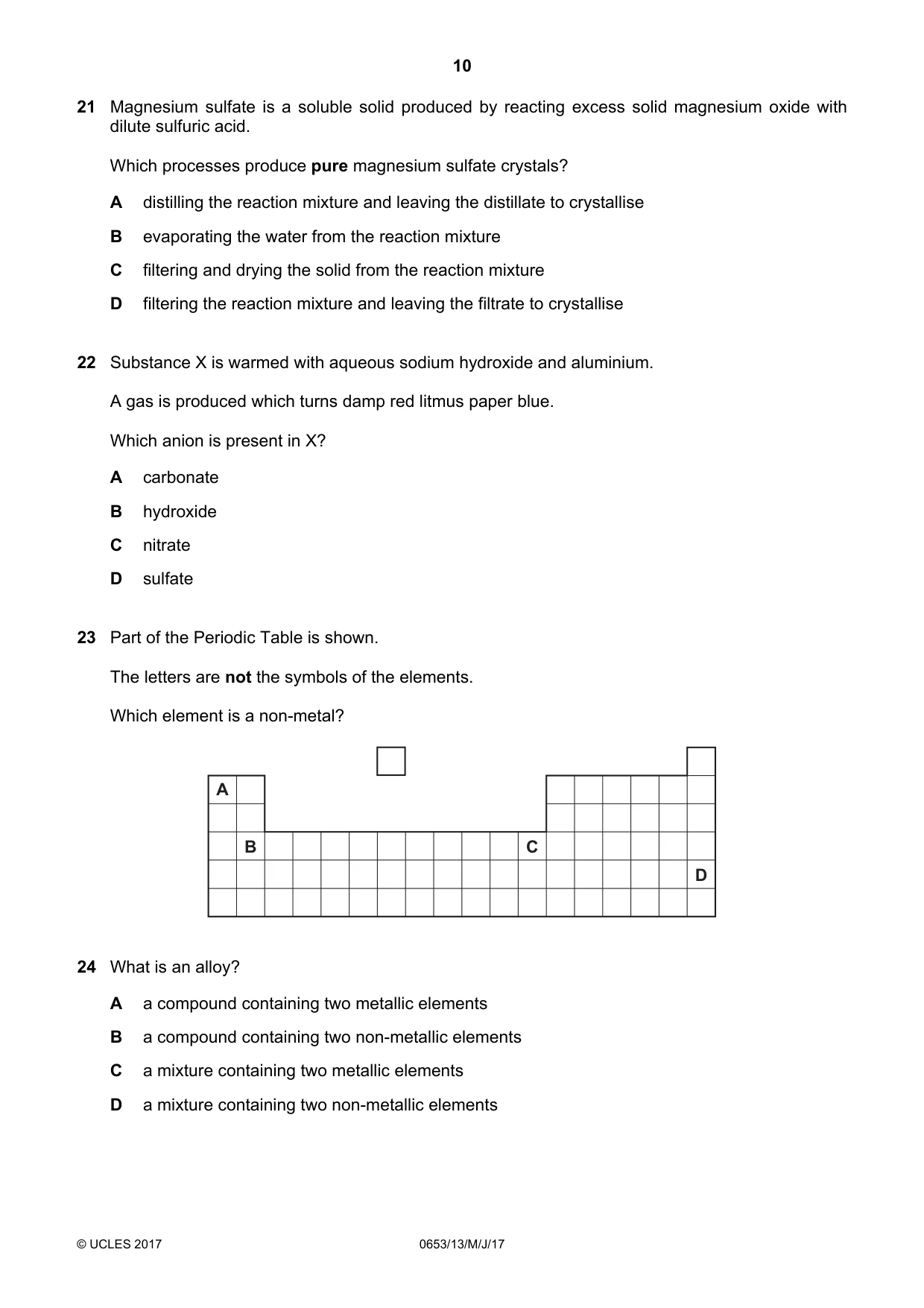
Q21 · Magnesium sulfate is a soluble solid produced by reacting excess solid magnesium oxide…
21 Magnesium sulfate is a soluble solid produced by reacting excess solid magnesium oxide with dilute sulfuric acid. Which processes produce pure magnesium sulfate crystals? A distilling the reaction mixture and leaving the distillate to crystallise B evaporating the water from the reaction mixture C filtering and drying the solid from the reaction mixture D filtering the reaction mixture and leaving the filtrate to crystallise
Mark scheme: D
Q22 · Substance X is warmed with aqueous sodium hydroxide and aluminium
22 Substance X is warmed with aqueous sodium hydroxide and aluminium. A gas is produced which turns damp red litmus paper blue. Which anion is present in X? A carbonate B hydroxide C nitrate D sulfate
Mark scheme: C
Q23 · Part of the Periodic Table is shown
23 Part of the Periodic Table is shown. The letters are not the symbols of the elements. Which element is a non-metal? A B C D
Mark scheme: D
Q24 · What is an alloy?
24 What is an alloy? A a compound containing two metallic elements B a compound containing two non-metallic elements C a mixture containing two metallic elements D a mixture containing two non-metallic elements
Mark scheme: C
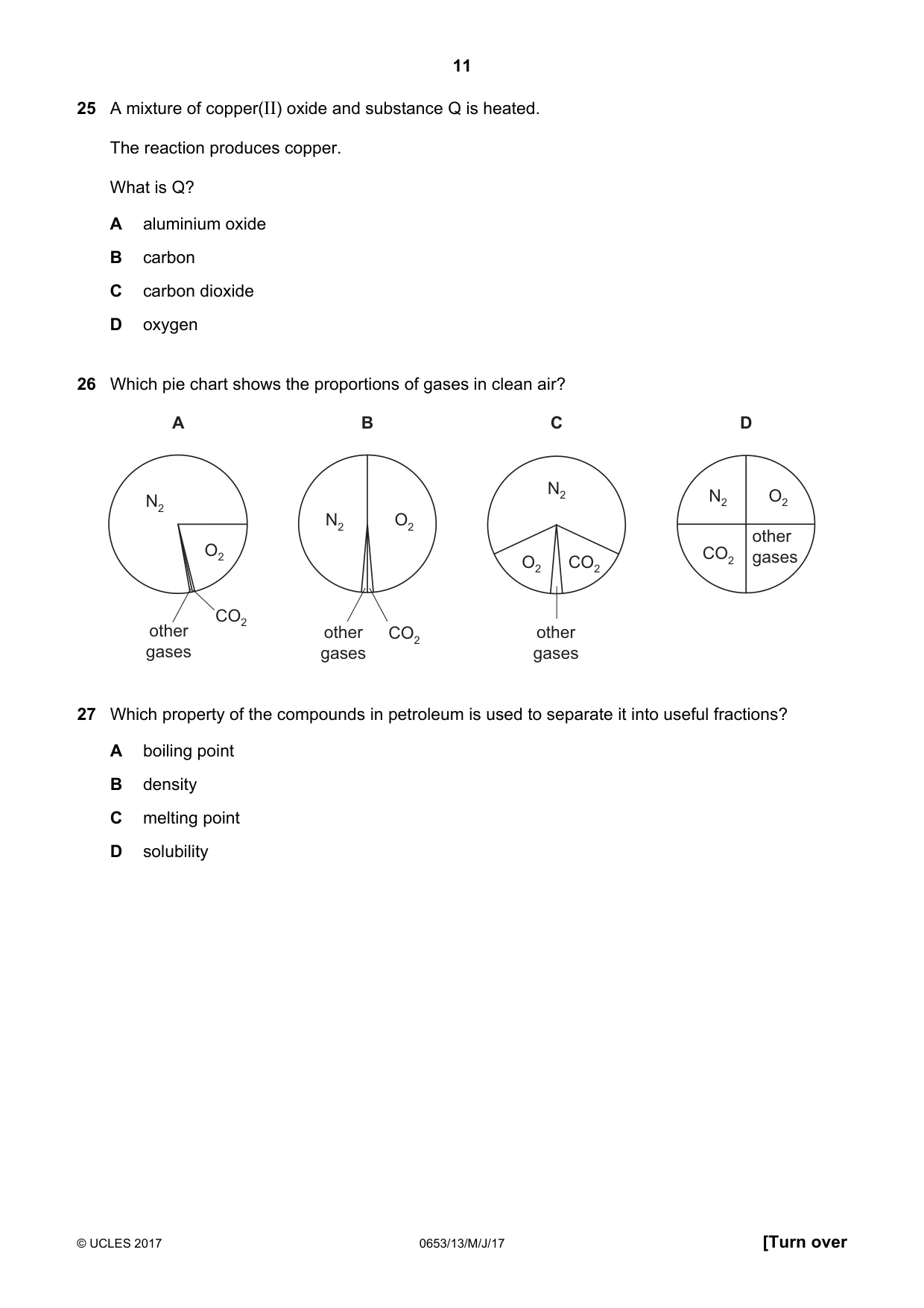
Q25 · A mixture of copper(II) oxide and substance Q is heated
25 A mixture of copper(II) oxide and substance Q is heated. The reaction produces copper. What is Q? A aluminium oxide B carbon C carbon dioxide D oxygen
Mark scheme: B
Q26 · Which pie chart shows the proportions of gases in clean air?
26 Which pie chart shows the proportions of gases in clean air? A B C D N2 N2 O2 N2 N2 O2 other O2 CO2 gases O2 CO2 CO2 other other CO2 other gases gases gases
Mark scheme: A
Q27 · Which property of the compounds in petroleum is used to separate it into useful fractions?
27 Which property of the compounds in petroleum is used to separate it into useful fractions? A boiling point B density C melting point D solubility
Mark scheme: A
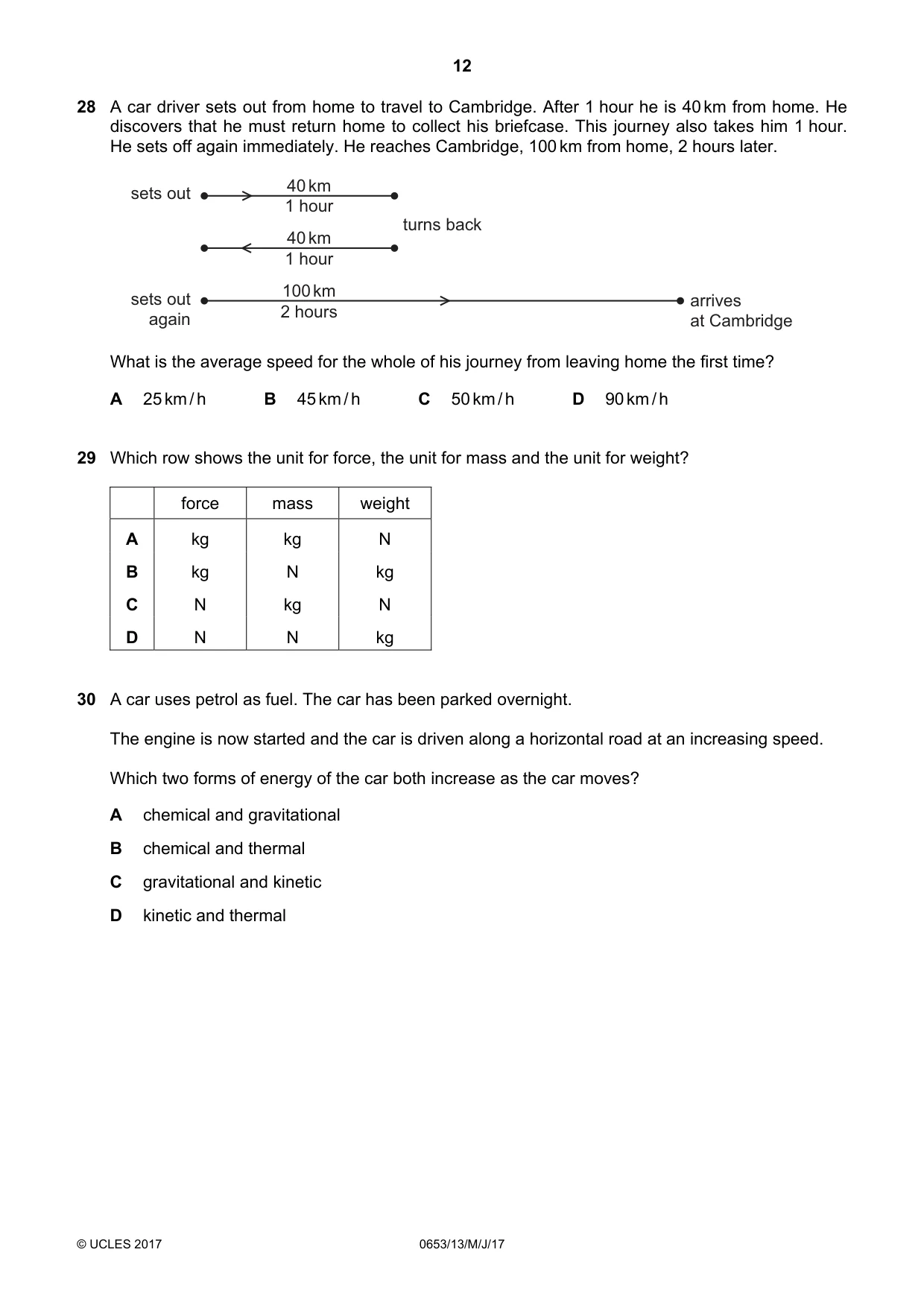
Q28 · A car driver sets out from home to travel to Cambridge
28 A car driver sets out from home to travel to Cambridge. After 1 hour he is 40 km from home. He discovers that he must return home to collect his briefcase. This journey also takes him 1 hour. He sets off again immediately. He reaches Cambridge, 100 km from home, 2 hours later. sets out 40 km 1 hour turns back 40 km 1 hour 100 km sets out arrives 2 hours again at Cambridge What is the average speed for the whole of his journey from leaving home the first time? A 25 km / h B 45 km / h C 50 km / h D 90 km / h
Mark scheme: B
Q29 · Which row shows the unit for force, the unit for mass and the unit for weight?
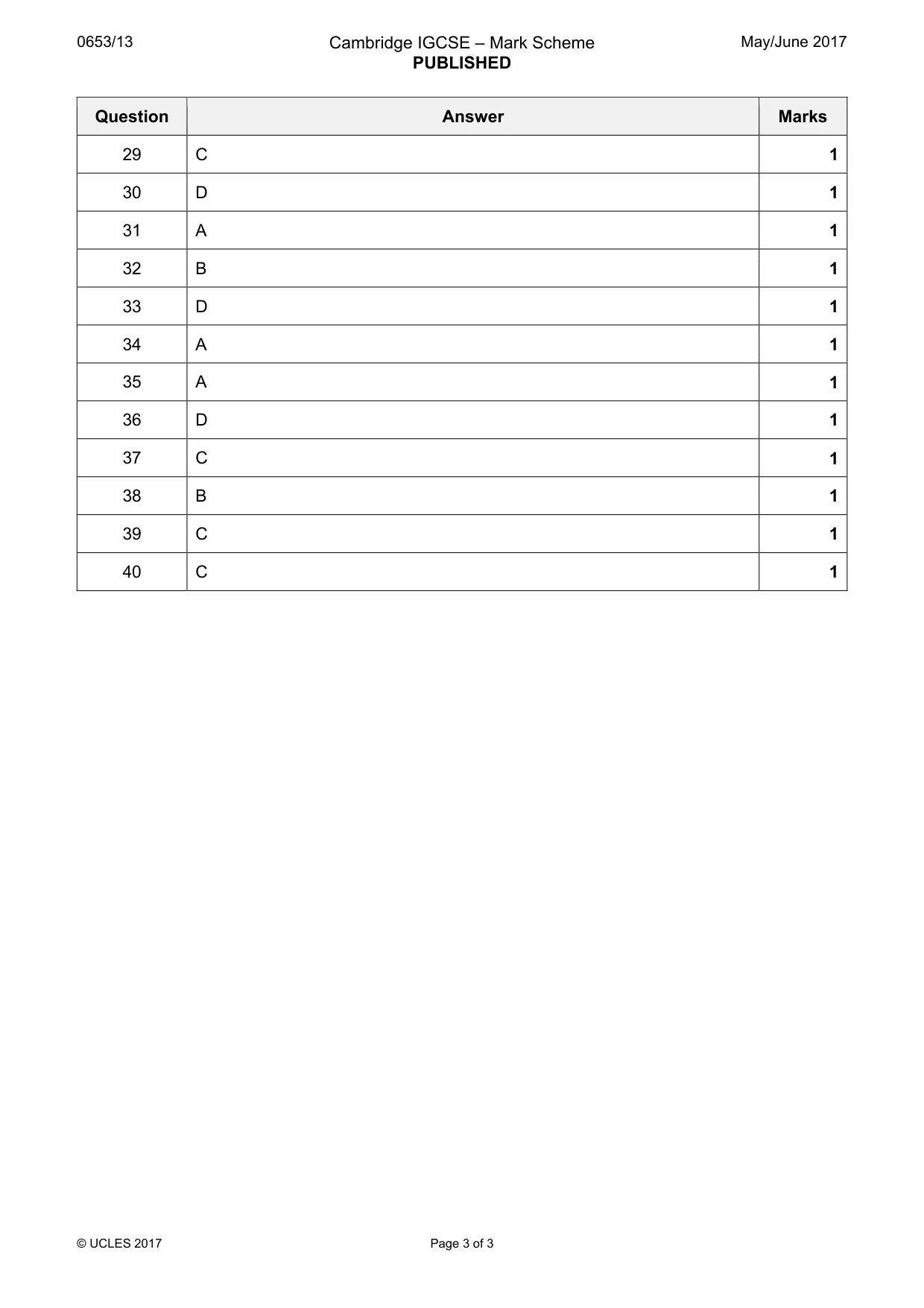
29 Which row shows the unit for force, the unit for mass and the unit for weight? force mass weight A kg kg N B kg N kg C N kg N D N N kg
Mark scheme: C
Q30 · A car uses petrol as fuel
30 A car uses petrol as fuel. The car has been parked overnight. The engine is now started and the car is driven along a horizontal road at an increasing speed. Which two forms of energy of the car both increase as the car moves? A chemical and gravitational B chemical and thermal C gravitational and kinetic D kinetic and thermal
Mark scheme: D
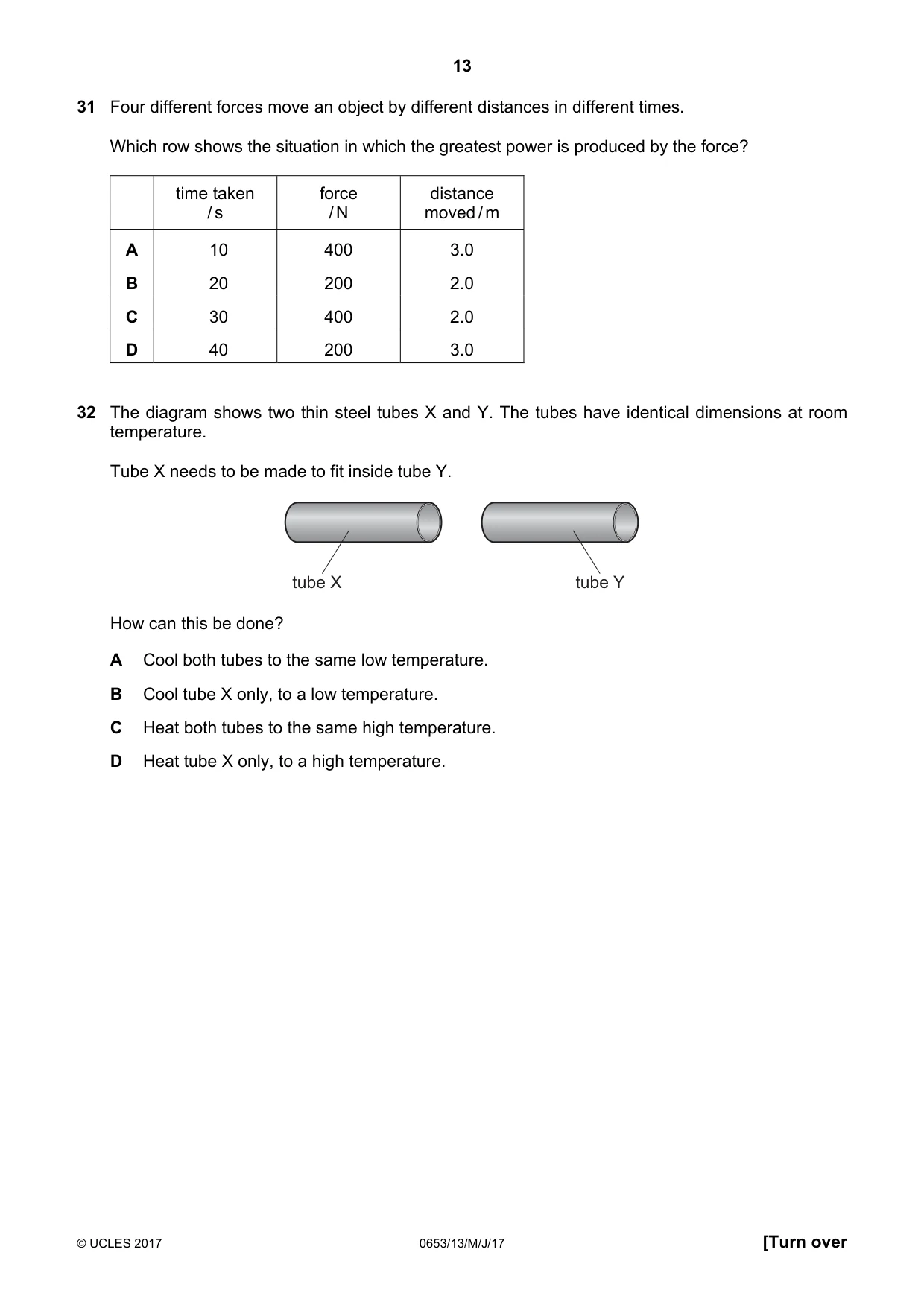
Q31 · Four different forces move an object by different distances in different times
31 Four different forces move an object by different distances in different times. Which row shows the situation in which the greatest power is produced by the force? time taken force distance / s / N moved / m A 10 400 3.0 B 20 200 2.0 C 30 400 2.0 D 40 200 3.0
Mark scheme: A
Q32 · The diagram shows two thin steel tubes X and Y
32 The diagram shows two thin steel tubes X and Y. The tubes have identical dimensions at room temperature. Tube X needs to be made to fit inside tube Y. tube X tube Y How can this be done? A Cool both tubes to the same low temperature. B Cool tube X only, to a low temperature. C Heat both tubes to the same high temperature. D Heat tube X only, to a high temperature.
Mark scheme: B
Q33 · On a cold night, a person stands near a campfire
33 On a cold night, a person stands near a campfire. He holds his hands out towards the fire. His hands are heated by the fire. hands campfire Which process is responsible for transferring thermal energy from the fire to his hands? A conduction B convection C evaporation D radiation
Mark scheme: D
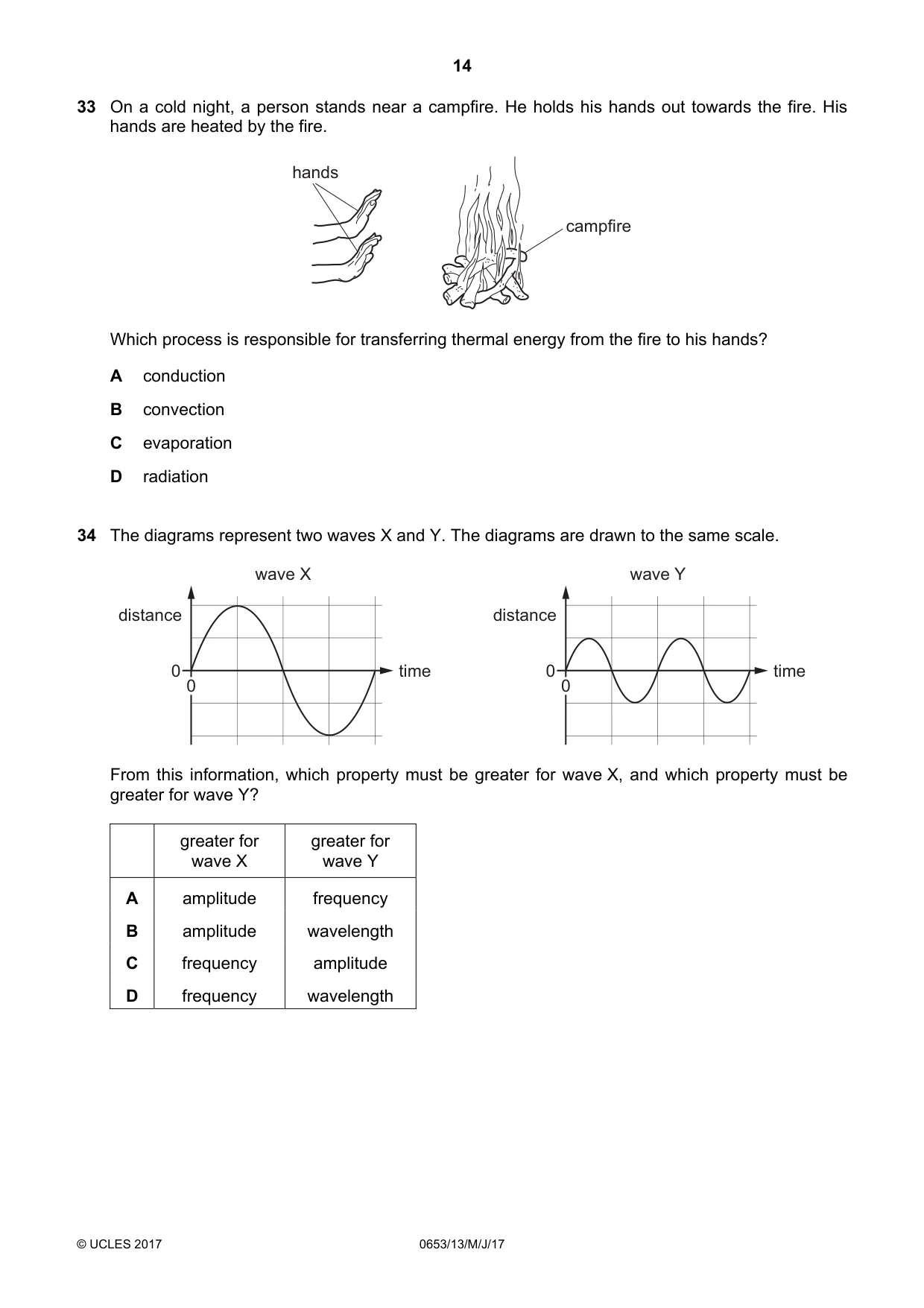
Q34 · The diagrams represent two waves X and Y
34 The diagrams represent two waves X and Y. The diagrams are drawn to the same scale. wave X wave Y distance distance 0 time 0 time 0 0 From this information, which property must be greater for wave X, and which property must be greater for wave Y? greater for greater for wave X wave Y A amplitude frequency B amplitude wavelength C frequency amplitude D frequency wavelength
Mark scheme: A
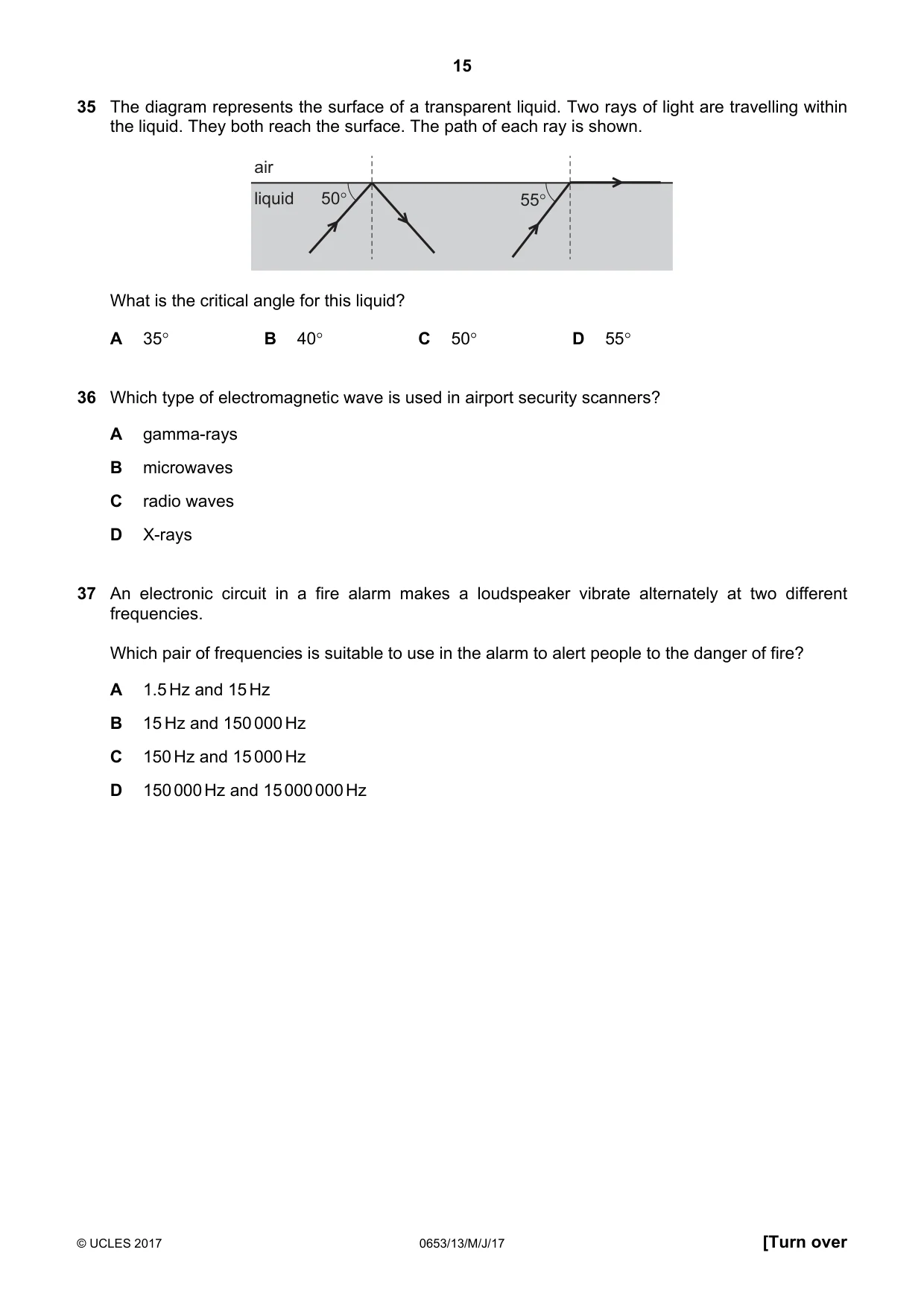
Q35 · The diagram represents the surface of a transparent liquid
35 The diagram represents the surface of a transparent liquid. Two rays of light are travelling within the liquid. They both reach the surface. The path of each ray is shown. air liquid 50° 55° What is the critical angle for this liquid? A 35° B 40° C 50° D 55°
Mark scheme: A
Q36 · Which type of electromagnetic wave is used in airport security scanners?
36 Which type of electromagnetic wave is used in airport security scanners? A gamma-rays B microwaves C radio waves D X-rays
Mark scheme: D
Q37 · An electronic circuit in a fire alarm makes a loudspeaker vibrate alternately at two…
37 An electronic circuit in a fire alarm makes a loudspeaker vibrate alternately at two different frequencies. Which pair of frequencies is suitable to use in the alarm to alert people to the danger of fire? A 1.5 Hz and 15 Hz B 15 Hz and 150 000 Hz C 150 Hz and 15 000 Hz D 150 000 Hz and 15 000 000 Hz
Mark scheme: C
Q38 · An uncharged metal rod is held by an insulating handle
38 An uncharged metal rod is held by an insulating handle. The rod is brought near to a positively charged sphere. This causes some particles in the rod to move. positively metal rod charged sphere + + + + + + + + insulating handle Which particles in the rod move and in which direction do the particles move? particles that move direction of movement A electrons away from the sphere B electrons towards the sphere C protons away from the sphere D protons towards the sphere
Mark scheme: B
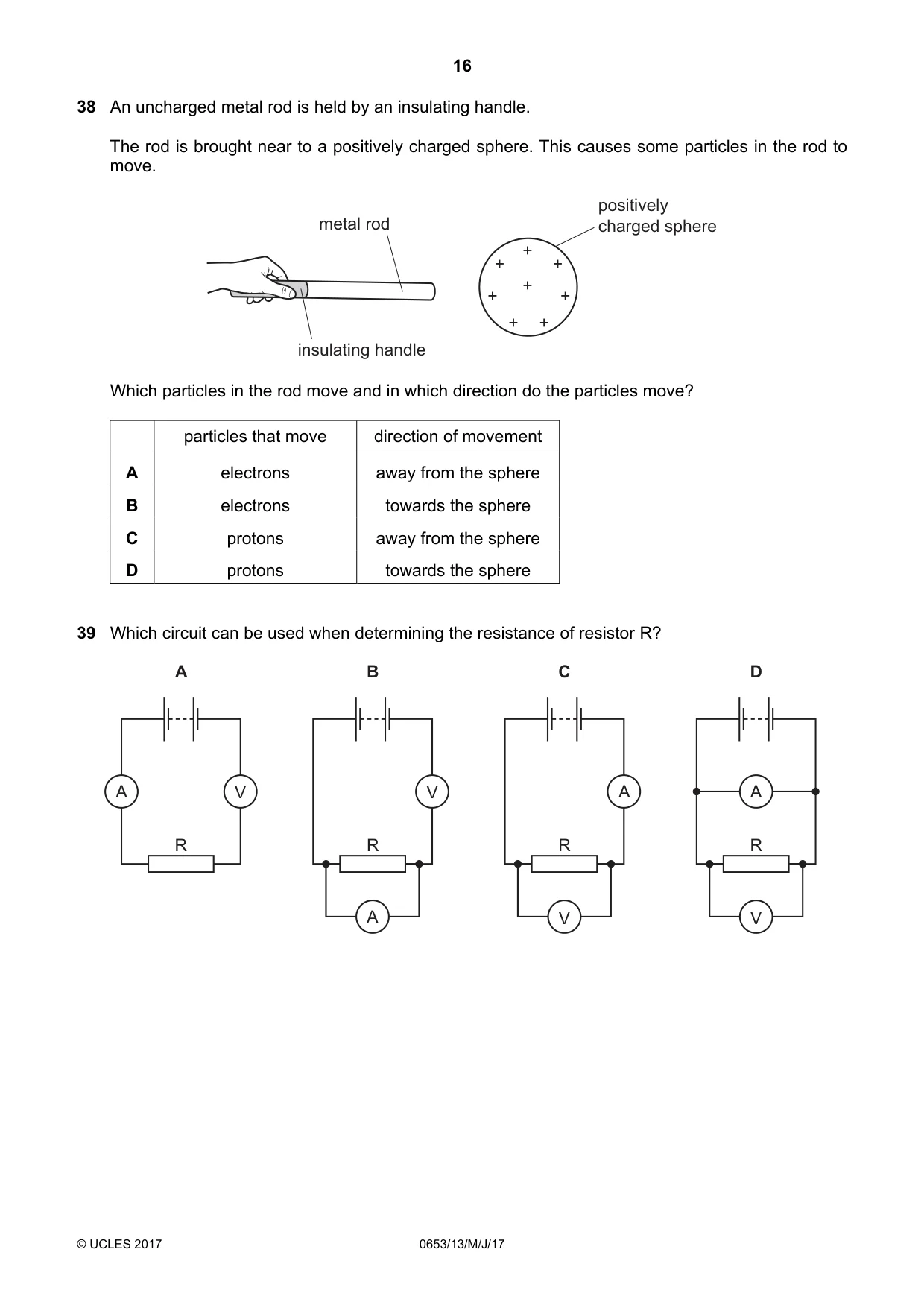
Q39 · Which circuit can be used when determining the resistance of resistor R?
39 Which circuit can be used when determining the resistance of resistor R? A B C D A V V A A R R R R A V V
Mark scheme: C
Q40 · The circuit shown includes two identical lamps and an open switch
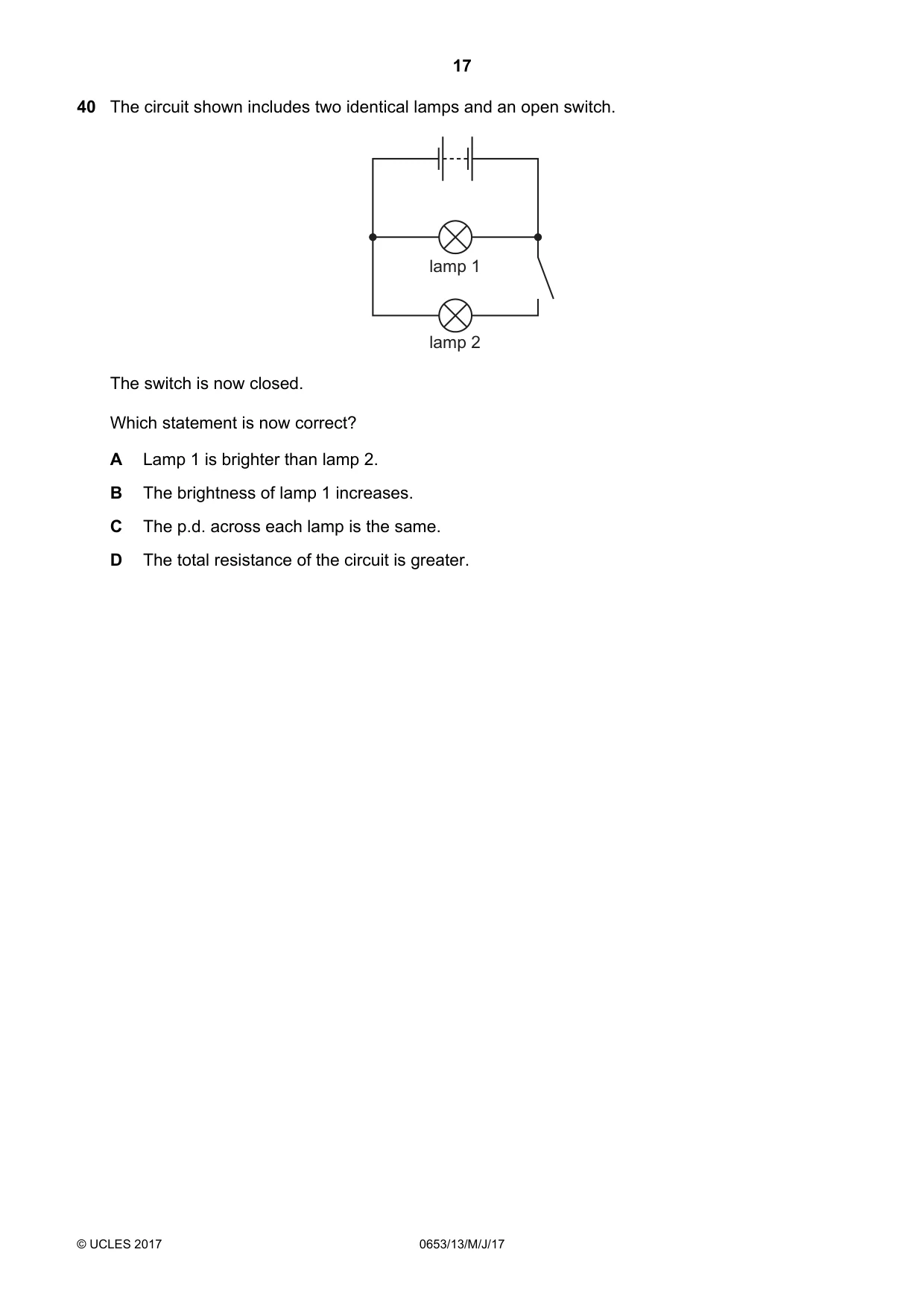
40 The circuit shown includes two identical lamps and an open switch. lamp 1 lamp 2 The switch is now closed. Which statement is now correct? A Lamp 1 is brighter than lamp 2. B The brightness of lamp 1 increases. C The p.d. across each lamp is the same. D The total resistance of the circuit is greater.
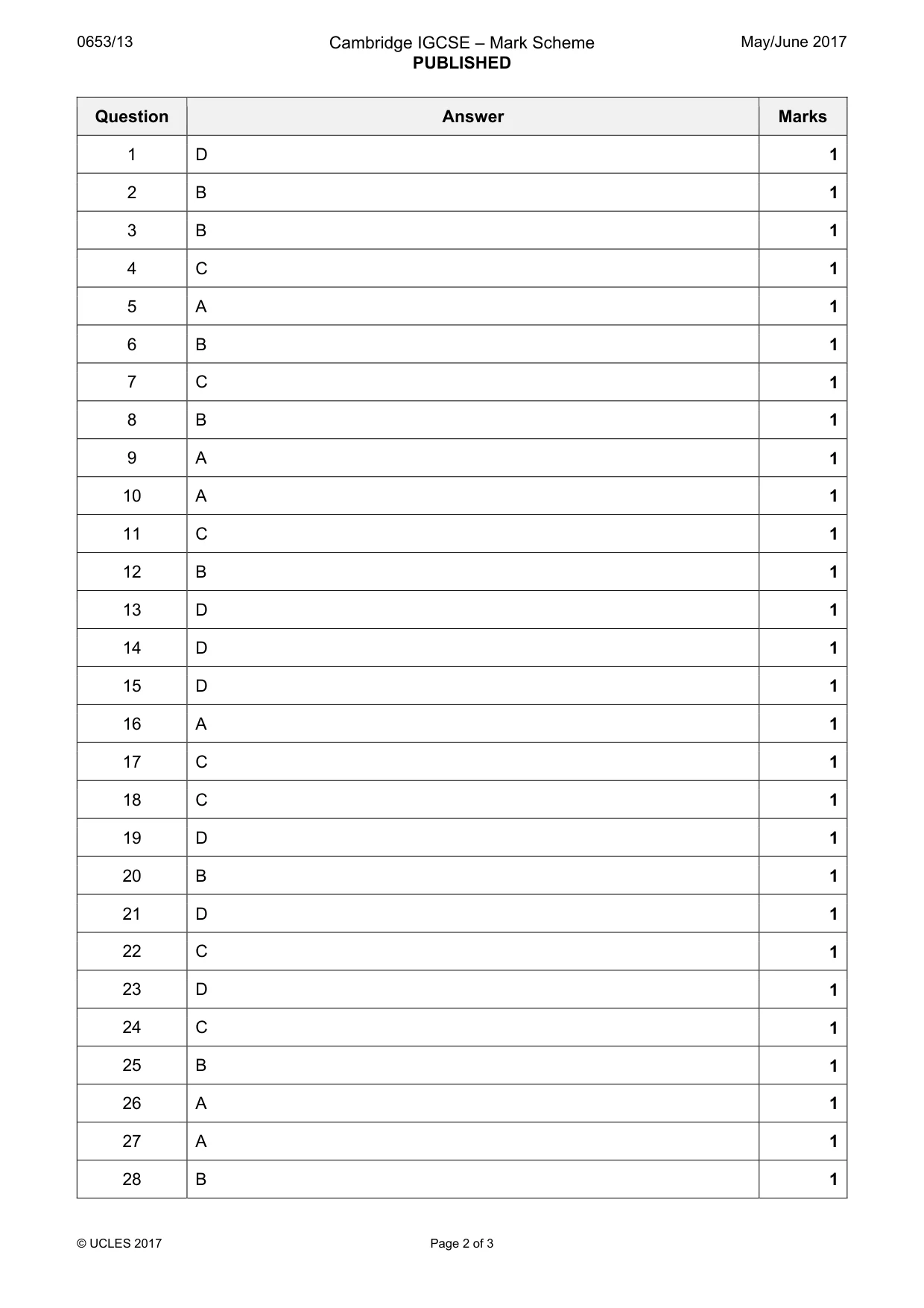
Mark scheme: C
What was in this paper
The subtopics covered by these 40 questions, and how many questions each got. Open one in a new tab to see every Cambridge question on it.
2Electrical circuits2Energy, work and power2Air quality and climate1Alloys and their properties1Arrangement of elements1Atomic structure and the Periodic Table1Biological molecules1Carbon cycle1Chromatography1Electrical quantities1Electrolysis1Electromagnetic spectrum1Enzymes1Exothermic and endothermic reactions1Food chains and food webs1Gas exchange in humans1General properties of waves1Heart1Identification of ions and gases1Light1Mass and weight1Motion1Photosynthesis1Physical and chemical changes1Preparation of salts1Rate of reaction1Reactivity series1Redox1Separation and purification1Sexual reproduction in humans1Sexual reproduction in plants1Size of specimens1Sound1Thermal properties and temperature1Transfer of thermal energy1Transpiration1What you needed in this session
Cambridge’s own grade thresholds for 2017 May/June, Paper 1 · Variant 3. A higher threshold means an easier paper — the bar moves with how the cohort did.