Questions as text
Q1 · Which material is used for the core of an electromagnet? 0625/11 May/June 2005
26 Which material is used for the core of an electromagnet? A aluminium B copper C iron D steel
1 marks
Answer: C
This question in 0625/11 May/June 2005
Q2 · A brass rod is positioned in an east-west direction and a plotting compass is placed at… 0625/11 May/June 2005
27 A brass rod is positioned in an east-west direction and a plotting compass is placed at each end. brass rod N plotting compass Which diagram shows the positions of the needles of the plotting compasses? A B C D
1 marks
Answer: A
This question in 0625/11 May/June 2005
Q3 · Two circuits are set up as shown 0625/11 May/June 2005
36 Two circuits are set up as shown. The iron rods are placed close together, and are free to move. S iron rod iron rod X What happens to the size of the gap at X when switch S is closed? A It decreases. B It decreases then increases. C It increases. D It does not change.
1 marks
Answer: A
This question in 0625/11 May/June 2005
Q4 · How many of the following methods could be used to demagnetise a piece of steel? 0625/11 Oct/Nov 2005
26 How many of the following methods could be used to demagnetise a piece of steel? heating it until it is red hot pulling it from a coil that is carrying an alternating current placing it in an east-west direction and hammering it putting it in a coil which is carrying a direct current A 1 B 2 C 3 D 4
1 marks
Answer: C
This question in 0625/11 Oct/Nov 2005
Q5 · Two rods X and Y look the same 0625/11 Oct/Nov 2005
27 Two rods X and Y look the same. P magnet rod X N S Q R rod Y S The N pole of a magnet is brought close, in turn, to each end of both rods. The results of these four actions are shown in the table. end tested result P attraction Q attraction R attraction S repulsion Which of the rods is a permanent magnet? A neither of the rods B both of the rods C rod X only D rod Y only
1 marks
Answer: D
This question in 0625/11 Oct/Nov 2005
Q6 · The diagrams show a straight wire carrying a current into the paper 0625/11 Oct/Nov 2005
35 The diagrams show a straight wire carrying a current into the paper. Which diagram shows the magnetic field pattern due to this current? A B C D wire wire wire wire
1 marks
Answer: B
This question in 0625/11 Oct/Nov 2005
Q7 · A student investigates which end of a magnetic compass needle is attracted to a bar magnet 0625/11 May/June 2006
26 A student investigates which end of a magnetic compass needle is attracted to a bar magnet. What does the investigation show? A Both ends of the compass needle are attracted by the north pole of the magnet. B Both ends of the compass needle are attracted by the south pole of the magnet. C One end of the compass needle is attracted by the north pole and the other end by the south pole. D The compass needle is not attracted by either end of the magnet.
1 marks
Answer: C
This question in 0625/11 May/June 2006
Q8 · From which materials are the coil and the core of an electromagnet made? 0625/11 May/June 2006
27 From which materials are the coil and the core of an electromagnet made? coil core A copper copper B copper iron C iron copper D iron iron
1 marks
Answer: B
This question in 0625/11 May/June 2006
Q9 · Small particles of metal are scattered near a bar magnet to show the pattern of the… 0625/11 May/June 2007
25 Small particles of metal are scattered near a bar magnet to show the pattern of the magnetic field. Which metal is suitable? A aluminium B brass C copper D iron
1 marks
Answer: D
This question in 0625/11 May/June 2007
Q10 · A strong electromagnet is used to attract pins 0625/11 May/June 2007
26 A strong electromagnet is used to attract pins. core pins coil What happens when the current in the coil is halved? A No pins are attracted. B Fewer pins are attracted. C The same number of pins is attracted. D Many more pins are attracted.
1 marks
Answer: B
This question in 0625/11 May/June 2007
Q11 · Four plotting compasses are placed near a bar magnet 0625/11 May/June 2007
27 Four plotting compasses are placed near a bar magnet. Which plotting compass is shown pointing in the correct direction? A B N C D S
1 marks
Answer: B
This question in 0625/11 May/June 2007
Q12 · Which materials are suitable for making a permanent magnet and the core of an… 0625/11 Oct/Nov 2007
26 Which materials are suitable for making a permanent magnet and the core of an electromagnet? permanent magnet core of an electromagnet A iron iron B iron steel C steel iron D steel steel
1 marks
Answer: C
This question in 0625/11 Oct/Nov 2007
Q13 · Which line in the table shows whether iron and steel are ferrous or non-ferrous materials? 0625/11 May/June 2008
27 Which line in the table shows whether iron and steel are ferrous or non-ferrous materials? iron steel A ferrous ferrous B ferrous non-ferrous C non-ferrous ferrous D non-ferrous non-ferrous
1 marks
Answer: A
This question in 0625/11 May/June 2008
Q14 · A solenoid carrying a current is used to demagnetise a bar magnet 0625/11 May/June 2008
28 A solenoid carrying a current is used to demagnetise a bar magnet. solenoid bar magnet power supply Which conditions achieve demagnetisation? current through movement of bar magnet solenoid A a.c. around the solenoid quickly B a.c. through the solenoid slowly C d.c. around the solenoid quickly D d.c. through the solenoid slowly
1 marks
Answer: B
This question in 0625/11 May/June 2008
Q15 · A student wishes to demagnetise a steel bar 0625/11 Oct/Nov 2008
26 A student wishes to demagnetise a steel bar. He uses the apparatus shown. coil electrical supply steel bar Which type of electrical supply should the student use and what should he do with the steel bar? supply what to do with the steel bar A a.c. keep it inside the coil B a.c. slowly remove it from the coil C d.c. keep it inside the coil D d.c. slowly remove it from the coil
1 marks
Answer: B
This question in 0625/11 Oct/Nov 2008
Q16 · Two metal bars are held together 0625/11 Oct/Nov 2008
27 Two metal bars are held together. At least one of the bars is a magnet. The bars repel each other. What does this show about the bars and why? what it shows why A only one of the bars is a magnet two magnets always attract each other B only one of the bars is a magnet induced magnetism in the other bar makes it repel C they are both magnets there must be like poles facing each other D they are both magnets there must be opposite poles facing each other
1 marks
Answer: C
This question in 0625/11 Oct/Nov 2008
Q17 · The north pole of a bar magnet is placed next to end P of an iron bar PQ, as shown 0625/11 May/June 2009
25 The north pole of a bar magnet is placed next to end P of an iron bar PQ, as shown. As a result, magnetic poles are induced in the iron bar. S N P Q magnet iron bar What are the magnetic poles induced at P and at Q? magnetic pole at P magnetic pole at Q A north north B north south C south north D south south
1 marks
Answer: C
This question in 0625/11 May/June 2009
Q18 · An electromagnet is used to separate magnetic metals from non-magnetic metals 0625/11 May/June 2009
26 An electromagnet is used to separate magnetic metals from non-magnetic metals. Why is steel unsuitable as the core of the electromagnet? A It forms a permanent magnet. B It has a high density. C It has a high thermal capacity. D It is a good conductor of electricity.
1 marks
Answer: A
This question in 0625/11 May/June 2009
Q19 · A wire perpendicular to the page carries an electric current in a direction out of the… 0625/11 May/June 2009
34 A wire perpendicular to the page carries an electric current in a direction out of the page. There are four compasses near the wire. Which compass shows the direction of the magnetic field caused by the current? B A C wire with current out of page D
1 marks
Answer: C
This question in 0625/11 May/June 2009
Q20 · A permanent magnet is brought near to a piece of copper 0625/11 Oct/Nov 2009
25 A permanent magnet is brought near to a piece of copper. The copper is not attracted by the magnet. Why is there no attraction? A Copper is ferrous but is only attracted by an electromagnet. B Copper is ferrous but is not attracted by any type of magnet. C Copper is not ferrous and is only attracted by an electromagnet. D Copper is not ferrous and is not attracted by any type of magnet.
1 marks
Answer: D
This question in 0625/11 Oct/Nov 2009
Q21 · Four plotting compasses are placed in the magnetic field of two identical bar magnets as… 0625/11 Oct/Nov 2009
26 Four plotting compasses are placed in the magnetic field of two identical bar magnets as shown in the diagram. Which compass is shown pointing in the wrong direction? B A D S N N S C
1 marks
Answer: D
This question in 0625/11 Oct/Nov 2009
Q22 · A permanent magnet is brought near to a piece of copper 0625/12 Oct/Nov 2009
27 A permanent magnet is brought near to a piece of copper. The copper is not attracted by the magnet. Why is there no attraction? A Copper is ferrous but is only attracted by an electromagnet. B Copper is ferrous but is not attracted by any type of magnet. C Copper is not ferrous and is only attracted by an electromagnet. D Copper is not ferrous and is not attracted by any type of magnet.
1 marks
Answer: D
This question in 0625/12 Oct/Nov 2009
Q23 · Four plotting compasses are placed in the magnetic field of two identical bar magnets as… 0625/12 Oct/Nov 2009
28 Four plotting compasses are placed in the magnetic field of two identical bar magnets as shown in the diagram. Which compass is shown pointing in the wrong direction? B A D S N N S C
1 marks
Answer: D
This question in 0625/12 Oct/Nov 2009
Q24 · A magnet attracts two pieces of iron 0625/11 May/June 2010
26 A magnet attracts two pieces of iron. iron N S What is the arrangement of the induced poles in the pieces of iron? A N S S N B N S N S C S N S N D S N N S
1 marks
Answer: B
This question in 0625/11 May/June 2010
Q25 · A piece of iron and a piece of steel are picked up by an electromagnet as shown 0625/11 May/June 2010
27 A piece of iron and a piece of steel are picked up by an electromagnet as shown. electromagnet N S steel iron The current to the electromagnet is switched off. What happens? A Both the iron and the steel remain magnetised. B Neither the iron nor the steel remain magnetised. C Only the iron remains magnetised. D Only the steel remains magnetised.
1 marks
Answer: D
This question in 0625/11 May/June 2010
Q26 · A coil is connected to a battery and a soft iron bar is hung near to it 0625/11 May/June 2010
34 A coil is connected to a battery and a soft iron bar is hung near to it. soft iron coil The current is then reversed by reversing the battery connections. How does the soft iron bar behave in the two cases? with the battery as shown with the battery reversed A attracted to the coil attracted to the coil B attracted to the coil repelled from the coil C repelled from the coil attracted to the coil D repelled from the coil repelled from the coil
1 marks
Answer: A
This question in 0625/11 May/June 2010
Q27 · A magnet attracts two pieces of iron 0625/12 May/June 2010
26 A magnet attracts two pieces of iron. iron N S What is the arrangement of the induced poles in the pieces of iron? A N S S N B N S N S C S N S N D S N N S
1 marks
Answer: B
This question in 0625/12 May/June 2010
Q28 · A coil is connected to a battery and a soft iron bar is hung near to it 0625/12 May/June 2010
27 A coil is connected to a battery and a soft iron bar is hung near to it. soft iron coil The current is then reversed by reversing the battery connections. How does the soft iron bar behave in the two cases? with the battery as shown with the battery reversed A attracted to the coil attracted to the coil B attracted to the coil repelled from the coil C repelled from the coil attracted to the coil D repelled from the coil repelled from the coil
1 marks
Answer: A
This question in 0625/12 May/June 2010
Q29 · A piece of iron and a piece of steel are picked up by an electromagnet as shown 0625/12 May/June 2010
28 A piece of iron and a piece of steel are picked up by an electromagnet as shown. electromagnet N S steel iron The current to the electromagnet is switched off. What happens? A Both the iron and the steel remain magnetised. B Neither the iron nor the steel remain magnetised. C Only the iron remains magnetised. D Only the steel remains magnetised.
1 marks
Answer: D
This question in 0625/12 May/June 2010
Q30 · Which statement about a magnet is not correct? 0625/11 Oct/Nov 2010
26 Which statement about a magnet is not correct? A It can attract another magnet. B It can attract an unmagnetised piece of iron. C It can repel another magnet. D It can repel an unmagnetised piece of iron.
1 marks
Answer: D
This question in 0625/11 Oct/Nov 2010
Q31 · A chain of steel nails and a chain of iron nails hang from a strong magnet 0625/11 Oct/Nov 2010
27 A chain of steel nails and a chain of iron nails hang from a strong magnet. The chains are then carefully removed from the magnet. magnet steel iron What happens to the chains? A Both chains fall apart. B Both chains stay together. C Only the chain of iron nails falls apart. D Only the chain of steel nails falls apart.
1 marks
Answer: C
This question in 0625/11 Oct/Nov 2010
Q32 · Which statement about a magnet is not correct? 0625/12 Oct/Nov 2010
33 Which statement about a magnet is not correct? A It can attract another magnet. B It can attract an unmagnetised piece of iron. C It can repel another magnet. D It can repel an unmagnetised piece of iron.
1 marks
Answer: D
This question in 0625/12 Oct/Nov 2010
Q33 · A chain of steel nails and a chain of iron nails hang from a strong magnet 0625/12 Oct/Nov 2010
34 A chain of steel nails and a chain of iron nails hang from a strong magnet. The chains are then carefully removed from the magnet. magnet steel iron What happens to the chains? A Both chains fall apart. B Both chains stay together. C Only the chain of iron nails falls apart. D Only the chain of steel nails falls apart.
1 marks
Answer: C
This question in 0625/12 Oct/Nov 2010
Q34 · Which statement about a magnet is not correct? 0625/13 Oct/Nov 2010
26 Which statement about a magnet is not correct? A It can attract another magnet. B It can attract an unmagnetised piece of iron. C It can repel another magnet. D It can repel an unmagnetised piece of iron.
1 marks
Answer: D
This question in 0625/13 Oct/Nov 2010
Q35 · A chain of steel nails and a chain of iron nails hang from a strong magnet 0625/13 Oct/Nov 2010
27 A chain of steel nails and a chain of iron nails hang from a strong magnet. The chains are then carefully removed from the magnet. magnet steel iron What happens to the chains? A Both chains fall apart. B Both chains stay together. C Only the chain of iron nails falls apart. D Only the chain of steel nails falls apart.
1 marks
Answer: C
This question in 0625/13 Oct/Nov 2010
Q36 · Which test could be used to find which end of a magnet is the north pole? 0625/11 May/June 2011
25 Which test could be used to find which end of a magnet is the north pole? A putting it near a compass needle B putting it near a ferrous metal C putting it near a non-ferrous metal D putting it near a steel spoon
1 marks
Answer: A
This question in 0625/11 May/June 2011
Q37 · In two separate experiments, a magnet is brought near to an unmagnetised iron bar 0625/11 May/June 2011
26 In two separate experiments, a magnet is brought near to an unmagnetised iron bar. This causes the bar to become magnetised. experiment 1 N magnet S X iron bar experiment 2 S magnet N iron bar Y Which magnetic poles are induced at X and at Y? pole induced at X pole induced at Y A N N B N S C S N D S S
1 marks
Answer: A
This question in 0625/11 May/June 2011
Q38 · In two separate experiments, a magnet is brought near to an unmagnetised iron bar 0625/12 May/June 2011
26 In two separate experiments, a magnet is brought near to an unmagnetised iron bar. This causes the bar to become magnetised. experiment 1 N magnet S X iron bar experiment 2 S magnet N iron bar Y Which magnetic poles are induced at X and at Y? pole induced at X pole induced at Y A N N B N S C S N D S S
1 marks
Answer: A
This question in 0625/12 May/June 2011
Q39 · Which test could be used to find which end of a magnet is the north pole? 0625/12 May/June 2011
28 Which test could be used to find which end of a magnet is the north pole? A putting it near a compass needle B putting it near a ferrous metal C putting it near a non-ferrous metal D putting it near a steel spoon
1 marks
Answer: A
This question in 0625/12 May/June 2011
Q40 · In two separate experiments, a magnet is brought near to an unmagnetised iron bar 0625/13 May/June 2011
26 In two separate experiments, a magnet is brought near to an unmagnetised iron bar. This causes the bar to become magnetised. experiment 1 N magnet S X iron bar experiment 2 S magnet N iron bar Y Which magnetic poles are induced at X and at Y? pole induced at X pole induced at Y A N N B N S C S N D S S
1 marks
Answer: A
This question in 0625/13 May/June 2011
Q41 · Which test could be used to find which end of a magnet is the north pole? 0625/13 May/June 2011
28 Which test could be used to find which end of a magnet is the north pole? A putting it near a compass needle B putting it near a ferrous metal C putting it near a non-ferrous metal D putting it near a steel spoon
1 marks
Answer: A
This question in 0625/13 May/June 2011
Q42 · A polythene rod repels an inflated balloon hanging from a nylon thread 0625/13 May/June 2011
30 A polythene rod repels an inflated balloon hanging from a nylon thread. What charges must the rod and the balloon carry? A The rod and the balloon carry opposite charges. B The rod and the balloon carry like charges. C The rod is charged but the balloon is not. D The balloon is charged but the rod is not.
1 marks
Answer: B
This question in 0625/13 May/June 2011
Q43 · Two bars of soft iron are placed near a bar magnet 0625/11 Oct/Nov 2012
27 Two bars of soft iron are placed near a bar magnet. bar magnet soft iron soft iron S N P Q Which row states and explains the behaviour of poles P and Q of the soft iron bars? P and Q reason A attract P and Q are like poles B attract P and Q are unlike poles C repel P and Q are like poles D repel P and Q are unlike poles
1 marks
Answer: B
This question in 0625/11 Oct/Nov 2012
Q44 · Some electrical devices require a magnet which may be switched on and off many times in a… 0625/11 Oct/Nov 2012
28 Some electrical devices require a magnet which may be switched on and off many times in a second. Which type of magnet may be used? A an electromagnet only B a permanent magnet only C either a permanent magnet or an electromagnet D neither a permanent magnet nor an electromagnet
1 marks
Answer: A
This question in 0625/11 Oct/Nov 2012
Q45 · Some electrical devices require a magnet which may be switched on and off many times in a… 0625/12 Oct/Nov 2012
33 Some electrical devices require a magnet which may be switched on and off many times in a second. Which type of magnet may be used? A an electromagnet only B a permanent magnet only C either a permanent magnet or an electromagnet D neither a permanent magnet nor an electromagnet
1 marks
Answer: A
This question in 0625/12 Oct/Nov 2012
Q46 · Two bars of soft iron are placed near a bar magnet 0625/12 Oct/Nov 2012
34 Two bars of soft iron are placed near a bar magnet. bar magnet soft iron soft iron S N P Q Which row states and explains the behaviour of poles P and Q of the soft iron bars? P and Q reason A attract P and Q are like poles B attract P and Q are unlike poles C repel P and Q are like poles D repel P and Q are unlike poles
1 marks
Answer: B
This question in 0625/12 Oct/Nov 2012
Q47 · Which row shows whether iron and steel are ferrous or non-ferrous? 0625/13 Oct/Nov 2012
27 Which row shows whether iron and steel are ferrous or non-ferrous? iron steel A ferrous ferrous B ferrous non-ferrous C non-ferrous ferrous D non-ferrous non-ferrous
1 marks
Answer: A
This question in 0625/13 Oct/Nov 2012
Q48 · The N pole of a magnet repels one end of bar X 0625/13 Oct/Nov 2012
28 The N pole of a magnet repels one end of bar X. X repels N S What happens when the other end of bar X is placed near to the poles of the magnet? other end near other end near N pole S pole A attracts attracts B attracts repels C repels attracts D repels repels
1 marks
Answer: B
This question in 0625/13 Oct/Nov 2012
Q49 · Which statement about magnetism is correct? 0625/11 May/June 2013
26 Which statement about magnetism is correct? A Aluminium is a ferrous metal. B A steel magnet can be demagnetised by heating it. C The core of an electromagnet is usually made of steel. D The magnetic field lines around a bar magnet are evenly spaced.
1 marks
Answer: B
This question in 0625/11 May/June 2013
Q50 · Two soft-iron rods are placed end to end inside a coil which is connected to a battery 0625/11 May/June 2013
27 Two soft-iron rods are placed end to end inside a coil which is connected to a battery. coil soft-iron rod soft-iron rod The connections from the battery to the coil are now reversed. What happens to the soft-iron rods in each case? battery connections battery connections as shown reversed A rods attract rods attract B rods attract rods repel C rods repel rods attract D rods repel rods repel
1 marks
Answer: A
This question in 0625/11 May/June 2013
Q51 · An electromagnet is used to separate magnetic metals from non-magnetic metals 0625/12 May/June 2013
26 An electromagnet is used to separate magnetic metals from non-magnetic metals. Why is steel not suitable as the core of the electromagnet? A It forms a permanent magnet. B It has a high density. C It has a high thermal capacity. D It is a good conductor of electricity.
1 marks
Answer: A
This question in 0625/12 May/June 2013
Q52 · An old and expensive steel watch becomes magnetised 0625/12 May/June 2013
27 An old and expensive steel watch becomes magnetised. The owner wants to use the watch again. He must demagnetise the watch. What is the best method to do this? A Heat it until it glows red hot. B Pass direct current though it. C Place it in a plastic bag and put the bag in hot water for several hours. D Place it in a solenoid that carries alternating current and then slowly remove it.
1 marks
Answer: D
This question in 0625/12 May/June 2013
Q53 · Two soft-iron rods are placed end to end inside a coil which is connected to a battery 0625/13 May/June 2013
25 Two soft-iron rods are placed end to end inside a coil which is connected to a battery. coil soft-iron rod soft-iron rod The connections from the battery to the coil are now reversed. What happens to the soft-iron rods in each case? battery connections battery connections as shown reversed A rods attract rods attract B rods attract rods repel C rods repel rods attract D rods repel rods repel
1 marks
Answer: A
This question in 0625/13 May/June 2013
Q54 · Which statement about magnetism is correct? 0625/13 May/June 2013
27 Which statement about magnetism is correct? A Aluminium is a ferrous metal. B A steel magnet can be demagnetised by heating it. C The core of an electromagnet is usually made of steel. D The magnetic field lines around a bar magnet are evenly spaced.
1 marks
Answer: B
This question in 0625/13 May/June 2013
Q55 · An electric current can produce a heating effect and a magnetic effect 0625/13 May/June 2013
36 An electric current can produce a heating effect and a magnetic effect. Which row shows the effect that a relay uses, together with one application of a relay? effect used by a relay one application of a relay A heating effect allowing a small current to switch on a large current B heating effect changing the voltage of an alternating current C magnetic effect allowing a small current to switch on a large current D magnetic effect changing the voltage of an alternating current
1 marks
Answer: C
This question in 0625/13 May/June 2013
Q56 · A hard magnetic material can be used to make a permanent magnet 0625/11 Oct/Nov 2013
26 A hard magnetic material can be used to make a permanent magnet. A soft magnetic material can be used to make a temporary magnet. Which row shows whether iron and steel are hard or soft magnetic materials? iron steel A hard hard B hard soft C soft hard D soft soft
1 marks
Answer: C
This question in 0625/11 Oct/Nov 2013
Q57 · How can a permanent magnet be demagnetised? 0625/11 Oct/Nov 2013
27 How can a permanent magnet be demagnetised? A cool the magnet for a long time B hit the magnet repeatedly with a hammer C leave the magnet in a coil which is connected to a battery D shine bright light onto the magnet
1 marks
Answer: B
This question in 0625/11 Oct/Nov 2013
Q58 · How can a permanent magnet be demagnetised? 0625/12 Oct/Nov 2013
26 How can a permanent magnet be demagnetised? A cool the magnet for a long time B hit the magnet repeatedly with a hammer C leave the magnet in a coil which is connected to a battery D shine bright light onto the magnet
1 marks
Answer: B
This question in 0625/12 Oct/Nov 2013
Q59 · A hard magnetic material can be used to make a permanent magnet 0625/12 Oct/Nov 2013
27 A hard magnetic material can be used to make a permanent magnet. A soft magnetic material can be used to make a temporary magnet. Which row shows whether iron and steel are hard or soft magnetic materials? iron steel A hard hard B hard soft C soft hard D soft soft
1 marks
Answer: C
This question in 0625/12 Oct/Nov 2013
Q60 · In which pair are both metals ferrous? 0625/13 Oct/Nov 2013
26 In which pair are both metals ferrous? A aluminium and copper B aluminium and steel C copper and iron D iron and steel
1 marks
Answer: D
This question in 0625/13 Oct/Nov 2013
Q61 · How can a permanent magnet be demagnetised? 0625/13 Oct/Nov 2013
27 How can a permanent magnet be demagnetised? A cool the magnet for a long time B hit the magnet repeatedly with a hammer C leave the magnet in a coil which is connected to a battery D shine bright light onto the magnet
1 marks
Answer: B
This question in 0625/13 Oct/Nov 2013
Q62 · The direction of the current flowing in a straight wire X is into the paper 0625/13 Oct/Nov 2013
36 The direction of the current flowing in a straight wire X is into the paper. Which diagram shows the shape of the magnetic field pattern around the wire? A B C D X X X X
1 marks
Answer: A
This question in 0625/13 Oct/Nov 2013
Q63 · Two iron nails hang from a bar magnet 0625/11 May/June 2014
25 Two iron nails hang from a bar magnet. Which diagram shows the magnetic poles induced in the nails? A B C D bar N N N N magnet S S S S N S N S S N S N N N S S S S N N
1 marks
Answer: A
This question in 0625/11 May/June 2014
Q64 · A steel magnet is placed inside a coil of wire 0625/11 May/June 2014
26 A steel magnet is placed inside a coil of wire. There is a large alternating current in the coil. The magnet is slowly moved out of the coil to position P. coil of wire steel magnet moved out of coil P 12 V a.c. How has the steel changed, if at all, when it reaches position P? A It has become a stronger magnet. B It has become demagnetised. C The poles have changed ends. D There has been no change.
1 marks
Answer: B
This question in 0625/11 May/June 2014
Q65 · An electric current is passed through a coil of wire 0625/11 May/June 2014
34 An electric current is passed through a coil of wire. coil of wire Which diagram shows the shape of the magnetic field produced in the middle of the coil? A B C D
1 marks
Answer: A
This question in 0625/11 May/June 2014
Q66 · Which row correctly shows whether copper and steel are ferrous or non-ferrous? 0625/12 May/June 2014
26 Which row correctly shows whether copper and steel are ferrous or non-ferrous? copper steel A ferrous ferrous B ferrous non-ferrous C non-ferrous ferrous D non-ferrous non-ferrous
1 marks
Answer: C
This question in 0625/12 May/June 2014
Q67 · A steel magnet is placed inside a coil of wire 0625/12 May/June 2014
27 A steel magnet is placed inside a coil of wire. There is a large alternating current in the coil. The magnet is slowly moved out of the coil to position P. coil of wire steel magnet moved out of coil P 12 V a.c. How has the steel changed, if at all, when it reaches position P? A It has become a stronger magnet. B It has become demagnetised. C The poles have changed ends. D There has been no change.
1 marks
Answer: B
This question in 0625/12 May/June 2014
Q68 · Two iron nails hang from a bar magnet 0625/13 May/June 2014
32 Two iron nails hang from a bar magnet. Which diagram shows the magnetic poles induced in the nails? A B C D bar N N N N magnet S S S S N S N S S N S N N N S S S S N N
1 marks
Answer: A
This question in 0625/13 May/June 2014
Q69 · A steel magnet is placed inside a coil of wire 0625/13 May/June 2014
33 A steel magnet is placed inside a coil of wire. There is a large alternating current in the coil. The magnet is slowly moved out of the coil to position P. coil of wire steel magnet moved out of coil P 12 V a.c. How has the steel changed, if at all, when it reaches position P? A It has become a stronger magnet. B It has become demagnetised. C The poles have changed ends. D There has been no change.
1 marks
Answer: B
This question in 0625/13 May/June 2014
Q70 · An electric current is passed through a coil of wire 0625/13 May/June 2014
35 An electric current is passed through a coil of wire. coil of wire Which diagram shows the shape of the magnetic field produced in the middle of the coil? A B C D
1 marks
Answer: A
This question in 0625/13 May/June 2014
Q71 · The ends of three metal rods are tested by holding end Q of rod 1 close to the others in… 0625/11 Oct/Nov 2014
26 The ends of three metal rods are tested by holding end Q of rod 1 close to the others in turn. R T Q S U rod 1 rod 2 rod 3 The results are as follows. End Q: attracts end R, attracts end S, attracts end T, repels end U. Which of the metal rods is a magnet? A rod 1 only B rod 1 and rod 2 C rod 1 and rod 3 D rod 3 only
1 marks
Answer: C
This question in 0625/11 Oct/Nov 2014
Q72 · A permanent magnet is made from metal and an electromagnet uses a metal core 0625/11 Oct/Nov 2014
27 A permanent magnet is made from metal and an electromagnet uses a metal core. Which metal is suitable for each of these purposes? permanent core of magnet electromagnet A iron iron B iron steel C steel iron D steel steel
1 marks
Answer: C
This question in 0625/11 Oct/Nov 2014
Q73 · Which diagram shows the magnetic field pattern around a wire that is carrying a current… 0625/12 Oct/Nov 2014
22 Which diagram shows the magnetic field pattern around a wire that is carrying a current perpendicular to the page? A B C D wire wire
1 marks
Answer: B
This question in 0625/12 Oct/Nov 2014
Q74 · A permanent magnet is made from metal and an electromagnet uses a metal core 0625/12 Oct/Nov 2014
30 A permanent magnet is made from metal and an electromagnet uses a metal core. Which metal is suitable for each of these purposes? permanent core of magnet electromagnet A iron iron B iron steel C steel iron D steel steel
1 marks
Answer: C
This question in 0625/12 Oct/Nov 2014
Q75 · The ends of three metal rods are tested by holding end Q of rod 1 close to the others in… 0625/12 Oct/Nov 2014
33 The ends of three metal rods are tested by holding end Q of rod 1 close to the others in turn. R T Q S U rod 1 rod 2 rod 3 The results are as follows. End Q: attracts end R, attracts end S, attracts end T, repels end U. Which of the metal rods is a magnet? A rod 1 only B rod 1 and rod 2 C rod 1 and rod 3 D rod 3 only
1 marks
Answer: C
This question in 0625/12 Oct/Nov 2014
Q76 · The ends of three metal rods are tested by holding end Q of rod 1 close to the others in… 0625/13 Oct/Nov 2014
26 The ends of three metal rods are tested by holding end Q of rod 1 close to the others in turn. R T Q S U rod 1 rod 2 rod 3 The results are as follows. End Q: attracts end R, attracts end S, attracts end T, repels end U. Which of the metal rods is a magnet? A rod 1 only B rod 1 and rod 2 C rod 1 and rod 3 D rod 3 only
1 marks
Answer: C
This question in 0625/13 Oct/Nov 2014
Q77 · The diagram shows two bar magnets, stored with metal keepers across the ends 0625/13 Oct/Nov 2014
27 The diagram shows two bar magnets, stored with metal keepers across the ends. The keepers help to keep the magnets magnetised. magnet keeper keeper magnet The material used for the keepers becomes strongly magnetised when placed in contact with the magnets, but does not remain magnetised when taken away from the magnets. What is a suitable metal to use for the magnets and what is a suitable metal to use for the keepers? metal for metal for magnets keepers A iron iron B iron steel C steel iron D steel steel
1 marks
Answer: C
This question in 0625/13 Oct/Nov 2014
Q78 · The diagram shows the structure of a transformer 0625/13 Oct/Nov 2014
36 The diagram shows the structure of a transformer. core primary coil Which row shows a suitable material for the primary coil and a suitable material for the core? primary coil core A copper copper B copper iron C iron copper D iron iron
1 marks
Answer: B
This question in 0625/13 Oct/Nov 2014
Q79 · Which metal is suitable to use to make a permanent magnet? 0625/12 Feb/March 2015
25 Which metal is suitable to use to make a permanent magnet? A aluminium B brass C iron D steel
1 marks
Answer: D
This question in 0625/12 Feb/March 2015
Q80 · The diagram shows two magnets and two iron rods placed in a line 0625/12 Feb/March 2015
26 The diagram shows two magnets and two iron rods placed in a line. N S J N S K magnet iron magnet iron rod rod Which magnetic poles are induced at the ends J and K of the iron rods? pole induced pole induced at end J at end K A N N B N S C S N D S S
1 marks
Answer: B
This question in 0625/12 Feb/March 2015
Q81 · A magnet is placed on a balance 0625/11 May/June 2015
25 A magnet is placed on a balance. The balance reading changes when an iron bar or another magnet is held close to the first magnet. The arrangements are shown in the diagrams. S iron bar N S S S N N N 100 g g g diagram 1 diagram 2 diagram 3 Which row gives the balance reading in diagram 2 and in diagram 3? balance reading in diagram 2 balance reading in diagram 3 / g / g A less than 100 less than 100 B less than 100 more than 100 C more than 100 less than 100 D more than 100 more than 100
1 marks
Answer: A
This question in 0625/11 May/June 2015
Q82 · An electromagnet with a soft-iron core is connected to a battery and an open switch 0625/11 May/June 2015
26 An electromagnet with a soft-iron core is connected to a battery and an open switch. The soft-iron core is just above some small soft-iron nails. electromagnet soft-iron core soft-iron nails The switch is now closed, left closed for a few seconds, and then opened. What do the soft-iron nails do as the switch is closed, and what do they do when the switch is then opened? as switch is closed as switch is opened A nails jump up nails fall down B nails jump up nails stay up C nails stay down nails jump up D nails stay down nails stay down
1 marks
Answer: A
This question in 0625/11 May/June 2015
Q83 · Which group contains only non-ferrous metals? 0625/12 May/June 2015
25 Which group contains only non-ferrous metals? A aluminium, brass, iron B brass, copper, lead C copper, iron, steel D copper, lead, steel
1 marks
Answer: B
This question in 0625/12 May/June 2015
Q84 · An electromagnet with a soft-iron core is connected to a battery and an open switch 0625/12 May/June 2015
26 An electromagnet with a soft-iron core is connected to a battery and an open switch. The soft-iron core is just above some small soft-iron nails. electromagnet soft-iron core soft-iron nails The switch is now closed, left closed for a few seconds, and then opened. What do the soft-iron nails do as the switch is closed, and what do they do when the switch is then opened? as switch is closed as switch is opened A nails jump up nails fall down B nails jump up nails stay up C nails stay down nails jump up D nails stay down nails stay down
1 marks
Answer: A
This question in 0625/12 May/June 2015
Q85 · Which action will demagnetise a magnetised piece of steel? 0625/13 May/June 2015
25 Which action will demagnetise a magnetised piece of steel? A Cool it in a freezer for several hours. B Hit it repeatedly with a hammer. C Put it in a coil carrying a direct current (d.c.). D Put it near an unmagnetised piece of iron.
1 marks
Answer: B
This question in 0625/13 May/June 2015
Q86 · An electromagnet with a soft-iron core is connected to a battery and an open switch 0625/13 May/June 2015
26 An electromagnet with a soft-iron core is connected to a battery and an open switch. The soft-iron core is just above some small soft-iron nails. electromagnet soft-iron core soft-iron nails The switch is now closed, left closed for a few seconds, and then opened. What do the soft-iron nails do as the switch is closed, and what do they do when the switch is then opened? as switch is closed as switch is opened A nails jump up nails fall down B nails jump up nails stay up C nails stay down nails jump up D nails stay down nails stay down
1 marks
Answer: A
This question in 0625/13 May/June 2015
Q87 · A student investigates the force on a bar magnet placed near a current-carrying coil 0625/13 May/June 2015
34 A student investigates the force on a bar magnet placed near a current-carrying coil. She carries out three different experiments. N S N S S N magnet attracted to coil experiment 1 experiment 2 experiment 3 In experiment 1, the magnet is attracted to the coil. Which row shows what happens in the other two experiments? experiment 2 experiment 3 A magnet attracted magnet attracted B magnet attracted magnet repelled C magnet repelled magnet attracted D magnet repelled magnet repelled
1 marks
Answer: C
This question in 0625/13 May/June 2015
Q88 · Which action will demagnetise a magnetised piece of steel? 0625/14 May/June 2015
26 Which action will demagnetise a magnetised piece of steel? A Cool it in a freezer for several hours. B Hit it repeatedly with a hammer. C Put it in a coil carrying a direct current (d.c.). D Put it near an unmagnetised piece of iron.
1 marks
Answer: B
This question in 0625/14 May/June 2015
Q89 · A student investigates the force on a bar magnet placed near a current-carrying coil 0625/14 May/June 2015
28 A student investigates the force on a bar magnet placed near a current-carrying coil. She carries out three different experiments. N S N S S N magnet attracted to coil experiment 1 experiment 2 experiment 3 In experiment 1, the magnet is attracted to the coil. Which row shows what happens in the other two experiments? experiment 2 experiment 3 A magnet attracted magnet attracted B magnet attracted magnet repelled C magnet repelled magnet attracted D magnet repelled magnet repelled
1 marks
Answer: C
This question in 0625/14 May/June 2015
Q90 · Three cores of different metals, P, Q and R, are placed inside identical coils of wire 0625/14 May/June 2015
33 Three cores of different metals, P, Q and R, are placed inside identical coils of wire. At least one of the metals is non-ferrous. The cores are held above some iron nails. The three diagrams below show what happens when there is a current in the coils. coil + + + – – – core P Q R iron nails The three diagrams below show what happens when the current is then switched off. + + + – – – P Q R Which row identifies whether the core metals are ferrous or non-ferrous? ferrous non-ferrous A P Q and R B P and Q R C Q and R P D R P and Q
1 marks
Answer: C
This question in 0625/14 May/June 2015
Q91 · Which row states whether each metal is ferrous or non-ferrous? 0625/11 Oct/Nov 2015
25 Which row states whether each metal is ferrous or non-ferrous? ferrous non-ferrous A aluminium copper B copper iron C iron steel D steel aluminium
1 marks
Answer: D
This question in 0625/11 Oct/Nov 2015
Q92 · Which procedure may be used to demagnetise a steel bar? 0625/11 Oct/Nov 2015
26 Which procedure may be used to demagnetise a steel bar? A cooling it in a freezer for several hours B earthing it with a copper wire for several seconds C removing it slowly from a coil carrying an alternating current (a.c.) D rubbing it in one direction with a woollen cloth
1 marks
Answer: C
This question in 0625/11 Oct/Nov 2015
Q93 · Which statement about a permanent bar magnet is correct? 0625/12 Oct/Nov 2015
25 Which statement about a permanent bar magnet is correct? A It is made from a soft magnetic material. B It repels a non-magnetic material. C Its field lines cross each other where the magnetic field is strong. D Its N-pole repels the N-pole of another magnet.
1 marks
Answer: D
This question in 0625/12 Oct/Nov 2015
Q94 · Which procedure may be used to demagnetise a steel bar? 0625/12 Oct/Nov 2015
26 Which procedure may be used to demagnetise a steel bar? A cooling it in a freezer for several hours B earthing it with a copper wire for several seconds C removing it slowly from a coil carrying an alternating current (a.c.) D rubbing it in one direction with a woollen cloth
1 marks
Answer: C
This question in 0625/12 Oct/Nov 2015
Q95 · Which metal could be used for a permanent magnet and which metal could be used for the… 0625/13 Oct/Nov 2015
25 Which metal could be used for a permanent magnet and which metal could be used for the core of an electromagnet? permanent core of magnet electromagnet A iron copper B iron steel C steel copper D steel iron
1 marks
Answer: D
This question in 0625/13 Oct/Nov 2015
Q96 · Which procedure may be used to demagnetise a steel bar? 0625/13 Oct/Nov 2015
26 Which procedure may be used to demagnetise a steel bar? A cooling it in a freezer for several hours B earthing it with a copper wire for several seconds C removing it slowly from a coil carrying an alternating current (a.c.) D rubbing it in one direction with a woollen cloth
1 marks
Answer: C
This question in 0625/13 Oct/Nov 2015
Q97 · In which pair are both materials magnetic? 0625/12 Feb/March 2016
27 In which pair are both materials magnetic? A aluminium and copper B copper and iron C iron and steel D steel and aluminium
1 marks
Answer: C
This question in 0625/12 Feb/March 2016
Q98 · The diagram shows the magnetic field around two bar magnets 0625/12 Feb/March 2016
28 The diagram shows the magnetic field around two bar magnets. Which diagram shows the poles of the magnets? A N S N S B N S S N C S N N S D S N S N
1 marks
Answer: C
This question in 0625/12 Feb/March 2016
Q99 · Which statement about a magnet is correct? 0625/11 May/June 2016
27 Which statement about a magnet is correct? A A magnet attracts a gold rod. B A magnet does not attract a plastic rod. C A magnet never repels another magnet. D A magnet sometimes repels an unmagnetised nickel rod.
1 marks
Answer: B
This question in 0625/11 May/June 2016
Q100 · A student wishes to make a permanent magnet 0625/11 May/June 2016
28 A student wishes to make a permanent magnet. She has an iron rod and a steel rod. Which rod should she use to make the permanent magnet, and is this rod a hard magnetic material or a soft magnetic material? type of magnetic rod material A iron hard B iron soft C steel hard D steel soft
1 marks
Answer: C
This question in 0625/11 May/June 2016
Q101 · A strong electromagnet is used to attract pins 0625/11 May/June 2016
35 A strong electromagnet is used to attract pins. core current coil pins What happens when the current in the coil is halved? A No pins are attracted. B Some pins are attracted, but not as many. C The same number of pins is attracted. D More pins are attracted.
1 marks
Answer: B
This question in 0625/11 May/June 2016
Q102 · Two nickel bars are placed close to the N-pole of a bar magnet 0625/12 May/June 2016
27 Two nickel bars are placed close to the N-pole of a bar magnet. The nickel bars become magnetised. magnet nickel bars S N P Q Which row states the pole induced at P, the pole induced at Q, and the type of magnetic force between P and Q? pole induced pole induced force between at P at Q P and Q A N S attraction B N S repulsion C S N attraction D S N repulsion
1 marks
Answer: A
This question in 0625/12 May/June 2016
Q103 · A student wishes to make a permanent magnet 0625/12 May/June 2016
28 A student wishes to make a permanent magnet. She has an iron rod and a steel rod. Which rod should she use to make the permanent magnet, and is this rod a hard magnetic material or a soft magnetic material? type of magnetic rod material A iron hard B iron soft C steel hard D steel soft
1 marks
Answer: C
This question in 0625/12 May/June 2016
Q104 · A strong electromagnet is used to attract pins 0625/12 May/June 2016
35 A strong electromagnet is used to attract pins. core current coil pins What happens when the current in the coil is halved? A No pins are attracted. B Some pins are attracted, but not as many. C The same number of pins is attracted. D More pins are attracted.
1 marks
Answer: B
This question in 0625/12 May/June 2016
Q105 · Which statement about magnetism is correct? 0625/13 May/June 2016
27 Which statement about magnetism is correct? A An unmagnetised iron bar becomes magnetised when it is placed near a magnet. B An unmagnetised steel bar can be magnetised by passing a current through it. C The direction of magnetic field lines is from an S-pole to an N-pole. D The N-poles of two magnets attract each other.
1 marks
Answer: A
This question in 0625/13 May/June 2016
Q106 · A student wishes to make a permanent magnet 0625/13 May/June 2016
28 A student wishes to make a permanent magnet. She has an iron rod and a steel rod. Which rod should she use to make the permanent magnet, and is this rod a hard magnetic material or a soft magnetic material? type of magnetic rod material A iron hard B iron soft C steel hard D steel soft
1 marks
Answer: C
This question in 0625/13 May/June 2016
Q107 · A strong electromagnet is used to attract pins 0625/13 May/June 2016
35 A strong electromagnet is used to attract pins. core current coil pins What happens when the current in the coil is halved? A No pins are attracted. B Some pins are attracted, but not as many. C The same number of pins is attracted. D More pins are attracted.
1 marks
Answer: B
This question in 0625/13 May/June 2016
Q108 · In two separate experiments, a magnet is brought near to an unmagnetised iron bar 0625/11 Oct/Nov 2016
27 In two separate experiments, a magnet is brought near to an unmagnetised iron bar. This causes the bar to become magnetised. experiment 1 N magnet S X iron bar experiment 2 S magnet N iron bar Y Which magnetic pole is induced at X and at Y? pole induced at X pole induced at Y A N N B N S C S N D S S
1 marks
Answer: A
This question in 0625/11 Oct/Nov 2016
Q109 · In two separate experiments, a magnet is brought near to an unmagnetised iron bar 0625/12 Oct/Nov 2016
27 In two separate experiments, a magnet is brought near to an unmagnetised iron bar. This causes the bar to become magnetised. experiment 1 N magnet S X iron bar experiment 2 S magnet N iron bar Y Which magnetic pole is induced at X and at Y? pole induced at X pole induced at Y A N N B N S C S N D S S
1 marks
Answer: A
This question in 0625/12 Oct/Nov 2016
Q110 · In two separate experiments, a magnet is brought near to an unmagnetised iron bar 0625/13 Oct/Nov 2016
27 In two separate experiments, a magnet is brought near to an unmagnetised iron bar. This causes the bar to become magnetised. experiment 1 N magnet S X iron bar experiment 2 S magnet N iron bar Y Which magnetic pole is induced at X and at Y? pole induced at X pole induced at Y A N N B N S C S N D S S
1 marks
Answer: A
This question in 0625/13 Oct/Nov 2016
Q111 · A small compass is placed close to a strong bar magnet, the same distance from each end 0625/12 Feb/March 2017
27 A small compass is placed close to a strong bar magnet, the same distance from each end. Which diagram shows the direction in which the compass needle points? A B C D N N N N compass compass compass compass S S S S
1 marks
Answer: C
This question in 0625/12 Feb/March 2017
Q112 · A student wishes to magnetise two steel bars X and Y 0625/12 Feb/March 2017
28 A student wishes to magnetise two steel bars X and Y. She places bar X in a coil connected to a d.c. power supply. She places bar Y parallel to a magnetic field and hammers it. Which bars become magnetised? A X and Y B X only C Y only D neither X nor Y
1 marks
Answer: A
This question in 0625/12 Feb/March 2017
Q113 · In a child’s toy, a metal rod is used to lift metal fish out of a toy pond 0625/11 May/June 2017
26 In a child’s toy, a metal rod is used to lift metal fish out of a toy pond. The fish are magnetically attracted to the end of the rod. There is no magnetic force between the fish. metal rod toy pond metal fish What are possible materials from which the fish and the rod are made? fish rod A aluminium soft iron B aluminium steel C soft iron soft iron D soft iron steel
1 marks
Answer: D
This question in 0625/11 May/June 2017
Q114 · Which diagram shows the pattern of magnetic field lines around a bar magnet? 0625/11 May/June 2017
27 Which diagram shows the pattern of magnetic field lines around a bar magnet? A B N S N S C D N S N S
1 marks
Answer: D
This question in 0625/11 May/June 2017
Q115 · What is wrong with this labelled diagram of a permanent magnet? 0625/12 May/June 2017
26 What is wrong with this labelled diagram of a permanent magnet? iron disc N S A The cross-section should be rectangular. B The length should be greater than the diameter. C The magnet should be made of steel. D The N-pole and the S-pole should be reversed.
1 marks
Answer: C
This question in 0625/12 May/June 2017
Q116 · Which statement about magnetism is correct? 0625/12 May/June 2017
27 Which statement about magnetism is correct? A An unmagnetised iron bar becomes magnetised when it is placed near a magnet. B An unmagnetised steel bar can be magnetised by passing a current through it. C Steel is used as the core of an electromagnet. D When an iron bar has been magnetised, it is difficult to demagnetise it.
1 marks
Answer: A
This question in 0625/12 May/June 2017
Q117 · From which materials are the coil and the core of an electromagnet made? 0625/13 May/June 2017
26 From which materials are the coil and the core of an electromagnet made? coil core A copper soft iron B copper steel C soft iron copper D steel soft iron
1 marks
Answer: A
This question in 0625/13 May/June 2017
Q118 · In which way are a bar magnet and an electromagnet similar? 0625/13 May/June 2017
27 In which way are a bar magnet and an electromagnet similar? A A bar magnet and an electromagnet are always magnetised when stored. B A bar magnet and an electromagnet can both be used to separate magnetic and non-magnetic materials. C A bar magnet can be made of steel and an electromagnet uses a steel core. D The magnetic field strength of a bar magnet and of an electromagnet can both be varied.
1 marks
Answer: B
This question in 0625/13 May/June 2017
Q119 · A train of steel nails and a train of iron nails hang from a strong magnet 0625/11 Oct/Nov 2017
27 A train of steel nails and a train of iron nails hang from a strong magnet. magnet train of train of steel nails iron nails The trains are then carefully removed from the magnet. What happens to the trains? A Both trains fall apart. B Both trains stay together. C Only the train of iron nails falls apart. D Only the train of steel nails falls apart.
1 marks
Answer: C
This question in 0625/11 Oct/Nov 2017
Q120 · The north pole of a bar magnet is placed in turn next to each end of a rod X 0625/11 Oct/Nov 2017
28 The north pole of a bar magnet is placed in turn next to each end of a rod X. One end of the rod moves away from the north pole but the other end moves towards the north pole. The experiment is repeated with the bar magnet and a different rod Y but this time both ends of the rod move towards the north pole. From which materials could the rods X and Y be made? rod X rod Y A soft iron copper B soft iron soft iron C steel copper D steel soft iron
1 marks
Answer: D
This question in 0625/11 Oct/Nov 2017
Q121 · A train of steel nails and a train of iron nails hang from a strong magnet 0625/12 Oct/Nov 2017
28 A train of steel nails and a train of iron nails hang from a strong magnet. magnet train of train of steel nails iron nails The trains are then carefully removed from the magnet. What happens to the trains? A Both trains fall apart. B Both trains stay together. C Only the train of iron nails falls apart. D Only the train of steel nails falls apart.
1 marks
Answer: C
This question in 0625/12 Oct/Nov 2017
Q122 · Two circuits are set up as shown 0625/12 Oct/Nov 2017
29 Two circuits are set up as shown. The iron rods are placed close together and are able to move. S iron rod iron rod X What happens to the size of the gap at X when switch S is closed? A It decreases. B It decreases then increases. C It increases. D It does not change.
1 marks
Answer: C
This question in 0625/12 Oct/Nov 2017
Q123 · A train of steel nails and a train of iron nails hang from a strong magnet 0625/13 Oct/Nov 2017
27 A train of steel nails and a train of iron nails hang from a strong magnet. magnet train of train of steel nails iron nails The trains are then carefully removed from the magnet. What happens to the trains? A Both trains fall apart. B Both trains stay together. C Only the train of iron nails falls apart. D Only the train of steel nails falls apart.
1 marks
Answer: C
This question in 0625/13 Oct/Nov 2017
Q124 · The diagram shows an electromagnet 0625/13 Oct/Nov 2017
28 The diagram shows an electromagnet. X Which material is part X made from? A copper B iron C steel D tin
1 marks
Answer: B
This question in 0625/13 Oct/Nov 2017
Q125 · A permanent magnet is placed close to a bar of soft iron 0625/11 May/June 2018
27 A permanent magnet is placed close to a bar of soft iron. permanent S N P Q soft iron bar magnet What are the polarities of end P and of end Q? end P end Q A N N B N S C S N D S S
1 marks
Answer: C
This question in 0625/11 May/June 2018
Q126 · Which metal is used for the core of an electromagnet? 0625/11 May/June 2018
28 Which metal is used for the core of an electromagnet? A copper B iron C magnesium D steel
1 marks
Answer: B
This question in 0625/11 May/June 2018
Q127 · A permanent magnet is placed close to a bar of soft iron 0625/12 May/June 2018
26 A permanent magnet is placed close to a bar of soft iron. permanent S N P Q soft iron bar magnet What are the polarities of end P and of end Q? end P end Q A N N B N S C S N D S S
1 marks
Answer: C
This question in 0625/12 May/June 2018
Q128 · A permanent magnet is placed close to a bar of soft iron 0625/13 May/June 2018
24 A permanent magnet is placed close to a bar of soft iron. permanent S N P Q soft iron bar magnet What are the polarities of end P and of end Q? end P end Q A N N B N S C S N D S S
1 marks
Answer: C
This question in 0625/13 May/June 2018
Q129 · The diagram shows a permanent bar magnet placed on a wooden table 0625/13 May/June 2018
25 The diagram shows a permanent bar magnet placed on a wooden table. A student draws arrows to show the direction of the magnetic field at four points. Which arrow shows the direction of the magnetic field at that position? A D B N S C
1 marks
Answer: D
This question in 0625/13 May/June 2018
Q130 · The diagram shows a bar magnet and four plotting compasses 0625/11 Oct/Nov 2018
26 The diagram shows a bar magnet and four plotting compasses. Which compass shows the direction of the magnetic field due to the magnet? A D S N B C
1 marks
Answer: D
This question in 0625/11 Oct/Nov 2018
Q131 · Iron is used for the core of a transformer and steel is used to make a bar magnet 0625/11 Oct/Nov 2018
27 Iron is used for the core of a transformer and steel is used to make a bar magnet. Which statement explains these uses of iron and of steel? A Iron is a magnetic material and steel is a non-magnetic material. B Iron is a permanent magnetic material and steel is a temporary magnetic material. C Iron is a temporary magnetic material and steel is a permanent magnetic material. D Iron is a non-magnetic material and steel is a magnetic material.
1 marks
Answer: C
This question in 0625/11 Oct/Nov 2018
Q132 · An iron bar PQ is placed close to a bar magnet 0625/12 Oct/Nov 2018
26 An iron bar PQ is placed close to a bar magnet. In which diagram does end P become an induced north pole? A B C D S P N P S P N Q S Q N Q P S Q N
1 marks
Answer: D
This question in 0625/12 Oct/Nov 2018
Q133 · The diagram shows a bar magnet at rest on a smooth horizontal surface 0625/12 Oct/Nov 2018
27 The diagram shows a bar magnet at rest on a smooth horizontal surface. A length of soft-iron wire is held parallel to the magnet. N soft-iron wire magnet S The wire is released. What happens? A The wire moves away from the magnet. B The wire moves towards the magnet. C The wire’s centre stays in its present position and the wire rotates through 90° in a clockwise direction. D The wire’s centre stays in its present position and the wire rotates through 90° in an anticlockwise direction.
1 marks
Answer: B
This question in 0625/12 Oct/Nov 2018
Q134 · Which diagram shows the pattern and the direction of the magnetic field lines around a… 0625/13 Oct/Nov 2018
26 Which diagram shows the pattern and the direction of the magnetic field lines around a bar magnet? A B N S N S C D N S N S
1 marks
Answer: A
This question in 0625/13 Oct/Nov 2018
Q135 · Which action will not magnetise a rod? 0625/12 Feb/March 2019
26 Which action will not magnetise a rod? A placing a copper rod inside a coil carrying a direct current B stroking a steel rod with a permanent magnet C hammering a steel rod aligned with the Earth’s magnetic field D placing a soft-iron rod close to a permanent magnet
1 marks
Answer: A
This question in 0625/12 Feb/March 2019
Q136 · The ends of three metal rods are tested by holding end Q of rod 1 close to the others in… 0625/12 Feb/March 2019
27 The ends of three metal rods are tested by holding end Q of rod 1 close to the others in turn. R T Q S U rod 1 rod 2 rod 3 The results are as follows. End Q attracts end R. End Q attracts end S. End Q attracts end T. End Q repels end U. Which of the metal rods is a magnet? A rod 1 only B rod 1 and rod 2 C rod 1 and rod 3 D rod 3 only
1 marks
Answer: C
This question in 0625/12 Feb/March 2019
Q137 · Why is soft iron used for the core of an electromagnet? 0625/11 May/June 2019
28 Why is soft iron used for the core of an electromagnet? A Soft iron easily becomes a permanent magnet. B Soft iron is a good electrical conductor. C Soft iron is a poor thermal conductor. D Soft iron loses its magnetism when the current in the coil is switched off.
1 marks
Answer: D
This question in 0625/11 May/June 2019
Q138 · An iron ball on a horizontal wooden table rolls near the north pole of a bar magnet which… 0625/11 May/June 2019
29 An iron ball on a horizontal wooden table rolls near the north pole of a bar magnet which is lying on the table. Which diagram shows the most likely path of the ball, as seen from above the table? A B magnet S magnet S N N ball ball C D magnet S magnet S N N ball ball stops here
1 marks
Answer: B
This question in 0625/11 May/June 2019
Q139 · Two thin, uncharged strips of plastic 0625/11 May/June 2019
30 Diagram 1 shows two thin, uncharged strips of plastic. Diagram 2 shows the same strips after they have been rubbed with a dry cloth. strips strips of plastic of plastic diagram 1 diagram 2 Which row describes the charge on the strips after rubbing, and the force between the strips after rubbing? charge on strips force between strips A opposite attraction B opposite repulsion C the same attraction D the same repulsion
1 marks
Answer: D
This question in 0625/11 May/June 2019
Q140 · Four small compasses are placed around a solenoid 0625/11 May/June 2019
37 Four small compasses are placed around a solenoid. solenoid A current is now switched on in the solenoid. Which diagram shows possible new directions of the compass needles? A B C D
1 marks
Answer: D
This question in 0625/11 May/June 2019
Q141 · A soft iron bar is a long way from any magnetic field 0625/12 May/June 2019
28 A soft iron bar is a long way from any magnetic field. How can the material of the bar be described? A It is magnetic and strongly magnetised. B It is magnetic and unmagnetised. C It is non-magnetic and strongly magnetised. D It is non-magnetic and unmagnetised.
1 marks
Answer: B
This question in 0625/12 May/June 2019
Q142 · An iron ball on a horizontal wooden table rolls near the north pole of a bar magnet which… 0625/12 May/June 2019
29 An iron ball on a horizontal wooden table rolls near the north pole of a bar magnet which is lying on the table. Which diagram shows the most likely path of the ball, as seen from above the table? A B magnet S magnet S N N ball ball C D magnet S magnet S N N ball ball stops here
1 marks
Answer: B
This question in 0625/12 May/June 2019
Q143 · A metal bar is placed inside a current-carrying coil, as shown in diagram 1 0625/13 May/June 2019
28 A metal bar is placed inside a current-carrying coil, as shown in diagram 1. There is a small current in the coil. The bar holds a few nails, as shown in diagram 2. nails diagram 1 diagram 2 When there is no current in the coil, the nails drop off. Which row is correct? metal from which effect of a larger the bar is made current in the coil A soft iron it makes no difference B soft iron the bar holds more nails C steel it makes no difference D steel the bar holds more nails
1 marks
Answer: B
This question in 0625/13 May/June 2019
Q144 · An iron ball on a horizontal wooden table rolls near the north pole of a bar magnet which… 0625/13 May/June 2019
29 An iron ball on a horizontal wooden table rolls near the north pole of a bar magnet which is lying on the table. Which diagram shows the most likely path of the ball, as seen from above the table? A B magnet S magnet S N N ball ball C D magnet S magnet S N N ball ball stops here
1 marks
Answer: B
This question in 0625/13 May/June 2019
Q145 · In an experiment, a wire is held above a compass needle as shown 0625/13 May/June 2019
36 In an experiment, a wire is held above a compass needle as shown. N S An electric current is switched on in the wire and the compass needle is deflected. Which row explains why this happens and then describes what happens when the current is reversed? what happens when why this happens the current is reversed A there is a magnetic the compass needle deflects field inside the wire in the opposite direction B there is a magnetic there is no effect on field inside the wire the compass needle C there is a magnetic the compass needle deflects field around the wire in the opposite direction D there is a magnetic there is no effect on field around the wire the compass needle
1 marks
Answer: C
This question in 0625/13 May/June 2019
Q146 · A student has a bar magnet 0625/11 Oct/Nov 2019
27 A student has a bar magnet. He brings the magnet close to an object. The magnet and the object repel each other. What must the object be? A another permanent magnet B any magnetic material C a block of wood D a piece of copper
1 marks
Answer: A
This question in 0625/11 Oct/Nov 2019
Q147 · Two soft-iron rods are placed end-to-end inside a coil 0625/11 Oct/Nov 2019
28 Two soft-iron rods are placed end-to-end inside a coil. The coil is connected to a battery. coil soft-iron rod soft-iron rod The connections from the battery to the coil are now reversed. What happens to the soft-iron rods in each case? battery connections battery connections as shown reversed A rods attract rods attract B rods attract rods repel C rods repel rods attract D rods repel rods repel
1 marks
Answer: A
This question in 0625/11 Oct/Nov 2019
Q148 · There is a current in a wire 0625/11 Oct/Nov 2019
36 There is a current in a wire. The direction of the current is out of the page. Which diagram shows the magnetic field pattern produced? A B key wire carrying a current out of the page C D
1 marks
Answer: B
This question in 0625/11 Oct/Nov 2019
Q149 · A bar magnet is slowly moved towards an unmagnetised metal object X 0625/12 Oct/Nov 2019
27 A bar magnet is slowly moved towards an unmagnetised metal object X. bar magnet S N X When it is a few centimetres away, the object begins to slide towards the magnet. Why does this happen? A X is a non-magnetic material and magnetism is induced in it. B X is a non-magnetic material and magnetism is not induced in it. C X is a magnetic material and magnetism is induced in it. D X is a magnetic material and magnetism is not induced in it.
1 marks
Answer: C
This question in 0625/12 Oct/Nov 2019
Q150 · Two soft-iron rods are placed end-to-end inside a coil 0625/12 Oct/Nov 2019
28 Two soft-iron rods are placed end-to-end inside a coil. The coil is connected to a battery. coil soft-iron rod soft-iron rod The connections from the battery to the coil are now reversed. What happens to the soft-iron rods in each case? battery connections battery connections as shown reversed A rods attract rods attract B rods attract rods repel C rods repel rods attract D rods repel rods repel
1 marks
Answer: A
This question in 0625/12 Oct/Nov 2019
Q151 · The diagram shows a conductor carrying current in a direction out of the plane of the page 0625/12 Oct/Nov 2019
36 The diagram shows a conductor carrying current in a direction out of the plane of the page. Which set of arrows represents the direction of the magnetic field due to this current? A B key wire carrying a current out of the paper C D
1 marks
Answer: A
This question in 0625/12 Oct/Nov 2019
Q152 · The diagram represents a magnetic field 0625/13 Oct/Nov 2019
27 The diagram represents a magnetic field. The field increases in strength from left to right. P A small compass is placed at P. Which way will the compass needle point? A B C D N N N N
1 marks
Answer: C
This question in 0625/13 Oct/Nov 2019
Q153 · Two soft-iron rods are placed end-to-end inside a coil 0625/13 Oct/Nov 2019
28 Two soft-iron rods are placed end-to-end inside a coil. The coil is connected to a battery. coil soft-iron rod soft-iron rod The connections from the battery to the coil are now reversed. What happens to the soft-iron rods in each case? battery connections battery connections as shown reversed A rods attract rods attract B rods attract rods repel C rods repel rods attract D rods repel rods repel
1 marks
Answer: A
This question in 0625/13 Oct/Nov 2019
Q154 · A permanent magnet is to be made 0625/11 May/June 2020
27 A permanent magnet is to be made. Which row gives the correct material to use and the correct reason for choosing this material? material reason A soft iron easy to demagnetise B soft iron hard to demagnetise C steel easy to demagnetise D steel hard to demagnetise
1 marks
Answer: D
This question in 0625/11 May/June 2020
Q155 · Four nails A, B, C and D are tested to find which makes the strongest permanent magnet 0625/11 May/June 2020
28 Four nails A, B, C and D are tested to find which makes the strongest permanent magnet. One of the nails is placed against a bar magnet and the number of paper clips which the nail can support is recorded. nail N S bar magnet paper clips The bar magnet is then removed and the number of paper clips remaining attached to the nail is recorded. Each nail is tested individually. Which nail becomes the strongest permanent magnet? number of paper clips attached to the nail bar magnet present bar magnet removed A 2 0 B 2 1 C 4 3 D 5 2
1 marks
Answer: C
This question in 0625/11 May/June 2020
Q156 · The diagrams show two bar magnets which are attracting each other 0625/12 May/June 2020
27 The diagrams show two bar magnets which are attracting each other. Which diagram shows the magnetic field pattern between the poles? A B S N S N S N S N C D S N S N S N S N
1 marks
Answer: A
This question in 0625/12 May/June 2020
Q157 · Four nails A, B, C and D are tested to find which makes the strongest permanent magnet 0625/12 May/June 2020
28 Four nails A, B, C and D are tested to find which makes the strongest permanent magnet. One of the nails is placed against a bar magnet and the number of paper clips which the nail can support is recorded. nail N S bar magnet paper clips The bar magnet is then removed and the number of paper clips remaining attached to the nail is recorded. Each nail is tested individually. Which nail becomes the strongest permanent magnet? number of paper clips attached to the nail bar magnet present bar magnet removed A 2 0 B 2 1 C 4 3 D 5 2
1 marks
Answer: C
This question in 0625/12 May/June 2020
Q158 · The diagram shows a magnet with some plotting compasses 0625/13 May/June 2020
27 The diagram shows a magnet with some plotting compasses. The compasses show the direction of the magnetic field of the magnet. Which plotting compass has the needle pointing in the wrong direction? A D N S B C
1 marks
Answer: C
This question in 0625/13 May/June 2020
Q159 · Four nails A, B, C and D are tested to find which makes the strongest permanent magnet 0625/13 May/June 2020
28 Four nails A, B, C and D are tested to find which makes the strongest permanent magnet. One of the nails is placed against a bar magnet and the number of paper clips which the nail can support is recorded. nail N S bar magnet paper clips The bar magnet is then removed and the number of paper clips remaining attached to the nail is recorded. Each nail is tested individually. Which nail becomes the strongest permanent magnet? number of paper clips attached to the nail bar magnet present bar magnet removed A 2 0 B 2 1 C 4 3 D 5 2
1 marks
Answer: C
This question in 0625/13 May/June 2020
Q160 · Two soft-iron pins are suspended from the S pole of a bar magnet 0625/11 Oct/Nov 2020
27 Two soft-iron pins are suspended from the S pole of a bar magnet. Which diagram shows how the pins are deflected? A B C D S S S S
1 marks
Answer: C
This question in 0625/11 Oct/Nov 2020
Q161 · A student uses three small plotting compasses to investigate the magnetic field around a… 0625/11 Oct/Nov 2020
28 A student uses three small plotting compasses to investigate the magnetic field around a bar magnet. Which diagram shows the directions in which the compass needles point? A B N S N S C D N S N S
1 marks
Answer: A
This question in 0625/11 Oct/Nov 2020
Q162 · The diagrams show a current-carrying wire with an arrow in the direction of the current 0625/11 Oct/Nov 2020
36 The diagrams show a current-carrying wire with an arrow in the direction of the current. Which diagram shows the magnetic field produced by the current? A B magnetic magnetic field lines field lines wire wire C D magnetic magnetic field lines field lines wire wire
1 marks
Answer: B
This question in 0625/11 Oct/Nov 2020
Q163 · A student sets up four experiments using bar magnets and other metal objects 0625/12 Oct/Nov 2020
27 A student sets up four experiments using bar magnets and other metal objects. The N and S poles of the bar magnets are labelled N and S. 1 2 S N S N S N iron 3 4 S N copper S N N S Which pairs attract each other? A 1 and 2 B 1 and 3 C 2 and 4 D 3 and 4
1 marks
Answer: A
This question in 0625/12 Oct/Nov 2020
Q164 · A student uses three small plotting compasses to investigate the magnetic field around a… 0625/12 Oct/Nov 2020
28 A student uses three small plotting compasses to investigate the magnetic field around a bar magnet. Which diagram shows the directions in which the compass needles point? A B N S N S C D N S N S
1 marks
Answer: A
This question in 0625/12 Oct/Nov 2020
Q165 · Diagrams 1, 2 and 3 show an experiment to compare two magnets 1 and 2 0625/13 Oct/Nov 2020
27 Diagrams 1, 2 and 3 show an experiment to compare two magnets 1 and 2. W magnet 1 Y magnet 2 X Z N N N magnet magnet magnet S S S 125.3 g 124.9 g 126.7 g diagram 1 diagram 2 diagram 3 Which row explains the readings on the balances? polarity of magnet 1 polarity of magnet 2 A X is an N pole Z is an N pole B X is an N pole Z is an S pole C X is an S pole Z is an N pole D X is an S pole Z is an S pole
1 marks
Answer: C
This question in 0625/13 Oct/Nov 2020
Q166 · A student uses three small plotting compasses to investigate the magnetic field around a… 0625/13 Oct/Nov 2020
28 A student uses three small plotting compasses to investigate the magnetic field around a bar magnet. Which diagram shows the directions in which the compass needles point? A B N S N S C D N S N S
1 marks
Answer: A
This question in 0625/13 Oct/Nov 2020
Q167 · A soft-iron bar is not magnetised 0625/12 Feb/March 2021
28 A soft-iron bar is not magnetised. It is held close to the N pole of a magnet and then to the S pole of the same magnet. What will be the result? N pole S pole A attracts attracts B attracts repels C repels attracts D repels repels
1 marks
Answer: A
This question in 0625/12 Feb/March 2021
Q168 · A charged rod X is placed on a balance and another rod Y is brought close to it, as shown 0625/12 Feb/March 2021
29 A charged rod X is placed on a balance and another rod Y is brought close to it, as shown. Y X X 45.3 g 45.7 g Which combination of charges would cause the change in the balance reading shown? X Y A negative charge negative charge B negative charge positive charge C negative charge no charge D positive charge no charge
1 marks
Answer: A
This question in 0625/12 Feb/March 2021
Q169 · Three cores of different metals P, Q and R are placed inside identical coils of wire 0625/12 Feb/March 2021
30 Three cores of different metals P, Q and R are placed inside identical coils of wire. At least one of the metals is non-magnetic. The cores are held above some iron nails. The three diagrams show what happens when there is a current in the coils. coil + + + – – – core P Q R iron nails The three diagrams below show what happens when the current is then switched off. + + + – – – P Q R Which core metals are magnetic? A P only B R only C P and Q D Q and R
1 marks
Answer: D
This question in 0625/12 Feb/March 2021
Q170 · Two metal rods each have a painted end 0625/12 May/June 2021
27 Two metal rods each have a painted end. The painted ends are placed next to the N pole and S pole of a bar magnet in turn. N S The rods are made from iron, aluminium or magnetised steel. rod placed next to observation 1 N pole of bar magnet attracts 1 S pole of bar magnet attracts 2 N pole of bar magnet nothing happens 2 S pole of bar magnet nothing happens What are rod 1 and rod 2 made from? rod 1 rod 2 A magnetised steel aluminium B iron magnetised steel C aluminium iron D iron aluminium
1 marks
Answer: D
This question in 0625/12 May/June 2021
Q171 · Three piles of small nails, P, Q and R, are placed on a bench below three electromagnets 0625/12 May/June 2021
28 Three piles of small nails, P, Q and R, are placed on a bench below three electromagnets. One set of nails is made of copper, one of soft iron and one of steel. Diagram 1 shows the situation when the electromagnets are switched on. Diagram 2 shows the situation when the electromagnets are then switched off. diagram 1 the switches are closed Q R P bench small nails diagram 2 the switches are open small nails R bench P Q Which row correctly identifies the materials from which the nails are made? copper soft iron steel A P Q R B P R Q C Q P R D Q R P
1 marks
Answer: A
This question in 0625/12 May/June 2021
Q172 · A solenoid is connected to a very sensitive ammeter 0625/12 May/June 2021
34 A solenoid is connected to a very sensitive ammeter. A rod is inserted into one end of the solenoid. The ammeter shows that there is a small electric current in the solenoid while the rod is moving. solenoid rod A Which rod is being inserted? A a heated copper rod B a magnetised steel rod C an uncharged nylon rod D a radioactive uranium rod
1 marks
Answer: B
This question in 0625/12 May/June 2021
Q173 · A bar magnet is brought near to a rod of unknown material 0625/11 Oct/Nov 2021
25 A bar magnet is brought near to a rod of unknown material. The unknown rod is attracted to both ends of the bar magnet. rod of unknown material magnet Which material is the bar made from? A aluminium B magnetised steel C unmagnetised iron D plastic
1 marks
Answer: C
This question in 0625/11 Oct/Nov 2021
Q174 · Which material is magnetic? 0625/12 Oct/Nov 2021
25 Which material is magnetic? A aluminium B copper C iron D silver
1 marks
Answer: C
This question in 0625/12 Oct/Nov 2021
Q175 · What would be the least successful method of magnetising a steel bar? 0625/13 Oct/Nov 2021
25 What would be the least successful method of magnetising a steel bar? A Insert the bar in a coil with a large direct current (d.c.). B Place the bar at right angles to a weak magnetic field and hit it with a hammer. C Place the bar parallel to a strong magnetic field, heat it and let it cool. D Stroke the bar with a magnet.
1 marks
Answer: B
This question in 0625/13 Oct/Nov 2021
Q176 · Which diagram shows the magnetic field around a straight, current-carrying wire? 0625/13 Oct/Nov 2021
35 Which diagram shows the magnetic field around a straight, current-carrying wire? A B current current C D current current
1 marks
Answer: A
This question in 0625/13 Oct/Nov 2021
Q177 · Two isolated metal spheres are both negatively charged 0625/12 Feb/March 2022
27 Two isolated metal spheres are both negatively charged. The spheres are brought close together but do not touch. Which diagram shows the charge distribution on the spheres? A B C D – – – – – – – – – – – – – – – – – – – – – – – –
1 marks
Answer: D
This question in 0625/12 Feb/March 2022
Q178 · When a plastic comb is placed next to a small piece of aluminium foil hanging from a… 0625/12 Feb/March 2022
28 When a plastic comb is placed next to a small piece of aluminium foil hanging from a nylon thread, the foil is repelled by the comb. Why is this? A The comb is charged and the foil is uncharged. B The comb is uncharged and the foil is charged. C The comb and the foil have charges of opposite sign. D The comb and the foil have charges of the same sign.
1 marks
Answer: D
This question in 0625/12 Feb/March 2022
Q179 · Two magnets are placed near a current-carrying coil 0625/12 Feb/March 2022
35 Two magnets are placed near a current-carrying coil. The diagram shows this experimental arrangement and the current direction in the coil. X Y N S N S Which statement is correct? A Both X and Y are attracted to the coil. B Both X and Y are repelled by the coil. C X is attracted to the coil and Y is repelled. D X is repelled by the coil and Y is attracted.
1 marks
Answer: B
This question in 0625/12 Feb/March 2022
Q180 · Point X is near to a bar magnet, as shown 0625/11 May/June 2022
26 Point X is near to a bar magnet, as shown. X N S Which arrow indicates the direction of the magnetic field of the bar magnet at point X? A B C D
1 marks
Answer: D
This question in 0625/11 May/June 2022
Q181 · A student counts how many iron pins an electromagnet picks up when its power supply is… 0625/11 May/June 2022
27 A student counts how many iron pins an electromagnet picks up when its power supply is switched on. Then, she counts how many pins are picked up when the power supply is switched off. core d.c. power d.c. power supply on supply off iron pins She repeats the experiment using cores made of different materials. The results are shown. Which core is made out of soft iron? pins picked up with pins picked up with the power supply on the power supply off A 0 0 B 2 7 C 8 5 D 12 0
1 marks
Answer: D
This question in 0625/11 May/June 2022
Q182 · The diagram shows a charged plastic rod and an uncharged metal sphere 0625/11 May/June 2022
28 The diagram shows a charged plastic rod and an uncharged metal sphere. The metal sphere is suspended by an insulating thread. insulating thread + + + + + plastic rod metal sphere The plastic rod is then moved close to the metal sphere. Which row is correct? the overall state of observation the metal sphere A The rod attracts the sphere. charged B The rod attracts the sphere. uncharged C The rod repels the sphere. charged D The rod repels the sphere. uncharged
1 marks
Answer: B
This question in 0625/11 May/June 2022
Q183 · The diagrams show patterns around a straight wire carrying a current perpendicularly out… 0625/11 May/June 2022
36 The diagrams show patterns around a straight wire carrying a current perpendicularly out of the page. Which pattern represents the magnetic field due to the current in the wire? A B C D
1 marks
Answer: B
This question in 0625/11 May/June 2022
Q184 · The three diagrams each show two magnets 0625/12 May/June 2022
26 The three diagrams each show two magnets. 1 2 S N N S S N S N 3 N S S N In which diagrams do the two magnets attract each other? A 1 only B 1 and 3 C 2 only D 2 and 3
1 marks
Answer: C
This question in 0625/12 May/June 2022
Q185 · The diagram shows the magnetic fields around three objects, P, Q and R, placed close to… 0625/12 May/June 2022
27 The diagram shows the magnetic fields around three objects, P, Q and R, placed close to each other. P Q R Which row shows the nature of each of the objects? P Q R permanent magnet permanent magnet A copper rod N S N S permanent magnet permanent magnet B copper rod N S S N permanent magnet permanent magnet C iron rod N S N S permanent magnet permanent magnet D iron rod N S S N
1 marks
Answer: B
This question in 0625/12 May/June 2022
Q186 · Iron filings are picked up by an electromagnet 0625/12 May/June 2022
28 Iron filings are picked up by an electromagnet. The current in the electromagnet is switched off and the filings fall on a plastic bench. A plastic comb is rubbed with a woollen cloth and held just above the iron filings. Some of the filings jump and stick to the comb. Which statement correctly explains the last observation? A The comb has been electrically charged by rubbing with the cloth. B The comb has been magnetised by rubbing with the cloth. C The filings have been electrically charged by the electromagnet. D The filings have been magnetised by the electromagnet.
1 marks
Answer: A
This question in 0625/12 May/June 2022
Q187 · A student attempts to make a permanent magnet by hammering metal bars of the same size in… 0625/13 May/June 2022
26 A student attempts to make a permanent magnet by hammering metal bars of the same size in the same magnetic field. In which case is the strongest permanent magnet produced? A B magnetic magnetic field lines field lines iron bar iron bar C D magnetic magnetic field lines field lines steel bar steel bar
1 marks
Answer: C
This question in 0625/13 May/June 2022
Q188 · A student places object X on a balance 0625/13 May/June 2022
27 A student places object X on a balance. The student first brings magnet Y and then magnet Z close to object X and observes the readings on the balance. The distance between Y and X is the same as the distance between Z and X. The diagram shows the results of the experiment. N S magnet Y magnet Z S N object X 49.3 g 48.7 g 48.1 g Which statement explains the results? A Object X is an iron block and magnet Y is stronger than magnet Z. B Object X is an iron block and magnet Y is weaker than magnet Z. C Object X is a permanent magnet and magnet Y is stronger than magnet Z. D Object X is a permanent magnet and magnet Y is weaker than magnet Z.
1 marks
Answer: B
This question in 0625/13 May/June 2022
Q189 · A plastic rod is rubbed with a dry woollen cloth 0625/12 Oct/Nov 2022
28 A plastic rod is rubbed with a dry woollen cloth. The rod becomes positively charged. Which statement is correct? A Electrons move from the cloth to the rod. B Electrons move from the rod to the cloth. C Protons move from the cloth to the rod. D Protons move from the rod to the cloth.
1 marks
Answer: B
This question in 0625/12 Oct/Nov 2022
Q190 · Four small compasses are placed around a solenoid 0625/12 Oct/Nov 2022
34 Four small compasses are placed around a solenoid. solenoid A current is now switched on in the solenoid. Which diagram shows possible new directions of the compass needles? A B C D
1 marks
Answer: D
This question in 0625/12 Oct/Nov 2022
Q191 · A plastic rod is rubbed with a dry woollen cloth 0625/13 Oct/Nov 2022
28 A plastic rod is rubbed with a dry woollen cloth. The rod becomes positively charged. Which statement is correct? A Electrons move from the cloth to the rod. B Electrons move from the rod to the cloth. C Protons move from the cloth to the rod. D Protons move from the rod to the cloth.
1 marks
Answer: B
This question in 0625/13 Oct/Nov 2022
Q192 · Four small compasses are placed around a solenoid 0625/13 Oct/Nov 2022
34 Four small compasses are placed around a solenoid. solenoid A current is now switched on in the solenoid. Which diagram shows possible new directions of the compass needles? A B C D
1 marks
Answer: D
This question in 0625/13 Oct/Nov 2022
Q193 · Which metal is used for the core of a transformer? 0625/13 Oct/Nov 2022
35 Which metal is used for the core of a transformer? A aluminium B copper C soft iron D steel
1 marks
Answer: C
This question in 0625/13 Oct/Nov 2022
Q194 · The diagram shows the design of a type of relay 0625/13 Oct/Nov 2022
36 The diagram shows the design of a type of relay. pivot spring N P terminals for external circuit Two parts are labelled N and P. From which metal is N made and from which metal is P made? N P A soft iron soft iron B soft iron steel C steel soft iron D steel steel
1 marks
Answer: A
This question in 0625/13 Oct/Nov 2022
Q195 · The diagram shows a bar magnet at rest on a smooth horizontal surface 0625/12 Feb/March 2023
24 The diagram shows a bar magnet at rest on a smooth horizontal surface. A length of soft-iron wire is held parallel to the magnet. N soft-iron wire magnet S The wire is released. What happens? A The wire moves away from the magnet. B The wire moves towards the magnet. C The wire’s centre stays in its present position and the wire rotates through 90° in a clockwise direction. D The wire’s centre stays in its present position and the wire rotates through 90° in an anticlockwise direction.
1 marks
Answer: B
This question in 0625/12 Feb/March 2023
Q196 · A man walks across a carpet 0625/12 Feb/March 2023
25 A man walks across a carpet. He becomes negatively charged by friction with the carpet. What happens as he touches a metal object connected to the Earth? A The man gains electrons. B The man loses electrons. C The man gains protons. D The man loses protons.
1 marks
Answer: B
This question in 0625/12 Feb/March 2023
Q197 · In an experiment, a wire is held above a compass needle as shown 0625/12 Feb/March 2023
32 In an experiment, a wire is held above a compass needle as shown. N S An electric current is switched on in the wire and the compass needle is deflected. Which row explains why this happens and then describes what happens when the current is reversed? what happens when why this happens the current is reversed A there is a magnetic the compass needle deflects field inside the wire in the opposite direction B there is a magnetic the compass needle remains field inside the wire deflected in the same direction C there is a magnetic the compass needle deflects field around the wire in the opposite direction D there is a magnetic the compass needle remains field around the wire deflected in the same direction
1 marks
Answer: C
This question in 0625/12 Feb/March 2023
Q198 · An unmagnetised piece of soft iron is placed close to a strong permanent magnet, as shown 0625/11 May/June 2023
23 An unmagnetised piece of soft iron is placed close to a strong permanent magnet, as shown. S N X permanent soft iron magnet What is the induced polarity of end X of the soft iron and in which direction does the magnetic force act on the soft iron? direction of force polarity of end X on the soft iron A N to the left B N to the right C S to the left D S to the right
1 marks
Answer: C
This question in 0625/11 May/June 2023
Q199 · The diagram shows a vertical wire carrying a current I placed between the poles of a… 0625/11 May/June 2023
32 The diagram shows a vertical wire carrying a current I placed between the poles of a magnet. I N S What is the direction of the force on the wire exerted by the magnetic field? A from N to S B from S to N C horizontal and at right angles to the direction from N to S D parallel to the wire
1 marks
Answer: C
This question in 0625/11 May/June 2023
Q200 · The magnetic field of a bar magnet can be represented by magnetic field lines 0625/12 May/June 2023
23 The magnetic field of a bar magnet can be represented by magnetic field lines. Which diagram shows two magnetic field lines correctly? A B C D N S N S N S N S
1 marks
Answer: A
This question in 0625/12 May/June 2023
Q201 · Which row gives the metal used to make the core of an electromagnet and one property of… 0625/13 May/June 2023
23 Which row gives the metal used to make the core of an electromagnet and one property of the electromagnet? metal property A iron permanent magnet B iron temporary magnet C steel permanent magnet D steel temporary magnet
1 marks
Answer: B
This question in 0625/13 May/June 2023
Q202 · Which metal could be used for a permanent magnet and which metal could be used for the… 0625/11 Oct/Nov 2023
24 Which metal could be used for a permanent magnet and which metal could be used for the core of an electromagnet? permanent core of magnet electromagnet A iron copper B iron steel C steel copper D steel iron
1 marks
Answer: D
This question in 0625/11 Oct/Nov 2023
Q203 · A hard magnetic material can be used to make a permanent magnet 0625/12 Oct/Nov 2023
24 A hard magnetic material can be used to make a permanent magnet. A soft magnetic material can be used to make a temporary magnet. Which row shows whether iron and steel are hard or soft magnetic materials? iron steel A hard hard B hard soft C soft hard D soft soft
1 marks
Answer: C
This question in 0625/12 Oct/Nov 2023
Q204 · In the diagram, rod R is suspended from an insulating thread 0625/12 Oct/Nov 2023
28 In the diagram, rod R is suspended from an insulating thread. insulating thread Q R + + + + + moves away from rod Q When the positively charged rod Q is brought close to rod R, rod R moves away from rod Q. Which conclusion can be made from this observation? A Rod R is charged, but it is not possible to identify the sign of the charge. B Rod R must be positively charged. C Rod R must be negatively charged. D Rod R is uncharged.
1 marks
Answer: B
This question in 0625/12 Oct/Nov 2023
Q205 · Which metal can be attracted by a magnet? 0625/13 Oct/Nov 2023
24 Which metal can be attracted by a magnet? A zinc B lead C iron D copper
1 marks
Answer: C
This question in 0625/13 Oct/Nov 2023
Q206 · A current passes along a wire placed between the poles of a permanent magnet 0625/13 Oct/Nov 2023
32 A current passes along a wire placed between the poles of a permanent magnet. The wire experiences a force due to the magnetic field. N S What will change the direction of this force? A increasing the current B reversing the current C increasing the strength of the magnetic field D using an electromagnet with the same polarity as the permanent magnet
1 marks
Answer: B
This question in 0625/13 Oct/Nov 2023
Q207 · Which statement is always true? 0625/12 Feb/March 2024
23 Which statement is always true? A A magnetic material attracts a non-magnetic material. B A magnetic material repels another magnetic material. C A magnetic material attracts another magnetic material if one of them is magnetised. D A non-magnetic material repels another non-magnetic material.
1 marks
Answer: C
This question in 0625/12 Feb/March 2024
Q208 · Which diagram shows the pattern and the direction of the magnetic field lines around a… 0625/11 May/June 2024
24 Which diagram shows the pattern and the direction of the magnetic field lines around a bar magnet? A B N S N S C D S N S N
1 marks
Answer: A
This question in 0625/11 May/June 2024
Q209 · The diagram shows part of the magnetic field between two bar magnets 0625/13 May/June 2024
24 The diagram shows part of the magnetic field between two bar magnets. X Y Which statement about the ends of the magnets is correct? A X and Y are both N poles. B X and Y are both S poles. C X is an N pole and Y is an S pole. D X is an S pole and Y is an N pole.
1 marks
Answer: C
This question in 0625/13 May/June 2024
Q210 · Diagrams 1, 2 and 3 show an experiment to compare two magnets 1 and 2 0625/13 May/June 2024
25 Diagrams 1, 2 and 3 show an experiment to compare two magnets 1 and 2. W magnet 1 Y magnet 2 X Z N N N magnet magnet magnet S S S 125.3 g 124.9 g 126.7 g diagram 1 diagram 2 diagram 3 Which row explains the readings on the balances? polarity of magnet 1 polarity of magnet 2 A X is an N pole Z is an N pole B X is an N pole Z is an S pole C X is an S pole Z is an N pole D X is an S pole Z is an S pole
1 marks
Answer: C
This question in 0625/13 May/June 2024
Q211 · A bar magnet is next to a steel bar 0625/11 Oct/Nov 2024
24 A bar magnet is next to a steel bar. Some of the magnetic field lines due to the magnet are shown. steel bar X Y What are the correct poles of the magnet and would the steel bar attract or repel the bar magnet? X Y force A N pole S pole attraction B N pole S pole repulsion C S pole N pole attraction D S pole N pole repulsion
1 marks
Answer: A
This question in 0625/11 Oct/Nov 2024
Q212 · The diagram shows what happens when a bar PQ is brought near to a permanent magnet which… 0625/12 Oct/Nov 2024
24 The diagram shows what happens when a bar PQ is brought near to a permanent magnet which is standing on a balance. P Q S S N N 78.2 g 89.9 g What could bar PQ be? A an iron bar or a permanent magnet with P a N pole B an iron bar or a permanent magnet with Q a N pole C an iron bar only D a permanent magnet only
1 marks
Answer: D
This question in 0625/12 Oct/Nov 2024
Q213 · The diagram shows three small compasses near to a bar magnet 0625/13 Oct/Nov 2024
24 The diagram shows three small compasses near to a bar magnet. P N S Q R Which compasses show the direction of the magnetic field due to the bar magnet? A P and Q B P only C Q and R D Q only
1 marks
Answer: D
This question in 0625/13 Oct/Nov 2024
Q214 · A negatively charged rod is brought close to an isolated, uncharged metal sphere 0625/13 Oct/Nov 2024
25 A negatively charged rod is brought close to an isolated, uncharged metal sphere. isolated, uncharged – negatively charged rod – metal sphere – – P Q – – What are the charges on sides P and Q of the sphere? A P and Q are both negatively charged. B P and Q are both positively charged. C P is negatively charged and Q is positively charged. D P is positively charged and Q is negatively charged.
1 marks
Answer: D
This question in 0625/13 Oct/Nov 2024
Q215 · The direction of the current in a straight wire X is into the paper 0625/13 Oct/Nov 2024
32 The direction of the current in a straight wire X is into the paper. Which diagram shows the shape of the magnetic field pattern around the wire? A B C D
1 marks
Answer: A
This question in 0625/13 Oct/Nov 2024
Q216 · A plotting compass is placed close to the pole of a magnet with poles marked X and Y 0625/12 Feb/March 2025
28 A plotting compass is placed close to the pole of a magnet with poles marked X and Y. The N pole of the plotting compass points to pole X, as shown. X Y Pole Y of the magnet is then placed close to another magnet with poles marked P and Q, as shown. The magnets repel each other. X Y P Q magnets repel Which row is correct? pole X pole P A N N B N S C S N D S S
1 marks
Answer: C
This question in 0625/12 Feb/March 2025
Q217 · An isolated metal sphere is positively charged 0625/12 Feb/March 2025
33 An isolated metal sphere is positively charged. It is then brought near to another isolated metal sphere that is neutral. left right + + + + + + + + + + positively charged + + neutral metal sphere metal sphere What happens to the charges on the neutral sphere as the positively charged sphere is brought close to it? A Some positive charges move to the left and some negative charges move to the right. B Some positive charges move to the right and some negative charges move to the left. C Some positive charges move to the right, but the negative charges do not move. D The positive charges do not move, but some negative charges move to the left.
1 marks
Answer: D
This question in 0625/12 Feb/March 2025
Q218 · Which row describes the magnetic properties of soft iron and steel? 0625/11 May/June 2025
25 Which row describes the magnetic properties of soft iron and steel? soft iron steel A easy to demagnetise easy to demagnetise B easy to demagnetise hard to demagnetise C hard to demagnetise easy to demagnetise D hard to demagnetise hard to demagnetise
1 marks
Answer: B
This question in 0625/11 May/June 2025
Q219 · Two charged rods, X and Y, are brought, in turn, near to a negatively charged rod 0625/11 May/June 2025
26 Two charged rods, X and Y, are brought, in turn, near to a negatively charged rod. X is attracted by the negatively charged rod, and Y is repelled. What are the charges on X and Y? charge on X charge on Y A negative negative B negative positive C positive negative D positive positive
1 marks
Answer: C
This question in 0625/11 May/June 2025
Q220 · Which statement describes a magnetic field? 0625/11 May/June 2025
29 Which statement describes a magnetic field? A It is a region where all objects experience a force. B It is a region where all electric charges experience a force. C It is a region where all magnetic poles experience a force. D It is a region where all metals experience a force.
1 marks
Answer: C
This question in 0625/11 May/June 2025
Q221 · A student has a bar magnet and two metal blocks 0625/12 May/June 2025
24 A student has a bar magnet and two metal blocks. The student places the bar magnet next to end W and end X of metal block 1. The student then places the bar magnet next to end Y and end Z of metal block 2. The diagram shows which ends of the metal blocks are attracted or repelled by the bar magnet. bar magnet attract N S W X metal block 1 attract N S X W attract N S Y Z metal block 2 repel N S Z Y Which metal blocks are bar magnets? A both metal block 1 and metal block 2 B metal block 1 only C metal block 2 only D neither metal block 1 nor metal block 2
1 marks
Answer: C
This question in 0625/12 May/June 2025
Q222 · A student has a bar magnet and two metal blocks 0625/13 May/June 2025
24 A student has a bar magnet and two metal blocks. The student places the bar magnet next to end W and end X of metal block 1. The student then places the bar magnet next to end Y and end Z of metal block 2. The diagram shows which ends of the metal blocks are attracted or repelled by the bar magnet. bar magnet attract N S W X metal block 1 attract N S X W attract N S Y Z metal block 2 repel N S Z Y Which metal blocks are bar magnets? A both metal block 1 and metal block 2 B metal block 1 only C metal block 2 only D neither metal block 1 nor metal block 2
1 marks
Answer: C
This question in 0625/13 May/June 2025
Q223 · Soft iron and steel are magnetic materials 0625/12 Oct/Nov 2025
26 Soft iron and steel are magnetic materials. What are permanent magnets and temporary magnets made of? permanent temporary magnet magnet A soft iron soft iron B soft iron steel C steel soft iron D steel steel
1 marks
Answer: C
This question in 0625/12 Oct/Nov 2025
Q224 · A negatively charged plastic rod is brought near to an isolated, uncharged metal sphere… 0625/12 Oct/Nov 2025
27 A negatively charged plastic rod is brought near to an isolated, uncharged metal sphere and held there. What happens when the metal sphere is earthed? A Electrons flow from the metal sphere to earth. B Electrons flow from earth to the metal sphere. C Positive charge flows from the metal sphere to earth. D Positive charge flows from earth to the metal sphere.
1 marks
Answer: A
This question in 0625/12 Oct/Nov 2025
Q225 · The diagram shows a coil of insulated wire wrapped around a soft-iron rod 0625/12 Oct/Nov 2025
32 The diagram shows a coil of insulated wire wrapped around a soft-iron rod. The wire is connected to a d.c. power supply as indicated. The apparatus is in a region which is totally shielded from the Earth’s magnetic field. + – soft-iron rod P A small compass needle is placed at point P. In which direction does the N pole of the compass needle point? A towards the bottom of the page B towards the left of the page C towards the right of the page D towards the top of the page
1 marks
Answer: C
This question in 0625/12 Oct/Nov 2025
Q226 · A metal sphere is attached to the top of an insulated rod 0625/13 Oct/Nov 2025
26 A metal sphere is attached to the top of an insulated rod. A negatively charged rod is held close to one side of the metal sphere. The other side of the metal sphere is earthed. Which diagram shows the distribution of charge on the metal sphere? A B – + – –– – –– –– –– –– + – C D ++ + –– –– + –– + –– + + +
1 marks
Answer: D
This question in 0625/13 Oct/Nov 2025

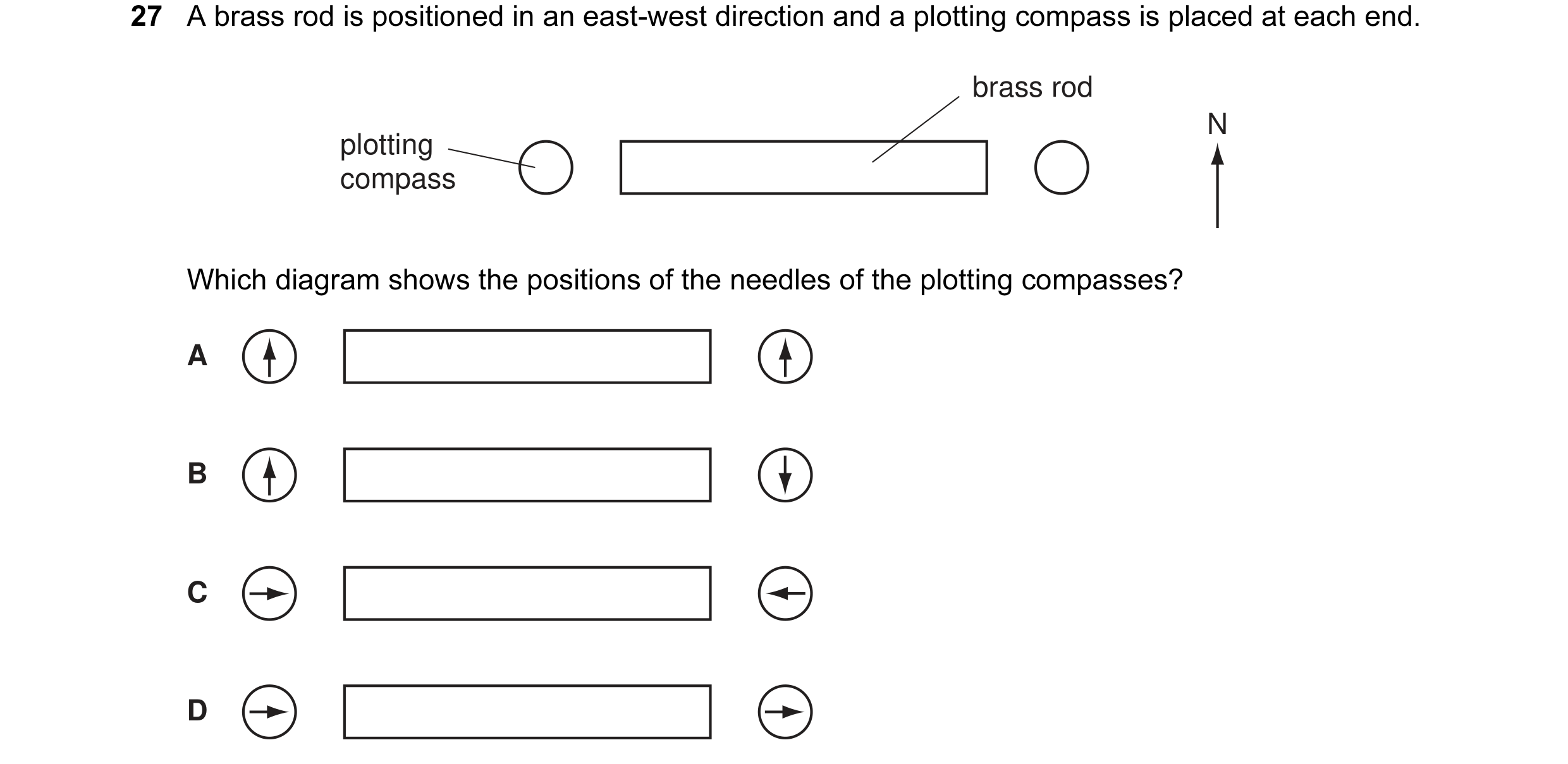
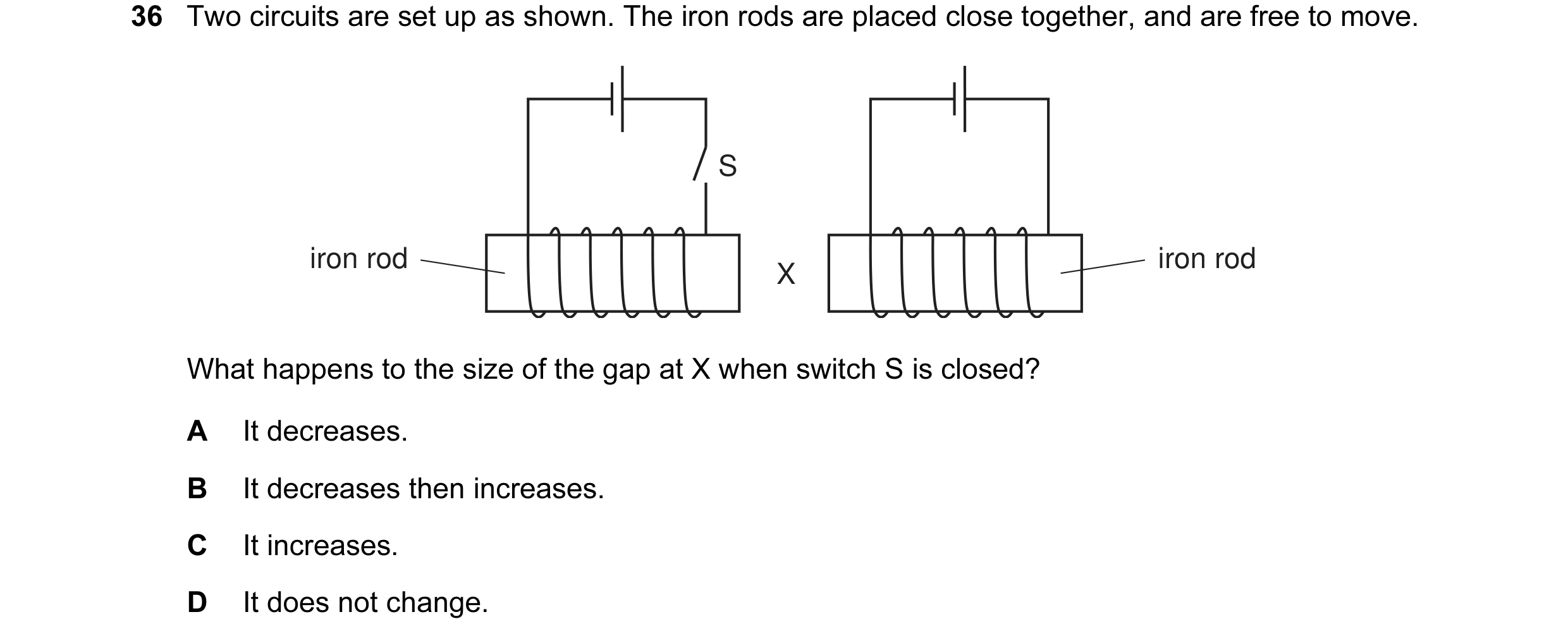
 1 / 83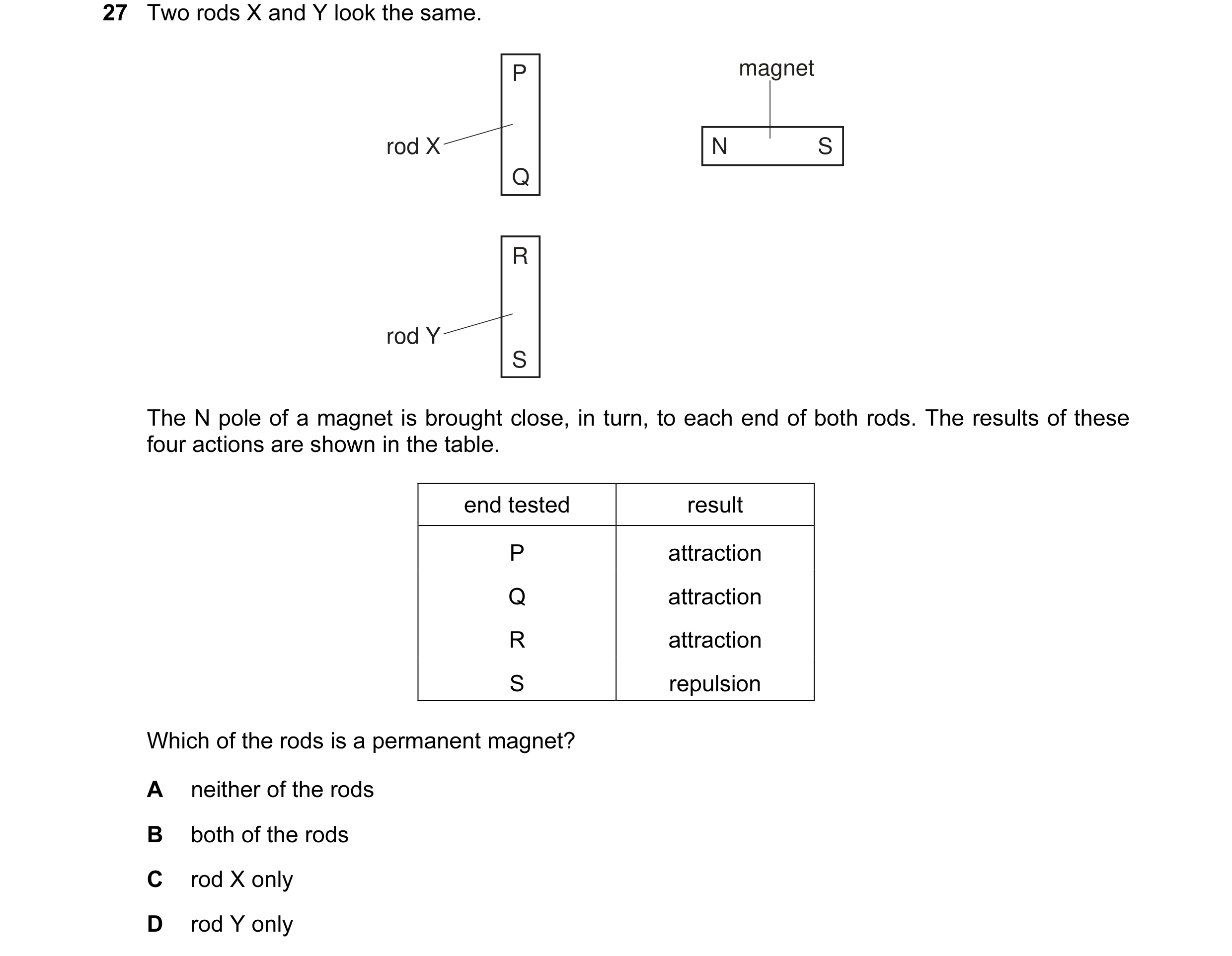
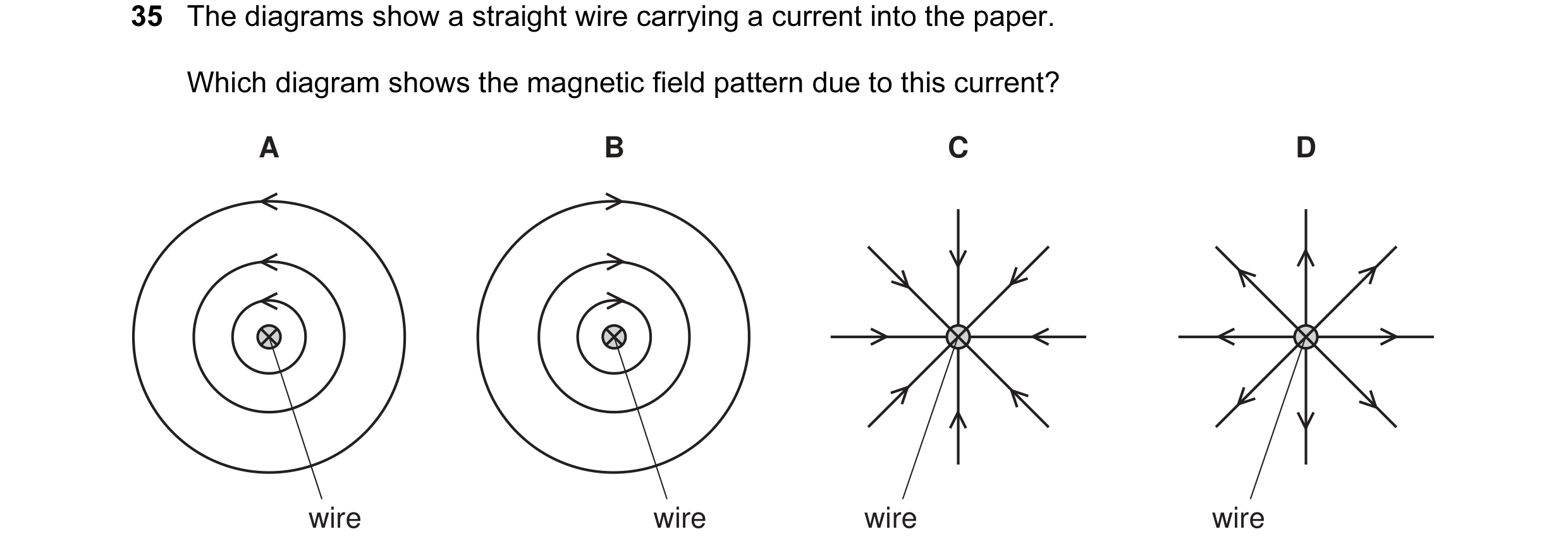
 2 / 83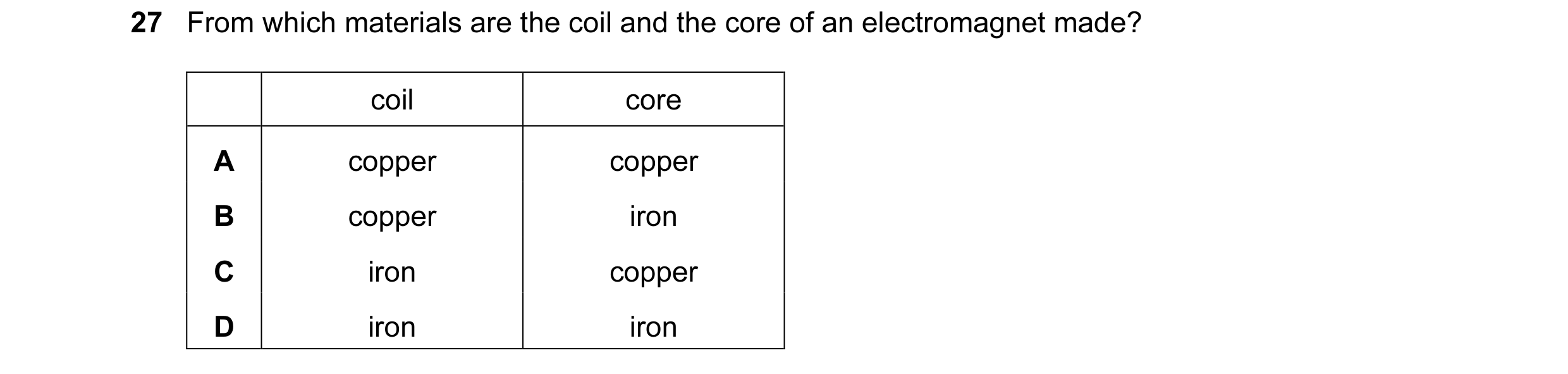
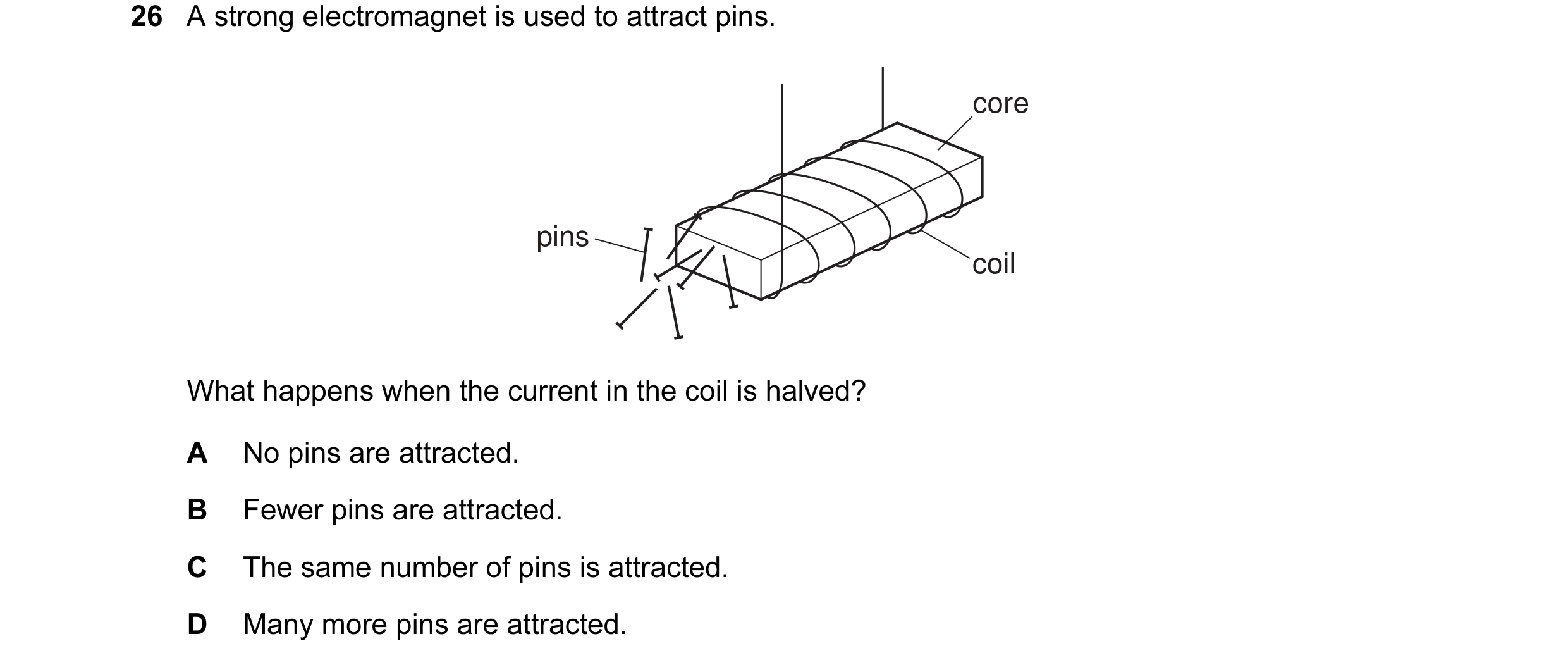
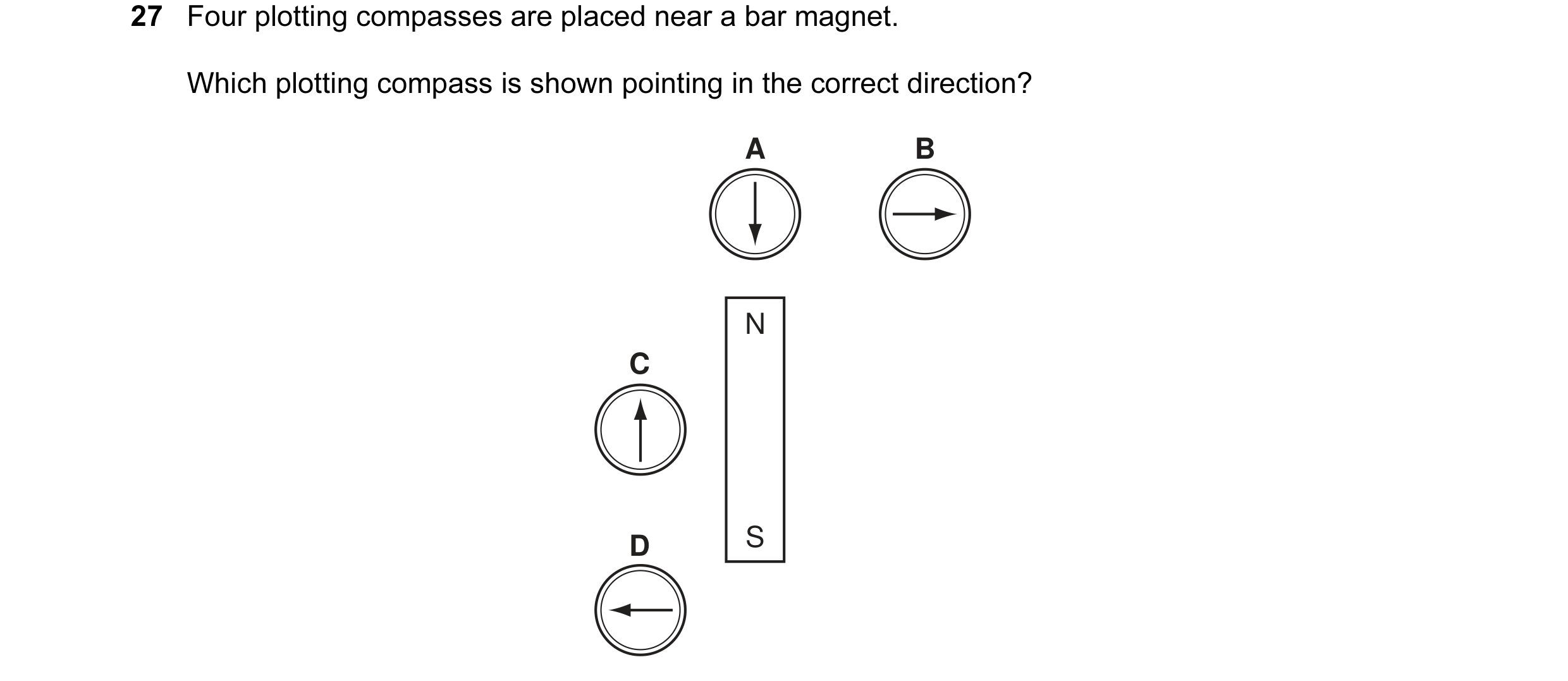 3 / 83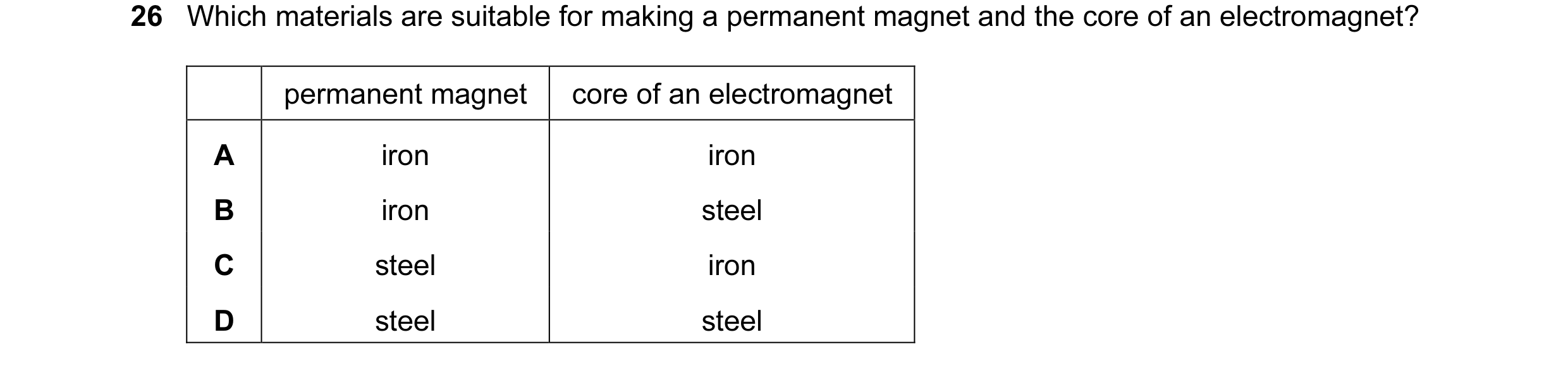
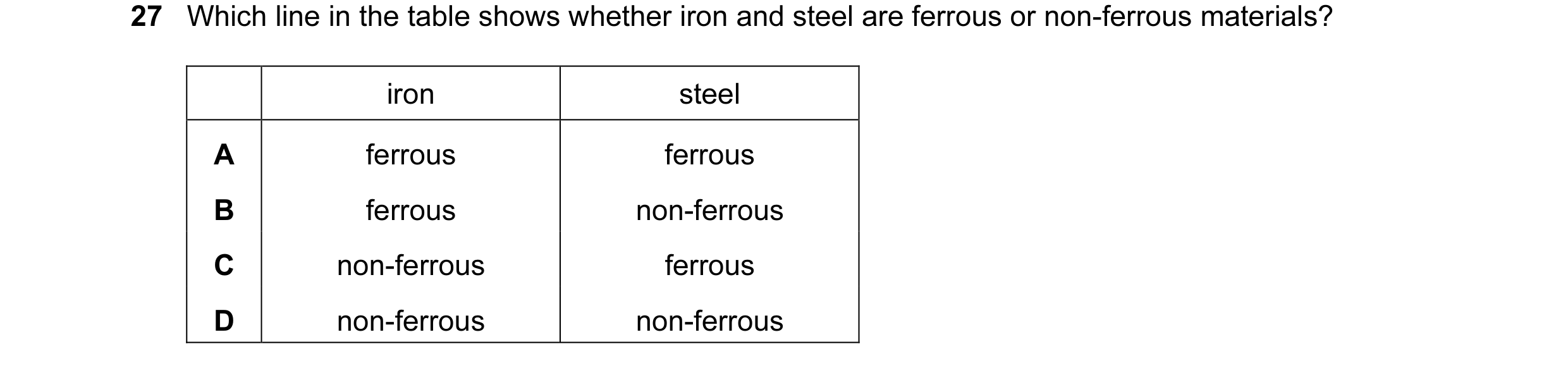
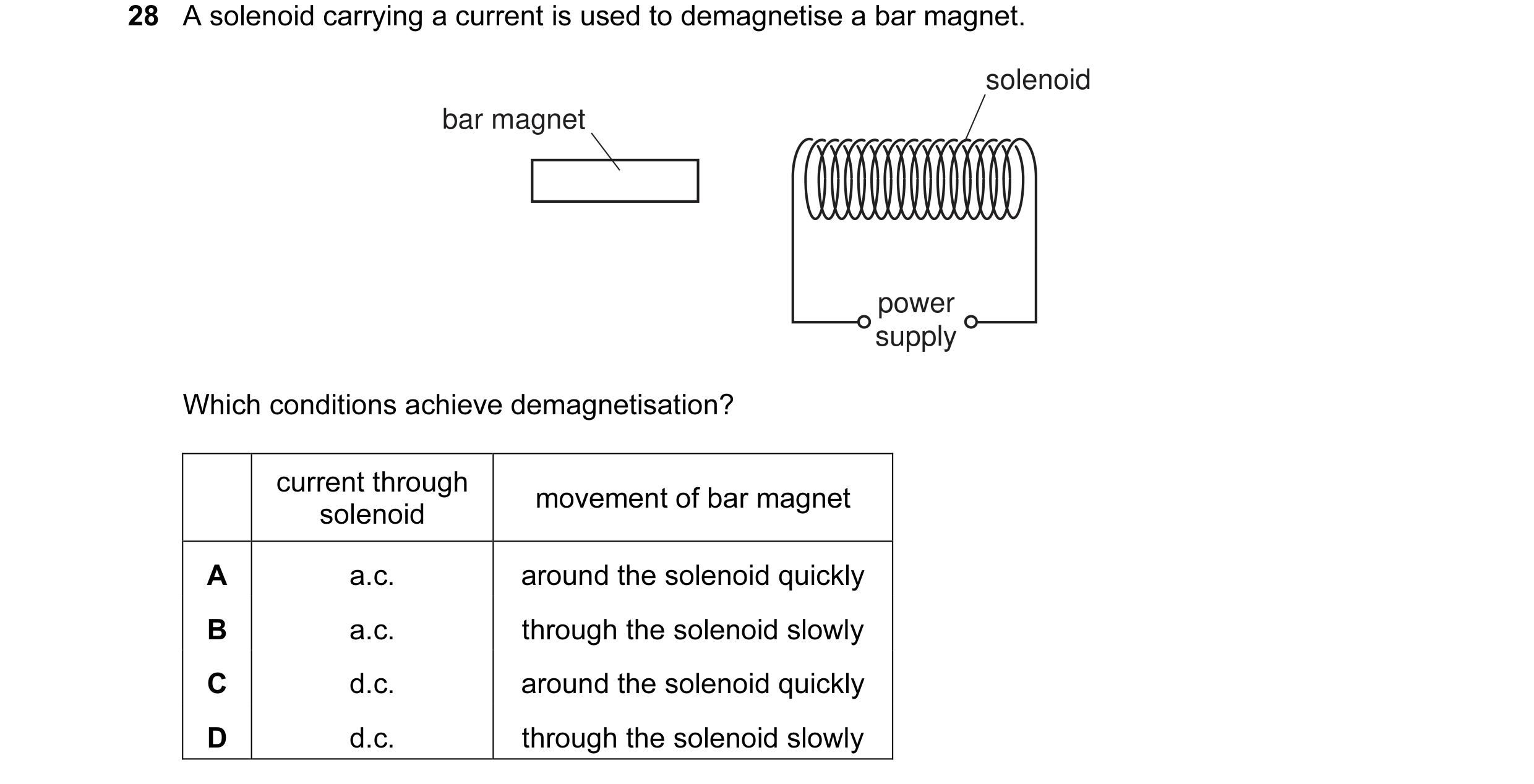 4 / 83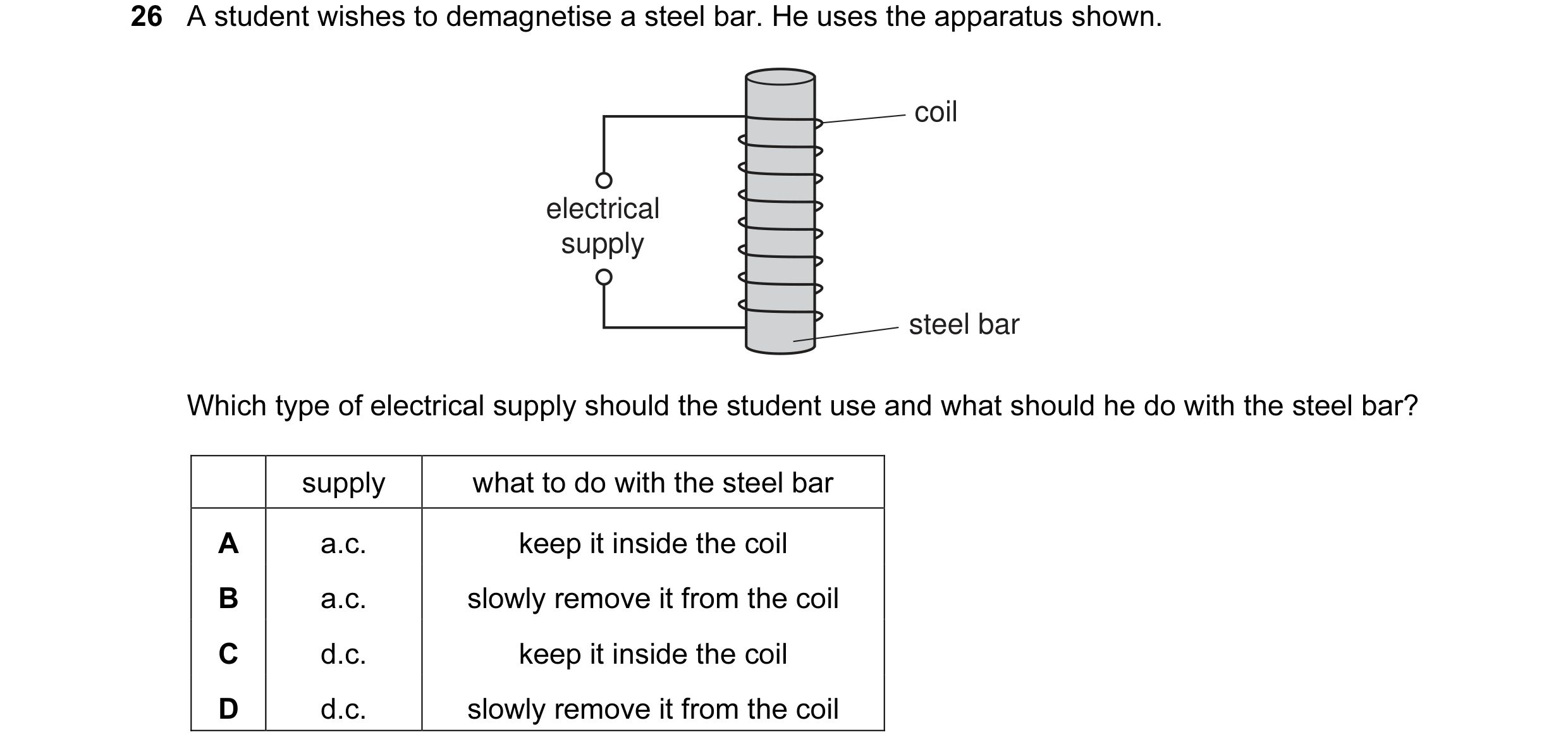
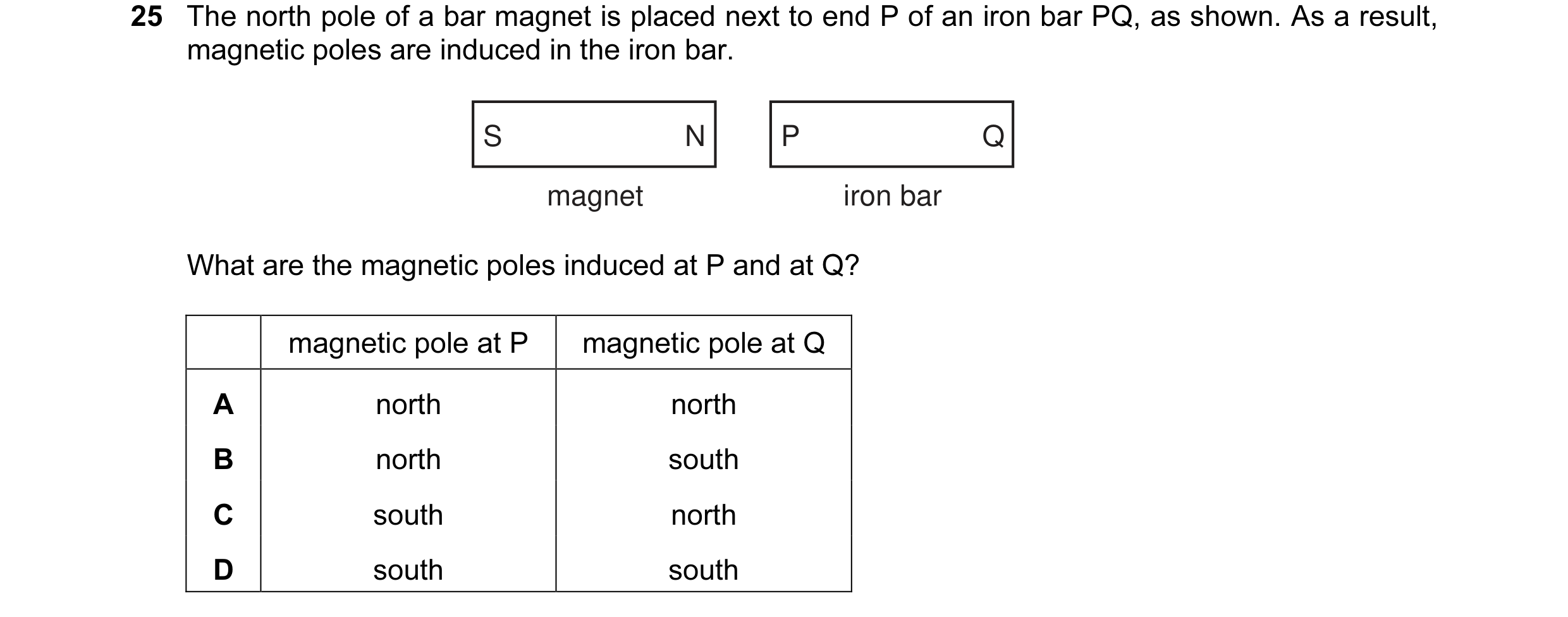 5 / 83
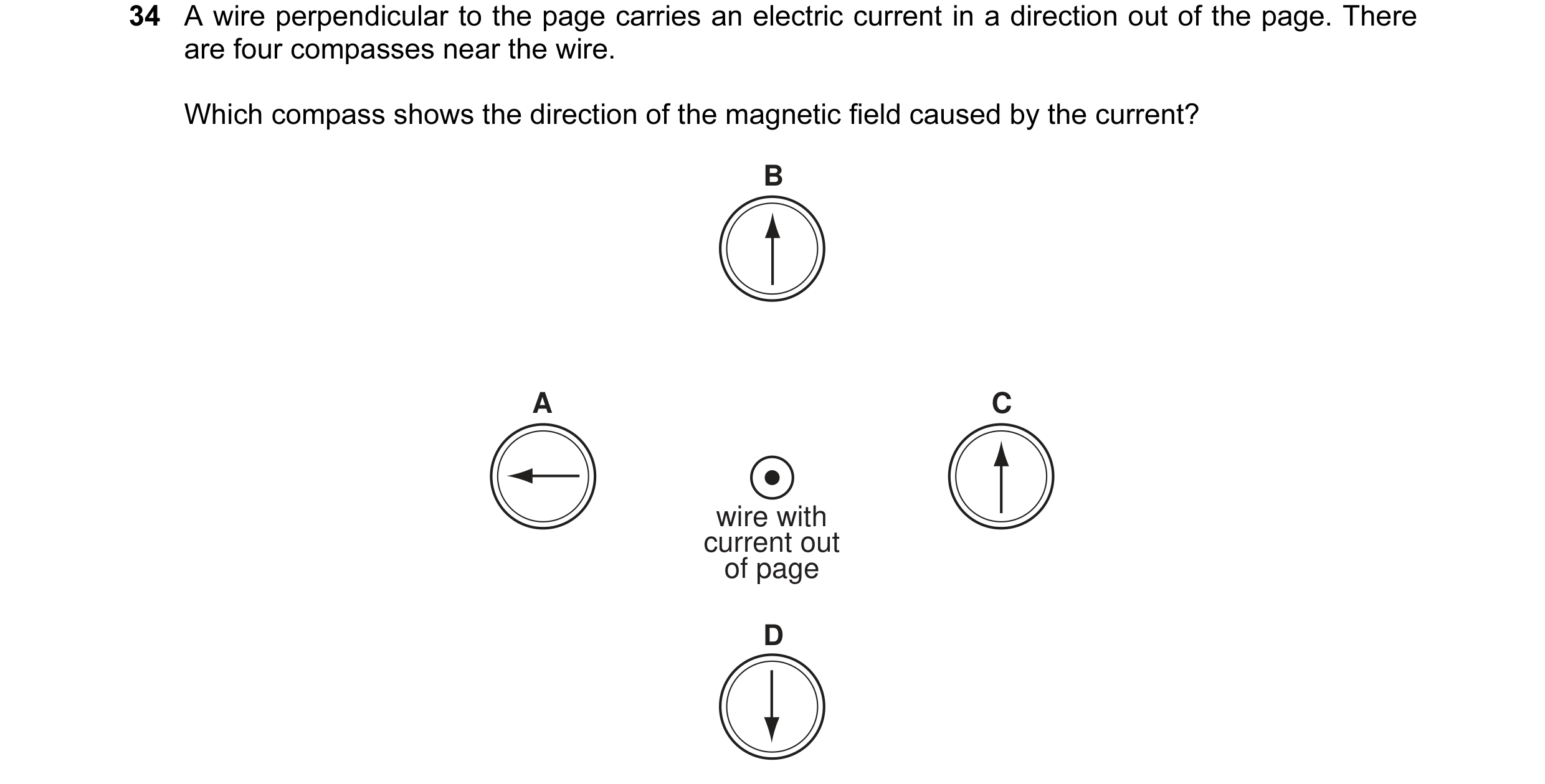
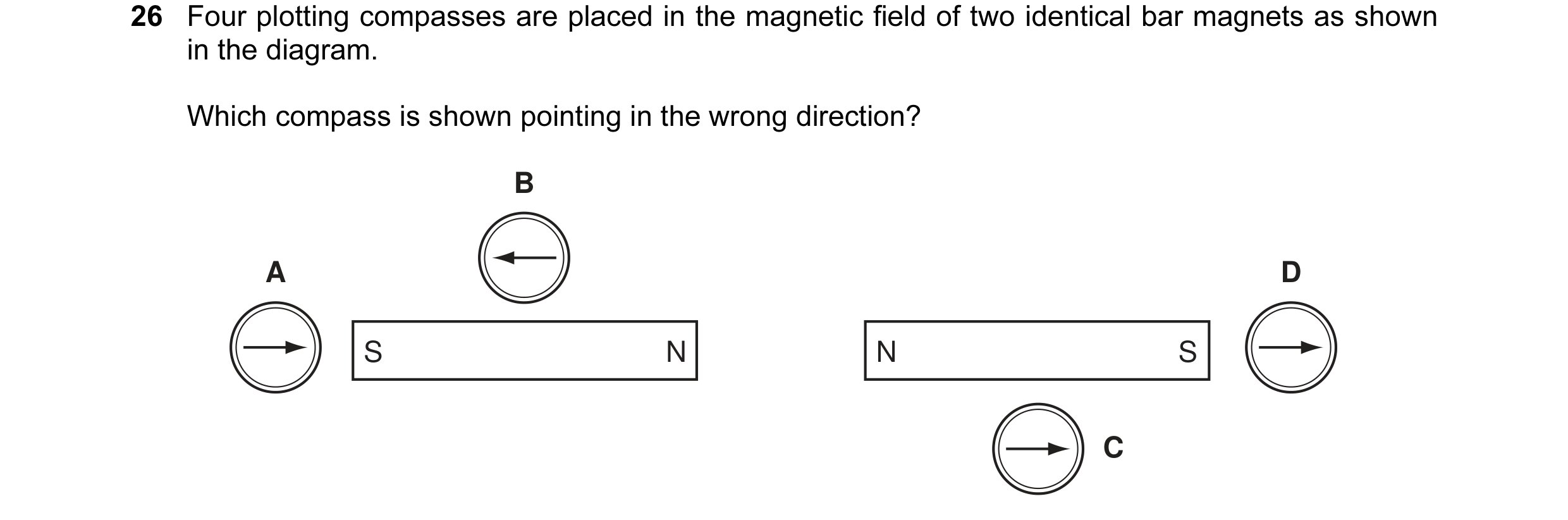 6 / 83
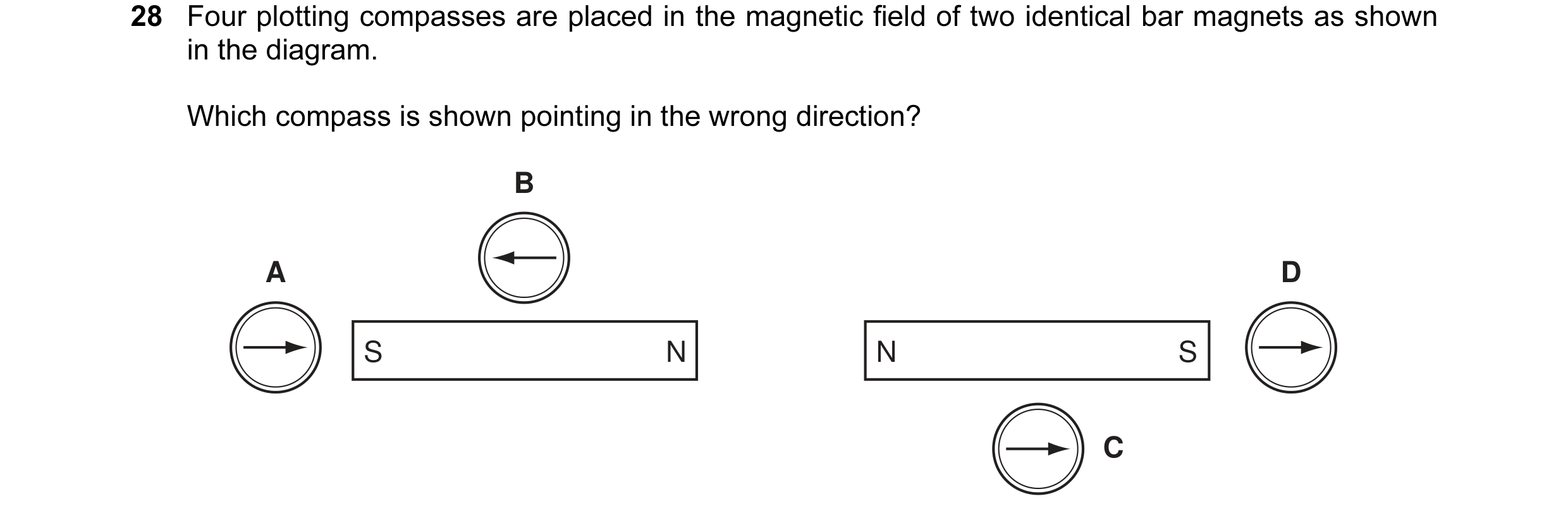
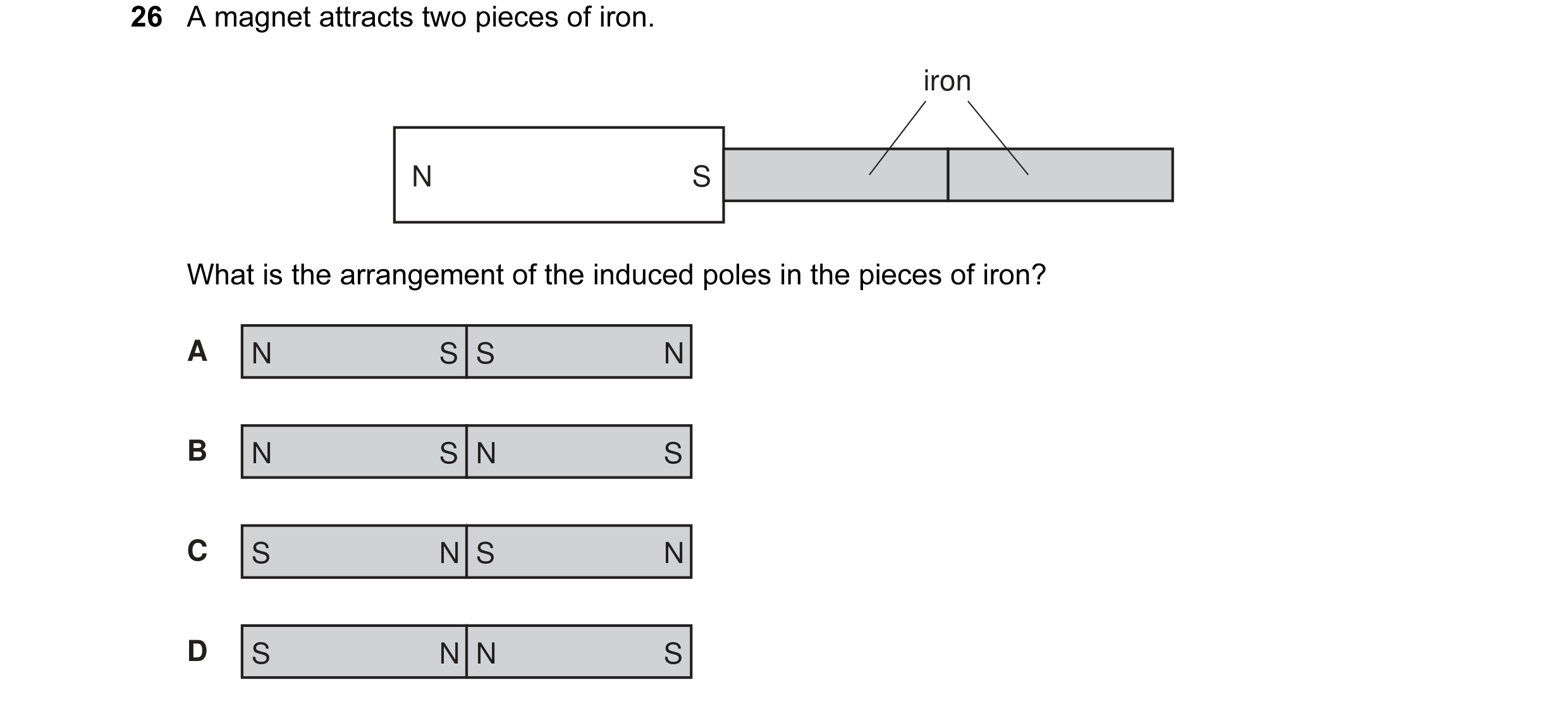 7 / 83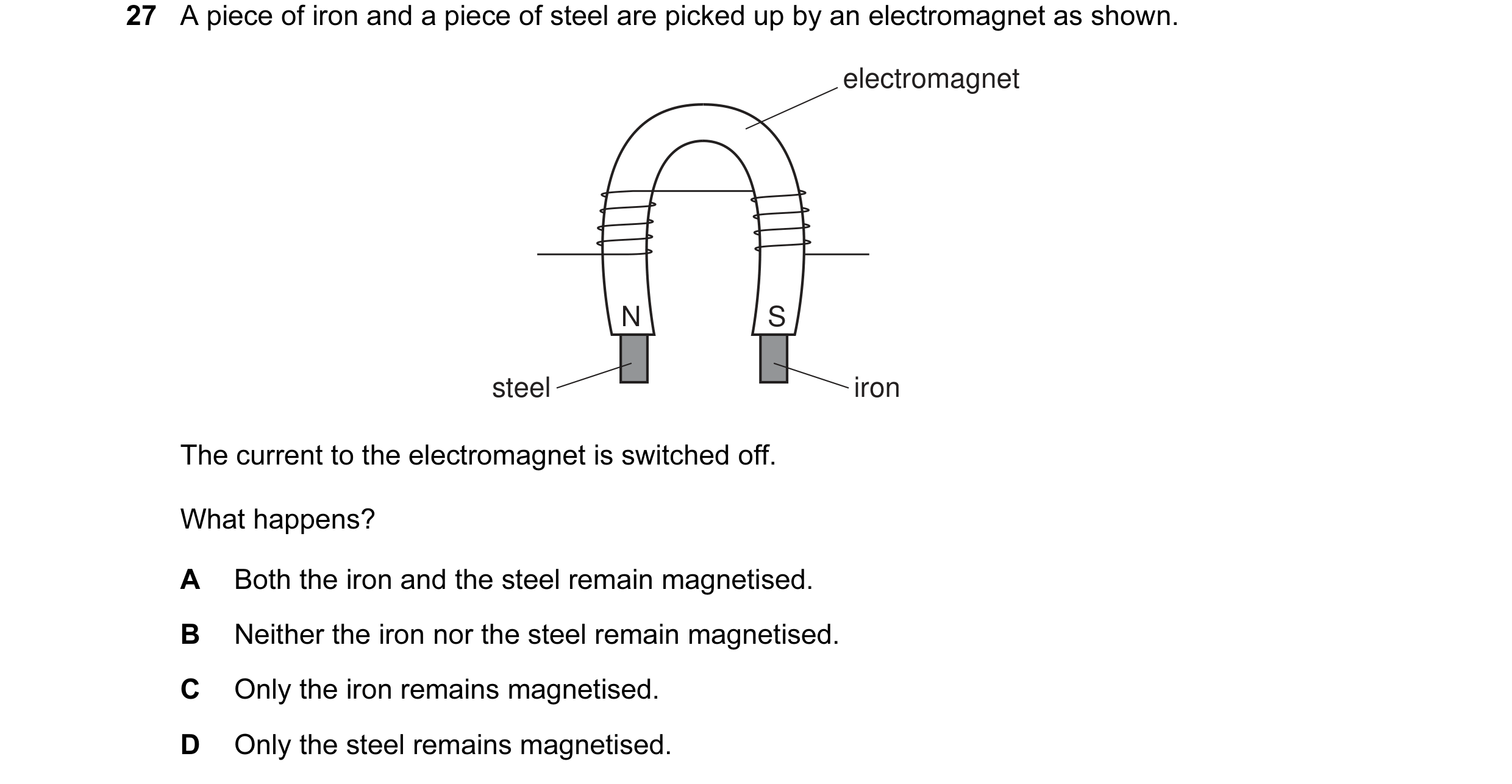
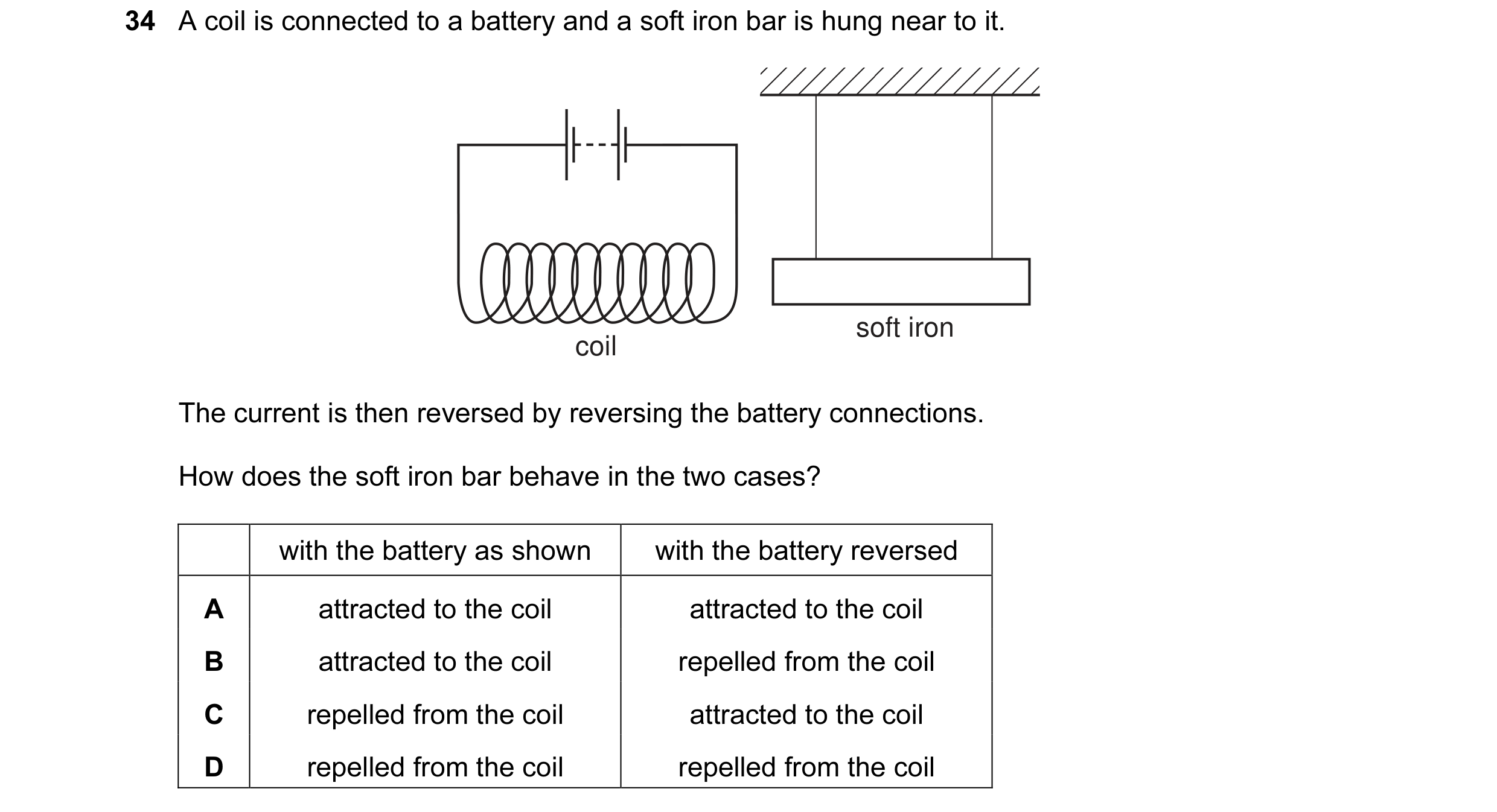 8 / 83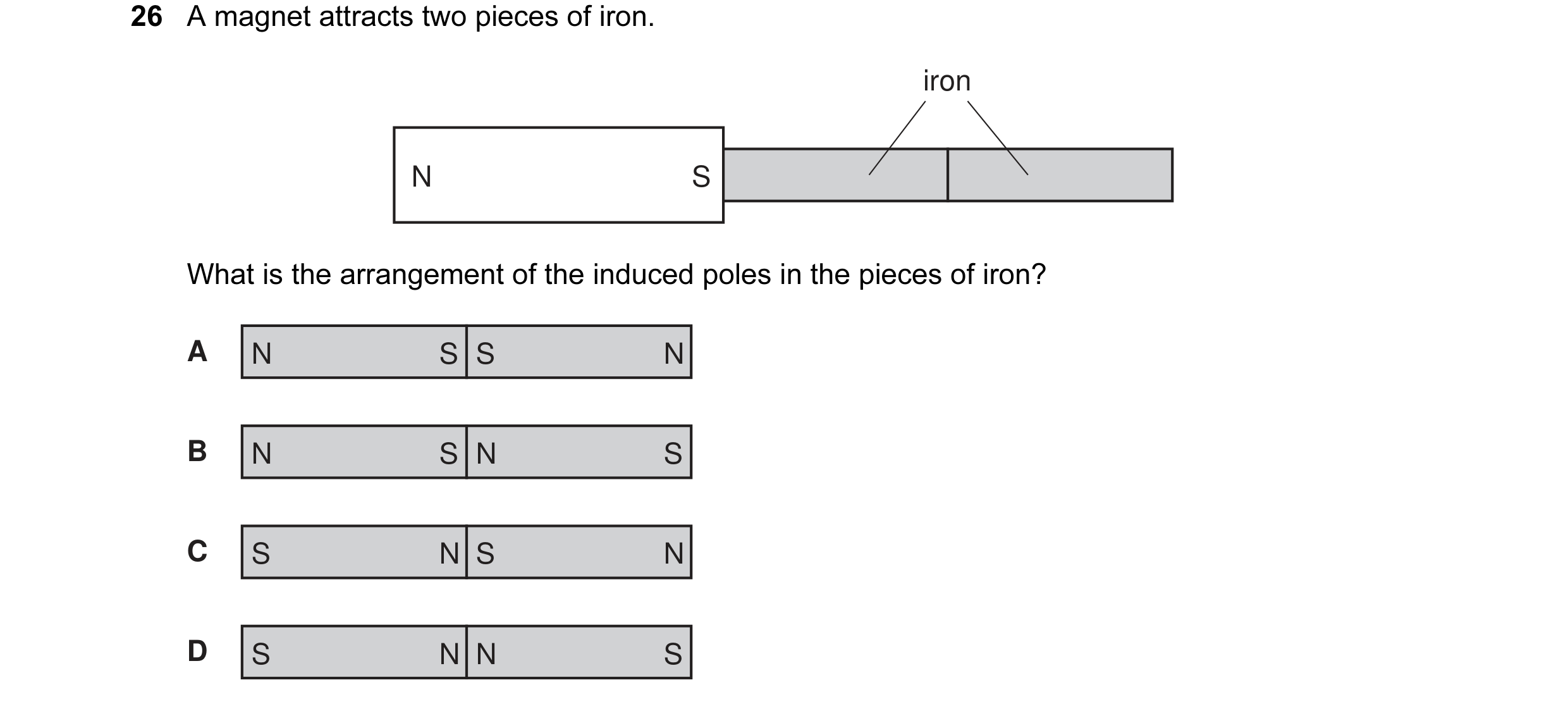
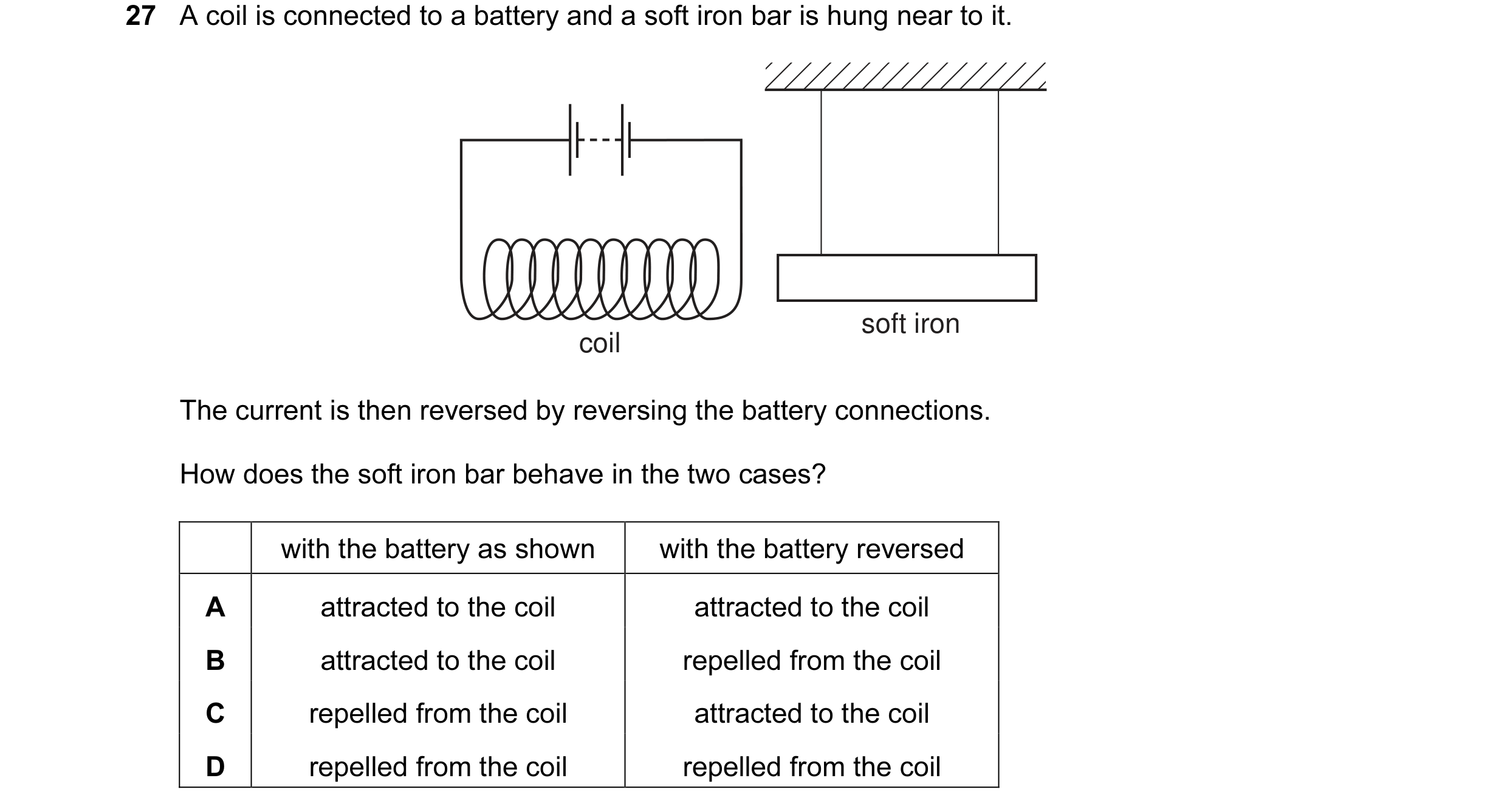 9 / 83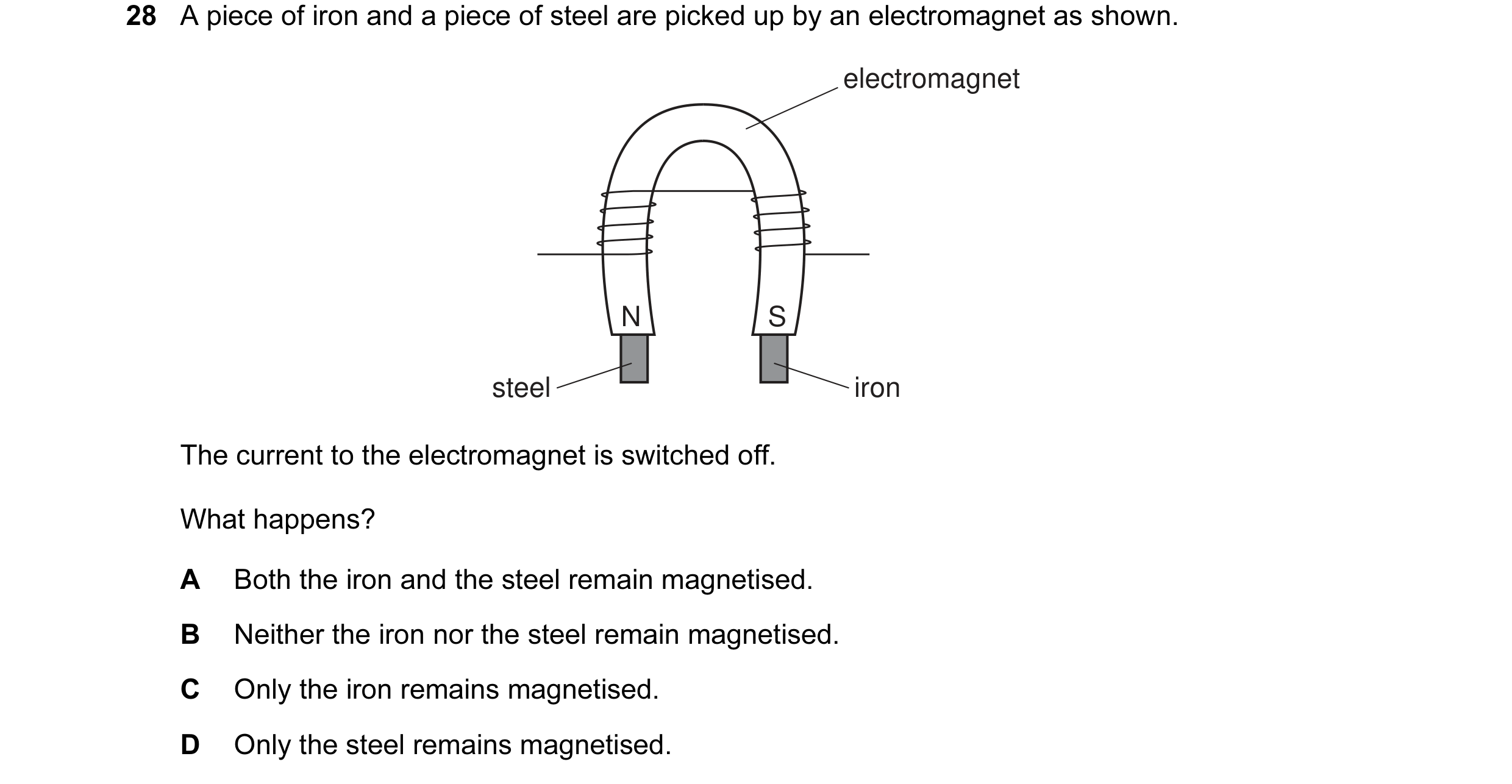

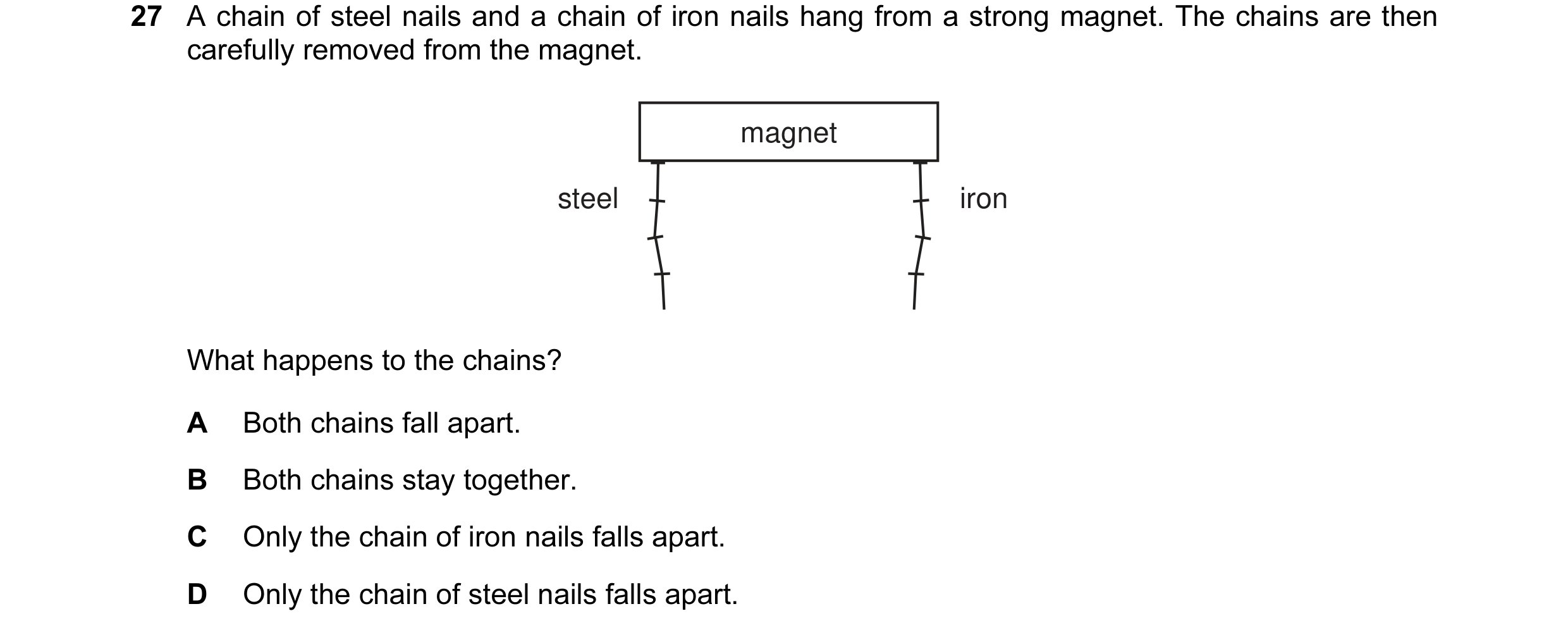
 10 / 83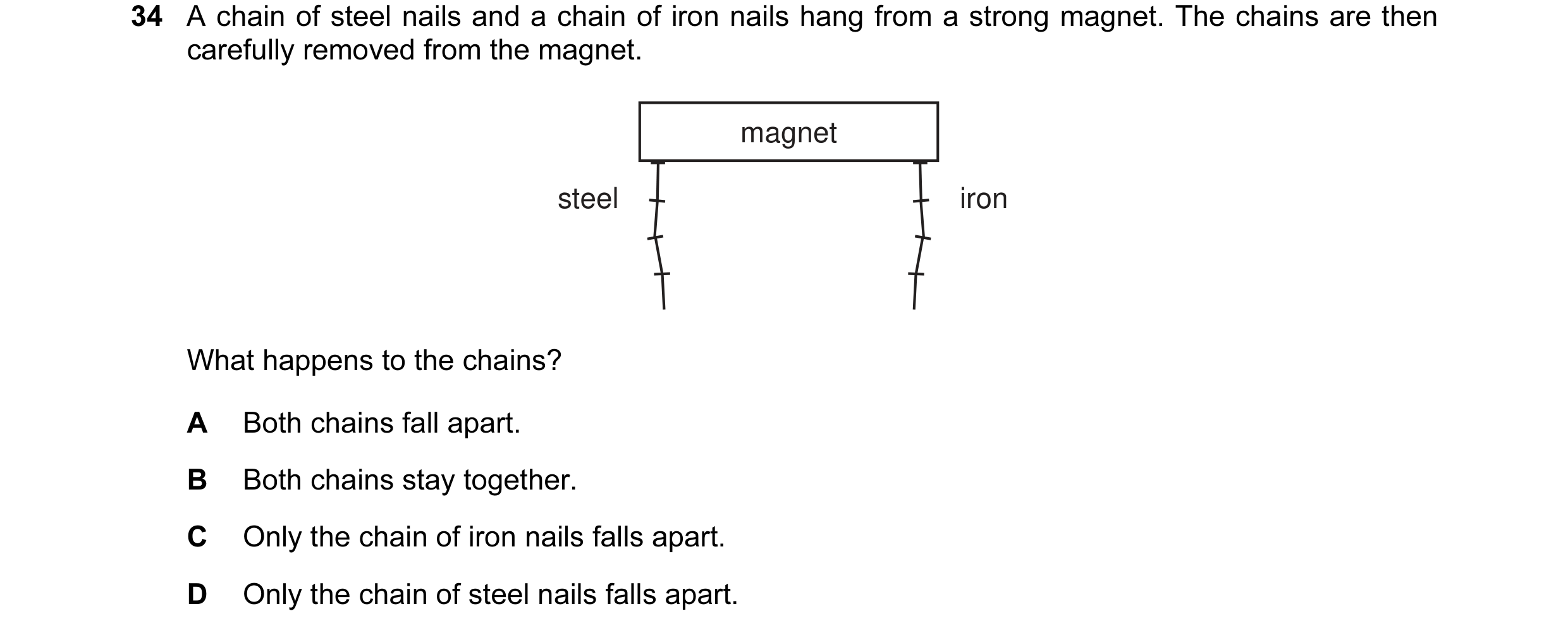

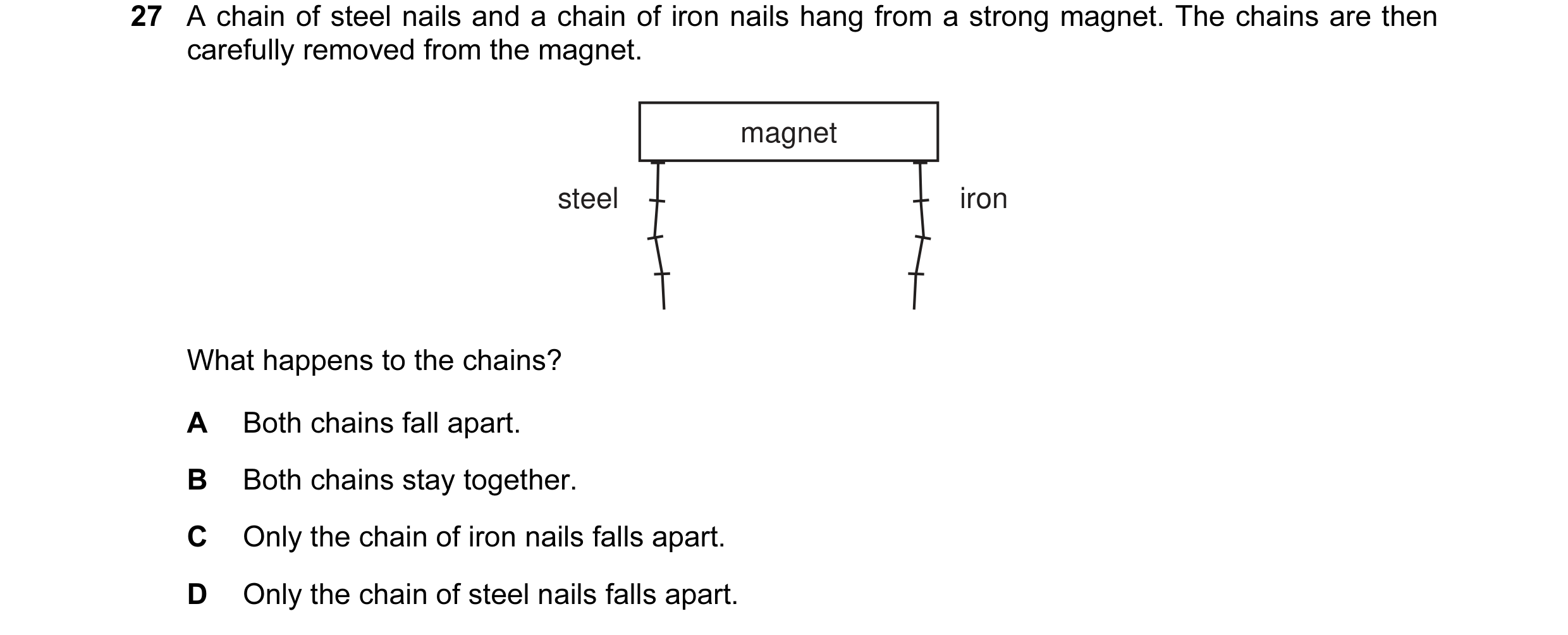
 11 / 83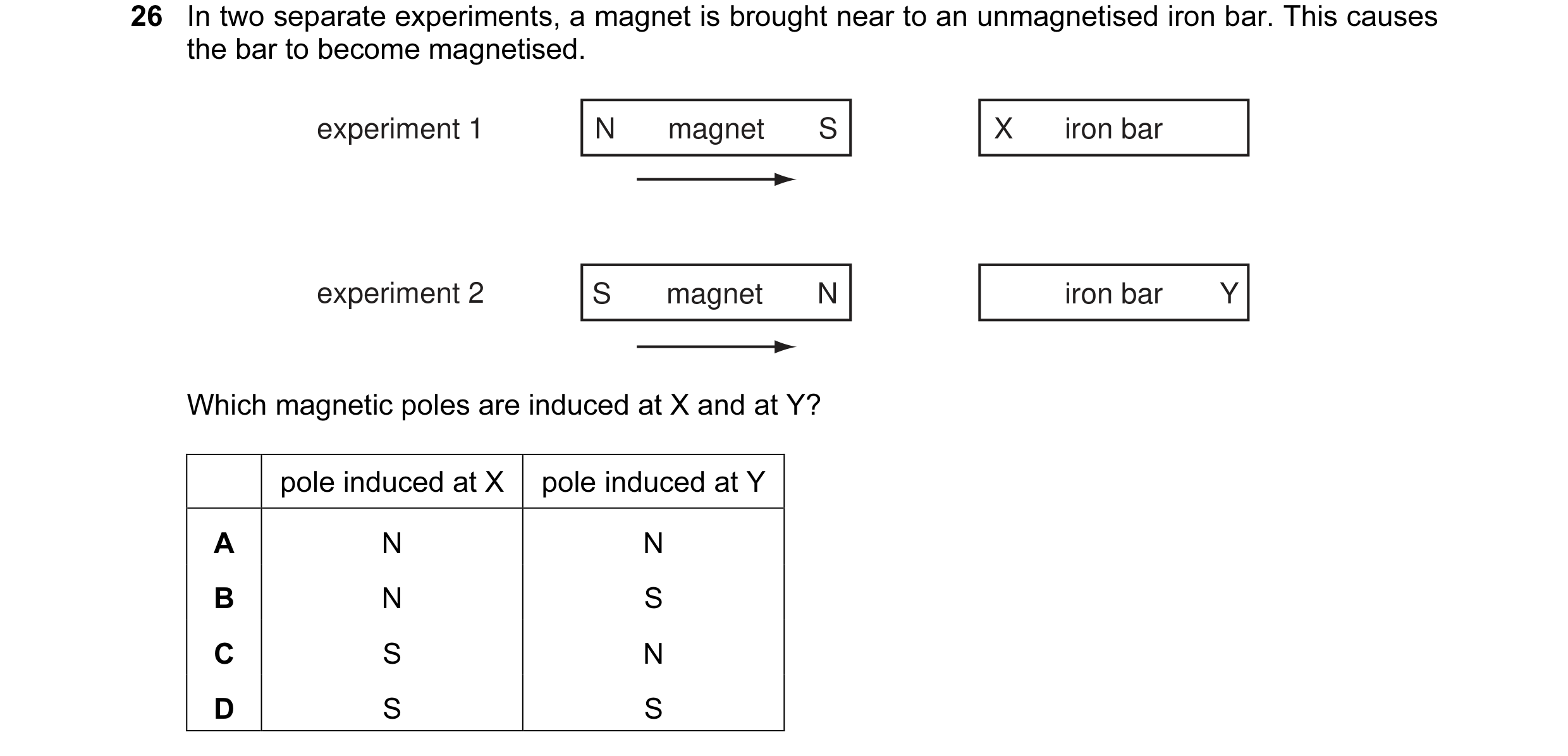
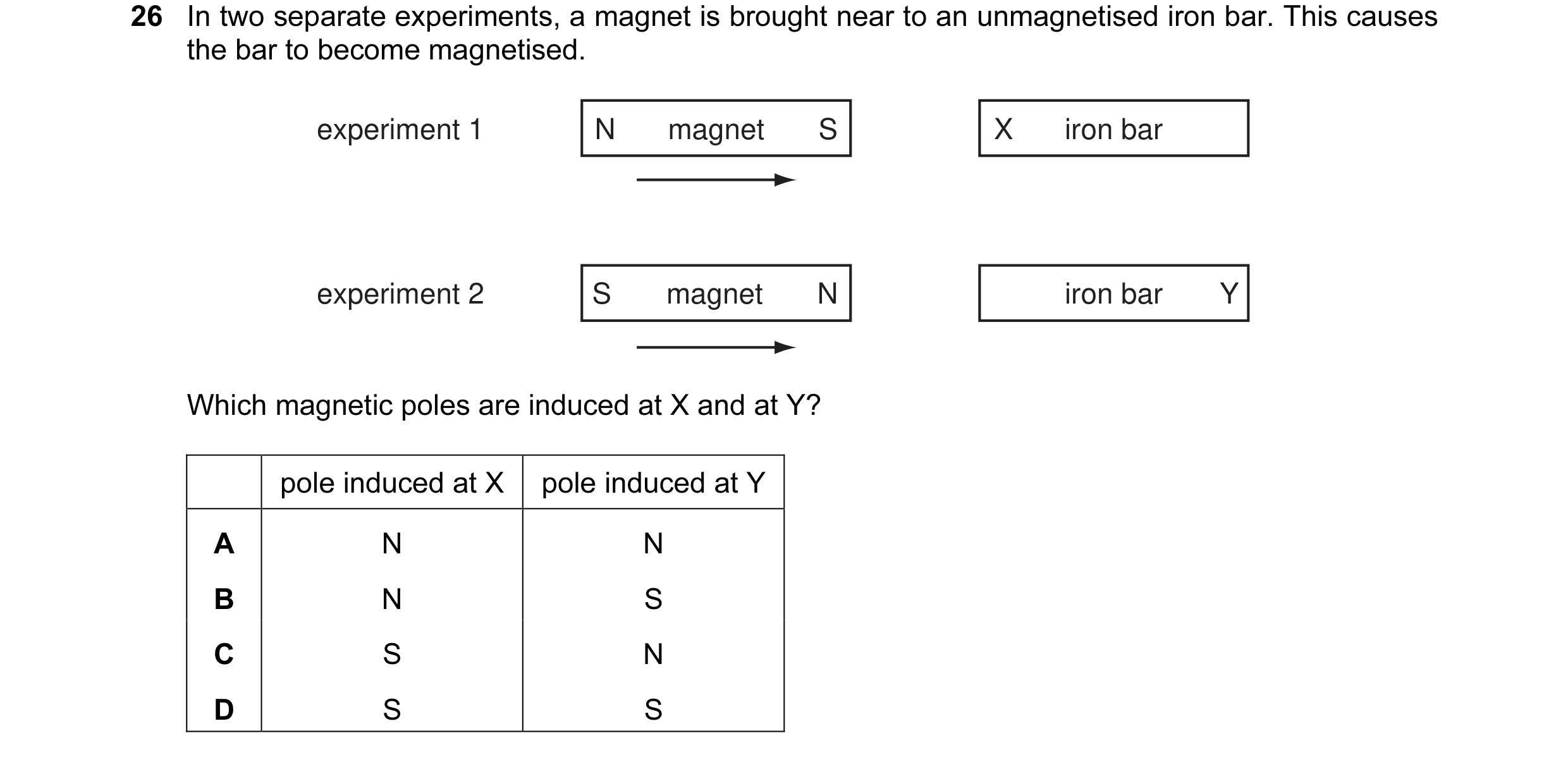
 12 / 83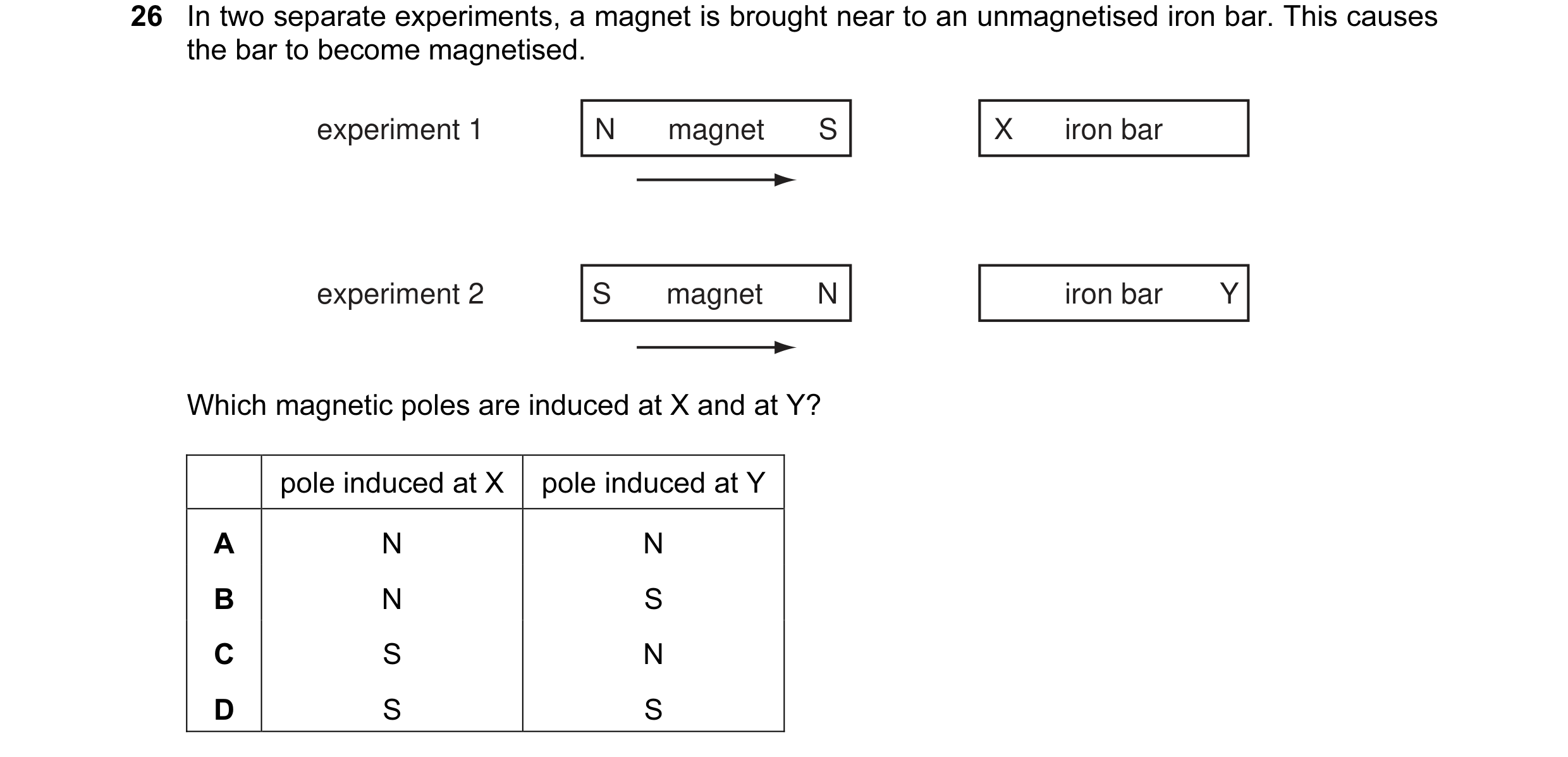

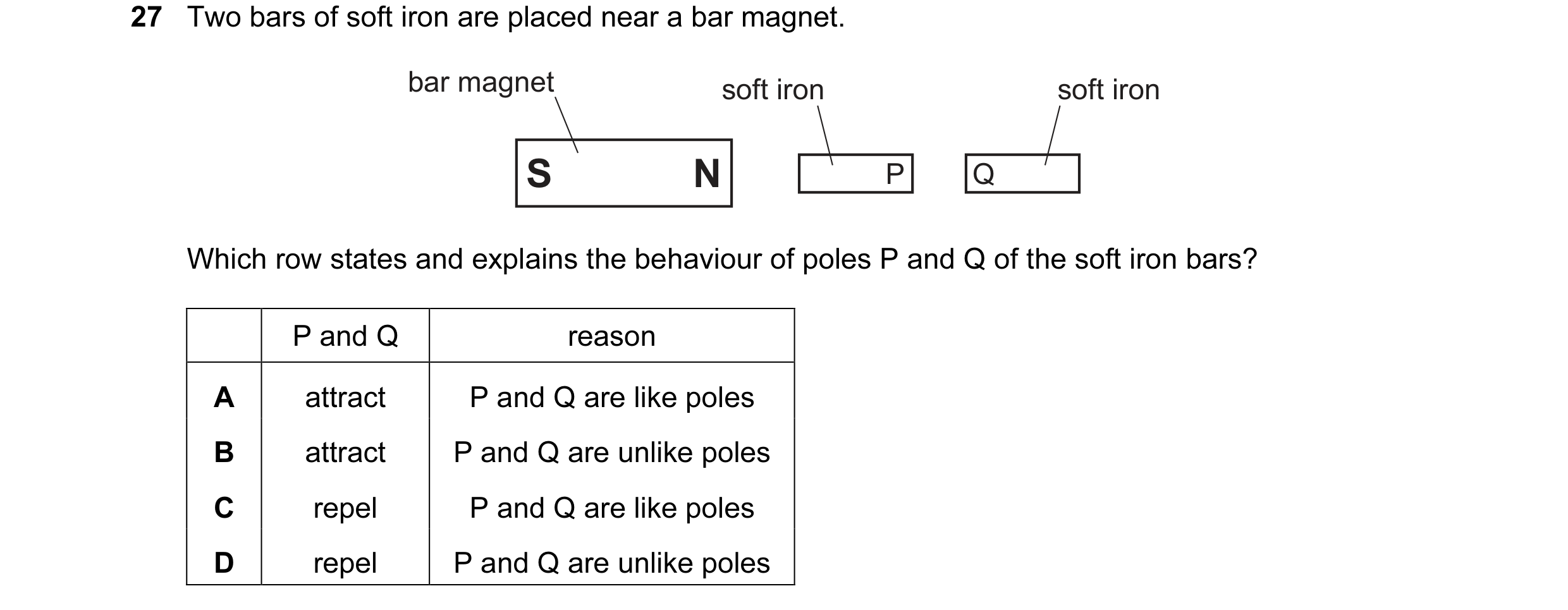 13 / 83
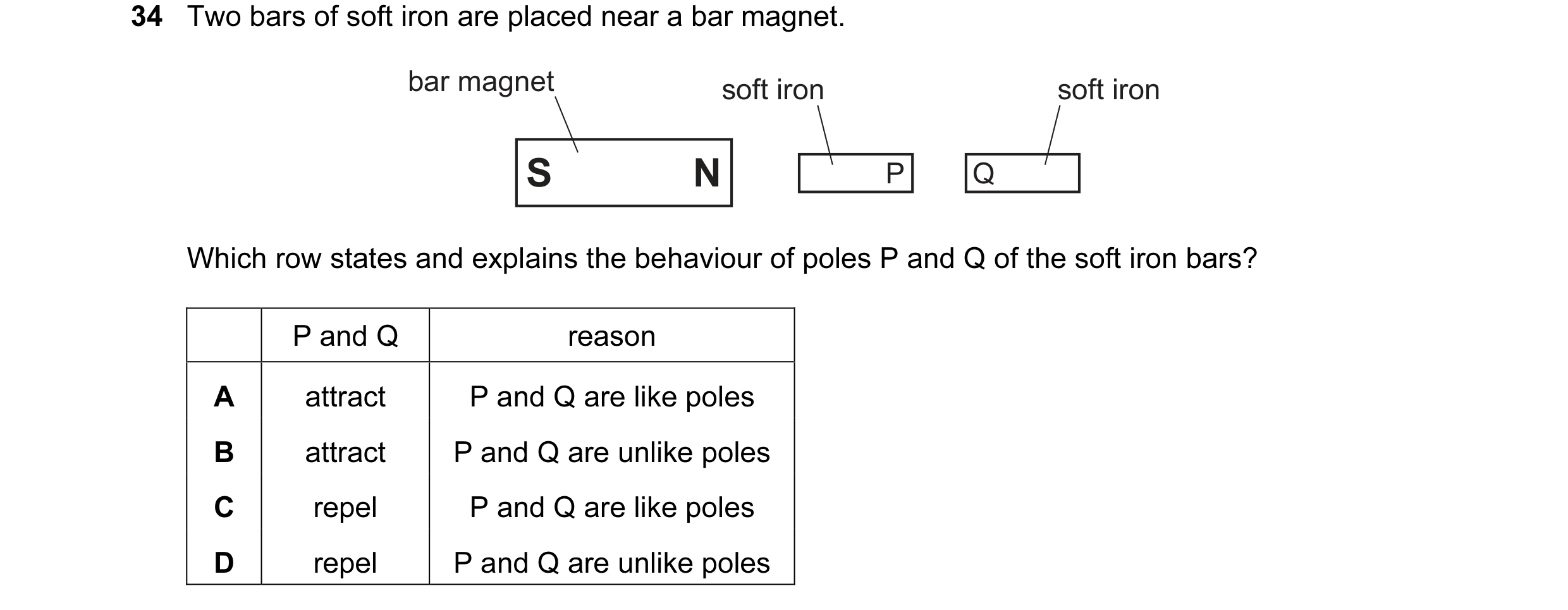
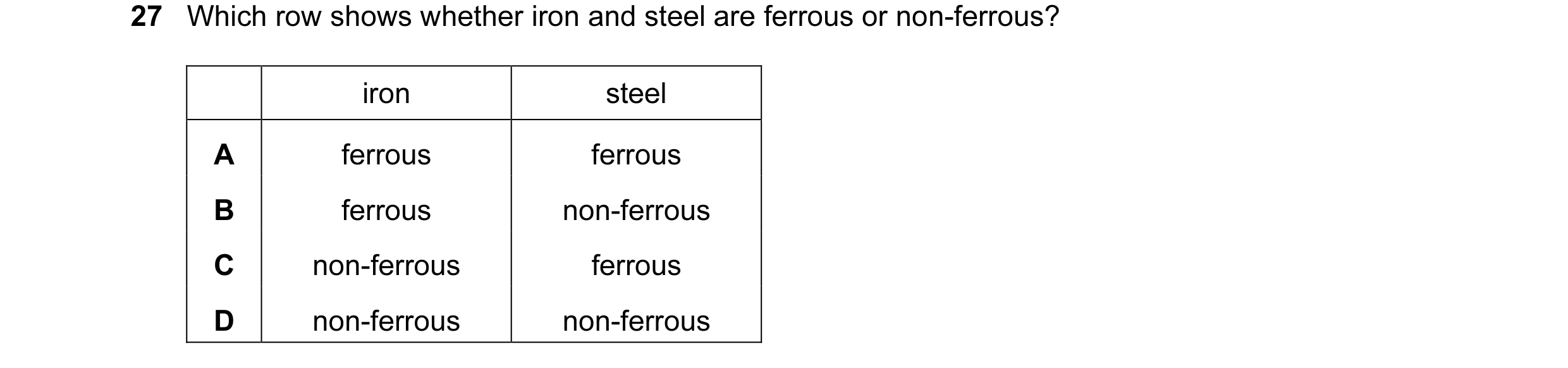 14 / 83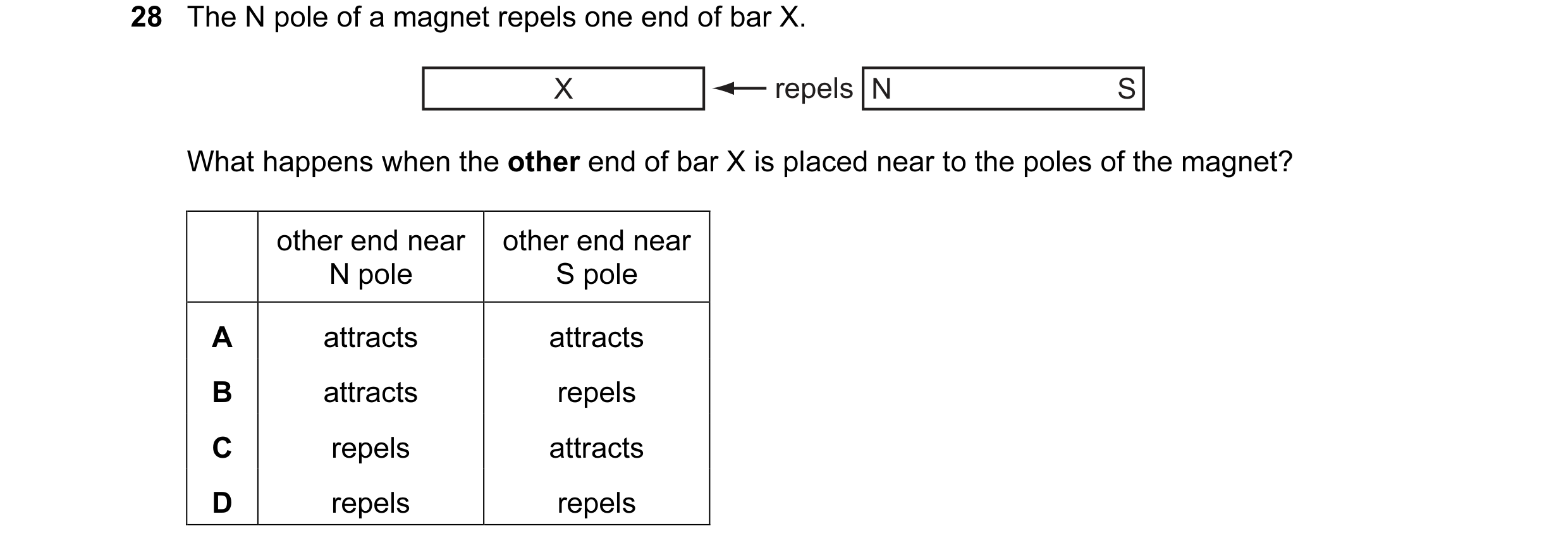

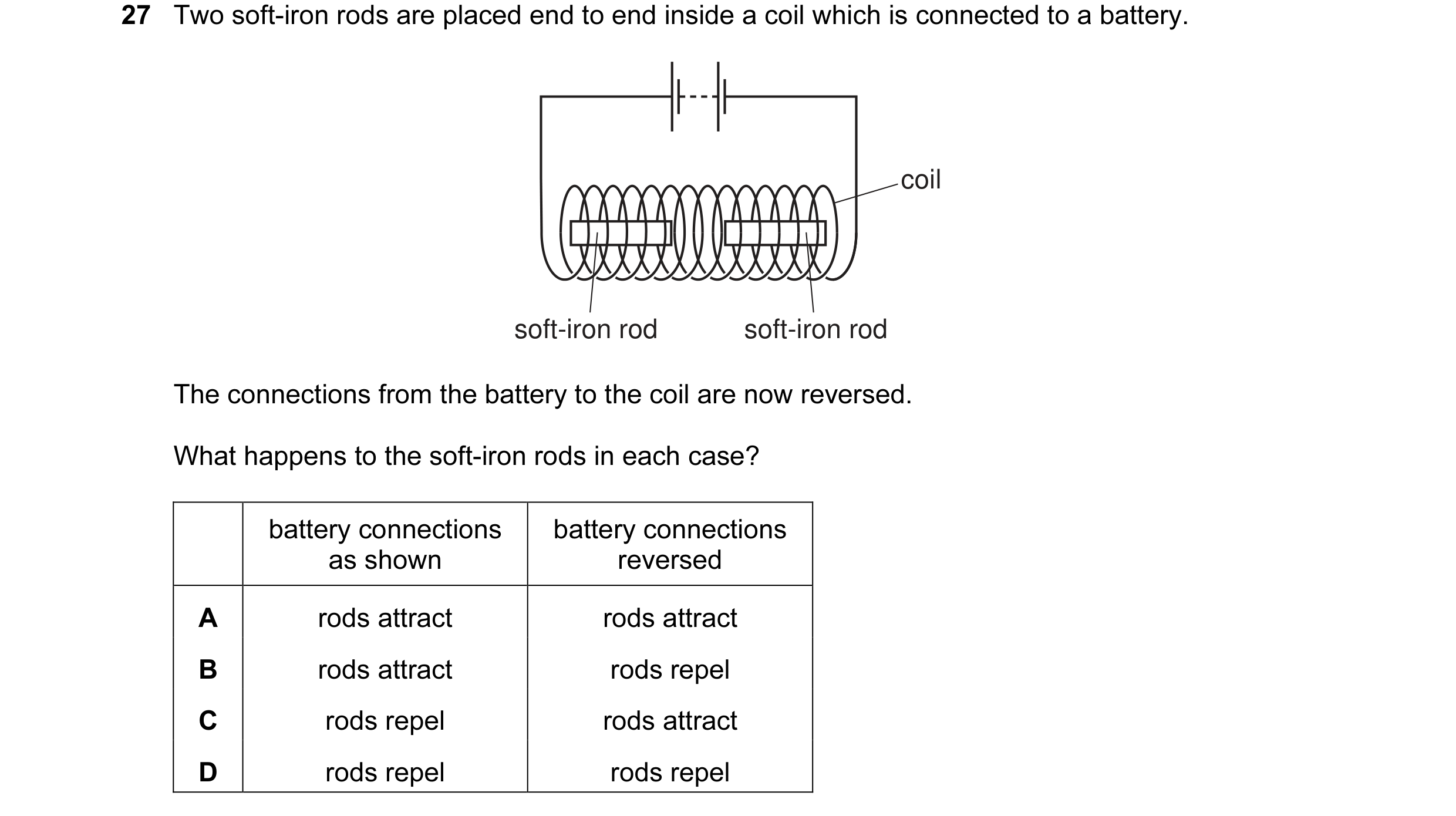
 15 / 83
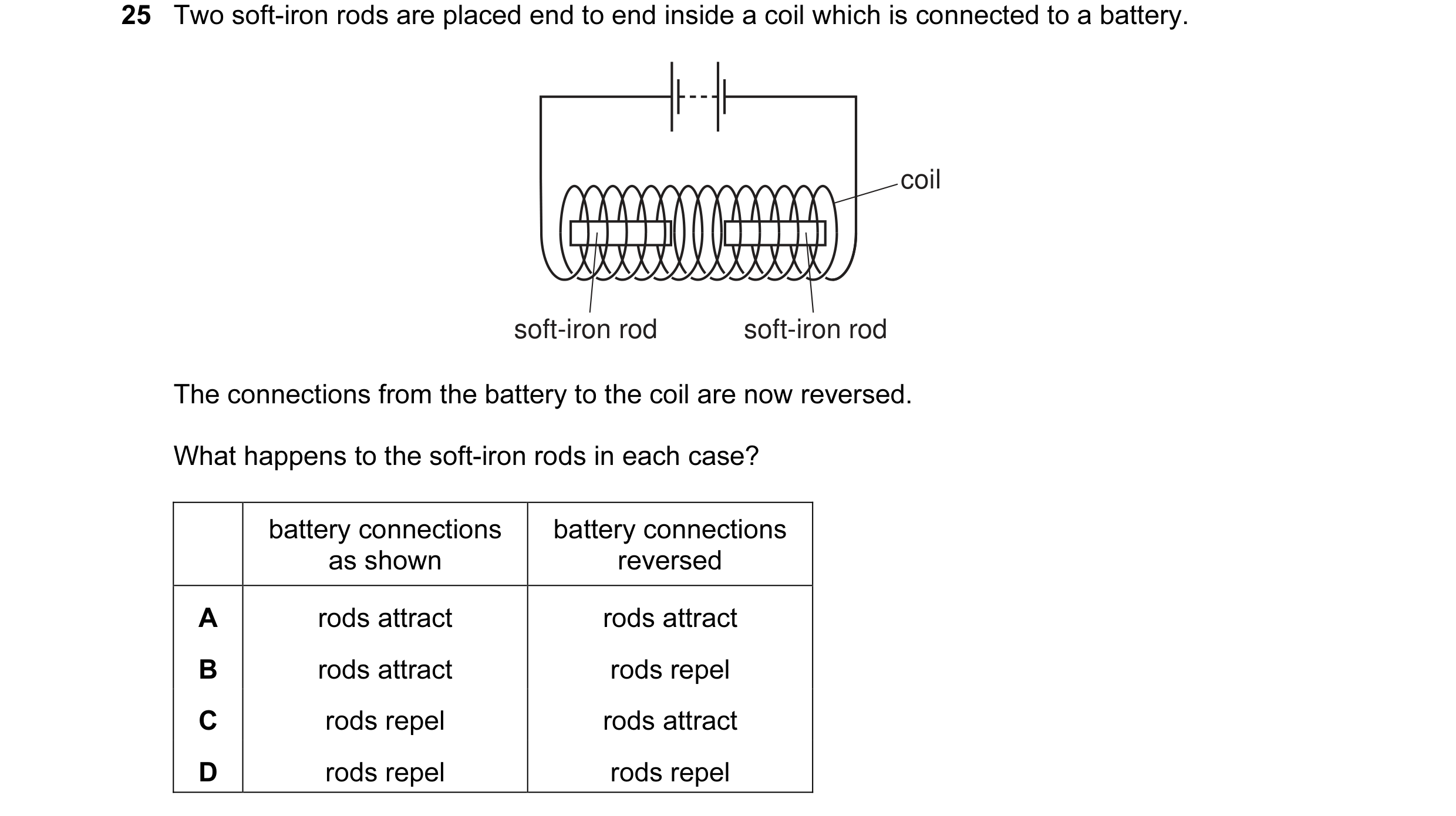

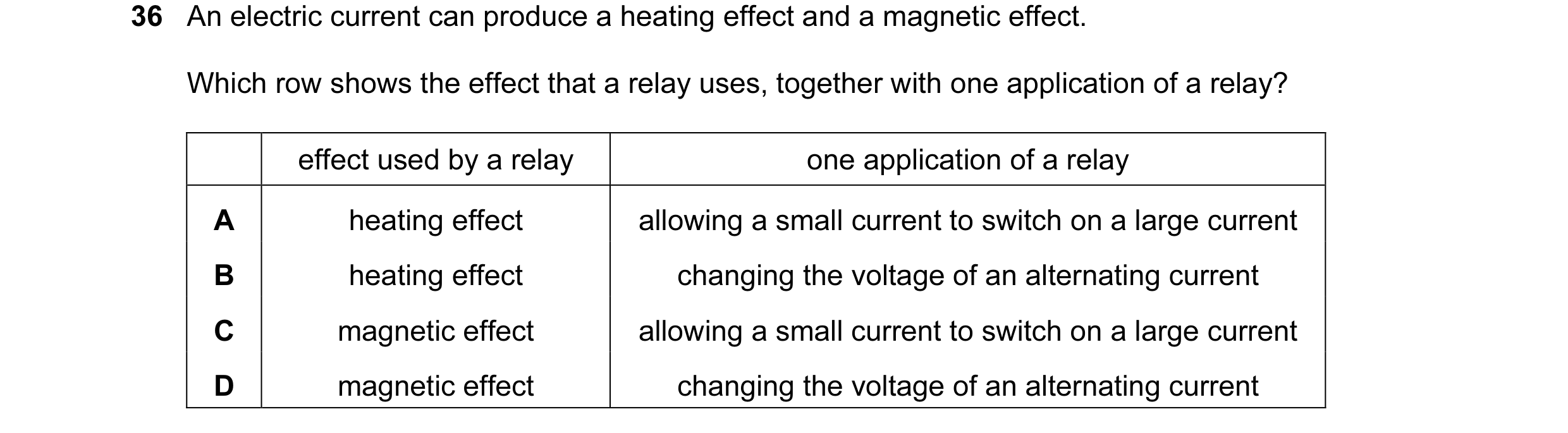 16 / 83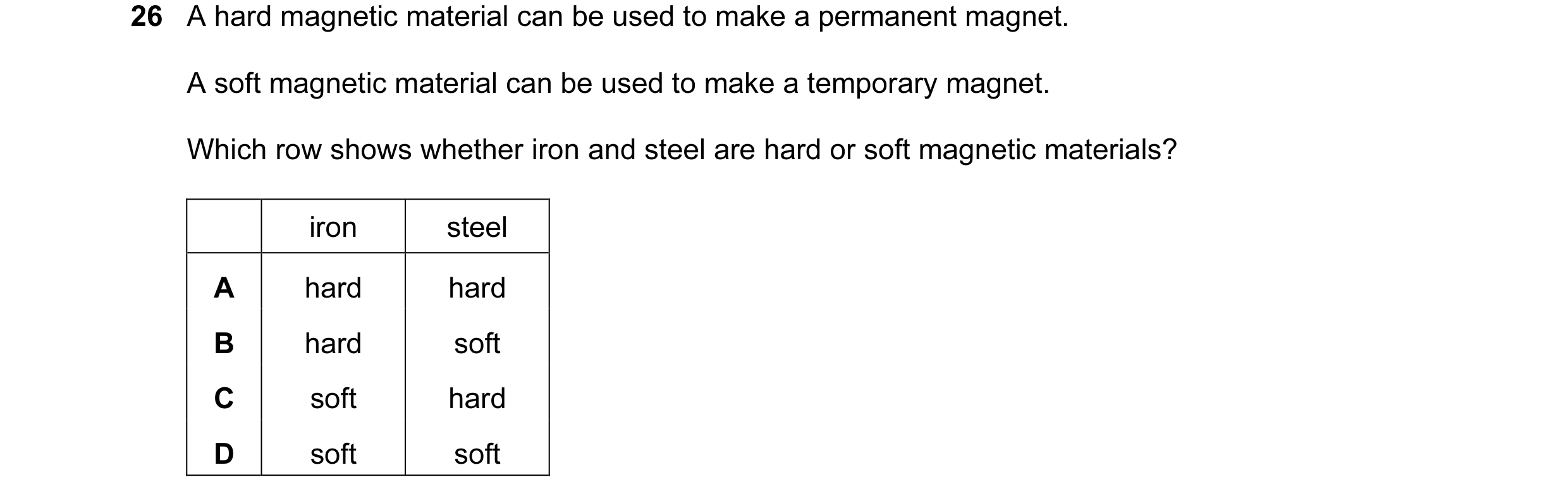


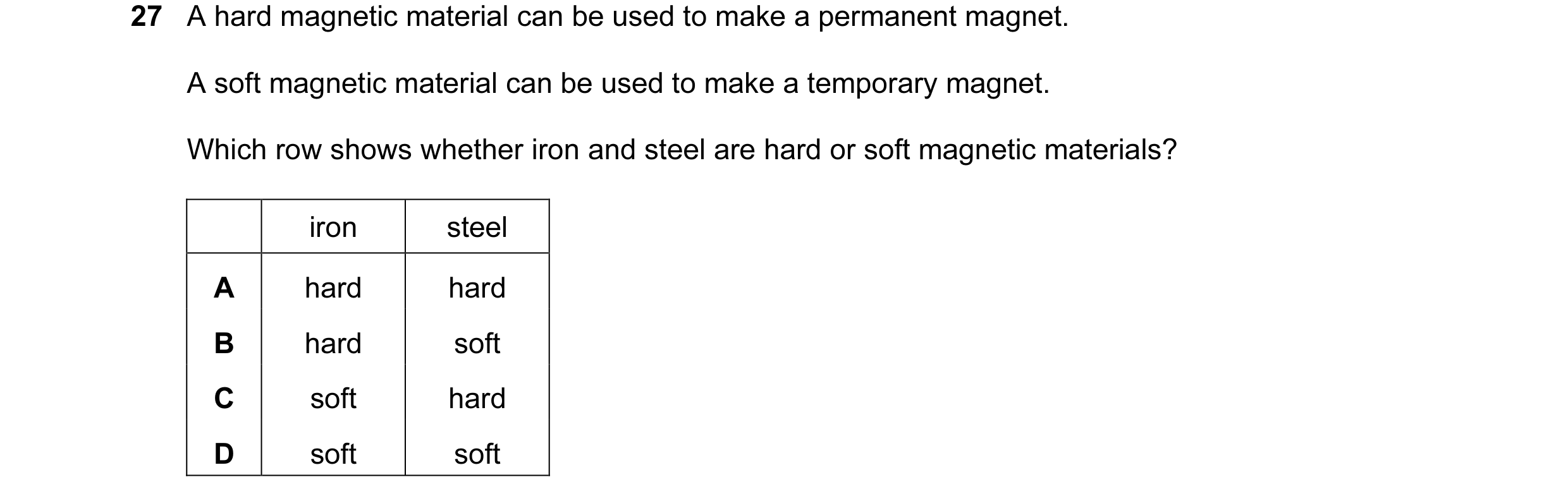
 17 / 83
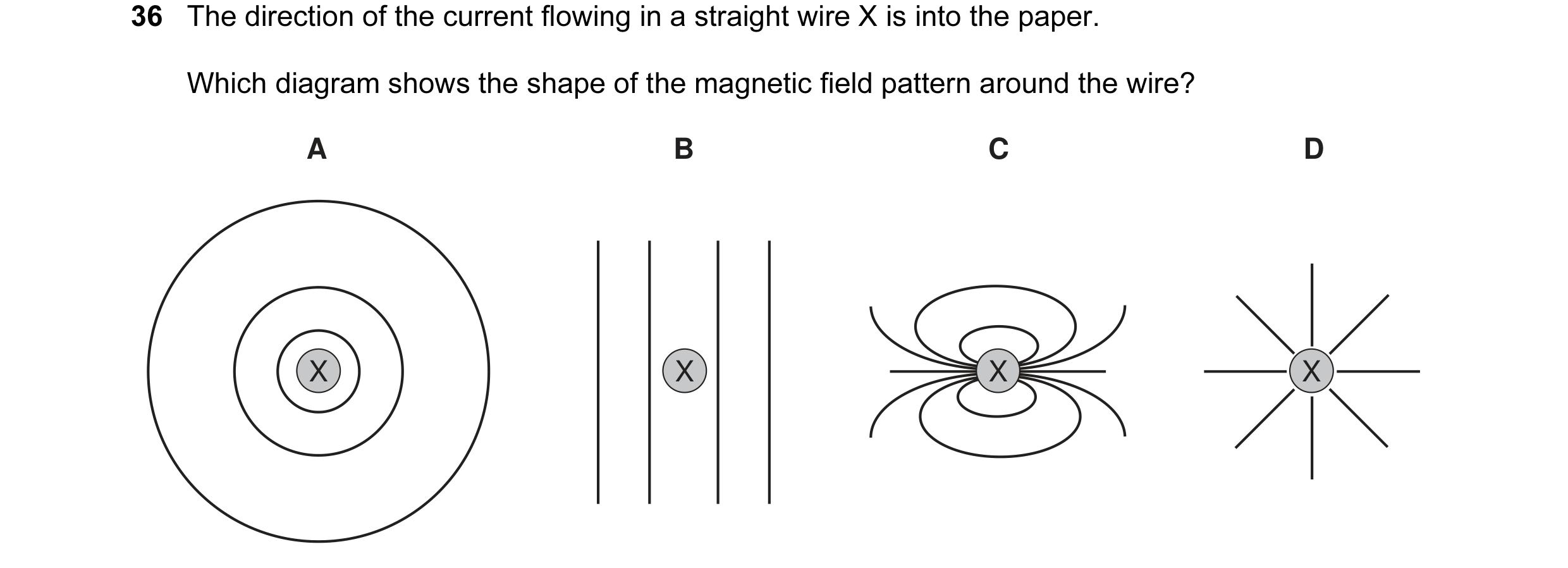
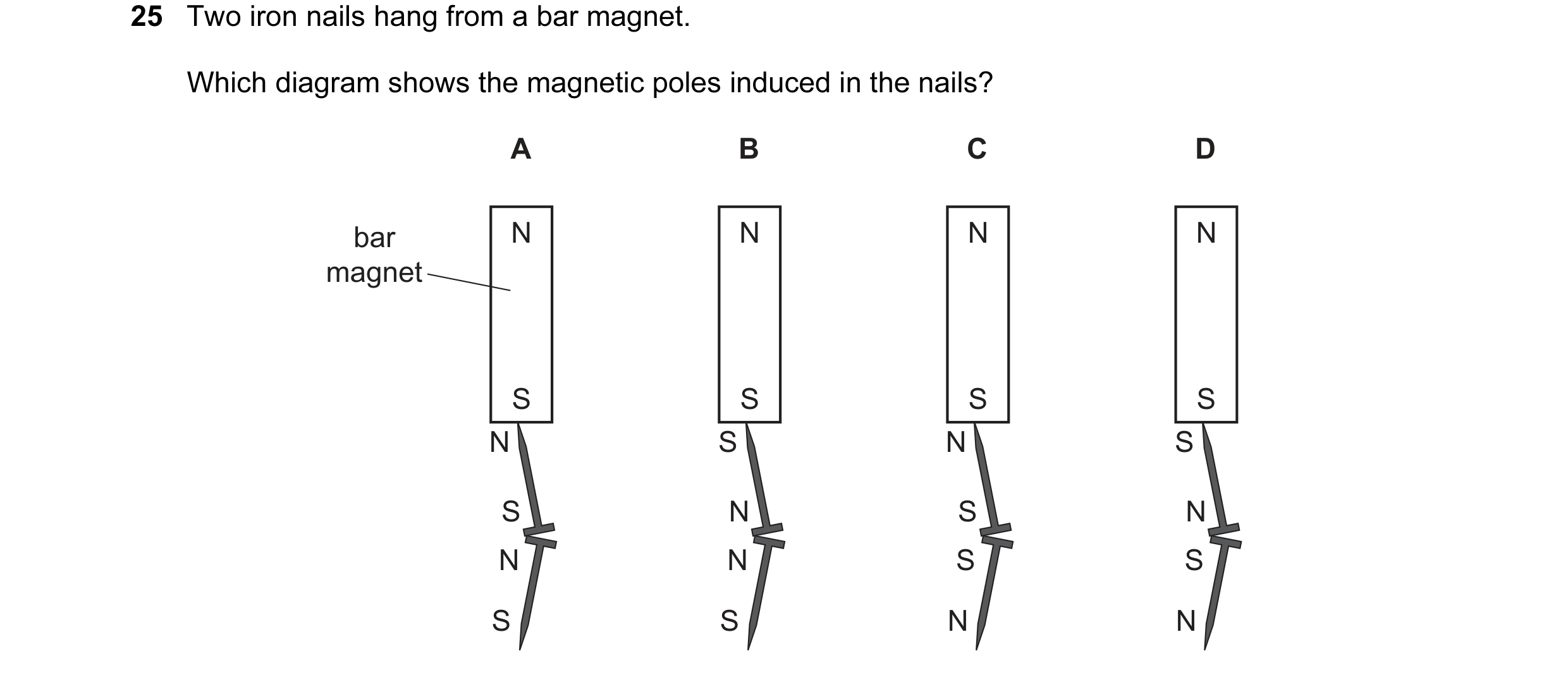 18 / 83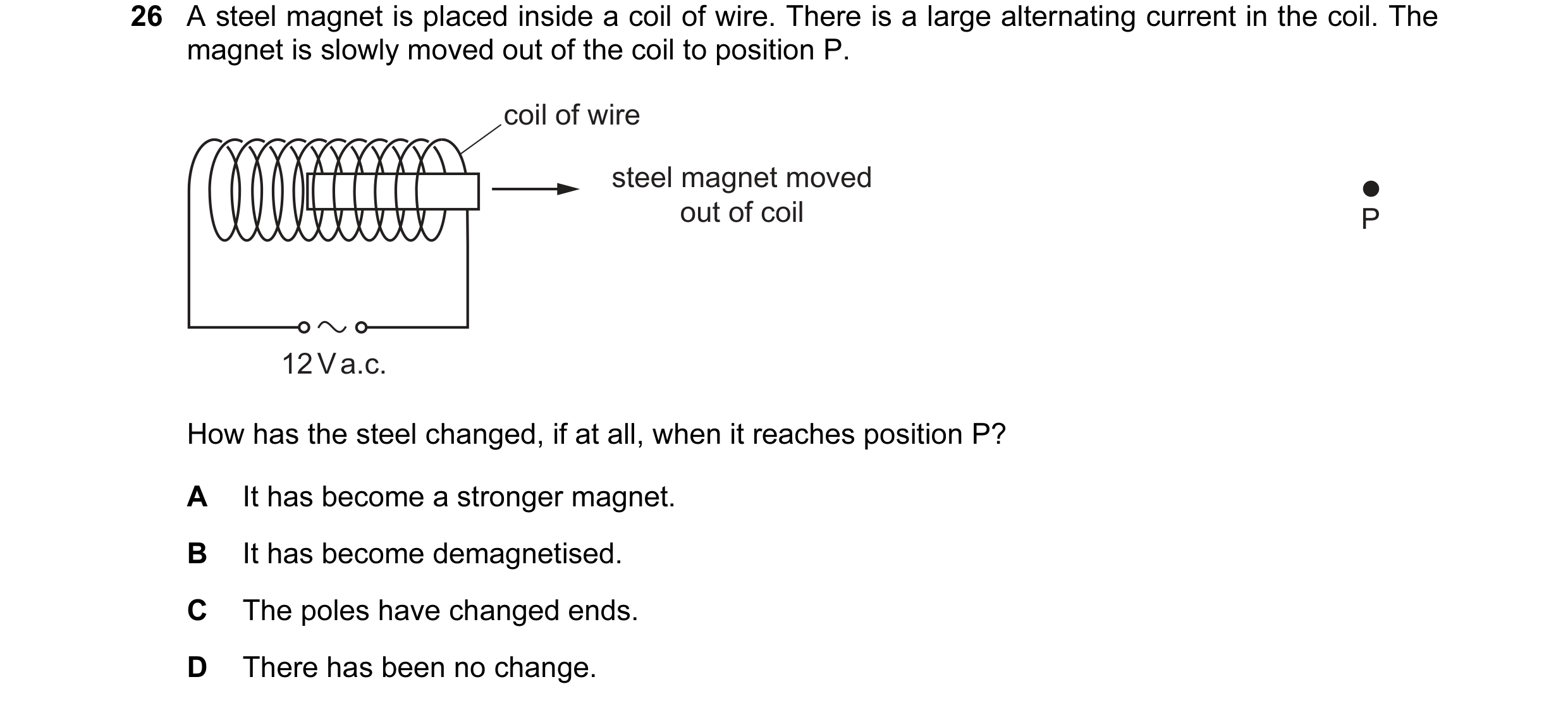
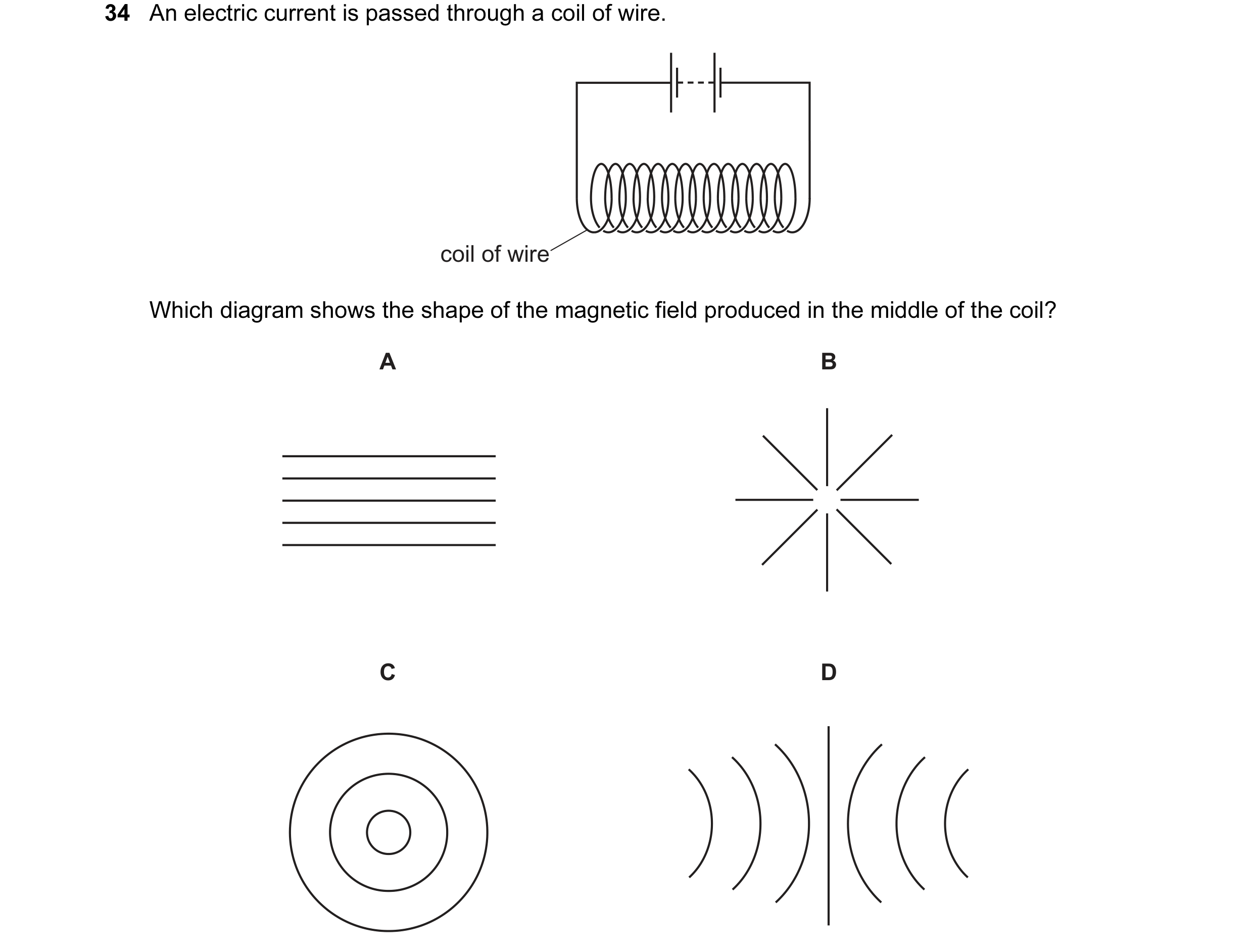 19 / 83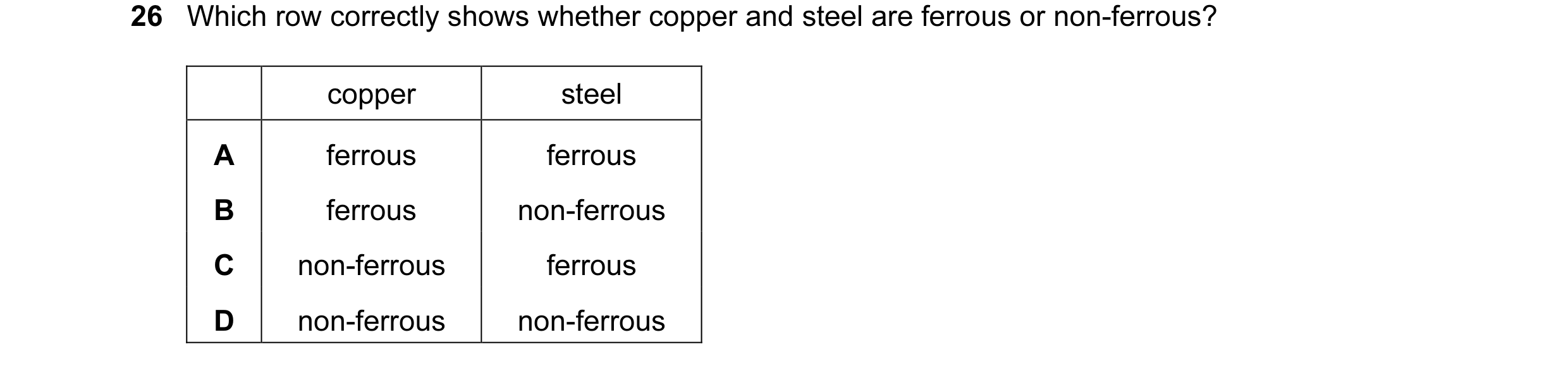
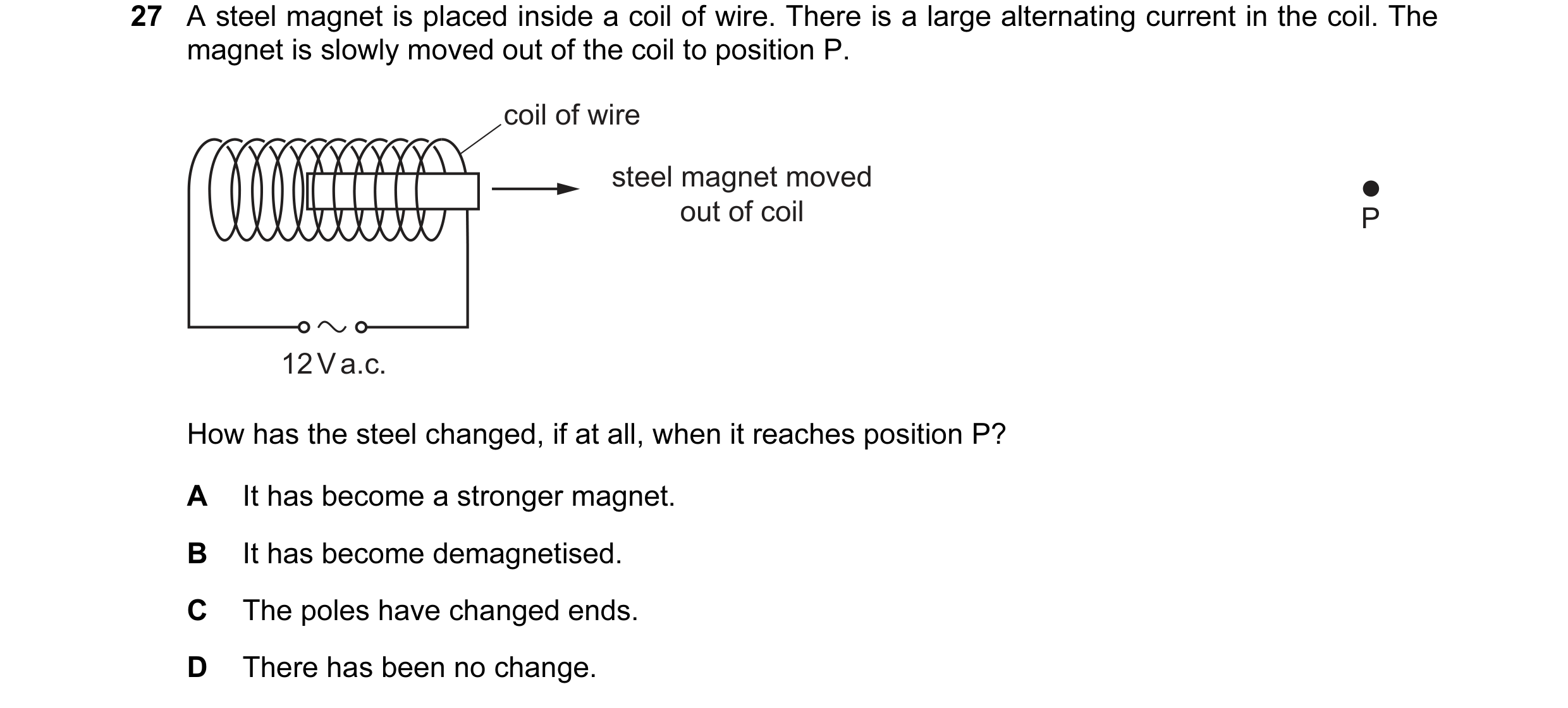
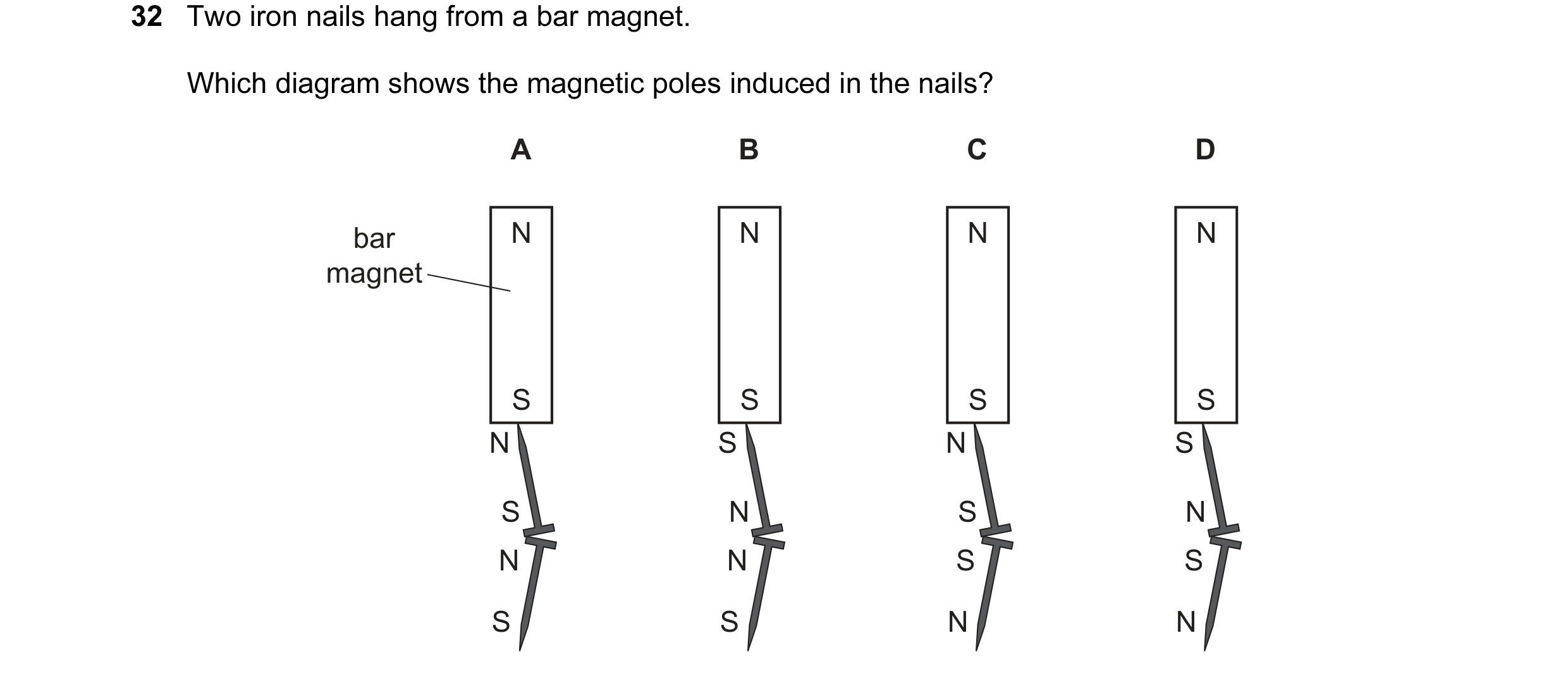 20 / 83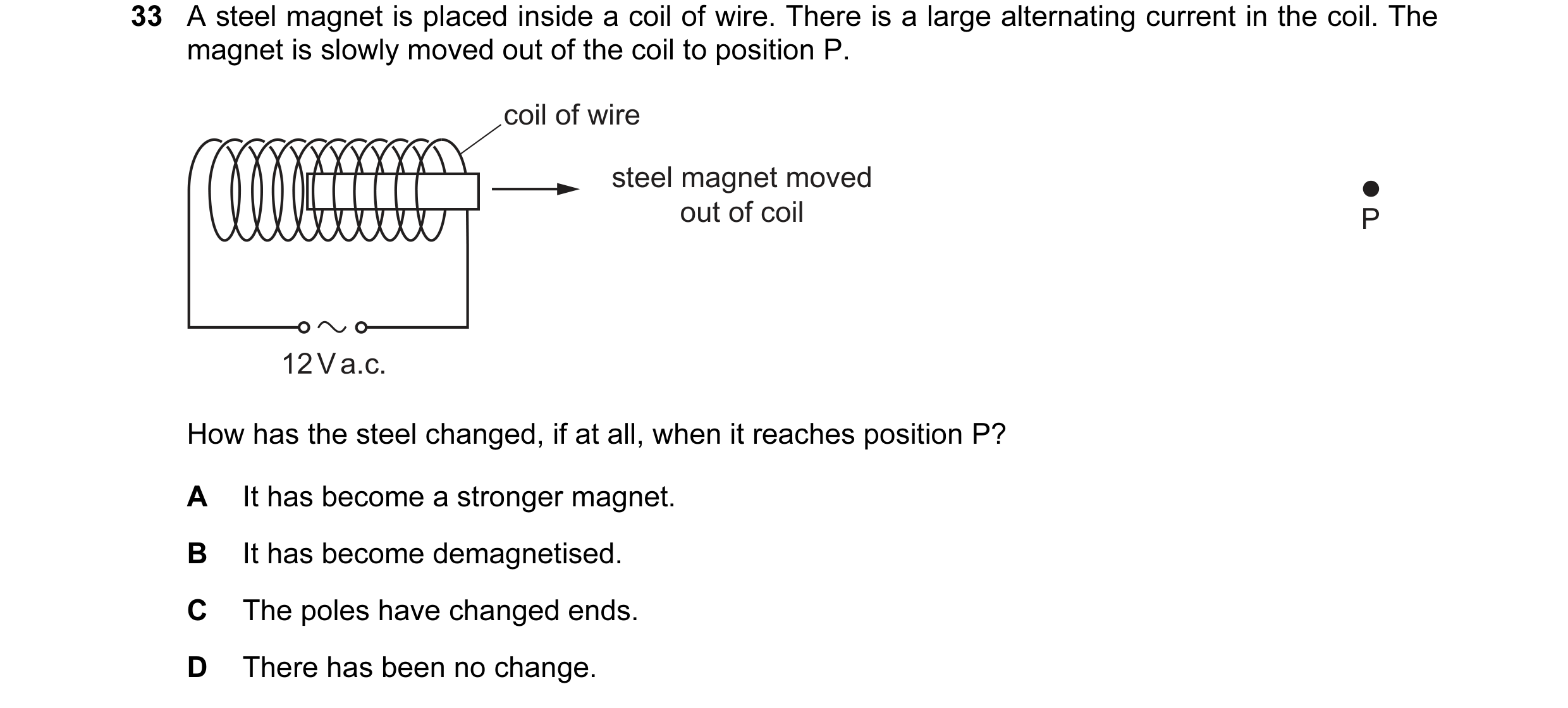
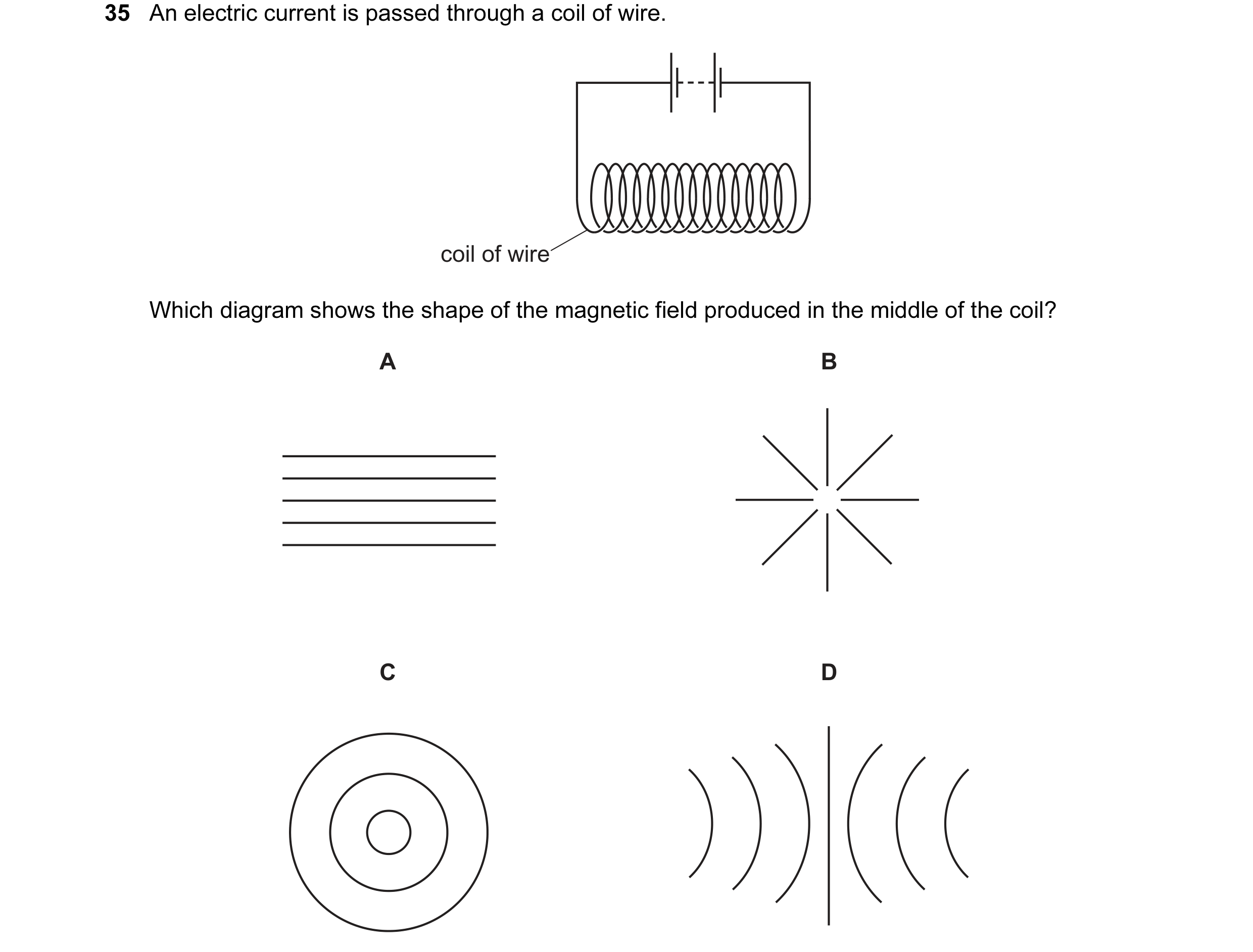 21 / 83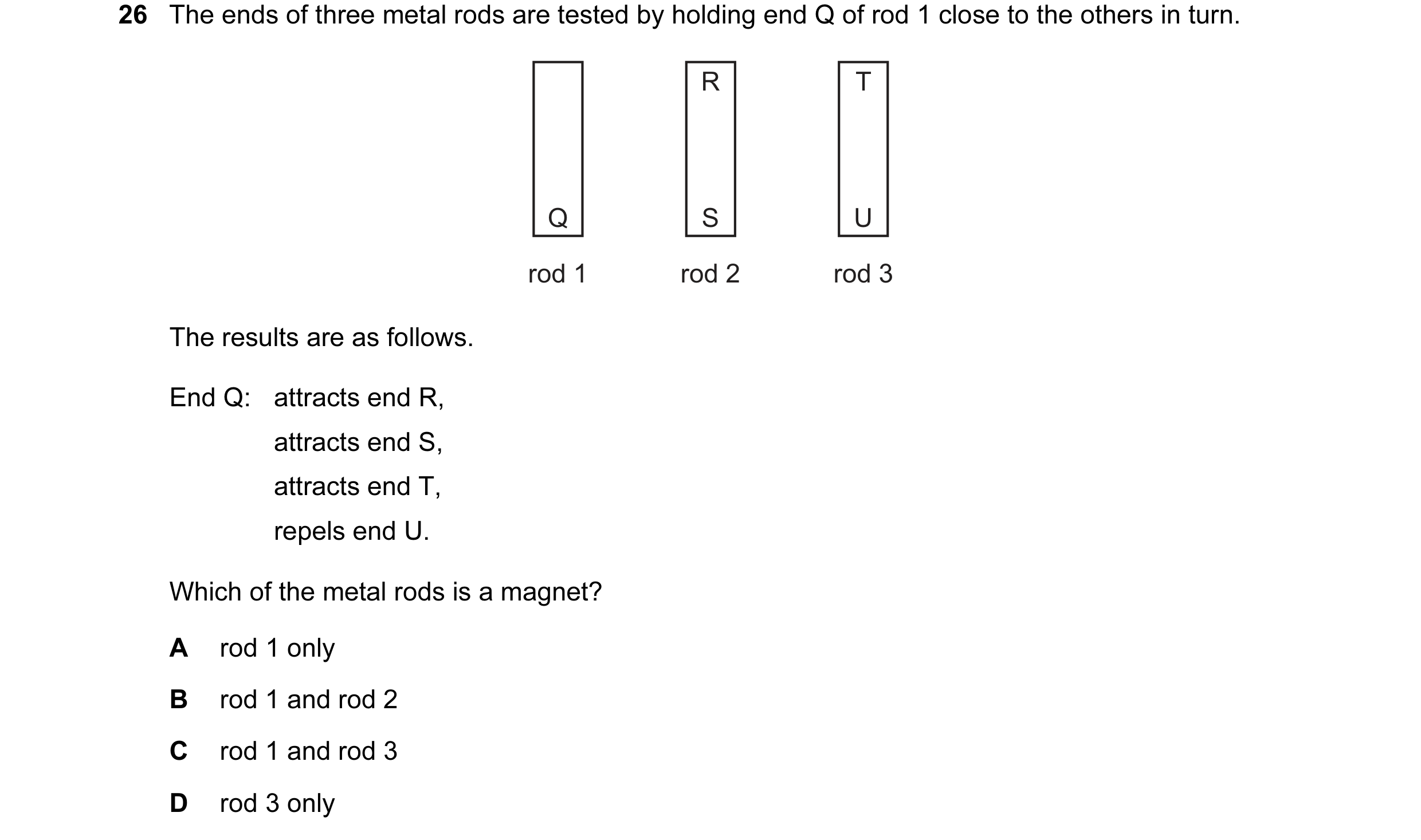
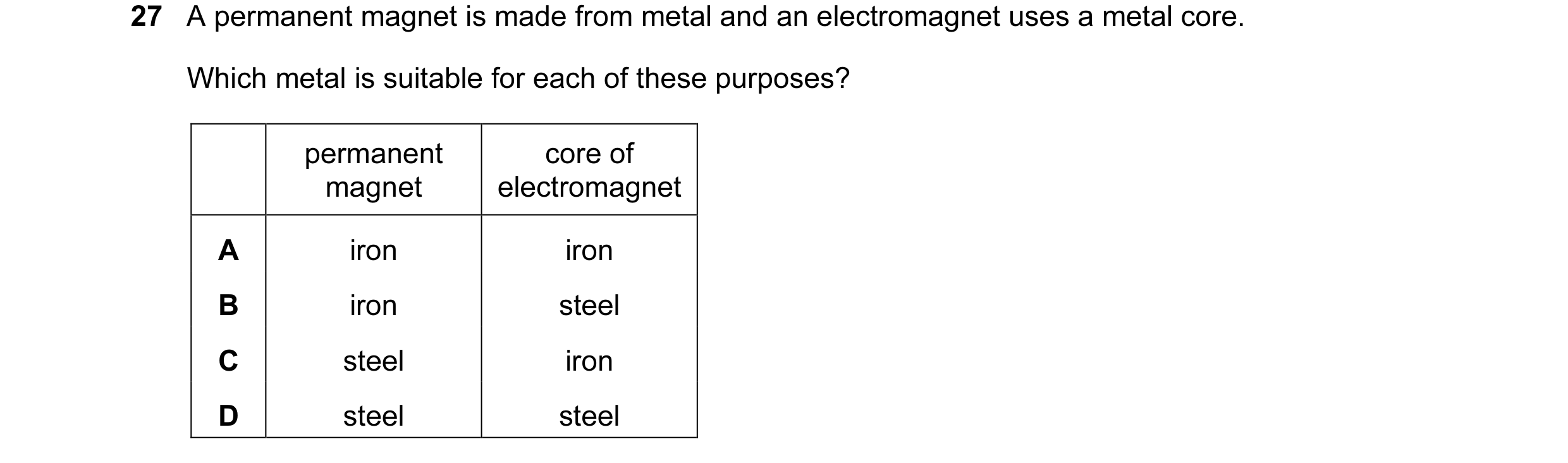
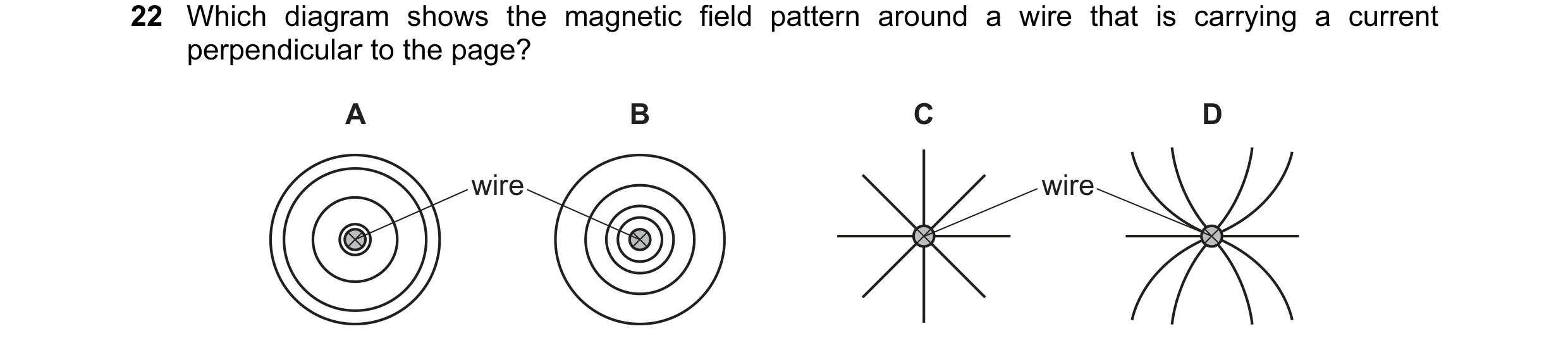 22 / 83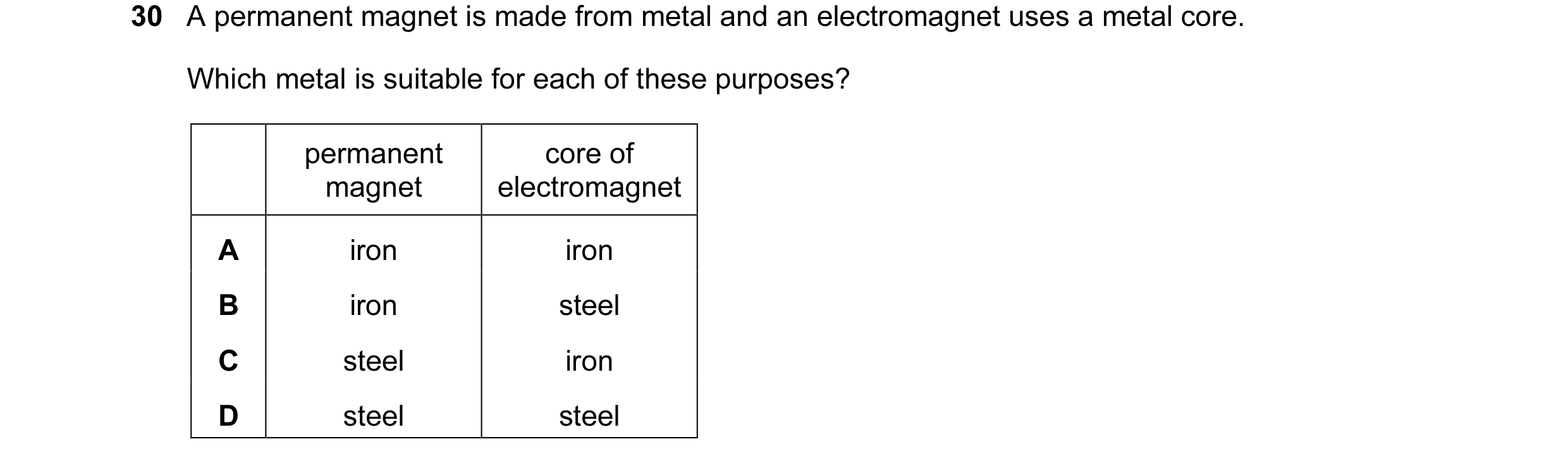
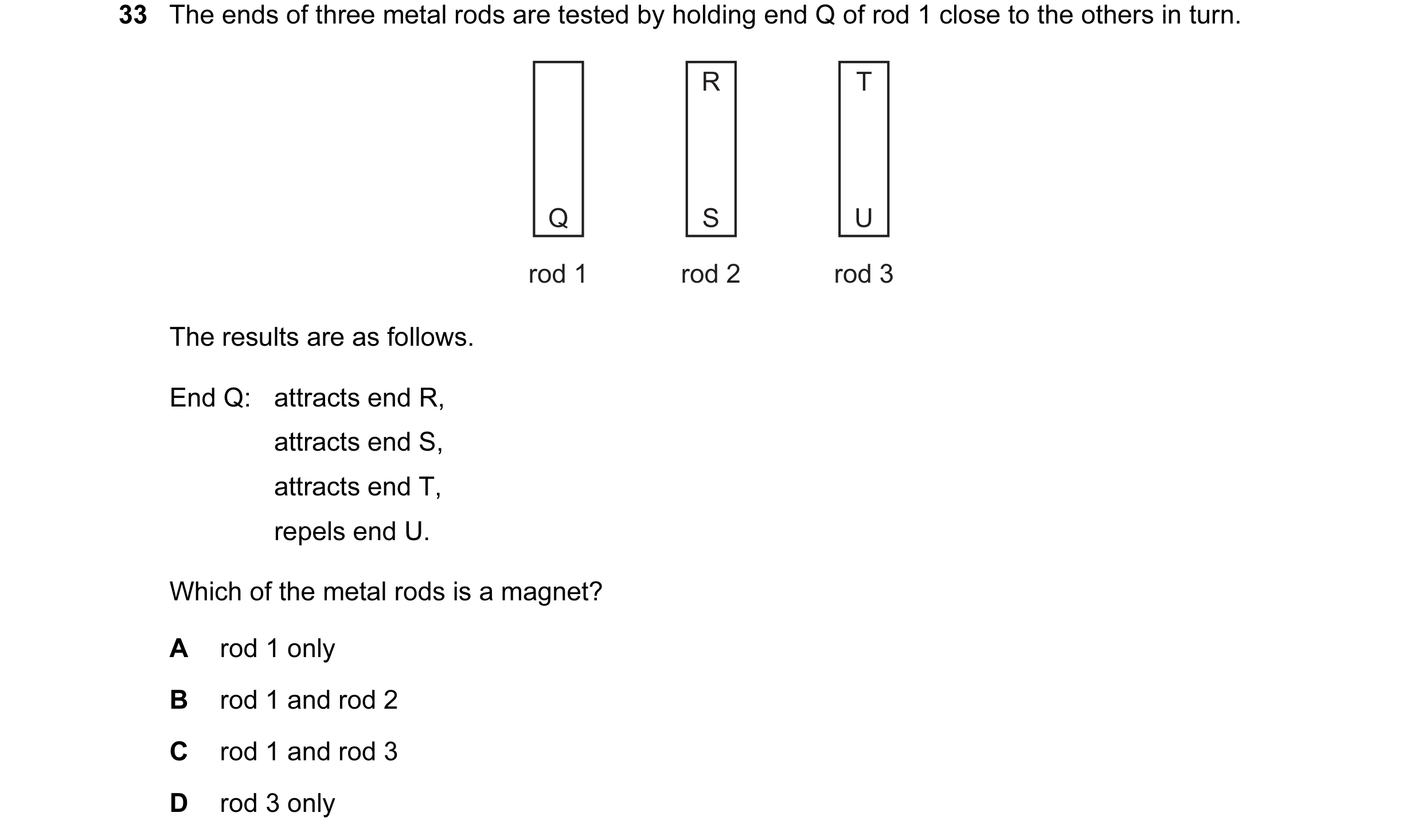 23 / 83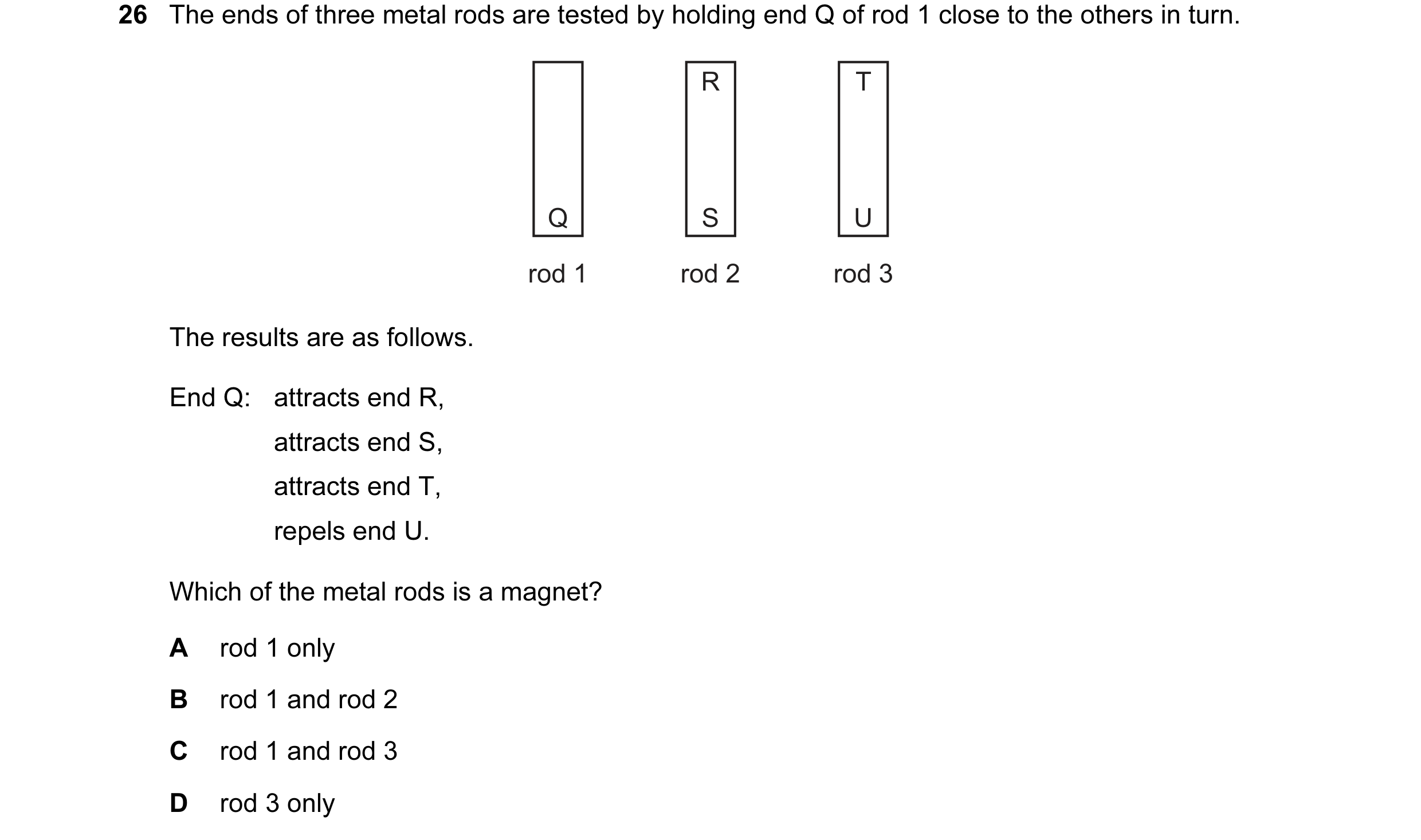
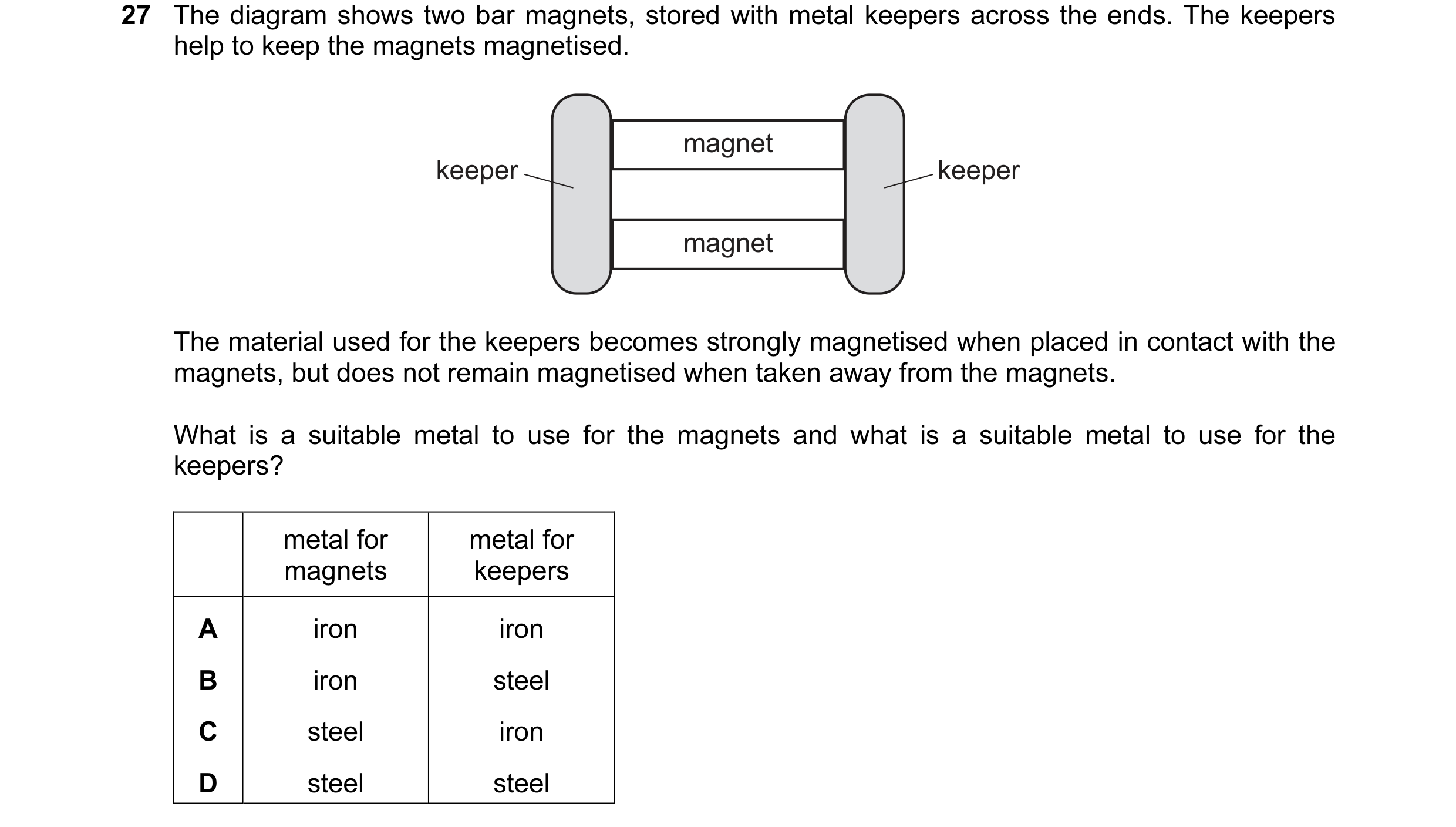 24 / 83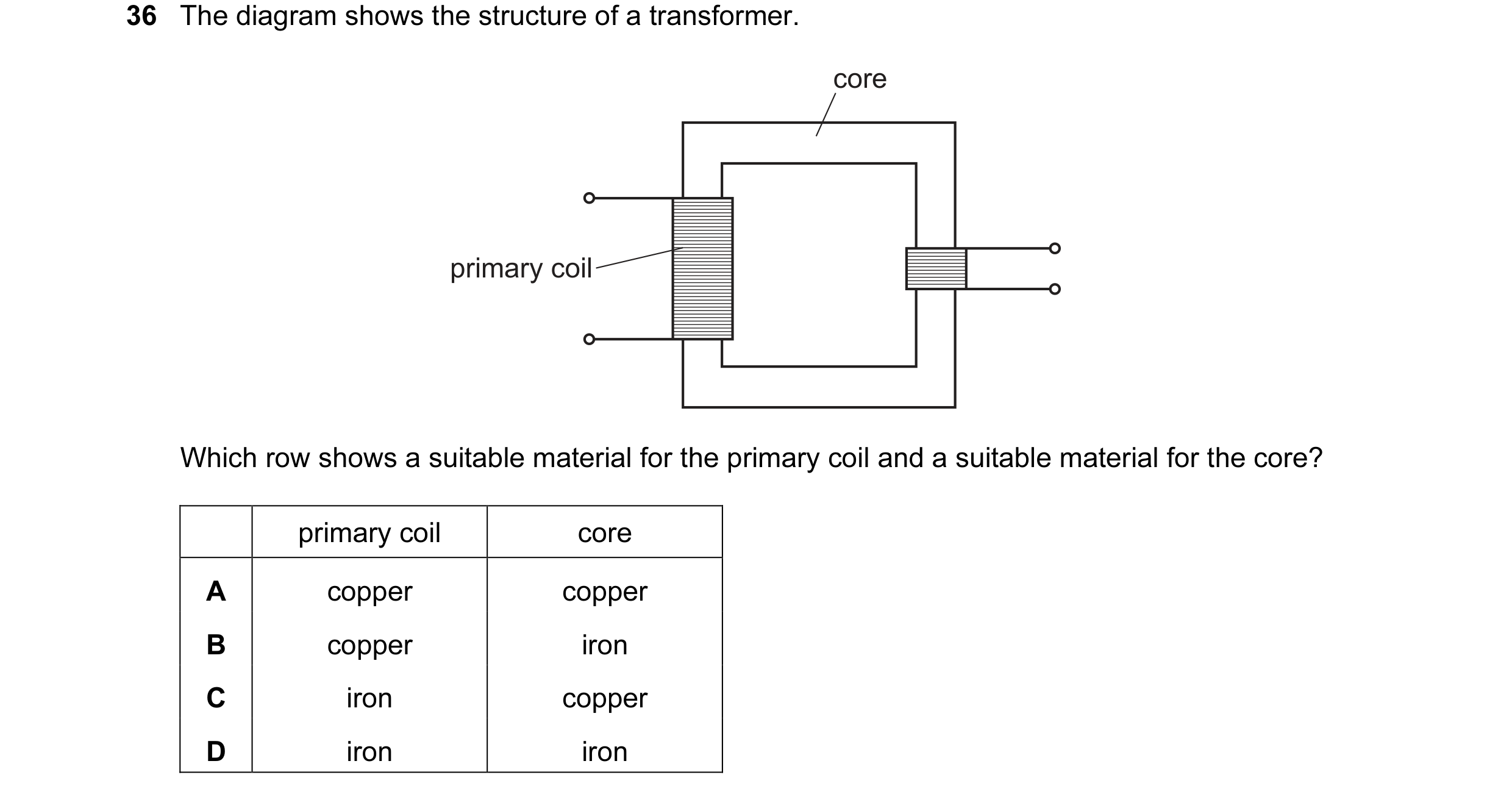

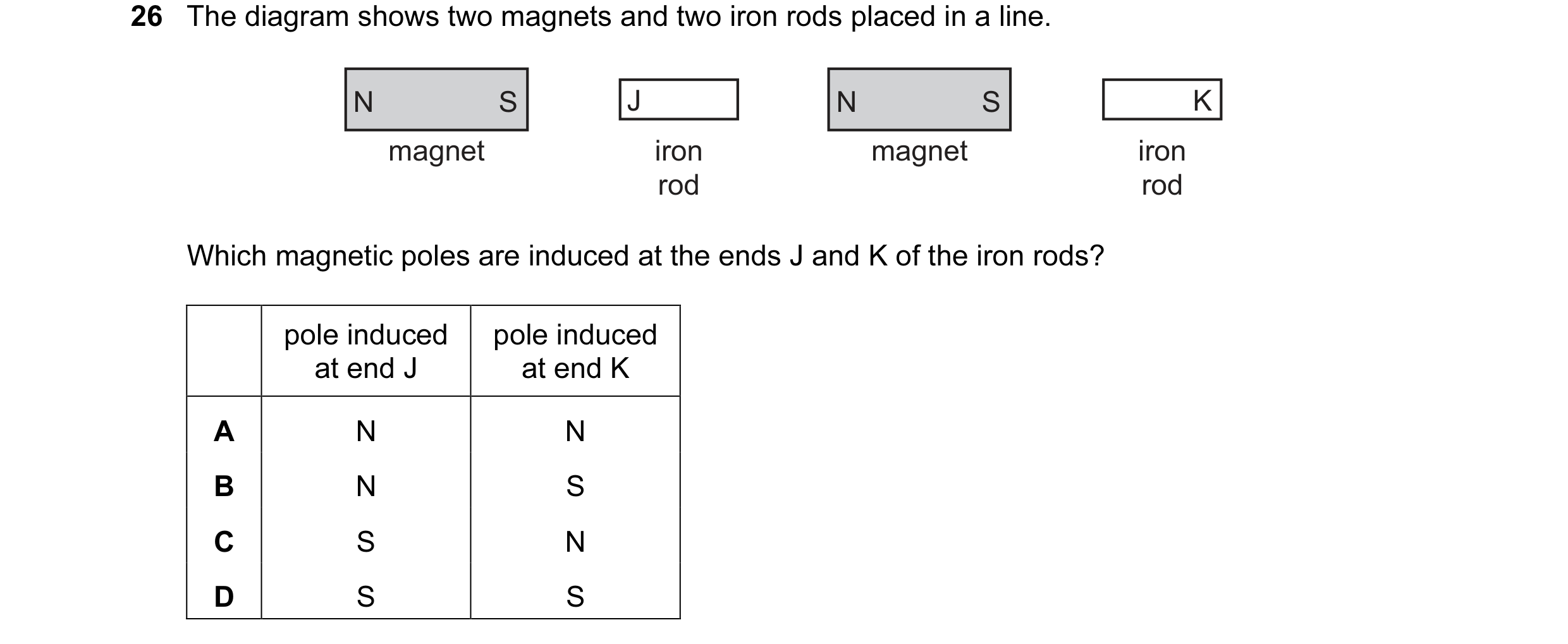 25 / 83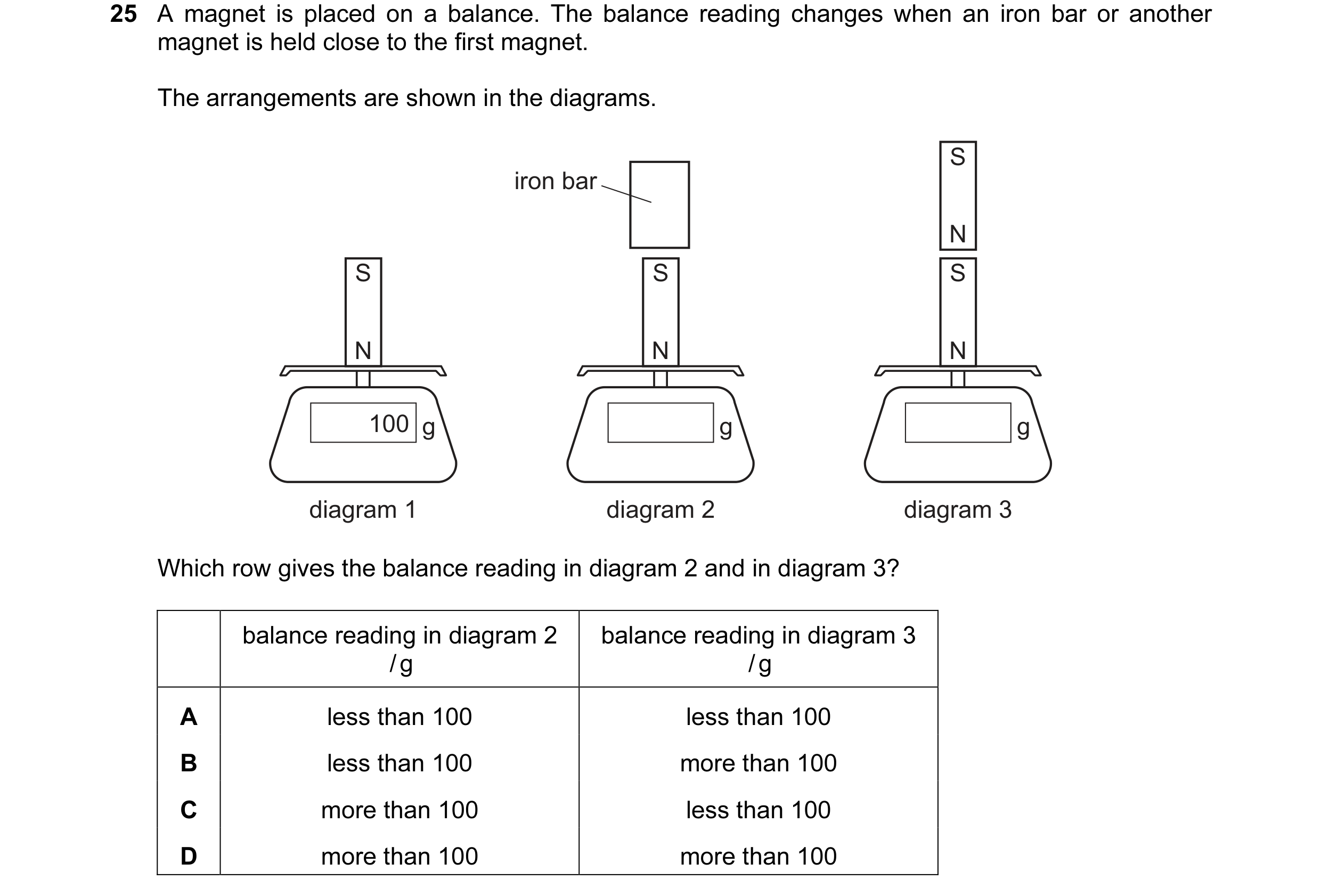
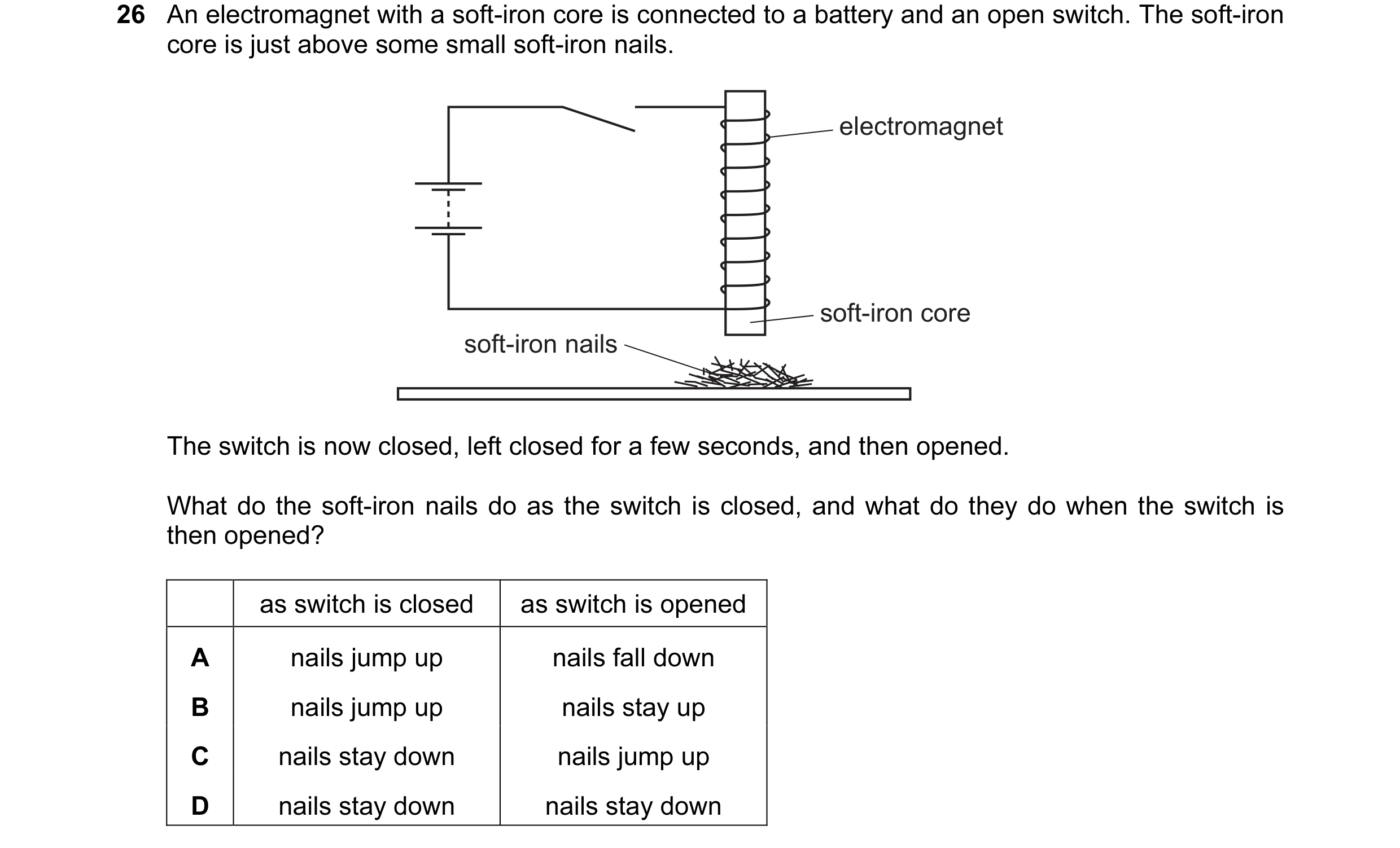 26 / 83
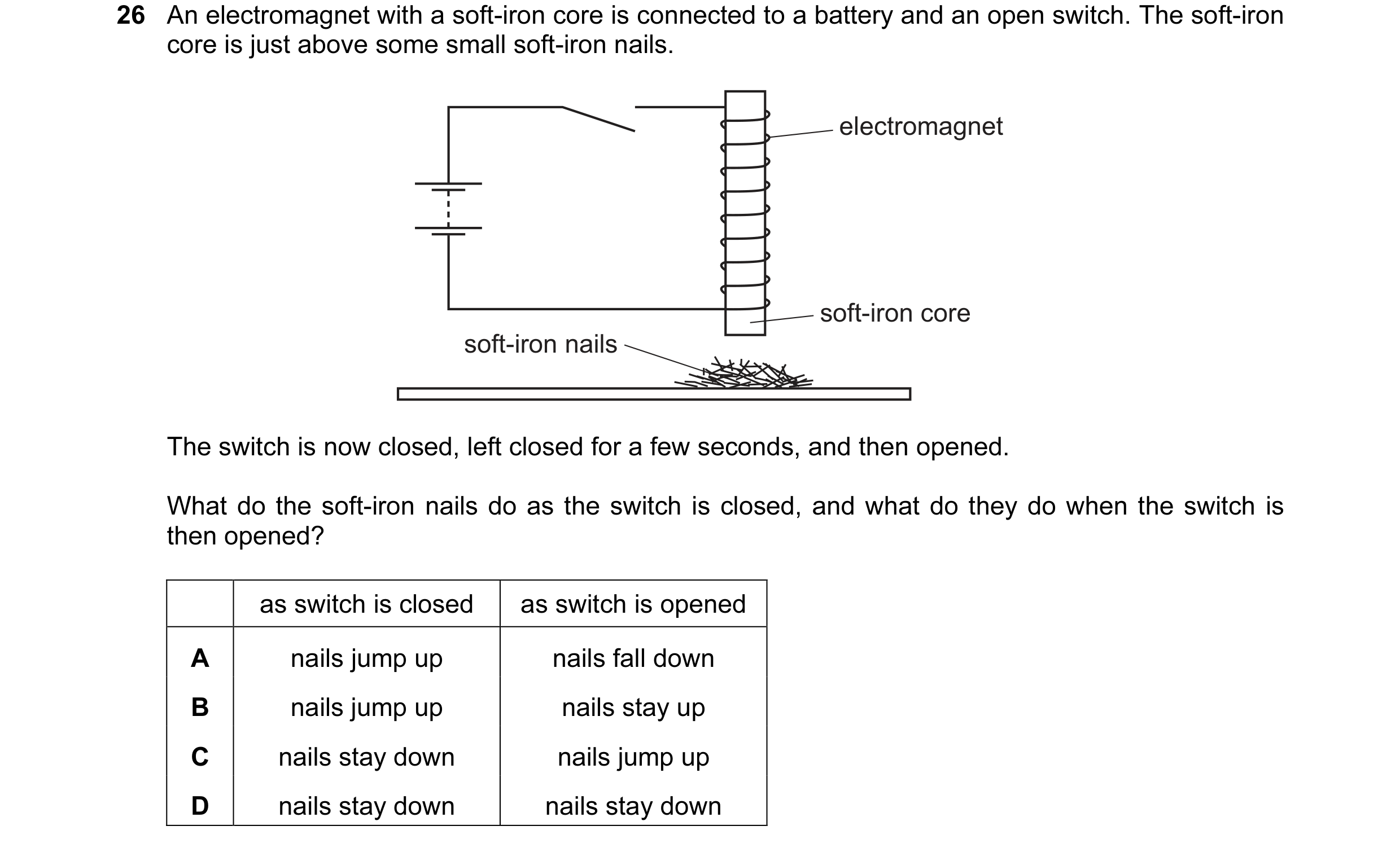
 27 / 83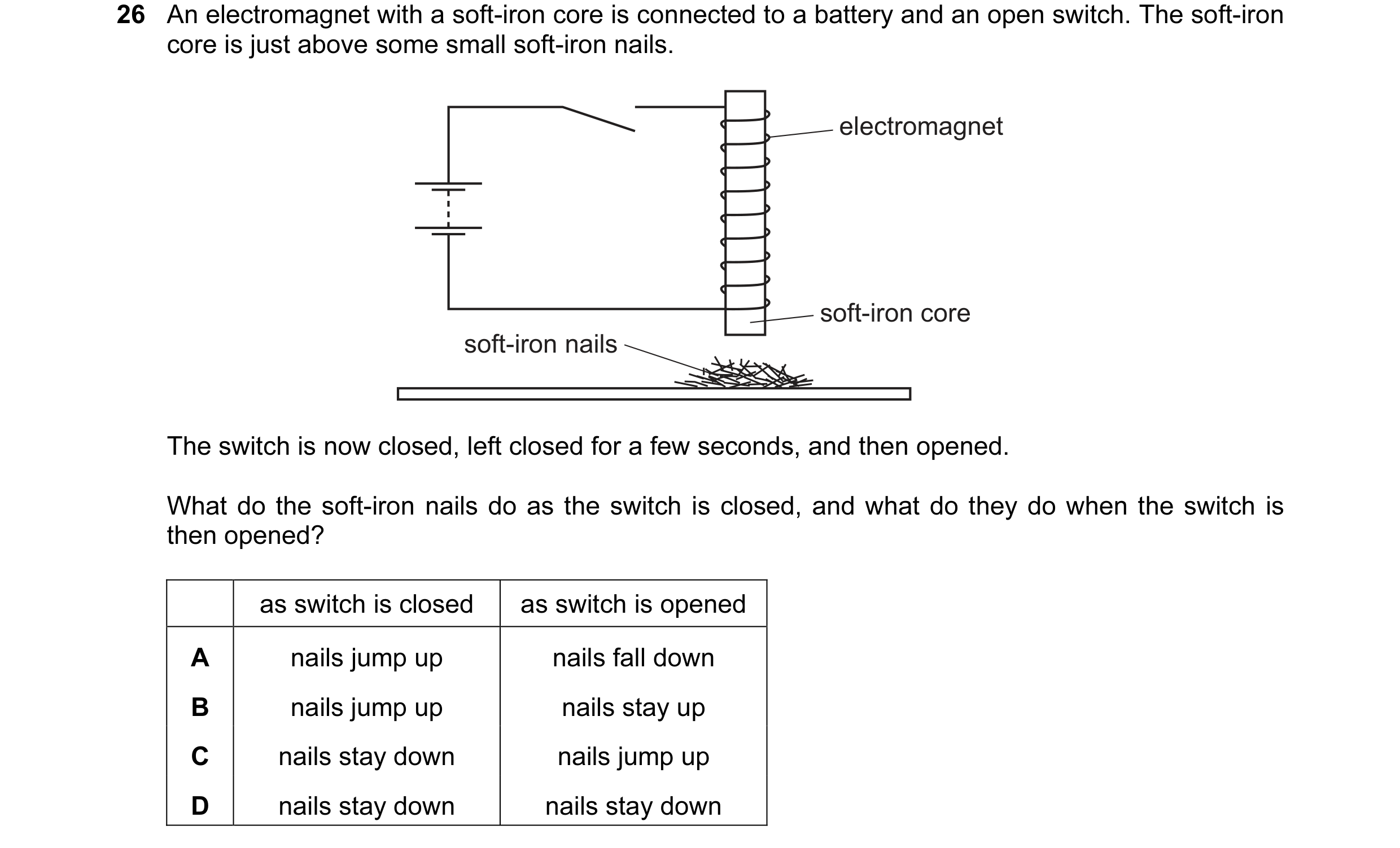
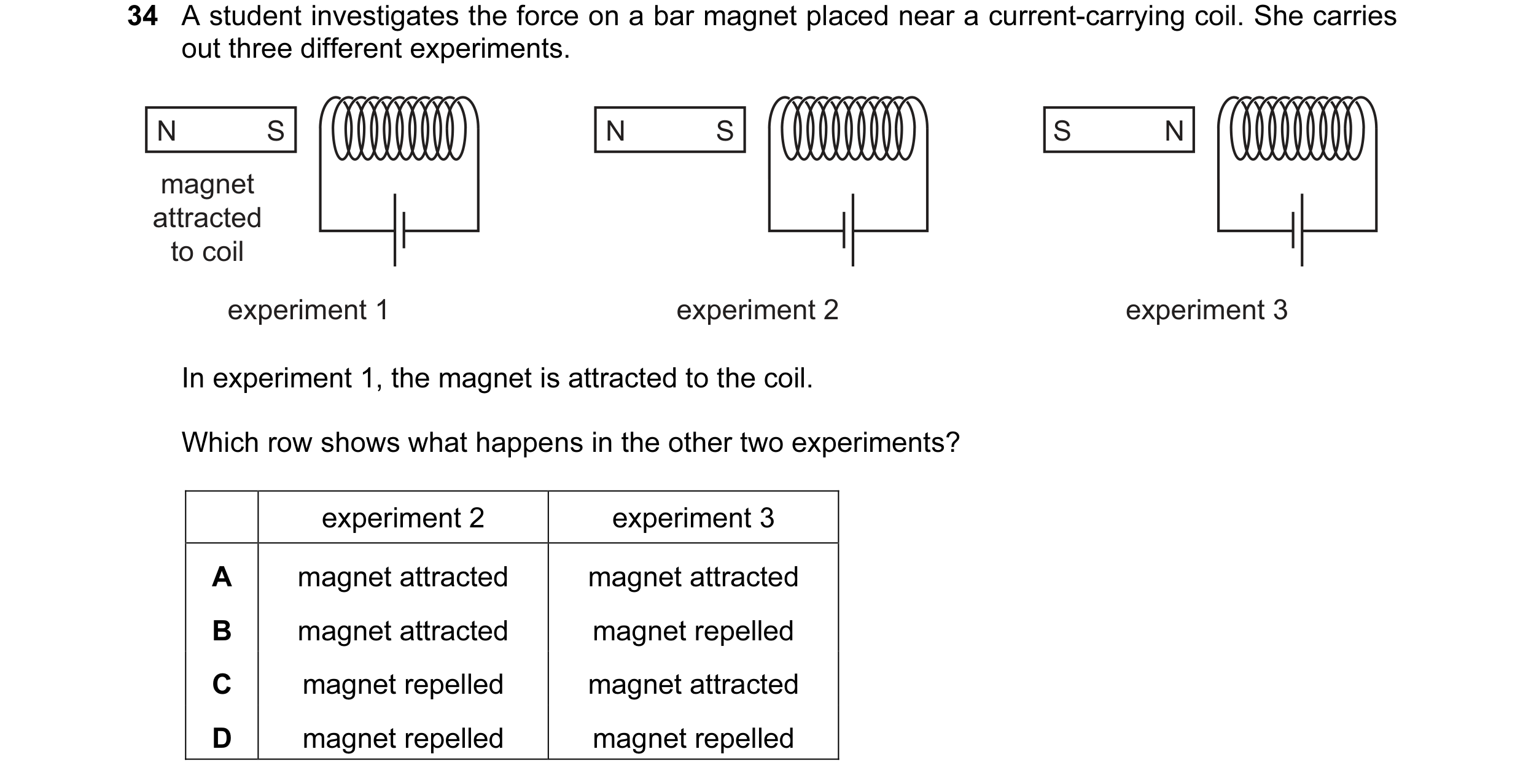
 28 / 83
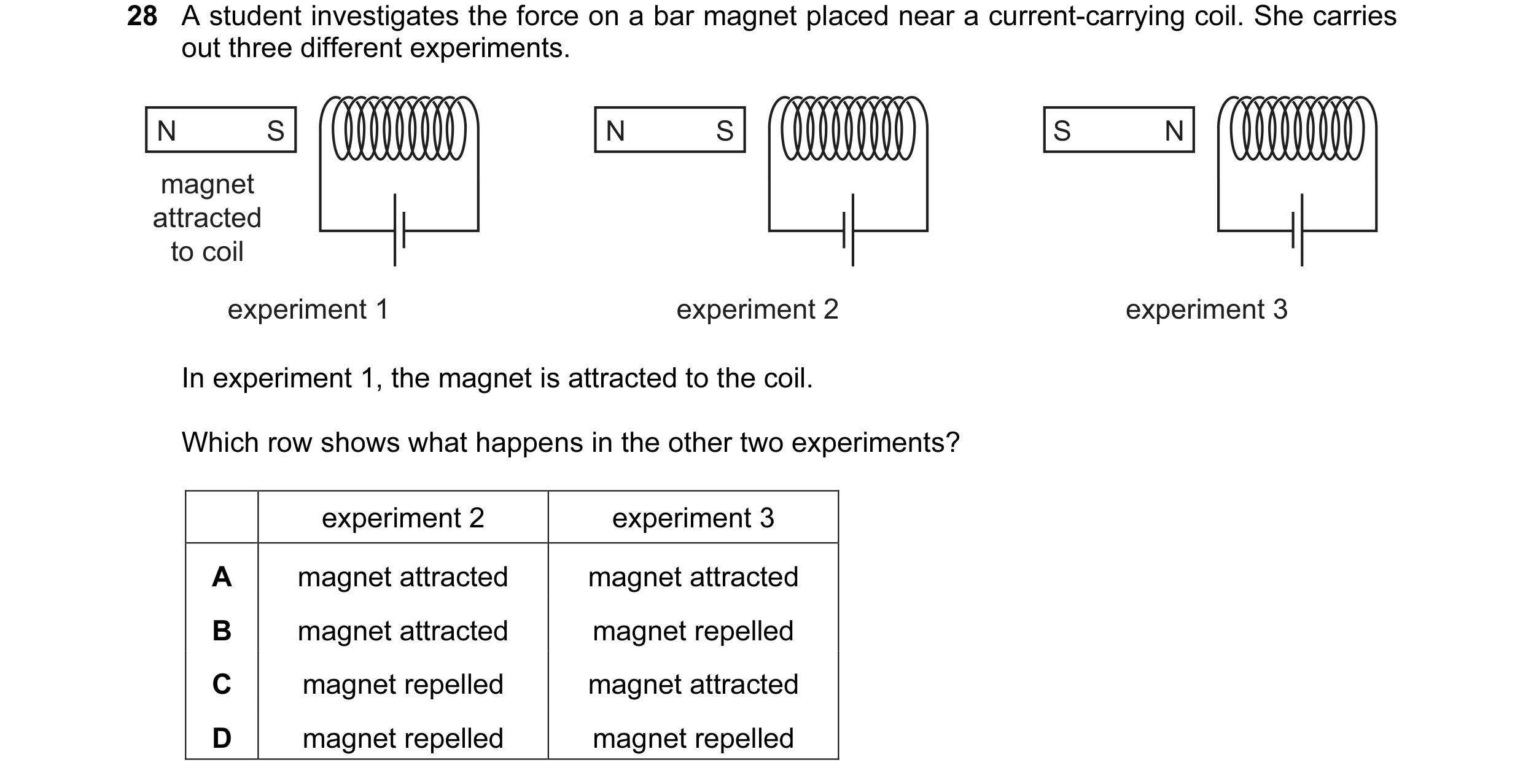 29 / 83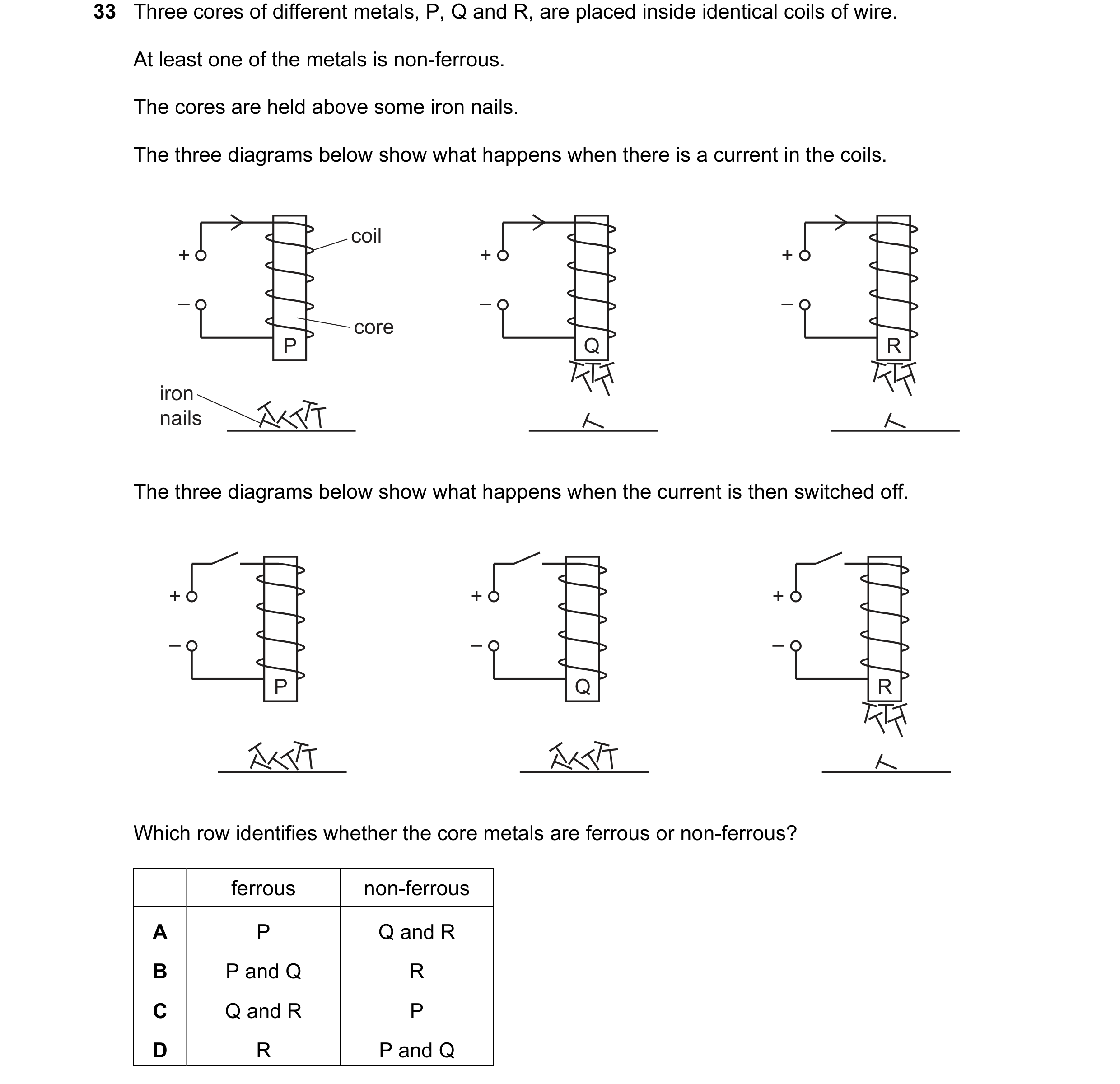
 30 / 83


 31 / 83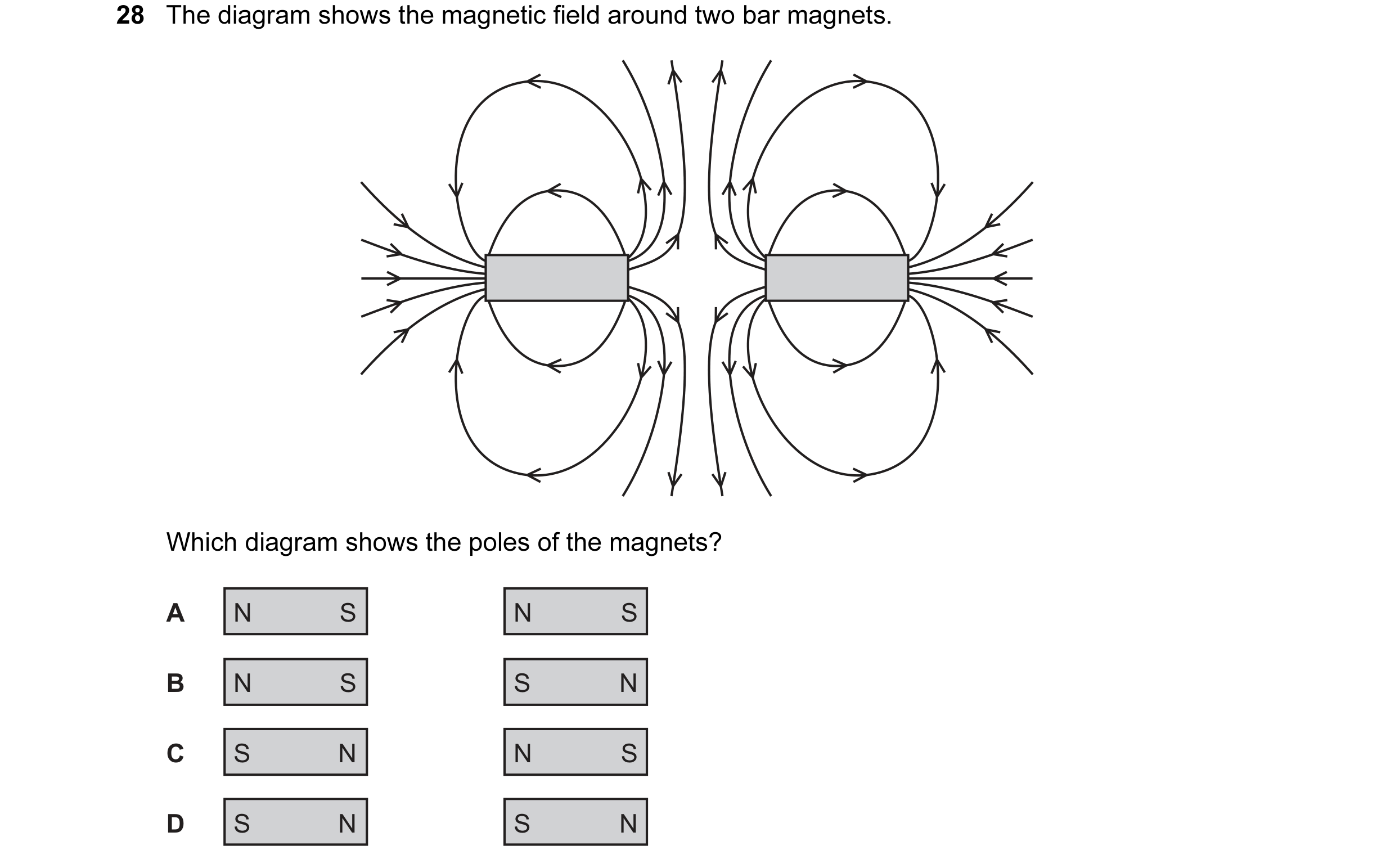

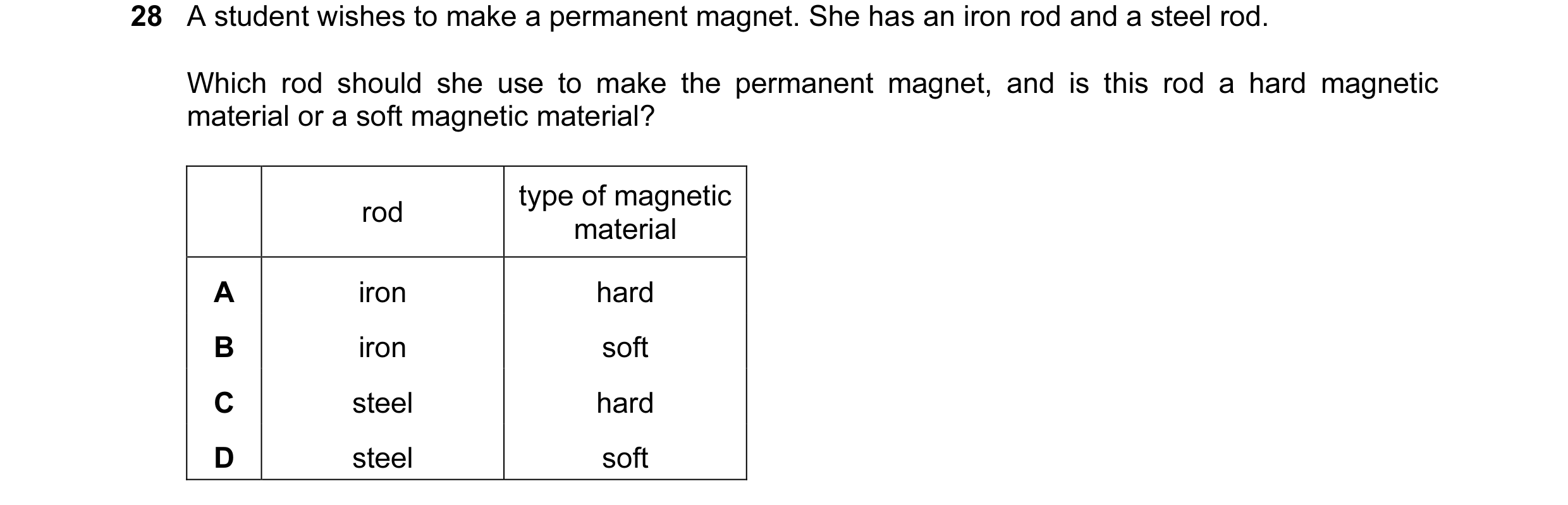 32 / 83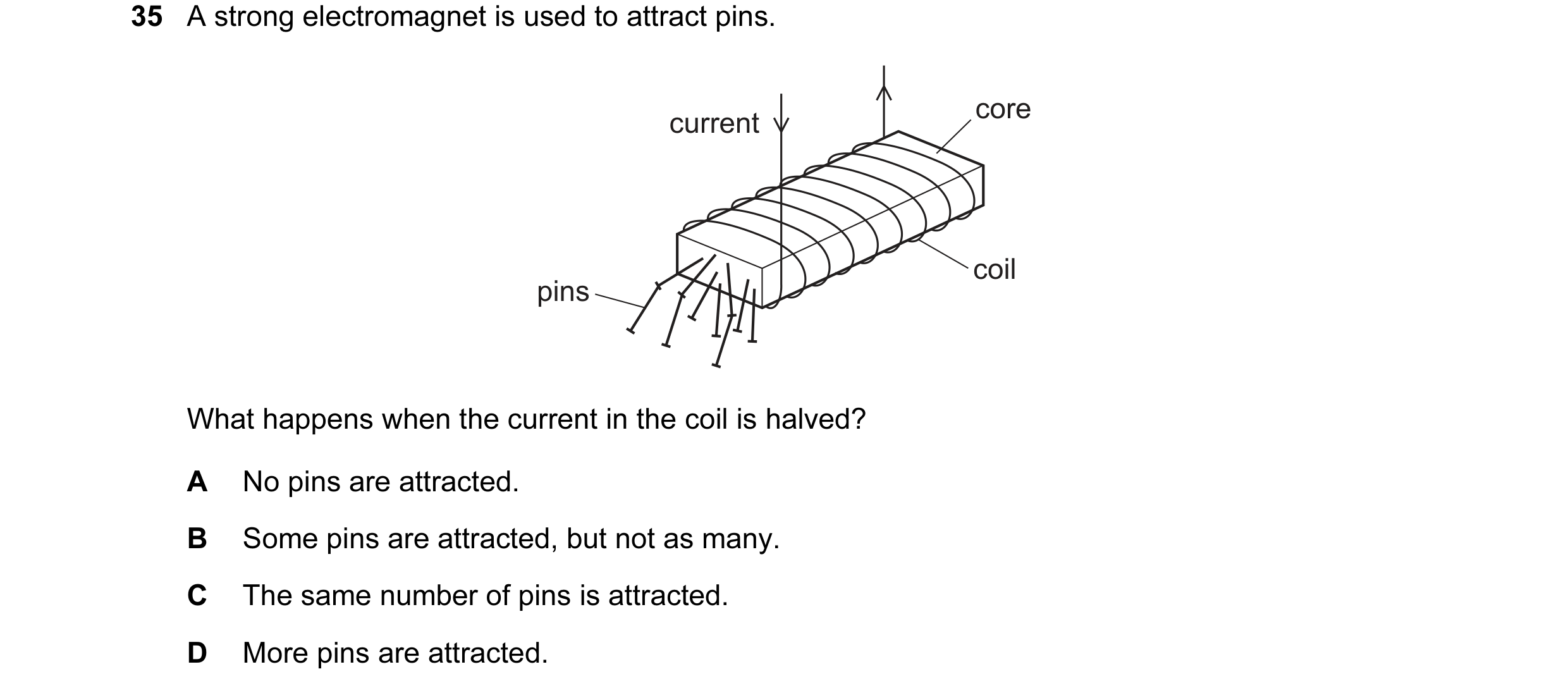
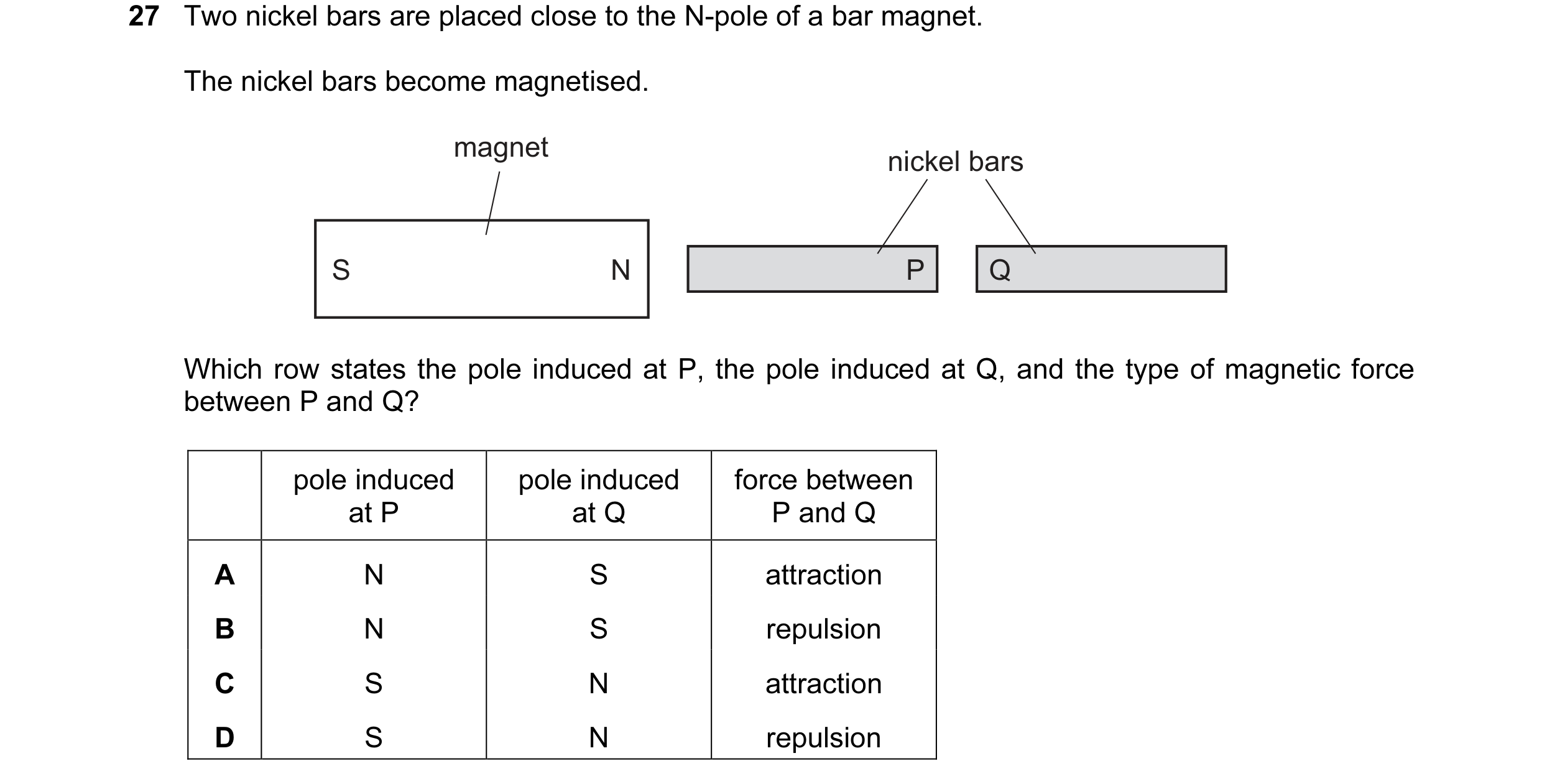
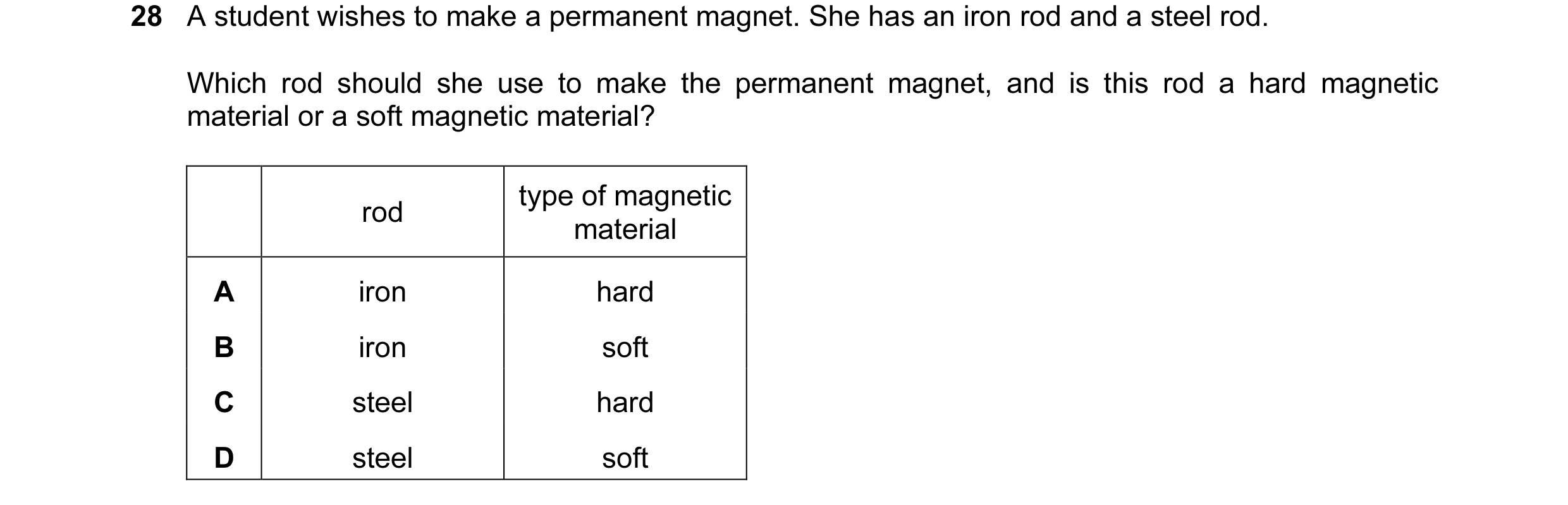 33 / 83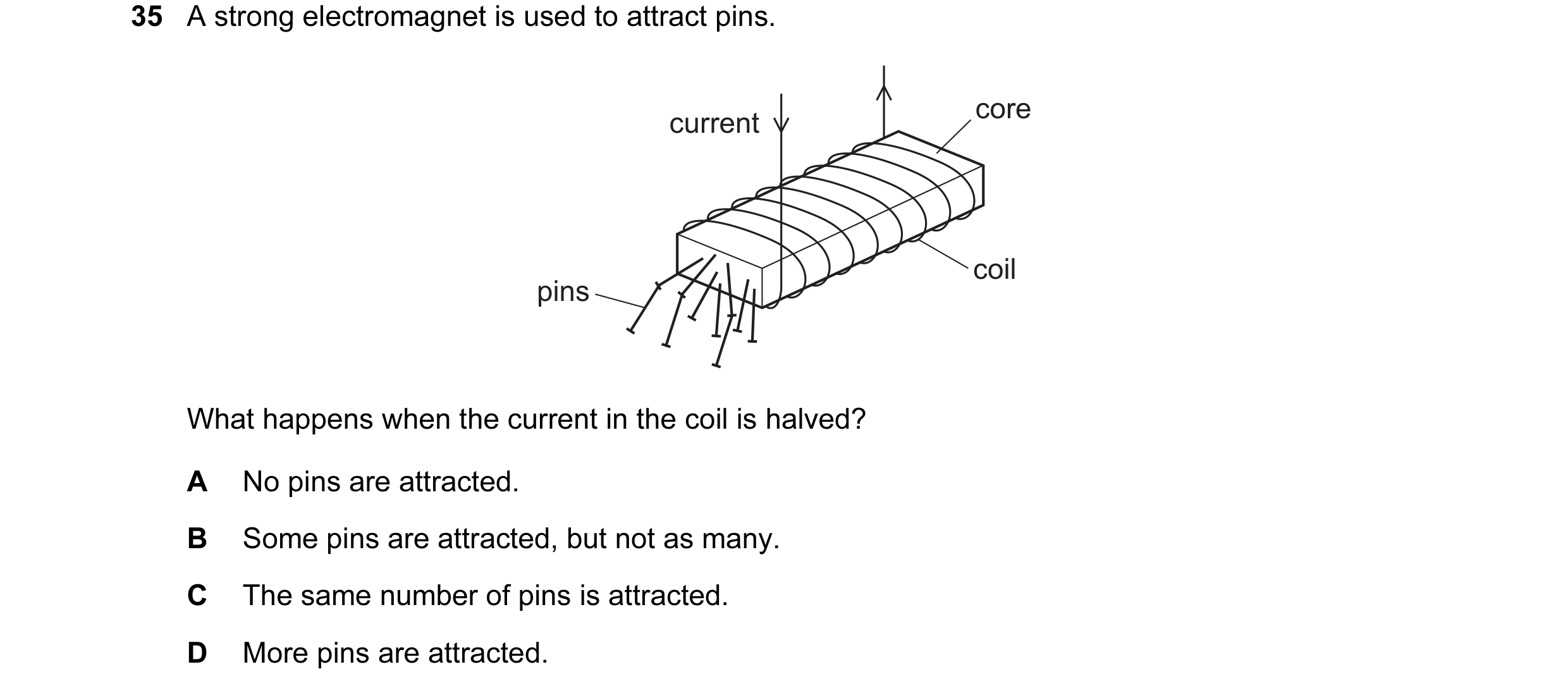

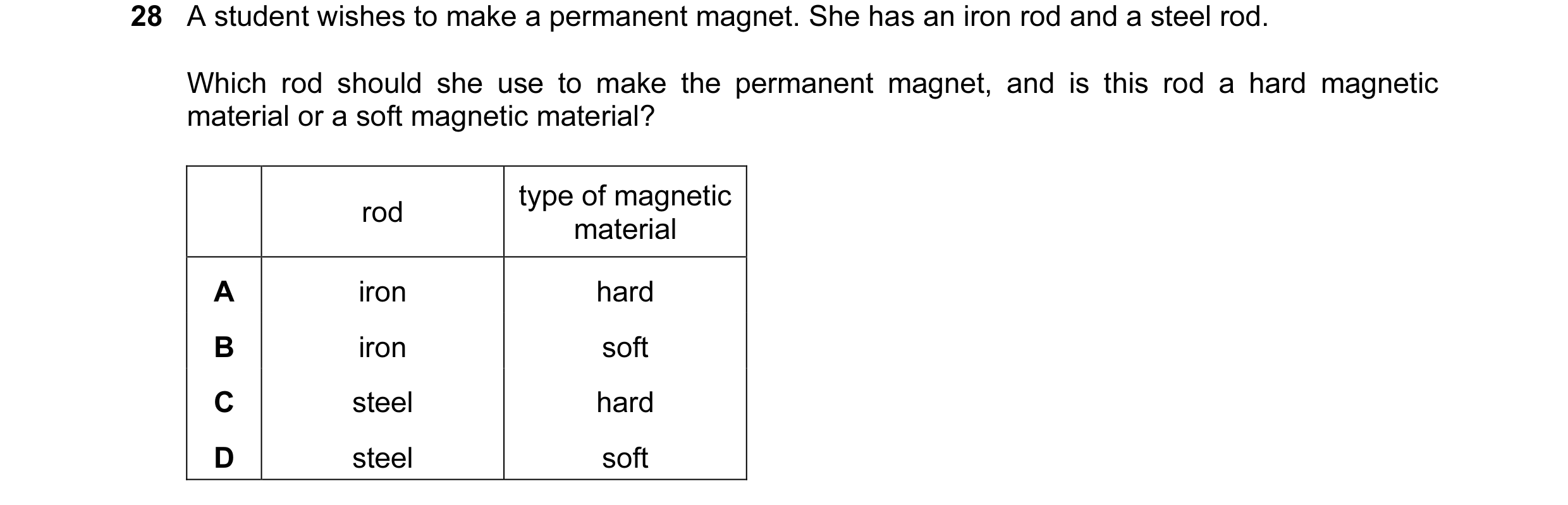 34 / 83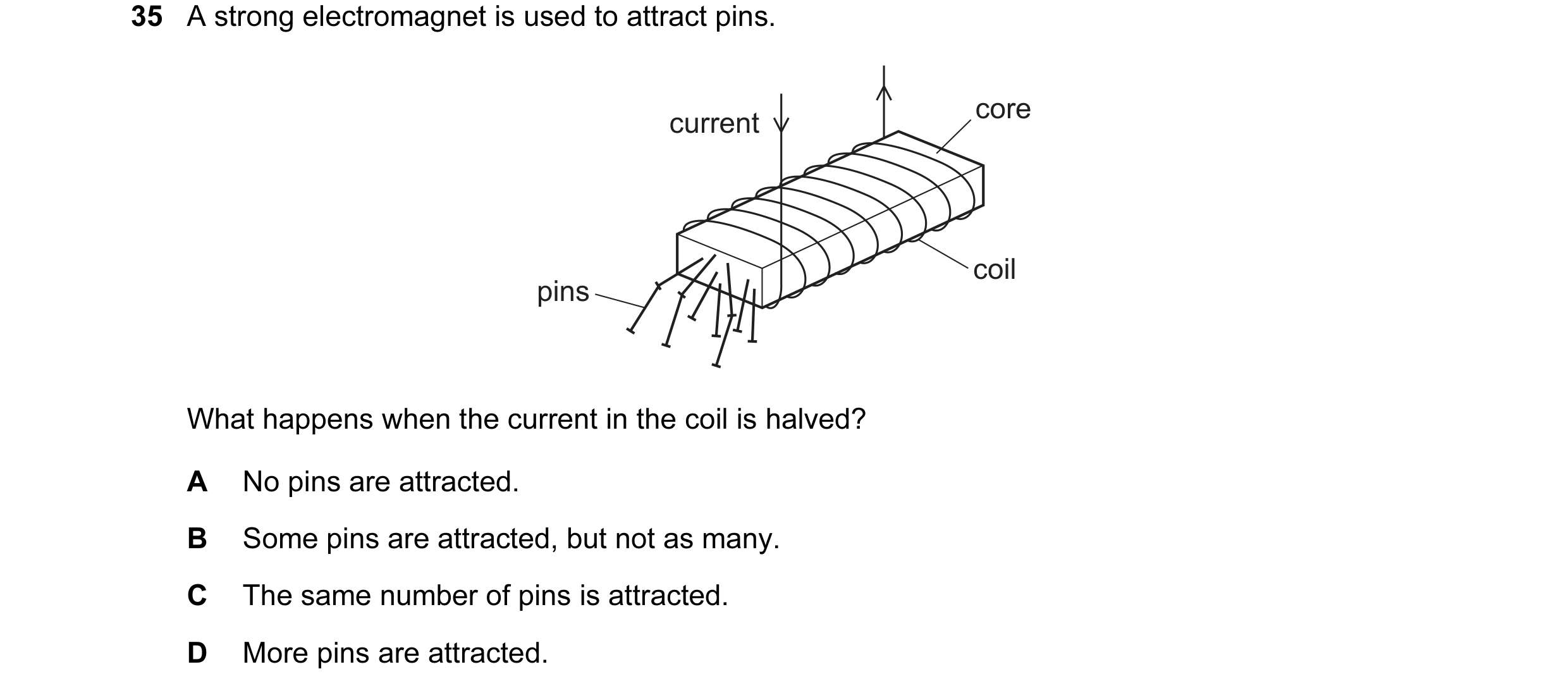
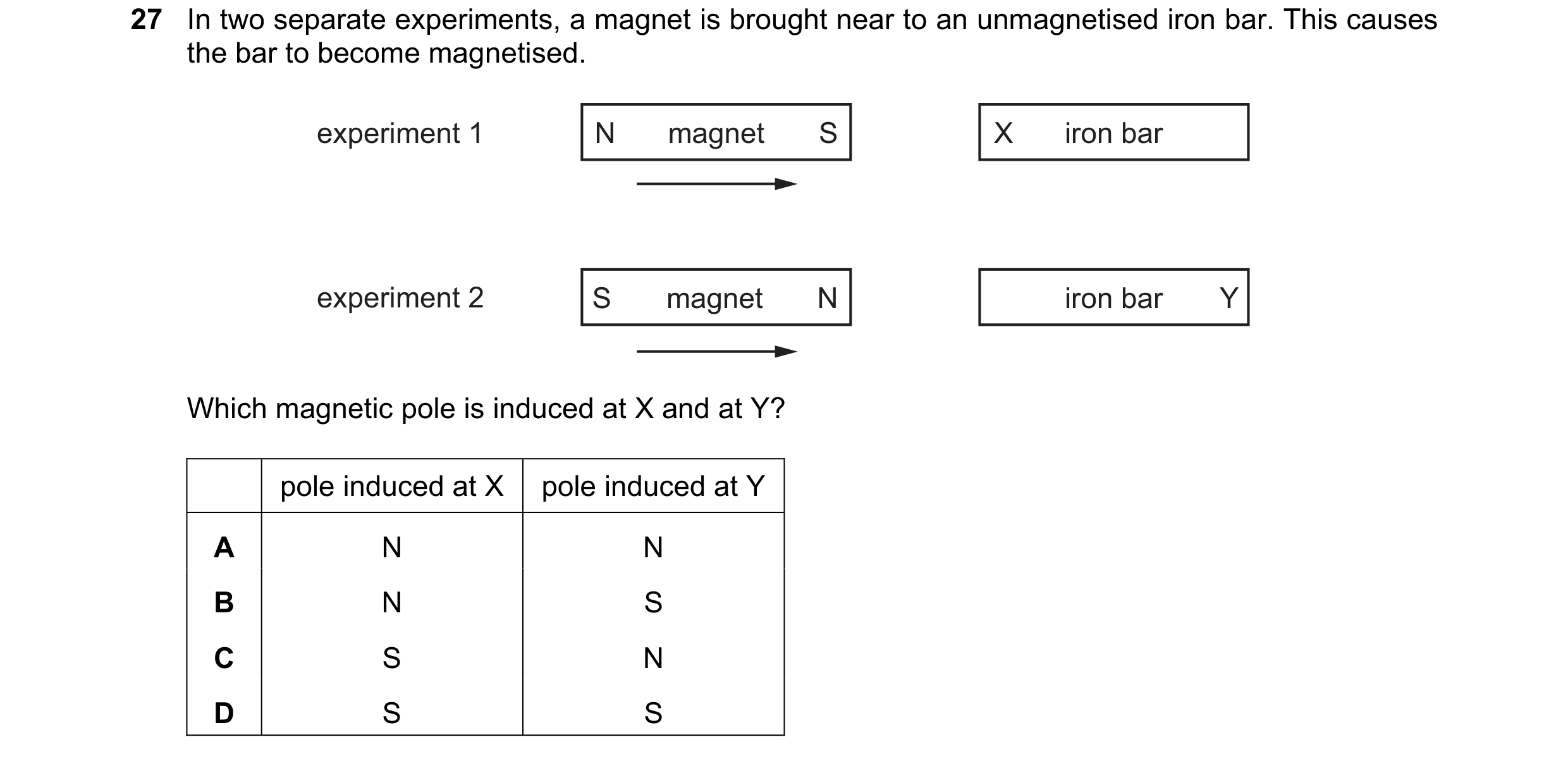 35 / 83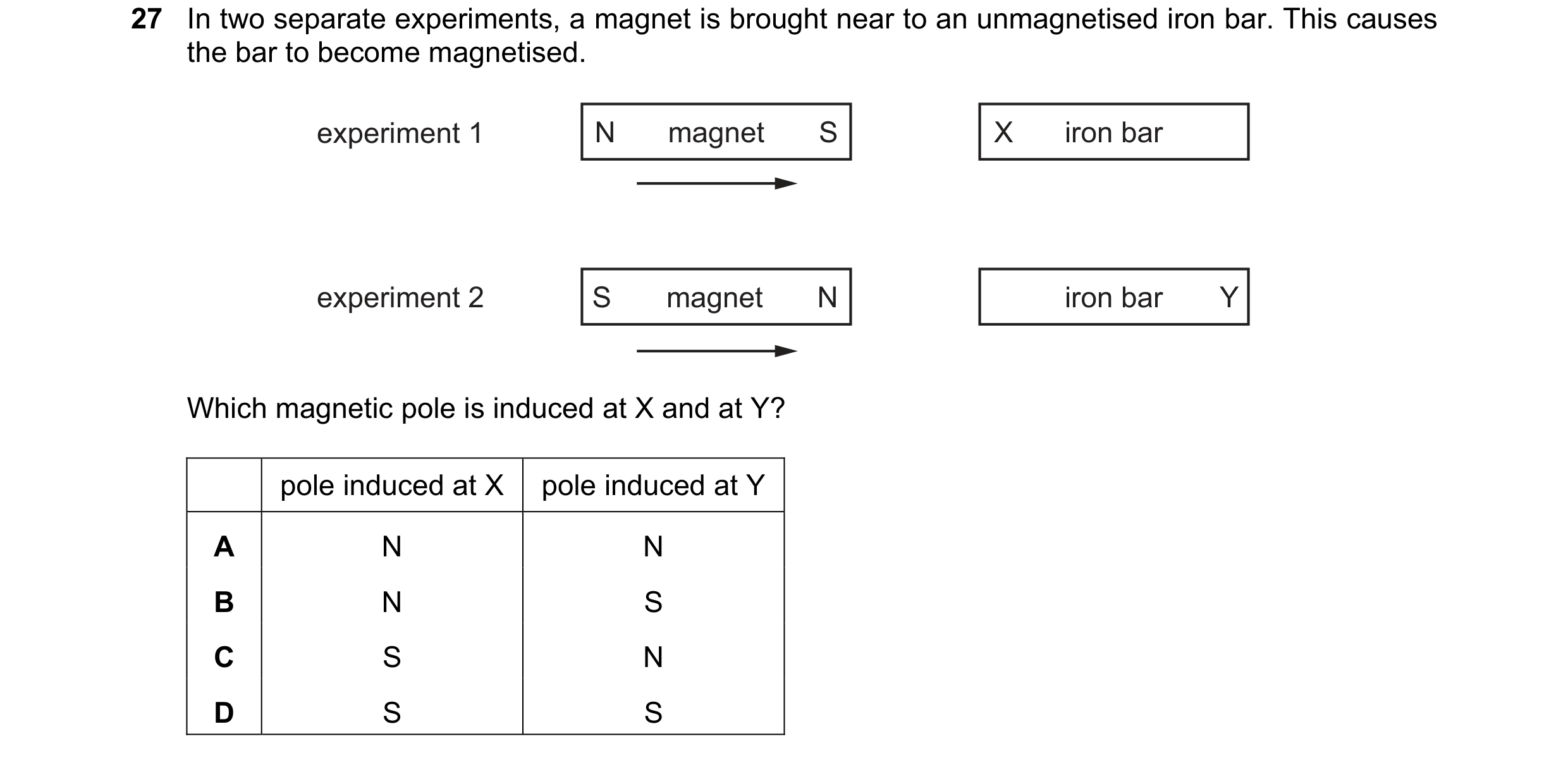
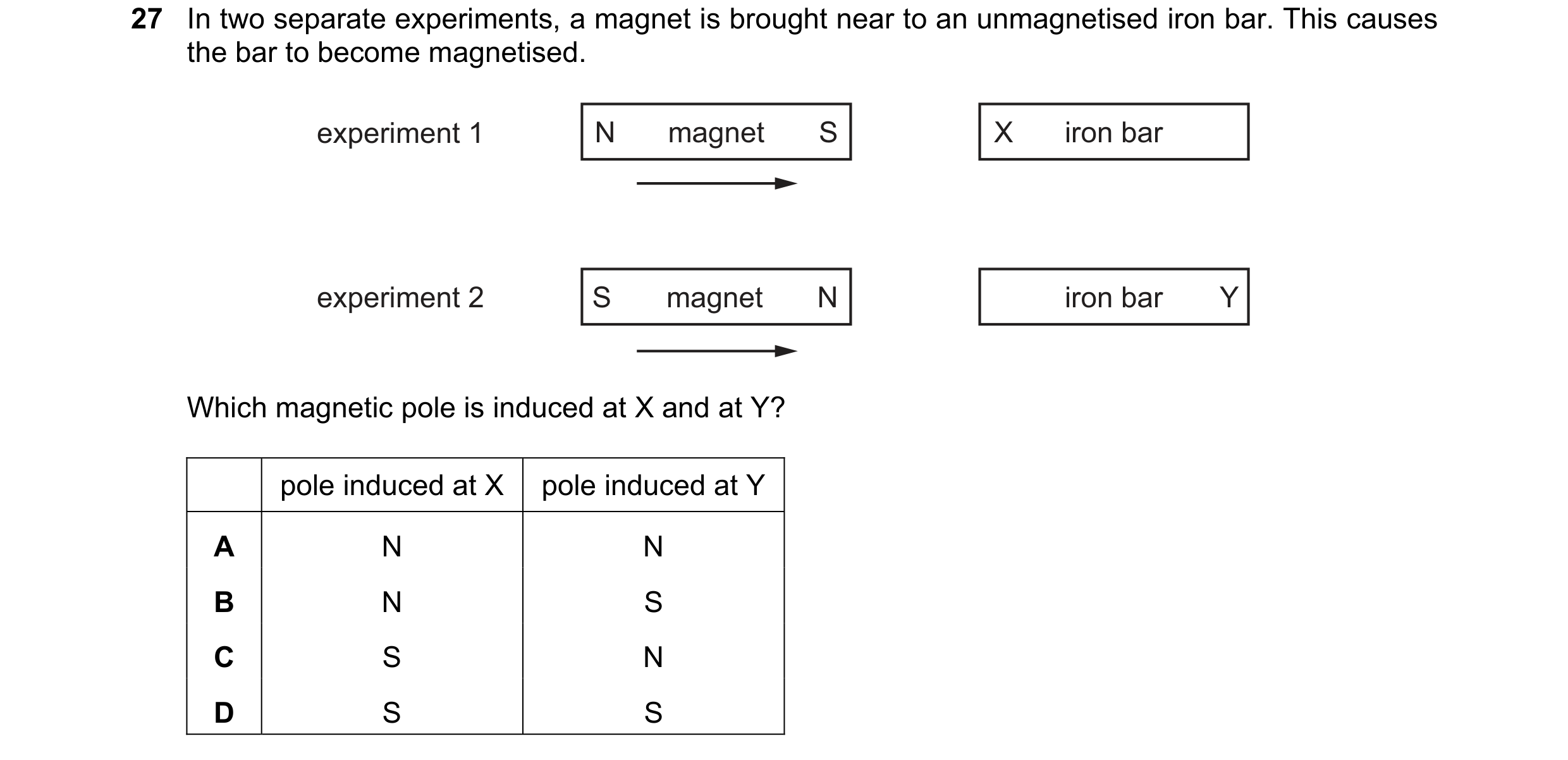
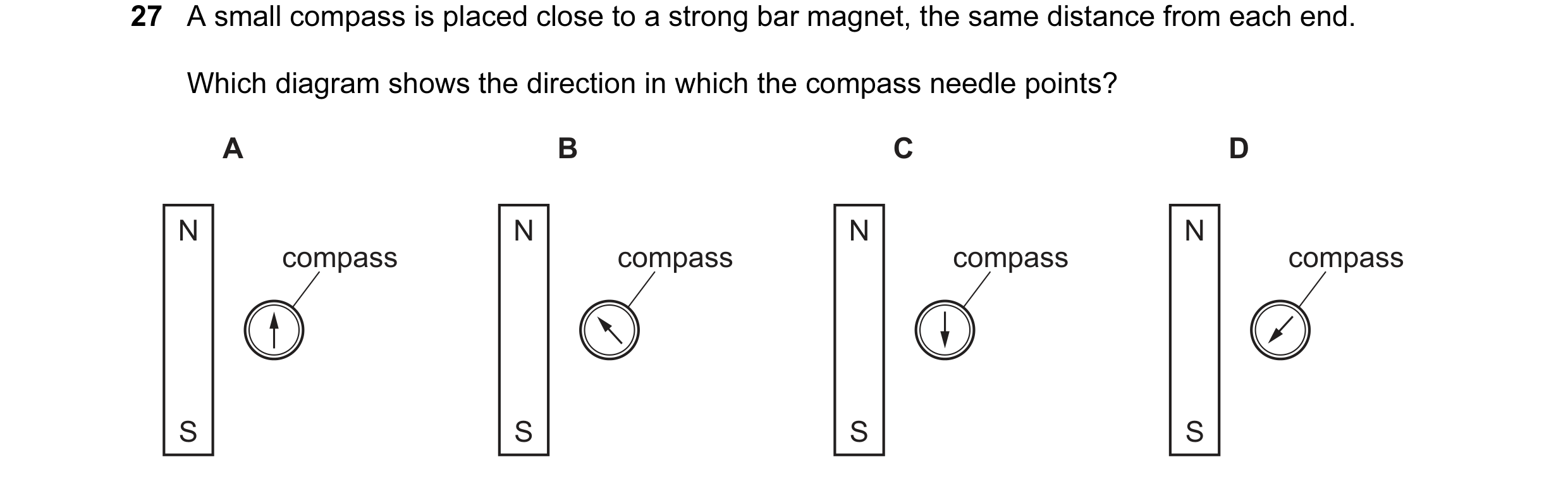 36 / 83
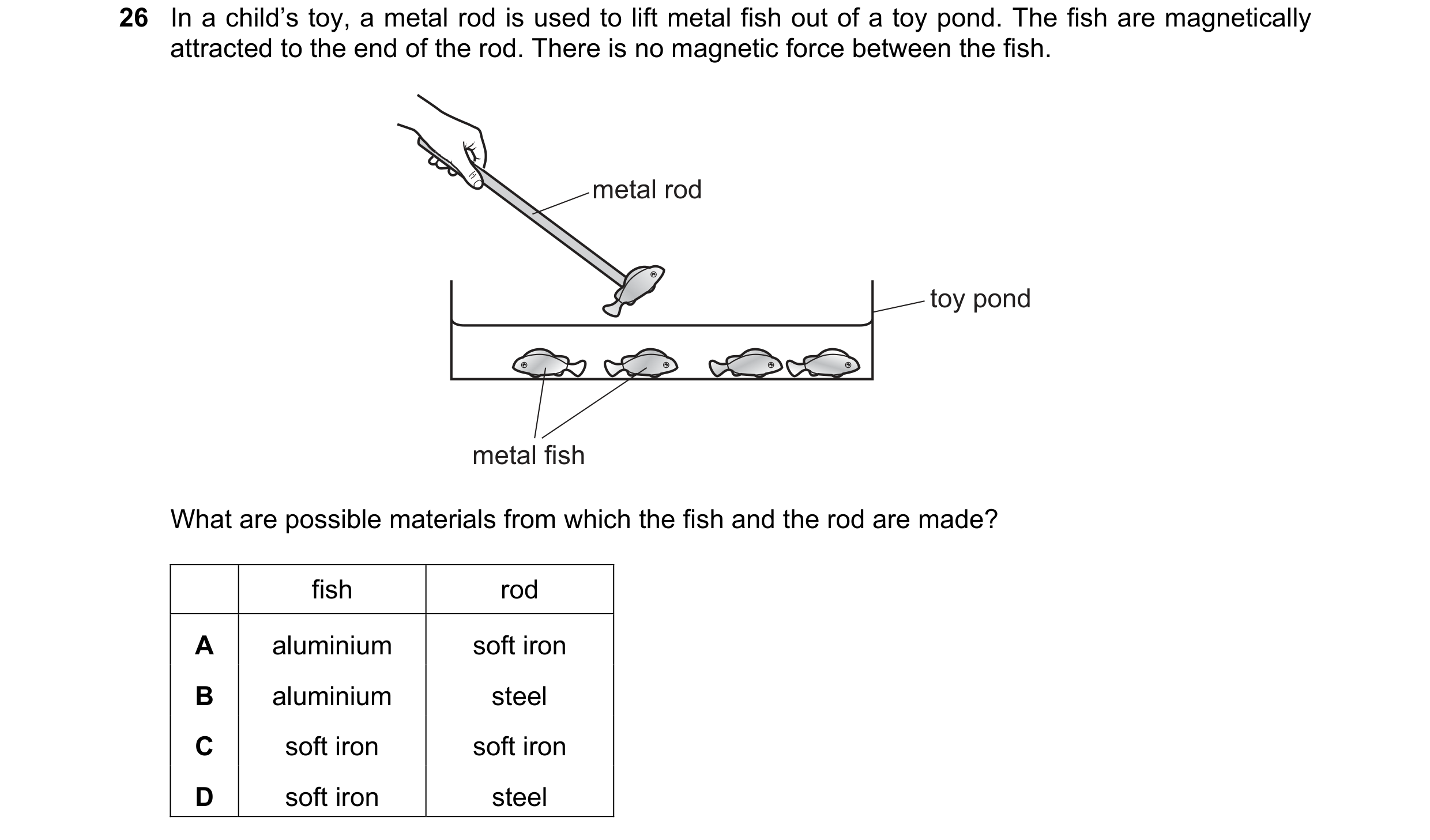
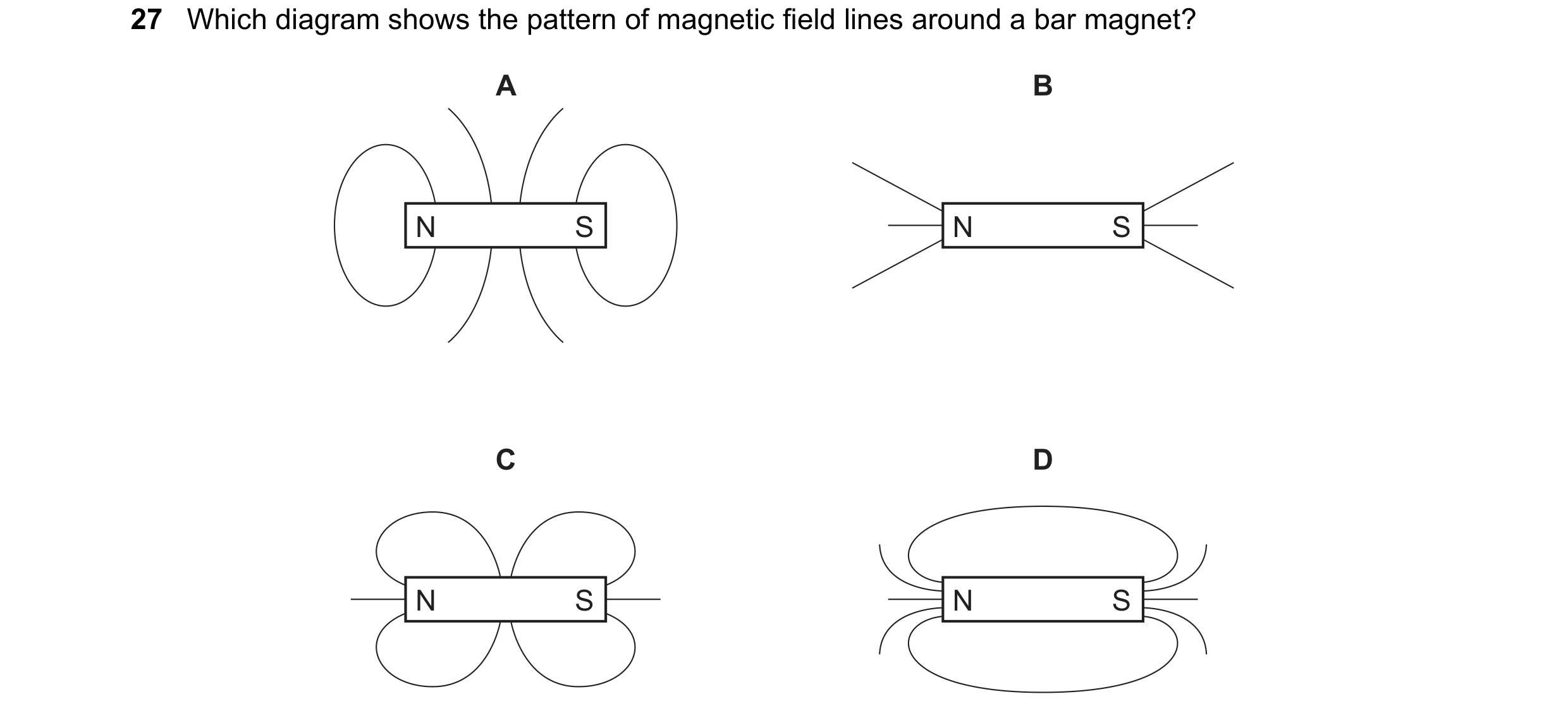 37 / 83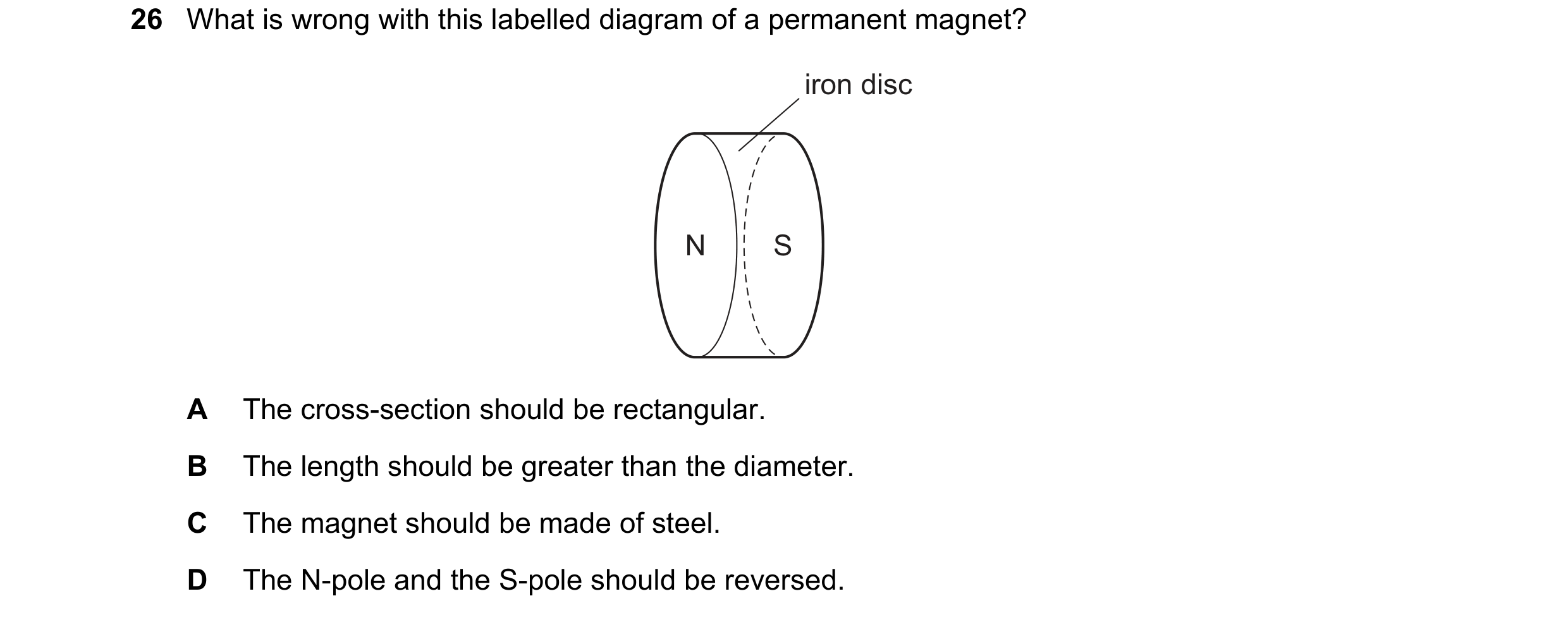

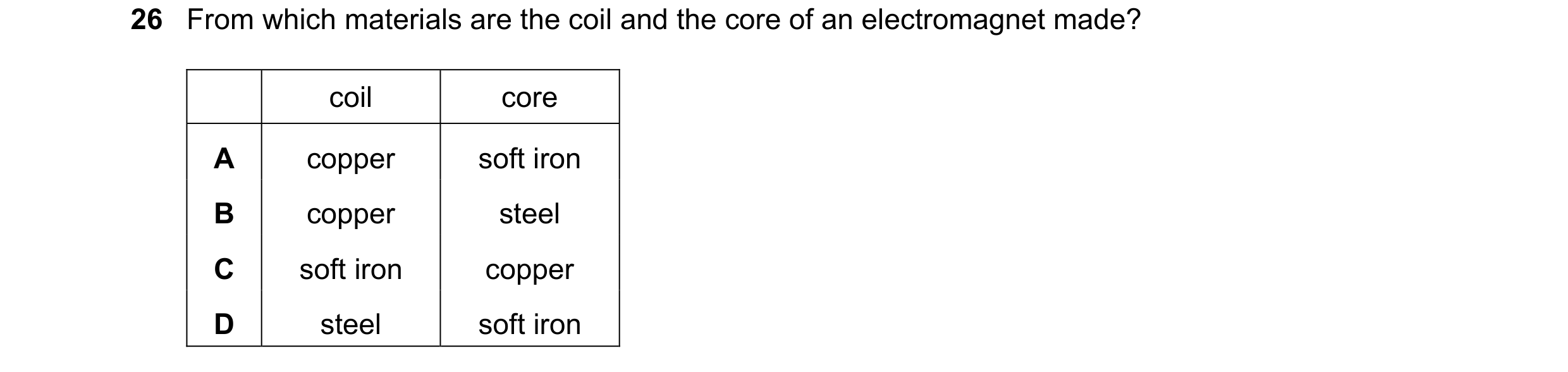
 38 / 83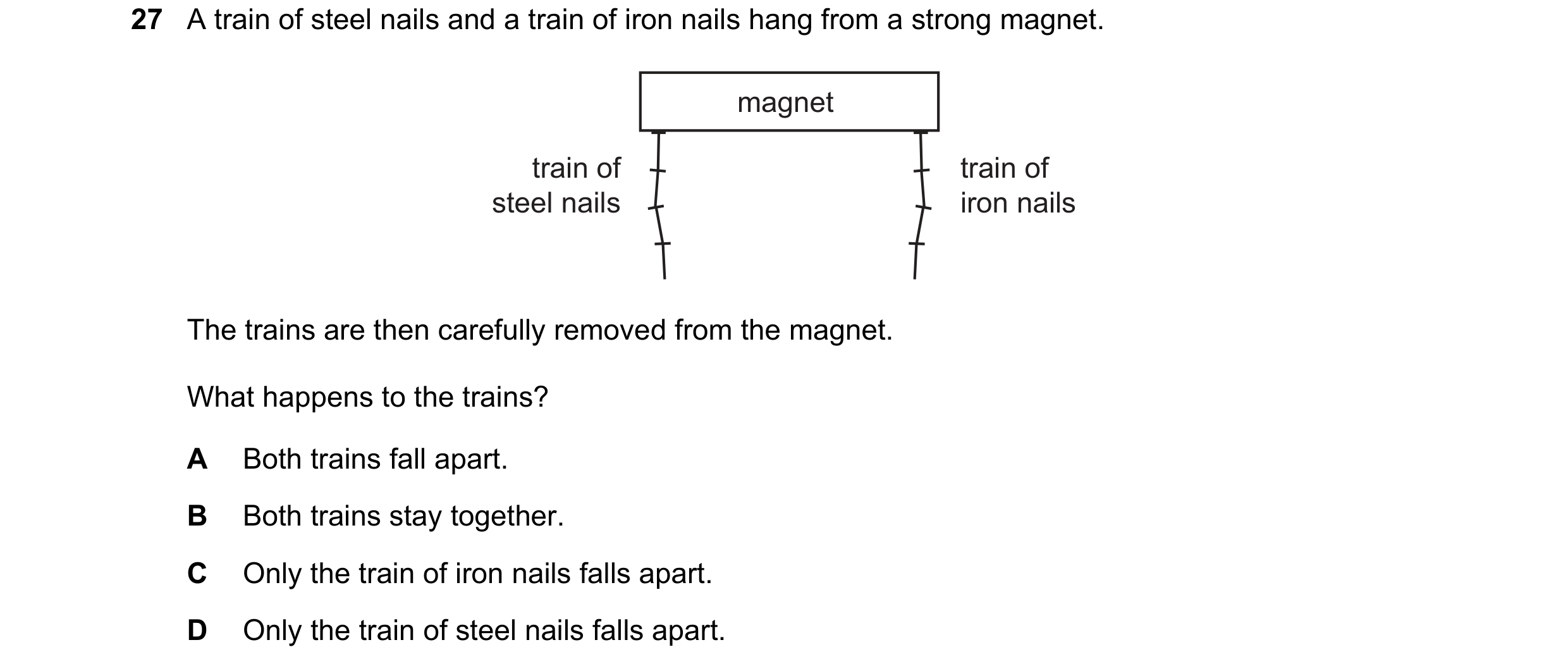
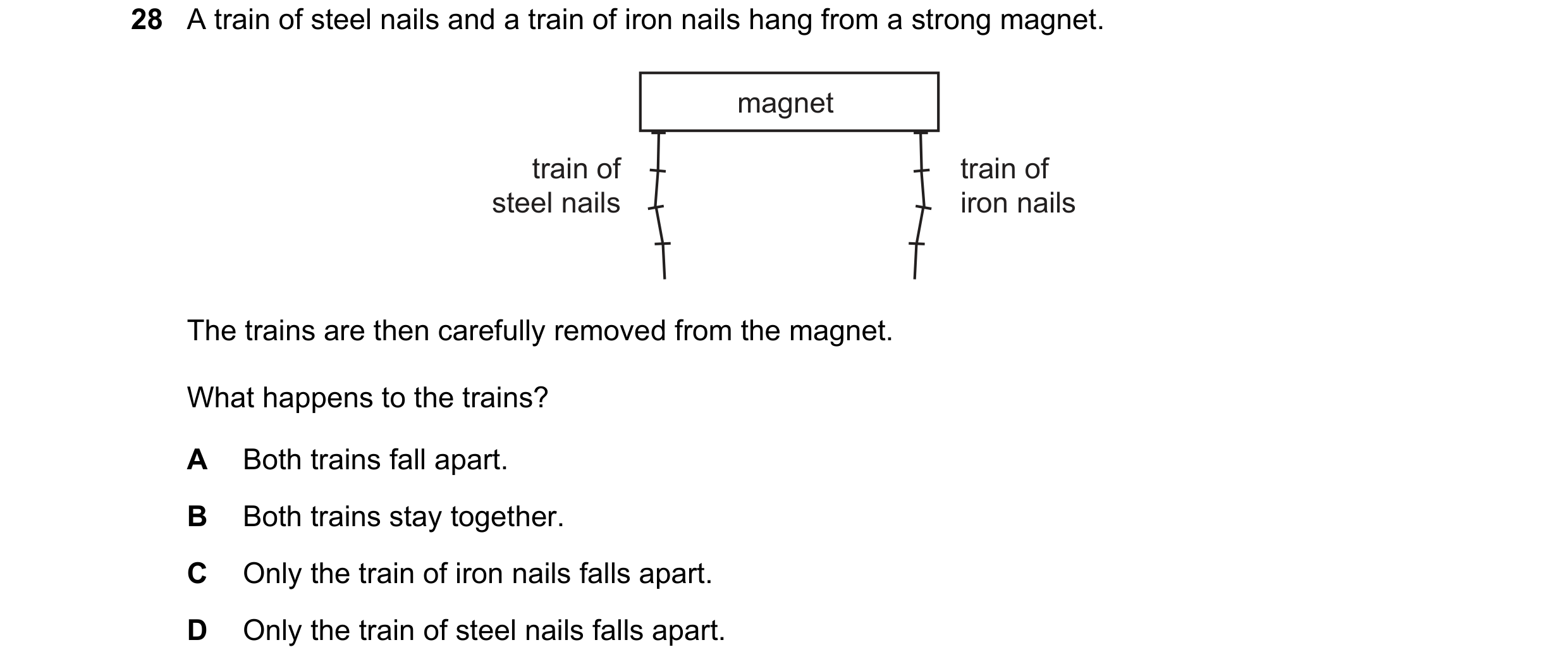 39 / 83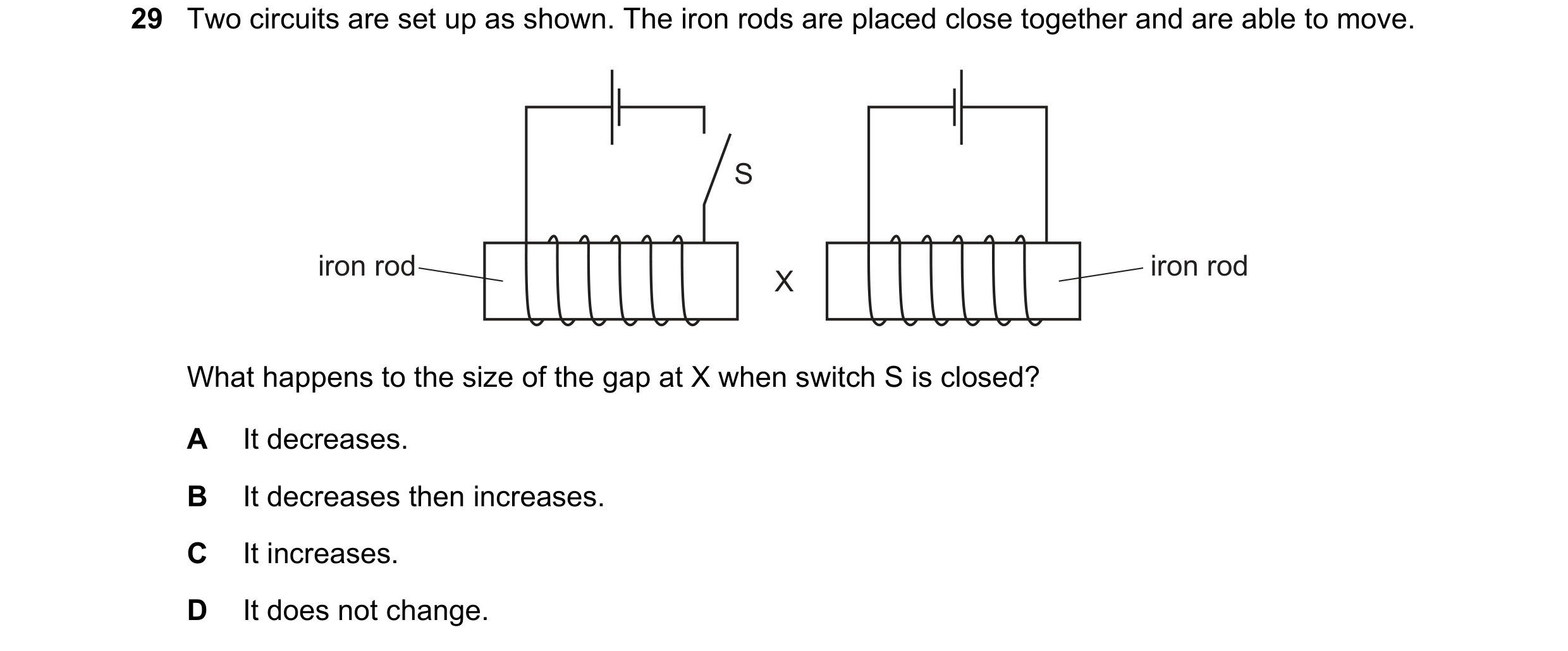
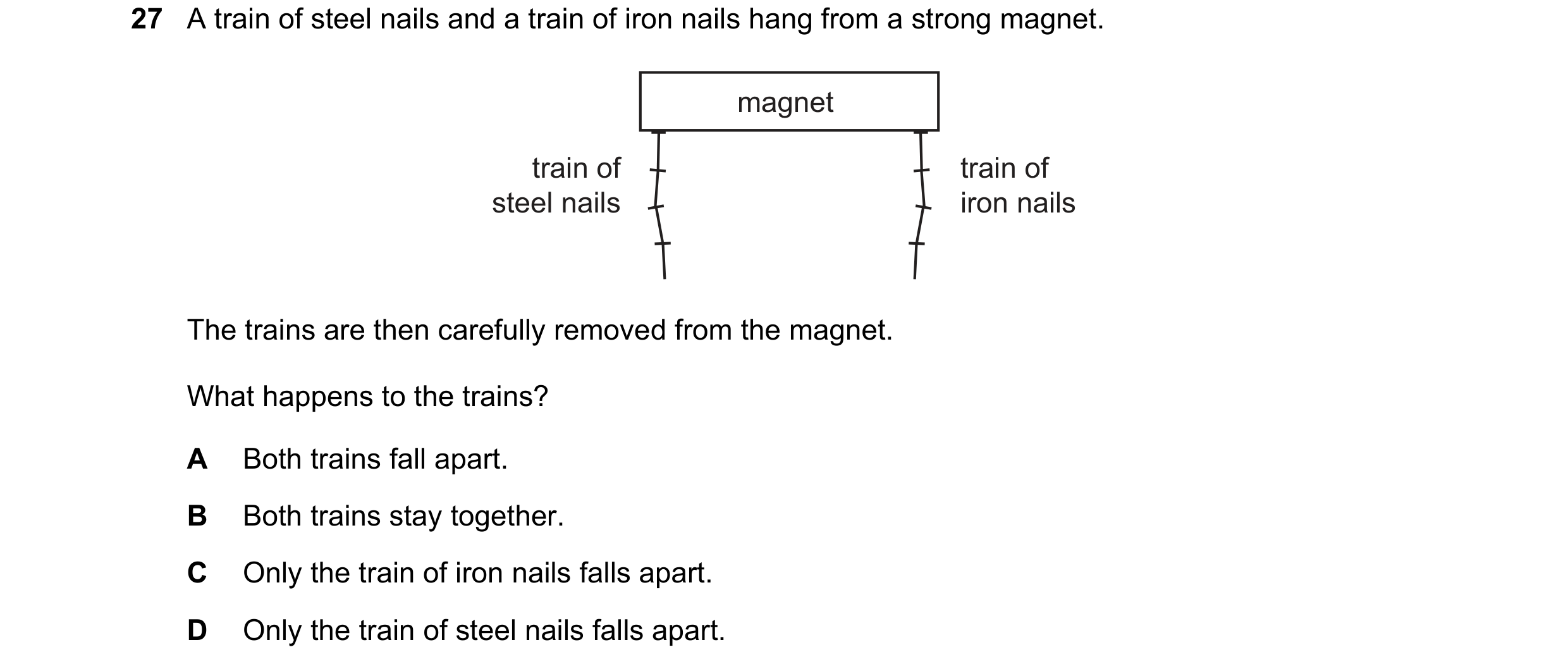
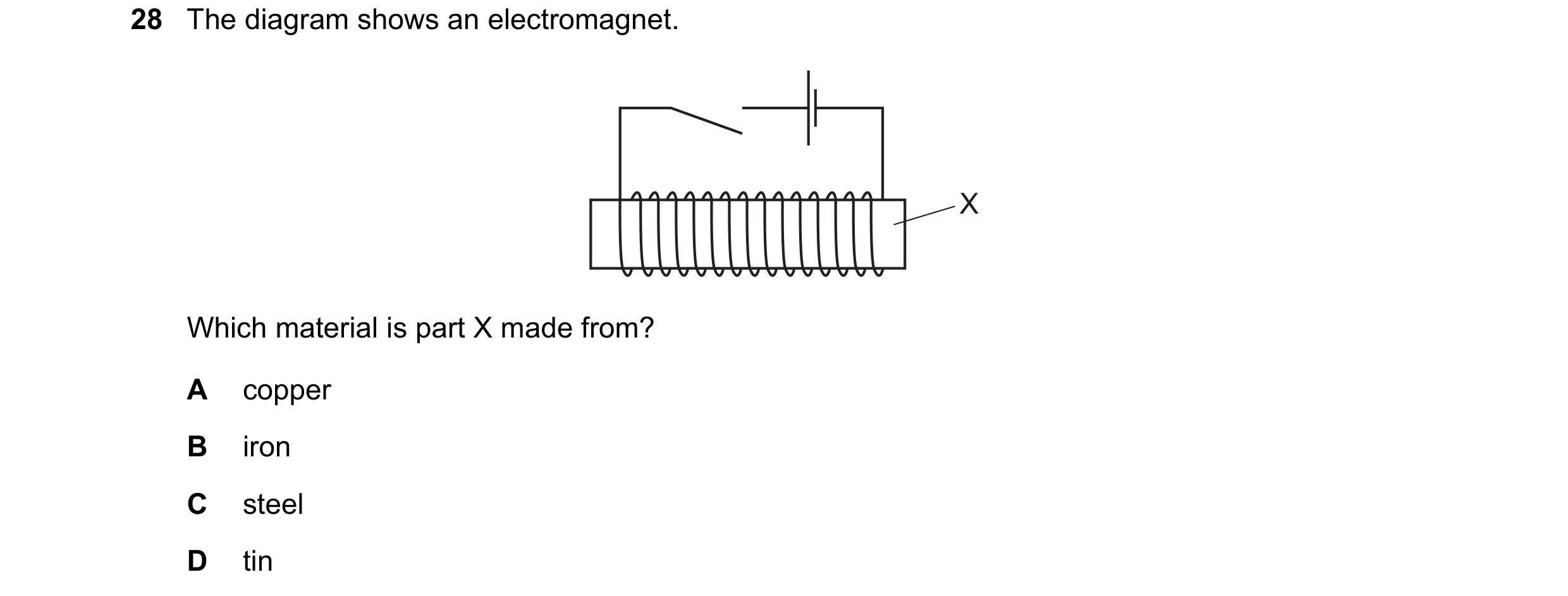 40 / 83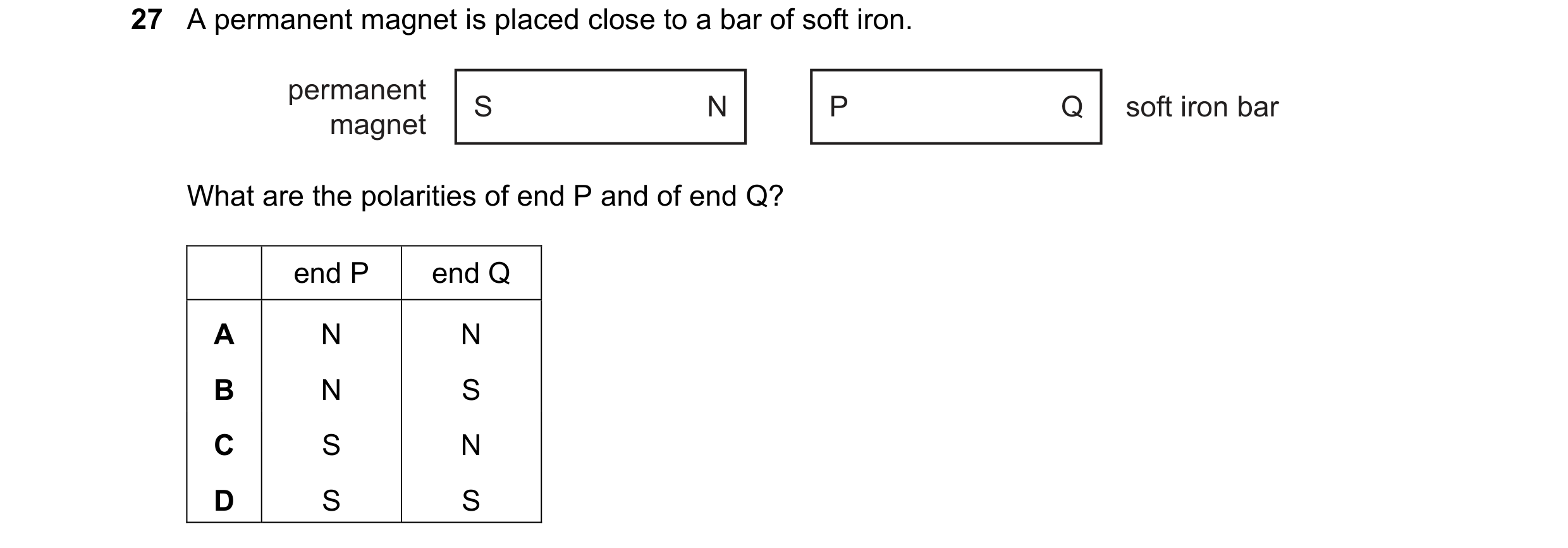

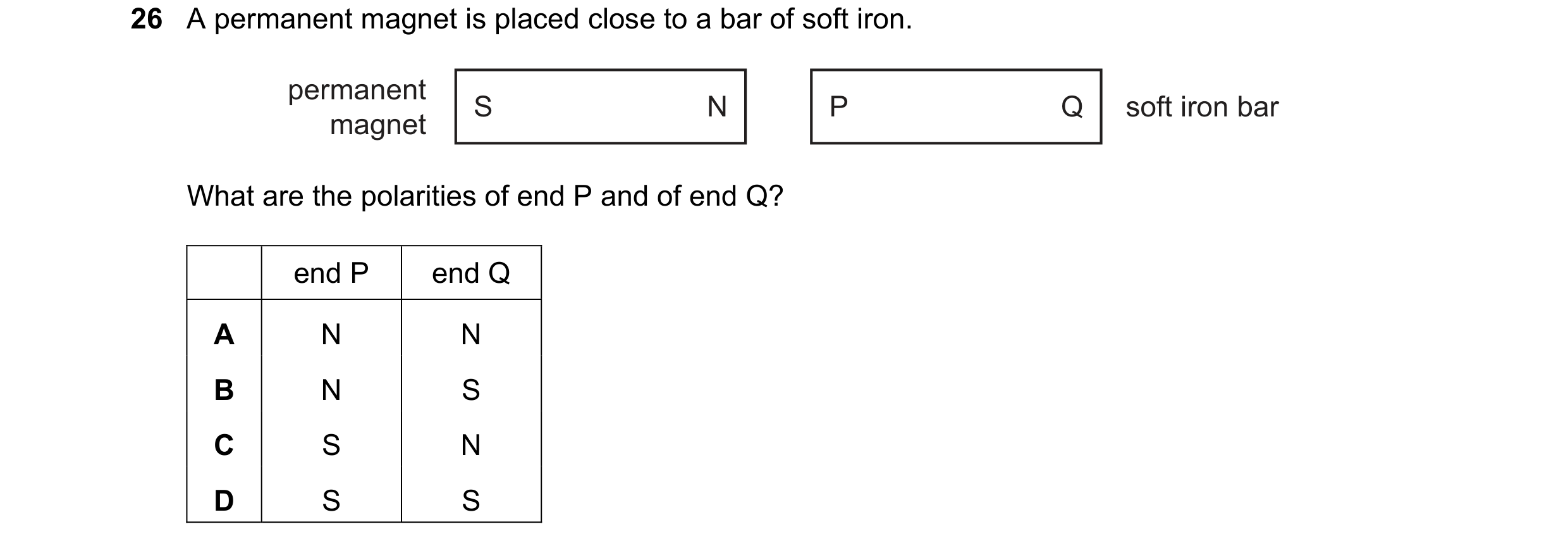
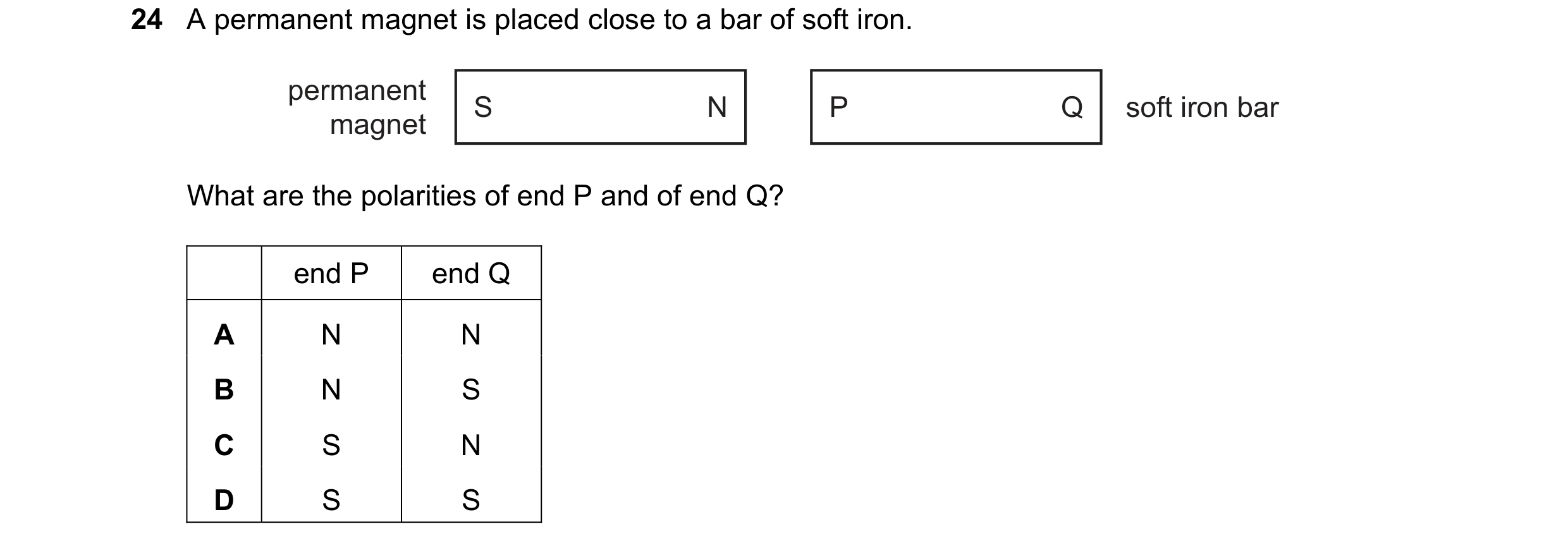 41 / 83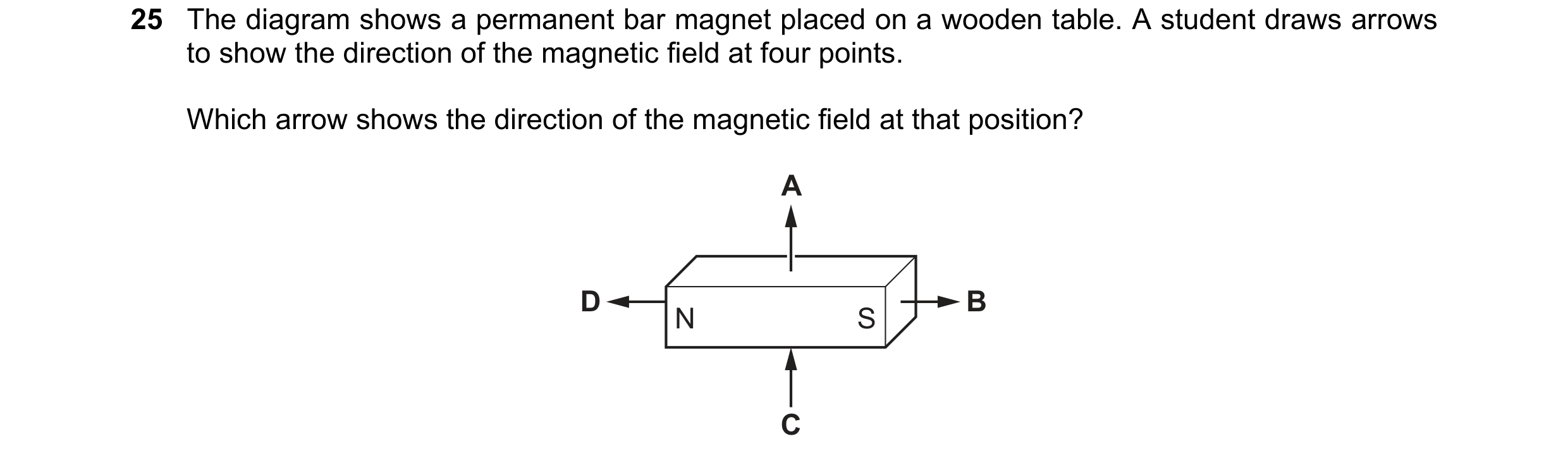
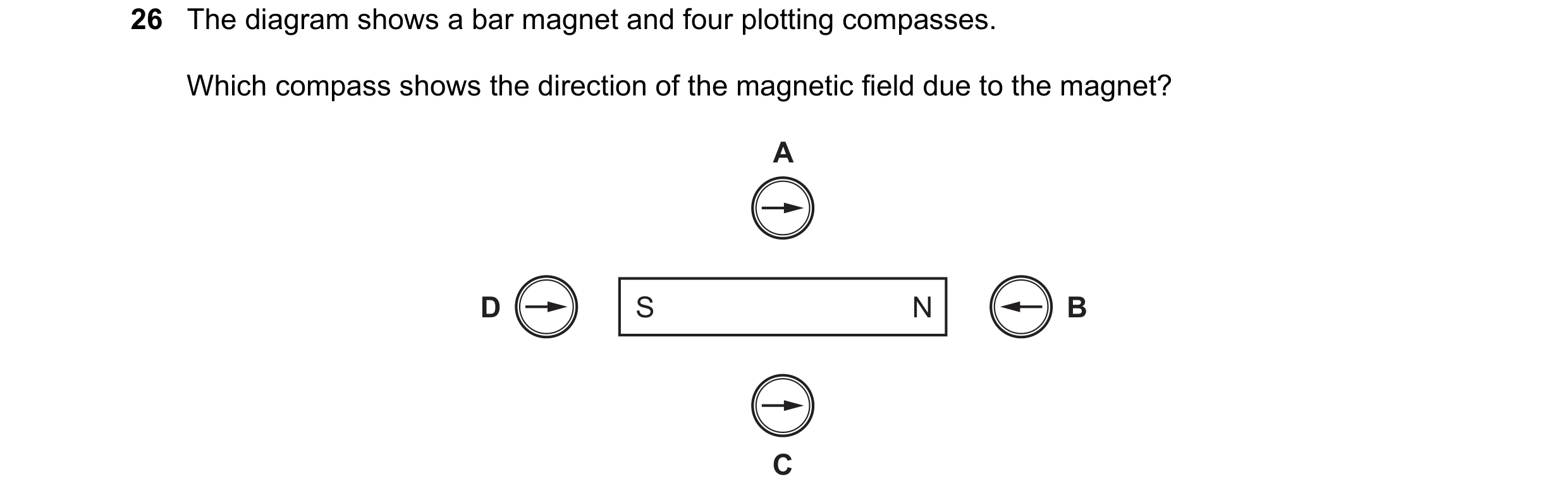
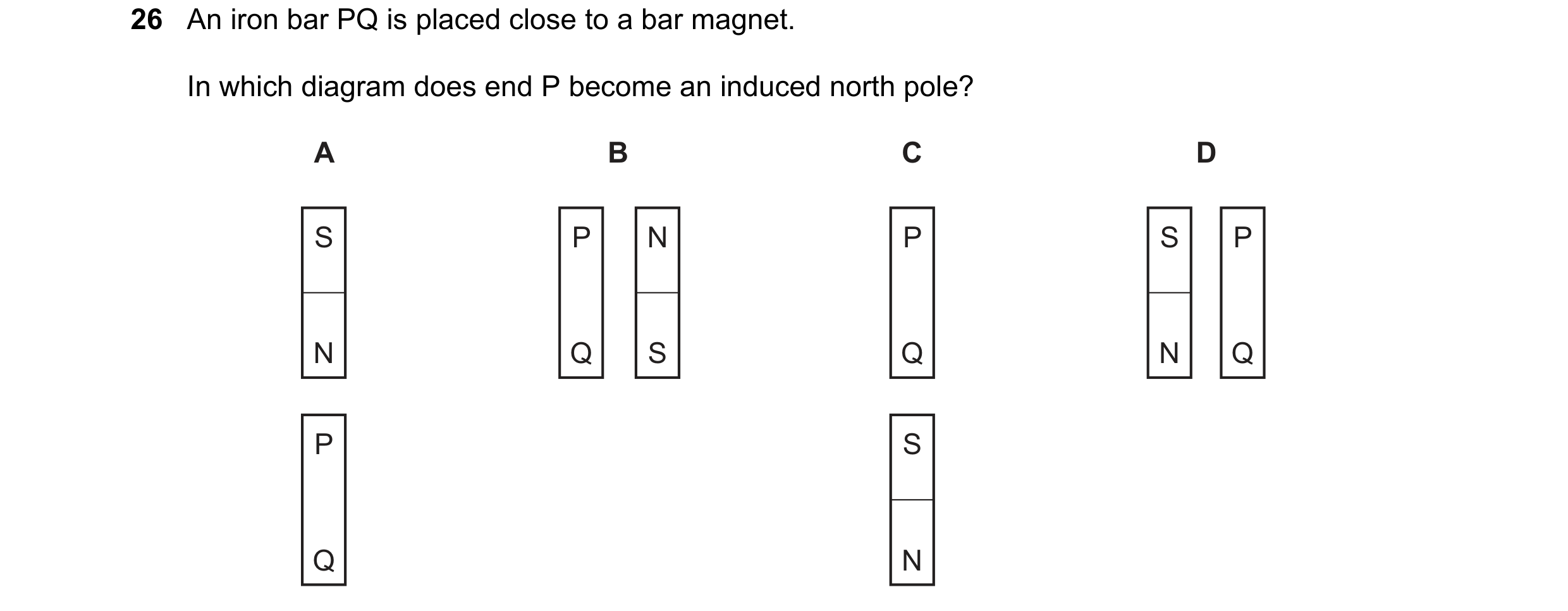 42 / 83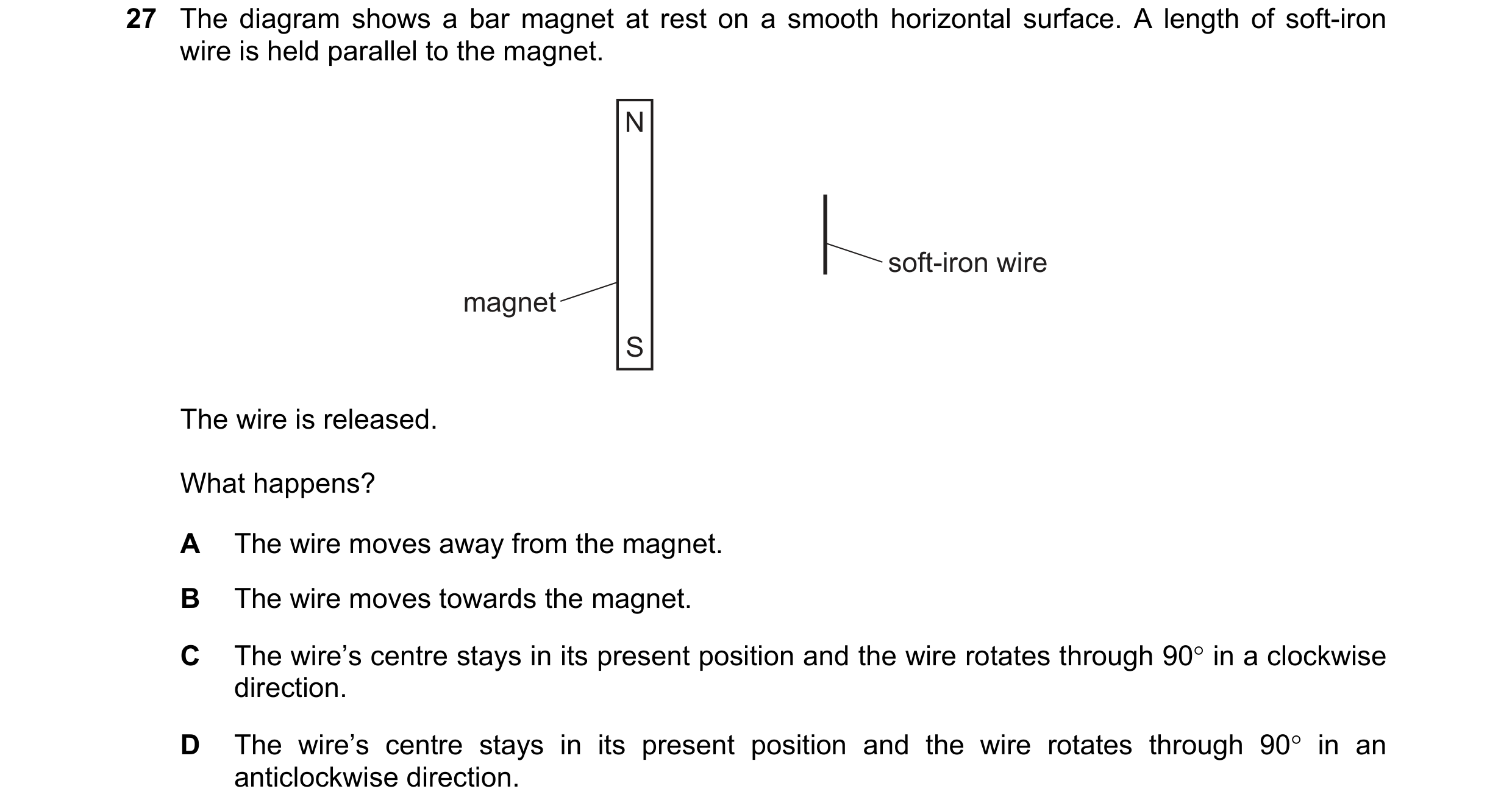
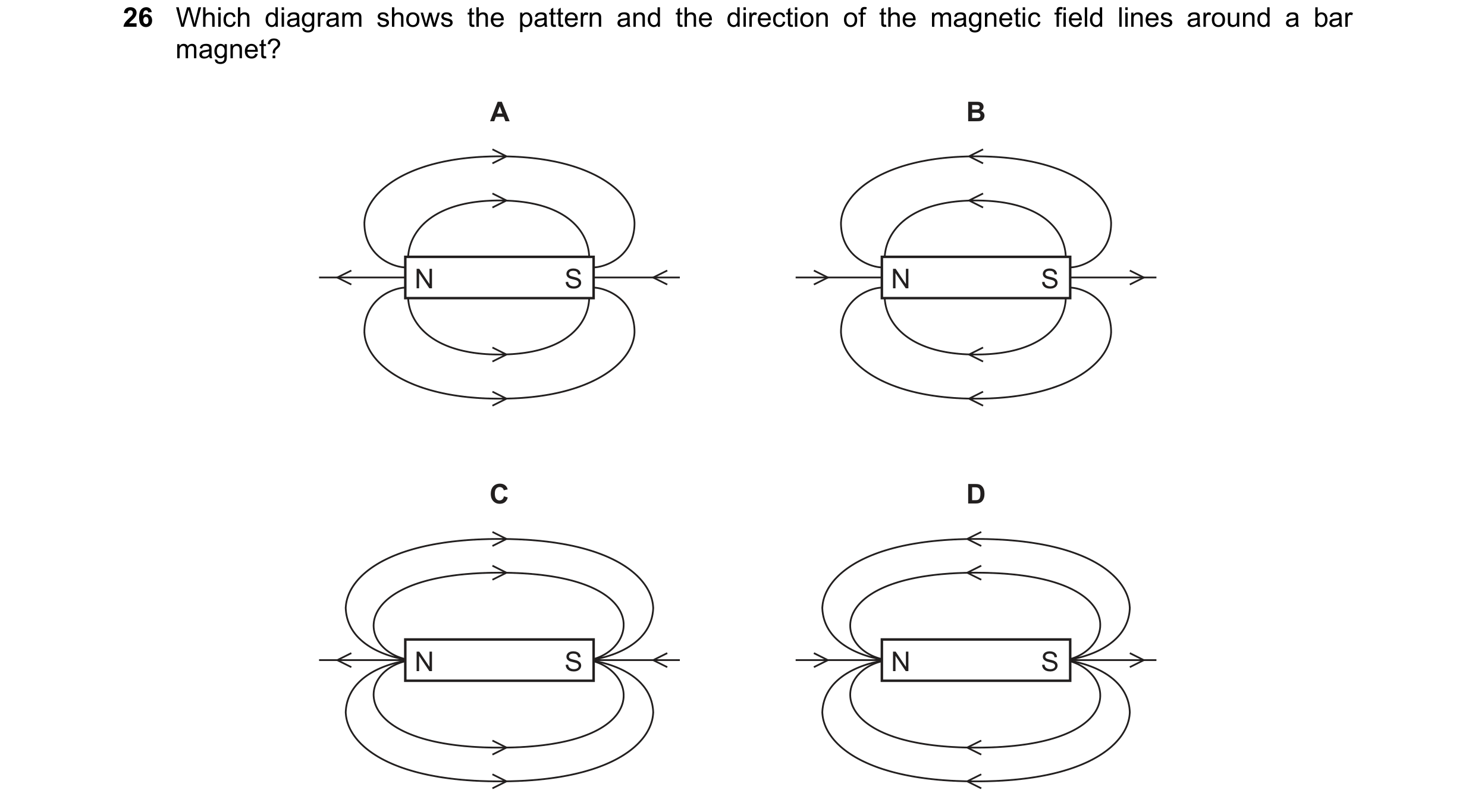
 43 / 83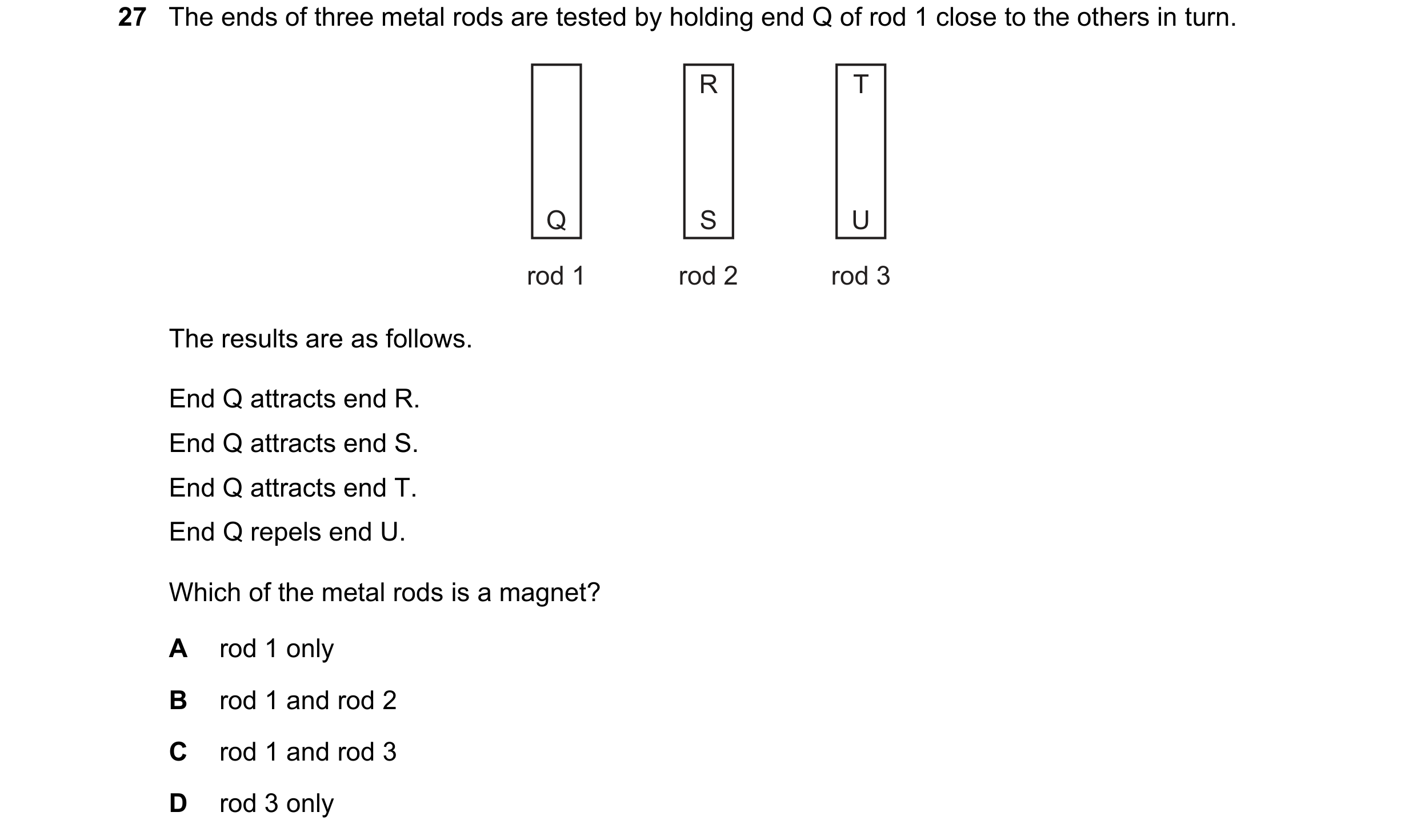

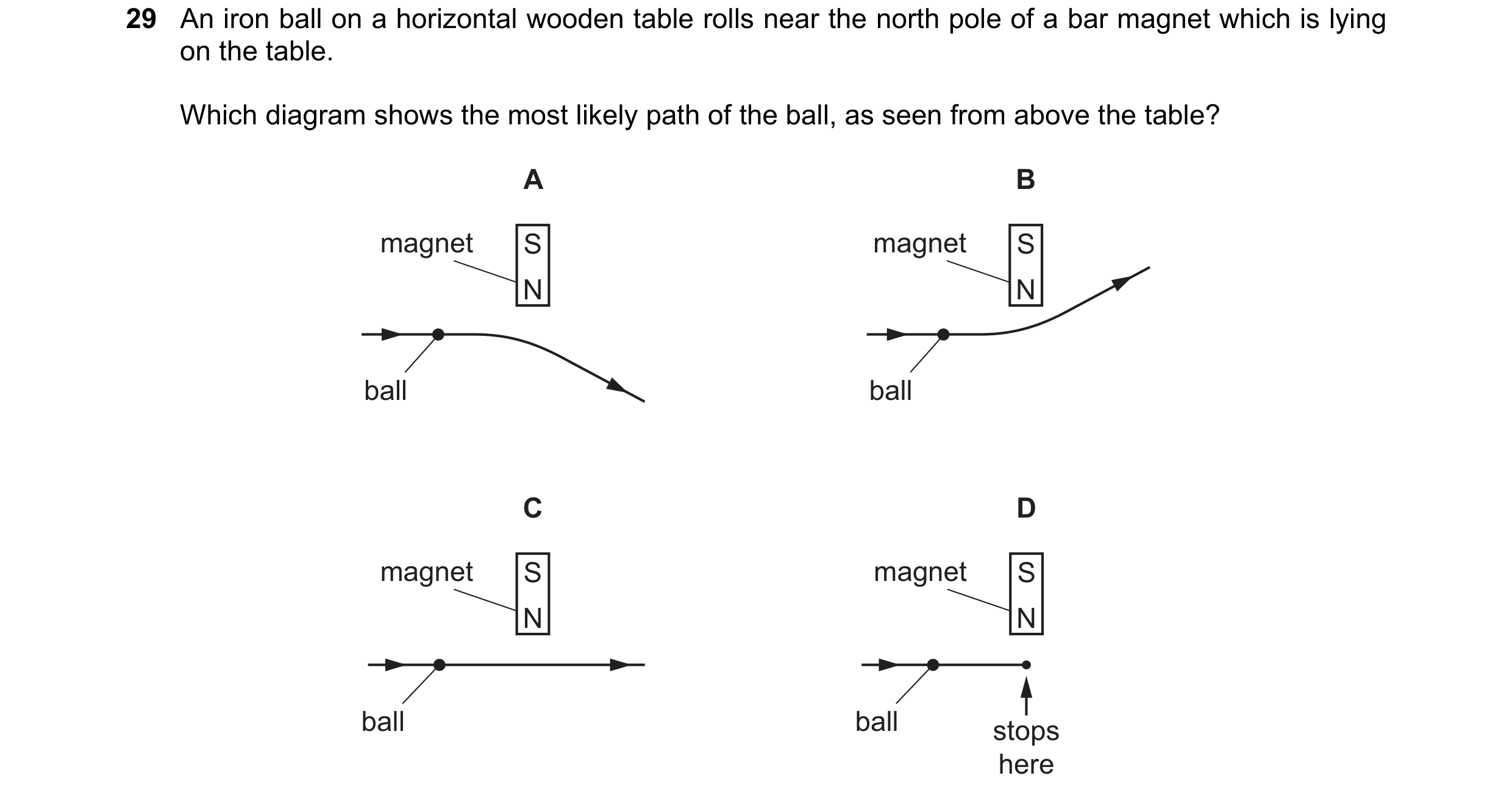 44 / 83
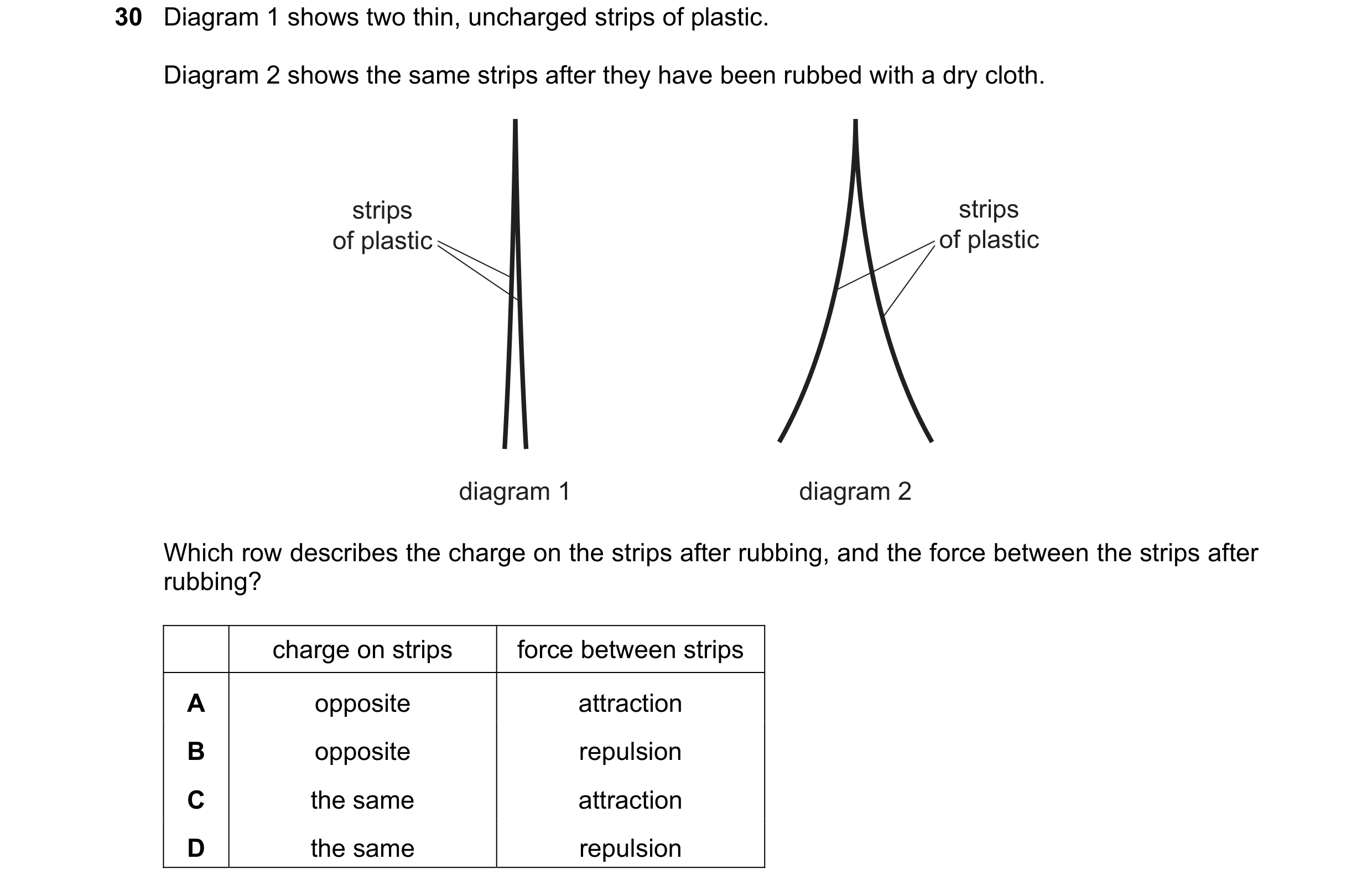 45 / 83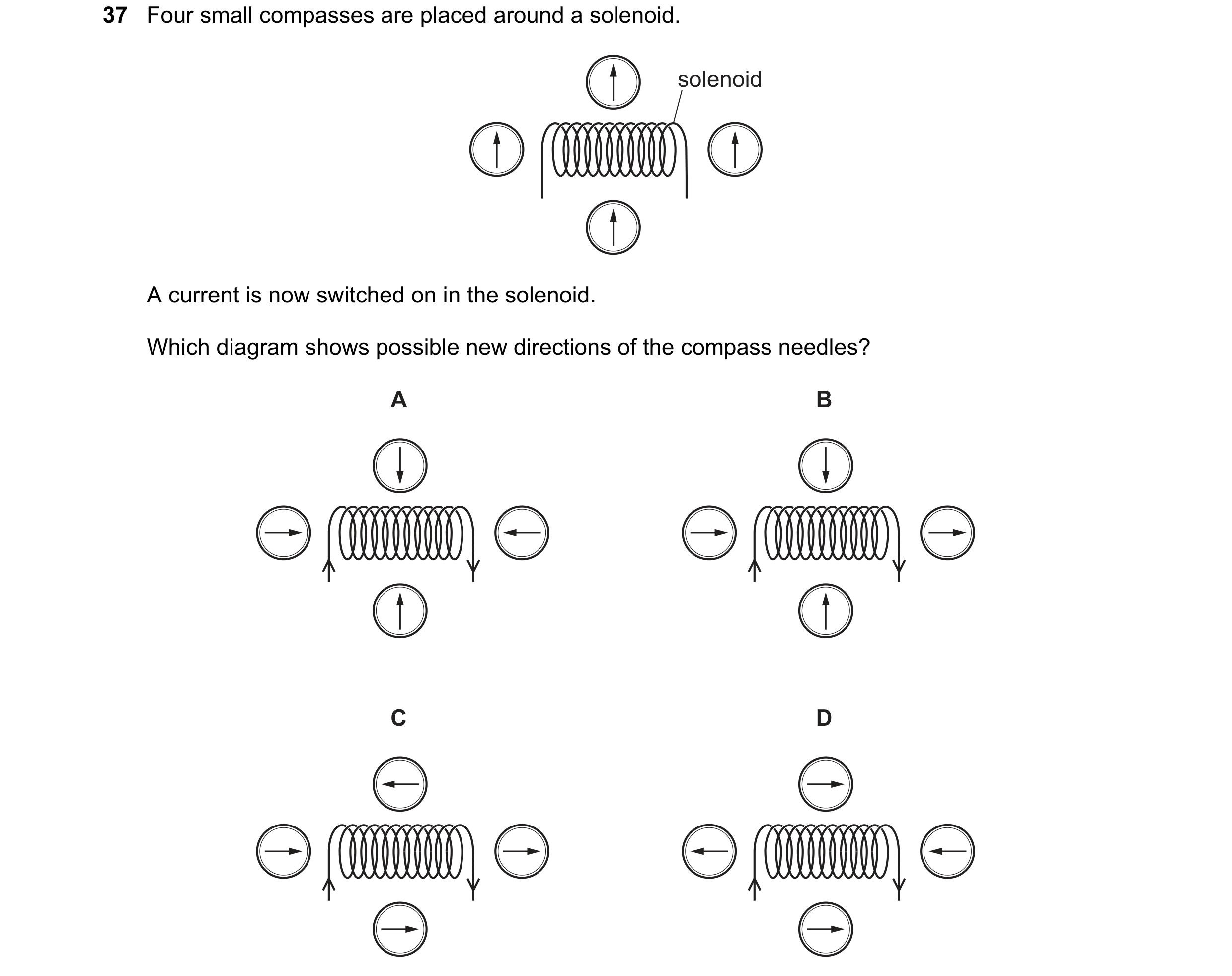
 46 / 83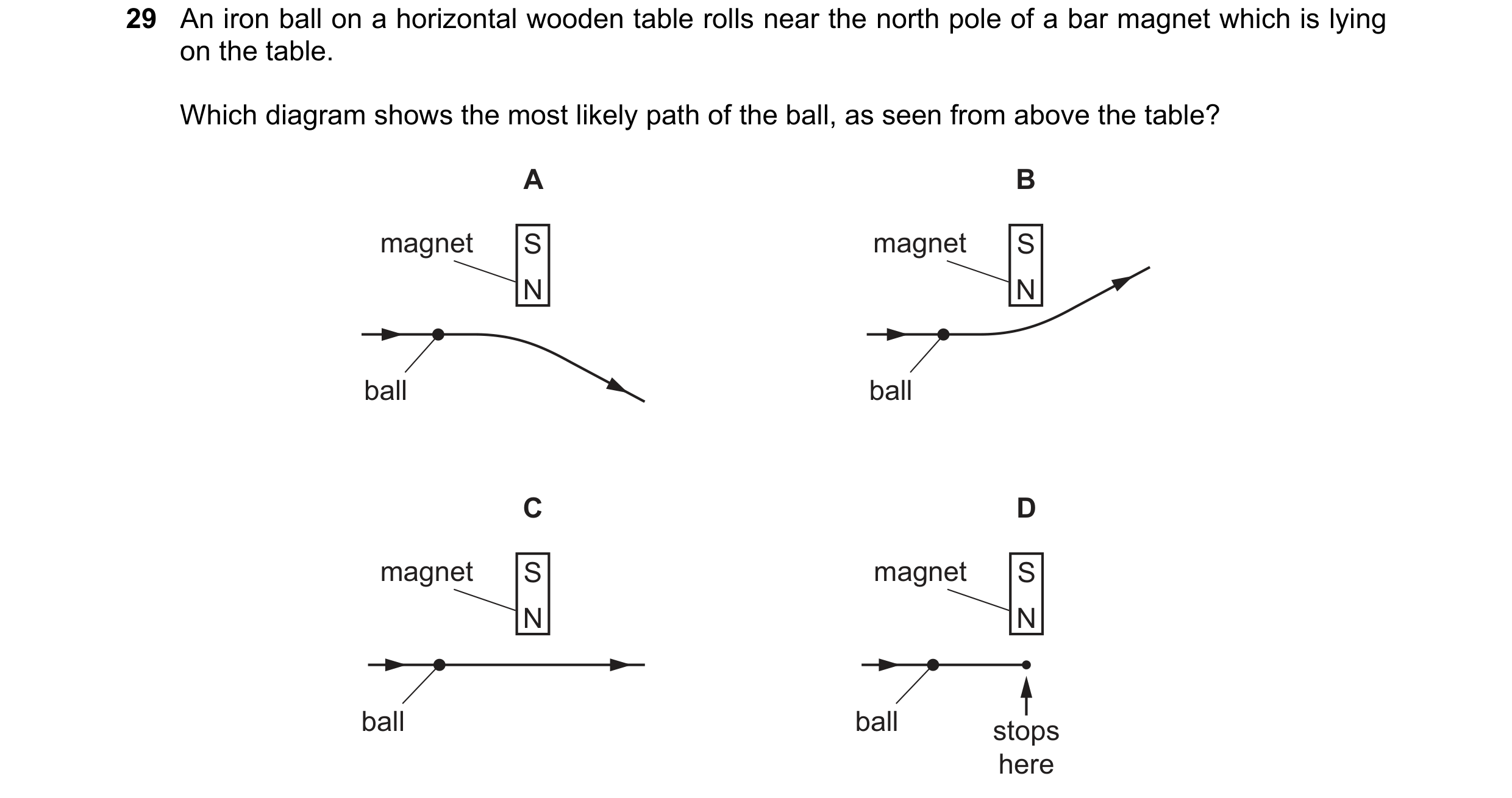
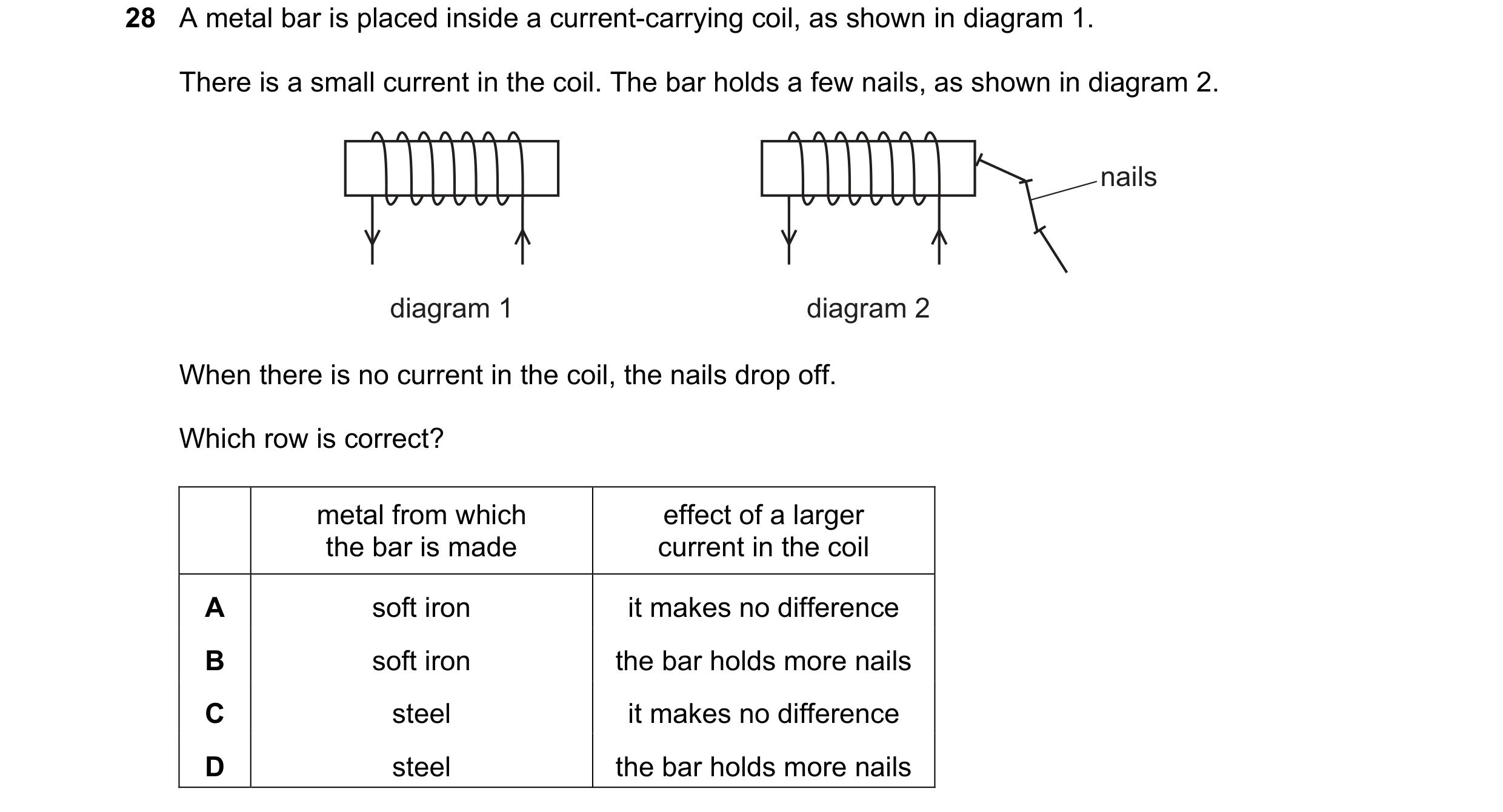 47 / 83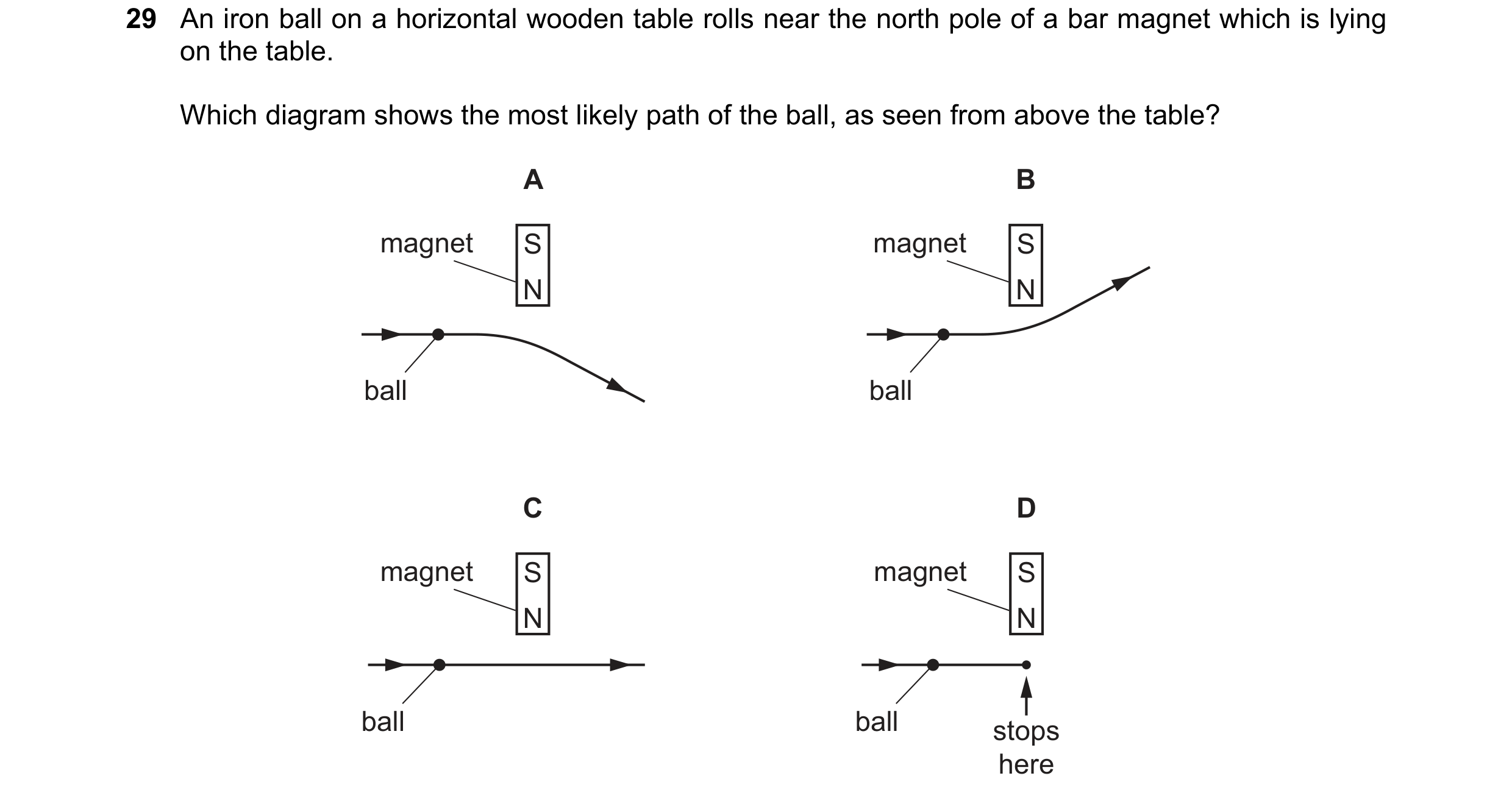
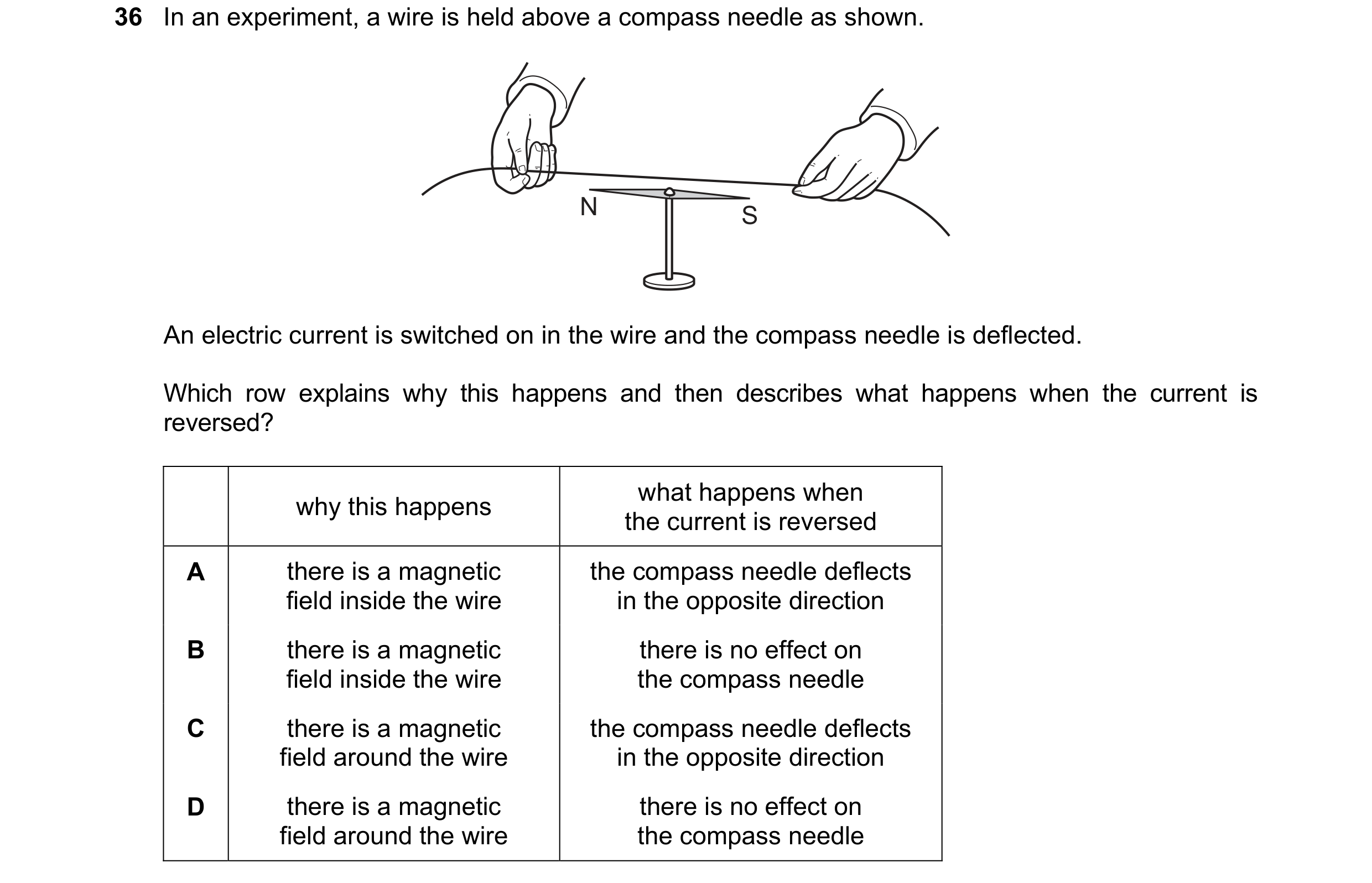 48 / 83
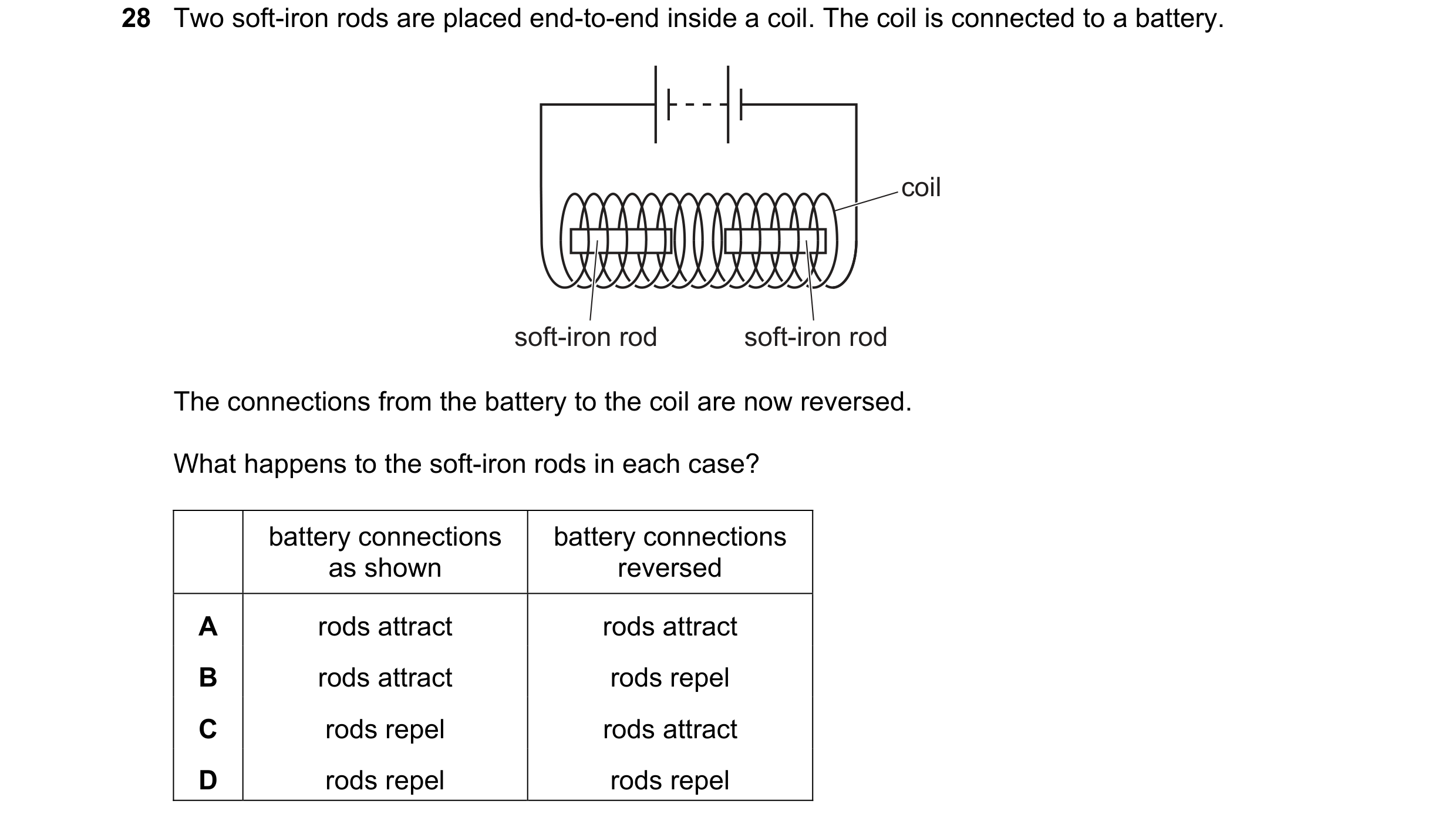
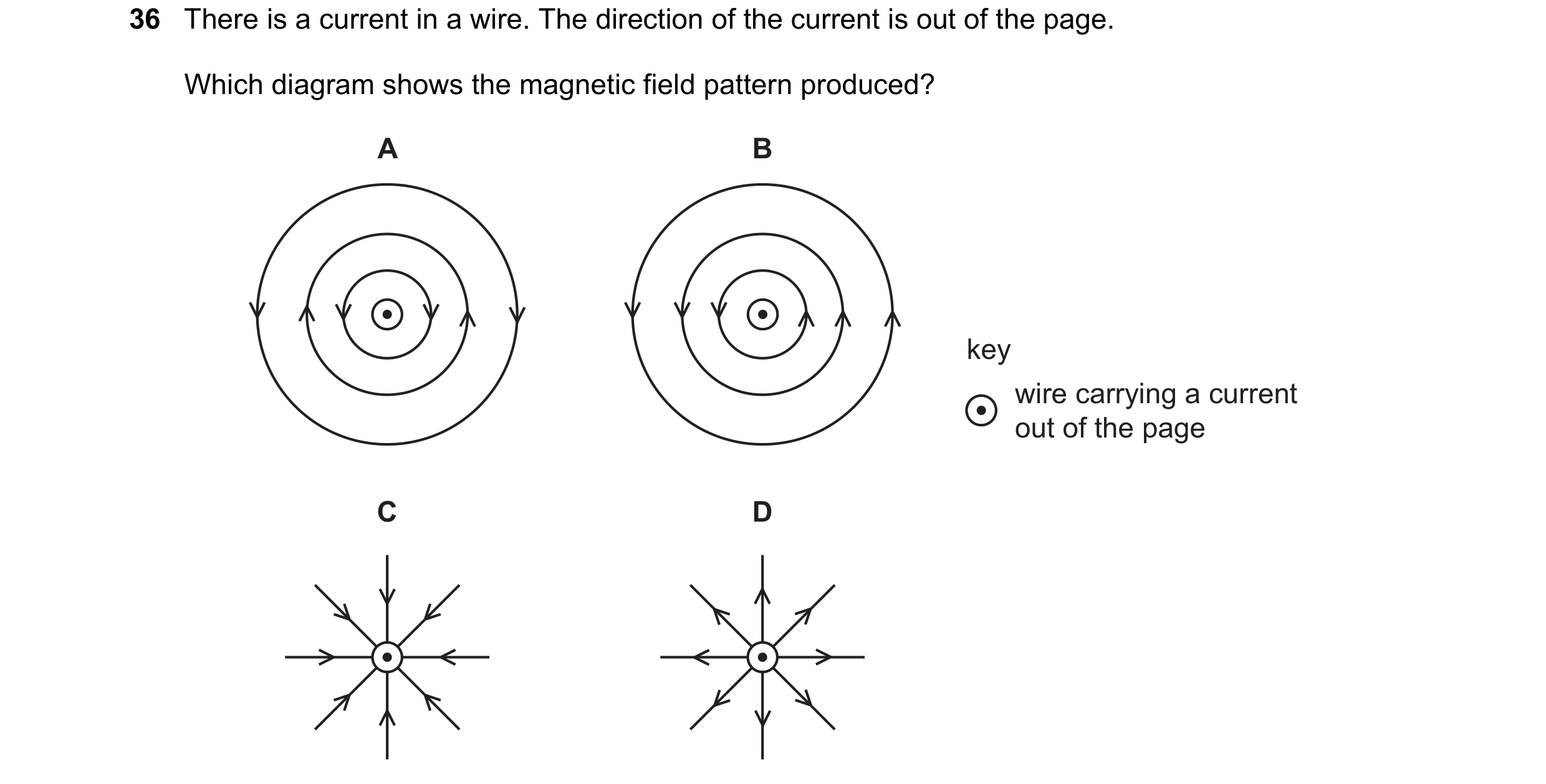 49 / 83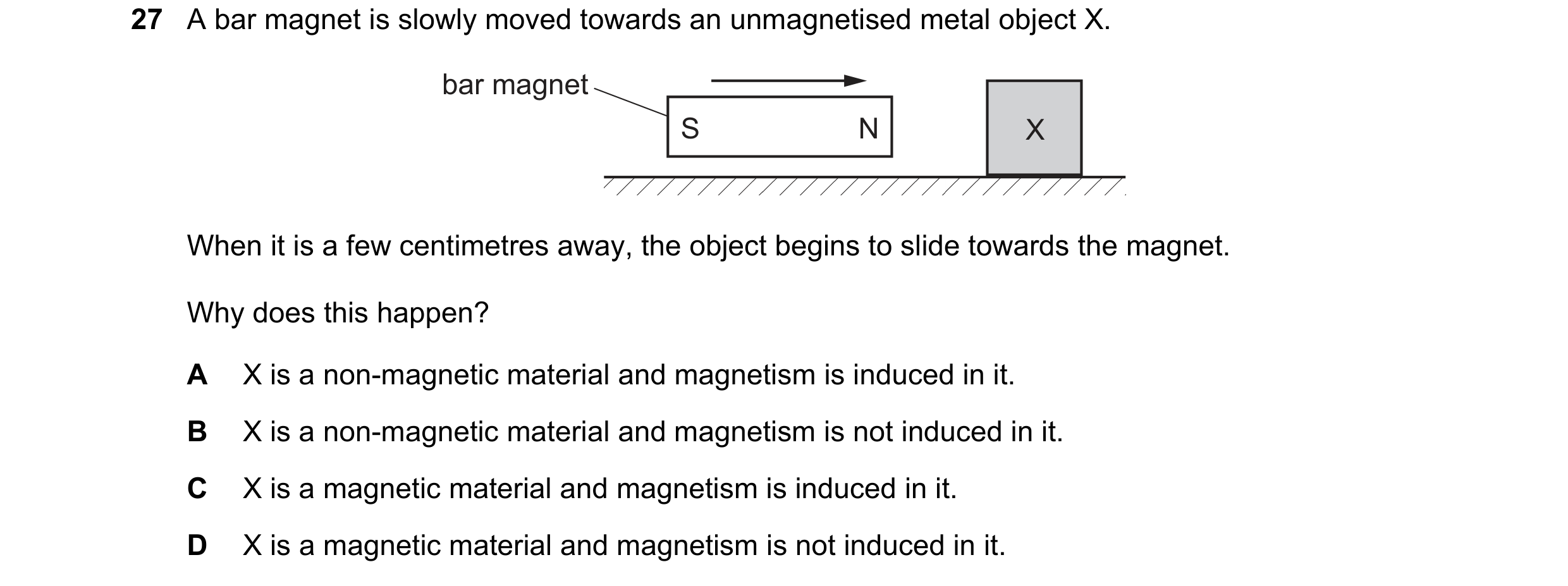
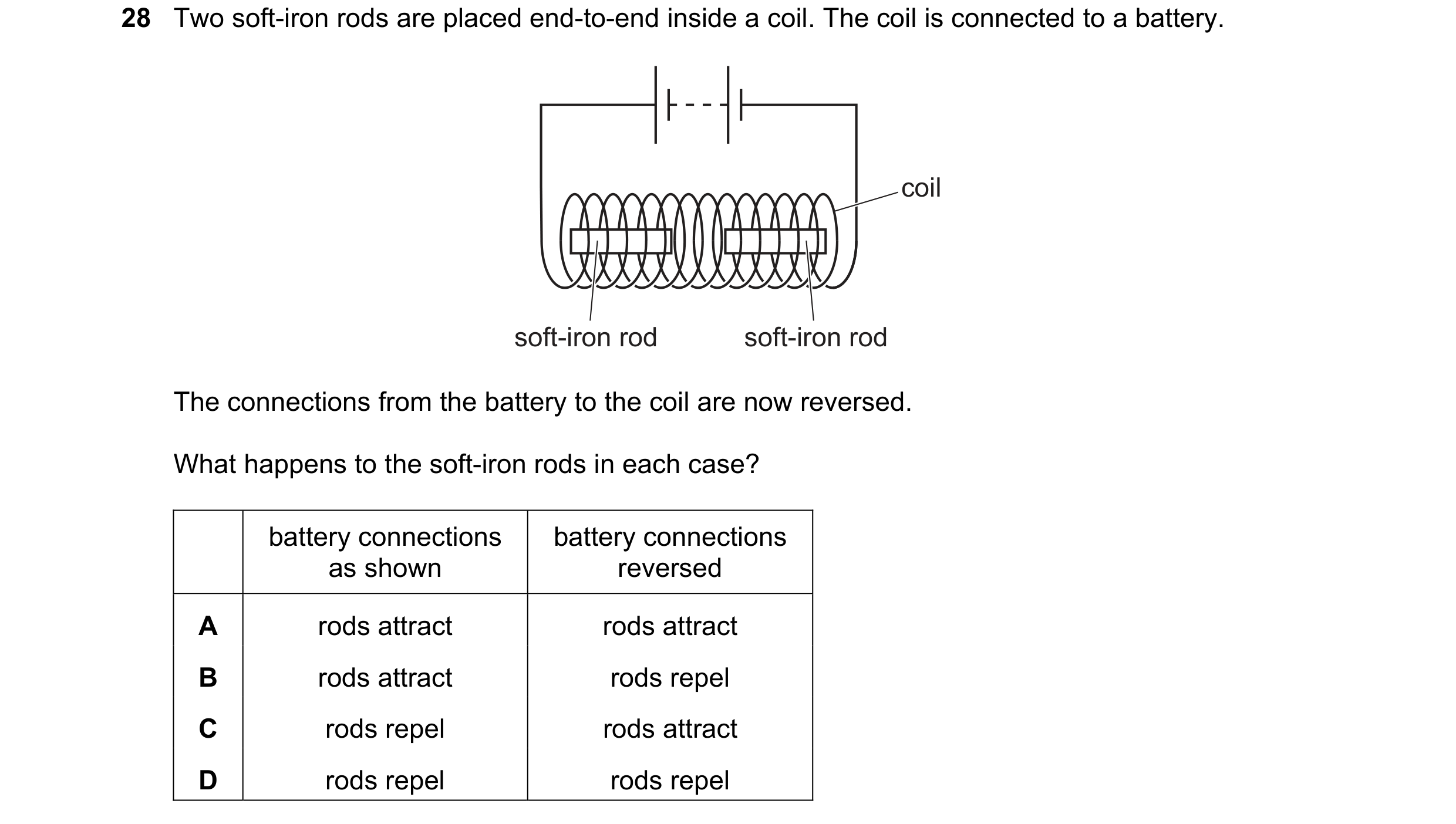 50 / 83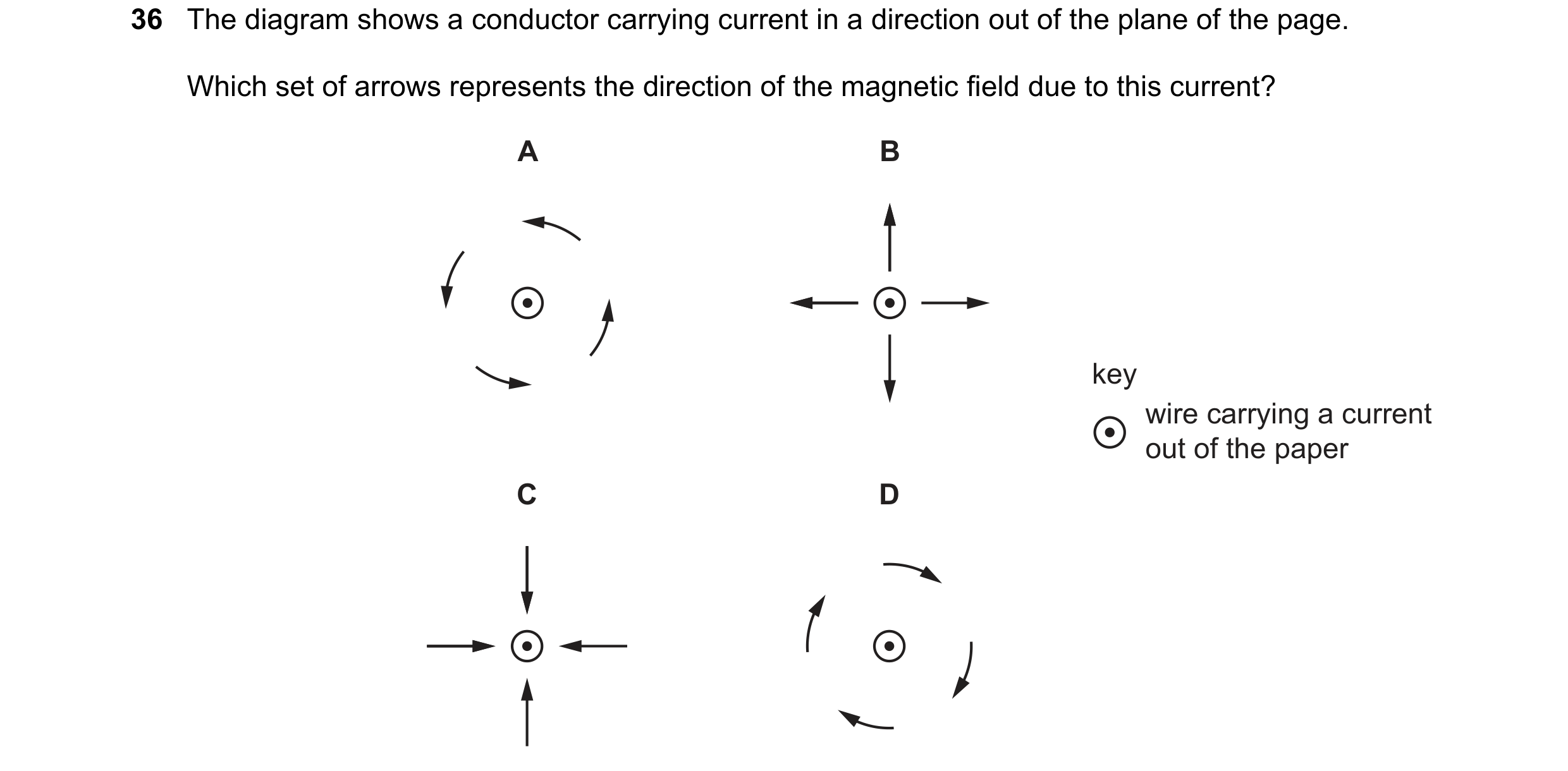
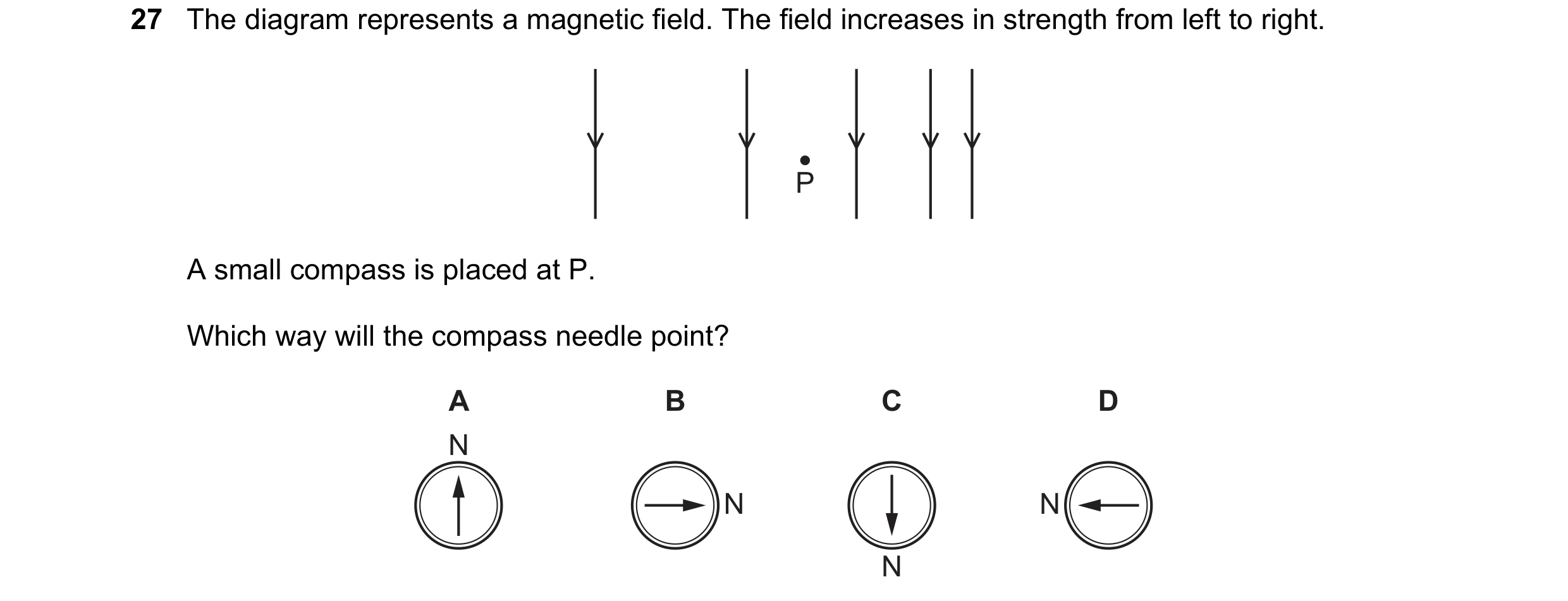 51 / 83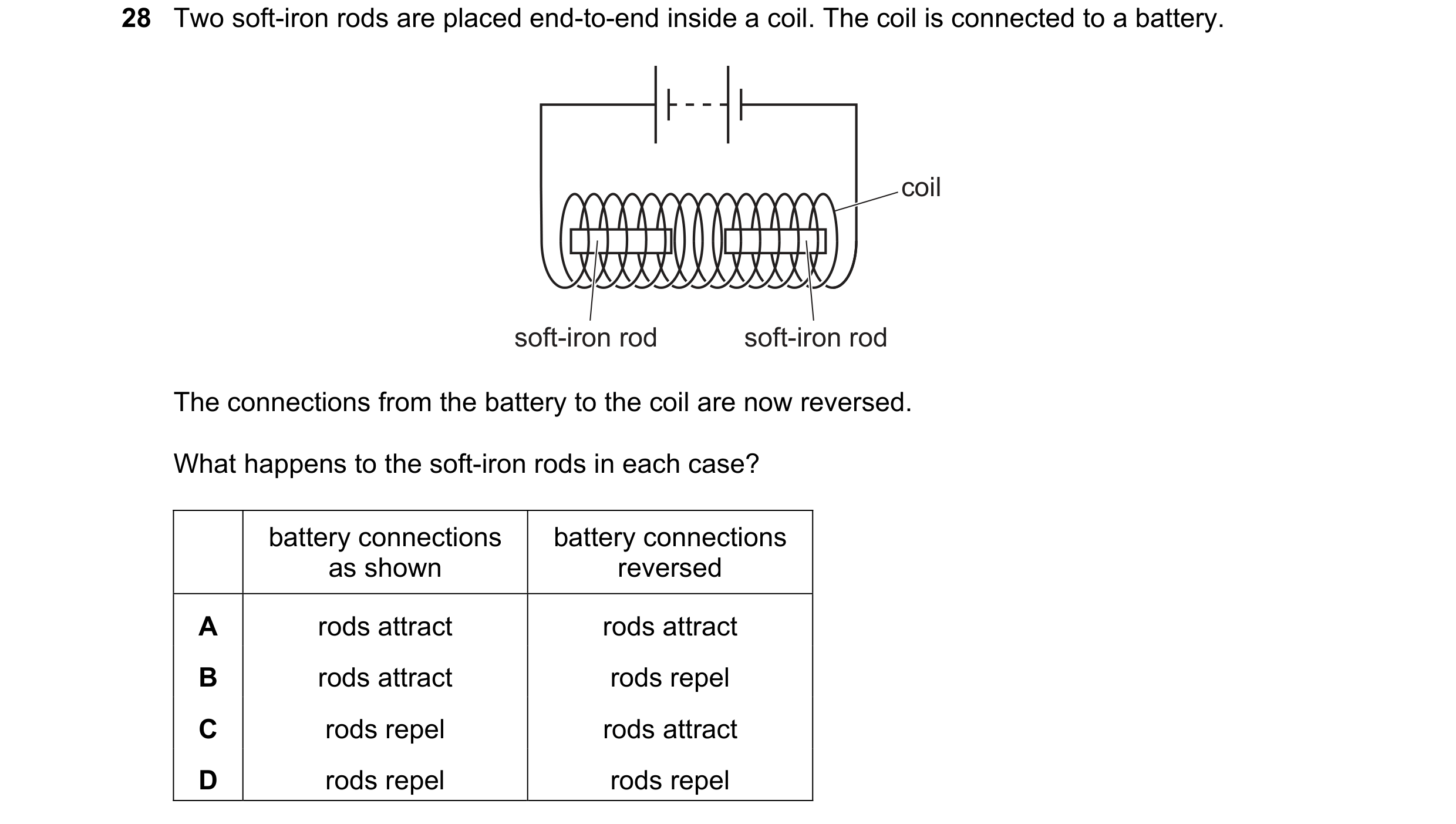
 52 / 83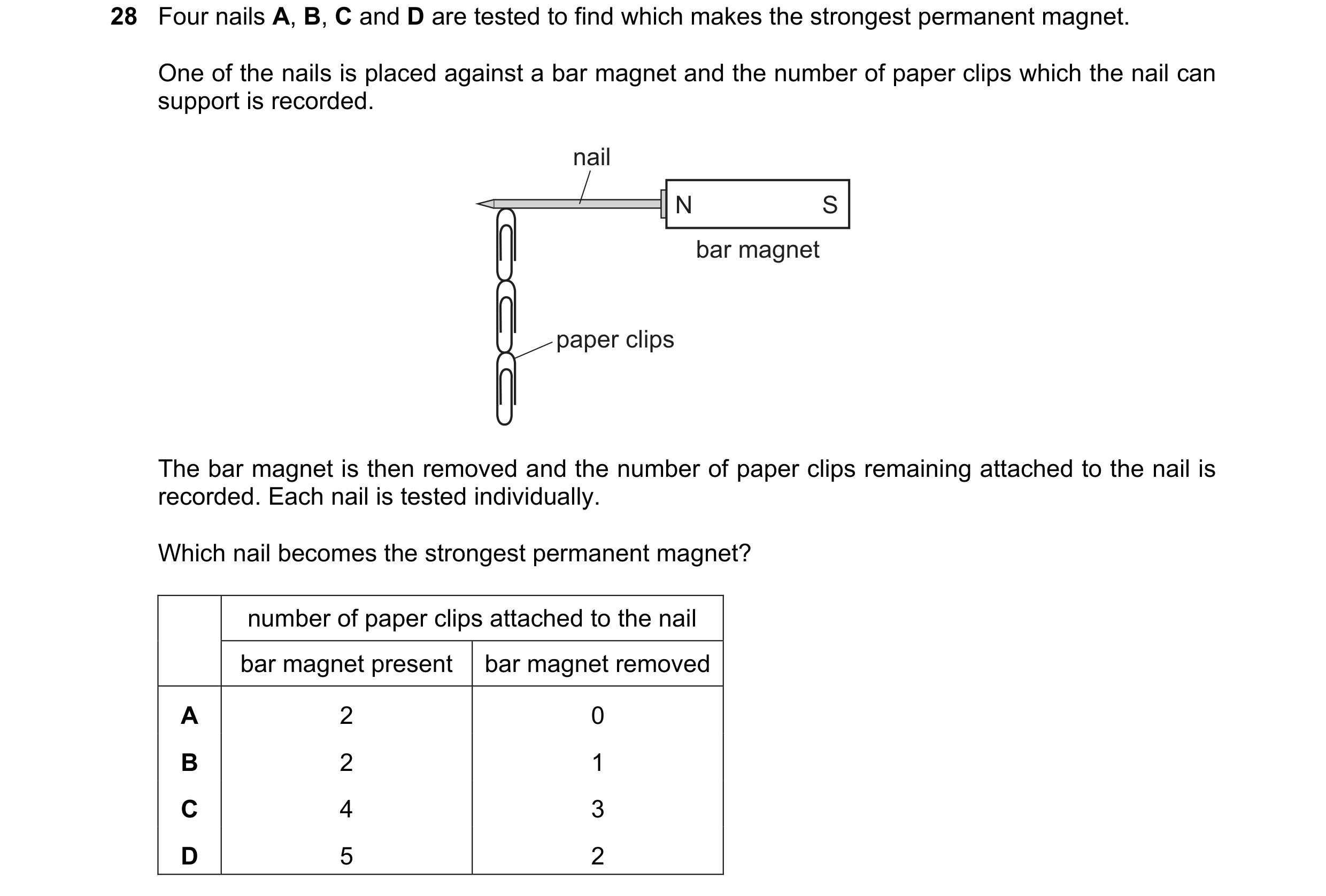
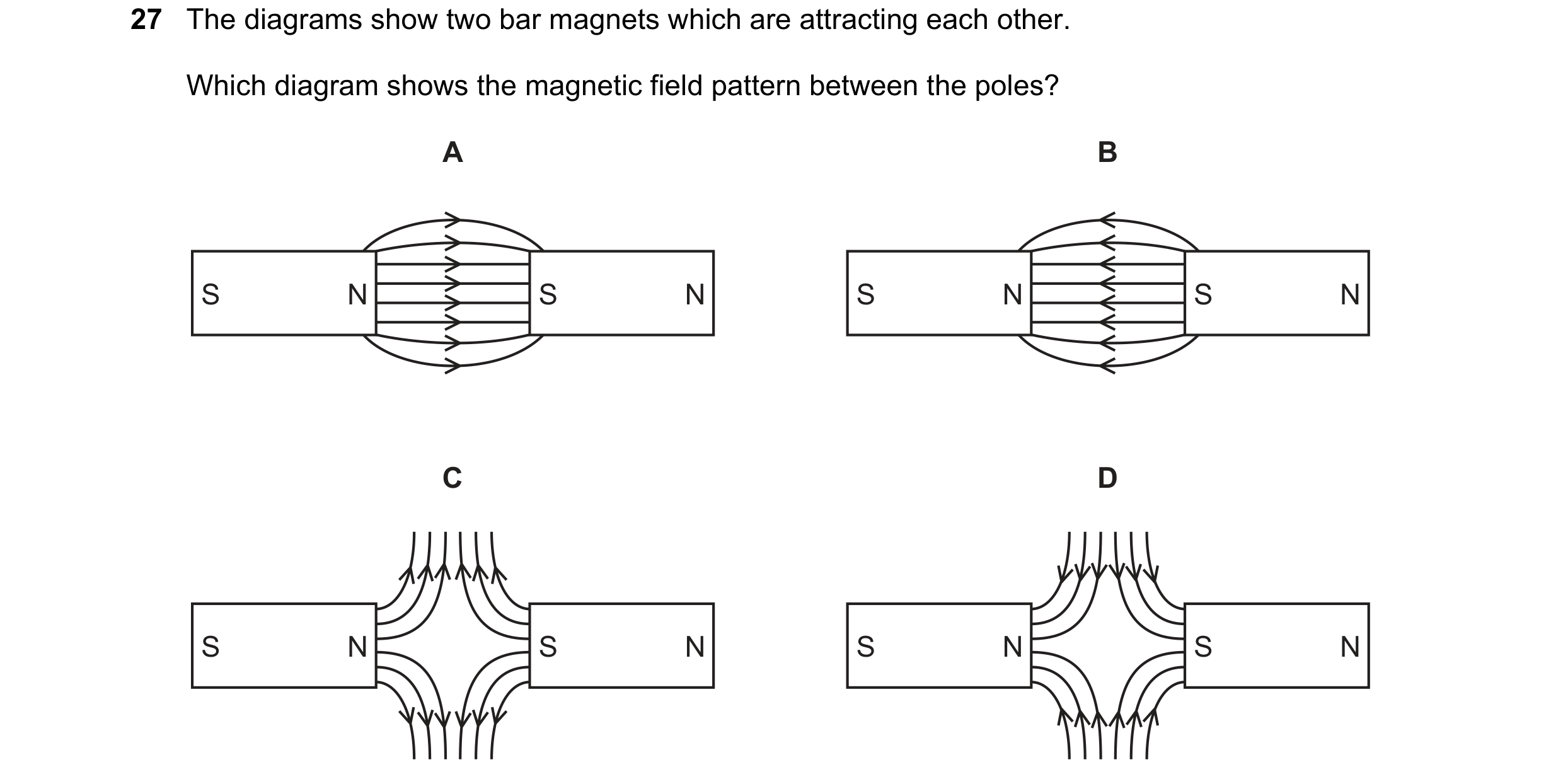 53 / 83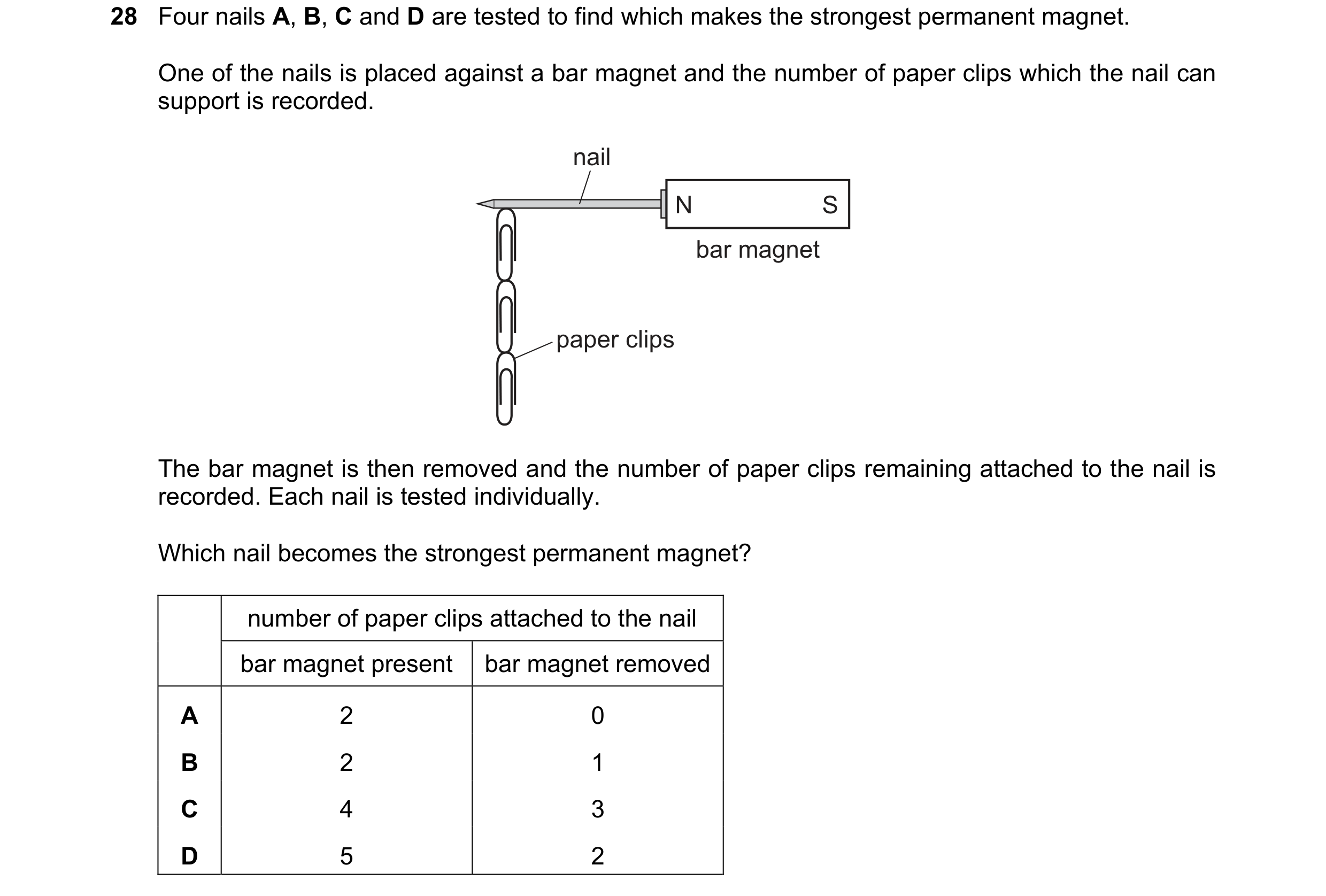
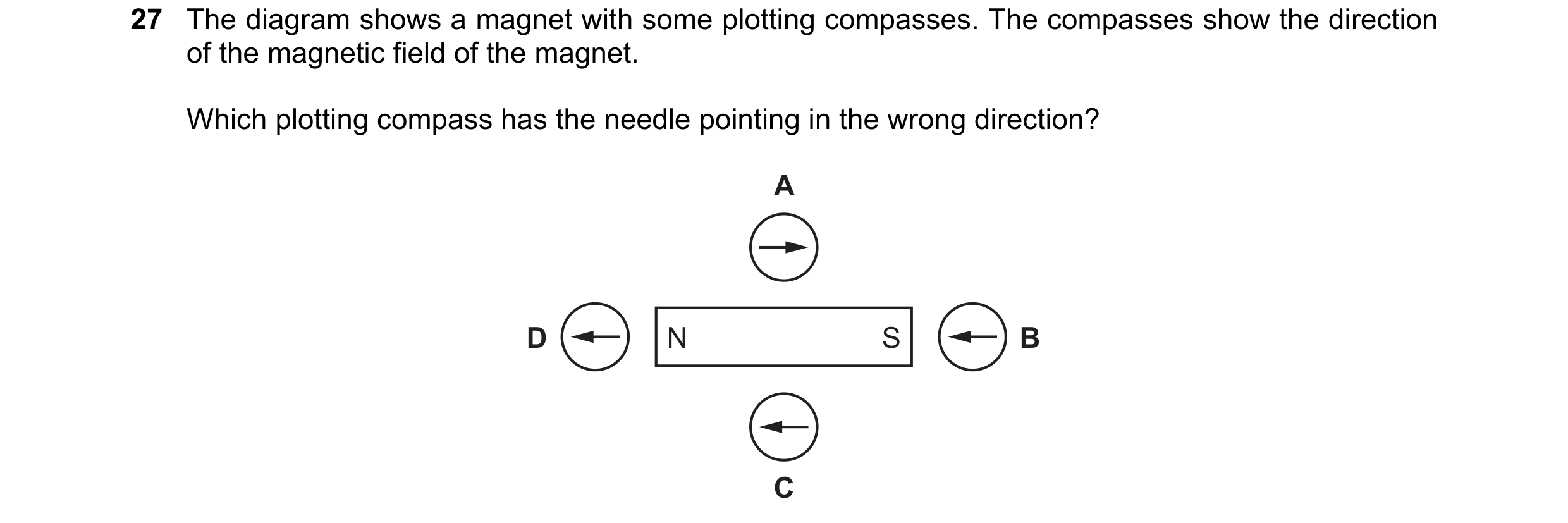 54 / 83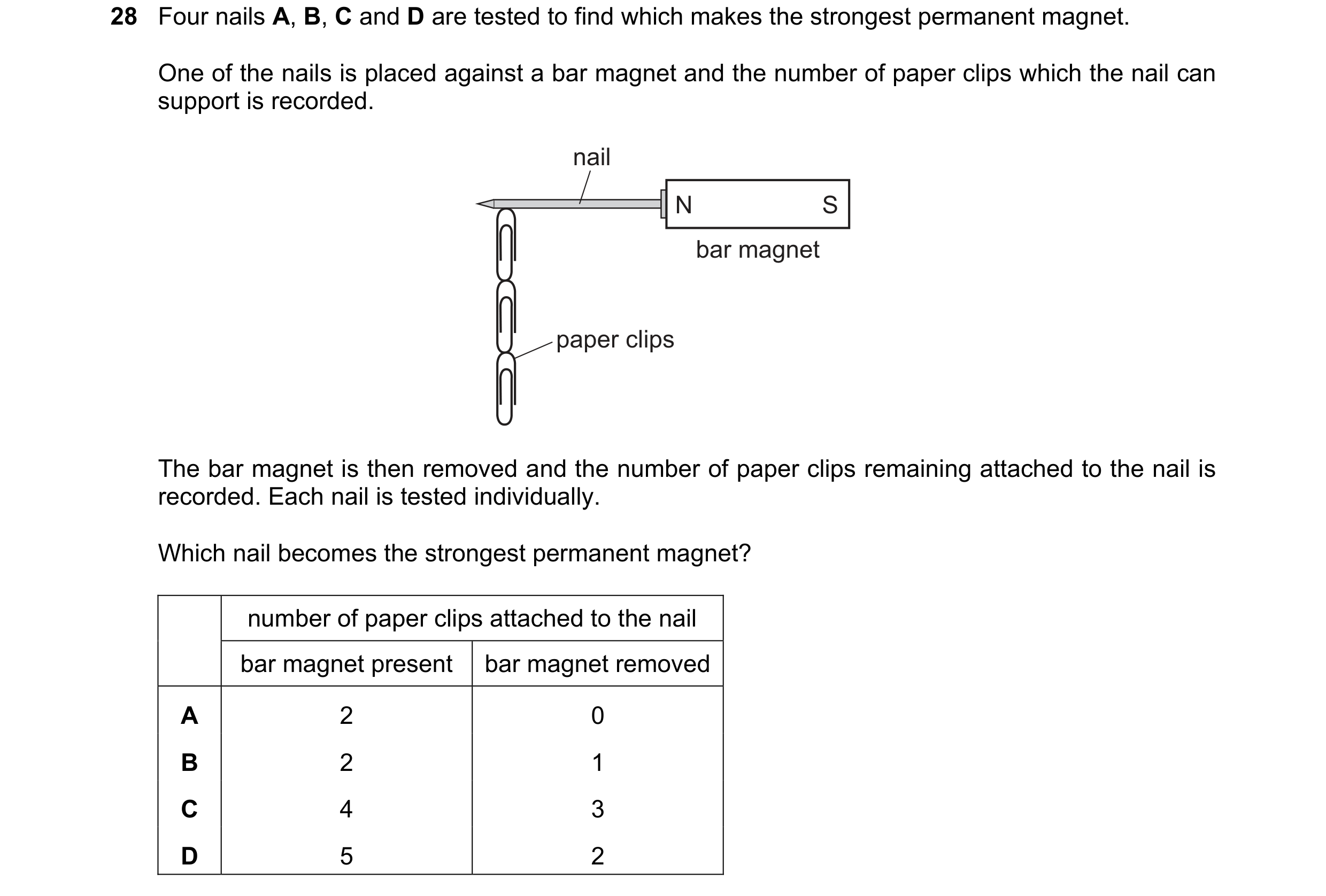
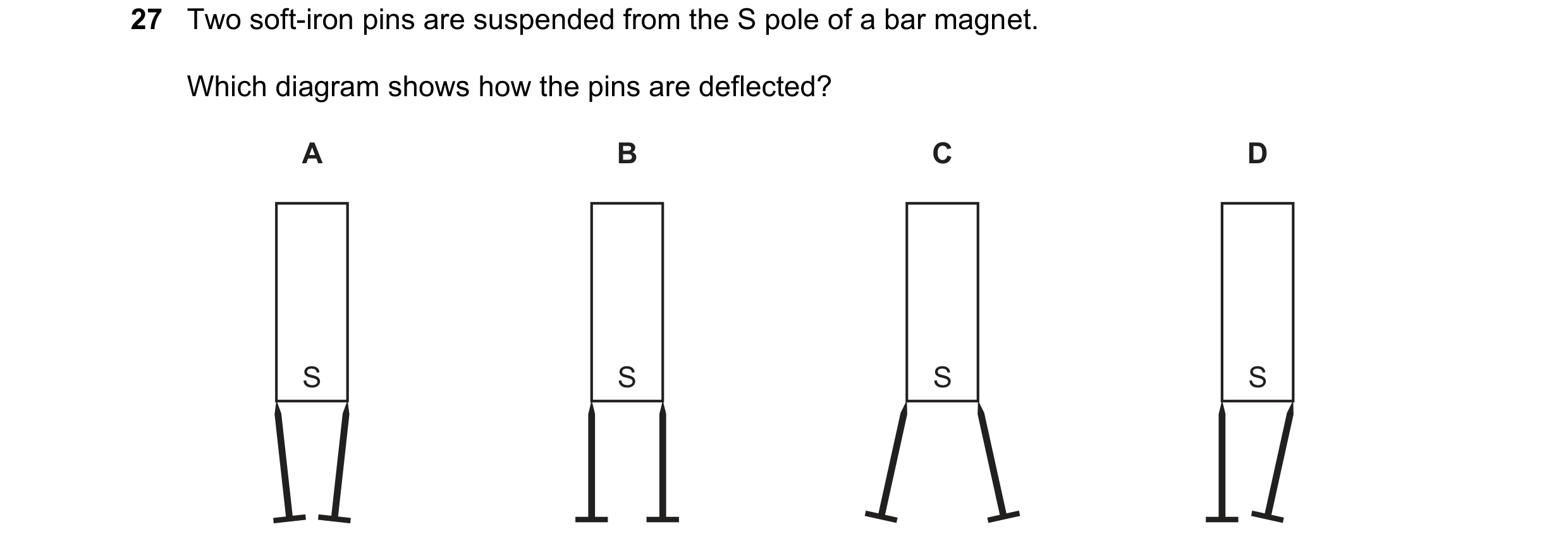 55 / 83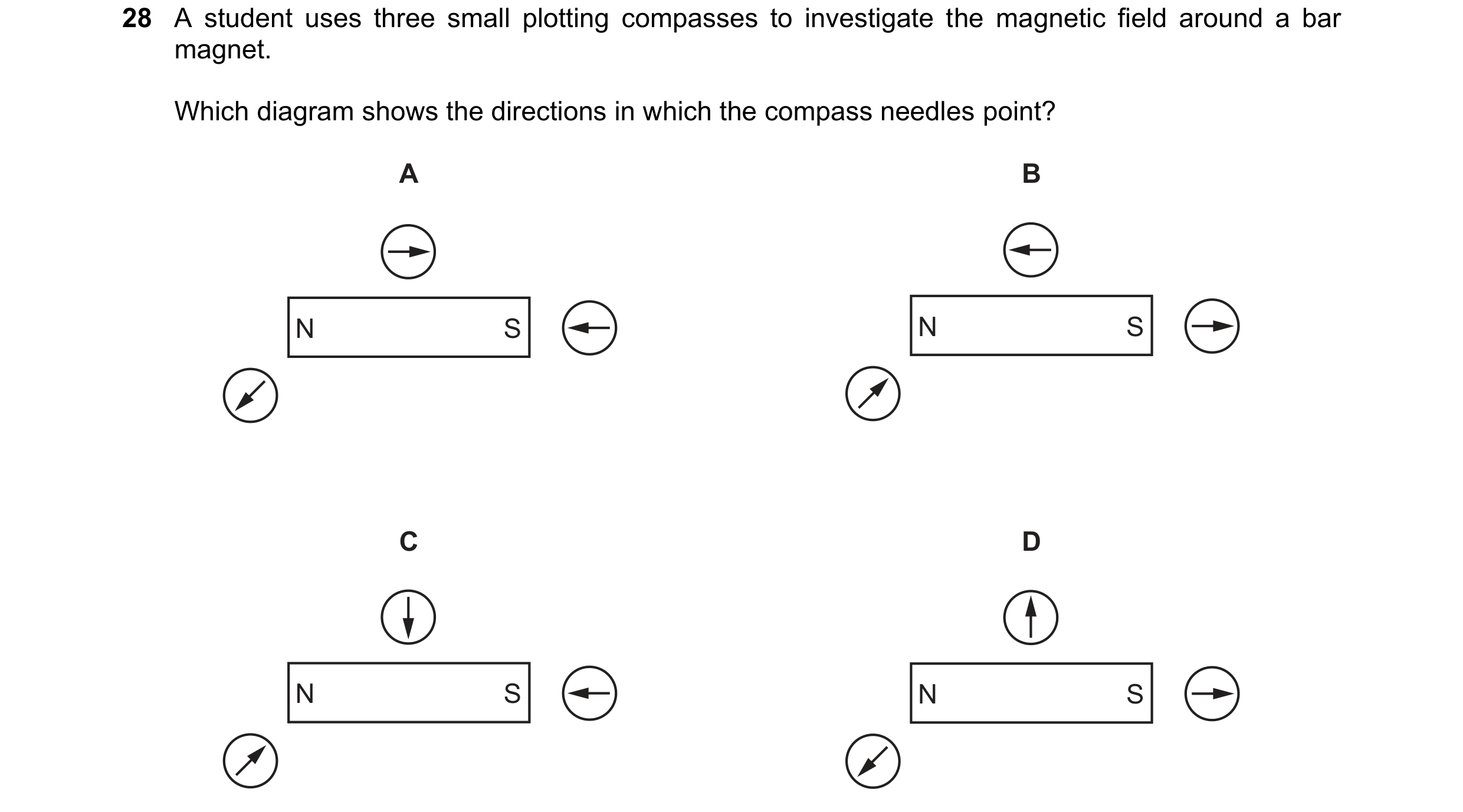
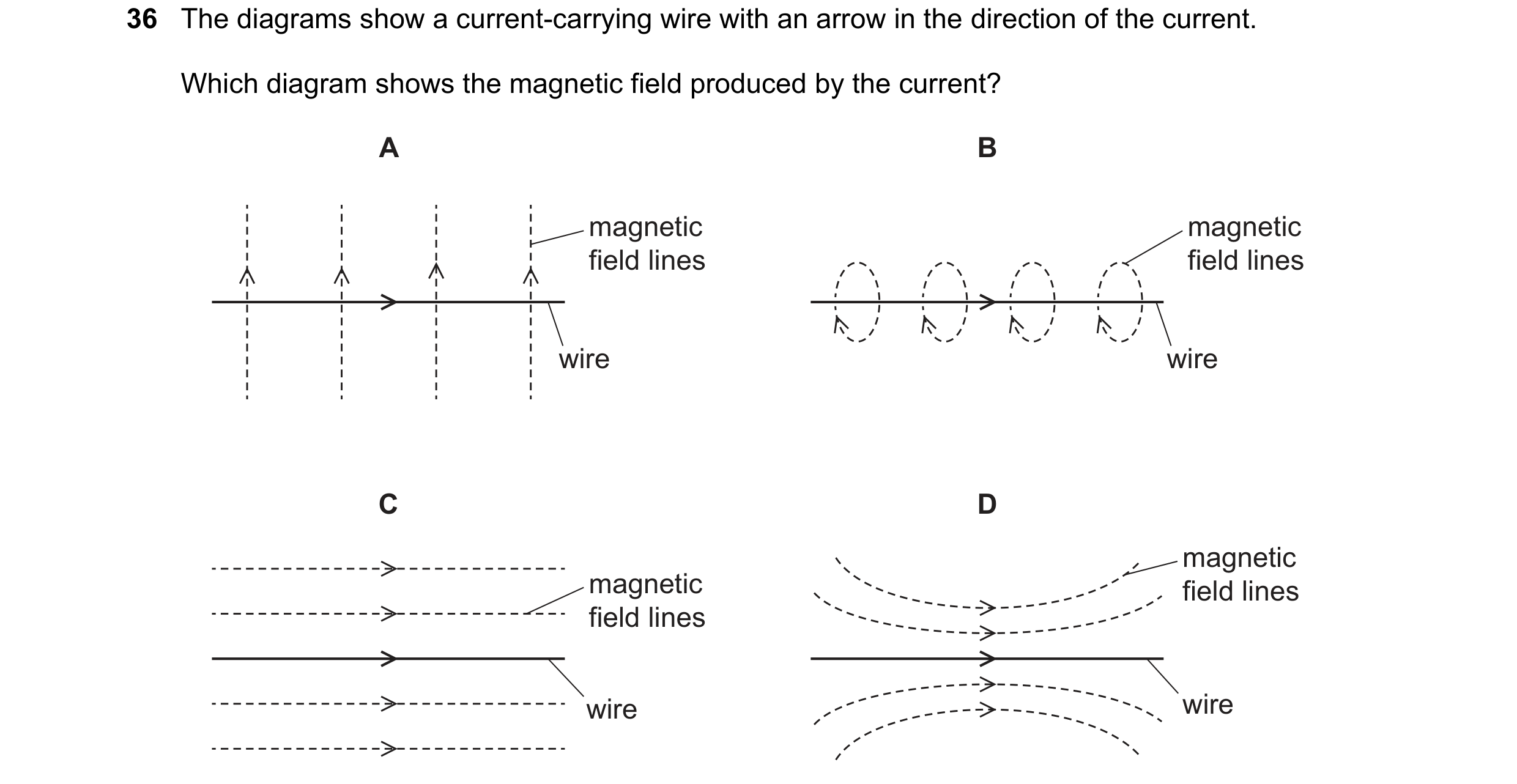 56 / 83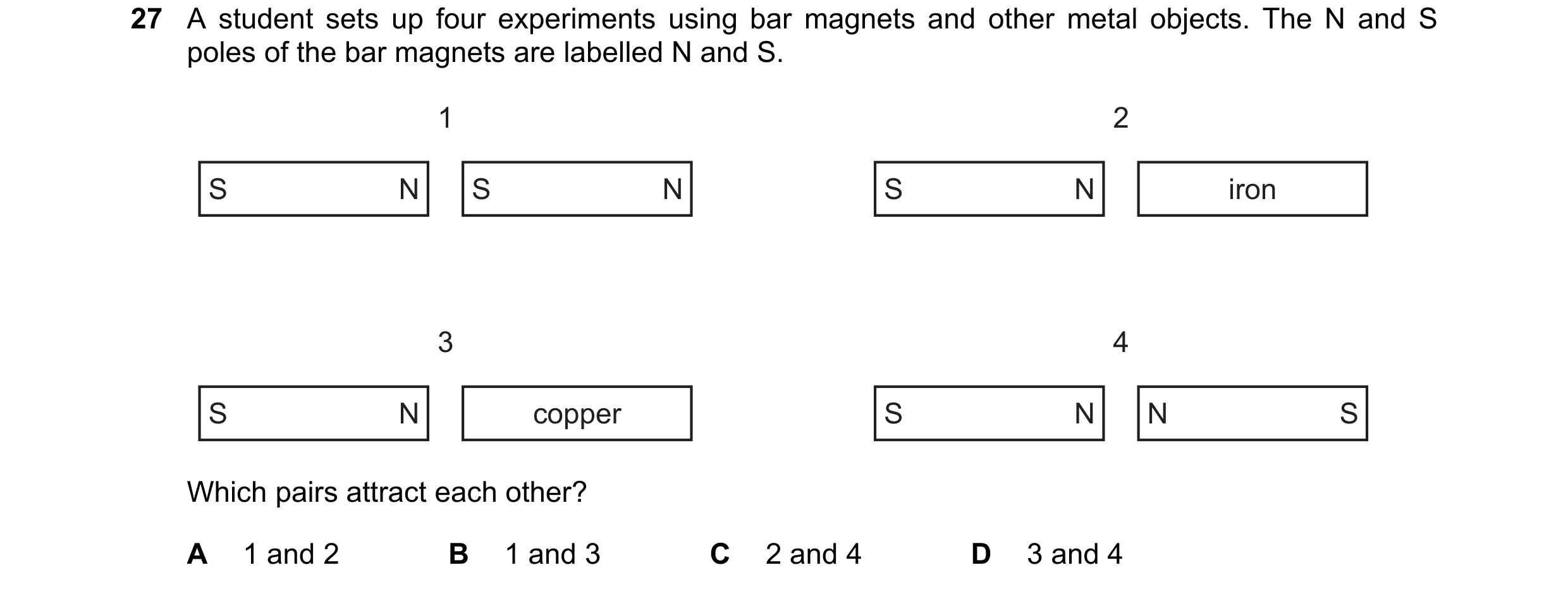
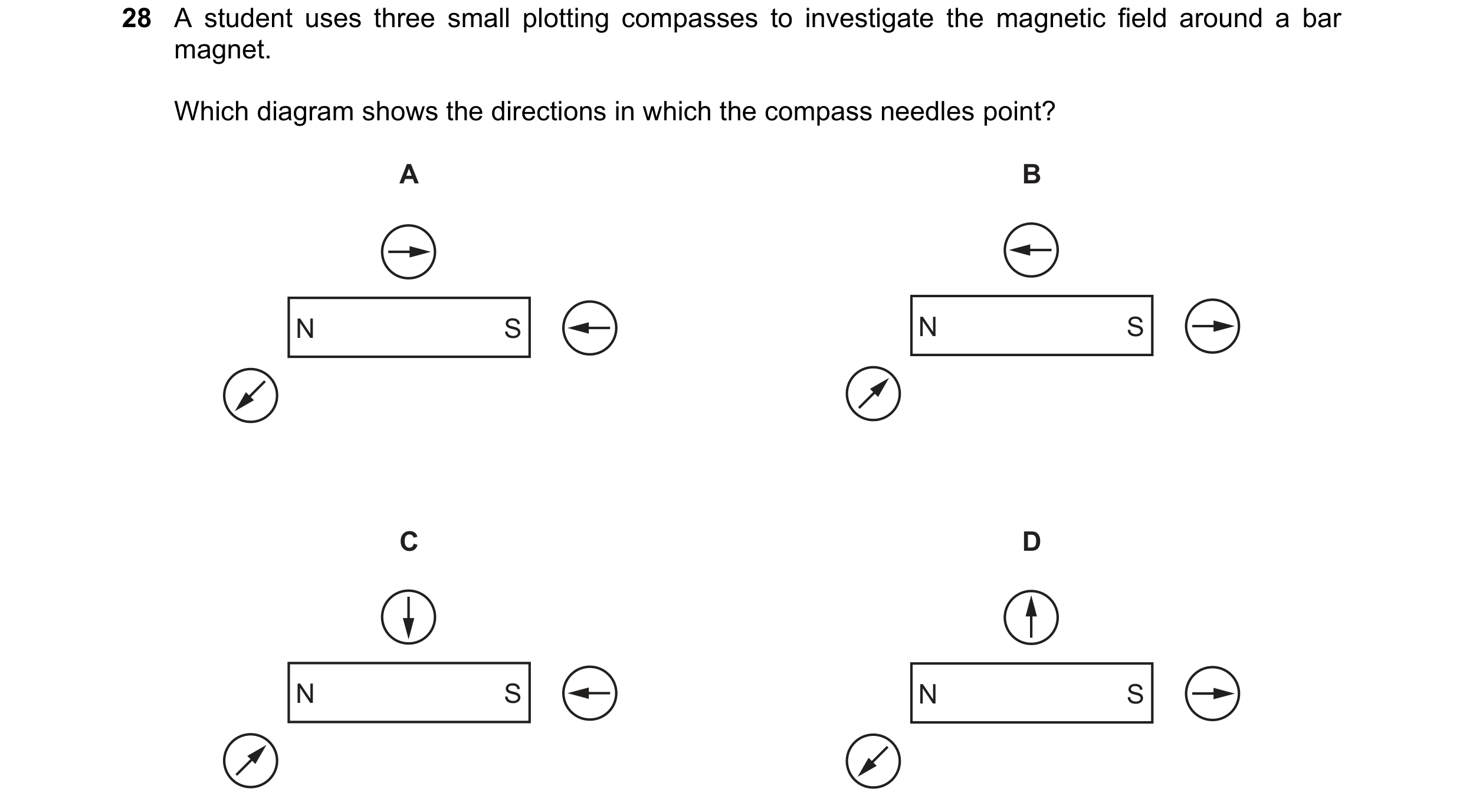 57 / 83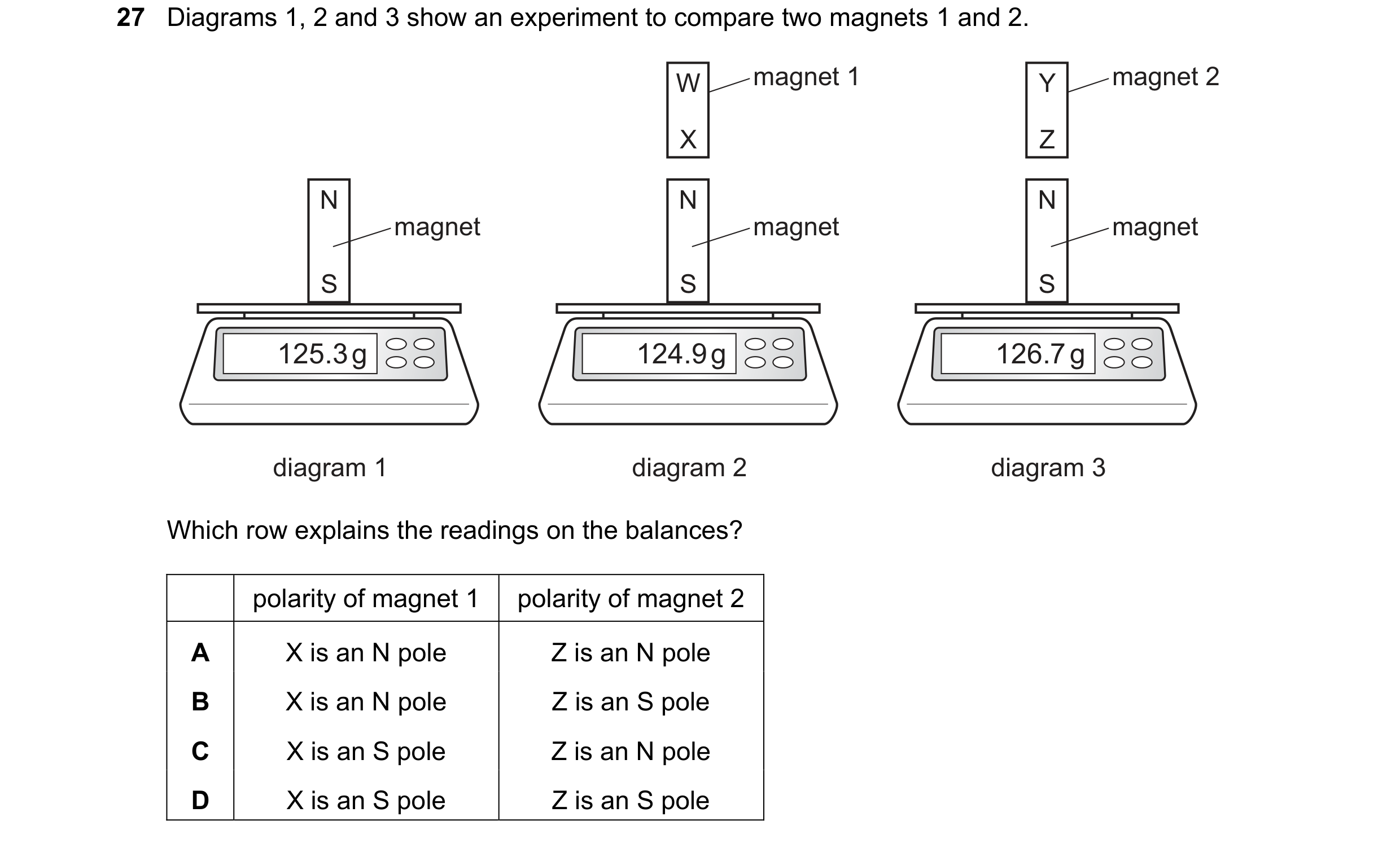
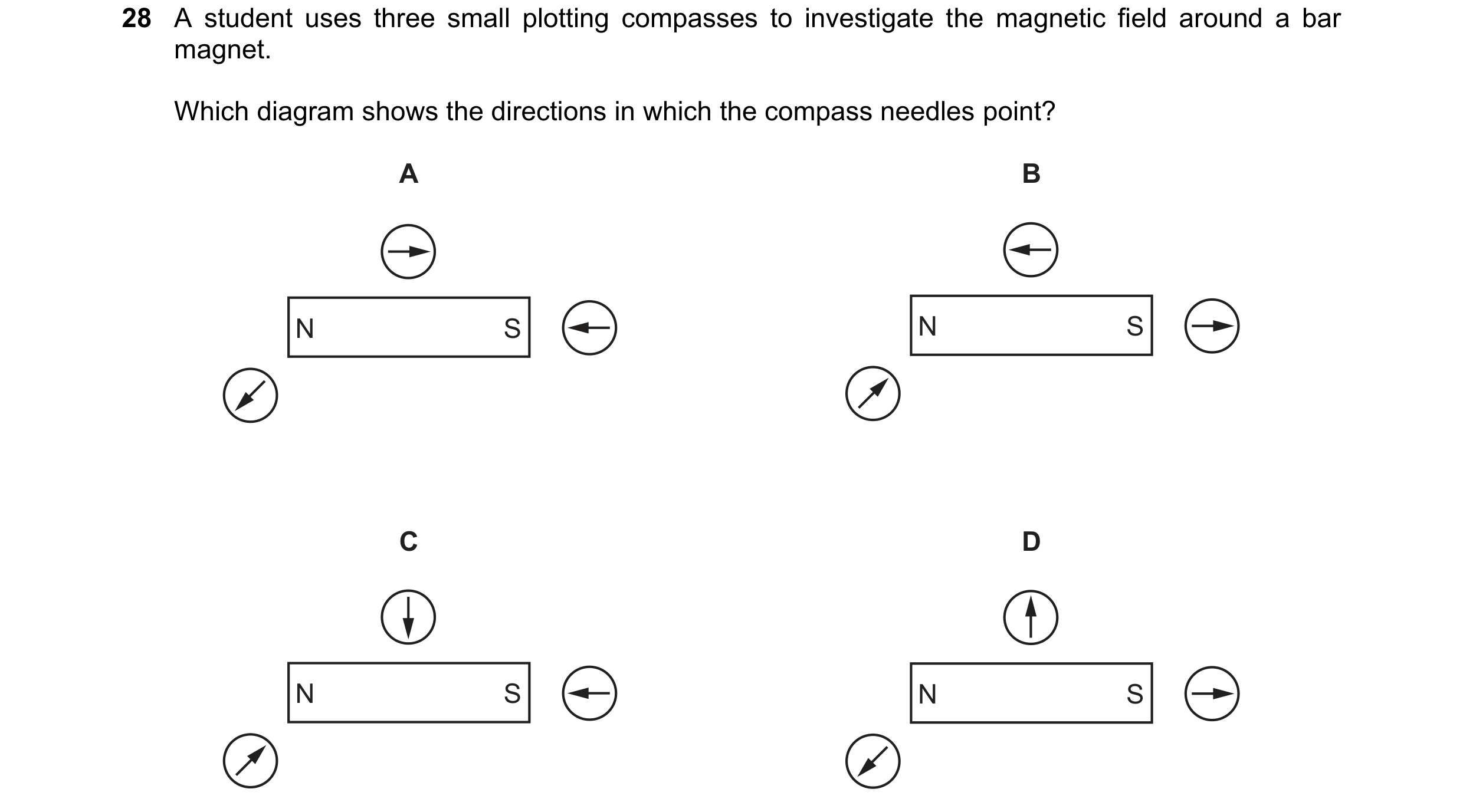 58 / 83
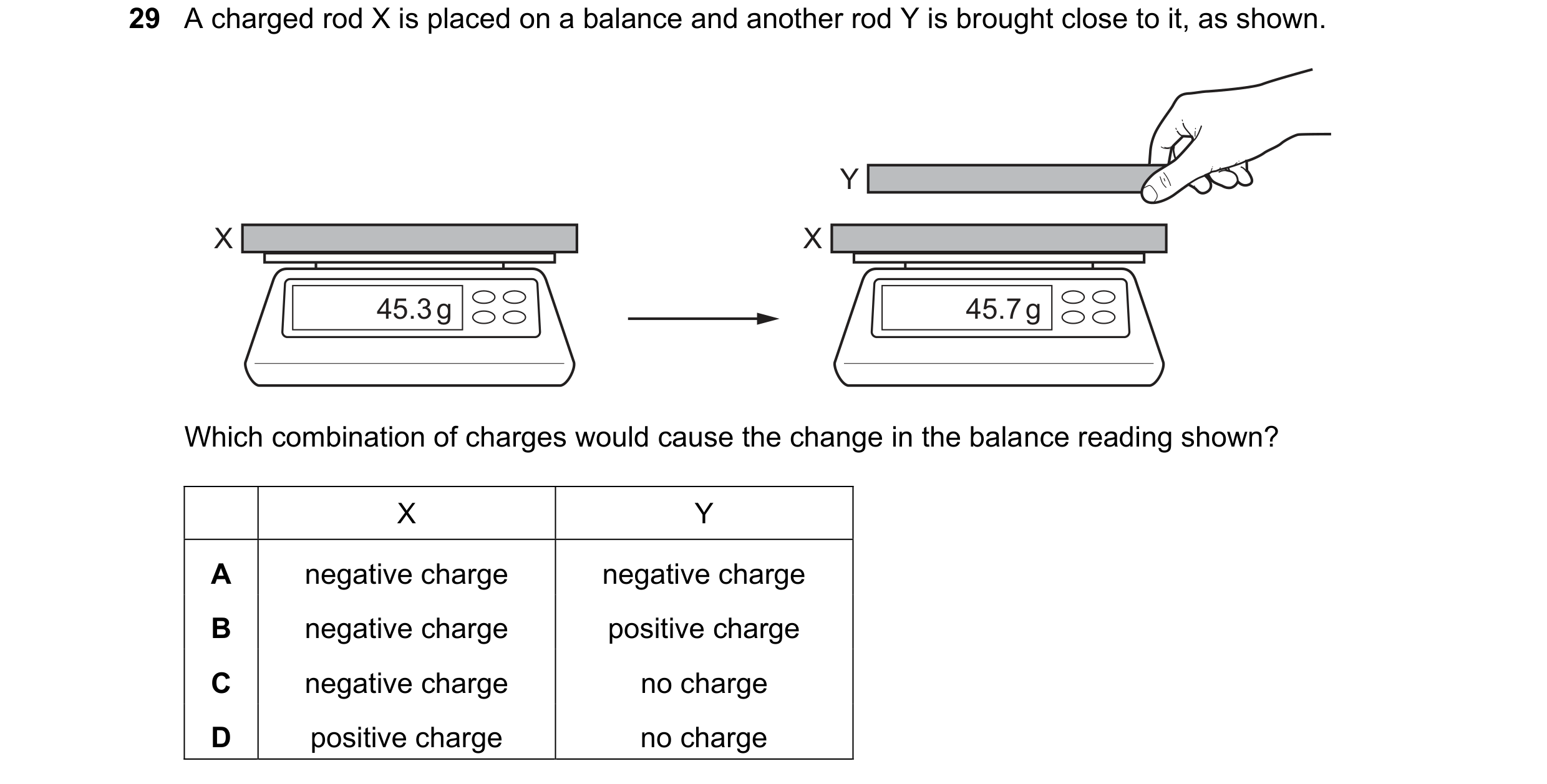 59 / 83
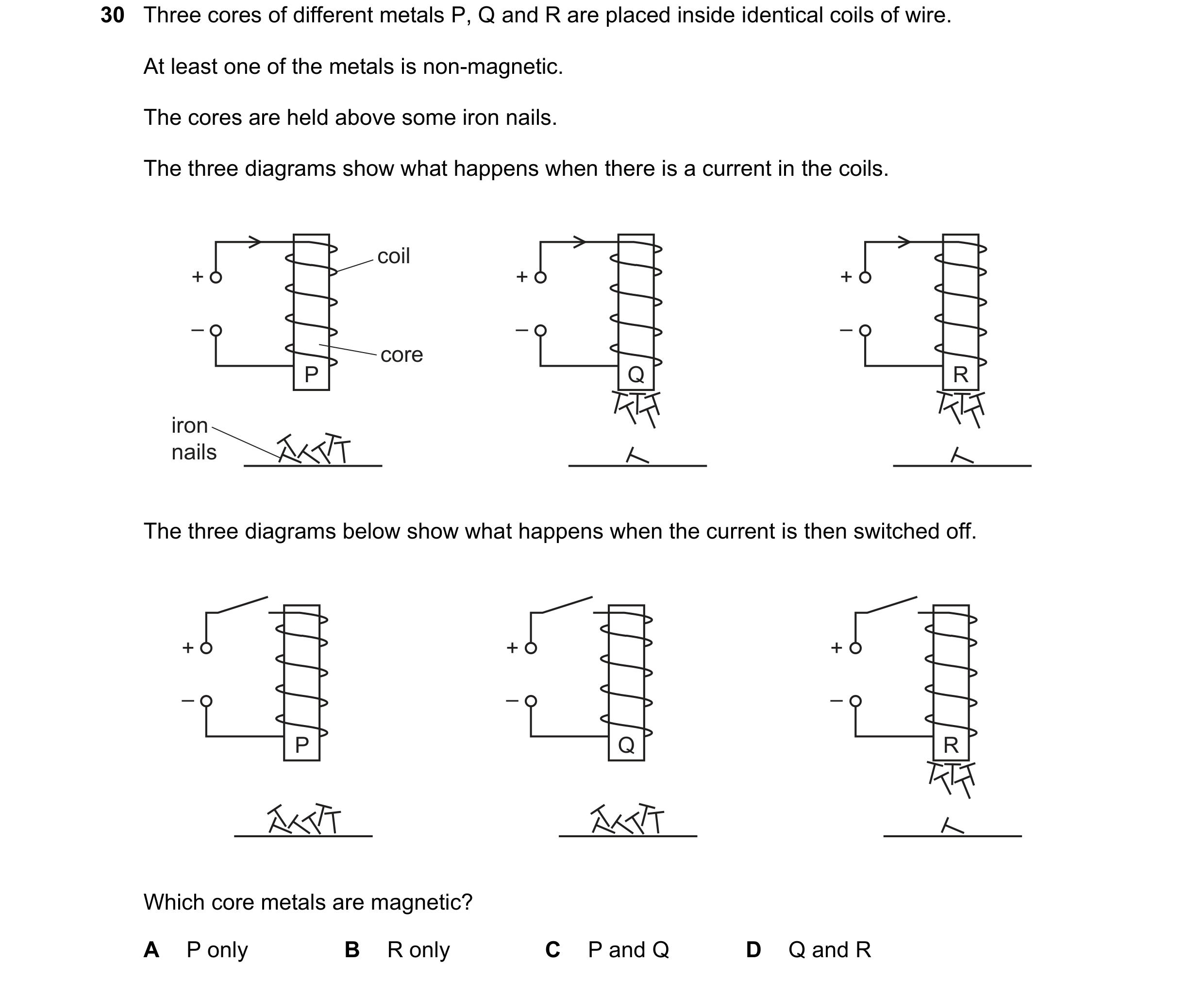 60 / 83
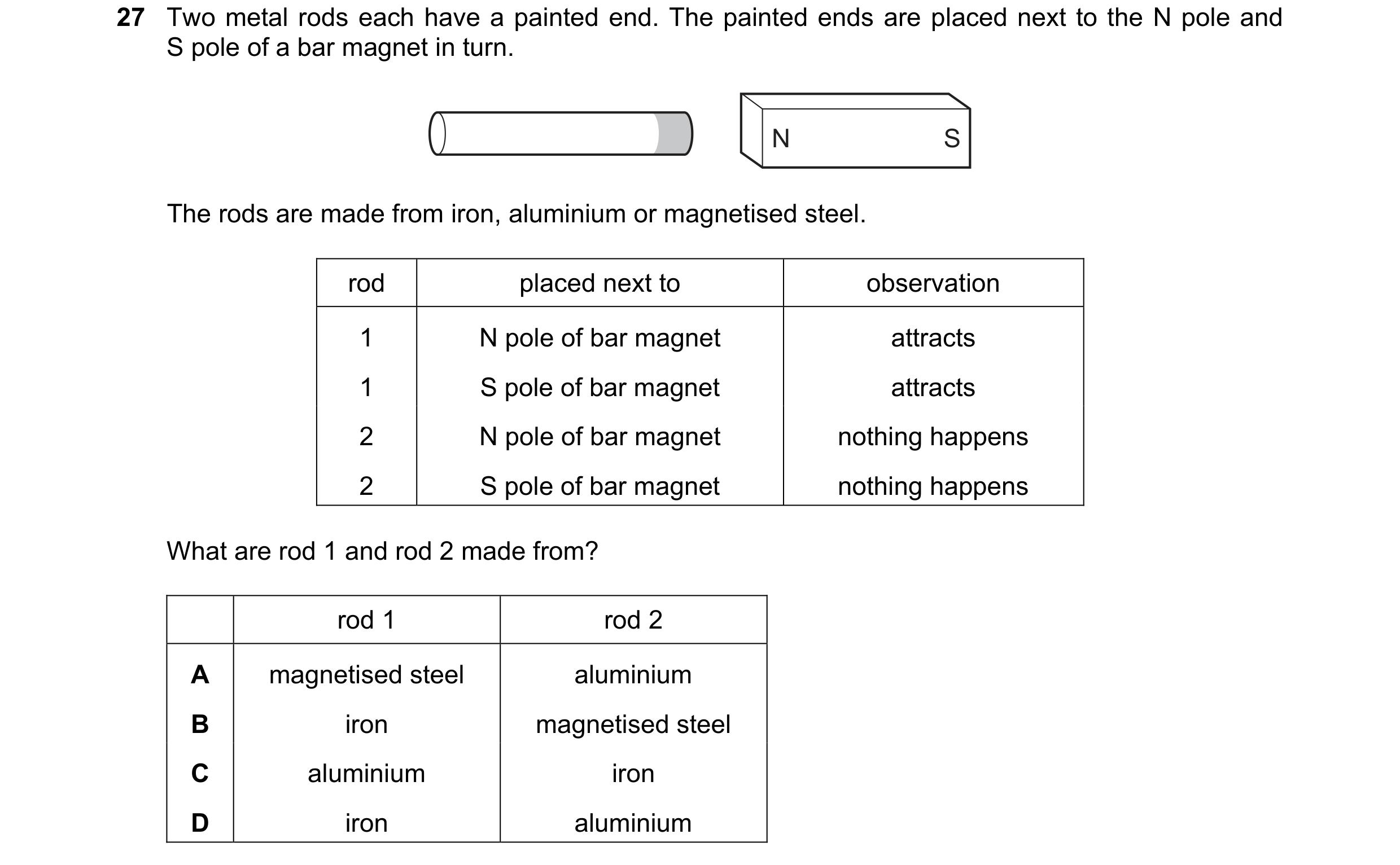 61 / 83
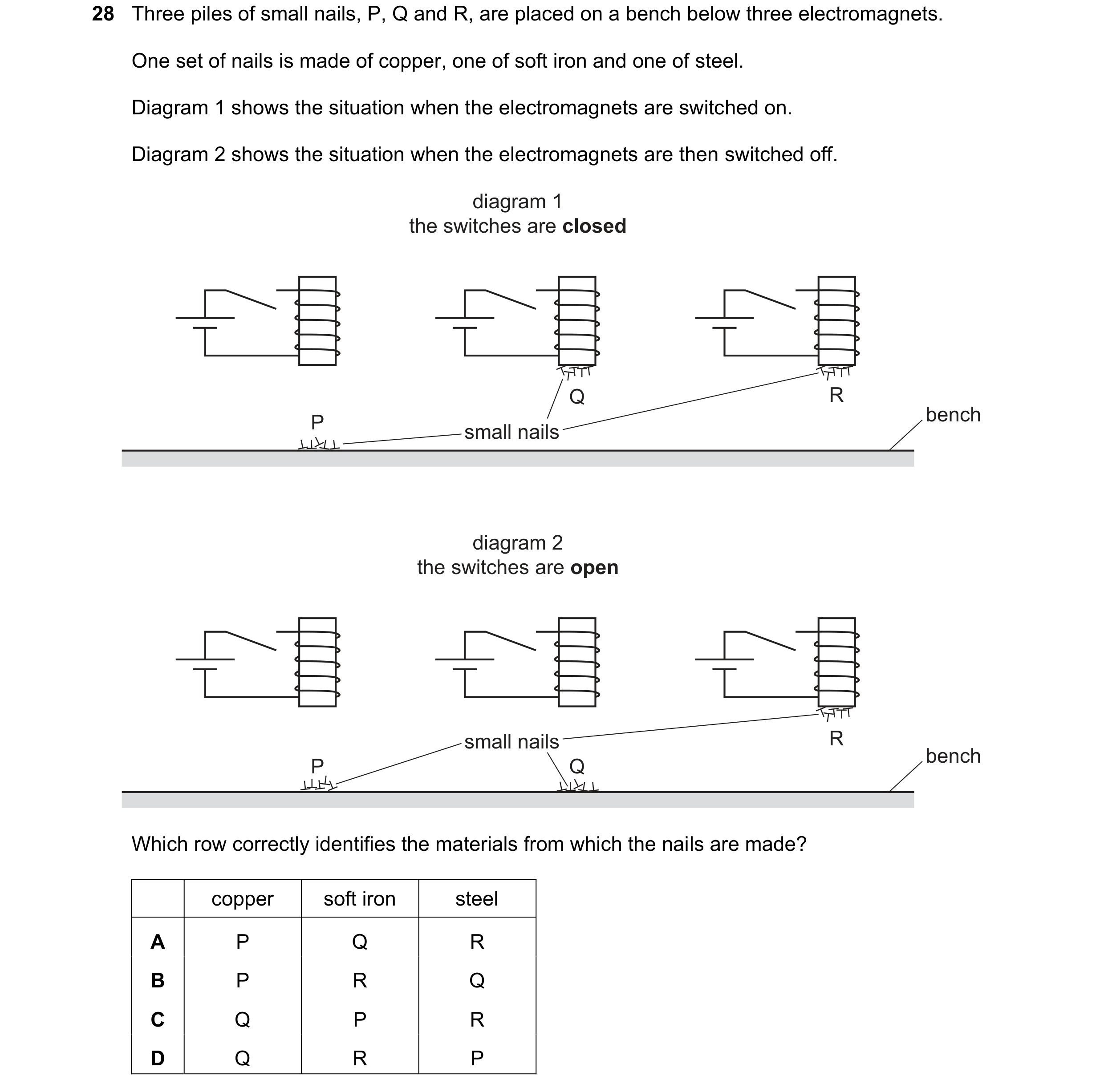 62 / 83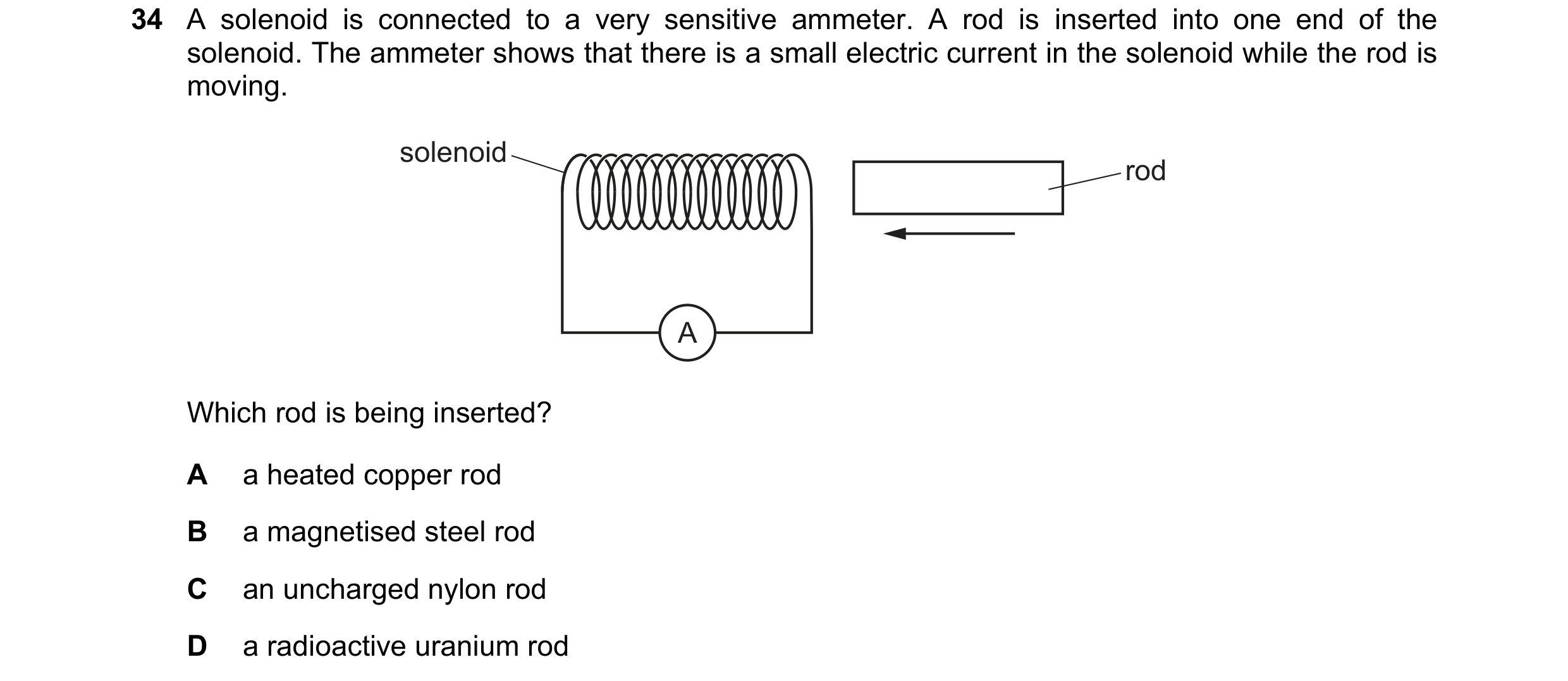
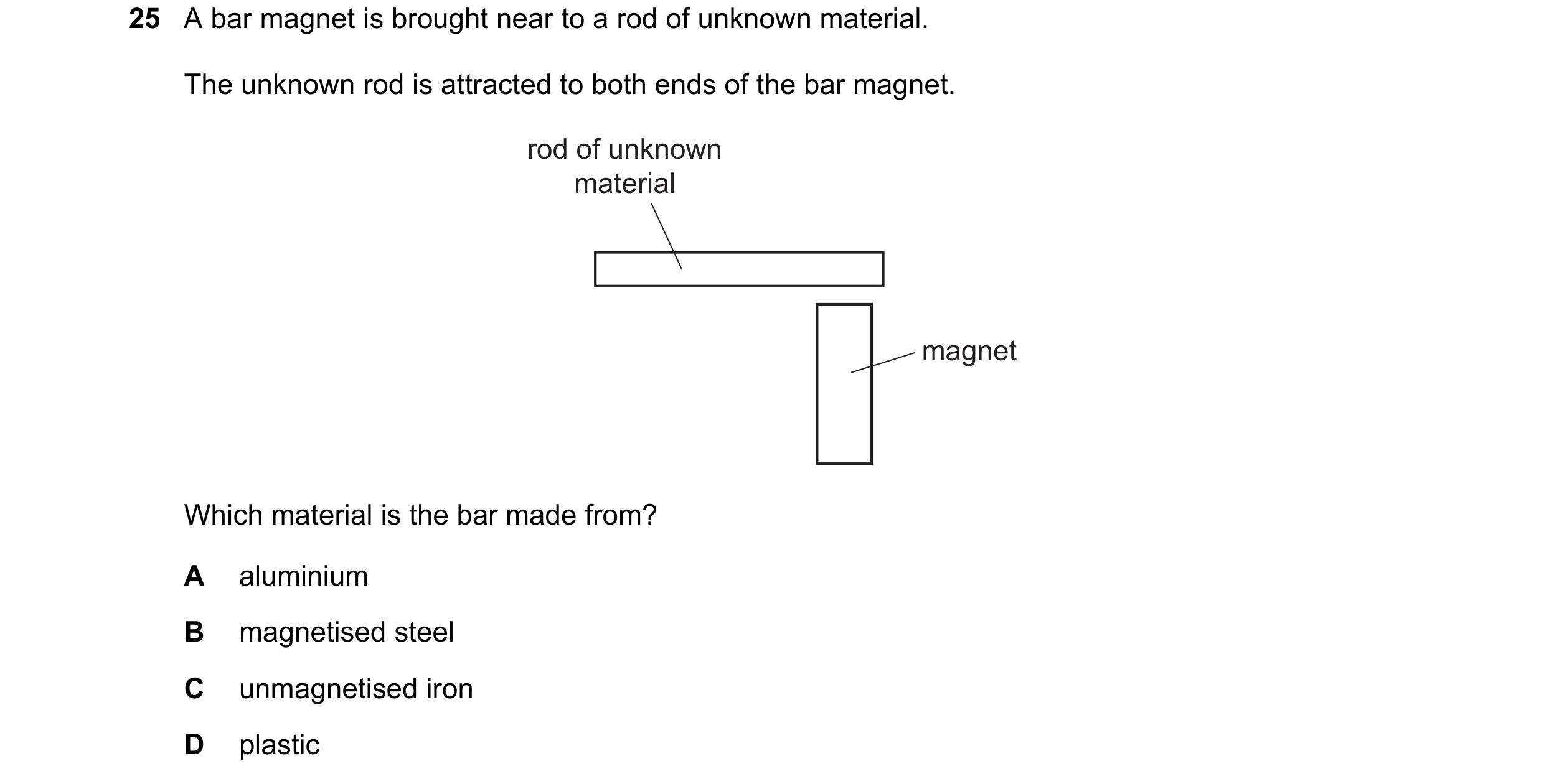

 63 / 83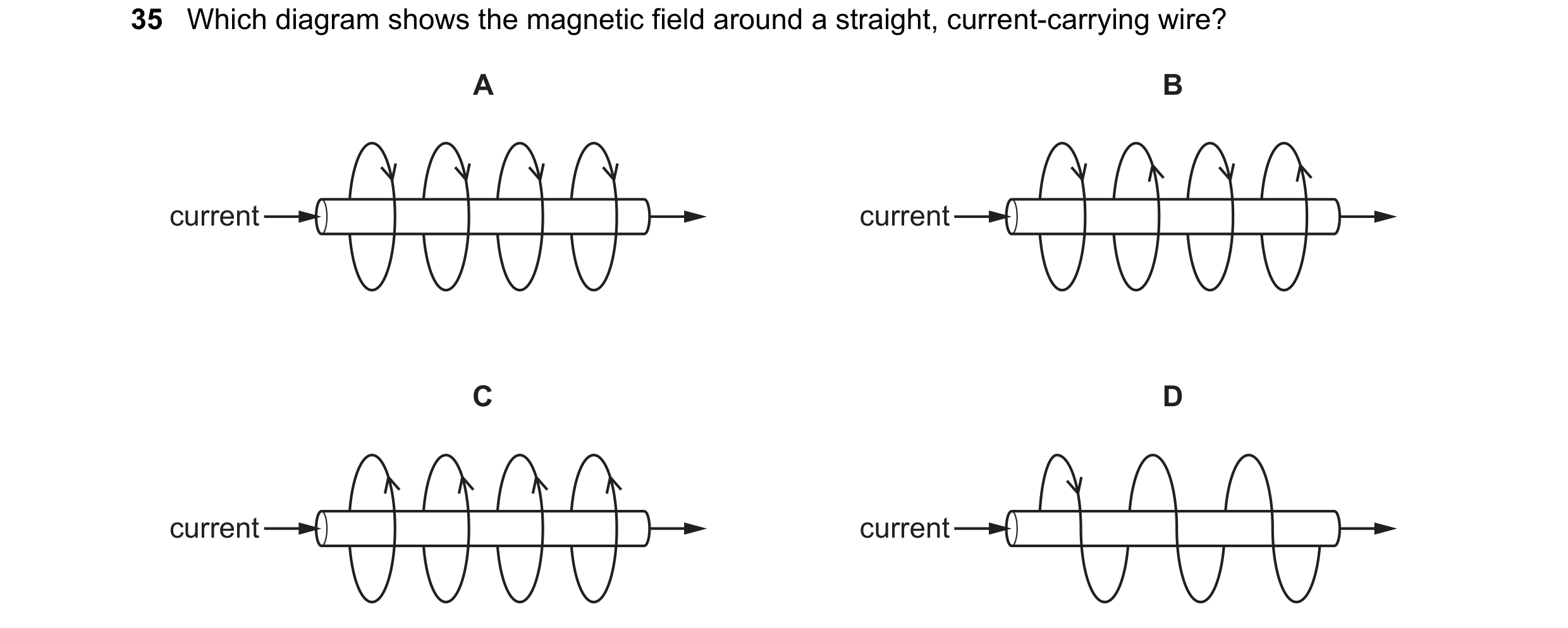
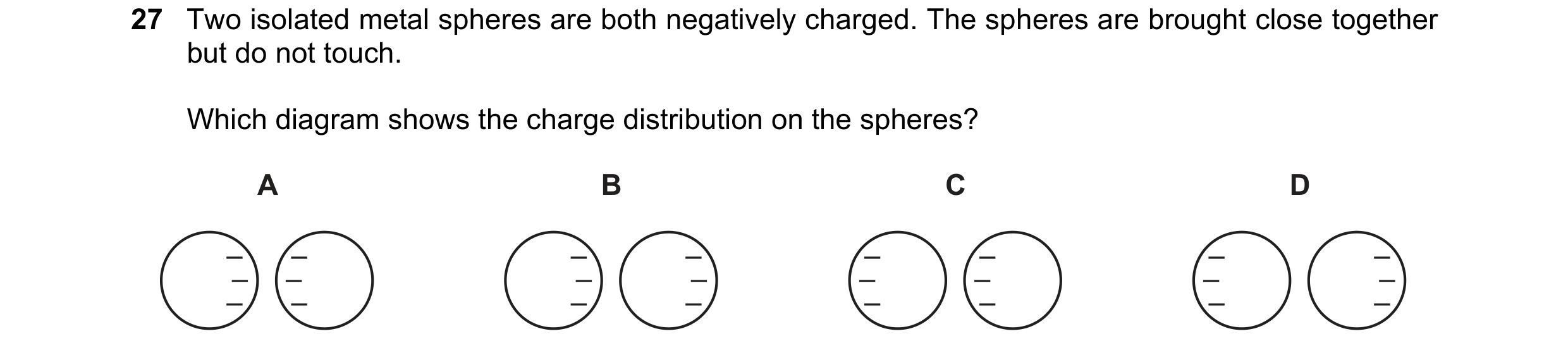
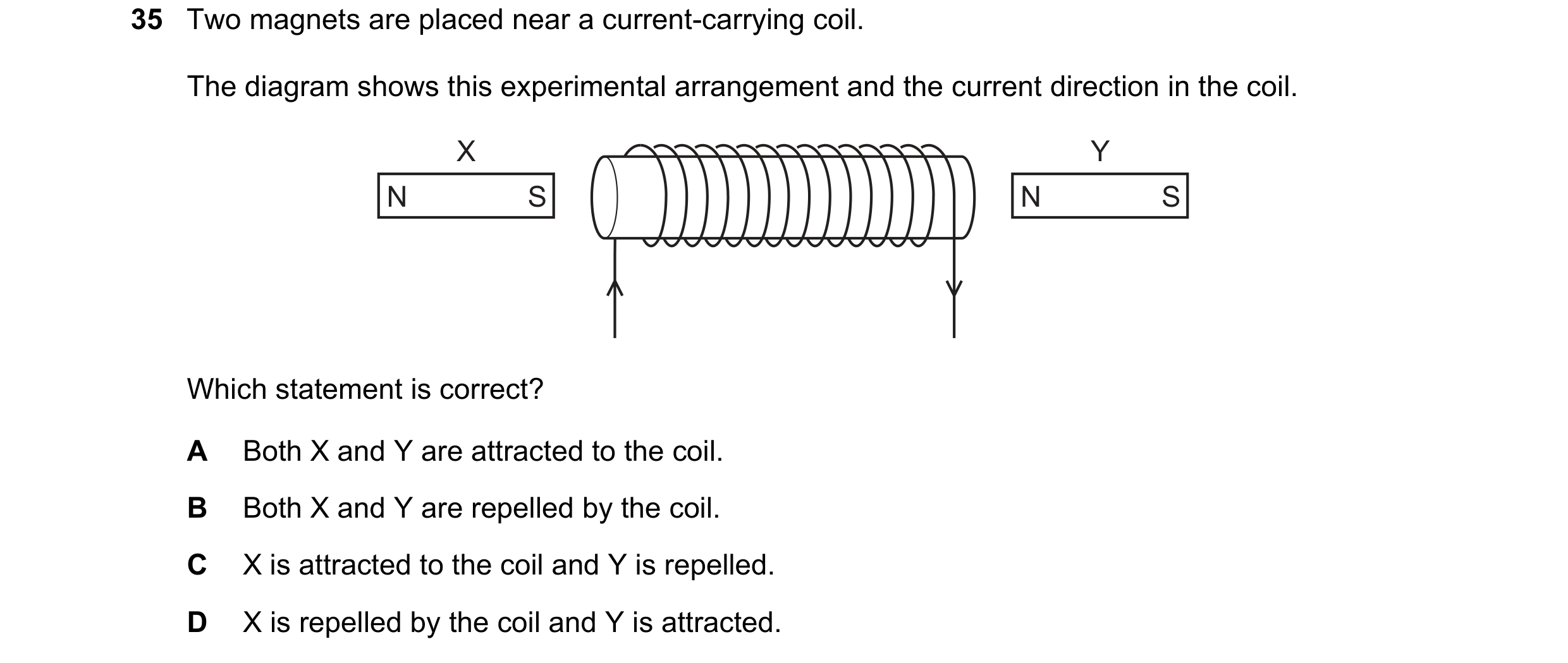 64 / 83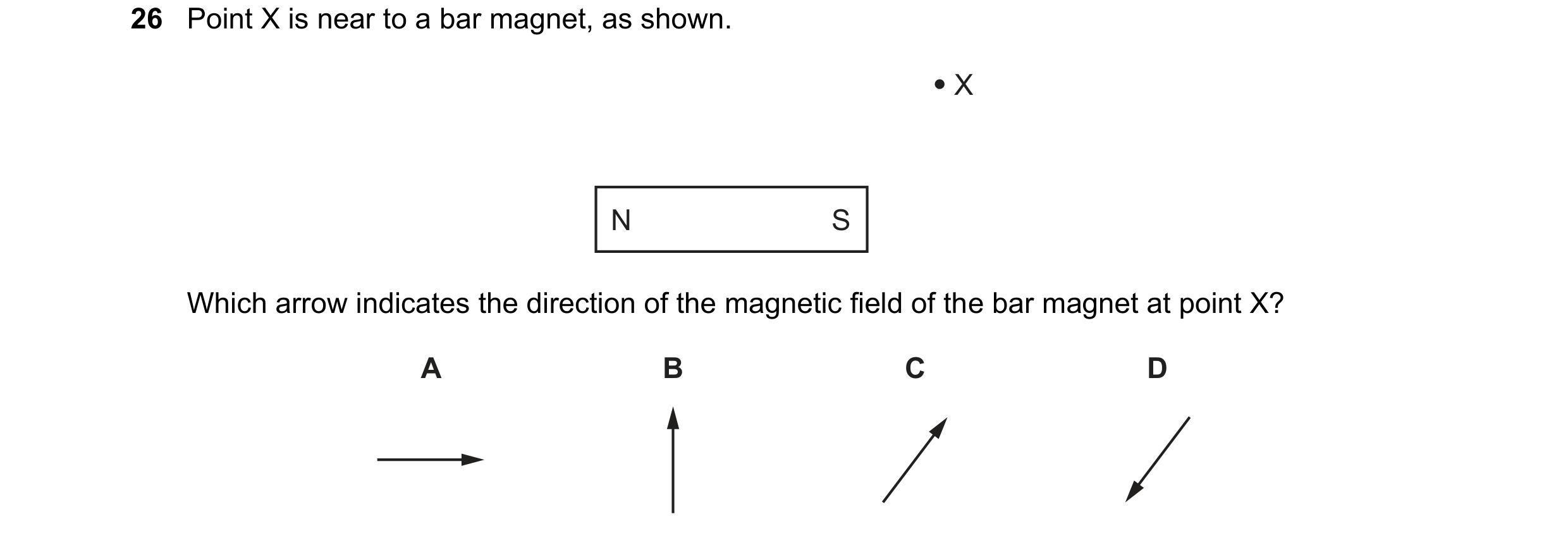
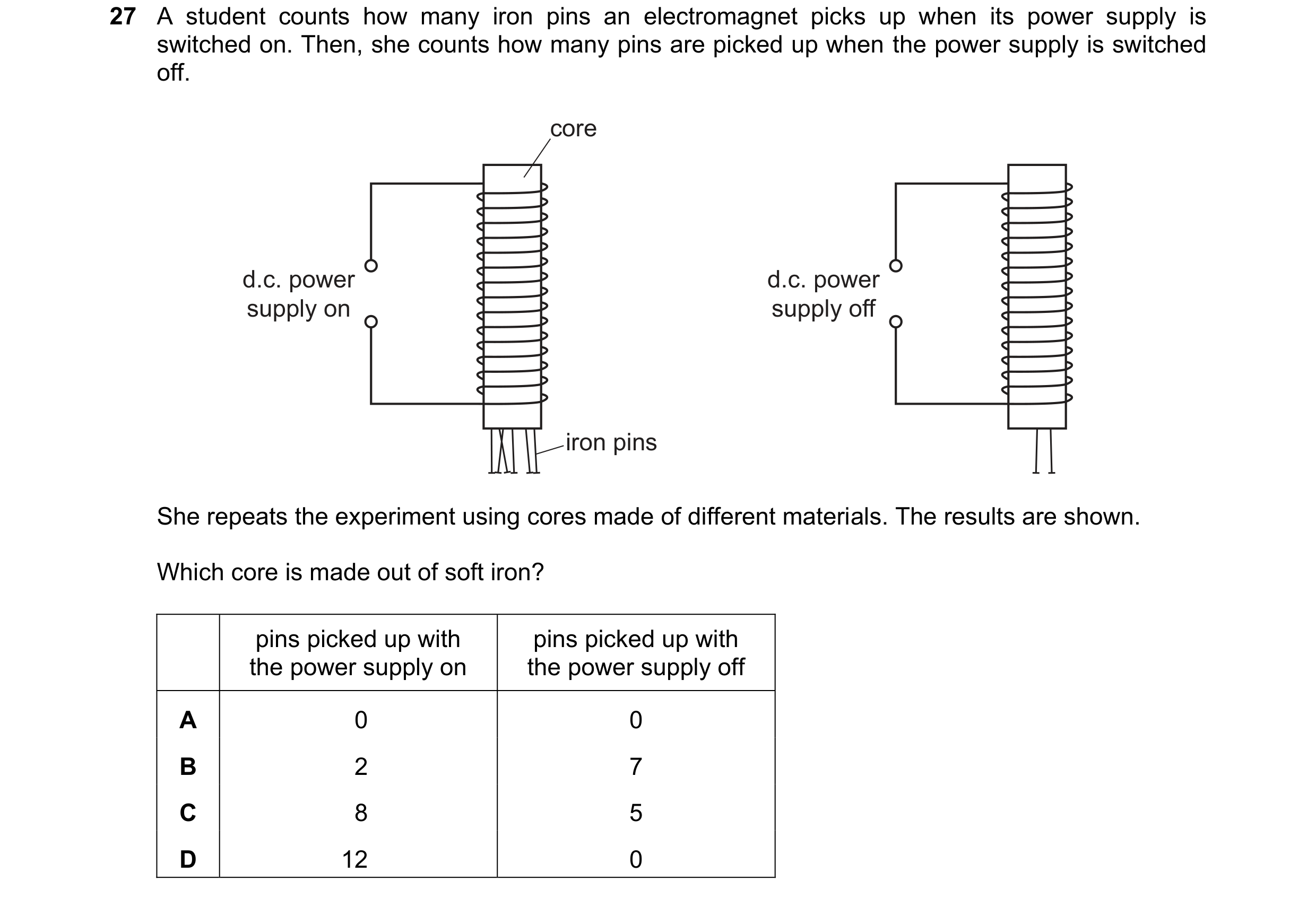 65 / 83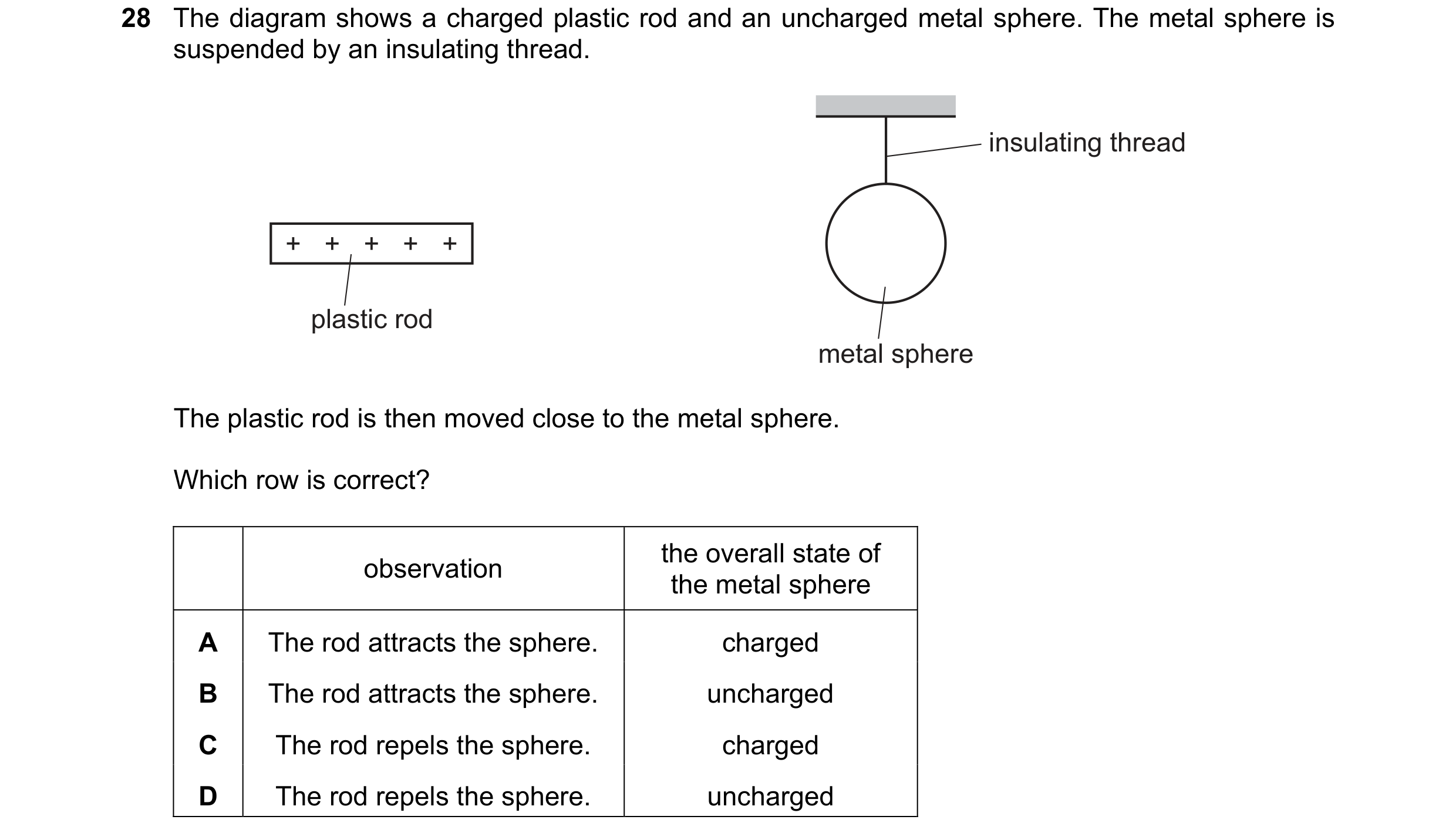
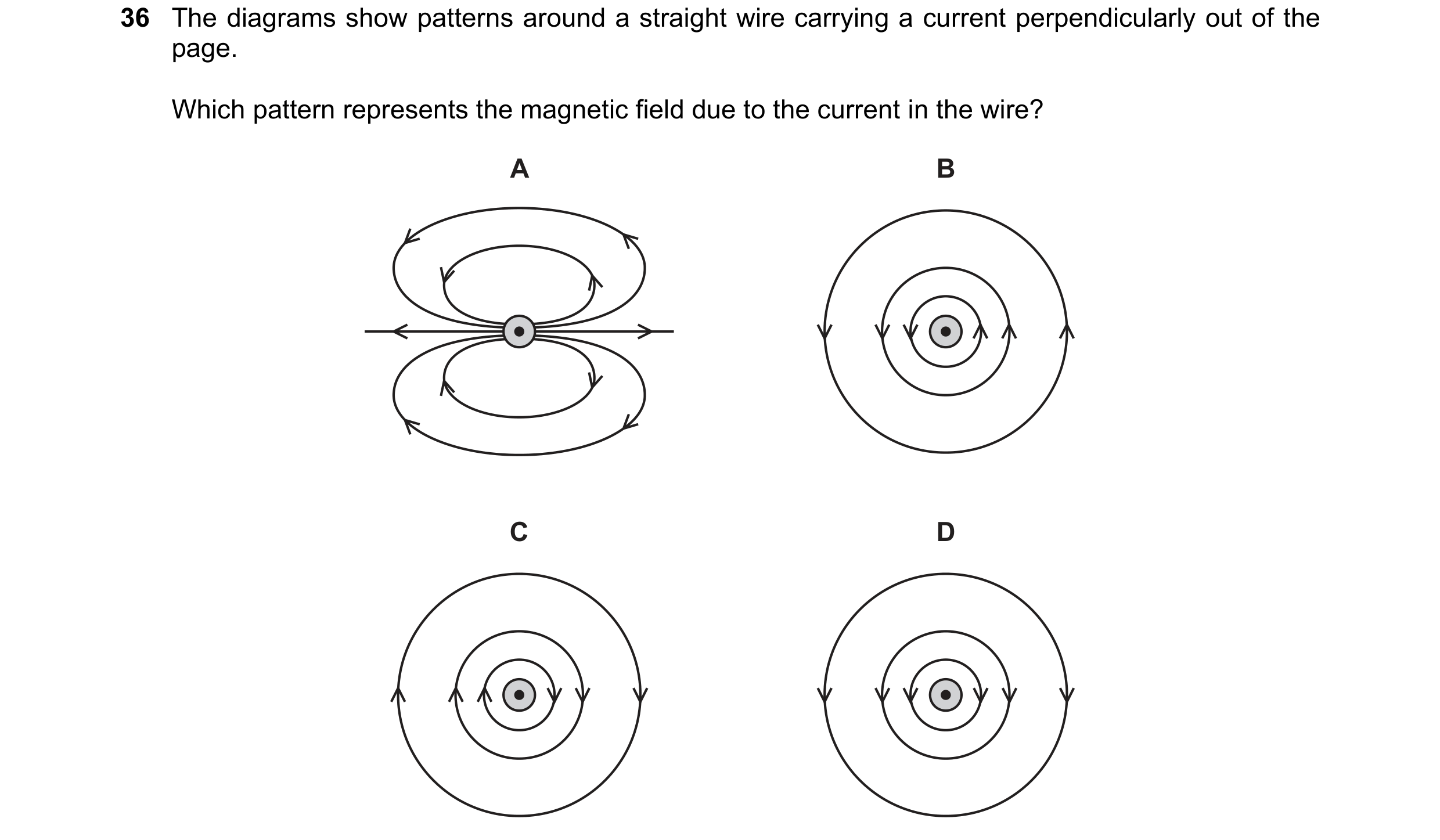 66 / 83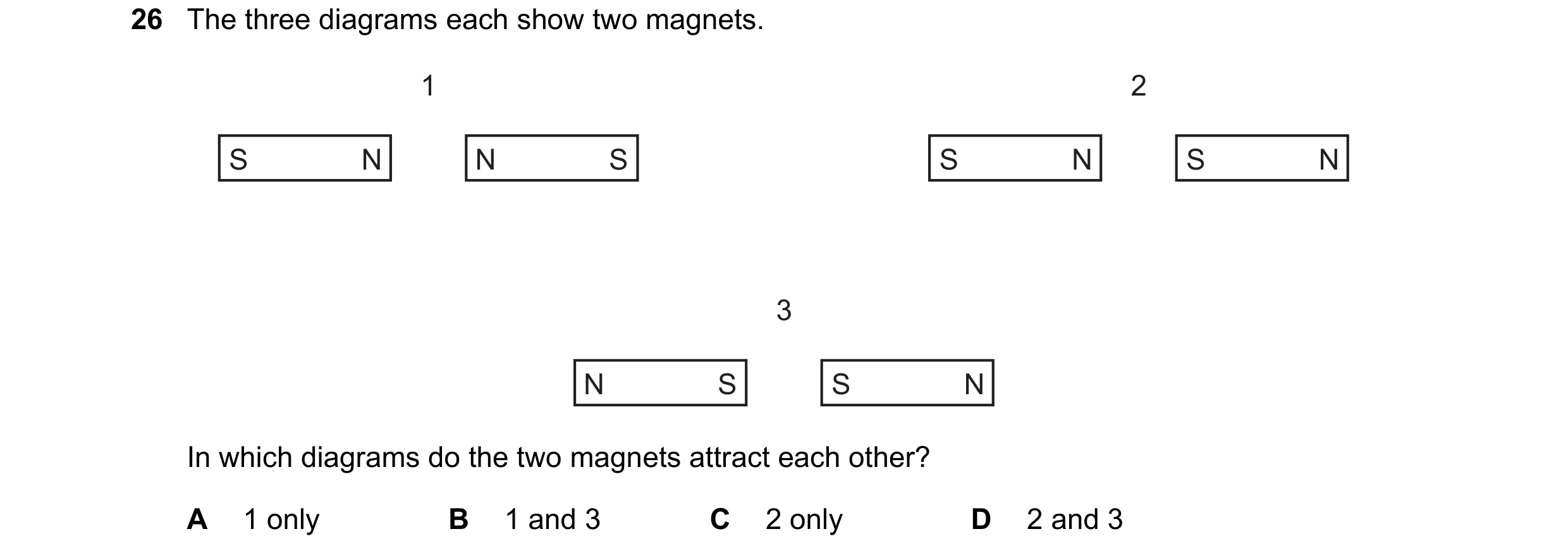
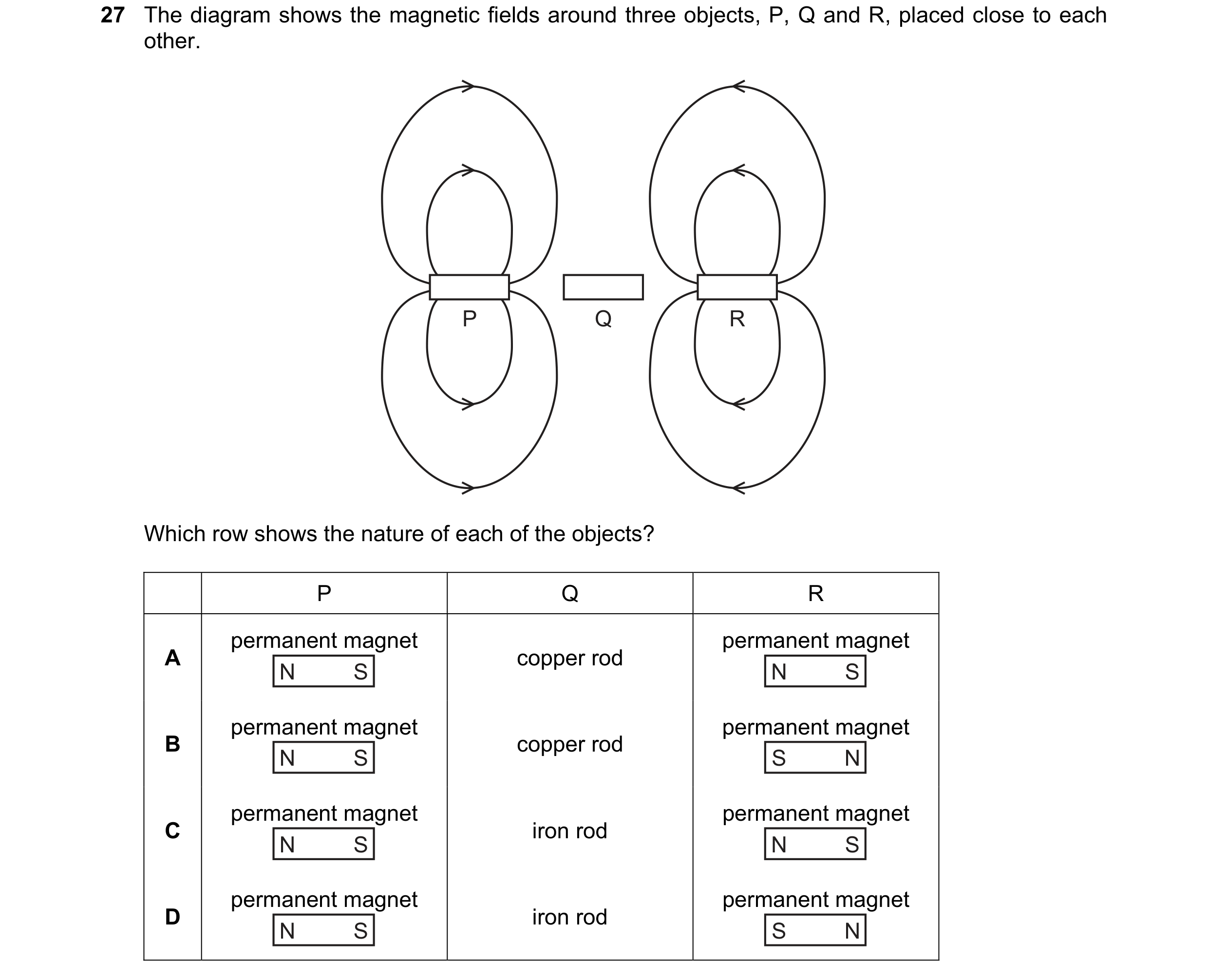 67 / 83
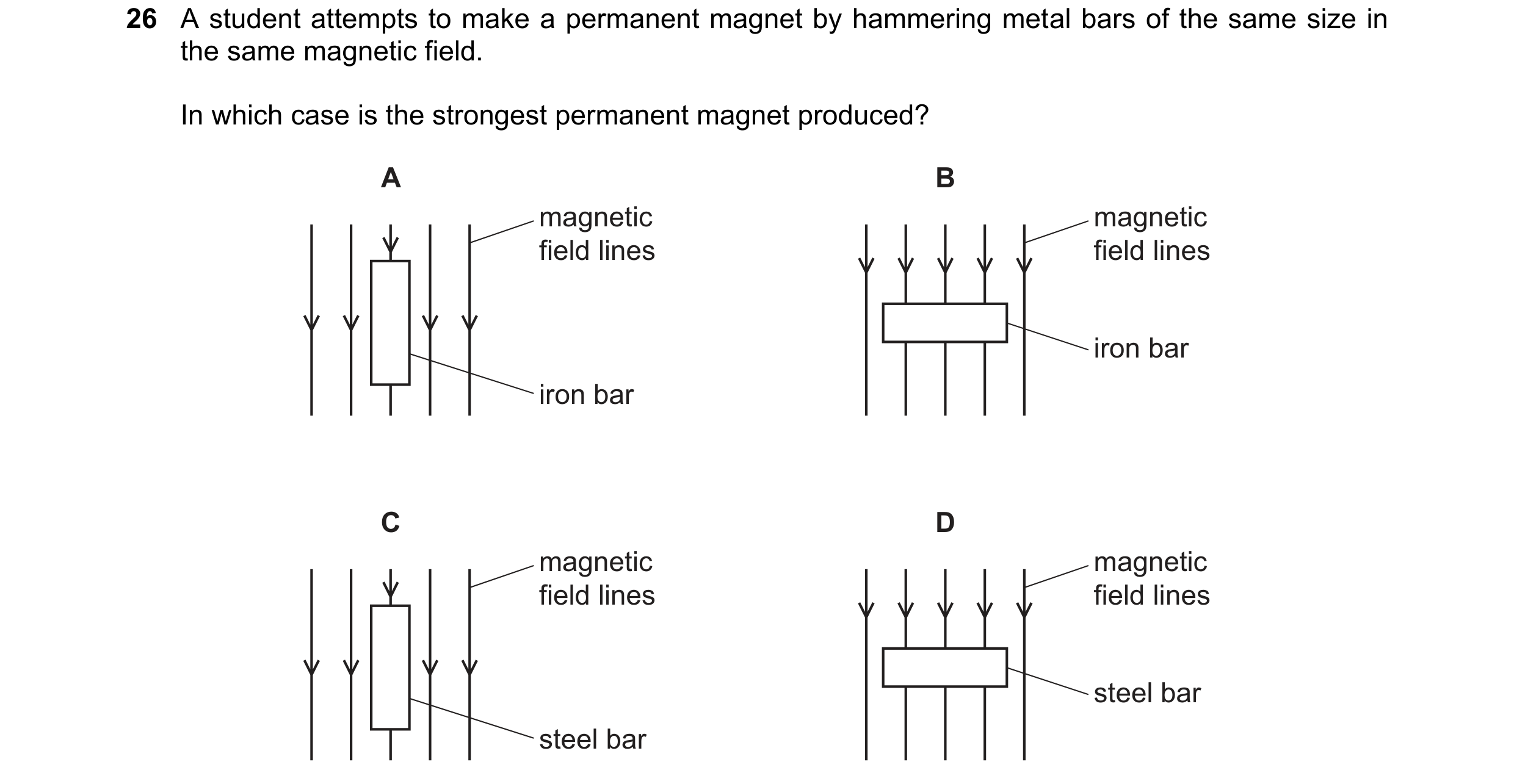 68 / 83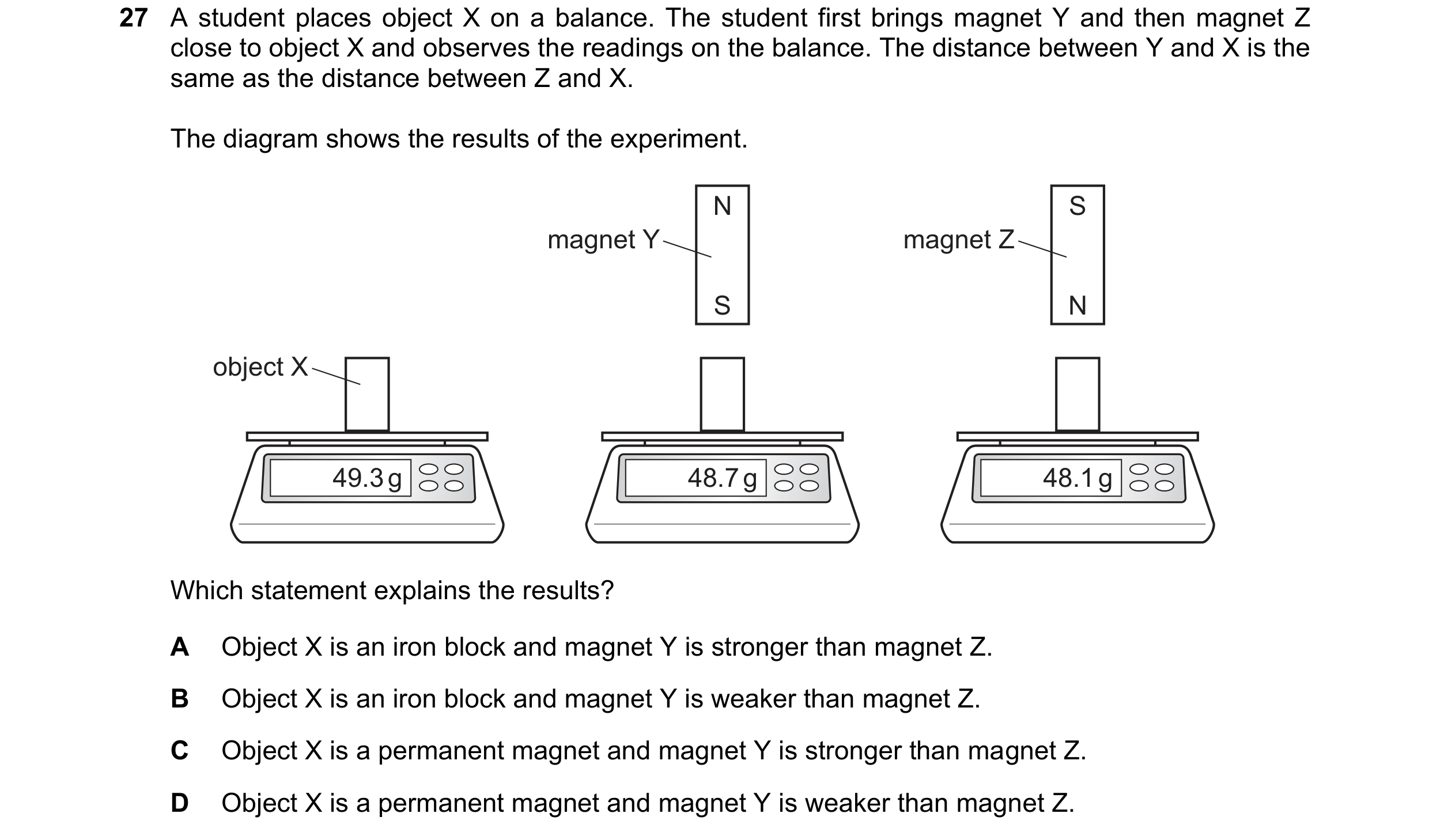
 69 / 83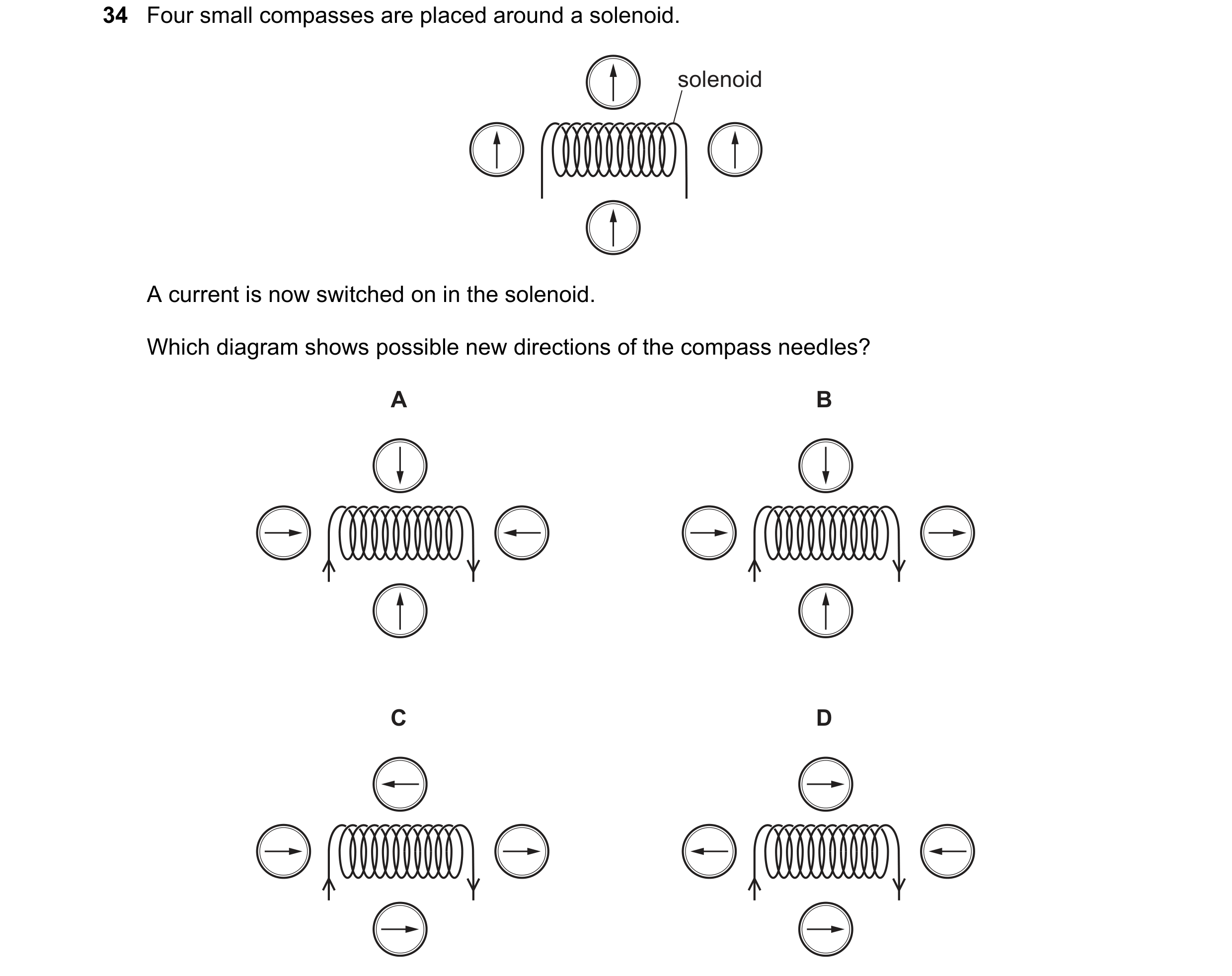
 70 / 83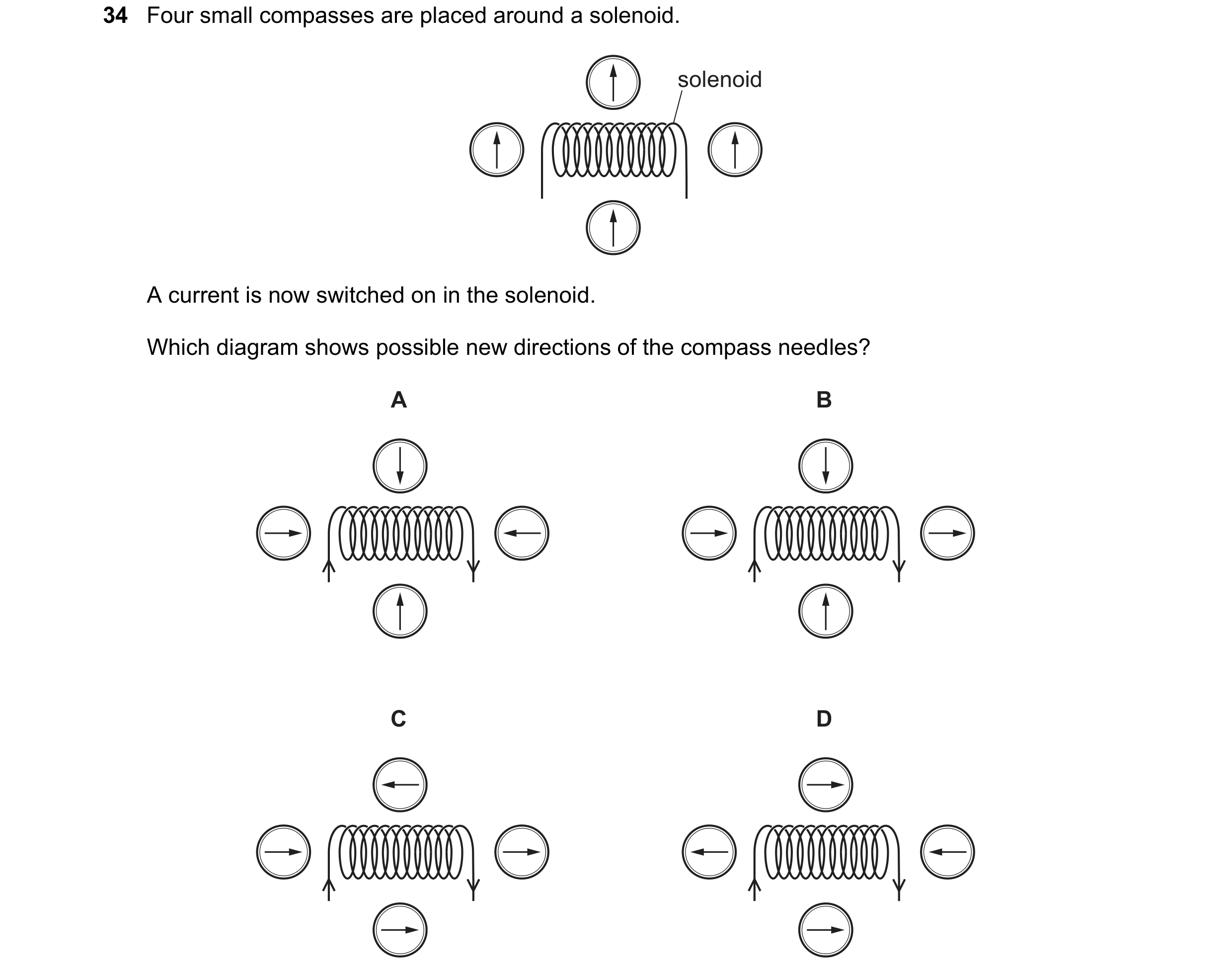
 71 / 83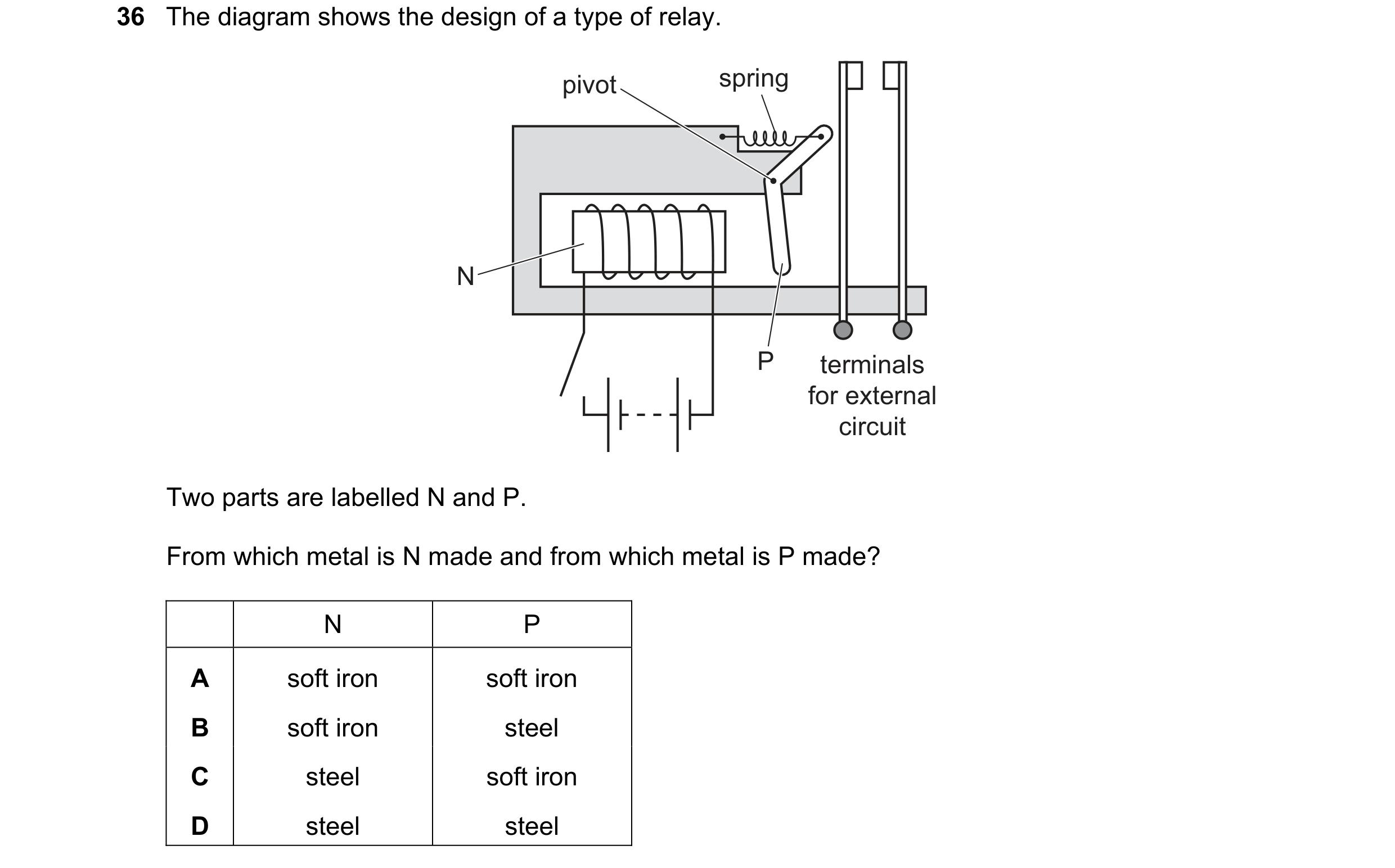
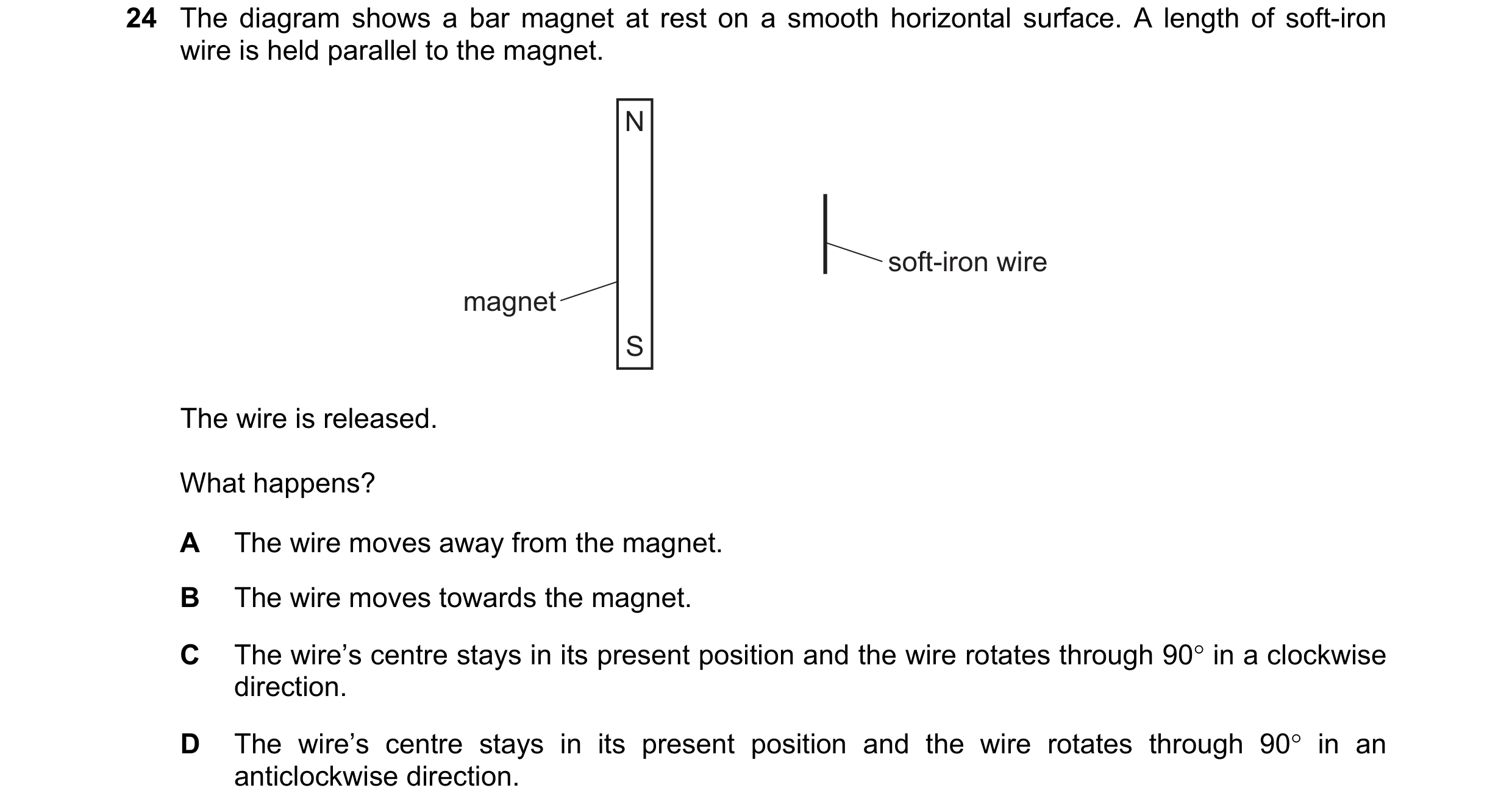 72 / 83
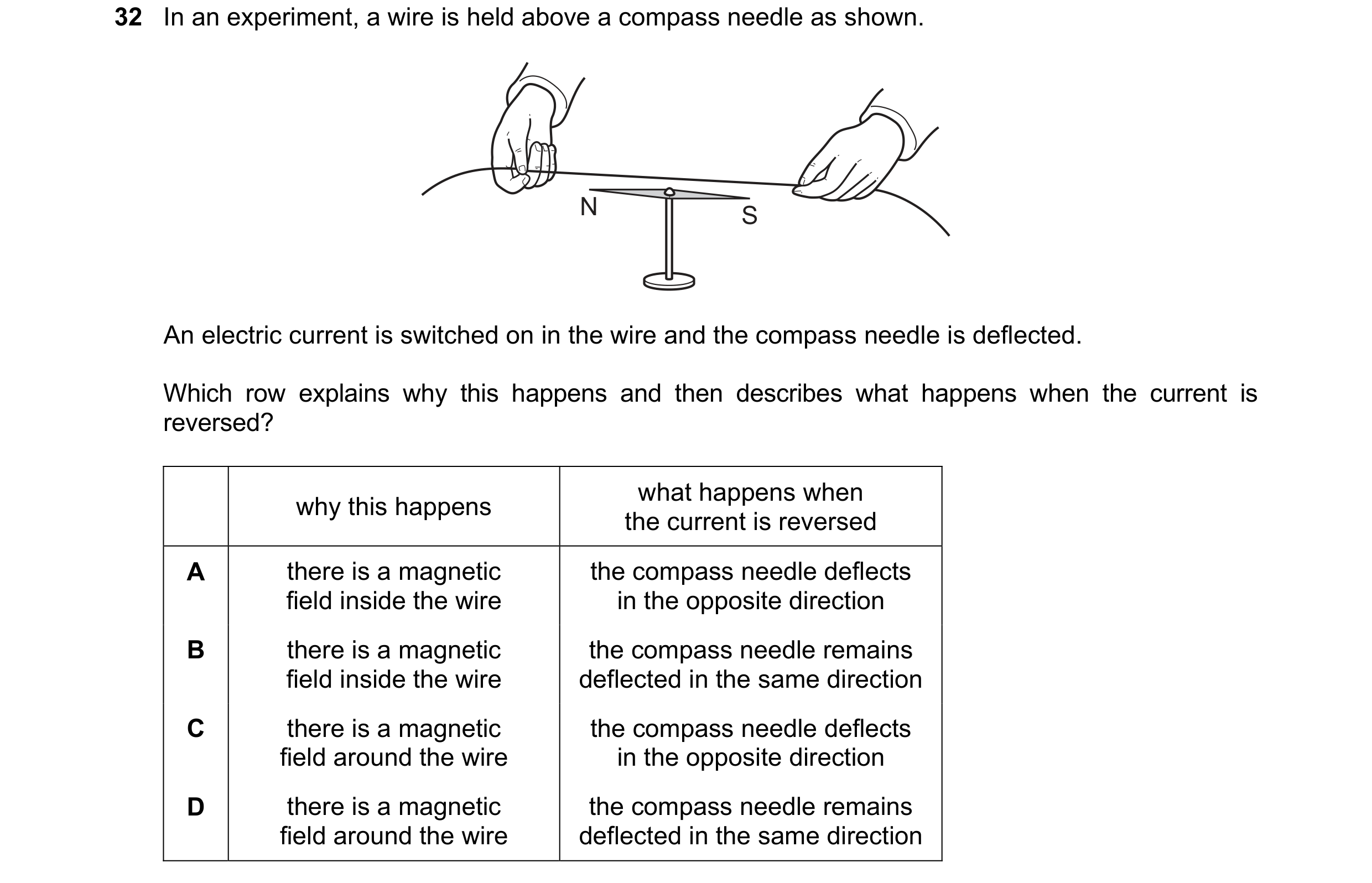
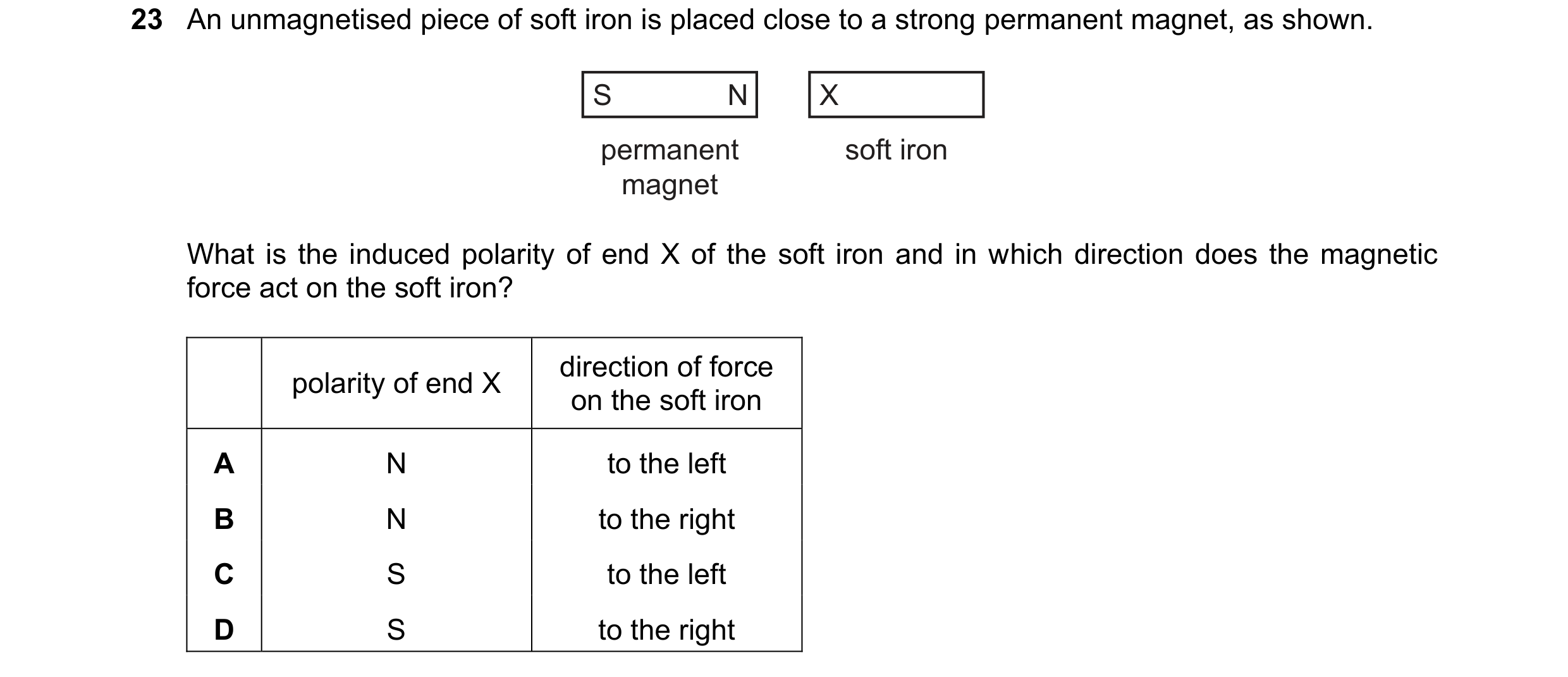 73 / 83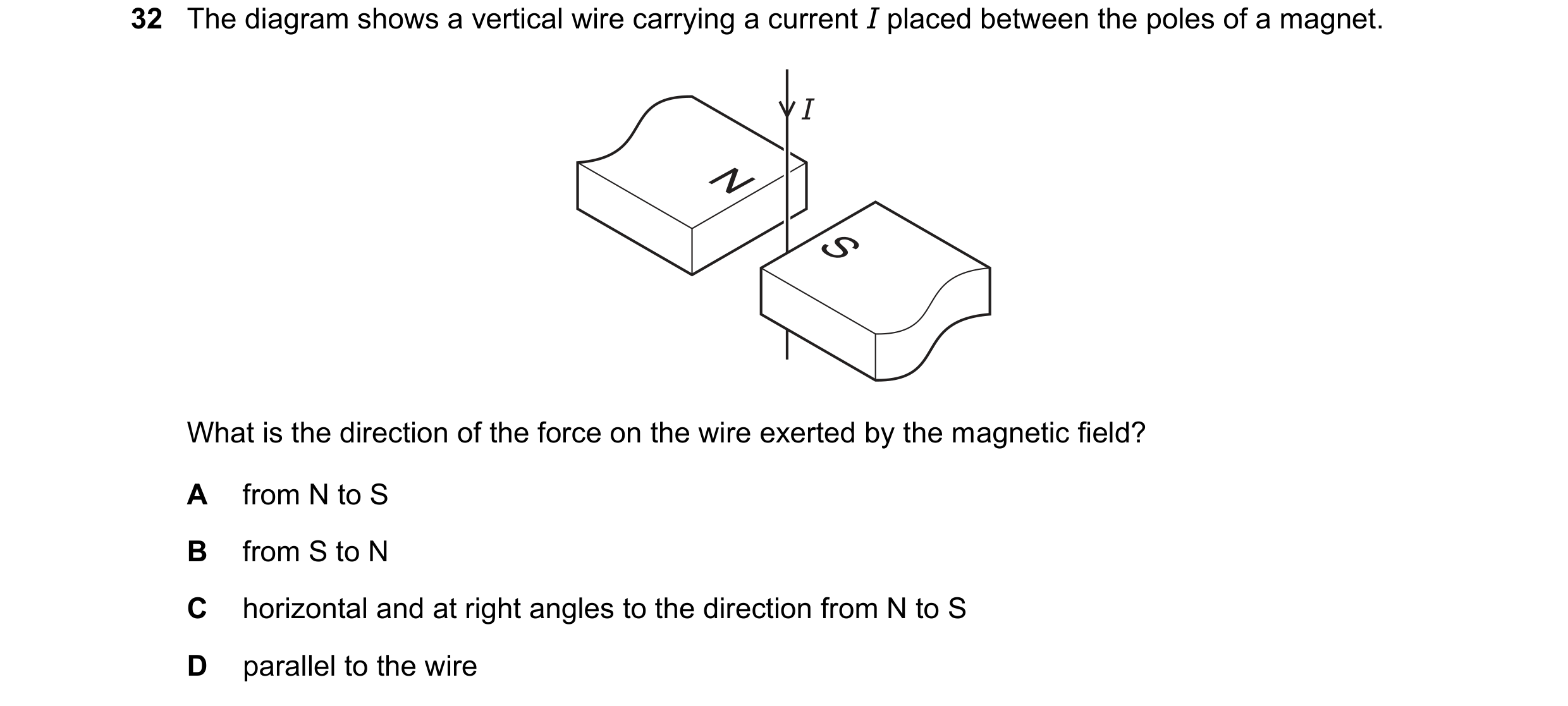

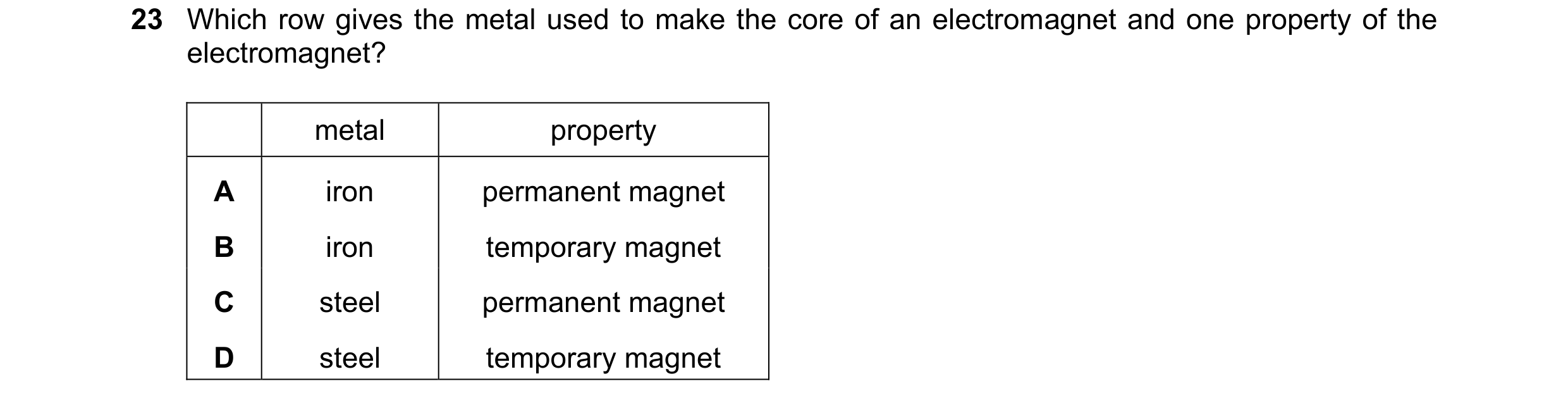
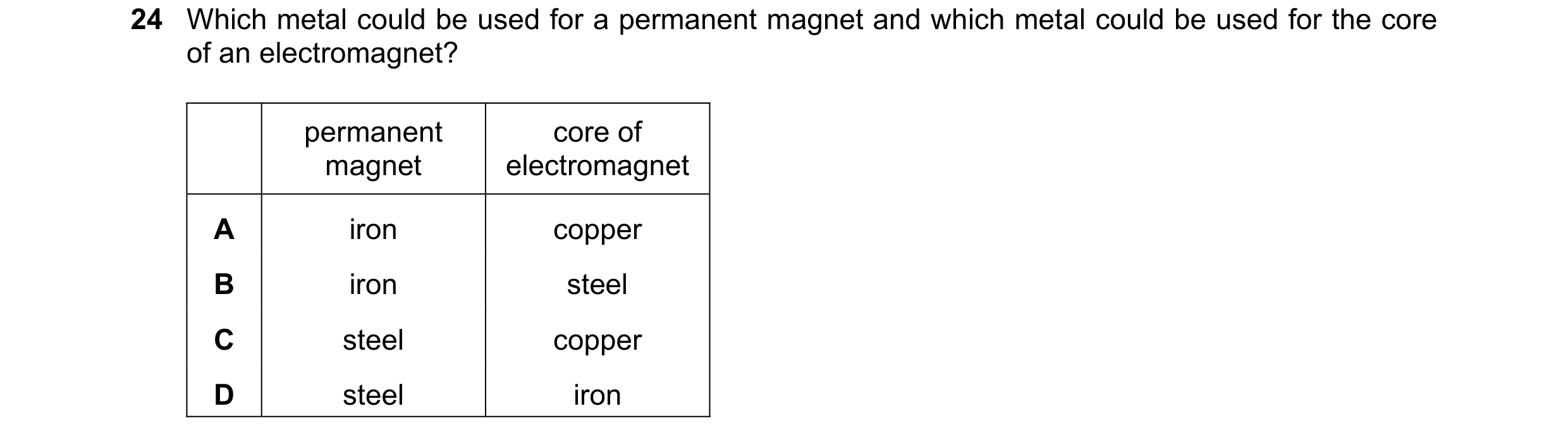 74 / 83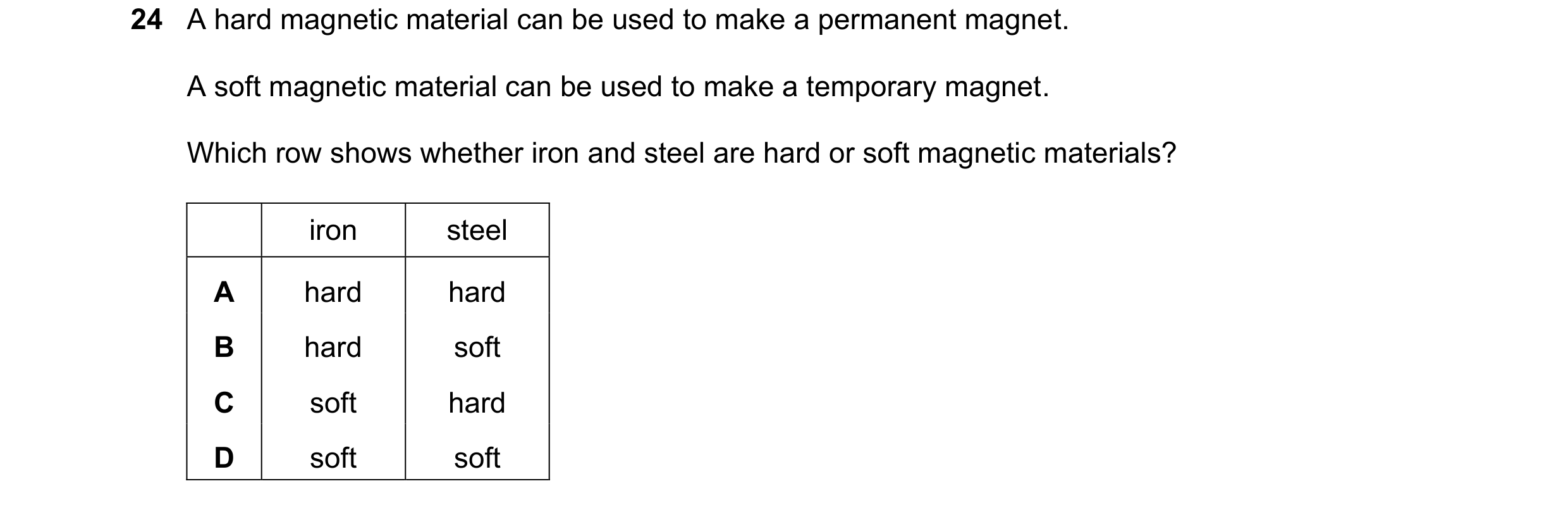
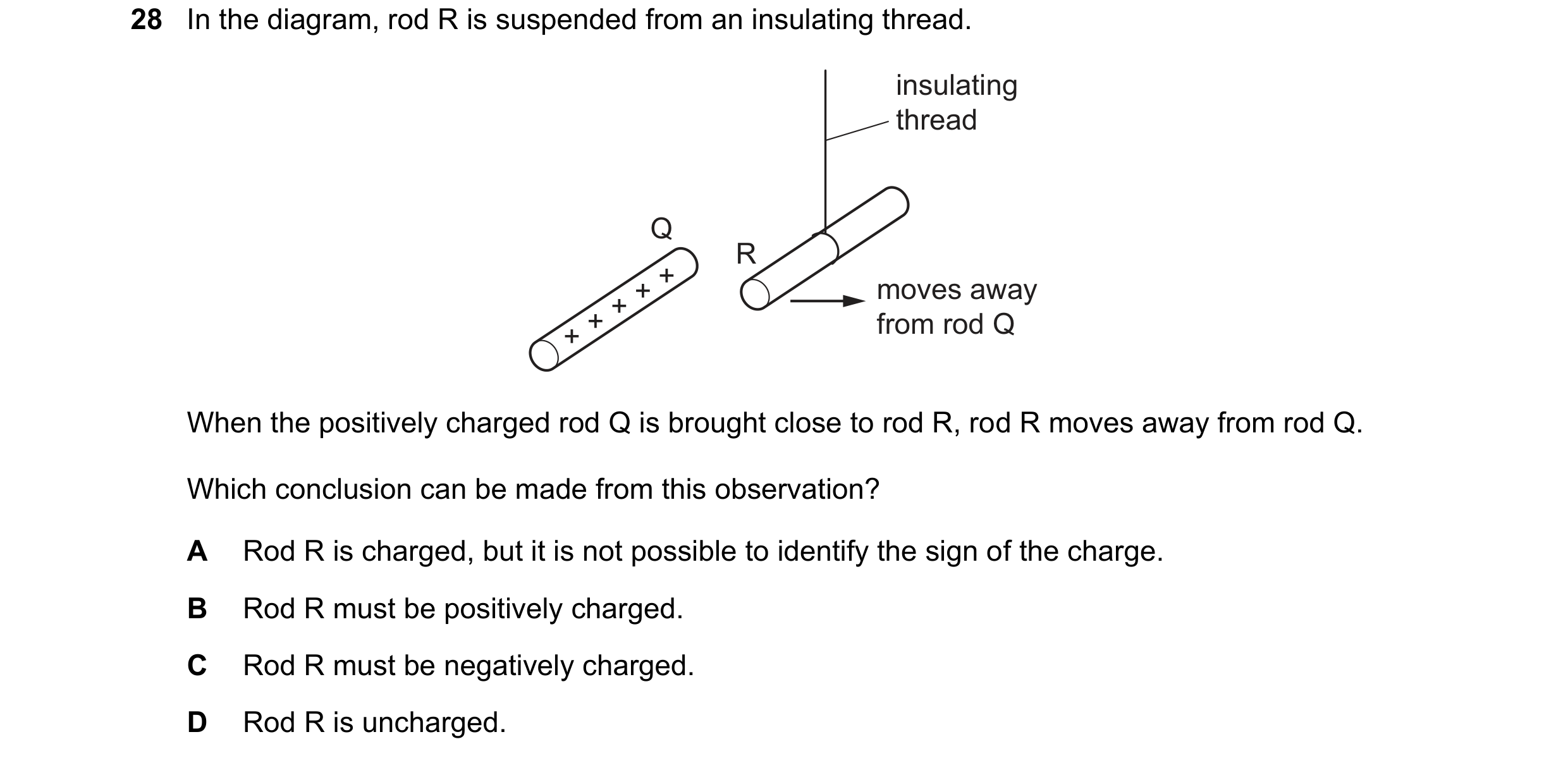
 75 / 83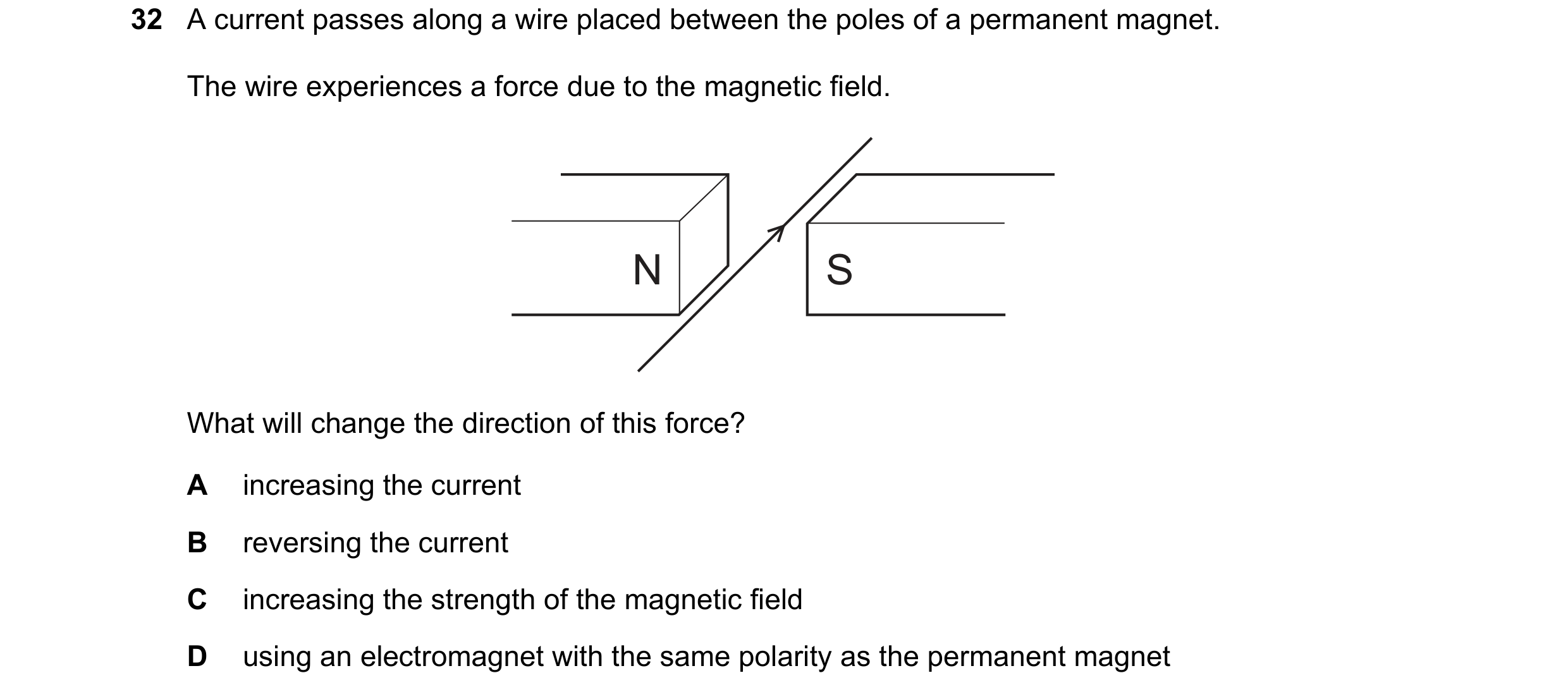

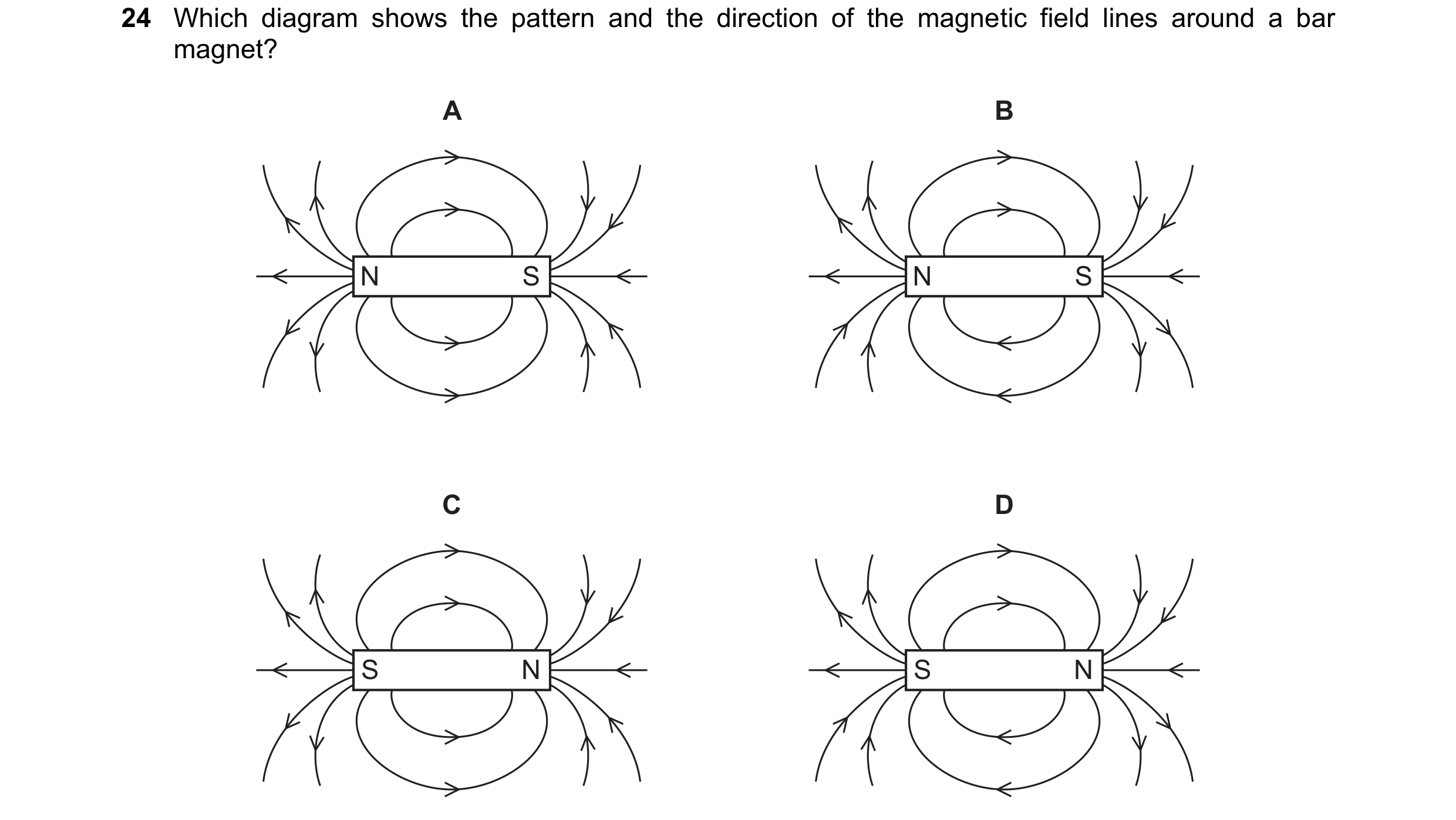 76 / 83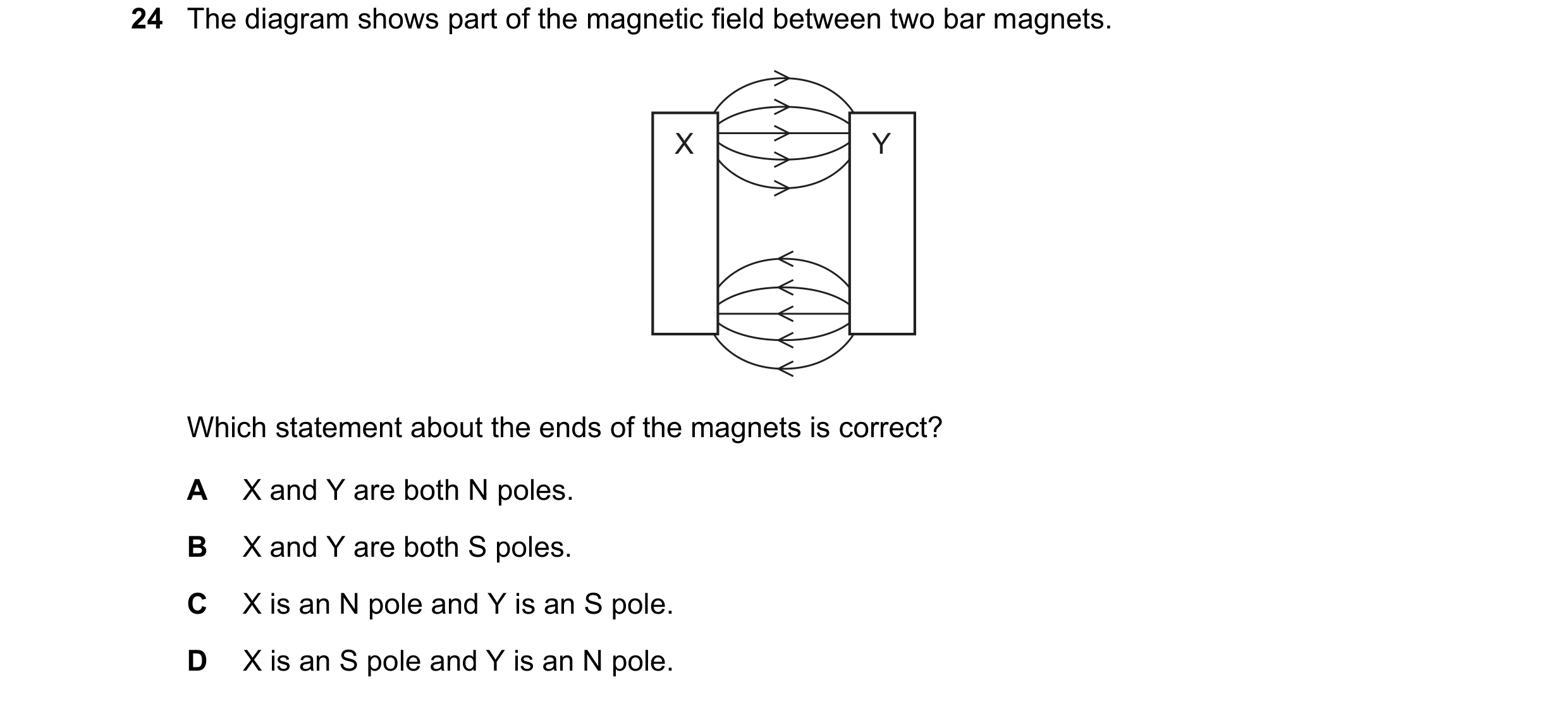
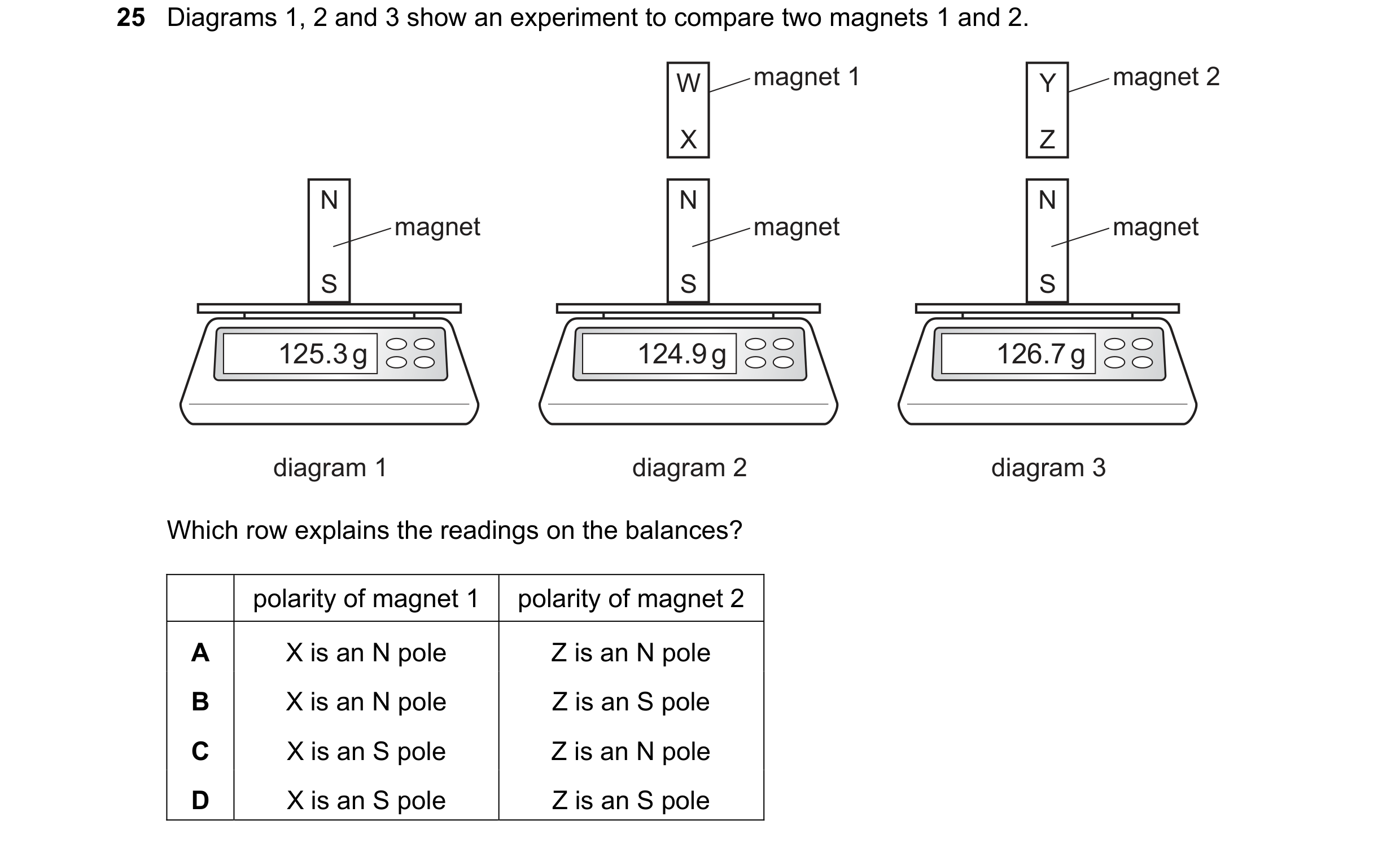 77 / 83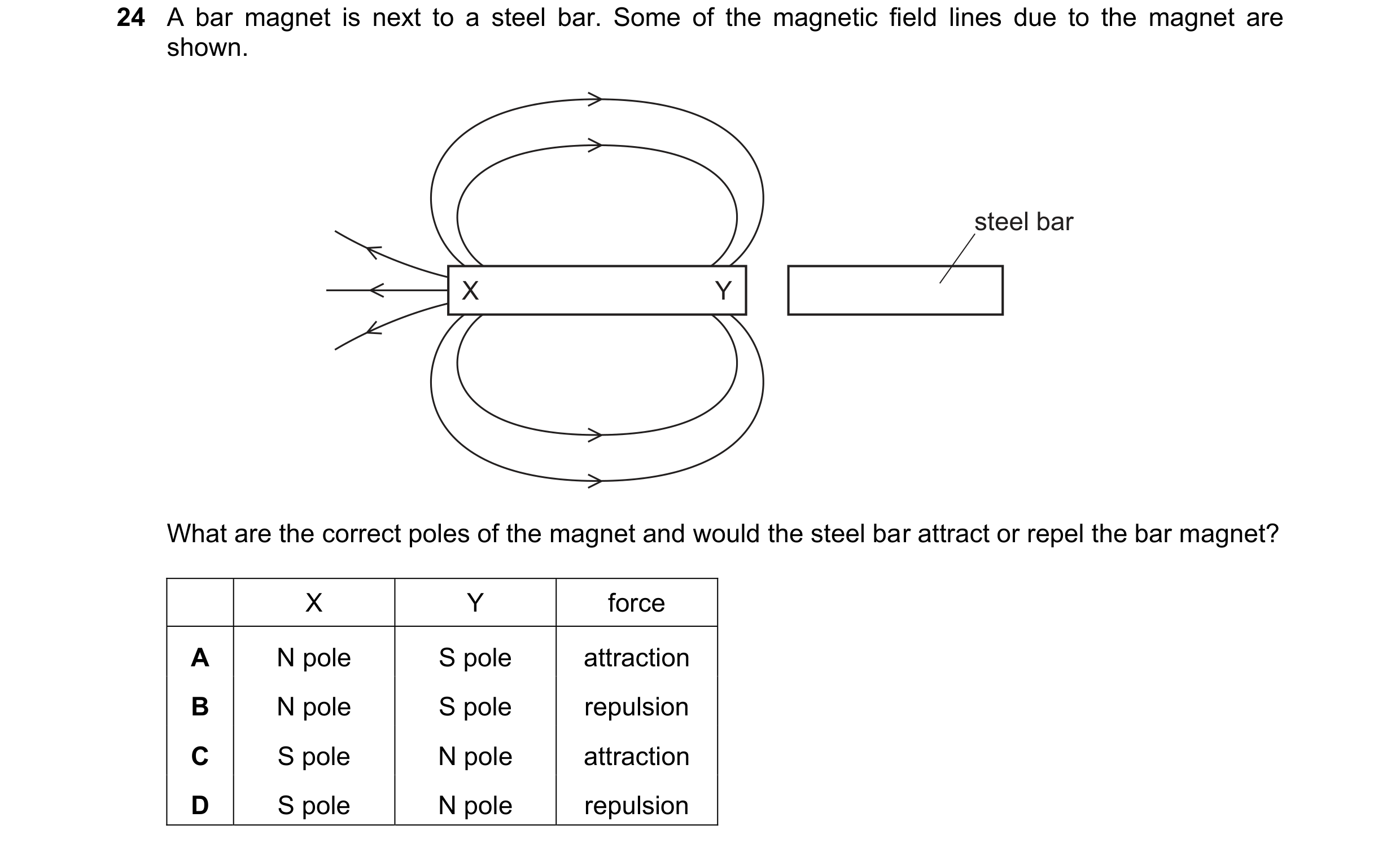
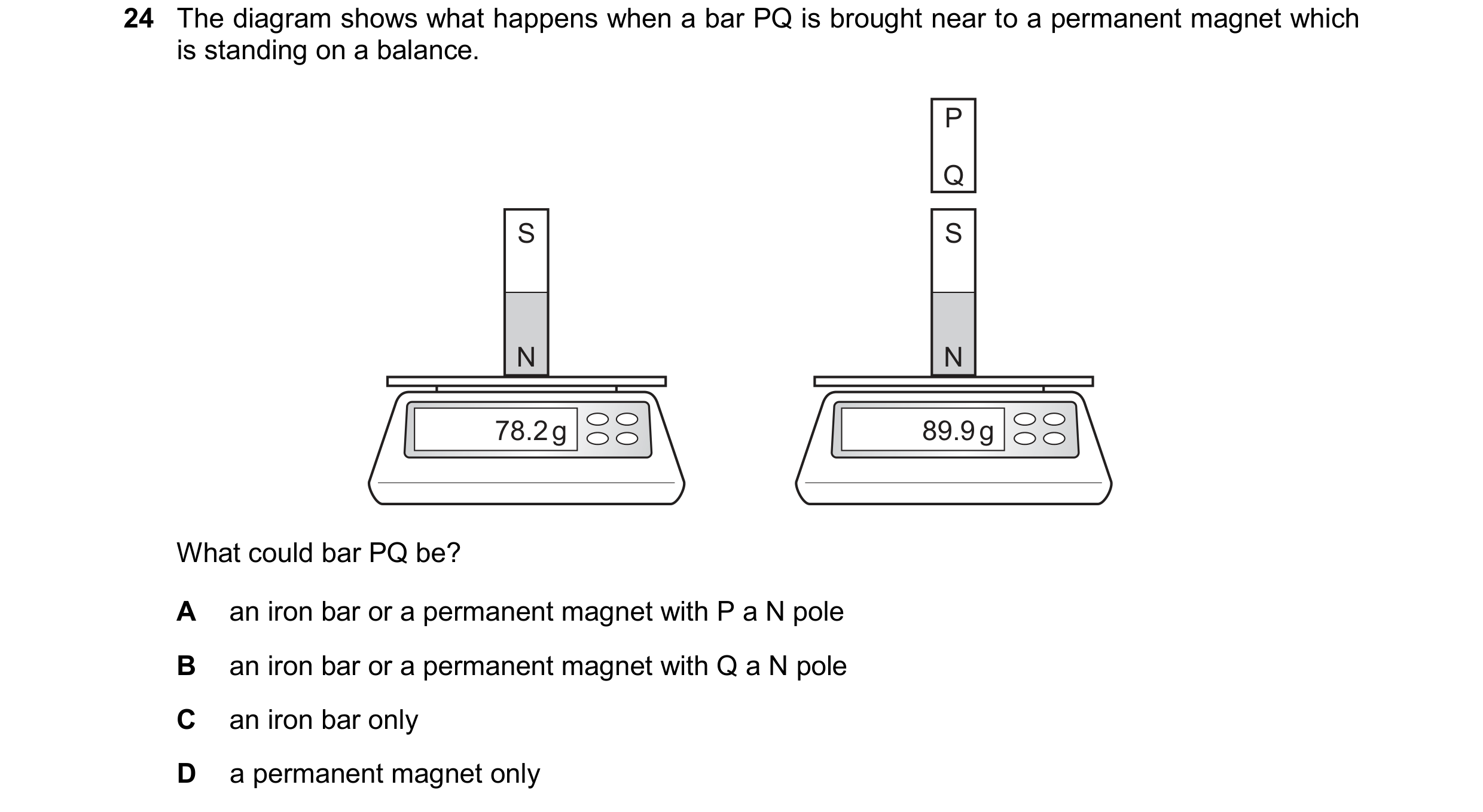 78 / 83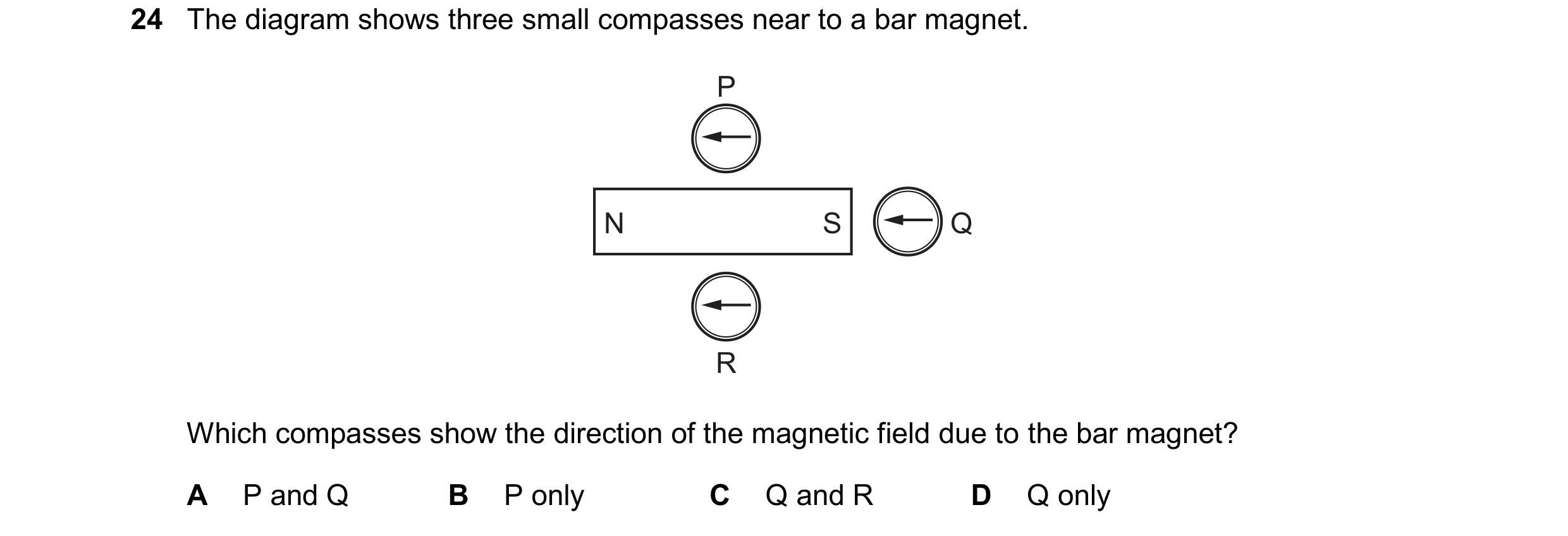
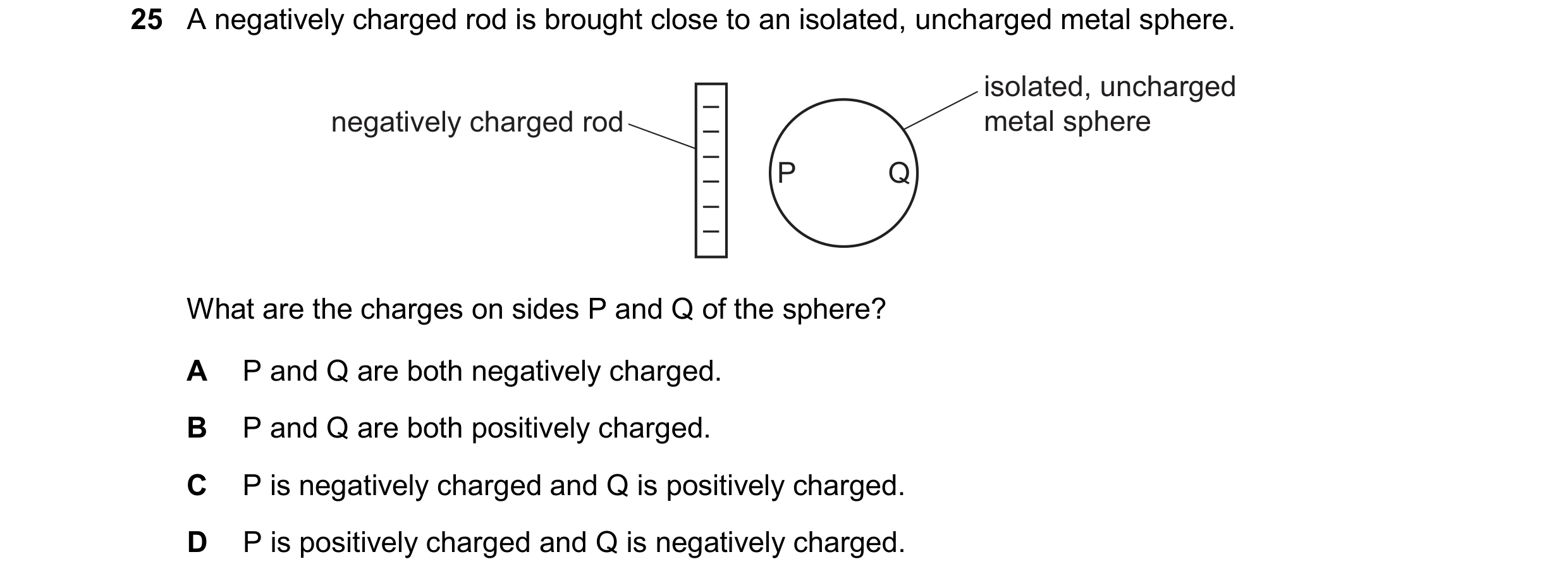
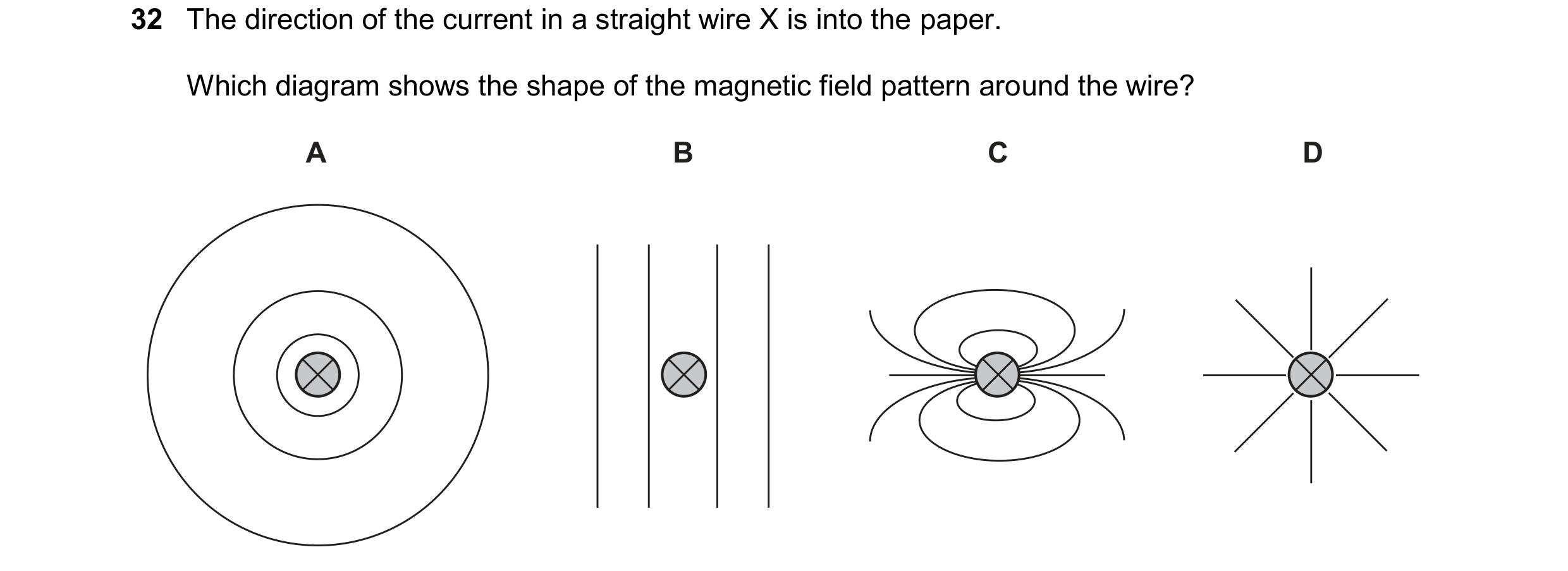 79 / 83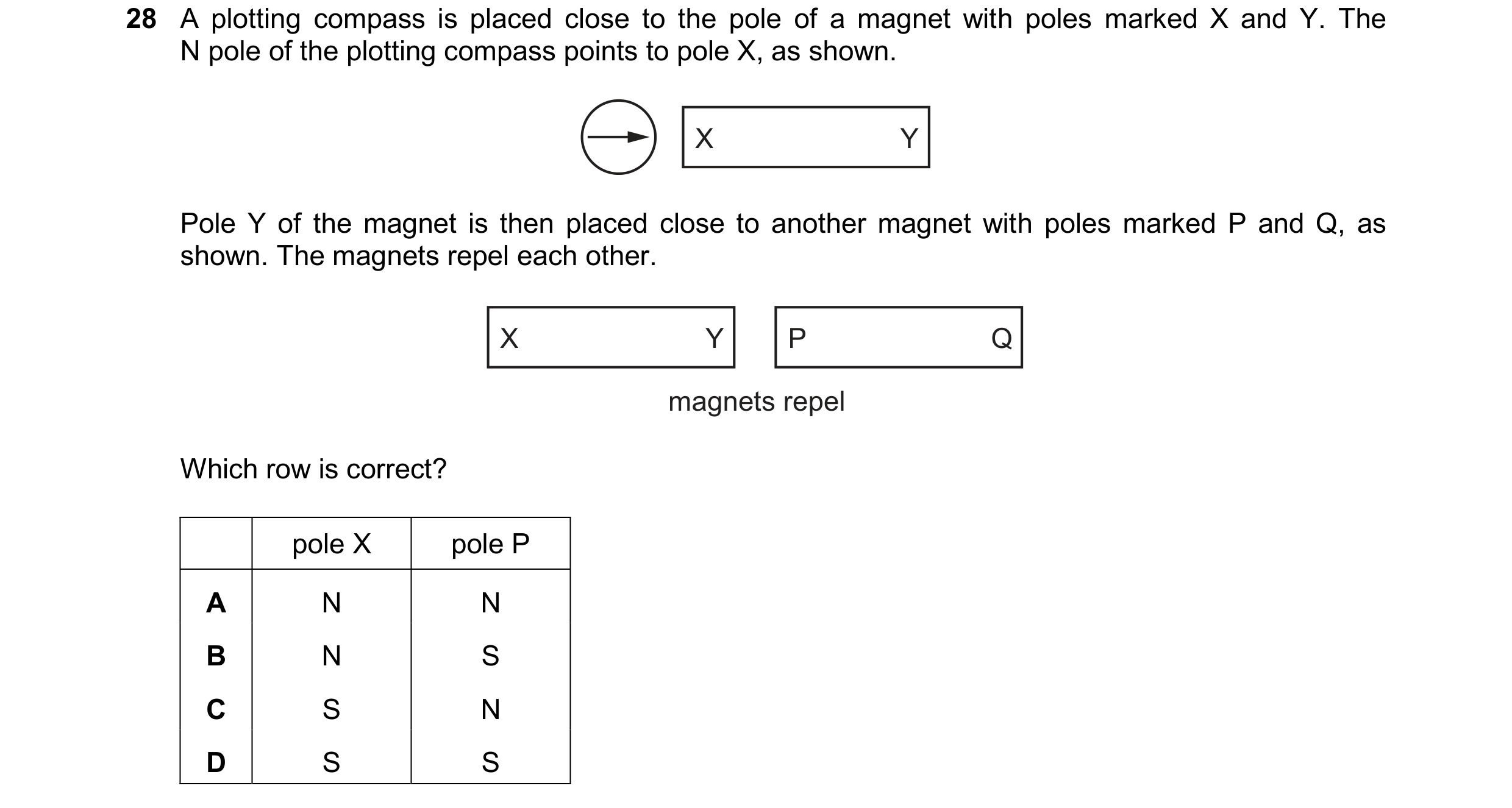
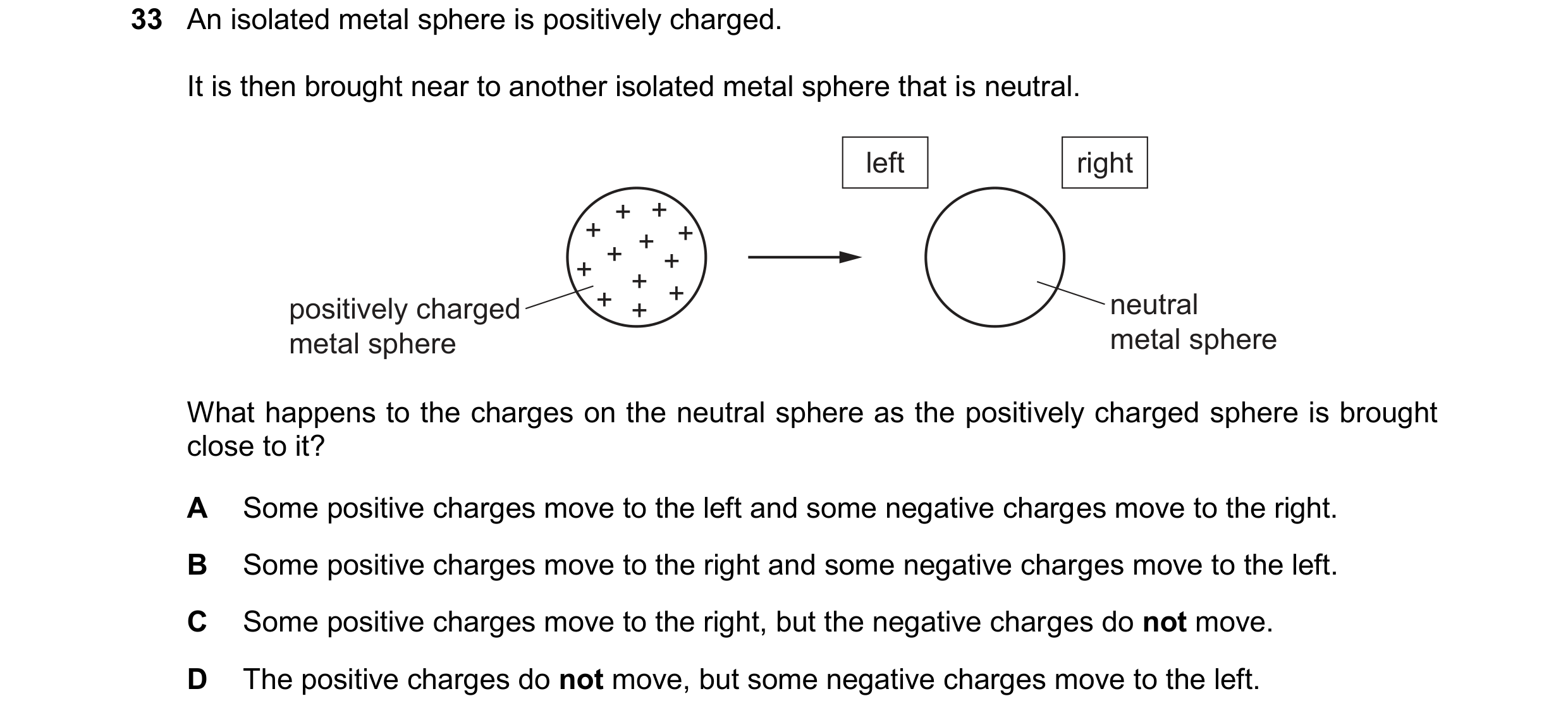
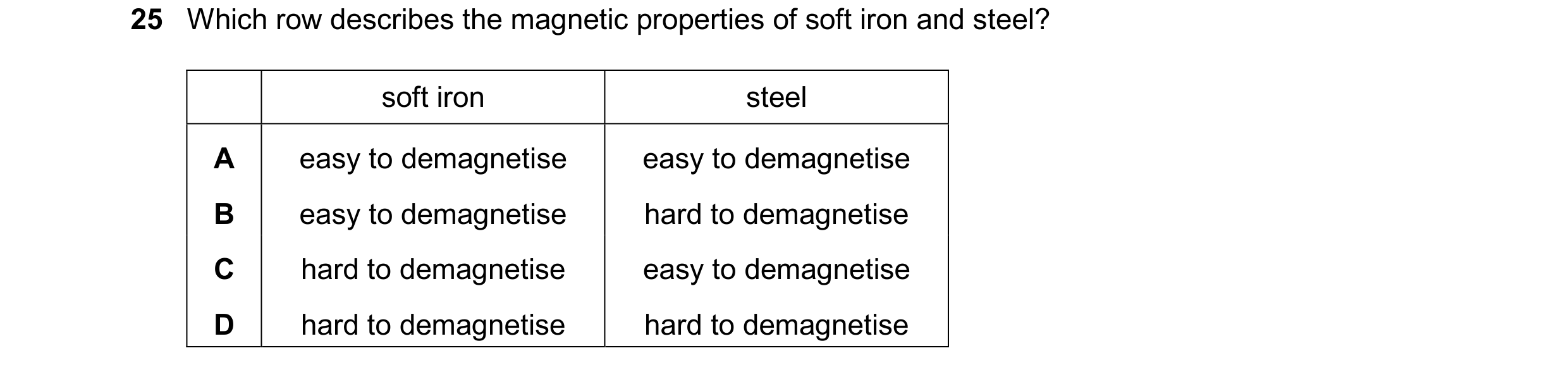 80 / 83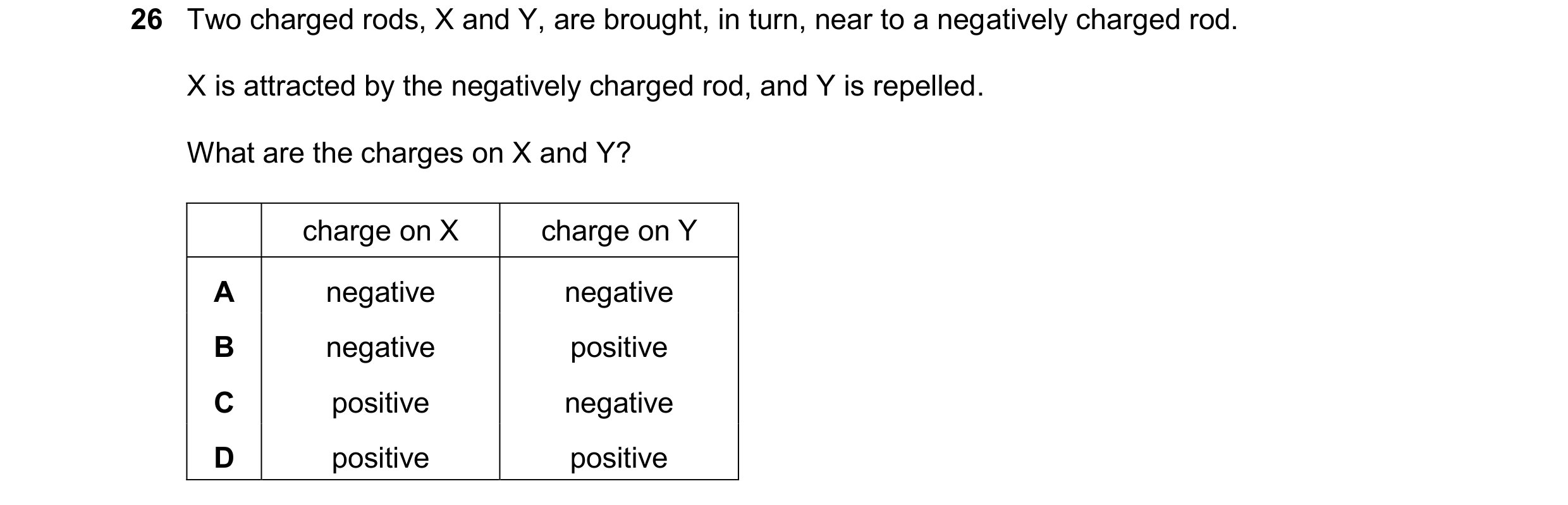

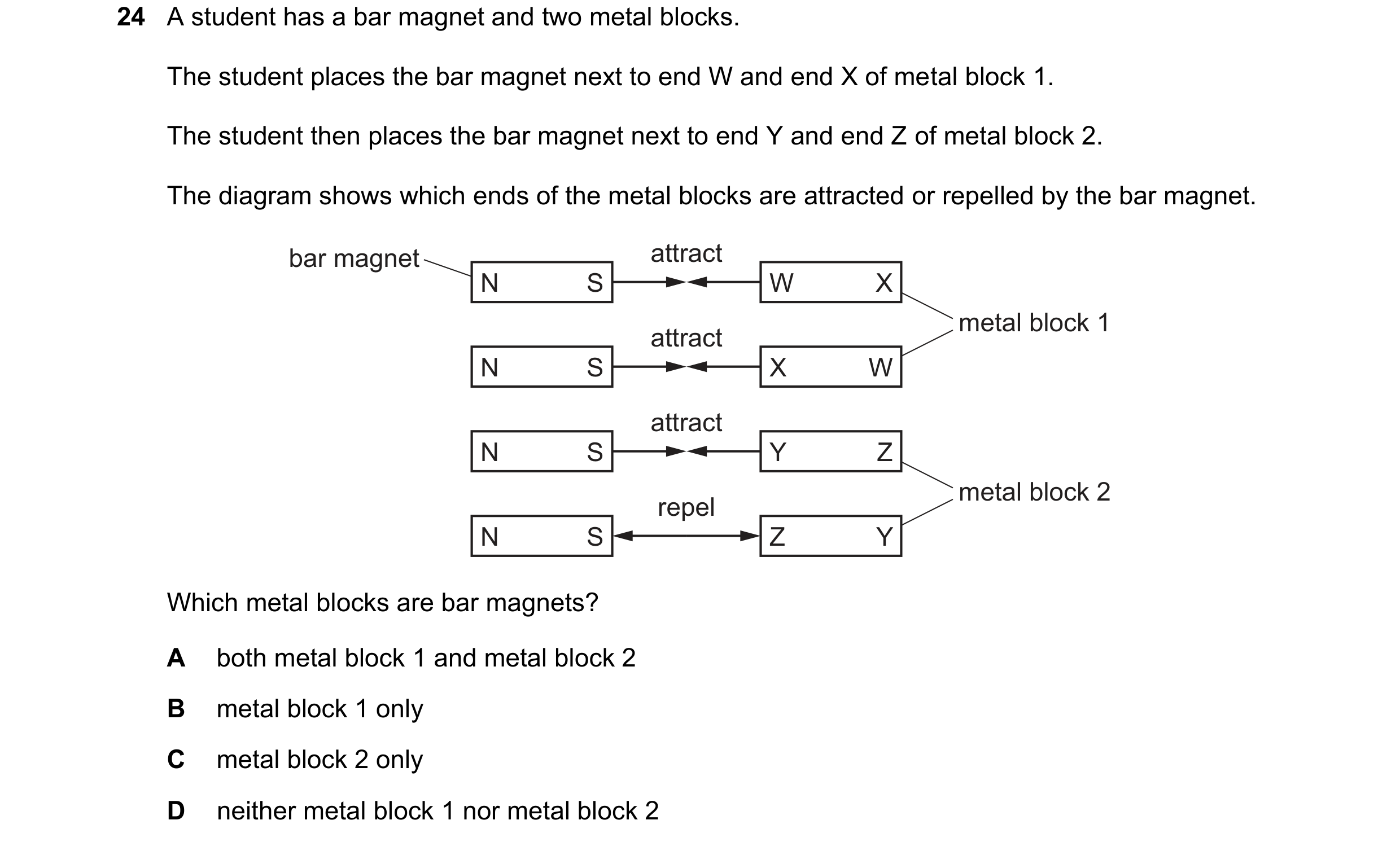 81 / 83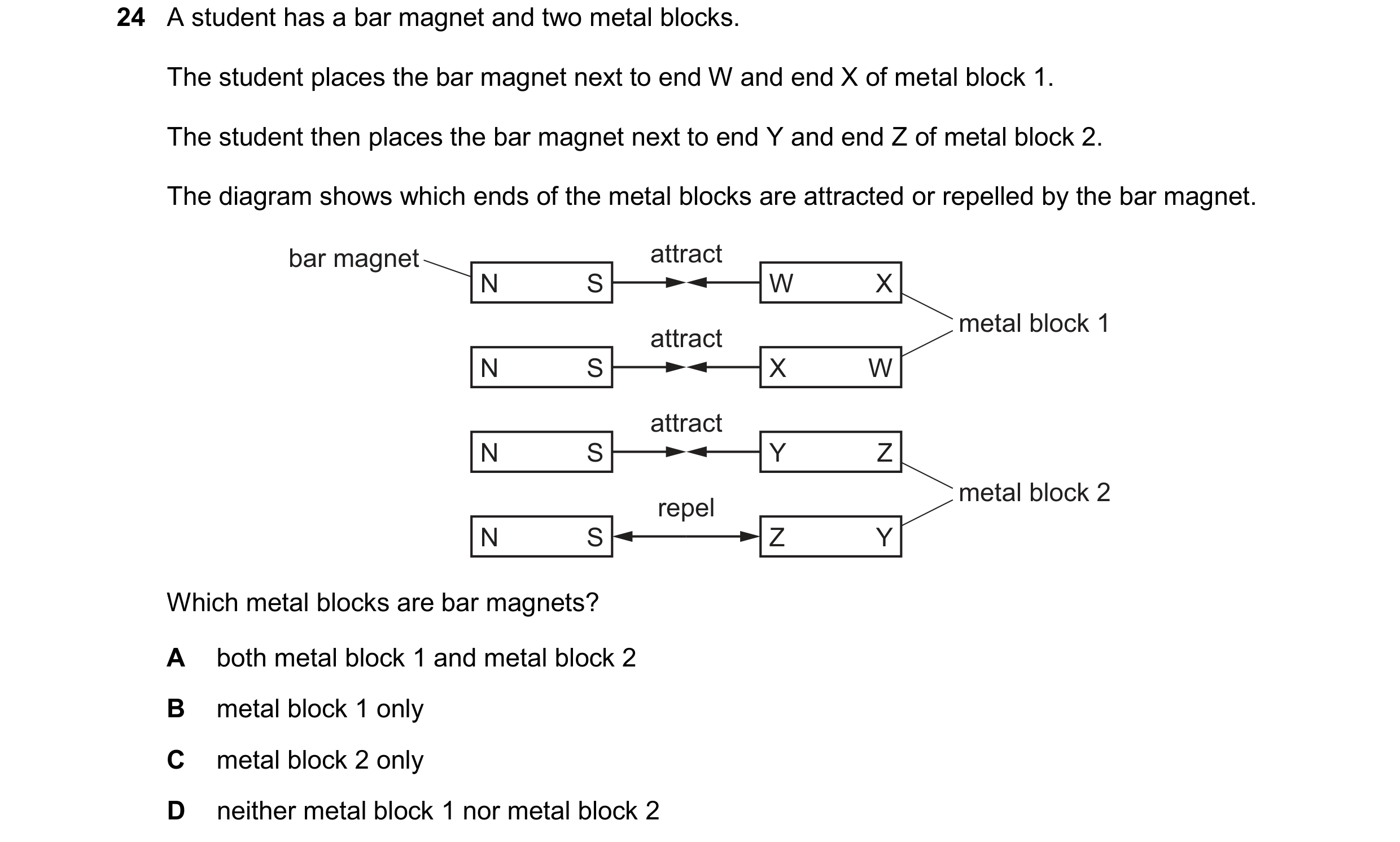
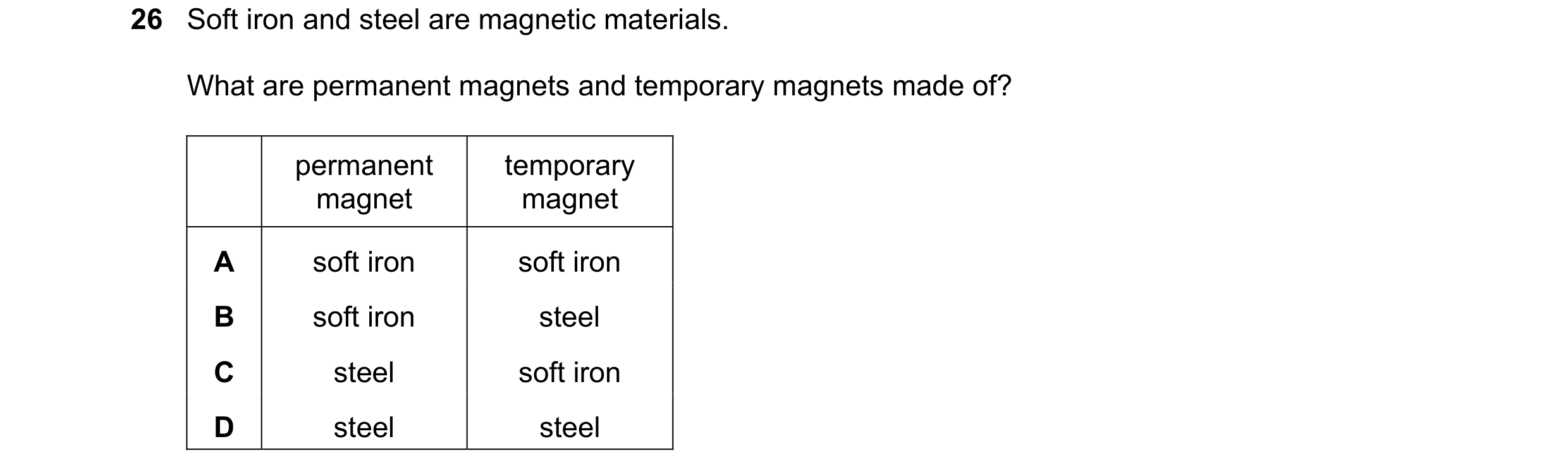
 82 / 83
 83 / 83