Cambridge IGCSE Physics 0625 — 2014 Oct/Nov Paper 1 · Variant 2
0625/12/O/N/14 · 40 questions · 40 marks · ≈45 min
The question paper and its mark scheme, free to read here and free to download. This is Cambridge’s own paper, exactly as it was sat.
Question paper20 pages


Mark scheme2 pages
Answers below. Sit the paper first if you are practising.
Questions as text
Q1 · A man stands by a railway track
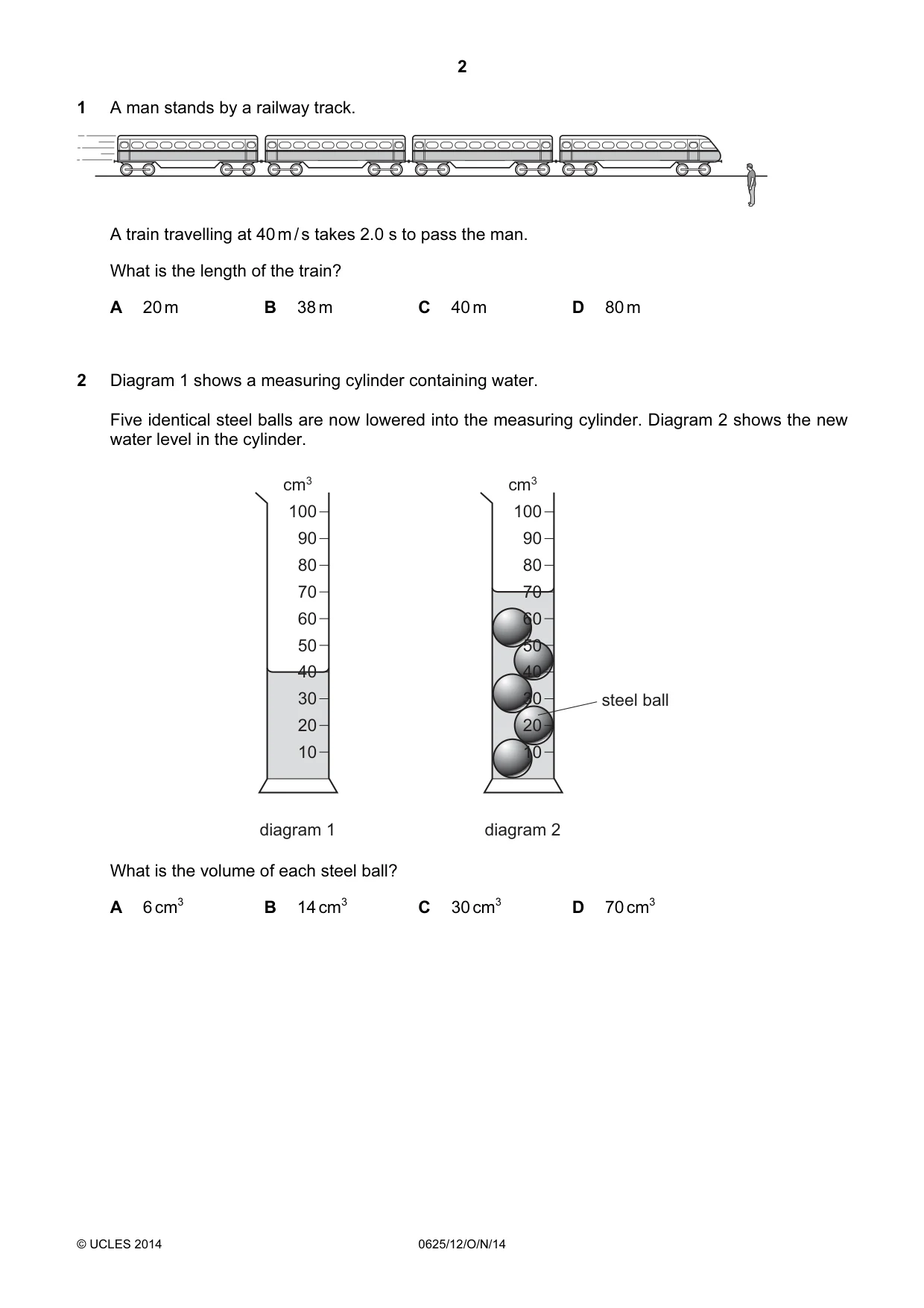
1 A man stands by a railway track. A train travelling at 40 m / s takes 2.0 s to pass the man. What is the length of the train? A 20 m B 38 m C 40 m D 80 m
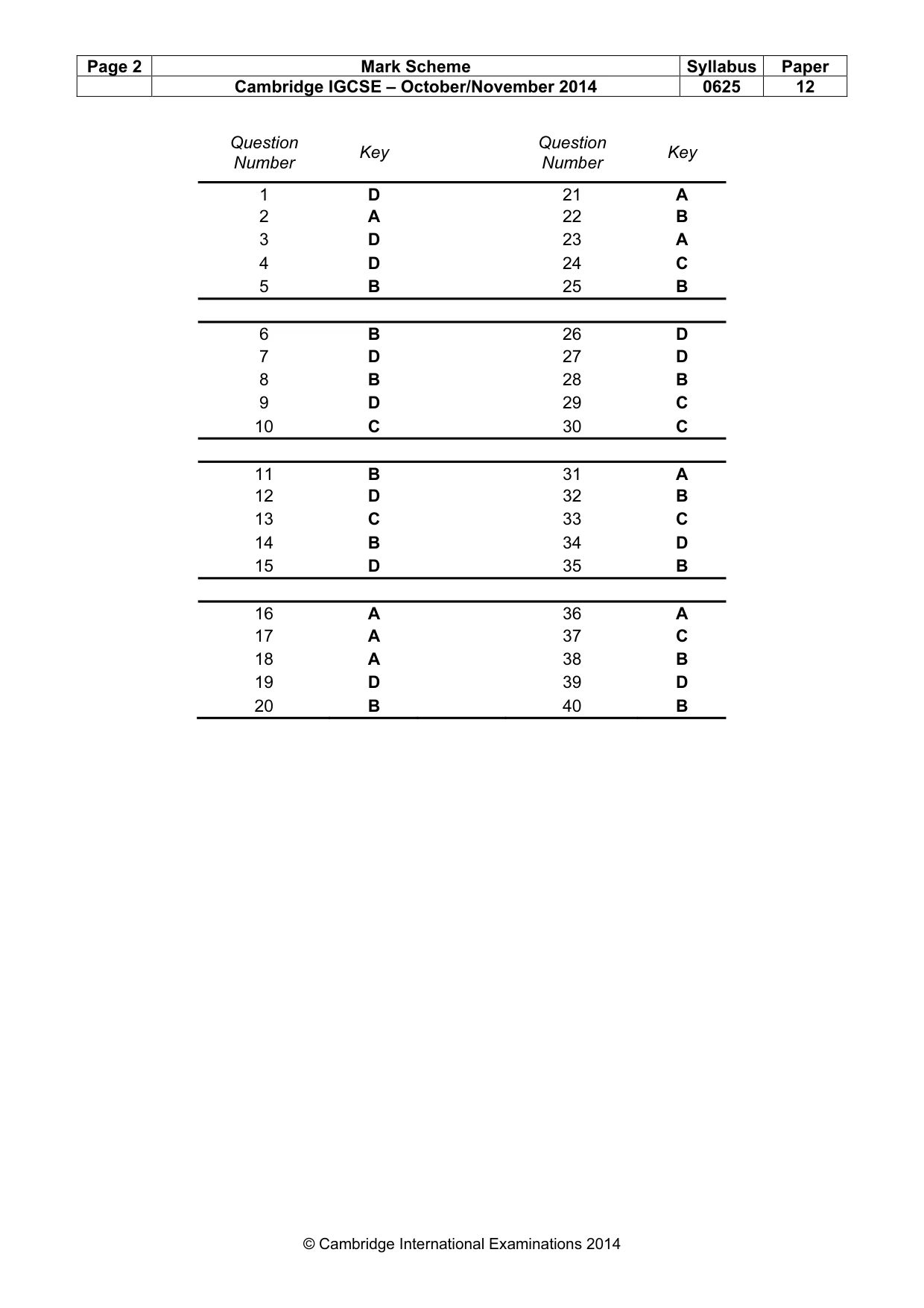
Mark scheme: D
Q2 · A measuring cylinder containing water
2 Diagram 1 shows a measuring cylinder containing water. Five identical steel balls are now lowered into the measuring cylinder. Diagram 2 shows the new water level in the cylinder. cm3 cm3 100 100 90 90 80 80 70 70 60 60 50 50 40 40 30 30 steel ball 20 20 10 10 diagram 1 diagram 2 What is the volume of each steel ball? A 6 cm3 B 14 cm3 C 30 cm3 D 70 cm3
Mark scheme: A
More questions on Physical quantities and measurement techniques
Q3 · The graph shows how the speed of a car changes with time
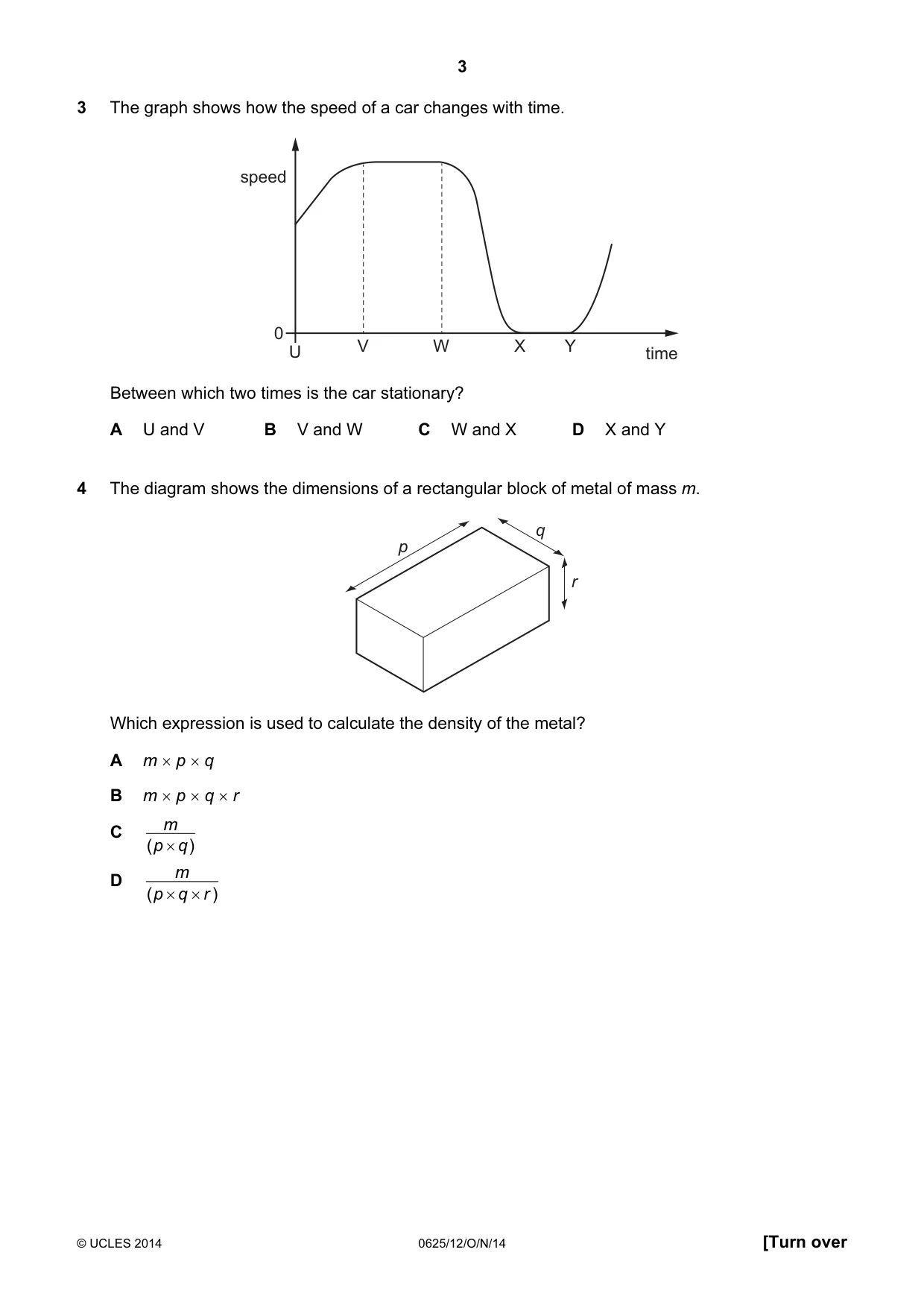
3 The graph shows how the speed of a car changes with time. speed 0 U V W X Y time Between which two times is the car stationary? A U and V B V and W C W and X D X and Y
Mark scheme: D
Q4 · The diagram shows the dimensions of a rectangular block of metal of mass m
4 The diagram shows the dimensions of a rectangular block of metal of mass m. q p r Which expression is used to calculate the density of the metal? A m × p × q B m × p × q × r C m ( p × q ) D m ( p × q × r )
Mark scheme: D
Q5 · The weight of an object is found using the balance shown in the diagram
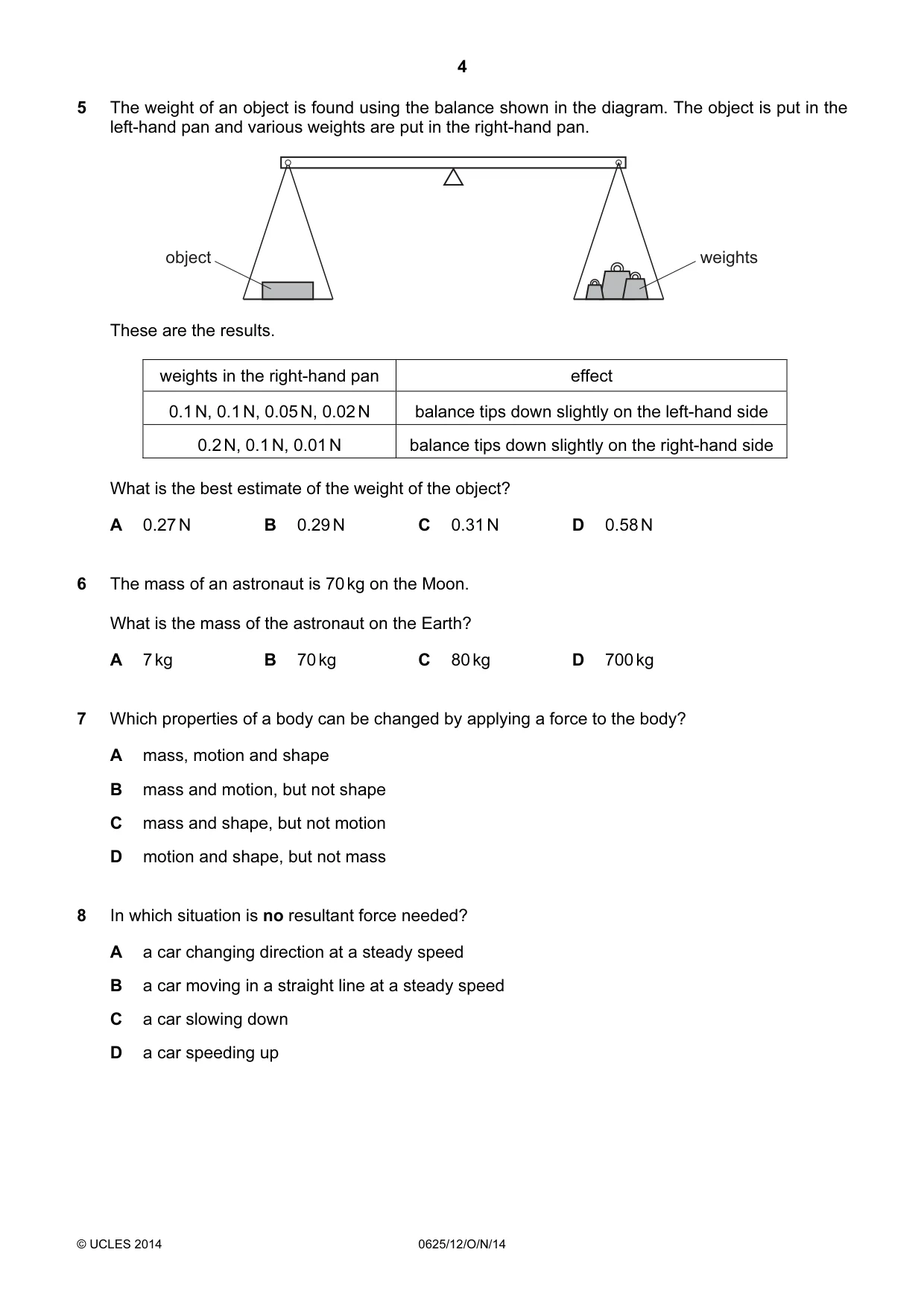
5 The weight of an object is found using the balance shown in the diagram. The object is put in the left-hand pan and various weights are put in the right-hand pan. object weights These are the results. weights in the right-hand pan effect 0.1 N, 0.1 N, 0.05 N, 0.02 N balance tips down slightly on the left-hand side 0.2 N, 0.1 N, 0.01 N balance tips down slightly on the right-hand side What is the best estimate of the weight of the object? A 0.27 N B 0.29 N C 0.31 N D 0.58 N
Mark scheme: B
Q6 · The mass of an astronaut is 70 kg on the Moon
6 The mass of an astronaut is 70 kg on the Moon. What is the mass of the astronaut on the Earth? A 7 kg B 70 kg C 80 kg D 700 kg
Mark scheme: B
Q7 · Which properties of a body can be changed by applying a force to the body?
7 Which properties of a body can be changed by applying a force to the body? A mass, motion and shape B mass and motion, but not shape C mass and shape, but not motion D motion and shape, but not mass
Mark scheme: D
Q8 · In which situation is no resultant force needed?
8 In which situation is no resultant force needed? A a car changing direction at a steady speed B a car moving in a straight line at a steady speed C a car slowing down D a car speeding up
Mark scheme: B
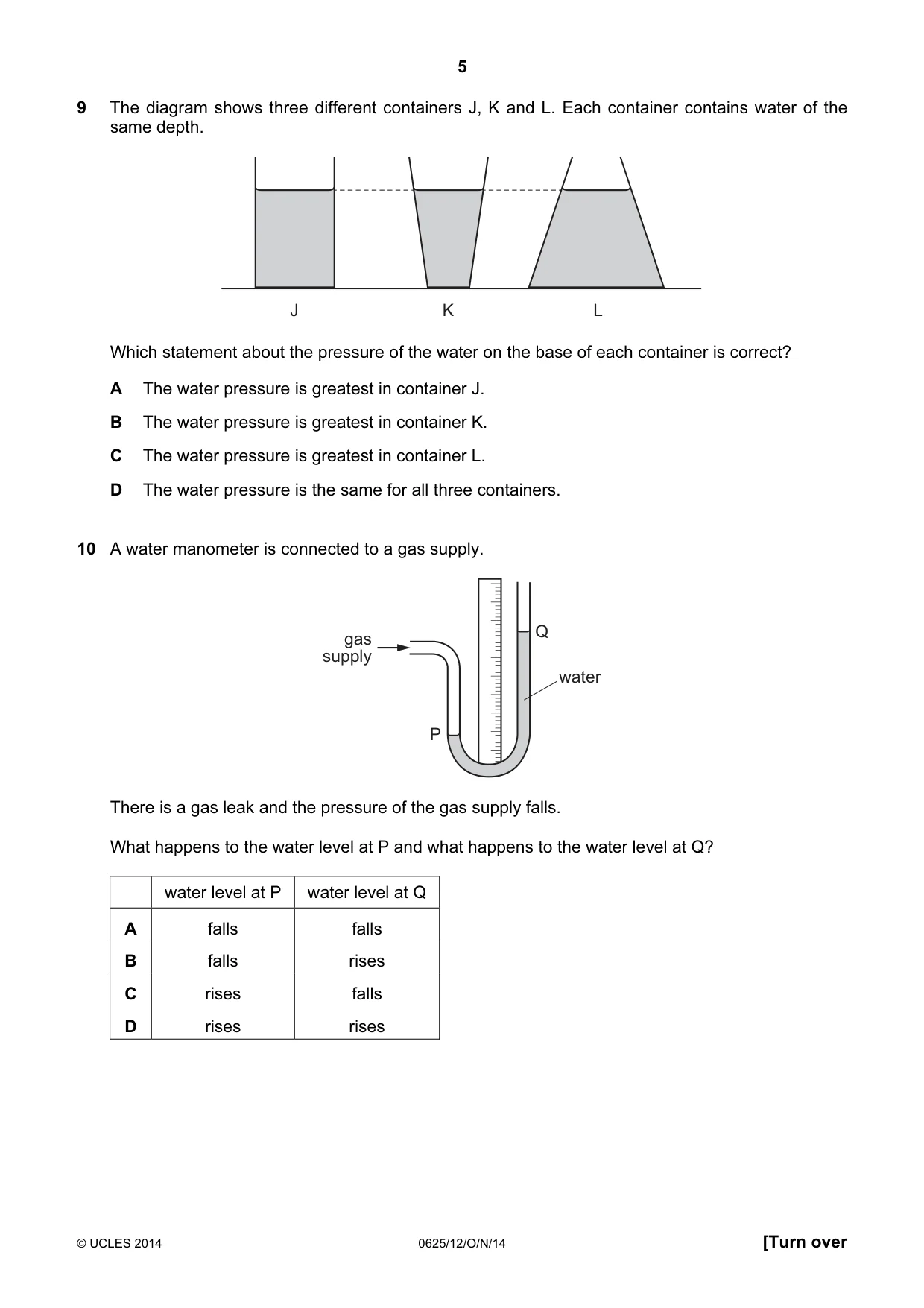
Q9 · The diagram shows three different containers J, K and L
9 The diagram shows three different containers J, K and L. Each container contains water of the same depth. J K L Which statement about the pressure of the water on the base of each container is correct? A The water pressure is greatest in container J. B The water pressure is greatest in container K. C The water pressure is greatest in container L. D The water pressure is the same for all three containers.
Mark scheme: D
Q10 · A water manometer is connected to a gas supply
10 A water manometer is connected to a gas supply. Q gas supply water P There is a gas leak and the pressure of the gas supply falls. What happens to the water level at P and what happens to the water level at Q? water level at P water level at Q A falls falls B falls rises C rises falls D rises rises
Mark scheme: C
Q11 · The list contains three energy resources P, Q and R
11 The list contains three energy resources P, Q and R. P geothermal energy from hot rocks Q nuclear fission in reactors R sunlight on solar panels Which of these resources are renewable? A P and Q only B P and R only C Q and R only D P, Q and R
Mark scheme: B
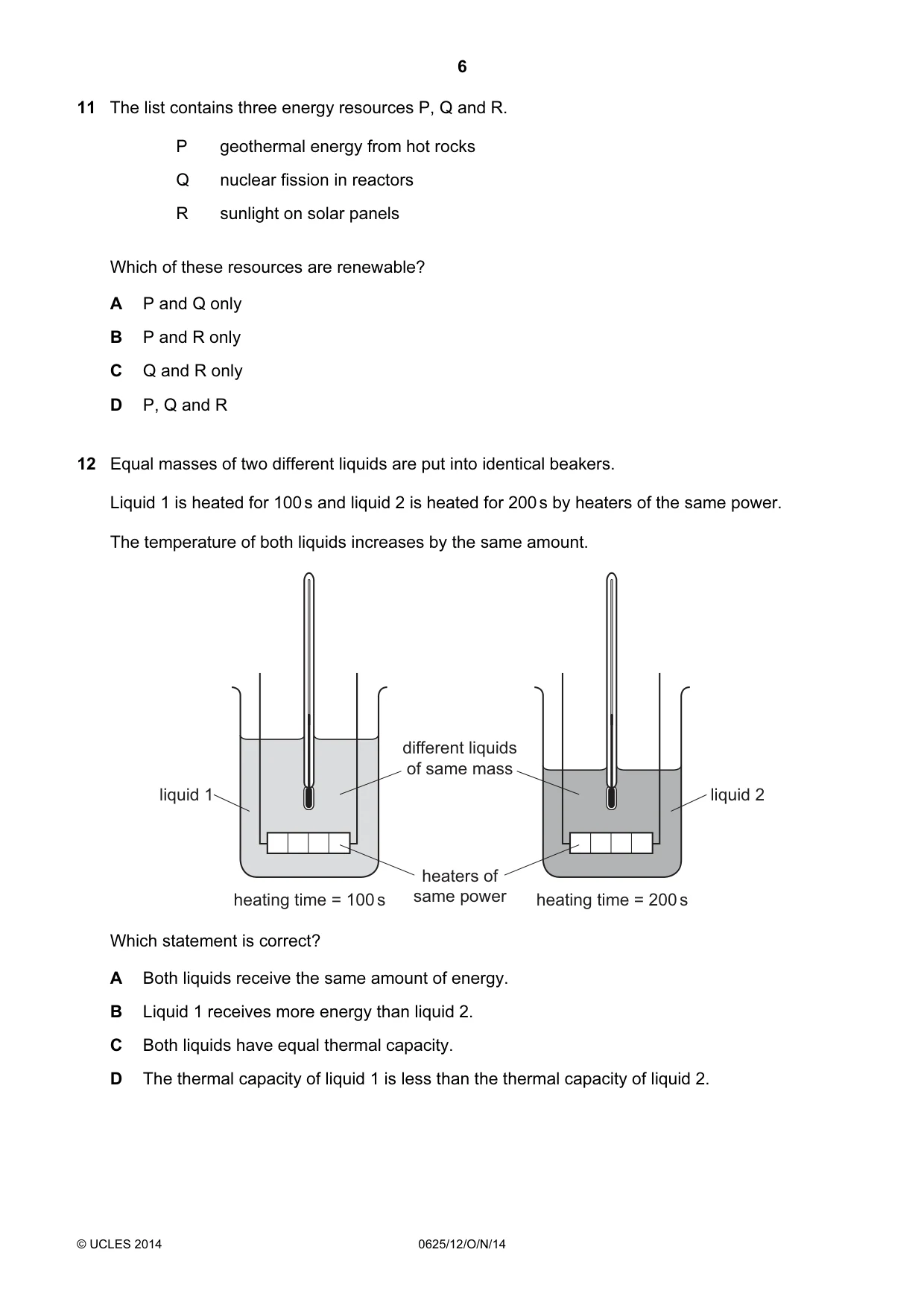
Q12 · Equal masses of two different liquids are put into identical beakers
12 Equal masses of two different liquids are put into identical beakers. Liquid 1 is heated for 100 s and liquid 2 is heated for 200 s by heaters of the same power. The temperature of both liquids increases by the same amount. different liquids of same mass liquid 1 liquid 2 heaters of heating time = 100 s same power heating time = 200 s Which statement is correct? A Both liquids receive the same amount of energy. B Liquid 1 receives more energy than liquid 2. C Both liquids have equal thermal capacity. D The thermal capacity of liquid 1 is less than the thermal capacity of liquid 2.
Mark scheme: D
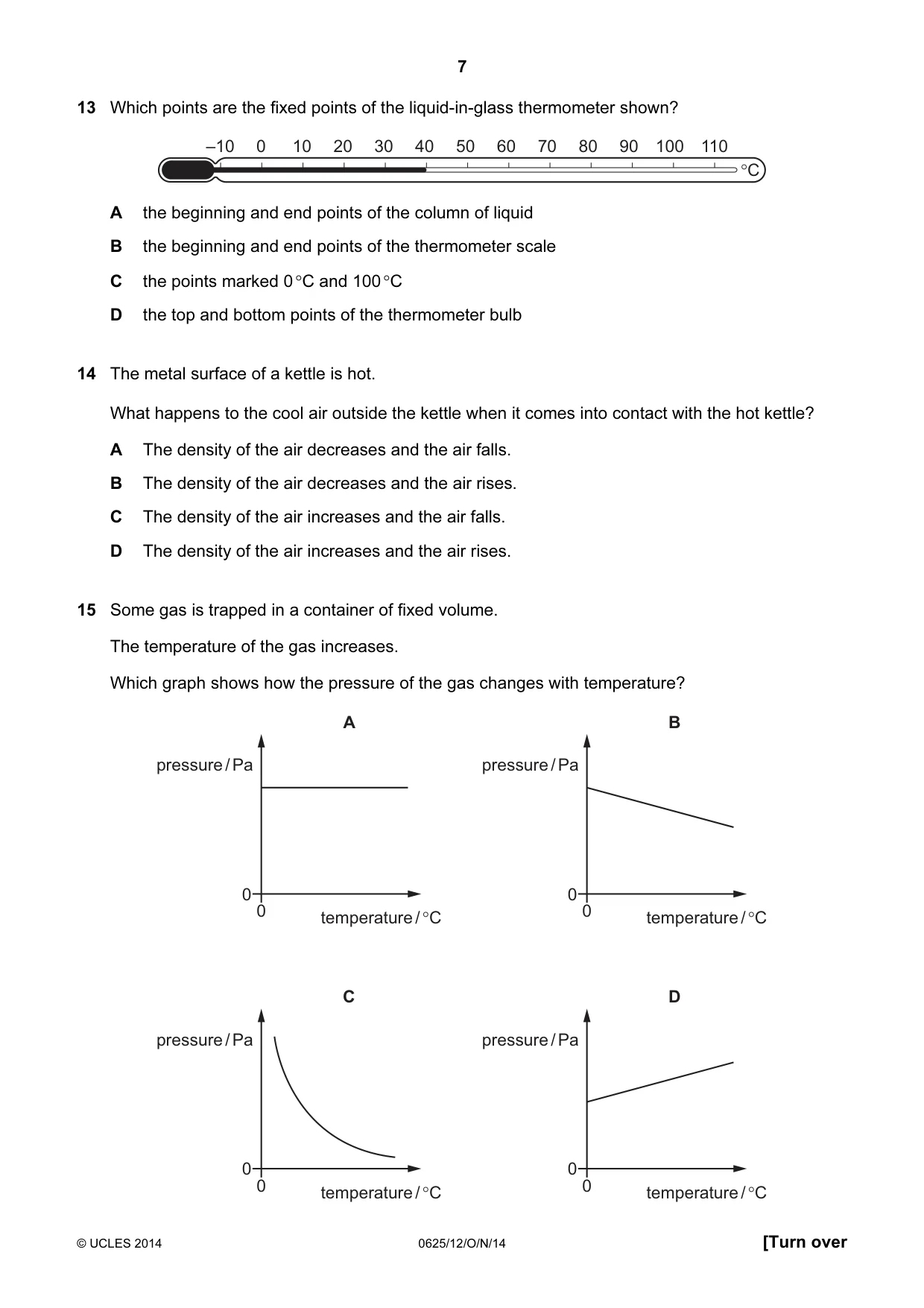
Q13 · Which points are the fixed points of the liquid-in-glass thermometer shown?
13 Which points are the fixed points of the liquid-in-glass thermometer shown? –10 0 10 20 30 40 50 60 70 80 90 100 110 °C A the beginning and end points of the column of liquid B the beginning and end points of the thermometer scale C the points marked 0 °C and 100 °C D the top and bottom points of the thermometer bulb
Mark scheme: C
Q14 · The metal surface of a kettle is hot
14 The metal surface of a kettle is hot. What happens to the cool air outside the kettle when it comes into contact with the hot kettle? A The density of the air decreases and the air falls. B The density of the air decreases and the air rises. C The density of the air increases and the air falls. D The density of the air increases and the air rises.
Mark scheme: B
Q15 · Some gas is trapped in a container of fixed volume
15 Some gas is trapped in a container of fixed volume. The temperature of the gas increases. Which graph shows how the pressure of the gas changes with temperature? A B pressure / Pa pressure / Pa 0 0 0 temperature / °C 0 temperature / °C C D pressure / Pa pressure / Pa 0 0 0 temperature / °C 0 temperature / °C
Mark scheme: D
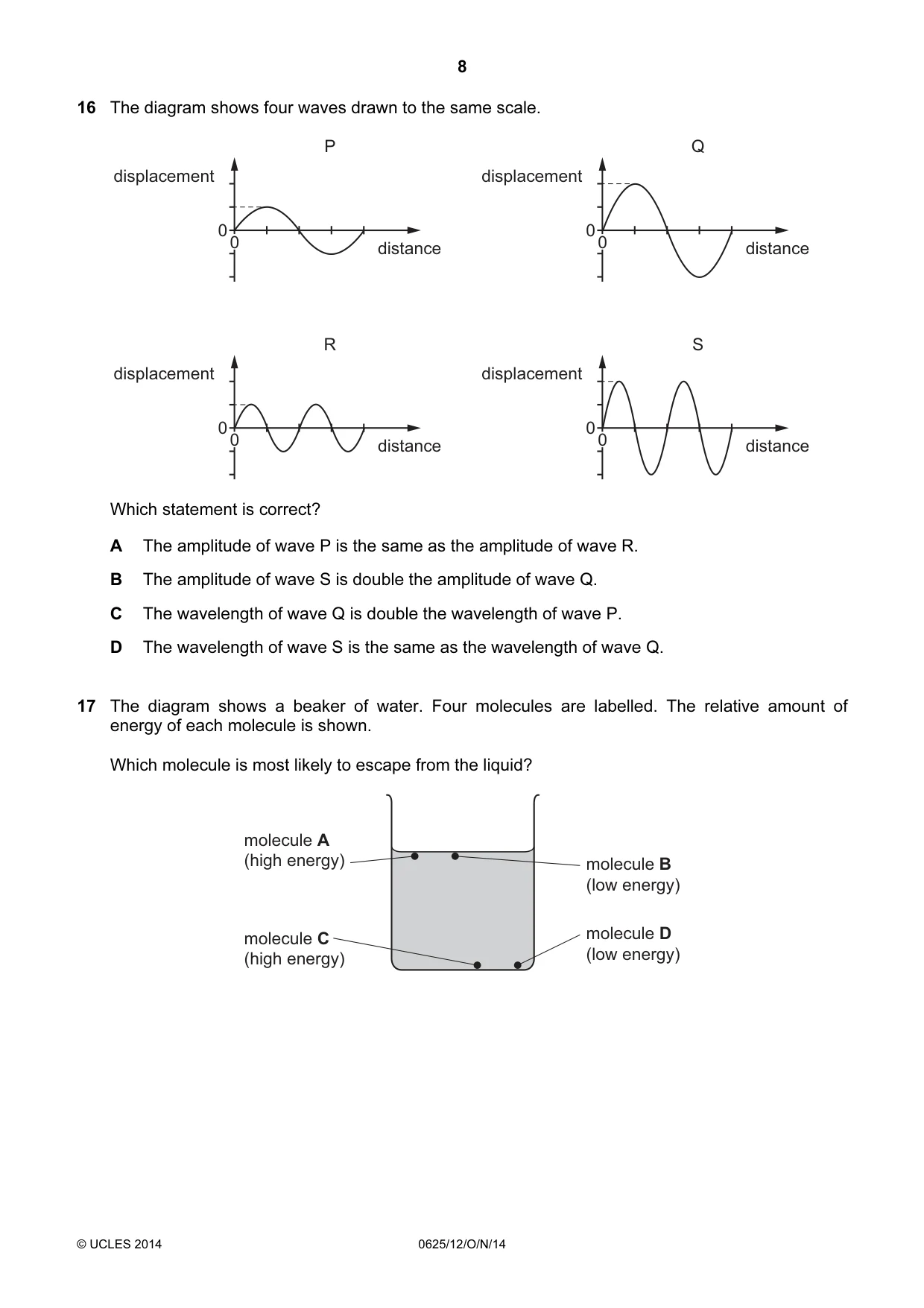
Q16 · The diagram shows four waves drawn to the same scale
16 The diagram shows four waves drawn to the same scale. P Q displacement displacement 00 00 distance distance R S displacement displacement 00 00 distance distance Which statement is correct? A The amplitude of wave P is the same as the amplitude of wave R. B The amplitude of wave S is double the amplitude of wave Q. C The wavelength of wave Q is double the wavelength of wave P. D The wavelength of wave S is the same as the wavelength of wave Q.
Mark scheme: A
Q17 · The diagram shows a beaker of water
17 The diagram shows a beaker of water. Four molecules are labelled. The relative amount of energy of each molecule is shown. Which molecule is most likely to escape from the liquid? molecule A (high energy) molecule B (low energy) molecule C molecule D (high energy) (low energy)
Mark scheme: A
Q18 · One type of double glazing consists of two panes of glass separated by a vacuum
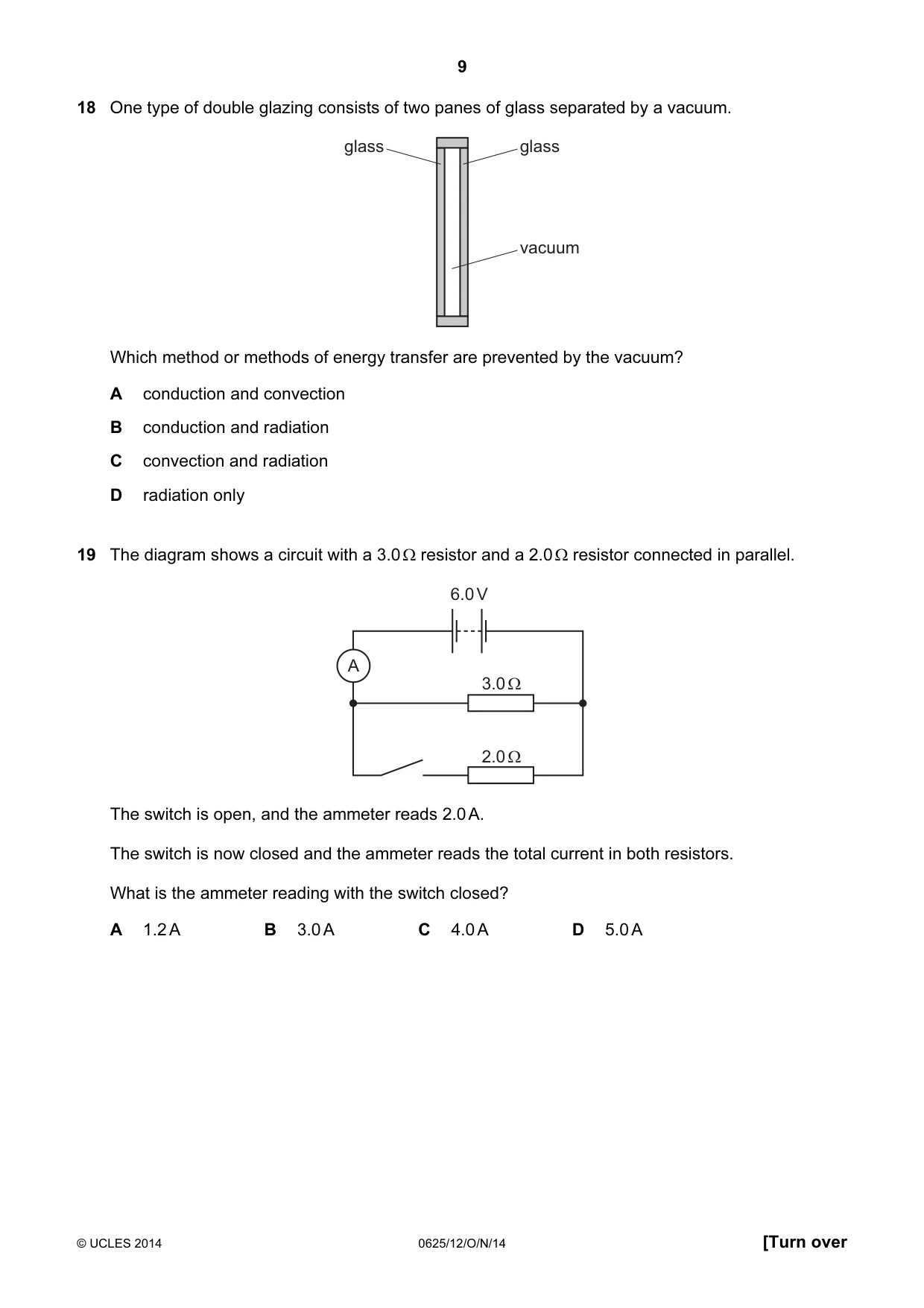
18 One type of double glazing consists of two panes of glass separated by a vacuum. glass glass vacuum Which method or methods of energy transfer are prevented by the vacuum? A conduction and convection B conduction and radiation C convection and radiation D radiation only
Mark scheme: A
Q19 · The diagram shows a circuit with a 3.0 Ω resistor and a 2.0 Ω resistor connected in…
19 The diagram shows a circuit with a 3.0 Ω resistor and a 2.0 Ω resistor connected in parallel. 6.0 V A 3.0 Ω 2.0 Ω The switch is open, and the ammeter reads 2.0 A. The switch is now closed and the ammeter reads the total current in both resistors. What is the ammeter reading with the switch closed? A 1.2 A B 3.0 A C 4.0 A D 5.0 A
Mark scheme: D
Q20 · The diagram shows cables used in the transmission of electrical energy
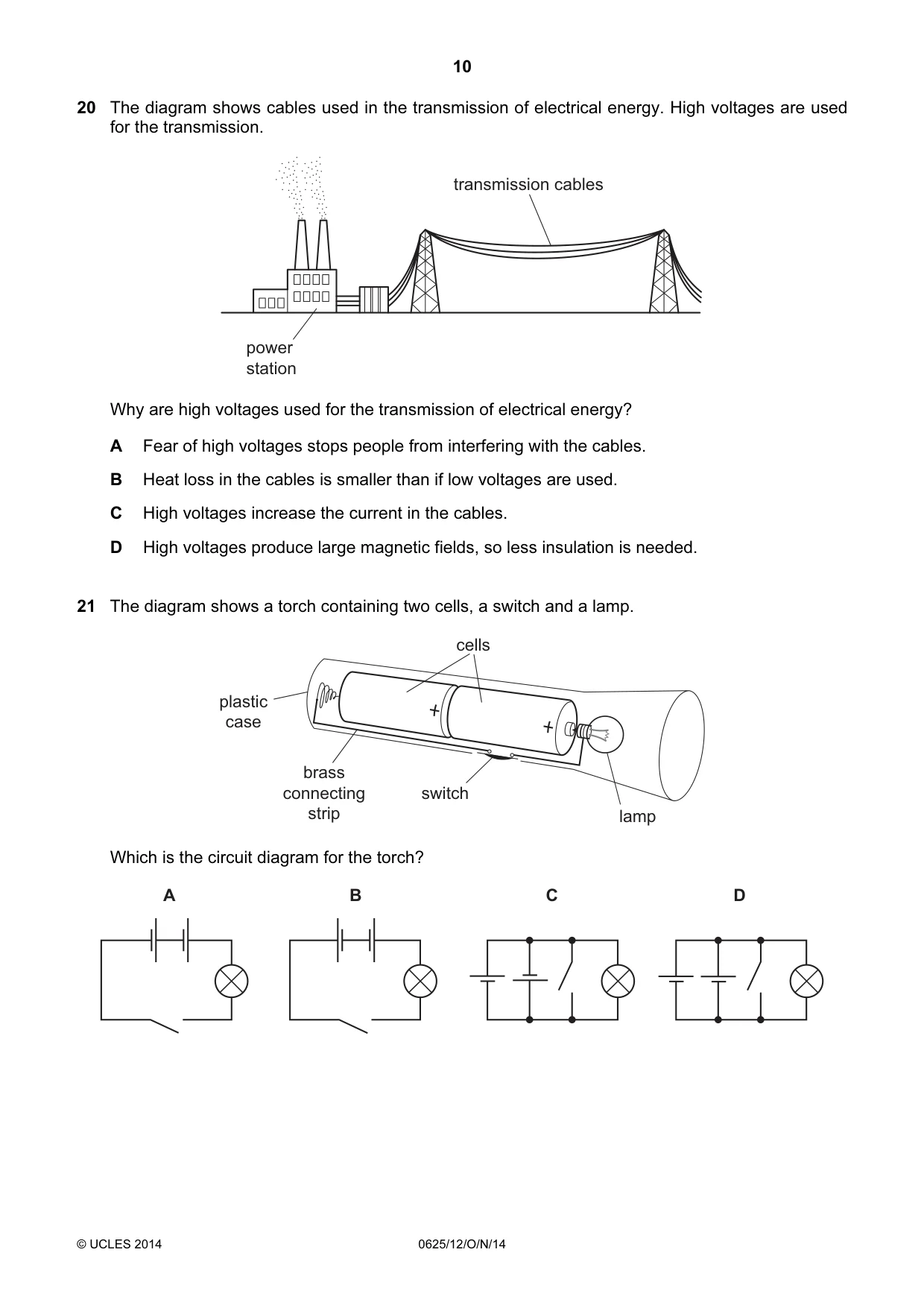
20 The diagram shows cables used in the transmission of electrical energy. High voltages are used for the transmission. transmission cables power station Why are high voltages used for the transmission of electrical energy? A Fear of high voltages stops people from interfering with the cables. B Heat loss in the cables is smaller than if low voltages are used. C High voltages increase the current in the cables. D High voltages produce large magnetic fields, so less insulation is needed.
Mark scheme: B
Q21 · The diagram shows a torch containing two cells, a switch and a lamp
21 The diagram shows a torch containing two cells, a switch and a lamp. cells plastic case brass connecting switch strip lamp Which is the circuit diagram for the torch? A B C D
Mark scheme: A
Q22 · Which diagram shows the magnetic field pattern around a wire that is carrying a current…
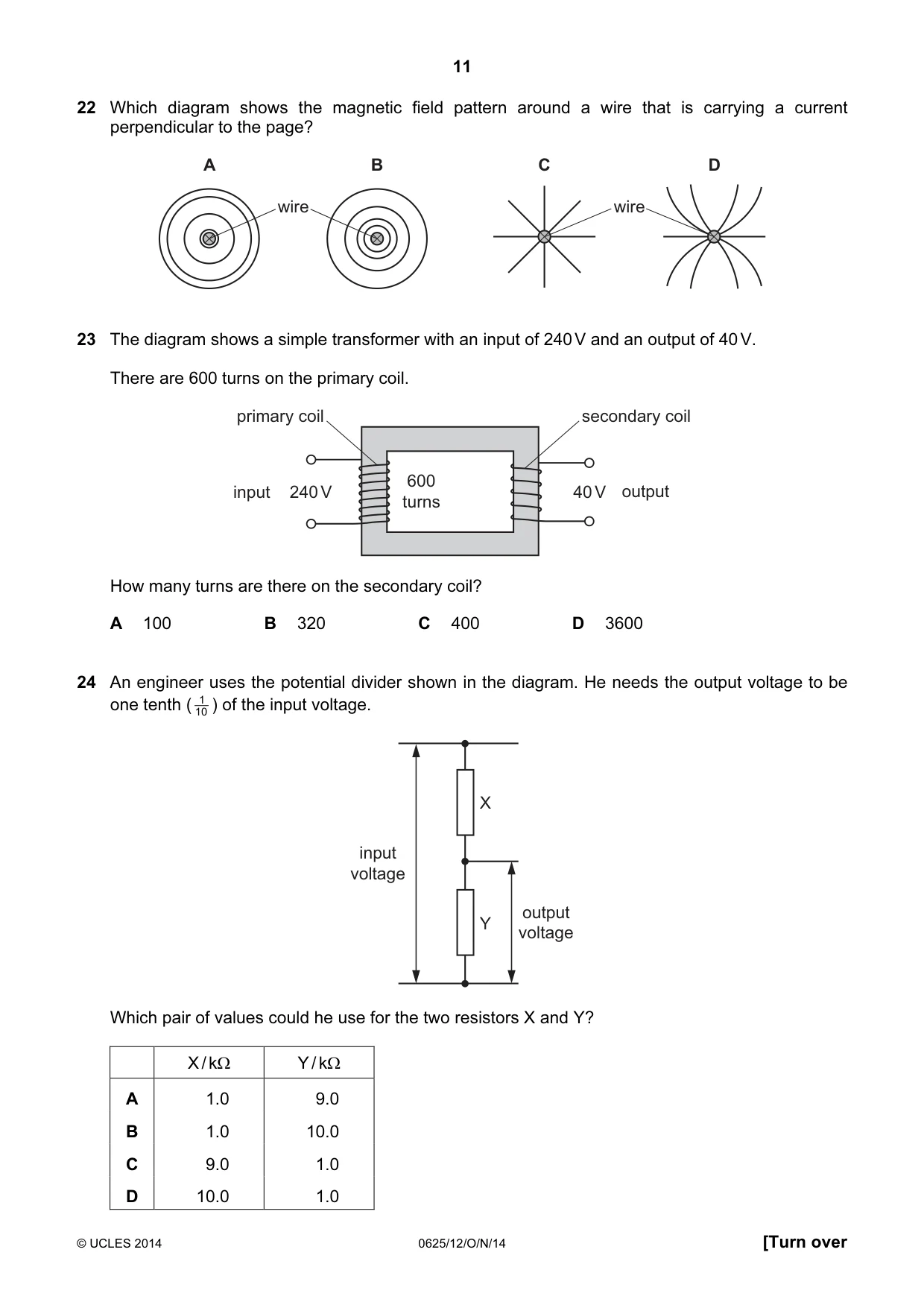
22 Which diagram shows the magnetic field pattern around a wire that is carrying a current perpendicular to the page? A B C D wire wire
Mark scheme: B
Q23 · The diagram shows a simple transformer with an input of 240 V and an output of 40 V
23 The diagram shows a simple transformer with an input of 240 V and an output of 40 V. There are 600 turns on the primary coil. primary coil secondary coil 600 input 240 V 40 V output turns How many turns are there on the secondary coil? A 100 B 320 C 400 D 3600
Mark scheme: A
Q24 · An engineer uses the potential divider shown in the diagram
24 An engineer uses the potential divider shown in the diagram. He needs the output voltage to be one tenth ( 10 1 ) of the input voltage. X input voltage output Y voltage Which pair of values could he use for the two resistors X and Y? X / kΩ Y / kΩ A 1.0 9.0 B 1.0 10.0 C 9.0 1.0 D 10.0 1.0
Mark scheme: C
Q25 · The current in a kettle is 10 A and it is protected by a 13 A fuse
25 The current in a kettle is 10 A and it is protected by a 13 A fuse. The owner of the kettle replaces the 13 A fuse with a 3 A fuse. What happens when the kettle is switched on? A The fuse blows and the kettle is damaged. B The fuse blows and the kettle is undamaged. C The fuse does not blow and the kettle works correctly. D The fuse does not blow but the kettle fails to work.
Mark scheme: B
Q26 · Which waves are longitudinal?
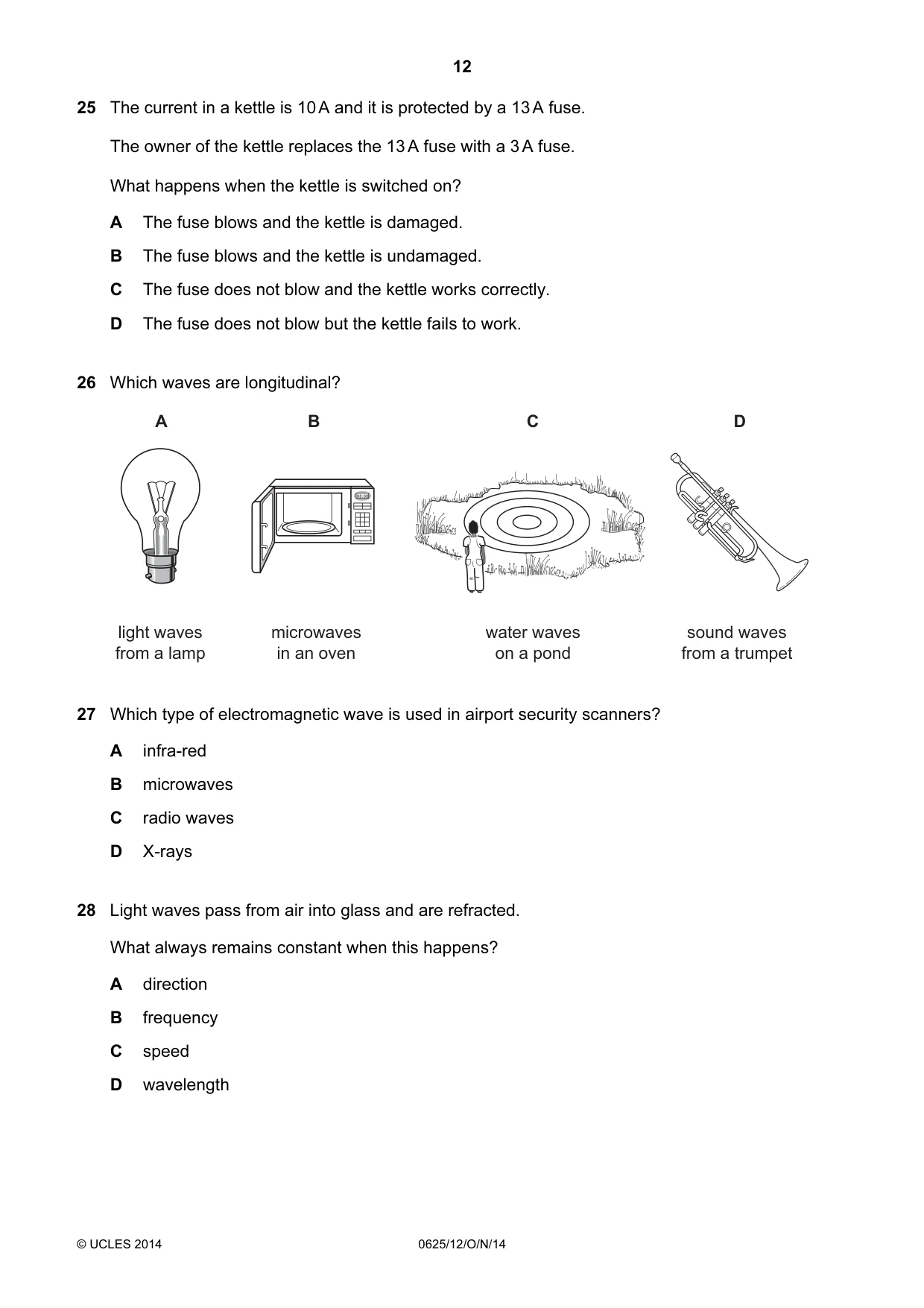
26 Which waves are longitudinal? A B C D 88:88 light waves microwaves water waves sound waves from a lamp in an oven on a pond from a trumpet
Mark scheme: D
Q27 · Which type of electromagnetic wave is used in airport security scanners?
27 Which type of electromagnetic wave is used in airport security scanners? A infra-red B microwaves C radio waves D X-rays
Mark scheme: D
Q28 · Light waves pass from air into glass and are refracted
28 Light waves pass from air into glass and are refracted. What always remains constant when this happens? A direction B frequency C speed D wavelength
Mark scheme: B
Q29 · In an experiment to measure the speed of sound, a student uses a stopwatch to find the…
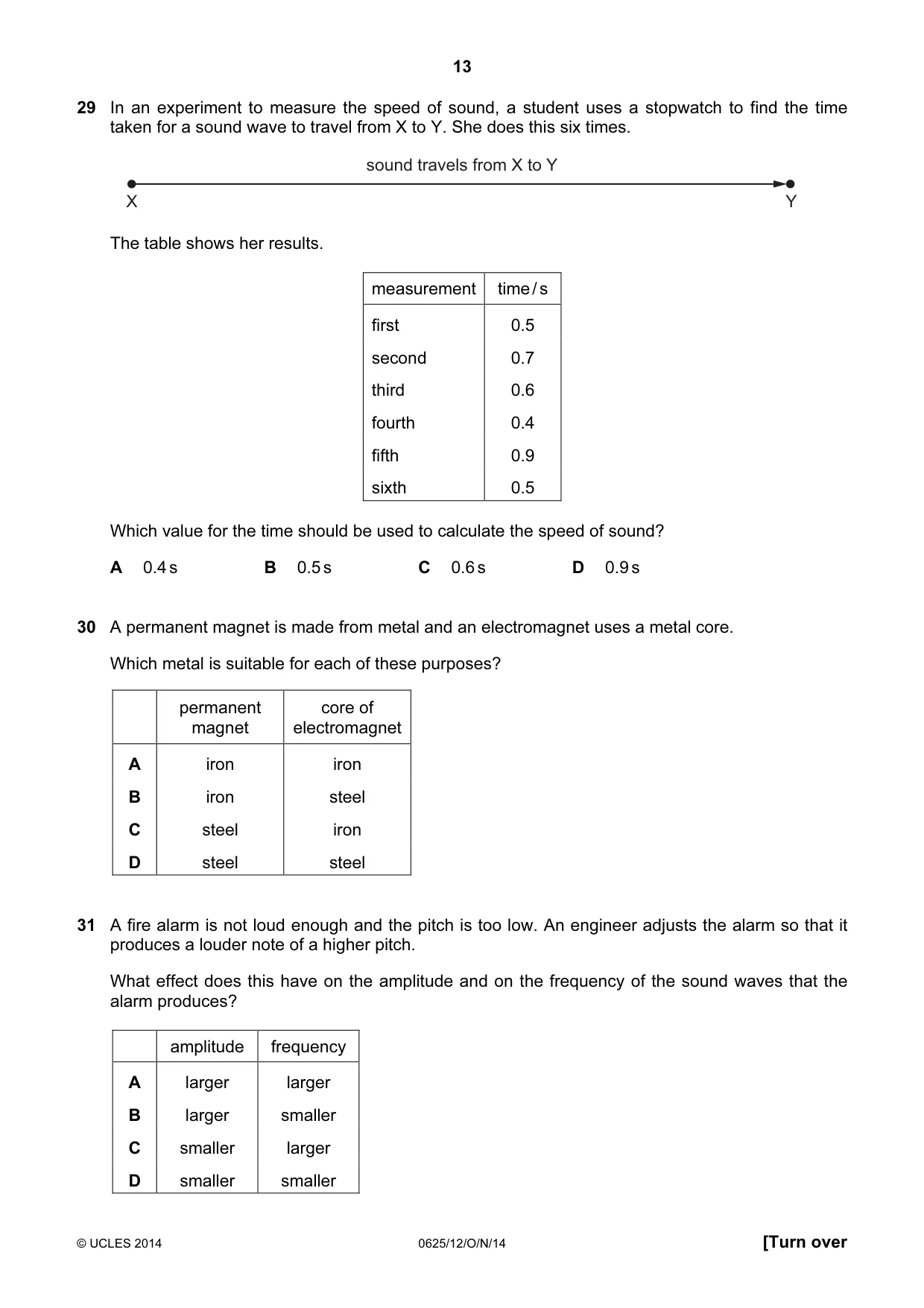
29 In an experiment to measure the speed of sound, a student uses a stopwatch to find the time taken for a sound wave to travel from X to Y. She does this six times. sound travels from X to Y X Y The table shows her results. measurement time / s first 0.5 second 0.7 third 0.6 fourth 0.4 fifth 0.9 sixth 0.5 Which value for the time should be used to calculate the speed of sound? A 0.4 s B 0.5 s C 0.6 s D 0.9 s
Mark scheme: C
Q30 · A permanent magnet is made from metal and an electromagnet uses a metal core
30 A permanent magnet is made from metal and an electromagnet uses a metal core. Which metal is suitable for each of these purposes? permanent core of magnet electromagnet A iron iron B iron steel C steel iron D steel steel
Mark scheme: C
Q31 · A fire alarm is not loud enough and the pitch is too low
31 A fire alarm is not loud enough and the pitch is too low. An engineer adjusts the alarm so that it produces a louder note of a higher pitch. What effect does this have on the amplitude and on the frequency of the sound waves that the alarm produces? amplitude frequency A larger larger B larger smaller C smaller larger D smaller smaller
Mark scheme: A
Q32 · Which row gives the unit for energy and the unit for electromotive force (e.m.f.)?
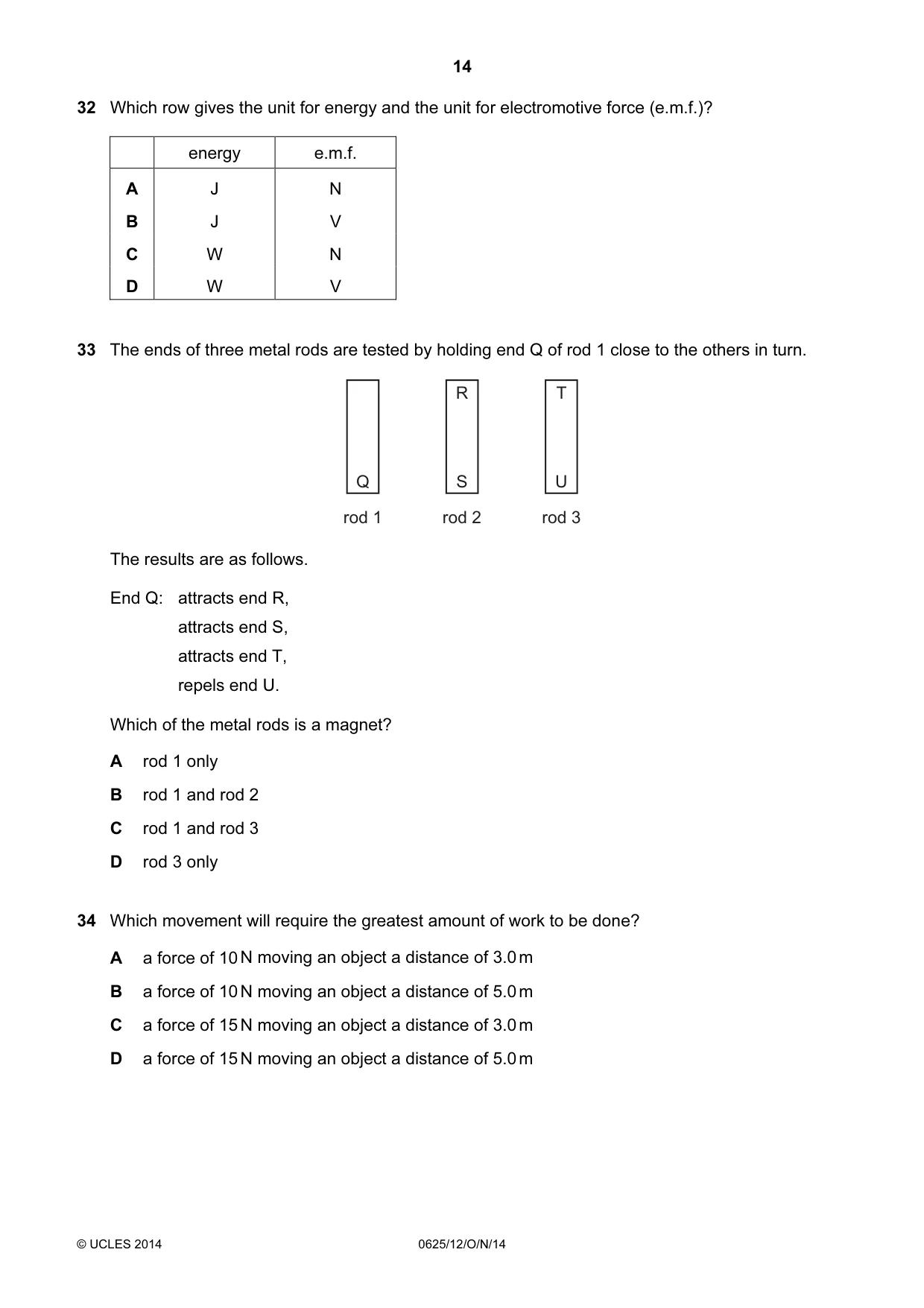
32 Which row gives the unit for energy and the unit for electromotive force (e.m.f.)? energy e.m.f. A J N B J V C W N D W V
Mark scheme: B
Q33 · The ends of three metal rods are tested by holding end Q of rod 1 close to the others in…
33 The ends of three metal rods are tested by holding end Q of rod 1 close to the others in turn. R T Q S U rod 1 rod 2 rod 3 The results are as follows. End Q: attracts end R, attracts end S, attracts end T, repels end U. Which of the metal rods is a magnet? A rod 1 only B rod 1 and rod 2 C rod 1 and rod 3 D rod 3 only
Mark scheme: C
Q34 · Which movement will require the greatest amount of work to be done?
34 Which movement will require the greatest amount of work to be done? A a force of 10 N moving an object a distance of 3.0 m B a force of 10 N moving an object a distance of 5.0 m C a force of 15 N moving an object a distance of 3.0 m D a force of 15 N moving an object a distance of 5.0 m
Mark scheme: D
Q35 · An object is placed in front of a converging lens
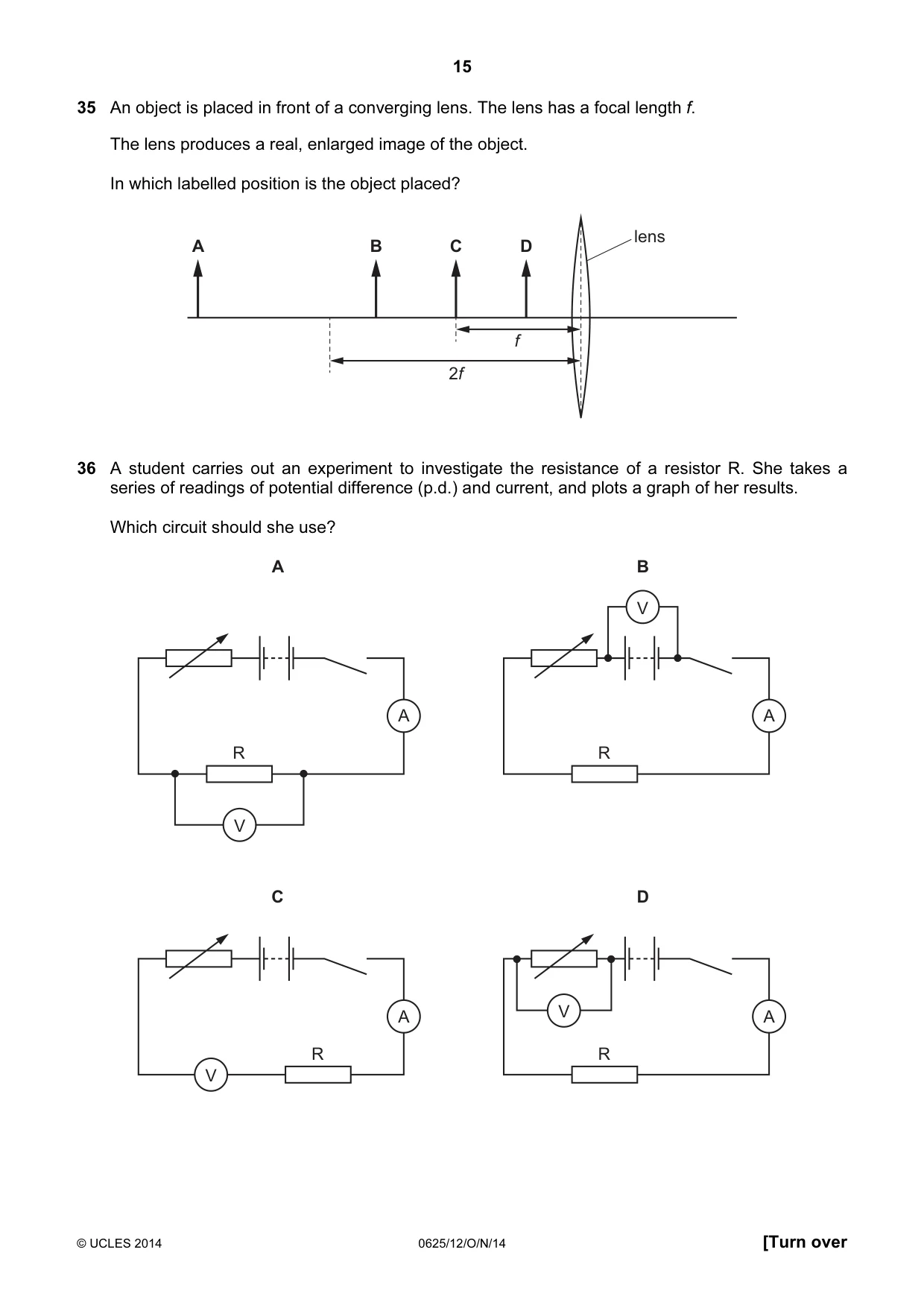
35 An object is placed in front of a converging lens. The lens has a focal length f. The lens produces a real, enlarged image of the object. In which labelled position is the object placed? lens A B C D f 2f
Mark scheme: B
Q36 · A student carries out an experiment to investigate the resistance of a resistor R
36 A student carries out an experiment to investigate the resistance of a resistor R. She takes a series of readings of potential difference (p.d.) and current, and plots a graph of her results. Which circuit should she use? A B V A A R R V C D A V A R R V
Mark scheme: A
Q37 · The diagram shows a radioactive source, a thick aluminium sheet and a radiation detector
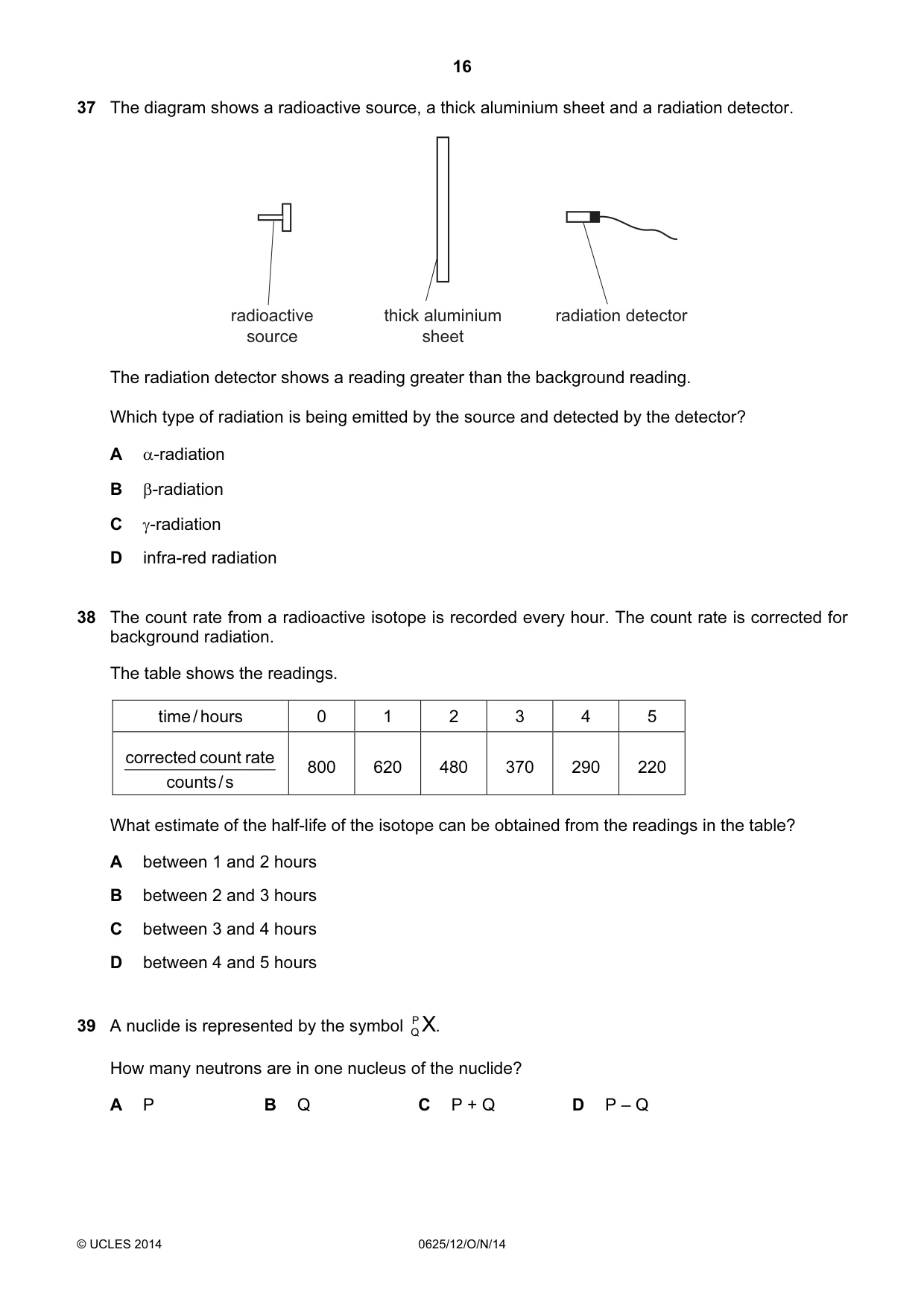
37 The diagram shows a radioactive source, a thick aluminium sheet and a radiation detector. radioactive thick aluminium radiation detector source sheet The radiation detector shows a reading greater than the background reading. Which type of radiation is being emitted by the source and detected by the detector? A α-radiation B β-radiation C γ-radiation D infra-red radiation
Mark scheme: C
Q38 · The count rate from a radioactive isotope is recorded every hour
38 The count rate from a radioactive isotope is recorded every hour. The count rate is corrected for background radiation. The table shows the readings. time / hours 0 1 2 3 4 5 corrected count rate 800 620 480 370 290 220 counts / s What estimate of the half-life of the isotope can be obtained from the readings in the table? A between 1 and 2 hours B between 2 and 3 hours C between 3 and 4 hours D between 4 and 5 hours
Mark scheme: B
Q39 · A nuclide is represented by the symbol P X
39 A nuclide is represented by the symbol P X . Q How many neutrons are in one nucleus of the nuclide? A P B Q C P + Q D P – Q
Mark scheme: D
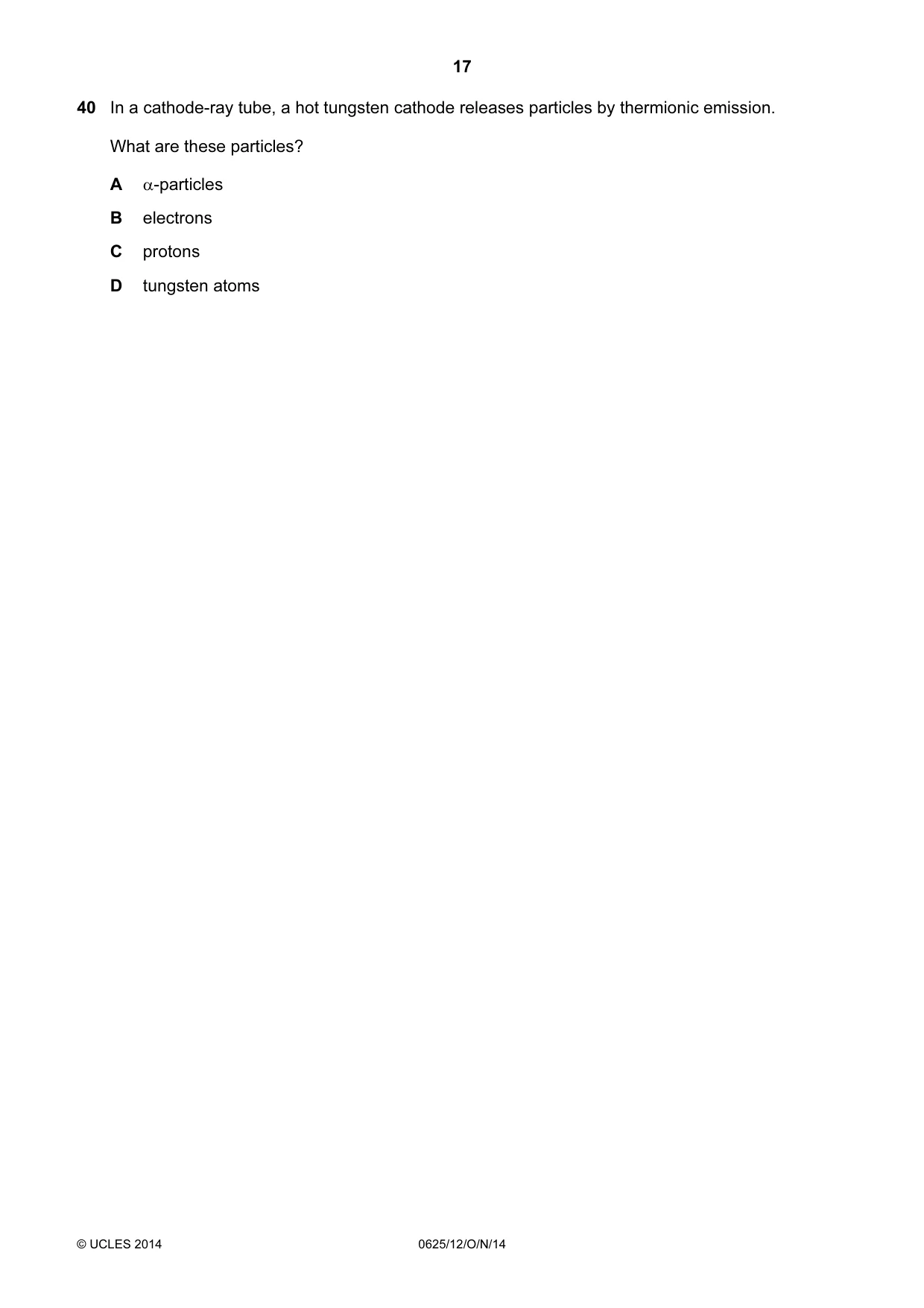
Q40 · In a cathode-ray tube, a hot tungsten cathode releases particles by thermionic emission
40 In a cathode-ray tube, a hot tungsten cathode releases particles by thermionic emission. What are these particles? A α-particles B electrons C protons D tungsten atoms
Mark scheme: B
What was in this paper
The subtopics covered by these 40 questions, and how many questions each got. Open one in a new tab to see every Cambridge question on it.
4Electromagnetic effects3Sound3Energy, work and power2Forces2Kinetic particle model of matter2Light2Mass and weight2Motion2Pressure2Radioactivity2Simple phenomena of magnetism2The nuclear model of the atom2Thermal properties and temperature2Transfer of thermal energy2Density1Electrical quantities1Electrical safety1Electromagnetic spectrum1General properties of waves1Physical quantities and measurement techniques1What you needed in this session
Cambridge’s own grade thresholds for 2014 Oct/Nov, Paper 1 · Variant 2. A higher threshold means an easier paper — the bar moves with how the cohort did.