Cambridge IGCSE Physics 0625 — 2019 Feb/March Paper 1 · Variant 2
0625/12/F/M/19 · 40 questions · 40 marks · ≈45 min
The question paper and its mark scheme, free to read here and free to download. This is Cambridge’s own paper, exactly as it was sat.
Question paper16 pages
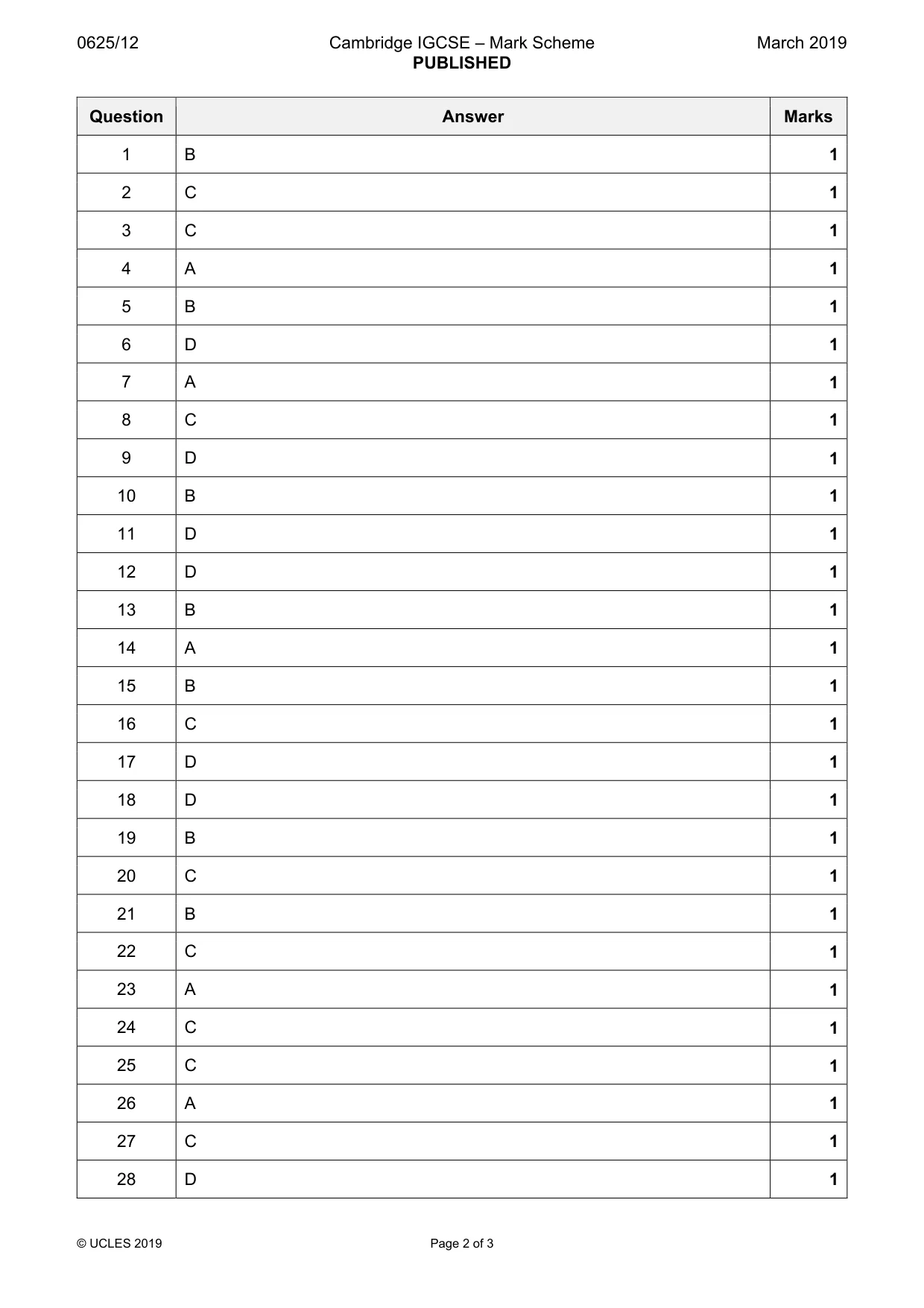
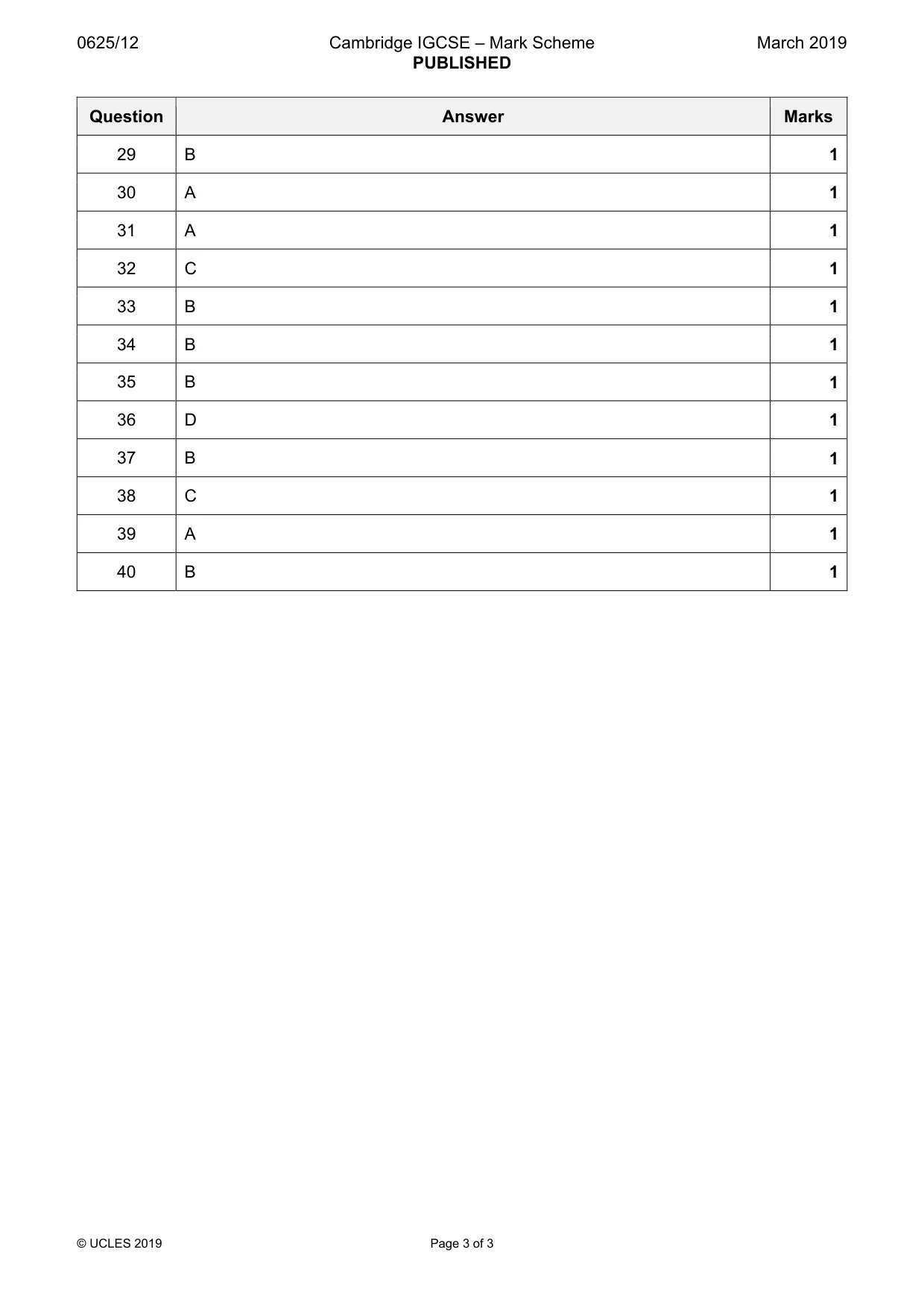
Mark scheme3 pages
Answers below. Sit the paper first if you are practising.
Questions as text
Q1 · Water drips from a tap into a measuring cylinder
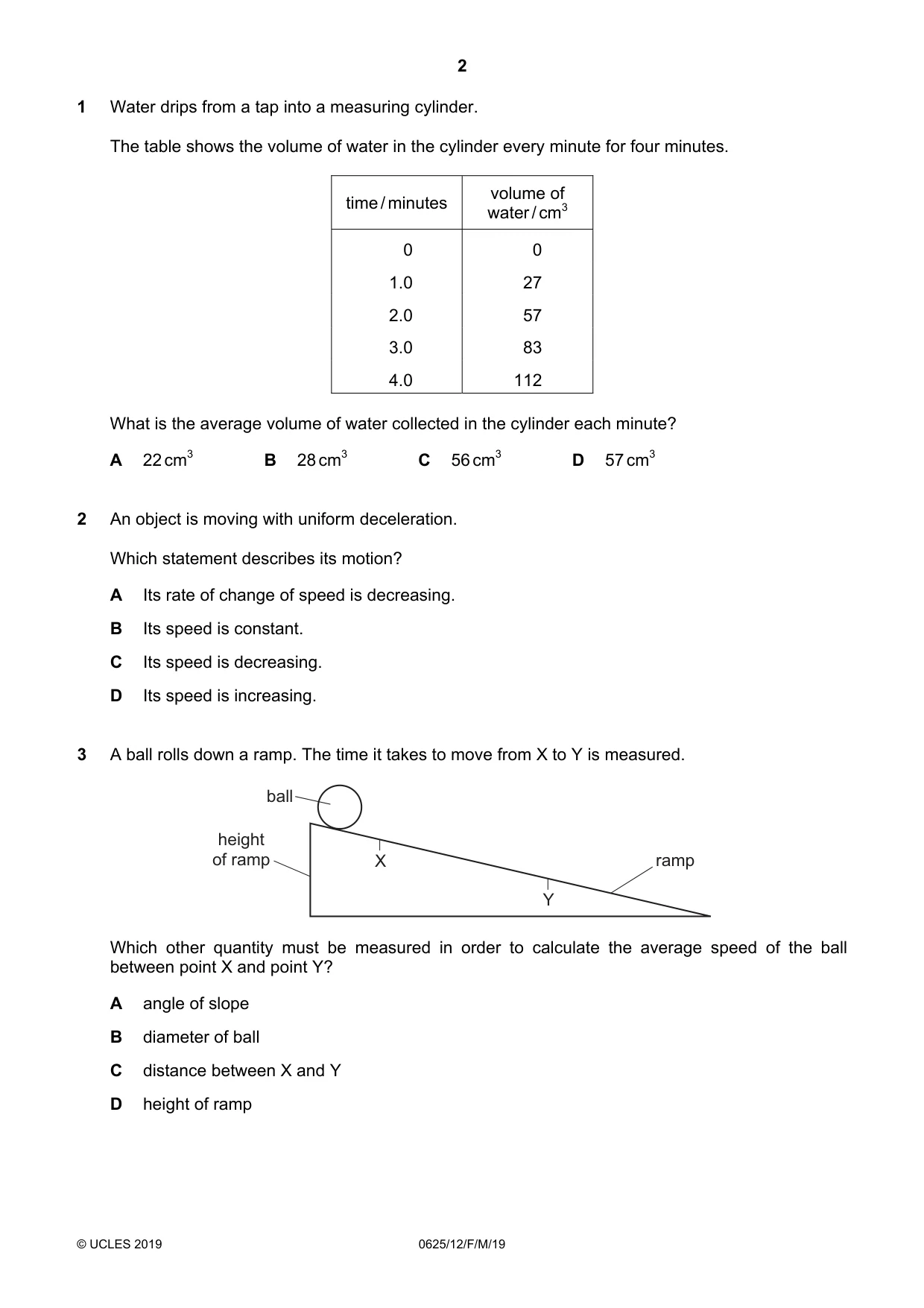
1 Water drips from a tap into a measuring cylinder. The table shows the volume of water in the cylinder every minute for four minutes. volume of time / minutes water / cm3 0 0 1.0 27 2.0 57 3.0 83 4.0 112 What is the average volume of water collected in the cylinder each minute? A 22 cm3 B 28 cm3 C 56 cm3 D 57 cm3
Mark scheme: B
More questions on Physical quantities and measurement techniques
Q2 · An object is moving with uniform deceleration
2 An object is moving with uniform deceleration. Which statement describes its motion? A Its rate of change of speed is decreasing. B Its speed is constant. C Its speed is decreasing. D Its speed is increasing.
Mark scheme: C
Q3 · A ball rolls down a ramp
3 A ball rolls down a ramp. The time it takes to move from X to Y is measured. ball height of ramp X ramp Y Which other quantity must be measured in order to calculate the average speed of the ball between point X and point Y? A angle of slope B diameter of ball C distance between X and Y D height of ramp
Mark scheme: C
Q4 · An astronaut in a space station orbits above the Earth
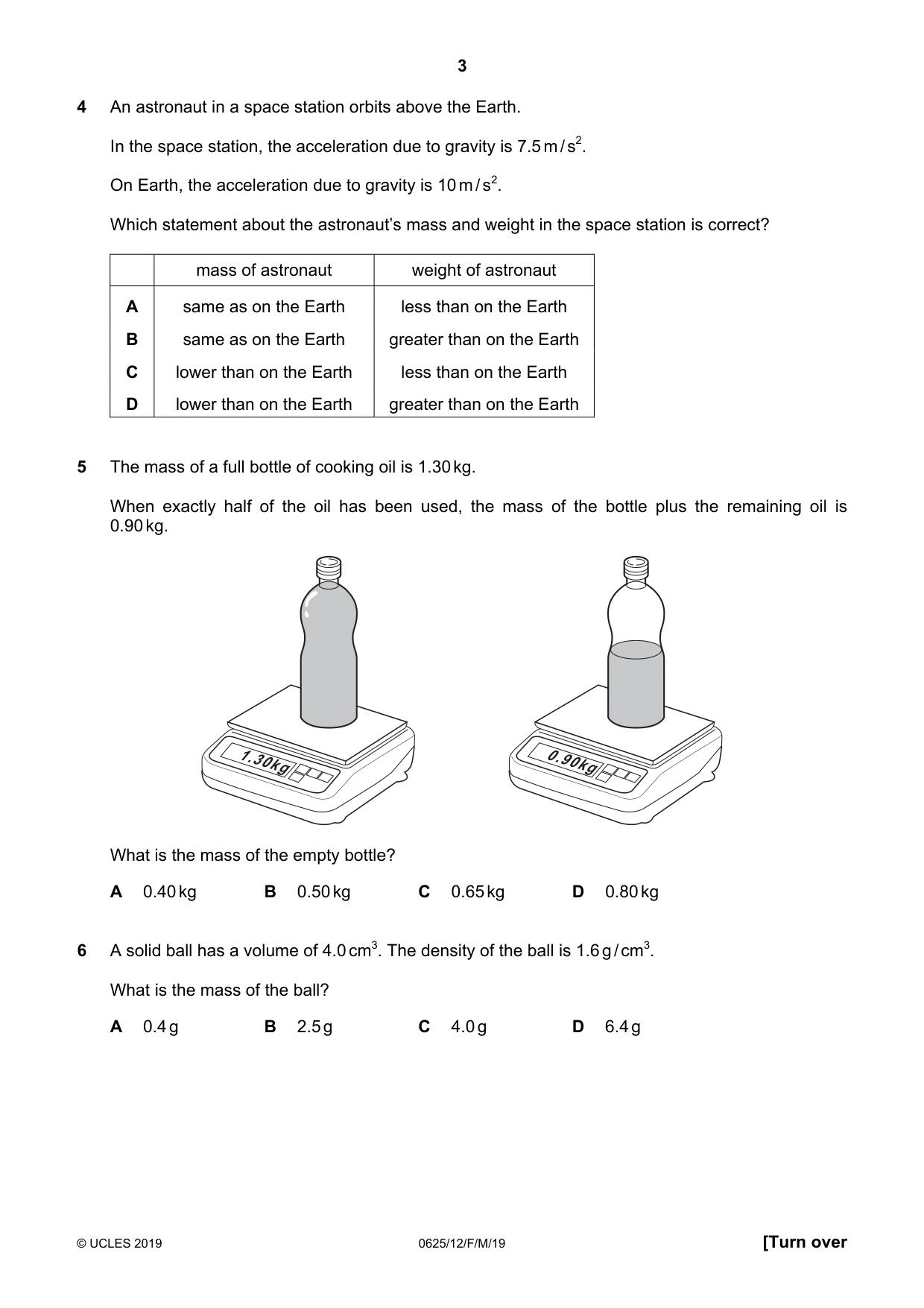
4 An astronaut in a space station orbits above the Earth. In the space station, the acceleration due to gravity is 7.5 m / s2. On Earth, the acceleration due to gravity is 10 m / s2. Which statement about the astronaut’s mass and weight in the space station is correct? mass of astronaut weight of astronaut A same as on the Earth less than on the Earth B same as on the Earth greater than on the Earth C lower than on the Earth less than on the Earth D lower than on the Earth greater than on the Earth
Mark scheme: A
Q5 · The mass of a full bottle of cooking oil is 1.30 kg
5 The mass of a full bottle of cooking oil is 1.30 kg. When exactly half of the oil has been used, the mass of the bottle plus the remaining oil is 0.90 kg. 1.30kg 0.90kg What is the mass of the empty bottle? A 0.40 kg B 0.50 kg C 0.65 kg D 0.80 kg
Mark scheme: B
Q6 · A solid ball has a volume of 4.0 cm3
6 A solid ball has a volume of 4.0 cm3. The density of the ball is 1.6 g / cm3. What is the mass of the ball? A 0.4 g B 2.5 g C 4.0 g D 6.4 g
Mark scheme: D
Q7 · Which property of an object cannot be changed by applying forces?
7 Which property of an object cannot be changed by applying forces? A mass B shape C speed D volume
Mark scheme: A
Q8 · The extension / load graph for a spring is shown
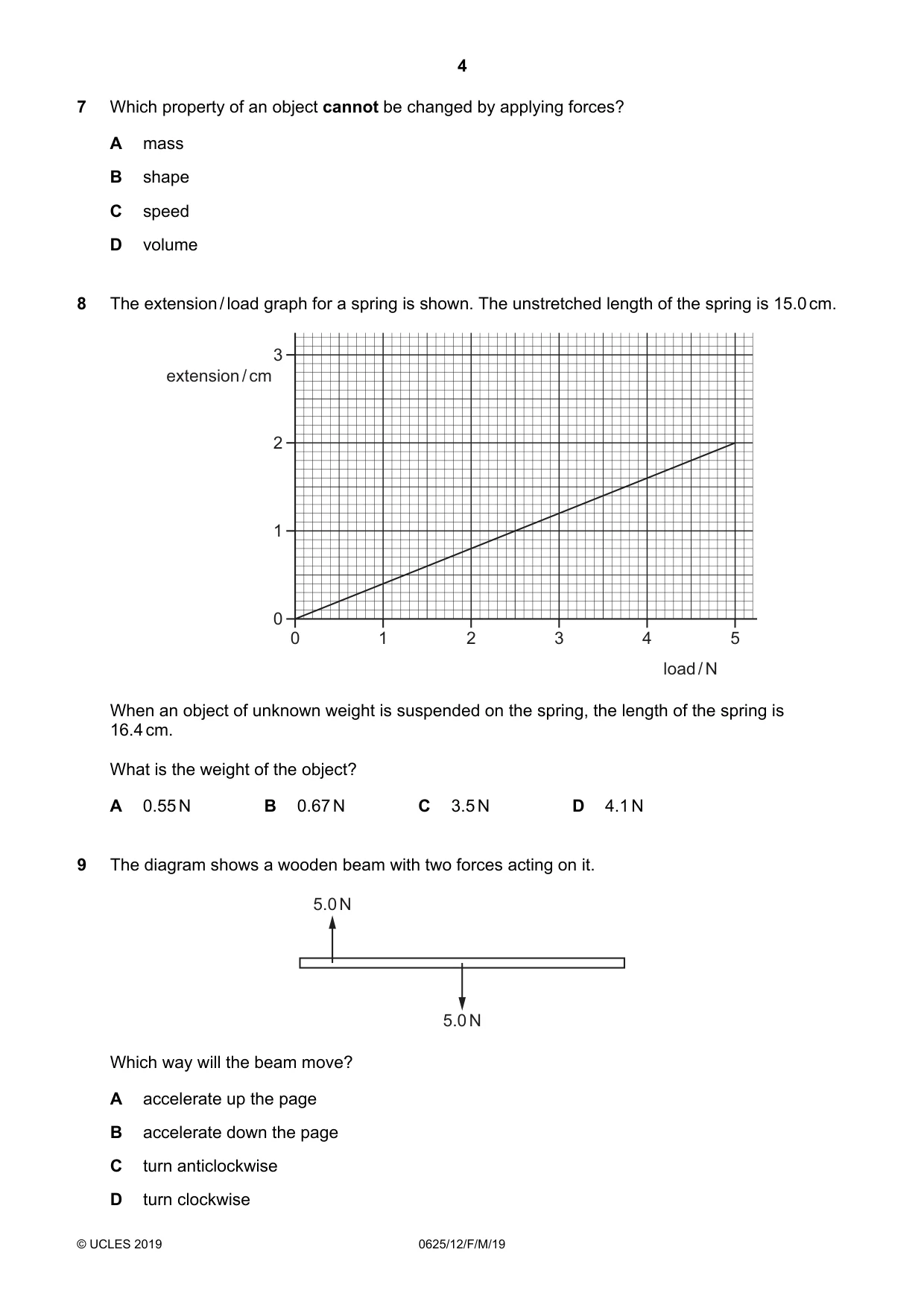
8 The extension / load graph for a spring is shown. The unstretched length of the spring is 15.0 cm. 3 extension / cm 2 1 0 0 1 2 3 4 5 load / N When an object of unknown weight is suspended on the spring, the length of the spring is 16.4 cm. What is the weight of the object? A 0.55 N B 0.67 N C 3.5 N D 4.1 N
Mark scheme: C
Q9 · The diagram shows a wooden beam with two forces acting on it
9 The diagram shows a wooden beam with two forces acting on it. 5.0 N 5.0 N Which way will the beam move? A accelerate up the page B accelerate down the page C turn anticlockwise D turn clockwise
Mark scheme: D
Q10 · Which source of energy uses the production of steam to generate electrical energy?
10 Which source of energy uses the production of steam to generate electrical energy? A hydroelectric B nuclear C tides D waves
Mark scheme: B
Q11 · What is the unit of power?
11 What is the unit of power? A joule B newton C pascal D watt
Mark scheme: D
Q12 · The diagram shows a U-tube manometer containing three liquids: mercury, liquid X and…
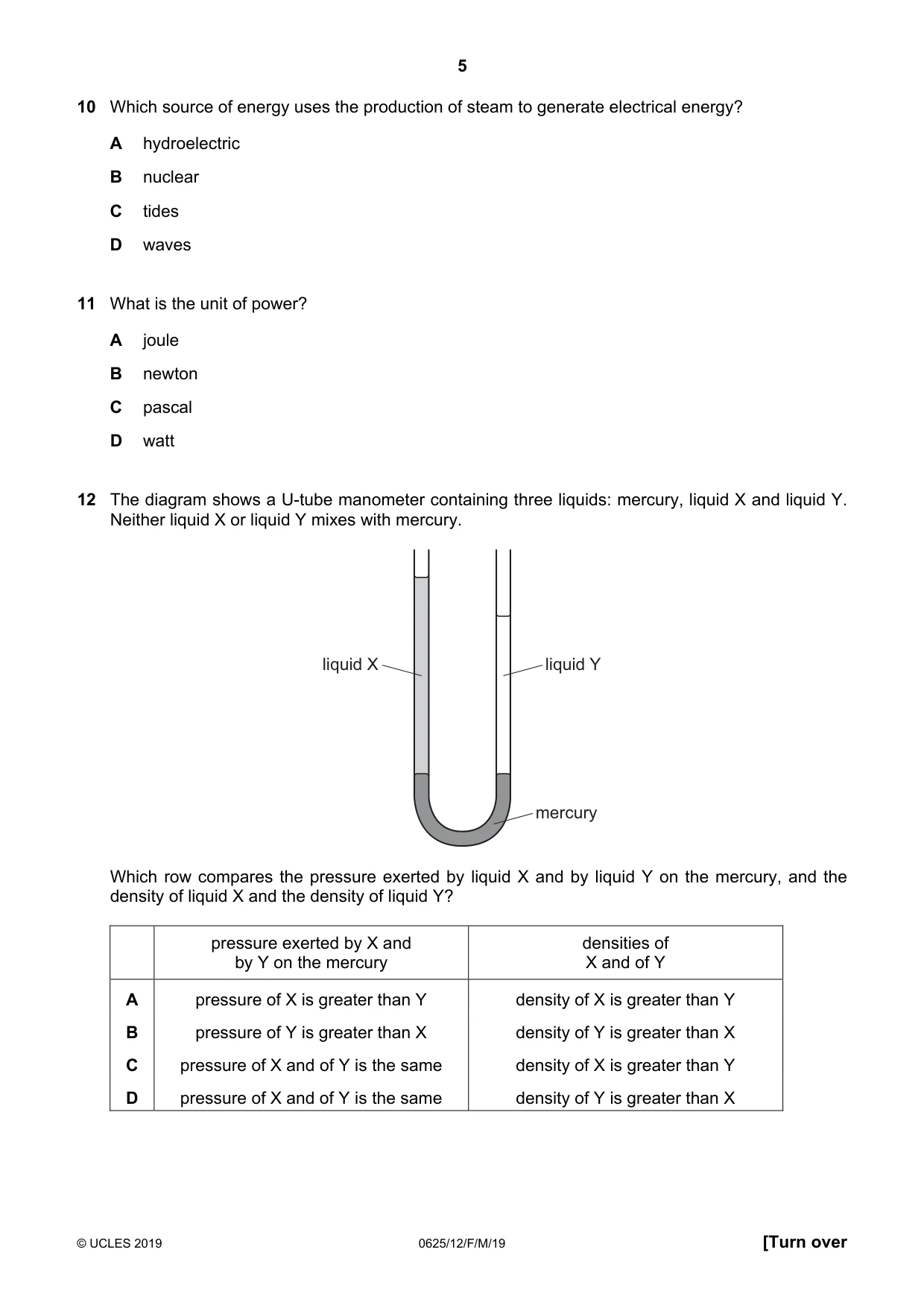
12 The diagram shows a U-tube manometer containing three liquids: mercury, liquid X and liquid Y. Neither liquid X or liquid Y mixes with mercury. liquid X liquid Y mercury Which row compares the pressure exerted by liquid X and by liquid Y on the mercury, and the density of liquid X and the density of liquid Y? pressure exerted by X and densities of by Y on the mercury X and of Y A pressure of X is greater than Y density of X is greater than Y B pressure of Y is greater than X density of Y is greater than X C pressure of X and of Y is the same density of X is greater than Y D pressure of X and of Y is the same density of Y is greater than X
Mark scheme: D
Q13 · Which diagram shows an athlete exerting least pressure on the ground?
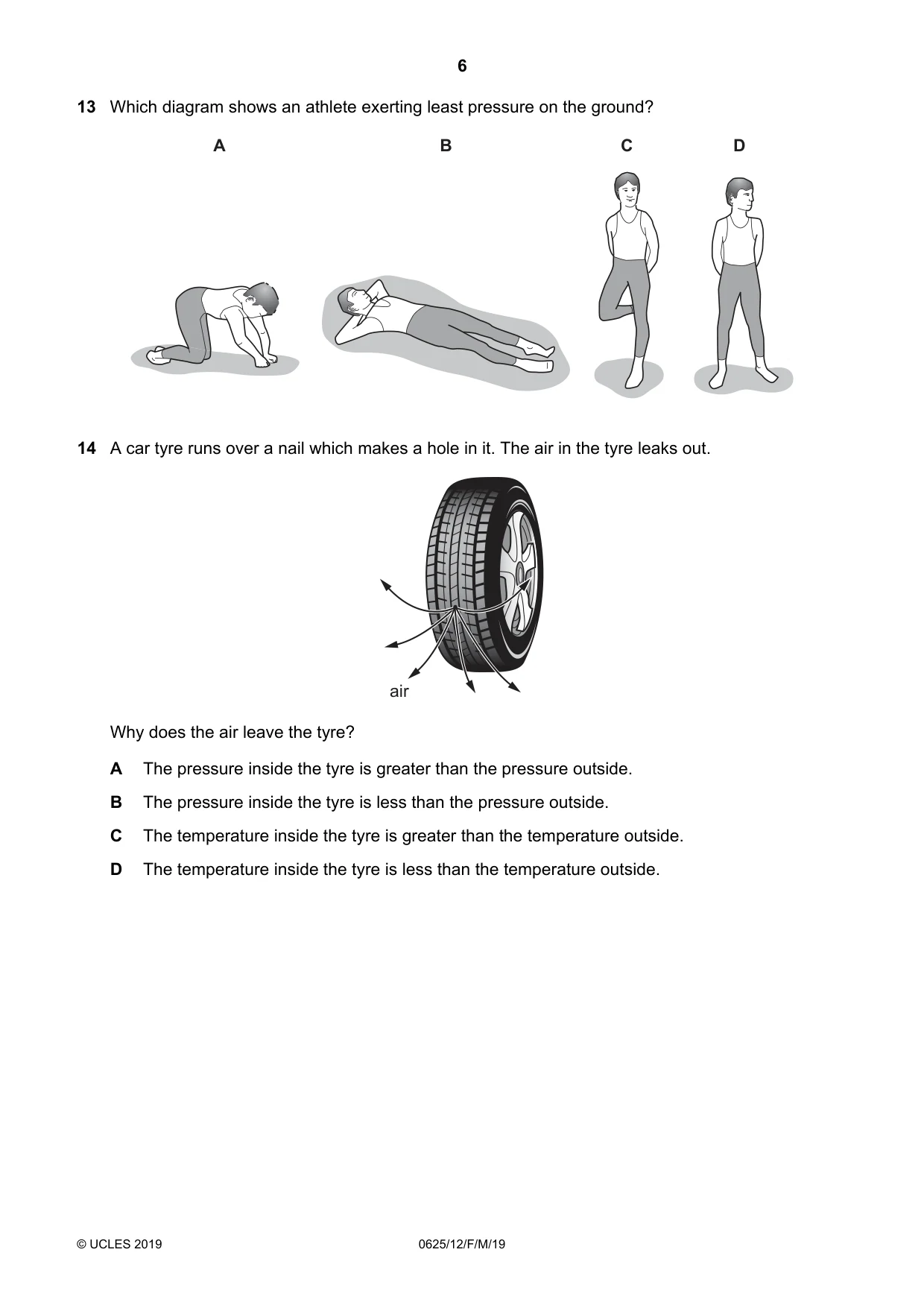
13 Which diagram shows an athlete exerting least pressure on the ground? A B C D
Mark scheme: B
Q14 · A car tyre runs over a nail which makes a hole in it
14 A car tyre runs over a nail which makes a hole in it. The air in the tyre leaks out. air Why does the air leave the tyre? A The pressure inside the tyre is greater than the pressure outside. B The pressure inside the tyre is less than the pressure outside. C The temperature inside the tyre is greater than the temperature outside. D The temperature inside the tyre is less than the temperature outside.
Mark scheme: A
Q15 · On a cold day, a metal measuring tape graduated in millimetres is used to measure the…
15 On a cold day, a metal measuring tape graduated in millimetres is used to measure the distance between two fence posts. The measuring tape reads 3.000 m. On a much hotter day, the metal measuring tape is used to measure the length of the same distance again. The metal measuring tape has a higher temperature than the ground. The temperature of the ground remains constant. Which statement is correct? A The measuring tape reads less than 3.000 m because the graduations are closer together. B The measuring tape reads less than 3.000 m because the graduations are further apart. C The measuring tape reads more than 3.000 m because the graduations are closer together. D The measuring tape reads more than 3.000 m because the graduations are further apart.
Mark scheme: B
Q16 · A thermometer has graduations which start at –10 °C and end at 110 °C
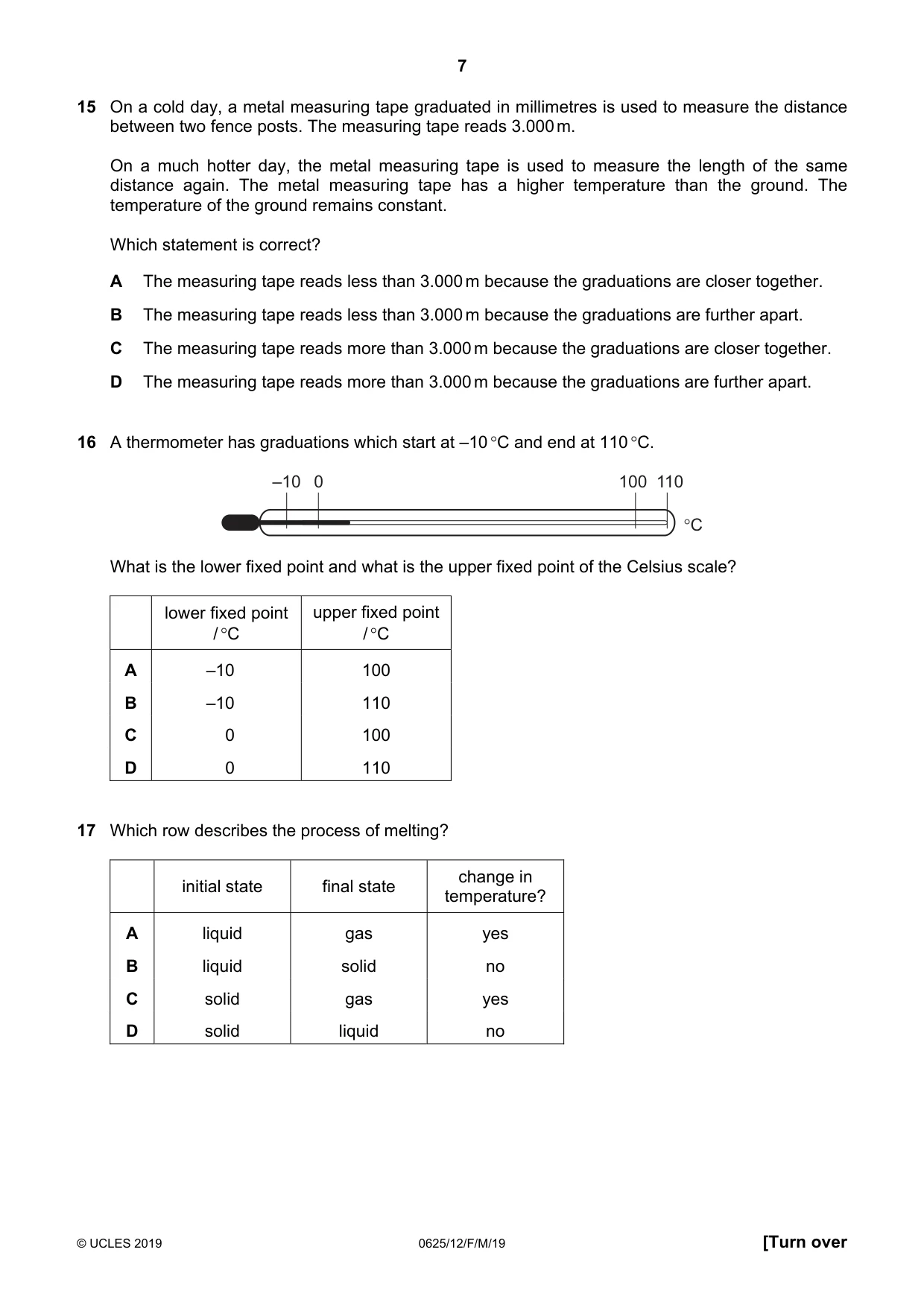
16 A thermometer has graduations which start at –10 °C and end at 110 °C. –10 0 100 110 °C What is the lower fixed point and what is the upper fixed point of the Celsius scale? lower fixed point upper fixed point / °C / °C A –10 100 B –10 110 C 0 100 D 0 110
Mark scheme: C
Q17 · Which row describes the process of melting?
17 Which row describes the process of melting? change in initial state final state temperature? A liquid gas yes B liquid solid no C solid gas yes D solid liquid no
Mark scheme: D
Q18 · Four campers are warming their food on a fire
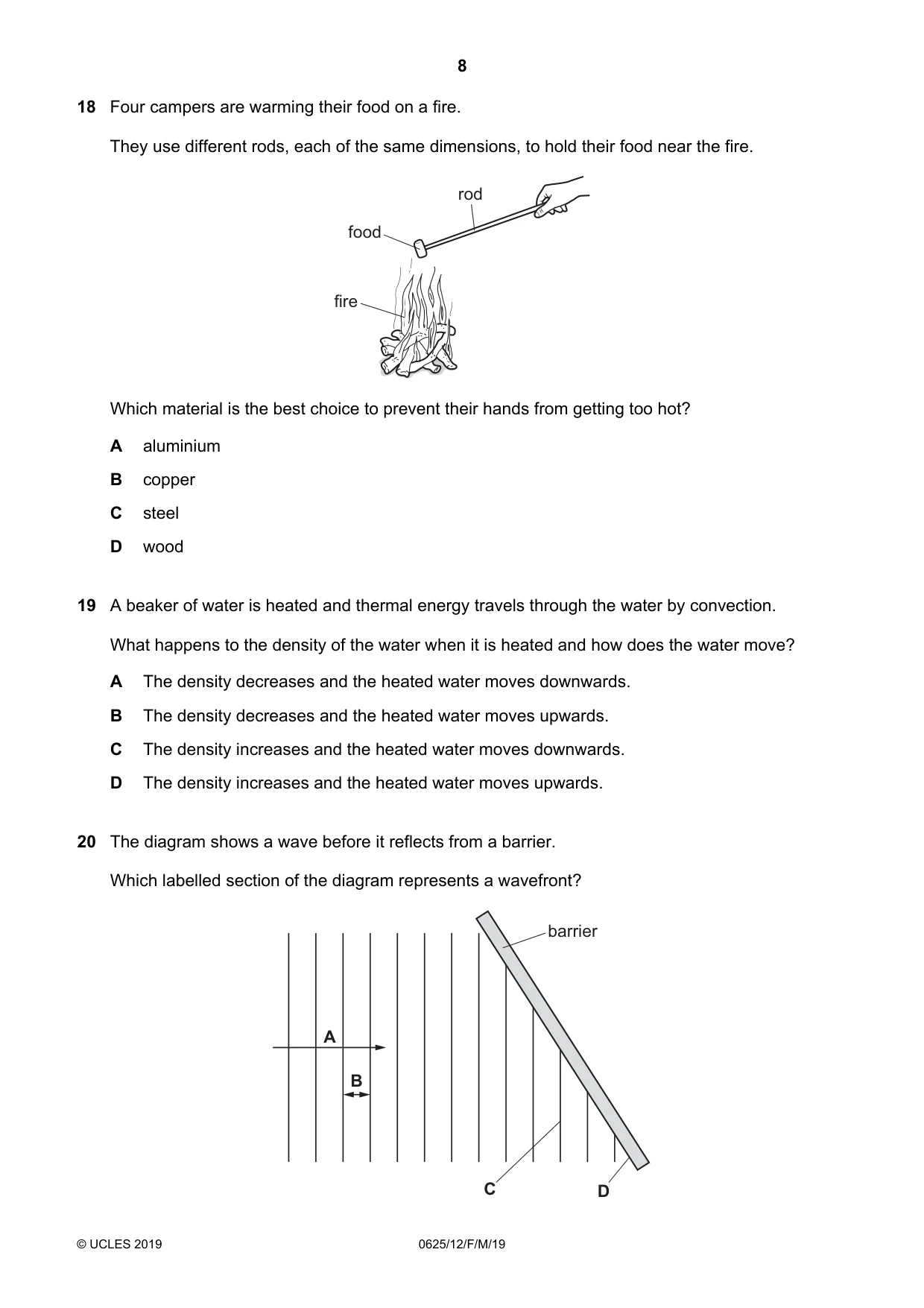
18 Four campers are warming their food on a fire. They use different rods, each of the same dimensions, to hold their food near the fire. rod food fire Which material is the best choice to prevent their hands from getting too hot? A aluminium B copper C steel D wood
Mark scheme: D
Q19 · A beaker of water is heated and thermal energy travels through the water by convection
19 A beaker of water is heated and thermal energy travels through the water by convection. What happens to the density of the water when it is heated and how does the water move? A The density decreases and the heated water moves downwards. B The density decreases and the heated water moves upwards. C The density increases and the heated water moves downwards. D The density increases and the heated water moves upwards.
Mark scheme: B
Q20 · The diagram shows a wave before it reflects from a barrier
20 The diagram shows a wave before it reflects from a barrier. Which labelled section of the diagram represents a wavefront? barrier A B C D
Mark scheme: C
Q21 · The diagram shows a transverse wave
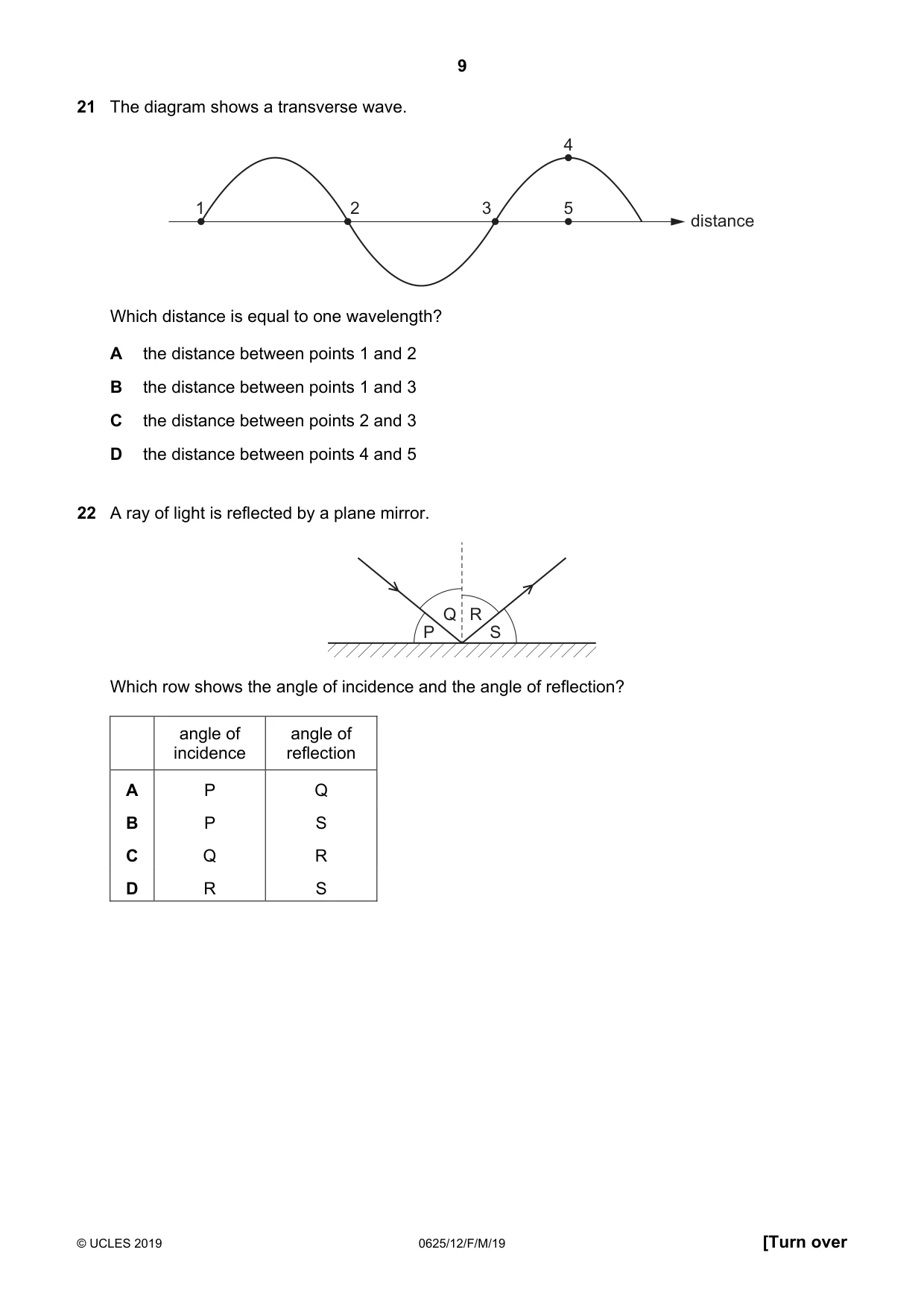
21 The diagram shows a transverse wave. 4 1 2 3 5 distance Which distance is equal to one wavelength? A the distance between points 1 and 2 B the distance between points 1 and 3 C the distance between points 2 and 3 D the distance between points 4 and 5
Mark scheme: B
Q22 · A ray of light is reflected by a plane mirror
22 A ray of light is reflected by a plane mirror. Q R P S Which row shows the angle of incidence and the angle of reflection? angle of angle of incidence reflection A P Q B P S C Q R D R S
Mark scheme: C
Q23 · Which diagram correctly represents rays of light passing through a converging lens in a…
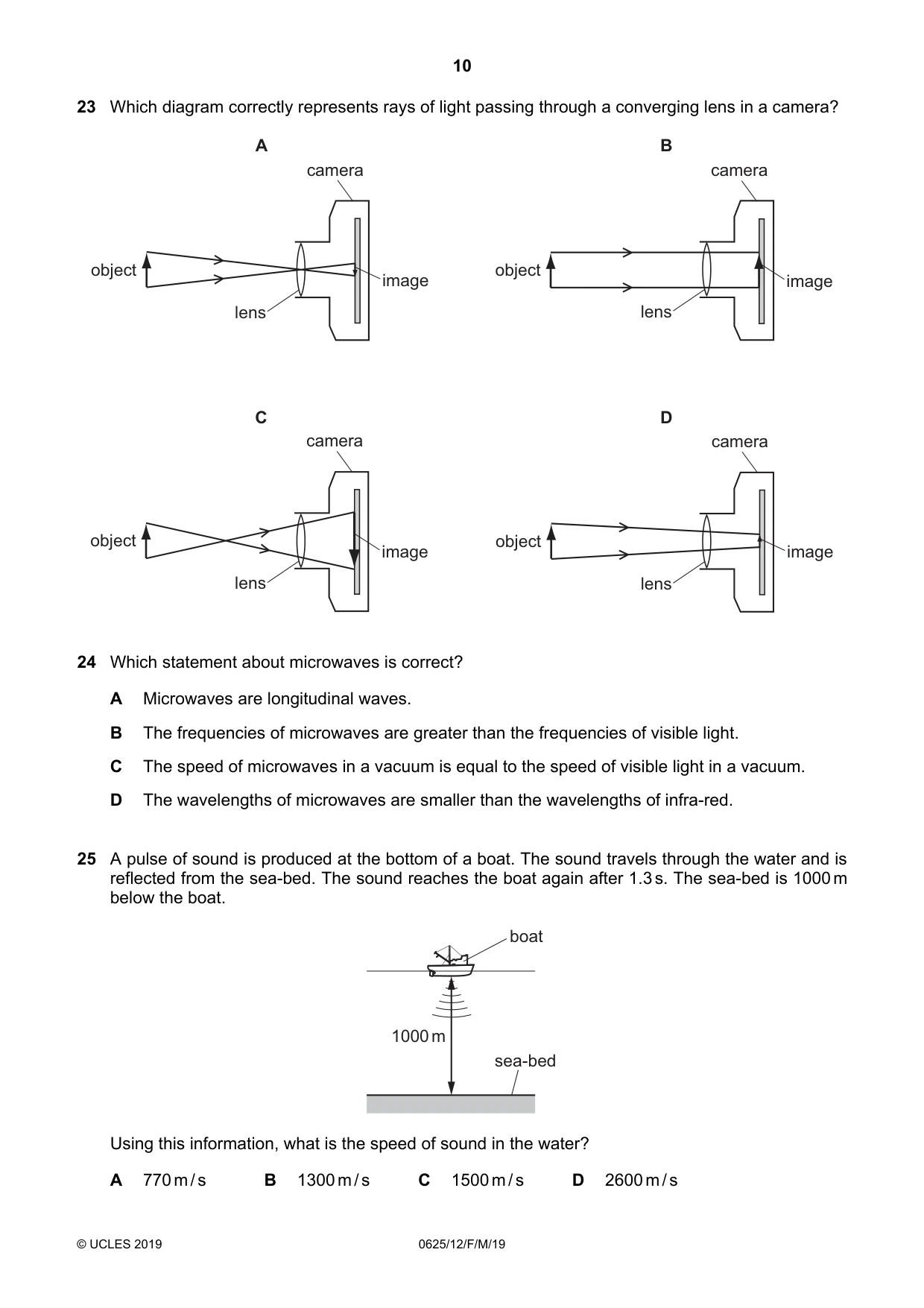
23 Which diagram correctly represents rays of light passing through a converging lens in a camera? A B camera camera object object image image lens lens C D camera camera object object image image lens lens
Mark scheme: A
Q24 · Which statement about microwaves is correct?
24 Which statement about microwaves is correct? A Microwaves are longitudinal waves. B The frequencies of microwaves are greater than the frequencies of visible light. C The speed of microwaves in a vacuum is equal to the speed of visible light in a vacuum. D The wavelengths of microwaves are smaller than the wavelengths of infra-red.
Mark scheme: C
Q25 · A pulse of sound is produced at the bottom of a boat
25 A pulse of sound is produced at the bottom of a boat. The sound travels through the water and is reflected from the sea-bed. The sound reaches the boat again after 1.3 s. The sea-bed is 1000 m below the boat. boat 1000 m sea-bed Using this information, what is the speed of sound in the water? A 770 m / s B 1300 m / s C 1500 m / s D 2600 m / s
Mark scheme: C
Q26 · Which action will not magnetise a rod?
26 Which action will not magnetise a rod? A placing a copper rod inside a coil carrying a direct current B stroking a steel rod with a permanent magnet C hammering a steel rod aligned with the Earth’s magnetic field D placing a soft-iron rod close to a permanent magnet
Mark scheme: A
Q27 · The ends of three metal rods are tested by holding end Q of rod 1 close to the others in…
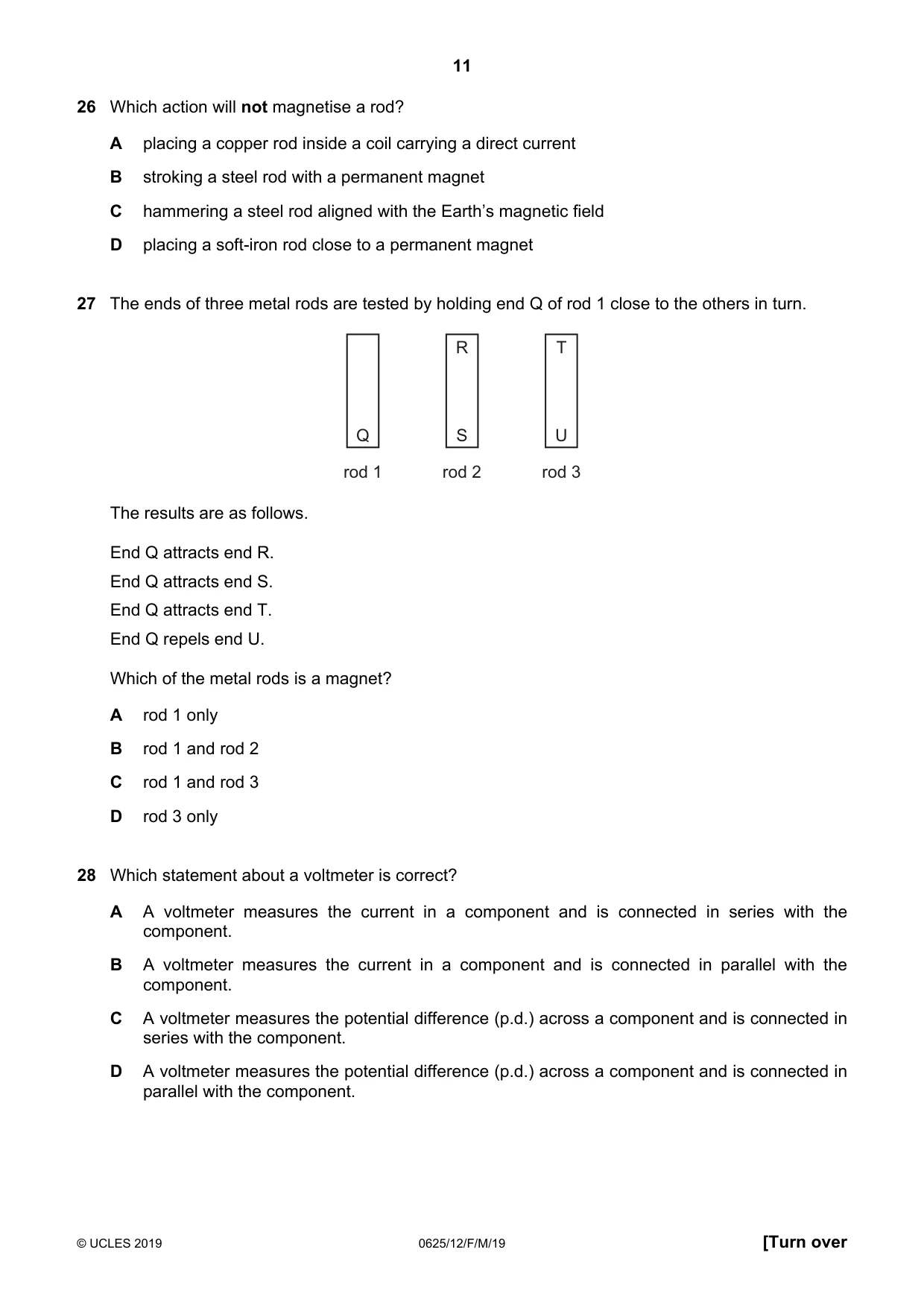
27 The ends of three metal rods are tested by holding end Q of rod 1 close to the others in turn. R T Q S U rod 1 rod 2 rod 3 The results are as follows. End Q attracts end R. End Q attracts end S. End Q attracts end T. End Q repels end U. Which of the metal rods is a magnet? A rod 1 only B rod 1 and rod 2 C rod 1 and rod 3 D rod 3 only
Mark scheme: C
Q28 · Which statement about a voltmeter is correct?
28 Which statement about a voltmeter is correct? A A voltmeter measures the current in a component and is connected in series with the component. B A voltmeter measures the current in a component and is connected in parallel with the component. C A voltmeter measures the potential difference (p.d.) across a component and is connected in series with the component. D A voltmeter measures the potential difference (p.d.) across a component and is connected in parallel with the component.
Mark scheme: D
Q29 · Four wires are made from the same metal
29 Four wires are made from the same metal. Which wire has the lowest resistance? length of diameter of wire / cm wire / mm A 20 0.20 B 20 0.40 C 40 0.20 D 40 0.40
Mark scheme: B
Q30 · A student sets up a circuit containing a battery of two cells and three lamps, as shown
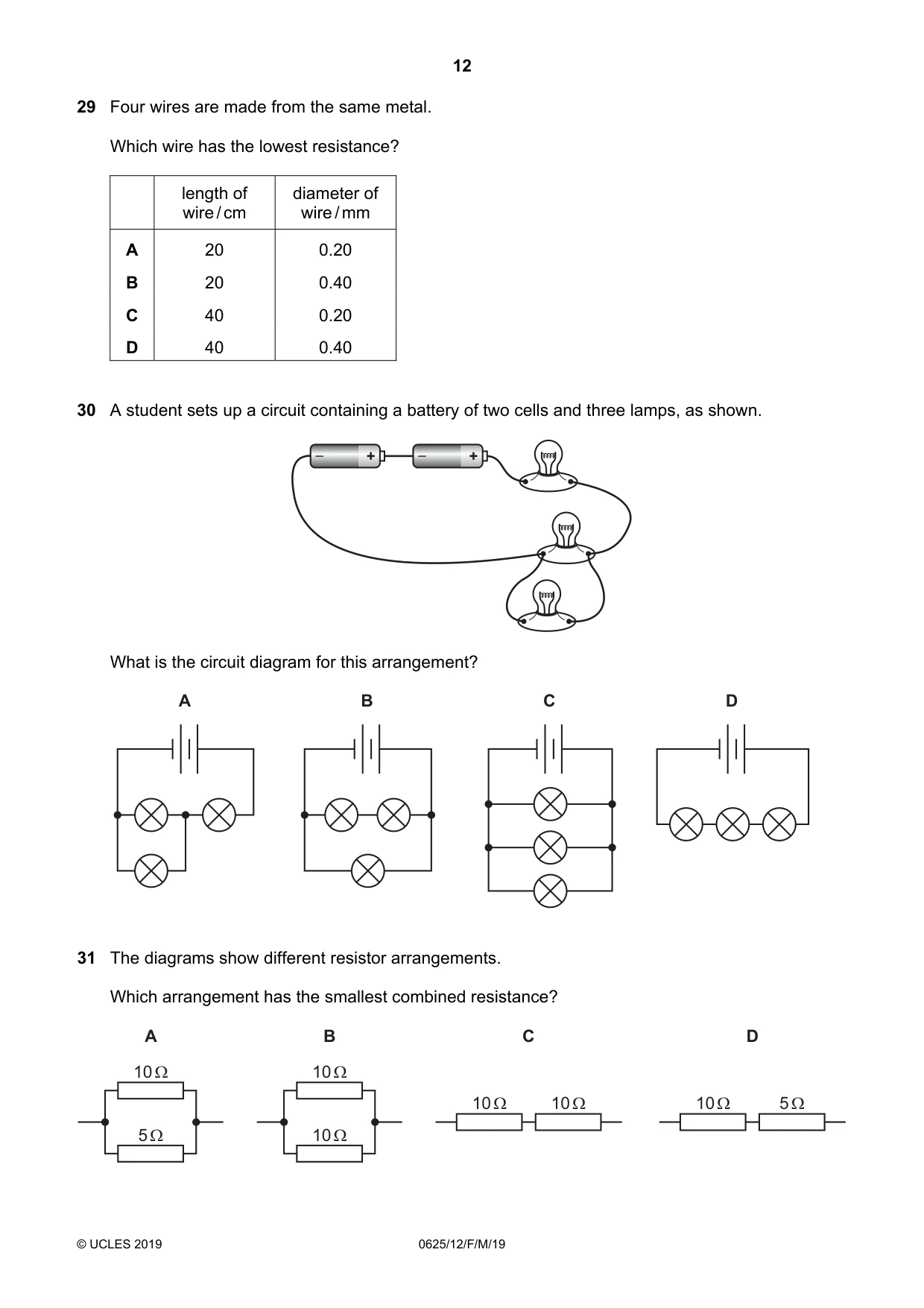
30 A student sets up a circuit containing a battery of two cells and three lamps, as shown. – + – + What is the circuit diagram for this arrangement? A B C D
Mark scheme: A
Q31 · The diagrams show different resistor arrangements
31 The diagrams show different resistor arrangements. Which arrangement has the smallest combined resistance? A B C D 10 Ω 10 Ω 10 Ω 10 Ω 10 Ω 5 Ω 5 Ω 10 Ω
Mark scheme: A
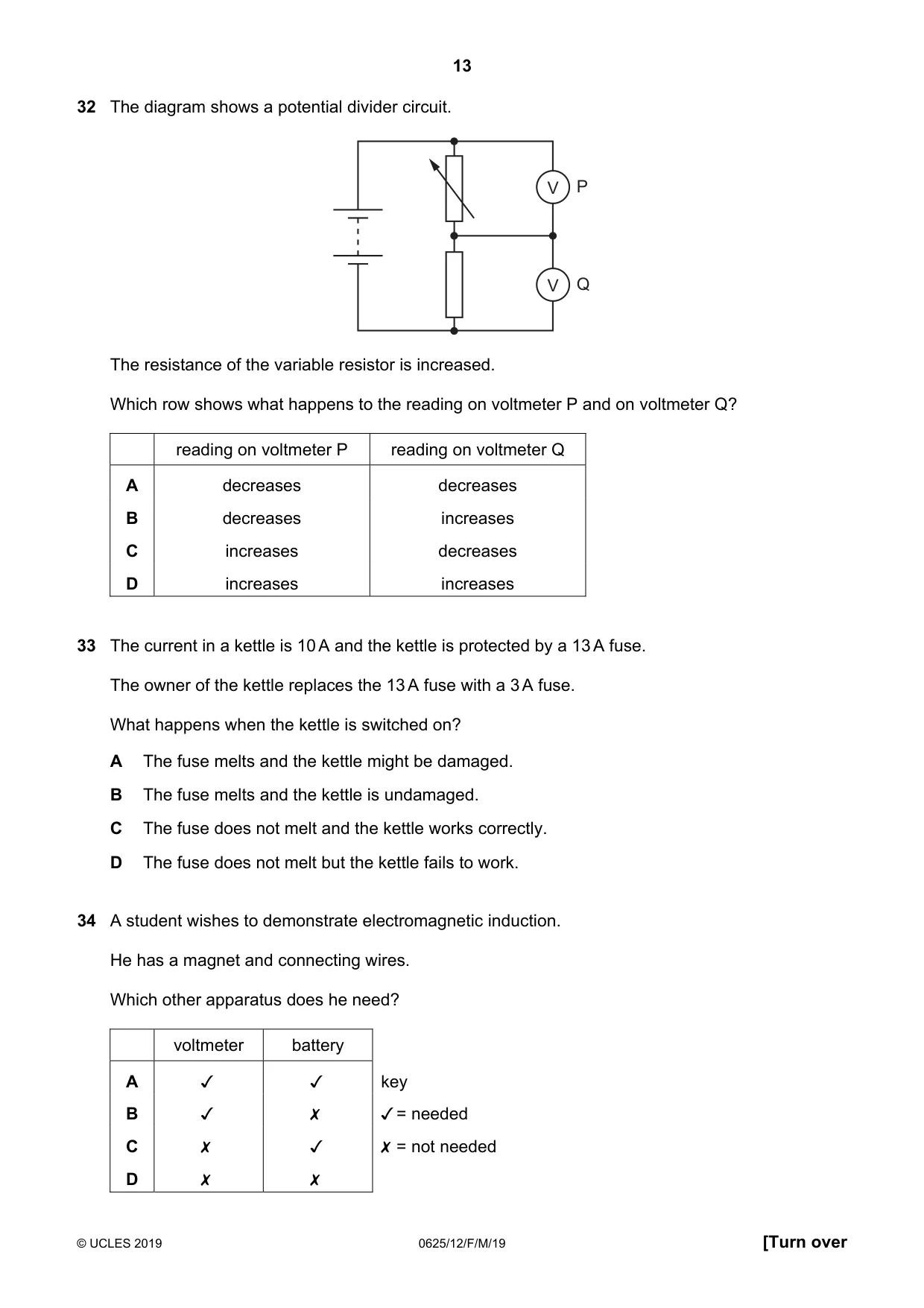
Q32 · The diagram shows a potential divider circuit
32 The diagram shows a potential divider circuit. V P V Q The resistance of the variable resistor is increased. Which row shows what happens to the reading on voltmeter P and on voltmeter Q? reading on voltmeter P reading on voltmeter Q A decreases decreases B decreases increases C increases decreases D increases increases
Mark scheme: C
Q33 · The current in a kettle is 10 A and the kettle is protected by a 13 A fuse
33 The current in a kettle is 10 A and the kettle is protected by a 13 A fuse. The owner of the kettle replaces the 13 A fuse with a 3 A fuse. What happens when the kettle is switched on? A The fuse melts and the kettle might be damaged. B The fuse melts and the kettle is undamaged. C The fuse does not melt and the kettle works correctly. D The fuse does not melt but the kettle fails to work.
Mark scheme: B
Q34 · A student wishes to demonstrate electromagnetic induction
34 A student wishes to demonstrate electromagnetic induction. He has a magnet and connecting wires. Which other apparatus does he need? voltmeter battery v v key Jv = needed X = not needed 0 OD > «x « & «x < x
Mark scheme: B
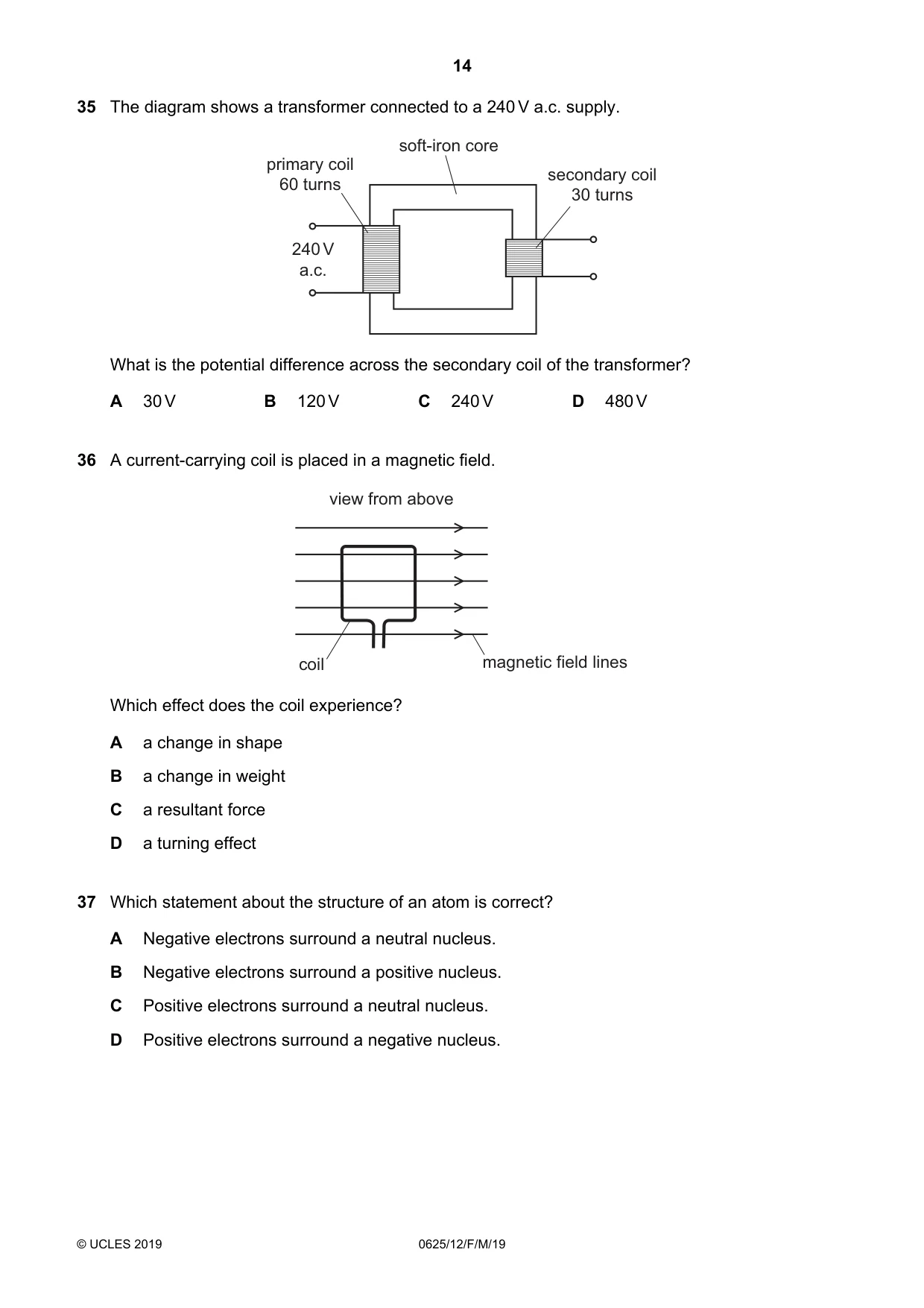
Q35 · The diagram shows a transformer connected to a 240 V a.c
35 The diagram shows a transformer connected to a 240 V a.c. supply. soft-iron core primary coil secondary coil 60 turns 30 turns 240 V a.c. What is the potential difference across the secondary coil of the transformer? A 30 V B 120 V C 240 V D 480 V
Mark scheme: B
Q36 · A current-carrying coil is placed in a magnetic field
36 A current-carrying coil is placed in a magnetic field. view from above coil magnetic field lines Which effect does the coil experience? A a change in shape B a change in weight C a resultant force D a turning effect
Mark scheme: D
Q37 · Which statement about the structure of an atom is correct?
37 Which statement about the structure of an atom is correct? A Negative electrons surround a neutral nucleus. B Negative electrons surround a positive nucleus. C Positive electrons surround a neutral nucleus. D Positive electrons surround a negative nucleus.
Mark scheme: B
Q38 · What are isotopes of an element?
38 What are isotopes of an element? A atoms of a different element with a different number of neutrons B atoms of a different element with a different number of protons C atoms of the same element with a different number of neutrons D atoms of the same element with a different number of protons
Mark scheme: C
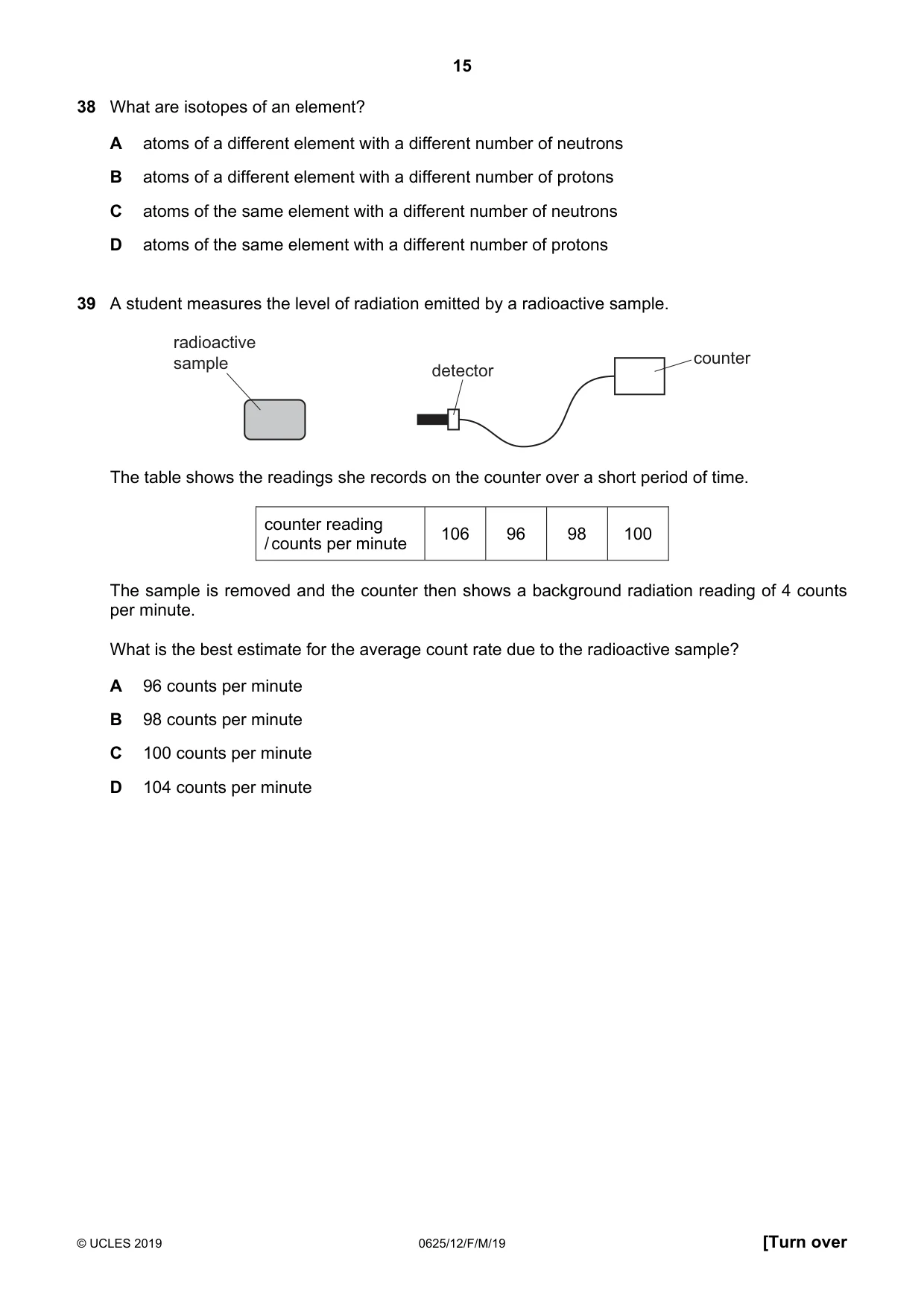
Q39 · A student measures the level of radiation emitted by a radioactive sample
39 A student measures the level of radiation emitted by a radioactive sample. radioactive sample counter detector The table shows the readings she records on the counter over a short period of time. counter reading 106 96 98 100 / counts per minute The sample is removed and the counter then shows a background radiation reading of 4 counts per minute. What is the best estimate for the average count rate due to the radioactive sample? A 96 counts per minute B 98 counts per minute C 100 counts per minute D 104 counts per minute
Mark scheme: A
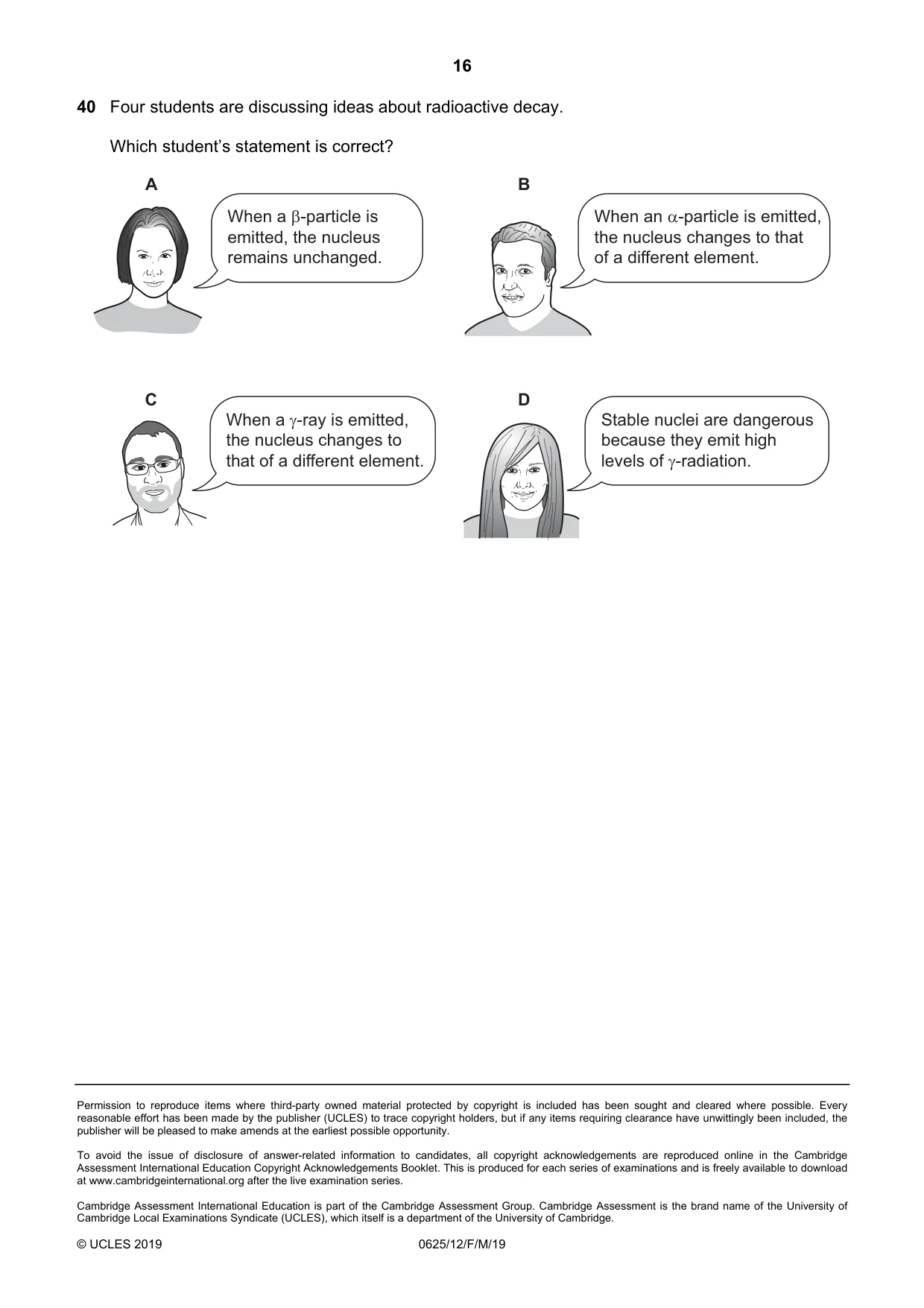
Q40 · Four students are discussing ideas about radioactive decay
40 Four students are discussing ideas about radioactive decay. Which student’s statement is correct? A B When a β-particle is When an α-particle is emitted, emitted, the nucleus the nucleus changes to that remains unchanged. of a different element. C D When a γ-ray is emitted, Stable nuclei are dangerous the nucleus changes to because they emit high that of a different element. levels of γ-radiation.
Mark scheme: B
What was in this paper
The subtopics covered by these 40 questions, and how many questions each got. Open one in a new tab to see every Cambridge question on it.
4Electromagnetic effects3Forces3Pressure3Density2Energy, work and power2General properties of waves2Light2Motion2Radioactivity2Simple phenomena of magnetism2The nuclear model of the atom2Thermal properties and temperature2Transfer of thermal energy2Electrical quantities1Electrical safety1Electromagnetic spectrum1Kinetic particle model of matter1Mass and weight1Physical quantities and measurement techniques1Sound1What you needed in this session
Cambridge’s own grade thresholds for 2019 Feb/March, Paper 1 · Variant 2. A higher threshold means an easier paper — the bar moves with how the cohort did.