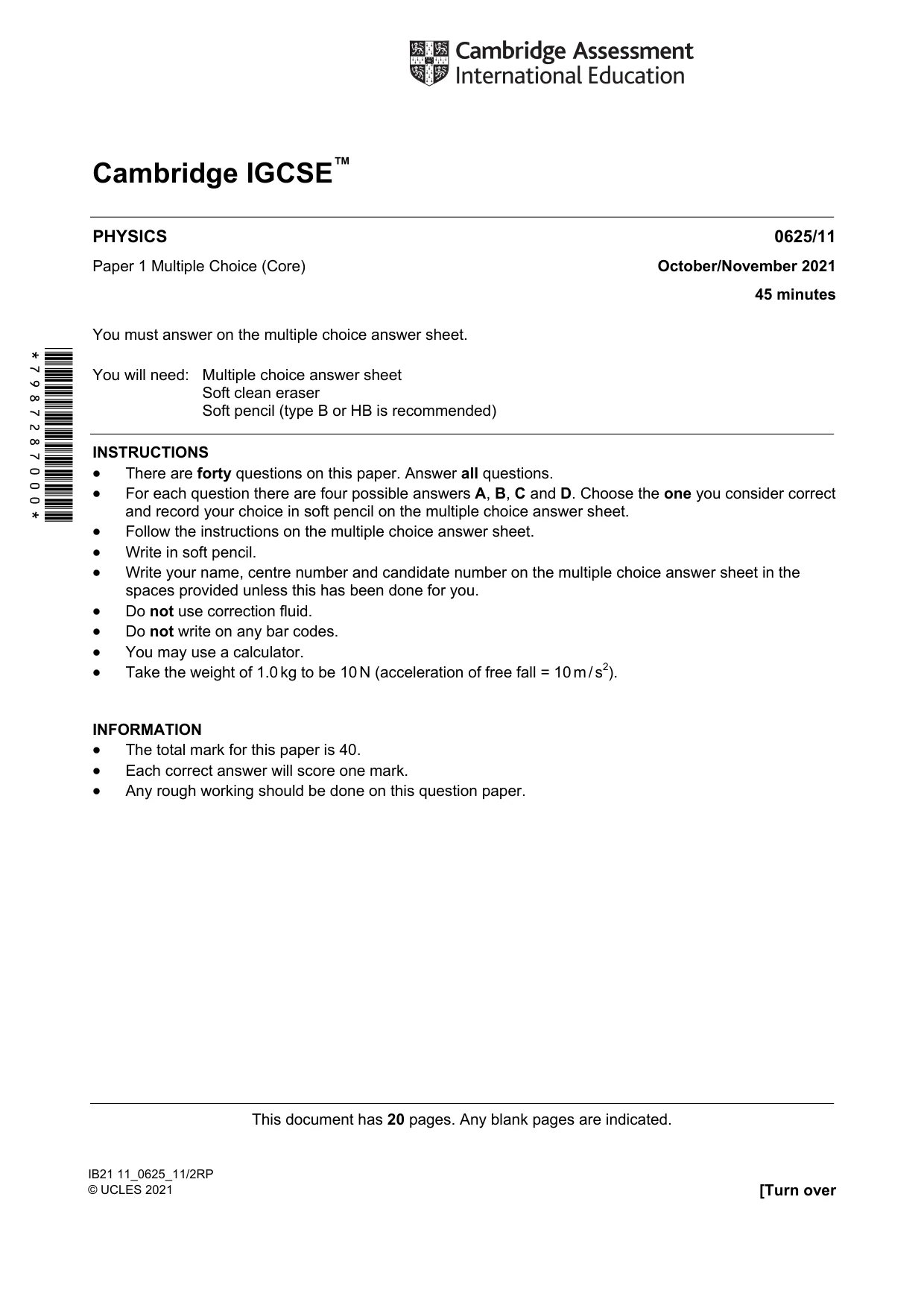
Cambridge IGCSE Physics 0625 — 2021 Oct/Nov Paper 1 · Variant 1
0625/11/O/N/21 · 40 questions · 40 marks · ≈45 min
The question paper and its mark scheme, free to read here and free to download. This is Cambridge’s own paper, exactly as it was sat.
Question paper20 pages
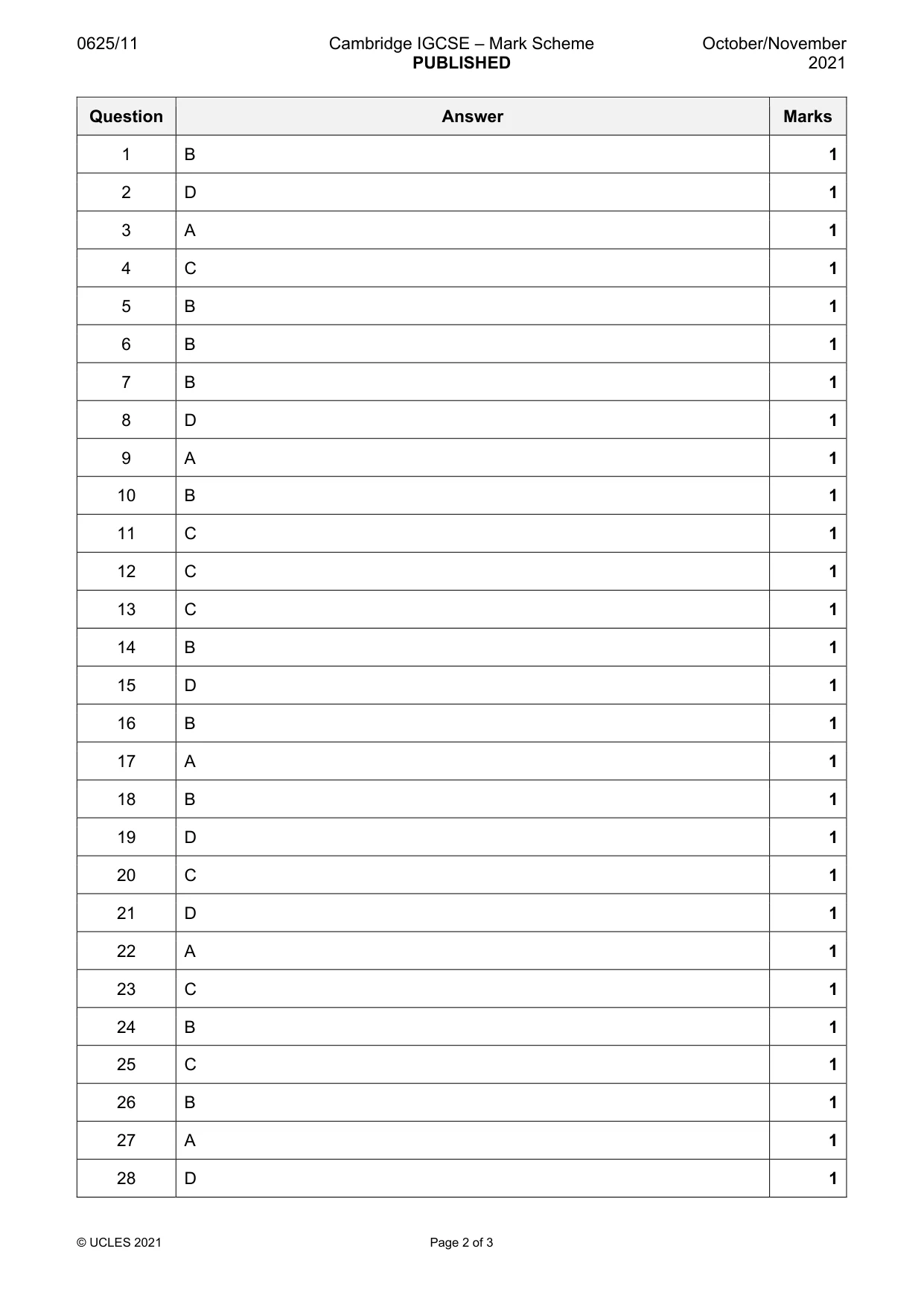
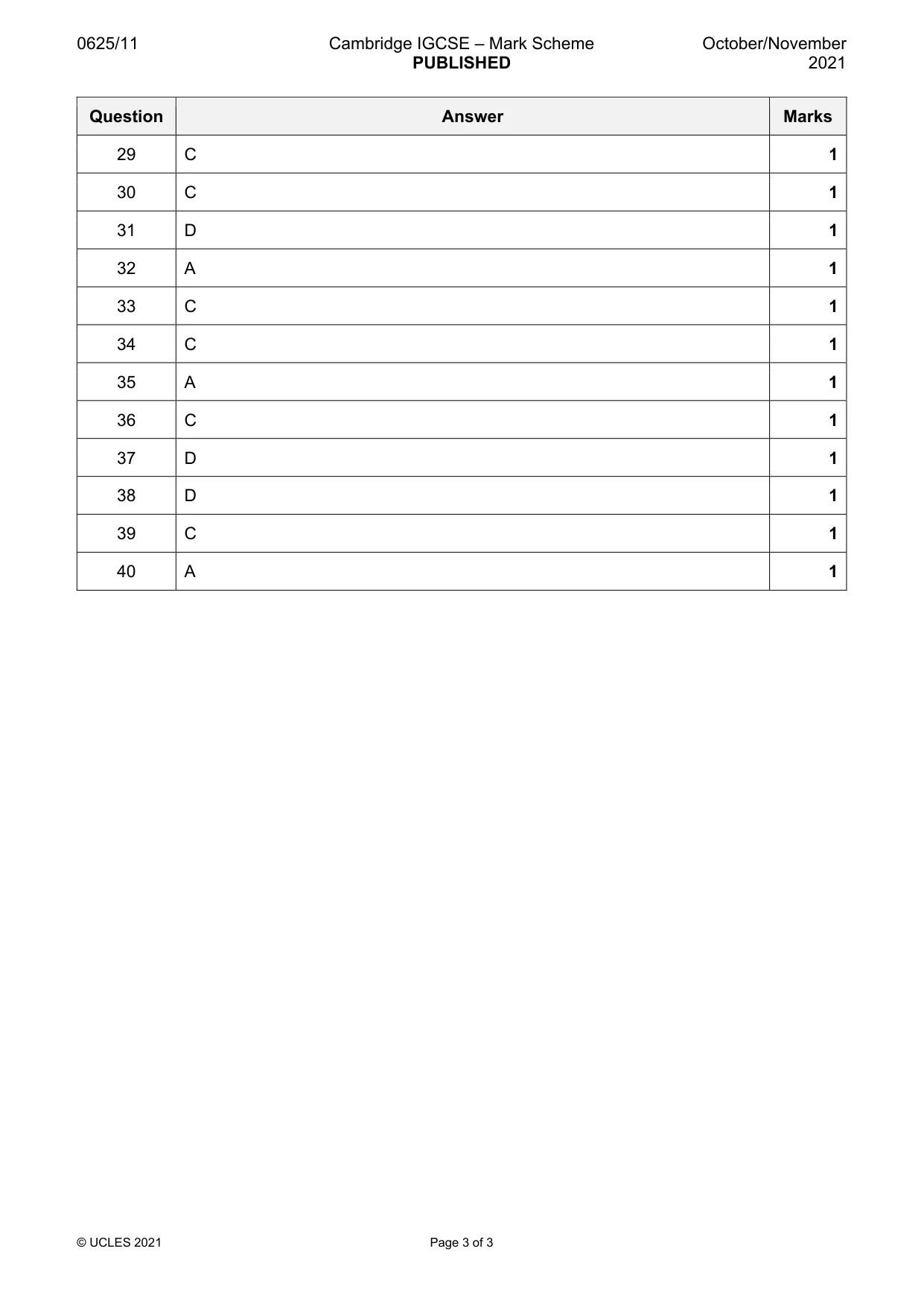
Mark scheme3 pages
Answers below. Sit the paper first if you are practising.
Questions as text
Q1 · A student measures the volume of a quantity of water
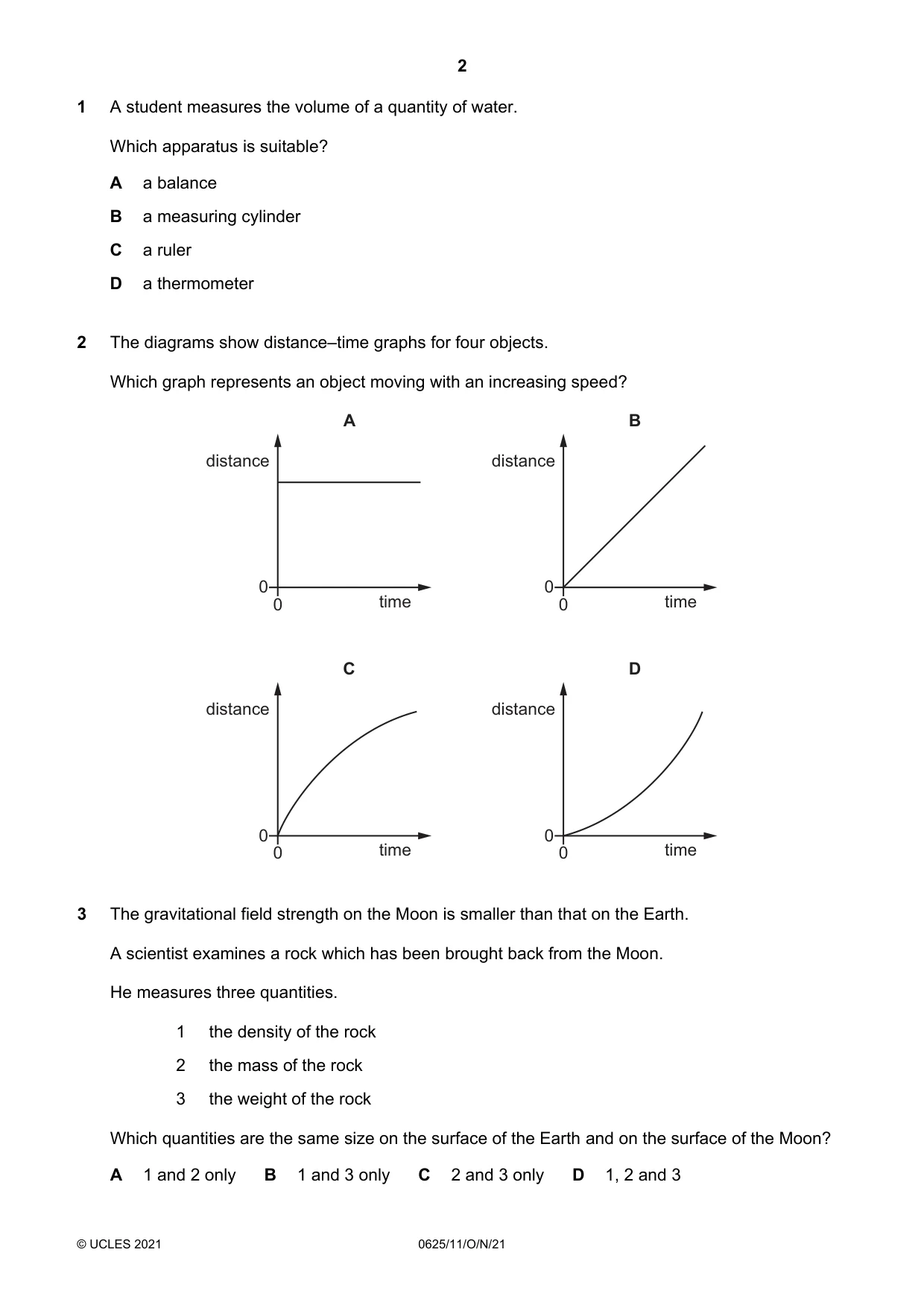
1 A student measures the volume of a quantity of water. Which apparatus is suitable? A a balance B a measuring cylinder C a ruler D a thermometer
Mark scheme: B
More questions on Physical quantities and measurement techniques
Q2 · The diagrams show distance–time graphs for four objects
2 The diagrams show distance–time graphs for four objects. Which graph represents an object moving with an increasing speed? A B distance distance 0 0 0 time 0 time C D distance distance 0 0 0 time 0 time
Mark scheme: D
Q3 · The gravitational field strength on the Moon is smaller than that on the Earth
3 The gravitational field strength on the Moon is smaller than that on the Earth. A scientist examines a rock which has been brought back from the Moon. He measures three quantities. 1 the density of the rock 2 the mass of the rock 3 the weight of the rock Which quantities are the same size on the surface of the Earth and on the surface of the Moon? A 1 and 2 only B 1 and 3 only C 2 and 3 only D 1, 2 and 3
Mark scheme: A
Q4 · Which substance in the table has the lowest density?
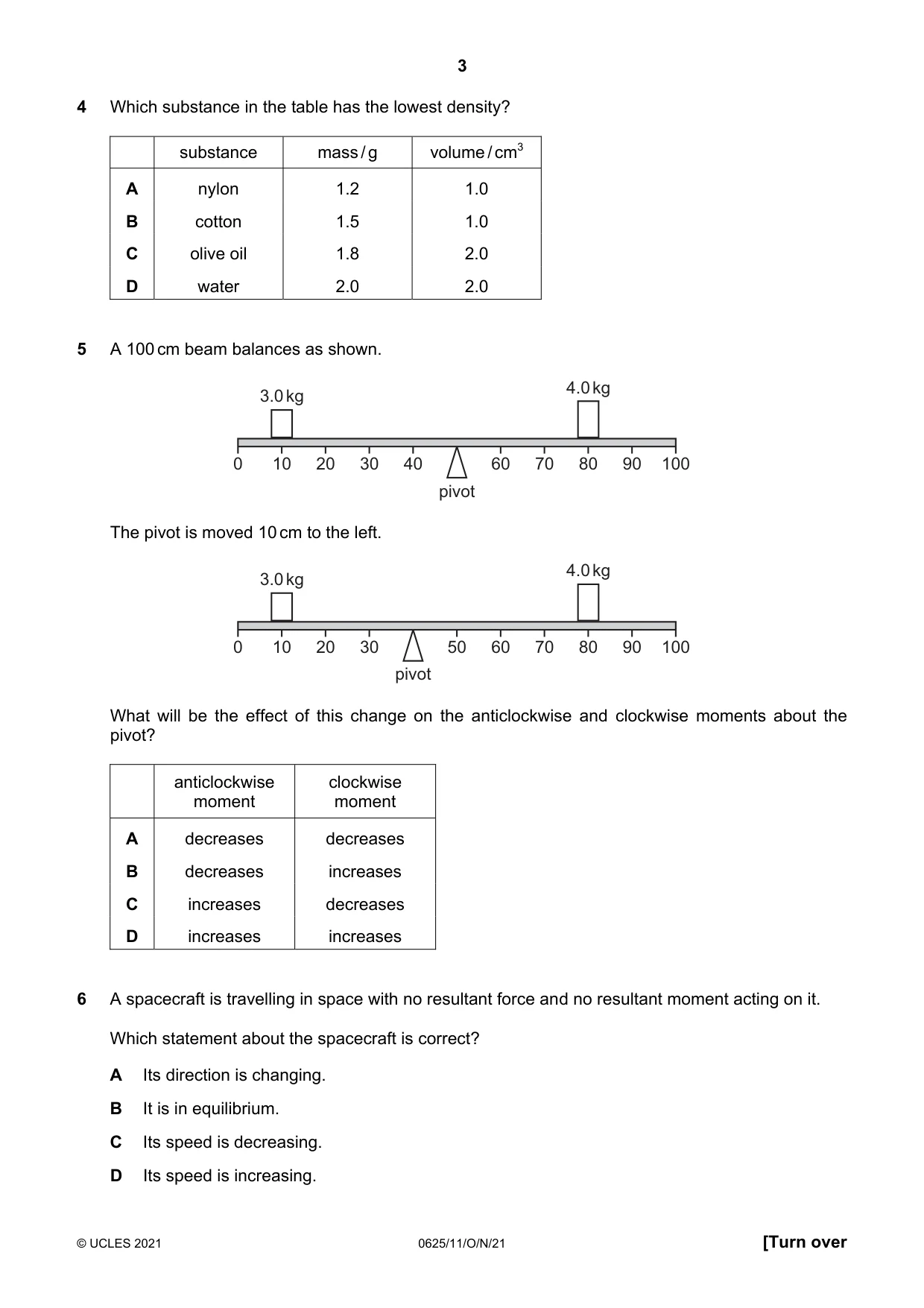
4 Which substance in the table has the lowest density? substance mass / g volume / cm3 A nylon 1.2 1.0 B cotton 1.5 1.0 C olive oil 1.8 2.0 D water 2.0 2.0
Mark scheme: C
Q5 · A 100 cm beam balances as shown
5 A 100 cm beam balances as shown. 4.0 kg 3.0 kg 0 10 20 30 40 60 70 80 90 100 pivot The pivot is moved 10 cm to the left. 4.0 kg 3.0 kg 0 10 20 30 50 60 70 80 90 100 pivot What will be the effect of this change on the anticlockwise and clockwise moments about the pivot? anticlockwise clockwise moment moment A decreases decreases B decreases increases C increases decreases D increases increases
Mark scheme: B
Q6 · A spacecraft is travelling in space with no resultant force and no resultant moment…
6 A spacecraft is travelling in space with no resultant force and no resultant moment acting on it. Which statement about the spacecraft is correct? A Its direction is changing. B It is in equilibrium. C Its speed is decreasing. D Its speed is increasing.
Mark scheme: B
Q7 · The graph shows the total energy transferred by an electric motor over a period of time
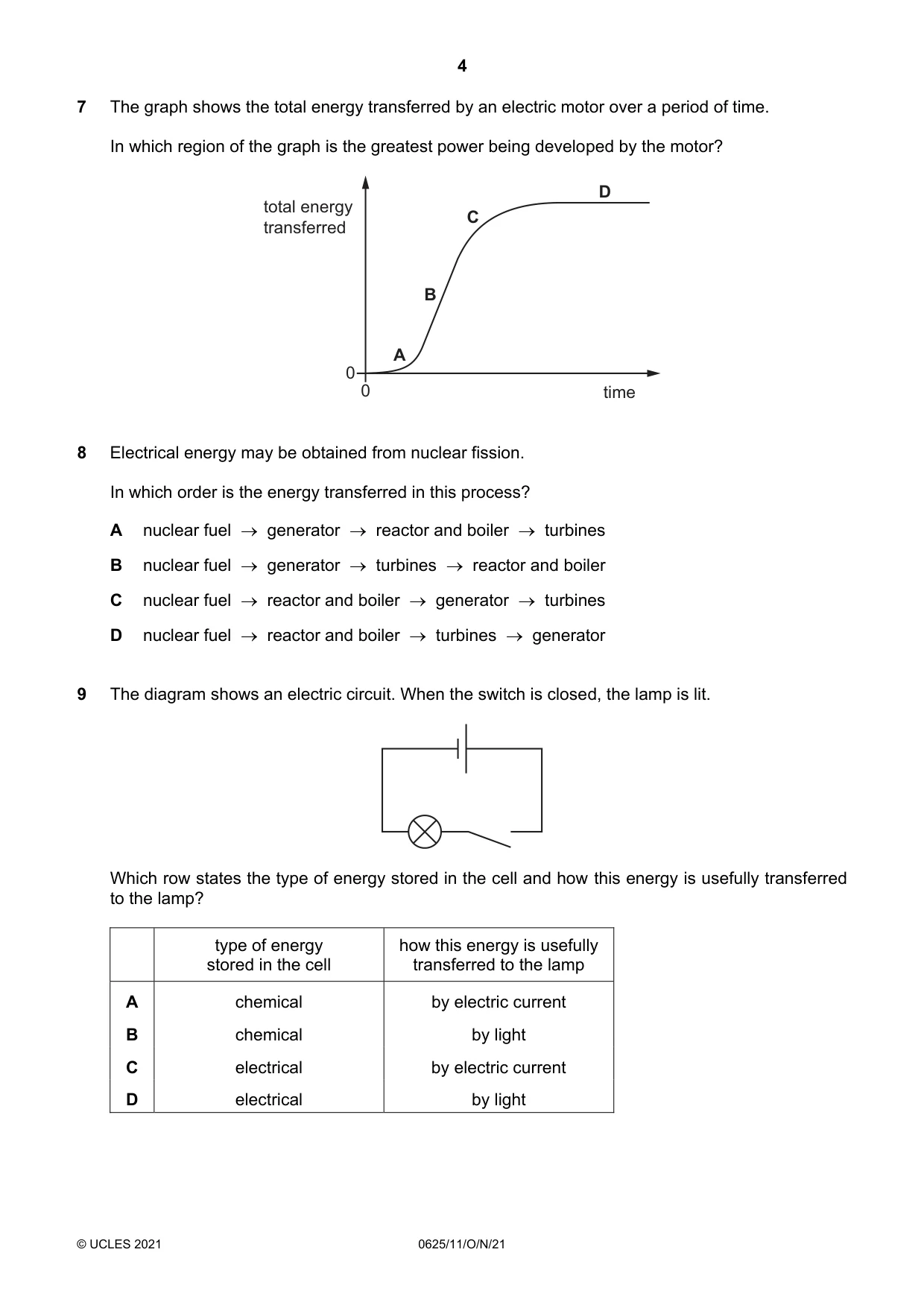
7 The graph shows the total energy transferred by an electric motor over a period of time. In which region of the graph is the greatest power being developed by the motor? D total energy C transferred B A 0 0 time
Mark scheme: B
Q8 · Electrical energy may be obtained from nuclear fission
8 Electrical energy may be obtained from nuclear fission. In which order is the energy transferred in this process? A nuclear fuel generator reactor and boiler turbines B nuclear fuel generator turbines reactor and boiler C nuclear fuel reactor and boiler generator turbines D nuclear fuel reactor and boiler turbines generator
Mark scheme: D
Q9 · The diagram shows an electric circuit
9 The diagram shows an electric circuit. When the switch is closed, the lamp is lit. Which row states the type of energy stored in the cell and how this energy is usefully transferred to the lamp? type of energy how this energy is usefully stored in the cell transferred to the lamp A chemical by electric current B chemical by light C electrical by electric current D electrical by light
Mark scheme: A
Q10 · A scientist uses an electric motor to lift a load through a vertical distance of 2.0 m
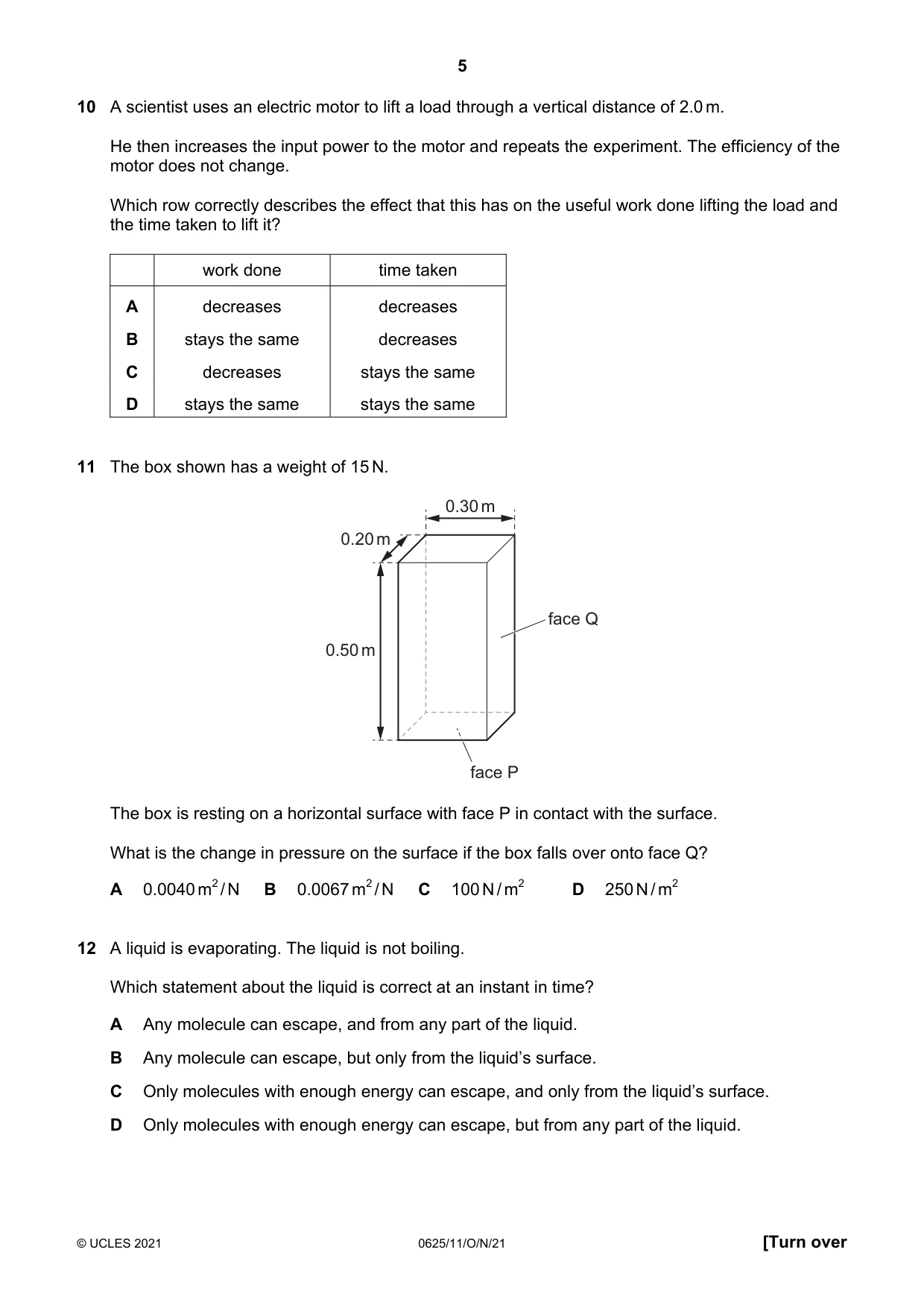
10 A scientist uses an electric motor to lift a load through a vertical distance of 2.0 m. He then increases the input power to the motor and repeats the experiment. The efficiency of the motor does not change. Which row correctly describes the effect that this has on the useful work done lifting the load and the time taken to lift it? work done time taken A decreases decreases B stays the same decreases C decreases stays the same D stays the same stays the same
Mark scheme: B
Q11 · The box shown has a weight of 15 N
11 The box shown has a weight of 15 N. 0.30 m 0.20 m face Q 0.50 m face P The box is resting on a horizontal surface with face P in contact with the surface. What is the change in pressure on the surface if the box falls over onto face Q? A 0.0040 m2 / N B 0.0067 m2 / N C 100 N / m2 D 250 N / m2
Mark scheme: C
Q12 · A liquid is evaporating
12 A liquid is evaporating. The liquid is not boiling. Which statement about the liquid is correct at an instant in time? A Any molecule can escape, and from any part of the liquid. B Any molecule can escape, but only from the liquid’s surface. C Only molecules with enough energy can escape, and only from the liquid’s surface. D Only molecules with enough energy can escape, but from any part of the liquid.
Mark scheme: C
Q13 · Which row correctly describes the movement of particles in solids and liquids?
13 Which row correctly describes the movement of particles in solids and liquids? solids liquids A no movement move around each other B no movement vibration only C vibration only move around each other D vibration only vibration only
Mark scheme: C
Q14 · A long, thin bar of copper is heated gently and evenly along its length
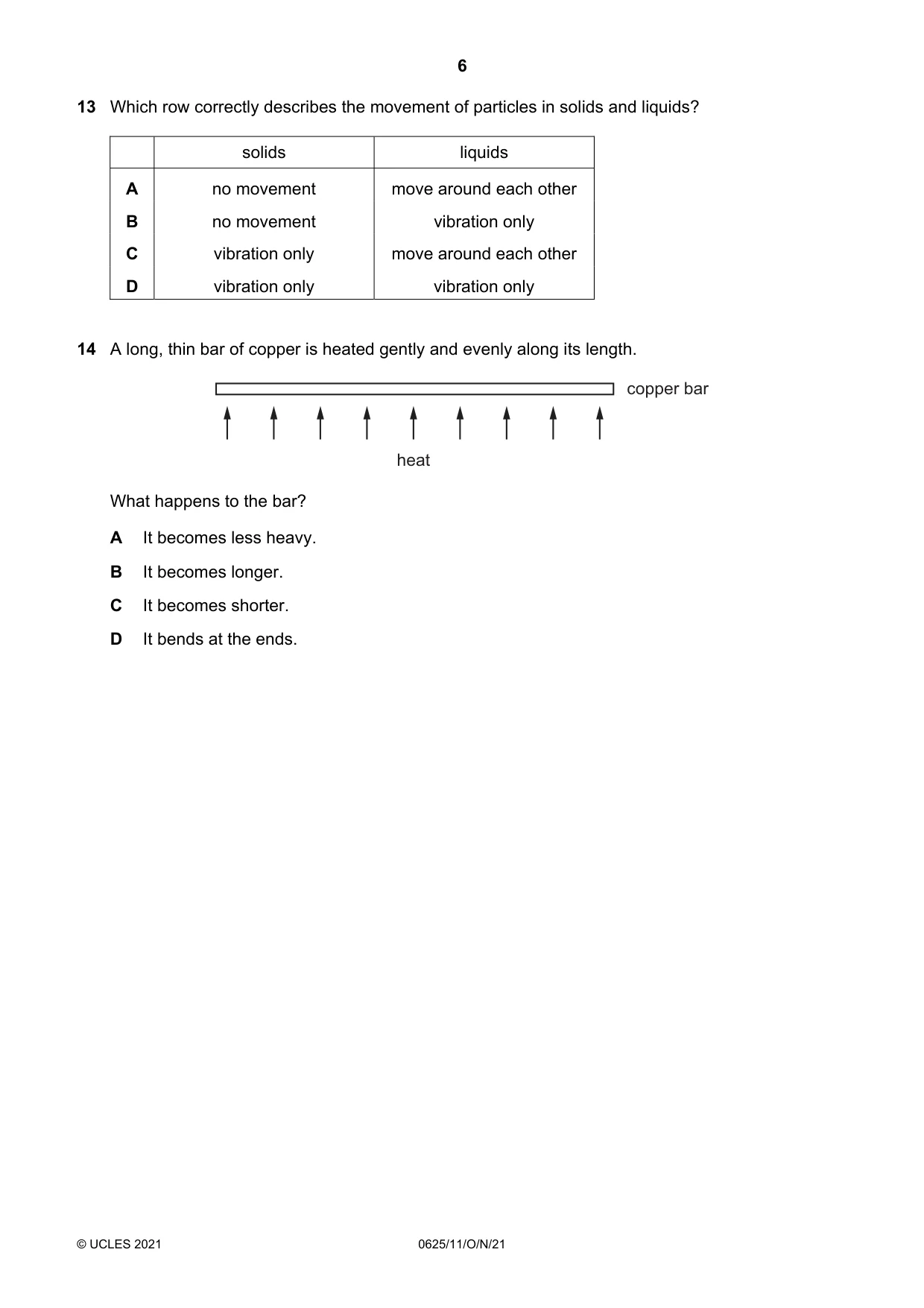
14 A long, thin bar of copper is heated gently and evenly along its length. copper bar heat What happens to the bar? A It becomes less heavy. B It becomes longer. C It becomes shorter. D It bends at the ends.
Mark scheme: B
Q15 · The diagram shows a flask which has been filled with liquid X at room temperature
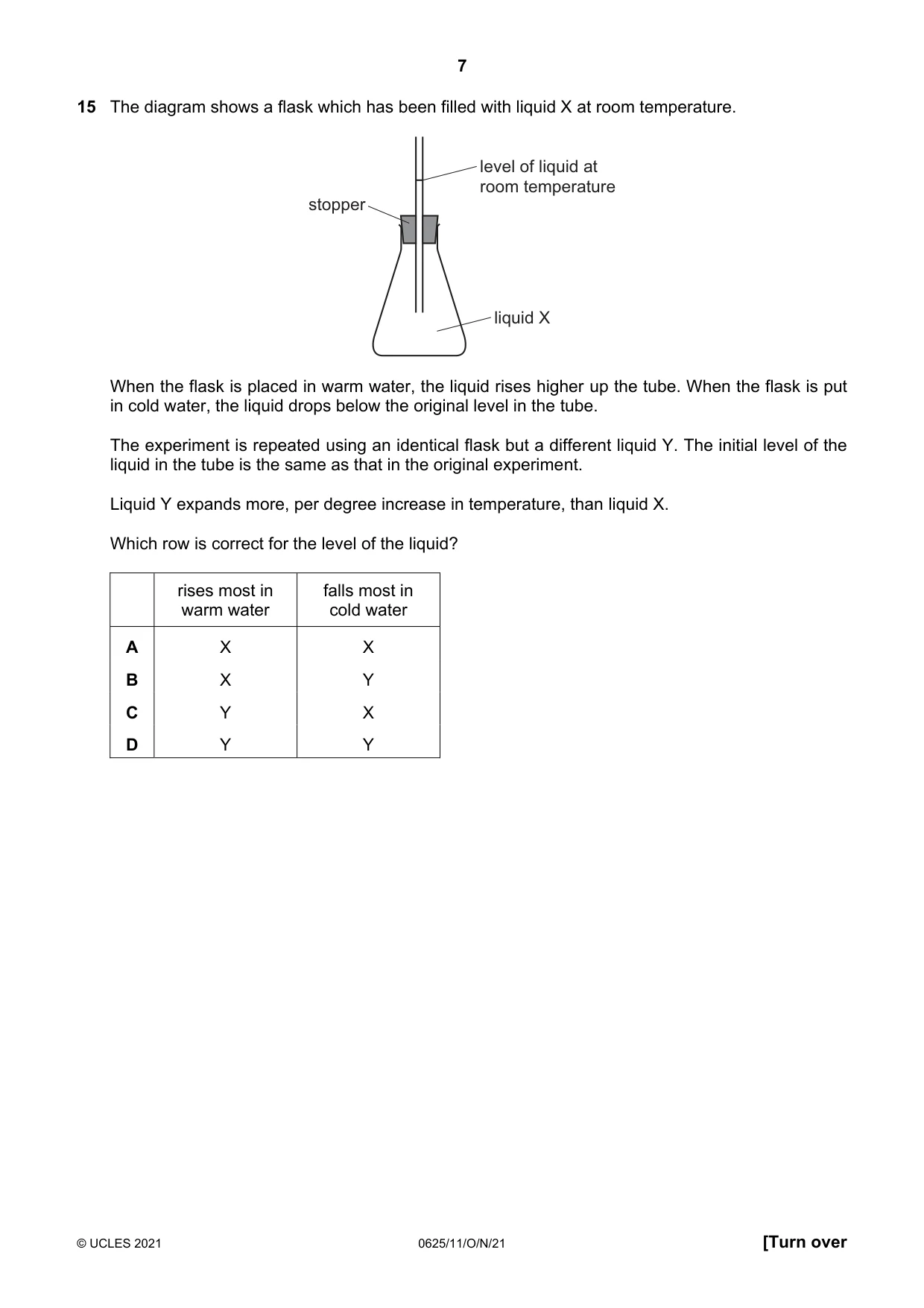
15 The diagram shows a flask which has been filled with liquid X at room temperature. level of liquid at room temperature stopper liquid X When the flask is placed in warm water, the liquid rises higher up the tube. When the flask is put in cold water, the liquid drops below the original level in the tube. The experiment is repeated using an identical flask but a different liquid Y. The initial level of the liquid in the tube is the same as that in the original experiment. Liquid Y expands more, per degree increase in temperature, than liquid X. Which row is correct for the level of the liquid? rises most in falls most in warm water cold water A X X B X Y C Y X D Y Y
Mark scheme: D
Q16 · The diagram shows a pan used for cooking food
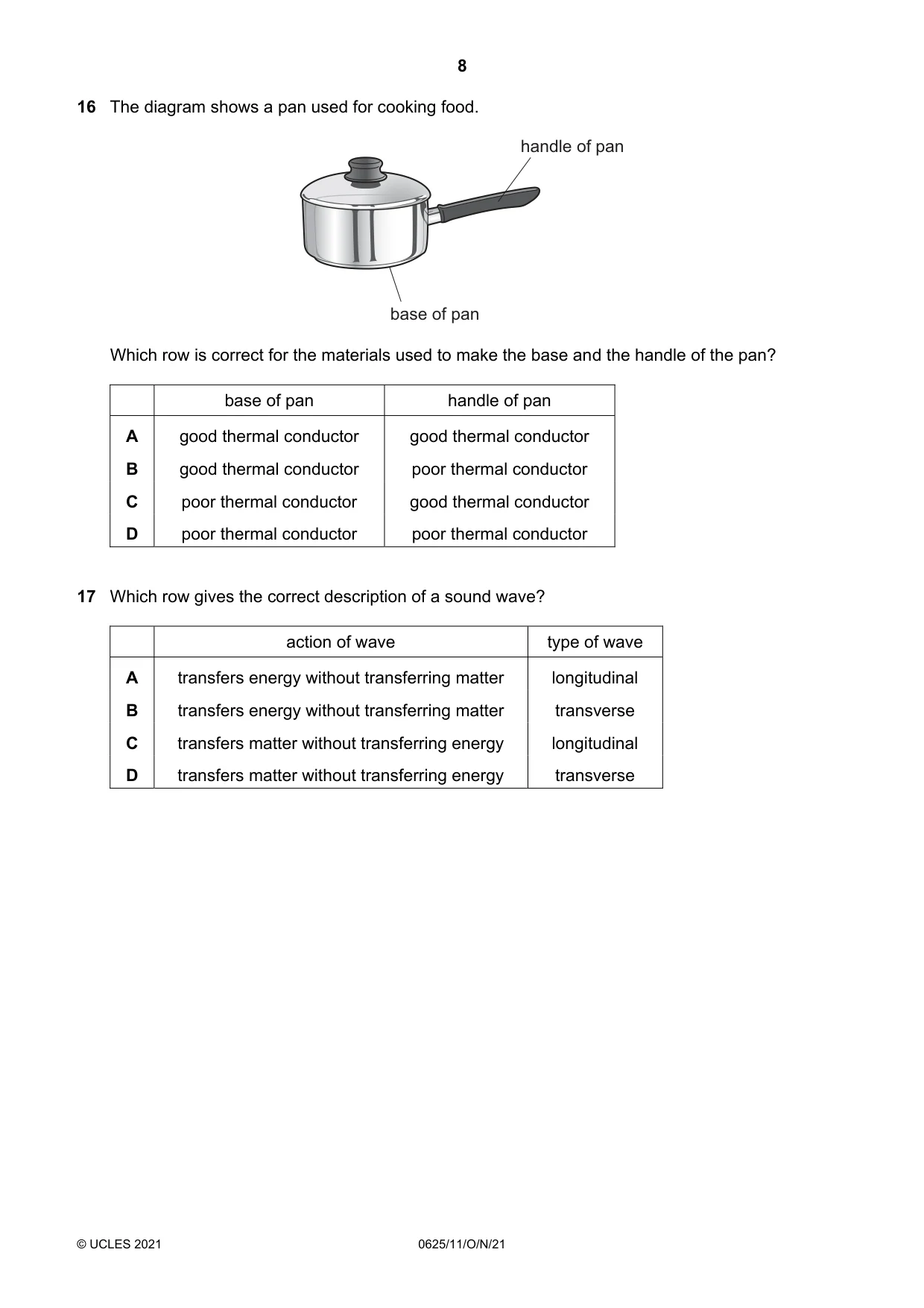
16 The diagram shows a pan used for cooking food. handle of pan base of pan Which row is correct for the materials used to make the base and the handle of the pan? base of pan handle of pan A good thermal conductor good thermal conductor B good thermal conductor poor thermal conductor C poor thermal conductor good thermal conductor D poor thermal conductor poor thermal conductor
Mark scheme: B
Q17 · Which row gives the correct description of a sound wave?
17 Which row gives the correct description of a sound wave? action of wave type of wave A transfers energy without transferring matter longitudinal B transfers energy without transferring matter transverse C transfers matter without transferring energy longitudinal D transfers matter without transferring energy transverse
Mark scheme: A
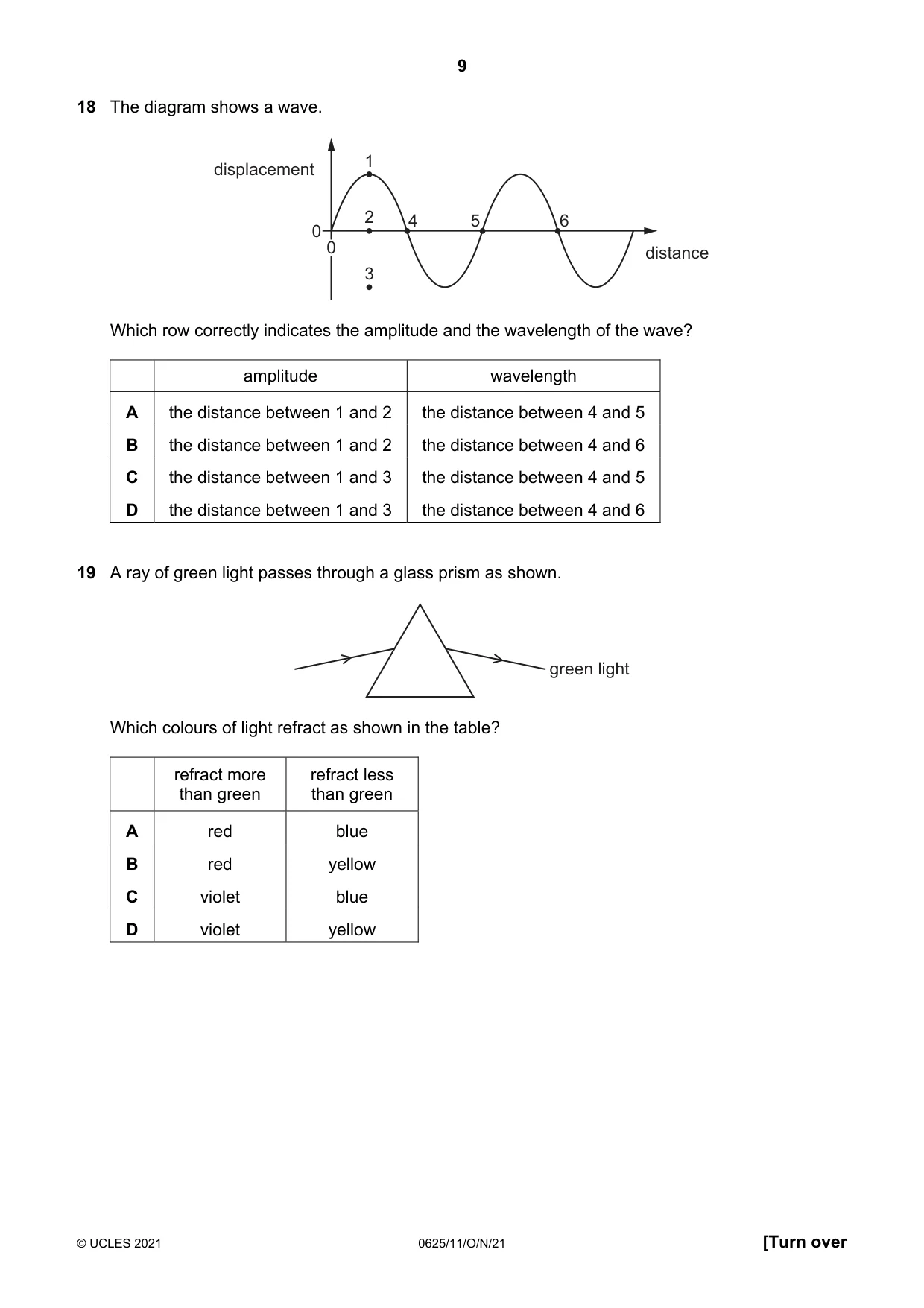
Q18 · The diagram shows a wave
18 The diagram shows a wave. 1 displacement 2 4 5 6 0 0 distance 3 Which row correctly indicates the amplitude and the wavelength of the wave? amplitude wavelength A the distance between 1 and 2 the distance between 4 and 5 B the distance between 1 and 2 the distance between 4 and 6 C the distance between 1 and 3 the distance between 4 and 5 D the distance between 1 and 3 the distance between 4 and 6
Mark scheme: B
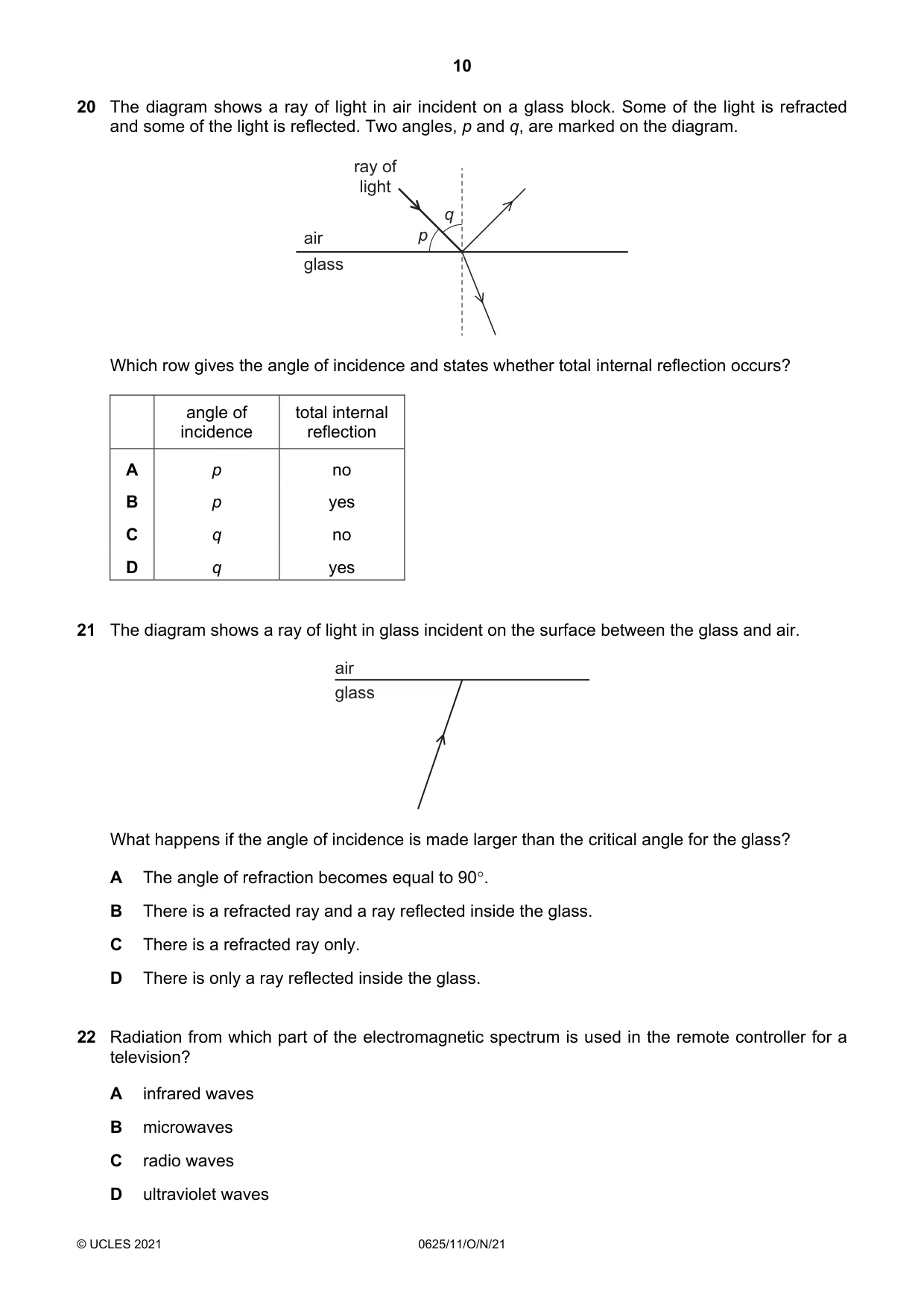
Q19 · A ray of green light passes through a glass prism as shown
19 A ray of green light passes through a glass prism as shown. green light Which colours of light refract as shown in the table? refract more refract less than green than green A red blue B red yellow C violet blue D violet yellow
Mark scheme: D
Q20 · The diagram shows a ray of light in air incident on a glass block
20 The diagram shows a ray of light in air incident on a glass block. Some of the light is refracted and some of the light is reflected. Two angles, p and q, are marked on the diagram. ray of light q air p glass Which row gives the angle of incidence and states whether total internal reflection occurs? angle of total internal incidence reflection A p no B p yes C q no D q yes
Mark scheme: C
Q21 · The diagram shows a ray of light in glass incident on the surface between the glass and…
21 The diagram shows a ray of light in glass incident on the surface between the glass and air. air glass What happens if the angle of incidence is made larger than the critical angle for the glass? A The angle of refraction becomes equal to 90. B There is a refracted ray and a ray reflected inside the glass. C There is a refracted ray only. D There is only a ray reflected inside the glass.
Mark scheme: D
Q22 · Radiation from which part of the electromagnetic spectrum is used in the remote…
22 Radiation from which part of the electromagnetic spectrum is used in the remote controller for a television? A infrared waves B microwaves C radio waves D ultraviolet waves
Mark scheme: A
Q23 · Two rays of light are different colours
23 Two rays of light are different colours. Which row is correct? speed of the two wavelengths of the two colours in a vacuum colours in a vacuum A different different B different the same C the same different D the same the same
Mark scheme: C
Question 24
24 What is ultrasound? A sound waves that are so loud that they damage human hearing B sound waves that are too high-pitched for humans to hear C sound waves that are too low-pitched for humans to hear D sound waves that are too quiet for humans to hear
Mark scheme: B
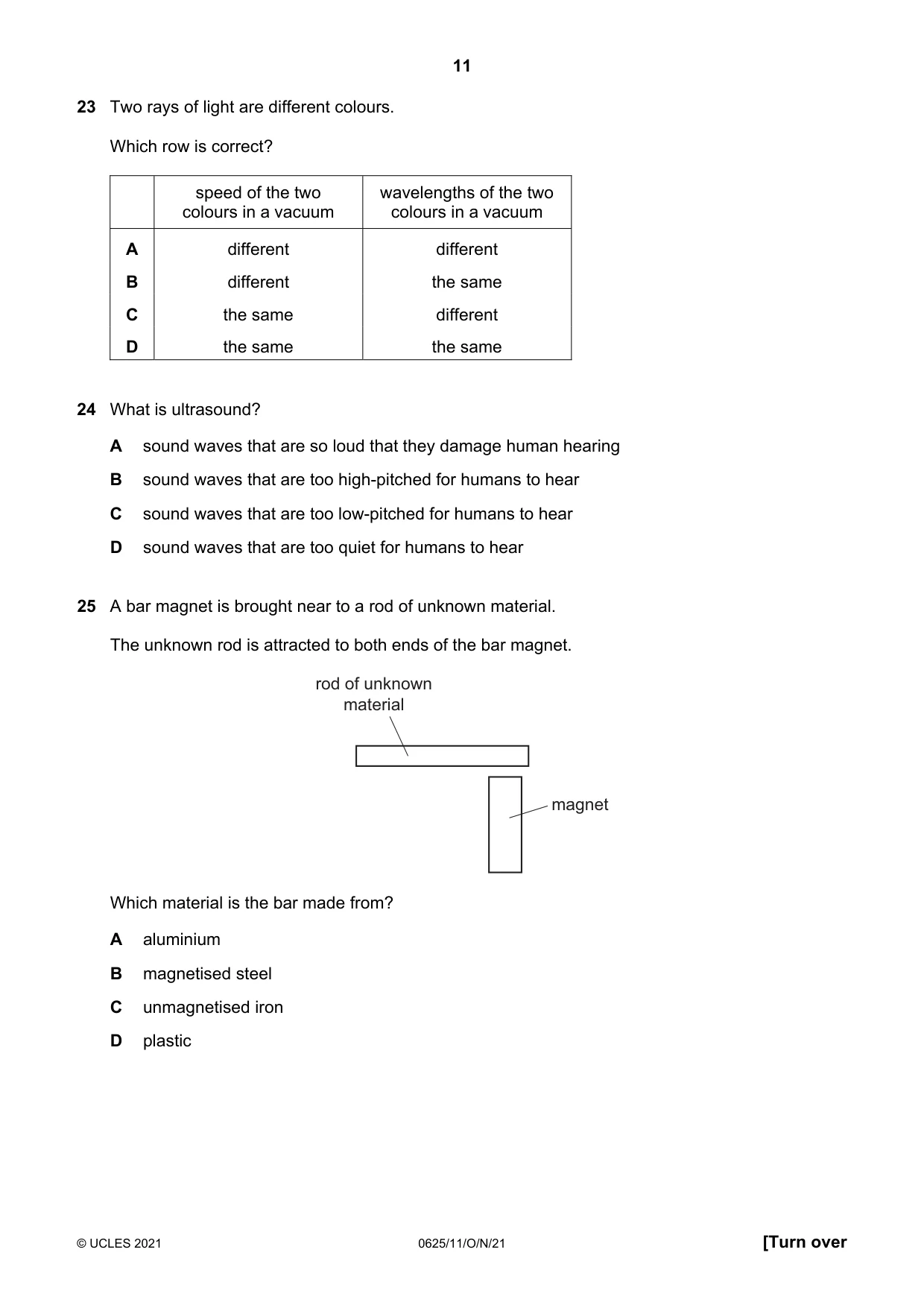
Q25 · A bar magnet is brought near to a rod of unknown material
25 A bar magnet is brought near to a rod of unknown material. The unknown rod is attracted to both ends of the bar magnet. rod of unknown material magnet Which material is the bar made from? A aluminium B magnetised steel C unmagnetised iron D plastic
Mark scheme: C
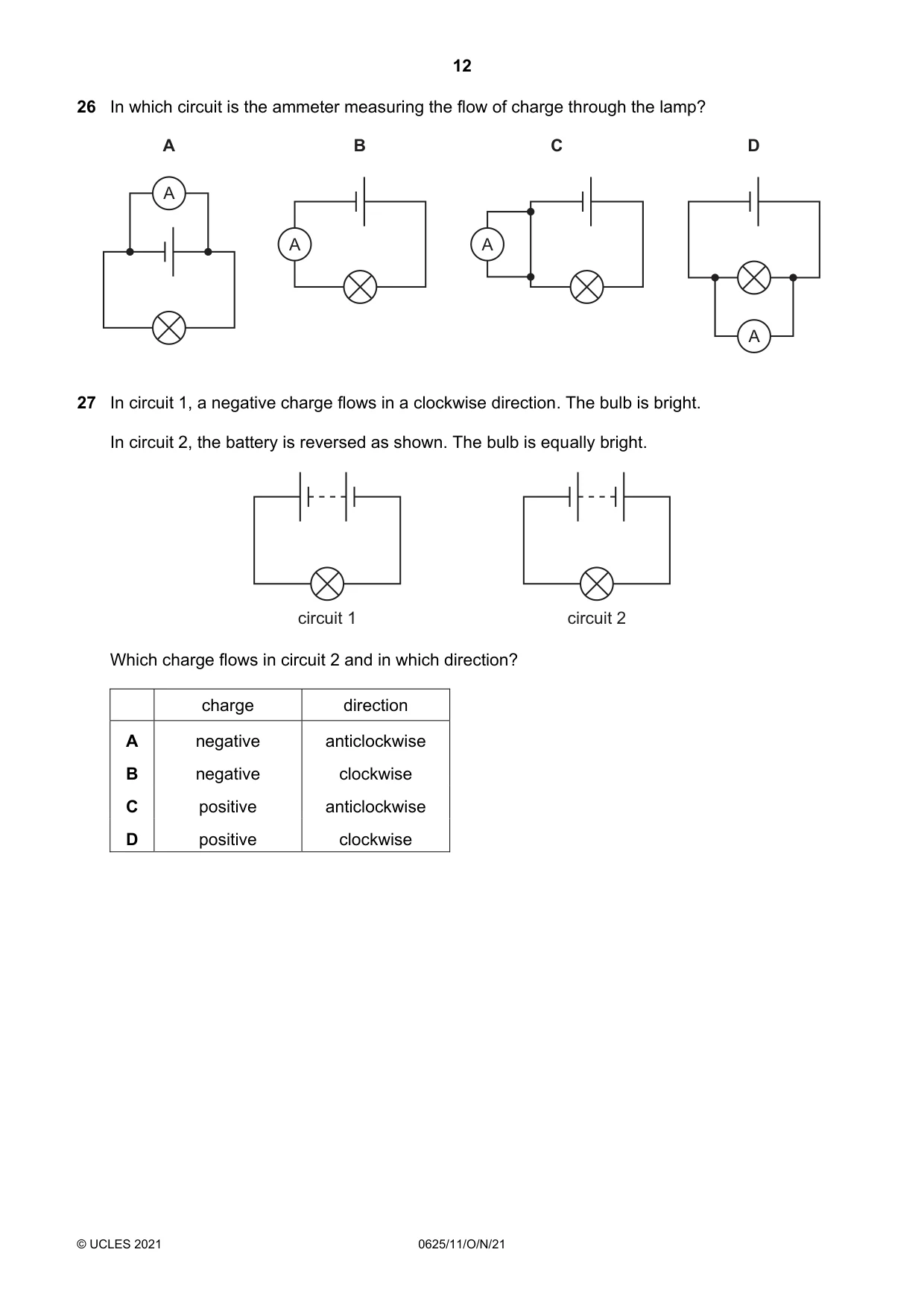
Q26 · In which circuit is the ammeter measuring the flow of charge through the lamp?
26 In which circuit is the ammeter measuring the flow of charge through the lamp? A B C D A A A A
Mark scheme: B
Q27 · In circuit 1, a negative charge flows in a clockwise direction
27 In circuit 1, a negative charge flows in a clockwise direction. The bulb is bright. In circuit 2, the battery is reversed as shown. The bulb is equally bright. circuit 1 circuit 2 Which charge flows in circuit 2 and in which direction? charge direction A negative anticlockwise B negative clockwise C positive anticlockwise D positive clockwise
Mark scheme: A
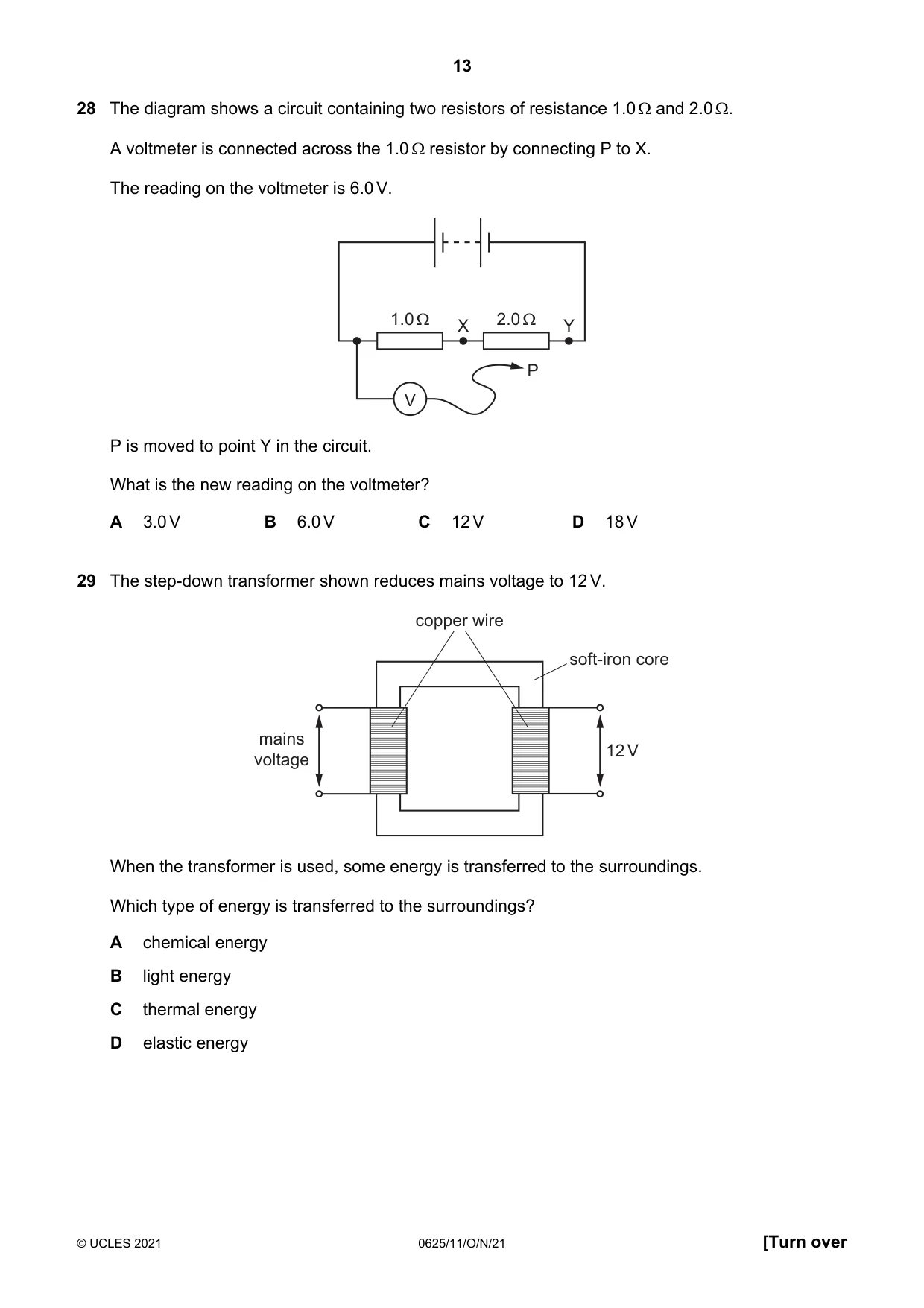
Q28 · The diagram shows a circuit containing two resistors of resistance 1.0 and 2.0
28 The diagram shows a circuit containing two resistors of resistance 1.0 and 2.0 . A voltmeter is connected across the 1.0 resistor by connecting P to X. The reading on the voltmeter is 6.0 V. 1.0 Ω X 2.0 Ω Y P V P is moved to point Y in the circuit. What is the new reading on the voltmeter? A 3.0 V B 6.0 V C 12 V D 18 V
Mark scheme: D
Q29 · The step-down transformer shown reduces mains voltage to 12 V
29 The step-down transformer shown reduces mains voltage to 12 V. copper wire soft-iron core mains 12 V voltage When the transformer is used, some energy is transferred to the surroundings. Which type of energy is transferred to the surroundings? A chemical energy B light energy C thermal energy D elastic energy
Mark scheme: C
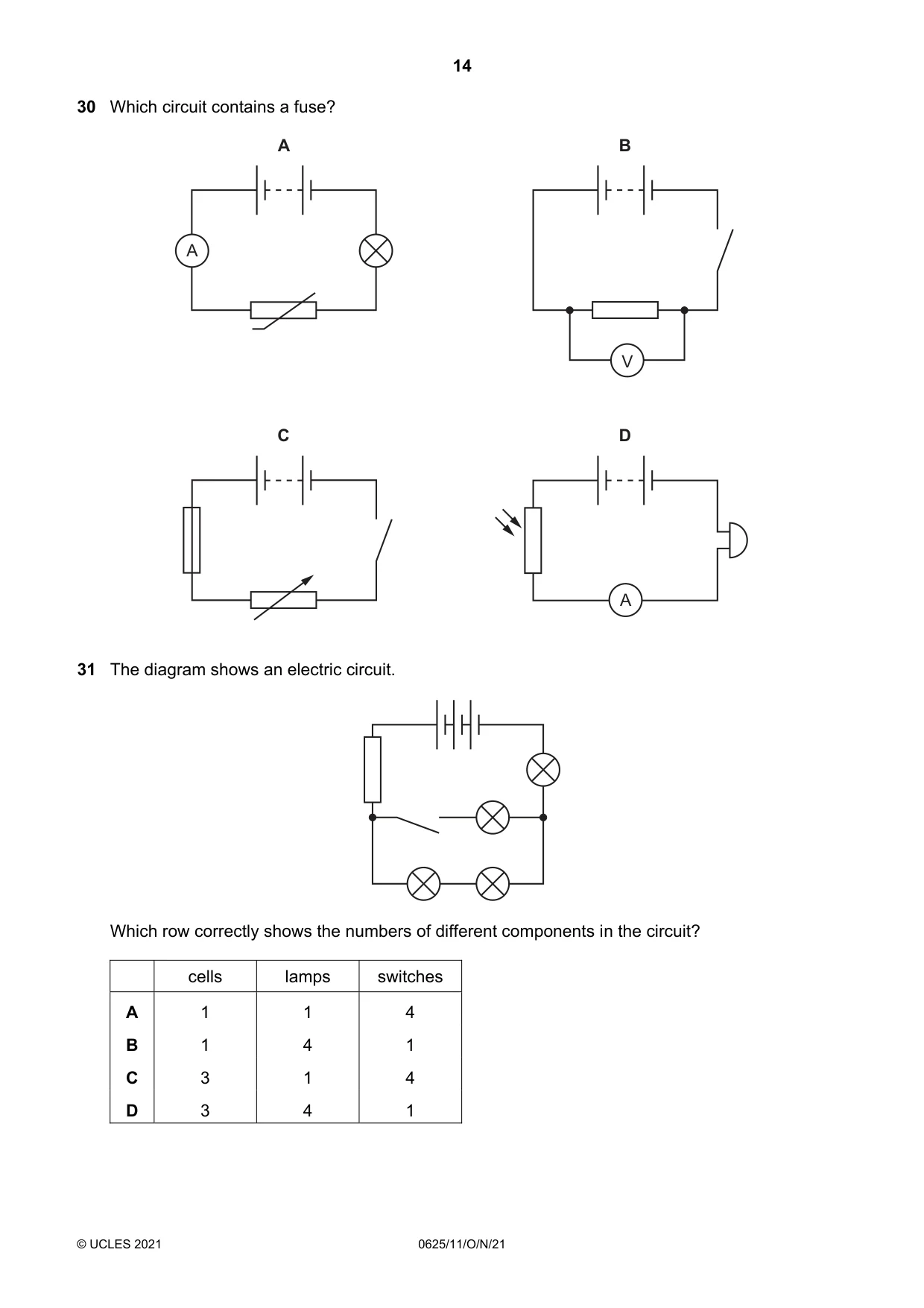
Q30 · Which circuit contains a fuse?
30 Which circuit contains a fuse? A B A V C D A
Mark scheme: C
Q31 · The diagram shows an electric circuit
31 The diagram shows an electric circuit. Which row correctly shows the numbers of different components in the circuit? cells lamps switches A 1 1 4 B 1 4 1 C 3 1 4 D 3 4 1
Mark scheme: D
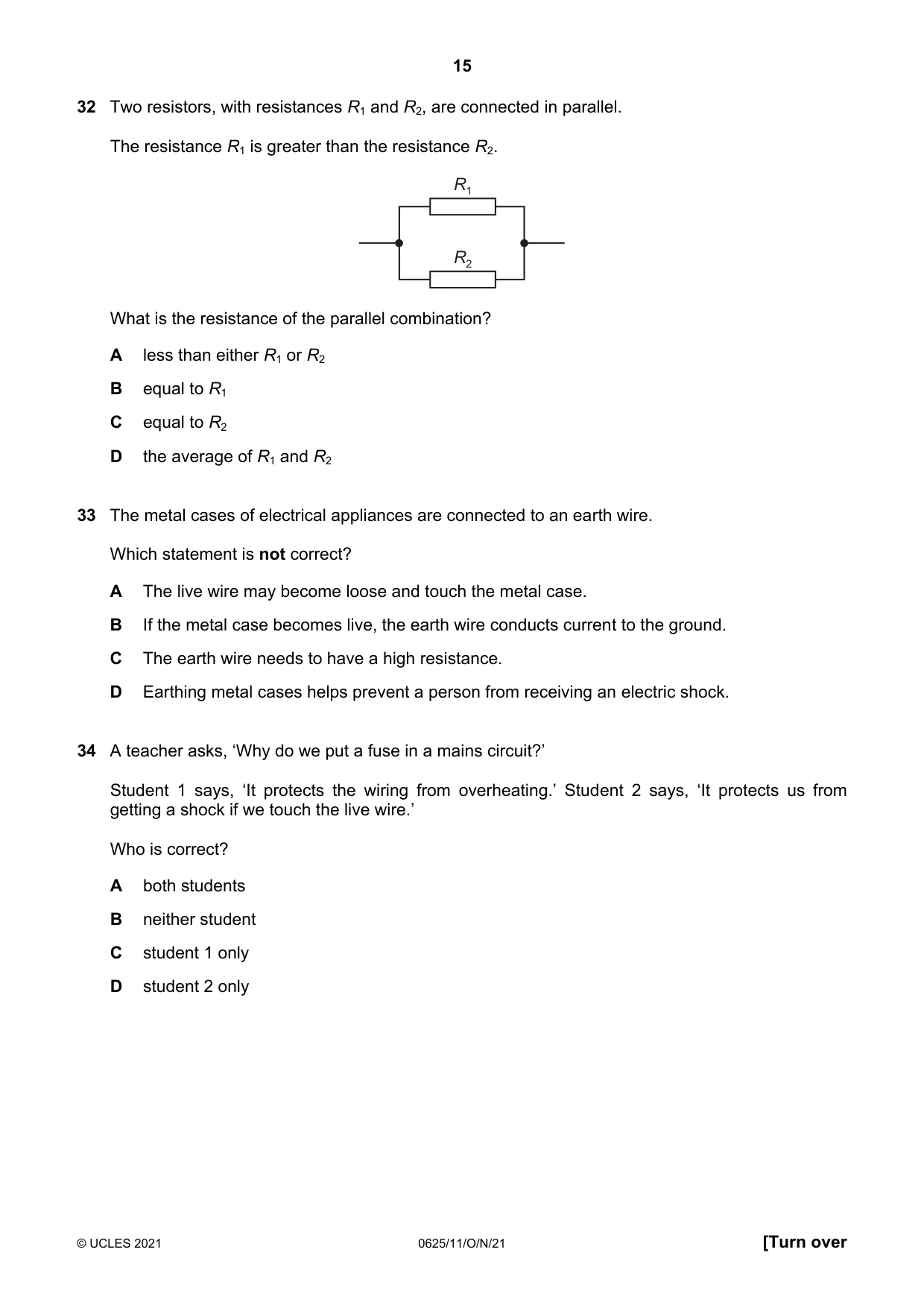
Q32 · Two resistors, with resistances R1 and R2, are connected in parallel
32 Two resistors, with resistances R1 and R2, are connected in parallel. The resistance R1 is greater than the resistance R2. R1 R2 What is the resistance of the parallel combination? A less than either R1 or R2 B equal to R1 C equal to R2 D the average of R1 and R2
Mark scheme: A
Q33 · The metal cases of electrical appliances are connected to an earth wire
33 The metal cases of electrical appliances are connected to an earth wire. Which statement is not correct? A The live wire may become loose and touch the metal case. B If the metal case becomes live, the earth wire conducts current to the ground. C The earth wire needs to have a high resistance. D Earthing metal cases helps prevent a person from receiving an electric shock.
Mark scheme: C
Q34 · A teacher asks, ‘Why do we put a fuse in a mains circuit?’ Student 1 says, ‘It protects…
34 A teacher asks, ‘Why do we put a fuse in a mains circuit?’ Student 1 says, ‘It protects the wiring from overheating.’ Student 2 says, ‘It protects us from getting a shock if we touch the live wire.’ Who is correct? A both students B neither student C student 1 only D student 2 only
Mark scheme: C
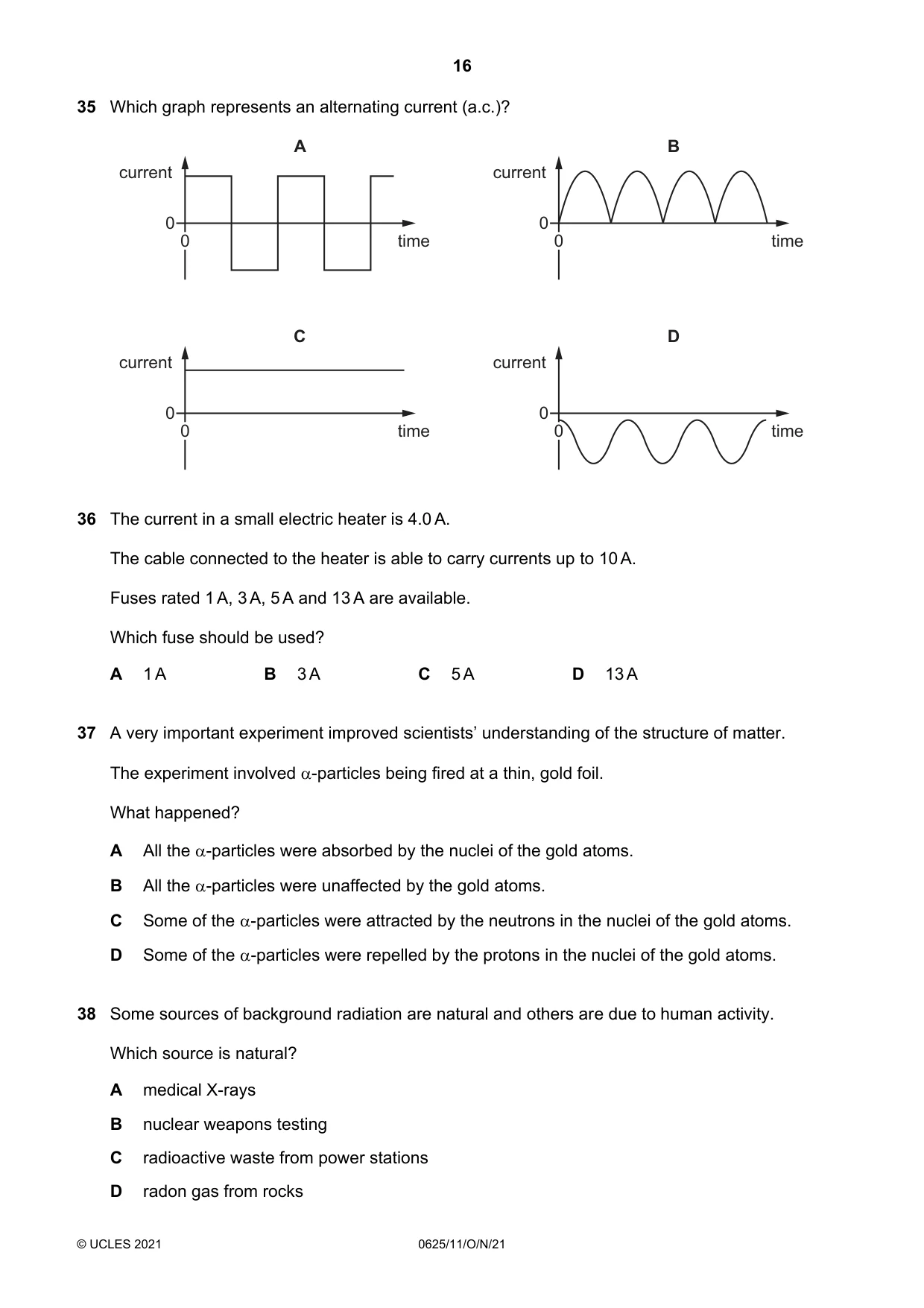
Q35 · Which graph represents an alternating current (a.c.)?
35 Which graph represents an alternating current (a.c.)? A B current current 0 0 0 time 0 time C D current current 0 0 0 time 0 time
Mark scheme: A
Q36 · The current in a small electric heater is 4.0 A
36 The current in a small electric heater is 4.0 A. The cable connected to the heater is able to carry currents up to 10 A. Fuses rated 1 A, 3 A, 5 A and 13 A are available. Which fuse should be used? A 1 A B 3 A C 5 A D 13 A
Mark scheme: C
Q37 · A very important experiment improved scientists’ understanding of the structure of matter
37 A very important experiment improved scientists’ understanding of the structure of matter. The experiment involved -particles being fired at a thin, gold foil. What happened? A All the -particles were absorbed by the nuclei of the gold atoms. B All the -particles were unaffected by the gold atoms. C Some of the -particles were attracted by the neutrons in the nuclei of the gold atoms. D Some of the -particles were repelled by the protons in the nuclei of the gold atoms.
Mark scheme: D
Q38 · Some sources of background radiation are natural and others are due to human activity
38 Some sources of background radiation are natural and others are due to human activity. Which source is natural? A medical X-rays B nuclear weapons testing C radioactive waste from power stations D radon gas from rocks
Mark scheme: D
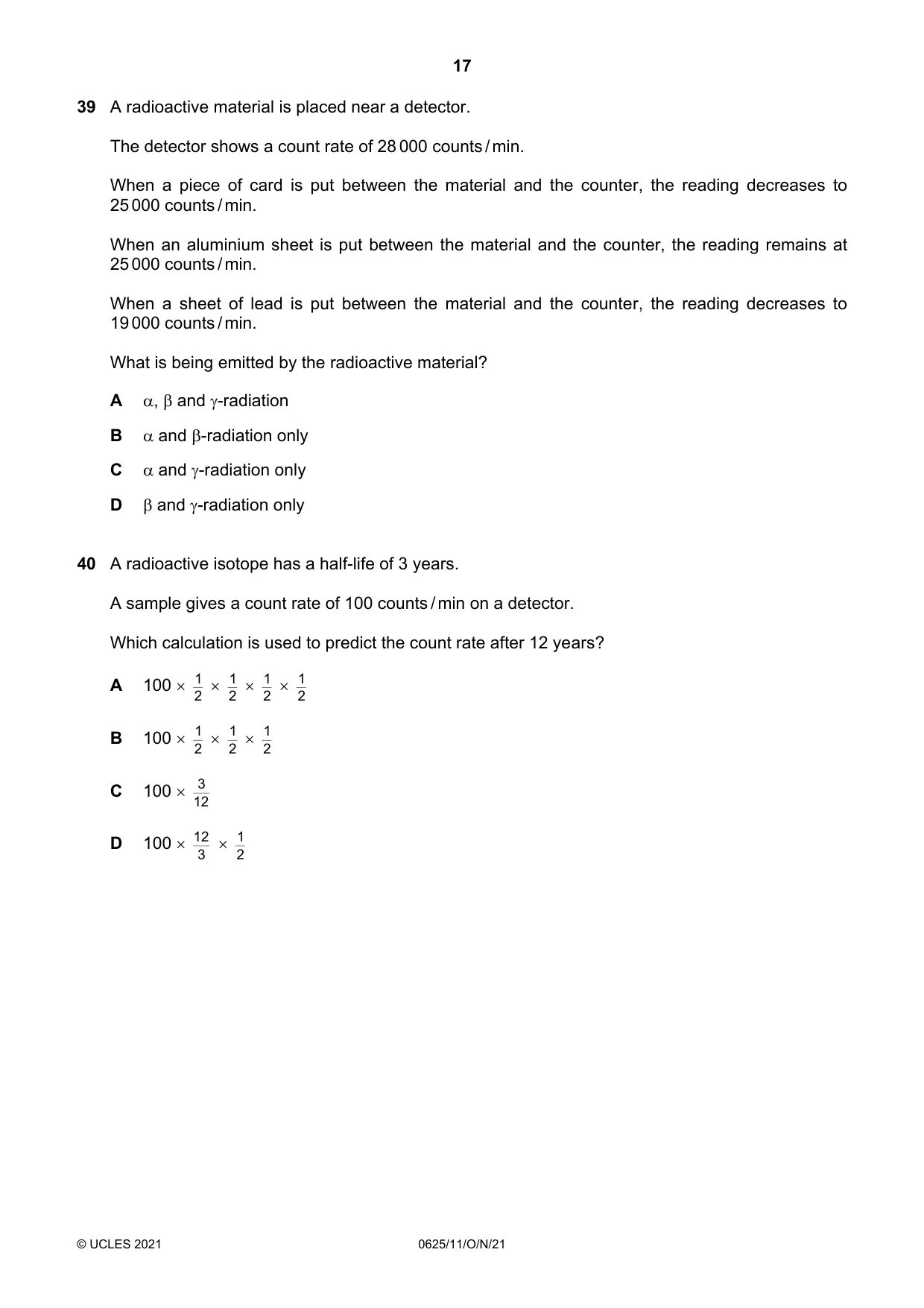
Q39 · A radioactive material is placed near a detector
39 A radioactive material is placed near a detector. The detector shows a count rate of 28 000 counts / min. When a piece of card is put between the material and the counter, the reading decreases to 25 000 counts / min. When an aluminium sheet is put between the material and the counter, the reading remains at 25 000 counts / min. When a sheet of lead is put between the material and the counter, the reading decreases to 19 000 counts / min. What is being emitted by the radioactive material? A , and -radiation B and -radiation only C and -radiation only D and -radiation only
Mark scheme: C
Q40 · A radioactive isotope has a half-life of 3 years
40 A radioactive isotope has a half-life of 3 years. A sample gives a count rate of 100 counts / min on a detector. Which calculation is used to predict the count rate after 12 years? A 100 1 2 1 2 1 2 1 2 B 100 1 2 1 2 1 2 C 100 3 12 D 100 12 3 1 2
Mark scheme: A
What was in this paper
The subtopics covered by these 40 questions, and how many questions each got. Open one in a new tab to see every Cambridge question on it.
5Electrical safety4Energy, work and power4Light3Radioactivity3Electromagnetic effects2Electromagnetic spectrum2Forces2General properties of waves2Kinetic particle model of matter2Thermal properties and temperature2Density1Mass and weight1Motion1Physical quantities and measurement techniques1Pressure1Simple phenomena of magnetism1Sound1The nuclear model of the atom1Transfer of thermal energy1What you needed in this session
Cambridge’s own grade thresholds for 2021 Oct/Nov, Paper 1 · Variant 1. A higher threshold means an easier paper — the bar moves with how the cohort did.