Cambridge IGCSE Physics 0625 — 2018 Oct/Nov Paper 1 · Variant 1
0625/11/O/N/18 · 40 questions · 40 marks · ≈45 min
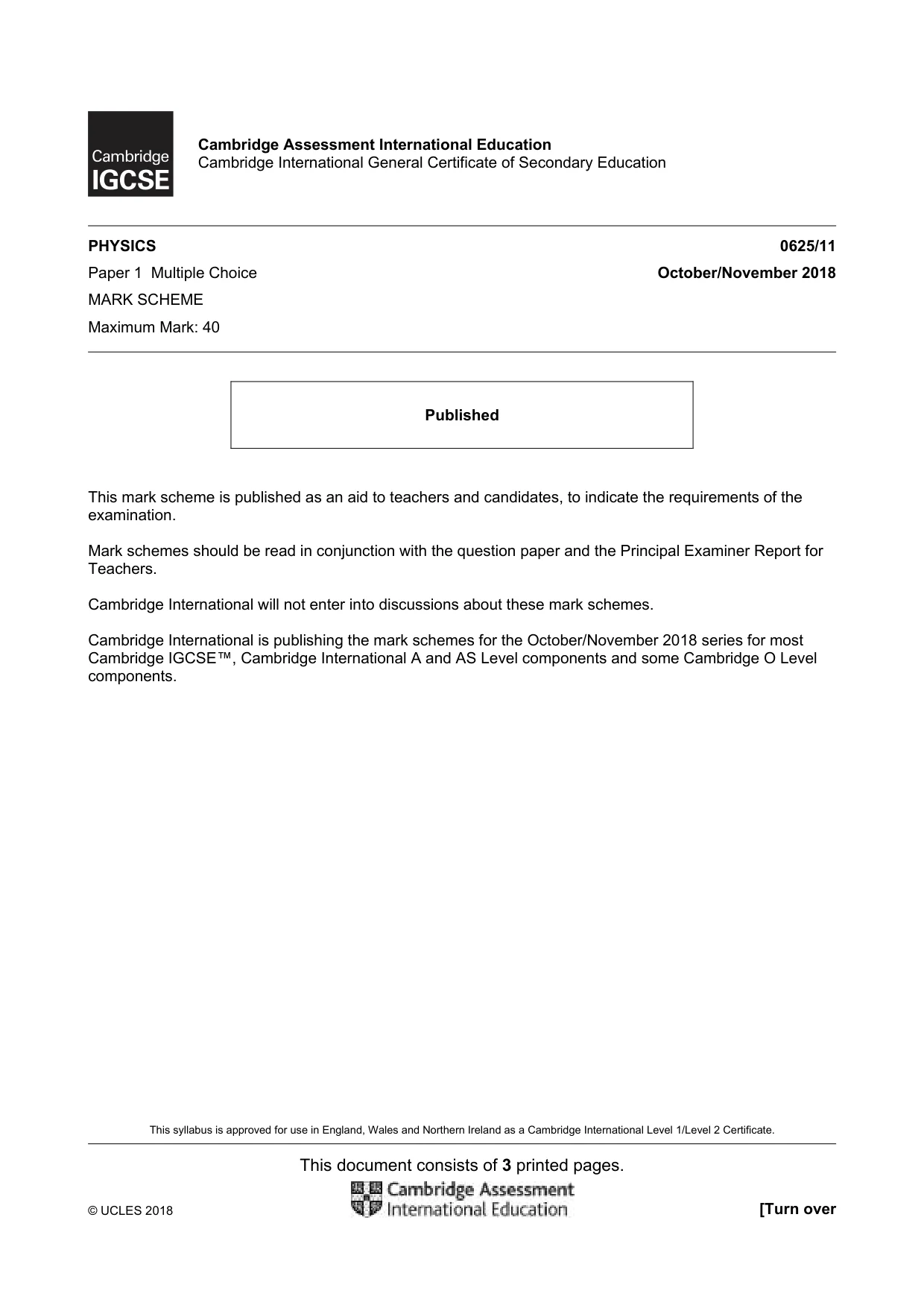
The question paper and its mark scheme, free to read here and free to download. This is Cambridge’s own paper, exactly as it was sat.
Question paper16 pages
Mark scheme3 pages
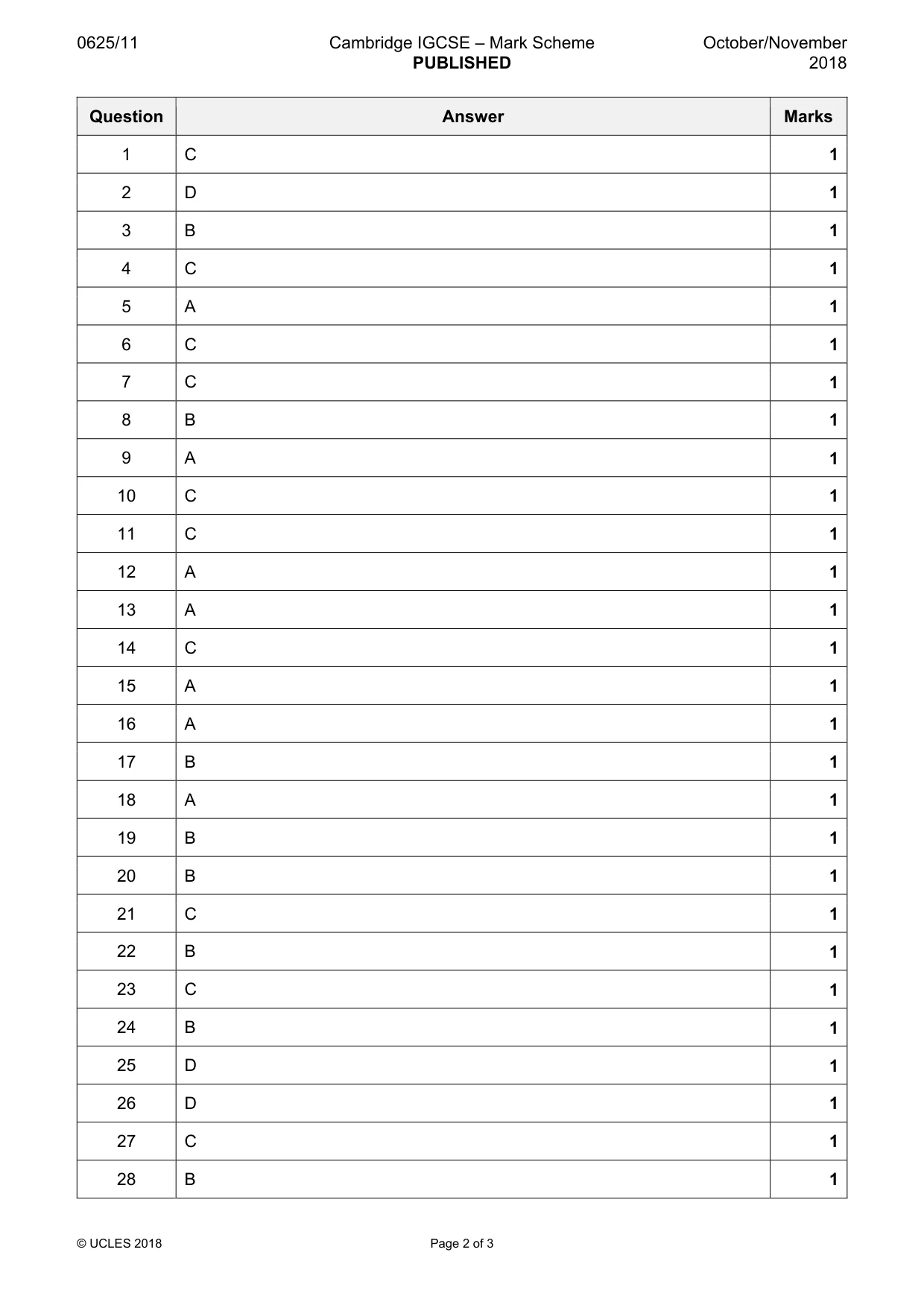
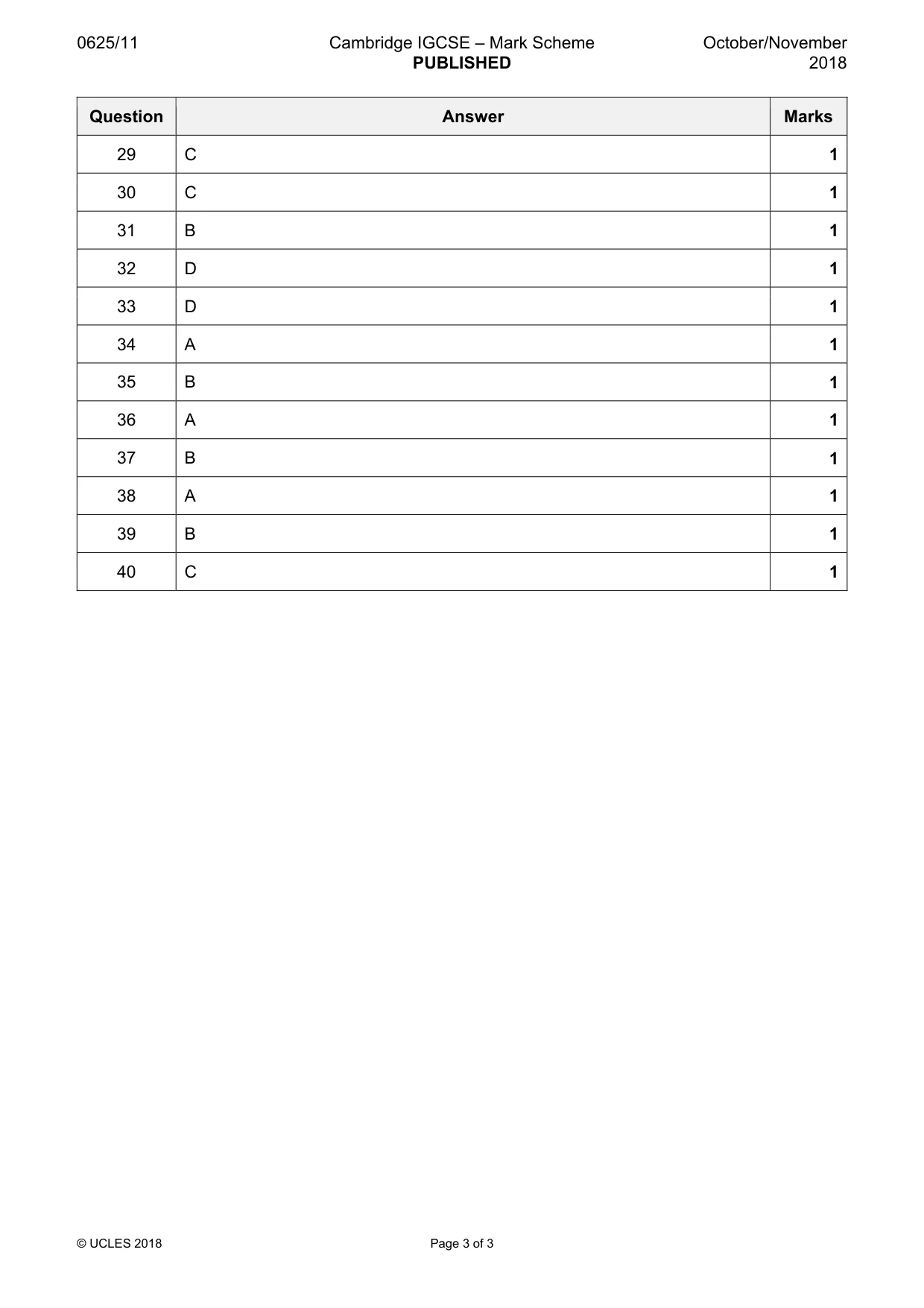
Answers below. Sit the paper first if you are practising.
Questions as text
Q1 · A pendulum is set in motion and timed
1 A pendulum is set in motion and timed. The time measured for 20 complete swings is 30 s. What is the time for one complete swing of the pendulum? A 0.67 s B 0.75 s C 1.5 s D 3.0 s
Mark scheme: C
More questions on Physical quantities and measurement techniques
Q2 · The diagrams are distance-time graphs for four bodies
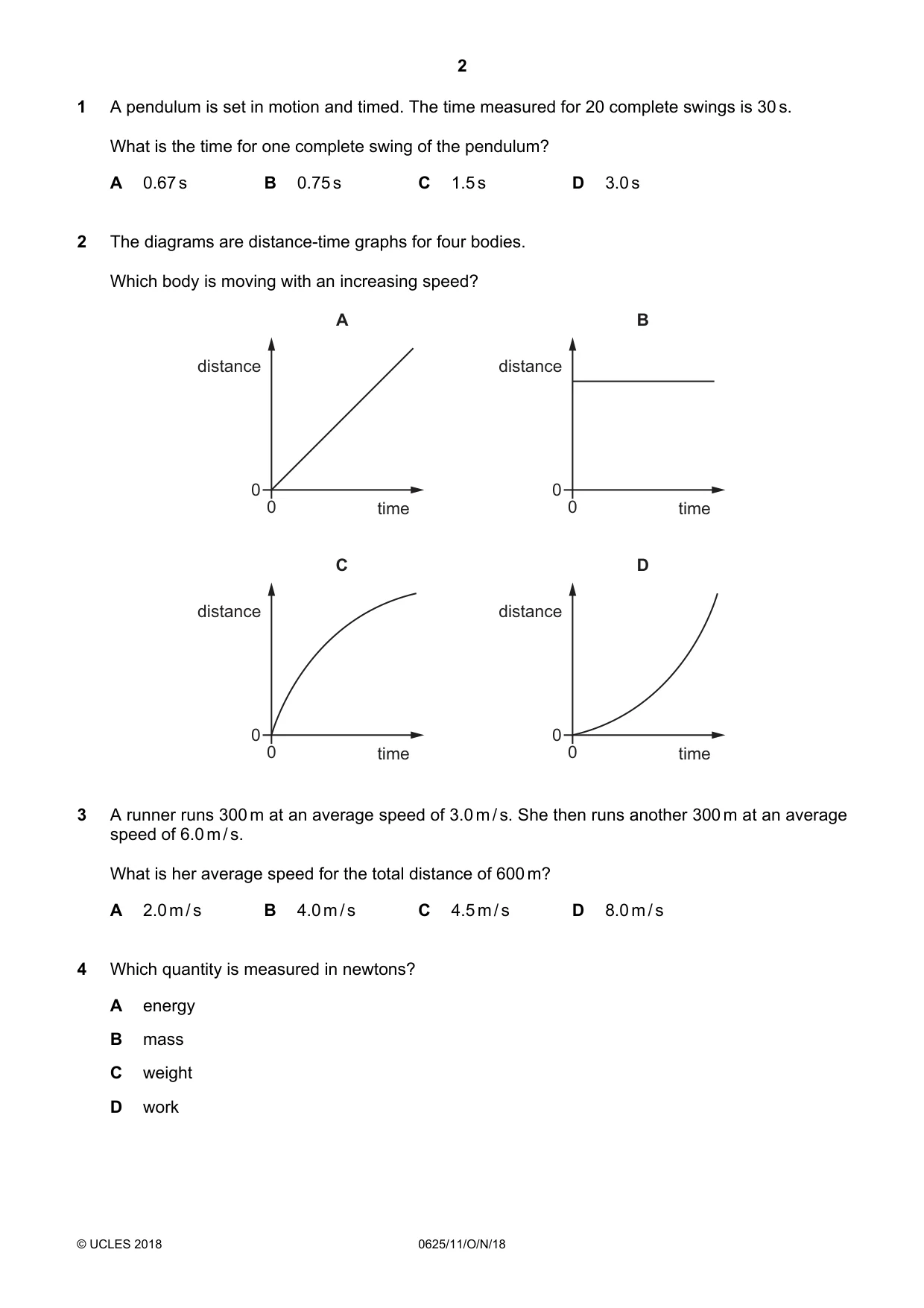
2 The diagrams are distance-time graphs for four bodies. Which body is moving with an increasing speed? A B distance distance 0 0 0 time 0 time C D distance distance 0 0 0 time 0 time
Mark scheme: D
Q3 · A runner runs 300 m at an average speed of 3.0 m / s
3 A runner runs 300 m at an average speed of 3.0 m / s. She then runs another 300 m at an average speed of 6.0 m / s. What is her average speed for the total distance of 600 m? A 2.0 m / s B 4.0 m / s C 4.5 m / s D 8.0 m / s
Mark scheme: B
Q4 · Which quantity is measured in newtons?
4 Which quantity is measured in newtons? A energy B mass C weight D work
Mark scheme: C
Q5 · Four identical steel blocks are placed on a balance
5 Four identical steel blocks are placed on a balance. The reading on the balance is 220 N. What is the mass of one steel block? A 5.5 kg B 22 kg C 55 kg D 88 kg
Mark scheme: A
Q6 · A liquid has a volume of 0.040 m3 and a mass of 30 000 g
6 A liquid has a volume of 0.040 m3 and a mass of 30 000 g. What is the density of the liquid? A 0.075 kg / m3 B 7.5 kg / m3 C 750 kg / m3 D 7500 kg / m3
Mark scheme: C
Q7 · The unstretched lengths and extension-load graphs are shown for each of four different…
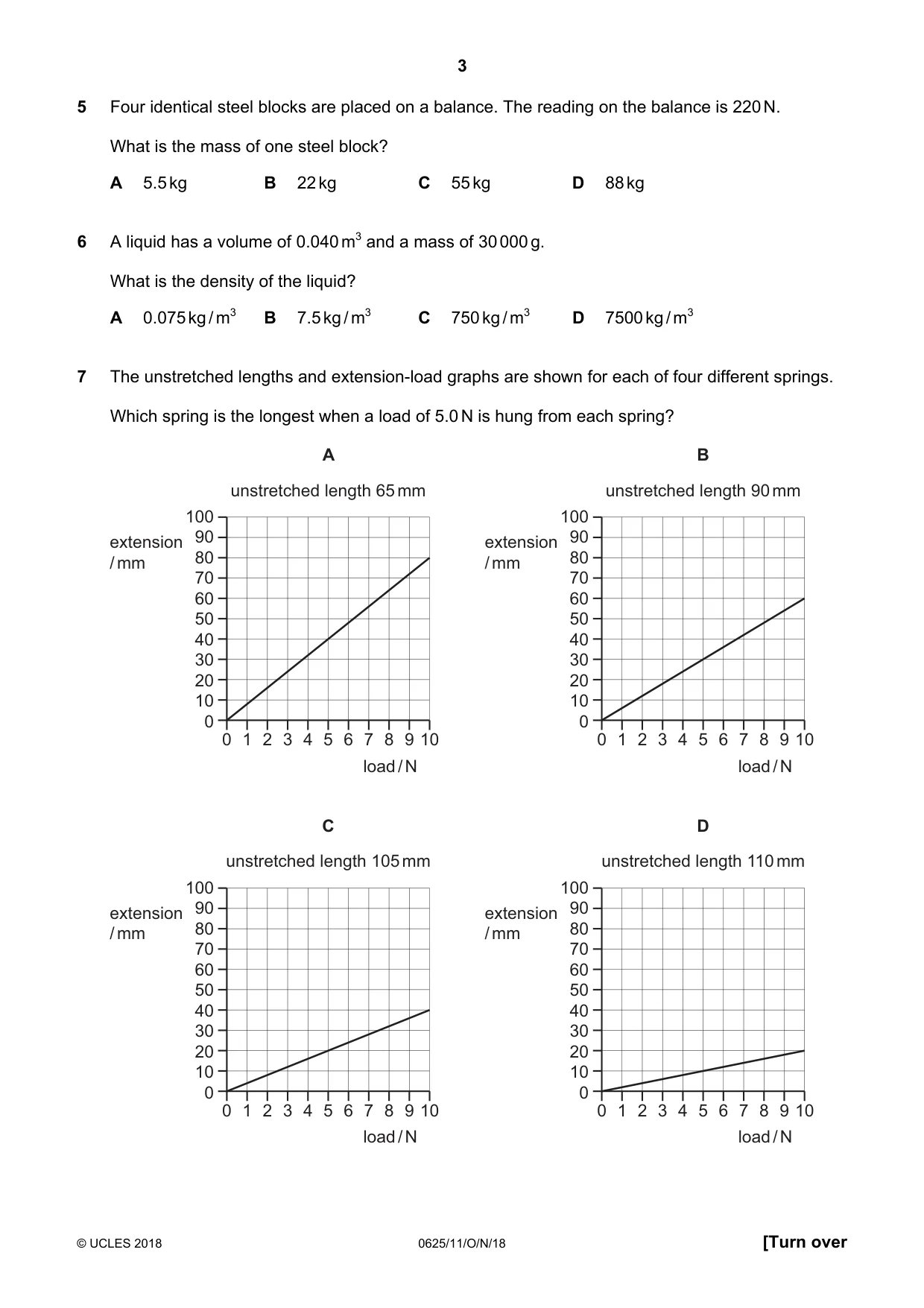
7 The unstretched lengths and extension-load graphs are shown for each of four different springs. Which spring is the longest when a load of 5.0 N is hung from each spring? A B unstretched length 65 mm unstretched length 90 mm 100 100 extension 90 extension 90 / mm 80 / mm 80 70 70 60 60 50 50 40 40 30 30 20 20 10 10 0 0 0 1 2 3 4 5 6 7 8 9 10 0 1 2 3 4 5 6 7 8 9 10 load / N load / N C D unstretched length 105 mm unstretched length 110 mm 100 100 extension 90 extension 90 / mm 80 / mm 80 70 70 60 60 50 50 40 40 30 30 20 20 10 10 0 0 0 1 2 3 4 5 6 7 8 9 10 0 1 2 3 4 5 6 7 8 9 10 load / N load / N
Mark scheme: C
Q8 · A car moves along a level road
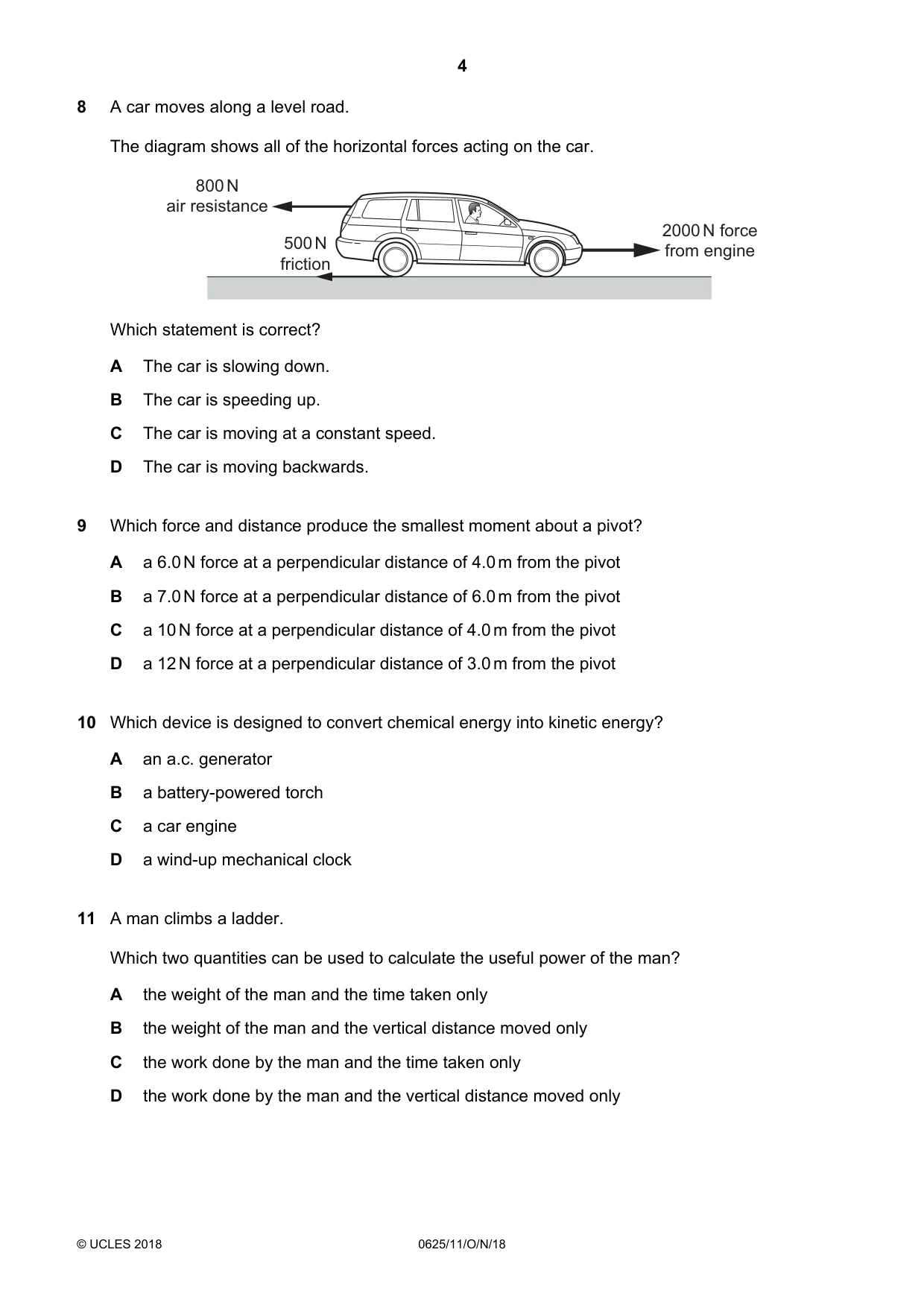
8 A car moves along a level road. The diagram shows all of the horizontal forces acting on the car. 800 N air resistance 2000 N force 500 N from engine friction Which statement is correct? A The car is slowing down. B The car is speeding up. C The car is moving at a constant speed. D The car is moving backwards.
Mark scheme: B
Q9 · Which force and distance produce the smallest moment about a pivot?
9 Which force and distance produce the smallest moment about a pivot? A a 6.0 N force at a perpendicular distance of 4.0 m from the pivot B a 7.0 N force at a perpendicular distance of 6.0 m from the pivot C a 10 N force at a perpendicular distance of 4.0 m from the pivot D a 12 N force at a perpendicular distance of 3.0 m from the pivot
Mark scheme: A
Q10 · Which device is designed to convert chemical energy into kinetic energy?
10 Which device is designed to convert chemical energy into kinetic energy? A an a.c. generator B a battery-powered torch C a car engine D a wind-up mechanical clock
Mark scheme: C
Q11 · A man climbs a ladder
11 A man climbs a ladder. Which two quantities can be used to calculate the useful power of the man? A the weight of the man and the time taken only B the weight of the man and the vertical distance moved only C the work done by the man and the time taken only D the work done by the man and the vertical distance moved only
Mark scheme: C
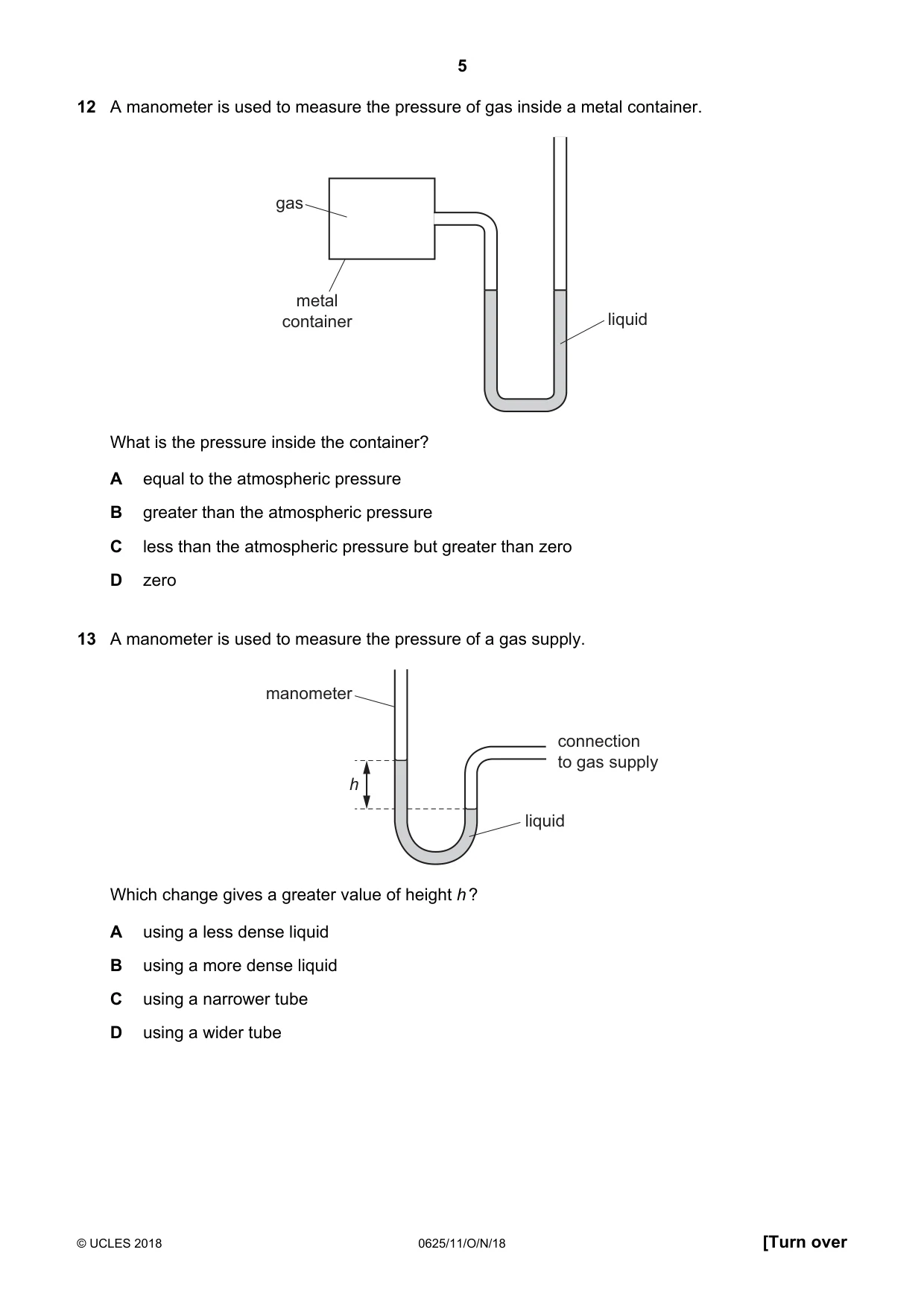
Q12 · A manometer is used to measure the pressure of gas inside a metal container
12 A manometer is used to measure the pressure of gas inside a metal container. gas metal container liquid What is the pressure inside the container? A equal to the atmospheric pressure B greater than the atmospheric pressure C less than the atmospheric pressure but greater than zero D zero
Mark scheme: A
Q13 · A manometer is used to measure the pressure of a gas supply
13 A manometer is used to measure the pressure of a gas supply. manometer connection to gas supply h liquid Which change gives a greater value of height h ? A using a less dense liquid B using a more dense liquid C using a narrower tube D using a wider tube
Mark scheme: A
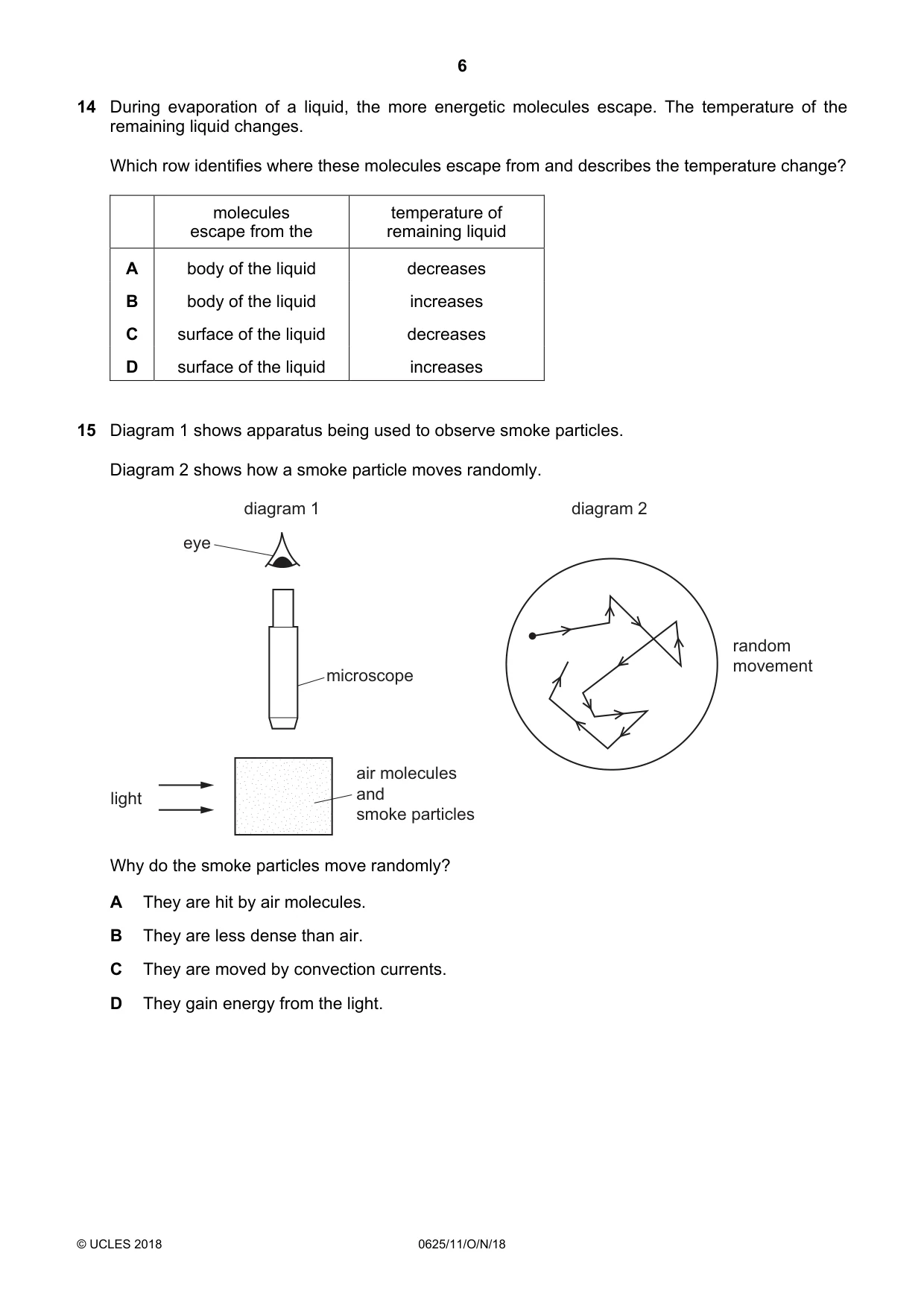
Q14 · During evaporation of a liquid, the more energetic molecules escape
14 During evaporation of a liquid, the more energetic molecules escape. The temperature of the remaining liquid changes. Which row identifies where these molecules escape from and describes the temperature change? molecules temperature of escape from the remaining liquid A body of the liquid decreases B body of the liquid increases C surface of the liquid decreases D surface of the liquid increases
Mark scheme: C
Q15 · Apparatus being used to observe smoke particles
15 Diagram 1 shows apparatus being used to observe smoke particles. Diagram 2 shows how a smoke particle moves randomly. diagram 1 diagram 2 eye random movement microscope air molecules light and smoke particles Why do the smoke particles move randomly? A They are hit by air molecules. B They are less dense than air. C They are moved by convection currents. D They gain energy from the light.
Mark scheme: A
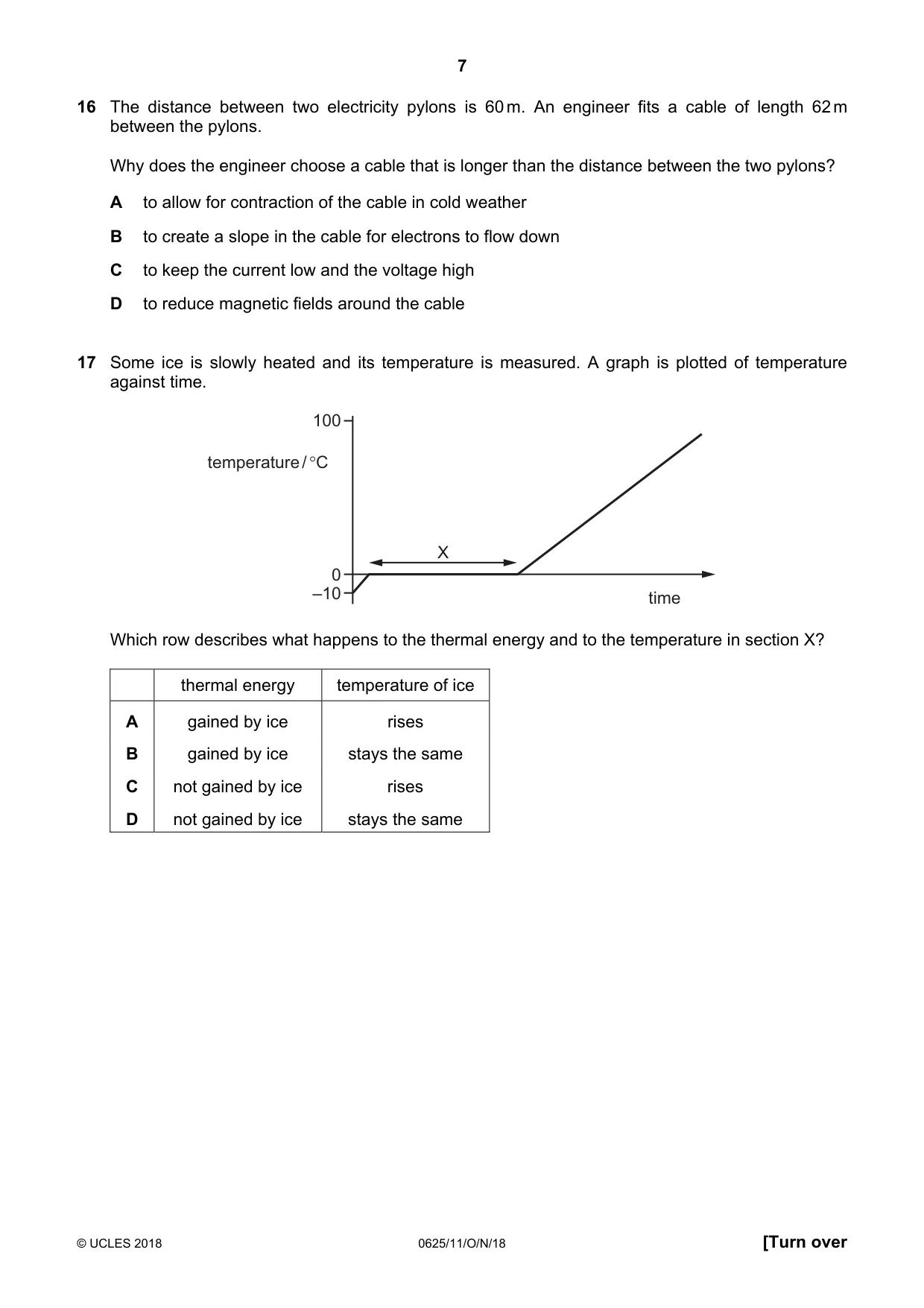
Q16 · The distance between two electricity pylons is 60 m
16 The distance between two electricity pylons is 60 m. An engineer fits a cable of length 62 m between the pylons. Why does the engineer choose a cable that is longer than the distance between the two pylons? A to allow for contraction of the cable in cold weather B to create a slope in the cable for electrons to flow down C to keep the current low and the voltage high D to reduce magnetic fields around the cable
Mark scheme: A
Q17 · Some ice is slowly heated and its temperature is measured
17 Some ice is slowly heated and its temperature is measured. A graph is plotted of temperature against time. 100 temperature / °C X 0 –10 time Which row describes what happens to the thermal energy and to the temperature in section X? thermal energy temperature of ice A gained by ice rises B gained by ice stays the same C not gained by ice rises D not gained by ice stays the same
Mark scheme: B
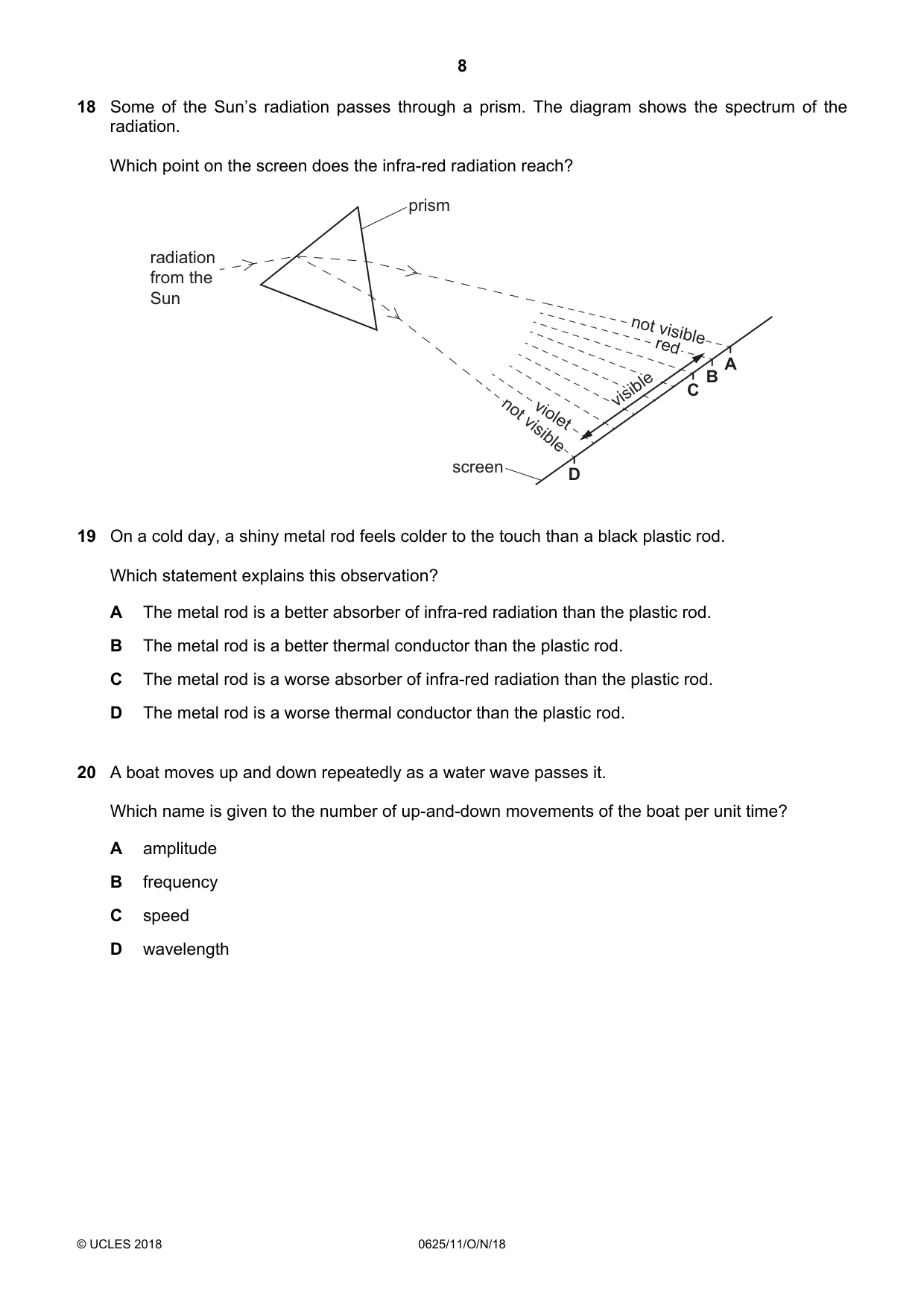
Q18 · Some of the Sun’s radiation passes through a prism
18 Some of the Sun’s radiation passes through a prism. The diagram shows the spectrum of the radiation. Which point on the screen does the infra-red radiation reach? prism radiation from the Sun not visible red A visible B C not visible violet screen D
Mark scheme: A
Q19 · On a cold day, a shiny metal rod feels colder to the touch than a black plastic rod
19 On a cold day, a shiny metal rod feels colder to the touch than a black plastic rod. Which statement explains this observation? A The metal rod is a better absorber of infra-red radiation than the plastic rod. B The metal rod is a better thermal conductor than the plastic rod. C The metal rod is a worse absorber of infra-red radiation than the plastic rod. D The metal rod is a worse thermal conductor than the plastic rod.
Mark scheme: B
Q20 · A boat moves up and down repeatedly as a water wave passes it
20 A boat moves up and down repeatedly as a water wave passes it. Which name is given to the number of up-and-down movements of the boat per unit time? A amplitude B frequency C speed D wavelength
Mark scheme: B
Q21 · Plane water waves travel from a shallow region into a deeper region
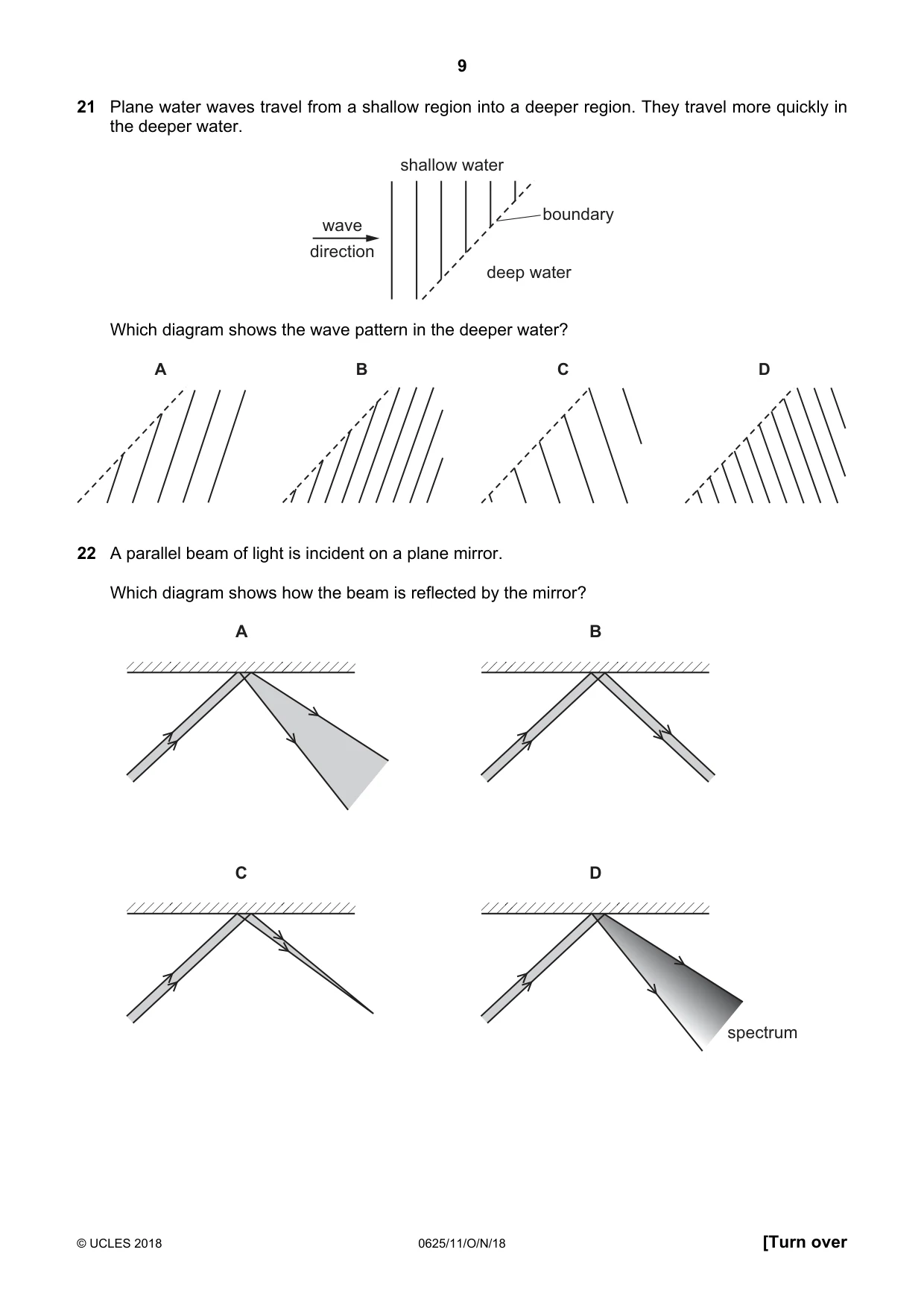
21 Plane water waves travel from a shallow region into a deeper region. They travel more quickly in the deeper water. shallow water boundary wave direction deep water Which diagram shows the wave pattern in the deeper water? A B C D
Mark scheme: C
Q22 · A parallel beam of light is incident on a plane mirror
22 A parallel beam of light is incident on a plane mirror. Which diagram shows how the beam is reflected by the mirror? A B C D spectrum
Mark scheme: B
Q23 · The diagram shows a parallel, cylindrical light beam of diameter d incident on a thin…
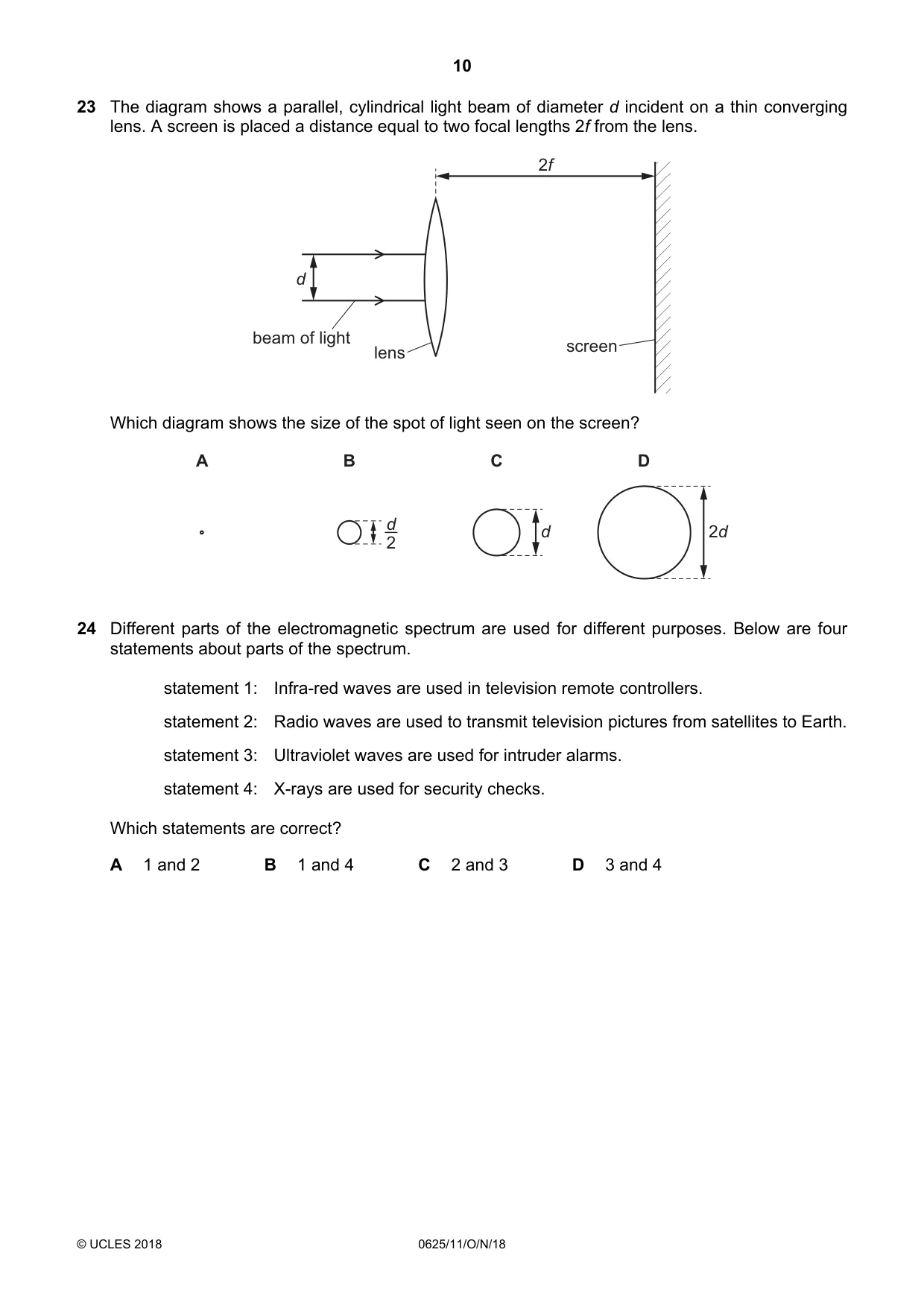
23 The diagram shows a parallel, cylindrical light beam of diameter d incident on a thin converging lens. A screen is placed a distance equal to two focal lengths 2f from the lens. 2f d beam of light lens screen Which diagram shows the size of the spot of light seen on the screen? A B C D d d 2d 2
Mark scheme: C
Q24 · Different parts of the electromagnetic spectrum are used for different purposes
24 Different parts of the electromagnetic spectrum are used for different purposes. Below are four statements about parts of the spectrum. statement 1: Infra-red waves are used in television remote controllers. statement 2: Radio waves are used to transmit television pictures from satellites to Earth. statement 3: Ultraviolet waves are used for intruder alarms. statement 4: X-rays are used for security checks. Which statements are correct? A 1 and 2 B 1 and 4 C 2 and 3 D 3 and 4
Mark scheme: B
Q25 · A woman hears the first note produced by a clarinet
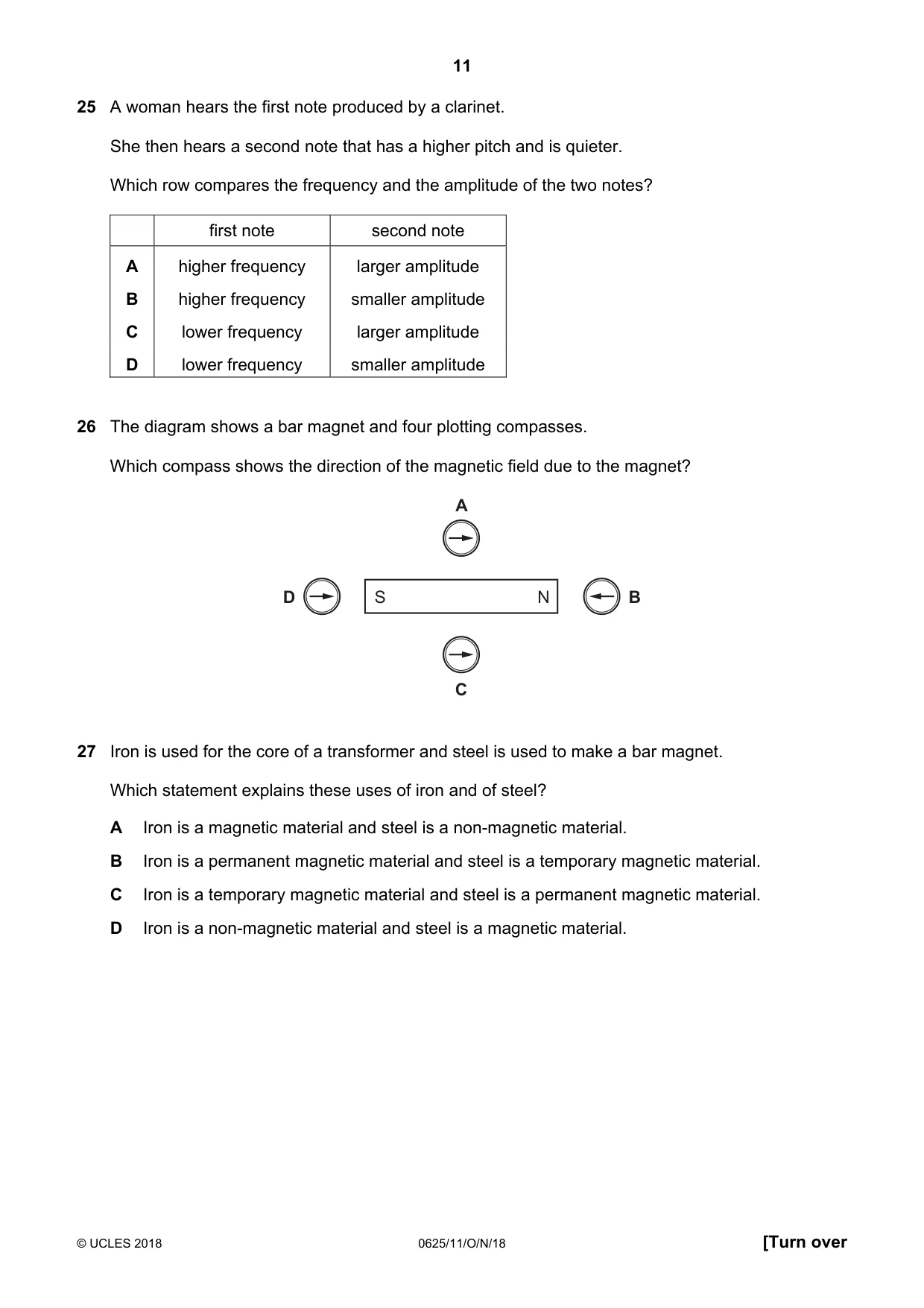
25 A woman hears the first note produced by a clarinet. She then hears a second note that has a higher pitch and is quieter. Which row compares the frequency and the amplitude of the two notes? first note second note A higher frequency larger amplitude B higher frequency smaller amplitude C lower frequency larger amplitude D lower frequency smaller amplitude
Mark scheme: D
Q26 · The diagram shows a bar magnet and four plotting compasses
26 The diagram shows a bar magnet and four plotting compasses. Which compass shows the direction of the magnetic field due to the magnet? A D S N B C
Mark scheme: D
Q27 · Iron is used for the core of a transformer and steel is used to make a bar magnet
27 Iron is used for the core of a transformer and steel is used to make a bar magnet. Which statement explains these uses of iron and of steel? A Iron is a magnetic material and steel is a non-magnetic material. B Iron is a permanent magnetic material and steel is a temporary magnetic material. C Iron is a temporary magnetic material and steel is a permanent magnetic material. D Iron is a non-magnetic material and steel is a magnetic material.
Mark scheme: C
Q28 · A negatively charged plastic rod P is placed above a positively charged plastic rod Q
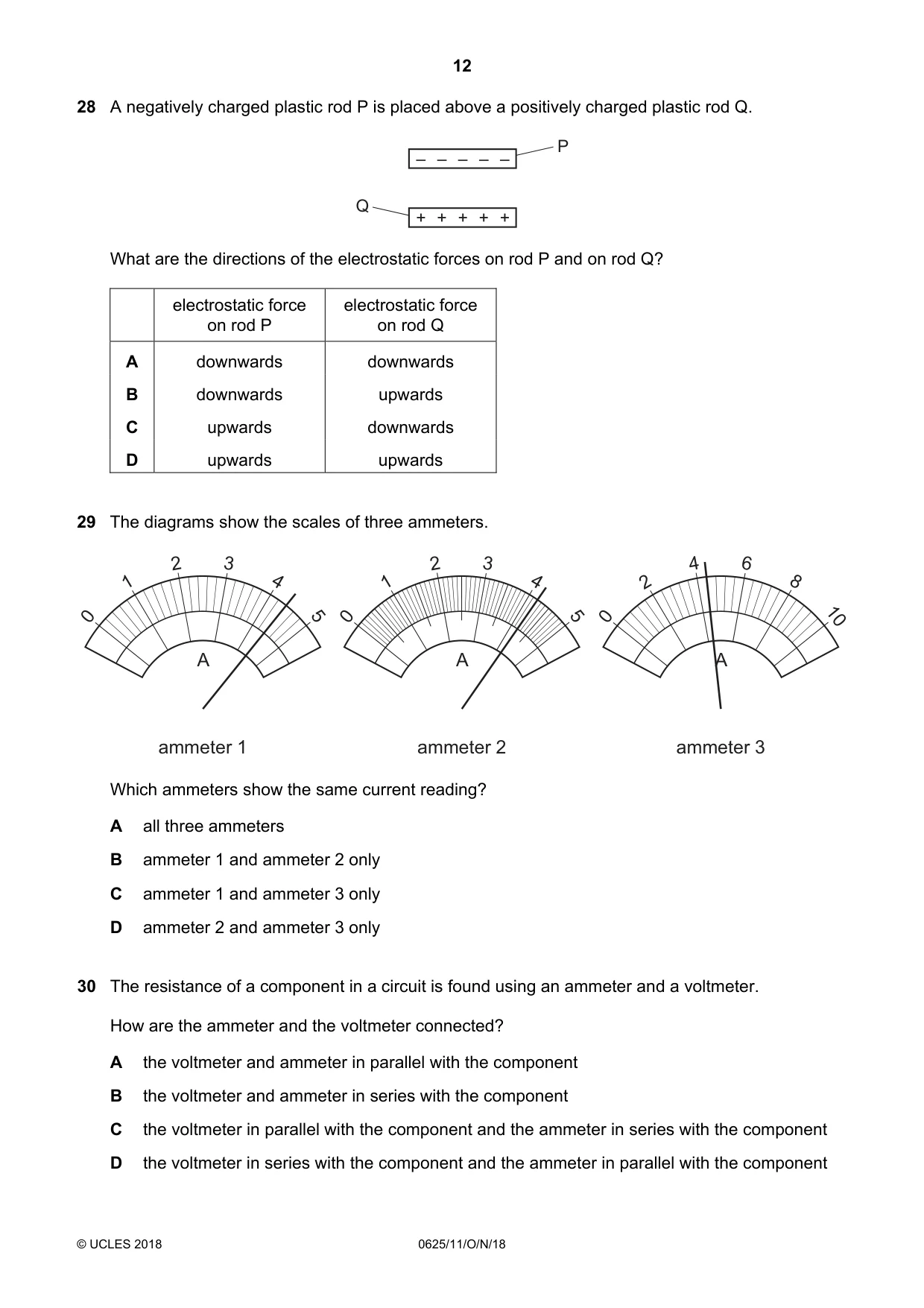
28 A negatively charged plastic rod P is placed above a positively charged plastic rod Q. P – – – – – Q + + + + + What are the directions of the electrostatic forces on rod P and on rod Q? electrostatic force electrostatic force on rod P on rod Q A downwards downwards B downwards upwards C upwards downwards D upwards upwards
Mark scheme: B
Q29 · The diagrams show the scales of three ammeters
29 The diagrams show the scales of three ammeters. 2 3 2 3 4 6 1 4 1 4 2 8 0 5 0 5 0 10 A A A ammeter 1 ammeter 2 ammeter 3 Which ammeters show the same current reading? A all three ammeters B ammeter 1 and ammeter 2 only C ammeter 1 and ammeter 3 only D ammeter 2 and ammeter 3 only
Mark scheme: C
Q30 · The resistance of a component in a circuit is found using an ammeter and a voltmeter
30 The resistance of a component in a circuit is found using an ammeter and a voltmeter. How are the ammeter and the voltmeter connected? A the voltmeter and ammeter in parallel with the component B the voltmeter and ammeter in series with the component C the voltmeter in parallel with the component and the ammeter in series with the component D the voltmeter in series with the component and the ammeter in parallel with the component
Mark scheme: C
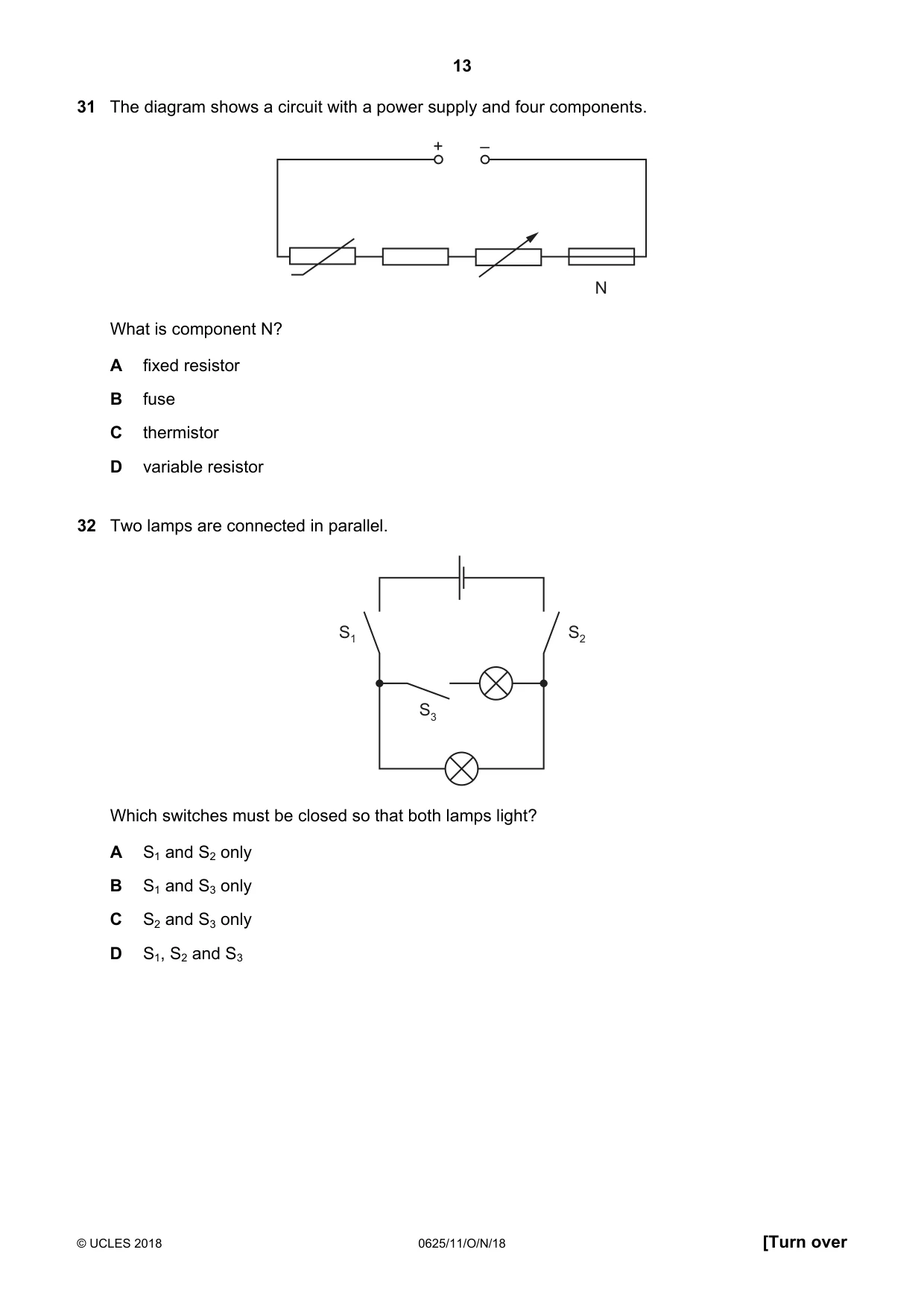
Q31 · The diagram shows a circuit with a power supply and four components
31 The diagram shows a circuit with a power supply and four components. + – N What is component N? A fixed resistor B fuse C thermistor D variable resistor
Mark scheme: B
Q32 · Two lamps are connected in parallel
32 Two lamps are connected in parallel. S1 S2 S3 Which switches must be closed so that both lamps light? A S1 and S2 only B S1 and S3 only C S2 and S3 only D S1, S2 and S3
Mark scheme: D
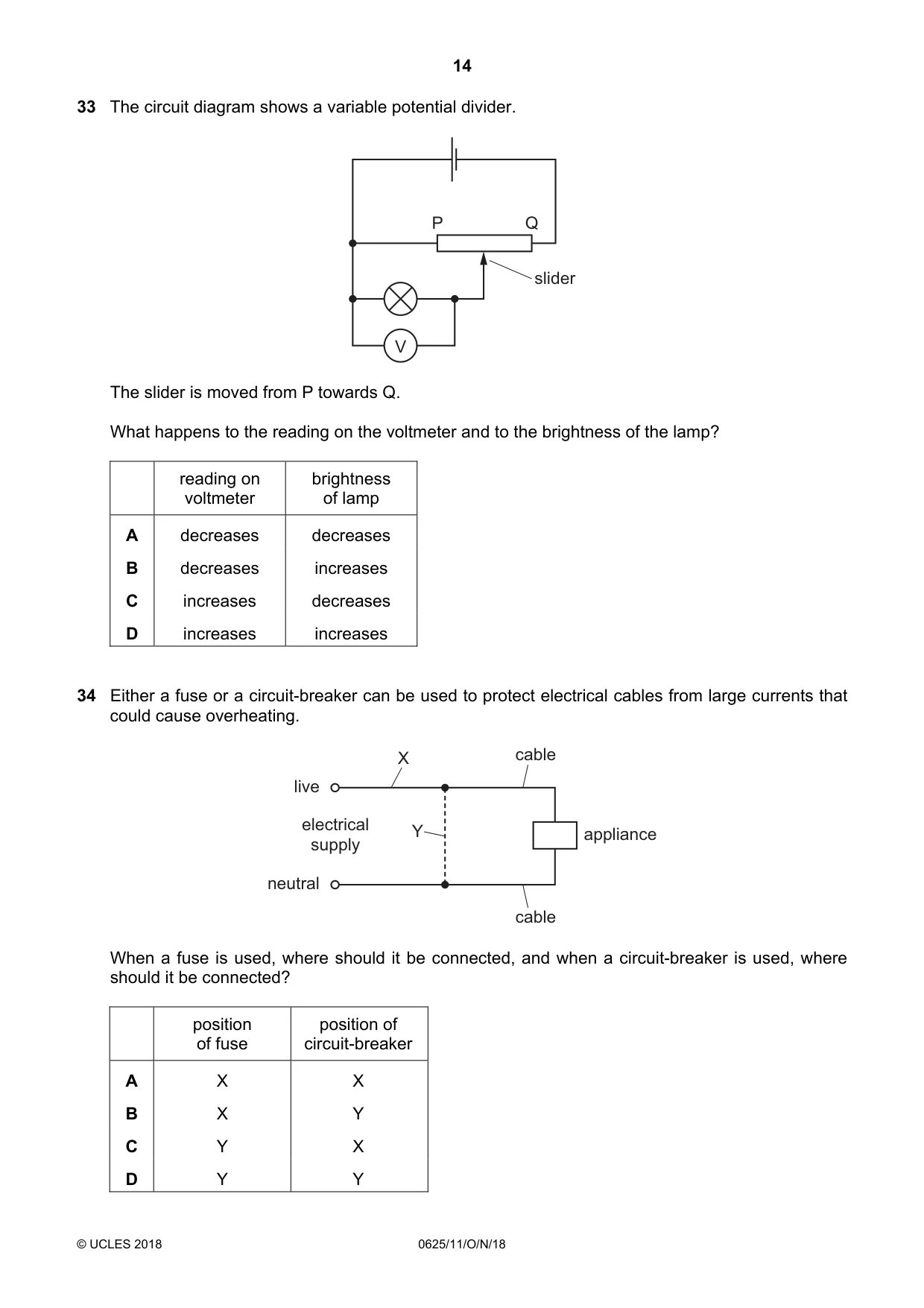
Q33 · The circuit diagram shows a variable potential divider
33 The circuit diagram shows a variable potential divider. P Q slider V The slider is moved from P towards Q. What happens to the reading on the voltmeter and to the brightness of the lamp? reading on brightness voltmeter of lamp A decreases decreases B decreases increases C increases decreases D increases increases
Mark scheme: D
Q34 · Either a fuse or a circuit-breaker can be used to protect electrical cables from large…
34 Either a fuse or a circuit-breaker can be used to protect electrical cables from large currents that could cause overheating. X cable live electrical Y appliance supply neutral cable When a fuse is used, where should it be connected, and when a circuit-breaker is used, where should it be connected? position position of of fuse circuit-breaker A X X B X Y C Y X D Y Y
Mark scheme: A
Q35 · Which electrical device uses the turning effect produced by a current-carrying coil in a…
35 Which electrical device uses the turning effect produced by a current-carrying coil in a magnetic field? A a.c. generator B d.c. motor C relay D transformer
Mark scheme: B
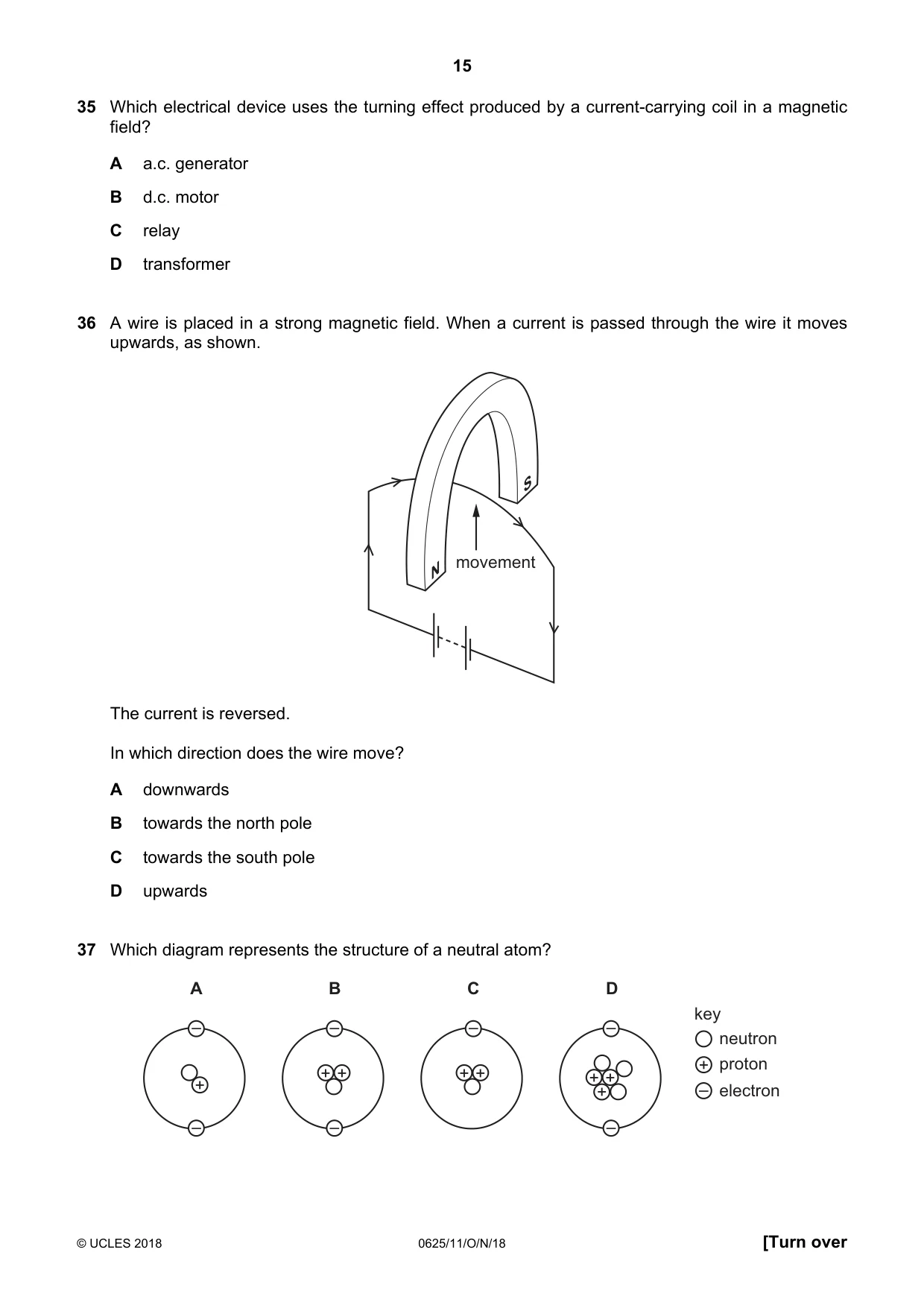
Q36 · A wire is placed in a strong magnetic field
36 A wire is placed in a strong magnetic field. When a current is passed through the wire it moves upwards, as shown. S N movement The current is reversed. In which direction does the wire move? A downwards B towards the north pole C towards the south pole D upwards
Mark scheme: A
Q37 · Which diagram represents the structure of a neutral atom?
37 Which diagram represents the structure of a neutral atom? A B C D key – – – – neutron + proton + + + + + + + + – electron – – –
Mark scheme: B
Q38 · Each nucleus of nuclide X contains 10 protons and a total of 22 nucleons
38 Each nucleus of nuclide X contains 10 protons and a total of 22 nucleons. Which notation is correct for this nuclide? A 22 X B 22 X C 12 X D 10 X 10 32 10 22
Mark scheme: A
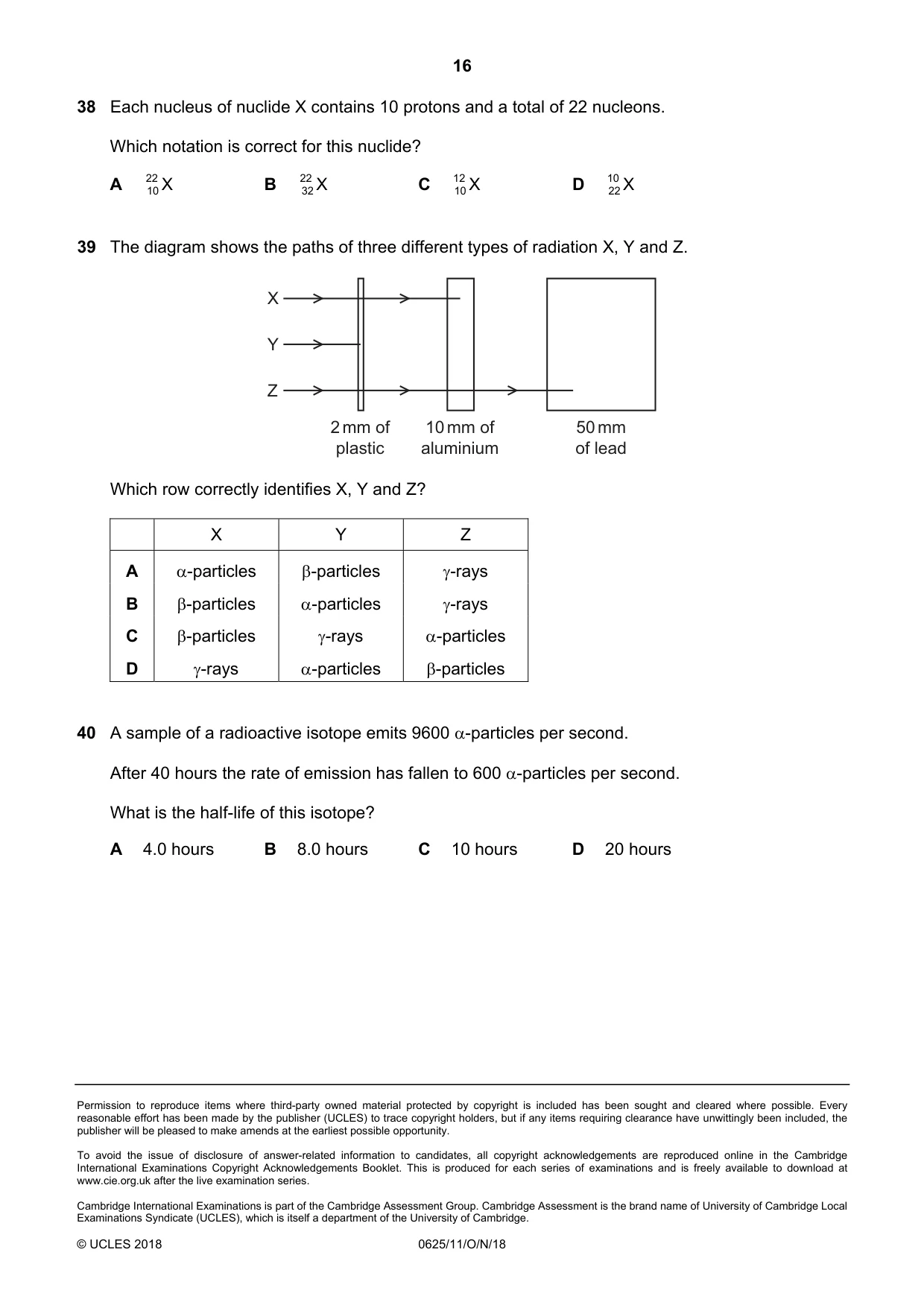
Q39 · The diagram shows the paths of three different types of radiation X, Y and Z
39 The diagram shows the paths of three different types of radiation X, Y and Z. X Y Z 2 mm of 10 mm of 50 mm plastic aluminium of lead Which row correctly identifies X, Y and Z? X Y Z A α-particles β-particles γ-rays B β-particles α-particles γ-rays C β-particles γ-rays α-particles D γ-rays α-particles β-particles
Mark scheme: B
Q40 · A sample of a radioactive isotope emits 9600 α-particles per second
40 A sample of a radioactive isotope emits 9600 α-particles per second. After 40 hours the rate of emission has fallen to 600 α-particles per second. What is the half-life of this isotope? A 4.0 hours B 8.0 hours C 10 hours D 20 hours
Mark scheme: C
What was in this paper
The subtopics covered by these 40 questions, and how many questions each got. Open one in a new tab to see every Cambridge question on it.
4Forces4Electrical quantities2Electromagnetic effects2Electromagnetic spectrum2Energy, work and power2General properties of waves2Kinetic particle model of matter2Light2Motion2Pressure2Radioactivity2Simple phenomena of magnetism2The nuclear model of the atom2Thermal properties and temperature2Density1Electrical safety1Mass and weight1Physical quantities and measurement techniques1Sound1Transfer of thermal energy1What you needed in this session
Cambridge’s own grade thresholds for 2018 Oct/Nov, Paper 1 · Variant 1. A higher threshold means an easier paper — the bar moves with how the cohort did.