Cambridge IGCSE Physics 0625 — 2013 Oct/Nov Paper 1 · Variant 3
0625/13/O/N/13 · 40 questions · 40 marks · ≈45 min
The question paper and its mark scheme, free to read here and free to download. This is Cambridge’s own paper, exactly as it was sat.
Question paper20 pages
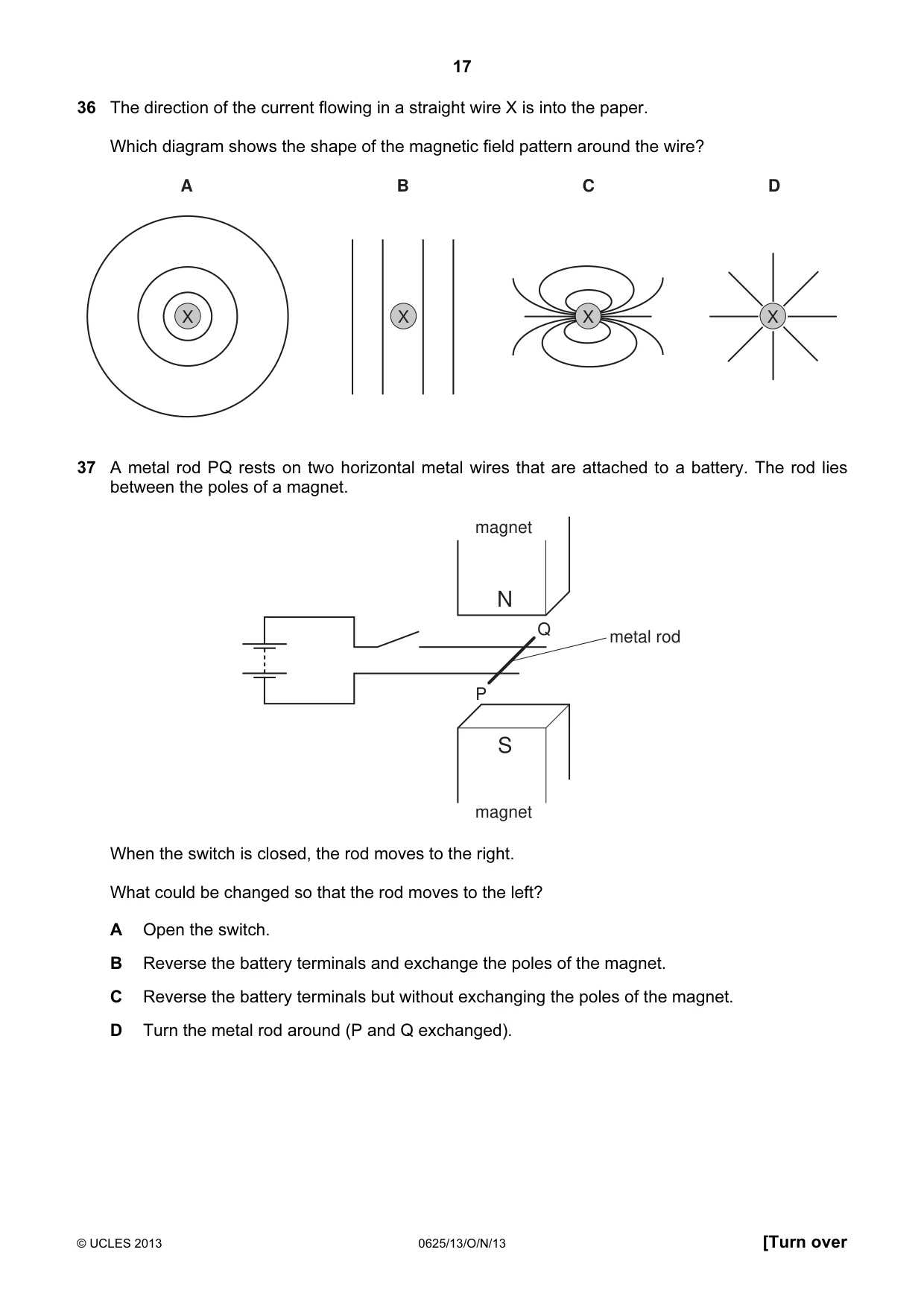
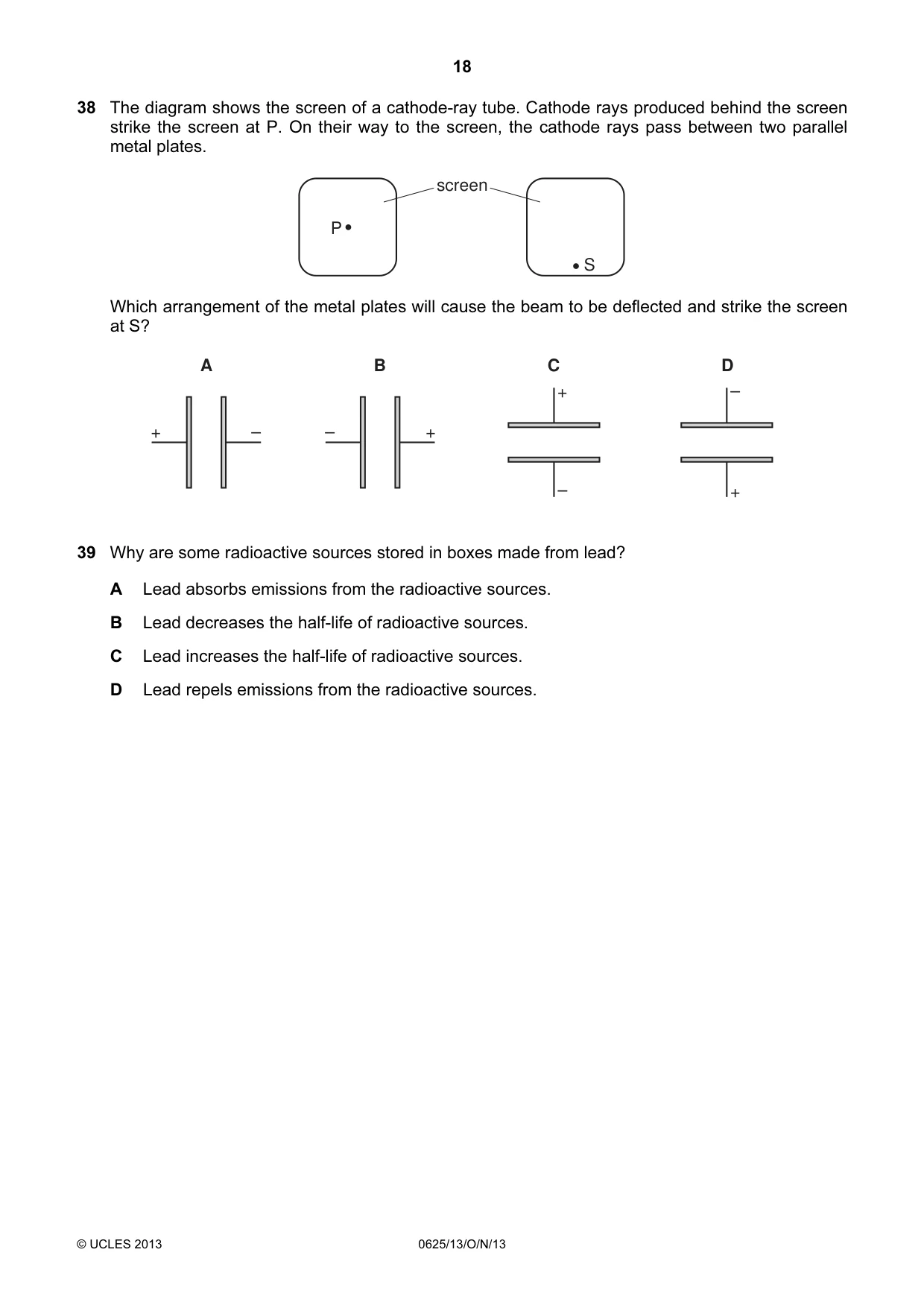
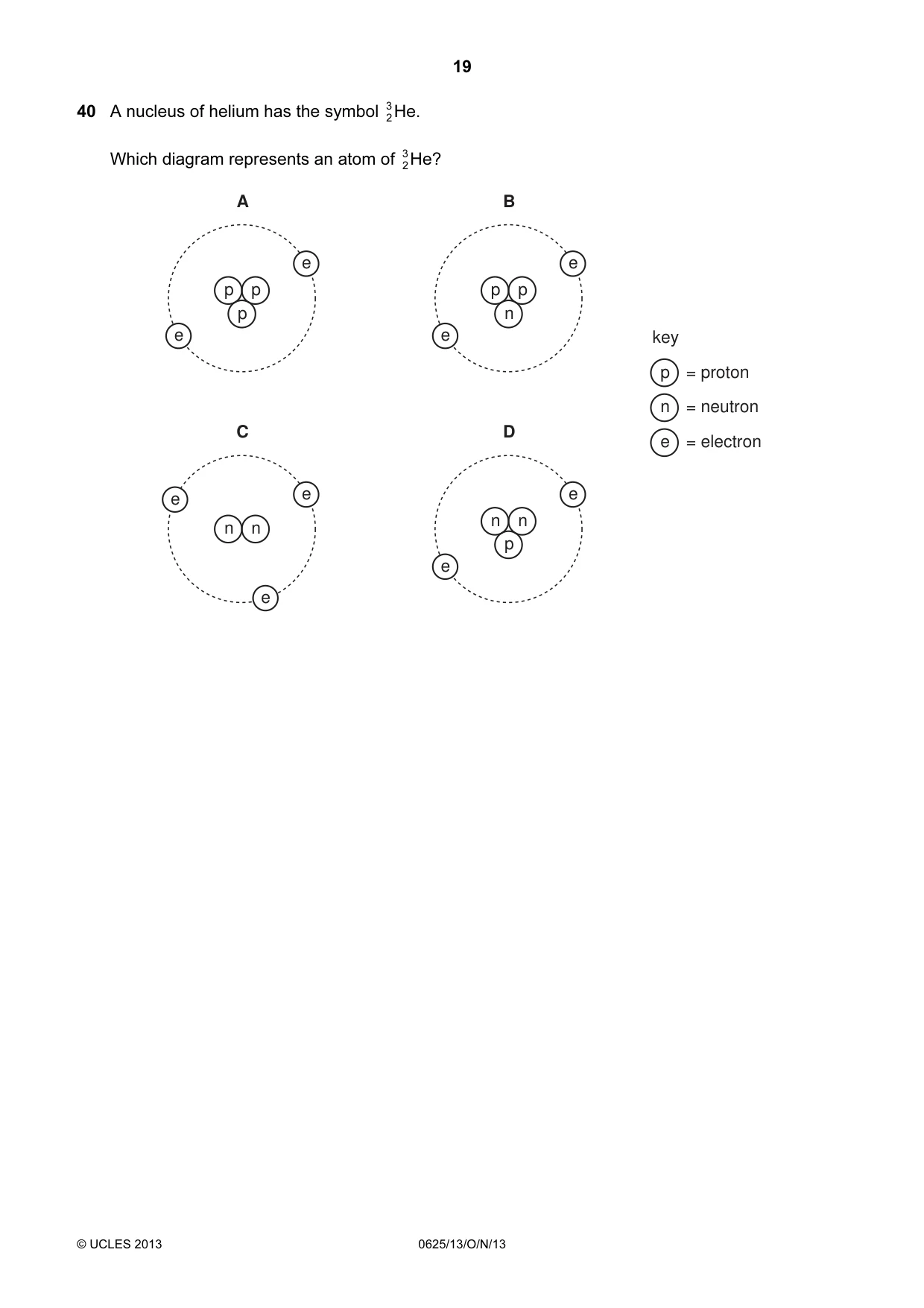
Mark scheme2 pages
Answers below. Sit the paper first if you are practising.
Questions as text
Q1 · A cyclist rides round a track three times
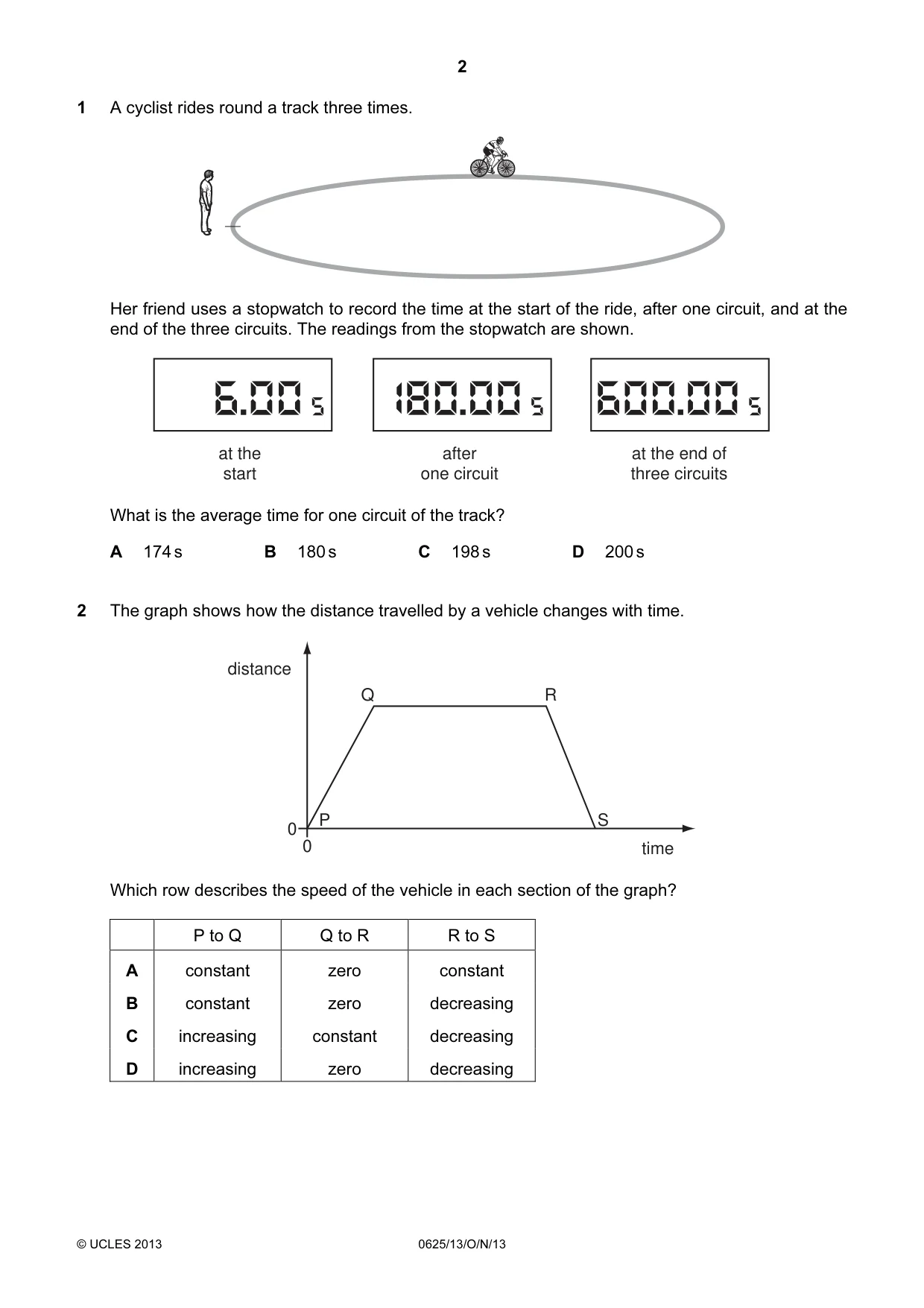
1 A cyclist rides round a track three times. Her friend uses a stopwatch to record the time at the start of the ride, after one circuit, and at the end of the three circuits. The readings from the stopwatch are shown. at the after at the end of start one circuit three circuits What is the average time for one circuit of the track? A 174 s B 180 s C 198 s D 200 s
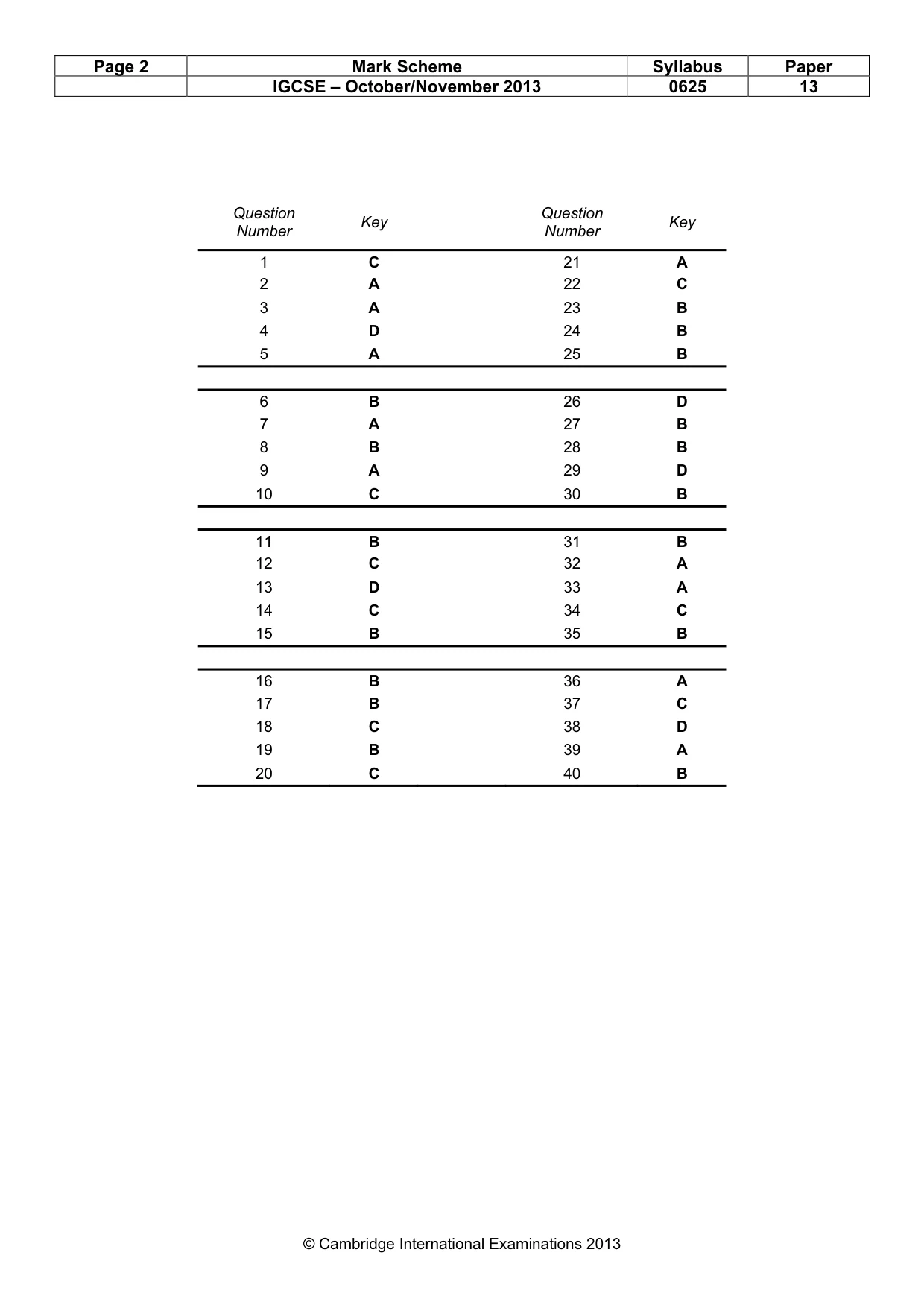
Mark scheme: C
More questions on Physical quantities and measurement techniques
Q2 · The graph shows how the distance travelled by a vehicle changes with time
2 The graph shows how the distance travelled by a vehicle changes with time. distance Q R P S 0 0 time Which row describes the speed of the vehicle in each section of the graph? P to Q Q to R R to S A constant zero constant B constant zero decreasing C increasing constant decreasing D increasing zero decreasing
Mark scheme: A
Q3 · A small steel ball is dropped from a low balcony
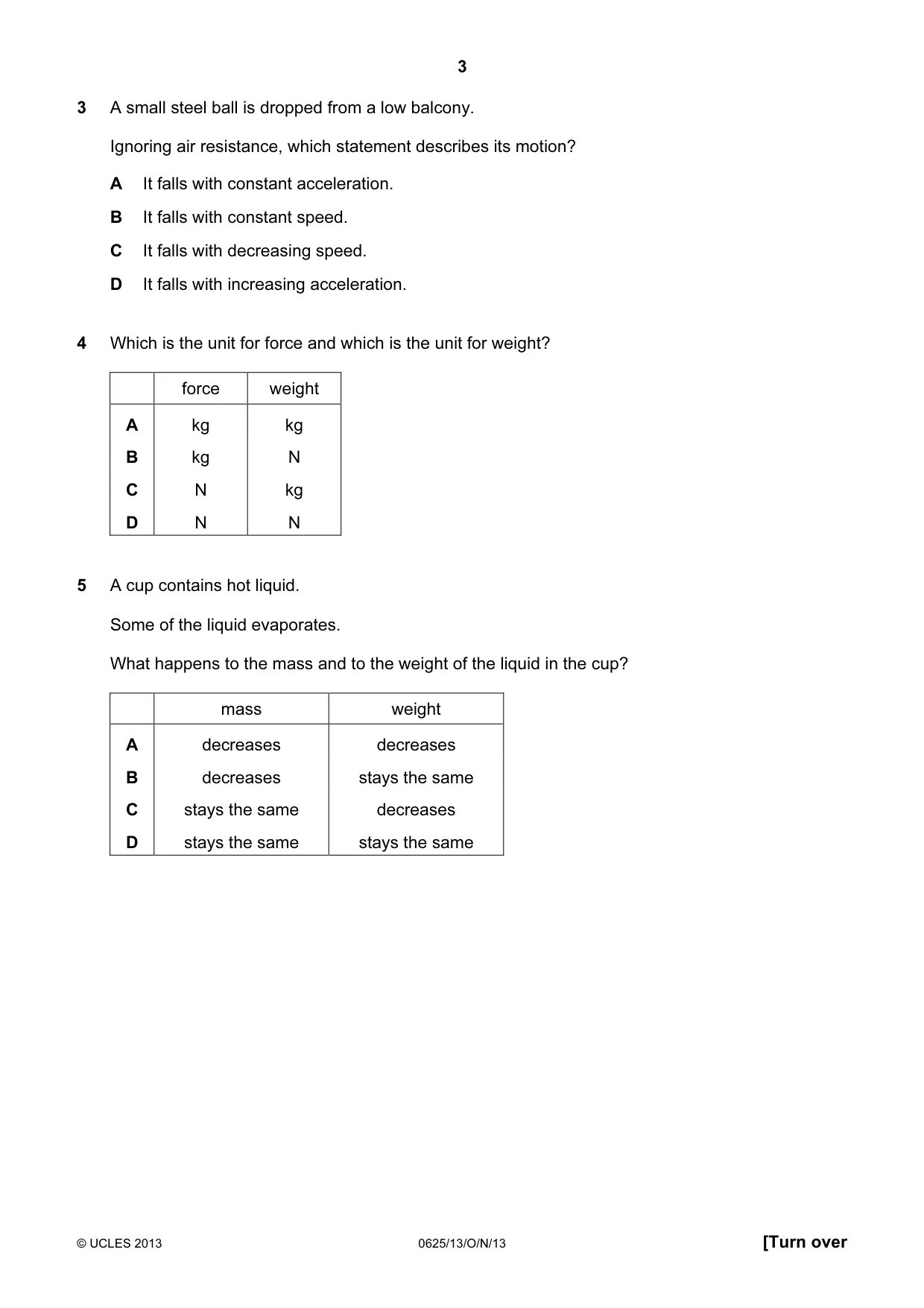
3 A small steel ball is dropped from a low balcony. Ignoring air resistance, which statement describes its motion? A It falls with constant acceleration. B It falls with constant speed. C It falls with decreasing speed. D It falls with increasing acceleration.
Mark scheme: A
Q4 · Which is the unit for force and which is the unit for weight?
4 Which is the unit for force and which is the unit for weight? force weight A kg kg B kg N C N kg D N N
Mark scheme: D
Q5 · A cup contains hot liquid
5 A cup contains hot liquid. Some of the liquid evaporates. What happens to the mass and to the weight of the liquid in the cup? mass weight A decreases decreases B decreases stays the same C stays the same decreases D stays the same stays the same
Mark scheme: A
Q6 · A student is given four different objects and a metre rule
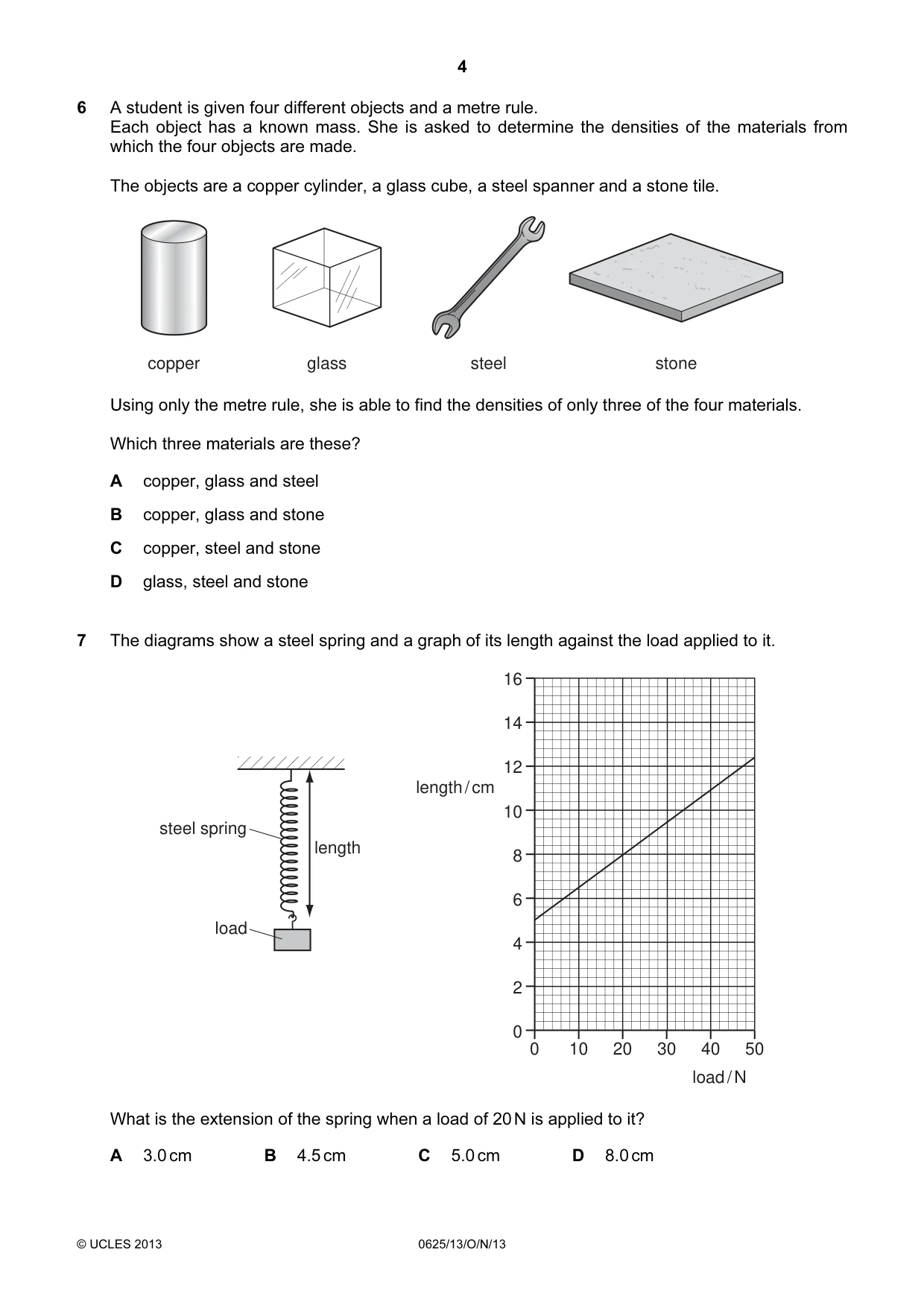
6 A student is given four different objects and a metre rule. Each object has a known mass. She is asked to determine the densities of the materials from which the four objects are made. The objects are a copper cylinder, a glass cube, a steel spanner and a stone tile. copper glass steel stone Using only the metre rule, she is able to find the densities of only three of the four materials. Which three materials are these? A copper, glass and steel B copper, glass and stone C copper, steel and stone D glass, steel and stone
Mark scheme: B
Q7 · The diagrams show a steel spring and a graph of its length against the load applied to it
7 The diagrams show a steel spring and a graph of its length against the load applied to it. 16 14 12 length / cm 10 steel spring length 8 6 load 4 2 0 0 10 20 30 40 50 load / N What is the extension of the spring when a load of 20 N is applied to it? A 3.0 cm B 4.5 cm C 5.0 cm D 8.0 cm
Mark scheme: A
Q8 · A box is being moved by a fork-lift truck
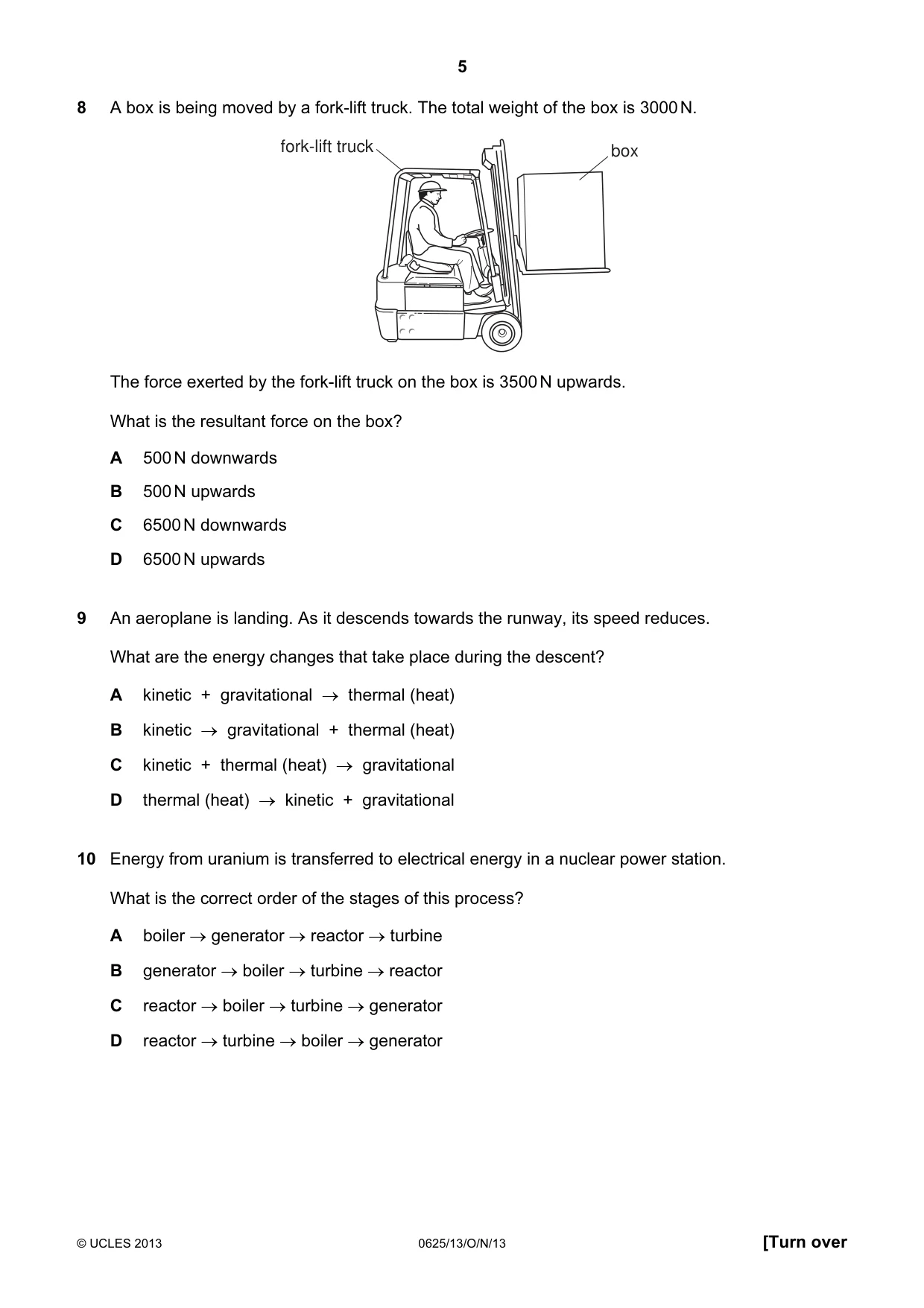
8 A box is being moved by a fork-lift truck. The total weight of the box is 3000 N. fork-lift truck box The force exerted by the fork-lift truck on the box is 3500 N upwards. What is the resultant force on the box? A 500 N downwards B 500 N upwards C 6500 N downwards D 6500 N upwards
Mark scheme: B
Q9 · An aeroplane is landing
9 An aeroplane is landing. As it descends towards the runway, its speed reduces. What are the energy changes that take place during the descent? A kinetic + gravitational → thermal (heat) B kinetic → gravitational + thermal (heat) C kinetic + thermal (heat) → gravitational D thermal (heat) → kinetic + gravitational
Mark scheme: A
Q10 · Energy from uranium is transferred to electrical energy in a nuclear power station
10 Energy from uranium is transferred to electrical energy in a nuclear power station. What is the correct order of the stages of this process? A boiler → generator → reactor → turbine B generator → boiler → turbine → reactor C reactor → boiler → turbine → generator D reactor → turbine → boiler → generator
Mark scheme: C
Q11 · It is dangerous for submarines to dive to very great depths
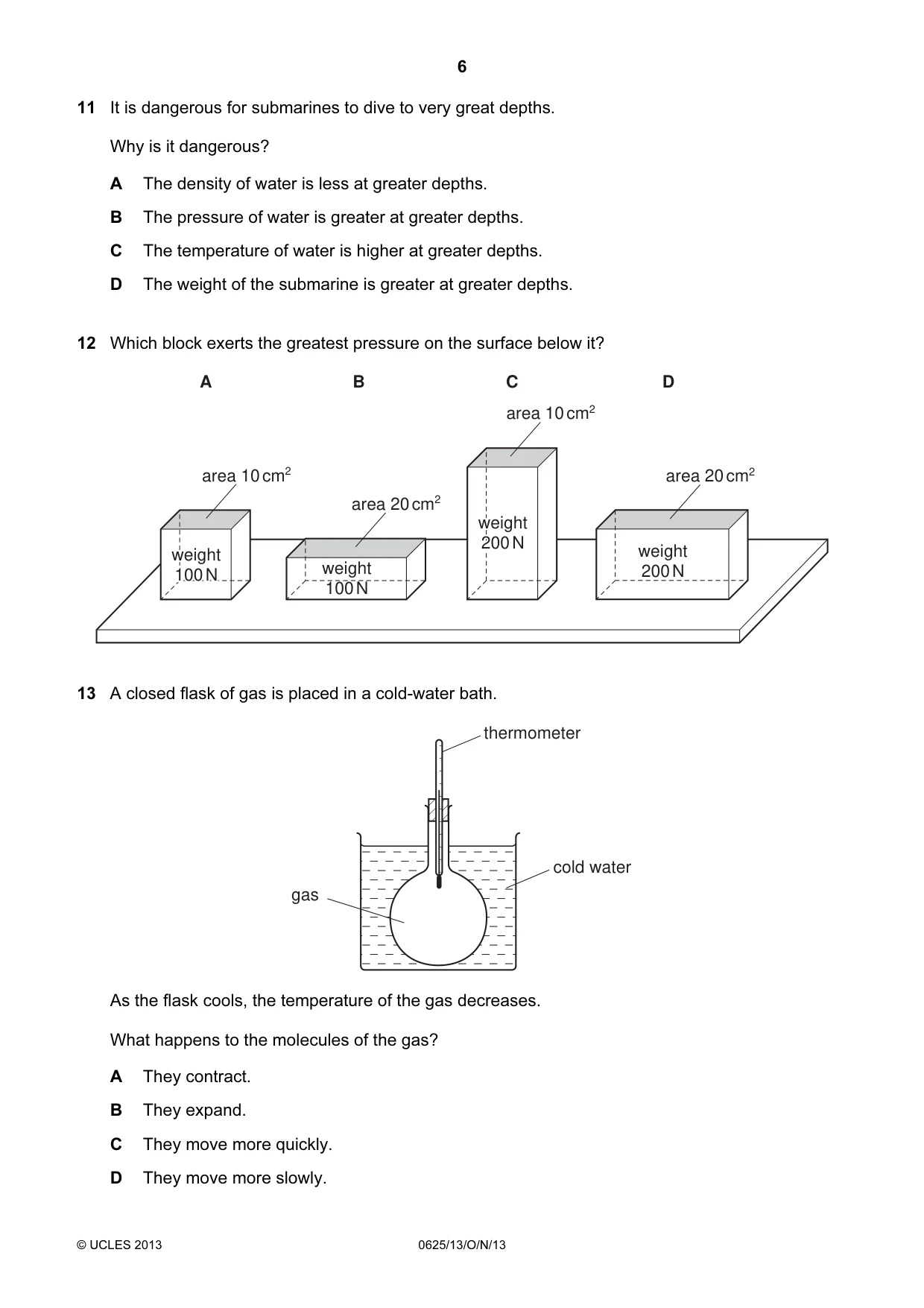
11 It is dangerous for submarines to dive to very great depths. Why is it dangerous? A The density of water is less at greater depths. B The pressure of water is greater at greater depths. C The temperature of water is higher at greater depths. D The weight of the submarine is greater at greater depths.
Mark scheme: B
Q12 · Which block exerts the greatest pressure on the surface below it?
12 Which block exerts the greatest pressure on the surface below it? A B C D area 10 cm2 area 10 cm2 area 20 cm2 area 20 cm2 weight weight weight 200 200 N 200 N weight weight weight weight weight weight 100 100 N 100 N weight weight weight 200 200 N 200 N 100 100 N 100 N
Mark scheme: C
Q13 · A closed flask of gas is placed in a cold-water bath
13 A closed flask of gas is placed in a cold-water bath. thermometer cold water gas As the flask cools, the temperature of the gas decreases. What happens to the molecules of the gas? A They contract. B They expand. C They move more quickly. D They move more slowly.
Mark scheme: D
Q14 · A block of ice cream is prevented from melting by wrapping it in newspaper soaked in water
14 A block of ice cream is prevented from melting by wrapping it in newspaper soaked in water. The water evaporates from the newspaper. Which molecules escape from the water and what happens to the average speed of the water molecules that remain in the newspaper? average speed of the escaping molecules remaining water molecules A the less energetic ones decreases B the less energetic ones increases C the more energetic ones decreases D the more energetic ones increases
Mark scheme: C
Q15 · Equal masses of two different liquids are heated using the same heater
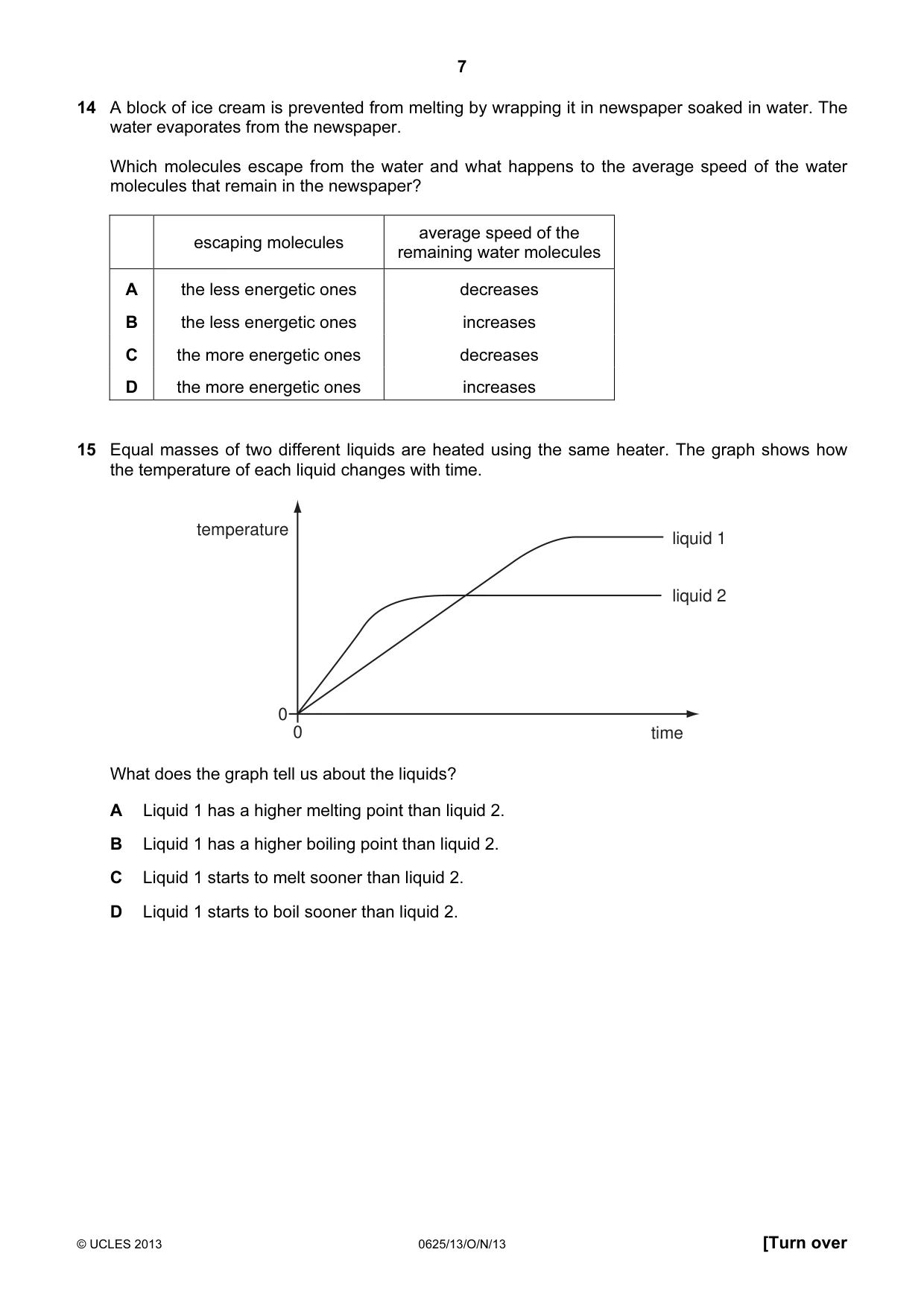
15 Equal masses of two different liquids are heated using the same heater. The graph shows how the temperature of each liquid changes with time. temperature liquid 1 liquid 2 0 0 time What does the graph tell us about the liquids? A Liquid 1 has a higher melting point than liquid 2. B Liquid 1 has a higher boiling point than liquid 2. C Liquid 1 starts to melt sooner than liquid 2. D Liquid 1 starts to boil sooner than liquid 2.
Mark scheme: B
Q16 · A wooden wheel can be strengthened by putting a tight circle of iron around it
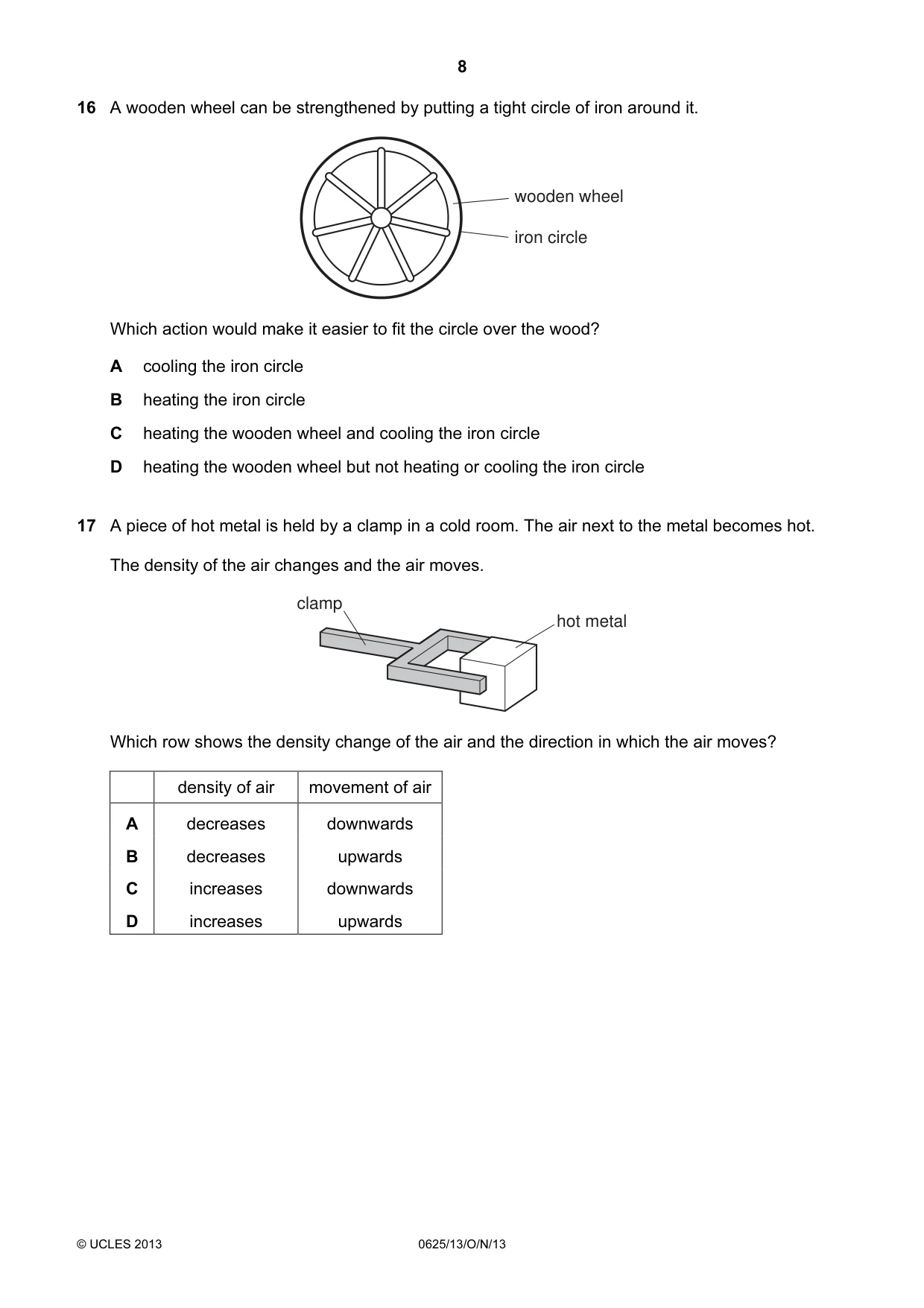
16 A wooden wheel can be strengthened by putting a tight circle of iron around it. wooden wheel iron circle Which action would make it easier to fit the circle over the wood? A cooling the iron circle B heating the iron circle C heating the wooden wheel and cooling the iron circle D heating the wooden wheel but not heating or cooling the iron circle
Mark scheme: B
Q17 · A piece of hot metal is held by a clamp in a cold room
17 A piece of hot metal is held by a clamp in a cold room. The air next to the metal becomes hot. The density of the air changes and the air moves. clamp hot metal Which row shows the density change of the air and the direction in which the air moves? density of air movement of air A decreases downwards B decreases upwards C increases downwards D increases upwards
Mark scheme: B
Q18 · A rod is made half of glass and half of copper
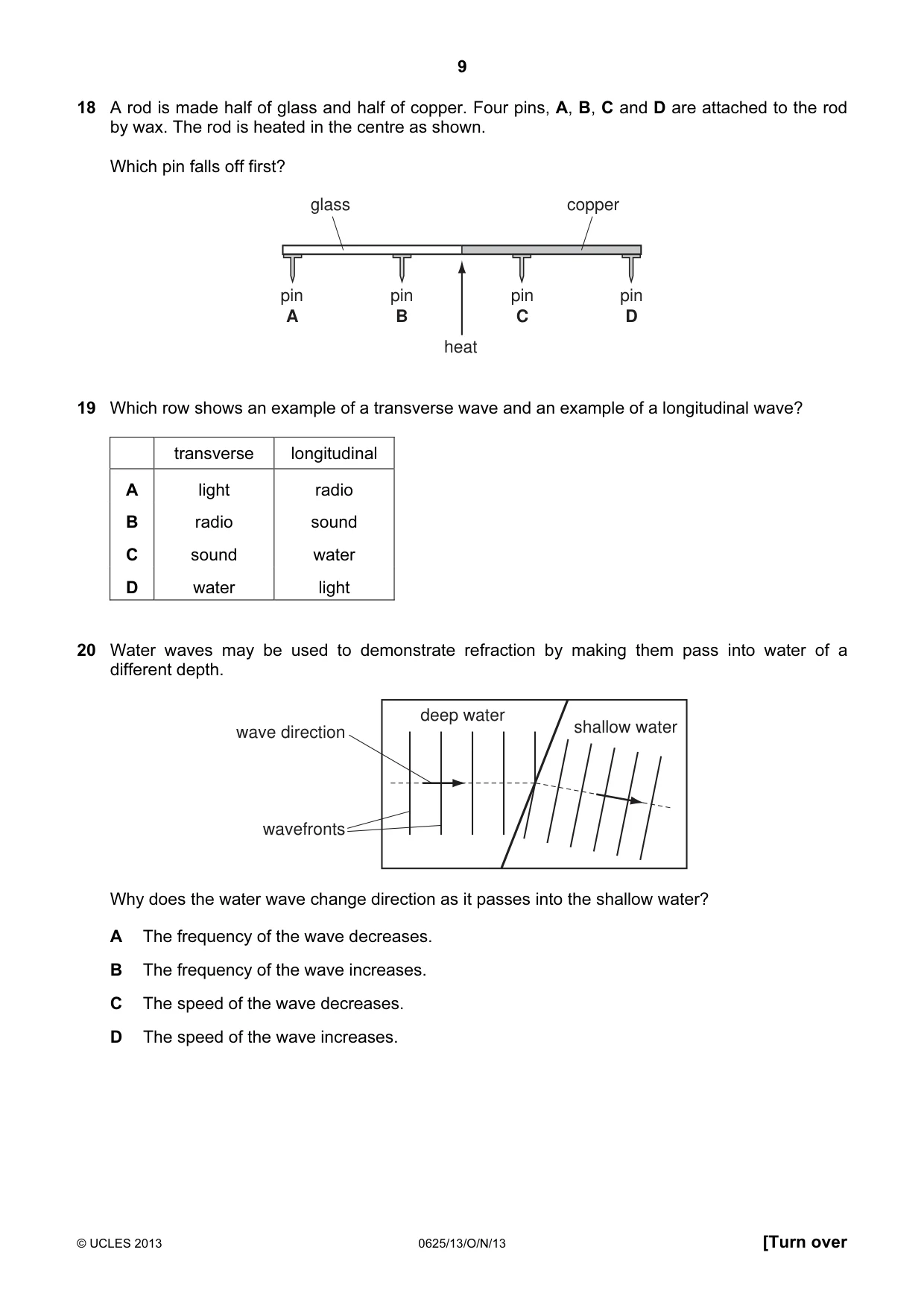
18 A rod is made half of glass and half of copper. Four pins, A, B, C and D are attached to the rod by wax. The rod is heated in the centre as shown. Which pin falls off first? glass copper pin pin pin pin A B C D heat
Mark scheme: C
Q19 · Which row shows an example of a transverse wave and an example of a longitudinal wave?
19 Which row shows an example of a transverse wave and an example of a longitudinal wave? transverse longitudinal A light radio B radio sound C sound water D water light
Mark scheme: B
Q20 · Water waves may be used to demonstrate refraction by making them pass into water of a…
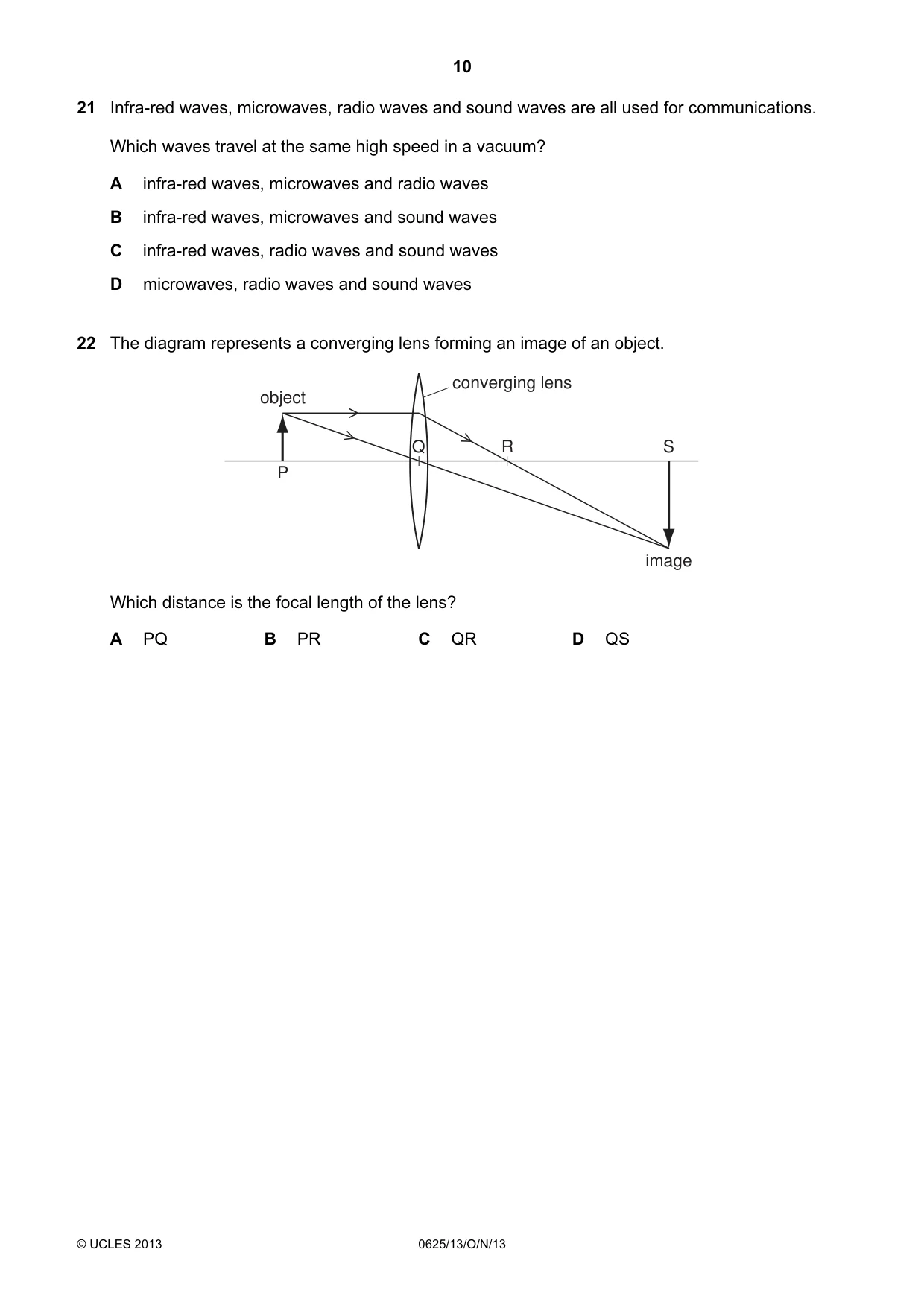
20 Water waves may be used to demonstrate refraction by making them pass into water of a different depth. deep water wave direction shallow water wavefronts Why does the water wave change direction as it passes into the shallow water? A The frequency of the wave decreases. B The frequency of the wave increases. C The speed of the wave decreases. D The speed of the wave increases.
Mark scheme: C
Q21 · Infra-red waves, microwaves, radio waves and sound waves are all used for communications
21 Infra-red waves, microwaves, radio waves and sound waves are all used for communications. Which waves travel at the same high speed in a vacuum? A infra-red waves, microwaves and radio waves B infra-red waves, microwaves and sound waves C infra-red waves, radio waves and sound waves D microwaves, radio waves and sound waves
Mark scheme: A
Q22 · The diagram represents a converging lens forming an image of an object
22 The diagram represents a converging lens forming an image of an object. converging lens object Q R S P image Which distance is the focal length of the lens? A PQ B PR C QR D QS
Mark scheme: C
Q23 · A teacher demonstrates the dispersion of white light using a triangular glass prism
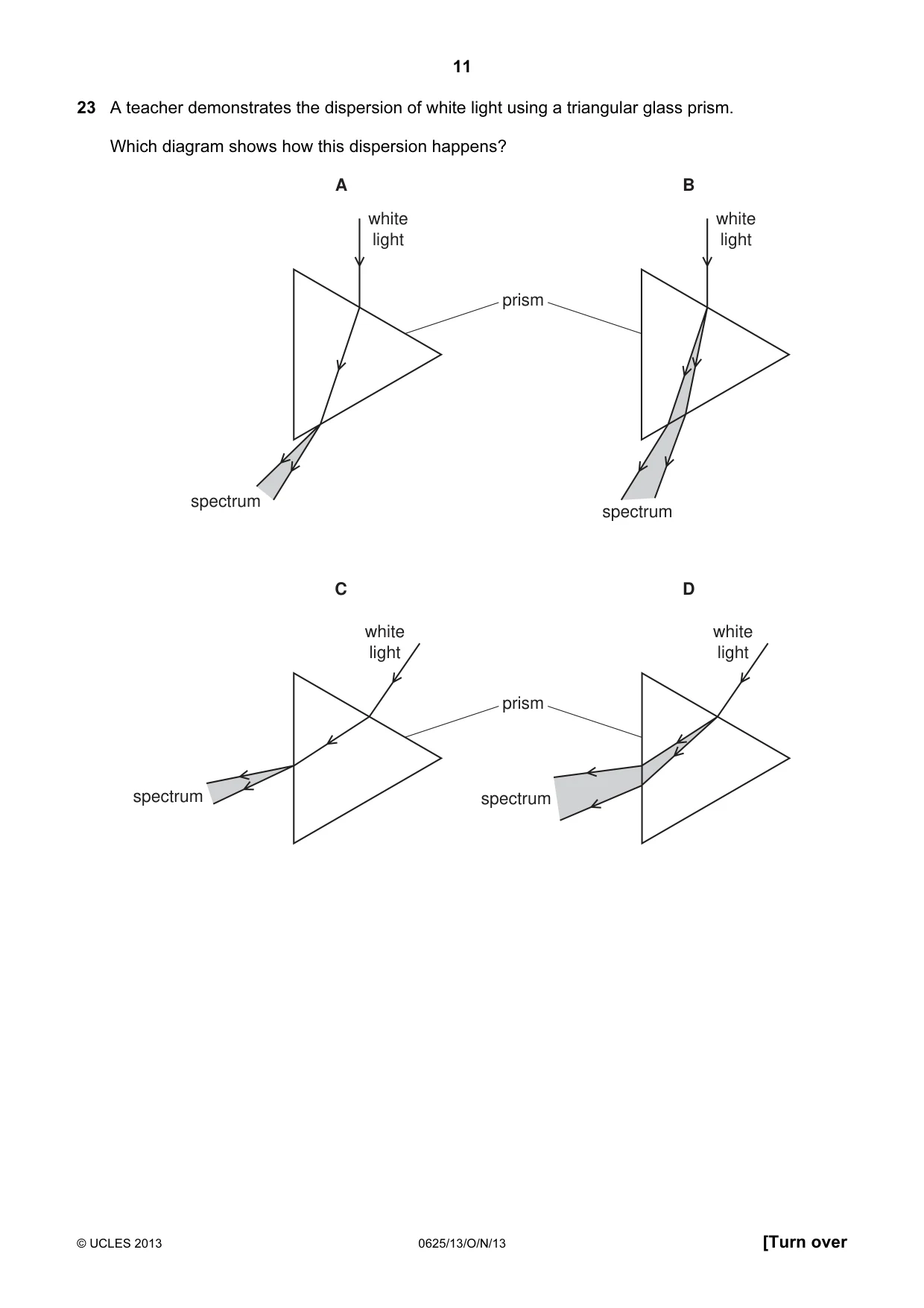
23 A teacher demonstrates the dispersion of white light using a triangular glass prism. Which diagram shows how this dispersion happens? A B white white light light prism spectrum spectrum C D white white light light prism spectrum spectrum
Mark scheme: B
Q24 · To estimate the width of a valley, a climber starts a stopwatch as he shouts
24 To estimate the width of a valley, a climber starts a stopwatch as he shouts. He hears an echo from the opposite side of the valley after 1.0 s. sound climber valley The sound travels at 330 m / s. What is the width of the valley? A 82.5 m B 165 m C 330 m D 660 m
Mark scheme: B
Q25 · A police car sounds its siren when travelling to an emergency
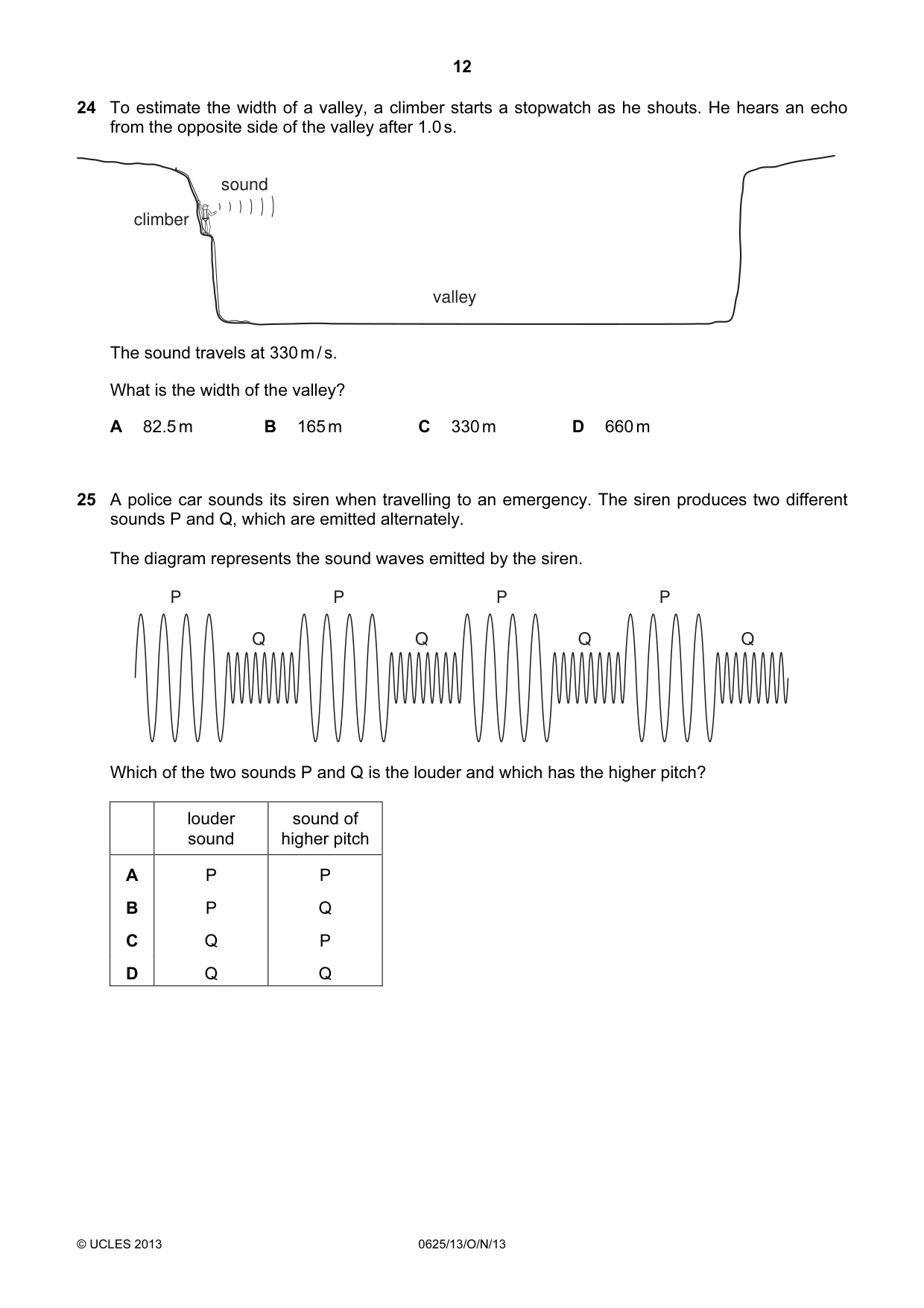
25 A police car sounds its siren when travelling to an emergency. The siren produces two different sounds P and Q, which are emitted alternately. The diagram represents the sound waves emitted by the siren. P P P P Q Q Q Q Which of the two sounds P and Q is the louder and which has the higher pitch? louder sound of sound higher pitch A P P B P Q C Q P D Q Q
Mark scheme: B
Q26 · In which pair are both metals ferrous?
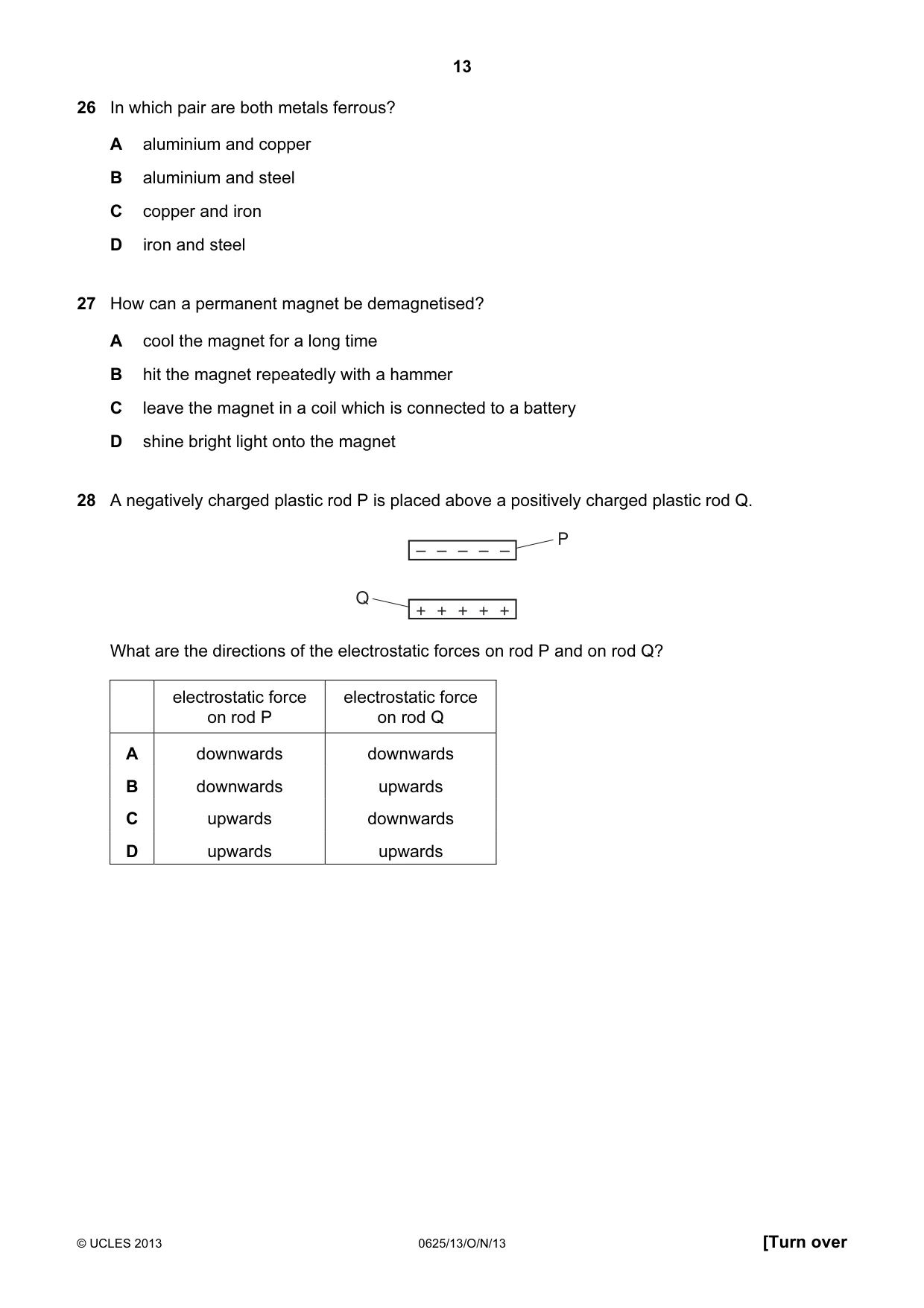
26 In which pair are both metals ferrous? A aluminium and copper B aluminium and steel C copper and iron D iron and steel
Mark scheme: D
Q27 · How can a permanent magnet be demagnetised?
27 How can a permanent magnet be demagnetised? A cool the magnet for a long time B hit the magnet repeatedly with a hammer C leave the magnet in a coil which is connected to a battery D shine bright light onto the magnet
Mark scheme: B
Q28 · A negatively charged plastic rod P is placed above a positively charged plastic rod Q
28 A negatively charged plastic rod P is placed above a positively charged plastic rod Q. P – – – – – Q + + + + + What are the directions of the electrostatic forces on rod P and on rod Q? electrostatic force electrostatic force on rod P on rod Q A downwards downwards B downwards upwards C upwards downwards D upwards upwards
Mark scheme: B
Q29 · A student wishes to measure first the electromotive force (e.m.f.) of a battery, and then…
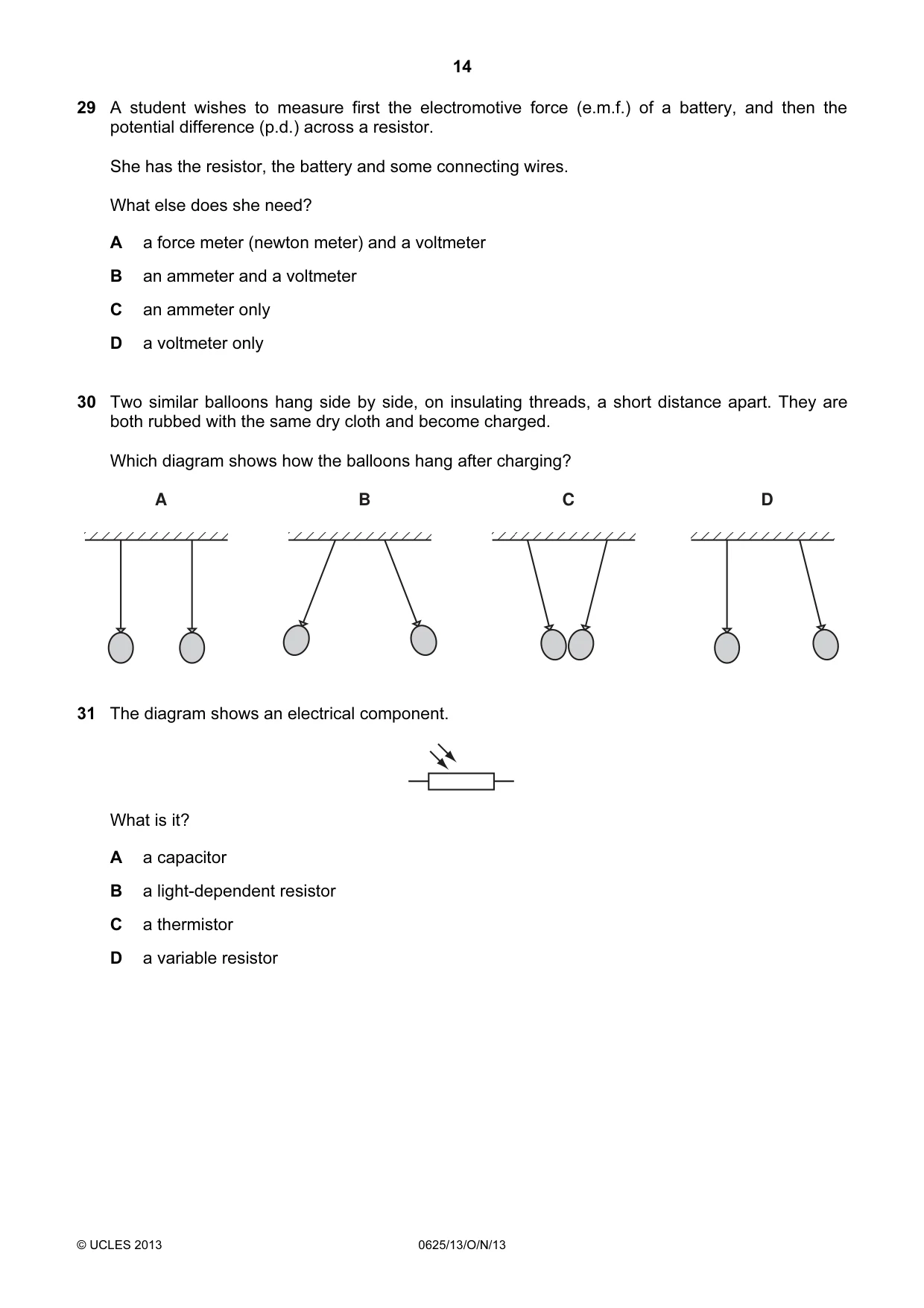
29 A student wishes to measure first the electromotive force (e.m.f.) of a battery, and then the potential difference (p.d.) across a resistor. She has the resistor, the battery and some connecting wires. What else does she need? A a force meter (newton meter) and a voltmeter B an ammeter and a voltmeter C an ammeter only D a voltmeter only
Mark scheme: D
Q30 · Two similar balloons hang side by side, on insulating threads, a short distance apart
30 Two similar balloons hang side by side, on insulating threads, a short distance apart. They are both rubbed with the same dry cloth and become charged. Which diagram shows how the balloons hang after charging? A B C D
Mark scheme: B
Q31 · The diagram shows an electrical component
31 The diagram shows an electrical component. What is it? A a capacitor B a light-dependent resistor C a thermistor D a variable resistor
Mark scheme: B
Q32 · The diagram shows a circuit
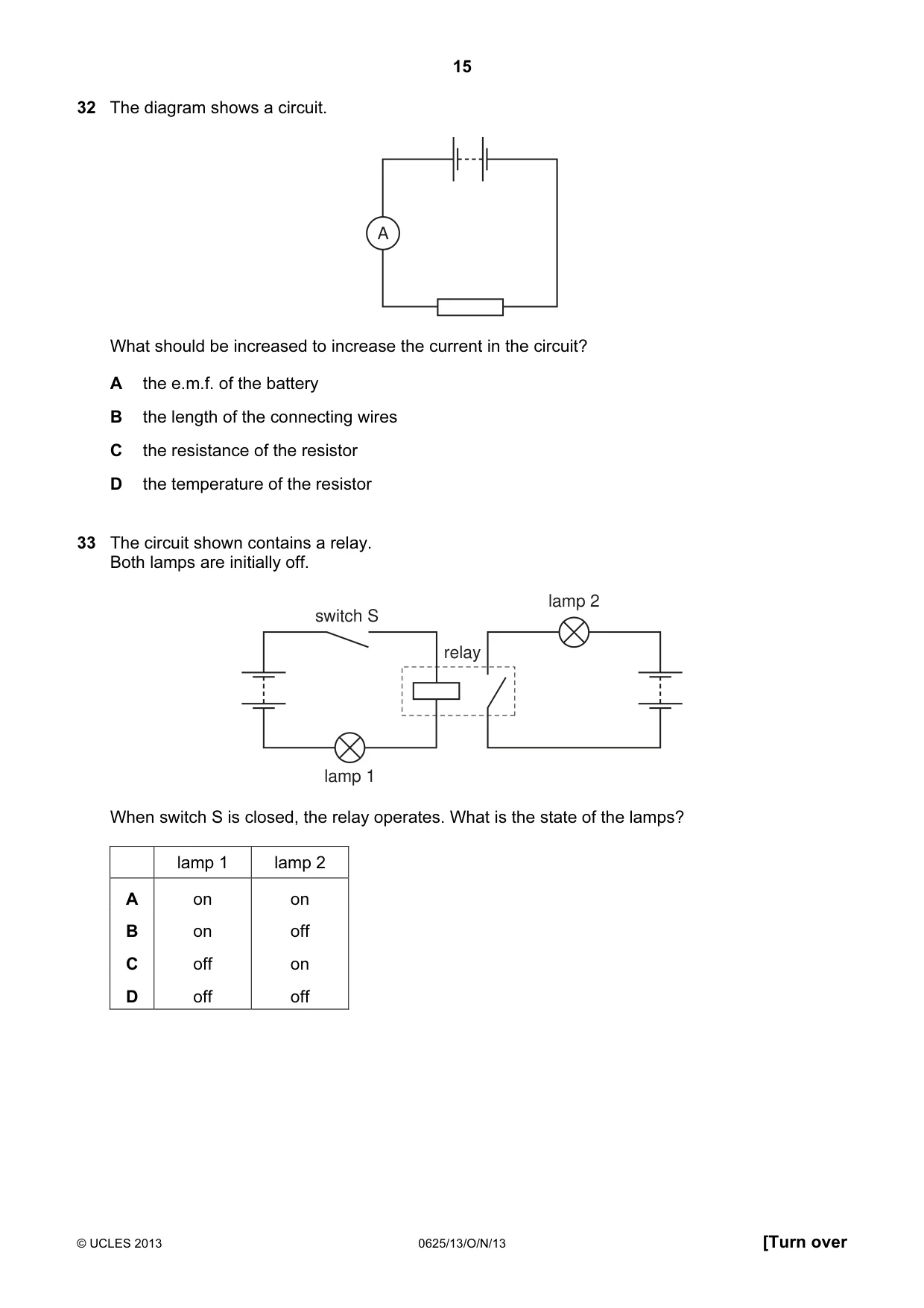
32 The diagram shows a circuit. A What should be increased to increase the current in the circuit? A the e.m.f. of the battery B the length of the connecting wires C the resistance of the resistor D the temperature of the resistor
Mark scheme: A
Q33 · The circuit shown contains a relay
33 The circuit shown contains a relay. Both lamps are initially off. lamp 2 switch S relay lamp 1 When switch S is closed, the relay operates. What is the state of the lamps? lamp 1 lamp 2 A on on B on off C off on D off off
Mark scheme: A
Q34 · An electric motor is connected to the mains supply by insulated wires
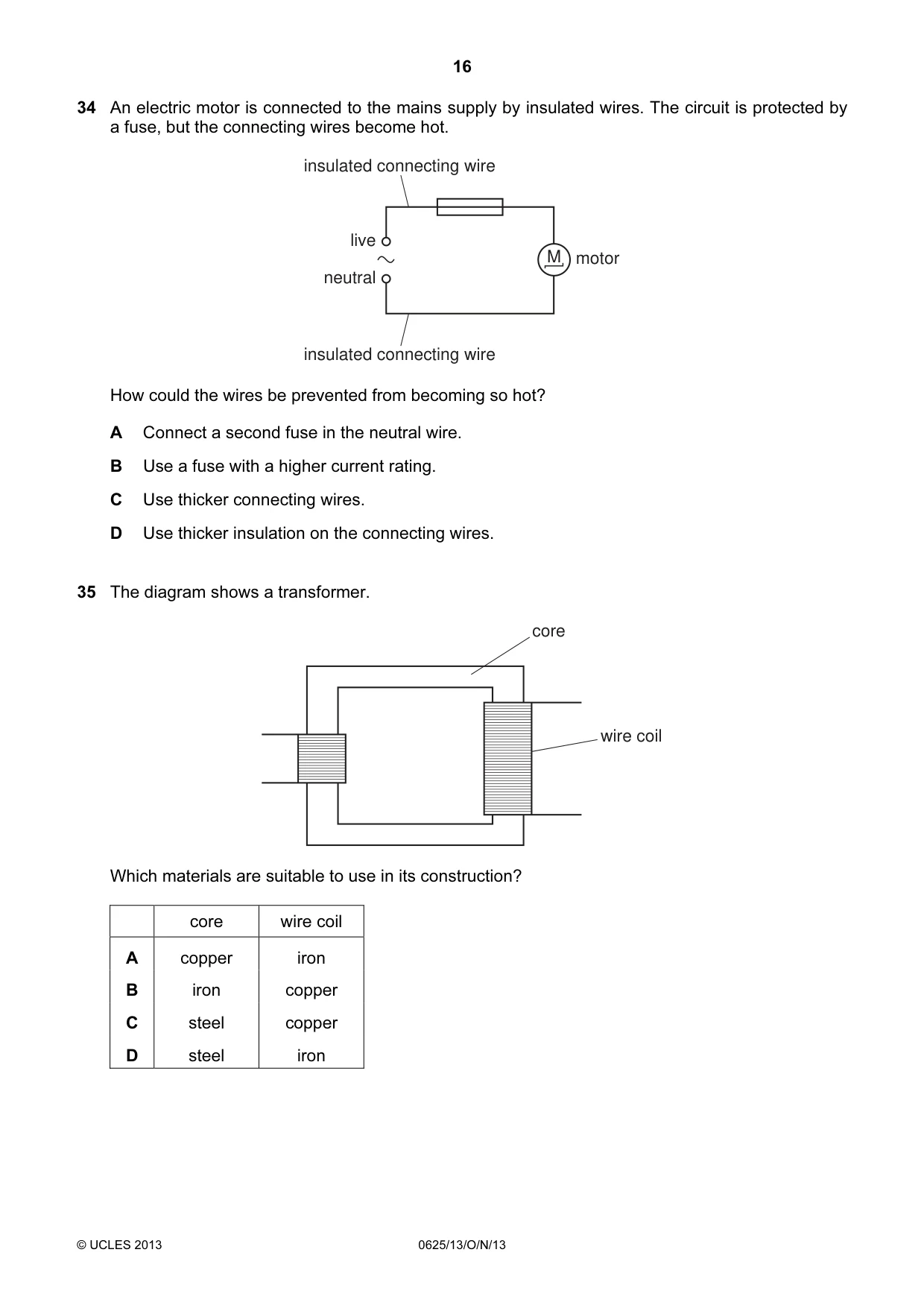
34 An electric motor is connected to the mains supply by insulated wires. The circuit is protected by a fuse, but the connecting wires become hot. insulated connecting wire live M motor neutral insulated connecting wire How could the wires be prevented from becoming so hot? A Connect a second fuse in the neutral wire. B Use a fuse with a higher current rating. C Use thicker connecting wires. D Use thicker insulation on the connecting wires.
Mark scheme: C
Q35 · The diagram shows a transformer
35 The diagram shows a transformer. core wire coil Which materials are suitable to use in its construction? core wire coil A copper iron B iron copper C steel copper D steel iron
Mark scheme: B
Q36 · The direction of the current flowing in a straight wire X is into the paper
36 The direction of the current flowing in a straight wire X is into the paper. Which diagram shows the shape of the magnetic field pattern around the wire? A B C D X X X X
Mark scheme: A
Q37 · A metal rod PQ rests on two horizontal metal wires that are attached to a battery
37 A metal rod PQ rests on two horizontal metal wires that are attached to a battery. The rod lies between the poles of a magnet. magnet N Q metal rod P S magnet When the switch is closed, the rod moves to the right. What could be changed so that the rod moves to the left? A Open the switch. B Reverse the battery terminals and exchange the poles of the magnet. C Reverse the battery terminals but without exchanging the poles of the magnet. D Turn the metal rod around (P and Q exchanged).
Mark scheme: C
Q38 · The diagram shows the screen of a cathode-ray tube
38 The diagram shows the screen of a cathode-ray tube. Cathode rays produced behind the screen strike the screen at P. On their way to the screen, the cathode rays pass between two parallel metal plates. screen P S Which arrangement of the metal plates will cause the beam to be deflected and strike the screen at S? A B C D + – + – – + – +
Mark scheme: D
Q39 · Why are some radioactive sources stored in boxes made from lead?
39 Why are some radioactive sources stored in boxes made from lead? A Lead absorbs emissions from the radioactive sources. B Lead decreases the half-life of radioactive sources. C Lead increases the half-life of radioactive sources. D Lead repels emissions from the radioactive sources.
Mark scheme: A
Q40 · A nucleus of helium has the symbol He
40 A nucleus of helium has the symbol He. 3 2 Which diagram represents an atom of He? 3 2 A B e e p p p p p n e e key p = proton n = neutron C D e = electron e e e n n n n p e e
Mark scheme: B
What was in this paper
The subtopics covered by these 40 questions, and how many questions each got. Open one in a new tab to see every Cambridge question on it.
3Electrical quantities3Electromagnetic effects3Energy, work and power2Forces2General properties of waves2Kinetic particle model of matter2Light2Mass and weight2Motion2Pressure2Simple phenomena of magnetism2Sound2The nuclear model of the atom2Thermal properties and temperature2Transfer of thermal energy2Density1Electrical safety1Electromagnetic spectrum1Physical quantities and measurement techniques1Radioactivity1What you needed in this session
Cambridge’s own grade thresholds for 2013 Oct/Nov, Paper 1 · Variant 3. A higher threshold means an easier paper — the bar moves with how the cohort did.