Cambridge IGCSE Physics 0625 — 2016 May/June Paper 1 · Variant 3
0625/13/M/J/16 · 40 questions · 40 marks · ≈45 min
The question paper and its mark scheme, free to read here and free to download. This is Cambridge’s own paper, exactly as it was sat.
Question paper20 pages
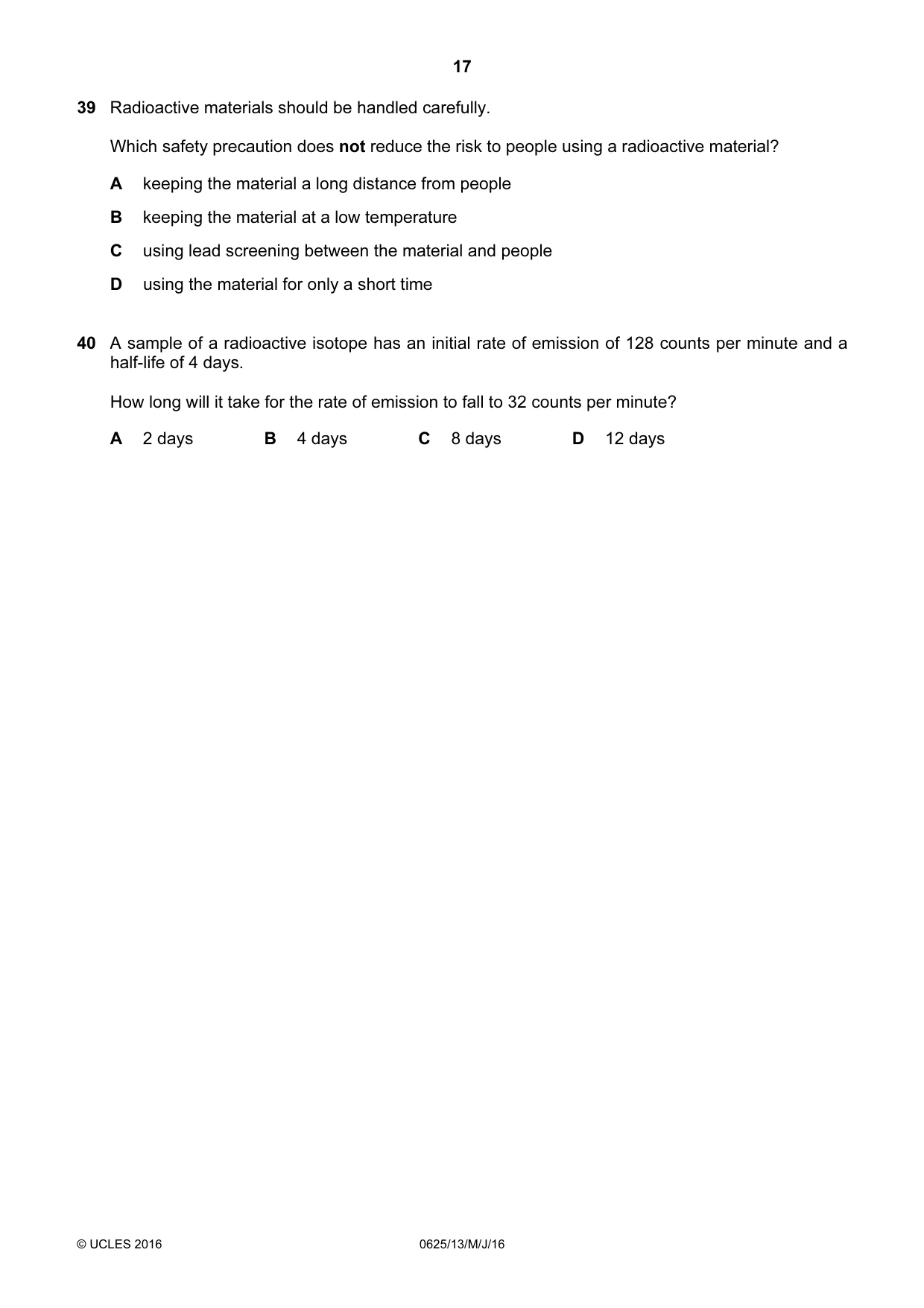


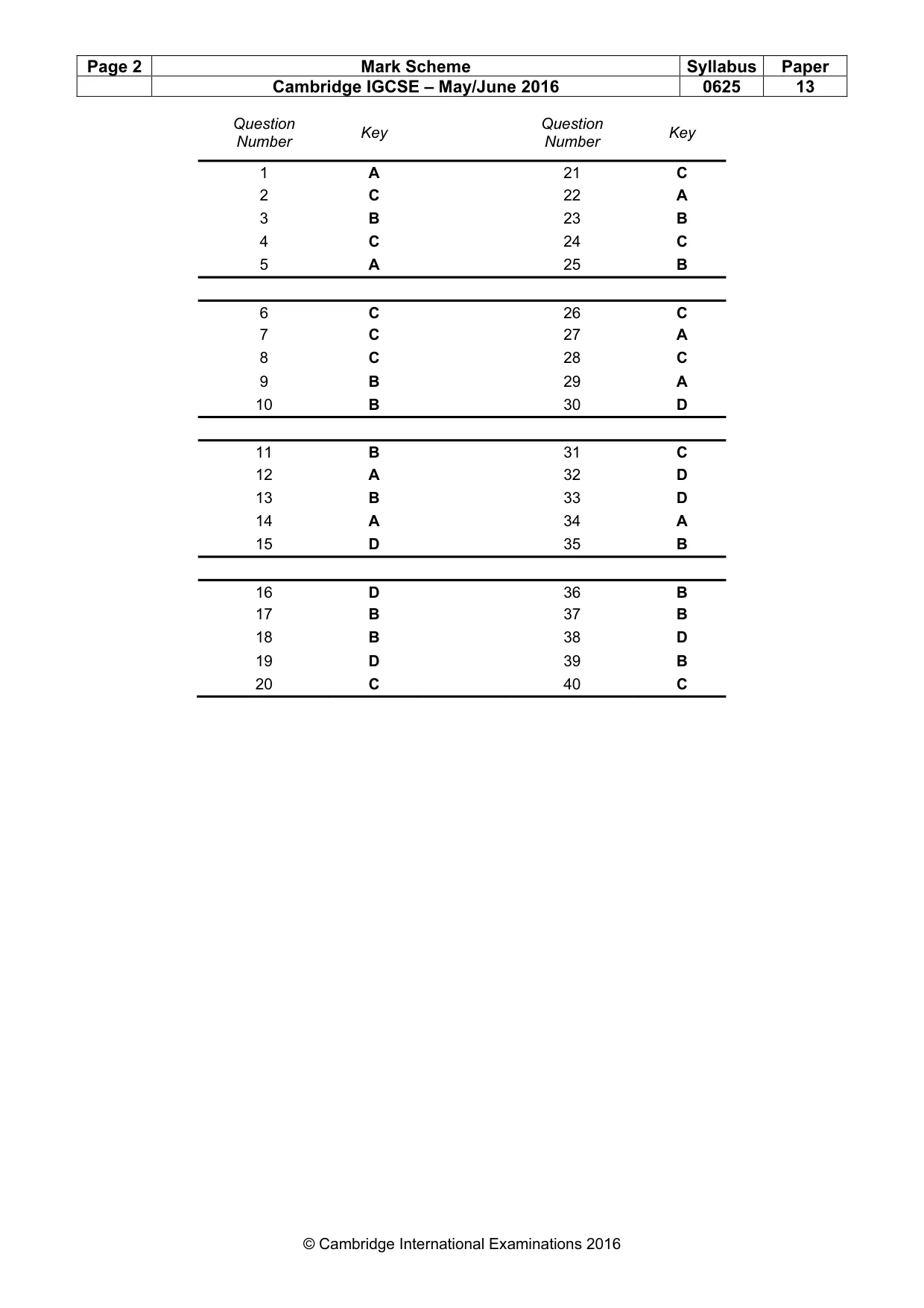
Mark scheme2 pages
Answers below. Sit the paper first if you are practising.
Questions as text
Q1 · The diagram shows an enlarged drawing of the end of a metre rule
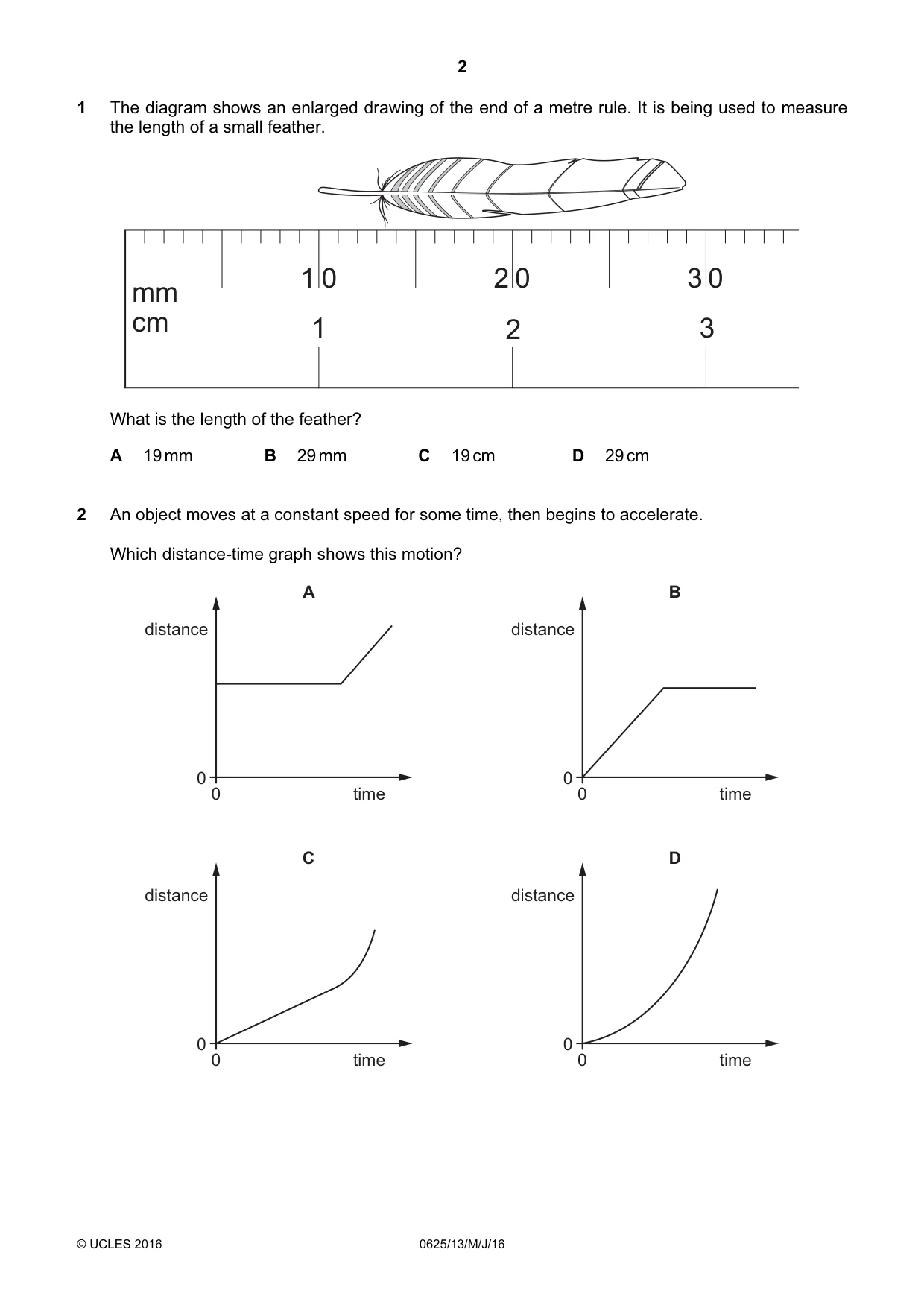
1 The diagram shows an enlarged drawing of the end of a metre rule. It is being used to measure the length of a small feather. 1 0 2 0 3 0 mm cm 1 2 3 What is the length of the feather? A 19 mm B 29 mm C 19 cm D 29 cm
Mark scheme: A
More questions on Physical quantities and measurement techniques
Q2 · An object moves at a constant speed for some time, then begins to accelerate
2 An object moves at a constant speed for some time, then begins to accelerate. Which distance-time graph shows this motion? A B distance distance 0 0 0 time 0 time C D distance distance 0 0 0 time 0 time
Mark scheme: C
Q3 · A car travels at an average speed of 60 km / h for 15 minutes
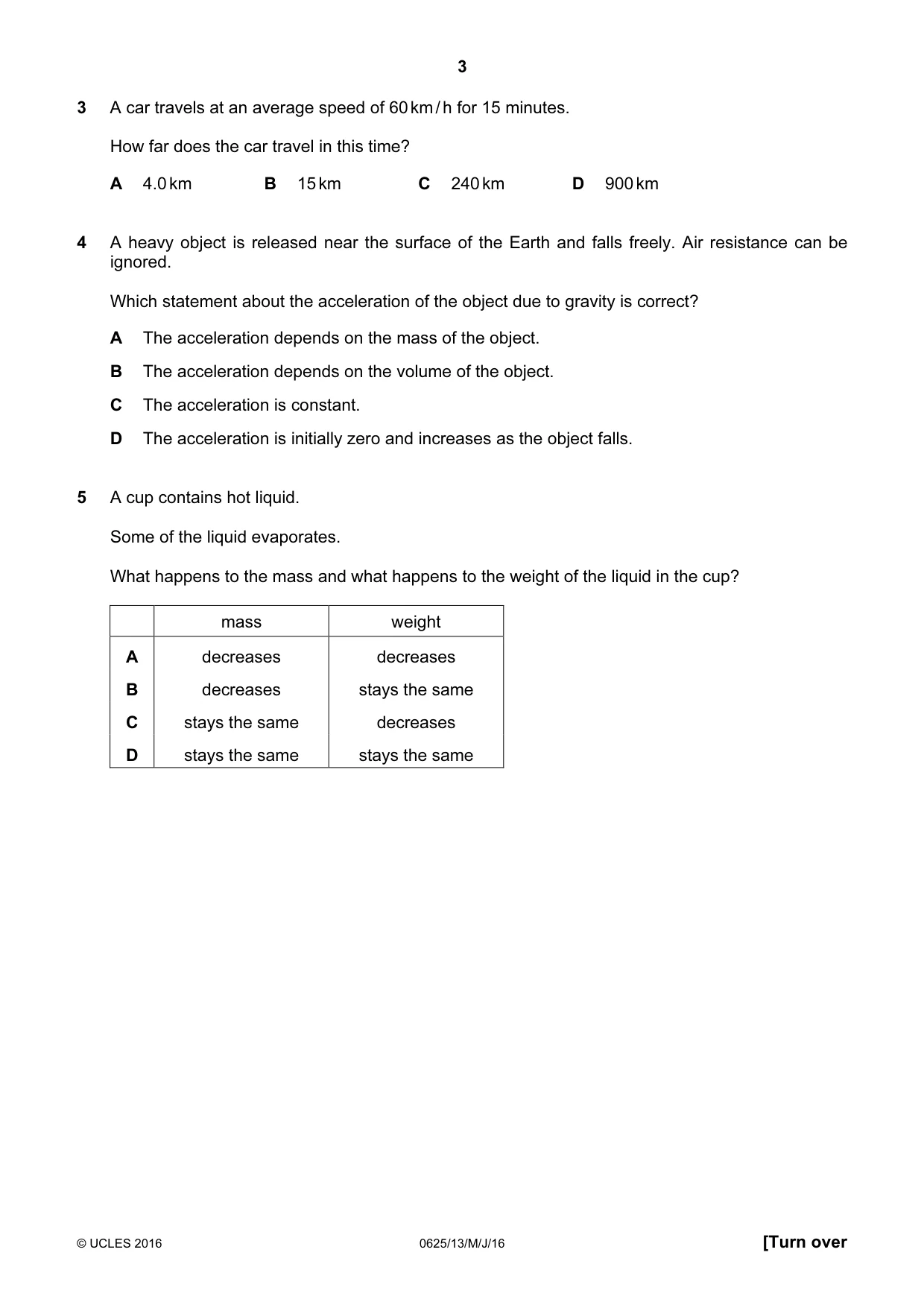
3 A car travels at an average speed of 60 km / h for 15 minutes. How far does the car travel in this time? A 4.0 km B 15 km C 240 km D 900 km
Mark scheme: B
Q4 · A heavy object is released near the surface of the Earth and falls freely
4 A heavy object is released near the surface of the Earth and falls freely. Air resistance can be ignored. Which statement about the acceleration of the object due to gravity is correct? A The acceleration depends on the mass of the object. B The acceleration depends on the volume of the object. C The acceleration is constant. D The acceleration is initially zero and increases as the object falls.
Mark scheme: C
Q5 · A cup contains hot liquid
5 A cup contains hot liquid. Some of the liquid evaporates. What happens to the mass and what happens to the weight of the liquid in the cup? mass weight A decreases decreases B decreases stays the same C stays the same decreases D stays the same stays the same
Mark scheme: A
Q6 · A measuring cylinder containing water
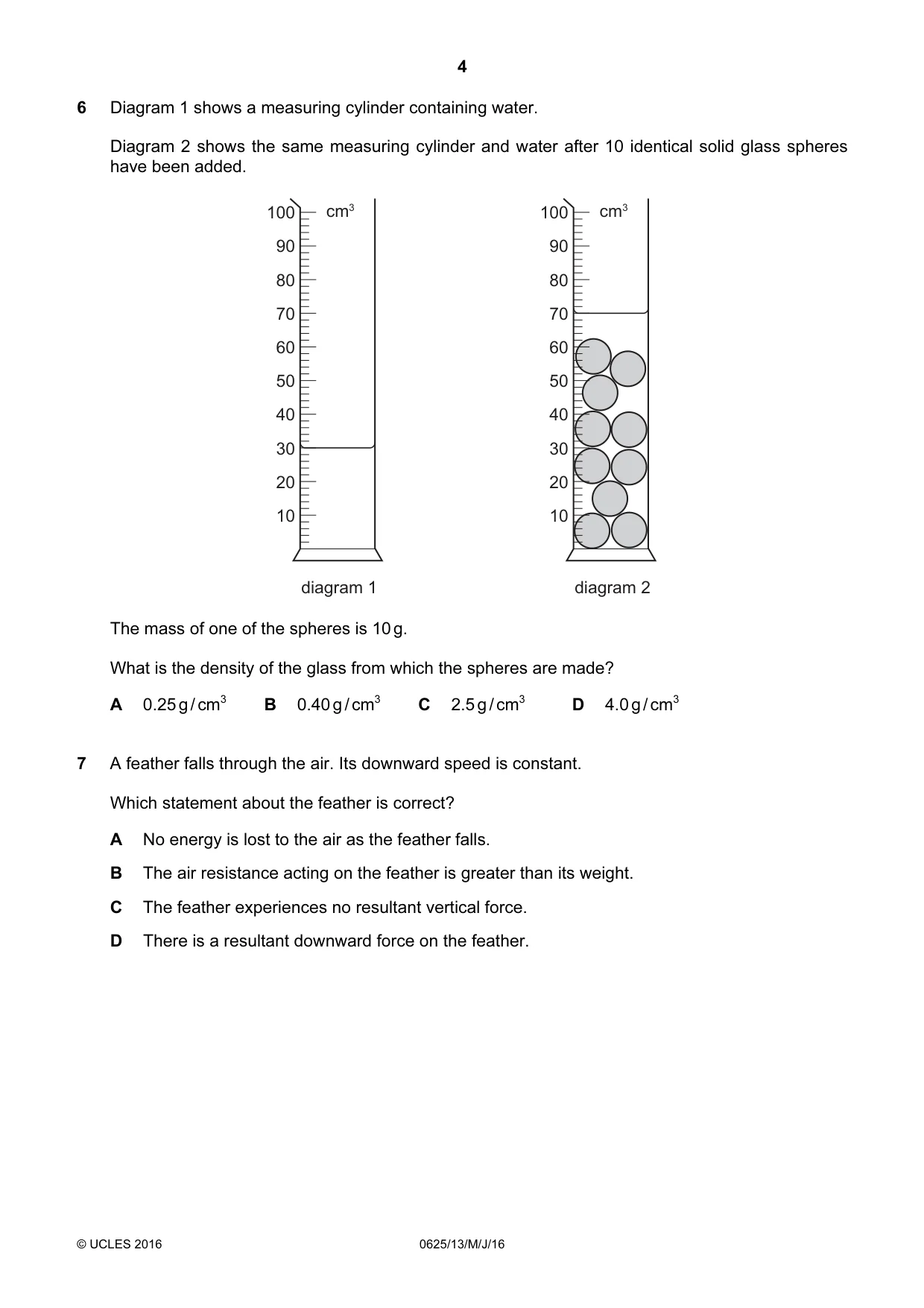
6 Diagram 1 shows a measuring cylinder containing water. Diagram 2 shows the same measuring cylinder and water after 10 identical solid glass spheres have been added. 100 cm3 100 cm3 90 90 80 80 70 70 60 60 50 50 40 40 30 30 20 20 10 10 diagram 1 diagram 2 The mass of one of the spheres is 10 g. What is the density of the glass from which the spheres are made? A 0.25 g / cm3 B 0.40 g / cm3 C 2.5 g / cm3 D 4.0 g / cm3
Mark scheme: C
Q7 · A feather falls through the air
7 A feather falls through the air. Its downward speed is constant. Which statement about the feather is correct? A No energy is lost to the air as the feather falls. B The air resistance acting on the feather is greater than its weight. C The feather experiences no resultant vertical force. D There is a resultant downward force on the feather.
Mark scheme: C
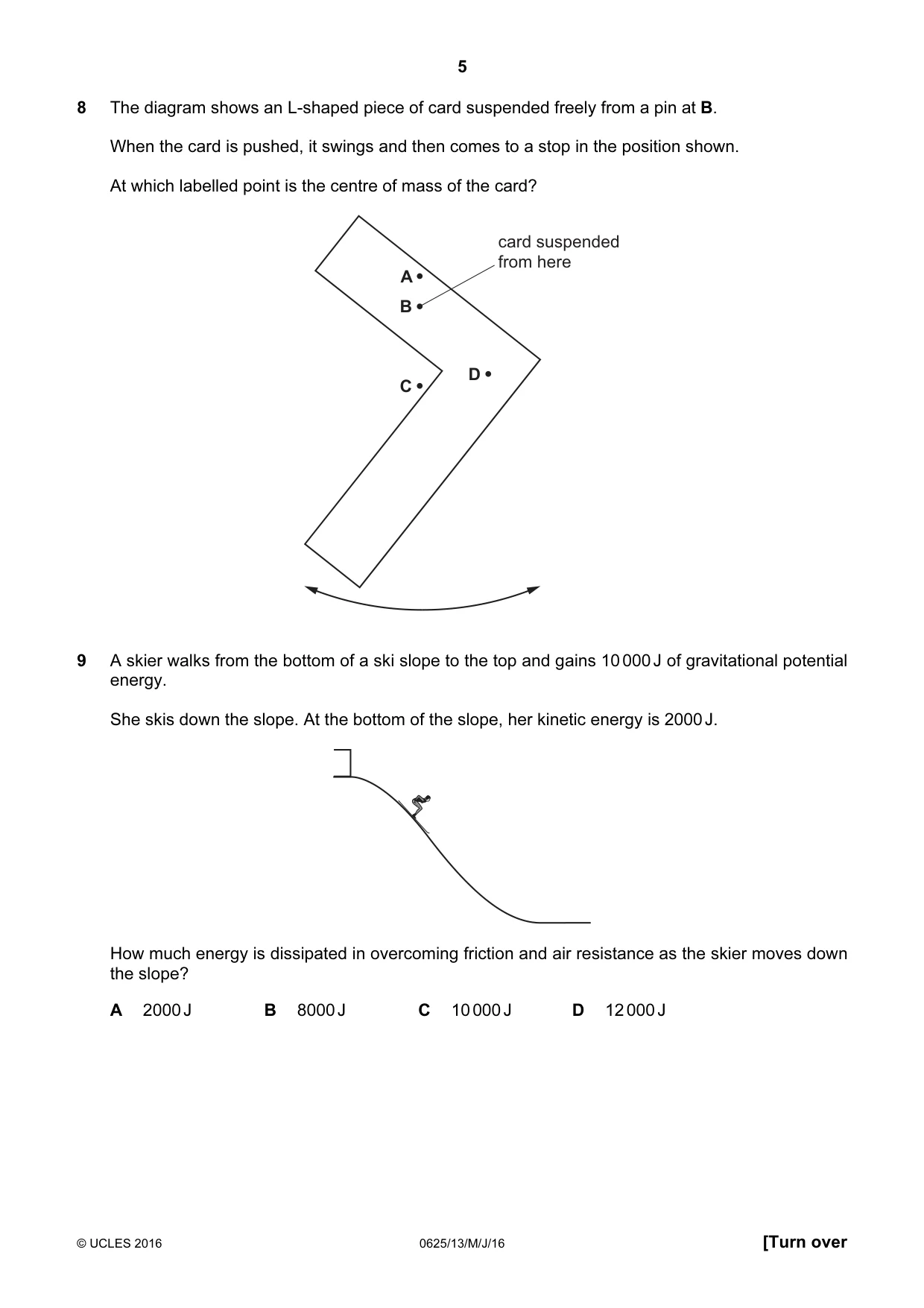
Q8 · The diagram shows an L-shaped piece of card suspended freely from a pin at B
8 The diagram shows an L-shaped piece of card suspended freely from a pin at B. When the card is pushed, it swings and then comes to a stop in the position shown. At which labelled point is the centre of mass of the card? card suspended from here A B D C
Mark scheme: C
Q9 · A skier walks from the bottom of a ski slope to the top and gains 10 000 J of…
9 A skier walks from the bottom of a ski slope to the top and gains 10 000 J of gravitational potential energy. She skis down the slope. At the bottom of the slope, her kinetic energy is 2000 J. How much energy is dissipated in overcoming friction and air resistance as the skier moves down the slope? A 2000 J B 8000 J C 10 000 J D 12 000 J
Mark scheme: B
Q10 · Which energy source is renewable and reliably available at all times?
10 Which energy source is renewable and reliably available at all times? A coal B geothermal C nuclear D wind
Mark scheme: B
Q11 · Two workers are stacking cans on to a shelf in a shop
11 Two workers are stacking cans on to a shelf in a shop. The workers lift the same number of identical cans on to the same shelf from the same level. Worker P takes 3.0 minutes to lift the cans. Worker Q takes 4.0 minutes to lift the cans. Which statement about the workers is correct? A Worker P develops less useful power than worker Q. B Worker P develops more useful power than worker Q. C Worker P does less useful work than worker Q. D Worker P does more useful work than worker Q.
Mark scheme: B
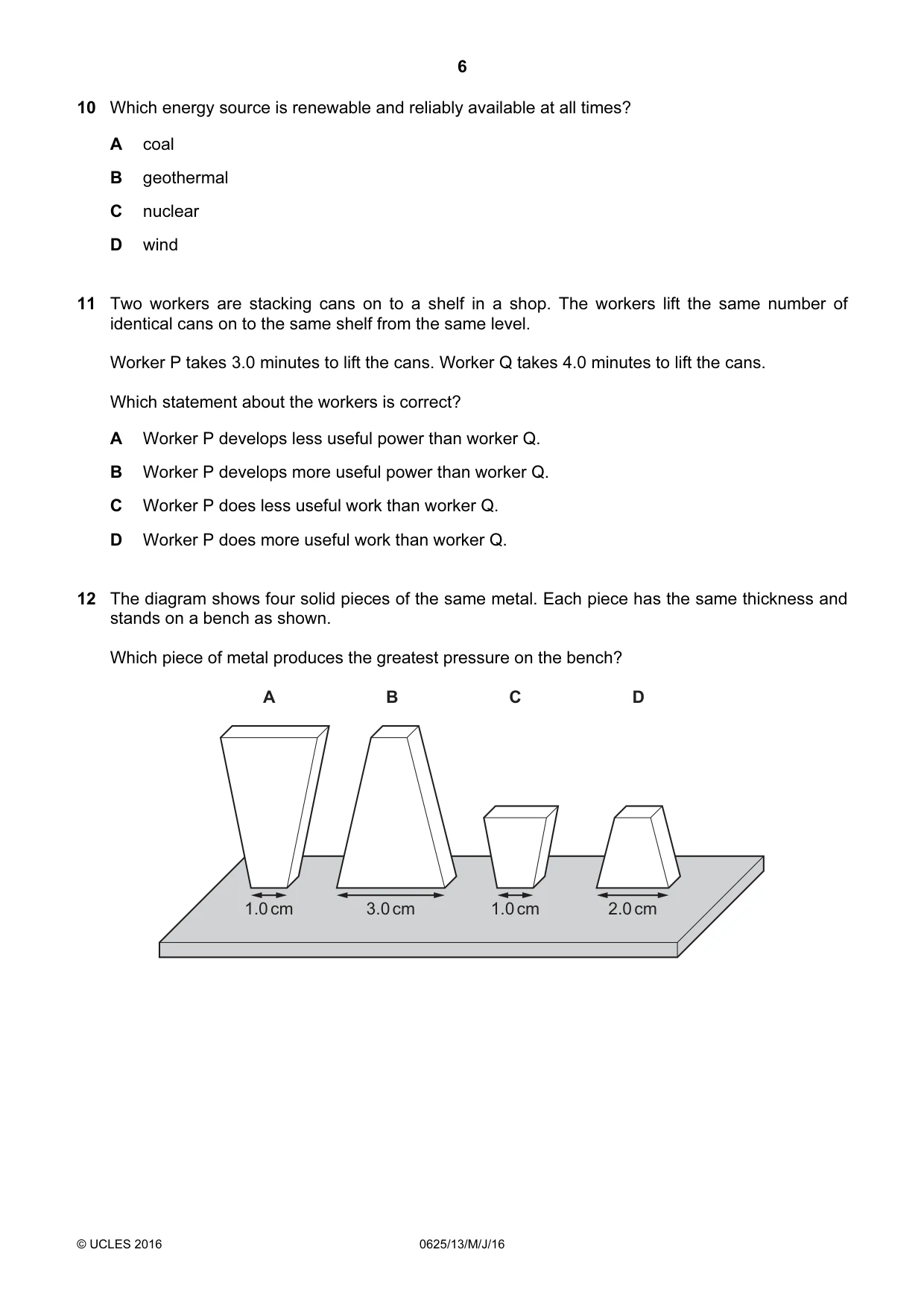
Q12 · The diagram shows four solid pieces of the same metal
12 The diagram shows four solid pieces of the same metal. Each piece has the same thickness and stands on a bench as shown. Which piece of metal produces the greatest pressure on the bench? A B C D 1.0 cm 3.0 cm 1.0 cm 2.0 cm
Mark scheme: A
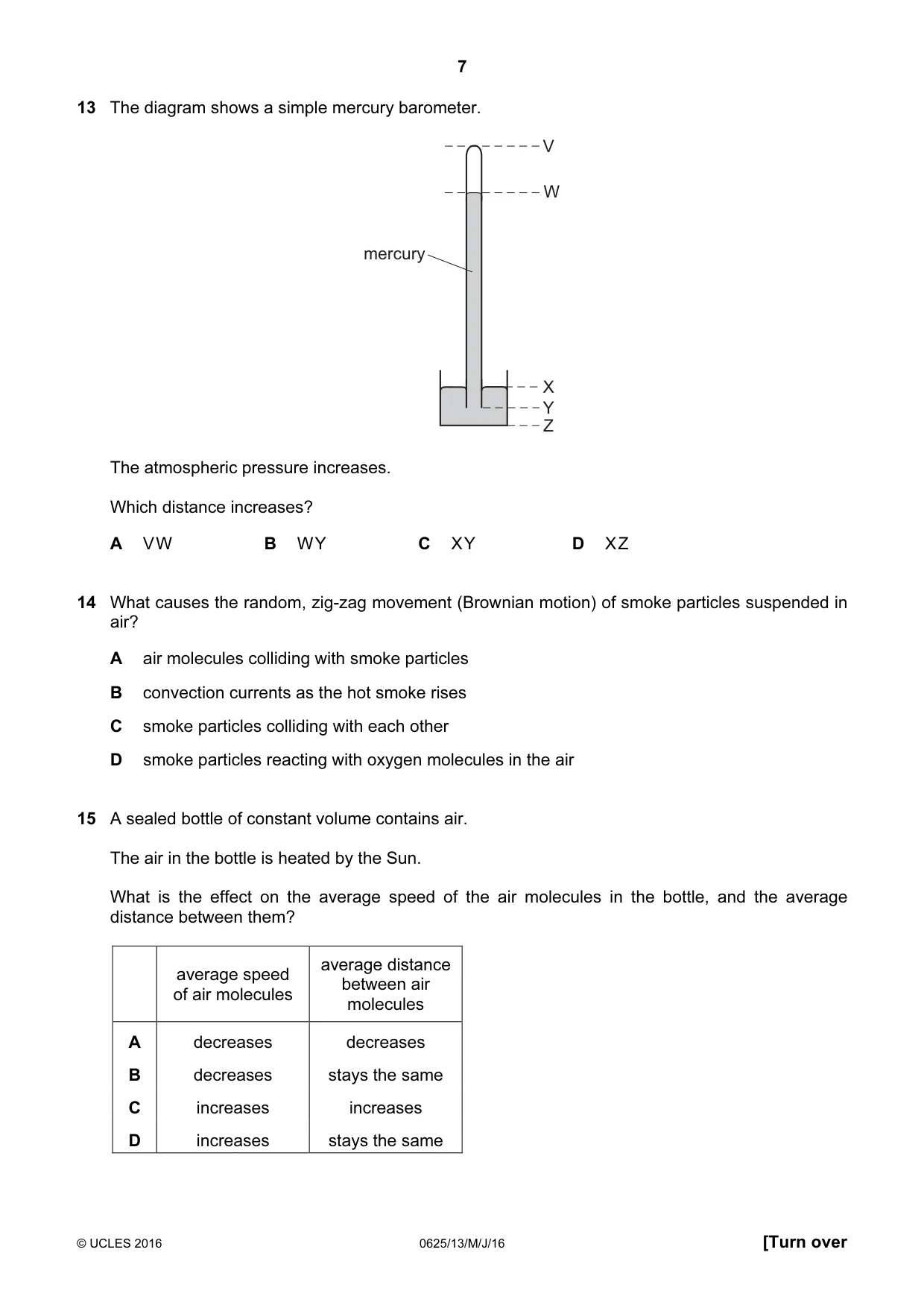
Q13 · The diagram shows a simple mercury barometer
13 The diagram shows a simple mercury barometer. V W mercury X Y Z The atmospheric pressure increases. Which distance increases? A VW B WY C XY D XZ
Mark scheme: B
Q14 · What causes the random, zig-zag movement (Brownian motion) of smoke particles suspended…
14 What causes the random, zig-zag movement (Brownian motion) of smoke particles suspended in air? A air molecules colliding with smoke particles B convection currents as the hot smoke rises C smoke particles colliding with each other D smoke particles reacting with oxygen molecules in the air
Mark scheme: A
Q15 · A sealed bottle of constant volume contains air
15 A sealed bottle of constant volume contains air. The air in the bottle is heated by the Sun. What is the effect on the average speed of the air molecules in the bottle, and the average distance between them? average distance average speed between air of air molecules molecules A decreases decreases B decreases stays the same C increases increases D increases stays the same
Mark scheme: D
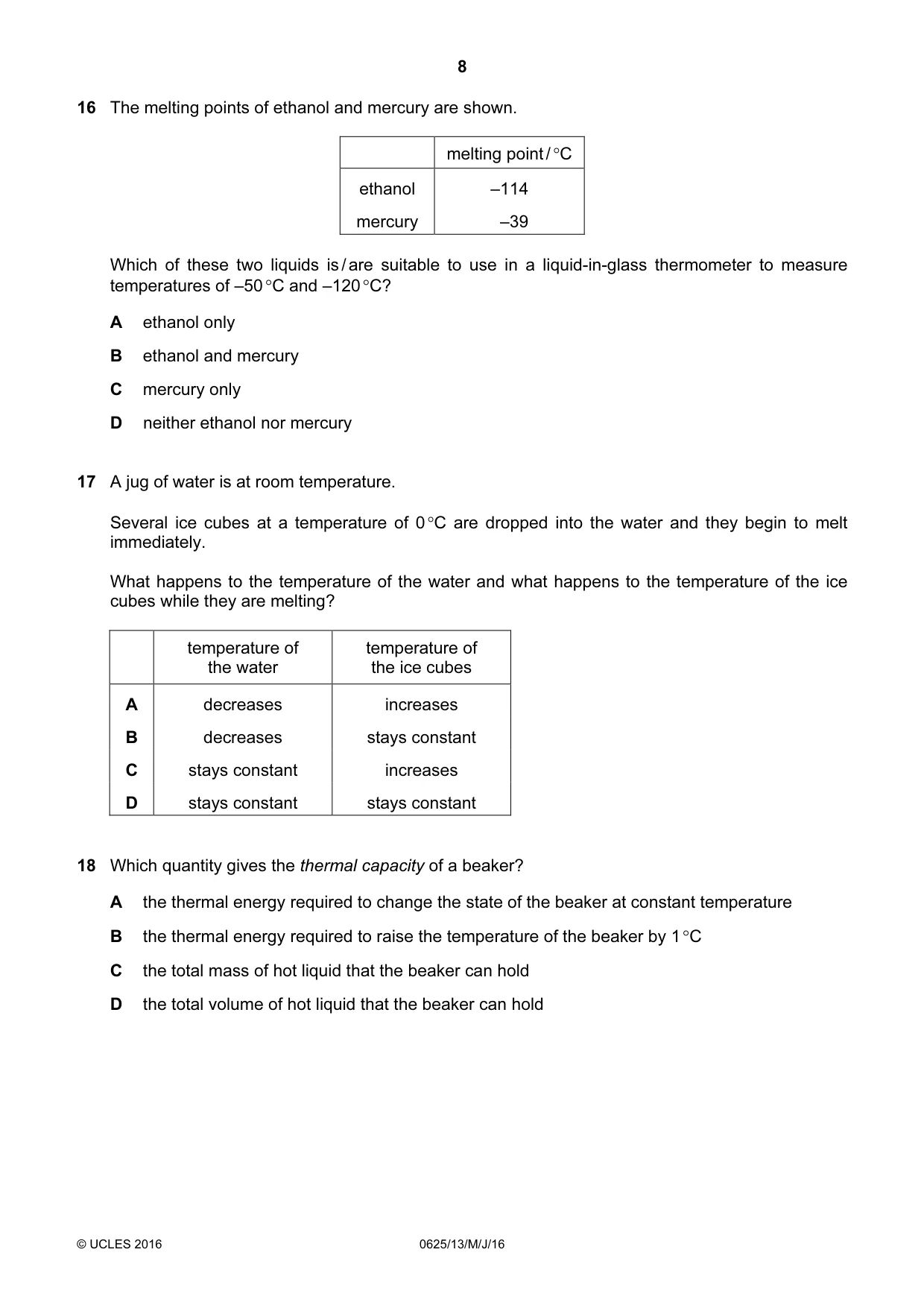
Q16 · The melting points of ethanol and mercury are shown
16 The melting points of ethanol and mercury are shown. melting point / °C ethanol –114 mercury –39 Which of these two liquids is / are suitable to use in a liquid-in-glass thermometer to measure temperatures of –50 °C and –120 °C? A ethanol only B ethanol and mercury C mercury only D neither ethanol nor mercury
Mark scheme: D
Q17 · A jug of water is at room temperature
17 A jug of water is at room temperature. Several ice cubes at a temperature of 0 °C are dropped into the water and they begin to melt immediately. What happens to the temperature of the water and what happens to the temperature of the ice cubes while they are melting? temperature of temperature of the water the ice cubes A decreases increases B decreases stays constant C stays constant increases D stays constant stays constant
Mark scheme: B
Q18 · Which quantity gives the thermal capacity of a beaker?
18 Which quantity gives the thermal capacity of a beaker? A the thermal energy required to change the state of the beaker at constant temperature B the thermal energy required to raise the temperature of the beaker by 1 °C C the total mass of hot liquid that the beaker can hold D the total volume of hot liquid that the beaker can hold
Mark scheme: B
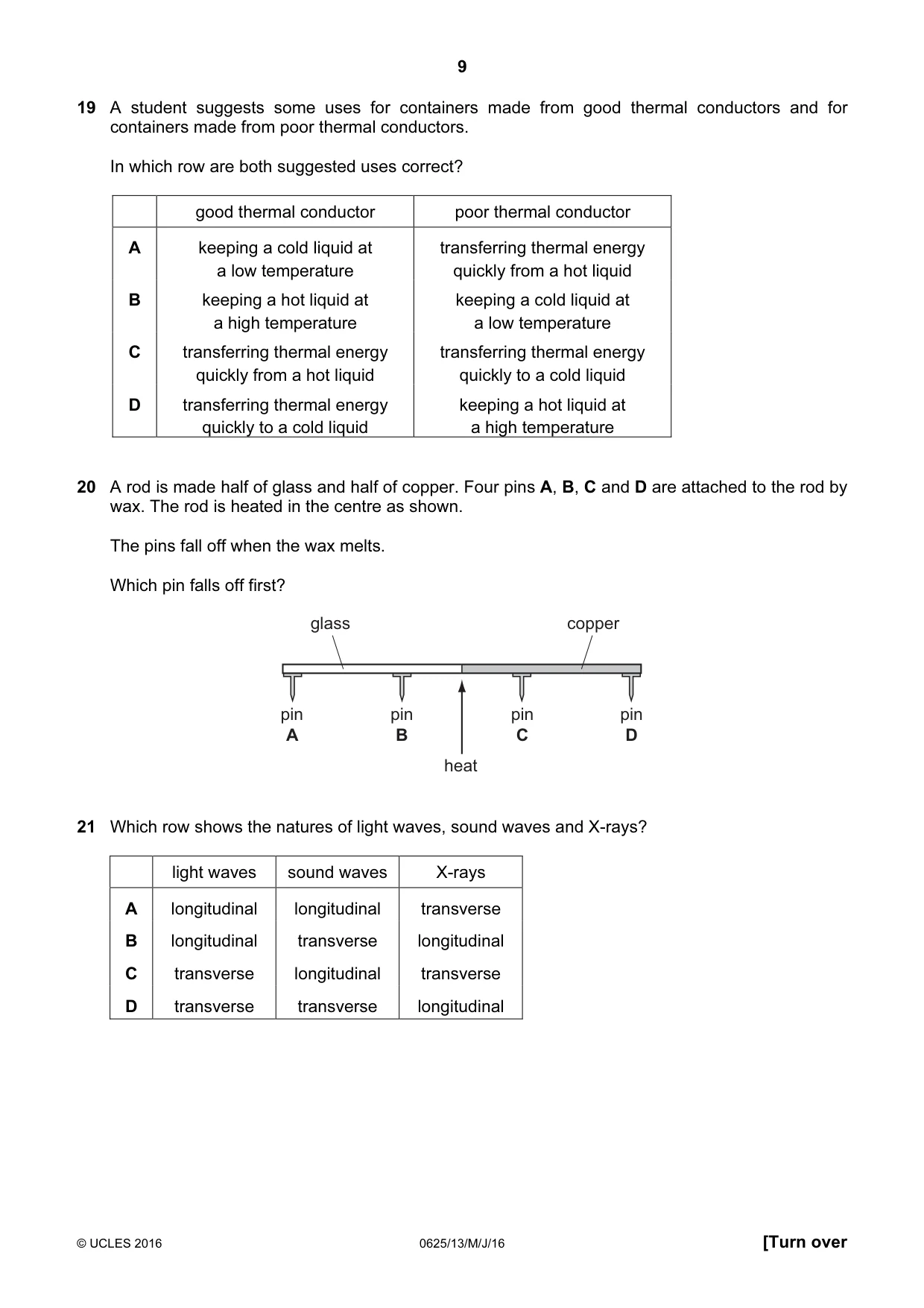
Q19 · A student suggests some uses for containers made from good thermal conductors and for…
19 A student suggests some uses for containers made from good thermal conductors and for containers made from poor thermal conductors. In which row are both suggested uses correct? good thermal conductor poor thermal conductor A keeping a cold liquid at transferring thermal energy a low temperature quickly from a hot liquid B keeping a hot liquid at keeping a cold liquid at a high temperature a low temperature C transferring thermal energy transferring thermal energy quickly from a hot liquid quickly to a cold liquid D transferring thermal energy keeping a hot liquid at quickly to a cold liquid a high temperature
Mark scheme: D
Q20 · A rod is made half of glass and half of copper
20 A rod is made half of glass and half of copper. Four pins A, B, C and D are attached to the rod by wax. The rod is heated in the centre as shown. The pins fall off when the wax melts. Which pin falls off first? glass copper pin pin pin pin A B C D heat
Mark scheme: C
Q21 · Which row shows the natures of light waves, sound waves and X-rays?
21 Which row shows the natures of light waves, sound waves and X-rays? light waves sound waves X-rays A longitudinal longitudinal transverse B longitudinal transverse longitudinal C transverse longitudinal transverse D transverse transverse longitudinal
Mark scheme: C
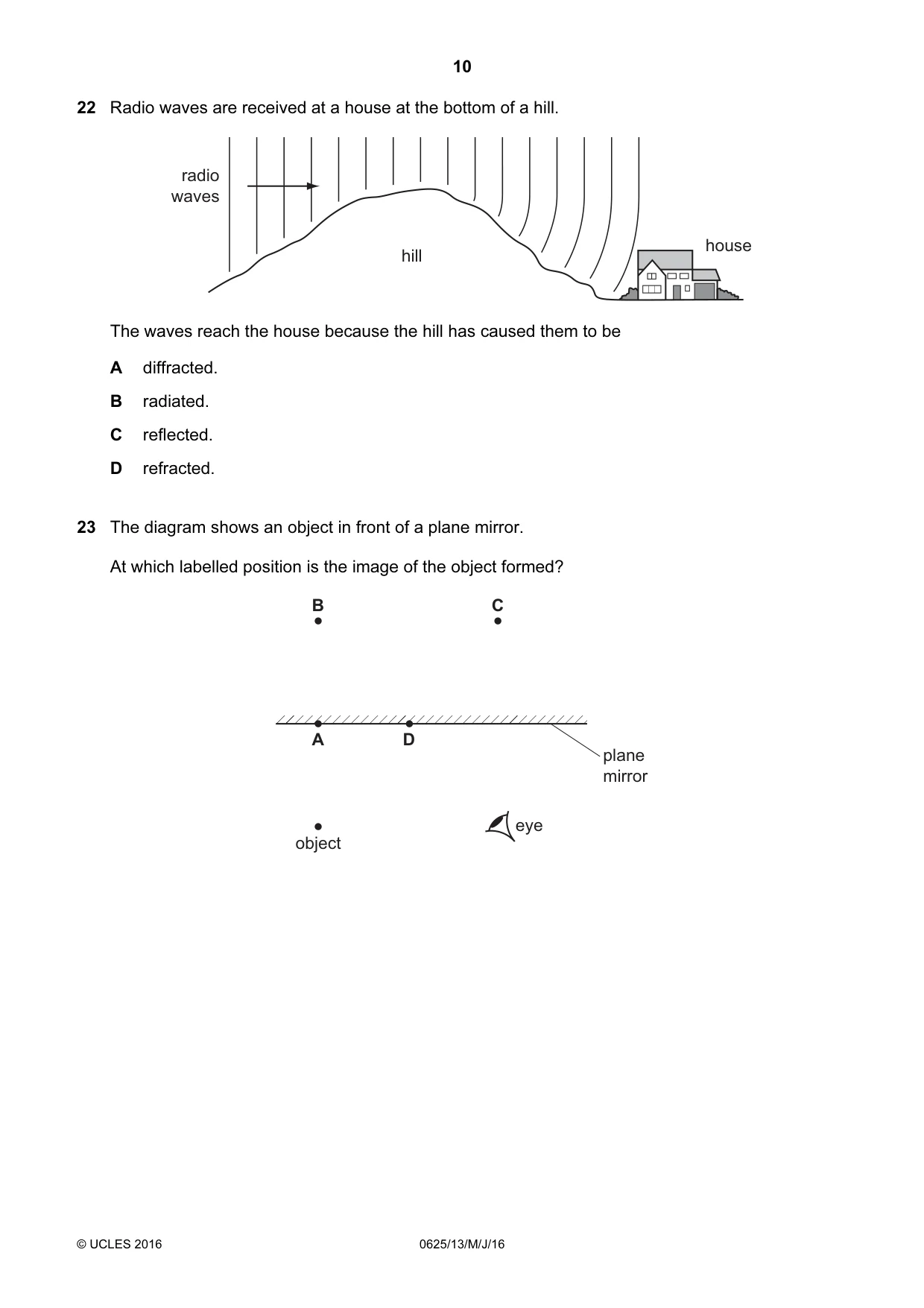
Q22 · Radio waves are received at a house at the bottom of a hill
22 Radio waves are received at a house at the bottom of a hill. radio waves house hill The waves reach the house because the hill has caused them to be A diffracted. B radiated. C reflected. D refracted.
Mark scheme: A
Q23 · The diagram shows an object in front of a plane mirror
23 The diagram shows an object in front of a plane mirror. At which labelled position is the image of the object formed? B C A D plane mirror eye object
Mark scheme: B
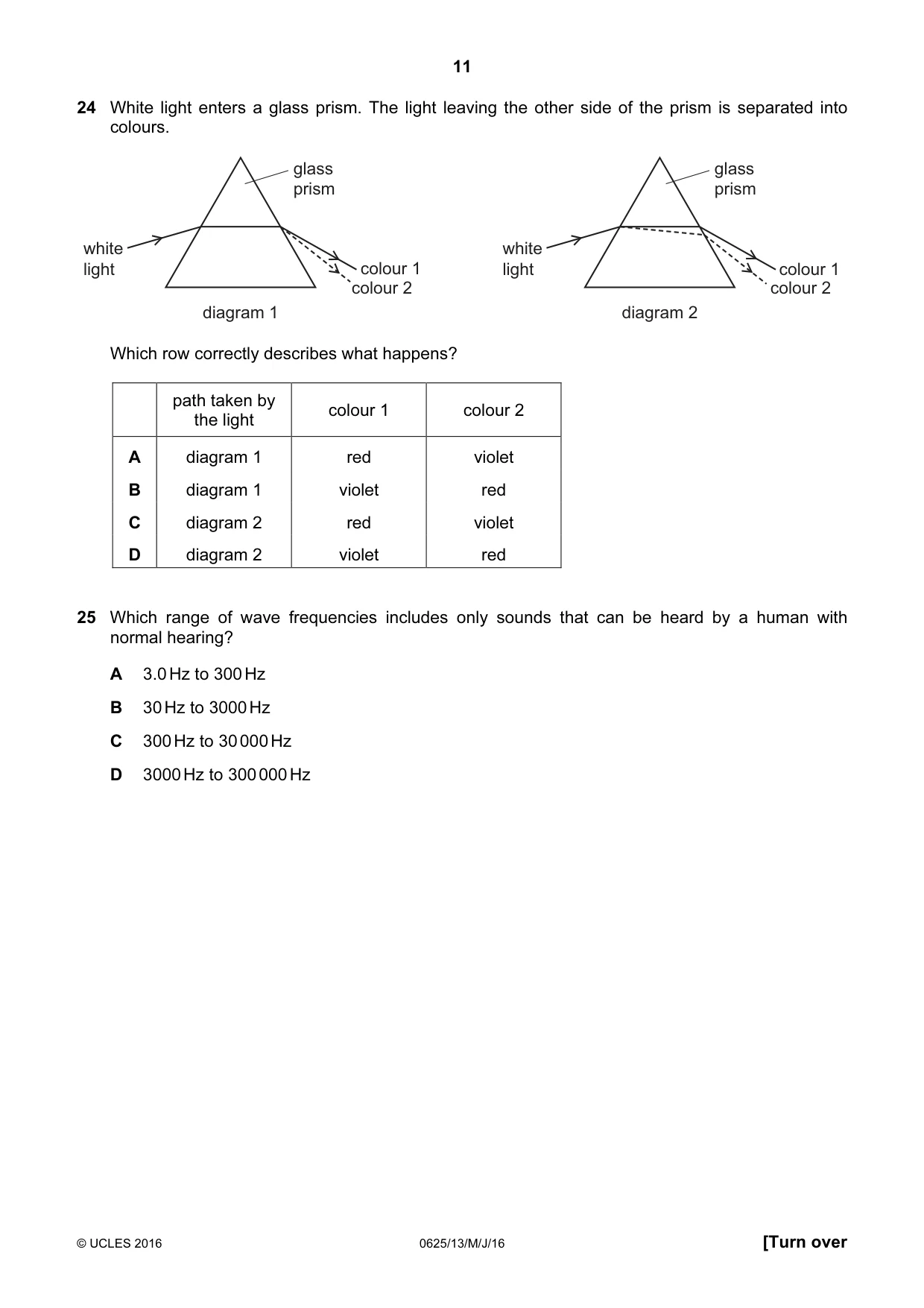
Q24 · White light enters a glass prism
24 White light enters a glass prism. The light leaving the other side of the prism is separated into colours. glass glass prism prism white white light colour 1 light colour 1 colour 2 colour 2 diagram 1 diagram 2 Which row correctly describes what happens? path taken by colour 1 colour 2 the light A diagram 1 red violet B diagram 1 violet red C diagram 2 red violet D diagram 2 violet red
Mark scheme: C
Q25 · Which range of wave frequencies includes only sounds that can be heard by a human with…
25 Which range of wave frequencies includes only sounds that can be heard by a human with normal hearing? A 3.0 Hz to 300 Hz B 30 Hz to 3000 Hz C 300 Hz to 30 000 Hz D 3000 Hz to 300 000 Hz
Mark scheme: B
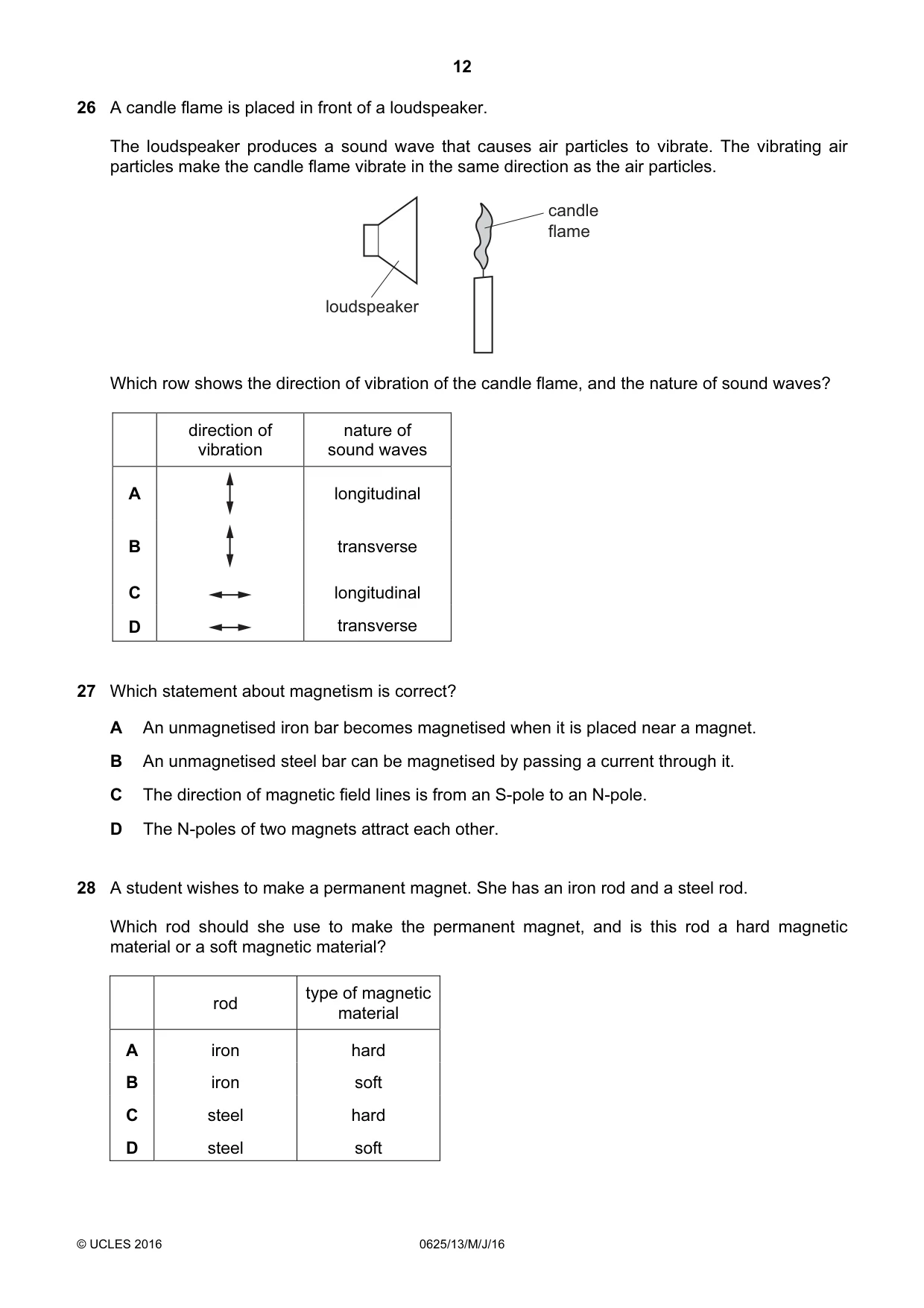
Q26 · A candle flame is placed in front of a loudspeaker
26 A candle flame is placed in front of a loudspeaker. The loudspeaker produces a sound wave that causes air particles to vibrate. The vibrating air particles make the candle flame vibrate in the same direction as the air particles. candle flame loudspeaker Which row shows the direction of vibration of the candle flame, and the nature of sound waves? direction of nature of vibration sound waves A longitudinal B transverse C longitudinal D transverse
Mark scheme: C
Q27 · Which statement about magnetism is correct?
27 Which statement about magnetism is correct? A An unmagnetised iron bar becomes magnetised when it is placed near a magnet. B An unmagnetised steel bar can be magnetised by passing a current through it. C The direction of magnetic field lines is from an S-pole to an N-pole. D The N-poles of two magnets attract each other.
Mark scheme: A
Q28 · A student wishes to make a permanent magnet
28 A student wishes to make a permanent magnet. She has an iron rod and a steel rod. Which rod should she use to make the permanent magnet, and is this rod a hard magnetic material or a soft magnetic material? type of magnetic rod material A iron hard B iron soft C steel hard D steel soft
Mark scheme: C
Q29 · A flexible electrical cable consists of a central conductor and outer insulation
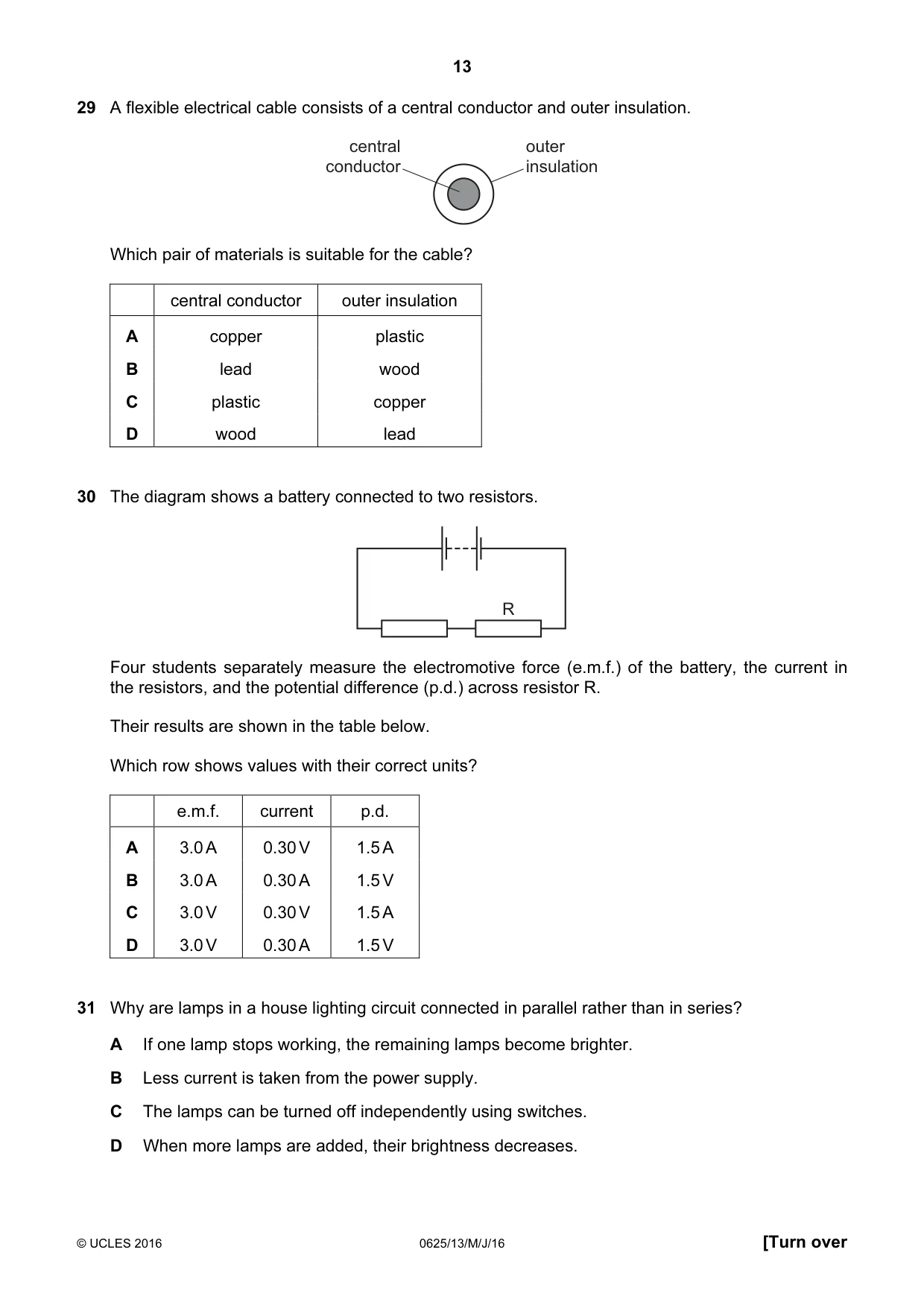
29 A flexible electrical cable consists of a central conductor and outer insulation. central outer conductor insulation Which pair of materials is suitable for the cable? central conductor outer insulation A copper plastic B lead wood C plastic copper D wood lead
Mark scheme: A
Q30 · The diagram shows a battery connected to two resistors
30 The diagram shows a battery connected to two resistors. R Four students separately measure the electromotive force (e.m.f.) of the battery, the current in the resistors, and the potential difference (p.d.) across resistor R. Their results are shown in the table below. Which row shows values with their correct units? e.m.f. current p.d. A 3.0 A 0.30 V 1.5 A B 3.0 A 0.30 A 1.5 V C 3.0 V 0.30 V 1.5 A D 3.0 V 0.30 A 1.5 V
Mark scheme: D
Q31 · Why are lamps in a house lighting circuit connected in parallel rather than in series?
31 Why are lamps in a house lighting circuit connected in parallel rather than in series? A If one lamp stops working, the remaining lamps become brighter. B Less current is taken from the power supply. C The lamps can be turned off independently using switches. D When more lamps are added, their brightness decreases.
Mark scheme: C
Q32 · The diagram shows a cell connected to two 6.0 Ω resistors
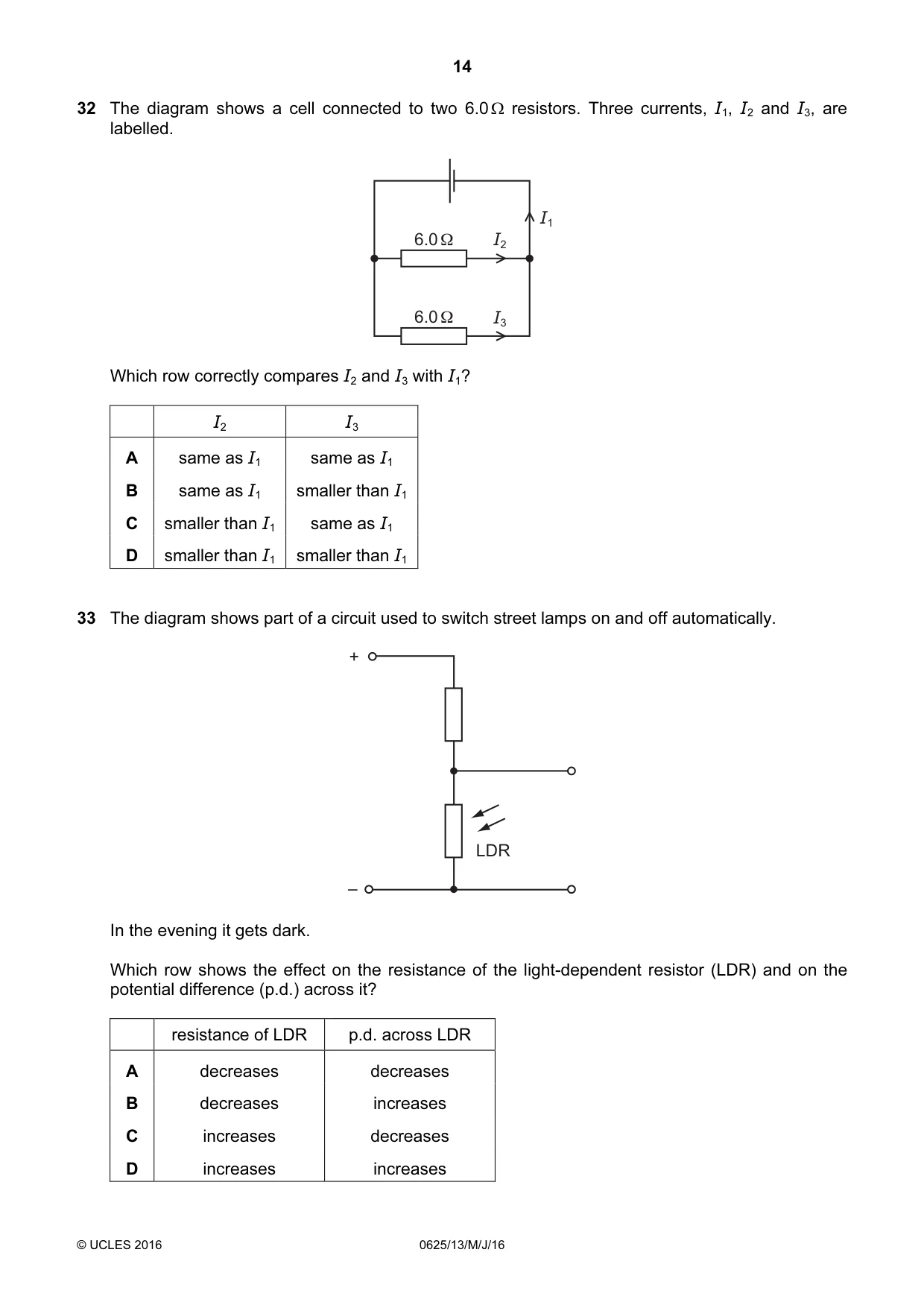
32 The diagram shows a cell connected to two 6.0 Ω resistors. Three currents, I1, I2 and I3, are labelled. I1 6.0 Ω I2 6.0 Ω I3 Which row correctly compares I2 and I3 with I1? I2 I3 A same as I1 same as I1 B same as I1 smaller than I1 C smaller than I1 same as I1 D smaller than I1 smaller than I1
Mark scheme: D
Q33 · The diagram shows part of a circuit used to switch street lamps on and off automatically
33 The diagram shows part of a circuit used to switch street lamps on and off automatically. + LDR – In the evening it gets dark. Which row shows the effect on the resistance of the light-dependent resistor (LDR) and on the potential difference (p.d.) across it? resistance of LDR p.d. across LDR A decreases decreases B decreases increases C increases decreases D increases increases
Mark scheme: D
Q34 · A domestic circuit includes a 30 A fuse
34 A domestic circuit includes a 30 A fuse. This protects the wiring if there is too much current in the circuit. In which wire is the 30 A fuse positioned, and what does it do when it operates? position operation A live wire disconnects the circuit B live wire reduces the current to 30 A C neutral wire disconnects the circuit D neutral wire reduces the current to 30 A
Mark scheme: A
Q35 · A strong electromagnet is used to attract pins
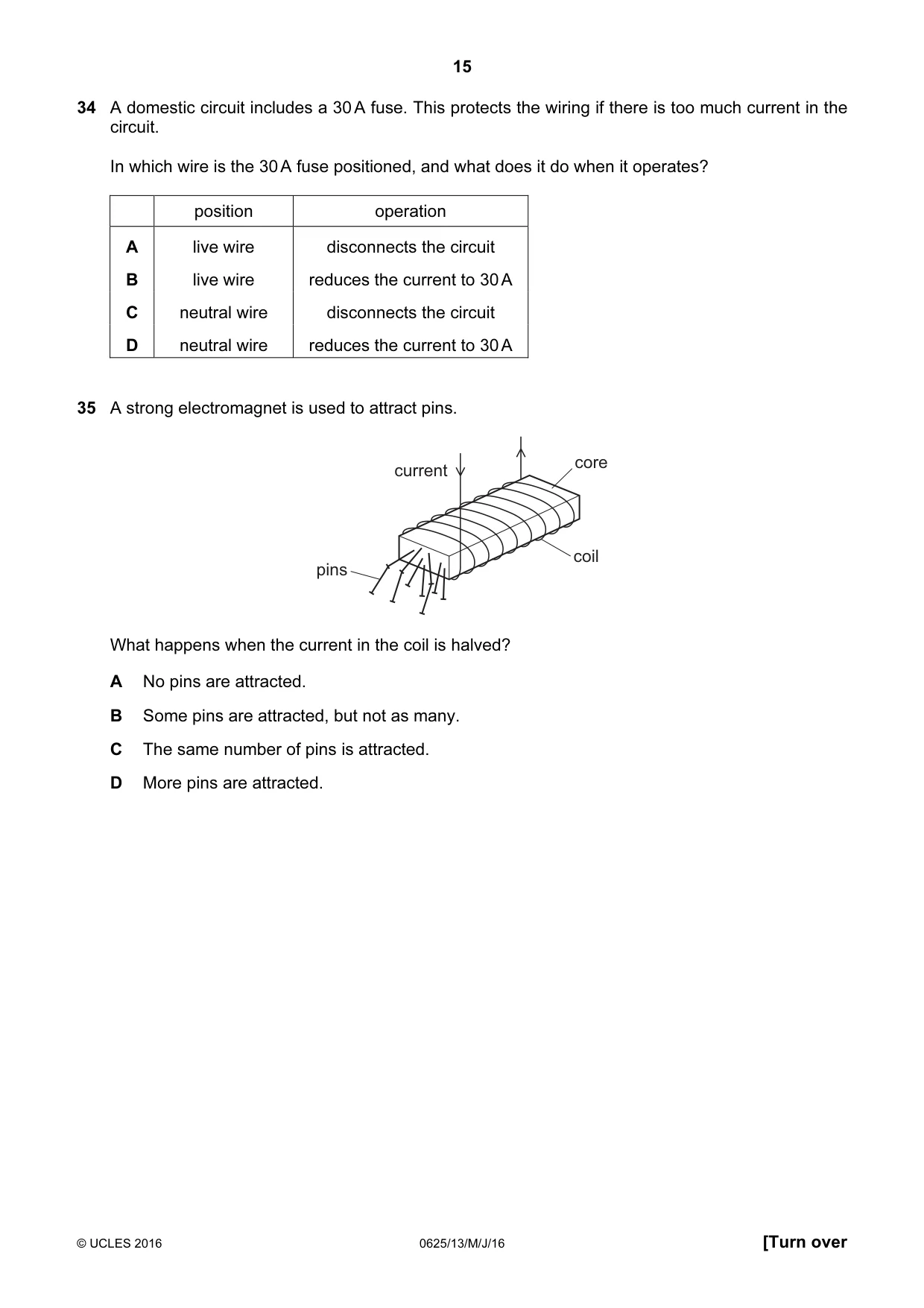
35 A strong electromagnet is used to attract pins. core current coil pins What happens when the current in the coil is halved? A No pins are attracted. B Some pins are attracted, but not as many. C The same number of pins is attracted. D More pins are attracted.
Mark scheme: B
Q36 · The diagram shows a transformer
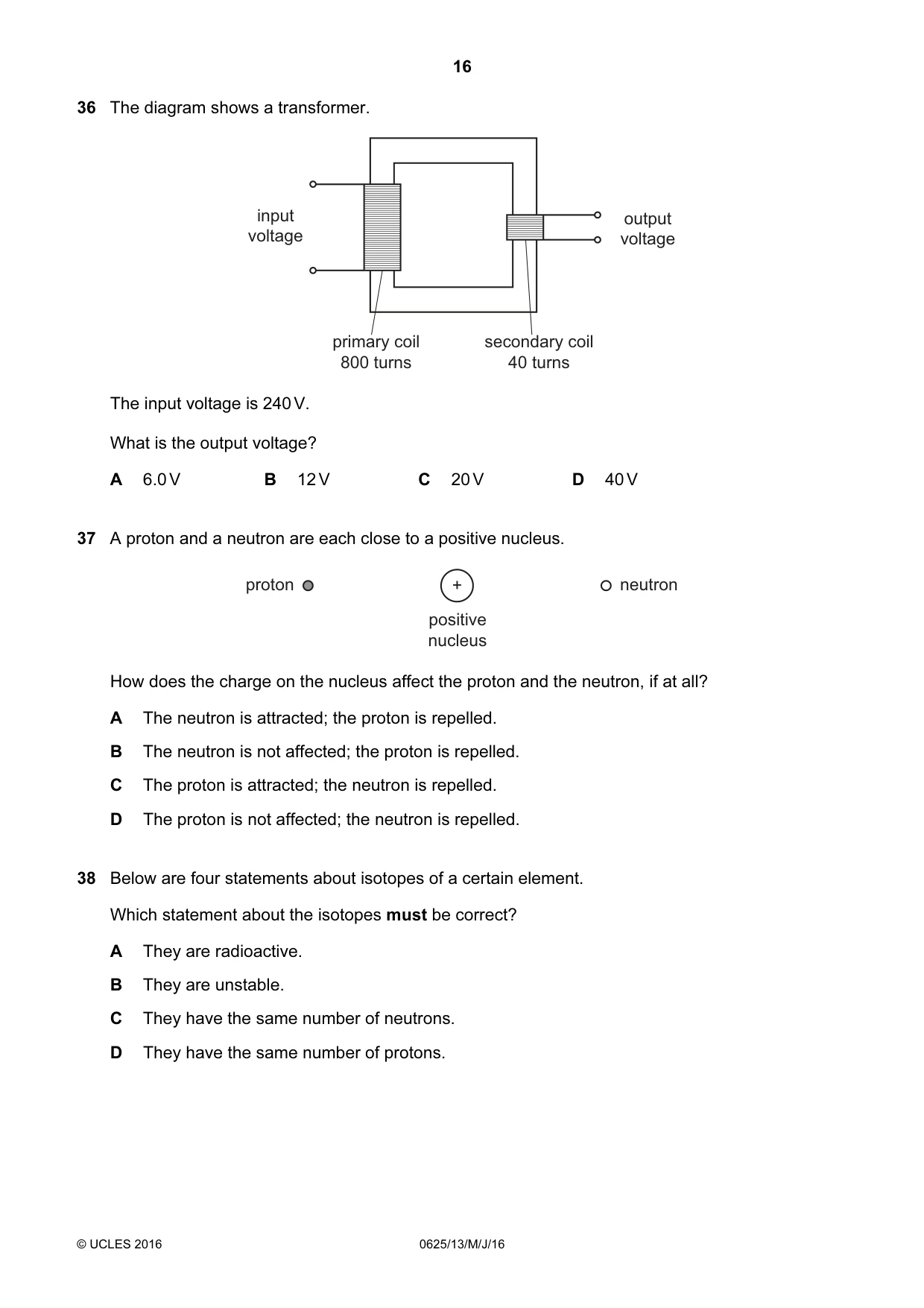
36 The diagram shows a transformer. input output voltage voltage primary coil secondary coil 800 turns 40 turns The input voltage is 240 V. What is the output voltage? A 6.0 V B 12 V C 20 V D 40 V
Mark scheme: B
Q37 · A proton and a neutron are each close to a positive nucleus
37 A proton and a neutron are each close to a positive nucleus. proton + neutron positive nucleus How does the charge on the nucleus affect the proton and the neutron, if at all? A The neutron is attracted; the proton is repelled. B The neutron is not affected; the proton is repelled. C The proton is attracted; the neutron is repelled. D The proton is not affected; the neutron is repelled.
Mark scheme: B
Q38 · Below are four statements about isotopes of a certain element
38 Below are four statements about isotopes of a certain element. Which statement about the isotopes must be correct? A They are radioactive. B They are unstable. C They have the same number of neutrons. D They have the same number of protons.
Mark scheme: D
Q39 · Radioactive materials should be handled carefully
39 Radioactive materials should be handled carefully. Which safety precaution does not reduce the risk to people using a radioactive material? A keeping the material a long distance from people B keeping the material at a low temperature C using lead screening between the material and people D using the material for only a short time
Mark scheme: B
Q40 · A sample of a radioactive isotope has an initial rate of emission of 128 counts per…
40 A sample of a radioactive isotope has an initial rate of emission of 128 counts per minute and a half-life of 4 days. How long will it take for the rate of emission to fall to 32 counts per minute? A 2 days B 4 days C 8 days D 12 days
Mark scheme: C
What was in this paper
The subtopics covered by these 40 questions, and how many questions each got. Open one in a new tab to see every Cambridge question on it.
3Energy, work and power3Motion3Thermal properties and temperature3Electrical quantities2Electromagnetic effects2Forces2General properties of waves2Kinetic particle model of matter2Light2Pressure2Radioactivity2Simple phenomena of magnetism2Sound2The nuclear model of the atom2Transfer of thermal energy2Density1Electrical safety1Mass and weight1Physical quantities and measurement techniques1What you needed in this session
Cambridge’s own grade thresholds for 2016 May/June, Paper 1 · Variant 3. A higher threshold means an easier paper — the bar moves with how the cohort did.