Cambridge IGCSE Physics 0625 — 2020 Oct/Nov Paper 1 · Variant 3
0625/13/O/N/20 · 40 questions · 40 marks · ≈45 min
The question paper and its mark scheme, free to read here and free to download. This is Cambridge’s own paper, exactly as it was sat.
Question paper16 pages
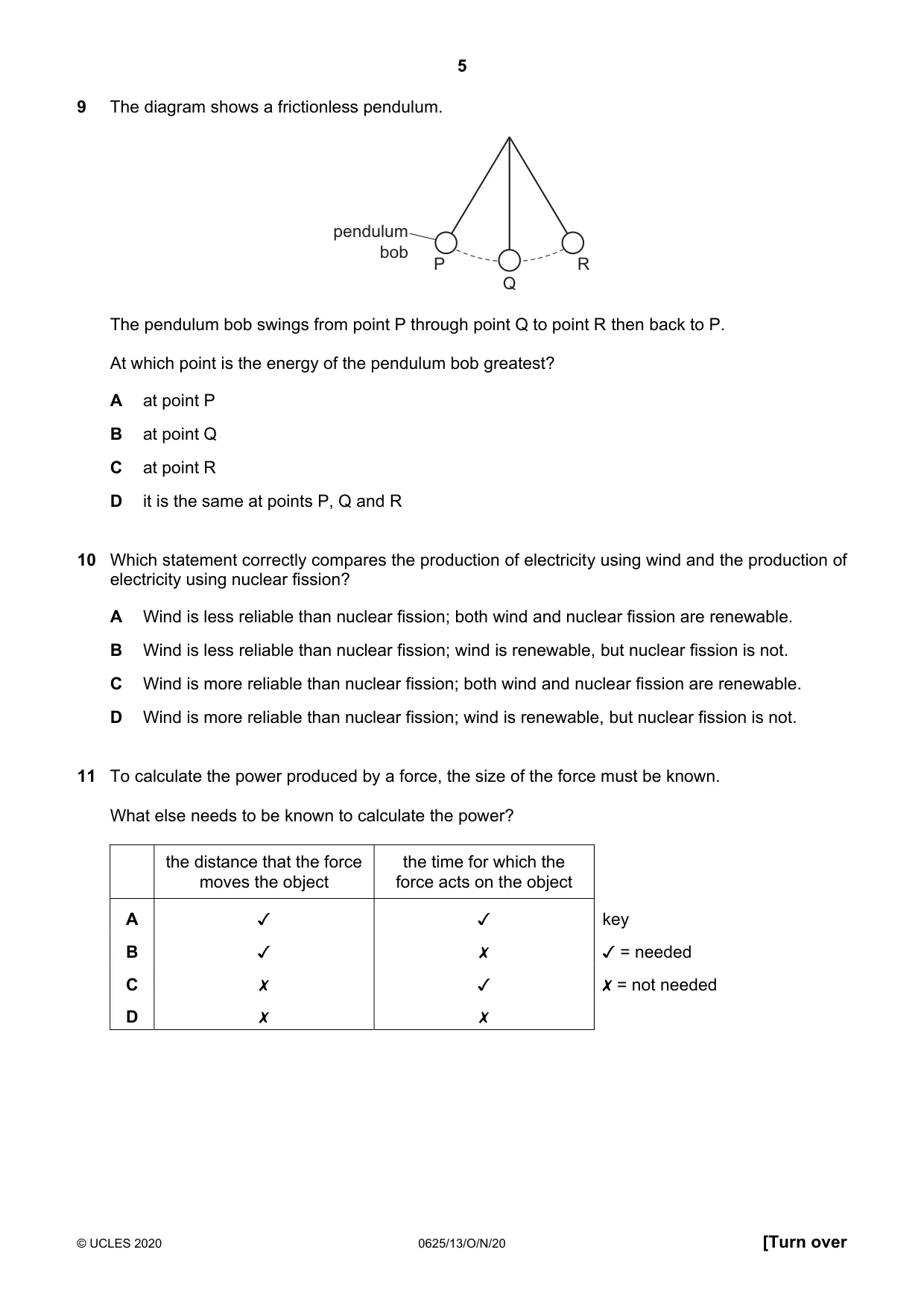
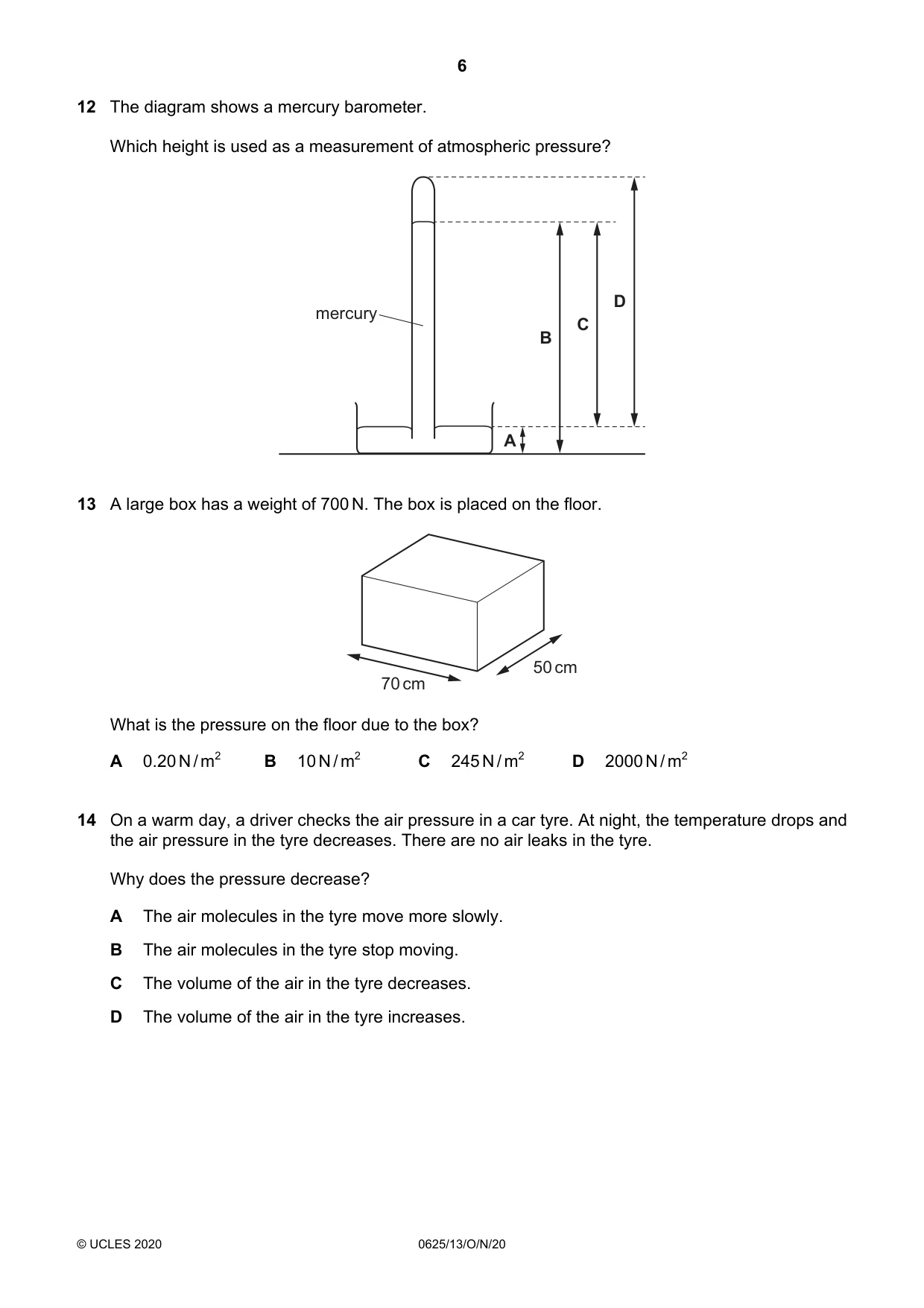
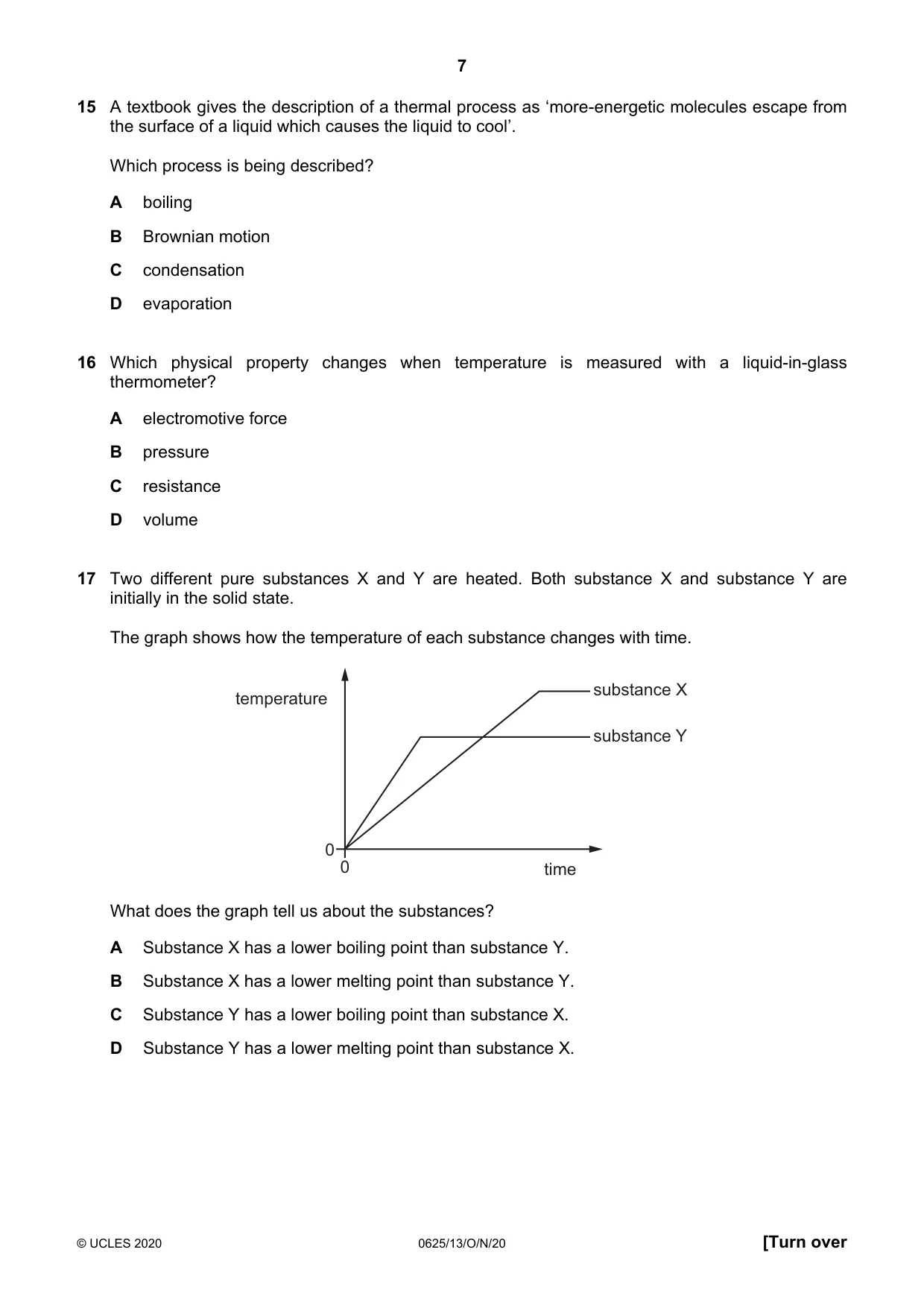
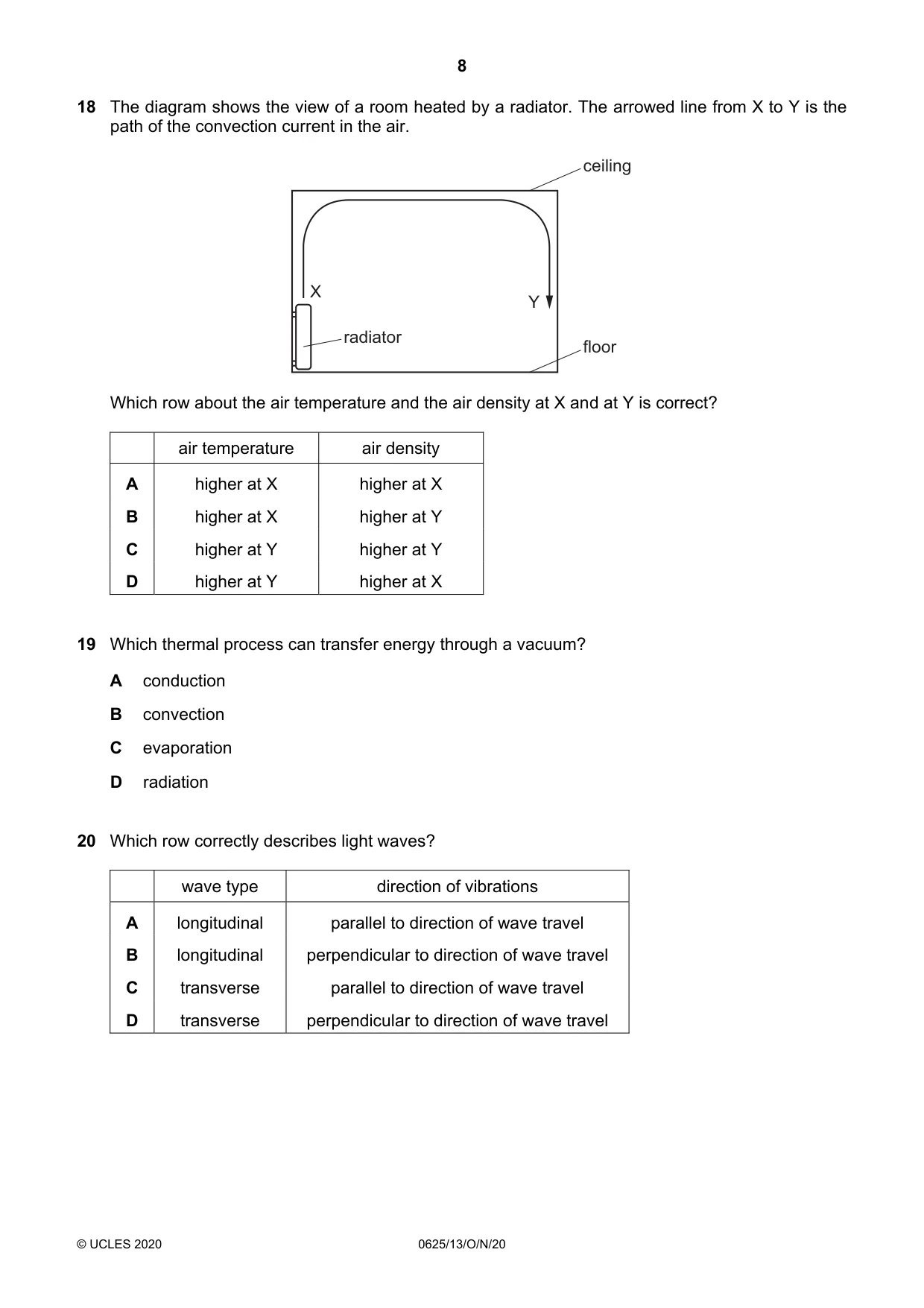
Mark scheme3 pages
Answers below. Sit the paper first if you are practising.
Questions as text
Q1 · A student uses a metre rule to measure the length of a sheet of paper
1 A student uses a metre rule to measure the length of a sheet of paper. Which measurement is shown to the nearest millimetre? A 0.3 m B 0.29 m C 0.293 m D 0.2932 m
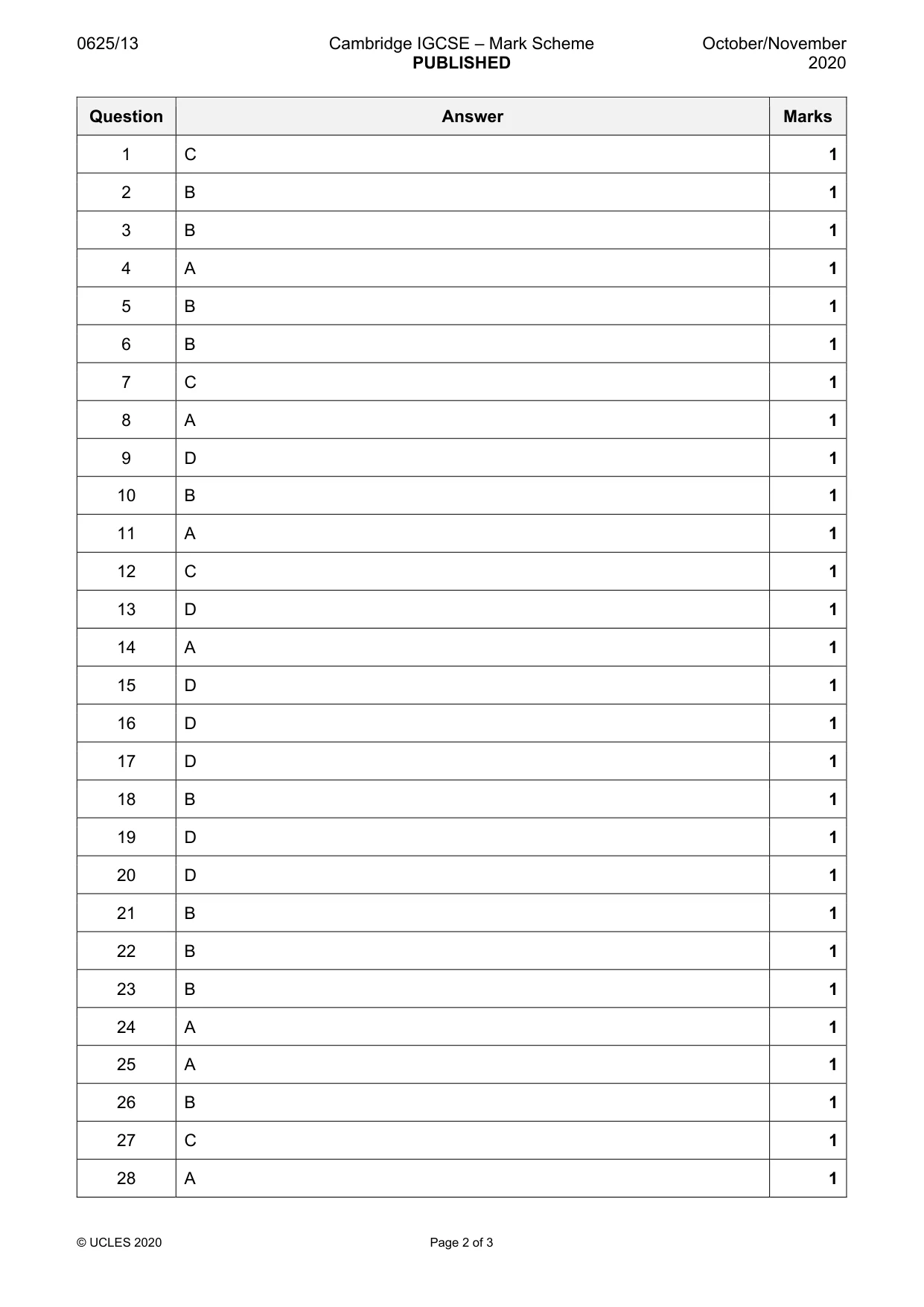
Mark scheme: C
More questions on Physical quantities and measurement techniques
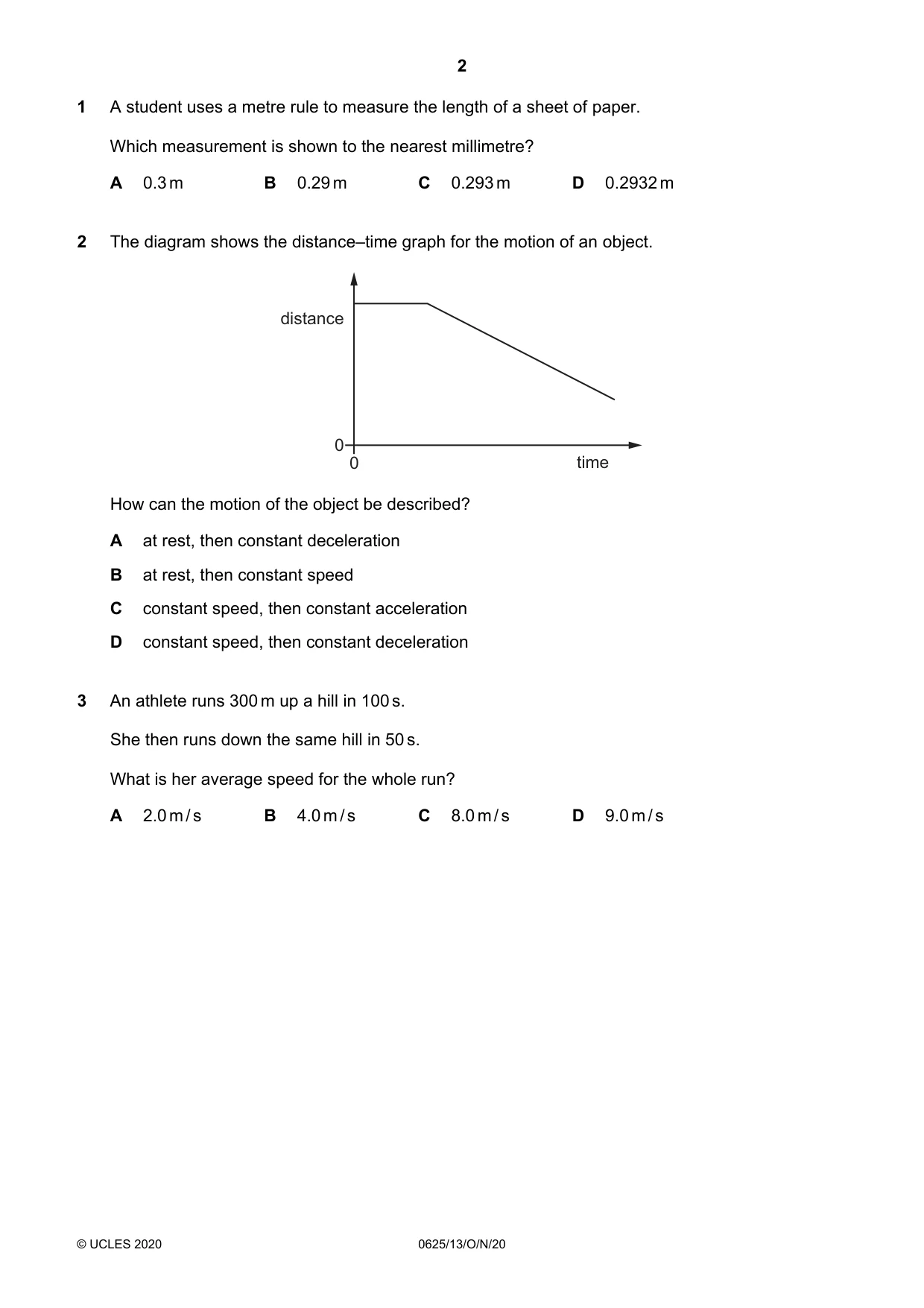
Q2 · The diagram shows the distance–time graph for the motion of an object
2 The diagram shows the distance–time graph for the motion of an object. distance 0 0 time How can the motion of the object be described? A at rest, then constant deceleration B at rest, then constant speed C constant speed, then constant acceleration D constant speed, then constant deceleration
Mark scheme: B
Q3 · An athlete runs 300 m up a hill in 100 s
3 An athlete runs 300 m up a hill in 100 s. She then runs down the same hill in 50 s. What is her average speed for the whole run? A 2.0 m / s B 4.0 m / s C 8.0 m / s D 9.0 m / s
Mark scheme: B
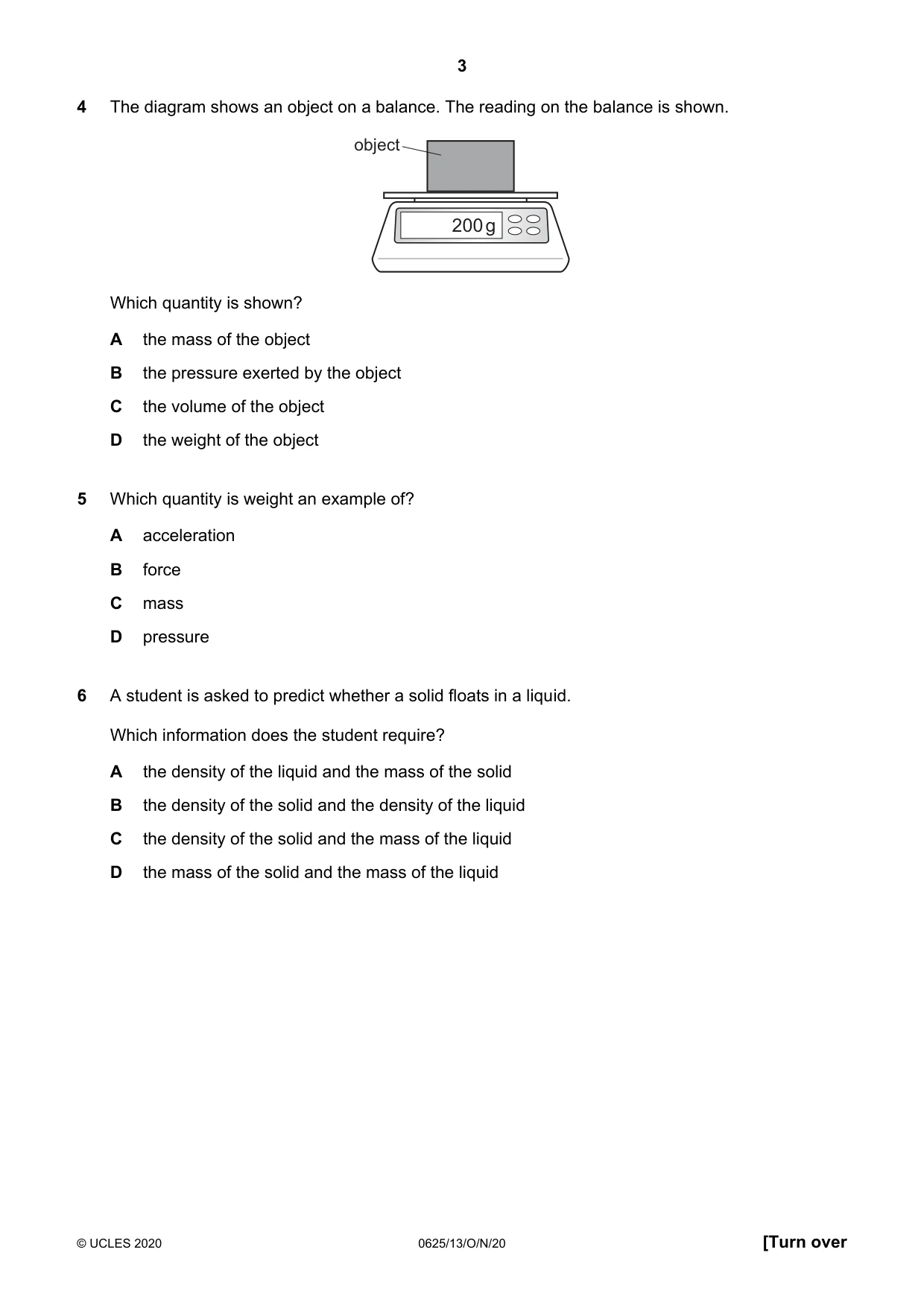
Q4 · The diagram shows an object on a balance
4 The diagram shows an object on a balance. The reading on the balance is shown. object 200 g Which quantity is shown? A the mass of the object B the pressure exerted by the object C the volume of the object D the weight of the object
Mark scheme: A
Q5 · Which quantity is weight an example of?
5 Which quantity is weight an example of? A acceleration B force C mass D pressure
Mark scheme: B
Q6 · A student is asked to predict whether a solid floats in a liquid
6 A student is asked to predict whether a solid floats in a liquid. Which information does the student require? A the density of the liquid and the mass of the solid B the density of the solid and the density of the liquid C the density of the solid and the mass of the liquid D the mass of the solid and the mass of the liquid
Mark scheme: B
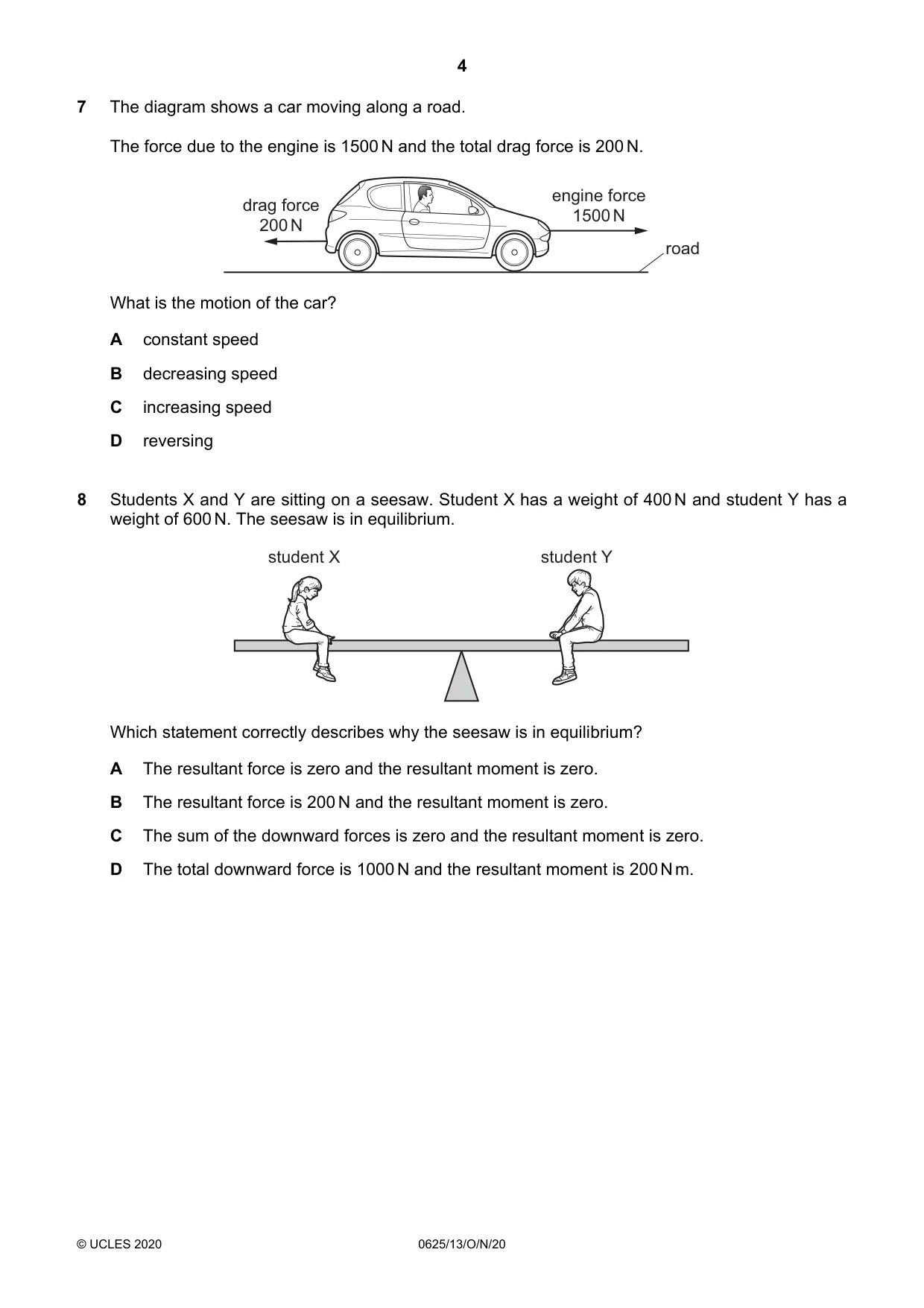
Q7 · The diagram shows a car moving along a road
7 The diagram shows a car moving along a road. The force due to the engine is 1500 N and the total drag force is 200 N. engine force drag force 1500 N 200 N road What is the motion of the car? A constant speed B decreasing speed C increasing speed D reversing
Mark scheme: C
Q8 · Students X and Y are sitting on a seesaw
8 Students X and Y are sitting on a seesaw. Student X has a weight of 400 N and student Y has a weight of 600 N. The seesaw is in equilibrium. student X student Y Which statement correctly describes why the seesaw is in equilibrium? A The resultant force is zero and the resultant moment is zero. B The resultant force is 200 N and the resultant moment is zero. C The sum of the downward forces is zero and the resultant moment is zero. D The total downward force is 1000 N and the resultant moment is 200 N m.
Mark scheme: A
Q9 · The diagram shows a frictionless pendulum
9 The diagram shows a frictionless pendulum. pendulum bob P R Q The pendulum bob swings from point P through point Q to point R then back to P. At which point is the energy of the pendulum bob greatest? A at point P B at point Q C at point R D it is the same at points P, Q and R
Mark scheme: D
Q10 · Which statement correctly compares the production of electricity using wind and the…
10 Which statement correctly compares the production of electricity using wind and the production of electricity using nuclear fission? A Wind is less reliable than nuclear fission; both wind and nuclear fission are renewable. B Wind is less reliable than nuclear fission; wind is renewable, but nuclear fission is not. C Wind is more reliable than nuclear fission; both wind and nuclear fission are renewable. D Wind is more reliable than nuclear fission; wind is renewable, but nuclear fission is not.
Mark scheme: B
Q11 · To calculate the power produced by a force, the size of the force must be known
11 To calculate the power produced by a force, the size of the force must be known. What else needs to be known to calculate the power? the distance that the force moves the object the time for which the force acts on the object 0 0O WwW D> v v x x v x v x key Jv = needed X = not needed
Mark scheme: A
Q12 · The diagram shows a mercury barometer
12 The diagram shows a mercury barometer. Which height is used as a measurement of atmospheric pressure? D mercury C B A
Mark scheme: C
Q13 · A large box has a weight of 700 N
13 A large box has a weight of 700 N. The box is placed on the floor. 50 cm 70 cm What is the pressure on the floor due to the box? A 0.20 N / m2 B 10 N / m2 C 245 N / m2 D 2000 N / m2
Mark scheme: D
Q14 · On a warm day, a driver checks the air pressure in a car tyre
14 On a warm day, a driver checks the air pressure in a car tyre. At night, the temperature drops and the air pressure in the tyre decreases. There are no air leaks in the tyre. Why does the pressure decrease? A The air molecules in the tyre move more slowly. B The air molecules in the tyre stop moving. C The volume of the air in the tyre decreases. D The volume of the air in the tyre increases.
Mark scheme: A
Q15 · A textbook gives the description of a thermal process as ‘more-energetic molecules escape…
15 A textbook gives the description of a thermal process as ‘more-energetic molecules escape from the surface of a liquid which causes the liquid to cool’. Which process is being described? A boiling B Brownian motion C condensation D evaporation
Mark scheme: D
Q16 · Which physical property changes when temperature is measured with a liquid-in-glass…
16 Which physical property changes when temperature is measured with a liquid-in-glass thermometer? A electromotive force B pressure C resistance D volume
Mark scheme: D
Q17 · Two different pure substances X and Y are heated
17 Two different pure substances X and Y are heated. Both substance X and substance Y are initially in the solid state. The graph shows how the temperature of each substance changes with time. substance X temperature substance Y 0 0 time What does the graph tell us about the substances? A Substance X has a lower boiling point than substance Y. B Substance X has a lower melting point than substance Y. C Substance Y has a lower boiling point than substance X. D Substance Y has a lower melting point than substance X.
Mark scheme: D
Q18 · The diagram shows the view of a room heated by a radiator
18 The diagram shows the view of a room heated by a radiator. The arrowed line from X to Y is the path of the convection current in the air. ceiling X Y radiator floor Which row about the air temperature and the air density at X and at Y is correct? air temperature air density A higher at X higher at X B higher at X higher at Y C higher at Y higher at Y D higher at Y higher at X
Mark scheme: B
Q19 · Which thermal process can transfer energy through a vacuum?
19 Which thermal process can transfer energy through a vacuum? A conduction B convection C evaporation D radiation
Mark scheme: D
Q20 · Which row correctly describes light waves?
20 Which row correctly describes light waves? wave type direction of vibrations A longitudinal parallel to direction of wave travel B longitudinal perpendicular to direction of wave travel C transverse parallel to direction of wave travel D transverse perpendicular to direction of wave travel
Mark scheme: D
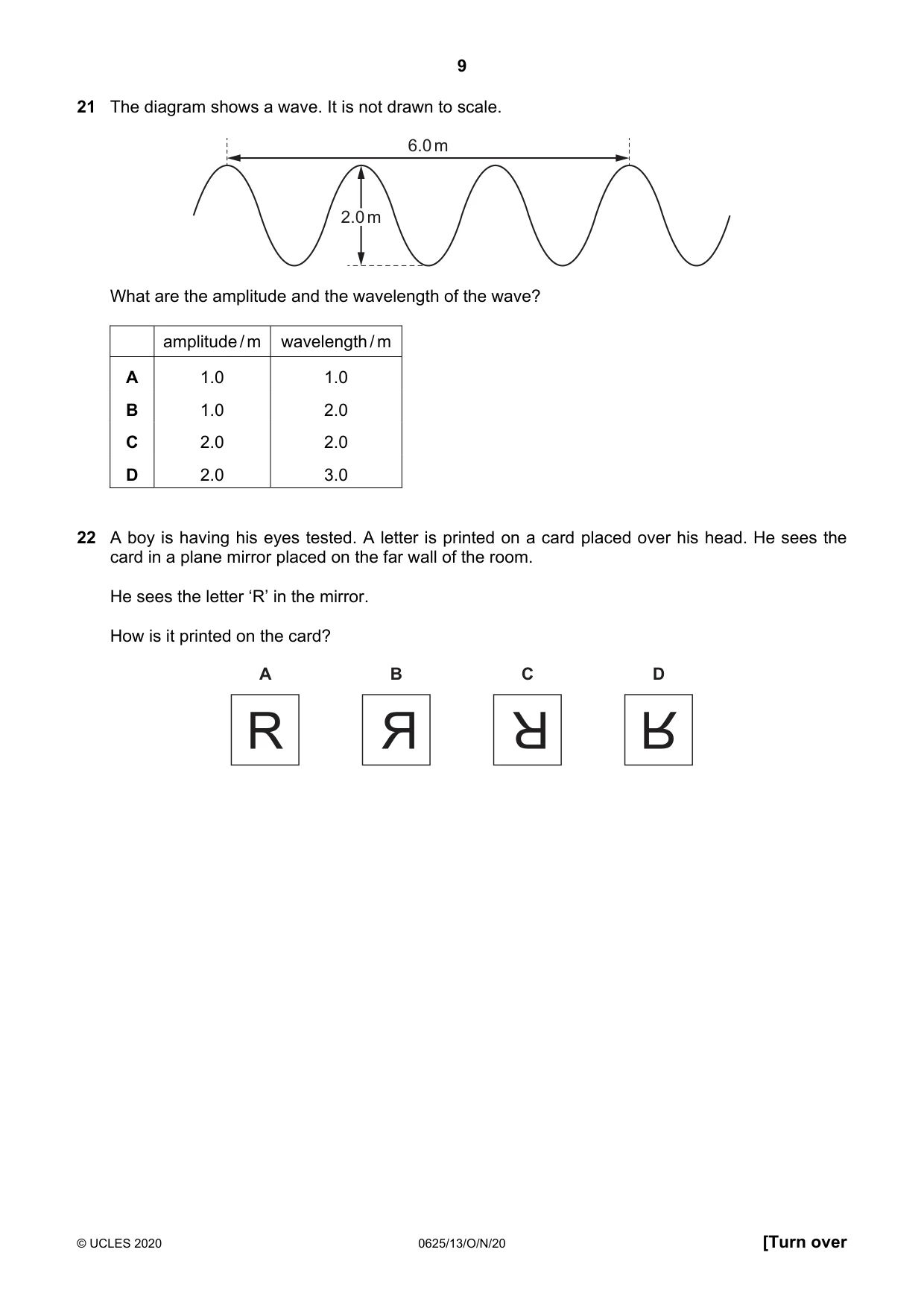
Q21 · The diagram shows a wave
21 The diagram shows a wave. It is not drawn to scale. 6.0 m 2.0 m What are the amplitude and the wavelength of the wave? amplitude / m wavelength / m A 1.0 1.0 B 1.0 2.0 C 2.0 2.0 D 2.0 3.0
Mark scheme: B
Q22 · A boy is having his eyes tested
22 A boy is having his eyes tested. A letter is printed on a card placed over his head. He sees the card in a plane mirror placed on the far wall of the room. He sees the letter ‘R’ in the mirror. How is it printed on the card? A B C D
Mark scheme: B
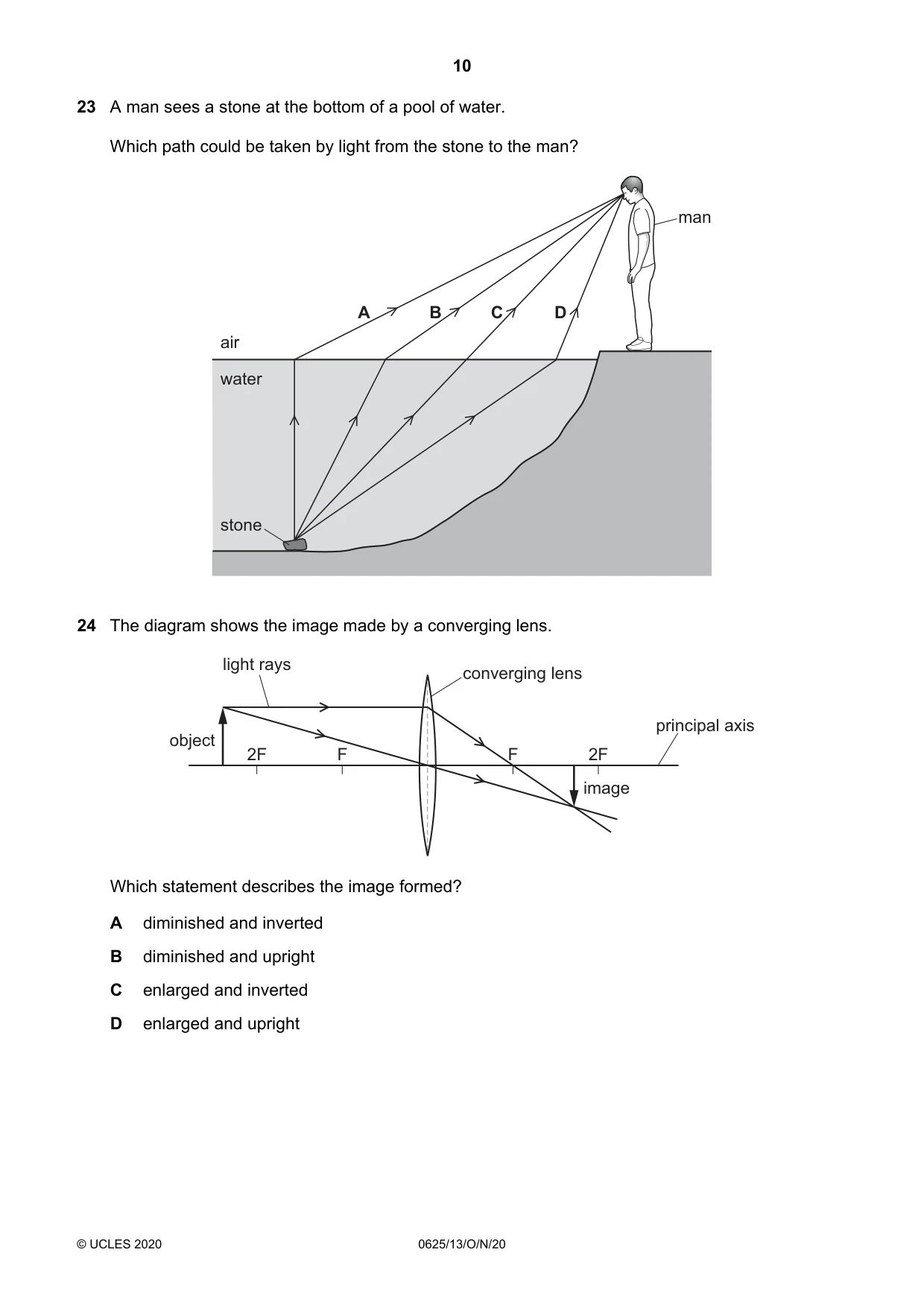
Q23 · A man sees a stone at the bottom of a pool of water
23 A man sees a stone at the bottom of a pool of water. Which path could be taken by light from the stone to the man? man A B C D air water stone
Mark scheme: B
Q24 · The diagram shows the image made by a converging lens
24 The diagram shows the image made by a converging lens. light rays converging lens principal axis object 2F F F 2F image Which statement describes the image formed? A diminished and inverted B diminished and upright C enlarged and inverted D enlarged and upright
Mark scheme: A
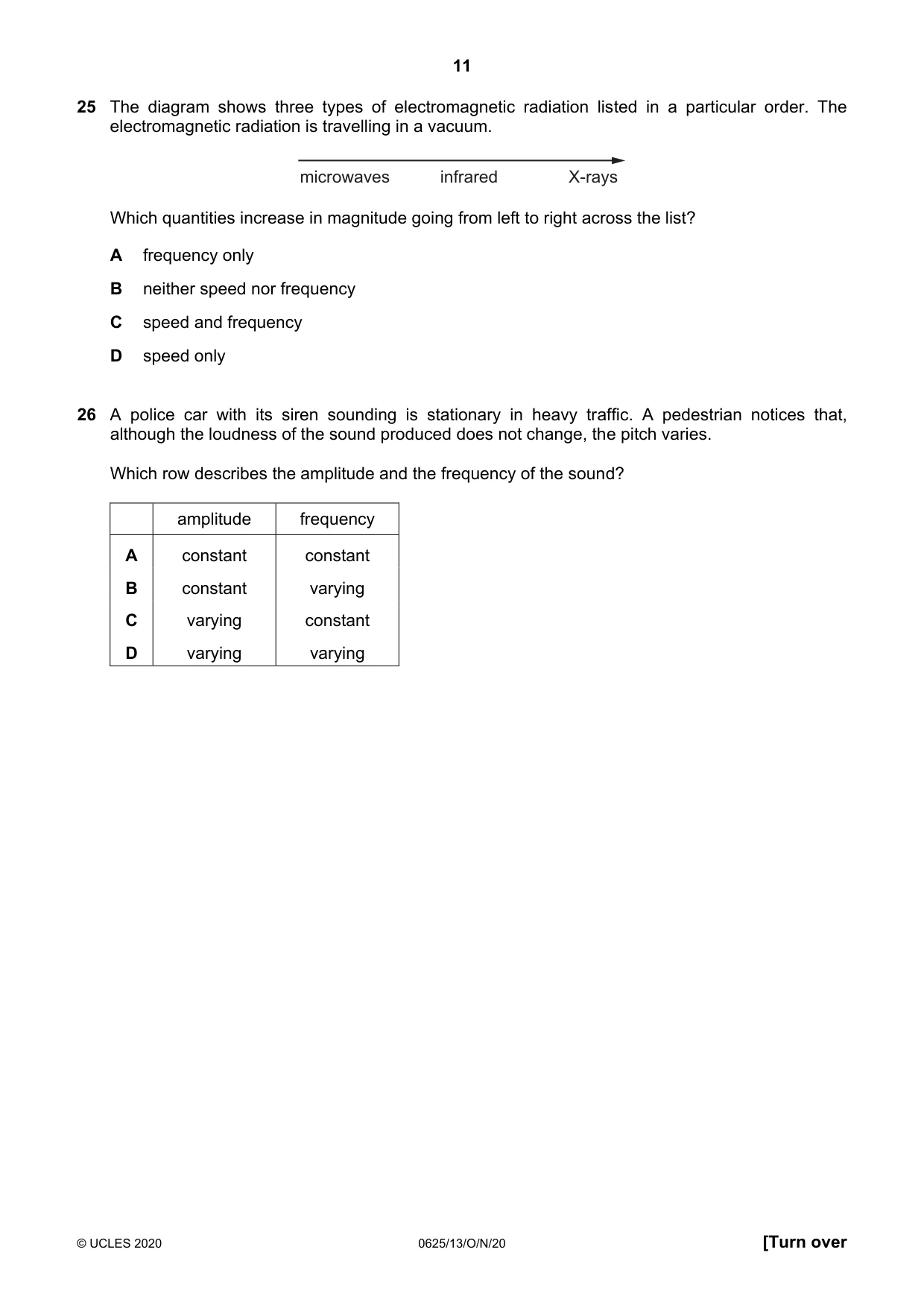
Q25 · The diagram shows three types of electromagnetic radiation listed in a particular order
25 The diagram shows three types of electromagnetic radiation listed in a particular order. The electromagnetic radiation is travelling in a vacuum. microwaves infrared X-rays Which quantities increase in magnitude going from left to right across the list? A frequency only B neither speed nor frequency C speed and frequency D speed only
Mark scheme: A
Q26 · A police car with its siren sounding is stationary in heavy traffic
26 A police car with its siren sounding is stationary in heavy traffic. A pedestrian notices that, although the loudness of the sound produced does not change, the pitch varies. Which row describes the amplitude and the frequency of the sound? amplitude frequency A constant constant B constant varying C varying constant D varying varying
Mark scheme: B
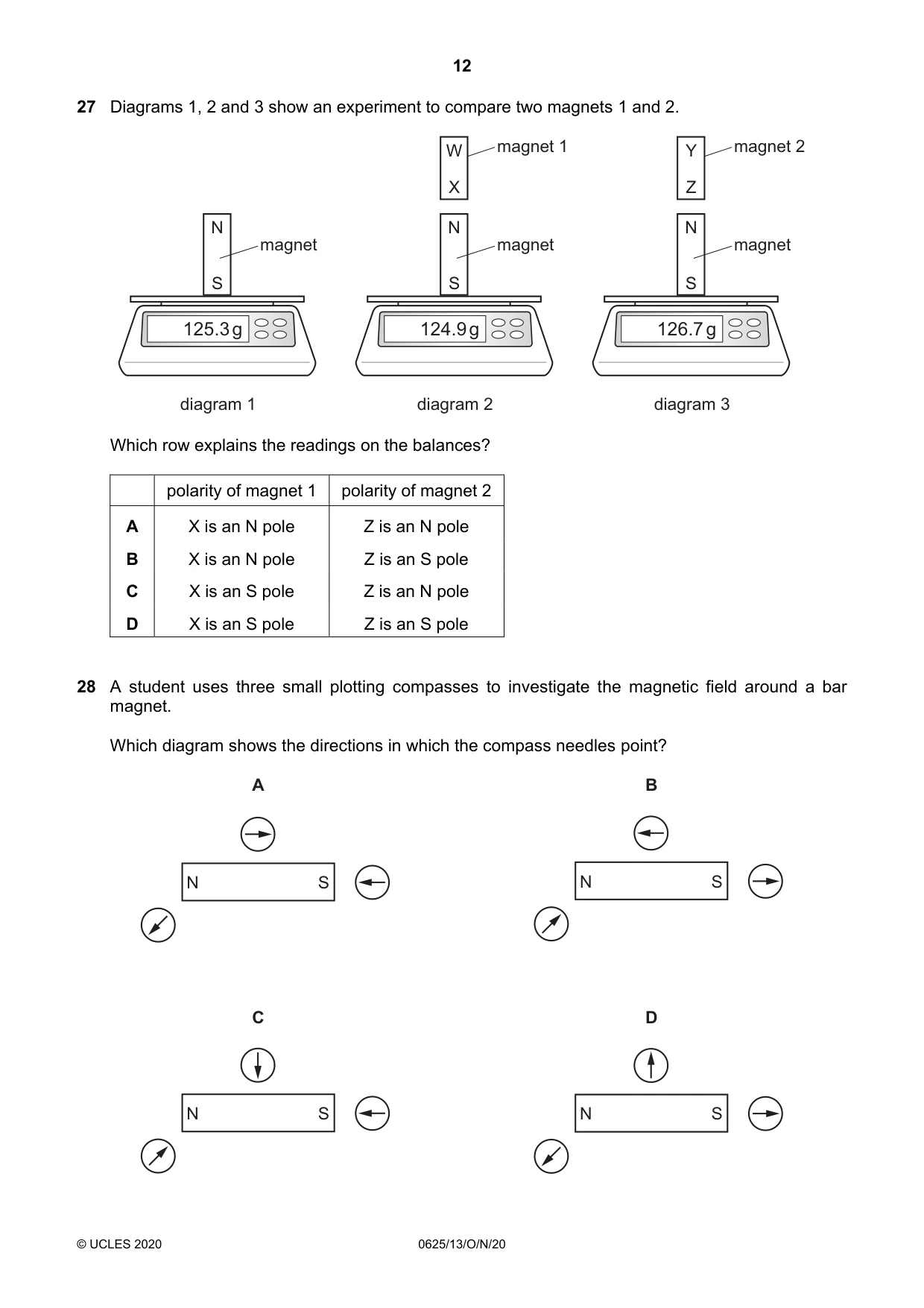
Q27 · Diagrams 1, 2 and 3 show an experiment to compare two magnets 1 and 2
27 Diagrams 1, 2 and 3 show an experiment to compare two magnets 1 and 2. W magnet 1 Y magnet 2 X Z N N N magnet magnet magnet S S S 125.3 g 124.9 g 126.7 g diagram 1 diagram 2 diagram 3 Which row explains the readings on the balances? polarity of magnet 1 polarity of magnet 2 A X is an N pole Z is an N pole B X is an N pole Z is an S pole C X is an S pole Z is an N pole D X is an S pole Z is an S pole
Mark scheme: C
Q28 · A student uses three small plotting compasses to investigate the magnetic field around a…
28 A student uses three small plotting compasses to investigate the magnetic field around a bar magnet. Which diagram shows the directions in which the compass needles point? A B N S N S C D N S N S
Mark scheme: A
Q29 · Which statement about charging an insulator is correct?
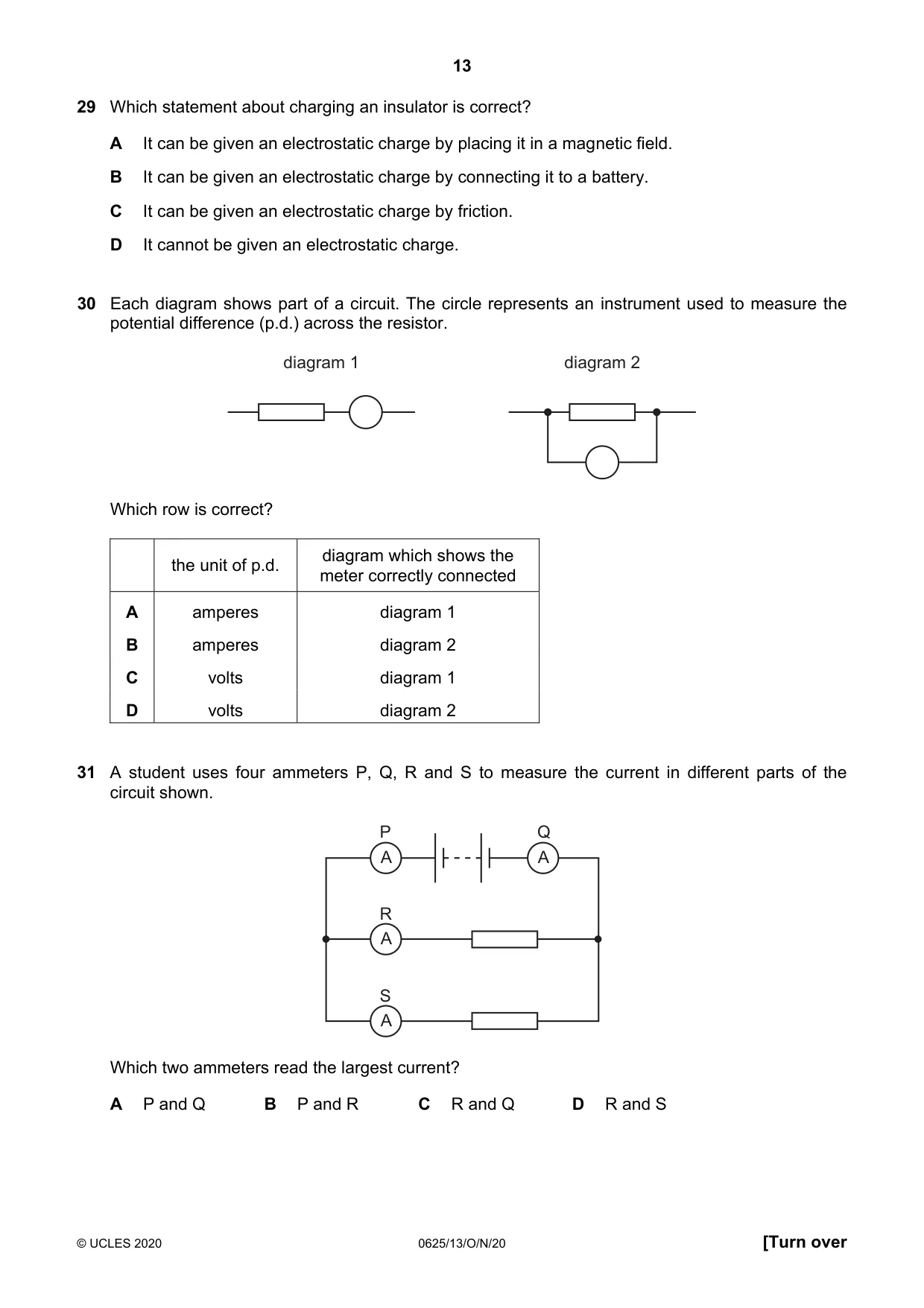
29 Which statement about charging an insulator is correct? A It can be given an electrostatic charge by placing it in a magnetic field. B It can be given an electrostatic charge by connecting it to a battery. C It can be given an electrostatic charge by friction. D It cannot be given an electrostatic charge.
Mark scheme: C
Q30 · Each diagram shows part of a circuit
30 Each diagram shows part of a circuit. The circle represents an instrument used to measure the potential difference (p.d.) across the resistor. diagram 1 diagram 2 Which row is correct? diagram which shows the the unit of p.d. meter correctly connected A amperes diagram 1 B amperes diagram 2 C volts diagram 1 D volts diagram 2
Mark scheme: D
Q31 · A student uses four ammeters P, Q, R and S to measure the current in different parts of…
31 A student uses four ammeters P, Q, R and S to measure the current in different parts of the circuit shown. P Q A A R A S A Which two ammeters read the largest current? A P and Q B P and R C R and Q D R and S
Mark scheme: A
Q32 · Three statements about a relay are given
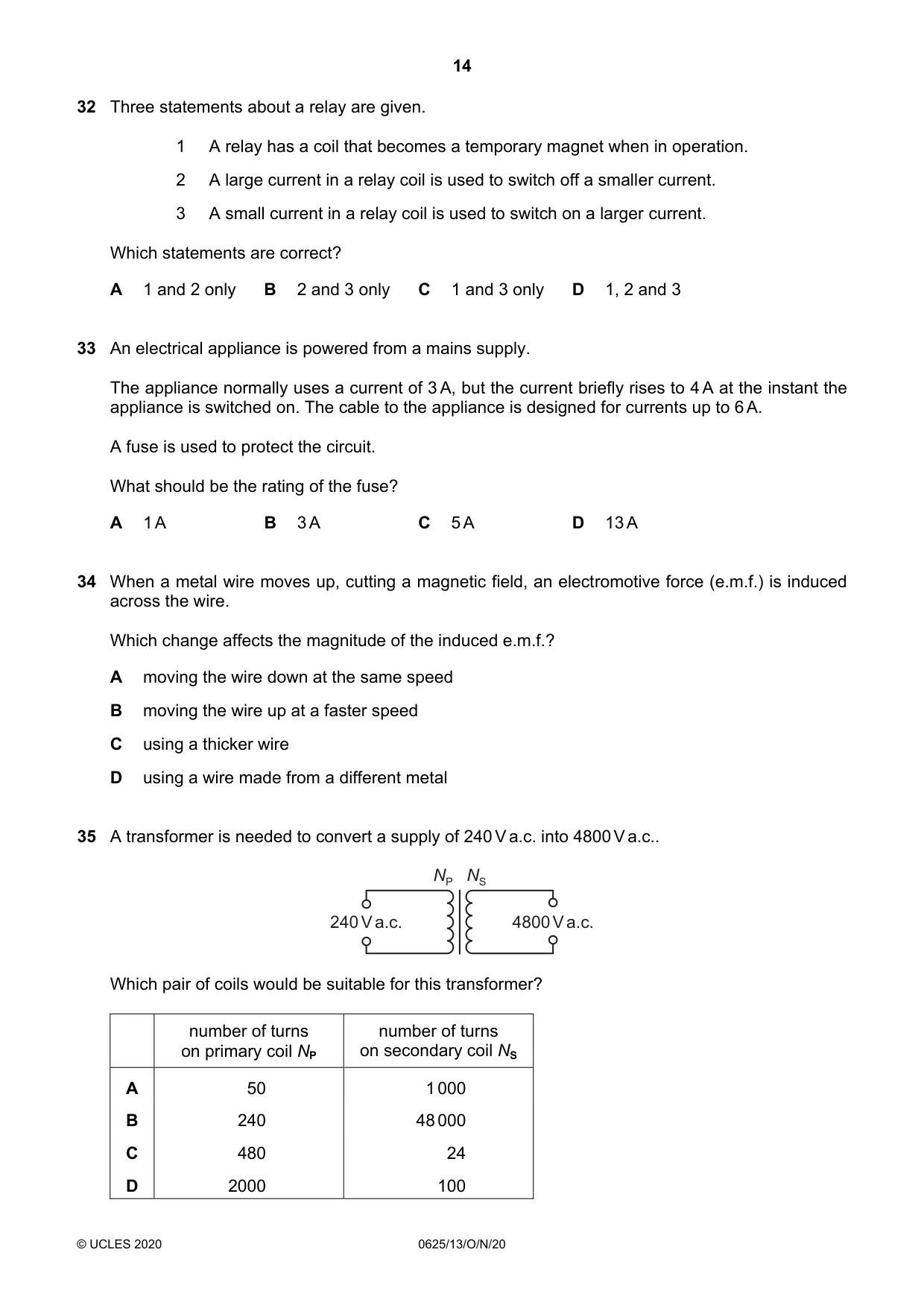
32 Three statements about a relay are given. 1 A relay has a coil that becomes a temporary magnet when in operation. 2 A large current in a relay coil is used to switch off a smaller current. 3 A small current in a relay coil is used to switch on a larger current. Which statements are correct? A 1 and 2 only B 2 and 3 only C 1 and 3 only D 1, 2 and 3
Mark scheme: C
Q33 · An electrical appliance is powered from a mains supply
33 An electrical appliance is powered from a mains supply. The appliance normally uses a current of 3 A, but the current briefly rises to 4 A at the instant the appliance is switched on. The cable to the appliance is designed for currents up to 6 A. A fuse is used to protect the circuit. What should be the rating of the fuse? A 1 A B 3 A C 5 A D 13 A
Mark scheme: C
Q34 · When a metal wire moves up, cutting a magnetic field, an electromotive force (e.m.f.) is…
34 When a metal wire moves up, cutting a magnetic field, an electromotive force (e.m.f.) is induced across the wire. Which change affects the magnitude of the induced e.m.f.? A moving the wire down at the same speed B moving the wire up at a faster speed C using a thicker wire D using a wire made from a different metal
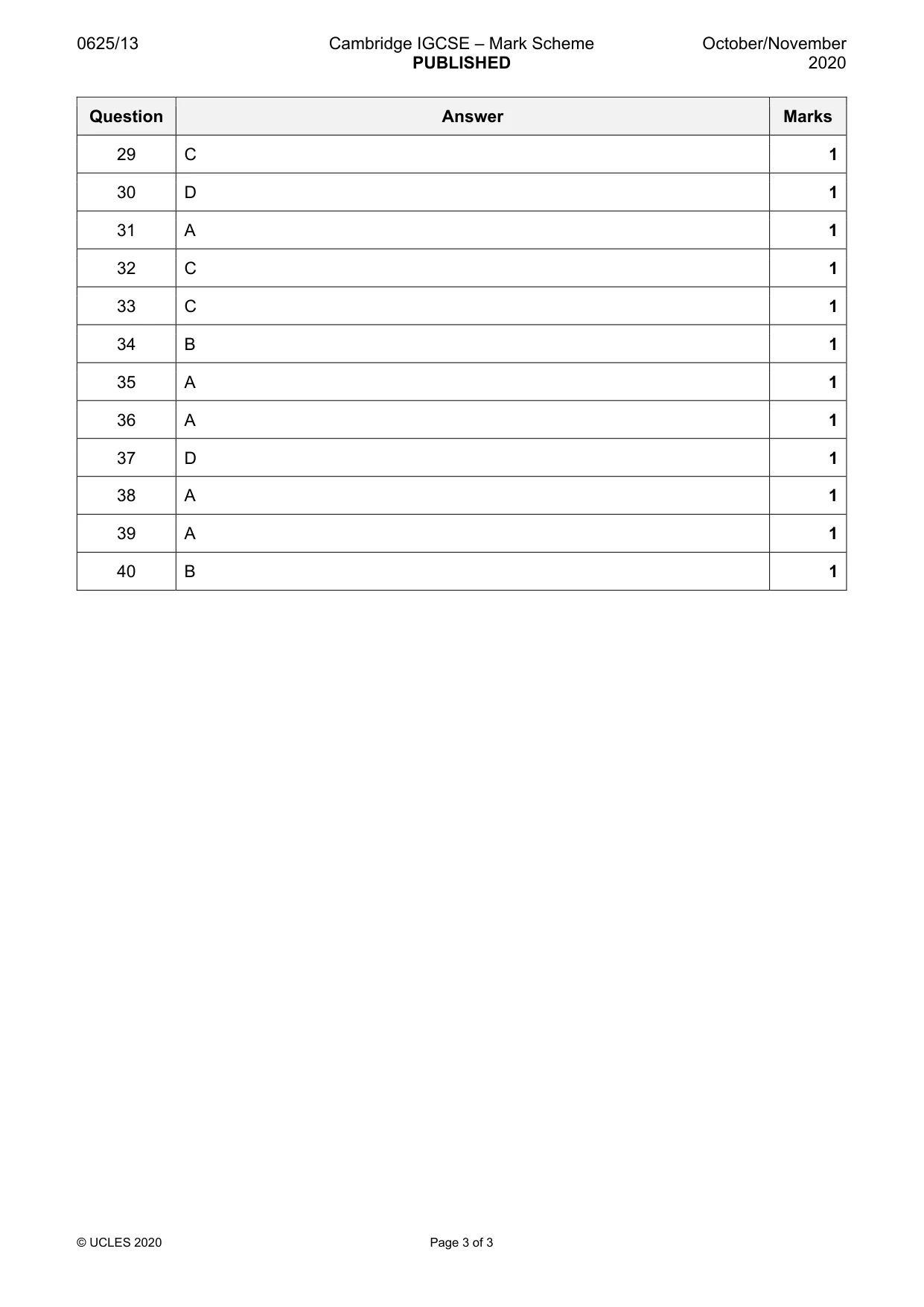
Mark scheme: B
Q35 · A transformer is needed to convert a supply of 240 V a.c
35 A transformer is needed to convert a supply of 240 V a.c. into 4800 V a.c.. NP NS 240 V a.c. 4800 V a.c. Which pair of coils would be suitable for this transformer? number of turns number of turns on primary coil NP on secondary coil NS A 50 1 000 B 240 48 000 C 480 24 D 2000 100
Mark scheme: A
Q36 · The diagram shows a wire carrying a current in the direction shown
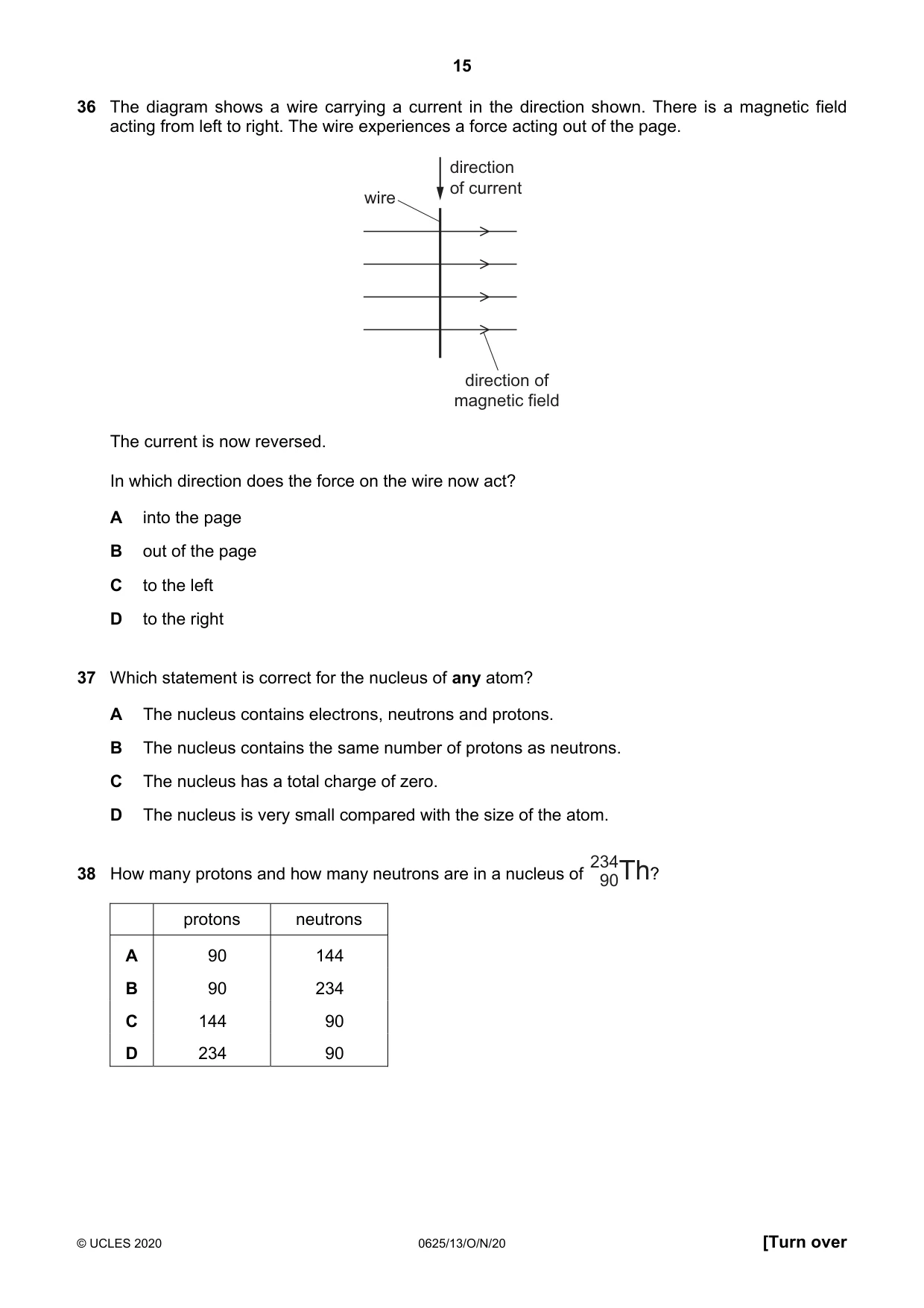
36 The diagram shows a wire carrying a current in the direction shown. There is a magnetic field acting from left to right. The wire experiences a force acting out of the page. direction of current wire direction of magnetic field The current is now reversed. In which direction does the force on the wire now act? A into the page B out of the page C to the left D to the right
Mark scheme: A
Q37 · Which statement is correct for the nucleus of any atom?
37 Which statement is correct for the nucleus of any atom? A The nucleus contains electrons, neutrons and protons. B The nucleus contains the same number of protons as neutrons. C The nucleus has a total charge of zero. D The nucleus is very small compared with the size of the atom. 234Th
Mark scheme: D
Q38 · How many protons and how many neutrons are in a nucleus of ?
38 How many protons and how many neutrons are in a nucleus of ? 90 protons neutrons A 90 144 B 90 234 C 144 90 D 234 90
Mark scheme: A
Q39 · A radiation detector in a laboratory is measuring background radiation
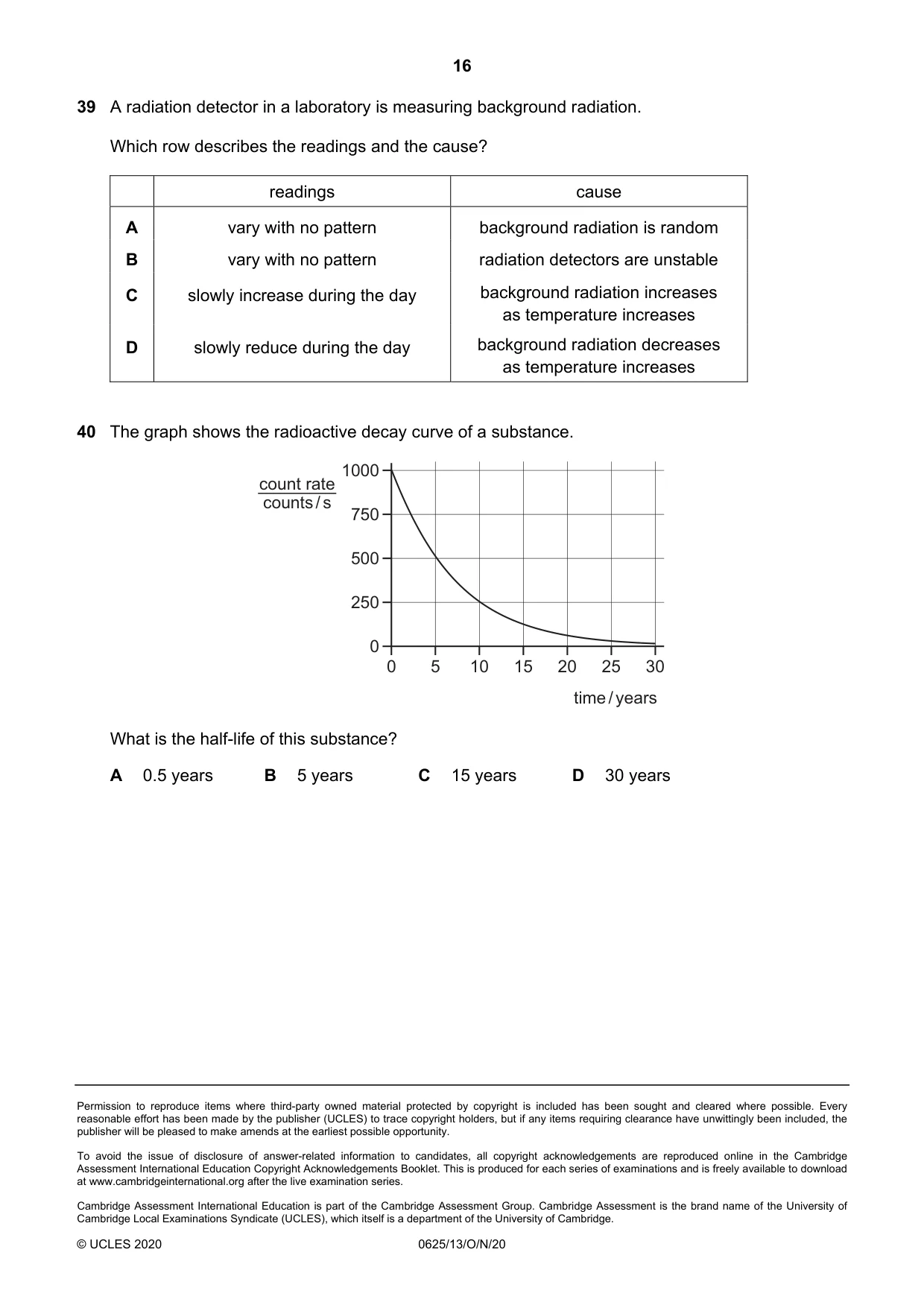
39 A radiation detector in a laboratory is measuring background radiation. Which row describes the readings and the cause? readings cause A vary with no pattern background radiation is random B vary with no pattern radiation detectors are unstable C slowly increase during the day background radiation increases as temperature increases D slowly reduce during the day background radiation decreases as temperature increases
Mark scheme: A
Q40 · The graph shows the radioactive decay curve of a substance
40 The graph shows the radioactive decay curve of a substance. 1000 count rate counts / s 750 500 250 0 0 5 10 15 20 25 30 time / years What is the half-life of this substance? A 0.5 years B 5 years C 15 years D 30 years
Mark scheme: B
What was in this paper
The subtopics covered by these 40 questions, and how many questions each got. Open one in a new tab to see every Cambridge question on it.
4Energy, work and power3Light3Pressure3Electric circuits2Forces2General properties of waves2Mass and weight2Motion2Radioactivity2Simple phenomena of magnetism2The nuclear model of the atom2Thermal properties and temperature2Transfer of thermal energy2Density1Electrical quantities1Electrical safety1Electromagnetic spectrum1Kinetic particle model of matter1Physical quantities and measurement techniques1Sound1What you needed in this session
Cambridge’s own grade thresholds for 2020 Oct/Nov, Paper 1 · Variant 3. A higher threshold means an easier paper — the bar moves with how the cohort did.