Cambridge IGCSE Physics 0625 — 2005 May/June Paper 1 · Variant 1
0625/11/M/J/05 · 40 questions · 40 marks · ≈45 min
The question paper and its mark scheme, free to read here and free to download. This is Cambridge’s own paper, exactly as it was sat.
Question paper20 pages


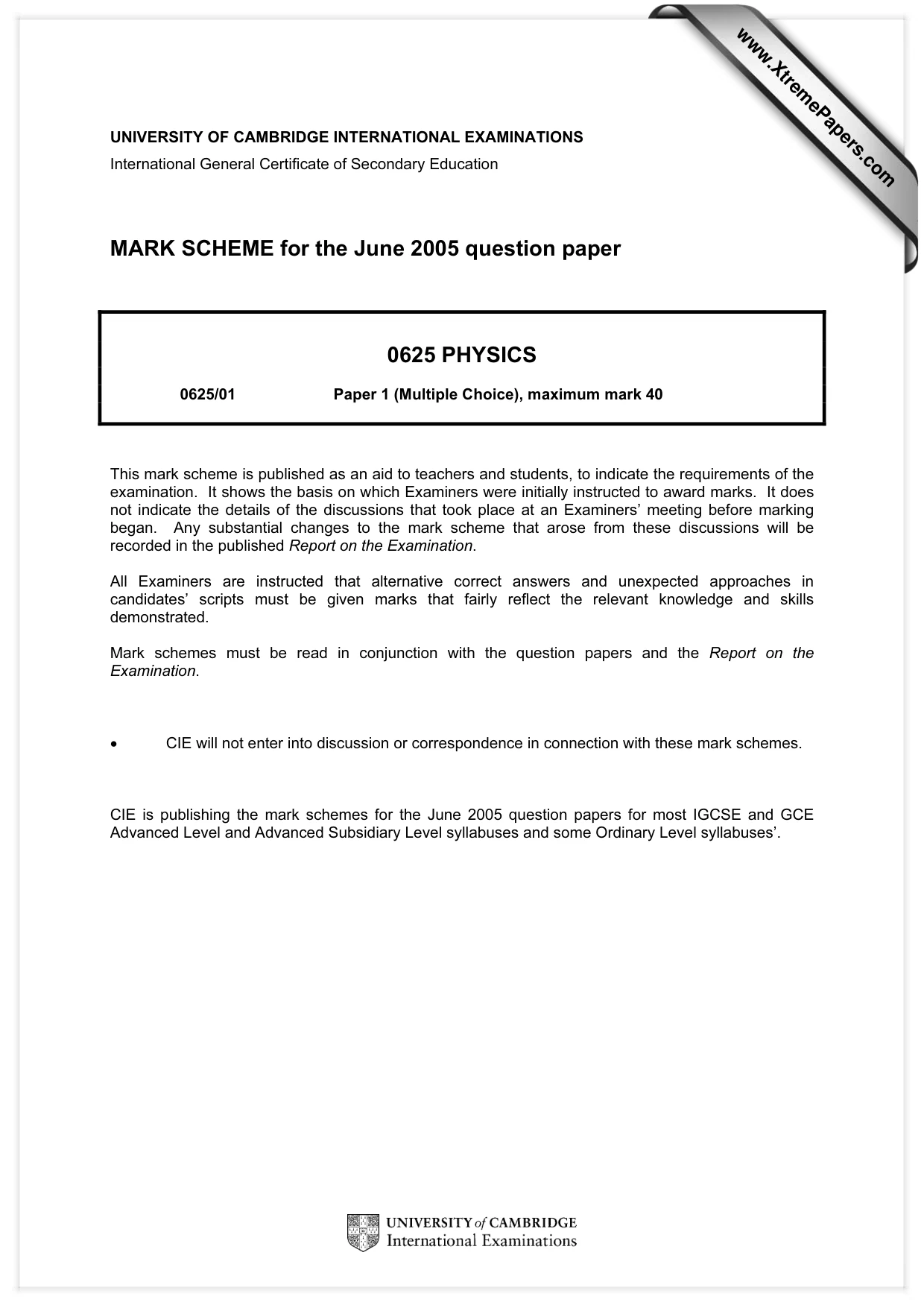
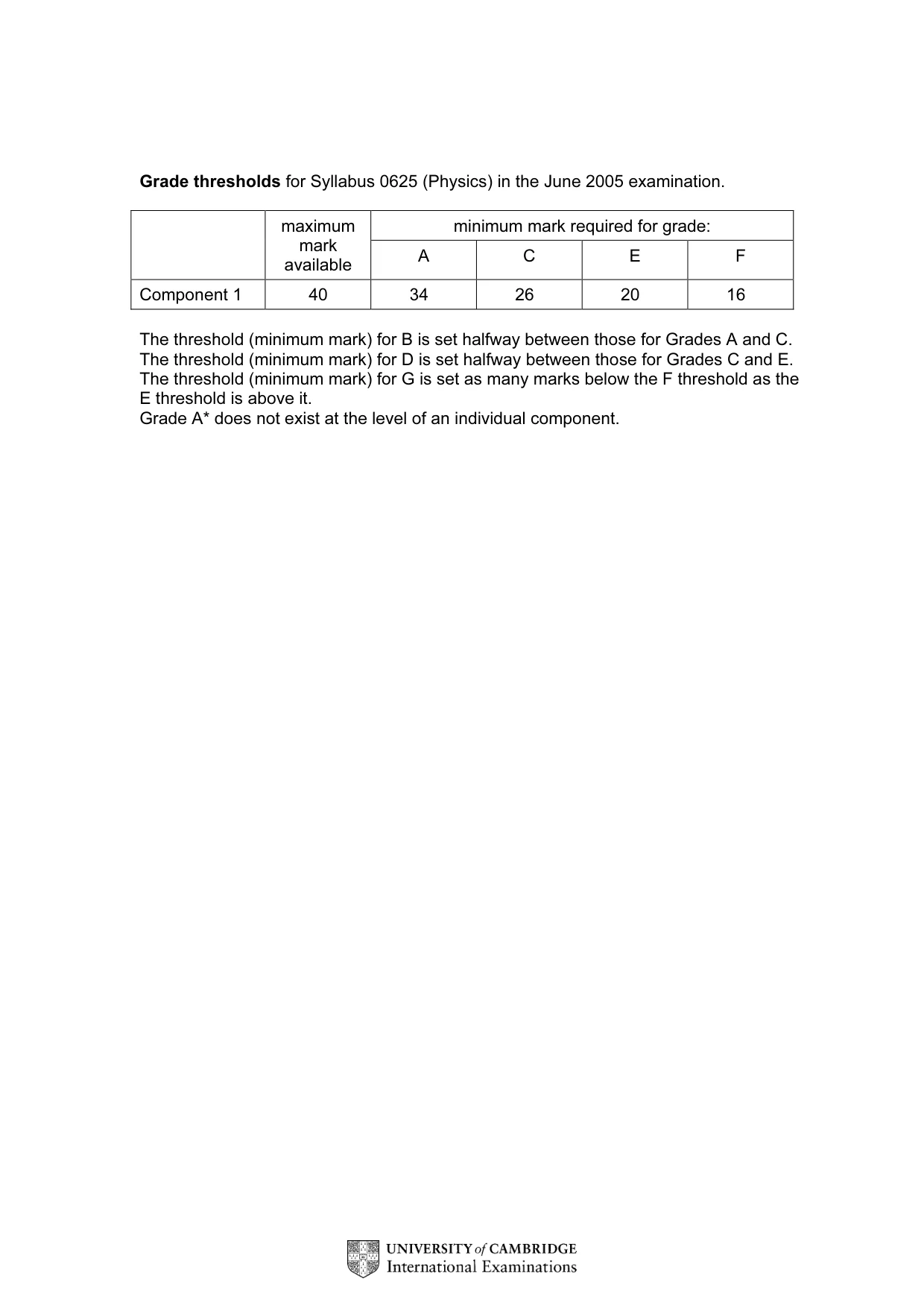
Mark scheme4 pages
Answers below. Sit the paper first if you are practising.
Questions as text
Q1 · A decorator wishes to calculate the area of a bathroom tile so that he can estimate the…
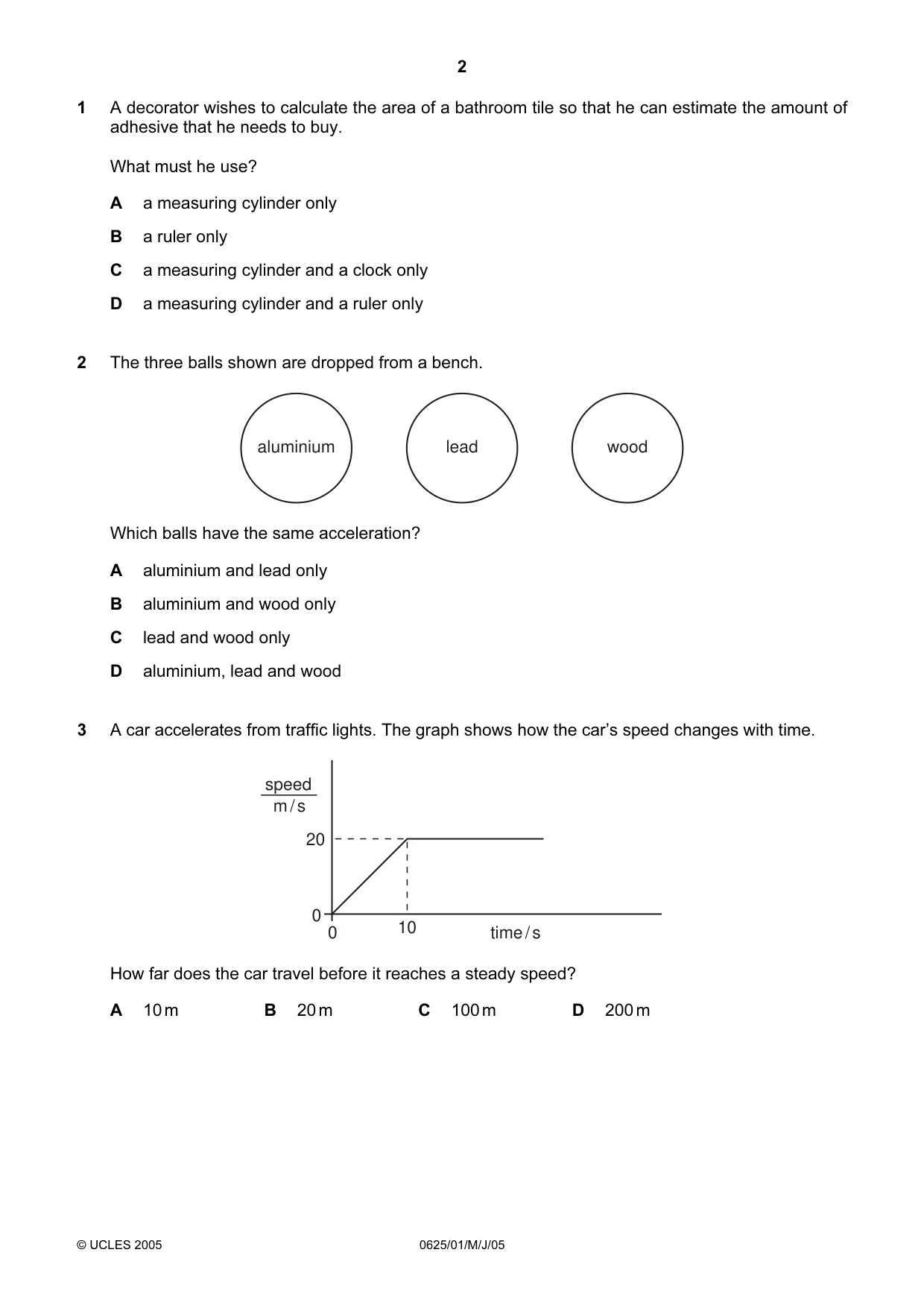
1 A decorator wishes to calculate the area of a bathroom tile so that he can estimate the amount of adhesive that he needs to buy. What must he use? A a measuring cylinder only B a ruler only C a measuring cylinder and a clock only D a measuring cylinder and a ruler only
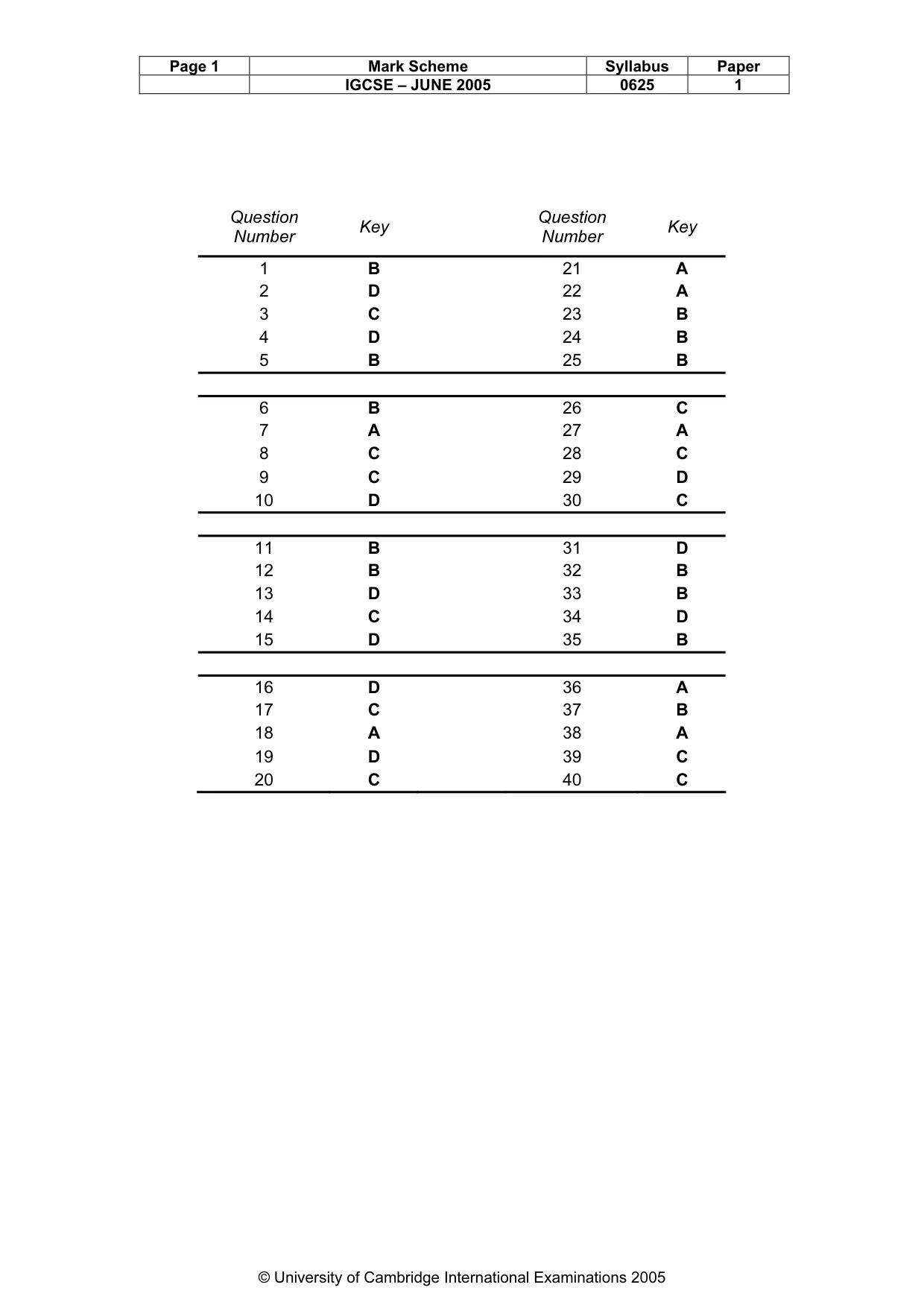
Mark scheme: B
More questions on Physical quantities and measurement techniques
Q2 · The three balls shown are dropped from a bench
2 The three balls shown are dropped from a bench. aluminium lead wood Which balls have the same acceleration? A aluminium and lead only B aluminium and wood only C lead and wood only D aluminium, lead and wood
Mark scheme: D
Q3 · A car accelerates from traffic lights
3 A car accelerates from traffic lights. The graph shows how the car’s speed changes with time. speed m / s 20 0 0 10 time / s How far does the car travel before it reaches a steady speed? A 10 m B 20 m C 100 m D 200 m
Mark scheme: C
Q4 · Which statement is correct?
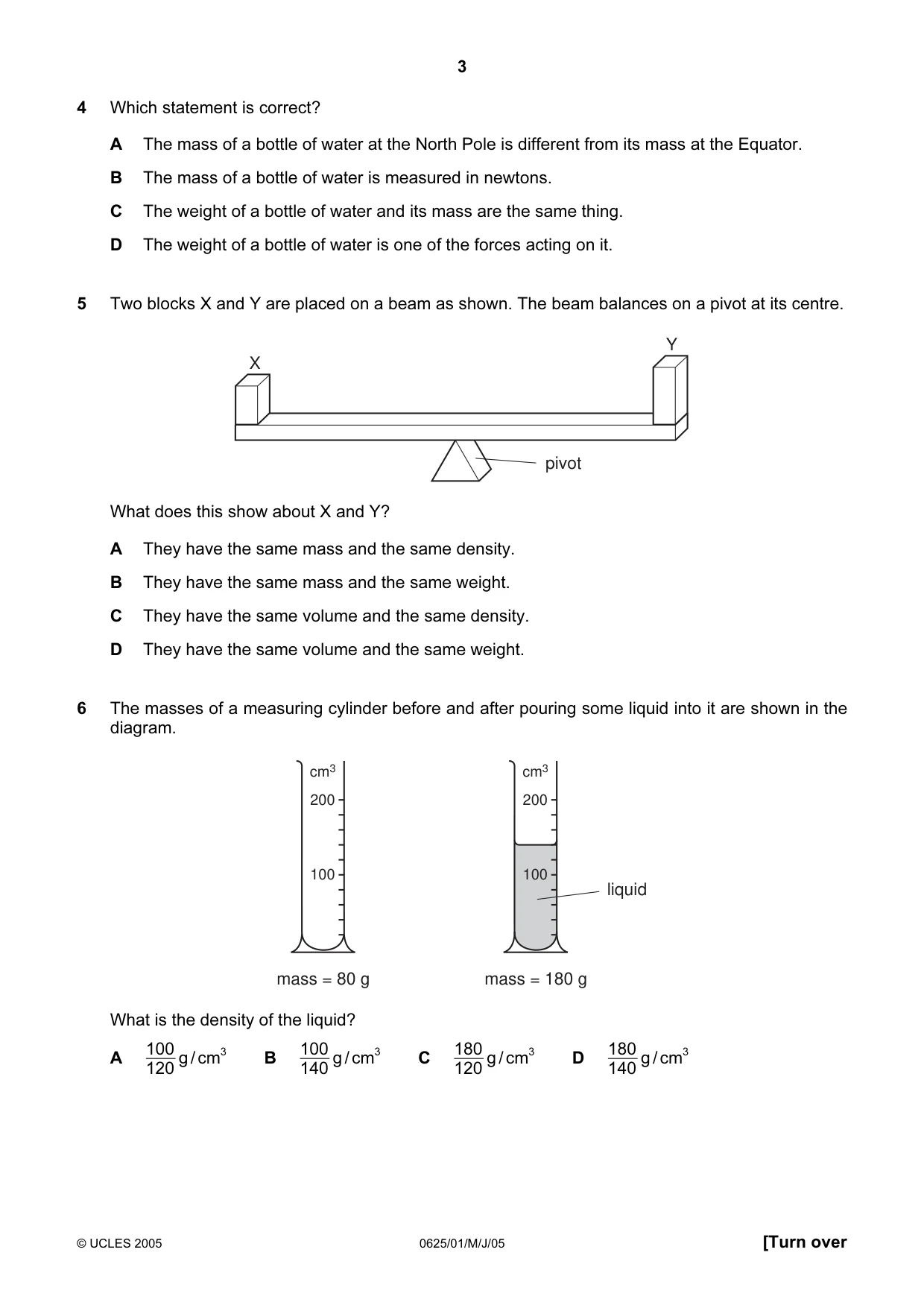
4 Which statement is correct? A The mass of a bottle of water at the North Pole is different from its mass at the Equator. B The mass of a bottle of water is measured in newtons. C The weight of a bottle of water and its mass are the same thing. D The weight of a bottle of water is one of the forces acting on it.
Mark scheme: D
Q5 · Two blocks X and Y are placed on a beam as shown
5 Two blocks X and Y are placed on a beam as shown. The beam balances on a pivot at its centre. Y X pivot What does this show about X and Y? A They have the same mass and the same density. B They have the same mass and the same weight. C They have the same volume and the same density. D They have the same volume and the same weight.
Mark scheme: B
Q6 · The masses of a measuring cylinder before and after pouring some liquid into it are shown…
6 The masses of a measuring cylinder before and after pouring some liquid into it are shown in the diagram. cm3 cm3 200 200 100 100 liquid mass = 80 g mass = 180 g What is the density of the liquid? 100 g / cm3 100 g / cm3 180 g / cm3 180 g / cm3 A B C D 120 140 120 140
Mark scheme: B
Q7 · A girl and a boy are pulling in opposite directions on a rope
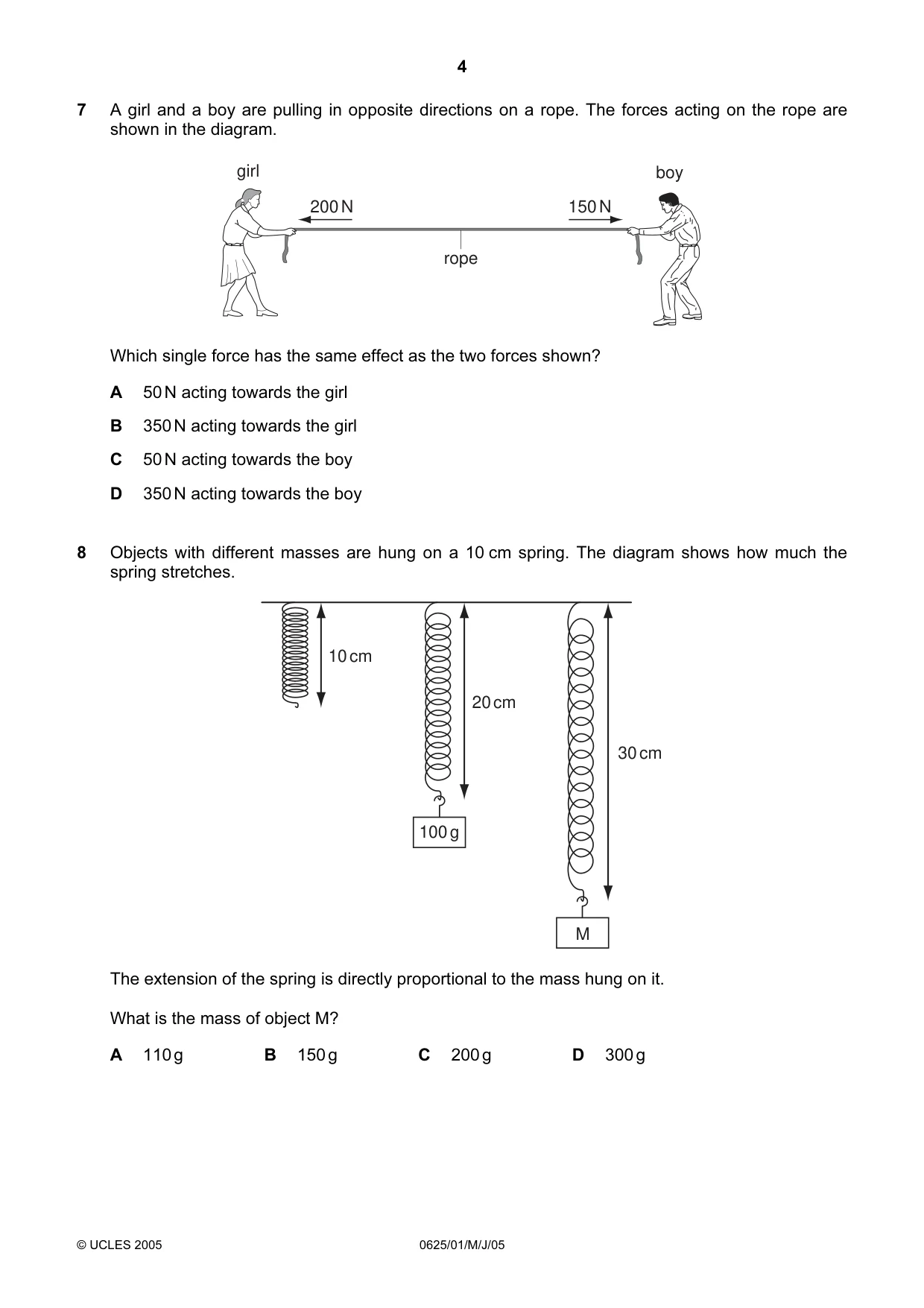
7 A girl and a boy are pulling in opposite directions on a rope. The forces acting on the rope are shown in the diagram. girl boy 200 N 150 N rope Which single force has the same effect as the two forces shown? A 50 N acting towards the girl B 350 N acting towards the girl C 50 N acting towards the boy D 350 N acting towards the boy
Mark scheme: A
Q8 · Objects with different masses are hung on a 10 cm spring
8 Objects with different masses are hung on a 10 cm spring. The diagram shows how much the spring stretches. 10 cm 20 cm 30 cm 100 g M The extension of the spring is directly proportional to the mass hung on it. What is the mass of object M? A 110 g B 150 g C 200 g D 300 g
Mark scheme: C
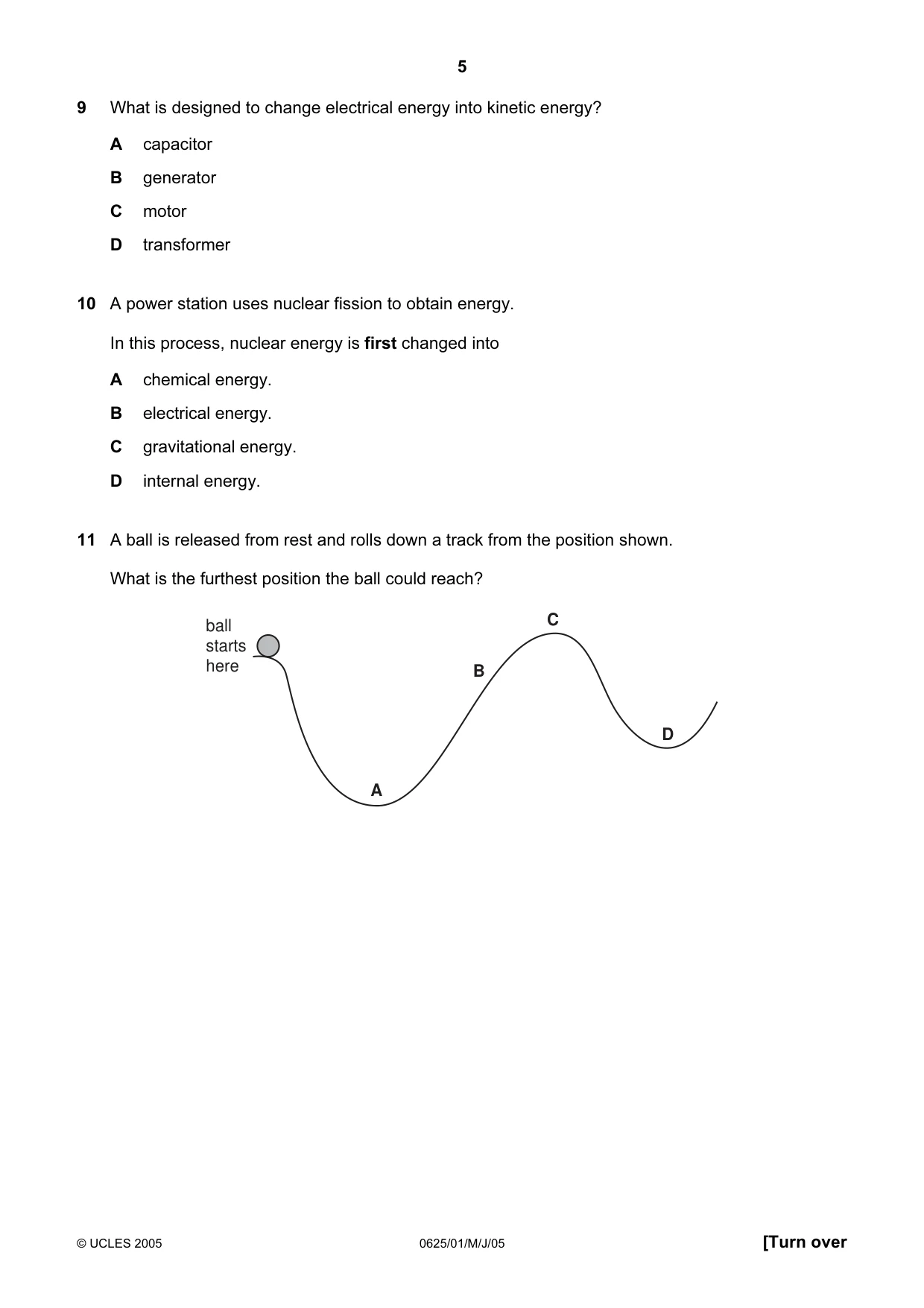
Q9 · What is designed to change electrical energy into kinetic energy?
9 What is designed to change electrical energy into kinetic energy? A capacitor B generator C motor D transformer
Mark scheme: C
Q10 · A power station uses nuclear fission to obtain energy
10 A power station uses nuclear fission to obtain energy. In this process, nuclear energy is first changed into A chemical energy. B electrical energy. C gravitational energy. D internal energy.
Mark scheme: D
Q11 · A ball is released from rest and rolls down a track from the position shown
11 A ball is released from rest and rolls down a track from the position shown. What is the furthest position the ball could reach? ball C starts here B D A
Mark scheme: B
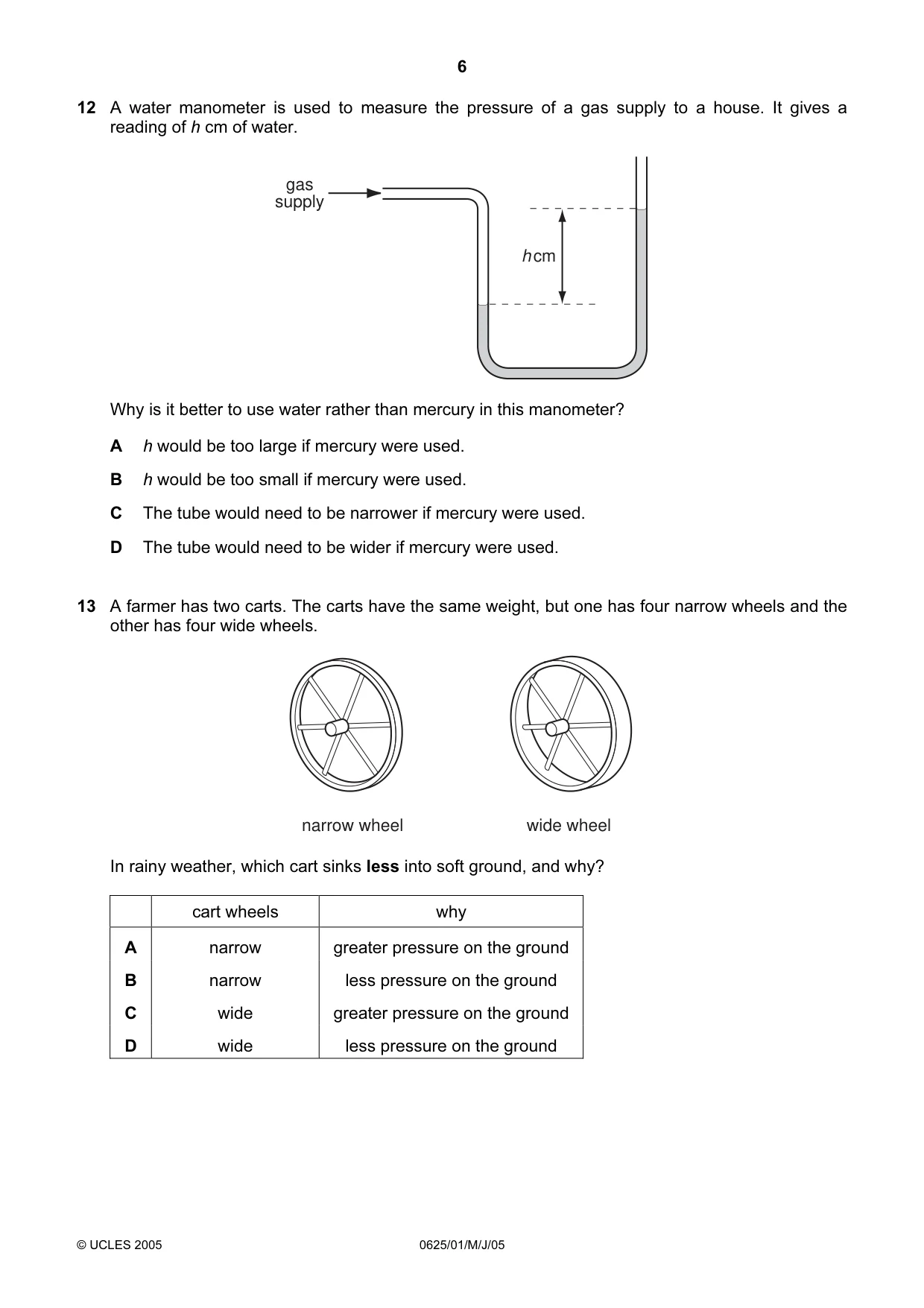
Q12 · A water manometer is used to measure the pressure of a gas supply to a house
12 A water manometer is used to measure the pressure of a gas supply to a house. It gives a reading of h cm of water. gas supply h cm Why is it better to use water rather than mercury in this manometer? A h would be too large if mercury were used. B h would be too small if mercury were used. C The tube would need to be narrower if mercury were used. D The tube would need to be wider if mercury were used.
Mark scheme: B
Q13 · A farmer has two carts
13 A farmer has two carts. The carts have the same weight, but one has four narrow wheels and the other has four wide wheels. narrow wheel wide wheel In rainy weather, which cart sinks less into soft ground, and why? cart wheels why A narrow greater pressure on the ground B narrow less pressure on the ground C wide greater pressure on the ground D wide less pressure on the ground
Mark scheme: D
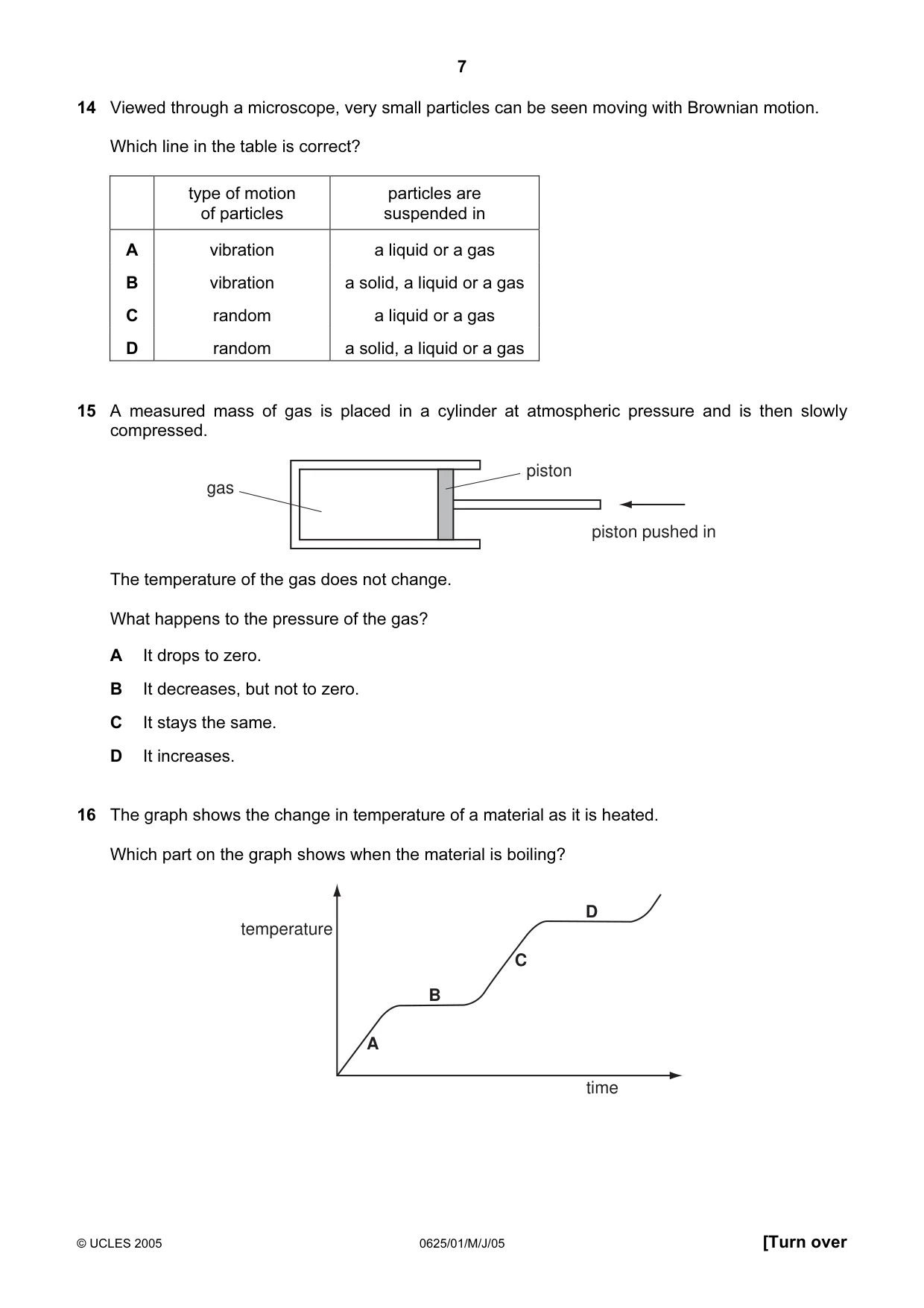
Q14 · Viewed through a microscope, very small particles can be seen moving with Brownian motion
14 Viewed through a microscope, very small particles can be seen moving with Brownian motion. Which line in the table is correct? type of motion particles are of particles suspended in A vibration a liquid or a gas B vibration a solid, a liquid or a gas C random a liquid or a gas D random a solid, a liquid or a gas
Mark scheme: C
Q15 · A measured mass of gas is placed in a cylinder at atmospheric pressure and is then slowly…
15 A measured mass of gas is placed in a cylinder at atmospheric pressure and is then slowly compressed. piston gas piston pushed in The temperature of the gas does not change. What happens to the pressure of the gas? A It drops to zero. B It decreases, but not to zero. C It stays the same. D It increases.
Mark scheme: D
Q16 · The graph shows the change in temperature of a material as it is heated
16 The graph shows the change in temperature of a material as it is heated. Which part on the graph shows when the material is boiling? D temperature C B A time
Mark scheme: D
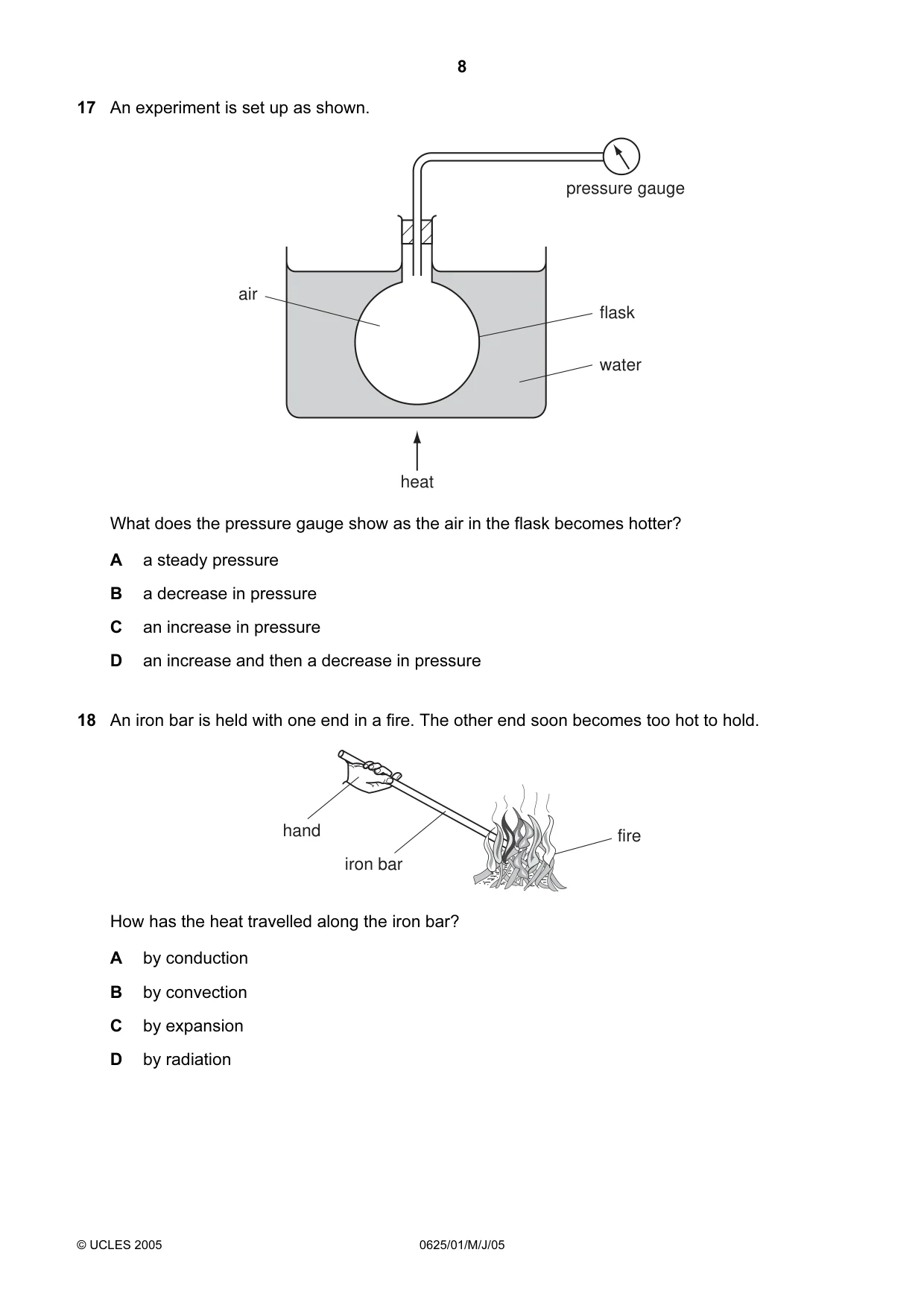
Q17 · An experiment is set up as shown
17 An experiment is set up as shown. pressure gauge air flask water heat What does the pressure gauge show as the air in the flask becomes hotter? A a steady pressure B a decrease in pressure C an increase in pressure D an increase and then a decrease in pressure
Mark scheme: C
Q18 · An iron bar is held with one end in a fire
18 An iron bar is held with one end in a fire. The other end soon becomes too hot to hold. hand fire iron bar How has the heat travelled along the iron bar? A by conduction B by convection C by expansion D by radiation
Mark scheme: A
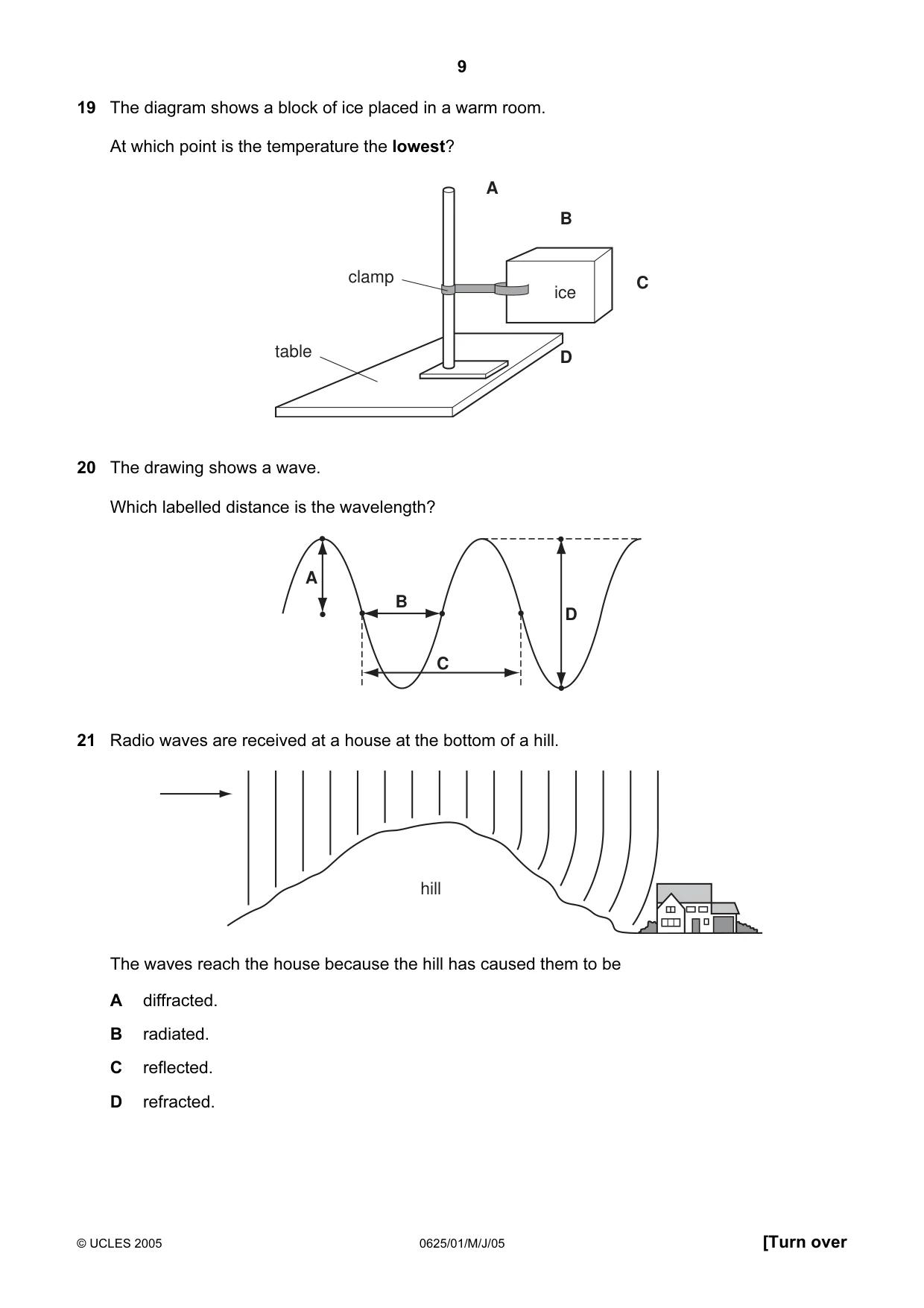
Q19 · The diagram shows a block of ice placed in a warm room
19 The diagram shows a block of ice placed in a warm room. At which point is the temperature the lowest? A B clamp C ice table D
Mark scheme: D
Q20 · The drawing shows a wave
20 The drawing shows a wave. Which labelled distance is the wavelength? A B D C
Mark scheme: C
Q21 · Radio waves are received at a house at the bottom of a hill
21 Radio waves are received at a house at the bottom of a hill. hill The waves reach the house because the hill has caused them to be A diffracted. B radiated. C reflected. D refracted.
Mark scheme: A
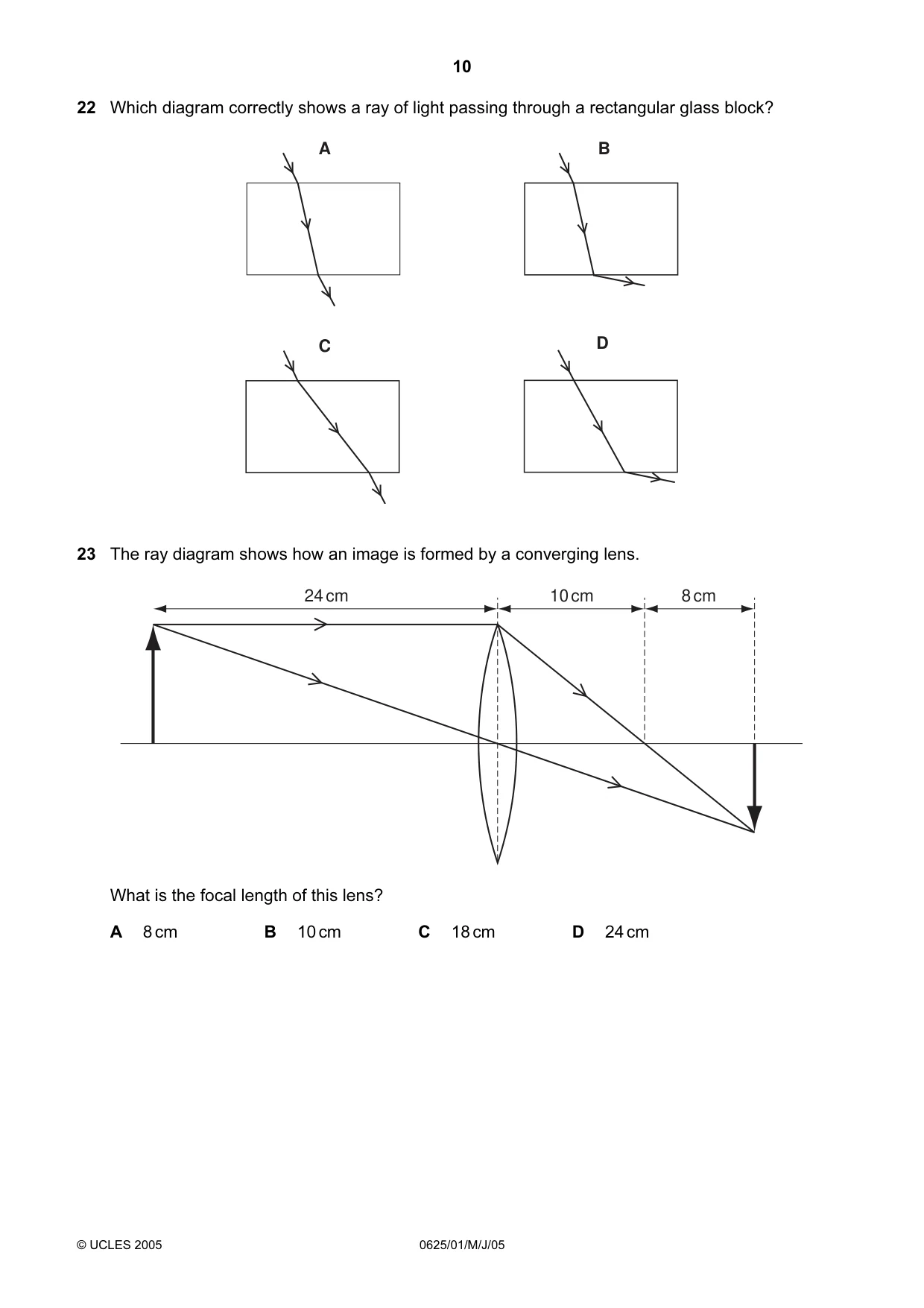
Q22 · Which diagram correctly shows a ray of light passing through a rectangular glass block?
22 Which diagram correctly shows a ray of light passing through a rectangular glass block? A B C D
Mark scheme: A
Q23 · The ray diagram shows how an image is formed by a converging lens
23 The ray diagram shows how an image is formed by a converging lens. 24 cm 10 cm 8 cm What is the focal length of this lens? A 8 cm B 10 cm C 18 cm D 24 cm
Mark scheme: B
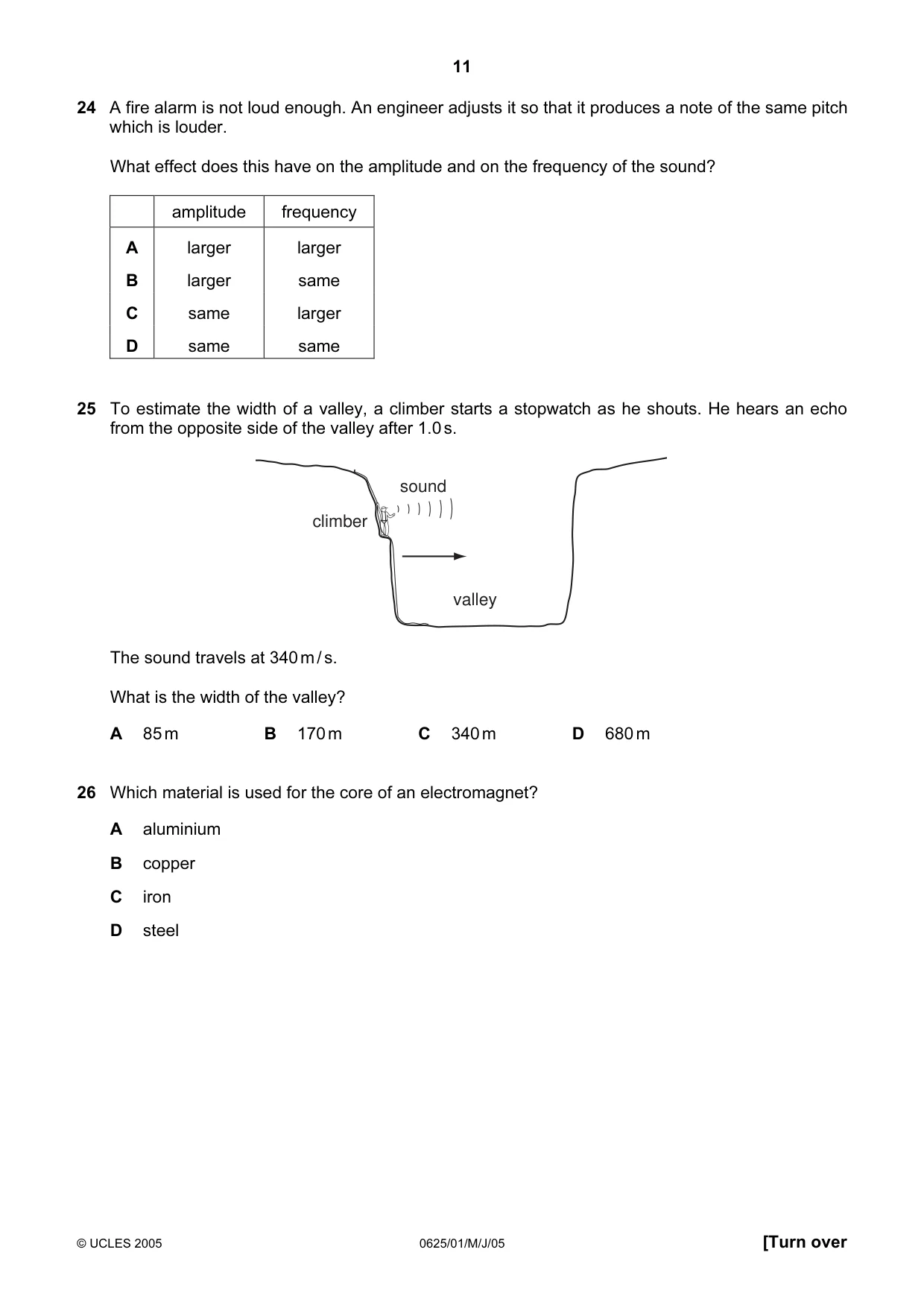
Q24 · A fire alarm is not loud enough
24 A fire alarm is not loud enough. An engineer adjusts it so that it produces a note of the same pitch which is louder. What effect does this have on the amplitude and on the frequency of the sound? amplitude frequency A larger larger B larger same C same larger D same same
Mark scheme: B
Q25 · To estimate the width of a valley, a climber starts a stopwatch as he shouts
25 To estimate the width of a valley, a climber starts a stopwatch as he shouts. He hears an echo from the opposite side of the valley after 1.0 s. sound climber valley The sound travels at 340 m / s. What is the width of the valley? A 85 m B 170 m C 340 m D 680 m
Mark scheme: B
Q26 · Which material is used for the core of an electromagnet?
26 Which material is used for the core of an electromagnet? A aluminium B copper C iron D steel
Mark scheme: C
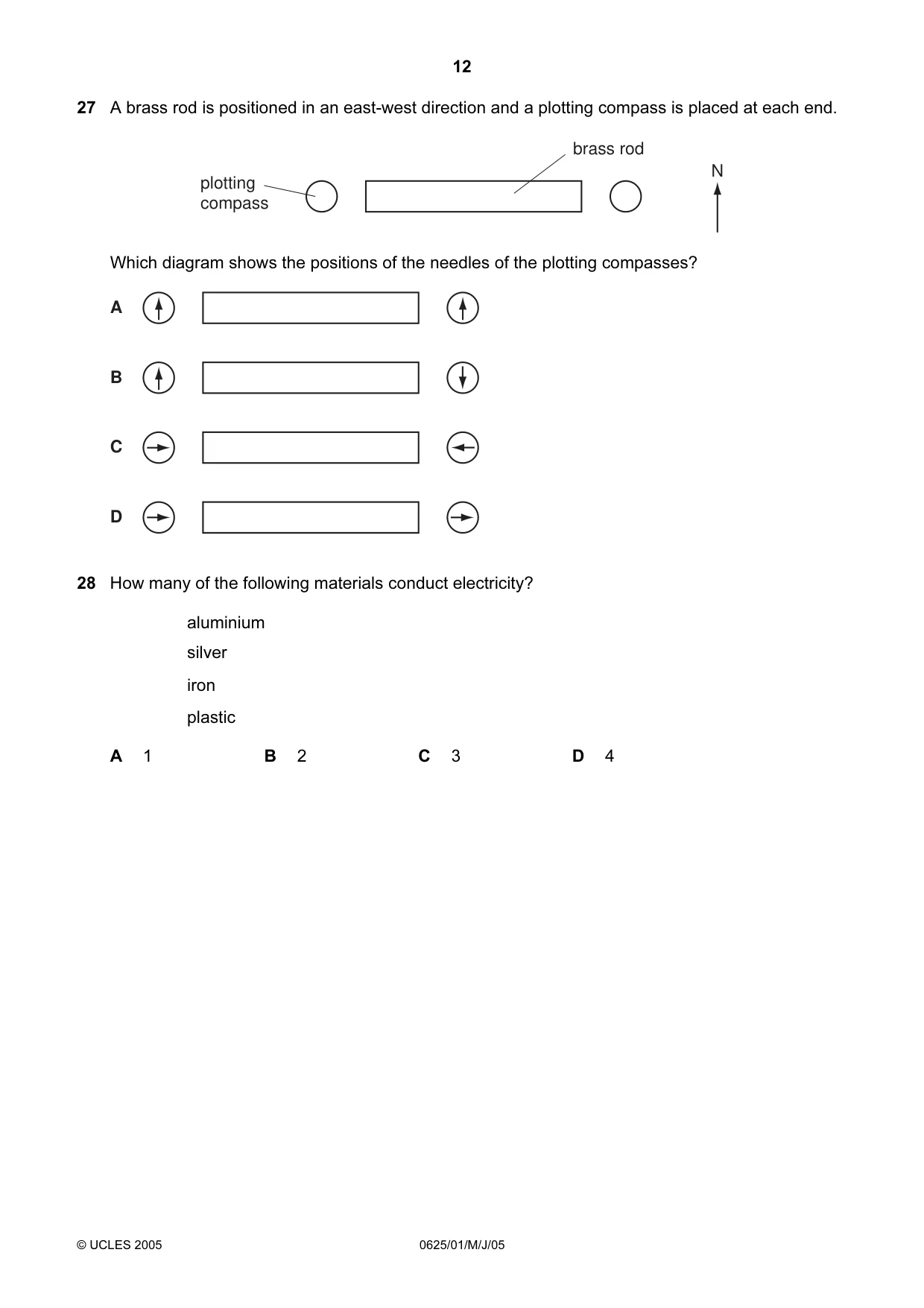
Q27 · A brass rod is positioned in an east-west direction and a plotting compass is placed at…
27 A brass rod is positioned in an east-west direction and a plotting compass is placed at each end. brass rod N plotting compass Which diagram shows the positions of the needles of the plotting compasses? A B C D
Mark scheme: A
Q28 · How many of the following materials conduct electricity?
28 How many of the following materials conduct electricity? aluminium silver iron plastic A 1 B 2 C 3 D 4
Mark scheme: C
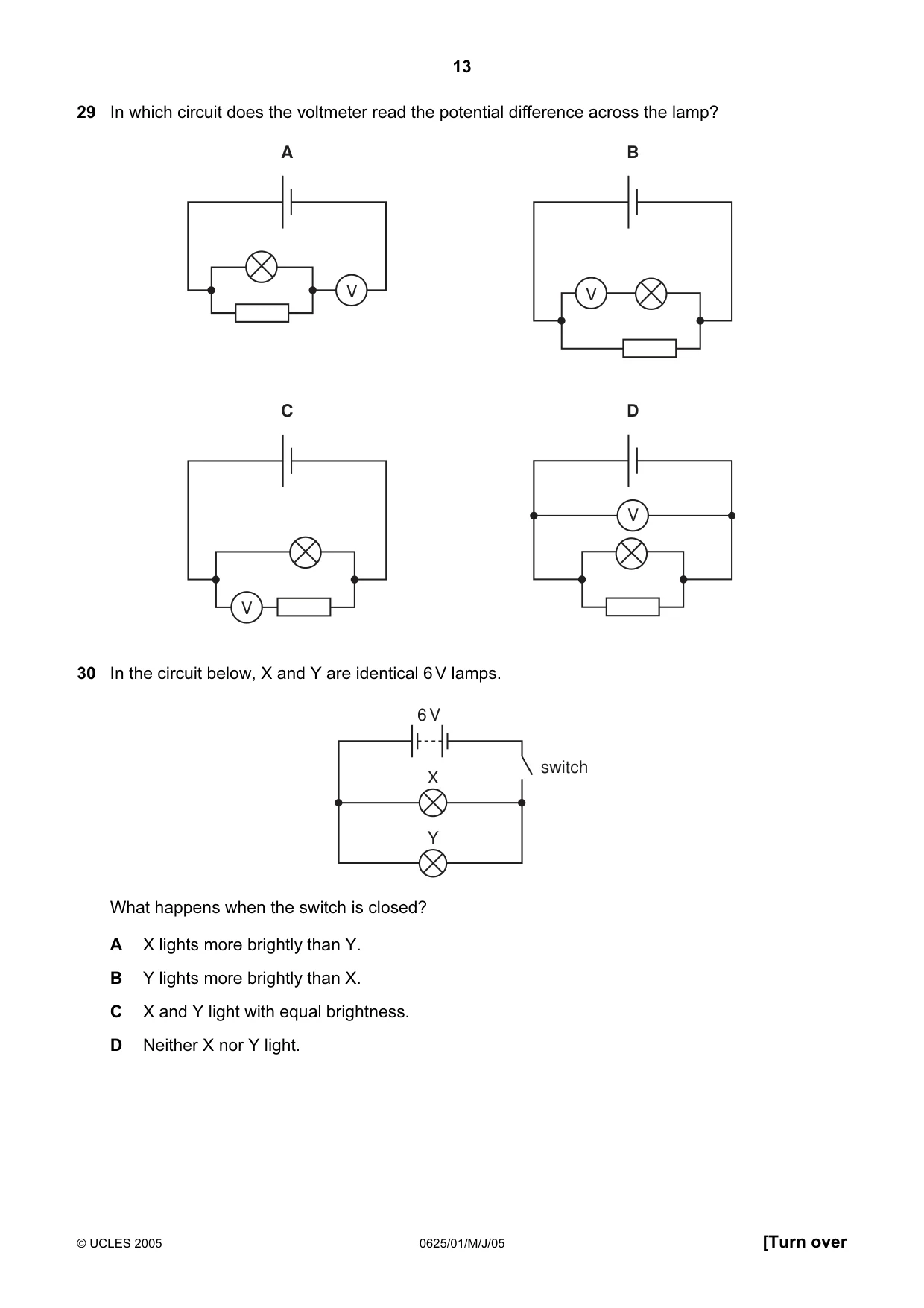
Q29 · In which circuit does the voltmeter read the potential difference across the lamp?
29 In which circuit does the voltmeter read the potential difference across the lamp? A B V V C D V V
Mark scheme: D
Q30 · In the circuit below, X and Y are identical 6 V lamps
30 In the circuit below, X and Y are identical 6 V lamps. 6 V switch X Y What happens when the switch is closed? A X lights more brightly than Y. B Y lights more brightly than X. C X and Y light with equal brightness. D Neither X nor Y light.
Mark scheme: C
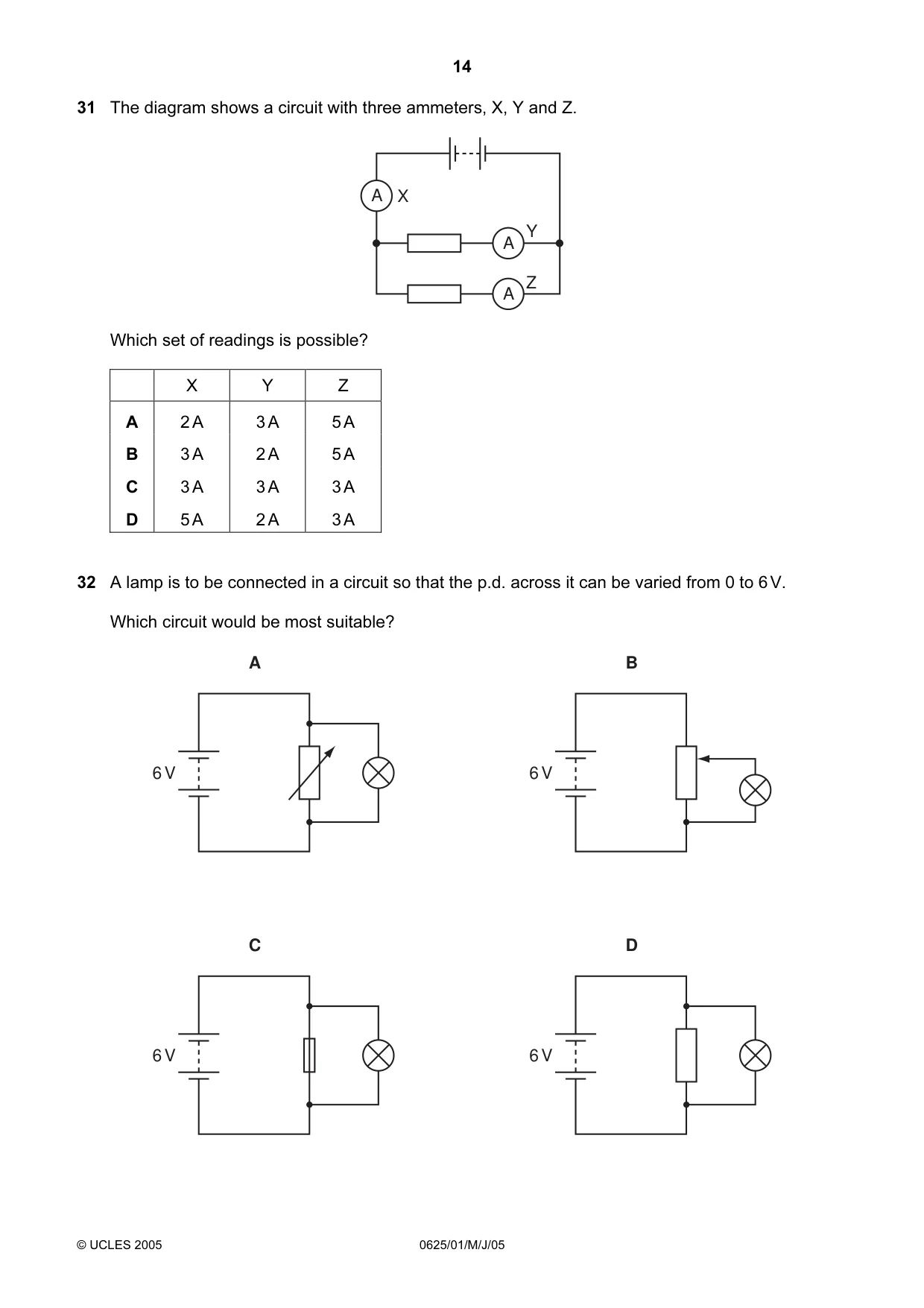
Q31 · The diagram shows a circuit with three ammeters, X, Y and Z
31 The diagram shows a circuit with three ammeters, X, Y and Z. A X Y A Z A Which set of readings is possible? X Y Z A 2 A 3 A 5 A B 3 A 2 A 5 A C 3 A 3 A 3 A D 5 A 2 A 3 A
Mark scheme: D
Q32 · A lamp is to be connected in a circuit so that the p.d
32 A lamp is to be connected in a circuit so that the p.d. across it can be varied from 0 to 6 V. Which circuit would be most suitable? A B 6 V 6 V C D 6 V 6 V
Mark scheme: B
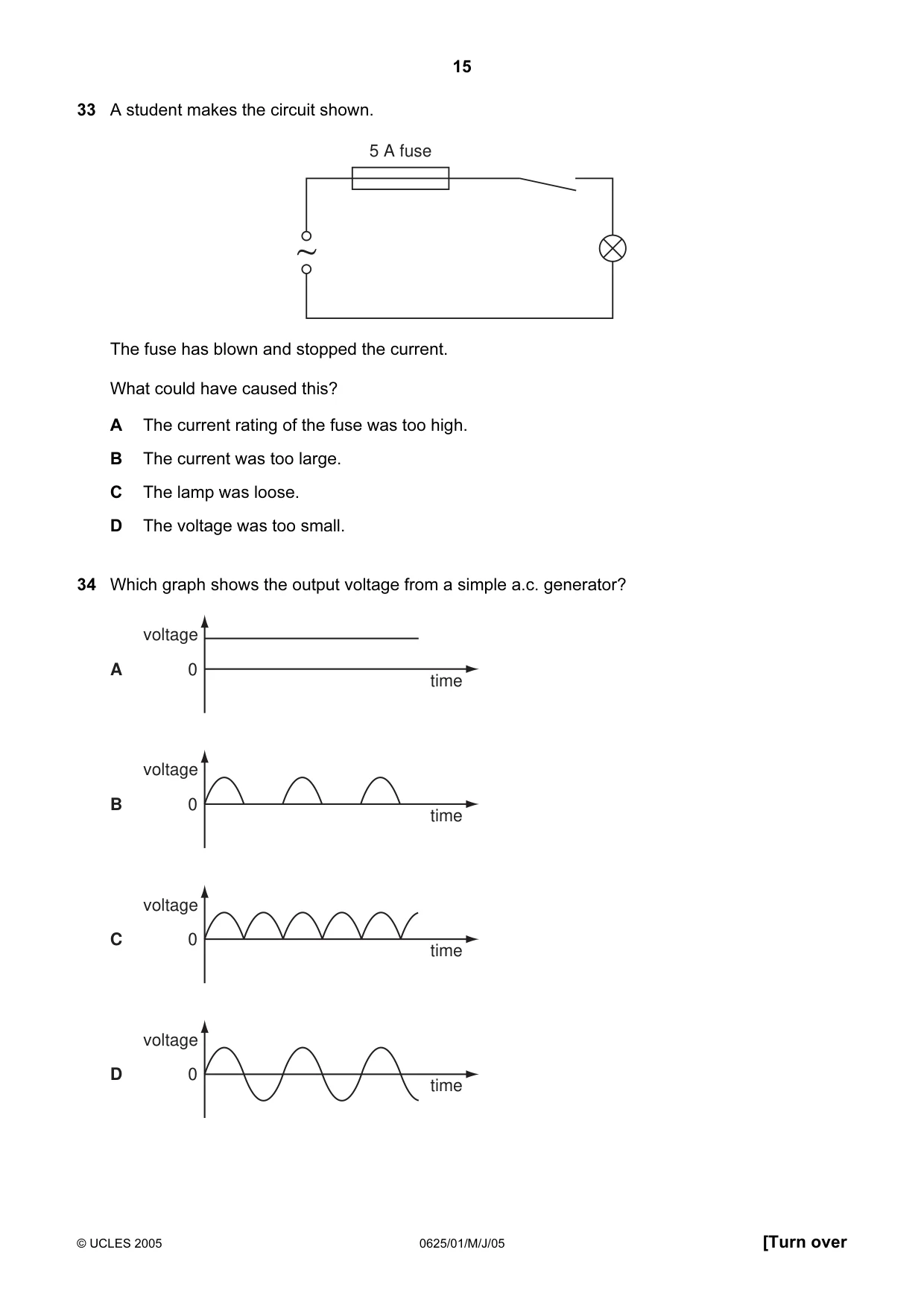
Q33 · A student makes the circuit shown
33 A student makes the circuit shown. 5 A fuse The fuse has blown and stopped the current. What could have caused this? A The current rating of the fuse was too high. B The current was too large. C The lamp was loose. D The voltage was too small.
Mark scheme: B
Q34 · Which graph shows the output voltage from a simple a.c
34 Which graph shows the output voltage from a simple a.c. generator? voltage A 0 time voltage B 0 time voltage C 0 time voltage D 0 time
Mark scheme: D
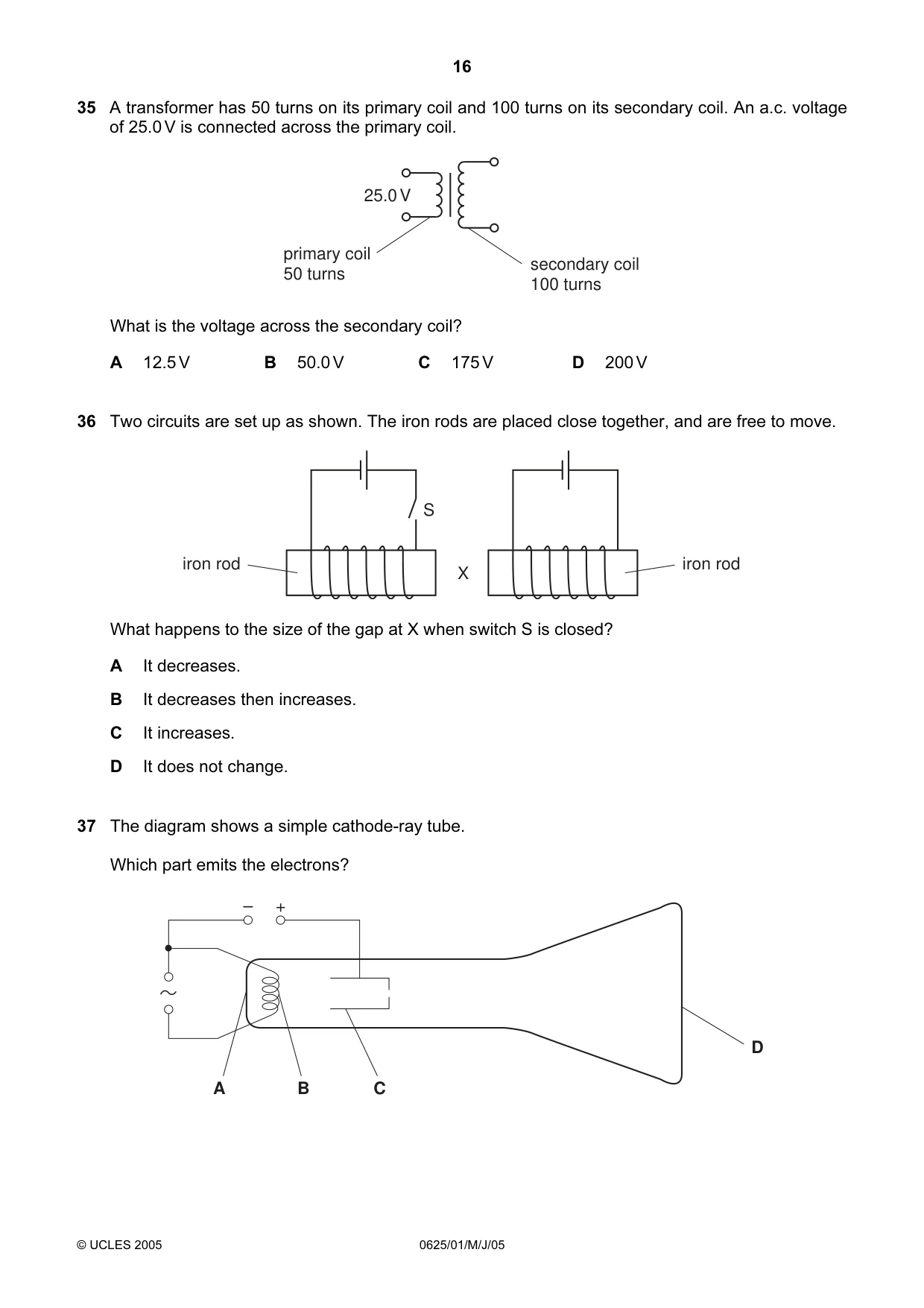
Q35 · A transformer has 50 turns on its primary coil and 100 turns on its secondary coil
35 A transformer has 50 turns on its primary coil and 100 turns on its secondary coil. An a.c. voltage of 25.0 V is connected across the primary coil. 25.0 V primary coil secondary coil 50 turns 100 turns What is the voltage across the secondary coil? A 12.5 V B 50.0 V C 175 V D 200 V
Mark scheme: B
Q36 · Two circuits are set up as shown
36 Two circuits are set up as shown. The iron rods are placed close together, and are free to move. S iron rod iron rod X What happens to the size of the gap at X when switch S is closed? A It decreases. B It decreases then increases. C It increases. D It does not change.
Mark scheme: A
Q37 · The diagram shows a simple cathode-ray tube
37 The diagram shows a simple cathode-ray tube. Which part emits the electrons? – + D A B C
Mark scheme: B
Q38 · Which type of radiation has the greatest ionising effect?
38 Which type of radiation has the greatest ionising effect? A α-particles B β-particles C γ-rays D all have the same ionising effect
Mark scheme: A
Q39 · A powder contains 400 mg of a radioactive material that emits α-particles
39 A powder contains 400 mg of a radioactive material that emits α-particles. The half-life of the material is 5 days. What mass of that material remains after 10 days? A 0 mg B 40 mg C 100 mg D 200 mg
Mark scheme: C
Q40 · In the symbol below, A is the nucleon number and Z is the proton number
40 In the symbol below, A is the nucleon number and Z is the proton number. A X Z What is represented by the symbol? A an electron B a neutron C a nuclide D an X-ray
Mark scheme: C
What was in this paper
The subtopics covered by these 40 questions, and how many questions each got. Open one in a new tab to see every Cambridge question on it.
4Electromagnetic effects4Energy, work and power3Pressure3Thermal properties and temperature3Forces2Light2Mass and weight2Motion2Radioactivity2Simple phenomena of magnetism2Sound2Density1Electrical quantities1Electrical safety1Electromagnetic spectrum1General properties of waves1Kinetic particle model of matter1Physical quantities and measurement techniques1The nuclear model of the atom1Transfer of thermal energy1